Wordless Wednesday – 04222026
A place where I post unscripted, unedited, soulless rants of a insomniac madman
I have walked through many lives,
some of them my own,
and I am not who I was,
though some principle of being
abides, from which I struggle
not to stray.
When I look behind,
as I am compelled to look
before I can gather strength
to proceed on my journey,
I see the milestones dwindling
toward the horizon
and the slow fires trailing
from the abandoned camp-sites,
over which scavenger angels
wheel on heavy wings.
Oh, I have made myself a tribe
out of my true affections,
and my tribe is scattered!
How shall the heart be reconciled
to its feast of losses?
In a rising wind
the manic dust of my friends,
those who fell along the way,
bitterly stings my face.
Yet I turn, I turn,
exulting somewhat,
with my will intact to go
wherever I need to go,
and every stone on the road
precious to me.
In my darkest night,
when the moon was covered
and I roamed through wreckage,
a nimbus-clouded voice
directed me:
“Live in the layers,
not on the litter.”
Though I lack the art
to decipher it,
no doubt the next chapter
in my book of transformations
is already written.
I am not done with my changes.
There is a lie people tell about growth.
That it happens once.
A breakthrough.
A healing season.
A clean before-and-after moment where the old self falls away and the new self arrives polished, wiser, complete.
Real life rarely moves like that.
It comes in layers.
One version of you learns how to survive.
Another learns how to protect itself.
Another becomes hard where softness once lived.
Another finally gets tired of carrying what the others built.
That’s the world Kunitz walks through in The Layers.
Not a neat story of transformation—but a lifetime of selves stacked inside one body.
Some buried.
Some unfinished.
Some still speaking.
That’s why the quote matters.
“I am not done with my changes.”
It isn’t frustration.
It’s wisdom.
Because mature people understand that becoming does not end at a certain age, after a certain heartbreak, after a certain success, after a certain failure.
You do not graduate from growth.
You keep shedding what no longer fits.
Keep grieving identities that once protected you.
Keep meeting versions of yourself you didn’t know were waiting.
Some changes feel chosen.
Others arrive like weather.
Loss changes you.
Love changes you.
Humiliation changes you.
Work changes you.
Truth changes you once you stop running from it.
And perhaps the hardest change of all is this:
Learning to stop worshiping older versions of yourself.
The stronger you.
The younger you.
The one who had more time.
The one before the damage.
The one before the mistakes.
That person had their season.
So do you.
Now.
Even unfinished.
Even uncertain.
Even mid-reconstruction.
Because the self is not a monument.
It is a landscape.
And landscapes are shaped by erosion, fire, flood, roots, seasons, and return.
There’s a truth underneath Kunitz’s words:
You are not failing because you are still changing.
You are alive enough
for the work to continue.
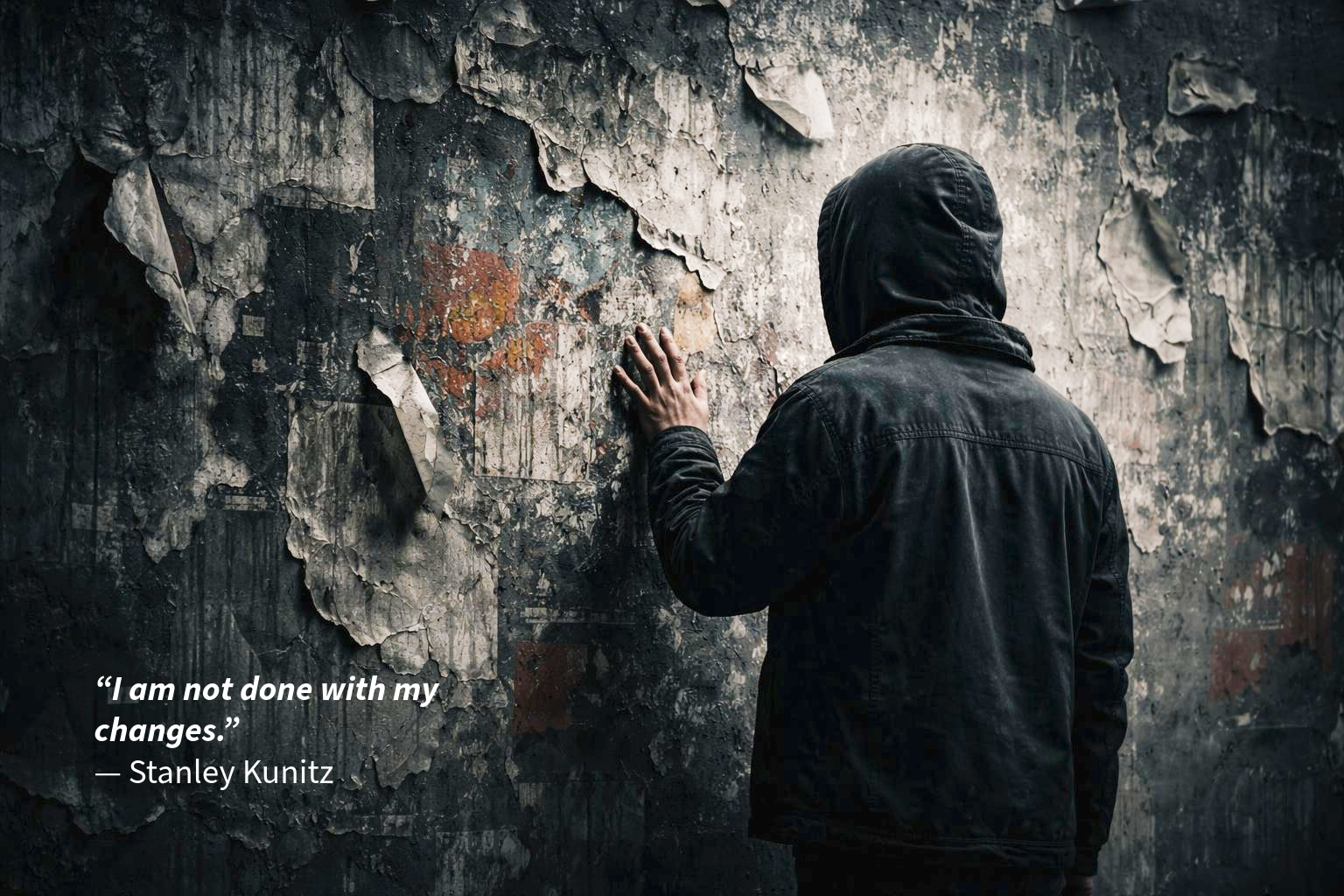
It sounds simple, almost casual. But there’s steel in it. Not done. Not finished. Not settled into a final version just because time has passed.
There’s pressure to become complete. To arrive at some stable identity and stay there. By a certain age, by a certain milestone, by the time other people decide you should have it figured out.
I’ve felt that pressure in subtle ways—the urge to explain myself as if I’m already final. To present a polished summary instead of the unfinished truth.
But life doesn’t honor neat timelines. It interrupts. It strips things down. It teaches late. Sometimes the lesson you needed at twenty arrives at fifty. Sometimes the self you defended for years quietly expires in one hard season.
Kunitz wrote this line with age behind him, which gives it extra force. He isn’t speaking from youthful possibility. He’s speaking from lived evidence.
Change is not reserved for the young. Reinvention does not expire.
And the real danger may be deciding too early that your becoming is over.
Maybe growth is less glamorous than we imagine.
Less breakthrough, more revision.
Less grand arrival, more honest correction.
Less “found myself,” more “met another layer.”
You are allowed to outgrow old versions of yourself.
You are allowed to begin again without apology.
There is no shame in still becoming.
Only in pretending you are finished when you are not.
What part of you have you declared permanent that may only be unfinished?

Mercy had opinions.
Most mornings they concerned bacon, territorial disputes with pigeons, and why rain was a personal insult aimed directly at him. But this morning he dragged me three blocks before sunrise with the focused urgency of a man who knew exactly where the body was buried.
“You weigh less than my regrets,” I told him as the leash cut tight across my palm. “This shouldn’t be physically possible.”
He never looked back.
The city before dawn always felt honest to me. No crowds. No polished storefront smiles. No daytime theater. Just wet brick, shuttered windows, and streets shining black as old scars. Rain had passed an hour earlier, leaving everything rinsed but not forgiven. Fog leaned low between buildings, thick enough to blur corners and make every alley feel like it was thinking.
My boots struck the pavement with hollow little reports. Mercy’s paws made softer sounds—quick taps, impatient and certain.
He led me down Harrow Street, left on Vale, then deeper into a neighborhood I hadn’t visited in years. That unsettled me more than I cared to admit. I knew this city the way damaged men know bars: by instinct, by smell, by where not to stand. I knew where the cheap coffee lived, where the cops parked, where grief rented rooms by the month.
Yet this stretch felt forgotten.
Tall buildings stood shoulder to shoulder like old men refusing to speak. Power lines sagged overhead. Windows watched without blinking. Even the streetlamps seemed reluctant, their amber glow thin and exhausted.
Then I saw the shelter.
It stood alone at the corner like something left behind when the rest of the world moved on.
Glass walls beaded with moisture. A cyan light buzzed overhead, cold and unnatural against the wet dark. The sign above it read:
BUS STOP – ABANDONED
“That’s comforting,” I said.
Mercy stopped so suddenly the leash jerked my arm. He planted all four paws and leaned forward, ears raised, body taut with attention.
Inside the shelter sat a woman.
Head bowed. Hair hanging like wet ink over her face. Hands folded between her knees. Motionless in the kind of stillness living people rarely manage.
My throat tightened.
The coat was the same dark one from the park. Or I wanted it to be. Memory is a crooked tailor—it keeps altering what it swears was exact.
Rain ticked against the glass.
I stepped closer, every instinct asking why.
“Excuse me?”
My voice sounded smaller than I intended.
No movement.
No answer.
Only the electric hum of the light above her and the distant hiss of tires somewhere blocks away.
Mercy gave a low whine, the sound thin and uneasy.
I moved to the shelter entrance.
The temperature dropped at once.
Not dramatically—no theatrical blast of frozen air. Just a precise, intimate cold that slipped beneath my coat and settled against the spine. The smell changed too. Wet stone. Dust. Paper. The scent of rooms closed for years.
“Who are you?”
The woman lifted her head.
Slowly.
Not with menace. Worse than menace. With patience.
I saw no face.
Where features should have been there was fog gathered into human suggestion. Hollows where eyes belonged. A shifting blur where a mouth struggled to become one. It was like watching memory try to wear skin.
Every nerve in me recoiled.
Then she spoke.
“You’re late.”
The voice struck through me clean and hard.
I stumbled backward into the rail, pain flashing through my shoulder.
Mercy barked once—sharp, furious, brave beyond proportion.
The figure turned toward him.
“Still loyal,” she said.
Then back to me.
“You never came that night.”
The world narrowed.
There are voices the body remembers before the mind does. A mother calling your childhood name. A lover whispering in the dark. The last message left on your phone that you listen to until language turns into wound.
Lena.
Not exactly her voice. Worse. Close enough.
My lungs forgot their work.
“That’s not possible.”
“No,” the figure said. “But it happened anyway.”
I felt suddenly nineteen, then thirty-five, then the age I was the morning they called to tell me she was gone. Grief doesn’t obey clocks. It stacks time like broken plates and waits for one touch to bring the whole shelf down.
“I was there,” I said, though I no longer knew if I meant the hospital, the funeral, the marriage, or the years I spent failing in smaller ways.
The cyan light above us screamed and burst.
Glass detonated outward.
I dropped over Mercy instinctively, shards striking pavement, coat, concrete with bright violent chatter. Something sliced my knuckle. Warm blood mixed with rainwater.
Then silence.
When I looked up, the bench was empty.
No woman.
No fog.
No footprints on the wet floor.
Only a single object resting where she had sat.
A brass bus token, greened with age.
I picked it up. It was colder than metal should be.
Stamped into one side were two words:
LAST ROUTE
Mercy licked the blood from my wrist once, gentle as apology.
Then he turned and stared down the street ahead, tail still, body alert.
As if this had not been the destination.
Only the first stop.

Some people think masks are things you put on.
That’s the kind of thought people have when life has been gentle with them.
The truth is harsher. More intimate. A mask is not always worn over the face. Sometimes it grows there slowly, layer by layer, until you can no longer tell where the skin ended and the protection began. Sometimes it is built from swallowed words, tightened jaw muscles, strategic silences, practiced shrugs, jokes made at the right moment, apologies offered for things that never required apology.
Sometimes the mask saves your life.
That is what makes removing it complicated.
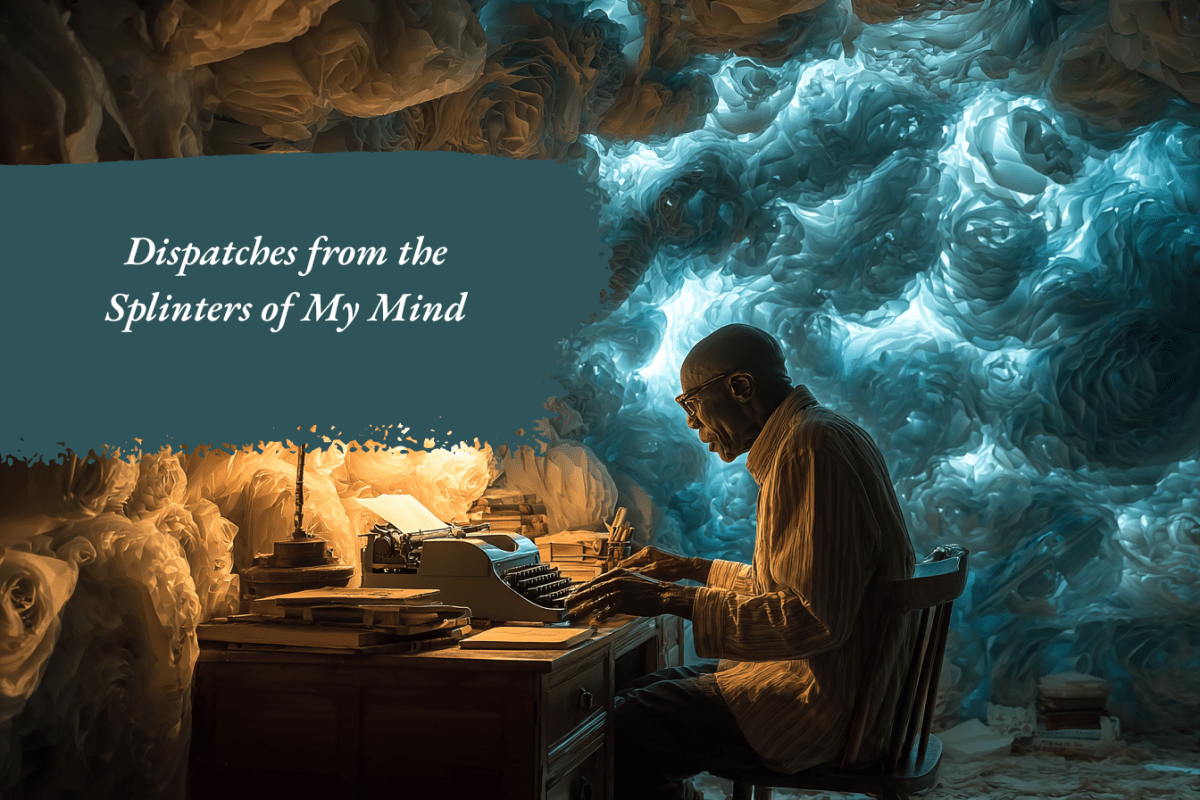
He holds the face carefully, almost reverently, as if it might bruise. Fingers spread along the temples, thumb beneath the jaw, palm cradling what once passed for composure. The surface is smooth where he has become rough. Cold where he has become hot with buried anger. Featureless where he has become crowded with history.
It resembles peace.
That resemblance is dangerous.
There are seasons of life when peace is not available, only presentation. During those seasons, you learn to construct expressions that reassure other people while abandoning yourself. You learn how to look calm while panic rearranges the furniture inside your chest. You learn how to speak evenly while grief claws at the walls. You learn how to nod, complete tasks, return emails, pay bills, shake hands, say “I’m good,” and keep moving as if motion were the same thing as healing.
It isn’t.
Motion can be another disguise.
He presses his forehead to the borrowed face. The contact is gentle enough to be mistaken for affection. But tenderness and desperation often use the same gestures. Up close, he can smell metal, dust, old oil from the weapon slung across his shoulder, the stale salt of dried sweat embedded in fabric that has outlived comfort. His own breath returns warm against his lips after striking the smooth surface of the mask. Even now, he is speaking to himself through something artificial.
There were years when that felt normal.
Years when the world demanded utility more than honesty. Years when softness had to be hidden like contraband. Years when every room seemed to ask the same silent question: Can you be useful without being complicated? He answered yes so many times it became reflex.
Usefulness gets rewarded.
Complexity gets managed.
Pain gets postponed.
And postponed pain does not disappear. It compounds interest.
So one day you wake to find yourself efficient but unreachable. Competent but numb. Surrounded but alone. You have become excellent company for everyone except the person living inside you.
That person eventually starts knocking.
Not dramatically. No thunderclap revelation. No cinematic collapse in a grocery store aisle while oranges roll in symbolic directions. It begins smaller than that. A strange heaviness when the room grows quiet. Irritation at kindness. Exhaustion after conversations that required no effort. The inability to answer simple questions like What do you want? or How are you really? without feeling like you’ve been asked to translate a dead language.
The mask still works.
That’s part of the problem.
It still earns trust. Still photographs well. Still knows when to smile, when to remain unreadable, when to offer the right amount of vulnerability to seem human without becoming exposed. It is a masterpiece of adaptive engineering.
But masterpieces can become prisons.
He studies the face in his hands as if searching for seams. There are scratches along the cheekbone. Fine cracks near the mouth. Hairline fractures where too many rehearsed reassurances were delivered through clenched teeth. The damage is subtle but cumulative. Even false things wear down under repeated use.
He remembers the first time he needed it.
Not the exact day. Trauma fogs calendars. But he remembers the sensation: a room where honesty would have been punished, a moment where fear would have invited predators, an atmosphere so charged with consequence that authenticity became a luxury item. So he reached for distance. For neutrality. For whatever expression would cost the least.
It worked.
That’s how the arrangement begins.
Survival tools are hard to retire because they come with receipts.
Look, they say. We got you through that year. Through those people. Through the nights you thought would split you open. Through funerals, betrayals, deadlines, humiliations, losses, all the little wars no one salutes. Why are you turning on us now?
And what can you say?
Thank you.
Also, you are choking me.
Both can be true.
That is the part no one teaches well: gratitude and departure can occupy the same breath. You can honor what protected you and still refuse to live inside it forever. You can acknowledge necessity without confusing it for destiny.
He lifts the face closer. Its eyes remain closed. Lucky thing.
If it opened them, what would it see? A man? A weapon? A frightened child who became strategic too early? A tired soul rehearsing strength because he no longer remembers spontaneity? Identity is less a statue than a crowd. We keep trying to choose one representative to send to the front desk.
No wonder we’re exhausted.
His hands tighten slightly. Not enough to break it. Enough to feel that he could.
Power over the mask is a new sensation. Usually it dictated terms. Usually it appeared automatically at conflict, criticism, intimacy, uncertainty. Especially intimacy. Nothing threatens armor like being seen by someone gentle. Hostility confirms the need for defense. Tenderness questions it.
That’s why some people sabotage love.
Not because they hate closeness.
Because closeness reaches for buckles.
He knows this now too late for some things and just in time for others.
There were people who tried to meet him beyond the mask. They said, in their own imperfect ways, You can come out now. He heard danger where invitation was intended. Heard exposure where safety was being offered. Heard the old alarms and obeyed them.
How many lives are shaped by outdated warnings?
The room is silent except for breath and the faint creak of fabric as he shifts. In the dark, even stillness has sound. He runs a thumb along the jawline of the face he wore to survive. Smooth. Untroubled. Almost holy in its emptiness.
But emptiness should never be mistaken for peace.
Peace has texture. Peace can cry. Peace can laugh too loud. Peace can admit confusion. Peace can say no without performance and yes without suspicion. Peace can be inconsistent because it no longer fears punishment for changing shape.
The mask can do none of these things.
It can only maintain.
And maintenance is expensive.
He lowers it slowly into his lap. The weapon hangs useless at his side, a relic from another kind of defense. For the first time in years, he allows his own face to remain unarranged. No tactical calm. No measured hardness. No curated indifference.
Just fatigue. Sadness. Relief. A little terror.
Real expressions are messy tenants.
They move furniture without asking.
He expects catastrophe. Some ancient consequence. Lightning, exile, ridicule, collapse.
Nothing happens.
The room does not punish him.
The dark does not laugh.
No tribunal emerges to revoke his membership in the tribe of the functioning.
Only breath.
Only the strange ache of muscles unclenched too late.
Only the realization that he has mistaken anticipation for reality more times than he can count.
He looks again at the face in his hands and sees it clearly now—not enemy, not fraud, not shame. A tool built under pressure by a self that wanted to live.
He bows his head.
“Thank you,” he whispers.
Then, after a pause earned the hard way:
“You can rest now.”
Somewhere inside him, locks he didn’t know existed begin to release.
Not all at once.
Enough.
by Mary Oliver
One day you finally knew
what you had to do, and began,
though the voices around you
kept shouting
their bad advice—
though the whole house
began to tremble
and you felt the old tug
at your ankles.
“Mend my life!”
each voice cried.
But you didn’t stop.
You knew what you had to do,
though the wind pried
with its stiff fingers
at the very foundations,
though their melancholy
was terrible.
It was already late
enough, and a wild night,
and the road full of fallen
branches and stones.
But little by little,
as you left their voices behind,
the stars began to burn
through the sheets of clouds,
and there was a new voice
which you slowly
recognized as your own,
that kept you company
as you strode deeper and deeper
into the world,
determined to do
the only thing you could do—
determined to save
the only life you could save.
Most suffering survives by staying unnamed.
It lives in blurred places.
The relationship that drains you but you keep defending.
The habit that is costing you but still feels familiar.
The grief you call “fine.”
The loneliness disguised as independence.
The life that fits on paper but not in the body.
As long as something remains half-seen, it keeps power.
That’s why clarity can feel violent.
When you finally see a thing as it is—not as you hoped it was, not as you explained it away, not as others told you to tolerate—it rearranges everything.
You can’t unknow it.
That’s the threshold The Journey stands on.
Mary Oliver’s speaker hears the voices calling her back. Expectations. Guilt. Obligation. The old machinery of who she was supposed to be.
But something has changed.
She sees the voices for what they are.
Noise.
And once seen clearly, they lose authority.
That’s the part people miss about transformation.
It rarely begins with courage.
It begins with recognition.
You notice the pattern.
You name the wound.
You admit the truth.
You stop romanticizing what is harming you.
Then movement becomes possible.
Not easy.
Not graceful.
Possible.
Because sight creates consequence.
Once you see the cage, staying inside becomes a decision.
Once you see the lie, repeating it becomes participation.
Once you see your own hunger, ignoring it becomes betrayal.
That’s why many people avoid clarity.
Confusion can be comfortable.
Awareness demands something.
And still—there is mercy in seeing.
Because what is seen can be grieved.
What is seen can be changed.
What is seen can be left behind.
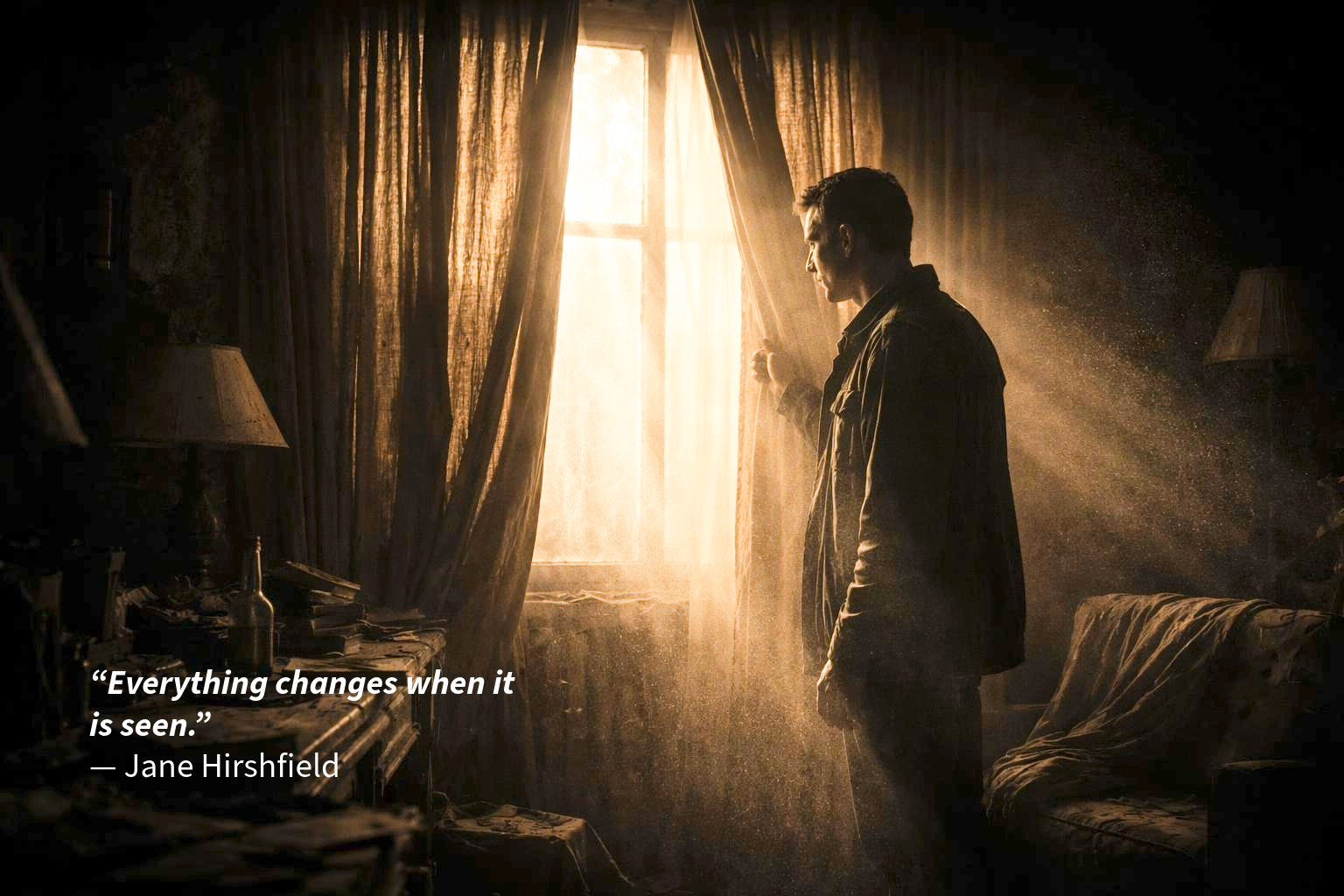
It sounds small. Almost too simple. Just noticing something shouldn’t carry that much power. Looking is passive, isn’t it? Seeing changes nothing… until it does.
There are things that survive by staying unnamed. Habits. Griefs. Quiet resentments. The way you talk to yourself when no one is around.
I’ve noticed how certain patterns lose strength the moment they are fully seen. Not solved. Not healed. Just exposed to honest light.
That sharp comment you call humor.
That exhaustion you call laziness.
That loneliness disguised as independence.
Some truths remain powerful only while blurred. They depend on distance, denial, and half-light.
Hirshfield’s line understands something subtle: awareness is disruptive. Once you truly see a thing, you can’t relate to it the same way anymore.
You may still struggle with it. You may still choose badly. But innocence is gone. Pretending becomes heavier.
Maybe seeing is the first real act of change.
Not dramatic action.
Not declarations.
Not reinvention by sunrise.
Just the clear moment when you stop lying about what is there.
A room looks different once the curtains are opened.
So does a life.
What in your life would begin to change the moment you stopped looking away from it?

The dog did not bark.
That bothered me more than barking would have.
Dogs bark at mailmen, thunder, ghosts in plumbing, and their own reflections. They bark because the world keeps arriving uninvited. But Mercy stood in the hallway each morning, silent and rigid, staring past me toward the far wall as if waiting for someone polite enough to knock.
I poured coffee into a chipped mug and watched steam rise in slow, uncertain spirals. The kitchen light hummed overhead with the tired commitment of a government employee. Rain stitched itself against the windows. Dawn came weak and colorless, like it had second thoughts.
Mercy didn’t move.
“Either there’s a murderer in the hall,” I said, “or you’re developing performance art.”
Nothing.
His ears twitched once. His eyes stayed fixed.
I carried my mug to the living room.
The apartment still looked like a place someone had paused rather than lived in. Books stacked where shelves should’ve been. A jacket slung over the chair for three weeks. Dust in the corners gathering tenure. Since Lena died, I’d become an expert at maintaining just enough disorder to call it temporary.
Then I saw the mirror.
It hung beside the old lamp near the wall—cheap frame, warped glass, bought years ago because we needed something to make the room look bigger. Now a thin crack ran from top corner to center like a vein under skin.
And in the fogged surface stood the outline of a woman.
Dark hair. Head bowed. Hands at her sides.
Still.
My coffee hit the floor before I knew I’d dropped it. Ceramic shattered. Hot liquid spread across the boards in branching rivers.
The reflection vanished.
Only me remained—wild-eyed, half-dressed, middle-aged and ridiculous.
Mercy finally padded into the room. He stepped carefully around the shards and sat beside my leg.
“You saw that,” I said.
He blinked once.
Useful.
I knelt to gather the broken pieces. My hands shook harder than I wanted to admit. One shard caught the light and for a second I saw her again—not the shape in the mirror, but the woman in the park. Her tired smile. The strange sparks moving across her coat. The way she’d said He belongs to you now.
Not He is yours.
Not Take care of him.
Belongs to you.
Like ownership could run both directions.
I wrapped the broken mug in newspaper and threw it away. Then I covered the mirror with an old bedsheet.
The room changed instantly. Smaller. Meaner.
Mercy growled.
A low sound, deep in his chest. The first noise he’d made since I found him.
The sheet moved.
Just once. Barely.
As if something behind it had exhaled.
No moon floods the memory of that night
only the rain I remember the cold rain
against our faces and mixing with your tears
only the rain I remember the cold rain
and your mouth soft and warm
no moon no stars no jagged pain
of lightning only my impotent tongue
and the red rage within my brain
knowing that the chilling rain was our forever
even as I tried to explain:
“A revolutionary is a doomed man
with no certainties but love and history.”
“But our children must grow up with certainties
and they will make the revolution.”
“By example we must show the way so plain
that our children can go neither right
nor left but straight to freedom.”
“No,” you said. And you left.
No moon floods the memory of that night
only the rain I remember the cold rain
and praying that like the rain
returns to the sky you would return to me again.
Reflection
Some memories arrive dressed in beauty.
Soft light.
Nostalgia.
The kind of distance that rounds off sharp edges and lets the past look kinder than it was.
This poem offers none of that.
No moon.
No silver wash across the scene.
No gentle light to turn pain into something poetic and easier to hold.
Just memory.
Unlit.
Exact.
Still carrying the shape of what happened.
That absence matters.
Because we often rely on beauty to make memory bearable. We frame old wounds in language polished enough to survive looking at them. We call it reflection. We call it growth. Sometimes it’s just camouflage.
Knight refuses camouflage.
He understands that some nights do not become lyrical with time. They do not mellow into wisdom on schedule. They remain what they were: moments of rupture, fear, violence, consequence, or awakening.
And the mind keeps them that way.
Not out of cruelty.
Out of function.
Because certain nights redraw the map of a life.
There is a self before them.
And another self after.
The memory remains sharp because it had to. Because forgetting would mean losing the evidence of what changed you.
That’s the harder truth underneath this poem:
Not every memory wants healing.
Some memories want accuracy.
They insist on being remembered without filters, without sentiment, without false light cast over them by time.
And maybe that honesty has its own kind of mercy.
Because when we stop trying to beautify what hurt us, we can finally understand it.
Not excuse it.
Not romanticize it.
Understand it.
That’s different.
And often, that difference is where freedom begins.
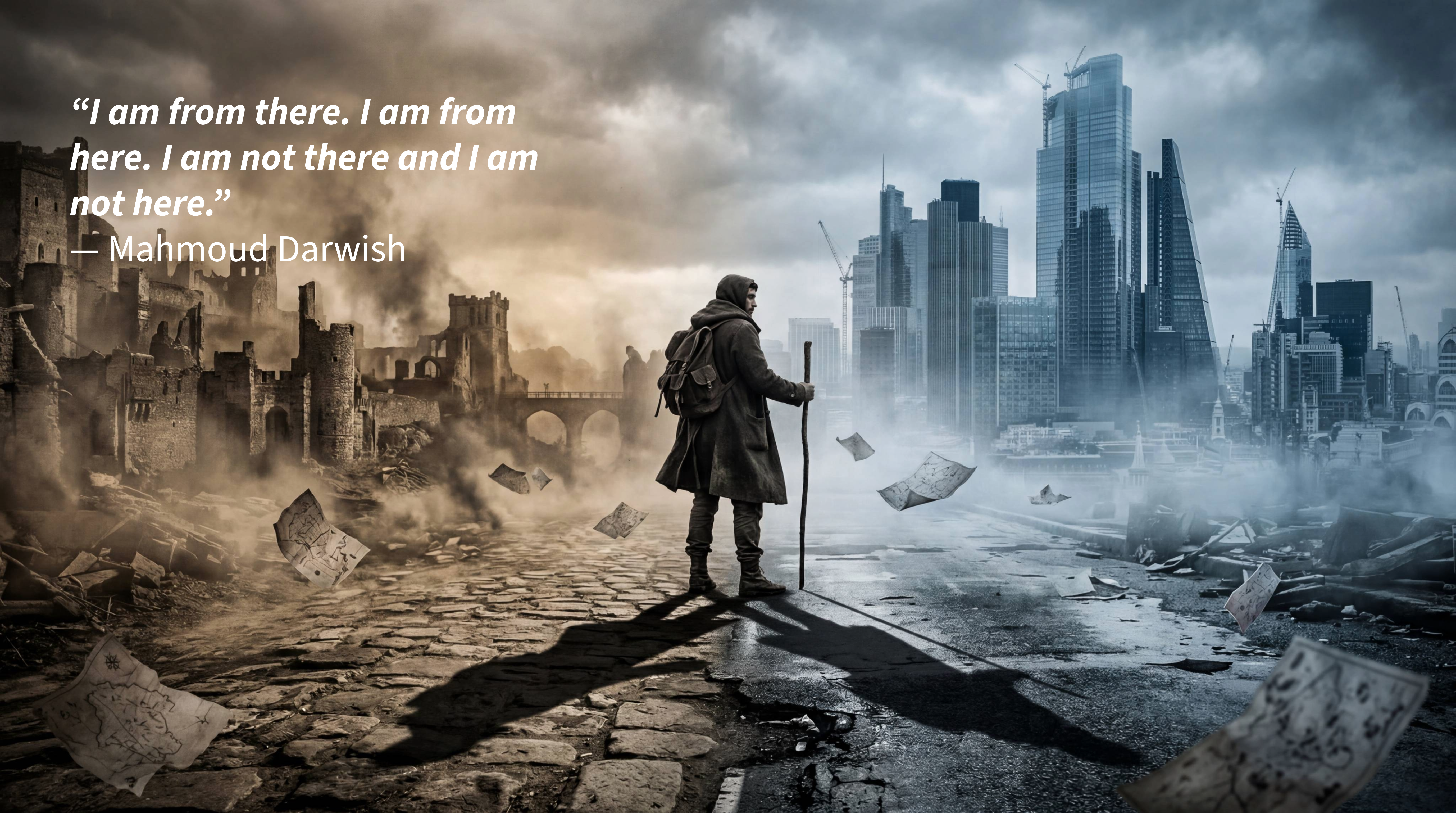
It sounds paradoxical at first—almost like contradiction for its own sake. But sit with it long enough, and it begins to feel painfully familiar. Belonging is not always a location. Sometimes it is a wound.
There are people who live between worlds even when they never move. Between cultures. Between generations. Between who they were expected to be and who they became.
I’ve known that kind of in-between space. Not fully fitting the room you came from, but never fully claimed by the room you entered. Learning to translate yourself depending on who is listening. Becoming fluent in adjustment.
From there. From here. Not there. Not here.
That rhythm feels like identity under pressure. The mind carrying multiple maps while the body stands in one place.
Darwish speaks from exile, but exile takes many forms. Sometimes it is political. Sometimes familial. Sometimes emotional. Sometimes you can sit in your own house and feel like a visitor.
And the danger of living too long in that space is forgetting you deserve belonging at all.
Maybe home is not always where you started.
Maybe it is what you build where truth can breathe.
A room.
A friendship.
A page.
A self no longer split for other people’s comfort.
Some of us inherit roots.
Some of us grow them later.
Both are real.
Where in your life have you learned to survive by splitting yourself in two?

The dog looked at me like he already knew I was lying.
I stood in the doorway with rain on my coat and mud on my boots, holding a trembling Cavalier spaniel against my chest like a confession wrapped in fur. His ears were damp silk. His heartbeat was frantic and tiny, tapping against my ribs as if he wanted out of this story before it got worse.
“Where’d you get him?” my sister asked from the kitchen.
That was the problem with family. They never ask if you’re okay. They ask logistical questions.
“Found him in the park.”
“At midnight?”
“Dogs don’t wear watches.”
She stared over the rim of her coffee mug, unimpressed. I’d always admired her discipline. If sarcasm were a martial art, she’d have been undefeated.
I dried the little animal with a towel and set him on the couch. He sat there with the solemn dignity of a retired priest. Outside, the wind dragged branches across the windows. The whole house sounded like it regretted being built.
I hadn’t meant to be in the park that late. Sleep and I had been in negotiations for months, and neither side trusted the other. So I walked. The barren trees there looked like black veins against the fog, and the path gleamed wet beneath the lamps. A place for insomniacs, widowers, and people meeting strangers they shouldn’t.
That’s where I saw her.
A woman standing in the mist, holding the dog. Dark coat. Head bowed. Hair moving in the wind like ink in water. There was something wrong with the light around her. It shimmered in blue and amber sparks, like circuitry trying to remember how to be stars.
“You look tired,” she said without turning.
“I practice.”
She smiled faintly. Some people smile with warmth. Others smile like they know the ending.
“He belongs to you now,” she said, kneeling to place the dog on the ground.
“I think you skipped several steps.”
“He’ll help.”
“With what?”
“With staying.”
Then she looked at me—really looked—and I felt the old grief inside me shift like a man waking in another room.
I took one step forward.
The fog moved.
She was gone.
No dramatic flourish. No scream of violins. Just absence. Clean and immediate.
The dog trotted to me and leaned against my leg as if this sort of thing happened all the time.
Back in the house, my sister crouched beside him. “What’s his name?”
I remembered the woman’s eyes. The tired kindness in them. The way she spoke like someone leaving instructions for a house she’d once lived in.
“Mercy,” I said.
“That’s a terrible name for a male dog.”
“Then he’ll have character.”
She rolled her eyes and carried him to the kitchen for water.
I stood alone in the living room, listening to the bowls clink, the kettle hiss, the ordinary sounds of survival.
For the first time in a long while, the silence didn’t feel like punishment.
Later that night, Mercy climbed into bed uninvited and slept against the hollow place beside me.
I dreamed of the park.
Of a woman walking deeper into the fog.
And of turning, finally, toward home.
1.
Of the gardens of Adonis, Lydia, I love
Most of all those fugitive roses
That on the day they are born,
That very day, must also die.
Eternal, for them, the light of day:
They’re born when the sun is already high
And die before Apollo’s course
Across the visible sky is run.
We too, of our lives, must make one day:
We never know, my Lydia, nor want
To know of nights before or after
The little while that we may last.
2.
To be great, be whole: nothing that’s you
Should you exaggerate or exclude.
In each thing, be all. Give all you are
In the least you ever do.
The whole moon, because it rides so high,
Is reflected in each pool.
Reflection
There’s a stage in life where you think consistency is the goal.
Be the same person everywhere.
Hold one opinion forever.
Never change enough to make anyone uncomfortable.
It sounds noble.
It’s often fear.
Because neat identities are easier to explain. Easier to market. Easier to defend. They require less courage than growth.
Whitman understood that.
When he says he contradicts himself, he isn’t confessing failure. He’s rejecting the smallness of being reduced to one version of himself.
He’s saying:
I am alive enough to evolve.
Wide enough to hold tension.
Human enough to be unfinished.
Then Pessoa enters the room and deepens the challenge.
“To be great, be whole.”
Not perfect.
Not simple.
Whole.
That’s harder than it sounds.
Wholeness doesn’t mean ironing out your contradictions until you become smooth and socially acceptable. It means integrating them honestly.
The part of you that wants solitude
and the part that wants connection.
The version of you that failed badly
and the version still trying.
The tenderness you hide
and the steel you needed to survive.
The younger self who believed everything
and the older self who knows better.
Most people spend years amputating pieces of themselves to gain approval.
Be less intense.
Less emotional.
Less curious.
Less complicated.
Less real.
Then they wonder why they feel incomplete.
Because wholeness is not achieved through subtraction.
It comes from acknowledgment.
From saying:
Yes, I have changed.
Yes, I contain conflict.
Yes, some days I am wise and other days ridiculous.
Yes, I am still becoming.
That kind of honesty threatens people who built identities out of rigidity.
But it frees everyone else.
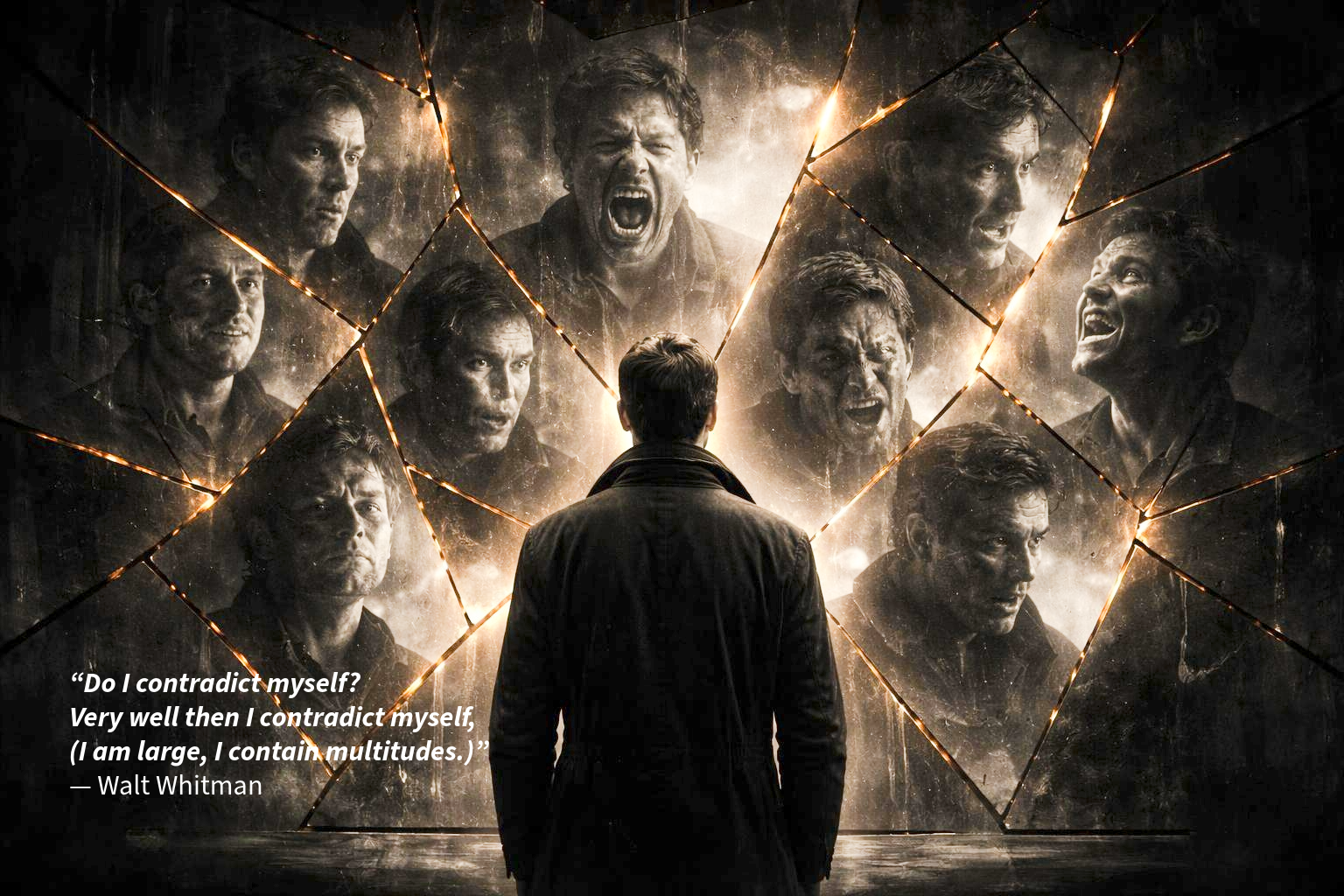
It feels bold, almost playful. Whitman shrugs at contradiction the way most people apologize for it. No defense. No embarrassment. Just a refusal to be reduced to one clean version of himself.
Most of us are trained to be consistent long before we are taught to be honest.
Pick a lane. Stay on brand. Don’t confuse people. Be the same person in every room. There’s comfort in that—for others. Predictability makes people feel safe.
But real life is messier than that.
I’ve believed opposite things in different seasons. Been strong in public and uncertain in private. Wanted solitude one day and connection the next. Carried confidence beside insecurity like they rented the same apartment.
That doesn’t make a person fake. It makes them alive.
The pressure to appear coherent can become its own prison. You start trimming complexity just to remain understandable. You deny growth because it clashes with yesterday’s version of you.
Whitman breaks that cage open. Contradiction, in his hands, becomes evidence of depth rather than failure.
Maybe maturity isn’t becoming simpler.
Maybe it’s becoming spacious enough to hold what doesn’t match.
Strength and tenderness.
Certainty and doubt.
Past self and present self.
You do not owe the world a perfectly edited identity.
Sometimes the truest thing about you
is that you are still changing.
What contradiction in you have you treated like a flaw instead of proof of growth?

She played records the way some people confess—slowly, carefully, with one hand trembling where nobody could see it.
The bar was called The Lantern, which felt like a joke the owner had long since stopped explaining. Nothing inside it had looked bright in years. Amber bulbs hung low in stained glass shades, throwing tired halos across warped wood and cracked mirrors. Smoke from decades ago still seemed trapped in the walls, mixed now with the scent of bleach, stale beer, wet wool coats, and the faint medicinal bite of cheap gin. The floor stuck to your shoes in places, as if the room wanted to keep something from leaving.
I came there on Thursdays because Thursday was when she worked.
I told myself it was for the music.
That was the kind of lie a man can live inside if he keeps it modest.
Nobody knew much about her. They called her June because somebody once did and she never corrected them. Maybe that was her name. Maybe it was the month she buried a version of herself. Maybe it was just easier to let strangers label you than explain the truth. In places like The Lantern, names were less identity than camouflage.
She stood behind the turntables dressed in black mesh sleeves and dark fabric that caught the light only when she moved. Silver rings flashed on her fingers. Headphones rested around her neck like a doctor’s instrument for diagnosing dead things. Her short blonde hair curled at the edges as though it had opinions of its own. There was nothing flashy about her, nothing begging to be seen.
Which made everyone look.
Her hands were the first thing I noticed. They moved with the patience of someone who had once ruined everything by rushing. She touched knobs, sliders, and vinyl with the care of a woman handling old wounds. Each motion deliberate. Each pause earned.
She never looked at the crowd.
That was part of the magnetism.
Most people who perform want hunger in the room. They want applause, attention, proof they exist. She seemed interested in the opposite. Distance. Control. The ability to give people feeling without giving them herself.
When she blended one record into the next, the room changed temperature. You could feel it happen. Shoulders loosened. Bitter couples found reasons to lean closer. Men who had spent all day being ignored stood a little straighter, remembering they once had names too. Women laughed from somewhere deeper than politeness. The bartender polished glasses slower, like even he knew interruptions could be a kind of violence.
And me?
I watched her the way lonely men watch storms through windows—awed, safe, and secretly wishing for damage.
I tried not to make a habit of it. Failed elegantly.
There was something in the way she kept her eyes lowered. Not shyness. Not fear. It looked more like discipline. Like she knew eye contact was expensive and had stopped spending it on strangers.
She caught me staring once.
Her gaze lifted and landed on me with the clean precision of a blade set on a table. No smile. No annoyance. No invitation. Just a long, measuring look that made me feel counted, weighed, and found unremarkable.
Then she dropped the needle on a song so bruised and beautiful it sounded like regret learning how to dance in heels.
The bass rolled through the floorboards into my legs. Cymbals shimmered like broken glass in warm light. A woman somewhere near the back exhaled sharply, as if the song had touched a memory she’d hidden badly.
I stayed until closing.
Chairs were flipped upside down onto tables. Cash drawers clicked shut. Neon signs buzzed themselves tired. The room emptied in stages, like people leaving church uncertain whether they’d been forgiven.
She packed records into a scarred milk crate, sliding sleeves into place with reverence.
“You take requests?” I asked.
My voice sounded too loud in the near-empty room.
“Not from strangers.”
Her voice was low, roughened at the edges, the kind of voice that suggested cigarettes, secrets, or surviving.
“We’ve seen each other for months.”
“That just means you’re a familiar stranger.”
There are lines that flirt. Lines that wound. That one simply told the truth.
I nodded toward the final record still spinning in the silence of its own groove. “What was that last track called?”
She paused. One hand resting on the crate handle. The other lightly touching the platter as it turned.
For a moment, something crossed her face. Sadness maybe. Or memory. Sometimes they wear the same coat.
“Some songs are safer unnamed.”
I wanted to ask who hurt her. I wanted to ask who she hurt back. I wanted to ask what kind of life teaches a person to ration tenderness like wartime sugar.
Instead, I said nothing.
Wisdom arrives late, but it still counts.
She lifted the crate and walked past me, carrying enough music to ruin or save a person. As she passed, I caught the scent of rainwater, vinyl sleeves, and a perfume so faint it might have been imagined.
At the door she stopped.
Without turning around, she said, “You should stop coming here for me.”
The sentence landed clean and deep because it was accurate.
“Why?”
“Because I only know how to speak in songs.”
Then she opened the door.
Cold air rushed in smelling of wet pavement, exhaust, and dawn still hiding somewhere down the block. It moved through the room like bad news.
Then she was gone.
I still go on Thursdays.
I sit in the same booth with the cracked red vinyl and order the same bourbon I sip too slowly. Sometimes another DJ fills in. Sometimes the turntables stay dark.
Some habits aren’t hope.
Some are grief wearing better clothes.
Some are the shape hope leaves behind when it finally gets tired of waiting.
Who first said “false as dreams?” Not one who saw
Into the wild and wondrous world they sway;
No thinker who hath read their mystic law;
No Poet who hath weaved them in his lay.Else had he known that through the human breast
Cross and recross a thousand fleeting gleams,
That, passed unnoticed in the day’s unrest,
Come out at night, like stars, in shining dreams;That minds too busy or to dull to mark
The dim suggestions of the noisier hours,
By dreams in the deep silence of the dark,
Are roused at midnight with their folded powers.Like that old fount beneath Dodona’s oaks,
That, dry and voiceless in the garish noon,
When the calm night arose with modest looks,
Caught with full wave the sparkle of the moon.If, now and then, a ghastly shape glide in,
And fright us with its horrid gloom or glee,
It is the ghost of some forgotten sin
We failed to exorcise on bended knee.And that sweet face which only yesternight
Came to thy solace, dreamer (did’st thou read
The blessing in its eyes of tearful light?)
Was but the spirit of some gentle deed.Each has its lesson; for our dreams in sooth,
Come they in shape of demons, gods, or elves,
Are allegories with deep hearts of truth
That tell us solemn secrets of ourselves.
Dreams don’t arrive with permission.
They slip in quietly—between moments, between responsibilities, between the version of yourself you’ve learned to be and the one you haven’t fully faced yet.
That’s what makes them dangerous.
Not because they’re unrealistic.
But because they’re honest in a way waking life rarely allows.
Dreams doesn’t treat them as fantasies to chase blindly.
It treats them as something more complicated—something that both reveals and unsettles.
Because a dream doesn’t just show you what you want.
It shows you what you’re missing.
And that realization doesn’t always feel inspiring.
Sometimes it feels like distance.
Like standing in two places at once—one foot in the life you’ve built, the other reaching toward something that doesn’t quite exist yet, or maybe never will.
That tension is where the poem lives.
We like to believe dreams are meant to guide us.
That they point toward something attainable, something waiting for us if we just move in the right direction.
But Timrod suggests something quieter—and harder to sit with:
That dreams don’t always exist to be fulfilled.
Sometimes they exist to remind you of the gap.
Between who you are
and who you imagined you might become.
That gap can do one of two things.
It can push you forward—force you to question, to move, to refuse to settle for something that no longer feels aligned.
Or it can become something you learn to live around.
A quiet ache.
A persistent awareness that there’s more… even if you never quite reach it.
And maybe that’s the part we don’t talk about enough.
That not every dream is meant to resolve.
Some stay with you—not as a destination, but as a kind of internal compass.
Not telling you where to go…
but reminding you that where you are isn’t the whole story.
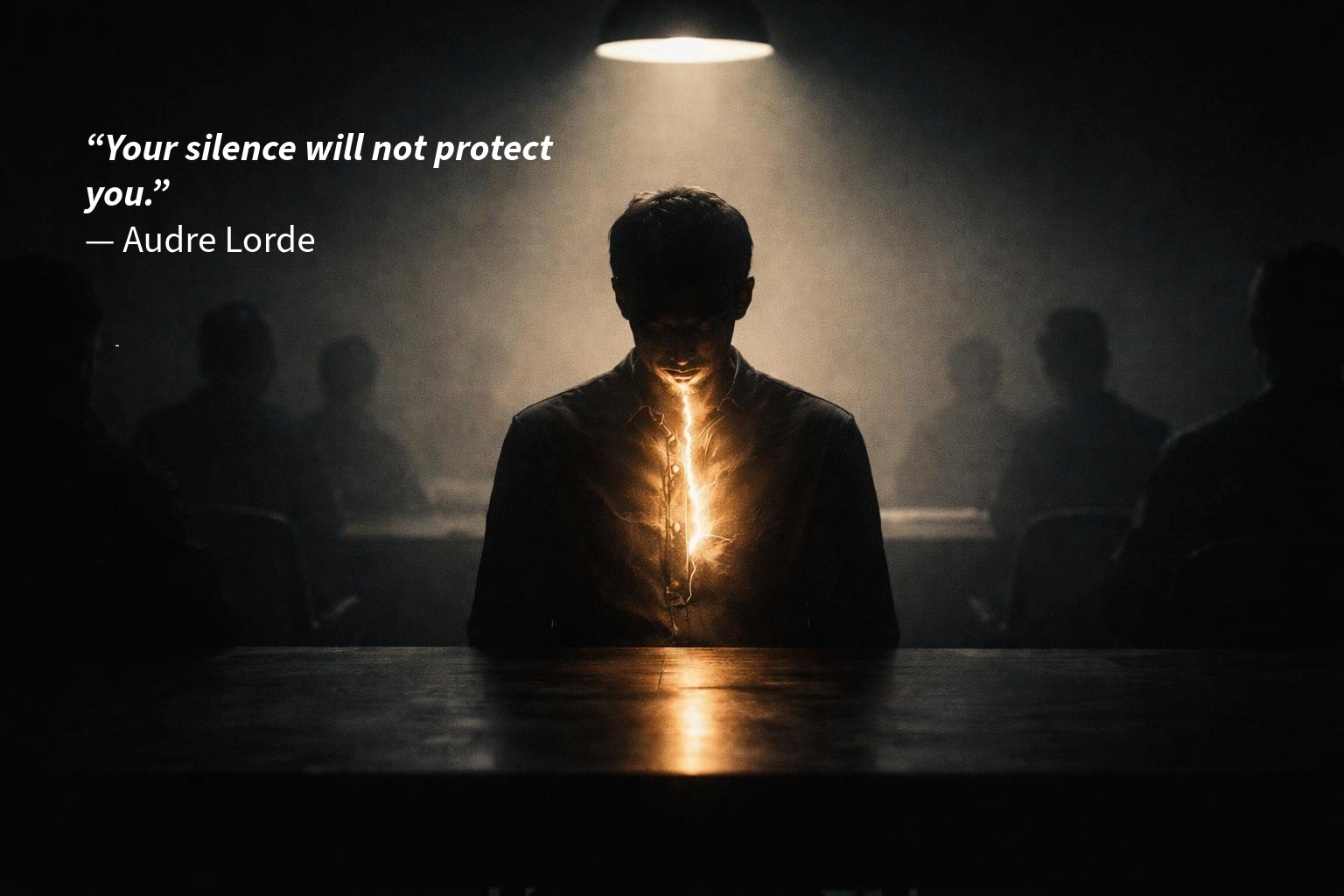
It lands like a warning with no extra padding. Clean. Direct. Uncomfortable. The kind of truth people recognize immediately and still spend years avoiding.
Silence can feel intelligent. Strategic. Mature, even.
I’ve mistaken it for strength before—saying nothing to keep the peace, swallowing what needed air, convincing myself restraint was the wiser path. Sometimes it was. Sometimes silence is discipline.
But other times, silence is fear wearing respectable clothes.
It’s the meeting where you let something slide. The relationship where you keep shrinking to avoid friction. The family table where everyone knows the truth, but no one wants to be the one who says it first.
That kind of silence has a cost. It doesn’t remove conflict—it relocates it inward. Into the jaw clenched at night. Into the stomach turning before a phone call. Into the slow corrosion of self-respect.
Lorde understood that. Silence doesn’t guarantee safety. It often guarantees only that you suffer privately while the thing remains untouched.
And private suffering has a way of becoming habit.
Speaking up doesn’t always save you.
It may cost comfort. It may cost approval. It may cost the version of life built around avoidance.
But silence charges interest too.
Maybe courage isn’t loudness.
Maybe it’s finally saying the one honest sentence you’ve rehearsed a hundred times in your head.
And letting the room change because of it.
What truth have you been protecting others from at the expense of yourself?

The city always sounded tired after midnight.
Not quiet—never quiet. Quiet would have required mercy. This place had none left to spare. It groaned instead. Tires whispered over wet asphalt like men sharing bad secrets. Sirens bled somewhere distant, too far to save anyone, close enough to remind you saving was still marketed as a service. Neon signs buzzed with the stubbornness of dying insects. Steam rose from sewer grates in pale ribbons, carrying the smell of rust, grease, and old heat. Even the rain felt used twice already.
I saw her first in the reflection.
Not the woman herself. The suggestion of her. Her face stretched across a rain-slick storefront window, fractured by rivulets of water and scratches in the glass. Eyes lowered. Mouth set in that careful line people wear when they’ve learned emotion can be used against them. Headphones covered her ears like armor. Inside the dark contour of her silhouette, blue bars of light climbed and dropped in rhythm—an equalizer pulsing where a heart should’ve been.
I turned.
She stood beneath the awning of a shuttered electronics store, ten feet away, hands in the pockets of a black coat gone shiny at the seams. Rain had threaded itself through her hair, clinging there in silver strands. The kind of face painters fail at because symmetry would have ruined it.
“You staring,” she said.
Her voice was low, smoke-bruised, with the flat calm of someone who no longer wasted tone on strangers.
“You hiding badly,” I said.
That earned half a smile.
Half smiles are dangerous. Full smiles tell the truth or a practiced lie. Half smiles invite you to finish the sentence yourself.
I stepped beside her. The wind carried the cold off her coat. Wet wool. Faint cigarette ash. Beneath that, something clean and nearly erased—soap, maybe. The scent of somebody still trying, despite evidence.
The sidewalk reflected blue light in torn ribbons. Pedestrians passed us with collars up and faces tucked inward, each person carrying a private storm in public.
“What are you listening to?” I asked.
“The dead.”
“Good bass line?”
“Terrible advice.”
She handed me one side of the headphones.
The padding was warm from her skin.
I expected music. Some bruised jazz trumpet. Piano that sounded like regret climbing stairs. Maybe synth-pop for people who collect emotional damage as a hobby.
Instead: voicemail.
Voices layered over static.
A man apologizing with the urgency of someone who had just discovered consequences. A woman saying goodbye in a tone that wanted to mean later but knew better. A child laughing somewhere far back in the mix, clean and bright enough to hurt. Another voice whispering come home as if the words themselves were kneeling.
Underneath it all ran a low mechanical hum, steady as a train entering a tunnel.
I pulled the headphone away.
The rain hit harder, ticking against the awning like impatient fingers.
“What is this?”
“Everything people wanted to say after they ran out of time.”
She said it casually, but grief always sounds casual once it gets old enough.
I looked at the crowd moving through the street. Silhouettes in the blue wash of storefront light. Shoes splashing through puddles. Faces lit by phones, by cigarettes, by nothing at all. Nobody looking up. Nobody looking inward either, if they could help it.
Whole lives collapse because people commit themselves to surface level.
“You collect these?” I asked.
“I inherit them.”
“From who?”
She turned then, and really looked at me.
Her eyes held that clear, weathered emptiness you only get after surviving several versions of yourself. Not sadness exactly. Sadness is young. This was older. This was what remains after sorrow pays rent too long.
“From people who mistake me for someone who can help.”
There are nights instinct tells you to leave. Then there are nights loneliness outvotes instinct by a landslide.
“Can you?” I asked.
She touched the side of the headphones.
A small gesture. Tender almost.
“No,” she said. “But I can make sure they’re heard.”
The bus I’d been waiting on hissed to the curb, brakes exhaling like old lungs. Doors folded open. Light spilled across the pavement in a tired rectangle.
I turned for one second.
Just one.
Long enough to consider warmth. Routine. The small narcotic of going home unchanged.
When I looked back, she was gone.
No footsteps. No retreating figure. No cinematic miracle. Just absence.
The bench beside me held the headphones.
Rain steamed faintly off the cushions. They were still warm.
I sat. My knees complained. My coat soaked through at the shoulders. Somewhere nearby, a bottle rolled in the gutter with the hollow sound of something empty rehearsing itself.
I put them on.
Static bloomed first.
Then my own voice.
Raw. Unperformed. The voice people use only in dark rooms and prayer.
Begging for things I had never admitted I’d lost.
Names I still carried like shrapnel.
Promises I pretended not to remember.
And underneath it all, quieter than breath—
the sound of me trying not to break.
I am fevered with the sunset,
I am fretful with the bay,
For the wander-thirst is on me
And my soul is in Cathay.There’s a schooner in the offing,
With her topsails shot with fire,
And my heart has gone aboard her
For the Islands of Desire.I must forth again to-morrow!
With the sunset I must be
Hull down on the trail of rapture
In the wonder of the sea.
There’s a certain kind of leaving that feels like freedom.
Wind at your back.
Nothing tying you down.
The open promise of somewhere else—anywhere else—waiting just beyond the horizon.
The Sea Gypsy leans into that feeling.
But not in the way people like to pretend.
Because this isn’t clean freedom.
It’s not the kind that comes from clarity or purpose.
It’s driven by something else.
Restlessness.
That quiet, persistent sense that staying where you are is no longer an option—not because something is chasing you… but because something inside you won’t sit still.
And that’s harder to explain.
There’s no single moment that forces the decision.
No clear reason that justifies it.
Just a growing awareness:
You don’t belong here anymore.
Or maybe you never did.
So you go.
Not with a plan.
Not with certainty.
Just movement.
And for a while, that movement feels like relief.
Distance creates space.
Space creates the illusion of control.
You tell yourself that whatever you left behind—whatever didn’t fit, didn’t work, didn’t make sense—will sort itself out once there’s enough ocean between you and it.
But the sea has a way of stripping things down.
Out there, there’s nothing to hide behind.
No noise to distract you.
No structure to lean on.
Just you… and the same questions you thought you could outrun.
That’s where the poem turns.
Because the horizon never gets closer.
It keeps its distance.
Always just out of reach.
And the longer you chase it, the more you start to realize:
Maybe the point was never to arrive.
Maybe it was to keep moving.
Not because movement solves anything—
but because stillness forces you to face what you’ve been avoiding.
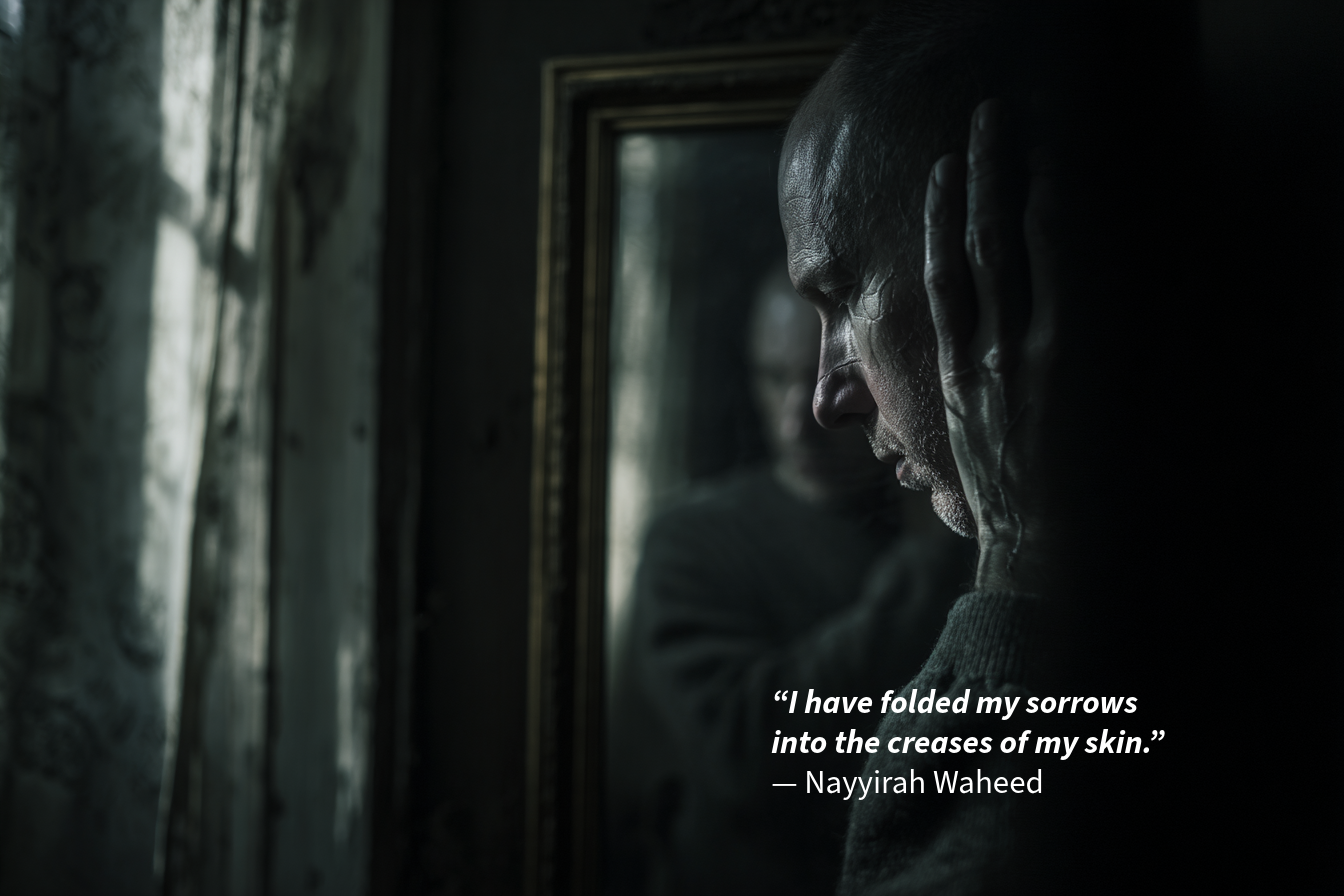
It feels quiet, almost whispered. Not dramatic grief—lived grief. The kind that doesn’t announce itself because it has already settled in.
Some pain doesn’t stay in memory. It moves into the body.
I’ve felt that in ways that are hard to explain—the tightness in the shoulders after carrying too much too long, the exhaustion that sleep doesn’t fix, the jaw clenched for reasons the day itself didn’t cause.
We talk about sorrow like it’s emotional, as if it lives only in thought. But the body keeps records the mind tries to misplace. It stores old alarms, unfinished losses, names you don’t say anymore.
That’s what makes certain moments strange. A smell, a song, a hallway light hitting the floor the wrong way—and suddenly something buried rises without asking permission.
Waheed’s line understands that grief can become architecture. Not visible to everyone, but built into how you move, how you brace, how you rest.
And once it’s there, healing isn’t just about feeling better.
It’s about learning new ways to inhabit yourself.
Maybe the marks we carry aren’t proof that we failed to move on.
Maybe they’re proof that we survived what tried to stay.
Not everything leaves cleanly.
Not everything should.
Some things become part of your shape—
and still, you keep becoming more than what hurt you.
What emotion have you been carrying in your body longer than you’ve admitted?

I met them in the hour when memory loosens its tie and starts speaking honestly.
The hall sat on a side street like an old secret too stubborn to die. Marble steps worn shallow by generations of polished shoes. Brass handles gone dull from anxious hands. Inside, the air carried layers of time—dust in the curtains, lemon oil on the wood, old perfume trapped in velvet, and the faint metallic scent of rain brought in on coats. People filed in quietly, wearing the practiced faces adults use when they want to seem composed. You could feel the loneliness under the fabric.
I took a seat near the back. Men like me learn to love exits.
The stage was bare except for two chairs, two stands, and a single pool of amber light. No flowers. No grand drapery. No nonsense. It looked less like a concert and more like a confession waiting to happen.
Then they stepped out.
Two women in black, moving with the calm precision of people who had survived things no one applauds. They stood back to back without touching, close enough to feel each other’s heat, far enough to remain sovereign.
The first woman wore spring and winter as if contradiction were simply another form of elegance. Cherry blossoms threaded her hair, soft pink against dark fabric, while frost seemed to gather at the hem of her dress and along the edge of her sleeves. Beauty and warning in equal measure.
The second carried summer and autumn in the angle of her jaw and the stillness of her shoulders. Warm gold light seemed to cling to her skin. Leaves circled low around her feet, turning slow in an invisible current. She looked like the last warm day before everything changes.
No host. No speech. No theatrical grin asking us to love them.
They lifted their bows.
The first note entered the room like a blade slipped between ribs.
I have heard music in bars where laughter was mostly camouflage. In churches where people negotiated with heaven. In cheap apartments through thin walls while someone tried to keep from breaking. I have heard songs used as seduction, sedation, distraction, branding. But this was not entertainment.
This was excavation.
Spring came first.
It smelled of wet soil, cut stems, windows opened after a long winter. It carried the bright stupidity of hope—the kind that makes you believe apologies matter, that timing can be corrected, that love is just effort with better lighting. I thought of a woman I once almost married. We had mistaken wanting for wisdom. We kissed like architects while the foundation cracked beneath us.
Then winter answered.
Its notes were clean, severe, almost merciful in their honesty. Frost across a windowpane. Hospital corridors at dawn. The silence after someone says what they really mean. I remembered funerals where casseroles outnumbered truth. I remembered the years I wore toughness like armor, not noticing armor freezes to the skin after long enough.
Summer rose next from the woman behind her.
Warmth rolled through the hall like sunlight through blinds. It tasted of porch beer sweating in the bottle, skin salted by heat, city asphalt after sundown, laughter shouted across yards. It was youth with its collar open. It was the old arrogance of believing there would always be another June.
Then autumn stepped forward.
Dry leaves skittered across the stage in widening circles. Her tone held smoke, distance, and the grace of surrender done properly. Not collapse. Not defeat. The mature art of release. I thought of the selves I had already outlived—the angry boy, the performing man, the cynic who called numbness intelligence. Some identities don’t die dramatically. They flake off quietly when no one is looking.
Still, the women never turned.
They did not glance back for approval, cue, or reassurance. Their trust was older than eye contact. Their distance held intimacy deeper than touch. That bothered me more than it should have. Most of us spend our lives begging to be seen while never learning how to stand beside another soul without consuming it.
The music swelled.
Blossom met frost. Heat pressed against decay. Joy dragged grief into the light and made it dance. It sounded like marriage, divorce, birth, burial, relapse, forgiveness, rent due Monday, coffee at sunrise, a hand reached out too late, another reached out just in time. It sounded like being alive without edits.
I felt my throat tighten.
There are moments when art stops flattering you and starts indicting you. This was one of them. I saw how often I had mistaken control for strength. How often I kept one foot out the door so I could call abandonment strategy. How often I blamed the weather for storms I personally financed.
The final note landed and kept vibrating in the wood beneath our shoes.
No one moved.
The room was so still I could hear someone crying three rows ahead, trying to do it politely. Somewhere else, a man cleared his throat like that would restore dignity.
When the lights rose, the stage was empty.
No encore. No names. Two abandoned chairs and a hundred people suddenly aware of their own unfinished lives.
Outside, the night air was mild and impossible to classify. Warm breeze, cold edge. Rain smell, dry pavement. The sky itself undecided.
I laughed hard enough to fog the dark.
Of course.
Even the weather refused to pick a side.
Little Orphant Annie's come to our house to stay,
An' wash the cups an' saucers up, an' brush the crumbs away,
An' shoo the chickens off the porch, an' dust the hearth, an' sweep,
An' make the fire, an' bake the bread, an' earn her board-an'-keep;
An' all us other children, when the supper-things is done,
We set around the kitchen fire an' has the mostest fun
A-list'nin' to the witch-tales 'at Annie tells about,
An' the Gobble-uns 'at gits you
    Ef you
        Don't
            Watch
                Out!

Wunst they wuz a little boy wouldn't say his prayers,--
An' when he went to bed at night, away up-stairs,
His Mammy heerd him holler, an' his Daddy heerd him bawl,
An' when they turn't the kivvers down, he wuzn't there at all!
An' they seeked him in the rafter-room, an' cubby-hole, an' press,
An' seeked him up the chimbly-flue, an' ever'-wheres, I guess;
But all they ever found wuz thist his pants an' roundabout:--
An' the Gobble-uns 'll git you
    Ef you
        Don't
            Watch
                Out!
An' one time a little girl 'ud allus laugh an' grin,
An' make fun of ever' one, an' all her blood-an'-kin;
An' wunst, when they was "company," an' ole folks wuz there,
She mocked 'em an' shocked 'em, an' said she didn't care!
An' thist as she kicked her heels, an' turn't to run an' hide,
They wuz two great big Black Things a-standin' by her side,
An' they snatched her through the ceilin' 'fore she knowed what she's about!
An' the Gobble-uns 'll git you
    Ef you
        Don't
            Watch
                Out!
An' little Orphant Annie says, when the blaze is blue,
An' the lamp-wick sputters, an' the wind goes woo-oo!
An' you hear the crickets quit, an' the moon is gray,
An' the lightnin'-bugs in dew is all squenched away,--
You better mind yer parunts, an' yer teachurs fond an' dear,
An' churish them 'at loves you, an' dry the orphant's tear,
An' he'p the pore an' needy ones 'at clusters all about,
Er the Gobble-uns 'll git you
    Ef you
        Don't
            Watch
                Out!
It begins softly.
Almost too softly to question.
A child. A presence. Something delicate, half-seen, hovering just beyond the edge of certainty. The kind of moment you might dismiss as imagination—until you realize how much weight it carries.
Because this poem isn’t really about a child.
It’s about distance.
The slow, quiet kind that doesn’t announce itself. The kind that looks like stillness from the outside, but feels like drifting from within.
That’s what makes it unsettling.
Nothing violent happens.
Nothing breaks.
And yet… something is slipping.
The “elf child” exists in that in-between space—part of the world, but not fully anchored to it. Present, but unreachable. Seen, but not understood.
And if you sit with it long enough, the question starts to turn inward:
How far can someone drift before they’re no longer fully here?
We tend to romanticize imagination. Call it wonder. Escape. A refuge from the weight of things we don’t want to face.
And sometimes it is.
Sometimes it’s the only thing that makes the world bearable.
But there’s another side to it.
A quieter one.
The part where retreat becomes habit.
Where silence replaces connection.
Where being “elsewhere” starts to feel safer than being present.
That’s where the poem lingers.
Not in fantasy—but in the cost of it.
Because the further you drift, the harder it becomes to return.
Not because the way back is gone…
but because something in you has grown used to the distance.
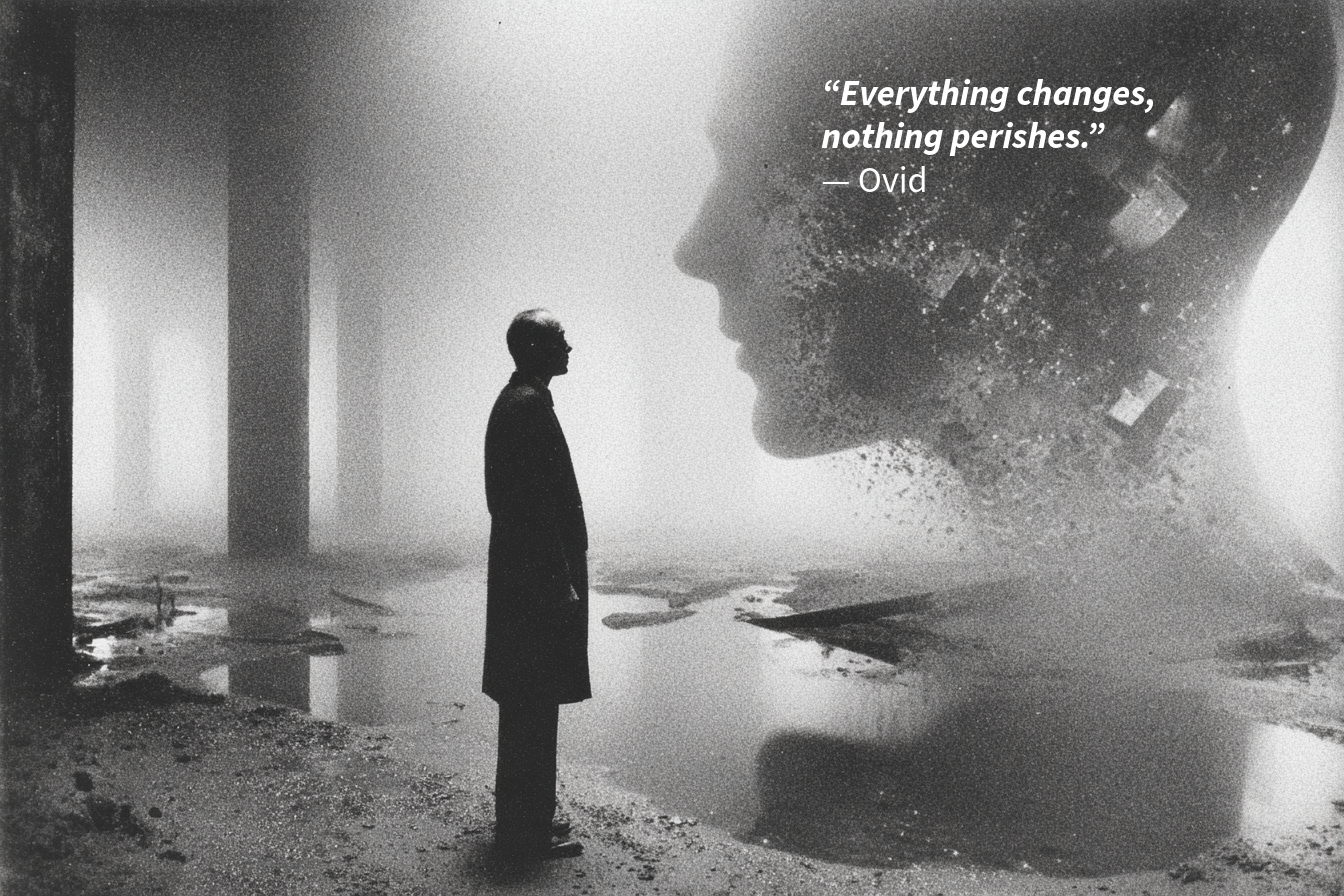
It reads almost like reassurance. Nothing is lost, just transformed. A clean way to look at change—something that makes it feel less final, less absolute.
But change doesn’t feel clean when you’re in it.
I’ve watched things shift in ways I didn’t expect—relationships, routines, parts of myself I thought were fixed. Not disappearing, just… becoming something else.
That’s the part that unsettles you. Not the loss, exactly—but the recognition. Seeing something familiar take on a shape you don’t recognize anymore.
We like to believe things end neatly. That there’s a clear line between what was and what is. But most of the time, it’s not like that. It overlaps. It lingers. It carries pieces forward whether you want it to or not.
Ovid doesn’t offer comfort here—he offers perspective. Nothing perishes. It just refuses to stay the same.
Which means you don’t get to hold onto anything exactly as it was. Not people. Not moments. Not even yourself.
Maybe the point isn’t to stop change.
Maybe it’s to understand what it leaves behind.
Because even when something shifts…
something of it remains.
Not identical.
Not untouched.
But present.
And learning to recognize that—
that might be the only way to keep moving without feeling like everything is lost.
What in your life has changed shape—but never truly left you?
The Architecture of Her Lies – Part III
I knew something had changed the moment I looked at her and felt pity.
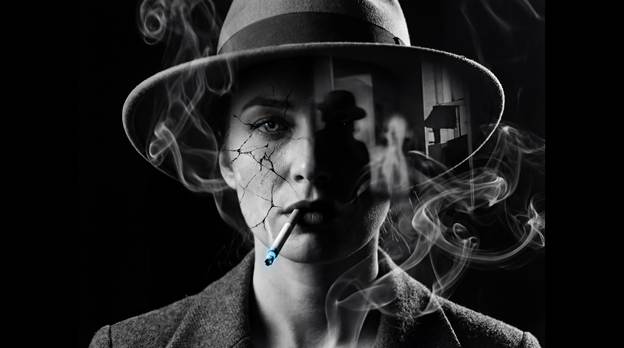
Up until then she had been danger dressed for evening. Smoke wrapped in silk. A knife taught manners. Every line of her had suggested precision, the kind that leaves no fingerprints and rarely apologizes. But now, standing in front of me beneath that broad-brimmed hat, she looked less like a predator and more like a grand old theater after the fire—still elegant, still upright, but carrying collapse in the beams.
Her face held the damage openly.
Cracks threaded across one cheek and climbed through the brow in delicate black veins, like drought lines in a riverbed that used to know abundance. Fine fractures radiated from the corner of her eye. Some shallow, some deep enough to hold shadow. The skin between them looked pale and smooth, almost beautiful in the insulting way ruins sometimes are.
She wore the damage better than most people wear confidence.
The cigarette between her lips burned with a blue ember that pulsed each time she drew on it. Not orange. Blue. Wrong enough to be memorable. Smoke slid from her mouth in slow ribbons, carrying the scent of tobacco, rainwater, cold stone, and something faintly medicinal. The smell of places where people wait too long.
And inside her—
That was where the room temperature dropped.
I could see movement beneath the fractured half of her face. Not under skin. Behind it. Depth where there should’ve been surface. Hallways where cheekbone ought to be. A lamp glowing somewhere behind her temple. A narrow doorway carved into shadow near the jawline.
And a man in a hat standing motionless in that doorway.
Me.
Recognition rarely arrives with thunder. Mostly it slips a knife in quietly and lets you discover the blood later.
“You see it now,” she said.
Her voice came smooth, but tired around the edges. Like velvet dragged over nails.
“I see enough.”
“No,” she said softly. “You see the outline. Men like you fall in love with outlines.”
That one landed center mass.
Because she was right. I had spent years preferring possibility over presence. Half-kept promises. Half-loved women. Half-finished grief. I called it caution because cowardice is a hard word to shave with in the morning.
I stepped closer.
The floor beneath my shoes gave a low wooden creak, though it had been tile a second ago. This place rearranged itself whenever truth got near. Helpful in the same way a mugger helps you travel lighter.
The silhouette inside her shifted.
My silhouette.
One hand lifted toward the doorframe. Fingers trembling slightly.
I hadn’t trembled in years.
Or maybe I had and called it stress.
“What room is that?” I asked.
Her blue eye fixed on me with the calm cruelty of a surgeon who already knows the diagnosis.
“The one where you left her.”
The air changed at once.
Warmer.
Thicker.
I smelled wet asphalt after summer rain. Heard tires hiss across city streets. Somewhere nearby a jukebox muttered through a bad speaker. The sharp scent of cheap perfume cut through it all, followed by whiskey and the salt of nervous skin.
Memory doesn’t knock. It kicks the door in.
Her hand was on my sleeve again.
Warm fingers. Tight grip.
Her voice trying not to fracture in front of me.
Don’t disappear on me.
And me doing exactly that.
No noble motive. No dramatic sacrifice. No need to save the world before breakfast. Just fatigue, fear, and the selfish instinct of a man who mistook leaving for honesty.
I swallowed hard enough to feel it scrape.
“She moved on,” I said.
“She might have,” the woman in front of me replied. “But you didn’t.”
Blue fire flared at the tip of her cigarette.
Inside her face, the room sharpened into focus. Cheap apartment. Crooked lamp. Rain tapping the window like unpaid debt. A woman stood in the middle of it with her back to the door, shoulders rigid in that posture people use when they’re trying to hold themselves together out of spite.
Waiting.
Every nerve in me wanted to look away.
So I stared harder.
“That’s impossible.”
She smiled, and it had all the warmth of tax season.
“Memory has never been interested in your opinions.”
The doorway widened another inch.
The man in the hat—me, or the version of me that calcified there—still stood at the threshold. Not entering. Not leaving. Suspended between cruelty and courage like a decorative idiot.
I knew that posture.
I’d built a life out of it.
“You keep unfinished moments,” I said.
“I keep what people feed me.”
No venom in her tone. No triumph. Just fact.
Which was somehow meaner.
“Regret is fertile soil,” she added.
Smoke thickened around her shoulders, curling into shapes that almost became faces before collapsing back into haze. I heard whispers in it now—half-apologies, names spoken too late, the rustle of letters never mailed.
My chest tightened.
Not panic.
Recognition.
This place wasn’t built from lies alone.
It was built from deferred truths. The things we schedule for later until later dies.
“What happens if I open the door?” I asked.
A new fracture traced down her cheek with a faint dry sound, like porcelain deciding it had done enough.
“You feel it.”
“And if I walk away?”
“You keep pretending you already have.”
Fair answer.
The room inside her brightened. The woman at the window turned slightly. Not enough to show me her face. Enough to show she had heard something once and never fully stopped listening for it.
I hated myself then with an old, familiar precision.
Not dramatic hatred.
Nothing operatic.
The ordinary kind.
The kind men carry in the pockets of their lives like spare change—heavy enough to notice, common enough to ignore.
My hand rose before I fully meant it to. Fingers hovering inches from the fractured side of her face where the doorway waited.
She did not flinch.
For the first time since I met her, she looked tired.
Not physically.
Structurally.
As if holding everybody else’s unfinished business had put mileage on the frame.
“You don’t have to be the jailer,” I said.
Her blue eye narrowed slightly.
“And you don’t have to audition forever for the role of prisoner.”
Touché.
I almost laughed.
Almost.
My fingers brushed the crack in her cheek.
Cold first.
Then sudden heat.
Then rain striking pavement hard enough to bounce.
The smell of whiskey.
The lamp glow.
The ache of words I should’ve said when they were still useful.
The room lunged forward and swallowed me whole.
And somewhere behind me, just before everything changed, I heard her exhale smoke and murmur—
“About damn time.”
Into the woods my Master went,
Clean forspent, forspent.
Into the woods my Master came,
Forspent with love and shame.
But the olives they were not blind to Him,
The little gray leaves were kind to Him:
The thorn-tree had a mind to Him
When into the woods He came.Out of the woods my Master went,
And He was well content.
Out of the woods my Master came,
Content with death and shame.
When Death and Shame would woo Him last,
From under the trees they drew Him last:
‘Twas on a tree they slew Him — last
When out of the woods He came.
There’s something unsettling about the way the trees speak.
Not loudly.
Not with urgency.
But with a kind of quiet awareness—as if they’ve seen this before, or worse… as if they understand what’s happening in a way the people involved do not.
That’s where the poem begins to shift.
Because it removes us from the center of the moment.
The focus isn’t on the act itself, or even the figure at its center.
It’s on the witnesses—the silent, rooted things that cannot move, cannot intervene, cannot look away.
And that changes the weight of everything.
We’re used to thinking of suffering as something personal. Something contained within the individual experiencing it.
But this poem suggests something else:
That suffering has an audience.
That it leaves an imprint on everything around it.
That even silence can carry memory.
The trees don’t act.
They don’t resist.
They don’t offer comfort.
They simply remain.
And in that stillness, there’s a different kind of presence.
Not passive.
Not indifferent.
But enduring.
That’s where the poem quietly asks its question:
If suffering is inevitable… what gives it meaning?
Not in the sense of justification.
Not in a way that makes it easier to accept.
But in how it’s held.
How it’s witnessed.
How it’s remembered.
Because meaning doesn’t always come from changing the outcome.
Sometimes it comes from refusing to let the moment disappear.
From standing, even in silence, and acknowledging what has happened—without turning away, without reducing it, without pretending it didn’t matter.
That’s the tension here.
The world doesn’t stop.
The act completes itself.
The moment passes.
But the trees remain.
And so does what they’ve seen.
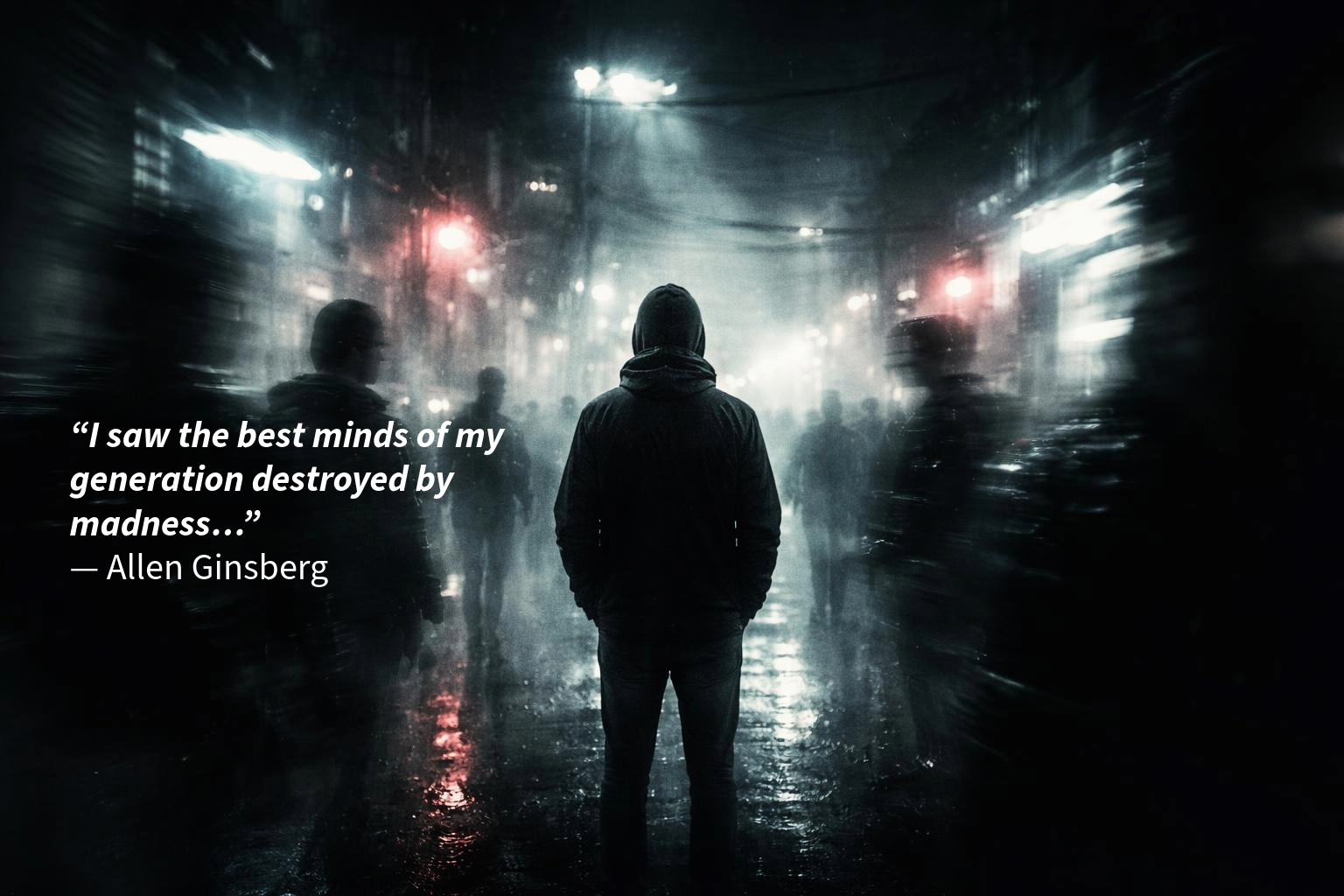
It opens like a witness statement. Not poetic in the delicate sense—more like something recorded because it had to be said. There’s no distance in it. Just observation, raw and immediate.
There’s a weight to seeing things clearly—especially when what you see isn’t something you can fix.
I’ve had moments like that. Watching someone unravel in slow motion. Not all at once—just small fractures over time. The missed calls. The change in tone. The way they stop showing up the way they used to.
And you notice it. You feel it. But there’s this quiet helplessness that comes with it. Because awareness doesn’t always come with power.
That’s the part Ginsberg captures. Not just the destruction—but the act of witnessing it. The inability to turn away once you’ve seen it for what it is.
It’s not dramatic. It’s not loud.
It’s slow.
And it stays with you.
Maybe the hardest part isn’t the madness itself.
Maybe it’s carrying the memory of it.
Knowing what someone was…
and what they became.
Not trying to rewrite it.
Not trying to soften it.
Just holding the truth of it—
even when it doesn’t resolve into anything clean.
Because some things aren’t meant to be fixed.
Only remembered.
What have you witnessed that you can’t unsee—and how has it changed you?

I thought she was gone.
That’s the first mercy this place pretends to offer—absence. A clean break. Space to breathe.
But the air didn’t loosen.
It thickened.
Sat heavy in my lungs like I’d been breathing through damp cloth. Every inhale came with a taste—metallic, faintly sweet, like old blood cut with cheap sugar. My ears rang in that low, constant way you only notice when everything else goes quiet. Not silence.
Pressure.
The kind that waits for something to crack.
I didn’t move.
Couldn’t tell if it was caution or something worse—something quieter. Something that had already decided staying put was easier than risking whatever came next.
The floor beneath my boots felt uneven. Not physically—no shift, no stumble—but wrong in memory. Like it remembered other feet standing where mine were. Like it held impressions that didn’t belong to me.
And then the smell changed.
Sharp this time.
Ozone and ash.
Something recently burned.
Light fractured open behind me—thin at first, like a crack in a door you weren’t supposed to find.
I turned slow.
Didn’t want to spook it.
Didn’t want to confirm what I already knew.
She stood there again.
Closer.
Too close.
The brim of her hat no longer swallowed her completely. One eye cut through the dark—blue, but not natural blue. Too precise. Too focused. Like light had been sharpened into something with intent.
It didn’t glow.
It targeted.
The other side of her face—
That’s where everything broke.
The lines I’d noticed before had deepened, spread, split wider. Jagged fractures ran across her cheek, down into her jaw, threading through her skin like fault lines under strain. I could see depth now. Not just surface.
Layer.
Beneath.
Something moved in there. Slow. Patient. Not trying to escape.
Just… waiting its turn.
Her cigarette burned hotter this time, ember pulsing like a heartbeat. Each inhale lit the cracks from within, turning her into something briefly transparent. Not flesh.
Structure.
Hollow spaces where something used to be—or never was.
“You stayed,” she said.
Her voice didn’t settle anymore.
It doubled.
A second tone trailing just behind the first, slightly out of sync. Like her words had to travel through something before reaching me.
“I told you,” I said, though the sound scraped coming out. Dry. Detached. “I wasn’t lost.”
Her head tilted, slow as a pendulum.
“You’re closer than you were,” she said. “That’s not the same thing.”
The air between us tightened. I could feel it in my teeth. That faint, electric ache like biting into foil.
The smoke from her cigarette didn’t drift.
It circled.
Looped back on itself like it didn’t trust the space beyond her.
“What are you?” I asked.
My throat tightened around the question like it didn’t want it spoken.
Her eye fixed on me.
Not my face.
Not my chest.
Deeper.
Somewhere behind the ribs where things sit heavy and unspoken.
“You already know,” she said.
And just like that—
Something inside me gave way.
Not around me.
Not the walls.
Me.
A memory split open without warning.
Rain hitting pavement hard enough to bounce. Neon bleeding into water, smearing color across the ground. My hand wrapped around a glass I didn’t need. Her laugh—too bright, too loud—cutting through it all.
Different woman.
Different night.
Same mistake.
“You don’t get to leave like that,” she said, grabbing my sleeve. Fingers tight. Desperate in a way I pretended not to notice.
“I’m not doing this,” I remember saying.
Cold. Clean. Final.
Her grip slipping.
Her voice cracking—
“Don’t disappear on me.”
Then nothing.
Gone.
Not faded.
Removed.
Like the memory had been lifted out by something that knew exactly where to cut.
I staggered, breath catching mid-inhale. The air felt thinner now. Or maybe I just noticed how little of it there’d been all along.
“What did you—”
“I didn’t do anything,” she said.
The ember flared again.
“You brought that with you.”
Another fracture split across her face. Deeper this time. I heard it—a dry, brittle sound, like porcelain giving under pressure.
I should’ve felt fear.
Instead, I felt—
Drawn.
Not to her.
To what she was holding up in front of me.
“What is this place?” I asked.
The question came out softer now. Less defiant. More… tired.
She stepped closer.
The temperature shifted with her. Warmer, but not comforting. Like standing too close to a fire you didn’t start.
“This,” she said, “is where unfinished things come to rest.”
Her hand lifted.
Slow.
Measured.
It hovered inches from my chest.
I could feel it without contact—a subtle pull, like gravity had narrowed its focus.
“Regret,” she whispered.
The word landed in my gut.
“Guilt.”
Lower.
“The version of you that almost chose differently.”
Her fingers curled slightly, like she was holding something invisible—something that belonged to me whether I wanted it or not.
“I give them shape,” she said.
Her eye never blinked.
“And you give them permission.”
My chest tightened.
Because that was the truth I didn’t want to touch.
“You think I want this?” I asked.
Even as I said it, I knew how weak it sounded.
Her expression didn’t shift.
“That’s the part you keep getting wrong.”
Another step.
The space between us collapsed into something shared.
“You don’t want truth,” she said. “Truth demands something from you.”
Her voice dropped, softer now.
“You want relief.”
The word didn’t land.
It sank.
Because relief doesn’t ask anything back.
Relief lets you sit down.
Her cigarette burned low, ash clinging stubbornly to the tip like it refused to fall.
“You came here for something,” she continued. “You just haven’t admitted what it is yet.”
The walls didn’t flicker this time.
They opened.
Slow.
Deliberate.
A doorway formed behind her, light spilling through it in soft, golden waves. It didn’t feel like this place. It didn’t smell like it either.
Warm wood.
Rain after heat.
Something faint and human.
Home.
Or something pretending to be.
“That one’s yours,” she said.
I didn’t move.
Couldn’t.
“What’s in there?” I asked.
She didn’t hesitate.
“Peace.”
Too smooth.
Too practiced.
I stepped forward anyway.
Because that’s what we do.
We walk toward the thing we know is lying because it sounds like something we need.
Each step felt heavier than the last. The air thickened, resisting me. Or maybe testing.
The closer I got, the more the light pressed against my skin—warm, almost soft. It wrapped around my hand before I even reached the threshold.
Behind me, her voice followed.
“If you go in there…”
I stopped.
“…you don’t come back out the same.”
I let the words sit.
“Do I come back out at all?” I asked.
Silence.
That was answer enough.
I glanced back.
Her face had fractured further now—lines splitting wide enough to reveal movement beneath. Not chaotic.
Controlled.
Like something patient enough to wait for collapse.
“You ever go in?” I asked.
For the first time—
She paused.
A flicker.
Barely there.
“I don’t need to,” she said.
That’s when it clicked.
She wasn’t above this place.
She was made from it.
Every regret she held.
Every lie she preserved.
Every room she built—
She was the sum of it.
Curated.
Just like she said.
I turned back to the doorway.
The light pulsed.
Familiar.
Inviting.
It knew me.
Or knew enough of me to pretend.
My hand lifted.
Hovered.
The warmth seeped into my skin, spreading up my arm, loosening something in my chest I didn’t realize I’d been holding tight for years.
Behind me, her voice softened.
“You don’t have to carry it anymore.”
That’s the hook.
Not desire.
Not fear.
Release.
I closed my eyes.
Just for a second.
Long enough to feel the weight of everything I’d walked away from. Everything I’d cut clean and called necessary.
Long enough to realize—
She wasn’t offering me a way out.
She was offering me a place to stop paying for it.
I opened my eyes.
The light didn’t waver.
Didn’t question.
Didn’t judge.
It just waited.
My hand moved forward—
—
—
Then stopped.
Right at the edge.
The warmth lingered, but didn’t take me.
Not yet.
I pulled my hand back.
Slow.
Deliberate.
Behind me, something shifted.
Not the walls.
Her.
“You’re learning,” she said.
No satisfaction.
No disappointment.
Just… acknowledgment.
I didn’t turn around.
Didn’t want to see what she looked like now.
“Or maybe,” I said, my voice steadier than it had any right to be, “I’m just not ready to let it go.”
A pause.
Then—
“Same thing.”
The doorway dimmed slightly.
Not gone.
Just waiting.
Always waiting.
I stood there, feeling the weight settle back into my chest. Heavier now that I’d touched the idea of putting it down.
Heavier…
But mine.
For the first time since I got here, I understood the real cost.
Not getting trapped.
Not getting lost.
But choosing to carry what you could set down—
Because at least it was honest.
And somewhere behind me, just beyond the edge of sight—
I could feel her watching.
Not hunting.
Not pushing.
Just waiting for the moment I’d decide I was tired enough to stop fighting.

There are things older than your memory that still recognize you, and they do not arrive with noise. They do not knock, do not announce, do not ask permission to be understood. They wait in the margins—cool, patient, unmoved by the rhythm of your days or the stories you tell about yourself to make everything feel coherent. You only notice them when everything else goes quiet, when the distractions fall off and you’re left with the faint hum of your own breathing, the weight of your body in space, the subtle awareness that something is watching—not from the outside, but from somewhere just beneath your own skin.
The moon is one of those things.
Not the one you photograph or reference in passing, not the pale disk that hangs above you like a decorative afterthought. The other one—the one that feels closer than it should, the one that bends inward, holding shadow like a secret it refuses to share. You’ve felt it before in moments you didn’t know how to name—standing still at night when the air carries a thin chill, when the world seems suspended between movement and silence. It presses against you then, not physically, but in a way that settles behind your ribs, as if something inside you recognizes its shape before your mind has time to interfere.
There is a face there.
Not one that looks back at you, not one that seeks recognition, but one that exists in refusal. The eyes are closed—not in rest, but in a kind of deliberate withdrawal, a turning away from the demand to be seen. The surface is not smooth. It is cracked, weathered, textured like something that has endured time rather than moved through it. If you look long enough, you can almost feel it beneath your fingertips—the uneven ridges, the brittle edges, the places where something once held firm and then gave way, not in collapse, but in exposure.
You understand that feeling more than you admit.
There are parts of you that have worn down in the same way—not broken, not gone, but altered through pressure, through time, through the quiet erosion of things you never addressed directly. You call it growth because that is what you were taught to call it. You tell yourself that moving forward requires leaving things behind, that shedding old versions of yourself is necessary to become something better, something more refined, more acceptable.
But refinement has a cost.
You feel it in the way certain memories no longer come back clearly, as if they’ve been filed away somewhere you can’t easily access. You feel it in the way your responses have become measured, controlled, shaped to fit the space you’re in rather than the truth you’re carrying. There is a tension there—a subtle tightening just beneath your chest, a pressure that doesn’t fully release even when you tell yourself you’re at ease.
That pressure has a history.
It is not new.
It has been accumulating in small, almost unnoticeable ways. Every time you chose silence over honesty, not because you didn’t know what to say, but because you understood what saying it would cost. Every time you adjusted yourself to match the expectations in front of you, smoothing out the edges, muting the contradictions, presenting something that could move through the world without resistance. You learned how to do that well.
Too well.
The world encourages that version of you. It calls it maturity, discipline, control. It rewards you for being consistent, for being understandable, for being someone who does not disrupt the flow. It tells you to be an individual, but only within the boundaries that have already been drawn. Anything beyond that—anything that resists categorization, that refuses to resolve into something clear—is treated as something to be corrected, or quietly set aside.
So you set it aside.
Again and again.
Until the parts of you that didn’t fit stopped trying to surface in obvious ways.
But they didn’t disappear.
They changed.
They moved deeper, into places that don’t rely on language or logic, into spaces that operate more like sensation than thought. You feel them sometimes in ways that don’t make immediate sense—a sudden heaviness in your chest when nothing around you justifies it, a flicker of unease in moments that should feel simple, a quiet pull toward something you can’t fully explain.
This is where the symbol begins to take hold.
Not as something external, not as something separate from you, but as a reflection of what you’ve been carrying without naming. The moon does not show you something new. It reveals a structure that has always been there—layered, incomplete in appearance, but whole in a way that doesn’t rely on visibility.
Its darkness is not absence.
It is containment.
Everything it does not show still exists, still holds weight, still shapes the curve you can see. You have been taught to treat your own darkness differently—to see it as something to resolve, something to eliminate, something that stands in the way of becoming who you’re supposed to be.
But what if it isn’t in the way?
What if it is part of the form?
You feel that question more than you think it.
It lingers in the moments when you stop trying to fix yourself, when you let your thoughts move without immediately correcting them, when you sit long enough for the surface to quiet and something deeper begins to shift. There is discomfort there—a low, steady tension that makes you want to reach for distraction, to break the moment before it deepens into something you can’t easily control.
Most people do.
They move away from that edge as soon as they feel it.
Because staying there requires a different kind of attention. Not the kind that analyzes or categorizes, but the kind that observes without interference. The kind that allows contradiction to exist without forcing it into resolution. The kind that recognizes that not everything within you is meant to be simplified.
This is where the myth becomes real.
Not as a story you tell, but as a pattern you begin to recognize within yourself. The phases, the concealment, the partial revelations—all of it mirrors something internal. You are not as singular as you present. You never were. You are layered, shifting, holding multiple states at once, even when you try to compress them into something more manageable.
The exhaustion you feel sometimes—the kind that doesn’t come from physical effort—is not just from what you do.
It is from what you hold back.
From the constant negotiation between what is true and what is acceptable. From the effort of maintaining a version of yourself that can move through the world without disruption. It is a quiet fatigue, one that settles into your shoulders, into your breath, into the way you carry yourself when no one is watching.
And still, beneath all of that, something remains intact.
Not untouched.
But present.
The same way the moon remains whole even when you can only see a fraction of it.
You do not need to illuminate everything to understand that it exists.
You do not need to resolve every contradiction to be whole.
You only need to stop pretending that the unseen parts of you are separate from who you are.
That is where the shift begins.
Not in revelation.
Not in transformation.
But in allowance.
A quiet, deliberate decision to stop editing yourself in ways that erase rather than integrate. To let the parts of you that do not fit easily remain present without forcing them into something they are not. To recognize that wholeness is not something you build by removing what is difficult, but something you uncover by allowing everything to exist in the same space.
The moon does not explain itself.
It does not justify its phases.
It does not ask to be understood.
It simply holds what it holds.
And if you stay still long enough—if you resist the urge to translate, to fix, to reduce—you begin to feel that same structure within yourself.
Not as an idea.
As a presence.
Something that has been there longer than your explanations, longer than your attempts to define yourself, longer than the versions of you that have come and gone.
And in that recognition, something loosens.
Not everything.
Just enough.
Enough to breathe differently.
Enough to sit without immediately needing to move.
Enough to understand that what you have been trying to resolve was never meant to be simplified in the first place.
The moon never needed to speak your name.
It only needed to remember it.
And somewhere, beneath everything you’ve been taught to become—
you do too.
Lo! ’t is a gala night
Within the lonesome latter years!
An angel throng, bewinged, bedight
In veils, and drowned in tears,
Sit in a theatre, to see
A play of hopes and fears,
While the orchestra breathes fitfully
The music of the spheres.
Mimes, in the form of God on high,
Mutter and mumble low,
And hither and thither fly—
Mere puppets they, who come and go
At bidding of vast formless things
That shift the scenery to and fro,
Flapping from out their Condor wings
Invisible Wo!
That motley drama—oh, be sure
It shall not be forgot!
With its Phantom chased for evermore
By a crowd that seize it not,
Through a circle that ever returneth in
To the self-same spot,
And much of Madness, and more of Sin,
And Horror the soul of the plot.
But see, amid the mimic rout,
A crawling shape intrude!
A blood-red thing that writhes from out
The scenic solitude!
It writhes!—it writhes!—with mortal pangs
The mimes become its food,
And seraphs sob at vermin fangs
In human gore imbued.
Out—out are the lights—out all!
And, over each quivering form,
The curtain, a funeral pall,
Comes down with the rush of a storm,
While the angels, all pallid and wan,
Uprising, unveiling, affirm
That the play is the tragedy, “Man,”
And its hero, the Conqueror Worm.
At first, it feels like a performance.
A stage.
Actors moving through their roles.
An audience watching from a distance, as if everything unfolding has structure—purpose—meaning.
It looks familiar.
Because that’s how we tend to see our own lives.
We assign roles.
We build narratives.
We convince ourselves that what we’re doing fits into something larger, something that justifies the effort, the struggle, the choices we make along the way.
And for a while, that illusion holds.
Until it doesn’t.
Because Poe doesn’t let the performance stand on its own.
He interrupts it.
Not with revelation.
Not with clarity.
But with something far more unsettling:
Inevitability.
The worm doesn’t enter as a twist.
It doesn’t arrive to shock.
It simply appears—like it was always part of the story, waiting for the right moment to be seen.
And once it is, everything changes.
The stage doesn’t matter.
The roles don’t matter.
The performance itself begins to feel fragile—temporary—almost insignificant in the face of what’s coming.
That’s where the discomfort sets in.
Because the poem forces a question most people spend their lives avoiding:
If the ending is the same… what gives any of this meaning?
It’s an easy question to push away.
Easier to stay focused on the performance.
On the day-to-day movement of things.
On the idea that what we’re building will somehow outlast the reality we don’t want to face.
But Poe doesn’t offer that comfort.
He strips it down.
Not to say that nothing matters—
but to expose how often we rely on permanence to justify what we do.
And maybe that’s where the shift happens.
Because if nothing lasts…
then meaning isn’t something waiting at the end.
It’s something created in the middle.
In the choices.
In the way you show up.
In what you hold onto—even knowing you can’t keep it forever.
That doesn’t erase the inevitability.
It just changes your relationship to it.
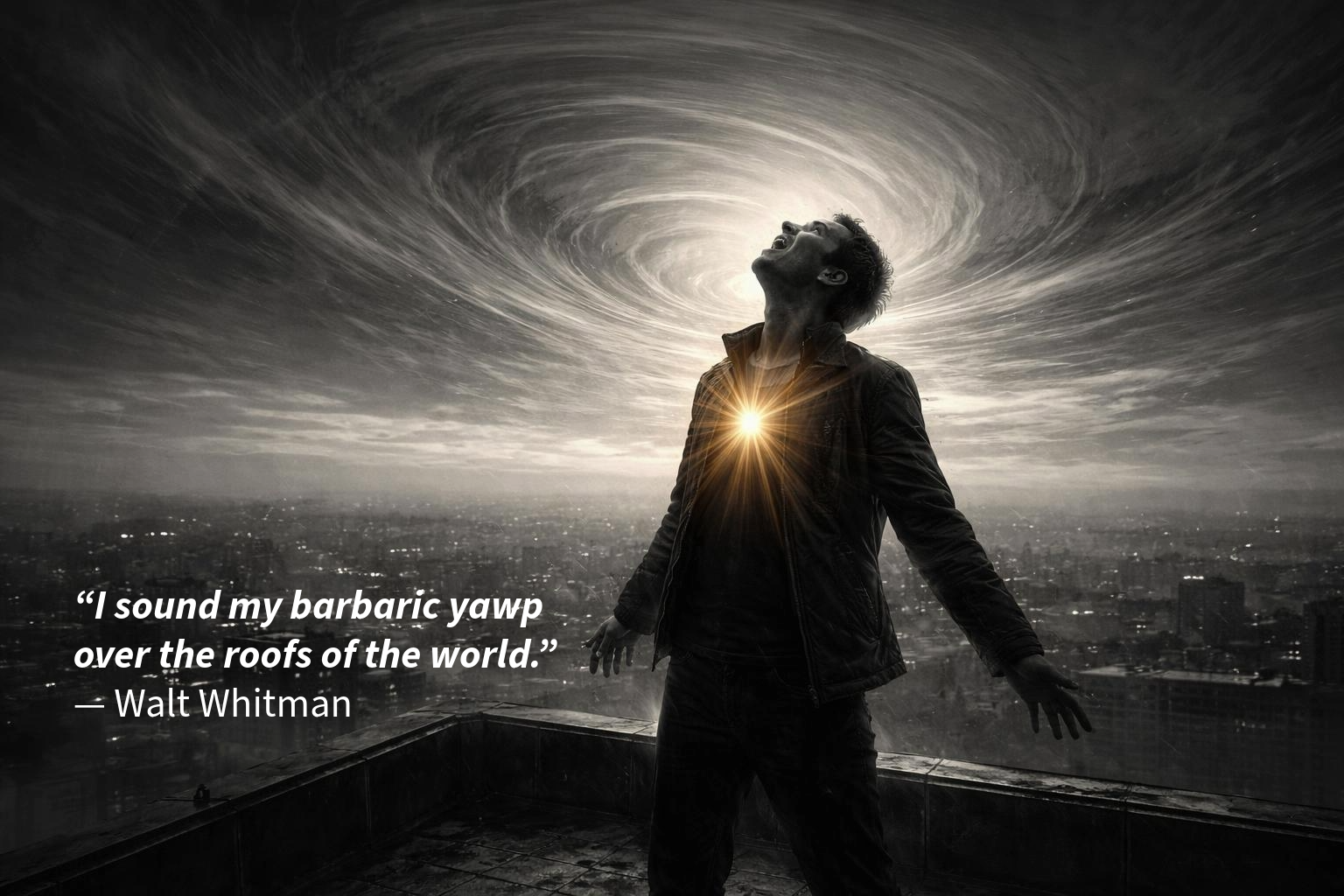
It feels loud. Unfiltered. Almost reckless. A voice thrown into the open without worrying about how it lands or who approves of it.
There’s something uncomfortable about that kind of expression. Not because it’s wrong—but because it’s exposed.
Most of us are trained out of that instinct early. Lower your voice. Refine it. Make it acceptable. Make it fit.
I’ve felt that tightening—the urge to edit before speaking, to soften the edges, to make sure what I say lands clean. It becomes automatic. You don’t even realize how much of your voice you’ve adjusted until you hear something that hasn’t been filtered at all.
Whitman’s “yawp” isn’t polished. It’s not careful. It’s not trying to be understood perfectly.
It’s presence. Raw and immediate.
And that’s the part that’s hard to replicate—because it requires letting go of control. Letting go of how it will be received. Letting go of whether it fits into anything recognizable.
Because once you start shaping your voice for acceptance…
it stops being entirely yours.
Maybe not everything you say needs to be refined.
Maybe not everything needs to be quiet.
Some things are meant to be released exactly as they are—
unfiltered, imperfect, fully yours.
Not for approval.
Not for validation.
Just because they exist.
And maybe that’s enough reason to let them be heard.
What part of your voice have you been holding back because it doesn’t feel “acceptable”?

I noticed her because nothing about her belonged.
Places like that had a smell—stale coffee, wet plaster, something electrical burning just beneath the surface. The kind of scent that clings to your tongue long after you leave, if you ever do. The air was thick, humid in the wrong way, like breath trapped in a closed room. Every step I took echoed a half-second too late, as if the floor needed time to remember I was there.
And then there she was.
Cut clean against all that distortion.
Her hat cast a shadow that swallowed her eyes whole, leaving only the suggestion of them—dark, patient, watching from somewhere just out of reach. Smoke slipped from the corner of her mouth in slow, deliberate strands, curling upward before dissolving into the black behind her. It didn’t drift. It lingered, like it had a reason to stay.
Her skin looked wrong up close.
Not broken—no. That would’ve been easier to understand. It was textured, faint lines running across it like dried riverbeds, like something that had been stretched too far and never quite settled back into itself. Time hadn’t touched her. It had pressed into her.
She wasn’t looking at me.
That’s what pulled me in.
Everyone else in that place watched you like you were a question they needed answered. She didn’t. She stood still, listening to something I couldn’t hear, her breath slow, controlled. The cigarette ember pulsed faintly in the dark—alive, steady, refusing to die out.
I stepped closer before I realized I’d made the decision.
The floor beneath me shifted—not physically, but in memory. A hallway flickered into a hospital corridor for a split second. I caught the sharp sting of antiseptic in my nose, heard the distant hum of machines. Then it was gone. Back to cracked tile and dim light.
She didn’t move.
“You lost?” I asked.
My voice sounded wrong. Too loud, like it didn’t belong in the same space as her.
She smiled around the cigarette. Subtle. Controlled. The kind of smile that doesn’t give anything away because it doesn’t need to.
“No,” she said, exhaling smoke that brushed against my face before disappearing. It smelled faintly sweet—jasmine, maybe. Or something pretending to be.
“I’m exactly where I’m supposed to be.”
Her voice didn’t echo. It settled. Sank into the space like it had always been there.
I should’ve walked away.
Instead, I studied her.
The way her fingers held the cigarette—steady, no tremor. The way her shoulders didn’t rise with her breath. Even the fabric at her neck sat too still, like gravity had negotiated with her and lost.
“You don’t look like you belong here,” I said.
She tilted her head just enough for the light to catch the edge of her lips. Not her eyes. Never her eyes.
“Neither do you.”
Something in my chest tightened. Not fear. Recognition.
That was worse.
The walls behind her flickered again. A bar bled into a chapel. I heard laughter cut into quiet prayer. The smell of whiskey folded into candle wax. A memory brushed past me—mine, I think—but I couldn’t hold onto it long enough to be sure.
She stayed the same.
That’s when it hit me.
Not part of the place.
The anchor.
“You built this,” I said.
She took another drag, the ember flaring brighter for a moment, casting a brief glow across her cheek. It revealed more of those fine lines—like fractures beneath the surface.
“I didn’t build it,” she said. “I curated it.”
The word landed heavy.
Curated meant choice. Intention. Selection.
I looked around again—really looked this time. Faces frozen mid-conversation. Movements that looped just a little too perfectly. A man raising a glass but never drinking. A woman laughing without sound.
“They’re stuck,” I said.
She stepped closer.
The air shifted with her. Warmer. Tighter. I could feel it in my lungs, like there was less room to breathe.
“They’re comfortable,” she corrected.
Her voice softened, but it carried weight. Not persuasion. Conviction.
“People don’t want truth,” she continued. “Truth cuts too clean. Leaves nothing behind to hide in.”
She reached up, tapping ash from her cigarette. It didn’t fall. Just vanished before it hit the ground.
“So they build something softer. Something manageable.”
Her head tilted again, and I felt it—that quiet pressure, like she was peeling something back inside me.
“I just give those things… structure.”
The smell hit me then.
Not jasmine.
Not really.
It was something older. Dust and paper. Rain on pavement. A trace of something burned—like letters you never meant to destroy.
“You trap them,” I said, but it came out weaker than I intended.
“I preserve them.”
She was close enough now that I could hear the faint sound of her breathing—or something like it. Slow. Measured. Almost mechanical.
“And me?” I asked. “Why am I here?”
For the first time, she paused.
Not long. Just enough.
That was the crack.
“That depends,” she said quietly. “Are you searching for something…”
She stepped closer. The smoke between us thickened, curling like it didn’t want to let me see her clearly.
“…or are you hiding from it?”
My mouth went dry.
Because the answer wasn’t simple.
It never is.
Images flickered at the edges of my mind—things I hadn’t thought about in years. A face I couldn’t fully remember. A voice just out of reach. The weight of something left unfinished.
I didn’t answer.
Didn’t need to.
She already knew.
That’s the real trick.
It’s not seduction.
It’s not charm.
It’s recognition.
She sees the version of you you’ve been avoiding—the one buried under better stories—and she doesn’t drag it into the light.
She builds a room around it.
Makes it livable.
I reached into my coat, fingers brushing the familiar shape of a lighter. The metal was cold, grounding. Real.
I struck it.
The flame wavered for a second—then steadied. The light caught her face just enough to reveal the truth I’d been avoiding.
Those lines in her skin?
They weren’t cracks.
They were seams.
Like something had been pieced together. Carefully. Deliberately.
“Do you ever leave?” I asked, my voice quieter now.
She stepped back, the darkness reclaiming her inch by inch.
“Why would I?” she said. “Everything I need comes to me.”
The walls shifted again. This time slower. More deliberate. Like they were listening.
“You came looking for me,” she added.
The flame in my hand flickered.
I didn’t remember that.
Didn’t remember how I got here.
Didn’t remember what I was chasing.
Only that I’d been chasing something.
The lighter snapped shut.
Darkness folded back in.
She was almost gone now—just the outline of her hat, the faint glow of the cigarette lingering where her mouth had been.
“And now that you’ve found me…” her voice drifted through the space, softer, closer than it should’ve been—
“you don’t have to keep looking.”
Silence.
Thick. Absolute.
The place settled.
Different now.
Quieter.
More… familiar.
I stood there for a long moment, listening to my own breath. Feeling the weight of the space press in, not resisting it this time.
Not questioning it.
I looked down at my hands.
They felt steady.
Too steady.
Like they’d finally stopped searching.
And that’s when it hit me.
The worst part of a place like that isn’t getting lost.
It’s realizing you don’t want to leave.
So fallen! so lost! the light withdrawn
Which once he wore!
The glory from his gray hairs gone
Forevermore!
Revile him not, the Tempter hath
A snare for all;
And pitying tears, not scorn and wrath,
Befit his fall!
Oh, dumb be passion’s stormy rage,
When he who might
Have lighted up and led his age,
Falls back in night.
Scorn! would the angels laugh, to mark
A bright soul driven,
Fiend-goaded, down the endless dark,
From hope and heaven!
Let not the land once proud of him
Insult him now,
Nor brand with deeper shame his dim,
Dishonored brow.
But let its humbled sons, instead,
From sea to lake,
A long lament, as for the dead,
In sadness make.
Of all we loved and honored, naught
Save power remains;
A fallen angel’s pride of thought,
Still strong in chains.
All else is gone; from those great eyes
The soul has fled:
When faith is lost, when honor dies,
The man is dead!
Then, pay the reverence of old days
To his dead fame;
Walk backward, with averted gaze,
And hide the shame!
Reflection
Some losses don’t come from defeat.
They come from decision.
Ichabod isn’t a poem about a man being stripped of something against his will. It’s about a man who had everything—respect, influence, a voice that carried weight—and chose something that cost him all of it.
Not immediately.
Not dramatically.
But permanently.
That’s what makes this poem unsettling.
Because the fall isn’t loud. It doesn’t announce itself with spectacle. It happens in a quieter space—where compromise begins to look reasonable, where conviction starts to feel inconvenient, where the line between right and comfortable blurs just enough to step over without fully noticing.
And once that step is taken… something shifts.
Not outwardly, at first.
The world may still recognize your name.
Still give you space.
Still treat you as if nothing has changed.
But something internal has already left the room.
That’s the weight behind Ichabod.
“The glory has departed” isn’t about reputation.
It’s about integrity.
The part of you that knows who you are—and what you stand for—no longer aligns with the choices you’ve made.
And once that fracture happens, it doesn’t heal easily.
Because this kind of loss isn’t about what others take from you.
It’s about what you give away.
We like to think collapse comes from external pressure—from systems, from conflict, from forces beyond our control.
But this poem suggests something harder to accept:
Sometimes the defining moment isn’t what happens to you.
It’s what you agree to.
What you sign your name to.
What you stay silent about.
What you justify when you know better.
That’s where the real shift occurs.
Not in the action itself—but in the quiet understanding that follows:
You crossed a line you once believed you never would.
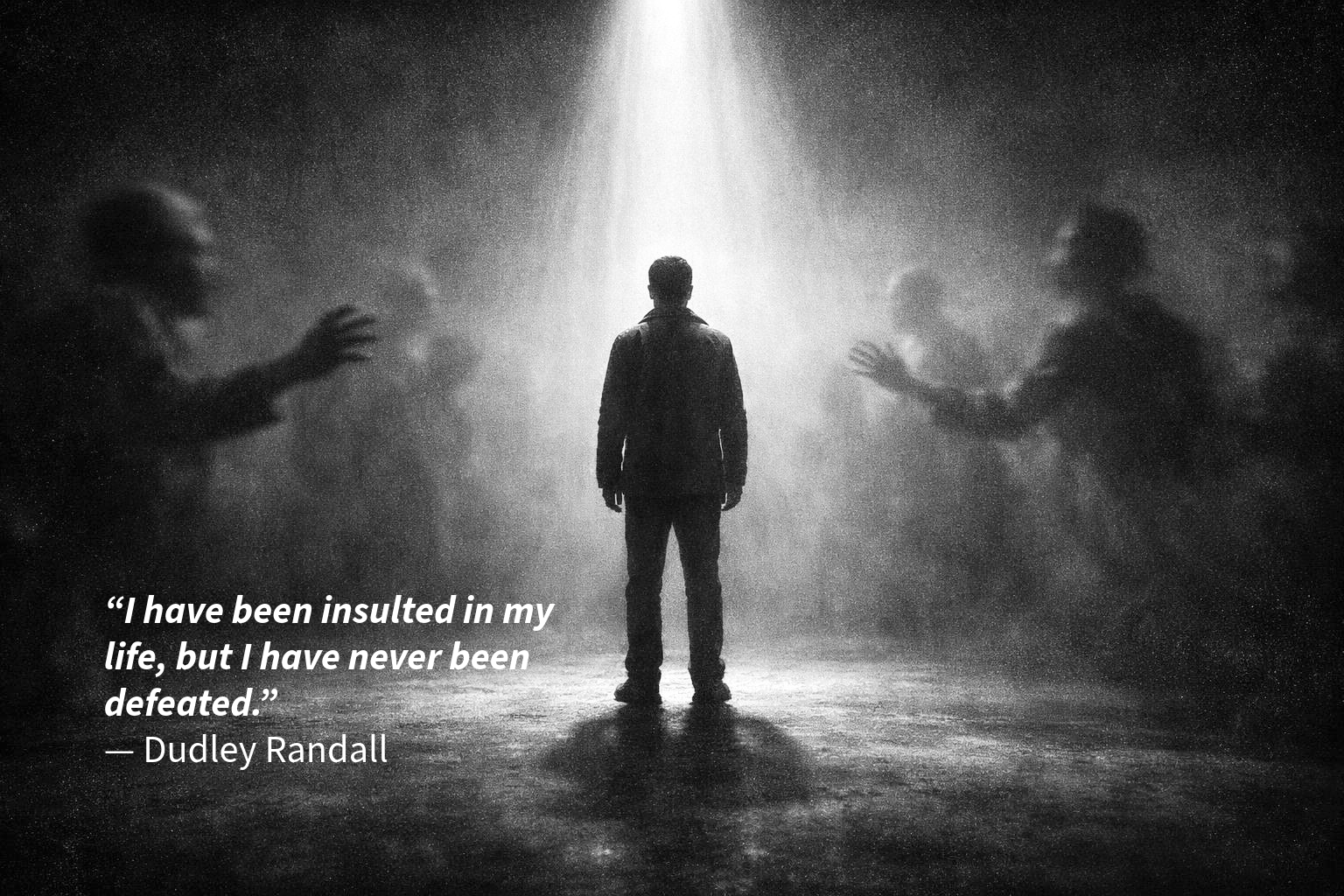
It reads steady. Not emotional. Not reactive. Just a clear line drawn between what’s been done to him… and what he’s allowed it to mean.
There’s a difference between being hurt and being undone—but it doesn’t always feel that way in the moment.
Insults don’t always come loud. Sometimes they show up as dismissal. As being overlooked. As the quiet assumption that you don’t belong where you are.
I’ve felt that kind of weight before—not enough to break you all at once, but enough to make you question yourself if you sit in it too long.
That’s the part people don’t talk about. Not the impact of the moment—but the echo that follows it. The way it tries to settle into your thinking, your posture, your sense of where you stand.
Randall’s line cuts through that echo. He doesn’t deny what happened. He doesn’t pretend it didn’t land.
He just refuses to let it define the outcome.
And that refusal—that separation between what was done and what it becomes—that’s where the strength sits.
Maybe defeat isn’t about what you face.
Maybe it’s about what you accept as final.
Not every hit can be avoided.
Not every moment can be controlled.
But the meaning you give it—that part stays yours.
And holding onto that…
that’s how you don’t lose yourself in the process.
What have you allowed to linger longer than it deserved—and how has it shaped you?

Morning doesn’t break so much as it leaks in—thin, hesitant light slipping through the blinds like it’s not sure it belongs here anymore.
I sit at the table in your robe.
Still yours.
Still smells faintly of tobacco and something warm I can’t name without you here to confirm it.
The coffee hums behind me. The house breathes. I don’t.
The pen waits.
My hand doesn’t.
It drifts—slow, instinctive—down to my stomach.
I don’t even remember when I started doing that.
There’s a weight there now. Not heavy. Not yet. Just… present.
Like a quiet truth I can’t outrun.
Dear Darling,
It’s morning. The light’s soft today—the kind you used to stop and notice, like it meant something more than just another day starting.
Coffee’s almost ready. I made pancakes. Syrup already on the plate—you said it soaked in better that way.
I’m wearing that silk gown. The one you never got tired of looking at like it was the first time, every time.
My hand presses against my stomach as I write this.
You don’t know.
You were never going to know.
We made something, and I walked away from it before it had a name.
Before it had a chance.
Things still work. That’s the part I hate. The coffee brews. The light comes in. None of it checks to see if you’re still here.
You would’ve taught this child how to listen.
Not just hear—listen.
Bebop the way it’s supposed to be felt. Not explained. Not dissected. Felt.
Motown like it lives in the spine whether you want it to or not.
The Philly sound… the way you talked about it like it was church without the pews.
I can tell them.
I will.
But it won’t be the same.
I don’t have your patience. Your reverence. The way you respected the silence between notes like it mattered just as much as the sound itself.
I miss the way you sang Big Joe Turner off key—loud, unapologetic, like the room belonged to you and nobody else had a say in it.
You never got it right.
Not once.
And I never told you how much I loved that.
I knew what staying meant.
I just didn’t want to pay for it.
I pause.
My thumb circles slow against my stomach.
There’s nothing there yet. Not really.
But I keep my hand there anyway.
I almost told you.
I didn’t.
I told myself I could do this without you. That it would be easier that way. Cleaner.
My heart didn’t agree.
I stayed quiet anyway.
We said we’d do it backwards.
A girl with your name.
A boy with mine.
I don’t know if I’m allowed to keep that promise without you here.
Do you remember that trip?
The desert. Three of us and a plan that sounded better in your head than it ever had a chance of being.
Everything kept going wrong. Heat. Wind. Something always breaking or running out.
And she just… handled it. Like none of it was ever serious to begin with.
I see it now—clear as anything.
That scorpion. Bigger than it had any business being.
She picked it up like it was nothing and chased you with it.
You ran.
I ran.
She laughed.
I forgot she knew what she was doing.
You always said she understood things most people wouldn’t touch—bugs, venom, all of it.
An entomologist.
I just remember thinking she was out of her mind.
Your sister’s going to be an aunt.
I can see her now—trying to be you.
Picking up your bad habits like they still belong to someone.
Pushing them a little further each time.
Like there’s no one left to tell her where the line was.
Teaching them the wrong things on purpose. Letting them taste what they shouldn’t.
Laughing like rules were just suggestions someone else wrote.
Holding it all together just long enough for nobody to ask questions.
Trying to be you.
And not even knowing it.
I finished another chapter.
It’s sitting here, waiting for you like it used to. I can still see you reading—thumb brushing your beard, twisting that one side longer than the other.
You always said you’d fix it.
You never did.
I miss the way you stood behind me. Quiet. Certain. Like the world could fall apart and you’d still be there, steady as breath.
I try to remember that feeling.
I try to give it to something that’s never going to meet you.
I keep pausing like you’re about to say something. Like I didn’t train myself out of that already.
I’ll write again tomorrow.
I love you.
Never doubt that.
I read it twice.
Not for grammar.
For truth.
My hand stays there longer this time.
The lighter clicks.
Flame blooms.
The paper curls, blackens, disappears in on itself—like it’s trying to take the words back before they settle somewhere permanent.
I drop it into your ashtray.
Your pipe’s still there.
That hand-carved one from Ireland you wouldn’t shut up about. You said it would last forever.
I pick it up.
Turn it over in my hands.
Cold.
I press it gently against my stomach.
I wait anyway.
The smoke rises—thin, quiet.
My hand tightens.
Not a thought. Not yet.
Just something—
wrong.
Author’s Note: This piece was written for Sadje’s What Do You See #335. The image offered quiet, but the story refused it—pulling instead at absence, at the things we leave unsaid, and the consequences that continue long after the moment has passed.

The city kept its treasury locked behind marble and lies. I kept mine in a dented coffee tin under the sink—loose change, bad decisions, and names needing forgetting. Funny thing about value: theirs needed guards; mine needed forgetting. When they finally audited me, I handed them silence. It accrued interest faster than truth ever did. Then I sent an invoice.

The room smelled like something that had overstayed its welcome.
Old smoke. Varnish. A faint trace of cologne that had long since lost the man it belonged to. It clung to the curtains, to the seams of the chair, to the back of the throat—coating everything in a thin, stale film that didn’t leave, no matter how long the windows stayed shut.
She stood beside the chair, unmoving.
Black silk wrapped her frame like a second thought—quiet, deliberate. When she breathed, the fabric barely shifted, absorbing the light instead of reflecting it. It made her harder to read. Harder to place.
That was the point.
The man in the chair didn’t breathe at all.
Not visibly.
His chest didn’t rise. His shoulders didn’t settle. He existed in that space between—where the body hasn’t quite admitted it’s finished, and the room hasn’t decided what to do with it yet.
His head leaned forward, chin hovering just above his collar. The skin along his neck sagged slightly, loose in a way that suggested time had been pulling at him for years… and had finally gotten what it came for.
His hand hung over the armrest.
Heavy. Slack. Fingertips pale, as if the blood had retreated somewhere safer. The other hand rested in his lap, curled inward like it had tried to hold onto something at the last second and missed.
The chair held him upright anyway.
It was too large for him now.
Carved wood curled outward in elaborate, unnecessary flourishes—each detail catching shadows that didn’t belong to the light in the room. The leather had cracked in thin, branching lines, like something once alive had dried out and stayed that way.
It didn’t creak.
It waited.
The smoke told the truth.
It didn’t rise from a cigarette. There wasn’t one.
It came from him.
Slow at first—thin strands slipping from the seams of his coat, from the hollow at his throat, from the faint parting of his lips. It didn’t rush. It didn’t panic.
It knew this moment.
It had been preparing for it long before she arrived.
She watched it with a stillness that bordered on reverence.
Not admiration. Not curiosity.
Recognition.
Her eyes tracked the way it moved—how it coiled, how it tested the air, how it lingered near the edges of his body like it wasn’t quite ready to let go.
She understood that hesitation.
“You took your time,” she said.
Her voice didn’t break the silence—it settled into it, low and even, like it had always been part of the room.
The smoke shifted.
Barely.
But enough.
Her gaze moved across his face, slow, deliberate. Taking inventory.
There had been power there once. You could still see its outline—the set of his jaw, the stubborn line between his brows, the faint tension still lingering around his eyes like they might open if something called him back hard enough.
Nothing did.
Men like him never listened when it mattered.
Her jaw tightened—just slightly.
Not anger.
Something closer to acknowledgment. The kind that comes too late to change anything.
She stepped closer.
The floor whispered beneath her weight—a soft, reluctant creak that sounded louder than it should have. The air shifted with her movement, carrying the smell with it, thickening it, pressing it deeper into her lungs.
She didn’t flinch.
Her hand lifted, hovering just above his shoulder.
Close enough now to feel the temperature.
Cool.
Not cold.
Not yet.
The smoke reacted first.
It curled upward, slower now, more deliberate. It gathered near her fingers, brushing against them without touching—testing the boundary between where he ended and she began.
She held her hand steady.
“You built all of this,” she murmured, her voice quieter now, closer to him, as if the distance between them mattered. “And still… this is how it ends.”
The room didn’t answer.
It didn’t need to.
Her fingers lowered.
Contact.
The fabric beneath her hand felt worn—soft in places where time had rubbed against it too often. Beneath that, the structure of his shoulder remained, but diminished. As if whatever had held it together had already started to leave.
The smoke surged.
Not violently.
Not desperately.
Just… certain.
It slipped from him in long, quiet threads—each one stretching before it broke free, like it was remembering the shape of the body it had lived in.
His chest shifted.
A small thing.
Almost nothing.
But enough to mark the difference between holding on and letting go.
The chair creaked then—low, drawn-out, like it had been bearing the weight of more than just a body.
She closed her eyes.
Not in grief.
In focus.
The smoke moved differently now.
It no longer drifted.
It chose.
Each strand bending toward her, drawn to something deeper than heat, deeper than air. It touched her skin in soft, fleeting passes—cool at first, then warming as it lingered.
Her breath hitched.
Just once.
Unintended.
She felt it.
The residue of him—not memory, not thought—but something closer to pressure. Weight settling behind her ribs, along her spine, threading itself through places that had been empty… or waiting.
Her fingers tightened against his shoulder.
Not to hold him.
To steady herself.
When she opened her eyes, the room looked the same.
But it didn’t feel the same.
The air had shifted.
Lighter in some places. Heavier in others.
The smoke was gone.
Not vanished.
Transferred.
The man in the chair sagged.
Subtly at first—then completely.
His head dipped further, chin finally meeting his chest. His hand slid an inch along the armrest before stopping, as if even gravity had lost interest in him.
What remained was just a body.
Structure without presence.
A shell that no longer remembered how to hold itself together.
She stepped back slowly.
Testing her balance.
Testing the weight now sitting behind her eyes, in her chest, along the edges of her thoughts.
It settled.
Not comfortably.
But completely.
Her gaze lingered on him.
Not with sorrow.
With clarity.
This was always the ending.
Not the grand fall. Not the dramatic unraveling.
Just this—
A quiet emptying.
A chair that remembers more than the man ever will.
“Thank you,” she said.
Not because he deserved it.
Because the moment required it.
She turned toward the door.
The silk followed her movement in a soft whisper, brushing against itself like something alive, carrying with it the faintest trace of what the room had just lost.
At the threshold, she paused.
The air behind her sat heavy and still.
For a second, she listened.
Not for him.
For herself.
For what had changed.
Then—
A small shift at the corner of her mouth.
Not quite a smile.
Something sharper.
She stepped out.
And the room, for the first time in years—
Felt empty.
Oh, slow to smite and swift to spare,
Gentle and merciful and just!
Who, in the fear of God, didst bear
The sword of power, a nation’s trust!
In sorrow by thy bier we stand,
Amid the awe that hushes all,
And speak the anguish of a land
That shook with horror at thy fall.
Thy task is done; the bond are free:
We bear thee to an honored grave,
Whose proudest monument shall be
The broken fetters of the slave.
Pure was thy life; its bloody close
Hath placed thee with the sons of light,
Among the noble host of those
Who perished in the cause of Right.
It sounds gentle at first—almost like reassurance. Be patient. Don’t rush. Let things unfold. The kind of advice that feels calm on the surface, easy to agree with.
But patience isn’t passive. Not the kind Rilke is talking about.
There’s a tension in not knowing. A constant pull to figure things out, to close the loop, to get to something solid you can stand on. I’ve felt that pressure—to resolve things quickly, to make sense of what doesn’t yet make sense.
Unanswered questions don’t sit quietly. They follow you. Show up at the wrong time. Linger longer than you want them to.
And the instinct is to push them away or force an answer just to quiet the noise. Even if the answer doesn’t fully fit.
Rilke challenges that instinct. Not by offering solutions—but by asking you to stay in the uncertainty without trying to escape it.
To sit with what’s unresolved without turning it into something it isn’t.
Because maybe the problem isn’t the question—
it’s the need to end it too soon.
Maybe not everything is meant to be answered right away.
Maybe some things are meant to be lived through first.
Not solved.
Not finalized.
Just carried—until they change shape on their own.
And maybe patience isn’t about waiting…
it’s about staying present long enough to understand.
What question in your life are you trying to answer too quickly?

It was in high school where everything tilted.
That’s where my love for writing, art, and music took a turn—sharp enough to leave a mark. I started writing horror stories, the kind that didn’t rely on monsters jumping out of closets, but the kind that sat with you long after the lights were off. Psychological. Quiet. Unsettling in a way I didn’t fully understand yet.
I drew what I wrote. Faces caught between something human and something else. Shadows doing most of the talking.
And somewhere in the middle of all that, I found heavy metal.
That’s when the rules showed up.
It was like there was a rulebook I was never given.
I asked Madre about it once. She stared at me like I should’ve already known, then shook her head.
Classic Madre.
She kept that look well into my adulthood.
My kids laugh about it now—because I catch myself giving them that same look.
It was fine—acceptable even—to write strange stories. Fine to draw the things I was drawing. People could box that up and call it “creative.” But metal? That crossed a line I didn’t know existed until someone told me I needed to turn in my black card.
I remember just sitting there, letting that hang in the air longer than it should have.
For a second, my mind went to guys like Jimi Hendrix… and Jaimoe Johanson.
Nobody handed them a rulebook.
I didn’t say anything.
Then it hit me—
I was aware that being Black wasn’t just identity—it was visibility.
The world saw me before it heard me.
I guess that’s a step up from being invisible. — Invisible Man
Around the same time, I made another decision that didn’t sit well with the people who thought they knew better. I moved away from the college track and into the electronics lab.
“You’re throwing your future,” my guidance counselor said.
They believed in standards. Fixed lines. Clear limits.
Problem was—I didn’t fit where they said I should.
And no matter what I did, they kept looking past me.
I’m right here. Can’t you hear me?
This was the same woman who told me it was impossible to learn microcomputer math without a foundation in Algebra.
I aced the class.
High school wasn’t about figuring out who you were.
It was about learning who you were allowed to be.
I felt the pressure to stay Black while trying to be an individual.
The problem was never my identity. It was that other people kept confusing identity with compliance.
Some of the same kids I played in the sandbox with started looking at me like I was from somewhere else. Like I had crossed into something unfamiliar.
So I learned to perform.
Say the right things. Like the right things. Stay close enough to the script to avoid the questions.
Like an actor hitting marks just to stay in the scene.
But that kind of survival comes with a cost.
You start confusing who you are with who you need to be to get through the day.
And somewhere in all that, nobody teaches you the part that matters most—
how to accept yourself without the audience.
I used to think people saw me for what I was in that moment. That once I fit the category, the story was done.
But it doesn’t work like that.
They don’t see two people.
The one you are… and the one you’re becoming.
I ran into one of my sixth-grade teachers years later. When I told her I was a writer, I dressed it up with a little self-deprecation.
“You probably never thought I’d become that.”
She looked me dead in the eyes, same way she did back then.
“You said that. I didn’t.”
Then she invited me to lunch with some of the old group.
Popularity is a currency that devalues overnight. I watched people spend themselves trying to keep up with it.
Not me.
“You can go your own way.” — Fleetwood Mac
Costly lesson. Worth every bit of it.
What I learned in high school wasn’t how to fit in.
It was how to stop asking for permission to be who I already was.
And once you see it…
the mask never quite fits the same again.
Doesn’t mean the world stopped asking me to wear it.

She worked in the quiet hours—those thin, in-between moments when the world forgot to be loud.
The vials in front of her breathed more than they sat. Each one held a memory of the earth: crushed root, fermented leaf, sap coaxed from bark that had learned how to survive drought and fire and the careless hands of men. The smoke curling upward wasn’t just smoke—it was language. It spoke in slow spirals, telling her what the mixtures would not.
People used to understand this.
Not the recipes—those were the easy part. Anyone could follow steps, grind this, boil that. But the listening… that was the lost art. The knowing that a plant didn’t give itself the same way twice. That the soil it grew in, the grief it absorbed, the storms it endured—those things lived inside it. Healing wasn’t extraction. It was negotiation.
She dipped the tip of her tool into the darkest vial and hesitated.
“Too bitter,” she murmured, though no one else was there to hear it.
Her fingers hovered, then shifted to another—lighter, thinner, but stubborn. This one had grown in shadow. It would fight her. Good. Medicines that didn’t resist weren’t worth trusting.
Behind her, the walls carried symbols older than memory. Not decoration—records. Every mark was a conversation someone had once had with the earth and survived to tell about it. She didn’t look at them anymore. She didn’t need to. They had moved into her bones long ago.
Once, people traveled for days to sit where she sat.
They came with sickness, yes—but more often with confusion. A body doesn’t break without reason. A spirit doesn’t ache without history. She had learned early that most of what they called illness was simply a life lived out of rhythm. Too much noise. Too much taking. Not enough listening.
Now they came less.
They had pills that worked faster. Machines that spoke louder. Certainty packaged in clean white containers that didn’t ask questions back. Healing had become a transaction—quick, efficient, empty of memory.
She pressed the mixture into the parchment before her, letting it bleed into the fibers.
“This one is for forgetting pain without forgetting the lesson,” she said softly, as if naming it anchored it to the world.
Her hands stilled.
That was the problem, wasn’t it?
People didn’t want lessons anymore. They wanted silence. They wanted the wound gone without understanding what had cut them open in the first place.
Outside, something shifted—the wind, maybe. Or something older moving through it.
She closed her eyes and let the room breathe around her.
Nature had never stopped speaking. Not once. It whispered in cracked soil, in the way leaves curled before a storm, in the quiet defiance of weeds breaking through stone. The language was still there, patient as ever.
It was people who had forgotten how to hear.
She opened her eyes, reached for another vial, and began again—not because anyone was coming, but because the work itself mattered. Because somewhere, someone would remember. Because healing, real healing, was never about saving the world.
It was about restoring the conversation.
By Dalia Taha
Translated By Sara ElkamelEnter Book (2 versions)
Translated from the Arabic
The book you held in your hands
now lies on the nightstand by your bed, in its heart
the lines you sketched
under the sentences you read more than once, bewildered,
before you put the book down
and started pacing aimlessly between the rooms.
You let it drown you for a full week,
took it everywhere you went;
you read it alone in bed,
and stretched out on the sofa while the family’s voices
drifted toward you from the other room.
Whenever you’d lift your head,
you found yourself
face-to-face with the world,
glancing at the sky outside your window;
ready, at last, to converse with the hills.
Every book grants you the language
you need to make contact
with something you had no idea even existed:
a tree’s pores, a fox’s nose,
sadness on a face, a nation’s suffering.
Look how beautiful you look as you read.
Look how peaceful you look
as you let an entire continent colonize you;
as you lay the book down on the nightstand,
as if returning to the world
something that belongs to it—
as you stand, dazzled by the hills
as though the book, too,
has returned to the world
something that belongs to it.
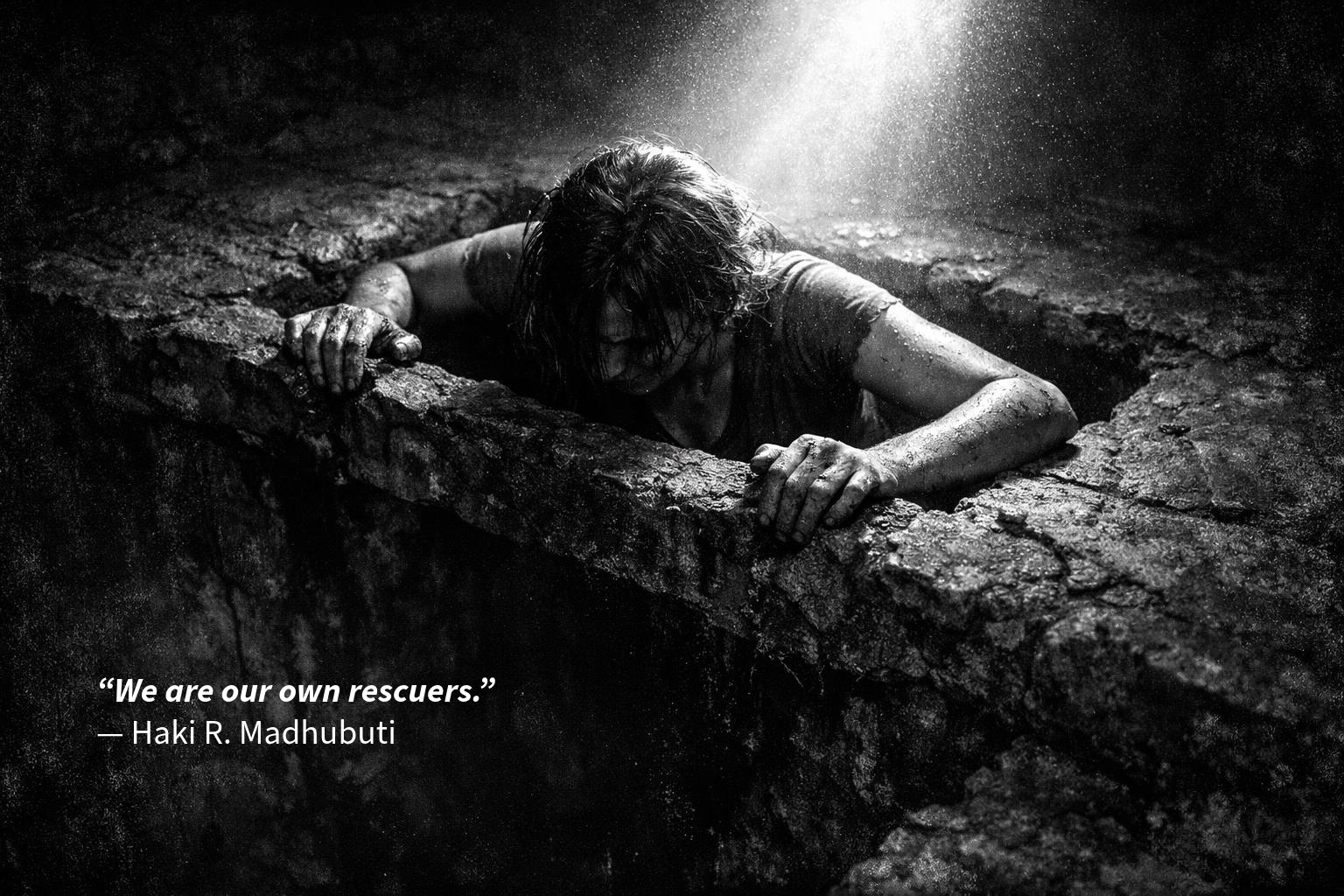
It reads like a statement, but it feels like a challenge. No decoration. No explanation. Just a line that cuts straight through the idea that someone else is coming to fix things.
There’s a part of us that waits. Even if we don’t say it out loud. We wait for the right moment, the right help, the right set of circumstances to make things easier to handle.
I’ve done it in small ways—putting things off, telling myself I’ll deal with it later, hoping something shifts without me having to force it. It feels reasonable. It feels patient.
But most of the time, it’s just avoidance dressed up as strategy.
Madhubuti’s line doesn’t leave room for that. It strips away the expectation of outside intervention completely. No one is coming to carry the weight. No one is stepping in at the last minute to correct the direction.
And that’s not a punishment—it’s clarity.
Because once you accept that, something changes. You stop waiting. You stop negotiating with time. You start moving—even if it’s messy, even if it’s uncertain.
Because the alternative is staying exactly where you are.
Maybe being your own rescuer doesn’t mean having all the answers.
Maybe it just means refusing to stay stuck.
Taking the step. Making the call. Starting before you feel ready.
Not because it’s comfortable—
but because it’s yours to do.
And no one else can do it for you.
Where are you still waiting for something—or someone—instead of taking the next step yourself?
Notes from a Night I Don’t Fully Remember
I didn’t notice it at first. Change doesn’t announce itself. Not really. It doesn’t kick the door in or make promises it can’t keep. It just… arrives. Slips into the empty seat beside you like a stranger in a crowded train station—close enough to feel, easy enough to ignore. So I ignored it. I kept scribbling in my notebook, one thought chasing the next, no shape to any of it. Just movement. Just noise. It was past midnight. My eyes burned. My hands cramped. And Guppy—Guppy reminded me, loudly, that her litter box needed changing. No patience. No grace. Funny how something that small can pull you back from the edge of your own head. I changed the litter, washed my hands, and came back to the page. That’s when it shifted.
I looked at the notebook and decided I wasn’t going to choose. A story. An essay. Something else I didn’t have a name for yet. All of it. So I wrote. Straight. No chaser. No polishing. No second-guessing. Just the truth the way I’d lived it—uncomfortable, uneven, mine. And then something opened. Everything I’d read, seen, heard… it was there. Not as memory. Not as reference. As if it had been waiting. I could feel it lining up behind the words.
I looked up from my notebook.
The train station was empty.
A woman was walking away, her footsteps the only sound left in the room. Slow. Measured. Certain. I turned, trying to follow the sound, but there was nowhere for her to go. No doors. No exits. Just space where she should have been.
And then the footsteps stopped.
I sat there, listening.
The clock on the wall took over—each second grinding forward with a hard, shifting sound, like tiny workers buried inside it, cranking the hands inch by inch.
I didn’t know how long I’d been sitting there.
Didn’t know if I had moved at all.
The sound of fluttering wings filled my office, but I didn’t look up right away. Guppy did. She let out a sharp, offended meow before hopping onto the desk, then down into my lap like she owned both the space and whatever had just passed through it. “Can’t you see I’m working?” I asked. Didn’t matter. She turned once, twice, then settled—final say. I shifted, adjusted, gave in. There’s a rule about that, unwritten but absolute. A cat chooses your lap, you don’t move. Not for discomfort. Not for reason. Not even for sense. I used to think there was a time limit attached—ten minutes, maybe fifteen, something measurable. But sitting there, hands still, the room too quiet, I couldn’t remember the number. Couldn’t remember if there ever was one. Guppy’s weight anchored me in place, and for the first time all night, I wasn’t sure if I was staying still because of her… or because something else in the room wanted me to.
I was wrong.
Not a little.
Completely.
The fluttering grew louder.
Guppy’s claws sank into my thigh, sharp enough to anchor me. She let out a low, uneasy sound, looking back at me like I was the one out of place.
The room shifted.
I knew this place.
This is where I go when the story comes.
Only this time—
it didn’t come alone.
Voices layered over each other, pressing in. Not words at first—just presence. Then fragments. A street folding in on itself. Something blooming where it shouldn’t.
And the woman—
closer now.
Or maybe I was.
The noise swelled, crowding the edges of everything I thought I understood.
I exhaled. Slow. Forced.
Held on to that one thread.
The rest didn’t disappear—
but it bent.
Aligned.
Waited.
The picture sharpened.
Not clear. Not safe.
But enough.
I picked up the pen.
And this time—
I didn’t pretend the words were mine.
The pages are filled.
My handwriting.
…I think.
I lean closer.
What is this?
I don’t recognize what’s on the page. The lines twist into something older than language—symbols that feel familiar in the wrong way. Like something I’ve seen before but was never meant to read. It reminds me of those ancient books—the ones that never made it to the shelves. The ones kept behind the desk, clutched in the arms of that librarian. The one who always watched a little too closely.
“Are we going to behave today, Master Khan?”
Her voice—calm, precise. Not a question. Never was.
“Yes, ma’am.”
I hear it before I remember saying it.
She scoffs. A small sound, sharp enough to cut. Then the look—that same scowl that made you sit up straighter whether you wanted to or not.
“Peppermint?”
Always peppermint.
Always after.
The sun has faded. Night has returned. The glow from my desk lamp is too much—pressing in, bleaching the edges of everything. I turn it down before it burns through my eyes. Something moves at the edge of my vision. I turn. Nothing. The cigarette smoke thickens, curling slow through the room, clinging to the light. I take it in. The scent is wrong. Not American. Turkish, maybe. Or something older. Something I don’t remember lighting.
“Excuse me, Mr. Khan. Do you think you can help me?”
The voice comes from the shadows.
I look around the room, slow, deliberate—trying to catch movement before it disappears.
Nothing.
“I need you to tell my life story,” the voice continues.
Still nothing.
I strike a match. Light a cigarette. Draw it in deep, hold it there like it might steady something.
Exhale.
Then a sip of coffee.
Cold.
Of course it is.
“Why in the hell would I want to do that?” I ask.
Guppy hisses. Low. Sharp.
I look up.
And there she is.
Standing like she’s always been there.
Too much to take in at once. Too many details competing for attention—like she brought her own gravity into the room and everything else had to adjust around it. Every part of her felt… intentional. Nothing wasted. Nothing accidental.
My first instinct was simple.
Run.
Get the hell out. Find a church. A monastery. Somewhere quiet where stories don’t follow you home.
But then the thought hit—
Who’s going to look after Guppy?
I didn’t move.
I stayed.
Who is she?
A memory of a forgotten love? A glance across a crowded room that never quite left? Or something pulled from a story I never finished?
…Doesn’t matter.
She wears a wide straw hat, the brim low enough to hide most of her face. What little I can see isn’t enough to hold onto—but the way she moves… that says everything. Measured. Certain. Like she’s been here before. Like she knew I would be.
She pulls out a chair. Sits. No hesitation. No permission asked.
The room shifts around her, like it’s adjusting to a weight it didn’t expect.
She leans in, close enough to blur the edges of everything else.
“Just write,” she whispers.
Like it was never up to me.
And I do.
Now I’m back in my office.
The coffee cup sits where I left it. A cigarette burns slow in the ashtray, curling smoke into the stale air like it’s been waiting on me.
I look around.
How did I get here?
For a moment, I don’t move. Just stand there, listening—half expecting to hear something… or someone.
Nothing comes.
So I sit down at the desk. Open the notebook. The pages are filled.
My handwriting.
…I think.
Guppy gives a quick, impatient meow as she shifts in my lap, settling in like she’s been there the whole time.
I start entering the notes into the computer, pecking at the keys in that old, stubborn way of mine. Slow. Uneven. Familiar.
It takes a while.
But it’ll be alright.
It usually is.
I pause, fingers hovering over the keys.
The room is quiet again.
Too quiet.
And for just a second—
I could swear I hear it.
Footsteps.
Fading.
I don’t remember my own eyes.
That’s the first thing they took—not physically, not in some surgical horror you could point to and say there. No blood. No scar. Just… absence. A quiet erasure. Like someone dimmed the world until it forgot how to reach me.
They told me the implants would fix it.
“Restore perception,” they said. Not vision. Not sight. Perception. That should’ve been the warning.
Now I see everything.
Not the way you do. Not color and shadow and distance. I see corridors where there shouldn’t be corridors. Layers behind walls. Heat signatures of people who haven’t entered the room yet. The visor hums low, like it’s thinking, like it’s deciding what I deserve to know.
And sometimes… it shows me things that don’t belong to now.
There’s a hallway in the red. Endless. Clean. Clinical. It stretches farther than geometry should allow. I don’t walk it—no, that’s the worst part. I am already inside it when it appears. No transition. No warning. Just—
There.
Every time.
The air smells sterile, metallic. Like rain on iron. Like memory stripped of warmth.
They said the cost would be minimal.
Minimal is a lie engineers tell when they don’t have the language for loss.
I used to dream. I know that much. I can feel the shape of it, like a phantom limb of the mind. Faces I loved, maybe. A voice that softened the edges of the day. But now when I try to recall it, the visor flickers—red floods in—and the hallway replaces whatever was trying to surface.
It edits me.
That’s the truth I wasn’t supposed to reach.
The machines didn’t just help me see. They decide what is worth seeing. What stays. What gets buried.
There are moments—small, dangerous moments—when I lift my hand to the edge of the visor. My fingers hover there. The material is warm. Alive, almost. It pulses faintly, synced to something deeper than my heartbeat.
If I take it off… do I go blind again?
Or do I finally see what they’ve been hiding from me?
Last time I tried, the hallway came faster. Closer. The lights overhead stuttered like a warning. And at the far end—
Something moved.
Not a person.
Not a machine.
Something that recognized me.
I haven’t tried again since.
Because here’s the part they never tell you about restoration:
Sometimes the thing you get back isn’t yours anymore.
And sometimes the thing watching you from the other side of the lens…
is learning how to wear your memory better than you ever did.
Petrarch dreams of pebbles
on the tongue, he loves me
at a distance, black polished stone
skipping the lake that swallows
worn-down words, a kind of drown
and drench and quench and very kind
to what I would’ve said. Light marries
water and what else (unfit
for drinking purposes), light lavishes
my skin on intermittent sun. (I am weather
and unreasonable, out of all
season. Petrarch loves my lies
of laurel leaves, ripped sprigs of
deciduous evergreen.) A creek is lying
in my cement-walled bed, slurring
through the center of small
town; the current’s brown and
turbid (muddy, turbulent
with recent torrents), silt rushing
toward the reservoir. A Sonata
passes by too close (I have to jump)
and yes I do hear music here. It’s blue, or
turquoise, aquamarine, some synonym
on wheels, note down that note. It’s Petrarch
singing with his back to me (delivering
himself to voice), his fingers
filled with jonquil, daffodils, mistaken
narcissus. (I surprised him
between the pages of a book,
looked up the flowers I misnamed.)
Forsythia and magnolia bring me
spring, when he walks into the house
he has wings. Song is a temporary thing
(attempt), he wants to own his music.
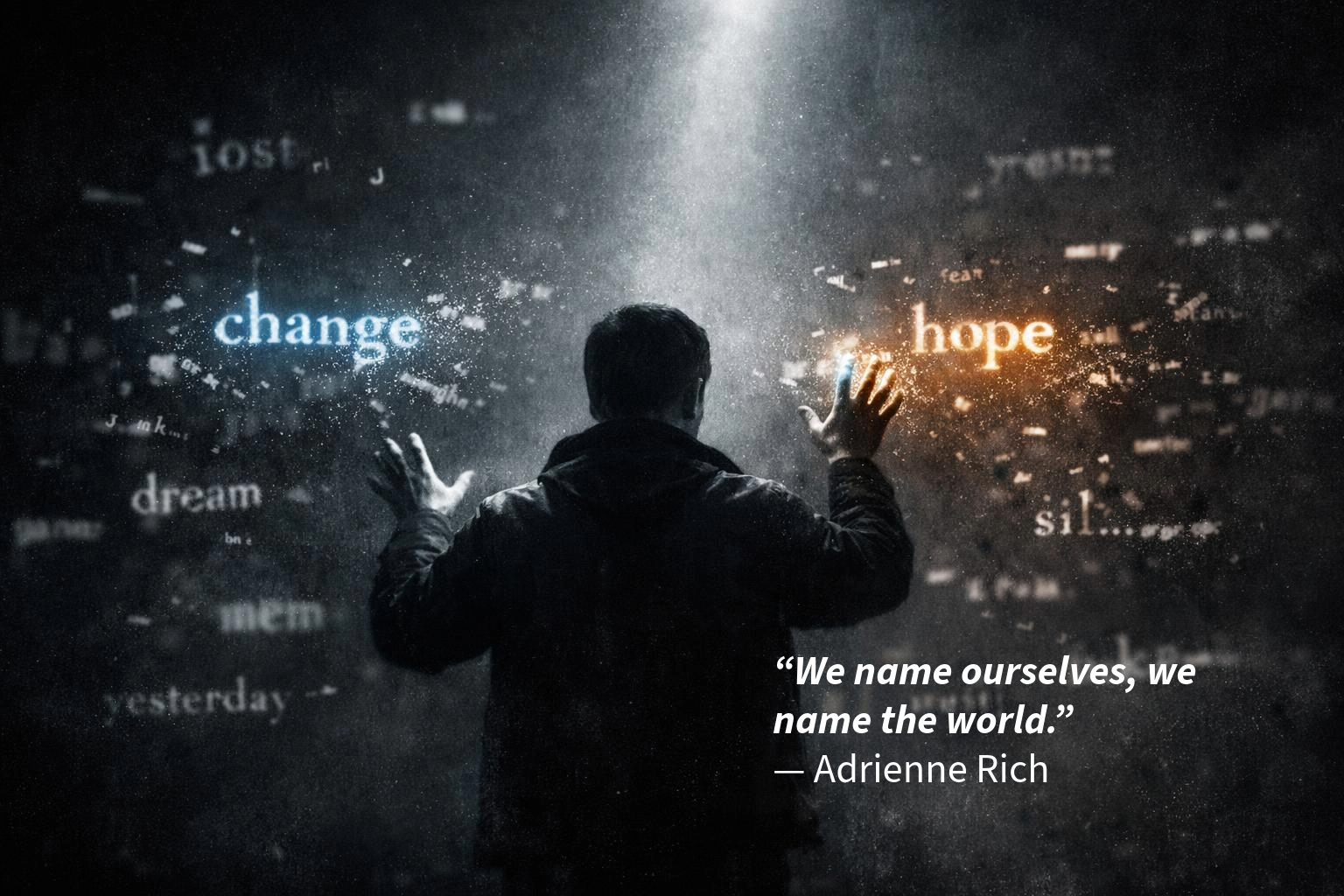
It feels simple—almost too simple. Naming something doesn’t seem like power at first. It feels ordinary. Routine. But the more you sit with it, the more you realize how much control lives in that act.
Because naming is never neutral.
From the beginning, things are labeled for us—who we are, where we belong, what we’re capable of. Some of it is subtle. Some of it isn’t. But over time, those labels start to feel like facts. Like something fixed.
I’ve caught myself answering to things I didn’t choose. Adjusting to definitions that were handed to me without question. It happens quietly—until you don’t even realize you’re doing it anymore.
But the moment you start naming things for yourself… everything shifts.
Not all at once. Not dramatically. But enough to feel it.
Because when you choose your own language, you’re not just describing your life—you’re shaping it. You’re deciding what something means instead of inheriting someone else’s version of it.
Adrienne Rich understood that. Naming isn’t just expression—it’s authorship.
Maybe the work isn’t just discovering who you are.
Maybe it’s deciding how you speak about it.
Not repeating what’s been said.
Not defaulting to what’s expected.
But choosing your own words—even if they don’t fit cleanly.
Because once you name something for yourself…
it stops owning you.
What part of your life have you been describing using someone else’s language?
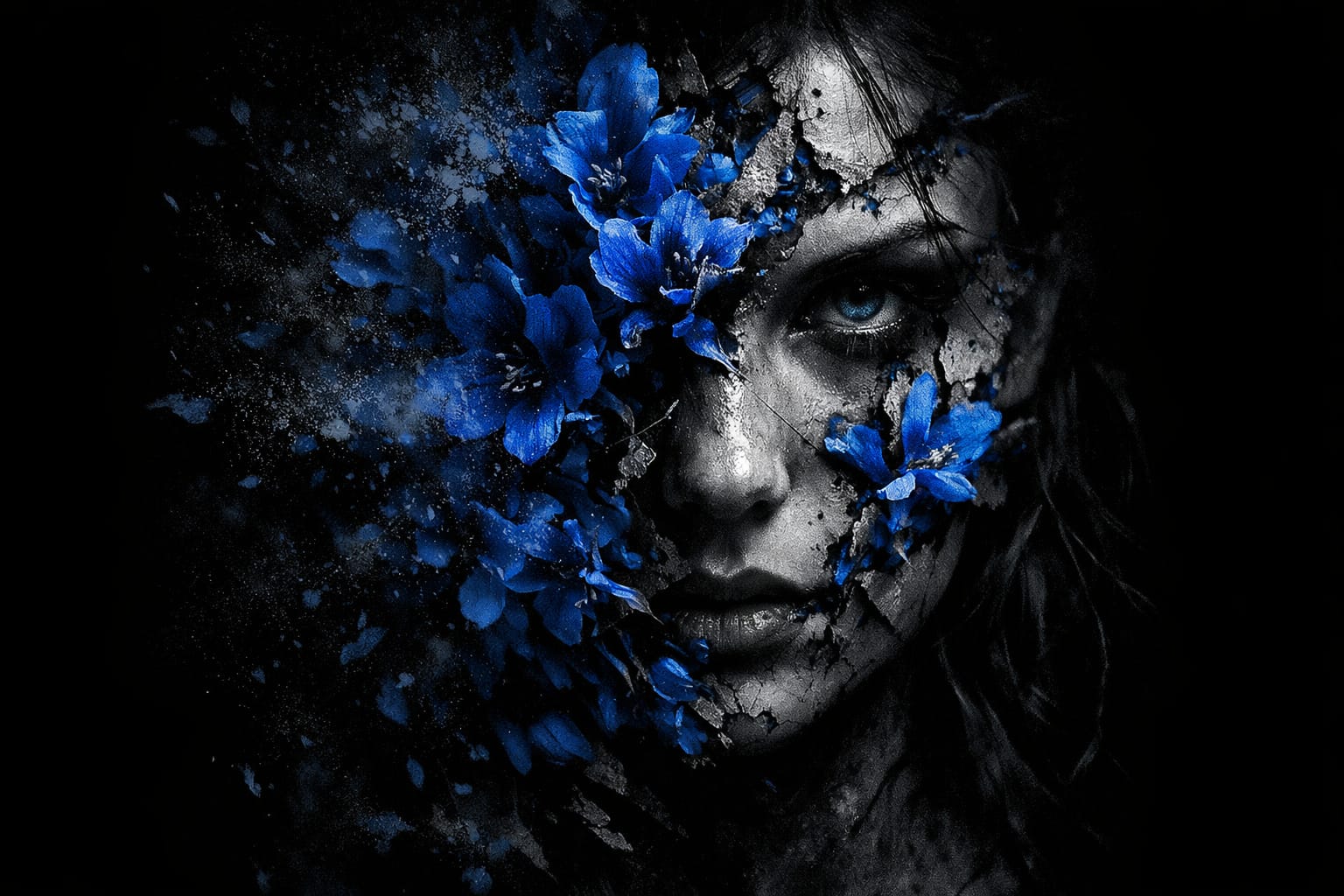
She is not breaking.
That’s the first lie the image tells you.
At a glance, it looks like collapse—skin splitting like dry earth, fragments peeling away into a black that feels less like absence and more like hunger. But look closer. The fractures don’t fall apart. They bloom. Blue pushes through the ruin, not delicate, not ornamental—insistent. Violent in its quiet way.
Her face is a battleground where something refused to stay buried.
The blue isn’t soft. It stains the grayscale like a bruise that never healed right. Petals press through her cheekbone, her temple, her jaw—as if the body tried to contain something and failed. Or worse… tried to forget.
Her eye—sharp, awake—doesn’t ask for help. It measures you. Like it’s deciding whether you’re another witness or just another person who will look away once the beauty wears off and the damage starts to mean something.
There’s ash in the cracks. You can almost smell it—burnt memory, old rooms, something that once had a name. The texture of her skin feels wrong, like stone that remembers being flesh. Like something lived there, left, and took the softness with it.
But the flowers stayed.
That’s the part that unsettles.
Because flowers aren’t supposed to grow in places like this. Not in fracture lines. Not in ruin. Not in whatever kind of darkness clings to her like a second skin.
Unless they’re not symbols of life.
Unless they’re proof of survival that came at a cost.
She doesn’t smile. Doesn’t need to. There’s a steadiness in her that feels earned the hard way—through nights that didn’t end clean, through versions of herself that had to be buried just to keep walking. The kind of strength that doesn’t inspire. The kind that endures.
And still—
color remains.
Not everywhere. Not enough to make things easy. Just enough to remind you that something inside her refused extinction.
Most people want exercise to feel like a reward. I’ve never bought into that.
Exercise, for me, has always been closer to maintenance—like tightening bolts on a machine you still need to run tomorrow. You don’t celebrate it. You do it because not doing it costs more.
That said, walking is the one form that never tried to sell me a lie.
It doesn’t pretend to be fun. It doesn’t dress itself up with neon lights, loud music, or promises of transformation in thirty days. It just asks one thing: keep moving.
And somehow, that’s enough.
Walking has been the most consistent thread in my life—not because it excites me, but because it meets me where I am. Good day, bad day, restless mind, heavy thoughts—it doesn’t argue. It doesn’t judge. It just absorbs.
There’s a rhythm to it. Heel, toe. Breath in, breath out. The world passing at a pace slow enough to notice, but steady enough to leave something behind. Problems don’t disappear, but they loosen their grip. Thoughts that felt tangled start to line up single file.
You don’t walk to escape. You walk to process.
And if you pay attention, the work starts showing up.
More than a few ideas have found me mid-stride. Plot holes I couldn’t untangle at the desk suddenly loosen somewhere between one block and the next. Dialogue sharpens. Scenes rearrange themselves without me forcing them. It’s like the story finally exhales when I stop hovering over it.
But walking gives, and walking takes.
Because the same rhythm that unlocks an idea will carry it right out of your head if you’re not paying attention.
You need a way to catch it.
A notebook in your pocket. A voice memo on your phone. Something. Because the lie we tell ourselves is, I’ll remember this when I get back.
You won’t.
Not fully. Not the way it felt when it arrived. Not the phrasing, not the clarity, not the weight of it. By the time you sit back down, all that’s left is a ghost of the idea—and ghosts don’t write clean prose.
So the walk becomes two things at once: a generator and a test.
If you care about the work, you don’t just let the moment pass—you trap it, even if it’s messy. Even if it’s just fragments. Because fragments can be rebuilt. Forgotten ideas can’t.
Thirty minutes a day is all it takes.
No gym membership. No supplements. No fancy clothes stitched with promises you didn’t ask for. Just you… easing on down the road.
There’s something honest about that kind of movement. No mirrors. No metrics screaming at you. No one keeping score. Just your body remembering what it was built to do.
I used to be a gym rat.
Back when I could walk in, flip the switch, and bring it without thinking. Back when effort felt automatic and strength felt like something I could summon on command.
I can’t do that the same way anymore.
And that pisses me off.
Not because I think I’m weak—but because it feels like I’m losing an edge. The kind that let me move through life by standards nobody actually meets, but everybody swears by like it’s gospel.
As a soldier, I believed in that edge early in my career. Thought it was necessary. Thought it was the thing that separated those who made it from those who didn’t.
I was wrong.
I learned the difference between a soldier and a warrior.
A soldier follows orders, meets standards, pushes until something breaks—sometimes himself. A warrior understands restraint. Knows when to move, when to wait, when to endure without burning everything down in the process.
One lives by force.
The other lives by awareness.
And here’s the part that took me a while to understand—
The military doesn’t teach you how to survive. It teaches you how to live.
Not comfortably. Not softly. But deliberately. With purpose. With structure. With a code that doesn’t bend just because the day got hard.
I just misunderstood what that life was supposed to look like.
I thought it meant constant pressure. Constant edge. Always on.
It didn’t.
Now?
Now I walk the neighborhood.
And out there, things slow down just enough for me to notice what I used to miss. The flowers pushing through cracks like they’ve got something to prove. The quiet rhythm of people going about their lives. The animals that don’t question the day—they just live it.
And somewhere in all of that…
I find my place alongside them.
Not chasing what I used to be. Not pretending I don’t feel the loss either. Just moving forward, step by step, in a world that never stopped moving.
I use the same approach in writing: one step at a time.
That’s all it is, really. The same way you walk the dog. You don’t worry about the whole road at once. You just start moving. One block. One corner. One more stretch before turning back home.
Writing works the same way.
You don’t finish an essay, a story, or a chapter all at once. You finish it sentence by sentence, paragraph by paragraph, thought by thought. The trouble starts when you stand still long enough to think about everything left undone. That’s when doubt creeps in, big as a bill collector and twice as loud.
But forward is forward.
A few lines today. A page tomorrow. A fix for a broken scene while your shoes hit the sidewalk and the dog stops to inspect something that apparently holds the secrets of the universe.
It may not look glamorous, but progress rarely does.
We want breakthroughs, lightning bolts, grand moments of arrival. Most of the time, what changes us is repetition. Quiet effort. The unremarkable decision to keep going.
Same with walking. Same with writing.
You put one foot down, then the next.
One word, then another.
And sooner or later, you look up and realize you’ve gone farther than you thought you would.
Editing doesn’t start when the draft is finished.
It starts before the first word hits the page.
Every idea you choose… and every one you don’t… that’s editing. That’s preproduction. You’re already deciding what matters. The clearer you are on what you want to say, the less you have to clean up later.
Then comes the writing. That part? Easy. That’s instinct. That’s the words showing up like they’ve been waiting.
Post-production… that’s where it gets real.
That’s where doubt walks in.
You read it back and start asking harder questions. Is it believable? Does it land? Can someone else sit with this and feel something… or is this just me talking to myself?
Because readers are worse than any editor. They don’t analyze—they react. And if it doesn’t feel right, they’re gone.
So you cut. You rewrite. You tighten.
Sometimes you write a sentence that’s beautiful… and it doesn’t belong. You cut it anyway. It hurts. It’s supposed to. The story is better without it.
Grammar matters. But a perfect sentence that does nothing is still useless.
So you go back and find better words. Not bigger words. Better ones. No five-dollar words when a two-dollar one will carry the weight.
That’s where poetry comes in.
It teaches command of language. Every word has a job. What you leave out matters just as much.
You learn restraint.
I’m not trying to explain everything to you. I’m trying to let you sit next to me and feel it. The grit. The tension. The atmosphere. If I do it right, I don’t have to walk you through it.
Sometimes, it sounds like this:
Shrieks and whimpers blend in the shadows, composing a chilling melody… one haunting, yet familiar. Propped on padded steel, I reflect. Inaction’s consequence has become the gallow’s pole. Action’s responsibility—the weight for which I dangle.
No explanation. Just placement.
But truth isn’t fixed. It’s perception.
All I can do is tell it the way I see it. If I say it with enough precision, you’ll find yourself somewhere in it.
That’s the job.
Not perfection. Mediocrity is unacceptable—but that doesn’t mean perfect. It means no carelessness. No lazy writing.
Not every line has to shine. But every line has to matter.
Life doesn’t wrap things up neatly. It doesn’t hand you clean endings. Sometimes things just sit there unresolved. That belongs in the work too.
I don’t tie everything up.
I just make sure you feel what’s left hanging.
And here’s the part people don’t like—
I can’t control how you feel about any of this.
All I can do is put it on the page the way it needs to be.
Truth over popularity. No exceptions.
But don’t get that twisted—the reader always matters.
It makes no sense to write something that can’t be understood. If you can’t enter the work, that’s on me. Not because the idea is wrong, but because I didn’t translate it clearly enough.
That’s where precision comes in.
Perception without precision gets lost.
So I aim for clarity. Not to make it easier… but to make sure you can find me.
What looks raw on the page usually isn’t. It’s intentional. Sometimes the gut punch waits in the shadows. Other times it’s right there in the open.
Either way… it’s placed.
I’m not trying to impress you.
I’m trying to tell the truth the best way I can.
If I do that right—
you’ll believe me.
And maybe… you’ll listen.
Author’s Note
A thank you to Sadje for her Sunday Poser—a question that turned into something more than an answer. It turned into a conversation.:::

There’s a certain kind of moment you don’t recognize until later—the quiet ones that change your direction without asking permission.
Mine came in a used bookstore.
The owner didn’t say much. He just walked up, placed Bad Haircut in my hands, and said, “Read this.”
No urgency. No explanation. Just certainty.
He’d mentioned Tom Perrotta before. I’d filed it away with all the other I’ll get to it authors. The list was long. He wasn’t near the top.
But something about that moment—something in the way the book didn’t feel optional—cut through the noise.
So I read it.
And somewhere between the first page and the last… something shifted.
What keeps pulling me back isn’t just the stories—it’s the people inside them.
Perrotta doesn’t build characters to serve a plot. He lets them exist first. And that changes everything.
He goes the extra mile in a way that doesn’t announce itself. There’s no dramatic spotlight, no forced moment telling you what matters. Instead, he works in the margins—the hesitation in a sentence, the wrong thing said at the wrong time, the silence that lingers just a second too long.
That’s where the truth lives.
His characters aren’t polished. They’re not particularly heroic. Half the time they don’t even understand themselves. But that’s exactly why they land.
They feel human.
Not the version we rehearse for other people—but the one that shows up when things don’t go the way we planned. Insecure. Conflicted. Trying. Failing. Trying again, sometimes worse than before.
And because of that, you don’t just read about them—you recognize them.
Worse… you recognize yourself.
That’s where the shift happens. That’s where you start to care.
Not because the story tells you to. But because you’ve seen that version of a person before. Maybe you’ve been that person. Maybe you still are.
There are a couple of moments in Bad Haircut that never really left me.
One of them is the way Perrotta describes the city—not as one place, but as two towns pretending to share the same space. There’s this invisible line. You cross it, and everything shifts. The tone. The people. The expectations.
No sign telling you it’s there. But you feel it.
That stuck with me because it’s real.
I grew up around cities like that. I’ve walked those lines without knowing what they were until I was already on the other side. Places where one block feels like possibility and the next feels like something closing in on you. Same city. Different rules.
Then there’s another moment—the one that hits a little closer.
The protagonist gets involved with an older woman while he’s still in high school. For him, it isn’t casual. It isn’t a story to tell his friends. It’s everything. The kind of moment that rewrites how you see yourself, how you think the world works.
And then she tells him she’s going to marry someone else.
Just like that.
It’s messy. Complicated. A little reckless. The kind of situation adults would label a mistake and move on from.
But for him, it’s not a footnote.
It’s a fracture.
That’s what Perrotta understands—something we tend to forget once we’ve put distance between who we were and who we are now.
Back then, everything mattered.
Every conversation carried weight. Every touch meant something. Every loss felt permanent.
There was no such thing as just a moment.
And when you read it now, older, supposedly wiser… you realize how much of that intensity never really left. It just learned how to hide better.
My all-time favorites are Count a Lonely Cadence by Gordon Weaver and Invisible Man by Ralph Ellison.
Those books move differently.
They carry weight in a more deliberate way—language that feels carved instead of spoken, themes that stretch beyond the page into something larger. Identity. Isolation. The cost of being seen—or not seen at all.
They demand something from you.
But Bad Haircut doesn’t move like that.
It doesn’t reach for myth. It doesn’t try to explain the world.
It stays smaller. Closer.
And somehow… that makes it hit just as hard.
Because where Weaver and Ellison deal in systems—power, institutions, identity under pressure—Perrotta works in something quieter.
He shows you how those same forces live in ordinary spaces. In school hallways. In neighborhoods. In the small decisions that don’t feel like decisions at all.
Not whether you survive a system…
But whether you become the kind of person who never questions it.
I return to these books because they recognize the life I’ve lived—even the parts I didn’t at the time.
Not the dramatic moments. Not the ones that make stories worth telling at a bar.
The quiet ones.
The ones that shape you before you even realize something is changing.
I’ve read other work by Tom Perrotta. Good work. Solid work.
But nothing hits me like Bad Haircut.
There’s something about it that doesn’t let go. Or maybe it never needed to—it just waited until I caught up to it.
It might even make my desert island list.
Count a Lonely Cadence.
Invisible Man.
And Bad Haircut.
Three different kinds of weight. Three different ways of telling the truth.
If you looked at those copies, you wouldn’t see pristine pages. You’d see wear. Creases in the spine. Edges softened from being opened too many times.
Dog-eared pages.
I hate dog-earing a book.
Always have.
But these?
These don’t feel like objects you preserve. They feel like something you return to—again and again—until the marks stop feeling like damage and start feeling like proof.
Proof that something in there wasn’t just worth reading—
It was worth needing.
By Claude McKay
If we must die, let it not be like hogs
Hunted and penned in an inglorious spot,
While round us bark the mad and hungry dogs,
Making their mock at our accursèd lot.
If we must die, O let us nobly die,
So that our precious blood may not be shed
In vain; then even the monsters we defy
Shall be constrained to honor us though dead!
O kinsmen! we must meet the common foe!
Though far outnumbered let us show us brave,
And for their thousand blows deal one death-blow!
What though before us lies the open grave?
Like men we’ll face the murderous, cowardly pack,
Pressed to the wall, dying, but fighting back!
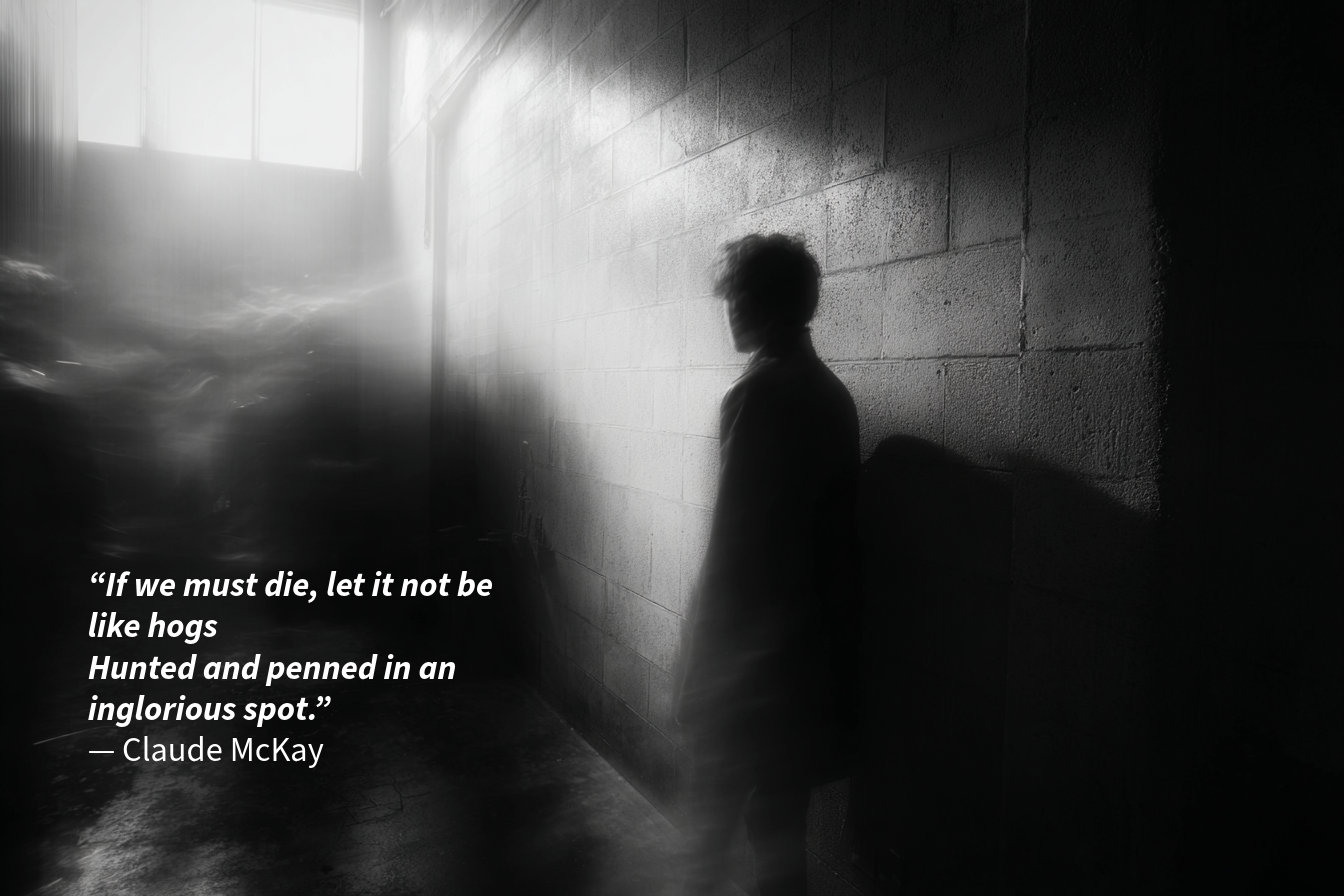
It doesn’t ease in. It hits hard, immediate—no room for interpretation. There’s urgency in it. A refusal. Not just about death, but about dignity. About how a life is lived when it’s under pressure.
There’s something uncomfortable about this kind of clarity. Most of us move through life avoiding extremes—avoiding confrontation, avoiding risk, avoiding anything that might force us to define where we actually stand.
But pressure has a way of stripping all that down. It reveals what you tolerate. What you accept. What you stay silent about just to keep things steady.
I’ve seen how easy it is to shrink in those moments. To choose comfort over conviction. To let things slide because speaking up feels like it might cost too much.
McKay doesn’t leave space for that kind of negotiation. His words come from a place where the cost is already on the table. Where dignity isn’t optional—it’s the only thing left to protect.
And maybe that’s what makes it hit.
Because it forces a question most of us don’t ask until we have to—
what do you stand for when standing costs you something?
Not every moment calls for a fight. Not every situation demands resistance.
But some do.
And in those moments, it’s not about winning. It’s about how you show up. What you refuse to accept. What you’re willing to carry, even when it’s heavy.
Because dignity isn’t something you’re given.
It’s something you decide to hold onto—
especially when it would be easier not to.
Where have you stayed silent to keep the peace—and what did it cost your sense of self?

She doesn’t remember when the red started.
Not the first drop—that would be too clean, too cinematic. Life doesn’t announce its turning points with a single, obedient moment. It seeps. It stains. It builds in quiet layers until one day you look in the mirror and realize something has marked you permanent.
The world around her has already drained itself dry. Everything reduced to bone and shadow, to the honest language of black and white. No distractions. No soft places left to hide. Just contrast—truth sharpened into edges.
But the red…
The red refuses to behave.
It clings to her like memory. Not just what was done, but what couldn’t be undone. It splashes across her cheek, streaks along her brow, settles into the corners of her mouth like a secret she’s tired of keeping. It doesn’t ask permission. It doesn’t fade.
Her grip tightens around the handle in her hand—not trembling, not uncertain. Just… anchored. Like it’s the only real thing left in a world that has forgotten how to feel.
She’s learned the difference between noise and signal.
People talk. They always do. About justice. About lines you don’t cross. About who you’re supposed to be when the lights are on and someone’s watching. But none of them ever explain what happens when the lights go out. When the rules start bending under the weight of reality.
That’s where she lives now.
In the quiet aftermath.
In the space between decision and consequence.
Her eyes don’t wander. They don’t soften. They don’t apologize. There’s a calculation there—cold, precise—but underneath it, something heavier. Something tired. Like she’s already counted the cost and paid it in advance.
That’s the part no one sees.
They’ll look at her and see violence. Rage. Maybe even madness if it helps them sleep better at night. But they won’t see the discipline it took to get here. The restraint that came before the breaking point. The thousand moments she chose not to act… until the one where she did.
The red doesn’t make her a monster.
It makes her honest.
Because deep down, beneath the noise and the rules and the performance of being “good,” everyone knows there’s a line. And everyone likes to believe they’ll never cross it.
She used to believe that too.
Now she just wonders how many are already closer than they think.
Let America be America again.
Let it be the dream it used to be.
Let it be the pioneer on the plain
Seeking a home where he himself is free.
(America never was America to me.)
Let America be the dream the dreamers dreamed—
Let it be that great strong land of love
Where never kings connive nor tyrants scheme
That any man be crushed by one above.
(It never was America to me.)
O, let my land be a land where Liberty
Is crowned with no false patriotic wreath,
But opportunity is real, and life is free,
Equality is in the air we breathe.
(There’s never been equality for me,
Nor freedom in this “homeland of the free.”)
Say, who are you that mumbles in the dark?
And who are you that draws your veil across the stars?
I am the poor white, fooled and pushed apart,
I am the Negro bearing slavery’s scars.
I am the red man driven from the land,
I am the immigrant clutching the hope I seek—
And finding only the same old stupid plan
Of dog eat dog, of mighty crush the weak.
I am the young man, full of strength and hope,
Tangled in that ancient endless chain
Of profit, power, gain, of grab the land!
Of grab the gold! Of grab the ways of satisfying need!
Of work the men! Of take the pay!
Of owning everything for one’s own greed!
I am the farmer, bondsman to the soil.
I am the worker sold to the machine.
I am the Negro, servant to you all.
I am the people, humble, hungry, mean—
Hungry yet today despite the dream.
Beaten yet today—O, Pioneers!
I am the man who never got ahead,
The poorest worker bartered through the years.
Yet I’m the one who dreamt our basic dream
In the Old World while still a serf of kings,
Who dreamt a dream so strong, so brave, so true,
That even yet its mighty daring sings
In every brick and stone, in every furrow turned
That’s made America the land it has become.
O, I’m the man who sailed those early seas
In search of what I meant to be my home—
For I’m the one who left dark Ireland’s shore,
And Poland’s plain, and England’s grassy lea,
And torn from Black Africa’s strand I came
To build a “homeland of the free.”
The free?
Who said the free? Not me?
Surely not me? The millions on relief today?
The millions shot down when we strike?
The millions who have nothing for our pay?
For all the dreams we’ve dreamed
And all the songs we’ve sung
And all the hopes we’ve held
And all the flags we’ve hung,
The millions who have nothing for our pay—
Except the dream that’s almost dead today.
O, let America be America again—
The land that never has been yet—
And yet must be—the land where every man is free.
The land that’s mine—the poor man’s, Indian’s, Negro’s, ME—
Who made America,
Whose sweat and blood, whose faith and pain,
Whose hand at the foundry, whose plow in the rain,
Must bring back our mighty dream again.
Sure, call me any ugly name you choose—
The steel of freedom does not stain.
From those who live like leeches on the people’s lives,
We must take back our land again,
America!
O, yes,
I say it plain,
America never was America to me,
And yet I swear this oath—
America will be!
Out of the rack and ruin of our gangster death,
The rape and rot of graft, and stealth, and lies,
We, the people, must redeem
The land, the mines, the plants, the rivers.
The mountains and the endless plain—
All, all the stretch of these great green states—
And make America again!
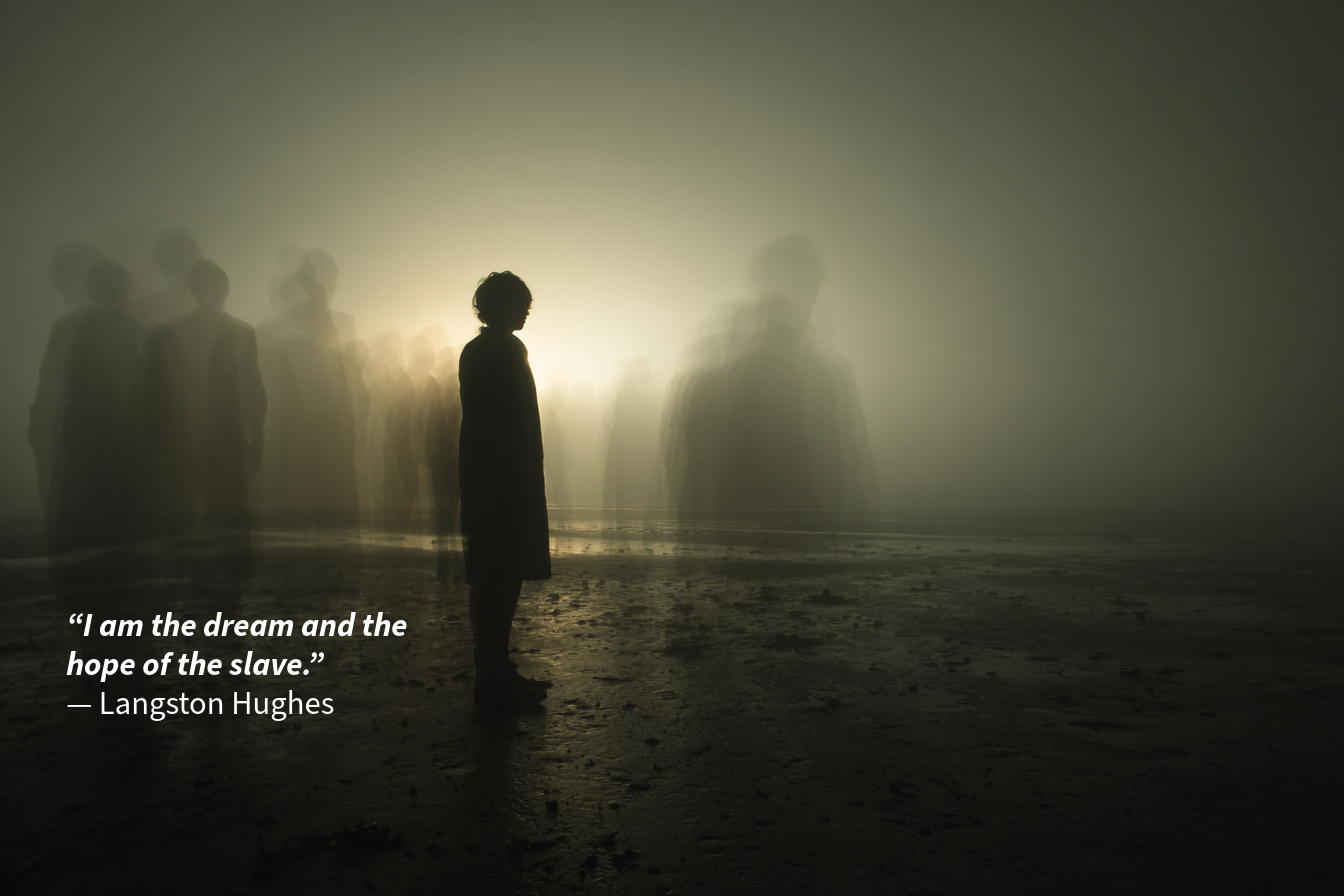
It reads like a declaration—but it carries more than pride. There’s weight behind it. Not just who I am, but what I represent. A continuation. A result.
There’s something heavy about realizing you didn’t start your story where you think you did. That parts of who you are were shaped long before you had a say in any of it.
I’ve felt that in quieter ways—the expectations, the inherited beliefs, the things passed down without ever being spoken out loud. Some of it feels like strength. Some of it feels like pressure.
Hughes’ line doesn’t separate the two. It holds both at the same time. To be the dream means you carry what someone else couldn’t reach. To be the hope means you’re standing where someone else once couldn’t stand.
That’s not light. That’s not abstract.
It means your existence is tied to something unfinished. Something that didn’t end—it just changed form.
And the question becomes whether you recognize it… or move through life thinking you built yourself alone.
Maybe identity isn’t just about who you decide to be. Maybe it’s also about what you choose to carry forward—and what you choose to reshape.
Not out of obligation.
Not out of guilt.
But out of awareness.
Because once you understand where you stand…
you don’t walk the same way anymore.
What part of your life feels inherited—and what are you choosing to do with it?

She doesn’t remember the moment it began—only the sound.
Not a scream. Not at first.
A hum.
Low. Mechanical. Patient.
It started somewhere beneath her ribs, a foreign rhythm learning her body like a language it intended to overwrite. Now it pulses through her—wires threading out from her side like exposed nerves, trembling in the dark as if they can still feel something worth holding onto.
Her eyes are shut, but not in peace.
In refusal.
Because seeing would make it real.
The left side of her face is still hers—soft, tired, human. The right side has no such mercy. Cold plates kiss her skin where it no longer belongs to her. Light leaks from seams that were never meant to open. Red, sterile, deliberate. Not blood—something cleaner. Something worse.
There’s a moment—just a flicker—where she tries to stomp it down. The panic. The rising terror clawing at her throat. She tries to stamp her will over whatever this is becoming, like she can still claim jurisdiction over her own body.
But the machine doesn’t negotiate.
It adapts.
Her breath shudders. A memory surfaces—warm sunlight, a laugh she doesn’t fully recognize anymore, the weight of her own name spoken by someone who meant it. That’s the part that fights. That’s the part that refuses to go quiet.
And maybe that’s the cruelest design of all.
They didn’t erase her.
They left just enough.
Enough to feel the loss.
The wires twitch again, reacting to something unseen, and her body follows a half-second too late—as if she’s no longer the one giving the commands. The delay is subtle. Almost elegant.
Like possession dressed up as progress.
She gasps—not because she needs air, but because something inside her still believes she does.
Still believes she’s alive.
There’s a fracture at her center now, glowing faint and violent. Not a wound. Not exactly. More like a door left open too long. Something got in.
Something stayed.
And as the hum deepens—steady, certain—she understands, finally, that this isn’t transformation.
It’s replacement.
Piece by piece. Thought by thought. Memory by memory.
Until the only thing left of her…
Is the part that still hurts.

We like to believe that progress is a straight line—one step after another, measured, deliberate, inevitable. We imagine the climb as something clean, something earned through effort alone, as if willpower were enough to carry us upward. But no one tells you how heavy each step becomes when you’re not just carrying ambition, but everything you’ve tried to bury along the way.
The stairs are never just stairs.
They remember.
Every hesitation. Every false start. Every moment you almost turned back but didn’t. They hold the imprint of your weight—not just your body, but your doubt, your fear, your unfinished conversations with yourself. You think you’re climbing toward something—success, clarity, becoming—but the truth is, you’re also climbing with something. And that something doesn’t always want you to reach the top.
You feel it in the pauses.
Not the kind you plan, not the kind you earn, but the kind that finds you halfway up, when your body is still capable but your mind begins to fracture. You sit down for a moment, just to catch your breath, just to recalibrate—but the stillness stretches longer than it should. The silence begins to speak.
This is where the demons step in.
Not loud. Not theatrical. Not the monsters you were warned about in stories. These are quieter. More precise. They don’t drag you down the stairs—they convince you that staying where you are makes sense. They speak in your voice, with your logic, using your past as evidence. They remind you of every time you tried and failed, every time you reached and came up short, every time the climb cost more than you were prepared to give.
They don’t need to stop you.
They just need to make stopping feel reasonable.
So you sit.
And the longer you sit, the heavier everything becomes. Not because the stairs have changed, but because the weight you’re carrying has started to settle. It spreads out inside you, filling spaces you didn’t realize were hollow, pressing against the edges of who you thought you were. It tells you that maybe this is enough. That maybe the version of you sitting here—paused, contained, controlled—is safer than the one still trying to climb.
There’s a strange comfort in that lie.
Because climbing requires confrontation.
Not with the world—but with yourself.
Every step upward forces something into the light. A doubt you can’t ignore. A fear you can’t rationalize away. A truth that doesn’t fit the version of yourself you’ve been presenting. The higher you go, the less room there is for illusion. And for some, that exposure feels more dangerous than failure.
So they stop.
Not forever. Not officially. Just… long enough.
Long enough to lose momentum.
Long enough to forget what the next step felt like.
Long enough to convince themselves that they’ll start again later—when things are clearer, easier, more aligned. But clarity doesn’t arrive in stillness. It arrives in motion, in friction, in the uncomfortable act of continuing when continuation doesn’t make sense.
That’s the part people don’t talk about.
Success isn’t built on motivation.
It’s built on movement through resistance.
And resistance is rarely external.
It doesn’t come from the stairs.
It comes from the weight you carry up them.
That weight has a history.
It is made of everything you’ve internalized but never resolved. Expectations that were never yours but feel like they are. Failures that were supposed to teach you something but instead taught you to hesitate. Voices that told you who you were before you had the chance to decide for yourself.
You don’t leave those things behind at the base of the staircase.
You bring them with you.
And at some point, they begin to speak louder than your reasons for climbing.
That’s when the climb changes.
It stops being about reaching the top.
It becomes about deciding whether you’re willing to keep going while carrying what you haven’t yet understood.
Some people turn back here.
Not because they can’t climb.
But because they can’t carry.
Others stay where they are.
Suspended between who they were and who they might become, convincing themselves that stillness is a form of control. That if they don’t move, they can’t fail. That if they don’t climb, they don’t have to confront what waits for them at the next level.
But there are a few—quiet, stubborn, often misunderstood—who do something different.
They don’t drop the weight.
They examine it.
They sit on the step, not in surrender, but in recognition. They begin to understand that the demons they’ve been fighting are not external forces, but internal constructs—built, reinforced, and sustained over time. They don’t disappear when ignored. They don’t weaken with avoidance. They adapt.
So instead of running from them, these few turn toward them.
They ask uncomfortable questions.
Where did this come from?
Why does it have this much power?
What part of me still believes this is true?
This is not a dramatic moment.
There is no sudden clarity, no instant transformation.
Just a slow, deliberate shift.
The weight doesn’t vanish—but it changes.
It becomes defined.
And what is defined can be carried differently.
So they stand.
Not lighter.
But steadier.
And they take another step.
Not because the path is clear.
Not because the fear is gone.
But because they’ve decided that stopping is no longer an option.
This is where the illusion breaks.
Not all at once.
But enough to see through it.
The stairs were never the obstacle.
The climb was never the enemy.
It was the conversation you refused to have with yourself along the way.
And once that conversation begins—honestly, without performance, without deflection—the nature of the climb shifts. It is no longer about proving something to the world. It is no longer about reaching a destination that validates your effort.
It becomes about alignment.
About becoming someone who can move forward without being anchored to what no longer serves them.
That doesn’t mean the demons disappear.
They don’t.
They evolve.
But so do you.
And at some point, the thing that once stopped you becomes the thing that teaches you how to continue.
Not perfectly.
Not effortlessly.
But truthfully.
So when you find yourself sitting on the steps—paused, uncertain, weighed down by something you can’t quite name—understand this:
You are not stuck.
You are in the moment where the climb asks something real of you.
Not effort.
Not ambition.
Understanding.
And once you begin to understand what you’re carrying…
…the steps stop feeling like resistance.
And start feeling like direction.
1888 – 1965
A penny for the Old Guy
I
We are the hollow men
We are the stuffed men
Leaning together
Headpiece filled with straw. Alas!
Our dried voices, when
We whisper together
Are quiet and meaningless
As wind in dry grass
Or rats’ feet over broken glass
In our dry cellar
Shape without form, shade without colour.
Paralysed force, gesture without motion;
Those who have crossed
With direct eyes, to death’s other Kingdom
Remember us—if at all—not as lost
Violent souls, but only
As the hollow men
II
Eyes I dare not meet in dreams
In death’s dream kingdom
These do not appear:
There, the eyes are
Sunlight on a broken column
There, is a tree swinging
And voices are
In the wind’s singing
More distant and more solemn
Than a fading star.
Let me be no nearer
In death’s dream kingdom
Let me also wear
Such deliberate disguises
Rat’s coat, crowskin, crossed staves
In a field
Behaving as the wind behaves
No nearer—
Not that final meeting
In the twilight kingdom
III
This is the dead land
This is cactus land
Here the stone images
Are raised, here they receive
The supplication of a dead man’s hand
Under the twinkle of a fading star.
Is it like this
In death’s other kingdom
Waking alone
At the hour when we are
Trembling with tenderness
Lips that would kiss
Form prayers to broken stone.
IV
The eyes are not here
There are no eyes here
In this valley of dying stars
In this hollow valley
This broken jaw of our lost kingdoms
In this last of meeting places
We grope together
And avoid speech
Gathered on this beach of the tumid river
Sightless, unless
The eyes reappear
As the perpetual star
Multifoliate rose
Of death’s twilight kingdom
The hope only
Of empty men.
V
Here we go round the prickly pear
Prickly pear prickly pear
Here we go round the prickly pear
At five o’clock in the morning.
Between the idea
And the reality
Between the motion
And the act
Falls the Shadow
For Thine is the Kingdom
Between the conception
And the creation
Between the emotion
And the response
Falls the Shadow
Life is very long
Between the desire
And the spasm
Between the potency
And the existence
Between the essence
And the descent
Falls the Shadow
For Thine is the Kingdom
For Thine is
Life is
For Thine is the
This is the way the world ends
This is the way the world ends
This is the way the world ends
Not with a bang but a whimper.
Reflection
This is what it looks like when something inside a person… goes quiet.
Not peaceful quiet.
Not rest.
But absence.
The Hollow Men doesn’t scream. It doesn’t rage. It doesn’t even try to convince you of anything. It just exists in a kind of spiritual low tide, where everything that once had weight—belief, purpose, conviction—has been drained out, leaving something that still moves, still speaks… but doesn’t fully live.
That’s what makes it unsettling.
Because it doesn’t describe monsters.
It describes people.
People who’ve learned how to function without feeling too deeply.
People who speak in fragments, act without conviction, drift instead of decide.
People who’ve made peace with emptiness because filling it would require something they no longer trust themselves to carry.
And if you sit with it long enough, the discomfort shifts.
It stops being about them.
It starts being about how easy it is to become one of them.
Not all at once.
But gradually.
A compromise here.
A silence there.
A moment where you choose not to speak because it’s easier. Safer. Less complicated.
And over time, those small choices add up.
Until you look up one day and realize you’re moving through your life without friction. Without resistance.
Without presence.
That’s the real weight of this poem.
Not emptiness as tragedy—
but emptiness as something that can quietly become normal.
And once it does, it’s hard to recognize what’s missing.
It feels almost defiant. Gladness doesn’t belong in a “ruthless furnace”—not logically. Not comfortably. But there it is, placed right in the middle of it, like something that refuses to burn.
There’s a quiet pressure in the world to match its mood. If things are heavy, you’re expected to carry that weight visibly. If things are falling apart, joy can start to feel inappropriate—like you’re ignoring reality or missing something important.
I’ve felt that hesitation. That moment where something good shows up—a laugh, a breath, a small pocket of peace—and there’s a reflex to hold back. To temper it. To not lean all the way in.
Like accepting it fully might make it disappear faster. Or worse—make you look like you don’t understand how hard things really are.
But Gilbert isn’t asking for permission. He’s calling for stubbornness. The kind that doesn’t deny the harshness of the world—but refuses to let it dictate the full range of your experience.
Because the truth is, the furnace doesn’t stop. The pressure doesn’t ease just because you decide to feel less.
So the question becomes—
why should your capacity for gladness be the thing that gets sacrificed?
Maybe gladness isn’t something you wait for the world to allow. Maybe it’s something you claim—quietly, deliberately—right in the middle of everything that says you shouldn’t.
Not as denial.
Not as escape.
But as proof that the world doesn’t get to decide everything you feel.
And holding onto that—
that might be its own kind of resistance.
Where have you been holding back your joy because the world didn’t feel like it deserved it?

She didn’t look like someone who stayed.
That was the first lie I told myself. It went down easy, like cheap whiskey—burned just enough to feel honest, then settled in like something I didn’t have to question.
The mountains behind her were bruised with fading light, the sky pressing low like it had weight to it. Wind came off the ridge in uneven breaths, carrying pine, damp earth, and the faint ghost of rain that never quite made it. It cut through my jacket and stayed there, needling into bone.
She leaned against the railing like she owned the quiet. One shoulder dipped, fingers tracing the cold iron scrollwork—slow, deliberate, like she was counting something. Time, maybe. Or all the reasons she shouldn’t be here.
The whole thing felt staged. Like we were standing inside some memory dressed up as a parlour—clean lines, soft edges, nothing sharp enough to admit what was actually happening.
I should’ve spoken the second I saw her.
Instead, I watched.
That’s my tell. I observe. I measure. I wait until the moment passes, then I pretend I didn’t want it anyway.
I conjure the courage to speak to you.
The thought kept circling, but it didn’t land. It never does. Courage isn’t something I lack—it’s something I delay until it becomes useless.
Her hair shifted in the wind, catching the last scraps of light. There was something in her stillness, something coiled and ready to animate if the wrong—or right—word got said.
“I was hoping you’d come out.”
Her voice didn’t move much. No lift. No fall. Just flat enough to keep things from breaking.
I stepped closer. Gravel cracked under my boots—too loud, too late. Close enough now to see the tension in her jaw, the way her eyes stayed fixed on the distance like it might answer for both of us.
“I almost didn’t.”
That’s the truth I deal in. Half-measures. Almosts. Enough to sound real, not enough to cost me anything.
She gave a small smile. Not kind. Not cruel. Just… tired.
“You always almost don’t.”
That one didn’t bruise. It cut.
I moved beside her, hands gripping the railing. Cold metal. Solid. Something I could hold onto that wouldn’t walk away. My pulse was wrong—too fast, too loud. Like it was trying to outrun something I hadn’t admitted yet.
Below us, a car door slammed.
Final.
“I don’t want you to leave.”
There it was. No buildup. No cover. Just dropped between us like something that might detonate if we looked at it too long.
She turned then.
Really turned.
And for a second, I saw it—the crack in the armor. The hesitation. The thing I’d been too careful to name.
“Then why didn’t you say something sooner?”
No anger. No edge.
That made it worse.
Because she wasn’t fighting me.
She was done.
Because I was afraid.
Because wanting something gives it leverage.
Because I’ve spent years learning how to hide—how to fold myself down into something manageable, something safe, something that doesn’t risk collapse.
“I thought I had time.”
It sounded thinner out loud. Like something already breaking.
Her eyes held mine just long enough to make it count.
“There’s always time… until there isn’t.”
The wind shifted—colder, sharper. It slid under my skin like it knew where the weak spots were. I realized then I’d been warm before.
Didn’t even notice when it left.
The engine below turned over.
Low. Steady.
Waiting like it already knew how this ends.
I didn’t look. Didn’t need to.
I could see it anyway—the tail lights stretching out, thinning into nothing. That red glow people talk about like it means something. Like it isn’t just distance made visible.
Baby please don’t go.
It stayed in my throat, thick and useless.
“Stay,” I said instead.
Too small. Too late.
She studied me like she was checking for something—truth, maybe. Or proof that I hadn’t changed.
She didn’t find it.
“Not this time.”
No softness. No hesitation.
Just the sound of a door that doesn’t open again.
She moved past me. Her shoulder brushed mine—warm, real—and then it was gone. The absence hit harder than the contact. Like stepping off something you thought was solid.
And that’s when it came.
The truth. Late, like everything else.
What I really meant to say… I can’t help the way I’m built. I never meant to be so closed off to the love you showed me.
But meaning something and saying it are two different acts, and I’ve made a habit of choosing the easier one.
Her footsteps faded. Gravel. Wood. Silence.
The engine pulled away, sound stretching thin before it disappeared altogether.
I stayed there, hands locked on the railing, staring at a view that didn’t give a damn whether I learned anything from it or not.
The mountains didn’t move.
The sky didn’t shift.
Only the space beside me.
I exhaled, slow, uneven. Something inside me gave—not loud, not clean. Just a quiet fracture spreading under pressure.
Broken again.
Not the kind you notice right away.
The kind that holds.
The kind that waits.
And maybe that’s the worst of it.
Not that she left.
But that I saw it coming… and still chose not to stop it.
Author’s Note
This piece grew out of a collision of prompts and quiet moments that refused to stay quiet. I’d like to extend my gratitude to FOWC (Fandango’s One Word Challenge), RDP (Ragtag Daily Prompt), Word of the Day, and Linda Hill’s SoCS (Stream of Consciousness Saturday) for providing the kind of creative friction that sparks something honest. These prompts don’t just give words—they create entry points into places we might otherwise avoid.
Some stories arrive loud. This one didn’t. It lingered. It waited. It asked for restraint, for silence, for the kind of truth that shows up a second too late.
And maybe that’s the point.
Thank you for the nudge, the tension, and the reminder that even a single word—placed at the right moment—can open something we didn’t know we were still carrying.

The brick pressed cool against her back, rough enough to remind her she was still made of something that could feel.
Morning didn’t arrive—it seeped. Slow and deliberate, like light had to think about whether this street deserved it. The air carried the stale scent of last night’s rain mixed with something metallic, like rust and regret. Somewhere down the block, a loose sign creaked. Somewhere closer, footsteps stomped against the pavement—heavy, certain, belonging to someone who never had to wonder if the world made space for him.
She didn’t turn.
She already knew what she would see.
A man moving through the world like it owed him recognition. Like the ground itself would rise up if he asked it to. His presence would echo long after he passed, each stomp a declaration.
She wondered what that felt like.
To move without hesitation.
To exist without explanation.
Her fingers brushed along the brick beside her, tracing the uneven edges, the chipped mortar. There were places where the wall had broken down into a jagged stump of what it used to be—pieces missing, worn away by time and weather and everything that didn’t care enough to preserve it.
She understood that kind of erosion.
It doesn’t happen all at once. Nobody notices the first crack. Or the second. It’s slow. Patient. You lose pieces of yourself in ways that don’t make noise.
Until one day, you realize you’ve been reduced to something functional.
Something ignored.
Something… background.
A bus groaned in the distance, the low hum vibrating through the soles of her shoes. She closed her eyes for a moment, letting the sound settle into her bones. The city had a rhythm—one she had learned to move within without ever disturbing it.
Because the moment you disturb it, people look.
And when people look, they decide.
Not who you are.
But what you are.
Her jaw tightened.
She remembered the interview room—too bright, too sterile. The faint scent of coffee that wasn’t meant for her. The man behind the desk didn’t even try to hide it, the way his attention drifted, the way his pen hovered like it was waiting for permission to stamp her into a category he already chose before she walked in.
Qualified.
Capable.
Still… not quite right.
His eyes had skimmed her, not unkind—but distant. Detached. Like she was a line item he had already calculated the outcome for.
She answered every question.
She sat straight.
She gave them everything she had built, everything she had fought for.
And still… she felt herself shrinking in that chair.
Not physically.
Something quieter than that.
Like her voice was dissolving before it reached him.
“Thank you for coming in.”
Polite.
Final.
A dismissal wrapped in professionalism.
She exhaled slowly now, eyes opening to the empty stretch of street. The light had shifted, catching dust in the air, turning it into something almost beautiful.
Almost.
Her reflection flickered briefly in a passing window—warped, stretched, then gone.
She stared at where it had been.
There was a time she tried harder. Spoke louder. Carried herself sharper. Thought if she could just be undeniable enough, the world would have no choice but to see her.
But the truth came quietly.
The world doesn’t reward volume.
It rewards comfort.
And she made people uncomfortable.
Not because of anything she did.
But because of what she represented without trying.
She leaned her head back against the brick, closing her eyes again. The texture scraped faintly against her skin, grounding her. The breeze shifted, cool against her face, carrying the distant murmur of voices she wasn’t part of.
Invisible wasn’t the right word.
Invisible meant not existing.
She existed.
That was the problem.
She existed in spaces that weren’t built to hold her.
She existed in conversations that weren’t meant to include her.
She existed… and the world kept trying to edit her out.
Her hand pressed flat against the wall, fingers splayed, feeling the solid certainty of it.
“I’m here,” she said softly.
The words didn’t travel far. They didn’t need to.
For a moment, nothing moved. No footsteps. No engines. No distant voices.
Just her.
Breathing.
Standing.
Refusing to dissolve.
“I’m here,” she said again, firmer this time. Not louder—but deeper. Like the words came from somewhere beneath the exhaustion.
The street didn’t answer.
The city didn’t pause.
No one turned to witness the moment.
But something shifted anyway.
Not out there.
In here.
Because for the first time in a long while, she wasn’t waiting for someone else to confirm it.
Not a system.
Not a stranger.
Not a man with a pen ready to stamp her into silence.
She pushed off the wall, shoulders squaring—not in defiance, not in performance.
Just in truth.
The kind that doesn’t need applause.
The kind that doesn’t ask permission.
She stepped forward, her own footsteps quiet—not a stomp, not a declaration.
But steady.
Intentional.
Unapologetically hers.
Is that Eric Garner worked
for some time for the Parks and Rec.
Horticultural Department, which means,
perhaps, that with his very large hands,
perhaps, in all likelihood,
he put gently into the earth
some plants which, most likely,
some of them, in all likelihood,
continue to grow, continue
to do what such plants do, like house
and feed small and necessary creatures,
like being pleasant to touch and smell,
like converting sunlight
into food, like making it easier
for us to breathe.
Personal Reflection
It doesn’t look like much at first.
Just a few lines. A quiet observation.
Something almost too simple to carry weight.
And then it lands.
Not with force—but with clarity.
That’s what makes this poem dangerous.
Because it doesn’t argue.
It doesn’t raise its voice.
It doesn’t try to convince you of anything.
It just gives you a fact—small, human, undeniable—and lets you sit with what that fact means in a world that too often forgets how to see people as people.
That’s the tension at the center of this piece.
Not loud injustice.
Not spectacle.
But absence.
The absence of recognition.
The absence of care.
The absence of something as basic as being seen.
And here’s where it cuts deeper than it should:
We move through the world every day surrounded by people we don’t notice.
Not because we’re cruel.
But because we’ve learned not to look too closely.
It’s easier that way.
Easier to reduce people to roles, labels, headlines.
Easier to move past them without asking what they loved, what they carried, what made them human beyond the surface we’re given.
This poem refuses that distance.
It offers one small detail—something intimate, ordinary—and suddenly the abstraction collapses.
You can’t unsee it.
You can’t push it back into the category of “someone else’s story.”
Because now it’s not distant anymore.
Now it’s specific.
And specificity is what makes empathy unavoidable.
That’s the quiet power here.
Not in what the poem says—but in what it forces you to realize:
That humanity doesn’t disappear in systems that ignore it.
It just goes unacknowledged.
Until someone names it.
It sounds almost obvious when you read it. Of course love makes you vulnerable. Of course there’s risk. But the way it’s said—plain, direct—strips away any illusion that you can have one without the other.
We like to talk about love like it’s a reward. Something you earn. Something that makes life better, fuller, easier to carry.
What we don’t talk about is the quiet contract underneath it. The unspoken understanding that the moment you care deeply about someone, you’ve already agreed to lose something—eventually.
Maybe it’s distance. Maybe it’s change. Maybe it’s time.
I’ve felt that hesitation before—the instinct to hold back just enough to stay protected. To keep a part of yourself untouched, just in case things fall apart. It feels smart. Controlled. Safe.
But it also keeps everything at a distance.
Because love doesn’t exist halfway. Not the kind that actually matters. It asks for presence, for honesty, for a level of openness that doesn’t guarantee anything in return.
Agha Shahid Ali isn’t warning you away from love. He’s telling you the cost upfront. No fine print. No negotiation.
And the real question becomes—
are you willing to accept that loss is part of the experience… before it even happens?
Maybe vulnerability isn’t the risk. Maybe it’s the point.
Not because it protects you—but because it proves you were there. Fully. Without holding anything back.
You can’t control how things end.
You can only decide how present you’re willing to be while they exist.
And maybe that’s what makes it matter at all.
What have you held back in love to protect yourself—and what did it cost you?

The light finds her the way memory does—uninvited, precise, impossible to ignore.
It settles along her face, tracing the small constellations of freckles like it’s reading a map only it understands. She doesn’t move away from it. Doesn’t lean into it either. She lets it sit there, like everything else she’s learned to carry.
Because she carries things.
Not in the loud, obvious way people talk about—no dramatic confessions, no visible fractures. Her grief is quieter than that. It arrives in increments. Measured. Cataloged. Lined up in the private ledger she keeps somewhere behind her eyes.
A look someone gave her once and didn’t mean to.
A goodbye that felt unfinished.
The message she never sent, still sitting in a thread that has long since gone cold.
She measures them all.
Not to weigh herself down, but to understand the shape of what remains.
Her gaze drifts past the frame, fixed on something that isn’t here anymore. You can tell by the way her eyes don’t quite settle—like they’re adjusting to distances that no longer exist. There’s a softness in her expression, but it isn’t innocence. It’s recognition. The kind that comes when you stop asking why something hurt and start asking what it changed.
The wind moves through her hair, and for a second, it feels like the world is trying to interrupt her accounting. Trying to scatter the pages.
But she’s practiced at this.
She doesn’t chase the past. Doesn’t wrestle it into meaning. She simply meets it, one grief at a time, holding each one up to the light the way you might examine a scar—not to reopen it, but to remember how it healed wrong… or right… or not at all.
There’s a faint smile at the corner of her mouth, and it isn’t misplaced.
It’s earned.
Because somewhere along the way, she learned that grief isn’t a single weight—it’s a series of small calibrations. Adjustments. Quiet reckonings. And if you pay attention long enough, you begin to notice something almost dangerous in that process:
Not all grief breaks you.
Some of it teaches you how not to break again.
And in that space—between what was taken and what remains—she sits, still and steady, measuring… not the loss itself, but the distance she’s managed to travel beyond it.
1953 –
The heart’s reasons
seen clearly,
even the hardest
will carry
its whip-marks and sadness
and must be forgiven.
As the drought-starved
eland forgives
the drought-starved lion
who finally takes her,
enters willingly then
the life she cannot refuse,
and is lion, is fed,
and does not remember the other.
So few grains of happiness
measured against all the dark
and still the scales balance.
The world asks of us
only the strength we have and we give it.
Then it asks more, and we give it.
Reflection
There’s a quiet violence in the idea of being weighed.
Not judged loudly. Not condemned.
Just… measured.
As if everything you’ve carried—every grief, every memory, every version of yourself—is placed on a scale and asked a single, unforgiving question:
What is this worth?
And for most of us, the instinct is immediate.
We hold on tighter.
To the pain.
To the history.
To the stories we’ve told ourselves about who we are and why we are this way.
Because letting go feels like loss.
Like betrayal.
Like erasing something that mattered.
But Hirshfield doesn’t frame it that way.
She suggests something quieter. More unsettling.
What if the weight you carry isn’t proof of your depth—
but the thing keeping you from moving freely?
What if not everything you’ve held onto deserves to stay?
That’s where the poem shifts.
Because the scale isn’t just measuring what you’ve endured.
It’s asking what you’re willing to release.
And that’s a different kind of reckoning.
We like to think growth is about adding—more knowledge, more strength, more understanding.
But sometimes it’s subtraction.
Letting go of old versions of yourself that no longer fit.
Releasing anger that’s outlived its purpose.
Setting down grief—not because it didn’t matter, but because carrying it forever will break you.
That doesn’t mean forgetting.
It means choosing what continues with you.
There’s a kind of freedom in that—but it’s not easy.
Because identity gets tangled up in what we carry.
We tell ourselves: If I let this go, who am I without it?
And maybe that’s the real weight.
Not the memory.
Not the pain.
But the fear of what remains when it’s gone.
It feels quiet on the surface. Observational. Like someone standing still in a crowded room, watching without being seen. Measuring grief—not reacting to it, not turning away from it. Just… noticing.
But who measures grief unless they’re already carrying it?
There’s a kind of recognition that happens when you’ve lived with something long enough. You start to see it in other people—the way they pause before answering a simple question, the way their eyes drift somewhere else for a second too long. It’s subtle, but it’s there.
I’ve done it without thinking. Noticing the weight in someone’s voice. Comparing it, quietly, to my own. Not to rank it, not to compete—but to understand it. To feel less alone in it.
Grief doesn’t move cleanly. It lingers in the background, reshaping how you listen, how you speak, how you exist in a room. And once you’ve learned its language, you start hearing it everywhere.
Dickinson doesn’t say she escapes it. She doesn’t say she heals it. She just measures it—acknowledges its presence, again and again.
Because maybe the point isn’t to outrun grief.
Maybe it’s to recognize it… without letting it define everything.
There’s something human in that quiet act of noticing. Of seeing someone else carry what you’ve carried, even if the details are different.
Not fixing it. Not naming it out loud.
Just understanding.
And maybe that’s enough—
not to erase the weight…
but to make it a little less isolating.
How has your own grief changed the way you see others?

The cold doesn’t ask permission. It settles in like an old debt—something inherited, something owed before you ever understood the terms. It lives in the marrow now. In the quiet spaces between breaths. In the pauses where truth almost shows itself, then thinks better of it.
The cloth over my eyes is damp. It smells like rain that never quite reached the ground. Whoever tied it didn’t rush. There’s a precision to the knot. A message in it.
You’re not meant to see your way through this.
At first, I thought the darkness would strip things away.
Instead, it gave them back.
Sound arrives sharper. The world presses in closer. Snow settling. Wind dragging its fingers through bare branches. My own breathing—too loud, too human. And beneath it… something else.
Not a sound. Not exactly.
A weight.
It stands behind me like a thought I’ve spent years refusing to finish. I don’t need eyes to know it’s there. I feel it in the way the air thickens, in the way my spine straightens without permission. In the way my body remembers something my mind tried to forget.
There’s a particular kind of fear that doesn’t panic.
It recognizes.
I don’t turn. Not because I’m brave. Because I know what happens when you finally face something that’s been patient.
It stops waiting.
I used to believe control came from seeing. That if I could map the edges, name the threat, I could keep it where it belonged—outside of me. That’s the lie. Sight lets you pretend the line exists.
It doesn’t.
Behind me, the animal breathes.
Slow. Certain. Familiar.
Not hunting. Not guarding.
Knowing.
I wonder when it started.
Was it always there? Sitting just behind my better decisions, my rehearsed restraint, my careful words? Was it there when I swallowed anger and called it discipline? When I walked away and called it growth? When I stayed silent and called it strength?
The wind shifts, and I catch it—the scent beneath the cold. Not fur. Not blood.
Recognition.
The kind that doesn’t come from meeting something new, but from realizing you’ve been avoiding a mirror.
My hands don’t tremble.
That’s how I know.
Fear shakes you when something is foreign. This… this is steady. Grounded. Like gravity finally deciding to introduce itself properly.
I inhale. Slow. Measured. The way you do when you’re about to say something that can’t be taken back.
Behind me, the animal exhales.
Closer now.
Or maybe I’ve stopped pretending it was ever far away.
I think about turning. About tearing the cloth loose, forcing the world back into something I can explain. Something with edges and distance and names that make it smaller than it is.
But I don’t.
Because I know what I’ll see.
Not teeth.
Not hunger.
Not a thing waiting to destroy me.
Something that learned to wait while I tried to become acceptable. Something that held every word I didn’t say, every line I refused to cross, every truth I buried because it didn’t fit the version of myself I thought I had to be.
The animal shifts.
Not forward.
Not back.
Just enough to remind me—
It has always moved when I did.
I let the breath out.
Long. Unsteady now, just enough to be honest.
“I know,” I say, though I don’t know if I’m speaking to it or finally to myself.
The wind carries the words nowhere.
Good.
This wasn’t meant for the world.
The cloth stays in place. The dark doesn’t break. But something loosens anyway—not outside, not in the frozen air or the unseen horizon—
Inside.
The animal doesn’t leave.
It doesn’t need to.
It never did.
by Warson Shire
no one leaves home unless
home is the mouth of a shark
you only run for the border
when you see the whole city running as well
your neighbors running faster than you
breath bloody in their throats
the boy you went to school with
who kissed you dizzy behind the old tin factory
is holding a gun bigger than his body
you only leave home
when home won’t let you stay.
no one leaves home unless home chases you
fire under feet
hot blood in your belly
it’s not something you ever thought of doing
until the blade burnt threats into
your neck
and even then you carried the anthem under
your breath
only tearing up your passport in an airport toilets
sobbing as each mouthful of paper
made it clear that you wouldn’t be going back.
you have to understand,
that no one puts their children in a boat
unless the water is safer than the land
no one burns their palms
under trains
beneath carriages
no one spends days and nights in the stomach of a truck
feeding on newspaper unless the miles travelled
means something more than journey.
no one crawls under fences
no one wants to be beaten
pitied
no one chooses refugee camps
or strip searches where your
body is left aching
or prison,
because prison is safer
than a city of fire
and one prison guard
in the night
is better than a truckload
of men who look like your father
no one could take it
no one could stomach it
no one skin would be tough enough
the
go home blacks
refugees
dirty immigrants
asylum seekers
sucking our country dry
niggers with their hands out
they smell strange
savage
messed up their country and now they want
to mess ours up
how do the words
the dirty looks
roll off your backs
maybe because the blow is softer
than a limb torn off
or the words are more tender
than fourteen men between
your legs
or the insults are easier
to swallow
than rubble
than bone
than your child body
in pieces.
i want to go home,
but home is the mouth of a shark
home is the barrel of the gun
and no one would leave home
unless home chased you to the shore
unless home told you
to quicken your legs
leave your clothes behind
crawl through the desert
wade through the oceans
drown
save
be hunger
beg
forget pride
your survival is more important
no one leaves home until home is a sweaty voice in your ear
saying-
leave,
run away from me now
i dont know what i’ve become
but i know that anywhere
is safer than here
There are poems that sit quietly on the page.
Home doesn’t.
It presses in. It crowds the air. It makes you aware of things you’d rather keep at a distance—because once you understand what it’s saying, you don’t get to return to comfort without a little guilt tagging along.
At its core, this poem dismantles a lie we’ve grown comfortable believing: that leaving is a choice.
We dress it up as ambition. Reinvention. Opportunity.
Something clean. Something admirable.
But Shire cuts through that narrative with surgical precision.
No one leaves home unless staying becomes unbearable.
Not inconvenient. Not disappointing.
Unbearable.
That word carries weight. It implies a breaking point—a moment when the body, the mind, or the soul recognizes something the rest of us don’t want to see. A line crossed. A threshold passed. A quiet understanding that what once held you now threatens to erase you.
And suddenly, leaving isn’t brave.
It’s necessary.
That shift matters.
Because it forces us to confront how easily we judge movement without understanding its cause. We see departure and assume desire. We assume agency. We assume people are chasing something.
This poem reminds us that sometimes they’re running.
And not toward anything.
Just away.
Away from violence. From silence. From systems that make it clear—without ever saying it outright—that you do not belong here anymore.
But here’s where the poem deepens.
Home isn’t just about geography. It’s about identity—what happens when the place that shaped you can no longer contain you. When your history becomes something you have to carry instead of something you can return to.
That kind of leaving doesn’t end when the journey does.
It follows.
In the way you speak.
In what you remember.
In what you choose not to talk about.
It lives in the space between who you were and who you’re forced to become.
And maybe that’s the quiet truth this poem leaves behind:
Not everyone gets to leave cleanly.
Some people leave in pieces.
Some carry entire worlds inside them—fractured, incomplete, but still alive.
It lands like a warning. Not cruel—just honest. The kind of truth you don’t argue with because you’ve already felt it. The world doesn’t slow down. It doesn’t adjust its weight just because you’re struggling to hold it.
Softness gets treated like a flaw out here. Like something that needs to be corrected or covered up. You learn to tighten up. Speak less. Feel less—at least on the surface.
I’ve seen how quickly the world moves past anything it doesn’t understand. Grief gets a timeline. Vulnerability gets labeled as weakness. Even kindness starts to feel like a risk—something you measure out carefully so it doesn’t get taken or twisted.
So you adapt. You build a version of yourself that can take the hit. You call it strength. You call it resilience. And maybe it is—but there’s a cost to it.
Because the more you harden, the harder it becomes to recognize what you were protecting in the first place.
Warsan Shire isn’t telling you to get rid of your softness. She’s telling you the truth about the environment you’re carrying it through. That it won’t be held for you. That no one is coming to protect it.
Which means—if it matters—you have to.
Maybe strength isn’t about losing your softness. Maybe it’s about learning how to hold it without letting the world grind it down.
Not by hiding it.
Not by pretending it’s not there.
But by choosing—carefully—where it gets to exist.
Because in a world that doesn’t make space for it…
keeping your softness intact might be the strongest thing you do.
Where have you hardened yourself just to survive—and what did it cost you?
I’m not even sure what that means—taking an online IQ test.
I’ve read the definitions. I understand what it’s supposed to measure. Pattern recognition. Logic. Processing speed. A neat little number that tells you how well your brain behaves under controlled conditions.
Clean. Clinical. Impressive… if you like that sort of thing.
But I’ve met people who can ace those tests and still can’t think their way around the corner. The kind of folks who can solve theoretical problems all day long but freeze when reality refuses to follow instructions. Book smart, sure. Life confused.
I’ve also known people who wouldn’t impress anyone on paper… but you’d trust them when things went sideways.
Same world.
Different kinds of intelligence.
And that number?
It only tells you part of the story.
I remember taking a test once—military entrance.
I was drunk and hungover at the same time. Which shouldn’t be possible, but there I was… living proof that bad decisions can overlap.
And yeah—I bombed it.
Still passed, somehow. Just enough to get in the door, not enough to get a seat at the table. My score boxed me in. Limited options. Limited expectations. Funny how a number you barely remember taking starts speaking for you like it knows your whole story.
I remember how they treated us based on that score.
You could feel it.
Who got respect. Who got side-eyed. Who got talked to like they were already behind before they even started.
Here’s where it got interesting.
I’d be standing next to guys with higher scores—on paper, sharper minds, better placements—and they couldn’t figure out some of the basic tasks tied to their own jobs. Not all of them. But enough to notice something didn’t add up.
So I tried to help.
Most of them didn’t want it.
Here come the pretentious jerk balls… fresh out the factory, still wrapped in confidence they hadn’t earned yet. The kind that would rather struggle in silence than accept help from someone “below” them.
But one of them?
He was different.
We stepped outside, sat on the stoop, and worked through it. No rank. No scores. Just two people trying to solve a problem without making it more complicated than it needed to be.
When we finished, he looked at me and asked,
“Why aren’t you in my field… at my level?”
I took a drag from my cigarette.
“Hot chicks and alcohol.”
He nodded.
“I been there.”
We laughed.
Because sometimes the gap between where you are and where you could’ve been… isn’t intelligence.
It’s choices.
“I’m not smart.”
I say that a lot.
Not fishing for compliments—I’ve known people who are genuinely brilliant. The kind of minds that move faster, see further, connect things before you even realize there’s something to connect.
I’m not that.
At least, that’s what I tell myself.
My wife used to roll her eyes every time I said it.
“Whatever.”
That was her whole argument.
And she had reason.
That woman watched me do some of the most impressively idiotic things a grown man can do without supervision. The kind of decisions that make you question whether common sense is optional.
But she also saw me when I got stuck.
Not the casual kind of stuck—the kind where your brain locks up and frustration settles in like it pays rent. The kind that makes you feel useless.
She never agreed with me in those moments.
Never argued either.
She’d just tell me to step away.
Then she’d come back with a cup of coffee, sit beside me, and wait. No pressure. No speeches. Just presence. Like she understood that clarity doesn’t come from force—it comes when the noise finally settles.
And when I started something—really started—she already knew what I needed.
Legal pad.
Red pen. Black pen.
A full carafe of coffee.
Set it down… and give me space.
She’d even keep the kids away.
Not because I didn’t want to see them—I never minded when they came to talk—but she understood something I didn’t have the words for back then:
There’s a point in the process where stopping costs more than continuing.
So until I got there?
“Leave your father alone.”
She protected that space like it mattered.
Like I mattered.
I remember one time I was tearing into my team—just destroying them. They’d done something I thought was ridiculous. Not just wrong… obviously wrong.
Apparently, one of them called my wife.
Little bastards were always ratting me out.
They knew I wouldn’t listen to my bosses…
but they knew I’d listen to her.
Phone rings.
“What happened?” she asked.
So I told her.
“I told you—they had the same training I did.”
“Listen.”
That one word hit harder than anything I’d said.
I felt it—that irritation. Like she wasn’t hearing me.
But she was.
Better than I was.
When I got home, the coffee was ready. That expensive stuff I hated paying for… and loved drinking anyway.
We sat down.
She let me talk.
Then she said it plain.
“Your old team was with you for five years.”
I nodded.
“You had time to learn them.”
Another nod.
“You have to do that again.”
I didn’t like that answer.
So yeah… I pouted.
“What?” she asked.
I stared into my coffee.
“That damn test.”
My son asked me once—he served too—how my time in the military could’ve been harder than the guys he knew doing the same job.
Same title.
Different story.
I laughed.
“The guys I knew doing my job?” I told him. “They had it easy as hell too.”
That confused him.
So I told him a few things.
Not everything. Just enough.
His eyes widened.
“How?”
I smiled. Gave him a wink.
Because some things don’t translate.
Not cleanly. Not completely.
And definitely not into a number.
Over the years—teaching, training, watching people succeed and struggle in ways that don’t make sense on paper—I’ve learned this:
Intelligence is an elusive beast.
It doesn’t sit still long enough to be measured cleanly.
It shows up when it wants to.
Hides when you need it most.
And sometimes looks nothing like what you were taught to recognize.
So no—
I’m not saying intelligence doesn’t matter.
I’m saying it doesn’t live inside a number.
And if you think you’ve got it figured out because of a score on a page…
You probably don’t.
Author’s Note
This piece was written in response to Sadje’s Sunday Poser #279—a weekly, thought-provoking prompt that I’ve come to appreciate in my own quiet way. I don’t always jump into the ring and participate, but I read the question every time. There’s something about the way it lingers… like a conversation you didn’t realize you needed until it’s already started.
This one stuck with me longer than most.
Not because I had an answer ready—but because I didn’t.
So I sat with it. Let it circle. Let it pull at a few old memories I hadn’t planned on revisiting. What came out wasn’t a clean response or a polished argument—it was something closer to a reckoning. A look at the difference between what we measure… and what we actually understand.
That’s usually how it goes around here.
Questions don’t get answered so much as they get unpacked.
And sometimes, if you’re lucky, you walk away seeing something you missed the first time.


At midnight, the abandoned amusement park came alive.
Not all at once.
It started with a tremor—so slight Daniel thought it was his imagination catching on something. Then came the hum. Low. Electrical. Wrong. It crawled under his skin before it reached his ears, like something waking up beneath the ground rather than inside the wires.
He saw the lights flicker from the road.
One bulb. Then another. A broken string of carnival glow stuttering back to life like a heartbeat trying to remember its rhythm.
He should’ve kept driving.
Instead, his foot eased off the gas. The engine idled like it was waiting for permission he didn’t need to give.
The gate hung open.
Not wide. Not welcoming. Just enough to suggest it had been that way for a long time—or had only just been moved for him.
Inside, the air smelled of rust and old sugar. Burnt oil. Damp wood. The kind of scent that clings to your throat and settles there, like something you forgot to say years ago.
Then the lights came on.
Not bright. Not clean. They buzzed overhead in tired colors—faded reds, sickly yellows, a blue that looked like it had been left out in the rain too long. The Ferris wheel groaned into motion, slow at first, metal dragging against metal with a sound that felt too close to breathing.
Music followed.
A warped calliope tune, stretched thin and uneven. Notes bending where they shouldn’t. Like memory trying to play itself back but getting the details wrong.
Daniel stepped forward.
Not because he wanted to.
Because something in him leaned toward it.
And then he saw her.
She stood beneath the Ferris wheel like she belonged to the place more than the rust did. Still. Unbothered. Watching the wheel turn like it meant something.
“You made it,” she said.
Her voice cut clean through the noise—steady, grounded, like it didn’t need the rest of the park to exist.
Daniel frowned. “Do I know you?”
“Not yet.”
She stepped closer.
The closer she got, the more the world seemed to settle. The flickering lights steadied. The warped music smoothed just enough to be recognizable. Even the air shifted—less decay, more… presence.
He noticed her eyes first. Not because they were striking—but because they weren’t searching. They already knew where to land.
“What is this?” he asked.
“A place that doesn’t lie to you,” she said. “At least not the way the rest of the world does.”
That answer didn’t help.
It didn’t need to.
She took his hand.
Her skin was warm.
That surprised him more than anything.
The moment their fingers closed, the park surged.
The Ferris wheel picked up speed, wind whispering through its spokes. The carousel jolted into motion, horses rising and falling with a rhythm too smooth to be mechanical. Lights stretched into streaks as if the night itself had started to move.
Laughter echoed.
Not distant. Not imagined.
Close enough that he turned, expecting to see faces—but there was nothing there. Just the sound lingering a second too long, like it didn’t know where to go after it existed.
“You feel that?” she asked.
He did.
It wasn’t joy.
It was sharper. Edged. Like standing at the exact point where something could still change—but probably wouldn’t.
They rode everything.
Or maybe everything rode them.
Time didn’t pass—it folded in on itself, collapsing minutes into moments that felt too full to measure. The wind cut across his face on the Ferris wheel, cold enough to sting, grounding enough to remind him he was still in a body that had forgotten how to feel like this.
He laughed.
It came out rough. Rusted. Like a door that hadn’t been opened in years.
She watched him when he did.
Not with amusement.
With recognition.
“You’re starting to remember,” she said.
“Remember what?” he asked, breath uneven.
She didn’t answer.
Instead, she led him into the funhouse.
The mirrors didn’t distort.
They clarified.
In one, he saw himself younger—jaw tighter, eyes sharper, something unbroken sitting just behind them like it hadn’t been introduced to the world yet.
In another, older—shoulders slumped, gaze dulled by a thousand small compromises he never named as such.
And then—
A roadside.
His car idling.
His hand on the wheel.
That moment.
The one where he almost turned left instead of right.
He stepped back.
His chest tightened like something had reached in and pressed against the inside.
“What the hell is this?” he asked.
“This is where the things you walked away from keep breathing,” she said quietly.
He turned to her.
“And you?”
For the first time, she hesitated.
“I’m one of them.”
The words didn’t echo.
They sank.
The park shifted again.
The colors dulled. The lights flickered harder now, exposing the rust beneath the paint, the cracks beneath the illusion. The music stuttered, skipping notes like it was losing its grip.
“You’re not real,” he said.
She smiled—but it carried weight now.
“I was,” she said. “Just not in the life you chose.”
That hit harder than anything else had.
Outside, the sky had begun to thin. The black giving way to something weaker. Something inevitable.
Dawn.
“You don’t have much time,” she said.
“For what?” His voice came out quieter now.
“To decide if this matters,” she said.
He looked at her.
Not the idea of her.
Her.
The way she stood like she didn’t need permission to exist. The way she saw him without asking him to explain himself first.
“You feel real,” he said.
“I am,” she replied. “Just not in a way you get to keep.”
There it was.
The truth, stripped clean.
He swallowed.
“Then what’s the point of this?”
She stepped closer, close enough that he could feel her breath—warm, steady, human.
“To remind you,” she said, “that the man you almost were… didn’t disappear. You just stopped listening to him.”
The Ferris wheel slowed.
The lights dimmed.
The hum faded into something hollow.
He felt it leaving.
Not the park.
The feeling.
That sharp, dangerous clarity slipping back into the quiet place it had come from.
“Stay,” he said.
The word surprised him.
She shook her head gently.
“You don’t want me,” she said.
“I do.”
“No,” she said. “You want the version of yourself that exists when I’m here.”
He didn’t argue.
Because the worst part was—
She was right.
At the gate, the world outside waited. Still. Ordinary. Safe in the way things are when they don’t ask anything from you.
She let go of his hand.
“This is where you go back,” she said.
“And you?”
“I stay where I’ve always been,” she said. “Right at the edge of the choice you didn’t make.”
He nodded slowly.
“Will I see you again?”
She stepped back into the dimming light.
“Only if you forget.”
And then—
Nothing.
The park stilled.
The lights died.
The music cut off mid-note.
Daniel stood there, the silence pressing in heavier than the noise ever had.
He could still feel her hand.
Still smell the rust and sugar.
Still hear the echo of laughter that didn’t belong to anyone.
He got back in his car.
The engine turned over like it always did.
The road stretched ahead like it always had.
But something in him didn’t sit the same.
Because now he knew—
Some places don’t come alive to entertain you.
They wake up to remind you who you were before you decided to be someone easier to live with.

There is a version of you that has never spoken. Not because it lacks words, but because it understands the cost of being heard. It lives somewhere behind your eyes, just beyond the reach of mirrors and rehearsed conversations—a quiet architecture of memory and instinct built from moments you swallowed instead of expressed. It is not hidden in the way a secret is hidden; it is hidden in the way a scar disappears under skin—still there, still shaping the structure, just no longer visible to those who don’t know where to press.
You feel it sometimes—in the pause before you answer a question you’ve been asked a hundred times, in the moment when the truth rises sharp and immediate, only to be softened, reshaped, diluted into something acceptable. Something survivable. Something that won’t make the room shift. That version of you doesn’t argue. It watches. It has learned the language of tolerance—not the kind that expands understanding, but the kind that compresses identity into manageable pieces, the kind that allows you to sit in rooms where you are only partially present. You call it maturity. You call it growth. But somewhere beneath those polished names, something quieter calls it what it is: survival.
Inside you, there is a forest. You don’t visit it often. It is not curated, not symmetrical, not safe. It does not exist for aesthetic appreciation or poetic metaphor; it exists because it grew that way—wild, tangled, ungoverned. The trees lean at angles that don’t make sense, the ground shifts underfoot, and the deeper you go, the less certain you are that you can find your way back. That is why you stay at the edge, because the edge is manageable. The edge is where society lives. Out here, everything has a name, a function, a script. You learn quickly which parts of yourself are welcome and which ones should remain theoretical.
So you edit. You refine. You present. You become a version of yourself that fits within the boundaries of collective comfort—and they applaud you for it. They tell you to be an individual while handing you a template. They tell you to stand out while rewarding you for blending in. Somewhere along the way, you begin to forget what your unedited voice sounds like. But the forest remembers. It remembers every thought you abandoned halfway through, every instinct you silenced before it reached your mouth, every moment you chose peace over truth—not because peace was right, but because truth would have cost you something you weren’t ready to lose.
The forest is not empty. It is crowded. It is filled with versions of you that never made it past the threshold of expression. They move between the trees like ghosts of possibility—not dead, not gone, just unrealized. Waiting. Watching. Becoming something else in the absence of acknowledgment. This is where the anomalous begins, because those versions do not remain static. They evolve. They distort. They adapt to the darkness you’ve left them in. What starts as silence becomes pressure. What starts as avoidance becomes fragmentation.
You feel it in small ways at first—a hesitation you can’t explain, a reaction that feels disproportionate, a quiet sense that you are not entirely aligned. You tell yourself it’s stress, fatigue, nothing—but it is not nothing. It is the accumulation of everything you refused to explore, everything you labeled inconvenient, everything you chose not to understand because understanding would have required change. The mind does not discard unused pieces; it repurposes them. And when those pieces are left in the dark long enough, they begin to form something unfamiliar—something that does not recognize the version of you that stands in the light.
That is the part no one warns you about. They talk about self-discovery like it is clean, like opening a door to neatly arranged truths waiting patiently for your arrival. They do not talk about the possibility that what waits inside may not be interested in being understood, that it may not be gentle, that it may not recognize you as its origin—because you abandoned it, because you taught it that it did not belong. So it built something else. Something that could survive without you.
Now, when you feel that pull—that quiet, persistent pressure to look inward—you hesitate. Not because you are afraid of what you will find, but because you are afraid of what will recognize you. Society has an answer for this, as it always does: stay busy, stay distracted, stay within the lines. There is comfort in repetition, safety in conformity, peace in not asking questions that don’t have easy answers. What they do not tell you is that this peace comes at a cost—that every unasked question leaves a mark, that every suppressed truth adds weight to something already struggling to hold itself together.
They do not tell you that becoming part of the herd requires a slow, deliberate quieting of everything that makes you unpredictable—not because unpredictability is dangerous to you, but because it is dangerous to them, to the structure, to the illusion that everything is under control. So they teach you to sleep—not physically, but mentally, emotionally, spiritually. They teach you to function without fully engaging, to exist without fully inhabiting yourself, to move through the world as a shape that resembles you but does not require the full presence of your internal world. And you comply, because it works, because it keeps things smooth, because it avoids conflict.
But survival is not the same as being whole.
Somewhere, in the quiet moments you try to avoid, you feel that difference—a fracture, a subtle misalignment between who you are and who you allow yourself to be. You feel it when you are alone, when the noise drops, when there is no one to perform for. That version of you steps forward—not loudly, not aggressively, but with a presence that cannot be ignored. It does not accuse. It does not demand. It simply exists. And in that existence, it asks a question you’ve spent years avoiding: what would happen if you stopped editing yourself?
Not recklessly. Not destructively. But deliberately. Quietly. In a way that acknowledges the forest instead of pretending it isn’t there. In a way that steps beyond the edge—not to conquer it, not to control it, but to understand it. To walk among the trees without needing to name everything. To sit with the versions of yourself that never had the chance to speak, and to listen—not for comfort, not for validation, but for truth.
That is where things begin to shift. Not outwardly, not immediately, but internally. The fragmentation slows. The pressure eases. The anomalous becomes less foreign, less threatening—not because it disappears, but because it is no longer ignored, no longer abandoned, no longer left to evolve in isolation. There are no applause lines here. No audience. Just you, and everything you’ve avoided, and the quiet, uncomfortable, necessary work of becoming someone who can hold all of it without turning away.
That is not conformity. That is not rebellion. That is integration—and it is far more difficult than either, because it requires you to let go of the illusion that you can be accepted without being fully known, even by yourself.
So the question isn’t whether you have these unspoken worlds within you.
You do.
Everyone does.
The question is whether you are willing to step into them.
Because the longer you pretend they don’t exist… the louder they become.
And eventually—
they stop asking to be heard.
They start demanding it.

Stories in Monochrome
The storm started before sundown and never bothered to stop. Snow slid sideways across the window like the world was being erased one line at a time. Out here, the weather didn’t arrive politely. It came the way bad news comes — sudden, cold, and without asking if you were ready.
I had been alone in the station since noon.
Most days were like that.
Just me, the wires, and whatever passed through them.
People think telegraph work is exciting because messages travel fast. Truth is, the faster the message moves, the less it has to do with you. You just sit there, tapping out words that belong to other people, lives that never once stop to wonder who carried their news across the miles.
I used to imagine the wires as tethers stretched across the country.
Thin lines tying one lonely place to another.
After a few winters out here, you stop feeling tethered.
You start feeling like the knot nobody checks anymore.
The lamp hissed beside me, throwing a weak circle of light across the desk. The rest of the room sat in shadow, the corners dark enough to swallow a man whole if he leaned back too far. The stove had gone low, and I hadn’t bothered to feed it. Coal was for nights when someone might come through.
No one was coming through tonight.
The key clicked once under my fingers, just to make sure the line was still alive. A habit more than anything. When the storm got bad, the wires sometimes went quiet, and the silence could make a man start hearing things he shouldn’t.
Click.
Nothing back.
Good.
I reached for the paper roll and fed it through the register, listening to the small mechanical chatter that meant the machine still remembered its job, even if nobody else did.
For a while, that was all there was.
Wind.
Lamp.
The soft tick of metal.
Then the register started moving.
Not fast. Not urgent. Just steady.
I frowned and leaned closer, watching the strip of paper curl out across the desk, the punched dots marching along in neat little lines.
No call sign first.
No operator on the line.
Just the message.
I waited for the signal to stop, thinking maybe some fool down the line had bumped his key. It happened sometimes when the weather got bad. Loose hands, tired eyes, a man tapping nonsense because he didn’t feel like going home to whatever waited there.
But the tapping didn’t sound like nonsense.
It sounded careful.
Deliberate.
I pulled the tape free and held it closer to the lamp, squinting at the pattern, letting my fingers run along the holes the way a blind man reads a page.
It took a minute for the words to settle in my head.
STATION 14 WILL CLOSE AFTER FIRE
NO SURVIVORS INSIDE
DO NOT REMAIN
My first thought wasn’t ghosts.
It was the railroad.
Everything out here came down to the railroad.
If the line held, the town held.
If the line broke, the town dried up like a creek in August.
I’d seen it before.
Not here, but back east, when I was still green enough to think grown men knew what they were doing. The summer of the strike, when the yards filled with shouting and smoke and men who hadn’t been paid in weeks. Engines sitting cold on the tracks while soldiers stood guard like the trains were prisoners instead of iron.
We barely held the line together then.
Some towns never did.
I rubbed my thumb along the edge of the tape, feeling the thin paper curl under my hand.
Ten years, the message said.
Ten years from now.
Could the railroad survive another hit like that?
Could this place?
I looked around the station, at the stove, the desk, the little clock the company sent when they built the line through here. Nothing fancy. Nothing worth much to anyone but the men who worked it.
This job was the first thing I’d ever done that didn’t belong to my father.
He’d sent me west with two shirts, a watch that didn’t keep proper time, and a letter of introduction that opened just enough doors to get me out of his house. Said a man ought to learn how to stand on his own legs where nobody knew his name.
Most folks out here still didn’t take me serious.
To them I was the boy shipped west by a railroad man with friends in the company office, another soft-handed son sent out where nobody cared if he failed.
Truth was, I didn’t know if I believed in myself either, not at first.
But the wires made sense.
Dots.
Lines.
Signals that meant the same thing no matter who sent them.
Out here, the machine didn’t care whose son I was.
It only cared if I got the message right.
And this one…
This one I wished I hadn’t.
STATION 14 WILL CLOSE AFTER FIRE
NO SURVIVORS INSIDE
DO NOT REMAIN
I wanted to tell someone.
Supervisor.
Dispatcher.
Anybody.
But the storm had the line half dead already, and even if I got through, what would I say?
A message from ten years ahead says the railroad’s going to fall apart?
Out here in the middle of nowhere, a man could shout the truth into the wires all night long and still sound like a fool on the other end.
The lamp flickered, and the shadows shifted across the wall like the room itself wasn’t sure it believed me either.
Then the tape started moving again.
Slow.
Steady.
No sound from the key this time.
Just the paper sliding forward like something inside the machine had decided it wasn’t finished talking.
I didn’t touch it right away.
Didn’t breathe either.
When the strip finally stopped, I leaned in and pulled it free, holding it up where the lamp could reach it.
This time the message was shorter.
Only one line.
The holes looked clean, sharp, like they’d been punched by a careful hand.
I read it once.
Then again.
Then I looked at the clock on the wall.
January 14.
I lowered my eyes back to the tape.
MESSAGE SENT JANUARY 14
TEN YEARS FROM NOW
The wind hit the side of the station hard enough to rattle the glass, and for a second I thought the whole place might tear loose from the ground and go sliding off into the dark.
I could leave.
The thought came quick.
Just put on my coat.
Walk out.
Let the station sit empty.
Nobody would know until morning.
Nobody would care until later.
I looked at the key.
Looked at the stove.
Looked at the lamp burning low beside the window where the snow kept falling the same way it had all night.
I sat back down.
Fed the tape through again.
Set my fingers on the key.
If the message was coming from ten years ahead, then maybe the line still ran both ways.
Maybe the wires didn’t care what year it was.
My hand hovered before I pressed the lever.
STATION 14 RECEIVED
WHO SENT THIS
WHAT HAPPENS
The machine sat quiet.
The wind howled.
The lamp flickered low enough to make the shadows crawl.
For a moment I thought that was the end of it.
Then the register started again.
Not fast.
Not slow.
Just steady.
I watched the tape roll out across the desk, my hands flat against the wood, afraid if I moved the whole thing might stop.
When it finished, I didn’t want to read it.
But a man alone in a place like this doesn’t get the luxury of not knowing.
I picked up the strip.
Held it to the light.
YOU SENT IT
The lamp sputtered once, then steadied.
Outside, the wires kept singing in the storm, stretched tight across the miles, holding one lonely station to another, same as always.
Only now I couldn’t tell if they were keeping me tethered to the world…
or keeping something else from letting go.
This post is in response to Fandango’s Flashback Friday
Here is my post from Two years ago
The world doesn’t rush.
It just keeps going.
Leaves fall, grow back, fall again. Wind moves through branches like it’s remembering something old. Somewhere in all of that—quiet, unbothered—a squirrel pauses. Not for performance. Not for reflection. Just… because that’s what the moment asked of it.
And that’s where we’ve lost the thread.
We move like everything is urgent. Like the next thing is always the thing that matters most. Coffee gets cold because we’re already thinking about the next task. Sunsets happen behind us while we’re staring at a screen. Even rest feels scheduled, like something to complete instead of something to live.
Meanwhile, that squirrel is sitting there like it cracked the code.
Still. Alert. Present.
There’s a rhythm in nature that doesn’t beg for attention—it just exists. Cycles that don’t need validation. Trees don’t rush their growth. Rivers don’t apologize for their pace. And animals don’t question whether they’re “doing enough” with their time. They exist inside the moment fully, without trying to turn it into something else.
We don’t.
We pass through moments like they’re checkpoints instead of experiences. And then we wonder why everything feels thin. Why days blur together. Why the big things don’t hit as hard as they should.
Because we’ve trained ourselves to ignore the small ones.
The truth is, meaning doesn’t live in the milestones. It hides in the quiet spaces we keep skipping over—the way light hits a wall at the same time every afternoon, the sound of leaves under your shoes, the brief pause of a squirrel deciding whether you’re worth worrying about.
That’s the stuff that anchors you. Not the noise. Not the chase.
The small, almost invisible moments.
But they only matter if you’re there to notice them.
And maybe that’s the whole thing.
Not some grand reset. Not a complete life overhaul.
Just… stop.
Long enough to see what’s already happening around you.
Long enough to realize that the world never stopped offering you something real—you just got too busy to accept it.
And yeah… squirrels?
They’ve been sitting in that truth the whole time.

He looked like a man the world had tried to erase in slow, deliberate strokes.
Not violently. Not all at once.
No—this was something quieter. More patient. The kind of erasure that comes from being overlooked just often enough that eventually, you begin to agree with it.
The lines in his face didn’t just mark time—they recorded negotiations. Every crease a compromise. Every shadow a place where something once mattered more than it does now. His eyes held that particular stillness you only see in people who have outlived their expectations. Not dreams—those die easy. Expectations are heavier. They rot slower.
There’s a moment, somewhere between who you were and who you settled into, where the argument ends. Not because you won. Not because you lost. Just… because you got tired of hearing yourself make the case.
He had that look.
Like he once believed in something with both hands. Like he fought for it, maybe even bled for it. And then one day, he realized the fight had gone on without him—or worse, that it never needed him at all.
The world has a way of teaching that lesson without saying a word.
His gaze didn’t accuse you. That’s what made it heavier. No bitterness. No spectacle. Just a quiet acknowledgment: this is how it goes. People come in loud, convinced they’ll bend something. Change something. Leave a mark that matters.
And then time answers back.
Not cruel. Not kind. Just consistent.
What remained in him wasn’t defeat. It was something more unsettling—acceptance without peace. The kind that doesn’t soothe, doesn’t resolve. It simply sits with you. Like an old coat you never throw away because, at some point, it stopped being about warmth.
You could imagine him once laughing. Loud. Unapologetic. The kind of laugh that fills a room and dares anyone to disagree with it.
Now, whatever was left of that laugh lived somewhere behind his eyes, folded into memory, waiting for a reason that would never come again.
And still—he remained.
Not because he had something left to prove.
But because leaving, in its own way, would have required more energy than staying.
1951 –
Remember the sky that you were born under,
know each of the star’s stories.
Remember the moon, know who she is.
Remember the sun’s birth at dawn, that is the
strongest point of time. Remember sundown
and the giving away to night.
Remember your birth, how your mother struggled
to give you form and breath. You are evidence of
her life, and her mother’s, and hers.
Remember your father. He is your life, also.
Remember the earth whose skin you are:
red earth, black earth, yellow earth, white earth
brown earth, we are earth.
Remember the plants, trees, animal life who all have their
tribes, their families, their histories, too. Talk to them,
listen to them. They are alive poems.
Remember the wind. Remember her voice. She knows the
origin of this universe.
Remember you are all people and all people
are you.
Remember you are this universe and this
universe is you.
Remember all is in motion, is growing, is you.
Remember language comes from this.
Remember the dance language is, that life is.
Remember.
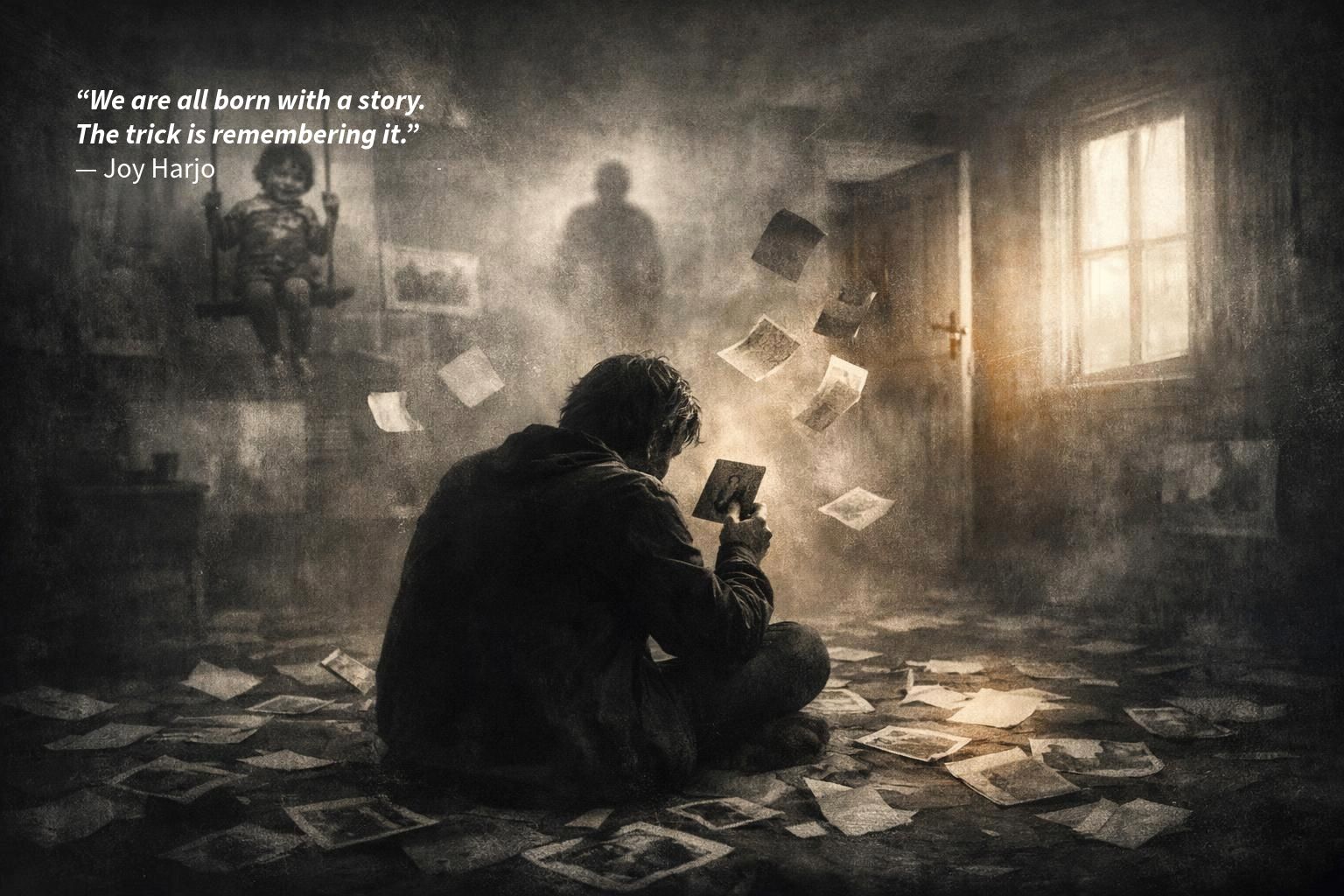
It sounds simple at first—almost gentle. Like something you’d hear sitting outside at dusk, the air cooling just enough to make you pause. We all have a story. Of course we do. The idea feels familiar, almost comforting.
But remembering isn’t passive. It’s not flipping through clean pages or pulling a neat narrative off a shelf. It’s fragmented. Uneven. Sometimes it comes back in flashes—smells, sounds, a moment you didn’t realize mattered until years later.
There are parts we forget on purpose. Not because they’re gone—but because they’re inconvenient. Painful. Complicated. So we rewrite. We simplify. We turn lived experience into something easier to carry.
I’ve caught myself doing that—rounding off the rough edges of memory, telling a version of the story that sounds better, makes more sense. Leaves out the hesitation, the doubt, the moments I didn’t show up the way I thought I would.
But the truth doesn’t disappear. It waits. In the quiet moments. In the things that don’t quite line up.
Joy Harjo’s line isn’t about nostalgia—it’s about excavation. The kind that requires you to sit with what you’d rather skip. Because the story you remember determines the life you believe you’ve lived.
Maybe remembering isn’t about getting it right. Maybe it’s about getting it honest.
Not the version that sounds good.
The version that feels true—even when it’s unfinished.
Because that’s where your voice lives. Not in the polished narrative… but in the parts that still don’t settle.
What part of your story have you rewritten to make it easier to live with?

The room doesn’t breathe—it waits.
Dust hangs in the light like a verdict not yet delivered. The musicians blur at the edges, bodies dissolving into motion, bow against string, string against silence. Only he remains fixed at the center, a man carved out of hesitation and necessity. The conductor lifts his hand, not like a command, but like a confession he isn’t ready to finish.
Paper litters the floor at his feet—scores abandoned, rewritten, rejected. Ink bleeding into itself. Whole movements discarded like bad decisions you can’t quite remember making. He doesn’t look down. He never does. If he starts counting the failures, the music dies before it’s born.
There’s a tremor in his fingers. Not fear. Not quite. Something older. Something that remembers every wrong note, every missed cue, every time the orchestra slipped away from him like a crowd turning its back.
He brings the baton down.
The room obeys—but only barely.
The violins surge too fast, the cellos drag behind like grief that refuses to keep pace. Brass flares, then falters. It isn’t chaos. It’s worse. It’s almost right. Close enough to taste, far enough to hurt.
His jaw tightens.
He hears it—the fracture buried beneath the melody. No one else will catch it. They’ll hear beauty. He hears betrayal. A single thread out of place unraveling everything he thought he understood about this piece… about himself.
He cuts them off with a sharp flick.
Silence crashes harder than the sound ever did.
For a moment, no one moves. Not the players, not the dust, not even the light. They’re all watching him, waiting for the verdict he doesn’t want to give.
He lowers his hand slowly.
“Again,” he says.
Not angry. Not defeated. Just certain in the way a man is certain when he knows he has nothing left to hide from failure.
Because somewhere in the wreckage of what they just played, there was a glimpse—small, dangerous, undeniable—of something true.
And that’s the thing about truth.
Once you hear it, even broken…
you don’t get to walk away.
won’t you celebrate with me
what i have shaped into
a kind of life? i had no model.
born in babylon
both nonwhite and woman
what did i see to be except myself?
i made it up
here on this bridge between
starshine and clay,
my one hand holding tight
my other hand; come celebrate
with me that everyday
something has tried to kill me
and has failed.
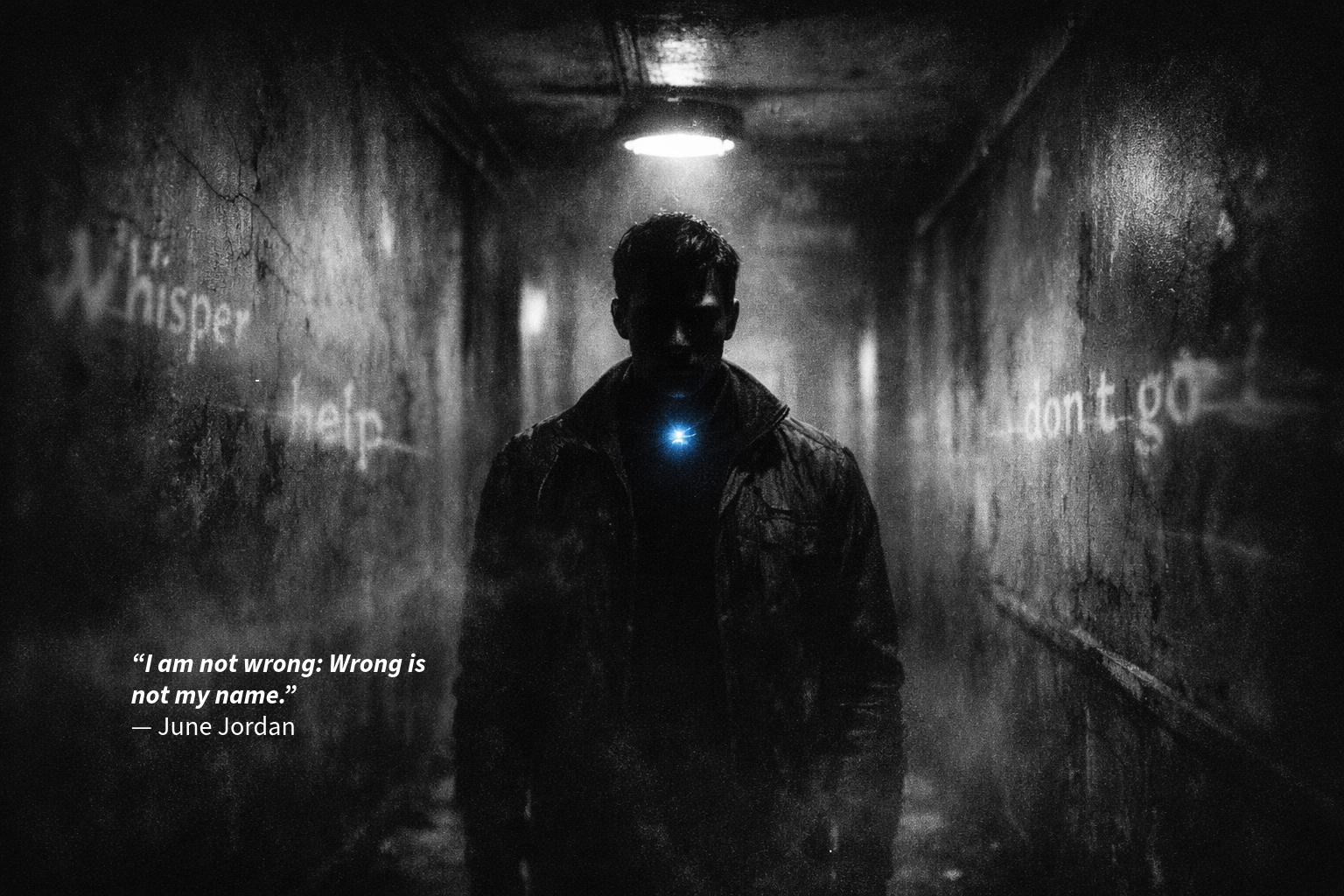
It lands like a correction spoken through clenched teeth. Not loud, not theatrical—just firm. The kind of sentence you say after you’ve been talked over one too many times. It doesn’t ask for agreement. It doesn’t explain itself. It just stands there.
Because most of us have worn that word at some point—wrong. Not stitched onto us all at once, but added piece by piece. A comment here. A look there. The subtle shift in someone’s tone when you say what you really think.
I can still hear it in small moments—the pause before I speak, the second-guessing, the quiet rehearsal in my head while someone else is already talking. Like I’m trying to sand down the edges of what I’m about to say before it even leaves my mouth.
That’s how it settles in. Not as a wound, but as a habit. You start adjusting yourself to avoid friction. You call it being thoughtful, being careful—but it’s just fear wearing a better suit.
June Jordan doesn’t negotiate with that voice. She cuts it off at the root. Not with anger—but with clarity. A refusal to let other people’s discomfort rewrite her identity.
Because once you accept that label, you don’t just question your words—you question your right to have them.
There’s a different kind of quiet that comes when you stop correcting yourself mid-sentence. When you let the thought land exactly as it is—unpolished, maybe imperfect, but honest.
Not every word will be right. That’s not the point.
The point is—it’s yours.
And that’s enough.
Where do you still edit yourself before you’re even heard?

The cold didn’t arrive all at once. It settled—quiet, deliberate—like a verdict no one bothered to announce. It crept into the bones first, numbing intention, dulling memory, until even the past felt like something borrowed from someone else’s life.
He had learned to live that way.
To wear the frost like armor. To let it harden him into something unbreakable—or at least something that didn’t look like it could break.
But glass always remembers.
That was the problem.
The fracture didn’t start where you could see it. It never does. It began somewhere beneath the surface, in the quiet spaces between decisions, in the things he told himself didn’t matter. Tiny cracks. Hairline betrayals. Each one small enough to ignore. Together, enough to shatter a man clean through.
And then the light came.
Not gentle. Not kind.
It burned its way in—through the broken places, through the parts he had sealed off, through the lies he had polished into truth. It didn’t ask permission. It never does. Light like that doesn’t heal. It exposes.
And behind it—impossible, stubborn—there was life.
Flowers where there should have been nothing. Soft petals pushing through ruin. Color daring to exist in a world that had already decided on gray. He hated it at first. Hated the way it reached for him like it knew something he didn’t. Like it expected him to remember how to feel.
But hatred takes energy.
And he was so damn tired.
So he stood there, caught between frost and fire, watching something fragile refuse to die inside him.
The cracks widened.
Not from damage this time—but from pressure. From growth. From something insisting that breaking wasn’t always the end of the story. That maybe—just maybe—what shattered wasn’t the man, but the version of him that could no longer survive the truth.
He touched the fracture.
Felt warmth for the first time in years.
And for a moment—just a moment, he wondered if the cold had never been strength at all.
Only fear, frozen solid.
By Richard Hugo
You might come here Sunday on a whim.
Say your life broke down. The last good kiss
you had was years ago. You walk these streets
laid out by the insane, past hotels
that didn’t last, bars that did, the tortured try
of local drivers to accelerate their lives.
Only churches are kept up. The jail
turned 70 this year. The only prisoner
is always in, not knowing what he’s done.
The principal supporting business now
is rage. Hatred of the various grays
the mountain sends, hatred of the mill,
The Silver Bill repeal, the best liked girls
who leave each year for Butte. One good
restaurant and bars can’t wipe the boredom out.
The 1907 boom, eight going silver mines,
a dance floor built on springs—
all memory resolves itself in gaze,
in panoramic green you know the cattle eat
or two stacks high above the town,
two dead kilns, the huge mill in collapse
for fifty years that won’t fall finally down.
Isn’t this your life? That ancient kiss
still burning out your eyes? Isn’t this defeat
so accurate, the church bell simply seems
a pure announcement: ring and no one comes?
Don’t empty houses ring? Are magnesium
and scorn sufficient to support a town,
not just Philipsburg, but towns
of towering blondes, good jazz and booze
the world will never let you have
until the town you came from dies inside?
Say no to yourself. The old man, twenty
when the jail was built, still laughs
although his lips collapse. Someday soon,
he says, I’ll go to sleep and not wake up.
You tell him no. You’re talking to yourself.
The car that brought you here still runs.
The money you buy lunch with,
no matter where it’s mined, is silver
and the girl who serves your food
is slender and her red hair lights the wall.
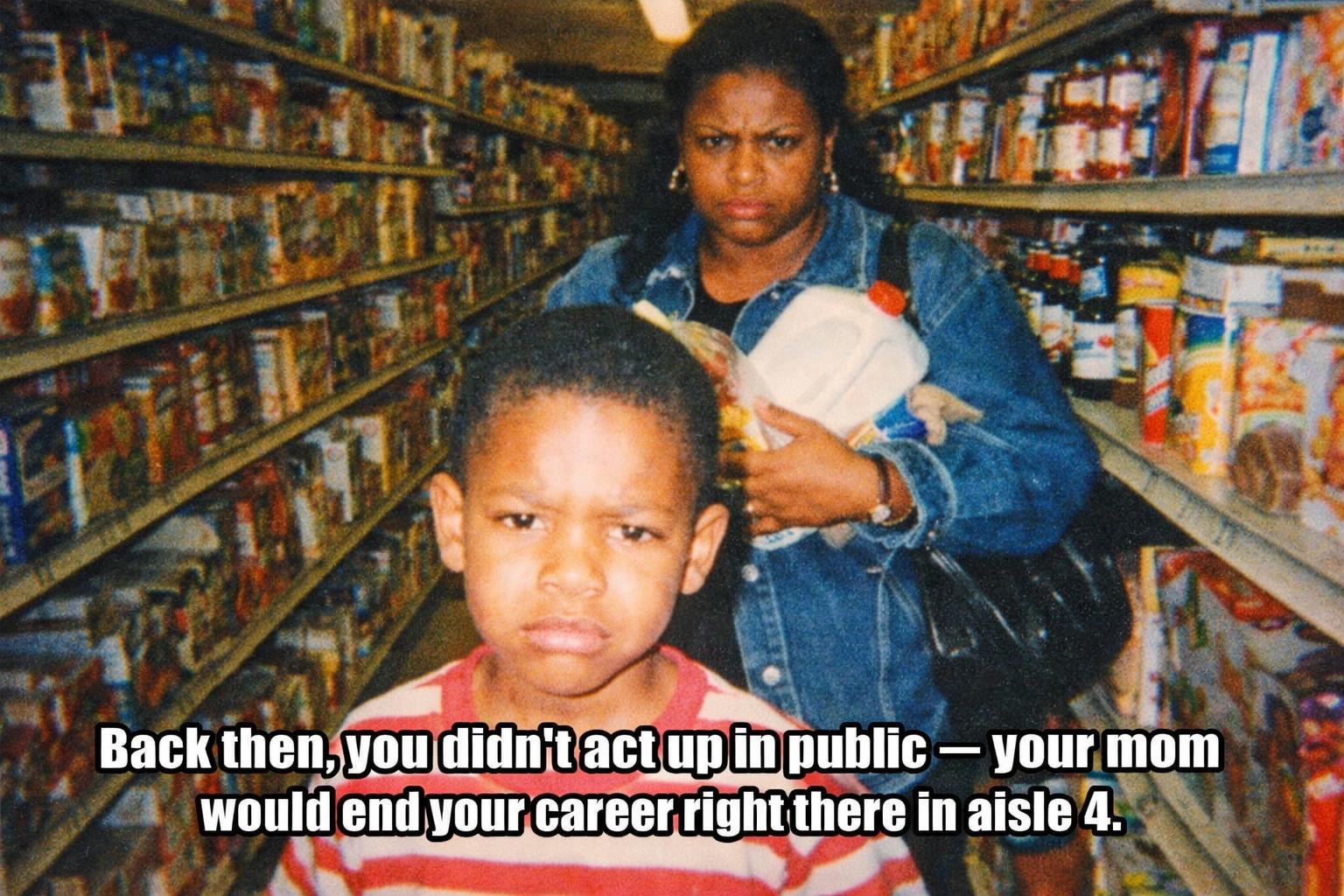
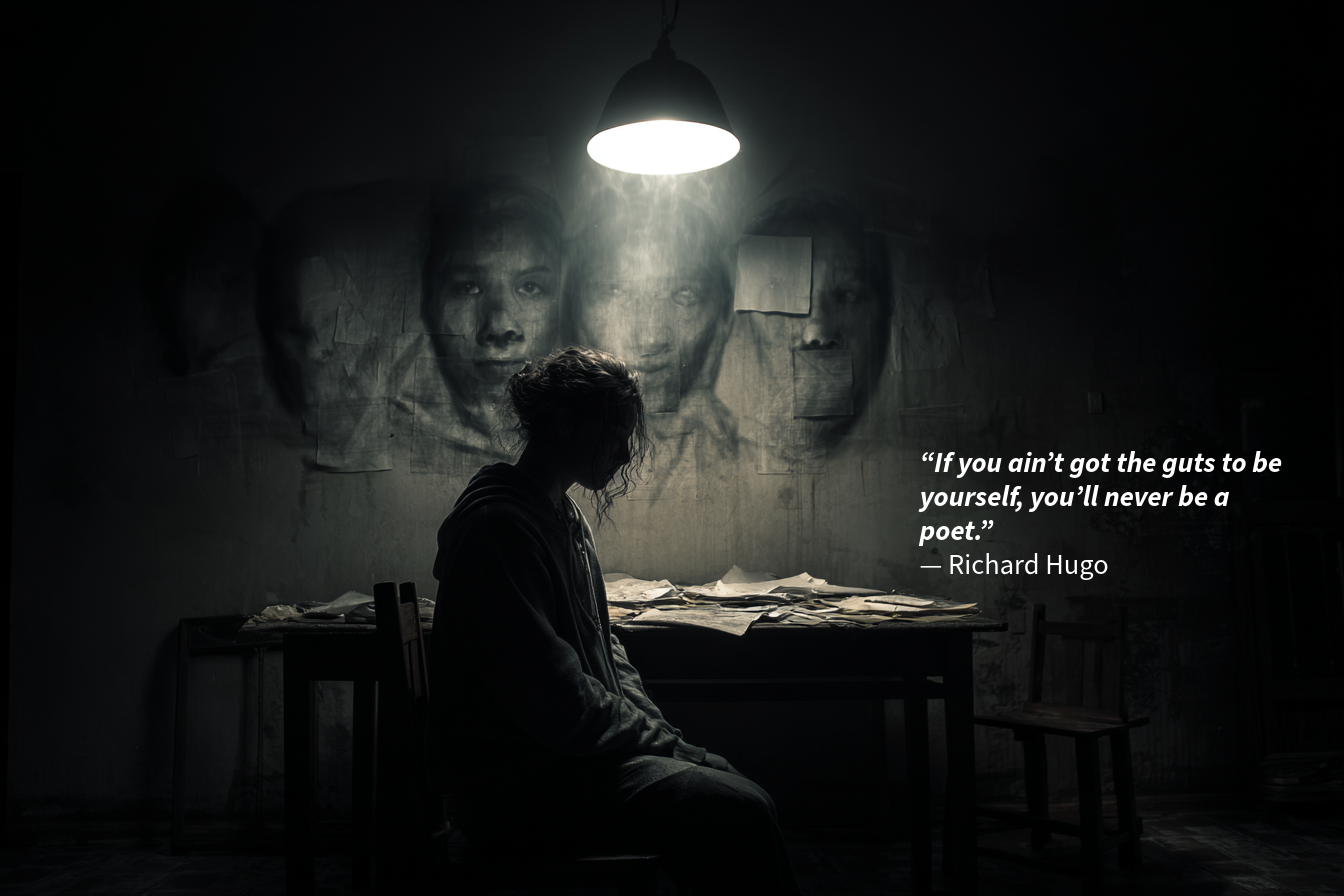
It sounds like a dare more than advice. No polish, no soft landing—just a blunt truth sitting there like a barstool confession. Be yourself, or don’t bother showing up. There’s something almost physical about it, like stepping into cold air without a coat. You either feel it or you don’t.
But “being yourself” isn’t clean. It’s not some curated version you present when the lighting is right. It’s the unfinished parts, the contradictions, the things you’d rather file away and forget. Most people don’t struggle with writing—they struggle with permission. Permission to be messy. To be wrong. To say something that might not land.
We learn early how to perform. How to adjust. How to soften the edges so we’re easier to accept. And somewhere along the way, that performance starts to look like identity. Hugo’s line cuts straight through that illusion. It’s not asking if you can write—it’s asking if you’re willing to risk being seen without the mask.
And that’s where most people stall. Not because they lack talent—but because they understand, deep down, what it costs.
Maybe the work isn’t about becoming anything new. Maybe it’s about stripping away what was never yours to begin with. Not loudly. Not all at once. Just enough to hear your own voice again—unfiltered, a little uneven, but yours.
That might be the real threshold. Not skill. Not discipline. Just the quiet courage to stop pretending.
Where are you still performing a version of yourself instead of telling the truth?
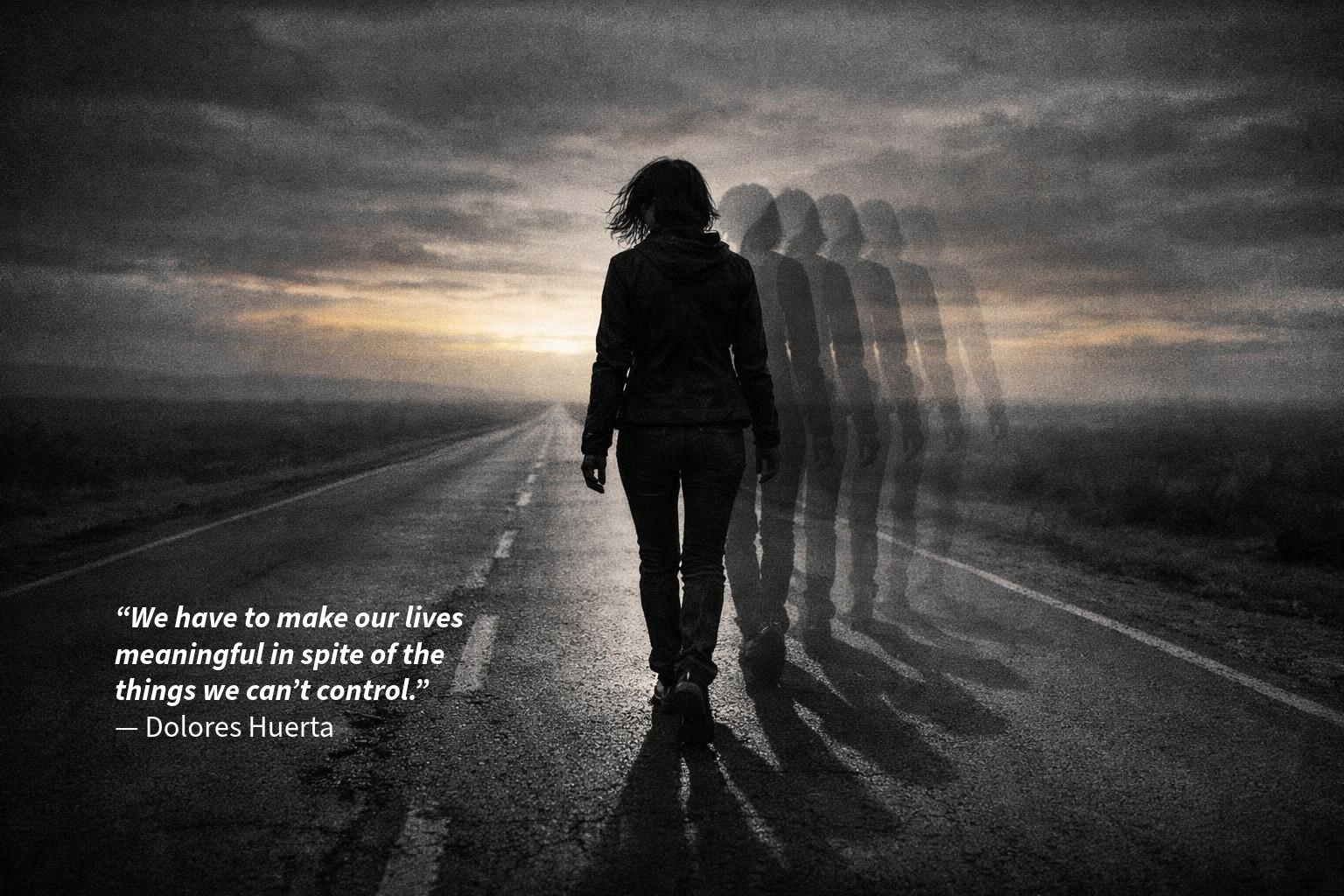
Life doesn’t wait for ideal conditions.
Things don’t line up.
Plans don’t always hold.
Outcomes don’t always match effort.
Control is limited.
And the older you get, the more obvious that becomes.
There’s a quiet frustration in realizing how much is out of your hands.
You try.
You adjust.
You do what you can.
And still, things don’t always turn out the way you expected.
It’s easy to start believing meaning only comes when things go right.
When the work pays off.
When the story makes sense.
But if that’s the standard, most of life will feel incomplete.
Dolores Huerta understood something harder than optimism.
Meaning isn’t given by the outcome.
It’s built in the process.
Even when the result is uncertain.
Even when the conditions aren’t fair.
Even when you’re tired.
Maybe meaning isn’t something you find at the end.
Maybe it’s something you create while you’re still in the middle of it.
What gives your life meaning right now — even if it doesn’t look the way you expected?
They gave the museum to Travis Hanson. He gets the parts that make sense. I get the parts that happened anyway—the ones that didn’t ask permission, didn’t check the manual, and definitely didn’t end with applause.
Right at the entrance, there’s a picture of me trying to open a beer bottle with my teeth. No caption. Just a moment frozen in time where I was absolutely convinced this was going to work. That confidence—that’s the real exhibit. Not the outcome. The belief that preceded it.
Further in, my desk sits in the corner like it owes me something. Half-written parchments scattered across it—sentences that started with authority and ended like they got distracted halfway through their own argument. Ink fading where I paused too long, like the words lost faith before I did. A pewter inkwell sits there, heavy and unimpressed. My favorite quills rest beside it, bent just enough to suggest I thought pressure would speed things up. It looks like work. It feels like avoidance dressed up as effort.
There’s a chair, of course. That’s where I go when I want to appear engaged while doing absolutely nothing useful. Every time I lean back—every time I drift, pretending I’m one good thought away from brilliance—I look up and there it is:
“You Should Be Working.”
Not motivational. Not inspirational. Accusatory. Like it knows exactly what I’m doing and isn’t impressed by how well I justify it. I used to stare at it like it owed me something, like inspiration was late and I was the victim. Truth is, I wasn’t waiting. I was hiding. One sounds noble. The other sounds accurate.
Off to the side, there’s a photograph of Mrs. Khan giving me that look. Calm. Surgical. The emotional equivalent of, go ahead, finish this mistake—I’ll wait. I earned that look. I flooded the kitchen because I decided—again—that I was qualified for something I had no business touching. Vise grips, duct tape, WD-40… I had a whole toolkit of bad decisions. Might’ve even brought in bailing wire just to make it official. I didn’t fix the problem. I expanded it. But the ice maker worked. So technically, not a total loss—if you ignore the part where the floor looked like it filed for divorce.
What came next doesn’t get a plaque. It gets remembered. The mop leaning in the corner like it’s reconsidering its life choices. Towels stacked like I was building a monument to poor judgment. The sound of the washer running because she wasn’t about to carry the weight of my “I got this” moment. She made me do the laundry. Which felt less like a chore and more like consequences with a spin cycle. I hate doing laundry. Still do. Growth has limits.
Somewhere between standing in that water and pretending I knew how to separate colors, I added a plumber to my speed dial. Not because I evolved—because I got tired of auditioning for disaster.
Behind the desk, carved deep enough to outlast better decisions than I usually make, it says: “Still working on it.” That’s the truth of my wing. Not that I figured anything out. Not that I earned anything worth framing. Just that I keep showing up—bad ideas, unfinished pages, side-eyes, and that damn sign overhead—trying to convince myself that knowing better and doing better are the same thing.
They’re not.
But I’m… still working on it.
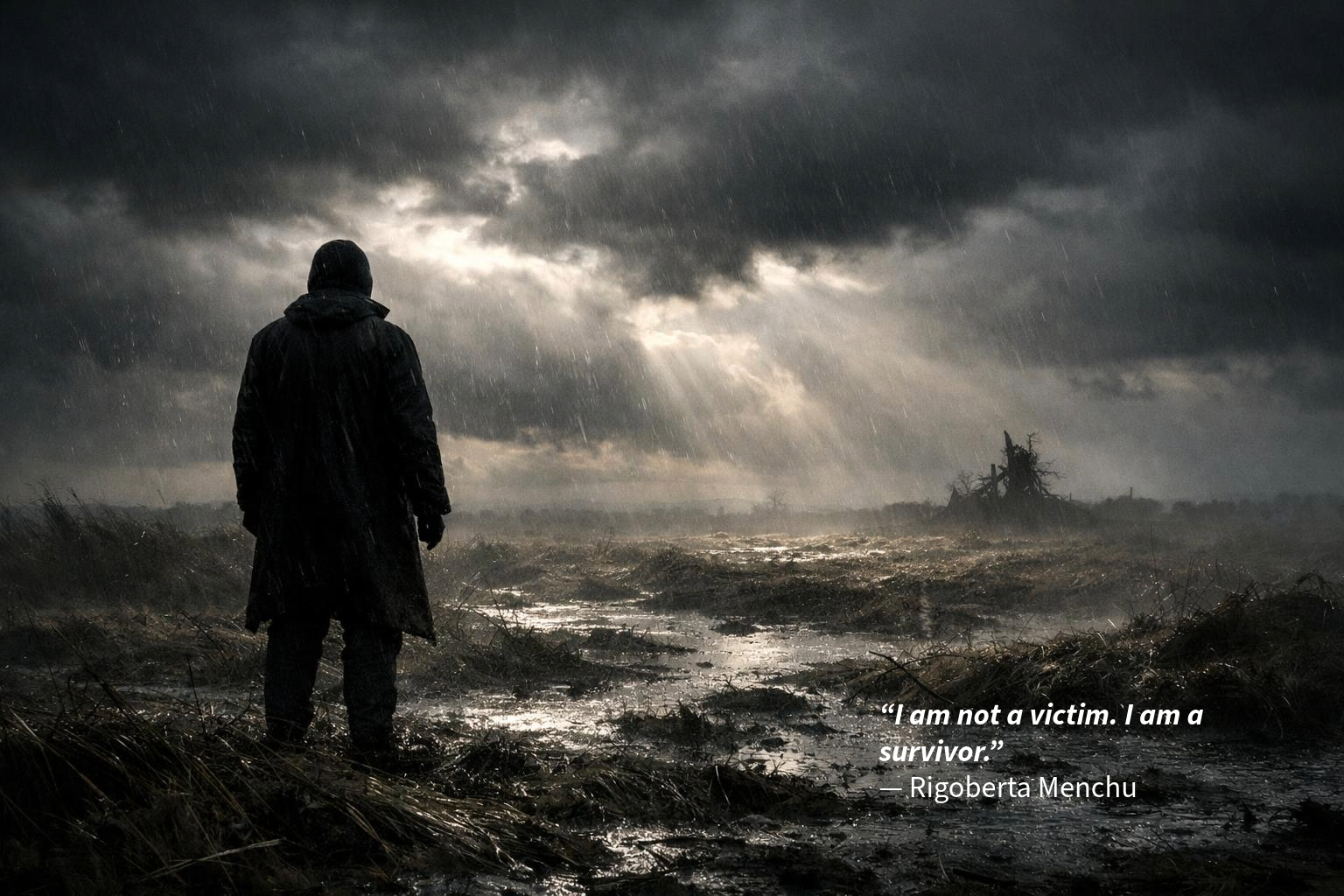
There’s a difference between what happens to you and what stays with you.
The events don’t always define you.
But the meaning you give them can.
Some people carry their past like a weight.
Others carry it like proof.
Survival is rarely dramatic.
Most of the time, it looks ordinary.
Getting up when you don’t feel ready.
Continuing when something in you wants to stop.
Holding yourself together in ways no one else sees.
The word “victim” describes something real.
But it also freezes the moment.
“Survivor” acknowledges movement.
It says:
something happened — and I am still here.
That doesn’t erase the past.
It changes your relationship to it.
Maybe strength isn’t about avoiding what happens to you.
Maybe it’s about deciding it doesn’t get to decide you.
What have you lived through that changed you — and how do you choose to carry it now?
The rain didn’t fall. It hovered—like it had somewhere better to be but couldn’t quite commit. Hung there in the air, thinking things through. I respected that. Commitment’s a tricky thing. People talk a good game until it’s time to actually land somewhere.
My name is Tailfeather Jenkins. Private Investigator. I locate disappointments, misplace truths, and send invoices that rarely get the respect they deserve. The fan above my desk turned slow and uneven, like it owed somebody money and was hoping they forgot.
That’s when she walked in.
She didn’t enter the room so much as dim it. Like someone turned the brightness down without asking.
Widow Jones wore darkness like it had been tailored specifically for her—fitted, measured, deliberate. The hat did most of the talking. Wide brim, cutting her face in half, keeping her eyes in shadow and leaving those red lips out front like a warning sign nobody reads until after the accident. Not painted for beauty. Painted with intent.
Her skin caught the light reluctantly, like it didn’t trust it. Smooth. Pale. Unhurried. The kind of stillness you only get after you’ve either finished grieving… or decided it wasn’t worth the effort in the first place.
You couldn’t see her eyes right away. That wasn’t an accident. Eyes give things away. Widow Jones didn’t strike me as the charitable type.
Her hair fell in controlled waves over her shoulders, not a strand out of place. That told me two things immediately—she plans ahead, and she doesn’t panic. People who don’t panic are either very smart… or very dangerous. Sometimes both. Those are the ones you don’t rush unless you’ve got a death wish or a backup plan. I didn’t have either that morning.
The dress didn’t ask for attention. It knew it had it. Black on black, fabric moving just enough to remind you it wasn’t decoration—it was intention. No noise. No desperation. Just control.
There was a scent, but it didn’t introduce itself properly. Not floral. Not sweet. Something quieter. Like memory after it’s had time to settle and doesn’t need your permission anymore.
She didn’t fidget. Didn’t scan the room. Didn’t need to.
Women like that don’t go looking for trouble.
They wait for it to recognize them.
“I’m looking for Tailfeather Jenkins,” she said. “You him?”
“That’s the rumor.”
She didn’t smile. That was promising.
She moved toward the chair like it already belonged to her.
Then the room reminded her it didn’t.
Her heel caught the leg just enough to betray her. Not a fall—nothing dramatic. Just a brief hitch in the rhythm. A break in the illusion. She steadied herself without grabbing anything, adjusted without looking down, without looking at me, like the moment had been negotiated and quietly dismissed.
But it happened.
And I wrote it down anyway. Not in the notebook. Somewhere more useful.
Women like that don’t make mistakes.
Which means when they do… it’s not the mistake that matters. It’s what it reveals about the rest of the act.
She sat, crossed her legs, and took the room back like nothing had happened.
“My husband is dead.”
“I’m sorry,” I said. It came out clean, practiced. Like something I kept in a drawer and pulled out when required. Sympathy has a script. Authenticity usually shows up late, if at all.
“I believe he was murdered.”
That shifted the air. Not enough for anyone else to notice. Just enough for me.
“He left the house three nights ago. No note. No call. No nothing.”
“Nothing’s expensive these days,” I said. “Except honesty. That’ll cost you everything if you’re not careful.”
Still no smile. Discipline like that usually comes with a history.
I’ve trusted my instincts about women before. That’s how I met a psychopath. Beautiful. The kind of beautiful that makes bad decisions feel like destiny. Didn’t notice the eyes until it was too late. By then, I was already part of the lesson.
I opened my notebook. Blank pages. Full confidence. It’s a system that hasn’t failed me yet, mostly because I don’t trust either one completely.
“Name?”
“Earl Jones.”
“Occupation?”
She paused.
That pause told me more than anything she could’ve said. People hesitate around lies, truths, and things they don’t want to categorize. I didn’t push it. No need to chase something that’s already circling you.
The house sat at the end of a quiet street that looked like it minded its business a little too well. Lawns trimmed, windows clean, everything in its place. The kind of neighborhood that doesn’t ask questions because it already decided it doesn’t want the answers.
Inside didn’t smell like anything.
That’s not normal.
Every place smells like something—coffee, dust, old arguments, decisions that didn’t age well. This place smelled like nothing had ever happened there. Like someone had erased the evidence of living and left the structure behind.
The counters weren’t tidy.
They were cleared.
There’s a difference. Tidy is effort. Cleared is intention.
The sink was dry. Not recently cleaned—unused. A man lives somewhere, there’s always something left behind. A glass, a plate, something that says, “I was here, and I’ll deal with it later.” Later never comes, but the evidence sticks around.
Earl Jones didn’t leave anything.
Cabinets were organized. Plates stacked like they were waiting for inspection. Then the spices.
Alphabetized.
That stopped me.
Men don’t alphabetize spices. Not unless they’re performing for someone who might be watching. Or trying to convince themselves they’re a different kind of man than they actually are.
The living room was arranged like a photograph. Furniture positioned, not lived in. No imprint on the cushions. No remote abandoned in the middle of a decision. No blanket draped over the arm like it lost an argument.
Just a room pretending to be a life.
The bedroom followed the same script. Bed tight. Closet half full. Not too much, not too little. Measured. Controlled. Like someone had calculated what absence should look like.
The only thing missing…
was a person.
Happy’s Diner smelled like burnt coffee and things people avoided saying out loud. Neon sign buzzing like it was hanging on out of spite more than purpose.
They made a good pastrami.
That told me Earl had been trying. Men don’t chase good sandwiches unless they’re chasing something else too—routine, comfort, a version of themselves they haven’t fully earned yet.
I didn’t stay long.
Didn’t need to.
A photograph told me everything I needed to know.
A girl. Young. Eyes too sharp for her age. The kind of eyes that don’t belong to childhood anymore. His eyes. Not the smile from the photo on my desk—that one felt borrowed. This was the original version.
That didn’t fit the man I’d been shown.
But it fit everything else.
Outside, the air had that quiet weight that comes before something decides to happen.
That’s when I saw it.
Black sedan. Across the street.
Parked wrong.
Not careless.
Intentional.
You can tell the difference. One says “I forgot.” The other says “I’m waiting.”
I didn’t turn my head. Didn’t need to. You feel that kind of attention before you see it.
Widow Jones stepped up beside me. Closer than she’d been before. Close enough to suggest this wasn’t coincidence anymore.
“You see it?” she asked.
“Yeah.”
“They’ve been following me.”
No tremor. No panic. Just confirmation. Like she’d finally said something out loud she’d been carrying for a while.
I nodded.
“They’re not looking for him anymore,” I said.
She didn’t ask how I knew.
That told me she already did.
The girl stepped out behind us, quiet, observant. Not afraid. Not yet. That worried me more than fear would’ve.
Three of us standing there.
One past.
One present.
One problem none of us had control over.
Earl Jones didn’t disappear.
He split.
One life he built carefully, piece by piece.
One life he didn’t know he had until it showed up and demanded space.
And somewhere in between—
something found him.
I watched the car. Still. Patient. Like it had all the time in the world and knew it.
I thought about the house. Too clean. Too careful. A place designed to remove fingerprints, not collect them.
Thought about the way she caught herself on that chair. The smallest crack in a performance built on control.
Thought about the girl.
The only thing in this whole situation that felt real. Unmanaged. Unpolished. Unfinished.
And that’s when it happened.
I laughed.
Not out loud. Not long. Just enough to feel it move through me and settle somewhere it didn’t quite belong.
Because none of it was funny.
But for the first time—
after all the pieces stopped pretending to be something else—
it fit.
When you were five, what did you want to be when you grew up?
When I was five, I wanted to be something.
That’s what people expect you to say. Something simple. Something you could draw with a thick crayon and hold up like evidence—see, I’m already becoming this. A clean answer. A future you can pronounce.
Problem is—I don’t remember being five. Not in any way that feels reliable. No clear picture. No moment that holds still long enough to trust it. Just gaps where something should be. Like a room you know you’ve been in, but can’t describe.
There was a theory floating around for a while—picked up just enough traction to be worth repeating—that I was never a child. Just born a grumpy old man. I’ve never done much to argue against it.
In fact… there’s no evidence of me being a child. I made sure it was eliminated.
Not in some dramatic, burn-the-records kind of way. Nothing cinematic. Just time doing what it does—wearing things down, sanding the edges off, letting the unimportant slip through the cracks. Memory isn’t a vault. It’s a leak.
But not everything disappeared.
I remember sitting at a table—cheap wood, uneven, rocking just enough to notice. Paper in front of me, curling at the corners. Markers scattered like tools I didn’t quite understand yet. I drew a self-portrait. Or tried to.
I remember the hesitation more than the lines. The way my hand hovered before committing. The face on the page looking back at me and feeling… wrong. Not broken. Not bad. Just not true. I didn’t have the language for that then. I just knew I didn’t like it.
My family told me it was good. Warm voices. Easy encouragement.
But it didn’t land.
My Madre stood there a little longer. Quiet. She didn’t tear it down. Didn’t dress it up either. Just looked at it like she was measuring something I couldn’t see yet. Her eyes moved slower, sharper—like she wasn’t looking at what it was, but what it wasn’t.
Her opinion mattered the most. So I bore down. Practiced harder. Chased something I couldn’t name yet.
I had a friend who could draw—really draw. His lines made sense. Mine didn’t. Not like that. Not clean. Not confident. I couldn’t figure out how he got from nothing to something that looked right. I didn’t understand the process. Just the distance.
I remember the markers. The sweet ones—the ones that pretended to be fruit. Thick in the air, artificial, almost sticky. And the Sharpies. No disguise. Just raw, chemical bite that sat in the back of your throat. We used to sniff them like it was part of the process.
It didn’t help.
But I kept going.
Writing started creeping in somewhere along the way. Uninvited. Didn’t ask permission. Didn’t care that I was trying to focus on drawing. Stories showed up anyway—half-formed, persistent, sitting just behind whatever I was trying to put on paper.
I wish I could’ve just focused on the art. Would’ve been simpler. But the stories wouldn’t leave.
In high school, sitting at my best friend’s house, his brother said it like it was nothing—you can write and illustrate your own book. Before that moment, it never crossed my mind. Not once.
Even after that… I doubted it.
Even after my first story was published. Even after I stood in front of a room teaching seminars on poetry and short stories. Still didn’t quite believe it. Like the evidence was there, but it didn’t belong to me.
I’m still doing it.
Of course… there were detours. Soldier. Marriage. Kids. Whole chapters written in a different language. Life filled the margins whether I asked it to or not.
But I keep coming back. Blank page. Quiet room. That same friction between what I see and what I can actually put down.
Sometimes it feels like looking in a mirror and not arguing with what’s there anymore. Like the version I kept chasing was already doing the work—I just didn’t trust him yet.
Kids want to be something. Astronaut. Superhero. Firefighter. Clean answers.
I think I missed that part. Or maybe I didn’t.
Maybe this was always it.
Not the title. Not the uniform. Just the work. Trying to get it right. Even when it doesn’t come out that way. Even when you don’t believe it counts.
So no—I don’t remember what I wanted to be when I was five.
But I remember what it felt like to get it wrong.
And I remember not stopping.
That’s close enough.
Most days.
It sounds simple. Almost obvious.
Of course you are your own person.
But the longer you live, the more you realize how much of your life is shaped by expectations that were never yours to begin with.
What you should be.
What you should want.
What you should accept.
Some of it is loud.
Most of it is quiet.
Becoming yourself is not a one-time decision.
It’s something you have to keep choosing.
You outgrow things.
You question things.
You notice where you’ve been adjusting just to fit into spaces that were never meant for you.
That kind of awareness isn’t comfortable.
It creates distance.
Sometimes from people.
Sometimes from the version of yourself you’ve been presenting.
Nina Simone didn’t speak about identity like it was fixed.
She lived it like something you had to claim —
again and again —
especially when the world tried to define it for you.
Maybe being your own person isn’t about independence.
Maybe it’s about refusing to disappear into expectations that were never yours.
Where in your life have you been shaping yourself to fit, instead of allowing yourself to be?
There are days when the world feels too big to understand.
Too many voices.
Too many opinions.
Too many expectations about what you should be doing, thinking, or becoming.
It’s easy to feel small in the middle of all that.
Easy to feel like your life is just one more drop in something too large to matter.
Most people learn to live with that feeling.
Some learn to ignore it.
Some spend their whole lives trying to prove it wrong.
Alejandra Pizarnik wrote about solitude, doubt, and the strange distance people sometimes feel from their own lives.
Her words don’t promise comfort.
They don’t try to make the world sound simple.
They remind us that meaning isn’t something handed to you.
It’s something you notice — or miss — depending on how willing you are to look.
The sky is always there.
But not everyone looks up.
Some people are too busy surviving.
Some are too tired.
Some are afraid of what they might feel if they stop moving long enough to notice where they are.
And sometimes the hardest part of being alive isn’t suffering.
It’s realizing how much of life passes by when you aren’t paying attention.
Maybe the world doesn’t belong to the strongest people.
Maybe it belongs to the ones who keep looking, even when they don’t fully understand what they see.
When was the last time you stopped long enough to notice where you really are in your life, instead of just moving through it?
Most people think language is simple.
You open your mouth, words come out, someone else hears them, and the message lands exactly the way you meant it. That’s the illusion. Language feels precise, but most of the time it’s anything but.
Words are blunt instruments trying to describe sharp emotions, complicated ideas, and experiences that don’t fit neatly into a sentence. We say I’m fine when we mean everything from I’m exhausted to I’m barely holding it together. We say I understand when we really mean I heard you… but I don’t feel what you feel.
Language lets us talk. It doesn’t guarantee we connect.
Sometimes it doesn’t even let us say the thing at all.
I’ve had moments where the truth sat right there in my chest, clear as day, and still refused to come out right.
I wanted to speak what I draw—to translate something raw and visual into something someone else could feel—but language kept sanding it down into something safer, smaller.
So you learn to say it other ways.
A pause that lingers too long.
A hand that almost reaches, then thinks better of it.
Eyes that hold a second past what’s comfortable, like they’re trying to finish a sentence the mouth couldn’t start.
The room shifts. Something is understood.
Nothing was said.
That’s the part most people miss.
Language isn’t just vocabulary. It’s tone, timing, history, culture, and whatever ghosts you brought into the conversation. Two people can use the same words and mean completely different things. Worse, two people can mean the same thing and still walk away misunderstood.
And still—despite all that—it’s one of the most beautiful things we have.
Language can heal. It can motivate. It can pull someone back from the edge when nothing else reaches them. A single sentence, at the right time, can feel like oxygen.
But that same tool can cut just as clean.
It can destroy, disrupt, irritate. It can leave marks that don’t show up until years later. Words don’t just pass through people—they settle in.
Technology only sharpens the problem. We have more ways to communicate than ever—texts, emails, posts, messages—but less clarity. A sentence without a face behind it turns cold. A joke becomes an insult. Silence becomes accusation.
The more we rely on language, the more we expose how fragile it really is.
What most people don’t understand is this:
Language was never meant to be perfect.
It’s a reach. Not a guarantee.
It gets us close—but never all the way there.
And maybe that’s why some things feel more honest when they’re written in a notebook, sketched on a page, played through a speaker, or left hanging in the space between two people who both understand… without needing the words at all.
When we’re young, we think answers are permanent.
We believe that once we figure something out, it stays figured out.
Who we are.
What we believe.
What matters.
What doesn’t.
But life has a way of rearranging the questions.
Things you were sure about start to feel uncertain.
Things you never thought about suddenly matter.
Things you thought you understood turn out to be more complicated than you wanted them to be.
And the older you get, the more you realize the questions never really stop.
Dr. Jane Wright spent her life working in cancer research —
a field where nothing stays settled for long.
Treatments change.
Knowledge changes.
Assumptions change.
What worked yesterday might not work tomorrow.
That kind of work forces you to live with uncertainty.
It forces you to stay curious even when you’re tired.
It forces you to admit that being wrong is part of learning anything real.
The same thing happens in life, whether we like it or not.
We outgrow beliefs.
We rethink decisions.
We look back at old versions of ourselves and realize we didn’t know nearly as much as we thought we did.
That isn’t failure.
That’s movement.
Maybe wisdom isn’t having the right answers.
Maybe it’s having the courage to keep asking the questions after the answers stop making sense.
What belief or certainty in your life has changed over time, and what did that change teach you about yourself?
People like to say technology changed my job.
That sounds neat. Clean. Logical.
It isn’t exactly true.
The job itself hasn’t changed much at all. I still sit in a chair, stare at words, move them around, delete half of them, and try to make the other half sound like I knew what I was doing all along. The difference is the tools I use now would’ve looked like science fiction when I started.
Back then, writing meant a legal pad, a typewriter, or later a desktop computer that took ten minutes to boot and another ten minutes to crash. If you wanted to look something up, you grabbed a book, not a search bar. If you made a mistake, you fixed it yourself. There was no auto-correct, no grammar checker, and definitely no artificial intelligence offering suggestions like an overeager intern who never sleeps.
There was no autosave.
You learned real quick what that meant.
Hard drive failures.
Twenty megabytes of storage if you were lucky.
Our operating system lived on floppy disks.
The printer screamed like a wounded animal every time the dot-matrix decided to cooperate.
And there were actual arguments about which program was better —
Word, WordPerfect, or Lotus 1-2-3 —
like the fate of civilization depended on it.
You didn’t trust the machine,
and the machine sure as hell didn’t care about you.
Now I carry more storage on a flash drive than we had in an entire room full of computers back then.
Hard drives fit in your shirt pocket.
Now my desk looks like the control panel of a small spaceship.
I’ve got a laptop, a tablet, cloud storage, editing software, and enough passwords to qualify as a part-time cryptographer. Half the time I don’t know if I’m writing, formatting, uploading, backing up, syncing, or troubleshooting.
Technology didn’t make the work easier.
It made the work possible — and complicated in ways nobody warned us about.
The biggest change isn’t speed.
It’s expectation.
Because everything is faster now, everyone assumes everything should be faster.
Write faster.
Edit faster.
Post faster.
Respond faster.
Create more.
Produce more.
Some days it feels like the job isn’t writing anymore.
It’s managing the machines that make writing possible.
And yet, with all this technology sitting on my desk, I still reach for a pen and a notebook when I start something new.
Stories. Poems. Prose.
The first draft usually happens the old way — ink on paper, crossing things out, arrows in the margins, pages that look like a crime scene by the time I’m done.
And underneath all the screens, all the software, all the updates and logins and notifications… the real work is still the same.
You sit down.
You face the blank page.
You try to say something true.
Technology can give you better tools, but it can’t give you better ideas.
It can help you fix a sentence, but it can’t tell you what needs to be said.
It can store everything you’ve ever written, but it can’t tell you if any of it matters.
If anything, technology has made the job more honest.
There’s nowhere to hide now.
No excuse about not having the right equipment.
No reason you can’t write today.
The tools are always there.
Waiting.
Charged.
Connected.
Which means the only thing left to blame…
is you.
And oddly enough, I think that’s a good thing.
Because no matter how much technology changes, the job is still the same one it’s always been.
Sit down.
Do the work.
Tell the truth.
Everything else is just wiring.
Most people think the hardest truths are about the world.
Politics.
Other people.
Things that went wrong.
But the truth that hits the hardest is usually closer than that.
It’s the one about ourselves.
The habits we don’t want to admit.
The fears we pretend we don’t have.
The patterns we repeat even when we know better.
Seeing those things clearly takes more courage than arguing with anyone else ever will.
It’s easy to believe we know who we are.
We build stories about ourselves —
about what kind of person we are,
what we believe,
what we would never do.
Then life puts us in a situation that doesn’t fit the story.
And suddenly the truth shows up.
Not the version we like.
Not the version we tell people.
The real one.
Cherríe Moraga understood that the real danger isn’t being wrong.
It’s refusing to look.
Because once you stop looking, you stop growing.
You stop changing.
You stop understanding yourself at all.
And that kind of blindness feels safe…
until it doesn’t.
Maybe honesty isn’t about telling the truth to other people.
Maybe it starts with being willing to hear the truth when it’s about you.
What truth about yourself have you avoided, even when part of you already knew it was there?
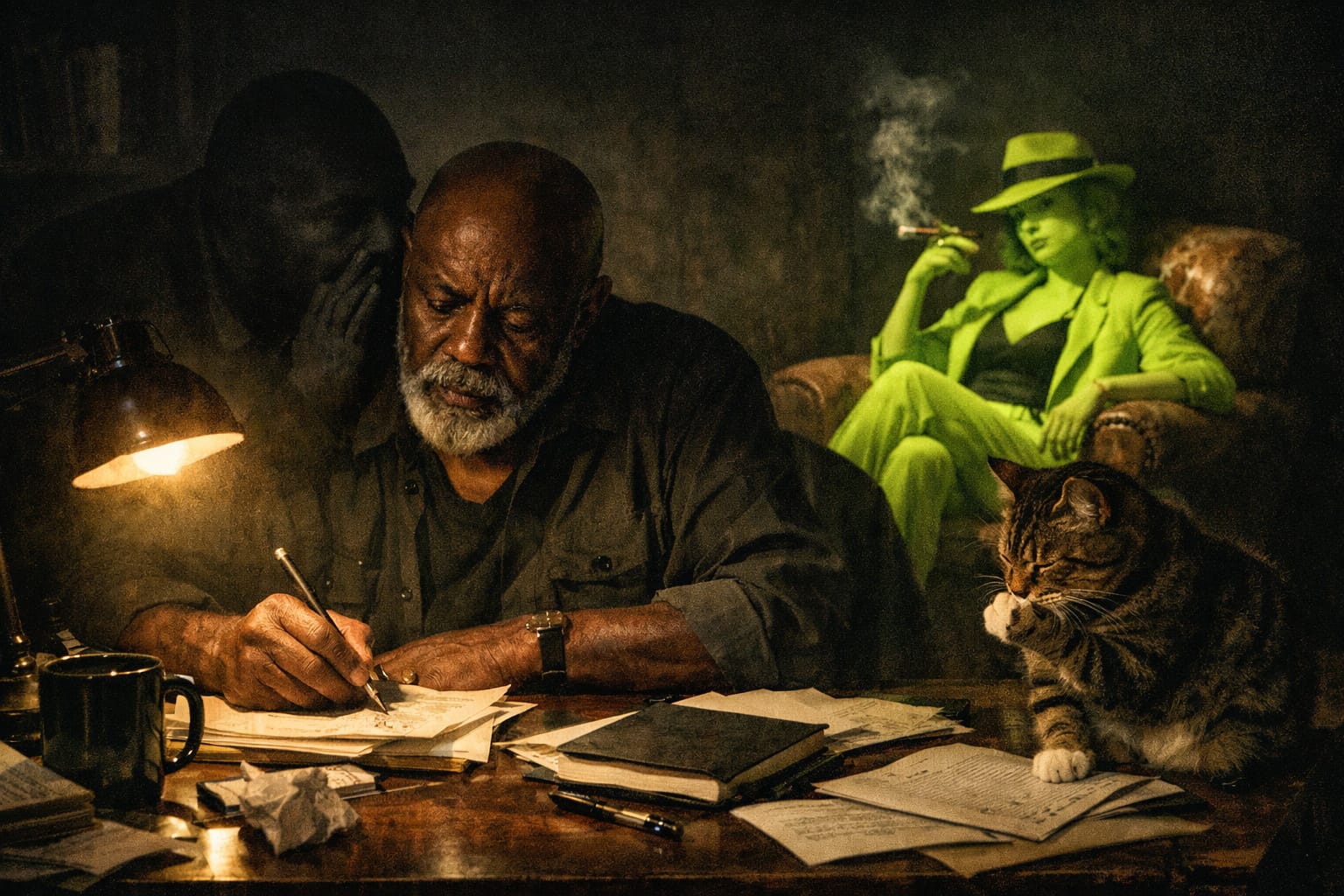
Saying no to everyday distractions has never been much of a problem for me.
Noise, nonsense, people wanting your time for things that don’t matter — that part is easy. By trade I’ve always been a troubleshooter. Something breaks, you figure out why, you fix it, and you move on. Most goals work the same way. Make a plan, follow the steps, don’t overthink it, and eventually the job gets done.
External interference I can handle.
Internal interference is where things start getting interesting.
Right now I’m working on the first draft of a novel. The idea started about a year ago on Memoirs of Madness, and once I got rolling the pages came faster than I expected. I’m sitting at fifty-four thousand words out of an eighty-thousand word goal. At this pace I should have the first draft done by the beginning of the third quarter, assuming I don’t lose my mind before then.
On paper, everything looks fine.
Inside my head, it sounds like a different meeting entirely.
There’s a voice in there that keeps asking what the hell I think I’m doing.
Tells me I’m only good enough to write short pieces.
Reminds me — very helpfully — of all the other novels I started over the years that are now sitting on hard drives like unfinished home improvement projects nobody wants to talk about.
The problem isn’t ideas.
It’s confidence.
Or more accurately, the lack of it at exactly the wrong time.
The strange thing is, I probably write better now than I did years ago. At least I think I do. Hard to say. Self-evaluation has never been my strong suit. I can fix a machine without questioning my life choices, but put a blank page in front of me and suddenly I’m negotiating with ghosts.
I’m pretty sure they make pills for that. No idea if my insurance covers it.
When my wife was alive, I didn’t second-guess things this much. I’d write something, hand it to her, and wait. She’d read a few lines, get this look on her face like she wasn’t sure whether to laugh or schedule me an appointment with somebody. Then she’d shake her head and tell me there was something wrong with me.
That’s how I knew I was on the right track.
If she liked something too much, I’d delete the whole thing and start over. Couldn’t trust it otherwise. If it didn’t make her look at me sideways, it probably wasn’t worth keeping.
I don’t get that look anymore.
So these days saying no to distractions is easy.
Saying no to doubt is the part I’m still working on.
Because if I let that voice run the show, this novel will end up in the same place as the others — sitting on a hard drive somewhere, taking up space, right next to all the projects I was absolutely sure I was going to finish.
And I’ve got enough of those already.
I don’t need another one.
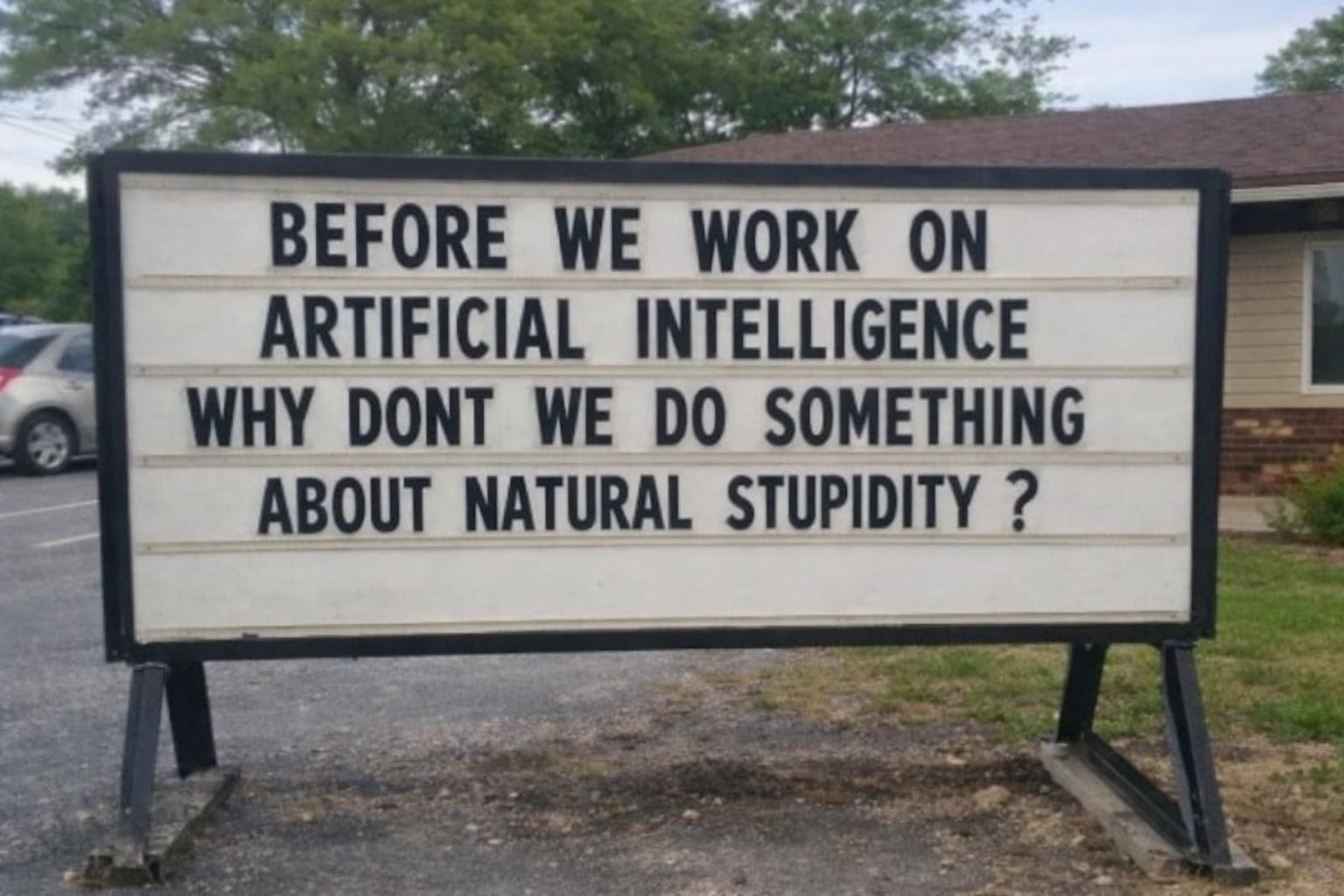
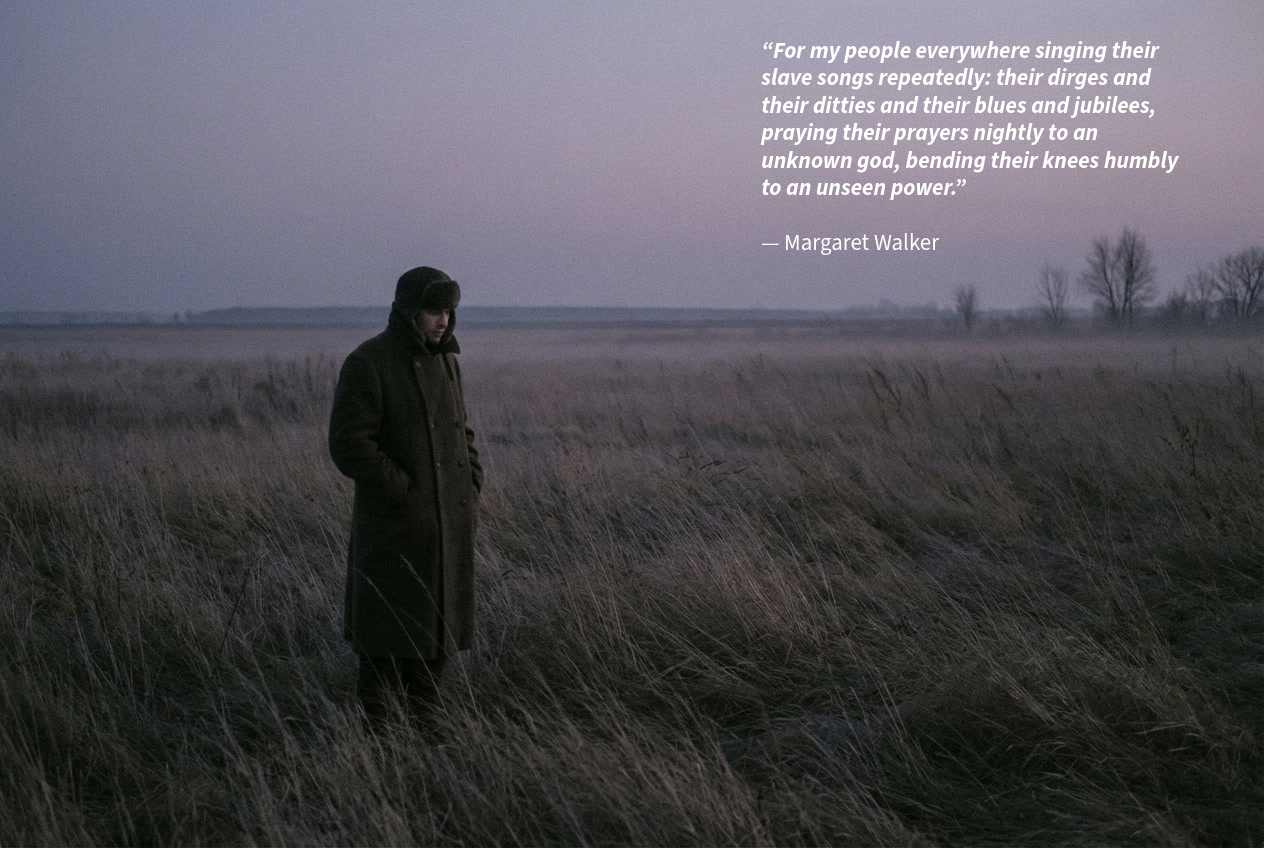
History is not just something written in books.
It lives in voices.
In habits.
In the way people carry themselves without knowing why.
Some stories never disappear.
They get passed down in quiet ways — through songs, sayings, warnings, and the things people tell their children when they think no one else is listening.
You don’t always know where those stories started.
But you can feel the weight of them.
Margaret Walker wrote about survival, but not the kind people like to celebrate.
Not the loud kind.
Not the heroic kind.
The kind where people endure because they have no choice.
The kind where strength looks like getting up again when the world has already decided you shouldn’t.
There is something humbling about realizing how much of who we are didn’t start with us.
The fears we carry.
The pride we carry.
The stubbornness that keeps us moving even when we don’t know where we’re going.
Some of that comes from history we never lived,
but somehow still belong to.
Maybe remembering isn’t about the past.
Maybe it’s about understanding the ground we’re standing on right now.
What part of your life feels shaped by something older than you — something you didn’t choose, but still carry?
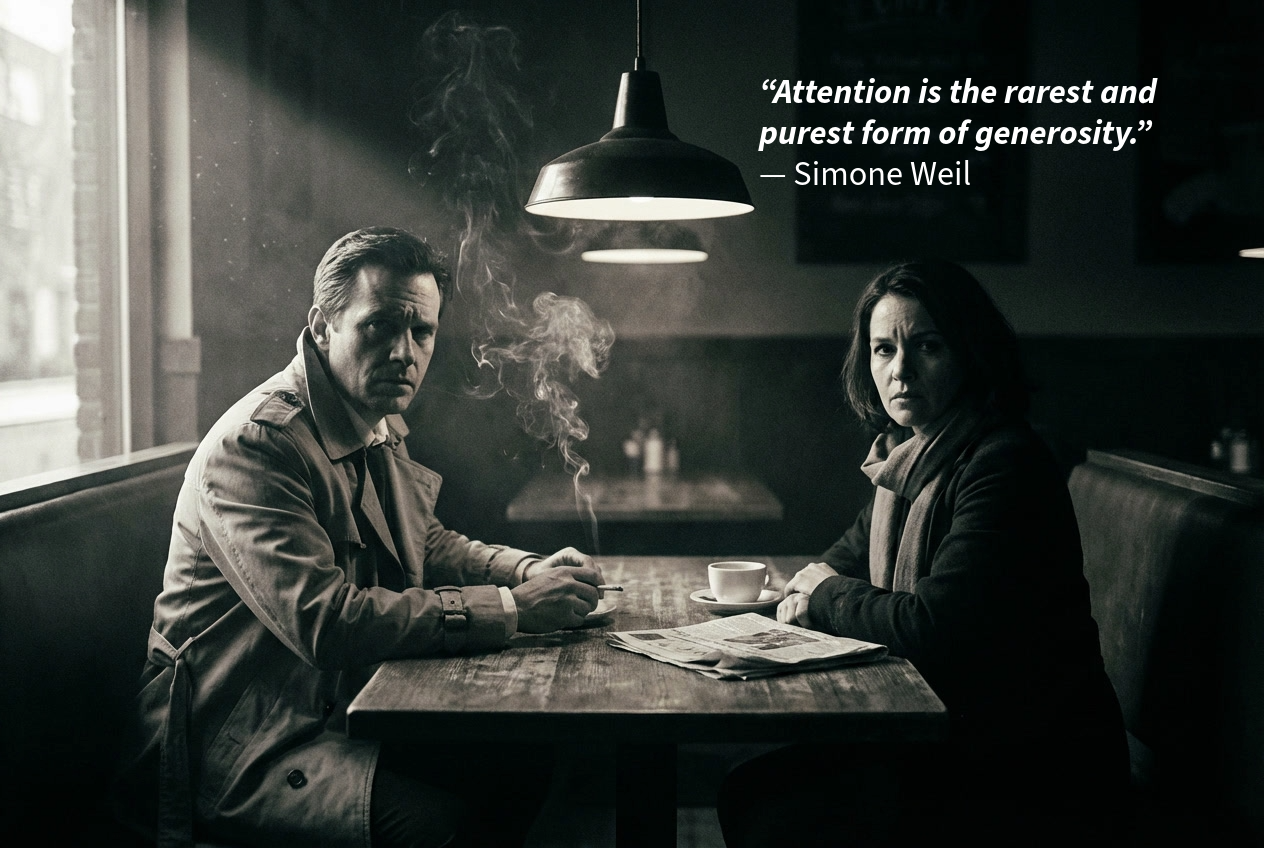
We think generosity means giving something away.
Money. Time. Help. Advice.
But most of the time, what people really want is simpler than that.
They want to be seen.
They want to be heard.
They want to know they aren’t invisible.
And that takes something harder than giving.
It takes attention.
Real attention is difficult.
Not the kind where you nod while thinking about something else.
Not the kind where you wait for your turn to talk.
The kind where you actually listen.
The kind where you let someone else exist without trying to fix them, judge them, or rush past them.
That kind of attention costs energy.
It costs patience.
It costs ego.
It means stepping outside your own thoughts long enough to let another person be real in front of you.
Simone Weil called it generosity for a reason.
Because most of the time, we don’t give it.
Not because we don’t care.
Because we’re distracted, tired, busy, or lost in our own heads.
Maybe the rarest kindness isn’t what we give.
Maybe it’s the moment we stop long enough to truly notice someone else.

When was the last time you felt genuinely heard — and when was the last time you gave that to someone else?


 Memoirs of Madness