Quote of the Day – 07122026


Personal Reflection

There comes a moment when you realize the work is no longer just about you.

The private room taught you discipline. The world taught you vulnerability. Somewhere between those two places, another realization quietly takes root: if your work reaches other people, it carries a responsibility beyond your own satisfaction.

That responsibility isn’t to preach.

It isn’t to persuade.

It certainly isn’t to tell people what to think.

James Baldwin understood that art has a different calling. It doesn’t exist to hand out comfortable answers. It exists to expose the questions we’ve learned to ignore.

We spend much of our lives collecting certainty. We inherit opinions, traditions, assumptions, and explanations until they begin to feel permanent. They become furniture in the mind—so familiar that we stop noticing they’re there.

Honest art walks into that room and quietly rearranges everything.

A novel asks why loneliness still exists in crowded cities.

A photograph asks why one face captures our attention while another disappears into the background.

A poem asks why grief can feel heavier years after the funeral than it did on the day itself.

None of these works solve the problem.

They simply refuse to let us pretend it isn’t there.

That refusal is an act of courage.

The artist’s responsibility is not to comfort us with certainty, but to invite us into deeper honesty. The strongest work leaves us slightly unsettled—not because it has taken something away, but because it has uncovered something that was already waiting beneath the surface.

Perhaps that is why the work leaves the room.

Not to collect admiration.

Not to win arguments.

But to begin conversations that continue long after the final page has been turned, the gallery has closed, or the last note has faded into silence.

Questions have a longer life than answers.

And sometimes the greatest gift an artist can offer the world is the courage to ask one more.


Reflective Prompt

What question has your life been asking lately that no easy answer has been able to satisfy?

Quote of the Day – 05122026


Personal Reflection

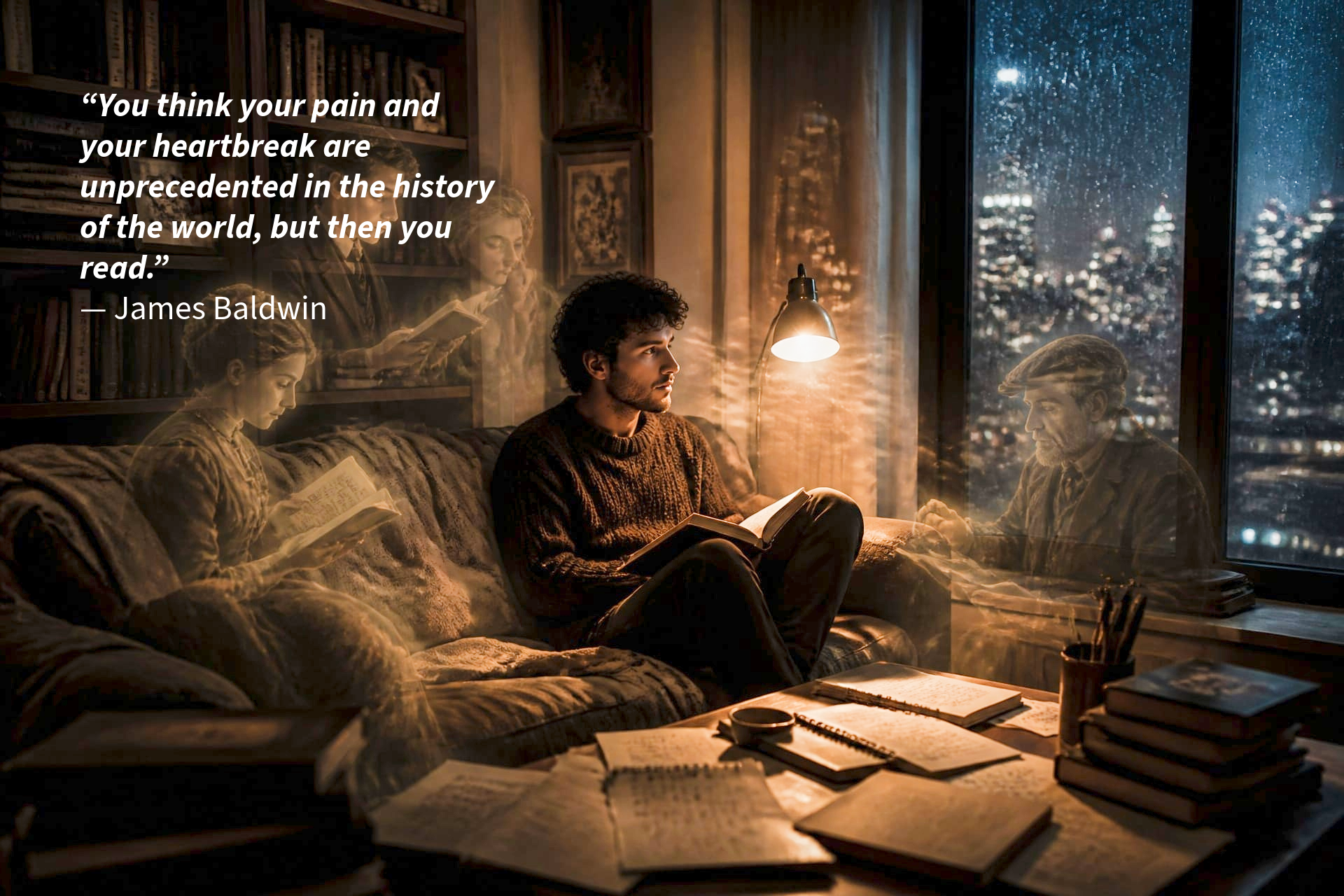
At first glance, it feels comforting in the simplest human way imaginable—the realization that someone else has survived something close enough to your own pain to recognize it when they see it in words.

Not fix it.
Not erase it.
Just… recognize it.

And sometimes recognition is powerful precisely because suffering has a way of convincing people they’ve become emotionally untranslatable.

That’s what heartbreak does after enough time passes without language around it. It isolates. Not always physically, but internally. You begin carrying entire emotional landscapes no one else can see. Conversations continue. Responsibilities continue. Life continues. Meanwhile, somewhere underneath all that movement, there’s a quieter reality unfolding that never fully reaches the surface.

And the longer something remains unnamed, the heavier it becomes.

That’s why certain books hit with almost frightening precision. You pick them up casually, expecting distraction, maybe even escape, and instead you find yourself staring at a sentence that seems to know more about your interior life than some of the people closest to you.

It’s unsettling when that happens.

Not because the writer “understands” you perfectly—that’s impossible—but because they uncover something you’ve been carrying in silence long enough that you stopped realizing its weight.

A fear.
A loneliness.
A grief that adapted itself so thoroughly into your daily functioning that it no longer announced itself as pain. It just became part of the atmosphere of your life.

That’s the dangerous thing about emotional suffering left unspoken for too long: human beings adapt to it. We normalize exhaustion. Normalize numbness. Normalize feeling disconnected from ourselves while still performing competence well enough to survive socially.

And then one honest paragraph breaks something open.

Not dramatically. Quietly.

A line from Baldwin. Morrison. Plath. Didion. Someone dead for decades somehow placing their hand against the same invisible wall you’ve been pressing against your entire life.

And suddenly your suffering no longer feels unique in the isolating sense. It becomes human.

That shift matters more than people realize.

Because loneliness often deepens not from pain itself—but from the belief that no one else could possibly carry pain shaped like yours.

Art interrupts that illusion.

Not by removing grief…
but by placing another human voice beside it.

Maybe that’s why people return to certain books, songs, and poems during difficult seasons of their lives. Not for answers. Not even for comfort in the traditional sense.

But for companionship.

For evidence that another person once stood in similar darkness and managed to leave behind language instead of silence.

And maybe healing begins there—not the moment pain disappears, but the moment you realize your inner life is still capable of connection despite it.

Because sometimes the most life-saving thing another human being can offer isn’t advice.

Sometimes it’s recognition.

The quiet relief of discovering that your private ache still belongs to the shared experience of being alive.


Reflective Prompt

What piece of art once made you feel seen in a way that ordinary conversation never quite could?

Quote of the Day – 09232025


Personal Reflection:
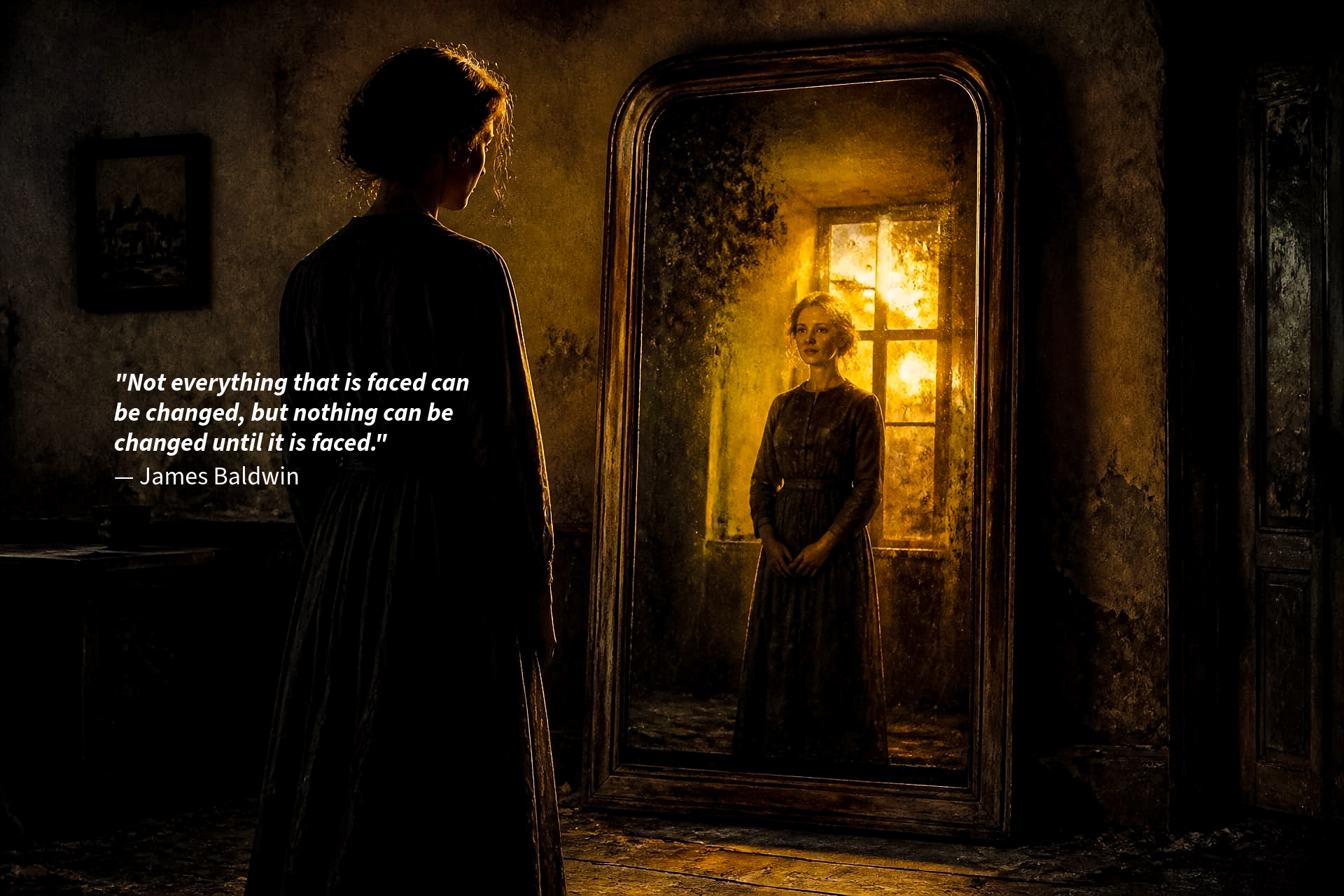
Some chains are forged by history — systems, oppression, and circumstance that press against us from the outside. Those are real, and Baldwin never denied their weight. But here, he’s pointing to a quieter, more insidious kind of captivity: the lies we rehearse until they pass for truth.

Lies whisper in our own voice. I can’t leave. I’m not worthy. It’s too late for me. They’re persuasive not because they’re true, but because they offer safety. They let us stay in the cell we’ve come to know, even when the door has been standing open.

That’s the cruelty of self-deception: it convinces us the lock is unbreakable when, in reality, it’s our own belief that keeps us still. Iron can be shattered. Histories can be challenged. But the stories we tell ourselves? Those are harder to undo because they demand confrontation with the self.

Freedom, then, isn’t just escape — it’s clarity. It begins when we strip away the excuses, the rehearsed scripts, the fear dressed up as certainty. And once the lie falls apart, the chain loses its power.

Reflective Prompt:
What story have you been telling yourself that feels safe but keeps you captive — and what truth would you have to face to finally step free?