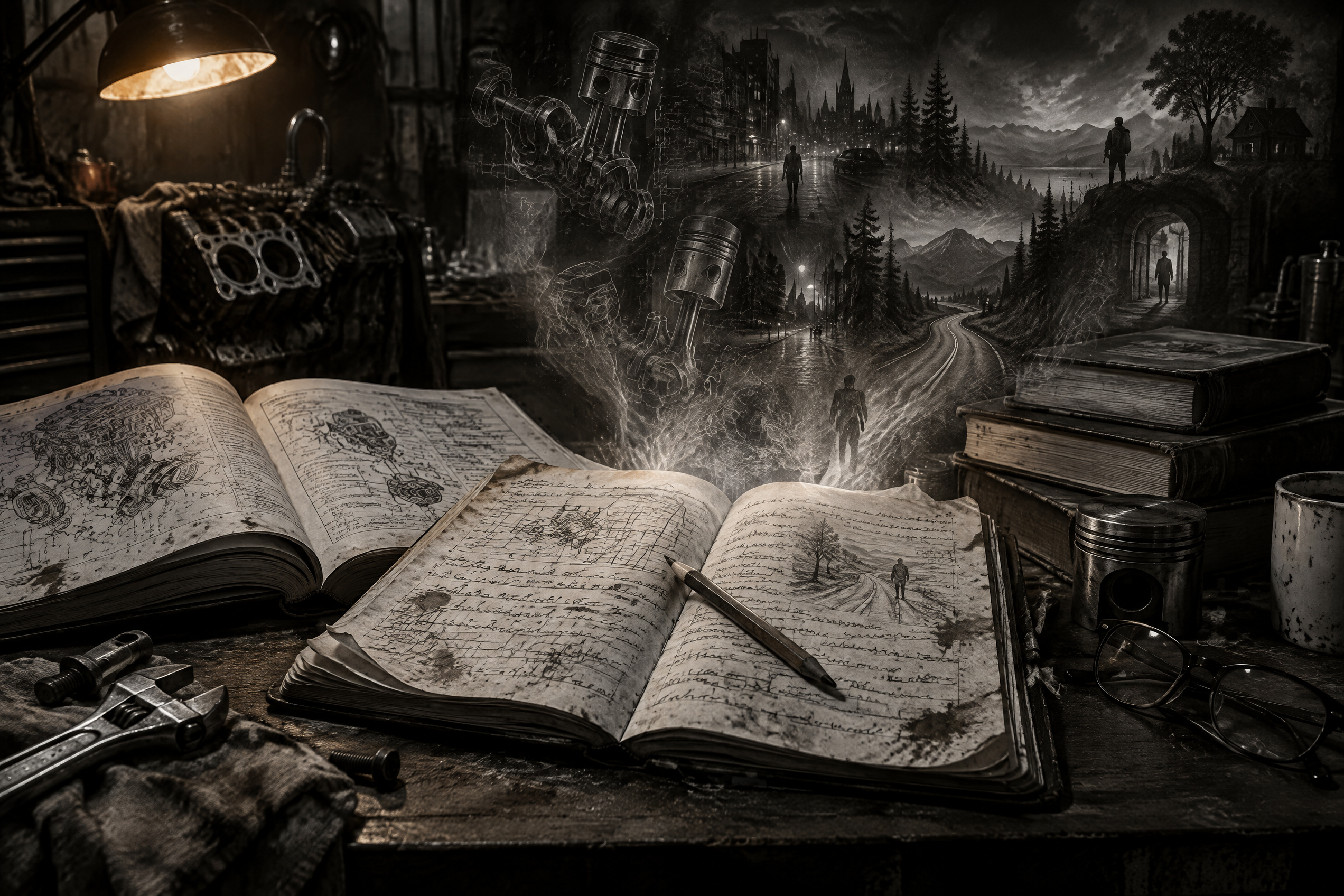
The Long Way Home

What’s the longest trip you’ve ever taken?

View all responses

I’ve traveled around the world. Japan, Korea, Hungary, Belgium, Iraq—just to name a few. I’ve crossed oceans, walked through places where I didn’t speak the language, and spent time in countries most people I knew had only seen on television or found on a map.

So when someone asks about the longest trip I’ve ever taken, you’d think I’d start somewhere overseas.

I don’t.

The trip that comes to mind is the one I took with my baby brother.

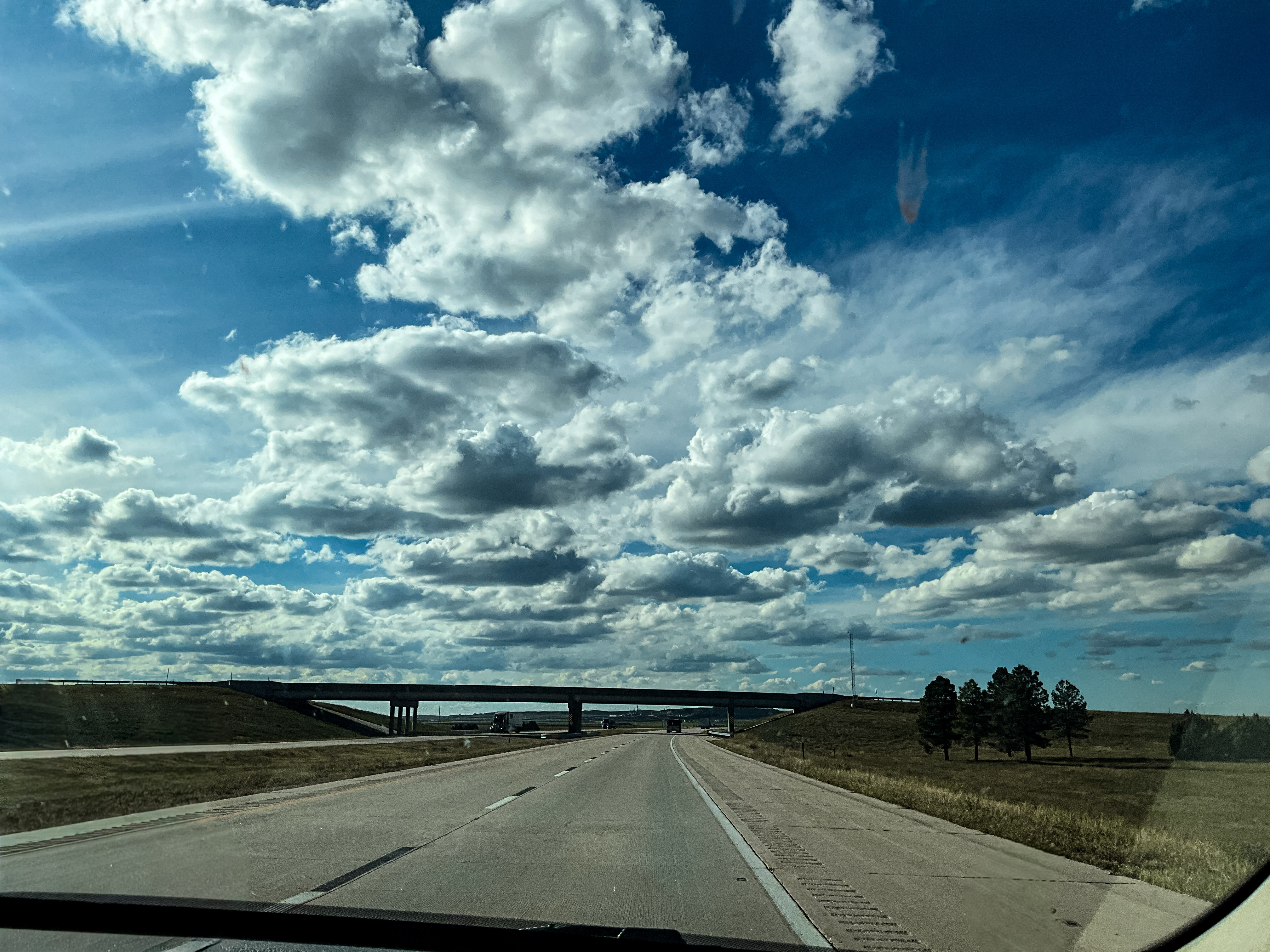
We started in Kalamazoo, Michigan, with a load, a truck, and a whole lot of North America waiting in front of us. From Michigan we headed west through Twin Falls, Idaho, then up toward Washington, through Issaquah, before turning south through Eugene, Oregon. From there we worked our way down the California coast through Anchor Bay and San Francisco. Eventually, we turned east again, crossed the country toward Knoxville, Tennessee, continued to Jacksonville, Florida, and finally made our way home to Illinois.

Nearly six thousand miles, give or take—and that’s before counting all the wandering that happens between the dots on a map.

I’d traveled through some of those areas before. Several times, in fact. But there was something different about experiencing them with my brother. Places I’d stopped noticing became new because he hadn’t seen them yet.

Of course, before the trip could teach me anything profound about brotherhood, America sent us a moose.

Somewhere around Lolo Pass, we encountered one standing in the middle of the road.

At least I’m calling it a moose. It was large enough that neither one of us felt compelled to climb out of the truck and request identification.

It just stood there.

Looking at us.

My brother suggested that I honk the horn.

I’d heard somewhere that startling a moose was one of those ideas that sounded reasonable right up until you actually did it, so I decided we weren’t in that much of a hurry.

We waited.

The moose stared at us.

We stared at the moose.

Eventually, it walked toward the truck.

Now, there’s a considerable difference between seeing a large wild animal somewhere off in the distance and having one decide to come over and inspect you personally. It came close enough that the moose and I made eye contact.

Have you ever stared into the eyes of a moose?

It’s a humbling experience.

There I was behind the wheel of a machine capable of hauling us and our load thousands of miles across a continent, and suddenly none of that mattered. Not the engine. Not the horsepower. Not the steel surrounding us. That animal stood there looking at me as though it understood something humans periodically forget.

In the grand scheme of things, we aren’t nearly as powerful as we think we are.

Eventually, the moose decided we weren’t worth further investigation and wandered off.

My brother never got to honk the horn.

We continued west.

Then my brother saw the Pacific Ocean.

He’d never seen it before.

I had.

The moment he realized we were approaching the Pacific, he started babbling about everything he’d always wanted to do when he finally saw it.

I rolled my eyes and kept driving.

He kept talking.

And talking.

Eventually, I realized that if I wanted any peace whatsoever, I was going to have to stop the damn truck.

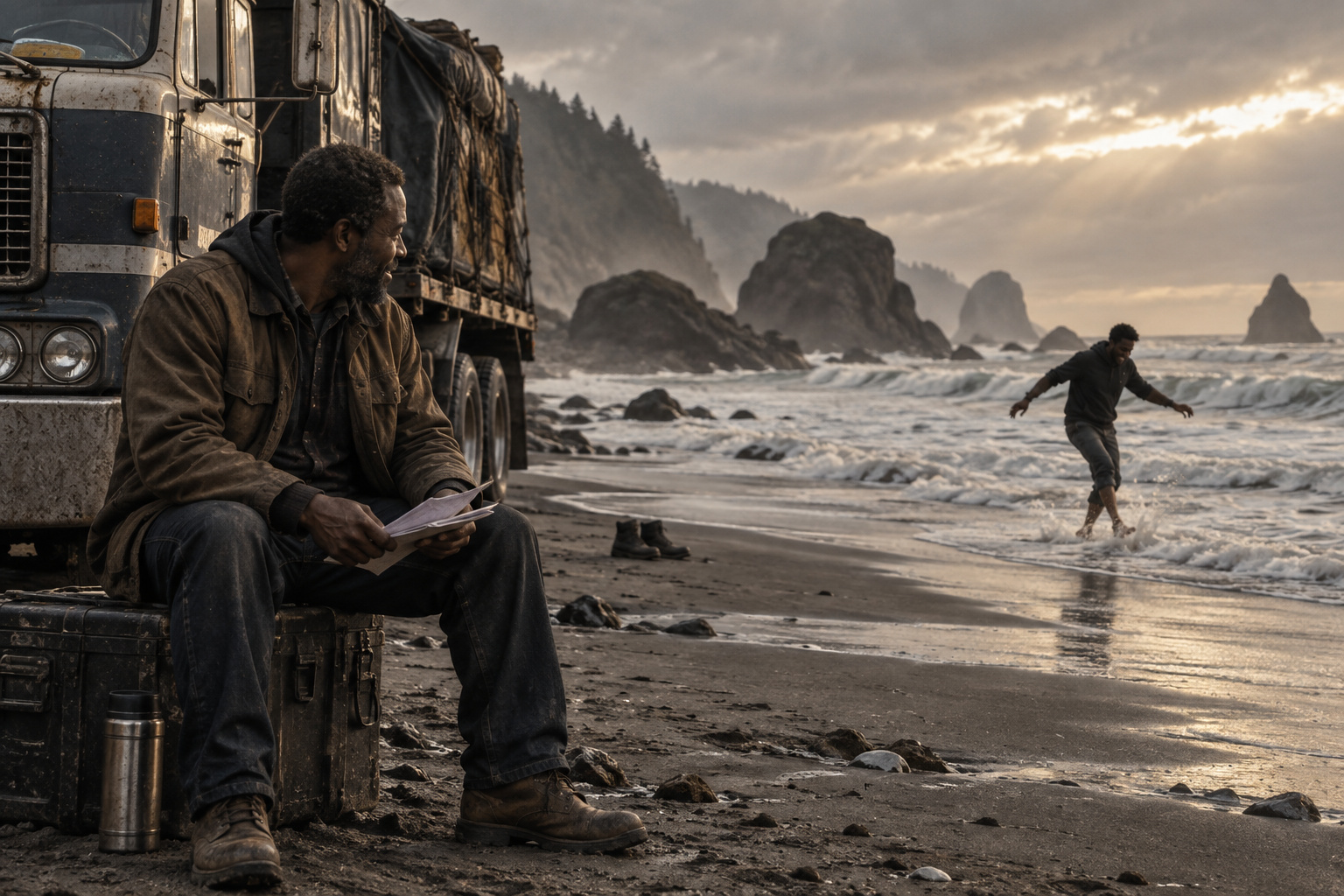
The moment we stopped, my baby brother took off toward the water like a child.

I stayed behind because I had paperwork to do. Somebody on this expedition had to pretend to be a responsible adult. I pulled everything out, settled in, and attempted to get some work done.

I didn’t accomplish much.

Instead, I watched my brother play in the Pacific Ocean.

I’d seen the Pacific before. There wasn’t anything particularly new about it to me. Water. Waves. Horizon. Beautiful, certainly, but familiar.

Watching him changed that.

Maybe that’s something that happens to us after we’ve been around awhile. We see something enough times and eventually stop seeing it. We recognize it. We know what it is. We file it away with everything else we’ve already experienced.

Then somebody you love encounters it for the first time.

Suddenly, you’re looking again.

So I sat there with my paperwork mostly forgotten, watching my brother play in the Pacific like he’d been waiting his entire life for that particular moment.

Then he bent down.

I watched him scoop up some water.

Before I could determine what the hell he was doing, my brother took a big drink of the Pacific Ocean.

There are moments when an older brother should intervene and offer guidance.

There are other moments when experience is the finest teacher available.

He came running back toward me coughing, sputtering, and spitting water.

He looked at me with genuine betrayal.

“It’s salty.”

I stared at him.

Then I looked at the largest body of salt water on the planet stretching behind him.

“Yeah,” I said. “It’s the ocean.”

Sometimes traveling with your baby brother allows you to rediscover the wonder of the world through his eyes.

Sometimes it allows you to discover that apparently nobody ever explained the ocean to him.

We kept moving.

There were more miles, more stops, more conversations, more problems, and more than a few things that didn’t go according to plan. What started as a long haul became one of those trips where the road seemed determined to see exactly how much bullshit two brothers could absorb before one of them finally said enough.

Apparently, our threshold was fairly high.

By the time we were heading toward Jacksonville to drop off the load, we’d already accumulated enough stories for one journey.

The road wasn’t finished with us.

It was late at night, and we were running in a cabover when the right steer tire blew.

If you’ve never experienced a steer-tire blowout in a truck, there isn’t much time for contemplation. One moment you’re rolling down the interstate, and the next several tons of truck have developed their own opinion about where they would like to go.

And it isn’t necessarily where you’re pointing the steering wheel.

The truck started knocking back and forth across the interstate.

I fought the wheel.

There wasn’t time to be frightened. Fear is a luxury that comes afterward. In the moment, there’s only the machine, the road, and whatever experience you’ve accumulated over the years telling your hands what to do before your mind has time to discuss it.

Correct.

Don’t overcorrect.

Hold her.

Keep the damn thing upright.

I remember being thankful for the hour. Traffic was practically nonexistent. Had cars been running alongside us, I’m not certain how differently that night might have ended.

Eventually, I got her under control.

We were upright.

We were still on the road.

We were alive.

Then came the fear.

My heart was pounding. My hands were still gripping the wheel while my brain caught up with what had just happened. That peculiar silence that follows something terrible settled over the cab.

Then, from the bunk behind me, my brother spoke.

“I knew you had it.”

I wanted to punch him in the face.

I’d just spent however many seconds trying to keep several tons of truck from killing both of us, and apparently my baby brother had been lying back there completely confident that Big Brother had everything under control.

But we were upright.

We were alive.

And I was too grateful for both facts to climb into the bunk and strangle him.

So I let it go.

Mostly.

Eventually, we dropped the load in Jacksonville and started working our way home.

By then, the schedule had become more of a suggestion than an actual plan. Somewhere among the miles, mishaps, repairs, delays, and everything else the road had thrown at us, we committed what our wives considered the greater offense of the entire journey.

We missed Thanksgiving.

They were pissed.

Understandably.

We had explanations, of course. Men on the road always have explanations. Some are even true.

None of them mattered much until we finally pulled into Illinois.

Then they saw my rig.

The anger disappeared.

My wife was the daughter of a mechanic, and she’d married one. She knew machinery. She knew trucks. There wasn’t much I could hide from her when it came to mechanical damage, and she didn’t need me standing beside the rig providing commentary.

She looked at it.

Really looked at it.

And whatever she’d planned to say about Thanksgiving became considerably less important.

Eventually, the rest of the family left to return to Michigan.

My wife and I were alone.

Then she asked me what happened.

So I told her.

Not the telephone version.

Not the we’re fine, don’t worry version you give the people waiting at home because there’s nothing they can do from hundreds or thousands of miles away except worry.

I told her what had actually happened.

The trouble.

The damage.

The blowout.

The moments when getting home stopped being merely the final leg of a trip and became something we had to accomplish.

She listened.

Being a mechanic’s daughter and a mechanic’s wife, she understood enough to hear what I wasn’t saying.

She understood how close some of it had been.

When I finished, she wrapped her arms around me.

And held on.

Not one of those quick embraces that says I’m glad you’re home.

She held me for a long time.

For once, I didn’t have anything smart to say.

I just stood there and let her.

I’ve traveled around the world. I’ve crossed oceans and borders and stood thousands of miles from anything resembling home.

But when someone asks me about my longest trip, I remember that ridiculous journey with my baby brother. Michigan to Idaho. Washington. Oregon. Down through California. Across the country to Tennessee. Florida. Then finally back to Illinois.

I remember a moose teaching me that human beings aren’t nearly as impressive as we imagine ourselves to be.

I remember watching my grown brother become a little boy when he saw the Pacific Ocean for the first time.

I remember discovering that he apparently didn’t know the Pacific was salty.

I remember fighting that steering wheel in the middle of the night.

And I remember hearing his voice from the bunk behind me.

“I knew you had it.”

Maybe that’s what remains after enough years have passed. Not the mileage. Not every highway number. Not every fuel stop or state line.

The people who shared the road with you.

The brother who trusted you enough to sleep while you were trying not to kill both of you.

The woman waiting at the end who understood, without you having to explain everything, just how fortunate you were to be standing in front of her.

After nearly six thousand miles, I finally made it home.

Then my wife put her arms around me.

And after that trip, I needed it.

The Road Charges Extra for Poor Planning

What’s your best tip for budget travel?

View all responses

My best tip for budget travel is simple: buy it before you need it.

I’ve spent years figuring out how to survive on the road as cheaply as possible without turning the trip into some sort of endurance exercise.

Before I leave, there’s ice in the cooler and plenty of water. Depending on the trip, there might be another cooler with sandwiches, fruit, snacks, or whatever else keeps me from paying twelve dollars at a truck stop because somebody put turkey and cheese between two pieces of bread and wrapped it in plastic. There’s a thermos of coffee because highway coffee adds up too.

If you smoke, buy your cigarettes before you leave—unless you’re traveling through a state where they’re cheaper. Then common sense says wait.

But the biggest savings happen before the engine ever starts.

Research the trip.

Check fuel prices along the route. Know where you intend to stop instead of waiting until the fuel light starts negotiating with you. Compare lodging prices before you’re exhausted enough to pay whatever somebody asks for a bed. Find a few places where you can get a decent meal without paying the convenience tax that comes with being tired, hungry, and unfamiliar with the area.

And pay attention to when you leave.

If my route takes me through a major city, I try to time the trip so I’m not crawling through rush-hour traffic. Sitting there idling, creeping forward twenty feet, stopping, and doing it all over again burns fuel while accomplishing damn near nothing. Sometimes leaving an hour earlier—or waiting somewhere comfortable for traffic to clear—can save fuel, frustration, and a considerable amount of colorful language.

Then there’s the vehicle itself.

Before a road trip, service it. Check the oil, coolant, tire pressure, and lights. Most of those things affect how efficiently or reliably the vehicle operates, and the lights are simply something you want working when darkness catches you two hundred miles from home.

A properly maintained vehicle is generally cheaper to drive than one you’re asking to limp across three states on hope and dashboard warning lights.

Besides, maintenance in your driveway is usually cheaper than repairs beside an interstate.

If you drive a Flex Fuel vehicle, there’s another calculation worth making.

Don’t look only at the price on the pump. Look at the cost of moving the vehicle down the road.

On my most recent trip, E85 was $2.39 a gallon while regular unleaded was $3.39. My F-150 averaged roughly 19 to 20 miles per gallon on E85. E85 generally gives you fewer miles per gallon than gasoline, but with a dollar-per-gallon difference, that mileage penalty didn’t automatically make it the more expensive fuel.

That’s where research—and a little arithmetic—pays off.

Before leaving, find out where E85 is available along your route and compare its price with regular gasoline. More importantly, know approximately what mileage your vehicle gets using each one.

And don’t take any of this as me saying, “E85 is cheaper, so use E85.”

It isn’t always.

If the difference between E85 and regular gasoline is only twenty or thirty cents a gallon, the mileage you lose may eat every penny you thought you were saving. Your vehicle matters. Your driving habits matter. The route matters. The price spread matters. Hell, even how heavily you’ve loaded the vehicle matters.

That big number glowing on the gas-station sign can fool you.

E85 at $2.39 versus gasoline at $3.39 made sense for me. Put E85 at $2.99 against gasoline at $3.19, though, and I’m pulling out the calculator before I’m pulling out my wallet.

Cost per mile is what matters.

And that principle extends beyond fuel.

Plan your stops, not just your route.

There is, however, a point where frugal becomes cheap.

If I’ve been driving for hours and need a proper meal, I’m stopping for one. If I’m tired and need a decent hotel and some sleep, I’m getting a room. I’m not driving another hundred miles half-awake because somewhere down the highway a motel might be twenty dollars cheaper.

That’s not frugal. That’s foolish.

Saving money isn’t worth making yourself miserable, and it damn sure isn’t worth making yourself unsafe.

Budget travel isn’t about squeezing every nickel until Jefferson hollers. It’s about keeping as much money in your pocket as reasonably possible while still getting where you’re going comfortably and safely.

The road will always have expenses.

What gets expensive are the decisions you make when you’re hungry, tired, running low on fuel, stuck in traffic, or staring at a warning light with another three hundred miles to go.

By then, your choices have become considerably smaller—and usually considerably more expensive.

So, if I have one piece of advice for traveling on a budget, it isn’t spend less.

It’s plan more.

Because the road charges extra for poor planning.

The Rabbit Who Stayed

Who is your favorite cartoon character?

View all responses

I don’t remember having a favorite cartoon character. Apparently, my wife had enough favorite for both of us.

I watched cartoons growing up, plenty of them. Saturday mornings provided the usual parade of animated foolishness, and I enjoyed it well enough, but I was always more of a live-action guy. Give me actual people running around getting into trouble, and I was probably going to choose that over something animated.

Still, somehow, Bugs Bunny survived.

Not necessarily because he was my favorite, but because he was hers.

My wife was an extreme Bugs Bunny fan. And when I say extreme, I mean the kind of fan whose affection eventually becomes everybody else’s shopping assignment. The children bought her Bugs Bunny stuff. I bought her Bugs Bunny stuff. She bought herself Bugs Bunny stuff. That rabbit was everywhere.

After enough years, you stop questioning it.

You see Bugs Bunny and think of her.

Funny thing about memory: it doesn’t always preserve what you loved most. Sometimes it hangs onto what the people you loved loved. Their music gets mixed into your soundtrack. Their sayings sneak into your vocabulary. Their favorite foods become things you recognize on sight. And apparently, their smart-ass cartoon rabbits take up permanent residence somewhere in your head.

So, if you ask me who my favorite cartoon character is, I still don’t know that I have one.

But ask me which one survived the decades?

Bugs Bunny.

The bastard wasn’t even my favorite, and somehow he still won.

Eh… what’s up, Doc?

What Happened?

Which outdated technology do you miss the most, and why?


When you live long enough, the list of answers to this question becomes long.

Hours have been spent discussing the way things used to be, the way things should be, and one of our favorites: Why the hell did they change this or that?

But are those the real questions?

Typically, questions such as this fall into what I call the Dumbshit Category. Questions that give us an excuse to reminisce about rotary phones, cassette tapes, typewriters, television sets that weighed approximately the same as a Buick, and all the other things we once considered modern.

Nothing wrong with dumbshit.

Dumbshit has its place.

Every once in a while, though, one of these questions accidentally asks something worth answering.

Which outdated technology do I miss the most?

None of it.

What I miss is a time when we seemed to believe everyone mattered.

I am increasingly troubled—sometimes enraged—by the moment when human interaction began disappearing behind a hexadecimal veil. Somewhere along the way, convenience stopped assisting human connection and began replacing it.

We don’t visit as much.

We don’t sit.

We don’t spend time with our elders simply because they are there.

There was a time when sitting with an elder felt like an honor. You listened to stories you may have heard before. Sometimes several times before. You drank something. Ate something. Sat around doing absolutely nothing important.

Except it was important.

Now I sometimes hear people discuss visiting an elder as though somebody assigned them a shift.

Maybe this bothers me more now because I’ve learned something youth makes difficult to understand.

There isn’t always another Saturday.

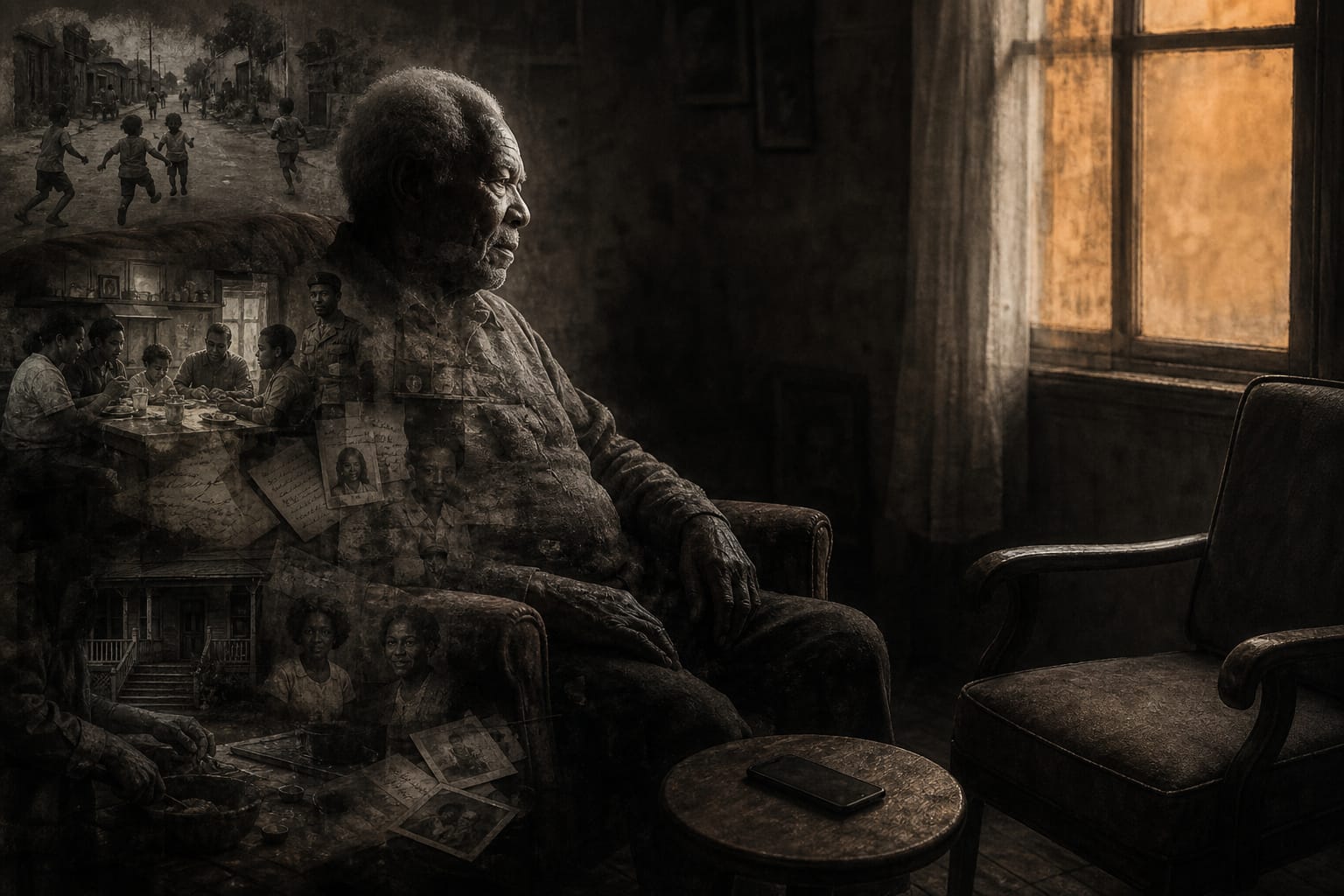
An elder isn’t simply someone sitting in a chair waiting for company. They are a living archive. They carry stories nobody bothered to write down, names beneath photographs nobody thought to label, family history, neighborhood history, mistakes, victories, recipes, grudges, jokes, and answers to questions we haven’t thought to ask yet.

Then one day the archive closes.

No backup.

No password recovery.

No cloud.

Gone.

And suddenly the stories we thought we’d heard too many times become the ones we’d give anything to hear once more.

Perhaps people haven’t stopped caring. Maybe that’s too harsh. Perhaps we’ve built a world where caring has become increasingly inconvenient—and then spent enormous amounts of technology trying to eliminate inconvenience.

The problem is that some things worth keeping were inconvenient all along.

I don’t blame technology for this. That would be too easy, and probably dishonest.

We’ve done versions of this to ourselves throughout history.

I remember the elders of my youth looking around at the changing world and asking the same question.

What happened?

As a young man, I had answers.

They’re old.

They don’t understand.

Things change.

There was some truth in all of it.

Every generation eventually encounters a world it no longer completely recognizes. New customs appear. Language changes. Technology changes. Things once considered essential disappear. Some of those changes are improvements. Some are merely different. Some things probably deserved to disappear.

Nostalgia is a talented liar.

It remembers the mixtape but conveniently forgets standing beside the cassette player with a pencil trying to wind the damn tape back into the shell.

So I don’t want the old world back.

Yet here I sit as one of the elders, looking through essentially the same window they did, asking the same damned question.

What happened?

And now I understand what I couldn’t understand then.

Perhaps they weren’t asking us to stop the world from changing.

Perhaps they were asking whether we understood what we were giving up.

Even our language has evolved in an attempt to provide greater clarity. We have words for things previous generations struggled to articulate. That’s progress, and I wouldn’t dismiss it.

Still, somewhere in all this precision, we occasionally seem to have misplaced understanding.

We correct terminology without hearing meaning. We label before listening. We communicate through abbreviations, reactions, emojis, likes, shares, and whatever collection of symbols happens to be fashionable this week.

Sometimes those things communicate perfectly well.

Sometimes they allow us to avoid actually talking to one another.

In 1969, Led Zeppelin released a track called “Communication Breakdown.”

More than half a century later, the title sounds less like a song and more like a prophetic message.

Consider the absurdity.

We carry devices capable of reaching another human being almost anywhere on the planet in seconds. We can send photographs, text messages, email, video, voice, and thoughts across thousands of miles before the coffee gets cold.

We have never possessed more tools for communication.

Yet I’m not convinced we’ve become better at communicating.

Perhaps communication was never primarily about transmission.

Perhaps it was about presence.

Human beings are inconvenient.

We repeat ourselves. We interrupt. We tell stories badly. We need rides when somebody has something else planned. We call at the wrong time. We sit in silence. We need someone beside us when there isn’t a damn thing they can do to fix what hurts.

Real relationships require something modern life constantly teaches us to eliminate:

inconvenience.

Technology didn’t make that choice for us.

We did.

And before I climb too high onto the elder’s soapbox, I remember the young man who heard older people asking What happened? and dismissed them because they didn’t understand his world.

Now I understand theirs a little better.

Maybe that’s another piece of technology that has become outdated: the belief that another human being is worth our time even when there is nothing to gain, nothing to accomplish, and nothing to post afterward.

I don’t miss the rotary telephone.

I miss remembering why we called.

Maybe the elders weren’t trying to tell us that everything was better back then.

Maybe they were simply asking us not to throw away the things that mattered while we were busy building what came next.

It took me becoming one of them to finally hear it.

LASND

Apparently, Nobody Told the Laptop

Daily writing prompt
What’s a conspiracy theory you actually find believable?

The conspiracy theory I find most believable is planned obsolescence.

Now, I don’t believe there is some mysterious timer buried deep inside my refrigerator, laptop, or television counting down the seconds until the warranty expires.

Although, some days, I wonder.

You know the moment.

The washing machine has been running faithfully for years. Then one morning it makes a noise usually associated with farm equipment, flashes an error code requiring an engineering degree to decipher, and stops working.

You call somebody.

They tell you what it will cost to repair.

You stare at the phone.

Then you ask the question we’ve apparently been conditioned to ask:

“Wouldn’t it be cheaper just to buy another one?”

And there it is.

That’s the part of planned obsolescence I find believable.

I’ve owned enough products over the years to notice that some things simply don’t seem to last the way they once did. Worse, when they break, repairing them has become increasingly difficult. Parts are proprietary. Components that once could be replaced individually are integrated into larger assemblies. Things are glued, soldered, sealed, or otherwise constructed in ways that make you wonder whether the person designing the product ever intended for another human being to open it.

Of course, there is a perfectly reasonable counterargument.

Technology changes.

I know that better than most.

My background is in technology, so I understand the necessity of hardware and software evolution. Standards change. Security requirements change. Operating systems evolve. Applications require more processing power and memory. Interfaces disappear. New technologies replace old ones.

Progress requires change.

I’m not standing in my front yard shaking my fist at the cloud because my fifteen-year-old laptop won’t edit 8K video.

There are limits.

What bothers me is the increasingly common assumption that because a machine can no longer perform the newest function, it no longer has a useful function.

Those are two very different things.

I currently have laptops running that are more than a decade old.

By modern standards, they’re obsolete.

Apparently, nobody told the laptops.

They still boot. They still work. They still perform the jobs I’ve assigned them.

Some of my older machines handle duties on an offline network where I store sensitive information. They don’t need access to every modern cloud service. They don’t need the newest browser. They don’t need enough processing power to generate the next Pixar movie before lunch.

In fact, there is something wonderfully ironic about it.

The machine considered too old for the modern internet may be exactly the machine I don’t want anywhere near the modern internet.

I also write on some of them.

Writing is apparently another activity that has become technologically demanding despite the alphabet remaining stubbornly limited to twenty-six letters.

For that job, I need a keyboard, a screen, reliable storage, and software capable of putting one word after another.

A computer built ten or fifteen years ago can somehow still manage this Herculean task.

So I repurpose my equipment.

That’s probably the systems side of my brain at work. I don’t ask an old machine to perform a job beyond its capabilities. I look at what it can still do reliably and assign it accordingly.

To me, that isn’t nostalgia.

It’s resource management.

Obsolescence should describe a machine that can no longer perform a useful function—not merely one that can no longer perform the newest function.

Software complicates the issue.

A perfectly functional piece of hardware can become effectively useless because the environment around it changes.

An operating-system update requires more resources. A manufacturer stops providing drivers. An application drops support for an older operating system. A browser becomes incompatible. Security requirements change. Eventually, the machine sitting on your desk hasn’t physically failed at all.

The world around it has simply decided it doesn’t belong anymore.

And again, some of that is necessary.

Security vulnerabilities are real. Developers cannot reasonably support every piece of hardware manufactured since Moses came down from the mountain. At some point, old architecture genuinely becomes incompatible with what we’re trying to accomplish.

I understand that.

What interests me is where necessity ends and economics begins.

Because a manufacturer doesn’t actually need to install a mysterious five-year self-destruct timer inside a device.

If the battery cannot reasonably be replaced, the parts aren’t available, the operating system is no longer supported, the applications stop working, and repairing the machine costs almost as much as replacing it, the economic result is exactly the same.

You buy another one.

No tiny corporate demon required.

And computers aren’t the only place I’ve noticed it.

Appliances, televisions, phones, automobiles, tools—there seems to be an increasing number of things we’re expected to replace rather than repair.

Some of that is perception, certainly. We remember the refrigerator that lasted thirty years and conveniently forget the piece of junk Uncle Leroy bought in 1986 that died before Reagan left office.

Survivorship bias is real.

But so is the changing relationship between consumers and the things we own.

Once, repair was an ordinary part of ownership.

Now repair can feel almost rebellious.

And manufacturers aren’t entirely responsible for that.

We participate.

That’s the uncomfortable part.

We’ve become accustomed to the upgrade cycle.

New phone.

New computer.

New television.

New feature.

New version.

New thing that does something we apparently desperately needed despite having survived the previous fifty years without knowing it existed.

Marketing departments don’t necessarily have to convince us that the old thing is broken.

They only have to convince us that it’s old.

Somewhere along the way, those words became synonymous.

Old.

Obsolete.

Useless.

They aren’t.

Eventually, everything reaches the end of its useful life. I don’t intend to keep a computer running simply because I can. There comes a point where the time, expense, security risk, or effort required to maintain something exceeds whatever usefulness remains.

Then you replace it.

That’s not planned obsolescence.

That’s reality.

But I try to make that decision myself.

Not because a commercial tells me.

Not because a software company has released version seventeen-point-whatever.

Not because somebody decided the machine on my desk has reached an age where it should quietly report to the nearest recycling center.

I decide whether it still has a job.

If it does, it stays.

Maybe that’s my small contribution to the rebellion.

Nothing particularly dramatic. No barricades. No manifesto nailed to the doors of Silicon Valley. Just my refusal to participate in the status quo when the status quo doesn’t make sense.

If something works, I use it.

If it breaks and I can reasonably repair it, I repair it.

If it can no longer perform its original job but remains capable of doing something useful, I give it another one.

So, do I believe in planned obsolescence?

Yes.

I just don’t think the conspiracy requires a secret room full of executives deciding precisely when my laptop should die.

That would almost be reassuring.

The truth may be considerably more ordinary.

Design products that discourage repair. Create an ecosystem that continually raises the definition of what constitutes “current.” Make replacement easier than maintenance. Then spend billions convincing consumers that newer automatically means better.

After that, you don’t need a mystery timer.

We’ll start the countdown ourselves.

Meanwhile, somewhere on my network, a laptop more than a decade old is quietly doing exactly what I asked it to do.

It doesn’t know it’s obsolete.

I’m not going to tell it.

Consider that my contribution to the rebellion.

All It Must, but No More

Daily writing prompt
If you had a time machine and could send just one message to your past self, what would it say?

Young people sometimes have this notion that the information we know is obsolete. In some ways, they are absolutely correct. We elders have a similar notion: What the hell are these young people doing? I wonder if their mama knows they’re out here showing out?

Both generations aren’t looking at the whole picture.

Recently, I discussed those pearls of wisdom I call “jewels” in an essay entitled Dropping Jewels. Today, however, I’m thinking about something slightly different: passing along a single message that encompasses scores of triumphs, follies, and seemingly useless facts gathered over a lifetime.

That seems daunting.

How do you reduce all those years to a few words without allowing hindsight to rewrite the story? How do you acknowledge the victories without polishing them, admit the follies without condemning the fool who committed them, and recognize that some of those seemingly useless facts simply haven’t found their moment yet?

We do this in the hope that we can remain objective and tell the truth of the matter, minus our ego.

This, too, is daunting.

Perhaps that is why the message itself must be simple:

Nothing is irrelevant. Everything has its time and place, if you exercise patience and restraint.

Some of what I knew when I was young became obsolete. Some of what I dismissed became indispensable. Some things waited decades before circumstances finally revealed why I had carried them so long. The value wasn’t always in knowing. Sometimes, it was in waiting.

The younger me probably wouldn’t understand that.

He wouldn’t need to.

The message contains all it must, but no more.

Baldwin, Ursula, and My Good T-Shirt

Daily writing prompt
Which author would you love to have dinner with?

Most people would probably choose an author and spend dinner asking about books.

I’d invite James Baldwin.

I can see him sitting across from me, cigarette balanced between his fingers, legs crossed. His forehead creases as he listens to my first question. There is something about those eyes—large, intense, examining—that makes me wonder whether he’s considering the question or deciding whether it’s worth dignifying with a response.

I’d be a little star-struck.

Hell, it’s James Baldwin.

I start carefully.

“How much did your personal struggles contribute to the insight in your work? Being Black, American, and gay during that era—how much of that struggle found its way onto the page?”

His expression doesn’t change.

“That isn’t what you really want to ask, is it?”

Well, shit.

“I was trying to be cool and respectful. I’ve been weaned on your legend. But your writing tells me if I suck up to you, you’d be offended.”

He studies me for another moment.

“Behind your eyes, I see that they have witnessed far enough for you to come at me in this manner.”

Still no expression. Just that gaze.

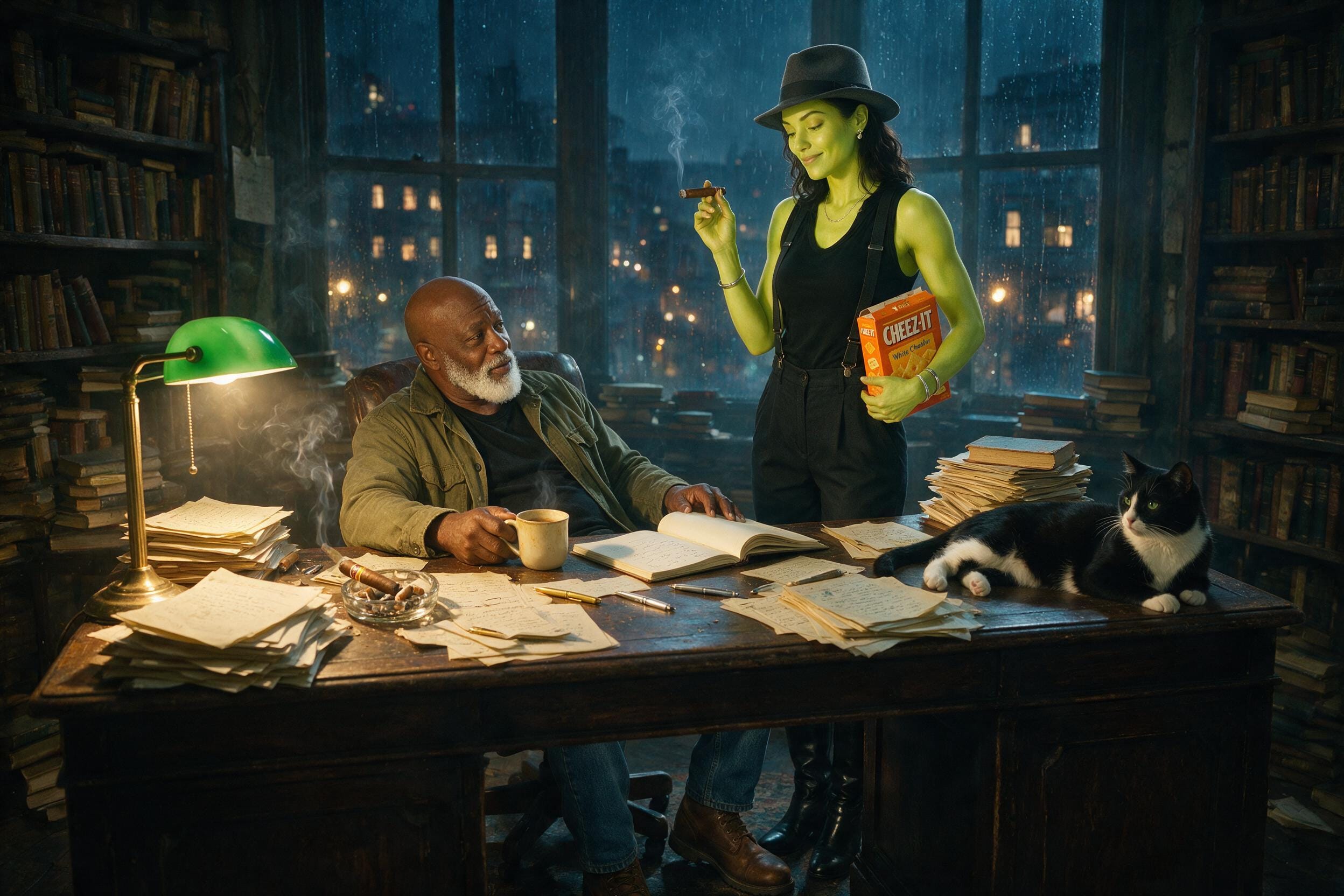
Ursula walks over and places my pipe and ashtray beside me before taking her seat at the end of the table. She lights her Cohiba and settles back.

No help from her.

Baldwin and I continue examining each other.

There is a peculiar experience in finally sitting across from someone you’ve known only through words, photographs, recordings, and legend. Part of you wants to meet the man. Another part can’t stop seeing the monument.

So I try again.

“This is something I’ve never completely understood about your work. You had every damn reason to hate. Yet somehow you kept looking beyond what people did to ask why they needed to do it. How?”

I pause.

“It’s almost as if grace wasn’t an option, but a necessity.”

His eyes hold mine.

For the briefest moment, I catch something in his gaze I want to call respect. Not the respect given to an equal—I ain’t foolish enough to believe that—but enough to tell me he no longer considers me a joke.

Then it turns to vapor.

Baldwin takes another drag from his cigarette.

I pack my pipe.

Apparently we’re going to be here awhile.

I strike a match, get the tobacco burning, and take my first pull.

Baldwin leans back.

“What were you trying to do in those earlier essays of yours? It’s as though you were writing pieces of one essay and publishing them separately. You posted them not because they were ready, but because you thought they were cool.”

I hold the smoke.

Did Baldwin just call me out?

Another pull from the pipe buys me a couple of seconds.

I got nothing. He nailed it.

Damn it, man.

At the end of the table, Ursula pours her white cheddar Cheez-Its into a china bowl.

I stare at it.

She ain’t never done that.

She’s fronting for Mr. Baldwin.

Hell, I didn’t even know we had china.

Of course, I can’t complain. I have on my good T-shirt.

“I didn’t have any idea what I was going to write about,” I finally admit. “Back then, I thought it was enough just to write. I’d probably call it something else now.”

I think about it.

“Perhaps not. Life is madness, and it’s all the rage.”

Ursula reaches for a bottle of mezcal, sets it on the table, pours herself a shot, and knocks it back.

Apparently we’re done pretending to be civilized.

Baldwin’s attention shifts toward the end of the table.

“Who are you, darling?”

Ursula pours another shot and knocks it back. Her face twists as the liquor burns its way down. She recovers, clears her throat, and looks at him.

“I’m Ursula. His muse.”

Baldwin looks at me.

I draw on my pipe.

Ursula reaches into the china bowl for another Cheez-It.

Then she looks at me.

“You know you’re touched, right?”

I raise an eyebrow.

She gestures toward Baldwin with her empty shot glass.

“You just spent the better part of dinner having a conversation with a dead writer, and gods know what twisted region of your mind I crawled out of.”

She holds out one lime-green hand and stares at it.

“And seriously… lime-green? What the hell?”

Time Was Never the Problem

Daily writing prompt
What’s something you used to worry about but don’t anymore?

There was a time when I worried there simply weren’t enough hours in the day. Like many people, I believed the more I could cram into those hours, the more productive I was. We celebrate being busy, glorify multitasking, and wear exhaustion like a badge of honor. I used to buy into that way of thinking.

Over the years, I learned something different.

Time has never changed. Whether I’m here tomorrow or not, the sun will rise, the Earth will continue its journey, and another twenty-four hours will pass. Time isn’t running faster. We are.

Much of my career required planning. Before beginning a repair, I often worked backward from the desired outcome. What parts would I need? Were special tools required? Had I done this procedure before, or did I need to review the manual? Most importantly, what problems might reveal themselves once everything was taken apart?

Repair guides are remarkably accurate—until they aren’t.

A manual can’t predict a rusted bolt, hidden damage, or a previous repair done with more optimism than skill. That’s why mechanics sometimes discover additional problems after they’ve already begun. From the customer’s perspective, it may seem suspicious. From the mechanic’s perspective, reality simply revealed something that couldn’t have been seen before.

Life has a habit of doing the same thing.

No amount of planning eliminates surprises. Good planning simply leaves enough margin to deal with them without sacrificing quality. It reduces stress, not because everything goes according to plan, but because you’ve prepared yourself for the possibility that it won’t.

That realization changed the way I think about time.

I no longer worry about how much I can squeeze into a day. Instead, I ask whether I gave the work in front of me the time and attention it deserved. I’ve found that people remember quality long after they’ve forgotten how quickly something was finished.

Time was never my enemy.

My expectations of what I could accomplish within it were.

Dropping Jewels

Daily writing prompt
What’s a quote that perfectly describes your outlook on life?

The prompt asks for a quote that describes my outlook on life. I could easily borrow one from Marcus Aurelius, James Joyce, or any number of great thinkers whose words have influenced me over the years. They all deserve a place on the shelf.

But the older I get, the more I realize some of the greatest wisdom I’ve ever received never came from a book. It came from living, making mistakes, listening, and paying attention to the people around me.

Growing up, we had an expression: “I’m dropping jewels. You need to pick them up and put them in your bag.” At the time, I didn’t fully appreciate what it meant. Like most young people, I thought wisdom belonged to someone else. Years later, I discovered those jewels had been waiting for me exactly when I needed them.

Some came from my parents, who taught me through their example long before I understood the lessons. Some came from my stepmother, whose observations often seemed unrelated to whatever we were discussing. Then, months or even years later, one of those “jewels” would quietly return at precisely the right moment.

Others came from ordinary conversations. A coworker once showed me a better way to do something. As I thanked her, she simply smiled and said, “No one knows everything.” That single sentence taught me more about humility and teamwork than any leadership seminar ever could.

Then there are the jewels my grandchildren have unknowingly dropped into my own bag. One granddaughter looked at me one day and said, “Peepaw, you like lived a whole life.” Another caught me struggling with something I had done thousands of times before and laughed, “Peepaw, it’s like you forgot your Peepaw.” Children have a remarkable way of speaking truth without ever trying to sound wise.

That’s when it finally occurred to me that wisdom doesn’t travel in only one direction.

From our first breath, we are both teachers and students. We don’t become one and then the other—we are both at the same time. Every conversation holds the possibility that we might leave with a jewel or quietly place one into someone else’s bag. You can find them in a grocery store, at a ball game, sitting on the front stoop with a glass of sun tea, or even waiting in line at the DMV. (Let’s be honest—everybody needs a little kindness after waiting at the DMV.)

I still admire the great philosophers and writers. Their words continue to challenge and inspire me. But I no longer believe wisdom belongs only to famous names or leather-bound books. It lives in ordinary people having ordinary conversations, if we’re willing to listen.

This is the way of humanity.

The Compass I Was Given

Daily writing prompt
What gives you direction in life?

If someone asked me what gives me direction in life, I could point to many things. My faith. My family. My career. My writing. All have shaped the man I am today. Yet, if I’m honest, the compass that guides my life was placed in my hands long before I understood how to read it.

It was given to me by my parents.

They sacrificed more than I understood at the time to provide my siblings and me with a blueprint for life. Both instilled a strong work ethic and the belief that if a job was worth doing, it was worth doing to the best of your ability. Mediocrity simply wasn’t an option in our home.

My father taught himself to read before earning a college degree. He showed me that determination could overcome circumstances. My mother created a home built on steadiness, grace, and quiet strength. She had an incredible ability to remain calm when life became chaotic, and she approached every task with care and purpose. I watched her create beautiful things, never rushing the process. Even then, she was teaching me that the journey mattered as much as the destination.

The greatest gift they gave me, other than life itself, was a steadfast faith in the Almighty. We each followed our own path, but they taught us that we were part of something far greater than the four walls of our home or the borders of our hometown. They weren’t simply pointing me toward a destination—they were teaching me how to find my way.

Like many young people, I believed I needed to discover life on my own. I pushed against some of the lessons I had been taught, convinced I knew better. Looking back, I smile because I watched my own children do much the same thing. There seems to come a point when every generation believes it has discovered something entirely new, only to realize years later that their parents may have known a thing or two after all.

For me, that realization came after my father passed away. It was then I understood I could no longer rely on the compass they carried for me. I had to learn to trust the one they had already placed in my hands. The lessons I had inherited became the principles I chose to live by.

At first, I believed serving in the military was enough. Later, I realized it was only one expression of a much larger responsibility. My direction—or perhaps my personal code—is simple: leave the world a little better than I found it.

Today, that compass influences everything I do. It guides how I treat people, how I approach my work, and how I write. I don’t expect to change the world, but I hope my words encourage someone to think a little deeper, consider another perspective, or leave with a greater understanding than when they arrived. If I can do that, then I’ve done my part.

The funny thing about a person’s code is that it changes over time. It should. Experience, failure, faith, and wisdom all have a hand in refining it. A good compass doesn’t change true north; it simply helps us recognize it more clearly. I think that’s what my parents were really giving me all those years ago.

The World Is Larger Than We Think

Daily writing prompt
What are your top 10 travel destinations?

I’ve been fortunate to travel throughout much of the United States and around the world. Along the way, I experienced different cultures, languages, traditions, and ways of seeing life. If someone asked me for my top ten travel destinations, I could probably make a list. The truth is, though, that’s not what travel gave me.

The greatest lesson wasn’t found in famous landmarks or postcard views. It was learning to listen before I spoke, to observe before I judged, and to respect traditions that weren’t my own. There were certainly customs I didn’t understand or even agree with, but I learned they deserved to be understood before they were criticized.

What surprised me most was not how different people were, but how familiar they often felt. Families still gathered around meals. Parents worried about their children. Friends laughed together. Communities celebrated, mourned, and cared for one another. The customs, languages, and ceremonies changed from place to place, but many of the values beneath them remained remarkably similar.

I also discovered that respect has a language of its own. When you approach people with genuine curiosity instead of assumptions, something remarkable happens. They stop seeing you as a tourist and begin treating you as a guest. Some even invite you to share in their traditions, offering a glimpse of their world that no guidebook could ever provide.

Those experiences changed the way I see both the world and the people in it. They reminded me that curiosity builds bridges where assumptions build walls.

The world is a vast, beautiful place. I’ve often wondered why we choose to live it so small.

Better to Have No Public

Daily writing prompt
What is your favorite quote?

I have collected hundreds of quotes over the years. Some challenge me. Some comfort me. Others remind me to keep learning. Choosing a single favorite feels almost impossible because the right quote often depends on where I am in life.

If I had to choose just one, though, it would be Cyril Connolly’s observation:

“Better to write for yourself and have no public, than to write for the public and have no self.”

I think about those words every time I sit down to write.

In a world that measures success in views, likes, followers, and algorithms, it’s easy to start writing for approval instead of truth. That path may attract attention, but it slowly chips away at the very thing that made your voice worth hearing in the first place.

Connolly’s quote reminds me that authenticity is not a marketing strategy. It’s a discipline. Every story, essay, or poem should sound like it could only have been written by the person holding the pen. If I lose that voice in pursuit of popularity, then whatever audience I gain comes at too high a price.

Ironically, I believe genuine readers recognize authenticity when they find it. They may not agree with every opinion or interpretation, but they know when someone is writing honestly.

I would rather spend my life writing words that are true to who I am than spend it chasing words I think people want to hear. Audiences come and go. Trends fade. Your voice is the only thing you carry from the first page to the last.

That is why, of all the quotes I’ve collected over the years, this remains my favorite when it comes to writing. It isn’t simply advice about writing. It’s advice about living.

Before You Decide What to Think

Daily writing prompt
If you had to give one life-changing tip, what would it be?

People often ask for one piece of life-changing advice, as though wisdom were a key hidden beneath the right rock. I don’t think life works that way. Most of us have heard the advice we needed years before we were ready to understand it.

Experience is usually the teacher; advice merely introduces the lesson.

If you insisted that I leave behind one tip, it wouldn’t be believe this or do that.

It would be this:

Learn how to think before you decide what to think.

Question your assumptions. Look at problems from more than one angle. Be willing to change your mind when the evidence demands it. Curiosity will take you farther than certainty ever will.

Every worthwhile decision I’ve ever made began with a question, not an answer.

Perhaps that’s why I don’t believe a single tip can change a life. Advice rarely does. But learning how to think changes every decision that follows.

The Difference Between Knowing and Thinking

I think thinking is a basic skill. The older I get, the more I realize it isn’t.

Early in my military career, I learned to stop chasing symptoms and start looking for root causes. A single fault could be produced by several different systems. Before we ever reached for a tool, we had to ask ourselves, What are all the possible causes?

That lesson stayed with me.

One of the biggest mistakes experienced technicians make is allowing experience to become certainty. We become convinced we’ve seen this problem before and dismiss other possibilities. Sometimes the newest technician, with a completely different perspective, sees what everyone else overlooked.

I’ve found that people aren’t much different.

Many things present as one thing but are actually another. The first explanation isn’t always the best one, and the loudest answer isn’t always the right one. Learning to ask better questions has made me slower to judge and quicker to listen.

Perhaps that’s the real skill.

Not having all the answers, but having the humility to consider there may be more than one.

Daily writing prompt
What’s a skill you consider basic, that most people don’t actually know how to do?

The Older I Get, the Quieter My Heroes Become

Daily writing prompt
Who is the fictional character you relate to the most?

The fictional character I relate to the most is Walt Longmire.

I first met him through Robert Taylor’s portrayal in the television series. It was his manner that caught my attention. He never seemed in a hurry to speak. He listened more than he talked. He carried himself with quiet confidence, treating everyone with the same measure of respect until they gave him a reason to do otherwise. He didn’t need to be the loudest person in the room to command it.

That performance led me to Craig Johnson’s novels, where I discovered a character with even greater depth.

Beneath the badge is a man who loves history, notices details others overlook, wrestles with grief, questions his own decisions, and understands that people are rarely as simple as they first appear. He isn’t driven by the desire to be right as much as he is by the responsibility to find the truth.

That’s the part of Walt Longmire I recognize.

I’ve never been drawn to larger-than-life heroes. I’ve always admired ordinary people who quietly carry extraordinary burdens without asking for recognition. People who think before they speak. People who understand that strength isn’t measured by how loud you are, but by how well you shoulder responsibility when no one is watching.

The older I get, the less interested I am in people who always have the answers. I’m far more interested in those who are willing to keep asking the right questions.

Perhaps that’s why Walt Longmire has stayed with me all these years. Not because he’s a sheriff, but because he reminds me that character is revealed in the quiet moments—when no one is watching, when no applause is coming, and when doing the right thing is simply the only choice left.

The older I get, the quieter my heroes become.

The Threads We Don’t See

Yes, I do.

I don’t believe in coincidence. I believe there are threads connecting one moment to another, one person to the next, one choice to consequences we may not recognize until years later.

Our lives are a tapestry of moments. We rarely see the whole pattern while we’re living it.

The difficulty is that we’re standing too close to the tapestry. We see a single knot while life is weaving an entire pattern. Often, we don’t see the connection because we aren’t looking for it. Sometimes we are looking, but we don’t even know where to begin.

I’ve met people who changed the course of my life with a single conversation. I’ve made decisions that seemed insignificant at the time, only to discover later they led me exactly where I needed to be. Looking back, the threads become visible.

That doesn’t mean every event is good or that every hardship is somehow deserved. Life can be cruel without asking our permission. But even pain has a way of connecting us to lessons, people, and versions of ourselves we might never have found otherwise.

Perhaps the reason isn’t always in the event itself. Perhaps the reason is in what we choose to do with it once the threads finally come into view.

Daily writing prompt
Do you think everything happens for a reason?

The Things We Keep

Daily writing prompt
What’s your home decoration style?

I don’t really have a decorating style, and I’ve never wanted one.

Well… unless mystery storage totes count as a decorating style. I have a few tucked away, and I’m not entirely sure what’s in them. Doesn’t everyone?

Over the last few years, I’ve made a conscious effort to reduce the clutter in my home. The older I get, the more I realize that everything I own quietly asks something of me. It needs to be cleaned, stored, moved, repaired, or simply remembered. If something no longer serves a purpose, I try to let it go. If I can, I’d rather give it directly to someone who needs it. If not, I donate it and hope it finds the right home.

That philosophy has become part of how I live, not just how I organize my house.

The hardest part wasn’t deciding what to do with my own belongings. It was sorting through the treasures my children left behind after they grew up. To them, many of those things are forgotten relics from another lifetime. To a parent, they’re snapshots of a life unfolding.

While going through my mother’s belongings, I found a small plaster keepsake I had painted with watercolors as a child. It isn’t valuable. It isn’t particularly beautiful. It now sits on my kitchen windowsill.

Its purpose isn’t decoration.

It’s a reminder that one of life’s greatest privileges is watching our children become the people they were meant to be. We watch them stumble, succeed, fail, laugh, and slowly discover themselves. It’s beautiful.

It’s also frustrating when you’re standing there wondering, Who—or where—the hell did you get that dumb shit?

Parenthood has a way of teaching both awe and humility.

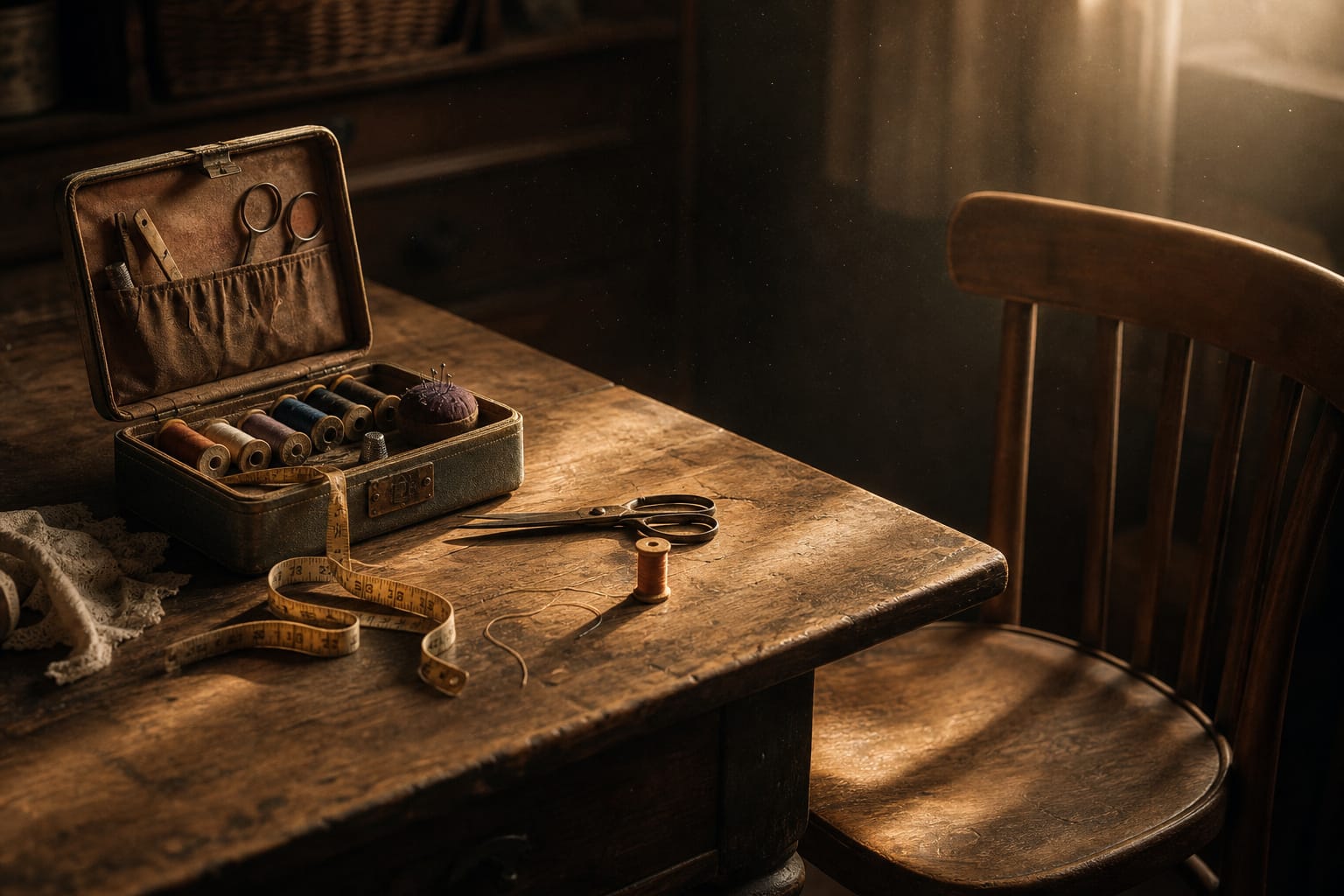
Not long after, I found my mother’s old sewing kit—the very one she taught me to sew with.

I carried it to my desk and carefully emptied its contents. Every spool of thread, every needle, every button, every thimble. More than fifty years of mending were tucked inside that little box.

I cleaned the case, replaced the pieces I knew were missing, arranged everything the way I imagined she would have wanted it, then closed the lid and placed it on a shelf.

It was complete again.

Sometime later, I needed to mend a shirt. Instead of reaching for the sewing kit, I started making a shopping list for one of my own.

One of my closest friends watched me for a moment before saying quietly, “Your mom wouldn’t mind if you used the sewing kit.”

“Nope,” I replied. “It’s Mom’s.”

“It’s okay, dear,” she said softly. “She’d want you to use it.”

That conversation stayed with me.

Eventually, I opened the box, threaded a needle, and began mending my own clothes with the same sewing kit that had mended mine decades earlier.

Now it’s the sewing kit I use.

Or maybe that’s not quite true.

Maybe I’m simply its next caretaker.

I still keep it clean. I still put everything back where it belongs. But I’ve stopped trying to preserve it as though it were a museum piece. My mother didn’t keep it pristine. She kept it useful.

Perhaps one day one of my children will open that same box. They may recognize it immediately, or they may simply see an old sewing kit with worn edges and neatly arranged thread. I hope they use it. I hope they add a few spools of their own. I hope, somewhere in the middle of mending a torn sleeve or replacing a missing button, they remember their grandmother.

I used to believe that everything in my home had to justify the space it occupied. I still believe that. I was simply measuring purpose too narrowly.

Some things are built to mend fabric. The lucky ones spend generations mending families.

Perhaps this is their purpose—not to sit untouched on a shelf, but to carry a story from one generation to the next.

Every Ending Has a Name

If you could rewrite any book’s ending, which one would you choose?

I’ve read books with endings I hated.

I wanted another chapter. Another conversation. Another chance for a character to choose differently. I closed the cover convinced I knew a better way to end the story.

Then I became a writer.

It changed the question.

I’ve even written endings I didn’t like.

There were nights I stared at the final page, convinced there had to be another way. Not because the ending was wrong.

Because it hurt.

The story wasn’t interested in what I wanted.

It ended where it needed to.

My job wasn’t to negotiate with it.

My job was to listen.

Rewrite them?

What foolishness is this?

That’s like walking up to someone and telling them to change their name because you don’t like the one they were given. You don’t get to rename another person’s story simply because it didn’t unfold the way you hoped.

Every ending belongs to the journey that came before it.

Life has never shown much interest in comfortable endings.

The older I get, the more I realize that the moments that shaped me rarely felt complete. The apology that arrived too late. The goodbye I didn’t know was the last one. Life rarely announces when you’re reading the final page of a chapter. More often, it simply turns the page while you’re still trying to understand the one you just finished.

Perhaps that’s why the endings that linger in my memory aren’t always the happiest ones.

They’re the honest ones.

When I finish a story, I try to become its first reader.

I set the manuscript aside and return to it with as much honesty as I can manage.

Has the story earned its ending?

Did I answer the questions I promised to answer?

Did I leave behind something worth thinking about?

Eventually, the story tells me it has said all it came to say.

That’s why I wouldn’t rewrite another writer’s ending.

I know how difficult it is to earn one of my own.

A book ends when the author writes the final sentence.

A story ends whenever the reader is finished thinking about it.

I write until the final whisper.

Then I step back and ponder whether I’ve left the reader with an echo worth thinking about.

The Charge

Daily writing prompt
What’s a song lyric that has stuck with you forever?

One song lyric has stayed with me for decades:

“You’ll take my life, but I’ll take yours too.”The Trooper by Iron Maiden.

When I was younger, it sounded like defiance wrapped in a heavy guitar riff. As I got older, I heard something entirely different.

To me, The Trooper isn’t about glorifying war. It’s a reminder of its cost. The song taught me there are no victors in war. Someone always loses a son, a daughter, a friend, or a piece of themselves that they never get back.

The words haven’t changed over the years.

I have.

The Promise to Remain Curious

Daily writing prompt
What’s a promise you made to yourself that you’ve actually kept?

“Don’t make promises you can’t keep, boy.”

“I know you mean well, but all you have is your word. So do what you say, and say what you mean.”

Those were lessons instilled in me as a child.

It’s hard work staying true to your word. It’s even harder sometimes to stay true to yourself.

Somewhere along the way, I made myself a promise: I would never give up my quest for knowledge and understanding.

I haven’t.

That doesn’t mean I’ve always kept the promise perfectly.

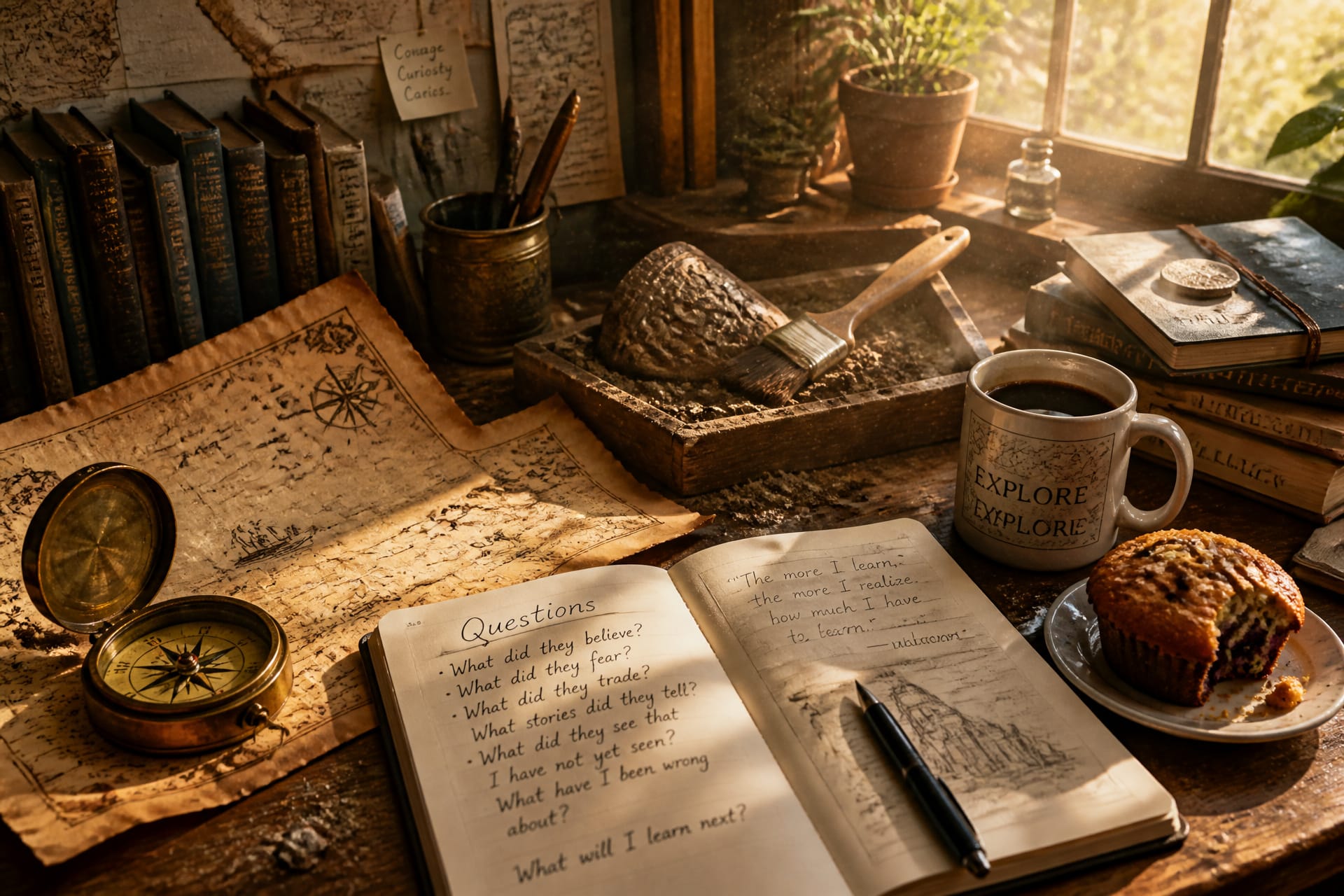
I read. I listen. I observe. I ask questions. I also spend time each day writing down my thoughts and questions. It keeps my mind fresh, but more importantly, it forces me to examine what I think I know.

Sometimes questions lead to answers. Sometimes they only lead to better questions. I’ve learned not to consider either outcome a failure.

In fact, I’ve learned there is just as much information in failure as there is in a positive result.

When something fails, I try to take a deep breath and examine what went wrong. What did I miss? Was the plan flawed? Did I make a bad assumption? Was there something I couldn’t have anticipated?

Failure doesn’t always hand you the answer.

Sometimes all it gives you is another question.

That’s enough.

A good question gives you somewhere to start.

I remember when I thought the goal was perfection. Everything had to be exactly right. If I learned enough, prepared enough, and planned carefully enough, perhaps I could account for every possibility.

Experience cured me of that.

While performing operations, I learned that sometimes the first plan goes to shit. When that happens, the shit just got real, and you’d better start figuring some things out.

That didn’t teach me to prepare less.

It changed the way I prepared.

I began leaving room for the unexpected. I learned that preparation wasn’t about controlling everything that might happen. It was about understanding enough to adapt when something happened that I hadn’t planned for.

And somewhere in there, I learned to apply a little grace.

Perfection is a construct of our own making. We decide what perfect should look like and sometimes punish ourselves when reality refuses to cooperate.

Grace doesn’t mean lowering my standards. I still believe in doing things well. It means accepting that something can go wrong without everything being wrong.

Sometimes the plan fails.

Take a deep breath. Examine what went wrong. Figure out what you know, what you don’t know, and where to start.

Then move forward.

We don’t just learn from books, lectures, or fancy speeches.

Some lessons come from places we would rather avoid.

We learn from pain. We learn from regret. We learn from loss.

Life is rarely tied up in a pretty bow. Understanding it means being open to the things that make us uncomfortable as well as the things that bring us joy. Pain doesn’t suddenly become good because we learned something from it. Loss doesn’t become fair because eventually we found some meaning in it.

Some things just hurt.

But they are still part of the education.

I used to say gas-station donuts are horrible so we can appreciate the good ones when we finally taste one.

There’s probably some questionable philosophy in there somewhere, but I still believe the basic idea.

Contrast teaches us something.

Joy means something different after sorrow. Success looks different after failure. Certainty feels different once you’ve discovered how spectacularly wrong you can be.

Maybe we need both sides of the experience to understand either one.

There is also a difference between knowing something and understanding it.

As a technician, I read countless manuals explaining how to repair things. Part A connects to Part C. Check this voltage. Replace that component. Follow the procedure.

That’s knowledge.

But you can’t really troubleshoot something until you understand how it operates. What does each part do? Why is it there? What is its function within the whole system? Once you understand that, a fault gives you somewhere to start looking.

And the fault isn’t always where the problem is.

I don’t know how many times I found a fault presenting itself in one location only to discover that the actual problem was somewhere else entirely.

I’ve learned that life can work that way too.

What we see isn’t necessarily where the problem began.

That’s why I’ve never been satisfied with simply knowing what happened. I want to understand how the pieces fit together. I want to know why.

That has required me to broaden my understanding of the world.

More importantly, I’ve had to let go of some of my illusions and assumptions.

That’s more difficult than it sounds.

We spend a lifetime learning from our experiences. Those experiences teach us how the world works—or at least how we believe it works. Over time, those lessons harden into conclusions, and those conclusions can become certainty.

There is nothing inherently wrong with certainty. We need some of it just to make our way through the day.

The danger comes when certainty becomes more important than truth.

I’ve been guilty of that.

I’ve been certain about things because my experiences told me I was right. I’ve defended conclusions when perhaps I should have been examining how I reached them. Sometimes admitting I was wrong required more than changing my mind. It required admitting that something I had carried for years no longer deserved the weight I had given it.

I’ve had to learn to say, Maybe I was wrong.

Those are four difficult words.

They are also four liberating ones.

Writing helps me practice that.

A thought looks different once I put it on paper. I can question it. Turn it around. Ask where it came from. Ask whether it came from experience, evidence, assumption, fear, or something somebody told me years ago that I never bothered to examine.

I’ve written questions I couldn’t answer.

Worse, I’ve written questions whose answers I didn’t particularly want to hear.

Not every belief survives the interrogation.

Maybe that’s the point.

I’ve also learned the value of patience and restraint.

There are times when everything in us says, Do something. Standing still feels like failure. Other people may be looking at you wondering why in the hell you’re not acting.

Sometimes they’re screaming it.

Good luck with that.

But sometimes standing there and thinking is exactly what needs to be done.

Action for the sake of action can create another problem before you’ve understood the first one. Sometimes you have to resist grabbing the nearest solution and give yourself enough time to understand what you’re actually looking at.

That’s difficult when somebody is demanding that you do something.

It’s even harder when the person demanding it is you.

Patience taught me that thinking is also an action.

Restraint taught me that knowing when not to act can be every bit as important as knowing what to do.

Maybe that’s why this promise still matters to me.

What scares me isn’t encountering something I don’t know. I’ve lived long enough to understand that there will always be more things I don’t know than things I do.

What scares me is reaching a point where I can no longer think my way through a problem.

I don’t need to have every answer.

I need to be able to look at what is in front of me, ask the right questions, examine what I think I know, recognize what I don’t know, and figure out where to start.

That’s why I keep reading. That’s why I keep writing down my thoughts and questions. That’s why I remain willing to reconsider things I once believed with certainty.

I’m not trying to know everything.

I’m trying to remain capable of figuring things out.

I have to admit there are days when I’m not as strong in keeping this promise as I am on others. There are days when I’m tired, distracted, or simply don’t feel like digging any deeper.

That’s part of the process too.

Keeping a promise doesn’t require perfection.

Sometimes it simply requires returning to it.

So I keep the faith.

I believe in the process of continual learning. There will always be something I don’t know, something I’ve misunderstood, something I’ve forgotten, or something I’ve been absolutely certain about that deserves another look.

I don’t expect to understand everything before my time here is finished.

I’m not sure I’d want to.

I just want to remain curious enough to keep asking the next question, humble enough to accept the answer when it isn’t the one I expected, and wise enough to know that tomorrow I may need to question that answer too.

That is the promise.

Not that I will always know.

That I will always be willing to learn.

Dinner with Ursula


Most people would probably invite Sherlock Holmes, Gandalf, or Atticus Finch to dinner. Me? I’d invite Ursula.

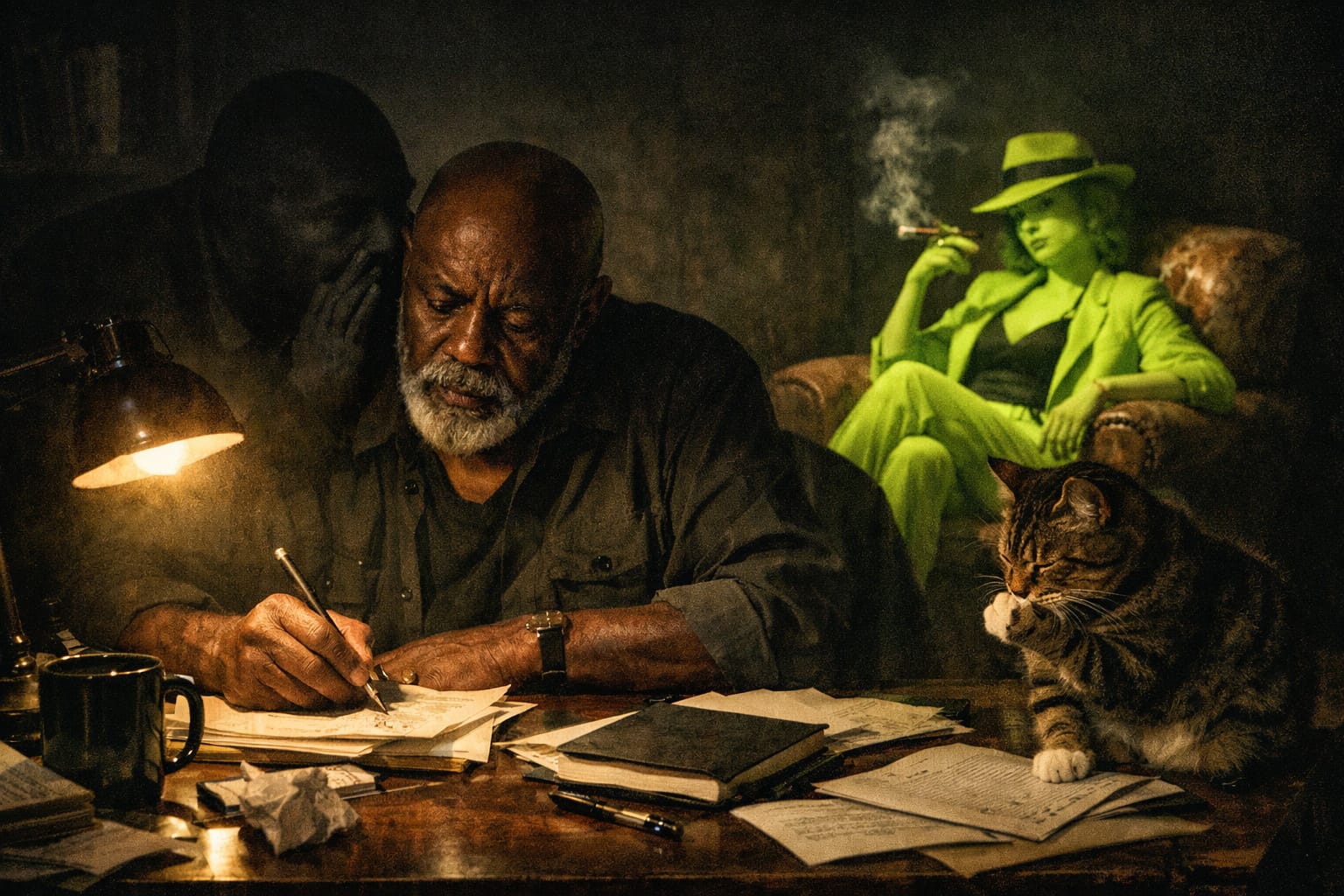
She’d arrive late—not because she was careless, but because she enjoys making an entrance. Lime green from head to toe, fedora tilted just enough to suggest she knows something the rest of us don’t, she’d carry a box of white cheddar Cheez-Its tucked beneath one arm. She insists the orange ones are for amateurs. Somewhere in the evening, she’d light a Cohiba cigar without asking permission, smile at the horrified expressions around the room, and remind everyone that rules are often just comfortable habits wearing neckties.

She was beautiful in all the ordinary ways. But that wasn’t what made you stop talking. There was something else—something that reached beyond symmetry, curves, or color. One look from Ursula and you understood that beauty isn’t what attracts the eye. It’s what leaves the soul struggling to find better words.

Oh yeah… it doesn’t have a damn thing to do with sex.

That may disappoint a few people, but that’s because we’ve spent too much time confusing beauty with desire. They’re not the same thing. Desire asks what it can take. Beauty asks what it can awaken. Ursula never made me want to possess her. She made me want to write something worthy of her company.

At first glance, she’d seem impossible.

The truth is, she is.

Ursula isn’t borrowed from someone else’s imagination. She’s borrowed from mine.

Or perhaps that’s giving me too much credit.

Writers have a peculiar relationship with the people who live in the regions of their minds. We like to pretend we’re in charge, that every sentence marches across the page because we commanded it to. That’s a comforting illusion. Characters have a habit of ignoring outlines, rejecting dialogue, and refusing endings that don’t ring true. They become less like puppets and more like difficult dinner guests who insist on ordering dessert before the entrée.

Ursula has always been the worst offender.

She doesn’t compliment my writing. She interrogates it.

“Why did you choose that word?”

“Is that what the character would say, or what you want them to say?”

“Were you writing the truth…or just something that sounded good?”

Those are uncomfortable questions, which is probably why I keep inviting her back.

Some people imagine a muse as a graceful spirit whispering inspiration into the ear of an artist. Mine steals my pen, critiques my paragraphs, reaches for another handful of white cheddar Cheez-Its, and explains why an entire page deserves to be thrown into the fireplace.

She’s usually right.

Usually.

Here’s where I’d challenge my own answer to this prompt. If Ursula is nothing more than a colorful extension of my personality, then having dinner with her is little more than talking to myself. That sounds less like an interesting evening and more like a reason to schedule an appointment with a professional.

Or does it?

Every writer eventually discovers there are conversations that only become possible after they’re disguised as fiction. We invent people because they can ask questions we’re not yet brave enough to ask ourselves. We hand pieces of ourselves to imaginary strangers, and in return they reveal truths we would have ignored had they arrived in our own voice.

Perhaps that’s all a muse has ever been.

Not magic.

Not mythology.

Just the courage to let another version of yourself speak.

If dinner lasted long enough, Ursula would eventually remove her fedora, lean back in her chair, and let the silence settle between us. She’d tap the ash from her cigar, glance toward the empty notebook lying beside my coffee cup, and smile that infuriating smile she wears whenever she knows the answer before I do.

Then she’d ask the only question that really matters.

“So…what story are you avoiding today?”

I probably wouldn’t answer.

I’d just open the notebook and start writing.

Daily writing prompt
If you could have dinner with any fictional character, who would it be?

Worth Every Penny

Daily writing prompt
What is the best purchase you have ever made?

People usually expect an answer like a house, a first car, or some piece of technology that made life easier.

Mine is much simpler.

A wedding ring.

Not because it was expensive. It wasn’t. Gold is just metal until we decide it means something. A ring has no power of its own. The promise it represents is what gives it weight.

The day of our wedding was the only time in my life I ever had sweaty palms. Not in the military. Not during moments that demanded courage. Standing there waiting for the woman I loved, however, my hands betrayed me. Looking back, I suppose they understood the magnitude of the moment before the rest of me did.

The day I slipped that ring onto my wife’s finger, I wasn’t buying jewelry. I was making a commitment. I was choosing to stand beside another person through the ordinary days as much as the extraordinary ones. Through laughter and frustration. Through certainty and doubt. Through seasons neither of us could have imagined.

Being a husband, a father, a grandfather, and now a great-grandfather has been the hardest job I have ever had. It has also been the most rewarding. None of those roles came with an instruction manual. Every one of them required patience, humility, forgiveness, and the willingness to keep showing up, even on the days I fell short. Looking back, I realize that wedding ring wasn’t simply the beginning of a marriage. It was the first step into every blessing that followed.

Life doesn’t always honor our plans. It certainly didn’t honor all of ours. But I have never regretted that purchase.

Even now, after loss has rewritten so much of my life, I don’t see that ring as a reminder of what ended. I see it as proof that I loved deeply enough to risk having my heart broken. There are few investments in life that offer no financial return while enriching you beyond measure. Love is one of them.

If I had to buy it all over again, knowing exactly how the story would unfold, I wouldn’t hesitate.

Some purchases fill your house.

A few fill your life.

Only the rarest ones continue to fill your heart long after the receipt has disappeared.

A Day Wasted

Daily writing prompt
What app eats up most of your screen time — and do you even feel bad about it?

Kindle and Audible easily consume more of my screen time than any other apps. Between history, philosophy, literature, and biographies, I’m almost always reading or listening to something.

Do I feel bad about it?

Not at all.

I constantly read, observe, and contemplate the world around me. I came across a line years ago that said a person should spend at least thirty minutes each day in deep thought. I have no idea whether there was any science behind it, but it lodged itself somewhere in my mind. I’ve tried to live by that idea ever since.

I feel a day without learning something is a day wasted. Learning isn’t confined to books. Sometimes it’s found in a conversation, a mistake, a quiet observation, or a question that refuses to leave you alone. Curiosity has been one of the few constants in my life.

Years ago, during a mission, one of my soldiers looked at me and said, “Sarge, you think too much.”

A little while later, after we’d worked through a problem that wasn’t obvious to everyone else, the same soldier shook his head and asked, “How in the hell did you figure that out?”

We shared a cigarette in the few minutes we had before the next phase of the mission.

I never answered his question. The answer wasn’t genius or instinct. It was years of reading, observing, and thinking before the moment ever arrived. Most solutions are discovered long before we realize we’ll need them.

So no, I don’t feel guilty about spending time on Kindle or Audible. If anything, I wish I had more hours in the day. There’s always another book waiting to teach me something I didn’t know yesterday—or remind me of something I had forgotten.

Pirates, Blueberry Muffins, and What’s the Next Story

Jot down the first thing that comes to your mind.


People say, “Write down the first thing that comes to mind.”

I don’t think my mind works that way.

It’s more like…

How can I feed my mind today?

As I’m working on my comparative religion essay series, my thoughts branch off in every direction at once. How do I read these texts without forcing my own conclusions onto them? How do I compare beliefs fairly while still being honest about my own? Can I build something meaningful without oversimplifying thousands of years of history and philosophy?

Then my brain abruptly changes channels.

How do I keep moving this project forward without neglecting everything else I’m building across the MKU? Does this project even belong there, or should it become something entirely its own? Did I ever decide on a story for this week’s feature? What am I going to have for dinner?

Then another thought wanders in.

Maybe I should’ve been an archaeologist in another life. There’s something appealing about brushing away centuries of dust just to understand the people who came before us.

Or maybe a pirate.

Pirates are cool. Who doesn’t like pirates?

Although, if I’m being honest, I’d probably spend more time studying the treasure map than digging up the treasure.

And somewhere in the middle of all that…

Blueberry muffins are the truth.

That’s what living inside my head feels like. It’s less a straight line than a room full of conversations all happening at once. Some become essays. Some become stories. Some become questions that stay with me for years before I stumble across an answer.

Maybe that’s why the prompt made me laugh. Asking me for the first thing that comes to mind is like asking a library which book it wants to be. There isn’t just one. There never has been.

I don’t really chase thoughts.

I follow curiosity and see where it decides to take me next.

Beyond City Limits

Daily writing prompt
What’s a movie or book that inspired you to travel?

I never had a single movie or book that inspired me to travel. Instead, it was the cumulative effect of reading books and watching films that changed my perspective. They taught me that the world was far bigger than the city limits I grew up within.

Every story became a window into another way of living. Whether it was a bustling city on the other side of the globe, a quiet mountain village, or a culture entirely different from my own, I began to understand that there were countless lives unfolding beyond my own experience. That realization sparked something deeper than wanderlust. It created curiosity.

When I eventually had the opportunity to travel, I wasn’t searching for postcard moments. I wanted to understand the people, the history, the traditions, and the everyday lives that made each place unique. Whether I was wandering through the street markets of South Korea, attending a jazz festival in Japan, or finding myself in a place where someone else’s English was better than my attempt at their language, travel kept reminding me how little I knew.

More than once, I heard some version of the same observation:

“We speak English, but you don’t speak Arabic.”

They were right.

Travel has a way of stripping away the illusion that our own customs, language, and experiences sit at the center of the world.

More than anything, though, I wanted my own life to count for something. I hoped that wherever I went, whatever work I did, I might leave a place—or a person—a little better than I found it. Looking back, I believe I have, at least in some small way.

But the truth is, the miles I’ve traveled matter less than the lives I’ve touched—and the lives that touched me. Those encounters taught me humility, broadened my perspective, and reminded me that every culture has something worth learning from. Hopefully, we bring that humility home with us and instill those values in our children: the willingness to listen before speaking, the courage to admit what we do not know, and the understanding that the world is far bigger than ourselves.

In the end, that was the journey I was really searching for all along.

The Way

If I could have dinner with any philosopher, I would have a difficult decision to make. John Stuart Mill would speak of the greater good—the idea that our actions should produce the greatest benefit for the greatest number. Immanuel Kant would argue that morality begins with duty, that some things are right simply because they are right, regardless of the outcome. Friedrich Nietzsche would likely challenge both of them, insisting that we question the very foundations upon which we build our values.

I suspect the conversation would last well into the night.

Yet somewhere between the soup and dessert, I would have to tell them they had all missed something.

Not because they were wrong. Far from it. Each of them offers a framework for understanding why people make sacrifices. The problem is that sacrifice rarely announces itself as philosophy while it is happening.

Military service is often explained through Mill’s lens. A nation asks a few to risk everything so that many may live in peace. It is the greater good in its most tangible form.

It is also explained through Kant. We swear an oath. We accept responsibility. Duty is not measured by convenience or personal gain. It is measured by whether we fulfill it when it costs us something.

Both explanations contain truth.

Neither one fully explains the man standing beside you.

Over the years, I have heard a phrase repeated by veterans from different generations, different branches, and different wars.

“We don’t do this for God and country. We do it for the one standing next to us.”

People sometimes misunderstand that statement. They hear it as a rejection of patriotism. It isn’t. It is simply an honest description of what happens when theory collides with reality.

The person beside you may not even be your friend.

He snores.

He complains.

He borrows your gear without asking.

He has habits that make you question whether he was raised by wolves.

You may never share a meal with him after your service ends.

Yet if he goes down, you go.

Not because you’ve calculated the consequences like Mill.

Not because you’ve recited Kant’s categorical imperative.

You go because there are some things that stop being decisions.

They become who you are.

One Platoon Sergeant struck me as a bully. At least, that’s how I saw him then. I have never cared much for people who use rank, strength, or authority to make others feel smaller. We rarely agreed, and more than once I questioned whether he took satisfaction in making life harder than it needed to be. If I am being honest, I despised the man.

Years later, I found myself correcting someone. My tone was sharper than it needed to be. Halfway through the conversation, I stopped. For just a moment, I heard echoes of the man I had spent years trying not to become.

I still don’t agree with every lesson or every method he used. Some of them, I never will. But time has a way of separating the lesson from the teacher. Beneath all the friction, he saw something I couldn’t yet see in myself.

Wisdom doesn’t always come with age, nor is it wrapped in acts of kindness. Sometimes it comes from the very people we struggle to understand, the ones who challenge us, frustrate us, and refuse to let us remain who we were.

It’s a strange thing. Some people seem to look at us and see two versions standing side by side—the person we are today and the person we are capable of becoming. Stranger still, that second person has been there all along. We simply haven’t accepted them yet.

Perhaps that was his job all along—not to create the man I would become, but to recognize him long before I could.

Looking back, philosophers can explain the sacrifice. Historians can assign meaning to it. Politicians can speak of honor, freedom, and national purpose. Those ideas matter. They help us understand why nations ask so much of so few.

But in the moment, none of those thoughts occupy your mind.

There is only the mission.

There is only the person beside you.

There is only The Way.

That phrase is difficult to define because it is not a doctrine. It is not a political ideology or a religious creed. It is a way of carrying yourself long before anyone is watching and long after everyone has gone home. It is the quiet understanding that some responsibilities are accepted without negotiation, not because they are easy, but because abandoning them would mean abandoning a part of yourself.

Perhaps that is where philosophy reaches its limit.

Mill explains the mission.

Kant explains the duty.

Nietzsche explains the struggle to become.

But none of them can fully explain why someone would willingly risk everything for another person they don’t particularly like.

You don’t learn that from reading philosophy.

You learn it by walking the path.

And once you’ve walked it, you no longer need anyone to explain The Way.

Daily writing prompt
If you could have dinner with any philosopher, who would it be?

The Inheritance of Strangers

If she could have reached back through time, Marianne thought, if she could have plucked a single thread from the sprawling, snarled tapestry of human behavior—one of those thick, nearly unbreakable cords running from the earliest campfires through the neon-lit veins of every modern city—she would not have chosen a passing fashion or the next great invention. Those were obvious answers, and obvious answers were always suspect. Simplicity, she had come to believe, was its own kind of deception: the comforting illusion that life’s untidy complexities could be reduced to a single story.

What she wanted to unravel was older than civilization itself—the human habit of measuring another person’s worth by circumstances they had never chosen. If that single thread could be loosened, perhaps the entire weave would begin to change.

The more she considered it, the more she saw how little humanity had evolved in this regard. Tribes became kingdoms. Kingdoms became nations. New words accumulated—race, class, caste, religion, nationality, wealth, disability, education, gender—but they all served the same ancient impulse: to separate, to rank, to assign value before character ever had a chance to speak. Every generation convinced itself that its particular exclusions were justified. It was as though each inherited the same burning house and, rather than extinguish the flames, simply rearranged the furniture to suit a new age.

She often wondered what history might have become had people judged one another by their choices instead of their accidents. Not because she imagined some impossible utopia—life would always contain conflict, disappointment, and ambition—but because so many of history’s worst atrocities rested upon a single lie: that some lives were worth less than others.

The irony was almost unbearable. Every person entered the world the same way: helpless, unaware, untouched by the labels that would soon define them. The categories came later. The divisions were taught.

Marianne knew that prejudice was never the disease itself. It was a symptom—fear searching for certainty, tribal instinct masquerading as morality, the human longing for order taken to its darkest conclusion. Erase one label, and another would appear unless something deeper had changed.

She had grown up in a house where judgment felt as ordinary as breathing. At the dinner table, her father, never openly cruel yet seldom compassionate, ranked nations, religions, and skin tones with the detached confidence of someone discussing the weather. Her mother echoed him more from habit than conviction, and Marianne learned which questions invited conversation and which invited silence. Those early lessons settled into her long before she possessed the language to challenge them.

Years later, she discovered how stubborn those lessons remained. Even after rejecting the beliefs she had inherited, she sometimes caught herself making the same instinctive judgments she thought she had escaped. What unsettled her most was not the thought itself, but how effortlessly it arrived.

That realization drove her toward history. She studied societies that had taught ordinary people to fear neighbors, to distrust strangers, to see fellow human beings as vermin or enemies. Again and again she found the same pattern: fear narrowed imagination until cruelty began to feel reasonable.

She knew she could not erase that instinct from humanity any more than she could erase hunger or grief. But she also knew people were capable of resisting it. Every act of curiosity instead of suspicion, every conversation that crossed an invisible boundary, every refusal to reduce another person to a label was a small rebellion against an ancient inheritance.

Perhaps those moments would never rewrite history. Perhaps they were too quiet for that.

Still, Marianne preferred to believe that civilizations changed the same way people did: not through grand declarations, but through countless private decisions repeated over generations.

So if she could erase a single trend from history, it would be the belief that another human being is worth less because of the circumstances of their birth.

The strangest part, she reflected, was that the closer the world grew together, the harder it sometimes seemed to remember that simple truth.

Daily writing prompt
If you could erase one trend from history, what would it be?

The Wisdom of Fear

Daily writing prompt
What’s a fear you’ve overcome — and how did you do it?

We are taught from an early age not to be afraid.

Stand your ground.

Face your fears.

Conquer them.

Somewhere along the way, we decided fear was a flaw to overcome instead of a part of ourselves to understand.

I think fear has earned a bad reputation.

To be fair, society gets some things right. We learn from experience. We teach our children not to touch a hot stove or wander into traffic because some fears are necessary. But somewhere in our history, fear stopped being viewed as a survival instinct and became something to be ashamed of.

I don’t.

Fear is something we are born with. Long before we have words, our bodies react to loud noises, unfamiliar faces, sudden movements, and uncertain situations. Parents certainly teach us some fears, just as their parents taught them, but they don’t create our capacity for fear. They shape it.

I’ve watched children hesitate before approaching something adults considered harmless. They couldn’t explain why they stopped. They didn’t have the vocabulary. Yet something inside them said, Wait.

I’ve heard grown men say the same thing in different words.

“I’ve got a bad feeling about this.”

“That’s bad juju.”

“You need a gut check.”

“The hair on the back of my neck stood up.”

Notice something interesting. We rarely call any of those feelings fear.

Instead, we call them intuition. Instinct. Situational awareness. Discernment. Common sense. We praise people for trusting their gut while pretending it has nothing to do with fear. We simply give fear a different name because we’ve convinced ourselves that admitting fear is the same as admitting weakness.

Fear isn’t weakness.

Fear is information.

It is one of the oldest survival instincts we possess. Long before there were books, philosophies, or warning labels, fear helped our ancestors recognize danger and live long enough to pass those instincts on. It is the quiet voice that notices something is wrong before our conscious mind catches up. Perhaps that’s the wisdom of fear—not that it should control us, but that it deserves to be understood before it is dismissed.

Of course, not every fear tells the truth. Trauma, anxiety, and prejudice can all teach us to fear what poses no real danger. That’s why fear shouldn’t be obeyed blindly. It should be understood.

I learned that lesson in combat.

Every one of us was afraid. Anyone who tells you otherwise is either lying or remembers the experience differently than I do. The difference wasn’t whether we felt fear. We all did. The difference was what we did with it.

Fear sharpened our senses. It slowed reckless decisions. It forced us to pay attention to details we might have otherwise ignored. It reminded us that the stakes were real. That fear didn’t make us weaker. In many ways, it helped bring us home.

That’s why I reject the idea that fear is something to conquer.

You can overcome a specific fear. You can learn to speak before a crowd, jump from an airplane, or face whatever once kept you awake at night. But fear itself cannot be conquered because it is woven into who we are. To wage war against fear is to wage war against a part of ourselves.

I’d rather spend my life understanding it.

Perhaps we’ve been asking the wrong question all along. Instead of asking how to conquer fear, perhaps we should ask what it’s trying to teach us. Fear isn’t asking to rule our lives. It only asks to be heard. It asks to be part of the conversation because, whether we acknowledge it or not, it has always been with us. Like every part of ourselves, it has a purpose. Sometimes it warns us of genuine danger. Other times it reveals old wounds, misplaced assumptions, or anxieties that no longer serve us. The goal isn’t blind obedience. The goal is understanding.

Some fears deserve to be challenged because they keep us from living the life we want. Others deserve to be respected because they keep us alive. Wisdom isn’t found in pretending we’re fearless. It’s found in learning the difference.

So here’s the lesson I wish we’d teach our children instead:

Don’t be afraid to be afraid.

Just Don’t Confuse It with Tomfoolery

Is a little chaos actually good for us?

When I look at this question, I can’t help but chuckle. Personally, I have no time for tomfoolery. I don’t think there’s much room for it in this world, and I certainly don’t have the patience for people whose only goal is to irk everyone around them. I don’t do irksome.

Then I realized I might have been lumping everything together.

Under closer examination, I found a few exceptions. Shenanigans without responsibility can be dangerous—trust me, I know. But the right kind of shenanigans can be good for the soul. They remind us not to take ourselves quite so seriously.

Now, hijinks? I love me some hijinks. The harmless kind. The kind that leaves everyone with nothing more than bruised egos, wounded pride, and a story that somehow gets funnier every time it’s told.

The older I get, the more I realize practical jokes did not cause the real chaos. It’s the kind life delivers without asking permission.

Chaos has always been viewed as a bad thing. Something to avoid. Something to control. Something to survive. Yet sometimes we need a little chaos to remind us we’re still alive. To remind us that life is more than our homes, our cars, and the mindless routines we convince ourselves are keeping us grounded.

I’ve spent a lifetime navigating what most people would call chaos. Believe it or not, I’ve lived a blessed life overall. But blessings rarely travel alone. They often arrive with hardship, disappointment, grief, and the occasional nightmare.

Those moments didn’t just test me; they shaped me into the man I am. Whether that’s a good thing or a bad thing isn’t my call to make. In the end, that verdict belongs to the people I leave behind.

Maybe that’s why I no longer see all chaos as the enemy. The pointless kind that hurts people for no reason? I can do without that. But the kind that shakes us awake, reminds us that we’re human, exposes our weaknesses, and teaches us something about ourselves? That kind has its place.

Perhaps life isn’t asking us to eliminate chaos altogether. Perhaps it’s asking us to recognize the difference between reckless disorder and the unexpected moments that remind us we’re still capable of laughing, learning, and growing.

Just don’t confuse it with tomfoolery.

I Earned My Words

Daily writing prompt
Are you a lifelong learner?

Absolutely. I believe we’re born with two identities that never leave us: teacher and student. Not one replacing the other but existing simultaneously. Learning didn’t begin in a classroom, nor does it end with a retirement party. Our lives are stitched together from thousands of small moments, each one adding another sentence to the story we’re writing.

I didn’t arrive at that philosophy overnight. It began with a conversation I still remember almost word for word.

After using a word I’d recently heard, my grandmother asked, “Where did you hear that word?”

Thinking I’d made a mistake, I asked, “Did I use it incorrectly?”

She ignored my question and asked another.

“What does it mean?”

I didn’t know.

Then she gave me a lesson that has stayed with me ever since.

“If you don’t know the definition and can’t spell it, don’t use it.”

About a week later, my mother came home with two dictionaries, a student edition and a collegiate edition. I was only seven or eight years old. Looking back, I realized they weren’t simply books. They were an investment in my curiosity and a quiet belief in who I might become. That conversation marked the beginning of my lifelong respect for language. I stopped collecting words and started earning them.

I’ve always been more autodidact than academic. Many of my most valuable lessons never came from textbooks. They came from the elders who noticed I was paying attention, from mistakes, conversations with strangers, overheard remarks, books that challenged my beliefs, and experiences that reminded me how little I actually know. Every time I think I’ve figured something out, life has a way of handing me another chapter.

Being a lifelong learner also means being willing to change your mind. That’s harder than memorizing facts. It requires humility—the willingness to admit that yesterday’s certainty may become tomorrow’s misconception. Growth begins the moment we stop defending what we know and start questioning what we don’t.

My grandmother’s lesson never really ended. I still keep dictionaries and thesauruses within arm’s reach, not because I’ve earned every word, but because there are always more waiting to be earned. As long as that remains true, I’ll gladly remain both a student and, whenever I have something worth sharing, a teacher.

The Stories That Never Really End

Daily writing prompt
What’s a book you think deserves a sequel?

In reading Count a Lonely Cadence, I’m reminded why we write. Some stories change the world by quietly changing the reader. They ask us to confront the things we’d rather leave alone—the quiet wounds, the private failures, the moments that shake us to our core and linger long after the final page.

This novel doesn’t need a sequel in the traditional sense. Character-driven fiction rarely does. Gordon Weaver gave us a complete story. Yet that’s precisely why I find myself wanting another chapter.

Not because the plot is unfinished, but because the people feel unfinished in the way real people always do. Life doesn’t end when the last page is turned. It keeps moving, carrying its triumphs, regrets, and unanswered questions with it. Eventually, we stop talking about them like characters and start talking about them like people we once knew.

Years after reading it, I still catch myself wondering what came next. Did they find peace? Did they become someone different? Or did life simply continue, as it so often does?

That’s the mark of great fiction. It doesn’t demand a sequel—it quietly earns one.

“You remember, Bean?”

“I wonder whatever happened to that guy.”

The Villain in the Mirror

Daily writing prompt
What villain actually had a good point?

Most people will probably answer this question with Magneto, Killmonger, or some other modern villain whose motives were understandable even if their methods weren’t. Those are good answers.

Mine is different.

I would argue that Professor Moriarty had the best point—not because of anything he said, but because of what Arthur Conan Doyle was saying through him.

I’ve always believed Holmes and Moriarty are far more alike than different. They possess extraordinary intellects, an almost unsettling ability to detach emotion from reason, and an obsessive pursuit of their chosen purpose. One uses those gifts to restore order. The other uses them to create chaos. Strip away the labels of “hero” and “villain,” and what remains are two men standing at opposite ends of the same road.

To me, that’s the point.

The greatest adversary isn’t the person standing across from us.

It’s the person we could become.

I’ve always found it interesting that we prefer stories where evil is easy to identify. We point to the villain because it’s comforting to believe darkness lives somewhere outside ourselves. It’s much harder to accept that the line separating Holmes from Moriarty isn’t intelligence, talent, or even opportunity. It’s character. It’s the thousands of choices we make when no one is watching.

That’s why I’ve never viewed Moriarty as simply a criminal mastermind. I’ve always seen him as Holmes’s reflection. Not his opposite, but his possibility.

In many ways, Doyle separates into two characters what most of us experience within ourselves. We all possess ambition, pride, resentment, compassion, discipline, and temptation. The struggle isn’t defeating someone like Moriarty. It’s deciding which parts of ourselves we’ll feed and which parts we’ll keep on a leash.

That reminds me of an old saying often attributed to the comic strip character Pogo: “We have met the enemy and he is us.” I’ve always thought those words captured something literature has been trying to tell us for centuries. Before we can confront the darkness in the world, we have to acknowledge the shadows we carry ourselves.

That’s why I think we so often point outward instead of inward. It’s easier to condemn a villain than to acknowledge that, under different circumstances—or after enough bitterness, ego, or fear—we might recognize pieces of ourselves in him.

Maybe that’s why Holmes fascinates me just as much as Moriarty. Holmes doesn’t win because he’s smarter. He wins because he chooses a different purpose for the very gifts that could have made him just as dangerous. His greatest victory isn’t over Moriarty. It’s over the version of himself he refuses to become.

So, what villain actually had a good point?

For me, it wasn’t something Moriarty argued. It was something his existence revealed.

Sometimes the greatest villain in the story isn’t the one we’re chasing.

It’s the one staring back at us from the mirror.

I Vote for Lady Polgara

Daily writing prompt
Emperor Palpatine has announced open elections for a new Emperor — and he’s nominated Darth Vader. You get to nominate one challenger.

My challenger?

Lady Polgara, the Sorceress from David Eddings’ Belgariad and Malloreon series.

Most people would nominate someone capable of defeating Vader in combat. I’d rather nominate someone capable of defeating the very idea that fear is the best way to lead.

If you’ve ever read the series, you know her instantly. Raven-black hair broken by a single white lock that tells a story all its own—a reminder that wisdom is often earned through hardship and time. She doesn’t wear it like a badge of honor. It’s simply part of who she has become.

Polgara has spent centuries guiding kingdoms, advising rulers, and quietly shaping history without ever seeking a throne for herself. To me, that’s exactly what makes her worthy of one. The people most eager to rule are often the ones who shouldn’t.

Vader commands obedience through intimidation. His authority depends on reminding everyone what happens if they disappoint him. Polgara is something entirely different. She inspires loyalty through wisdom, patience, and experience. She is respected because of her judgment and feared because everyone knows she is fully capable of doing whatever is necessary when the moment demands it.

What I always loved about Polgara is that little gesture she makes when summoning her Will. She doesn’t actually need it. The gesture isn’t about power; it’s about presence. It’s a habit born from centuries of discipline. Anyone who knows her recognizes it immediately. The room grows quiet, not because they wonder if she can act, but because they know she can.

That’s real authority.

Vader reaches for the Force whenever someone disappoints him. Polgara reaches for wisdom first. Only when wisdom fails does she make that familiar gesture, and everyone understands that the discussion has ended.

Don’t mistake her compassion for weakness. She has humbled kings, outwitted armies, and protected kingdoms for generations. She has never needed to prove she was the most powerful person in the room because everyone already knew. She never ruled through fear, yet even the proudest monarch thought twice before challenging her judgment.

Palpatine wanted an emperor. I’d rather elect a guardian.

The galaxy has already seen what happens when power is fueled by fear. Perhaps it’s time to see what happens when it’s guided by wisdom… by a woman with raven-black hair, a single white lock, and a reputation that made kings pause before speaking.

My vote belongs to Lady Polgara.

Pain Is Weakness Leaving the Body… Or So I Thought

Daily writing prompt
What’s something you used to believe as a kid that seems ridiculous now?

One of the biggest lies I carried from childhood into adulthood was the idea that “pain is weakness leaving the body.” It sounded noble. Tough. Almost heroic. So whenever I got hurt, the response was automatic: “I’m good.” “I’m alright.” Even when I clearly wasn’t.

For a lot of us, especially boys, toughness wasn’t just encouraged—it was expected. You learned quickly that admitting pain invited commentary you didn’t want. Soft. Wimp. Pansy. Those words had a way of policing masculinity long before most of us understood what masculinity even was.

That mindset followed me long after childhood. It’s funny how beliefs like that become part of your internal code. Once they’re written in, they’re hard to erase. I rarely asked for help because somewhere in the back of my mind, needing it meant I was somehow less than. It pushes you to be tough all the time, to be the strongest, the fastest, the one who never complains. The problem is you’re competing against a version of yourself that doesn’t exist, chasing rules nobody ever bothered to explain. You spend years trying to win a game without realizing it was rigged from the start.

The funny part is that some of those insults never made much sense to me. “Stop acting like a girl” was supposed to be the ultimate put-down, yet I grew up knowing plenty of girls and women who could outrun, outwork, and outfight half the guys making that joke. The insult always seemed built on an assumption that reality kept disproving.

And then there’s my all-time favorite: “namby-pamby.”

Seriously… what the hell is a namby-pamby?

I lose it every time I hear it. It’s impossible to say with a straight face. It sounds less like an insult and more like the name of a children’s breakfast cereal or a forgotten cartoon character.

Looking back, the ridiculous part wasn’t the saying itself. It was believing that strength meant pretending pain didn’t exist. Real strength isn’t refusing to acknowledge you’re hurt. It’s knowing when to endure, when to ask for help, and when to say, “Yeah… that actually hurts.”

Turns out pain isn’t weakness leaving the body.

Sometimes it’s your body trying its hardest to keep you from breaking.

Or, in language that leaves absolutely no room for interpretation, the wisest advice my body has ever given me.

“Sit your ass down.”

Choosing What Matters

Daily writing prompt
What is one way you have grown this year?

Growth Isn’t Always Loud

One way I have grown this year is learning to be more deliberate about where I invest my time and attention. For a long time, I believed productivity meant doing more, chasing every idea, and saying yes to every opportunity. This year, I’ve started focusing on what truly matters and letting go of what doesn’t. I’ve learned that growth isn’t always about adding something new to your life; sometimes it’s about removing the distractions that keep you from becoming the person you want to be.

I’m still a work in progress, but I’ve become more patient with the process, more protective of my creative energy, and more willing to focus on depth instead of volume. That may not be the most dramatic transformation, but it’s made a meaningful difference in how I live and create.

The Meme Question

Daily writing prompt
What’s your favorite meme?

The Last Chair in the House

Daily writing prompt
What are the biggest benefits of minimalist living?

The Whammy


I know many of my friends view our childhood obsessions through the lens of Lincoln Logs, Stretch Armstrong, G.I. Joe with the kung fu grip, Rock ’Em Sock ’Em Robots, and Spider-Man.

For me though…

Girls.

I’ve spent years gathering empirical data in order to help dudekind. Somebody has to tell the truth. Too many soft-ass men out here pretending they were born smooth. It’s almost like somebody’s growing them in the backyard. Half these dudes walk around talking like they came out the womb flirting with nurses and paying child support. Bullshit.

I can remember it like it happened yesterday. I was five years old, standing somewhere between fearless and completely confused, when a little girl smiled at me. Just smiled. That was it. No grand seduction. No dramatic music. Just a small human being with missing teeth and probably jelly on her fingers looking at me like I existed.

And I froze.

Did I smile back?
Say hello?
Wave?
Pretend I suddenly had somewhere important to be?

I didn’t have a clue.

Some of you may be thinking five years old is a little early to be thinking about girls, but I’m not sure there’s ever really an “appropriate” age for that first moment of awareness. Not lust. Not romance. Just awareness. That strange realization that another person can suddenly make you self-conscious in your own skin. One second you’re eating crayons and trying to figure out why glue smells interesting, and the next your brain short-circuits because somebody smiled at you too long.

“This is how it starts.”

One minute you are sharing apple slices and celery sticks with peanut butter, completely unaware that at the height of innocence you have already begun the descent.

We call that…

The Whammy.

There’s no shame in it. Many men have been seduced by the Whammy. You’d think age, wisdom, and cholesterol medication would’ve hardened us against it.

Nope.

People act like masculinity starts with toughness. Nah. It starts with confusion. Tiny moments of panic no man admits prepared him. A boy standing there trying to decode a smile like it’s military intelligence.

Time passes. Knees start popping when you stand up. Somehow The Whammy still works.

Because men act like attraction is all confidence and swagger, but most of us began as nervous little idiots trying not to combust because a girl said our name. We just got better at hiding it.

Years later, I would discover some women were fully aware The Whammy existed. Hell, a few of them practically held graduate degrees in it.

Sometimes I wonder if there’s a conference somewhere. Workshops. PowerPoints. Coffee and danishes in the lobby. “Advanced Applications of The Whammy.” I mean, they already have seminars teaching men how to pick up women, so honestly, it tracks.

I recall once having an interesting conversation with a woman about women. She had a lot to say on the subject, but one thing stuck with me.

“Honey, if I can’t get what I want with a look and a smile, I’m not doing my job.”

I remember leaving that conversation grinning because I could also recall the many times I had fallen prey to exactly that combination. The gaze. The smile. Men out here talking about logic and reason while completely ignoring the historical evidence that a woman can tilt her head slightly and reroute a man’s entire blood supply away from his brain.

That’s the Whammy right there.

The wild part is some women understand The Whammy with terrifying precision. Not because they’re evil. Just observant. They know presence matters. Timing matters. A smile at the right moment can lower a grown man’s IQ into single digits.

Testosterone will make a man follow a woman into danger. Common sense evaporates. Entire survival instincts clock out for the evening. There could be a sign on both sides of the entrance to a dark alley blinking in neon:


DANGER: VAMPIRES PRESENT

And some fool would still wander in because he caught a glimpse of long legs and a smile disappearing into the shadows.

Three days later you see him staggering out the alley looking like unpaid rent and poor decisions. Pale. Sweating. Shirt half untucked. Moving like life itself put hands on him.

“You alright?” you ask.

“Yeah, I just need water. I think I drank too much tequila.”

Now, I’ve been on a tequila bender before. That is a very specific kind of suffering. Tequila doesn’t make you look spiritually disconnected from your ancestors.

“Nah, man.”

“Mm-hmm.”

You side-eye him because you already know what happened. Brother got hit with The Whammy and survived by the grace of God and electrolytes. But he’s still in denial. Men stay in denial. We will walk out emotionally dismembered talking about, “I’m good.” No you’re not. You look like a Victorian orphan fighting consumption.

That’s the power of it. The Whammy doesn’t just bypass logic. It convinces you logic was overrated to begin with.

The truth? A lot of men spend their entire lives pretending they understand women when really they’re still that five-year-old kid internally yelling:

What do I do with my hands?

There’s also something honest about that age. Before ego hardens. Before heartbreak. Before performance. Before podcasts and “alpha male” nonsense turned human interaction into a hostage negotiation. Back then, a smile could stop your entire operating system. No strategy. No manipulation. Just pure emotional blue-screen failure.

Maybe that’s why I don’t fully trust men who claim they’ve always been smooth. Smooth men are usually rehearsed men. The rest of us remember the awkwardness. We remember the stammering, the overthinking, the sudden inability to form complete sentences around someone we liked.

And honestly? Good.

That awkwardness means something mattered.

Daily writing prompt
What’s a thing you were completely obsessed with as a kid?

The Things That Made My Hands Shake

On love, fear, and the risks that matter most

What makes me nervous? Not snakes. Not heights. Not public speaking. I’ve stood in enough strange rooms under bad lighting to know fear wears many costumes, and most of them are stitched from cheap fabric and old lies.

What makes me nervous is potential.

Not the bright, polished kind sold in seminars and printed over mountain ranges. Not the version with sunrise fonts and a man named Trent telling you to dominate your morning. I mean the real kind. The dangerous kind. The kind that slips into the room after midnight when the house has gone still, when the refrigerator hums like distant machinery, when the floorboards settle like old bones.

It leans close and whispers, You could have been more.

That sentence has colder hands than death.

People talk endlessly about failure because failure is loud. It leaves dents in the drywall. It arrives with stories. You can point to it and say, There. That was the moment. You can blame timing, bad luck, poor leadership, weak knees, bad whiskey, worse judgment.

Failure is visible.

But wasted potential?

That thing moves like mold behind wallpaper.

It grows in silence. It feeds in dim corners. By the time you notice the smell, it has already spread through the house.

I know its scent.

It smells like notebooks whose pages stayed too clean. Like guitars with strings gone dull from waiting. Like business ideas buried in drawers under expired batteries and takeout menus. Like words that should have been said beside hospital beds, front porches, gravesides, kitchen tables.

It smells like dust.

That makes me nervous.

I recall being nervous at my wedding. Sweaty palms and all that. So many cool points lost in that moment. One minute I was trying to stand there like a composed man with timeless confidence, the next I was damp-handed and blinking like a suspect under interrogation lights. My collar felt too tight. The room seemed warmer than science allows. Every eye in the place felt like a spotlight.

One look at her and I was stunned.

She was radiant in her lavender lace dress, calm as sunrise. She didn’t seem nervous at all. She gently took my hand and smiled at me. Moments later, we were married.

I’ve often wondered why marrying the woman I was going to build a life with rattled me more than combat ever did. Maybe because war came with training. Manuals. Repetition. Expectations.

Being a husband?
Being a father?

Clueless.

I suppose everyone is clueless about becoming a husband and father. Nobody arrives with blueprints. Still, I didn’t expect it so soon. I wasn’t looking to fall in love, let alone get married. Life has a crooked sense of humor that way.

What I learned is this: love with everything you have and let it make you better. Anything less is negotiation.

I once read that loving someone is giving them everything they need to destroy you and trusting they won’t. Dramatic? Maybe. But not wrong. To love deeply is to hand over access to the soft parts and hope they treat them gently.

It’s that uncertainty that makes you nervous and elated at once. Your pulse quickens for reasons fear alone cannot explain.

Maybe that is what people mean when they use the word magic.

Then shortly after, I was combat cool as Kool-Aid… Oh Yeah.

Funny how fear works. It can have you unraveling over vows in a pressed shirt, then steady as stone in chaos when alarms start ringing. The body doesn’t always know what deserves panic. Sometimes it panics at love and relaxes in war.

Not because I believe everyone is destined for fame or greatness. Most of us are destined for ordinary miracles: paying bills on time, making someone laugh when they needed it, showing up tired, carrying groceries, forgiving badly, trying again. Life is less trumpet blast than kettle simmer.

But buried somewhere inside most people is one true offering.

A craft only they can shape. A tenderness only they can give. A way of seeing the world that could steady someone else in the dark. A story. A song. A discipline. A courage. A mercy.

And some never unwrap it.

I’ve met brilliant people who became sarcastic instead of brave. Talented people who sharpened excuses more than skills. Loving people barricaded behind pride. Strong people who confused endurance with purpose. They could have changed their lives, maybe even someone else’s, but chose the familiar ache of staying the same.

There is a grief in that no funeral ever names.

My own fear no longer comes from failing. Failure has sweat on it. Failure has dirt under its nails. Failure means you stepped into the ring and got hit in the mouth by reality. There is something honest about that. Noble, even.

No, what unnerves me now is stagnation dressed as wisdom.

It sounds reasonable.

Maybe next year.
When things calm down.
After I’m more prepared.
Once I have the right tools.
When I feel confident.

Meanwhile the years move like thieves in socks.

Quietly.

One season becomes another. Summer light turns to brittle autumn shadows. Coffee gets reheated more often than dreams. The mirror grows less forgiving. Names of the dead increase. Energy becomes something to budget.

Then one day you hear yourself say, “I always wanted to…”

That sentence lands heavier than regret.

I’ve felt this in my own life—the weight of half-built things, the ghost-pressure of roads not taken. Projects I delayed because perfectionism wore the mask of standards. Love I rationed because vulnerability felt expensive. Gifts I kept in storage because the world might mishandle them.

Truth is, sometimes I wasn’t protecting the gift.

I was protecting myself from being seen trying.

That is a humiliating kind of honesty.

So what makes me nervous?

The thought of arriving at the far edge of life carrying unopened tools.

The thought of confusing survival for living.

The thought of having the ability to love deeply but choosing guarded distance. Having the capacity to build but choosing commentary. Having enough time to begin and spending it curating reasons not to.

That fear does not shout.

It watches.

But there is mercy in nervousness. It can be a compass if you let it. Often the place that makes your pulse quicken is the exact place your life is asking you to enter.

Write the page.

Make the apology.

Learn the skill.

Tell the truth.

Apply badly.

Begin embarrassed.

Start with trembling hands if you must.

The air will still smell like rain some mornings. Coffee will still steam in the cup. Dawn will still drag its pale light across the floorboards. Life does not wait for courage to arrive fully dressed.

It asks only movement.

Because someday will come whether invited or not.

And when it does, I would rather meet it winded, scarred, and unfinished—

than preserved in the glass case of hesitation.


Daily writing prompt
What makes you nervous?

Something Else Held the Pen

Daily writing prompt
Describe one positive change you have made in your life.

Notes from a Night I Don’t Fully Remember

I didn’t notice it at first. Change doesn’t announce itself. Not really. It doesn’t kick the door in or make promises it can’t keep. It just… arrives. Slips into the empty seat beside you like a stranger in a crowded train station—close enough to feel, easy enough to ignore. So I ignored it. I kept scribbling in my notebook, one thought chasing the next, no shape to any of it. Just movement. Just noise. It was past midnight. My eyes burned. My hands cramped. And Guppy—Guppy reminded me, loudly, that her litter box needed changing. No patience. No grace. Funny how something that small can pull you back from the edge of your own head. I changed the litter, washed my hands, and came back to the page. That’s when it shifted.

I looked at the notebook and decided I wasn’t going to choose. A story. An essay. Something else I didn’t have a name for yet. All of it. So I wrote. Straight. No chaser. No polishing. No second-guessing. Just the truth the way I’d lived it—uncomfortable, uneven, mine. And then something opened. Everything I’d read, seen, heard… it was there. Not as memory. Not as reference. As if it had been waiting. I could feel it lining up behind the words.

I looked up from my notebook.

The train station was empty.

A woman was walking away, her footsteps the only sound left in the room. Slow. Measured. Certain. I turned, trying to follow the sound, but there was nowhere for her to go. No doors. No exits. Just space where she should have been.

And then the footsteps stopped.

I sat there, listening.

The clock on the wall took over—each second grinding forward with a hard, shifting sound, like tiny workers buried inside it, cranking the hands inch by inch.

I didn’t know how long I’d been sitting there.
Didn’t know if I had moved at all.

The sound of fluttering wings filled my office, but I didn’t look up right away. Guppy did. She let out a sharp, offended meow before hopping onto the desk, then down into my lap like she owned both the space and whatever had just passed through it. “Can’t you see I’m working?” I asked. Didn’t matter. She turned once, twice, then settled—final say. I shifted, adjusted, gave in. There’s a rule about that, unwritten but absolute. A cat chooses your lap, you don’t move. Not for discomfort. Not for reason. Not even for sense. I used to think there was a time limit attached—ten minutes, maybe fifteen, something measurable. But sitting there, hands still, the room too quiet, I couldn’t remember the number. Couldn’t remember if there ever was one. Guppy’s weight anchored me in place, and for the first time all night, I wasn’t sure if I was staying still because of her… or because something else in the room wanted me to.

I was wrong.

Not a little.

Completely.

The fluttering grew louder.

Guppy’s claws sank into my thigh, sharp enough to anchor me. She let out a low, uneasy sound, looking back at me like I was the one out of place.

The room shifted.

I knew this place.

This is where I go when the story comes.

Only this time—

it didn’t come alone.

Voices layered over each other, pressing in. Not words at first—just presence. Then fragments. A street folding in on itself. Something blooming where it shouldn’t.

And the woman—

closer now.

Or maybe I was.

The noise swelled, crowding the edges of everything I thought I understood.

I exhaled. Slow. Forced.

Held on to that one thread.

The rest didn’t disappear—

but it bent.

Aligned.

Waited.

The picture sharpened.

Not clear. Not safe.

But enough.

I picked up the pen.

And this time—

I didn’t pretend the words were mine.

The pages are filled.

My handwriting.

…I think.

I lean closer.

What is this?

I don’t recognize what’s on the page. The lines twist into something older than language—symbols that feel familiar in the wrong way. Like something I’ve seen before but was never meant to read. It reminds me of those ancient books—the ones that never made it to the shelves. The ones kept behind the desk, clutched in the arms of that librarian. The one who always watched a little too closely.

“Are we going to behave today, Master Khan?”

Her voice—calm, precise. Not a question. Never was.

“Yes, ma’am.”

I hear it before I remember saying it.

She scoffs. A small sound, sharp enough to cut. Then the look—that same scowl that made you sit up straighter whether you wanted to or not.

“Peppermint?”

Always peppermint.

Always after.

The sun has faded. Night has returned. The glow from my desk lamp is too much—pressing in, bleaching the edges of everything. I turn it down before it burns through my eyes. Something moves at the edge of my vision. I turn. Nothing. The cigarette smoke thickens, curling slow through the room, clinging to the light. I take it in. The scent is wrong. Not American. Turkish, maybe. Or something older. Something I don’t remember lighting.

“Excuse me, Mr. Khan. Do you think you can help me?”

The voice comes from the shadows.

I look around the room, slow, deliberate—trying to catch movement before it disappears.

Nothing.

“I need you to tell my life story,” the voice continues.

Still nothing.

I strike a match. Light a cigarette. Draw it in deep, hold it there like it might steady something.

Exhale.

Then a sip of coffee.

Cold.

Of course it is.

“Why in the hell would I want to do that?” I ask.

Guppy hisses. Low. Sharp.

I look up.

And there she is.

Standing like she’s always been there.

Too much to take in at once. Too many details competing for attention—like she brought her own gravity into the room and everything else had to adjust around it. Every part of her felt… intentional. Nothing wasted. Nothing accidental.

My first instinct was simple.

Run.

Get the hell out. Find a church. A monastery. Somewhere quiet where stories don’t follow you home.

But then the thought hit—

Who’s going to look after Guppy?

I didn’t move.

I stayed.

Who is she?

A memory of a forgotten love? A glance across a crowded room that never quite left? Or something pulled from a story I never finished?

…Doesn’t matter.

She wears a wide straw hat, the brim low enough to hide most of her face. What little I can see isn’t enough to hold onto—but the way she moves… that says everything. Measured. Certain. Like she’s been here before. Like she knew I would be.

She pulls out a chair. Sits. No hesitation. No permission asked.

The room shifts around her, like it’s adjusting to a weight it didn’t expect.

She leans in, close enough to blur the edges of everything else.

“Just write,” she whispers.

Like it was never up to me.

And I do.

Now I’m back in my office.

The coffee cup sits where I left it. A cigarette burns slow in the ashtray, curling smoke into the stale air like it’s been waiting on me.

I look around.

How did I get here?

For a moment, I don’t move. Just stand there, listening—half expecting to hear something… or someone.

Nothing comes.

So I sit down at the desk. Open the notebook. The pages are filled.

My handwriting.

…I think.

Guppy gives a quick, impatient meow as she shifts in my lap, settling in like she’s been there the whole time.

I start entering the notes into the computer, pecking at the keys in that old, stubborn way of mine. Slow. Uneven. Familiar.

It takes a while.

But it’ll be alright.

It usually is.

I pause, fingers hovering over the keys.

The room is quiet again.

Too quiet.

And for just a second—

I could swear I hear it.

Footsteps.

Fading.

The Edge I Thought I Needed 

Daily writing prompt
What’s the most fun way to exercise?

Most people want exercise to feel like a reward. I’ve never bought into that. 

Exercise, for me, has always been closer to maintenance—like tightening bolts on a machine you still need to run tomorrow. You don’t celebrate it. You do it because not doing it costs more. 

That said, walking is the one form that never tried to sell me a lie. 

It doesn’t pretend to be fun. It doesn’t dress itself up with neon lights, loud music, or promises of transformation in thirty days. It just asks one thing: keep moving. 

And somehow, that’s enough. 

Walking has been the most consistent thread in my life—not because it excites me, but because it meets me where I am. Good day, bad day, restless mind, heavy thoughts—it doesn’t argue. It doesn’t judge. It just absorbs. 

There’s a rhythm to it. Heel, toe. Breath in, breath out. The world passing at a pace slow enough to notice, but steady enough to leave something behind. Problems don’t disappear, but they loosen their grip. Thoughts that felt tangled start to line up single file. 

You don’t walk to escape. You walk to process. 

And if you pay attention, the work starts showing up. 

More than a few ideas have found me mid-stride. Plot holes I couldn’t untangle at the desk suddenly loosen somewhere between one block and the next. Dialogue sharpens. Scenes rearrange themselves without me forcing them. It’s like the story finally exhales when I stop hovering over it. 

But walking gives, and walking takes. 

Because the same rhythm that unlocks an idea will carry it right out of your head if you’re not paying attention. 

You need a way to catch it. 

A notebook in your pocket. A voice memo on your phone. Something. Because the lie we tell ourselves is, I’ll remember this when I get back. 

You won’t. 

Not fully. Not the way it felt when it arrived. Not the phrasing, not the clarity, not the weight of it. By the time you sit back down, all that’s left is a ghost of the idea—and ghosts don’t write clean prose. 

So the walk becomes two things at once: a generator and a test. 

If you care about the work, you don’t just let the moment pass—you trap it, even if it’s messy. Even if it’s just fragments. Because fragments can be rebuilt. Forgotten ideas can’t. 

Thirty minutes a day is all it takes. 

No gym membership. No supplements. No fancy clothes stitched with promises you didn’t ask for. Just you… easing on down the road. 

There’s something honest about that kind of movement. No mirrors. No metrics screaming at you. No one keeping score. Just your body remembering what it was built to do. 

I used to be a gym rat. 

Back when I could walk in, flip the switch, and bring it without thinking. Back when effort felt automatic and strength felt like something I could summon on command. 

I can’t do that the same way anymore. 

And that pisses me off. 

Not because I think I’m weak—but because it feels like I’m losing an edge. The kind that let me move through life by standards nobody actually meets, but everybody swears by like it’s gospel. 

As a soldier, I believed in that edge early in my career. Thought it was necessary. Thought it was the thing that separated those who made it from those who didn’t. 

I was wrong. 

I learned the difference between a soldier and a warrior. 

A soldier follows orders, meets standards, pushes until something breaks—sometimes himself. A warrior understands restraint. Knows when to move, when to wait, when to endure without burning everything down in the process. 

One lives by force. 

The other lives by awareness. 

And here’s the part that took me a while to understand— 

The military doesn’t teach you how to survive. It teaches you how to live. 

Not comfortably. Not softly. But deliberately. With purpose. With structure. With a code that doesn’t bend just because the day got hard. 

I just misunderstood what that life was supposed to look like. 

I thought it meant constant pressure. Constant edge. Always on. 

It didn’t. 

Now? 

Now I walk the neighborhood. 

And out there, things slow down just enough for me to notice what I used to miss. The flowers pushing through cracks like they’ve got something to prove. The quiet rhythm of people going about their lives. The animals that don’t question the day—they just live it. 

And somewhere in all of that… 

I find my place alongside them. 

Not chasing what I used to be. Not pretending I don’t feel the loss either. Just moving forward, step by step, in a world that never stopped moving. 

I use the same approach in writing: one step at a time. 

That’s all it is, really. The same way you walk the dog. You don’t worry about the whole road at once. You just start moving. One block. One corner. One more stretch before turning back home. 

Writing works the same way. 

You don’t finish an essay, a story, or a chapter all at once. You finish it sentence by sentence, paragraph by paragraph, thought by thought. The trouble starts when you stand still long enough to think about everything left undone. That’s when doubt creeps in, big as a bill collector and twice as loud. 

But forward is forward. 

A few lines today. A page tomorrow. A fix for a broken scene while your shoes hit the sidewalk and the dog stops to inspect something that apparently holds the secrets of the universe. 

It may not look glamorous, but progress rarely does. 

We want breakthroughs, lightning bolts, grand moments of arrival. Most of the time, what changes us is repetition. Quiet effort. The unremarkable decision to keep going. 

Same with walking. Same with writing. 

You put one foot down, then the next. 

One word, then another. 

And sooner or later, you look up and realize you’ve gone farther than you thought you would. 

The Quiet Things That Shape Us

Daily writing prompt
What book could you read over and over again?

There’s a certain kind of moment you don’t recognize until later—the quiet ones that change your direction without asking permission.

Mine came in a used bookstore.

The owner didn’t say much. He just walked up, placed Bad Haircut in my hands, and said, “Read this.”

No urgency. No explanation. Just certainty.

He’d mentioned Tom Perrotta before. I’d filed it away with all the other I’ll get to it authors. The list was long. He wasn’t near the top.

But something about that moment—something in the way the book didn’t feel optional—cut through the noise.

So I read it.

And somewhere between the first page and the last… something shifted.


What keeps pulling me back isn’t just the stories—it’s the people inside them.

Perrotta doesn’t build characters to serve a plot. He lets them exist first. And that changes everything.

He goes the extra mile in a way that doesn’t announce itself. There’s no dramatic spotlight, no forced moment telling you what matters. Instead, he works in the margins—the hesitation in a sentence, the wrong thing said at the wrong time, the silence that lingers just a second too long.

That’s where the truth lives.

His characters aren’t polished. They’re not particularly heroic. Half the time they don’t even understand themselves. But that’s exactly why they land.

They feel human.

Not the version we rehearse for other people—but the one that shows up when things don’t go the way we planned. Insecure. Conflicted. Trying. Failing. Trying again, sometimes worse than before.

And because of that, you don’t just read about them—you recognize them.

Worse… you recognize yourself.

That’s where the shift happens. That’s where you start to care.

Not because the story tells you to. But because you’ve seen that version of a person before. Maybe you’ve been that person. Maybe you still are.


There are a couple of moments in Bad Haircut that never really left me.

One of them is the way Perrotta describes the city—not as one place, but as two towns pretending to share the same space. There’s this invisible line. You cross it, and everything shifts. The tone. The people. The expectations.

No sign telling you it’s there. But you feel it.

That stuck with me because it’s real.

I grew up around cities like that. I’ve walked those lines without knowing what they were until I was already on the other side. Places where one block feels like possibility and the next feels like something closing in on you. Same city. Different rules.

Then there’s another moment—the one that hits a little closer.

The protagonist gets involved with an older woman while he’s still in high school. For him, it isn’t casual. It isn’t a story to tell his friends. It’s everything. The kind of moment that rewrites how you see yourself, how you think the world works.

And then she tells him she’s going to marry someone else.

Just like that.

It’s messy. Complicated. A little reckless. The kind of situation adults would label a mistake and move on from.

But for him, it’s not a footnote.

It’s a fracture.

That’s what Perrotta understands—something we tend to forget once we’ve put distance between who we were and who we are now.

Back then, everything mattered.

Every conversation carried weight. Every touch meant something. Every loss felt permanent.

There was no such thing as just a moment.

And when you read it now, older, supposedly wiser… you realize how much of that intensity never really left. It just learned how to hide better.


My all-time favorites are Count a Lonely Cadence by Gordon Weaver and Invisible Man by Ralph Ellison.

Those books move differently.

They carry weight in a more deliberate way—language that feels carved instead of spoken, themes that stretch beyond the page into something larger. Identity. Isolation. The cost of being seen—or not seen at all.

They demand something from you.

But Bad Haircut doesn’t move like that.

It doesn’t reach for myth. It doesn’t try to explain the world.

It stays smaller. Closer.

And somehow… that makes it hit just as hard.

Because where Weaver and Ellison deal in systems—power, institutions, identity under pressure—Perrotta works in something quieter.

He shows you how those same forces live in ordinary spaces. In school hallways. In neighborhoods. In the small decisions that don’t feel like decisions at all.

Not whether you survive a system…

But whether you become the kind of person who never questions it.

I return to these books because they recognize the life I’ve lived—even the parts I didn’t at the time.

Not the dramatic moments. Not the ones that make stories worth telling at a bar.

The quiet ones.

The ones that shape you before you even realize something is changing.


I’ve read other work by Tom Perrotta. Good work. Solid work.

But nothing hits me like Bad Haircut.

There’s something about it that doesn’t let go. Or maybe it never needed to—it just waited until I caught up to it.

It might even make my desert island list.

Count a Lonely Cadence.
Invisible Man.
And Bad Haircut.

Three different kinds of weight. Three different ways of telling the truth.

If you looked at those copies, you wouldn’t see pristine pages. You’d see wear. Creases in the spine. Edges softened from being opened too many times.

Dog-eared pages.

I hate dog-earing a book.

Always have.

But these?

These don’t feel like objects you preserve. They feel like something you return to—again and again—until the marks stop feeling like damage and start feeling like proof.

Proof that something in there wasn’t just worth reading—

It was worth needing.

The Knucklehead Wing

Daily writing prompt
If you could have something named after you, what would it be?

They gave the museum to Travis Hanson. He gets the parts that make sense. I get the parts that happened anyway—the ones that didn’t ask permission, didn’t check the manual, and definitely didn’t end with applause.

Right at the entrance, there’s a picture of me trying to open a beer bottle with my teeth. No caption. Just a moment frozen in time where I was absolutely convinced this was going to work. That confidence—that’s the real exhibit. Not the outcome. The belief that preceded it.

Further in, my desk sits in the corner like it owes me something. Half-written parchments scattered across it—sentences that started with authority and ended like they got distracted halfway through their own argument. Ink fading where I paused too long, like the words lost faith before I did. A pewter inkwell sits there, heavy and unimpressed. My favorite quills rest beside it, bent just enough to suggest I thought pressure would speed things up. It looks like work. It feels like avoidance dressed up as effort.

There’s a chair, of course. That’s where I go when I want to appear engaged while doing absolutely nothing useful. Every time I lean back—every time I drift, pretending I’m one good thought away from brilliance—I look up and there it is:

“You Should Be Working.”

Not motivational. Not inspirational. Accusatory. Like it knows exactly what I’m doing and isn’t impressed by how well I justify it. I used to stare at it like it owed me something, like inspiration was late and I was the victim. Truth is, I wasn’t waiting. I was hiding. One sounds noble. The other sounds accurate.

Off to the side, there’s a photograph of Mrs. Khan giving me that look. Calm. Surgical. The emotional equivalent of, go ahead, finish this mistake—I’ll wait. I earned that look. I flooded the kitchen because I decided—again—that I was qualified for something I had no business touching. Vise grips, duct tape, WD-40… I had a whole toolkit of bad decisions. Might’ve even brought in bailing wire just to make it official. I didn’t fix the problem. I expanded it. But the ice maker worked. So technically, not a total loss—if you ignore the part where the floor looked like it filed for divorce.

What came next doesn’t get a plaque. It gets remembered. The mop leaning in the corner like it’s reconsidering its life choices. Towels stacked like I was building a monument to poor judgment. The sound of the washer running because she wasn’t about to carry the weight of my “I got this” moment. She made me do the laundry. Which felt less like a chore and more like consequences with a spin cycle. I hate doing laundry. Still do. Growth has limits.

Somewhere between standing in that water and pretending I knew how to separate colors, I added a plumber to my speed dial. Not because I evolved—because I got tired of auditioning for disaster.

Behind the desk, carved deep enough to outlast better decisions than I usually make, it says: “Still working on it.” That’s the truth of my wing. Not that I figured anything out. Not that I earned anything worth framing. Just that I keep showing up—bad ideas, unfinished pages, side-eyes, and that damn sign overhead—trying to convince myself that knowing better and doing better are the same thing.

They’re not.

But I’m… still working on it.

Tailfeather Jenkins and the Widow Jones

Daily writing prompt
What makes you laugh?

The rain didn’t fall. It hovered—like it had somewhere better to be but couldn’t quite commit. Hung there in the air, thinking things through. I respected that. Commitment’s a tricky thing. People talk a good game until it’s time to actually land somewhere.

My name is Tailfeather Jenkins. Private Investigator. I locate disappointments, misplace truths, and send invoices that rarely get the respect they deserve. The fan above my desk turned slow and uneven, like it owed somebody money and was hoping they forgot.

That’s when she walked in.

She didn’t enter the room so much as dim it. Like someone turned the brightness down without asking.

Widow Jones wore darkness like it had been tailored specifically for her—fitted, measured, deliberate. The hat did most of the talking. Wide brim, cutting her face in half, keeping her eyes in shadow and leaving those red lips out front like a warning sign nobody reads until after the accident. Not painted for beauty. Painted with intent.

Her skin caught the light reluctantly, like it didn’t trust it. Smooth. Pale. Unhurried. The kind of stillness you only get after you’ve either finished grieving… or decided it wasn’t worth the effort in the first place.

You couldn’t see her eyes right away. That wasn’t an accident. Eyes give things away. Widow Jones didn’t strike me as the charitable type.

Her hair fell in controlled waves over her shoulders, not a strand out of place. That told me two things immediately—she plans ahead, and she doesn’t panic. People who don’t panic are either very smart… or very dangerous. Sometimes both. Those are the ones you don’t rush unless you’ve got a death wish or a backup plan. I didn’t have either that morning.

The dress didn’t ask for attention. It knew it had it. Black on black, fabric moving just enough to remind you it wasn’t decoration—it was intention. No noise. No desperation. Just control.

There was a scent, but it didn’t introduce itself properly. Not floral. Not sweet. Something quieter. Like memory after it’s had time to settle and doesn’t need your permission anymore.

She didn’t fidget. Didn’t scan the room. Didn’t need to.

Women like that don’t go looking for trouble.

They wait for it to recognize them.

“I’m looking for Tailfeather Jenkins,” she said. “You him?”

“That’s the rumor.”

She didn’t smile. That was promising.

She moved toward the chair like it already belonged to her.

Then the room reminded her it didn’t.

Her heel caught the leg just enough to betray her. Not a fall—nothing dramatic. Just a brief hitch in the rhythm. A break in the illusion. She steadied herself without grabbing anything, adjusted without looking down, without looking at me, like the moment had been negotiated and quietly dismissed.

But it happened.

And I wrote it down anyway. Not in the notebook. Somewhere more useful.

Women like that don’t make mistakes.

Which means when they do… it’s not the mistake that matters. It’s what it reveals about the rest of the act.

She sat, crossed her legs, and took the room back like nothing had happened.

“My husband is dead.”

“I’m sorry,” I said. It came out clean, practiced. Like something I kept in a drawer and pulled out when required. Sympathy has a script. Authenticity usually shows up late, if at all.

“I believe he was murdered.”

That shifted the air. Not enough for anyone else to notice. Just enough for me.

“He left the house three nights ago. No note. No call. No nothing.”

“Nothing’s expensive these days,” I said. “Except honesty. That’ll cost you everything if you’re not careful.”

Still no smile. Discipline like that usually comes with a history.

I’ve trusted my instincts about women before. That’s how I met a psychopath. Beautiful. The kind of beautiful that makes bad decisions feel like destiny. Didn’t notice the eyes until it was too late. By then, I was already part of the lesson.

I opened my notebook. Blank pages. Full confidence. It’s a system that hasn’t failed me yet, mostly because I don’t trust either one completely.

“Name?”

“Earl Jones.”

“Occupation?”

She paused.

That pause told me more than anything she could’ve said. People hesitate around lies, truths, and things they don’t want to categorize. I didn’t push it. No need to chase something that’s already circling you.


The house sat at the end of a quiet street that looked like it minded its business a little too well. Lawns trimmed, windows clean, everything in its place. The kind of neighborhood that doesn’t ask questions because it already decided it doesn’t want the answers.

Inside didn’t smell like anything.

That’s not normal.

Every place smells like something—coffee, dust, old arguments, decisions that didn’t age well. This place smelled like nothing had ever happened there. Like someone had erased the evidence of living and left the structure behind.

The counters weren’t tidy.

They were cleared.

There’s a difference. Tidy is effort. Cleared is intention.

The sink was dry. Not recently cleaned—unused. A man lives somewhere, there’s always something left behind. A glass, a plate, something that says, “I was here, and I’ll deal with it later.” Later never comes, but the evidence sticks around.

Earl Jones didn’t leave anything.

Cabinets were organized. Plates stacked like they were waiting for inspection. Then the spices.

Alphabetized.

That stopped me.

Men don’t alphabetize spices. Not unless they’re performing for someone who might be watching. Or trying to convince themselves they’re a different kind of man than they actually are.

The living room was arranged like a photograph. Furniture positioned, not lived in. No imprint on the cushions. No remote abandoned in the middle of a decision. No blanket draped over the arm like it lost an argument.

Just a room pretending to be a life.

The bedroom followed the same script. Bed tight. Closet half full. Not too much, not too little. Measured. Controlled. Like someone had calculated what absence should look like.

The only thing missing…

was a person.


Happy’s Diner smelled like burnt coffee and things people avoided saying out loud. Neon sign buzzing like it was hanging on out of spite more than purpose.

They made a good pastrami.

That told me Earl had been trying. Men don’t chase good sandwiches unless they’re chasing something else too—routine, comfort, a version of themselves they haven’t fully earned yet.

I didn’t stay long.

Didn’t need to.

A photograph told me everything I needed to know.

A girl. Young. Eyes too sharp for her age. The kind of eyes that don’t belong to childhood anymore. His eyes. Not the smile from the photo on my desk—that one felt borrowed. This was the original version.

That didn’t fit the man I’d been shown.

But it fit everything else.


Outside, the air had that quiet weight that comes before something decides to happen.

That’s when I saw it.

Black sedan. Across the street.

Parked wrong.

Not careless.

Intentional.

You can tell the difference. One says “I forgot.” The other says “I’m waiting.”

I didn’t turn my head. Didn’t need to. You feel that kind of attention before you see it.

Widow Jones stepped up beside me. Closer than she’d been before. Close enough to suggest this wasn’t coincidence anymore.

“You see it?” she asked.

“Yeah.”

“They’ve been following me.”

No tremor. No panic. Just confirmation. Like she’d finally said something out loud she’d been carrying for a while.

I nodded.

“They’re not looking for him anymore,” I said.

She didn’t ask how I knew.

That told me she already did.

The girl stepped out behind us, quiet, observant. Not afraid. Not yet. That worried me more than fear would’ve.

Three of us standing there.

One past.

One present.

One problem none of us had control over.

Earl Jones didn’t disappear.

He split.

One life he built carefully, piece by piece.

One life he didn’t know he had until it showed up and demanded space.

And somewhere in between—

something found him.

I watched the car. Still. Patient. Like it had all the time in the world and knew it.

I thought about the house. Too clean. Too careful. A place designed to remove fingerprints, not collect them.

Thought about the way she caught herself on that chair. The smallest crack in a performance built on control.

Thought about the girl.

The only thing in this whole situation that felt real. Unmanaged. Unpolished. Unfinished.

And that’s when it happened.

I laughed.

Not out loud. Not long. Just enough to feel it move through me and settle somewhere it didn’t quite belong.

Because none of it was funny.

But for the first time—

after all the pieces stopped pretending to be something else—

it fit.

Still Not Convinced

When you were five, what did you want to be when you grew up?

When I was five, I wanted to be something.

That’s what people expect you to say. Something simple. Something you could draw with a thick crayon and hold up like evidence—see, I’m already becoming this. A clean answer. A future you can pronounce.

Problem is—I don’t remember being five. Not in any way that feels reliable. No clear picture. No moment that holds still long enough to trust it. Just gaps where something should be. Like a room you know you’ve been in, but can’t describe.

There was a theory floating around for a while—picked up just enough traction to be worth repeating—that I was never a child. Just born a grumpy old man. I’ve never done much to argue against it.

In fact… there’s no evidence of me being a child. I made sure it was eliminated.

Not in some dramatic, burn-the-records kind of way. Nothing cinematic. Just time doing what it does—wearing things down, sanding the edges off, letting the unimportant slip through the cracks. Memory isn’t a vault. It’s a leak.

But not everything disappeared.

I remember sitting at a table—cheap wood, uneven, rocking just enough to notice. Paper in front of me, curling at the corners. Markers scattered like tools I didn’t quite understand yet. I drew a self-portrait. Or tried to.

I remember the hesitation more than the lines. The way my hand hovered before committing. The face on the page looking back at me and feeling… wrong. Not broken. Not bad. Just not true. I didn’t have the language for that then. I just knew I didn’t like it.

My family told me it was good. Warm voices. Easy encouragement.

But it didn’t land.

My Madre stood there a little longer. Quiet. She didn’t tear it down. Didn’t dress it up either. Just looked at it like she was measuring something I couldn’t see yet. Her eyes moved slower, sharper—like she wasn’t looking at what it was, but what it wasn’t.

Her opinion mattered the most. So I bore down. Practiced harder. Chased something I couldn’t name yet.

I had a friend who could draw—really draw. His lines made sense. Mine didn’t. Not like that. Not clean. Not confident. I couldn’t figure out how he got from nothing to something that looked right. I didn’t understand the process. Just the distance.

I remember the markers. The sweet ones—the ones that pretended to be fruit. Thick in the air, artificial, almost sticky. And the Sharpies. No disguise. Just raw, chemical bite that sat in the back of your throat. We used to sniff them like it was part of the process.

It didn’t help.

But I kept going.

Writing started creeping in somewhere along the way. Uninvited. Didn’t ask permission. Didn’t care that I was trying to focus on drawing. Stories showed up anyway—half-formed, persistent, sitting just behind whatever I was trying to put on paper.

I wish I could’ve just focused on the art. Would’ve been simpler. But the stories wouldn’t leave.

In high school, sitting at my best friend’s house, his brother said it like it was nothing—you can write and illustrate your own book. Before that moment, it never crossed my mind. Not once.

Even after that… I doubted it.

Even after my first story was published. Even after I stood in front of a room teaching seminars on poetry and short stories. Still didn’t quite believe it. Like the evidence was there, but it didn’t belong to me.

I’m still doing it.

Of course… there were detours. Soldier. Marriage. Kids. Whole chapters written in a different language. Life filled the margins whether I asked it to or not.

But I keep coming back. Blank page. Quiet room. That same friction between what I see and what I can actually put down.

Sometimes it feels like looking in a mirror and not arguing with what’s there anymore. Like the version I kept chasing was already doing the work—I just didn’t trust him yet.

Kids want to be something. Astronaut. Superhero. Firefighter. Clean answers.

I think I missed that part. Or maybe I didn’t.

Maybe this was always it.

Not the title. Not the uniform. Just the work. Trying to get it right. Even when it doesn’t come out that way. Even when you don’t believe it counts.

So no—I don’t remember what I wanted to be when I was five.

But I remember what it felt like to get it wrong.

And I remember not stopping.

That’s close enough.

Most days.

The Illusion of Language

Daily writing prompt
What’s something most people don’t understand?

Most people think language is simple.
You open your mouth, words come out, someone else hears them, and the message lands exactly the way you meant it. That’s the illusion. Language feels precise, but most of the time it’s anything but.

Words are blunt instruments trying to describe sharp emotions, complicated ideas, and experiences that don’t fit neatly into a sentence. We say I’m fine when we mean everything from I’m exhausted to I’m barely holding it together. We say I understand when we really mean I heard you… but I don’t feel what you feel.

Language lets us talk. It doesn’t guarantee we connect.

Sometimes it doesn’t even let us say the thing at all.

I’ve had moments where the truth sat right there in my chest, clear as day, and still refused to come out right.
I wanted to speak what I draw—to translate something raw and visual into something someone else could feel—but language kept sanding it down into something safer, smaller.

So you learn to say it other ways.

A pause that lingers too long.
A hand that almost reaches, then thinks better of it.
Eyes that hold a second past what’s comfortable, like they’re trying to finish a sentence the mouth couldn’t start.

The room shifts. Something is understood.
Nothing was said.

That’s the part most people miss.

Language isn’t just vocabulary. It’s tone, timing, history, culture, and whatever ghosts you brought into the conversation. Two people can use the same words and mean completely different things. Worse, two people can mean the same thing and still walk away misunderstood.

And still—despite all that—it’s one of the most beautiful things we have.

Language can heal. It can motivate. It can pull someone back from the edge when nothing else reaches them. A single sentence, at the right time, can feel like oxygen.

But that same tool can cut just as clean.

It can destroy, disrupt, irritate. It can leave marks that don’t show up until years later. Words don’t just pass through people—they settle in.

Technology only sharpens the problem. We have more ways to communicate than ever—texts, emails, posts, messages—but less clarity. A sentence without a face behind it turns cold. A joke becomes an insult. Silence becomes accusation.

The more we rely on language, the more we expose how fragile it really is.

What most people don’t understand is this:

Language was never meant to be perfect.
It’s a reach. Not a guarantee.

It gets us close—but never all the way there.

And maybe that’s why some things feel more honest when they’re written in a notebook, sketched on a page, played through a speaker, or left hanging in the space between two people who both understand… without needing the words at all.

The Tools Changed. The Job Didn’t.

People like to say technology changed my job.
That sounds neat. Clean. Logical.

It isn’t exactly true.

The job itself hasn’t changed much at all. I still sit in a chair, stare at words, move them around, delete half of them, and try to make the other half sound like I knew what I was doing all along. The difference is the tools I use now would’ve looked like science fiction when I started.

Back then, writing meant a legal pad, a typewriter, or later a desktop computer that took ten minutes to boot and another ten minutes to crash. If you wanted to look something up, you grabbed a book, not a search bar. If you made a mistake, you fixed it yourself. There was no auto-correct, no grammar checker, and definitely no artificial intelligence offering suggestions like an overeager intern who never sleeps.

There was no autosave.
You learned real quick what that meant.

Hard drive failures.
Twenty megabytes of storage if you were lucky.
Our operating system lived on floppy disks.
The printer screamed like a wounded animal every time the dot-matrix decided to cooperate.

And there were actual arguments about which program was better —
Word, WordPerfect, or Lotus 1-2-3 —
like the fate of civilization depended on it.

You didn’t trust the machine,
and the machine sure as hell didn’t care about you.

Now I carry more storage on a flash drive than we had in an entire room full of computers back then.
Hard drives fit in your shirt pocket.

Now my desk looks like the control panel of a small spaceship.

I’ve got a laptop, a tablet, cloud storage, editing software, and enough passwords to qualify as a part-time cryptographer. Half the time I don’t know if I’m writing, formatting, uploading, backing up, syncing, or troubleshooting.

Technology didn’t make the work easier.
It made the work possible — and complicated in ways nobody warned us about.

The biggest change isn’t speed.
It’s expectation.

Because everything is faster now, everyone assumes everything should be faster.
Write faster.
Edit faster.
Post faster.
Respond faster.
Create more.
Produce more.

Some days it feels like the job isn’t writing anymore.
It’s managing the machines that make writing possible.

And yet, with all this technology sitting on my desk, I still reach for a pen and a notebook when I start something new.
Stories. Poems. Prose.
The first draft usually happens the old way — ink on paper, crossing things out, arrows in the margins, pages that look like a crime scene by the time I’m done.

And underneath all the screens, all the software, all the updates and logins and notifications… the real work is still the same.

You sit down.
You face the blank page.
You try to say something true.

Technology can give you better tools, but it can’t give you better ideas.
It can help you fix a sentence, but it can’t tell you what needs to be said.
It can store everything you’ve ever written, but it can’t tell you if any of it matters.

If anything, technology has made the job more honest.

There’s nowhere to hide now.
No excuse about not having the right equipment.
No reason you can’t write today.

The tools are always there.
Waiting.
Charged.
Connected.

Which means the only thing left to blame…
is you.

And oddly enough, I think that’s a good thing.

Because no matter how much technology changes, the job is still the same one it’s always been.

Sit down.
Do the work.
Tell the truth.

Everything else is just wiring.

Daily writing prompt
How has technology changed your job?

I Had a Plan Until My Brain Got Involved

Daily writing prompt
How often do you say “no” to things that would interfere with your goals?

Saying no to everyday distractions has never been much of a problem for me.
Noise, nonsense, people wanting your time for things that don’t matter — that part is easy. By trade I’ve always been a troubleshooter. Something breaks, you figure out why, you fix it, and you move on. Most goals work the same way. Make a plan, follow the steps, don’t overthink it, and eventually the job gets done.

External interference I can handle.
Internal interference is where things start getting interesting.

Right now I’m working on the first draft of a novel. The idea started about a year ago on Memoirs of Madness, and once I got rolling the pages came faster than I expected. I’m sitting at fifty-four thousand words out of an eighty-thousand word goal. At this pace I should have the first draft done by the beginning of the third quarter, assuming I don’t lose my mind before then.

On paper, everything looks fine.
Inside my head, it sounds like a different meeting entirely.

There’s a voice in there that keeps asking what the hell I think I’m doing.
Tells me I’m only good enough to write short pieces.
Reminds me — very helpfully — of all the other novels I started over the years that are now sitting on hard drives like unfinished home improvement projects nobody wants to talk about.

The problem isn’t ideas.
It’s confidence.
Or more accurately, the lack of it at exactly the wrong time.

The strange thing is, I probably write better now than I did years ago. At least I think I do. Hard to say. Self-evaluation has never been my strong suit. I can fix a machine without questioning my life choices, but put a blank page in front of me and suddenly I’m negotiating with ghosts.
I’m pretty sure they make pills for that. No idea if my insurance covers it.

When my wife was alive, I didn’t second-guess things this much. I’d write something, hand it to her, and wait. She’d read a few lines, get this look on her face like she wasn’t sure whether to laugh or schedule me an appointment with somebody. Then she’d shake her head and tell me there was something wrong with me.

That’s how I knew I was on the right track.

If she liked something too much, I’d delete the whole thing and start over. Couldn’t trust it otherwise. If it didn’t make her look at me sideways, it probably wasn’t worth keeping.

I don’t get that look anymore.

So these days saying no to distractions is easy.
Saying no to doubt is the part I’m still working on.

Because if I let that voice run the show, this novel will end up in the same place as the others — sitting on a hard drive somewhere, taking up space, right next to all the projects I was absolutely sure I was going to finish.

And I’ve got enough of those already.
I don’t need another one.

Everybody Knows One Superpower Isn’t Enough 

Daily writing prompt
What’s a secret skill or ability you have or wish you had?

As kids, we carry around a whole warehouse full of fantasies. 

I never really understood why superheroes stick in our heads the way they do, but every child has one. 

I remember reading a line once that always made sense to me: 

“Mother is the name for God, on the lips and hearts of children.” 

When I was young, I believed my Madre could solve anything. 

In a lot of ways, I still do. 

Her wisdom has outlived most of the problems I thought were impossible. 

But when it comes to secret abilities, superheroes are still the standard. 

Over the years I’ve done a fair amount of research — highly scientific, very serious — trying to figure out the perfect combination of powers. 

Unfortunately, life kept interrupting the project, and I never got to finish developing the full skill set. 

Which is a problem, because everybody knows having only one superpower is lame. 

Let me give you a few examples. 

Superman has x-ray vision, super strength, flight, and he’s bulletproof. 

And to be fair, if you can lift an entire building, is that really just super strength? 

That sounds like it needs its own category. 

Super strength plus. 

Luke Cage has super strength and bulletproof skin, which is solid. 

Not flashy, but dependable. 

The Hulk has super strength, can jump halfway across the planet, and he’s green. 

I don’t know if being green counts as a power, but it definitely adds to the resume. 

Point is, nobody remembers the superhero with only one trick. 

So after years of highly scientific research, I narrowed it down to the essentials. 

Super strength, x-ray vision, and the ability to fly. 

Super strength because at some point in life every man realizes half his problems could be solved if he could just pick something up and move it somewhere else. 

Broken car, heavy furniture, bad decisions, people… 

Not saying I would use it irresponsibly, but I’d like the option. 

X-ray vision would come in handy more than people admit. 

Not for the reasons everyone jokes about, but because I’m tired of not knowing what’s really going on behind things. 

Walls, doors, conversations, intentions. 

Most of life feels like guessing. 

X-ray vision would at least cut down on the guessing. 

And flying… that one’s easy. 

Sometimes you just want to leave without explaining why. 

No traffic. 

No small talk. 

No waiting in line. 

Just point yourself in a direction and go. 

Truth is, none of those are really about power. 

They’re about freedom. 

Super strength so things stop feeling heavier than they should. 

X-ray vision so people stop being such a mystery. 

Flight so you can get away when the world starts closing in. 

That’s probably the closest thing to a superpower most of us actually want. 

Ink, Coffee, and Silence

Daily writing prompt
What strategies do you use to cope with negative feelings?

Negative feelings don’t show up politely. They don’t knock on the door and ask if it’s a good time. Sometimes they slip in quiet, like they’ve always had a key. Other times they kick the damn door open, track mud across the floor, and sit down like they pay the rent. They never bring tools to fix what they broke.

I’ve learned over the years that pretending they aren’t there just makes them louder. Ignoring them never worked for me. They don’t leave. They wait.

One thing I do is write. Not because it’s noble, and not because I think everything I write is worth reading. Most of it isn’t. I’ve been filling notebooks most of my life. While my wife was dying, I started posting my work publicly because the pain had to go somewhere, and my head was running out of room to keep it all inside. When it stays inside, it grows teeth. When it’s on paper, it’s just ink, and sometimes that’s enough to make it let go.

Sometimes I draw. Freehand, pencil on paper, nothing fancy. There’s something about dragging an image out of your head and forcing it onto the page that slows the noise down. Writing helps, but drawing is different. When I’m sketching, my thoughts can’t outrun my hand, and that’s slow enough to make whatever’s got hold of me loosen its grip. I’m sure some egghead somewhere has a ten-dollar word for why that works. But any word over five dollars usually makes you sound like an asshole, so I don’t worry about the science of it. I just know it works.

Sometimes I read. Not the kind where you’re chasing a goal or trying to look smart. Just reading to get out of my own head for a while. History, crime novels, philosophy, anything that reminds me the world was screwed up long before I got here, and it’ll stay that way after I’m gone. Somebody else has already lived through worse and kept going, which makes it hard to sit there thinking my problems are the end of the story.

Coffee helps. Not because caffeine fixes anything, but because routine does. Grinding the beans, pouring the water, standing there half awake while the machine does its thing — that’s a small piece of the world that still makes sense when the rest of it doesn’t.

I also learned that silence isn’t the enemy, no matter what people say. I’ve always been a loner. For a long time I figured it was safer to keep my thoughts to myself, mostly because people mock what they don’t understand. When I was younger, that got under my skin more than I liked to admit. Part of the reason I started training, lifting, pushing myself the way I did, was because of that. Funny thing is, getting stronger didn’t stop the noise in my head — it just made it quiet enough to live with.

And quiet is enough. If I sit still long enough, the noise settles. Not gone, just quieter. Quiet enough to think instead of react.

And sometimes I laugh at it. Not the fake laugh you use in public, but the kind that comes out when you realize life doesn’t care what you had planned. You work, you worry, you try to keep things together, and something still comes along and knocks the whole thing sideways. After a while you either laugh at the mess or let it tear you up. Laughing is cheaper.

I don’t have a perfect system. Some days none of this works. Some days the best strategy is just getting through the day without doing something you’ll regret tomorrow.

That counts too.

Because coping isn’t about winning.
It’s about staying in the fight long enough to see the next morning.

I Haven’t Slept Since the First Bush

If you didn’t need sleep, what would you do with all the extra time?


I had to laugh when I read this question.
Asking an insomniac what they would do if they didn’t need sleep is cute.

I haven’t slept since the first Bush.
Bush 2 didn’t exactly improve the situation.

Hmm… what day is it?
Oh, it’s Sunday? Why didn’t you say so.
Hold on, let me pull out my calendar and see what’s on the agenda.

Yeah… I’m booked solid. I’ve only got a few minutes.

People always think if they didn’t need sleep, they’d finally get their life together.
Write more. Read more. Exercise. Clean the garage. Become the person they keep talking about.

That’s not how it works.

Extra hours don’t fix anything.
They just leave you sitting there… awake longer.

Your eyes burn, you yawn nonstop, and you forget what you were doing while you’re still doing it.
Then you pass out… and miss the appointment you waited six months to get.

You get drowsy and start talking to someone who isn’t there.
She’s gorgeous, of course. Nobody hallucinates about ugly people.
I think they call that a nightmare… only you’re still awake for it.

Guppy comes over whining about something, like she’s worn out from a full day of naps.
She gets more sleep than I do.
The second I lay down, she climbs on me and goes to sleep like she’s been waiting for it all day.
She’s snoring in no time.
I’m still laying there staring at the ceiling, fully awake, questioning every decision I’ve ever made.

No-Doz, Five Hour Energy, all those miracle fixes just make you pee.
After a while the color starts changing too.
That’s not something you want to be thinking about in the wee hours of the morning.

I fill notebooks with fragmented ideas that never get finished.
But the second I actually need a blank page, I sit there staring at it like it’s supposed to magically start speaking to me.
It never does. It just sits there… judging me.

I wouldn’t have an excuse anymore.
Just me, a grumpy cat, and a coffee grinder that sounds like it’s about to die.

I even thought about yoga once, but I couldn’t get past “Downward Dog.”
Tight leggings and weird poses don’t fit my dude wheel.

And I know exactly how that would end.

Not with a finished novel.
Not with a clean garage.
Not with some perfectly organized life.

It would end the same way it always does…

…waking up with drool stuck to a notebook page, coffee stains everywhere, and a cigarette burning in the ashtray like it refuses to enable your insomnia.

Where the Alchemist Disappear

What activities do you lose yourself in?

You look at social media long enough and you start to think everyone is happy.
Every picture has a smile. Every post sounds like a greeting card. Nobody wants to show the parts that don’t work, the parts that don’t make sense, the parts that fall apart when nobody’s looking. Everything has to look polished. Plastic smiles, hollow sentiment, and a Rolodex full of affirmations. That seems to be the toolbox people carry now.

I don’t remember my tools looking like that.
Mine were a pair of Vise-Grips, a roll of duct tape, and a pocket knife. If something broke, you fixed it. If you couldn’t fix it, you figured out how to make it work anyway. No slogans required.

The world feels full of illusionists now.
Everybody trying to make things look better than they are. I suppose that works for some folks. Some people need the show.

For the rest of us, this is where the work starts.

This is where I disappear into the things that keep my head straight.
Writing. Reading. Music. Cameras. Notebooks. Quiet rooms where nobody expects anything from you.

That’s where I lose myself.

I lose myself in writing first. Not the romantic version people talk about, where inspiration pours out like a movie montage. I mean the slow kind. Sitting at the desk with coffee going cold, fingers hovering over the keyboard, chasing a sentence that refuses to land right. Hours pass without ceremony. No music. No conversation. Just the sound of keys and the occasional muttered curse when a paragraph won’t behave.

I don’t know when writing became my thing.
It just kind of took over one day, like it walked up and white-glove slapped every other creative outlet I had. One minute I was doing a little of everything, the next minute writing was the one that wouldn’t leave me alone. The thing I love most about it is getting lost in the story. When it’s working, I don’t feel like I’m making anything up. It feels more like I’m standing off to the side watching it happen, trying to get it down fast enough before it disappears.

If I do it right, I can pull the reader in the same way.
Like I’m pointing at something and saying, look… you see this? isn’t this cool?
At least that’s the idea. Truth is, I fall flat more than I get it right. Most days the words don’t land the way I want them to, the scene doesn’t feel real, and the whole thing sounds better in my head than it does on the page.

That just means you go back and do it again.
Write your ass off.
Succeed or fail, write your ass off, stop, breathe, then repeat.

Most of the time, it isn’t even about finishing a story.
It’s world building. Creating places that don’t exist, people who never lived, histories nobody remembers but me. I’ll sit there sketching out timelines, backstories, small details that may never make it onto the page but still need to be there so the world feels real. One idea leads to another, and before I know it, half the day is gone and all I have to show for it is a notebook full of names, locations, and questions I don’t have answers to yet. That’s fine. That’s part of it.

Sometimes writing is about giving a voice to people who usually don’t get one.
That happens a lot when you start digging into history. Everyone remembers the heroes. Their names are in the books, their stories get told over and over again. But there were always other people there. The ones who carried the gear, who fixed the mistakes, who kept things moving while someone else got the credit. Those are the stories that interest me. The problem is, if you’re going to write about people like that, the world around them has to feel real. You can’t fake it. If the details are wrong, the whole thing falls apart.

That’s where the reading comes in.

I lose myself in reading too, but not the way I used to. Somewhere along the line, reading stopped being escape and became study. I take books apart now. I notice structure, pacing, the way a line is built, the way tension is held. Sometimes I’m looking for facts. Sometimes I’m looking for how someone made a scene feel true. Sometimes I’m just trying to make sure what I’m writing doesn’t sound like it came from somebody who wasn’t there. I wish I could read the way I did when I was younger, without thinking about how the machine works. But even with the gears exposed, I can still disappear into a good book. It just feels more like walking through the engine room than riding the train.

Music does it too. Put the right album on, and I’m gone. Not distracted — gone. The room fades, the clock stops mattering, and I’m somewhere else entirely. In so many ways, music is the soundtrack of our lives. A song comes on you haven’t heard in years, and it pulls you right back to the first time you heard it. Same place. Same people. Same version of yourself you thought you left behind.

It’s like we become time travelers when we listen to music.
We move back and forward through time without even trying. One minute you’re sitting in the present, the next minute you’re back in some moment you forgot you remembered. Sometimes you’re proud of who you were. Sometimes you’re not. Sometimes you find yourself smiling even though you know you screwed things up back then. For whatever reason, the memory still feels right.

I lose myself in visual work the same way.
Photography, cinematography, digital art — anything that deals with light and shadow will pull me in until I forget what time it is. Looking through a lens changes the way the world feels. You stop seeing objects and start seeing shapes, contrast, texture, the way a face catches light for half a second before the moment is gone. When I’m editing images or working on digital pieces, hours disappear without warning. One adjustment turns into ten. One idea turns into another. It isn’t about perfection. It’s about chasing the feeling that the image is finally saying what I saw in my head.

Cinematography is where I get lost the most, because it lets me use everything at once.
Writing for the screenplay. Thinking in scenes instead of chapters. Storyboarding forces me to use the visual side of my brain, not just the narrative side. That’s where things get tricky. I’m wired for long fiction by default. I like detail, internal thought, the slow burn that takes pages to build. Film doesn’t work that way. In a screenplay, one page is about a minute of screen time. That means you have to cut anything that doesn’t move the story forward.

Sometimes you can write something that feels right on the page but doesn’t exist as an image. If you can’t see it, the camera can’t see it either.
If you can’t imagine it, cut it.

Then you get into the reality of the shoot itself.
You write a scene by the water at golden hour, which sounds great until you remember golden hour only lasts so long. You scout locations, DSLR in hand, figuring out where the light will fall and how long you have before it’s gone.

And before you lock anything in, you make sure there’s a plan to feed the crew.
Nothing falls apart faster than a group of hungry people waiting for the light to be right.

Then there’s the quiet work.
Notebooks open. Pens scattered. Pages filled with half-ideas, sketches, fragments of stories that may never go anywhere. I can sit there for hours moving from one page to another, not finishing anything, just circling the same thoughts until something clicks.

My notebooks are an extension of my mind.
My brain runs about a thousand miles an hour, so I need something to slow things down. Whether I’m writing, reading, or working on something visual, there’s a notebook involved somewhere. I know there are devices that are supposed to replace that, and I have most of them, but none of them feel the same as putting something on paper.

Most of the time I’m not satisfied with the notebooks you can buy, so I make my own.
Disc systems when I want to move pages around. Plastic spirals when I don’t want them bending on me. Covers, inserts, paper the way I want it. I can make as many as I need and never wait on something that won’t feel right when it shows up.

And sometimes, if I’m honest, I lose myself in nothing at all.
Just sitting. Thinking. Staring out the window like an old man who forgot what he stood up for. Those moments used to bother me. Now I know better.

That’s usually when the next idea shows up.

The things I lose myself in aren’t loud.
They don’t look impressive.
Most of them wouldn’t make sense to anyone watching.

But they’re the only places where my mind finally shuts up long enough to hear what it’s been trying to say.

Nobody’s Counting Out Here

First day on the dock, they stuck me with the two oldest guys in the place.

Nobody told me their ages, but you could tell by the way they moved. Not slow exactly. Just careful, like every joint had a memory attached to it.

Socrates ran the pallet jack like it owed him money. Issac stacked crates with the kind of precision you don’t learn in training videos. Nobody talked unless they had to.

I figured I should say something. Probational workers are supposed to be friendly. Show initiative. All that crap.

We were unloading a truck full of boxed fittings, metal edges biting through cheap gloves, the smell of oil and dust hanging in the air.

I cleared my throat.

“So… uh… my name’s Greg. Gregory Allen Parker.”

Neither of them looked up.

Socrates slid a pallet into place and muttered,
“That so.”

I kept going anyway.

“Allen’s my middle name. Named after my grandfather.”

Issac grunted. Could’ve meant anything.

We worked another minute in silence. Forklift whining somewhere behind us. A chain clanked against the dock wall.

I tried again.

“What about you guys? You got middle names?”

That got a reaction.

Socrates stopped pushing the jack and turned his head just enough to look at me over his shoulder. Not angry. Worse. Tired.

“You asking for conversation,” he said, “or you taking a census?”

“Just talking,” I said. “Trying to get to know people.”

He stared at me another second like he was deciding whether I was worth the effort.

Then he sighed.

“Socrates Eugene Carter.”

I blinked.

“Socrates? Like… the philosopher?”

He went back to moving the pallet.

“My mama liked books,” he said. “Didn’t mean I got to read ’em.”

Issac snorted.

I looked at him.

“And you?”

He kept stacking, slow and steady.

“Issac Thomas Reed.”

“Thomas got a meaning?” I asked.

He shrugged.

“Means my daddy had a brother named Thomas who owed him twenty dollars.”

I laughed before I could stop myself.

Neither of them did.

We worked another few minutes. My arms already burning, sweat running down my back, shirt sticking to me like I’d worn it three days straight.

I didn’t know why, but the silence felt heavier now, like I’d stepped into something I didn’t understand.

Still… I opened my mouth again.

“So what about middle names… you think they matter?”

That did it.

Socrates stopped the pallet jack and leaned on the handle, looking straight at me for the first time.

Up close, his face looked like old leather left in the sun too long.

“You on probation, right?”

“Yeah.”

“Then listen close, Greg Allen.”

He tapped the crate with one knuckle.

“Out here, nobody’s counting middle names.
Nobody’s counting stories.
Nobody’s counting what you were supposed to be.”

Issac set down the box he was holding and wiped his hands on his pants.

“What matters,” he said, “is what they call you when the work’s done.”

I frowned.

“What do they call you?”

Issac gave a crooked half-smile.

“Still here.”

Socrates nodded once.

“That’s the only name that means anything.”

They went back to work.

I stood there a second, then grabbed the next crate and started stacking.

Didn’t feel like talking anymore.
Out here, nobody’s counting.

Daily writing prompt
What is your middle name? Does it carry any special meaning/significance?

Be Careful Not to Slip

You’re writing your autobiography. What’s your opening sentence?

“I write stories with a certain rawness that tends to make polite people uncomfortable—and after years as a miscreant, I’ve learned the quickest way to shock someone is simply to tell the truth.”

Whenever I buy a book, I read the first paragraph first. If it sucks, the book goes back on the shelf. Life has already handed me enough bad decisions—I don’t need to buy one.

I write stories with a certain rawness that tends to make polite people uncomfortable—and after years as a miscreant, I’ve learned the quickest way to shock someone is simply to tell the truth. It’s a strange thing to discover about yourself, especially after spending a good portion of your life trying not to look too closely at it. Most people prefer their stories polished, softened around the edges, trimmed so no one bleeds on the carpet. I was never very good at that. Somewhere between bad decisions, hard lessons, and the quiet moments that come after both—usually with a single malt scotch in hand and a smoke, preferably a straight, because there ain’t no sense in fucking around—I learned that the truth has a habit of sitting in the room whether you invite it or not… that motherfucker. All a writer really does is point at it and say, “There it is,” while everyone else pretends they don’t see the blood on the floor. Be careful not to slip.

Ghostman

Daily writing prompt
How has a failure, or apparent failure, set you up for later success?

“Pepaw, it’s like you forgot you are Pepaw.”

My granddaughter said it casually, like she was pointing out something obvious. I laughed.

But the words stuck.

Because she was right.

For a while there I had forgotten exactly who I was.

The question I was asked recently was simple enough: how has a failure set you up for later success? That could mean a lot of things. So rather than wander through half a dozen stories, I’ll narrow the lens and use one point of reference—Memoirs of Madness.

Years ago I was told that if I was serious about writing, I needed a website. Back then the advice was simple: start a blog, create accounts everywhere, and your audience would follow.

At the time I had a decent following on Facebook, so I assumed the readers would move with me.

They didn’t.

Around that same time my wife was dying. When life drops something like that in your lap, internet exposure and audience growth stop mattering. I stopped publicly writing for years. I taught theory, hosted a radio show, and kept moving forward the best I could.

Twelve years later, I rediscovered the blog.

Someone close to me kept nudging me to write again, and I realized something simple—I still had something to say. Years earlier another writer once told me she reread my work because there was always a message hidden in it. I hadn’t even realized I was doing that.

So I opened the blog again and gave it another try.

At first it was rough. I paid attention to engagement and adjusted my writing based on what seemed to connect with readers.

The results were sketchy.

Eventually I stopped worrying about it. I said to hell with it and just started writing again. I took photographs. I explored ideas. I filled gaps and chased unfinished thoughts. Sometimes I circled the same topic from three different directions just to see what I had missed.

Friends started telling me the work felt more relatable. My editor once said something that stuck with me.

“I knew you had it in you. You just didn’t bring it every time. Now you do.”

But there was another problem quietly sitting in the background.

Doubt had become normal.

Somewhere along the way I convinced myself I couldn’t do things the way I used to. I started telling people I would need to ask someone else for information about things I had handled many times before.

One day I had two conversations about two different projects. Both people gave me the same strange look.

They had asked me about things I already knew how to do.

One of them was my granddaughter.

She tilted her head and said, “Pepaw, it’s like you forgot you are Pepaw.”

Sure, I have physical limitations now. That part is real. But the problem solving, the critical thinking, and the thirst for knowledge never left.

For a while I forgot that.

In my own mind I had become something else.

Ghostman.

Still here, but faded. Present, but no longer the man who used to step forward and figure things out.

Then my granddaughter reminded me.

The abilities never disappeared.

Only my confidence in them had.

Now, my blog isn’t what you would call a true failure—at least not in the way we’ve been taught to measure these things. We live in a world programmed for instant gratification. When success doesn’t show up quickly, we assume something must be wrong.

Sometimes nothing is wrong at all.

What I experienced with Memoirs of Madness was closer to an apparent failure.

Here I try every day to take my pain, my indecision, my doubts, and all the strange little thoughts that wander through my head and turn them into something with substance.

Some days I fail miserably.

Other days something clicks. I grab hold of a concept and ride it all the way to the end.

And when that happens—

that’s alchemy, baby.

Alchemy in its truest form.

So I stopped asking permission from my own doubt and poured that energy back into my work, my writing, and the philosophy that now guides everything I do.

Truth over Popularity … No Exceptions.

The Missions That Matter

Daily writing prompt
What experiences in life helped you grow the most?

People ask what experiences in life helped me grow the most.

They usually expect a defining moment. A clean story. A single event you can point to and say, That’s where everything changed. The idea that one or two experiences could summarize a life is almost adorable.

When I was younger, maybe I could have offered something tidy. But those neat explanations feel like fairy tales now — bedtime versions of reality where everything fits and every lesson arrives on schedule.

Growth doesn’t happen that way.

When my father was ill and later died, I was in combat. My emotions were everywhere. I didn’t know how to think or how to feel. My wife wanted me to stay home after the funeral. She wanted me to be with family so they could love on me.

I’m still grateful she wanted that for me.

But I needed something that made sense.

Grief didn’t.
Combat did.

Mission parameters were clear. Objectives were defined. You either completed the task or you didn’t. In the middle of that external chaos, there was structure. I found a kind of peace in it — not comfort, but clarity. I told myself I needed to make my father proud. I told myself I could swallow everything I was feeling and still complete the mission.

And I did.

I completed that mission and every one after it.

When I returned home, my wife greeted me. One look into her eyes and something inside me began to realign. The world felt less mechanical.

But success came with a cost.

Every time I went back to combat, I left a piece of myself behind. Slowly, I became someone I didn’t fully recognize.

My children got used to me not being there. One minute I was buying them dolls, and the next they were using words like boyfriend and asking to borrow my truck. Time doesn’t pause for duty. It just moves.

It’s hard to see who’s hurting when you’re trapped inside a breathless gasp. You convince yourself everyone else is steady, unaffected — like mannequins behind tempered glass. Perfectly posed. Untouched by your decisions.

They weren’t untouched.

I just couldn’t see through the fog I was standing in.

My wife stood by me through everything. I never knew how much she carried until I had to carry it myself. My job had felt heavy. Compared to running a household efficiently, it was a cakewalk.

I still wonder how she kept it all together without losing her mind. Maybe she didn’t. Maybe in those quiet moments — when the kids were studying or the grandkids were off in their own worlds — she allowed herself to unravel. Or maybe she was one of those rare people who make endurance look effortless.

Then she got ill.

One day she rubbed my arms and, almost in a whisper, said she wanted to go home.

I stepped out to my shop and wept. Not the controlled kind. The kind that empties you.

Then I wiped my face and began preparing for the most important mission of my life.

I needed to do right by her. She had done right by me.

I dropped everything. Nothing else mattered.

I took her home.

Not long after, I found out my cancer had come back. Even though I was barely keeping it together, I remember thinking, Well shit… I’m going out like this?

A close friend of mine had the same cancer at the same time. He didn’t make it. If I’m honest, there were moments I thought he might have been the lucky one.

I could almost hear it:

The last train… all aboard.
Please have your tickets ready.

Mortality doesn’t shout. It announces itself calmly.

But the train didn’t stop for me.

A friend once said, “I don’t know how you aren’t crazy.”

I told him, “There isn’t time for that. Too much work to be done.”

I’ve lived most of my life in mission mode. Grief, combat, illness — I answered them all the same way: focus, push forward, complete the objective.

But growth didn’t come from finishing missions.

It came from learning which ones mattered.

It came from understanding that you can find order in chaos — but structure doesn’t erase cost. It came from realizing that strength without presence leaves holes in the people you love. It came from choosing home when home needed me.

The experiences that helped me grow the most weren’t singular or dramatic. They were cumulative. They were the slow realizations that pride has limits, that time moves whether you are present or not, that love is a responsibility, not a sentiment.

I once believed growth was about proving I could endure anything.

Now I understand it’s about knowing when to stay.

And staying, when everything in you is trained to deploy — that may be the hardest mission of all.

Unassigned at 0200

Long nights are easy. It’s the quiet ones that test you.

At 0200 the world feels paused.

The house was dark except for the kitchen. Fluorescent light humming overhead. Boots lined near the door. The smell of fried chicken and mashed potatoes cutting through the fatigue. Coffee brewing — strong, black, my drug of choice.

My soldiers sat at my table, shoulders heavy from training, forks scraping ceramic in low rhythm. Eyes red. Movements slower than they’d admit.

She moved through that room like it belonged to her — because it did.

No rank at the table. No posturing. Just young men being fed while the rest of the world slept.

That hour belonged to us.


By day — or whatever passed for day in that schedule — I was responsible for personnel and millions of dollars in equipment. When something broke, it was my problem. When something failed, it landed in my lap. I didn’t just carry that weight — I knew what to do with it. Solving complex mechanical issues while the rest of the world slept was its own kind of high. Clarity. Consequence. Outcome tied directly to effort.

At home, I wasn’t the one in charge.

I was a husband. A dad. Later, a grandfather.

That was my safe space.

I believed the two worlds would sharpen each other. Discipline at work would translate to steadiness at home. Patience at home would temper intensity at work.

Sometimes it worked.

Sometimes it didn’t.

I remember one of my daughters standing there, hands on her hips, eyes locked on mine.

“I’m not one of your soldiers.”

That hit harder than I expected. For a second, I wondered if I’d come down too hard.

“I’m aware,” I told her. “If you were, you’d already be moving and I wouldn’t be hearing this nonsense.”

Her eyes narrowed — defiance she definitely got from her mother. Because I’m famously agreeable.

I adjusted.

“You’re right. My bad. What was I thinking… oh that’s right. You’re my daughter, so you still have to do what I say. Now go on.”

She held the stare another beat, then walked off muttering under her breath. I’m pretty sure she got that from me.

Leadership and parenting share tools. They don’t share contracts.

That took time to understand.


If I ran hot, she ran steady.

I would vent about lazy soldiers, about standards slipping, about the “gods” cursing me with a fresh crop that didn’t take things seriously. I’d be losing my mind over it.

There were things about my job I couldn’t tell her. Some details stayed where they belonged — inside the wire, inside the unit. But she didn’t need specifics to see when something was off.

She’d listen first.

Always listen first.

Then she’d lower the boom if necessary.

One day I was in their backs hard enough that one of them told me the phone was for me. I told him to have whoever it was call back. He insisted.

I grabbed the phone.

“Hello?”

“Leave my boys alone.”

“But they—”

“Leave them alone. Promise me.”

I complied.

Later that night she asked if I could  tell her what had me so worked up.

I shook my head.

She studied me for a second, the way she did when she knew I was missing something.

“Go listen to some music. Read your Quran. Get your mind right. Dinner will be ready in an hour.”

She wasn’t undermining my authority.

She was protecting it from me.


People assume military life means you always have it together.

Pressed uniform. Calm voice. Decisive posture.

We’re trained to function under stress. That doesn’t make us immune to it. You can operate with adrenaline in your veins and still carry anger, fear, exhaustion. You can compartmentalize without ever processing.

At 0200 in my kitchen, none of that mattered.

There were just tired men eating, strong coffee keeping us upright, and a woman who understood that intensity needs shelter.


Retirement was scheduled. Predictable.

Her death wasn’t.

She passed before my final day in uniform.

So, I stopped being a soldier and a husband at the same time.

One minute I was responsible for people and equipment. The next I was walking into a civilian job where I wasn’t the boss — exactly what I thought I wanted. A paycheck. No stress.

Except the problem-solving part of my brain wouldn’t shut up.

There were inefficiencies. Gaps. Things that could be tightened. I tried telling that part of me to stay in its lane.

It didn’t listen.

What I didn’t expect was how loud the quiet would be.

The first time I woke up at 0200 with nowhere to be, no one waiting in the kitchen, no boots by the door — I just sat there.

No mission brief.

No plates clinking.

No voice telling me to get my mind right.

Just the refrigerator humming and my own thoughts circling.

I wasn’t angry.

I wasn’t even sad in the way people expect.

I felt… unassigned.

Like a man trained for deployment who had nowhere left to report.

I used to vent to her about what I could. She didn’t need operational details to understand the weight I was carrying. She could see it in my shoulders, in the way I moved through a room.

Without her, there was no counterweight.

No one to say, “Leave my boys alone.”

No one to study me and see what I couldn’t.

The house got quiet.

Not 0200 quiet with plates clinking and low conversation. Not the smell of fried chicken cutting through fatigue. Not coffee brewing while boots rested by the door.

Just quiet.

I still drink coffee.

Strong. Black.

Old habits don’t retire.

So, I listen to some music, read my Quran, and get my mind right.

Some nights, neither do I.

Daily writing prompt
Describe a phase in life that was difficult to say goodbye to.

Normal Never Fit

Daily writing prompt
If you could be someone else for a day, who would you be, and why?

“If you could be someone else for a day, who would you be?”

No one.

That’s the answer.

There’s a line people like to quote as if it’s decorative wisdom:

“Be yourself; everyone else is already taken.”
— Oscar Wilde

When I was younger, I didn’t appreciate that line. I wanted to be normal. You know — smooth edges, standard reactions, predictable wiring. I wanted to move through rooms without feeling like I was carrying extra weight no one else could see.

Normal seemed easier.

It wasn’t.

Trying to be someone else is exhausting. It’s like wearing a suit that almost fits but never quite sits right on your shoulders. You adjust the collar. You tug at the sleeves. You smile at the mirror and convince yourself it’s close enough.

But it never is.

I spent years getting comfortable in my own skin. Years recognizing my gifts. Years accepting my limitations. Not the kind of acceptance that sounds good in a motivational speech — the real kind. The kind where you sit alone with your flaws and admit they’re not going anywhere.

I’m not going to pretend everything is fine. I’m not floating through life on some enlightened cloud. There are defects in the machinery. There are dents in the frame.

But the machine runs.

And I understand it now.

That’s the difference.

The question assumes there’s something more interesting, more complete, more polished waiting in someone else’s life. Maybe there is. But it’s not mine. And I’ve done too much work to abandon the ground I fought to stand on.

Defects and all, this is my wiring.

Defects and all, this is my story.

Wilde’s quote isn’t cute anymore. It’s practical.

Everyone else is already taken.

And for the first time in a long time, so am I.

It’s about damn time.

Because It’s Steady

Daily writing prompt
What is your favorite drink?

My favorite drink? Easy. Black coffee.

It’s the only drink I’ve had consistently for most of my life. No cream. No sugar. No adjustments.

Just heat and grit in a chipped enamel mug.

I’ve changed cities. Jobs. Beliefs.
People have come and gone.
Machines have been replaced.
Hard drives have crashed.

But coffee has been constant.

That grinder in the corner? That’s work.
The scattered beans? Preparation.
The steam rising? Time moving whether you’re ready or not.

Black coffee doesn’t try to comfort you. It clears your head. It demands you meet the day as it is.

That’s why it’s my favorite.

Not because it’s trendy.
Not because it’s sophisticated.

Because it’s steady.

Straight with No Chaser

Daily writing prompt
Who are your favorite people to be around?

Before I started drafting this essay, I was on the phone with my partner at House of Tunage.

He was giving me a ration of crap because I hadn’t followed through on something he asked me to do years ago. Not yesterday. Years ago.

Then he said it.

“I’m your friend. If you tell me you can’t do it, that’s fine. I can accept that.”

The man was so full of it he needed to invest in Charmin.

He saw the look on my face and started laughing.

“What did you just say?” I asked.

He laughed harder.

Because he knew he had my attention.

He remembers when we ran House of Tunage off a laptop I pulled out of the trash. Packing tape. Cardboard. Rubber bands. That was our infrastructure. No budget. No polish. Just will.

“If you could do that with the crap we had,” he said, “there shouldn’t be anything stopping you now. Go to work.”

And he hung up.

I laughed out loud. Made another pot of coffee. Sat down. Started outlining what needed to be finished. Muted complaints under my breath.

Did that yahoo forget who he was talking to?

No.

That’s exactly why he said it.


That’s who I prefer to be around.

Not the ones who flatter. Not the ones who nod politely. The ones who remember your capacity when you forget it. The ones who won’t let you hide behind good intentions. The ones who press until you move.

Family isn’t blood. It never was. Religion calls people brothers and sisters for a reason. Family is covenant. It’s armor. You protect one another — and you correct one another. You don’t let each other shrink.

We love to quantify things. Count the friends. Measure the loyalty. Record the metrics. But some bonds don’t fit a number. They exist because of shared strife. Shared rebuilds. Shared contradiction. You don’t graph those things. You recognize them.

The world runs on variables. Systems break. Plans fail. We rationalize. Growth isn’t automatic — it’s an opportunity. Not everyone takes it.

My circle is small not because I avoid people, but because not everyone values accountability over comfort. Humans migrate toward like-minded people. That’s not arrogance. That’s anthropology. If only a few think the way you do — about loyalty, about work, about doing the right thing even when no one is watching — then your circle will be small.

There is strength in solitude. You can sit in a crowded room and feel alone. You can sit alone and feel steady. A small circle doesn’t signal isolation. It signals filtration.

The hardest thing in life isn’t being right. It’s doing right. Without applause. Without consensus. Without status attached to it.

The people I prefer to be around understand that.

They don’t fear contradiction.
They don’t collapse under correction.
They don’t weaponize good intentions.
They don’t perform loyalty. They practice it.

They look you in the eye, tell you the truth, hang up the phone—

—and expect you to get to work.

Straight.

No chaser.

The Last Pair on the Rack

Daily writing prompt
Tell us about your favorite pair of shoes, and where they’ve taken you.

For most men I know, it’s sneakers or loafers or some polished thing they save for church.

For me, it was always boots.

I spent most of my adult life laced into combat leather. Jump boots. Jungle boots. Different brands, different contracts, different years — but the same weight, the same smell of polish and sweat and dust baked into the seams. Earlier today I read another man’s post about his boots. I wasn’t planning to answer the question this year. I figured I’d already said enough about that life.

But I started smiling.

That’s how memory gets you. Quiet. Sideways.

I called my son. His military road was different than mine — same branch, different era, different wars — but there are threads that don’t change. The first time you lace up for real. The first mission. The first time you realize the boots are going to carry more than your body.

We laughed about ours.

Then we pivoted — like we always do — to his Navy daughter, my granddaughter, currently somewhere out at sea. Another generation in boots and steel decks and salt air. The conversation widened. Time folded in on itself. Three generations tied together by laces and duty and stories we don’t always tell the civilians.

Somewhere in the middle of that, we drifted back to high school ROTC. My failed attempt to teach him how to spit-shine properly. I remember standing there, explaining circles and patience and pressure like it was sacred ritual. He remembers ignoring half of it.

We laughed hard at that.

Then he told me he passed the tradition on to my grandson.

That hit different.

He brought up a pair of jungle boots I wore until they literally disintegrated. I replaced the soles. Replaced the heels. Replaced the laces more times than I can count. Finally swapped the laces out for 550 cord. Not regulation. Functional. I’ve always leaned functional over pretty.

Those boots went from the beaches of the Pacific to the shores of the Yellow Sea. Other places too. Too many to list. Some beautiful. Some not. They carried me through humidity thick as soup and sand that found its way into everything. They stood in formation. They stood in mud. They stood when I didn’t feel like standing.

I look at my boot rack now. There’s one pair of military-issue boots left. I’d forgotten I even had them. They were tucked away at my mother’s house.

What is it about mothers?

They’re archivists of the things we swear we don’t need anymore. They hold onto fragments — boots, notebooks, scraps of paper — until one day those fragments are heavier than gold.

While I was there, I found an old engineering notebook. My early schematics. Tight lines. Confident angles. Big ideas. I remember thinking I was unstoppable back then.

I look at those pages now and wonder — what happened to that guy?

Then I catch myself.

Nothing happened.

He’s still here. Just scarred. Smarter. Quieter about it.

Those boots didn’t just take me across oceans. They took me from arrogance to humility. From proving myself to protecting others. From thinking strength was noise to understanding strength is endurance.

My favorite pair of shoes were never really about footwear.

They were about where they stood.

And who stood in them.

Now they sit still.

But the miles don’t disappear.


Author’s Note:
Appreciation to Di and Aaron for the spark behind this piece. And to Esther, whose prompt reminded me that some memories don’t fade — they just wait.

A No. 2 Pencil and Common Sense

My Approach to Budgeting on a Fixed Income

Budgeting, for me, isn’t about color-coded spreadsheets and financial influencers telling me to “manifest abundance.” It’s about math. Cold, unbothered math.

Money doesn’t care how motivated I feel. It responds to numbers.

Believe it or not, if you’re full-time military in the United States, you live on a fixed income. The check shows up twice a month. The amount is set. You can earn rank, sure — but month to month, that number doesn’t flex just because prices do.

So I learned early: when income is fixed, discipline cannot be optional.

One of the funniest things about budgeting came later in my career. Before I retired, part of my job was helping people work through their budgets. We read different methods — and there are a million of them out there.

One day we ran across an article written by some uber-wealthy individual explaining how to “think about money.”

A co-worker looked up and said, “I don’t listen to folks like that. What do they know about being broke?”

We all laughed and kept working.

There’s truth in that humor.

Advice about money often comes from people who’ve never felt the tension of watching an account balance dip lower than comfort allows. It’s easier to preach strategy when scarcity isn’t in the room.

That doesn’t mean wealthy people know nothing. It just means perspective matters.

And perspective is earned.

I write down what I actually spend — not what I wish I spent. Not what I spent five years ago before groceries decided they were luxury goods. The real numbers. If the math hurts, good. At least it’s honest.

Clarity first. Comfort later.

But here’s the part people don’t like to admit: we focus on money like it’s the key to happiness. “All our problems will be solved if I had more money.”

I’ve never seen that actually be true in the long run.

More money solves the immediate crisis. It quiets the emergency. It buys breathing room. And breathing room matters.

But then prices rise. Insurance creeps up. Groceries stretch further into the month. The number that once felt like relief becomes the new baseline. Now we need more again.

It starts to feel like Groundhog Day — waking up to the same financial morning over and over. The setting changes. The numbers change. But the cycle doesn’t.

Earn more. Spend more. Adjust. Repeat.

The scenery shifts just enough to convince you something’s different, but the pattern remains intact.

I used to tease when money came up in conversation, “I was happier when I didn’t have any money.”

It wasn’t really about the money.

It was about expectation.

For years I’ve said, “Money don’t mean jack.” That philosophy caused friction. More than once I heard, “That’s easy to say for someone who has money.”

The irony was almost funny.

The person saying it had the beautiful home. The polished cars. The things people point to when they measure success. I didn’t have those things at that level. Not even close.

So what is it about our obsession with the almighty dollar?

I don’t have a clean answer.

I just know the obsession doesn’t seem to end when the number increases. It expands. It mutates. It finds a new baseline. And I don’t see that changing anytime soon — if ever.

In truth, we need to find ways to better utilize the money we have.

I can almost hear the response already — smiling, slightly defensive:
“I don’t have enough money to better utilize anything. I barely have enough to live.”

I hear that voice because I’ve been there.

As a child, we didn’t have much money. Not even close. But I never went to bed hungry. My clothes weren’t designer, but they weren’t shabby either. The lights stayed on. The rent got paid.

My mother made that happen.

She didn’t have more money. She had discipline. She had priorities. She had sacrifice.

At the time, I didn’t understand what I was watching. I didn’t recognize the quiet decisions she made — the things she went without so we didn’t have to. Wisdom looks ordinary when you’re young.

It wasn’t until much later in life that I understood what she was really doing.

She wasn’t stretching money.

She was stretching responsibility.

That lesson stayed with me.

When I retired, I finally sat down and audited my household.

Line by line.
Subscription by subscription.
Policy by policy.

My favorite phrase during that process was, “I’m paying what… for this?”

Some of it was laughable. Some of it was embarrassing. A few charges had just been riding along for years, quietly pulling from the account because I never challenged them.

After the initial shock — and yes, frustration — I started trimming.

Not drastically. Not emotionally. I didn’t slash everything and turn my life into austerity theater. I didn’t cancel things I knew I would quietly turn back on in three months.

I made decisions based on needs, not wants.

And that distinction is harder than it sounds.

It hasn’t been easy. Comfort argues. Convenience negotiates. “It’s only $19.99” multiplies when repeated often enough.

But the result?

I reduced my monthly household costs by 40%.

No lottery ticket. No raise. No windfall. Just attention and intention.

Your number won’t look like mine. That’s not the point.

The point is this: we often don’t need more money as much as we need more awareness.

And I didn’t do it with some fancy app or computer program.

I used a No. 2 pencil, blank paper, and some common sense.

Daily writing prompt
Write about your approach to budgeting.

No Soundtrack for Service

Daily writing prompt
Are you patriotic? What does being patriotic mean to you?

Am I patriotic?

That depends on who’s asking—and what they think that word means.

I spent years in the military. Long enough to understand that patriotism isn’t always loud. It isn’t always wrapped in flags or shouted over fireworks. I never felt drawn to the pageantry. No chest-thumping. No slogans. No need to convince anyone I loved my country.

I was raised differently.

In my house, you did what needed to be done. No prompt. No circumstance. No applause required. If something was broken, you fixed it. If someone needed help, you showed up. If there was a job to do, you did it—well—and you moved on.

That was the code.

So when I joined the military, I never stopped to define it as patriotism. I was just doing the gig. Filling a role. Carrying my weight. Taking care of the people to my left and right. The flag wasn’t abstract to me—it was stitched on my shoulder, faded by sun and sweat. It didn’t need explanation. It needed discipline.

Some people equate patriotism with performance. The waving. The volume. The rhetoric. I don’t begrudge them that. Everyone expresses love differently. But I’ve always been suspicious of love that needs an audience.

To me, patriotism—if I claim the word at all—is quiet accountability.

It’s paying attention.
It’s voting.
It’s questioning when necessary.
It’s defending the country’s ideals, not pretending they’re already perfect.

It’s believing the nation is worth serving—and worth improving.

There’s a difference between loving something blindly and loving it enough to demand it be better.

I never thought much about defining patriotism because I was busy practicing my version of it. Not the romanticized version. Not the marketing campaign. The work. The long hours. The hard calls. The responsibility. The understanding that service isn’t glamorous most days. It’s repetitive. It’s exhausting. It’s human.

Maybe that’s why I never felt comfortable calling myself patriotic. The word felt ceremonial. My experience felt practical.

But maybe patriotism isn’t a feeling.

Maybe it’s behavior.

If that’s true, then I suppose I’ve been patriotic all along—just without the soundtrack.

Truth Over Popularity

Daily writing prompt
If there were a biography about you, what would the title be?

A Life Without Applause

I learned early that rooms love agreement more than honesty.

Agreement makes people comfortable. It keeps the temperature even. It oils the machinery of belonging. You nod, you smile, you say what fits, and the world hands you something warm in return—approval, access, applause.

Truth doesn’t work that way.

Truth clears its throat at the wrong moment. It interrupts the rhythm. It exposes the seam in the curtain. It costs you invitations. It costs you allies. Sometimes it costs you momentum.

But it lets you sleep.

There were easier versions of this life. Versions where I rounded the edges. Versions where I softened the language, trimmed the shadows, brightened the tone. I could have been agreeable. I could have been palatable. I could have been strategically vague.

It would have been simpler.

But every time I tried to edit myself for comfort, something in me went quiet. And that silence was louder than any applause I might have gained.

So I chose the long road.

The kind where you build when no one is watching. The kind where you publish before you are ready. The kind where you hold a line even when the room shifts and the algorithm hums and the numbers whisper that you should pivot.

I pivoted enough in my early years to know the cost.

Popularity is fast.
Truth is patient.

Popularity asks, What do they want?
Truth asks, What is accurate?

And accuracy can be lonely.

There were seasons when the work felt like throwing sparks into a canyon and waiting for an echo that never came. Seasons when obscurity pressed in like weather. Seasons when doubt dressed itself as practicality and suggested compromise as maturity.

But compromise has a smell. And once you recognize it, you can’t pretend you don’t.

This was never about being unseen.

It was about being unbent.

I did not refuse applause. I refused to chase it. I refused to tailor the spine of my voice to fit the appetite of a room that changes every season. If something I made reached people, good. If it didn’t, I still had to live with it.

That was the contract.

Because in the end, the only audience that never leaves is the one inside your own chest. And that audience is ruthless. It knows when you’re posturing. It knows when you’re shrinking. It knows when you’ve traded something essential for something temporary.

I chose to disappoint rooms rather than betray that witness.

Not because I am heroic.

Because I am practical.

Applause fades.
Truth remains.

And if there is a measure by which this life should be judged, let it not be volume—but alignment.

I chose what remains.

Fortress of Solitude

Daily writing prompt
Write about your dream home.

I have lived in a chaotic world for most of my life.

Not poetic chaos. Not inconvenience dressed up as hardship.

Military service. Noise that never really stopped. Orders that shaped your days and sometimes your thoughts. Rooms where you learned to scan exits without appearing to. Sleep that never fully went deep because some part of you stayed on watch. Years of discipline, tension, sacrifice. Years of responsibility that most people never see and don’t need to.

You learn things in that world.

You learn how to function tired.
You learn how to compartmentalize.
You learn how to remain steady while everything around you shifts.

What you don’t learn is how to turn it off.

Once that switch is flipped, it stays flipped.

Vigilance becomes instinct. Reflex. Muscle memory.

It is a superpower.

And it is a curse.

It keeps you safe.
It sharpens perception.
It lets you notice what others miss.

But sometimes it surges without warning — adrenaline with nowhere to go, tension that arrives before reason. The body reacting even when the room is quiet. The nervous system remembering things the calendar says are over.

I would like vigilance to take a break.

It doesn’t.

But inside this house, at least it can lower its volume.

If it spikes, if the body tightens before the mind catches up, the walls are thick. The world stays outside. No misunderstanding. No spectacle. No outside interpretation of an internal moment.

Inside these walls, even my hardest minutes are private.

That is safety.

Now I am retired.

And I want to enjoy the peace my sacrifices have purchased.

Not perform peace.

Actually feel it.

My dream home is not about hiding from people.

It is about finally being able to exhale without scanning the horizon first.

It stands at the edge of a small town where the road narrows and the noise fades before it reaches the porch. Gravel under the tires. Trees that bend but do not break. Nothing manicured for performance. Nothing curated for applause.

At the front of the yard stands a sign planted firmly in the soil:

NO SHITBIRDS

Bold. All caps.

And beneath it:

If you’re wondering if it’s you, turn around.

That sign is not anger.

It is clarity.

Anyone can enter this house.

But they enter with respect.

Respect for the space.
Respect for the work.
Respect for the quiet.
Respect for the fact that some habits were earned under pressure.

Anything less than that?

Kick rocks.

The house itself is solid—wood, stone, weight. Doors that close with authority. Windows placed for light, not spectacle. From the outside it looks calm. From the inside it feels secure.

Security matters.

Because when you have lived long enough in unpredictability, predictability becomes a luxury.

There is a room filled with books.

Shelves packed tight with cracked spines and penciled margins. Books that challenged me. Books that steadied me. Books that sat with me when silence felt too loud.

In the center sits a chair worn into shape by long evenings. Beside it, a small wooden table holding a cup of coffee. A lamp casting soft amber light over the page while the rest of the room rests in shadow.

In that room, something in me softens.

No one is issuing orders.
No one is scanning for threats.
No one is asking for performance.

Just ink and thought.

The studio is large enough to handle my art and my writing without compromise.

One side for words. A long desk beneath a wide window. Binders lined in order. Machines set up permanently. Nothing temporary. Writing is where vigilance becomes meaning.

The other side for art. Easel upright. Drop cloth stained with honest effort. Wide tables for sketching and scanning. Light that tells the truth. Art is where discipline becomes expression instead of defense.

High along the walls are multiple perches.

Wide shelves mounted intentionally. A beam near the ceiling. A sun-warmed window ledge. Guppy watches from above, tail flicking. She knocks a pen to the floor when I take myself too seriously. She sleeps deeply.

Sometimes I watch her and remember what that looks like.

In the back is the tinkering space.

A heavy workbench scarred from years of use. Tools hung in order. Machines opened up mid-repair. The smell of oil and sawdust. I take things apart there.

Sometimes machines.

Sometimes old reflexes.

This house is my Fortress of Solitude.

Not a bunker.

Not a hiding place.

A place where vigilance can sit instead of stand.

A place where silence is intentional.

A place where peace does not need to prove itself.

I have lived in chaos.

Now I choose calm.

Vigilance may never leave.

But in this house, it does not get the last word.

Perforated Silence


I don’t tell people this, because it sounds like a lie when you say it out loud—but the work goes better if I chew while I draw.

Not gum. Never gum. Gum is too clean, too polite. It doesn’t fight back.

I sit at the table long after the street forgets my name. Coffee cooling to something bitter and honest. Paper spread out like a confession I haven’t decided to make yet. The pencil knows my hand better than most people ever did. It hesitates when I hesitate. It presses harder when I pretend I’m fine.

There’s a thin red thread hanging from the corner of my mouth. I don’t think about it. That’s the point. It keeps time. Keeps me anchored. Something to do with the jaw while the rest of me disappears into the lines.

The cat watches.

She always does.

Perched there like a courtroom judge who never bangs the gavel. Yellow eyes. No sympathy. No condemnation either. Just the steady understanding that whatever I’m doing, I’m not done yet. She has a way of watching that feels older than language—like she’s seen this before and knows better than interrupt it.

I draw faces mostly. Not portraits. Faces that look like they’ve survived something and didn’t bother to tell anyone. The kind of faces that would never answer a question straight if you asked them. Sometimes I think I’m drawing myself from a few decades ahead. Sometimes from behind.

People like to talk about money as if it explains everything. As if the numbers can be lined up and the story will behave. But money doesn’t understand why a man stays at a table too long, or why he keeps red licorice within reach like a tool instead of a treat. It doesn’t know what it costs to sit with a blank page until it stops resisting you.

The red thread shortens. I bite. Pull. Chew again. It’s muscle memory now. Same as sharpening the pencil. Same as breathing through the hard parts. Same as not stopping when the lines start to say things I wasn’t planning on admitting.

Each mark seems to multiply the silence. Not louder—deeper. The kind of quiet that stacks on itself until you can hear your own thinking echo back wrong. That’s when I lean in closer. That’s when I don’t look away.

The world outside tries to interrupt. Bills. Noise. Expectations. All of it begging for commentary. I don’t argue with it anymore. I just mute it the only way I know how—by staying with the work until the noise forgets I exist.

There’s a quiet rebellion in it, I think. Not the loud kind. Nothing anyone would clap for. Just a man refusing to be efficient. Refusing to be optimized. Refusing to turn the process into something clean enough to sell without residue.

She shifts on the table. Her tail flicks once—not impatience, not approval, just acknowledgment. She stays.

I finish the sketch when the coffee is gone and the red is almost gone too. The paper looks back at me like it recognizes something I haven’t named yet. That’s how I know it’s done—not perfect, not resolved, just honest enough to let me sleep.

I wipe my hands on my jeans. Push the chair back. She jumps down, satisfied, as if her presence alone was the supervision required.

If someone asked me later what I like best—what I reach for without thinking—I wouldn’t make a speech about it. I wouldn’t dress it up.

I’d just say it helps me stay in the room.

And some nights, that’s everything.

Daily writing prompt
What’s your favorite candy?

Built, Not Bought

I know—perspective wasn’t invented in my lifetime, so stop looking at me in that tone of voice. I hurry every chance I get. That’s not a flaw. That’s mileage.

I’ve lived long enough to watch things arrive with fanfare and leave without apology. Things I was sure would never disappear. Kodak? Really? A name so stitched into everyday life that you didn’t even think of it as a company—just a given. I can still see those photo envelopes—your last name misspelled, a date stamped crooked—moments you didn’t realize mattered until you held them. There was a ritual to it. Finish the roll. Guard it like fragile truth. Wait. And waiting used to be part of the value. And then it was gone. Not erased, just… finished. We still have the photographs. We still have the memories. The machine mattered less than we thought.

I’ve watched televisions evolve from furniture to accessories. Big-screen TVs used to take up an entire wall, and it took several people to move one. Meanwhile, our lives were being packed into cardboard boxes labeled Kitchen, Kid’s Room, Bath, and my personal favorite: Misc. Everything important eventually winds up in Misc.

Then my wife discovered totes, and the shit went downhill from there. Same labels, same contents—but now they were slapped onto plastic bins stacked in the corner of a garage you worked your ass off to finally afford. Progress, they called it. Durable. Stackable. Eternal.

Nothing was lost. Everything was contained. And somehow, that felt worse.

Even though it felt worse, it wasn’t bad enough to stop. I traded in my Sharpie for fancy labels I make with my printers. Oh yeah—I can afford the better totes now. The stackable kind. Now the stuff has filled the garage and spilled into a storage unit. I may need therapy or a dumpster. Probably both.

The kids grew up in the meantime. They got their own spaces. Doors started slamming. Obscenities were shouted with an enthusiasm that suggested my daughters had taken sibling disagreements to a whole new level. Apparently, their dad and uncles were soft. Weak. Should probably take lessons.

That’s how it goes. The world keeps upgrading while quietly discarding what once felt permanent.

But does the world really keep upgrading? Or is that just something we tell ourselves so we don’t have to face the harder truths—the ones without instruction manuals or return policies?

Some things didn’t evolve. They were replaced. And not in a good way. They became disposable. Not broken. Not obsolete. Just cheaper to throw away than to understand or repair.

There was a time when the word quality meant something. You can still find it if you know where to look—pressed into the spine of an old hardcover, stitching still tight after decades, pages yellowed but intact. Sitting quietly next to words like honor and integrity. Words we still recognize, but no longer expect to encounter in the wild. We didn’t lose those things all at once. We just stopped insisting on them.

Not long ago, my boss asked us what we were doing over the weekend. It had been a rough week—tough, scary, downright mean. People talked about blowing off steam. Drinking. Traveling. Zoning out. Most of the things they mentioned, I’d already done at some point in my life.

When it got to me, I said I was going to build a new bookshelf for a collection I was putting together.

The entire department gave me hell.

“Why don’t you just buy one?”
“They’re cheaper.”
All the usual commentary that comes with efficiency and convenience and not wanting to think too hard about where things come from.

I didn’t argue. I just went home.

They were right—though not for the reasons they thought. Hardwood makes better bookshelves. Hardwood is expensive. I was using pine.

I sealed it with polyurethane. Nothing fancy. But there’s something about working through the miscuts. Measuring twice and still getting it wrong. Sanding it down and watching it slowly become what you intended. Something about ending the day with sawdust on your hands and a finished thing standing where nothing stood before.

You don’t build like that because it’s cheaper.
You build like that because it still asks something of you.

Now you have a collection you took the time to research and gather, sitting on a shelf you designed and built yourself. It may not be worth much money. It won’t impress an appraiser. But it might be one of the most valuable things in your life.

Time is worth more than any dollar amount we attach to it. We just forget that when we’re doing the math.

When I came back to work, the running joke was still my “project.” I showed them a picture of the simple shelf I’d built. They countered by pulling up sleek, expensive bookshelves online. Lots of clean lines. Lots of gloss. Very impressive.

So I asked them to look up handmade pine bookshelves.

I sipped my coffee while the chiding went quiet. A few of them looked at me, shrugged, and walked back to their desks. It wasn’t about winning. It was just the first time all week the math didn’t get the last word.

Through all of this, there has been one constant thread that helped me get through it all: music.
Nothing else needs to be said.

When I went home, I pulled a book off my shelf and propped my feet up, reading the first page. My cat, Sophie, meowed and curled up beside me. And now, I often find Guppy asleep on the top shelf.

The house settled into its usual sounds.

I’ve lived through enough so-called world-changing inventions to recognize the seduction of that phrase. Computers shrank from room-sized beasts to things we misplace. Phones became smarter than we ever bothered to be—and made us dumber in some areas. The internet promised connection and delivered noise at scale. All impressive. All useful. None of them changed me the way time did.

Every invention I’ve lived through tried to make life faster, easier, louder. Perspective does the opposite.

The shelf still holds. The house is quiet. That feels like enough.

Daily writing prompt
The most important invention in your lifetime is…

Nothing Demanded

Daily writing prompt
Describe your most ideal day from beginning to end.

My ideal day doesn’t announce itself. It starts quietly, without alarms or obligation pressing its thumb into my chest. Morning light slips through the blinds like it knows better than to be loud. Coffee comes when it comes. No rush. No schedule trying to tame me.

There’s a stretch of time where nothing is required of me except being present. Maybe a few pages read. Maybe a few lines written. Not productivity for show—just the slow, honest work of listening to myself. The kind of work that doesn’t clock in or out.

At some point, the day softens. The world gets smaller. A couch that remembers my weight. A body that finally lets go. A shared silence with a creature who doesn’t need explanations, only warmth. No conversations to manage. No versions of myself to perform.

This is where the day peaks—not in excitement, but in permission. Permission to rest. To be unguarded. To exist without earning it.

If the rest of the day passes like this—unremarkable, steady, unbothered—then it’s perfect. Not because anything spectacular happened, but because nothing demanded I be anything other than human.

And honestly?
That’s more than enough.

No Headline for This

Daily writing prompt
How do significant life events or the passage of time influence your perspective on life?

The major events in our lives announce themselves. They arrive with names, dates, diagnoses, anniversaries. We can point to them cleanly and say, That’s when things changed. They’re easy to catalogue, easy to explain, easy to remember.

The little things don’t work that way.

They rarely have names. They don’t ask to be remembered. Most of the time, they don’t even register as events at all. They slip in quietly—an unprompted kindness, a hesitation, a small cruelty, a moment of care that wasn’t required—and then disappear. Later, you find yourself reacting to something more strongly than you expect. You don’t understand why it landed so hard, and the explanation never shows up when you call for it.

That confusion usually means a little thing happened.

Over time—especially during illness, loss, or prolonged uncertainty—you learn how much weight these moments carry. The system around you may function as designed. People do their jobs. Procedures are followed. But every so often, someone steps outside the script. They pause. They notice. They do something small when it would have been easier not to. And it stays with you—not because it was dramatic, but because it didn’t have to happen at all.

These moments aren’t sexy. They don’t make good stories. They don’t rearrange your life in a single afternoon. They don’t come with closure. But they accumulate. They shape how safe you feel, how guarded you become, how much trust you extend, how much softness you allow yourself to keep without apology.

The passage of time teaches this slowly: the big events may break you open, but the small moments decide what grows back in their place.

That’s why you can name the milestones but struggle to explain your reactions. The cause isn’t a single memory—it’s a pattern. A quiet layering of moments too ordinary to record, too small to defend, yet too persistent to outrun.

The major events help us explain our lives to others.
The little things explain us to ourselves—long after we’ve stopped trying to make sense of them.

The BASIC and Fortran Blues

We were too poor to have a computer when I was a kid. That’s not a metaphor or a badge—just a fact. Computers existed, sure, but they lived in schools and offices, not houses like mine.

I worked on them every day at school. Enough to know how they functioned. Enough to understand their value. But owning one? That felt like something other people did. People with different lives.

Years later, I was married, had kids, and was building computers for work. Irony doesn’t even cover it. I could assemble them, troubleshoot them, keep entire systems running—but still didn’t believe one would ever belong to me. Computers were tools for labor, not things you brought home.

The bosses had computers at home. That should tell you everything. One of them eventually sold me his old machine. Not out of charity—just convenience. It was a laptop, technically, though nothing like the ones we see today. It was big. Heavy. Awkward. The kind of machine that demanded a table and your full attention.

You didn’t just turn it on. You fed it. A boot disk first. Then another disk for the operating system. It made noise. Took time. Let you know it was working. And every time my wife walked past it, the floor shook just enough to make her nervous.

I remember spending hours and hours learning code. All the mistakes. All the half-baked ideas. Late-night phone calls that started with, “I think I’ve got it figured out.” Disk swapped the next day to see if I was right. Composition notebooks filled with lines of code in different languages, written by hand because that’s how you kept track of what worked and what didn’t.

Back then, you needed to know as many languages as possible. Different operating systems for different functions. No universal solution. No safety net. You adapted or you stalled out. The machine didn’t care how tired you were or how close you thought you were—it only cared whether you got it right.

That computer didn’t symbolize progress. It symbolized disbelief. The idea that this thing—once distant, untouchable—was now sitting in my house still felt unreal. Like it might disappear if I got too comfortable.

Now I sit here with multiple machines at my disposal, each faster, lighter, quieter than anything I could’ve imagined back then. I move between them without thinking. Open files. Sync work. Switch tasks like it’s nothing.

But I do my best to remember where that ease came from.

I remember the weight. The disks. The waiting. The way one wrong move could bring everything to a halt. I remember learning patience because there was no other option. Learning respect—for the tool, for the process, for the work itself.

I’ve come so far over the years. But I carry those early lessons with me. Not as nostalgia, and not as hardship for its own sake—but as a reminder.

The tools may change.
The discipline doesn’t.

Daily writing prompt
Write about your first computer.

Clues Left Behind

What do you enjoy doing most in your leisure time?

I enjoy tracking down television shows that only survived a single season. There’s something fascinating about failure that almost worked. Sometimes the reasons are obvious—bad writing, wrong casting, a network that panicked too fast. Other times, you’ll never really know. I’m drawn to what didn’t last, because sometimes the failure says more than the success.

Of course, there are always those articles titled “The Truth Behind…” but most of the time, it just feels like people making shit up to fill the silence. I’d rather sit with the uncertainty and decide for myself whether something deserved to disappear or simply arrived at the wrong moment.

I also enjoy discovering artists I’ve never heard before. New doesn’t necessarily mean current—it just means new to me. Like today, listening to a little Django Reinhardt in the middle of the afternoon, no plan, just letting the room change shape around the sound.

I pay attention to the things that disappear early—they usually leave better clues behind.

The Method

Daily writing prompt
List five things you do for fun.

I live a simple life.
Apparently, this confuses people.

Some assume “simple” means boring—that if I’m not broadcasting joy at full volume, I must be missing out on something essential. Chaos. Noise. The approved version of fun.

I’ve even been told I’m not really living.

“The world can’t be found in one of your books,” they say.
“You need to get out and see the world.”

That bothered me once.
For about thirty seconds.

Then I explained what my everyday life used to look like.

Some people went quiet.
Some turned pale.
A few vomited.

I’ll admit—it gave me a little tingle.

The ones who mattered just nodded and said, Yeah… you’ve earned the right to rest.

They were wrong about one thing.
I’m not resting. I’m choosing.

Because I’ve seen the world—up close, in motion, at speed.
And I’ve learned you don’t need to cross an ocean to understand people.
You just need to pay attention.

Here’s what fun looks like now:


Reading

Reading isn’t escape.
It’s discovery through confrontation.

I read to understand why the world keeps repeating itself. Books showed me cruelty, tenderness, faith, and failure long before I met them face-to-face. Anyone who says the world can’t be found in a book hasn’t been paying attention to either one.

Books don’t pretend.
And they don’t let me, either.


Writing

Writing isn’t a hobby.
It’s a discipline with standards.

I write to see what survives the page—ideas, memories, versions of myself that don’t get to lie. It’s where things either hold or collapse.

Writing is fun because it gets to the truth faster than conversation.
And because on the page, I can’t bullshit myself.


Listening to Music

I don’t use music as wallpaper.

I listen to albums—front to back. Deep cuts. No algorithm steering my mood. The real story is never in the hits.

Music taught me timing. Restraint. When silence matters more than sound.
It’s also what made me fall in love with stories in the first place—before I trusted words, I trusted feeling.

Listening is fun because it still surprises me.
And because it reminds me that every good story starts with rhythm.


Hand Drawing & Photography

Both are acts of slowing down.

Drawing forces honesty—one line at a time, no undo.
Photography demands attention. You don’t take a photo; you notice one.

Sometimes these worlds overlap. I draw the photographs I take. Sometimes those images bleed into my writing, the same way music pulls a memory to the surface before I know its name.

I don’t make images to decorate.
I make them to see.


Mechanics & Woodworking

Things don’t come together by accident.

Mechanics teaches respect for systems. Ignore how something works and it will teach you—violently. Creation begins with understanding.

Before I build anything, I draw it. Sometimes I photograph something similar and reverse-engineer it—break it down, rebuild the idea, make it mine.

Wood remembers everything. You can’t rush it. You can’t argue with it. But if you listen, unrelated pieces become something solid and new.

Somewhere along the way, I realized I wasn’t collecting hobbies.
I was learning how to pay attention—how structure holds, how timing matters, how nothing works unless you understand what it’s made of.

This is discovery through confrontation, just with heavier consequences.

And that’s why it’s fun.
Because turning fragments into function leaves no room for bullshit. Especially my own.

I Always Come Back

If I could make my pet understand one thing, it would be this: I’m never leaving you.

Not when I shut the door in the morning. Not when the bags are packed. Not when my voice sounds distracted or tired or sharp around the edges. None of that is abandonment—it’s just the noise of being human.

And honestly—let’s not fool ourselves. They understand everything else just fine.

They understand the sound of the treat bag from three rooms away. They understand the difference between “outside” and “we’re going to the vet,” even when you try to dress it up with a happy voice. They understand routine, mood, tension, joy, grief—half the time better than we do. They’re not clueless. They’re just quiet about what they know.

Take a moment and consider this: we feed them. We buy them toys. We rearrange our lives around walks, litter, vet appointments, and the sacred schedule of now. So who’s really running the show?

Exactly.

But for all that control they seem to have—the way they claim the couch, the bed, your time, your heart—there’s still that one soft panic when you reach for your keys. That one question they keep asking with their whole body:

Are you coming back?

So yeah. If I could give them one sentence that landed perfectly, it wouldn’t be “stop barking” or “please don’t eat that” or “the vacuum isn’t a predator.”

It would be this:

I’m never leaving you. I always come back.

Daily writing prompt
If you could make your pet understand one thing, what would it be?

Listening to Madness

The clutter I’m learning to reduce isn’t physical—it’s internal. For years, I filled my creative process with unnecessary layers: over-explaining, over-structuring, and second-guessing instincts that were already sound. What looked like discipline was often a lack of trust.

As I’ve grown as an artist, I’ve realized that my voice was never the problem. The clutter came from stepping in too often—guiding the reader instead of letting them discover, rushing work before it had the time to settle into its own shape. That impulse to manage every outcome added noise where there should have been space.

Reducing clutter, for me, means removing that interference. It means listening to the work, to the unease, to the so-called madness I once tried to control or explain away. Once I connect the dots and nothing inside me flinches, the work is ready. Anything beyond that is excess.

The simplification isn’t about doing less. It’s about getting out of the way.

Daily writing prompt
Where can you reduce clutter in your life?

The Middle Is the Hard Part

My biggest challenge isn’t discipline. It’s discernment.

I have no shortage of ideas, responsibilities, or obligations. The challenge is knowing which ones deserve my time, my energy, and my attention—and which ones are just noise dressed up as urgency. Not everything that demands me is worth me.

Consistency is another ongoing battle. I can show up strong, work hard, and push through difficult stretches, but staying steady—especially once the initial momentum fades—takes real effort. Closely tied to that is finishing what I start. I’m good at beginnings. I’m learning to respect the grind of the middle and the responsibility of the ending. Completion requires a different kind of discipline than inspiration.

A large part of this came into focus in 2025. I spent much of that year trying to rediscover myself—to reset, recalibrate, and recover in ways that weren’t visible from the outside. Mental recovery, I’ve learned, can be far more demanding than physical recovery. It doesn’t follow a clear timeline, and it doesn’t announce progress. You just keep showing up, often without proof you’re moving forward.

There’s also patience. I want things to mean something now. I want the work to land, the effort to show, the long hours to justify themselves in visible ways. But most of the meaningful things I’ve built—craft, clarity, trust—have moved slowly, almost stubbornly. Learning to stay present during that slow burn instead of rushing the outcome is a lesson I keep revisiting.

At the same time, I’m willing to take things to the next level. That willingness is real—but willingness alone isn’t enough. It has to be backed by consistency, follow-through, and the humility to refine instead of constantly reinventing.

There’s also the tension between solitude and connection. I do some of my best thinking and creating alone, but too much isolation turns reflective into restless. Finding the balance between protecting my inner world and staying engaged with others is a daily calibration, not a solved equation.

And finally, there’s honesty—with myself. It’s easy to frame exhaustion as productivity, avoidance as busyness, or comfort as contentment. The harder work is stopping long enough to ask whether I’m actually aligned with what I say matters, or just moving out of habit.

None of these challenges are dramatic. They don’t announce themselves. They show up quietly—in choices, in delays, in what I finish and what I leave behind. That’s why they matter.


Daily writing prompt
What are your biggest challenges?

Where I Stand After Illusions Fade

Two years ago, I said my political views hadn’t changed. That was true—and also a way of avoiding a harder admission.

What hadn’t changed were my beliefs. What had begun to change was my patience.

I still don’t “do politics” in the tribal sense. I don’t wear colors. I don’t chant. I don’t confuse certainty with wisdom. I prefer things plainspoken—say what you mean, stand where you stand. But time has taught me that clarity is rarely welcome. It disrupts narratives. It slows momentum. It asks inconvenient questions in rooms built for applause.

What age gave me wasn’t ideology. It gave me pattern recognition.

I’ve watched language get sanded down until it no longer cuts the people it was meant to protect. I’ve watched fear dressed up as concern and sold as leadership. I’ve watched principles become flexible the moment they interfered with comfort, power, or belonging. And if I’m honest, I didn’t always call it out. Sometimes I stayed quiet—not because I agreed, but because silence was cheaper.

That part matters.

Politics isn’t confined to ballots or podiums. It shows up in workplaces where “fit” means obedience. In families where peace is bought by swallowing disagreement. In churches where doubt is treated as disloyalty. It lives in who gets grace and who gets labeled a problem. I used to tell myself I was outside of it. I wasn’t. I was just benefiting from not being the immediate target.

What’s changed most is my relationship with certainty.

I no longer trust people who speak in absolutes while never paying a personal price for them. I’m less interested in what someone claims to believe and more interested in what they’re willing to risk for it—reputation, access, comfort, belonging. I’ve learned that conviction without consequence is just branding.

I’ve also learned that hidden agendas aren’t a flaw in the system. They are the system. Once you see that, you don’t get to unsee it. You either perform along with it, or you accept that things may get quieter around you.

So no—my political views haven’t flipped. But they’ve hardened where they needed to and softened where arrogance used to live. I ask different questions now. I listen longer. I assume less. And I no longer confuse staying out of the noise with staying clean.

Standing this way costs something.

It costs ease. It costs invitations. It costs the comfort of being fully claimed by any side. But it buys something better: the ability to sleep at night without rehearsing excuses. The freedom to say, this is where I stand, even when the room shifts uncomfortably.

It may not fit neatly on a ballot.

But it’s honest. And at this stage of my life, honesty matters more than alignment.

Daily writing prompt
How have your political views changed over time?

Still Working

I haven’t posted here in a while. Not because I ran out of things to say. Not because the work stopped. I just wasn’t standing at the microphone.

The last couple of months were spent doing the unglamorous things I should have done much earlier—working on the admin side of the site. Fixing broken links. Noticing design holes. Wrestling with UI and UX issues that don’t announce themselves until they’ve already annoyed someone. It’s the kind of work no one sees unless it’s missing. MoM will probably never be perfect, and that’s fine. It doesn’t have to be. It just has to function. It has to breathe.

During that time, I was also drawing—freehand, unplugged, no project waiting on the other end. I forgot how much goes into making something visual. How close it is to writing. How every line, finished or abandoned, belongs to a world that didn’t exist until you put your hand to paper. That realization landed hard because it reminded me of something simple: creation isn’t output. It’s participation.

And yes—that shit is fun.
But not in the way people usually mean.

Nothing about what I’ve been doing fits neatly into the idea of fun. There’s no leisure glow to fixing broken infrastructure or reworking something for the third time because it still doesn’t sit right. I grew up believing you work first and earn play later. That belief wasn’t wrong. It kept the lights on. It built discipline. It mattered.

What I learned later—much later—is that sometimes you have to loosen the grip to get real work done. Sometimes cutting up a bit isn’t a distraction; it’s how momentum returns. Play, when it works, isn’t escape. It’s engagement without judgment. It’s moving within the work instead of standing over it, asking if it’s good enough yet.

My girls taught me that. I remember wiping water from my face, surrounded by water balloons and modified water guns. No strategy. No efficiency. Just laughter and chaos and the immediate reality of being there. The shit was real—real fun. And somewhere in that mess was the lesson: not everything that matters announces itself as productivity.

Writing here started to carry weight. Expectations—mine more than anyone else’s. Analytics whispering. The quiet hum of Is this good? Will they get it? I wanted to be a writer so bad. I wanted people to take me seriously. I needed my work to mean something.

The funny thing is, I was already a writer. People do take me seriously. And I’ve written meaningful things. Right? The platypus story. The one about the kid with the long tongue. Those didn’t come from force or strategy. They came from showing up and letting the work breathe.

Drawing doesn’t carry that baggage. No audience. No scoreboard. No version of my name clearing its throat in the corner. Just contact. Just presence. But it does give me a sense of contentment—of peace. That charge that comes when an idea starts to take shape. Especially when it was nothing more than a passing thought you managed to grab before it slipped past you for good.

Some ideas are like that stranger across the room who catches your attention. You hesitate. You circle the moment. You try to summon the courage to speak, knowing you might never get another chance—until finally, you go for broke.

At the same time, I spent more time reading—really paying attention to what others are doing. Old friends still sharp. New voices doing interesting, thoughtful work. That matters. It pulls your head out of its own echo chamber. It reminds you that the work isn’t a closed loop.

The evolution of Quote of the Day taught me something I didn’t fully understand at the time. It started small, almost casually, and over time became the most stable and consistent thing I do here. Not because it was optimized. Because it was allowed to deepen. I no longer believe posting every day is proof of commitment. I’d rather create something real than post just to stay visible.

So this isn’t a return announcement. It’s not an explanation. It’s just evidence that the work didn’t stop—it shifted. Maintenance counts. Attention counts. Learning counts. Silence doesn’t always mean absence.

No promises.
No schedule carved into stone.
Just honest work, moving again, because it never really left.

Daily writing prompt
What was the last thing you did for play or fun?

Signal Through the Static

I was never a cartoon kid. The bright colors, the slapstick chaos, the noise—they all felt like they were shouting past me. But every now and then, something stranger slipped through the broadcast. Clutch Cargo. Space Angel. The 70s Spider-Man reruns with animation so stiff it felt like everyone was holding their breath.

Most folks remember those shows for the uncanny mouths or the budget that barely covered a pot of coffee. I remember the stories.

Even as a kid, that’s what hooked me. It wasn’t the art; it was the pulse beneath it. A pilot lost in deep space. A hero swinging across a city that looked more empty than alive. A mystery to unravel before the next commercial break. Those shows were weird—no denying that—but weird wasn’t a flaw. Weird was an invitation.

While other kids waited for punchlines, I waited for stakes. I wanted to know what the trouble was, what hidden door we were about to open, what secret someone was trying to bury. The stories were simple, but they had weight. They made you pay attention. They carried that quiet tension you only feel when something matters, even if you can’t explain why.

Looking back, I think that’s what stayed with me. Not the animation. Not the nostalgia. The stories. They were the first lesson in how narrative works when you strip away spectacle: character, pressure, consequence. The essentials.

Maybe that’s why they stuck.
Maybe that’s why I still chase that same feeling when I sit down to write—just a strange transmission cutting through the static, reminding me that the story is the thing that survives.


Daily writing prompt
What’s your favorite cartoon?

The Discipline of a Quiet Man

There are words we use carelessly, scattering them across people who haven’t earned them. Honor is not one of them. Honor is not a word; it’s a state of being. Many treat it as a relic from old books, a concept preserved in ink but forgotten in practice. We remember its definition, but not its discipline. Honor belongs to lives that can bear its weight—those whose choices reveal intent rather than performance, discipline rather than spectacle, substance rather than noise. Kareem Abdul-Jabbar is one of the rare men whose life, lived deliberately and consistently, justifies the use of that word.

Long before trophies or records, before the skyhook carved its arc into basketball history, Kareem learned what it meant to walk a disciplined path. In Black Cop’s Kid, he writes about his father, a Black New York City police officer navigating a segregated America. His father moved through streets that demanded vigilance, wisdom, and restraint—a man required to inhabit two worlds that seldom acknowledged the full weight of his humanity. That quiet duality shaped Kareem’s earliest understanding of strength. His father did not preach lessons; he embodied them. The discipline in that household was not loud or performative. It was patient. Intentional. A way of carrying oneself when no one is watching. It was here that Kareem first learned that the inner life must be steadier than the world pressing against it.

As Kareem stepped into the national spotlight, that lesson met its first genuine test. His presence alone carried expectations that were not of his choosing. Every gesture, every silence, every interview became a canvas for projection. America demanded a familiar performance from its Black athletes—gratitude without question, humility without edge, excellence without voice. Kareem refused the performance. His reserve was mistaken for distance; his intellect, for defiance. Yet what much called aloofness was simply the discipline he had been raised with: the separation of worlds, protecting the private self, the refusal to let public hunger consume what must remain internal. Strength, for him, was never volume. It was alignment. And maintaining that alignment in the face of scrutiny became its own form of endurance.

This alignment is what he carried into the moment that would sharpen his moral identity. In Black Cop’s Kid, Kareem describes being invited, at just twenty years old, to join a gathering now known as the Cleveland Summit. Jim Brown called him to sit alongside Bill Russell, Carl Stokes, Muhammad Ali, and other Black leaders—a room full of men who bore their own histories of struggle and conviction. They met to confront Ali’s refusal to be drafted into the Vietnam War. Some had served in uniform; others had walked the front lines of civil rights battles. The air in that room was a crucible, not a ceremony. Kareem entered as the youngest voice present, carrying the discipline of his father but stepping into a conversation that demanded clarity far beyond his years.

For hours, the group questioned Ali. They challenged his reasoning, his faith, his willingness to accept consequences. Ali argued that the war was being fought by people of color against people of color, for a nation that denied them basic civil rights. His refusal was rooted in religious conviction and moral clarity, not political theatrics. As Kareem recounts it, the debate grew heated—sharp questions, sharper answers, the weight of identity and duty pressing into every sentence. What emerged was not a portrait of a defiant champion but of a man prepared to sacrifice everything rather than betray his principles.

Bill Russell summarized what a good deal of felt but would not say aloud: he envied Ali’s “absolute and sincere faith.” Envy—not of fame or power, but of conviction. Kareem saw it plainly: even giants grappled with doubt. Even legends feared whether they could withstand the cost of conscience. In that moment, Kareem recognized a truth his father had lived without speaking—integrity is measured by what a person refuses to surrender. By the end of the Summit, they stood with Ali. Kareem left not with a slogan but with a direction. As he wrote, he felt he was finally doing something important rather than merely watching the world from its edges. His father’s quiet discipline had found its test, and it held.

That commitment of intent over performance would define the decades that followed. Kareem did not chase the spotlight. He did not soften his seriousness to become more palatable. His writing, activism, and public presence reflect a consistent refusal to be shaped by expectation. In a culture that rewards noise, he chose depth. In an era that prized spectacle, he chose substance. His reserve was not distance—it was stewardship of the inner life his father taught him to protect.

This same ethos threads through his work beyond basketball. In Brothers in Arms, his tribute to the 761st Tank Battalion of Black soldiers in World War II, he writes of men whose greatest acts were known only in fragments. Many lived entire lives without revealing what they had endured. Their silence was not secrecy—it was dignity. Kareem writes about them with reverence, humility, and a recognition that some forms of service cannot be measured by praise. In many ways, his own life echoes theirs: principled choices, quiet strength, a preference for action over advertisement. Deeds, not words, as the old motto says.

Across time, the pattern of his life remains coherent. The public, private, and secret selves that his father taught him to guard align under a single discipline: to move with intent, even when misunderstood. The same steadiness that kept his father upright on hostile streets steadied Kareem through shifting eras, hostile headlines, and the long shadow of fame. His reserve is no longer misread when viewed through this lens. It becomes what it always was: a disciplined way of walking through a world eager to consume more than it has earned.

Most athletes earn admiration. Very few earn Honor. Kareem Abdul-Jabbar does, not because he was flawless or universally embraced, but because he lived with deliberate intent when it would have been easier to drift, and with discipline when it would have been easier to perform. Honor is not a word; it is a state of being. And if we are to use that word with any seriousness, we should reserve it for lives capable of carrying its weight. Kareem Abdul-Jabbar’s life is one of them.


Daily writing prompt
Name the professional athletes you respect the most and why.

Instincts, Echoes, and the Work of Coming Back

Of course I trust my instincts. These instincts are the reason I’m still here. They’re the early warning system that kicked in long before I had the language to explain what was happening. They’ve pulled me out of bad situations, terrible decisions, and moments where everything felt razor-thin. Survival sharpens you in ways calm living never will. Yet there are times you wonder if what you’re feeling is actually what’s happening. As someone living with PTSD, even after years of progress, the episodes don’t disappear—they just get quieter, less commanding, but still capable of blindsiding you when life hits at the wrong angle.

That’s the strange part: instincts are made of scar tissue and memory, not magic. They’re a patchwork of everything you’ve lived through—every mistake, every close call, every moment you had to react before you had time to think. And when your past includes trauma, those instincts can carry echoes of things you already survived. Sometimes they show up as alarms, even when there’s no fire in the room. It’s difficult to explain this to people. Not because they don’t care or don’t try, but because they don’t have a point of reference. If someone’s never had their body react to a memory like it’s happening in real time, or never had their nervous system jump to high alert over a sound everyone else barely notices, there’s only so much they can understand.

It’s not their fault. It’s simply the gap between lived experience and good intentions. But sometimes that gap feels like its own form of isolation. You end up minimizing what you feel or staying quiet because explaining it feels like trying to describe color to someone who’s only ever seen in grayscale. Eventually the question becomes: Why bother? And that silence can be its own kind of weight.

Even so, with the right support and coping tools, you really can relearn how to trust—not just your instincts, but yourself. Healing isn’t about shutting off the alarms; it’s about recalibrating them so they stop drowning out everything else. You learn to tell the difference between a real signal and old static. You learn how to talk yourself down without dismissing what your body is trying to say. You realize you’re not fighting your nervous system—you’re retraining it. Support and coping skills create space between the present moment and the past, and that’s the space where self-trust has room to grow.

But healing isn’t linear. There are days when every tool you’ve learned goes out the window. Days when your instincts feel unreliable, when your body reacts before your brain catches up, when everything hits at once and you’re back in old patterns without warning. Those days can make progress feel imaginary. But they aren’t the whole story. Because the very fact that you can name what’s happening now—the fact that you can reach for help, reach for tools, reach for clarity—means you’re not where you used to be.

Trust isn’t a single leap. It’s a series of small choices where you refuse to abandon yourself. Over time, instinct and self-trust start to merge again, the way they were always meant to. You move from surviving to navigating, and eventually, to living with a steadiness that’s earned, not imagined.

It’s not perfect. But it’s real. And real is enough.


Do you trust your instincts?

The Line Between Us and the Wild Is Paper-Thin

Some days, I feel like the unofficial understudy for Marlon Perkins from Mutual of Omahas Wild Kingdom—minus the khaki shorts and the camera crew. No judgement here, khaki’s are so comfortable. Wildlife keeps showing up in my life like it’s angling for a recurring role.

A few years back, it was Louie and Smiley—two raccoons who treated my house like a spiritual retreat with free snacks. I returned from visiting my folks to find Louie perched in my office chair reading the Douay-Rheims Bible with the focus of a man reconsidering his sins. Smiley wandered out of the kitchen with a loaf of bread and a pack of cheese like he was prepping for a midnight sermon.

“I found the mother lode!” he said.

“Shut up, Smiley,” Louie muttered—then saw me.
“Louie! He’s back! He’s back!”

Panic. Scramble. Silence.
I expected the Bible to be covered in raccoon glyphs, but it was clean. The kitchen was another story entirely. The kitchen looked like a flour bomb had gone off. And the little bastards were munching on my Cheez-its. Looking back I can’t blame them because Cheez-It’s are righteous. And it’s been over a year since I’ve seen either of them. Strange to admit, but I miss those idiots. You don’t realize how lonely you’ve gotten until you start missing thieves with tails.

These days, everything seems to drift toward “normal”—if that word still means anything. Maybe it’s really just slipping back into the routine that makes sense to you, even if it looks ridiculous to anyone else. My routine involves trying (and failing) to quit smoking while watching the neighborhood wildlife walk around like they pay rent.

Groundhogs strolling like retirees.
Squirrels hustling like Wall Street interns.
Feral cats acting like landlords.

They don’t hide; they don’t wait for the coast to clear. They move like the world belongs to them.

Some mornings, the line between wild and human feels paper-thin.

Lately I’ve been paying attention in a way I never used to—maybe that’s why the animals have gotten bolder.

Because then came the possums.

A pair waddled down my sidewalk one evening, paused, and stared at me like I was the one intruding. As if they were wondering if I was going to hurt them or let them be. I supposed they had decided because one of them lifted a tiny paw and waved.

Then she stood up and said,
Mangus, dont act like you dont see us! Ralph, would you look at this—humans can be so rude.”

Ralph gave the possum equivalent of a shrug.

I figured that was strange enough for the week, but winter has a way of dragging even stranger things to your doorstep.

There’s something about a cold morning—the chill bites you like you walked into the wrong yard. A reminder of the no-no’s of life.

A few mornings later, frost was clinging to everything like regret. I stepped out with a cigarette—a filthy habit, so I’m told. But I’ve lived long enough to see people celebrate worse sins, so I take the judgment with a grain of salt.

That’s when I saw him.

A raccoon was sitting on my stoop, smoking one of my cigarettes, staring into the frost as if it had whispered a prophecy. He jumped when he finally noticed me. His eyes went wide, then settled. If I meant him harm, I’d have done it already.

I lit my own cigarette.
You hear the snow crunching beneath someone’s footsteps. I turned.

Don’t worry,” the raccoon said without looking back. “That’s just Smoke wondering if you put anything out to eat. You’ve been slipping on that, by the way.

Smoke—another raccoon—raised a paw in greeting, then kept moving toward the trash can like we were roommates who barely tolerated each other.

I took my first drag.
Ah, the sweet relief of the little lies we tell ourselves.
Best thing ever.”
Not really—but the small fibs get us through the day.

Cold mornings always pry open old memories. Suddenly, I was thinking about a chocolate cake—dangerously good-looking, baked by someone capable of getting a diabetic canonized or killed. I told myself I’d be a “good diabetic” that day. Truth was, it simply wasn’t the weekend.

I’m not diabetic on the weekends.
A doctor once told me that’s not how it works.
My response: “Watch me, partner.”
Gave him my patented fuck off look. He didn’t know that expression at the time, but he learned fast.

Later, a young woman offering the cake stood beside me—closer than she needed to be. She smelled nice. Held out a plate.

“Yes, you have diabetes,” she whispered. “But you still have to live.”

Best cake ever.

Back on the stoop, the raccoon finally spoke.

Im Stu. Stuart Bigelow. Thats what a little girl across town used to call me. Cancer took her. Cancers an evil SOB—it comes for us all.”

Im Mangus, I said. And I have one question.”

Whats that?”

“Who in the hell told you you could smoke my cigarettes?”

Stu coughed mid-drag, a little smoke curling out like he was half-laughing.
Well, I figured since you left them outside, it was a party pack.”

Stu’s whiskers twitched after each exhale as if the smoke was burning his nose.

I snorted, then coughed, then burst into laughter.
So not a party pack, Stu.”

Some mornings, the wild doesn’t feel wild at all.


Daily writing prompt
Do you ever see wild animals?

Skills from a Graduate of the School of Hard Knocks

If I’m being honest, the things I’m good at didn’t come from any classroom with fluorescent lights and tidy rows. They came from life pulling me aside, usually at the worst possible moment, and saying, “Pay attention—this part matters.” Most of what I know was earned the long way: scraped knuckles, late nights, and a few seasons where survival wasn’t guaranteed but somehow still happened. These skills didn’t unfold gently. They arrived as consequences, as revelations, as the quiet clarity that follows a storm.

One thing I’ve learned is that I’m better at creating a feeling than I am at delivering a finished product. I don’t sit down to produce anything polished or algorithm-friendly. I write to capture a moment’s temperature—the hush before a confession, the weight of a truth someone’s been carrying too long, the strange peace that settles in when you finally stop pretending everything is fine. I follow the line that tightens my chest because that’s where the real story is hiding. Atmosphere isn’t decoration; it’s the closest thing I have to honesty. And if someone walks into that space and feels seen, then the work did what it was supposed to.

I’ve also learned how to make complicated emotions legible—not tidy, not simple, but real. The heavy stuff never hands you clean language. Grief has its own dialect. Shame speaks in whispers. Loneliness shows up wearing someone else’s coat. Most people run from these things because they think naming them will make them bigger. But I sit with them long enough to understand their shape. Not because I’m brave—because I don’t know how else to move through the world. If I can translate that heaviness into a line that makes someone pause and think, “Yeah… me too,” then maybe the weight becomes shareable.

Another skill I’ve picked up is the ability to hold a ridiculous number of moving parts without letting the whole structure collapse. MKU. MoM. HoT. Fiction arcs. Art projects. QOTD. Image collections. The universe I’m building is messy, sprawling, and sometimes bigger than I intended. But even in the chaos, there’s a thread running through it—something emotional, instinctive, connective. I don’t always know where the thread is leading, but I know when I’ve lost it. And I know how to find my way back by listening to what the work is trying to become. People mistake this for multitasking; it’s really just surviving the storm with both hands open.

I’ve stopped worshipping the first draft. If a piece doesn’t feel right, I tear it apart, not out of self-doubt but out of loyalty—to the truth, to the reader, to the version of myself that refuses to settle for the easy version of anything. Revision is where the honesty happens. It’s where the mask slips. It’s where I notice the lines I wrote to protect myself instead of reveal something. I’ve rebuilt myself enough times to know that tearing something down is just another form of creation.

And finally, I adapt. Quickly. Quietly. Often without applause or acknowledgment. Life didn’t give me the privilege of staying the same for long. Every year demanded a new version of me—some built by choice, others by necessity. Adaptation isn’t a talent; it’s a scar that learned how to walk. When something breaks, I adjust. When something shifts beneath my feet, I move. Reinvention stopped feeling dramatic years ago; now it’s just how I breathe.

These are the skills I’ve gathered on my way through the wreckage. Not glamorous. Not marketable. But real. They weren’t taught—they were carved. And maybe that’s the mark of a true education in the school of hard knocks: you don’t graduate with honors. You graduate with perspective. With endurance. With stories you didn’t ask for but somehow needed.

And when someone asks what you’re good at, you finally have the language to answer—not with pride, but with truth.


The Boy Who Wasn’t Afraid of the Dark

There’s something about the night I’ve never managed to explain without feeling like I’m circling the real truth instead of touching it. It isn’t just the absence of light. It’s the way the world exhales after midnight, how everything settles into a version of itself that feels more honest. If you’re a night person, you already know what I mean—you don’t need me to draw a map to that place.

As a kid, I treated the night like a sanctuary no one else had discovered. The dark didn’t judge, didn’t demand, didn’t tap its foot waiting for me to prove something. I used to get sad when the Dawn arrived—not out of melodrama, but because daybreak felt like someone flipping on the fluorescent lights, telling me to sit up straight and get back in line. Dawn was order. Dawn was expectation. Dawn was the world reminding me I owed it something.

Night never asked for payment.
It just handed me the keys and stepped aside.

I really believed there were no rules after sunset. In the dark, the harsh edges of the day softened. The noise thinned out. My thoughts stopped running defense and finally came out from hiding. The boy I was didn’t have the language for it, but he understood the feeling: Night made room for him in a way life rarely did.

Looking back, I can see how much of that was escape. The night gave me cover—space to imagine, space to feel, space to acknowledge things I wasn’t ready to say out loud. But escape isn’t always cowardice. Sometimes it’s survival. Sometimes it’s the only way a kid can breathe.

And even now—older, carrying more history than I ever expected to survive—I still feel that tug when the sky lightens. There’s a part of me that mourns the end of the hours where I don’t have to pretend to be anything. A part that whispers, Hold on… not yet.
That boy is still in there. He still trusts the dark more than the dawn.

But here’s the thing I keep circling back to: the night didn’t make me free. It made me honest. There’s a difference. The dark gave me room to face myself without all the day’s noise confusing the signal. It let me consider who I was becoming, who I wasn’t, who I might still be if I stopped running long enough to look in the mirror.

And some nights—when the world goes quiet and the air feels like it’s holding its breath—that honesty still slips through. It reminds me why I loved the dark in the first place: not because it hid me, but because it revealed the parts of me I didn’t yet know how to live with in the light.

The Hardest Decision Was Saying Yes to Myself

Daily writing prompt
What’s the hardest decision you’ve ever had to make? Why?

The hardest decision I’ve made recently wasn’t life-or-death. It was deciding to release my work—actually release it. Not hide it in drafts. Not polish it into oblivion. Not drop something small into the void and pretend I didn’t care about the silence afterward. The real battle wasn’t skill or imagination. It was belief—my own.

And I had reason to hesitate. I’d put work out before, here and there. A story, an image, a thought I didn’t mind people ignoring. And they did. The response was minimal or nonexistent, and that kind of quiet gets inside your head. It feeds every story you whisper to yourself at three in the morning: Why do I bother? What does it take to keep going? No one’s reading me anyway. Silence is its own kind of confirmation bias. It tells you you’re forgettable long before you ever get a chance to be known.

Then 2024 hit, and everything went sideways. I was terribly ill—bent, shaken, barely holding myself upright some days. But the blog? Strange as it sounds, it became the one place that felt sane. Real. Safe. My body was chaos, but the work gave my mind somewhere to breathe. I didn’t write because I was inspired. I wrote because it was the only steady ground I had left to stand on.

2025 rolled in with its own question mark hanging over my head. I’d survived—but now what? Who the hell was I supposed to be after everything? No grand gestures; those are just New Year’s resolutions dressed up in fancier language. We make them because we mean well, but half the time we don’t say them out loud. Not because they’re secret—shhh, G-14 classified—but because if we fail, at least the failure stays private. No ridicule. No audience.

Still, I was creating. Since 2023, I’d been grinding like a madman, pushing out content as if volume alone could outrun doubt. But earlier this year, something shifted. I slowed down. I started choosing quality over quantity. Fewer posts, deeper ones. Work that actually had weight. And the analytics—when they finally came—didn’t just pat me on the back. They confirmed it. Memoirs of Madness has had its best year ever. I’m proud of the work, sure. But what hits harder are the unexpected relationships that have come out of this place. That’s the real measure of success. Connection. Not clicks.

Only after all that did I look back at why I never trusted the praise from friends and family. It wasn’t that I doubted their honesty. It’s just that love carries a bias. It’s like being the most beautiful woman in four counties. Everyone knows it, everyone agrees. She leaves home expecting doors to swing open—only to find herself in a city where everyone is beautiful and suddenly she’s average. Not any less beautiful, just no longer exceptional by default. Creative praise works the same way. When the only eyes on your work are the ones already in your corner, it’s easy to confuse affection with validation. And easier still to hide behind that confusion.

But the last seven or eight months changed everything. I kept showing up. The work matured. The engagement grew. Strangers—people with no stake in my ego—connected with pieces I almost didn’t release. It wasn’t validation I was chasing. It was proof that the work could stand in bigger rooms. And for the first time, it could.

Releasing my work wasn’t the victory. That was just the surface.


The real decision—the hard one—was finally trusting that it belonged in the world.
Once I chose that, the rest started falling into place.

The People I Keep Close

Daily writing prompt
Who are your current most favorite people?

These days, my favorite people aren’t the loud ones. They aren’t the ones chasing applause, reposting their virtues, or building entire personalities out of whatever trend is paying attention this week. I find myself drawn to the honest ones—the people who speak plainly and stand up straight even when nobody’s watching. The ones whose integrity isn’t a performance but a reflex.

Authenticity gets romanticized a lot, but most folks don’t actually want the real thing. Real authenticity means you’re going to disappoint someone. It means saying the thing that needs to be said instead of the thing that keeps the peace. Integrity has a cost, and everyone nods along right up to the moment the bill shows up.

I’ve learned to pay attention to who stays the same when the stakes rise. Who doesn’t bend their moral spine just to make a situation smoother. Who tells you the truth even when it’s awkward, or heavy, or not what you wanted to hear. Those people are rare, and when you find them, you feel your shoulders drop a little. You breathe easier. The room feels safer.

So yes—my favorite people are the honest ones, the authentic ones, the ones whose integrity isn’t situational. They don’t need a spotlight. They don’t need a crowd. They just show up as themselves, every damn time.

Those are the people worth keeping close.

The Draft 2

Daily writing prompt
If you could meet a historical figure, who would it be and why?

Chapter 2

The Magnificent Seven, Mangus Style

I’m sitting at the table, drinking coffee, smoking a cigarette, waiting for the liquor distributors to show up. The invoices are spread out like old confessions. Ursula drops into the booth beside me, scooting against the wall, legs propped up on the bench like she’s claiming territory. She looks like she’s been rode hard and put away wet.

“You look like hammered dogshit,” I say.

“Thanks,” she sighs. “It’s a wonder women aren’t fighting in the parking lot for a chance to talk to you.”

I grunt and go back to the receipts. It was a good night. A bunch of weekenders dropped in just because they heard Willie and Ernie were here. Then somehow someone whispered that Josephine Baker might show. It was over after that. Word of mouth is gasoline in a place like this.

We’re in between both worlds—nobody really knows the size of the joint. The place shifts. Expands. Contracts. Accommodates. Like memory. Like guilt.

The door opens, blasting light from the heat tab—too bright, too sharp. Just a silhouette. I shield my eyes.

Bass Reeves walks in.

Not dressed like legend, not like myth—just a man who’s walked through dust and didn’t bother wiping it off. I don’t call him over. He comes anyway. Doesn’t sit. Just stands long enough to confirm he’s real, and not just folklore wearing boots.

He takes the seat across from me—no words exchanged. Doesn’t need any.

The door opens again, except this time, it doesn’t make a sound.

Poe steps through.

He enters like he’s always belonged indoors, even when he hasn’t eaten in days. Coat longer than necessary. Shoes too clean for a man with his kind of imagination. He doesn’t look at us. He looks at the rafters, checking for ravens. Bass nods. Poe nods back, like grief recognizing authority.

Ursula doesn’t greet them. She knows better than to greet ghosts.

I start to say something, but I stop—because someone is standing at the edge of the table.

No one saw her come in.

No coat. No apology. No explanation.

Just there.

Mata Hari.

She’s not posing. Not seductive. Not shimmering. Just still.

Present.

Composed like someone who’s tired of being looked at and never actually seen.

Reeves rises—not out of courtesy, not because she’s a woman—but because someone has entered his perimeter.

Poe stands, too, but slower. Not startled. Just… intrigued. Like he’s been trying to write her for years.

She doesn’t look at either of them.

Her gaze drops to my receipts.

My records.

“You keep records,” she says softly.
“That makes you accountable.”

She doesn’t sit. She doesn’t need to. The room begins adjusting around her—like furniture shifting to make space for gravity.

Before I can recover, the door opens—with noise this time.

Ursula walks back in, not with plates, not with style. But with familiarity.

She leans down and kisses the newcomer on the cheek.

“Hey, Rudy.”

Rudolph Fisher blushes and shrugs like a schoolboy caught passing notes.

I light another cigarette. My hand is not steady.

“Remember my first kiss,” I mutter. “Lime green woman.”

“Lime green chick, huh?” Yuri calls from across the room—thick Russian, thick boots, thicker folklore.

“You eat the worm again?” Roscoe asks. He’s polishing the same glass he’s been polishing since Truman was president.

I shake my head.

The fellas glance at each other—slowly, like the air just changed language.

Oscar breaks the silence.

“It was two worms.”

Everyone nods like that explains everything.

Ursula guides Rudolph to the table. He doesn’t posture. Doesn’t rush. He sits like a man whose pace belongs to him—not to the room.

“Now we’ve got rhythm,” he says, tapping the table twice. The table… agrees.

“You guys hungry?” Ursula asks—already heading to the kitchen before anyone answers.

She won’t cook it—God forbid—but she’ll deliver it. Gifted waitress. Terrible woman for boiling water.

Roscoe and Oscar drift toward the bar, part-time employees who never leave and never clock in. I once told them I’m not paying extra.

They nodded like monks agreeing poverty was noble.

Ursula returns with plates she definitely did not make.

Bass studies his meal like it’s giving testimony.

Poe inhales the steam like he’s trying to decode its loneliness.

Fisher smiles without tasting anything.

Mata Hari watches butter knives like they hold state secrets.

No one speaks.

Not because we’re eating.

Because something is coming.

The door opens a third time.

Not dramatic.

Just right.

Gwendolyn Brooks walks in.

Not like royalty.

Like someone royalty once stood for.

And everyone—Poe, Reeves, Fisher, Yuri, Roscoe, Oscar, Mata Hari—stands.

Not out of politeness.

Out of alignment.

She doesn’t require attention. The room composes itself around her presence.

She does not take the head of the table.

She takes the center.

Because that is where gravity sits.

She sets down her satchel. Folds her napkin.

And without looking up:

“Tell me,” she says,
“why you write.”

No one answers.

Because royalty does not ask questions.

She issues invitations.

And then—

There are eight cups on the table.

And only seven of us sitting.

The eighth cup is warm.

I turn—

And Toni Morrison is already there.

Not having entered.

Not having appeared.

Just present—hands folded, elbows resting, as if she had always been here.

Brooks doesn’t turn to greet her.

She only says:

“You took your time.”

Morrison smiles—small, devastating.

“No,” she says.
“I took my place.”

Then she looks at me.

Not through me.

Into me.

Not asking a question—

Delivering one.

“What promises have you made…
that your writing is afraid to keep?”

No one speaks.

Because that was not a question.

It was a verdict.

And that is where the chapter ends.

Fuzzy Creatures, Women, and the Truth

Daily writing prompt
Beach or mountains? Which do you prefer? Why?

I’ve been to several corners of the world. I’ve spent time in places that would make people cringe—hell, they make me cringe when I let my mind drift back there. But when I look at these two choices, it feels like a no-brainer.

Give me the mountains.

Not the postcard kind—the real ones. The ones where the air thins out and you can hear your own pulse arguing with gravity. I’ve sat there wondering how much time it took to carve them into what they are—ancient, stubborn, unapologetically themselves. Walking a trail through them will kick your ass in the most honest way possible, every step a small tax you pay for the privilege of being there.

And when you finally reach whatever passes for a destination? The sense of accomplishment hits different. It’s not victory—it’s communion.

Funny thing is, when I was young, I swore the beach was where it was at. Not because I actually enjoyed it all that much—more because that’s where the women always talked about going. At that age, it was a no-brainer. Youth, and the nonsense we tell ourselves. I played volleyball barefoot in the sand, listened to that guy who only knew one chord on his guitar, watched the girls swoon like he was some kind of desert prophet. We had bonfires, told stories, laughed until the night was serenaded by the dawn.

It was magic in its own chaotic, salt-soaked way.
But even with all that, it doesn’t compare to the mountains for me.

Up there, everything strips down to what matters. You hear the creatures before you see them—felt more than observed. Every now and then one will wander out, give you that slow, measured look, maybe share the moment with you. They’re never fussy. I like that about them.

And somewhere along the way, I figured out there are women up there too.
Fuzzy creatures, women, and breathtaking views—what’s not to like?

Honestly, the animals might be cooler than most people. At least they don’t pretend to be anything other than what they are. People?
What did Morrison say?
People are strange—and he was being polite.

The beach is pretty, sure. But the mountains?
They make you bleed a little for every inch of beauty.
And anything worth keeping has always cost me something.

So yeah—I pick the mountains.
I trust things that don’t lie.

Can You Read a Person’s Soul in Five Seconds?

Daily writing prompt
What’s the first impression you want to give people?

When I was young, they drilled it into us: “First impressions are lasting impressions.”
Dress right, talk right, act right.
Show people the best version of yourself and they’ll treat you accordingly.

Then I stepped into the world as a Black man in America and learned the fine print they never bothered to mention:
some folks made their impressions before I even opened my mouth.
They’d look at me and decide who I was, what I was, and where I belonged.
Then came the compliments disguised as praise—“articulate”—like I’d crawled out of the woods dragging a club and a grunt.

I wish I could say that nonsense is ancient history.
That we’ve evolved past it.
But I’ve lived long enough to know you can pull down statues, rename buildings, and rewrite curriculum, and still never undo the generational damage.
When I was a kid, history class felt like a bragging session: Look what we did to these people.
The day I discovered the truth about President Lincoln—his contradictions, his motives, the myth vs. the man—I blew up in class and got tossed out.
Didn’t help my GPA, but it sure helped my clarity.

Funny thing is, I didn’t let that anger harden me.
I kept reading.
And the more I learned, the more Lincoln felt like someone I could actually respect—someone I could sit down and have coffee with, contradictions and all.

Years later, my daughter came home with a school assignment about Lincoln, and I saw my opening. I had the knowledge. I had the books. I had the truth.
But something said, Slow down.
So I asked her, “Do you want the truth, or what they teach you in school?”
She chose school.
And I understood.
The whitewashing had already reached her generation.
Her innocence was intact.
Her hope was intact.
And I wasn’t ready to be the one to crack it.

That same daughter once refused to watch movies about racism.
Hands on her hips, chin up, she said, “It isn’t like that anymore.”
A moment of pride mixed with dread.
Because I knew she was wrong—not out of foolishness, but out of youth.
I knew one day the world would show her its teeth.
And the worst part?
There wasn’t a damn thing I could do to stop it.

Eventually, she came back to me with another assignment—Malcolm X this time.
She knew exactly what she was doing.
The moment she said his name, I switched on like a breaker panel.
I dragged out every book I had. I told her everything school would never teach her.
That kid didn’t lift a finger for that assignment.
I did the whole damn thing.
Yep—she played me.
I still tease her about it.

But I’d be lying if I said I don’t make snap judgments of my own.
When you’ve lived long enough, patterns get etched into you.
But every now and then, life steps in and reminds me I don’t know everything either.

Once, in Wyoming, I’d forgotten my shower kit and wandered into a general store expecting the usual sideways looks.
Instead, the woman at the register glanced at my items and said, “Honey, you forgot…”
She pointed out what I missed, sent me back for it, and checked everything again when I returned.
“Now you’re ready,” she said.
Simple kindness.
Caught me off guard.
Still makes me smile.

Another time, in Montana, a freak storm trapped us in a Chinese restaurant. Power went out, candles came on, and the kitchen kept rolling like it was nothing new.
I went to the bathroom, and an older gentleman nearly jumped out of his skin when he saw me.
I said, “Hell, I’m not gonna cook you and eat you.”
Let it hang there.
He burst out laughing. We walked out with nods of mutual respect—two strangers caught in something human.

Later that same night, a man walked up to my table—me and my biracial friend—and asked, “You having fun?”
Same words, twice.
Same smile that doesn’t smile.
My friend tensed. I put a hand on him to settle him.
Storm wasn’t going anywhere.
No point making our own.

And here’s the thing:
When America talks race, everything gets framed as Black vs. White.
Two sides. One battlefield.
But history wasn’t that small.

Black folks and White folks just had better publicists.

Because while America was glued to civil rights marches on TV, every marginalized group in this country was fighting their own battles:

Asian immigrants finally broke through racist immigration quotas with the 1965 Immigration and Nationality Act.
The Chicano Movement reshaped labor rights, education, and political identity.
Native activists occupied Alcatraz, formed AIM, and demanded sovereignty.
In 1969, N. Scott Momaday became the first Native American to win the Pulitzer for Fiction.
Japanese Americans were fighting for redress after internment.
Filipino farmworkers sparked the grape strike.
And the Stonewall uprising ignited the modern LGBTQ+ movement.

Everyone was fighting.
Everyone was changing the country.
But America prefers a tidy narrative.
Reality never asked for one.

So let me be clear before someone tries to twist my words:
This isn’t a Black vs. White essay.
Not even close.

Because hate?
Hate is colorblind.

It doesn’t care about race, religion, gender, sexual orientation, or whatever else we invent to justify cruelty.
I learned that the hard way.

I was overseas once—a situation that turned violent fast.
Not combat the way we trained for.
Not patriotic speeches or heroic music.
Just raw hate aimed at a group of Americans who looked like the whole world shrunk into one squad.
Black, white, brown—none of it mattered.
They didn’t hate our skin.
They hated our nationality.
And they came at us like it was sport.

We came home bonded by survival, only to step back into a country where the old assumptions waited like unpaid bills.

These days, I laugh—but not because any of it is funny.
I laugh out of frustration and exhaustion.
Because sometimes that’s the only release valve a man’s got.

So first impressions…
they have their uses, I suppose.
But I’ve seen them lie, and I’ve seen them reveal the whole damn soul of a person.
Sometimes they’re nothing but noise.
Sometimes they expose the heart.
You learn to pay attention—not to the surface, but to the truth leaking around the edges.

And while folks are busy misjudging me on sight, I remind myself of one truth:

We fought to protect “God and Country.”
So if you’re out here treating me falsely,
just remember—
I defended your right to do it.

Damn, I’m good at my job.

What We Pretend Not to See

Daily writing prompt
What book are you reading right now?

It’s never as simple as answering, “What book are you reading right now?” I usually have four or five going at once — most of them nonfiction. Histories, craft books, philosophy, the “how did this happen and why does it still matter?” kind of material. Somewhere along the way, I forgot how to read purely for pleasure. Training does that. Once you learn to take stories apart, you stop seeing them as entertainment and start seeing them as machines.

Even when a novel doesn’t fully work, I still take a wrench to it.
I listen for the knock in the engine, the missed beat in a line of dialogue, the moment the writer blinked instead of pushing through. I can enjoy a book, absolutely — but I enjoy it like a mechanic listening to an engine idling just a little rough.

And here’s the part I’m almost embarrassed to admit: I can’t bring myself to write in books. Feels like a cardinal sin. So instead I’ve got notebooks scattered all over the house — pages filled with scribbles, arrows, fragments, arguments I’m having with an author who isn’t in the room. I finally gave in and bought one of those e-reader gizmos that lets you highlight the digital version. It feels like cheating, but at least I’m not defacing paper. A technicality, but I’ll take the loophole.

So when someone asks what I’m reading, they expect a title.
But the truth is, I’m running an autopsy.

And the books on my desk right now — Under the Dome by Stephen King and L.A. Confidential by James Ellroy — are the kind that don’t give up their secrets easily. Which is exactly why they matter.

Stephen King gets labeled “the Master of Horror,” but that’s just a convenience for the shelf. King’s real mastery is building pressure systems — closed environments where the air tightens and ordinary people start showing their real faces. In Under the Dome, the dome could be aliens, magic, or a freak atmospheric event; it doesn’t matter. It’s a magnifying glass. It forces truth to the surface.

King understands that people don’t transform under pressure — they’re revealed. Chester’s Mill doesn’t turn violent because of the dome. The dome just takes away the freedom to pretend.

And that’s where the cognitive dissonance hits.
You read something wild — a man electrocuted by an invisible barrier, the town fracturing into fear and paranoia — and your mind rejects it. “People aren’t like this,” you think. But rewind thirty seconds. You heard a crash outside your window, put the book down, checked it out, and watched your neighbor scream at a trash can like it betrayed him. You shook your head at the nonsense, then came back to a fictional scene that suddenly feels easier to believe than real life.

That’s King’s trick.
He shows you something unbelievable so you finally acknowledge the truth you’ve been ignoring.

Ellroy, on the other hand, doesn’t need supernatural pressure.
He starts inside the rot.

In L.A. Confidential, corruption isn’t a plot device — it’s oxygen. The moral decay isn’t creeping in; it’s already soaked into every wall, badge, and handshake. His characters don’t break down over time. They begin the story already fractured, already bent by pressures they barely acknowledge. Ellroy’s cognitive dissonance comes from the reader wanting to believe people aren’t this cruel, this compromised, this hungry for power and absolution.

But then your phone buzzes with a news alert and disproves that hope in under four seconds.

Ellroy doesn’t distort reality.
He removes the polite language that keeps us comfortable.

King writes about what happens when the walls close in.
Ellroy writes about what happens when the walls never existed in the first place.

King exposes human nature by turning up the pressure.
Ellroy exposes human nature by turning off the excuses.

One town collapses because the dome forces truth to the surface.
The other city collapses because truth was never allowed to stand upright.

Both men understand something we work very hard to avoid:

The unbelievable is always happening.
The unbelievable has always been happening.
We just prefer to call it fiction.

So when someone asks what I’m reading, the short answer is Under the Dome and L.A. Confidential.

But the real answer is: I’m reading two authors who drag the human condition out into the open, each in their own way — King through the surreal, Ellroy through the hyperreal. Both force you to look at the reflection, even when you’d rather look away.

And maybe that’s the part we pretend not to see —
the truth isn’t hiding from us.
We’re hiding from it.

The Bookstore I Never Opened

What alternative career paths have you considered or are interested in?


When I think about alternate paths, I don’t lean toward regret so much as curiosity. I made the choices I needed to make—provide for my family, show up when it mattered, carry the weight I was handed without folding. That path shaped me, and I don’t flinch from it.

I’ve always wanted to write, and I’m doing that. I wanted a life that mattered to someone beyond myself, and I lived that out as a soldier. And the best job I’ve ever had—the one nobody prepared me for but I’d sign up for again without hesitation—is being a parent. Nothing outshines that.

But there were other lives tugging at me from the edges.

If you were to look at my bookshelves, you might think I was quietly running a used bookstore out of my living room. My grandchildren even thought I lived in a library for a while. I just smiled and let them believe it. Honestly, the only thing keeping me from opening a bookstore is the part where you’re expected to sell the books. I understand the business model—I’m just not convinced it’s for me.

Books and music have always been my constants. If life had tilted differently, I could’ve easily become the old guy at the record store or the corner bookstore—the one who knows exactly which album you need on a bad day or which worn-down paperback might knock some truth loose in you. There’s a version of me in another timeline handing people vinyl and saying, “Trust me,” then going back to alphabetizing the Miles Davis section for the fifteenth time.

Maybe that’s the thread through all of it: stories and sound have always been the places I went to breathe.

And the wild thing is, I’m basically living that alternate life now. Not in a storefront, but through the work I do—curating, writing, sharing pieces of music and meaning, building spaces where people come to find something they didn’t know they needed. Turns out you don’t need a counter or a cash register to play that role. Just shelves full of books, stacks of vinyl, and enough stubborn joy to keep the doors open in your own way.

So yes, there were other paths I might’ve walked. But the one I chose? It mattered. And the one I’m building now—this mix of writing, art, story, and sound—might just be the closest I’ve ever come to living all my alternate lives at once.

I Didn’t Grow Up — I Got Drafted

Daily writing prompt
When was the first time you really felt like a grown up (if ever)?

Some people swear I was never a child. They talk about me like I came out of the womb already irritated with humanity—scowl pre-installed, voice warmed up and ready to yell at strangers. And honestly? I get it. I spent over twenty years raising my voice for a living. Hard to picture a guy like that in a onesie, getting hyped over stickers and suckers.

But I remember it.
I remember rolling my eyes with the kids and grandkids—performing the whole too cool for this act—but also hoping, in that quiet place you don’t admit out loud, that nobody ever broke their hearts or stole their joy. There’s something about watching innocence that makes you want to stand guard, even if you pretend you’re above it.

Still, none of that made me feel grown.
Not the early milestones everyone swears matter. Not the first kiss, the first heartbreak, or the first time I put on a uniform and pretended I knew what I was doing. I hit all the checkpoints without crossing the threshold.

Adulthood didn’t sneak up gently.
It came as a year—a tight, unrelenting twelve months—where mortality stopped being philosophical and started breathing down my neck. I remember one night in particular: stepping outside after an incident, dust still floating in the air, adrenaline refusing to let my hands settle. That was the moment I understood life wasn’t theoretical. It could vanish, just like that.

And somewhere in that stretch, something inside me shifted. Not a big, cinematic revelation. More like an internal fracture you can’t ignore once you hear it.

The kid in me didn’t disappear; he just stopped driving. Maybe he stepped back. Maybe he grew quiet. Maybe he finally understood the stakes.

Because once I walked onto a battlefield, I knew I wasn’t a kid anymore.
You feel the ground vibrating under your boots, and it rearranges something in you. Permanently. After that, youth stops being a phase and becomes a memory.

People love to believe adulthood is a choice—something you claim, or celebrate, or ease into with birthdays and responsibilities.

For me, it arrived in the dirt and the dust and the dark.
A draft notice I never signed, delivered on a day I can’t forget.

I didn’t grow up.
I got drafted.

The Place That Doesn’t Ask Anything of Me

Daily writing prompt
If you could live anywhere in the world, where would it be?

If I could live anywhere in the world, I’d choose a place that doesn’t demand explanations or performances. I’ve lived in cities, deserts, the deep woods — turns out I can settle in just about any landscape as long as it leaves me room to disappear a little.

These days, I picture a small town within driving distance of my hideaway. A place where the market clerk nods without prying, and the librarian teases me about my tattered books but respects the depth of them. Guppy wouldn’t trust her at first, naturally. But a few well-timed treats would work faster than diplomacy ever could. Age catches up with all of us, but if anyone’s going on a diet, it’s her.

Most mornings would start the same: a meditation-heavy book cracked open, a good pen waiting, coffee steaming, my thoughts wandering until Guppy yanks me back to earth with a judgmental meow. Just enough contact with the world to keep me grounded — not enough to get invited to supper. (People get touchy when you say no.)

What I’m really chasing is a chance to breathe. A place where the air isn’t sharpened by worry, where everything isn’t a potential threat even when it isn’t one. Somewhere I can write without the static of the world pressing in, where anonymity isn’t loneliness — it’s relief.

And at the end of each day, I’d know I chose right: Guppy stretching and settling into her next perch, the porch light catching dust in the evening air, the quiet presence of night creatures moving around me. They don’t disturb me. I don’t disturb them. Just a mutual agreement to exist without fear.

Hard to ask for more than that.

What I Found, What I Kept, What I Became


A simple sewing kit, a lifetime of inherited rhythm.


I ended up with my mother’s sewing kit after she crossed over, though “kit” might be too generous a word. It was a simple plastic box the color of old Tupperware, caked in decades of dirt and lint and whatever life had rubbed off on it. I emptied the contents, cleaned it, and put everything back the way I remembered. Funny thing is, I didn’t think I remembered much—until I did. Muscle memory is honest like that.

She used to have me sit beside her while she ran her old Singer like it was a locomotive. Heat built up around that machine. The motor would hum, fabric would spark with static, and the whole room felt charged—like electricity and summer trapped in a small space. My job was simple: keep the needles threaded and the bobbins loaded. I’d keep a couple wound and ready so she’d never have to stop. Every time she hit her groove, something new for my room came out of it. I didn’t buy store-bought sheets until I got married.

I learned to sew, knit, crochet—“girlie things,” the world called them. I say that with a smirk because later, when I had daughters, I taught them the same skills I wasn’t “supposed” to know. Nothing shuts down a stereotype quicker than a man who can backstitch better than you.

After she passed, I didn’t want to use her kit. That box felt like sacred ground. I told myself I’d build my own—fresh basket, fresh tools, fresh start. I even wrote out a supply list. But finding the right basket turned into a ridiculous odyssey. I mentioned the problem to a friend, and she told me, “You know, it’s okay to use your mom’s.”

I refused without thinking.

She didn’t push. She just said softly, “She wouldn’t mind.”

But that was the thing—I minded.

The kit sat there for years. Cleaned, restored, untouched.

The turning point came the day I wandered into a store to look at sewing machines. I wanted something that felt close to her old Singer, though I knew nothing like it existed anymore. The man behind the counter didn’t ask what kind of stitch work I did or what machine I learned on. Didn’t ask about thread tension or feed dogs or bobbin types. He just talked price.
Over and over.
Like money was the point.

I walked out without saying much. If the first thing you bring to me is cost instead of purpose, we have nothing to talk about.

I went home and opened her kit again. Those old Singer needles were still inside—delicate, outdated, impossible to replace. I picked one up and threaded it without thinking, the way she taught me. When I pricked my finger, I could practically hear her: “Where’s your thimble?” The kind of thing she’d say with half-exasperation, half-love. I stuck my finger in my mouth like a kid, and for the first time since she crossed the veil, I smiled.

She once told me, “I’m teaching you all this stuff because knowing you, you’ll marry a woman who doesn’t know how to do anything.” She said it with affection, the way mothers do when they’ve already figured you out.
She was wrong, of course. I didn’t marry a woman like that.

I remember a visit where Mom and my late wife argued—good-natured but firm—about who spoiled me the most. According to them, I was spoiled rotten. According to me, I’m just a man who thinks things ought to be done a certain way.

Hell, right is right, right?

You know, the precision of that first stitch—after all those years—hit me harder than I expected. Something about it was too perfect, too familiar, like my hands remembered a language my mind forgot. And now that I’m older, I find myself full of questions I’d ask my mother and my late wife if the veil worked both ways. It never does. There’s always a million things you want to say to someone once they’re gone.

Looking back, I think teaching me all that sewing and knitting wasn’t just about preparing me for some imaginary woman who couldn’t thread a needle. I think she was keeping my hands busy, slowing down a mind that ran too hot, too fast. At the time, I didn’t believe there was a woman on this planet who couldn’t sew, stitch, or fix something. Then I dated one. Funny thing—I even thought about marrying her. Maybe my mother knew something I didn’t.

There’s something about using my hands that stills me. Crafting, repairing, working with tools—it forces my mind to slow down and focus in a way nothing else does. Writing pulls me outward into worlds that don’t exist yet, chasing the unknown. But when I sew, or mend, or make something real, the world narrows to the size of the task. It started with that old sewing kit on the shelf. But it grew into something much larger. Using her tools isn’t about the past anymore.
It’s how I keep my hands steady enough to build the future


Daily writing prompt
What’s the coolest thing you’ve ever found (and kept)?

Confessions of a Horrible Student II: The Connie Winford Diabolical

Daily writing prompt
What was your favorite subject in school?

“Because sometimes the lessons that shape you come folded, ink-stained, and intercepted by your parents.”

The last time we talked, I narrowly escaped the fallout from The Battle.
I still don’t know why my father even put up a fight. In situations like that, Mom wins—she always wins.

Dinner was late that night, and Dad’s last nerve; frayed. He moped around the house like a rejected understudy in his own life. Mom chuckled every time she passed him—quietly, of course, out of his line of sight.

But enough about The Battle. I’m here today to tell you about my next misadventure: The Connie Winford Diabolical.


Suppose you’ve ever been twelve and suddenly realized that girls weren’t carriers of incurable cooties but mysterious, magnificent creatures who smelled like shampoo and danger. In that case, you already know where this story begins. And what were those bumps on their chest? Some mysterious growth? Were they dying? Nope—they were boobs. The downfall of man.

Middle School.
The arena of hormonal confusions, bad decisions, Grey Flannel, and Drakkar. The mixture alone was enough to make anyone hurl. But back then, we had the constitution of gods—right up until alcohol got involved. That’s a story for another day.

By then, I’d graduated from class clown to romantic visionary. English was still my thing, which meant I’d discovered a weapon far more dangerous than spitballs—words.

I started writing notes. Not just any notes. Masterpieces. Folded with precision, tight enough to survive the perilous journey across the classroom. Each one a mini-drama of doodled hearts, overwrought metaphors, and shamelessly borrowed Hallmark poetry.

Shakespeare would have been proud.

However, evidence suggested otherwise.

Then came The Note.

She was new—a transfer student, with curly hair, a smile like she’d been warned not to use it in public. Connie Winford. A name that still sounds like a trap.

I slipped her my finest work: a declaration of eternal middle-school devotion written in purple ink. It included the words destiny, soul connection, and—God help me—forever.

She giggled. I took that as a victory. But she showed her best friend, who showed another, and by lunch, the entire cafeteria knew I’d pledged undying love. They had thoughts. Loud ones.

I tried to play it cool. That lasted six minutes. Then, in a fit of damage control, I wrote a second note claiming it was all a joke. She didn’t buy it. My teacher, who intercepted note number three, definitely didn’t buy it.

By 2:15, I was in the principal’s office. By 3:00, my parents had been called.


Home.

My father was furious. “No man in this family conducts himself like this,” he said.

Mom countered, “What about Uncle Butch?”

My father popped, “You think this is a laughing matter?”

I braced myself for the usual surrender—Mom softening, saying something like, Of course not, dear.

But not my mama. No way.

“Yep, freaking hilarious,” she said. “You act like you didn’t pass me notes in school. If I recall, your note was worse than his. Plus, your folding was terrible. Everyone knows it’s about the presentation. Eat your peas.”

Dad said nothing. Just stabbed at his plate, probably reconsidering all his life choices.


That night, I did what any self-respecting, lovesick fool would do: I called her. The house phone was mounted on the kitchen wall—the kind with a coiled cord long enough to lasso a small horse. I dragged it down the hallway into my room and whispered my apology, voice trembling like it carried state secrets.

Things were going well—until I heard it.

A click.

The quiet death of privacy.

My parents were listening in.

Mother’s voice came first: “That’s a mighty long cord for a short conversation.”

Then Father, dry as ever: “Son, next time you write a love note, use better paper. That cheap stuff smears.”

This from a man who knew his folding game was subpar.
Was I adopted?

They tag-teamed me. There was no escape.

I hung up the phone, face burning, dignity in ruins.

The next day, my teacher sentenced me to read from the dictionary during lunch. I didn’t mind. It felt poetic somehow.

That’s the day I learned two things:

  1. Love makes geniuses stupid.
  2. Parents have a sixth sense for dial tones. Some may even say, they feel a disturbance in the Force.

And maybe—just maybe—that’s when I became a writer. Because if you’re going to get in trouble for your words, they might as well be worth reading.
Until you get in trouble saying nothing. Again, a story for another day.

The Negotiation of Light: Notes on Screens, Silence, and Stillness

Daily writing prompt
How do you manage screen time for yourself?

In the mornings, when I sit on the porch with my coffee, I watch the world before it fully wakes. The birds navigate from post to post, wings catching the soft light as if they were practicing choreography from a higher rehearsal. I imagine their laughter in bird-speak — gossip about Gary, the feathered fool who embarrassed himself at last night’s “Bird Watch.”

I marvel at how they not only fly but know where they’re going. Then it hits me — magnetism, the original GPS. Nature had built-in navigation long before we turned it into a subscription model.

The squirrels join the morning rush soon after, leaping from limb to limb with effortless grace. There’s a small platoon that passes by daily — the same crew, the same route. I can almost hear them cheering one another on: “Look at you! We’re almost there — ten more minutes!”

And there I am, coffee in hand, watching this unfiltered world unfold — no buffering, no pop-ups, no endless scroll. Just life doing what life does best: being.

Several years ago, I wrote a short line on social media:

“Curb your addiction; Netflix is not a lifestyle.”

At the time, streaming was the new religion. Everyone worshiped the next series drop like it was gospel, and I was no better. I said it partly to be clever, partly as a confession. Because let’s face it — I wasn’t preaching from a mountaintop; I was speaking from the couch.

Even now, I still believe we should spend more time reading, thinking, and being with the people who matter. But the reality is more complicated. These days, screens aren’t just entertainment — they’re the medium of our lives. I’ve written novels, edited photographs, designed worlds, and built entire digital ecosystems from a laptop screen. I’ve written on this blog nearly every day for months straight, and much of it was done on my phone between sips of coffee and the next notification.

So, how do I manage screen time? I don’t always manage it. I negotiate with it.

My desktop is for heavy creative work — the serious stuff: film editing, image manipulation, long fiction. My laptop is for writing in motion. But when I pick up my phone, that small rectangle becomes a world all its own. It’s easy to get lost in that glow — the infinite scroll of headlines, half-truths, dopamine, and distraction.

I once read that researchers call this Small Screen Addiction. I laughed — mostly because I recognized myself in the diagnosis. It’s that quiet pull to check just one more thing, that phantom buzz you swear you felt. The addiction isn’t to the device; it’s to the anticipation of something happening.

That’s the real danger. We’ve become a generation of watchers waiting for something new to arrive on our screens — a message, a miracle, a moment of validation.

These days, I try to make peace with it. I’ve set small rituals: no screens before coffee, no scrolling after midnight, and at least one hour a day where I stare at the ceiling or the sky instead of pixels. It’s not perfect, but it’s balance — or something like it.

And then the day winds down. I return to the porch, this time with tea instead of coffee, preparing for whatever remains of the night. Sometimes I play an audiobook I’ve already heard — something familiar enough to let my mind wander through the spaces between words, where new ideas like to hide.

The glow shifts now — from screens to the eyes of nocturnal creatures beginning their day. They watch me, curious, trying to decide if I mean harm or if I’m one of them. I smell different, but I’ve earned their tolerance through time and quiet. Yes, this is my home — but it was theirs long before me, and it will be theirs long after I’m gone.

It’s funny, the things you learn when you sit, watch, and listen. Their stories begin to braid themselves into yours. Something to be shared — not uploaded or streamed, just lived.

And maybe that’s the best screen management there is.


Author’s Note

We’re surrounded by light — digital, artificial, celestial — and each one demands something of us. Some burn fast and bright, while others whisper in frequencies older than language. The trick, I think, isn’t to turn them off, but to listen long enough to know which ones deserve your attention.

Everything Must Go… Time Is Running Out

The Time Machine Files, Vol. 3

Depends. You selling or giving it away?


People love to talk about time like it’s a membership program — renewable, limited, and probably ad-supported.
“There’s not enough time in the day.”
“I wish I had more time.”
“Time just got away from me.”
We all say it. I’ve said it too.

The thing about time, though, is it’s always been the same amount since we started measuring it. The only thing that changes is us — or more precisely, how we try to package it.
We’ve gone from lunar calendars to solar calendars to whatever daylight-saving-time fever dream we’re still pretending makes sense. The problem isn’t time. It’s that we keep treating it like software that needs constant updates.

So naturally, someone’s going to say, “We just need to manage it better.”
Cue the parade of Day Runners, Franklin Coveys, and every other trendy organizer that promised to make us “more efficient.” We’ve become so efficient that people now have time to buy multiple organizing systems, compare them on YouTube, and make affiliate links ranking which one saves you more of your already wasted life.

So I wonder if the next big thing will be the ability to purchase time in blocks.
You know — “Now available in convenient six-hour increments!” Buy one, get a bonus fifteen minutes for self-care. Maybe throw in a loyalty program. Because nothing says progress like turning eternity into a subscription service.

They’ll probably call it something sleek and stupid, like Chrono+ or The Timely App.
“Reclaim your minutes!”
“Upgrade your life!”
“Don’t waste another second — for just $19.99 a month.”


(A bright, sterile retail space. Muzak hums in the background. A counter gleams beneath fluorescent lights.)

Sales Associate: Good evening, ma’am, can I help you?
Customer: Yes, I’d like to purchase a time block.
Sales Associate: Certainly. How much were you thinking?
Customer: Hmm… I’m not sure.
Sales Associate: We’re offering thirty percent off any blocks over ninety days, if that helps.
Customer: Really? Oh, Jeremy — stop that! Don’t put things in your mouth. What have I told you about putting things in your mouth? What is that? Spit it out! Right now, young man. Thank you.

(A pause. She straightens her coat, smiles politely.)
Customer: I’m so sorry, where were we? Oh, yes. I’ll take one ninety-day block and three one-hundred-twenty-day blocks. Time flies so fast — you can never be too careful.


And that’s exactly the problem.
We’ve turned time into a product, a project, and a panic attack — all rolled into one. You can color-code your planner, automate your calendar, and stack every “optimization hack” known to humankind.
You still can’t out-organize mortality.

Maybe the trick isn’t getting more time. Maybe it’s using the time you already have without acting like you’re auditioning for it.

So, do I need time?
Not really. I need less of it hanging over my head and more of it sitting quietly beside me — the kind that doesn’t come with notifications, countdowns, or motivational quotes.

If I ever finish the time machine, maybe I’ll try deleting the concept altogether. No deadlines, no clocks, no “you’re running late.” Just motion and memory. Just the sound of life moving forward without asking permission.

Until then, I’ll keep what I’ve got —
a half-wired machine,
a cup of cold coffee,
and a future still on backorder.

Daily writing prompt
Do you need time?

Oh Look, Another Time Travel Question 

They asked what my life will be like in three years. I told them I’m still trying to figure out next Tuesday. 

Some men build time machines. Others read about alien pods and synthetic sheep, hoping to understand what went wrong with the species. I do both — coffee optional, cynicism not. 


Every time someone asks about the future, I picture a crowd of anxious humans trying to schedule the weather or negotiate with fate via Google Calendar. It’s adorable. Come here, let me pinch your cheek. Really—this obsession with pretending we’re in control. I’ve met potholes with a stronger sense of inevitability. 

Three years from now, I’ll probably still be working on the time machine in my basement. People keep asking why. I tell them it’s cheaper than therapy and safer than dating apps. Besides, time travel makes more sense than “five-year plans.” At least with time travel, you accept the paradox. With planning, you just lie to yourself more efficiently. 

So, keep endless scrolling and doing your TikTok dances. Because apparently no one needs cable anymore, and I suppose that makes you a public servant now. So—high five? What? Get away from me… weirdo. 

In three years, I hope to have mastered the fine art of not giving a damn about metrics. Maybe I’ll finally stop apologizing for slow progress and start celebrating that I’m still moving at all. I might have fewer teeth, more coffee stains, and the same bad back—but I’ll also have more stories. And if that’s not progress, what is? 

If the time machine works, I’ll visit future me just to see if I ever stopped procrastinating. My bet? Future me is standing in the same spot, muttering something about “calibration issues” and sipping cold coffee. If that’s the case, I’ll pat him on the shoulder, tell him he did fine, and leave him to his nonsense. 

Because maybe that’s the secret: it’s not about what the future looks like. It’s about showing up for the weird present we’ve already got—even if the gears grind, the circuits smoke, and the timeline refuses to cooperate. 

Because no one needs body snatchers—thank you, Jack Finney—or android replicas of Philip K. Dick. Be yourself. Live in the moment. Don’t be a pansy. 

So, what will my life be like in three years? 

Hopefully still under construction. Hopefully still mine. 

And if the time machine’s finally working by then… I’ll let you know. 


Daily writing prompt
What will your life be like in three years?

International Chucklehead Day 


No one remembers who started it. Probably someone who said something so catastrophically dumb that laughter was the only way to keep the world from collapsing in on itself. That’s the real magic of it — turning foolishness into fellowship. 

Every year, on the first Friday of November, we celebrate the sacred art of not having it all together. A holiday for the half-aware, the overconfident, and the beautifully human. 

There are rules to this madness, of course — because even fools need structure. 

How to Celebrate: 

Step 1: Confess Your Foolishness 

Start the day by admitting your latest act of nonsense — the thing that made even your reflection sigh. Write it down on a scrap of paper. Don’t overthink it; the truth works best when it’s still raw. 

Fold it up. 

No name, no excuses. 

Drop it into the Crowning Ceremony Drawing — a sacred bowl, coffee mug, or whatever container hasn’t been repurposed as an ashtray. 

It’s not about shame. It’s about liberation — the moment you realize your worst mistake has become everyone’s favorite story. 

Step 2: Craft the Crown 

Tradition states that the previous year’s Chucklehead Supreme must craft the crown for the new one. It’s a sacred duty — part redemption arc, part creative punishment. 

No two crowns should ever look alike. Some are wrapped in tinfoil and regret, others in duct tape and leftover wisdom. A few have been rumored to include receipts from bad decisions and one brave attempt at origami. 

The important thing is effort. The crown must be made by hand and offered with the solemnity of someone who’s learned their lesson — or at least pretended to. 

Step 3: Acts of Absurd Kindness 

At some point during the day, pay someone a compliment so strange it bends their sense of reality for a second. 

Say, “Your left eye is particularly dazzling today.” 

Say it straight-faced. No grin, no flinch. 

Pick a word you’d never use — dazzling, radiant, exquisite. The kind that belongs in perfume ads or embroidered pillows. Use it anyway. Because for one brief, shining moment, everyone deserves to be a little ridiculous. 

Step 4: The 3 P.M. Chuckle Ritual 

Wherever you are, tell the worst joke you know. No winners. No scoring. Just the shared sound of collective groaning to remind us that laughter, even bad laughter, is still holy. 

When the last chuckle fades, everyone assembles for the Crowning Ceremony Drawing. The folded confessions are placed in the center — a bowl, a hat, or a leftover candy dish from last year’s failed diet. 

One confession is drawn. One truth is read aloud. 

And somewhere in the room, the new Chucklehead Supreme exhales and steps forward to claim their crown. 

Step 5: Crown the Worthy 

Present the handcrafted crown in a mock ceremony — bonus points for a kazoo processional or a slow clap that lasts slightly too long. 

The new Chucklehead Supreme must wear it proudly until someone else out-chuckles them. It’s not a punishment. It’s an acknowledgment: you’ve officially joined the noble order of people brave enough to look foolish and laugh about it. 

Step 6: For the Retired & the Wise 

Same rules apply — only now the arena has changed. Gather your fellow retirees at your usual hangout: the diner, the park bench, the coffee shop that knows your order before you walk in. 

Write down your foolishness on a napkin if that’s all you’ve got. Drop it in an empty sugar packet box. Tell the same bad joke you’ve told every week since ‘92. 

Crown the winner, or the loser — depending on how you look at it — and raise your mugs in solidarity. Because time doesn’t make you immune to foolishness; it just gives you better material. 

Why We Celebrate: 

Because perfection is a myth sold by people who’ve never burned toast. 

Because humility ages better than pride. 

Because every one of us is a walking blooper reel trying to look composed in public. 

And maybe because, after a lifetime of getting it wrong, I’ve learned the trick isn’t avoiding the fall — it’s learning to laugh when you hit the floor. 

So pour your coffee. Wear your invisible crown. And remember: the world doesn’t fall apart when you screw up — it just becomes a little funnier. 

Long live the Chuckleheads. 

Author’s Note: 

This piece was written in celebration of imperfection — the kind that keeps us honest, humble, and human. Somewhere out there, someone’s still wearing last year’s Crown of Cluelessness. If that’s you, your left eye is still dazzling. 

Daily writing prompt
Invent a holiday! Explain how and why everyone should celebrate.

Do’s, Don’ts, and Dumbshit: A Brief Guide to Time Travel

Aging isn’t the problem — it’s the reruns. A tongue-in-cheek survival guide for anyone who’s ever looked back and thought, “What the hell was I thinking?”

Daily writing prompt
Is there an age or year of your life you would re-live?


This could be an interesting question, depending on how you look at it.
If we’re talking about glory days—back before the gray, before the knees filed for early retirement, before hangovers started needing a recovery plan—then no thanks. I have no time for foolishness and even less to say on the matter.

But if we’re talking time travel—now you’ve got my attention.

I’ve mentioned before that I’ve been building a time machine in my basement. No one believes I’ll ever get the damn thing working. Their “lack of faith in the Force is disturbing.” One woman told me, “It’s not my lack of faith in the Force—it’s my lack of faith in time travel.” I rolled my eyes, of course. Time travel is real—just like dragons. What, don’t look at me in that tone of voice.

So, I decided it was necessary to create a short list of do’s and don’ts. Some of these should be obvious, but you and I both know humans are notorious for dumbshit. What follows is my rough draft of the guide.


Time Travel: A Practical Guide for the Chronologically Curious

DO

  1. Bring humility, not luggage. You can’t pack self-awareness into a carry-on, but it’s the only thing that makes the trip worth it.
  2. Wave, don’t interfere. Watching your younger self screw up is part of the fun—it’s a rerun with better lighting.
  3. Ask the questions you were too proud to ask back then. “What the hell were you thinking?” still counts.
  4. Thank the ghosts. The people who left or broke you were part of the architecture that got you here.
  5. Notice the details—the color of the room, your mother’s voice, the way your laughter used to sound before the world got louder.
  6. Come home. Time travel’s a sightseeing tour, not a place to live.

DON’T

  1. Don’t try to fix anything. You’ll only trade one regret for a newer, shinier model.
  2. Don’t warn your younger self. That idiot needs to learn. You’re living proof they eventually did.
  3. Don’t chase old flames. The girl who didn’t pay you attention the first time still doesn’t give a damn about your ass now.
  4. Don’t drown in the what-ifs. That’s not nostalgia; that’s self-harm in prettier clothes.
  5. Don’t justify your present by rewriting your past. If you’re lost, that’s on today’s version of you.
  6. Don’t forget to bring back souvenirs—perspective, closure, forgiveness. They travel light but change everything.

Once I stop procrastinating and actually finish building the damn time machine, I wouldn’t use it to relive anything. I’d just visit long enough to remember that every mistake had a purpose and every joy had an expiration date. Then I’d come back, pour some coffee, and—I don’t know—maybe write my thoughts on a blog called Memoirs of Madness. Then get on with the business of living whatever version of now I’ve got left.

I’ll let you know how it goes.


The Price of Stolen Time

Daily writing prompt
What historical event fascinates you the most?

As a lifelong student of history, I’ve never been able to pull one event from the timeline and say, “This is my jam,” or “This right here—this is the shit.”

I’ve said it, of course. Probably said it too often. But none of them ever stick, because the truth is—it’s all the jam. Every revolution, every backroom betrayal, every random Tuesday that accidentally changed the world. History is the world’s longest mixtape, and it never skips a track.

I remember friends saying, “History’s boring.” Or worse, “So what?” I’d sit there thinking: You mean to tell me you can scroll for hours watching conspiracy podcasts and true-crime breakdowns, but a real story about an empire eating itself alive doesn’t do it for you?

History isn’t boring. It’s gossip that got serious—a mirror that never lies.

And sometimes, buried in the margins, there’s someone like Henrietta Wood.

Henrietta Wood wasn’t supposed to be remembered.

 Born enslaved in Kentucky around 1818. Freed in 1848. Kidnapped back into slavery in 1853 by a man named Zebulon Ward—an opportunist who saw her freedom as a clerical error he could correct for profit.

He sold her into slavery in Mississippi and Texas. Twelve years gone.

 Then emancipation came, and instead of fading quietly into “freedom,” she filed a lawsuit. Not a complaint. Not a plea. A bill.

In 1870, she sued Ward for $20,000 in federal court—a number so bold it had to make the room flinch. The trial dragged for eight years because that’s what the legal system does when it owes you something. In 1878, she won $2,500, the equivalent of about $65,000 today.

Ward paid.

 Henrietta used the money to send her son to law school.

 Tell me that’s not poetic symmetry.

She didn’t change the system. She cracked it—just enough to let the light in.

“Arthur H. Simms graduated law school in 1889, made his mark in Chicago—living proof that a mother’s lawsuit wasn’t just a story, but the starting gun for a lineage.”

Most people would’ve spent it fast, but Henrietta played a longer game.

 She had principles and foresight in a time when most folks were just trying to breathe through the next day. Survival back then wasn’t a metaphor—it was the whole assignment.

She was awarded her money just after the crash of 1877, when the country was bleeding out from economic collapse and labor riots. Chaos in the streets. Blood on the rails. And in the middle of all that noise, there she was—a newly wealthy Black woman in America. By any measure, that was nothing short of miraculous.

She didn’t just win a case; she won proof that the system could be forced, however briefly, to recognize her humanity—

 and the humanity we had fought for a hundred years earlier.

Just one year before her victory, Black people had officially become citizens under the Reconstruction Amendments. On paper, anyway. But the ink was still wet, and the promise hadn’t been delivered. Citizenship didn’t come with safety, or wealth, or power—it came with a target on your back.

It’s wild when you think about it: Lincoln said “four score and seven years ago” to define what America was supposed to mean, and here we were, a single score later, still trying to cash that promise. Henrietta Wood’s lawsuit was more than a demand for money—it was a demand for the score to finally be settled.

But history doesn’t balance its books that easily. Her win was a down payment, not a clean ledger.

Nearly five full scores—ninety-five years—passed between the ratification of the 14th Amendment in 1868, which declared Black people citizens, and the 24th in 1964, which finally said they could vote without paying for the privilege. Ninety-five years between being written into the Constitution and being let into the booth. That’s not progress; that’s a slow bleed dressed up as democracy.

And that’s what makes Henrietta Wood’s victory so damn profound. She didn’t wait for the Constitution to catch up. She didn’t wait for permission. In a time when her citizenship was still a technicality and her humanity was a debate; she walked into a courtroom and forced the system to do what the law had promised but hadn’t yet learned how to deliver—recognize her.

The same law they had fought and bled for before they were even citizens. Before the ink on the 14th Amendment, before the word freedom stopped needing quotation marks. Henrietta stood on that battlefield of paperwork and principle and made the country do what the statue in the bay only claimed to represent.

She settled her own score nearly a century before the nation even realized the debt existed.

That’s why I study history. That’s why I never found it boring. Because every century, every headline, every name carved into stone is part of the same damn argument about who gets to be human and who gets to send the bill.

Henrietta Wood didn’t just win money—she won meaning. She took the same law they fought and bled for before they were even citizens, and she made it do what the statue in the bay only pretends to: stand for liberty, not theater. She didn’t ask for mercy. She demanded math.

And that’s what history really is—math written in blood and ink. Every generation adds up what the last one promised, and we’re still carrying the remainder.

So when people tell me, “History’s over,” I just laugh. The score’s not settled. Somewhere between 1868 and now—between Henrietta’s courthouse and that statue still holding her torch over borrowed water—the light keeps flickering like a warning.

What did Led Zeppelin say? “The Song Remains the Same.”

That’s the jam. Every damn time.

Author’s Note

I love history. So much that I’m building an entire website for it—and for everything else that refuses to be forgotten.

 We make history in every breath we take. Every choice, every fight, every story that doesn’t get told.

How in the hell can that ever be boring?