There are stories you write.
Then there are stories that corner you in dim places and wait until your defenses get tired.
Most people think writing begins with inspiration. A flash. A sentence. A clever idea showing up like a polite guest at the front door.
That’s a lie writers tell civilians so we don’t sound unwell.
The truth is uglier.
Sometimes a story stalks you.
You try to work on something else. You open another document. Another project. Another bright little distraction with marketable bones and clean dialogue. Meanwhile, somewhere beneath the floorboards of your skull, another story keeps breathing. Slow. Damp. Patient.
You hear it while washing dishes. While driving. While pretending to listen to people explain things you stopped caring about three minutes earlier.
And eventually it stops asking.
It just takes a seat beside you.
This one found me in a subway tunnel that doesn’t exist.
Or maybe it does.
That’s the problem.
The first time I saw her, I was half asleep at my desk.
Rain battered the apartment windows hard enough to sound like static from an untuned television. My coffee was cold. The ashtray overflowed with cigarette butts I didn’t remember smoking. Somewhere in the building, pipes groaned like an old man trying to stand up after regret. Upstairs, a couple was helping each other find God loud enough for the whole building to convert.
I was trying to write a different story.
A better story.
Something literary enough to impress people who use the phrase narrative architecture with straight faces.
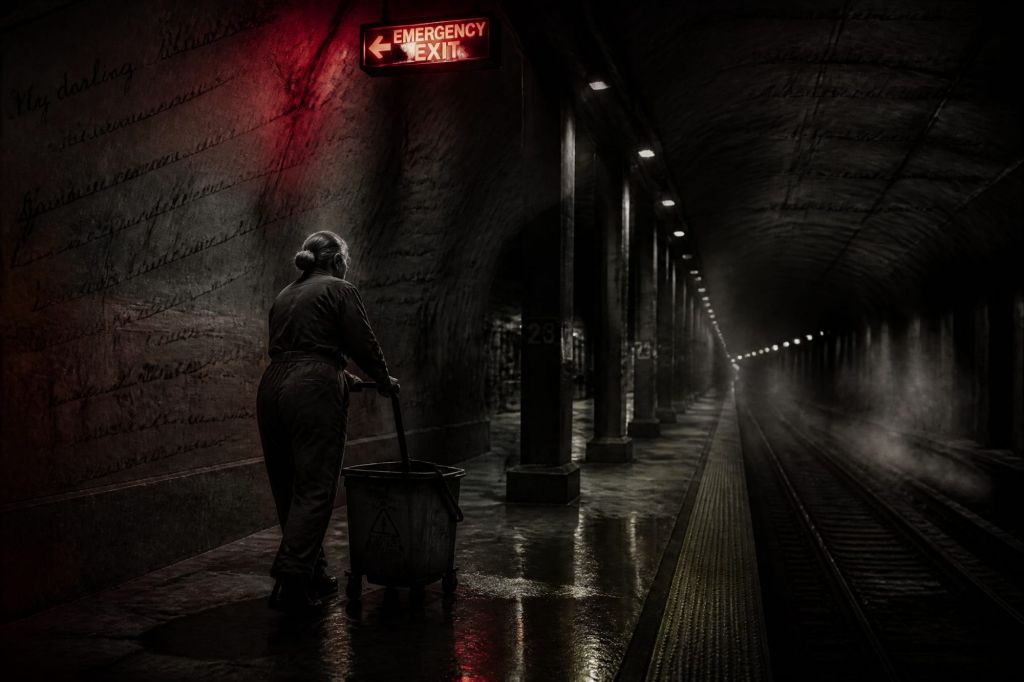
Instead, I kept seeing a woman pushing a mop bucket through an empty underground station.
No trains. No passengers. Just wet concrete reflecting red emergency lights.
And writing on the walls.
Pages of it.
Cursive stretched across stone like confessions scratched into the inside of a coffin.
At first I ignored it.
Writers ignore things all the time. Especially the important things. That’s why half of us own unfinished novels and emotional damage in equal quantities.
But the image kept returning.
The woman. The tunnel. The sound of wheels squeaking against wet pavement.
Not loud.
Rhythmic.
Like a clock drowning one second at a time.
I told myself it was aesthetic residue. Just another noir image floating through my subconscious because I consume too many films where everyone looks exhausted and morally compromised.
Then I heard her voice.
Not literally.
I’m eccentric, not hospitalized.
But I knew her cadence before I knew her name. Calm. Older. The kind of voice that had survived enough disappointment to stop raising itself for dramatic effect.
And the worst part?
She wasn’t asking me to tell her story.
She was waiting for me to catch up to it.
That distinction matters.
Some stories arrive like guests.
Others stand in your bedroom doorway at three in the morning holding a knife made of memory.
This one felt old.
Not ancient in the fantasy-novel sense. Old in the human sense. Like grief folded and unfolded too many times. Like letters kept in boxes nobody opens anymore.
I started seeing details I hadn’t invented consciously.
Platform 23.
A burn mark near one column.
The smell of bleach mixing with cigarette smoke and underground mildew.
The woman wore gloves with torn fingertips. Her left knee hurt in cold weather. She hated loud chewing. Someone once told her she had beautiful hands, and it ruined compliments for her permanently.
Tell me how the hell I knew that.
That’s the part non-writers don’t understand.
Characters sometimes arrive carrying information before plot exists.
You discover them the same way archaeologists uncover ruined cities: one careful brushstroke at a time while hoping the whole thing doesn’t collapse.
I tried resisting.
That lasted maybe two days.
I outlined another project. Read articles. Watched videos about productivity and story structure from people whose books somehow all sound emotionally taxidermied.
Meanwhile the tunnel kept expanding.
Every time I closed my eyes, it grew longer.
More lights. More steam. More writing on the walls.
And eventually I noticed something that bothered me enough to stop sleeping properly.
The handwriting was changing.
Different angles. Different pressure. Different emotions.
As if the walls weren’t written by one person.
But by everyone who ever passed through there.
That was the moment the story stopped being an idea and became an infection.
Because suddenly I knew what the tunnel was.
Not literally.
Emotionally.
It was the place unfinished things go.
The things people bury while pretending they merely misplaced them.
And the woman?
She cleaned the station because nobody else would touch it.
That’s how stories get you.
Not through spectacle.
Through recognition.
You don’t fall in love with the plot first. You fall in love with the wound underneath it.
After that, resistance becomes theater.
I started carrying a notebook again because of her.
That annoyed me.
Writers romanticize notebooks until they’re carrying one through grocery stores scribbling fragmented dialogue beside frozen pizzas like unstable prophets.
Mine currently contains:
- three story ideas
- a sentence about loneliness
- a reminder to buy detergent
- and “what if memory itself develops mold?”
Creative excellence.
I wish I could tell you this process feels magical.
Sometimes it does.
Mostly it feels like being haunted by unpaid emotional debts.
The real danger isn’t obsession.
It’s transformation.
Because if you stay with a story long enough, it starts cleaning things out of you too.
That’s the unspoken exchange.
You think you’re shaping the narrative.
Meanwhile the narrative is dragging a wet rag across parts of your soul you boarded shut years ago.
And maybe that’s why we keep doing it.
Not for publication. Not for applause. Not even for legacy.
Maybe writers continue because every once in a while a story appears from the dark carrying a bucket, a broken voice, and a tunnel full of ghosts…
…and says:
“Come look at what you buried.”
Discover more from Memoirs of Madness
Subscribe to get the latest posts sent to your email.


Beautiful 🤍
LikeLiked by 1 person
Keep writing 👏
LikeLiked by 1 person