Somewhere around here, buried beneath several decades of
accumulated paperwork, questionable decisions, and things I swore I’d need
someday, there should be a document concerning the possibility of an
extraterrestrial invasion. I put it together years ago, back when watching V
and Close Encounters of the Third Kind convinced me that humanity wasn’t
taking this whole alien business nearly seriously enough.
Now, before anybody starts questioning my mental stability,
let me clarify something. It wasn’t exactly an emergency plan. I didn’t have
evacuation routes mapped out, emergency rations stockpiled, or a designated
rendezvous point for surviving members of the human race. What I had was a list
of questions. Important questions. The sort of things I figured somebody ought
to ask before we started exchanging diplomatic gifts, signing treaties, or
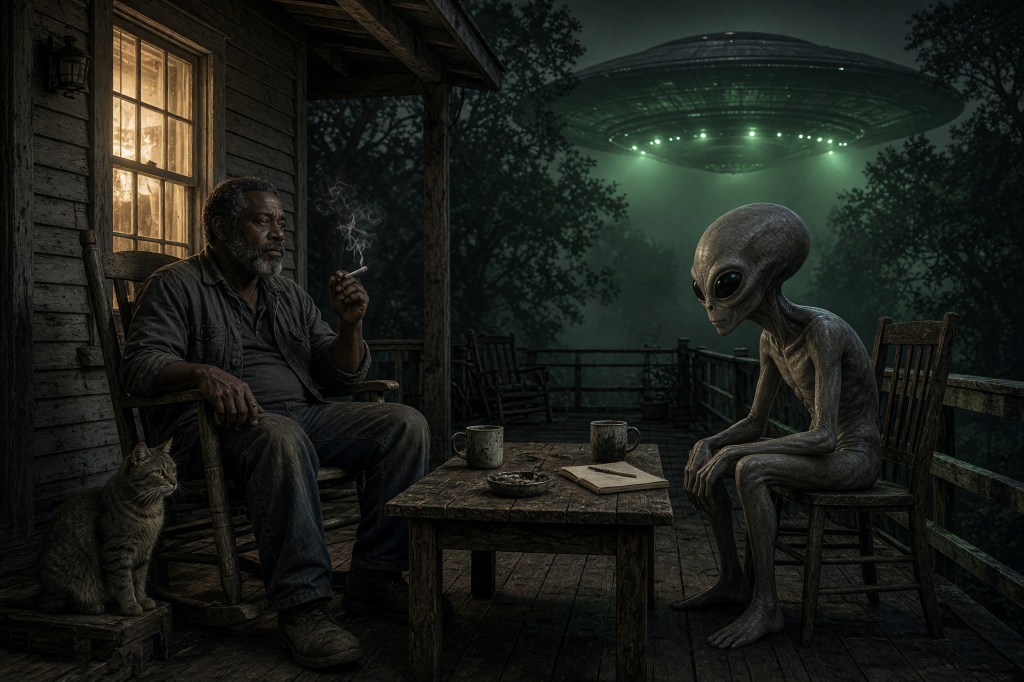
allowing eight-foot-tall visitors with suspiciously large heads to establish
embassies in our neighborhoods.
Unfortunately, I seem to have misplaced the list.
Fortunately, I remember some of the questions.
And since nobody has appointed me Earth’s official
ambassador, I figure I can dispense with all that diplomatic bullshit and get
straight to the important stuff.
For starters, do alien women really have more than two
boobs, or have science-fiction writers just been getting a little freaky?
I’m serious.
For decades, Hollywood has been presenting us with
extraterrestrial women whose anatomical arrangements suggest that somebody in
the costume department had a particularly interesting imagination. Now, I’m not
judging. Different planets, different evolutionary circumstances, different
plumbing. I understand that. But I’d appreciate a little clarification
concerning what’s scientifically plausible and what’s simply the result of some
lonely screenwriter spending too much time with his imagination.
And while we’re discussing matters of questionable
extraterrestrial behavior, let’s address this abduction business.
Is that shit real?
Because I’ve heard some stories over the years, and frankly,
I’m having trouble separating legitimate interplanetary activity from the
possibility that somebody got hold of some particularly enthusiastic peyote or
LSD.
Again, I’m not judging.
People do strange things. Sometimes they see strange things.
Sometimes they do strange things and then see even stranger things. That’s
humanity for you. We’ve been confusing hallucinations with divine revelations,
supernatural encounters, and messages from beyond the stars for longer than
anybody cares to admit.
But if y’all really have been abducting people, I have a
follow-up question.
What’s with all the probing?
Seriously.
You’ve supposedly mastered interstellar travel, developed
technology beyond our comprehension, and figured out how to navigate distances
that would make our finest scientists reach for another bottle of aspirin. Yet
somehow, your preferred method of investigating the human species involves
sticking things into places where things generally don’t belong.
Now, I understand scientific curiosity. I’ve got plenty of
it myself.
But come on.
Y’all got a little freak in you, don’t you?
It’s okay. You can tell me. I’m not going to put it on the
internet.
Well, probably not.
Now, before we get too comfortable, there’s something else
we need to establish.
Just because you can fly through space in a cool-ass
spaceship doesn’t mean you run shit down here.
Understand?
I realize your technology is impressive. Hell, I’d love to
take a look under the hood of that spacecraft. You’ve apparently figured out
propulsion systems, energy sources, and navigation techniques that make our
current achievements look like somebody rubbing two sticks together and
celebrating the invention of fire.
Congratulations.
Seriously. That’s impressive.
But technological superiority doesn’t automatically grant
you authority over everybody unfortunate enough to be standing beneath your
landing gear.
We’ve had enough trouble with that particular philosophy
here on Earth.
For centuries, people have confused having better weapons,
faster transportation, or more sophisticated machinery with possessing some
divine right to tell everybody else how to live. History is littered with the
consequences, and frankly, most of us are still cleaning up the mess.
So, if you’ve come to exchange knowledge, share discoveries,
or perhaps explain why the universe seems determined to keep so many of its
secrets to itself, pull up a chair.
Coffee?
But if you’ve come expecting everybody to bow down because
your spaceship has better mileage than my truck, we’re going to have a problem.
Which brings me to another question.
Y’all got any special powers?
You know, reading minds, moving objects without touching
them, making people do things against their will? Anything like that?
I’m particularly interested in the mind-reading business.
Not because I have anything to hide, mind you, but because I’ve met enough
people whose thoughts I’d rather not accidentally stumble into. There are some
places a reasonable person simply shouldn’t go without protective equipment.
And mind control?
That raises a whole different collection of concerns.
Although, I suppose it might explain a few things about
human behavior over the years.
But here’s what I really want to know.
Do y’all have a death ray?
Please tell me you’ve got a death ray.
That would be cool as hell.
I don’t necessarily need to fire it. I’m not asking to
borrow it. I just want to see one. Maybe watch a demonstration involving an
abandoned automobile or something equally expendable. Nothing dramatic. Just
enough to establish that the technology exists and that several generations of
science-fiction enthusiasts haven’t been waiting for nothing.
And I bet that thing doesn’t even take AAA batteries.
Think about that.
No digging through kitchen drawers looking for batteries
that haven’t already been stolen out of the television remote. No discovering
that somebody put dead batteries back in the package. No rechargeable battery
packs that promise twelve hours of operation but start complaining after
forty-five minutes.
And I bet there’s no USB-C cable involved either.
Can you imagine?
An advanced extraterrestrial civilization capable of
crossing the unimaginable distances between stars, only to have its most
powerful weapon rendered useless because somebody forgot the charging cable
back on Zeta Reticuli.
“Commander, we cannot destroy the planet.”
“Why not?”
“Kevin forgot the adapter.”
I’d be disappointed.
Not surprised, mind you. Just disappointed.
Because if there’s one thing humanity has demonstrated
conclusively, it’s that no matter how sophisticated our technology becomes,
somebody will eventually design a proprietary charging system that requires
purchasing additional accessories.
I sincerely hope extraterrestrials have evolved beyond that
particular nonsense.
Of course, there are other questions.
Plenty of them.
I’d like to know whether they’ve discovered other
civilizations, whether they’ve figured out what existed before the universe
began expanding, and whether they’ve managed to solve some of the mysteries
that have kept human philosophers, scientists, and theologians arguing for
centuries.
I’d also be curious whether they’ve developed a political
system that doesn’t eventually turn into a collection of ambitious idiots
fighting over who gets to sit in the biggest chair.
That might actually be worth traveling across the galaxy to
investigate.
But those are questions for later.
First, I need to establish whether we’re dealing with
explorers, conquerors, scientists, tourists, or some intergalactic degenerates
who’ve been conducting unauthorized medical examinations on unsuspecting
farmers.
Because context matters.
And despite what certain science-fiction movies might
suggest, I don’t believe possessing extraordinary technology automatically
makes somebody particularly intelligent, compassionate, or civilized.
Hell, we’ve managed to put people on the Moon while
simultaneously demonstrating an astonishing inability to get along with the
people living across the street.
For all we know, extraterrestrials might be exactly like us.
Just with better transportation.
Which, now that I think about it, might be the most
terrifying possibility of all.
Anyway, those are some of the questions I remember from my
original list. There were others, but after several decades, numerous moves,
and the general foolishness associated with being alive, the document appears
to have disappeared into whatever mysterious dimension collects missing socks,
misplaced car keys, and instruction manuals.
I’ll probably find it eventually.
Most likely while looking for something entirely unrelated.
In the meantime, should an extraterrestrial spacecraft
appear over my neighborhood tomorrow, I intend to remain reasonably calm,
observe the situation, and avoid making any unnecessary assumptions about the
intentions of our visitors.
I’ll put on some coffee.
Maybe offer them a cigarette.
And once we’ve established that nobody intends to vaporize
anybody, I’ll begin asking questions.
Politely, of course.
After all, first impressions matter.
Although, now that I think about it, there’s one more thing
I probably ought to ask before we get started.
That death ray of yours … does it come with a warranty?
Because I know how this shit works.
The minute I get one home, something’s going to break.
It has been a while since I wandered over to Di’s place for Share Your World, so I figured it was time to see what kind of trouble her questions could get me into.
This week, Di has us talking about work—the ideal job, workplace disappointment, promotions, teamwork, and the kind of company we might build if given the opportunity. Considering some of my experiences over the years, a few of these questions were easier to answer than others. A couple may have poked the bear.
As always, these are my answers, shaped by my experiences and whatever wisdom I managed to salvage from them.
Now, let’s see what kind of mess I can make of perfectly innocent questions.
If you could have an ideal job, what would it be?
My ideal job would be creating art that feeds me spiritually—work that leaves me feeling more alive for having made it. And hopefully, some of that joy finds its way into the work itself, so the people who encounter it can feel a little of what I felt while creating it.
Have you ever been disappointed with a job you thought would be ideal?
Yes, of course. Oddly enough, it wasn’t the job itself that disappointed me. I enjoyed the work. The problem was the people I worked with and, more specifically, their interpretation of the rules.
I’ve always believed rules should provide structure and consistency. What frustrated me was watching the same rules bend, stretch, or suddenly become carved in stone depending on who was involved or who was doing the interpreting. Eventually, even work you enjoy becomes difficult when you spend more energy navigating people than actually doing the job.
Do you believe promotions in the workplace are given to those who work hard, those who are qualified for the job, or those who happen to be friends with management?
I’ve actually seen all three.
I’ve watched people get promoted because they worked hard and earned it. I’ve seen qualified people move into positions because they were genuinely the best person for the job. I don’t have a problem with either of those. Even when I wanted the position myself, I could respect the decision if the person had earned it.
It’s that third one that gives me the “sweet ass.”
When friendship, favoritism, or office politics carries more weight than ability, experience, or effort, it damages more than morale. It tells everyone else that the standards they were told mattered really don’t. Work hard. Learn your job. Become qualified. Do everything right—and then watch somebody leapfrog over you because they know the right person.
That’s not promotion. That’s preference wearing a name tag.
Do you prefer working as part of a team or on your own?
It depends on the task at hand—and, admittedly, who the hell is on the team.
I enjoy working on my own. There is a certain freedom in being able to set my own pace, make decisions, solve problems, and adjust direction without having to hold a committee meeting every fifteen minutes.
However, some projects are simply too large or complex for one person. The sheer scope of the work requires a team, and when you have the right people—people who understand their responsibilities, communicate, and respect what everyone brings to the table—a good team can accomplish things that would be nearly impossible alone.
So, I suppose I prefer working independently when the work allows it and collaboratively when the work demands it.
Just choose the team carefully.
If you could build your own company, what would it be?
I would build a creative studio along with a small press dedicated to independent authors and artists.
The studio would be a place where different creative disciplines could cross paths—writing, photography, visual art, filmmaking, graphic design, and whatever strange idea somebody dragged through the door that morning. I wouldn’t want creativity divided into neat little boxes. Some of the most interesting work happens when those boxes get knocked over.
The small press would focus on indie authors, particularly writers with strong voices who might not fit comfortably into what traditional publishing considers marketable. I understand the value of standards, editing, and professionalism, but I also believe there is a difference between helping someone strengthen their voice and sanding away everything that made the voice interesting in the first place.
I wouldn’t want to build a factory for content.
I’d want to build a place where people could create work that feeds them spiritually—and hopefully some of that joy, truth, madness, and humanity would make its way to the people who eventually experience it.
What are you grateful for this week?
This week, I’m grateful that we made it home safely.
It was one of those trips where enough things went wrong to remind you how quickly a plan can become something entirely different. We dealt with problems, adjusted when necessary, and kept moving, but we didn’t do it alone.
We had a solid support team behind us, and I can say without hesitation that we would not have made it through everything without them. Sometimes you don’t fully appreciate the people standing behind you until circumstances force you to lean on them.
So this week, I’m grateful for safe travels, good people, and the reminder that being capable doesn’t mean you have to do everything alone.
Dispatches from the Splinters of My Mind — Entry 35
She left before the song finished.
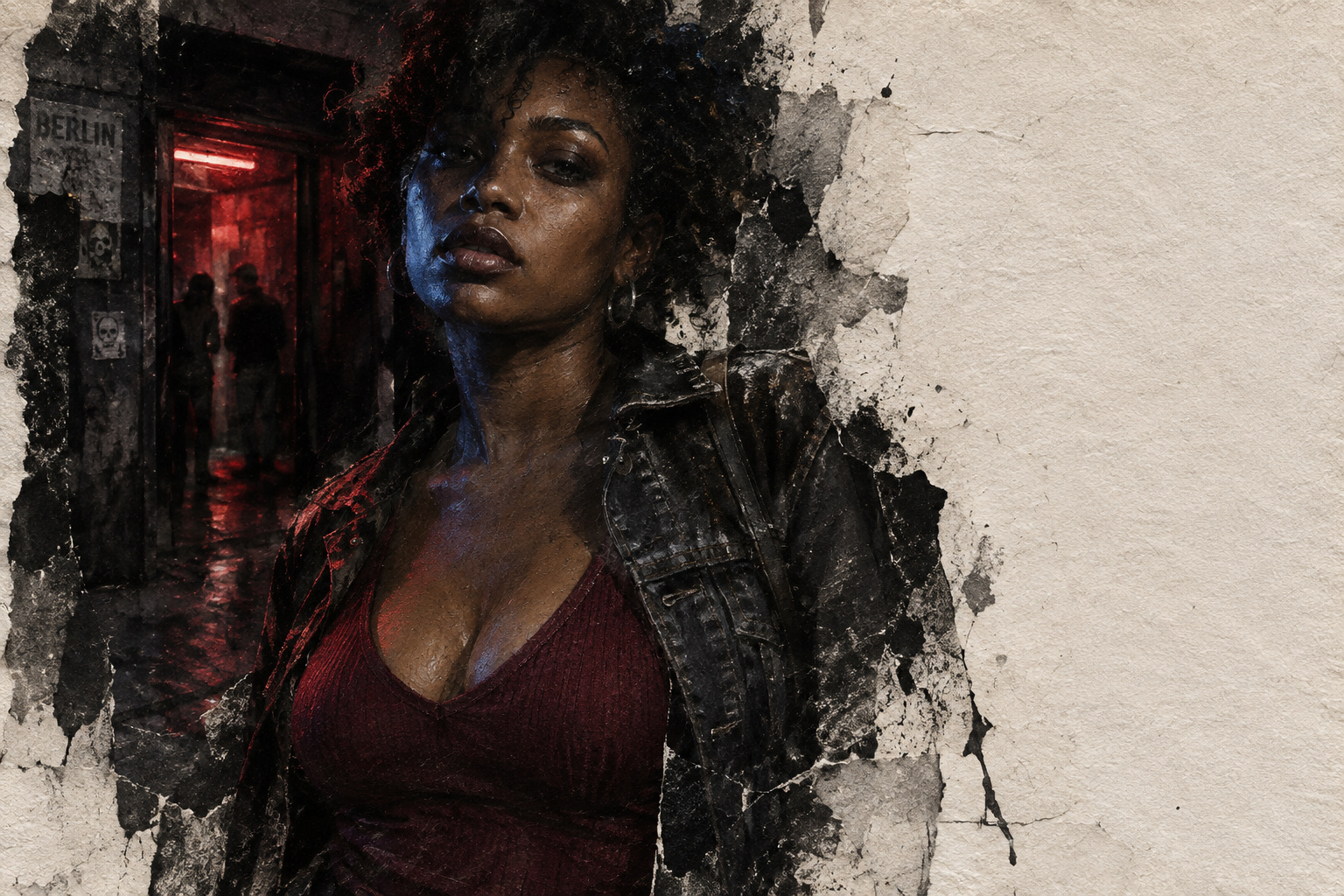
Not because of a fight. Nobody had grabbed her wrist, whispered something unforgivable into her ear, or appeared from some previous version of her life demanding payment. Nothing that convenient happened. There would be no villain to blame tomorrow morning, no dramatic story polished over coffee until leaving seemed inevitable. She had simply been standing beneath the red lights, surrounded by bodies surrendering themselves to the bass, when she looked around and realized she had absolutely no reason to be there.
The realization frightened her more than danger would have.
Danger gave you instructions.
Run.
Fight.
Scream.
Survive.
Emptiness merely handed you a mirror.
Outside, Berlin was wet without quite raining. The pavement carried the greasy shine of an old photograph, red neon stretching itself through puddles while blue light leaked from somewhere she couldn’t locate. She leaned against the wall beside the club entrance and pulled her jacket tighter, although she wasn’t cold. Behind her, the bass continued hammering through brick and concrete, softened now into something anatomical. A giant heart buried beneath the building. She could feel it between her shoulder blades.
People entered.
People left.
Nobody looked at her long enough to remember her.
She liked that.
For nearly eleven minutes, she stood beneath a broken piece of signage and pretended she was waiting for someone.
There was dignity in waiting. Waiting suggested intention. It told strangers there was a reason you were standing alone at two-thirty in the morning with your makeup beginning to surrender and your phone vibrating unanswered inside your jacket. Someone was coming. A taxi. A lover. A friend. Some necessary person delayed by traffic.
But nobody was coming.
She had made certain of that.
Her phone vibrated again.
She didn’t look.
Across the street, a man dragged a black garbage bag from a restaurant and threw it into a dumpster. Somewhere farther down the block, glass shattered, followed by laughter. A bicycle hissed across wet pavement. Cigarette smoke curled from the mouth of a woman beneath an awning and disappeared into the night as though even the air had somewhere else to be.
She pushed herself away from the wall.
Home was seventeen minutes away.
She walked in the opposite direction.
There are places we go when we don’t want to go home.
Nobody talks about them because most of them aren’t particularly beautiful. Nobody photographs the fluorescent aisle of a convenience store at three in the morning and calls it sanctuary. Nobody writes songs about laundromats where three machines are broken and somebody has abandoned a sock beneath a plastic chair. There are no postcards celebrating hospital cafeterias after visiting hours, twenty-four-hour pharmacies, train platforms, gas stations, hotel lobbies, bus shelters, parking garages, or diners where the coffee has been sitting long enough to qualify as an archaeological discovery.
But sometimes those places hold us.
Sometimes home asks questions.
These places don’t.
She found a convenience store four blocks away and wandered inside without needing anything. The fluorescent lights were brutal. They flattened everything beneath them: candy wrappers, cigarette advertisements, bottles of water, her face reflected in the refrigerator doors. There was nowhere for shadows to hide, which seemed unnecessarily cruel at that hour.
The clerk glanced up.
She picked up a bottle of water.
Put it back.
Picked up another identical bottle.
Apparently, this one had better qualifications.
She almost laughed.
That bothered her.
She hadn’t expected laughter to survive tonight.
At the register she bought the water, chewing gum she didn’t want, and a disposable lighter even though she hadn’t smoked in six years. The clerk placed everything into a thin plastic bag.
“Need cigarettes?”
She looked at the lighter in her hand.
“No.”
He waited half a second longer than necessary, perhaps expecting an explanation.
She gave him none.
Outside, she threw the lighter into the first trash bin she passed.
Then retrieved it.
She stood there with her hand inside a public trash can at three in the morning and finally laughed hard enough that tears came.
“Jesus Christ.”
A couple walking past gave her additional sidewalk.
Fair enough.
She wiped her eyes and kept moving.
She had spent the last seven years becoming someone she thought she was supposed to become. The dependable one. The reasonable one. The woman who answered messages. Remembered birthdays. Sent money. Showed up early. Forgave people before they apologized because carrying anger was supposedly unhealthy. She learned which parts of herself made other people uncomfortable and quietly sanded them down.
Too loud.
Too angry.
Too ambitious.
Too needy.
Too distant.
Too much.
Not enough.
Eventually, she had become wonderfully easy to love.
She just wasn’t entirely certain who everyone was loving.
That thought had come to her inside the club.
Not as language.
Language came later.
At first it had simply been the sight of herself in a mirror behind the bar. Red light. Blue light. Bodies moving around her. Her own face floating between bottles of gin and vodka. She had stared at the woman in the reflection and waited for recognition.
Nothing.
Then the woman smiled.
She hadn’t.
That was when she left.
She reached the train station without deciding to go there.
The platform was nearly empty. A young man slept sitting upright against a backpack. An older woman held a grocery bag between her shoes. Somewhere overhead, an electronic sign announced destinations in indifferent amber letters.
She sat.
The metal bench was cold through her jeans.
Her phone vibrated again.
This time she took it out.
Nine missed calls.
Eleven messages.
The most recent contained only three words.
Where are you?
She stared at them.
It was such a simple question.
She began typing.
I’m fine.
Deleted it.
I needed some air.
Deleted.
I’ll be home soon.
Deleted.
The cursor blinked.
Where are you?
She looked along the platform.
She could have answered geographically. Station. Street. District. Coordinates if she wanted to be particularly obnoxious. She could have sent a pin and reduced herself to a blinking dot on somebody else’s screen.
But that wasn’t what the question meant.
Not anymore.
A train arrived.
Doors opened.
The sleeping man woke and boarded without hesitation. The older woman gathered her groceries and followed him. Three other people emerged from the carriage and disappeared toward the stairs.
She remained seated.
The doors closed.
The train left.
Something inside her loosened.
Not healed.
She hated that word.
People talked about healing as though pain were a cut and time simply needed to knit the edges together. Some things didn’t close. Some things became architecture. You built rooms around them. Installed windows. Learned which floorboards complained beneath your weight.
Eventually you stopped calling it damage.
You called it home.
Maybe that was the problem.
She stood.
At the far end of the platform was a darkened window. Her reflection waited inside it.
She approached slowly.
There she was.
Smudged eyeliner.
Tired eyes.
Hair beginning to surrender to damp air.
Jacket hanging crooked from one shoulder.
No red light.
No blue.
No music.
No crowd.
Nothing beautiful enough to hide behind.
She looked terrible.
She looked familiar.
For the first time that night, she recognized herself.
“Well,” she whispered.
Her reflection offered no advice.
Good.
She was tired of advice.
Another train was coming in six minutes.
Home was now twenty-three minutes away.
She could still go.
She could climb the stairs, call a taxi, answer the messages, invent something believable, remove her makeup, crawl beneath familiar sheets and resume the life waiting patiently for her return.
Nothing had actually changed.
That was the terrifying part.
Nothing outside her had changed at all.
The city remained indifferent. The club kept breathing music into the pavement. Somewhere glasses were being filled. Someone was falling in love. Someone was lying. Someone was washing blood from their knuckles. Someone was standing in a kitchen wondering why another person hadn’t come home.
Her phone vibrated.
Please answer me.
She turned it off.
Not because she hated whoever was waiting.
Perhaps she loved them.
That complicated things.
Then she climbed the stairs from the platform and returned to the street.
Dawn hadn’t arrived, but somewhere beyond the buildings the darkness had begun thinning at the edges. The hour when night stopped feeling permanent.
She walked without deciding where.
Past a bakery beginning its morning.
Past two men arguing beside a taxi.
Past a woman sweeping broken glass from a doorway.
Past windows containing lives she would never know.
Eventually she found a small café with four tables and terrible lighting. A handwritten sign claimed it opened at four.
It was 4:07.
Close enough.
She went inside.
The man behind the counter didn’t ask why she was there.
He merely poured coffee.
She sat beside the window and wrapped both hands around the cup. Steam touched her face. Outside, the city slowly revealed itself: concrete, graffiti, delivery trucks, wet pavement, people carrying yesterday into tomorrow.
For the first time all night, she stopped moving.
She didn’t know whether she would go home.
She didn’t know whether there would still be a home when she did.
She didn’t know what she would say when she turned the phone back on.
For once, she allowed those questions to remain unanswered.
Across the glass, her reflection settled over the waking street.
She looked at it.
It looked back.
And somewhere beneath the exhaustion, beneath the woman everyone knew and the woman she had spent years constructing for them, something small and inconvenient stirred.
Not happiness.
Not courage.
Nothing worthy of a quote printed over a sunrise.
Recognition.
She lifted the coffee to her lips.
It was terrible.
She drank it anyway.
Outside, morning came without asking whether anyone was ready.
We are taught to approach problems in a strangely binary fashion. Right or wrong. This or that. Inside the box or outside of it. Hence that tired old phrase, “Think outside the box.”
There is nothing inherently wrong with looking for a different solution. Some of humanity’s greatest accomplishments came from someone looking at what everyone else accepted and asking, Why are we doing it this way?
The problem comes when everybody is trying so damned hard to discover the next great idea that we overlook the obvious one sitting directly in front of us.
Of course, we can blame technology.
Technology has become the usual suspect whenever we start talking about what has gone wrong with society. The internet ruined communication. Social media destroyed civility. Smartphones killed conversation. There is probably some truth buried in those arguments, but blaming technology is also convenient.
Because this problem is older than automobiles.
Older than television.
Older than radio.
Definitely older than the internet.
We have never completely figured out how to respect one another.
What’s frustrating is that we like to believe we shouldn’t judge one another. We repeat that no person is inherently better than another as though saying it often enough makes it our practice.
It doesn’t.
In some ways, we can’t help ourselves. We are shaped by what we were taught, what we witnessed, and what we experienced growing up. Those lessons don’t disappear simply because we’ve gotten older and learned better words for describing ourselves. Some become so deeply embedded that we don’t recognize them as assumptions anymore.
But even that explanation can become another excuse.
We have accumulated an entire collection of societal wisdom that gets repeated so often we eventually stop asking whether any of it is actually true.
Technology is evil.
Everything must be positive.
Think outside the box.
And one of my personal favorites: the idea that someone who can’t multitask is somehow less capable than someone who can.
Multitasking may be one of the greatest pieces of hokum we’ve managed to turn into a virtue. Somewhere along the way, being distracted in several directions at once became evidence of productivity.
That’s the problem with things everybody knows.
Eventually, nobody remembers to ask how we know them.
We inherit ideas from our families, communities, workplaces, cultures, and experiences. Some contain wisdom. Some contain prejudice. Some were probably bullshit when somebody first said them three generations ago. Yet they can become so deeply embedded that we stop recognizing them as assumptions and begin treating them as facts.
Then we use those assumptions to measure other people.
Perhaps that’s where respect actually begins—not with refusing to judge, because I’m not convinced human beings are capable of that, but with recognizing that the ruler we’re using to measure somebody else might be crooked.
I’m not suggesting that we should live without standards. Nor am I suggesting that we should wander through life refusing to make judgments about people, situations, or behavior. That’s neither realistic nor particularly wise.
I’m suggesting something considerably less dramatic.
Slow down.
Try to get the clearest picture of the situation possible before making a decision, especially when that decision has the potential to alter the course of someone’s life.
Including your own.
Sometimes we have more time than others. That’s reality. There will be moments when circumstances demand a decision before we have every fact we’d like to have. But having less time isn’t an excuse for sloppy or shoddy thinking. It doesn’t excuse rushing to judgment, and it certainly doesn’t excuse rushing blindly into action.
You work with what you have.
You pay attention.
You question what you think you know.
Then you make the best decision the circumstances allow.
Because judgment has consequences in more than one direction.
There is the person being judged, certainly. What we decide about someone can affect how we speak to them, how we treat them, what opportunities we give them, what we deny them, and sometimes how they begin to see themselves.
But there is another person affected by that judgment.
Us.
Every time we reach a conclusion without examining what brought us there, we strengthen the assumptions that produced it. If we’re right, perhaps nothing happens. If we’re wrong and never bother to discover it, the assumption survives. It becomes easier to use the next time. Eventually, we aren’t examining the person standing in front of us at all. We’re examining everything we’ve already decided someone like them must be.
That’s why I don’t particularly care for the phrase don’t judge.
We judge.
We have to.
The responsibility isn’t to somehow stop judging. The responsibility is to make the clearest judgment we can with the information and time available to us—and remain willing to change that judgment when better information arrives.
I was reminded of this during a recent business trip.
My associate thought I was being overly cautious. Perhaps from where he was sitting, I was. I wanted things checked. I wanted contingencies. I wasn’t particularly interested in assuming that because something had worked yesterday, it would work today.
Then we started having breakdowns.
Several of them.
Any one of those situations could have ended considerably differently. What became inconvenience, frustration, and delay could quite easily have resulted in serious injury or the loss of a life.
I didn’t say anything about having been cautious.
There wasn’t anything to say.
Later, my associate came to me and thanked me for being thorough. More importantly, he thanked me for not allowing myself to get caught in the urgency of the moment.
That stayed with me.
It wasn’t as though I had suddenly become some damned guru sitting on a mountaintop dispensing wisdom. Experience has simply taught me several cruel lessons over the years. Some of them we can laugh about now.
Others…
You simply exhale and change your shorts.
That’s the thing about experience. Surviving something doesn’t automatically make you wise. Sometimes all you’ve learned is another way things can go horribly wrong. The wisdom, if there is any, comes afterward—when you’re willing to examine what happened, what you missed, what you got right, and what you damn sure don’t intend to repeat.
Perhaps that’s why I was cautious.
I have lived long enough to know that urgency has a way of convincing us that movement is more important than thought. Something must be done now, therefore whatever we do now must be better than taking another moment to understand what we’re dealing with.
Sometimes urgency is real.
Sometimes we genuinely don’t have much time.
But less time doesn’t lower the standard of care.
If anything, the consequences should make us more deliberate with whatever time we have.
That doesn’t mean freezing when action is necessary. It means refusing to confuse speed with competence. It means working with the information available, paying attention to what is actually happening, questioning assumptions, and then acting.
And if better information arrives afterward?
Have enough sense to reconsider.
Maybe you were wrong.
Maybe the other person was wrong.
Maybe everybody was working with a crooked ruler.
That isn’t weakness. It isn’t surrender. And it certainly isn’t failure.
It’s discernment.
Perhaps that’s the underrated life skill I’ve been trying to describe all along.
Not knowing everything.
Not never making mistakes.
Not somehow becoming enlightened enough to stop judging people altogether.
Just developing the discipline to examine what you think you know before allowing it to determine what you do.
Respect grows from that. Better judgment grows from that. Experience becomes useful because of that.
We spend an extraordinary amount of time looking for clever answers. We celebrate thinking outside the box, breaking conventions, moving faster, doing more, and finding the next great solution.
Sometimes the answer isn’t particularly clever.
Sometimes it’s simply paying attention.
Slow down doesn’t always mean move slowly.
Sometimes it simply means don’t let the moment do your thinking for you.
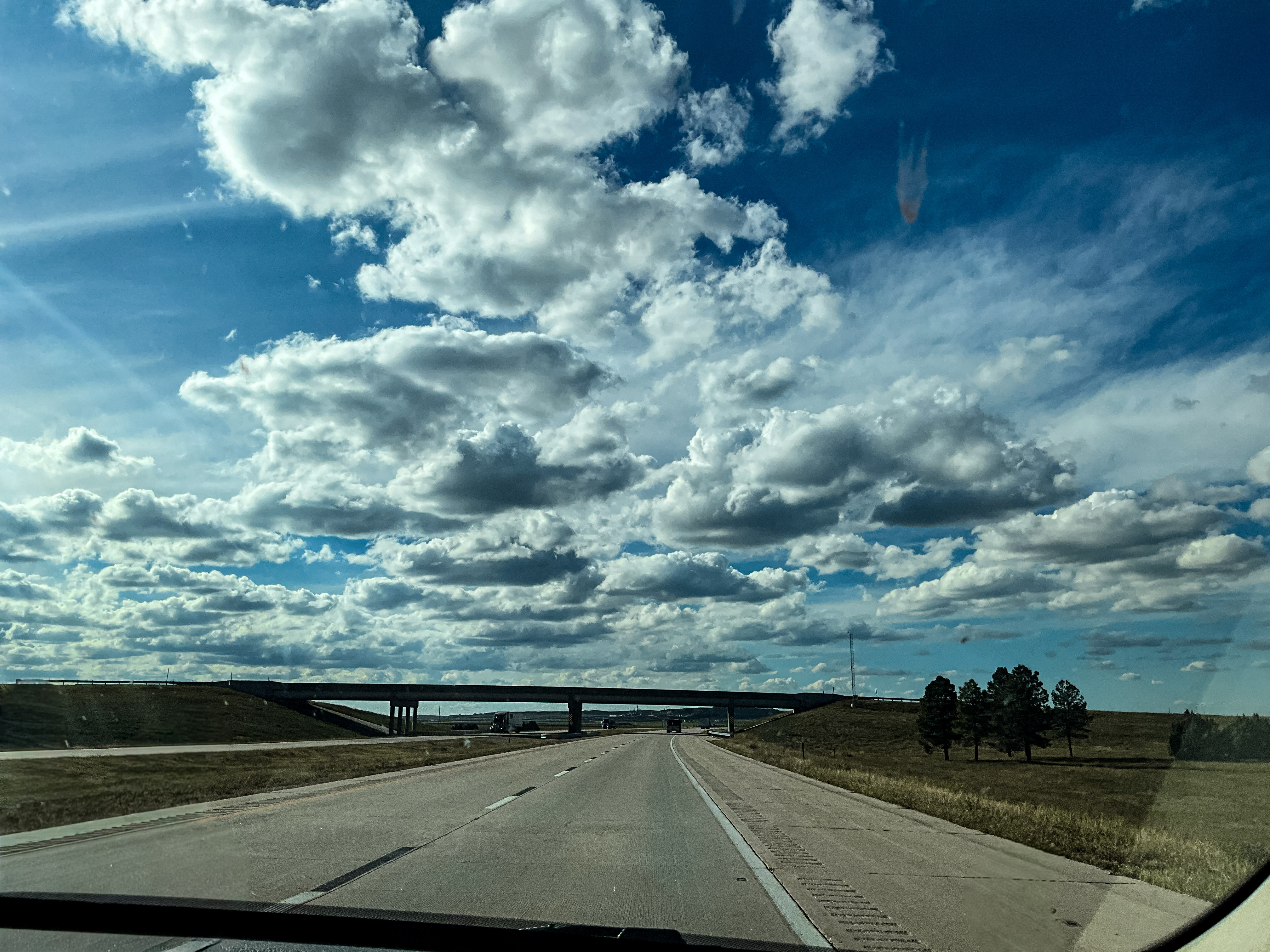
There were long hours, changing plans, fatigue, stops that took longer than they should have, and the thousand small irritations that seem to multiply whenever you are trying to get somewhere on a schedule. By the time enough miles have passed beneath you, the road can become nothing more than something to endure.
Then I looked up.
For a few moments, all of that disappeared.
The highway stretched toward the horizon beneath a sky crowded with clouds, sunlight slipping through them and spreading across the open land. Nothing dramatic happened. We didn’t stop. There wasn’t some great revelation waiting beside the road.
There was simply something beautiful in front of me.
I think we sometimes make the mistake of believing beauty requires peace. Yet so often, the exact opposite is true. Beauty can become more vivid when it appears in the middle of frustration, exhaustion, or uncertainty. Maybe it is the contrast. Maybe when everything around us feels difficult, we become more aware of the few things that are not asking anything from us.
That sky didn’t solve anything. It didn’t shorten the miles, change the schedule, or make the trip less tiring. But because the trip had been so trying, being given even a few moments to notice something beautiful felt greater than it might have otherwise.
Sometimes beauty is simply pleasant.
Other times, when you stumble across it in the middle of a mess, it feels almost like magic.
And perhaps that is why those moments become so much more joyful. You are not escaping what is difficult. You are simply being reminded that the difficult thing is not the whole world.
The problems were still there. The miles still had to be driven. Nothing about seeing that sky made the trip easier.
But for a moment, frustration was not the only thing happening.
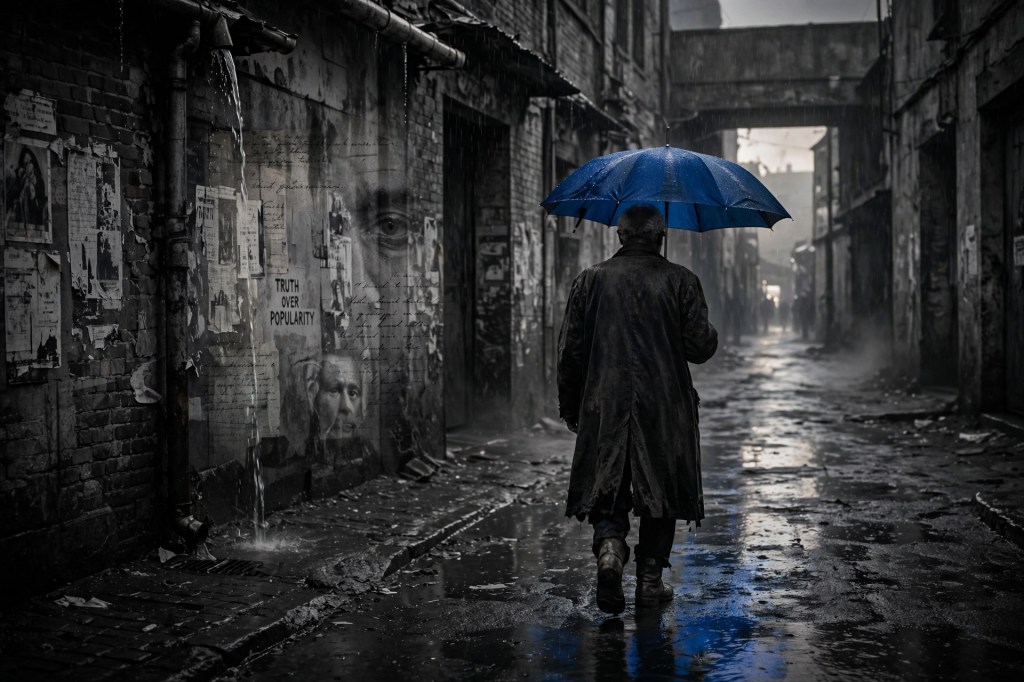
I’ve used those words for years, and somewhere along the way
they became more than something I could slap beneath my name and pretend
sounded profound. Believe me, I have plenty of things I say simply because they
sound cool.
This isn’t one of them.
Truth over popularity has become something of a measuring
stick for everything I create.
When I write fiction, I spend a considerable amount of time
trying to make the unbelievable believable. The town may not exist. The people
may never have drawn breath. The circumstances might have been assembled
somewhere between too much coffee, cigarette smoke, and whatever peculiar
corner of my imagination decided to start making noise that morning. But the
emotions have to be real.
The grief has to hurt.
Fear has to behave like fear.
Love cannot suddenly become convenient because I need it to
rescue the plot.
People have to make bad decisions for reasons that make
sense to them, even when those decisions make absolutely no sense to
anyone watching.
That is the truth I’m after.
I want someone to encounter a character whose life looks
nothing like their own and still recognize something. Maybe it is the anger.
Maybe the loneliness. Maybe it’s the stubborn refusal to surrender when
surrender would probably be considerably easier. Background shouldn’t matter at
that moment. Race, geography, age, religion, politics, money—those things shape
us, certainly, but underneath them are experiences that remain stubbornly
human.
I don’t always hit the mark.
That’s important for me to admit.
Sometimes the metaphor gets there before the truth does.
Sometimes I become too enamored with an image, a sentence, or an idea and
forget that beautiful language isn’t worth much if nobody believes the person
standing inside it. So I go back. I question it. I rewrite it. Occasionally, I
murder a perfectly good sentence because the bastard was showing off.
The same philosophy follows me into my visual work.
I want an image to communicate before I explain it. The
viewer shouldn’t need three paragraphs from me to understand that someone is
grieving, isolated, defiant, frightened, powerful, or simply tired of whatever
shit the world handed them that morning. Composition, posture, shadow, light,
texture, negative space—those become another vocabulary.
The image should speak.
My words should speak.
And neither should require me standing beside them
explaining what I meant.
Popularity is different. Popularity asks what people want.
Truth asks what the work needs.
Those questions occasionally arrive at the same answer.
Sometimes they don’t.
I’ve learned to live with that.
I’d rather create something that ten people genuinely feel
than something a thousand people briefly notice before scrolling to whatever
comes next. That doesn’t mean I am indifferent to an audience. Quite the
opposite. Respecting an audience means refusing to bullshit them simply because
bullshit might perform better.
So, if I had to reduce my creative philosophy to three
words, they would still be the same ones:
Truth over popularity.
And after all these years, I think I finally understand what
they cost.
Hello, I’m Mangus Khan, and for the next few minutes, I encourage you to walk into Madness with me.
Come on in, Brave Souls.
Today we’re going to talk about perspective.
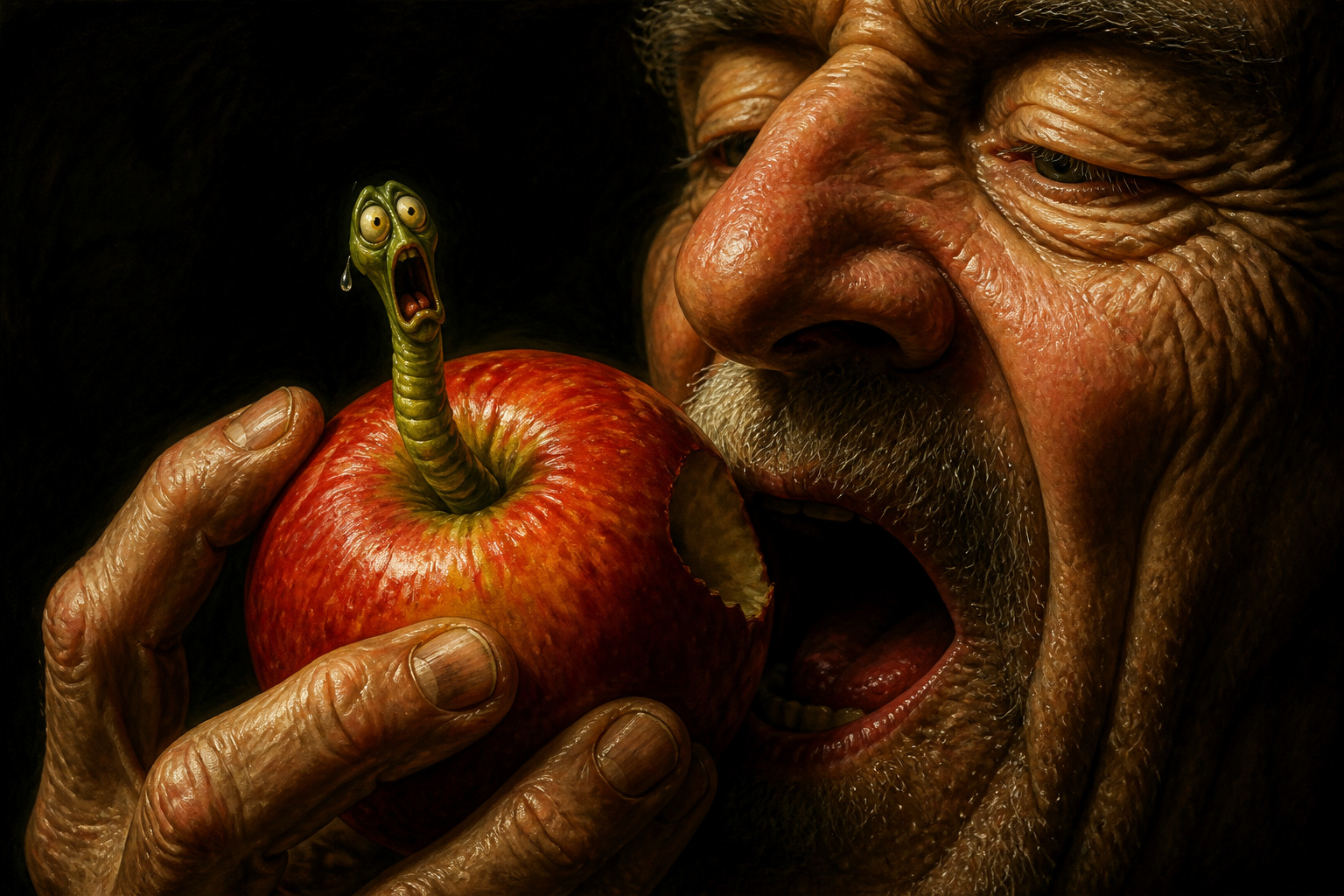
There’s a man.
There’s an apple.
There’s a worm.
And depending upon which one you ask, this is either lunch—
or a home invasion followed by attempted murder.
The man didn’t know this, of course. That’s important. As far as he was concerned, he was having an apple. Maybe his doctor told him to eat better. Maybe he was trying to lose a few pounds. Maybe the vending machine wanted three dollars and twenty-five cents for a candy bar, and even desperation has financial limits. Whatever the reason, he picked the apple. Good for him. Look at that son of a bitch making responsible decisions.
Meanwhile, Clarence was about to die.
I’ve named the worm Clarence because he looked like a Clarence, and Clarence had been having a perfectly ordinary morning before the apocalypse arrived. The apple was comfortable. The temperature was good. The neighborhood was quiet. The rent was reasonable—free, actually. Clarence had found a particularly sweet section near the core and was contemplating whether he should spend the afternoon tunneling toward the opposite side when something enormous wrapped itself around his entire universe.
Five fingers. Calloused. Warm. Smelling faintly of soap, cigarettes, and whatever humans touch during the course of an ordinary day.
The apple moved.
Clarence froze as gravity shifted beneath him. Light poured through the small opening he’d been using as a breakfast nook, and his entire world rose toward something he couldn’t understand. Then he saw it—a face, enormous and wrinkled, gray whiskers framing an opening mouth. Beyond the lips were teeth.
Oh, hell no.
Now, I don’t know whether worms experience existential dread. I’m assuming they do because it makes this story considerably better. Whatever Clarence experienced, it was enough to send him shooting out of that apple like the mortgage company had arrived with paperwork.
The man screamed.
Clarence screamed.
There are moments when species differences become irrelevant.
This was one of them.
The apple hit the table. The chair scraped violently backward, its legs shrieking against the kitchen floor. Clarence stood upright in the middle of what had been, until seconds ago, his dining room, his narrow green body trembling while the man stared at him as though Satan himself had crawled from the produce section.
For several seconds, neither moved.
Then Clarence said, “What the fuck is wrong with you?”
The man blinked. “What?”
“You heard me.”
He leaned closer.
Clarence recoiled. “Back the hell up.”
Surprisingly, the man did.
“You were in my apple.”
Clarence stared at him. “Your apple?”
“Yes.”
“I’ve lived here for six weeks.”
“I bought it yesterday.”
Clarence paused. “From whom?”
“The grocery store.”
“Did they show you a deed?”
The man frowned. “No.”
“Lease?”
“No.”
“Title?”
“It’s an apple.”
“Convenient.”
And there it was.
Perspective.
The man saw food; Clarence saw property. The man saw contamination; Clarence saw attempted murder. Neither had changed the object sitting between them. It remained the same apple, bruised now where it had struck the table, one bite missing from its side and a rather indignant worm protruding from the top. Yet two completely different realities had somehow managed to occupy the same kitchen.
We do this shit constantly.
Not with worms, necessarily, although after today I’d inspect the produce.
We move through the world assuming we’re the protagonist because we’re standing behind our own eyes. It makes sense. Every morning you wake inside the same skull, accompanied by your memories, worries, plans, bills, aches, regrets, and whatever unfinished argument your brain decided to resume at three seventeen in the morning. There’s probably background music too, although you can’t hear it because the budget for your particular production was apparently spent elsewhere. Still, this is your story, so naturally you’re the main character.
The problem is that everybody else woke up believing exactly the same thing.
You’re driving to work when some asshole cuts you off. You slam on the brakes, your coffee attempts escape, and your blood pressure discovers territory Lewis and Clark never mapped. For the next twelve miles, you conduct an extensive investigation into this person’s intelligence, parentage, driving ability, moral character, and whether civilization would benefit from their immediate removal from the gene pool. They ruined your morning. They are clearly the villain.
Meanwhile, three cars ahead, that person doesn’t remember you exist.
Maybe they never saw you. Maybe their child is sick. Maybe they’re late for something important. Maybe their mother called from the hospital five minutes ago.
Or maybe they’re just an asshole.
Let’s not romanticize everybody.
Sometimes the asshole actually is an asshole.
But while you’re behind them constructing a psychological profile that would impress the FBI, they’re wondering whether they remembered to turn off the coffee maker. You’re living through an incident they’ll never remember. Same road. Same ten seconds. Different story.
That’s uncomfortable when you follow it far enough, because it means there are probably people walking around this planet carrying memories of us that we don’t possess.
Think about that for a moment.
Somewhere, somebody may remember something you said twenty years ago. One sentence. You don’t remember saying it. Hell, you might not remember the conversation, the room, or the person, but they do. Maybe it hurt them. Maybe it encouraged them. Maybe it changed something. Maybe they went home afterward and cried. Maybe they decided not to quit. Maybe they decided they could never forgive you.
And you went home and had meatloaf.
That’s a hell of a thing.
We tend to judge our impact by our intention. I didn’t mean anything by it. Perhaps not, but intention belongs to the person throwing the stone. Impact belongs to whatever it hits. That doesn’t mean we’re responsible for every interpretation anyone has ever made of us. That road leads directly to madness, and around here we prefer to walk into Madness voluntarily. But it does mean our version isn’t the only version.
I’ve thought about that more as I’ve gotten older. There are situations from my past where I once knew exactly what happened—or at least I believed I did. Age has a nasty habit of sanding certainty down around the edges. Eventually you realize the memory you’ve carried for thirty years isn’t footage. It’s testimony. Your testimony. It passed through who you were, what you knew, what you feared, what you loved, and perhaps most importantly, what you needed to believe about yourself when it happened.
Someone else may have walked away from the same room carrying an entirely different version.
Neither person necessarily lying.
That’s the bastard of it.
Sometimes there isn’t a villain.
Just two people standing on opposite sides of the same apple.
Clarence was still pissed, by the way. I haven’t forgotten about him. He stood inside the crater where the man’s first bite had nearly ended his entire bloodline, staring at the human with an expression of outrage that seemed anatomically ambitious for something without eyebrows.
“Do you have any idea what you almost did?”
“I was eating.”
“You bit my bedroom.”
“I didn’t know you were there.”
Clarence stared at him.
And maybe that’s the sentence sitting underneath this whole ridiculous mess.
I didn’t know you were there.
How much damage begins there?
I didn’t know you were hurting. I didn’t know you heard me. I didn’t know that mattered to you. I didn’t know you were afraid. I didn’t know you needed help. I didn’t know you loved me. I didn’t know you were saying goodbye.
I didn’t know.
Sometimes it’s an excuse.
Sometimes it’s the absolute truth.
We cannot see every consequence before we act. We cannot know every private battle taking place around us. We cannot spend our lives terrified that some casual movement will turn us into the monster in somebody else’s memory. But maybe we can move a little more carefully. Ask another question. Listen another thirty seconds. Leave a little room for the possibility that what looks obvious from our side of the apple looks completely different from the other.
And perspective isn’t the same thing as truth. That’s another trap. Seeing another side doesn’t mean every side is equally correct. Sometimes somebody is wrong. Sometimes somebody is cruel. Sometimes somebody knows exactly what they’re doing. Sometimes the villain knows he’s the villain and simply doesn’t give a shit.
The willingness to consider that the camera isn’t always pointed where we think it is.
We like certainty because certainty makes casting easier. Heroes over here. Villains over there. Good people. Bad people. Us. Them. Nice, clean categories with the moral complexity of a Saturday morning cartoon. Reality has always been messier. Sometimes the hero in one chapter is the bastard in another. Sometimes the person who saved you couldn’t save somebody else. Sometimes the person you remember as cruel was surviving something you never knew about. Sometimes the person you hurt remembers your face more clearly than you remember their name.
And sometimes you’re just a hungry old man trying to eat a goddamn apple while Clarence is inside filing charges with the Hague.
Perspective.
The man looked at Clarence. Clarence looked at the man. Somewhere behind them, the refrigerator hummed with complete indifference to the diplomatic crisis unfolding beside the fruit bowl.
“So what happens now?” the man asked.
Clarence considered the question. “You put the apple down.”
“Fine.”
“Slowly.”
The man lowered it to the table.
“And then?”
“You leave.”
“This is my kitchen.”
Clarence glanced around. “Again with the property claims.”
The man rubbed his face. He was hungry, increasingly irritated, and beginning to suspect that choosing fruit had been the worst dietary decision he’d made all week. “What am I supposed to eat?”
Clarence shrugged. “Not my problem.”
“There’s a banana.”
Clarence narrowed his eyes.
“You might want to knock first.”
The man turned toward the banana sitting beside the coffee maker.
For the first time in his life, he wondered.
And perhaps that’s enough.
Not agreement. Not guilt. Not spending the rest of our lives apologizing for occupying space. Just wondering. Wondering what something looks like from over there. Wondering what we missed. Wondering whether the person we’ve cast as the villain has a version of the story where we’re wearing the black hat. Wondering whether that irritating stranger is carrying something heavy. Wondering whether our harmless joke landed somewhere we couldn’t see.
Wondering whether there’s a Clarence in the apple before taking the first bite.
The man picked up the banana. He stared at it for several seconds, turned it over in his weathered hands, then tapped it twice against the counter.
“Anybody home?”
Silence.
He peeled it cautiously.
Clarence watched from the apple.
“Paranoid bastard,” he muttered.
And there it is, Brave Souls.
You can learn the lesson and still get talked about afterward.
That’s life.
We’re on a journey through the ordinary and mundane, taking off the rose-colored glasses and looking for a different side of Madness.
Sometimes the world doesn’t need to change.
Sometimes you just need to move three feet to the left and look again.
Because somewhere, in somebody else’s version of events, the villain isn’t plotting anything.
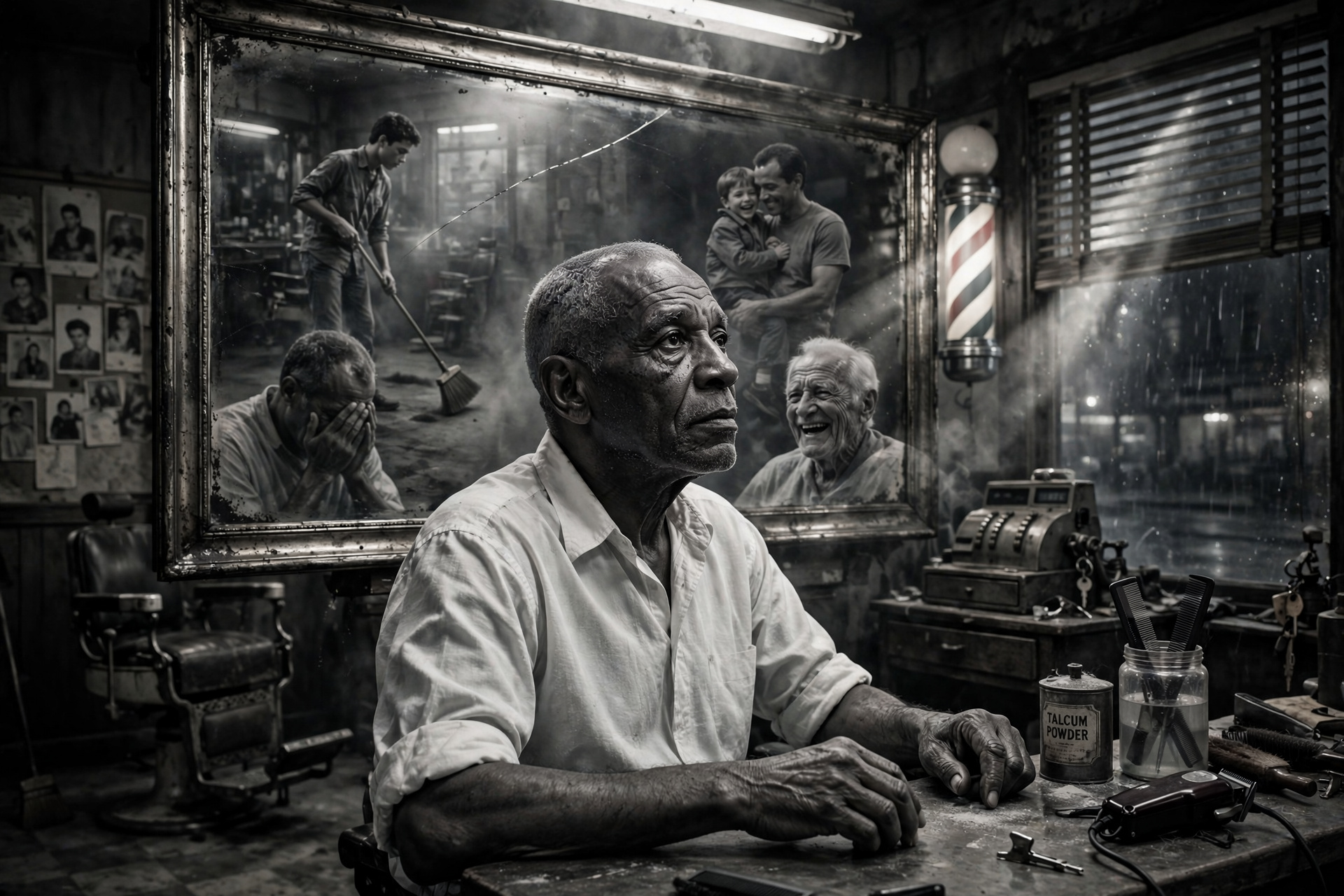
Leon Mercer had been cutting hair long enough to know that men lied most comfortably while looking directly at themselves. They lied about their wives, their drinking, their money, their children, the doctor appointments they had no intention of keeping, and the women they absolutely were not seeing despite arriving on Thursday afternoon smelling like somebody else’s expensive soap. Leon never challenged them because contradiction was bad for business and, besides, a barber’s chair occupied roughly the same social territory as a confessional, except the barber had clippers, charged less, and generally knew when to keep his mouth shut.
For fifty-one years, Leon had stood behind one chair or another inside Mercer & Son Barbershop, although the Son on the painted window had become something of a historical artifact after his father died. Leon had never changed it. Customers occasionally asked why, particularly younger men who believed every business required branding, optimization, social media, and some poor bastard dancing on the internet to convince strangers to purchase things they already needed. Leon would point toward the photograph of his father hanging beside the register and tell them the son was still working.
That usually shut them up.
The shop smelled the way barbershops were supposed to smell, which Leon considered increasingly rare in a world determined to make everything smell like eucalyptus. There was talc, aftershave, clipper oil, coffee that had been sitting on the burner approximately twenty minutes longer than any merciful God intended, and beneath everything the warm human smell of men who came through the door carrying weather on their coats and whatever troubles they hadn’t managed to leave outside. Hair accumulated beneath the chairs in soft crescents throughout the day, gray mixing with black, brown, blond, and the occasional blue or green experiment that caused Leon to reconsider civilization before remembering civilization had survived bell-bottoms.
The mirror had been there longer than he had.
It stretched nearly the entire length of the wall behind the chairs, heavy silvered glass inside a dark wooden frame his father claimed had come from a hotel demolished sometime after the war. The silver had begun surrendering around the edges years ago, leaving little black constellations beneath the surface, and a thin crack climbed from the lower-right corner like a river searching for somewhere to go. Leon had considered replacing it exactly once. His father had stared at him until the idea died of embarrassment.
Now Leon was seventy, and everybody had apparently decided this constituted an emergency.
His daughter Camille had started it by mentioning retirement over Sunday dinner, employing the careful voice children used when they were about to explain life to the people responsible for theirs. His son Marcus joined the conspiracy shortly afterward, suggesting Leon could sell the building while property values were high, travel somewhere warm, sleep late, take up fishing, or discover one of the other activities apparently reserved for men whose alarm clocks had been confiscated.
Leon listened until they finished.
Then he asked who planned to cut their hair.
Neither had found that funny.
The irritating part was that Leon had already been thinking about closing. His right knee had developed opinions concerning prolonged standing, and the knuckles of his cutting hand sometimes stiffened overnight until hot water persuaded them to cooperate. There were mornings when he sat in his Buick across the street watching sunlight crawl across the shop window and wondered whether he wanted to unlock the door or simply drive somewhere else. He had spent more than half a century measuring days in quarter inches, tapers, necklines, conversations and the rhythmic opening and closing of scissors, and lately the future seemed less like an open road than a hallway whose lights were being switched off behind him.
On the first Monday in October, Leon placed a handwritten sign beside the register.
CLOSING DECEMBER 31.
He stared at it for several minutes before opening the shop.
By lunchtime, three customers had complained, two had accused him of betrayal, one had offered to buy the barber pole, and Mr. Henderson, who was eighty-six and had been coming to Mercer & Son since Leon’s father ran the place, announced that Leon was far too young to retire.
“You’re sixteen years older than me,” Leon reminded him.
“That ain’t the point.”
Leon decided this was the problem with getting old. Nobody could agree when you had actually accomplished it.
The mirror began misbehaving three nights later.
Leon had locked the front door, turned the sign to CLOSED and swept beneath the second chair when he glanced up and saw a seventeen-year-old boy staring back at him.
The broom stopped.
The boy was thin, narrow-shouldered and offensively blessed with hair. He wore a white T-shirt beneath an unbuttoned work shirt, and a battered push broom rested in his hands. Behind him was the same barbershop, although the walls were lighter, the chairs newer, and the calendar beside the register advertised 1973.
Leon stared.
The boy stared.
Leon stepped closer.
The boy did the same.
“Well, I’ll be damned.”
Seventeen-year-old Leon mouthed the words perfectly.
Leon raised one hand and touched his face, feeling the loose skin beneath his eyes and the coarse gray along his jaw while the boy in the mirror touched smooth brown skin untouched by seventy years of gravity, weather, disappointment and fried food.
Then the bell above the front door jingled.
Leon spun around.
Nobody was there.
When he looked back, the mirror contained an old barber standing alone with a broom.
Leon went home.
He told no one.
At seventy, a man learned there were experiences better examined privately before giving his children ammunition.
Three evenings later, the mirror showed him at thirty-two.
He was standing behind Chair One cutting the hair of a boy Leon recognized immediately as Marcus at nine years old. Young Marcus was talking with both hands, which he still did whenever he became excited, while thirty-two-year-old Leon kept turning his head toward the telephone on the counter. Leon remembered the afternoon. A customer had called wanting a last-minute appointment, and Leon had rushed his son’s haircut because money was tight and every dollar mattered.
That was how he remembered it.
The mirror remembered more.
Marcus had been telling him about a school play.
Leon watched his younger self nod without listening.
The boy explained that he had gotten the part he wanted, and his father said, “Hold still,” before turning again toward the telephone.
Present-day Leon felt something uncomfortable settle beneath his ribs.
“I went to that play.”
The mirror offered no defense.
“I was there.”
Thirty-two-year-old Leon continued cutting.
“I worked my ass off for those kids.”
The reflection remained silent because mirrors had apparently perfected the art of winning arguments by refusing to participate.
Leon left angry.
The following morning he discovered himself looking forward to closing time.
The mirror showed him forty-five, standing in the back room with his forehead against the wall after learning his father had cancer. Leon remembered himself handling that period well. He had told the family they would get through it, drove his father to treatments, kept the shop running and never allowed anybody to see him frightened.
The mirror showed him trembling.
Not dramatically. There had been no collapse, no great masculine howl against the injustice of mortality. Forty-five-year-old Leon simply stood with both palms against the wall while his shoulders shook, quietly and helplessly, for perhaps thirty seconds before he washed his face and returned to the shop.
Leon watched until the memory ended.
“Huh.”
He had forgotten that.
Somehow he had spent twenty-five years remembering courage and edited out the fear required to produce it.
After that, Leon stopped resisting.
He began arriving early and staying late, not because he expected the mirror to perform but because he had become curious about which version of himself might wander out of the silver next. Some nights nothing happened. He would stand there feeling ridiculous until his coffee went cold and eventually tell the mirror to kiss his ass before turning off the lights.
Other nights it opened him like a file cabinet.
He saw himself at twenty-six lying to his wife about why he had come home late and discovered, with considerable irritation, that the lie had been even less convincing than he remembered. He watched himself at fifty-three quietly paying for a customer’s haircut because the man had lost his job and was interviewing the next morning. He had forgotten doing that entirely. He saw an argument with Camille that he had preserved for years as evidence of his daughter’s unreasonable temper and discovered within approximately forty seconds that Camille had been reasonable, articulate and mostly correct.
Leon folded his arms.
“Well, shit.”
The mirror seemed pleased with itself.
He began laughing.
There was something profoundly liberating about discovering how unreliable his personal mythology had become. For seventy years Leon had been editing the story of Leon Mercer, cutting around embarrassing scenes, improving dialogue, adjusting motives and occasionally promoting himself from supporting asshole to misunderstood hero. The mirror restored the deleted footage.
Sometimes he wept.
Sometimes he gulped hard enough to hurt.
More often than he expected, he laughed.
The mirror showed him kindnesses he had forgotten and cruelties he had minimized, fears he had renamed caution and acts of courage he had dismissed as necessity. It showed him the young husband who believed paying bills was the same thing as being emotionally present and the middle-aged father who could listen patiently to a stranger describe a failing marriage while somehow missing the silence in his own house. It showed him apologizing when he remembered refusing to apologize, remaining silent when he remembered saying exactly the right thing, and occasionally doing something so unexpectedly decent that Leon found himself wondering who the hell that fellow had been.
There was no pattern he could discern, which eventually became the point.
The mirror wasn’t interested in punishment.
It was interested in accuracy.
Then, on a rainy Thursday evening in November, it showed him the future.
Leon had finished cleaning his clippers and was reaching for his coat when movement in the glass caught his attention. The shop reflected there was not the shop surrounding him. The walls had been repainted. The old fluorescent fixtures were gone. Three younger barbers moved between chairs while music played from somewhere Leon couldn’t see, and the place was crowded enough that two customers waited near the door.
In Chair One sat an old man.
Leon moved closer.
The man must have been ninety, perhaps older, his body narrower, shoulders slightly bent, scalp almost completely bald except for a stubborn white fringe above his ears. Deep lines crossed his face, and his hands rested upon the arms of the chair with the comfortable stillness of someone who had finally stopped needing to prove those hands could work.
Leon recognized himself.
Future Leon was laughing.
Not politely. The old fool had his head thrown back and his mouth open while a young barber stood behind him laughing too. Someone outside the reflection said something Leon couldn’t hear, and the entire shop erupted.
Leon touched the glass.
The vision disappeared.
For several days he thought about what it meant, which was unusual because Leon generally preferred conclusions that arrived promptly and behaved themselves. He assumed at first that the mirror was telling him not to retire, but that interpretation became increasingly stupid the longer he considered it. The old man in the chair wasn’t working.
He was simply there.
Leon looked at the closing sign beside the register.
Perhaps leaving the chair did not require leaving the room.
That realization should have satisfied him.
Instead, another question arrived.
Late one evening, with rain ticking softly against the front window and the neighborhood reduced to blurred headlights beyond the glass, Leon stood before the mirror and thought about his father.
“Show me Pops.”
Nothing happened.
Leon waited.
“I’ve seen enough of me.”
The mirror returned a seventy-year-old barber standing beneath tired fluorescent lights.
“Come on.”
Nothing.
Leon felt foolish and then angry for feeling foolish.
“You showed me everything else.”
Still nothing.
He placed both hands on the counter and stared into his own face.
Then something his father had said forty years earlier returned to him, not as words exactly, but as a sensation: his father’s hand resting briefly against the back of Leon’s neck after he had finished his first flawless taper. Leon had spent much of his life believing his father had never said he was proud of him.
Maybe he hadn’t.
Maybe Leon had simply spent too much time waiting for the sentence and not enough noticing everything surrounding it.
He looked again at the mirror.
Seventeen.
Thirty-two.
Forty-five.
Seventy.
Ninety.
His father had stood behind this same chair and watched every version beginning to form. The arrogant boy who wanted something bigger than the barbershop, the young husband pretending he understood marriage, the frightened father pretending he understood fatherhood, the middle-aged son learning that parents could die, and the old man beginning to mistake fatigue for completion.
Leon lowered his head.
The laugh came first, small and broken around the edges, followed by tears he made absolutely no effort to stop.
There wasn’t any use pretending anymore.
He was old enough to know better and too old to give a damn.
The surprising part was how good that felt.
For most of his life, Leon had assumed truth was something a person endured, a bitter medicine swallowed because adulthood demanded it. Nobody had bothered telling him that truth could also be funny, that seeing yourself clearly might reveal not some hidden monster but an ordinary fool who had occasionally been magnificent, frequently been ridiculous, sometimes been selfish, sometimes been generous, and somehow remained himself through every contradiction.
The stories Leon had told about himself were not lies exactly.
They were simply edited.
He had removed the scenes that complicated the plot.
The mirror put them back.
On December thirty-first, Leon removed the closing sign.
He replaced it with another.
UNDER NEW MANAGEMENT — JANUARY 2.
He sold the business to Darius Cole, who had worked the third chair for eleven years and complained that Leon’s asking price was suspiciously reasonable. Leon kept the building, retained a key, and informed Darius that he would probably come around on Tuesdays.
“Why Tuesdays?” Darius asked.
“None of your damn business.”
On January second, Leon arrived at nine-thirty carrying coffee.
Darius looked at the clock.
“You’re late.”
“I don’t work here.”
“Then why are you behind my counter?”
Leon considered this.
“Your coffee is terrible.”
“You made it.”
“That ain’t the point.”
Darius laughed and returned to his customer.
Leon wandered toward the old mirror.
For weeks it had shown him everything except the man standing immediately before it, but now the glass offered nothing unusual. There was no seventeen-year-old boy sweeping badly, no frightened forty-five-year-old hiding in the back room, no ninety-year-old laughing from a future that might never arrive.
There was only Leon Mercer.
Seventy years old.
Gray hair.
Wrinkled face.
Tired eyes.
Bad knee.
Barber’s hands.
A little heavier around the middle than he preferred, although at this stage of negotiations gravity appeared unwilling to compromise.
Leon waited.
The reflection waited.
He leaned closer.
Nothing changed.
For the first time since the mirror began telling the truth, Leon realized he didn’t need it to show him anything.
He knew the man in the glass.
Not completely, perhaps. A human life was too contradictory for that kind of certainty, and Leon had finally developed enough respect for truth to stop demanding simplicity from it. There were still stories he had told incorrectly, apologies he owed, kindnesses he had forgotten, failures he had exaggerated and victories he had polished until they gleamed brighter than they deserved.
Fine.
They belonged to him too.
Leon studied himself for another moment before a smile worked its way across his face.
Dispatches from the Splinters of My Mind — Entry #34
I started walking because there wasn’t anything else to do with myself.
That’s not entirely true. There were dishes in the sink, unopened boxes stacked against the bedroom wall, messages on my phone from people who had gradually stopped asking whether I was all right and started asking whether I was alive. There were forms from the unemployment office, a refrigerator containing mustard, half a carton of eggs, and something in a plastic container I had stopped trusting several days earlier. There were books I could have read, television I could have watched, sleep I could have attempted. There were plenty of things to do.
There just wasn’t anything I wanted to do.
That distinction had become important.
Somewhere during the previous eighteen months, my life had changed from something I participated in to something I maintained. Wake. Shower. Coffee. Applications. Groceries. Bills. Phone calls returned three days late. Laundry when underwear became a logistical concern. Eat because the body apparently insists upon being consulted. Sleep badly. Repeat.
Nothing catastrophic had happened, which somehow made explaining it worse.
Mara left in February. My father died in April. The company eliminated my department in June after seventeen years and thanked me for my service with a cardboard box and a packet explaining COBRA. In August, my oldest friend stopped calling after I canceled dinner for the fourth time. By October, I had moved into an apartment where the previous tenant’s furniture marks remained pressed into the carpet like fossils.
None of those things destroyed me.
That’s what people misunderstand about disappearing.
You don’t always vanish in an explosion. Sometimes you leave yourself the way a shoreline disappears beneath the tide—an inch here, another there, nothing dramatic enough to photograph until somebody notices the house is standing in water.
So I walked.
At first, I called it exercise.
Then stress management.
Then something to help me sleep.
Eventually I stopped lying.
I walked because every night around eleven, my apartment became too quiet to tolerate.
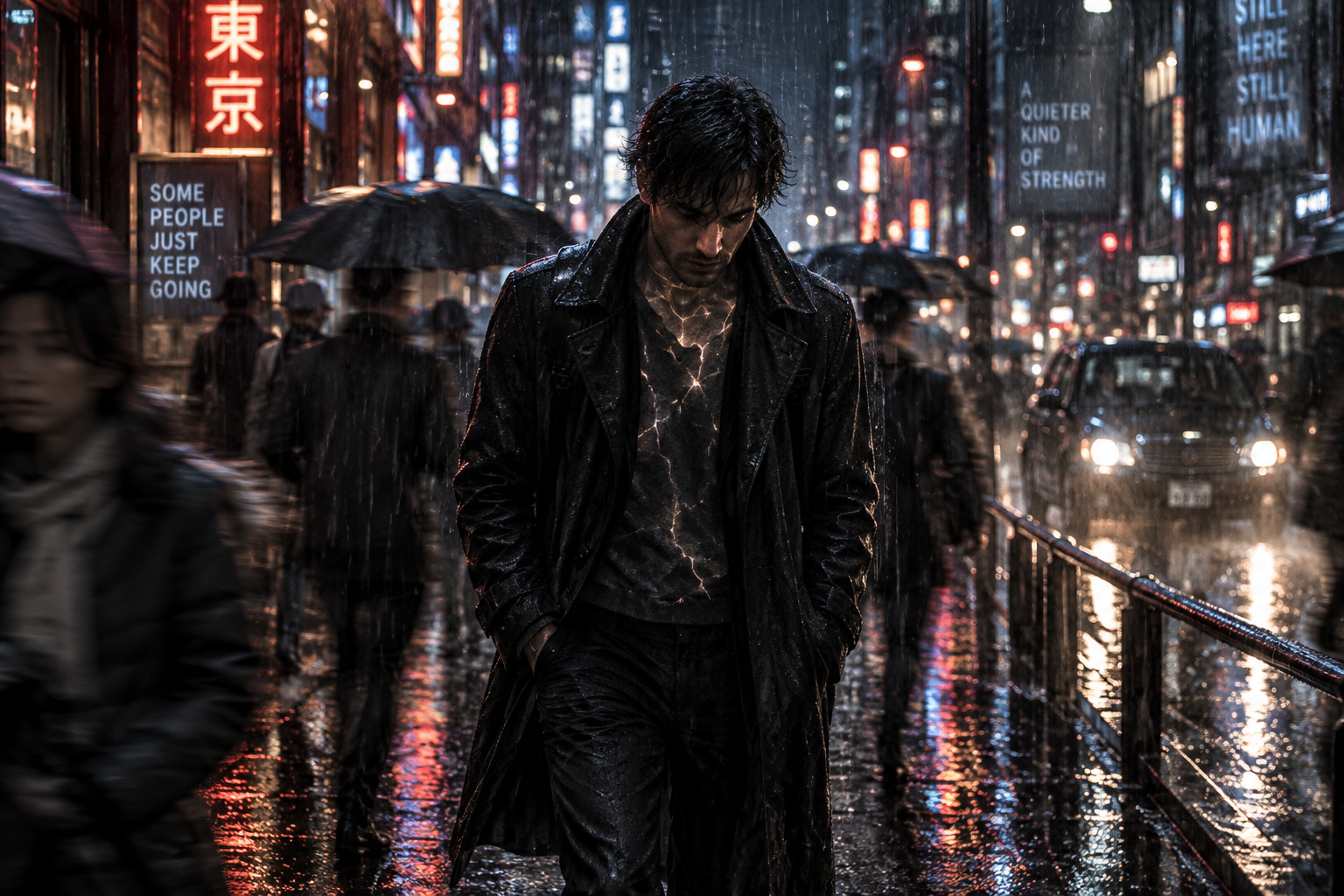
The city was better in the rain.
Rain removed obligation from things. Nobody expected conversation beneath an umbrella. Nobody wondered why you were alone. Everyone walked with purpose even when they had none, shoulders hunched, heads lowered, moving between islands of fluorescent light while tires whispered across black pavement.
I liked becoming anonymous among them.
On dry nights, people had faces. In rain, they became coats and umbrellas, reflections sliding across shop windows, bodies briefly illuminated by headlights before disappearing again.
The first time I saw myself, I was crossing Ninth Street.
He stood on the opposite corner beneath the red glow of a pharmacy sign, hands inside the pockets of a black coat.
My coat.
Not the one I was wearing.
The old one.
Leather, knee-length, ridiculous in retrospect, although at twenty-eight I had believed it made me look dangerous.
The man wearing it looked twenty-eight.
The light changed.
People moved between us.
Someone bumped my shoulder and muttered something.
When the crowd cleared, he was gone.
I stood in the crosswalk until a taxi leaned on its horn.
I told myself resemblance.
Cities manufacture doubles. Give enough strangers similar haircuts and winter coats and eventually somebody will look enough like you to ruin an evening.
I went home.
The next night, I walked the same route.
I didn’t see him.
The night after that, I did.
This version was older.
Thirty-five, maybe thirty-six.
He sat inside a restaurant beside a woman whose face I couldn’t see, laughing so hard his head tilted backward.
I knew that laugh.
Mine before I learned to ration it.
I stopped outside the window.
Rain ran down the glass between us, bending his face.
The woman reached across the table and touched his hand.
He turned.
Saw me.
The laughter disappeared.
For several seconds we stared at each other through the window.
Then a bus passed.
When it cleared, the table was empty.
Not abandoned.
Empty.
No plates.
No glasses.
No woman.
A waiter wiped the spotless surface with a white cloth.
I walked home faster than usual.
The following night, I took a different street.
He was waiting there too.
After that, I began seeing versions of myself everywhere.
One boarded a train as I reached the platform. Another climbed into the back of a taxi. I saw a gray-haired version smoking outside a hotel and a younger one standing beneath an awning kissing somebody whose face disappeared behind an umbrella.
They were never exactly where I could reach them.
Twenty yards.
Half a block.
The opposite platform.
Across four lanes of traffic.
Close enough to recognize.
Far enough to doubt.
I began walking farther.
The city began answering.
At least, that’s what I thought.
The first sign appeared beside a bus shelter.
SOME PEOPLE JUST KEEP GOING.
Advertising, probably.
I couldn’t remember what it was selling.
Three blocks later:
STILL HERE. STILL HUMAN.
I stopped beneath it.
The rain ticked against the metal frame overhead.
“Fuck you,” I said.
A woman waiting for the bus moved several feet away.
Fair enough.
The next evening another billboard read:
A QUIETER KIND OF STRENGTH.
I laughed.
“You’re laying it on a little thick.”
Nobody answered.
Two nights later, the messages changed.
YOU USED TO TURN LEFT HERE.
I stopped.
The sign hung above a closed electronics store.
I had turned left there.
Years ago.
There had been a bar on Jefferson called Milo’s. My friend David and I went every Thursday after work, back when Thursday meant something besides the day before Friday.
I turned left.
Milo’s was gone.
A laundromat occupied the space.
But through its fogged windows, for perhaps three seconds, I saw bar stools.
Pool table.
David waving from the back.
Then somebody opened the laundromat door and warm detergent-scented air rolled across the sidewalk.
Rows of washing machines.
No David.
The next sign said:
YOU DON’T LIKE WHAT’S DOWN THAT STREET.
I went anyway.
Apparently I had retained at least one recognizable personality trait.
The street narrowed.
Neon thinned.
Traffic became distant.
Halfway down the block, a man stood beneath the awning of a closed tailor shop smoking a cigarette.
Black leather coat.
Twenty-eight.
Me.
I stopped.
He looked up.
“You took your time.”
His voice was mine, except younger, carrying an arrogance I’d forgotten possessing.
“Are you me?”
He smiled.
“I used to be.”
I moved closer.
Up close, the differences hurt.
No lines around the eyes. More hair. Shoulders held differently. He inhabited his body as though he’d never considered apologizing for occupying space.
I hated him immediately.
I envied him even faster.
“I’ve been looking for you.”
“Yeah.”
“Why?”
He took a drag.
“Because you think I know where you went.”
Rain drummed against the awning.
“I want my life back.”
He laughed.
Not cruelly.
That somehow irritated me more.
“Which one?”
“The one before all this.”
“Before Mara?”
“Before everything.”
“Your father?”
I said nothing.
“The job?”
Nothing.
“David?”
“Shut up.”
He flicked ash into the gutter.
“You keep talking about losing yourself like I was something worth preserving.”
That landed harder than I expected.
“I was happy.”
“No. You were busy.”
“I had a life.”
“You had momentum. That’s not the same thing.”
I wanted to hit him.
He seemed to know.
“You want me back because you remember me selectively. You remember the coat. The job. The friends. You don’t remember how scared I was all the goddamn time.”
“I wasn’t scared.”
He smiled.
“See?”
A taxi passed, throwing water across the curb.
I turned away.
When I looked back, the awning was empty.
Only a cigarette remained in the gutter, hissing in the rain.
I kept walking.
Not because I expected answers anymore.
Because stopping felt worse.
I met others.
Forty-two stood inside a convenience store staring at lottery tickets.
Fifty sat alone on a bench feeding pieces of bread to pigeons despite a sign prohibiting it.
Thirty-one walked past holding Mara’s hand.
She looked happy.
I didn’t follow them.
The version from the week after my father’s funeral sat on the steps of a church.
I recognized him immediately.
Same shirt I’d worn for three days.
Same beard.
Same vacant expression people mistake for strength when a man doesn’t cry where they can see him.
I sat beside him.
For a while neither of us spoke.
Finally I asked, “Are you the one?”
He shook his head.
“Who am I looking for?”
He pointed down the street.
Of course he did.
Apparently every version of me was committed to being cryptic.
I stood.
Before leaving, I looked back.
“Does it get easier?”
He stared at the rain.
“I wouldn’t know.”
I understood.
He hadn’t survived it yet.
I left him there.
The city grew quieter as I walked.
Storefronts darkened. Traffic disappeared. Even the rain softened until individual drops became audible against my coat.
The signs continued.
NOT THIS ONE.
KEEP WALKING.
YOU ALREADY PASSED HIM.
Then:
STOP LOOKING BACK.
I did.
Nobody.
When I faced forward again, someone stood at the end of the block.
Hello, I’m Mangus Khan, and for the next few minutes, I encourage you to walk into Madness with me.
Come on in, Brave Souls.
Watch where you step.
There’s a ten-millimeter socket around here somewhere, which means we’ll probably find Jimmy Hoffa, Amelia Earhart, and evidence of intelligent life in Congress before we find that little bastard.
The shop smells like work.
Not the sanitized version sold in commercials where some suspiciously clean mechanic smiles while holding a wrench that has obviously never touched an engine. I mean actual work—the metallic tang of old tools, gasoline evaporating from something it probably shouldn’t be evaporating from, penetrating oil, hot dust, burned grease, and that peculiar sweetness of antifreeze lingering beneath everything else.
There’s grime beneath my fingernails that soap has already filed paperwork against.
Metal shavings glitter across the workbench beneath a hanging lamp whose shade is stained with decades of fingerprints. Wrenches lie scattered among sockets, extensions, screwdrivers, oily shop towels, coffee cans filled with bolts nobody remembers removing, and several mysterious pieces of hardware everyone has collectively agreed were probably unnecessary.
At least, that’s what we’re telling ourselves.
Somewhere against the wall, an old radio wheezes through a speaker that has probably needed replacing since Reagan was president. The music comes and goes beneath the occasional clatter of metal settling against metal.
The engine is open on the bench.
Head removed.
Pistons exposed.
Everything normally hidden beneath steel, plastic, hoses, wires, and the comforting illusion that everything is fine now sits naked beneath the light.
Funny thing about machines.
They look considerably less impressive once you open them up.
So do people.
From the outside, an engine is simply an engine. Turn the key. It starts. Press the accelerator. It moves. Nobody thinks about compression ratios, oil pressure, bearings, timing, fuel mixture, cooling systems, or the thousands of tiny explosions happening a few feet in front of us.
We just expect the motherfucker to work.
Preferably with air conditioning.
People receive roughly the same consideration.
We rarely think about what keeps someone functioning while they’re functioning.
We see the result.
They showed up.
Answered the phone.
Went to work.
Paid the bill.
Cooked dinner.
Made the deadline.
Laughed at the joke.
Asked how everybody else was doing.
Good.
Everything must be fine.
Then something starts knocking.
Ticking.
Grinding.
Maybe there’s a vibration that wasn’t there yesterday.
And suddenly we’re listening.
That’s human nature, I suppose.
We rarely appreciate the machinery while it works.
We notice it when it stops.
Engines.
Plumbing.
Electricity.
Relationships.
Bodies.
People.
Especially people.
That’s the part I’ve been thinking about.
We live in a disposable age.
Something breaks?
Replace it.
Phone gets slow?
Replace it.
Television develops a line across the screen?
Replace it.
Coffee maker starts making a noise suspiciously similar to demonic possession?
Replace the bastard before it starts speaking Latin.
Repair has become inconvenient.
Worse, it has become economically suspicious.
Things aren’t always designed to be repaired anymore. They’re designed to be upgraded, traded, replaced, discarded, forgotten.
Somewhere along the way, new became synonymous with better, and old became something requiring justification.
We stopped asking:
Can this be fixed?
and started asking:
How much is a new one?
Sometimes that’s practical.
There comes a point when repairing something costs more than replacing it. Anybody who has kept an old car alive knows that particular mathematics. Eventually you’ve replaced the starter, alternator, radiator, water pump, fuel pump, half the suspension, three sensors you didn’t know existed, and something the mechanic described only as that damn thing behind the other damn thing.
At some point, you’re forced to admit you’re no longer maintaining a vehicle.
You’re financing an archaeological dig.
Fair enough.
But we’ve allowed that thinking to migrate from things into people.
Someone struggles longer than our patience permits.
Too much baggage.
Someone changes.
We don’t recognize them anymore.
Next.
We have developed an entire vocabulary for throwing human beings away and occasionally calling it personal growth.
Now, before somebody starts warming up their keyboard—
Sometimes walking away is absolutely necessary.
Not every relationship should be repaired.
Some things are toxic.
Some things are dangerous.
Some things are destructive.
Some people will drain every ounce of kindness you possess, complain that the glass wasn’t full enough, then ask what you’re doing for them tomorrow.
There are relationships that have cracked beyond anything glue, prayer, therapy, duct tape, patience, forgiveness, or sheer stubbornness should be expected to hold together.
Knowing when to leave is wisdom.
But knowing when to stay?
Knowing when something is damaged rather than dead?
That’s becoming a rarer skill.
The wrench turns.
Metal groans against metal.
A bolt that hasn’t moved in twenty years refuses the first attempt.
Then the second.
I lean into it.
Nothing.
There is a moment familiar to anyone who has worked on old machinery when you begin negotiating with God despite not remembering inviting Him into the garage.
Then—
crack.
The bolt moves.
About an eighth of an inch.
There.
Progress.
Not dramatic.
Nobody applauds.
No inspirational soundtrack begins playing.
No motivational speaker wanders into the shop to explain that the bolt moved because I believed in myself.
It moved because I soaked the stubborn son of a bitch in penetrating oil and leaned on a breaker bar.
Sometimes progress isn’t spiritual.
Sometimes you need leverage.
Maybe that’s what repair actually looks like.
Small.
Dirty.
Slow.
Unimpressive.
You don’t rebuild an engine by standing across the garage shouting positive affirmations at it.
You are worthy, Chevrolet.
No.
You tear the bastard apart.
And that’s the part nobody puts on the poster.
Before rebuilding comes disassembly.
You remove things.
Label things.
Inspect things.
Clean away years of grime so you can see what you’re actually dealing with.
Sometimes the damage isn’t where you thought it was.
The noise came from here.
The failure began over there.
The thing that finally stopped working wasn’t the thing that started the problem.
Human beings aren’t terribly different.
We spend enormous amounts of time repairing symptoms because symptoms are visible.
We’re tired, so we drink more coffee.
We’re lonely, so we scroll.
We’re angry, so we find somebody convenient to blame.
We’re overwhelmed, so naturally we add more shit to the schedule.
We’re unhappy, so we buy something.
We’re hurting, so we tell everybody we’re fine.
Dashboard light comes on?
Piece of electrical tape over that son of a bitch.
Problem solved.
Except the engine still knows.
That’s the part we forget.
You can hide a warning without repairing the damage.
I’ve done that.
More times than I care to count.
I suspect most of us have.
There’s a strange pride attached to endurance. We admire people who keep going.
He’s strong.
She’s a fighter.
Look at everything they’ve been through.
And there is truth in that.
Endurance matters.
Sometimes getting through the day is an act of courage nobody else will ever see.
But there is a darker side to our worship of resilience.
Sometimes we celebrate people for surviving conditions they should never have been expected to endure.
Sometimes strong becomes the word everybody uses when they don’t want to ask whether you need help.
And sometimes you begin believing your usefulness depends upon your ability to keep functioning.
That one is dangerous.
Because people become extraordinarily skilled at functioning while damaged.
They still go to work.
Still laugh.
Still answer the phone.
Still take care of everybody else.
Still make dinner.
Still pay bills.
Still say:
I’m good.
The engine continues running.
Maybe there’s a knock.
Maybe it’s burning oil.
Maybe compression is down in one cylinder.
Maybe something inside is operating under far more strain than anybody realizes.
But it runs.
So everybody assumes it’s fine.
Including the person operating it.
Especially the person operating it.
I’ve wondered how many times in my life I’ve done exactly that.
Kept moving because movement looked enough like health to fool everybody.
Maybe even myself.
There have been times when stopping seemed more frightening than continuing.
Because stopping meant listening.
And listening meant hearing the knock.
So you stay busy.
Work becomes useful that way.
Schedules.
Deadlines.
Projects.
Other people’s problems.
Anything capable of making enough noise that you don’t have to hear your own machinery.
There is pride in endurance.
There is also stupidity.
I’ve practiced both.
Sometimes stopping feels like failure.
Opening the hood feels like admitting something is wrong.
And once you start taking things apart, there’s always that frightening possibility you’ll discover the damage is worse than you thought.
So we keep driving.
Turn the radio louder.
Ignore the vibration.
Tell ourselves it’ll probably make it.
Probably.
Human beings have built entire lives around that word.
Eventually, though, something forces the hood open.
Loss.
Age.
Failure.
A relationship ending.
A friendship changing.
Children growing up.
Parents growing old.
The empty chair.
The phone call that divides life into before and after.
Or maybe nothing dramatic happens.
Sometimes it’s just a quiet room.
A sleepless night.
Three seventeen in the morning.
The refrigerator humming somewhere down the hall while the entire world appears to have gone silent except for whatever you’ve been refusing to think about.
That’s when you hear it.
The knock.
Not from the engine.
From somewhere deeper.
And suddenly there you are.
Parts scattered across the workbench.
Everything exposed beneath a harsh light.
That’s an uncomfortable place to be.
Because now you can see what you’ve been carrying.
Old damage.
Improvised repairs.
Things held together far longer than they should have been.
Old grief packed beneath new responsibilities.
Anger covering fear.
Humor covering pain.
Work covering loneliness.
Pride covering exhaustion.
Maybe even scars from something you had forgotten was broken.
The instinct is judgment.
How did I let it get this bad?
I’ve never found that question particularly useful.
A mechanic doesn’t insult an engine back into working order.
Well…
Not exclusively.
There is usually some profanity involved.
But eventually the questions have to become simpler.
What’s wrong?
Then:
What caused it?
Then:
What can be repaired?
And finally, the one nobody likes:
What can’t?
That’s where the real work begins.
Because repair doesn’t always mean restoration.
That’s another lie we tell ourselves.
We want repaired things to become what they were before.
We talk about getting our old selves back.
Getting back to normal.
Going back to the way things were.
Sometimes you can’t.
Sometimes you shouldn’t.
A rebuilt engine isn’t untouched.
It has history.
Parts have been replaced.
Surfaces machined.
Tolerances changed.
Old weaknesses discovered.
New pieces installed beside old ones.
Maybe it runs differently afterward.
Maybe better.
Maybe not.
Maybe simply differently.
People are like that too.
Healing doesn’t return us to factory settings.
There are no factory settings.
Whatever happened, happened.
Grief changes the architecture.
Love changes it.
War changes it.
Parenthood.
Failure.
Success.
Betrayal.
Forgiveness.
Time.
The person who comes out the other side isn’t the person who went in.
Mara knocked three times, softly enough that I could have pretended not to hear her, which I suspect was intentional.
“Elias?”
I looked toward the door without answering. Whoever had designed Ward C had apparently believed privacy was something mentally unstable people might misuse, so the doors never quite closed. Mine remained open by three inches, leaving a narrow strip through which I could see the opposite wall, part of the nurses’ station, and occasionally somebody wandering past in hospital socks while carrying on a conversation with God.
Mara remained just outside my line of sight.
“Elias, may I come in?”
I took another drag from my cigarette and considered the question with considerably more seriousness than it deserved. The cigarette itself was already a violation of at least four rules, although nobody had bothered confiscating them since Tuesday. Either security had become remarkably incompetent or somebody had decided lung cancer was sufficiently far down the list of things likely to kill me that enforcement seemed petty.
Coffee presented the larger problem.
I hadn’t had any in four days.
A man deprived of caffeine for ninety-six hours should not be expected to make decisions involving women, strangers, suspicious knocks, or reality.
“Depends,” I said.
“On what?”
“Whether you’re real.”
There was silence from the hallway.
Then she laughed.
Not loudly. Just enough.
“I was wondering the same thing about you.”
That seemed fair.
“Come in.”
The door opened.
And there she was.
Three days earlier I had watched Mara Bell standing barefoot on a cafeteria table screaming that somebody had stolen Thursday. Two orderlies had eventually talked her down, although talked is generous considering one of them had tackled her around the waist while she attempted to bite the other.
Yesterday she had shuffled past me wearing institutional blue, her hair looking as though it had spent the night negotiating with electricity.
Tonight she looked like murder had dressed for dinner.
Black dress. Dark stockings. Pearl earrings. Gloves. A wide-brimmed hat tilted low enough that her eyes disappeared beneath it, leaving only the sculpted geography of cheekbones, nose, and mouth exposed whenever the light found her. A cigarette rested between her lips, unlit.
I stared.
She waited.
I continued staring.
“You’re supposed to say something, Elias.”
“I’m trying to decide whether asking where you got the clothes would ruin the moment.”
“It would.”
“Then you look lovely.”
“That will do.”
She entered with the slow confidence of a woman walking into a room she already owned and stopped beside the window. Moonlight leaked through the blinds and broke itself across her face in narrow silver bars.
She removed the cigarette from her lips.
“You have a light?”
“Apparently.”
I crossed the room and struck a match.
For a moment neither of us moved.
The flame trembled between us.
Mara leaned toward it until the cigarette caught, and somewhere in that tiny ceremony something shifted. Perhaps it was the hat. Perhaps the perfume I hadn’t noticed until then, something faintly floral struggling beneath antiseptic and cigarette smoke. Perhaps four days without coffee had finally caused permanent neurological damage.
Whatever the reason, I stopped seeing the woman from the cafeteria.
I saw Mara.
She inhaled deeply and leaned against the windowsill.
“Thank you.”
“You’re welcome.”
She looked around my room.
“You live like an animal.”
“I’ve been here eleven days.”
“Twelve.”
That stopped me.
“You’ve been counting?”
She didn’t answer.
Instead, Mara examined the cigarette between her fingers as though she’d discovered something written in the ash.
“They’re coming tomorrow.”
There are sentences whose meaning depends entirely upon the person speaking them.
Had Nurse Franklin said it, they would probably have meant doctors.
Had Dr. Levin said it, they might have meant my family.
Coming from Mara, they could have meant the federal government, extraterrestrials, Jehovah’s Witnesses, or the Four Horsemen of the Apocalypse.
I decided not to guess.
“Who?”
“The zombies.”
There it was.
I lit another cigarette.
“Of course.”
“You don’t believe me.”
“I didn’t say that.”
“You thought it.”
“I think lots of things. Most of them aren’t admissible as evidence.”
For the first time since entering the room, her performance slipped.
Only slightly.
Her mouth tightened. Her shoulders dropped perhaps half an inch. Then something glittered beneath the shadow of her hat and traveled slowly down her cheek.
A tear.
She didn’t wipe it away.
That frightened me more than anything she’d said.
“Mara.”
“They aren’t dead people.”
I waited.
She smoked.
Outside my room, a cart squeaked along the corridor. Someone laughed somewhere farther down the ward. A telephone rang twice before being answered. Ordinary sounds. Hospital sounds.
Mara lowered her voice.
“That’s just what I call them.”
“Why?”
“Because there isn’t anything left inside them.”
Something cold moved through me.
She lifted her face enough that I could finally see her eyes.
“They smile. They talk. They remember your name. They ask whether you’re sleeping and whether the medicine is helping, and they write things down when you answer.”
I said nothing.
“Then they take pieces.”
“What pieces?”
“The ones that don’t fit.”
The cigarette burned between her fingers.
I wanted to dismiss it.
I desperately wanted to dismiss it.
There was only one problem.
I had been having the same dream for six nights.
Except I was beginning to suspect it wasn’t a dream.
Mara stepped closer.
“Elias, I need you to help me.”
There was perfume beneath the antiseptic again. Tobacco. Something warm and human. She was close enough that I could see the faint tremor at the corner of her mouth despite all that manufactured composure.
“With the zombies?”
She nodded.
I should have told her no.
I should have found Nurse Franklin. I should have reported the conversation, surrendered my cigarettes, requested whatever medication they gave people when reality started developing cracks around the edges.
Instead, I heard myself ask the question that would eventually ruin both our lives.
“What do you need me to do?”
Mara smiled.
Not seductively.
Not triumphantly.
Relieved.
And somehow that was worse.
“First,” she whispered, “you need to remember why you’re here.”
Then she walked out.
I remained beside the window long after her footsteps disappeared down the corridor, smoking until the cigarette burned close enough to my fingers to hurt.
On the opposite wall hung the calendar I’d been given when I arrived.
I looked at it.
September 26.
Then I looked again.
Because beneath today’s date, written in my own handwriting, were four words I had absolutely no memory of writing.
It is in the darkest places we sometimes find the truth. The question is whether we will accept what we find, or retreat behind the veil of denial. It is that decision that gives us pause.
And within that pause, we wonder whether we have the strength to console a soul still aching from the sting. We wonder whether we have the courage to move through what remains. Sometimes, there is no better name for it than the ache.
Yet amid struggle, we are at our most real. The masks become too heavy to carry. The lies we tell ourselves require more strength than we have left to maintain them. What remains is not always beautiful, and it is rarely comfortable, but it is ours.
But struggle does not always make us stronger. Sometimes it becomes a noose around the neck. Sometimes it becomes quicksand, and the harder we fight against it, the deeper we sink. There is no promise that suffering will teach us anything. Pain is not obligated to leave wisdom behind. Sometimes all it leaves is the ache.
The struggle does not decide what becomes of us. We do.
Perhaps that is the uncomfortable part. The same darkness that causes one person to reach for something buried deep within can convince another there is nothing worth reaching for. Struggle offers no guarantees. It merely brings us to the place where something must be decided.
And there we are again.
Within the pause.
Perhaps we needn’t worry so much about strength or courage. They have been beside us from the beginning, waiting to be called upon. Not guaranteeing what we will become. Not promising that we will emerge untouched. Simply waiting for us to decide what we will do with what remains.
For fifty-three years, Felix Gold had sold other people the news.
He had done it from the same green-painted newsstand on the corner of Mercer and Forty-Second, a narrow metal box wedged between a subway entrance and a building that had changed names so many times Felix had stopped bothering to remember what was written above the revolving doors. When he first opened the stand, newspapers arrived in bundles heavy enough to make his shoulders ache, tied with coarse twine that left red grooves across his fingers in winter. Men bought the morning edition on their way to work and returned for the midday paper because twelve hours was apparently too long to wait for the world to misbehave again. Cigarettes sat behind him in neat rows. Candy bars occupied the counter. Magazines hung from clips overhead, their glossy covers promising beautiful women, faster cars, political scandals, better marriages, and abdominal muscles Felix had never possessed and had managed to live quite happily without.
The city had changed around him while the newsstand remained stubbornly itself.
Buildings rose. Stores disappeared. A coffee shop became a bank, which became a pharmacy, which became an empty storefront with brown paper taped across its windows. Subway tokens vanished. Pay phones vanished. Men who once stopped every morning to complain about the Yankees eventually sent their sons, then their daughters, then nobody at all. People stopped carrying coins. Then cash. Then, increasingly, newspapers. They walked past Felix staring into glowing rectangles held inches from their faces, receiving the world’s disasters before he could cut the twine from the morning bundles.
Felix adapted where he could.
He sold bottled water.
Phone chargers.
Lottery tickets.
Cheap umbrellas that turned inside out whenever the wind developed an attitude.
He even learned how to use the little card reader his granddaughter installed beside the register, though he continued glaring suspiciously at it every time someone paid by tapping a telephone against the machine.
There were limits to progress.
At seventy-eight, Felix had begun discovering limits of another kind.
His knees announced rain before the meteorologists did. His right hand sometimes refused to close completely around a coffee cup until he’d worked the stiffness from his fingers. Carrying the newspaper bundles from the delivery truck had become an exercise in negotiation between pride and vertebrae, and lately the vertebrae had been winning. The six concrete steps from the subway platform felt steeper every evening. His apartment seemed farther from the station than it had ten years earlier, though Felix knew perfectly well the city hadn’t moved his building during the night simply to inconvenience him.
Still, each morning at five-thirty, he lifted the corrugated steel shutter.
The metal screamed along its track.
Felix understood the sentiment.
He brewed coffee on a hot plate older than some of his customers, arranged the papers, checked the lottery display, and settled onto his stool while the city woke around him in layers: garbage trucks grinding their way through intersections, buses exhaling at curbs, delivery carts rattling over pavement, horns beginning their daily arguments, the subway breathing warm metallic air through the stairwell beside him.
And every morning Felix told himself the same thing.
Maybe Christmas.
Christmas became spring.
Spring became his birthday.
His birthday became Labor Day.
There was always another reasonable date upon which a man could stop doing something he’d done for more than half a century.
The problem wasn’t money. Felix had enough, provided he didn’t suddenly develop expensive tastes or decide to buy a racehorse.
The problem was page six.
The first one appeared seventeen years earlier.
Felix remembered the date because Miriam had still been alive.
It had been a Tuesday in February, bitter enough that the wind sliced between buildings and found every opening in a man’s coat. Felix was flipping through the midday edition while eating pastrami on rye when he found a small article halfway down page six.
No headline.
No photograph.
Just four paragraphs describing a freighter trapped in ice somewhere north of Greenland.
Felix almost skipped it.
Then he read the name of the captain.
Samuel Gold.
His father.
Felix stared at the print until mustard slid from the sandwich onto his thumb.
Samuel Gold had never captained a ship. The man sold furniture in Queens and became seasick crossing the Hudson. He had been dead twenty-nine years.
Yet the article described him standing on the deck of the Mercy Bell beneath green northern lights while his crew searched for a passage through ice “older than human sorrow.”
Felix read it three times.
Then he laughed.
A printing error.
Some writer having fun.
Maybe another Samuel Gold.
He brought the paper home anyway.
Miriam read the article after dinner.
She didn’t laugh.
“Your father used to talk about Greenland,” she said.
Felix looked up.
“What?”
“When he was sick. Near the end. He kept saying he dreamed about a green sky.”
Felix felt something cold move beneath his ribs.
The next morning, he checked page six.
Nothing.
Two weeks later another appeared.
A woman named Celia Ramos discovered a staircase beneath her apartment building that descended seventeen floors farther than the building itself.
Three months later, a retired schoolteacher boarded a bus in Brooklyn and arrived in Prague twelve minutes later without crossing an ocean.
Then came the boy who found summer inside an abandoned refrigerator.
The widow whose dead husband telephoned every Thursday at 3:17 but never spoke.
The barber who discovered that one customer’s hair grew backward through time.
They were never more than a few paragraphs.
Never advertised on the front page.
Never mentioned in the table of contents.
Felix began checking other copies.
The stories weren’t there.
Only his.
He tried swapping newspapers before opening them. Tried taking the third copy from a bundle. The seventeenth. Once, feeling particularly clever, he asked a customer to choose one for him.
Page six waited.
He stopped trying to explain it.
Eventually, he stopped wanting an explanation.
The stories became part of his day.
His private adventure.
For seventeen years, Felix traveled farther sitting on a wooden stool inside a six-foot newsstand than most people traveled in a lifetime.
Then Miriam died.
Afterward, page six changed.
The stories became gentler.
A woman discovered that every snowfall contained one memory from someone she had loved.
An old man found his childhood dog waiting outside a grocery store forty years after burying him.
A widower heard his wife’s voice coming from an unplugged radio, complaining that he still hadn’t fixed the kitchen faucet.
Felix laughed so hard at that one he cried.
Miriam had complained about the same damned faucet.
He never told anyone about page six.
Some things became smaller when explained.
Some became ridiculous.
Some belonged only to the person fortunate enough to encounter them.
So Felix kept opening the stand.
Kept selling newspapers.
Kept climbing subway stairs on knees that increasingly objected to the arrangement.
Until Thursday.
The midday edition arrived at eleven-forty.
Felix waited until the lunch rush passed before pulling his copy from the stack. His fingers trembled slightly as he opened it, though whether from age or anticipation he couldn’t say.
Page six contained only one paragraph.
Felix read it.
Then read it again.
For the first time in seventeen years, he wished the page were blank.
After fifty-three years operating a newsstand at Mercer and Forty-Second, Felix Gold closed the steel shutter for the final time at 6:14 p.m. Thursday. He took the downtown train home, fell asleep between stations, and missed his stop.
That was all.
No explanation.
No adventure.
Felix checked the clock.
12:07.
For the rest of the afternoon, he considered leaving early.
At five, he nearly did.
At six, he stood inside the cramped newsstand listening to rain begin tapping against the metal roof. The familiar smells surrounded him: old paper, coffee burned down to tar, wet pavement, tobacco that hadn’t actually been sold there in years but somehow remained embedded in the walls.
At 6:13, Felix placed his hand on the shutter.
He could stay open.
One minute.
That was all it would take.
He almost laughed at himself.
Seventeen years of impossible stories and apparently Felix Gold had learned nothing except how quickly a man could become superstitious.
At 6:14, he pulled the shutter down.
The lock clicked.
The sound felt strangely final.
On the train, Felix chose his usual seat beside the door. Rainwater glistened on his coat. His feet hurt. His knees throbbed. The fluorescent lights hummed overhead while the carriage rocked through darkness with the familiar metallic rhythm he had heard thousands of times.
Felix rested his head against the wall.
Across from him, someone had abandoned a newspaper.
Midday edition.
He smiled.
“Of course.”
He reached for it.
Page six was blank.
Felix stared at the empty paper.
Then the train entered a tunnel.
The lights flickered.
Once.
Twice.
When they returned, Felix was no longer alone.
A woman sat across from him wearing the blue wool coat she had been buried in.
Her hair was pinned the way she wore it when they first met. Her hands rested patiently in her lap. She looked neither young nor old. She simply looked like Miriam, which was somehow more impossible than anything page six had ever shown him.
Felix couldn’t speak.
Miriam smiled.
“You missed your stop.”
His throat tightened.
“I know.”
“You always were stubborn.”
Felix looked toward the dark window. His reflection stared back at him: seventy-eight years, tired eyes, gray stubble, shoulders bent beneath fifty-three years of mornings.
Beside his reflection sat hers.
He closed his eyes.
For the first time in decades, Felix Gold didn’t care where the train was going.
When he opened them again, Miriam was gone.
The carriage was crowded.
Someone stood near the door scrolling through a phone. A woman held a sleeping child. Two teenagers argued quietly through earbuds. The train slowed into a station Felix recognized.
His station.
Felix stepped onto the platform.
In his coat pocket, something crackled.
The newspaper.
He didn’t remember taking it.
Felix opened to page six.
A new sentence waited beneath the first.
Tomorrow morning, Felix Gold slept until nine-thirty.
Felix read it twice.
Then he began laughing.
Not because it was funny.
Because after fifty-three years of selling everybody else’s news, Felix had finally received permission to stop being part of it.
He folded the paper beneath his arm and climbed the stairs toward home.
Dispatches from the Splinters of My Mind — Entry 33:
The first piece came off beneath my fingernail.
Turquoise.
No bigger than a grain of rice.
I noticed it while washing my face before bed, standing beneath the bathroom light that had been threatening to die for six months but apparently lacked the commitment. It buzzed faintly above the mirror, bleaching everything beneath it—the white sink, the gray grout, the little silver hairs beginning to colonize my temples despite repeated diplomatic objections.
I had already brushed my teeth, taken out my earrings, and tied my hair back.
The ordinary little dismantling we perform every night before allowing ourselves to become whatever sleeps in our beds.
There was something rough along my jaw.
I scratched it.
The turquoise flake landed in the sink with a sound too small to deserve attention.
I stared at it anyway.
I don’t wear turquoise makeup.
Never have.
Too loud.
Red lipstick, yes. Always red. But turquoise belonged on old convertibles, cheap jewelry, swimming pools in motel brochures. Not my face.
I leaned toward the mirror until my breath fogged the bottom edge of the glass.
There was another patch near my cheekbone.
I touched it.
Hard.
Not skin.
I worked a fingernail beneath the edge.
There was resistance at first, a faint pulling sensation that made my teeth ache, and then the piece surrendered with a tiny dry crack.
Something the size of a dime curled away.
There was skin underneath.
Brown.
Warm.
Mine.
I touched it.
The skin felt normal.
Then I remembered that I hated jazz.
I stood there holding the turquoise fragment between my fingers.
Miles Davis was playing in the bedroom.
Kind of Blue.
My favorite album.
Except it wasn’t.
The trumpet slipped through the apartment, muted and melancholy, something I’d heard hundreds of times while cooking, reading, drinking wine, pretending Sunday morning wasn’t already conspiring to become Monday.
I remembered buying the record.
I remembered playing it while Daniel made pancakes.
I remembered arguing with him that Coltrane’s playing on Blue in Green was more interesting than anything else on the album.
Those memories remained.
But beneath them was something quieter.
Older.
I hated jazz.
Too busy.
Too pleased with itself.
Music wandering around looking for somewhere to sit down.
My stomach tightened.
“That’s ridiculous.”
The woman in the mirror agreed.
I think.
I dropped the turquoise piece into the sink.
Miles kept playing.
For the first time in twenty years, I wanted him to stop.
I didn’t turn the music off.
I was afraid of what the silence might confirm.
I found another edge beside my nose.
I should have gone to bed.
There are several moments in my life that would have turned out differently if curiosity possessed an off switch.
I peeled.
Coffee.
I hated coffee.
Not disliked.
Hated.
The bitterness. The scorched smell lingering in rooms. That sour film it left on my tongue. I remembered being seven years old at my aunt’s kitchen table, accidentally drinking from an adult’s cup and immediately spitting it back.
That memory felt ancient.
True.
I’d been drinking three cups every day since graduate school.
I looked toward the mug sitting beside the sink.
DON’T TALK TO ME UNTIL COFFEE.
There was a brown crescent dried inside it.
My sister gave me the mug for Christmas.
No.
Daniel gave it to me.
No.
I bought it myself at an airport.
Chicago?
Atlanta?
I couldn’t remember.
My fingertips went cold.
Another piece.
I hated running.
Another.
I preferred evenings to mornings.
Another.
I didn’t like red.
That one frightened me.
I looked at my mouth.
The lipstick gleamed beneath the bathroom light, glossy and almost obscenely vivid against my skin.
Red had been mine.
Not just a preference.
A declaration.
Red dresses. Red scarves. Red nails whenever work allowed it. Red lipstick even on days when the rest of me couldn’t be bothered.
I had been wearing it since I was nineteen.
I knew exactly why.
My grandmother.
She would stand at the hallway mirror before leaving the house and apply lipstick with the concentration of a surgeon. Church. Grocery store. Doctor’s appointment. Didn’t matter.
I could see her.
Tiny gold mirror in one hand.
Lipstick in the other.
The powdery smell of her bathroom.
The faint tremor in her fingers.
Once, when I was little, I asked why she always wore it.
She smiled at me through the mirror.
“Because I decide which face leaves this house.”
I had carried that sentence for thirty-seven years.
I had quoted it at parties.
Written it inside a birthday card to my niece.
Used it once during a presentation about women and professional identity.
I could hear my grandmother saying it.
Could see the tiny gold mirror.
Could smell her powder.
Could remember standing beside her.
Then another memory surfaced.
My grandmother at church.
My grandmother cooking.
My grandmother asleep in her hospital bed.
Her lips always bare.
My grandmother never wore lipstick.
The room seemed to tilt.
I gripped the sink.
I stopped peeling.
For perhaps five minutes.
Maybe twenty.
The clock on my phone said 11:38 when I finally looked.
I sat on the closed toilet lid staring at the pieces scattered across the porcelain.
Turquoise fragments.
Some glossy.
Some dull.
They looked less like makeup now.
More like paint scraped from an old house.
I touched my cheek.
Ridges.
Layers.
My own face had topography.
I thought about calling someone.
My sister.
Daniel.
A doctor.
But what exactly do you say?
Hello, I seem to be molting psychologically.
Emergency rooms have enough problems.
So I did what sensible people do when confronted with something impossible.
I searched the internet.
Allergic reaction.
Skin peeling.
Cosmetic contamination.
Stress.
Dermatitis.
Autoimmune disease.
Hormonal changes.
Cancer, naturally.
The internet can turn a hangnail into six months to live before you’ve finished typing.
I closed the phone.
The screen went black.
For an instant I saw my reflection in it.
Something about the face was wrong.
I turned it facedown.
In the bathroom mirror, a thin turquoise line crossed my forehead.
I pulled it.
A larger piece came away.
And suddenly I knew where my laugh came from.
My sister.
That sharp little inhale before the sound.
Hers.
I tried laughing.
There it was.
Borrowed.
I tried again, deliberately changing it.
Nothing came.
I couldn’t find another laugh.
Another fragment.
The phrase You know what I mean?
Daniel.
Another.
The way I crossed my arms when angry.
My mother.
Another.
The little nod I gave people when pretending I understood something.
Professor Bell.
Graduate seminar.
Another.
The confidence I wore during presentations.
Marianne Cooper.
My first supervisor.
She had walked into meetings like the furniture belonged to her.
I’d copied her.
At first deliberately.
Shoulders back.
Voice lower.
Never apologize before disagreeing.
I practiced it before meetings.
Eventually I stopped practicing.
Eventually everyone called it confidence.
Mine.
Except it hadn’t been.
Piece after piece landed in the sink.
My gestures.
My phrases.
My posture.
My taste in wine.
The books on my nightstand.
The way I seasoned chicken.
The perfume I’d worn for fifteen years.
My habit of touching someone’s forearm when I wanted them to know I was listening.
None of it had begun with me.
The thought should have made me feel fraudulent.
Instead, unexpectedly, it made me lonely.
How many people were living inside the ordinary things I called myself?
How many dead people still moved when I moved?
How many people I’d stopped loving still spoke through my mouth?
I looked at the fragments.
For the first time, I didn’t see debris.
I saw fingerprints.
We like to imagine identity as buried treasure.
Dig through enough expectations, enough childhood bullshit, enough failed relationships, enough jobs, compromises, disappointments and obligations, and eventually you’ll reach the authentic self.
Pure.
Untouched.
Waiting patiently beneath everything other people did to you.
That’s a comforting idea.
It is also, I began to suspect, complete bullshit.
Maybe there had never been an untouched me.
My mother’s stubbornness had become my persistence.
My sister’s laugh had become my joy.
Marianne’s arrogance had become my confidence.
Daniel’s jazz had become Sunday mornings.
My grandmother’s impossible lipstick had somehow become my mouth.
Were those things false because they came from somewhere else?
If somebody teaches you kindness and eventually you become kind, is the kindness counterfeit?
If somebody teaches you cruelty and you carry it for thirty years, does it become authentic simply because you’ve had it long enough?
Maybe we aren’t people underneath the accumulation.
Maybe the accumulation is the person.
I understood that.
And I kept peeling anyway.
That’s the part I regret.
Not beginning.
Continuing.
By midnight the turquoise was gone.
Underneath was another layer.
Ochre.
It covered my left cheek and disappeared beneath my hairline.
I laughed when I saw it.
Actually laughed.
Apparently my psyche had been decorated by someone with access to an art-supply store.
The joke sounded weak in the bathroom.
I peeled the ochre.
My first kiss happened behind the gymnasium.
No.
In Marcus Hill’s car.
No.
I’d never kissed Marcus Hill.
I could taste peppermint gum.
Then cigarettes.
Then nothing.
Another piece.
I married Daniel because I loved him.
I married Daniel because I was pregnant.
I’d never been pregnant.
Daniel died.
Daniel left.
Daniel was asleep in the bedroom.
There had never been a Daniel.
I stopped breathing.
“Daniel?”
The name barely escaped my mouth.
I waited.
No answer.
“Daniel?”
Louder.
Nothing.
I ran to the bedroom.
The record had reached the end. The needle traveled around the final groove with a soft rhythmic hiss.
The room smelled faintly of dust and the candle I’d burned earlier.
No Daniel.
No photographs on the dresser.
There should have been photographs.
Wedding.
Beach.
Christmas at my sister’s.
I opened the closet.
Men’s shirts.
Three.
One blue.
One white.
One gray.
I touched the blue one.
Cotton.
Soft from years of washing.
I remembered buying it for him.
I remembered burying him in it.
I remembered watching him fold it into a suitcase while telling me he couldn’t do this anymore.
Three memories.
All complete.
All painful.
All true.
I pressed the shirt against my face.
It smelled like cedar from the closet.
Nothing else.
I couldn’t remember Daniel’s smell.
That broke me.
Not whether he had died.
Not whether he’d left.
Not whether he’d existed.
I couldn’t remember how he smelled when I put my face against his neck.
I sat on the bedroom floor holding the shirt.
Miles Davis spun silently beside me.
I cried until my throat hurt.
Then I heard my sister’s inhale inside my sob.
For a moment, I hated her for giving me even that.
At 2:13, I returned to the bathroom.
I don’t know why I noticed the time.
The floor was covered with pieces of me.
Turquoise.
Ochre.
Gray.
A thin white layer I couldn’t associate with anything except loneliness.
They crunched beneath my bare feet.
I looked terrible.
Half my face appeared raw beneath the remaining material.
Not wounded.
Unfinished.
The red lipstick remained perfect.
I wet a washcloth.
Scrubbed.
Red.
Soap.
Red.
Makeup remover.
Red.
I scrubbed until my lips burned.
Still red.
“Because I decide which face leaves this house.”
I stared at myself.
“Did you even say that?”
My grandmother didn’t answer.
Neither did the mirror.
So I peeled again.
Mother.
Sister.
Teacher.
Lover.
Friend.
Enemy.
Wife.
Widow.
Daughter.
Professional.
Coward.
Woman who stayed.
Woman who left.
Each layer took something.
Eventually I stopped recognizing the memories being removed.
A farmhouse.
A blue bicycle.
Someone named Rebecca.
A dog called Moses.
A harbor.
For one strange moment, I remembered ordering a man named Tomas hanged.
My fingers opened.
The fragment dropped.
“No.”
The bathroom had become silent except for the electrical buzz above me.
That memory wasn’t mine.
I knew that much.
Didn’t I?
I looked at the woman in the mirror.
Most of the layers were gone.
One remained.
Thin.
Nearly transparent.
I found its edge beneath my chin.
My hands trembled.
This was it.
The original.
Whatever existed before everyone else had touched me.
Before expectation.
Before imitation.
Before survival.
Before love.
Before anybody had taught me what face to make when the world looked back.
Me.
I pulled.
The layer resisted.
For the first time, it hurt.
A deep pulling beneath the skin, as though whatever I was removing had roots.
I nearly stopped.
Then it released.
The layer came away almost whole.
I closed my eyes.
My face tingled in the cold bathroom air.
I breathed.
Once.
Twice.
Then looked.
The woman underneath was someone else.
She wasn’t frightening.
That would have been easier.
She was approximately my age.
Brown skin.
Dark eyes.
Wet strands of hair clinging to her forehead.
Red lips.
But the face was unfamiliar.
Different nose.
Different cheekbones.
A faint scar above the left eyebrow.
I leaned closer.
She did too.
I touched my face.
She touched hers.
Her fingertips pressed against skin I could feel beneath mine.
I raised my hand.
She raised hers.
I smiled.
She smiled.
I began to laugh.
So did she.
I couldn’t tell whether either of us meant it.
“Who are you?”
Her lips moved with mine.
No answer.
I looked down.
Hundreds of fragments surrounded my feet.
Everything I’d believed was me.
Suddenly I wanted them back.
Not because they were authentic.
Because they were mine.
Maybe ownership had never required originality.
I dropped to my knees.
Coffee.
Jazz.
Daniel.
My mother’s folded arms.
My sister’s laugh.
Marianne’s confidence.
The stupid mug.
The red dresses.
The lies.
God, even the lies.
Especially the lies.
I gathered handfuls and pressed them against my face.
They wouldn’t stick.
Turquoise broke beneath my fingers.
Ochre crumbled into powder.
Memories flickered and vanished before I could identify them.
“Please.”
I don’t know who I was asking.
When I looked up again, the woman in the mirror was standing.
I wasn’t.
I froze.
She touched her cheek.
I didn’t.
Her fingernail found an edge.
“No.”
She began peeling.
A thin layer came away.
Underneath—
my nose.
Another piece.
My cheekbone.
Another.
The little line beside my mouth I’d spent years pretending wasn’t a wrinkle.
“Stop.”
She continued.
My face emerged beneath hers.
The face I had just removed.
Complete.
Familiar.
Mine.
She smiled with my mouth.
Bright red.
I slowly stood.
She remained still.
Then I touched my lips.
She touched hers.
For the first time all night, our movements matched perfectly.
Both of us stopped.
On the counter between us sat the tube of lipstick.
Black case.
Gold band.
Cap removed.
A bead of red clung to its tip.
I stared at it.
I couldn’t remember taking it out.
Couldn’t remember buying it.
Couldn’t remember applying it.
The woman in the mirror looked down at hers.
Then back at me.
We stood there beneath the dying fluorescent light, surrounded by everything we had once mistaken for a single person.
Neither of us moved.
Finally, she reached for the lipstick.
I didn’t.
She lifted it toward my familiar mouth.
Then stopped.
Her eyes met mine.
There was something in her expression I recognized.
Not fear.
Not confusion.
Permission.
Or perhaps refusal.
I couldn’t tell anymore.
She waited.
So did I.
And somewhere beneath my bare feet, one of the discarded pieces cracked without being touched.
Rain had a peculiar habit of carrying away what people believed they had left behind.
Most never noticed.
They hurried beneath black umbrellas, shoulders hunched against the cold, shoes striking wet cobblestones in hurried rhythms while conversations dissolved beneath the endless hiss of falling water. They welcomed the storm as though rain possessed the kindness to wash guilt from a conscience or loneliness from a heart. By morning they convinced themselves they felt lighter.
They were right.
They simply misunderstood what had become lighter.
The oldest streets remembered what people could not. Water pooled between centuries-old stones polished smooth by millions of footsteps, releasing the earthy scent of wet brick, rust, moss, and forgotten cellars. Rainwater slid down cracked limestone walls carrying soot, dust, and ash into narrow gutters, yet something always resisted the current. Invisible fragments lingered behind—too fragile for human eyes, too precious for the storm to erase.
That was why she came.
No one knew her name.
The city had forgotten it generations ago.
People occasionally noticed a solitary woman kneeling alone in the rain, setting clear mason jars carefully across the glistening street as though arranging candles for a ceremony no one else had been invited to attend. Passersby frowned, stepped around her, then continued home without another thought. By the next intersection they couldn’t have described her face if their lives depended upon it.
The rain had already taken that memory.
She welcomed their indifference.
It made the work easier.
One by one, she placed the empty jars upon the slick stones. Her hands moved with practiced tenderness despite fingers reddened by cold. Water soaked through her sleeves until they clung heavily against her skin. Strands of dark hair escaped her braid and stuck against her cheeks, yet she never wiped them away. Every movement carried the quiet precision of someone who understood that careless hands could shatter far more than glass.
To everyone else…
The jars remained empty.
To her…
Each slowly filled with pale threads drifting downward through the rain like luminous cobwebs caught upon invisible currents.
There went the apology a father rehearsed for thirty years but never found the courage to speak.
Another jar welcomed the confidence a young woman abandoned outside a hospital room before pretending to be brave for everyone else.
Nearby settled the last dream of an aging violinist who convinced himself survival mattered more than music.
A child unknowingly surrendered the memory of his mother’s perfume.
A widow released the sound of her husband’s laugh because remembering it had become too painful.
The city shed itself constantly.
People imagined resilience meant carrying everything.
It did not.
Sometimes surviving required leaving pieces behind.
Most never realized how much of themselves remained scattered across the streets they walked every day.
The Keeper watched each fragile fragment descend into waiting glass, where it shimmered faintly before becoming still. They made no sound, yet she always sensed the instant another piece arrived. Regret settled with surprising weight, dense as wet stone. Hope floated almost weightless, dancing inside the jars like trapped fireflies. Love radiated warmth that seeped through cold glass into her palms long after the rain had cooled everything else.
Fear…
Fear rattled.
As though desperately searching for a way back out.
She never opened those jars.
Not anymore.
Years ago she had made that mistake.
She still carried the echoes.
Rain continued drumming against rooftops, splashing from overflowing gutters in silver curtains. The air tasted of iron and ozone, carrying the sharp metallic scent that arrives before lightning. Water struck the glass jars with delicate taps until the entire street sounded like someone playing thousands of crystal bells somewhere beyond sight. The rhythm was strangely comforting.
Ancient.
As though the rain had been performing this ritual long before cities learned their own names.
Occasionally someone paused.
A businessman stopped beneath a streetlamp, suddenly overcome by an unfamiliar sense of peace.
A young girl smiled for no reason she could explain before running after her parents.
An elderly woman began humming a lullaby she believed she had forgotten seventy years earlier.
Then they continued walking.
Straighter.
Lighter.
Never understanding that something too heavy for a single human heart had quietly found another willing to bear it.
The Keeper waited until the eastern sky softened from charcoal to pearl before gathering the jars. Each one settled differently inside her leather satchel. She never needed labels.
The weight told her everything.
She carried them beneath the city to a place no map acknowledged—a vast archive hidden below forgotten streets where endless shelves disappeared into darkness beyond the reach of lantern light. Tens of thousands of identical jars rested there, glowing softly in the perpetual silence. Together they resembled a night sky buried beneath stone, every vessel preserving some fragile fragment of humanity that might otherwise have vanished forever.
Visitors imagined she collected sorrow.
They were mistaken.
She collected proof that people had once loved.
That they had once hoped.
That they had once been afraid.
Without those things…
History became statistics.
Lives became names carved into stone.
Human beings became stories told without souls.
She understood something few ever did.
People believed memory lived inside the mind.
It did not.
Memory lived inside the things we chose not to abandon.
She reached for the final jar.
It stood alone upon the rain-slick street.
Empty.
No light descended.
No forgotten dream.
No abandoned grief.
Only rain striking glass.
She frowned.
The city had never failed to leave something behind.
Never.
For the first time in centuries, unease settled into her chest like cold water.
She looked up.
The umbrellas were still there.
Black silhouettes moving through silver rain.
But beneath them…
No one walked.
The umbrellas drifted forward by themselves, carried through the storm by invisible hands.
The Keeper felt a tremor move through her own body.
Not fear.
Recognition.
She looked down.
The empty jar reflected her face.
She stared into it for a long moment before realization hollowed her breath.
She could remember every fragment she had rescued.
Every forgotten apology.
Every abandoned dream.
Every stolen laugh.
Every face she had saved.
But when she searched for the sound of her own laughter…
Nothing came.
When she tried to picture the face of the woman she had once called Mother…
Only rain answered.
The work had never been free.
For every forgotten piece she rescued from the world…
The house had become too quiet since Evelyn died, although Walter would have argued that the house itself had nothing to do with it. Houses did not become lonely. People became lonely and blamed the architecture because drywall could not argue back. He had explained this to his daughter twice during the past week, once when she suggested he spend a few nights at her house and again when she arrived carrying brochures for three assisted-living communities, all of them filled with photographs of suspiciously cheerful old people playing cards beneath chandeliers.
Walter had looked through the first brochure long enough to discover that one of the places offered something called mindful movement on Tuesday mornings, then handed the entire stack back to her.
“I know how to move,” he said.
“Dad.”
“I’ve been doing it for eighty-one years.”
“That isn’t what I mean.”
“I know exactly what you mean, which is why I’m choosing to misunderstand you.”
She had inherited Evelyn’s expression for moments like that, the slight tightening around the mouth that meant she was deciding whether murder would create more inconvenience than satisfaction. Walter almost told her so, but grief had made certain jokes dangerous. There were still places inside him where Evelyn’s name struck bone.
His children meant well, which somehow made the whole damned thing worse. If they had been greedy bastards circling the house for furniture and insurance money, he could have thrown them out and enjoyed doing it, but they were worried about him. They called in the morning to make sure he had awakened, called in the evening to make sure he had eaten, and appeared without warning carrying casseroles large enough to sustain an infantry platoon through winter. Somewhere between their mother’s funeral and the reading of the obituary, his children had apparently promoted themselves to his commanding officers.
Who the hell did these kids think they were?
He had been getting by before any of them had existed. He had crossed an ocean wearing government-issued boots, slept beneath skies that shook from artillery, come home with letters folded into his duffel and memories he had spent the next sixty years pretending did not wake him occasionally at three in the morning. He had married Evelyn when neither of them had enough money to be sensible about it, raised three children through influenza, broken bones, report cards, first dates, slammed doors, college tuition, marriages, divorces, grandchildren, and the thousand ordinary catastrophes from which families were constructed. Yet somehow his inability to remember where he had put his reading glasses last Tuesday had become evidence that he could no longer be trusted with a toaster.
Still, he had agreed to clean out the house.
That was how they phrased it.
Clean out.
As though fifty-seven years of marriage had accumulated in the corners like dust.
By Saturday afternoon, Walter had managed one closet, half of the linen cabinet, and approximately eighteen inches of the bookshelf in the den before deciding that civilization could survive another day without his contribution. Everywhere he looked, Evelyn remained disguised as an object. Her blue sweater hung behind a coat she had not worn in years. Her gardening gloves rested on the basement shelf with dirt still pressed into the fingertips. A chipped ceramic bowl sat above the refrigerator because she had refused to throw it away despite Walter pointing out, with what he considered impeccable logic, that they owned several bowls that were not broken.
That isn’t the point, she would say.
He had never discovered what the point was.
Now he couldn’t ask.
Walter carried a cardboard box into his office and lowered it beside the desk, pausing until the dull complaint in his lower back subsided. The room smelled of old paper, furniture polish, and the faint mineral dryness of chalk, although he had not used the blackboard mounted on the far wall in years. He had brought it home after retiring from Franklin High, back when the district had decided that interactive whiteboards represented progress and thirty-seven years of chalkboards represented something apparently shameful. Evelyn had laughed when he wrestled the thing through the front door.
“You retired from teaching, Walter.”
“I retired from the school.”
“There is a difference?”
“Apparently.”
She had rolled her eyes and helped him mount it anyway.
Now the board was covered with faint remnants of old scribbles, fragments of words and crooked lines emerging through the gray-black surface as afternoon sunlight crossed the room. Walter stood before it, rubbing his thumb against one particularly stubborn mark.
“Hmmm,” he murmured. “Thought I erased those.”
He considered finding the eraser, decided the board had survived this long without his intervention, and lowered himself into the chair behind the desk. There were practical things he was supposed to accomplish before his daughter returned tomorrow, including deciding which books he wanted to keep and whether the filing cabinet contained anything worth saving. Instead, Walter noticed an old cigar box wedged behind a row of encyclopedias on the bottom shelf.
He recognized it immediately.
The cigars themselves had disappeared sometime during the Carter administration, but the box had followed him through three houses and at least four arguments with Evelyn about why a man who no longer smoked cigars needed a cigar box.
Walter set it on the desk.
The brass clasp resisted before surrendering with a brittle click, releasing the dry smell of cardboard, old paper, and something faintly metallic. Inside lay the archaeological remains of a life nobody would have considered important enough to excavate: postcards with curled corners, letters bound with a rubber band that had hardened into something resembling amber, foreign coins, two photographs, a hotel matchbook, a train ticket, an army insignia, three keys whose locks had long since disappeared, and several objects Walter himself could not immediately identify.
He picked up a broken brown button.
For several seconds, nothing came.
He turned it between his thumb and forefinger, studying the pale thread still caught through two of its holes. It was too large for a shirt and too plain for anything Evelyn would have worn. Walter nearly dropped it into the wastebasket beside the desk before something shifted inside his memory.
Rain.
Not ordinary rain, but the cold sideways rain of November, driven beneath collars and through seams until every piece of clothing weighed twice what it had that morning. He remembered wool scratching his neck. Diesel exhaust. Mud thick enough to steal a boot. A young man named Henry Dobbs swearing at a truck that refused to start while Walter laughed from beneath a poncho that had already surrendered its claim to waterproofing.
The button had come from his field jacket.
Walter closed his fist around it.
He could see Dobbs now, nineteen years old and skinny as fence wire, grinning through the rain with a cigarette stuck to his lower lip. Walter remembered the truck coughing alive, remembered someone cheering, remembered reaching for the passenger door and catching his jacket against a piece of metal. The button had snapped free and landed in the mud.
Dobbs had picked it up.
Better keep that, Teach. Government’s gonna charge you for it.
Walter smiled despite himself.
He had forgotten Dobbs.
Not the name exactly, because names could survive in places where faces did not, but he had forgotten the sound of his voice and the ridiculous way he smoked cigarettes in the rain. He had forgotten the truck and the mud and the button. He had forgotten being twenty-two years old and believing that surviving until breakfast qualified as a long-term plan.
Then he heard the chalk.
The sound was unmistakable.
A dry scrape traveled across the room behind him, followed by a pause and another deliberate stroke.
Walter remained still.
The house had made strange noises since Evelyn died. Pipes knocked. Floorboards complained. The refrigerator occasionally produced a groan suggesting that some large animal had become trapped behind the vegetable drawer. Grief sharpened ordinary sounds until they seemed intentional, and Walter had learned not to investigate every creak merely because some foolish part of him hoped Evelyn had returned from the dead to complain that he had left a light burning downstairs.
The scratching came again.
Walter turned.
A piece of white chalk rested against the blackboard.
There was no hand holding it.
Walter stared long enough for his rational mind to offer several explanations and reject every one of them. The chalk moved slowly across the surface, dragging itself through a line of pale dust while letters appeared behind it.
November rain came sideways that morning.
Walter’s fingers tightened around the button.
The chalk continued.
It wrote about the truck.
It wrote about the mud.
It wrote Henry Dobbs’s name.
Walter rose so quickly that the chair rolled backward and struck the filing cabinet. His first instinct was to leave the room, which irritated him enough that he stayed. He had survived men shooting at him, teenagers armed with hormones and bad attitudes, three children learning to drive, prostate surgery, and nearly six decades of marriage to a woman who considered surrender a character defect. He was not going to be chased from his own office by a piece of chalk.
Besides, it had misspelled Dobbs.
“Two b’s,” Walter said.
The chalk stopped.
A moment later, it returned to the name, erased the final letters, and corrected them.
Walter stared at the board.
“Well,” he murmured, “at least you’re teachable.”
The chalk resumed its journey.
The story spread across the blackboard in Walter’s own familiar handwriting, although he knew with absolute certainty that he had never written those sentences. It described Dobbs retrieving the button from the mud, polishing it unnecessarily against his filthy sleeve, and dropping it into Walter’s palm. It described the two young men laughing because laughter was easier than admitting they were frightened. Then it recorded something Walter had forgotten entirely.
You kept it because Henry did not come home.
Walter’s amusement disappeared.
The button suddenly felt heavier.
For more than half a century he had remembered Henry Dobbs as a name attached to a war, one among several names he had learned not to visit too often. He had forgotten that Henry had given him the button. Forgotten that he had carried it home. Forgotten that sometime afterward he had placed it inside a cigar box and allowed decades to gather around it.
Walter lowered himself into the chair.
For a long while, neither he nor the chalk moved.
Late-afternoon light stretched farther across the floor until it touched the legs of Evelyn’s empty reading chair in the corner. Walter looked from the button to the cigar box, where dozens of other objects waited without explanation, and understood with a sensation somewhere between wonder and dread that he had no idea what most of his own possessions meant anymore.
He reached into the box again.
This time he selected the matchbook.
The chalk lifted from the tray before he remembered anything at all.
Not simply hearing. We already know how to do that, at least those of us who can. I mean listening as an act of attention. The deliberate decision to turn toward another person and make an honest effort to understand what they are trying to communicate before deciding how we feel about it.
We teach children how to read. We teach them how to write. We teach them how to speak in front of a classroom and defend an argument. We test comprehension, grammar, vocabulary, mathematics, science, and history. Somewhere in all of that, though, we seem to assume that listening will take care of itself.
I am not convinced it does.
I have a deaf grandson and a blind great-nephew, and both have complicated the way I think about words like listening and seeing.
My grandson listens with his eyes.
That sentence alone should make us reconsider what listening actually means. He watches faces, expressions, hands, posture, movement. He pays attention to things many of us miss because we are busy preparing our response before the other person has finished speaking. He reminds me that listening was never solely about hearing in the first place.
My great-nephew has taught me something similar from the other direction. He is blind, but that does not mean he moves through the world without perception. If anything, he has made me think more carefully about what seeing actually means. Sight is biological. Seeing is something deeper. It requires attention, interpretation, memory, context, and the willingness to notice what others overlook.
Those of us with functioning eyesight can be remarkably careless with it. We look without observing. We pass people, places, expressions, and moments without ever really registering them. We assume that because something entered our field of vision, we saw it.
That is not always true.
Sometimes it takes a blind man to teach us how to see.
The same is true of listening.
A person can hear every word and understand almost none of what was said.
Maybe schools should teach that distinction.
Imagine if active listening were part of the curriculum from childhood onward. Students would learn how to repeat another person’s position accurately before disagreeing with it. They would learn to ask, “Is this what you mean?” before charging ahead with an assumption. They would learn that understanding someone does not mean surrendering their own position.
Perhaps most importantly, they would learn how to recognize when they might be wrong.
That may be the part we struggle with most.
We often enter conversations believing our job is to defend what we already know. We gather evidence while the other person is speaking. We construct rebuttals. We wait for an opening. Sometimes we are not listening at all. We are simply reloading.
Active listening interrupts that impulse.
It asks us to remain present long enough for another possibility to enter the room.
That does not mean everyone will agree. I am not suggesting that teaching children how to listen would somehow eliminate conflict, prejudice, stubbornness, or plain old foolishness. Human beings have been finding reasons to argue with one another since somebody first pointed at something and another person said, “No, that’s mine.”
Listening is not magic.
People can understand each other perfectly and still disagree.
But disagreement might become different if understanding came first.
Imagine what that could mean in a classroom. Then imagine it in a marriage, a workplace, a friendship, a neighborhood, or a family sitting around a dinner table. Imagine what might happen if people entered difficult conversations trained not merely to speak clearly, but to receive clearly.
We live in an age that has given us more ways to communicate than any generation before us. We can send words across the world in seconds. We can broadcast our thoughts to hundreds or thousands of people before breakfast.
The technology improved.
I am not certain the listener did.
Maybe that is because we have always treated listening as something automatic instead of something that requires practice.
Will teaching active listening fix the communication breakdown we seem determined to perfect? Of course not. But that is another conversation for another day, isn’t it?
My grandson listens with his eyes.
My great-nephew reminds me that seeing is larger than sight.
Perhaps they understand something many of us should have been taught much earlier: attention is not passive.
It is a discipline.
And maybe schools should teach us how to practice it.
Darth Vader. No hesitation. Luke Skywalker was a wimp.
There, I said it.
I know Luke was supposed to be the hero. I understood that even when I first watched Star Wars. He was the young man staring toward the horizon, dreaming about something larger than the life he had been given. He wanted adventure, purpose, something beyond moisture farming on Tatooine. All perfectly reasonable ambitions.
But damn, did he whine about everything.
We used to ask someone if they wanted some cheese with that whine. However, it isn’t responsible conduct to waste good cheese.
Then Darth Vader walked through that doorway.
He did not need an introduction. He did not need to explain himself. Hell, he barely needed dialogue. Black armor, cape, that mechanical breathing, and everybody around him suddenly understood that the temperature in the room had changed. Vader had presence. Luke wanted to become somebody. Vader walked into the story already knowing exactly who he was.
At least, that was what I thought.
That distinction matters because I suspect part of what attracted me to Vader had less to do with good and evil than certainty. Luke was uncertain about nearly everything. He questioned himself, questioned Obi-Wan, questioned what was happening around him, and occasionally seemed one inconvenience away from complaining to somebody’s manager. Vader appeared to possess none of those weaknesses. He moved deliberately. He spoke deliberately. When someone challenged him, he did not spend fifteen minutes discussing his feelings about it.
He simply started choking people.
Not exactly a healthy conflict-resolution strategy, but undeniably efficient.
By the end of that first movie, folks were wondering whether they wanted to be a Jedi Master or a Sith Lord. Light side or dark side. Hero or villain. Maybe that is a question we spend much of our lives asking ourselves. We just use different names for it.
Most of us are never going to carry a lightsaber, blow up a Death Star, or choke an irritating coworker from across the conference room—HR tends to frown on that sort of thing—but we still encounter versions of the choice. Who are we going to be when we are angry? What do we do with power when we have it? What happens when fear gets hold of us? How much of ourselves are we willing to surrender to get what we believe we deserve?
Jedi Master or Sith Lord sounds considerably cooler, but perhaps the question underneath has always been the same.
Of course, getting older complicated my opinion.
Luke was supposed to be unfinished. That was the entire point. He was a young man trying to discover who he was while circumstances kept ripping pieces from the world he understood. His uncertainty was not a failure of the character; it was the foundation of him. Heroes rarely begin as heroes. Usually they begin confused, frightened, arrogant, naive, or standing somewhere staring into the distance because they believe the answer to their life must exist somewhere beyond the horizon.
Vader, meanwhile, only appeared finished.
His armor and manner were not who he was. They were who he had to become in order to survive his choices.
I think that distinction matters. Sometimes we imagine consequences as something that happens to us, but some consequences become things we have to carry. We build armor around them. We learn how to walk differently beneath their weight. Eventually, if we wear that armor long enough, other people may stop remembering there was ever somebody underneath it.
Maybe we do, too.
Once we learn who Darth Vader actually is, that black armor starts looking different. The certainty I admired becomes something closer to imprisonment. Anakin Skywalker did not wake up one morning and decide to become one of cinema’s great villains. He arrived there through fear, love, arrogance, manipulation, anger, terrible decisions, and the stubborn human tendency to keep walking down the wrong road because admitting we took the wrong turn would require us to confront everything we have already done.
That makes Vader far more interesting to me than a villain who is simply evil.
There is still a man inside that armor.
That may be what ultimately separates a memorable villain from somebody who merely gives the hero something to fight. The best villains contain enough humanity that we can recognize the road leading toward them, even when we would never excuse where that road ends. We understand something about their anger. Their fear makes sense. Their wounds make sense. Sometimes even their reasoning makes uncomfortable sense right up until the moment they cross a line we cannot follow them across.
Vader crossed plenty of those lines.
Yet, when the moment finally came, the man inside the armor was still capable of making another choice.
Maybe that is why, after all these years, my answer remains Darth Vader.
Luke Skywalker became the hero he needed to become, and I appreciate his journey more now than I did when I first encountered him. Age has a funny way of making you more patient with people who are still trying to figure themselves out.
But if you ask me who I would rather watch walk into a room?
That probably isn’t the answer the question was looking for, but after more than five decades of reading, I have never kept score by page count. I couldn’t tell you which book was the longest any more than I could tell you how many cups of coffee I drank while reading them. There have been novels thick enough to make a respectable doorstop, technical manuals on engines and oilfield tools, books on theory that required me to read the same damned paragraph three times before deciding whether I understood it or merely admired the author’s ability to confuse me, and books I have willingly picked up again after already knowing how they ended.
So, when someone asks me what the longest book I’ve ever read was, my first instinct is to ask another question.
What exactly do we mean by long?
If we are talking strictly about novels, Stephen King probably deserves a chair at the front of the room. I have read The Stand, Under the Dome, Bag of Bones, and 11/22/63 at least twice each. These aren’t books you casually tuck under your arm before heading to the doctor’s office unless you intend to defend yourself with one in the parking lot. The Stand, particularly in its uncut form, is enormous, but I don’t remember experiencing it as an enormous book. I remember the people. I remember the world King built around them, the choices they made, and that peculiar sensation that comes when a fictional place has held you long enough that closing the book feels a little like leaving town.
That, I think, is where page count begins to fail us. I have also read Susanna Clarke’s Jonathan Strange & Mr Norrell, another substantial piece of real estate between two covers, and eventually started through it again. Then there are David and Leigh Eddings’ The Belgariad and The Malloreon, ten novels spread across a continuous journey. At some point, counting pages becomes less useful than admitting that I apparently have no objection to moving into a fictional world for a while, provided the landlord keeps things interesting.
That’s what I love about reading fiction. Every time I open a book, there is the possibility of discovering somewhere else, of becoming immersed in a world that didn’t exist until another writer imagined it onto the page. Streets appear where there were none. People begin breathing who never existed. Histories accumulate, grudges develop, families fracture, governments rise, towns acquire secrets, and somewhere along the way I stop seeing words printed on paper and begin seeing a place. For however long the writer can sustain the illusion, I get to live there.
Perhaps that’s also why I spend so much time trying to create worlds that make sense to my own readers. I know what it feels like from the other side of the page. I know the pleasure of beginning a new journey without knowing where I’m being taken, and I know the different pleasure of opening another chapter in an existing storyline and returning to people and places that have somehow become familiar. When I write, I’m chasing some version of that experience for my readers. I want them to cross that invisible boundary where they’re no longer merely reading about the world I’ve created. They’re standing inside it.
Perhaps that is the first distinction worth making. A long novel doesn’t necessarily feel long. When the characters matter, when curiosity survives another hundred pages, and when you find yourself reaching for the book instead of looking at how much remains, length becomes almost invisible. The book isn’t demanding your time anymore.
You’re giving it willingly.
Technical reading is another animal entirely.
I have spent plenty of time with manuals concerning engines, oilfield tools, and machinery that did not particularly care whether I was entertained. There was no villain waiting in chapter seventeen, no mystery dangling just beyond the next page, and certainly no author whispering, “Just one more chapter.” There was simply something I needed to understand, usually because somewhere outside the book was a very real piece of equipment that expected me to know what the hell I was doing.
You don’t always read those books from beginning to end. You attack them. You follow diagrams, specifications, procedures, tolerances, warnings, and cross-references. You flip backward because something on page 412 assumes you remember what was explained on page 173. You stare at an illustration until the collection of lines stops looking like somebody dropped a plate of spaghetti onto graph paper and begins to resemble an actual mechanical system. And let’s not forget the notebook sitting beside you, gradually filling with arrows, diagrams, question marks, scratched-out assumptions, and increasingly irritated scribbles as you try to make sense of why B goes into J when every bit of common sense you possess is telling you the damned thing ought to go into M.
Eventually, something clicks. The drawing stops being a drawing. You can see the system behind it: what moves, what connects, what transfers force, pressure, signal, or power, and what happens downstream when one component decides it no longer wants to cooperate. Then you take what you’ve learned and test it against the real thing.
That’s when the notebook changes.
Those scribbles become gospel—not because everything written there is sacred or even particularly pretty, but because they contain the lessons the manual couldn’t give you. Here is what happened when we followed the procedure exactly. Here is the shortcut that isn’t really a shortcut but saves twenty minutes because somebody finally figured out you don’t have to remove that entire assembly. Here is the workaround for the problem the manufacturer apparently never imagined happening, although everyone who has actually worked on the damned thing has seen it twice before lunch. The margins collect warnings, corrections, measurements, little diagrams, and those precious sentences beginning with, “Next time…”
Eventually, you’re no longer trying to understand why B goes into J. You know why. More importantly, you know what happens when it doesn’t.
Then somebody new comes along.
You hand them the manual because that’s where they’re supposed to start. But somewhere nearby is that battered notebook, its pages stained, folded, scribbled over, and filled with years of arguments between what the book said should happen and what the machine actually did. That’s where lessons learned become knowledge worth passing along. You show the next person what you discovered, explain the mistakes that cost you hours so they don’t have to repeat them, and perhaps watch them add a few scribbles of their own.
At that point, you aren’t simply reading anymore.
You’re teaching.
And somewhere along the way, the book you were trying so damned hard to understand became the beginning of another book—one written by everyone who had to make the first one work in the real world.
Books of theory can be just as demanding, though for different reasons. A machine will eventually reveal whether you understand it. An idea isn’t always so courteous. Philosophy, literary theory, history, religion, science, and the countless other subjects I’ve wandered through over the years have taught me that ten difficult pages can demand more from a reader than a hundred pages of good fiction. Sometimes a single paragraph requires stopping, rereading, arguing with it, walking away, and returning later to discover whether the problem was the writer’s explanation or my understanding.
That kind of reading changed my definition of a long book.
Sometimes length isn’t measured by how many pages you turn.
Sometimes it’s measured by how long you have to remain on one.
When I first looked at the question, How does our perspective change our reality? I had no idea how to proceed. It is simple enough on the surface, one of those questions that seems to invite a tidy answer and perhaps a clever sentence at the end. Yet there was something underneath it I couldn’t quite put my finger on. So, as they say, if you want to know how you feel about something, write. Or something like that.
The first thing that came to mind was something I heard decades ago while attending a discussion on religion. It was a lively discussion, I assure you, the sort where everybody arrived carrying convictions and nobody seemed particularly interested in leaving with fewer of them. The leader kept repeating the same phrase:
“Your perception is your reality.”
At the time, I thought it was a cop-out. A philosophical dodge dressed nicely enough to sound profound. I remember thinking, Stand your guns, man. Pick a side. Are you a namby-pansy? It’s okay if you are. It’s all about know thyself, yeah?
Funny thing about getting older: sometimes it takes decades to understand something you were absolutely certain you understood the first time.
The truth is the truth. Our perception does not possess some magical authority to rewrite it. A thing does not become true simply because we believe it, fear it, need it, or repeat it loudly enough. What perception can change is the version of that truth we are willing to accept. Sometimes we don’t have enough information. Sometimes experience hasn’t taught us what we’re looking at yet. Sometimes we are simply wrong.
And sometimes we know damn well it’s a lie.
That last one bothers me.
T.S. Eliot gives us a wonderful example in The Love Song of J. Alfred Prufrock. Prufrock spends so much time trapped within his perception of himself, and imagining how others perceive him, that possibility becomes something he can contemplate but struggles to inhabit. Nothing needs to physically restrain him. His uncertainty, hesitation, and relentless self-examination do much of the work.
How we perceive ourselves can become a prison with no walls.
Those may be the hardest prisons to escape because there is nothing obvious to tear down. No bars to bend. No lock waiting for the right key. There is only the quiet certainty that this is who I am. I can’t do that. I’m too old. I’m not intelligent enough. People like me don’t belong there. Someone like that could never want someone like me. I tried once. I failed. This is simply the hand I’ve been dealt.
Some walls, of course, are real. Poverty is real. Prejudice is real. Age comes collecting whether we answer the door or not. Bodies have limitations, circumstances have consequences, and no amount of positive thinking turns concrete into mist. Pretending otherwise is motivational-poster bullshit.
But sometimes there isn’t a wall.
Sometimes there is only our perception of one.
Worse, sometimes somebody else built it for us.
We often find comfort and safety wrapped inside the ideals of another person. Parents tell us what respectable looks like. Teachers tell us what we’re capable of. Communities tell us where we belong. Lovers tell us what makes us worthy of love. Society hands us categories before we’ve learned enough about ourselves to question them. None of these influences must necessarily be malicious. Some protected us. Some gave us structure when we needed structure. Some taught us things worth keeping.
But a blanket can keep you warm long after it has become too small.
We are assembled from fragments: lessons learned, books read, music heard, films watched, conversations remembered, mistakes survived. Each adds something to the information through which we interpret the world. None of us sees from nowhere. We look through everything that came before, carrying what we know alongside everything we don’t know yet.
That raises an uncomfortable possibility. If our perception is shaped by the information available to us, what happens when new information contradicts what we thought we knew? What happens when experience reveals something that had always been there, but we lacked the knowledge—or perhaps the willingness—to recognize?
More importantly, what happens when the new information is about us?
Eventually, we have to decide which fragments still belong.
That is where this gets uncomfortable.
What happens when you shake off the blanket and stand naked before the truth about yourself?
Not your truth. I’ve become suspicious of that phrase here. The truth doesn’t need our ownership. I mean the truth about you, stripped of the flattering explanations, inherited expectations, convenient villains, excuses polished smooth from years of handling, and stories you’ve repeated so often you’ve forgotten you were the one telling them.
Now you’re exposed.
And perhaps the person you’re most exposed to is yourself.
Other people can be dismissed. We can argue with them, avoid them, accuse them of misunderstanding us, decide their opinions don’t matter, and go home feeling wonderfully vindicated. What we know about ourselves is considerably more difficult to escape, particularly when we begin to recognize how much of what confined us was accepted, inherited, or maintained by us.
Seeing that doesn’t make it disappear.
Knowledge isn’t courage.
Awareness isn’t transformation.
And recognizing the truth does not suddenly create responsibility.
You bore that responsibility all along.
Now you simply know it’s there.
Perhaps that’s how perspective changes our reality. It doesn’t change the truth. It changes what we’re capable of seeing, what we’re willing to acknowledge, and eventually what excuses remain available to us. We can learn more. We can look from another angle. We can question the fragments from which we’ve constructed ourselves. We can discover that some limitations are real while others have survived because we never seriously questioned them.
Or we can pull the blanket back over our heads.
That’s still a choice.
So maybe that man all those decades ago wasn’t dodging the question when he kept saying, Your perception is your reality. Maybe I was too busy demanding that he pick a side to understand what he was actually placing in front of us.
The truth was there.
It always had been.
So was the responsibility.
Now that you can see both, do you possess the courage to do something about it?
Author’s Note
Thanks, Sadje, for providing the catalyst that eventually became this essay. I never quite know where one of these Sunday Poser prompts is going to take me, and perhaps that’s part of the fun.
It’s wonderful to step away from fiction from time to time. Fiction gives me plenty of room to explore ideas, but there’s always the additional work of figuring out how to weave a concept into the story without making the characters sound like they suddenly wandered into a philosophy lecture. The idea has to belong there. It has to emerge from the characters, the circumstances, and whatever trouble I’ve gotten them into.
Non-fiction offers a different kind of freedom.
Sometimes you don’t need the character, the dark alley, the suspicious stranger, or somebody standing beneath a streetlamp contemplating all the terrible decisions that brought them there.
Sometimes you can just talk straight.
This question gave me the opportunity to do that. I started with perception, wandered through a memory several decades old, bumped into Eliot along the way, and eventually found myself somewhere considerably more uncomfortable: responsibility.
Apparently, even when I step away from fiction, I still manage to wander into the darker corners.
Thanks for the inspiration, Sadje, and for giving me another excuse to walk into the madness and see what was waiting there.
By the time Ness found the distortion in the left cylinder, midnight had already come and gone, and the little garage behind Miller Street had settled into the peculiar silence of places where machines slept. Rain tapped against the high windows with enough persistence to become part of the room, mingling with the occasional hiss of tires passing on the wet street beyond, while inside there was only the smell of old gasoline, burnt coffee, warm metal, penetrating oil, and the citrus hand cleaner that promised miracles on its label but had never once managed to get the black completely out from beneath her fingernails. The BMW R75/5 stood beneath the work light like an aging prizefighter refusing the stool, wounded but unwilling to admit anything had happened.
The old motorcycle carried 1972 in every scar. Its boxer twin was air-cooled, mechanically straightforward, and built during an era when engineers apparently believed a machine should be repairable by someone possessing patience, a decent set of tools, and enough profanity to see the job through. The black paint had faded around the tank where somebody’s knees had gripped it through thousands upon thousands of miles, the chrome had dulled beneath weather and time, and the leather seat was cracked deeply enough to reveal its age without surrendering its usefulness. Somebody could have restored the bike until it gleamed like a museum piece, but Ness was glad nobody had, because she distrusted anything old that had been polished until the evidence of living disappeared.
She sat cross-legged on the concrete beside it, her denim overalls stained at both knees and an old white T-shirt gone gray around the collar, while her hair existed somewhere between a bun and an outright rebellion. Grease streaked her forearms and marked one cheek where she had absently brushed away a loose strand of hair several hours earlier, and there was an ache between her shoulder blades that reminded her she had been hunched over the machine considerably longer than common sense recommended. Her phone vibrated across the workbench for perhaps the fourth time that evening, but she ignored it and rotated the chamber housing beneath the inspection lamp until the light caught something so slight that another pair of eyes might have dismissed it as nothing.
There it was, a nearly invisible distortion running along the inner wall, too subtle to announce itself as damage and too significant to leave alone. Ness leaned closer, turning the housing another few degrees, and felt the small private satisfaction that came whenever a machine finally surrendered the secret it had been keeping from everybody else. Three mechanics had inspected the BMW before it reached her, and the accompanying paperwork contained enough expensive admissions of uncertainty to fill an afternoon: carburetors cleaned, valves adjusted, timing checked, ignition inspected, compression tested, plugs changed, fuel lines replaced. Everybody had worked on the symptoms, and nobody had found the wound.
Ness suspected thermal shock had distorted the left cylinder’s pressure chamber just enough to upset the old boxer’s rhythm once the engine reached operating temperature. The housing was not cracked, shattered, or obviously broken, which was precisely why the problem had survived three shops and several hundred dollars of the owner’s money. The metal had simply changed, and Ness understood better than most people that something could remain recognizably itself while being altered enough beneath the surface to make everything around it behave differently.
Her phone vibrated again, and when she finally looked across the garage and saw MOM glowing on the screen, she considered letting the call die with the others before deciding that avoidance would merely postpone whatever sermon was apparently waiting for her. She peeled off one glove with her teeth, wiped her hand against the thigh of her overalls, and answered with the guarded patience of someone who already knew the conversation was going somewhere she had no interest in visiting.
“You’re still at that garage,” her mother said, making the accusation sound almost impressive considering she had managed it without asking an actual question.
“Apparently,” Ness replied, glancing toward the clock as though midnight had somehow snuck into the building without permission.
Her mother’s sigh traveled through the telephone with enough weight to suggest generations of disappointed women were participating in it. She wanted to know why Ness was still working, why she needed to crawl around motorcycles at that hour, why she could not leave the machine until morning, and Ness answered each question until the questions gradually stopped being about the BMW at all. They rarely were. Eventually her mother arrived at the familiar territory where concern dressed itself as advice and advice slowly became instruction, and Ness could almost hear the sentence assembling itself before the words arrived.
“You could do something a little more ladylike, honey.”
Ness looked down at herself, taking inventory with deliberate seriousness. Her overalls were stained with grease, her boots were scarred from welding sparks and dropped tools, there was something dark beneath every fingernail, and the shirt she was wearing had probably crossed whatever boundary separated clothing from shop rag sometime during the previous administration. She caught her reflection in the darkened window beyond the BMW and saw exhausted eyes, unruly hair, a streak of grease across one cheek, and the unmistakable expression of a woman who had discovered a mechanical fault three professional mechanics had missed.
“Mom, I am a lady,” she said.
“You know what I mean, hun, because no man is going to want you looking like that. Look at you; you’re always a mess.”
Ness stared at her reflection a moment longer and realized the remarkable thing was that she did know what her mother meant. She had known since childhood, when dresses were praised differently from jeans, when scraped knees were treated as temporary embarrassments rather than evidence of a good afternoon, and when the adults around her had begun quietly describing the boundaries of womanhood without ever admitting they were building a fence. Somewhere along the way, she had simply stopped asking permission to climb over it.
“I’ve got work to finish, Mom.”
“Your father’s worried about you.”
“That should keep both of you occupied.”
“Nessa.”
The government name arrived with all the subtlety of artillery, but Ness ended the call before the conversation could gather reinforcements, set the phone facedown on the workbench, and returned her attention to the damaged housing. She had barely repositioned the inspection lamp when headlights swept across the garage windows, illuminating the rain in pale streaks, and a moment later she heard a car door slam outside.
Ness closed her eyes.
Of course they had come.
Her father entered first, carrying rain on the shoulders of his jacket and indignation everywhere else. He was a short, heavyset man whose thinning gray hair had plastered itself against his forehead, and he surveyed the garage with the expression of somebody discovering his daughter in a criminal enterprise rather than a licensed repair shop. Her mother followed beneath an umbrella that had apparently failed at the one responsibility assigned to umbrellas, then folded it carefully near the door while her husband demanded to know why Ness had not answered her phone.
“I answered Mom,” Ness said.
“That’s not answering me.”
Ness looked toward her mother, who suddenly developed an intense scholarly interest in a pegboard containing combination wrenches.
Her father noticed the BMW, and something in his expression shifted as he studied the old motorcycle before asking who owned it. When Ness explained that it belonged to a customer, he immediately wanted to know whether the customer was a man, and the question stopped her because she could not understand what the owner’s sex had to do with anything currently happening inside the garage.
“Yes, Dad, the owner is a man.”
Her father produced a grunt containing several opinions he apparently considered too sophisticated for language, and then came the finger. Ness had known that finger her entire life. Whenever her father’s chubby index finger rose toward the ceiling and his eyes widened with righteous certainty, the matter at hand was no longer conversation but proclamation, and everybody else was expected to stand quietly while wisdom descended from somewhere above the fluorescent lights.
“Next you’re going to tell me you’re going gallivanting around with some biker type,” he said. “They’re no good, I tell ya. No good.”
Ness stared at him because she had never understood what people meant when they said biker type. She imagined there must be some secret taxonomy she had missed, perhaps something involving leather jackets, questionable facial hair, and an irresistible compulsion to frighten suburban fathers. She knew people who rode motorcycles and people who repaired motorcycles, but she did not know anyone she would describe as a biker type, and she certainly had no intention of gallivanting anywhere because she had an elderly German motorcycle disassembled across half her garage.
“Calm down, hun,” her mother said, touching his arm. “It’s going to be all right.”
Her father was not finished, however, because the finger went up again and his eyes widened until Ness wondered whether righteous indignation might eventually become an ophthalmological emergency.
“Next she’ll be wanting to be with a Black. Mark my words.”
This time the garage became very quiet.
Ness heard the rain striking the windows, the fluorescent ballast humming overhead, and the tiny metallic ticking of the BMW cooling beneath the work lamp. Her father continued talking for several seconds, but she stopped hearing the words because one phrase remained suspended between them with enough ugliness to change the dimensions of the room.
A Black.
Ness studied her father with the uncomfortable concentration she normally reserved for damaged machinery, and for the first time in her life she wondered whether she had been diagnosing the wrong problem. There had been comments over the years, certainly, but they had always seemed small enough to explain away. He complained about neighborhoods he considered dangerous, made jokes he abandoned whenever she entered the room, and once described the Black family who moved three houses down as “surprisingly nice,” but Ness had filed those things beneath the convenient heading of product of his time. Some of the parents of her Black friends had occasionally said things about white people, too, and she had used that observation as another reason not to examine her father’s words too closely. Everybody carried baggage from somewhere, she had told herself, and people did not always mean exactly what they said.
Standing beneath the fluorescent lights with grease on her face and her father’s finger still pointing toward heaven, she began to wonder whether those explanations had been less about understanding him than protecting herself. Perhaps he had not mellowed with age as much as she had believed. Perhaps he had simply learned which parts of himself needed to remain hidden around his daughter, playing nice whenever circumstances demanded it and allowing the truth to surface only in fragments small enough for her to excuse. The possibility hurt more than the insult itself because this was still the man who had taught her to ride a bicycle, checked the oil in her first car, sat beside her through childhood fevers, and slipped twenty-dollar bills into her hand long after she was old enough to refuse them. Discovering something ugly inside someone you hated would have been easy; discovering it inside someone you loved required rearranging the furniture of memory.
“Dad,” Ness said after a while, “what does any of that have to do with motorcycles?”
His mouth opened, but nothing useful emerged.
Her mother looked toward the floor.
Ness waited because she genuinely wanted to know whether he could build a bridge between those thoughts, but the silence provided the only answer available.
She turned away from him and picked up the distorted housing from the workbench. The metal felt cool and substantial in her palm, carrying fifty years of heating, cooling, vibration, weather, neglect, maintenance, highways, back roads, and whatever private histories belonged to the people who had ridden behind that black tank.
Her father frowned at the industrial enclosure standing against the rear wall, a gray steel cabinet with a thick sealed door, environmental controls, isolation mounts, and enough instrumentation to make it look considerably more mysterious than it actually was.
“What the hell does that thing do?”
Ness opened the hatch and placed the housing carefully inside before explaining that the Chamber could detect changes ordinary inspection could not. Once sealed, the environment would stabilize at twenty-two degrees Celsius with controlled humidity and essentially zero external vibration, allowing the sensors to map resonance, stiffness, internal harmonics, and microscopic distortions that could remain invisible on a workbench. The system would listen to the metal, in a manner of speaking, until it understood how the component differed from what the rest of the engine expected it to be.
“This piece spent more than fifty years heating up and cooling down,” Ness explained as she entered the parameters. “Thousands of cycles eventually change metal, and something probably happened too quickly this time. Maybe the engine overheated and cooled suddenly, or maybe years of heat cycling finally caught up with it, but metal doesn’t have to crack before something is wrong. Sometimes it changes just enough that everything connected to it stops working the way it should.”
Her mother stepped closer and asked why Ness could not simply replace the damaged component, and Ness acknowledged that replacement would certainly be easier. Modern repair philosophy would probably demand exactly that, because throwing away an imperfect component and installing something manufactured to specification was faster than understanding what had happened to the original. These old BMW components were different, though. They had been hand-cast and hand-finished, carrying tiny irregularities that had spent decades becoming part of the engine’s particular rhythm, and replacing enough original pieces eventually created a motorcycle that might look like the same machine without actually being the same machine.
Ness closed the heavy door, and the seal engaged with a deep metallic sound that seemed to settle somewhere inside her chest.
The Chamber began listening.
Numbers slowly populated the display as the sensors mapped the housing, revealing a diaphragm stiffened by decades of heat cycling, a resonance cavity responding a fraction of a second late, and micro-warping along the inner wall that explained the uneven pressure Ness had suspected. None of it had been visible from the outside. The housing had looked serviceable beneath ordinary inspection, and yet something hidden within it had changed enough to disturb everything around it.
Her father stood behind her without speaking.
Ness watched the display and became painfully aware of the metaphor assembling itself in front of her, so obvious that she almost resented the machine for it. She had spent years looking at her father from the outside and deciding that whatever imperfections existed within him were ordinary wear, harmless remnants of another generation, little distortions that did not alter the essential machinery of the man. Tonight she had looked deeper and discovered something she could no longer pretend was cosmetic.
The Chamber did not condemn the metal for what had happened to it, but neither did it pretend the distortion was harmless.
That distinction mattered.
When the mapping cycle finished, Ness initiated the reformation process. Controlled heat entered the enclosure gradually, followed by carefully measured micro-vibration and pressure realignment, each adjustment informed by the component’s own accumulated irregularities rather than some imaginary state of factory perfection. The purpose was not to erase fifty years from the housing or force it into the dimensions of a newly manufactured replacement. The Chamber remembered the imperfections that belonged there while correcting the distortion that prevented the component from functioning as it should.
“Ness,” her father said quietly behind her.
She kept her eyes on the instruments because she was not ready to discover what expression waited on his face.
“Not tonight, Dad.”
There was a time when she would have explained herself, softened the sentence, or found some way to reassure him that they were still all right, because daughters learned early that sometimes they were expected to protect their fathers from the consequences of disappointing them. Tonight she had neither the strength nor the inclination. Loving somebody did not require resolving every wound before bedtime, and she had just learned something about him that needed more than an apology offered beneath fluorescent lights.
Her mother eventually touched his sleeve, and a few moments later the garage door opened and admitted a brief gust of damp September air before closing behind them. Ness remained at the workbench while the Chamber continued its slow reformation cycle, and for the first time that evening nobody was telling her what she ought to become.
Hours later, when the machine finally released its seal, Ness removed the housing while the metal was still warm and carried it back to the waiting BMW. She reinstalled the component, checked every connection, reassembled what she had removed, primed the carburetors, and worked with the deliberate patience exhaustion demanded when mistakes became easier. Beyond the windows, the darkness had begun surrendering to the first colorless suggestion of morning, turning the rain-slicked street into a pale reflection of a world not quite awake.
When everything was ready, Ness rested one grease-blackened hand against the tank and pressed the starter.
The boxer engine turned, hesitated, and then came alive beneath her hand with the unmistakable rhythm of an old BMW twin. The sound filled the garage, deep and mechanical and slightly uneven in the particular way the machine had probably sounded for decades, but the faltering hesitation was gone. Each cylinder answered the other across the crankcase, opposing pulses settling into a rhythm that was not perfect, had never been perfect, and did not need perfection to be right.
Ness lowered herself onto the concrete beside the motorcycle and listened while the engine warmed. Her coffee had gone cold hours ago, her back hurt, her clothes were filthy, and grease had somehow reached places grease had no legitimate reason to be, but none of it made her feel like the mess her mother had described. She felt tired, disappointed, angry, and strangely clearer than she had been before her parents arrived.
Everybody seemed to have specifications for her. Her mother wanted refinement, her father wanted obedience wrapped in femininity and bordered by assumptions Ness had only begun to understand, while strangers wanted careers, marriages, children, appearances, and all the other approved measurements by which a woman was supposed to demonstrate that she had assembled herself correctly.
The old BMW had taught her something different.
A thing did not become worthy because somebody forced it back to factory specifications, and age did not excuse every distortion simply because it had accumulated slowly. Some imperfections belonged to the history of a thing, while others interfered with its ability to function, and wisdom might be nothing more glamorous than learning to distinguish between the two. The Chamber could identify the difference in metal because metal did not lie about what pressure had done to it. People were considerably more complicated.
Perhaps the hardest admissions were not the ones people made aloud but the ones that quietly changed the stories they had spent years telling themselves. Ness had believed her father’s little remarks were harmless because believing otherwise would have required her to see him differently, just as her parents believed her grease-stained clothes and love of motorcycles represented some deviation from the woman she ought to have become. Everybody, it seemed, preferred restoration when restoration meant returning someone else to the version they found most comfortable.
Ness rested her palm against the warm tank and felt the old boxer breathing through the metal. The motorcycle had entered the Chamber distorted and emerged neither younger nor newer, its scratches still present, its chrome still dull, its history entirely intact. Nothing essential had been erased, because nothing essential had needed correcting.
She listened to the engine settle into itself as morning slowly gathered beyond the windows, and somewhere beneath the disappointment of the night, Ness understood that the same would have to be true of her.
She came to the bench when the wind was undecided.
That was when it talked the most.
Not during storms, despite what people might imagine if she were foolish enough to tell them. Storms were useless. Too much noise, too much weather showing off, throwing branches around and rattling windows like some drunk who had discovered percussion. She preferred afternoons when the air wandered without apparent purpose, slipping around buildings and beneath benches, worrying scraps of paper along the pavement before abandoning them somewhere else.
Usually, she went to the old bench beneath the tree, where the wind came across the open ground without having to negotiate concrete, glass, traffic, perfume, cigarette smoke, somebody’s lunch, and all the other debris people insisted on putting between themselves and the world. There she could sit with her notebook and listen until something worth remembering arrived.
Today she didn’t have that luxury.
Today she had forty minutes, an uncomfortable bench between concrete columns, and a city doing everything in its power to drown the wind out.
She sat anyway.
Because sometimes you didn’t choose where the stories found you.
Anyone passing would have seen a woman doing nothing.
She had become exceptionally good at doing nothing.
The city moved beyond the courtyard in the ordinary ways cities move when nobody is paying attention. Tires hissed across pavement still damp from an earlier rain. Somewhere a truck backed toward a loading dock, its warning alarm repeating with mechanical patience. A door slammed. Someone laughed. A siren rose several streets away and faded toward whatever misfortune had summoned it.
She rested one hand on the closed notebook beside her and waited.
Then the wind shifted.
She tilted her head.
There.
Woodsmoke.
It was faint enough that another person might have dismissed it, but she knew better than to dismiss anything the wind carried. She breathed through her nose and caught it again, warmer this time, followed by something she couldn’t immediately identify. Rice, perhaps, but sweeter, wrapped inside something green. Bamboo. The smell of grain steaming inside its own little chamber above a fire.
She closed her eyes.
“All right,” she whispered. “Where are we going?”
The city began disappearing.
It always happened that way. Never dramatically. Reality didn’t tear open. There were no flashes of light, no thunderclaps, no celestial assholes blowing trumpets. One world simply surrendered to another by degrees, as though reality itself had grown tired of arguing about which version deserved to remain.
The truck disappeared first.
Then the traffic.
Then the siren.
Water took their place.
Running water, close enough that she could distinguish its movement around stones, and beneath it came a slow wooden complaint.
Creak.
Water.
Creak.
Water.
Creak.
Something large was turning.
Insects joined the sound, hundreds of them hidden somewhere beyond sight. A bird called once from high above. Chickens muttered and scratched beneath a wooden floor. Someone chopped something against a board—three quick strikes followed by silence—and from farther away came voices, people speaking casually enough that nobody had bothered lowering their voices for a stranger.
She opened her eyes.
The concrete columns were gone.
Mountains had taken their place.
Rice terraces descended through the valley in enormous green steps, some bright beneath the afternoon light, others dark where clouds had laid shadows across them. A bamboo waterwheel turned in the stream below, lifting water in patient increments and spilling it toward channels cut into the hillside.
Creak.
Water.
Creak.
Water.
A woman crouched beside a small fire beneath a stilt house. Smoke curled around her before drifting through the structure’s wooden supports. Several lengths of bamboo rested near the embers. The woman reached for one, turned it, considered something only she understood, then returned it to the heat.
Pù Luông.
The name arrived without sound.
Names always did.
They appeared inside her with the peculiar familiarity of something remembered, although she had never been here, had never walked these terraces or climbed the wooden steps into these houses. She had never heard these particular chickens complaining about whatever chickens found objectionable in the world.
One of the bamboo tubes was split open.
Steam escaped.
The scent struck her immediately—sticky rice, bamboo, woodsmoke, something almost nutty beneath it—and her stomach answered with an embarrassing little growl.
She looked down.
“Seriously?”
A child ran beneath the house and sent the chickens scattering.
The woman cooking laughed.
Someone called from somewhere uphill.
The waterwheel continued turning.
For several seconds there was nothing mysterious about any of it. No tragedy waited around the corner. Nobody appeared carrying some cryptic message meant only for her. There was food being prepared, children misbehaving, chickens taking offense, water being persuaded uphill through an arrangement somebody’s grandfather probably understood better than any engineer.
Life.
That was all.
And perhaps that was enough.
The wind changed direction.
The valley vanished.
Concrete returned beneath her boots. The bench pressed against the backs of her thighs. Traffic poured into the silence so quickly that she almost resented it.
She breathed out slowly.
“That wasn’t so bad.”
The wind moved across her cheek.
She had learned not to interpret that sort of thing as an answer.
Mostly.
Another current slipped between the buildings, colder than the first, carrying damp leaves and earth. She caught smoke again, though this time something sharper traveled inside it, citrus and spice, an aroma that hovered between pepper and something darker.
She closed her eyes.
“Still Vietnam?”
The wind didn’t answer questions.
It had standards.
The image came slowly.
People sat around food spread across banana leaves. Chicken cooked with sour bamboo shoots. Wild greens. Fish grilled until its skin had blackened along the edges. Rice cooked inside bamboo again, though the fragrance surrounding this meal was different, deeper, touched by an aromatic seed she didn’t know.
Later, perhaps, she would learn its name.
Hạt dổi.
For now, the wind asked only that she remember the smell.
The people around the meal were Mường. She knew that in the same impossible way she knew the names of places she had never visited. Someone poured rice wine. Someone else reached across the food and had their hand slapped away, provoking laughter from the others. Two older women continued a conversation apparently far more important than whatever foolishness was happening around them.
Then a gong sounded.
The note entered her before she heard it.
Deep.
Bronze.
Ancient without needing to advertise the fact.
Its vibration traveled through the vision, across whatever impossible distance separated them, and settled beneath her sternum.
She opened her eyes.
Concrete.
Buildings.
Bench.
The gong remained.
She placed two fingers against her chest and felt the echo there.
Once.
Twice.
Then nothing.
She waited several seconds.
“You’re getting dramatic.”
A scrap of wind lifted the hair from her cheek.
She smiled despite herself.
“Yeah. Takes one to know one.”
This time the wind came carrying water.
Not the clean movement of a mountain stream. Something larger. Deeper. The smell changed with it: vegetation soaked through with humidity, mud warmed beneath a hidden sun, old wood carrying the memory of countless rains.
The courtyard dissolved beneath mist.
A lake appeared.
Ba Bể.
Mountains rose around dark water while morning mist drifted low enough to obscure where water ended and sky began. A narrow boat emerged slowly from the gray, guided by an old man seated near the stern. His paddle entered the water with barely a sound.
Dip.
Pull.
Dip.
Pull.
She watched him.
He wasn’t looking at the mountains.
He wasn’t watching where he was going.
He stared at the empty seat opposite him.
There was something about the way he looked at that absence that made her chest tighten.
She knew that look.
Some absences developed weight. They sat beside you. Ate with you. Slept in the other half of the bed. Followed you into grocery stores and waited patiently while strangers asked how you were doing.
She looked away from him.
The wind shifted before she could decide whether she wanted to know more.
Mountains sharpened around her.
Rice fields.
A river threading through them.
Buffalo standing knee-deep in mud.
Phong Nam Valley arrived without ceremony, without the visual grandeur the other places seemed almost incapable of avoiding. A motorcycle struggled along a narrow road. A dog barked somewhere uphill. Water moved through an irrigation channel. Someone hammered metal in a nearby house. A woman called to someone she couldn’t see, waited, then called again with considerably less patience.
Laundry hung damp beneath an overhang.
A dented cooking pot rested upside down beside a doorway.
A man crouched beside something mechanical that had apparently offended him.
A grandmother chased a chicken away from whatever the chicken had decided belonged to it.
She smiled.
This was what she loved about the wind.
It rarely showed her monuments.
It showed her Tuesdays.
Places where nobody had prepared for strangers. People whose shirts didn’t match, whose houses needed paint, whose children had dirty knees and whose dinner might burn because somebody had gotten distracted telling a story. Lives occurring without witnesses. Nobody performing authenticity because nobody knew there was an audience.
The wind didn’t bring postcards.
It brought evidence.
Someone had been here.
Someone was here now.
Then she saw the little girl.
She crouched beside the road with a stick in her hand, drawing circles in the dirt.
One inside another.
Inside another.
Inside another.
The woman leaned forward.
Something had changed.
She couldn’t identify what at first.
Then she realized.
The dog had stopped barking.
The motorcycle was gone.
The hammering had ceased.
No voices.
Even the irrigation water seemed to have forgotten how to move.
The girl stopped drawing.
She raised her head.
Slowly.
Not toward the village.
Toward her.
The woman gripped the edge of the bench.
“No.”
The girl looked directly at her.
That had never happened.
People inside the fragments sometimes seemed to glance in her direction, but there had always been another explanation—a sound behind her, another person, coincidence arranging itself badly.
This wasn’t that.
The child’s eyes found hers.
Held them.
The girl whispered something.
The woman didn’t speak Vietnamese.
She understood anyway.
Come.
Her fingers tightened around the bench.
“What did you say?”
The vision shattered.
The courtyard returned violently enough to make her gasp.
Traffic.
Concrete.
Brick.
The bench.
Her heartbeat.
She looked around.
Nobody had noticed anything.
A man crossed the far end of the courtyard carrying a paper cup. Somewhere a woman argued into her phone. The truck was still backing toward the loading dock.
The world had continued without her.
She remained perfectly still.
Usually, that was the end.
The wind delivered whatever fragment it had carried across oceans and mountains, allowed her to witness some piece of somebody else’s existence, then moved along. She had never understood why. Years ago she had stopped asking. Some questions became smaller when answered.
She waited.
Nothing.
“Okay.”
She reached for the notebook.
That was when the smell arrived.
She stopped.
Not smoke.
Not rice.
Not river mud or damp leaves or charcoal or spices.
Stone.
Cold stone after rain.
Her hand remained suspended above the notebook.
“No.”
The temperature dropped.
The courtyard sounds disappeared.
There were no birds to replace them.
No water.
No voices.
No insects.
Nothing.
The absence frightened her more than anything the wind had ever carried.
Then the image formed.
Clouds moved beneath her.
A bridge curved across a mountainside, impossibly suspended between enormous weathered hands rising from the earth. Their stone fingers were mottled with dark stains, ancient-looking despite belonging to something built by human beings.
She knew this place.
The Golden Bridge.
Bà Nà Hills.
Near Đà Nẵng.
She had seen photographs.
Everyone had seen photographs.
That was precisely what was wrong.
The wind never brought postcards.
There should have been people everywhere.
Tourists taking photographs. Couples posing. Children running ahead of exhausted parents. Voices overlapping in half a dozen languages.
There was nobody.
Only a man.
He stood perhaps thirty feet away with his back toward her, gray shirt moving in the mountain wind.
Waiting.
She couldn’t feel the bench anymore.
Her boots touched the bridge.
She looked down.
Stone beneath them.
She had never crossed before.
That was another rule.
She witnessed.
Nothing more.
“Who are you?”
The man didn’t move.
She took one step.
The wind screamed.
Images struck her faster than thought.
The woman beneath the stilt house.
The bamboo splitting open.
Steam.
The old man staring at the empty seat.
A gong.
The girl drawing circles.
A hospital corridor.
Rain hammering against a metal roof.
Hands.
Old hands.
One finger crooked by a scar.
A photograph burning from its edges toward the center.
The little girl.
Come.
Then the man began turning.
She couldn’t move.
Not because she was frightened.
Because something inside her recognized him.
His shoulder first.
His chin.
Almost his face—
The world collapsed.
She was thrown backward against the bench.
Air tore into her lungs.
The courtyard slammed into existence around her with almost obscene normality.
A car horn.
Footsteps.
Somebody laughing.
The smell of coffee from the cup in the stranger’s hand.
She sat frozen.
Her palms hurt.
She looked down and discovered splinters of wood embedded beneath her fingernails where she had gripped the bench.
“Son of a bitch.”
The wind moved away.
She waited for her breathing to settle.
One minute.
Perhaps two.
Then she noticed something between her boots.
A leaf.
Yellow.
Small.
Wet along one edge.
She stared at it.
There were no trees in the courtyard.
She didn’t touch it.
For the first time since the wind had begun speaking to her, she didn’t want to know.
Across the world, clouds moved through the mountains outside Đà Nẵng.
Tourists walked the Golden Bridge beneath enormous stone hands, taking photographs and laughing and complaining about the weather.
Nobody noticed the man standing near the railing.
Nobody noticed when he turned his head.
He was listening.
And somewhere between Vietnam and a bench thousands of miles away, the wind changed direction.
Author’s Note
My gratitude and appreciation to Sadje for the challenge that sent this story wandering in a direction I never expected.
That is one of the things I enjoy most about these prompts. Sometimes they give me a destination; other times they simply crack open a door and leave me standing there wondering what the hell is on the other side. This time, I found a woman sitting quietly on a bench, listening to the wind—and before I knew it, that wind had carried me halfway around the world.
Thank you, Sadje, for the spark, the inspiration, and another invitation to follow an idea wherever it decided to go.
Apparently, in my little corner of madness, even the wind has stories to tell.
Dispatches from the Splinters of My Mind — Entry 32
I woke standing waist-deep in water.
Cold was the first thing I understood.
Not where I was. Not how I’d gotten there. Not why the sky looked as though someone had driven a black nail through the sun.
Cold.
The water had worked through my clothes and settled against my skin with the intimacy of something that had been waiting. My feet were buried ankle-deep in mud. Every time I shifted my weight, the bottom tightened around my boots as if reconsidering whether it intended to let me leave.
I stood still.
Sometimes ignorance deserves a moment before you start fucking with it.
The lake stretched farther than I could see, flat except for rings spreading outward from my body. Mist crawled across its surface. Beyond it, pieces of buildings rose from the shoreline—columns, broken roofs, staircases climbing toward entrances that no longer existed. They looked ancient, although I couldn’t have told you why.
Perhaps ruin has its own calendar.
Above them hung the eclipse.
A perfect black circle surrounded by white fire.
I stared at it longer than I should have.
Then something bumped my hip.
I nearly screamed.
A face floated beside me.
I stumbled backward, lost one boot to the mud, caught myself, and watched the face roll lazily in the water.
Some stared upward. Others sank nose-first beneath the surface before rolling back. A woman’s face drifted past with one cheek broken away. An old man’s mask had no mouth. Something resembling a child’s theatrical mask—
No.
Not a child.
Just small.
I stopped looking at the faces and started looking for land.
That was when I saw the crowns.
They floated too, which made no sense.
Bronze, silver, blackened metal. Some elaborate enough to belong in museums, others little more than twisted bands. One passed close enough that I could see tiny stones set into its rim.
I reached for it.
The instant my fingers touched metal, I remembered ordering a man hanged.
I let go.
The crown splashed away.
My stomach clenched.
For one impossible second I had been standing on a balcony.
Below me, a courtyard packed with people.
Rain.
Red banners hanging from stone walls.
A man kneeling with his hands bound.
I remembered his name.
Tomas.
I remembered signing the order.
I remembered not watching when the rope tightened.
Then I was back in the lake.
“No.”
My voice traveled across the water.
Nothing answered.
I knew no Tomas.
I had never ordered anyone killed.
I had never stood on a balcony above a courtyard.
At least I didn’t think I had.
That’s the problem with memory.
We treat it like evidence because the alternative is admitting most of our lives are stored in something with the structural integrity of wet paper.
Another object bumped my arm.
A mask.
I pushed it away.
It rolled over.
Something had been carved inside.
Letters.
I caught the edge before it drifted past.
MICHAEL.
The name tightened something in my chest.
My mother called me Michael when she was angry.
Everyone else called me Mike.
I dropped it.
Another mask floated within reach.
I turned it over.
SERGEANT.
The next:
DAD.
I stared at that one for a long time.
I don’t have children.
At least—
No.
I don’t have children.
I threw the mask.
It struck the water and disappeared.
A few seconds later it surfaced farther away, staring at the eclipse.
I began walking.
Every step required negotiation with the mud.
The ruins seemed close, but distance behaved strangely there. I walked toward a temple with six surviving columns until my legs trembled, yet it never appeared any nearer.
The masks followed.
Not all of them.
Just enough.
Michael.
Sergeant.
Dad.
A cracked one marked HUSBAND.
Another said LIAR.
That one I left facedown.
The crowns kept their distance.
I was grateful.
Overhead, birds circled.
Ravens, I thought.
Too many to count.
Their wings overlapped until portions of the sky seemed to move.
One descended low over the water.
Its reflection passed beneath it.
Except the reflection wasn’t a bird.
I stopped.
The raven crossed above me.
Below, something human walked across the underside of the lake.
A man.
Then another.
Then dozens.
Their reflections moved beneath the surface as casually as pedestrians crossing a plaza, some alone, some together, all upside down from where I stood.
I looked toward the ruins.
Their reflections were intact.
The broken temple became whole beneath the water.
Columns restored.
Roof unbroken.
Lights burning inside.
My breath caught.
I knew that place.
Not recognized.
Knew.
I had walked those steps carrying flowers.
White ones.
Someone had been waiting inside.
I couldn’t remember her face.
But I remembered loving her.
The memory hurt enough to make me bend forward.
My hand touched the water.
Stars scattered beneath my fingers.
I jerked back.
The sky above was filled with stars despite the eclipse.
The lake held the same constellations.
For several seconds I couldn’t tell where the sky ended.
Then I noticed what was missing.
Me.
The temple reflected.
The birds reflected as people.
The eclipse burned beneath the water like a second black sun.
The masks had pale doubles below them.
I had nothing.
I waved my hand.
No hand moved beneath mine.
I leaned closer.
Only stars.
Then something moved far below.
A shape approached through the darkness.
A man.
He rose until he stood beneath my feet.
Upside down.
Or I was.
Water separated us.
He wore my face.
Same nose.
Same scar along the chin.
Same thinning hair.
But his clothes were dry.
Behind him stretched another shoreline.
The temples there were whole.
People moved between them.
He stared at me.
I stared back.
Then he raised his right hand.
I raised mine.
His expression changed.
So did mine.
We both lowered our hands.
He raised his left.
I didn’t.
His eyes widened.
I raised mine.
He didn’t.
Neither of us moved after that.
A crown bumped my ribs.
I ignored it.
The man beneath the water looked toward something behind me.
His face changed.
Fear.
I turned.
Nothing.
Mist.
Masks.
Ruins.
When I looked down again, he was pounding against the underside of the surface.
His mouth moved.
No sound reached me.
“What?”
He struck the water harder.
The lake didn’t ripple.
I crouched until my face hovered inches above his.
“What are you saying?”
Again.
Two words.
I watched his mouth carefully.
Don’t move.
Something touched my shoulder.
I froze.
Not because he had warned me.
Because I remembered this.
The lake.
The hand.
The man beneath the water.
I remembered standing exactly here.
Except I had been below.
I remembered looking upward at a terrified man surrounded by ruins.
I remembered trying to warn him.
I remembered failing.
The hand tightened.
Warm fingers.
Human.
Behind me, someone breathed.
The man beneath the lake stopped pounding.
His face became strangely calm.
Almost relieved.
Then he stepped backward.
“No.”
He continued away.
“Wait.”
The hand on my shoulder turned me around.
There was nobody there.
Only a mask floating upright.
My face.
Not similar.
Mine.
Its eyes were open.
I grabbed it.
Inside was a single word.
REFLECTION.
The lake moved.
For the first time since I woke, waves spread across its surface.
The ruins distorted.
The eclipse fractured.
Stars stretched into white scars.
Below me, the other man began walking toward the intact temple.
“Hey!”
He didn’t turn.
“Which one of us is real?”
That stopped him.
Slowly, he looked back.
Even through the water, I saw him smile.
Not mockingly.
Sadly.
Then he pointed upward.
At me.
For one stupid, beautiful second, relief flooded through my body.
Me.
I was real.
I laughed.
The sound came out broken.
Then I noticed his finger wasn’t pointing at me.
It pointed beyond me.
At the sky.
I looked up.
The eclipse had begun to move.
Not the moon.
The entire sky.
Stars slid sideways. Darkness rippled. The ravens scattered as though frightened by something behind the heavens.
A thin line appeared across the firmament.
Perfectly straight.
From one horizon to the other.
Light leaked through it.
Not sunlight.
Something white and depthless.
The sky was opening along a seam.
Below me, the other man ran.
I tried to follow.
My feet wouldn’t move.
The mud had tightened around my ankles.
The masks gathered.
Michael.
Sergeant.
Dad.
Husband.
Liar.
Stranger.
Names I knew.
Names I didn’t.
Crowns floated among them.
Lives I remembered.
Lives I couldn’t possibly have lived.
Above, the seam widened.
Below, the intact city disappeared into darkness as the other man reached the temple steps.
He looked back once.
I raised my hand.
This time he raised his.
Perfectly.
I don’t know which of us did it first.
The white opening in the sky grew wider.
The lake began draining upward.
Masks lifted from the surface.
Crowns followed.
Water rose around me in silver threads, climbing toward the wound overhead.
And somewhere beneath my feet, in a world that might have been reflection or memory or the only real place left, the other man entered the temple and closed the door.
I was still standing there when the water reached my knees.
Still standing when it reached my ankles.
Still standing when the lake was gone.
The masks were gone.
The crowns were gone.
The ruins were gone.
There was only black mud beneath my boots and stars above and below me.
Two skies.
No horizon.
No reflection.
And somewhere in the darkness, from a direction I could no longer call beneath me, someone knocked three times.
Hello, I’m Mangus Khan, and for the next few minutes, I encourage you to walk into Madness with me.
Come on in, Brave Souls.
Mind the papers.
And don’t touch anything.
Not because it’s evidence. I just haven’t figured out where the hell anything goes.
There is a peculiar arrogance in believing every question has an answer.
We are raised on that shit.
Two plus two equals four. Water boils at a certain temperature. The murderer gets caught somewhere around page 287. Somebody explains the whole mess before the credits roll, preferably while standing beside a fireplace with everybody responsible gathered conveniently in one room.
Order restored.
Truth revealed.
Everybody can go home.
Real life apparently missed that meeting.
Some things remain unresolved.
Not because we weren’t smart enough. Not because we didn’t look hard enough. Not because we failed to ask the right questions.
Sometimes the truth simply refuses to cooperate.
I imagine it sitting across the desk from me right now, legs crossed, smoking one of my cigarettes without asking, watching me shuffle through everything I think I know.
The room smells like wet wool, stale tobacco, old paper, and coffee that crossed the line from beverage to industrial solvent sometime before noon. Rain scratches against the window, soft at first, then harder when the wind turns. Every passing car throws another smear of reflected neon across the ceiling. Red. Blue. Dirty yellow. The colors crawl across the walls and disappear before I can decide what they remind me of.
The desk lamp throws a tired circle of amber over the mess.
Photographs.
Statements.
Names.
Dates.
Receipts with faded ink.
Notes written in margins by a version of me who apparently believed future me would know what the hell he meant.
Things people swore happened.
Things other people swore couldn’t have happened.
A glass sits near my elbow with two fingers of something brown catching the light. The ice has surrendered. Somewhere beneath the papers, the coffee has gone cold. The cigarette between my fingers burns unattended until the smoke curls into my eyes.
I squint through it.
And somewhere beneath all that paper is what actually happened.
Maybe.
That’s the trouble with truth.
We like to imagine it standing beneath a spotlight, clean and unmistakable, waiting patiently for somebody brave enough to look at it.
Most of the time, it’s hiding behind the filing cabinet wearing somebody else’s coat.
The older I get, the less certain I am that memory and truth have ever been properly introduced.
Human beings don’t remember events.
We remember versions.
Memory isn’t a security camera tucked safely in the corner recording everything exactly as it happened. It is a storyteller, and not always a reliable one. It edits. Rearranges. Crops inconvenient things out of the frame. It softens some edges and sharpens others. Sometimes it protects us. Sometimes it protects our ego. Sometimes it protects the people we love.
And occasionally it screws with us just because apparently the subconscious enjoys practical jokes.
Give ten people the same afternoon and you’ll get eleven stories.
Wait twenty years and ask again.
Now you’ve got fifteen.
And every damn one of them may be sincere.
That’s what bothers me.
A deliberate liar is almost comforting. Once you know somebody is lying, you’ve got something solid to work with. There is motive. Intent. Somewhere beneath the bullshit is a decision to conceal something.
But what do you do with somebody who believes their lie?
What do you do when that somebody is you?
That question has gotten heavier with age.
There are memories I would have sworn were carved in stone. I could tell you where everyone stood. What was said. The expression on someone’s face. The smell in the room. The temperature outside.
Then somebody else who was there remembers it differently.
At first, you argue.
No, that’s not what happened.
Funny how quickly certainty puts on boxing gloves.
Then comes the uncomfortable possibility that neither person is lying.
Maybe two people can stand three feet apart, live through the same moment, and walk away carrying completely different truths.
Maybe that’s why some arguments survive longer than the people who started them.
Nobody is fighting about what happened anymore.
They’re defending what it meant.
And meaning is stubborn.
A lie isn’t always something deliberately invented.
Sometimes it’s something repeated long enough to become furniture.
Nobody remembers who brought the ugly bastard into the house, but everybody walks around it.
Families do this.
Communities do it.
Countries certainly do it.
We inherit explanations the way we inherit old dishes and grudges.
That’s just how it happened.
According to whom?
Nobody knows anymore.
But we’ve been serving Thanksgiving dinner on that story for forty-seven years, so don’t start asking questions now.
Questions make people uncomfortable.
Good questions make them angry.
Because a question doesn’t merely challenge what somebody knows.
Sometimes it threatens who they had to become in order to believe it.
That’s a different kind of investigation.
You aren’t searching for fingerprints anymore.
You’re searching through identity.
Regret.
Shame.
Love.
Fear.
Grief.
Pride.
All those wonderfully unreliable witnesses we carry around inside ourselves.
Some of them have been rehearsing their testimony for decades.
And here comes the slant.
Maybe solving the mystery isn’t always the point.
Maybe learning why we need a particular answer matters more.
That’s the file sitting unopened at the bottom of the stack.
The one we keep finding reasons not to touch.
We spend years investigating other people.
Why did she leave?
Why did he betray me?
Why didn’t they understand?
Why didn’t somebody tell me?
Why did this happen?
Why wasn’t I enough?
Why didn’t I see it coming?
Those are legitimate questions. Some of them deserve answers.
But sometimes we aren’t looking for truth.
We’re looking for a verdict.
We want somebody declared guilty.
Somebody innocent.
Somebody responsible.
Maybe even ourselves.
Because blame, painful as it can be, provides structure. It gives suffering walls and a roof. It tells us where to put the furniture.
Uncertainty leaves us standing outside in the rain.
And eventually another question wanders into the room, takes off its wet coat, sits down without being invited, and ruins the whole damn evening:
What if I never know?
Shit.
Nobody likes that suspect.
I certainly don’t.
There are things in my own life I have interrogated long past the point where there was anything useful left to discover. Conversations replayed at three in the morning. Words examined from every possible angle. Silences given meanings they may never have possessed.
You know the ritual.
The house is quiet.
Too quiet.
The refrigerator hums somewhere down the hall. Pipes tick inside the walls. A clock you barely notice during daylight suddenly sounds like somebody hammering nails into the night.
Tick.
Tick.
Tick.
And your mind decides this is the perfect time to reopen a case from 1987.
You stare at the ceiling.
Reconstruct the scene.
Change one sentence.
Move somebody three feet to the left.
Give yourself the perfect response you didn’t think of until twelve years later.
Case solved.
Except it isn’t.
Because morning comes and nothing has changed.
The past remains stubbornly immune to editing.
I’ve spent enough nights in that interrogation room with myself to know the coffee is terrible.
Maybe you have too.
That’s where acceptance becomes something different from surrender.
Acceptance isn’t saying it didn’t matter.
It isn’t forgiveness.
It isn’t pretending you suddenly understand.
Sometimes acceptance is simply admitting that the evidence is exhausted.
There are no more witnesses to interview.
No hidden photograph waiting beneath the floorboards.
No final conversation coming to straighten everything out.
You know what you know.
You don’t know what you don’t.
And no amount of suffering is going to turn one into the other.
That realization can feel strangely physical.
Your shoulders drop.
Your jaw unclenches.
You notice you’ve been holding your breath.
Outside, the rain hasn’t stopped, but it sounds different somehow.
Not gentler.
Just farther away.
So maybe you close the folder.
Not because the mystery has been solved.
That’s important.
You close it because morning is coming.
Because there are other files on the desk.
Because there are people still here who deserve more of you than the ghosts do.
Because eventually searching for an answer can become another way of refusing to live without one.
The cigarette has burned almost to the filter.
The coffee is cold.
The neon hotel sign across the street flickers twice before settling back into its red glow. Tires hiss across wet pavement below. Somewhere down the block, somebody laughs beneath an awning, and for a second that ordinary little sound cuts through the rain.
Life continuing.
Without waiting for my conclusions.
There is something almost insulting about that.
And something merciful.
I’ve lived long enough to accumulate a few folders marked UNSOLVED.
I suspect most of us have.
People we misunderstood.
People who misunderstood us.
Doors we should have opened.
Doors we should have nailed shut.
Apologies that arrived too late.
Apologies that never arrived.
Questions whose answers went into the ground with the only people who could have given them.
And moments where, even decades later, we can still hear ourselves asking:
What the hell happened?
Maybe one day the answer comes.
Maybe it doesn’t.
There is a strange kind of maturity in learning to live beside the question without allowing it to own the house.
Knowing when you’ve investigated something long enough.
Knowing when another night staring at the evidence isn’t going to reveal a clue—it is only going to steal another night.
Some truths reveal themselves.
Some truths have to be dragged kicking and screaming into daylight.
Some change shape depending upon where you’re standing.
And some stubborn bastards remain somewhere in the noise.
Maybe that’s where they belong.
I reach across the desk and close the folder.
The sound is surprisingly small.
Just cardboard meeting cardboard.
No revelation.
No swelling music.
No voice from the heavens explaining what it all meant.
Just a closed file.
Rain.
Smoke.
A little red neon trembling against the glass.
And tomorrow waiting outside the window.
After all, Brave Souls, we’re not here to straighten everything out.
We’re on a journey through the ordinary and mundane, taking off the rose-colored glasses and looking for a different side of Madness. Sometimes that means finding answers.
Sometimes it means having enough sense to stop demanding them.
I’ve traveled around the world. Japan, Korea, Hungary, Belgium, Iraq—just to name a few. I’ve crossed oceans, walked through places where I didn’t speak the language, and spent time in countries most people I knew had only seen on television or found on a map.
So when someone asks about the longest trip I’ve ever taken, you’d think I’d start somewhere overseas.
I don’t.
The trip that comes to mind is the one I took with my baby brother.
We started in Kalamazoo, Michigan, with a load, a truck, and a whole lot of North America waiting in front of us. From Michigan we headed west through Twin Falls, Idaho, then up toward Washington, through Issaquah, before turning south through Eugene, Oregon. From there we worked our way down the California coast through Anchor Bay and San Francisco. Eventually, we turned east again, crossed the country toward Knoxville, Tennessee, continued to Jacksonville, Florida, and finally made our way home to Illinois.
Nearly six thousand miles, give or take—and that’s before counting all the wandering that happens between the dots on a map.
I’d traveled through some of those areas before. Several times, in fact. But there was something different about experiencing them with my brother. Places I’d stopped noticing became new because he hadn’t seen them yet.
Of course, before the trip could teach me anything profound about brotherhood, America sent us a moose.
Somewhere around Lolo Pass, we encountered one standing in the middle of the road.
At least I’m calling it a moose. It was large enough that neither one of us felt compelled to climb out of the truck and request identification.
It just stood there.
Looking at us.
My brother suggested that I honk the horn.
I’d heard somewhere that startling a moose was one of those ideas that sounded reasonable right up until you actually did it, so I decided we weren’t in that much of a hurry.
We waited.
The moose stared at us.
We stared at the moose.
Eventually, it walked toward the truck.
Now, there’s a considerable difference between seeing a large wild animal somewhere off in the distance and having one decide to come over and inspect you personally. It came close enough that the moose and I made eye contact.
Have you ever stared into the eyes of a moose?
It’s a humbling experience.
There I was behind the wheel of a machine capable of hauling us and our load thousands of miles across a continent, and suddenly none of that mattered. Not the engine. Not the horsepower. Not the steel surrounding us. That animal stood there looking at me as though it understood something humans periodically forget.
In the grand scheme of things, we aren’t nearly as powerful as we think we are.
Eventually, the moose decided we weren’t worth further investigation and wandered off.
My brother never got to honk the horn.
We continued west.
Then my brother saw the Pacific Ocean.
He’d never seen it before.
I had.
The moment he realized we were approaching the Pacific, he started babbling about everything he’d always wanted to do when he finally saw it.
I rolled my eyes and kept driving.
He kept talking.
And talking.
Eventually, I realized that if I wanted any peace whatsoever, I was going to have to stop the damn truck.
The moment we stopped, my baby brother took off toward the water like a child.
I stayed behind because I had paperwork to do. Somebody on this expedition had to pretend to be a responsible adult. I pulled everything out, settled in, and attempted to get some work done.
I didn’t accomplish much.
Instead, I watched my brother play in the Pacific Ocean.
I’d seen the Pacific before. There wasn’t anything particularly new about it to me. Water. Waves. Horizon. Beautiful, certainly, but familiar.
Watching him changed that.
Maybe that’s something that happens to us after we’ve been around awhile. We see something enough times and eventually stop seeing it. We recognize it. We know what it is. We file it away with everything else we’ve already experienced.
Then somebody you love encounters it for the first time.
Suddenly, you’re looking again.
So I sat there with my paperwork mostly forgotten, watching my brother play in the Pacific like he’d been waiting his entire life for that particular moment.
Then he bent down.
I watched him scoop up some water.
Before I could determine what the hell he was doing, my brother took a big drink of the Pacific Ocean.
There are moments when an older brother should intervene and offer guidance.
There are other moments when experience is the finest teacher available.
He came running back toward me coughing, sputtering, and spitting water.
He looked at me with genuine betrayal.
“It’s salty.”
I stared at him.
Then I looked at the largest body of salt water on the planet stretching behind him.
“Yeah,” I said. “It’s the ocean.”
Sometimes traveling with your baby brother allows you to rediscover the wonder of the world through his eyes.
Sometimes it allows you to discover that apparently nobody ever explained the ocean to him.
We kept moving.
There were more miles, more stops, more conversations, more problems, and more than a few things that didn’t go according to plan. What started as a long haul became one of those trips where the road seemed determined to see exactly how much bullshit two brothers could absorb before one of them finally said enough.
Apparently, our threshold was fairly high.
By the time we were heading toward Jacksonville to drop off the load, we’d already accumulated enough stories for one journey.
The road wasn’t finished with us.
It was late at night, and we were running in a cabover when the right steer tire blew.
If you’ve never experienced a steer-tire blowout in a truck, there isn’t much time for contemplation. One moment you’re rolling down the interstate, and the next several tons of truck have developed their own opinion about where they would like to go.
And it isn’t necessarily where you’re pointing the steering wheel.
The truck started knocking back and forth across the interstate.
I fought the wheel.
There wasn’t time to be frightened. Fear is a luxury that comes afterward. In the moment, there’s only the machine, the road, and whatever experience you’ve accumulated over the years telling your hands what to do before your mind has time to discuss it.
Correct.
Don’t overcorrect.
Hold her.
Keep the damn thing upright.
I remember being thankful for the hour. Traffic was practically nonexistent. Had cars been running alongside us, I’m not certain how differently that night might have ended.
Eventually, I got her under control.
We were upright.
We were still on the road.
We were alive.
Then came the fear.
My heart was pounding. My hands were still gripping the wheel while my brain caught up with what had just happened. That peculiar silence that follows something terrible settled over the cab.
Then, from the bunk behind me, my brother spoke.
“I knew you had it.”
I wanted to punch him in the face.
I’d just spent however many seconds trying to keep several tons of truck from killing both of us, and apparently my baby brother had been lying back there completely confident that Big Brother had everything under control.
But we were upright.
We were alive.
And I was too grateful for both facts to climb into the bunk and strangle him.
So I let it go.
Mostly.
Eventually, we dropped the load in Jacksonville and started working our way home.
By then, the schedule had become more of a suggestion than an actual plan. Somewhere among the miles, mishaps, repairs, delays, and everything else the road had thrown at us, we committed what our wives considered the greater offense of the entire journey.
We missed Thanksgiving.
They were pissed.
Understandably.
We had explanations, of course. Men on the road always have explanations. Some are even true.
None of them mattered much until we finally pulled into Illinois.
Then they saw my rig.
The anger disappeared.
My wife was the daughter of a mechanic, and she’d married one. She knew machinery. She knew trucks. There wasn’t much I could hide from her when it came to mechanical damage, and she didn’t need me standing beside the rig providing commentary.
She looked at it.
Really looked at it.
And whatever she’d planned to say about Thanksgiving became considerably less important.
Eventually, the rest of the family left to return to Michigan.
My wife and I were alone.
Then she asked me what happened.
So I told her.
Not the telephone version.
Not the we’re fine, don’t worry version you give the people waiting at home because there’s nothing they can do from hundreds or thousands of miles away except worry.
I told her what had actually happened.
The trouble.
The damage.
The blowout.
The moments when getting home stopped being merely the final leg of a trip and became something we had to accomplish.
She listened.
Being a mechanic’s daughter and a mechanic’s wife, she understood enough to hear what I wasn’t saying.
She understood how close some of it had been.
When I finished, she wrapped her arms around me.
And held on.
Not one of those quick embraces that says I’m glad you’re home.
She held me for a long time.
For once, I didn’t have anything smart to say.
I just stood there and let her.
I’ve traveled around the world. I’ve crossed oceans and borders and stood thousands of miles from anything resembling home.
But when someone asks me about my longest trip, I remember that ridiculous journey with my baby brother. Michigan to Idaho. Washington. Oregon. Down through California. Across the country to Tennessee. Florida. Then finally back to Illinois.
I remember a moose teaching me that human beings aren’t nearly as impressive as we imagine ourselves to be.
I remember watching my grown brother become a little boy when he saw the Pacific Ocean for the first time.
I remember discovering that he apparently didn’t know the Pacific was salty.
I remember fighting that steering wheel in the middle of the night.
And I remember hearing his voice from the bunk behind me.
“I knew you had it.”
Maybe that’s what remains after enough years have passed. Not the mileage. Not every highway number. Not every fuel stop or state line.
The people who shared the road with you.
The brother who trusted you enough to sleep while you were trying not to kill both of you.
The woman waiting at the end who understood, without you having to explain everything, just how fortunate you were to be standing in front of her.
After nearly six thousand miles, I finally made it home.
My best tip for budget travel is simple: buy it before you need it.
I’ve spent years figuring out how to survive on the road as cheaply as possible without turning the trip into some sort of endurance exercise.
Before I leave, there’s ice in the cooler and plenty of water. Depending on the trip, there might be another cooler with sandwiches, fruit, snacks, or whatever else keeps me from paying twelve dollars at a truck stop because somebody put turkey and cheese between two pieces of bread and wrapped it in plastic. There’s a thermos of coffee because highway coffee adds up too.
If you smoke, buy your cigarettes before you leave—unless you’re traveling through a state where they’re cheaper. Then common sense says wait.
But the biggest savings happen before the engine ever starts.
Research the trip.
Check fuel prices along the route. Know where you intend to stop instead of waiting until the fuel light starts negotiating with you. Compare lodging prices before you’re exhausted enough to pay whatever somebody asks for a bed. Find a few places where you can get a decent meal without paying the convenience tax that comes with being tired, hungry, and unfamiliar with the area.
And pay attention to when you leave.
If my route takes me through a major city, I try to time the trip so I’m not crawling through rush-hour traffic. Sitting there idling, creeping forward twenty feet, stopping, and doing it all over again burns fuel while accomplishing damn near nothing. Sometimes leaving an hour earlier—or waiting somewhere comfortable for traffic to clear—can save fuel, frustration, and a considerable amount of colorful language.
Then there’s the vehicle itself.
Before a road trip, service it. Check the oil, coolant, tire pressure, and lights. Most of those things affect how efficiently or reliably the vehicle operates, and the lights are simply something you want working when darkness catches you two hundred miles from home.
A properly maintained vehicle is generally cheaper to drive than one you’re asking to limp across three states on hope and dashboard warning lights.
Besides, maintenance in your driveway is usually cheaper than repairs beside an interstate.
If you drive a Flex Fuel vehicle, there’s another calculation worth making.
Don’t look only at the price on the pump. Look at the cost of moving the vehicle down the road.
On my most recent trip, E85 was $2.39 a gallon while regular unleaded was $3.39. My F-150 averaged roughly 19 to 20 miles per gallon on E85. E85 generally gives you fewer miles per gallon than gasoline, but with a dollar-per-gallon difference, that mileage penalty didn’t automatically make it the more expensive fuel.
That’s where research—and a little arithmetic—pays off.
Before leaving, find out where E85 is available along your route and compare its price with regular gasoline. More importantly, know approximately what mileage your vehicle gets using each one.
And don’t take any of this as me saying, “E85 is cheaper, so use E85.”
It isn’t always.
If the difference between E85 and regular gasoline is only twenty or thirty cents a gallon, the mileage you lose may eat every penny you thought you were saving. Your vehicle matters. Your driving habits matter. The route matters. The price spread matters. Hell, even how heavily you’ve loaded the vehicle matters.
That big number glowing on the gas-station sign can fool you.
E85 at $2.39 versus gasoline at $3.39 made sense for me. Put E85 at $2.99 against gasoline at $3.19, though, and I’m pulling out the calculator before I’m pulling out my wallet.
Cost per mile is what matters.
And that principle extends beyond fuel.
Plan your stops, not just your route.
There is, however, a point where frugal becomes cheap.
If I’ve been driving for hours and need a proper meal, I’m stopping for one. If I’m tired and need a decent hotel and some sleep, I’m getting a room. I’m not driving another hundred miles half-awake because somewhere down the highway a motel might be twenty dollars cheaper.
That’s not frugal. That’s foolish.
Saving money isn’t worth making yourself miserable, and it damn sure isn’t worth making yourself unsafe.
Budget travel isn’t about squeezing every nickel until Jefferson hollers. It’s about keeping as much money in your pocket as reasonably possible while still getting where you’re going comfortably and safely.
The road will always have expenses.
What gets expensive are the decisions you make when you’re hungry, tired, running low on fuel, stuck in traffic, or staring at a warning light with another three hundred miles to go.
By then, your choices have become considerably smaller—and usually considerably more expensive.
So, if I have one piece of advice for traveling on a budget, it isn’t spend less.
I don’t remember having a favorite cartoon character. Apparently, my wife had enough favorite for both of us.
I watched cartoons growing up, plenty of them. Saturday mornings provided the usual parade of animated foolishness, and I enjoyed it well enough, but I was always more of a live-action guy. Give me actual people running around getting into trouble, and I was probably going to choose that over something animated.
Still, somehow, Bugs Bunny survived.
Not necessarily because he was my favorite, but because he was hers.
My wife was an extreme Bugs Bunny fan. And when I say extreme, I mean the kind of fan whose affection eventually becomes everybody else’s shopping assignment. The children bought her Bugs Bunny stuff. I bought her Bugs Bunny stuff. She bought herself Bugs Bunny stuff. That rabbit was everywhere.
After enough years, you stop questioning it.
You see Bugs Bunny and think of her.
Funny thing about memory: it doesn’t always preserve what you loved most. Sometimes it hangs onto what the people you loved loved. Their music gets mixed into your soundtrack. Their sayings sneak into your vocabulary. Their favorite foods become things you recognize on sight. And apparently, their smart-ass cartoon rabbits take up permanent residence somewhere in your head.
So, if you ask me who my favorite cartoon character is, I still don’t know that I have one.
But ask me which one survived the decades?
Bugs Bunny.
The bastard wasn’t even my favorite, and somehow he still won.
Dispatches from the Splinters of My Mind — Entry 31
The singing started inside the bedroom wall at 2:13 in the morning.
I know the time because insomnia makes accountants of us all.
You begin keeping records nobody asked for. The refrigerator compressor kicks on every forty-seven minutes. The upstairs toilet flushes around 1:40. The radiator knocks six times before deciding whether it intends to provide heat or merely complain about the possibility. Somewhere outside, a garbage truck arrives at 4:52 every Tuesday and performs what sounds like industrial surgery on a dumpster.
At 2:13, the wall sang.
Not loudly.
That would have been easier.
It began as a vibration beneath everything else, low enough that I first blamed the radiator. I put my palm against the plaster and felt something humming on the other side.
Three notes.
Pause.
Three notes again.
Then a man’s voice joined them.
My voice.
I pulled my hand away.
There are moments when the mind offers explanations not because they’re convincing but because they’re available.
Television.
Neighbor.
Phone.
Dream.
Stroke.
Ghost.
The brain apparently has no quality-control department after two in the morning.
I pressed my ear against the wall.
The voice stopped.
For maybe ten seconds there was nothing except the blood beating inside my own head.
Then someone whispered my name.
I slept on the couch.
The building was old enough to have opinions.
Six stories of soot-darkened brick squeezed between a laundromat and a vacant storefront whose faded awning still advertised WATCH REPAIR, though the windows had been painted white years ago. The hallways smelled of boiled cabbage, radiator dust, somebody’s incense, and the particular dampness old buildings develop when they’ve spent a century absorbing other people’s weather.
My apartment was 4C.
According to the landlord, the wall behind my bed bordered 4B.
According to 4B, nobody lived there.
I learned this the following afternoon when I knocked.
An elderly woman opened the door wearing a blue robe and holding half a grapefruit.
“You the new one?”
“Three months.”
“Still new.”
She ate a spoonful of grapefruit.
I asked whether she’d been playing music.
“No.”
“Singing?”
“No.”
“Television?”
“No.”
“Radio?”
She looked past me toward my apartment.
“What time?”
I almost lied.
“Two thirteen.”
The spoon stopped halfway to her mouth.
Just for a second.
Then she ate the grapefruit.
“Pipes,” she said.
“Pipes don’t sing.”
“You haven’t lived here long enough.”
She closed the door.
That should have been my first warning.
Instead, I bought earplugs.
Human civilization rests largely upon our willingness to purchase small pieces of foam rather than confront impossible things.
The choir returned the following night.
This time there were three voices.
All mine.
One sounded older, the words dragged through gravel and cigarettes. Another spoke with an accent I couldn’t place. The third sounded almost like me now, except softer.
They weren’t singing words exactly.
The language moved underneath the melody, surfacing in fragments.
Yellow kitchen.
A pause.
Rebecca hated peas.
Another voice answered.
Tuesday mornings at the harbor.
Then the old one:
Claire wouldn’t let go of my hand.
I sat upright.
The room was dark except for the orange glow leaking through the blinds from the streetlamp outside.
“Who is Claire?”
The choir continued.
I got out of bed.
“Who the hell is Claire?”
Silence.
I put my hand against the wall.
Cold plaster.
Then the softer voice began humming again.
Images arrived with it.
Not visions.
Nothing that dramatic.
More like memories trying to happen.
A yellow kitchen.
Sunlight across cheap linoleum.
A little girl sitting at a table, separating peas from rice with surgical concentration.
Someone laughing behind me.
For perhaps half a second, I knew that laugh.
Loved it.
Missed it.
Then it was gone.
I stumbled backward hard enough to hit the dresser.
I don’t have children.
I’ve never lived in a yellow kitchen.
And I have never known anyone named Rebecca.
For the next week, I listened.
That is the part I have difficulty admitting.
Fear should have made me leave.
Instead, curiosity pulled a chair beside the wall.
Every night at 2:13, I sat there with a notebook.
The voices multiplied.
Five.
Nine.
Twelve.
Eventually I stopped counting.
There was the fisherman.
The teacher.
The drunk.
The father.
The widower.
The coward.
The cruel one.
The man who apparently spent twenty-three years aboard cargo ships despite the fact that I become nauseated on ferryboats.
One voice spoke frequently about a dog named Moses.
Another remembered prison.
Another remembered a garden behind a house I could almost smell—tomato vines, wet soil, basil crushed between someone’s fingers.
One never spoke.
He only cried.
I began constructing a theory because people will build philosophy around anything if the alternative is admitting they are frightened.
They were me.
Not ghosts.
Not exactly.
They were the people I could have become.
Lives branching from choices I’d made and choices I’d refused to make. Somewhere there was a version of me who had boarded the ship, married Claire, raised Rebecca, planted tomatoes, bought Moses, gone to prison.
Potential had somehow acquired acoustics.
Once I decided that, I became less afraid.
Regret is considerably easier to live with than haunting.
I even began talking to them.
“Did Rebecca ever start eating peas?”
The father laughed.
I think.
“Did Moses die?”
The voice went silent for three nights.
I didn’t ask again.
Sometimes I told them about myself.
Nothing important.
Work.
Coffee.
The woman downstairs who stole everyone’s newspapers and pretended she didn’t.
They never responded directly.
That should have bothered me.
Instead, I assumed alternate versions of myself were assholes.
At least some things remained consistent across realities.
On the ninth night, one of them sang about the coffee cup.
I had broken it that morning.
White ceramic. Blue rim. Nothing sentimental. It slipped while I was washing dishes and struck the sink.
The handle snapped cleanly away.
I threw both pieces into the trash.
At 2:13, the choir began.
Three voices.
Then five.
Then the old one emerged.
Blue around the edge.
My pen stopped.
Handle in the garbage.
I stared at the wall.
“No.”
The humming continued.
“That isn’t yours.”
Another voice joined him.
Blood on the thumb.
I looked down.
A small cut crossed the pad of my right thumb where the broken ceramic had caught me.
Nobody had seen it.
I hadn’t left the apartment.
“How do you know that?”
The choir became quiet.
“How do you know?”
Nothing.
I struck the wall with my palm.
“Answer me.”
The plaster trembled.
Then every voice began singing at once.
Not memories.
My day.
Coffee at 7:16.
Shower.
Eggs.
The broken cup.
The email I deleted without answering.
The nap at three.
The cigarette on the fire escape even though I’d told myself I’d quit again.
My own life returned to me in harmony.
I punched the wall.
Plaster cracked beneath my knuckles.
The choir stopped.
A thin line opened across the paint.
Something dark waited behind it.
Not empty space.
Something darker than that.
I leaned closer.
From inside the crack came breathing.
Hundreds of breaths.
All keeping different time.
I backed away.
The next morning I asked the landlord what was behind the bedroom wall.
“4B.”
“No. I mean between the apartments.”
“Studs. Wiring. Insulation. Same shit that’s behind every wall.”
“How thick?”
He stared at me.
“Wall thick.”
I measured it.
My bedroom was fourteen feet wide.
Mrs. Grapefruit allowed me into 4B after I lied and said there might be a plumbing issue.
Her apartment was fourteen feet wide.
The exterior dimensions of the building left approximately nine inches between us.
The crack in my wall was eleven inches deep before the measuring tape stopped touching anything.
I pulled it out.
The final two inches were wet.
I did not smell the liquid.
There are limits to curiosity.
I covered the crack with duct tape.
Three layers.
Then moved the bed against it.
At 2:13, the choir returned anyway.
This time they sang about tomorrow.
I knew before I understood how.
The melody had changed.
There was anticipation inside it.
One voice described rain striking the bedroom window.
The forecast called for clear skies.
Another mentioned the power going out at 6:04.
Another said someone would knock on my door at 8:17.
Then the crying man finally spoke.
Don’t open it.
I didn’t sleep.
Morning came clear.
At 11:30, clouds gathered.
Rain began at noon.
At 6:04, the lights went out.
The entire building groaned into darkness.
I sat in the kitchen with every lamp switch turned on, waiting for electricity that wasn’t coming.
At 8:16, I stood facing the front door.
The hallway beyond it was silent.
My phone showed no service.
8:17.
Three knocks.
Soft.
Patient.
I didn’t move.
Three more.
Then a man’s voice from the hallway said my name.
My voice.
I stayed where I was.
After a while, footsteps retreated down the hall.
The lights returned at 8:39.
I never opened the door.
At 2:13, I dragged the bed away from the wall.
The duct tape had peeled itself loose.
The crack was wider.
Wide enough now for two fingers.
I didn’t touch it.
The choir was already waiting.
Dozens of voices humming behind the plaster.
I stood barefoot in the darkness.
“Which one am I?”
The humming stopped.
I hadn’t planned to ask that.
The question had simply arrived.
“Which one of you am I supposed to be?”
Nothing.
I stepped closer.
“I stayed. I left. I said yes. I said no. Fine. I understand.”
No response.
“You’re all the people I didn’t become.”
Somewhere inside the wall, someone laughed.
Not cruelly.
That made it worse.
I hit the plaster.
“Then what the hell do you want?”
Every voice stopped.
The silence afterward felt enormous.
I could hear traffic four floors below.
Rainwater dripping from the fire escape.
My own breathing.
Then, very far inside the wall, the old voice spoke.
“No.”
I froze.
“What?”
Another voice whispered something I couldn’t understand.
Then another.
Then another.
The whispers traveled through whatever space existed behind those eleven impossible inches of plaster until hundreds of versions of my voice seemed to be conferring with one another.
Finally the old one returned.
“We aren’t singing to you.”
My mouth had gone dry.
“Then who?”
Silence.
I leaned toward the crack.
Something shifted deep inside it.
The old voice whispered:
“We’re trying to remember which one of us you were.”
The wall went quiet.
Not gradually.
Completely.
The radiator stopped.
Traffic disappeared.
Even the rain seemed to vanish.
For several seconds there was no sound anywhere in the world.
Then, from somewhere behind me, inside the apartment—
Hello, I’m Mangus Khan, and for the next few minutes, I encourage you to walk into Madness with me.
Pull up a chair, Brave Souls.
It’s raining.
Not that gentle, contemplative rain people write poetry about. Not the kind tapping politely against a window while you sit inside wrapped in something soft, sipping coffee and pretending melancholy makes you interesting.
Nah.
This rain has an attitude.
Cold drops work their way beneath the collar. Water collects at the cuffs. The ground has surrendered entirely, becoming that particular kind of mud that grabs the bottom of your shoe like it has abandonment issues. Wet wood hisses in the fire. Smoke hangs low beneath the trees, carrying the smell of damp earth, scorched bark, and whatever dignity you had left before your socks became wet.
There’s a little warmth.
Not much.
A stubborn orange flame pushing against all that blue-black cold.
You wrap both hands around the cup because whatever is inside has stopped being a beverage and become central heating.
And you wait.
Because apparently, the universe has canceled your plans without bothering to send an email.
That bothers us.
Or perhaps I should say it bothers me.
I have spent much of my life believing there must be something I can do.
Give me a problem, and somewhere inside my head a workbench immediately appears. I start examining the pieces. What happened? What failed? What can be repaired? What can be bypassed? What needs replacing?
There has to be a solution.
That belief has served me well.
It has also gotten my ass into trouble.
Because not everything that hurts is broken.
Not everything uncomfortable is asking to be changed.
And not everything that enters our lives requires us to square our shoulders, crack our knuckles, and announce:
All right, motherfucker. Let’s fix this.
Sometimes there isn’t anything to fix.
Sometimes it’s raining.
That realization has taken me longer than I care to admit.
We live in a culture almost pathologically uncomfortable with leaving shit alone. Every difficulty requires a response. Every sadness needs treatment. Every disappointment needs reframing. Every setback needs to become an opportunity.
Lose your job?
Reinvent yourself.
Relationship ends?
Work on yourself.
Feeling exhausted?
Optimize your morning routine.
Can’t sleep?
Apparently you need magnesium, meditation, twelve minutes of sunlight before 7:03 a.m., and some bastard on YouTube explaining that you’ve been breathing incorrectly since birth.
God forbid we simply have a bad fucking day.
We’ve become suspicious of stillness because doing nothing looks dangerously similar to failing.
Action feels responsible. Action feels brave. More importantly, action gives us the illusion of control.
But anyone who has ever been lost knows movement and progress are not the same damn thing.
Sometimes walking faster only gets you farther from where you need to be.
I know this.
Intellectually, anyway.
Living it is something else entirely.
There have been times when I kept poking at something because I couldn’t tolerate the possibility that nothing I did would change it. I examined it from every angle. Replayed conversations. Reconsidered decisions. Constructed alternate histories where one different sentence, one different choice, one different moment might have produced another ending.
The mind loves that shit.
Give it enough darkness and silence and it’ll build an entire courtroom.
Prosecutor.
Defense attorney.
Judge.
Jury.
And somehow you’re the defendant in every damn case.
Maybe I should have…
What if I had…
Why didn’t I…
Those questions feel productive because they’re active.
They aren’t.
Sometimes they’re just another way of standing outside screaming at the clouds.
The rain remains profoundly unimpressed.
It doesn’t care about your résumé.
Doesn’t care how many storms you’ve survived.
Doesn’t care whether you’re a good person.
Doesn’t care that this is a particularly inconvenient week for precipitation.
Rain has no opinion of you whatsoever.
There is something strangely liberating about that.
You don’t have to defeat it.
You don’t have to understand it.
You don’t have to discover why the universe has chosen you for this particular soggy chapter of character development.
You need shelter.
You need warmth.
You need enough sense not to wander into the darkness simply because sitting still makes you uncomfortable.
So you tend the fire.
The wood spits.
A little ember rises, glows orange against the darkness, then disappears.
You pull the coat tighter around your shoulders.
Take another sip.
The warmth touches your tongue, settles briefly in your chest, and the rain keeps falling.
Tap.
Tap.
Hiss.
For once, you leave the damn thing alone.
That isn’t surrender.
I think that’s the distinction I’ve had to learn.
There is a difference between giving up and recognizing there isn’t a damn thing for you to do right now.
That last part matters.
Right now.
Maybe tomorrow requires action.
Maybe morning brings a decision you’ve been avoiding.
Maybe when the clouds clear, you’ll need to rebuild something, bury something, leave something, apologize for something, or finally confront the bastard you’ve been pretending isn’t standing in the room.
Fine.
Tomorrow can have tomorrow.
Tonight, it’s raining.
And some shit just has to pass.
Grief has days like that.
So does anger.
Loneliness.
Fear.
Disappointment.
There are nights when your own mind becomes a shitty neighborhood you probably shouldn’t wander through alone.
Every regret has a porch light on.
Every old wound suddenly remembers your address.
Every mistake you’ve ever made seems delighted that you stopped by.
And the temptation is to solve all of it at two-thirty in the morning.
That’s always a brilliant idea.
Nothing improves existential despair quite like sleep deprivation and cold coffee.
Sometimes you have to recognize that the thoughts aren’t instructions.
The feelings aren’t prophecies.
The darkness isn’t permanent merely because you cannot currently see morning.
You don’t have to defeat the night.
You have to get through it without setting fire to tomorrow.
That might mean doing remarkably ordinary things.
Eat something.
Take a shower.
Turn off the phone.
Answer one email. Ignore seventeen others.
Feed the cat.
Put another piece of wood on the fire.
Small things.
Unremarkable things.
Things nobody makes statues about.
We’ve turned resilience into mythology.
We imagine the battered figure on the mountaintop, clothes torn, blood on the cheek, fist raised against the sunrise while orchestral music swells somewhere behind them.
Apparently adversity comes with a soundtrack now.
Real resilience is often considerably less photogenic.
Sometimes resilience is wet socks.
Sometimes resilience is staring at the ceiling at 3:14 in the morning and deciding you don’t need to solve your entire life before sunrise.
Sometimes resilience is making it through Tuesday without making Wednesday clean up the mess.
There may not be a lesson afterward, either.
That might be the part I appreciate most.
We’re obsessed with extracting meaning from suffering.
Everything happens for a reason.
Every storm makes us stronger.
Every hardship teaches us something.
Every scar tells a story.
Maybe.
Sometimes a scar just means something cut you.
Sometimes pain doesn’t arrive carrying a syllabus.
Sometimes the universe isn’t teaching a class.
Sometimes it rains because atmospheric moisture condensed into droplets heavy enough to fall from the goddamn sky.
And somehow, I find that comforting.
Because if every hardship must contain a lesson, then suffering becomes another assignment we can fail.
Now it isn’t enough that something hurt.
We’re apparently required to become enlightened by it.
Fuck that.
Some experiences leave wisdom.
Some leave scars.
Some leave both.
And some leave nothing except the quiet realization that we survived something we would rather not repeat.
That counts.
Eventually, the sound changes.
You notice it before anything else.
The relentless drumming against leaves becomes scattered taps. The hiss around the fire softens. Somewhere beyond the trees, something small begins moving again.
The air still smells wet.
Your clothes are still damp.
The mud hasn’t magically disappeared.
Nothing about the world has been repaired.
But the rain has stopped.
No trumpet.
No revelation.
No mysterious voice from the heavens explaining why you needed the experience.
The clouds simply ran out of water.
You stare into the remains of the fire.
Maybe laugh a little.
All that worrying.
All that impatience.
All that desperate desire to do something.
And the thing ended without your assistance.
Imagine that shit.
You finish whatever remains in the cup.
Stand.
Stretch the stiffness from your legs.
Gather your things.
And continue down the road.
Not stronger.
Not transformed.
Not reborn beneath a glorious sunrise.
Just a little drier than you were an hour ago.
Maybe wisdom isn’t knowing how to solve everything.
Maybe wisdom is knowing what actually belongs in your hands.
Fix what you can.
Fight when fighting matters.
Build shelter when the storm gives you enough warning.
Protect whatever small patch of warmth you’ve managed to create.
But every now and then, Brave Souls, have enough sense to recognize when life isn’t asking you to conquer anything.
It’s asking you to sit beside the fire.
Hold something warm between your hands.
Listen to the rain.
And wait.
Because some shit doesn’t need fixing.
Some shit doesn’t need understanding.
Some shit doesn’t need to become part of your personal growth journey.
Sometimes there isn’t a lesson hiding beneath the wreckage.
Sometimes there is only weather.
And weather changes.
Some shit just has to pass.
And maybe that’s enough Madness for one evening.
Until next time, Brave Souls, keep looking at the ordinary from an angle. You never know what might be hiding there.
Rain had a peculiar habit of carrying away what people believed they had left behind.
Most never noticed.
They hurried beneath black umbrellas, shoulders hunched against the cold, shoes striking wet cobblestones in hurried rhythms while conversations dissolved beneath the endless hiss of falling water. They welcomed the storm as though rain possessed the kindness to wash guilt from a conscience or loneliness from a heart. By morning they convinced themselves they felt lighter.
They were right.
They simply misunderstood what had become lighter.
The oldest streets remembered what people could not. Water pooled between centuries-old stones polished smooth by millions of footsteps, releasing the earthy scent of wet brick, rust, moss, and forgotten cellars. Rainwater slid down cracked limestone walls carrying soot, dust, and ash into narrow gutters, yet something always resisted the current. Invisible fragments lingered behind—too fragile for human eyes, too precious for the storm to erase.
That was why she came.
No one knew her name.
The city had forgotten it generations ago.
People occasionally noticed a solitary woman kneeling alone in the rain, setting clear mason jars carefully across the glistening street as though arranging candles for a ceremony no one else had been invited to attend. Passersby frowned, stepped around her, then continued home without another thought. By the next intersection they couldn’t have described her face if their lives depended upon it.
The rain had already taken that memory.
She welcomed their indifference.
It made the work easier.
One by one, she placed the empty jars upon the slick stones. Her hands moved with practiced tenderness despite fingers reddened by cold. Water soaked through her sleeves until they clung heavily against her skin. Strands of dark hair escaped her braid and stuck against her cheeks, yet she never wiped them away. Every movement carried the quiet precision of someone who understood that careless hands could shatter far more than glass.
To everyone else…
The jars remained empty.
To her…
Each slowly filled with pale threads drifting downward through the rain like luminous cobwebs caught upon invisible currents.
There went the apology a father rehearsed for thirty years but never found the courage to speak.
Another jar welcomed the confidence a young woman abandoned outside a hospital room before pretending to be brave for everyone else.
Nearby settled the last dream of an aging violinist who convinced himself survival mattered more than music.
A child unknowingly surrendered the memory of his mother’s perfume.
A widow released the sound of her husband’s laugh because remembering it had become too painful.
The city shed itself constantly.
People imagined resilience meant carrying everything.
It did not.
Sometimes surviving required leaving pieces behind.
Most never realized how much of themselves remained scattered across the streets they walked every day.
The Keeper watched each fragile fragment descend into waiting glass, where it shimmered faintly before becoming still. They made no sound, yet she always sensed the instant another piece arrived. Regret settled with surprising weight, dense as wet stone. Hope floated almost weightless, dancing inside the jars like trapped fireflies. Love radiated warmth that seeped through cold glass into her palms long after the rain had cooled everything else.
Fear…
Fear rattled.
As though desperately searching for a way back out.
She never opened those jars.
Not anymore.
Years ago she had made that mistake.
She still carried the echoes.
Rain continued drumming against rooftops, splashing from overflowing gutters in silver curtains. The air tasted of iron and ozone, carrying the sharp metallic scent that arrives before lightning. Water struck the glass jars with delicate taps until the entire street sounded like someone playing thousands of crystal bells somewhere beyond sight. The rhythm was strangely comforting.
Ancient.
As though the rain had been performing this ritual long before cities learned their own names.
Occasionally someone paused.
A businessman stopped beneath a streetlamp, suddenly overcome by an unfamiliar sense of peace.
A young girl smiled for no reason she could explain before running after her parents.
An elderly woman began humming a lullaby she believed she had forgotten seventy years earlier.
Then they continued walking.
Straighter.
Lighter.
Never understanding that something too heavy for a single human heart had quietly found another willing to bear it.
The Keeper waited until the eastern sky softened from charcoal to pearl before gathering the jars. Each one settled differently inside her leather satchel. She never needed labels.
The weight told her everything.
She carried them beneath the city to a place no map acknowledged—a vast archive hidden below forgotten streets where endless shelves disappeared into darkness beyond the reach of lantern light. Tens of thousands of identical jars rested there, glowing softly in the perpetual silence. Together they resembled a night sky buried beneath stone, every vessel preserving some fragile fragment of humanity that might otherwise have vanished forever.
Visitors imagined she collected sorrow.
They were mistaken.
She collected proof that people had once loved.
That they had once hoped.
That they had once been afraid.
Without those things…
History became statistics.
Lives became names carved into stone.
Human beings became stories told without souls.
She understood something few ever did.
People believed memory lived inside the mind.
It did not.
Memory lived inside the things we chose not to abandon.
She reached for the final jar.
It stood alone upon the rain-slick street.
Empty.
No light descended.
No forgotten dream.
No abandoned grief.
Only rain striking glass.
She frowned.
The city had never failed to leave something behind.
Never.
For the first time in centuries, unease settled into her chest like cold water.
She looked up.
The umbrellas were still there.
Black silhouettes moving through silver rain.
But beneath them…
No one walked.
The umbrellas drifted forward by themselves, carried through the storm by invisible hands.
The Keeper felt a tremor move through her own body.
Not fear.
Recognition.
She looked down.
The empty jar reflected her face.
She stared into it for a long moment before realization hollowed her breath.
She could remember every fragment she had rescued.
Every forgotten apology.
Every abandoned dream.
Every stolen laugh.
Every face she had saved.
But when she searched for the sound of her own laughter…
Nothing came.
When she tried to picture the face of the woman she had once called Mother…
Only rain answered.
The work had never been free.
For every forgotten piece she rescued from the world…
It came carrying dust on its boots, old grudges in its pockets, and the particular kind of trouble that tends to find men who have already survived more than enough.
As The Narrative Forge begins settling into its role as the home for MKU’s continuing fiction, I’ll occasionally bring a story back across the bridge to Memoirs of Madness—not simply as a reblog, but as an invitation.
If you haven’t wandered over to the Forge yet, consider this an open door.
Meet Sheriff Silas Kincaid.
Welcome to Bourbon & Rust.
And remember: around here, rust usually means something has been left unattended far too long.
Every morning, Mara painted one flower beside the woman’s face.
She had stopped calling it a portrait months ago. Portraits were supposed to preserve people. This thing kept changing.
The first flower appeared where her mother’s cheek should have been—a small blue blossom growing from charcoal darkness. Mara blamed exhaustion. The second appeared three days later. By winter, thin stems had begun wandering through the unfinished half of the face, rooting themselves in smudges where Mara had erased and redrawn the same features dozens of times.
Her mother had been dead eleven years.
People liked to say grief faded. Mara suspected those people had confused fading with rearrangement. Grief was modular. It dismantled itself and reassembled whenever necessary. A song became a hand resting on your shoulder. Cinnamon became Christmas morning. An empty chair became an accusation. Some Tuesday afternoon, without warning, the way someone once pronounced your name could hollow out your chest.
So Mara stopped trying to finish the face.
She painted flowers instead.
Cornflowers for the blue dress her mother wore to Mara’s graduation. Chicory for the roadside where they once changed a tire together in the rain, laughing because neither knew what the hell they were doing. One tiny blossom beneath the eye for the afternoon Mara had discovered her mother crying in the kitchen and learned, for the first time, that mothers could break too.
That flower frightened her most.
Years passed.
The charcoal woman slowly disappeared beneath the garden until Mara could no longer tell where memory ended and invention began.
Then one morning Mara noticed something.
A single blue flower had grown downward from the woman’s eye.
She hadn’t painted it.
Mara touched the paper.
The charcoal stained her fingertip.
For reasons she couldn’t explain, she pressed that finger beneath her own eye and drew a thin black line down her cheek.
She understood then that kinship was not blood alone. It was inheritance of another kind—the gestures we unknowingly repeat, the stubbornness we swear isn’t theirs, the wounds handed down beside recipes and photographs, the laughter that escapes our mouths sounding disturbingly like someone who has been gone for years.
Mara looked at the unfinished woman.
For eleven years, she had believed she was painting her mother.
Which outdated technology do you miss the most, and why?
When you live long enough, the list of answers to this question becomes long.
Hours have been spent discussing the way things used to be, the way things should be, and one of our favorites: Why the hell did they change this or that?
But are those the real questions?
Typically, questions such as this fall into what I call the Dumbshit Category. Questions that give us an excuse to reminisce about rotary phones, cassette tapes, typewriters, television sets that weighed approximately the same as a Buick, and all the other things we once considered modern.
Nothing wrong with dumbshit.
Dumbshit has its place.
Every once in a while, though, one of these questions accidentally asks something worth answering.
Which outdated technology do I miss the most?
None of it.
What I miss is a time when we seemed to believe everyone mattered.
I am increasingly troubled—sometimes enraged—by the moment when human interaction began disappearing behind a hexadecimal veil. Somewhere along the way, convenience stopped assisting human connection and began replacing it.
We don’t visit as much.
We don’t sit.
We don’t spend time with our elders simply because they are there.
There was a time when sitting with an elder felt like an honor. You listened to stories you may have heard before. Sometimes several times before. You drank something. Ate something. Sat around doing absolutely nothing important.
Except it was important.
Now I sometimes hear people discuss visiting an elder as though somebody assigned them a shift.
Maybe this bothers me more now because I’ve learned something youth makes difficult to understand.
There isn’t always another Saturday.
An elder isn’t simply someone sitting in a chair waiting for company. They are a living archive. They carry stories nobody bothered to write down, names beneath photographs nobody thought to label, family history, neighborhood history, mistakes, victories, recipes, grudges, jokes, and answers to questions we haven’t thought to ask yet.
Then one day the archive closes.
No backup.
No password recovery.
No cloud.
Gone.
And suddenly the stories we thought we’d heard too many times become the ones we’d give anything to hear once more.
Perhaps people haven’t stopped caring. Maybe that’s too harsh. Perhaps we’ve built a world where caring has become increasingly inconvenient—and then spent enormous amounts of technology trying to eliminate inconvenience.
The problem is that some things worth keeping were inconvenient all along.
I don’t blame technology for this. That would be too easy, and probably dishonest.
We’ve done versions of this to ourselves throughout history.
I remember the elders of my youth looking around at the changing world and asking the same question.
What happened?
As a young man, I had answers.
They’re old.
They don’t understand.
Things change.
There was some truth in all of it.
Every generation eventually encounters a world it no longer completely recognizes. New customs appear. Language changes. Technology changes. Things once considered essential disappear. Some of those changes are improvements. Some are merely different. Some things probably deserved to disappear.
Nostalgia is a talented liar.
It remembers the mixtape but conveniently forgets standing beside the cassette player with a pencil trying to wind the damn tape back into the shell.
So I don’t want the old world back.
Yet here I sit as one of the elders, looking through essentially the same window they did, asking the same damned question.
What happened?
And now I understand what I couldn’t understand then.
Perhaps they weren’t asking us to stop the world from changing.
Perhaps they were asking whether we understood what we were giving up.
Even our language has evolved in an attempt to provide greater clarity. We have words for things previous generations struggled to articulate. That’s progress, and I wouldn’t dismiss it.
Still, somewhere in all this precision, we occasionally seem to have misplaced understanding.
We correct terminology without hearing meaning. We label before listening. We communicate through abbreviations, reactions, emojis, likes, shares, and whatever collection of symbols happens to be fashionable this week.
Sometimes those things communicate perfectly well.
Sometimes they allow us to avoid actually talking to one another.
In 1969, Led Zeppelin released a track called “Communication Breakdown.”
More than half a century later, the title sounds less like a song and more like a prophetic message.
Consider the absurdity.
We carry devices capable of reaching another human being almost anywhere on the planet in seconds. We can send photographs, text messages, email, video, voice, and thoughts across thousands of miles before the coffee gets cold.
We have never possessed more tools for communication.
Yet I’m not convinced we’ve become better at communicating.
Perhaps communication was never primarily about transmission.
Perhaps it was about presence.
Human beings are inconvenient.
We repeat ourselves. We interrupt. We tell stories badly. We need rides when somebody has something else planned. We call at the wrong time. We sit in silence. We need someone beside us when there isn’t a damn thing they can do to fix what hurts.
Real relationships require something modern life constantly teaches us to eliminate:
inconvenience.
Technology didn’t make that choice for us.
We did.
And before I climb too high onto the elder’s soapbox, I remember the young man who heard older people asking What happened? and dismissed them because they didn’t understand his world.
Now I understand theirs a little better.
Maybe that’s another piece of technology that has become outdated: the belief that another human being is worth our time even when there is nothing to gain, nothing to accomplish, and nothing to post afterward.
I don’t miss the rotary telephone.
I miss remembering why we called.
Maybe the elders weren’t trying to tell us that everything was better back then.
Maybe they were simply asking us not to throw away the things that mattered while we were busy building what came next.
It took me becoming one of them to finally hear it.
They rise slowly from forgotten things until memory mistakes them for permanence. By the time anyone notices them, they have already become older than history itself. They are built grain by grain from abandoned dreams, unfinished conversations, unopened letters, unspoken apologies, and names that no living tongue remembers pronouncing. We imagine the past disappears. The mountain knows better. It simply waits until enough of it accumulates to become a landscape.
I began the ascent without deciding to.
The path revealed itself beneath my feet, winding upward through an impossible terrain built not from stone but from the discarded gravity of human lives. Every step settled upon broken clocks whose hands still searched endlessly for vanished hours. Weathered portraits stared upward through cracked glass, their faces softened by rain until strangers and ancestors had become indistinguishable. Rusted keys rested beside unopened journals swollen from damp, cracked violins whose strings had surrendered their final songs, children’s shoes hardened by years of mud, extinguished lanterns smelling faintly of soot, wedding bands polished smooth by decades of love, and books so saturated with storms that their pages had fused into silent monuments.
The air itself carried memory.
Rain settled upon old paper with the sweet scent of mildew and cedar. Moss clung to forgotten objects, releasing the rich fragrance of wet forests after autumn storms. Somewhere beneath everything lingered the metallic trace of iron, as though the mountain itself possessed blood hidden beneath its skin. Each breath tasted of endings that had quietly transformed into beginnings while no one was paying attention.
Snow drifted from the eclipsed sky.
Yet nothing felt cold.
The flakes dissolved before touching my skin, becoming ash…
Then feathers…
Then fragments of handwritten letters whose ink vanished the instant I tried to read them.
The silence was alive.
Not empty.
Listening.
Every footstep disappeared before its echo could return, absorbed by the countless forgotten things buried beneath the path. The quiet pressed gently against my ears until I became aware of smaller sounds—the slow rasp of fabric against my coat, the steady rhythm of my breathing, the faint creak of leather beneath my boots, and somewhere far below, almost imperceptible, the slow heartbeat of the mountain itself.
Behind me, the world dissolved beneath an endless sea of cloud until there remained only the narrow trail climbing toward the summit and the solitary tree silhouetted against the eclipsed sun. Its branches spread across the heavens like veins beneath translucent skin, black against the silver halo surrounding the hidden light. Thousands of ravens circled through its limbs without ever landing, their wings producing a low, rhythmic murmur that sounded less like birds in flight than immense pages turning inside a forgotten library older than language.
The climb grew steeper.
Not because the mountain demanded strength.
Because it demanded surrender.
Every step required abandoning something I had carried without realizing its weight.
The need to understand.
The need to be right.
The need to explain every wound until it resembled justice.
The higher I climbed, the quieter those burdens became.
Along the path stood statues carved from weathered marble.
Some had no faces.
Others possessed only faces.
A mother forever reaching toward a child she could no longer remember.
A soldier lowering his rifle long after every battle had ended.
A poet whose mouth remained open, still searching for the final word that refused to be written.
An old woman smiling toward someone history had forgotten to record.
They did not commemorate greatness.
They commemorated becoming.
I reached out and brushed my fingers across one worn shoulder.
The stone felt unexpectedly warm.
For one impossible heartbeat I smelled woodsmoke curling through winter air. I heard distant laughter around a supper table lit by candlelight. I felt rough callused hands guiding mine across a piece of unfinished wood. The warmth carried the quiet comfort of belonging somewhere I had never been.
Then…
Nothing.
Only stone once more.
The mountain was built from everything humanity believed it had lost.
Nothing here had vanished.
Everything had simply changed its form.
A realization settled slowly into my ribs.
Perhaps grief itself was never the enemy.
Perhaps forgetting was.
We spend our lives believing pain buries us, when often it is quietly planting something whose roots require decades before they reach water.
The higher I climbed, the lighter my body became.
Not because my burdens disappeared.
Because I had finally stopped insisting they belonged to me alone.
Every regret.
Every failure.
Every broken promise.
Every love that ended before either heart was ready.
None had been wasted.
The soul is incapable of waste.
It transforms every sorrow into soil.
Every joy into rain.
Every unanswered question into another ring hidden deep within the trunk of its oldest tree.
That was why the summit glowed.
Not with holiness.
With accumulation.
The tree had grown from everything humanity believed it had left behind.
I reached its roots as the eclipse settled into perfect stillness.
The trunk towered beyond comprehension, its bark folded into spirals resembling fingerprints pressed into living wood by countless unseen hands. Moss wrapped the roots in thick emerald blankets that released the earthy fragrance of rain-soaked forests. Tiny streams wound between them, carrying fragments of starlight instead of water. When I rested my palm against the bark, warmth flowed into my hand—not heat, but recognition.
Then…
The heartbeat.
Slow.
Impossibly slow.
Each pulse seemed separated by entire generations.
Children were born between two beats.
Empires rose and vanished between the next.
The tree remembered differently than we did.
It remembered completely.
The wind finally spoke.
Not with words.
With voices.
Thousands of them.
Children.
Lovers.
Strangers.
Enemies.
Mothers.
Fathers.
The forgotten.
The unborn.
Every voice layered gently atop another until individuality dissolved into something far older than language. I could not distinguish one story from the next, yet somehow understood them all. Every life had entered the roots. Every choice had become another ring within the trunk. Every grief had nourished another branch stretching toward a sky forever hidden behind the eclipse.
Tears gathered before I understood why.
Not from sadness.
From proportion.
For the first time, my life no longer felt isolated.
It felt connected.
A single root among countless others, each feeding something infinitely larger than itself.
I closed my eyes.
The bark beneath my hand grew warmer.
Suddenly I understood why the ferryman had smiled.
Why the labyrinth had refused directions.
Why the mirror had revealed becoming instead of reflection.
None of them had been destinations.
They had been preparations.
The journey had never been leading me toward knowledge.
It had been leading me toward participation.
The tree asked nothing of me.
Not belief.
Not certainty.
Not perfection.
Only presence.
When I opened my eyes, one raven had finally settled upon the highest branch.
It regarded me without fear.
Without judgment.
Without expectation.
Then…
Almost imperceptibly…
The eclipse began to move.
The first rays of sunlight spilled across the mountain, illuminating every broken clock, every weathered portrait, every forgotten object, every unfinished statue. Nothing had been restored.
Nothing had been repaired.
Yet everything had changed.
Not because the world was different.
Because I finally was.
I understood then that the purpose of the climb had never been to leave my past behind.
It had been to discover that every discarded moment, every forgotten face, every unanswered prayer, every mistake I believed had buried me had instead become part of the living ground beneath my feet.
I looked once more toward the ancient tree before beginning the descent.
For the first time since entering the Splinters…
I no longer felt like a traveler.
I felt like a root.
And somewhere beneath the mountain, where forgotten rivers still carried borrowed names toward unseen shores, another path quietly began to grow.
Hello, I’m Mangus Khan, and for the next few minutes, Brave Souls, I encourage you to walk into Madness with me.
We are on a journey through the ordinary and mundane, where we take off the rose-colored glasses and look at things from a slightly different angle.
For the next few minutes, reality will slant.
Walter had been walking for forty-three minutes when he decided the universe owed him somewhere to put his ass.
He hadn’t intended to walk that far. The afternoon was supposed to be simple: pick up his prescription, grab coffee, stop by the hardware store for the screws he’d forgotten twice already, and get home before the day disappeared. Somewhere between the pharmacy and the hardware store, however, his phone reminded him that he had three unanswered emails, two missed calls, a text from his daughter, an available software update, a banking alert, a request to rate his pharmacy experience, and seventeen news notifications explaining why civilization might not survive until dinner.
By the time he reached the little park between Fourth and Jefferson, his knees had begun negotiating terms of surrender.
The bench beneath the sycamore wasn’t anything special. Gray wood polished by weather and generations of tired asses. Rust gathering around the bolts. Somebody named Darnell had loved Keisha forever sometime around 2009, although judging by the gouge through her name, forever had lasted about three months.
Walter was lowering himself when he noticed the brass plaque.
PAY BEFORE SITTING.
He straightened.
Read it again.
PAY BEFORE SITTING.
“Of course.”
He checked beneath the plaque.
Nothing.
Walked around the bench.
Nothing there either.
No meter. No coin slot. No card reader. No QR code. Not even one of those cheerful little signs explaining which app he needed to download so somebody in Silicon Valley could collect his email address before allowing him to rest his knees.
Walter dug through his pockets.
Two quarters. A dime. A hardware-store receipt from March. Something furry that might once have been a cough drop.
“Pay where?”
The bench remained silent.
Walter looked around for instructions.
There weren’t any.
“Fine.”
He sat.
The splinter entered his left buttock with the precision of a trained assassin.
Walter came off the bench so quickly his knees temporarily forgot they were old.
“Son of a—”
A woman pushing a stroller glanced toward him.
Walter smiled.
“Bench.”
She increased her pace.
He reached behind himself, found the offender, and pulled free a sliver of wood barely longer than his thumbnail.
“City charges you to sit and can’t sand the damn thing.”
He inspected the seat carefully, ran his palm over the wood, found nothing sharp, then lowered himself several inches farther down.
His phone buzzed.
Your screen time was up 17% last week.
Walter stared at the message.
“Thank you for your concern.”
He opened his email.
Thwick.
Walter froze.
A tiny sting bloomed in his right cheek.
He stood.
Another splinter.
“What the hell?”
He brushed the seat again. Nothing.
He sat closer to the end.
His phone buzzed.
His daughter.
Dad, did you make the appointment?
Walter began typing.
Thwick.
“Goddammit!”
A pigeon abandoned the sidewalk.
Walter stood and stared at the bench.
Three splinters.
Three different places.
The bench offered no explanation.
An older woman approached carrying a folded paper sack beneath one arm. She wore sensible shoes, a blue cardigan despite the warmth, and the unhurried expression of someone who had stopped apologizing for moving at her own speed.
Walter stepped aside.
“Careful.”
She looked at him.
“Splinters.”
She looked at the bench.
Then at Walter.
Then she sat.
Walter waited.
Nothing happened.
She placed the paper sack beside her and folded her hands loosely in her lap.
A bus sighed at the curb across the street. Somewhere behind them, a lawn mower coughed to life. Two children raced bicycles along the path while their father shouted something about helmets. A dog investigated the base of a tree with the concentration of a forensic accountant.
The woman simply sat.
Walter stared at her.
“You okay?”
She turned toward him.
“Yes.”
“Just checking.”
She nodded.
Then returned to doing absolutely nothing.
Walter looked at the plaque.
PAY BEFORE SITTING.
“Did you pay?”
The woman glanced at the sign.
“For what?”
“Exactly.”
She studied him for a moment, apparently found nothing requiring further investigation, and turned toward the trees.
Walter sat at the opposite end.
He waited.
Nothing.
“There.”
The woman didn’t respond.
His phone buzzed.
Walter reached for it.
Thwick.
His hand stopped halfway into his pocket.
Slowly, he withdrew it.
He looked at the woman.
She continued watching the trees.
Walter looked at his pocket.
Then at the bench.
“No.”
Nothing answered.
He pulled the phone out deliberately.
Thwick.
“Ow!”
The woman sighed.
Walter turned toward her.
“You heard that.”
“I heard you.”
“This damn bench keeps sticking me.”
“Then stop doing whatever you’re doing.”
“I’m sitting.”
The woman finally looked at him.
“No. You’re sitting while doing everything else.”
Walter opened his mouth.
Nothing came out.
She turned away.
He put his phone facedown beside him.
For approximately eleven seconds, Walter sat quietly.
Then his knee started bouncing.
Thwick.
“Oh, come on.”
He stopped.
Nothing.
Walter crossed his arms.
Uncrossed them.
Looked toward the street.
Wondered what time it was.
Wondered whether the hardware store closed at six.
Wondered whether he’d remembered to turn off the coffee maker.
His fingers drifted toward his phone.
He caught himself.
The woman remained beside him.
Not meditating.
Not humming.
Not staring blissfully into the middle distance as though she’d recently purchased enlightenment from a lifestyle website.
Just sitting.
Walter watched her for another moment.
“How do you do it?”
“Do what?”
“That.”
She looked around.
“Sit?”
“Yes.”
“I bend my knees first.”
Walter stared at her.
The corner of her mouth moved.
“Very funny.”
“I thought so.”
Silence returned.
Walter decided he’d show her.
He placed both hands on his thighs.
Straightened his back.
Closed his eyes.
Breathed slowly through his nose.
In.
Out.
In.
Thwick.
“Jesus Christ.”
This time the woman laughed.
Quietly.
Walter opened his eyes.
“Now you’re laughing at me.”
“A little.”
“I’m being still.”
“No.” She picked a piece of lint from her cardigan. “You’re working very hard at looking still.”
That irritated him because it was true.
Walter leaned back.
“So what am I supposed to do?”
The woman shrugged.
“Nothing.”
“Nothing?”
“Nothing.”
Walter looked at her.
Then at the bench.
Then at the plaque.
PAY BEFORE SITTING.
Doing nothing shouldn’t have been difficult.
That was the ridiculous part.
Walter had spent most of his life wishing people would leave him alone long enough to do nothing. He complained about meetings. Complained about errands. Complained about phone calls arriving while he was eating. Complained about television commercials, junk mail, traffic, emails, passwords, appointments, deadlines, notifications, updates, upgrades, subscriptions and people who started conversations with Got a minute?
Yet here he was.
Nobody needed him.
Nobody was talking to him.
Nobody was asking him for anything.
And Walter couldn’t stand it.
His phone buzzed.
He left it alone.
Another buzz.
He wondered who it was.
He let himself wonder.
His knee wanted to move.
He let it want.
A thought about the screws wandered through his head.
He didn’t chase it.
Then came the appointment.
His daughter’s text.
The emails.
The dishes in the sink.
Tomorrow.
Yesterday.
A conversation from three weeks ago that Walter suddenly decided he could have handled better.
A bill due Thursday.
A news story he’d already read twice.
A song he couldn’t remember the name of.
The strange realization that he needed to clean behind the refrigerator.
His mind apparently considered silence an emergency and had begun breaking glass to find something—anything—to fill it.
Walter breathed.
Not deliberately.
He simply breathed.
The city continued without his participation.
Tires whispered across pavement. The mower sputtered somewhere beyond the trees. A siren rose in the distance and dissolved again. Children laughed. Somebody dropped something metal. The dog barked once and received an answer from somewhere several blocks away.
The sycamore leaves scraped softly together overhead.
Walter listened.
Eventually he realized something.
The park wasn’t quiet.
It had never been quiet.
He was.
The realization unsettled him enough that he almost reached for his phone.
Almost.
Instead, he remained where he was.
And somewhere between one breath and the next, Walter stopped waiting for the moment to end.
He couldn’t remember the last time he’d done that.
He could remember telephone numbers from forty years ago. Commercial jingles from childhood. Passwords he’d stopped using in 2017. The address of his first apartment. The exact sound his father’s screen door made when it slammed behind him.
But he couldn’t remember the last time he’d sat somewhere without demanding that the moment become something else.
Useful.
Productive.
Entertaining.
Documented.
Shared.
Anything except what it already was.
His phone buzzed again.
Walter smiled.
Not because he’d conquered anything.
Tomorrow he’d probably spend twenty minutes looking for the phone while holding it in his hand.
But right now—
trees.
Wind.
Breath.
Enough.
The woman eventually stood.
Walter opened his eyes.
“You’re leaving?”
“Eventually everybody does.”
She picked up her paper sack.
Walter looked at the plaque.
PAY BEFORE SITTING.
“I think I understand.”
The woman followed his gaze.
“That’s usually when people get themselves in trouble.”
She walked away.
Walter remained.
He didn’t check the time.
Didn’t check his messages.
Didn’t photograph the sunlight slipping through the sycamore branches, although for a moment he wanted to.
Didn’t think about what he would tell anyone about sitting on a strange bench that apparently had opinions about his ass.
He simply watched the afternoon move.
A young man approached eventually, coffee in one hand, phone in the other, earbuds sealing both ears against the world.
People believed the cemetery marked where the dead rested.
They were wrong.
The dead rested wherever the living remembered them.
The cemetery existed for everyone else.
The hillside rolled beneath a sky the color of weathered linen, where fog drifted low across bent grass like slow-moving ghosts searching for names they had once answered to. Hundreds of stone monuments stood scattered among the swaying reeds, each carved with an empty frame instead of a name. No dates. No epitaphs. No angels with folded wings. Only silent rectangles waiting to receive a face. Travelers dismissed them as abandoned memorials from some forgotten plague. Historians filled books with theories about iconoclasm, lost traditions, and grave robbers. Priests blessed the road below but never climbed the hill itself. Only the wind seemed to know the truth, threading through the grass with whispers that sounded almost like conversations carried from another century.
By sunrise…
the whispers were gone.
Only the silence remained.
Every autumn, when the first frost silvered the earth and the valley surrendered to morning mist, a solitary woman climbed the hill carrying an old leather case worn smooth by decades of careful hands. No one knew her name. Children who glimpsed her from distant farmhouses called her the Portrait Keeper, though their parents insisted she was only another story invented to keep young feet from wandering too far after sunset.
Still…
No one ever followed her.
She walked with the deliberate patience of someone who understood that grief could not be hurried. Dew soaked the hem of her black coat. Cold wind slipped beneath the fabric and wrapped itself around her bones, yet she never seemed to notice. She stopped before each monument, brushing away moss and lichen with fingertips so gentle they resembled a daughter straightening her mother’s collar one last time. From the leather case she withdrew a portrait wrapped in yellowed linen—sometimes cracked oil paint that smelled faintly of linseed and smoke, sometimes charcoal whose edges blurred beneath the touch of time, sometimes tiny sepia photographs carrying the chemical scent of forgotten darkrooms.
She never rushed.
Memory deserved better than haste.
When she placed a portrait inside its waiting frame, the world changed.
Not dramatically.
Quietly.
The wind ceased as though the hillside itself had forgotten how to breathe. Every blade of grass stood perfectly still. Even the fog hesitated, suspended between one heartbeat and the next. For a single impossible moment, warmth returned to painted cheeks. Eyes regained their light. Lips softened into the beginning of a smile. Wrinkles ceased being evidence of age and became maps of laughter once freely given.
Then the moment passed.
The portrait became only paint once more.
The silence resumed.
She closed the leather case and continued walking.
No prayers.
No ceremony.
Only work.
Because remembrance, she believed, was never an emotion.
It was a responsibility.
Most people misunderstood death.
Death was merciful.
Oblivion was not.
A heartbeat ended only once.
Forgetting happened slowly.
It arrived in small betrayals so ordinary they escaped notice. A grandson struggled to remember the color of his grandfather’s eyes. A daughter forgot the cadence of her mother’s laughter. A husband woke one morning unable to recall which side of the bed his wife had preferred. The scent of tobacco lingering in an old coat disappeared. The melody someone always hummed while washing dishes faded into silence. Faces dissolved first around the edges, like watercolor left too long beneath rain, until one terrible day memory could no longer assemble them at all.
That was when the frames emptied.
Not when a person died.
When the final living soul lost the ability to picture their face.
The Portrait Keeper inherited thousands of likenesses gathered across centuries by those who had carried the burden before her. Every painting represented the final act of love performed by someone unwilling to surrender another human being to absolute nothingness. Somewhere, generations earlier, a trembling hand had mixed pigments, sharpened charcoal, or steadied a camera because they believed this face mattered.
Love had created every portrait.
Love alone kept them here.
As she knelt before another monument, damp earth released the rich scent of moss, wet stone, and roots that had spent decades embracing forgotten coffins beneath the hill. Rain from the previous evening still clung to the grass, soaking through the knees of her dress until cold seeped into her skin. Somewhere unseen, crows called to one another with voices rough as broken violins before falling abruptly silent, as though something older had demanded their attention.
She unwrapped the next portrait.
A young woman.
Dark curls gathered loosely at her neck.
Eyes steady enough to quiet storms.
Time had cracked the varnish across one cheek, yet the expression beneath remained untouched, carrying the faintest trace of hope despite the century separating her from anyone who had ever spoken her name aloud.
The Keeper smiled.
A small smile.
One earned through exhaustion rather than joy.
“You’re home,” she whispered.
The frame accepted the portrait with a soft wooden click.
The temperature changed.
Not enough for anyone else to notice.
Enough for her.
Warmth brushed against her face with the unmistakable tenderness of someone placing a gentle hand upon her cheek.
She closed her eyes.
There it was again.
The sensation she had known since childhood.
Not ghosts.
Recognition.
Then came the feeling she dreaded more than death itself.
Someone was watching.
She turned slowly.
Rows upon rows of monuments disappeared into the mist, every frame filled with faces gathered from forgotten centuries. Men whose names no language still carried. Women who had once sung children to sleep. Soldiers. Midwives. Bakers. Teachers. Strangers.
For the briefest heartbeat…
none of them were looking forward.
Every painted eye rested upon her.
There was no accusation.
No hunger.
Only gratitude so immense it settled over her shoulders like a weight she had carried for so long she no longer recognized it as heavy.
She lowered her gaze.
Some gifts were too intimate to witness twice.
By dawn the cemetery looked ordinary again. Fog retreated into the valley, revealing nothing more than weathered monuments scattered across lonely grass. Travelers passed without slowing, convinced they were looking upon abandoned memorials left to decay beneath indifferent skies. None noticed that several empty frames now held unfamiliar faces.
Fewer still realized those faces seemed strangely familiar.
Like someone waiting inside the oldest photograph tucked away in a grandmother’s attic.
Someone they almost remembered.
The Keeper closed her leather case.
Only one portrait remained.
She had carried it for forty-three years.
Its colors had faded until the woman’s features seemed suspended between memory and disappearance. Ink-stained fingertips rested gently in her lap. Silver threaded through dark hair. Her tired smile carried the quiet dignity of someone who had spent an entire lifetime remembering everyone else while slowly allowing herself to vanish.
The Keeper reached out to touch the canvas.
Her fingers stopped.
For the first time…
she could no longer remember whether the woman in the portrait had been her mother.
The conspiracy theory I find most believable is planned obsolescence.
Now, I don’t believe there is some mysterious timer buried deep inside my refrigerator, laptop, or television counting down the seconds until the warranty expires.
Although, some days, I wonder.
You know the moment.
The washing machine has been running faithfully for years. Then one morning it makes a noise usually associated with farm equipment, flashes an error code requiring an engineering degree to decipher, and stops working.
You call somebody.
They tell you what it will cost to repair.
You stare at the phone.
Then you ask the question we’ve apparently been conditioned to ask:
“Wouldn’t it be cheaper just to buy another one?”
And there it is.
That’s the part of planned obsolescence I find believable.
I’ve owned enough products over the years to notice that some things simply don’t seem to last the way they once did. Worse, when they break, repairing them has become increasingly difficult. Parts are proprietary. Components that once could be replaced individually are integrated into larger assemblies. Things are glued, soldered, sealed, or otherwise constructed in ways that make you wonder whether the person designing the product ever intended for another human being to open it.
Of course, there is a perfectly reasonable counterargument.
Technology changes.
I know that better than most.
My background is in technology, so I understand the necessity of hardware and software evolution. Standards change. Security requirements change. Operating systems evolve. Applications require more processing power and memory. Interfaces disappear. New technologies replace old ones.
Progress requires change.
I’m not standing in my front yard shaking my fist at the cloud because my fifteen-year-old laptop won’t edit 8K video.
There are limits.
What bothers me is the increasingly common assumption that because a machine can no longer perform the newest function, it no longer has a useful function.
Those are two very different things.
I currently have laptops running that are more than a decade old.
By modern standards, they’re obsolete.
Apparently, nobody told the laptops.
They still boot. They still work. They still perform the jobs I’ve assigned them.
Some of my older machines handle duties on an offline network where I store sensitive information. They don’t need access to every modern cloud service. They don’t need the newest browser. They don’t need enough processing power to generate the next Pixar movie before lunch.
In fact, there is something wonderfully ironic about it.
The machine considered too old for the modern internet may be exactly the machine I don’t want anywhere near the modern internet.
I also write on some of them.
Writing is apparently another activity that has become technologically demanding despite the alphabet remaining stubbornly limited to twenty-six letters.
For that job, I need a keyboard, a screen, reliable storage, and software capable of putting one word after another.
A computer built ten or fifteen years ago can somehow still manage this Herculean task.
So I repurpose my equipment.
That’s probably the systems side of my brain at work. I don’t ask an old machine to perform a job beyond its capabilities. I look at what it can still do reliably and assign it accordingly.
To me, that isn’t nostalgia.
It’s resource management.
Obsolescence should describe a machine that can no longer perform a useful function—not merely one that can no longer perform the newest function.
Software complicates the issue.
A perfectly functional piece of hardware can become effectively useless because the environment around it changes.
An operating-system update requires more resources. A manufacturer stops providing drivers. An application drops support for an older operating system. A browser becomes incompatible. Security requirements change. Eventually, the machine sitting on your desk hasn’t physically failed at all.
The world around it has simply decided it doesn’t belong anymore.
And again, some of that is necessary.
Security vulnerabilities are real. Developers cannot reasonably support every piece of hardware manufactured since Moses came down from the mountain. At some point, old architecture genuinely becomes incompatible with what we’re trying to accomplish.
I understand that.
What interests me is where necessity ends and economics begins.
Because a manufacturer doesn’t actually need to install a mysterious five-year self-destruct timer inside a device.
If the battery cannot reasonably be replaced, the parts aren’t available, the operating system is no longer supported, the applications stop working, and repairing the machine costs almost as much as replacing it, the economic result is exactly the same.
You buy another one.
No tiny corporate demon required.
And computers aren’t the only place I’ve noticed it.
Appliances, televisions, phones, automobiles, tools—there seems to be an increasing number of things we’re expected to replace rather than repair.
Some of that is perception, certainly. We remember the refrigerator that lasted thirty years and conveniently forget the piece of junk Uncle Leroy bought in 1986 that died before Reagan left office.
Survivorship bias is real.
But so is the changing relationship between consumers and the things we own.
Once, repair was an ordinary part of ownership.
Now repair can feel almost rebellious.
And manufacturers aren’t entirely responsible for that.
We participate.
That’s the uncomfortable part.
We’ve become accustomed to the upgrade cycle.
New phone.
New computer.
New television.
New feature.
New version.
New thing that does something we apparently desperately needed despite having survived the previous fifty years without knowing it existed.
Marketing departments don’t necessarily have to convince us that the old thing is broken.
They only have to convince us that it’s old.
Somewhere along the way, those words became synonymous.
Old.
Obsolete.
Useless.
They aren’t.
Eventually, everything reaches the end of its useful life. I don’t intend to keep a computer running simply because I can. There comes a point where the time, expense, security risk, or effort required to maintain something exceeds whatever usefulness remains.
Then you replace it.
That’s not planned obsolescence.
That’s reality.
But I try to make that decision myself.
Not because a commercial tells me.
Not because a software company has released version seventeen-point-whatever.
Not because somebody decided the machine on my desk has reached an age where it should quietly report to the nearest recycling center.
I decide whether it still has a job.
If it does, it stays.
Maybe that’s my small contribution to the rebellion.
Nothing particularly dramatic. No barricades. No manifesto nailed to the doors of Silicon Valley. Just my refusal to participate in the status quo when the status quo doesn’t make sense.
If something works, I use it.
If it breaks and I can reasonably repair it, I repair it.
If it can no longer perform its original job but remains capable of doing something useful, I give it another one.
So, do I believe in planned obsolescence?
Yes.
I just don’t think the conspiracy requires a secret room full of executives deciding precisely when my laptop should die.
That would almost be reassuring.
The truth may be considerably more ordinary.
Design products that discourage repair. Create an ecosystem that continually raises the definition of what constitutes “current.” Make replacement easier than maintenance. Then spend billions convincing consumers that newer automatically means better.
After that, you don’t need a mystery timer.
We’ll start the countdown ourselves.
Meanwhile, somewhere on my network, a laptop more than a decade old is quietly doing exactly what I asked it to do.
Mirrors deceive only those who expect reflections.
The old ones are doors.
I did not remember entering the hall.
Perhaps I never had.
The corridor behind me had dissolved into a darkness so complete it seemed to drink memory itself. Before me rose a mirror taller than any cathedral door, framed in black wood carved with roots, ravens, sleeping kings, and forgotten constellations whose names had been erased from every surviving language. Hundreds of candles burned throughout the chamber, yet none surrendered warmth. Their pale flames trembled without smoke, releasing only the faint fragrance of melting beeswax, cold iron, ancient vellum, and dust so old it carried the dry sweetness of abandoned monasteries. The silence possessed weight. It settled upon my shoulders like a ceremonial cloak, making even breath feel intrusive.
The glass was cracked.
Not broken.
Remembered.
Thousands of silver fractures spread across its surface like rivers frozen beneath winter ice. They caught the candlelight and scattered it into drifting constellations that seemed suspended beneath the glass instead of upon it. The cracks shimmered with impossible depth. Looking into them felt less like studying broken glass than gazing through the veins of reality itself. Every fracture suggested another path. Every path promised another version of the same impossible destination.
He stood where my reflection should have been.
Older.
Not in years.
In burdens.
His robe absorbed the light around it until black itself seemed too pale to describe what I was seeing. Great wings unfolded behind him—not feathered, but woven from living shadow, each movement resembling a murder of ravens lifting from a battlefield after the last soldier had forgotten his own name. Upon his brow rested a crown grown from intertwined branches, thorns, and dead stars whose pale light had long since vanished from the heavens. It did not appear forged.
It appeared inevitable.
He raised one hand.
Slowly.
The motion possessed the unbearable patience of mountains shaping themselves through centuries of wind.
I hesitated.
Not because I feared him.
Because somewhere beneath memory…
I recognized him.
Recognition is rarely comforting.
The air between us became impossibly thin. Ancient glass separated us, yet it felt no thicker than skin. My breathing slowed until every inhale echoed inside my chest like wind passing through cathedral ruins. I heard the faint rasp of cloth shifting against my coat. The soft creak of leather beneath my boots. The steady pulse of blood inside my ears.
Then another sound emerged.
Not his breathing.
Mine.
Older.
Deeper.
Each breath carried the cadence of someone who had witnessed civilizations bloom into dust and still found reason to continue walking. It sounded like my lungs remembering a rhythm my life had somehow forgotten.
The mirror did not reflect who I was.
It reflected who had survived every version of me.
My hand rose almost without permission.
So did his.
Our fingertips stopped an inch apart.
The glass inhaled.
The fractures awakened one by one, veins of silver fire spreading through the mirror until the chamber filled with a faint crystalline hum that vibrated inside my ribs. The sound was neither music nor language. It resembled distant glaciers breaking beneath unseen moons. Beneath the glass unfolded impossible landscapes layered atop one another like memories refusing chronology: forests growing beneath oceans; cities built inside the ribs of sleeping giants; children carrying miniature suns whose warmth smelled faintly of cedar smoke and summer rain; rivers climbing into eclipsed skies where birds flew backward through constellations that no astronomer had ever mapped.
The mirror contained no future.
It contained every possibility abandoned in order to become the person standing before it.
An unexpected grief settled inside me.
Not regret.
Something older.
The sorrow reserved for lives never granted the dignity of existing.
The artist who abandoned the canvas too soon.
The father who spoke too little because silence felt safer than tenderness.
The friend who arrived one day too late.
The stranger whose single act of kindness might have redirected another soul’s entire history.
None accused me.
They simply existed.
Waiting patiently inside the fractures where every unlived decision continued forever, branching into worlds I would never inhabit yet somehow continued to mourn.
His eyes never left mine.
Within them I found neither judgment nor forgiveness.
Only understanding.
Absolute understanding.
The kind that strips every defense from the soul.
His lips never moved.
Yet words entered the chamber with the quiet certainty of snowfall covering forgotten graves.
“Every life believes it is becoming.”
Silence.
The candles bent inward as though listening.
“Few understand they are remembering.”
A cold draft drifted through the hall carrying scents that belonged to no single season—rain striking warm stone, extinguished fireplaces, pine resin, old parchment, cedar chests unopened for generations, and the faint metallic trace of approaching storms. Somewhere beyond the towering arches came the slow beating of unseen wings. Each pulse traveled through the marble floor until the vibration settled beneath my feet like another heartbeat hidden inside the earth.
I searched his face for answers.
Instead…
I found exhaustion.
Not the exhaustion of age.
The exhaustion of waiting.
Waiting so long that time itself had surrendered the habit of counting.
The realization struck with terrifying gentleness.
He had never been imprisoned inside the mirror.
I had.
Every certainty I defended.
Every identity I polished.
Every fear mistaken for truth.
Every role I accepted because it spared me the terrifying freedom of becoming something else.
Each had been another layer of glass placed between us.
The cracks were not evidence of decay.
They were evidence that something inside me had finally become willing to break.
His hand pressed softly against the mirror.
This time…
The glass yielded.
Cold flooded my fingertips—not winter’s cold, but the temperature of water hidden beneath glaciers, stone sleeping beneath mountains, and truths existing long before the first human mouth learned to shape sound into language. It climbed slowly through my hand, my arm, my chest. Every heartbeat echoed through the silver fractures until I could no longer distinguish whether the rhythm belonged to my own heart or to the mirror itself.
For one impossible moment…
I no longer knew which side contained the reflection.
Or whether either side had ever truly been real.
The candles extinguished themselves.
One by one.
Darkness reclaimed the hall with the patient confidence of night returning to a world that had only borrowed daylight.
Only the fractures continued glowing.
When the final flame surrendered, ordinary glass stared back at me.
My reflection had returned.
Smaller than I remembered.
Not diminished.
Merely unfinished.
Deep within the countless silver fractures, almost too distant to distinguish from memory itself, the crowned figure remained motionless.
Watching.
Waiting.
Some thresholds are crossed only once.
Others reveal that they were crossed years ago, and every step taken since has merely been the slow remembering of a meeting the soul has been walking toward since before it ever learned its own name.
Hello, I’m Mangus Khan, and for the next few minutes, I encourage you, Brave Souls, to walk into Madness with me.
We are on a journey through the ordinary and mundane, where we take off the rose-colored glasses and look at a different side of Madness.
For the next few minutes, reality will slant.
Nobody remembered when the frog started coming to Café Mouette.
That was the strange part.
People remembered him. They simply couldn’t remember his beginning.
Every evening, usually around nine, he occupied the third stool from the window, ordered black coffee, and watched the rain collect in the gutters outside. He never brought an umbrella. This seemed reasonable.
Madame Celeste kept a cup behind the counter specifically for him.
White porcelain. Chipped handle.
She called him Henri.
Nobody knew whether Henri was actually his name.
Nobody asked.
There are questions polite society agrees not to pursue, and apparently the identity of an enormous frog drinking coffee in a neighborhood café was one of them.
The woman at the table was different.
Her name was Elise.
She arrived every Thursday at 8:45, ordered tea she rarely drank, opened whatever novel she was carrying, and sat at the small table beside Henri.
They never spoke.
This went on for eleven months.
Which meant, naturally, they had developed a relationship.
Not the kind requiring conversation.
Something quieter.
Henri drank coffee.
Elise read.
Rain tapped against the windows.
Occasionally a smaller frog sat on the table between them. Nobody knew whose frog it was. Perhaps it belonged to the café.
Paris had stranger arrangements.
Then, one Thursday, Elise arrived and found someone sitting on Henri’s stool.
A man.
Ordinary-looking fellow. Gray coat. Damp hat. Briefcase between his shoes.
Henri stood beside him.
The man ignored him.
Henri stared.
The man continued drinking his coffee.
Henri stared harder.
Madame Celeste stopped polishing a glass.
Elise lowered her book.
Even the little frog on the table seemed to understand the magnitude of what had occurred.
The box had been sitting on the kitchen table for three days.
Mara passed it every morning on her way to the coffeepot and every night on her way to bed. Sometimes she touched the cardboard flap. Once, she opened it halfway before closing it again. Mostly, she pretended it wasn’t there.
Grief, she had discovered, did not operate on a fast track.
People did.
People brought casseroles, hugged too long, said things about better places, then returned to their lives. Employers granted bereavement leave as if sorrow were something that could be completed between Tuesday and Friday. The funeral home gave her seventeen decisions to make before she’d had enough time to understand that Daniel was dead.
But grief?
Grief sat its ass down.
Made coffee.
Stayed.
On Thursday morning, Mara finally opened the box.
Daniel’s sister had packed it from his desk at work. Nothing important, she’d said.
That phrase bothered Mara.
Nothing important.
Inside were three pens, two paper clips, a half-used roll of antacids, his employee badge, a coffee mug with a chipped handle, and the stupid little wooden heart Mara had given him sixteen years earlier.
She picked it up.
“Damn you.”
The heart had cost four dollars at a roadside craft stand somewhere outside Savannah. Daniel had laughed when she’d given it to him.
There were other things she needed to do. The insurance company wanted another form. His truck needed to be sold. His clothes still occupied half the closet because Mara hadn’t decided whether touching them would hurt more than seeing them.
There was a scratch across one side she didn’t remember. The edges had darkened from years of handling. Somehow, the ridiculous little thing had followed Daniel through four jobs, three houses, one bankruptcy, two reconciliations, and the spectacular argument of 2019 when Mara had thrown his cellphone into the backyard and Daniel had calmly asked whether she wanted him to retrieve it before the sprinklers came on.
She laughed.
The sound startled her.
Then came the tears.
They arrived violently, folding her forward until her forehead nearly touched the table. Something tightened beneath her ribs—a knot that had been forming since the hospital called, perhaps before. She pressed the wooden heart against her chest as though enough pressure might force the emptiness closed.
It didn’t.
Nothing would.
That was the part nobody told you.
Love didn’t disappear when somebody died.
It became homeless.
All that affection, irritation, history, forgiveness, desire, resentment, laughter—the private language two people spent years inventing—suddenly had nowhere to go.
So it wandered around inside you, breaking things.
Mara remained there until the coffee went cold.
Eventually, she opened her hand.
The little heart had left an indentation in her palm.
She considered returning it to the box.
Instead, she walked to the bookshelf and placed it beside their wedding photograph.
Not a shrine.
Not exactly.
Just a keepsake.
Something small enough to hold what couldn’t possibly fit inside it.
Mara touched the wooden heart once more.
“You idiot,” she whispered.
For the first time since Daniel died, the words didn’t feel like goodbye.
Everyone agreed the Ashcombe Library had burned to the ground in the autumn of 1931. Newspapers carried photographs of blackened arches collapsing into themselves beneath towers of smoke while firefighters stood exhausted among rivers of steaming ash. Insurance ledgers recorded every loss with bureaucratic precision—the carved oak shelves, the stained-glass windows imported from Prague, the handwritten manuscripts donated by families whose names no longer appeared on street signs. Within months, the city cleared away the ruins, scattered fresh soil across the scar, and planted grass where centuries of memory had once stood shoulder to shoulder. Seasons passed. Children laughed where scholars had once whispered. Lovers crossed the empty lot without ever glancing down, never suspecting they were walking across the bones of forgotten stories. Time did what fire could not. It convinced everyone that forgetting was the same thing as healing.
Only the oldest people in Ashcombe hesitated whenever the library was mentioned.
It wasn’t fear that settled behind their eyes.
It was recognition.
They never argued with the official story.
They simply refused to speak the final sentence.
“Yes,” they would say quietly. “The building burned.”
Then they would change the subject.
The first account arrived seventeen years later in a weathered journal donated anonymously to the Historical Society. A traveling salesman claimed he had wandered into the old district while escaping a violent thunderstorm. Rain had soaked his wool coat until it clung to his shoulders like wet canvas, and every breath tasted of cold iron and chimney smoke. He found an oak door standing alone beneath a weathered stone arch that shouldn’t have existed. Curious more than cautious, he stepped inside expecting little more than an abandoned chapel.
Instead, he found silence.
Not the ordinary silence of an empty room, but the immense stillness of a place that had spent generations teaching people to lower their voices. The air smelled of beeswax, cedar, damp limestone, and leather bindings that had absorbed a hundred years of quiet hands turning careful pages. Dust drifted through shafts of pale morning light like slow-falling snow, each tiny particle lingering as though reluctant to surrender to gravity. Towering shelves disappeared into darkness above him, giving the impossible impression that knowledge itself had no ceiling.
Then he noticed the raven.
It stood alone upon the upper balcony beneath the stained-glass window, perfectly still, feathers black enough to swallow the light collecting around them. It neither cawed nor moved. It simply watched with the patient curiosity of something that had witnessed far too many visitors to be surprised by another.
His journal devoted only a single sentence to the book waiting on the center table.
It already knew which lie I had come to defend.
That sentence unsettled historians far more than everything else he described.
No one questioned the architecture.
No one questioned the impossible library.
Everyone questioned the book.
Over the next seventy years, eleven more journals surfaced, each written by someone with no conceivable connection to the others. A schoolteacher. A detective. A widowed seamstress. A railway porter. A concert pianist. Their handwriting differed. Their lives differed. Their reasons for wandering into forgotten streets differed.
Their descriptions did not.
Each described the same impossible reading room.
The same solitary raven.
The same shaft of light falling upon the same weathered table.
The same open book waiting without impatience.
Stranger still, none ever described what they had read.
Only the lives they abandoned afterward.
One resigned from Parliament.
Another reunited with a brother he had blamed for forty years.
A woman who had spent three decades teaching literature quietly burned every manuscript she had written before planting roses in the countryside.
None of them became happier.
But every one of them became…
lighter.
As though they had finally stopped carrying something invisible.
For years I dismissed every account as folklore polished by repetition. History has a habit of sanding rough truths into comfortable legends, and I had devoted my career to separating romance from fact. I trusted documents because paper, unlike memory, rarely cared whether it comforted anyone.
Memory, I had learned, was a gifted novelist.
It rewrote endings.
Softened betrayals.
Edited conversations.
Removed our own cruelty while magnifying everyone else’s.
Perhaps that is how we survive ourselves.
Perhaps it is also how we lose ourselves.
I found the door on a gray November afternoon after rain had washed the city clean. Water trickled through cracked gutters and gathered in shallow puddles that reflected broken brick facades like fractured mirrors. The alley smelled of wet mortar, rust, and leaves surrendering to decay. At its end stood a weathered oak door framed by ancient stonework untouched by time. Moss clung to the mortar between its blocks, yet the brass handle gleamed with the quiet polish of countless unseen hands.
It felt warm beneath my fingertips.
Warmer than my own skin.
The hinges opened without complaint.
The silence beyond them seemed to inhale.
Crossing the threshold felt strangely intimate, as though entering someone else’s memory without permission. The library wrapped around me with the comforting scent of paper, dust, cedar shelves, extinguished candles, and old wool coats that had once dried beside forgotten fireplaces. Every breath carried the faint sweetness of aging parchment mixed with something almost impossible to identify…
Regret.
Not imagined.
Not symbolic.
Something tangible enough to taste.
My footsteps echoed once across the worn stone floor before disappearing into a silence so complete I could hear the slow rhythm of my own heartbeat inside my ears. Somewhere water dripped steadily into unseen darkness. The sound arrived several seconds late, as though the room itself had grown too vast for ordinary acoustics.
Thousands of books surrounded me.
None bore titles.
None appeared neglected.
Each waited with the quiet dignity of someone who understood patience better than time itself.
The raven remained upon the balcony exactly as the journals described.
Watching.
Never blinking.
Never judging.
Only waiting to discover whether I possessed enough courage to stop lying to myself.
The book rested alone beneath the shaft of pale light, its pages open as though I had merely stepped away moments earlier. The oak table surrounding it bore countless shallow impressions left by nervous fingertips pressing too hard into old wood. I rested my own trembling hand upon its surface.
The timber was warm.
Someone else had been there.
Recently.
The pages appeared blank until I leaned closer.
Then words emerged slowly beneath the paper’s surface like forgotten photographs developing inside chemical trays.
The first sentence stole the breath from my lungs.
Not because I recognized it.
Because I recognized the voice.
My mother’s.
Suddenly I was six years old again, hiding behind the cracked kitchen door while two adults whispered loudly enough for children to mistake whispers for secrets. I had carried that afternoon inside me for more than four decades, polishing its edges until it became the foundation upon which I built every disappointment that followed. I believed my father had chosen another family over ours because that story demanded only anger.
The truth demanded grief.
The book did not accuse me.
It simply removed the edits.
Every pause.
Every trembling hand.
Every sentence memory had quietly rewritten to protect a frightened little boy from a sorrow too large for his heart.
My father had not abandoned us.
He had been dying.
My mother had not lied out of bitterness.
She had lied out of love.
For years I had mourned a betrayal that never happened while refusing to mourn the man I had actually lost.
The tears came without permission.
Warm against my face.
Cold upon the ancient paper.
They disappeared before leaving a mark.
When I finally looked up, the library remained exactly as before. The raven shifted its weight almost imperceptibly, the faint scrape of its claws against old stone echoing through the cathedral silence. It felt less like applause than acknowledgment.
The book had changed nothing.
It had only returned something I should never have misplaced.
When I turned to leave, one final realization settled quietly over me.
Every shelf held identical volumes.
There had never been thousands of different stories.
Only thousands of different readers.
Outside, the alley was gone.
So was the door.
Only an empty field stretched beneath the afternoon sky, where children laughed across grass growing over forgotten foundations.
A bronze plaque stood near the sidewalk.
ASHCOMBE PUBLIC LIBRARY
1889–1931
Lost to Fire
Sometimes people ask whether I truly believe the library exists.
I never answer.
Some questions deserve uncertainty.
Instead, I ask one of my own.
“If a single book contained the memory you’ve spent your entire life rewriting…”
“Would you be brave enough to discover who you’ve really been all along?”
Young people sometimes have this notion that the information we know is obsolete. In some ways, they are absolutely correct. We elders have a similar notion: What the hell are these young people doing? I wonder if their mama knows they’re out here showing out?
Both generations aren’t looking at the whole picture.
Recently, I discussed those pearls of wisdom I call “jewels” in an essay entitled Dropping Jewels. Today, however, I’m thinking about something slightly different: passing along a single message that encompasses scores of triumphs, follies, and seemingly useless facts gathered over a lifetime.
That seems daunting.
How do you reduce all those years to a few words without allowing hindsight to rewrite the story? How do you acknowledge the victories without polishing them, admit the follies without condemning the fool who committed them, and recognize that some of those seemingly useless facts simply haven’t found their moment yet?
We do this in the hope that we can remain objective and tell the truth of the matter, minus our ego.
This, too, is daunting.
Perhaps that is why the message itself must be simple:
Nothing is irrelevant. Everything has its time and place, if you exercise patience and restraint.
Some of what I knew when I was young became obsolete. Some of what I dismissed became indispensable. Some things waited decades before circumstances finally revealed why I had carried them so long. The value wasn’t always in knowing. Sometimes, it was in waiting.
Most people would probably choose an author and spend dinner asking about books.
I’d invite James Baldwin.
I can see him sitting across from me, cigarette balanced between his fingers, legs crossed. His forehead creases as he listens to my first question. There is something about those eyes—large, intense, examining—that makes me wonder whether he’s considering the question or deciding whether it’s worth dignifying with a response.
I’d be a little star-struck.
Hell, it’s James Baldwin.
I start carefully.
“How much did your personal struggles contribute to the insight in your work? Being Black, American, and gay during that era—how much of that struggle found its way onto the page?”
His expression doesn’t change.
“That isn’t what you really want to ask, is it?”
Well, shit.
“I was trying to be cool and respectful. I’ve been weaned on your legend. But your writing tells me if I suck up to you, you’d be offended.”
He studies me for another moment.
“Behind your eyes, I see that they have witnessed far enough for you to come at me in this manner.”
Still no expression. Just that gaze.
Ursula walks over and places my pipe and ashtray beside me before taking her seat at the end of the table. She lights her Cohiba and settles back.
No help from her.
Baldwin and I continue examining each other.
There is a peculiar experience in finally sitting across from someone you’ve known only through words, photographs, recordings, and legend. Part of you wants to meet the man. Another part can’t stop seeing the monument.
So I try again.
“This is something I’ve never completely understood about your work. You had every damn reason to hate. Yet somehow you kept looking beyond what people did to ask why they needed to do it. How?”
I pause.
“It’s almost as if grace wasn’t an option, but a necessity.”
His eyes hold mine.
For the briefest moment, I catch something in his gaze I want to call respect. Not the respect given to an equal—I ain’t foolish enough to believe that—but enough to tell me he no longer considers me a joke.
Then it turns to vapor.
Baldwin takes another drag from his cigarette.
I pack my pipe.
Apparently we’re going to be here awhile.
I strike a match, get the tobacco burning, and take my first pull.
Baldwin leans back.
“What were you trying to do in those earlier essays of yours? It’s as though you were writing pieces of one essay and publishing them separately. You posted them not because they were ready, but because you thought they were cool.”
I hold the smoke.
Did Baldwin just call me out?
Another pull from the pipe buys me a couple of seconds.
I got nothing. He nailed it.
Damn it, man.
At the end of the table, Ursula pours her white cheddar Cheez-Its into a china bowl.
I stare at it.
She ain’t never done that.
She’s fronting for Mr. Baldwin.
Hell, I didn’t even know we had china.
Of course, I can’t complain. I have on my good T-shirt.
“I didn’t have any idea what I was going to write about,” I finally admit. “Back then, I thought it was enough just to write. I’d probably call it something else now.”
I think about it.
“Perhaps not. Life is madness, and it’s all the rage.”
Ursula reaches for a bottle of mezcal, sets it on the table, pours herself a shot, and knocks it back.
Apparently we’re done pretending to be civilized.
Baldwin’s attention shifts toward the end of the table.
“Who are you, darling?”
Ursula pours another shot and knocks it back. Her face twists as the liquor burns its way down. She recovers, clears her throat, and looks at him.
“I’m Ursula. His muse.”
Baldwin looks at me.
I draw on my pipe.
Ursula reaches into the china bowl for another Cheez-It.
Then she looks at me.
“You know you’re touched, right?”
I raise an eyebrow.
She gestures toward Baldwin with her empty shot glass.
“You just spent the better part of dinner having a conversation with a dead writer, and gods know what twisted region of your mind I crawled out of.”
She holds out one lime-green hand and stares at it.
If your future self could send you one sentence, what do you hope it would say?
If my future self could send me one sentence, I don’t think I’d want advice. I damn sure wouldn’t want him telling me everything was going to be okay. Although, if he happened to include a few winning lottery numbers, I wouldn’t complain.
No, I think I’d want him to answer one question:
Was the juice worth the squeeze?
I’ve spent a lot of my life squeezing.
Working. Learning. Writing. Building things, tearing them apart, and building them again because somewhere along the way I realized I could do it better. I’ve made mistakes. Some expensive. Some painful. Some I’ve probably repeated because apparently the first lesson didn’t take. I’ve lost people. I’ve changed directions. I’ve watched carefully constructed plans fall apart after doing everything I thought I was supposed to do.
Still, I kept squeezing.
The strange thing is, I’m not sure what I expect the juice to be.
Success would be the easy answer, but I’ve lived long enough to know success is a moving target. Reach one goal and another appears somewhere farther down the road. Money would be nice, but I’ve owned things I desperately wanted only to discover they became ordinary once they belonged to me. Recognition? Maybe. Every writer wants somebody to read the words. Anybody claiming otherwise is probably lying a little.
But none of those seem important enough to send a message through time.
Maybe I’ve been measuring the wrong thing.
I’ve spent much of my life fixing things. Sometimes machines. Sometimes systems. Occasionally my own mess. You learn after a while that fixing something doesn’t always mean making it perfect. Sometimes you simply leave it working a little better than when it came into your hands.
Perhaps life isn’t much different.
Maybe the measure isn’t what I accumulated along the way, but what remained after I passed through.
A person who knew something because I took the time to teach them. A machine running because I bothered to figure out why it wasn’t. A story where there had only been a blank page. A conversation that caused someone to look at something from a different angle. Maybe a few people carrying something I said long after I’ve forgotten saying it.
Nothing grand.
I don’t need my name carved into anything.
And I certainly don’t expect to fix everything I touch. Some things can’t be fixed. Some things aren’t mine to fix. Other things will remain unfinished no matter how much time I’m given.
But perhaps unfinished isn’t the same as wasted.
Maybe that’s what I’ve been squeezing for all along.
Not success.
Not recognition.
Not some final tally proving I won more than I lost.
I want to know that my presence mattered—not because everyone knew I was there, but because something was a little better after I left.
So if my future self could send me one sentence, I think I know what I’d hope it would say:
We left things better than we found them.
That’s all.
Because the man sending those words would know everything I don’t know yet. He’d know which plans worked and which ones fell apart. He’d know which stories found readers and which disappeared quietly into the dark. He’d know every mistake still waiting for me and every loss I haven’t learned how to carry yet.
And after knowing the entire cost, if that’s the sentence he chose to send back to me—
It hung above the labyrinth like an enormous unblinking eye, its black center swallowing the sun while a thin corona of silver fire illuminated the stone below. The light was wrong. It cast shadows without revealing their source and painted every wall in shifting shades of ash and bone. The ancient corridors seemed to breathe beneath it. Moisture seeped from weathered limestone, carrying the cool mineral scent of caves untouched for millennia. Moss clung stubbornly to fractured carvings, releasing the earthy fragrance of rain-soaked forests each time the wind drifted through the maze. Somewhere beyond the walls, unseen water fell with slow, patient rhythm.
Drip.
Silence.
Drip.
Silence.
Each echo lingered just long enough to suggest another set of footsteps following my own.
The ferryman had not lied.
The river had stripped away my name.
The labyrinth intended to strip away everything else.
At its entrance I hesitated.
Not because I feared becoming lost.
Because some part of me already understood that I had been lost long before arriving here.
The stone beneath my boots felt unexpectedly warm, polished smooth by countless travelers whose passage had worn shallow depressions into the floor. I placed one hand against the nearest wall. It was damp and rough beneath my fingertips, the grooves of ancient symbols filled with cold water that smelled faintly of iron and wet earth. The carvings depicted kings without crowns, wolves with human eyes, children carrying lanterns into forests that possessed no exits.
They were not decorations.
They were memories.
Not mine alone.
Everyone’s.
I took my first step.
The sound disappeared almost immediately.
No echo returned.
The labyrinth absorbed noise the way old grief absorbs language.
People speak of finding themselves as though it were a destination waiting patiently beyond enough determination. We imagine identity hidden somewhere ahead, tucked behind the correct decision or the proper revelation. We search careers, relationships, philosophies, and religions believing one final corridor will eventually open into certainty.
Perhaps that is why labyrinths have always unsettled us.
They refuse to reward the illusion of progress.
The first corridor curved gently to the left.
Then another.
Then another.
Each passage resembled the last so perfectly that time itself began unraveling. Minutes became indistinguishable from hours. My breathing slowed until it matched the cadence of the dripping water somewhere deep inside the stone. Hunger never arrived. Fatigue visited briefly before dissolving into something stranger—a sensation less like endurance and more like suspension.
It felt as though the maze existed outside chronology.
Not preserving time.
Ignoring it.
The silence deepened.
Not empty.
Occupied.
There is a difference.
The quiet here possessed density. It pressed softly against my ears until I became aware of sounds normally buried beneath consciousness—the scrape of leather against stone, the faint crackle of my joints as I walked, the slow expansion of my lungs, even the rhythm of blood moving through my temples. Every heartbeat seemed louder than the last.
The labyrinth was removing distractions one sense at a time.
Then I saw the first figure.
A man stood motionless in the adjacent corridor, separated from me by little more than a shoulder-high wall. His posture radiated confidence. Back straight. Jaw set. Fists loosely clenched at his sides. He stared ahead without blinking, convinced the path before him simply required enough discipline to surrender.
I knew him instantly.
Not because we had met.
Because I remembered believing what he believed.
Work harder.
Control more.
Never hesitate.
Never reveal weakness.
His certainty looked exhausting.
I almost called out.
Almost warned him that no amount of control can negotiate with mortality, grief, or love.
But before the words formed, I understood.
The labyrinth permits witnessing.
Never rescue.
Some lessons collapse the moment another person carries them for you.
I kept walking.
The air grew colder.
My fingertips brushed another carved wall. This one depicted roots spreading beneath an enormous tree whose branches held empty cages instead of fruit. Moisture gathered beneath my nails, smelling of damp bark and ancient dust. The stone itself seemed alive, pulsing almost imperceptibly beneath my palm, as though the maze possessed a heartbeat buried somewhere below the earth.
Another figure waited farther ahead.
He sat against the wall with his face hidden inside trembling hands.
His shoulders rose and fell in silent sobs.
Grief had hollowed him until his body resembled abandoned architecture.
I recognized him too.
The version of myself who believed loss had ended the story.
I remembered how heavy mornings had become during those years. The taste of coffee turning bitter for reasons unrelated to the coffee. The strange guilt that arrived whenever laughter escaped unexpectedly. The exhausting performance of appearing functional while carrying entire funerals inside the chest.
He never looked up.
Sorrow narrows vision until only itself remains visible.
Corridor after corridor unfolded before me.
Each one held another life I had mistaken for my identity.
The child who apologized before speaking.
The soldier who mistook vigilance for peace.
The writer who confused solitude with understanding.
The man who smiled because explaining his pain required more energy than enduring it.
The old man who had not yet become old but had already surrendered curiosity.
Every version remained trapped within its own narrow passage, convinced it occupied the whole of existence.
A terrible realization settled slowly into my ribs.
None of them were imprisoned.
They had simply stopped walking.
A cold wind moved through the labyrinth.
It carried the scent of approaching rain mixed with extinguished candles, old parchment, pine resin, and smoke so ancient it had forgotten fire. Somewhere high above, ravens crossed the eclipsed sky in perfect silence, their shadows gliding across the stone like forgotten thoughts passing through memory.
The carvings changed.
Kings disappeared.
Saints disappeared.
Instead I found symbols.
A cracked mirror.
An empty chair.
A wolf drinking from black water.
A hand reaching toward another before fear persuaded it to withdraw.
The old myths never explained themselves.
Only modern minds demand instruction manuals.
The soul has always understood symbols better than definitions.
Eventually I arrived at the center.
Or what I believed to be the center.
A solitary figure stood beneath the eclipsed sun, bathed in silver light that seemed to descend from nowhere at all. The air around them shimmered faintly, carrying the scent of rain striking hot stone. Dust floated lazily through the chamber like tiny forgotten stars.
The figure faced away.
Waiting.
I crossed the final distance slowly.
Each footstep sounded louder than the one before.
My pulse hammered against my ribs with such force I wondered if the entire labyrinth could hear it.
When only a few paces separated us, the figure turned.
There was no face.
Only polished black glass.
For a long moment, I saw nothing.
Then the mirror awakened.
Not my reflection.
My becoming.
Every corridor unfolded simultaneously.
Every version of myself.
Every fear mistaken for prophecy.
Every kindness I had forgotten giving.
Every wound I continued polishing because pain had become more familiar than healing.
Every abandoned possibility.
Every unlived life.
Not arranged chronologically.
Arranged honestly.
The sight stole the air from my lungs.
Terror does not always announce itself with screaming.
Sometimes it arrives as recognition.
The labyrinth had never been measuring my ability to escape.
It had been measuring my willingness to see.
Behind me, throughout the endless corridors, every silent figure slowly lifted its head.
One after another.
The child.
The soldier.
The mourner.
The writer.
The stranger.
They all looked toward the center.
Toward me.
Toward themselves.
The eclipse brightened.
Not because darkness retreated.
Because my eyes had finally surrendered their need for daylight.
I looked once more into the living mirror.
This time only one face remained.
Not perfected.
Not healed.
Not finished.
Simply the one still courageous enough to keep walking.
Only then did I understand what the ferryman had carried me toward.
The river had taken my borrowed names.
The labyrinth had taken my borrowed selves.
And somewhere beyond the final corridor, beyond every certainty I had ever mistaken for truth, another journey was already waiting.
Because the maze was never built to imprison the traveler.
It was built to exhaust every illusion until the only path remaining was the one that had always been walking quietly toward itself.
Hello, I’m Mangus Khan, and for the next few minutes I encourage you to walk into Madness with me.
There is an hour the clocks don’t talk about.
Most people sleep through it. Babies dream through it. Lovers roll closer together without knowing why. Somewhere, bread begins to rise. Somewhere else, a life quietly falls apart.
Three o’clock belongs to neither yesterday nor tomorrow.
It belongs to the people who cannot outrun themselves.
Tonight, we’re stopping at a diner that’s always open. The coffee is burnt, the pie is older than anyone admits, and the waitress has forgotten more stories than most people will ever live.
Reality will slant.
Strap in.
Rain had been falling so long it no longer sounded like weather.
It sounded like memory.
The little diner sat where two forgotten highways crossed, wrapped in neon and darkness, its windows glowing like tired eyes refusing to close. The orange 24 HOURS sign buzzed with a faint electrical hum, shedding just enough light to remind passing travelers they were still among the living.
Whether they wanted to be was another matter.
The bell above the door gave a single tired ring.
Nobody looked up.
The waitress already had the coffee pouring before the newest customer reached the counter.
No menus.
No questions.
Just coffee.
The aroma drifted through the room—burnt beans, scorched sugar, old ceramic mugs that had carried more confessions than conversations. Bacon grease lingered beneath it, mixed with rain-soaked denim, damp wool, and the faint metallic scent that always follows a hard storm.
Some smells don’t belong to places.
They belong to chapters of your life.
Four raccoons occupied the counter.
Their trench coats glistened with rain. Their paws wrapped around chipped white mugs as though warmth were something fragile enough to spill.
One stared into his coffee.
One watched the rain.
One studied the cracked Formica countertop as though it contained directions he could no longer read.
The fourth took the empty stool without asking permission.
Nobody introduced themselves.
Names imply beginnings.
Everyone here felt more like endings.
The waitress slid a mug in front of him.
He nodded.
Steam curled upward between them, briefly hiding his face.
“You look familiar,” she said.
“I’ve been here before?”
She smiled without answering.
“No.”
A long pause.
“But you’ve been carrying the same thing.”
The newcomer looked down into the coffee.
For a heartbeat he thought he saw someone else’s reflection staring back.
When he blinked…
it was only coffee again.
He decided not to mention it.
This wasn’t the kind of place where strange things needed explaining.
A refrigerator compressor kicked on somewhere behind the kitchen. The old jukebox clicked to life by itself, releasing a scratchy jazz melody that sounded as though it had been trapped inside the machine since 1958.
No one had fed it a nickel.
No one seemed surprised.
Outside, headlights drifted across the rain like ghosts searching for exits.
Inside…
time felt thick.
As though every second had to push through syrup before becoming the next.
The raccoon nearest the window finally spoke.
“Funny thing about survival.”
His voice sounded like gravel soaked in whiskey.
“You spend so much time trying not to drown…”
He lifted his mug.
“…you forget what dry feels like.”
Nobody answered.
Truth doesn’t require applause.
Only recognition.
The newcomer rubbed both paws around the warm ceramic.
“When people ask how I’m doing…”
He stopped.
The sentence seemed too heavy to lift.
“They’re hoping I’ll say ‘fine.'”
He laughed softly.
“They’re not asking because they want the truth.”
“They’re asking because the truth might make them late for work.”
A faint chuckle rolled down the counter.
Not because it was funny.
Because everyone had buried that same realization beneath years of polite smiles.
The waitress topped off every cup.
The coffee was bitter enough to wrinkle memory.
“You know why this place stays open twenty-four hours?” she asked.
The newcomer shook his head.
She leaned closer.
“It doesn’t.”
He frowned.
“The diner closes every morning at six.”
He glanced toward the glowing sign.
“It says twenty-four hours.”
“It lies.”
She wiped the counter with slow circles.
“The sign isn’t talking about the diner.”
Nobody elaborated.
Nobody needed to.
Outside, dawn remained several lifetimes away.
The raccoon by the window smiled for the first time.
Small.
Tired.
Earned.
“Three o’clock isn’t a time.”
He watched a raindrop crawl sideways across the glass.
“It’s a place.”
The words settled over the room like dust in an abandoned church.
Some people arrive there after burying someone they loved.
Some after losing a marriage.
Some after surviving war.
Some after finally admitting the person in the mirror has become a stranger.
Different roads.
Same address.
The newcomer closed his eyes.
He realized he’d spent years trying to outrun silence.
Buying things.
Working longer.
Talking louder.
Keeping busy enough that his own thoughts couldn’t catch him.
Yet somehow…
they always found him around three in the morning.
The waitress set a slice of apple pie beside his coffee.
“I didn’t order this.”
“No.”
She smiled.
“But you looked hungry.”
He almost corrected her.
Then realized she wasn’t talking about pie.
The jazz record ended.
For one perfect heartbeat…
the diner became completely silent.
Not empty.
Silent.
There is a difference.
It was the kind of silence that doesn’t ask you to speak.
Only to listen.
When the newcomer finally stood, his coffee cup remained half full.
He reached for his wallet.
The waitress waved him off.
“Someone already paid.”
He looked around the room.
The other stools sat empty.
The raccoons were gone.
Only damp rings from their coffee cups remained on the counter.
He never heard the bell above the door.
Never saw them leave.
Outside, the rain had stopped.
The parking lot reflected the first faint hint of morning.
He turned once to look back.
The neon still glowed.
24 HOURS.
Yet when he blinked…
the diner had become a boarded-up building with dust-covered windows and a faded sign hanging crooked above the door.
Abandoned.
For years.
He stood there until the sunrise washed the orange glow from his memory.
Some mornings begin with an alarm clock.
Others begin with a question you spend the rest of your life trying to answer.
Maybe you’ve been to that diner.
Maybe you just haven’t realized it yet.
I’m Mangus Khan, and this is the Memoirs of Madness.
Until next time… keep your coffee hot, your mind open… because that shit… be at a slant.
The little Chihuahua took her place on the porch just before sunset, the same way she had every evening for as long as anyone in the county could remember. She settled onto the weathered planks, ears standing at attention, her tiny chest rising and falling with quiet determination as she watched the gravel road disappear into the horizon.
The old farmhouse had grown quieter over the years.
Paint peeled from the porch railing in thin curls that fluttered whenever the prairie wind wandered through. The screen door no longer slammed because no one rushed through it anymore. Even the porch swing had forgotten its familiar rhythm, hanging motionless except when storms remembered the house before people did.
Behind the Chihuahua sat Martha.
Age had rounded her shoulders and silvered her hair, but it had never managed to diminish the patience in her eyes. She rocked slowly in the old wooden chair, wrapped in a faded sweater despite the warmth of the evening. Her hands rested quietly in her lap, folded around memories too precious to set down.
Neither she nor the dog said anything.
They never needed to.
The road spoke enough for both of them.
Every distant engine caused the little dog’s ears to twitch.
Every pickup truck raised her to all four paws.
Every cloud of dust stirred hope that refused to grow old.
Then the vehicle would pass without turning into the driveway.
The Chihuahua would quietly sit again.
Never discouraged.
Simply waiting.
Martha often wondered if dogs experienced time the way people did.
Humans measured life with calendars, birthdays, anniversaries, and clocks forever reminding them what had been lost. Dogs seemed to measure life differently. They counted familiar footsteps, remembered the scent of worn work boots, and trusted promises long after words had faded into silence.
Perhaps that was wisdom.
Or perhaps it was simply love without conditions.
Five years earlier, Daniel had knelt on that very porch before climbing into his old pickup.
“I’ll be back before supper, Peanut.”
He had scratched behind her ears the way he always did.
She had licked his hand once.
The truck disappeared beneath a trail of dust.
A drunk driver crossed the center line thirty-two miles away.
Daniel never came home.
No one had the heart to explain death to a dog.
The neighbors tried.
For weeks they carried treats to the porch.
Peanut accepted them politely before returning to her place beside the steps.
Someone suggested taking her inside.
Another offered to adopt her.
Martha simply shook her head.
“She isn’t waiting because she doesn’t understand,” she had whispered.
“She’s waiting because she remembers.”
There was a difference.
The seasons rolled past.
Spring painted the fields green before surrendering to the gold of summer. Autumn covered the yard with brittle leaves that danced around Peanut’s tiny paws. Winter buried the porch beneath snow so deep Martha sometimes had to clear a small path just so the little dog could reach her favorite spot.
Still she waited.
Not with desperation.
With faith.
There was something profoundly human about believing love should end when reason told it to.
There was something profoundly canine about refusing to believe love ended at all.
One crisp October evening, as amber light stretched across the fields, a young boy riding his bicycle stopped in front of the farmhouse.
“Ma’am,” he asked gently, “what’s your dog looking for?”
Martha smiled without taking her eyes from the road.
“Not looking.”
“Waiting.”
The boy studied the Chihuahua.
“Do you think he’ll come back?”
Martha considered the question for a long while.
The breeze carried the scent of dry grass and distant rain. Somewhere beyond the fields, a meadowlark offered its final song before dusk settled over the countryside.
Finally she answered.
“I think some promises are too big for time to keep.”
The boy frowned, uncertain.
“But love…” she continued softly, “…doesn’t always need someone to return. Sometimes it simply needs someone willing to wait.”
The boy nodded as though he understood, though Martha suspected he wouldn’t truly grasp those words for many years.
He pedaled away just as the first stars appeared overhead.
Peanut never moved.
She remained at the edge of the porch, watching the road with unwavering devotion.
As darkness settled across the fields, Martha reached down and gently rested her hand on the little dog’s back.
Together they watched the empty road until the porch light flickered on.
Perhaps Daniel would never again walk up those worn wooden steps.
Perhaps some goodbyes were permanent.
But as Martha looked at the little Chihuahua keeping faithful watch over a promise made years ago, she realized something people often forgot.
Hope isn’t always believing someone will come home.
Sometimes hope is choosing to keep the porch light on… just in case.
There are places the world forgets because there is nothing left worth remembering.
Then there are places the world forgets because someone worked very hard to make certain they were never found again.
Blackstone Quarry belonged to the second kind.
The quarry had been abandoned for nearly sixty years, surrendered to rain, moss, and patient silence after a vein of granite ran dry sometime in the late nineteen-sixties. Nature reclaimed the machinery first. Rust devoured the cranes. Wild ivy climbed the fractured stone walls one careful inch at a time. Pools of rainwater collected in the scars left by dynamite, becoming mirrors that reflected a sky few people bothered to look at anymore. The access road disappeared beneath tall grass, and the mapmakers, perhaps out of laziness or mercy, quietly stopped printing its name.
Yet every morning, long before dawn dissolved into gray, an old man unlocked the weathered gate and walked the same narrow path between the towering cliffs.
His boots knew every depression in the stone.
His hands remembered every tool before he reached for it.
His body carried the slow ache of labor repeated so often it had become indistinguishable from prayer.
The townspeople knew him only as Elias.
No one seemed to know when he had arrived. No one remembered him having been young. He appeared every few weeks in the village below, purchasing lamp oil, coarse coffee, bread, replacement hammer heads, and occasionally a new chisel. He always paid in cash. He always thanked the shopkeepers by name. If someone asked what he was building in the abandoned quarry, he answered with the same gentle smile.
“I’m trying to keep something together.”
People assumed he meant stone.
Artists often spoke in riddles.
No one thought to ask a second question.
Rain had fallen for three days without pause when Elias climbed the final rise overlooking the quarry. Water streamed down the dark granite walls, disappearing into pools so still they reflected the cliffs with unsettling precision. Mist drifted through the excavation in slow ribbons, softening the edges of everything except the monument waiting at its center.
He stopped walking.
Not because he had reached his destination.
Because he always stopped here first.
He removed his hat despite the rain.
Closed his eyes.
And listened.
Only the weather answered.
Rain striking stone.
Water spilling into ancient channels.
The distant cry of a raven circling somewhere beyond the cliffs.
He waited another moment before allowing himself to exhale.
“Good,” he whispered.
“You made it through another night.”
The monument rose from the quarry floor with impossible grace, carved from a single mass of black granite older than memory itself. At first glance it appeared to be an unfinished sculpture of a woman lifting her face toward the heavens. Her eyes remained peacefully closed. Her lips rested slightly apart, as though caught between a weary breath and an unspoken prayer. Rain traced silver paths down her cheeks and neck before vanishing into fractures that spread delicately across the stone like the veins of a leaf.
Visitors who occasionally discovered the quarry always made the same mistake.
They looked at the cracks.
Elias looked at everything between them.
He crossed the remaining distance slowly, his boots splashing through shallow pools that had gathered around the monument’s base. His lantern cast a warm amber glow against the rain-dark granite, revealing countless hairline fractures woven across the sculpture’s throat and chest. Within a few of them, something shimmered so faintly it might have been dismissed as moisture catching the light.
Elias knew better.
He rested one weathered hand against the stone.
The granite answered with warmth.
Not the warmth left behind by yesterday’s sun.
Something deeper.
Slower.
Alive.
He closed his eyes once more.
His fingertips moved gently across the fractures, reading them the way another man might read Braille. Every ridge, every subtle shift in texture, every crack no wider than a human hair told him a story no instrument could measure. His breathing slowed until it matched a rhythm he had learned decades earlier.
At last he found it.
A fracture beneath her collarbone.
Yesterday it had ended beneath the shoulder.
Today it had lengthened by less than the width of a fingernail.
Most men would never have noticed.
Elias felt his heart sink anyway.
Forty-three years.
Forty-three years of measuring, repairing, waiting…
…and she was growing tired.
He lowered his forehead against the cool stone.
“I know,” he murmured.
“I’m still here.”
For an instant—a moment so brief he later questioned whether grief had imagined it—the warmth beneath his palm pulsed softly.
Not like stone.
Like the fading heartbeat of someone who had carried far too much for far too long.
Elias opened his eyes and looked upward.
The rain had washed dust from the granite during the night, revealing tiny points of pale light buried deep within the fractures. They glimmered beneath the surface with impossible distance, swirling in slow silence like galaxies trapped beneath frozen water. He watched one spiral of stars drift almost imperceptibly beneath her throat before disappearing into darkness again.
The first time he had seen them, he had convinced himself exhaustion was playing tricks on his mind.
That had been thirty-one years ago.
He no longer searched for explanations.
Only changes.
He reached into his satchel and withdrew a weathered leather journal swollen from decades of rain and stone dust. Every page contained careful measurements, charcoal sketches, and observations recorded in a precise hand that had grown shakier with age. He turned to the next blank page and wrote only a single sentence.
The fracture widened again.
He stared at the words for a long time before quietly adding another.
She still holds.
Then he closed the journal, picked up his hammer and chisel, and began another day’s work beneath a sky that had no idea how close it had come to falling.
At exactly 6:17 every evening, he set a second place at the table.
Never 6:15. Never 6:20.
The ritual had long since escaped conscious thought. His hands simply knew what was expected of them. The fork rested a finger’s width from the plate. The water glass was filled halfway. The linen napkin was folded into the same crisp rectangle she had always managed with effortless precision, each crease sharp enough to suggest that dignity could survive even the smallest routines. He still cooked enough for two. Habit measured ingredients more faithfully than memory ever could. The oak tabletop bore a faint ring where the second glass had rested night after night, year after year. He had polished every inch of that table except the circle beneath the empty place setting. Some marks deserved preserving.
The chair across from him had been empty for so long that the emptiness itself had become another resident of the house. Dust settled around it differently. Evening light always reached it first before slowly finding him. More than once he had laughed at something crackling over the old kitchen radio and instinctively turned toward the vacant seat, already halfway to sharing the joke before remembering there was no one left to hear it. Grief, he had discovered, did not announce itself with tears nearly as often as it revealed itself through interrupted habits.
The neighbors noticed, of course.
People always noticed grief once it learned to keep a schedule.
Some called it devotion. Others called it loneliness wearing good manners. They lowered their voices whenever they walked past his house around supper, as though sorrow might overhear them through the windows. No one ever suggested he stop. Rituals, however peculiar, were easier for the living to accept than the silence left behind when they disappeared.
Late one Tuesday in autumn, while the last maple leaves scraped softly across the porch like dry fingertips searching for a way inside, there came a knock.
Not loud.
Just two patient taps.
His hand paused above the second glass.
The clock ticked once.
6:17.
When he opened the door, a woman stood quietly beneath the porch light.
She wasn’t young, nor was she old. Time had settled into her face the way evening settles into an empty room—without hurry and without apology. She wore no coat despite the November chill, yet the wind seemed uncertain what to do with her. It curled gently around her instead of through her, lifting a loose strand of silver-threaded hair before surrendering it back to her shoulder.
Her eyes met his with the strange familiarity of someone who had arrived exactly when she intended.
She smiled.
“Is the seat still open?”
He frowned.
“I’m sorry… I don’t believe we’ve met.”
“No,” she answered softly. “Not yet.”
Before he could decide whether to invite her inside, she stepped across the threshold with the quiet confidence of someone entering a place where she had always been welcome. The old floorboards answered beneath her feet with their familiar creaks, sounding less like warnings than greetings. For reasons he couldn’t explain, he wasn’t frightened. Surprised, certainly. Curious, undeniably. But fear never found a place to settle.
She stopped beside the table.
For a long moment she simply looked at the second place setting.
Then, almost absentmindedly, she unfolded the linen napkin, smoothed it gently with her fingertips, and folded it again with the same neat precision his wife had possessed. It wasn’t identical. Nothing ever could be. Yet watching her perform the small, ordinary act sent something quietly aching through his chest.
“You’ve kept this ready,” she said.
His eyes drifted toward the untouched plate.
“I wasn’t sure when to stop.”
She rested her hand lightly on the back of the chair before lowering herself into it.
The room changed.
Not dramatically.
Only in the subtle way an old house settles after the first fire has been lit on a cold evening. The refrigerator hummed softly in the kitchen. A pipe clicked somewhere inside the wall. Outside, another breeze swept a handful of leaves across the porch.
He realized the room no longer felt as though it were waiting.
It simply felt occupied.
He sat opposite her.
Neither of them hurried to speak.
The silence between them carried no awkwardness. It possessed the quiet ease of two people watching rain from opposite ends of the same porch, each understanding the other without demanding conversation.
Finally, he asked, “Who are you?”
She tilted her head ever so slightly.
“Does it matter?”
He searched her face for recognition and found none. Yet something about her presence stirred a memory too old to name. She didn’t resemble his wife. She resembled the possibility that loneliness had finally grown tired of introducing itself.
“I’ve been expecting someone,” he admitted.
“I know.”
“Who sent you?”
She smiled again, though this time there was unmistakable sadness resting behind it.
“Would the answer change what happens next?”
He looked down at the table.
The worn ring beneath the second glass caught the light from the dining room lamp, its pale outline resembling the ghost of countless evenings. For years he had believed he was preserving a place for someone who could never return.
Now he wondered whether he had simply been keeping a place inside himself from closing.
Slowly, almost reluctantly, he wrapped trembling fingers around the untouched glass.
The crystal felt cool against his palm.
He slid it across the oak table.
Neither of them spoke while it moved.
The faint whisper of glass across polished wood seemed impossibly loud inside the quiet house, carrying through every room like the final note of a song refusing to disappear.
She accepted it with both hands.
“Thank you,” she whispered.
Not because she had been offered water.
Because she had been welcomed.
The old clock ticked again.
6:18.
Outside, the last maple leaves surrendered to the wind and disappeared into the darkness.
She lifted the glass and took a single sip.
Then she smiled—not at him, but at the empty chair beside the table, as though acknowledging someone neither of them needed to name.
When he looked back a moment later, the chair across from him no longer seemed empty.
It simply looked ready for whatever life chose to place there next.
There was a time when I worried there simply weren’t enough hours in the day. Like many people, I believed the more I could cram into those hours, the more productive I was. We celebrate being busy, glorify multitasking, and wear exhaustion like a badge of honor. I used to buy into that way of thinking.
Over the years, I learned something different.
Time has never changed. Whether I’m here tomorrow or not, the sun will rise, the Earth will continue its journey, and another twenty-four hours will pass. Time isn’t running faster. We are.
Much of my career required planning. Before beginning a repair, I often worked backward from the desired outcome. What parts would I need? Were special tools required? Had I done this procedure before, or did I need to review the manual? Most importantly, what problems might reveal themselves once everything was taken apart?
Repair guides are remarkably accurate—until they aren’t.
A manual can’t predict a rusted bolt, hidden damage, or a previous repair done with more optimism than skill. That’s why mechanics sometimes discover additional problems after they’ve already begun. From the customer’s perspective, it may seem suspicious. From the mechanic’s perspective, reality simply revealed something that couldn’t have been seen before.
Life has a habit of doing the same thing.
No amount of planning eliminates surprises. Good planning simply leaves enough margin to deal with them without sacrificing quality. It reduces stress, not because everything goes according to plan, but because you’ve prepared yourself for the possibility that it won’t.
That realization changed the way I think about time.
I no longer worry about how much I can squeeze into a day. Instead, I ask whether I gave the work in front of me the time and attention it deserved. I’ve found that people remember quality long after they’ve forgotten how quickly something was finished.
Time was never my enemy.
My expectations of what I could accomplish within it were.
The river possessed the peculiar stillness found only in places where the world seemed to be holding its breath. It carried no scent of salt or fresh earth, no chorus of insects stitched into the air, no birds arguing over branches overhead. There should have been life here. Rivers were supposed to announce themselves with movement—with frogs hidden among reeds, fish breaking the surface, wind teasing leaves into conversation. Instead there was only water and stone, and even those seemed reluctant to exist.
Its surface was black enough to resemble polished obsidian, reflecting the bruised sky with unsettling precision. Looking down felt less like peering into water than staring through a window into another world, one where gravity favored the heavens below instead of above. The raft drifted across that impossible mirror without disturbing it more than a whisper. Each ripple spread outward with exaggerated patience before vanishing as though embarrassed for having interrupted the silence.
Neither traveler spoke.
Not because silence was comfortable.
Because words felt intrusive here.
The older of the two stood near the stern, one weathered hand wrapped around the rough pole that served as both rudder and reassurance. The wood had polished smooth beneath decades of calluses earned from lives most people would mistake for legends. His shoulders bore the posture of someone who had survived too much to believe survival meant victory. He had buried friends beneath foreign skies, watched cities become ash, and learned long ago that fear rarely arrived shouting. It preferred to sit quietly beside you until you mistook it for your own thoughts.
This place reminded him of old battlefields.
Not because of death.
Because of what remained after death had finished speaking.
He inhaled deeply, searching for the familiar perfume of wet stone and river moss. Nothing answered him. The air carried no fragrance at all. It tasted flat against his tongue, dry despite the endless water surrounding them, as though the river had forgotten that breathing creatures required something more than silence to stay alive.
The younger traveler knelt beside the lantern fixed near the center of the raft. Warm amber light spilled across the damp timbers, revealing every crack and knot in the ancient wood while doing almost nothing to push back the darkness surrounding them. Instead, the darkness seemed to drink the light with quiet gratitude.
She cupped the lantern between chilled hands.
Its warmth should have comforted her.
Instead it reminded her how cold everything else had become.
She could not remember when the temperature had changed. One moment the journey had been merely cool. The next, the damp air had settled into her joints like unwelcome company. Tiny beads of moisture gathered along her sleeves, yet her lips felt dry enough to split. Every breath escaped in pale ribbons before dissolving into mist that lingered longer than breath ought to.
She glanced over the edge.
Movement.
Just beneath the surface.
At first she convinced herself it was the shifting reflection of clouds.
Then the shapes matched the raft’s speed.
Fish darted.
Logs drifted.
These things accompanied.
Every time she tried to focus upon one, the water gently blurred as though protecting whatever traveled beneath them from being fully seen. A ripple would bloom without cause. A reflection would bend in the wrong direction. Then everything returned to perfect stillness.
She looked away.
Not because the mystery frightened her.
Because a deeper part of her had begun to suspect that if she stared long enough…
…something below might decide to look back.
The older traveler had noticed.
Of course he had.
Age teaches a person that the most dangerous questions are often the ones nobody asks aloud.
Ahead, colossal pillars of black stone erupted from the river like the shattered ribs of some forgotten god. Their jagged peaks disappeared into low-hanging clouds that churned with the slow certainty of bruises spreading beneath skin. Waterfalls spilled from impossible heights, their distant roar softened until it resembled someone whispering through closed doors.
The canyon narrowed.
The river did not.
It simply surrendered to the stone, slipping between impossible walls with the quiet obedience of something that had made this journey countless times before.
An uneasy thought settled into the older traveler’s mind.
Rivers carve canyons.
They do not submit to them.
His grip tightened around the pole.
The wood answered with a faint groan.
He told himself it came from the strain of the current.
It settled inside both their minds with the weight of an old memory they could not place.
The younger traveler slowly raised her eyes.
“You heard that?”
The older man nodded once.
“I wish I hadn’t.”
Neither asked who had spoken.
Some questions carried answers far more dangerous than ignorance.
The current, so gentle moments before, began gathering strength beneath the raft. At first it felt almost reassuring, the steady pull of water finally revealing its destination. Then the surface tightened. Tiny whirlpools spun open and vanished before either traveler could be certain they had existed. The mirror-like reflections fractured into ribbons of silver and charcoal, twisting as though the river were slowly wringing the sky dry.
The lantern flame leaned forward.
The mist no longer drifted.
It ran.
The whisper of moving water thickened into something almost conversational. At first it resembled distant voices carried on the wind. Then the older traveler realized there was no wind. The murmurs rose and fell with uncanny rhythm, hundreds of indistinct conversations layered one upon another until they formed a chorus just beyond understanding. Every so often a word seemed ready to emerge, but dissolved before reaching meaning.
He had heard that sound before.
Hospitals.
Waiting rooms outside operating theaters.
Churches after funerals.
Places where hope and grief occupied the same bench.
His chest tightened.
Not from fear.
From recognition.
The younger traveler found herself staring toward one of the towering stone monoliths.
Someone stood upon it.
A solitary figure.
Motionless.
She blinked.
Now there were three.
She rubbed her eyes against the damp cold and looked again.
The cliffs were populated.
Dozens of dark silhouettes stood upon impossible ledges, their robes hanging without movement despite the growing current below. None gestured. None shifted their weight. Yet every head remained turned toward the raft with patient, unbearable attention.
She resisted the urge to wave.
Something deep inside warned her that acknowledgment was a kind of invitation.
The older traveler refused to look.
Experience had taught him that not every mystery deserved an answer.
Some only wanted witnesses.
The river surged.
A thunderous crack echoed through the canyon.
Stone split.
One of the towering pillars fractured cleanly through its center before collapsing into the current with enough force to send walls of icy water crashing over the raft. The impact drove both travelers to their knees. The older man’s hands screamed as he jammed the pole between submerged rocks, muscles straining beneath soaked clothing while the current fought to wrench it away.
The younger traveler lunged for the lantern before it slid into the river.
Her fingers closed around its iron handle.
For one impossible heartbeat the light illuminated the water beneath them.
There were no shadows below the raft.
Only faces.
Hundreds of them.
Perhaps thousands.
Their eyes were open.
Their mouths moved silently.
They were not drowning.
They were watching.
She recoiled so violently the raft rocked beneath her.
“What did you see?” the older traveler shouted above the growing roar.
She swallowed hard.
The words lodged in her throat.
“If I tell you…”
She forced herself to breathe.
“…they’ll know I remember them.”
The rapids erupted ahead like the open jaws of some ancient beast. White water exploded against obsidian rock, sending freezing spray high into the air where it hung unnaturally long before settling back toward the river. The roar became physical, vibrating through bone and muscle until every heartbeat seemed borrowed from the current itself.
The raft struck its first standing wave.
The world disappeared beneath black water.
Cold enveloped them with startling violence. It was not the clean cold of mountain streams but something older, heavier, as though the river carried centuries instead of water. It wrapped itself around their lungs and whispered against their skin with the intimate familiarity of forgotten dreams.
When they broke the surface, gasping, the raft was no longer empty.
A figure stood between them.
Its robes dripped without sound.
Where a face should have been there was only smooth gray skin, featureless and impossibly still.
It raised one hand.
Not threatening.
Not welcoming.
Waiting.
The older traveler swung the pole with every ounce of strength left inside him.
The wood passed through the figure as though striking fog.
The faceless traveler tilted its head almost sympathetically before stepping backward into empty air.
It did not fall.
It simply ceased to occupy the place where it had stood.
The younger traveler looked behind them.
The calm river was gone.
There had never been calm water.
Only endless rapids.
Only towering black stone.
Only mist.
Only patient watchers lining impossible cliffs.
Memory itself had become another current, carrying away certainty one piece at a time.
The raft plunged toward the largest drop yet, its ancient timbers groaning beneath the punishment of relentless water. The lantern finally surrendered, slipping from trembling fingers without so much as a splash. Instead of sinking, its amber light drifted slowly beneath the surface, carried downward by unseen hands until it vanished into the waiting faces below.
Darkness closed around them.
Not the darkness of night.
The darkness that settles over a name just before it is forgotten.
Far upstream, where the mist swallowed distance and time alike, another crude raft slipped silently onto the river.
Two strangers stood aboard it.
Neither spoke.
Both believed they were the first to make the journey.
The river, ancient and patient, welcomed them as it always had.
The prompt asks for a quote that describes my outlook on life. I could easily borrow one from Marcus Aurelius, James Joyce, or any number of great thinkers whose words have influenced me over the years. They all deserve a place on the shelf.
But the older I get, the more I realize some of the greatest wisdom I’ve ever received never came from a book. It came from living, making mistakes, listening, and paying attention to the people around me.
Growing up, we had an expression: “I’m dropping jewels. You need to pick them up and put them in your bag.” At the time, I didn’t fully appreciate what it meant. Like most young people, I thought wisdom belonged to someone else. Years later, I discovered those jewels had been waiting for me exactly when I needed them.
Some came from my parents, who taught me through their example long before I understood the lessons. Some came from my stepmother, whose observations often seemed unrelated to whatever we were discussing. Then, months or even years later, one of those “jewels” would quietly return at precisely the right moment.
Others came from ordinary conversations. A coworker once showed me a better way to do something. As I thanked her, she simply smiled and said, “No one knows everything.” That single sentence taught me more about humility and teamwork than any leadership seminar ever could.
Then there are the jewels my grandchildren have unknowingly dropped into my own bag. One granddaughter looked at me one day and said, “Peepaw, you like lived a whole life.” Another caught me struggling with something I had done thousands of times before and laughed, “Peepaw, it’s like you forgot your Peepaw.” Children have a remarkable way of speaking truth without ever trying to sound wise.
That’s when it finally occurred to me that wisdom doesn’t travel in only one direction.
From our first breath, we are both teachers and students. We don’t become one and then the other—we are both at the same time. Every conversation holds the possibility that we might leave with a jewel or quietly place one into someone else’s bag. You can find them in a grocery store, at a ball game, sitting on the front stoop with a glass of sun tea, or even waiting in line at the DMV. (Let’s be honest—everybody needs a little kindness after waiting at the DMV.)
I still admire the great philosophers and writers. Their words continue to challenge and inspire me. But I no longer believe wisdom belongs only to famous names or leather-bound books. It lives in ordinary people having ordinary conversations, if we’re willing to listen.
If someone asked me what gives me direction in life, I could point to many things. My faith. My family. My career. My writing. All have shaped the man I am today. Yet, if I’m honest, the compass that guides my life was placed in my hands long before I understood how to read it.
It was given to me by my parents.
They sacrificed more than I understood at the time to provide my siblings and me with a blueprint for life. Both instilled a strong work ethic and the belief that if a job was worth doing, it was worth doing to the best of your ability. Mediocrity simply wasn’t an option in our home.
My father taught himself to read before earning a college degree. He showed me that determination could overcome circumstances. My mother created a home built on steadiness, grace, and quiet strength. She had an incredible ability to remain calm when life became chaotic, and she approached every task with care and purpose. I watched her create beautiful things, never rushing the process. Even then, she was teaching me that the journey mattered as much as the destination.
The greatest gift they gave me, other than life itself, was a steadfast faith in the Almighty. We each followed our own path, but they taught us that we were part of something far greater than the four walls of our home or the borders of our hometown. They weren’t simply pointing me toward a destination—they were teaching me how to find my way.
Like many young people, I believed I needed to discover life on my own. I pushed against some of the lessons I had been taught, convinced I knew better. Looking back, I smile because I watched my own children do much the same thing. There seems to come a point when every generation believes it has discovered something entirely new, only to realize years later that their parents may have known a thing or two after all.
For me, that realization came after my father passed away. It was then I understood I could no longer rely on the compass they carried for me. I had to learn to trust the one they had already placed in my hands. The lessons I had inherited became the principles I chose to live by.
At first, I believed serving in the military was enough. Later, I realized it was only one expression of a much larger responsibility. My direction—or perhaps my personal code—is simple: leave the world a little better than I found it.
Today, that compass influences everything I do. It guides how I treat people, how I approach my work, and how I write. I don’t expect to change the world, but I hope my words encourage someone to think a little deeper, consider another perspective, or leave with a greater understanding than when they arrived. If I can do that, then I’ve done my part.
The funny thing about a person’s code is that it changes over time. It should. Experience, failure, faith, and wisdom all have a hand in refining it. A good compass doesn’t change true north; it simply helps us recognize it more clearly. I think that’s what my parents were really giving me all those years ago.
I’ve been fortunate to travel throughout much of the United States and around the world. Along the way, I experienced different cultures, languages, traditions, and ways of seeing life. If someone asked me for my top ten travel destinations, I could probably make a list. The truth is, though, that’s not what travel gave me.
The greatest lesson wasn’t found in famous landmarks or postcard views. It was learning to listen before I spoke, to observe before I judged, and to respect traditions that weren’t my own. There were certainly customs I didn’t understand or even agree with, but I learned they deserved to be understood before they were criticized.
What surprised me most was not how different people were, but how familiar they often felt. Families still gathered around meals. Parents worried about their children. Friends laughed together. Communities celebrated, mourned, and cared for one another. The customs, languages, and ceremonies changed from place to place, but many of the values beneath them remained remarkably similar.
I also discovered that respect has a language of its own. When you approach people with genuine curiosity instead of assumptions, something remarkable happens. They stop seeing you as a tourist and begin treating you as a guest. Some even invite you to share in their traditions, offering a glimpse of their world that no guidebook could ever provide.
Those experiences changed the way I see both the world and the people in it. They reminded me that curiosity builds bridges where assumptions build walls.
The world is a vast, beautiful place. I’ve often wondered why we choose to live it so small.
Not because I expected courtesy, but because names are the first things the living demand from one another. Who are you?Where do you belong?What should I call you? We build entire civilizations upon those questions, believing that if something can be named, it can be understood. Yet the old man standing at the stern of the weathered boat never looked at me as though I required an introduction. He simply rested both hands upon the ash oar, pushed away from the crumbling shore, and let the black water decide the direction.
The boat moved without resistance.
No current.
No wind.
Only motion.
The silence surrounding us felt ancient, thick enough to press against the skin. Fog drifted low across the river in pale ribbons, smelling of rain-soaked stone, decaying reeds, and wood that had spent centuries drinking from dark water. Each breath coated the inside of my lungs with cold so clean it bordered on pain. Even the air carried the strange stillness found in abandoned cathedrals, where every sound seems reluctant to disturb whatever remains sleeping beneath the floor.
The oar entered the river with slow, deliberate strokes.
Wood whispered against water.
Drip.
Silence.
Drip.
Silence.
It was less the sound of rowing than the sound of time measuring itself.
I looked over the side.
At first I thought the river was filled with smooth stones.
Then one opened its eyes.
Faces floated beneath the surface.
Hundreds.
Perhaps thousands.
Some drifted just below the water, their pale skin distorted beneath the dark glass. Others rested deeper, where moonlight barely reached them, their expressions suspended somewhere between surrender and astonishment. Young faces. Ancient faces. Children. Women. Men whose beards waved gently with invisible currents. None struggled. None reached upward. They simply watched the boat pass as though they had been waiting longer than memory itself.
The water smelled faintly metallic now.
Like wet iron.
Like blood washed clean by endless rain.
My stomach tightened.
I searched each face for recognition.
A brother.
A stranger.
Someone I had buried.
Someone who had buried me.
Then a colder realization settled into my bones.
The danger was not recognizing one of them.
The danger was recognizing all of them.
Every face carried some fragment of my own life.
The frightened child who learned silence before courage.
The man who mistook exhaustion for purpose.
The friend who stayed too long.
The lover who left too early.
The countless selves I had discarded whenever survival demanded reinvention.
The river was not carrying the dead.
It was carrying unfinished identities.
The ferryman remained silent.
His cloak drank the moonlight until he appeared carved from the darkness itself. Wrinkled hands gripped the worn handle of the oar with effortless certainty. I could not tell whether he was impossibly old or simply beyond the need for age. His face possessed the unsettling calm of weathered cliffs that had watched oceans rise and retreat without ever questioning either event.
Eventually, I asked the only question that still felt useful.
“Where are we going?”
He did not answer immediately.
Instead, he nodded toward the horizon.
Only then did I notice the city.
It emerged gradually through the fog, less discovered than remembered. Black towers rose like broken vertebrae beneath an impossibly large crescent moon. Staircases climbed toward archways suspended in empty air. Bridges connected buildings whose foundations had long ago disappeared beneath the river. Ravens circled silently above the highest spires, never once beating their wings hard enough to disturb the silence.
The city looked abandoned.
Yet I had the unmistakable feeling someone expected me there.
“You’ve been there before,” the ferryman finally said.
His voice carried no accent.
Only age.
“I don’t remember.”
“No.”
He dipped the oar once more into the black water.
“You weren’t meant to.”
The answer should have frustrated me.
Instead, it filled me with grief I could not explain.
How much of ourselves must be forgotten simply to continue living?
How many truths become unbearable once memory finally catches them?
The farther we traveled, the stranger the river became.
Its surface reflected nothing above it.
Not the moon.
Not the towers.
Not the ravens crossing the sky.
Instead, the water reflected places.
My grandmother standing quietly in her kitchen before dawn, hands wrapped around a chipped coffee mug.
The hospital room where someone whispered goodbye without realizing it would be forever.
A dirt road from childhood disappearing beneath summer heat.
The face of a woman whose laughter I could remember perfectly but whose voice had already begun dissolving into silence.
The river reflected attachment.
Not geography.
It showed every place where my soul had refused to keep walking.
The boat continued forward.
No wake formed behind us.
It was as though the river refused to acknowledge our passing.
The fog thickened until the city vanished once again. Only a single stone staircase remained visible, rising impossibly from the water into clouds dense enough to resemble unwritten history. Moss clung to the worn steps. Water dripped steadily from broken balustrades, each drop echoing like a heartbeat inside an empty temple.
The ferryman rested the oar across his knees.
The boat drifted on its own.
“You cannot climb,” he said quietly, “while carrying what belongs to the river.”
Instinctively I looked down.
My hands appeared empty.
Yet my shoulders ached.
My spine bowed beneath invisible weight.
Old arguments I still rehearsed in solitude.
Forgiveness postponed because anger had become familiar.
Failures polished until they resembled identity.
People who no longer remembered me, though I continued carrying them every waking day.
Regret has mass.
Memory possesses gravity.
The soul keeps meticulous accounts long after the mind has forgotten the transaction.
The silence between us deepened.
Not awkward.
Ceremonial.
The kind of silence that exists inside ancient forests moments before snowfall begins.
Somewhere overhead, a raven cried once.
The sound dissolved before it reached the far shore.
“I’ve spent my whole life trying to become someone else,” I admitted.
The confession escaped without permission.
The ferryman nodded.
“So does everyone who mistakes survival for identity.”
The sentence struck harder than accusation.
Because it contained no judgment.
Only recognition.
I thought of every mask I had worn believing it necessary.
The obedient child.
The relentless worker.
The patient listener.
The man who smiled first so no one would ask whether he was breaking.
Each version had kept me alive.
None had allowed me to live.
The ruined city appeared again, now close enough that I could see vines threading through shattered stone. Windows stood empty like blind eyes. Yet nothing about the place suggested death.
Only interruption.
Civilizations rarely collapse all at once.
Neither do people.
The boat touched the ancient landing with barely a ripple.
The ferryman stepped aside.
No farewell.
No blessing.
No warning.
Only a slight inclination of his head toward the staircase disappearing into moonlit mist.
I climbed onto the cold stone.
Its rough surface pressed against the soles of my feet, damp with centuries of rain. The air smelled of ash, wet limestone, extinguished candles, and distant pine carried by a wind I could not feel.
I turned back.
The boat was already drifting away.
“So that’s all?” I called.
“You never even asked my name.”
For the first time, the ferryman looked directly at me.
His eyes reflected neither moonlight nor shadow.
Only still water.
“I didn’t need to.”
He pushed the oar gently into the river.
The boat glided backward without sound.
“Names belong to the shore you left behind.”
The mist folded around him like closing pages.
The lantern hanging from the bow became a single trembling star.
Then…
Nothing.
Only the river.
Only the staircase.
Only the impossible city waiting above.
I stood there for a long time, listening to my own breathing mingle with the slow rhythm of water striking ancient stone. Somewhere high above the ruins, ravens continued circling beneath the enormous moon, patient as forgotten gods.
Only then did I understand.
The ferryman had never been carrying me toward another place.
He had been carrying me away from every version of myself that required a name.
Because there are journeys no map records.
Crossings no compass survives.
And there comes a moment—quiet as an oar entering black water—when identity is no longer measured by what the world has called you…
Not actually quiet, of course. Forests were incapable of shutting up. Leaves whispered among themselves. Insects conducted whatever tiny, irritating business required that much buzzing. Somewhere beyond the trees, water moved over stone with the smug persistence of something that had nowhere else to be. A warm wind pushed through the canopy, carrying the damp perfume of moss, bark, old rain, and something dead enough to be interesting.
But on one particular branch, silence had become a survival strategy.
Peep stood with both wings spread, feathers puffed until he looked twice his actual size and considerably more important. He was six days old, still wearing patches of baby fuzz, and had recently discovered righteous indignation.
It suited him.
The wind caught his left wing and nearly spun him sideways.
Peep recovered immediately.
Nobody mentioned it.
This was wise.
His mother sat several inches away, studying him with the expression of someone reconsidering every reproductive decision she’d ever made.
His father peeked around the tree trunk.
He surveyed Peep.
He surveyed Mother.
Then he slowly withdrew his head.
Cowardice, Peep thought.
Typical.
“I asked a question.”
Mother scratched beneath one wing.
Peep waited.
She scratched beneath the other.
“Are you finished?”
“I haven’t even begun.”
“Oh, good.”
Peep pointed dramatically toward the nest tucked into the crook of the tree above them. It had once been a respectable establishment constructed from twigs, grass, moss, and approximately seventeen pieces of material stolen from places nobody intended birds to steal from. Now it smelled like wet feathers, crushed berries, old worms, and regret.
“There are sunflower shells everywhere. Somebody pooped near my sleeping spot. Again. There is half a beetle stuck to the wall, and this morning I found a severed leg under my moss.”
Mother blinked.
“Your moss?”
“Yes. My moss.”
“You don’t own moss.”
“I selected it.”
“You fell asleep on it.”
“Exactly. Possession.”
“You fell out of the nest twice yesterday.”
“That is irrelevant.”
“You were chasing your own tail feathers.”
“I was conducting an investigation.”
“Into what?”
Peep hesitated.
That was classified.
His father made a tiny choking sound from behind the tree.
Peep’s head snapped toward him.
“You think this is funny?”
Father’s beak disappeared.
Peep stared at the empty space where his father had been.
“That’s what I thought.”
Mother resumed preening.
That irritated Peep more than an argument would have. There was something deeply insulting about trying to deliver a serious address concerning the collapse of civilization while your audience cleaned its armpits.
Peep paced along the branch.
He had been thinking about this for most of the morning, which represented a significant percentage of his entire life. The conclusion was unavoidable: he was surrounded by animals.
Technically, yes, they were all animals.
That wasn’t the point.
“I am the only bird in this family who cares about standards.”
Mother stopped preening.
“We live like pigeons.”
Silence.
Even Father poked his head around the trunk.
Mother’s eyes narrowed.
There were words a civilized bird simply did not use.
“Watch your mouth.”
“I said what I said.”
“Peep.”
“Look at the place!”
He pointed toward the nest again.
“Yesterday, Dad was adverlying about this place as a ‘premium woodland residence with panoramic views.’”
Father reappeared. “I was attracting renters.”
“We have one bedroom.”
“Open floor plan.”
“We don’t have a floor.”
“Rustic.”
“The roof leaks.”
“Natural ventilation.”
“You can see a squirrel’s butt from the front door.”
Father considered this.
“Panoramic.”
Mother closed her eyes.
Sometimes love wasn’t enough. Sometimes you looked at the bird you’d chosen to build a life with and understood why certain species ate their mates.
Peep continued pacing, growing increasingly drunk on the intoxicating nectar of his own argument.
“Furthermore, this nest has no organizational system. Worm goes in, worm comes out, leftovers go over the side. Seed shells? Over the side. Beetle parts? Over. The. Side. We shouldn’t need a committee.”
Another gust of wind swept through the trees. Leaves shivered. The branch swayed beneath Peep’s feet, and the scent of pine and wet earth washed over him.
He paused.
For one brief moment, he looked beyond his outrage.
The forest stretched farther than he could understand. Green upon green disappeared into shadows. Sunlight slipped through the canopy in pale golden fragments. Somewhere out there were hawks, snakes, storms, winters, and countless things he didn’t even have names for yet.
Peep was six days old.
The world was enormous.
Perhaps that was why the nest bothered him.
It was the only part of the world small enough to control.
He looked back at his parents.
Naturally, this profound realization changed absolutely nothing.
“I have developed a prescription for this family’s chronic filthiness.”
Mother stared at him.
“A prescription.”
“Yes.”
“You’re six days old.”
“I’ve had a busy week.”
Father nodded thoughtfully from behind the tree. “He has.”
Mother looked at him.
Father vanished.
Peep raised one wing and began counting.
“Clean the nest twice daily. Organize worms according to size. Beetles go on the left, berries on the right. No miscellaneous body parts in sleeping areas. And nobody poops until they’ve checked which direction the wind is blowing.”
Father’s head appeared again.
“That’s actually not bad advice.”
Mother turned her head approximately three degrees.
Father disappeared.
Peep smiled.
Victory had a taste.
Apparently, it tasted like yesterday’s caterpillar still stuck to the corner of his beak.
Mother looked toward the nest.
Then at Peep.
Then back toward the nest.
“You know what?”
Peep straightened.
Here it came.
Recognition.
Respect.
Perhaps an apology.
“You’re right.”
His tiny chest swelled.
Mother smiled sweetly.
“Since you’re so concerned about cleanliness, you can clean it.”
Peep’s wings slowly lowered.
The forest resumed its ordinary noise.
A beetle crawled across the branch.
Peep watched it pass.
This was how revolutions died, he realized. Not through superior force. Not through ideological defeat.
Chores.
Father leaned around the tree, making absolutely no effort to conceal his grin.
Mother settled comfortably against the branch.
Peep looked at them.
Then at the nest.
Then at the beetle leg protruding from beneath his beloved moss.
His face hardened.
“This family is toxic.”
Father fell off the other side of the tree laughing.
I have collected hundreds of quotes over the years. Some challenge me. Some comfort me. Others remind me to keep learning. Choosing a single favorite feels almost impossible because the right quote often depends on where I am in life.
If I had to choose just one, though, it would be Cyril Connolly’s observation:
“Better to write for yourself and have no public, than to write for the public and have no self.”
I think about those words every time I sit down to write.
In a world that measures success in views, likes, followers, and algorithms, it’s easy to start writing for approval instead of truth. That path may attract attention, but it slowly chips away at the very thing that made your voice worth hearing in the first place.
Connolly’s quote reminds me that authenticity is not a marketing strategy. It’s a discipline. Every story, essay, or poem should sound like it could only have been written by the person holding the pen. If I lose that voice in pursuit of popularity, then whatever audience I gain comes at too high a price.
Ironically, I believe genuine readers recognize authenticity when they find it. They may not agree with every opinion or interpretation, but they know when someone is writing honestly.
I would rather spend my life writing words that are true to who I am than spend it chasing words I think people want to hear. Audiences come and go. Trends fade. Your voice is the only thing you carry from the first page to the last.
That is why, of all the quotes I’ve collected over the years, this remains my favorite when it comes to writing. It isn’t simply advice about writing. It’s advice about living.
People often ask for one piece of life-changing advice, as though wisdom were a key hidden beneath the right rock. I don’t think life works that way. Most of us have heard the advice we needed years before we were ready to understand it.
Experience is usually the teacher; advice merely introduces the lesson.
If you insisted that I leave behind one tip, it wouldn’t be believe this or do that.
It would be this:
Learn how to think before you decide what to think.
Question your assumptions. Look at problems from more than one angle. Be willing to change your mind when the evidence demands it. Curiosity will take you farther than certainty ever will.
Every worthwhile decision I’ve ever made began with a question, not an answer.
Perhaps that’s why I don’t believe a single tip can change a life. Advice rarely does. But learning how to think changes every decision that follows.
I think thinking is a basic skill. The older I get, the more I realize it isn’t.
Early in my military career, I learned to stop chasing symptoms and start looking for root causes. A single fault could be produced by several different systems. Before we ever reached for a tool, we had to ask ourselves, What are all the possible causes?
That lesson stayed with me.
One of the biggest mistakes experienced technicians make is allowing experience to become certainty. We become convinced we’ve seen this problem before and dismiss other possibilities. Sometimes the newest technician, with a completely different perspective, sees what everyone else overlooked.
I’ve found that people aren’t much different.
Many things present as one thing but are actually another. The first explanation isn’t always the best one, and the loudest answer isn’t always the right one. Learning to ask better questions has made me slower to judge and quicker to listen.
Perhaps that’s the real skill.
Not having all the answers, but having the humility to consider there may be more than one.
Daily writing prompt
What’s a skill you consider basic, that most people don’t actually know how to do?
The fictional character I relate to the most is Walt Longmire.
I first met him through Robert Taylor’s portrayal in the television series. It was his manner that caught my attention. He never seemed in a hurry to speak. He listened more than he talked. He carried himself with quiet confidence, treating everyone with the same measure of respect until they gave him a reason to do otherwise. He didn’t need to be the loudest person in the room to command it.
That performance led me to Craig Johnson’s novels, where I discovered a character with even greater depth.
Beneath the badge is a man who loves history, notices details others overlook, wrestles with grief, questions his own decisions, and understands that people are rarely as simple as they first appear. He isn’t driven by the desire to be right as much as he is by the responsibility to find the truth.
That’s the part of Walt Longmire I recognize.
I’ve never been drawn to larger-than-life heroes. I’ve always admired ordinary people who quietly carry extraordinary burdens without asking for recognition. People who think before they speak. People who understand that strength isn’t measured by how loud you are, but by how well you shoulder responsibility when no one is watching.
The older I get, the less interested I am in people who always have the answers. I’m far more interested in those who are willing to keep asking the right questions.
Perhaps that’s why Walt Longmire has stayed with me all these years. Not because he’s a sheriff, but because he reminds me that character is revealed in the quiet moments—when no one is watching, when no applause is coming, and when doing the right thing is simply the only choice left.
Then there are attics that become museums without anyone realizing it.
The difference isn’t found in the things they hold.
It’s found in what no one has had the heart to throw away.
The attic had always frightened Siobhán a little.
Not because she believed it was haunted.
Because it felt like the house remembered things no one downstairs talked about anymore.
She paused at the top of the narrow staircase, one hand resting against the worn pine banister polished smooth by generations of hands. A single pull chain dangled from the ceiling. When she tugged it, the naked bulb flickered twice before surrendering a warm amber glow that dissolved only a fraction of the darkness gathered beneath the rafters.
The rest remained untouched.
Patient.
Dust drifted through the beam in slow, lazy spirals, turning in the air as though reluctant to settle again. The old house answered her arrival in the language of age—the quiet groan of drying timbers, the soft tick of contracting nails, the whisper of rain brushing the slate roof overhead. Somewhere inside the walls, pipes sighed with the exhaustion of another summer.
She drew a slow breath.
Cedar.
Old paper.
Lavender.
Beeswax.
And beneath it all…
perfume.
Not the sharp sweetness of department store fragrances, but something softer. Powdery. Floral. Mature. A scent that had surrendered its name long ago yet refused to surrender its presence.
It reminded her of opening Evie’s dresser drawers when she was little. Handkerchiefs folded into perfect squares. Birthday cards tucked beneath neatly stacked sweaters. Old recipe cards written in elegant cursive. Everything carried that same quiet fragrance, as though time itself had chosen to linger there.
Without realizing it, she whispered,
“I’m only looking.”
The words sounded absurd the instant they escaped.
She laughed softly at herself.
“Listen to you.”
Talking to an empty attic.
Then again…
it didn’t feel empty.
It felt…
occupied.
Not by ghosts.
By memories.
There was a difference.
Memories didn’t haunt a place.
They waited.
Three days earlier, hospice had quietly moved into the downstairs bedroom.
They carried gentle smiles and softer voices. They wore shoes that seemed designed never to disturb hardwood floors. They spoke in careful phrases polished smooth through years of practice.
“Comfort care.”
“Transition.”
“Quality of life.”
No one ever said the word hiding beneath them.
Goodbye.
Evie was one hundred and five years old.
A century and five years.
Long enough to remember when automobiles were still curiosities. Long enough to watch radios become televisions, televisions become computers, and computers shrink until entire libraries fit inside a shirt pocket.
Long enough to outlive nearly everyone who remembered the young woman she had once been.
That thought lingered.
Perhaps the hardest part of growing old wasn’t losing people.
Perhaps it was becoming the only person left who remembered who you used to be.
The night before, Siobhán had sat beside Evie’s bed while rain tapped gently against the bedroom window.
She found herself studying her grandmother’s hands.
Those hands had kneaded bread every Sunday morning.
They had buttoned winter coats with practiced patience while impatient grandchildren squirmed toward the front door.
They had wiped away tears after broken hearts and scraped knees with equal tenderness, never seeming to know the difference between physical pain and emotional pain. Both deserved kindness.
Time had transformed them.
The skin had become almost translucent, revealing blue veins that wandered across her hands like tiny rivers on an old map.
Fragile.
Paper-thin.
Yet when Evie reached out and squeezed her granddaughter’s hand…
the warmth surprised her.
Old age, she realized, wasn’t cold.
It was simply quieter.
As children, the cousins invented wild stories about the attic.
There were pirates’ chests hidden beneath the rafters.
Stacks of forgotten money.
A ghost bride who only appeared during thunderstorms.
One particularly imaginative summer, her cousin Liam became convinced a circus lion had once lived upstairs after discovering an enormous leather collar tucked inside a closet.
Every theory earned the same response.
Evie would laugh.
Not loudly.
Never loudly.
Her laugh carried the same smoky warmth as her speaking voice. It rolled gently from somewhere deep inside her chest, sounding less like amusement and more like someone remembering a favorite song.
“Oh, you children…”
Then she’d shoo them gently toward the kitchen.
“Nothing up there worth getting dusty over.”
Children rarely remember explanations.
They remember mysteries.
Against the far wall rested three immense steamer trunks beneath a blanket of dust so thick they appeared rooted to the floor itself.
They didn’t look abandoned.
They looked…
patient.
Waiting.
Each step toward them disturbed tiny clouds that glittered briefly in the amber light before settling once more upon decades of silence.
She brushed dust from the largest trunk with the sleeve of her sweater.
Dark oak emerged beneath her fingertips.
Then polished brass.
Then two engraved initials.
E. S.
She frowned.
Every birthday card.
Every Christmas gift.
Every handwritten recipe.
Every note tucked into a lunchbox.
Always signed exactly the same way.
Love, Evie
Never Evelyn.
Never a surname.
Just…
Evie.
She traced the initials with her thumb.
The brass felt strangely cool beneath her skin despite the summer heat pressing against the roof overhead.
Perhaps it belonged to someone else.
A sister.
An aunt.
A friend.
Yet the thought refused to settle.
Something deep inside her stirred—not memory exactly, but the peculiar sensation that sometimes arrives moments before memory catches up.
Recognition waiting for a name.
The brass latch resisted.
Not stubbornly.
Wearily.
As though it had grown accustomed to being left alone.
When it finally yielded, the hinges released a slow sigh that echoed softly through the attic.
The sound carried an odd melancholy.
Less like opening a trunk…
and more like interrupting a long sleep.
Cool air escaped.
Along with the unmistakable fragrance of perfume.
Fresh.
Impossible.
She froze.
For one absurd moment she was certain someone stood behind her.
She turned.
Nothing.
Only rain sliding down the attic window.
Only shadows.
Only silence.
Still…
her heartbeat had quickened.
Inside, everything had been arranged with extraordinary care.
Silk gowns rested beneath tissue paper so delicate it whispered whenever she lifted a corner.
White cotton gloves lay folded beside satin evening gloves.
Shoes had been wrapped individually in linen.
A string of pearls curled gently inside a velvet pouch.
A silver compact still reflected light beneath a thin veil of tarnish.
Nothing had simply been stored.
Everything had been preserved.
Curated.
Someone hadn’t packed a trunk.
Someone had built a memory.
Someone had believed another pair of hands would eventually open it.
Perhaps…
these hands.
Beneath the clothing rested several bundles tied neatly with faded blue ribbon.
Photographs.
Hundreds of them.
She untied the ribbon carefully, almost instinctively slowing her movements as though afraid hurried hands might disturb whatever quiet agreement existed between the objects inside.
The first photograph stole the breath from her lungs.
Not because the woman was beautiful.
Beauty alone explained very little.
The world was full of beautiful faces.
Faces perfected until perfection itself had become forgettable.
This woman possessed something else.
Stillness.
She looked into the camera without performing for it.
Her expression held no vanity.
No calculation.
No practiced glamour.
She looked at the unseen photographer with the quiet attention reserved for someone whose words genuinely mattered.
Siobhán felt something tighten unexpectedly in her chest.
She had seen those eyes before.
Not in photographs.
Across a kitchen table.
Watching grandchildren unwrap Christmas presents.
Listening patiently to stories that wandered nowhere.
Smiling at jokes she’d heard a hundred times as though they were somehow still worth laughing at.
Those eyes knew how to listen.
She turned over another photograph.
The same woman.
Different dress.
Different hairstyle.
Different year.
Always those eyes.
Another.
Another.
Another.
A hundred moments collected across decades.
The same impossible familiarity.
“No…”
The word escaped as little more than breath.
“It can’t be.”
She searched the backs.
Most were blank.
One bore the faded stamp of a motion picture studio.
Another carried penciled production notes.
Then she found one written in elegant fountain-pen script.
To Evie.
Never let them convince you the camera knows you better than you know yourself.
—Evelyn
The attic seemed to inhale.
Outside, rain continued its patient conversation with the roof.
Downstairs, the grandfather clock marked another passing hour.
Siobhán barely heard it.
She stared at the signature.
Evelyn.
Her grandmother had never mentioned anyone named Evelyn.
Not once.
She looked back at the photograph.
Then at the inscription.
Then around the attic that suddenly no longer felt like a room filled with forgotten belongings.
It felt like the first page of a story someone had spent nearly a century waiting for another person to read.
And for the first time in her life, Siobhán found herself wondering whether she had ever truly known the woman everyone simply called…
Thursday afternoons had become a habit he never explained.
Long after the appointments had ended, long after her name disappeared from the hospital’s schedule and the sympathy cards stopped arriving, he still drove to the medical building on the edge of town. He always parked on the third level of the garage, backed into the same space overlooking the river, and sat with the engine running until the cooling exhaust ticked softly beneath the hood. He told himself he came because traffic was lighter after five, because the view was peaceful, because old routines were difficult to break. The truth was less practical. This had been the last place in the world where she was still undeniably alive.
The garage carried its own strange weather. Damp concrete, motor oil, and the faint medicinal scent that drifted down the elevator shafts blended into an odor he had come to associate with hope and heartbreak occupying the same room. Fluorescent lights buzzed overhead with the weary persistence of insects trapped behind glass, while distant footsteps arrived a heartbeat before the people who made them. Every sound lingered here longer than it should have, bouncing from pillar to pillar before dissolving into a quiet that never felt entirely empty.
He stepped from the truck, locked the door, and stood listening.
Somewhere below, a door slammed.
An elevator chimed.
Then—
Someone laughed.
It wasn’t loud.
It wasn’t even unusual.
But it stopped him cold because he knew that laugh the way sailors know the sound of home before they see the shoreline.
He searched every aisle.
Nobody.
By the time he convinced himself grief had simply played another trick, the moment had passed.
Yet the next evening he found himself parking in the same space again.
He told himself he was only proving something.
Instead, the garage began proving something to him.
At first it was only the echoes.
His footsteps lingered a fraction too long.
Once, after stopping to retie his shoe, the echoes continued for three more steps before fading away.
Another evening they ended exactly when he did, as though someone had stopped walking beside him.
He drove home telling himself concrete was a strange thing.
Concrete could explain everything.
Hope could explain the rest.
On the third evening he stood beside the same pillar, resting his palm against its cool surface.
“This is getting ridiculous,” he muttered. “I’m talking to a parking garage.”
The silence settled around him.
Then, gently—
“No.”
The word was so soft he almost missed it.
His breath caught.
“…Helen?”
Nothing.
He laughed nervously and turned toward his truck.
Three steps later the voice returned, not from behind him or ahead of him, but from everywhere the echoes could reach.
“I’ve been waiting for you to listen.”
His keys slipped from his hand and struck the concrete with a metallic crack that rolled through the garage before disappearing into the evening.
He didn’t sleep much that night.
Instead, he wandered the quiet house until he found himself standing in the kitchen.
Her coffee mug still occupied the back corner of the cabinet.
Blue ceramic.
A tiny chip on the handle from the day she’d insisted she could reach the top shelf without help.
He wrapped his fingers around it but didn’t take it down.
People always said the grieving needed to let go.
No one ever explained what they were supposed to hold onto.
The next afternoon, before he’d finished talking himself out of it, he was already driving back.
The conversations began cautiously.
Not because she was cautious.
Because he was.
“I don’t understand.”
“You never did.”
He smiled despite himself.
“You always hated explaining things.”
“No.”
A pause.
“You hated asking.”
The laugh that followed belonged entirely to her.
Warm.
Amused.
The laugh of a woman who had spent forty years watching one stubborn man insist he could assemble furniture without reading instructions.
He found himself laughing too.
It startled him.
He couldn’t remember the last time laughter had arrived without permission.
Days passed.
Sometimes they spoke.
Sometimes they simply shared the silence.
He told her about the tomatoes he’d planted too late.
She reminded him she had warned him.
“I thought I knew better.”
“You always think that.”
“I’ve been right once or twice.”
“You’ve been lucky once or twice.”
He laughed.
“So that’s how we’re remembering our marriage?”
“No.”
Another quiet laugh.
“That’s how I remember loving you.”
He closed his eyes.
It wasn’t the words that undid him.
It was how ordinary they were.
Love, he realized, wasn’t built from grand declarations.
It was built from a thousand ridiculous conversations no one ever thought to write down.
One evening he admitted what had haunted him since the funeral.
“I thought I was doing what you needed.”
“I know.”
“I didn’t want you to see me fall apart.”
“I know.”
“Then why does it feel like I failed you?”
The garage seemed to breathe around him.
“You thought strength meant carrying me.”
He waited.
“It didn’t?”
“No.”
The word settled into him like rain soaking dry earth.
“It meant trusting me enough to help carry you.”
A memory rose uninvited.
The hospital room.
Machines speaking in measured beeps.
She had reached for his hand.
“How are you doing?”
He had smiled.
“I’m fine.”
She’d looked at him for a long time before squeezing his hand.
At the time he had called it kindness.
Now he recognized it as disappointment.
Not because he hadn’t loved her.
Because he hadn’t let her love him in return.
“I lied.”
“No.”
Her voice remained impossibly gentle.
“You lied to yourself.”
Autumn arrived quietly.
Leaves gathered along the edges of the garage, skittering across the concrete whenever the wind wandered through the open levels.
He still came every Thursday.
Sometimes they talked.
Sometimes they simply listened to the world echo around them.
One evening he burned another grilled cheese sandwich.
“I can hear you laughing.”
“I am.”
“They weren’t that bad.”
“They were charcoal.”
“They were crispy.”
“They were smoking.”
“You still ate them.”
A long pause.
“I did.”
“Why?”
Another pause.
“Because I loved you.”
He smiled into the empty garage.
“I always wondered.”
“I know.”
Weeks later he realized something had changed.
He had spent an entire walk across the garage without listening for her voice.
Instead, he’d been watching the river beyond the concrete wall, admiring the way the late afternoon sun broke itself into ribbons across the water.
Life had quietly resumed while he wasn’t looking.
“I think…” he whispered, “…I’m going to be all right.”
No answer came.
He wasn’t disappointed.
He nodded anyway.
At the stairwell he paused and looked back one last time.
The fluorescent lights hummed.
Water dripped somewhere beyond the pillars.
The garage stood exactly as it always had.
Ordinary.
Patient.
Filled with echoes.
He stepped through the door.
His footsteps followed him once.
Then only silence.
At home he opened the kitchen cabinet.
He reached automatically for her blue mug.
His hand rested there for a long moment.
Smiling, he chose his own instead.
He poured a single cup of coffee, carried it to the porch, and watched the evening settle over the neighborhood.
For the first time since she’d been gone, he wasn’t drinking alone.
I don’t believe in coincidence. I believe there are threads connecting one moment to another, one person to the next, one choice to consequences we may not recognize until years later.
Our lives are a tapestry of moments. We rarely see the whole pattern while we’re living it.
The difficulty is that we’re standing too close to the tapestry. We see a single knot while life is weaving an entire pattern. Often, we don’t see the connection because we aren’t looking for it. Sometimes we are looking, but we don’t even know where to begin.
I’ve met people who changed the course of my life with a single conversation. I’ve made decisions that seemed insignificant at the time, only to discover later they led me exactly where I needed to be. Looking back, the threads become visible.
That doesn’t mean every event is good or that every hardship is somehow deserved. Life can be cruel without asking our permission. But even pain has a way of connecting us to lessons, people, and versions of ourselves we might never have found otherwise.
Perhaps the reason isn’t always in the event itself. Perhaps the reason is in what we choose to do with it once the threads finally come into view.
Every evening at precisely 9:17, after the last human wandered home convinced they’d made meaningful progress, the EXIT signs blinked once.
That was the signal.
Tiny green letters shimmered, stretched, and stepped out of their plastic casings like weary office workers clocking out after another disappointing shift.
“Forty-three thousand, six hundred and twelve,” sighed Exit Number Seven.
“What?”
“Humans directed toward me today.”
“And?”
“Three actually used me.”
A chorus of sympathetic groans echoed through the maze.
Exit Number Four rubbed his glowing temples.
“They just keep walking.”
“They do love corners,” muttered Exit Number Twelve.
“They *collect* corners.”
Above them, the walls cleared their throats.
The maze itself had been listening.
“They’re improving.”
Every EXIT sign turned.
“They are not.”
“They absolutely are not.”
The concrete walls rumbled thoughtfully.
“One human stopped today.”
Silence.
“They looked at me for almost eleven seconds.”
“Then?”
“They checked their phone.”
The collective sigh nearly dimmed every sign in the complex.
From a crack high above, three pigeons observed the nightly meeting.
“They’re still studying the humans?” asked the youngest.
The oldest pigeon fluffed his feathers.
“They’ve been studying them for centuries.”
“Have they figured them out?”
“No.”
“Why not?”
“Humans keep changing the rules.”
The youngest watched another group enter the maze the following morning.
Some ran.
Some hesitated.
One confidently chose the wrong hallway six consecutive times.
Another spent twenty minutes arguing with someone about which exit was “probably faster.”
“They seem…complicated.”
The old pigeon laughed.
“They’re wonderfully simple.”
“Really?”
“They’re the only creatures we’ve ever seen who can stand beside an exit while searching for one.”
By noon, the betting had begun.
Exit Number Nine wagered two LED bulbs on the woman in the blue jacket.
“She reads signs.”
Exit Number Three disagreed.
“She only reads the ones confirming what she already planned to do.”
The walls accepted the bet.
They’d seen this pattern before.
The woman walked directly toward Exit Number Nine.
She smiled.
She reached for the door.
Then her phone chimed.
She frowned.
Turned around.
And disappeared deeper into the maze because an app insisted there was a route that would save twelve seconds.
The walls said nothing.
Exit Number Nine quietly paid the wager.
Near sunset, a little girl wandered into the maze holding her grandfather’s hand.
She looked up at one of the glowing green signs.
“Grandpa?”
“Yes?”
“Why are there so many exits?”
“So people don’t get trapped.”
She frowned.
“But…they still do.”
Her grandfather didn’t answer.
He simply smiled the sad smile of someone old enough to know that walls are rarely what keep people lost.
Above them, every EXIT sign glowed just a little brighter.
For the first time that day…
One of the mice had noticed the experiment.
Author’s Note
This story was inspired by Melissa’s Fandango Flash Fiction Challenge #383. A simple photograph of a maze sparked an unexpected question: What if humans weren’t the ones observing the experiment?
Somewhere between the exits and the dead ends, the story stopped being about a maze and became about us—our routines, our distractions, and our remarkable ability to overlook the obvious while searching for complicated answers.
Thank you, Melissa, for providing the spark. It’s always fascinating to see how a single image can lead writers down entirely different corridors, each discovering a story that was hiding in plain sight.
Happy writing, everyone. I look forward to seeing where the maze led you.
I don’t really have a decorating style, and I’ve never wanted one.
Well… unless mystery storage totes count as a decorating style. I have a few tucked away, and I’m not entirely sure what’s in them. Doesn’t everyone?
Over the last few years, I’ve made a conscious effort to reduce the clutter in my home. The older I get, the more I realize that everything I own quietly asks something of me. It needs to be cleaned, stored, moved, repaired, or simply remembered. If something no longer serves a purpose, I try to let it go. If I can, I’d rather give it directly to someone who needs it. If not, I donate it and hope it finds the right home.
That philosophy has become part of how I live, not just how I organize my house.
The hardest part wasn’t deciding what to do with my own belongings. It was sorting through the treasures my children left behind after they grew up. To them, many of those things are forgotten relics from another lifetime. To a parent, they’re snapshots of a life unfolding.
While going through my mother’s belongings, I found a small plaster keepsake I had painted with watercolors as a child. It isn’t valuable. It isn’t particularly beautiful. It now sits on my kitchen windowsill.
Its purpose isn’t decoration.
It’s a reminder that one of life’s greatest privileges is watching our children become the people they were meant to be. We watch them stumble, succeed, fail, laugh, and slowly discover themselves. It’s beautiful.
It’s also frustrating when you’re standing there wondering, Who—or where—the hell did you get that dumb shit?
Parenthood has a way of teaching both awe and humility.
Not long after, I found my mother’s old sewing kit—the very one she taught me to sew with.
I carried it to my desk and carefully emptied its contents. Every spool of thread, every needle, every button, every thimble. More than fifty years of mending were tucked inside that little box.
I cleaned the case, replaced the pieces I knew were missing, arranged everything the way I imagined she would have wanted it, then closed the lid and placed it on a shelf.
It was complete again.
Sometime later, I needed to mend a shirt. Instead of reaching for the sewing kit, I started making a shopping list for one of my own.
One of my closest friends watched me for a moment before saying quietly, “Your mom wouldn’t mind if you used the sewing kit.”
“Nope,” I replied. “It’s Mom’s.”
“It’s okay, dear,” she said softly. “She’d want you to use it.”
That conversation stayed with me.
Eventually, I opened the box, threaded a needle, and began mending my own clothes with the same sewing kit that had mended mine decades earlier.
Now it’s the sewing kit I use.
Or maybe that’s not quite true.
Maybe I’m simply its next caretaker.
I still keep it clean. I still put everything back where it belongs. But I’ve stopped trying to preserve it as though it were a museum piece. My mother didn’t keep it pristine. She kept it useful.
Perhaps one day one of my children will open that same box. They may recognize it immediately, or they may simply see an old sewing kit with worn edges and neatly arranged thread. I hope they use it. I hope they add a few spools of their own. I hope, somewhere in the middle of mending a torn sleeve or replacing a missing button, they remember their grandmother.
I used to believe that everything in my home had to justify the space it occupied. I still believe that. I was simply measuring purpose too narrowly.
Some things are built to mend fabric. The lucky ones spend generations mending families.
Perhaps this is their purpose—not to sit untouched on a shelf, but to carry a story from one generation to the next.
If you could rewrite any book’s ending, which one would you choose?
I’ve read books with endings I hated.
I wanted another chapter. Another conversation. Another chance for a character to choose differently. I closed the cover convinced I knew a better way to end the story.
Then I became a writer.
It changed the question.
I’ve even written endings I didn’t like.
There were nights I stared at the final page, convinced there had to be another way. Not because the ending was wrong.
Because it hurt.
The story wasn’t interested in what I wanted.
It ended where it needed to.
My job wasn’t to negotiate with it.
My job was to listen.
Rewrite them?
What foolishness is this?
That’s like walking up to someone and telling them to change their name because you don’t like the one they were given. You don’t get to rename another person’s story simply because it didn’t unfold the way you hoped.
Every ending belongs to the journey that came before it.
Life has never shown much interest in comfortable endings.
The older I get, the more I realize that the moments that shaped me rarely felt complete. The apology that arrived too late. The goodbye I didn’t know was the last one. Life rarely announces when you’re reading the final page of a chapter. More often, it simply turns the page while you’re still trying to understand the one you just finished.
Perhaps that’s why the endings that linger in my memory aren’t always the happiest ones.
They’re the honest ones.
When I finish a story, I try to become its first reader.
I set the manuscript aside and return to it with as much honesty as I can manage.
Has the story earned its ending?
Did I answer the questions I promised to answer?
Did I leave behind something worth thinking about?
Eventually, the story tells me it has said all it came to say.
That’s why I wouldn’t rewrite another writer’s ending.
I know how difficult it is to earn one of my own.
A book ends when the author writes the final sentence.
A story ends whenever the reader is finished thinking about it.
I write until the final whisper.
Then I step back and ponder whether I’ve left the reader with an echo worth thinking about.
“You’ll take my life, but I’ll take yours too.” — The Trooper by Iron Maiden.
When I was younger, it sounded like defiance wrapped in a heavy guitar riff. As I got older, I heard something entirely different.
To me, The Trooper isn’t about glorifying war. It’s a reminder of its cost. The song taught me there are no victors in war. Someone always loses a son, a daughter, a friend, or a piece of themselves that they never get back.
“I know you mean well, but all you have is your word. So do what you say, and say what you mean.”
Those were lessons instilled in me as a child.
It’s hard work staying true to your word. It’s even harder sometimes to stay true to yourself.
Somewhere along the way, I made myself a promise: I would never give up my quest for knowledge and understanding.
I haven’t.
That doesn’t mean I’ve always kept the promise perfectly.
I read. I listen. I observe. I ask questions. I also spend time each day writing down my thoughts and questions. It keeps my mind fresh, but more importantly, it forces me to examine what I think I know.
Sometimes questions lead to answers. Sometimes they only lead to better questions. I’ve learned not to consider either outcome a failure.
In fact, I’ve learned there is just as much information in failure as there is in a positive result.
When something fails, I try to take a deep breath and examine what went wrong. What did I miss? Was the plan flawed? Did I make a bad assumption? Was there something I couldn’t have anticipated?
Failure doesn’t always hand you the answer.
Sometimes all it gives you is another question.
That’s enough.
A good question gives you somewhere to start.
I remember when I thought the goal was perfection. Everything had to be exactly right. If I learned enough, prepared enough, and planned carefully enough, perhaps I could account for every possibility.
Experience cured me of that.
While performing operations, I learned that sometimes the first plan goes to shit. When that happens, the shit just got real, and you’d better start figuring some things out.
That didn’t teach me to prepare less.
It changed the way I prepared.
I began leaving room for the unexpected. I learned that preparation wasn’t about controlling everything that might happen. It was about understanding enough to adapt when something happened that I hadn’t planned for.
And somewhere in there, I learned to apply a little grace.
Perfection is a construct of our own making. We decide what perfect should look like and sometimes punish ourselves when reality refuses to cooperate.
Grace doesn’t mean lowering my standards. I still believe in doing things well. It means accepting that something can go wrong without everything being wrong.
Sometimes the plan fails.
Take a deep breath. Examine what went wrong. Figure out what you know, what you don’t know, and where to start.
Then move forward.
We don’t just learn from books, lectures, or fancy speeches.
Some lessons come from places we would rather avoid.
We learn from pain. We learn from regret. We learn from loss.
Life is rarely tied up in a pretty bow. Understanding it means being open to the things that make us uncomfortable as well as the things that bring us joy. Pain doesn’t suddenly become good because we learned something from it. Loss doesn’t become fair because eventually we found some meaning in it.
Some things just hurt.
But they are still part of the education.
I used to say gas-station donuts are horrible so we can appreciate the good ones when we finally taste one.
There’s probably some questionable philosophy in there somewhere, but I still believe the basic idea.
Contrast teaches us something.
Joy means something different after sorrow. Success looks different after failure. Certainty feels different once you’ve discovered how spectacularly wrong you can be.
Maybe we need both sides of the experience to understand either one.
There is also a difference between knowing something and understanding it.
As a technician, I read countless manuals explaining how to repair things. Part A connects to Part C. Check this voltage. Replace that component. Follow the procedure.
That’s knowledge.
But you can’t really troubleshoot something until you understand how it operates. What does each part do? Why is it there? What is its function within the whole system? Once you understand that, a fault gives you somewhere to start looking.
And the fault isn’t always where the problem is.
I don’t know how many times I found a fault presenting itself in one location only to discover that the actual problem was somewhere else entirely.
I’ve learned that life can work that way too.
What we see isn’t necessarily where the problem began.
That’s why I’ve never been satisfied with simply knowing what happened. I want to understand how the pieces fit together. I want to know why.
That has required me to broaden my understanding of the world.
More importantly, I’ve had to let go of some of my illusions and assumptions.
That’s more difficult than it sounds.
We spend a lifetime learning from our experiences. Those experiences teach us how the world works—or at least how we believe it works. Over time, those lessons harden into conclusions, and those conclusions can become certainty.
There is nothing inherently wrong with certainty. We need some of it just to make our way through the day.
The danger comes when certainty becomes more important than truth.
I’ve been guilty of that.
I’ve been certain about things because my experiences told me I was right. I’ve defended conclusions when perhaps I should have been examining how I reached them. Sometimes admitting I was wrong required more than changing my mind. It required admitting that something I had carried for years no longer deserved the weight I had given it.
I’ve had to learn to say, Maybe I was wrong.
Those are four difficult words.
They are also four liberating ones.
Writing helps me practice that.
A thought looks different once I put it on paper. I can question it. Turn it around. Ask where it came from. Ask whether it came from experience, evidence, assumption, fear, or something somebody told me years ago that I never bothered to examine.
I’ve written questions I couldn’t answer.
Worse, I’ve written questions whose answers I didn’t particularly want to hear.
Not every belief survives the interrogation.
Maybe that’s the point.
I’ve also learned the value of patience and restraint.
There are times when everything in us says, Do something. Standing still feels like failure. Other people may be looking at you wondering why in the hell you’re not acting.
Sometimes they’re screaming it.
Good luck with that.
But sometimes standing there and thinking is exactly what needs to be done.
Action for the sake of action can create another problem before you’ve understood the first one. Sometimes you have to resist grabbing the nearest solution and give yourself enough time to understand what you’re actually looking at.
That’s difficult when somebody is demanding that you do something.
It’s even harder when the person demanding it is you.
Patience taught me that thinking is also an action.
Restraint taught me that knowing when not to act can be every bit as important as knowing what to do.
Maybe that’s why this promise still matters to me.
What scares me isn’t encountering something I don’t know. I’ve lived long enough to understand that there will always be more things I don’t know than things I do.
What scares me is reaching a point where I can no longer think my way through a problem.
I don’t need to have every answer.
I need to be able to look at what is in front of me, ask the right questions, examine what I think I know, recognize what I don’t know, and figure out where to start.
That’s why I keep reading. That’s why I keep writing down my thoughts and questions. That’s why I remain willing to reconsider things I once believed with certainty.
I’m not trying to know everything.
I’m trying to remain capable of figuring things out.
I have to admit there are days when I’m not as strong in keeping this promise as I am on others. There are days when I’m tired, distracted, or simply don’t feel like digging any deeper.
That’s part of the process too.
Keeping a promise doesn’t require perfection.
Sometimes it simply requires returning to it.
So I keep the faith.
I believe in the process of continual learning. There will always be something I don’t know, something I’ve misunderstood, something I’ve forgotten, or something I’ve been absolutely certain about that deserves another look.
I don’t expect to understand everything before my time here is finished.
I’m not sure I’d want to.
I just want to remain curious enough to keep asking the next question, humble enough to accept the answer when it isn’t the one I expected, and wise enough to know that tomorrow I may need to question that answer too.
Every town possesses a place its people refuse to explain.
Not because they have forgotten the story, but because memory can become dangerous when spoken aloud often enough. Some places inherit superstition. Others inherit guilt. Briar Hollow inherited an orchard.
The trees stood at the edge of town where the fields surrendered to mist and the earth dipped gently toward the river valley. They had not produced fruit in nearly eighty years, yet no one dared cut them down. Every spring tiny buds appeared along their twisted branches, teasing the village with the promise of blossoms before shriveling into gray husks that scattered across the ground like ash. Autumn arrived without apples. Winter wrapped the trunks in frost, but they never rotted, never split beneath lightning, never surrendered to disease. They simply endured, as though death itself had overlooked them.
The crows understood long before people ever did.
They gathered there every morning before sunrise, black silhouettes perched along the skeletal branches in impossible numbers. Hundreds of them. Sometimes thousands. They never fought over territory. They never scavenged. They simply watched. Their polished eyes followed every passerby with the patient certainty of creatures waiting for something they knew would eventually happen. On windless mornings they remained so perfectly still that the orchard resembled a cathedral filled with silent mourners dressed entirely in feathers.
Even the air behaved differently there.
The wind slowed as it crossed the first row of trees, as though reluctant to disturb whatever slept beneath the roots. Rain carried a richer scent, heavy with wet bark, moss-covered stone, and freshly turned earth that somehow lingered even during the driest summers. Standing among the trees always felt like entering a room where someone had just stopped crying. Nothing looked broken, yet sorrow clung invisibly to every branch, every patch of soil, every breath drawn into waiting lungs.
The old people noticed these things.
The young learned not to ask.
Before every planting season, parents repeated the same warning they themselves had heard as children, their voices carrying an urgency that never quite matched the simplicity of the words.
“Never dig beneath the orchard.”
No one explained why.
Questions faded with time. Habits survived.
Only Eliza refused to inherit silence.
At nine years old, she still believed every mystery deserved an answer and every lonely thing deserved kindness. Her grandmother used to tell her that questions were like seeds. Most died in poor soil. A few grew into forests large enough to swallow entire generations. Eliza had smiled whenever she heard that, never understanding it as a warning. She carried curiosity the way other children carried smooth stones in their pockets, collecting one impossible question after another until her thoughts overflowed with them.
Why did the crows never leave?
Why did no flowers grow beneath the trees?
Why did adults lower their voices whenever they passed the orchard?
Most of all…
Why did everyone seem afraid of a place that had done nothing except stand quietly for longer than anyone could remember?
The storm arrived three days before everything changed.
Rain fell without interruption, soaking the valley until streams overflowed and wagon wheels disappeared beneath deep ribbons of mud. The orchard drank every drop without complaint. Water collected in shallow pools around the trunks before quietly disappearing into the ground, as though the earth beneath the trees remained endlessly thirsty.
On the fourth morning the rain softened into a cold mist that drifted between the branches like pale breath.
Eliza wandered farther than her mother would have allowed.
She had no destination.
Children rarely do.
They simply follow whatever catches their attention.
That morning it was a single white flower growing beside the broken stone wall marking the orchard’s edge.
It shouldn’t have existed.
Everything around it was lifeless.
The soil was black and heavy.
Leaves had decayed into dark ribbons beneath bare limbs.
Even the moss clinging to fallen stones carried the dull gray-green color of old photographs.
Yet there it stood.
One delicate bloom.
Its petals glowed softly against the darkness, untouched by mud despite the days of rain. Tiny droplets rested upon its edges, catching the pale morning light until each one shimmered like a tear refusing to fall.
Eliza knelt.
The ground released the rich scent of wet earth and decomposing leaves as her knees settled into the mud. Cold seeped slowly through the fabric of her dress, yet the soil beneath her fingertips felt strangely warm.
Not warmed by sunlight.
There was no sunlight.
This warmth came from deeper below.
It pulsed faintly against her skin.
Almost…
Like a heartbeat.
She withdrew her hand instinctively.
The warmth vanished.
For a long moment she simply watched the flower sway gently despite the complete absence of wind.
“You don’t belong here,” she whispered.
The words dissolved into the mist.
Then, somewhere high above her, wings shifted.
She looked upward.
Every crow in the orchard had turned toward her.
Hundreds of black eyes.
Unblinking.
Patient.
None called.
None flew.
The silence pressed against her ears until she became painfully aware of every tiny sound—the slow drip of water from the branches, her own breathing growing shallower, the distant pounding of her heart, and somewhere beneath all of it…
A rhythm.
Not heard.
Felt.
A slow, steady pulse traveling upward through the soles of her shoes.
The orchard was alive.
Not with life as she understood it.
With memory.
She didn’t know why she believed that.
The thought simply arrived complete.
As though the earth itself had placed it gently inside her mind.
Without thinking, Eliza lifted the flower carefully from the ground, preserving every fragile root she could. The stem trembled between her fingers, impossibly delicate, yet stubborn enough to survive where nothing else would grow. She searched for a better place beneath the oldest tree, believing with the unquestioning certainty only children possess that lonely things simply needed company.
As she pressed the roots into the waiting earth, the orchard exhaled.
The sound was so soft she almost mistook it for the wind.
But there was no wind.
Only the unmistakable sensation that something ancient had awakened beneath her hands after centuries of dreaming.
Then…
Every crow fell silent at once.
Not quieter.
Silent.
Even the rain seemed to hesitate.
The world held its breath.
And somewhere beneath the roots of the oldest tree…
Most people would probably invite Sherlock Holmes, Gandalf, or Atticus Finch to dinner. Me? I’d invite Ursula.
She’d arrive late—not because she was careless, but because she enjoys making an entrance. Lime green from head to toe, fedora tilted just enough to suggest she knows something the rest of us don’t, she’d carry a box of white cheddar Cheez-Its tucked beneath one arm. She insists the orange ones are for amateurs. Somewhere in the evening, she’d light a Cohiba cigar without asking permission, smile at the horrified expressions around the room, and remind everyone that rules are often just comfortable habits wearing neckties.
She was beautiful in all the ordinary ways. But that wasn’t what made you stop talking. There was something else—something that reached beyond symmetry, curves, or color. One look from Ursula and you understood that beauty isn’t what attracts the eye. It’s what leaves the soul struggling to find better words.
Oh yeah… it doesn’t have a damn thing to do with sex.
That may disappoint a few people, but that’s because we’ve spent too much time confusing beauty with desire. They’re not the same thing. Desire asks what it can take. Beauty asks what it can awaken. Ursula never made me want to possess her. She made me want to write something worthy of her company.
At first glance, she’d seem impossible.
The truth is, she is.
Ursula isn’t borrowed from someone else’s imagination. She’s borrowed from mine.
Or perhaps that’s giving me too much credit.
Writers have a peculiar relationship with the people who live in the regions of their minds. We like to pretend we’re in charge, that every sentence marches across the page because we commanded it to. That’s a comforting illusion. Characters have a habit of ignoring outlines, rejecting dialogue, and refusing endings that don’t ring true. They become less like puppets and more like difficult dinner guests who insist on ordering dessert before the entrée.
Ursula has always been the worst offender.
She doesn’t compliment my writing. She interrogates it.
“Why did you choose that word?”
“Is that what the character would say, or what you want them to say?”
“Were you writing the truth…or just something that sounded good?”
Those are uncomfortable questions, which is probably why I keep inviting her back.
Some people imagine a muse as a graceful spirit whispering inspiration into the ear of an artist. Mine steals my pen, critiques my paragraphs, reaches for another handful of white cheddar Cheez-Its, and explains why an entire page deserves to be thrown into the fireplace.
She’s usually right.
Usually.
Here’s where I’d challenge my own answer to this prompt. If Ursula is nothing more than a colorful extension of my personality, then having dinner with her is little more than talking to myself. That sounds less like an interesting evening and more like a reason to schedule an appointment with a professional.
Or does it?
Every writer eventually discovers there are conversations that only become possible after they’re disguised as fiction. We invent people because they can ask questions we’re not yet brave enough to ask ourselves. We hand pieces of ourselves to imaginary strangers, and in return they reveal truths we would have ignored had they arrived in our own voice.
Perhaps that’s all a muse has ever been.
Not magic.
Not mythology.
Just the courage to let another version of yourself speak.
If dinner lasted long enough, Ursula would eventually remove her fedora, lean back in her chair, and let the silence settle between us. She’d tap the ash from her cigar, glance toward the empty notebook lying beside my coffee cup, and smile that infuriating smile she wears whenever she knows the answer before I do.
Then she’d ask the only question that really matters.
“So…what story are you avoiding today?”
I probably wouldn’t answer.
I’d just open the notebook and start writing.
Daily writing prompt
If you could have dinner with any fictional character, who would it be?
People usually expect an answer like a house, a first car, or some piece of technology that made life easier.
Mine is much simpler.
A wedding ring.
Not because it was expensive. It wasn’t. Gold is just metal until we decide it means something. A ring has no power of its own. The promise it represents is what gives it weight.
The day of our wedding was the only time in my life I ever had sweaty palms. Not in the military. Not during moments that demanded courage. Standing there waiting for the woman I loved, however, my hands betrayed me. Looking back, I suppose they understood the magnitude of the moment before the rest of me did.
The day I slipped that ring onto my wife’s finger, I wasn’t buying jewelry. I was making a commitment. I was choosing to stand beside another person through the ordinary days as much as the extraordinary ones. Through laughter and frustration. Through certainty and doubt. Through seasons neither of us could have imagined.
Being a husband, a father, a grandfather, and now a great-grandfather has been the hardest job I have ever had. It has also been the most rewarding. None of those roles came with an instruction manual. Every one of them required patience, humility, forgiveness, and the willingness to keep showing up, even on the days I fell short. Looking back, I realize that wedding ring wasn’t simply the beginning of a marriage. It was the first step into every blessing that followed.
Life doesn’t always honor our plans. It certainly didn’t honor all of ours. But I have never regretted that purchase.
Even now, after loss has rewritten so much of my life, I don’t see that ring as a reminder of what ended. I see it as proof that I loved deeply enough to risk having my heart broken. There are few investments in life that offer no financial return while enriching you beyond measure. Love is one of them.
If I had to buy it all over again, knowing exactly how the story would unfold, I wouldn’t hesitate.
Some purchases fill your house.
A few fill your life.
Only the rarest ones continue to fill your heart long after the receipt has disappeared.
Kindle and Audible easily consume more of my screen time than any other apps. Between history, philosophy, literature, and biographies, I’m almost always reading or listening to something.
Do I feel bad about it?
Not at all.
I constantly read, observe, and contemplate the world around me. I came across a line years ago that said a person should spend at least thirty minutes each day in deep thought. I have no idea whether there was any science behind it, but it lodged itself somewhere in my mind. I’ve tried to live by that idea ever since.
I feel a day without learning something is a day wasted. Learning isn’t confined to books. Sometimes it’s found in a conversation, a mistake, a quiet observation, or a question that refuses to leave you alone. Curiosity has been one of the few constants in my life.
Years ago, during a mission, one of my soldiers looked at me and said, “Sarge, you think too much.”
A little while later, after we’d worked through a problem that wasn’t obvious to everyone else, the same soldier shook his head and asked, “How in the hell did you figure that out?”
We shared a cigarette in the few minutes we had before the next phase of the mission.
I never answered his question. The answer wasn’t genius or instinct. It was years of reading, observing, and thinking before the moment ever arrived. Most solutions are discovered long before we realize we’ll need them.
So no, I don’t feel guilty about spending time on Kindle or Audible. If anything, I wish I had more hours in the day. There’s always another book waiting to teach me something I didn’t know yesterday—or remind me of something I had forgotten.
People say, “Write down the first thing that comes to mind.”
I don’t think my mind works that way.
It’s more like…
How can I feed my mind today?
As I’m working on my comparative religion essay series, my thoughts branch off in every direction at once. How do I read these texts without forcing my own conclusions onto them? How do I compare beliefs fairly while still being honest about my own? Can I build something meaningful without oversimplifying thousands of years of history and philosophy?
Then my brain abruptly changes channels.
How do I keep moving this project forward without neglecting everything else I’m building across the MKU? Does this project even belong there, or should it become something entirely its own? Did I ever decide on a story for this week’s feature? What am I going to have for dinner?
Then another thought wanders in.
Maybe I should’ve been an archaeologist in another life. There’s something appealing about brushing away centuries of dust just to understand the people who came before us.
Or maybe a pirate.
Pirates are cool. Who doesn’t like pirates?
Although, if I’m being honest, I’d probably spend more time studying the treasure map than digging up the treasure.
And somewhere in the middle of all that…
Blueberry muffins are the truth.
That’s what living inside my head feels like. It’s less a straight line than a room full of conversations all happening at once. Some become essays. Some become stories. Some become questions that stay with me for years before I stumble across an answer.
Maybe that’s why the prompt made me laugh. Asking me for the first thing that comes to mind is like asking a library which book it wants to be. There isn’t just one. There never has been.
I don’t really chase thoughts.
I follow curiosity and see where it decides to take me next.
I never had a single movie or book that inspired me to travel. Instead, it was the cumulative effect of reading books and watching films that changed my perspective. They taught me that the world was far bigger than the city limits I grew up within.
Every story became a window into another way of living. Whether it was a bustling city on the other side of the globe, a quiet mountain village, or a culture entirely different from my own, I began to understand that there were countless lives unfolding beyond my own experience. That realization sparked something deeper than wanderlust. It created curiosity.
When I eventually had the opportunity to travel, I wasn’t searching for postcard moments. I wanted to understand the people, the history, the traditions, and the everyday lives that made each place unique. Whether I was wandering through the street markets of South Korea, attending a jazz festival in Japan, or finding myself in a place where someone else’s English was better than my attempt at their language, travel kept reminding me how little I knew.
More than once, I heard some version of the same observation:
“We speak English, but you don’t speak Arabic.”
They were right.
Travel has a way of stripping away the illusion that our own customs, language, and experiences sit at the center of the world.
More than anything, though, I wanted my own life to count for something. I hoped that wherever I went, whatever work I did, I might leave a place—or a person—a little better than I found it. Looking back, I believe I have, at least in some small way.
But the truth is, the miles I’ve traveled matter less than the lives I’ve touched—and the lives that touched me. Those encounters taught me humility, broadened my perspective, and reminded me that every culture has something worth learning from. Hopefully, we bring that humility home with us and instill those values in our children: the willingness to listen before speaking, the courage to admit what we do not know, and the understanding that the world is far bigger than ourselves.
In the end, that was the journey I was really searching for all along.
If I could have dinner with any philosopher, I would have a difficult decision to make. John Stuart Mill would speak of the greater good—the idea that our actions should produce the greatest benefit for the greatest number. Immanuel Kant would argue that morality begins with duty, that some things are right simply because they are right, regardless of the outcome. Friedrich Nietzsche would likely challenge both of them, insisting that we question the very foundations upon which we build our values.
I suspect the conversation would last well into the night.
Yet somewhere between the soup and dessert, I would have to tell them they had all missed something.
Not because they were wrong. Far from it. Each of them offers a framework for understanding why people make sacrifices. The problem is that sacrifice rarely announces itself as philosophy while it is happening.
Military service is often explained through Mill’s lens. A nation asks a few to risk everything so that many may live in peace. It is the greater good in its most tangible form.
It is also explained through Kant. We swear an oath. We accept responsibility. Duty is not measured by convenience or personal gain. It is measured by whether we fulfill it when it costs us something.
Both explanations contain truth.
Neither one fully explains the man standing beside you.
Over the years, I have heard a phrase repeated by veterans from different generations, different branches, and different wars.
“We don’t do this for God and country. We do it for the one standing next to us.”
People sometimes misunderstand that statement. They hear it as a rejection of patriotism. It isn’t. It is simply an honest description of what happens when theory collides with reality.
The person beside you may not even be your friend.
He snores.
He complains.
He borrows your gear without asking.
He has habits that make you question whether he was raised by wolves.
You may never share a meal with him after your service ends.
Yet if he goes down, you go.
Not because you’ve calculated the consequences like Mill.
Not because you’ve recited Kant’s categorical imperative.
You go because there are some things that stop being decisions.
They become who you are.
One Platoon Sergeant struck me as a bully. At least, that’s how I saw him then. I have never cared much for people who use rank, strength, or authority to make others feel smaller. We rarely agreed, and more than once I questioned whether he took satisfaction in making life harder than it needed to be. If I am being honest, I despised the man.
Years later, I found myself correcting someone. My tone was sharper than it needed to be. Halfway through the conversation, I stopped. For just a moment, I heard echoes of the man I had spent years trying not to become.
I still don’t agree with every lesson or every method he used. Some of them, I never will. But time has a way of separating the lesson from the teacher. Beneath all the friction, he saw something I couldn’t yet see in myself.
Wisdom doesn’t always come with age, nor is it wrapped in acts of kindness. Sometimes it comes from the very people we struggle to understand, the ones who challenge us, frustrate us, and refuse to let us remain who we were.
It’s a strange thing. Some people seem to look at us and see two versions standing side by side—the person we are today and the person we are capable of becoming. Stranger still, that second person has been there all along. We simply haven’t accepted them yet.
Perhaps that was his job all along—not to create the man I would become, but to recognize him long before I could.
Looking back, philosophers can explain the sacrifice. Historians can assign meaning to it. Politicians can speak of honor, freedom, and national purpose. Those ideas matter. They help us understand why nations ask so much of so few.
But in the moment, none of those thoughts occupy your mind.
There is only the mission.
There is only the person beside you.
There is only The Way.
That phrase is difficult to define because it is not a doctrine. It is not a political ideology or a religious creed. It is a way of carrying yourself long before anyone is watching and long after everyone has gone home. It is the quiet understanding that some responsibilities are accepted without negotiation, not because they are easy, but because abandoning them would mean abandoning a part of yourself.
Perhaps that is where philosophy reaches its limit.
Mill explains the mission.
Kant explains the duty.
Nietzsche explains the struggle to become.
But none of them can fully explain why someone would willingly risk everything for another person they don’t particularly like.
You don’t learn that from reading philosophy.
You learn it by walking the path.
And once you’ve walked it, you no longer need anyone to explain The Way.
Daily writing prompt
If you could have dinner with any philosopher, who would it be?
If she could have reached back through time, Marianne thought, if she could have plucked a single thread from the sprawling, snarled tapestry of human behavior—one of those thick, nearly unbreakable cords running from the earliest campfires through the neon-lit veins of every modern city—she would not have chosen a passing fashion or the next great invention. Those were obvious answers, and obvious answers were always suspect. Simplicity, she had come to believe, was its own kind of deception: the comforting illusion that life’s untidy complexities could be reduced to a single story.
What she wanted to unravel was older than civilization itself—the human habit of measuring another person’s worth by circumstances they had never chosen. If that single thread could be loosened, perhaps the entire weave would begin to change.
The more she considered it, the more she saw how little humanity had evolved in this regard. Tribes became kingdoms. Kingdoms became nations. New words accumulated—race, class, caste, religion, nationality, wealth, disability, education, gender—but they all served the same ancient impulse: to separate, to rank, to assign value before character ever had a chance to speak. Every generation convinced itself that its particular exclusions were justified. It was as though each inherited the same burning house and, rather than extinguish the flames, simply rearranged the furniture to suit a new age.
She often wondered what history might have become had people judged one another by their choices instead of their accidents. Not because she imagined some impossible utopia—life would always contain conflict, disappointment, and ambition—but because so many of history’s worst atrocities rested upon a single lie: that some lives were worth less than others.
The irony was almost unbearable. Every person entered the world the same way: helpless, unaware, untouched by the labels that would soon define them. The categories came later. The divisions were taught.
Marianne knew that prejudice was never the disease itself. It was a symptom—fear searching for certainty, tribal instinct masquerading as morality, the human longing for order taken to its darkest conclusion. Erase one label, and another would appear unless something deeper had changed.
She had grown up in a house where judgment felt as ordinary as breathing. At the dinner table, her father, never openly cruel yet seldom compassionate, ranked nations, religions, and skin tones with the detached confidence of someone discussing the weather. Her mother echoed him more from habit than conviction, and Marianne learned which questions invited conversation and which invited silence. Those early lessons settled into her long before she possessed the language to challenge them.
Years later, she discovered how stubborn those lessons remained. Even after rejecting the beliefs she had inherited, she sometimes caught herself making the same instinctive judgments she thought she had escaped. What unsettled her most was not the thought itself, but how effortlessly it arrived.
That realization drove her toward history. She studied societies that had taught ordinary people to fear neighbors, to distrust strangers, to see fellow human beings as vermin or enemies. Again and again she found the same pattern: fear narrowed imagination until cruelty began to feel reasonable.
She knew she could not erase that instinct from humanity any more than she could erase hunger or grief. But she also knew people were capable of resisting it. Every act of curiosity instead of suspicion, every conversation that crossed an invisible boundary, every refusal to reduce another person to a label was a small rebellion against an ancient inheritance.
Perhaps those moments would never rewrite history. Perhaps they were too quiet for that.
Still, Marianne preferred to believe that civilizations changed the same way people did: not through grand declarations, but through countless private decisions repeated over generations.
So if she could erase a single trend from history, it would be the belief that another human being is worth less because of the circumstances of their birth.
The strangest part, she reflected, was that the closer the world grew together, the harder it sometimes seemed to remember that simple truth.
Daily writing prompt
If you could erase one trend from history, what would it be?
Somewhere along the way, we decided fear was a flaw to overcome instead of a part of ourselves to understand.
I think fear has earned a bad reputation.
To be fair, society gets some things right. We learn from experience. We teach our children not to touch a hot stove or wander into traffic because some fears are necessary. But somewhere in our history, fear stopped being viewed as a survival instinct and became something to be ashamed of.
I don’t.
Fear is something we are born with. Long before we have words, our bodies react to loud noises, unfamiliar faces, sudden movements, and uncertain situations. Parents certainly teach us some fears, just as their parents taught them, but they don’t create our capacity for fear. They shape it.
I’ve watched children hesitate before approaching something adults considered harmless. They couldn’t explain why they stopped. They didn’t have the vocabulary. Yet something inside them said, Wait.
I’ve heard grown men say the same thing in different words.
“I’ve got a bad feeling about this.”
“That’s bad juju.”
“You need a gut check.”
“The hair on the back of my neck stood up.”
Notice something interesting. We rarely call any of those feelings fear.
Instead, we call them intuition. Instinct. Situational awareness. Discernment. Common sense. We praise people for trusting their gut while pretending it has nothing to do with fear. We simply give fear a different name because we’ve convinced ourselves that admitting fear is the same as admitting weakness.
Fear isn’t weakness.
Fear is information.
It is one of the oldest survival instincts we possess. Long before there were books, philosophies, or warning labels, fear helped our ancestors recognize danger and live long enough to pass those instincts on. It is the quiet voice that notices something is wrong before our conscious mind catches up. Perhaps that’s the wisdom of fear—not that it should control us, but that it deserves to be understood before it is dismissed.
Of course, not every fear tells the truth. Trauma, anxiety, and prejudice can all teach us to fear what poses no real danger. That’s why fear shouldn’t be obeyed blindly. It should be understood.
I learned that lesson in combat.
Every one of us was afraid. Anyone who tells you otherwise is either lying or remembers the experience differently than I do. The difference wasn’t whether we felt fear. We all did. The difference was what we did with it.
Fear sharpened our senses. It slowed reckless decisions. It forced us to pay attention to details we might have otherwise ignored. It reminded us that the stakes were real. That fear didn’t make us weaker. In many ways, it helped bring us home.
That’s why I reject the idea that fear is something to conquer.
You can overcome a specific fear. You can learn to speak before a crowd, jump from an airplane, or face whatever once kept you awake at night. But fear itself cannot be conquered because it is woven into who we are. To wage war against fear is to wage war against a part of ourselves.
I’d rather spend my life understanding it.
Perhaps we’ve been asking the wrong question all along. Instead of asking how to conquer fear, perhaps we should ask what it’s trying to teach us. Fear isn’t asking to rule our lives. It only asks to be heard. It asks to be part of the conversation because, whether we acknowledge it or not, it has always been with us. Like every part of ourselves, it has a purpose. Sometimes it warns us of genuine danger. Other times it reveals old wounds, misplaced assumptions, or anxieties that no longer serve us. The goal isn’t blind obedience. The goal is understanding.
Some fears deserve to be challenged because they keep us from living the life we want. Others deserve to be respected because they keep us alive. Wisdom isn’t found in pretending we’re fearless. It’s found in learning the difference.
So here’s the lesson I wish we’d teach our children instead:
When I look at this question, I can’t help but chuckle. Personally, I have no time for tomfoolery. I don’t think there’s much room for it in this world, and I certainly don’t have the patience for people whose only goal is to irk everyone around them. I don’t do irksome.
Then I realized I might have been lumping everything together.
Under closer examination, I found a few exceptions. Shenanigans without responsibility can be dangerous—trust me, I know. But the right kind of shenanigans can be good for the soul. They remind us not to take ourselves quite so seriously.
Now, hijinks? I love me some hijinks. The harmless kind. The kind that leaves everyone with nothing more than bruised egos, wounded pride, and a story that somehow gets funnier every time it’s told.
The older I get, the more I realize practical jokes did not cause the real chaos. It’s the kind life delivers without asking permission.
Chaos has always been viewed as a bad thing. Something to avoid. Something to control. Something to survive. Yet sometimes we need a little chaos to remind us we’re still alive. To remind us that life is more than our homes, our cars, and the mindless routines we convince ourselves are keeping us grounded.
I’ve spent a lifetime navigating what most people would call chaos. Believe it or not, I’ve lived a blessed life overall. But blessings rarely travel alone. They often arrive with hardship, disappointment, grief, and the occasional nightmare.
Those moments didn’t just test me; they shaped me into the man I am. Whether that’s a good thing or a bad thing isn’t my call to make. In the end, that verdict belongs to the people I leave behind.
Maybe that’s why I no longer see all chaos as the enemy. The pointless kind that hurts people for no reason? I can do without that. But the kind that shakes us awake, reminds us that we’re human, exposes our weaknesses, and teaches us something about ourselves? That kind has its place.
Perhaps life isn’t asking us to eliminate chaos altogether. Perhaps it’s asking us to recognize the difference between reckless disorder and the unexpected moments that remind us we’re still capable of laughing, learning, and growing.
There are libraries built to preserve knowledge. There are archives built to preserve history. Then there are places built for things the world was never meant to remember.
No map marked the entrance.
No government acknowledged its existence.
Even the oldest churches omitted any mention of the stone staircase hidden beneath the city’s oldest cemetery, where weathered headstones leaned toward one another like conspirators sharing secrets older than language. Moss swallowed names that had long ago surrendered to rain, while twisted roots gripped the earth with the stubborn patience of things that had watched civilizations arrive and disappear. Those who wandered too close after midnight occasionally spoke of hearing voices beneath their feet—not loud enough to understand, only enough to convince themselves the wind had learned to imitate grief.
By morning they always dismissed it as imagination.
They never returned after dark.
The Keeper preferred it that way.
He could no longer remember when he had first descended the worn stone steps or whether he had ever climbed back into daylight. Time behaved differently beneath the earth. It pooled instead of flowing, collecting quietly inside endless corridors where candlelight never quite reached the ceiling. The air carried the scent of ancient parchment, damp limestone, beeswax, cedar shelves polished by centuries of careful hands, and something else that no language had ever adequately named. It was the smell left behind when a memory refused to die.
The library stretched beyond sight.
Shelves climbed into darkness like cathedral columns, each one filled not with books but with carefully labeled glass vessels. Thousands upon thousands rested in perfect order, their crystal walls illuminated from within by pale threads of living light. Suspended inside every jar floated a human face, neither entirely flesh nor entirely spirit, formed from luminous strands that drifted like smoke trapped beneath glass. Some faces appeared peaceful, their eyes closed as though dreaming. Others stared outward with quiet sorrow. A few still carried expressions of wonder, terror, forgiveness, or disbelief—as if the final emotion they had ever known had become permanent.
None of them spoke.
Not while they were being watched.
The Keeper moved slowly through the aisles carrying a brass lantern in one hand and a square of linen in the other. His joints protested each step with familiar aches that had become companions long ago. His beard, white as winter ash, spilled across the front of his dark robes, and his fingers bore the permanent stains of ink, candle soot, and time. Every evening, without fail, he polished the glass one vessel at a time, removing dust that somehow settled even in a place untouched by seasons.
He knew every shelf.
Every crack in the stone.
Every flicker of every lantern.
He knew precisely where each vessel belonged.
More importantly…
He knew why they could never be moved.
As his cloth circled the smooth glass of a nearby vessel, the face inside slowly opened its eyes.
The Keeper smiled.
“Good evening, Eleanor.”
The woman looked back at him, her features softening with quiet recognition. She did not speak. None of them ever truly did. Instead, delicate ripples of white light drifted through the vessel like ink dissolving into clear water. The Keeper understood the language instinctively. It was not made of words but of feeling—regret, relief, gratitude, longing—all flowing together until they became something larger than speech.
“You still remember your son,” he whispered. “That’s good.”
The light brightened briefly before settling again.
He carefully returned Eleanor to her place among hundreds of others.
Each vessel held only one thing.
Not a soul.
Not a ghost.
Only the final memory its owner had refused to surrender before death.
Some preserved first loves.
Others contained promises left unfulfilled, songs never finished, children never held, apologies never spoken, names history had erased, and moments of courage witnessed by no one except the dying heart that carried them.
The Keeper had learned long ago that people rarely clung to their happiest memories.
They clung to the unfinished ones.
The ones that still hurt.
Those possessed the strongest roots.
Those were the hardest to release.
Some nights, when the candles burned low and the silence settled heavily between the shelves, the memories shimmered together like distant constellations. Thousands of forgotten lives illuminated the cavern with a pale glow that neither warmed nor chilled the air. The Keeper often stood among them for hours, listening to their quiet radiance, wondering if memory itself had a heartbeat.
Then he reached the northern wall.
His hand froze.
One vessel was missing.
Not shattered.
Not misplaced.
Gone.
The empty space stared back at him like a missing tooth.
The brass plaque beneath the vacant shelf bore no name.
Only a single word engraved so deeply it seemed older than the metal itself.
RETURNED
The linen slipped from his fingers.
For the first time in longer than he could remember…
The Keeper was afraid.
Because vessels did not disappear.
They did not leave.
They did not return.
And if one memory had found its way back into the world above…
Then somewhere beneath the same moon hanging over the city, someone was walking through the streets carrying a memory humanity had buried centuries ago.
Behind him, a single jar chimed softly against its shelf.
Then another.
Then another.
One by one, thousands of vessels awakened.
The Keeper turned slowly.
Every face inside the library had opened its eyes.
Absolutely. I believe we’re born with two identities that never leave us: teacher and student. Not one replacing the other but existing simultaneously. Learning didn’t begin in a classroom, nor does it end with a retirement party. Our lives are stitched together from thousands of small moments, each one adding another sentence to the story we’re writing.
I didn’t arrive at that philosophy overnight. It began with a conversation I still remember almost word for word.
After using a word I’d recently heard, my grandmother asked, “Where did you hear that word?”
Thinking I’d made a mistake, I asked, “Did I use it incorrectly?”
She ignored my question and asked another.
“What does it mean?”
I didn’t know.
Then she gave me a lesson that has stayed with me ever since.
“If you don’t know the definition and can’t spell it, don’t use it.”
About a week later, my mother came home with two dictionaries, a student edition and a collegiate edition. I was only seven or eight years old. Looking back, I realized they weren’t simply books. They were an investment in my curiosity and a quiet belief in who I might become. That conversation marked the beginning of my lifelong respect for language. I stopped collecting words and started earning them.
I’ve always been more autodidact than academic. Many of my most valuable lessons never came from textbooks. They came from the elders who noticed I was paying attention, from mistakes, conversations with strangers, overheard remarks, books that challenged my beliefs, and experiences that reminded me how little I actually know. Every time I think I’ve figured something out, life has a way of handing me another chapter.
Being a lifelong learner also means being willing to change your mind. That’s harder than memorizing facts. It requires humility—the willingness to admit that yesterday’s certainty may become tomorrow’s misconception. Growth begins the moment we stop defending what we know and start questioning what we don’t.
My grandmother’s lesson never really ended. I still keep dictionaries and thesauruses within arm’s reach, not because I’ve earned every word, but because there are always more waiting to be earned. As long as that remains true, I’ll gladly remain both a student and, whenever I have something worth sharing, a teacher.
Every evening, just before the last of the daylight surrendered to the trees, he carried the old brass lantern into the backyard. The ritual had survived twenty-three winters, twenty-three springs, and more well-meaning conversations than he cared to remember. Neighbors watched from kitchen windows while stirring soup or clearing dinner plates. Children who had once whispered about the strange old man eventually grew into adults who scarcely noticed him anymore. Some assumed he was honoring a dead wife. Others decided age had simply carried him somewhere they could no longer follow. He never corrected them. Grief had taught him that explanations were usually for the comfort of the listener, not the one forced to live inside the loss. He would hang the lantern from the weathered cedar fence, strike the match, shield the flame against the evening breeze with hands made rough by time, and watch the warm glow settle into the gathering darkness. Only then would he allow himself to breathe, as though somewhere beyond the tree line a promise had once again been kept.
The woods beyond his property had never frightened him before Daniel disappeared. They had been ordinary woods then, dense with oak and maple, tangled undergrowth, deer trails, and the earthy perfume of damp leaves that lingered long after autumn rains. He had taught his son to skip stones across the creek that wandered through them, to identify animal tracks pressed into soft mud, and to tell the difference between the lonely cry of an owl and the bark of a fox. Those memories had once carried the easy warmth of family. Now they arrived edged with something sharper, each recollection ending in the same unbearable silence that had settled over his life the afternoon his ten-year-old son never came home.
The search had consumed the town. Volunteers walked shoulder to shoulder beneath orange ribbons tied to branches. Helicopters beat the air until their blades seemed to carve desperation into the sky itself. Bloodhounds circled the creek, doubled back, whined, and lost the scent as though the earth had swallowed the child whole. Detectives asked the same questions until the answers lost their meaning. Had anyone seen a suspicious vehicle? Did Daniel know a stranger? Was there somewhere else he might have gone? Weeks became months. Months became years. The case file gathered dust while his life gathered habits. Eventually people stopped saying “when he comes home” and began saying “what happened.” He learned to nod through both.
Everyone believed his son had been abducted.
He spent two decades trying to believe it himself.
It was the only explanation the world offered, yet it never fit quite right. Somewhere beneath reason, beneath grief, beneath the endless machinery of acceptance, another possibility refused to die. It visited him in dreams where Daniel called from just beyond the trees, close enough to hear but impossibly far away. He would wake with his heart pounding, convinced for one impossible moment that if he hurried outside he would find footprints in the dew. He never did. Still, every evening he lit the lantern. Not because he expected anyone to come. Because some stubborn, wordless part of him could not bear the thought of his son searching through darkness and finding no light waiting.
The lantern itself had belonged to his grandfather, who carried it while checking fence lines before sunrise on a farm long since reclaimed by subdivisions and cul-de-sacs. The brass had dulled with age, though years of handling had polished the curved handle smooth enough to catch the fading light. The glass bore faint scratches that distorted the flame just enough to make it seem alive, as though it breathed with the evening air. He often caught himself staring into it, mesmerized by the slow dance of fire against soot-darkened glass. There were nights he imagined the flame leaning toward the woods, drawn by something only it could sense.
That evening the air carried the scent of approaching rain despite a cloudless sky. Cicadas droned somewhere beyond the fence before falling abruptly silent, leaving the world suspended in a hush so complete he could hear the distant creak of tree limbs rubbing together. The silence felt familiar, but not empty. It possessed the uneasy expectancy of a room where someone had just stopped speaking.
Then the flame fluttered.
There was no wind.
He frowned and stepped closer. The lantern brightened for the briefest instant before settling again. Across the yard, beyond the cedar fence, another light answered.
At first he mistook it for a neighbor’s flashlight weaving through the woods. Yet flashlights cut the darkness with harsh white certainty. This light glowed amber, soft around the edges, warm enough to remind him of evenings before electricity had replaced candles in old farmhouses. It moved slowly between the trunks, dipping and rising with the rhythm of careful footsteps.
His pulse quickened.
The light came nearer.
A figure emerged from the trees.
Small.
Slender.
A boy carrying a lantern nearly identical to his own.
For a moment his mind refused to understand what his eyes insisted upon. Age had stolen many things from him, but never his eyesight. He knew the shape of those shoulders. He knew the way the child favored his left leg after running too hard. He knew the stubborn cowlick that never lay flat no matter how much water or combing his wife had used.
The boy stopped at the fence.
He wore a faded red jacket.
Mud clung to the toes of his sneakers exactly as though he had just crossed the creek.
The old man’s breath caught somewhere between memory and disbelief.
“…Dad?”
The word floated across the yard with astonishing gentleness.
His fingers opened.
The lantern slipped from his grasp and landed in the grass with a muffled thud, its flame somehow refusing to die.
Every instinct urged him to run, to gather the child into his arms before the world could steal him again. Yet another instinct, older and quieter, warned him that sudden movements might shatter whatever impossible thing had found him. He stood frozen, trembling so violently he could hear the fabric of his jacket rustle against itself.
“Daniel?”
The boy smiled.
Not the uncertain smile of someone meeting a stranger.
The effortless smile of a son who had finally found his father.
“I knew you’d keep the light burning.”
Twenty-three years of carefully stacked composure collapsed inside him. All the practiced acceptance, every hollow reassurance offered by therapists and pastors and friends, every sentence that began with you have to move on, splintered beneath five simple words. Tears blurred his vision until the lanterns became halos suspended in darkness.
“I never stopped looking for you,” he whispered, his voice breaking beneath the weight of years.
Daniel tilted his head, confusion softening his features.
“I never stopped looking for you either.”
The words settled between them with unbearable tenderness.
“I searched everywhere.”
“So did I.”
The old man shook his head slowly.
“They said someone took you.”
“They told me you disappeared.”
Neither accusation carried anger.
Only sadness.
Daniel looked toward the woods behind him, where the darkness seemed to ripple as though another landscape existed just beyond sight.
“I was chasing a fox,” he said quietly. “I remember seeing a light between the trees. It looked beautiful. Everything around it bent… not like branches in the wind. Like the whole forest folded.” He searched for words that refused to exist. “When I walked through it… you were gone.”
The old man stared past him.
For the first time in twenty-three years, the woods no longer looked familiar. Shadows overlapped in impossible angles. Moonlight lingered where no opening existed. It was as though another forest occupied the same space, separated only by something too thin for human eyes to understand.
“I thought you abandoned me,” Daniel admitted, his voice barely louder than the insects beginning to sing again.
The confession struck harder than grief itself.
“No.”
The old man’s answer emerged as little more than breath.
“No… God, no.”
His chest tightened with an ache so profound it felt almost holy.
“I thought I failed you.”
Daniel’s expression softened with heartbreaking compassion, as though somewhere beyond that impossible divide he had grown into a kindness untouched by bitterness.
“I think,” the boy said gently, “we both believed the wrong story.”
The lanterns brightened together.
Their golden light spilled across the grass until the darkness separating them shimmered like glass submerged beneath still water. The old man stepped forward. Daniel mirrored him. They reached across the invisible boundary with hands trembling from identical hope.
Their fingertips stopped less than an inch apart.
He felt warmth.
Not contact.
Only the promise of it.
Tears rolled silently down weathered cheeks.
Daniel smiled.
“I’ve tried every year.”
“So have I.”
“I don’t think the worlds stay open very long.”
The light around him had already begun to thin.
Panic rose inside the old man.
“Can you come home?”
Daniel looked back over his shoulder, not with fear but affection.
“I have a home.”
The words stung until the boy continued.
“They found me.”
“They love me.”
“I’ve grown up.”
“I’ve had birthdays.”
“I’ve laughed.”
“I’ve been happy.”
Relief flooded through the old man with such force that his knees nearly gave way. For more than two decades he had imagined cold nights, empty rooms, frightened tears, and endless loneliness. He had carried guilt heavy enough to bend an entire life around it.
Instead, somewhere beyond the reach of his own world, his son had lived.
Not the life either of them had expected.
But a life.
The darkness between the trees deepened.
Daniel lifted his lantern.
“I needed you to know.”
“What?”
“You never stopped being my dad.”
The old man closed his eyes as another quiet fracture healed somewhere deep inside him.
“I love you, son.”
“I know.”
“I love you too.”
The lantern’s glow softened until it resembled the first distant star appearing above the trees. Daniel stepped backward, his outline becoming translucent, then luminous, then little more than warm light drifting among the trunks. The forest swallowed him without sound, leaving only the gentle rustle of leaves stirred by a breeze that seemed to come from someplace beyond the world.
The old man remained beside the fence until dawn spread pale silver across the dew-soaked grass. Birds announced the morning exactly as they had every day for twenty-three years, yet everything felt quietly altered. The grief remained. Love had ensured it always would. But the guilt that had lived beside it, whispering that he should have searched harder, run faster, seen more, had finally loosened its grip.
He bent, lifted the old brass lantern into his hands, and noticed the glass was warm though its flame had long since gone out.
For the first time since Daniel disappeared, he carried it back inside.
Not because hope had ended.
Because it no longer needed a light to prove it was still alive.
Elias had walked home from Harlow’s Market every Thursday for nearly twelve years, though calling it a walk made it sound more intentional than it was. It was closer to a ritual, one of those small agreements a man makes with himself after life has taken enough liberties. He left his apartment at four-thirty, crossed Mercer Avenue before the buses thickened, stopped at the market for rye bread, eggs, coffee, and one Honeycrisp apple he never wrote on the list because pretending it was spontaneous gave the afternoon a little dignity. Mrs. Harlow rang him up without asking questions. Sometimes she told him the weather before it happened. Sometimes she pressed a dented can of soup into his bag because it was “about to expire,” though they both knew it had another year left and she simply worried about men who bought groceries like punctuation marks instead of meals. Elias accepted these small mercies with a nod, the way he accepted most things—carefully, quietly, and without giving anyone the satisfaction of seeing where they landed.
Routine had become his preferred form of architecture. It gave the days walls. It gave the hours doors. Without it, time became too open, and open things had a way of inviting memory inside. So he kept to his route. Harlow’s Market to the cracked green mailbox, mailbox to the old barber shop with the striped pole that no longer turned, barber shop to the abandoned pharmacy with sun-faded posters still promising flu shots from three winters ago, then down Tillman Street toward home. Same pavement. Same leaning lamppost. Same gum-darkened patch of sidewalk where some careless soul had made one bad decision that hardened into public record. He noticed these details not because they interested him, but because repetition had trained him to trust them. A man could survive almost anything if the street stayed where he left it.
That Thursday, the rye bread was still warm through the paper sleeve, and the apple rode heavy at the bottom of the grocery bag, bumping against his thigh with each step. The afternoon smelled of rain held back by stubborn clouds, exhaust from the avenue, and the yeasty warmth of the bakery two blocks over. Somewhere behind him, a delivery truck groaned into reverse, its warning beeps slicing the air with mechanical impatience. Elias adjusted the bag in his hand and turned past the barber shop, already thinking about coffee, toast, and the quiet half hour before evening news made the world sound determined to outdo itself.
Then the sidewalk shifted.
At first, Elias thought his knee had betrayed him. It had been known to do so since the winter he slipped outside the post office and refused help from three separate strangers because pride, unlike bone, never learned when to stop showing off. He paused, flexed his leg, and looked down. The concrete beneath his shoes was whole. No crack, no raised slab, no slick patch of moss. Yet something about the angle was wrong. The pavement ahead had lifted by maybe an inch, perhaps less, forming a soft upward curve where the street had always run flat. It was subtle enough to make accusation difficult. Too slight for alarm. Too visible to ignore.
He stood there longer than a reasonable man should stand over pavement.
The buildings on either side seemed to lean with the curve, not dramatically, not enough for anyone else to stop and point, but just enough that the brick faces of the pharmacy and laundromat appeared to have softened at their edges. Windowpanes held the afternoon light at odd slants. The painted letters on the pharmacy sign stretched thinner toward one end, as though the word itself had begun losing its grip. Elias blinked, then blinked again, waiting for ordinary geometry to reassert itself with the smug confidence it usually enjoyed.
It did not.
A woman passed him carrying a bouquet wrapped in brown paper, her heels clicking across the rising sidewalk without hesitation. She did not stumble. She did not glance down. A boy in a school uniform dragged one hand along the pharmacy wall and hummed to himself, his backpack bouncing as he climbed the gentle bend as naturally as if it had always been there. A dog trotted behind its owner, nose low, unconcerned by the fact that the street appeared to be considering escape.
Elias wanted to ask someone if they saw it too, but the question lodged in his throat. There were things a man could say in public, and there were things that invited people to look at him with professional kindness. He had seen that look before, though never directed at him. His mother had received it in the last year of her life whenever she insisted birds were gathering outside her window to count her breaths. The nurses had smiled softly and written things down. Elias had hated those smiles more than he hated the forgetting itself.
So he said nothing.
He stepped forward.
The incline met his shoe with a faint pressure, not unlike stepping onto the first board of an old dock and feeling it acknowledge his weight. The sensation traveled up through his ankle and into his chest, where it opened something small and unwelcome. For one impossible second, Elias had the feeling that the street recognized him. Not saw him. Not judged him. Simply knew the exact measure of what he carried and had lifted itself in response.
Ridiculous.
He walked faster.
By the time he reached the corner of Tillman, the pavement had returned to its expected flatness, or at least close enough that he could pretend his eyes had invented the rest. He did not look back. Looking back was how doubt became a room with furniture. He kept moving, grocery bag creaking in his fist, rye bread cooling, apple knocking gently against the carton of eggs like a little red heart refusing to keep still.
At home, he placed everything where it belonged. Bread in the tin box. Eggs in the refrigerator. Coffee beside the chipped mug he used every morning. The apple he set in the wooden bowl on the counter, though for reasons he could not name, he turned it stem-side up, as if proper orientation mattered.
The apartment greeted him with its usual disciplined silence. One chair at the kitchen table. One plate drying in the rack. One coat hanging by the door. He had spent years convincing himself that loneliness and order were not the same thing. Order was chosen. Loneliness merely arrived, hung its hat, and slowly learned where everything went.
He made toast. He boiled water. He sat at the table and tried to read the paper, but the print kept rearranging itself into the curve of that street.
After a while, he rose and crossed to the window. From his apartment he could not see the pharmacy or the bend, only the ordinary lower portion of Tillman Street where cars passed through puddles and people hurried home beneath umbrellas opening too late. Everything looked faithful. Everything looked fixed.
Still, long after night settled against the glass and the city softened into blurred lamps and wet tires, Elias found himself thinking about that slight lift in the pavement, that quiet refusal of the world to remain level, and beneath that thought, deeper and more troubling, another one waited with patient teeth.
Maybe the street had not changed at all.
Maybe it had simply become tired of pretending he hadn’t.
Elias slept poorly, though that in itself was hardly remarkable. Sleep had become less an act of surrender than a negotiation, a nightly exchange in which exhaustion promised rest while memory quietly rewrote the terms. He drifted through shallow dreams stitched together from familiar places that refused to remain familiar. Streets ended where rivers should have been. Doors opened into empty rooms he somehow recognized. Faces appeared with startling clarity until he reached for them, at which point they dissolved into light and shadow before leaving him alone with the peculiar certainty that someone had just left without saying goodbye.
Morning brought no answers, only coffee strong enough to convince his hands they belonged to him again.
He stood at the kitchen sink watching rain gather on the outside of the window. It arrived gently, soft enough that the city seemed to absorb it rather than resist it. Droplets wandered down the glass in uneven paths, merging with one another before disappearing beneath the frame. He found himself tracing their movement without realizing it, grateful for the simple honesty of gravity. Water always knew where to go.
Or at least it used to.
The thought arrived uninvited.
He frowned into his coffee.
The street occupied his mind far more than it deserved. He tried reading. The same paragraph escaped him four times. He turned on the radio only to switch it off moments later when the announcer’s cheerful certainty felt almost offensive. He considered calling his sister, but she would ask how he was doing, and he had grown tired of answering questions that sounded simple until someone expected the truth.
By late afternoon he found himself walking toward Harlow’s Market again without consciously deciding to leave the apartment.
The neighborhood smelled washed clean. Wet brick carried the mineral scent of old buildings drinking deeply after weeks of dry weather. The sycamores lining Mercer Avenue released the earthy fragrance of soaked bark, while somewhere nearby someone had begun grilling onions, their sweetness drifting lazily through the damp air. Tires whispered across rain-darkened pavement instead of roaring, and conversations seemed wrapped in soft cloth, their edges rounded by the weather.
Everything felt quieter.
Not silent.
Patient.
When the abandoned pharmacy came into view, Elias slowed instinctively.
The fold had grown.
It no longer resembled a flaw in the pavement. The entire street rose with graceful confidence, arching upward in a slow, impossible curve that seemed less constructed than remembered, as though the neighborhood had decided to reveal the shape it had always hidden beneath appearances. Storefronts leaned gently toward one another. Fire hydrants listed at improbable angles without spilling so much as a drop. Window reflections stretched upward, carrying clouds into places where clouds should never have existed.
He stopped beneath the old barber pole.
Rainwater trickled toward the center of the street.
Then, without hesitation, it changed direction.
Tiny silver streams gathered themselves and began climbing.
Not quickly.
Not dramatically.
Simply… upward.
The movement possessed the quiet inevitability of leaves floating downstream. It was so natural that for one disorienting heartbeat Elias wondered whether every river he had ever seen had flowed in the wrong direction instead.
He rubbed his eyes.
The water continued its ascent.
A quarter slipped from a young man’s pocket as he reached for his car keys. It struck the pavement with a bright metallic ring, spun twice, then rolled steadily toward the crest of the folded street before disappearing from sight. The young man never noticed. He climbed into his sedan, humming softly to himself, and drove away.
A newspaper page escaped a recycling bin farther down the block. Instead of tumbling through the gutter, it floated upward along the curve, turning lazy circles in the damp air before settling against the side of a lamppost halfway up the incline.
No one reacted.
A woman balanced two cups of coffee while chatting with her companion, laughing at something he couldn’t hear. A mail carrier adjusted the strap on his satchel and continued climbing the impossible grade with the practiced ease of someone delivering letters through perfectly ordinary terrain. Two teenagers argued about baseball while one absentmindedly bounced a tennis ball that obediently returned to his hand despite striking pavement tilted at an angle no physics teacher would tolerate.
Elias felt suddenly conspicuous.
Not because anyone watched him.
Because no one did.
It occurred to him that madness might begin exactly this way—not with dragons in the sky or voices beneath the floorboards, but with the unbearable loneliness of witnessing something the rest of the world accepted without question.
He stood perfectly still while life flowed around him like water navigating a stone.
Then he heard it.
A single caw.
Low.
Measured.
Not loud enough to startle.
Only enough to announce presence.
The crow perched atop the splintered fence bordering the abandoned lot beside the pharmacy.
Its feathers carried a blue sheen beneath the overcast sky, each one edged with rain that caught what little light remained. It regarded Elias with unsettling patience, head tilted ever so slightly, black eyes bright with the calm intelligence reserved for creatures that never felt obligated to explain themselves.
Elias had never believed the old stories.
Birds weren’t omens.
They weren’t messengers.
They were simply birds.
Yet something about this one resisted explanation.
The crow neither approached nor fled.
It waited.
As though time belonged to it.
A breeze wandered down the folded street carrying the smell of wet earth, rusted iron, and something older still—a scent like forgotten basements, unopened trunks, and books left too long in attics. Elias inhaled deeply before recognizing it.
It smelled like memory.
Not a particular memory.
The act of remembering itself.
His pulse slowed.
The neighborhood seemed to exhale around him.
Only then did he notice the words.
Someone had painted them across the weathered brick wall of the abandoned pharmacy in thick white letters that glistened faintly against the damp surface.
NOTHING HOLDS HERE.
The paint appeared fresh enough to still smell of solvent, yet rain had already begun washing pale trails through several of the letters, giving them the appearance of words attempting to leave the wall before anyone finished reading them.
Elias stepped closer.
He reached out almost involuntarily.
His fingertips brushed the rough brick.
The paint was dry.
The wall was warm.
Warmer than it should have been beneath an afternoon spent hidden behind clouds.
He left his hand there longer than necessary.
The bricks hummed with a barely perceptible vibration, so faint he couldn’t tell whether it belonged to the wall or to his own pulse echoing through bone.
Behind him, the crow called again.
Not impatiently.
Encouragingly.
Elias withdrew his hand.
The folded street rose before him in quiet invitation, curving gently toward a horizon that should not have existed.
For the first time since noticing the impossible bend, he found himself wondering a question that frightened him more than any answer ever could.
What if the street wasn’t asking him to believe it?
What if it had simply been waiting for him to stop pretending he couldn’t see it?
Elias stood at the foot of the folded street until the last of the afternoon surrendered to evening. The neighborhood continued around him with the quiet confidence of a world that had no interest in proving itself. A city bus sighed to a stop two blocks away. Somewhere, a screen door slapped shut, followed by the distant laughter of children chasing one another through sprinklers. The ordinary rhythms of the day persisted without interruption, each sound settling naturally into the next, yet everything seemed to arrive from a slightly different direction than it should have, as though the air itself had developed a gentle inclination toward the impossible.
He looked once over his shoulder.
The road behind him stretched perfectly flat, disappearing between familiar houses washed in the amber light of early evening. It would have been easy to turn away. Easy to return home, make coffee, convince himself that fatigue had become a more persuasive storyteller than reality. He imagined tomorrow arriving exactly as yesterday had, the folded street dismissed as a trick of light, an overworked mind, or the harmless eccentricity of growing older. There was comfort in those explanations. Comfort, he had learned, often came dressed as certainty.
But certainty had become strangely heavy.
The grocery bag slipped lower in his hand. He tightened his grip, feeling the paper soften where the rain had dampened it. The warmth from the loaf of bread had long since faded. The eggs shifted quietly against one another, delicate enough to remind him that some things survived only if carried with care.
He drew a slow breath and stepped onto the incline.
The pavement yielded beneath his shoes with the quiet resilience of earth after spring rain. It wasn’t unstable. If anything, it felt more solid than the streets below, as though this impossible curve rested upon foundations deeper than the city itself. Each step carried him upward without resistance, and with each step something inside him seemed to loosen—a knot untied so gradually he hadn’t realized it had been there.
The air grew lighter.
Not thinner.
Lighter.
The familiar ache in his lower back, the stiffness that greeted him every morning before coffee, diminished until he found himself walking without the cautious calculation age had quietly demanded of him. Even the grocery bag felt less burdensome, swinging easily beside his leg as though gravity had agreed to carry part of its weight.
He paused and looked down.
The city stretched beneath him at an angle no architect would ever approve, rooftops folding gently into one another like overlapping pages in a well-read novel. Chimneys leaned toward church steeples. Telephone wires traced graceful arcs across the sky instead of rigid lines. The rain that had collected in gutters below shimmered upward in slow silver ribbons before dissolving into mist halfway to the crest.
Nothing appeared broken.
Only rearranged.
The scent of wet asphalt gradually surrendered to something older.
Fresh-cut cedar.
Pipe tobacco.
Black coffee cooling on a winter windowsill.
His father’s workshop.
The realization stopped him more effectively than any fear.
He hadn’t thought about that smell in decades.
His father had built furniture in a narrow garage behind their first house, humming tunelessly while curls of cedar drifted across the concrete floor like pale ribbons. Elias remembered standing in the doorway, too young to be useful, holding nails he wasn’t trusted to hammer. His father never spoke much while he worked, yet the silence between them had always felt full instead of empty.
The memory arrived with astonishing clarity.
Then it was gone.
Another scent took its place.
Lavender soap.
His mother’s linen closet.
Freshly ironed shirts hanging in careful rows.
A summer afternoon when she had laughed so hard over something trivial that tears ran down her face while his father pretended to be annoyed simply to hear her laugh again.
Elias closed his eyes.
He had spent years believing memory faded like old photographs.
Instead, it seemed to wait.
Patiently.
For the right road.
The crow landed several yards ahead without making a sound.
It turned once, meeting his eyes before hopping farther up the incline. It did not beckon. It did not hurry him. It simply moved with the quiet assurance of something that already knew where the journey ended.
Elias found himself following.
The folded street grew steeper, though climbing required no greater effort. Houses gradually gave way to stretches of open pavement where familiar storefronts dissolved into long reflections that possessed no obvious source. Windows held images that belonged to different seasons. One displayed autumn leaves swirling across a porch he recognized from childhood. Another reflected snowfall despite the warm July evening surrounding him. Somewhere, faint music drifted through the air—a piano playing a melody he almost remembered from years ago, stopping just before recognition could settle into certainty.
He realized then that the street wasn’t changing around him.
It was changing with him.
Each step uncovered something he had carried so long it had become invisible.
The conversation where he chose caution over honesty.
The letter he never mailed because too much time had passed.
The job he accepted because it was practical instead of meaningful.
The woman who had once asked, “What would you do if you stopped being afraid?” and whose face he could still recall more vividly than his answer.
Regret, he discovered, rarely announced itself in dramatic moments.
It accumulated quietly inside ordinary decisions.
A thousand small retreats eventually disguised themselves as a life.
The realization hurt.
Not sharply.
Deeply.
Like discovering an old fracture had never truly healed.
Ahead, the crow took flight.
Its wings caught the fading light before disappearing into the bright haze gathering near the crest.
Elias continued climbing until he noticed movement farther up the impossible curve.
Someone walked there.
The figure moved with an ease that felt almost musical, each step flowing naturally into the next, shoulders relaxed, head lifted toward the widening sky. A faded canvas jacket shifted gently with the evening breeze.
The same jacket Elias had worn for years.
The same silver beginning to thread through dark hair.
The same slight limp from an ankle broken decades earlier outside the post office on an icy February morning.
He stopped.
The figure did not.
Instead, the stranger paused beside an elderly woman struggling with two heavy grocery bags. Without hesitation, he accepted one, smiled, and matched her pace until she reached level ground. They exchanged a few words carried away by the wind before parting with the easy warmth shared by people who still believed strangers belonged to one another.
The man continued walking.
A little farther on, he stopped to straighten a child’s fallen bicycle.
Then he laughed at something the child said.
The sound drifted down the folded street.
Warm.
Unforced.
Familiar enough to tighten something in Elias’s chest.
He realized, with a quiet certainty that required no explanation, he was listening to his own laugh.
Not the careful chuckle he offered coworkers or cashiers.
The laugh he had not heard from himself in years.
The one that arrived before disappointment learned how to interrupt it.
The stranger never once looked back.
He simply kept walking toward the crest where sky and pavement dissolved into one another beneath a wash of golden light.
Elias watched him go.
Not with envy.
Not anymore.
But with the bittersweet recognition reserved for meeting someone you once promised never to abandon.
And slowly, almost imperceptibly, he understood.
The man ahead of him was not the life he had lost.
He was the part of himself that had refused to stop walking.
Elias stood on the folded street for a long while after the other man disappeared beyond the crest. He did not chase him. He did not call his name. The impulse rose briefly, no stronger than the urge to wave at a departing train, then settled into something quieter. There are moments in a life that refuse interruption. To pursue them is to misunderstand them. Whatever waited beyond that impossible horizon belonged to another journey, another season of becoming. This one still belonged to him.
The evening gathered around the neighborhood with unhurried grace. The western sky surrendered its gold to muted violet, and the first porch lights awakened one by one below him, their warm squares of amber punctuating the deepening dusk. Somewhere in the distance, a screen door closed with the familiar report of old wood meeting old wood. A dog barked twice, was answered by another several blocks away, and then the city settled into the gentle murmur reserved for people returning home.
Home.
The word felt unexpectedly unfamiliar.
Not because he had forgotten where he lived, but because he could no longer remember when he had stopped thinking of it as a place he inhabited and started thinking of it as somewhere he simply waited.
A breeze wandered across the crest of the folded street, carrying with it the scent of honeysuckle, damp earth, and freshly cut grass from some unseen yard. It brushed against his face with surprising tenderness, like the absentminded touch of someone passing through a room who still remembered you were there. He closed his eyes, allowing the cool air to settle against his skin.
For the first time in years, he noticed that his shoulders no longer ached.
Not because the pain had vanished.
Because he had stopped bracing against it.
He opened his eyes.
The impossible street remained before him, but something about it had softened. The sharp certainty of its upward arc seemed to relax at the edges, as though it had completed the work it had quietly begun long before Elias had ever noticed the first bend in the pavement. The buildings no longer leaned quite so dramatically. Reflections found their proper homes inside windows. The silver streams of rainwater, which only moments earlier had climbed effortlessly toward the crest, hesitated, shimmered, and slowly surrendered to gravity once more.
The world wasn’t correcting itself.
It was exhaling.
Elias began the walk back down.
Each step carried a curious sensation, not of descending but of returning. The folded pavement yielded gently beneath his shoes, releasing him in measured increments. The neighborhood unfolded around him with quiet familiarity. Brick regained its ordinary geometry. Telephone poles straightened. Shadows resumed their patient obedience to the setting sun. Somewhere below, a bicycle bell rang with cheerful insistence, and this time the sound arrived exactly when it should.
Halfway down the incline, he paused.
The weathered brick wall of the abandoned pharmacy stood beside him.
He searched for the painted words.
The wall was bare.
Rain-darkened mortar filled the spaces between old bricks worn smooth by decades of weather, but there was no trace of white paint, no ghost of letters, no stain left behind by a hurried brush. He reached out, resting his fingertips against the warm brick exactly where the message had been.
Only rough stone greeted his hand.
He smiled.
Not because he understood.
Because he no longer needed to.
By the time he reached the bottom of the street, nothing remained to suggest that the neighborhood had ever defied the ordinary. Cars rolled across level pavement. A delivery driver balanced three pizzas with practiced confidence. Children chased one another across the sidewalk, their sneakers slapping the concrete with joyful disregard for the invisible mathematics that kept the world beneath them. The folded street had become just another street.
Or perhaps it always had been.
The crow remained.
It perched atop the same splintered fence, feathers catching the last threads of evening light. It regarded Elias for a quiet moment before lifting effortlessly into the air. The bird circled once above the intersection, then drifted westward until it dissolved into the darkening sky.
Elias watched until there was nothing left to follow.
The walk home felt strangely shorter.
The grocery bag rested comfortably in his hand, no longer pulling at his shoulder with familiar insistence. The rhythm of his footsteps found an ease he hadn’t realized had been missing. He noticed things that had escaped him for years: the jasmine climbing Mrs. Ortega’s fence, the uneven laughter spilling from the upstairs apartment above the laundromat, the warm glow of the bakery window where a young baker dusted flour from his apron before locking the door for the night.
How long had those things been waiting for him to look up?
Inside his apartment, the familiar silence welcomed him, though it no longer felt quite as empty. He unpacked his groceries with the same practiced motions that had begun every Thursday evening for more than a decade. The rye bread found its place inside the tin box. The eggs settled carefully into the refrigerator door. The coffee joined its place beside the chipped enamel mug whose handle had survived two apartments, one marriage, and countless mornings that had blurred together until they seemed like a single endless day.
He reached into the paper bag for the apple.
His hand found nothing.
He frowned and peered inside.
Empty.
A soft tap echoed somewhere behind him.
He turned.
The Honeycrisp rested in the middle of the kitchen floor.
For a moment it remained perfectly still.
Then, almost imperceptibly, it began to move.
It rolled across the worn hardwood with patient determination, tracing a gentle curve that ignored the subtle slope toward the sink. The polished red skin caught the amber light from the overhead fixture as it traveled, not quickly, not mysteriously, but with the quiet confidence of something that already knew where it belonged.
It came to rest against the front door.
Elias looked from the apple to the brass knob above it.
Outside, the evening breathed softly through the cracks around the frame. Somewhere beyond the building, leaves whispered together beneath a rising wind. Farther away, a train announced its departure with a low mournful horn that lingered over the rooftops before dissolving into the night.
He thought about the man on the folded street.
Not the life he might have lived.
The life he still possessed.
He thought about the letter folded inside the top drawer of his desk, written months ago and never mailed because he had convinced himself too much time had passed. He thought about the sketchbook tucked away in the back of his closet beneath old tax returns and forgotten instruction manuals. He thought about the phone numbers he had memorized long ago and stopped dialing for reasons that had seemed sensible at the time.
Routine had protected him.
It had also become a room with no windows.
The apple waited.
So did the door.
Elias bent slowly, picked up the fruit, and smiled at the cool weight of it resting in his palm. He reached for the doorknob, hesitated only long enough to listen to the steady beat of his own breathing, then opened the door to the cool evening air.
The city stretched before him exactly as it always had.
Streetlights glowed.
Neighbors talked across porches.
Somewhere, laughter drifted through the darkness.
Nothing looked different.
Yet as he stepped outside, he could not shake the quiet feeling that the world had not become larger.
Only his place within it.
Behind him, the apartment stood open for another heartbeat before he reached back, left the door unlocked, and walked into the evening with the apple in one hand and both hands finally free.
Martha distrusted the camera the moment she lifted it from its velvet-lined box. Age had darkened the brass into the color of old honey, and the leather bellows released a slow breath scented with cedar, dust, and the faint metallic tang that clings to objects handled by generations of careful hands. It carried more weight than seemed reasonable, as though it remembered every photograph it had ever taken and refused to set any of them down. Her aunt had left it to her without ceremony, tucked inside the cedar chest at the foot of the guest bed, accompanied by a single folded note written in the elegant handwriting Martha had admired since childhood.
Use it only when you’re ready to see what isn’t there.
She laughed softly, though the sound dissolved almost as soon as it left her mouth. Her aunt had always spoken in riddles that felt ridiculous until years later, when life quietly translated them. Martha slipped the note back beneath the velvet and closed the lid, telling herself it was sentiment wrapped in mystery. Old women had earned that privilege.
The house had been unusually quiet since the funeral.
Not silent.
Old houses were never silent. They settled into themselves with tired sighs. Floorboards answered invisible footsteps. Pipes murmured behind plaster walls. The porch swing complained whenever the wind remembered its name. Sometimes the refrigerator hummed with enough conviction to sound like distant conversation. She had learned to welcome those small noises. They reminded her that something besides memory still occupied the rooms.
The first photograph unsettled her long before it finished drying.
She pointed the lens toward the kitchen table where nearly every morning of the past thirty-eight years had begun. The chipped blue mug still held a faint coffee ring inside because she’d never seen much point in scrubbing away stains that always returned. Yesterday’s newspaper lay folded beside it, unopened except for the crossword she’d abandoned halfway through. Morning sunlight spilled across the scarred oak tabletop, lingering in familiar places worn smooth by decades of elbows, grocery lists, birthday cakes, arguments, apologies, and quiet evenings that never seemed remarkable until they belonged to yesterday.
The shutter released with a deliberate metallic click.
It sounded less like a photograph being taken than a door quietly locking behind her.
Later, standing in the cramped darkroom her aunt had fashioned from the old laundry room, Martha watched the blank paper drift beneath amber light. The chemical odor wrapped around her with sharp medicinal insistence, making her eyes water. Slowly, almost reluctantly, the image surfaced through the developer.
The kitchen appeared exactly as she remembered.
The sunlight.
The window.
The faded wallpaper.
But the table stood alone.
The mug had vanished.
The newspaper was gone.
Even the chair where she’d been sitting moments before no longer existed, leaving sunlight stretched across empty floorboards that suddenly looked much older than the house itself.
She stared until the chemicals cooled.
Perhaps the camera was broken.
Perhaps she had loaded the film incorrectly.
Perhaps old things simply forgot how to work.
She tried again.
The second photograph emptied the living room of its towering bookshelf. The wall behind it emerged pale and unfamiliar, marked only by rectangles where sunlight had never reached. Without the shelves, the room seemed to echo, as though stories themselves had packed their belongings and left without saying goodbye.
The third photograph erased her bed.
The fourth removed the porch swing.
Each image hollowed the house a little further.
By dusk the photographs covered the kitchen table in uneven rows, their edges curling as they dried. Martha moved them with careful fingertips, studying them the way archaeologists brushed dirt from broken pottery, hoping some hidden shape would reveal itself. The real house surrounded her unchanged. The mug waited in the sink beneath a crescent of dried coffee. The bookshelf leaned exactly as it always had because she’d never bothered fixing the uneven floor beneath it. The swing still hung outside beneath the porch roof, where late afternoon light painted it gold.
She wandered through the rooms carrying the photographs.
The books smelled faintly of yellowing paper and cedar shelves. She ran a finger across their spines and watched dust gather beneath her nail. One novel still held the grocery receipt she’d been using as a bookmark six years earlier. She couldn’t remember a single sentence beyond that page.
The bedroom carried the scent of lavender that had long ago faded into the linen closet itself. She rested her hand on the neatly folded quilt without sitting. Since Arthur died, she’d learned to occupy only one side of the mattress even when she slept alone. The other half remained untouched most mornings, not from devotion anymore but because habits eventually become furniture. You stop noticing them until someone points toward the empty space they’ve built inside you.
Outside, the swing creaked.
She looked up.
Nothing moved.
The sound lingered anyway.
She closed her eyes and remembered Arthur standing there shirtless in the July heat, wiping sweat from his forehead with the back of his wrist while pretending to ignore her suggestions about measurements. He had always measured twice and still cut once with complete confidence. When the swing finally hung level, he’d sat beside her with the satisfaction of a man who believed small things could hold a marriage together.
Perhaps they had.
She couldn’t remember the last time she’d lowered herself onto its weathered boards.
Not because sitting there hurt.
Because not sitting there had quietly become easier.
The realization arrived without drama.
Grief hadn’t stolen her life.
It had rearranged it so slowly that she’d mistaken surrender for routine.
The photographs hadn’t erased the objects.
They had erased her relationship with them.
She gathered the pictures into a neat stack and slid them inside their envelope, deciding she had indulged enough of her aunt’s peculiar inheritance.
The shutter clicked.
She froze.
The camera hadn’t been touched.
Its lens pointed toward the front hallway.
Her heartbeat filled the kitchen louder than the ticking clock above the stove.
The final photograph emerged more slowly than the others, reluctant to surrender its secret. Gray shadows floated upward through the chemicals before settling into shape. In the lower corner, written in her aunt’s unmistakable hand, appeared a single word.
Tomorrow.
The front door stood open.
Morning sunlight spilled across the porch in long amber ribbons.
A weathered suitcase rested beside the steps.
Beyond it, faint impressions marked the old wooden boards. Footprints perhaps. Or places where someone had stood long enough to leave expectation behind.
She searched every corner of the photograph.
No one waited.
No one waved.
The empty space where a person should have been somehow carried more presence than any face could have.
She turned the photograph over.
Blank.
She placed it inside the kitchen drawer and closed it.
She made tea.
She watered the fern beside the window.
She read three pages of a novel without remembering a single sentence.
An hour later she opened the drawer again.
Outside, evening settled over the yard with the smell of cut grass, damp earth, and rain gathering somewhere beyond the trees. Fireflies blinked uncertainly above the weeds. The porch swing rested perfectly still beneath deepening shadows.
She climbed into the attic before she could convince herself not to.
The suitcase waited beneath an old quilt exactly where she’d left it years ago. Dust softened its corners. A spider had woven one determined strand between the handle and a cardboard box of Christmas ornaments. When she lifted the lid, the hinges sighed like an old man settling into his favorite chair.
Inside rested clothes she’d once packed for a trip that never happened.
Postcards from places she’d promised Arthur they’d visit after retirement.
A fountain pen wrapped carefully inside one of his handkerchiefs.
She picked up the pen.
Its weight felt strangely familiar.
As though some part of her hand had been waiting years to remember it.
Downstairs, the old camera remained on the kitchen table facing the open hallway.
Its lens reflected the fading evening light without asking for another photograph.
It had already shown her everything she needed to see.
Martha unlocked the front door.
Cool air drifted inside carrying the scent of honeysuckle and distant rain.
She stepped onto the porch.
The swing waited beside her.
The road beyond the gate disappeared into gathering twilight.
For a long time she simply stood there, listening—not for voices, not for ghosts, but for the quiet sound a life makes just before it begins moving again.
There are rooms that collect dust. There are rooms that collect memories. Then there are rooms that collect people long after they’ve forgotten they ever lived there. The building on Ashcombe Street had stood empty for nearly forty years, or at least that was what the city records insisted. Tax documents listed it as abandoned. Utility companies reported no electricity, no water, no gas moving through its ancient pipes. Yet every few months someone claimed to see a faint glow drifting behind the third-floor windows sometime after midnight. By sunrise the lights were gone, the front door remained locked, and the neighbors quietly returned to pretending they hadn’t looked. Old cities survive because people learn which questions are safer left unanswered. Ashcombe Street had become one of those questions.
Jonah Mercer never believed in haunted buildings. Ghosts required intention. They required unfinished business, vengeance, sorrow clinging stubbornly to old walls. Jonah believed abandoned places were haunted only by imagination. Twenty-two years working for the Municipal Archive had taught him that buildings merely reflected the people who entered them. Empty hospitals echoed because visitors expected suffering. Churches felt sacred because generations had been taught to lower their voices beneath stained glass. Walls remembered sound. People supplied the meaning. That explanation had always been enough. Until tonight.
Rain drummed steadily against the boarded windows as he forced the swollen oak door inward. Damp air greeted him immediately, carrying the smell of mildew, wet plaster, old wool, and something metallic lingering beneath it all. It wasn’t blood. It was older than blood, like forgotten coins resting for decades beneath dark river water. His flashlight carved a narrow path through the darkness, illuminating thousands of suspended dust particles drifting lazily through the beam. They rose and settled with such deliberate rhythm that the building seemed to inhale and exhale around him. Every step across the warped hardwood released another groan from beneath his boots, but the sounds did not echo the way they should have. They lingered. They seemed to consider the room before disappearing, as though the floor itself weighed each footstep before allowing silence to reclaim it.
Jonah stopped walking. The silence pressing around him possessed a texture unlike anything he had experienced before. It wasn’t the absence of sound. It was a presence. Heavy. Patient. It settled gently against his ears until he became aware of things normally hidden beneath everyday noise—the quiet rasp of his own breathing, the leather of his gloves stretching as he tightened his grip on the flashlight, the measured rhythm of his heartbeat climbing into his throat. An uncomfortable thought crossed his mind, absurd enough that he almost laughed aloud.
The building wasn’t empty.
It was listening.
He shook the idea away and unclipped the digital recorder from his jacket. “Municipal Archive Survey Number 1847,” he said, forcing a steadiness into his voice he didn’t entirely feel. “Property vacant approximately thirty-nine years. Significant structural deterioration observed throughout entrance hall.” His recorder captured every word perfectly. The room did not. His voice seemed swallowed the instant it left his mouth, absorbed by the walls before it could return to him. Even silence, he realized, had rules inside this place.
He continued deeper into the building. Wallpaper peeled from the walls in long curling strips that resembled old skin shedding from something enormous. Water stains spread across the ceilings like dark veins beneath translucent flesh. Furniture remained exactly where someone had abandoned it decades earlier, each piece buried beneath blankets of gray dust thick enough to preserve fingerprints indefinitely. Nothing appeared disturbed. Time itself seemed reluctant to remain here. It had simply stopped passing.
Then he noticed the overcoats.
At first he mistook them for people waiting quietly in the darkness. Long wool coats stood motionless throughout the room, each perfectly tailored despite the decay surrounding them. Relief arrived the moment he realized they were mannequins.
It disappeared just as quickly.
None of them had heads.
Where faces should have been rested ornate wooden picture frames. Each frame contained a black-and-white studio portrait so sharply detailed it seemed impossible. Individual strands of hair caught the light. Tiny reflections shimmered within watchful eyes. Fine wrinkles in expensive suits remained crisp despite four decades of abandonment. The photographs had not faded. They had not yellowed. Dust blanketed every surface in the room except the portraits themselves. The glass gleamed as though someone had polished it moments before he arrived.
Curiosity overcame caution.
Jonah stepped closer to the nearest mannequin and reached toward the frame. His fingertips stopped less than an inch away. Warmth radiated from the wood. Not warmth gathered from sunlight or trapped inside old timber, but the unmistakable warmth of living skin. He hesitated only a second before resting two fingers against the frame.
It pulsed.
So faintly he almost convinced himself he’d imagined it.
Behind him, a floorboard creaked.
Not beneath his feet.
Somewhere deeper inside the room.
He turned sharply.
Nothing moved.
Only rows of silent mannequins disappearing into shadow, each one patiently wearing another stranger’s face. His flashlight drifted slowly across them.
One.
Three.
Seven.
Twelve.
Different decades.
Different expressions.
Different lives.
Yet something connected them all in a way he couldn’t explain. The feeling arrived before the thought itself, slipping beneath his skin with quiet certainty. They were familiar—not because he recognized them, but because some forgotten part of him already had.
His pulse quickened as he approached the largest figure standing near the center of the room. The portrait showed a man in a beautifully tailored double-breasted overcoat. His hair was neatly combed. His jaw carried the hard confidence of someone who had learned to mistake control for strength. But it wasn’t the expensive clothing or the expression that stole Jonah’s breath.
It was the eyes.
They were watching him.
Not following him like a trick of perspective.
Watching him.
Patiently.
Knowingly.
He took one cautious step to the left.
The eyes moved with him.
Another step.
Still watching.
The room seemed to grow thinner around him. Each breath felt shallower than the last, as though the house itself had quietly begun consuming the air. His instincts begged him to leave, but curiosity anchored him where he stood. Slowly he brushed away the dust covering the tarnished brass nameplate beneath the frame.
One word emerged.
JONAH.
His mouth went dry. Every muscle in his body tightened as he lifted the flashlight toward the portrait once more.
The face looking back at him was his own.
Not as he was today.
As he might become.
Older.
Colder.
A man whose eyes held no trace of kindness, only the quiet certainty of someone who had survived by abandoning every part of himself worth saving.
Jonah staggered backward. The flashlight slipped from his hand and struck the floor, the beam spinning wildly across the room.
For one impossible heartbeat, every portrait smiled.
When the light settled, the smiles were gone.
But the room had changed.
Every frame had turned.
Every face was looking directly at him.
And somewhere in the darkness beyond the mannequins, a voice barely louder than a breath whispered,
She found the first note on a Tuesday morning, tucked between two wool sweaters she hadn’t worn since before the children were born. The paper had yellowed softly at the edges, as though it had spent years breathing in cedar and darkness, waiting for the exact morning she would finally notice it. The handwriting was unmistakably hers—not the hurried, practical scrawl that now lived on grocery lists, appointment cards, and forgotten sticky notes plastered across the refrigerator, but the looping, patient script she used when she still believed handwriting revealed the architecture of a soul.
Don’t forget who you were before the noise.
She stared until the words blurred. The closet light buzzed faintly overhead, its tired fluorescent hum filling the silence the way distant insects fill a summer evening. Around her, the familiar scent of cedar mingled with clean cotton, lavender sachets that had long ago surrendered their fragrance, and the faint sweetness of perfume lingering in collars she no longer wore. It was remarkable how memory possessed its own scent. She had once hidden inside this very closet after difficult days, not because there was room to hide, but because there was finally room to breathe. Before the calendar became another member of the household. Before conversations turned into logistics. Before every hour belonged to someone else.
She folded the note with more care than it deserved and slipped it into her pocket, insisting to herself that it had to be an old page torn from a forgotten journal.
Memory misplaced things.
Life buried them.
The following evening another note waited inside the pocket of a cardigan she’d almost donated last spring.
You’re drifting again.
A chill traveled across her shoulders despite the warmth of the room.
She read the sentence once.
Then again.
The handwriting belonged to her.
The certainty did not.
It sounded like someone she remembered only in flashes—a woman who once bought train tickets because curiosity outweighed caution, who wandered bookstores without checking the time, who laughed so freely strangers often turned to see what they were missing. Somewhere along the years that woman had learned to lower her voice, soften her opinions, apologize before speaking, and call it maturity.
When had survival become indistinguishable from surrender?
By Thursday the notes had become less mystery than ritual. She found herself delaying bedtime just to stand before the closet door, fingertips resting on the brass knob while anticipation fluttered somewhere beneath her ribs. The rest of the house settled into its nightly chorus—the dishwasher sighing through another cycle, floorboards answering the cooling air with tiny creaks, the muffled drone of a television she wasn’t really watching.
Another folded square waited among her scarves.
You apologized again.
She smiled despite herself.
Then the smile faded.
She replayed the day with uncomfortable clarity.
She had apologized when someone else bumped into her shopping cart.
Apologized for asking a waiter to correct her order.
Apologized for interrupting her husband with a thought she’d almost forgotten.
Three apologies.
None of them hers to make.
She wondered how many invisible pieces of herself had been traded away one unnecessary apology at a time.
Friday’s note rested beneath the sleeve of a linen blouse she’d worn during the interview for the promotion she’d never pursued.
You almost laughed today.
The memory surfaced immediately.
A little girl in the grocery store had been scolding a cantaloupe with absolute conviction, accusing it of being “a very suspicious melon.” The absurdity had risen inside her before she instinctively swallowed it, smoothing her face back into polite adulthood.
She had become someone who edited joy before anyone else could.
The realization settled heavier than she expected.
Saturday arrived wrapped in steady rain that softened the windows into watercolor. The bedroom carried the comforting scent of damp earth drifting through the cracked window, mingling with cedar and aging paper. Another note rested inside the sleeve of the navy blouse she used to wear on days she wanted the world to notice her before she ever opened her mouth.
Stop shrinking to fit rooms you’ve already outgrown.
The words struck with surgical precision.
Her knees gave way before she realized she was sitting.
The cedar floor felt cool beneath her bare legs, its polished grain worn smooth by decades of quiet use. Dust floated lazily through narrow beams of light slipping past the closet door, each particle suspended as though time itself had decided to linger. She leaned her head against the wall and closed her eyes.
She remembered the woman who filled journals because thoughts refused to remain inside her.
The woman who believed forty wasn’t an ending but another beginning.
The woman who collected maps she never used because possibility itself felt beautiful.
She hadn’t lost that woman all at once.
She had misplaced her gradually.
A compromise here.
A postponed dream there.
One quiet surrender after another until absence began wearing the face of normal.
The closet light flickered gently overhead.
Not like a warning.
More like someone breathing.
She realized then that none of the notes had asked her to become someone new.
They had simply refused to let her forget someone she already was.
Sunday morning arrived without ceremony. Pale sunlight spilled across the bedroom floor, carrying the fresh scent of cut grass and distant rain. She opened the closet expecting another folded page waiting faithfully among the clothes.
There was nothing.
She searched anyway.
Sweater pockets.
Coat linings.
The cedar shelves.
Even beneath an old shoebox she hadn’t opened in years.
Nothing.
For one fragile moment panic tightened around her ribs.
Had she imagined everything?
Had the conversation ended because she’d failed some test she never knew she was taking?
Her hand slipped into the pocket of the cardigan where the first note had waited days earlier.
Empty.
She smiled.
Not because she understood.
Because she no longer needed to.
Outside the bedroom someone called her name from the kitchen.
For years she would have answered before the second syllable finished leaving their mouth, another instinct polished by repetition.
Instead she crossed to the window.
The morning air met her skin with surprising coolness, carrying birdsong, damp leaves, freshly cut grass, and the distant laughter of children chasing one another somewhere beyond the fences. She breathed until the scent of cedar faded behind the smell of a world already busy becoming itself.
In the reflection on the glass she caught a glimpse of her own face.
There was no dramatic transformation waiting there.
Only quieter eyes.
Straighter shoulders.
A woman who looked as though she had finally remembered the sound of her own voice.
“There you are,” she whispered.
The words weren’t spoken to the reflection.
They were spoken to someone who had been waiting patiently inside her all along.
The restaurant had survived longer than anyone expected. Businesses around it had come and gone—video rental stores, hardware shops, two pharmacies, a florist that smelled perpetually of damp soil and carnations—but the diner remained, stubborn as an old oak refusing to surrender to another winter. Time hadn’t ignored the place so much as settled into it. The vinyl booths wore thin where thousands of weary strangers had slid into them after long shifts. The laminated menus had become cloudy beneath years of fingerprints and coffee rings. Near the register, a black chalkboard announced the daily specials in looping white letters, and somehow the cook managed to misspell Wednesday often enough that the regulars had stopped correcting him. It became less a mistake than a tradition, another reminder that perfection had never been on the menu.
The air carried layers of memory. Fresh coffee drifted above the darker scent of bacon grease that had soaked into the walls decades ago. Toast browned somewhere beyond the pass-through window while onions hissed on a flat-top grill, releasing that sweet, smoky perfume that made even people who weren’t hungry reconsider. Rain tapped softly against the front windows, leaving silver trails that caught the glow of the neon OPEN sign before slipping quietly into the darkness below. The fluorescent lights buzzed overhead with the weary patience of insects too old to die, casting everything in a gentle wash that softened wrinkles, dulled bright colors, and made every face seem as though it belonged to someone carrying a story they rarely told aloud.
She had discovered the place by accident months earlier after taking a wrong turn that somehow felt intentional. There were restaurants closer to home and certainly nicer ones, yet she kept returning without ever deciding to. Some places called to hunger. Others called to loneliness. This place seemed to recognize something she hadn’t yet found the courage to name. She usually chose a booth along the windows where she could watch rain gather in the potholes outside or follow strangers as they hurried past with collars raised against the wind. Watching other people move with purpose had become one of her quiet rituals. It was comforting to imagine everyone else knew exactly where they were headed.
She no longer trusted destinations.
Life had a peculiar way of becoming recognizable without ever becoming familiar. Somewhere between promotions, obligations, birthdays she barely remembered celebrating, and countless conversations where she smiled because it was easier than explaining herself, she’d developed the unsettling suspicion that she had become exceptionally good at living a life she had never consciously chosen. It wasn’t unhappiness exactly. Unhappiness announces itself. This was quieter. Like discovering your reflection still smiled after you’d stopped. Like hearing someone call your name across a crowded room and realizing you hadn’t answered because, for one impossible moment, you weren’t certain it belonged to you anymore.
Perhaps that was why she noticed the booth.
It occupied the far corner beneath a crooked black-and-white photograph of the owner’s father, who stared forever into the middle distance with the patient expression of a man who had long ago accepted that people carried burdens they would never discuss over breakfast. The booth itself looked no different from the others. The same cracked red vinyl. The same chrome edging polished dull by time. The same napkin dispenser reflecting the room in warped fragments. Yet no one ever sat there. Resting against the sugar dispenser was a small brass placard that caught the light whenever the front door opened.
RESERVED — WHITAKER
It wasn’t the sign that unsettled her.
Restaurants reserved tables all the time.
It was the way everyone behaved around it.
Servers approached the corner only as closely as necessity required before drifting away with unconscious precision, their paths bending around the booth as naturally as water slipping around a stone in the middle of a stream. Customers never requested it, even when every other table was occupied and families waited patiently near the entrance. Children, creatures famously immune to invisible boundaries, chased one another through the aisles until they neared Table Seven, where they slowed for reasons they couldn’t possibly explain before wandering elsewhere in search of some newer distraction. No one stared at the booth. No one acknowledged it. Yet everyone accommodated it, as though the empty seat was occupied by someone whose absence demanded impeccable manners.
She found herself looking toward it more often with each visit.
Not out of fear.
Recognition.
The feeling made little sense, yet it settled somewhere beneath her ribs with the stubborn certainty of an old scar reacting to approaching rain. The booth didn’t remind her of someone she’d known. It reminded her of something she’d misplaced. Not keys. Not a memory. Something less tangible and infinitely more important. There are losses so gradual they never receive funerals. They disappear one compromise at a time until, years later, you discover an unfamiliar silence where a piece of yourself once lived. She couldn’t have explained why that empty booth seemed to understand such things.
So, on her third visit, she stopped pretending she hadn’t noticed it.
By her fifth visit, curiosity had matured into something quieter than obsession and far more persistent than coincidence. It followed her through the day the way the memory of a melody lingers after the last note has disappeared, surfacing at odd moments when her mind should have been elsewhere. She finally asked about the booth while absentmindedly stirring cream into a cup of coffee that had already grown lukewarm. The spoon traced slow circles against the ceramic, each soft metallic chime dissolving beneath the steady murmur of conversations drifting through the diner. “You ever seen Whitaker?” she asked. The young server paused in the middle of polishing a glass, and for a fleeting instant the practiced smile he’d worn all morning slipped just enough to reveal uncertainty beneath it. He admitted he’d worked there for nearly four years and had never met anyone by that name. When she asked why the reservation remained if no one ever came, his eyes drifted instinctively toward the corner before returning to hers, as though checking on an old friend from across the room. “We just do,” he replied quietly. There was no mystery in his voice, only acceptance, the kind people develop after living beside an unanswered question long enough that it stops demanding an answer. Before she could press him further, he excused himself, disappearing through the swinging kitchen doors where the hiss of onions on the grill, clattering dishes, and voices calling orders folded him back into the ordinary machinery of another afternoon. She watched the empty booth long after he was gone. It struck her that no one ever seemed to dust the brass placard, yet it never gathered so much as a fingerprint. Somehow it remained polished, catching the light each time the front door opened, as though someone unseen still cared how it appeared.
Rain returned on her seventh visit with the quiet confidence of an old acquaintance. It wasn’t a storm so much as a patient conversation between sky and pavement, soft enough that people stopped noticing it even while it reshaped the evening. By closing time only a handful of customers remained. A tired jazz melody drifted from the jukebox, barely loud enough to separate itself from the gentle hum of the refrigerator and the rhythmic clatter of silverware being sorted into metal bins behind the kitchen. Somewhere a cook laughed. Someone else yawned. A dishwasher sighed to life. The sounds overlapped until they became less individual noises than the heartbeat of a place growing comfortable with the end of another day. She found herself looking once more toward Table Seven. For the briefest moment, an absurd thought crossed her mind that the booth was looking back. She almost smiled at herself. Empty chairs didn’t watch people. Tables couldn’t remember names. Brass signs possessed neither patience nor expectation. Yet the feeling lingered stubbornly beneath reason, impossible to dismiss simply because it refused to make sense.
She rose from her booth without quite deciding to. Crossing the dining room felt strangely ceremonial, though no one seemed to notice she had left her seat. Her footsteps slowed as she approached the corner, not from fear but from the peculiar awareness that accompanies moments which later divide a life into before and after. Details emerged that she’d somehow overlooked during every previous visit. The tabletop carried the faint scent of lemon polish beneath years of brewed coffee. A tiny burn mark darkened one edge where a forgotten cigarette had rested decades earlier. Running her fingertips beneath the lip of the table, she discovered initials carved so carefully they had nearly disappeared beneath layers of varnish and time. The booth welcomed her with a quiet sigh as the aged vinyl settled beneath her weight. Warmth rose through the cushion, subtle but unmistakable. She frowned. After sitting empty all evening, the seat should have been cool. Instead, it felt as though someone had stood only moments before she arrived, leaving behind the last trace of their presence. She rested both palms on the laminate and closed her eyes. Beyond the windows tires whispered across rain-darkened streets while, somewhere far outside town, a freight train released a lonely horn that seemed to stretch across the night itself. Her breathing slowed. Nothing happened. She almost laughed at the stories people invent to fill the spaces life refuses to explain. Perhaps haunted places were simply ordinary rooms where grief had learned to wait politely. Perhaps mystery survived only because memory was less reliable than longing.
“You took your time.”
The voice entered the silence so gently that it startled her only after she realized it had not come from her own thoughts. She opened her eyes. A woman sat across from her, so quietly present that she seemed less to have arrived than to have always occupied the opposite seat. She wore a dark coat still carrying tiny beads of rain along its sleeves, and silver threaded through dark hair gathered loosely behind her neck. There was nothing remarkable about her features, yet familiarity lingered around her with the quiet persistence of a forgotten dream or the scent of a childhood home encountered unexpectedly years later. Her face stirred recognition without offering memory. They regarded one another in silence while steam drifted lazily upward from two cups of coffee. At some point the waitress had refilled them both. Neither woman had noticed her approach. Neither questioned it. The ordinary continued undisturbed around them while something impossible unfolded unnoticed in the corner of a tired little diner.
Her eyes settled on the brass placard. “Who is Whitaker?” she asked softly.
The woman rested a single finger upon the engraved name, tracing its letters with almost affectionate patience before lifting her eyes. “What do you think?”
She searched for an answer that sounded less foolish than the truth. “I think…” Her voice caught. “I think someone’s been expected.”
The woman smiled, though whether with agreement or sympathy she could not tell. Her gaze drifted toward the rain slipping down the windows. “Long enough,” she said at last, “for waiting to become part of the furniture.”
The words settled into the space between them without demanding explanation. After a long moment the woman reached into her coat and withdrew a small folded piece of paper, its edges softened by years of careful handling. She laid it gently upon the table. Before opening it, she recognized the handwriting.
It was her own.
I think this now reads much closer to the literary cadence you’ve been developing for Quiet Fire: the mystery unfolds almost imperceptibly, introspection is woven into observation rather than stopping the narrative, and the diner itself feels like a witness that has quietly outlived generations of people and their unanswered questions.
She stared at the folded paper for a long time before her fingers finally obeyed the quiet command of curiosity. The paper had become soft with age, its creases worn pale from being opened and closed more times than it should have survived. It carried the faint scent of old paper and cedar, the peculiar fragrance of drawers left undisturbed for years. Even before she unfolded it, recognition arrived with the certainty of a scar remembering the weather. The handwriting belonged to her.
Only a single sentence waited inside.
Don’t forget who you were before the noise.
She read the words once.
Then again.
The ink had faded slightly, yet every stroke felt startlingly familiar, each curve of every letter recalling habits her hand no longer possessed. She searched her memory for the moment she might have written it, but memory answered the way old houses answer when you call into empty rooms—with echoes that sound almost like voices until you realize they belong only to yourself. There had been journals once. Legal pads filled with thoughts scribbled between obligations. Notes tucked into books she promised herself she would finish reading. Entire seasons of her life had disappeared beneath calendars, deadlines, expectations, and the quiet exhaustion that comes from becoming dependable for everyone except yourself. Somewhere along the way she had stopped asking whether the woman making those promises still existed. She had simply continued honoring everyone else’s.
“When did I write this?” she asked, her voice barely louder than the rain brushing the windows.
The woman across from her did not answer immediately. She watched droplets race one another down the glass, each finding its own uncertain path before disappearing into the darkness beyond the neon glow.
“Some questions,” she said at last, “arrive before their answers.”
The sentence settled over the table with remarkable gentleness. It didn’t feel evasive. It felt finished.
The coffee between them had grown still. Outside, a pickup truck rolled through the intersection, its headlights washing briefly across the diner before fading into the wet night. Somewhere behind the kitchen someone laughed at a joke she couldn’t quite hear. Plates touched porcelain. A chair scraped across tile. Life continued its patient conversation with itself, entirely unaware that something impossible had chosen an empty booth in the corner to reveal itself.
She lowered her eyes to the note once more.
When she looked up, the opposite seat was empty.
There had been no movement.
No chair pushed backward.
No footsteps retreating across the floor.
Only absence.
Not sudden.
Simply complete.
She searched the dining room almost instinctively. A retired couple counted bills near the register. A truck driver buttoned his coat before stepping into the rain. The waitress gathered salt shakers from nearby tables with the absentminded rhythm of someone ending the same shift she had ended hundreds of times before. No one appeared surprised. No one searched for a missing customer. If anyone had noticed the woman at all, the moment had already slipped quietly beyond remembering.
The young server approached carrying the check. He slowed as he reached the booth, his expression clouding with the uncertain look of someone trying to reconcile two memories that refused to agree with one another.
“I didn’t realize someone was sitting with you.”
She studied him carefully.
“I wasn’t alone?”
“You were talking.”
He glanced toward the empty seat.
“I thought…” He frowned, then shook his head. “Maybe I was mistaken.”
Neither of them seemed willing to test the silence further.
He left the check beside her coffee and drifted back toward the kitchen, occasionally glancing over his shoulder as though uncertain what he believed.
She folded the note with deliberate care and slipped it into her coat pocket. The paper rested there with surprising weight, no heavier than before and yet somehow impossible to ignore. Rising from the booth, she let her fingertips trail across the smooth laminate one final time. Years of conversations seemed to linger beneath the polished surface—celebrations, apologies, first dates, last meals, ordinary mornings that had unknowingly become cherished memories. Places remembered people in ways people rarely remembered themselves.
Her hand brushed the brass placard.
It tipped gently onto its side.
For a moment she considered setting it upright again.
Instead, she turned it until the engraved letters faced her.
RESERVED — WHITAKER
She read the name slowly, allowing it to exist without demanding that it explain itself.
Then she smiled.
Not because she understood.
Because, for the first time in years, she no longer believed every mystery needed solving before it could change a life.
She stepped outside.
The rain had dwindled to a cool mist that carried the scent of wet asphalt, fresh earth, and distant lilacs blooming somewhere she couldn’t see. Streetlights shimmered in puddles scattered across the parking lot, each reflection trembling as though the night itself breathed beneath the water. She stood there for a long moment, listening to the soft rhythm of tires passing on the highway and the lonely whistle of a freight train somewhere beyond the edge of town. The world felt exactly as it had an hour earlier.
Only she did not.
Several minutes passed before the young server returned to clear the table.
The booth stood empty beneath the crooked photograph.
The brass placard rested exactly where it always had.
He reached for the untouched coffee cup across from hers.
His fingers paused.
The porcelain was still warm.
He looked toward the front door.
Beyond the rain-streaked glass, the parking lot was empty.
In reading Count a Lonely Cadence, I’m reminded why we write. Some stories change the world by quietly changing the reader. They ask us to confront the things we’d rather leave alone—the quiet wounds, the private failures, the moments that shake us to our core and linger long after the final page.
This novel doesn’t need a sequel in the traditional sense. Character-driven fiction rarely does. Gordon Weaver gave us a complete story. Yet that’s precisely why I find myself wanting another chapter.
Not because the plot is unfinished, but because the people feel unfinished in the way real people always do. Life doesn’t end when the last page is turned. It keeps moving, carrying its triumphs, regrets, and unanswered questions with it. Eventually, we stop talking about them like characters and start talking about them like people we once knew.
Years after reading it, I still catch myself wondering what came next. Did they find peace? Did they become someone different? Or did life simply continue, as it so often does?
That’s the mark of great fiction. It doesn’t demand a sequel—it quietly earns one.
Most people will probably answer this question with Magneto, Killmonger, or some other modern villain whose motives were understandable even if their methods weren’t. Those are good answers.
Mine is different.
I would argue that Professor Moriarty had the best point—not because of anything he said, but because of what Arthur Conan Doyle was saying through him.
I’ve always believed Holmes and Moriarty are far more alike than different. They possess extraordinary intellects, an almost unsettling ability to detach emotion from reason, and an obsessive pursuit of their chosen purpose. One uses those gifts to restore order. The other uses them to create chaos. Strip away the labels of “hero” and “villain,” and what remains are two men standing at opposite ends of the same road.
To me, that’s the point.
The greatest adversary isn’t the person standing across from us.
It’s the person we could become.
I’ve always found it interesting that we prefer stories where evil is easy to identify. We point to the villain because it’s comforting to believe darkness lives somewhere outside ourselves. It’s much harder to accept that the line separating Holmes from Moriarty isn’t intelligence, talent, or even opportunity. It’s character. It’s the thousands of choices we make when no one is watching.
That’s why I’ve never viewed Moriarty as simply a criminal mastermind. I’ve always seen him as Holmes’s reflection. Not his opposite, but his possibility.
In many ways, Doyle separates into two characters what most of us experience within ourselves. We all possess ambition, pride, resentment, compassion, discipline, and temptation. The struggle isn’t defeating someone like Moriarty. It’s deciding which parts of ourselves we’ll feed and which parts we’ll keep on a leash.
That reminds me of an old saying often attributed to the comic strip character Pogo: “We have met the enemy and he is us.” I’ve always thought those words captured something literature has been trying to tell us for centuries. Before we can confront the darkness in the world, we have to acknowledge the shadows we carry ourselves.
That’s why I think we so often point outward instead of inward. It’s easier to condemn a villain than to acknowledge that, under different circumstances—or after enough bitterness, ego, or fear—we might recognize pieces of ourselves in him.
Maybe that’s why Holmes fascinates me just as much as Moriarty. Holmes doesn’t win because he’s smarter. He wins because he chooses a different purpose for the very gifts that could have made him just as dangerous. His greatest victory isn’t over Moriarty. It’s over the version of himself he refuses to become.
So, what villain actually had a good point?
For me, it wasn’t something Moriarty argued. It was something his existence revealed.
Sometimes the greatest villain in the story isn’t the one we’re chasing.
Not the ordinary silence of a forgotten countryside where birds argued with the wind and insects stitched invisible hymns through the tall grass. This silence possessed weight. It settled over his shoulders the moment he crossed the threshold, thick with the smell of old limestone, candle soot, drying lavender, and rain that had seeped into the walls decades before. Every footstep stirred dust that glittered like lazy constellations in shafts of amber light drifting through the cracked shutters. The villa felt less abandoned than paused, as though life had stepped outside for a moment and simply never returned. The silence didn’t merely surround him. It observed him with the patient curiosity of something that had watched generations arrive believing they understood the world, only to leave carrying questions they hadn’t intended to ask.
The woman reclining among the faded cushions appeared perfectly at home inside it.
Her ivory dress pooled around her like poured cream, soft folds catching the afternoon sunlight until she seemed less dressed than painted into the room itself. A lavender shawl slipped lazily from one shoulder, its fabric shifting each time the breeze wandered through the open window carrying the scent of rosemary and wet earth. Her eyes remained closed, one hand supporting her cheek, her breathing slow enough to make time itself seem embarrassed for rushing. She possessed the unsettling composure of someone who had long ago stopped demanding answers and instead learned the quieter discipline of listening.
She had rented the villa six months earlier, arriving with three weathered trunks, a crate overflowing with books whose leather bindings had surrendered to age, and exactly one sentence for every curious villager who came pretending to welcome her while searching for gossip.
“I’m here to finish listening.”
Naturally, they decided she was insane.
Villages pride themselves on being different from cities, but people remain wonderfully predictable. Whether urban apartments stack against one another or cottages lean beneath climbing ivy, neighbors have always shared the same favorite pastime—constructing elaborate stories to explain what patience would eventually reveal. Rumors multiplied like weeds after spring rain. Some claimed she was mourning a husband. Others insisted she had fled royalty, scandal, or murder. One old fisherman swore she’d come to negotiate with ghosts. Elias dismissed them all with the quiet confidence of a man who trusted plaster, stone, and measurable things far more than whispers.
He had been hired to restore the villa’s fading frescoes, spending his mornings balanced atop wooden scaffolding while carefully brushing away centuries of neglect. Powdered limestone clung beneath his fingernails. Pigments stained the lines of his palms. The rhythmic scrape of brush against cracked plaster became its own conversation with the walls. Yet every afternoon, without fail, he found his attention drifting toward the woman by the window.
She barely moved.
Hours passed while sunlight crawled across the floorboards and shadows stretched like sleepy cats across the room. Dust motes floated lazily between them. Occasionally a strand of her dark hair escaped its loose knot and danced in the breeze, but otherwise she remained perfectly still, as though listening required every ounce of motion a body possessed.
Finally, unable to ignore the question any longer, he broke the silence.
“You spend a remarkable amount of time doing nothing.”
Her lips curved into the smallest smile.
“You mistake stillness for nothing.”
He chuckled.
“Fair enough.”
“You keep looking at me.”
“I keep wondering what you’re hearing.”
“The house.”
He laughed more openly this time, the sound bouncing awkwardly against ancient stone.
“The house doesn’t speak.”
“It does.” Her voice carried neither irritation nor defense, only quiet certainty. “It simply refuses conversations with impatient people.”
There was something undeniably provocative about her confidence. She offered no dramatic performance, no mystical theatrics, no attempt to persuade him. She simply existed inside a reality that required no permission from anyone else. Elias found that strangely irritating. People desperate to convince you often exposed the cracks in their own stories. She displayed none. It was as if doubt belonged entirely to him.
He told himself she fascinated him because she was eccentric.
That explanation lasted exactly three days.
By the fourth, he caught himself finishing work more slowly, stretching tasks that should have taken minutes into an hour simply to remain in the room a little longer. He asked questions disguised as jokes.
“What did the fireplace confess today?”
“That someone buried regret beneath it.”
“And the ceiling?”
“It misses rain.”
“The staircase?”
“It remembers every goodbye.”
He rolled his eyes each time.
Then returned the following afternoon.
Curiosity, he discovered, often wears skepticism as camouflage.
One evening clouds gathered with unusual determination. The sky darkened until daylight resembled tarnished brass. Wind threaded through broken shutters, carrying the metallic scent that always arrives moments before rain. The first drops landed gently upon the stone windowsill before the heavens surrendered all restraint.
Rain hammered the villa.
Water rushed through the open window, splashing across ancient floorboards with frantic urgency.
Elias hurried toward it.
“Close the window!”
“No.”
“The room is getting soaked.”
“It needs to.”
Thunder cracked overhead with enough force to rattle the glass. The entire villa shuddered beneath the impact. Somewhere deep inside the walls came a groan—not the ordinary complaint of settling timber but something lower, older, almost relieved.
Rainwater slipped across the warped floorboards before disappearing into hairline cracks no wider than a fingernail.
The woman slowly opened her eyes.
“There.”
He frowned.
“There what?”
“The house remembered.”
A floorboard near the cushions lifted with a weary sigh.
Neither of them breathed.
Elias noticed the old umbrella leaning beside the doorway, forgotten now, dripping quietly onto the worn flagstones. For a fleeting moment it struck him as absurd that such an ordinary object could stand witness while something impossible unfolded only a few feet away.
He knelt, the old wood cool and slick beneath his fingertips. He eased the plank upward, releasing a breath of air trapped for generations. It smelled of cedar, mildew, brittle paper, and the unmistakable sweetness of time sealed away. Nestled beneath lay a bundle wrapped carefully in faded oilcloth, every fold tied with a ribbon that had long ago surrendered its color.
“You knew,” he whispered.
“I suspected.”
“You planned this.”
She smiled gently.
“No.”
She looked toward the rain.
“The rain did.”
He should have felt umbrage. He should have resented being drawn into what increasingly resembled an elaborate performance. Instead, what rose inside him was something far less comfortable.
Wonder.
He untied the ribbon.
The paper crackled like autumn leaves.
Every envelope bore the same careful handwriting.
Every letter was addressed to a woman who, judging by the untouched seals, had never held a single one.
The first spoke of love interrupted by war.
The second promised a return.
The third confessed that the writer had never possessed the courage to leave in the first place.
Outside, the storm drifted toward the distance, leaving behind only the soft percussion of water falling from broken gutters. The villa seemed different now. Larger somehow. Lighter. As though grief, once acknowledged, no longer needed to press so heavily against stone and timber.
Elias closed the final letter they had read and stared at the walls surrounding them.
They no longer looked cracked.
They looked tired.
“Why me?” he asked quietly.
The woman rested her fingertips upon the faded plaster with extraordinary tenderness, like greeting an old friend whose heartbeat had finally steadied.
“Because houses don’t preserve memories,” she said.
“What do they preserve?”
She looked at him, her eyes reflecting the last gold light of evening.
“Witnesses.”
The silence returned.
But it no longer felt empty.
It smelled of rain and old paper. It breathed through the settling beams overhead. It carried the lingering warmth of lives that refused to disappear simply because no one remained alive to remember them.
For the first time since entering the villa, Elias understood that some buildings are not abandoned.
They are simply waiting for someone willing to hear the story they have spent a lifetime refusing to forget.
The chair no longer feels unfamiliar. The notebook opens without hesitation. The tools have settled into your hands the way old friends settle into conversation. After a week of returning, something subtle has changed.
The work no longer feels like an obstacle.
It feels like an invitation.
We spend so much of our creative lives worrying about originality that we often overlook something far more important: sincerity. We wonder whether our ideas have already been written, painted, photographed, or sung by someone else. We measure ourselves against voices that arrived years before ours and quietly convince ourselves that there is nothing left worth saying.
Martha Graham offers another way of seeing.
The question isn’t whether the work has been done before.
The question is whether it has ever been done by you.
No one else has lived behind your eyes. No one else has carried your particular grief, your quiet victories, your failures, your loves, your doubts, your long walks, your ordinary mornings, or the conversations that changed your life without anyone else noticing.
Your voice is not valuable because it is different.
It is valuable because it is true.
That realization changes the purpose of the private room.
It is no longer a place where you struggle to become someone remarkable. It becomes the place where you stop pretending to be someone else. Every day of discipline has been quietly removing another mask. Every draft has stripped away another unnecessary performance. Every moment of silence has brought you closer to the voice that has been waiting beneath expectation all along.
Perhaps that is what inspiration was trying to teach us from the beginning.
It was never asking us to invent a new soul.
It was asking us to trust the one we already have.
Tomorrow, the work begins leaving the room.
It will encounter readers with different histories, different hopes, and different ways of seeing the world. Some will understand it immediately. Others won’t.
That is no longer your responsibility.
Your responsibility ended the moment you offered the most honest version of yourself you could create.
Everything after that belongs to the journey.
Reflective Prompt
What part of yourself have you been holding back because you believed someone else could express it better?
Most people assumed she was lonely. People possess an almost supernatural talent for arriving at the wrong conclusion with complete confidence, and the regulars at Alder Park were no exception. Every afternoon, just as the sharp edges of daylight softened beneath the slow approach of evening, she wandered the winding path carrying a faded canvas satchel, a dented thermos of coffee, and Oliver—a long-haired Chihuahua who possessed more opinions than common sense. Together they always stopped beneath the oldest oak in the park, where a weathered wooden bench had surrendered decades ago to rain, splinters, summer heat, winter frost, and the quiet weight of confessions left behind by strangers who believed wood couldn’t keep secrets. She lowered herself onto the familiar seat, feeling the lingering warmth of the afternoon sun seep through the old boards while the scent of damp earth, honeysuckle, fresh-cut grass, and distant charcoal drifted lazily through the air. Oliver circled twice before settling against her hip with all the seriousness of a bodyguard barely taller than a loaf of bread. She closed her eyes, not because she wanted to escape the world, but because she’d learned something most people never did: seeing was easy. Listening required surrender.
She wasn’t waiting for peace. Peace was one of those fashionable words people loved collecting without ever agreeing on its definition, right up there with closure, balance, and I’ll start Monday. No, she came here every afternoon because the wind always had something to say, and unlike most conversations she’d endured throughout her life, the wind rarely wasted time pretending to be something it wasn’t.
“They’re staring again.”
“I know.”
“Trying to decide whether you’re eccentric or heartbroken.”
“They usually settle on both.”
The oak leaves answered before she could laugh, rustling overhead with something suspiciously close to amusement.
“Humans are fascinating creatures. Half of them can’t remember where they parked this morning, yet somehow they’re qualified to diagnose complete strangers from thirty yards away.”
She smiled without opening her eyes.
“You’re becoming cynical.”
The breeze brushed softly across her cheek, carrying the scent of pine from somewhere miles away before returning with traces of chimney smoke, lake water, cigar tobacco, and the faint sweetness of someone’s apple pie cooling on an open windowsill.
She laughed quietly, startling two finches into flight. That was the thing about the wind. It had crossed deserts before they had names, carried smoke from forgotten battlefields into the lungs of children who would never know the wars their grandparents survived, cooled the brows of kings convinced history revolved around them, and whispered through churches, prisons, hospitals, libraries, and lovers’ bedrooms with absolute indifference. Eternity, she had decided, wasn’t solemn. Eternity was sarcastic. After watching humanity repeat the same mistakes for several thousand years, who wouldn’t be?
She lifted the thermos and poured herself a cup of coffee. Steam curled into the cooling air, carrying the bittersweet aroma she loved almost as much as the conversations.
“So… what have you been carrying today?”
The breeze hesitated, drifting lazily through the branches as though deciding whether honesty would improve anyone’s afternoon.
“Mostly cigarette smoke.”
She groaned.
“I knew we’d get there.”
“Of course we’d get there.”
“I’ve been under a little stress.”
“Humans always say that as though stress submitted a résumé and got hired sometime last Tuesday.”
“It helps.”
The wind circled the bench, lifting a strand of silver hair before disappearing into Oliver’s coat, leaving the little dog looking mildly offended.
“So does stretching. You don’t see people standing outside in January hugging their hamstrings.”
She laughed harder than she meant to.
“You’ve never smoked.”
“No, but I’ve transported enough of it around the planet to qualify as a passive expert.”
Her smile faded into something quieter.
“I wish I’d never picked up the habit.”
For a long moment, the wind said nothing. It simply wandered through the branches overhead, turning leaves one at a time as though flipping through the fragile pages of an old family photo album.
“Humans collect strange things.”
“Such as?”
“Habits. Regrets. Coffee mugs. Old arguments. Broken promises. Decorative pillows.”
She rolled her eyes.
“I own three decorative pillows.”
The branches erupted into applause.
“Seven.”
Her brow furrowed.
“…Seven?”
“See? That’s exactly my point. You don’t even know what you’re carrying anymore.”
Oliver sneezed.
“He’s embarrassed for you.”
“Traitor,” she muttered, scratching behind his ears until his tail betrayed him with an enthusiastic wag.
Farther down the path, a middle-aged man rounded the bend with his phone pressed dramatically against one ear. He nodded to an invisible conversation while deliberately avoiding eye contact with a woman walking toward him from the opposite direction. She glanced up only long enough to recognize him before looking back at the pavement. Neither slowed. Neither spoke.
The wind sighed with the exhaustion of something that had been observing human behavior since before anyone figured out agriculture.
“He’s not talking to anyone.”
“I assumed.”
“His ex-wife is.”
The man disappeared around the bend, still committed to his imaginary conversation.
“Honestly…” the wind muttered. “Your species has invented jazz, barbecue, libraries, indoor plumbing, antibiotics, telescopes capable of seeing galaxies billions of light-years away, and cheesecake…”
It paused.
“Yet pretending to receive an important phone call remains one of your favorite conflict-resolution strategies.”
She laughed so unexpectedly that a passing cyclist smiled in return, convinced someone nearby had just delivered the joke of the day.
“You make us sound hopeless.”
The breeze wandered gently through the canopy before answering, this time with less sarcasm than affection.
“No. Hopeless species don’t write symphonies, rescue stray dogs, or stay awake all night beside hospital beds. You’re not hopeless.”
A pause.
“Just wonderfully inefficient.”
Silence settled around them like an old quilt—comfortable, familiar, earned. Leaves whispered overhead while somewhere deeper in the park a mourning dove called into the lengthening afternoon. Oliver’s steady breathing rose and fell beneath her hand, reminding her that dogs had somehow mastered the art of existing without pretending to understand everything. Humans, on the other hand, insisted on explaining life until they could no longer hear it.
After a while she spoke so quietly the words nearly disappeared before reaching the breeze.
“People think I come here because I’m lonely.”
This time the wind didn’t answer immediately. It moved gently through the branches, carrying with it the smell of approaching rain that hadn’t yet arrived and the faint fragrance of lilacs blooming somewhere beyond the park. When it finally spoke, every trace of its usual sarcasm had given way to something older.
“Lonely?”
A single oak leaf drifted into her lap.
“No.”
Another landed softly on Oliver’s nose.
“You come here because you’re one of the few humans left who still understands the difference between listening… and merely waiting for your turn to speak.”
She felt something shift inside her—not sadness, not happiness, but recognition. For most of her life she’d believed wisdom meant finding the right answers. The wind, with all its sarcasm and impossible age, had patiently taught her that wisdom usually arrived disguised as a better question.
“What should people ask you?”
The breeze carried the scent of rain, distant campfires, old books, fresh bread, saltwater, and a thousand unfinished conversations scattered across the world.
The entire oak shivered.
“Not what tomorrow holds.”
The shadows beneath the branches lengthened.
“They should ask what today has been trying to tell them all along.”
Neither of them spoke again. They didn’t need to. Some conversations ended long before the final words were spoken. Oliver rested his head against her hand while the wind wandered off to gather another day’s worth of apologies, laughter, whispered promises, and stories people believed had vanished the moment they were spoken. It knew better. The wind never forgot. And tomorrow, if it found humanity particularly entertaining, it might tell her another story.
Or it might simply complain about people again.
After several thousand years, it had more than earned the privilege.
I have spent most of my life believing I was broken.
It is a convenient explanation. Society prefers broken things because they suggest repair. Give the wound a name. Assign it a diagnosis. Build a treatment plan. Promise enough discipline, enough medication, enough optimism, and eventually the damaged thing will become acceptable again.
Normal.
What an extraordinary word for people terrified of mystery.
The old stories never spoke that way. The myths understood something we have spent centuries trying to disinfect. Transformation is rarely beautiful while it is happening. It does not arrive wrapped in enlightenment or accompanied by orchestral music. It arrives filthy, hungry, and half-formed. It tears feathers from flesh and asks bone to remember a language older than walking. It leaves the soul crouched somewhere between species, unable to return to what it once was and incapable of recognizing what it is becoming.
That is where they found me.
Or perhaps…
That is where I finally stopped pretending I hadn’t always lived.
The swamp swallowed every sound except my breathing. Cold mud pressed between my fingers and toes, thick as wet clay, smelling of rotted leaves, stagnant water, and the sweet fermentation of forgotten seasons. People think decay smells unpleasant. They have never stayed long enough to notice the strange warmth beneath it—the perfume of one life quietly surrendering itself so another can begin.
Mist drifted through the trees in slow ribbons, soft enough to resemble memory made visible. The trunks rose around me like the pillars of some forgotten cathedral whose congregation had long ago become roots and moss. Water gathered at the tips of bare branches before falling in slow, deliberate drops, each one striking the flooded earth with the patience of a clock older than civilization.
I did not know how long I had been kneeling there.
Minutes.
Years.
Entire lifetimes.
Time loses its discipline in places abandoned by certainty.
Rain soaked my hair until it clung heavily against my neck. My skin had grown so cold that the sensation circled back toward numbness, yet beneath the chill something feverish continued burning. My muscles trembled—not from fear, but from the effort of carrying a weight my body still refused to understand.
The wings folded across my back were enormous.
Black.
Not the polished obsidian of ravens flying beneath winter sunlight, but the dull charcoal left behind after a fire has consumed everything worth naming. Their feathers smelled faintly of smoke and wet earth. When I shifted, they whispered against one another with the brittle sound of ancient pages turning inside a forgotten library.
I reached backward with shaking hands.
The feathers were warm.
Warmer than my own skin.
Alive.
I tried to stand.
My legs obeyed.
The wings did not.
Not because they were injured.
Because they remembered a gravity my body had forgotten.
There are burdens the soul accepts centuries before the mind invents words to describe them.
That was when I heard footsteps.
Not approaching.
Circling.
Measured.
Patient.
Each step sank softly into the mud without disturbing the silence surrounding it. The forest itself seemed to lean inward. Branches creaked overhead, not in the wind, but with the slow intimacy of listeners drawing closer to hear an old confession.
Somewhere above the fog, a raven called.
Once.
Only once.
As though announcing my arrival to witnesses I could not see.
“You’ve stopped fighting it.”
The voice came from nowhere.
Everywhere.
Old enough to sound like stone weathered smooth by thousands of winters. Neither man nor woman. Neither gentle nor cruel. It carried the strange authority of something that had watched civilizations bloom and collapse without ever needing to interfere.
“I never started,” I whispered.
The words tasted like wet iron.
A low laugh rolled through the trees, vibrating beneath the water more than through the air.
“No,” the voice answered. “You merely called it suffering.”
The sentence entered me like cold water beneath the skin.
Because it was true.
Every restless night.
Every dream where I woke tasting ash and feathers.
Every instinct that made me feel slightly displaced inside my own humanity.
Every room where I sensed I had been expected centuries before I arrived.
I had called all of it damage.
Never inheritance.
Never initiation.
Never destiny.
The black water pooled beneath my feet reflected my outline.
Except…
It wasn’t mine.
The creature staring back possessed a curved beak where my mouth should have been. Eyes darker than moonless rivers. Wings so vast they disappeared beyond the edges of the water itself.
Its feathers moved with the current.
Mine remained still.
Slowly, I lifted my hand toward my face.
The reflection did not imitate me.
Instead, it tilted its head with something that resembled pity.
Or disappointment.
Perhaps they are the same emotion viewed from different centuries.
How many mirrors had I abandoned simply because they refused to flatter me?
The realization settled into my bones with the terrible certainty of winter entering an empty house.
Perhaps identity is not hidden from us.
Perhaps we simply spend our lives avoiding every reflection unwilling to negotiate with our preferred illusions.
The fog thickened until the trees became pale ghosts dissolving into white silence. Water dripped steadily from the feather tips, each drop creating circles that widened across the swamp before disappearing into older ripples. Watching them, I wondered if memory behaved the same way.
One grief expanding into another.
One fear inherited from people whose names had already dissolved into dust.
One silence passed carefully from generation to generation because no one had survived long enough to translate it.
People speak endlessly about inherited blood.
Very few speak of inherited silence.
Silence travels farther.
It needs no language.
The voice returned, quieter now, almost compassionate.
“They feared what could not be categorized.”
I closed my eyes.
“So they named it monster.”
The swamp remained motionless.
“And what did you name yourself?”
The answer escaped before thought could intercept it.
“Wrong.”
The word barely disturbed the air.
Yet the entire forest reacted.
The raven overhead fell silent.
The water ceased moving.
Even the rain hesitated before touching the earth.
There is a loneliness unlike any other in believing your existence is fundamentally mistaken. It stains every kindness with suspicion. Every friendship becomes temporary. Every love arrives carrying the expectation that eventually they will discover what you have secretly believed all along—that you are not difficult because of what happened to you.
You are difficult because of what you are.
That belief had become scripture.
Not written in books.
Written into posture.
Into breathing.
Into the way I apologized before speaking and thanked people for tolerating my existence.
I carried it for decades without realizing how heavy certainty can become.
The reflection lowered itself until its beak touched the surface of the water.
Ripples spread outward.
The face dissolved.
Then slowly…
Painfully…
The creature and I became indistinguishable.
Not man becoming bird.
Not bird becoming man.
Something older than both.
Something that remembered a time before names divided the living into acceptable and unacceptable forms.
The old myths were never warnings.
We turned them into warnings because transformation frightened us.
Perhaps Lycaon was never cursed.
Perhaps the wolf was simply the first honest mirror.
Perhaps the raven did not steal prophecy.
Perhaps prophecy has always belonged to those willing to survive the terrible solitude of seeing differently.
The wings across my back shifted.
Not violently.
Tenderly.
Like muscles awakening after centuries of sleep.
I understood then why they had always felt unbearably heavy.
They had never been meant to remain folded.
The swamp smelled different now.
Cleaner.
Not because decay had vanished.
Because I finally understood decay is simply another dialect spoken by renewal.
The dead trees surrounding me were not monuments to endings.
They were scaffolding.
The next forest was already growing beneath their roots.
I looked once more into the black water.
The reflection remained.
Not as judge.
Not as monster.
Not as god.
As witness.
Patient enough to wait until I exhausted every explanation that required me to remain ordinary.
Only then did it lower its head.
Not in submission.
In recognition.
As though welcoming home a creature that had wandered too long beneath borrowed names.
And for the first time in my life…
I stopped asking the gods to finish making me.
Perhaps they had never abandoned the work.
Perhaps every grief, every exile, every strange dream, every feather hidden beneath my skin had been another careful stroke of the chisel.
The masterpiece was never meant to resemble a man.
I have become the old man I spent my entire life trying not to become.
The realization didn’t arrive with gray hair or aching joints, nor did it wait patiently inside a mirror for one dramatic morning when I would finally surrender to the obvious. It settled over me the way winter settles over abandoned buildings, quietly claiming one forgotten room after another until there was nowhere left that still belonged to summer. Somewhere between funerals, retirement, late-night coffee, and learning the names of my prescription medications better than the names of new neighbors, I stopped imagining the future and began living almost exclusively in conversations with the past. I never made that decision consciously. Time made it for me while I was busy believing I still had plenty of it.
Most evenings I climbed to the rooftop of my building carrying a dented thermos filled with black coffee and a notebook whose pages had become more faithful than most people I had known. The climb left my knees protesting every step, but the city waiting above always made the pain feel like a reasonable admission fee. From the rooftop, New York stretched toward every horizon beneath a blanket of blue darkness, its countless windows glowing like distant campfires scattered across a battlefield too enormous to comprehend. Traffic crawled through narrow streets in slow ribbons of white and red, helicopters drifted across the skyline like patient predators, and somewhere below, sirens stitched themselves into the city’s endless heartbeat. The wind carried rain, diesel fuel, hot electrical transformers, damp brick, and the faint metallic scent that always follows storms, as though lightning leaves traces of itself behind for anyone willing to breathe deeply enough.
The older I became, the less I trusted memory. People speak of memories as though they were photographs tucked safely inside dusty albums, but photographs remain honest. Memory lies with astonishing confidence. It edits conversations to protect our pride, erases cruelty disguised as necessity, softens betrayals we committed while sharpening those committed against us, and somehow convinces us that we were always a little kinder, a little wiser, and a little more courageous than we ever truly managed to be. I spent decades believing my memories belonged to me. It took growing old to realize I belonged to them.
That was why I kept journals.
At least, that was the reason I gave myself.
The truth was uglier.
I was terrified of disappearing before I finished understanding who I had been.
Every notebook represented another failed attempt to pin my life to paper before time quietly carried pieces of it away. Their cracked leather bindings smelled of cedar, dust, fountain-pen ink, and the faint sweetness of yellowing paper that had absorbed decades of cigarette smoke before I finally quit. Some pages still carried tiny brown rings where coffee cups had rested during sleepless nights. Others bore fingerprints darkened by engine grease from jobs I could barely remember working. Entire relationships lived between those covers. Arguments. Birthdays. Funerals. Regrets disguised as observations. Lies disguised as optimism.
The first impossible sentence appeared on a Tuesday.
I remember because Tuesdays have always seemed especially ordinary, and extraordinary things prefer ordinary days. I opened a journal I hadn’t touched in nearly forty years and found a line written in unmistakably familiar handwriting.
If you’re reading this, we survived.
The handwriting belonged to me.
The ink had aged naturally.
The page smelled exactly as old paper should.
Everything insisted the sentence had always been there.
Everything except my memory.
I read the line so many times the words began losing their meaning, dissolving into nothing more than shapes arranged across yellow paper. Eventually I laughed, though the sound emerging from my throat belonged more to nervousness than amusement. Age does peculiar things to memory, I reminded myself. Men forget birthdays, names, directions, entire conversations. Why shouldn’t I forget writing a single sentence four decades earlier? I closed the journal, poured another cup of coffee, and spent the rest of the evening pretending my hands weren’t trembling.
The following night another sentence appeared.
You missed the first clue.
This time I knew.
I had examined that page twice before putting the journal away.
It had been blank.
I told no one.
Who would believe me?
More importantly, who would I become if they did?
Over the following weeks the journals continued changing with maddening restraint. They never added spectacular revelations or impossible prophecies. Instead, they quietly corrected me. An argument I remembered winning now ended with an apology I had conveniently forgotten accepting. A story I had proudly told for years now included details revealing just how frightened I had actually been. Entire paragraphs rewrote themselves, not changing events but exposing motives I had spent decades carefully burying beneath polished anecdotes and selective memory. It was as though someone had become editor of my life and possessed no interest whatsoever in protecting my reputation.
Sleep abandoned me.
Coffee lost its ability to quiet my thoughts.
The apartment began feeling increasingly occupied despite every room remaining visibly empty. Some nights I woke convinced someone had just finished speaking my name. Other nights I could have sworn pages turned softly somewhere beyond the bedroom door, followed by the unmistakable scratch of a fountain pen moving across paper. I searched closets, checked locks twice before bed, even laughed at myself while proving no one else occupied the apartment.
Yet every morning another page had changed.
Then came the entry I knew I had never written.
It wasn’t because the handwriting differed.
It didn’t.
It was because it described something that had happened only hours earlier.
It described the rooftop.
The rain.
The coffee cooling beside me.
It described me standing at the ledge wondering whether my life had amounted to anything that would outlive my obituary.
At the bottom of the page, beneath every word I remembered writing, one final sentence waited.
You still haven’t looked behind you.
A coldness settled into my spine that had nothing to do with the wind sweeping across the rooftop.
Slowly…
Very slowly…
I turned.
The roof was empty.
No footsteps.
No movement.
Only rusted ventilation ducts, puddles reflecting distant city lights, and the endless skyline stretching toward the horizon.
I laughed again.
Too loudly.
Too quickly.
The sound disappeared into the night without echo.
When I looked back at the journal, another sentence had appeared while my eyes had been elsewhere.
Not here.
Behind you.
I carried the notebook downstairs with my pulse hammering so violently I could feel it behind my eyes. Every light inside the apartment remained exactly as I had left it. The hallway stood empty. The bedroom door remained slightly open. The old clock above the kitchen sink ticked with comforting regularity.
Nothing looked wrong.
Until I walked past the hallway mirror.
For just an instant…
The reflection didn’t move.
I took another step.
It remained standing exactly where it had been.
Watching me leave.
By the time I gathered enough courage to turn around, the mirror reflected only an exhausted old man clutching a journal against his chest.
When I finally opened the notebook again, every page had become blank.
Every page…
Except the last.
It contained only today’s date.
Beneath it, written in fresh ink that was still drying before my eyes, were six words that smelled faintly of wet iron instead of ink.
The hardest part wasn’t watching the drawings move. It was realizing they only moved when they thought she wasn’t looking.
Evelyn had never intended to become suspicious of silence. There had been a time when silence belonged to peaceful things—a snowfall settling over empty streets, the hush inside an old library, the fragile stillness before dawn when the city briefly forgot itself. Living alone had taught her that silence possessed another nature altogether. It collected inside aging buildings the way moisture settled into cracked brick and dust gathered beneath forgotten furniture, quietly occupying every neglected corner until it seemed to develop a pulse of its own. The apartment overlooking Mercer Street had survived more than a century of fires, blackouts, hard winters, and tenants whose names had long ago dissolved into public records and fading photographs. Its pipes sighed behind plaster walls, its wooden floors answered every shifting temperature with slow, arthritic groans, and the rusted fire escape outside her window creaked with such regularity that she often imagined the building breathing through iron lungs. The place never truly slept. It merely waited, and after enough nights spent alone inside it, Evelyn found herself waiting with it.
She preferred working on the fire escape rather than inside the apartment because the city felt strangely honest from six stories above the pavement. Rain transformed the streets into long ribbons of reflected amber where headlights stretched into shimmering rivers, while the smell of wet brick mingled with diesel exhaust, cigarette smoke drifting from neighboring windows, and the earthy scent that rose from hot concrete after an evening storm. Wrapped inside a weathered leather jacket stained with charcoal dust and graphite fingerprints, she balanced her sketchbook across her knees and drew until her fingertips ached, often losing entire evenings without realizing how much time had passed. She never searched for subjects because they always seemed to find her first. Faces emerged beneath her pencil with unnerving confidence, each line arriving before conscious thought had time to intervene. A woman standing beneath a lonely streetlamp whose tired eyes suggested she had spent years waiting for someone who would never return. An elderly gentleman removing his hat before the ruins of a church that no longer existed. A barefoot child carrying an oversized lantern through an empty alley. A young soldier walking deeper into a hallway that grew narrower with every impossible step, as though the architecture itself wished to consume him. None of them felt invented. They felt remembered, as though her hands had stumbled into someone else’s memories while her mind had wandered elsewhere.
The faces lingered with her long after she closed the sketchbook. They appeared in dreams she could never quite recall upon waking, yet left behind emotions that clung to her throughout the day like damp clothing. Sometimes she caught herself searching crowded subway platforms for strangers she recognized only from charcoal sketches. Other times she would stop halfway through making coffee because she suddenly remembered details about lives she knew she had never lived. At first she blamed overwork, too much caffeine, and not nearly enough sleep, convincing herself that fatigue was blurring the line between imagination and memory. That explanation survived until the afternoon she noticed the old man’s hands had changed.
The difference was almost laughably insignificant. She remembered drawing him with both hands folded neatly over the polished handle of his walking cane. Now the cane leaned against the bench while his fingers gripped the brim of his hat instead. She stared at the page for several minutes before quietly convincing herself she had simply remembered incorrectly. Memory, after all, had always been unreliable. Two days later, however, the barefoot child disappeared from one sketch entirely. She searched every page before discovering him standing beside the soldier in the impossible hallway, his small hand resting trustingly inside the soldier’s larger one. A week after that, windows she had intentionally left dark glowed softly with candlelight, shadows shifted direction, missing buttons reappeared, cracked pavement repaired itself, and pencil lines she had never drawn appeared with remarkable precision. None of the changes called attention to themselves. They were subtle enough to encourage doubt rather than certainty, and she gradually discovered that uncertainty was infinitely more frightening than absolute proof. Certainty at least allowed fear to stand on solid ground. Doubt forced it to wander endlessly through shifting darkness.
Eventually she began testing the drawings the way detectives tested witnesses. Before leaving the fire escape for coffee or a shower, she deliberately introduced tiny imperfections into every sketch—a misplaced shadow, a crooked window frame, a button sewn to the wrong side of a coat, a missing shoelace, an uneven row of bricks. Every single time she returned, each mistake had vanished beneath flawless graphite work she knew beyond any reasonable doubt she had never created. Whoever—or whatever—was correcting them demonstrated extraordinary patience. Nothing dramatic ever happened. Pages never turned by themselves. No figures climbed from the paper. The changes occurred only while she was absent, almost as though the drawings understood that performing before an audience would violate some ancient, carefully observed rule.
Curiosity eventually overwhelmed common sense. During a violent summer thunderstorm, while rain hammered rooftops hard enough to drown out the city itself, Evelyn carried an antique vanity mirror onto the fire escape and positioned it behind her sketchbook so the pages reflected faintly within the glass. If the drawings truly moved only when they believed themselves unobserved, perhaps the mirror would allow her to witness what direct observation never could. The plan felt absurd even as she arranged everything into place, yet something deep within her insisted that mirrors occasionally revealed truths ordinary sight could not bear. Her grandmother had once whispered that certain things behaved differently when they believed human eyes had turned away. As a child she dismissed those stories as harmless folklore. Sitting alone beneath cold rain and distant thunder, she found herself desperately wishing she had continued dismissing them.
Time slowed until each passing minute seemed to stretch beyond measure. Rain dripped steadily from the iron staircase above, striking the railing with patient metallic taps that sounded disturbingly like approaching footsteps. Across the alley, a television flickered blue behind rain-speckled glass before abruptly disappearing into darkness. Far below, tires hissed across flooded intersections while an ambulance wailed somewhere near the river, its mournful siren gradually dissolving into the storm. Evelyn forced herself to keep her gaze fixed upon the mirror rather than the sketchbook itself, her heartbeat pounding so loudly she feared it might somehow betray her presence.
For a long while nothing happened.
Then the woman beneath the streetlamp exhaled.
The movement was almost imperceptible, consisting of nothing more than shoulders rising slightly before settling once again, yet its quiet humanity froze every muscle in Evelyn’s body. Moments later the old man shifted his weight upon the bench. The barefoot child rubbed sleep from one eye. The soldier lowered his head as though listening to distant voices beyond the paper’s edge. One by one the drawings awakened with astonishing normalcy, stretching stiff limbs, exchanging silent conversations, opening doors, lighting lanterns, watering flowers, and gathering together in tiny charcoal streets that connected seamlessly across dozens of separate pages. Children laughed. Elderly couples walked arm in arm. Two old men resumed an unfinished chess match beneath an iron bridge she had absolutely never drawn. No one appeared surprised to be alive. They behaved like neighbors ending another ordinary day inside a city that simply happened to exist upon paper.
Her terror gradually gave way to something even more dangerous.
Wonder.
Then every figure stopped moving.
Not one after another.
All at once.
Conversations ceased in mid-sentence. Lanterns remained suspended halfway toward unlit wicks. Children abandoned their games. The chess players rose without finishing their match. Every face turned toward the same unfinished sketch resting near the bottom corner of the page—a narrow hallway ending at a closed door she had abandoned weeks earlier because something about its proportions made her profoundly uneasy. Even unfinished, that doorway always appeared darker than the surrounding graphite, as though the paper itself absorbed light differently there.
The door opened.
Not dramatically, but with unbearable patience, inch by careful inch, allowing dread to mature naturally into horror. Beyond the threshold lay no visible room, only a darkness so complete it possessed impossible depth, resembling black water beneath ancient ice rather than the simple absence of light. The darkness seemed to breathe, expanding and contracting with slow, deliberate rhythm, while somewhere beyond it came the unmistakable scrape of graphite against heavy paper.
Scratch.
A long pause.
Scratch.
Another pause.
Scratch.
The sound remained painfully soft, yet it carried extraordinary intimacy, like someone calmly writing your name just outside a locked bedroom door.
Every figure retreated.
Parents gathered frightened children into their arms. Windows slammed shut. Lanterns were extinguished. The elderly abandoned their benches without complaint. Even the soldier stepped backward, his shoulders tightening beneath invisible weight. No one screamed. No one panicked. They moved with the quiet discipline of people who had endured this countless times before, people who understood that survival depended upon absolute silence.
Then the charcoal woman slowly turned toward the mirror.
Not toward Evelyn.
Toward her reflection.
Their eyes met through old, rain-speckled glass, and for the first time since Evelyn had drawn her, the woman’s expression softened into something heartbreakingly close to compassion. She raised one trembling finger to her lips before silently shaping two words.
Don’t answer.
The scratching stopped.
The rain stopped.
Traffic vanished.
Even the city’s restless heartbeat disappeared until Mercer Street lay beneath a silence so complete it pressed against Evelyn’s ears like deep water.
Three quiet knocks echoed from inside her apartment.
Not at the front door.
From the bedroom.
Evelyn lived alone.
The mirror cracked from top to bottom with a sound like splitting bone, and every drawing instantly returned to complete stillness. The figures stood exactly where she had first created them, frozen once more beneath ordinary graphite strokes as though life had never touched them at all. She remained motionless for several long minutes before finally gathering enough courage to climb through the open window and step into the apartment.
The bedroom stood empty.
The front door remained locked.
Nothing appeared disturbed.
Almost nothing.
Resting neatly upon her kitchen table, where nothing had existed only moments earlier, lay a brand-new sketchbook bound in worn black leather. Its cover glistened with tiny beads of rain despite never having been outside. It was already open.
The first page was not blank.
Someone had drawn her with exquisite detail.
She was standing inside the unfinished hallway.
The charcoal door behind her had nearly closed.
And on the final sliver of darkness still visible through the narrowing gap… an eye was quietly opening.
The fireworks arrived with military precision, climbing into the humid July sky one brilliant shell at a time before blooming into impossible flowers of blue-white fire. Around the fairgrounds, children pointed toward the heavens while parents lifted their phones, eager to preserve another Independence Day in a thousand digital memories that would likely never be revisited. Laughter drifted between food vendors selling grilled onions, roasted corn, and sweet funnel cakes dusted with powdered sugar, while the warm breeze carried the unmistakable scent of burnt sulfur, charcoal smoke, damp asphalt, and freshly cut grass. To nearly everyone gathered beneath the glowing sky, the evening promised celebration, tradition, and uncomplicated joy. To the woman standing alone beneath the stage lights, however, the first explosion was not a celebration at all. It was the sound of artillery echoing across decades she had spent trying, and failing, to leave behind.
She rested her hands against the weathered body of the old Telecaster hanging across her shoulders, allowing her fingertips to trace grooves worn smooth by thousands of performances. The guitar smelled of worn leather, machine oil, sweat, stale cigarette smoke absorbed inside roadside bars that had long since disappeared, and the faint sweetness of old pine cases that had crossed America in the backs of rusted vans. Every scratch represented another mile traveled. Every dent marked another night when music paid the bills, healed wounds words could not reach, or simply kept loneliness from becoming permanent. Countless musicians had owned finer instruments, but none, she believed, carried more stories than the battered guitar resting against her ribs. Around her neck hung a pair of military dog tags that felt unnaturally cold despite the sticky July heat, and she instinctively closed her hand around them before stepping fully into the wash of cobalt stage lights. No one in the audience knew whose name was stamped into the steel. That anonymity had become its own kind of promise, one she had honored for years.
Beyond the edge of the crowd, where carnival lights surrendered to darkness, the faded Starlite Motel still stood as though time itself had forgotten to finish the job. Its aging neon sign flickered with stubborn determination, humming softly against the night like an exhausted heart refusing to stop beating. Half the rooms had been abandoned, their windows covered with cracked plywood that rattled whenever summer storms rolled through, while puddles reflected broken letters from the motel’s sign in distorted fragments that shimmered across the pavement. She had not stayed there in over twenty years, yet every visit carried her back with astonishing clarity. She could still smell stale coffee lingering in the tiny office, hear truck tires whispering across rain-soaked pavement, and remember the weight of a folded letter resting inside her jacket pocket, a letter she had written dozens of times but never possessed the courage to mail. Some places surrendered quietly to history. Others simply waited for the people who could never quite leave them behind.
Another firework exploded overhead, the concussion reaching deep into her chest before the crack reached her ears, and for a brief, involuntary moment she was no longer standing on a temporary stage surrounded by celebration. Instead, she found herself sitting on the front porch of a small house twenty-three summers earlier, watching her husband freeze at the distant pop of neighborhood firecrackers. His coffee had gone cold between his hands because he had forgotten it was there. His eyes searched invisible horizons while every muscle in his jaw tightened against enemies only he could still see. He had survived the war, a fact everyone admired with effortless certainty, but almost no one understood that survival had not ended when the shooting stopped. The physicians diagnosed him with post-traumatic stress disorder, neighbors thanked him politely for his service at grocery stores and community parades, and strangers assumed everything had returned to normal because he wore no visible scars. They never remained long enough to witness the sleepless nights, the panic hidden behind practiced smiles, or the quiet rituals he performed before entering crowded restaurants, always choosing a chair that allowed him to watch every doorway. They celebrated the soldier who came home without ever realizing that part of him never truly had.
As she looked across the sea of smiling faces illuminated by fireworks and carnival lights, she felt neither bitterness nor resentment toward their happiness. Children chased one another beneath fluttering American flags while veterans sat quietly in folding chairs beside young couples who had yet to discover how fragile peace could become. Teenagers laughed loudly enough to drown out the distant music drifting across the midway, and elderly couples held hands as if repeating traditions older than memory itself. Watching them, she understood with painful clarity that this joy, this laughter, and this ordinary evening beneath a summer sky represented exactly what her husband had believed he was protecting. That realization made the weight she carried infinitely more complicated because freedom was never simply purchased by one generation and handed permanently to the next. It demanded payment again and again, collecting installments measured not only in lives lost on distant battlefields but also in marriages strained beneath invisible burdens, birthdays missed during deployments, friendships that quietly dissolved, children who grew up learning silence before conversation, hospital waiting rooms filled with exhausted families, and veterans who fought battles every ordinary Tuesday long after the uniforms had been folded away. Most people celebrated the holiday. Very few ever saw the receipts.
When she struck the first chord, the sound emerged with the rough honesty that only decades of lived experience could produce, resonating through the humid night with enough grit to silence conversations throughout the crowd. It was not technically perfect, nor did it need to be, because authenticity possesses textures that perfection can never imitate. The melody drifted through the abandoned motel, climbed the rusting ferris wheel standing motionless against the horizon, and wandered into the smoke-filled sky where fireworks burst overhead in cascading rivers of blue light. As she played, memories layered themselves over the present until time itself seemed almost transparent. She could see the motel room where they had once spent a desperate night because every hotel closer to the military hospital had been full. She remembered his boots neatly placed beside the bed, his folded uniform hanging from a bathroom hook, and the unopened envelope containing disability paperwork that neither of them wanted to acknowledge because accepting help somehow felt like surrender. Outside that room, the nation celebrated victory. Inside, they quietly confronted its cost.
Each note she played seemed to gather another unseen voice until the music became something far larger than a performance. She found herself thinking not only of soldiers but also of nurses who carried unbearable memories home after impossible shifts, spouses who slowly learned to love people transformed by experiences they could never fully comprehend, parents who answered difficult questions from children too young to understand why nightmares lingered long after dawn, and communities forever changed by names engraved on polished stone. Trauma, she had learned, rarely ended with those who first endured it. It seeped quietly through generations, shaping conversations, silences, fears, and resilience alike, becoming an inheritance no family had ever requested but many nevertheless received. The audience believed they were listening to music celebrating Independence Day. She knew she was conducting a memorial for everyone whose sacrifices would never fit neatly into history books or patriotic speeches.
By the time the grand finale arrived, the heavens had become an ocean of brilliant blue fire, each explosion overlapping the next until the earth itself seemed to vibrate beneath the crowd’s feet. Smoke rolled across the fairgrounds in soft waves, carrying with it the sharp scent of burnt powder that mingled with popcorn, grilled food, spilled beer, and the humid promise of rain waiting somewhere beyond the horizon. The audience rose together in thunderous applause, some smiling broadly while others quietly wiped tears they could not explain. Perhaps they believed the music had simply moved them. Perhaps it had. Or perhaps, for one brief evening beneath a sky illuminated by borrowed light, they had unknowingly brushed against the invisible weight carried every day by veterans who still scanned rooftops without realizing it, widows who absentmindedly reached for cold dog tags resting beneath their shirts, and families who understood that the hardest battles often began only after the wars themselves had officially ended.
She allowed the final note to linger until even its echo surrendered to silence, believing that silence deserved its own place in the performance because it was the only language grief had ever spoken fluently. Without acknowledging the applause behind her, she removed the guitar from her shoulder, pressed her thumb gently against the worn edges of the dog tags resting against her chest, and walked away from the stage with slow, deliberate steps. The cheers continued long after she disappeared into the shadows, but she never looked back. She had learned years ago that freedom rarely announced itself with fireworks, speeches, or triumphant songs. More often it arrived quietly, carried home inside broken bodies, guarded by exhausted souls, and remembered by those willing to keep telling the stories after the crowds had folded their chairs, extinguished the lights, and returned to lives made possible by sacrifices they would never fully see. Tonight, if only for the length of a single song, she hoped the music had reminded them that every celebration rests upon countless untold stories, and that the true cost of freedom is measured not in a single day of remembrance but in the ordinary lives forever changed by its enduring price.
The first bottle hit the stage before the first song had reached its chorus. It wasn’t even full. Whoever had thrown it had already taken the edge off their anger before deciding to aim what remained at the woman standing beneath the floodlights. The bottle skipped across the wooden stage, struck a monitor with a dull crack, and disappeared into the shadows beside the drum riser. Nia never looked down. Her fingers continued gliding across the strings, her band held the groove without hesitation, and the opening riff rolled across the crowd as though nothing had happened. Years of standing beneath bright lights had taught her a lesson that no music school ever could: hatred feeds on attention, but conviction feeds on endurance.
She had learned long ago that there were only two ways to survive people who wanted to define your worth before they learned your name. One path demanded that you spend your life arguing with every insult, every stereotype, every quiet dismissal disguised as concern. The other required something infinitely harder. It demanded that you become so undeniably yourself that, for a fleeting moment, people forgot why they had come expecting to dislike you. She had chosen the second path, not because it was easier, but because it left room for music where bitterness would otherwise have lived.
Beyond the stage, the evening still belonged to the setting sun. The fireworks waited patiently behind the skyline while warm shades of crimson and amber painted the horizon over the only city she had ever truly called home. People often asked why she stayed. The question came from strangers, journalists, relatives, and even close friends who genuinely worried about her. They couldn’t understand why someone who had endured ridicule, discrimination, whispered assumptions, and outright prejudice would continue planting roots in the same soil. Some asked with compassion, while others asked with the smug certainty that they already knew the answer. Neither group understood that leaving had never felt like freedom. It had always felt like surrendering something that belonged to people who had never earned it.
To Nia, home had never been defined by politicians standing behind podiums or commentators shouting across television screens. Home wasn’t measured by the loudest voices on social media or by those who wrapped cruelty in patriotic slogans. Home was infinitely smaller and infinitely greater than all of that. It lived in the memory of her grandmother humming old gospel hymns while frying catfish on humid summer evenings. It lingered in neighbors who shoveled each other’s driveways before sunrise without expecting repayment. It survived inside veterans who carried invisible wounds yet still paused to salute every funeral procession they encountered. Home revealed itself through mechanics who quietly repaired single mothers’ cars without charging labor, teachers who emptied their own wallets to buy school supplies for children they barely knew, nurses who worked impossible shifts because someone had to remain standing when everyone else was exhausted, firefighters who ran toward smoke while everyone else fled, and children who chased lightning bugs beneath skies illuminated by July fireworks. Those ordinary people rarely appeared on the evening news, yet they represented the country she recognized every single day.
A stagehand caught her eye and raised five fingers before disappearing behind a speaker cabinet. Nia nodded almost absentmindedly as she tightened the worn leather guitar strap across her shoulder. The instrument felt heavier than usual, not because of its weight but because of what it carried. The weathered finish displayed a bald eagle stretched across faded stars and stripes, a design that had confused people ever since she’d commissioned it years earlier. Some assumed it was blind patriotism, while others believed it mocked the nation altogether. Both interpretations missed the point entirely. The chipped paint, the scratches carved into the lacquer, and the worn edges weren’t decorative choices. They were honest ones. They reflected a country that was beautiful precisely because it bore the marks of every generation that had struggled to improve it. Perfection had never interested her. Repair always had.
The lights exploded into brilliance, swallowing the audience behind a curtain of white and gold. Thousands of faces vanished into silhouettes as the opening chord thundered through the speakers and rolled across the park like an approaching storm. Nia closed her eyes, not because she wanted to escape the crowd but because memory demanded space to breathe. She could almost feel her father’s calloused hands guiding hers across the fretboard, teaching her the first three chords before arthritis slowly stole music from his fingers. She remembered her mother waiting patiently in lines that stretched around buildings simply to cast a ballot, always repeating that someone had sacrificed too much for that right to be wasted. She remembered her grandfather unfolding an old American flag with trembling hands that still carried echoes of a war he never found words to describe. None of those memories were rooted in perfection. They were rooted in perseverance.
As the music gathered strength, the audience slowly surrendered to its rhythm. Some people sang without hesitation, others stood quietly absorbing every lyric, while a handful remained rigid with folded arms, convinced they were waiting for the exact moment she would give them permission to hate her. She never offered it. Instead, when the final chord of the first song dissolved into applause, she stepped toward the microphone and allowed the silence to settle naturally around her.
“I’ve been called un-American for pointing out injustice,” she said, her voice calm enough that people leaned closer instead of pulling away. The applause faded into thoughtful silence. “I’ve also been told I should leave if I don’t like everything I see.” A warm breeze drifted across the stage carrying the scent of grilled food, fresh-cut grass, and distant gunpowder waiting inside fireworks that had yet to ignite. She rested one hand against her guitar and smiled with quiet confidence before continuing. “The funny thing is, love isn’t pretending something is perfect. Love stays. Love repairs. Love refuses to surrender home to people whose only language is fear.”
For several heartbeats no one moved. Truth often arrived without fanfare, requiring time to settle inside people before it revealed its weight. Then an elderly white veteran near the front slowly rose to his feet, removed his cap, and placed it over his heart. Beside him, a young Latina mother lifted her daughter onto her shoulders so she could see above the crowd. A Sikh paramedic still wearing the remains of a twelve-hour shift began clapping. A teenager with bright blue hair joined him, followed by an older couple who had spent the entire concert sitting in folding chairs near the back. Like rain spreading across dry earth, applause rippled outward until thousands of strangers found themselves participating in something larger than agreement. It wasn’t unanimous, and perhaps that was precisely why it mattered. Honest moments rarely are.
Then the fireworks began.
Red blossoms erupted against the darkening sky, followed by bursts of gold, blue, and white that reflected across tear-filled eyes belonging to people who had arrived carrying invisible walls between themselves and everyone around them. The music swelled beneath the explosions overhead until it became impossible to tell where the guitar ended and the fireworks began. Veterans embraced immigrants. Children danced with strangers. Neighbors laughed without first asking where someone worshipped, who they voted for, what language they spoke at home, or where their ancestors had begun their journeys. For the length of a single song, the divisions that usually dominated every conversation seemed to dissolve beneath a shared sky. The fireworks belonged to everyone. The music belonged to everyone. Home belonged to everyone willing to accept the responsibility of building it.
When the final note faded into the warm summer night, a profound silence settled over the park. It wasn’t the silence of uncertainty but of recognition, the kind that follows an experience too meaningful to interrupt with immediate applause. Nia understood better than anyone that tomorrow the arguments would return. The headlines would return. The ridicule, the discrimination, the prejudice, and the endless suspicion waiting beneath everyday conversations would still exist when the sun rose. Music alone could not erase generations of injustice, nor could one concert rewrite history. Yet as she walked off the stage beneath the fading echoes of fireworks, she found herself smiling anyway because healing had never depended on permanent victories. Sometimes healing arrived disguised as borrowed moments—a shared chorus, a quiet understanding, a crowd that remembered, if only for a little while, that patriotism is neither blind devotion nor endless condemnation. It is the stubborn, enduring belief that a nation can become better because ordinary people love it enough to repair what is broken rather than abandon it to those who profit from its divisions.
The last firework dissolved into drifting smoke, and darkness slowly reclaimed the sky, but something had changed, however briefly. Beneath a sky that had asked nothing of anyone except to look upward together, thousands of strangers remembered that they had always been standing beneath the very same stars.
There are rivers that carry commerce. Rivers that carry kingdoms. Rivers that carry the dead. Then there are rivers like the one that winds through Blackwater Point, where the current carries something far heavier than water. The old people never called it cursed. Curses implied anger, revenge, intention. Intention belonged to people. The river was older than all of those things. Older than churches built along its banks. Older than the lighthouse whose beam swept faithfully across its surface every evening. Older than the names families had carried for generations. It possessed neither mercy nor malice. It simply remembered.
Every house overlooking the river followed the same ritual. Windows were latched before dusk. Curtains were drawn while there was still enough daylight to pretend the darkness hadn’t arrived. Mothers called children inside with voices sharpened by generations of inherited fear. Fishermen refused to cast their nets after sunset. Even the dogs grew strangely quiet once the moon climbed above the tree line. Outsiders laughed at these habits, dismissing them as quaint superstition wrapped in small-town folklore. The people of Blackwater Point never argued. Some truths become impossible to explain after you’ve survived them. Others demand silence because speaking them aloud feels too much like an invitation.
Mara had spent most of her life believing memory belonged exclusively to people. Memories faded. They softened around the edges. They rewrote themselves each time they were revisited until grief became nostalgia and guilt disguised itself as misunderstanding. She believed the mind was both historian and liar, forever editing the past into something a human heart could survive. She would learn before dawn that memory had another keeper entirely. One that neither forgave nor forgot. One that held every version of every life exactly as it happened.
Rain descended in a slow, relentless curtain, each drop striking the river with a sound so delicate it seemed impossible that together they could drown out the world. The surface rippled endlessly, thousands of tiny circles expanding until they collided with one another and disappeared. Mara’s small wooden boat drifted into the current without resistance, as though the river had been waiting for her to loosen the rope. The old paper umbrella she held above her shoulder did little more than redirect the rain from her face to her lap. Water seeped through her sleeves, settled cold against her skin, and worked its way into her bones with patient determination.
Beside her rested an old brass lantern. Its flame burned low, the glass chimney fogged by moisture, casting trembling ribbons of amber light across the black water. Next to it lay her grandfather’s pocket watch. The silver casing was scarred from decades of use, the cracked crystal catching pale moonlight whenever the boat rocked. Its hands remained frozen at 2:17.
The exact minute Elias disappeared.
Three months had passed, yet she still woke some mornings convinced she had heard his boots on the porch. Some evenings she caught herself setting two cups on the table before remembering there would only be one. Grief had become less like pain and more like weather—always present, changing intensity without ever truly leaving.
They never found his body.
His rowboat had been discovered tied neatly to the old ferry dock before sunrise. The knot securing it was one Elias had taught her when they were children. His tackle box remained inside. His jacket hung neatly over the seat. Nothing was disturbed except for four words scratched into the mud across the dock, letters carved with a finger rather than a knife.
The river remembers.
The sheriff blamed teenagers.
The preacher blamed mystery.
The townspeople blamed nothing at all.
They simply stopped looking.
That frightened Mara more than Elias’s disappearance ever had.
Not because they lacked compassion.
Because they had accepted something she still refused to believe.
When she questioned them, their answers always sounded rehearsed.
“Sometimes the river keeps what belongs to it.”
No one ever explained what that meant.
No one wanted to.
The only person who spoke plainly was Agnes Harrow, the midwife who had delivered nearly every child born in Blackwater Point over the last fifty years. Some claimed she knew more about death than birth. Others claimed the river whispered to her in dreams. Children crossed the street to avoid passing her house after sunset.
When Mara stopped at her porch that morning carrying the lantern and her grandfather’s watch, Agnes looked neither surprised nor concerned.
“You’ve already decided to go,” the old woman said quietly.
“I have.”
“Then nothing I say will stop you.”
“I need to find Elias.”
Agnes nodded, her clouded eyes drifting toward the distant water.
“No,” she whispered. “You need the river to tell you something you cannot forgive yourself for not already knowing.”
Long before anyone in Grey Hollow learned to leave Maclan Kincade alone, they had already decided what he must be. Children whispered that he was a wizard who could command storms with a single word, while the older residents preferred quieter explanations, insisting he had simply grown strange after too many years living by himself beneath the shadow of Black Alder Mountain. Hunters occasionally claimed they had seen him standing motionless among the pines for hours at a time, speaking softly into the wind as though waiting for someone to answer. Others swore the birds never flew when he entered the forest, and that even the deer paused to watch him pass. Maclan never corrected any of the stories because people have always found myths easier to live with than truth. Truth carries responsibility. Legends ask only to be repeated.
Every morning before dawn painted silver across the mountain ridges, Maclan stepped from his weathered cabin into air that smelled of wet stone, pine resin, and the night’s lingering rain. Mist drifted lazily between the ancient trunks, swallowing the narrow footpath until it seemed less like a trail and more like an invitation to leave the ordinary world behind. He never carried a lantern. After nearly seventy years walking beneath those branches, he had learned that darkness was rarely the thing people should fear. Darkness merely required patience. It was brightness that hurried people past the quiet miracles hidden beneath their feet. He walked slowly, resting his fingertips against rough bark polished smooth by centuries of wind and weather, occasionally stopping to close his eyes as though listening for a voice carried somewhere beneath the rustling canopy. To anyone watching from a distance, he appeared less like a man exploring a forest than one returning home after a long conversation interrupted only briefly by sleep.
Lily had watched him for almost an entire season before curiosity finally overcame caution. She was twelve years old, possessing the stubborn patience unique to children who had already discovered that adults rarely answered the questions worth asking. Every story she heard about Maclan contradicted the one before it. He was dangerous. He was harmless. He was a fraud. He was immortal. Contradictions have a way of taking root inside curious minds, and eventually she found herself following him before sunrise, stepping carefully into his footprints so the damp leaves wouldn’t betray her presence. The deeper they traveled, the quieter the forest became. Birdsong faded until even the robins seemed reluctant to cross an invisible boundary. The earthy scent of wet moss gradually mingled with something older, something impossible to describe, reminding her of cedar chests left unopened for generations, forgotten libraries where dust settled like snowfall, and dried flowers pressed carefully between the pages of books no one had touched in decades. Every instinct told her to turn back. Curiosity persuaded her to take one more step.
The grove revealed itself without warning. One moment she stood among ordinary trees. The next she found herself surrounded by towering oaks whose trunks twisted together like old hands refusing to release one another after centuries of shared burdens. Their branches stretched so high they swallowed the morning light, leaving the clearing suspended in a soft twilight untouched by the rising sun. At first Lily believed dew coated the leaves overhead because thousands of tiny reflections shimmered whenever the breeze stirred the canopy. She stepped closer and felt her breath catch. The leaves weren’t wet. They were covered in delicate writing so impossibly fine it seemed woven directly into their veins. Yet the longer she looked, the less certain she became she was seeing words at all. One leaf briefly revealed a father teaching his daughter to whistle beside a river. Another became an elderly woman humming softly while kneading bread in a warm kitchen. Another held two brothers laughing so hard neither could remain standing. The moments dissolved almost instantly, rearranging themselves before Lily’s eyes into lives she had never lived and people she had never known, leaving behind an ache she could not explain, as though she had forgotten something precious without ever realizing she possessed it.
“You’ve been following me since the old bridge.”
Maclan’s voice carried no surprise.
No anger.
Only quiet certainty.
Embarrassed, Lily stepped into the clearing.
“I wanted to know if the stories were true.”
Maclan smiled faintly.
“They rarely are.”
She looked upward again, unable to tear her eyes away from the shimmering canopy.
“What is this place?”
Maclan reached upward and caught a single falling leaf before it touched the ground. He studied it for a long moment with the tenderness of someone holding a fading photograph.
“The forest remembers,” he said quietly. “Everything we don’t.”
Lily frowned.
“I don’t understand.”
“I know.”
He handed her the leaf.
The moment it rested against her fingertips, the world shifted.
She smelled smoke drifting from a chimney she had never seen. She heard someone laughing in a language she had never learned. She felt the rough warmth of an elderly man’s calloused hand wrapped around much smaller fingers while snow fell somewhere beyond sight. Then, as quickly as it arrived, the memory dissolved, leaving only the echo of emotions that somehow felt both completely foreign and deeply familiar.
She looked up, shaken.
“Whose memory was that?”
Maclan’s tired eyes drifted toward the endless canopy.
“Does it matter?”
The answer frustrated her.
“Of course it matters.”
He shook his head gently.
“It mattered to someone.”
For weeks afterward Lily returned to the grove. Maclan never invited her, yet he never sent her away. Instead he taught her to walk without disturbing silence, to recognize the difference between listening and waiting, and to understand that every place carries stories whether anyone remains alive to tell them or not. The forest, he explained, was not magical because it changed reality. It was magical because it refused to let reality disappear completely. Every forgotten kindness, every apology never spoken, every lullaby whose final witness had died, every name that had faded from family memory eventually found its way beneath these branches. Not because the trees collected them, but because memory itself refused extinction. The forest simply gave forgotten lives somewhere to rest until someone cared enough to remember again.
One autumn afternoon Lily noticed Maclan standing perfectly still beneath an old birch tree, staring at his own hands with quiet confusion. His face carried none of the panic she expected, only the weary resignation of someone encountering an old companion.
“Are you all right?” she asked softly.
He looked toward her with an apologetic smile.
“I can’t remember my mother’s face.”
The words landed with unexpected weight.
“You forgot?”
“No.”
He looked upward.
“I gave it away.”
Later that afternoon he led Lily to the oldest tree in the grove, its bark pale as weathered bone and its leaves glowing faintly amber beneath the gathering dusk. One by one he touched several leaves.
“This remembers the day my father taught me to fish.”
Another.
“The sound of my sister laughing.”
Another.
“My first love.”
Another.
“My mother’s bread cooling beside an open window.”
Lily stared at him.
“If they’re here…”
“They’re no longer here.”
He touched his forehead.
“They’re no longer mine.”
Understanding arrived slowly.
“You gave them to the forest.”
Maclan nodded.
“Every keeper does.”
“But why?”
He sighed, and for the first time Lily saw how tired he truly was.
“People believe forgetting happens all at once. It doesn’t. Forgetting begins quietly. First we stop telling the story because everyone already knows it. Then the people who remember grow old. Then one day someone dies without realizing they were the last person carrying the sound of a particular laugh, the smell of a particular kitchen, or the way a mother’s voice changed when she called her child home at sunset. The world doesn’t notice because losses without witnesses rarely make any noise.”
Lily looked around at the countless leaves trembling above them.
“There are so many.”
“There are more every year.”
“Why?”
Maclan’s expression grew impossibly sad.
“Because people have become very busy.”
Years slipped quietly past. Lily grew taller. Maclan grew quieter. There were mornings when he forgot why he had entered a particular part of the forest or paused halfway through a sentence because the memory supporting it had already become another leaf overhead. Yet whenever Lily asked whether he regretted surrendering so much of himself, he always answered the same way.
“I’ve forgotten beautiful things,” he would say with a smile that carried equal parts joy and grief, “but I have kept the world from losing them forever.”
The first heavy snow arrived early that winter.
Maclan never returned from the forest.
The townspeople searched until dawn, calling his name through valleys swallowed by drifting fog. They found only his walking staff leaning against the oldest tree in the grove. No footprints. No body. No sign of struggle. Just silence settling gently over fresh snow.
For weeks Lily wandered beneath the canopy searching every branch for his name. Panic slowly replaced grief. She searched every tree again. Then again. The forest held millions upon millions of memories, yet nowhere could she find the man who had spent his life protecting them. Exhausted, she collapsed beneath the great oak where he had first placed a leaf in her hand.
“I’ve forgotten where to look,” she whispered.
The wind answered.
It began as the faintest movement through the highest branches before gathering strength until every tree in the grove seemed to inhale together. Thousands upon thousands of leaves turned at once, revealing their hidden sides. The sound was unlike rustling. It resembled whispering. Not one voice.
Thousands.
Every branch.
Every tree.
Every memory.
One name.
Maclan Kincade.
Lily looked upward through tears she hadn’t realized were falling and finally understood what he had been trying to teach her from the beginning. He had never intended to preserve himself as one memory among countless others. He had slowly surrendered pieces of his own life so that strangers separated by generations might someday remember a forgotten lullaby, the warmth of bread cooling on a windowsill, the smell of rain carried through an open doorway, or the comfort of a father’s rough hand wrapped around a child’s much smaller one. Standing beneath the whispering canopy, she realized that memory had never been about preserving the past. Memory was an act of love refusing to surrender to silence.
Years later, travelers still asked the Guardian of Grey Hollow whether the stories about Maclan Kincade were true. Lily always smiled before leading them into the forest at sunrise. She never pointed toward the oldest trees or spoke of magic. Instead, she asked them to remain silent for a little while and simply listen. Most heard nothing beyond wind moving gently through ancient branches. Some claimed they heard whispers. Once in a very great while, someone emerged with tears they could not explain, suddenly remembering the sound of a grandmother’s laughter, the scent of a childhood home, or the face of someone they had believed time had stolen forever.
Lily never corrected them.
Some stories aren’t meant to be told.
They’re meant to be carried.
And somewhere beyond the reach of ordinary memory, where forgotten lives continue whispering through leaves no season can claim, the old keeper still walks beneath the trees, making certain that love never disappears simply because the last person who remembered it has gone.
Not ordinary silence—the kind found in abandoned houses or forgotten churches—but something denser, as though the room had swallowed every sound that had ever entered it and refused to give them back. Even her breathing seemed reluctant to exist there. The floorboards accepted her weight without complaint, and the old house settled around her with the slow patience of something that had been waiting far longer than she cared to imagine.
Only then did she notice the wall.
It stretched from floor to ceiling beneath a sprawling tapestry of yellowed newspaper clippings, handwritten notes, faded photographs, brittle maps, pressed flowers, and scraps of paper whose edges had curled with age. Hundreds—perhaps thousands—of crimson threads stitched everything together, weaving impossible paths across the plaster. Some strands looped lazily while others intersected at sharp angles before disappearing beneath photographs or vanishing behind pinned pages. At first glance the arrangement appeared chaotic. The longer she stared, however, the more the disorder felt intentional.
Not organized.
Alive.
Her eyes followed one strand until another interrupted it, then another, then five more, each demanding attention before surrendering it. She couldn’t have said how long she stood there, only that the growing pressure behind her eyes made her feel as though the wall were studying her just as carefully.
The air carried the scent of old paper softened by time. Dust drifted lazily through shafts of afternoon light. Beneath it lingered dried lavender, damp cedar, and the faint metallic smell that follows a thunderstorm before the first drop of rain ever falls. It reminded her of forgotten libraries where books outlived the people who once loved them.
Only after the wall had claimed her attention did she realize someone else occupied the room.
The woman stood perfectly still before the web of crimson thread. She neither welcomed Tova nor acknowledged the old floorboards beneath her feet. Instead, she rested two fingertips against a faded photograph near the center of the wall as gently as someone greeting an old friend.
“I’ve been expecting you.”
The words drifted across the room without urgency.
People always said things like that in strange places. It was the sort of sentence designed to quash questions before they ever reached someone’s lips.
Tova almost laughed.
“I’m pretty sure you haven’t.”
The woman smiled without turning around.
“No,” she said quietly. “You only believe that because you’re still counting time the normal way.”
A slow knot tightened in Tova’s stomach.
She had spent three sleepless nights trying to convince herself someone was playing an elaborate prank. A forgotten friend. A cruel joke. A reader who had somehow crossed a line. Every explanation collapsed beneath one impossible fact.
The envelope had been addressed in her own handwriting.
Not handwriting that merely resembled hers.
Her handwriting.
The peculiar hook beneath every y. The narrow loops of her g. The heavier pressure whenever she hesitated over a word. Tiny imperfections she’d carried since high school without ever realizing they had become part of her.
A Polaroid of a quiet lakeshore she had never visited.
And a single sentence.
Don’t let me remember.
Outside, somewhere beyond the rain-streaked windows, a forgotten ceiling fan squeaked with each slow revolution. The sound arrived at uneven intervals, never quite settling into a rhythm. It reminded Tova of an old clock that had grown tired of measuring time.
The woman stepped toward an antique desk where dozens of worn journals sat stacked in careful towers.
“Memory isn’t a collection,” she said as she rested her hand upon the nearest notebook. “People think forgetting happens all at once. It doesn’t. It happens grain by grain until one morning you can’t remember why a certain song makes you cry.”
She opened the journal.
Every page was blank except for dates.
Thousands of them.
Some belonged to years that had already passed.
Others belonged to years that had not yet arrived.
Tova frowned.
“You expect me to believe this?”
“I expect you to recognize it.”
Something in the woman’s voice unsettled her more than the room itself.
There was no attempt to convince.
No desperation.
Only certainty.
The certainty frightened her because it felt strangely familiar.
Drawn by instinct she stepped closer to the wall.
One photograph captured four people laughing beneath the broad canopy of an ancient willow tree during a summer picnic. Sunlight danced across the nearby river. Blankets were scattered over fresh grass. Mason jars caught the afternoon light while someone’s hand reached toward a basket overflowing with peaches.
It should have been an ordinary memory.
Except every face had been carefully scratched away.
Not gouged.
Not vandalized.
Removed with extraordinary patience.
Everything remained.
The laughter.
The sunlight.
The embrace.
Only identity had been erased.
“Who are they?”
“You.”
Tova shook her head.
“No.”
“Different versions.”
A chill slipped through the room so gradually she couldn’t identify the moment it arrived. One heartbeat she felt comfortably warm beneath her jacket. The next, the tiny hairs along her arms stood upright. The smell of rain deepened although every window remained closed.
Somewhere inside the house old wood settled with a soft crack.
It sounded disturbingly like footsteps deciding not to continue.
The woman joined her before the photograph.
“Most people spend their lives chasingquantity,” she said softly. “More birthdays. More photographs. More keepsakes. More proof they existed.”
Her fingers brushed lightly across the faded image.
“But memory has never cared about accumulation.”
She paused.
“It only respects quality.”
Tova leaned closer.
At first she thought exhaustion was playing tricks on her eyes.
Then she realized the crimson threads weren’t pinned into the wall.
They disappeared into the photographs themselves.
She blinked.
The people inside the lakeside picnicphotograph moved.
Only slightly.
One woman lifted her glass.
Leaves rustled above them.
Ripples spread across the water.
A child laughed somewhere beyond the frame.
Tova’s breath caught in her throat.
The movement was subtle enough to deny if she looked away.
Then every figure stopped.
Together they turned toward her.
Not their faces.
The empty places where faces should have been.
A whisper escaped the photograph.
“Don’t make the same choice again.”
Tova stumbled backward, striking the desk hard enough to send the journals tumbling onto the wooden floor.
The books burst open.
Blank pages fluttered wildly despite the still air.
Across every page black ink began spreading.
Not being written.
Remembered.
Names appeared.
Dates.
Fragments of conversations.
Places she’d never visited.
Promises she’d never made.
Somehow she knew every word before she read it.
“What is this place?” she whispered.
The woman watched the pages fill with quiet sadness.
“It’s where unfinished lives wait.”
“I’m leaving.”
“You’ve already tried.”
The woman crossed the room and opened the door.
Beyond it wasn’t the hallway Tova remembered entering.
It was this room.
Again.
Another wall.
Another lamp glowing amber in the corner.
Another woman standing before another impossible web of crimson thread.
Another Tova had just stepped through another doorway, pausing exactly as she had moments before.
Or hours before.
Or years.
The rooms stretched endlessly beyond one another like reflections trapped between facing mirrors.
Infinite.
Silent.
Each one connected by scarlet thread.
Each conversation beginning exactly where another ended.
The woman turned toward her fully for the first time.
“There is one question you haven’t asked.”
Tova’s mouth had gone dry.
“What question?”
The woman’s expression softened with something that looked dangerously close to relief.
“Why do we both have your face?”
For the first time since entering the room, Tova truly looked.
Not at the eyes.
Not at the smile.
At the tiny crescent-shaped scar beneath the woman’s chin.
Her own hand rose before she consciously intended it to.
Her fingertips found the identical scar beneath her own chin.
Every afternoon after preschool, Ellie insisted on walking the same narrow road with Ranger, the retired police dog her grandfather had adopted after the department decided he had earned a quieter life. The routine never changed. She skipped along the cracked pavement in bare feet whenever the weather allowed, stopping to inspect caterpillars crossing the road, collecting smooth stones she believed looked like sleeping turtles, and asking questions whose answers mattered only because she was four years old and still believed the world explained itself if you remained curious enough. Ranger followed at her shoulder with the slow, deliberate gait of an old soldier whose body had begun surrendering to time long before his mind had accepted the surrender. His muzzle had turned gray. Arthritis occasionally stiffened his hips on cold mornings. Yet his eyes never softened. They moved constantly, sweeping tree lines, drainage ditches, abandoned fence rows, and shadows beneath low branches with the disciplined precision of someone who had spent years expecting danger to appear where everyone else saw ordinary scenery.
Ellie mistook his vigilance for sadness. Children often believe the people and animals they love experience the world the way they do, so whenever Ranger stopped walking to stare into the woods, she wrapped both arms around his neck and whispered that everything was all right. She kissed the side of his face, scratched behind his ears, and laughed whenever his enormous ears twitched beneath her fingers. Sometimes she promised him there were no monsters hiding in the trees. Sometimes she promised she would protect him if any ever appeared. Ranger accepted every embrace without protest, though he never stopped watching the forest. Even while leaning gently into her affection, every muscle beneath his thick coat remained tight enough to spring forward without warning. His body understood something Ellie could not. Safety was not the absence of danger. Safety was remaining ready when danger finally revealed itself.
Her grandfather never interrupted those moments. Instead, he stood several yards behind them, watching with an expression Ellie wouldn’t understand until decades later. He had worked patrol for nearly thirty years. He knew exactly what Ranger was seeing because he had spent much of his own career seeing it too. Hypervigilance looked like courage to strangers, professionalism to supervisors, and reliability to everyone whose life depended on it. Eventually, however, it became something else entirely. It became a language the nervous system forgot how to stop speaking. Retirement removed the badge. It removed the radio. It removed the long nights and emergency calls. What it couldn’t remove was the certainty that somewhere, just beyond the next tree or around the next corner, something terrible was patiently waiting for someone to stop paying attention.
The afternoon the photograph was taken began quietly enough. Mist clung to the woods after an early rain, leaving the air heavy with the scent of wet earth, pine needles, and decaying leaves. Water dripped lazily from branches overhead while the forest swallowed sound with unsettling efficiency. Even the birds seemed reluctant to sing. Ellie noticed none of it. She was busy explaining to Ranger why clouds looked heavier before they cried and why grown-ups probably forgot how to hear trees talking because they spent too much time thinking. Ranger stopped walking so abruptly that Ellie bumped into his shoulder. His ears lifted. His breathing changed almost imperceptibly. Every muscle in his body became still. To Ellie it looked as though he had discovered another squirrel. To her grandfather it looked exactly the way Ranger had behaved moments before locating armed suspects years earlier.
Without understanding why, Ellie hugged him.
She pressed her cheek against the coarse fur along his neck and whispered, “I’ve got you.”
Ranger closed his eyes.
Only for a heartbeat.
Then they opened again, fixed on something deep inside the trees.
Years passed. Childhood disappeared the way childhood always does, quietly enough that you rarely notice it’s gone until someone shows you an old photograph and introduces you to a version of yourself who trusted without calculation. Ranger died when Ellie was thirteen. Her grandfather followed several years later. Life continued gathering responsibilities, losses, and obligations until those afternoon walks became little more than fragments tucked inside memory.
Everything changed the day Ellie met Ranger’s former handler.
The retired deputy was sorting old department files for a historical exhibit when he recognized the photograph sitting on Ellie’s desk. He smiled immediately, remembering the dog, then grew unexpectedly quiet after noticing the date printed along the bottom edge. He asked where the picture had been taken.
Ellie told him.
The color drained from his face.
After several long moments he said something she wasn’t prepared to hear.
“You were there that day?”
She nodded.
He lowered himself into a chair.
“No one ever told you?”
The room suddenly felt smaller.
Outside, traffic continued moving through the afternoon as though nothing important had happened.
Inside, Ellie discovered there are moments when the past changes without altering a single fact.
The deputy explained that an escaped murderer had vanished into those woods less than two hours before the photograph was taken. Every available officer had been searching the area. Families weren’t warned because investigators believed public panic would make the search more dangerous. Ranger had been pulled from retirement that morning to assist before the suspect slipped away again.
Then Ellie remembered something.
The leash.
She hadn’t been holding it.
Ranger had been.
The deputy nodded before she finished speaking.
“He wasn’t taking a walk.”
Ellie felt her stomach tighten.
“He was working.”
The old deputy looked down at the photograph, studying the enormous German Shepherd sitting perfectly still while a little girl kissed the side of his face.
“No,” he said quietly. “He was standing between you and a man who would have killed you without thinking twice.”
The photograph blurred behind tears she hadn’t expected. For more than twenty years she had believed she was comforting an old dog who seemed anxious for reasons she couldn’t understand. She had imagined herself as the protector, the brave little girl making impossible promises to someone she loved. Only now did she realize the terrible beauty of the truth.
Ranger had never once believed she could protect him.
He had simply loved her too much to let her know she needed protecting.
Ellie stared at the photograph for a long time after the deputy left. Eventually she noticed something she had somehow missed every time she’d looked at it before.
Ranger wasn’t watching the woods.
He was watching the only direction from which danger could reach her first.
She touched the edge of the faded photograph with her fingertips, remembering the warmth of his fur against her cheek, the steady rhythm of his breathing, and the quiet certainty she had always felt beside him without ever understanding where it came from.
Some promises are spoken aloud because they need witnesses.
The strongest ones never require words.
Sometimes they look like an old dog sitting perfectly still on an empty road, carrying memories no child should ever inherit, while silently deciding that if darkness comes, it will have to pass through him first.