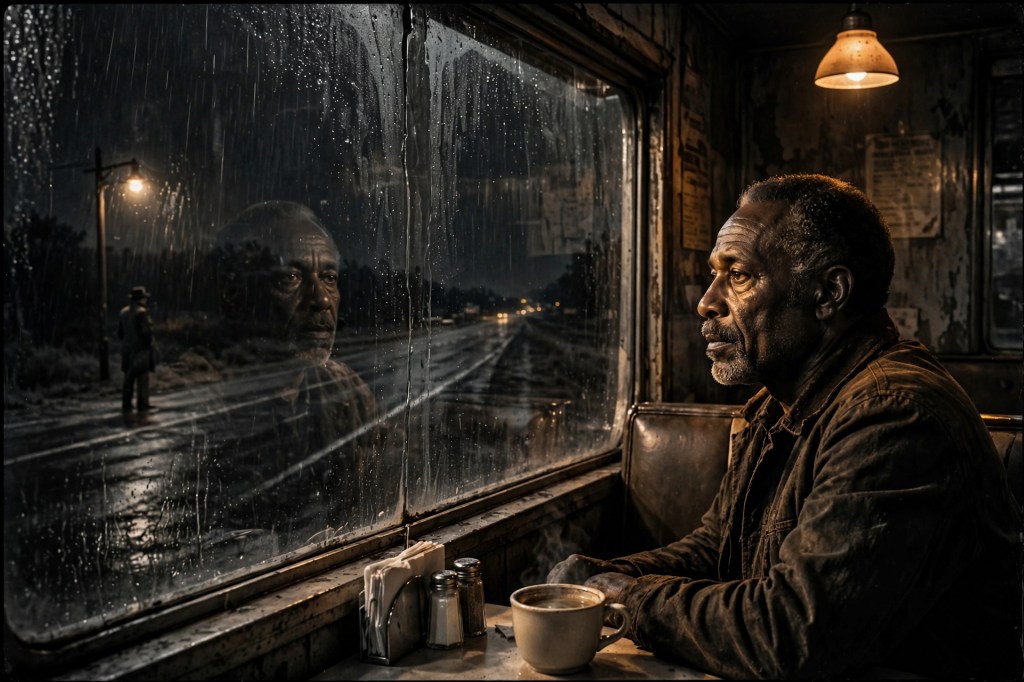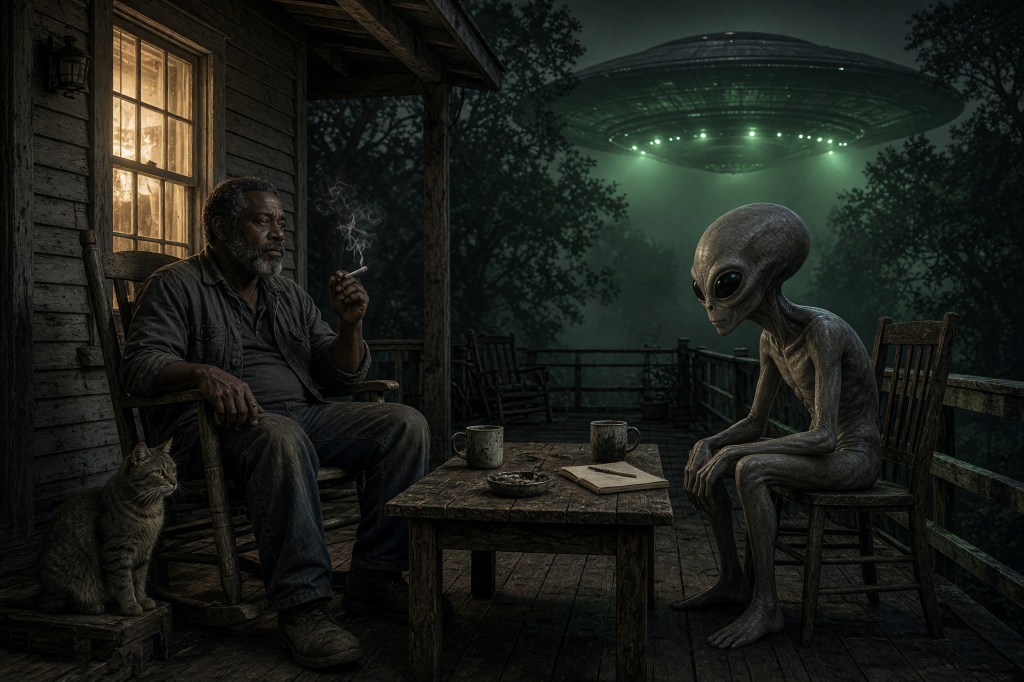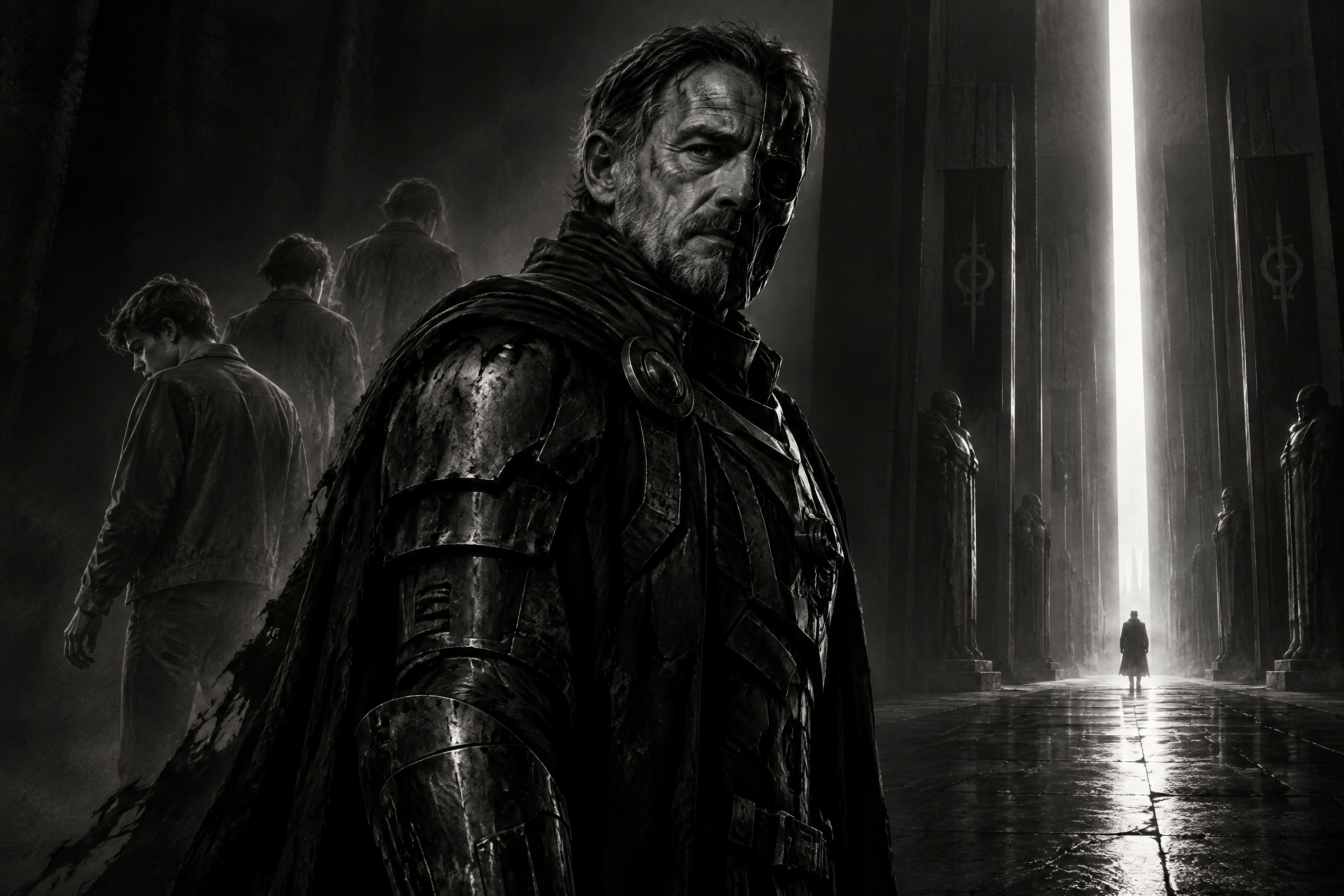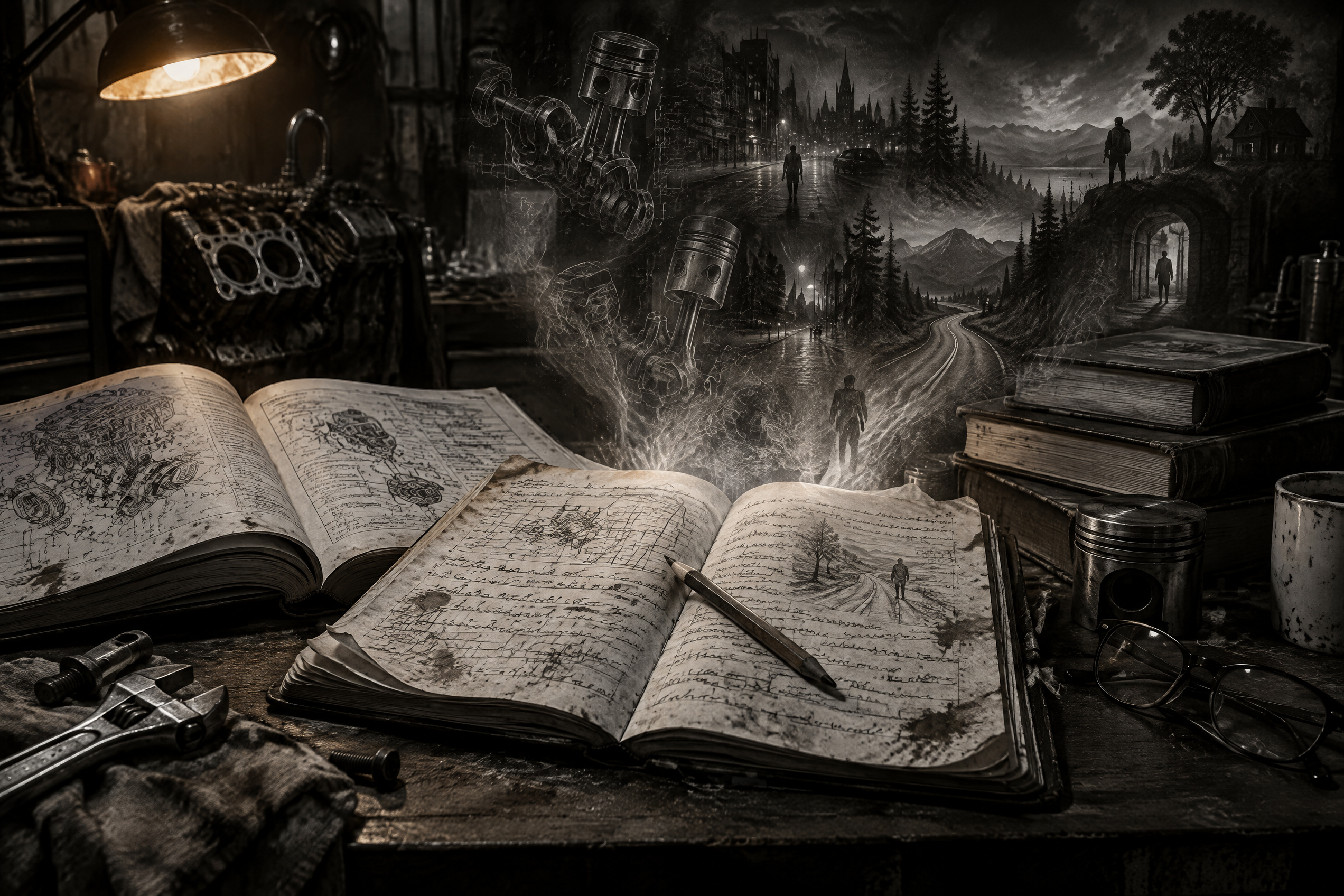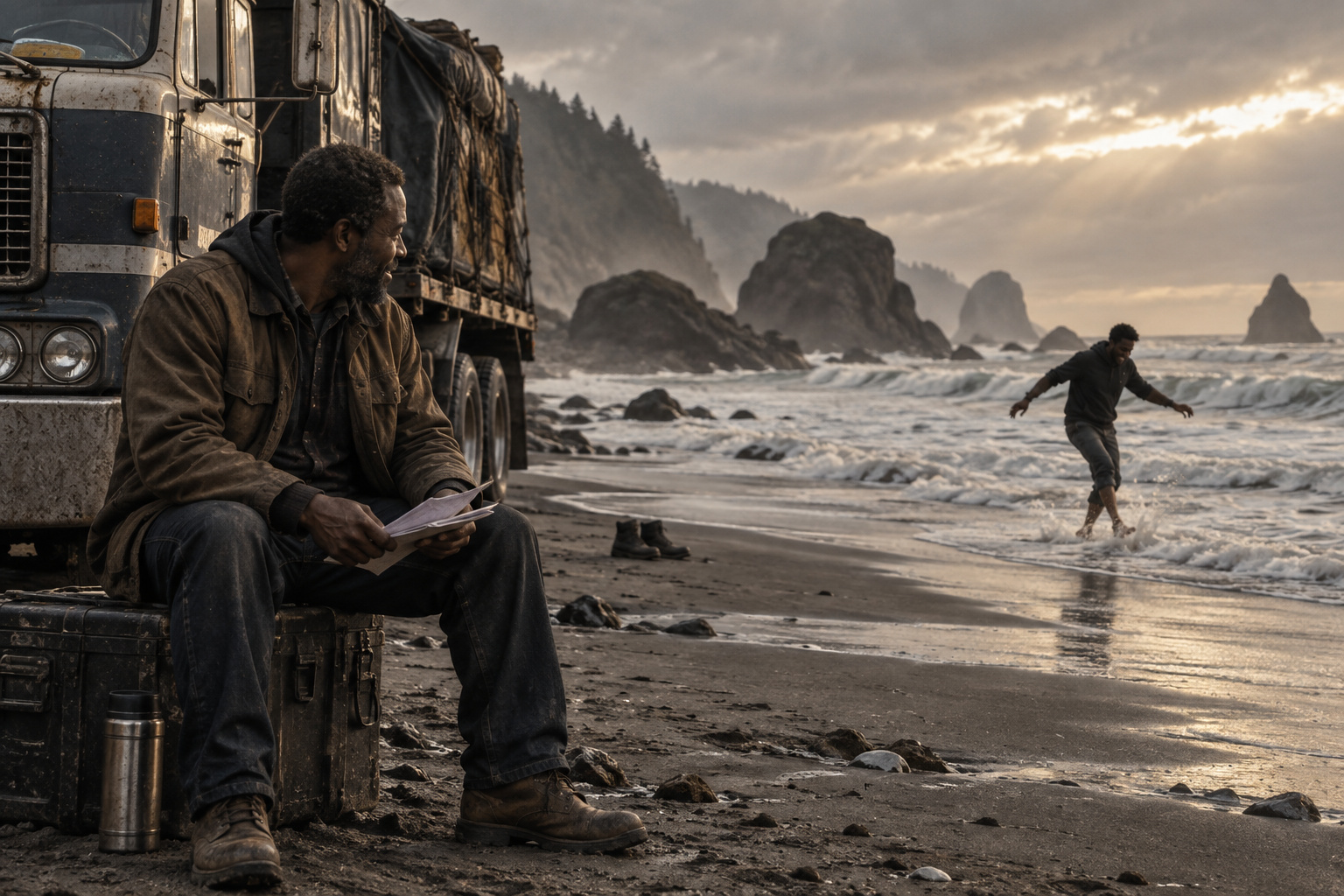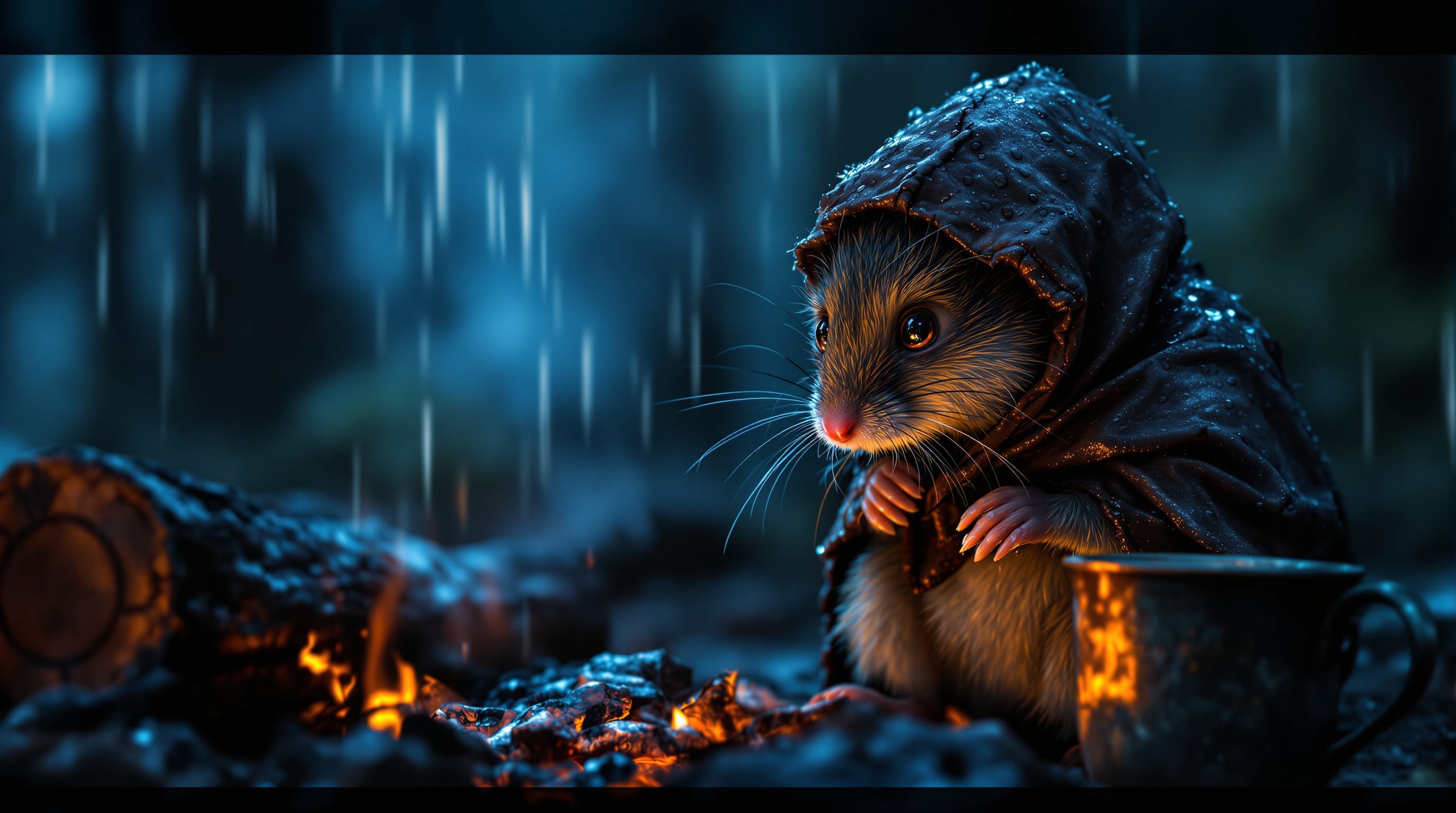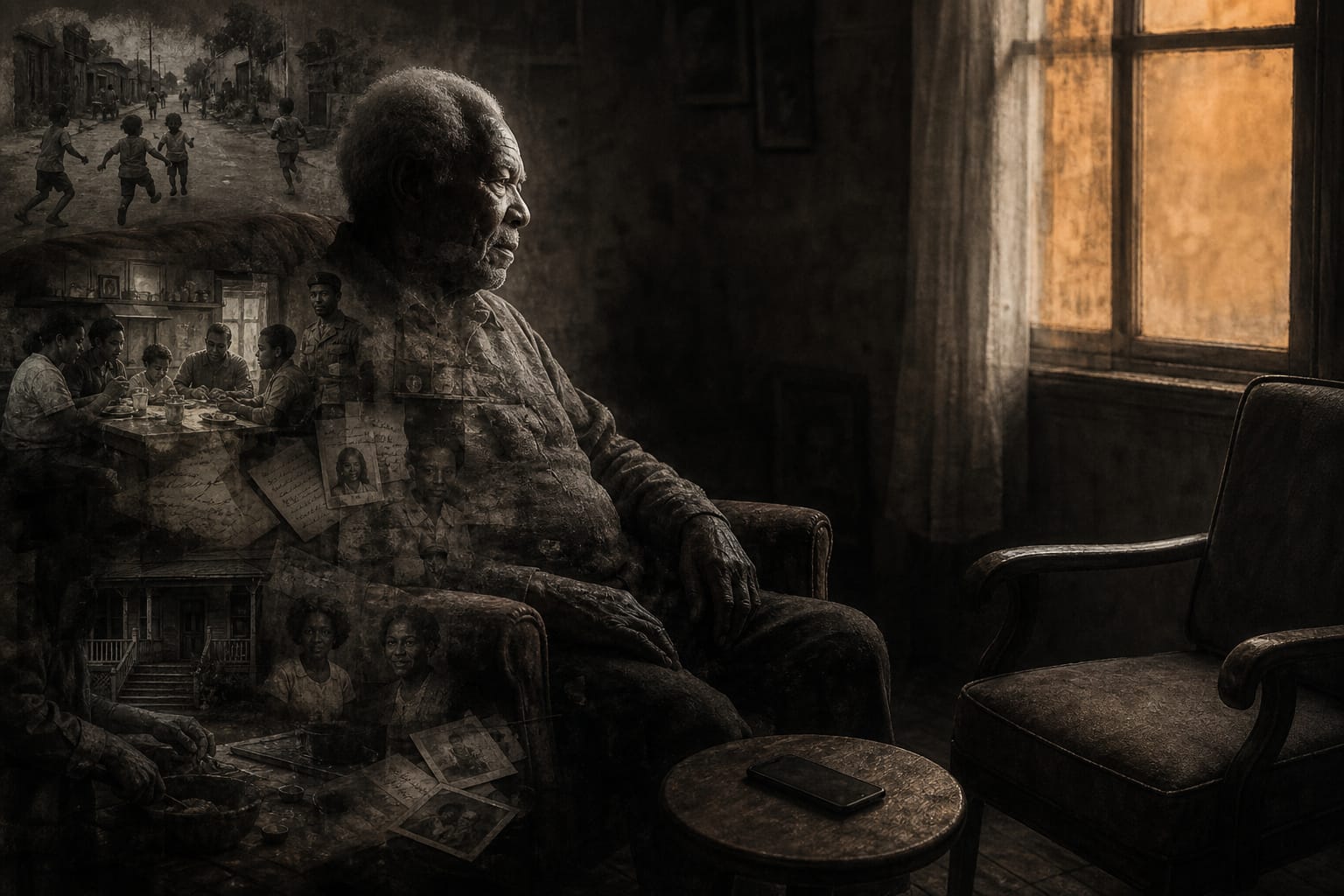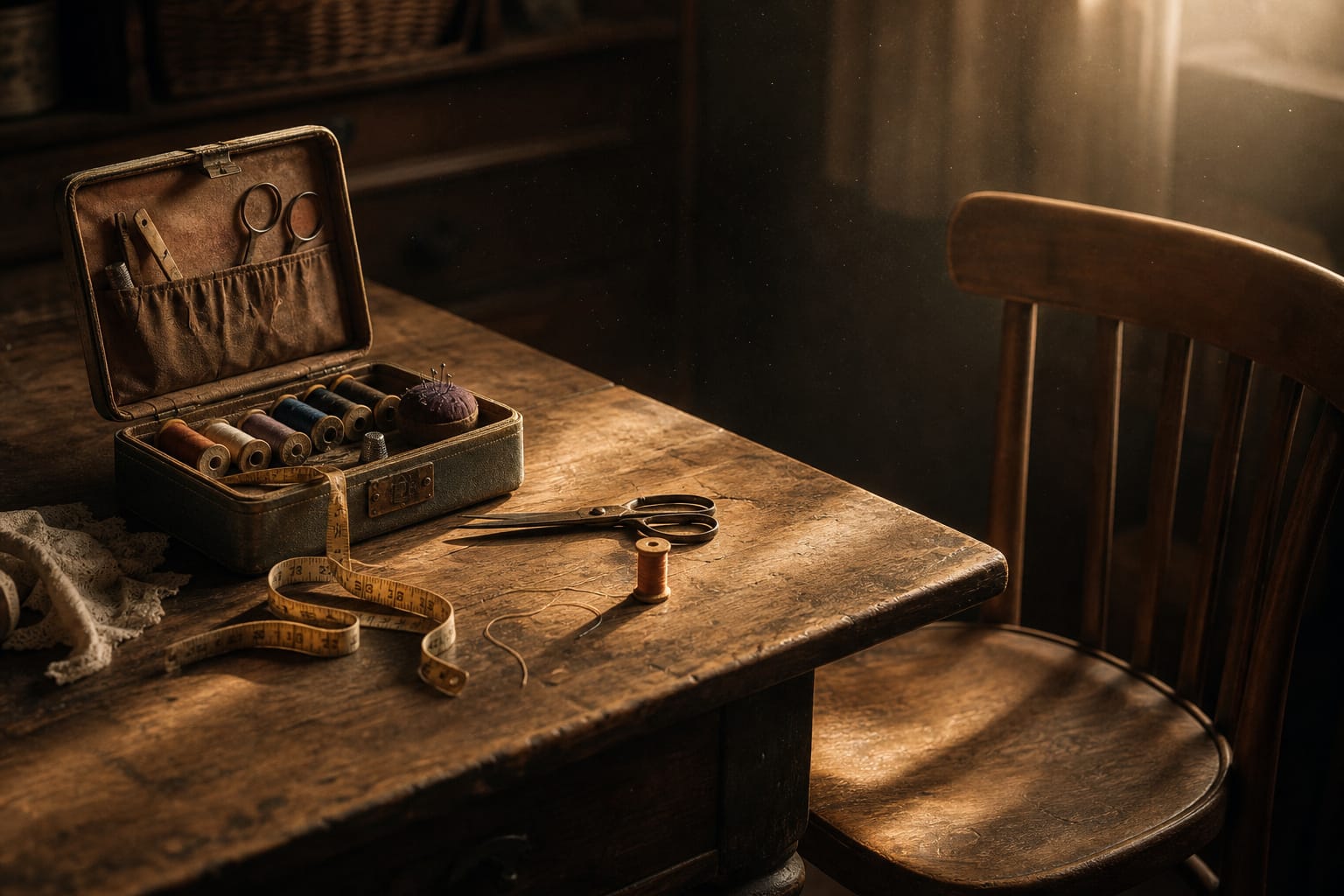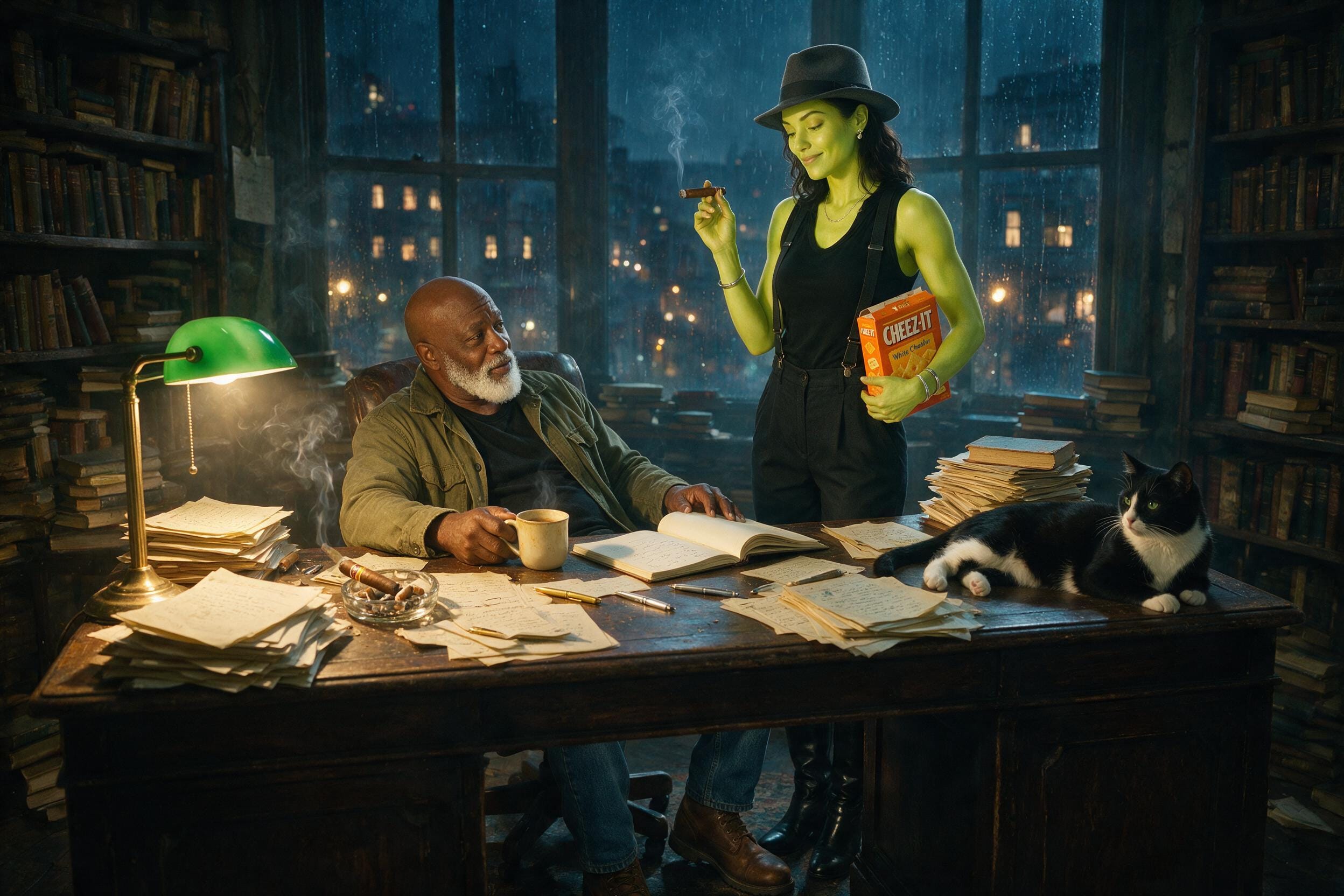
The Places He Pulls Me


Chapter 3 of 8

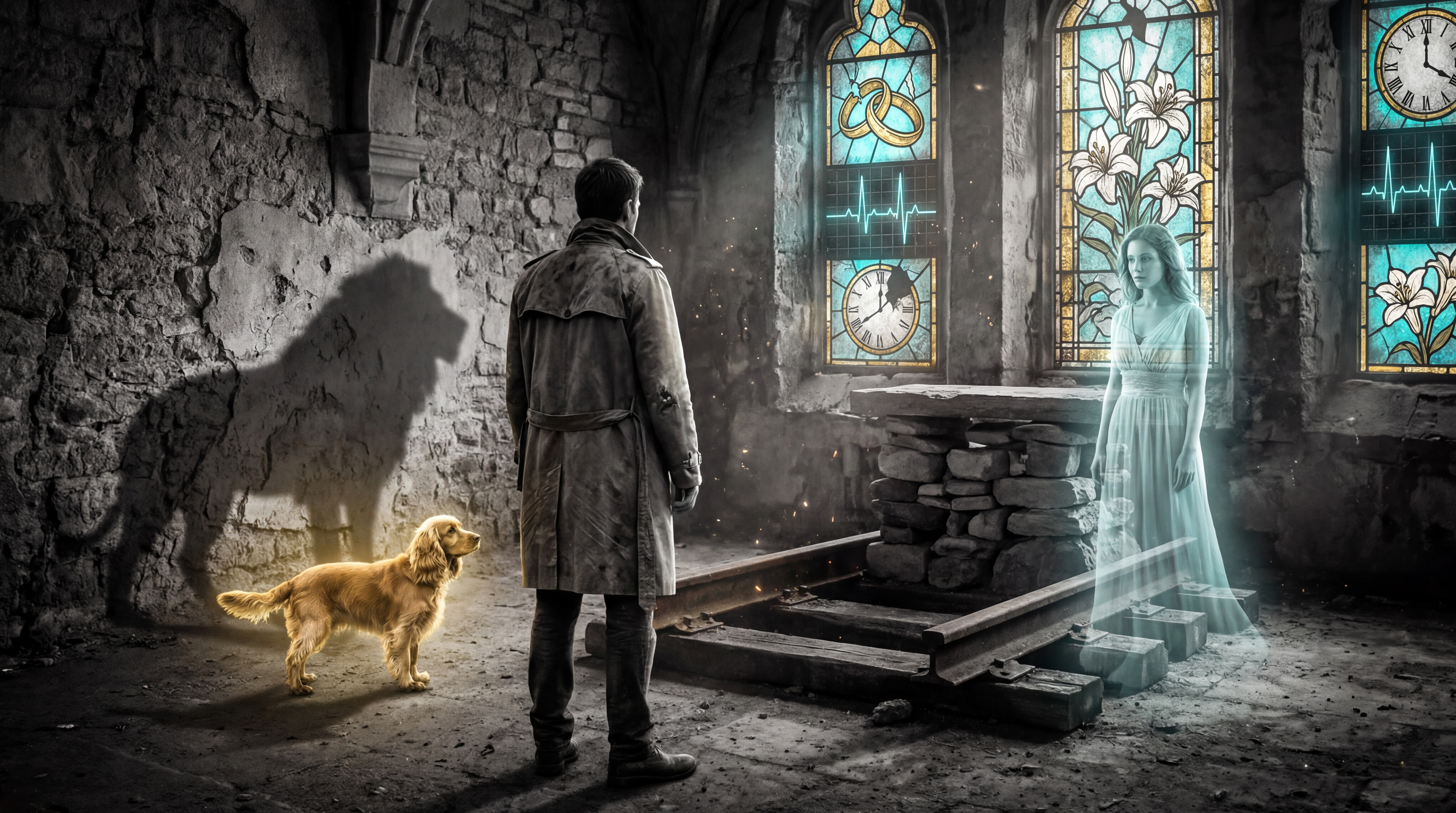
Mercy had opinions.

Most mornings they concerned bacon, territorial disputes with pigeons, and why rain was a personal insult aimed directly at him. But this morning he dragged me three blocks before sunrise with the focused urgency of a man who knew exactly where the body was buried.

“You weigh less than my regrets,” I told him as the leash cut tight across my palm. “This shouldn’t be physically possible.”

He never looked back.

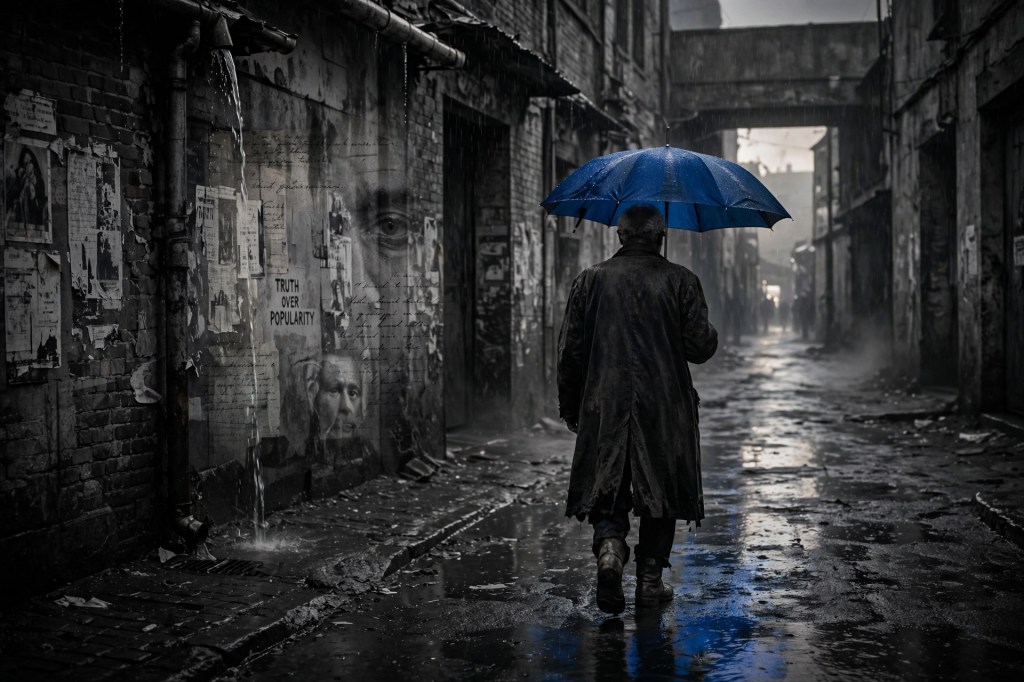
The city before dawn always felt honest to me. No crowds. No polished storefront smiles. No daytime theater. Just wet brick, shuttered windows, and streets shining black as old scars. Rain had passed an hour earlier, leaving everything rinsed but not forgiven. Fog leaned low between buildings, thick enough to blur corners and make every alley feel like it was thinking.

My boots struck the pavement with hollow little reports. Mercy’s paws made softer sounds—quick taps, impatient and certain.

He led me down Harrow Street, left on Vale, then deeper into a neighborhood I hadn’t visited in years. That unsettled me more than I cared to admit. I knew this city the way damaged men know bars: by instinct, by smell, by where not to stand. I knew where the cheap coffee lived, where the cops parked, where grief rented rooms by the month.

Yet this stretch felt forgotten.

Tall buildings stood shoulder to shoulder like old men refusing to speak. Power lines sagged overhead. Windows watched without blinking. Even the streetlamps seemed reluctant, their amber glow thin and exhausted.

Then I saw the shelter.

It stood alone at the corner like something left behind when the rest of the world moved on.

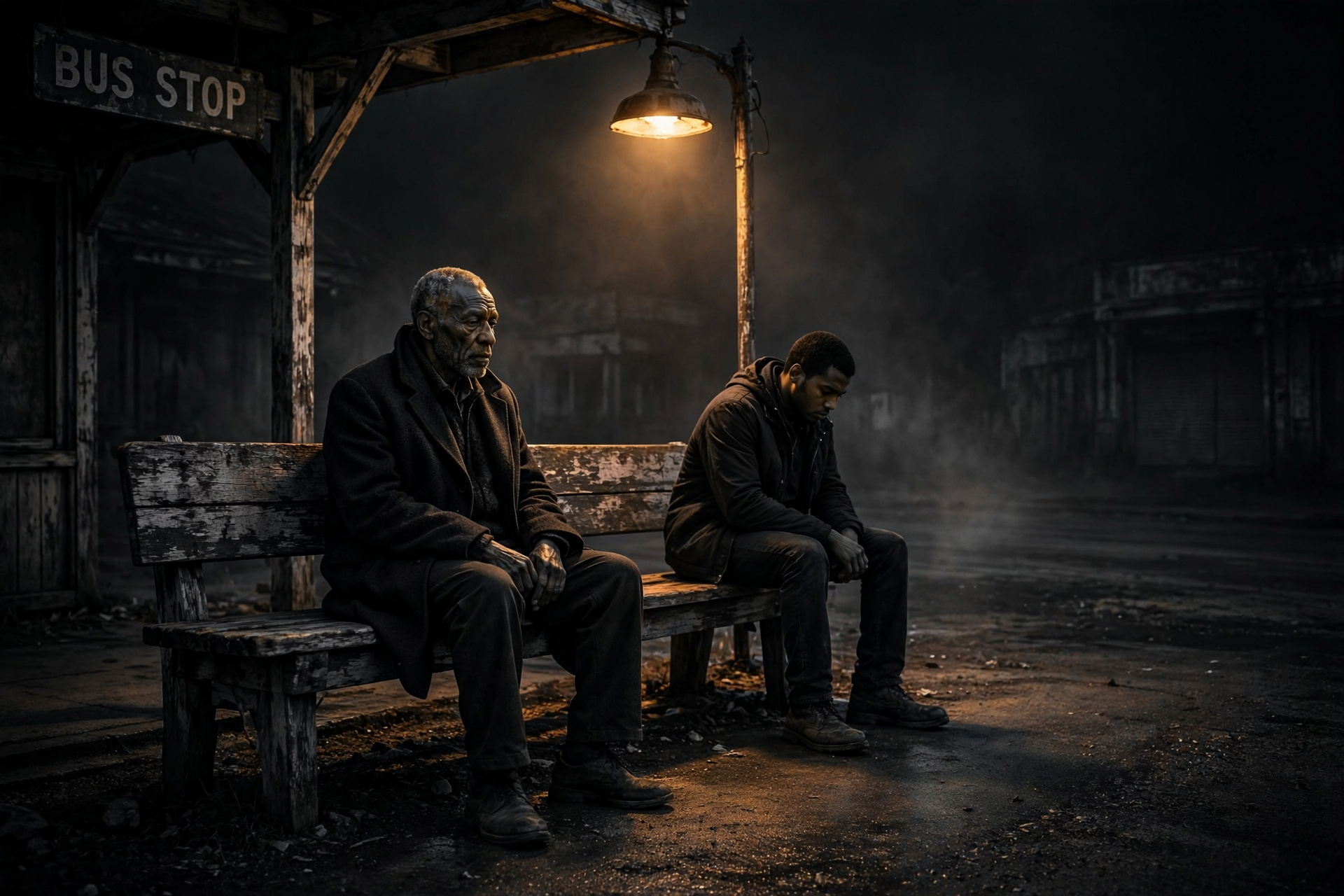
Glass walls beaded with moisture. A cyan light buzzed overhead, cold and unnatural against the wet dark. The sign above it read:

BUS STOP – ABANDONED

“That’s comforting,” I said.

Mercy stopped so suddenly the leash jerked my arm. He planted all four paws and leaned forward, ears raised, body taut with attention.

Inside the shelter sat a woman.

Head bowed. Hair hanging like wet ink over her face. Hands folded between her knees. Motionless in the kind of stillness living people rarely manage.

My throat tightened.

The coat was the same dark one from the park. Or I wanted it to be. Memory is a crooked tailor—it keeps altering what it swears was exact.

Rain ticked against the glass.

I stepped closer, every instinct asking why.

“Excuse me?”

My voice sounded smaller than I intended.

No movement.

No answer.

Only the electric hum of the light above her and the distant hiss of tires somewhere blocks away.

Mercy gave a low whine, the sound thin and uneasy.

I moved to the shelter entrance.

The temperature dropped at once.

Not dramatically—no theatrical blast of frozen air. Just a precise, intimate cold that slipped beneath my coat and settled against the spine. The smell changed too. Wet stone. Dust. Paper. The scent of rooms closed for years.

“Who are you?”

The woman lifted her head.

Slowly.

Not with menace. Worse than menace. With patience.

I saw no face.

Where features should have been there was fog gathered into human suggestion. Hollows where eyes belonged. A shifting blur where a mouth struggled to become one. It was like watching memory try to wear skin.

Every nerve in me recoiled.

Then she spoke.

“You’re late.”

The voice struck through me clean and hard.

I stumbled backward into the rail, pain flashing through my shoulder.

Mercy barked once—sharp, furious, brave beyond proportion.

The figure turned toward him.

“Still loyal,” she said.

Then back to me.

“You never came that night.”

The world narrowed.

There are voices the body remembers before the mind does. A mother calling your childhood name. A lover whispering in the dark. The last message left on your phone that you listen to until language turns into wound.

Lena.

Not exactly her voice. Worse. Close enough.

My lungs forgot their work.

“That’s not possible.”

“No,” the figure said. “But it happened anyway.”

I felt suddenly nineteen, then thirty-five, then the age I was the morning they called to tell me she was gone. Grief doesn’t obey clocks. It stacks time like broken plates and waits for one touch to bring the whole shelf down.

“I was there,” I said, though I no longer knew if I meant the hospital, the funeral, the marriage, or the years I spent failing in smaller ways.

The cyan light above us screamed and burst.

Glass detonated outward.

I dropped over Mercy instinctively, shards striking pavement, coat, concrete with bright violent chatter. Something sliced my knuckle. Warm blood mixed with rainwater.

Then silence.

When I looked up, the bench was empty.

No woman.

No fog.

No footprints on the wet floor.

Only a single object resting where she had sat.

A brass bus token, greened with age.

I picked it up. It was colder than metal should be.

Stamped into one side were two words:

LAST ROUTE

Mercy licked the blood from my wrist once, gentle as apology.

Then he turned and stared down the street ahead, tail still, body alert.

As if this had not been the destination.

Only the first stop.

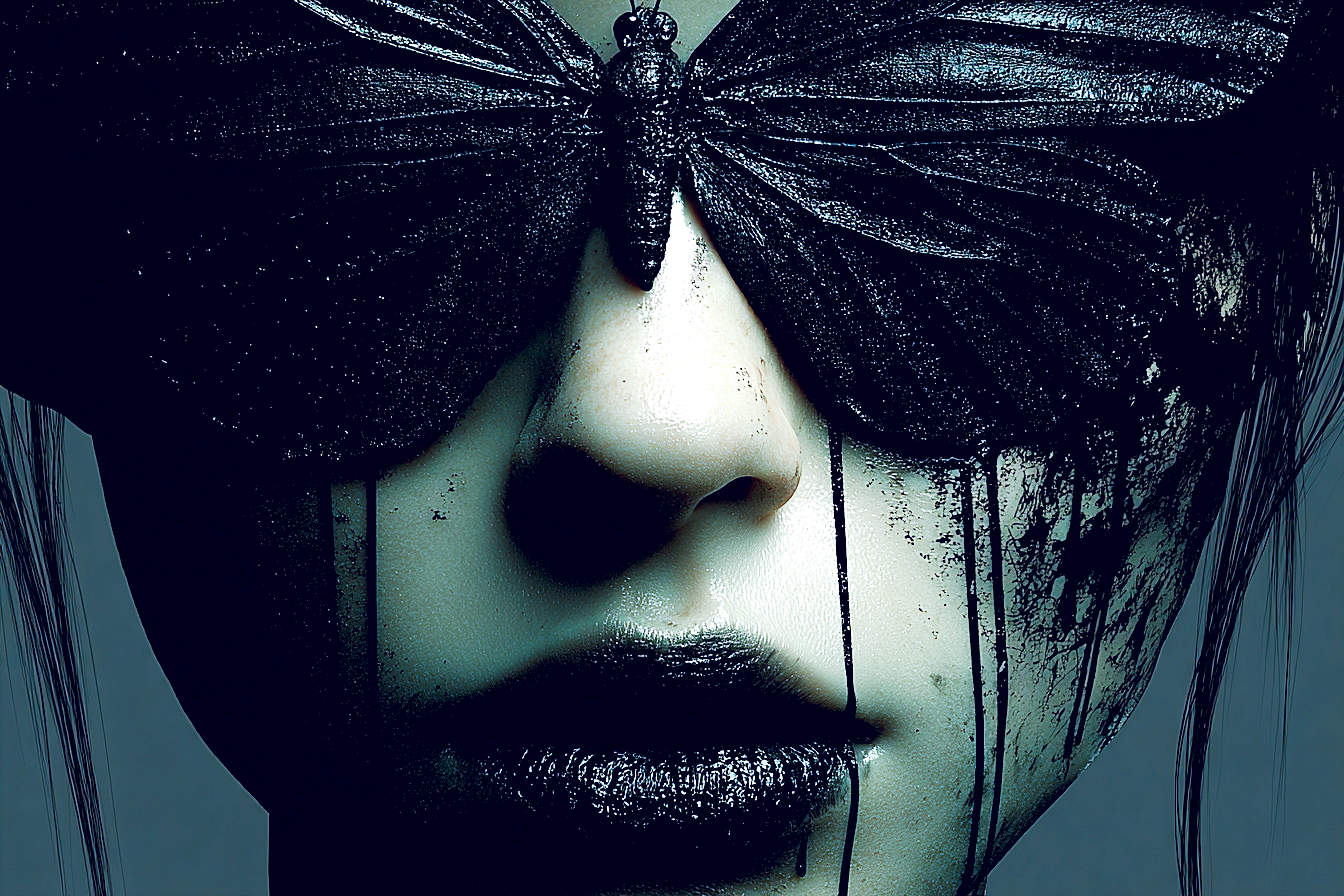
The Moon That Remembered Your Name


Dispatches of Splinters of My Mind: Entry 16

There are things older than your memory that still recognize you, and they do not arrive with noise. They do not knock, do not announce, do not ask permission to be understood. They wait in the margins—cool, patient, unmoved by the rhythm of your days or the stories you tell about yourself to make everything feel coherent. You only notice them when everything else goes quiet, when the distractions fall off and you’re left with the faint hum of your own breathing, the weight of your body in space, the subtle awareness that something is watching—not from the outside, but from somewhere just beneath your own skin.

The moon is one of those things.

Not the one you photograph or reference in passing, not the pale disk that hangs above you like a decorative afterthought. The other one—the one that feels closer than it should, the one that bends inward, holding shadow like a secret it refuses to share. You’ve felt it before in moments you didn’t know how to name—standing still at night when the air carries a thin chill, when the world seems suspended between movement and silence. It presses against you then, not physically, but in a way that settles behind your ribs, as if something inside you recognizes its shape before your mind has time to interfere.

There is a face there.

Not one that looks back at you, not one that seeks recognition, but one that exists in refusal. The eyes are closed—not in rest, but in a kind of deliberate withdrawal, a turning away from the demand to be seen. The surface is not smooth. It is cracked, weathered, textured like something that has endured time rather than moved through it. If you look long enough, you can almost feel it beneath your fingertips—the uneven ridges, the brittle edges, the places where something once held firm and then gave way, not in collapse, but in exposure.

You understand that feeling more than you admit.

There are parts of you that have worn down in the same way—not broken, not gone, but altered through pressure, through time, through the quiet erosion of things you never addressed directly. You call it growth because that is what you were taught to call it. You tell yourself that moving forward requires leaving things behind, that shedding old versions of yourself is necessary to become something better, something more refined, more acceptable.

But refinement has a cost.

You feel it in the way certain memories no longer come back clearly, as if they’ve been filed away somewhere you can’t easily access. You feel it in the way your responses have become measured, controlled, shaped to fit the space you’re in rather than the truth you’re carrying. There is a tension there—a subtle tightening just beneath your chest, a pressure that doesn’t fully release even when you tell yourself you’re at ease.

That pressure has a history.

It is not new.

It has been accumulating in small, almost unnoticeable ways. Every time you chose silence over honesty, not because you didn’t know what to say, but because you understood what saying it would cost. Every time you adjusted yourself to match the expectations in front of you, smoothing out the edges, muting the contradictions, presenting something that could move through the world without resistance. You learned how to do that well.

Too well.

The world encourages that version of you. It calls it maturity, discipline, control. It rewards you for being consistent, for being understandable, for being someone who does not disrupt the flow. It tells you to be an individual, but only within the boundaries that have already been drawn. Anything beyond that—anything that resists categorization, that refuses to resolve into something clear—is treated as something to be corrected, or quietly set aside.

So you set it aside.

Again and again.

Until the parts of you that didn’t fit stopped trying to surface in obvious ways.

But they didn’t disappear.

They changed.

They moved deeper, into places that don’t rely on language or logic, into spaces that operate more like sensation than thought. You feel them sometimes in ways that don’t make immediate sense—a sudden heaviness in your chest when nothing around you justifies it, a flicker of unease in moments that should feel simple, a quiet pull toward something you can’t fully explain.

This is where the symbol begins to take hold.

Not as something external, not as something separate from you, but as a reflection of what you’ve been carrying without naming. The moon does not show you something new. It reveals a structure that has always been there—layered, incomplete in appearance, but whole in a way that doesn’t rely on visibility.

Its darkness is not absence.

It is containment.

Everything it does not show still exists, still holds weight, still shapes the curve you can see. You have been taught to treat your own darkness differently—to see it as something to resolve, something to eliminate, something that stands in the way of becoming who you’re supposed to be.

But what if it isn’t in the way?

What if it is part of the form?

You feel that question more than you think it.

It lingers in the moments when you stop trying to fix yourself, when you let your thoughts move without immediately correcting them, when you sit long enough for the surface to quiet and something deeper begins to shift. There is discomfort there—a low, steady tension that makes you want to reach for distraction, to break the moment before it deepens into something you can’t easily control.

Most people do.

They move away from that edge as soon as they feel it.

Because staying there requires a different kind of attention. Not the kind that analyzes or categorizes, but the kind that observes without interference. The kind that allows contradiction to exist without forcing it into resolution. The kind that recognizes that not everything within you is meant to be simplified.

This is where the myth becomes real.

Not as a story you tell, but as a pattern you begin to recognize within yourself. The phases, the concealment, the partial revelations—all of it mirrors something internal. You are not as singular as you present. You never were. You are layered, shifting, holding multiple states at once, even when you try to compress them into something more manageable.

The exhaustion you feel sometimes—the kind that doesn’t come from physical effort—is not just from what you do.

It is from what you hold back.

From the constant negotiation between what is true and what is acceptable. From the effort of maintaining a version of yourself that can move through the world without disruption. It is a quiet fatigue, one that settles into your shoulders, into your breath, into the way you carry yourself when no one is watching.

And still, beneath all of that, something remains intact.

Not untouched.

But present.

The same way the moon remains whole even when you can only see a fraction of it.

You do not need to illuminate everything to understand that it exists.

You do not need to resolve every contradiction to be whole.

You only need to stop pretending that the unseen parts of you are separate from who you are.

That is where the shift begins.

Not in revelation.

Not in transformation.

But in allowance.

A quiet, deliberate decision to stop editing yourself in ways that erase rather than integrate. To let the parts of you that do not fit easily remain present without forcing them into something they are not. To recognize that wholeness is not something you build by removing what is difficult, but something you uncover by allowing everything to exist in the same space.

The moon does not explain itself.

It does not justify its phases.

It does not ask to be understood.

It simply holds what it holds.

And if you stay still long enough—if you resist the urge to translate, to fix, to reduce—you begin to feel that same structure within yourself.

Not as an idea.

As a presence.

Something that has been there longer than your explanations, longer than your attempts to define yourself, longer than the versions of you that have come and gone.

And in that recognition, something loosens.

Not everything.

Just enough.

Enough to breathe differently.

Enough to sit without immediately needing to move.

Enough to understand that what you have been trying to resolve was never meant to be simplified in the first place.

The moon never needed to speak your name.

It only needed to remember it.

And somewhere, beneath everything you’ve been taught to become—

you do too.

The Rules I Was Never Given

Daily writing prompt
Describe something you learned in high school.


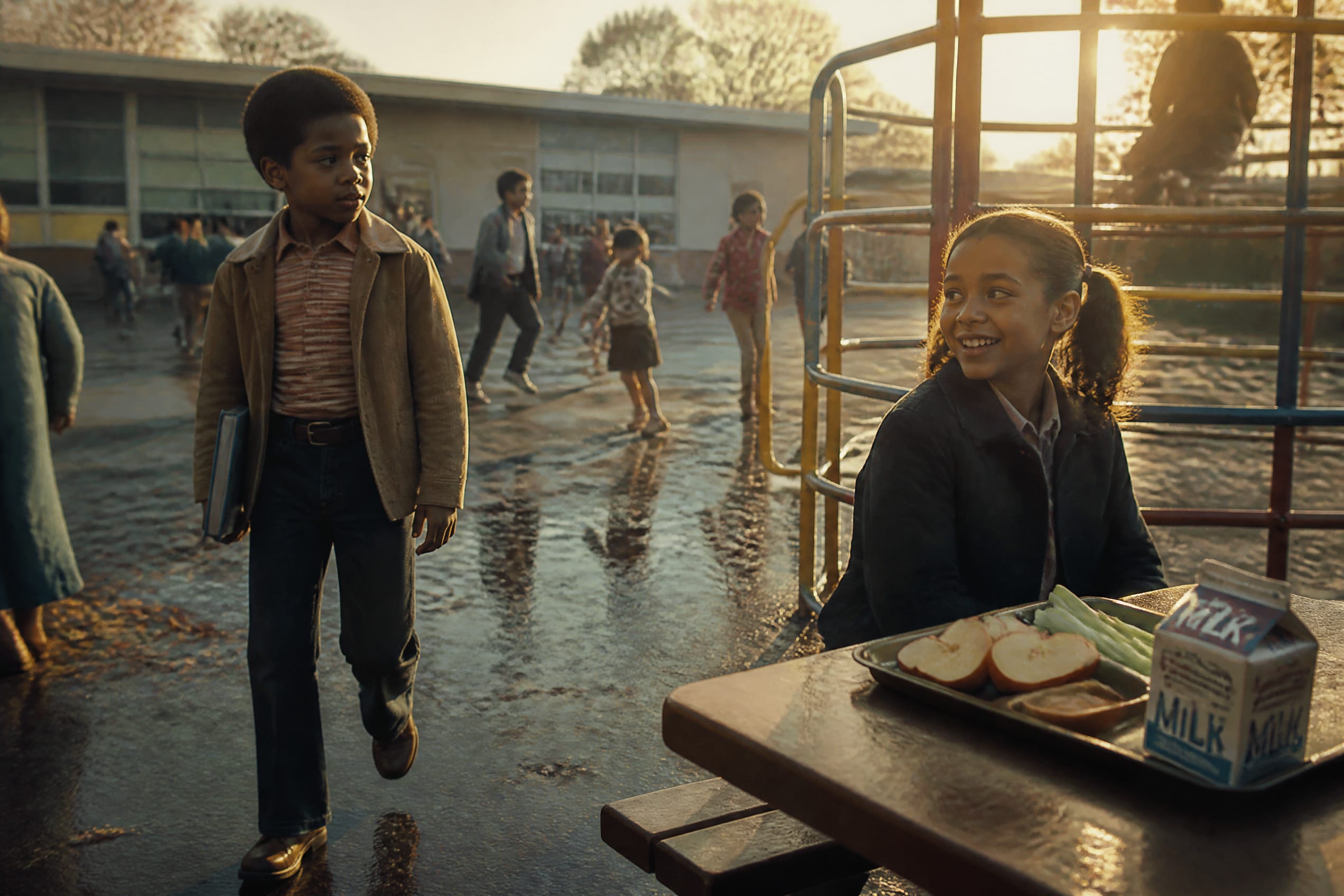
It was in high school where everything tilted.

That’s where my love for writing, art, and music took a turn—sharp enough to leave a mark. I started writing horror stories, the kind that didn’t rely on monsters jumping out of closets, but the kind that sat with you long after the lights were off. Psychological. Quiet. Unsettling in a way I didn’t fully understand yet.

I drew what I wrote. Faces caught between something human and something else. Shadows doing most of the talking.

And somewhere in the middle of all that, I found heavy metal.

That’s when the rules showed up.

It was like there was a rulebook I was never given.

I asked Madre about it once. She stared at me like I should’ve already known, then shook her head.

Classic Madre.

She kept that look well into my adulthood.

My kids laugh about it now—because I catch myself giving them that same look.

It was fine—acceptable even—to write strange stories. Fine to draw the things I was drawing. People could box that up and call it “creative.” But metal? That crossed a line I didn’t know existed until someone told me I needed to turn in my black card.

I remember just sitting there, letting that hang in the air longer than it should have.

For a second, my mind went to guys like Jimi Hendrix… and Jaimoe Johanson.

Nobody handed them a rulebook.

I didn’t say anything.

Then it hit me—

I was aware that being Black wasn’t just identity—it was visibility.
The world saw me before it heard me.
I guess that’s a step up from being invisible. — Invisible Man

Around the same time, I made another decision that didn’t sit well with the people who thought they knew better. I moved away from the college track and into the electronics lab.

“You’re throwing your future,” my guidance counselor said.

They believed in standards. Fixed lines. Clear limits.

Problem was—I didn’t fit where they said I should.

And no matter what I did, they kept looking past me.

I’m right here. Can’t you hear me?

This was the same woman who told me it was impossible to learn microcomputer math without a foundation in Algebra.

I aced the class.

High school wasn’t about figuring out who you were.

It was about learning who you were allowed to be.

I felt the pressure to stay Black while trying to be an individual.
The problem was never my identity. It was that other people kept confusing identity with compliance.

Some of the same kids I played in the sandbox with started looking at me like I was from somewhere else. Like I had crossed into something unfamiliar.

So I learned to perform.

Say the right things. Like the right things. Stay close enough to the script to avoid the questions.

Like an actor hitting marks just to stay in the scene.

But that kind of survival comes with a cost.

You start confusing who you are with who you need to be to get through the day.

And somewhere in all that, nobody teaches you the part that matters most—

how to accept yourself without the audience.

I used to think people saw me for what I was in that moment. That once I fit the category, the story was done.

But it doesn’t work like that.

They don’t see two people.

The one you are… and the one you’re becoming.

I ran into one of my sixth-grade teachers years later. When I told her I was a writer, I dressed it up with a little self-deprecation.

“You probably never thought I’d become that.”

She looked me dead in the eyes, same way she did back then.

“You said that. I didn’t.”

Then she invited me to lunch with some of the old group.

Popularity is a currency that devalues overnight. I watched people spend themselves trying to keep up with it.

Not me.

“You can go your own way.” — Fleetwood Mac

Costly lesson. Worth every bit of it.

What I learned in high school wasn’t how to fit in.

It was how to stop asking for permission to be who I already was.

And once you see it…

the mask never quite fits the same again.

Doesn’t mean the world stopped asking me to wear it.

The Language of Roots


She worked in the quiet hours—those thin, in-between moments when the world forgot to be loud.

The vials in front of her breathed more than they sat. Each one held a memory of the earth: crushed root, fermented leaf, sap coaxed from bark that had learned how to survive drought and fire and the careless hands of men. The smoke curling upward wasn’t just smoke—it was language. It spoke in slow spirals, telling her what the mixtures would not.

People used to understand this.

Not the recipes—those were the easy part. Anyone could follow steps, grind this, boil that. But the listening… that was the lost art. The knowing that a plant didn’t give itself the same way twice. That the soil it grew in, the grief it absorbed, the storms it endured—those things lived inside it. Healing wasn’t extraction. It was negotiation.

She dipped the tip of her tool into the darkest vial and hesitated.

“Too bitter,” she murmured, though no one else was there to hear it.

Her fingers hovered, then shifted to another—lighter, thinner, but stubborn. This one had grown in shadow. It would fight her. Good. Medicines that didn’t resist weren’t worth trusting.

Behind her, the walls carried symbols older than memory. Not decoration—records. Every mark was a conversation someone had once had with the earth and survived to tell about it. She didn’t look at them anymore. She didn’t need to. They had moved into her bones long ago.

Once, people traveled for days to sit where she sat.

They came with sickness, yes—but more often with confusion. A body doesn’t break without reason. A spirit doesn’t ache without history. She had learned early that most of what they called illness was simply a life lived out of rhythm. Too much noise. Too much taking. Not enough listening.

Now they came less.

They had pills that worked faster. Machines that spoke louder. Certainty packaged in clean white containers that didn’t ask questions back. Healing had become a transaction—quick, efficient, empty of memory.

She pressed the mixture into the parchment before her, letting it bleed into the fibers.

“This one is for forgetting pain without forgetting the lesson,” she said softly, as if naming it anchored it to the world.

Her hands stilled.

That was the problem, wasn’t it?

People didn’t want lessons anymore. They wanted silence. They wanted the wound gone without understanding what had cut them open in the first place.

Outside, something shifted—the wind, maybe. Or something older moving through it.

She closed her eyes and let the room breathe around her.

Nature had never stopped speaking. Not once. It whispered in cracked soil, in the way leaves curled before a storm, in the quiet defiance of weeds breaking through stone. The language was still there, patient as ever.

It was people who had forgotten how to hear.

She opened her eyes, reached for another vial, and began again—not because anyone was coming, but because the work itself mattered. Because somewhere, someone would remember. Because healing, real healing, was never about saving the world.

It was about restoring the conversation.

Something Else Held the Pen

Daily writing prompt
Describe one positive change you have made in your life.

Notes from a Night I Don’t Fully Remember

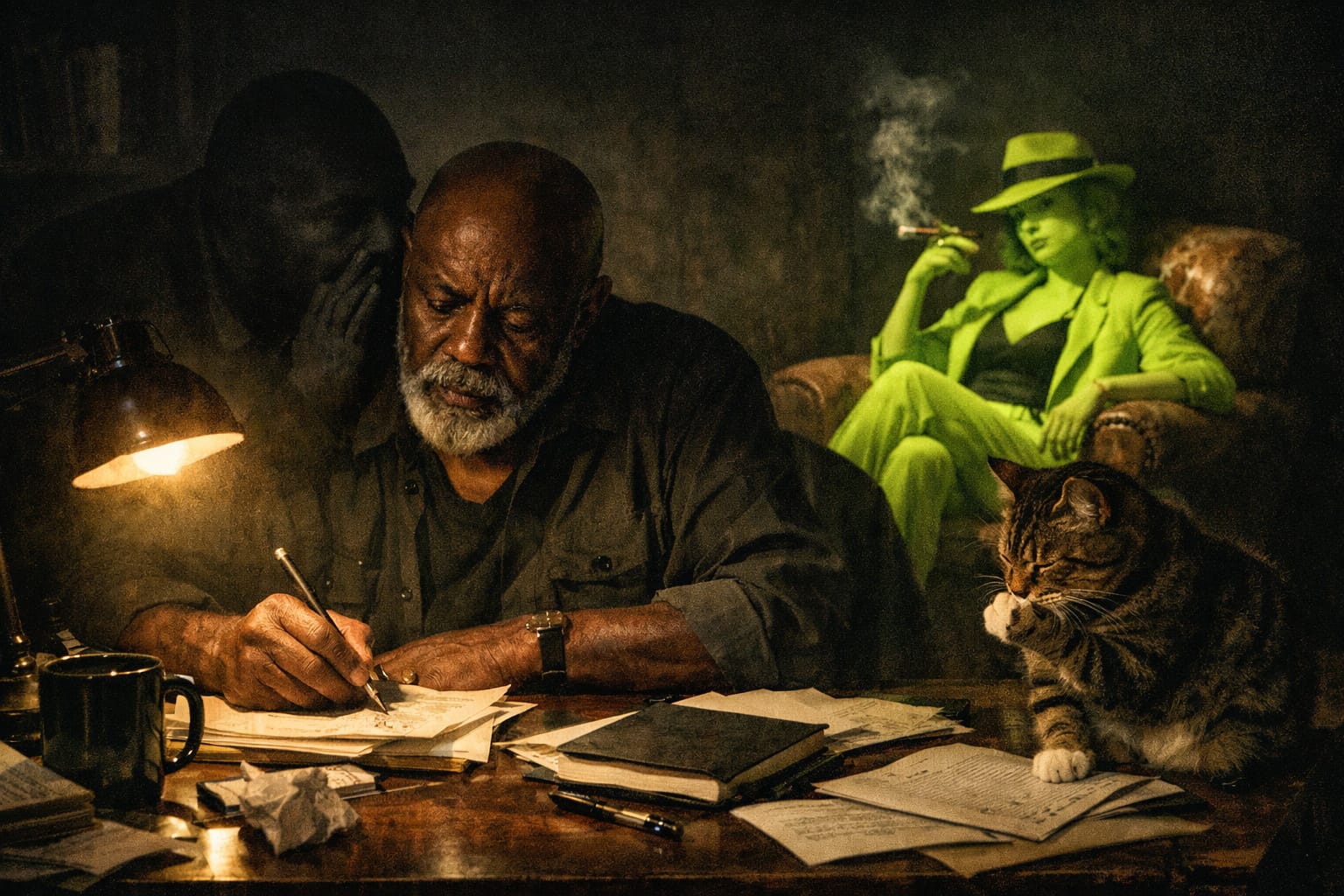
I didn’t notice it at first. Change doesn’t announce itself. Not really. It doesn’t kick the door in or make promises it can’t keep. It just… arrives. Slips into the empty seat beside you like a stranger in a crowded train station—close enough to feel, easy enough to ignore. So I ignored it. I kept scribbling in my notebook, one thought chasing the next, no shape to any of it. Just movement. Just noise. It was past midnight. My eyes burned. My hands cramped. And Guppy—Guppy reminded me, loudly, that her litter box needed changing. No patience. No grace. Funny how something that small can pull you back from the edge of your own head. I changed the litter, washed my hands, and came back to the page. That’s when it shifted.

I looked at the notebook and decided I wasn’t going to choose. A story. An essay. Something else I didn’t have a name for yet. All of it. So I wrote. Straight. No chaser. No polishing. No second-guessing. Just the truth the way I’d lived it—uncomfortable, uneven, mine. And then something opened. Everything I’d read, seen, heard… it was there. Not as memory. Not as reference. As if it had been waiting. I could feel it lining up behind the words.

I looked up from my notebook.

The train station was empty.

A woman was walking away, her footsteps the only sound left in the room. Slow. Measured. Certain. I turned, trying to follow the sound, but there was nowhere for her to go. No doors. No exits. Just space where she should have been.

And then the footsteps stopped.

I sat there, listening.

The clock on the wall took over—each second grinding forward with a hard, shifting sound, like tiny workers buried inside it, cranking the hands inch by inch.

I didn’t know how long I’d been sitting there.
Didn’t know if I had moved at all.

The sound of fluttering wings filled my office, but I didn’t look up right away. Guppy did. She let out a sharp, offended meow before hopping onto the desk, then down into my lap like she owned both the space and whatever had just passed through it. “Can’t you see I’m working?” I asked. Didn’t matter. She turned once, twice, then settled—final say. I shifted, adjusted, gave in. There’s a rule about that, unwritten but absolute. A cat chooses your lap, you don’t move. Not for discomfort. Not for reason. Not even for sense. I used to think there was a time limit attached—ten minutes, maybe fifteen, something measurable. But sitting there, hands still, the room too quiet, I couldn’t remember the number. Couldn’t remember if there ever was one. Guppy’s weight anchored me in place, and for the first time all night, I wasn’t sure if I was staying still because of her… or because something else in the room wanted me to.

I was wrong.

Not a little.

Completely.

The fluttering grew louder.

Guppy’s claws sank into my thigh, sharp enough to anchor me. She let out a low, uneasy sound, looking back at me like I was the one out of place.

The room shifted.

I knew this place.

This is where I go when the story comes.

Only this time—

it didn’t come alone.

Voices layered over each other, pressing in. Not words at first—just presence. Then fragments. A street folding in on itself. Something blooming where it shouldn’t.

And the woman—

closer now.

Or maybe I was.

The noise swelled, crowding the edges of everything I thought I understood.

I exhaled. Slow. Forced.

Held on to that one thread.

The rest didn’t disappear—

but it bent.

Aligned.

Waited.

The picture sharpened.

Not clear. Not safe.

But enough.

I picked up the pen.

And this time—

I didn’t pretend the words were mine.

The pages are filled.

My handwriting.

…I think.

I lean closer.

What is this?

I don’t recognize what’s on the page. The lines twist into something older than language—symbols that feel familiar in the wrong way. Like something I’ve seen before but was never meant to read. It reminds me of those ancient books—the ones that never made it to the shelves. The ones kept behind the desk, clutched in the arms of that librarian. The one who always watched a little too closely.

“Are we going to behave today, Master Khan?”

Her voice—calm, precise. Not a question. Never was.

“Yes, ma’am.”

I hear it before I remember saying it.

She scoffs. A small sound, sharp enough to cut. Then the look—that same scowl that made you sit up straighter whether you wanted to or not.

“Peppermint?”

Always peppermint.

Always after.

The sun has faded. Night has returned. The glow from my desk lamp is too much—pressing in, bleaching the edges of everything. I turn it down before it burns through my eyes. Something moves at the edge of my vision. I turn. Nothing. The cigarette smoke thickens, curling slow through the room, clinging to the light. I take it in. The scent is wrong. Not American. Turkish, maybe. Or something older. Something I don’t remember lighting.

“Excuse me, Mr. Khan. Do you think you can help me?”

The voice comes from the shadows.

I look around the room, slow, deliberate—trying to catch movement before it disappears.

Nothing.

“I need you to tell my life story,” the voice continues.

Still nothing.

I strike a match. Light a cigarette. Draw it in deep, hold it there like it might steady something.

Exhale.

Then a sip of coffee.

Cold.

Of course it is.

“Why in the hell would I want to do that?” I ask.

Guppy hisses. Low. Sharp.

I look up.

And there she is.

Standing like she’s always been there.

Too much to take in at once. Too many details competing for attention—like she brought her own gravity into the room and everything else had to adjust around it. Every part of her felt… intentional. Nothing wasted. Nothing accidental.

My first instinct was simple.

Run.

Get the hell out. Find a church. A monastery. Somewhere quiet where stories don’t follow you home.

But then the thought hit—

Who’s going to look after Guppy?

I didn’t move.

I stayed.

Who is she?

A memory of a forgotten love? A glance across a crowded room that never quite left? Or something pulled from a story I never finished?

…Doesn’t matter.

She wears a wide straw hat, the brim low enough to hide most of her face. What little I can see isn’t enough to hold onto—but the way she moves… that says everything. Measured. Certain. Like she’s been here before. Like she knew I would be.

She pulls out a chair. Sits. No hesitation. No permission asked.

The room shifts around her, like it’s adjusting to a weight it didn’t expect.

She leans in, close enough to blur the edges of everything else.

“Just write,” she whispers.

Like it was never up to me.

And I do.

Now I’m back in my office.

The coffee cup sits where I left it. A cigarette burns slow in the ashtray, curling smoke into the stale air like it’s been waiting on me.

I look around.

How did I get here?

For a moment, I don’t move. Just stand there, listening—half expecting to hear something… or someone.

Nothing comes.

So I sit down at the desk. Open the notebook. The pages are filled.

My handwriting.

…I think.

Guppy gives a quick, impatient meow as she shifts in my lap, settling in like she’s been there the whole time.

I start entering the notes into the computer, pecking at the keys in that old, stubborn way of mine. Slow. Uneven. Familiar.

It takes a while.

But it’ll be alright.

It usually is.

I pause, fingers hovering over the keys.

The room is quiet again.

Too quiet.

And for just a second—

I could swear I hear it.

Footsteps.

Fading.

The Edge I Thought I Needed 

Daily writing prompt
What’s the most fun way to exercise?

Most people want exercise to feel like a reward. I’ve never bought into that. 

Exercise, for me, has always been closer to maintenance—like tightening bolts on a machine you still need to run tomorrow. You don’t celebrate it. You do it because not doing it costs more. 

That said, walking is the one form that never tried to sell me a lie. 

It doesn’t pretend to be fun. It doesn’t dress itself up with neon lights, loud music, or promises of transformation in thirty days. It just asks one thing: keep moving. 

And somehow, that’s enough. 

Walking has been the most consistent thread in my life—not because it excites me, but because it meets me where I am. Good day, bad day, restless mind, heavy thoughts—it doesn’t argue. It doesn’t judge. It just absorbs. 

There’s a rhythm to it. Heel, toe. Breath in, breath out. The world passing at a pace slow enough to notice, but steady enough to leave something behind. Problems don’t disappear, but they loosen their grip. Thoughts that felt tangled start to line up single file. 

You don’t walk to escape. You walk to process. 

And if you pay attention, the work starts showing up. 

More than a few ideas have found me mid-stride. Plot holes I couldn’t untangle at the desk suddenly loosen somewhere between one block and the next. Dialogue sharpens. Scenes rearrange themselves without me forcing them. It’s like the story finally exhales when I stop hovering over it. 

But walking gives, and walking takes. 

Because the same rhythm that unlocks an idea will carry it right out of your head if you’re not paying attention. 

You need a way to catch it. 

A notebook in your pocket. A voice memo on your phone. Something. Because the lie we tell ourselves is, I’ll remember this when I get back. 

You won’t. 

Not fully. Not the way it felt when it arrived. Not the phrasing, not the clarity, not the weight of it. By the time you sit back down, all that’s left is a ghost of the idea—and ghosts don’t write clean prose. 

So the walk becomes two things at once: a generator and a test. 

If you care about the work, you don’t just let the moment pass—you trap it, even if it’s messy. Even if it’s just fragments. Because fragments can be rebuilt. Forgotten ideas can’t. 

Thirty minutes a day is all it takes. 

No gym membership. No supplements. No fancy clothes stitched with promises you didn’t ask for. Just you… easing on down the road. 

There’s something honest about that kind of movement. No mirrors. No metrics screaming at you. No one keeping score. Just your body remembering what it was built to do. 

I used to be a gym rat. 

Back when I could walk in, flip the switch, and bring it without thinking. Back when effort felt automatic and strength felt like something I could summon on command. 

I can’t do that the same way anymore. 

And that pisses me off. 

Not because I think I’m weak—but because it feels like I’m losing an edge. The kind that let me move through life by standards nobody actually meets, but everybody swears by like it’s gospel. 

As a soldier, I believed in that edge early in my career. Thought it was necessary. Thought it was the thing that separated those who made it from those who didn’t. 

I was wrong. 

I learned the difference between a soldier and a warrior. 

A soldier follows orders, meets standards, pushes until something breaks—sometimes himself. A warrior understands restraint. Knows when to move, when to wait, when to endure without burning everything down in the process. 

One lives by force. 

The other lives by awareness. 

And here’s the part that took me a while to understand— 

The military doesn’t teach you how to survive. It teaches you how to live. 

Not comfortably. Not softly. But deliberately. With purpose. With structure. With a code that doesn’t bend just because the day got hard. 

I just misunderstood what that life was supposed to look like. 

I thought it meant constant pressure. Constant edge. Always on. 

It didn’t. 

Now? 

Now I walk the neighborhood. 

And out there, things slow down just enough for me to notice what I used to miss. The flowers pushing through cracks like they’ve got something to prove. The quiet rhythm of people going about their lives. The animals that don’t question the day—they just live it. 

And somewhere in all of that… 

I find my place alongside them. 

Not chasing what I used to be. Not pretending I don’t feel the loss either. Just moving forward, step by step, in a world that never stopped moving. 

I use the same approach in writing: one step at a time. 

That’s all it is, really. The same way you walk the dog. You don’t worry about the whole road at once. You just start moving. One block. One corner. One more stretch before turning back home. 

Writing works the same way. 

You don’t finish an essay, a story, or a chapter all at once. You finish it sentence by sentence, paragraph by paragraph, thought by thought. The trouble starts when you stand still long enough to think about everything left undone. That’s when doubt creeps in, big as a bill collector and twice as loud. 

But forward is forward. 

A few lines today. A page tomorrow. A fix for a broken scene while your shoes hit the sidewalk and the dog stops to inspect something that apparently holds the secrets of the universe. 

It may not look glamorous, but progress rarely does. 

We want breakthroughs, lightning bolts, grand moments of arrival. Most of the time, what changes us is repetition. Quiet effort. The unremarkable decision to keep going. 

Same with walking. Same with writing. 

You put one foot down, then the next. 

One word, then another. 

And sooner or later, you look up and realize you’ve gone farther than you thought you would. 

The Quiet Things That Shape Us

Daily writing prompt
What book could you read over and over again?

There’s a certain kind of moment you don’t recognize until later—the quiet ones that change your direction without asking permission.

Mine came in a used bookstore.

The owner didn’t say much. He just walked up, placed Bad Haircut in my hands, and said, “Read this.”

No urgency. No explanation. Just certainty.

He’d mentioned Tom Perrotta before. I’d filed it away with all the other I’ll get to it authors. The list was long. He wasn’t near the top.

But something about that moment—something in the way the book didn’t feel optional—cut through the noise.

So I read it.

And somewhere between the first page and the last… something shifted.


What keeps pulling me back isn’t just the stories—it’s the people inside them.

Perrotta doesn’t build characters to serve a plot. He lets them exist first. And that changes everything.

He goes the extra mile in a way that doesn’t announce itself. There’s no dramatic spotlight, no forced moment telling you what matters. Instead, he works in the margins—the hesitation in a sentence, the wrong thing said at the wrong time, the silence that lingers just a second too long.

That’s where the truth lives.

His characters aren’t polished. They’re not particularly heroic. Half the time they don’t even understand themselves. But that’s exactly why they land.

They feel human.

Not the version we rehearse for other people—but the one that shows up when things don’t go the way we planned. Insecure. Conflicted. Trying. Failing. Trying again, sometimes worse than before.

And because of that, you don’t just read about them—you recognize them.

Worse… you recognize yourself.

That’s where the shift happens. That’s where you start to care.

Not because the story tells you to. But because you’ve seen that version of a person before. Maybe you’ve been that person. Maybe you still are.


There are a couple of moments in Bad Haircut that never really left me.

One of them is the way Perrotta describes the city—not as one place, but as two towns pretending to share the same space. There’s this invisible line. You cross it, and everything shifts. The tone. The people. The expectations.

No sign telling you it’s there. But you feel it.

That stuck with me because it’s real.

I grew up around cities like that. I’ve walked those lines without knowing what they were until I was already on the other side. Places where one block feels like possibility and the next feels like something closing in on you. Same city. Different rules.

Then there’s another moment—the one that hits a little closer.

The protagonist gets involved with an older woman while he’s still in high school. For him, it isn’t casual. It isn’t a story to tell his friends. It’s everything. The kind of moment that rewrites how you see yourself, how you think the world works.

And then she tells him she’s going to marry someone else.

Just like that.

It’s messy. Complicated. A little reckless. The kind of situation adults would label a mistake and move on from.

But for him, it’s not a footnote.

It’s a fracture.

That’s what Perrotta understands—something we tend to forget once we’ve put distance between who we were and who we are now.

Back then, everything mattered.

Every conversation carried weight. Every touch meant something. Every loss felt permanent.

There was no such thing as just a moment.

And when you read it now, older, supposedly wiser… you realize how much of that intensity never really left. It just learned how to hide better.


My all-time favorites are Count a Lonely Cadence by Gordon Weaver and Invisible Man by Ralph Ellison.

Those books move differently.

They carry weight in a more deliberate way—language that feels carved instead of spoken, themes that stretch beyond the page into something larger. Identity. Isolation. The cost of being seen—or not seen at all.

They demand something from you.

But Bad Haircut doesn’t move like that.

It doesn’t reach for myth. It doesn’t try to explain the world.

It stays smaller. Closer.

And somehow… that makes it hit just as hard.

Because where Weaver and Ellison deal in systems—power, institutions, identity under pressure—Perrotta works in something quieter.

He shows you how those same forces live in ordinary spaces. In school hallways. In neighborhoods. In the small decisions that don’t feel like decisions at all.

Not whether you survive a system…

But whether you become the kind of person who never questions it.

I return to these books because they recognize the life I’ve lived—even the parts I didn’t at the time.

Not the dramatic moments. Not the ones that make stories worth telling at a bar.

The quiet ones.

The ones that shape you before you even realize something is changing.


I’ve read other work by Tom Perrotta. Good work. Solid work.

But nothing hits me like Bad Haircut.

There’s something about it that doesn’t let go. Or maybe it never needed to—it just waited until I caught up to it.

It might even make my desert island list.

Count a Lonely Cadence.
Invisible Man.
And Bad Haircut.

Three different kinds of weight. Three different ways of telling the truth.

If you looked at those copies, you wouldn’t see pristine pages. You’d see wear. Creases in the spine. Edges softened from being opened too many times.

Dog-eared pages.

I hate dog-earing a book.

Always have.

But these?

These don’t feel like objects you preserve. They feel like something you return to—again and again—until the marks stop feeling like damage and start feeling like proof.

Proof that something in there wasn’t just worth reading—

It was worth needing.

The Color That Won’t Wash


She doesn’t remember when the red started.

Not the first drop—that would be too clean, too cinematic. Life doesn’t announce its turning points with a single, obedient moment. It seeps. It stains. It builds in quiet layers until one day you look in the mirror and realize something has marked you permanent.

The world around her has already drained itself dry. Everything reduced to bone and shadow, to the honest language of black and white. No distractions. No soft places left to hide. Just contrast—truth sharpened into edges.

But the red…
The red refuses to behave.

It clings to her like memory. Not just what was done, but what couldn’t be undone. It splashes across her cheek, streaks along her brow, settles into the corners of her mouth like a secret she’s tired of keeping. It doesn’t ask permission. It doesn’t fade.

Her grip tightens around the handle in her hand—not trembling, not uncertain. Just… anchored. Like it’s the only real thing left in a world that has forgotten how to feel.

She’s learned the difference between noise and signal.

People talk. They always do. About justice. About lines you don’t cross. About who you’re supposed to be when the lights are on and someone’s watching. But none of them ever explain what happens when the lights go out. When the rules start bending under the weight of reality.

That’s where she lives now.

In the quiet aftermath.
In the space between decision and consequence.

Her eyes don’t wander. They don’t soften. They don’t apologize. There’s a calculation there—cold, precise—but underneath it, something heavier. Something tired. Like she’s already counted the cost and paid it in advance.

That’s the part no one sees.

They’ll look at her and see violence. Rage. Maybe even madness if it helps them sleep better at night. But they won’t see the discipline it took to get here. The restraint that came before the breaking point. The thousand moments she chose not to act… until the one where she did.

The red doesn’t make her a monster.

It makes her honest.

Because deep down, beneath the noise and the rules and the performance of being “good,” everyone knows there’s a line. And everyone likes to believe they’ll never cross it.

She used to believe that too.

Now she just wonders how many are already closer than they think.

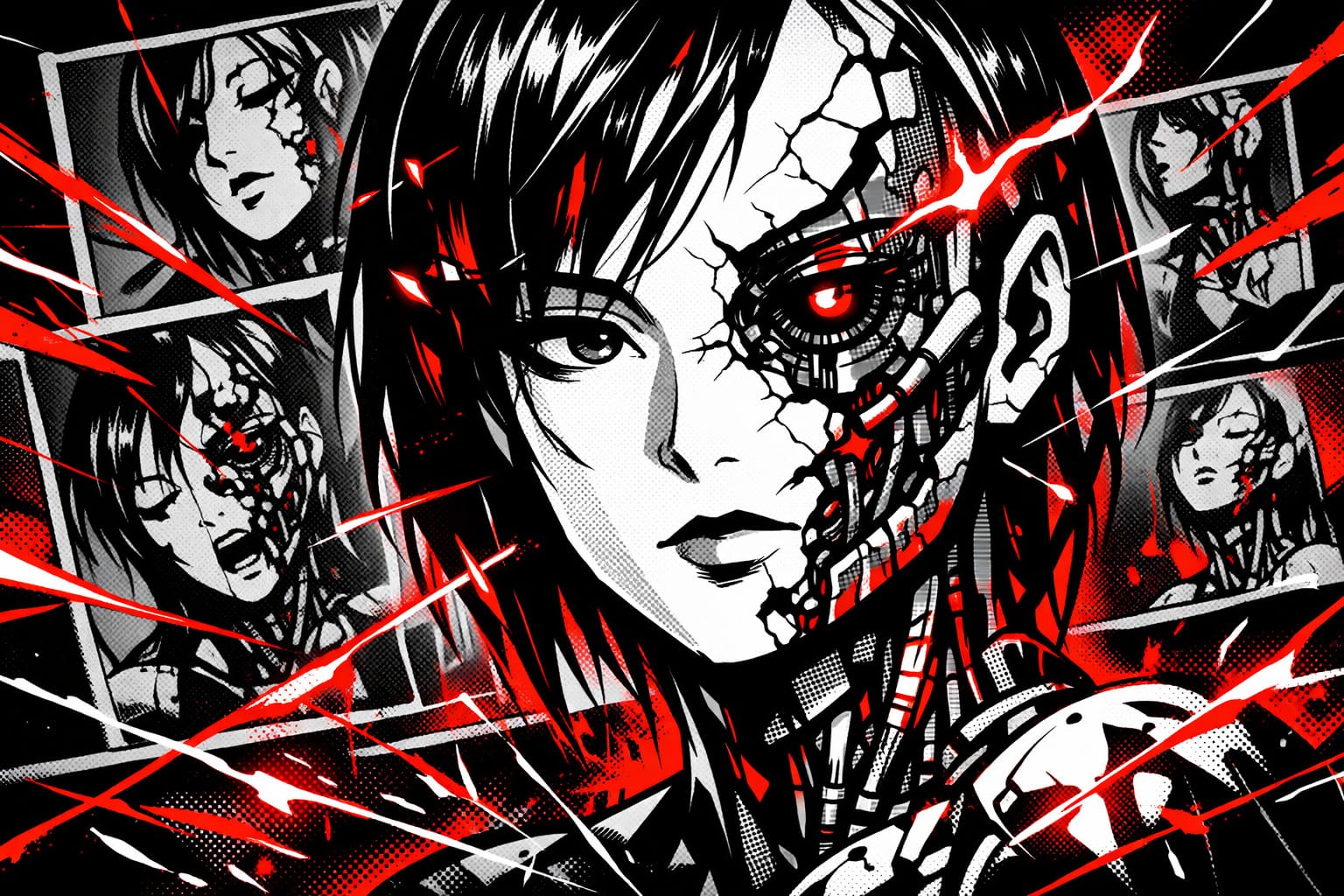
The Part That Still Hurts


She doesn’t remember the moment it began—only the sound.

Not a scream. Not at first.

A hum.

Low. Mechanical. Patient.

It started somewhere beneath her ribs, a foreign rhythm learning her body like a language it intended to overwrite. Now it pulses through her—wires threading out from her side like exposed nerves, trembling in the dark as if they can still feel something worth holding onto.

Her eyes are shut, but not in peace.

In refusal.

Because seeing would make it real.

The left side of her face is still hers—soft, tired, human. The right side has no such mercy. Cold plates kiss her skin where it no longer belongs to her. Light leaks from seams that were never meant to open. Red, sterile, deliberate. Not blood—something cleaner. Something worse.

There’s a moment—just a flicker—where she tries to stomp it down. The panic. The rising terror clawing at her throat. She tries to stamp her will over whatever this is becoming, like she can still claim jurisdiction over her own body.

But the machine doesn’t negotiate.

It adapts.

Her breath shudders. A memory surfaces—warm sunlight, a laugh she doesn’t fully recognize anymore, the weight of her own name spoken by someone who meant it. That’s the part that fights. That’s the part that refuses to go quiet.

And maybe that’s the cruelest design of all.

They didn’t erase her.

They left just enough.

Enough to feel the loss.

The wires twitch again, reacting to something unseen, and her body follows a half-second too late—as if she’s no longer the one giving the commands. The delay is subtle. Almost elegant.

Like possession dressed up as progress.

She gasps—not because she needs air, but because something inside her still believes she does.

Still believes she’s alive.

There’s a fracture at her center now, glowing faint and violent. Not a wound. Not exactly. More like a door left open too long. Something got in.

Something stayed.

And as the hum deepens—steady, certain—she understands, finally, that this isn’t transformation.

It’s replacement.

Piece by piece. Thought by thought. Memory by memory.

Until the only thing left of her…

Is the part that still hurts.

The Steps That Remember


Dispatches from the Splinters of my Mind: Entry 15

We like to believe that progress is a straight line—one step after another, measured, deliberate, inevitable. We imagine the climb as something clean, something earned through effort alone, as if willpower were enough to carry us upward. But no one tells you how heavy each step becomes when you’re not just carrying ambition, but everything you’ve tried to bury along the way.

The stairs are never just stairs.

They remember.

Every hesitation. Every false start. Every moment you almost turned back but didn’t. They hold the imprint of your weight—not just your body, but your doubt, your fear, your unfinished conversations with yourself. You think you’re climbing toward something—success, clarity, becoming—but the truth is, you’re also climbing with something. And that something doesn’t always want you to reach the top.

You feel it in the pauses.

Not the kind you plan, not the kind you earn, but the kind that finds you halfway up, when your body is still capable but your mind begins to fracture. You sit down for a moment, just to catch your breath, just to recalibrate—but the stillness stretches longer than it should. The silence begins to speak.

This is where the demons step in.

Not loud. Not theatrical. Not the monsters you were warned about in stories. These are quieter. More precise. They don’t drag you down the stairs—they convince you that staying where you are makes sense. They speak in your voice, with your logic, using your past as evidence. They remind you of every time you tried and failed, every time you reached and came up short, every time the climb cost more than you were prepared to give.

They don’t need to stop you.

They just need to make stopping feel reasonable.

So you sit.

And the longer you sit, the heavier everything becomes. Not because the stairs have changed, but because the weight you’re carrying has started to settle. It spreads out inside you, filling spaces you didn’t realize were hollow, pressing against the edges of who you thought you were. It tells you that maybe this is enough. That maybe the version of you sitting here—paused, contained, controlled—is safer than the one still trying to climb.

There’s a strange comfort in that lie.

Because climbing requires confrontation.

Not with the world—but with yourself.

Every step upward forces something into the light. A doubt you can’t ignore. A fear you can’t rationalize away. A truth that doesn’t fit the version of yourself you’ve been presenting. The higher you go, the less room there is for illusion. And for some, that exposure feels more dangerous than failure.

So they stop.

Not forever. Not officially. Just… long enough.

Long enough to lose momentum.

Long enough to forget what the next step felt like.

Long enough to convince themselves that they’ll start again later—when things are clearer, easier, more aligned. But clarity doesn’t arrive in stillness. It arrives in motion, in friction, in the uncomfortable act of continuing when continuation doesn’t make sense.

That’s the part people don’t talk about.

Success isn’t built on motivation.

It’s built on movement through resistance.

And resistance is rarely external.

It doesn’t come from the stairs.

It comes from the weight you carry up them.

That weight has a history.

It is made of everything you’ve internalized but never resolved. Expectations that were never yours but feel like they are. Failures that were supposed to teach you something but instead taught you to hesitate. Voices that told you who you were before you had the chance to decide for yourself.

You don’t leave those things behind at the base of the staircase.

You bring them with you.

And at some point, they begin to speak louder than your reasons for climbing.

That’s when the climb changes.

It stops being about reaching the top.

It becomes about deciding whether you’re willing to keep going while carrying what you haven’t yet understood.

Some people turn back here.

Not because they can’t climb.

But because they can’t carry.

Others stay where they are.

Suspended between who they were and who they might become, convincing themselves that stillness is a form of control. That if they don’t move, they can’t fail. That if they don’t climb, they don’t have to confront what waits for them at the next level.

But there are a few—quiet, stubborn, often misunderstood—who do something different.

They don’t drop the weight.

They examine it.

They sit on the step, not in surrender, but in recognition. They begin to understand that the demons they’ve been fighting are not external forces, but internal constructs—built, reinforced, and sustained over time. They don’t disappear when ignored. They don’t weaken with avoidance. They adapt.

So instead of running from them, these few turn toward them.

They ask uncomfortable questions.

Where did this come from?

Why does it have this much power?

What part of me still believes this is true?

This is not a dramatic moment.

There is no sudden clarity, no instant transformation.

Just a slow, deliberate shift.

The weight doesn’t vanish—but it changes.

It becomes defined.

And what is defined can be carried differently.

So they stand.

Not lighter.

But steadier.

And they take another step.

Not because the path is clear.

Not because the fear is gone.

But because they’ve decided that stopping is no longer an option.

This is where the illusion breaks.

Not all at once.

But enough to see through it.

The stairs were never the obstacle.

The climb was never the enemy.

It was the conversation you refused to have with yourself along the way.

And once that conversation begins—honestly, without performance, without deflection—the nature of the climb shifts. It is no longer about proving something to the world. It is no longer about reaching a destination that validates your effort.

It becomes about alignment.

About becoming someone who can move forward without being anchored to what no longer serves them.

That doesn’t mean the demons disappear.

They don’t.

They evolve.

But so do you.

And at some point, the thing that once stopped you becomes the thing that teaches you how to continue.

Not perfectly.

Not effortlessly.

But truthfully.

So when you find yourself sitting on the steps—paused, uncertain, weighed down by something you can’t quite name—understand this:

You are not stuck.

You are in the moment where the climb asks something real of you.

Not effort.

Not ambition.

Understanding.

And once you begin to understand what you’re carrying…

…the steps stop feeling like resistance.

And start feeling like direction.

The Distance Between Words


She didn’t look like someone who stayed.

That was the first lie I told myself. It went down easy, like cheap whiskey—burned just enough to feel honest, then settled in like something I didn’t have to question.

The mountains behind her were bruised with fading light, the sky pressing low like it had weight to it. Wind came off the ridge in uneven breaths, carrying pine, damp earth, and the faint ghost of rain that never quite made it. It cut through my jacket and stayed there, needling into bone.

She leaned against the railing like she owned the quiet. One shoulder dipped, fingers tracing the cold iron scrollwork—slow, deliberate, like she was counting something. Time, maybe. Or all the reasons she shouldn’t be here.

The whole thing felt staged. Like we were standing inside some memory dressed up as a parlour—clean lines, soft edges, nothing sharp enough to admit what was actually happening.

I should’ve spoken the second I saw her.

Instead, I watched.

That’s my tell. I observe. I measure. I wait until the moment passes, then I pretend I didn’t want it anyway.

I conjure the courage to speak to you.

The thought kept circling, but it didn’t land. It never does. Courage isn’t something I lack—it’s something I delay until it becomes useless.

Her hair shifted in the wind, catching the last scraps of light. There was something in her stillness, something coiled and ready to animate if the wrong—or right—word got said.

“I was hoping you’d come out.”

Her voice didn’t move much. No lift. No fall. Just flat enough to keep things from breaking.

I stepped closer. Gravel cracked under my boots—too loud, too late. Close enough now to see the tension in her jaw, the way her eyes stayed fixed on the distance like it might answer for both of us.

“I almost didn’t.”

That’s the truth I deal in. Half-measures. Almosts. Enough to sound real, not enough to cost me anything.

She gave a small smile. Not kind. Not cruel. Just… tired.

“You always almost don’t.”

That one didn’t bruise. It cut.

I moved beside her, hands gripping the railing. Cold metal. Solid. Something I could hold onto that wouldn’t walk away. My pulse was wrong—too fast, too loud. Like it was trying to outrun something I hadn’t admitted yet.

Below us, a car door slammed.

Final.

“I don’t want you to leave.”

There it was. No buildup. No cover. Just dropped between us like something that might detonate if we looked at it too long.

She turned then.

Really turned.

And for a second, I saw it—the crack in the armor. The hesitation. The thing I’d been too careful to name.

“Then why didn’t you say something sooner?”

No anger. No edge.

That made it worse.

Because she wasn’t fighting me.

She was done.

Because I was afraid.

Because wanting something gives it leverage.

Because I’ve spent years learning how to hide—how to fold myself down into something manageable, something safe, something that doesn’t risk collapse.

“I thought I had time.”

It sounded thinner out loud. Like something already breaking.

Her eyes held mine just long enough to make it count.

“There’s always time… until there isn’t.”

The wind shifted—colder, sharper. It slid under my skin like it knew where the weak spots were. I realized then I’d been warm before.

Didn’t even notice when it left.

The engine below turned over.

Low. Steady.

Waiting like it already knew how this ends.

I didn’t look. Didn’t need to.

I could see it anyway—the tail lights stretching out, thinning into nothing. That red glow people talk about like it means something. Like it isn’t just distance made visible.

Baby please don’t go.

It stayed in my throat, thick and useless.

“Stay,” I said instead.

Too small. Too late.

She studied me like she was checking for something—truth, maybe. Or proof that I hadn’t changed.

She didn’t find it.

“Not this time.”

No softness. No hesitation.

Just the sound of a door that doesn’t open again.

She moved past me. Her shoulder brushed mine—warm, real—and then it was gone. The absence hit harder than the contact. Like stepping off something you thought was solid.

And that’s when it came.

The truth. Late, like everything else.

What I really meant to say… I can’t help the way I’m built. I never meant to be so closed off to the love you showed me.

But meaning something and saying it are two different acts, and I’ve made a habit of choosing the easier one.

Her footsteps faded. Gravel. Wood. Silence.

The engine pulled away, sound stretching thin before it disappeared altogether.

I stayed there, hands locked on the railing, staring at a view that didn’t give a damn whether I learned anything from it or not.

The mountains didn’t move.

The sky didn’t shift.

Only the space beside me.

I exhaled, slow, uneven. Something inside me gave—not loud, not clean. Just a quiet fracture spreading under pressure.

Broken again.

Not the kind you notice right away.

The kind that holds.

The kind that waits.

And maybe that’s the worst of it.

Not that she left.

But that I saw it coming… and still chose not to stop it.


Author’s Note

This piece grew out of a collision of prompts and quiet moments that refused to stay quiet. I’d like to extend my gratitude to FOWC (Fandango’s One Word Challenge), RDP (Ragtag Daily Prompt), Word of the Day, and Linda Hill’s SoCS (Stream of Consciousness Saturday) for providing the kind of creative friction that sparks something honest. These prompts don’t just give words—they create entry points into places we might otherwise avoid.

Some stories arrive loud. This one didn’t. It lingered. It waited. It asked for restraint, for silence, for the kind of truth that shows up a second too late.

And maybe that’s the point.

Thank you for the nudge, the tension, and the reminder that even a single word—placed at the right moment—can open something we didn’t know we were still carrying.

The Weight of Being Seen


The brick pressed cool against her back, rough enough to remind her she was still made of something that could feel.

Morning didn’t arrive—it seeped. Slow and deliberate, like light had to think about whether this street deserved it. The air carried the stale scent of last night’s rain mixed with something metallic, like rust and regret. Somewhere down the block, a loose sign creaked. Somewhere closer, footsteps stomped against the pavement—heavy, certain, belonging to someone who never had to wonder if the world made space for him.

She didn’t turn.

She already knew what she would see.

A man moving through the world like it owed him recognition. Like the ground itself would rise up if he asked it to. His presence would echo long after he passed, each stomp a declaration.

She wondered what that felt like.

To move without hesitation.

To exist without explanation.

Her fingers brushed along the brick beside her, tracing the uneven edges, the chipped mortar. There were places where the wall had broken down into a jagged stump of what it used to be—pieces missing, worn away by time and weather and everything that didn’t care enough to preserve it.

She understood that kind of erosion.

It doesn’t happen all at once. Nobody notices the first crack. Or the second. It’s slow. Patient. You lose pieces of yourself in ways that don’t make noise.

Until one day, you realize you’ve been reduced to something functional.

Something ignored.

Something… background.

A bus groaned in the distance, the low hum vibrating through the soles of her shoes. She closed her eyes for a moment, letting the sound settle into her bones. The city had a rhythm—one she had learned to move within without ever disturbing it.

Because the moment you disturb it, people look.

And when people look, they decide.

Not who you are.

But what you are.

Her jaw tightened.

She remembered the interview room—too bright, too sterile. The faint scent of coffee that wasn’t meant for her. The man behind the desk didn’t even try to hide it, the way his attention drifted, the way his pen hovered like it was waiting for permission to stamp her into a category he already chose before she walked in.

Qualified.

Capable.

Still… not quite right.

His eyes had skimmed her, not unkind—but distant. Detached. Like she was a line item he had already calculated the outcome for.

She answered every question.

She sat straight.

She gave them everything she had built, everything she had fought for.

And still… she felt herself shrinking in that chair.

Not physically.

Something quieter than that.

Like her voice was dissolving before it reached him.

“Thank you for coming in.”

Polite.

Final.

A dismissal wrapped in professionalism.

She exhaled slowly now, eyes opening to the empty stretch of street. The light had shifted, catching dust in the air, turning it into something almost beautiful.

Almost.

Her reflection flickered briefly in a passing window—warped, stretched, then gone.

She stared at where it had been.

There was a time she tried harder. Spoke louder. Carried herself sharper. Thought if she could just be undeniable enough, the world would have no choice but to see her.

But the truth came quietly.

The world doesn’t reward volume.

It rewards comfort.

And she made people uncomfortable.

Not because of anything she did.

But because of what she represented without trying.

She leaned her head back against the brick, closing her eyes again. The texture scraped faintly against her skin, grounding her. The breeze shifted, cool against her face, carrying the distant murmur of voices she wasn’t part of.

Invisible wasn’t the right word.

Invisible meant not existing.

She existed.

That was the problem.

She existed in spaces that weren’t built to hold her.

She existed in conversations that weren’t meant to include her.

She existed… and the world kept trying to edit her out.

Her hand pressed flat against the wall, fingers splayed, feeling the solid certainty of it.

“I’m here,” she said softly.

The words didn’t travel far. They didn’t need to.

For a moment, nothing moved. No footsteps. No engines. No distant voices.

Just her.

Breathing.

Standing.

Refusing to dissolve.

“I’m here,” she said again, firmer this time. Not louder—but deeper. Like the words came from somewhere beneath the exhaustion.

The street didn’t answer.

The city didn’t pause.

No one turned to witness the moment.

But something shifted anyway.

Not out there.

In here.

Because for the first time in a long while, she wasn’t waiting for someone else to confirm it.

Not a system.

Not a stranger.

Not a man with a pen ready to stamp her into silence.

She pushed off the wall, shoulders squaring—not in defiance, not in performance.

Just in truth.

The kind that doesn’t need applause.

The kind that doesn’t ask permission.

She stepped forward, her own footsteps quiet—not a stomp, not a declaration.

But steady.

Intentional.

Unapologetically hers.

The Quiet Arithmetic of Loss


The light finds her the way memory does—uninvited, precise, impossible to ignore.

It settles along her face, tracing the small constellations of freckles like it’s reading a map only it understands. She doesn’t move away from it. Doesn’t lean into it either. She lets it sit there, like everything else she’s learned to carry.

Because she carries things.

Not in the loud, obvious way people talk about—no dramatic confessions, no visible fractures. Her grief is quieter than that. It arrives in increments. Measured. Cataloged. Lined up in the private ledger she keeps somewhere behind her eyes.

A look someone gave her once and didn’t mean to.
A goodbye that felt unfinished.
The message she never sent, still sitting in a thread that has long since gone cold.

She measures them all.

Not to weigh herself down, but to understand the shape of what remains.

Her gaze drifts past the frame, fixed on something that isn’t here anymore. You can tell by the way her eyes don’t quite settle—like they’re adjusting to distances that no longer exist. There’s a softness in her expression, but it isn’t innocence. It’s recognition. The kind that comes when you stop asking why something hurt and start asking what it changed.

The wind moves through her hair, and for a second, it feels like the world is trying to interrupt her accounting. Trying to scatter the pages.

But she’s practiced at this.

She doesn’t chase the past. Doesn’t wrestle it into meaning. She simply meets it, one grief at a time, holding each one up to the light the way you might examine a scar—not to reopen it, but to remember how it healed wrong… or right… or not at all.

There’s a faint smile at the corner of her mouth, and it isn’t misplaced.

It’s earned.

Because somewhere along the way, she learned that grief isn’t a single weight—it’s a series of small calibrations. Adjustments. Quiet reckonings. And if you pay attention long enough, you begin to notice something almost dangerous in that process:

Not all grief breaks you.

Some of it teaches you how not to break again.

And in that space—between what was taken and what remains—she sits, still and steady, measuring… not the loss itself, but the distance she’s managed to travel beyond it.

The Animal Within


The cold doesn’t ask permission. It settles in like an old debt—something inherited, something owed before you ever understood the terms. It lives in the marrow now. In the quiet spaces between breaths. In the pauses where truth almost shows itself, then thinks better of it.

The cloth over my eyes is damp. It smells like rain that never quite reached the ground. Whoever tied it didn’t rush. There’s a precision to the knot. A message in it.

You’re not meant to see your way through this.

At first, I thought the darkness would strip things away.

Instead, it gave them back.

Sound arrives sharper. The world presses in closer. Snow settling. Wind dragging its fingers through bare branches. My own breathing—too loud, too human. And beneath it… something else.

Not a sound. Not exactly.

A weight.

It stands behind me like a thought I’ve spent years refusing to finish. I don’t need eyes to know it’s there. I feel it in the way the air thickens, in the way my spine straightens without permission. In the way my body remembers something my mind tried to forget.

There’s a particular kind of fear that doesn’t panic.

It recognizes.

I don’t turn. Not because I’m brave. Because I know what happens when you finally face something that’s been patient.

It stops waiting.

I used to believe control came from seeing. That if I could map the edges, name the threat, I could keep it where it belonged—outside of me. That’s the lie. Sight lets you pretend the line exists.

It doesn’t.

Behind me, the animal breathes.

Slow. Certain. Familiar.

Not hunting. Not guarding.

Knowing.

I wonder when it started.

Was it always there? Sitting just behind my better decisions, my rehearsed restraint, my careful words? Was it there when I swallowed anger and called it discipline? When I walked away and called it growth? When I stayed silent and called it strength?

The wind shifts, and I catch it—the scent beneath the cold. Not fur. Not blood.

Recognition.

The kind that doesn’t come from meeting something new, but from realizing you’ve been avoiding a mirror.

My hands don’t tremble.

That’s how I know.

Fear shakes you when something is foreign. This… this is steady. Grounded. Like gravity finally deciding to introduce itself properly.

I inhale. Slow. Measured. The way you do when you’re about to say something that can’t be taken back.

Behind me, the animal exhales.

Closer now.

Or maybe I’ve stopped pretending it was ever far away.

I think about turning. About tearing the cloth loose, forcing the world back into something I can explain. Something with edges and distance and names that make it smaller than it is.

But I don’t.

Because I know what I’ll see.

Not teeth.

Not hunger.

Not a thing waiting to destroy me.

Something that learned to wait while I tried to become acceptable. Something that held every word I didn’t say, every line I refused to cross, every truth I buried because it didn’t fit the version of myself I thought I had to be.

The animal shifts.

Not forward.

Not back.

Just enough to remind me—

It has always moved when I did.

I let the breath out.

Long. Unsteady now, just enough to be honest.

“I know,” I say, though I don’t know if I’m speaking to it or finally to myself.

The wind carries the words nowhere.

Good.

This wasn’t meant for the world.

The cloth stays in place. The dark doesn’t break. But something loosens anyway—not outside, not in the frozen air or the unseen horizon—

Inside.

The animal doesn’t leave.

It doesn’t need to.

It never did.

That Damn Test

I’m not even sure what that means—taking an online IQ test.

I’ve read the definitions. I understand what it’s supposed to measure. Pattern recognition. Logic. Processing speed. A neat little number that tells you how well your brain behaves under controlled conditions.

Clean. Clinical. Impressive… if you like that sort of thing.

But I’ve met people who can ace those tests and still can’t think their way around the corner. The kind of folks who can solve theoretical problems all day long but freeze when reality refuses to follow instructions. Book smart, sure. Life confused.

I’ve also known people who wouldn’t impress anyone on paper… but you’d trust them when things went sideways.

Same world.

Different kinds of intelligence.

And that number?

It only tells you part of the story.


I remember taking a test once—military entrance.

I was drunk and hungover at the same time. Which shouldn’t be possible, but there I was… living proof that bad decisions can overlap.

And yeah—I bombed it.

Still passed, somehow. Just enough to get in the door, not enough to get a seat at the table. My score boxed me in. Limited options. Limited expectations. Funny how a number you barely remember taking starts speaking for you like it knows your whole story.

I remember how they treated us based on that score.

You could feel it.

Who got respect. Who got side-eyed. Who got talked to like they were already behind before they even started.

Here’s where it got interesting.

I’d be standing next to guys with higher scores—on paper, sharper minds, better placements—and they couldn’t figure out some of the basic tasks tied to their own jobs. Not all of them. But enough to notice something didn’t add up.

So I tried to help.

Most of them didn’t want it.

Here come the pretentious jerk balls… fresh out the factory, still wrapped in confidence they hadn’t earned yet. The kind that would rather struggle in silence than accept help from someone “below” them.

But one of them?

He was different.

We stepped outside, sat on the stoop, and worked through it. No rank. No scores. Just two people trying to solve a problem without making it more complicated than it needed to be.

When we finished, he looked at me and asked,
“Why aren’t you in my field… at my level?”

I took a drag from my cigarette.

“Hot chicks and alcohol.”

He nodded.
“I been there.”

We laughed.

Because sometimes the gap between where you are and where you could’ve been… isn’t intelligence.

It’s choices.


“I’m not smart.”

I say that a lot.

Not fishing for compliments—I’ve known people who are genuinely brilliant. The kind of minds that move faster, see further, connect things before you even realize there’s something to connect.

I’m not that.

At least, that’s what I tell myself.

My wife used to roll her eyes every time I said it.

“Whatever.”

That was her whole argument.

And she had reason.

That woman watched me do some of the most impressively idiotic things a grown man can do without supervision. The kind of decisions that make you question whether common sense is optional.

But she also saw me when I got stuck.

Not the casual kind of stuck—the kind where your brain locks up and frustration settles in like it pays rent. The kind that makes you feel useless.

She never agreed with me in those moments.

Never argued either.

She’d just tell me to step away.

Then she’d come back with a cup of coffee, sit beside me, and wait. No pressure. No speeches. Just presence. Like she understood that clarity doesn’t come from force—it comes when the noise finally settles.

And when I started something—really started—she already knew what I needed.

Legal pad.
Red pen. Black pen.
A full carafe of coffee.

Set it down… and give me space.

She’d even keep the kids away.

Not because I didn’t want to see them—I never minded when they came to talk—but she understood something I didn’t have the words for back then:

There’s a point in the process where stopping costs more than continuing.

So until I got there?

“Leave your father alone.”

She protected that space like it mattered.

Like I mattered.


I remember one time I was tearing into my team—just destroying them. They’d done something I thought was ridiculous. Not just wrong… obviously wrong.

Apparently, one of them called my wife.

Little bastards were always ratting me out.

They knew I wouldn’t listen to my bosses…
but they knew I’d listen to her.

Phone rings.

“What happened?” she asked.

So I told her.

“I told you—they had the same training I did.”

“Listen.”

That one word hit harder than anything I’d said.

I felt it—that irritation. Like she wasn’t hearing me.

But she was.

Better than I was.

When I got home, the coffee was ready. That expensive stuff I hated paying for… and loved drinking anyway.

We sat down.

She let me talk.

Then she said it plain.

“Your old team was with you for five years.”

I nodded.

“You had time to learn them.”

Another nod.

“You have to do that again.”

I didn’t like that answer.

So yeah… I pouted.

“What?” she asked.

I stared into my coffee.

“That damn test.”


My son asked me once—he served too—how my time in the military could’ve been harder than the guys he knew doing the same job.

Same title.

Different story.

I laughed.

“The guys I knew doing my job?” I told him. “They had it easy as hell too.”

That confused him.

So I told him a few things.

Not everything. Just enough.

His eyes widened.

“How?”

I smiled. Gave him a wink.

Because some things don’t translate.

Not cleanly. Not completely.

And definitely not into a number.


Over the years—teaching, training, watching people succeed and struggle in ways that don’t make sense on paper—I’ve learned this:

Intelligence is an elusive beast.

It doesn’t sit still long enough to be measured cleanly.
It shows up when it wants to.
Hides when you need it most.
And sometimes looks nothing like what you were taught to recognize.

So no—

I’m not saying intelligence doesn’t matter.

I’m saying it doesn’t live inside a number.

And if you think you’ve got it figured out because of a score on a page…

You probably don’t.


Author’s Note

This piece was written in response to Sadje’s Sunday Poser #279—a weekly, thought-provoking prompt that I’ve come to appreciate in my own quiet way. I don’t always jump into the ring and participate, but I read the question every time. There’s something about the way it lingers… like a conversation you didn’t realize you needed until it’s already started.

This one stuck with me longer than most.

Not because I had an answer ready—but because I didn’t.

So I sat with it. Let it circle. Let it pull at a few old memories I hadn’t planned on revisiting. What came out wasn’t a clean response or a polished argument—it was something closer to a reckoning. A look at the difference between what we measure… and what we actually understand.

That’s usually how it goes around here.

Questions don’t get answered so much as they get unpacked.
And sometimes, if you’re lucky, you walk away seeing something you missed the first time.


What Wakes at Midnight


At midnight, the abandoned amusement park came alive.

Not all at once.

It started with a tremor—so slight Daniel thought it was his imagination catching on something. Then came the hum. Low. Electrical. Wrong. It crawled under his skin before it reached his ears, like something waking up beneath the ground rather than inside the wires.

He saw the lights flicker from the road.

One bulb. Then another. A broken string of carnival glow stuttering back to life like a heartbeat trying to remember its rhythm.

He should’ve kept driving.

Instead, his foot eased off the gas. The engine idled like it was waiting for permission he didn’t need to give.

The gate hung open.

Not wide. Not welcoming. Just enough to suggest it had been that way for a long time—or had only just been moved for him.

Inside, the air smelled of rust and old sugar. Burnt oil. Damp wood. The kind of scent that clings to your throat and settles there, like something you forgot to say years ago.

Then the lights came on.

Not bright. Not clean. They buzzed overhead in tired colors—faded reds, sickly yellows, a blue that looked like it had been left out in the rain too long. The Ferris wheel groaned into motion, slow at first, metal dragging against metal with a sound that felt too close to breathing.

Music followed.

A warped calliope tune, stretched thin and uneven. Notes bending where they shouldn’t. Like memory trying to play itself back but getting the details wrong.

Daniel stepped forward.

Not because he wanted to.

Because something in him leaned toward it.

And then he saw her.

She stood beneath the Ferris wheel like she belonged to the place more than the rust did. Still. Unbothered. Watching the wheel turn like it meant something.

“You made it,” she said.

Her voice cut clean through the noise—steady, grounded, like it didn’t need the rest of the park to exist.

Daniel frowned. “Do I know you?”

“Not yet.”

She stepped closer.

The closer she got, the more the world seemed to settle. The flickering lights steadied. The warped music smoothed just enough to be recognizable. Even the air shifted—less decay, more… presence.

He noticed her eyes first. Not because they were striking—but because they weren’t searching. They already knew where to land.

“What is this?” he asked.

“A place that doesn’t lie to you,” she said. “At least not the way the rest of the world does.”

That answer didn’t help.

It didn’t need to.

She took his hand.

Her skin was warm.

That surprised him more than anything.

The moment their fingers closed, the park surged.

The Ferris wheel picked up speed, wind whispering through its spokes. The carousel jolted into motion, horses rising and falling with a rhythm too smooth to be mechanical. Lights stretched into streaks as if the night itself had started to move.

Laughter echoed.

Not distant. Not imagined.

Close enough that he turned, expecting to see faces—but there was nothing there. Just the sound lingering a second too long, like it didn’t know where to go after it existed.

“You feel that?” she asked.

He did.

It wasn’t joy.

It was sharper. Edged. Like standing at the exact point where something could still change—but probably wouldn’t.

They rode everything.

Or maybe everything rode them.

Time didn’t pass—it folded in on itself, collapsing minutes into moments that felt too full to measure. The wind cut across his face on the Ferris wheel, cold enough to sting, grounding enough to remind him he was still in a body that had forgotten how to feel like this.

He laughed.

It came out rough. Rusted. Like a door that hadn’t been opened in years.

She watched him when he did.

Not with amusement.

With recognition.

“You’re starting to remember,” she said.

“Remember what?” he asked, breath uneven.

She didn’t answer.

Instead, she led him into the funhouse.

The mirrors didn’t distort.

They clarified.

In one, he saw himself younger—jaw tighter, eyes sharper, something unbroken sitting just behind them like it hadn’t been introduced to the world yet.

In another, older—shoulders slumped, gaze dulled by a thousand small compromises he never named as such.

And then—

A roadside.

His car idling.

His hand on the wheel.

That moment.

The one where he almost turned left instead of right.

He stepped back.

His chest tightened like something had reached in and pressed against the inside.

“What the hell is this?” he asked.

“This is where the things you walked away from keep breathing,” she said quietly.

He turned to her.

“And you?”

For the first time, she hesitated.

“I’m one of them.”

The words didn’t echo.

They sank.

The park shifted again.

The colors dulled. The lights flickered harder now, exposing the rust beneath the paint, the cracks beneath the illusion. The music stuttered, skipping notes like it was losing its grip.

“You’re not real,” he said.

She smiled—but it carried weight now.

“I was,” she said. “Just not in the life you chose.”

That hit harder than anything else had.

Outside, the sky had begun to thin. The black giving way to something weaker. Something inevitable.

Dawn.

“You don’t have much time,” she said.

“For what?” His voice came out quieter now.

“To decide if this matters,” she said.

He looked at her.

Not the idea of her.

Her.

The way she stood like she didn’t need permission to exist. The way she saw him without asking him to explain himself first.

“You feel real,” he said.

“I am,” she replied. “Just not in a way you get to keep.”

There it was.

The truth, stripped clean.

He swallowed.

“Then what’s the point of this?”

She stepped closer, close enough that he could feel her breath—warm, steady, human.

“To remind you,” she said, “that the man you almost were… didn’t disappear. You just stopped listening to him.”

The Ferris wheel slowed.

The lights dimmed.

The hum faded into something hollow.

He felt it leaving.

Not the park.

The feeling.

That sharp, dangerous clarity slipping back into the quiet place it had come from.

“Stay,” he said.

The word surprised him.

She shook her head gently.

“You don’t want me,” she said.

“I do.”

“No,” she said. “You want the version of yourself that exists when I’m here.”

He didn’t argue.

Because the worst part was—

She was right.

At the gate, the world outside waited. Still. Ordinary. Safe in the way things are when they don’t ask anything from you.

She let go of his hand.

“This is where you go back,” she said.

“And you?”

“I stay where I’ve always been,” she said. “Right at the edge of the choice you didn’t make.”

He nodded slowly.

“Will I see you again?”

She stepped back into the dimming light.

“Only if you forget.”

And then—

Nothing.

The park stilled.

The lights died.

The music cut off mid-note.

Daniel stood there, the silence pressing in heavier than the noise ever had.

He could still feel her hand.

Still smell the rust and sugar.

Still hear the echo of laughter that didn’t belong to anyone.

He got back in his car.

The engine turned over like it always did.

The road stretched ahead like it always had.

But something in him didn’t sit the same.

Because now he knew—

Some places don’t come alive to entertain you.

They wake up to remind you who you were before you decided to be someone easier to live with.

The Things We Never Name


Dispatches from the Splinters of My Mind: Entry 14:

There is a version of you that has never spoken. Not because it lacks words, but because it understands the cost of being heard. It lives somewhere behind your eyes, just beyond the reach of mirrors and rehearsed conversations—a quiet architecture of memory and instinct built from moments you swallowed instead of expressed. It is not hidden in the way a secret is hidden; it is hidden in the way a scar disappears under skin—still there, still shaping the structure, just no longer visible to those who don’t know where to press.

You feel it sometimes—in the pause before you answer a question you’ve been asked a hundred times, in the moment when the truth rises sharp and immediate, only to be softened, reshaped, diluted into something acceptable. Something survivable. Something that won’t make the room shift. That version of you doesn’t argue. It watches. It has learned the language of tolerance—not the kind that expands understanding, but the kind that compresses identity into manageable pieces, the kind that allows you to sit in rooms where you are only partially present. You call it maturity. You call it growth. But somewhere beneath those polished names, something quieter calls it what it is: survival.

Inside you, there is a forest. You don’t visit it often. It is not curated, not symmetrical, not safe. It does not exist for aesthetic appreciation or poetic metaphor; it exists because it grew that way—wild, tangled, ungoverned. The trees lean at angles that don’t make sense, the ground shifts underfoot, and the deeper you go, the less certain you are that you can find your way back. That is why you stay at the edge, because the edge is manageable. The edge is where society lives. Out here, everything has a name, a function, a script. You learn quickly which parts of yourself are welcome and which ones should remain theoretical.

So you edit. You refine. You present. You become a version of yourself that fits within the boundaries of collective comfort—and they applaud you for it. They tell you to be an individual while handing you a template. They tell you to stand out while rewarding you for blending in. Somewhere along the way, you begin to forget what your unedited voice sounds like. But the forest remembers. It remembers every thought you abandoned halfway through, every instinct you silenced before it reached your mouth, every moment you chose peace over truth—not because peace was right, but because truth would have cost you something you weren’t ready to lose.

The forest is not empty. It is crowded. It is filled with versions of you that never made it past the threshold of expression. They move between the trees like ghosts of possibility—not dead, not gone, just unrealized. Waiting. Watching. Becoming something else in the absence of acknowledgment. This is where the anomalous begins, because those versions do not remain static. They evolve. They distort. They adapt to the darkness you’ve left them in. What starts as silence becomes pressure. What starts as avoidance becomes fragmentation.

You feel it in small ways at first—a hesitation you can’t explain, a reaction that feels disproportionate, a quiet sense that you are not entirely aligned. You tell yourself it’s stress, fatigue, nothing—but it is not nothing. It is the accumulation of everything you refused to explore, everything you labeled inconvenient, everything you chose not to understand because understanding would have required change. The mind does not discard unused pieces; it repurposes them. And when those pieces are left in the dark long enough, they begin to form something unfamiliar—something that does not recognize the version of you that stands in the light.

That is the part no one warns you about. They talk about self-discovery like it is clean, like opening a door to neatly arranged truths waiting patiently for your arrival. They do not talk about the possibility that what waits inside may not be interested in being understood, that it may not be gentle, that it may not recognize you as its origin—because you abandoned it, because you taught it that it did not belong. So it built something else. Something that could survive without you.

Now, when you feel that pull—that quiet, persistent pressure to look inward—you hesitate. Not because you are afraid of what you will find, but because you are afraid of what will recognize you. Society has an answer for this, as it always does: stay busy, stay distracted, stay within the lines. There is comfort in repetition, safety in conformity, peace in not asking questions that don’t have easy answers. What they do not tell you is that this peace comes at a cost—that every unasked question leaves a mark, that every suppressed truth adds weight to something already struggling to hold itself together.

They do not tell you that becoming part of the herd requires a slow, deliberate quieting of everything that makes you unpredictable—not because unpredictability is dangerous to you, but because it is dangerous to them, to the structure, to the illusion that everything is under control. So they teach you to sleep—not physically, but mentally, emotionally, spiritually. They teach you to function without fully engaging, to exist without fully inhabiting yourself, to move through the world as a shape that resembles you but does not require the full presence of your internal world. And you comply, because it works, because it keeps things smooth, because it avoids conflict.

But survival is not the same as being whole.

Somewhere, in the quiet moments you try to avoid, you feel that difference—a fracture, a subtle misalignment between who you are and who you allow yourself to be. You feel it when you are alone, when the noise drops, when there is no one to perform for. That version of you steps forward—not loudly, not aggressively, but with a presence that cannot be ignored. It does not accuse. It does not demand. It simply exists. And in that existence, it asks a question you’ve spent years avoiding: what would happen if you stopped editing yourself?

Not recklessly. Not destructively. But deliberately. Quietly. In a way that acknowledges the forest instead of pretending it isn’t there. In a way that steps beyond the edge—not to conquer it, not to control it, but to understand it. To walk among the trees without needing to name everything. To sit with the versions of yourself that never had the chance to speak, and to listen—not for comfort, not for validation, but for truth.

That is where things begin to shift. Not outwardly, not immediately, but internally. The fragmentation slows. The pressure eases. The anomalous becomes less foreign, less threatening—not because it disappears, but because it is no longer ignored, no longer abandoned, no longer left to evolve in isolation. There are no applause lines here. No audience. Just you, and everything you’ve avoided, and the quiet, uncomfortable, necessary work of becoming someone who can hold all of it without turning away.

That is not conformity. That is not rebellion. That is integration—and it is far more difficult than either, because it requires you to let go of the illusion that you can be accepted without being fully known, even by yourself.

So the question isn’t whether you have these unspoken worlds within you.

You do.

Everyone does.

The question is whether you are willing to step into them.

Because the longer you pretend they don’t exist… the louder they become.

And eventually—

they stop asking to be heard.

They start demanding it.

The Knucklehead Wing

Daily writing prompt
If you could have something named after you, what would it be?

They gave the museum to Travis Hanson. He gets the parts that make sense. I get the parts that happened anyway—the ones that didn’t ask permission, didn’t check the manual, and definitely didn’t end with applause.

Right at the entrance, there’s a picture of me trying to open a beer bottle with my teeth. No caption. Just a moment frozen in time where I was absolutely convinced this was going to work. That confidence—that’s the real exhibit. Not the outcome. The belief that preceded it.

Further in, my desk sits in the corner like it owes me something. Half-written parchments scattered across it—sentences that started with authority and ended like they got distracted halfway through their own argument. Ink fading where I paused too long, like the words lost faith before I did. A pewter inkwell sits there, heavy and unimpressed. My favorite quills rest beside it, bent just enough to suggest I thought pressure would speed things up. It looks like work. It feels like avoidance dressed up as effort.

There’s a chair, of course. That’s where I go when I want to appear engaged while doing absolutely nothing useful. Every time I lean back—every time I drift, pretending I’m one good thought away from brilliance—I look up and there it is:

“You Should Be Working.”

Not motivational. Not inspirational. Accusatory. Like it knows exactly what I’m doing and isn’t impressed by how well I justify it. I used to stare at it like it owed me something, like inspiration was late and I was the victim. Truth is, I wasn’t waiting. I was hiding. One sounds noble. The other sounds accurate.

Off to the side, there’s a photograph of Mrs. Khan giving me that look. Calm. Surgical. The emotional equivalent of, go ahead, finish this mistake—I’ll wait. I earned that look. I flooded the kitchen because I decided—again—that I was qualified for something I had no business touching. Vise grips, duct tape, WD-40… I had a whole toolkit of bad decisions. Might’ve even brought in bailing wire just to make it official. I didn’t fix the problem. I expanded it. But the ice maker worked. So technically, not a total loss—if you ignore the part where the floor looked like it filed for divorce.

What came next doesn’t get a plaque. It gets remembered. The mop leaning in the corner like it’s reconsidering its life choices. Towels stacked like I was building a monument to poor judgment. The sound of the washer running because she wasn’t about to carry the weight of my “I got this” moment. She made me do the laundry. Which felt less like a chore and more like consequences with a spin cycle. I hate doing laundry. Still do. Growth has limits.

Somewhere between standing in that water and pretending I knew how to separate colors, I added a plumber to my speed dial. Not because I evolved—because I got tired of auditioning for disaster.

Behind the desk, carved deep enough to outlast better decisions than I usually make, it says: “Still working on it.” That’s the truth of my wing. Not that I figured anything out. Not that I earned anything worth framing. Just that I keep showing up—bad ideas, unfinished pages, side-eyes, and that damn sign overhead—trying to convince myself that knowing better and doing better are the same thing.

They’re not.

But I’m… still working on it.

Tailfeather Jenkins and the Widow Jones

Daily writing prompt
What makes you laugh?

The rain didn’t fall. It hovered—like it had somewhere better to be but couldn’t quite commit. Hung there in the air, thinking things through. I respected that. Commitment’s a tricky thing. People talk a good game until it’s time to actually land somewhere.

My name is Tailfeather Jenkins. Private Investigator. I locate disappointments, misplace truths, and send invoices that rarely get the respect they deserve. The fan above my desk turned slow and uneven, like it owed somebody money and was hoping they forgot.

That’s when she walked in.

She didn’t enter the room so much as dim it. Like someone turned the brightness down without asking.

Widow Jones wore darkness like it had been tailored specifically for her—fitted, measured, deliberate. The hat did most of the talking. Wide brim, cutting her face in half, keeping her eyes in shadow and leaving those red lips out front like a warning sign nobody reads until after the accident. Not painted for beauty. Painted with intent.

Her skin caught the light reluctantly, like it didn’t trust it. Smooth. Pale. Unhurried. The kind of stillness you only get after you’ve either finished grieving… or decided it wasn’t worth the effort in the first place.

You couldn’t see her eyes right away. That wasn’t an accident. Eyes give things away. Widow Jones didn’t strike me as the charitable type.

Her hair fell in controlled waves over her shoulders, not a strand out of place. That told me two things immediately—she plans ahead, and she doesn’t panic. People who don’t panic are either very smart… or very dangerous. Sometimes both. Those are the ones you don’t rush unless you’ve got a death wish or a backup plan. I didn’t have either that morning.

The dress didn’t ask for attention. It knew it had it. Black on black, fabric moving just enough to remind you it wasn’t decoration—it was intention. No noise. No desperation. Just control.

There was a scent, but it didn’t introduce itself properly. Not floral. Not sweet. Something quieter. Like memory after it’s had time to settle and doesn’t need your permission anymore.

She didn’t fidget. Didn’t scan the room. Didn’t need to.

Women like that don’t go looking for trouble.

They wait for it to recognize them.

“I’m looking for Tailfeather Jenkins,” she said. “You him?”

“That’s the rumor.”

She didn’t smile. That was promising.

She moved toward the chair like it already belonged to her.

Then the room reminded her it didn’t.

Her heel caught the leg just enough to betray her. Not a fall—nothing dramatic. Just a brief hitch in the rhythm. A break in the illusion. She steadied herself without grabbing anything, adjusted without looking down, without looking at me, like the moment had been negotiated and quietly dismissed.

But it happened.

And I wrote it down anyway. Not in the notebook. Somewhere more useful.

Women like that don’t make mistakes.

Which means when they do… it’s not the mistake that matters. It’s what it reveals about the rest of the act.

She sat, crossed her legs, and took the room back like nothing had happened.

“My husband is dead.”

“I’m sorry,” I said. It came out clean, practiced. Like something I kept in a drawer and pulled out when required. Sympathy has a script. Authenticity usually shows up late, if at all.

“I believe he was murdered.”

That shifted the air. Not enough for anyone else to notice. Just enough for me.

“He left the house three nights ago. No note. No call. No nothing.”

“Nothing’s expensive these days,” I said. “Except honesty. That’ll cost you everything if you’re not careful.”

Still no smile. Discipline like that usually comes with a history.

I’ve trusted my instincts about women before. That’s how I met a psychopath. Beautiful. The kind of beautiful that makes bad decisions feel like destiny. Didn’t notice the eyes until it was too late. By then, I was already part of the lesson.

I opened my notebook. Blank pages. Full confidence. It’s a system that hasn’t failed me yet, mostly because I don’t trust either one completely.

“Name?”

“Earl Jones.”

“Occupation?”

She paused.

That pause told me more than anything she could’ve said. People hesitate around lies, truths, and things they don’t want to categorize. I didn’t push it. No need to chase something that’s already circling you.


The house sat at the end of a quiet street that looked like it minded its business a little too well. Lawns trimmed, windows clean, everything in its place. The kind of neighborhood that doesn’t ask questions because it already decided it doesn’t want the answers.

Inside didn’t smell like anything.

That’s not normal.

Every place smells like something—coffee, dust, old arguments, decisions that didn’t age well. This place smelled like nothing had ever happened there. Like someone had erased the evidence of living and left the structure behind.

The counters weren’t tidy.

They were cleared.

There’s a difference. Tidy is effort. Cleared is intention.

The sink was dry. Not recently cleaned—unused. A man lives somewhere, there’s always something left behind. A glass, a plate, something that says, “I was here, and I’ll deal with it later.” Later never comes, but the evidence sticks around.

Earl Jones didn’t leave anything.

Cabinets were organized. Plates stacked like they were waiting for inspection. Then the spices.

Alphabetized.

That stopped me.

Men don’t alphabetize spices. Not unless they’re performing for someone who might be watching. Or trying to convince themselves they’re a different kind of man than they actually are.

The living room was arranged like a photograph. Furniture positioned, not lived in. No imprint on the cushions. No remote abandoned in the middle of a decision. No blanket draped over the arm like it lost an argument.

Just a room pretending to be a life.

The bedroom followed the same script. Bed tight. Closet half full. Not too much, not too little. Measured. Controlled. Like someone had calculated what absence should look like.

The only thing missing…

was a person.


Happy’s Diner smelled like burnt coffee and things people avoided saying out loud. Neon sign buzzing like it was hanging on out of spite more than purpose.

They made a good pastrami.

That told me Earl had been trying. Men don’t chase good sandwiches unless they’re chasing something else too—routine, comfort, a version of themselves they haven’t fully earned yet.

I didn’t stay long.

Didn’t need to.

A photograph told me everything I needed to know.

A girl. Young. Eyes too sharp for her age. The kind of eyes that don’t belong to childhood anymore. His eyes. Not the smile from the photo on my desk—that one felt borrowed. This was the original version.

That didn’t fit the man I’d been shown.

But it fit everything else.


Outside, the air had that quiet weight that comes before something decides to happen.

That’s when I saw it.

Black sedan. Across the street.

Parked wrong.

Not careless.

Intentional.

You can tell the difference. One says “I forgot.” The other says “I’m waiting.”

I didn’t turn my head. Didn’t need to. You feel that kind of attention before you see it.

Widow Jones stepped up beside me. Closer than she’d been before. Close enough to suggest this wasn’t coincidence anymore.

“You see it?” she asked.

“Yeah.”

“They’ve been following me.”

No tremor. No panic. Just confirmation. Like she’d finally said something out loud she’d been carrying for a while.

I nodded.

“They’re not looking for him anymore,” I said.

She didn’t ask how I knew.

That told me she already did.

The girl stepped out behind us, quiet, observant. Not afraid. Not yet. That worried me more than fear would’ve.

Three of us standing there.

One past.

One present.

One problem none of us had control over.

Earl Jones didn’t disappear.

He split.

One life he built carefully, piece by piece.

One life he didn’t know he had until it showed up and demanded space.

And somewhere in between—

something found him.

I watched the car. Still. Patient. Like it had all the time in the world and knew it.

I thought about the house. Too clean. Too careful. A place designed to remove fingerprints, not collect them.

Thought about the way she caught herself on that chair. The smallest crack in a performance built on control.

Thought about the girl.

The only thing in this whole situation that felt real. Unmanaged. Unpolished. Unfinished.

And that’s when it happened.

I laughed.

Not out loud. Not long. Just enough to feel it move through me and settle somewhere it didn’t quite belong.

Because none of it was funny.

But for the first time—

after all the pieces stopped pretending to be something else—

it fit.

Still Not Convinced

When you were five, what did you want to be when you grew up?

When I was five, I wanted to be something.

That’s what people expect you to say. Something simple. Something you could draw with a thick crayon and hold up like evidence—see, I’m already becoming this. A clean answer. A future you can pronounce.

Problem is—I don’t remember being five. Not in any way that feels reliable. No clear picture. No moment that holds still long enough to trust it. Just gaps where something should be. Like a room you know you’ve been in, but can’t describe.

There was a theory floating around for a while—picked up just enough traction to be worth repeating—that I was never a child. Just born a grumpy old man. I’ve never done much to argue against it.

In fact… there’s no evidence of me being a child. I made sure it was eliminated.

Not in some dramatic, burn-the-records kind of way. Nothing cinematic. Just time doing what it does—wearing things down, sanding the edges off, letting the unimportant slip through the cracks. Memory isn’t a vault. It’s a leak.

But not everything disappeared.

I remember sitting at a table—cheap wood, uneven, rocking just enough to notice. Paper in front of me, curling at the corners. Markers scattered like tools I didn’t quite understand yet. I drew a self-portrait. Or tried to.

I remember the hesitation more than the lines. The way my hand hovered before committing. The face on the page looking back at me and feeling… wrong. Not broken. Not bad. Just not true. I didn’t have the language for that then. I just knew I didn’t like it.

My family told me it was good. Warm voices. Easy encouragement.

But it didn’t land.

My Madre stood there a little longer. Quiet. She didn’t tear it down. Didn’t dress it up either. Just looked at it like she was measuring something I couldn’t see yet. Her eyes moved slower, sharper—like she wasn’t looking at what it was, but what it wasn’t.

Her opinion mattered the most. So I bore down. Practiced harder. Chased something I couldn’t name yet.

I had a friend who could draw—really draw. His lines made sense. Mine didn’t. Not like that. Not clean. Not confident. I couldn’t figure out how he got from nothing to something that looked right. I didn’t understand the process. Just the distance.

I remember the markers. The sweet ones—the ones that pretended to be fruit. Thick in the air, artificial, almost sticky. And the Sharpies. No disguise. Just raw, chemical bite that sat in the back of your throat. We used to sniff them like it was part of the process.

It didn’t help.

But I kept going.

Writing started creeping in somewhere along the way. Uninvited. Didn’t ask permission. Didn’t care that I was trying to focus on drawing. Stories showed up anyway—half-formed, persistent, sitting just behind whatever I was trying to put on paper.

I wish I could’ve just focused on the art. Would’ve been simpler. But the stories wouldn’t leave.

In high school, sitting at my best friend’s house, his brother said it like it was nothing—you can write and illustrate your own book. Before that moment, it never crossed my mind. Not once.

Even after that… I doubted it.

Even after my first story was published. Even after I stood in front of a room teaching seminars on poetry and short stories. Still didn’t quite believe it. Like the evidence was there, but it didn’t belong to me.

I’m still doing it.

Of course… there were detours. Soldier. Marriage. Kids. Whole chapters written in a different language. Life filled the margins whether I asked it to or not.

But I keep coming back. Blank page. Quiet room. That same friction between what I see and what I can actually put down.

Sometimes it feels like looking in a mirror and not arguing with what’s there anymore. Like the version I kept chasing was already doing the work—I just didn’t trust him yet.

Kids want to be something. Astronaut. Superhero. Firefighter. Clean answers.

I think I missed that part. Or maybe I didn’t.

Maybe this was always it.

Not the title. Not the uniform. Just the work. Trying to get it right. Even when it doesn’t come out that way. Even when you don’t believe it counts.

So no—I don’t remember what I wanted to be when I was five.

But I remember what it felt like to get it wrong.

And I remember not stopping.

That’s close enough.

Most days.

The Illusion of Language

Daily writing prompt
What’s something most people don’t understand?

Most people think language is simple.
You open your mouth, words come out, someone else hears them, and the message lands exactly the way you meant it. That’s the illusion. Language feels precise, but most of the time it’s anything but.

Words are blunt instruments trying to describe sharp emotions, complicated ideas, and experiences that don’t fit neatly into a sentence. We say I’m fine when we mean everything from I’m exhausted to I’m barely holding it together. We say I understand when we really mean I heard you… but I don’t feel what you feel.

Language lets us talk. It doesn’t guarantee we connect.

Sometimes it doesn’t even let us say the thing at all.

I’ve had moments where the truth sat right there in my chest, clear as day, and still refused to come out right.
I wanted to speak what I draw—to translate something raw and visual into something someone else could feel—but language kept sanding it down into something safer, smaller.

So you learn to say it other ways.

A pause that lingers too long.
A hand that almost reaches, then thinks better of it.
Eyes that hold a second past what’s comfortable, like they’re trying to finish a sentence the mouth couldn’t start.

The room shifts. Something is understood.
Nothing was said.

That’s the part most people miss.

Language isn’t just vocabulary. It’s tone, timing, history, culture, and whatever ghosts you brought into the conversation. Two people can use the same words and mean completely different things. Worse, two people can mean the same thing and still walk away misunderstood.

And still—despite all that—it’s one of the most beautiful things we have.

Language can heal. It can motivate. It can pull someone back from the edge when nothing else reaches them. A single sentence, at the right time, can feel like oxygen.

But that same tool can cut just as clean.

It can destroy, disrupt, irritate. It can leave marks that don’t show up until years later. Words don’t just pass through people—they settle in.

Technology only sharpens the problem. We have more ways to communicate than ever—texts, emails, posts, messages—but less clarity. A sentence without a face behind it turns cold. A joke becomes an insult. Silence becomes accusation.

The more we rely on language, the more we expose how fragile it really is.

What most people don’t understand is this:

Language was never meant to be perfect.
It’s a reach. Not a guarantee.

It gets us close—but never all the way there.

And maybe that’s why some things feel more honest when they’re written in a notebook, sketched on a page, played through a speaker, or left hanging in the space between two people who both understand… without needing the words at all.

The Tools Changed. The Job Didn’t.

People like to say technology changed my job.
That sounds neat. Clean. Logical.

It isn’t exactly true.

The job itself hasn’t changed much at all. I still sit in a chair, stare at words, move them around, delete half of them, and try to make the other half sound like I knew what I was doing all along. The difference is the tools I use now would’ve looked like science fiction when I started.

Back then, writing meant a legal pad, a typewriter, or later a desktop computer that took ten minutes to boot and another ten minutes to crash. If you wanted to look something up, you grabbed a book, not a search bar. If you made a mistake, you fixed it yourself. There was no auto-correct, no grammar checker, and definitely no artificial intelligence offering suggestions like an overeager intern who never sleeps.

There was no autosave.
You learned real quick what that meant.

Hard drive failures.
Twenty megabytes of storage if you were lucky.
Our operating system lived on floppy disks.
The printer screamed like a wounded animal every time the dot-matrix decided to cooperate.

And there were actual arguments about which program was better —
Word, WordPerfect, or Lotus 1-2-3 —
like the fate of civilization depended on it.

You didn’t trust the machine,
and the machine sure as hell didn’t care about you.

Now I carry more storage on a flash drive than we had in an entire room full of computers back then.
Hard drives fit in your shirt pocket.

Now my desk looks like the control panel of a small spaceship.

I’ve got a laptop, a tablet, cloud storage, editing software, and enough passwords to qualify as a part-time cryptographer. Half the time I don’t know if I’m writing, formatting, uploading, backing up, syncing, or troubleshooting.

Technology didn’t make the work easier.
It made the work possible — and complicated in ways nobody warned us about.

The biggest change isn’t speed.
It’s expectation.

Because everything is faster now, everyone assumes everything should be faster.
Write faster.
Edit faster.
Post faster.
Respond faster.
Create more.
Produce more.

Some days it feels like the job isn’t writing anymore.
It’s managing the machines that make writing possible.

And yet, with all this technology sitting on my desk, I still reach for a pen and a notebook when I start something new.
Stories. Poems. Prose.
The first draft usually happens the old way — ink on paper, crossing things out, arrows in the margins, pages that look like a crime scene by the time I’m done.

And underneath all the screens, all the software, all the updates and logins and notifications… the real work is still the same.

You sit down.
You face the blank page.
You try to say something true.

Technology can give you better tools, but it can’t give you better ideas.
It can help you fix a sentence, but it can’t tell you what needs to be said.
It can store everything you’ve ever written, but it can’t tell you if any of it matters.

If anything, technology has made the job more honest.

There’s nowhere to hide now.
No excuse about not having the right equipment.
No reason you can’t write today.

The tools are always there.
Waiting.
Charged.
Connected.

Which means the only thing left to blame…
is you.

And oddly enough, I think that’s a good thing.

Because no matter how much technology changes, the job is still the same one it’s always been.

Sit down.
Do the work.
Tell the truth.

Everything else is just wiring.

Daily writing prompt
How has technology changed your job?

I Had a Plan Until My Brain Got Involved

Daily writing prompt
How often do you say “no” to things that would interfere with your goals?

Saying no to everyday distractions has never been much of a problem for me.
Noise, nonsense, people wanting your time for things that don’t matter — that part is easy. By trade I’ve always been a troubleshooter. Something breaks, you figure out why, you fix it, and you move on. Most goals work the same way. Make a plan, follow the steps, don’t overthink it, and eventually the job gets done.

External interference I can handle.
Internal interference is where things start getting interesting.

Right now I’m working on the first draft of a novel. The idea started about a year ago on Memoirs of Madness, and once I got rolling the pages came faster than I expected. I’m sitting at fifty-four thousand words out of an eighty-thousand word goal. At this pace I should have the first draft done by the beginning of the third quarter, assuming I don’t lose my mind before then.

On paper, everything looks fine.
Inside my head, it sounds like a different meeting entirely.

There’s a voice in there that keeps asking what the hell I think I’m doing.
Tells me I’m only good enough to write short pieces.
Reminds me — very helpfully — of all the other novels I started over the years that are now sitting on hard drives like unfinished home improvement projects nobody wants to talk about.

The problem isn’t ideas.
It’s confidence.
Or more accurately, the lack of it at exactly the wrong time.

The strange thing is, I probably write better now than I did years ago. At least I think I do. Hard to say. Self-evaluation has never been my strong suit. I can fix a machine without questioning my life choices, but put a blank page in front of me and suddenly I’m negotiating with ghosts.
I’m pretty sure they make pills for that. No idea if my insurance covers it.

When my wife was alive, I didn’t second-guess things this much. I’d write something, hand it to her, and wait. She’d read a few lines, get this look on her face like she wasn’t sure whether to laugh or schedule me an appointment with somebody. Then she’d shake her head and tell me there was something wrong with me.

That’s how I knew I was on the right track.

If she liked something too much, I’d delete the whole thing and start over. Couldn’t trust it otherwise. If it didn’t make her look at me sideways, it probably wasn’t worth keeping.

I don’t get that look anymore.

So these days saying no to distractions is easy.
Saying no to doubt is the part I’m still working on.

Because if I let that voice run the show, this novel will end up in the same place as the others — sitting on a hard drive somewhere, taking up space, right next to all the projects I was absolutely sure I was going to finish.

And I’ve got enough of those already.
I don’t need another one.

Everybody Knows One Superpower Isn’t Enough 

Daily writing prompt
What’s a secret skill or ability you have or wish you had?

As kids, we carry around a whole warehouse full of fantasies. 

I never really understood why superheroes stick in our heads the way they do, but every child has one. 

I remember reading a line once that always made sense to me: 

“Mother is the name for God, on the lips and hearts of children.” 

When I was young, I believed my Madre could solve anything. 

In a lot of ways, I still do. 

Her wisdom has outlived most of the problems I thought were impossible. 

But when it comes to secret abilities, superheroes are still the standard. 

Over the years I’ve done a fair amount of research — highly scientific, very serious — trying to figure out the perfect combination of powers. 

Unfortunately, life kept interrupting the project, and I never got to finish developing the full skill set. 

Which is a problem, because everybody knows having only one superpower is lame. 

Let me give you a few examples. 

Superman has x-ray vision, super strength, flight, and he’s bulletproof. 

And to be fair, if you can lift an entire building, is that really just super strength? 

That sounds like it needs its own category. 

Super strength plus. 

Luke Cage has super strength and bulletproof skin, which is solid. 

Not flashy, but dependable. 

The Hulk has super strength, can jump halfway across the planet, and he’s green. 

I don’t know if being green counts as a power, but it definitely adds to the resume. 

Point is, nobody remembers the superhero with only one trick. 

So after years of highly scientific research, I narrowed it down to the essentials. 

Super strength, x-ray vision, and the ability to fly. 

Super strength because at some point in life every man realizes half his problems could be solved if he could just pick something up and move it somewhere else. 

Broken car, heavy furniture, bad decisions, people… 

Not saying I would use it irresponsibly, but I’d like the option. 

X-ray vision would come in handy more than people admit. 

Not for the reasons everyone jokes about, but because I’m tired of not knowing what’s really going on behind things. 

Walls, doors, conversations, intentions. 

Most of life feels like guessing. 

X-ray vision would at least cut down on the guessing. 

And flying… that one’s easy. 

Sometimes you just want to leave without explaining why. 

No traffic. 

No small talk. 

No waiting in line. 

Just point yourself in a direction and go. 

Truth is, none of those are really about power. 

They’re about freedom. 

Super strength so things stop feeling heavier than they should. 

X-ray vision so people stop being such a mystery. 

Flight so you can get away when the world starts closing in. 

That’s probably the closest thing to a superpower most of us actually want. 

Ink, Coffee, and Silence

Daily writing prompt
What strategies do you use to cope with negative feelings?

Negative feelings don’t show up politely. They don’t knock on the door and ask if it’s a good time. Sometimes they slip in quiet, like they’ve always had a key. Other times they kick the damn door open, track mud across the floor, and sit down like they pay the rent. They never bring tools to fix what they broke.

I’ve learned over the years that pretending they aren’t there just makes them louder. Ignoring them never worked for me. They don’t leave. They wait.

One thing I do is write. Not because it’s noble, and not because I think everything I write is worth reading. Most of it isn’t. I’ve been filling notebooks most of my life. While my wife was dying, I started posting my work publicly because the pain had to go somewhere, and my head was running out of room to keep it all inside. When it stays inside, it grows teeth. When it’s on paper, it’s just ink, and sometimes that’s enough to make it let go.

Sometimes I draw. Freehand, pencil on paper, nothing fancy. There’s something about dragging an image out of your head and forcing it onto the page that slows the noise down. Writing helps, but drawing is different. When I’m sketching, my thoughts can’t outrun my hand, and that’s slow enough to make whatever’s got hold of me loosen its grip. I’m sure some egghead somewhere has a ten-dollar word for why that works. But any word over five dollars usually makes you sound like an asshole, so I don’t worry about the science of it. I just know it works.

Sometimes I read. Not the kind where you’re chasing a goal or trying to look smart. Just reading to get out of my own head for a while. History, crime novels, philosophy, anything that reminds me the world was screwed up long before I got here, and it’ll stay that way after I’m gone. Somebody else has already lived through worse and kept going, which makes it hard to sit there thinking my problems are the end of the story.

Coffee helps. Not because caffeine fixes anything, but because routine does. Grinding the beans, pouring the water, standing there half awake while the machine does its thing — that’s a small piece of the world that still makes sense when the rest of it doesn’t.

I also learned that silence isn’t the enemy, no matter what people say. I’ve always been a loner. For a long time I figured it was safer to keep my thoughts to myself, mostly because people mock what they don’t understand. When I was younger, that got under my skin more than I liked to admit. Part of the reason I started training, lifting, pushing myself the way I did, was because of that. Funny thing is, getting stronger didn’t stop the noise in my head — it just made it quiet enough to live with.

And quiet is enough. If I sit still long enough, the noise settles. Not gone, just quieter. Quiet enough to think instead of react.

And sometimes I laugh at it. Not the fake laugh you use in public, but the kind that comes out when you realize life doesn’t care what you had planned. You work, you worry, you try to keep things together, and something still comes along and knocks the whole thing sideways. After a while you either laugh at the mess or let it tear you up. Laughing is cheaper.

I don’t have a perfect system. Some days none of this works. Some days the best strategy is just getting through the day without doing something you’ll regret tomorrow.

That counts too.

Because coping isn’t about winning.
It’s about staying in the fight long enough to see the next morning.

I Haven’t Slept Since the First Bush

If you didn’t need sleep, what would you do with all the extra time?


I had to laugh when I read this question.
Asking an insomniac what they would do if they didn’t need sleep is cute.

I haven’t slept since the first Bush.
Bush 2 didn’t exactly improve the situation.

Hmm… what day is it?
Oh, it’s Sunday? Why didn’t you say so.
Hold on, let me pull out my calendar and see what’s on the agenda.

Yeah… I’m booked solid. I’ve only got a few minutes.

People always think if they didn’t need sleep, they’d finally get their life together.
Write more. Read more. Exercise. Clean the garage. Become the person they keep talking about.

That’s not how it works.

Extra hours don’t fix anything.
They just leave you sitting there… awake longer.

Your eyes burn, you yawn nonstop, and you forget what you were doing while you’re still doing it.
Then you pass out… and miss the appointment you waited six months to get.

You get drowsy and start talking to someone who isn’t there.
She’s gorgeous, of course. Nobody hallucinates about ugly people.
I think they call that a nightmare… only you’re still awake for it.

Guppy comes over whining about something, like she’s worn out from a full day of naps.
She gets more sleep than I do.
The second I lay down, she climbs on me and goes to sleep like she’s been waiting for it all day.
She’s snoring in no time.
I’m still laying there staring at the ceiling, fully awake, questioning every decision I’ve ever made.

No-Doz, Five Hour Energy, all those miracle fixes just make you pee.
After a while the color starts changing too.
That’s not something you want to be thinking about in the wee hours of the morning.

I fill notebooks with fragmented ideas that never get finished.
But the second I actually need a blank page, I sit there staring at it like it’s supposed to magically start speaking to me.
It never does. It just sits there… judging me.

I wouldn’t have an excuse anymore.
Just me, a grumpy cat, and a coffee grinder that sounds like it’s about to die.

I even thought about yoga once, but I couldn’t get past “Downward Dog.”
Tight leggings and weird poses don’t fit my dude wheel.

And I know exactly how that would end.

Not with a finished novel.
Not with a clean garage.
Not with some perfectly organized life.

It would end the same way it always does…

…waking up with drool stuck to a notebook page, coffee stains everywhere, and a cigarette burning in the ashtray like it refuses to enable your insomnia.

Where the Alchemist Disappear

What activities do you lose yourself in?

You look at social media long enough and you start to think everyone is happy.
Every picture has a smile. Every post sounds like a greeting card. Nobody wants to show the parts that don’t work, the parts that don’t make sense, the parts that fall apart when nobody’s looking. Everything has to look polished. Plastic smiles, hollow sentiment, and a Rolodex full of affirmations. That seems to be the toolbox people carry now.

I don’t remember my tools looking like that.
Mine were a pair of Vise-Grips, a roll of duct tape, and a pocket knife. If something broke, you fixed it. If you couldn’t fix it, you figured out how to make it work anyway. No slogans required.

The world feels full of illusionists now.
Everybody trying to make things look better than they are. I suppose that works for some folks. Some people need the show.

For the rest of us, this is where the work starts.

This is where I disappear into the things that keep my head straight.
Writing. Reading. Music. Cameras. Notebooks. Quiet rooms where nobody expects anything from you.

That’s where I lose myself.

I lose myself in writing first. Not the romantic version people talk about, where inspiration pours out like a movie montage. I mean the slow kind. Sitting at the desk with coffee going cold, fingers hovering over the keyboard, chasing a sentence that refuses to land right. Hours pass without ceremony. No music. No conversation. Just the sound of keys and the occasional muttered curse when a paragraph won’t behave.

I don’t know when writing became my thing.
It just kind of took over one day, like it walked up and white-glove slapped every other creative outlet I had. One minute I was doing a little of everything, the next minute writing was the one that wouldn’t leave me alone. The thing I love most about it is getting lost in the story. When it’s working, I don’t feel like I’m making anything up. It feels more like I’m standing off to the side watching it happen, trying to get it down fast enough before it disappears.

If I do it right, I can pull the reader in the same way.
Like I’m pointing at something and saying, look… you see this? isn’t this cool?
At least that’s the idea. Truth is, I fall flat more than I get it right. Most days the words don’t land the way I want them to, the scene doesn’t feel real, and the whole thing sounds better in my head than it does on the page.

That just means you go back and do it again.
Write your ass off.
Succeed or fail, write your ass off, stop, breathe, then repeat.

Most of the time, it isn’t even about finishing a story.
It’s world building. Creating places that don’t exist, people who never lived, histories nobody remembers but me. I’ll sit there sketching out timelines, backstories, small details that may never make it onto the page but still need to be there so the world feels real. One idea leads to another, and before I know it, half the day is gone and all I have to show for it is a notebook full of names, locations, and questions I don’t have answers to yet. That’s fine. That’s part of it.

Sometimes writing is about giving a voice to people who usually don’t get one.
That happens a lot when you start digging into history. Everyone remembers the heroes. Their names are in the books, their stories get told over and over again. But there were always other people there. The ones who carried the gear, who fixed the mistakes, who kept things moving while someone else got the credit. Those are the stories that interest me. The problem is, if you’re going to write about people like that, the world around them has to feel real. You can’t fake it. If the details are wrong, the whole thing falls apart.

That’s where the reading comes in.

I lose myself in reading too, but not the way I used to. Somewhere along the line, reading stopped being escape and became study. I take books apart now. I notice structure, pacing, the way a line is built, the way tension is held. Sometimes I’m looking for facts. Sometimes I’m looking for how someone made a scene feel true. Sometimes I’m just trying to make sure what I’m writing doesn’t sound like it came from somebody who wasn’t there. I wish I could read the way I did when I was younger, without thinking about how the machine works. But even with the gears exposed, I can still disappear into a good book. It just feels more like walking through the engine room than riding the train.

Music does it too. Put the right album on, and I’m gone. Not distracted — gone. The room fades, the clock stops mattering, and I’m somewhere else entirely. In so many ways, music is the soundtrack of our lives. A song comes on you haven’t heard in years, and it pulls you right back to the first time you heard it. Same place. Same people. Same version of yourself you thought you left behind.

It’s like we become time travelers when we listen to music.
We move back and forward through time without even trying. One minute you’re sitting in the present, the next minute you’re back in some moment you forgot you remembered. Sometimes you’re proud of who you were. Sometimes you’re not. Sometimes you find yourself smiling even though you know you screwed things up back then. For whatever reason, the memory still feels right.

I lose myself in visual work the same way.
Photography, cinematography, digital art — anything that deals with light and shadow will pull me in until I forget what time it is. Looking through a lens changes the way the world feels. You stop seeing objects and start seeing shapes, contrast, texture, the way a face catches light for half a second before the moment is gone. When I’m editing images or working on digital pieces, hours disappear without warning. One adjustment turns into ten. One idea turns into another. It isn’t about perfection. It’s about chasing the feeling that the image is finally saying what I saw in my head.

Cinematography is where I get lost the most, because it lets me use everything at once.
Writing for the screenplay. Thinking in scenes instead of chapters. Storyboarding forces me to use the visual side of my brain, not just the narrative side. That’s where things get tricky. I’m wired for long fiction by default. I like detail, internal thought, the slow burn that takes pages to build. Film doesn’t work that way. In a screenplay, one page is about a minute of screen time. That means you have to cut anything that doesn’t move the story forward.

Sometimes you can write something that feels right on the page but doesn’t exist as an image. If you can’t see it, the camera can’t see it either.
If you can’t imagine it, cut it.

Then you get into the reality of the shoot itself.
You write a scene by the water at golden hour, which sounds great until you remember golden hour only lasts so long. You scout locations, DSLR in hand, figuring out where the light will fall and how long you have before it’s gone.

And before you lock anything in, you make sure there’s a plan to feed the crew.
Nothing falls apart faster than a group of hungry people waiting for the light to be right.

Then there’s the quiet work.
Notebooks open. Pens scattered. Pages filled with half-ideas, sketches, fragments of stories that may never go anywhere. I can sit there for hours moving from one page to another, not finishing anything, just circling the same thoughts until something clicks.

My notebooks are an extension of my mind.
My brain runs about a thousand miles an hour, so I need something to slow things down. Whether I’m writing, reading, or working on something visual, there’s a notebook involved somewhere. I know there are devices that are supposed to replace that, and I have most of them, but none of them feel the same as putting something on paper.

Most of the time I’m not satisfied with the notebooks you can buy, so I make my own.
Disc systems when I want to move pages around. Plastic spirals when I don’t want them bending on me. Covers, inserts, paper the way I want it. I can make as many as I need and never wait on something that won’t feel right when it shows up.

And sometimes, if I’m honest, I lose myself in nothing at all.
Just sitting. Thinking. Staring out the window like an old man who forgot what he stood up for. Those moments used to bother me. Now I know better.

That’s usually when the next idea shows up.

The things I lose myself in aren’t loud.
They don’t look impressive.
Most of them wouldn’t make sense to anyone watching.

But they’re the only places where my mind finally shuts up long enough to hear what it’s been trying to say.

Nobody’s Counting Out Here

First day on the dock, they stuck me with the two oldest guys in the place.

Nobody told me their ages, but you could tell by the way they moved. Not slow exactly. Just careful, like every joint had a memory attached to it.

Socrates ran the pallet jack like it owed him money. Issac stacked crates with the kind of precision you don’t learn in training videos. Nobody talked unless they had to.

I figured I should say something. Probational workers are supposed to be friendly. Show initiative. All that crap.

We were unloading a truck full of boxed fittings, metal edges biting through cheap gloves, the smell of oil and dust hanging in the air.

I cleared my throat.

“So… uh… my name’s Greg. Gregory Allen Parker.”

Neither of them looked up.

Socrates slid a pallet into place and muttered,
“That so.”

I kept going anyway.

“Allen’s my middle name. Named after my grandfather.”

Issac grunted. Could’ve meant anything.

We worked another minute in silence. Forklift whining somewhere behind us. A chain clanked against the dock wall.

I tried again.

“What about you guys? You got middle names?”

That got a reaction.

Socrates stopped pushing the jack and turned his head just enough to look at me over his shoulder. Not angry. Worse. Tired.

“You asking for conversation,” he said, “or you taking a census?”

“Just talking,” I said. “Trying to get to know people.”

He stared at me another second like he was deciding whether I was worth the effort.

Then he sighed.

“Socrates Eugene Carter.”

I blinked.

“Socrates? Like… the philosopher?”

He went back to moving the pallet.

“My mama liked books,” he said. “Didn’t mean I got to read ’em.”

Issac snorted.

I looked at him.

“And you?”

He kept stacking, slow and steady.

“Issac Thomas Reed.”

“Thomas got a meaning?” I asked.

He shrugged.

“Means my daddy had a brother named Thomas who owed him twenty dollars.”

I laughed before I could stop myself.

Neither of them did.

We worked another few minutes. My arms already burning, sweat running down my back, shirt sticking to me like I’d worn it three days straight.

I didn’t know why, but the silence felt heavier now, like I’d stepped into something I didn’t understand.

Still… I opened my mouth again.

“So what about middle names… you think they matter?”

That did it.

Socrates stopped the pallet jack and leaned on the handle, looking straight at me for the first time.

Up close, his face looked like old leather left in the sun too long.

“You on probation, right?”

“Yeah.”

“Then listen close, Greg Allen.”

He tapped the crate with one knuckle.

“Out here, nobody’s counting middle names.
Nobody’s counting stories.
Nobody’s counting what you were supposed to be.”

Issac set down the box he was holding and wiped his hands on his pants.

“What matters,” he said, “is what they call you when the work’s done.”

I frowned.

“What do they call you?”

Issac gave a crooked half-smile.

“Still here.”

Socrates nodded once.

“That’s the only name that means anything.”

They went back to work.

I stood there a second, then grabbed the next crate and started stacking.

Didn’t feel like talking anymore.
Out here, nobody’s counting.

Daily writing prompt
What is your middle name? Does it carry any special meaning/significance?

Be Careful Not to Slip

You’re writing your autobiography. What’s your opening sentence?

“I write stories with a certain rawness that tends to make polite people uncomfortable—and after years as a miscreant, I’ve learned the quickest way to shock someone is simply to tell the truth.”

Whenever I buy a book, I read the first paragraph first. If it sucks, the book goes back on the shelf. Life has already handed me enough bad decisions—I don’t need to buy one.

I write stories with a certain rawness that tends to make polite people uncomfortable—and after years as a miscreant, I’ve learned the quickest way to shock someone is simply to tell the truth. It’s a strange thing to discover about yourself, especially after spending a good portion of your life trying not to look too closely at it. Most people prefer their stories polished, softened around the edges, trimmed so no one bleeds on the carpet. I was never very good at that. Somewhere between bad decisions, hard lessons, and the quiet moments that come after both—usually with a single malt scotch in hand and a smoke, preferably a straight, because there ain’t no sense in fucking around—I learned that the truth has a habit of sitting in the room whether you invite it or not… that motherfucker. All a writer really does is point at it and say, “There it is,” while everyone else pretends they don’t see the blood on the floor. Be careful not to slip.

Ghostman

Daily writing prompt
How has a failure, or apparent failure, set you up for later success?

“Pepaw, it’s like you forgot you are Pepaw.”

My granddaughter said it casually, like she was pointing out something obvious. I laughed.

But the words stuck.

Because she was right.

For a while there I had forgotten exactly who I was.

The question I was asked recently was simple enough: how has a failure set you up for later success? That could mean a lot of things. So rather than wander through half a dozen stories, I’ll narrow the lens and use one point of reference—Memoirs of Madness.

Years ago I was told that if I was serious about writing, I needed a website. Back then the advice was simple: start a blog, create accounts everywhere, and your audience would follow.

At the time I had a decent following on Facebook, so I assumed the readers would move with me.

They didn’t.

Around that same time my wife was dying. When life drops something like that in your lap, internet exposure and audience growth stop mattering. I stopped publicly writing for years. I taught theory, hosted a radio show, and kept moving forward the best I could.

Twelve years later, I rediscovered the blog.

Someone close to me kept nudging me to write again, and I realized something simple—I still had something to say. Years earlier another writer once told me she reread my work because there was always a message hidden in it. I hadn’t even realized I was doing that.

So I opened the blog again and gave it another try.

At first it was rough. I paid attention to engagement and adjusted my writing based on what seemed to connect with readers.

The results were sketchy.

Eventually I stopped worrying about it. I said to hell with it and just started writing again. I took photographs. I explored ideas. I filled gaps and chased unfinished thoughts. Sometimes I circled the same topic from three different directions just to see what I had missed.

Friends started telling me the work felt more relatable. My editor once said something that stuck with me.

“I knew you had it in you. You just didn’t bring it every time. Now you do.”

But there was another problem quietly sitting in the background.

Doubt had become normal.

Somewhere along the way I convinced myself I couldn’t do things the way I used to. I started telling people I would need to ask someone else for information about things I had handled many times before.

One day I had two conversations about two different projects. Both people gave me the same strange look.

They had asked me about things I already knew how to do.

One of them was my granddaughter.

She tilted her head and said, “Pepaw, it’s like you forgot you are Pepaw.”

Sure, I have physical limitations now. That part is real. But the problem solving, the critical thinking, and the thirst for knowledge never left.

For a while I forgot that.

In my own mind I had become something else.

Ghostman.

Still here, but faded. Present, but no longer the man who used to step forward and figure things out.

Then my granddaughter reminded me.

The abilities never disappeared.

Only my confidence in them had.

Now, my blog isn’t what you would call a true failure—at least not in the way we’ve been taught to measure these things. We live in a world programmed for instant gratification. When success doesn’t show up quickly, we assume something must be wrong.

Sometimes nothing is wrong at all.

What I experienced with Memoirs of Madness was closer to an apparent failure.

Here I try every day to take my pain, my indecision, my doubts, and all the strange little thoughts that wander through my head and turn them into something with substance.

Some days I fail miserably.

Other days something clicks. I grab hold of a concept and ride it all the way to the end.

And when that happens—

that’s alchemy, baby.

Alchemy in its truest form.

So I stopped asking permission from my own doubt and poured that energy back into my work, my writing, and the philosophy that now guides everything I do.

Truth over Popularity … No Exceptions.

The Missions That Matter

Daily writing prompt
What experiences in life helped you grow the most?

People ask what experiences in life helped me grow the most.

They usually expect a defining moment. A clean story. A single event you can point to and say, That’s where everything changed. The idea that one or two experiences could summarize a life is almost adorable.

When I was younger, maybe I could have offered something tidy. But those neat explanations feel like fairy tales now — bedtime versions of reality where everything fits and every lesson arrives on schedule.

Growth doesn’t happen that way.

When my father was ill and later died, I was in combat. My emotions were everywhere. I didn’t know how to think or how to feel. My wife wanted me to stay home after the funeral. She wanted me to be with family so they could love on me.

I’m still grateful she wanted that for me.

But I needed something that made sense.

Grief didn’t.
Combat did.

Mission parameters were clear. Objectives were defined. You either completed the task or you didn’t. In the middle of that external chaos, there was structure. I found a kind of peace in it — not comfort, but clarity. I told myself I needed to make my father proud. I told myself I could swallow everything I was feeling and still complete the mission.

And I did.

I completed that mission and every one after it.

When I returned home, my wife greeted me. One look into her eyes and something inside me began to realign. The world felt less mechanical.

But success came with a cost.

Every time I went back to combat, I left a piece of myself behind. Slowly, I became someone I didn’t fully recognize.

My children got used to me not being there. One minute I was buying them dolls, and the next they were using words like boyfriend and asking to borrow my truck. Time doesn’t pause for duty. It just moves.

It’s hard to see who’s hurting when you’re trapped inside a breathless gasp. You convince yourself everyone else is steady, unaffected — like mannequins behind tempered glass. Perfectly posed. Untouched by your decisions.

They weren’t untouched.

I just couldn’t see through the fog I was standing in.

My wife stood by me through everything. I never knew how much she carried until I had to carry it myself. My job had felt heavy. Compared to running a household efficiently, it was a cakewalk.

I still wonder how she kept it all together without losing her mind. Maybe she didn’t. Maybe in those quiet moments — when the kids were studying or the grandkids were off in their own worlds — she allowed herself to unravel. Or maybe she was one of those rare people who make endurance look effortless.

Then she got ill.

One day she rubbed my arms and, almost in a whisper, said she wanted to go home.

I stepped out to my shop and wept. Not the controlled kind. The kind that empties you.

Then I wiped my face and began preparing for the most important mission of my life.

I needed to do right by her. She had done right by me.

I dropped everything. Nothing else mattered.

I took her home.

Not long after, I found out my cancer had come back. Even though I was barely keeping it together, I remember thinking, Well shit… I’m going out like this?

A close friend of mine had the same cancer at the same time. He didn’t make it. If I’m honest, there were moments I thought he might have been the lucky one.

I could almost hear it:

The last train… all aboard.
Please have your tickets ready.

Mortality doesn’t shout. It announces itself calmly.

But the train didn’t stop for me.

A friend once said, “I don’t know how you aren’t crazy.”

I told him, “There isn’t time for that. Too much work to be done.”

I’ve lived most of my life in mission mode. Grief, combat, illness — I answered them all the same way: focus, push forward, complete the objective.

But growth didn’t come from finishing missions.

It came from learning which ones mattered.

It came from understanding that you can find order in chaos — but structure doesn’t erase cost. It came from realizing that strength without presence leaves holes in the people you love. It came from choosing home when home needed me.

The experiences that helped me grow the most weren’t singular or dramatic. They were cumulative. They were the slow realizations that pride has limits, that time moves whether you are present or not, that love is a responsibility, not a sentiment.

I once believed growth was about proving I could endure anything.

Now I understand it’s about knowing when to stay.

And staying, when everything in you is trained to deploy — that may be the hardest mission of all.

Unassigned at 0200

Long nights are easy. It’s the quiet ones that test you.

At 0200 the world feels paused.

The house was dark except for the kitchen. Fluorescent light humming overhead. Boots lined near the door. The smell of fried chicken and mashed potatoes cutting through the fatigue. Coffee brewing — strong, black, my drug of choice.

My soldiers sat at my table, shoulders heavy from training, forks scraping ceramic in low rhythm. Eyes red. Movements slower than they’d admit.

She moved through that room like it belonged to her — because it did.

No rank at the table. No posturing. Just young men being fed while the rest of the world slept.

That hour belonged to us.


By day — or whatever passed for day in that schedule — I was responsible for personnel and millions of dollars in equipment. When something broke, it was my problem. When something failed, it landed in my lap. I didn’t just carry that weight — I knew what to do with it. Solving complex mechanical issues while the rest of the world slept was its own kind of high. Clarity. Consequence. Outcome tied directly to effort.

At home, I wasn’t the one in charge.

I was a husband. A dad. Later, a grandfather.

That was my safe space.

I believed the two worlds would sharpen each other. Discipline at work would translate to steadiness at home. Patience at home would temper intensity at work.

Sometimes it worked.

Sometimes it didn’t.

I remember one of my daughters standing there, hands on her hips, eyes locked on mine.

“I’m not one of your soldiers.”

That hit harder than I expected. For a second, I wondered if I’d come down too hard.

“I’m aware,” I told her. “If you were, you’d already be moving and I wouldn’t be hearing this nonsense.”

Her eyes narrowed — defiance she definitely got from her mother. Because I’m famously agreeable.

I adjusted.

“You’re right. My bad. What was I thinking… oh that’s right. You’re my daughter, so you still have to do what I say. Now go on.”

She held the stare another beat, then walked off muttering under her breath. I’m pretty sure she got that from me.

Leadership and parenting share tools. They don’t share contracts.

That took time to understand.


If I ran hot, she ran steady.

I would vent about lazy soldiers, about standards slipping, about the “gods” cursing me with a fresh crop that didn’t take things seriously. I’d be losing my mind over it.

There were things about my job I couldn’t tell her. Some details stayed where they belonged — inside the wire, inside the unit. But she didn’t need specifics to see when something was off.

She’d listen first.

Always listen first.

Then she’d lower the boom if necessary.

One day I was in their backs hard enough that one of them told me the phone was for me. I told him to have whoever it was call back. He insisted.

I grabbed the phone.

“Hello?”

“Leave my boys alone.”

“But they—”

“Leave them alone. Promise me.”

I complied.

Later that night she asked if I could  tell her what had me so worked up.

I shook my head.

She studied me for a second, the way she did when she knew I was missing something.

“Go listen to some music. Read your Quran. Get your mind right. Dinner will be ready in an hour.”

She wasn’t undermining my authority.

She was protecting it from me.


People assume military life means you always have it together.

Pressed uniform. Calm voice. Decisive posture.

We’re trained to function under stress. That doesn’t make us immune to it. You can operate with adrenaline in your veins and still carry anger, fear, exhaustion. You can compartmentalize without ever processing.

At 0200 in my kitchen, none of that mattered.

There were just tired men eating, strong coffee keeping us upright, and a woman who understood that intensity needs shelter.


Retirement was scheduled. Predictable.

Her death wasn’t.

She passed before my final day in uniform.

So, I stopped being a soldier and a husband at the same time.

One minute I was responsible for people and equipment. The next I was walking into a civilian job where I wasn’t the boss — exactly what I thought I wanted. A paycheck. No stress.

Except the problem-solving part of my brain wouldn’t shut up.

There were inefficiencies. Gaps. Things that could be tightened. I tried telling that part of me to stay in its lane.

It didn’t listen.

What I didn’t expect was how loud the quiet would be.

The first time I woke up at 0200 with nowhere to be, no one waiting in the kitchen, no boots by the door — I just sat there.

No mission brief.

No plates clinking.

No voice telling me to get my mind right.

Just the refrigerator humming and my own thoughts circling.

I wasn’t angry.

I wasn’t even sad in the way people expect.

I felt… unassigned.

Like a man trained for deployment who had nowhere left to report.

I used to vent to her about what I could. She didn’t need operational details to understand the weight I was carrying. She could see it in my shoulders, in the way I moved through a room.

Without her, there was no counterweight.

No one to say, “Leave my boys alone.”

No one to study me and see what I couldn’t.

The house got quiet.

Not 0200 quiet with plates clinking and low conversation. Not the smell of fried chicken cutting through fatigue. Not coffee brewing while boots rested by the door.

Just quiet.

I still drink coffee.

Strong. Black.

Old habits don’t retire.

So, I listen to some music, read my Quran, and get my mind right.

Some nights, neither do I.

Daily writing prompt
Describe a phase in life that was difficult to say goodbye to.

Normal Never Fit

Daily writing prompt
If you could be someone else for a day, who would you be, and why?

“If you could be someone else for a day, who would you be?”

No one.

That’s the answer.

There’s a line people like to quote as if it’s decorative wisdom:

“Be yourself; everyone else is already taken.”
— Oscar Wilde

When I was younger, I didn’t appreciate that line. I wanted to be normal. You know — smooth edges, standard reactions, predictable wiring. I wanted to move through rooms without feeling like I was carrying extra weight no one else could see.

Normal seemed easier.

It wasn’t.

Trying to be someone else is exhausting. It’s like wearing a suit that almost fits but never quite sits right on your shoulders. You adjust the collar. You tug at the sleeves. You smile at the mirror and convince yourself it’s close enough.

But it never is.

I spent years getting comfortable in my own skin. Years recognizing my gifts. Years accepting my limitations. Not the kind of acceptance that sounds good in a motivational speech — the real kind. The kind where you sit alone with your flaws and admit they’re not going anywhere.

I’m not going to pretend everything is fine. I’m not floating through life on some enlightened cloud. There are defects in the machinery. There are dents in the frame.

But the machine runs.

And I understand it now.

That’s the difference.

The question assumes there’s something more interesting, more complete, more polished waiting in someone else’s life. Maybe there is. But it’s not mine. And I’ve done too much work to abandon the ground I fought to stand on.

Defects and all, this is my wiring.

Defects and all, this is my story.

Wilde’s quote isn’t cute anymore. It’s practical.

Everyone else is already taken.

And for the first time in a long time, so am I.

It’s about damn time.

Because It’s Steady

Daily writing prompt
What is your favorite drink?

My favorite drink? Easy. Black coffee.

It’s the only drink I’ve had consistently for most of my life. No cream. No sugar. No adjustments.

Just heat and grit in a chipped enamel mug.

I’ve changed cities. Jobs. Beliefs.
People have come and gone.
Machines have been replaced.
Hard drives have crashed.

But coffee has been constant.

That grinder in the corner? That’s work.
The scattered beans? Preparation.
The steam rising? Time moving whether you’re ready or not.

Black coffee doesn’t try to comfort you. It clears your head. It demands you meet the day as it is.

That’s why it’s my favorite.

Not because it’s trendy.
Not because it’s sophisticated.

Because it’s steady.

Straight with No Chaser

Daily writing prompt
Who are your favorite people to be around?

Before I started drafting this essay, I was on the phone with my partner at House of Tunage.

He was giving me a ration of crap because I hadn’t followed through on something he asked me to do years ago. Not yesterday. Years ago.

Then he said it.

“I’m your friend. If you tell me you can’t do it, that’s fine. I can accept that.”

The man was so full of it he needed to invest in Charmin.

He saw the look on my face and started laughing.

“What did you just say?” I asked.

He laughed harder.

Because he knew he had my attention.

He remembers when we ran House of Tunage off a laptop I pulled out of the trash. Packing tape. Cardboard. Rubber bands. That was our infrastructure. No budget. No polish. Just will.

“If you could do that with the crap we had,” he said, “there shouldn’t be anything stopping you now. Go to work.”

And he hung up.

I laughed out loud. Made another pot of coffee. Sat down. Started outlining what needed to be finished. Muted complaints under my breath.

Did that yahoo forget who he was talking to?

No.

That’s exactly why he said it.


That’s who I prefer to be around.

Not the ones who flatter. Not the ones who nod politely. The ones who remember your capacity when you forget it. The ones who won’t let you hide behind good intentions. The ones who press until you move.

Family isn’t blood. It never was. Religion calls people brothers and sisters for a reason. Family is covenant. It’s armor. You protect one another — and you correct one another. You don’t let each other shrink.

We love to quantify things. Count the friends. Measure the loyalty. Record the metrics. But some bonds don’t fit a number. They exist because of shared strife. Shared rebuilds. Shared contradiction. You don’t graph those things. You recognize them.

The world runs on variables. Systems break. Plans fail. We rationalize. Growth isn’t automatic — it’s an opportunity. Not everyone takes it.

My circle is small not because I avoid people, but because not everyone values accountability over comfort. Humans migrate toward like-minded people. That’s not arrogance. That’s anthropology. If only a few think the way you do — about loyalty, about work, about doing the right thing even when no one is watching — then your circle will be small.

There is strength in solitude. You can sit in a crowded room and feel alone. You can sit alone and feel steady. A small circle doesn’t signal isolation. It signals filtration.

The hardest thing in life isn’t being right. It’s doing right. Without applause. Without consensus. Without status attached to it.

The people I prefer to be around understand that.

They don’t fear contradiction.
They don’t collapse under correction.
They don’t weaponize good intentions.
They don’t perform loyalty. They practice it.

They look you in the eye, tell you the truth, hang up the phone—

—and expect you to get to work.

Straight.

No chaser.

The Last Pair on the Rack

Daily writing prompt
Tell us about your favorite pair of shoes, and where they’ve taken you.

For most men I know, it’s sneakers or loafers or some polished thing they save for church.

For me, it was always boots.

I spent most of my adult life laced into combat leather. Jump boots. Jungle boots. Different brands, different contracts, different years — but the same weight, the same smell of polish and sweat and dust baked into the seams. Earlier today I read another man’s post about his boots. I wasn’t planning to answer the question this year. I figured I’d already said enough about that life.

But I started smiling.

That’s how memory gets you. Quiet. Sideways.

I called my son. His military road was different than mine — same branch, different era, different wars — but there are threads that don’t change. The first time you lace up for real. The first mission. The first time you realize the boots are going to carry more than your body.

We laughed about ours.

Then we pivoted — like we always do — to his Navy daughter, my granddaughter, currently somewhere out at sea. Another generation in boots and steel decks and salt air. The conversation widened. Time folded in on itself. Three generations tied together by laces and duty and stories we don’t always tell the civilians.

Somewhere in the middle of that, we drifted back to high school ROTC. My failed attempt to teach him how to spit-shine properly. I remember standing there, explaining circles and patience and pressure like it was sacred ritual. He remembers ignoring half of it.

We laughed hard at that.

Then he told me he passed the tradition on to my grandson.

That hit different.

He brought up a pair of jungle boots I wore until they literally disintegrated. I replaced the soles. Replaced the heels. Replaced the laces more times than I can count. Finally swapped the laces out for 550 cord. Not regulation. Functional. I’ve always leaned functional over pretty.

Those boots went from the beaches of the Pacific to the shores of the Yellow Sea. Other places too. Too many to list. Some beautiful. Some not. They carried me through humidity thick as soup and sand that found its way into everything. They stood in formation. They stood in mud. They stood when I didn’t feel like standing.

I look at my boot rack now. There’s one pair of military-issue boots left. I’d forgotten I even had them. They were tucked away at my mother’s house.

What is it about mothers?

They’re archivists of the things we swear we don’t need anymore. They hold onto fragments — boots, notebooks, scraps of paper — until one day those fragments are heavier than gold.

While I was there, I found an old engineering notebook. My early schematics. Tight lines. Confident angles. Big ideas. I remember thinking I was unstoppable back then.

I look at those pages now and wonder — what happened to that guy?

Then I catch myself.

Nothing happened.

He’s still here. Just scarred. Smarter. Quieter about it.

Those boots didn’t just take me across oceans. They took me from arrogance to humility. From proving myself to protecting others. From thinking strength was noise to understanding strength is endurance.

My favorite pair of shoes were never really about footwear.

They were about where they stood.

And who stood in them.

Now they sit still.

But the miles don’t disappear.


Author’s Note:
Appreciation to Di and Aaron for the spark behind this piece. And to Esther, whose prompt reminded me that some memories don’t fade — they just wait.

A No. 2 Pencil and Common Sense

My Approach to Budgeting on a Fixed Income

Budgeting, for me, isn’t about color-coded spreadsheets and financial influencers telling me to “manifest abundance.” It’s about math. Cold, unbothered math.

Money doesn’t care how motivated I feel. It responds to numbers.

Believe it or not, if you’re full-time military in the United States, you live on a fixed income. The check shows up twice a month. The amount is set. You can earn rank, sure — but month to month, that number doesn’t flex just because prices do.

So I learned early: when income is fixed, discipline cannot be optional.

One of the funniest things about budgeting came later in my career. Before I retired, part of my job was helping people work through their budgets. We read different methods — and there are a million of them out there.

One day we ran across an article written by some uber-wealthy individual explaining how to “think about money.”

A co-worker looked up and said, “I don’t listen to folks like that. What do they know about being broke?”

We all laughed and kept working.

There’s truth in that humor.

Advice about money often comes from people who’ve never felt the tension of watching an account balance dip lower than comfort allows. It’s easier to preach strategy when scarcity isn’t in the room.

That doesn’t mean wealthy people know nothing. It just means perspective matters.

And perspective is earned.

I write down what I actually spend — not what I wish I spent. Not what I spent five years ago before groceries decided they were luxury goods. The real numbers. If the math hurts, good. At least it’s honest.

Clarity first. Comfort later.

But here’s the part people don’t like to admit: we focus on money like it’s the key to happiness. “All our problems will be solved if I had more money.”

I’ve never seen that actually be true in the long run.

More money solves the immediate crisis. It quiets the emergency. It buys breathing room. And breathing room matters.

But then prices rise. Insurance creeps up. Groceries stretch further into the month. The number that once felt like relief becomes the new baseline. Now we need more again.

It starts to feel like Groundhog Day — waking up to the same financial morning over and over. The setting changes. The numbers change. But the cycle doesn’t.

Earn more. Spend more. Adjust. Repeat.

The scenery shifts just enough to convince you something’s different, but the pattern remains intact.

I used to tease when money came up in conversation, “I was happier when I didn’t have any money.”

It wasn’t really about the money.

It was about expectation.

For years I’ve said, “Money don’t mean jack.” That philosophy caused friction. More than once I heard, “That’s easy to say for someone who has money.”

The irony was almost funny.

The person saying it had the beautiful home. The polished cars. The things people point to when they measure success. I didn’t have those things at that level. Not even close.

So what is it about our obsession with the almighty dollar?

I don’t have a clean answer.

I just know the obsession doesn’t seem to end when the number increases. It expands. It mutates. It finds a new baseline. And I don’t see that changing anytime soon — if ever.

In truth, we need to find ways to better utilize the money we have.

I can almost hear the response already — smiling, slightly defensive:
“I don’t have enough money to better utilize anything. I barely have enough to live.”

I hear that voice because I’ve been there.

As a child, we didn’t have much money. Not even close. But I never went to bed hungry. My clothes weren’t designer, but they weren’t shabby either. The lights stayed on. The rent got paid.

My mother made that happen.

She didn’t have more money. She had discipline. She had priorities. She had sacrifice.

At the time, I didn’t understand what I was watching. I didn’t recognize the quiet decisions she made — the things she went without so we didn’t have to. Wisdom looks ordinary when you’re young.

It wasn’t until much later in life that I understood what she was really doing.

She wasn’t stretching money.

She was stretching responsibility.

That lesson stayed with me.

When I retired, I finally sat down and audited my household.

Line by line.
Subscription by subscription.
Policy by policy.

My favorite phrase during that process was, “I’m paying what… for this?”

Some of it was laughable. Some of it was embarrassing. A few charges had just been riding along for years, quietly pulling from the account because I never challenged them.

After the initial shock — and yes, frustration — I started trimming.

Not drastically. Not emotionally. I didn’t slash everything and turn my life into austerity theater. I didn’t cancel things I knew I would quietly turn back on in three months.

I made decisions based on needs, not wants.

And that distinction is harder than it sounds.

It hasn’t been easy. Comfort argues. Convenience negotiates. “It’s only $19.99” multiplies when repeated often enough.

But the result?

I reduced my monthly household costs by 40%.

No lottery ticket. No raise. No windfall. Just attention and intention.

Your number won’t look like mine. That’s not the point.

The point is this: we often don’t need more money as much as we need more awareness.

And I didn’t do it with some fancy app or computer program.

I used a No. 2 pencil, blank paper, and some common sense.

Daily writing prompt
Write about your approach to budgeting.

No Soundtrack for Service

Daily writing prompt
Are you patriotic? What does being patriotic mean to you?

Am I patriotic?

That depends on who’s asking—and what they think that word means.

I spent years in the military. Long enough to understand that patriotism isn’t always loud. It isn’t always wrapped in flags or shouted over fireworks. I never felt drawn to the pageantry. No chest-thumping. No slogans. No need to convince anyone I loved my country.

I was raised differently.

In my house, you did what needed to be done. No prompt. No circumstance. No applause required. If something was broken, you fixed it. If someone needed help, you showed up. If there was a job to do, you did it—well—and you moved on.

That was the code.

So when I joined the military, I never stopped to define it as patriotism. I was just doing the gig. Filling a role. Carrying my weight. Taking care of the people to my left and right. The flag wasn’t abstract to me—it was stitched on my shoulder, faded by sun and sweat. It didn’t need explanation. It needed discipline.

Some people equate patriotism with performance. The waving. The volume. The rhetoric. I don’t begrudge them that. Everyone expresses love differently. But I’ve always been suspicious of love that needs an audience.

To me, patriotism—if I claim the word at all—is quiet accountability.

It’s paying attention.
It’s voting.
It’s questioning when necessary.
It’s defending the country’s ideals, not pretending they’re already perfect.

It’s believing the nation is worth serving—and worth improving.

There’s a difference between loving something blindly and loving it enough to demand it be better.

I never thought much about defining patriotism because I was busy practicing my version of it. Not the romanticized version. Not the marketing campaign. The work. The long hours. The hard calls. The responsibility. The understanding that service isn’t glamorous most days. It’s repetitive. It’s exhausting. It’s human.

Maybe that’s why I never felt comfortable calling myself patriotic. The word felt ceremonial. My experience felt practical.

But maybe patriotism isn’t a feeling.

Maybe it’s behavior.

If that’s true, then I suppose I’ve been patriotic all along—just without the soundtrack.

Truth Over Popularity

Daily writing prompt
If there were a biography about you, what would the title be?

A Life Without Applause

I learned early that rooms love agreement more than honesty.

Agreement makes people comfortable. It keeps the temperature even. It oils the machinery of belonging. You nod, you smile, you say what fits, and the world hands you something warm in return—approval, access, applause.

Truth doesn’t work that way.

Truth clears its throat at the wrong moment. It interrupts the rhythm. It exposes the seam in the curtain. It costs you invitations. It costs you allies. Sometimes it costs you momentum.

But it lets you sleep.

There were easier versions of this life. Versions where I rounded the edges. Versions where I softened the language, trimmed the shadows, brightened the tone. I could have been agreeable. I could have been palatable. I could have been strategically vague.

It would have been simpler.

But every time I tried to edit myself for comfort, something in me went quiet. And that silence was louder than any applause I might have gained.

So I chose the long road.

The kind where you build when no one is watching. The kind where you publish before you are ready. The kind where you hold a line even when the room shifts and the algorithm hums and the numbers whisper that you should pivot.

I pivoted enough in my early years to know the cost.

Popularity is fast.
Truth is patient.

Popularity asks, What do they want?
Truth asks, What is accurate?

And accuracy can be lonely.

There were seasons when the work felt like throwing sparks into a canyon and waiting for an echo that never came. Seasons when obscurity pressed in like weather. Seasons when doubt dressed itself as practicality and suggested compromise as maturity.

But compromise has a smell. And once you recognize it, you can’t pretend you don’t.

This was never about being unseen.

It was about being unbent.

I did not refuse applause. I refused to chase it. I refused to tailor the spine of my voice to fit the appetite of a room that changes every season. If something I made reached people, good. If it didn’t, I still had to live with it.

That was the contract.

Because in the end, the only audience that never leaves is the one inside your own chest. And that audience is ruthless. It knows when you’re posturing. It knows when you’re shrinking. It knows when you’ve traded something essential for something temporary.

I chose to disappoint rooms rather than betray that witness.

Not because I am heroic.

Because I am practical.

Applause fades.
Truth remains.

And if there is a measure by which this life should be judged, let it not be volume—but alignment.

I chose what remains.

Fortress of Solitude

Daily writing prompt
Write about your dream home.

I have lived in a chaotic world for most of my life.

Not poetic chaos. Not inconvenience dressed up as hardship.

Military service. Noise that never really stopped. Orders that shaped your days and sometimes your thoughts. Rooms where you learned to scan exits without appearing to. Sleep that never fully went deep because some part of you stayed on watch. Years of discipline, tension, sacrifice. Years of responsibility that most people never see and don’t need to.

You learn things in that world.

You learn how to function tired.
You learn how to compartmentalize.
You learn how to remain steady while everything around you shifts.

What you don’t learn is how to turn it off.

Once that switch is flipped, it stays flipped.

Vigilance becomes instinct. Reflex. Muscle memory.

It is a superpower.

And it is a curse.

It keeps you safe.
It sharpens perception.
It lets you notice what others miss.

But sometimes it surges without warning — adrenaline with nowhere to go, tension that arrives before reason. The body reacting even when the room is quiet. The nervous system remembering things the calendar says are over.

I would like vigilance to take a break.

It doesn’t.

But inside this house, at least it can lower its volume.

If it spikes, if the body tightens before the mind catches up, the walls are thick. The world stays outside. No misunderstanding. No spectacle. No outside interpretation of an internal moment.

Inside these walls, even my hardest minutes are private.

That is safety.

Now I am retired.

And I want to enjoy the peace my sacrifices have purchased.

Not perform peace.

Actually feel it.

My dream home is not about hiding from people.

It is about finally being able to exhale without scanning the horizon first.

It stands at the edge of a small town where the road narrows and the noise fades before it reaches the porch. Gravel under the tires. Trees that bend but do not break. Nothing manicured for performance. Nothing curated for applause.

At the front of the yard stands a sign planted firmly in the soil:

NO SHITBIRDS

Bold. All caps.

And beneath it:

If you’re wondering if it’s you, turn around.

That sign is not anger.

It is clarity.

Anyone can enter this house.

But they enter with respect.

Respect for the space.
Respect for the work.
Respect for the quiet.
Respect for the fact that some habits were earned under pressure.

Anything less than that?

Kick rocks.

The house itself is solid—wood, stone, weight. Doors that close with authority. Windows placed for light, not spectacle. From the outside it looks calm. From the inside it feels secure.

Security matters.

Because when you have lived long enough in unpredictability, predictability becomes a luxury.

There is a room filled with books.

Shelves packed tight with cracked spines and penciled margins. Books that challenged me. Books that steadied me. Books that sat with me when silence felt too loud.

In the center sits a chair worn into shape by long evenings. Beside it, a small wooden table holding a cup of coffee. A lamp casting soft amber light over the page while the rest of the room rests in shadow.

In that room, something in me softens.

No one is issuing orders.
No one is scanning for threats.
No one is asking for performance.

Just ink and thought.

The studio is large enough to handle my art and my writing without compromise.

One side for words. A long desk beneath a wide window. Binders lined in order. Machines set up permanently. Nothing temporary. Writing is where vigilance becomes meaning.

The other side for art. Easel upright. Drop cloth stained with honest effort. Wide tables for sketching and scanning. Light that tells the truth. Art is where discipline becomes expression instead of defense.

High along the walls are multiple perches.

Wide shelves mounted intentionally. A beam near the ceiling. A sun-warmed window ledge. Guppy watches from above, tail flicking. She knocks a pen to the floor when I take myself too seriously. She sleeps deeply.

Sometimes I watch her and remember what that looks like.

In the back is the tinkering space.

A heavy workbench scarred from years of use. Tools hung in order. Machines opened up mid-repair. The smell of oil and sawdust. I take things apart there.

Sometimes machines.

Sometimes old reflexes.

This house is my Fortress of Solitude.

Not a bunker.

Not a hiding place.

A place where vigilance can sit instead of stand.

A place where silence is intentional.

A place where peace does not need to prove itself.

I have lived in chaos.

Now I choose calm.

Vigilance may never leave.

But in this house, it does not get the last word.

Perforated Silence


I don’t tell people this, because it sounds like a lie when you say it out loud—but the work goes better if I chew while I draw.

Not gum. Never gum. Gum is too clean, too polite. It doesn’t fight back.

I sit at the table long after the street forgets my name. Coffee cooling to something bitter and honest. Paper spread out like a confession I haven’t decided to make yet. The pencil knows my hand better than most people ever did. It hesitates when I hesitate. It presses harder when I pretend I’m fine.

There’s a thin red thread hanging from the corner of my mouth. I don’t think about it. That’s the point. It keeps time. Keeps me anchored. Something to do with the jaw while the rest of me disappears into the lines.

The cat watches.

She always does.

Perched there like a courtroom judge who never bangs the gavel. Yellow eyes. No sympathy. No condemnation either. Just the steady understanding that whatever I’m doing, I’m not done yet. She has a way of watching that feels older than language—like she’s seen this before and knows better than interrupt it.

I draw faces mostly. Not portraits. Faces that look like they’ve survived something and didn’t bother to tell anyone. The kind of faces that would never answer a question straight if you asked them. Sometimes I think I’m drawing myself from a few decades ahead. Sometimes from behind.

People like to talk about money as if it explains everything. As if the numbers can be lined up and the story will behave. But money doesn’t understand why a man stays at a table too long, or why he keeps red licorice within reach like a tool instead of a treat. It doesn’t know what it costs to sit with a blank page until it stops resisting you.

The red thread shortens. I bite. Pull. Chew again. It’s muscle memory now. Same as sharpening the pencil. Same as breathing through the hard parts. Same as not stopping when the lines start to say things I wasn’t planning on admitting.

Each mark seems to multiply the silence. Not louder—deeper. The kind of quiet that stacks on itself until you can hear your own thinking echo back wrong. That’s when I lean in closer. That’s when I don’t look away.

The world outside tries to interrupt. Bills. Noise. Expectations. All of it begging for commentary. I don’t argue with it anymore. I just mute it the only way I know how—by staying with the work until the noise forgets I exist.

There’s a quiet rebellion in it, I think. Not the loud kind. Nothing anyone would clap for. Just a man refusing to be efficient. Refusing to be optimized. Refusing to turn the process into something clean enough to sell without residue.

She shifts on the table. Her tail flicks once—not impatience, not approval, just acknowledgment. She stays.

I finish the sketch when the coffee is gone and the red is almost gone too. The paper looks back at me like it recognizes something I haven’t named yet. That’s how I know it’s done—not perfect, not resolved, just honest enough to let me sleep.

I wipe my hands on my jeans. Push the chair back. She jumps down, satisfied, as if her presence alone was the supervision required.

If someone asked me later what I like best—what I reach for without thinking—I wouldn’t make a speech about it. I wouldn’t dress it up.

I’d just say it helps me stay in the room.

And some nights, that’s everything.

Daily writing prompt
What’s your favorite candy?

Built, Not Bought

I know—perspective wasn’t invented in my lifetime, so stop looking at me in that tone of voice. I hurry every chance I get. That’s not a flaw. That’s mileage.

I’ve lived long enough to watch things arrive with fanfare and leave without apology. Things I was sure would never disappear. Kodak? Really? A name so stitched into everyday life that you didn’t even think of it as a company—just a given. I can still see those photo envelopes—your last name misspelled, a date stamped crooked—moments you didn’t realize mattered until you held them. There was a ritual to it. Finish the roll. Guard it like fragile truth. Wait. And waiting used to be part of the value. And then it was gone. Not erased, just… finished. We still have the photographs. We still have the memories. The machine mattered less than we thought.

I’ve watched televisions evolve from furniture to accessories. Big-screen TVs used to take up an entire wall, and it took several people to move one. Meanwhile, our lives were being packed into cardboard boxes labeled Kitchen, Kid’s Room, Bath, and my personal favorite: Misc. Everything important eventually winds up in Misc.

Then my wife discovered totes, and the shit went downhill from there. Same labels, same contents—but now they were slapped onto plastic bins stacked in the corner of a garage you worked your ass off to finally afford. Progress, they called it. Durable. Stackable. Eternal.

Nothing was lost. Everything was contained. And somehow, that felt worse.

Even though it felt worse, it wasn’t bad enough to stop. I traded in my Sharpie for fancy labels I make with my printers. Oh yeah—I can afford the better totes now. The stackable kind. Now the stuff has filled the garage and spilled into a storage unit. I may need therapy or a dumpster. Probably both.

The kids grew up in the meantime. They got their own spaces. Doors started slamming. Obscenities were shouted with an enthusiasm that suggested my daughters had taken sibling disagreements to a whole new level. Apparently, their dad and uncles were soft. Weak. Should probably take lessons.

That’s how it goes. The world keeps upgrading while quietly discarding what once felt permanent.

But does the world really keep upgrading? Or is that just something we tell ourselves so we don’t have to face the harder truths—the ones without instruction manuals or return policies?

Some things didn’t evolve. They were replaced. And not in a good way. They became disposable. Not broken. Not obsolete. Just cheaper to throw away than to understand or repair.

There was a time when the word quality meant something. You can still find it if you know where to look—pressed into the spine of an old hardcover, stitching still tight after decades, pages yellowed but intact. Sitting quietly next to words like honor and integrity. Words we still recognize, but no longer expect to encounter in the wild. We didn’t lose those things all at once. We just stopped insisting on them.

Not long ago, my boss asked us what we were doing over the weekend. It had been a rough week—tough, scary, downright mean. People talked about blowing off steam. Drinking. Traveling. Zoning out. Most of the things they mentioned, I’d already done at some point in my life.

When it got to me, I said I was going to build a new bookshelf for a collection I was putting together.

The entire department gave me hell.

“Why don’t you just buy one?”
“They’re cheaper.”
All the usual commentary that comes with efficiency and convenience and not wanting to think too hard about where things come from.

I didn’t argue. I just went home.

They were right—though not for the reasons they thought. Hardwood makes better bookshelves. Hardwood is expensive. I was using pine.

I sealed it with polyurethane. Nothing fancy. But there’s something about working through the miscuts. Measuring twice and still getting it wrong. Sanding it down and watching it slowly become what you intended. Something about ending the day with sawdust on your hands and a finished thing standing where nothing stood before.

You don’t build like that because it’s cheaper.
You build like that because it still asks something of you.

Now you have a collection you took the time to research and gather, sitting on a shelf you designed and built yourself. It may not be worth much money. It won’t impress an appraiser. But it might be one of the most valuable things in your life.

Time is worth more than any dollar amount we attach to it. We just forget that when we’re doing the math.

When I came back to work, the running joke was still my “project.” I showed them a picture of the simple shelf I’d built. They countered by pulling up sleek, expensive bookshelves online. Lots of clean lines. Lots of gloss. Very impressive.

So I asked them to look up handmade pine bookshelves.

I sipped my coffee while the chiding went quiet. A few of them looked at me, shrugged, and walked back to their desks. It wasn’t about winning. It was just the first time all week the math didn’t get the last word.

Through all of this, there has been one constant thread that helped me get through it all: music.
Nothing else needs to be said.

When I went home, I pulled a book off my shelf and propped my feet up, reading the first page. My cat, Sophie, meowed and curled up beside me. And now, I often find Guppy asleep on the top shelf.

The house settled into its usual sounds.

I’ve lived through enough so-called world-changing inventions to recognize the seduction of that phrase. Computers shrank from room-sized beasts to things we misplace. Phones became smarter than we ever bothered to be—and made us dumber in some areas. The internet promised connection and delivered noise at scale. All impressive. All useful. None of them changed me the way time did.

Every invention I’ve lived through tried to make life faster, easier, louder. Perspective does the opposite.

The shelf still holds. The house is quiet. That feels like enough.

Daily writing prompt
The most important invention in your lifetime is…

Nothing Demanded

Daily writing prompt
Describe your most ideal day from beginning to end.

My ideal day doesn’t announce itself. It starts quietly, without alarms or obligation pressing its thumb into my chest. Morning light slips through the blinds like it knows better than to be loud. Coffee comes when it comes. No rush. No schedule trying to tame me.

There’s a stretch of time where nothing is required of me except being present. Maybe a few pages read. Maybe a few lines written. Not productivity for show—just the slow, honest work of listening to myself. The kind of work that doesn’t clock in or out.

At some point, the day softens. The world gets smaller. A couch that remembers my weight. A body that finally lets go. A shared silence with a creature who doesn’t need explanations, only warmth. No conversations to manage. No versions of myself to perform.

This is where the day peaks—not in excitement, but in permission. Permission to rest. To be unguarded. To exist without earning it.

If the rest of the day passes like this—unremarkable, steady, unbothered—then it’s perfect. Not because anything spectacular happened, but because nothing demanded I be anything other than human.

And honestly?
That’s more than enough.

No Headline for This

Daily writing prompt
How do significant life events or the passage of time influence your perspective on life?

The major events in our lives announce themselves. They arrive with names, dates, diagnoses, anniversaries. We can point to them cleanly and say, That’s when things changed. They’re easy to catalogue, easy to explain, easy to remember.

The little things don’t work that way.

They rarely have names. They don’t ask to be remembered. Most of the time, they don’t even register as events at all. They slip in quietly—an unprompted kindness, a hesitation, a small cruelty, a moment of care that wasn’t required—and then disappear. Later, you find yourself reacting to something more strongly than you expect. You don’t understand why it landed so hard, and the explanation never shows up when you call for it.

That confusion usually means a little thing happened.

Over time—especially during illness, loss, or prolonged uncertainty—you learn how much weight these moments carry. The system around you may function as designed. People do their jobs. Procedures are followed. But every so often, someone steps outside the script. They pause. They notice. They do something small when it would have been easier not to. And it stays with you—not because it was dramatic, but because it didn’t have to happen at all.

These moments aren’t sexy. They don’t make good stories. They don’t rearrange your life in a single afternoon. They don’t come with closure. But they accumulate. They shape how safe you feel, how guarded you become, how much trust you extend, how much softness you allow yourself to keep without apology.

The passage of time teaches this slowly: the big events may break you open, but the small moments decide what grows back in their place.

That’s why you can name the milestones but struggle to explain your reactions. The cause isn’t a single memory—it’s a pattern. A quiet layering of moments too ordinary to record, too small to defend, yet too persistent to outrun.

The major events help us explain our lives to others.
The little things explain us to ourselves—long after we’ve stopped trying to make sense of them.

The BASIC and Fortran Blues

We were too poor to have a computer when I was a kid. That’s not a metaphor or a badge—just a fact. Computers existed, sure, but they lived in schools and offices, not houses like mine.

I worked on them every day at school. Enough to know how they functioned. Enough to understand their value. But owning one? That felt like something other people did. People with different lives.

Years later, I was married, had kids, and was building computers for work. Irony doesn’t even cover it. I could assemble them, troubleshoot them, keep entire systems running—but still didn’t believe one would ever belong to me. Computers were tools for labor, not things you brought home.

The bosses had computers at home. That should tell you everything. One of them eventually sold me his old machine. Not out of charity—just convenience. It was a laptop, technically, though nothing like the ones we see today. It was big. Heavy. Awkward. The kind of machine that demanded a table and your full attention.

You didn’t just turn it on. You fed it. A boot disk first. Then another disk for the operating system. It made noise. Took time. Let you know it was working. And every time my wife walked past it, the floor shook just enough to make her nervous.

I remember spending hours and hours learning code. All the mistakes. All the half-baked ideas. Late-night phone calls that started with, “I think I’ve got it figured out.” Disk swapped the next day to see if I was right. Composition notebooks filled with lines of code in different languages, written by hand because that’s how you kept track of what worked and what didn’t.

Back then, you needed to know as many languages as possible. Different operating systems for different functions. No universal solution. No safety net. You adapted or you stalled out. The machine didn’t care how tired you were or how close you thought you were—it only cared whether you got it right.

That computer didn’t symbolize progress. It symbolized disbelief. The idea that this thing—once distant, untouchable—was now sitting in my house still felt unreal. Like it might disappear if I got too comfortable.

Now I sit here with multiple machines at my disposal, each faster, lighter, quieter than anything I could’ve imagined back then. I move between them without thinking. Open files. Sync work. Switch tasks like it’s nothing.

But I do my best to remember where that ease came from.

I remember the weight. The disks. The waiting. The way one wrong move could bring everything to a halt. I remember learning patience because there was no other option. Learning respect—for the tool, for the process, for the work itself.

I’ve come so far over the years. But I carry those early lessons with me. Not as nostalgia, and not as hardship for its own sake—but as a reminder.

The tools may change.
The discipline doesn’t.

Daily writing prompt
Write about your first computer.

Clues Left Behind

What do you enjoy doing most in your leisure time?

I enjoy tracking down television shows that only survived a single season. There’s something fascinating about failure that almost worked. Sometimes the reasons are obvious—bad writing, wrong casting, a network that panicked too fast. Other times, you’ll never really know. I’m drawn to what didn’t last, because sometimes the failure says more than the success.

Of course, there are always those articles titled “The Truth Behind…” but most of the time, it just feels like people making shit up to fill the silence. I’d rather sit with the uncertainty and decide for myself whether something deserved to disappear or simply arrived at the wrong moment.

I also enjoy discovering artists I’ve never heard before. New doesn’t necessarily mean current—it just means new to me. Like today, listening to a little Django Reinhardt in the middle of the afternoon, no plan, just letting the room change shape around the sound.

I pay attention to the things that disappear early—they usually leave better clues behind.

The Method

Daily writing prompt
List five things you do for fun.

I live a simple life.
Apparently, this confuses people.

Some assume “simple” means boring—that if I’m not broadcasting joy at full volume, I must be missing out on something essential. Chaos. Noise. The approved version of fun.

I’ve even been told I’m not really living.

“The world can’t be found in one of your books,” they say.
“You need to get out and see the world.”

That bothered me once.
For about thirty seconds.

Then I explained what my everyday life used to look like.

Some people went quiet.
Some turned pale.
A few vomited.

I’ll admit—it gave me a little tingle.

The ones who mattered just nodded and said, Yeah… you’ve earned the right to rest.

They were wrong about one thing.
I’m not resting. I’m choosing.

Because I’ve seen the world—up close, in motion, at speed.
And I’ve learned you don’t need to cross an ocean to understand people.
You just need to pay attention.

Here’s what fun looks like now:


Reading

Reading isn’t escape.
It’s discovery through confrontation.

I read to understand why the world keeps repeating itself. Books showed me cruelty, tenderness, faith, and failure long before I met them face-to-face. Anyone who says the world can’t be found in a book hasn’t been paying attention to either one.

Books don’t pretend.
And they don’t let me, either.


Writing

Writing isn’t a hobby.
It’s a discipline with standards.

I write to see what survives the page—ideas, memories, versions of myself that don’t get to lie. It’s where things either hold or collapse.

Writing is fun because it gets to the truth faster than conversation.
And because on the page, I can’t bullshit myself.


Listening to Music

I don’t use music as wallpaper.

I listen to albums—front to back. Deep cuts. No algorithm steering my mood. The real story is never in the hits.

Music taught me timing. Restraint. When silence matters more than sound.
It’s also what made me fall in love with stories in the first place—before I trusted words, I trusted feeling.

Listening is fun because it still surprises me.
And because it reminds me that every good story starts with rhythm.


Hand Drawing & Photography

Both are acts of slowing down.

Drawing forces honesty—one line at a time, no undo.
Photography demands attention. You don’t take a photo; you notice one.

Sometimes these worlds overlap. I draw the photographs I take. Sometimes those images bleed into my writing, the same way music pulls a memory to the surface before I know its name.

I don’t make images to decorate.
I make them to see.


Mechanics & Woodworking

Things don’t come together by accident.

Mechanics teaches respect for systems. Ignore how something works and it will teach you—violently. Creation begins with understanding.

Before I build anything, I draw it. Sometimes I photograph something similar and reverse-engineer it—break it down, rebuild the idea, make it mine.

Wood remembers everything. You can’t rush it. You can’t argue with it. But if you listen, unrelated pieces become something solid and new.

Somewhere along the way, I realized I wasn’t collecting hobbies.
I was learning how to pay attention—how structure holds, how timing matters, how nothing works unless you understand what it’s made of.

This is discovery through confrontation, just with heavier consequences.

And that’s why it’s fun.
Because turning fragments into function leaves no room for bullshit. Especially my own.

I Always Come Back

If I could make my pet understand one thing, it would be this: I’m never leaving you.

Not when I shut the door in the morning. Not when the bags are packed. Not when my voice sounds distracted or tired or sharp around the edges. None of that is abandonment—it’s just the noise of being human.

And honestly—let’s not fool ourselves. They understand everything else just fine.

They understand the sound of the treat bag from three rooms away. They understand the difference between “outside” and “we’re going to the vet,” even when you try to dress it up with a happy voice. They understand routine, mood, tension, joy, grief—half the time better than we do. They’re not clueless. They’re just quiet about what they know.

Take a moment and consider this: we feed them. We buy them toys. We rearrange our lives around walks, litter, vet appointments, and the sacred schedule of now. So who’s really running the show?

Exactly.

But for all that control they seem to have—the way they claim the couch, the bed, your time, your heart—there’s still that one soft panic when you reach for your keys. That one question they keep asking with their whole body:

Are you coming back?

So yeah. If I could give them one sentence that landed perfectly, it wouldn’t be “stop barking” or “please don’t eat that” or “the vacuum isn’t a predator.”

It would be this:

I’m never leaving you. I always come back.

Daily writing prompt
If you could make your pet understand one thing, what would it be?

Listening to Madness

The clutter I’m learning to reduce isn’t physical—it’s internal. For years, I filled my creative process with unnecessary layers: over-explaining, over-structuring, and second-guessing instincts that were already sound. What looked like discipline was often a lack of trust.

As I’ve grown as an artist, I’ve realized that my voice was never the problem. The clutter came from stepping in too often—guiding the reader instead of letting them discover, rushing work before it had the time to settle into its own shape. That impulse to manage every outcome added noise where there should have been space.

Reducing clutter, for me, means removing that interference. It means listening to the work, to the unease, to the so-called madness I once tried to control or explain away. Once I connect the dots and nothing inside me flinches, the work is ready. Anything beyond that is excess.

The simplification isn’t about doing less. It’s about getting out of the way.

Daily writing prompt
Where can you reduce clutter in your life?

The Middle Is the Hard Part

My biggest challenge isn’t discipline. It’s discernment.

I have no shortage of ideas, responsibilities, or obligations. The challenge is knowing which ones deserve my time, my energy, and my attention—and which ones are just noise dressed up as urgency. Not everything that demands me is worth me.

Consistency is another ongoing battle. I can show up strong, work hard, and push through difficult stretches, but staying steady—especially once the initial momentum fades—takes real effort. Closely tied to that is finishing what I start. I’m good at beginnings. I’m learning to respect the grind of the middle and the responsibility of the ending. Completion requires a different kind of discipline than inspiration.

A large part of this came into focus in 2025. I spent much of that year trying to rediscover myself—to reset, recalibrate, and recover in ways that weren’t visible from the outside. Mental recovery, I’ve learned, can be far more demanding than physical recovery. It doesn’t follow a clear timeline, and it doesn’t announce progress. You just keep showing up, often without proof you’re moving forward.

There’s also patience. I want things to mean something now. I want the work to land, the effort to show, the long hours to justify themselves in visible ways. But most of the meaningful things I’ve built—craft, clarity, trust—have moved slowly, almost stubbornly. Learning to stay present during that slow burn instead of rushing the outcome is a lesson I keep revisiting.

At the same time, I’m willing to take things to the next level. That willingness is real—but willingness alone isn’t enough. It has to be backed by consistency, follow-through, and the humility to refine instead of constantly reinventing.

There’s also the tension between solitude and connection. I do some of my best thinking and creating alone, but too much isolation turns reflective into restless. Finding the balance between protecting my inner world and staying engaged with others is a daily calibration, not a solved equation.

And finally, there’s honesty—with myself. It’s easy to frame exhaustion as productivity, avoidance as busyness, or comfort as contentment. The harder work is stopping long enough to ask whether I’m actually aligned with what I say matters, or just moving out of habit.

None of these challenges are dramatic. They don’t announce themselves. They show up quietly—in choices, in delays, in what I finish and what I leave behind. That’s why they matter.


Daily writing prompt
What are your biggest challenges?

Where I Stand After Illusions Fade

Two years ago, I said my political views hadn’t changed. That was true—and also a way of avoiding a harder admission.

What hadn’t changed were my beliefs. What had begun to change was my patience.

I still don’t “do politics” in the tribal sense. I don’t wear colors. I don’t chant. I don’t confuse certainty with wisdom. I prefer things plainspoken—say what you mean, stand where you stand. But time has taught me that clarity is rarely welcome. It disrupts narratives. It slows momentum. It asks inconvenient questions in rooms built for applause.

What age gave me wasn’t ideology. It gave me pattern recognition.

I’ve watched language get sanded down until it no longer cuts the people it was meant to protect. I’ve watched fear dressed up as concern and sold as leadership. I’ve watched principles become flexible the moment they interfered with comfort, power, or belonging. And if I’m honest, I didn’t always call it out. Sometimes I stayed quiet—not because I agreed, but because silence was cheaper.

That part matters.

Politics isn’t confined to ballots or podiums. It shows up in workplaces where “fit” means obedience. In families where peace is bought by swallowing disagreement. In churches where doubt is treated as disloyalty. It lives in who gets grace and who gets labeled a problem. I used to tell myself I was outside of it. I wasn’t. I was just benefiting from not being the immediate target.

What’s changed most is my relationship with certainty.

I no longer trust people who speak in absolutes while never paying a personal price for them. I’m less interested in what someone claims to believe and more interested in what they’re willing to risk for it—reputation, access, comfort, belonging. I’ve learned that conviction without consequence is just branding.

I’ve also learned that hidden agendas aren’t a flaw in the system. They are the system. Once you see that, you don’t get to unsee it. You either perform along with it, or you accept that things may get quieter around you.

So no—my political views haven’t flipped. But they’ve hardened where they needed to and softened where arrogance used to live. I ask different questions now. I listen longer. I assume less. And I no longer confuse staying out of the noise with staying clean.

Standing this way costs something.

It costs ease. It costs invitations. It costs the comfort of being fully claimed by any side. But it buys something better: the ability to sleep at night without rehearsing excuses. The freedom to say, this is where I stand, even when the room shifts uncomfortably.

It may not fit neatly on a ballot.

But it’s honest. And at this stage of my life, honesty matters more than alignment.

Daily writing prompt
How have your political views changed over time?

Still Working

I haven’t posted here in a while. Not because I ran out of things to say. Not because the work stopped. I just wasn’t standing at the microphone.

The last couple of months were spent doing the unglamorous things I should have done much earlier—working on the admin side of the site. Fixing broken links. Noticing design holes. Wrestling with UI and UX issues that don’t announce themselves until they’ve already annoyed someone. It’s the kind of work no one sees unless it’s missing. MoM will probably never be perfect, and that’s fine. It doesn’t have to be. It just has to function. It has to breathe.

During that time, I was also drawing—freehand, unplugged, no project waiting on the other end. I forgot how much goes into making something visual. How close it is to writing. How every line, finished or abandoned, belongs to a world that didn’t exist until you put your hand to paper. That realization landed hard because it reminded me of something simple: creation isn’t output. It’s participation.

And yes—that shit is fun.
But not in the way people usually mean.

Nothing about what I’ve been doing fits neatly into the idea of fun. There’s no leisure glow to fixing broken infrastructure or reworking something for the third time because it still doesn’t sit right. I grew up believing you work first and earn play later. That belief wasn’t wrong. It kept the lights on. It built discipline. It mattered.

What I learned later—much later—is that sometimes you have to loosen the grip to get real work done. Sometimes cutting up a bit isn’t a distraction; it’s how momentum returns. Play, when it works, isn’t escape. It’s engagement without judgment. It’s moving within the work instead of standing over it, asking if it’s good enough yet.

My girls taught me that. I remember wiping water from my face, surrounded by water balloons and modified water guns. No strategy. No efficiency. Just laughter and chaos and the immediate reality of being there. The shit was real—real fun. And somewhere in that mess was the lesson: not everything that matters announces itself as productivity.

Writing here started to carry weight. Expectations—mine more than anyone else’s. Analytics whispering. The quiet hum of Is this good? Will they get it? I wanted to be a writer so bad. I wanted people to take me seriously. I needed my work to mean something.

The funny thing is, I was already a writer. People do take me seriously. And I’ve written meaningful things. Right? The platypus story. The one about the kid with the long tongue. Those didn’t come from force or strategy. They came from showing up and letting the work breathe.

Drawing doesn’t carry that baggage. No audience. No scoreboard. No version of my name clearing its throat in the corner. Just contact. Just presence. But it does give me a sense of contentment—of peace. That charge that comes when an idea starts to take shape. Especially when it was nothing more than a passing thought you managed to grab before it slipped past you for good.

Some ideas are like that stranger across the room who catches your attention. You hesitate. You circle the moment. You try to summon the courage to speak, knowing you might never get another chance—until finally, you go for broke.

At the same time, I spent more time reading—really paying attention to what others are doing. Old friends still sharp. New voices doing interesting, thoughtful work. That matters. It pulls your head out of its own echo chamber. It reminds you that the work isn’t a closed loop.

The evolution of Quote of the Day taught me something I didn’t fully understand at the time. It started small, almost casually, and over time became the most stable and consistent thing I do here. Not because it was optimized. Because it was allowed to deepen. I no longer believe posting every day is proof of commitment. I’d rather create something real than post just to stay visible.

So this isn’t a return announcement. It’s not an explanation. It’s just evidence that the work didn’t stop—it shifted. Maintenance counts. Attention counts. Learning counts. Silence doesn’t always mean absence.

No promises.
No schedule carved into stone.
Just honest work, moving again, because it never really left.

Daily writing prompt
What was the last thing you did for play or fun?

Signal Through the Static

I was never a cartoon kid. The bright colors, the slapstick chaos, the noise—they all felt like they were shouting past me. But every now and then, something stranger slipped through the broadcast. Clutch Cargo. Space Angel. The 70s Spider-Man reruns with animation so stiff it felt like everyone was holding their breath.

Most folks remember those shows for the uncanny mouths or the budget that barely covered a pot of coffee. I remember the stories.

Even as a kid, that’s what hooked me. It wasn’t the art; it was the pulse beneath it. A pilot lost in deep space. A hero swinging across a city that looked more empty than alive. A mystery to unravel before the next commercial break. Those shows were weird—no denying that—but weird wasn’t a flaw. Weird was an invitation.

While other kids waited for punchlines, I waited for stakes. I wanted to know what the trouble was, what hidden door we were about to open, what secret someone was trying to bury. The stories were simple, but they had weight. They made you pay attention. They carried that quiet tension you only feel when something matters, even if you can’t explain why.

Looking back, I think that’s what stayed with me. Not the animation. Not the nostalgia. The stories. They were the first lesson in how narrative works when you strip away spectacle: character, pressure, consequence. The essentials.

Maybe that’s why they stuck.
Maybe that’s why I still chase that same feeling when I sit down to write—just a strange transmission cutting through the static, reminding me that the story is the thing that survives.


Daily writing prompt
What’s your favorite cartoon?

The Discipline of a Quiet Man

There are words we use carelessly, scattering them across people who haven’t earned them. Honor is not one of them. Honor is not a word; it’s a state of being. Many treat it as a relic from old books, a concept preserved in ink but forgotten in practice. We remember its definition, but not its discipline. Honor belongs to lives that can bear its weight—those whose choices reveal intent rather than performance, discipline rather than spectacle, substance rather than noise. Kareem Abdul-Jabbar is one of the rare men whose life, lived deliberately and consistently, justifies the use of that word.

Long before trophies or records, before the skyhook carved its arc into basketball history, Kareem learned what it meant to walk a disciplined path. In Black Cop’s Kid, he writes about his father, a Black New York City police officer navigating a segregated America. His father moved through streets that demanded vigilance, wisdom, and restraint—a man required to inhabit two worlds that seldom acknowledged the full weight of his humanity. That quiet duality shaped Kareem’s earliest understanding of strength. His father did not preach lessons; he embodied them. The discipline in that household was not loud or performative. It was patient. Intentional. A way of carrying oneself when no one is watching. It was here that Kareem first learned that the inner life must be steadier than the world pressing against it.

As Kareem stepped into the national spotlight, that lesson met its first genuine test. His presence alone carried expectations that were not of his choosing. Every gesture, every silence, every interview became a canvas for projection. America demanded a familiar performance from its Black athletes—gratitude without question, humility without edge, excellence without voice. Kareem refused the performance. His reserve was mistaken for distance; his intellect, for defiance. Yet what much called aloofness was simply the discipline he had been raised with: the separation of worlds, protecting the private self, the refusal to let public hunger consume what must remain internal. Strength, for him, was never volume. It was alignment. And maintaining that alignment in the face of scrutiny became its own form of endurance.

This alignment is what he carried into the moment that would sharpen his moral identity. In Black Cop’s Kid, Kareem describes being invited, at just twenty years old, to join a gathering now known as the Cleveland Summit. Jim Brown called him to sit alongside Bill Russell, Carl Stokes, Muhammad Ali, and other Black leaders—a room full of men who bore their own histories of struggle and conviction. They met to confront Ali’s refusal to be drafted into the Vietnam War. Some had served in uniform; others had walked the front lines of civil rights battles. The air in that room was a crucible, not a ceremony. Kareem entered as the youngest voice present, carrying the discipline of his father but stepping into a conversation that demanded clarity far beyond his years.

For hours, the group questioned Ali. They challenged his reasoning, his faith, his willingness to accept consequences. Ali argued that the war was being fought by people of color against people of color, for a nation that denied them basic civil rights. His refusal was rooted in religious conviction and moral clarity, not political theatrics. As Kareem recounts it, the debate grew heated—sharp questions, sharper answers, the weight of identity and duty pressing into every sentence. What emerged was not a portrait of a defiant champion but of a man prepared to sacrifice everything rather than betray his principles.

Bill Russell summarized what a good deal of felt but would not say aloud: he envied Ali’s “absolute and sincere faith.” Envy—not of fame or power, but of conviction. Kareem saw it plainly: even giants grappled with doubt. Even legends feared whether they could withstand the cost of conscience. In that moment, Kareem recognized a truth his father had lived without speaking—integrity is measured by what a person refuses to surrender. By the end of the Summit, they stood with Ali. Kareem left not with a slogan but with a direction. As he wrote, he felt he was finally doing something important rather than merely watching the world from its edges. His father’s quiet discipline had found its test, and it held.

That commitment of intent over performance would define the decades that followed. Kareem did not chase the spotlight. He did not soften his seriousness to become more palatable. His writing, activism, and public presence reflect a consistent refusal to be shaped by expectation. In a culture that rewards noise, he chose depth. In an era that prized spectacle, he chose substance. His reserve was not distance—it was stewardship of the inner life his father taught him to protect.

This same ethos threads through his work beyond basketball. In Brothers in Arms, his tribute to the 761st Tank Battalion of Black soldiers in World War II, he writes of men whose greatest acts were known only in fragments. Many lived entire lives without revealing what they had endured. Their silence was not secrecy—it was dignity. Kareem writes about them with reverence, humility, and a recognition that some forms of service cannot be measured by praise. In many ways, his own life echoes theirs: principled choices, quiet strength, a preference for action over advertisement. Deeds, not words, as the old motto says.

Across time, the pattern of his life remains coherent. The public, private, and secret selves that his father taught him to guard align under a single discipline: to move with intent, even when misunderstood. The same steadiness that kept his father upright on hostile streets steadied Kareem through shifting eras, hostile headlines, and the long shadow of fame. His reserve is no longer misread when viewed through this lens. It becomes what it always was: a disciplined way of walking through a world eager to consume more than it has earned.

Most athletes earn admiration. Very few earn Honor. Kareem Abdul-Jabbar does, not because he was flawless or universally embraced, but because he lived with deliberate intent when it would have been easier to drift, and with discipline when it would have been easier to perform. Honor is not a word; it is a state of being. And if we are to use that word with any seriousness, we should reserve it for lives capable of carrying its weight. Kareem Abdul-Jabbar’s life is one of them.


Daily writing prompt
Name the professional athletes you respect the most and why.

Instincts, Echoes, and the Work of Coming Back

Of course I trust my instincts. These instincts are the reason I’m still here. They’re the early warning system that kicked in long before I had the language to explain what was happening. They’ve pulled me out of bad situations, terrible decisions, and moments where everything felt razor-thin. Survival sharpens you in ways calm living never will. Yet there are times you wonder if what you’re feeling is actually what’s happening. As someone living with PTSD, even after years of progress, the episodes don’t disappear—they just get quieter, less commanding, but still capable of blindsiding you when life hits at the wrong angle.

That’s the strange part: instincts are made of scar tissue and memory, not magic. They’re a patchwork of everything you’ve lived through—every mistake, every close call, every moment you had to react before you had time to think. And when your past includes trauma, those instincts can carry echoes of things you already survived. Sometimes they show up as alarms, even when there’s no fire in the room. It’s difficult to explain this to people. Not because they don’t care or don’t try, but because they don’t have a point of reference. If someone’s never had their body react to a memory like it’s happening in real time, or never had their nervous system jump to high alert over a sound everyone else barely notices, there’s only so much they can understand.

It’s not their fault. It’s simply the gap between lived experience and good intentions. But sometimes that gap feels like its own form of isolation. You end up minimizing what you feel or staying quiet because explaining it feels like trying to describe color to someone who’s only ever seen in grayscale. Eventually the question becomes: Why bother? And that silence can be its own kind of weight.

Even so, with the right support and coping tools, you really can relearn how to trust—not just your instincts, but yourself. Healing isn’t about shutting off the alarms; it’s about recalibrating them so they stop drowning out everything else. You learn to tell the difference between a real signal and old static. You learn how to talk yourself down without dismissing what your body is trying to say. You realize you’re not fighting your nervous system—you’re retraining it. Support and coping skills create space between the present moment and the past, and that’s the space where self-trust has room to grow.

But healing isn’t linear. There are days when every tool you’ve learned goes out the window. Days when your instincts feel unreliable, when your body reacts before your brain catches up, when everything hits at once and you’re back in old patterns without warning. Those days can make progress feel imaginary. But they aren’t the whole story. Because the very fact that you can name what’s happening now—the fact that you can reach for help, reach for tools, reach for clarity—means you’re not where you used to be.

Trust isn’t a single leap. It’s a series of small choices where you refuse to abandon yourself. Over time, instinct and self-trust start to merge again, the way they were always meant to. You move from surviving to navigating, and eventually, to living with a steadiness that’s earned, not imagined.

It’s not perfect. But it’s real. And real is enough.


Do you trust your instincts?

The Line Between Us and the Wild Is Paper-Thin

Some days, I feel like the unofficial understudy for Marlon Perkins from Mutual of Omahas Wild Kingdom—minus the khaki shorts and the camera crew. No judgement here, khaki’s are so comfortable. Wildlife keeps showing up in my life like it’s angling for a recurring role.

A few years back, it was Louie and Smiley—two raccoons who treated my house like a spiritual retreat with free snacks. I returned from visiting my folks to find Louie perched in my office chair reading the Douay-Rheims Bible with the focus of a man reconsidering his sins. Smiley wandered out of the kitchen with a loaf of bread and a pack of cheese like he was prepping for a midnight sermon.

“I found the mother lode!” he said.

“Shut up, Smiley,” Louie muttered—then saw me.
“Louie! He’s back! He’s back!”

Panic. Scramble. Silence.
I expected the Bible to be covered in raccoon glyphs, but it was clean. The kitchen was another story entirely. The kitchen looked like a flour bomb had gone off. And the little bastards were munching on my Cheez-its. Looking back I can’t blame them because Cheez-It’s are righteous. And it’s been over a year since I’ve seen either of them. Strange to admit, but I miss those idiots. You don’t realize how lonely you’ve gotten until you start missing thieves with tails.

These days, everything seems to drift toward “normal”—if that word still means anything. Maybe it’s really just slipping back into the routine that makes sense to you, even if it looks ridiculous to anyone else. My routine involves trying (and failing) to quit smoking while watching the neighborhood wildlife walk around like they pay rent.

Groundhogs strolling like retirees.
Squirrels hustling like Wall Street interns.
Feral cats acting like landlords.

They don’t hide; they don’t wait for the coast to clear. They move like the world belongs to them.

Some mornings, the line between wild and human feels paper-thin.

Lately I’ve been paying attention in a way I never used to—maybe that’s why the animals have gotten bolder.

Because then came the possums.

A pair waddled down my sidewalk one evening, paused, and stared at me like I was the one intruding. As if they were wondering if I was going to hurt them or let them be. I supposed they had decided because one of them lifted a tiny paw and waved.

Then she stood up and said,
Mangus, dont act like you dont see us! Ralph, would you look at this—humans can be so rude.”

Ralph gave the possum equivalent of a shrug.

I figured that was strange enough for the week, but winter has a way of dragging even stranger things to your doorstep.

There’s something about a cold morning—the chill bites you like you walked into the wrong yard. A reminder of the no-no’s of life.

A few mornings later, frost was clinging to everything like regret. I stepped out with a cigarette—a filthy habit, so I’m told. But I’ve lived long enough to see people celebrate worse sins, so I take the judgment with a grain of salt.

That’s when I saw him.

A raccoon was sitting on my stoop, smoking one of my cigarettes, staring into the frost as if it had whispered a prophecy. He jumped when he finally noticed me. His eyes went wide, then settled. If I meant him harm, I’d have done it already.

I lit my own cigarette.
You hear the snow crunching beneath someone’s footsteps. I turned.

Don’t worry,” the raccoon said without looking back. “That’s just Smoke wondering if you put anything out to eat. You’ve been slipping on that, by the way.

Smoke—another raccoon—raised a paw in greeting, then kept moving toward the trash can like we were roommates who barely tolerated each other.

I took my first drag.
Ah, the sweet relief of the little lies we tell ourselves.
Best thing ever.”
Not really—but the small fibs get us through the day.

Cold mornings always pry open old memories. Suddenly, I was thinking about a chocolate cake—dangerously good-looking, baked by someone capable of getting a diabetic canonized or killed. I told myself I’d be a “good diabetic” that day. Truth was, it simply wasn’t the weekend.

I’m not diabetic on the weekends.
A doctor once told me that’s not how it works.
My response: “Watch me, partner.”
Gave him my patented fuck off look. He didn’t know that expression at the time, but he learned fast.

Later, a young woman offering the cake stood beside me—closer than she needed to be. She smelled nice. Held out a plate.

“Yes, you have diabetes,” she whispered. “But you still have to live.”

Best cake ever.

Back on the stoop, the raccoon finally spoke.

Im Stu. Stuart Bigelow. Thats what a little girl across town used to call me. Cancer took her. Cancers an evil SOB—it comes for us all.”

Im Mangus, I said. And I have one question.”

Whats that?”

“Who in the hell told you you could smoke my cigarettes?”

Stu coughed mid-drag, a little smoke curling out like he was half-laughing.
Well, I figured since you left them outside, it was a party pack.”

Stu’s whiskers twitched after each exhale as if the smoke was burning his nose.

I snorted, then coughed, then burst into laughter.
So not a party pack, Stu.”

Some mornings, the wild doesn’t feel wild at all.


Daily writing prompt
Do you ever see wild animals?

Skills from a Graduate of the School of Hard Knocks

If I’m being honest, the things I’m good at didn’t come from any classroom with fluorescent lights and tidy rows. They came from life pulling me aside, usually at the worst possible moment, and saying, “Pay attention—this part matters.” Most of what I know was earned the long way: scraped knuckles, late nights, and a few seasons where survival wasn’t guaranteed but somehow still happened. These skills didn’t unfold gently. They arrived as consequences, as revelations, as the quiet clarity that follows a storm.

One thing I’ve learned is that I’m better at creating a feeling than I am at delivering a finished product. I don’t sit down to produce anything polished or algorithm-friendly. I write to capture a moment’s temperature—the hush before a confession, the weight of a truth someone’s been carrying too long, the strange peace that settles in when you finally stop pretending everything is fine. I follow the line that tightens my chest because that’s where the real story is hiding. Atmosphere isn’t decoration; it’s the closest thing I have to honesty. And if someone walks into that space and feels seen, then the work did what it was supposed to.

I’ve also learned how to make complicated emotions legible—not tidy, not simple, but real. The heavy stuff never hands you clean language. Grief has its own dialect. Shame speaks in whispers. Loneliness shows up wearing someone else’s coat. Most people run from these things because they think naming them will make them bigger. But I sit with them long enough to understand their shape. Not because I’m brave—because I don’t know how else to move through the world. If I can translate that heaviness into a line that makes someone pause and think, “Yeah… me too,” then maybe the weight becomes shareable.

Another skill I’ve picked up is the ability to hold a ridiculous number of moving parts without letting the whole structure collapse. MKU. MoM. HoT. Fiction arcs. Art projects. QOTD. Image collections. The universe I’m building is messy, sprawling, and sometimes bigger than I intended. But even in the chaos, there’s a thread running through it—something emotional, instinctive, connective. I don’t always know where the thread is leading, but I know when I’ve lost it. And I know how to find my way back by listening to what the work is trying to become. People mistake this for multitasking; it’s really just surviving the storm with both hands open.

I’ve stopped worshipping the first draft. If a piece doesn’t feel right, I tear it apart, not out of self-doubt but out of loyalty—to the truth, to the reader, to the version of myself that refuses to settle for the easy version of anything. Revision is where the honesty happens. It’s where the mask slips. It’s where I notice the lines I wrote to protect myself instead of reveal something. I’ve rebuilt myself enough times to know that tearing something down is just another form of creation.

And finally, I adapt. Quickly. Quietly. Often without applause or acknowledgment. Life didn’t give me the privilege of staying the same for long. Every year demanded a new version of me—some built by choice, others by necessity. Adaptation isn’t a talent; it’s a scar that learned how to walk. When something breaks, I adjust. When something shifts beneath my feet, I move. Reinvention stopped feeling dramatic years ago; now it’s just how I breathe.

These are the skills I’ve gathered on my way through the wreckage. Not glamorous. Not marketable. But real. They weren’t taught—they were carved. And maybe that’s the mark of a true education in the school of hard knocks: you don’t graduate with honors. You graduate with perspective. With endurance. With stories you didn’t ask for but somehow needed.

And when someone asks what you’re good at, you finally have the language to answer—not with pride, but with truth.


The Boy Who Wasn’t Afraid of the Dark

There’s something about the night I’ve never managed to explain without feeling like I’m circling the real truth instead of touching it. It isn’t just the absence of light. It’s the way the world exhales after midnight, how everything settles into a version of itself that feels more honest. If you’re a night person, you already know what I mean—you don’t need me to draw a map to that place.

As a kid, I treated the night like a sanctuary no one else had discovered. The dark didn’t judge, didn’t demand, didn’t tap its foot waiting for me to prove something. I used to get sad when the Dawn arrived—not out of melodrama, but because daybreak felt like someone flipping on the fluorescent lights, telling me to sit up straight and get back in line. Dawn was order. Dawn was expectation. Dawn was the world reminding me I owed it something.

Night never asked for payment.
It just handed me the keys and stepped aside.

I really believed there were no rules after sunset. In the dark, the harsh edges of the day softened. The noise thinned out. My thoughts stopped running defense and finally came out from hiding. The boy I was didn’t have the language for it, but he understood the feeling: Night made room for him in a way life rarely did.

Looking back, I can see how much of that was escape. The night gave me cover—space to imagine, space to feel, space to acknowledge things I wasn’t ready to say out loud. But escape isn’t always cowardice. Sometimes it’s survival. Sometimes it’s the only way a kid can breathe.

And even now—older, carrying more history than I ever expected to survive—I still feel that tug when the sky lightens. There’s a part of me that mourns the end of the hours where I don’t have to pretend to be anything. A part that whispers, Hold on… not yet.
That boy is still in there. He still trusts the dark more than the dawn.

But here’s the thing I keep circling back to: the night didn’t make me free. It made me honest. There’s a difference. The dark gave me room to face myself without all the day’s noise confusing the signal. It let me consider who I was becoming, who I wasn’t, who I might still be if I stopped running long enough to look in the mirror.

And some nights—when the world goes quiet and the air feels like it’s holding its breath—that honesty still slips through. It reminds me why I loved the dark in the first place: not because it hid me, but because it revealed the parts of me I didn’t yet know how to live with in the light.

The Hardest Decision Was Saying Yes to Myself

Daily writing prompt
What’s the hardest decision you’ve ever had to make? Why?

The hardest decision I’ve made recently wasn’t life-or-death. It was deciding to release my work—actually release it. Not hide it in drafts. Not polish it into oblivion. Not drop something small into the void and pretend I didn’t care about the silence afterward. The real battle wasn’t skill or imagination. It was belief—my own.

And I had reason to hesitate. I’d put work out before, here and there. A story, an image, a thought I didn’t mind people ignoring. And they did. The response was minimal or nonexistent, and that kind of quiet gets inside your head. It feeds every story you whisper to yourself at three in the morning: Why do I bother? What does it take to keep going? No one’s reading me anyway. Silence is its own kind of confirmation bias. It tells you you’re forgettable long before you ever get a chance to be known.

Then 2024 hit, and everything went sideways. I was terribly ill—bent, shaken, barely holding myself upright some days. But the blog? Strange as it sounds, it became the one place that felt sane. Real. Safe. My body was chaos, but the work gave my mind somewhere to breathe. I didn’t write because I was inspired. I wrote because it was the only steady ground I had left to stand on.

2025 rolled in with its own question mark hanging over my head. I’d survived—but now what? Who the hell was I supposed to be after everything? No grand gestures; those are just New Year’s resolutions dressed up in fancier language. We make them because we mean well, but half the time we don’t say them out loud. Not because they’re secret—shhh, G-14 classified—but because if we fail, at least the failure stays private. No ridicule. No audience.

Still, I was creating. Since 2023, I’d been grinding like a madman, pushing out content as if volume alone could outrun doubt. But earlier this year, something shifted. I slowed down. I started choosing quality over quantity. Fewer posts, deeper ones. Work that actually had weight. And the analytics—when they finally came—didn’t just pat me on the back. They confirmed it. Memoirs of Madness has had its best year ever. I’m proud of the work, sure. But what hits harder are the unexpected relationships that have come out of this place. That’s the real measure of success. Connection. Not clicks.

Only after all that did I look back at why I never trusted the praise from friends and family. It wasn’t that I doubted their honesty. It’s just that love carries a bias. It’s like being the most beautiful woman in four counties. Everyone knows it, everyone agrees. She leaves home expecting doors to swing open—only to find herself in a city where everyone is beautiful and suddenly she’s average. Not any less beautiful, just no longer exceptional by default. Creative praise works the same way. When the only eyes on your work are the ones already in your corner, it’s easy to confuse affection with validation. And easier still to hide behind that confusion.

But the last seven or eight months changed everything. I kept showing up. The work matured. The engagement grew. Strangers—people with no stake in my ego—connected with pieces I almost didn’t release. It wasn’t validation I was chasing. It was proof that the work could stand in bigger rooms. And for the first time, it could.

Releasing my work wasn’t the victory. That was just the surface.


The real decision—the hard one—was finally trusting that it belonged in the world.
Once I chose that, the rest started falling into place.

The People I Keep Close

Daily writing prompt
Who are your current most favorite people?

These days, my favorite people aren’t the loud ones. They aren’t the ones chasing applause, reposting their virtues, or building entire personalities out of whatever trend is paying attention this week. I find myself drawn to the honest ones—the people who speak plainly and stand up straight even when nobody’s watching. The ones whose integrity isn’t a performance but a reflex.

Authenticity gets romanticized a lot, but most folks don’t actually want the real thing. Real authenticity means you’re going to disappoint someone. It means saying the thing that needs to be said instead of the thing that keeps the peace. Integrity has a cost, and everyone nods along right up to the moment the bill shows up.

I’ve learned to pay attention to who stays the same when the stakes rise. Who doesn’t bend their moral spine just to make a situation smoother. Who tells you the truth even when it’s awkward, or heavy, or not what you wanted to hear. Those people are rare, and when you find them, you feel your shoulders drop a little. You breathe easier. The room feels safer.

So yes—my favorite people are the honest ones, the authentic ones, the ones whose integrity isn’t situational. They don’t need a spotlight. They don’t need a crowd. They just show up as themselves, every damn time.

Those are the people worth keeping close.

The Draft 2

Daily writing prompt
If you could meet a historical figure, who would it be and why?

Chapter 2

The Magnificent Seven, Mangus Style

I’m sitting at the table, drinking coffee, smoking a cigarette, waiting for the liquor distributors to show up. The invoices are spread out like old confessions. Ursula drops into the booth beside me, scooting against the wall, legs propped up on the bench like she’s claiming territory. She looks like she’s been rode hard and put away wet.

“You look like hammered dogshit,” I say.

“Thanks,” she sighs. “It’s a wonder women aren’t fighting in the parking lot for a chance to talk to you.”

I grunt and go back to the receipts. It was a good night. A bunch of weekenders dropped in just because they heard Willie and Ernie were here. Then somehow someone whispered that Josephine Baker might show. It was over after that. Word of mouth is gasoline in a place like this.

We’re in between both worlds—nobody really knows the size of the joint. The place shifts. Expands. Contracts. Accommodates. Like memory. Like guilt.

The door opens, blasting light from the heat tab—too bright, too sharp. Just a silhouette. I shield my eyes.

Bass Reeves walks in.

Not dressed like legend, not like myth—just a man who’s walked through dust and didn’t bother wiping it off. I don’t call him over. He comes anyway. Doesn’t sit. Just stands long enough to confirm he’s real, and not just folklore wearing boots.

He takes the seat across from me—no words exchanged. Doesn’t need any.

The door opens again, except this time, it doesn’t make a sound.

Poe steps through.

He enters like he’s always belonged indoors, even when he hasn’t eaten in days. Coat longer than necessary. Shoes too clean for a man with his kind of imagination. He doesn’t look at us. He looks at the rafters, checking for ravens. Bass nods. Poe nods back, like grief recognizing authority.

Ursula doesn’t greet them. She knows better than to greet ghosts.

I start to say something, but I stop—because someone is standing at the edge of the table.

No one saw her come in.

No coat. No apology. No explanation.

Just there.

Mata Hari.

She’s not posing. Not seductive. Not shimmering. Just still.

Present.

Composed like someone who’s tired of being looked at and never actually seen.

Reeves rises—not out of courtesy, not because she’s a woman—but because someone has entered his perimeter.

Poe stands, too, but slower. Not startled. Just… intrigued. Like he’s been trying to write her for years.

She doesn’t look at either of them.

Her gaze drops to my receipts.

My records.

“You keep records,” she says softly.
“That makes you accountable.”

She doesn’t sit. She doesn’t need to. The room begins adjusting around her—like furniture shifting to make space for gravity.

Before I can recover, the door opens—with noise this time.

Ursula walks back in, not with plates, not with style. But with familiarity.

She leans down and kisses the newcomer on the cheek.

“Hey, Rudy.”

Rudolph Fisher blushes and shrugs like a schoolboy caught passing notes.

I light another cigarette. My hand is not steady.

“Remember my first kiss,” I mutter. “Lime green woman.”

“Lime green chick, huh?” Yuri calls from across the room—thick Russian, thick boots, thicker folklore.

“You eat the worm again?” Roscoe asks. He’s polishing the same glass he’s been polishing since Truman was president.

I shake my head.

The fellas glance at each other—slowly, like the air just changed language.

Oscar breaks the silence.

“It was two worms.”

Everyone nods like that explains everything.

Ursula guides Rudolph to the table. He doesn’t posture. Doesn’t rush. He sits like a man whose pace belongs to him—not to the room.

“Now we’ve got rhythm,” he says, tapping the table twice. The table… agrees.

“You guys hungry?” Ursula asks—already heading to the kitchen before anyone answers.

She won’t cook it—God forbid—but she’ll deliver it. Gifted waitress. Terrible woman for boiling water.

Roscoe and Oscar drift toward the bar, part-time employees who never leave and never clock in. I once told them I’m not paying extra.

They nodded like monks agreeing poverty was noble.

Ursula returns with plates she definitely did not make.

Bass studies his meal like it’s giving testimony.

Poe inhales the steam like he’s trying to decode its loneliness.

Fisher smiles without tasting anything.

Mata Hari watches butter knives like they hold state secrets.

No one speaks.

Not because we’re eating.

Because something is coming.

The door opens a third time.

Not dramatic.

Just right.

Gwendolyn Brooks walks in.

Not like royalty.

Like someone royalty once stood for.

And everyone—Poe, Reeves, Fisher, Yuri, Roscoe, Oscar, Mata Hari—stands.

Not out of politeness.

Out of alignment.

She doesn’t require attention. The room composes itself around her presence.

She does not take the head of the table.

She takes the center.

Because that is where gravity sits.

She sets down her satchel. Folds her napkin.

And without looking up:

“Tell me,” she says,
“why you write.”

No one answers.

Because royalty does not ask questions.

She issues invitations.

And then—

There are eight cups on the table.

And only seven of us sitting.

The eighth cup is warm.

I turn—

And Toni Morrison is already there.

Not having entered.

Not having appeared.

Just present—hands folded, elbows resting, as if she had always been here.

Brooks doesn’t turn to greet her.

She only says:

“You took your time.”

Morrison smiles—small, devastating.

“No,” she says.
“I took my place.”

Then she looks at me.

Not through me.

Into me.

Not asking a question—

Delivering one.

“What promises have you made…
that your writing is afraid to keep?”

No one speaks.

Because that was not a question.

It was a verdict.

And that is where the chapter ends.

Fuzzy Creatures, Women, and the Truth

Daily writing prompt
Beach or mountains? Which do you prefer? Why?

I’ve been to several corners of the world. I’ve spent time in places that would make people cringe—hell, they make me cringe when I let my mind drift back there. But when I look at these two choices, it feels like a no-brainer.

Give me the mountains.

Not the postcard kind—the real ones. The ones where the air thins out and you can hear your own pulse arguing with gravity. I’ve sat there wondering how much time it took to carve them into what they are—ancient, stubborn, unapologetically themselves. Walking a trail through them will kick your ass in the most honest way possible, every step a small tax you pay for the privilege of being there.

And when you finally reach whatever passes for a destination? The sense of accomplishment hits different. It’s not victory—it’s communion.

Funny thing is, when I was young, I swore the beach was where it was at. Not because I actually enjoyed it all that much—more because that’s where the women always talked about going. At that age, it was a no-brainer. Youth, and the nonsense we tell ourselves. I played volleyball barefoot in the sand, listened to that guy who only knew one chord on his guitar, watched the girls swoon like he was some kind of desert prophet. We had bonfires, told stories, laughed until the night was serenaded by the dawn.

It was magic in its own chaotic, salt-soaked way.
But even with all that, it doesn’t compare to the mountains for me.

Up there, everything strips down to what matters. You hear the creatures before you see them—felt more than observed. Every now and then one will wander out, give you that slow, measured look, maybe share the moment with you. They’re never fussy. I like that about them.

And somewhere along the way, I figured out there are women up there too.
Fuzzy creatures, women, and breathtaking views—what’s not to like?

Honestly, the animals might be cooler than most people. At least they don’t pretend to be anything other than what they are. People?
What did Morrison say?
People are strange—and he was being polite.

The beach is pretty, sure. But the mountains?
They make you bleed a little for every inch of beauty.
And anything worth keeping has always cost me something.

So yeah—I pick the mountains.
I trust things that don’t lie.

Can You Read a Person’s Soul in Five Seconds?

Daily writing prompt
What’s the first impression you want to give people?

When I was young, they drilled it into us: “First impressions are lasting impressions.”
Dress right, talk right, act right.
Show people the best version of yourself and they’ll treat you accordingly.

Then I stepped into the world as a Black man in America and learned the fine print they never bothered to mention:
some folks made their impressions before I even opened my mouth.
They’d look at me and decide who I was, what I was, and where I belonged.
Then came the compliments disguised as praise—“articulate”—like I’d crawled out of the woods dragging a club and a grunt.

I wish I could say that nonsense is ancient history.
That we’ve evolved past it.
But I’ve lived long enough to know you can pull down statues, rename buildings, and rewrite curriculum, and still never undo the generational damage.
When I was a kid, history class felt like a bragging session: Look what we did to these people.
The day I discovered the truth about President Lincoln—his contradictions, his motives, the myth vs. the man—I blew up in class and got tossed out.
Didn’t help my GPA, but it sure helped my clarity.

Funny thing is, I didn’t let that anger harden me.
I kept reading.
And the more I learned, the more Lincoln felt like someone I could actually respect—someone I could sit down and have coffee with, contradictions and all.

Years later, my daughter came home with a school assignment about Lincoln, and I saw my opening. I had the knowledge. I had the books. I had the truth.
But something said, Slow down.
So I asked her, “Do you want the truth, or what they teach you in school?”
She chose school.
And I understood.
The whitewashing had already reached her generation.
Her innocence was intact.
Her hope was intact.
And I wasn’t ready to be the one to crack it.

That same daughter once refused to watch movies about racism.
Hands on her hips, chin up, she said, “It isn’t like that anymore.”
A moment of pride mixed with dread.
Because I knew she was wrong—not out of foolishness, but out of youth.
I knew one day the world would show her its teeth.
And the worst part?
There wasn’t a damn thing I could do to stop it.

Eventually, she came back to me with another assignment—Malcolm X this time.
She knew exactly what she was doing.
The moment she said his name, I switched on like a breaker panel.
I dragged out every book I had. I told her everything school would never teach her.
That kid didn’t lift a finger for that assignment.
I did the whole damn thing.
Yep—she played me.
I still tease her about it.

But I’d be lying if I said I don’t make snap judgments of my own.
When you’ve lived long enough, patterns get etched into you.
But every now and then, life steps in and reminds me I don’t know everything either.

Once, in Wyoming, I’d forgotten my shower kit and wandered into a general store expecting the usual sideways looks.
Instead, the woman at the register glanced at my items and said, “Honey, you forgot…”
She pointed out what I missed, sent me back for it, and checked everything again when I returned.
“Now you’re ready,” she said.
Simple kindness.
Caught me off guard.
Still makes me smile.

Another time, in Montana, a freak storm trapped us in a Chinese restaurant. Power went out, candles came on, and the kitchen kept rolling like it was nothing new.
I went to the bathroom, and an older gentleman nearly jumped out of his skin when he saw me.
I said, “Hell, I’m not gonna cook you and eat you.”
Let it hang there.
He burst out laughing. We walked out with nods of mutual respect—two strangers caught in something human.

Later that same night, a man walked up to my table—me and my biracial friend—and asked, “You having fun?”
Same words, twice.
Same smile that doesn’t smile.
My friend tensed. I put a hand on him to settle him.
Storm wasn’t going anywhere.
No point making our own.

And here’s the thing:
When America talks race, everything gets framed as Black vs. White.
Two sides. One battlefield.
But history wasn’t that small.

Black folks and White folks just had better publicists.

Because while America was glued to civil rights marches on TV, every marginalized group in this country was fighting their own battles:

Asian immigrants finally broke through racist immigration quotas with the 1965 Immigration and Nationality Act.
The Chicano Movement reshaped labor rights, education, and political identity.
Native activists occupied Alcatraz, formed AIM, and demanded sovereignty.
In 1969, N. Scott Momaday became the first Native American to win the Pulitzer for Fiction.
Japanese Americans were fighting for redress after internment.
Filipino farmworkers sparked the grape strike.
And the Stonewall uprising ignited the modern LGBTQ+ movement.

Everyone was fighting.
Everyone was changing the country.
But America prefers a tidy narrative.
Reality never asked for one.

So let me be clear before someone tries to twist my words:
This isn’t a Black vs. White essay.
Not even close.

Because hate?
Hate is colorblind.

It doesn’t care about race, religion, gender, sexual orientation, or whatever else we invent to justify cruelty.
I learned that the hard way.

I was overseas once—a situation that turned violent fast.
Not combat the way we trained for.
Not patriotic speeches or heroic music.
Just raw hate aimed at a group of Americans who looked like the whole world shrunk into one squad.
Black, white, brown—none of it mattered.
They didn’t hate our skin.
They hated our nationality.
And they came at us like it was sport.

We came home bonded by survival, only to step back into a country where the old assumptions waited like unpaid bills.

These days, I laugh—but not because any of it is funny.
I laugh out of frustration and exhaustion.
Because sometimes that’s the only release valve a man’s got.

So first impressions…
they have their uses, I suppose.
But I’ve seen them lie, and I’ve seen them reveal the whole damn soul of a person.
Sometimes they’re nothing but noise.
Sometimes they expose the heart.
You learn to pay attention—not to the surface, but to the truth leaking around the edges.

And while folks are busy misjudging me on sight, I remind myself of one truth:

We fought to protect “God and Country.”
So if you’re out here treating me falsely,
just remember—
I defended your right to do it.

Damn, I’m good at my job.

What We Pretend Not to See

Daily writing prompt
What book are you reading right now?

It’s never as simple as answering, “What book are you reading right now?” I usually have four or five going at once — most of them nonfiction. Histories, craft books, philosophy, the “how did this happen and why does it still matter?” kind of material. Somewhere along the way, I forgot how to read purely for pleasure. Training does that. Once you learn to take stories apart, you stop seeing them as entertainment and start seeing them as machines.

Even when a novel doesn’t fully work, I still take a wrench to it.
I listen for the knock in the engine, the missed beat in a line of dialogue, the moment the writer blinked instead of pushing through. I can enjoy a book, absolutely — but I enjoy it like a mechanic listening to an engine idling just a little rough.

And here’s the part I’m almost embarrassed to admit: I can’t bring myself to write in books. Feels like a cardinal sin. So instead I’ve got notebooks scattered all over the house — pages filled with scribbles, arrows, fragments, arguments I’m having with an author who isn’t in the room. I finally gave in and bought one of those e-reader gizmos that lets you highlight the digital version. It feels like cheating, but at least I’m not defacing paper. A technicality, but I’ll take the loophole.

So when someone asks what I’m reading, they expect a title.
But the truth is, I’m running an autopsy.

And the books on my desk right now — Under the Dome by Stephen King and L.A. Confidential by James Ellroy — are the kind that don’t give up their secrets easily. Which is exactly why they matter.

Stephen King gets labeled “the Master of Horror,” but that’s just a convenience for the shelf. King’s real mastery is building pressure systems — closed environments where the air tightens and ordinary people start showing their real faces. In Under the Dome, the dome could be aliens, magic, or a freak atmospheric event; it doesn’t matter. It’s a magnifying glass. It forces truth to the surface.

King understands that people don’t transform under pressure — they’re revealed. Chester’s Mill doesn’t turn violent because of the dome. The dome just takes away the freedom to pretend.

And that’s where the cognitive dissonance hits.
You read something wild — a man electrocuted by an invisible barrier, the town fracturing into fear and paranoia — and your mind rejects it. “People aren’t like this,” you think. But rewind thirty seconds. You heard a crash outside your window, put the book down, checked it out, and watched your neighbor scream at a trash can like it betrayed him. You shook your head at the nonsense, then came back to a fictional scene that suddenly feels easier to believe than real life.

That’s King’s trick.
He shows you something unbelievable so you finally acknowledge the truth you’ve been ignoring.

Ellroy, on the other hand, doesn’t need supernatural pressure.
He starts inside the rot.

In L.A. Confidential, corruption isn’t a plot device — it’s oxygen. The moral decay isn’t creeping in; it’s already soaked into every wall, badge, and handshake. His characters don’t break down over time. They begin the story already fractured, already bent by pressures they barely acknowledge. Ellroy’s cognitive dissonance comes from the reader wanting to believe people aren’t this cruel, this compromised, this hungry for power and absolution.

But then your phone buzzes with a news alert and disproves that hope in under four seconds.

Ellroy doesn’t distort reality.
He removes the polite language that keeps us comfortable.

King writes about what happens when the walls close in.
Ellroy writes about what happens when the walls never existed in the first place.

King exposes human nature by turning up the pressure.
Ellroy exposes human nature by turning off the excuses.

One town collapses because the dome forces truth to the surface.
The other city collapses because truth was never allowed to stand upright.

Both men understand something we work very hard to avoid:

The unbelievable is always happening.
The unbelievable has always been happening.
We just prefer to call it fiction.

So when someone asks what I’m reading, the short answer is Under the Dome and L.A. Confidential.

But the real answer is: I’m reading two authors who drag the human condition out into the open, each in their own way — King through the surreal, Ellroy through the hyperreal. Both force you to look at the reflection, even when you’d rather look away.

And maybe that’s the part we pretend not to see —
the truth isn’t hiding from us.
We’re hiding from it.

The Bookstore I Never Opened

What alternative career paths have you considered or are interested in?


When I think about alternate paths, I don’t lean toward regret so much as curiosity. I made the choices I needed to make—provide for my family, show up when it mattered, carry the weight I was handed without folding. That path shaped me, and I don’t flinch from it.

I’ve always wanted to write, and I’m doing that. I wanted a life that mattered to someone beyond myself, and I lived that out as a soldier. And the best job I’ve ever had—the one nobody prepared me for but I’d sign up for again without hesitation—is being a parent. Nothing outshines that.

But there were other lives tugging at me from the edges.

If you were to look at my bookshelves, you might think I was quietly running a used bookstore out of my living room. My grandchildren even thought I lived in a library for a while. I just smiled and let them believe it. Honestly, the only thing keeping me from opening a bookstore is the part where you’re expected to sell the books. I understand the business model—I’m just not convinced it’s for me.

Books and music have always been my constants. If life had tilted differently, I could’ve easily become the old guy at the record store or the corner bookstore—the one who knows exactly which album you need on a bad day or which worn-down paperback might knock some truth loose in you. There’s a version of me in another timeline handing people vinyl and saying, “Trust me,” then going back to alphabetizing the Miles Davis section for the fifteenth time.

Maybe that’s the thread through all of it: stories and sound have always been the places I went to breathe.

And the wild thing is, I’m basically living that alternate life now. Not in a storefront, but through the work I do—curating, writing, sharing pieces of music and meaning, building spaces where people come to find something they didn’t know they needed. Turns out you don’t need a counter or a cash register to play that role. Just shelves full of books, stacks of vinyl, and enough stubborn joy to keep the doors open in your own way.

So yes, there were other paths I might’ve walked. But the one I chose? It mattered. And the one I’m building now—this mix of writing, art, story, and sound—might just be the closest I’ve ever come to living all my alternate lives at once.

I Didn’t Grow Up — I Got Drafted

Daily writing prompt
When was the first time you really felt like a grown up (if ever)?

Some people swear I was never a child. They talk about me like I came out of the womb already irritated with humanity—scowl pre-installed, voice warmed up and ready to yell at strangers. And honestly? I get it. I spent over twenty years raising my voice for a living. Hard to picture a guy like that in a onesie, getting hyped over stickers and suckers.

But I remember it.
I remember rolling my eyes with the kids and grandkids—performing the whole too cool for this act—but also hoping, in that quiet place you don’t admit out loud, that nobody ever broke their hearts or stole their joy. There’s something about watching innocence that makes you want to stand guard, even if you pretend you’re above it.

Still, none of that made me feel grown.
Not the early milestones everyone swears matter. Not the first kiss, the first heartbreak, or the first time I put on a uniform and pretended I knew what I was doing. I hit all the checkpoints without crossing the threshold.

Adulthood didn’t sneak up gently.
It came as a year—a tight, unrelenting twelve months—where mortality stopped being philosophical and started breathing down my neck. I remember one night in particular: stepping outside after an incident, dust still floating in the air, adrenaline refusing to let my hands settle. That was the moment I understood life wasn’t theoretical. It could vanish, just like that.

And somewhere in that stretch, something inside me shifted. Not a big, cinematic revelation. More like an internal fracture you can’t ignore once you hear it.

The kid in me didn’t disappear; he just stopped driving. Maybe he stepped back. Maybe he grew quiet. Maybe he finally understood the stakes.

Because once I walked onto a battlefield, I knew I wasn’t a kid anymore.
You feel the ground vibrating under your boots, and it rearranges something in you. Permanently. After that, youth stops being a phase and becomes a memory.

People love to believe adulthood is a choice—something you claim, or celebrate, or ease into with birthdays and responsibilities.

For me, it arrived in the dirt and the dust and the dark.
A draft notice I never signed, delivered on a day I can’t forget.

I didn’t grow up.
I got drafted.

The Place That Doesn’t Ask Anything of Me

Daily writing prompt
If you could live anywhere in the world, where would it be?

If I could live anywhere in the world, I’d choose a place that doesn’t demand explanations or performances. I’ve lived in cities, deserts, the deep woods — turns out I can settle in just about any landscape as long as it leaves me room to disappear a little.

These days, I picture a small town within driving distance of my hideaway. A place where the market clerk nods without prying, and the librarian teases me about my tattered books but respects the depth of them. Guppy wouldn’t trust her at first, naturally. But a few well-timed treats would work faster than diplomacy ever could. Age catches up with all of us, but if anyone’s going on a diet, it’s her.

Most mornings would start the same: a meditation-heavy book cracked open, a good pen waiting, coffee steaming, my thoughts wandering until Guppy yanks me back to earth with a judgmental meow. Just enough contact with the world to keep me grounded — not enough to get invited to supper. (People get touchy when you say no.)

What I’m really chasing is a chance to breathe. A place where the air isn’t sharpened by worry, where everything isn’t a potential threat even when it isn’t one. Somewhere I can write without the static of the world pressing in, where anonymity isn’t loneliness — it’s relief.

And at the end of each day, I’d know I chose right: Guppy stretching and settling into her next perch, the porch light catching dust in the evening air, the quiet presence of night creatures moving around me. They don’t disturb me. I don’t disturb them. Just a mutual agreement to exist without fear.

Hard to ask for more than that.

What I Found, What I Kept, What I Became


A simple sewing kit, a lifetime of inherited rhythm.


I ended up with my mother’s sewing kit after she crossed over, though “kit” might be too generous a word. It was a simple plastic box the color of old Tupperware, caked in decades of dirt and lint and whatever life had rubbed off on it. I emptied the contents, cleaned it, and put everything back the way I remembered. Funny thing is, I didn’t think I remembered much—until I did. Muscle memory is honest like that.

She used to have me sit beside her while she ran her old Singer like it was a locomotive. Heat built up around that machine. The motor would hum, fabric would spark with static, and the whole room felt charged—like electricity and summer trapped in a small space. My job was simple: keep the needles threaded and the bobbins loaded. I’d keep a couple wound and ready so she’d never have to stop. Every time she hit her groove, something new for my room came out of it. I didn’t buy store-bought sheets until I got married.

I learned to sew, knit, crochet—“girlie things,” the world called them. I say that with a smirk because later, when I had daughters, I taught them the same skills I wasn’t “supposed” to know. Nothing shuts down a stereotype quicker than a man who can backstitch better than you.

After she passed, I didn’t want to use her kit. That box felt like sacred ground. I told myself I’d build my own—fresh basket, fresh tools, fresh start. I even wrote out a supply list. But finding the right basket turned into a ridiculous odyssey. I mentioned the problem to a friend, and she told me, “You know, it’s okay to use your mom’s.”

I refused without thinking.

She didn’t push. She just said softly, “She wouldn’t mind.”

But that was the thing—I minded.

The kit sat there for years. Cleaned, restored, untouched.

The turning point came the day I wandered into a store to look at sewing machines. I wanted something that felt close to her old Singer, though I knew nothing like it existed anymore. The man behind the counter didn’t ask what kind of stitch work I did or what machine I learned on. Didn’t ask about thread tension or feed dogs or bobbin types. He just talked price.
Over and over.
Like money was the point.

I walked out without saying much. If the first thing you bring to me is cost instead of purpose, we have nothing to talk about.

I went home and opened her kit again. Those old Singer needles were still inside—delicate, outdated, impossible to replace. I picked one up and threaded it without thinking, the way she taught me. When I pricked my finger, I could practically hear her: “Where’s your thimble?” The kind of thing she’d say with half-exasperation, half-love. I stuck my finger in my mouth like a kid, and for the first time since she crossed the veil, I smiled.

She once told me, “I’m teaching you all this stuff because knowing you, you’ll marry a woman who doesn’t know how to do anything.” She said it with affection, the way mothers do when they’ve already figured you out.
She was wrong, of course. I didn’t marry a woman like that.

I remember a visit where Mom and my late wife argued—good-natured but firm—about who spoiled me the most. According to them, I was spoiled rotten. According to me, I’m just a man who thinks things ought to be done a certain way.

Hell, right is right, right?

You know, the precision of that first stitch—after all those years—hit me harder than I expected. Something about it was too perfect, too familiar, like my hands remembered a language my mind forgot. And now that I’m older, I find myself full of questions I’d ask my mother and my late wife if the veil worked both ways. It never does. There’s always a million things you want to say to someone once they’re gone.

Looking back, I think teaching me all that sewing and knitting wasn’t just about preparing me for some imaginary woman who couldn’t thread a needle. I think she was keeping my hands busy, slowing down a mind that ran too hot, too fast. At the time, I didn’t believe there was a woman on this planet who couldn’t sew, stitch, or fix something. Then I dated one. Funny thing—I even thought about marrying her. Maybe my mother knew something I didn’t.

There’s something about using my hands that stills me. Crafting, repairing, working with tools—it forces my mind to slow down and focus in a way nothing else does. Writing pulls me outward into worlds that don’t exist yet, chasing the unknown. But when I sew, or mend, or make something real, the world narrows to the size of the task. It started with that old sewing kit on the shelf. But it grew into something much larger. Using her tools isn’t about the past anymore.
It’s how I keep my hands steady enough to build the future


Daily writing prompt
What’s the coolest thing you’ve ever found (and kept)?

Confessions of a Horrible Student II: The Connie Winford Diabolical

Daily writing prompt
What was your favorite subject in school?

“Because sometimes the lessons that shape you come folded, ink-stained, and intercepted by your parents.”

The last time we talked, I narrowly escaped the fallout from The Battle.
I still don’t know why my father even put up a fight. In situations like that, Mom wins—she always wins.

Dinner was late that night, and Dad’s last nerve; frayed. He moped around the house like a rejected understudy in his own life. Mom chuckled every time she passed him—quietly, of course, out of his line of sight.

But enough about The Battle. I’m here today to tell you about my next misadventure: The Connie Winford Diabolical.


Suppose you’ve ever been twelve and suddenly realized that girls weren’t carriers of incurable cooties but mysterious, magnificent creatures who smelled like shampoo and danger. In that case, you already know where this story begins. And what were those bumps on their chest? Some mysterious growth? Were they dying? Nope—they were boobs. The downfall of man.

Middle School.
The arena of hormonal confusions, bad decisions, Grey Flannel, and Drakkar. The mixture alone was enough to make anyone hurl. But back then, we had the constitution of gods—right up until alcohol got involved. That’s a story for another day.

By then, I’d graduated from class clown to romantic visionary. English was still my thing, which meant I’d discovered a weapon far more dangerous than spitballs—words.

I started writing notes. Not just any notes. Masterpieces. Folded with precision, tight enough to survive the perilous journey across the classroom. Each one a mini-drama of doodled hearts, overwrought metaphors, and shamelessly borrowed Hallmark poetry.

Shakespeare would have been proud.

However, evidence suggested otherwise.

Then came The Note.

She was new—a transfer student, with curly hair, a smile like she’d been warned not to use it in public. Connie Winford. A name that still sounds like a trap.

I slipped her my finest work: a declaration of eternal middle-school devotion written in purple ink. It included the words destiny, soul connection, and—God help me—forever.

She giggled. I took that as a victory. But she showed her best friend, who showed another, and by lunch, the entire cafeteria knew I’d pledged undying love. They had thoughts. Loud ones.

I tried to play it cool. That lasted six minutes. Then, in a fit of damage control, I wrote a second note claiming it was all a joke. She didn’t buy it. My teacher, who intercepted note number three, definitely didn’t buy it.

By 2:15, I was in the principal’s office. By 3:00, my parents had been called.


Home.

My father was furious. “No man in this family conducts himself like this,” he said.

Mom countered, “What about Uncle Butch?”

My father popped, “You think this is a laughing matter?”

I braced myself for the usual surrender—Mom softening, saying something like, Of course not, dear.

But not my mama. No way.

“Yep, freaking hilarious,” she said. “You act like you didn’t pass me notes in school. If I recall, your note was worse than his. Plus, your folding was terrible. Everyone knows it’s about the presentation. Eat your peas.”

Dad said nothing. Just stabbed at his plate, probably reconsidering all his life choices.


That night, I did what any self-respecting, lovesick fool would do: I called her. The house phone was mounted on the kitchen wall—the kind with a coiled cord long enough to lasso a small horse. I dragged it down the hallway into my room and whispered my apology, voice trembling like it carried state secrets.

Things were going well—until I heard it.

A click.

The quiet death of privacy.

My parents were listening in.

Mother’s voice came first: “That’s a mighty long cord for a short conversation.”

Then Father, dry as ever: “Son, next time you write a love note, use better paper. That cheap stuff smears.”

This from a man who knew his folding game was subpar.
Was I adopted?

They tag-teamed me. There was no escape.

I hung up the phone, face burning, dignity in ruins.

The next day, my teacher sentenced me to read from the dictionary during lunch. I didn’t mind. It felt poetic somehow.

That’s the day I learned two things:

  1. Love makes geniuses stupid.
  2. Parents have a sixth sense for dial tones. Some may even say, they feel a disturbance in the Force.

And maybe—just maybe—that’s when I became a writer. Because if you’re going to get in trouble for your words, they might as well be worth reading.
Until you get in trouble saying nothing. Again, a story for another day.

The Negotiation of Light: Notes on Screens, Silence, and Stillness

Daily writing prompt
How do you manage screen time for yourself?

In the mornings, when I sit on the porch with my coffee, I watch the world before it fully wakes. The birds navigate from post to post, wings catching the soft light as if they were practicing choreography from a higher rehearsal. I imagine their laughter in bird-speak — gossip about Gary, the feathered fool who embarrassed himself at last night’s “Bird Watch.”

I marvel at how they not only fly but know where they’re going. Then it hits me — magnetism, the original GPS. Nature had built-in navigation long before we turned it into a subscription model.

The squirrels join the morning rush soon after, leaping from limb to limb with effortless grace. There’s a small platoon that passes by daily — the same crew, the same route. I can almost hear them cheering one another on: “Look at you! We’re almost there — ten more minutes!”

And there I am, coffee in hand, watching this unfiltered world unfold — no buffering, no pop-ups, no endless scroll. Just life doing what life does best: being.

Several years ago, I wrote a short line on social media:

“Curb your addiction; Netflix is not a lifestyle.”

At the time, streaming was the new religion. Everyone worshiped the next series drop like it was gospel, and I was no better. I said it partly to be clever, partly as a confession. Because let’s face it — I wasn’t preaching from a mountaintop; I was speaking from the couch.

Even now, I still believe we should spend more time reading, thinking, and being with the people who matter. But the reality is more complicated. These days, screens aren’t just entertainment — they’re the medium of our lives. I’ve written novels, edited photographs, designed worlds, and built entire digital ecosystems from a laptop screen. I’ve written on this blog nearly every day for months straight, and much of it was done on my phone between sips of coffee and the next notification.

So, how do I manage screen time? I don’t always manage it. I negotiate with it.

My desktop is for heavy creative work — the serious stuff: film editing, image manipulation, long fiction. My laptop is for writing in motion. But when I pick up my phone, that small rectangle becomes a world all its own. It’s easy to get lost in that glow — the infinite scroll of headlines, half-truths, dopamine, and distraction.

I once read that researchers call this Small Screen Addiction. I laughed — mostly because I recognized myself in the diagnosis. It’s that quiet pull to check just one more thing, that phantom buzz you swear you felt. The addiction isn’t to the device; it’s to the anticipation of something happening.

That’s the real danger. We’ve become a generation of watchers waiting for something new to arrive on our screens — a message, a miracle, a moment of validation.

These days, I try to make peace with it. I’ve set small rituals: no screens before coffee, no scrolling after midnight, and at least one hour a day where I stare at the ceiling or the sky instead of pixels. It’s not perfect, but it’s balance — or something like it.

And then the day winds down. I return to the porch, this time with tea instead of coffee, preparing for whatever remains of the night. Sometimes I play an audiobook I’ve already heard — something familiar enough to let my mind wander through the spaces between words, where new ideas like to hide.

The glow shifts now — from screens to the eyes of nocturnal creatures beginning their day. They watch me, curious, trying to decide if I mean harm or if I’m one of them. I smell different, but I’ve earned their tolerance through time and quiet. Yes, this is my home — but it was theirs long before me, and it will be theirs long after I’m gone.

It’s funny, the things you learn when you sit, watch, and listen. Their stories begin to braid themselves into yours. Something to be shared — not uploaded or streamed, just lived.

And maybe that’s the best screen management there is.


Author’s Note

We’re surrounded by light — digital, artificial, celestial — and each one demands something of us. Some burn fast and bright, while others whisper in frequencies older than language. The trick, I think, isn’t to turn them off, but to listen long enough to know which ones deserve your attention.

Everything Must Go… Time Is Running Out

The Time Machine Files, Vol. 3

Depends. You selling or giving it away?


People love to talk about time like it’s a membership program — renewable, limited, and probably ad-supported.
“There’s not enough time in the day.”
“I wish I had more time.”
“Time just got away from me.”
We all say it. I’ve said it too.

The thing about time, though, is it’s always been the same amount since we started measuring it. The only thing that changes is us — or more precisely, how we try to package it.
We’ve gone from lunar calendars to solar calendars to whatever daylight-saving-time fever dream we’re still pretending makes sense. The problem isn’t time. It’s that we keep treating it like software that needs constant updates.

So naturally, someone’s going to say, “We just need to manage it better.”
Cue the parade of Day Runners, Franklin Coveys, and every other trendy organizer that promised to make us “more efficient.” We’ve become so efficient that people now have time to buy multiple organizing systems, compare them on YouTube, and make affiliate links ranking which one saves you more of your already wasted life.

So I wonder if the next big thing will be the ability to purchase time in blocks.
You know — “Now available in convenient six-hour increments!” Buy one, get a bonus fifteen minutes for self-care. Maybe throw in a loyalty program. Because nothing says progress like turning eternity into a subscription service.

They’ll probably call it something sleek and stupid, like Chrono+ or The Timely App.
“Reclaim your minutes!”
“Upgrade your life!”
“Don’t waste another second — for just $19.99 a month.”


(A bright, sterile retail space. Muzak hums in the background. A counter gleams beneath fluorescent lights.)

Sales Associate: Good evening, ma’am, can I help you?
Customer: Yes, I’d like to purchase a time block.
Sales Associate: Certainly. How much were you thinking?
Customer: Hmm… I’m not sure.
Sales Associate: We’re offering thirty percent off any blocks over ninety days, if that helps.
Customer: Really? Oh, Jeremy — stop that! Don’t put things in your mouth. What have I told you about putting things in your mouth? What is that? Spit it out! Right now, young man. Thank you.

(A pause. She straightens her coat, smiles politely.)
Customer: I’m so sorry, where were we? Oh, yes. I’ll take one ninety-day block and three one-hundred-twenty-day blocks. Time flies so fast — you can never be too careful.


And that’s exactly the problem.
We’ve turned time into a product, a project, and a panic attack — all rolled into one. You can color-code your planner, automate your calendar, and stack every “optimization hack” known to humankind.
You still can’t out-organize mortality.

Maybe the trick isn’t getting more time. Maybe it’s using the time you already have without acting like you’re auditioning for it.

So, do I need time?
Not really. I need less of it hanging over my head and more of it sitting quietly beside me — the kind that doesn’t come with notifications, countdowns, or motivational quotes.

If I ever finish the time machine, maybe I’ll try deleting the concept altogether. No deadlines, no clocks, no “you’re running late.” Just motion and memory. Just the sound of life moving forward without asking permission.

Until then, I’ll keep what I’ve got —
a half-wired machine,
a cup of cold coffee,
and a future still on backorder.

Daily writing prompt
Do you need time?

Oh Look, Another Time Travel Question 

They asked what my life will be like in three years. I told them I’m still trying to figure out next Tuesday. 

Some men build time machines. Others read about alien pods and synthetic sheep, hoping to understand what went wrong with the species. I do both — coffee optional, cynicism not. 


Every time someone asks about the future, I picture a crowd of anxious humans trying to schedule the weather or negotiate with fate via Google Calendar. It’s adorable. Come here, let me pinch your cheek. Really—this obsession with pretending we’re in control. I’ve met potholes with a stronger sense of inevitability. 

Three years from now, I’ll probably still be working on the time machine in my basement. People keep asking why. I tell them it’s cheaper than therapy and safer than dating apps. Besides, time travel makes more sense than “five-year plans.” At least with time travel, you accept the paradox. With planning, you just lie to yourself more efficiently. 

So, keep endless scrolling and doing your TikTok dances. Because apparently no one needs cable anymore, and I suppose that makes you a public servant now. So—high five? What? Get away from me… weirdo. 

In three years, I hope to have mastered the fine art of not giving a damn about metrics. Maybe I’ll finally stop apologizing for slow progress and start celebrating that I’m still moving at all. I might have fewer teeth, more coffee stains, and the same bad back—but I’ll also have more stories. And if that’s not progress, what is? 

If the time machine works, I’ll visit future me just to see if I ever stopped procrastinating. My bet? Future me is standing in the same spot, muttering something about “calibration issues” and sipping cold coffee. If that’s the case, I’ll pat him on the shoulder, tell him he did fine, and leave him to his nonsense. 

Because maybe that’s the secret: it’s not about what the future looks like. It’s about showing up for the weird present we’ve already got—even if the gears grind, the circuits smoke, and the timeline refuses to cooperate. 

Because no one needs body snatchers—thank you, Jack Finney—or android replicas of Philip K. Dick. Be yourself. Live in the moment. Don’t be a pansy. 

So, what will my life be like in three years? 

Hopefully still under construction. Hopefully still mine. 

And if the time machine’s finally working by then… I’ll let you know. 


Daily writing prompt
What will your life be like in three years?

International Chucklehead Day 


No one remembers who started it. Probably someone who said something so catastrophically dumb that laughter was the only way to keep the world from collapsing in on itself. That’s the real magic of it — turning foolishness into fellowship. 

Every year, on the first Friday of November, we celebrate the sacred art of not having it all together. A holiday for the half-aware, the overconfident, and the beautifully human. 

There are rules to this madness, of course — because even fools need structure. 

How to Celebrate: 

Step 1: Confess Your Foolishness 

Start the day by admitting your latest act of nonsense — the thing that made even your reflection sigh. Write it down on a scrap of paper. Don’t overthink it; the truth works best when it’s still raw. 

Fold it up. 

No name, no excuses. 

Drop it into the Crowning Ceremony Drawing — a sacred bowl, coffee mug, or whatever container hasn’t been repurposed as an ashtray. 

It’s not about shame. It’s about liberation — the moment you realize your worst mistake has become everyone’s favorite story. 

Step 2: Craft the Crown 

Tradition states that the previous year’s Chucklehead Supreme must craft the crown for the new one. It’s a sacred duty — part redemption arc, part creative punishment. 

No two crowns should ever look alike. Some are wrapped in tinfoil and regret, others in duct tape and leftover wisdom. A few have been rumored to include receipts from bad decisions and one brave attempt at origami. 

The important thing is effort. The crown must be made by hand and offered with the solemnity of someone who’s learned their lesson — or at least pretended to. 

Step 3: Acts of Absurd Kindness 

At some point during the day, pay someone a compliment so strange it bends their sense of reality for a second. 

Say, “Your left eye is particularly dazzling today.” 

Say it straight-faced. No grin, no flinch. 

Pick a word you’d never use — dazzling, radiant, exquisite. The kind that belongs in perfume ads or embroidered pillows. Use it anyway. Because for one brief, shining moment, everyone deserves to be a little ridiculous. 

Step 4: The 3 P.M. Chuckle Ritual 

Wherever you are, tell the worst joke you know. No winners. No scoring. Just the shared sound of collective groaning to remind us that laughter, even bad laughter, is still holy. 

When the last chuckle fades, everyone assembles for the Crowning Ceremony Drawing. The folded confessions are placed in the center — a bowl, a hat, or a leftover candy dish from last year’s failed diet. 

One confession is drawn. One truth is read aloud. 

And somewhere in the room, the new Chucklehead Supreme exhales and steps forward to claim their crown. 

Step 5: Crown the Worthy 

Present the handcrafted crown in a mock ceremony — bonus points for a kazoo processional or a slow clap that lasts slightly too long. 

The new Chucklehead Supreme must wear it proudly until someone else out-chuckles them. It’s not a punishment. It’s an acknowledgment: you’ve officially joined the noble order of people brave enough to look foolish and laugh about it. 

Step 6: For the Retired & the Wise 

Same rules apply — only now the arena has changed. Gather your fellow retirees at your usual hangout: the diner, the park bench, the coffee shop that knows your order before you walk in. 

Write down your foolishness on a napkin if that’s all you’ve got. Drop it in an empty sugar packet box. Tell the same bad joke you’ve told every week since ‘92. 

Crown the winner, or the loser — depending on how you look at it — and raise your mugs in solidarity. Because time doesn’t make you immune to foolishness; it just gives you better material. 

Why We Celebrate: 

Because perfection is a myth sold by people who’ve never burned toast. 

Because humility ages better than pride. 

Because every one of us is a walking blooper reel trying to look composed in public. 

And maybe because, after a lifetime of getting it wrong, I’ve learned the trick isn’t avoiding the fall — it’s learning to laugh when you hit the floor. 

So pour your coffee. Wear your invisible crown. And remember: the world doesn’t fall apart when you screw up — it just becomes a little funnier. 

Long live the Chuckleheads. 

Author’s Note: 

This piece was written in celebration of imperfection — the kind that keeps us honest, humble, and human. Somewhere out there, someone’s still wearing last year’s Crown of Cluelessness. If that’s you, your left eye is still dazzling. 

Daily writing prompt
Invent a holiday! Explain how and why everyone should celebrate.

Do’s, Don’ts, and Dumbshit: A Brief Guide to Time Travel

Aging isn’t the problem — it’s the reruns. A tongue-in-cheek survival guide for anyone who’s ever looked back and thought, “What the hell was I thinking?”

Daily writing prompt
Is there an age or year of your life you would re-live?


This could be an interesting question, depending on how you look at it.
If we’re talking about glory days—back before the gray, before the knees filed for early retirement, before hangovers started needing a recovery plan—then no thanks. I have no time for foolishness and even less to say on the matter.

But if we’re talking time travel—now you’ve got my attention.

I’ve mentioned before that I’ve been building a time machine in my basement. No one believes I’ll ever get the damn thing working. Their “lack of faith in the Force is disturbing.” One woman told me, “It’s not my lack of faith in the Force—it’s my lack of faith in time travel.” I rolled my eyes, of course. Time travel is real—just like dragons. What, don’t look at me in that tone of voice.

So, I decided it was necessary to create a short list of do’s and don’ts. Some of these should be obvious, but you and I both know humans are notorious for dumbshit. What follows is my rough draft of the guide.


Time Travel: A Practical Guide for the Chronologically Curious

DO

  1. Bring humility, not luggage. You can’t pack self-awareness into a carry-on, but it’s the only thing that makes the trip worth it.
  2. Wave, don’t interfere. Watching your younger self screw up is part of the fun—it’s a rerun with better lighting.
  3. Ask the questions you were too proud to ask back then. “What the hell were you thinking?” still counts.
  4. Thank the ghosts. The people who left or broke you were part of the architecture that got you here.
  5. Notice the details—the color of the room, your mother’s voice, the way your laughter used to sound before the world got louder.
  6. Come home. Time travel’s a sightseeing tour, not a place to live.

DON’T

  1. Don’t try to fix anything. You’ll only trade one regret for a newer, shinier model.
  2. Don’t warn your younger self. That idiot needs to learn. You’re living proof they eventually did.
  3. Don’t chase old flames. The girl who didn’t pay you attention the first time still doesn’t give a damn about your ass now.
  4. Don’t drown in the what-ifs. That’s not nostalgia; that’s self-harm in prettier clothes.
  5. Don’t justify your present by rewriting your past. If you’re lost, that’s on today’s version of you.
  6. Don’t forget to bring back souvenirs—perspective, closure, forgiveness. They travel light but change everything.

Once I stop procrastinating and actually finish building the damn time machine, I wouldn’t use it to relive anything. I’d just visit long enough to remember that every mistake had a purpose and every joy had an expiration date. Then I’d come back, pour some coffee, and—I don’t know—maybe write my thoughts on a blog called Memoirs of Madness. Then get on with the business of living whatever version of now I’ve got left.

I’ll let you know how it goes.


The Price of Stolen Time

Daily writing prompt
What historical event fascinates you the most?

As a lifelong student of history, I’ve never been able to pull one event from the timeline and say, “This is my jam,” or “This right here—this is the shit.”

I’ve said it, of course. Probably said it too often. But none of them ever stick, because the truth is—it’s all the jam. Every revolution, every backroom betrayal, every random Tuesday that accidentally changed the world. History is the world’s longest mixtape, and it never skips a track.

I remember friends saying, “History’s boring.” Or worse, “So what?” I’d sit there thinking: You mean to tell me you can scroll for hours watching conspiracy podcasts and true-crime breakdowns, but a real story about an empire eating itself alive doesn’t do it for you?

History isn’t boring. It’s gossip that got serious—a mirror that never lies.

And sometimes, buried in the margins, there’s someone like Henrietta Wood.

Henrietta Wood wasn’t supposed to be remembered.

 Born enslaved in Kentucky around 1818. Freed in 1848. Kidnapped back into slavery in 1853 by a man named Zebulon Ward—an opportunist who saw her freedom as a clerical error he could correct for profit.

He sold her into slavery in Mississippi and Texas. Twelve years gone.

 Then emancipation came, and instead of fading quietly into “freedom,” she filed a lawsuit. Not a complaint. Not a plea. A bill.

In 1870, she sued Ward for $20,000 in federal court—a number so bold it had to make the room flinch. The trial dragged for eight years because that’s what the legal system does when it owes you something. In 1878, she won $2,500, the equivalent of about $65,000 today.

Ward paid.

 Henrietta used the money to send her son to law school.

 Tell me that’s not poetic symmetry.

She didn’t change the system. She cracked it—just enough to let the light in.

“Arthur H. Simms graduated law school in 1889, made his mark in Chicago—living proof that a mother’s lawsuit wasn’t just a story, but the starting gun for a lineage.”

Most people would’ve spent it fast, but Henrietta played a longer game.

 She had principles and foresight in a time when most folks were just trying to breathe through the next day. Survival back then wasn’t a metaphor—it was the whole assignment.

She was awarded her money just after the crash of 1877, when the country was bleeding out from economic collapse and labor riots. Chaos in the streets. Blood on the rails. And in the middle of all that noise, there she was—a newly wealthy Black woman in America. By any measure, that was nothing short of miraculous.

She didn’t just win a case; she won proof that the system could be forced, however briefly, to recognize her humanity—

 and the humanity we had fought for a hundred years earlier.

Just one year before her victory, Black people had officially become citizens under the Reconstruction Amendments. On paper, anyway. But the ink was still wet, and the promise hadn’t been delivered. Citizenship didn’t come with safety, or wealth, or power—it came with a target on your back.

It’s wild when you think about it: Lincoln said “four score and seven years ago” to define what America was supposed to mean, and here we were, a single score later, still trying to cash that promise. Henrietta Wood’s lawsuit was more than a demand for money—it was a demand for the score to finally be settled.

But history doesn’t balance its books that easily. Her win was a down payment, not a clean ledger.

Nearly five full scores—ninety-five years—passed between the ratification of the 14th Amendment in 1868, which declared Black people citizens, and the 24th in 1964, which finally said they could vote without paying for the privilege. Ninety-five years between being written into the Constitution and being let into the booth. That’s not progress; that’s a slow bleed dressed up as democracy.

And that’s what makes Henrietta Wood’s victory so damn profound. She didn’t wait for the Constitution to catch up. She didn’t wait for permission. In a time when her citizenship was still a technicality and her humanity was a debate; she walked into a courtroom and forced the system to do what the law had promised but hadn’t yet learned how to deliver—recognize her.

The same law they had fought and bled for before they were even citizens. Before the ink on the 14th Amendment, before the word freedom stopped needing quotation marks. Henrietta stood on that battlefield of paperwork and principle and made the country do what the statue in the bay only claimed to represent.

She settled her own score nearly a century before the nation even realized the debt existed.

That’s why I study history. That’s why I never found it boring. Because every century, every headline, every name carved into stone is part of the same damn argument about who gets to be human and who gets to send the bill.

Henrietta Wood didn’t just win money—she won meaning. She took the same law they fought and bled for before they were even citizens, and she made it do what the statue in the bay only pretends to: stand for liberty, not theater. She didn’t ask for mercy. She demanded math.

And that’s what history really is—math written in blood and ink. Every generation adds up what the last one promised, and we’re still carrying the remainder.

So when people tell me, “History’s over,” I just laugh. The score’s not settled. Somewhere between 1868 and now—between Henrietta’s courthouse and that statue still holding her torch over borrowed water—the light keeps flickering like a warning.

What did Led Zeppelin say? “The Song Remains the Same.”

That’s the jam. Every damn time.

Author’s Note

I love history. So much that I’m building an entire website for it—and for everything else that refuses to be forgotten.

 We make history in every breath we take. Every choice, every fight, every story that doesn’t get told.

How in the hell can that ever be boring?

No Cheap Shit

The Lab’s gone quiet tonight. Just me, a dead desktop, and the taste of old regret. Turns out, every shortcut comes with a bill — and this time, I paid in time I can’t get back.

Daily writing prompt
What’s something you believe everyone should know.

NO CHEAP SHIT.
That’s my one rule in the Lab — the hill I’ll die on — and the one I just broke.

The glow of the screen paints my hands in soft blue light. LibreOffice hums open, and for a second it’s like stepping through time. The last time I used this suite, it was still called OpenOffice — back when nobody could afford Microsoft, and we were all running on hope and cracked CDs. I remember the word-processor wars: Lotus 1-2-3, WordPerfect, Microsoft Word. That was the golden age of making do, when half the job was convincing old machines not to die mid-save.

I’ve been thinking about all that because today I pulled a machine out of rotation. She’s sitting on the shelf now, waiting to be stripped for parts — fans still warm, power light still pulsing like a heartbeat. She’s only a few years old, but she never earned her keep. Truth is, I knew better the day I bought her.

I broke my own rule.

See, when it comes to my Lab, I don’t buy cheap — I buy right. I wait. I build machines meant to last longer than the mood I’m in. Every four or five years, I rebuild. Every eight, I start from scratch. Even the retired ones still hum like old blues records — tired but proud. One of my boys calls dibs early every cycle. Says, “Your shit be like new.”

But this one? I knew she was weak from the start. My editor warned me, and I said the four dumbest words in my vocabulary: “It’ll get me by.” She sighed — that kind of sigh that comes from knowing a man who refuses to learn the easy way. My late wife used to give me the same look.

She’d drag me through electronics aisles, make me put back laptops like they were bad decisions with price tags. “You don’t buy tools,” she’d say. “You buy time.” And she was right.

Cutting corners never saves you anything — not in money, not in effort, not in peace. It just delays the reckoning.

That off-the-rack desktop was only the second prebuilt I’d owned in forty years. First night I had it, I was already cussing under my breath. Adobe CC lagged, the fan howled, and I called tech support just to have someone to blame. Yeah — I was that guy.

Now here I am, working on a ten-year-old laptop running Linux, and she’s humming like a jazz trio at midnight. Ten years old and still moving smooth because I built her right, upgraded her right, respected her limits. Forty-eight hours into a fresh burn-in and not a single stutter.

So here’s what I believe everyone should know: don’t cut corners.
Not on your machines. Not on your craft. Not on your life.

The easy route always comes back around to collect its fee.
Because the hardest thing you’ll ever have to do in life — is the right thing.
And doing the right thing almost always takes longer, costs more, and hurts like hell in the moment.

But it lasts.

Nothing worth a damn comes easy.

Buy the right tools. Take the time to build things that endure.
Because when you cheat the process, you’re not saving time — you’re stealing it from your future self.

And time’s the only thing the Lab can’t rebuild.

Well Shit, There Is Never Enough Duct Tape

Weathered, Hard Knocks Wisdom


Well shit. There is never enough duct tape.

Guppy and I are sitting in the middle of chaos again. She’s perched on the edge of the desk, licking her paw like she’s above it all. Around us, the lab looks like a hardware crime scene — cables spilling from gutted towers, screws scattered like confession pieces. A half-drunk cup of coffee cools beside me, burnt and bitter, the official scent of frustration.

She meows right on cue, the sound sharp and knowing. I look over. “Yeah,” I tell her. “I did it again.”

Outside, the truck’s still dead in the driveway. The house keeps popping up new problems like it’s auditioning for a demolition reel. And inside, my computers — the ones that run everything I’ve built — have decided to crash in unison. It’s a full symphony of failure.

It kinda feels like life bitch-slapped me. I’m standing there, half laughing, half wondering what cosmic fuse I blew this time. Then, in my mind, a ghostly finger points right at me and says, in that whiny little voice only the universe uses: “You know why.” The kind of voice that grates — part guilt, part game show host.

So I sit there, breathing through the noise, because reacting to chaos never resolves anything. There’s never enough duct tape for that kind of mess.


I’ve been fixing broken things since I was a kid. Did my first tune-up at eight years old — or what I thought was a tune-up. Standing on a kitchen chair in my school clothes, wrench in hand, trying to change plugs and set points. Madre nearly lost her mind when she saw the grease stains on that chair. But when that engine coughed back to life, I felt it — that quiet click inside that says, You can fix this.

Then came the eighties and my next addiction: computers. Back before color screens and mouse pads, when hope fit on a floppy disk and syntax errors were life lessons. We typed code line by line, fingers crossed, praying the damn thing would run. Our instructors were learning right beside us. When we figured out how to make a 5.25-inch floppy dual-sided, we thought we were gods.

We wrote everything down back then — notebooks, sketchpads, pages of half-finished programs and circuit doodles. There weren’t breaches in those days, just broken noses if someone got too close to your notebook. Hidden between the pages, you’d find a floppy or two — our version of a flash drive. Everything we built lived by hand, by instinct, by obsession.


I remember the early version of Memoirs of Madness. It wasn’t even a site yet — just an idea and a laptop I built from scavenged parts. I used to walk to the local library to borrow their Wi-Fi, fingers freezing on the keyboard, trying to post something before the battery died. My first “lab” was a pile of junked machines I dragged home and resurrected. Every boot-up felt like a small miracle, a little defiance against the void.

Then I got fancy — started buying ready-made machines, the kind that come preloaded with operating systems that assume they know what’s best for you. Windows. Loud, bossy, always watching. So I went back to Linux. The hard way, of course.

And naturally, it couldn’t be as simple as clicking “install.” There are, what, fifty different Linux distros to choose from? (It’s probably not fifty, but in the middle of a rebuild, it sure as hell feels like it.) Matching distro to hardware… don’t even get me started. The world’s built for Windows and Mac, not for the stubborn few still willing to build their own bones.

My old MacBook’s still around, though. She’s slow, loyal, and half-retired. She’s got the heart for it, just not the legs. I can’t bring myself to replace her. We’ve been through too much — too many drafts, too many late nights, too many little resurrections.

Every crash, every patch, every clunky restart just reminds me: I’ve been here before. Different machines, same madness.


It’s that time of year again — the anniversaries of loss, the kind that pile up quietly. Some losses don’t stay buried; they just wait for the calendar to circle back. And it’s in moments like these you pause, wondering what the right response to chaos even looks like. Because reacting never fixes it — there’s never enough duct tape.

The machines hum again now — not perfect, but alive. The house still leaks. The truck still sulks. I’ll fix what I can, curse what I can’t, and keep rebuilding in the meantime.

Guppy jumps into my lap, head-butts my beard, and purrs like she’s proud of me for surviving another day. I scratch behind her ear, take a sip of cold coffee, and sigh.

So, what am I working on?

My life.

And for now, it’s still running — a little buggy, sure, but running all the same.

Groove, Guppy… Guppy? Groove, please… ah, yes, thank you.

🎧 Soundtrack: “Help Me” – Sonny Boy Williamson II | “The Stumble” – Freddie King


Daily writing prompt
What have you been working on?

Tell Yourself Whatever You Need To

Most people think I’m loud — the kind of person who fills a room just by showing up. The one cracking jokes, telling stories, holding court like I was born to. I let them believe it. It keeps things easier, smoother. But truthfully, I’m an introvert in disguise — a quiet man who learned that silence makes people nervous.

I’ve actually heard folks say they were scared of me when I didn’t talk. Something about my face, maybe — the way it rests heavy, unreadable, like I’m thinking too much or judging too hard. I guess that’s my curse: I look like trouble when I’m just tired.

So I talk. Even when I don’t want to. Even when the words feel like sand in my mouth. I talk to make other people comfortable, to smooth over the awkwardness that silence seems to bring. I know that probably sounds weak, but it helps things along. It makes the day move easier. And sometimes, pretending to be the loud one is less exhausting than explaining why I’m quiet.

When I worked in offices, coworkers would say things like, “Are you judging me?” or “You’re judging me right now, aren’t you?” or “You look like you’re about to call me a name.” I’d laugh it off, but inside, I wasn’t judging anyone. I was probably thinking about a story idea, or how lunch wasn’t sitting right, or why the hell the printer only jammed when I used it. But try explaining that without sounding like a weirdo. It’s easier just to say something funny, make them laugh, keep the peace.

Even my ex used to tell me, “Let me know before you go dark.” She meant the quiet spells — those stretches when I’d retreat into my head, writing or reading or just not talking. To her, silence felt like absence, like a door closed without warning. But for me, it was never about her. It was how I reset. I don’t disappear out of anger; I disappear to breathe. But try convincing someone of that when they’ve been taught that noise means love.

The truth is, I can go days without saying a word and feel completely fine. The quiet doesn’t scare me — it steadies me. It’s where I make sense of things. Where I untangle the noise I swallowed all week. My desk becomes a refuge. A book, a pen, and a cup of cooling coffee are enough to rebuild the parts I’ve spent too long bending out of shape for other people’s peace.

But silence has its own cost. You start to wonder if anyone ever really knew you beneath the performance. If they’d still come around if you stopped making it easy for them. If they’d sit in the quiet long enough to realize you’re not angry — just tired of having to explain your existence.

So yeah, I’m loud. But not because I love attention. I’m loud because silence unsettles people, and I’ve spent too many years trying not to be someone’s reason for discomfort. Maybe that’s my weakness. Or maybe it’s another kind of grace — learning to speak, even when the world hasn’t earned your voice.

Before I go dark.

Daily writing prompt
What’s something most people don’t know about you?

The Geography of Silence

Daily writing prompt
What makes a good neighbor?

A good neighbor knows when not to wave.
They nod from across the street, maybe lift a hand if the mood strikes, but mostly—they stay put. They don’t wander over with gossip wrapped in small talk or ask what that noise was last night. They know everyone’s got ghosts, and some of us like to drink coffee with ours in peace.

A good neighbor minds their lawn, their lights, and their damn business. They understand proximity isn’t friendship—it’s geography. The best ones don’t pretend otherwise. They’re the kind who’ll pull your trash bin up to the curb when you forget, but never ask why you forgot in the first place.

But here’s the part no one admits: good neighbors save us, quietly.
They remind us we’re not alone even when we choose to be. The sound of their footsteps, the faint hum of their television through the wall—it’s proof of life, the fragile kind that keeps you tethered when the world starts feeling too wide. We may never speak beyond a passing hello, but that’s not indifference. It’s understanding.

The secret isn’t in being close—it’s in being considerate. It’s in knowing that kindness sometimes looks like silence. And if you’re lucky, it’s in the neighbor who nods at you through the blinds, both of you quietly agreeing that the best relationships are the ones that never need explaining.

When Nobody’s Watching

On the kind of truth that doesn’t need an audience.


I’ve always felt that people who do things “as a matter of principle” are full of it. Too often, they cling to their moral code like a lifeboat, even when the water’s shallow enough to stand. I don’t think most of them mean harm — they just get caught up in being right, afraid to face the possibility that they might be wrong. It’s human nature. We mistake conviction for truth because it’s easier than questioning ourselves.

The older I’ve gotten, the more I’ve realized that all our so-called principles are built on experience — the good, the bad, and the ones that broke us open. What we value changes. What once mattered deeply starts to fade. Acceptance doesn’t come easy; denial usually wins the first few rounds.

Over time, I stopped pretending I needed a long list of virtues to define me. I stripped it down to what felt real — two principles that anchor everything else: honesty and integrity.

Honesty keeps me from lying to myself, especially when self-deception would be easier.
Integrity keeps me from betraying who I say I am, even when it costs me something to stay true.

Everything else — compassion, respect, perseverance — grows from those two. I’ve found that when I hold to them, I don’t need much else. It’s simple, but it’s not easy.

I recall people talking about staying up with the times — as if evolution meant trading in your soul for a newer model. But some things shouldn’t change. Things like being true to yourself and paying attention to what actually matters — the choices, the people, and the moments that leave fingerprints on the rest of your life, whether you notice them or not.

I still hear my Madre’s voice when I start to drift:

“You know the difference between right and wrong. No one has to teach you. But I will remind you from time to time.”

That line stuck with me. Maybe because she was right — deep down, we all know. Life just tries to talk us out of it.

Some people call it character, others call it discipline. I just call it doing what’s right when nobody’s watching. The kind of thing you don’t brag about, because if you have to, it probably doesn’t count.

Daily writing prompt
What principles define how you live?

Ghosts, Deadlines, and the Cool Monitor

Somewhere between the ghosts that won’t shut up and the deadlines that never arrive, I learned the trick — just keep writing anyway.


In 2023, my writing team accused me of procrastinating. I was offended — we’d built blogs, workshops, entire worlds together. How could they think I wasn’t doing enough? Then my senior editor cornered me one afternoon. It wasn’t a talk so much as a scolding — the kind that makes you feel like a kid again, thumb hovering near your mouth, waiting for the cue to say, “I’m sorry. I’ll never do it again.”

She wasn’t wrong, though. She asked a single question I couldn’t answer:
“Why haven’t you finished your novels?”

I had no answer then, and I still don’t. I’ve told myself plenty of stories — excuses dressed up as reasons — but none with any iron in them. They clang hollow, like empty promises we whisper to ourselves when doubt starts pacing the floor.

Since my reemergence, I’ve kept writing. Slowly. Unevenly. Each sentence feels like a step back toward the part of me that once trusted the words. My editor’s been kinder lately — maybe because I’ve stopped hiding behind excuses, or maybe because Ursula, my muse, stopped sulking now that she’s getting her pages again.

But somewhere along the way, I forgot how to do it. I can’t recall the moment it happened — it slipped away in the night, like a silent rogue with perfect aim. Maybe I was its willing victim. Not the kind that dies, but the kind that lives haunted by the absence of what was taken.

You’d think that once you recognize what you’ve lost, it would be easy to reclaim. But it isn’t. It’s like I hid it in some special place — the one where I put all the things I swore I’d never lose. Now I stand at the door, staring into that room, unable to remember where I left it.

So I wait. I search the corners. I listen for echoes of the writer who once trusted the words to come. With patience, I know I’ll find what’s hidden — the secrets, the treasures, the grace buried under dust and doubt.

Believing in myself is the key. The rest is just remembering how to turn it.

By 2025, the ghosts have quieted. I’m no longer haunted by my demons — I think they took a cruise or something. But their cousins pop in from time to time, usually uninvited, always loud, never staying long. I let them talk. Then I get back to writing.

Still, despite the progress I’ve made, there’s something holding me back — something keeping me from reaching that place where I can be completely at ease with who I am as a creator. I don’t want to cross to the other side of the veil wondering if I could have been more.

Of course, there will always be unfinished work when we cross over. That’s the nature of it. But I don’t want to be one of those guys replaying fragments of what I could have been.

So this year, I’ve started making moves to change that — to turn my writing and art into something more than what sits quietly on my hard drive. I’ve focused on quality rather than quantity, and I’m learning, finally, to get out of my own way.

You know how embarrassing it is to trip over your own feet? Talk about losing cool points. The Cool Monitor’s in the corner, shaking his head and deducting them one by one.

But this time, at least, I’m still walking forward.

Maybe the real work was never about finishing — just refusing to stop.

I’ve made peace with the ghosts in my process. They’re lousy tenants — leave coffee rings, mutter bad advice, rearrange my ideas when I’m not looking. But I’ve learned to write through their noise. Some days, that’s what it means to be an artist: to keep typing while the past heckles from the cheap seats.

I’ve spent years chasing the version of myself I thought I was supposed to be — the novelist, the mentor, the unshakable voice. Turns out, I don’t need to become him again. I just need to keep showing up — pen in hand, imagination slightly bruised, heart still willing.

Once I realized that, I’ve written some of the most powerful stuff in years.


Reflective Prompt

Take a moment. Unplug from the artificial ether and tap into the one we were born with — the raw signal beneath the static. Acknowledge the things you wanted to do, the things you left hanging, the things you can still do. What are they?

Don’t dress them up as goals or resolutions. Just name them. Whisper them back into existence. Some will sting. Some will make you laugh at how small or strange they seem now. But all of them are proof that you’re still reaching — still alive enough to want.

Maybe that’s the real work of this life: learning to live with the unfinished, to walk beside the ghosts of what we almost became, and still make something worth remembering.

Daily writing prompt
What have you been putting off doing? Why?

When the Words Stop Belonging to Me

Somewhere between the promise to finish and the fear of release, I found the echo of a voice that used to steady me. Maybe finishing isn’t the victory—it’s the letting go.


The hardest personal goal I’ve set for myself was deciding to finish a manuscript by the end of the year. I made that promise quietly—no big declarations, no social media countdowns—just a whispered deal between me and the page. I told myself that this time, I wouldn’t stall, I wouldn’t second-guess, I’d simply finish. And for a while, I did. The words came like a slow, steady thaw after a long winter.

But somewhere along the way, I lost my nerve. I’ve been published before, but that was before my wife died. Back then, I wrote with a kind of reckless courage—like someone who still believed the act of creation could outlast the ache of being human. Now, everything I write feels like an echo of the life we built together, the silence between us inked in every line.

People call it fear, and maybe they’re right. But I think it’s more complicated than that. Fear can be fought. This… this feels like standing at the edge of something sacred, knowing that once I let the work go, I can’t pull it back. It’ll belong to the world—and not to her, not to me.

Still, I keep returning to the manuscript, the way you revisit an old photograph. There’s grief in it, but also grace. Maybe finishing isn’t about conquering the fear at all. Maybe it’s about learning to live with the ghosts that remain—and letting the story carry them somewhere new.


Author’s Note:
We talk a lot about fear in creative spaces, as if naming it will banish it. But sometimes, fear isn’t the enemy—it’s the proof that what we’re doing still matters.

Daily writing prompt
What was the hardest personal goal you’ve set for yourself?

Detention, Da Vinci, and the Making of a Misfit

I wouldn’t know the names of the masters if you paid me a million dollars. I can’t look at a painting and tell you who brushed what stroke or why it matters. There are a few comic book artists I really enjoy, but again, I couldn’t tell you their names. I just know when something stops me in my tracks.

The feeling I get when I look at art… I don’t really have words for it. It’s like trying to explain why a storm feels beautiful while it’s tearing through your neighborhood. You just feel it. Despite that, I spend my time trying to create the same kind of reaction in other people—through writing, art, film, photography—whatever medium happens to grab me that day.

I recall giving a speech in class once. When I finished, there was silence. No applause, no eye rolls—just my classmates staring at me like I’d confessed something I shouldn’t have. My teacher asked what inspired it, and I told him I made the whole thing up. He didn’t believe me. They sent me to the counselor’s office to “discuss my feelings.”

It took a while, but I finally convinced an adult that it was a work of fiction. I had my notebook with me, filled with half-finished stories and wild ideas. That notebook saved me. It proved I wasn’t broken—I was just a writer.

It was after that little incident I landed myself in detention for running my mouth. I’ve got a habit of voicing my disdain in its raw, unfiltered form. Come to think of it, that might’ve been what led my mother to suggest I give up profanity for Lent. Hmmm.

Meanwhile, back in detention, I checked out an art book from the library and started leafing through it. I found a Da Vinci sketch—nothing fancy, just a face drawn with impossible precision. I tried drawing my own version, and something in me shifted. After that, I started drawing everything. Then, write everything. Strangely, that was the birth of Mangus Khan.

Funny how things happen, huh?

Since then, I’ve learned that every work of art hits everyone differently. I’ve written things I meant to be serious, only to have people burst out laughing. There’s no predicting what someone will feel. You just roll with it, cherish the experience, and most of all—feel.


Author’s Note:
Don’t let anyone crush your creative spirit. They may not understand what you’ve created—and that’s okay. You never know how it will affect the next person. So create. Always create.

Daily writing prompt
Who are your favorite artists?

The Stories That Yearn to Be Told

Daily writing prompt
What is your favorite hobby or pastime?

I didn’t set out to be a writer. It happened by accident, somewhere between a half-finished sketch and a notebook full of half-thought ideas. Back then, I was a teenager with more curiosity than direction, filling pages because it felt like the only way to keep my thoughts from spilling everywhere else. One of my oldest friends likes to remind me he can’t remember a time I didn’t have a notebook in my hand. He says I was always scribbling or sketching, usually both.

It was at his house, during one of those long afternoons that used to stretch forever, when someone suggested I could write and illustrate my own book. I never did—but the idea never left. Over the years I’ve written stories inspired by other people’s art, and drawn illustrations for stories that weren’t mine. Maybe that’s the closest I’ve come to answering that old dare.

These days, my rituals are quieter, more deliberate. I start with coffee, smokes, and a notebook—that’s the constant. The rest depends on mood. Sometimes I need silence; other times, I scroll through playlists until I find something that matches the weather inside my head. The room is dimly lit, Guppy purring on the desk, both of us waiting for my next move. It’s not glamorous, but it’s home—the small ritual that turns chaos into coherence.

I don’t consider writing a hobby. But apparently, some people around me do. They say it like it’s harmless, even complimentary, as if writing were just another way to pass the time. Most days, it pisses me off—not because I crave validation, but because it ignores the time, discipline, and mental excavation it takes to build worlds, shape characters, or research a single line that rings true.

I’ve spent weeks turning over ideas before I ever write a word, sometimes months just mapping the geography of a story or tracing the emotional logic of a character. That’s not leisure; that’s labor—creative, invisible, and deeply consuming. Yet somehow, the work only “counts” if it’s published, printed, or profitable. Maybe that’s the illusion people live by: that creation isn’t real until it leaves your desk.

I’ve read the books. I’ve done the study. I’m not waiting for a permission slip to call myself a writer. Still, I can admit that sometimes fresh eyes help—someone catching a rhythm I missed, a sentence that stumbles, or an idea that needs to breathe differently. But that’s collaboration, not validation. The work itself has always been serious enough.

I remember the first time I saw my name in print. I was just a kid then, with childish dreams about becoming something I didn’t fully understand. But even at that age, I knew it was the only thing that gave me genuine joy and peace. It felt right. Like I’d found the one place where my head and my heart could finally speak the same language.

Even when I draw, I’m still telling stories. Sometimes, when I get it right, a single sketch can hold the whole narrative—the emotion, the silence between moments, the pulse of something unfinished but alive.

As an adult, that sense of wonder changed shape. I never thought my writing would go anywhere; most of it was just stories I’d tell my wife over coffee or late-night laughter. When she smiled, I’d rewrite. When she made that face—the one that said, “you’ve hit something”—I’d dig deeper. For a long time, I was defensive about my writing, too fragile to take a critique, too unsure to trust my own voice.

But somewhere along the way, I stopped chasing perfection and started writing from that place where the magic happens. I write from the soul, not the head. It took me forever to realize that for myself, even though I’d taught it a thousand times in workshops. Funny how the truths we teach others take the longest to reach home.

So maybe my favorite pastime isn’t writing itself, at least not in the way people imagine. It’s telling the stories that insist on being told—the ones that show up uninvited and refuse to leave quietly. Not the planned ones or the well-outlined projects, but the whispers that come when I’m half-awake, the flickers that make me reach for a pen even when I swore I was done for the night.

Those are the stories that remind me why I started. They aren’t about publishing or approval or anyone’s idea of success. They’re about listening—to memory, to imagination, to the things that ache to take shape. I suppose that’s what writing has always been for me: not a hobby, not even work, but a kind of surrender.
A way of being in conversation with something larger than myself.

One Size Fits Nobody 

When I was young, we didn’t know anything about bipolar, ADHD, or OCD. For most of the kids who looked like me, we were troublemakers. Lazy. Not living up to our “potential.” And my personal favorite — “at risk.” 

I saw things that still twist my stomach. Families locking their special-needs kids away like shame in human form. Others giving children up for adoption because they saw difference as a “defect.” I didn’t understand it then, but I also didn’t question it. I figured it wasn’t my business. That was my own brand of ignorance — youthful stupidity with a good dose of asswipe. Luckily, I got my head out of my ass before it became permanent. 

I watched people claw their way toward acceptance, thinking if they could just fit in, life might hurt less. It didn’t. I saw cruelty take every shape imaginable. And one night, I watched one of the kindest people I’d ever met get invited to a “party” by the popular crowd. What happened there was wrong on every level — a setup disguised as an invitation. People laughed. Some stood frozen, watching. Nobody stopped it. That was the night I decided I wouldn’t stand by again. I made it my mission to fight for the ones who couldn’t. Easier said than done, but it was a start. 

Thing was, I knew what it felt like to be made to feel less than. My athletic ability was my equalizer — my way to earn space. But it was a fragile kind of belonging. I thought if I could hit harder, run faster, fight better, I’d earn respect. 

Turns out, asswipes are going to be asswipes no matter how many beatings you hand out. 

Being a nerd and a geek didn’t help either — things I embrace now but used to hide. Being Black in America wasn’t easy, but even that didn’t compare to the way people treated those with mental or learning conditions. Hate, I learned, is colorblind and endlessly creative. 

We love to talk about how diversity makes America great. Sometimes I think diversity only exists on posters and TV slogans. 

Then it hit home. My family. I wasn’t ready, but I wasn’t scared. I just had to face a truth I didn’t want to admit: I had some buried prejudice of my own. Stuff I didn’t even know was there. And if I wanted to keep my family whole, I had to deal with it. Over time, I did. 

Then came my own diagnosis. PTSD. That’s when I found even more latent bullshit buried under the macho armor — the “last American badass” act. Mental illness didn’t exist for men like me. Especially not for Black men, because we’re supposed to be ridiculously strong. But let’s be honest — that toxic script applies to men everywhere. Be strong. Don’t cry. Fix it or bury it. It’s a lie that kills quietly. 

The stigma runs deep — not just in the streets, but in the system. I asked a therapist once about ADHD and OCD, wondering if some of my symptoms overlapped. She waved it off: “Once you resolve your PTSD, you’ll be back to normal.” 

Back to normal. As if “normal” were a bus stop I could just catch on the next route. 

That’s the problem. Too many mental health professionals treat PTSD like it’s a virus. “Bend over, quick poke, might sting a little.” Hell, if it were that simple, I’d have rolled up my sleeve years ago. 

But it’s not. None of it is. Every mind is different. What wrecks me might roll right off you. What medication lifts you up might level me. But they don’t listen. They pull out the checklist, ask the same robotic questions, tick the same boxes, and call it “care.” 

It’s one-size-fits-all medicine — and that bullshit didn’t work for clothing, so why the hell do they think it’ll work for the mind? 

When I hit full-blown crisis mode, I was lucky. I got an intern who actually gave a damn. She helped me start living with PTSD instead of suffering from it. She listened. She paid attention. She saw the person, not the file. 

My psychiatrist? Worthless. I called him my dope man to his face. He corrected me — gave me his title like I was some illiterate twit. I told him I didn’t give a damn what his title was; he was still my dope man, and the least he could do was give me some good shit. 

Instead, I got the cheap stuff — the kind that made me feel disrespected, doped, and disposable. 

But I’ve been lucky since then. I have a care team now that actually seems to give a damn about me as a person — not just a walking diagnosis. I don’t know exactly how that happened, but I’ve got a small inkling. See, there were a few medical professionals who became casualties of my unfiltered disdain for incompetence. I didn’t hold back. Maybe that left a trail — maybe word got around that I wasn’t someone to bullshit. Whatever it was, I finally ended up with people who listen. Who treat me like a human being instead of a puzzle to solve. 

Medication isn’t the solution. It never has been. It’s the work of the individual — the daily grind of facing the mirror and doing the damn work — that brings real results. I’ve worked with soldiers and civilians who carry the same ghosts, and the truth doesn’t change. The treatment only works when you treat the person. They’re not data points. They’re people. Treat them as such. 

We are people. We deserve to be treated fairly. Not pitied. Not managed. Not turned into a statistic on a spreadsheet. We deserve the love and fairness that every living soul on this planet is owed. 

If you want to help someone, start by listening. Don’t tell them what they need — ask them. Sure, you might know a few things, but don’t force it. Offer choices. Let them decide for themselves. Nobody likes being told what to do. And the ones who say they don’t mind? They’re lying. 

Healing isn’t a factory line. It’s messy, human, and different for everyone. What calms one person might break another. What saves you might drown me. 

There was a saying back in the day, before online dating. We used to say, “You got a sister or a friend?” — a way of saying, you’re good people, got anyone else like you? 

That’s how I feel about good mental health professionals. When you find one who actually listens — who sees you as a person, not a case number — all you can think is: You got a sister or a friend? 

But in my experience, most of these so-called mental health professionals don’t act like that. 

Two words for you: 

Uncultured Swine. 

(It’s still a compliment.) 

Author’s Note: 

This piece is about stigma — the kind that hides behind silence, systems, and credentials. It’s about learning that real strength doesn’t come from toughness or treatment plans. It comes from listening — to yourself, to others, to the pain no one wants to name. Because healing, like humanity, never fits into a box. 

Daily writing prompt
What’s a topic or issue about which you’ve changed your mind?

Well… You Know 

What it means to be labeled, to mock, and to finally understand. 

There’s something about that question — “Tell us about a time when you felt out of place” — that stirs up more than I want to admit. For someone like me, admitting fear or discomfort has always felt like breaking an unspoken code. Society still treats fear like a weakness, and men especially are taught to hide it behind our egos. I’d love to say I’ve outgrown that, that my ego doesn’t run the show anymore. Truth is, I’d be full of shit if I said that. Ego still tugs at my decisions, but I do my best to keep it in check. 

I remember when I was first diagnosed with PTSD. I wasn’t ashamed of it—I told friends and family outright, thinking honesty would bring support. I thought they’d rally, that they’d have my back in this new state of being. I was wrong. What I found instead was silence where I expected comfort, distance where I expected closeness. I heard whispers that weren’t really whispers, caught side-glances dressed up as concern, saw pity masquerading as care. The labels came quick: “Touched.” “Not right in the head.” And my personal favorite—“Well… you know.” 

Looking back, I can admit there were times I blew things out of proportion. PTSD has a way of magnifying shadows until they look like monsters. But there were other times when I was dead-on, seeing things that others couldn’t because they hadn’t lived through it. Learning techniques to live with PTSD—rather than just suffer under it—changed my perspective. 

I realized some of the fears I carried were invisible to others, because they’d never walked in that dark. And I also realized some of the fears they carried, the ones they thought were dire, looked small to me because I’d been through worse. That’s where the real challenge came in: not mocking them for what seemed trivial, not throwing back the same treatment they’d given me. That shit was hard. To pass up the chance to feed them the same poison they’d fed me? Damn near impossible. 

But I knew better. I knew what it was like to be on the receiving end of whispers, side-glances, and labels. Mocking them—even quietly, even under my breath—only made me worse. It made me just like them. And that realization? That was harder to swallow than the diagnosis itself. 

Before I retired, I spent the last few years working with people living with all kinds of mental conditions. What struck me wasn’t just the weight of their struggles, but how deeply they wanted to be “normal.” That desire ran so strong it could push them into choices that would shape, even haunt, the rest of their lives. 

I came to understand something: it’s one thing to know, intellectually, that it’s okay to be different. It’s another thing entirely to believe it in your bones. I saw people wrestle with that gap every day, and in their fight, I saw myself. Being out of place had taught me what it felt like to carry that longing, that shame, that desperate wish to blend in. And maybe that’s the only gift of being “othered” — the chance to understand someone else’s battle, even when they can’t put it into words. 

Perhaps, in some ways, this is what Memoirs of Madness is about. I didn’t start the blog with that purpose in mind, but maybe it has become a place to name the fears we all carry — the ones that make us feel out of place in our own lives. Or maybe it’s nothing of the kind. Maybe it’s just one man behind a keyboard, running his mouth. I’d like to believe it’s more than that. That in speaking my demons aloud, I give someone else permission to face theirs. That I remind them they’re not as alone as they think. 

Author’s Note: 
This piece grew from a prompt asking about a time I felt out of place. As always, I didn’t take the safe route. The question became an exploration of stigma, ego, and the long road toward compassion. If nothing else, I hope it reminds someone out there they aren’t as alone in their demons as they might believe. 

Daily writing prompt
Tell us about a time when you felt out of place.

Living Both Lives 

Daily writing prompt
Your life without a computer: what does it look like?

Coffee, Miles Davis, and a fresh OS 

On the surface, it sounds simple. Life without a computer? Quiet. Peaceful. No antivirus sales pop-ups, no Cialis spam at cost, no desperate emails from Classmates.com trying to drag me back to people I don’t remember—or worse, the ones I do. Strip all that away and sure, it’s tempting to picture myself sitting in an easy chair, no screen glow, no endless buzz. But simple answers are just window dressing. Let’s peel back the glass and see what’s really inside. 

I can remember the feel of it—life before all this. Index cards. Library catalogs. Encyclopedias stacked like walls around a curious kid. I’d curl up in the corner of a room and lose myself in some unknown world waiting to be discovered. A flashlight, a Conan paperback, an aunt who kept my trunk stocked. My mother would walk the hall, check to see if I was asleep. I’d roll to the side, play-acting. She never called me on it. Years later, I returned the favor when my daughters pulled the same trick with Goosebumps and The Babysitters Club. Memory does this thing—it polishes the edges. We remember the warmth, not the splinters. Maybe that’s why fragments from the past glow brighter: because we need them to. 

But nostalgia only tells half the story. You want the other half? Without computers, the scaffolding of modern life buckles. The power grid falters, the fridge sweats, the meds spoil, the pumps stall. Life unravels fast. You don’t have to be a doomsday prepper to see it—the dependency is baked in. 

And then there’s the smaller erosion, the social kind. I asked two young men for directions not long ago. One was polite, helpful. The other? Rude enough to make me want to crush him into wine. Back in the day, you blamed the parents and moved on. Now everyone blames “the cell phone generation”—usually while scrolling their own feeds or taking selfies. Computers didn’t invent rudeness. They just gave it more stages. 

So no, this isn’t an indictment. Computers didn’t ruin us. The cracks were already there long before the first home PC blinked awake. What computers did was speed it all up. Made connection instant, exposure constant. They’ve fed my family, carried my work, given me conversations with people in corners of the world I never would’ve reached otherwise. And they’ve pissed me off. As I type this, I’m smiling through the irony—I’m literally writing about life without computers while debugging a Linux distro on my desktop. It’s a love-hate relationship, and it always will be. 

Music is my counterweight. Computers speed me up, music slows me down. The screen demands reaction; the record demands attention. Drop Zeppelin or Miles Davis and suddenly the world exhales. The horns breathe, the guitars stretch, and I remember that time doesn’t have to move at the pace of a notification. 

So excuse me, as I sit down with my coffee, open a notebook, and let Miles play. I’ll scribble lines of prose that might become something later. And when I’m ready, I’ll boot the machine back up—fresh OS humming—ready to write, to read, to connect with friends across the world. 

Life without a computer? Maybe I’ve been living both lives all along. 

The Details That Keep Me Here

Learning to Trade Control for Presence

Daily writing prompt
What details of your life could you pay more attention to?

Looking back, I see the shift clear as day. In 2023, I leaned hard on control—details, contingencies, the belief that if I just tightened the screws enough, nothing could come loose. By 2024, the screws had already rattled out, and I was staring down a kind of fragility I’d never known before.

One year, I was convincing myself discipline was enough. Next, I was joking about my “part-dragon phase” just to soften the gut-punch of realizing I’m flesh and blood like everyone else. What hasn’t changed is the truth at the center: the details I need to pay attention to aren’t the external ones. They’re internal—the quiet daily choices that keep me alive, standing, and present with the people who’d notice if I wasn’t.

That’s not the answer I wanted to give, but it’s the only one that matters.

For most of my life, I’ve been the kind of person who sweats the details. I suppose it grew out of fear—fear of making a mistake, fear of letting something slip. My default mode was to be squared away: backup plans layered on top of contingency plans, every angle covered, every risk accounted for. If you’d asked me back then what details I needed to pay more attention to, I would’ve shrugged and said, “None. I’ve got it handled.”

But then life came along with its own set of details I couldn’t spreadsheet or strong-arm my way through. Health issues hit, and with them came changes I didn’t ask for and didn’t want. At first, I fell into my usual pattern—pretend control, mask the cracks, mutter “fuck it” when the new limits pressed too hard. But weakness has a way of humbling you. For the first time, I wasn’t sure how things would turn out.

That’s when my circle—the family I chose—stepped in. They reminded me I wasn’t done fighting, even when my body said otherwise. I’m not used to relying on anyone, but I learned to lean when I had to. It turns out that those details matter just as much as the ones I used to obsess over.

So what do I need to pay more attention to? The unglamorous, invisible stuff: eating better, resting when I should, saying no before I collapse, listening to my people when they call me on my bullshit. All the little choices that keep me here, present, and alive.

It’s tempting to say I’m doing this just for myself, and on some level that’s true. But it isn’t lost on me that my brothers, my friends, my people—they want me around too. There’s nothing better than feeling that kind of love. And honestly, I’m getting too old to risk another beating, figurative or otherwise.

No Punk in Me

On anniversaries, admin work, and the grit to keep moving.

Daily writing prompt
What’s your #1 priority tomorrow?

The end of the month always brings a surge in paperwork. Spreadsheets, backend checks, the kind of admin work that keeps my websites standing upright instead of collapsing in a heap of missed updates and broken links. Usually, I keep pace. But this month — hell, these last two months — I’ve been dragging. Emotion takes its toll, and when it hits, it doesn’t just knock you down; it scrapes off your momentum.

And tomorrow isn’t just the end of the month. It’s the anniversary of my wife’s death — the moment that split my life into three acts: the life before, the life during, the life after. Some years, I handle it better. Some years, it feels like the wound was carved just yesterday. But I’ve learned forgetting isn’t the goal. The point is remembering fully. Letting myself feel the pain, the joy, the sorrow, all tangled together in the memories that built me.

Funny thing is, she’d probably put her foot up my backside for the way I’ve been living. Can’t say I’d blame her. I’d probably kick my own ass, too. I remember the man I was, and I see the man I’ve become. Some parts I’m proud of; other times, I just shake my head at the mess I’ve gotten myself into. Jackass comes to mind more often than I’d like to admit.

I catch myself wondering who I’d be if she hadn’t died. Better? Happier? Maybe just more ornery — that last one feels like a safe bet. (Truth is, the orneriness has been growing by the day, and I’ve made my peace with it.)

But here’s what I know: no matter what might have been, this is the life I’ve got. The work still waits. The words still demand to be written. The fight — for the things I believe in, for the things I’ve spent my life creating — hasn’t gone anywhere.

So yes, tomorrow there will be admin. There will be memories, some sharp enough to cut, others soft enough to cradle. There will be the temptation to run from the ache, to hide in distraction or numbness. But my mama didn’t raise no punk. I’ll remember. I’ll work. I’ll fight. And I’ll laugh at myself along the way, because wisdom without humor is just another burden.


Author’s Note:
Grief never leaves — it just changes costumes. Some days it appears as silence, some days as laughter, and some days as the sharp edge of memory. But I’ve learned to live with it, and sometimes even laugh at it. Tomorrow will hurt, but it’ll also remind me why I keep showing up for the work and the fight. That’s how I honor her and myself.

Burnt Coffee & Time Machines

Daily writing prompt
List three jobs you’d consider pursuing if money didn’t matter.

When I first answered this question years ago, I leaned into time travel, jukeboxes, and 24-hour diners. Those images still live in me—they always will—but retirement has shifted my perspective. Now it isn’t about dreaming up another job so much as embracing what I already do: writing, creating art, and taking pictures.

People love to say, “If you do something you love, you never work a day in your life.” I’ve always liked the sound of that, though I know now it isn’t quite true. Writing and art have been part of me most of my life, and while I love them, they demand work—grinding, detailed, sometimes thankless work. The pride comes not from sidestepping that effort, but from doing it anyway and still loving the process enough to come back the next day. That’s the real magic.

Although I’m still tinkering with my time machine in the basement, for now, time travel lives inside my stories. That’s the gift of the page: step through, and suddenly you’re anywhere. And while the dream of owning a 24-hour diner never happened, I still sometimes write in one. The booths are cracked, the coffee burnt, and the danish usually stale—but if you show up before the morning rush, you might catch a fresh pastry and, better yet, a pocket of quiet. The hum of neon, the shuffle of strangers, and the early-morning stillness create a kind of portal of their own.

So maybe I never needed to own the diner. Perhaps it was always enough to sit in the corner with a notebook, bad coffee, and the ache of possibility in the air—time traveling in my own way.


Author’s Note:
The older I get, the more I realize it’s not about finding the perfect job, but finding the space where your imagination can keep breathing. Whether it’s a chipped mug in a half-empty diner, or the quiet corner of your own basement where “impossible” machines get built, what matters is the work you return to—the thing that keeps you curious. For me, that’s the page, the image, the story. The grind and the magic are inseparable.

Reflective Prompt:
Where do you find your own “time machine”—the place, habit, or ritual that lets you slip out of ordinary time and into the work (or play) you love, even when it demands effort?

Keeping It Old School—One Repair at a Time

Daily writing prompt
What brands do you associate with?

When I was a kid, brands were a kind of social currency. Clothes weren’t just fabric; they were shorthand for who you were. Madre Khan didn’t have much, but she made sure I never went hungry or without a place to sleep. Back then, I thought the right label could hide the lean years. We lived through the “generic” craze—plain white packaging, bargain prices—and adults preached, “You pay for what you get. Quality costs.” It felt like gospel.

For years I carried those lessons forward. My loyalties were automatic: Dickies for everyday wear, Logitech for office gear, Apple for everything but my phone. I even joked about being a brand whore, because at least I knew why I liked what I liked. My stepmother once shook her head at how casually I spent, but I’d tell her I bought what I needed and rarely worried about price. Quality justified the tab.

Lately, the gospel rings hollow. The “solid” names I grew up trusting don’t always deliver. Prices climb, quality slips, and you can’t put a price on quality now sounds like something printed on the inside of a fortune cookie. More than once, a no-name hard drive or keyboard has outperformed the legacy brand at half the cost.

These days I notice another shift. I own plenty of off-brand gear that works just fine for what I need. Retirement changes the math: I don’t need professional-grade tools anymore, but the ones I have will serve until they die. I used to research only within the circle of names I trusted; now the field is so crowded you watch the distributor more than the logo. Even established vendors let quality control slide, which often leaves me repairing old equipment or building my own replacement. I don’t buy desks or bookshelves anymore—I build them. I’ve started refurbishing old furniture and appliances with lower-grade tools and find the process oddly satisfying.

Just today I paused mid-essay to repair an outdoor extension cord. A simple fix would’ve done the job, but I couldn’t resist the upgrade—added roughly twenty-five feet for good measure. It’s a small thing, but it says a lot: why settle for a patch when you can quietly rewrite the boundaries of your backyard? Somewhere, Madre Khan is smiling at the sight of me splicing wires with the same patient curiosity she once showed when I tore things apart for parts.

I still research before I buy, but loyalty no longer seals the deal. If a nameless drive stores my files without complaint, it wins. If a plain keyboard keeps up with my writing, I don’t care whose badge sits on the box. The brands I associate with now aren’t names—they’re the ones that keep their promises.

Maybe that’s the real lesson: value isn’t in the logo, it’s in the follow-through. Childhood taught me to chase quality. Adulthood taught me to measure it myself. These days my motto is simple—get the most bang for the buck and enjoy the build along the way.

Confessions of an Insomniac – Episode 2: Mainlining Caffeine

Daily writing prompt
What could you do more of?

Sleep and I are estranged lovers—centuries of cold shoulders and midnight betrayals between us.
Sleep is like that perfect lover we imagine we could find, but do we really want perfection? Knowing that perfection is something for shitbirds and affirmation junkies. There’s no help for the shitbirds, but the affirmation junkies—there’s a new 5 a.m. virtual meeting. I think that’s the word. Who knows? I can’t keep up. Hell, I can’t even get up.
If we reconciled now, the shock might kill us both—like a jolt of mainlined caffeine through a cracked vein.

I could try being nicer to people. Be giddy, even. (Insert laugh track here.) But no—perish the thought. Niceness feels suspicious, like a door-to-door guru peddling enlightenment for the price of my dignity.
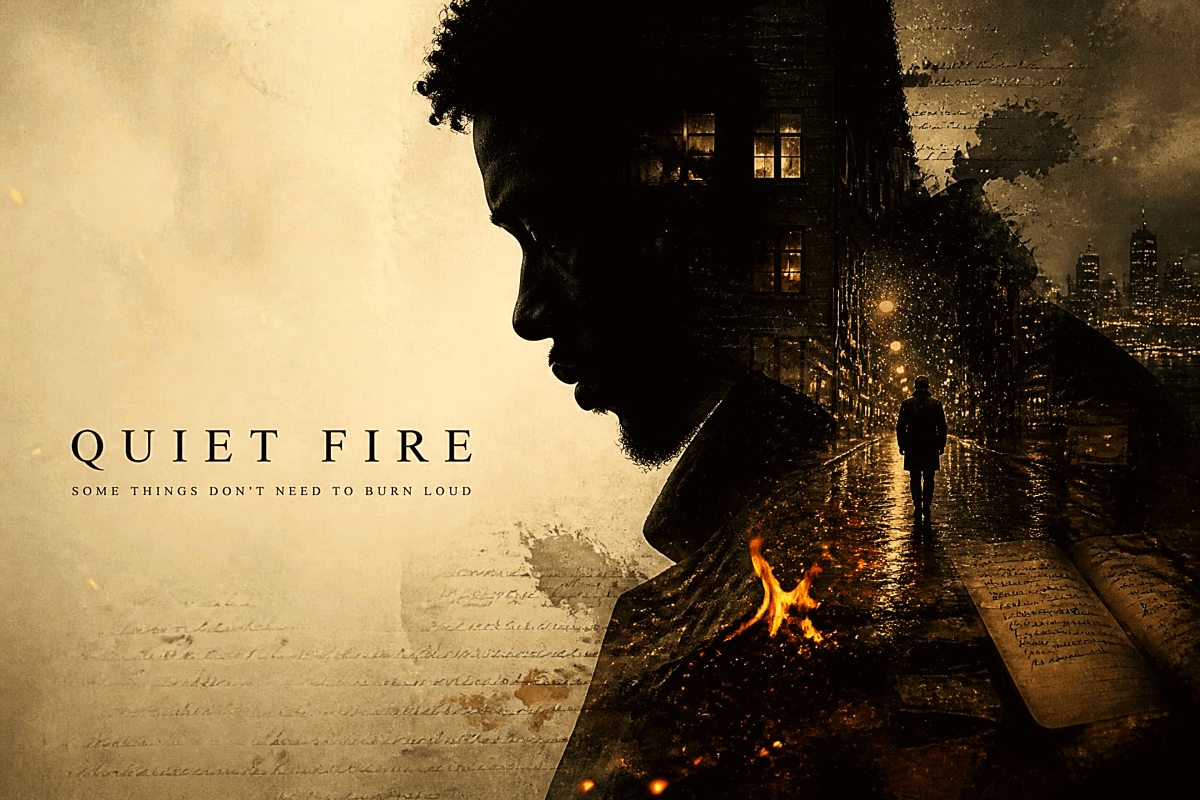
The writer in me says write more, which is hilarious because I already write every damn day. My editor swears I start a new series just to watch her eye twitch. Sometimes she sends me texts that are just a single, vibrating ellipsis. I plead the Fifth. She rolls her eyes so hard I can hear it over the phone.
The other day she asked, “When are you going to take the next step? You know you’re ready, right?”
Maybe she’s right. Maybe it’s time I believe in myself a little more—have faith in the work I keep throwing into the world like sparks from a stubborn match.

Still, there’s something quietly miraculous about creating work you love and finding out strangers love it too. For years, I didn’t have the time—raising a family will eat decades before you can blink. (Contrary to the baffling opinions of certain buttwipes who think parenting is optional.)

But the thing I’d truly like to do more of? Pay attention to my art. Not for money, not for likes—just to see how far I can push it. No limits, no internal hang-ups, none of the flimsy excuses we invent to dodge our own passions. Retirement has made one thing clear: I’m a storyteller. Always have been. Every skill I’ve picked up—writing, photography, film work, design—has been another star in the same battered sky, flickering through the smog of burnt coffee and late-night keystrokes. Each one lights a different corner of the story. Perhaps it’s time to stop forcing the tale into a single constellation and let the stars arrange themselves, allowing the story to decide whether it shines as prose, image, film, or sound.

As I write this, it begs the question… What if?
What if I let go and took the plunge? Will doubt finally fall away? Will I edge closer to whatever version of me is hiding under all this noise—no matter how cleverly I might hide myself?
Not to get hippy-dippy, but isn’t that the engine under all of this—the quiet force beneath the surface, behind the mask we flash to the world?
Excuse me while I glue my mask back together. They don’t epoxy like they used to. Progress my ass.

Maybe sleep will keep sulking in the corner. Fine. I’ll keep mapping my own constellations until the night runs out of darkness.
Sleep can wait. Niceness can rot. The story gets every last hour I have.

Where’d I Go?

Daily writing prompt
Share a lesson you wish you had learned earlier in life.

Geez, where do I start? There’s a whole damn syllabus of lessons I should’ve heeded earlier. One of the few perks of aging—besides knowing which joints will protest the weather—is the slow burn of wisdom. The kind you don’t get from books or podcasts. It comes wrapped in mistakes and bad decisions, leaving scars you can trace with your fingertips when the night goes too quiet.

Most of us have no idea what we’re doing. We’re trained to react instead of pause, to sprint when the real answer demands a slow walk and a long think. That made me an oddball—the guy who couldn’t walk and chew bubblegum, as the saying goes. I used to think something was broken in me because I didn’t move like my friends. So I faked it. Tried on their swagger like an ill-fitting coat and wound up knee-deep in more trouble than any decent statute of limitations allows. No one forced my hand. Every bad turn was my choice.

Eventually I needed to look in the mirror and recognize the person staring back. One night I finally did and whispered, “Where’d I go?” Instead of facing the answer, I reached for alcohol. At first it felt like an experiment; by the time the haze lifted, I realized I wasn’t just drinking—I was binge drinking. Like every drug, it took over. I drank to be accepted, but the acceptance I craved wasn’t external. It was the quiet inner nod that says this is who you are, faults and all.

I wasn’t sure I could follow through—if I had the courage to become me. I’d stand in a room full of people and still feel lonely. Everything felt wrong, yet temptation stayed strong: keep hiding like everyone else, stay two-faced and plastic. I knew every effort to fake it was bound to fail. I hate being wrong and go to great pains to avoid it. But here’s the twist—I was completely wrong, and I’m more than okay with it. Alcohol was so woven into my life I once believed it helped me find my muse. Pure horseshit. Fifteen years ago, I put down the bottle and I’ve been writing my ass off ever since.

It’s okay to be yourself. Let your weirdo flag fly. If anyone tells you different, the only appropriate and dignified response is a proper, “Fuck off!” For me, I had to whisper, “Sorry, Mom.” She wanted me to stop cussing for Lent. I told her I wasn’t Catholic anymore, but she wasn’t buying that as an excuse for a foul mouth.

If I had to pick one lesson, it’d be this: it’s alright to be me.
Not the version patched together from other people’s expectations. Not the quiet kid pretending to enjoy chaos. Just me. Turns out the hardest permission to grant is your own.


Author’s Note

Never let a shitbird talk you into being something other than who you are. Of course you’re going to evolve—that’s the point of living—but growth isn’t the same as surrender. Don’t sand down your edges just to fit someone else’s blueprint. The right people will respect your crooked angles and the wrong ones will drift off when they realize you’re not bending.

Sobriety taught me this, but you don’t need a bottle to learn it. The pressure to perform is everywhere—family dinners, office politics, the endless scroll of curated lives. Remember: becoming isn’t about becoming acceptable; it’s about becoming unmistakably yourself.


Reflective Prompt

Think back to a moment when you felt the pressure to shrink, fake, or bend just to belong.

  • What did you trade away in that moment—time, voice, dignity, a dream?
  • If you looked in the mirror right now, what question would stare back at you?
  • What would granting yourself full permission—your own quiet yes—actually look like?

Write it down. No filters, no audience. Just you and the truth that refuses to stay hidden.

Diet of Disdain

Daily writing prompt
What are your favorite types of foods?

Steps That Really Count

Daily writing prompt
How often do you walk or run?

What the Silence Knows

On Leadership and Reading the Room

Daily writing prompt
Do you see yourself as a leader?

The question lands like a pebble in the gut.
Not heavy, but unsettling—because it asks for a tidy answer when my life has been anything but tidy.

I’ve led unintentionally and followed on purpose. I’ve watched silence choke a room, felt the weight of nothing happening, and stepped forward because someone had to. And I’ve stepped back when my presence would only add noise. Both moves have carved me in ways no title ever could.

The military taught me early that leadership isn’t a birthright. You follow first. You fail. You observe. You learn how to carry the weight before you dare to lift it for someone else. Titles are just badges; the real work happens when no one is clapping—when you steady someone else’s fear while keeping your own hands from shaking.

Leadership, for me, is a rhythm. Some days you step up and speak. Other days, you keep your mouth shut and hold the line. The trick is reading the moment and being honest enough to become what it needs. Courage without a parade. Clarity without applause. Responsibility without the crown.

I’ve stepped forward when a group project stalled, laid out the path, and then faded back when momentum returned. I’ve seen teammates like Maya rewrite a messy spec and pull a team back from drift without a single title to their name. That, too, is leadership: the ability to lead, follow, or stand aside—and to know which role the moment requires.

So do I see myself as a leader?
I see myself as a reader of moments.
Sometimes the room needs a calm hand.
Sometimes it needs me to get out of the way.

That’s the work.
That’s the honor.
That’s what the silence knows.


Author’s Note
Leadership isn’t a title I chase. It’s a weight I sometimes shoulder when the room tilts and no one else moves. Writing this was a reminder that the moments that define us rarely come with applause—they come with silence, and the choice to break it or hold it.

How do you read the room when the air goes still? I’d love to hear the quiet rules you live by.

What Are You Doing Tonight?

Daily writing prompt
What are you doing this evening?

Denial — Everyone Sees It but You

Daily writing prompt
What personality trait in people raises a red flag with you?

Coffee, Smoke, and Silence

Daily writing prompt
Describe your ideal week.

Some weeks, peace isn’t found in grand adventures or endless productivity. It’s found in the quiet. A cup of coffee that doesn’t go cold. Smoke curling from a half-forgotten cigarette. And, maybe most importantly, silence from the noise people bring with them. My ideal week? One free of shitbirds. The kind who drain energy, stir chaos, or show up with nothing but drama in their pockets. Give me stillness. Give me focus. Give me the kind of week where I remember what it feels like to breathe without interruption.

You Can’t Keep the Force Waiting

Daily writing prompt
How do you relax?

Relax? I’m not even sure I know what that word means. I can define it, sure. I can even toss it into a sentence with some authority, like I’ve got the concept nailed down. But when it comes to actually doing it—executing the mysterious act of “relaxing”—I draw a blank.

That’s not to say I haven’t had relaxing moments. I’ve had a few, here and there, like finding an unexpected pocket of calm wedged between chaos and obligation. But that’s different than inhabiting a true state of relaxation. If such a state exists, it must’ve slipped past me sometime after childhood and never bothered to circle back.

However, I do have the ability to press pause in my mind in small increments. It’s become quite usual over the years. For example, I didn’t write again and ended up watching a couple of sports movies that, for some reason, had strippers in them. Before you sit in judgment—I didn’t write the movies. Still, I caught myself thinking about adding elements like that into a story. Hmmm. I like that. Excuse me for a minute while I make some notes. Okay, I’m back. Where was I?

For me, it’s more like waiting for the noise to die down rather than learning how to step out of it. And maybe that’s the rub: real relaxation isn’t about moments—it’s about being able to stay in that state, to stretch it out until it holds you. I haven’t cracked that code. Maybe I don’t even want to.

Oh yeah, relaxing. Yeah, I got nothing. So excuse me while I check out the latest Star Wars trilogies. You just can’t keep the Force waiting.