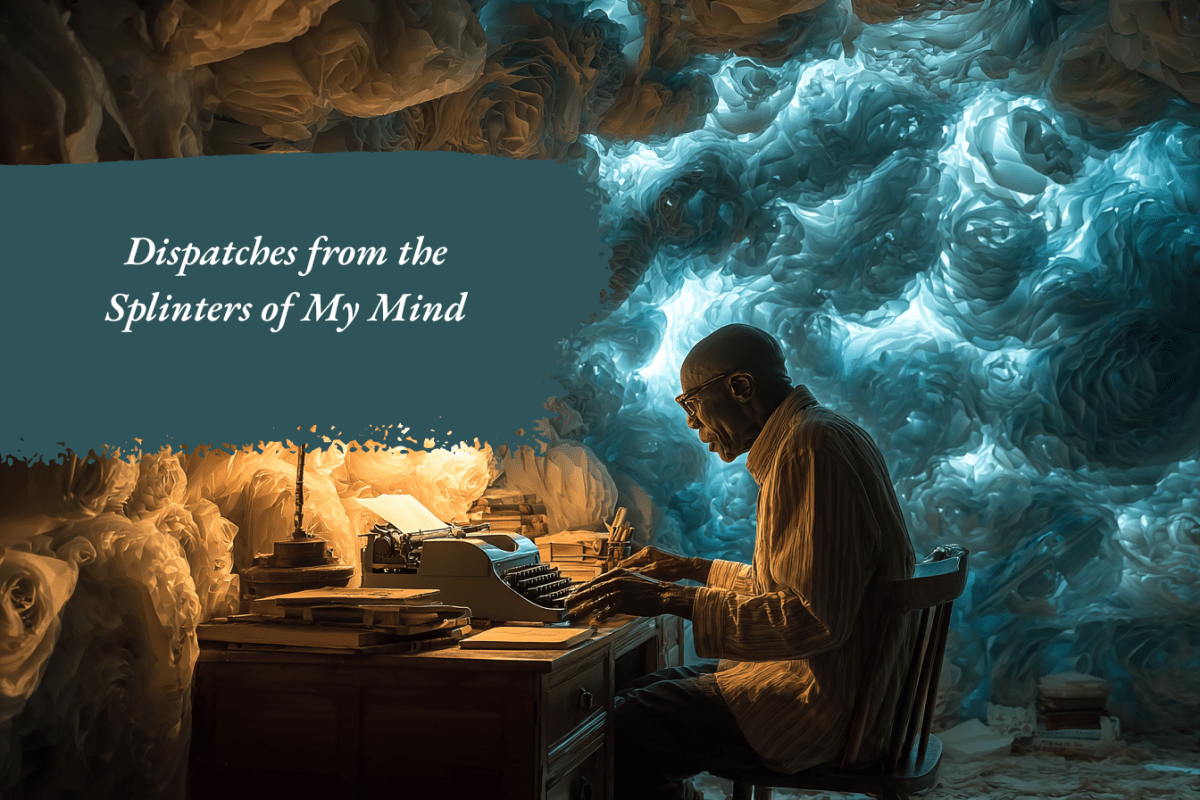

Dispatches of Splinters of My Mind: Entry 17
Some people think masks are things you put on.
That’s the kind of thought people have when life has been gentle with them.
The truth is harsher. More intimate. A mask is not always worn over the face. Sometimes it grows there slowly, layer by layer, until you can no longer tell where the skin ended and the protection began. Sometimes it is built from swallowed words, tightened jaw muscles, strategic silences, practiced shrugs, jokes made at the right moment, apologies offered for things that never required apology.
Sometimes the mask saves your life.
That is what makes removing it complicated.
He holds the face carefully, almost reverently, as if it might bruise. Fingers spread along the temples, thumb beneath the jaw, palm cradling what once passed for composure. The surface is smooth where he has become rough. Cold where he has become hot with buried anger. Featureless where he has become crowded with history.
It resembles peace.
That resemblance is dangerous.
There are seasons of life when peace is not available, only presentation. During those seasons, you learn to construct expressions that reassure other people while abandoning yourself. You learn how to look calm while panic rearranges the furniture inside your chest. You learn how to speak evenly while grief claws at the walls. You learn how to nod, complete tasks, return emails, pay bills, shake hands, say “I’m good,” and keep moving as if motion were the same thing as healing.
It isn’t.
Motion can be another disguise.
He presses his forehead to the borrowed face. The contact is gentle enough to be mistaken for affection. But tenderness and desperation often use the same gestures. Up close, he can smell metal, dust, old oil from the weapon slung across his shoulder, the stale salt of dried sweat embedded in fabric that has outlived comfort. His own breath returns warm against his lips after striking the smooth surface of the mask. Even now, he is speaking to himself through something artificial.
There were years when that felt normal.
Years when the world demanded utility more than honesty. Years when softness had to be hidden like contraband. Years when every room seemed to ask the same silent question: Can you be useful without being complicated? He answered yes so many times it became reflex.
Usefulness gets rewarded.
Complexity gets managed.
Pain gets postponed.
And postponed pain does not disappear. It compounds interest.
So one day you wake to find yourself efficient but unreachable. Competent but numb. Surrounded but alone. You have become excellent company for everyone except the person living inside you.
That person eventually starts knocking.
Not dramatically. No thunderclap revelation. No cinematic collapse in a grocery store aisle while oranges roll in symbolic directions. It begins smaller than that. A strange heaviness when the room grows quiet. Irritation at kindness. Exhaustion after conversations that required no effort. The inability to answer simple questions like What do you want? or How are you really? without feeling like you’ve been asked to translate a dead language.
The mask still works.
That’s part of the problem.
It still earns trust. Still photographs well. Still knows when to smile, when to remain unreadable, when to offer the right amount of vulnerability to seem human without becoming exposed. It is a masterpiece of adaptive engineering.
But masterpieces can become prisons.
He studies the face in his hands as if searching for seams. There are scratches along the cheekbone. Fine cracks near the mouth. Hairline fractures where too many rehearsed reassurances were delivered through clenched teeth. The damage is subtle but cumulative. Even false things wear down under repeated use.
He remembers the first time he needed it.
Not the exact day. Trauma fogs calendars. But he remembers the sensation: a room where honesty would have been punished, a moment where fear would have invited predators, an atmosphere so charged with consequence that authenticity became a luxury item. So he reached for distance. For neutrality. For whatever expression would cost the least.
It worked.
That’s how the arrangement begins.
Survival tools are hard to retire because they come with receipts.
Look, they say. We got you through that year. Through those people. Through the nights you thought would split you open. Through funerals, betrayals, deadlines, humiliations, losses, all the little wars no one salutes. Why are you turning on us now?
And what can you say?
Thank you.
Also, you are choking me.
Both can be true.
That is the part no one teaches well: gratitude and departure can occupy the same breath. You can honor what protected you and still refuse to live inside it forever. You can acknowledge necessity without confusing it for destiny.
He lifts the face closer. Its eyes remain closed. Lucky thing.
If it opened them, what would it see? A man? A weapon? A frightened child who became strategic too early? A tired soul rehearsing strength because he no longer remembers spontaneity? Identity is less a statue than a crowd. We keep trying to choose one representative to send to the front desk.
No wonder we’re exhausted.
His hands tighten slightly. Not enough to break it. Enough to feel that he could.
Power over the mask is a new sensation. Usually it dictated terms. Usually it appeared automatically at conflict, criticism, intimacy, uncertainty. Especially intimacy. Nothing threatens armor like being seen by someone gentle. Hostility confirms the need for defense. Tenderness questions it.
That’s why some people sabotage love.
Not because they hate closeness.
Because closeness reaches for buckles.
He knows this now too late for some things and just in time for others.
There were people who tried to meet him beyond the mask. They said, in their own imperfect ways, You can come out now. He heard danger where invitation was intended. Heard exposure where safety was being offered. Heard the old alarms and obeyed them.
How many lives are shaped by outdated warnings?
The room is silent except for breath and the faint creak of fabric as he shifts. In the dark, even stillness has sound. He runs a thumb along the jawline of the face he wore to survive. Smooth. Untroubled. Almost holy in its emptiness.
But emptiness should never be mistaken for peace.
Peace has texture. Peace can cry. Peace can laugh too loud. Peace can admit confusion. Peace can say no without performance and yes without suspicion. Peace can be inconsistent because it no longer fears punishment for changing shape.
The mask can do none of these things.
It can only maintain.
And maintenance is expensive.
He lowers it slowly into his lap. The weapon hangs useless at his side, a relic from another kind of defense. For the first time in years, he allows his own face to remain unarranged. No tactical calm. No measured hardness. No curated indifference.
Just fatigue. Sadness. Relief. A little terror.
Real expressions are messy tenants.
They move furniture without asking.
He expects catastrophe. Some ancient consequence. Lightning, exile, ridicule, collapse.
Nothing happens.
The room does not punish him.
The dark does not laugh.
No tribunal emerges to revoke his membership in the tribe of the functioning.
Only breath.
Only the strange ache of muscles unclenched too late.
Only the realization that he has mistaken anticipation for reality more times than he can count.
He looks again at the face in his hands and sees it clearly now—not enemy, not fraud, not shame. A tool built under pressure by a self that wanted to live.
He bows his head.
“Thank you,” he whispers.
Then, after a pause earned the hard way:
“You can rest now.”
Somewhere inside him, locks he didn’t know existed begin to release.
Not all at once.
Enough.
Discover more from Memoirs of Madness
Subscribe to get the latest posts sent to your email.


Love this Mangus.
LikeLike
Simple elegant truth…layer by unseasoned and seasoned layer…until the unveiling…what an indelible expose of who and what we have all become at one point in our lives…aware or not!
LikeLike