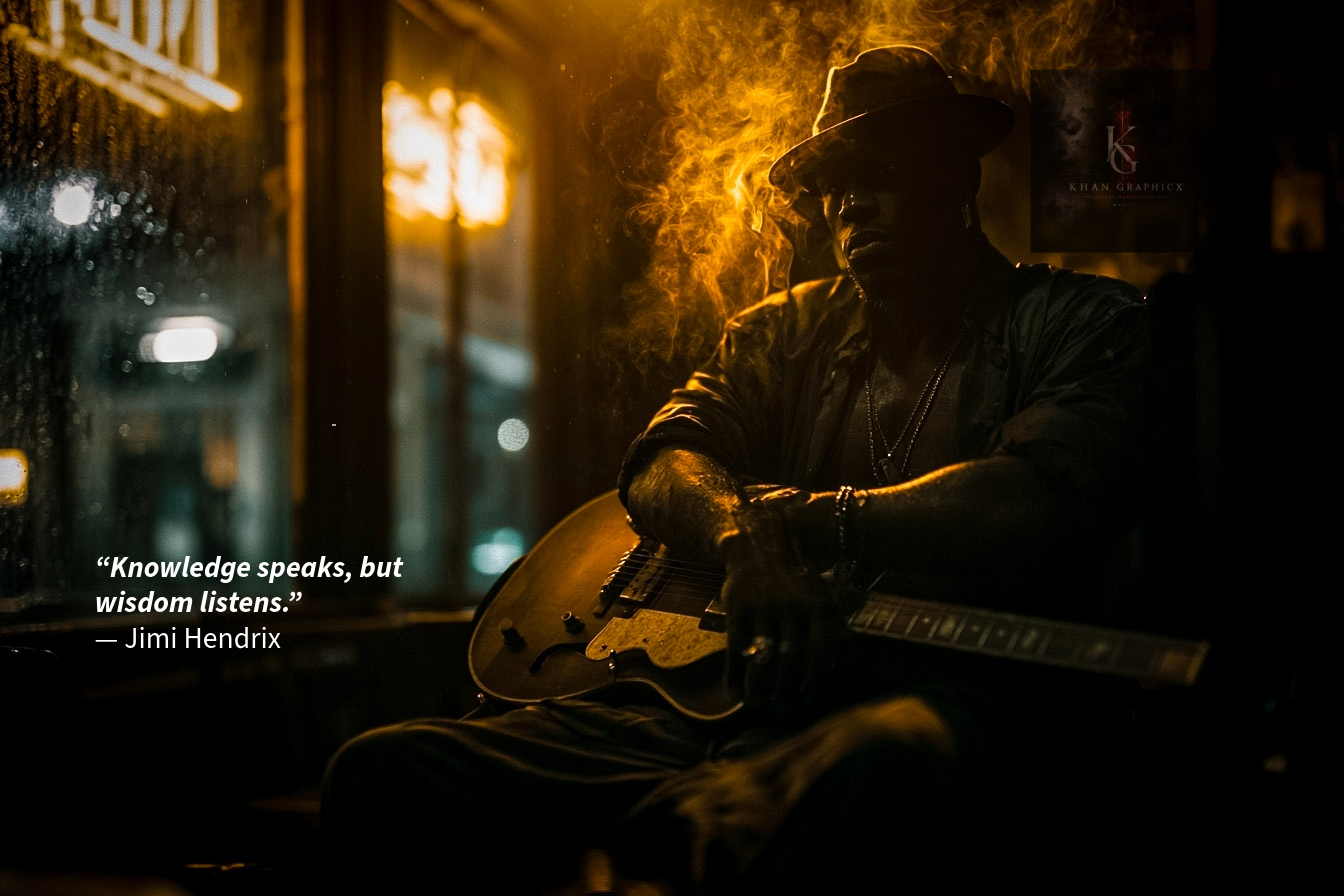
The world is overflowing with noise and starving for listening.
Everyone has an opinion now. A reaction prepared before the conversation even finishes breathing. We don’t listen to understand anymore — we listen for openings to speak.
Knowledge thrives there.
Wisdom stays quieter.
Because wisdom understands human beings are more complicated than conclusions.
Real listening requires ego to loosen its grip. It asks us to notice what exists beneath words: exhaustion hiding inside humor, grief disguised as anger, loneliness wearing confidence like a tailored jacket.
Writers struggle with this too.
Some stories fail because the writer talks over the truth instead of listening for it. The work sounds polished but emotionally hollow, like a beautiful room with nobody actually living inside it.
Maybe wisdom isn’t about better answers.
Maybe it’s about learning how to hear what the world has been trying to say all along.
Reflective Prompt
Who in your life truly listens to you — and when was the last time you offered that same attention in return?
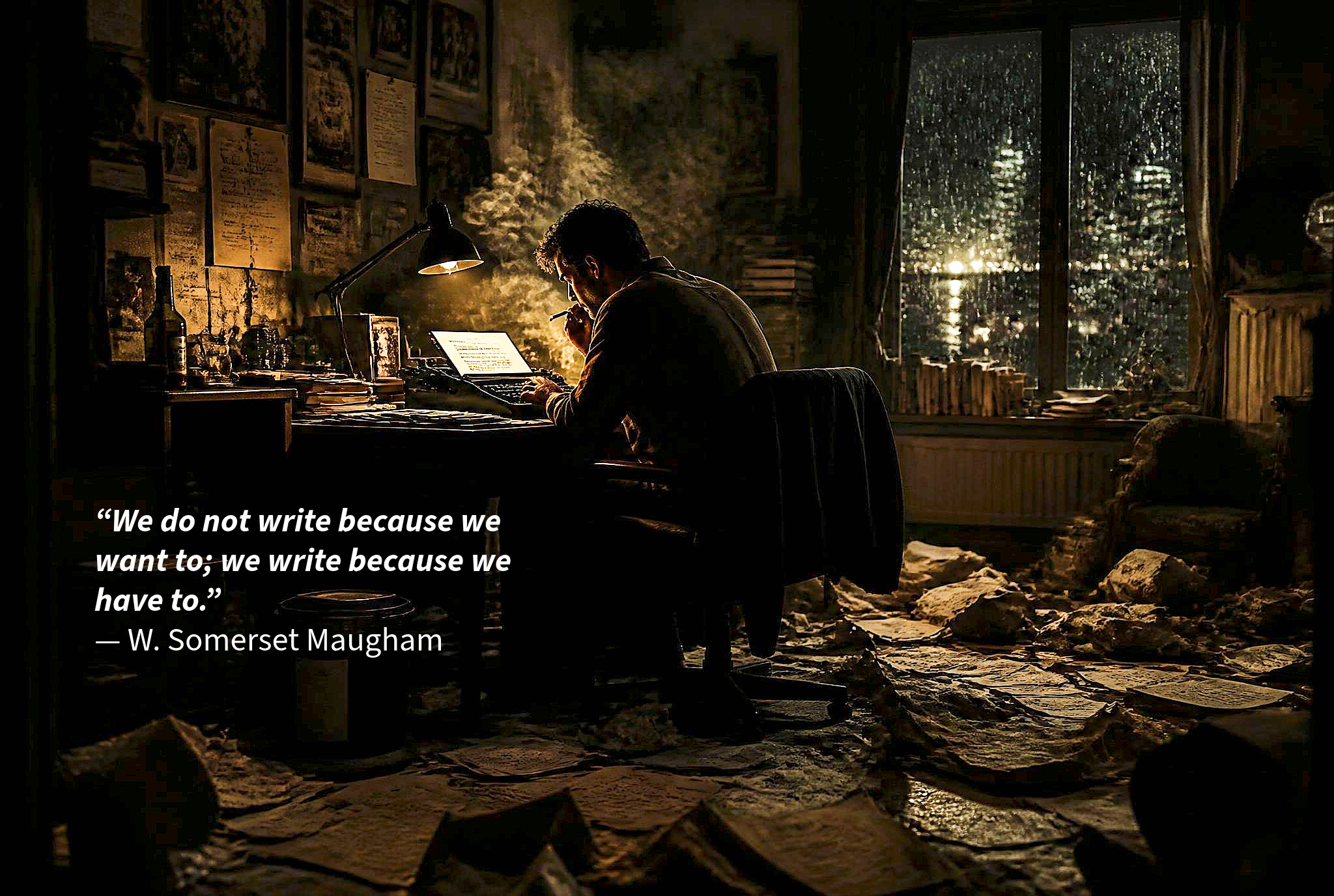
Most people imagine writing as a romantic act. A candle burning low beside a whiskey glass. Rain tapping the window. A brilliant mind pouring itself onto paper in one clean stream of genius.
Reality usually looks more like staring at a blinking cursor while your coffee goes cold for the third damn time.
Writing rarely arrives dressed like inspiration. More often, it shows up like an itch beneath the skin. Persistent. Irritating. Impossible to ignore. You tell yourself you’ll take a day off, clear your head, maybe do something practical for once. Then a sentence appears while washing dishes. A memory crawls out during a drive. A line of dialogue lands in your chest hard enough to stop you mid-step.
And suddenly the page starts calling again.
The dangerous thing about writing is that it exposes what we spend most of our lives trying to outrun.
Regret. Shame. Desire. Loneliness. The unfinished conversations that still echo years later when the house is quiet enough to hear yourself think.
Sometimes we believe we’re writing about a character or a memory or a song that cracked us open twenty years ago. Then somewhere around paragraph four, the mask slips. The real subject steps into the light. Not the thing we intended to write about — the thing we were trying not to.
That’s the part nobody talks about when they romanticize creativity.
Writing is confrontation.
Not performance. Not branding. Not aesthetics arranged carefully beneath soft lighting and clever captions. Real writing drags fingerprints across the hidden parts of you. It forces you to sit in rooms you locked years ago and notice the dust still floating in the air.
And worse? The page knows when you’re lying.
Readers know too.
You can decorate emptiness with beautiful language for a little while, but eventually the sentences collapse under their own weight. The work either contains truth or it doesn’t.
That truth doesn’t have to be loud. Sometimes it’s just one honest sentence standing quietly in the wreckage.
Maybe that’s why some of us keep returning to the page even when it exhausts us.
Not because writing makes life easier.
Because sometimes it makes life clearer.
The world moves fast now. Everything demands immediate reaction, instant certainty, polished identity. Writing remains one of the few places where confusion can still breathe long enough to become understanding.
Not answers. Understanding.
A rough draft is often just a person trying to hear themselves think over the noise of the world.
And maybe that’s enough.
Reflective Prompt
What truth keeps resurfacing in your life no matter how many times you try to write around it?
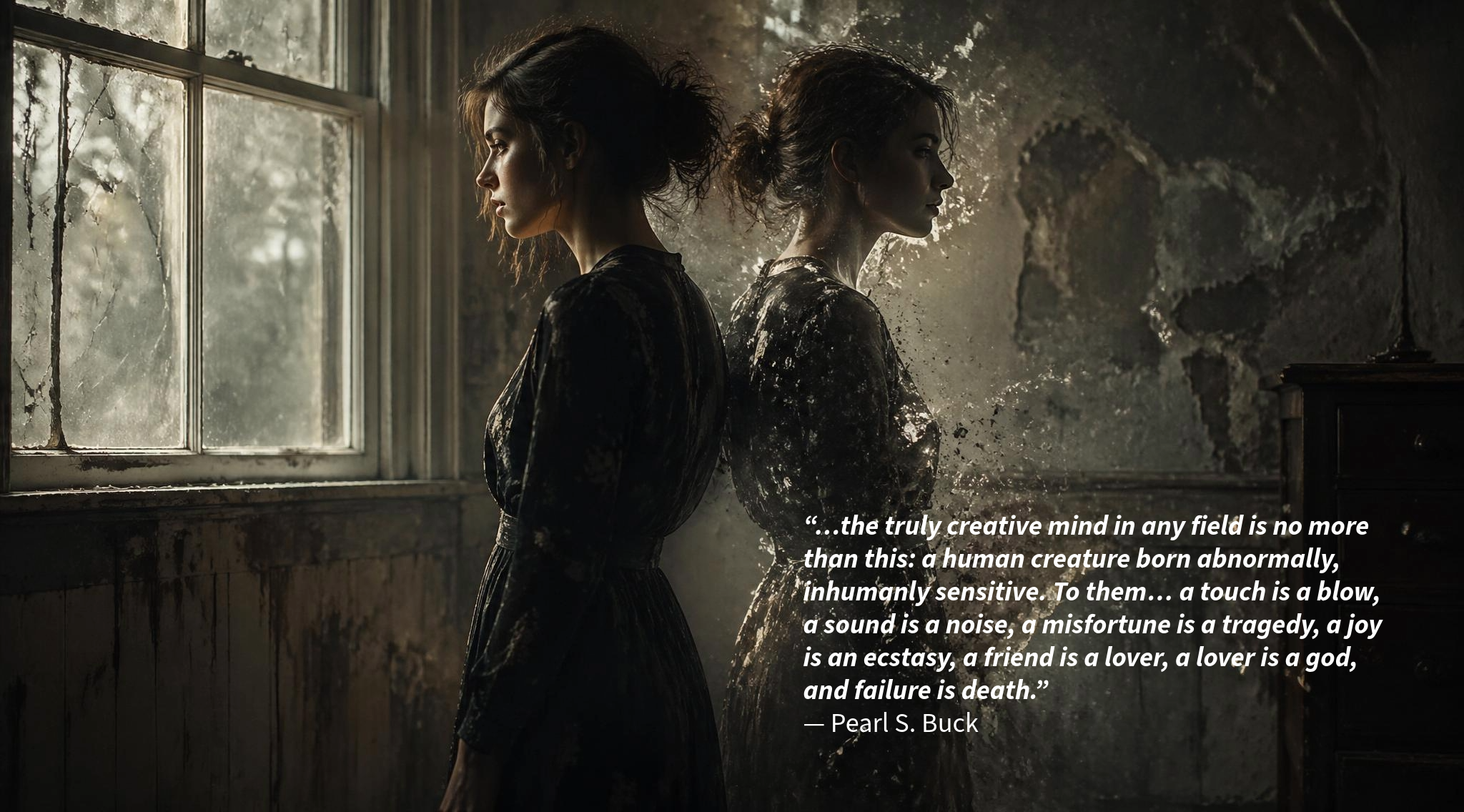
At first glance, it feels like a diagnosis—like someone finally put a name to that raw nerve you carry around in your chest. The kind that flinches at loud rooms, lingers too long on a passing comment, and turns a small moment into something that echoes for hours. It reads like a warning: if you feel too much, everything costs more.
But there’s a quiet brutality under that idea. Sensitivity isn’t romantic when you’re living inside it—it’s exhausting. It means your internal world has no dimmer switch. Everything arrives loud, sharp, immediate. You don’t just experience life—you absorb it, let it stain you. That depth can create beauty, sure… but it also means you don’t get to skim the surface when things go wrong. You sink. And maybe the harder truth is this: the same sensitivity that makes you capable of creating something meaningful is the same thing that makes survival feel like a full-contact sport.
Still… there’s something honest here that doesn’t need fixing. Maybe the goal isn’t to toughen up or dull the edges. Maybe it’s learning how to carry that sensitivity without letting it carry you off a cliff. To recognize that feeling deeply isn’t a flaw—it’s a kind of instrument. And like any instrument, it can either make noise… or music.
Reflective Prompt
Where in your life does your sensitivity feel like a burden—and what would change if you treated it as a form of perception instead of weakness?
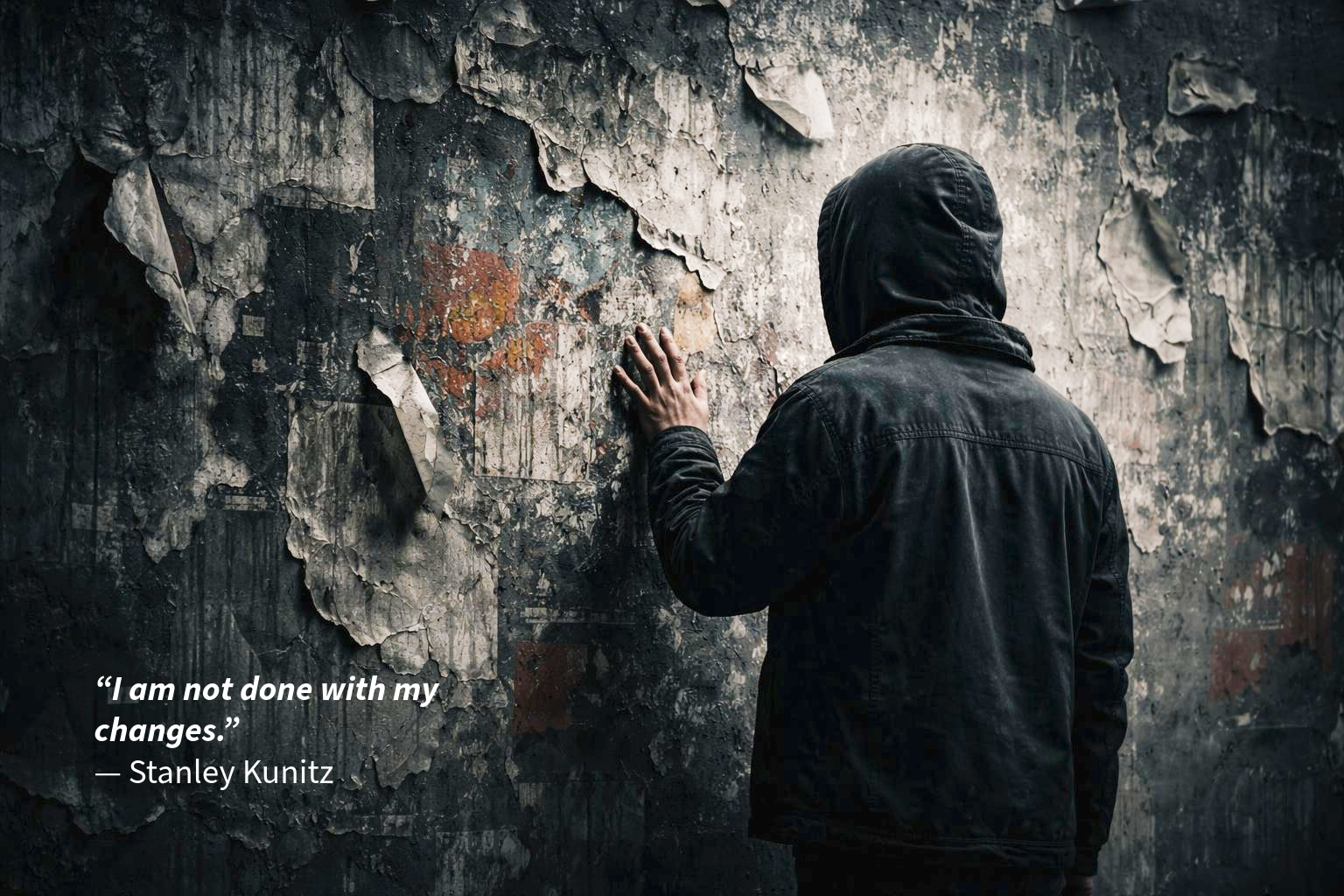
It sounds simple, almost casual. But there’s steel in it. Not done. Not finished. Not settled into a final version just because time has passed.
There’s pressure to become complete. To arrive at some stable identity and stay there. By a certain age, by a certain milestone, by the time other people decide you should have it figured out.
I’ve felt that pressure in subtle ways—the urge to explain myself as if I’m already final. To present a polished summary instead of the unfinished truth.
But life doesn’t honor neat timelines. It interrupts. It strips things down. It teaches late. Sometimes the lesson you needed at twenty arrives at fifty. Sometimes the self you defended for years quietly expires in one hard season.
Kunitz wrote this line with age behind him, which gives it extra force. He isn’t speaking from youthful possibility. He’s speaking from lived evidence.
Change is not reserved for the young. Reinvention does not expire.
And the real danger may be deciding too early that your becoming is over.
Maybe growth is less glamorous than we imagine.
Less breakthrough, more revision. Less grand arrival, more honest correction. Less “found myself,” more “met another layer.”
You are allowed to outgrow old versions of yourself. You are allowed to begin again without apology.
There is no shame in still becoming.
Only in pretending you are finished when you are not.
Reflective Prompt
What part of you have you declared permanent that may only be unfinished?
It sounds small. Almost too simple. Just noticing something shouldn’t carry that much power. Looking is passive, isn’t it? Seeing changes nothing… until it does.
There are things that survive by staying unnamed. Habits. Griefs. Quiet resentments. The way you talk to yourself when no one is around.
I’ve noticed how certain patterns lose strength the moment they are fully seen. Not solved. Not healed. Just exposed to honest light.
That sharp comment you call humor. That exhaustion you call laziness. That loneliness disguised as independence.
Some truths remain powerful only while blurred. They depend on distance, denial, and half-light.
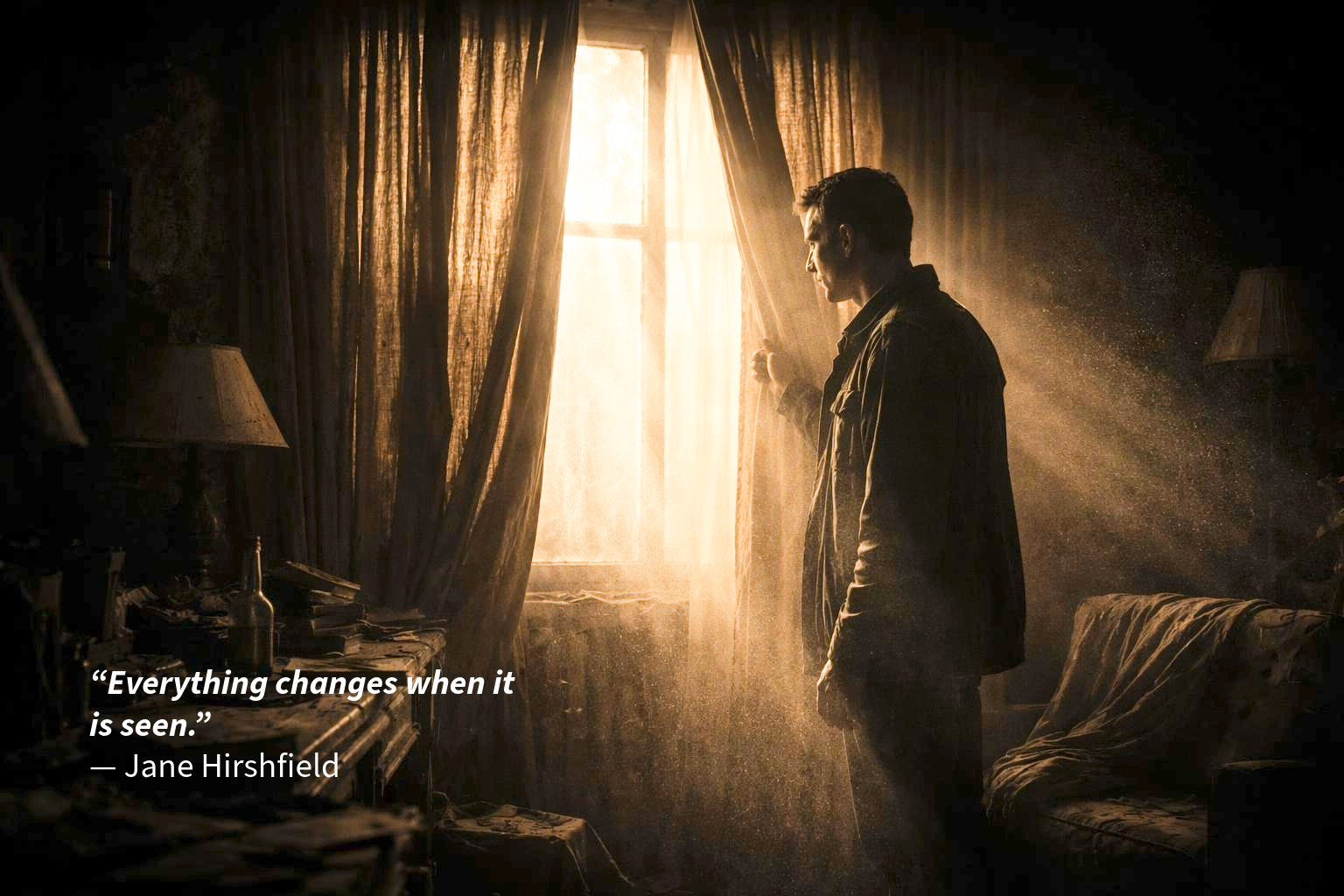
Hirshfield’s line understands something subtle: awareness is disruptive. Once you truly see a thing, you can’t relate to it the same way anymore.
You may still struggle with it. You may still choose badly. But innocence is gone. Pretending becomes heavier.
Maybe seeing is the first real act of change.
Not dramatic action. Not declarations. Not reinvention by sunrise.
Just the clear moment when you stop lying about what is there.
A room looks different once the curtains are opened. So does a life.
Reflective Prompt
What in your life would begin to change the moment you stopped looking away from it?
It reads steady. Not emotional. Not reactive. Just a clear line drawn between what’s been done to him… and what he’s allowed it to mean.
There’s a difference between being hurt and being undone—but it doesn’t always feel that way in the moment.
Insults don’t always come loud. Sometimes they show up as dismissal. As being overlooked. As the quiet assumption that you don’t belong where you are.
I’ve felt that kind of weight before—not enough to break you all at once, but enough to make you question yourself if you sit in it too long.
That’s the part people don’t talk about. Not the impact of the moment—but the echo that follows it. The way it tries to settle into your thinking, your posture, your sense of where you stand.
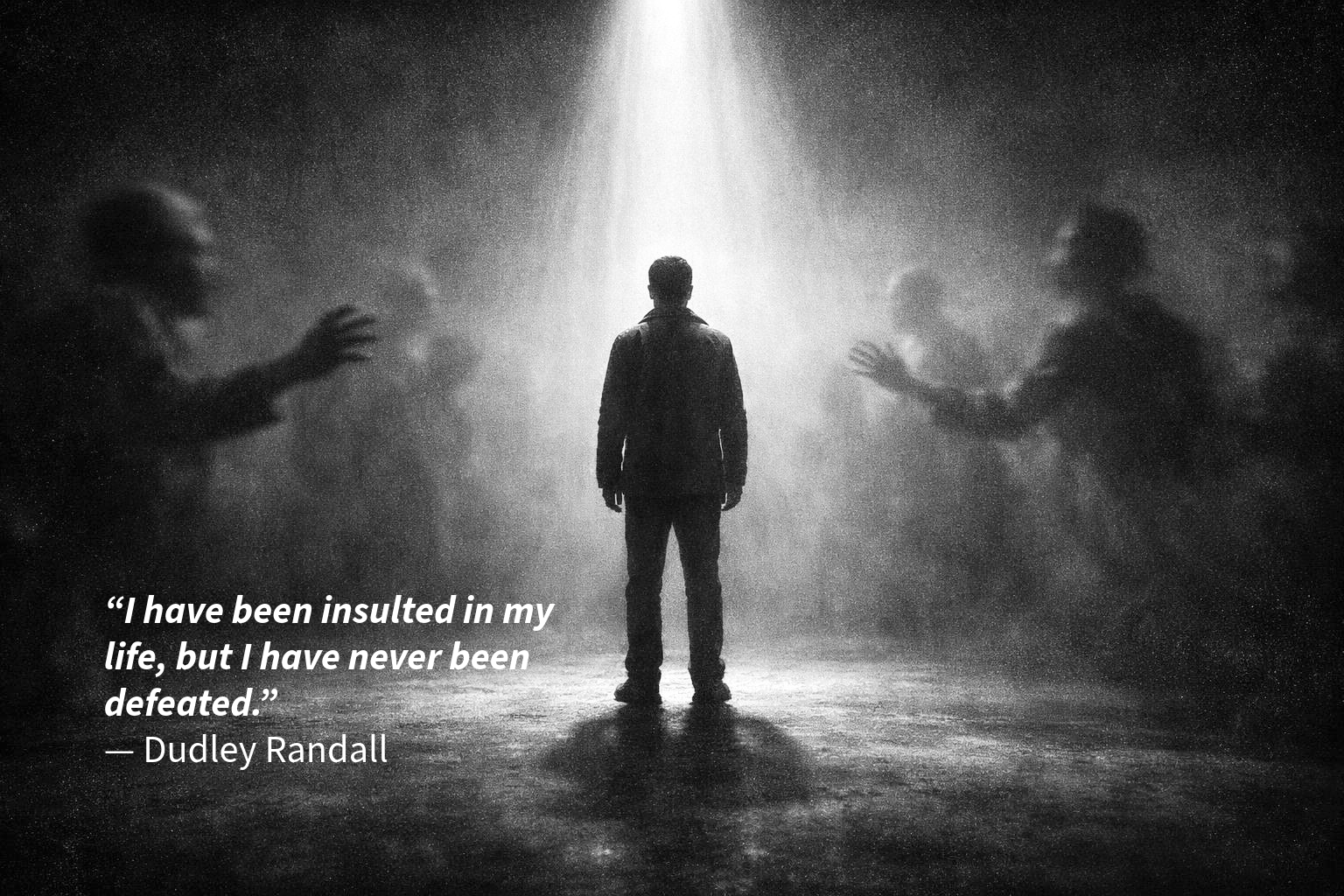
Randall’s line cuts through that echo. He doesn’t deny what happened. He doesn’t pretend it didn’t land.
He just refuses to let it define the outcome.
And that refusal—that separation between what was done and what it becomes—that’s where the strength sits.
Maybe defeat isn’t about what you face. Maybe it’s about what you accept as final.
Not every hit can be avoided. Not every moment can be controlled.
But the meaning you give it—that part stays yours.
And holding onto that… that’s how you don’t lose yourself in the process.
Reflective Prompt
What have you allowed to linger longer than it deserved—and how has it shaped you?
It sounds gentle at first—almost like reassurance. Be patient. Don’t rush. Let things unfold. The kind of advice that feels calm on the surface, easy to agree with.
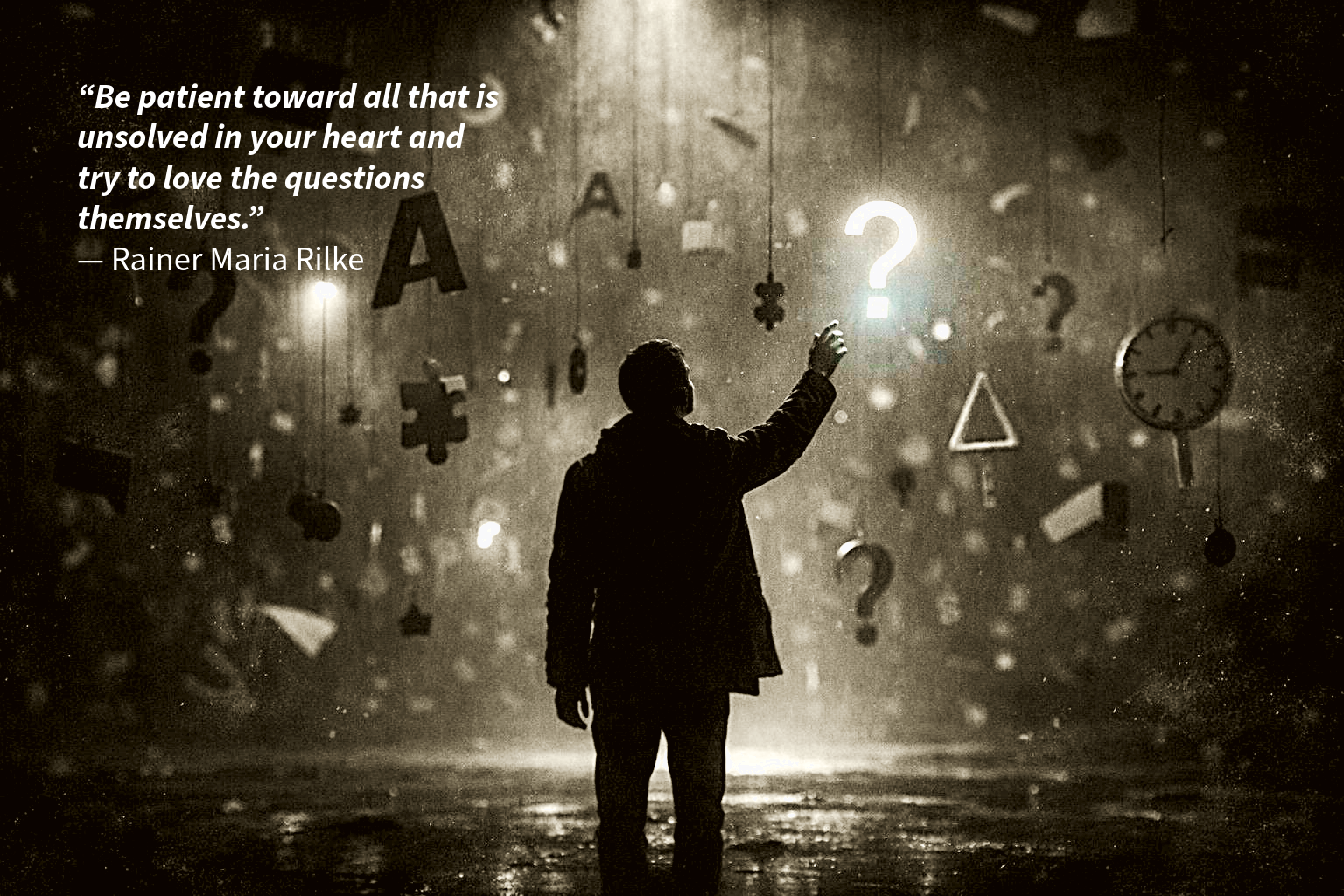
But patience isn’t passive. Not the kind Rilke is talking about.
There’s a tension in not knowing. A constant pull to figure things out, to close the loop, to get to something solid you can stand on. I’ve felt that pressure—to resolve things quickly, to make sense of what doesn’t yet make sense.
Unanswered questions don’t sit quietly. They follow you. Show up at the wrong time. Linger longer than you want them to.
And the instinct is to push them away or force an answer just to quiet the noise. Even if the answer doesn’t fully fit.
Rilke challenges that instinct. Not by offering solutions—but by asking you to stay in the uncertainty without trying to escape it.
To sit with what’s unresolved without turning it into something it isn’t.
Because maybe the problem isn’t the question— it’s the need to end it too soon.
Maybe not everything is meant to be answered right away. Maybe some things are meant to be lived through first.
Not solved. Not finalized.
Just carried—until they change shape on their own.
And maybe patience isn’t about waiting… it’s about staying present long enough to understand.
Reflective Prompt
What question in your life are you trying to answer too quickly?