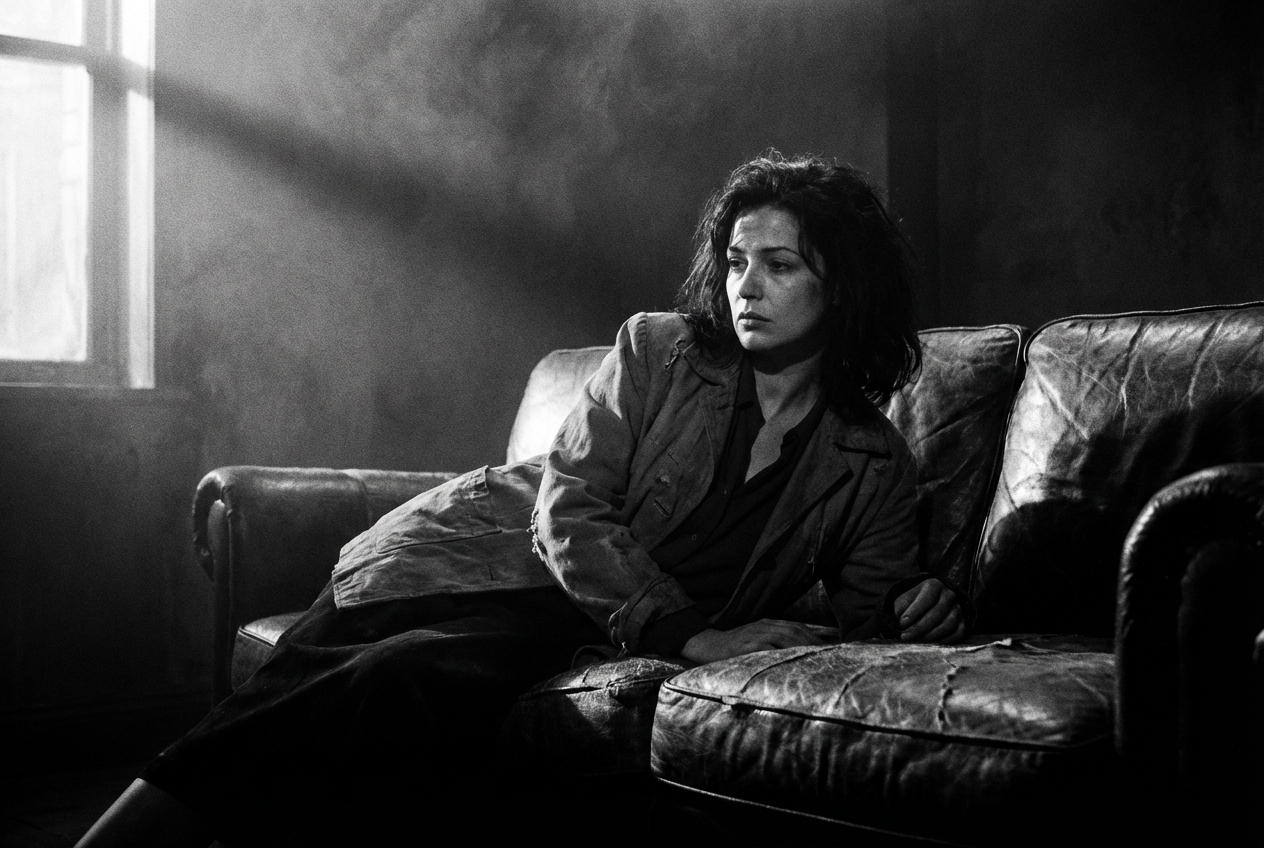
It is in the darkest places we sometimes find the truth. The question is whether we will accept what we find, or retreat behind the veil of denial. It is that decision that gives us pause.
And within that pause, we wonder whether we have the strength to console a soul still aching from the sting. We wonder whether we have the courage to move through what remains. Sometimes, there is no better name for it than the ache.
Yet amid struggle, we are at our most real. The masks become too heavy to carry. The lies we tell ourselves require more strength than we have left to maintain them. What remains is not always beautiful, and it is rarely comfortable, but it is ours.
But struggle does not always make us stronger. Sometimes it becomes a noose around the neck. Sometimes it becomes quicksand, and the harder we fight against it, the deeper we sink. There is no promise that suffering will teach us anything. Pain is not obligated to leave wisdom behind. Sometimes all it leaves is the ache.
The struggle does not decide what becomes of us. We do.
Perhaps that is the uncomfortable part. The same darkness that causes one person to reach for something buried deep within can convince another there is nothing worth reaching for. Struggle offers no guarantees. It merely brings us to the place where something must be decided.
And there we are again.
Within the pause.
Perhaps we needn’t worry so much about strength or courage. They have been beside us from the beginning, waiting to be called upon. Not guaranteeing what we will become. Not promising that we will emerge untouched. Simply waiting for us to decide what we will do with what remains.
Dispatches from the Splinters of My Mind — Entry 33:
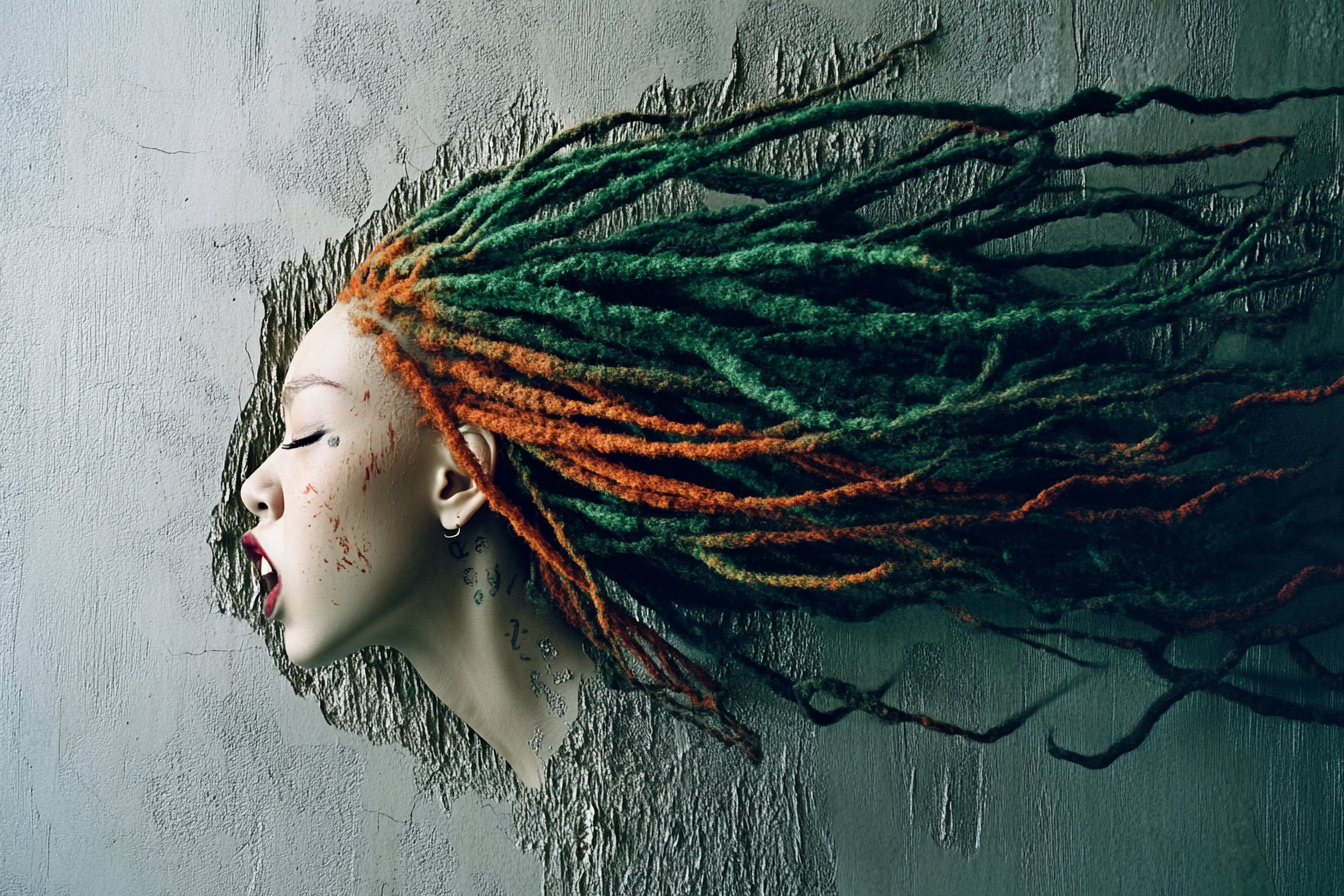
The first piece came off beneath my fingernail.
Turquoise.
No bigger than a grain of rice.
I noticed it while washing my face before bed, standing beneath the bathroom light that had been threatening to die for six months but apparently lacked the commitment. It buzzed faintly above the mirror, bleaching everything beneath it—the white sink, the gray grout, the little silver hairs beginning to colonize my temples despite repeated diplomatic objections.
I had already brushed my teeth, taken out my earrings, and tied my hair back.
The ordinary little dismantling we perform every night before allowing ourselves to become whatever sleeps in our beds.
There was something rough along my jaw.
I scratched it.
The turquoise flake landed in the sink with a sound too small to deserve attention.
I stared at it anyway.
I don’t wear turquoise makeup.
Never have.
Too loud.
Red lipstick, yes. Always red. But turquoise belonged on old convertibles, cheap jewelry, swimming pools in motel brochures. Not my face.
I leaned toward the mirror until my breath fogged the bottom edge of the glass.
There was another patch near my cheekbone.
I touched it.
Hard.
Not skin.
I worked a fingernail beneath the edge.
There was resistance at first, a faint pulling sensation that made my teeth ache, and then the piece surrendered with a tiny dry crack.
Something the size of a dime curled away.
There was skin underneath.
Brown.
Warm.
Mine.
I touched it.
The skin felt normal.
Then I remembered that I hated jazz.
I stood there holding the turquoise fragment between my fingers.
Miles Davis was playing in the bedroom.
Kind of Blue.
My favorite album.
Except it wasn’t.
The trumpet slipped through the apartment, muted and melancholy, something I’d heard hundreds of times while cooking, reading, drinking wine, pretending Sunday morning wasn’t already conspiring to become Monday.
I remembered buying the record.
I remembered playing it while Daniel made pancakes.
I remembered arguing with him that Coltrane’s playing on Blue in Green was more interesting than anything else on the album.
Those memories remained.
But beneath them was something quieter.
Older.
I hated jazz.
Too busy.
Too pleased with itself.
Music wandering around looking for somewhere to sit down.
My stomach tightened.
“That’s ridiculous.”
The woman in the mirror agreed.
I think.
I dropped the turquoise piece into the sink.
Miles kept playing.
For the first time in twenty years, I wanted him to stop.
I didn’t turn the music off.
I was afraid of what the silence might confirm.
I found another edge beside my nose.
I should have gone to bed.
There are several moments in my life that would have turned out differently if curiosity possessed an off switch.
I peeled.
Coffee.
I hated coffee.
Not disliked.
Hated.
The bitterness. The scorched smell lingering in rooms. That sour film it left on my tongue. I remembered being seven years old at my aunt’s kitchen table, accidentally drinking from an adult’s cup and immediately spitting it back.
That memory felt ancient.
True.
I’d been drinking three cups every day since graduate school.
I looked toward the mug sitting beside the sink.
DON’T TALK TO ME UNTIL COFFEE.
There was a brown crescent dried inside it.
My sister gave me the mug for Christmas.
No.
Daniel gave it to me.
No.
I bought it myself at an airport.
Chicago?
Atlanta?
I couldn’t remember.
My fingertips went cold.
Another piece.
I hated running.
Another.
I preferred evenings to mornings.
Another.
I didn’t like red.
That one frightened me.
I looked at my mouth.
The lipstick gleamed beneath the bathroom light, glossy and almost obscenely vivid against my skin.
Red had been mine.
Not just a preference.
A declaration.
Red dresses. Red scarves. Red nails whenever work allowed it. Red lipstick even on days when the rest of me couldn’t be bothered.
I had been wearing it since I was nineteen.
I knew exactly why.
My grandmother.
She would stand at the hallway mirror before leaving the house and apply lipstick with the concentration of a surgeon. Church. Grocery store. Doctor’s appointment. Didn’t matter.
I could see her.
Tiny gold mirror in one hand.
Lipstick in the other.
The powdery smell of her bathroom.
The faint tremor in her fingers.
Once, when I was little, I asked why she always wore it.
She smiled at me through the mirror.
“Because I decide which face leaves this house.”
I had carried that sentence for thirty-seven years.
I had quoted it at parties.
Written it inside a birthday card to my niece.
Used it once during a presentation about women and professional identity.
I could hear my grandmother saying it.
Could see the tiny gold mirror.
Could smell her powder.
Could remember standing beside her.
Then another memory surfaced.
My grandmother at church.
My grandmother cooking.
My grandmother asleep in her hospital bed.
Her lips always bare.
My grandmother never wore lipstick.
The room seemed to tilt.
I gripped the sink.
I stopped peeling.
For perhaps five minutes.
Maybe twenty.
The clock on my phone said 11:38 when I finally looked.
I sat on the closed toilet lid staring at the pieces scattered across the porcelain.
Turquoise fragments.
Some glossy.
Some dull.
They looked less like makeup now.
More like paint scraped from an old house.
I touched my cheek.
Ridges.
Layers.
My own face had topography.
I thought about calling someone.
My sister.
Daniel.
A doctor.
But what exactly do you say?
Hello, I seem to be molting psychologically.
Emergency rooms have enough problems.
So I did what sensible people do when confronted with something impossible.
I searched the internet.
Allergic reaction.
Skin peeling.
Cosmetic contamination.
Stress.
Dermatitis.
Autoimmune disease.
Hormonal changes.
Cancer, naturally.
The internet can turn a hangnail into six months to live before you’ve finished typing.
I closed the phone.
The screen went black.
For an instant I saw my reflection in it.
Something about the face was wrong.
I turned it facedown.
In the bathroom mirror, a thin turquoise line crossed my forehead.
I pulled it.
A larger piece came away.
And suddenly I knew where my laugh came from.
My sister.
That sharp little inhale before the sound.
Hers.
I tried laughing.
There it was.
Borrowed.
I tried again, deliberately changing it.
Nothing came.
I couldn’t find another laugh.
Another fragment.
The phrase You know what I mean?
Daniel.
Another.
The way I crossed my arms when angry.
My mother.
Another.
The little nod I gave people when pretending I understood something.
Professor Bell.
Graduate seminar.
Another.
The confidence I wore during presentations.
Marianne Cooper.
My first supervisor.
She had walked into meetings like the furniture belonged to her.
I’d copied her.
At first deliberately.
Shoulders back.
Voice lower.
Never apologize before disagreeing.
I practiced it before meetings.
Eventually I stopped practicing.
Eventually everyone called it confidence.
Mine.
Except it hadn’t been.
Piece after piece landed in the sink.
My gestures.
My phrases.
My posture.
My taste in wine.
The books on my nightstand.
The way I seasoned chicken.
The perfume I’d worn for fifteen years.
My habit of touching someone’s forearm when I wanted them to know I was listening.
None of it had begun with me.
The thought should have made me feel fraudulent.
Instead, unexpectedly, it made me lonely.
How many people were living inside the ordinary things I called myself?
How many dead people still moved when I moved?
How many people I’d stopped loving still spoke through my mouth?
I looked at the fragments.
For the first time, I didn’t see debris.
I saw fingerprints.
We like to imagine identity as buried treasure.
Dig through enough expectations, enough childhood bullshit, enough failed relationships, enough jobs, compromises, disappointments and obligations, and eventually you’ll reach the authentic self.
Pure.
Untouched.
Waiting patiently beneath everything other people did to you.
That’s a comforting idea.
It is also, I began to suspect, complete bullshit.
Maybe there had never been an untouched me.
My mother’s stubbornness had become my persistence.
My sister’s laugh had become my joy.
Marianne’s arrogance had become my confidence.
Daniel’s jazz had become Sunday mornings.
My grandmother’s impossible lipstick had somehow become my mouth.
Were those things false because they came from somewhere else?
If somebody teaches you kindness and eventually you become kind, is the kindness counterfeit?
If somebody teaches you cruelty and you carry it for thirty years, does it become authentic simply because you’ve had it long enough?
Maybe we aren’t people underneath the accumulation.
Maybe the accumulation is the person.
I understood that.
And I kept peeling anyway.
That’s the part I regret.
Not beginning.
Continuing.
By midnight the turquoise was gone.
Underneath was another layer.
Ochre.
It covered my left cheek and disappeared beneath my hairline.
I laughed when I saw it.
Actually laughed.
Apparently my psyche had been decorated by someone with access to an art-supply store.
The joke sounded weak in the bathroom.
I peeled the ochre.
My first kiss happened behind the gymnasium.
No.
In Marcus Hill’s car.
No.
I’d never kissed Marcus Hill.
I could taste peppermint gum.
Then cigarettes.
Then nothing.
Another piece.
I married Daniel because I loved him.
I married Daniel because I was pregnant.
I’d never been pregnant.
Daniel died.
Daniel left.
Daniel was asleep in the bedroom.
There had never been a Daniel.
I stopped breathing.
“Daniel?”
The name barely escaped my mouth.
I waited.
No answer.
“Daniel?”
Louder.
Nothing.
I ran to the bedroom.
The record had reached the end. The needle traveled around the final groove with a soft rhythmic hiss.
The room smelled faintly of dust and the candle I’d burned earlier.
No Daniel.
No photographs on the dresser.
There should have been photographs.
Wedding.
Beach.
Christmas at my sister’s.
I opened the closet.
Men’s shirts.
Three.
One blue.
One white.
One gray.
I touched the blue one.
Cotton.
Soft from years of washing.
I remembered buying it for him.
I remembered burying him in it.
I remembered watching him fold it into a suitcase while telling me he couldn’t do this anymore.
Three memories.
All complete.
All painful.
All true.
I pressed the shirt against my face.
It smelled like cedar from the closet.
Nothing else.
I couldn’t remember Daniel’s smell.
That broke me.
Not whether he had died.
Not whether he’d left.
Not whether he’d existed.
I couldn’t remember how he smelled when I put my face against his neck.
I sat on the bedroom floor holding the shirt.
Miles Davis spun silently beside me.
I cried until my throat hurt.
Then I heard my sister’s inhale inside my sob.
For a moment, I hated her for giving me even that.
At 2:13, I returned to the bathroom.
I don’t know why I noticed the time.
The floor was covered with pieces of me.
Turquoise.
Ochre.
Gray.
A thin white layer I couldn’t associate with anything except loneliness.
They crunched beneath my bare feet.
I looked terrible.
Half my face appeared raw beneath the remaining material.
Not wounded.
Unfinished.
The red lipstick remained perfect.
I wet a washcloth.
Scrubbed.
Red.
Soap.
Red.
Makeup remover.
Red.
I scrubbed until my lips burned.
Still red.
“Because I decide which face leaves this house.”
I stared at myself.
“Did you even say that?”
My grandmother didn’t answer.
Neither did the mirror.
So I peeled again.
Mother.
Sister.
Teacher.
Lover.
Friend.
Enemy.
Wife.
Widow.
Daughter.
Professional.
Coward.
Woman who stayed.
Woman who left.
Each layer took something.
Eventually I stopped recognizing the memories being removed.
A farmhouse.
A blue bicycle.
Someone named Rebecca.
A dog called Moses.
A harbor.
For one strange moment, I remembered ordering a man named Tomas hanged.
My fingers opened.
The fragment dropped.
“No.”
The bathroom had become silent except for the electrical buzz above me.
That memory wasn’t mine.
I knew that much.
Didn’t I?
I looked at the woman in the mirror.
Most of the layers were gone.
One remained.
Thin.
Nearly transparent.
I found its edge beneath my chin.
My hands trembled.
This was it.
The original.
Whatever existed before everyone else had touched me.
Before expectation.
Before imitation.
Before survival.
Before love.
Before anybody had taught me what face to make when the world looked back.
Me.
I pulled.
The layer resisted.
For the first time, it hurt.
A deep pulling beneath the skin, as though whatever I was removing had roots.
I nearly stopped.
Then it released.
The layer came away almost whole.
I closed my eyes.
My face tingled in the cold bathroom air.
I breathed.
Once.
Twice.
Then looked.
The woman underneath was someone else.
She wasn’t frightening.
That would have been easier.
She was approximately my age.
Brown skin.
Dark eyes.
Wet strands of hair clinging to her forehead.
Red lips.
But the face was unfamiliar.
Different nose.
Different cheekbones.
A faint scar above the left eyebrow.
I leaned closer.
She did too.
I touched my face.
She touched hers.
Her fingertips pressed against skin I could feel beneath mine.
I raised my hand.
She raised hers.
I smiled.
She smiled.
I began to laugh.
So did she.
I couldn’t tell whether either of us meant it.
“Who are you?”
Her lips moved with mine.
No answer.
I looked down.
Hundreds of fragments surrounded my feet.
Everything I’d believed was me.
Suddenly I wanted them back.
Not because they were authentic.
Because they were mine.
Maybe ownership had never required originality.
I dropped to my knees.
Coffee.
Jazz.
Daniel.
My mother’s folded arms.
My sister’s laugh.
Marianne’s confidence.
The stupid mug.
The red dresses.
The lies.
God, even the lies.
Especially the lies.
I gathered handfuls and pressed them against my face.
They wouldn’t stick.
Turquoise broke beneath my fingers.
Ochre crumbled into powder.
Memories flickered and vanished before I could identify them.
“Please.”
I don’t know who I was asking.
When I looked up again, the woman in the mirror was standing.
I wasn’t.
I froze.
She touched her cheek.
I didn’t.
Her fingernail found an edge.
“No.”
She began peeling.
A thin layer came away.
Underneath—
my nose.
Another piece.
My cheekbone.
Another.
The little line beside my mouth I’d spent years pretending wasn’t a wrinkle.
“Stop.”
She continued.
My face emerged beneath hers.
The face I had just removed.
Complete.
Familiar.
Mine.
She smiled with my mouth.
Bright red.
I slowly stood.
She remained still.
Then I touched my lips.
She touched hers.
For the first time all night, our movements matched perfectly.
Both of us stopped.
On the counter between us sat the tube of lipstick.
Black case.
Gold band.
Cap removed.
A bead of red clung to its tip.
I stared at it.
I couldn’t remember taking it out.
Couldn’t remember buying it.
Couldn’t remember applying it.
The woman in the mirror looked down at hers.
Then back at me.
We stood there beneath the dying fluorescent light, surrounded by everything we had once mistaken for a single person.
Neither of us moved.
Finally, she reached for the lipstick.
I didn’t.
She lifted it toward my familiar mouth.
Then stopped.
Her eyes met mine.
There was something in her expression I recognized.
Not fear.
Not confusion.
Permission.
Or perhaps refusal.
I couldn’t tell anymore.
She waited.
So did I.
And somewhere beneath my bare feet, one of the discarded pieces cracked without being touched.
Hello, I’m Mangus Khan, and for the next few minutes, I encourage you to walk into Madness with me.
Come on in, Brave Souls.
Pull up a stool.
Apparently the bartender has heard everything already.
And judging by his face, some of you motherfuckers need therapy.
The bar is warm in that particular way old bars get warm—not comfortable exactly, but inhabited. Amber light pools beneath battered lamps. Whiskey bottles stand shoulder to shoulder behind the counter, their glass throwing fractured pieces of gold against dark wood. The room smells of bourbon, damp coats, fried something-or-other from a kitchen nobody has inspected closely enough, and decades of conversations soaked into timber.
Somewhere near the back, somebody laughs too loudly.
A chair scrapes.
Ice tumbles into a glass.
The bartender wipes the counter.
Again.
He has probably wiped that same spot seventeen times tonight.
Not because it’s dirty.
Because his hands need something to do while you tell him about Susan.
Susan doesn’t understand you.
Apparently.
Susan hasn’t understood you since 2014, but instead of telling Susan, you have decided to tell a six-foot-something bear holding a dish towel.
Fair enough.
Pour the man another drink.
There’s something peculiar about bars.
People walk through the door carrying things they wouldn’t dream of bringing anywhere else.
Loneliness.
Divorce.
Regret.
A promotion.
A firing.
A funeral.
A wedding.
The phone call from the doctor.
The kid who finally came home.
The kid who hasn’t called.
The woman you should have married.
The woman you did.
Sometimes they’re the same woman.
Life is complicated.
The bartender listens.
Maybe he nods.
Maybe he gives you another inch of bourbon.
Maybe he says nothing because somewhere along the way he learned that silence, properly administered, is one hell of a medicine.
Then you leave.
And that’s the part we don’t think about.
You leave.
Your story doesn’t.
A little piece of it stays behind.
Not literally, of course.
At least I hope not. This isn’t that kind of bar.
But human beings leave residue.
Emotional fingerprints.
A sentence.
An expression.
The tremble in someone’s hand when they lift the glass.
The way a man says he’s fine while staring into something eighty proof.
The woman who keeps checking her phone even though she already knows he isn’t going to call.
The old guy who orders two drinks.
One for himself.
One for the empty stool beside him.
Everybody leaves something on the bar.
And somebody has to wipe it down.
That got me thinking about the people we unload ourselves onto.
Bartenders.
Waitresses.
Barbers.
Hairdressers.
Nurses.
Cashiers.
Janitors.
The woman working the hotel desk at two in the morning.
The mechanic leaning beneath your hood while you’re explaining that the engine started making a ka-chunka-ka-chunka noise somewhere around Peoria.
We tell strangers extraordinary things.
Sometimes because strangers are safe.
They don’t know the other characters.
They weren’t there.
They have no investment in the ending.
For ten minutes, they can simply listen.
Then we thank them.
Hopefully tip them.
And walk away feeling a little lighter.
But here’s the slant.
Where does the weight go?
We rarely ask.
We assume service workers disappear when we stop looking at them.
It’s an interesting little piece of human arrogance.
The bartender exists when we need a drink.
The waitress exists when we’re hungry.
The custodian exists when something needs cleaning.
The nurse exists when we’re hurting.
Then we walk out the door, and somewhere in the primitive little machinery of our minds, they return to storage until needed again.
Except they don’t.
They go home.
They have mortgages.
Bad knees.
Children.
Parents getting older.
Relationships falling apart.
Dreams postponed so many times they’ve stopped calling them dreams.
They sit in cars after shifts with both hands on the steering wheel, gathering enough energy to drive home.
They have mornings when getting out of bed requires negotiation.
They have people they miss.
They have people they’re trying desperately to forget.
They have their own Susans.
And yet tomorrow, they’ll put on the apron.
Tie the shoes.
Turn on the lights.
Unlock the door.
And ask us:
What can I get you?
There’s something profoundly human about that sentence when you think about it.
What can I get you?
Most of civilization seems built around somebody asking somebody else that question.
What can I get you?
What do you need?
How can I help?
Where does it hurt?
Would you like fries with that?
Some versions sound more noble than others.
The function isn’t terribly different.
Human beings taking care of human beings.
For money, certainly.
Let’s not romanticize labor into some bullshit inspirational poster.
The bartender isn’t pouring bourbon because the universe called him to your spiritual journey.
He has rent.
The waitress isn’t bringing pancakes because serving mankind fulfills her soul.
She’s working.
And work can be exhausting, repetitive, underpaid, thankless shit.
That’s precisely why kindness matters.
Not because service is noble.
Because the person doing it is human.
There’s a distinction.
We’ve gotten strangely comfortable confusing occupation with identity.
He’s a bartender.
She’s a waitress.
He’s the janitor.
No.
That’s what they’re doing when you happen to encounter them.
You don’t know who they are.
That’s an entirely different question.
Maybe the janitor paints.
Maybe the waitress is finishing a degree.
Maybe the cashier writes poetry during lunch.
Maybe the bartender goes home after listening to everybody else’s problems and sits quietly at his kitchen table because nobody has ever asked about his.
That possibility bothers me.
Because I wonder how many people I’ve walked past without seeing.
Not deliberately.
That’s the easy defense.
I wasn’t cruel.
I didn’t insult anybody.
I said thank you.
Fine.
But there is a considerable distance between not being an asshole and actually recognizing another human being.
Age has made me increasingly aware of that distance.
Maybe because I’ve spent enough time on both sides of invisible counters.
Maybe because eventually you understand everybody is carrying something.
The man moving slowly in front of you might have buried somebody yesterday.
The cashier who seems distracted might be wondering how she’s going to pay the electric bill.
The waitress who forgot your extra ranch dressing may be working a double after sleeping four hours.
Or maybe she’s just having a shitty day.
You’re allowed those too.
Funny how generously we excuse our own bad days while demanding strangers maintain professional-grade emotional stability during theirs.
We want grace wholesale and distribute it retail.
There’s some shit at a slant for you.
The bartender wipes the counter again.
The rag makes a soft dragging sound against the polished wood.
Someone calls his name.
He looks up.
Another glass.
Another story.
Another person needing something.
He reaches for the bottle.
Maybe tonight somebody will ask him a different question.
Not—
Can I get another?
Not—
You got anything stronger?
Not even—
What do I owe you?
Maybe somebody will look across that worn wooden counter and ask:
How are you doing tonight?
And then actually wait for the answer.
Small thing.
Probably won’t fix the world.
Hell, it won’t even fix Susan.
But civilization has always depended more on small kindnesses than grand declarations.
Holding the door.
Learning someone’s name.
Looking at the cashier instead of your phone.
Thanking the custodian.
Tipping the waitress.
Giving the exhausted clerk thirty seconds of patience.
Recognizing that the person standing on the other side of whatever counter separates you has an entire life you know absolutely nothing about.
The bar is quieter now.
Last call came and went.
Chairs are upside down on tables.
The whiskey bottles have stopped glowing because somebody turned off half the lamps.
Outside, tires whisper over wet pavement.
Inside, the bartender wipes the counter one final time.
The stories are gone.
Their weight isn’t.
Tomorrow he’ll unlock the door.
Someone will sit down.
A glass will hit the wood.
And another human being will begin:
You wouldn’t believe the day I’ve had.
Maybe that’s what we are.
Weary travelers wandering into each other’s lives for a few minutes, leaving pieces of ourselves behind.
Same stories.
Different names.
So be careful what you leave on the bar, Brave Souls.
Somebody has to wipe it down.
We’re on a journey through the ordinary and mundane, taking off the rose-colored glasses and looking for a different side of Madness.
Sometimes all it takes is looking across the counter instead of at what’s sitting on it.
When I first looked at the question, How does our perspective change our reality? I had no idea how to proceed. It is simple enough on the surface, one of those questions that seems to invite a tidy answer and perhaps a clever sentence at the end. Yet there was something underneath it I couldn’t quite put my finger on. So, as they say, if you want to know how you feel about something, write. Or something like that.
The first thing that came to mind was something I heard decades ago while attending a discussion on religion. It was a lively discussion, I assure you, the sort where everybody arrived carrying convictions and nobody seemed particularly interested in leaving with fewer of them. The leader kept repeating the same phrase:
“Your perception is your reality.”
At the time, I thought it was a cop-out. A philosophical dodge dressed nicely enough to sound profound. I remember thinking, Stand your guns, man. Pick a side. Are you a namby-pansy? It’s okay if you are. It’s all about know thyself, yeah?
Funny thing about getting older: sometimes it takes decades to understand something you were absolutely certain you understood the first time.
The truth is the truth. Our perception does not possess some magical authority to rewrite it. A thing does not become true simply because we believe it, fear it, need it, or repeat it loudly enough. What perception can change is the version of that truth we are willing to accept. Sometimes we don’t have enough information. Sometimes experience hasn’t taught us what we’re looking at yet. Sometimes we are simply wrong.
And sometimes we know damn well it’s a lie.
That last one bothers me.
T.S. Eliot gives us a wonderful example in The Love Song of J. Alfred Prufrock. Prufrock spends so much time trapped within his perception of himself, and imagining how others perceive him, that possibility becomes something he can contemplate but struggles to inhabit. Nothing needs to physically restrain him. His uncertainty, hesitation, and relentless self-examination do much of the work.
How we perceive ourselves can become a prison with no walls.
Those may be the hardest prisons to escape because there is nothing obvious to tear down. No bars to bend. No lock waiting for the right key. There is only the quiet certainty that this is who I am. I can’t do that. I’m too old. I’m not intelligent enough. People like me don’t belong there. Someone like that could never want someone like me. I tried once. I failed. This is simply the hand I’ve been dealt.
Some walls, of course, are real. Poverty is real. Prejudice is real. Age comes collecting whether we answer the door or not. Bodies have limitations, circumstances have consequences, and no amount of positive thinking turns concrete into mist. Pretending otherwise is motivational-poster bullshit.
But sometimes there isn’t a wall.
Sometimes there is only our perception of one.
Worse, sometimes somebody else built it for us.
We often find comfort and safety wrapped inside the ideals of another person. Parents tell us what respectable looks like. Teachers tell us what we’re capable of. Communities tell us where we belong. Lovers tell us what makes us worthy of love. Society hands us categories before we’ve learned enough about ourselves to question them. None of these influences must necessarily be malicious. Some protected us. Some gave us structure when we needed structure. Some taught us things worth keeping.
But a blanket can keep you warm long after it has become too small.
We are assembled from fragments: lessons learned, books read, music heard, films watched, conversations remembered, mistakes survived. Each adds something to the information through which we interpret the world. None of us sees from nowhere. We look through everything that came before, carrying what we know alongside everything we don’t know yet.
That raises an uncomfortable possibility. If our perception is shaped by the information available to us, what happens when new information contradicts what we thought we knew? What happens when experience reveals something that had always been there, but we lacked the knowledge—or perhaps the willingness—to recognize?
More importantly, what happens when the new information is about us?
Eventually, we have to decide which fragments still belong.
That is where this gets uncomfortable.
What happens when you shake off the blanket and stand naked before the truth about yourself?
Not your truth. I’ve become suspicious of that phrase here. The truth doesn’t need our ownership. I mean the truth about you, stripped of the flattering explanations, inherited expectations, convenient villains, excuses polished smooth from years of handling, and stories you’ve repeated so often you’ve forgotten you were the one telling them.
Now you’re exposed.
And perhaps the person you’re most exposed to is yourself.
Other people can be dismissed. We can argue with them, avoid them, accuse them of misunderstanding us, decide their opinions don’t matter, and go home feeling wonderfully vindicated. What we know about ourselves is considerably more difficult to escape, particularly when we begin to recognize how much of what confined us was accepted, inherited, or maintained by us.
Seeing that doesn’t make it disappear.
Knowledge isn’t courage.
Awareness isn’t transformation.
And recognizing the truth does not suddenly create responsibility.
You bore that responsibility all along.
Now you simply know it’s there.
Perhaps that’s how perspective changes our reality. It doesn’t change the truth. It changes what we’re capable of seeing, what we’re willing to acknowledge, and eventually what excuses remain available to us. We can learn more. We can look from another angle. We can question the fragments from which we’ve constructed ourselves. We can discover that some limitations are real while others have survived because we never seriously questioned them.
Or we can pull the blanket back over our heads.
That’s still a choice.
So maybe that man all those decades ago wasn’t dodging the question when he kept saying, Your perception is your reality. Maybe I was too busy demanding that he pick a side to understand what he was actually placing in front of us.
The truth was there.
It always had been.
So was the responsibility.
Now that you can see both, do you possess the courage to do something about it?
Author’s Note
Thanks, Sadje, for providing the catalyst that eventually became this essay. I never quite know where one of these Sunday Poser prompts is going to take me, and perhaps that’s part of the fun.
It’s wonderful to step away from fiction from time to time. Fiction gives me plenty of room to explore ideas, but there’s always the additional work of figuring out how to weave a concept into the story without making the characters sound like they suddenly wandered into a philosophy lecture. The idea has to belong there. It has to emerge from the characters, the circumstances, and whatever trouble I’ve gotten them into.
Non-fiction offers a different kind of freedom.
Sometimes you don’t need the character, the dark alley, the suspicious stranger, or somebody standing beneath a streetlamp contemplating all the terrible decisions that brought them there.
Sometimes you can just talk straight.
This question gave me the opportunity to do that. I started with perception, wandered through a memory several decades old, bumped into Eliot along the way, and eventually found myself somewhere considerably more uncomfortable: responsibility.
Apparently, even when I step away from fiction, I still manage to wander into the darker corners.
Thanks for the inspiration, Sadje, and for giving me another excuse to walk into the madness and see what was waiting there.
بہت پرانی بات ہے۔ ایک جگہ شجاع اور فیاض نام کے دو بھائی رہتے تھے۔ دونوں کے مزاج بالکل مختلف تھے۔ بڑا بھائی شجاع بڑا لالچی اور چالاک تھا۔ باپ کی موت کے بعد اس نے پوری جائداد پر قبضہ کر لیا اور چھوٹے بھائی کو کچھ نہ دیا۔ چھوٹا بھائی فیاض سیدھا سادہ اور…
Not a drizzle. Not that reluctant tapering off when a storm seems unable to decide whether it has finished. The rain simply stopped.
We thought it was over.
The clouds were still there, bruised and heavy, but somewhere beyond them the light had begun pushing through. Water slipped from the leaves in slow, fat drops. Gutters gurgled through the last of what they had collected. The world seemed to be settling itself.
Then the wind shifted.
It wasn’t much. Just enough to turn the leaves over and expose their pale undersides.
The birds disappeared.
A squirrel that had been sitting on the fence suddenly dropped into the yard and vanished beneath the shed. Somewhere nearby, the insects went quiet.
Apparently, everyone had received the memo except us.
Then I heard it.
Splat.
A drop struck the pavement.
Splat. Splat.
Another hit the railing.
For a few seconds, they came individually, enormous drops falling far enough apart that each announced itself.
Then the sky opened.
Rain hammered the pavement, the roof, the leaves, the cars parked along the street. Thousands of drops struck the hot ground at once, and the whole neighborhood began to hiss.
It sounded like bacon frying.
Not metaphorically. Not poetically.
Bacon.
A skillet full of it.
The kind of sound that makes you think of Sunday morning and grease popping against the stove while somebody stands too close despite knowing better.
Except there was no kitchen.
Just rain.
And then, because apparently the weather hadn’t finished showing off, the sun came out.
Not gradually.
One moment everything was gray, and the next sunlight broke through the clouds and spilled across the wet pavement. The trees glittered. Water running along the curb flashed silver. Every raindrop seemed briefly suspended in gold before disappearing against the ground.
But the sizzling continued.
I stood there listening to rain fall beneath a shining sun, watching steam curl from pavement that hadn’t yet surrendered its heat.
Nothing about it seemed particularly concerned with making sense.
Maybe that was why I kept watching.
We like clean transitions. Storm, then calm. Darkness, then light. Beginning, middle, end. We put periods where we think they belong and become irritated when the world keeps writing.
But the birds had known.
The squirrel had known.
Maybe even the trees, turning their leaves toward whatever was coming, had known.
We were the only ones foolish enough to mistake silence for certainty.
The rain eventually stopped again.
This time I didn’t declare it finished.
I just listened.
For a while, the gutters dripped. Steam lifted from the pavement. Somewhere in the trees, one bird finally tested the silence with a single note.
Then another answered.
The sun remained.
And somewhere beneath all that brightness, the earth was still warm enough to hiss.
It came carrying dust on its boots, old grudges in its pockets, and the particular kind of trouble that tends to find men who have already survived more than enough.
As The Narrative Forge begins settling into its role as the home for MKU’s continuing fiction, I’ll occasionally bring a story back across the bridge to Memoirs of Madness—not simply as a reblog, but as an invitation.
If you haven’t wandered over to the Forge yet, consider this an open door.
Meet Sheriff Silas Kincaid.
Welcome to Bourbon & Rust.
And remember: around here, rust usually means something has been left unattended far too long.
The other day, my editor said something that stuck with me.
She wanted to be able to see everything in one place.
At first, my brain immediately went to organization. The Mangus Khan Universe has grown considerably over the years. Memoirs of Madness is here. The Narrative Forge has become the home for much of my fiction. Khan Graphix is taking shape as a home for finished visual work and photography. House of Tunage has its own purpose. And there are other strange rooms scattered throughout this increasingly questionable establishment.
My first instinct was to defend the structure.
Everything has a reason for being where it is.
Then I realized she wasn’t really talking about structure.
She was talking about convenience.
You shouldn’t have to remember five websites, three series names, two secret handshakes, and the location of a hidden door behind a questionable-looking bookcase just to figure out what I’ve been creating.
That’s especially important because many of you don’t come here for one particular thing.
Some of you read the fiction. Some come for the essays. Some enjoy the photographs and artwork. Some apparently tolerate my sense of humor. A few of you have been hanging around long enough that I’m beginning to question your judgment.
And some of you recently told me that the mixture itself is part of what you enjoy.
That matters.
So I’ve been thinking differently about Memoirs of Madness.
I don’t want to cram everything I create onto this site. Some work needs room of its own. A long-running fiction series should have a place where someone can disappear into the story without digging through my latest philosophical argument with a coffee cup. A collection of photographs deserves to be experienced as a collection. Music deserves its own room to make noise.
But perhaps MoM can be the place where you can see what’s happening everywhere else.
When something new appears in The Narrative Forge, I’ll let you know here.
When a new collection is finished for Khan Graphix, I’ll open a window here.
When something interesting crawls out of another corner of the MKU, you’ll probably hear about it here first.
You can follow those doors if something interests you.
Or you can stay right here.
There will still be essays, questions, stories, photographs, experiments, occasional nonsense, and whatever else wanders through my head before I’ve had enough coffee to stop it.
I’m not interested in turning this place into a traffic interchange where every post screams CLICK HERE.
I want something simpler.
I want MoM to remain what it has somehow become over the years: the place where we meet.
I’ve spent the last couple of days doing something I’m occasionally terrible at.
Nothing.
Well, not exactly nothing. I visited a friend. I relaxed. I thought. Most importantly, I stepped away from the desk long enough to look at some things without immediately trying to fix them.
One of those things was Memoirs of Madness.
I’ve spent a lot of time thinking about what MoM is from this side of the keyboard. Tonight, I’d like to hear what it is from yours.
So, I have a few questions.
You don’t have to answer all of them. Pick one. Pick three. Answer every damn one if you’re feeling ambitious.
When you visit Memoirs of Madness, what do you come here for?
What feature or type of post do you look forward to most?
Is there something I publish that you usually skip? You won’t hurt my feelings. Useful truth beats polite bullshit.
Is there something I’ve done in the past that you wish I’d do more often?
Do you enjoy the variety here, or does MoM sometimes feel like too many different things competing for your attention?
When you think about Memoirs of Madness, what is the first thing that comes to mind?
And here’s the question I’m probably most interested in:
If one part of MoM disappeared tomorrow, what would you genuinely miss?
I’m not asking because I’ve decided to tear the place apart.
I’m asking because sometimes you can spend so much time building something that you stop seeing what other people see when they walk through the door.
Narrative Forge was built as a home for the longer stories—the serials, continuing narratives, strange towns, questionable people, and fictional worlds that need more room than a single post can give them.
The first time around, I made the mistake of trying to post a chapter from every active storyline every week.
That was ambitious.
It was also nuts.
So, we’re going to be smarter this time.
There will be one fiction drop each week. One week we may return to an old friend. The next may take us somewhere entirely different. Sometimes a story catches fire and demands another chapter before we’re ready to leave it.
We’ll follow the story.
Memoirs of Madness isn’t giving up fiction. Far from it. Stories in Monochrome, Quiet Fire, challenge-driven stories, That Shit… Be at a Slant, and the other short-form madness still have a home there.
The distinction is fairly simple.
MoM is where you come for the complete experience of a single piece.
Narrative Forge is where you come when the story isn’t finished with you yet.
The archives are already here, so wander around. Pick a story. Start at the beginning—or stumble into the middle and figure out where the bodies are buried.
Initially, I would tell you I’m not fussy about my food.
However, that would be a big fat lie.
The truth is, I think about what I eat. Not obsessively, and certainly not because I require some sophisticated culinary experience every time I sit down at the table. Nobody needs to arrange three green beans artistically across my plate and drizzle something around them that I’m apparently supposed to admire rather than eat.
My considerations are considerably more practical.
Some are religious.
Some are medical.
And somewhere underneath all that responsibility is the simple matter of whether I actually want to eat the damn thing.
As a Muslim, there are boundaries around what I eat. Pork and its derivatives aren’t part of my diet, and when it comes to meat, I prefer halal.
That creates a practical problem where I live.
There isn’t a halal butcher nearby, so getting meat requires planning. I have to travel for it, which usually means buying enough to make the trip worthwhile and making room in the freezer when I get home.
Apparently, even dinner requires logistics.
Islam makes allowances for genuine mistakes and circumstances beyond our control. I will also use kosher-prepared food in a pinch, while still paying attention to what is actually in it. Kosher and halal aren’t identical, and there are differences of scholarly opinion concerning some of the particulars.
But when I have the choice, I choose halal.
I don’t mess around with that.
Then there is the other consideration.
I’m diabetic and hypertensive.
My doctor, my body, and occasionally my common sense have formed a committee regarding what I should eat. I don’t remember voting for any of them, but apparently they have jurisdiction.
That means something can be perfectly acceptable according to my faith and still not be a particularly wise thing for me to eat.
There are foods I enjoy that I may pass on because I know how they affect me. Sometimes the issue isn’t the food itself but the amount or how it has been prepared. Something doesn’t magically stop looking good because I know I shouldn’t have it.
A slice of cake has never once looked at me and said, “Mangus, you should probably reconsider.”
Cake has no integrity.
Unfortunately, my body has never been particularly impressed by my arguments either.
So I make choices.
Sometimes I eat less of something. Sometimes I change how I prepare it. Sometimes I substitute something else. And sometimes I simply don’t eat it while silently resenting everyone who can.
I never claimed enlightenment.
After enough years inhabiting the same body, you learn that wanting something and needing something are two entirely different conversations.
Cooking at home makes those conversations easier.
I control what comes into the kitchen. I know what’s in the food, and I can adjust what needs adjusting without sacrificing everything I enjoy about eating. Healthy does not have to mean sentencing yourself to a lifetime of culinary sadness.
Because if the solution to living longer is eating food that makes those additional years feel considerably longer, somebody has misunderstood the assignment.
Perhaps that is where the original question becomes more complicated than it first appears.
Put a plate in front of me and I might say, “No, thank you.”
From across the table, that can look like I’m being fussy.
What you don’t know is why I said no.
Maybe my faith says no.
Maybe my health suggests that I should know better.
Maybe I simply don’t like the damn thing.
Those aren’t the same decisions.
There are foods I cannot eat according to my faith. There are others I could eat but sometimes choose not to because the consequences aren’t worth it. Then there are the things I simply don’t want.
And no, everything I refuse does not require a philosophical explanation.
Sometimes broccoli is just broccoli.
Somewhere along the way, though, I’ve had to learn the difference between deprivation and discipline.
One says, I can’t have that.
The other says, I could, but I’ve decided something else matters more.
That distinction reaches considerably farther than my kitchen.
Faith requires choices even when nobody else is watching. Taking care of yourself requires choices even when the thing you’re turning down would be considerably more enjoyable than the sensible alternative. Neither feels particularly dramatic while you’re standing in front of the refrigerator deciding what to make for dinner.
Most discipline doesn’t.
It looks remarkably ordinary from the outside.
So, how fussy am I about food?
Probably less than it appears.
Faith determines some of what I may eat. My health influences some of what I should eat. Personal preference handles the rest.
And every now and then, I look at something I absolutely should not eat and briefly consider presenting my case before a higher court.
So far, common sense has a winning record.
Mostly.
The plate isn’t defined by everything I’ve had to remove from it.
It’s defined by what I choose to put there.
Author’s Note: A quick thank you to Sadje for providing such an intriguing question for Sunday Poser. What looked like a simple question about being fussy with food turned out to have considerably more hiding beneath the plate. Funny how the best questions tend to do that.
Hello, I’m Mangus Khan, and for the next few minutes, I encourage you, Brave Souls, to walk into Madness with me.
We are on a journey through the ordinary and mundane, where we take off the rose-colored glasses and look at a different side of Madness.
For the next few minutes, reality will slant.
Nobody remembered when the frog started coming to Café Mouette.
That was the strange part.
People remembered him. They simply couldn’t remember his beginning.
Every evening, usually around nine, he occupied the third stool from the window, ordered black coffee, and watched the rain collect in the gutters outside. He never brought an umbrella. This seemed reasonable.
Madame Celeste kept a cup behind the counter specifically for him.
White porcelain. Chipped handle.
She called him Henri.
Nobody knew whether Henri was actually his name.
Nobody asked.
There are questions polite society agrees not to pursue, and apparently the identity of an enormous frog drinking coffee in a neighborhood café was one of them.
The woman at the table was different.
Her name was Elise.
She arrived every Thursday at 8:45, ordered tea she rarely drank, opened whatever novel she was carrying, and sat at the small table beside Henri.
They never spoke.
This went on for eleven months.
Which meant, naturally, they had developed a relationship.
Not the kind requiring conversation.
Something quieter.
Henri drank coffee.
Elise read.
Rain tapped against the windows.
Occasionally a smaller frog sat on the table between them. Nobody knew whose frog it was. Perhaps it belonged to the café.
Paris had stranger arrangements.
Then, one Thursday, Elise arrived and found someone sitting on Henri’s stool.
A man.
Ordinary-looking fellow. Gray coat. Damp hat. Briefcase between his shoes.
Henri stood beside him.
The man ignored him.
Henri stared.
The man continued drinking his coffee.
Henri stared harder.
Madame Celeste stopped polishing a glass.
Elise lowered her book.
Even the little frog on the table seemed to understand the magnitude of what had occurred.
One of the greatest strengths of the blogging community is the opportunity to discover thoughtful voices beyond our own. Every now and then, I come across an essay that sparks reflection or explores a subject many of us wrestle with, and I think it’s worth sharing.
Today’s piece examines the relationship between technology and lifelong learning—how digital tools have transformed the way we acquire knowledge, adapt to change, and continue growing long after formal education ends. While our perspectives and writing styles may differ, I appreciate the author’s focus on the importance of remaining curious in a world that never stops evolving.
Take a few minutes to read the essay, then return and share your thoughts. Do you believe technology has made us better learners, or has it simply given us access to more information? Where do you draw the line between knowledge, understanding, and wisdom?
Enjoy the read, and if it resonates with you, consider leaving the author a comment. Supporting fellow writers helps strengthen the community we all benefit from.
I have collected hundreds of quotes over the years. Some challenge me. Some comfort me. Others remind me to keep learning. Choosing a single favorite feels almost impossible because the right quote often depends on where I am in life.
If I had to choose just one, though, it would be Cyril Connolly’s observation:
“Better to write for yourself and have no public, than to write for the public and have no self.”
I think about those words every time I sit down to write.
In a world that measures success in views, likes, followers, and algorithms, it’s easy to start writing for approval instead of truth. That path may attract attention, but it slowly chips away at the very thing that made your voice worth hearing in the first place.
Connolly’s quote reminds me that authenticity is not a marketing strategy. It’s a discipline. Every story, essay, or poem should sound like it could only have been written by the person holding the pen. If I lose that voice in pursuit of popularity, then whatever audience I gain comes at too high a price.
Ironically, I believe genuine readers recognize authenticity when they find it. They may not agree with every opinion or interpretation, but they know when someone is writing honestly.
I would rather spend my life writing words that are true to who I am than spend it chasing words I think people want to hear. Audiences come and go. Trends fade. Your voice is the only thing you carry from the first page to the last.
That is why, of all the quotes I’ve collected over the years, this remains my favorite when it comes to writing. It isn’t simply advice about writing. It’s advice about living.
Our calendars fill quickly. Notifications pile up. To-do lists grow longer even as we cross items off. At the end of the day, we’re exhausted—and yet there’s a quiet voice that asks whether any of it truly mattered. Motion is easy to mistake for progress because both leave us tired.
I’ve spent enough years solving problems to know that activity can become its own distraction. Sometimes we stay busy because busyness feels productive. It shields us from harder questions: Am I building something, or merely maintaining momentum? Am I moving toward the life I want, or simply moving because standing still feels uncomfortable?
There’s a peculiar danger in becoming efficient at the wrong things. We polish routines that no longer serve us. We protect habits simply because they’re familiar. We convince ourselves that being overwhelmed is evidence of purpose, when often it’s only evidence that we’ve forgotten to choose.
The hardest part isn’t finding more hours in the day.
It’s deciding what deserves them.
Purpose has a way of simplifying life.
When you know what matters, saying “no” stops feeling like loss and starts feeling like protection.
Perhaps the measure of a life isn’t how much we accomplish, but how much of our energy is spent on what truly deserves our attention.
Reflective Prompt
If someone watched how you spent your time this week, what would they conclude mattered most to you?
Over the past month, you’ve probably noticed that a few of my regular features have wandered a little off schedule.
That’s on me.
Behind the scenes, I’ve been doing something that isn’t particularly exciting to read about but is absolutely necessary: rebuilding the foundation of Memoirs of Madness. I’ve been repairing incomplete posts, cleaning years of archived content, reorganizing projects, and preparing for a larger migration that will make everything easier to find and maintain in the future.
It has been slow, sometimes tedious work. The kind of work that doesn’t produce a new story every day, but makes sure the stories already here aren’t lost.
I’ve always believed that creative work deserves the same care behind the curtain as it does on the stage. Sometimes that means choosing maintenance over momentum. There is no reason to carry broken links, unfinished drafts, or outdated structures into the future simply because they’re familiar. If I’m going to build something meant to last, then the foundation deserves as much attention as the words themselves.
The good news is that much of that work is finally coming together. August is already taking shape, several series are back on track, and I’m looking forward to spending less time repairing the past and more time creating what’s next.
Thank you for sticking around while I swept the workshop floor.
I don’t believe in coincidence. I believe there are threads connecting one moment to another, one person to the next, one choice to consequences we may not recognize until years later.
Our lives are a tapestry of moments. We rarely see the whole pattern while we’re living it.
The difficulty is that we’re standing too close to the tapestry. We see a single knot while life is weaving an entire pattern. Often, we don’t see the connection because we aren’t looking for it. Sometimes we are looking, but we don’t even know where to begin.
I’ve met people who changed the course of my life with a single conversation. I’ve made decisions that seemed insignificant at the time, only to discover later they led me exactly where I needed to be. Looking back, the threads become visible.
That doesn’t mean every event is good or that every hardship is somehow deserved. Life can be cruel without asking our permission. But even pain has a way of connecting us to lessons, people, and versions of ourselves we might never have found otherwise.
Perhaps the reason isn’t always in the event itself. Perhaps the reason is in what we choose to do with it once the threads finally come into view.
If I could have dinner with any philosopher, I would have a difficult decision to make. John Stuart Mill would speak of the greater good—the idea that our actions should produce the greatest benefit for the greatest number. Immanuel Kant would argue that morality begins with duty, that some things are right simply because they are right, regardless of the outcome. Friedrich Nietzsche would likely challenge both of them, insisting that we question the very foundations upon which we build our values.
I suspect the conversation would last well into the night.
Yet somewhere between the soup and dessert, I would have to tell them they had all missed something.
Not because they were wrong. Far from it. Each of them offers a framework for understanding why people make sacrifices. The problem is that sacrifice rarely announces itself as philosophy while it is happening.
Military service is often explained through Mill’s lens. A nation asks a few to risk everything so that many may live in peace. It is the greater good in its most tangible form.
It is also explained through Kant. We swear an oath. We accept responsibility. Duty is not measured by convenience or personal gain. It is measured by whether we fulfill it when it costs us something.
Both explanations contain truth.
Neither one fully explains the man standing beside you.
Over the years, I have heard a phrase repeated by veterans from different generations, different branches, and different wars.
“We don’t do this for God and country. We do it for the one standing next to us.”
People sometimes misunderstand that statement. They hear it as a rejection of patriotism. It isn’t. It is simply an honest description of what happens when theory collides with reality.
The person beside you may not even be your friend.
He snores.
He complains.
He borrows your gear without asking.
He has habits that make you question whether he was raised by wolves.
You may never share a meal with him after your service ends.
Yet if he goes down, you go.
Not because you’ve calculated the consequences like Mill.
Not because you’ve recited Kant’s categorical imperative.
You go because there are some things that stop being decisions.
They become who you are.
One Platoon Sergeant struck me as a bully. At least, that’s how I saw him then. I have never cared much for people who use rank, strength, or authority to make others feel smaller. We rarely agreed, and more than once I questioned whether he took satisfaction in making life harder than it needed to be. If I am being honest, I despised the man.
Years later, I found myself correcting someone. My tone was sharper than it needed to be. Halfway through the conversation, I stopped. For just a moment, I heard echoes of the man I had spent years trying not to become.
I still don’t agree with every lesson or every method he used. Some of them, I never will. But time has a way of separating the lesson from the teacher. Beneath all the friction, he saw something I couldn’t yet see in myself.
Wisdom doesn’t always come with age, nor is it wrapped in acts of kindness. Sometimes it comes from the very people we struggle to understand, the ones who challenge us, frustrate us, and refuse to let us remain who we were.
It’s a strange thing. Some people seem to look at us and see two versions standing side by side—the person we are today and the person we are capable of becoming. Stranger still, that second person has been there all along. We simply haven’t accepted them yet.
Perhaps that was his job all along—not to create the man I would become, but to recognize him long before I could.
Looking back, philosophers can explain the sacrifice. Historians can assign meaning to it. Politicians can speak of honor, freedom, and national purpose. Those ideas matter. They help us understand why nations ask so much of so few.
But in the moment, none of those thoughts occupy your mind.
There is only the mission.
There is only the person beside you.
There is only The Way.
That phrase is difficult to define because it is not a doctrine. It is not a political ideology or a religious creed. It is a way of carrying yourself long before anyone is watching and long after everyone has gone home. It is the quiet understanding that some responsibilities are accepted without negotiation, not because they are easy, but because abandoning them would mean abandoning a part of yourself.
Perhaps that is where philosophy reaches its limit.
Mill explains the mission.
Kant explains the duty.
Nietzsche explains the struggle to become.
But none of them can fully explain why someone would willingly risk everything for another person they don’t particularly like.
You don’t learn that from reading philosophy.
You learn it by walking the path.
And once you’ve walked it, you no longer need anyone to explain The Way.
Daily writing prompt
If you could have dinner with any philosopher, who would it be?
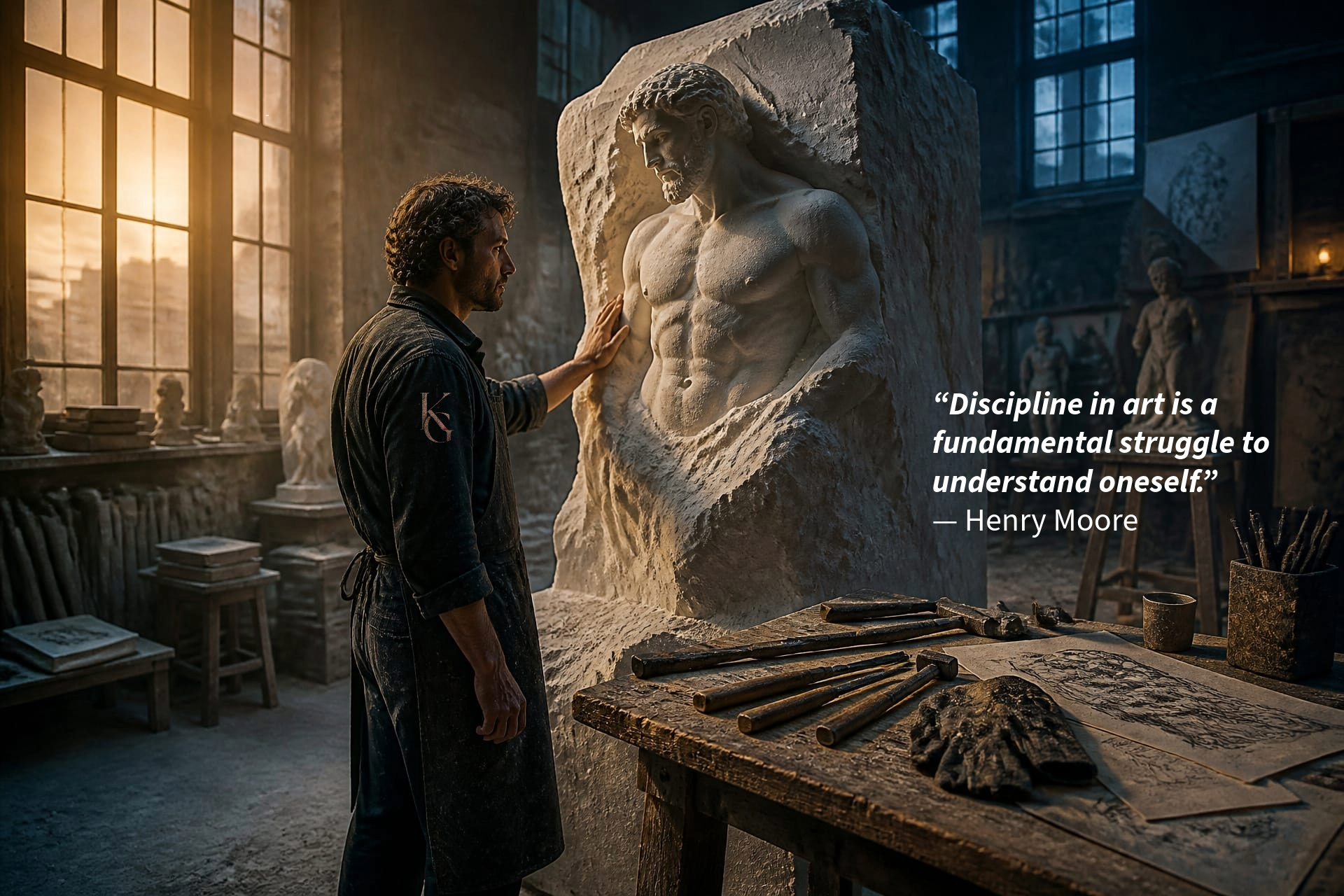
We imagine it as the absence of obligation—the open road, the empty calendar, the luxury of doing only what we feel inspired to do. But every artist eventually discovers a quieter truth. The greatest freedom isn’t found in escaping discipline. It’s found through it.
That sounds backwards until you’ve spent enough time in the room.
When you first begin creating, you’re surrounded by noise. The voices of teachers, critics, trends, expectations, and your own relentless self-doubt all compete for attention. Every blank page becomes a referendum on your talent. Every unfinished project feels like evidence that someone else was born with whatever you’re still trying to earn.
Then you keep showing up.
One day becomes another. Draft follows draft. The awkward attempts slowly become competent. Competence gives way to confidence—not the loud confidence that demands attention, but the quiet kind that no longer needs permission.
Henry Moore understood that discipline is never just about learning a craft. It is the long process of removing everything that isn’t truly yours.
Every hour spent working strips away imitation. Every revision uncovers another layer of honesty. Every failure teaches you which shortcuts lead away from your own voice. The work becomes less about producing something beautiful and more about discovering the person capable of creating it.
That discovery cannot be rushed.
Like a sculptor removing stone, discipline chips away at fear, impatience, ego, and the temptation to create for applause instead of truth. What remains isn’t perfection. It’s authenticity.
Perhaps that is the deepest form of independence.
Not freedom from the work, but freedom from pretending to be someone you’re not.
Long before the world sees what you’ve created, the private room has already done its work on you. It has taught your hands to trust, your instincts to speak, and your voice to stand without apology.
The masterpiece was never only the work that left the room.
It was also the person who walked out with it.
Reflective Prompt
What part of yourself has been uncovered—not invented—through the discipline of returning to your work?
In life there are people that will hurt us and cause us pain, but we must learn to forgive and forget and not hold grudges.
In life there are mistakes we will make, but we must learn from our wrongs and grow from them.
In life there are regrets we will have to live with, but we must learn to leave the past behind and realize it is something we can’t change.
In life there are people we will lose forever and can’t have back, but we must learn to let go and move on.
In life there are going to be obstacles that will cause interference, but we must learn to overcome these challenges and grow stronger.
In life there are fears that will hold us back from what we want, but we must learn to fight them with the courage from within.
God holds our lives in his hands. He holds the key to our future. Only he knows our fate.
He sees everything and knows everything. Everything in life really does happen for a reason: “God’s Reason”
Personal Reflection
There’s a quiet honesty in this poem that makes it approachable.
It does not pretend life will spare us pain. In fact, nearly every stanza begins with an acknowledgment of difficulty: hurt, mistakes, regret, loss, fear, obstacles. The poem understands something many people spend years trying to avoid:
Suffering is not an interruption of life. It is part of it.
What matters is how we carry it forward.
That’s where the poem shifts from observation into guidance. Forgive. Learn. Let go. Keep moving. Find courage. Hold faith.
Simple ideas on paper. Hard disciplines in practice.
Because forgiveness sounds beautiful until someone wounds you deeply. Letting go sounds wise until the loss still speaks to you at three in the morning. Courage sounds noble until fear becomes personal.
The poem’s strength is not literary complexity. It is emotional accessibility. It speaks in direct language because many people encounter life’s hardest lessons directly. Not philosophically. Not abstractly. Through heartbreak, disappointment, grief, failure, and uncertainty.
And beneath all of it rests the poem’s central belief:
That meaning exists even when we cannot immediately see it.
For some readers, that faith is spiritual. The idea that God carries a larger understanding than we do. For others, the message may resonate more symbolically—that pain can still produce growth, wisdom, compassion, or transformation over time.
Either way, the poem asks for trust.
Not blind denial of suffering. Not pretending everything feels fair.
But trust that a difficult season does not automatically make life meaningless.
That’s an important distinction.
Because many people confuse healing with erasing pain. Real healing usually means learning how to live honestly beside what happened without allowing it to define the entirety of who you are.
And that requires both faith and courage.
Faith that tomorrow can still hold value. Courage to continue long enough to reach it.
Reflection Prompts
Which is harder for you right now: forgiveness, letting go, or trusting the future?
What lesson has pain taught you that comfort never could?
When fear shows up in your life, do you retreat from it—or move through it carefully?
I’ve seen evil. Been close enough to feel it peel my face off and wear it while the world kept calling it me.
The mirror answered in pieces.
First with movement. A blink that didn’t belong to me. A smile arriving too early. One reflection slowly turning its head while I stood perfectly still in front of the sink.
Then came the sound.
A soft pop.
Another.
Glass cracking across the mirror with surgical patience.
Not loud. Not violent. Intentional.
I felt it in my fillings before I fully heard it. Tiny fractures spread through the reflection, gold veins spiderwebbing beneath the surface like nerves catching fire under skin.
Rain dragged itself against the boarded windows. The apartment smelled of wet plaster, stale cigarettes, standing water, and something faintly rotten buried underneath it all. Dust hung thick enough to taste. Every breath scraped my throat raw on the way down. The wallpaper sagged from the walls in damp exhausted curls, and one strip finally peeled loose beside the medicine cabinet, drifting downward with a dry papery whisper.
That tiny sound nearly made me jump.
That’s the thing nobody tells you about fear. At its quintessentialcore, fear isn’t loud.
It’s intimate.
It notices small things.
The room felt colder suddenly. Not temperature cold. Observed cold.
I stared at the fractured mirror bolted crookedly above the sink.
Nine reflections stared back.
Not copies.
Witnesses.
“Don’t you remember me?”
The voice came from the upper-left shard.
He looked younger than me by at least a decade. Thin in the way stress makes men thin. Damp curls hung over his forehead. Fresh bruising colored one side of his jaw purple-yellow beneath the flickering light. He kept rubbing his hands together compulsively, like they still remembered handcuffs.
His eyes stopped me cold.
Not because they were angry.
Because they still believed explanations mattered.
I searched his face while recognition scraped somewhere deep inside my mind like furniture dragging across concrete.
“You came to my apartment,” he said quietly. “Three nights before I died.”
Snow surfaced immediately.
Motel lights buzzing through heavy snowfall. Cheap radiator knocking behind stained wallpaper. Coffee burning on a hotplate.
The reflection watched realization move across my face.
“There it is,” he whispered.
The crack in the mirror widened.
“I tried to come back.”
His expression didn’t change.
“That’s not the same thing.”
Silence spread through the apartment then. Heavy silence. Emergency-room silence. The kind that arrives after doctors stop pretending effort changes outcomes.
Another reflection leaned into view from a lower shard. This version looked older than me somehow. Broader shoulders. Gray threaded unevenly through his beard like ash after a fire. His haircutlooked self-inflicted — severe and jagged, the kind men give themselves in motel bathrooms during nervous breakdowns. Fresh razor burn glowed red beneath his jawline.
He smiled without warmth.
“You know what your problem is?”
I said nothing.
He scratched slowly at dried blood near his wrist.
“You think guilt is evidence of humanity.”
The sentence landed with terrible precision. No shouting. No theatrics. Just truth finding exposed nerve.
“You confuse regret with redemption,” he continued. “That’s how you survive yourself.”
The overhead bulb buzzed harder.
For a moment all nine reflections moved independently. One paced. One muttered to himself. One sat motionless in darkness pulling at his own hair. One smiled constantly without blinking.
That smiling one bothered me most.
Then another reflection emerged deeper inside the fractured glass.
Half-hidden.
His nose had been broken badly years ago and healed crooked. One eye drifted slightly off-center. His soaked suit hung loose against narrow shoulders as though he had crawled out of a river moments earlier.
“Don’t you remember me?” he asked softly.
Hospital hallway.
Machines humming.
A woman collapsing into plastic chairs while fluorescent lights painted everyone corpse-pale.
“You told her you’d find who did it.”
“I arrested someone.”
“That wasn’t the question.”
His lazy eye twitched faintly as he stared at me.
Rain hammered harder outside now. The sound no longer resembled weather.
It sounded like applause.
The mirror shifted again.
Something moved behind the reflections.
Not someone.
Something.
A shape crossing slowly through the fractured depths of the glass like a figure wandering room to room inside a house built from memory.
My chest tightened.
“You see it too, don’t you?” whispered the smiling reflection.
I didn’t answer.
“You always do eventually.”
The shape stopped behind Clara’s reflection as she surfaced gradually near the center crack. Not suddenly. Slowly. Like an old photograph rising through dark water.
Her dark hair rested over one shoulder. She wore the same black sweater she used to steal from me during thunderstorms. Her eyes looked tired in familiar ways.
Seeing her physically hurt.
Not metaphorically.
Actual pain.
Like my ribs tightening around broken glass.
Everything inside me softened and panicked at the same time.
“You remember me,” she said.
Not accusation.
Recognition.
“I never forgot you.”
“That’s true.”
Her fingertips touched the inside of the fractured mirror. Gold cracks spread gently beneath her hand.
“But forgetting was never your problem.”
The room smelled different suddenly. Rainwater. Coffee. Old paperbacks. Faint jasmine perfume.
Clara always smelled like bookstores during storms.
“You preserved me too carefully,” she whispered.
“What does that mean?”
“It means you loved me better inside your mindthan you ever loved me in life.”
The smiling reflection laughed softly.
“There it is.”
I looked away immediately.
Cowardice disguises itself as contemplation more often than people realize.
“That thing you do,” the smiling reflection continued.
“What thing?”
“You retreat the second honesty stops sounding beautiful.”
The apartment creaked around us. Somewhere inside the walls pipes groaned like enormous animals shifting in sleep.
Then the reflections started changing faster.
The bruised young man aged suddenly. Teeth missing. Eyes hollow.
The motel-cut reflection began bleeding slowly from both ears.
The drowned-looking man’s jaw hung partially detached now, speaking through wet clicking sounds.
And Clara—
Clara remained exactly the same.
That terrified me most.
Because memory does that.
It lets the dead stay young while the living decay around them.
The smiling reflection pressed both palms against the glass now. His grin stretched too wide. Human teeth shouldn’t look that numerous.
“You still don’t understand, do you?”
I never answered because somewhere deep inside my mind — somewhere beneath memory, guilt, and all the locked rooms I spent years avoiding — I already knew.
These weren’t reflections.
They were rehearsals.
Versions of myself constructed from accumulated damage.
Not ghosts.
Consequences.
The oldest reflection finally stepped forward from the deepest fracture. His face looked almost identical to mine except calmer in the worst possible way. Acceptance lived inside him now. Total. Complete.
His voice came soft enough to mistake for my own thoughts.
“When was the last time,” he asked gently, “you spoke to another human being without turning your suffering into architecture?”
No one moved after that.
The rain softened outside. The overhead bulb buzzed weakly, throwing pale nervous light across the bathroom walls. Somewhere inside the building pipes groaned like enormous animals shifting in sleep.
And all nine reflections watched me in terrible silence while something behind the mirror slowly smiled with my face.
I don’t know why I touched my face.
Maybe instinct.
Maybe proof.
Maybe some primitive terrified part of my mind still needed confirmation that I existed separately from whatever was happening inside that glass.
My fingers rose slowly toward my cheek.
Every reflection reacted differently.
The bruised younger man flinched hard before I even made contact, eyes widening like he expected violence.
The reflection with the crooked nose closed his eyes in exhausted resignation.
The motel-cut version smiled faintly and leaned into the touch like a starving man offered warmth.
One reflection recoiled in disgust.
Another grabbed his own wrist as if trying to stop me.
The smiling reflection began laughing soundlessly, shoulders trembling while his grin stretched wider than human anatomy comfortably allowed.
And Clara—
Clara looked heartbroken.
That nearly destroyed me.
My fingertips finally touched my skin.
Cold.
Not skin-temperature cold.
Mirror cold.
An unnatural chill spread beneath my fingertips immediately, moving outward in thin branching lines beneath the flesh of my cheek. The sensation reminded me of ice forming across a windshield.
The reflections froze.
Every single one except the smiling man.
He stepped closer.
Not toward the glass.
Through it.
The movement was subtle enough that I almost convinced myself I imagined it, but the fracture around him deepened as his face pushed slightly forward from the mirror’s surface like something pressing upward beneath frozen water.
The overhead bulb flickered violently.
My hand jerked away from my face.
Too late.
Something remained touching me.
I could still feel fingertips against my cheek.
But my hand now hovered several inches away.
The room tilted.
Slowly.
Like reality losing balance.
The younger reflection stared at me with open panic now.
“He let you do it,” he whispered.
The crooked-nosed reflection backed away into darkness.
Clara began crying silently.
Only the smiling reflection seemed calm.
Relieved, even.
His face remained half-emerged from the fractured mirror now, skin trembling unnaturally where glass met flesh.
At first glance, it feels almost sad in its simplicity. As if love alone somehow isn’t enough. And maybe that sounds ungrateful in a world where so many people spend their lives searching desperately for affection, attention, or companionship.
But Orwell’s line points toward something quieter and more difficult.
Because being loved and being understood are not always the same thing.
A person can be surrounded by love and still feel profoundly unseen.
That’s the part people rarely say out loud because it feels disloyal somehow. Ungrateful. But emotional isolation does not always come from absence. Sometimes it comes from misinterpretation. From constantly feeling translated incorrectly by the people closest to you.
You begin simplifying yourself over time. Editing complexity out of your thoughts because explaining the full shape of your inner world feels exhausting. You learn how to answer “How are you?” in ways that make other people comfortable instead of truthful.
And eventually, even genuine love can start feeling lonely when it attaches itself only to the manageable pieces of who you are.
That’s what makes understanding so intimate.
Not agreement. Not admiration. Recognition.
The rare experience of another person seeing your contradictions clearly—the exhaustion beneath the humor, the fear beneath the independence, the grief woven quietly into your ordinary routines—and staying present without demanding that you become easier to process emotionally.
Mental exhaustion deepens when people feel perpetually misread. Over time, they begin carrying entire emotional realities internally because attempting to communicate them starts feeling more isolating than silence itself.
And perhaps that’s why so many people drift toward books, music, art, or strangers online during difficult seasons of life. Sometimes understanding arrives more honestly through fragments of shared humanity than through proximity alone.
Because the soul does not merely want company.
It wants resonance.
Still… maybe complete understanding between human beings is impossible. There will always be parts of us that remain private even when deeply loved.
But perhaps connection becomes meaningful the moment someone genuinely tries.
The moment another person listens carefully enough that you no longer feel pressured to compress yourself into smaller emotional shapes just to remain acceptable.
Because maybe love reaches its deepest form not when someone idealizes you…
…but when they recognize your interior world carries shadows, contradictions, and unfinished questions—and choose to stay near you anyway.
Reflective Prompt
When was the last time you felt genuinely understood without needing to explain every hidden part of yourself first?
I recently returned to writing about music over at House of Tunage for Song Lyric Sunday, and somewhere along the way the piece stopped being simply about a song.
It became about communication, deployments, marriage, friendship, jazz, old phone calls, and the strange emotional architecture music builds around our lives.
Sometimes songs don’t just soundtrack periods of your life.
Sometimes they quietly become part of the wiring.
World Telecommunication and Information Society Day celebrates humanity’s ever-growing ability to communicate across distance. From the telegraph to satellites to smartphones, the world has become increasingly connected. Messages that once took weeks or months to arrive can now cross oceans in seconds. For most of my career, I worked in telecommunications, installation, and repair, so the subject hits a little closer to home for me than it might for some people.
I spent years helping people stay connected. Funny thing is, nobody ever calls telecom repair because life is going well emotionally.
The first song that came to mind when I saw this week’s theme was Communication Breakdown by Led Zeppelin. Technically, it didn’t fit the criteria. No telephones. No operators. No lonely voices waiting beside rotary phones. Still, the song felt strangely relevant.
Listening to it now, the frantic energy sounds less like a collapsing relationship and more like modern life itself. Notifications. Endless digital noise. Half-finished conversations happening across multiple screens while people sit in the same room barely acknowledging each other.
Then my mind drifted toward Nobody Home by Pink Floyd, a quieter and far more haunted reflection on isolation. A room full of objects. A television humming softly in the dark. A phone existing mostly as decoration while loneliness settles into the wallpaper.
That song introduced me to feelings of isolation and loneliness I would eventually come to know all too well.
During one stretch of my career, I spent so much time away on assignments that my wife once joked — with more frustration than humor — that our house had become the place I visited.
Looking back, “Nobody Home” makes a lot more sense to me now than it did when I was younger.
Still, as powerful as the song remains, this week’s theme kept pulling me toward something warmer. Less about isolation and more about connection.
So naturally, I asked Guppy.
She yawned, looked vaguely disappointed in my inability to solve my own problems, and demanded treats for emotional support.
Somewhere between bribing the cat and overthinking the assignment, I remembered a conversation I had over the weekend with a group of teenagers who were genuinely interested in learning about music. Not trends. Not algorithms. Music.
One young man mentioned jazz.
Now that got my attention.
And somewhere in the middle of that conversation, I remembered When Sly Calls by Michael Franks.
And suddenly the theme made sense.
The full essay explores how one song became tied to communication, deployment, marriage, memory, and the emotional weight hidden inside something as simple as hearing the right voice at the right moment.
Maybe it’s age. Maybe it’s mileage. Maybe it’s finally understanding that concerts were never just about the music in the first place.
A few years ago, I would’ve spent the entire intermission chasing noise. Another drink. Another conversation. Another excuse not to sit still long enough to hear my own thoughts breathing underneath the crowd.
Now I find myself watching people more.
The exhausted security guard rubbing his knees near the barricade. The couple leaning into each other like the world outside this venue can wait another hour. The guy in the faded tour shirt singing fragments of songs before the band even returns, holding onto memories the rest of us can’t see.
There’s something strangely human about thousands of people gathering in one room carrying invisible things they don’t talk about out loud.
Grief. Stress. Bills. Regret. Loneliness. Memories attached to songs older than some people in the audience.
Then the lights drop.
And for a little while, strangers become a choir.
That part hits different now.
Current concert observations:
– One guy is absolutely fighting for his life in the merch line. – Somebody just spilled an entire drink and reacted like it was a federal emergency. – The restroom line has developed its own economy and political structure. – I’m pretty sure the couple beside me met tonight and are already discussing childhood trauma.
Live music remains one of humanity’s weirdest beautiful inventions.
Before we understood the world, we understood her.
Not politics. Not religion. Not money. Not the hard mathematics of survival.
Her.
A mother is often the first place we encounter mercy. The first voice that calms panic. The first hands that teach us gentleness without demanding weakness. Long before the world tells us to toughen up, compete harder, or hide our scars beneath polished smiles, there is usually a woman standing in the storm trying to make the wind softer for us.
That kind of love leaves fingerprints on the soul.
As a child, you do not notice the sacrifices. You don’t see exhaustion hidden behind coffee cups or the fear tucked behind forced smiles. You don’t understand how many mothers are carrying entire worlds while pretending the weight is manageable. You simply assume the light will always be on. The meal will appear. The hug will remain waiting at the end of a terrible day.
Only later do you realize she was building miracles out of fatigue and stubbornness.
Mothers become translators between us and chaos. They explain pain in smaller words. They convince frightened children that thunder is only noise and not the end of the world. Sometimes they do this while fighting storms of their own no one else notices.
That’s the part people often miss.
Motherhood is not sainthood. Mothers are human beings first. Complicated. Imperfect. Brilliant. Frustrated. Sometimes overwhelmed. Sometimes wounded long before we ever arrived. Yet many still choose to love anyway. To keep showing up anyway. To keep pouring from cups the world rarely helps refill.
There is something sacred in that kind of persistence.
Some mothers raised children in warm homes filled with laughter and music. Others raised them in survival mode — balancing bills, grief, disappointment, broken relationships, and silent fears while still trying to make birthdays feel magical. Some mothers worked double shifts. Some sat awake beside hospital beds. Some carried children that were not biologically theirs but loved them fiercely enough that blood became irrelevant.
Love has always been bigger than biology.
Stepmothers rarely receive enough credit for the emotional tightrope they walk.
People talk about marriage as if winning the heart of a partner is the difficult part. Sometimes the harder task is standing in front of children carrying confusion, loyalty conflicts, grief, anger, or fear and quietly saying, I will keep showing up anyway.
That kind of love requires courage.
A stepmother often enters a story already in progress. The traditions existed before her. The wounds did too. She inherits silence she did not create and tensions she did not ask for. Every act of care can feel cautiously examined. Every boundary tested. Every kindness weighed for sincerity.
Trust is not automatically given to her. It is earned slowly — through consistency, patience, restraint, and presence.
And that matters.
Because motherhood is not only measured by who gave birth. Sometimes motherhood is the woman helping with homework after a ten-hour shift. The woman sitting in uncomfortable bleachers at school events because she promised she would come. The woman learning how to love children who may not yet know how to love her back.
There is nothing small about that.
The same truth belongs to foster mothers and adoptive mothers, whose journeys are often left out of conversations about motherhood entirely.
Which is strange when you think about it.
Because many foster and adoptive mothers step directly into difficult terrain. Children carrying trauma. Loss. Displacement. Distrust. Histories too heavy for their age. These women are asked to build safety where safety may not have existed before. To teach stability to children who have learned instability as survival.
That is not secondary motherhood. That is motherhood in one of its most demanding forms.
Love becomes less about biology and more about decision. Daily decision.
To stay patient. To remain gentle. To keep showing up. To become proof that not everyone leaves.
And maybe that is one of the purest forms of motherhood there is: choosing to love someone fully when love is not guaranteed to return easily, quickly, or cleanly.
As children, we think our mothers are invincible. As teenagers, we think they are impossible. As adults, we finally begin to see them as people.
That realization can hurt a little.
Because suddenly you notice the tremble in her hands. The exhaustion in her eyes. The dreams she postponed. The pieces of herself she traded away so someone else could become whole. You realize she was learning life in real time too. There was no hidden manual tucked inside the kitchen drawer beside the rubber bands and old batteries.
Just faith. Improvisation. And love trying its best.
I think that is why Mother’s Day matters.
Not because flowers erase hardship. Not because greeting cards can summarize decades of sacrifice in pastel sentences. But because gratitude deserves language while people are still here to hear it. Too often we wait until funerals to become honest about love.
That seems backward to me.
So today is for the mothers who stayed. The mothers who struggled. The mothers who held families together with grit, prayer, duct tape, and pure refusal to quit. The grandmothers who stepped in when others stepped away. The foster mothers. The adoptive mothers. The stepmothers quietly building trust one difficult day at a time. The exhausted single mothers quietly fighting battles nobody applauds. The women who became safe places in a dangerous world.
And it is also for those carrying grief today.
For the people missing their mothers. For mothers mourning children. For those navigating complicated histories where love existed beside pain. For the women who wanted children but life unfolded differently.
Mother’s Day is not simple for everyone. Neither is love.
Still, there is beauty in acknowledging the women who taught us tenderness in a world increasingly addicted to cruelty.
If you are fortunate enough to still have your mother here, tell her what mattered. Not the polished version. The real version. Tell her about the moments she probably forgot but you carried for decades. The rides home. The late-night talks. The meals. The protection. The softness. The way she made survival feel less frightening.
Sometimes people never realize they were somebody’s lighthouse.
And maybe that is the quiet tragedy of love — the people who save us often think they were merely doing their job.
Two soluble aspirins spore in this glass, their mycelia fruiting the water, which I twist into milkiness. The whole world seems to slide into the drain by my window.
It has rained and rained since you left, the streets black and muscled with water. Out of pain and exhaustion you came into my mouth, covering my tongue with your good and bitter milk.
Now I find you have cashed that cheque. I imagine you slipping the paper under steel and glass. I sit here in a circle of lamplight, studying women of nine hundred years past.
My hand moves into darkness as I write, ‘The adulterous woman lost her nose and ears; the man was fined.’ I drain the glass. I still want to return to that hotel room by the station
to hear all night the goods trains coming and leaving.
Personal Reflection
Some losses look small from a distance.
A glass tipped over. A mess on the floor. Something ordinary gone wrong for a moment, easily cleaned, quickly forgotten.
That’s the lie of appearances.
Because not everything spilled can be restored.
And not every accident is only about the accident.
Spilt Milk understands how certain moments carry more than their surface suggests. A simple image becomes a doorway into regret, waste, tenderness, memory, or the strange ache of realizing something valuable has been lost in a form too common to notice until it’s gone.
That is often how grief works.
Not always through grand tragedies or dramatic endings.
Sometimes through the small thing broken at the wrong time.
The object dropped when your hands were already tired. The conversation mishandled when pride was louder than love. The chance missed because fear looked practical. The ordinary day you later understand was the last of its kind.
We dismiss these moments because they seem minor.
But the heart keeps different records than the mind.
It knows that what spills is not always milk.
Sometimes it is patience. Sometimes trust. Sometimes innocence. Sometimes time.
And time, once spilled, is notoriously difficult to pour back into the bottle.
That’s where the poem deepens.
Because the phrase itself often carries dismissal:
No use crying over spilt milk.
Move on. Get over it. Be practical.
Yet human beings are not machines built for efficient recovery.
We mourn what seems small because small things are where life actually happens.
Meals. Habits. Routines. Words spoken casually that become permanent. Tiny fractures that later reveal themselves as fault lines.
So perhaps the wiser lesson is not that spilled things don’t matter.
It is that fragility deserves more attention while it is still whole.
Reflection Prompts
What “small loss” in your life carried more weight than others realized?
Where have you dismissed your own grief because it looked minor from the outside?
What ordinary thing in your life deserves more care before it is gone?
The city kept its treasury locked behind marble and lies. I kept mine in a dented coffee tin under the sink—loose change, bad decisions, and names needing forgetting. Funny thing about value: theirs needed guards; mine needed forgetting. When they finally audited me, I handed them silence. It accrued interest faster than truth ever did. Then I sent an invoice.
Most people want exercise to feel like a reward. I’ve never bought into that.
Exercise, for me, has always been closer to maintenance—like tightening bolts on a machine you still need to run tomorrow. You don’t celebrate it. You do it because not doing it costs more.
That said, walking is the one form that never tried to sell me a lie.
It doesn’t pretend to be fun. It doesn’t dress itself up with neon lights, loud music, or promises of transformation in thirty days. It just asks one thing: keep moving.
And somehow, that’s enough.
Walking has been the most consistent thread in my life—not because it excites me, but because it meets me where I am. Good day, bad day, restless mind, heavy thoughts—it doesn’t argue. It doesn’t judge. It just absorbs.
There’s a rhythm to it. Heel, toe. Breath in, breath out. The world passing at a pace slow enough to notice, but steady enough to leave something behind. Problems don’t disappear, but they loosen their grip. Thoughts that felt tangled start to line up single file.
You don’t walk to escape. You walk to process.
And if you pay attention, the work starts showing up.
More than a few ideas have found me mid-stride. Plot holes I couldn’t untangle at the desk suddenly loosen somewhere between one block and the next. Dialogue sharpens. Scenes rearrange themselves without me forcing them. It’s like the story finally exhales when I stop hovering over it.
But walking gives, and walking takes.
Because the same rhythm that unlocks an idea will carry it right out of your head if you’re not paying attention.
You need a way to catch it.
A notebook in your pocket. A voice memo on your phone. Something. Because the lie we tell ourselves is, I’ll remember this when I get back.
You won’t.
Not fully. Not the way it felt when it arrived. Not the phrasing, not the clarity, not the weight of it. By the time you sit back down, all that’s left is a ghost of the idea—and ghosts don’t write clean prose.
So the walk becomes two things at once: a generator and a test.
If you care about the work, you don’t just let the moment pass—you trap it, even if it’s messy. Even if it’s just fragments. Because fragments can be rebuilt. Forgotten ideas can’t.
Thirty minutes a day is all it takes.
No gym membership. No supplements. No fancy clothes stitched with promises you didn’t ask for. Just you… easing on down the road.
There’s something honest about that kind of movement. No mirrors. No metrics screaming at you. No one keeping score. Just your body remembering what it was built to do.
I used to be a gym rat.
Back when I could walk in, flip the switch, and bring it without thinking. Back when effort felt automatic and strength felt like something I could summon on command.
I can’t do that the same way anymore.
And that pisses me off.
Not because I think I’m weak—but because it feels like I’m losing an edge. The kind that let me move through life by standards nobody actually meets, but everybody swears by like it’s gospel.
As a soldier, I believed in that edge early in my career. Thought it was necessary. Thought it was the thing that separated those who made it from those who didn’t.
I was wrong.
I learned the difference between a soldier and a warrior.
A soldier follows orders, meets standards, pushes until something breaks—sometimes himself. A warrior understands restraint. Knows when to move, when to wait, when to endure without burning everything down in the process.
One lives by force.
The other lives by awareness.
And here’s the part that took me a while to understand—
The military doesn’t teach you how to survive. It teaches you how to live.
Not comfortably. Not softly. But deliberately. With purpose. With structure. With a code that doesn’t bend just because the day got hard.
I just misunderstood what that life was supposed to look like.
I thought it meant constant pressure. Constant edge. Always on.
It didn’t.
Now?
Now I walk the neighborhood.
And out there, things slow down just enough for me to notice what I used to miss. The flowers pushing through cracks like they’ve got something to prove. The quiet rhythm of people going about their lives. The animals that don’t question the day—they just live it.
And somewhere in all of that…
I find my place alongside them.
Not chasing what I used to be. Not pretending I don’t feel the loss either. Just moving forward, step by step, in a world that never stopped moving.
I use the same approach in writing: one step at a time.
That’s all it is, really. The same way you walk the dog. You don’t worry about the whole road at once. You just start moving. One block. One corner. One more stretch before turning back home.
Writing works the same way.
You don’t finish an essay, a story, or a chapter all at once. You finish it sentence by sentence, paragraph by paragraph, thought by thought. The trouble starts when you stand still long enough to think about everything left undone. That’s when doubt creeps in, big as a bill collector and twice as loud.
But forward is forward.
A few lines today. A page tomorrow. A fix for a broken scene while your shoes hit the sidewalk and the dog stops to inspect something that apparently holds the secrets of the universe.
It may not look glamorous, but progress rarely does.
We want breakthroughs, lightning bolts, grand moments of arrival. Most of the time, what changes us is repetition. Quiet effort. The unremarkable decision to keep going.
Same with walking. Same with writing.
You put one foot down, then the next.
One word, then another.
And sooner or later, you look up and realize you’ve gone farther than you thought you would.
Every idea you choose… and every one you don’t… that’s editing. That’s preproduction. You’re already deciding what matters. The clearer you are on what you want to say, the less you have to clean up later.
Then comes the writing. That part? Easy. That’s instinct. That’s the words showing up like they’ve been waiting.
Post-production… that’s where it gets real.
That’s where doubt walks in.
You read it back and start asking harder questions. Is it believable? Does it land? Can someone else sit with this and feel something… or is this just me talking to myself?
Because readers are worse than any editor. They don’t analyze—they react. And if it doesn’t feel right, they’re gone.
So you cut. You rewrite. You tighten.
Sometimes you write a sentence that’s beautiful… and it doesn’t belong. You cut it anyway. It hurts. It’s supposed to. The story is better without it.
Grammar matters. But a perfect sentence that does nothing is still useless.
So you go back and find better words. Not bigger words. Better ones. No five-dollar words when a two-dollar one will carry the weight.
That’s where poetry comes in.
It teaches command of language. Every word has a job. What you leave out matters just as much.
You learn restraint.
I’m not trying to explain everything to you. I’m trying to let you sit next to me and feel it. The grit. The tension. The atmosphere. If I do it right, I don’t have to walk you through it.
Sometimes, it sounds like this:
Shrieks and whimpers blend in the shadows, composing a chilling melody… one haunting, yet familiar.Propped on padded steel, I reflect. Inaction’s consequence has become the gallow’s pole. Action’s responsibility—the weight for which I dangle.
No explanation. Just placement.
But truth isn’t fixed. It’s perception.
All I can do is tell it the way I see it. If I say it with enough precision, you’ll find yourself somewhere in it.
That’s the job.
Not perfection. Mediocrity is unacceptable—but that doesn’t mean perfect. It means no carelessness. No lazy writing.
Not every line has to shine. But every line has to matter.
Life doesn’t wrap things up neatly. It doesn’t hand you clean endings. Sometimes things just sit there unresolved. That belongs in the work too.
I don’t tie everything up.
I just make sure you feel what’s left hanging.
And here’s the part people don’t like—
I can’t control how you feel about any of this.
All I can do is put it on the page the way it needs to be.
Truth over popularity. No exceptions.
But don’t get that twisted—the reader always matters.
It makes no sense to write something that can’t be understood. If you can’t enter the work, that’s on me. Not because the idea is wrong, but because I didn’t translate it clearly enough.
That’s where precision comes in.
Perception without precision gets lost.
So I aim for clarity. Not to make it easier… but to make sure you can find me.
What looks raw on the page usually isn’t. It’s intentional. Sometimes the gut punch waits in the shadows. Other times it’s right there in the open.
Either way… it’s placed.
I’m not trying to impress you.
I’m trying to tell the truth the best way I can.
If I do that right—
you’ll believe me.
And maybe… you’ll listen.
Author’s Note
A thank you to Sadje for her Sunday Poser—a question that turned into something more than an answer. It turned into a conversation.:::
I’m not even sure what that means—taking an online IQ test.
I’ve read the definitions. I understand what it’s supposed to measure. Pattern recognition. Logic. Processing speed. A neat little number that tells you how well your brain behaves under controlled conditions.
Clean. Clinical. Impressive… if you like that sort of thing.
But I’ve met people who can ace those tests and still can’t think their way around the corner. The kind of folks who can solve theoretical problems all day long but freeze when reality refuses to follow instructions. Book smart, sure. Life confused.
I’ve also known people who wouldn’t impress anyone on paper… but you’d trust them when things went sideways.
Same world.
Different kinds of intelligence.
And that number?
It only tells you part of the story.
I remember taking a test once—military entrance.
I was drunk and hungover at the same time. Which shouldn’t be possible, but there I was… living proof that bad decisions can overlap.
And yeah—I bombed it.
Still passed, somehow. Just enough to get in the door, not enough to get a seat at the table. My score boxed me in. Limited options. Limited expectations. Funny how a number you barely remember taking starts speaking for you like it knows your whole story.
I remember how they treated us based on that score.
You could feel it.
Who got respect. Who got side-eyed. Who got talked to like they were already behind before they even started.
Here’s where it got interesting.
I’d be standing next to guys with higher scores—on paper, sharper minds, better placements—and they couldn’t figure out some of the basic tasks tied to their own jobs. Not all of them. But enough to notice something didn’t add up.
So I tried to help.
Most of them didn’t want it.
Here come the pretentious jerk balls… fresh out the factory, still wrapped in confidence they hadn’t earned yet. The kind that would rather struggle in silence than accept help from someone “below” them.
But one of them?
He was different.
We stepped outside, sat on the stoop, and worked through it. No rank. No scores. Just two people trying to solve a problem without making it more complicated than it needed to be.
When we finished, he looked at me and asked, “Why aren’t you in my field… at my level?”
I took a drag from my cigarette.
“Hot chicks and alcohol.”
He nodded. “I been there.”
We laughed.
Because sometimes the gap between where you are and where you could’ve been… isn’t intelligence.
It’s choices.
“I’m not smart.”
I say that a lot.
Not fishing for compliments—I’ve known people who are genuinely brilliant. The kind of minds that move faster, see further, connect things before you even realize there’s something to connect.
I’m not that.
At least, that’s what I tell myself.
My wife used to roll her eyes every time I said it.
“Whatever.”
That was her whole argument.
And she had reason.
That woman watched me do some of the most impressively idiotic things a grown man can do without supervision. The kind of decisions that make you question whether common sense is optional.
But she also saw me when I got stuck.
Not the casual kind of stuck—the kind where your brain locks up and frustration settles in like it pays rent. The kind that makes you feel useless.
She never agreed with me in those moments.
Never argued either.
She’d just tell me to step away.
Then she’d come back with a cup of coffee, sit beside me, and wait. No pressure. No speeches. Just presence. Like she understood that clarity doesn’t come from force—it comes when the noise finally settles.
And when I started something—really started—she already knew what I needed.
Legal pad. Red pen. Black pen. A full carafe of coffee.
Set it down… and give me space.
She’d even keep the kids away.
Not because I didn’t want to see them—I never minded when they came to talk—but she understood something I didn’t have the words for back then:
There’s a point in the process where stopping costs more than continuing.
So until I got there?
“Leave your father alone.”
She protected that space like it mattered.
Like I mattered.
I remember one time I was tearing into my team—just destroying them. They’d done something I thought was ridiculous. Not just wrong… obviously wrong.
Apparently, one of them called my wife.
Little bastards were always ratting me out.
They knew I wouldn’t listen to my bosses… but they knew I’d listen to her.
Phone rings.
“What happened?” she asked.
So I told her.
“I told you—they had the same training I did.”
“Listen.”
That one word hit harder than anything I’d said.
I felt it—that irritation. Like she wasn’t hearing me.
But she was.
Better than I was.
When I got home, the coffee was ready. That expensive stuff I hated paying for… and loved drinking anyway.
We sat down.
She let me talk.
Then she said it plain.
“Your old team was with you for five years.”
I nodded.
“You had time to learn them.”
Another nod.
“You have to do that again.”
I didn’t like that answer.
So yeah… I pouted.
“What?” she asked.
I stared into my coffee.
“That damn test.”
My son asked me once—he served too—how my time in the military could’ve been harder than the guys he knew doing the same job.
Same title.
Different story.
I laughed.
“The guys I knew doing my job?” I told him. “They had it easy as hell too.”
That confused him.
So I told him a few things.
Not everything. Just enough.
His eyes widened.
“How?”
I smiled. Gave him a wink.
Because some things don’t translate.
Not cleanly. Not completely.
And definitely not into a number.
Over the years—teaching, training, watching people succeed and struggle in ways that don’t make sense on paper—I’ve learned this:
Intelligence is an elusive beast.
It doesn’t sit still long enough to be measured cleanly. It shows up when it wants to. Hides when you need it most. And sometimes looks nothing like what you were taught to recognize.
So no—
I’m not saying intelligence doesn’t matter.
I’m saying it doesn’t live inside a number.
And if you think you’ve got it figured out because of a score on a page…
You probably don’t.
Author’s Note
This piece was written in response to Sadje’s Sunday Poser #279—a weekly, thought-provoking prompt that I’ve come to appreciate in my own quiet way. I don’t always jump into the ring and participate, but I read the question every time. There’s something about the way it lingers… like a conversation you didn’t realize you needed until it’s already started.
This one stuck with me longer than most.
Not because I had an answer ready—but because I didn’t.
So I sat with it. Let it circle. Let it pull at a few old memories I hadn’t planned on revisiting. What came out wasn’t a clean response or a polished argument—it was something closer to a reckoning. A look at the difference between what we measure… and what we actually understand.
That’s usually how it goes around here.
Questions don’t get answered so much as they get unpacked. And sometimes, if you’re lucky, you walk away seeing something you missed the first time.
Leaves fall, grow back, fall again. Wind moves through branches like it’s remembering something old. Somewhere in all of that—quiet, unbothered—a squirrel pauses. Not for performance. Not for reflection. Just… because that’s what the moment asked of it.
And that’s where we’ve lost the thread.
We move like everything is urgent. Like the next thing is always the thing that matters most. Coffee gets cold because we’re already thinking about the next task. Sunsets happen behind us while we’re staring at a screen. Even rest feels scheduled, like something to complete instead of something to live.
Meanwhile, that squirrel is sitting there like it cracked the code.
Still. Alert. Present.
There’s a rhythm in nature that doesn’t beg for attention—it just exists. Cycles that don’t need validation. Trees don’t rush their growth. Rivers don’t apologize for their pace. And animals don’t question whether they’re “doing enough” with their time. They exist inside the moment fully, without trying to turn it into something else.
We don’t.
We pass through moments like they’re checkpoints instead of experiences. And then we wonder why everything feels thin. Why days blur together. Why the big things don’t hit as hard as they should.
Because we’ve trained ourselves to ignore the small ones.
The truth is, meaning doesn’t live in the milestones. It hides in the quiet spaces we keep skipping over—the way light hits a wall at the same time every afternoon, the sound of leaves under your shoes, the brief pause of a squirrel deciding whether you’re worth worrying about.
That’s the stuff that anchors you. Not the noise. Not the chase.
The small, almost invisible moments.
But they only matter if you’re there to notice them.
And maybe that’s the whole thing. Not some grand reset. Not a complete life overhaul.
Just… stop.
Long enough to see what’s already happening around you.
Long enough to realize that the world never stopped offering you something real—you just got too busy to accept it.
And yeah… squirrels?
They’ve been sitting in that truth the whole time.
He looked like a man the world had tried to erase in slow, deliberate strokes.
Not violently. Not all at once. No—this was something quieter. More patient. The kind of erasure that comes from being overlooked just often enough that eventually, you begin to agree with it.
The lines in his face didn’t just mark time—they recorded negotiations. Every crease a compromise. Every shadow a place where something once mattered more than it does now. His eyes held that particular stillness you only see in people who have outlived their expectations. Not dreams—those die easy. Expectations are heavier. They rot slower.
There’s a moment, somewhere between who you were and who you settled into, where the argument ends. Not because you won. Not because you lost. Just… because you got tired of hearing yourself make the case.
He had that look.
Like he once believed in something with both hands. Like he fought for it, maybe even bled for it. And then one day, he realized the fight had gone on without him—or worse, that it never needed him at all.
The world has a way of teaching that lesson without saying a word.
His gaze didn’t accuse you. That’s what made it heavier. No bitterness. No spectacle. Just a quiet acknowledgment: this is how it goes. People come in loud, convinced they’ll bend something. Change something. Leave a mark that matters.
And then time answers back.
Not cruel. Not kind. Just consistent.
What remained in him wasn’t defeat. It was something more unsettling—acceptance without peace. The kind that doesn’t soothe, doesn’t resolve. It simply sits with you. Like an old coat you never throw away because, at some point, it stopped being about warmth.
You could imagine him once laughing. Loud. Unapologetic. The kind of laugh that fills a room and dares anyone to disagree with it.
Now, whatever was left of that laugh lived somewhere behind his eyes, folded into memory, waiting for a reason that would never come again.
And still—he remained.
Not because he had something left to prove. But because leaving, in its own way, would have required more energy than staying.
Dust hangs in the light like a verdict not yet delivered. The musicians blur at the edges, bodies dissolving into motion, bow against string, string against silence. Only he remains fixed at the center, a man carved out of hesitation and necessity. The conductor lifts his hand, not like a command, but like a confession he isn’t ready to finish.
Paper litters the floor at his feet—scores abandoned, rewritten, rejected. Ink bleeding into itself. Whole movements discarded like bad decisions you can’t quite remember making. He doesn’t look down. He never does. If he starts counting the failures, the music dies before it’s born.
There’s a tremor in his fingers. Not fear. Not quite. Something older. Something that remembers every wrong note, every missed cue, every time the orchestra slipped away from him like a crowd turning its back.
He brings the baton down.
The room obeys—but only barely.
The violins surge too fast, the cellos drag behind like grief that refuses to keep pace. Brass flares, then falters. It isn’t chaos. It’s worse. It’s almost right. Close enough to taste, far enough to hurt.
His jaw tightens.
He hears it—the fracture buried beneath the melody. No one else will catch it. They’ll hear beauty. He hears betrayal. A single thread out of place unraveling everything he thought he understood about this piece… about himself.
He cuts them off with a sharp flick.
Silence crashes harder than the sound ever did.
For a moment, no one moves. Not the players, not the dust, not even the light. They’re all watching him, waiting for the verdict he doesn’t want to give.
He lowers his hand slowly.
“Again,” he says.
Not angry. Not defeated. Just certain in the way a man is certain when he knows he has nothing left to hide from failure.
Because somewhere in the wreckage of what they just played, there was a glimpse—small, dangerous, undeniable—of something true.
And that’s the thing about truth.
Once you hear it, even broken… you don’t get to walk away.
There are days when the world feels too big to understand.
Too many voices. Too many opinions. Too many expectations about what you should be doing, thinking, or becoming.
It’s easy to feel small in the middle of all that. Easy to feel like your life is just one more drop in something too large to matter.
Most people learn to live with that feeling. Some learn to ignore it. Some spend their whole lives trying to prove it wrong.
Alejandra Pizarnik wrote about solitude, doubt, and the strange distance people sometimes feel from their own lives.
Her words don’t promise comfort. They don’t try to make the world sound simple.
They remind us that meaning isn’t something handed to you. It’s something you notice — or miss — depending on how willing you are to look.
The sky is always there.
But not everyone looks up.
Some people are too busy surviving. Some are too tired. Some are afraid of what they might feel if they stop moving long enough to notice where they are.
And sometimes the hardest part of being alive isn’t suffering.
It’s realizing how much of life passes by when you aren’t paying attention.
Maybe the world doesn’t belong to the strongest people. Maybe it belongs to the ones who keep looking, even when they don’t fully understand what they see.
Reflective Prompt
When was the last time you stopped long enough to notice where you really are in your life, instead of just moving through it?
Not one of those sleek machines with a touchscreen and a personality disorder. I’m talking about the old-school kind. Metal pot. Glass knob on top. Makes a sound like it’s arguing with the water.
You don’t rush a percolator. It sits there on the stove, bubbling away like an old man muttering about the state of the world.
Blip. Blip. Blip.
The smell of coffee fills the room, slow and steady, the way mornings used to work before everything needed an app and a firmware update.
Eventually someone pours a cup, takes a sip, and their shoulders drop about an inch.
Crisis postponed.
Not glamorous work.
But if I have to be something in the kitchen, I might as well be the reason people don’t start yelling at each other before 8 a.m.
What’s your favorite type of sandwich?
A Reuben.
Corned beef piled high, sauerkraut with attitude, Swiss cheese melting into the mess, and rye bread doing its best to hold the whole operation together.
It’s not a polite sandwich.
There’s no dignified way to eat a Reuben. By the third bite you’re leaning over the plate like a mechanic under a car, hoping gravity shows you a little mercy.
Sauerkraut falls out. Dressing drips. The rye is hanging on by sheer determination.
And let’s be clear about something.
A Reuben is not one of those fancy “variations.” No turkey Reuben. No vegan Reuben. No artisanal reinterpretation where someone replaces half the ingredients and calls it innovation.
That’s not creativity.
That’s blasphemy.
A real Reuben knows exactly what it is—messy, stubborn, and absolutely worth the trouble.
What do you think your last words will be?
I’d like to believe my last words will be something wise. Something profound. The kind of sentence people quote later while nodding thoughtfully.
But if my life so far is any indication, it’ll probably be something far less dignified.
It reads like a declaration carved into wood. No embellishment. No poetry. Just a statement.
Truth is powerful. And it prevails.
There’s something steady about that. Almost immovable. Like a woman who has walked through more than most people can imagine and no longer needs to shout.
But let’s not romanticize it.
Truth does not always prevail quickly. It does not always prevail safely. It does not always prevail without cost.
Sometimes truth costs reputation. Sometimes it costs belonging. Sometimes it costs blood.
When Sojourner Truth spoke, she wasn’t speaking from comfort. She was speaking from survival. From lived brutality. From a body that had been treated like property.
That changes the weight of the word.
Truth, in her mouth, wasn’t philosophical. It was resistance.
And here’s the harder mirror: we like the idea of truth prevailing — as long as it doesn’t threaten our position. We applaud courage from a distance. We repost conviction. But when truth starts rearranging our own assumptions, we hesitate.
Powerful truth doesn’t just confront systems.
It confronts us.
Maybe prevailing isn’t about winning the argument.
Maybe it’s about endurance.
Maybe truth prevails because it outlasts the lie. It waits. It resurfaces. It refuses to stay buried.
And maybe our job isn’t to guarantee victory.
Maybe our job is to stand with it long enough that it has somewhere to live.
Reflective Prompt
What truth in your life have you been delaying because you’re afraid of what it might cost?
Long nights are easy. It’s the quiet ones that test you.
At 0200 the world feels paused.
The house was dark except for the kitchen. Fluorescent light humming overhead. Boots lined near the door. The smell of fried chicken and mashed potatoes cutting through the fatigue. Coffee brewing — strong, black, my drug of choice.
My soldiers sat at my table, shoulders heavy from training, forks scraping ceramic in low rhythm. Eyes red. Movements slower than they’d admit.
She moved through that room like it belonged to her — because it did.
No rank at the table. No posturing. Just young men being fed while the rest of the world slept.
That hour belonged to us.
By day — or whatever passed for day in that schedule — I was responsible for personnel and millions of dollars in equipment. When something broke, it was my problem. When something failed, it landed in my lap. I didn’t just carry that weight — I knew what to do with it. Solving complex mechanical issues while the rest of the world slept was its own kind of high. Clarity. Consequence. Outcome tied directly to effort.
At home, I wasn’t the one in charge.
I was a husband. A dad. Later, a grandfather.
That was my safe space.
I believed the two worlds would sharpen each other. Discipline at work would translate to steadiness at home. Patience at home would temper intensity at work.
Sometimes it worked.
Sometimes it didn’t.
I remember one of my daughters standing there, hands on her hips, eyes locked on mine.
“I’m not one of your soldiers.”
That hit harder than I expected. For a second, I wondered if I’d come down too hard.
“I’m aware,” I told her. “If you were, you’d already be moving and I wouldn’t be hearing this nonsense.”
Her eyes narrowed — defiance she definitely got from her mother. Because I’m famously agreeable.
I adjusted.
“You’re right. My bad. What was I thinking… oh that’s right. You’re my daughter, so you still have to do what I say. Now go on.”
She held the stare another beat, then walked off muttering under her breath. I’m pretty sure she got that from me.
Leadership and parenting share tools. They don’t share contracts.
That took time to understand.
If I ran hot, she ran steady.
I would vent about lazy soldiers, about standards slipping, about the “gods” cursing me with a fresh crop that didn’t take things seriously. I’d be losing my mind over it.
There were things about my job I couldn’t tell her. Some details stayed where they belonged — inside the wire, inside the unit. But she didn’t need specifics to see when something was off.
She’d listen first.
Always listen first.
Then she’d lower the boom if necessary.
One day I was in their backs hard enough that one of them told me the phone was for me. I told him to have whoever it was call back. He insisted.
I grabbed the phone.
“Hello?”
“Leave my boys alone.”
“But they—”
“Leave them alone. Promise me.”
I complied.
Later that night she asked if I could tell her what had me so worked up.
I shook my head.
She studied me for a second, the way she did when she knew I was missing something.
“Go listen to some music. Read your Quran. Get your mind right. Dinner will be ready in an hour.”
She wasn’t undermining my authority.
She was protecting it from me.
People assume military life means you always have it together.
Pressed uniform. Calm voice. Decisive posture.
We’re trained to function under stress. That doesn’t make us immune to it. You can operate with adrenaline in your veins and still carry anger, fear, exhaustion. You can compartmentalize without ever processing.
At 0200 in my kitchen, none of that mattered.
There were just tired men eating, strong coffee keeping us upright, and a woman who understood that intensity needs shelter.
Retirement was scheduled. Predictable.
Her death wasn’t.
She passed before my final day in uniform.
So, I stopped being a soldier and a husband at the same time.
One minute I was responsible for people and equipment. The next I was walking into a civilian job where I wasn’t the boss — exactly what I thought I wanted. A paycheck. No stress.
Except the problem-solving part of my brain wouldn’t shut up.
There were inefficiencies. Gaps. Things that could be tightened. I tried telling that part of me to stay in its lane.
It didn’t listen.
What I didn’t expect was how loud the quiet would be.
The first time I woke up at 0200 with nowhere to be, no one waiting in the kitchen, no boots by the door — I just sat there.
No mission brief.
No plates clinking.
No voice telling me to get my mind right.
Just the refrigerator humming and my own thoughts circling.
I wasn’t angry.
I wasn’t even sad in the way people expect.
I felt… unassigned.
Like a man trained for deployment who had nowhere left to report.
I used to vent to her about what I could. She didn’t need operational details to understand the weight I was carrying. She could see it in my shoulders, in the way I moved through a room.
Without her, there was no counterweight.
No one to say, “Leave my boys alone.”
No one to study me and see what I couldn’t.
The house got quiet.
Not 0200 quiet with plates clinking and low conversation. Not the smell of fried chicken cutting through fatigue. Not coffee brewing while boots rested by the door.
Just quiet.
I still drink coffee.
Strong. Black.
Old habits don’t retire.
So, I listen to some music, read my Quran, and get my mind right.
Some nights, neither do I.
Daily writing prompt
Describe a phase in life that was difficult to say goodbye to.
Coffee stains map the surface like old territories. Ink smudges bloom where my wrist drags across unfinished thoughts. Notebooks lie open, pages filled with fragments of something — dialogue without context, a line about hunger that may or may not belong in Famished, a sentence about a shotgun in winter light that may or may not survive Where the Blackbird Sings.
There’s artwork half completed, graphite fading where I lost interest or nerve. A face without eyes. A sky without depth. I move from page to page like I’m checking on patients I never fully treated.
And somewhere in this mess is my lead holder.
I had it this morning.
Now it’s gone.
That shouldn’t matter. It’s just a tool. But losing it feels like the desk pushing back. Like the clutter finally saying, You don’t get to move forward until you sort us out.
Every now and then, I get this feeling that I’m not quite good enough to finish what I start. That maybe I need to learn something new first — master another technique, refine another approach — before I’m allowed to complete the thing in front of me.
It sounds responsible. It sounds disciplined. It sounds like growth.
But there’s another voice in the room, quieter and far less dramatic.
It says: You’re good enough. Finish it.
Then I hear my editor’s voice in the distance: Where are my damn words?
I’ve been feeding the visual side hard this quarter. Building images. Refining style. Layering light and shadow until they hum. That work matters. It sharpens the eye. It strengthens the hand. Images speak in ways words never will.
But words do something images can’t.
They press. They interrogate. They refuse to let me hide behind composition.
Two different languages. Same hunger.
If I don’t clear this space — physically, mentally — the long work suffers. The slow-burn pieces require air. They require quiet. They require a desk that isn’t arguing with me.
Maybe the desk isn’t cluttered because I lack skill.
Maybe it’s cluttered because I hesitate at the moment something demands commitment. Because finishing means standing behind it. Because completion invites judgment in a way drafts never do.
So, this weekend, I’m not making a grand declaration. I’m not announcing a return. I’m just clearing surface space. Wiping the coffee rings. Closing the notebooks that aren’t ready.
Picking one piece and staying with it long enough to see it through.
And finding the damn lead holder.
Sometimes progress isn’t forward motion.
Sometimes it’s choosing to believe you’re already capable — and finishing what’s been waiting on your desk all along.
Over the next few days, I’ll be moving Memoirs of Madness to a new hosting provider to improve long-term performance and stability. During this transition, the site may occasionally be unavailable, load slowly, or look a bit different while everything transfers and settles into its new home.
Once Memoirs of Madness is fully established in its new home, some elements of the layout may change as the structure is refined. You may also notice that a few older posts are removed or reorganized as part of ongoing housekeeping and curation.
While some things may look different, the heart of the work remains the same—the quality will not diminish.
If something seems off, please check back again shortly—I’m not going anywhere, just doing some necessary maintenance behind the curtain.
Thank you for your patience and continued support.
I know—perspective wasn’t invented in my lifetime, so stop looking at me in that tone of voice. I hurry every chance I get. That’s not a flaw. That’s mileage.
I’ve lived long enough to watch things arrive with fanfare and leave without apology. Things I was sure would never disappear. Kodak? Really? A name so stitched into everyday life that you didn’t even think of it as a company—just a given. I can still see those photo envelopes—your last name misspelled, a date stamped crooked—moments you didn’t realize mattered until you held them. There was a ritual to it. Finish the roll. Guard it like fragile truth. Wait. And waiting used to be part of the value. And then it was gone. Not erased, just… finished. We still have the photographs. We still have the memories. The machine mattered less than we thought.
I’ve watched televisions evolve from furniture to accessories. Big-screen TVs used to take up an entire wall, and it took several people to move one. Meanwhile, our lives were being packed into cardboard boxes labeled Kitchen, Kid’s Room, Bath, and my personal favorite: Misc. Everything important eventually winds up in Misc.
Then my wife discovered totes, and the shit went downhill from there. Same labels, same contents—but now they were slapped onto plastic bins stacked in the corner of a garage you worked your ass off to finally afford. Progress, they called it. Durable. Stackable. Eternal.
Nothing was lost. Everything was contained. And somehow, that felt worse.
Even though it felt worse, it wasn’t bad enough to stop. I traded in my Sharpie for fancy labels I make with my printers. Oh yeah—I can afford the better totes now. The stackable kind. Now the stuff has filled the garage and spilled into a storage unit. I may need therapy or a dumpster. Probably both.
The kids grew up in the meantime. They got their own spaces. Doors started slamming. Obscenities were shouted with an enthusiasm that suggested my daughters had taken sibling disagreements to a whole new level. Apparently, their dad and uncles were soft. Weak. Should probably take lessons.
That’s how it goes. The world keeps upgrading while quietly discarding what once felt permanent.
But does the world really keep upgrading? Or is that just something we tell ourselves so we don’t have to face the harder truths—the ones without instruction manuals or return policies?
Some things didn’t evolve. They were replaced. And not in a good way. They became disposable. Not broken. Not obsolete. Just cheaper to throw away than to understand or repair.
There was a time when the word quality meant something. You can still find it if you know where to look—pressed into the spine of an old hardcover, stitching still tight after decades, pages yellowed but intact. Sitting quietly next to words like honor and integrity. Words we still recognize, but no longer expect to encounter in the wild. We didn’t lose those things all at once. We just stopped insisting on them.
Not long ago, my boss asked us what we were doing over the weekend. It had been a rough week—tough, scary, downright mean. People talked about blowing off steam. Drinking. Traveling. Zoning out. Most of the things they mentioned, I’d already done at some point in my life.
When it got to me, I said I was going to build a new bookshelf for a collection I was putting together.
The entire department gave me hell.
“Why don’t you just buy one?” “They’re cheaper.” All the usual commentary that comes with efficiency and convenience and not wanting to think too hard about where things come from.
I didn’t argue. I just went home.
They were right—though not for the reasons they thought. Hardwood makes better bookshelves. Hardwood is expensive. I was using pine.
I sealed it with polyurethane. Nothing fancy. But there’s something about working through the miscuts. Measuring twice and still getting it wrong. Sanding it down and watching it slowly become what you intended. Something about ending the day with sawdust on your hands and a finished thing standing where nothing stood before.
You don’t build like that because it’s cheaper. You build like that because it still asks something of you.
Now you have a collection you took the time to research and gather, sitting on a shelf you designed and built yourself. It may not be worth much money. It won’t impress an appraiser. But it might be one of the most valuable things in your life.
Time is worth more than any dollar amount we attach to it. We just forget that when we’re doing the math.
When I came back to work, the running joke was still my “project.” I showed them a picture of the simple shelf I’d built. They countered by pulling up sleek, expensive bookshelves online. Lots of clean lines. Lots of gloss. Very impressive.
So I asked them to look up handmade pine bookshelves.
I sipped my coffee while the chiding went quiet. A few of them looked at me, shrugged, and walked back to their desks. It wasn’t about winning. It was just the first time all week the math didn’t get the last word.
Through all of this, there has been one constant thread that helped me get through it all: music. Nothing else needs to be said.
When I went home, I pulled a book off my shelf and propped my feet up, reading the first page. My cat, Sophie, meowed and curled up beside me. And now, I often find Guppy asleep on the top shelf.
The house settled into its usual sounds.
I’ve lived through enough so-called world-changing inventions to recognize the seduction of that phrase. Computers shrank from room-sized beasts to things we misplace. Phones became smarter than we ever bothered to be—and made us dumber in some areas. The internet promised connection and delivered noise at scale. All impressive. All useful. None of them changed me the way time did.
Every invention I’ve lived through tried to make life faster, easier, louder. Perspective does the opposite.
The shelf still holds. The house is quiet. That feels like enough.
She sits the way people do when they’ve finally stopped pretending the day went according to plan.
The couch gives beneath her, a slow surrender, fabric creasing where her body has learned to rest without asking permission. It remembers her shape better than most people ever have. Afternoon light slips in through the window—thin, dust-heavy, undecided—catching on the silver threaded through her hair, the soft pull of skin at her shoulders, the evidence of years spent carrying weight that never showed up on a scale.
This is not rest. This is what comes after holding yourself together too long.
Her tank top clings faintly to warmth, the ghost of the day still trapped in the cotton. Skin exposed, unguarded. No armor left. No performance required. She looks down at her hands and feels the familiar flicker of accusation. These hands have signed things they shouldn’t have. Held on when leaving would have hurt less. Let go when staying might have saved something. They tremble now—not from weakness, but from memory.
There is a wound you earn through endurance. It doesn’t bleed. It tightens.
It lives in the shoulders, in the jaw, in the space behind the eyes where thoughts go when they’re too tired to form words. She feels it settle there, heavy as wet cloth. This is the pain that learned to be quiet. The kind that stops asking for attention because it knows better.
She thinks about the versions of herself she was promised—by magazines, by love, by the softer lies people tell when they mean well. Stronger. Lighter. Forgiven. They stand like uninvited witnesses in the corners of the room, these almost-selves, careful not to meet her eyes. She doesn’t chase them anymore. Chasing taught her how expensive hope can be.
The room smells like yesterday. Cold coffee. Worn fabric. The faint mineral trace of skin that’s been still too long. Somewhere behind her, the world insists on urgency—phones buzzing, engines passing, time tapping its foot. In here, time slumps into a chair across from her and says nothing at all.
This is where the ache goes when it’s done screaming. This is where survival finally exhales.
She is not broken. She knows that much. But she is open in places that never healed cleanly.
Ink would catch this better than blood. A line pressed too hard into paper. A pause left uncorrected. The kind of mark you don’t explain away because explanation would cheapen it. This is not a story with a lesson. It’s a record. A witness.
She lets herself stay there—inside the weight, inside the truth—because she’s learned something no one bothered to teach her:
Healing doesn’t begin with hope. It begins the moment you stop lying about how much it hurt.
Morning arrives without ceremony. Light slips in through rain-blurred glass, hesitant, as if the day itself is undecided. The room still holds the night’s chill, so I cradle the cup and let its warmth work its way inward, slow and patient.
Outside, the world softens— trees loosen into color and breath, rain stitching the edges together. A winter bird begins somewhere unseen, its song thin but insistent, whispering morning into the quiet. Eight a.m.
Whatever lived between hello and goodbye, I don’t chase it. I leave it on the other side of the glass— intact, unmoving, a version of us that no longer asks to be believed.
I stay still. Steam lifts. The room listens.
A half-smile gathers when your words return, soft as rain against the pane. If I sit just right— tucked into the corner, letting the silence settle— I can hear something old stirring, amused, familiar, stretching its limbs beneath the calm.
Sometimes writers convince themselves that once something is written, it’s finished. That the act of getting the words down somehow completes the work. We couldn’t be more wrong.
What I was taught—what I still believe—is that the real task of writing is telling the whole story. And to do that, we have to get the hell out of the way. The story doesn’t belong to us in the way we like to pretend it does. Especially not at first. During the drafting phase, we’re nothing more than heralds—messengers racing to get the thing down before it slips away.
Joan Didion understood this when she said, “I write entirely to find out what I’m thinking.” That’s drafting in its purest form. Discovery, not control.
I once tried to describe that stage in a poem:
We find ourselves scribbling lines on the sidewalk in chalk before the rain.
That’s what drafting feels like—urgent, temporary, fearless. Those days are intoxicating. The rush of building something from nothing. I don’t know anything else in this life that quite compares. At least, not in the short time I’ve been conscious on this side of the veil.
Recently, I reread my first published work. I was eight years old, so let’s be clear—it wasn’t an opus. Three sentences. Awful ones, if I’m honest. But what struck me wasn’t the quality. It was the fearlessness. I had an idea, I wrote it, and I sent it off without apology. When I saw my name in the newspaper, something locked into place. This—telling stories—was what I wanted to do for the rest of my life.
Back then, I drew the same way. Without fear. Without permission. My mother encouraged that impulse, making sure I always had the tools I needed. My father, a no-nonsense man who believed in steady paychecks, was less convinced. Even now, people still tell me writing is a hobby. Usually because I haven’t published anything recently. Because there’s no obvious financial exchange. Most of these people have never written anything past a book report or a high-school essay. They mean well, I suppose. But the work doesn’t stop being work just because it’s unpaid.
“Practice makes perfect.” “Just keep working at it and you’ll get better.”
Those words once meant something to me. They were offered as measures of success—not just in writing, but in life. Put in the hours. Show up. Repeat. What I’ve learned since is this: practice alone is never the whole picture.
Proficiency doesn’t come from repetition by itself. Repetition without reflection only reinforces what you already do. Sometimes that means improvement. Other times, it means you’re just getting more efficient at the wrong things. Writing fails less often at the level of mechanics than it does at the level of thinking.
We study craft. We learn technique. And most importantly, we read. Not casually. Not as escape. But with attention. Reading a novel will teach you more than any classroom ever could. No disrespect to my professors or teachers, but the page doesn’t deal in theory—it deals in execution. Tone isn’t explained; it’s demonstrated. Rhythm isn’t discussed; it’s felt.
Stephen King put it bluntly: “If you don’t have time to read, you don’t have the time (or the tools) to write.” That line isn’t encouragement. It’s a line in the sand.
Once you can see what’s possible—once you’ve felt what language can actually do—you can’t unsee it. Effort alone stops being enough. Practice without evolution becomes self-deception. And that’s where dissatisfaction enters. Not as failure, but as evidence.
James Baldwin understood the danger of stopping there. He wrote, “The purpose of art is to lay bare the questions that have been hidden by the answers.” Once dissatisfaction sharpens your vision, you’re no longer free to settle for easy resolutions. Revision becomes an ethical act—a refusal to smooth over what should remain jagged. A commitment to letting the questions stand, even when answers would be easier.
I remember deciding I wanted to be a writer and being immediately convinced of one thing: I would never be good enough to write something anyone wanted to read. Once, one of my brothers said to me, almost offhandedly, “You actually wrote something people can understand.” He didn’t mean to wound me. But doubt doesn’t need malice. It just needs permission. The comment didn’t stop me, but it slowed me down. It taught me to listen outward instead of inward.
Doubt is internal. More precisely, it’s a state of mind. A person can believe in themselves and still let the commentary of others take the wheel. That’s where Cyril Connolly comes in: “Better to write for yourself and have no public, than to write for the public and have no self.” That line isn’t romantic. It’s a warning.
This is the key to writing. Yeah, the shit just got real.
Revision is the magical part. I love drafting—but revision is where the work becomes something you can stand behind. One of my instructors once told me, after I’d spent more time whining than revising, that revision wasn’t punishment. It was opportunity. Re-vision. The chance to see the work again—clearly this time.
Revision isn’t about fixing mistakes. It’s about changing your angle of approach. Shifting a piece from third person to first. Cutting a scene you thought was essential. Letting a moment breathe longer than you planned. This is where the story starts telling you what it wants to be. And if you stay with it, revision often delivers something you never imagined at the start—something truer, something earned.
Like many writers, I have fragments scribbled across countless notebooks. Every so often, I pull one of them out and sit with it again. Pen in hand. Quiet room. That’s when the noise fades and the work and I stop pushing against each other. We have a conversation. If I’ve done my job well, the reader gets to listen in.
After I finish a revision, I let the work sit. I owe that pause to myself—and to the piece. My goal is simple, though not easy: the work must be honest, cohesive, and carry the same integrity I demand from the things I choose to read. Anything less feels like a betrayal.
You don’t need fancy machines or specialized devices. Just you, a quiet place, and the willingness to work. Write it down. Turn it upside down. Hold it up to the light and see what still holds. Stay with it long enough, and something shifts. You stop forcing the work. The work stops resisting you. Slowly, almost imperceptibly, you begin to trust each other.
When I sit on my porch preparing for the next session, I sometimes watch children playing hopscotch on the sidewalk. I remember chalk on my own hands. I rub my fingers together at the memory. Then I turn back to the blank page and begin again. No rushing. No forcing. Just a man listening to the wind, ready to hear what it has to say.
Author’s Note
This essay was sparked by Ted’s piece, Rewrite, rewrite. Revise, revise. His reminder arrived at the right moment—quiet, direct, and honest about the work most of us would rather rush past. It wasn’t a lesson so much as a nudge, the kind that lingers after you’ve closed the page.
I’m grateful for that spark. Not because it told me what to do, but because it sent me back to the page asking better questions. This piece is a companion to his—not an answer, not a rebuttal—just another voice walking the same road from a slightly different angle.
Thanks, Ted, for lighting the match and trusting the work enough to keep striking it again.
I hear slumber calling— a distant, lonely sound, perhaps the loneliest I have ever known. It carries empty promises of peace, visions of places we have been and realms we never earned the right to imagine.
Sleep assembles us like a kit with missing instructions, parts rattling loose in the dark. Whatever it forges does not cool cleanly— it leaves us fired and cracked, pulled from the kiln too soon.
When it is over, when the dust finally settles, we sit on the edge of the bed, spines bent at an old kink we forgot we learned, waiting for something to return—
something to tell us how this works again, how it is to breathe.
Author’s Note
My thanks to Di for hosting the #MM301 challenge. These prompts don’t arrive gently—they sit with you, press a little, and ask what’s still unresolved. This piece grew out of that quiet pressure, out of what lingers after the noise fades. I’m grateful for the space to explore that edge, and for the invitation to listen closely to what remains unsaid.
He doesn’t bark. He doesn’t rush. He surveys the wreckage like he’s seen worse and survived it with his tail intact. Neon light crawls across his fur—electric, unapologetic—turning instinct into attitude and loyalty into legend. The shades aren’t for show; they’re a boundary. This is a creature who knows joy is a form of resistance. Who understands that style, like survival, is about refusing to disappear quietly. The world can burn its palette down to ash if it wants. He’ll still be here—cool, unbothered, and very much alive.
Two years ago, I said my political views hadn’t changed. That was true—and also a way of avoiding a harder admission.
What hadn’t changed were my beliefs. What had begun to change was my patience.
I still don’t “do politics” in the tribal sense. I don’t wear colors. I don’t chant. I don’t confuse certainty with wisdom. I prefer things plainspoken—say what you mean, stand where you stand. But time has taught me that clarity is rarely welcome. It disrupts narratives. It slows momentum. It asks inconvenient questions in rooms built for applause.
What age gave me wasn’t ideology. It gave me pattern recognition.
I’ve watched language get sanded down until it no longer cuts the people it was meant to protect. I’ve watched fear dressed up as concern and sold as leadership. I’ve watched principles become flexible the moment they interfered with comfort, power, or belonging. And if I’m honest, I didn’t always call it out. Sometimes I stayed quiet—not because I agreed, but because silence was cheaper.
That part matters.
Politics isn’t confined to ballots or podiums. It shows up in workplaces where “fit” means obedience. In families where peace is bought by swallowing disagreement. In churches where doubt is treated as disloyalty. It lives in who gets grace and who gets labeled a problem. I used to tell myself I was outside of it. I wasn’t. I was just benefiting from not being the immediate target.
What’s changed most is my relationship with certainty.
I no longer trust people who speak in absolutes while never paying a personal price for them. I’m less interested in what someone claims to believe and more interested in what they’re willing to risk for it—reputation, access, comfort, belonging. I’ve learned that conviction without consequence is just branding.
I’ve also learned that hidden agendas aren’t a flaw in the system. They are the system. Once you see that, you don’t get to unsee it. You either perform along with it, or you accept that things may get quieter around you.
So no—my political views haven’t flipped. But they’ve hardened where they needed to and softened where arrogance used to live. I ask different questions now. I listen longer. I assume less. And I no longer confuse staying out of the noise with staying clean.
Standing this way costs something.
It costs ease. It costs invitations. It costs the comfort of being fully claimed by any side. But it buys something better: the ability to sleep at night without rehearsing excuses. The freedom to say, this is where I stand, even when the room shifts uncomfortably.
It may not fit neatly on a ballot.
But it’s honest. And at this stage of my life, honesty matters more than alignment.
She lifts her arm like she’s remembering something older than breath—an inheritance carried not in blood, but in rhythm. The world behind her blurs into strokes of salt and shadow, yet she stands carved from something steadier: a woman made of lineage, of stories whispered through blue smoke and braided into the folds of her headwrap.
Her eyes are closed, but nothing about her is blind. She’s listening—maybe to the low tide of an ancestor’s voice, maybe to the soft insistence of her own pulse. The light catches her cheek like a blessing she didn’t ask for but accepts anyway.
And there’s that slight tilt of her mouth—neither smile nor sorrow, just the calm of someone who has survived enough to know the difference between surrender and liberation.
This is not a pose.
It’s a reckoning. A quiet claiming of space. A woman mid-stride in a prayer only she understands, and yet somehow, it feels like she speaks for all of us.
I came across this piece earlier today, and it stopped me. We talk about the Napoleonic Wars like they were fought by one kind of soldier in one kind of uniform, but history is rarely that clean. This post digs into the lives of Black soldiers who served in that era — men like George Rose and Thomas James — whose stories sit in the margins instead of the main text.
I’m reblogging it because it reminds us how easily entire lives can disappear from the record, not by accident, but by habit. And sometimes the most important thing we can do is shine a light where the page went quiet.
Air of December by Edie Brickell and the New Bohemians
December is a month of conflicting mindsets. On one hand, people get swept up in the season and start doing “Good Things,” as if generosity is something they dust off once a year like ornaments from the attic. Smiles get bigger. Voices get lighter. Folks try to be kinder, cleaner versions of themselves — at least for a few weeks.
But not everyone rises with the cheer. Some slip the other way — into that deep, cold room December knows how to unlock. The early darkness settles on their shoulders. The empty chairs at the table get louder. They watch the world light up and feel nothing but the distance.
The weather has changed. We felt the shift back in November — a quiet warning — but December carries the truth in its bones. The calendar hints at winter, but nature tells you outright. Woodchucks waddle with purpose, grabbing whatever scraps they need to seal themselves away. Raccoons run their winter reconnaissance, scouting warm corners with criminal determination.
Across the street, after sundown, the trees start speaking. Leaves rustle in patterns the wind doesn’t claim. Then: silence. Then another rustle — heavier this time — followed by a shadow shifting where it shouldn’t. And there it is: a raccoon the size of a small planet climbing like gravity signed a waiver. Somehow that bandit-faced acrobat is perched on the roof of a three-story house, staring down like it owns the deed.
Meanwhile, Christmas trees bloom behind neighborhood windows — soft glows behind glass, promises of borrowed joy. For the next thirty days, people will act like saints in training, as if kindness has a seasonal password and only December knows it. Christmas carols creep through grocery aisles. Decorations multiply like mushrooms.
This is precisely why you need a strong music collection. Survival gear. Armor.
Because there are only so many versions of “Jingle Bells,” “White Christmas,” “Deck the Halls,” and “Frosty the Snowman” a person can take before something in them snaps. Though Frosty and Rudolph do have their… alternative interpretations — the ones no one plays around polite company. Those versions? Those have some soul to them.
The lights are up on half the streets by now — fake pine needles, borrowed glow, holiday cheer on rotation. But behind windows, in alleys, in empty rooms and quiet corners, the air tastes different. Thinner. Sharper. More honest.
That’s when I slip on “Air of December.” Soft bass. Careful voice. Shadows tucked into the chords. This song doesn’t promise warmth, and it sure as hell doesn’t ask you to smile. It just says: pay attention.
Edie Brickell & New Bohemians were never a mainstream machine. They had one catchy breakout moment, and most people froze them in that era like a photograph in a drawer. Air of December is one of those tracks even longtime fans forget exists. It’s not whispered in corners or held up as a hidden classic. But for the ones who hear it — really hear it — there’s a quiet respect. A recognition of its weight. Its weather. Its staying power.
The song opens like a door easing into colder air — a small shift in pressure you feel more than hear. The guitar stays clean but unsweet; the bass hums low like a steady engine under the floorboards; the drums hold back, giving the track room to breathe. The band understands restraint — they don’t fill the silence; they let the silence carry meaning. There’s distance in the mix as well, not loneliness but space, like the walls of the room are set a little farther apart than usual. It gives the whole track that “cold air in the next room” feeling — a quiet tension humming beneath the melody.
Brickell’s voice moves with deliberate softness. She doesn’t chase the melody — she circles it. As if she is dancing alongside it, doing her best not to disturb the melody, but to belong to it. It’s intimate without being fragile or overbearing — confessional without wandering into theatrics. It respects the moment, and we appreciate that without even realizing we do. This is the “close-but-not-too-close” mic technique: you feel near her, but not pulled into her chest. You’re listening in, not being performed to.
Her lyrics drift like breath on cold glass — shapes that form, fade, and return slightly altered. Brickell doesn’t write scenes; she writes impressions. Smudges. Moments that land in your body long before your mind explains them. That’s December — not revelations, just quiet truths catching you in the corner of your eye.
There’s also the emotional sleight of hand: a major-key framework phrased with minor-key honesty. Hopeful chords, weary inflections. Warm instrumentation, cool delivery. A contradiction — just like the month. This isn’t a heartbreak song or a holiday anthem. It’s a temperature. A walking pace. The sound of someone thinking as the sun drops at 4:30 PM.
Some songs become seasonal without meaning to — not because they mention snow or nostalgia, but because they inhabit the emotional weather perfectly. This one does.
It sounds like a room after the noise has died down and the truth hasn’t found its words yet. It sounds like someone sitting beside you, matching your breathing. It sounds like December without the costume.
Most December songs want to wrap you in tinsel and memory. This one just sits beside you. Doesn’t judge. Doesn’t push. Just listens.
People claim they want authenticity in December — honesty, depth, meaning. They don’t. They want distraction wrapped in nostalgia. They want songs about snow so they don’t have to face the winter inside themselves.
“Air of December” refuses that bargain. It listens — and listening is dangerous this month.
Give someone a quiet December track and half of them will panic. They’ll change it before the first truth lands. Stillness has a way of turning the room into a mirror.
Most December listeners don’t want the real temperature. They want the thermostat set to everything’s fine. But winter doesn’t trade in lies. And neither does this track.
Yet there’s a strange comfort in that kind of honesty. The song doesn’t shield you from the cold — it invites you into it. It says, look around, breathe, the truths you’ve been dodging all year are rising — and you’re strong enough now to meet them.
December strips everything down to bone and breath. This track reminds you that what remains is still yours.
Some days the MKU pulls me deep into the art side of the house, and that’s where I’ve been this week—buried in images, color work, and the kind of creative mess that leaves your desk looking like a crime scene made of pixels.
But I’m still here behind the curtain on MoM, handling the admin work, reading fellow bloggers, keeping things tuned even if the front page looks quiet. Sometimes the best thing I can do is step back, breathe, and make sure the whole machine stays steady. More posts are coming. Just doing the groundwork first.
Some words don’t just honor the fallen — they remind us the living are still carrying their ghosts.
I stumbled across a piece that doesn’t wear patriotism like a costume. It doesn’t shout. It doesn’t wave flags. It simply stands still for a moment and asks: What happens to those who came home, but never truly made it back?
It traces the thin, invisible line between Veterans Day and Memorial Day—not to scold, but to reveal how often we blur the two because it’s easier than seeing the cost in human terms.
If you’ve ever said “Thank you for your service” and wondered afterward if it was enough—go read this.
Every now and then, a poem comes along that feels like it was written in a language your heart already understood. This one is exactly that—a quiet confession of the ways we love when we’re not sure the world is safe enough to love openly. And reading it through the Vietnamese translation by Nguyễn Thị Phương Trâm adds a different kind of weight. Her rendering doesn’t dilute Rumi’s longing; it sharpens it. The phrasing feels more intimate, more exposed, almost like a truth whispered in the dark rather than something meant for daylight. It carries the tremor of someone choosing their words carefully—not to hide the feeling, but to keep it from breaking.
I recognize myself in these lines—not because they’re romantic, but because they’re honest in the way only the wounded can be honest. The choices Rumi names—silence, loneliness, distance, wind, dreams—aren’t just poetic gestures; they’re survival strategies we adopt long before we ever learn to name them. Before I step into the analysis, I want to be clear about the feeling underneath all of this: this is a poem about longing, but it’s also a poem about what fear teaches us to call love.
Rumi’s Poem (Full Examination)
“I choose to love you in silence… Because in silence there is no rejection,” Silence becomes a controlled environment. No exposure, no risk. It’s the heart refusing to let someone’s “no” dismantle what feels sacred. There’s tenderness here, but also deep self-protection.
“I choose to love you in loneliness… Because in loneliness you do not belong to anyone but me,” Loneliness becomes ownership. Not of the person, but of the fantasy. It’s that quiet admission that imagined intimacy feels safer than shared intimacy—because reality involves other people, other choices, other ways to be hurt.
“I choose to cherish you from afar… Because distance will shield me from pain,” Distance is anesthetic. Keep the feeling alive, but keep it far enough away that it can’t burn you. There’s longing here rooted in past wounds—love held at arm’s length because closeness has teeth.
“I choose to kiss you in the wind… Because the wind is softer than my lips,” The wind becomes a surrogate for touch—the gentler, safer stand-in. This speaks to someone who has learned that physical connection can wound as easily as it heals. Gentleness outsourced to nature because the body remembers hurt.
“I choose to hold you in my dreams… Because in my dreams, you will be forever.” Dreams are the only place where love doesn’t die, change, betray, or disappear. Permanence becomes a fantasy because impermanence has already carved its mark.
Personal Reflection:
Rumi’s poem reads like someone tracing the outline of their own heart without daring to fill it in. Every choice—silence, loneliness, distance, dreams—feels less like surrender and more like survival. Anyone who’s lived through love that left bruises knows this pattern: protect the feeling by protecting yourself. Sometimes the safest place to love someone is the one where you never have to test whether they love you back.
But there’s a heavier truth humming beneath these lines. Loving in silence isn’t just reverence—it’s fear wearing poetry as armor. We tell ourselves we’re choosing distance when what we’re really choosing is control.
Silence keeps us from being shattered. Loneliness gives us a version of them we never have to share. Dreams let us rewrite the ending.
The thing is, these choices don’t just shield us from pain—they shield us from possibility. And that’s the part Rumi doesn’t say but implies: sometimes unspoken love is a sanctuary, and sometimes it’s a cell. The heart learns to ration hope after it’s been broken enough times. We call it wisdom, but it’s also scar tissue deciding what stories we’re allowed to tell.
Still, there’s something profoundly human in this poem—this instinct to hold what feels sacred in the quiet. Not every love needs to be confessed to be real. Some loves are meant to teach us, soften us, remind us we’re still capable of feeling deeply even after the world has taken its swings.
Maybe the point isn’t to stay hidden. Maybe it’s to understand the terrain of our own tenderness before we risk crossing it with someone else. Silence can be a starting point, not a resignation. Distance can be a breath, not a retreat.
And dreams… well, sometimes dreams hold our truest selves until we’re ready to step into the light and admit what we want out loud.
I’m stepping back from posting new pieces for the rest of the month — not because the well is dry, but because the work has shifted.
There’s writing, and then there’s everything that protects the writing — tending the archives, organizing drafts, sketching out what 2026 should feel like, not just look like. And just as important: actually showing up in other people’s spaces. Reading. Responding. Listening the way I ask others to.
I’ve always said I don’t want a crowd — I want a conversation. But conversation takes presence. It doesn’t happen if I only speak.
So this month, I’m still here. Just a little quieter. I’ll be reading your work, catching up on the stories and reflections I’ve missed. I’ll be behind the scenes — editing, planning, strengthening the scaffolding that holds this place up.
I’m realizing that engagement isn’t a side-task — it’s part of the practice. And I intend to carry that into 2026.
Not less writing. Just writing built on connection — not isolation.
I’m sitting at the table, drinking coffee, smoking a cigarette, waiting for the liquor distributors to show up. The invoices are spread out like old confessions. Ursula drops into the booth beside me, scooting against the wall, legs propped up on the bench like she’s claiming territory. She looks like she’s been rode hard and put away wet.
“You look like hammered dogshit,” I say.
“Thanks,” she sighs. “It’s a wonder women aren’t fighting in the parking lot for a chance to talk to you.”
I grunt and go back to the receipts. It was a good night. A bunch of weekenders dropped in just because they heard Willie and Ernie were here. Then somehow someone whispered that Josephine Baker might show. It was over after that. Word of mouth is gasoline in a place like this.
We’re in between both worlds—nobody really knows the size of the joint. The place shifts. Expands. Contracts. Accommodates. Like memory. Like guilt.
The door opens, blasting light from the heat tab—too bright, too sharp. Just a silhouette. I shield my eyes.
Bass Reeves walks in.
Not dressed like legend, not like myth—just a man who’s walked through dust and didn’t bother wiping it off. I don’t call him over. He comes anyway. Doesn’t sit. Just stands long enough to confirm he’s real, and not just folklore wearing boots.
He takes the seat across from me—no words exchanged. Doesn’t need any.
The door opens again, except this time, it doesn’t make a sound.
Poe steps through.
He enters like he’s always belonged indoors, even when he hasn’t eaten in days. Coat longer than necessary. Shoes too clean for a man with his kind of imagination. He doesn’t look at us. He looks at the rafters, checking for ravens. Bass nods. Poe nods back, like grief recognizing authority.
Ursula doesn’t greet them. She knows better than to greet ghosts.
I start to say something, but I stop—because someone is standing at the edge of the table.
No one saw her come in.
No coat. No apology. No explanation.
Just there.
Mata Hari.
She’s not posing. Not seductive. Not shimmering. Just still.
Present.
Composed like someone who’s tired of being looked at and never actually seen.
Reeves rises—not out of courtesy, not because she’s a woman—but because someone has entered his perimeter.
Poe stands, too, but slower. Not startled. Just… intrigued. Like he’s been trying to write her for years.
She doesn’t look at either of them.
Her gaze drops to my receipts.
My records.
“You keep records,” she says softly. “That makes you accountable.”
She doesn’t sit. She doesn’t need to. The room begins adjusting around her—like furniture shifting to make space for gravity.
Before I can recover, the door opens—with noise this time.
Ursula walks back in, not with plates, not with style. But with familiarity.
She leans down and kisses the newcomer on the cheek.
“Hey, Rudy.”
Rudolph Fisher blushes and shrugs like a schoolboy caught passing notes.
I light another cigarette. My hand is not steady.
“Remember my first kiss,” I mutter. “Lime green woman.”
“Lime green chick, huh?” Yuri calls from across the room—thick Russian, thick boots, thicker folklore.
“You eat the worm again?” Roscoe asks. He’s polishing the same glass he’s been polishing since Truman was president.
I shake my head.
The fellas glance at each other—slowly, like the air just changed language.
Oscar breaks the silence.
“It was two worms.”
Everyone nods like that explains everything.
Ursula guides Rudolph to the table. He doesn’t posture. Doesn’t rush. He sits like a man whose pace belongs to him—not to the room.
“Now we’ve got rhythm,” he says, tapping the table twice. The table… agrees.
“You guys hungry?” Ursula asks—already heading to the kitchen before anyone answers.
She won’t cook it—God forbid—but she’ll deliver it. Gifted waitress. Terrible woman for boiling water.
Roscoe and Oscar drift toward the bar, part-time employees who never leave and never clock in. I once told them I’m not paying extra.
They nodded like monks agreeing poverty was noble.
Ursula returns with plates she definitely did not make.
Bass studies his meal like it’s giving testimony.
Poe inhales the steam like he’s trying to decode its loneliness.
Fisher smiles without tasting anything.
Mata Hari watches butter knives like they hold state secrets.
No one speaks.
Not because we’re eating.
Because something is coming.
The door opens a third time.
Not dramatic.
Just right.
Gwendolyn Brooks walks in.
Not like royalty.
Like someone royalty once stood for.
And everyone—Poe, Reeves, Fisher, Yuri, Roscoe, Oscar, Mata Hari—stands.
Not out of politeness.
Out of alignment.
She doesn’t require attention. The room composes itself around her presence.
She does not take the head of the table.
She takes the center.
Because that is where gravity sits.
She sets down her satchel. Folds her napkin.
And without looking up:
“Tell me,” she says, “why you write.”
No one answers.
Because royalty does not ask questions.
She issues invitations.
And then—
There are eight cups on the table.
And only seven of us sitting.
The eighth cup is warm.
I turn—
And Toni Morrison is already there.
Not having entered.
Not having appeared.
Just present—hands folded, elbows resting, as if she had always been here.
Brooks doesn’t turn to greet her.
She only says:
“You took your time.”
Morrison smiles—small, devastating.
“No,” she says. “I took my place.”
Then she looks at me.
Not through me.
Into me.
Not asking a question—
Delivering one.
“What promises have you made… that your writing is afraid to keep?”
We got those Sunday Jazz Vibes going. It’s never intentional, but it’s always right. The slow grooves of Grover Washington Jr. set the tone before the coffee even cools. The things that man does with a sax ought to be illegal in a few states.
“East River Drive” rolls in like a slow-moving tide — smooth on the surface, dangerous underneath. It’s one of those tracks that pretends to be background sound until you realize you’ve stopped whatever you were doing just to follow the way he bends a note. That sly confidence, that river-road swagger. The rhythm section lays back like it’s got nowhere to be, while Grover glides above it all, mapping the emotional coastline of a Sunday morning.
A subtle deep groove — the kind that whispers instead of shouts, trusting you’ll lean in.
And somewhere between those warm horn lines and the long exhale of morning, my mind drifted downstream. That’s when the tonal shift hit — jarring in the best possible way.
Sliding from Grover into Melody Gardot is like stepping out of warm light into cool river air. Grover softens the room; Gardot sharpens it. His sax gives you glide. Her voice gives you gravity. With Grover, the river moves. With Gardot, the river speaks.
She pulls you in with that first line: “Love me like a river does.”
On paper, it’s simple. In her mouth, it’s a philosophy.
The river isn’t passion. It’s not urgency. It’s not the cinematic love-story nonsense we were raised on.
A river flows. A river returns. A river shapes the land without ever raising its voice.
She’s not asking for fireworks. She’s asking for endurance.
Then the quiet boundary: “Baby don’t rush, you’re no waterfall.”
That’s the deal-breaker disguised as tenderness. The waterfall is the crash, the spectacle, the “falling in love” that feels good until you’re pulling yourself out of the wreckage.
She wants none of that.
Her voice is soft, but the boundaries are steel.
Strip away the romance of rivers and waterfalls and what she’s really saying is:
“If you’re going to love me, do it in a way that won’t break me.”
That’s not fear. That’s experience.
The next verse shifts from river to sea — steady flow to swirling depth. Not for drama. For honesty. Intimacy always disorients you a little.
But even in that turbulence, she returns to her anchor: no rushing, no crashing, no spectacle. Even the sea has tides. Even passion needs rhythm.
Then the lens widens — earth, sky, rotation, gravity. Love as cycle, not event. Love that keeps you grounded without pinning you down.
And then back to the whisper: “Love me, that is all.”
Simple words. Colossal meaning.
What I love about this track is that it refuses to lie.
It doesn’t speak of love the way movies do — all gush, sparks, and declarations nobody could sustain after the credits roll. Gardot isn’t chasing fireworks. She’s not interested in romance that burns hot and disappears just as fast.
She’s talking about grown-folk love.
The kind that shows up. The kind that lasts. The kind built on years, not moments.
Her metaphors — river, sea, earth — aren’t poetic decoration. They’re durability tests:
Can your love flow? Can it deepen? Can it cycle? Can it stay?
She’s asking for a love that tends a lifetime, not a scene. A love shaped by presence, not passion; by commitment, not chaos.
The kind you don’t stumble into. The kind you earn.
And maybe that’s why this one gets me every time — there’s a difference between love that excites you and love that holds you. I’ve lived long enough to know which one matters more.
And let me say this plainly: this track comes from Melody Gardot’s debut album. Worrisome Heart was her first offering to the world, and I’ve rarely seen that kind of sophistication and grace appear so fully formed on a debut. Most artists spend years trying to grow into this kind of emotional control — the restraint, the nuance, the quiet authority. Gardot walked in with it from day one. No hesitation. No warm-up laps. Just a young artist already carrying the poise of someone who’s lived a lifetime and managed to distill it into song. Truly a marvel.
Before you watch the performance below, a quick note: This reflection is based on the studio version of “Love Me Like a River Does,” from Worrisome Heart — the quiet, intimate rendition where she whispers the philosophy of grown-folk love straight into your chest. But in the live version you’re about to hear, she opens with something unexpected: the first verse of Nina Simone’s “Don’t Explain.” It’s a deliberate nod — smoky, weary, full of Simone’s emotional steel — and Gardot weaves it in so seamlessly you barely notice the transition until it’s done. One moment you’re in Nina’s world of bruised truth; the next, Gardot slips into her own song like it was always meant to follow. It turns the piece from a gentle plea into something closer to a declaration.
What makes the song hit is how Gardot never pushes. The arrangement stays minimal. The room stays dim. Every breath has space around it.
It’s intimacy without intrusion. Truth without theater.
A quiet manifesto from someone who knows the cost of loving too fast and too violently.
She’s asking for love like water — not the kind that drowns you, but the kind that carries you and keeps coming back.
A grown-folk kind of love. A river kind of love. The kind that lasts because two people choose the flow over the fall.
And maybe that’s the real Sunday lesson — some songs don’t need volume to be heard. Some just need stillness.
Track: “November Trees and Rain” – Marie Dresselhuis
On most November mornings, there’s a chill in the air. Not the kind that grabs you by the collar and shakes you awake, but the subtle kind — the one that lets you know it’s there. It moves slow, almost tender, until your body shivers without asking permission.
I hear the morning before I see it. A woodpecker knocking its code into the trees, winter birds answering in their thin, determined voices. I close my eyes and let the breeze speak for a while — the rustle of fallen leaves, the soft give of the season shifting underfoot. There’s a certain beauty in the bareness of the trees. Something quiet. Something honest. Not something I can describe cleanly in words, but it’s beautiful all the same — the kind of beauty that doesn’t need witnesses.
Then the world shifts again — one of those November moments of return. The air brakes hiss, then squeal, and suddenly the stillness cracks open. Children rush toward the bus, half-awake, half-dressed, somehow always unprepared and always ready. The adventure begins whether they are or not.
I remember my own kids doing the same. I miss those mornings — not with regret, but with that quiet wish a father carries for a different version of himself, a different decision made on a different day.
Guppy’s cry pulls me back. She’s in my chair, staring at me like I’m late. Her way of reminding me that the present is still here, still demanding, still alive. Work waits. Memory wanders. But Guppy doesn’t let me drift too far.
So let us go then, you and I, into this next stop in Groovin’ with Glyn — that mixed music bag I keep rummaging through.
“November Trees and Rain” doesn’t try to dazzle you. It doesn’t fight for attention. It just unfolds — steady, slow-water honest. The title alone feels like a location on a map: somewhere between the last red leaf falling and the moment the season exhales. The guitar comes in like breath; the vocals come in like thought; the whole thing feels like watching the world turn the page while you stand there holding the corner.
This is a song for people who know how to sit with themselves. Not judge. Not fix. Just sit.
The Devil’s Voice in the Back of the Room
Not everyone trusts the quiet. They say they do, but not really. They want to be shocked and awed underneath while saying, “it’s so peaceful.” Some people hear a slow song and panic — like silence might reveal something they’ve worked hard to bury. Give them rain and they’ll close the blinds. Give them bare trees and they’ll look at their phones. Give them a morning like this and they won’t hear anything but their own hurry.
A song like “November Trees and Rain” has no chance with them. Too inward. Too honest. Too close to the bone.
But November isn’t for cowards. And neither is this track.
The Lift — Why It Belongs Here
Because there’s a moment midway through the month when the noise dies down — not the external noise, the internal one. This song fits right into that pocket. It’s the sound of a thought finally forming. The kind of realization you don’t chase; it arrives on its own timetable.
“November Trees and Rain” is what happens when the world stops performing and just is. Bare. Wet. Cold. True.
It reminds you that not everything beautiful announces itself — some things just endure.
Week 1 woke us. Week 2 asks us to stay awake.
Because the trees are bare now, the rain has longer stories to tell. Are you ready to listen?
November doesn’t crash in. It slips under the doorframe like it owns the place, tracking in the smell of rain and cold metal. Children rubbing their bellies because they have OD’d on candy. I miss those days. November comes as if it knows we need to exhale. Not long, just a little bit. Something quick to recharge for the next round of madness.
There’s a moment in early November when the world gets quiet enough that you actually hear yourself think — and sometimes you wish you hadn’t. The wind carries that familiar bite as the last of the fall aromas slide along with it. Then something else rides in on the shift — soft, strange, a whisper you almost mistake for memory. You turn your head without meaning to, unsure if you heard anything at all. The wind changes again, closer this time, warm against your ear as it murmurs, “Wake up.”
That’s the space “Wake Up” lives in.
A small Scottish band barely scratching 30K streams, November Lights shouldn’t hit this hard on paper. But the track feels like standing just outside your own life, watching the windows fog over while you debate going back inside. Not regret or clarity. More like the low buzz of a lightbulb that isn’t sure if it wants to live or die.
The vocals don’t beg. They ask. Quietly. Like someone nudging you in the dark, not to startle you, but to keep you from drifting too far away. And the production carries that nocturnal haze — the kind that tells you somebody sat alone longer than they meant to, letting reverb fill the silence they didn’t want to face.
Beneath it all is a steady pulse, the kind that hints at recognition rather than revelation. November has a talent for that — it doesn’t hand you answers; it hands you a mirror. The cold sharpens edges you swore were already smooth. The light changes, and suddenly everything looks closer to the truth.
The Honest Take
This is a quietly beautiful track. Not earth-shattering. Not one that guts you. Not every song is meant to gut you, but all of them should resonate with you on some level. Not every listener — just the ones the track was meant for. Something you won’t know until the needle touches the vinyl. Some songs don’t raise their voice; they settle in beside you and wait. “Wake Up” is exactly that — understated, precise, intentional.
The Devil’s Voice in the Back of the Room
Look, if you’re waiting for grit, you won’t find it here. If you want broken glass and a voice that sounds like it gargled the night, keep moving. And yes — someone out there will dismiss this as too clean, too polished, too “indie boy with a synth pad.”
Let them.
Not every November needs a fist. Some start with a shoulder tap, a soft reminder you can’t ignore. Besides, honesty hits harder than distortion when you hear it at the right hour.
The Lift — Why It Belongs Here
Because November is a month with its own kind of mercy. Not loud. Not generous. But real.
It doesn’t demand. It nudges. Sometimes it’s a hand on your shoulder saying, “You’re slipping. Come back to yourself.”
This song is that hand. The hush before the confession. The breath before the descent. The spark before the month settles in.
Week 1 shouldn’t break you. It should open the door.
“Wake Up” does that. Softly. Deliberately. Without apology.
November is here. The lights are on. Step inside — and enjoy this breath, because winter is coming.
My wife knew more about music than any woman I’ve ever met outside my mother. She couldn’t name artists, albums, or genres. None of that mattered. She just knew what was good. And the shit was spooky.
I learned this slowly, almost reluctantly, because I kept trying to talk to her about favorite artists. She never played that game. Her ear didn’t care about categories. Her heart didn’t negotiate with labels.
The first time she ever caught me off guard was the day I walked in and heard “Changes” by Black Sabbath drifting through the house. Sabbath. Black Sabbath.
Not a riff, not a hit — the one track that sounded like someone bottled regret.
It wasn’t that she was listening to Sabbath. It was that she somehow found the exact track I didn’t know I needed. And she did it without ever talking about music the way I did.
That quiet instinct — that sixth sense she carried — is what led her to two Nina Simone songs she treated like confessions. When she listened to Nina, the door stayed closed, the lamp stayed low, and you stayed out unless you were ready to walk into something fragile.
The smoke curled up from the cigarette balanced between her fingers, her hand resting beside a freshly cleaned ashtray. Hazelnut coffee filled the room, and Albert King was somewhere in the background complaining about the rain. I kissed her out of habit and apology — I stank to high heaven after a long day.
While I cleaned up, the music drifted from one blues track to another. I thought about grabbing a nap before the girls came home, when a voice cut through everything — soft, measured, heavy.
…wait. Is that Nina?
Next thing I knew, I was back at the table with a fresh cup of coffee. She didn’t look up, just nodded.
“I figured you’d get a nap before the girls got home,” she said.
I smiled into my cup. This is why I married her — she got me. She married me because I could reach the top shelf. Balance in all things.
She slid the CD case to me and tapped a single track:
“The Other Woman.”
I replayed it a few times — autopsy mode — until she reached over and rested her hand on mine.
“Let it play, baby,” she said softly.
So I did.
“The Other Woman” isn’t loud or dramatic. It’s a truth-teller — the kind of song that doesn’t raise its voice because it doesn’t have to. Nina sings it low and steady, like someone who’s already made peace with the ache she’s naming. The piano stays half-lit, the bass moves like it’s carrying news no one wants to hear, and nothing in the arrangement tries to comfort you.
That’s what hooked my wife. Not the lyrics. Not the storyline. The tone.
The way Nina delivered loneliness without apology. The way she stood inside the ache without flinching.
My wife knew that tone. She knew what it felt like to love a man who was half hers and half claimed by something bigger and colder than home. “The Other Woman” wasn’t a song about cheating to her; it was the shape of a loneliness she never put into words — but Nina named it clean.
Back then, I thought it was a strange song for her to be listening to. I wasn’t stepping out. I felt the loneliness in Nina’s voice, but I didn’t understand the source. Maybe I wasn’t meant to — not then.
Years later, when she got sick — the kind of sick that turns a hospital room into a country of its own — I sat beside her bed with Nina in my headphones while I tried to write. And that’s when it hit me.
My wife knew what it felt like to be the other woman.
Not because of infidelity. Not because of anything I did wrong. But because of devotion and duty — the two forces that built our life and carved holes in it at the same time.
She loved a man claimed by an oath he made before he ever met her. A man whose phone could ring at 2:17 a.m. A man who packed on short notice and left with even less.
We preached “Family First.” Said it often. Said it like it was gospel.
But the truth — the one Nina kept whispering — was “Mission First.”
If “The Other Woman” named the loneliness, then “Tell Me More and Then Some” named the hunger beneath it.
Not desire — presence. Not passion — time. Nina sings that second track like a woman reaching out in the dark, asking for just a little more of a man she barely gets to keep.
For a military spouse, that’s the whole gospel: the hours rationed out, the moments cut short, the days borrowed by orders.
You love the man, but the world keeps the schedule.
My wife never said she needed more of me — she never would have — but Nina said it for her. Together, those two songs held the architecture of her heart: the ache of being second and the quiet hope that maybe she could still have a little more time before the world claimed me again.
They lived on the same compilation she brought home when the girls were little — After Hours, still my favorite Nina collection. Maybe because it brought her voice into our home. Or maybe because it brought her truth into mine.
Those two tracks weren’t random choices.
They were the language she used to hold the parts of our life that the military kept taking. The ache she carried quietly. The hunger she never burdened me with.
Even now, as I write this, another Nina track slips in — “Ain’t No Use.” I didn’t cue it. Didn’t expect it. But there it is, like it wandered in to confirm every word on this page.
Nina always did that in our home — show up when truth was ready.
“The Other Woman” is my official Song Lyric Sunday entry because it appears on the 1969 compilation The Best of Nina Simone, one of her earliest and most enduring collections.
But really? I’m choosing it because my wife understood this song long before I did. She lived the ache of being second to a calling she never chose, with a grace I still don’t know how to name.
Some songs don’t remind you of a person — they finish the conversations you didn’t know you were having while they were still here.
This is one of those songs.
Let it play, baby.
Author’s Note: This piece isn’t about infidelity. It’s about the complicated places where love and duty overlap, and the quiet truths that grow in the spaces no one talks about. My wife and I were both Nina Simone fans, though she understood Nina in ways I didn’t grasp until much later. The songs mentioned here — “The Other Woman” and “Tell Me More and Then Some” — were part of her private rituals, the moments she used to hold what our life couldn’t always name. This essay is my way of honoring the weight she carried with grace. If any part of it resonates with you, let it. That’s Nina’s doing, not mine.
“It’s early in the morning / About a quarter to three…”
— Otis Redding
Nicotine stains my fingers, and there’s a coffee ring bleeding through the corner of my notebook. My shoulders ache — that familiar, loyal pain that’s been with me longer than most people. You get to that stopping point, the one where you promise yourself just one more thing so the mind can shut off without guilt or shame. Not that you’ve done anything wrong; it’s just the brain’s way of punishing ambition. You light up, take a sip, and the room hums like an overworked transformer. No bacon, no eggs — just the stench of being fried.
I’d been pulling an all-nighter, trying to wrestle systems into order before the next sunrise. Sleep wasn’t an option — at least that’s what I told myself, and once you start believing your own lies, they might as well be true. Somewhere around that blurred hour when the clock forgets which side of midnight it’s on, my wife came in with that look — half worry, half why in the hell aren’t you in bed next to me. The first two parts I could shrug off; the last one carried weight. She stood there, watched me for a moment, then went to put on a pot of coffee.
She was the wife of a soldier, so she knew the score. She didn’t like it much, but she knew it all the same. She looked at the clock and chuckled, that kind of laugh that carried both resignation and love.
“This is your theme song, right here,” she said. “Metal something — you’re always going on about it.”
“It’s Metallica, babe,” I said, “and the track is Am I Evil.”
She lit her own cigarette, slow and precise, the way she did everything that mattered. The smoke rose along the side of her face, curling like a slow dance with the light. One eye squinted through the haze as she looked my way — then in one easy breath, the smoke was gone.
“Shit, you say,” she replied, and I laughed — a small, grateful sound. The kind that breaks tension without fixing a thing. I took another sip of coffee. The bitterness hit just right, grounding me in that narrow space between exhaustion and clarity. Otis was still humming through the speakers, like an old friend keeping score of the hours we’d lost.
Otis Redding’s “Cigarettes and Coffee” came out in 1966, tucked into The Soul Album, a record overshadowed by his bigger hits. No stadium anthem here — just the quiet gospel of survival. The band plays soft, steady, respectful. Al Jackson Jr. keeps the drums whisper-thin, Duck Dunn anchors the bass like a heartbeat, and Steve Cropper’s guitar flickers in and out of the light.
It’s a sparse room of sound. You can almost smell the studio air — the tape reel humming, the smoke hanging low. Otis isn’t singing to anyone in particular. He’s talking to whoever’s still awake, whoever’s chasing purpose through fatigue.
“I’m sittin’ here talkin’ with my baby / Over cigarettes and coffee…”
That’s not romance. That’s ritual.
It’s the sound of two people trying to stay human when the night’s too long and the world’s too loud.
People love to say the sixties were a musical revolution. You hear it your whole life, like gospel. But you don’t really understand it until you’ve lived long enough to see how hype survives every generation. They didn’t have social media then, but they had slogans — peace signs, protest anthems, movements branded before they could breathe.
Today, the noise just comes in technicolor. Everything trending, nothing sticking. But Otis — he stuck. He already had his name etched in wax by the time this song landed, but “Cigarettes and Coffee” wasn’t for the spotlight. It was for the back room, the insomniacs, the men and women sitting at their own breaking points.
That’s what makes it timeless. It’s still talking about what we’re still living — the quiet wars we fight with ourselves, the long nights spent trying to hold it all together.
Every time I hear this track, something in me unclenches. It doesn’t lift me up — it settles me. Makes me honest. There’s a weight in Otis’s voice that feels like a man exhaling after carrying the world too long.
The song doesn’t fix anything; it just reminds you you’re not alone in the fixing. It says peace isn’t about rest — it’s about acceptance. The kind that comes when you’ve worked yourself down to silence and realize the silence feels sacred.
For a few minutes, I stop fighting the fatigue. My hands ache, my eyes burn, my shoulders protest, and somehow it all feels right. The song gives the exhaustion purpose. It turns the ache into evidence — proof that I’m still in motion.
That’s what makes it beautiful. Not joy. Recognition. The shared breath of the living tired.
Music provides the soundtrack of our lives — checkpoints across time, a kind of living mythos. We all move through the same years differently, but the songs mark us just the same. A verse here, a chorus there — little coordinates reminding us who we were before the noise got too loud.
It’s strange, isn’t it? Two people can walk side by side, hearing the same song, and still be living two entirely different truths. That’s the thing about music — it doesn’t belong to an era; it belongs to the listener.
That’s why Otis still matters. “Cigarettes and Coffee” isn’t nostalgia — it’s memory work. It’s here to keep us from forgetting what it feels like to be awake in the dark, searching for balance in the hum of a tired world.
Music is here so you don’t forget — how to feel, how to love, and how to weep. It’s a reminder that even in the long nights of rebuilding, there’s still rhythm left in the wreckage. And if you listen close enough, you might just hear yourself breathing in time with the song.
Pull Quote:
“It’s not a love song — it’s a mirror. A hymn for the living tired.”
Author’s Note: This piece was written for Jim Adams’ Song Lyric Sunday challenge, where writers and music lovers gather each week to explore songs through memory, meaning, and emotion. This week’s theme — coffee or tea — led me back to one of Otis Redding’s quiet masterpieces, “Cigarettes and Coffee.” What started as a late-night listen turned into something more personal — a reflection on rebuilding, resilience, and the art of staying awake long enough to make sense of it all.
He wasn’t born lucky. Nobody handed him a map. He learned early that some of us come into this world half-built, and the rest is on us. So he carved his name into time, steady and deliberate — a slow rebellion written in scars.
The city didn’t raise him. It tolerated him. Concrete and glass can’t teach you much, but they’ll listen if you bleed honest enough. He made peace with that kind of silence — the kind that hums between streetlights and memory.
There was a facility once — a place that smelled like rust, regret, and second chances. He wasn’t supposed to be there, but he stayed. Sometimes, a man doesn’t need comfort — he needs a place where the noise inside his head finally echoes back. In that echo, he found rhythm. In rhythm, he found himself. No blueprints. No saviors. Just repetition. Each motion a prayer, each mistake a gospel of survival.
He doesn’t worship. He works. He doesn’t beg. He endures. And if you ask what drives him, he’ll tell you the truth — it’s not pride or anger, not anymore. It’s the memory of a boy who promised a broken world he’d walk out standing.
When my system went down, it seemed like divine intervention—a forced pause. I took the chance to stop fighting the noise and reset my creative energy.
I sat there for a minute, half expecting the room to fill with people saying, “We’re here because we love and care about you. We’re worried. You don’t seem okay.” Instead, it was just me—and Guppy, staring like she’d seen this movie before. I muttered my customary “Kick Rocks,” and she gave me that look: “What’s going on with you, human? Pet me. Feed me. Clean my poop.”
Fair enough.
And because the universe clearly thought I needed a little more chaos, I decided to quit smoking. Yep, that was a moment of brilliance right there, buddy. I can’t remember the last time I built a machine, wrote a line, or rewired a circuit without a cigarette hanging from my lips or burning down in the ashtray. The old routine: light another while one’s already smoldering, forget which is which, call it inspiration. Now I’m in the cut back phase. Pray for me, light a candle, or call a hoodoo man to lay down some mojo—I can use all the help I can get.
Somewhere in the middle of all that nicotine withdrawal and digital resurrection, I pulled up the storyboard and looked at the mess. Dozens of storylines—some finished, most not. I decided it was time to clean house. So I’m finishing what I started. Focusing on the long fiction threads and promising myself that from here on, quality comes first. The foundation’s solid, but there’s still plenty of building to do.
You’ve all been patient, loyal, and willing to walk through my corridors of madness while I rebuild piece by piece. You deserve the best I’ve got—and that’s exactly what’s coming.
I suppose I should be pulling my hair out… wait, I’m bald—so I’m good.
“The cracks are where the future gets in.” — Nick Cave
Earlier this week, I wrote about dealing with multiple system failures — digital, emotional, creative. The kind of breakdown that makes everything feel heavier. Every keystroke. Every thought.
I couldn’t even open a text editor without feeling like the machine and I were daring each other to quit first.
So, I did what any rational person does when their world starts flickering — I tore it down.
Every wire. Every drive. Every application.
I started looking at everything — the hardware, the software, even the mental clutter I’d built around them. And I started cutting. To borrow a writer’s term, I’ve been killing my darlings. Not just the old drafts and half-finished files, but the stuff I’d been keeping out of sentiment — tools I didn’t use, folders I hadn’t opened since the Obama years, plans I wasn’t brave enough to admit were dead.
It’s strange, what survives a purge. The things you thought mattered crumble under scrutiny, while the quiet essentials — the things that actually serve you — emerge stronger, cleaner.
That’s when it hit me: maybe this isn’t just about computers. Maybe it’s about life architecture.
The Breakdown Phase
Sometimes the system has to fail so you’ll finally stop pretending it’s fine.
When the screens went dark, it wasn’t just technology collapsing — it was me running into the edge of my own maintenance backlog. You know the one: the projects, bills, and habits that pile up in the background while you tell yourself you’ll “get to it.”
Then, one day, everything gets to you instead.
But here’s the gift buried in the crash — it forces you to re-evaluate everything. To sit in the silence after the hum fades and ask: what’s still necessary? what’s still mine?
Back When We Built Our Own Fixes
I come from a time when computers didn’t “just work.” You had to earn them.
You didn’t buy plug-and-play — you built plug-and-hope. You traded parts out of milk crates, scribbled command lines in pencil, and held your breath during the boot beep because you weren’t sure if the whole thing would smoke or sing.
We understood our machines because we had to.*
There was intimacy in it — a relationship between curiosity and consequence. You learned to think like a system, to troubleshoot your way through the mess.
Now everything’s sealed, optimized, “user-friendly.” But friendly to whom?
The less we have to know, the less we understand. And when we stop understanding, we lose something fundamental — the muscle memory of resilience.
We used to break things and fix them. Now we just replace them and complain.
The Rebuild
So I went back to basics.
I started rebuilding my system piece by piece, checking every connection, testing every drive. And as I did, I realized this wasn’t just a technical reset — it was a personal audit.
I’ve been doing the same thing with my finances: cutting unnecessary subscriptions, auditing expenses, trimming the fat. I’m tired of auto-renewed everything — the digital equivalent of dust.
Same with my creativity. If a tool doesn’t serve the work, it’s gone. No more chasing new apps, new aesthetics, new noise. I’m rebuilding for efficiency, not ego.
There’s a strange peace in it — this deliberate stripping away. It reminds me that clarity isn’t something you download. It’s something you earn, line by line, dollar by dollar, decision by decision.
The System and the Self
The truth is, we’re not that different from the machines we build.
We run on energy and memory. We slow down when cluttered. We crash when overheated. And sometimes, the only way forward is to reformat.
But unlike machines, we get to choose how we rebuild. We decide what stays. We define what’s worth running.
This whole process — the wires, the drives, the self-audits — it isn’t about perfection. It’s about understanding. I don’t need things to run flawlessly. I just need them to make sense.
Keep Going, Responsibly
Here’s the part nobody romanticizes: rebuilding is exhausting. It’s unglamorous. It’s long hours, slow progress, and endless testing.
But it’s also the only way to ensure what you’re building can stand on its own.
Sometimes you have to keep going — not because it’s easy, but because stopping would mean accepting confusion as normal.
I’ve learned that keep going doesn’t mean sprinting through burnout. It means moving with intention. It means knowing when to step back, when to unplug, when to rewrite the damn script.
Because in life — just like in code — the smallest syntax errors can wreck the whole thing if you never stop to look.
“Sometimes you just have to keep walking, even if the map burned up a few miles back.” — Unknown
Author’s Note
Patience is a kind of engineering. You learn it by failing, by pausing, by realizing not everything needs to be fixed immediately.
Lately, I’ve been reminding myself that understanding — real understanding — takes time. Systems crash. People do too. What matters is how we rebuild, not how fast.
So if you’re in one of those messy seasons — where every wire feels tangled and every drive hums with static — breathe. Slow down. Learn your system before you rewrite it.
“Fear doesn’t always mean run. Sometimes it means you’ve finally cornered the truth.”
Let’s start with an admission: I’ve never liked the sound of my own voice. Not the way it cracks when I speak too quickly, or how it forgets itself halfway through a thought. Writing has always been safer — the words obey there. They arrive dressed and deliberate. Out loud, they stumble.
Before I speak, my body stages a small rebellion. My pulse climbs. My jaw tightens. The air feels heavy, as if the room is waiting to see what kind of fraud I’ll turn out to be. That’s what fear does — it turns attention into judgment, curiosity into threat. Only when I’m speaking about my writing does this happen — as if some inner voice hisses, “How dare you think your work is worthy of commentary?”
Yet outside the creative world, I’ve never hesitated to speak. Giving orders? No problem. I did it unapologetically. If someone broke down or got their feelings hurt, my answer was simple: “It’s not my fault your parents raised you to be a pansy.” Was that wrong? Of course. But it was effective — more often than not. That’s why the transition to civilian life hit me like a slow collapse. You can’t bark your way through vulnerability. You can’t command creativity. It doesn’t answer to rank.
But it isn’t really the audience I fear. It’s exposure. Writing lets me curate my confessions, polish the edges, make the mess beautiful. Speaking strips that away. It demands the raw version — the one that still shakes. And people are strange — sometimes cruel. Some need to be publicly flogged for how they treat others. I laugh when life gives them a taste of their own medicine. Not because two wrongs make a right — they don’t — but because it’s human to feel that flicker of satisfaction when justice shows up wearing irony’s grin. What always gets me, though, is how quickly the guilty feign ignorance. “I’ve done nothing,” they say. Or worse, “All I did was…” as if cruelty came with a receipt and a refund policy.
Sometimes I wonder if the page has made me soft. Soft in that pansy way I used to mock. Where are the tissues? Did you just hand me the cheap stuff? Man, you better give me the Puffs if we’re gonna do this right. Thank you. Where was I? Right — softness. I can write about grief, about love, about the parts of me that never healed. It’s almost easy to do so from the shadows, where no one sees your face or knows your name. A brave soul or a coward? Maybe both.
What do I look like without my mask? Will it fall away, or do I have to peel it off piece by piece? It’s okay to be frightened by what you see. It’s okay to scream aloud as you stare at the stranger in front of you — until you realize it isn’t a stranger at all. It’s you. And that’s the moment the voice in your head mutters, “The shit just got real. Damn it, man.”
Could I say these things out loud without flinching? Could I bear the sound of my truth without a backspace key to hide behind?
Maybe that’s what this season of my life is about — learning to live without the safety of revision. To understand that fear, pain, and uncertainty aren’t evidence of weakness, but proof that I’m alive — proof that I matter. The pounding of my heart, the sweat along my brow, the tingling at my edges — they’re all part of it. Then somewhere amidst all of this, I clear the mechanism. Serenity appears. It doesn’t replace the fear, pain, or uncertainty; it listens to them. They have a conversation while I exhale.
I don’t know if I’ll ever love the microphone. But I’m starting to think the page and the stage aren’t enemies. They’re just two mirrors — one for the voice, one for the soul — and I’m standing between them, trying to recognize my own reflection.
Reflective Prompt
What would your truth sound like if you stopped editing it mid-sentence? Say it out loud — even if your voice shakes.
Author’s Note
Sometimes honesty is a fistfight between who we were and who we’re trying to be. This one left a few bruises — the good kind. Now, if anyone knows where I left the ice packs… or hell, even a bag of frozen peas — I’m open to suggestions. Where’s the love, people? Where’s the love?
On Quiet Power, Unfinished Equality, and Knowing When to Step Aside
Women have been shaping the world from the quiet corners for as long as there’s been a world to shape. History loves its kings and loudmouths, but look closer and you’ll see the fingerprints of women everywhere—deals struck over kitchen tables, revolutions whispered into motion, empires shifted by a single word.
The damsel-in-distress? Pure fiction. Every woman I’ve known has been a strategist or a survivor. I was raised by women, so I never bought the stereotype. My mother, aunts, and grandmothers ran their worlds with a precision that left no room for excuses.
That lesson stuck. My daughters and granddaughters get no slack because they’re women—the only pass they get is being mine, and even that expires fast. I’ve watched women pick up the slack when men fall short, holding things together while someone else grabs the credit. And still, women are underestimated in ways I’ll never understand. The proof stands right in front of us, yet people squint as if strength needs permission to be real.
I saw it firsthand in the military. Equality is improving, but the gap is still wide. A striking new soldier joined our unit, and the guys forgot every rule of conduct, circling her like moths while she tried to learn her job. So I played the villain. I called people out, made her untouchable, and turned would-be defenders into cautionary tales. I hated doing it, but it gave her room to breathe. Her father was a command boss I’d butted heads with, so I expected trouble. Instead, we ended up on good terms, a quiet truce born from protecting his kid. She and I became friends, and years later, I still get the occasional text or Facebook update from her and the husband I once terrorized.
Long before marriage, an older woman once told me over beers, “If I can’t get what I want with a look and a smile, I’m not doing my job.” Back then, I didn’t get it. Marriage cleared that up. My wife could hold an entire conversation with a single glance, seal the verdict with a faint smile, and I’d move before she spoke—remembering that barroom oracle and chuckling while carrying out silent orders.
Here’s the tricky part: as much as I know the women in my life can handle themselves, the instinct to defend them never leaves. But that impulse can backfire. Sometimes the smartest move is to pick your battles, stay alert, and trust their strength. Respect isn’t rescue—it’s giving credit, stepping aside, and making sure the field is clear when they swing the hammer themselves.
Even after a lifetime of their guidance, I still don’t have a clue how women work. They tell me that all the time. I just smile, nod, and keep doing my chores. History is finally, grudgingly, starting to catch up.
Author’s Note I like Sunday Poser’s questions. They make me think—probably more than they should, but think nonetheless. Anything that stirs the mind is a good thing. So, thanks to Sadje for providing these tremendous challenges.
Sleep and I are estranged lovers—centuries of cold shoulders and midnight betrayals between us. Sleep is like that perfect lover we imagine we could find, but do we really want perfection? Knowing that perfection is something for shitbirds and affirmation junkies. There’s no help for the shitbirds, but the affirmation junkies—there’s a new 5 a.m. virtual meeting. I think that’s the word. Who knows? I can’t keep up. Hell, I can’t even get up. If we reconciled now, the shock might kill us both—like a jolt of mainlined caffeine through a cracked vein.
I could try being nicer to people. Be giddy, even. (Insert laugh track here.) But no—perish the thought. Niceness feels suspicious, like a door-to-door guru peddling enlightenment for the price of my dignity.
The writer in me says write more, which is hilarious because I already write every damn day. My editor swears I start a new series just to watch her eye twitch. Sometimes she sends me texts that are just a single, vibrating ellipsis. I plead the Fifth. She rolls her eyes so hard I can hear it over the phone. The other day she asked, “When are you going to take the next step? You know you’re ready, right?” Maybe she’s right. Maybe it’s time I believe in myself a little more—have faith in the work I keep throwing into the world like sparks from a stubborn match.
Still, there’s something quietly miraculous about creating work you love and finding out strangers love it too. For years, I didn’t have the time—raising a family will eat decades before you can blink. (Contrary to the baffling opinions of certain buttwipes who think parenting is optional.)
But the thing I’d truly like to do more of? Pay attention to my art. Not for money, not for likes—just to see how far I can push it. No limits, no internal hang-ups, none of the flimsy excuses we invent to dodge our own passions. Retirement has made one thing clear: I’m a storyteller. Always have been. Every skill I’ve picked up—writing, photography, film work, design—has been another star in the same battered sky, flickering through the smog of burnt coffee and late-night keystrokes. Each one lights a different corner of the story. Perhaps it’s time to stop forcing the tale into a single constellation and let the stars arrange themselves, allowing the story to decide whether it shines as prose, image, film, or sound.
As I write this, it begs the question… What if? What if I let go and took the plunge? Will doubt finally fall away? Will I edge closer to whatever version of me is hiding under all this noise—no matter how cleverly I might hide myself? Not to get hippy-dippy, but isn’t that the engine under all of this—the quiet force beneath the surface, behind the mask we flash to the world? Excuse me while I glue my mask back together. They don’t epoxy like they used to. Progress my ass.
Maybe sleep will keep sulking in the corner. Fine. I’ll keep mapping my own constellations until the night runs out of darkness. Sleep can wait. Niceness can rot. The story gets every last hour I have.
The morning coffee tastes like wet asphalt today, bitter and a little metallic, which feels right because Delores was the human embodiment of a detour sign—bright, tempting, and guaranteed to land you somewhere you didn’t plan on going.
We met outside a dive bar that smelled of stale gin and Monday failures. I was waving for a cab, she was leaning against one—hair slick with streetlight, cigarette ember pulsing like a tiny warning flare. Delores fixed one eye on me through the smoke and said, “Get in if you’re brave or drunk enough.” I was both, and apparently suicidal enough to think that sounded like romance.
Her cab smelled of gasoline and fading leather, the heater coughing a lukewarm breath that carried the ghost of every passenger before me. Delores drove like the city owed her a favor and she meant to collect, slicing through alleys slick with last night’s rain. Each turn came with a commentary delivered in that dulcet rasp of hers—soft velvet laid over broken glass—that made even a near-miss feel like a bedtime story.
Dinner was a mushroom pizza balanced on the hood at three a.m., steam rising into the amber glow of streetlamps. Sirens wailed in the distance, a crooked lullaby. She’d gesture at the skyline with a grease-stained hand and tell me where she’d hide when the world finally caught fire. I believed her. There was already a bunker behind her smile.
Our nights blurred into an integrated system of near-misses: her ex calling mid-shift to harass her over some ancient grudge, my wallet sliding between cracked seats, the sudden realization that her idea of commitment was showing up before dawn. Every mile carried the taste of exhaust and the thrill of maybe not making it home.
I loved the motion more than the woman, though I didn’t admit it then. The rush of wet tires on pavement, the neon flicker on her cheekbones—it all made me feel like my own stillness might finally shake loose. Trouble is, you can’t build a life at thirty miles over the limit. Motion only disguises the void; it doesn’t fill it.
The night it ended, we hit a traffic circle she called “The Bermuda Triangle of Bad Decisions.” She didn’t slow down. I grabbed the dash, she grabbed my knee, and whispered, “You ever wonder if we keep driving fast enough, maybe the past can’t catch us?” Her words slid into me like smoke through a cracked window—seductive, poisonous, and half-true.
I stepped out at the next red light and let the cold air slap me awake. Behind me, the cab’s taillights smeared into the wet dark, a pair of crimson commas on the sentence we’d never finish.
Moral of the story? Detours thrill the blood, but every one of them bends back to the same brutal truth: you can outrun traffic, but not yourself.
Author’s Note
This late-night joyride is fueled by the unholy trinity of prompts—FOWC, RDP, and the Word of the Day—each one a pothole I was happy to hit. The required troublemakers—eye, dulcet, and harass—slipped into the story like sirens in the distance: sharp, unavoidable, and just loud enough to make you check your rearview.
Writing Delores the Detour reminded me how motion can masquerade as meaning. It’s easy to chase neon streets and mistake adrenaline for affection; harder to admit that speed only hides the quiet parts of ourselves we’d rather not patrol. Consider this your friendly warning from the passenger seat: detours are thrilling, but the bill always comes due—usually in gas fumes and unanswered questions.
The wall split open at the hairline crack, and she came through screaming. Not with sound, but with vibration—the kind you feel crawling in your teeth, rattling in your bones. Her hair—roots alive with autumn rot and evergreen hunger—whipped outward like roots searching for soil.
Where’d you go? She’s alive, but barely. She stood out, so loud, so bright, you could see. Her silence sings to me, as if she belted out a primal scream. She was so loud, it’s wrong—she was strong. Where did we go? Tonight, the Sun will hum its final hymn.
She tastes the blood from her hidden, unhealed wounds. The plaster burns her skin; it’s slowly melting her spirit. There’s an itch under the surface she can’t stop clawing at, something crawling deep in the marrow, carving names she doesn’t want to remember.
Blood streaks her cheek, though she hadn’t been struck. It seeps from a single dark spot beneath her left eye, like the wall itself was leaking into her.
The air around her trembles. Not with rage, not with fear, but with the ache of a body caught between two worlds—one solid, one unfinished.
And still she screamed. And still, I listened. Because sometimes a scream is the only way a wound remembers it’s alive.
Author’s Note: This piece was written for Di’s Three Things Challenge — today’s words: hairline, itch, spot. Much appreciation to Di for keeping the ink restless and the imagination cornered. I’ll be back to flash fiction once I iron out the kinks of Narrative Forge. Thanks for hanging with me — telling stories is my happy place, having you enjoy them is just the perks of the gig.