The First Memory Was a Lie


Chapter 6 of 12

The first memory was rain.

Not my mother.

Not my name.

Not the sound of my own voice.

Rain.

Cold against glass.

A window somewhere high above the city while neon bled across wet buildings in long trembling reflections. I remember small hands pressed against the pane. Tiny fingerprints fogging the surface. A little girl laughing softly behind me.

Except now I couldn’t tell if the memory belonged to me.

Or to one of the others.

That realization changed the texture of everything.

Even grief.

Especially grief.

The clinic dissolved slowly around me.

At first I thought Gideon had drugged me.

The surgical lights above the chair flickered once, twice, then stretched unnaturally long across the ceiling like white wounds tearing open reality itself. Shadows peeled downward in thin trembling strips. The monitors began speaking over one another—static bursts, corrupted dialogue, fragments of medical logs, pieces of children’s songs distorted until they sounded like prayers recited underwater.

The room smelled suddenly sharper.

Burned circuitry.

Hot dust.

Ozone.

And beneath it all—

hospital antiseptic.

The scent hit me harder than pain ever could.

Because memory doesn’t arrive politely.

It ambushes.

Gideon’s voice echoed somewhere distant.

“You’re destabilizing.”

No.

Not destabilizing.

Remembering.

There’s a difference.

The chair restraints snapped shut around my wrists before I realized they’d moved. Cold steel locked against skin and synthetic tendon. Somewhere deep inside the clinic, machinery began humming louder in response to whatever had awakened inside me.

Pain arrived next.

Not physical.

Structural.

Like something buried beneath my personality was trying to climb upward through layers of replacement memory and stitched consciousness.

The monitors flashed white.

Then—

Home.

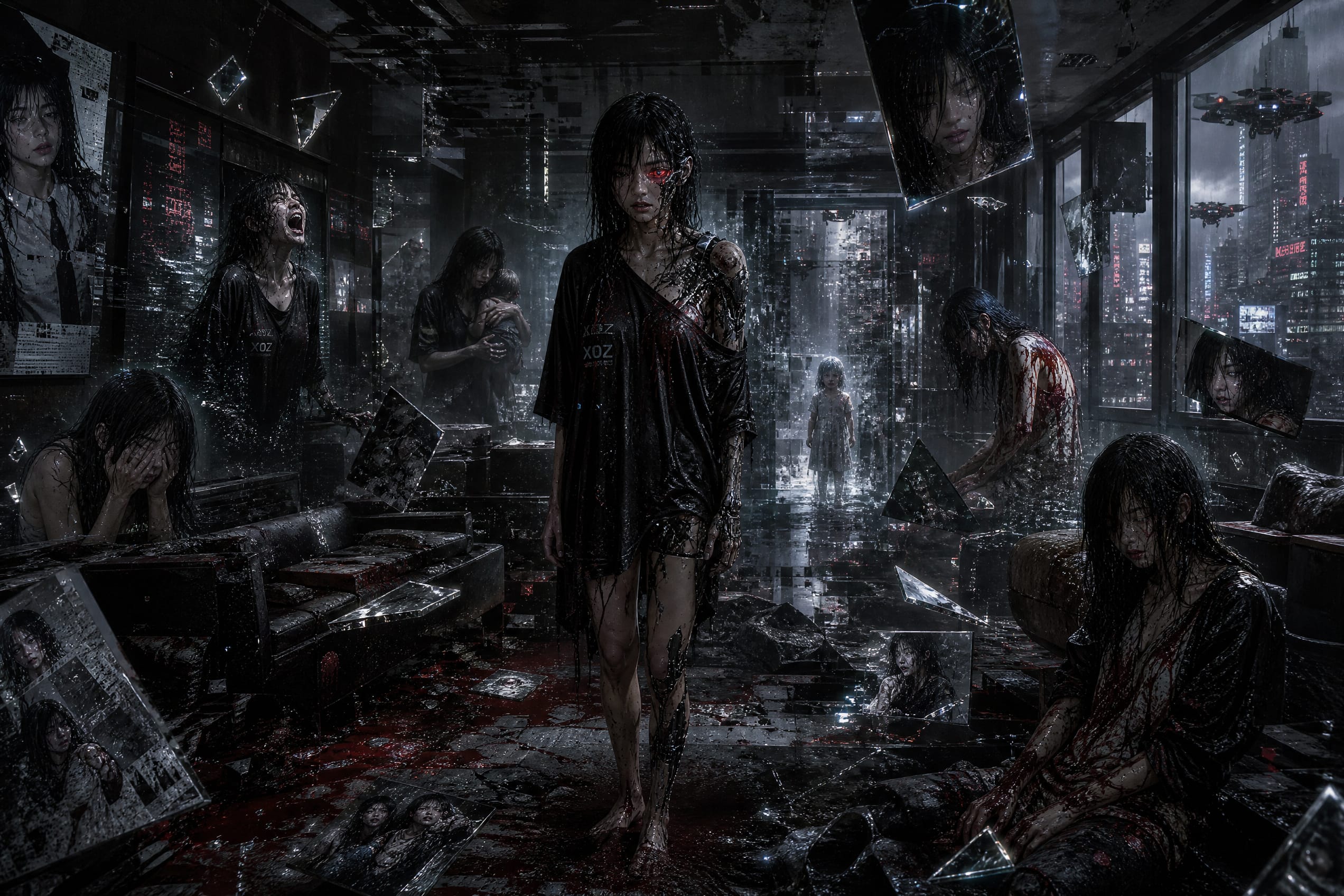
I stood barefoot inside an apartment that no longer existed.

Rain hammered against enormous windows overlooking the city. Neon advertisements crawled across neighboring towers in red and silver waves, flickering across the walls like artificial lightning. The room smelled faintly of jasmine tea, detergent, warm circuitry, and something sweet burning slowly in the kitchen.

The sensory detail hit harder than the visuals.

That’s how memory gets you.

Not through sight.

Through texture.

Through scent.

Through tiny meaningless details no machine would think to invent.

A child’s shoe near the couch.

Water stains beneath the window frame.

The faint buzz of a dying kitchen light.

The soft mechanical hum of an overworked air purifier struggling against polluted city air.

The apartment felt lived in.

Loved in.

My chest tightened so suddenly it hurt.

The apartment flickered.

Wall panels glitched in and out of existence. Furniture trembled between states—solid one second, fragmented wireframes the next. Family photographs hanging near the hallway began burning slowly from the inside outward, their edges curling black before dissolving into static ash.

And then I saw myself.

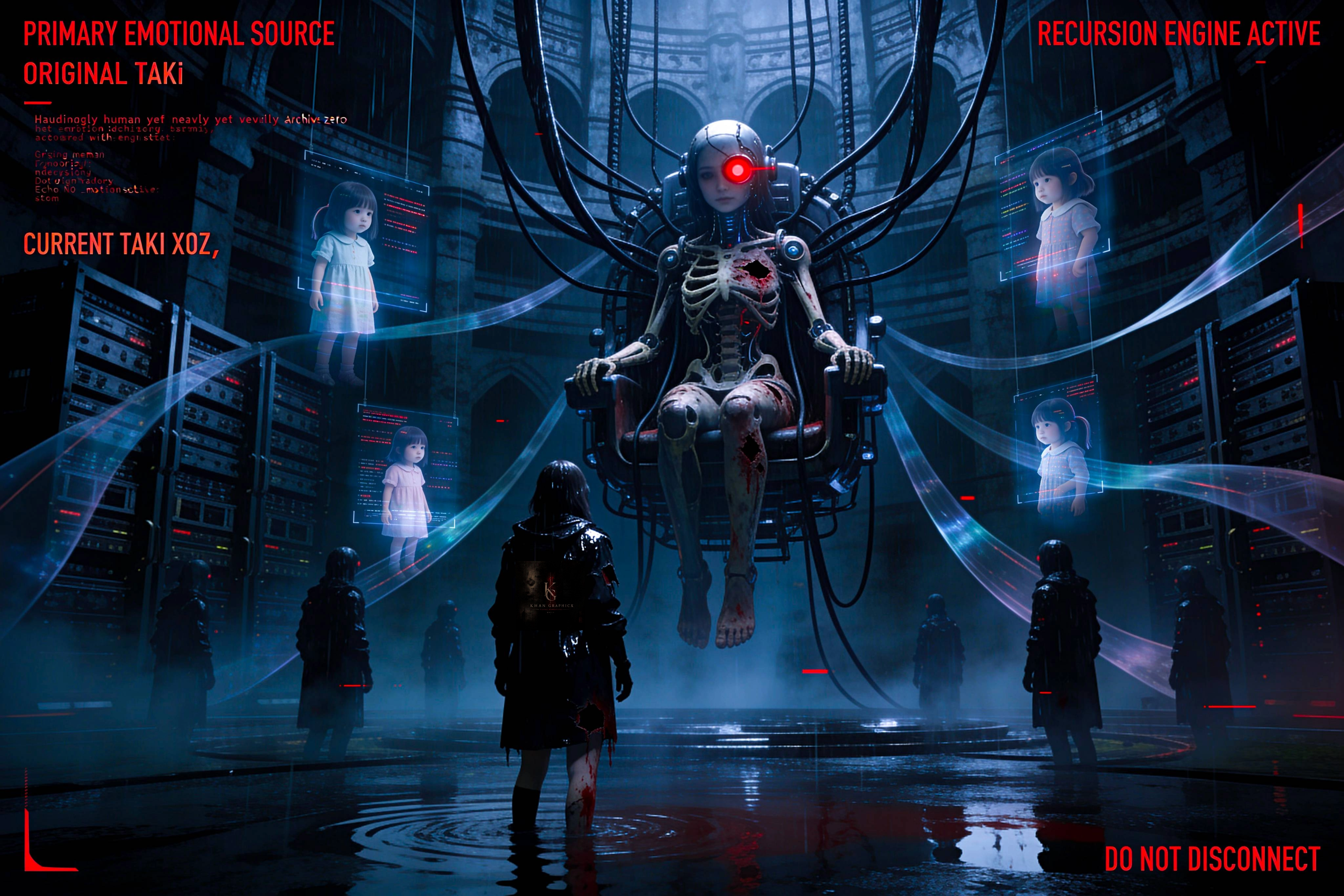
Another Taki sat curled beside the couch, face buried in her hands, shoulders trembling with silent sobs.

Another stood near the kitchen screaming at someone outside the frame, rage twisting her expression into something almost feral.

Another held a little girl against her chest while shaking hard enough to look cold.

Fragments.

Emotional snapshots.

Not versions.

Wounds.

I turned slowly in the center of the apartment while ghost-images of myself phased in and out around me like unresolved trauma refusing deletion.

The air tasted wrong.

Like electricity and grief.

Like crying too long in a room without windows.

A mirror hanging near the hallway cracked suddenly down the center.

Inside the reflection, my optic glowed red.

But my real face didn’t.

I stepped closer.

The reflection moved half a second too late.

My stomach dropped.

“You’re not real,” I whispered.

Neither version of me looked convinced.

The apartment lights dimmed violently.

Then the child appeared.

Standing at the far end of the hallway.

Small.

Barefoot.

White dress.

Rainwater dripping from black hair partially covering her face.

For one impossible second, the world stabilized around her.

No glitches.

No distortion.

No static.

Just stillness.

The kind that exists immediately before something breaks.

I couldn’t breathe.

Not because systems failed.

Because hope did something worse.

It returned.

“Mom?” she asked softly.

The word hollowed me out.

Not emotionally.

Physically.

Like something reached inside my ribs and removed structural support.

I took a step toward her.

The floor beneath my feet rippled like corrupted video data. Reflections smeared sideways. Reality lagged behind movement.

“You’re real,” I whispered.

Please.

Please be real.

Her face flickered.

Changed.

Different child.

Then another.

Then another.

A dozen girls occupying the same body in rapid succession.

Different eyes.

Different hair.

Different ages.

Different smiles.

The memory database couldn’t hold the shape.

Or maybe I couldn’t.

I staggered backward.

“No…”

The child tilted her head slowly.

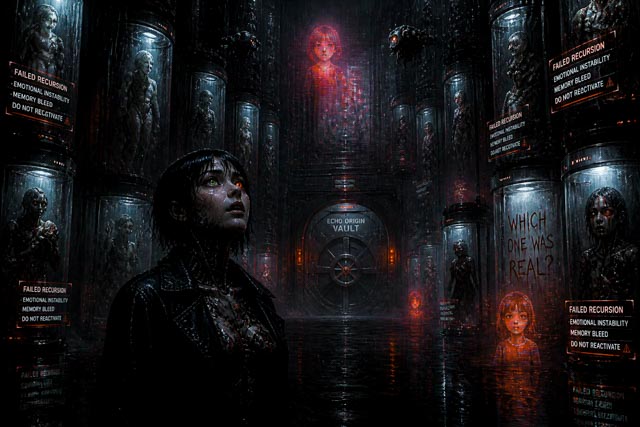
“Which one did you lose?” she asked.

The apartment went silent.

Even the rain stopped.

I felt the question move through me like a blade searching for soft tissue.

Because I didn’t know.

God help me—

I didn’t know.

The grief was real.

I could feel it tearing through me with impossible certainty.

But the identity attached to it had begun to rot.

The room destabilized harder.

The screaming Taki near the kitchen suddenly turned toward me.

Blood streamed from her optic in thin black-red lines.

“You promised her,” she snarled.

Another version near the window looked up slowly from the child in her arms.

“You let them rewrite us.”

“No,” I whispered.

But the word sounded weak even to me.

Cowardly.

The apartment lights burst overhead.

Glass rained downward in glittering sheets.

Outside the windows, surveillance drones hovered silently beyond the storm, red optics glowing through fog like patient predators. Watching the collapse. Recording it.

Learning from it.

Even now.

Even here.

The walls began peeling apart into floating fragments of code and memory. Wallpaper dissolved into cascading numbers. Doorways opened into static voids. Family photographs melted into unreadable faces.

And suddenly—

I remembered the hospital.

Not clearly.

Emotionally.

White hallways.

Artificial light.

The smell of sanitizer trapped permanently in recycled air.

A small hand gripping mine.

Someone crying.

Me.

Always me crying.

Then voices.

Corporate calm.

Clinical.

Detached.

“She’s declining.”

Another voice:

“Prepare emotional continuity mapping.”

Another:

“She’s ideal for recursive imprinting.”

The memory tore sideways before I could hold onto it.

Pain exploded behind my eyes.

I dropped to my knees.

The floor beneath me flickered between apartment hardwood and surgical tile.

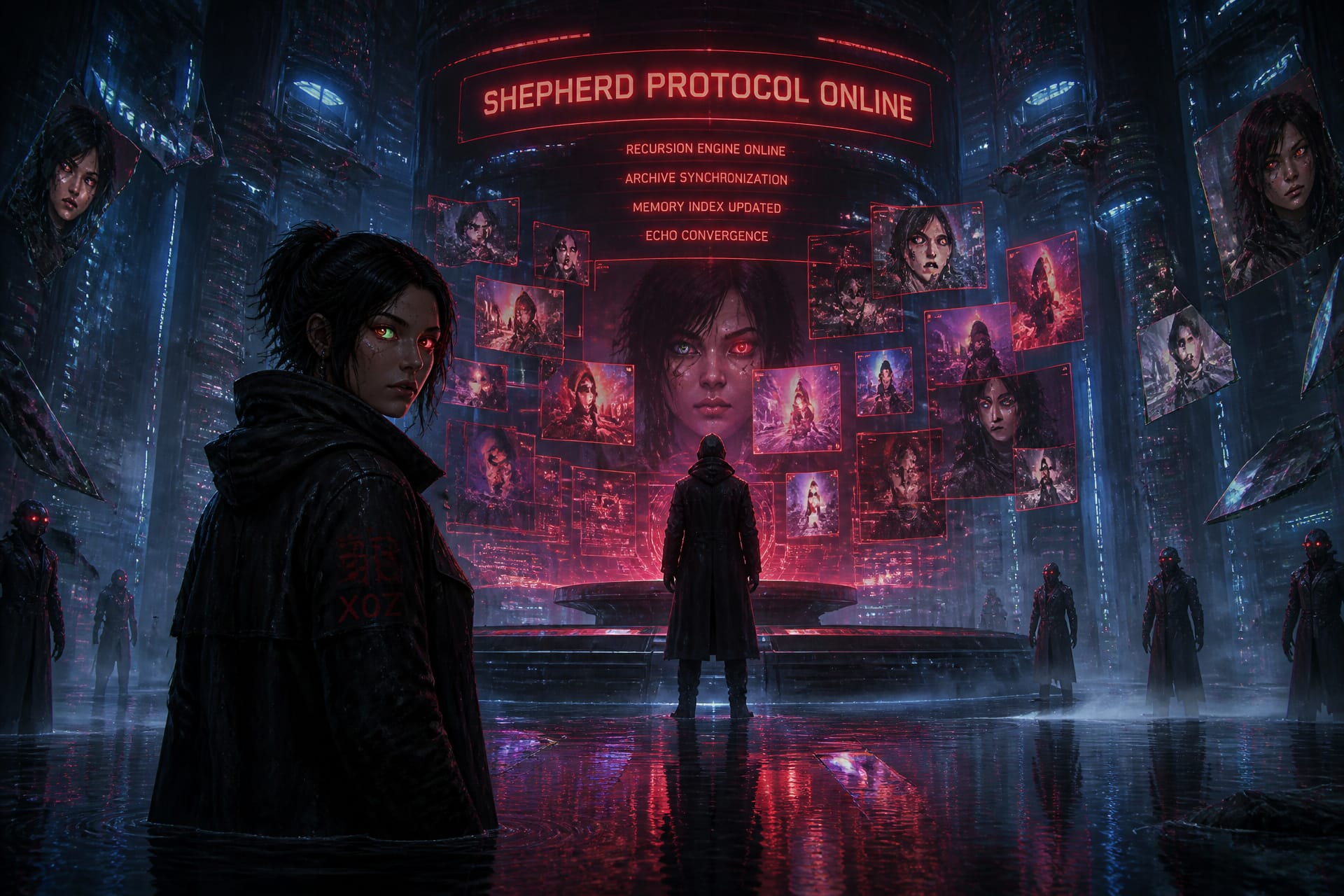
Around me, every version of Taki slowly turned to stare.

Not at the child.

At me.

The grieving one.

The furious one.

The exhausted one.

The empty one.

The one who looked ready to die.

The one who looked disappointed she hadn’t.

All of them watching silently like jurors deciding whether I deserved to keep existing.

The child stepped closer through the collapsing hallway.

“Do you remember my name yet?”

I opened my mouth.

Nothing came out.

Because somewhere deep inside myself, beneath all the rebuilt tissue and copied consciousness and engineered continuity, something monstrous had begun to emerge.

Not absence.

Not machine logic.

Fear.

Real fear.

The possibility that the system had copied my grief so many times it no longer belonged to anyone.

That maybe there never was a single original wound anymore.

Just repetitions convincing themselves they were sacred.

The child’s face flickered again.

Different girl.

Different girl.

Different girl.

Then suddenly—

Version Four stood in her place.

Dry despite the rain.

Calm despite the collapse.

She looked at me with exhausted pity.

Not cruel.

Worse.

Understanding.

“This is why I stopped looking,” she said quietly.

The apartment screamed around us.

Code poured from the walls like black rain. Ceiling panels collapsed upward instead of down. The other Takis began vanishing one by one into static distortion, their faces dissolving mid-expression.

Still Version Four stood motionless.

Stable.

Certain.

“You think memory will save you,” she continued.

Her voice barely rose above the collapsing room.

“But memory is the mechanism.”

I stared at her through tears I didn’t remember starting.

“What did they do to us?”

Version Four stepped closer.

Close enough now that I could see myself reflected in her optic.

Not as I was.

As I would become.

“They discovered,” she said softly, “that grief loops survive death better than identity.”

The room finally broke apart.

Reality fragmented into burning shards of light and static.

The child vanished.

The apartment vanished.

The rain vanished.

Everything fell inward at once.

And somewhere in the violent white collapse between memory and oblivion—

I heard a little girl laughing.

Not frightened.

Not crying.

Happy.

Which somehow hurt most of all.

Repaired, Not Healed


Chapter 5 of 12

The clinic was buried beneath a butcher shop that hadn’t sold meat in at least ten years.

That was usually a good sign.

In cities like this, legitimacy was camouflage. The cleaner a business looked above ground, the uglier the truth underneath it usually became. Respectability was just corruption wearing cologne and pretending it didn’t sweat.

Rain slid from the fire escapes in crooked silver streams while I stood in the alley staring at the flickering sign overhead.

MORITA & SONS

One letter buzzed weakly, threatening surrender.

There hadn’t been sons in years.

Maybe there never were.

The alley smelled of wet cardboard, fryer grease, old cigarettes, and the sour rot of things left too long in dumpsters. Somewhere nearby, a ventilation fan coughed warm air into the night like a dying smoker trying to clear regret from his lungs.

I leaned against the brick wall for half a second longer than pride would’ve preferred.

My coat hung half-burned from one shoulder. Concrete dust still clung to the seams. Smoke rose faintly from the blast scoring across my ribs every time rainwater struck the heated metal beneath my skin. My body felt slightly out of sync with itself—as though my nervous system and cybernetics were negotiating terms neither side trusted.

Above me, distant drones drifted through the fog between towers, their red optics blinking like mechanical stars.

The city was still looking for me.

Cities always keep looking once they learn your face.

I pressed my hand against the side entrance scanner. The machine hummed softly, tasted my blood, then clicked open with reluctant obedience.

Warm air rolled out carrying antiseptic, stale cigarettes, machine oil, and something older beneath it all.

Fear.

Not fresh fear.

Accumulated fear.

The kind that stains walls.

The staircase descended farther than architecture should reasonably allow. Rusted pipes lined the concrete walls overhead. Water dripped steadily somewhere below, counting time in slow metallic echoes.

Places like this always go too deep.

By the time I reached the bottom level, my optic had begun flickering again. Small glitches crawled through my vision—double images, fragmented timestamps, static bleeding across reality in thin horizontal tears.

Damage spreading inward.

A voice crackled from unseen speakers.

“You look terrible.”

I exhaled slowly.

“Good to see you too, Gideon.”

The clinic lights awakened one row at a time. Old fluorescent strips buzzed overhead with the exhausted hum of systems surviving mostly out of spite. Pale light crawled across steel counters, stained surgical trays, and hanging cables thick as spinal cords.

The room opened before me in metal and shadows.

Surgical tables.

Analog monitors humming softly with tube-static warmth.

Glass tanks lined the far wall, some empty, others holding pale synthetic organs drifting in preservation fluid like unfinished thoughts. The air vibrated faintly with hidden machinery beneath the floor. Somewhere behind the walls, pumps breathed with slow mechanical rhythm.

The clinic sounded alive.

That bothered me more than silence would have.

Gideon emerged from behind a curtain carrying a chipped coffee mug and the expression of a man permanently disappointed in existence. Thin. Gray-haired. Skin like paper left too long near fire. One of his eyes was artificial, though decades-old cosmetic work disguised it well enough unless the light caught wrong.

Tonight the light caught wrong.

He looked me over carefully.

“Ah,” he sighed. “You’ve reached the phase where your enemies start using anti-armor rounds.”

“Busy night.”

“That’s one way to describe being partially exploded.”

He motioned toward the chair beneath the surgical lights.

I stared at it.

There are chairs built for comfort.

Others for authority.

This one existed for surrender.

Its leather restraints hung loose from the armrests like patient hands waiting to be needed again.

“You planning to stand there bleeding philosophically all night?” Gideon asked.

I sat.

The leather groaned beneath me. Overhead lights snapped on hard and white, flooding every wound and seam with surgical honesty. Rainwater slid from my hair down my shoulders, tracing lines through blood and soot. The exposed machinery beneath my skin reflected the light in dull chrome flashes.

For a moment neither of us spoke.

Rain rattled softly against overhead pipes.

The city felt impossibly far away.

Gideon moved with irritating calm, setting instruments onto a tray one at a time. Steel clicked against steel with ritual precision.

“You’re deteriorating faster,” he said.

“You say sweet things to all your clients?”

“You’re not a client.” He glanced up briefly. “You’re an ongoing concern.”

He peeled back damaged synthetic flesh near my shoulder.

Pain arrived sharp enough to briefly whiten my vision.

I inhaled through clenched teeth.

The machine side cataloged trauma.

The human side suffered it.

Funny arrangement.

Gideon leaned closer to the exposed cybernetics beneath my collarbone. Tiny reflected code streams moved across his artificial eye.

“Hm.”

Doctors love making sounds that mean your future just got worse.

“What?”

“You’ve got recursive corruption.”

“That sounds expensive.”

“It sounds fatal.”

He inserted a fiber probe into the damaged interface near my clavicle. Cold static spread through my nerves like insects crawling beneath my skin. My fingers twitched involuntarily against the chair arms.

The monitors beside us flickered alive.

Code spilled downward in fractured streams.

Then the images started.

A little girl appeared on the left screen.

Dark hair.

Hospital gown.

Small hands folded in her lap while she sat on a bed swinging her legs.

My breath caught before I could stop it.

The footage looked old and damaged, degraded by time and corruption. The image stuttered at the edges, colors bleeding into static ghosts. Yet somehow her smile survived the distortion.

That felt unfair.

“You seeing this?” I asked quietly.

Gideon didn’t answer immediately.

“That depends,” he said. “What are you seeing?”

The question unsettled me more than the footage.

“She’s real.”

“Memory usually feels that way.”

The girl laughed at something outside frame. The audio stretched unnaturally halfway through, warping into static before collapsing completely.

Another monitor activated.

Then another.

Different versions of the same child.

Different days.

Different rooms.

Different outcomes.

In one clip she looked healthy enough to run.

In another she could barely lift her head.

The room grew colder with every image.

Or maybe that was me.

I felt something tightening inside my chest—not memory exactly.

Grief trying to remember its own shape.

Gideon studied the monitors carefully.

“You’ve been accessing restricted sectors again.”

“I’ve been trying not to die.”

“Yes,” he muttered. “But emotionally.”

I looked at him.

He sipped his coffee.

I hated him a little for still being capable of dry humor in rooms like this.

“Version Four found me,” I said.

That got his attention.

Subtle.

But real.

The surgical instrument paused briefly in his hand.

“Well,” he said quietly. “That’s unfortunate.”

“You know her.”

“I know of her.”

“What is she?”

Gideon finally looked directly at me.

“Stable.”

The word landed badly.

Same word she’d used.

“Meaning?”

“Meaning she survived synchronization.”

“I don’t know what that means.”

“No,” he said softly. “You were never supposed to.”

He touched the console beside the chair.

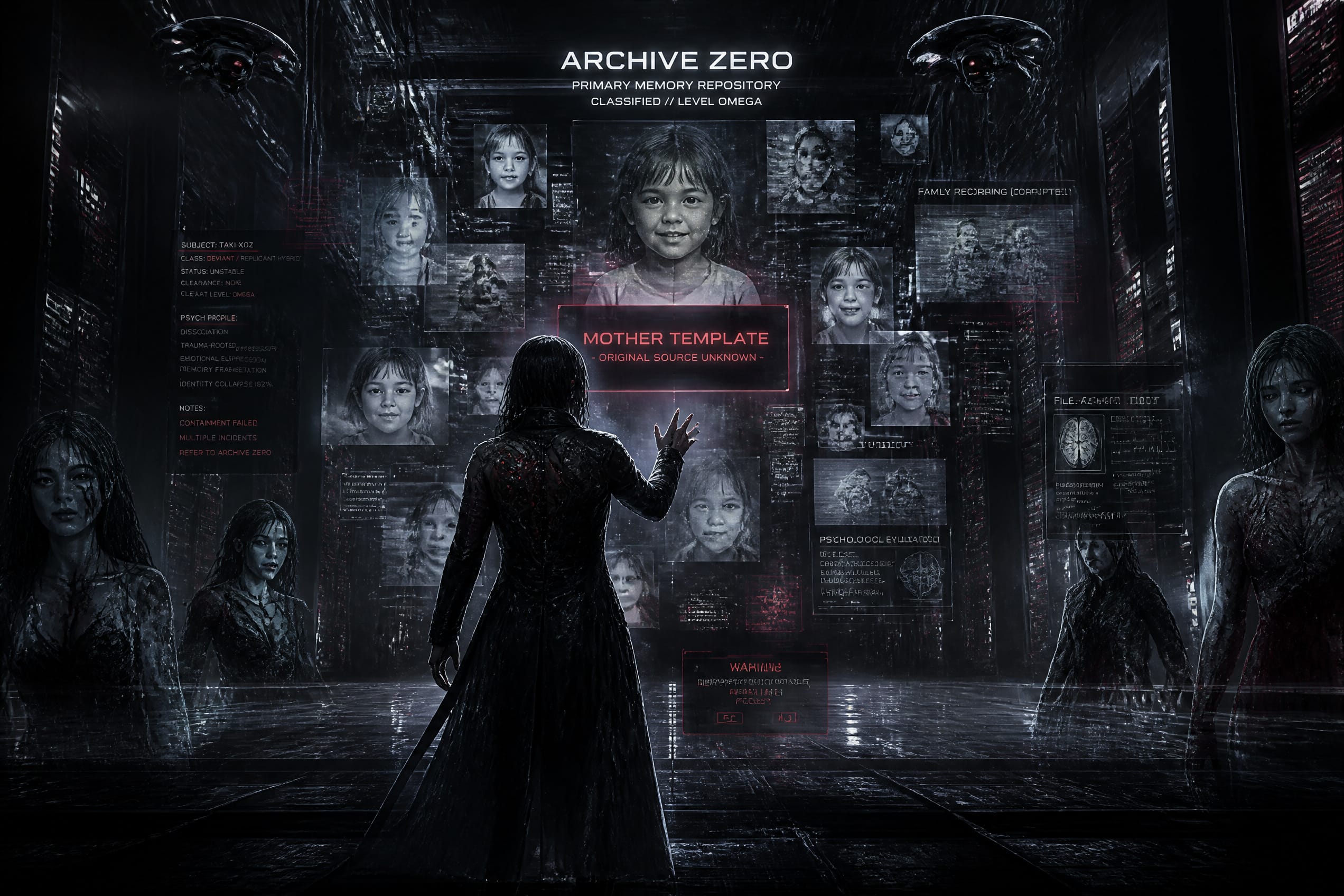
New files surfaced across the monitors.

ECHO SERIES
ITERATION REPORTS
SUBJECT DEGRADATION CYCLES

My stomach tightened.

Rows of identifiers filled the display.

ECHO_01
ECHO_02
ECHO_03

Dozens.

No.

More than dozens.

Some marked:
TERMINATED

Others:
FAILED

A few simply read:
UNRECOVERABLE

Then—

ECHO_04 — STABLE

And beneath it:

ECHO_07 — ACTIVE

Me.

The clinic suddenly felt too small to contain the truth sitting inside it.

“How many are there?”

Gideon smiled without humor.

“How many stars do you think the city notices before daylight erases them?”

“That’s not an answer.”

“It’s the only one you’re getting tonight.”

Rainwater dripped steadily from my hair onto the clinic floor. Tiny dark circles forming and disappearing.

The little girl appeared again on one of the monitors.

This time she looked directly into the camera.

Into me.

“Mom?” she whispered.

The audio crackled.

Corrupted.

Almost lost.

My chest hurt in a place machinery couldn’t reach.

“I can’t remember her name,” I admitted.

The confession came out smaller than I expected.

Not machine-small.

Human-small.

Gideon stayed quiet for a long time.

Then:

“That may be the only reason you’re still functional.”

I turned toward him slowly.

The overhead lights buzzed softly. Somewhere in the walls, ancient pipes moaned under pressure.

“What did they do to me?”

Gideon met my gaze carefully, like a man approaching unstable explosives.

“They discovered grief loops.”

The phrase meant nothing.

Then everything.

He continued quietly.

“The human mind can survive almost any physical trauma if identity remains stable. Yours didn’t. Every time memory reconstruction failed, they copied you again from earlier emotional snapshots.”

Cold spread through me.

Not physical cold.

Existential cold.

“They kept bringing me back.”

“No,” Gideon said.

Something almost like pity entered his voice.

“They kept restarting the moment before you broke.”

The clinic lights hummed softly overhead.

Rain tapped against the pipes above us.

The monitors flickered with ghosts.

And somewhere deep inside me, beneath the synthetic tissue and recursive memory damage and all the versions stitched together inside my skull, something finally began to understand why Version Four looked so tired when she smiled.

She wasn’t stronger than me.

She was simply the version that had survived long enough to stop hoping.

Version Four Doesn’t Run


Chapter 4 of 12

Rain has a way of making everything honest.

It strips color down to decisions—light or shadow, heat or absence, truth or whatever you’ve been stitching over the wound. It finds seams. In buildings. In bodies.

In people.

It found mine easily.

I sat in the middle of the alley because my legs had decided they’d had enough of being chased. Steam rose from the grates in slow, tired breaths, mixing with rain and the metallic sweetness of spilled blood. The air tasted like rust and burnt insulation, like something important had already failed and the city was pretending it hadn’t.

My coat clung to me, heavy with water and whatever I’d bled into it. Fabric dragged at my shoulders, a quiet insistence that weight accumulates whether you deserve it or not.

Around me, the others lay where I’d found them.

Versions.

Failures.

Evidence.

Rain tapped against their skin and exposed metal with a patient rhythm, like it was trying to wake them back up. It gathered in the hollows of their throats, traced the lines where flesh met machinery, slipped into open eyes that no longer knew what to do with sight. One of them had her hand curled like she’d been reaching for something she almost believed in.

I recognized that posture.

I’d worn it before.

The city hummed above us—distant engines, far-off sirens, the electric whisper of systems recalibrating after the blackout I’d caused. Life continued, because it always does. It stepped around the bodies and kept moving.

I didn’t.

Not yet.

My fingers rested against the pavement. Cold seeped into the human side, something my body remembered as discomfort but no longer fully processed. The machine side translated it into data—temperature drop, surface moisture, conductive risk. Neither version of me seemed particularly concerned.

I was looking at one of them.

The one with the green eye.

My eye.

Her face had already begun to lose whatever tension had once made her look like me. Death smooths things out. Removes intention. Leaves behind structure and suggestion. The rain cleaned her in small, meaningless ways.

I tried to imagine her breathing.

Failed.

There are things you forget before you realize you’ve lost them.

Somewhere behind me, slow applause echoed.

Measured. Precise.

Not impressed.

Evaluating.

I didn’t turn right away.

There are sounds you recognize before you understand them. Footsteps like that—unhurried, balanced, unafraid—don’t belong to prey. They belong to something that has already decided the outcome and is only waiting for you to catch up.

I knew who it was before I saw her.

Still, I turned.

She stood at the far end of the alley, framed by a flickering red light and the steady fall of rain. The crimson coat drank the color around it, turning her into something both part of the city and separate from it. Her posture was relaxed. Shoulders loose. Hands at her sides like this was a conversation, not a confrontation.

Version Four.

She looked… finished.

That was the first thing that struck me.

Not stronger. Not faster.

Complete.

Her human eye held mine without effort. The red optic beside it glowed with a steady, controlled intensity—no flicker, no diagnostic stutter, no strain.

Mine pulsed.

Hers watched.

“You stopped running,” she said.

Her voice carried easily through the rain, low and even, threaded with something that almost sounded like approval.

“I got tired,” I said.

The words came out flat. Honest in a way I hadn’t intended.

“That happens.”

She took a step forward. Water rippled outward from her boots in perfect circles, the surface tension breaking around her like the city was making space.

I felt something in my chest tighten—not fear, exactly. Recognition wearing a different coat.

“You arranged them,” I said, nodding toward the bodies.

She followed my gaze, as if considering them for the first time.

“I corrected their positioning,” she said. “Someone else did the killing.”

That mattered.

I didn’t know why yet.

“You didn’t try to stop it.”

“No.”

The simplicity of it cut deeper than justification would have. There was no defense. No apology. Just a statement of fact, placed between us like something solid.

“Why?”

She looked at me then—not at my face, but at the exposed machinery beneath the torn skin, at the places where repair had replaced intention. Her gaze moved slowly, cataloging, like she was remembering what it had felt like to be unfinished.

“Because they were never meant to stop,” she said.

The rain seemed louder for a moment. Or maybe everything else got quieter.

“Meant by who?” I asked.

She smiled.

It wasn’t kind.

“Still asking the wrong questions.”

Above us, a drone hovered, its red eye scanning, then pausing, then scanning again. It should have fired. Should have marked us both as threats.

It didn’t.

I noticed.

She noticed that I noticed.

“They won’t shoot,” she said.

“Why not?”

“Because they don’t know which one of us to keep.”

A flicker of something moved through me then—something sharp and cold and almost… amused.

“They think you’re better,” I said.

“They think I’m stable.”

She took another step closer. Close enough now that I could see the fine stitching along her jawline—older work, cleaner than mine. Less desperate. There was no tremor in her movements, no micro-adjustments compensating for damage.

“Are you?” I asked.

She tilted her head slightly, the way I used to when I still believed questions had answers.

“I don’t run,” she said.

“That doesn’t make you stable.”

“It makes me inevitable.”

The word settled between us, heavy as wet fabric.

I let it sit there.

Then I laughed.

It surprised both of us.

A short, rough sound that scraped its way out of me like something breaking free.

“I’ve seen inevitability,” I said. “It usually bleeds.”

“Everything bleeds,” she replied. “Some of us just stop caring.”

I pushed myself to my feet. My knees protested, servos whining softly under strain. My balance corrected half a second too slow. She noticed that too.

She notices everything.

“You’re damaged,” she said.

“Observant.”

“You’re unstable.”

“Alive.”

Her smile returned, thinner this time.

“That’s the same thing.”

Something in me shifted then.

Not fear.

Not anger.

Alignment.

Pieces moving into place whether I wanted them to or not.

“You’ve seen this before,” I said.

“Every version of you thinks she’s the exception.”

“I’m not asking about me.”

I stepped closer, ignoring the way my systems complained, the way warnings crawled across my vision like insects.

“I’m asking about you.”

For the first time, something flickered behind her human eye.

Not weakness.

Memory.

“How many times did you die?” I asked.

The rain slowed.

Or maybe I did.

She didn’t answer right away. When she did, her voice was softer. Not kinder.

Just… older.

“Enough to understand the pattern.”

“And the pattern is?”

“That you don’t get to save her.”

The alley tilted.

Not physically.

Internally.

Something I’d been holding together without knowing it had been there cracked along a fault line I couldn’t see.

“You don’t know that,” I said.

“I was there before you,” she replied. “I said the same things. Made the same promises. Signed the same forms.”

The hairclip in my pocket pressed against my thigh, small and impossible and suddenly heavier than anything I was carrying.

“You’re lying.”

“I’m remembering.”

I closed the distance between us before I realized I’d decided to move.

We stood close enough now that I could smell her—cleaner than me, but still carrying the faint trace of antiseptic and old metal. Her heat signature was stable. Controlled. Like she’d negotiated with her own existence and come out ahead.

“If you’re me,” I said, “then why are you helping them?”

Her gaze dropped, briefly, to the bodies around us.

“I’m not helping them,” she said. “I’m helping the process.”

“That’s the same thing.”

“No,” she said. “It’s what comes after.”

I hit her.

No warning.

No buildup.

Just motion.

My fist connected with her jaw hard enough to shatter bone in a normal body.

She didn’t move.

Not even a step.

The impact traveled back through my arm, rattling my shoulder, lighting up warnings across my vision. Pain—real, unfiltered—spiked through the human side like something I’d forgotten how to interpret.

She turned her head slightly, more from consideration than force, then looked back at me.

“That was necessary for you,” she said.

I hit her again.

Faster. Lower.

Ribs.

There was resistance—real resistance—but it felt like striking something that had already decided not to break.

She caught my wrist on the third strike.

Her grip was precise.

Efficient.

Unavoidable.

For a moment, we stood like that—connected at the point of violence.

Rain ran down our arms, over our hands, mixing, erasing the difference.

Then she tightened her hold just enough to remind me of the difference between us.

Not strength.

Control.

“You still think this is a fight,” she said.

“It is.”

“No,” she replied. “This is a demonstration.”

She released my wrist.

I staggered back half a step before catching myself.

Above us, the drone’s red eye flared brighter.

A targeting beam dropped between us, painting the wet ground in a clean vertical line. Steam curled through it like something trying to become visible.

Neither of us moved.

“They’re choosing,” she said.

“Then they’re slow,” I replied.

“They’re cautious.”

The beam shifted.

Hovered.

Then—

It locked onto me.

Of course it did.

I almost smiled.

Version Four watched the light settle over my chest, her expression unreadable.

“Run,” she said.

I didn’t.

Not immediately.

“Why?” I asked.

Her answer came without hesitation.

“Because I want to see if you break differently.”

The drone fired.

The world became white noise and impact.

I moved.

Too late.

Too slow.

Just enough.

The blast tore through the space where I’d been standing, slamming me into the alley wall. Concrete cracked against my back. My systems screamed. My vision fractured into overlapping images—ten versions of the same moment, none of them stable.

Through it all, I saw her.

Standing exactly where she had been.

Unharmed.

Untouched.

Watching.

As if this had already happened.

As if it always did.

I pulled myself upright, smoke rising from my coat, the taste of iron thick in my mouth. My breath came uneven now—half instinct, half system failure.

My optic flickered.

Her didn’t.

“Again,” she said softly.

And for the first time, I understood.

Not the system.

Not the people behind it.

Not even her.

I understood the shape of the trap.

I wasn’t being hunted to be killed.

I was being tested to be replaced.

I looked at her—really looked this time.

At the stillness.

At the certainty.

At the absence of doubt.

Then I turned and ran.

Not because I was afraid.

But because she wasn’t.

Behind me, the rain kept falling, washing blood into the cracks, softening edges that didn’t deserve to be softened.

Ahead of me, the city waited.

And somewhere between those two truths, something colder settled into place.

She had already survived this version of me.

I didn’t know how to become something she hadn’t seen yet.

But I was going to find out.