She found the photograph in a rusted cigar tin buried beneath extension cords, expired coupons, and instruction manuals for appliances they no longer owned.
The kind of place memory goes when someone doesn’t want to lose it but also can’t bear to look at it too often.
The garage was cold in that damp, unfinished way garages always are in late November. Rain whispered against the aluminum door. Somewhere nearby, water dripped steadily from a clogged gutter with the patience of torture. The single overhead bulb cast a weak yellow cone over the workbench Thomas had spent half his life leaning against while pretending to fix things.
Lena stood there holding the tin, breathing in the stale scent of sawdust, old cardboard, motor oil, and the faint ghost of his cedar aftershave lingering in the fabric of his jackets hanging nearby.
Six months.
And the house still carried him in layers.
Not enough to comfort her.
Just enough to reopen the wound every day.
She almost tossed the tin into the donation box.
That was the strange brutality of grief. Eventually, your life became administration. Sorting. Labeling. Deciding what to keep from a person who once occupied entire rooms with their breathing.
But the lid caught her thumbnail as she turned away.
So she opened it.
Inside sat a cluttered little museum of Thomas’s private archaeology.
A church bulletin browned at the folds.
A guitar pick.
Two subway tokens.
A receipt from a diner that had closed sometime during the first Obama administration.
And beneath everything else—
The photograph.
Her fingers froze around it instantly.
Black-and-white.
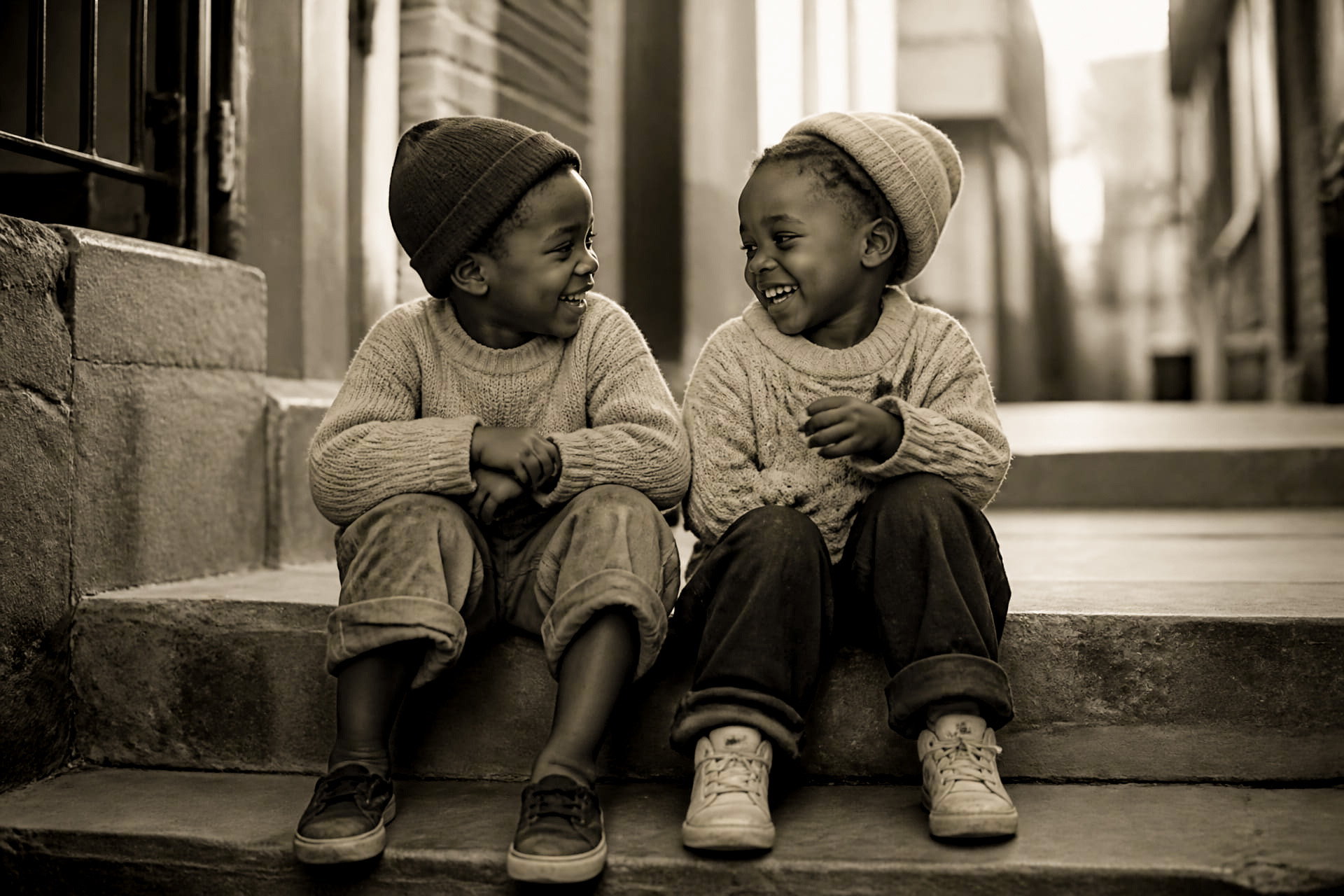
Two children sitting shoulder to shoulder on cracked concrete steps in some forgotten city alley. Knit caps. Oversized sweaters. Knees touching. Mid-laughter.
Not smiling for the camera.
Laughing at each other.
Real laughter.
The kind that bent the body sideways.
Lena frowned softly at first, trying to place them. Her eyes weren’t what they used to be. Neither was her memory lately. Grief had turned her thoughts into a house where half the rooms stayed dark.
Then recognition struck so suddenly it made her dizzy.
“Oh my God…”
Her knees weakened enough she had to lower herself into Thomas’s old workshop chair before the floor decided for her.
South Mercer Street.
The apartment complex with the broken stair railings and the Puerto Rican woman on the third floor who smoked cigarettes from dawn till midnight while yelling at soap operas through the screen door.
1973
That impossible summer heat.
The smell of concrete baking under the sun.
Children shouting somewhere nearby while a radio played Marvin Gaye through static.
She remembered Thomas complaining about the sweater.
“I look sick without it,” he’d muttered, tugging at the sleeves. “My elbows look homeless.”
And she had laughed so hard milk came out of her nose.
The memory arrived whole.
Not faded.
Not softened.
Alive.
Lena pressed trembling fingers against her mouth.
She had forgotten this day existed.
That realization hurt more than she expected.
People warned you grief would make you remember everything.
Nobody warned her it would also reveal what had already disappeared.
Entire afternoons erased.
Conversations gone.
Versions of herself buried beneath decades of survival.
How many moments had vanished while they were busy building a life? Paying mortgages. Fighting over money. Holding each other through funerals. Sitting in emergency rooms under fluorescent lights that made everybody look halfway dead already.
Marriage, she realized now, was not built from the big moments.
Not weddings.
Not anniversaries.
Not even deaths.
It was built from accumulated trivialities.
From burnt toast and pharmacy runs.
Inside jokes repeated until they stopped needing punchlines.
The specific rhythm of another person moving through the kitchen at 2 A.M.
Knowing exactly how long they paused before answering difficult questions.
And somewhere along the way, the beginning gets swallowed whole.
But Thomas had remembered.
He had kept proof.
Her thumb brushed the edge of the photograph carefully, reverently, as if too much pressure might smear the past itself.
Then she turned it over.
His handwriting leaned crooked across the back in fading blue ink.
Before life started taking things away.
The garage blurred instantly.
A sound escaped her throat before she could stop it—small and wounded and animal.
She folded inward in the chair, one hand gripping the photo, the other pressed hard against her chest as though grief had become something physical trying to claw its way out through bone.
She cried there for a long time.
Not elegantly.
There was nothing cinematic about mourning once you’d lived inside it long enough.
Her nose ran.
Her shoulders shook.
Her breathing became uneven and ugly.
Rain thickened outside, rattling harder against the roof.
And through it all she kept staring at those children.
Those impossible children.
Before cancer hollowed his cheeks.
Before resentment and exhaustion slipped quietly into the marriage like smoke beneath a door.
Before they learned how cruel time could be to tenderness if tenderness wasn’t protected deliberately.
She thought about the last year of his life.
How hospital rooms erased dignity piece by piece.
How people started speaking softer around him, as though volume itself might fracture his bones.
How sometimes she hated him for dying slowly.
There it was.
The thought she never admitted aloud.
Not because she blamed him.
Because watching someone disappear by inches exhausted parts of you that love alone cannot replenish.
Nobody likes to talk about that part.
They prefer grief polished into poetry.
But real grief had teeth.
Real grief was resentment sitting beside devotion.
Fatigue braided together with guilt.
Missing someone while also feeling furious they left you alone holding the wreckage.
Lena stared at the photograph again.
And suddenly she understood why he hid it.
Not to preserve childhood.
To preserve evidence.
Evidence that once—before illness and bills and disappointment and mortality tightened around their throats—they had belonged entirely to joy.
Not perfect joy.
Not storybook innocence.
Just two kids on a stoop laughing like the world hadn’t started charging admission yet.
A shaky laugh escaped her then.
“You sneaky bastard,” she whispered through tears.
Because even now, Thomas had managed to say something important without speaking directly.
That was always his way.
He left meaning in pockets.
In receipts.
In songs half-hummed under his breath.
Never obvious.
Never loud.
Outside, the rain softened again.
The garage smelled colder now.
Lena rose slowly from the chair, joints aching, grief moving inside her like old weather. She carried the photograph into the house with both hands.
The living room felt unbearably still.
His urn sat on the bookshelf beside the lamp he always complained was too bright.
She placed the photograph beside it carefully.
Not as a shrine.
Not as goodbye.
Something quieter than that.
An acknowledgment.
A reminder that before life became hospitals and silence and folded paperwork… there had once been two children sitting shoulder to shoulder on broken concrete steps, laughing like they had discovered something the rest of the world would spend a lifetime trying to recover.