
Personal Reflection
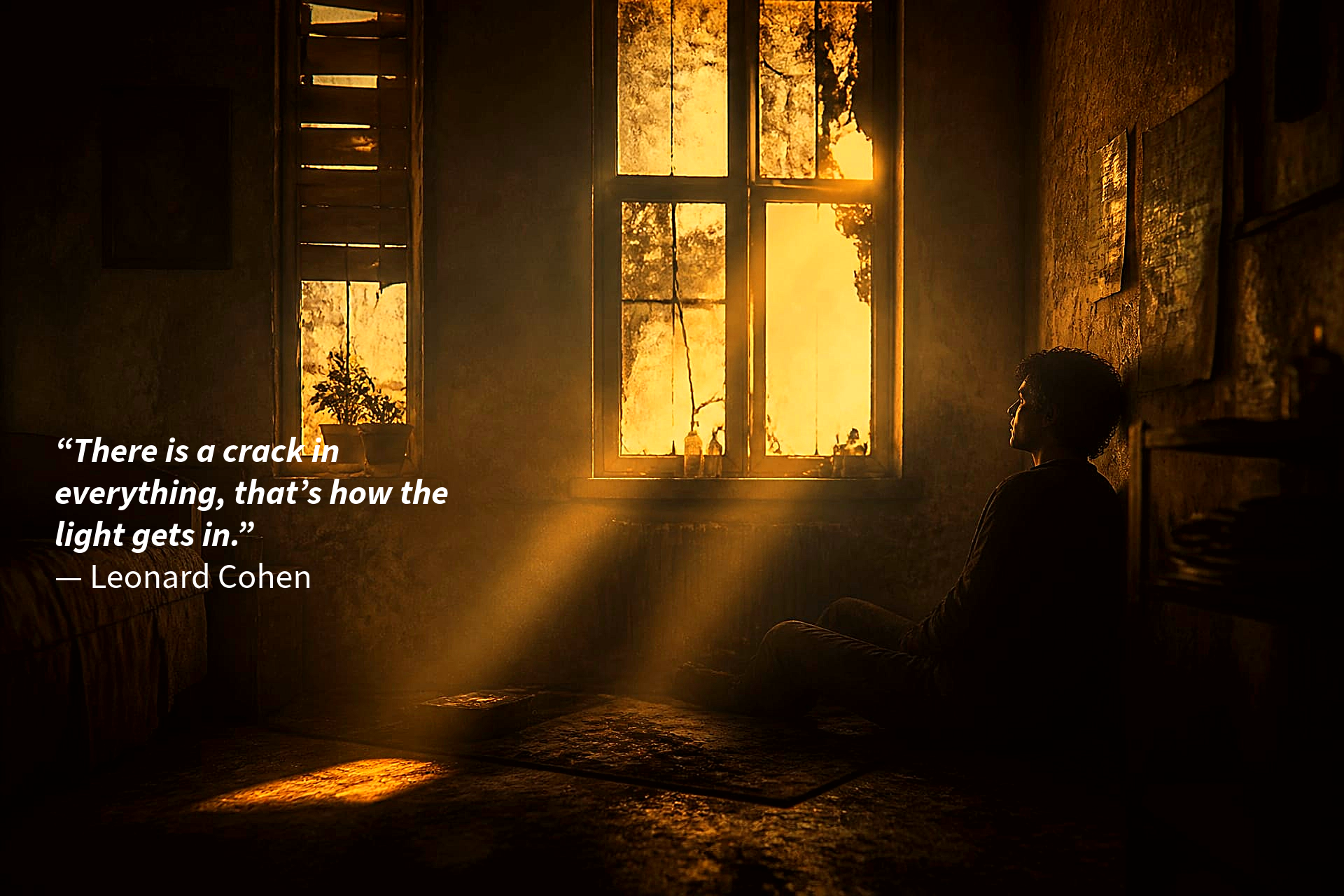
People often treat this quote like comfort. A poetic reassurance that brokenness serves a purpose. That damage somehow guarantees beauty in the end if you wait long enough and suffer gracefully enough.
But real cracks are not elegant while you’re living inside them.
They are disruptive.
Messy.
Unwanted.
Because most people do not break open beautifully.
They break quietly.
Through accumulated disappointments. Through grief that lingers longer than expected. Through years spent carrying responsibilities while privately running on emotional fumes. Sometimes the crack arrives suddenly—a loss, a betrayal, a diagnosis, a moment that divides your life into before and after. Other times it forms so gradually you don’t even notice it until ordinary things start feeling strangely heavy.
That’s what emotional exhaustion often looks like:
not dramatic collapse, but slow erosion.
You stop recognizing yourself fully. Your patience shortens. Your inner world grows noisier while your outward life becomes more automatic. You continue functioning because life rarely pauses long enough for people to completely fall apart. Bills still arrive. Conversations still happen. The world continues expecting movement even when something inside you feels fractured.
And perhaps that’s why so many people hide their cracks.
Not because they’re ashamed of being human—but because vulnerability in an exhausted world often feels unsafe. People learn how to appear composed while privately carrying grief, fear, loneliness, or burnout so persistent it begins settling into the architecture of their personality.
But hidden fractures do not disappear.
They shape the way light enters.
That’s the paradox Cohen understood:
the places where people are most wounded often become the places where they finally stop performing invulnerability. The places where compassion deepens. Where empathy becomes instinct instead of theory. Where a person stops speaking about pain abstractly because they’ve survived enough of it to recognize the weight in someone else’s silence immediately.
Not every wound makes people wiser.
Some simply hurt.
But sometimes suffering strips away illusions strong enough that a more honest version of the self finally begins emerging underneath all the emotional armor built for survival.
Maybe healing is not becoming untouched again.
Maybe healing is learning how to live honestly with the fractures instead of spending your entire life pretending they aren’t there.
Because cracks change people.
But they also let things through:
truth,
connection,
humility,
tenderness,
light.
And perhaps the goal was never to become unbreakable.
Perhaps the goal was to remain human even after life gave you every reason to close completely.
Reflective Prompt
What fracture in your life changed the way you now see yourself—or the way you understand other people’s pain?
Discover more from Memoirs of Madness
Subscribe to get the latest posts sent to your email.
 Memoirs of Madness
What a great song. It’s worth listening to Leonard Cohen. He certainly struggled, with everything. Meaning, love, art. Money. Life. And he wrote his feelings about all of it.
LikeLike