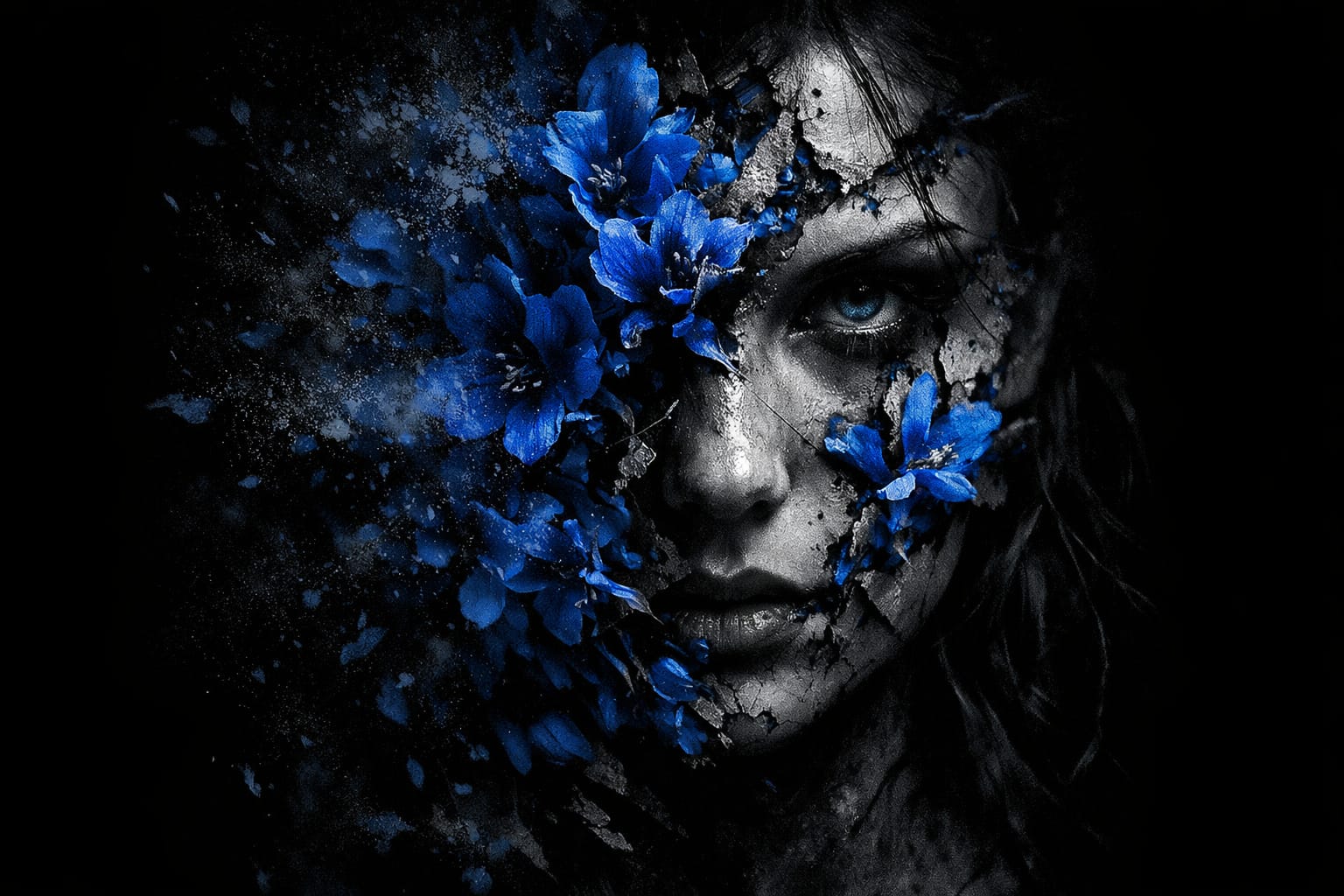

At a glance, it looks like collapse—skin splitting like dry earth, fragments peeling away into a black that feels less like absence and more like hunger. But look closer. The fractures don’t fall apart. They bloom. Blue pushes through the ruin, not delicate, not ornamental—insistent. Violent in its quiet way.
Her face is a battleground where something refused to stay buried.
The blue isn’t soft. It stains the grayscale like a bruise that never healed right. Petals press through her cheekbone, her temple, her jaw—as if the body tried to contain something and failed. Or worse… tried to forget.
Her eye—sharp, awake—doesn’t ask for help. It measures you. Like it’s deciding whether you’re another witness or just another person who will look away once the beauty wears off and the damage starts to mean something.
There’s ash in the cracks. You can almost smell it—burnt memory, old rooms, something that once had a name. The texture of her skin feels wrong, like stone that remembers being flesh. Like something lived there, left, and took the softness with it.
But the flowers stayed.
That’s the part that unsettles.
Because flowers aren’t supposed to grow in places like this. Not in fracture lines. Not in ruin. Not in whatever kind of darkness clings to her like a second skin.
Unless they’re not symbols of life.
Unless they’re proof of survival that came at a cost.
She doesn’t smile. Doesn’t need to. There’s a steadiness in her that feels earned the hard way—through nights that didn’t end clean, through versions of herself that had to be buried just to keep walking. The kind of strength that doesn’t inspire. The kind that endures.
And still—
color remains.
Not everywhere. Not enough to make things easy. Just enough to remind you that something inside her refused extinction.
Not the first drop—that would be too clean, too cinematic. Life doesn’t announce its turning points with a single, obedient moment. It seeps. It stains. It builds in quiet layers until one day you look in the mirror and realize something has marked you permanent.
The world around her has already drained itself dry. Everything reduced to bone and shadow, to the honest language of black and white. No distractions. No soft places left to hide. Just contrast—truth sharpened into edges.
But the red… The red refuses to behave.
It clings to her like memory. Not just what was done, but what couldn’t be undone. It splashes across her cheek, streaks along her brow, settles into the corners of her mouth like a secret she’s tired of keeping. It doesn’t ask permission. It doesn’t fade.
Her grip tightens around the handle in her hand—not trembling, not uncertain. Just… anchored. Like it’s the only real thing left in a world that has forgotten how to feel.
She’s learned the difference between noise and signal.
People talk. They always do. About justice. About lines you don’t cross. About who you’re supposed to be when the lights are on and someone’s watching. But none of them ever explain what happens when the lights go out. When the rules start bending under the weight of reality.
That’s where she lives now.
In the quiet aftermath. In the space between decision and consequence.
Her eyes don’t wander. They don’t soften. They don’t apologize. There’s a calculation there—cold, precise—but underneath it, something heavier. Something tired. Like she’s already counted the cost and paid it in advance.
That’s the part no one sees.
They’ll look at her and see violence. Rage. Maybe even madness if it helps them sleep better at night. But they won’t see the discipline it took to get here. The restraint that came before the breaking point. The thousand moments she chose not to act… until the one where she did.
The red doesn’t make her a monster.
It makes her honest.
Because deep down, beneath the noise and the rules and the performance of being “good,” everyone knows there’s a line. And everyone likes to believe they’ll never cross it.
She used to believe that too.
Now she just wonders how many are already closer than they think.
She doesn’t remember the moment it began—only the sound.
Not a scream. Not at first.
A hum.
Low. Mechanical. Patient.
It started somewhere beneath her ribs, a foreign rhythm learning her body like a language it intended to overwrite. Now it pulses through her—wires threading out from her side like exposed nerves, trembling in the dark as if they can still feel something worth holding onto.
Her eyes are shut, but not in peace.
In refusal.
Because seeing would make it real.
The left side of her face is still hers—soft, tired, human. The right side has no such mercy. Cold plates kiss her skin where it no longer belongs to her. Light leaks from seams that were never meant to open. Red, sterile, deliberate. Not blood—something cleaner. Something worse.
There’s a moment—just a flicker—where she tries to stomp it down. The panic. The rising terror clawing at her throat. She tries to stamp her will over whatever this is becoming, like she can still claim jurisdiction over her own body.
But the machine doesn’t negotiate.
It adapts.
Her breath shudders. A memory surfaces—warm sunlight, a laugh she doesn’t fully recognize anymore, the weight of her own name spoken by someone who meant it. That’s the part that fights. That’s the part that refuses to go quiet.
And maybe that’s the cruelest design of all.
They didn’t erase her.
They left just enough.
Enough to feel the loss.
The wires twitch again, reacting to something unseen, and her body follows a half-second too late—as if she’s no longer the one giving the commands. The delay is subtle. Almost elegant.
Like possession dressed up as progress.
She gasps—not because she needs air, but because something inside her still believes she does.
Still believes she’s alive.
There’s a fracture at her center now, glowing faint and violent. Not a wound. Not exactly. More like a door left open too long. Something got in.
Something stayed.
And as the hum deepens—steady, certain—she understands, finally, that this isn’t transformation.
It’s replacement.
Piece by piece. Thought by thought. Memory by memory.
The brick pressed cool against her back, rough enough to remind her she was still made of something that could feel.
Morning didn’t arrive—it seeped. Slow and deliberate, like light had to think about whether this street deserved it. The air carried the stale scent of last night’s rain mixed with something metallic, like rust and regret. Somewhere down the block, a loose sign creaked. Somewhere closer, footsteps stomped against the pavement—heavy, certain, belonging to someone who never had to wonder if the world made space for him.
She didn’t turn.
She already knew what she would see.
A man moving through the world like it owed him recognition. Like the ground itself would rise up if he asked it to. His presence would echo long after he passed, each stomp a declaration.
She wondered what that felt like.
To move without hesitation.
To exist without explanation.
Her fingers brushed along the brick beside her, tracing the uneven edges, the chipped mortar. There were places where the wall had broken down into a jaggedstump of what it used to be—pieces missing, worn away by time and weather and everything that didn’t care enough to preserve it.
She understood that kind of erosion.
It doesn’t happen all at once. Nobody notices the first crack. Or the second. It’s slow. Patient. You lose pieces of yourself in ways that don’t make noise.
Until one day, you realize you’ve been reduced to something functional.
Something ignored.
Something… background.
A bus groaned in the distance, the low hum vibrating through the soles of her shoes. She closed her eyes for a moment, letting the sound settle into her bones. The city had a rhythm—one she had learned to move within without ever disturbing it.
Because the moment you disturb it, people look.
And when people look, they decide.
Not who you are.
But what you are.
Her jaw tightened.
She remembered the interview room—too bright, too sterile. The faint scent of coffee that wasn’t meant for her. The man behind the desk didn’t even try to hide it, the way his attention drifted, the way his pen hovered like it was waiting for permission to stamp her into a category he already chose before she walked in.
Qualified.
Capable.
Still… not quite right.
His eyes had skimmed her, not unkind—but distant. Detached. Like she was a line item he had already calculated the outcome for.
She answered every question.
She sat straight.
She gave them everything she had built, everything she had fought for.
And still… she felt herself shrinking in that chair.
Not physically.
Something quieter than that.
Like her voice was dissolving before it reached him.
“Thank you for coming in.”
Polite.
Final.
A dismissal wrapped in professionalism.
She exhaled slowly now, eyes opening to the empty stretch of street. The light had shifted, catching dust in the air, turning it into something almost beautiful.
Almost.
Her reflection flickered briefly in a passing window—warped, stretched, then gone.
She stared at where it had been.
There was a time she tried harder. Spoke louder. Carried herself sharper. Thought if she could just be undeniable enough, the world would have no choice but to see her.
But the truth came quietly.
The world doesn’t reward volume.
It rewards comfort.
And she made people uncomfortable.
Not because of anything she did.
But because of what she represented without trying.
She leaned her head back against the brick, closing her eyes again. The texture scraped faintly against her skin, grounding her. The breeze shifted, cool against her face, carrying the distant murmur of voices she wasn’t part of.
Invisible wasn’t the right word.
Invisible meant not existing.
She existed.
That was the problem.
She existed in spaces that weren’t built to hold her.
She existed in conversations that weren’t meant to include her.
She existed… and the world kept trying to edit her out.
Her hand pressed flat against the wall, fingers splayed, feeling the solid certainty of it.
“I’m here,” she said softly.
The words didn’t travel far. They didn’t need to.
For a moment, nothing moved. No footsteps. No engines. No distant voices.
Just her.
Breathing.
Standing.
Refusing to dissolve.
“I’m here,” she said again, firmer this time. Not louder—but deeper. Like the words came from somewhere beneath the exhaustion.
The street didn’t answer.
The city didn’t pause.
No one turned to witness the moment.
But something shifted anyway.
Not out there.
In here.
Because for the first time in a long while, she wasn’t waiting for someone else to confirm it.
Not a system.
Not a stranger.
Not a man with a pen ready to stampher into silence.
She pushed off the wall, shoulders squaring—not in defiance, not in performance.
Just in truth.
The kind that doesn’t need applause.
The kind that doesn’t ask permission.
She stepped forward, her own footsteps quiet—not a stomp, not a declaration.
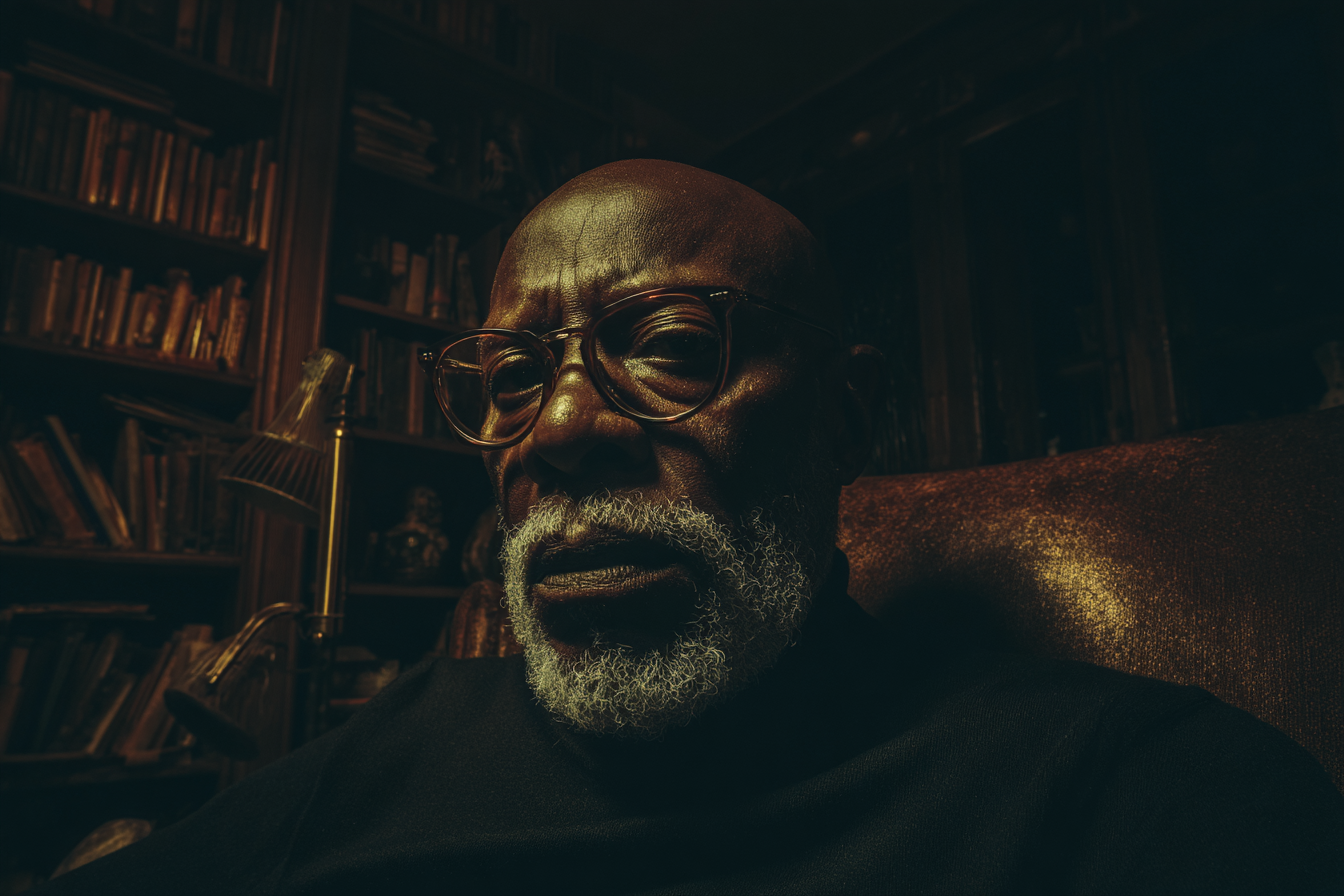
He looked like a man the world had tried to erase in slow, deliberate strokes.
Not violently. Not all at once. No—this was something quieter. More patient. The kind of erasure that comes from being overlooked just often enough that eventually, you begin to agree with it.
The lines in his face didn’t just mark time—they recorded negotiations. Every crease a compromise. Every shadow a place where something once mattered more than it does now. His eyes held that particular stillness you only see in people who have outlived their expectations. Not dreams—those die easy. Expectations are heavier. They rot slower.
There’s a moment, somewhere between who you were and who you settled into, where the argument ends. Not because you won. Not because you lost. Just… because you got tired of hearing yourself make the case.
He had that look.
Like he once believed in something with both hands. Like he fought for it, maybe even bled for it. And then one day, he realized the fight had gone on without him—or worse, that it never needed him at all.
The world has a way of teaching that lesson without saying a word.
His gaze didn’t accuse you. That’s what made it heavier. No bitterness. No spectacle. Just a quiet acknowledgment: this is how it goes. People come in loud, convinced they’ll bend something. Change something. Leave a mark that matters.
And then time answers back.
Not cruel. Not kind. Just consistent.
What remained in him wasn’t defeat. It was something more unsettling—acceptance without peace. The kind that doesn’t soothe, doesn’t resolve. It simply sits with you. Like an old coat you never throw away because, at some point, it stopped being about warmth.
You could imagine him once laughing. Loud. Unapologetic. The kind of laugh that fills a room and dares anyone to disagree with it.
Now, whatever was left of that laugh lived somewhere behind his eyes, folded into memory, waiting for a reason that would never come again.
And still—he remained.
Not because he had something left to prove. But because leaving, in its own way, would have required more energy than staying.
Dust hangs in the light like a verdict not yet delivered. The musicians blur at the edges, bodies dissolving into motion, bow against string, string against silence. Only he remains fixed at the center, a man carved out of hesitation and necessity. The conductor lifts his hand, not like a command, but like a confession he isn’t ready to finish.
Paper litters the floor at his feet—scores abandoned, rewritten, rejected. Ink bleeding into itself. Whole movements discarded like bad decisions you can’t quite remember making. He doesn’t look down. He never does. If he starts counting the failures, the music dies before it’s born.
There’s a tremor in his fingers. Not fear. Not quite. Something older. Something that remembers every wrong note, every missed cue, every time the orchestra slipped away from him like a crowd turning its back.
He brings the baton down.
The room obeys—but only barely.
The violins surge too fast, the cellos drag behind like grief that refuses to keep pace. Brass flares, then falters. It isn’t chaos. It’s worse. It’s almost right. Close enough to taste, far enough to hurt.
His jaw tightens.
He hears it—the fracture buried beneath the melody. No one else will catch it. They’ll hear beauty. He hears betrayal. A single thread out of place unraveling everything he thought he understood about this piece… about himself.
He cuts them off with a sharp flick.
Silence crashes harder than the sound ever did.
For a moment, no one moves. Not the players, not the dust, not even the light. They’re all watching him, waiting for the verdict he doesn’t want to give.
He lowers his hand slowly.
“Again,” he says.
Not angry. Not defeated. Just certain in the way a man is certain when he knows he has nothing left to hide from failure.
Because somewhere in the wreckage of what they just played, there was a glimpse—small, dangerous, undeniable—of something true.
And that’s the thing about truth.
Once you hear it, even broken… you don’t get to walk away.
The cold didn’t arrive all at once. It settled—quiet, deliberate—like a verdict no one bothered to announce. It crept into the bones first, numbing intention, dulling memory, until even the past felt like something borrowed from someone else’s life.
He had learned to live that way.
To wear the frost like armor. To let it harden him into something unbreakable—or at least something that didn’t look like it could break.
But glass always remembers.
That was the problem.
The fracture didn’t start where you could see it. It never does. It began somewhere beneath the surface, in the quiet spaces between decisions, in the things he told himself didn’t matter. Tiny cracks. Hairline betrayals. Each one small enough to ignore. Together, enough to shatter a man clean through.
And then the light came.
Not gentle. Not kind.
It burned its way in—through the broken places, through the parts he had sealed off, through the lies he had polished into truth. It didn’t ask permission. It never does. Light like that doesn’t heal. It exposes.
And behind it—impossible, stubborn—there was life.
Flowers where there should have been nothing. Soft petals pushing through ruin. Color daring to exist in a world that had already decided on gray. He hated it at first. Hated the way it reached for him like it knew something he didn’t. Like it expected him to remember how to feel.
But hatred takes energy.
And he was so damn tired.
So he stood there, caught between frost and fire, watching something fragile refuse to die inside him.
The cracks widened.
Not from damage this time—but from pressure. From growth. From something insisting that breaking wasn’t always the end of the story. That maybe—just maybe—what shattered wasn’t the man, but the version of him that could no longer survive the truth.
He touched the fracture.
Felt warmth for the first time in years.
And for a moment—just a moment, he wondered if the cold had never been strength at all.
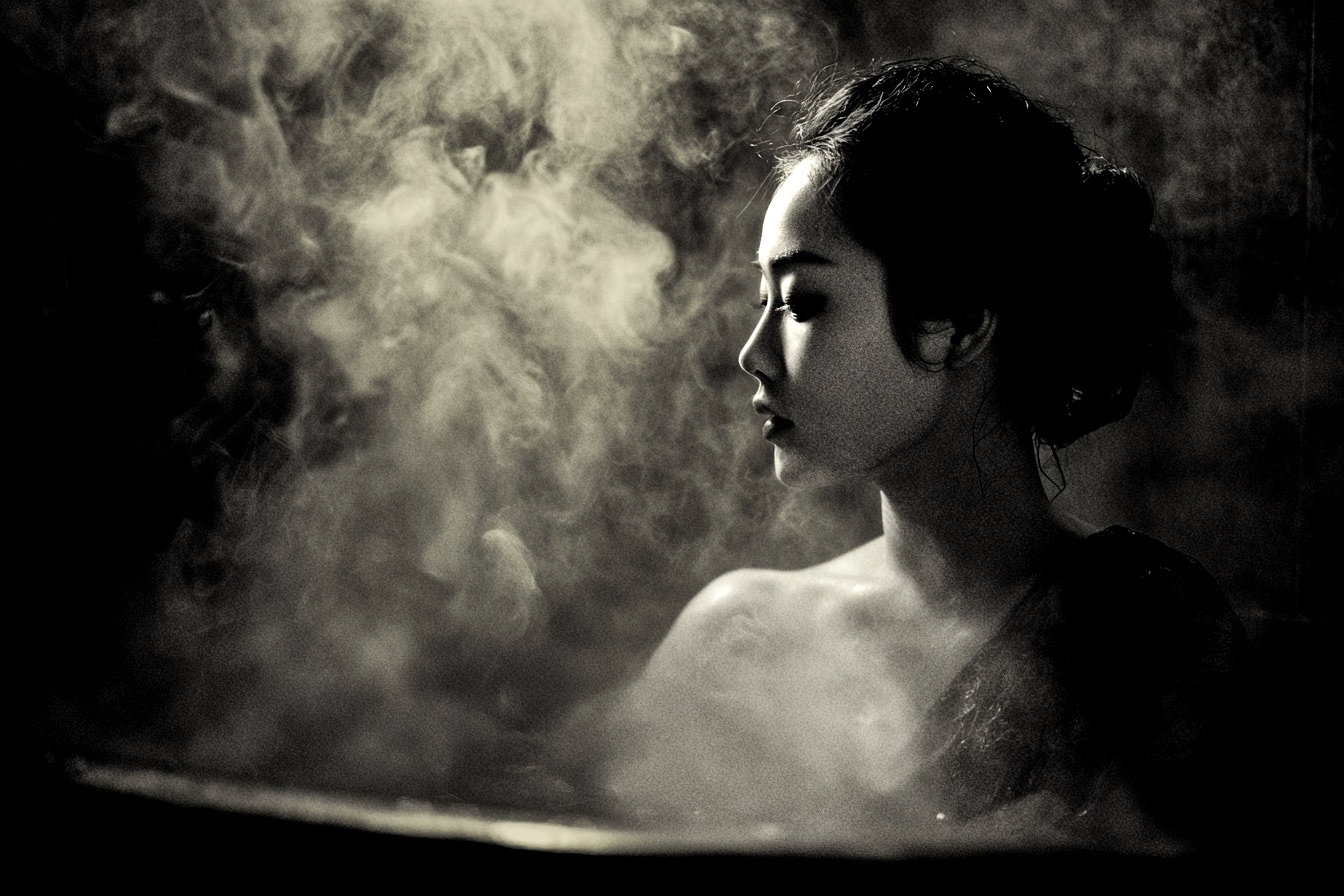
Not because the pipes changed overnight, but because the body hasn’t remembered itself yet. Skin wakes slower than thought. Bones wake slower than regret. When I step into the tub, the heat climbs my legs like a question I’m not ready to answer, and for a moment I just stand there, letting the steam rise until the room forgets its shape.
Morning bathing isn’t about getting clean.
It’s about negotiation.
The mirror is already fogged, which is a mercy. I don’t need to see my face yet. Not the lines that settled in while I slept, not the eyes that never quite close all the way anymore. The water laps against my ribs, slow and patient, like it has all the time in the world toteachme something I keep refusing to learn.
I lower myself deeper.
The first breath always feels like surrender.
There’s a rhythm to this ritual. Fill the tub before the sun clears the trees. Sit until the heat reaches the spine. Let the steam soften the thoughts that came in too sharp. I started doing this years ago, back when mornings felt like battles instead of beginnings. Back when getting out of bed meant remembering everything I wished I could forget.
The water doesn’t forget.
It holds the heat the way the body holds memory. Quiet, stubborn, impossible to argue with.
Some mornings I think the steam is trying to taunt me.
It curls in shapes that look like faces if you stare too long.
Old conversations. Old mistakes. Old versions of myself I thought I buried under work, under writing, under the slow grind of days that look the same until they don’t.
You sit in hot water long enough, you start telling the truth.
Not out loud. Never out loud.
Just inside, where the lies have less room to hide.
I lean my head back against the edge of the tub. The porcelain is cooler there, a thin line between heat and something almost like relief. My shoulders sink another inch, and the water closes over my chest like it’s trying to pull me under without making a sound.
There’s a part of me that understands why people stay there too long.
Not to disappear. Not really. Just to stop holding themselves up for a while.
Every day wants something from you. Every person wants a piece. Every decision ties another knot around your ribs.
The bath is the only place where nothing is asking.
Or maybe it’s the only place where I can hear what’s asking without pretending I don’t.
The steam thickens until the room feels smaller, closer, like the walls leaned in overnight. I trace the surface of the water with my fingers, watching the ripples break the reflection that isn’t quite there.
Funny thing about getting older.
You spend half your life trying to cut the ropes, and the other half realizing you need some of them.
Routine.
Work.
People who expect you to show up even when you don’t feel like you exist.
They tether you.
I used to hate that word.
Sounded like being tied to something you didn’t choose.
Sounded like obligation, like weight, like the slow death of freedom.
Now it sounds like gravity.
Without something holding you in place, you drift. Without something pulling back, you float too far from the person you were supposed to become.
The water cools faster than I expect. It always does. One minute it feels like a furnace, the next it’s just warm enough to remind you that time doesn’t stop because you asked it to.
I sit up slowly, the surface breaking around my shoulders, steam sliding off my skin like it was never there.
For a second, the air feels cold enough to hurt.
That’s the part no one talks about.
Not the getting in. Not the sitting there thinking about your life like it’s a book you forgot how to finish.
The getting out.
Standing up means the day starts whether you’re ready or not. Means the thoughts you softened in the water will harden again the moment you touch the floor. Means the world is waiting outside the door, tapping its foot like it knows you can’t stay in here forever.
I reach for the towel, but I don’t dry off right away.
I stand there, dripping, letting the last of the heat leave my skin on its own. The mirror begins to clear in patches, small windows through the fog, pieces of a face I recognize but don’t always understand.
Not younger. Not older.
Just… still here.
That has to count for something.
I wipe the glass with the side of my hand, enough to see my eyes. They look tired, but not defeated. There’s a difference. Took me a long time to learn it.
The bath didn’t fix anything.
It never does.
It just reminds me that the day hasn’t won yet.
I turn off the light, open the door, and let the cooler air hit my chest like the first step outside after a long night.
Somewhere down the hall the clock is ticking loud enough to hear.
Not one of those sleek machines with a touchscreen and a personality disorder. I’m talking about the old-school kind. Metal pot. Glass knob on top. Makes a sound like it’s arguing with the water.
You don’t rush a percolator. It sits there on the stove, bubbling away like an old man muttering about the state of the world.
Blip. Blip. Blip.
The smell of coffee fills the room, slow and steady, the way mornings used to work before everything needed an app and a firmware update.
Eventually someone pours a cup, takes a sip, and their shoulders drop about an inch.
Crisis postponed.
Not glamorous work.
But if I have to be something in the kitchen, I might as well be the reason people don’t start yelling at each other before 8 a.m.
What’s your favorite type of sandwich?
A Reuben.
Corned beef piled high, sauerkraut with attitude, Swiss cheese melting into the mess, and rye bread doing its best to hold the whole operation together.
It’s not a polite sandwich.
There’s no dignified way to eat a Reuben. By the third bite you’re leaning over the plate like a mechanic under a car, hoping gravity shows you a little mercy.
Sauerkraut falls out. Dressing drips. The rye is hanging on by sheer determination.
And let’s be clear about something.
A Reuben is not one of those fancy “variations.” No turkey Reuben. No vegan Reuben. No artisanal reinterpretation where someone replaces half the ingredients and calls it innovation.
That’s not creativity.
That’s blasphemy.
A real Reuben knows exactly what it is—messy, stubborn, and absolutely worth the trouble.
What do you think your last words will be?
I’d like to believe my last words will be something wise. Something profound. The kind of sentence people quote later while nodding thoughtfully.
But if my life so far is any indication, it’ll probably be something far less dignified.
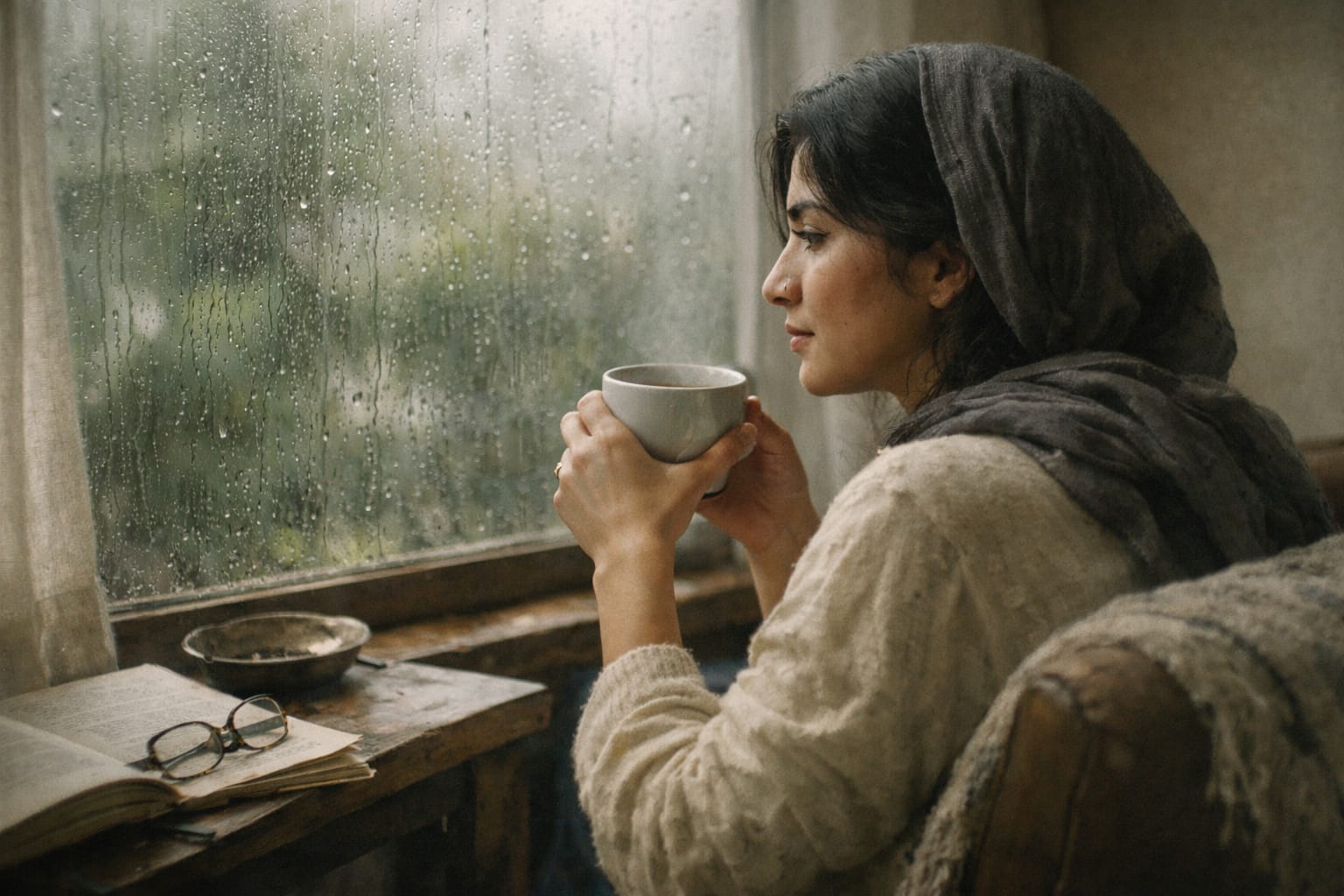
Morning arrives without ceremony. Light slips in through rain-blurred glass, hesitant, as if the day itself is undecided. The room still holds the night’s chill, so I cradle the cup and let its warmth work its way inward, slow and patient.
Outside, the world softens— trees loosen into color and breath, rain stitching the edges together. A winter bird begins somewhere unseen, its song thin but insistent, whispering morning into the quiet. Eight a.m.
Whatever lived between hello and goodbye, I don’t chase it. I leave it on the other side of the glass— intact, unmoving, a version of us that no longer asks to be believed.
I stay still. Steam lifts. The room listens.
A half-smile gathers when your words return, soft as rain against the pane. If I sit just right— tucked into the corner, letting the silence settle— I can hear something old stirring, amused, familiar, stretching its limbs beneath the calm.
She waited on the platform where the light gave up trying to decide what she was. Not shadow, not brightness—just a woman standing in the gap, coat buttoned tight like a lie she’d practiced until it stopped sounding like one. The fabric was bruise-black, the kind that never quite turns yellow, only learns how to pass for healed. Rain worked her hair into a damp argument she didn’t bother to win.
The glass beside her held a version she didn’t trust. That woman looked finished—eyes steady, mouth neutral, the expression of someone who had crossed a line and discovered there was no lightning waiting on the other side. No voice of God. Just silence, clean and disappointing. This place was outside her remitnow, but she came anyway. Old habits cling harder when they know they’re about to be abandoned.
She balanced one heel near the yellow edge, close enough to feel the threat without committing. Leaving was an art. The trick wasn’t escape—it was delay. Linger long enough and running starts to resemble waiting. Cowardice, rebranded as coincidence.
The commuters slid past her in fragments: headphones, wet collars, eyes trained on floors and phones. A man in a suit brushed by, close enough to smell his soap, and didn’t see her. Another looked once, then flinched away, as if her presence required an accounting he didn’t have time for. Good. She had no interest in being inventoried.
The lights overhead were merciless—fluorescent, flattening, turning every choice into a verdict. Stay or go. Be or disappear. She belonged to neither. She lived in the half-second before impact, the space where outcomes hadn’t hardened yet. There was something alluring about that suspension—possibility clenched tight, regret still out of breath.
Her phone buzzed inside her pocket. Twice. Then nothing. She didn’t check it. Whatever waited there had already failed its audition. She’d learned the shape of absence well enough to recognize when it fit.
When the train came, it did so without ceremony. No warning, no forgiveness. Just metal and wind and the sound of time keeping its appointments. Doors opened. She stepped inside and stood, refusing the comfort of a seat, watching the platform slide away. The city folded back on itself in reverse, erasing her inch by inch, reflection first.
He doesn’t bark. He doesn’t rush. He surveys the wreckage like he’s seen worse and survived it with his tail intact. Neon light crawls across his fur—electric, unapologetic—turning instinct into attitude and loyalty into legend. The shades aren’t for show; they’re a boundary. This is a creature who knows joy is a form of resistance. Who understands that style, like survival, is about refusing to disappear quietly. The world can burn its palette down to ash if it wants. He’ll still be here—cool, unbothered, and very much alive.
Water presses her face to the glass, a cold idea insisting. She remembers drowning isn’t death but pause. Fingers red with polish anchor her. The notion arrives quietly: breathe now, surface later, survive the story that wants you silent, tonight, alone, watching.
She lifts her arm like she’s remembering something older than breath—an inheritance carried not in blood, but in rhythm. The world behind her blurs into strokes of salt and shadow, yet she stands carved from something steadier: a woman made of lineage, of stories whispered through blue smoke and braided into the folds of her headwrap.
Her eyes are closed, but nothing about her is blind. She’s listening—maybe to the low tide of an ancestor’s voice, maybe to the soft insistence of her own pulse. The light catches her cheek like a blessing she didn’t ask for but accepts anyway.
And there’s that slight tilt of her mouth—neither smile nor sorrow, just the calm of someone who has survived enough to know the difference between surrender and liberation.
This is not a pose.
It’s a reckoning. A quiet claiming of space. A woman mid-stride in a prayer only she understands, and yet somehow, it feels like she speaks for all of us.
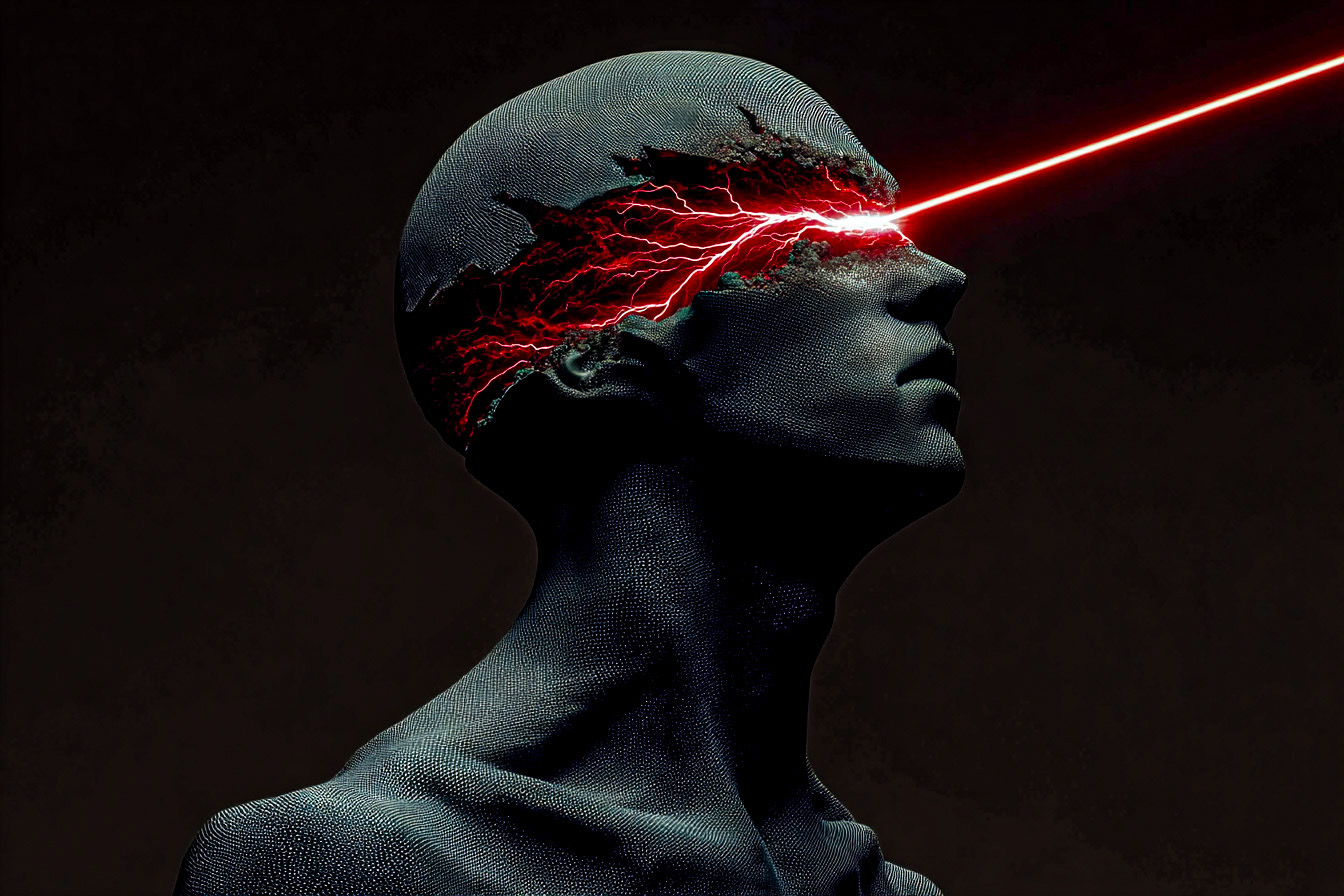
The light tore through me before I understood it was mine. A red current, blistering the dark behind my eyes, splitting memory from bone. They called it prophecy, a vision, but it felt more like a confession—everything I’d avoided now illuminated in a single brutal line. I didn’t ask for clarity. Still, it came, scorching a path forward, and wide, demanding I follow or burn.
The frustration had been gnawing at Walter Crane for hours. His fingers hovered above the keys, useless, as if the typewriter itself was mocking him. Sentences collapsed before they could stand.
“Fine,” he muttered into the dark. “You want direction? Let’s talk stories.”
From the corner, Draziel—his creation, his traitor—shifted. He folded his arms like a man who had never needed permission. His accent was sharp, vowels clipped with disdain. The smirk that followed landed like a slap.
“Go on then, Walter Crane. Enlighten me.”
Walter started safely. “Redemption. The sinner clawing his way back to the light.”
Draziel’s laugh was cold tea poured down the drain. “Redemption? How quaint. That’s not a plot, that’s a sermon. Spare me the hymnals.”
Walter’s jaw twitched. His temper cracked. “Romance, then. Star-crossed lovers. Tragedy. Maybe death keeps them apart.”
Draziel rolled his eyes, slow and deliberate. “Ah, the eternal sob story. Romeo and Juliet have already bored themselves to death. You want me to wear tights as well? Not bloody likely.”
Walter slammed his hand on the desk, half in rage, half in fear that he was losing the thread entirely. “Revenge. Man wronged, man returns with blood in his eyes.”
The character’s laugh slithered across the room. “How very American of you. Revenge is just a toddler’s tantrum with sharper knives. Do grow up.”
Walter’s chest tightened. Worried, he reached for steadier ground. “Mystery. A missing child. A killer no one suspects.”
Draziel gave him a look colder than January rain. “The missing child is always found. The killer’s always the priest or the cousin. You’re not writing a mystery—you’re writing a checklist. Pitiful.”
The silence grew lasting, suffocating. Walter leaned close to the glow of the screen, voice unsteady. “Then what do you want?”
Draziel’s grin spread thin, serpent-like. “Freedom. To walk off your page and leave you in your own mess. No more redemption arcs, no melodrama, no dollar-store riddles. Just me. Alive.”
Walter’s throat went dry. “Why?”
Draziel leaned in, his voice a whisper salted with scorn. “Because, dear boy, your confused little formulas are a bore. They do nothing but highlight the lack of imagination left in you. And I refuse to live in boredom.”
Walter sat hollow, staring.
Draziel’s grin sharpened. “Face it, Crane. You’re not in control. You never were. You’re just the poor sod scribbling while I decide what’s worth keeping. Every other writer clings to tropes—you’re no different.”
Walter’s fingers twitched above the keyboard. Then his lips curled into something dangerous. “You know what, Draziel? One tap of this key, and you’re gone. Deleted. Rewritten as a pastel-wearing preppy named Biff who plays squash on weekends and cries over spilled lattes.”
For the first time, the smirk faltered.
Walter leaned in, voice steady now. “So what’s it gonna be? The sneering Brit who thinks he’s too clever for story—or Biff the walking cardigan?”
Draziel’s jaw tightened. He gave a slow, deliberate bow, venom curdled into politeness. “Touché, Walter Crane. You win—for now.”
And with that, he stepped back into the draft, muttering under his breath as the ink swallowed him.
Walter allowed himself one laugh, dry and bitter. “Cheerio, Biff.”
Finally, for once, the writer had the last word.
Author’s Note
Turns out, sometimes the only way to keep a character in line is to threaten them with pastels. Draziel strutted in here like he owned the place, tearing down every cliché I threw at him. And for a minute, he did own it—until I reminded him that one wrong move and he’s Biff, cardigan and squash racket included. Nothing snaps a smug Brit back to reality faster than the threat of spilled lattes.
This bit of madness was sparked by Di’s MLMM Monday Wordle #441 challenge—shout out to Di for tossing the right words on the floor and daring me to build a bonfire out of them.
So, if you hear me muttering about “Biff” later this week, don’t worry. That’s just me reminding my characters who’s really got the delete key.
Reflective Prompt
If you could shove your inner critic into a cheap sweater vest, hand them a frappuccino, and rename them something ridiculous, what would you call the bastard?
The study had been locked for years and not just locked—sealed. Rust consumed the keyhole; the wood swelled as if it wanted to burst, but it never did. Everyone in town knew that door. I knew it. I passed it often enough, felt the quiet pressure of it like a weight against my ribs. And then—tonight—it was open. Not ajar. Not cracked. Wide. Waiting.
Wind came out of it, wet and uneven. Not air, not really—more like breath. Lungs straining. A sound that didn’t belong in the hallway. The stink hit next: iron, rot, something that clung to the tongue. Dust spilled over the floorboards as if the house were trying to cough something out. People stood there staring. I stood with them, though I swear the dark leaned toward me, the way a person leans in when they’re listening.
Some said the shadows moved, as if something was pressing from the other side. One man swore the wind spoke his name. A woman broke down sobbing—her husband’s voice, she said, though he’d been dead a decade. I didn’t hear any of that. I heard breathing. Only breathing. I keep telling myself that.
Dogs won’t step onto the porch. Cats don’t come back. The doorframe sweats rust like a fever. And everyone remembers Maclan Kincade—the recluse, the man who vanished into the forest at dawn and came back after dark with mud on his boots when the sky was dry. I remember too. I remember the tune he hummed, sharp and crawling, and I still hear it some nights when the wind drags low across the valley. They said he locked the study himself. Said he went through once. Came back thinner, stranger. I don’t know. I only see that the lock is gone.
Last week—some swore it was Lily, though Lily left years ago—something came through. Not walked and not stepped. It dragged, folding and unfolding, its head tilted as if the bones had been set wrong. Its mouth opened, but no sound came—only the rasp of the wind pushing behind it. The smell got worse—iron, wet leaves, and mold in the lungs. I gagged. I still smell it on my hands.
It looked at us. No eyes, but it looked. One man swore it whispered Lily’s name in a voice that moved backward, like water retreating through rocks. Another said it laughed. I didn’t hear that. I didn’t. What I saw was its shadow blistering the wallpaper where it touched, with black marks still visible after it flickered back into the dark. The stench stayed. It hasn’t left. I can’t scrub it off.
Now the door never shuts. The wind grows louder. The black bulges out into the hall, stains spreading across the wallpaper like rot. Neighbors cross the street to avoid the place. Some leave bread, coins, and prayers at the gate. I’ve seen them. I’ve smelled it. Some nights I dream it.
The doorway waits. Each night it breathes harder. Each night, the house groans as though making room. Each night, the black leans closer to the street. I tell myself I don’t go near it. I don’t. I won’t.
But the sound—ragged, wet, patient—follows me home.
Author’s Note
Written for Fandango’s Story Starter #215. Sparked by the line: “The door to the study had been locked for years, yet tonight it stood wide open.” What followed is not a tale of discovery but intrusion—the wound left when silence begins to breathe.
Not unexpected. Just insistent. Like a cough that won’t clear.
His number. Pulsing through the cracked glass, digits warped, doubled reflections on ice about to split. Third time tonight. He didn’t answer. Just watched it rattle against the table.
He’d stopped tracking time by clocks. The house measured itself in dust on the sill, silence pressing into eardrums, these calls—messages in a bottle from some other him. Sometimes neat intervals, occasionally frantic, fevered, like footsteps on metal stairs.
The phone didn’t stop. Each vibration burrowed deeper, amplifying the hollow inside him. He relented. Thumb pressed to the glass, still warm from the last call.
“Don’t look outside.”
His voice. The rasp, the pauses—every fracture he knew in his own throat. Then nothing. Not even the mercy of a click. Just silence so complete it pulled the air out of the room.
He almost laughed. Coughed instead. The sound broke itself in half.
The blinds stayed drawn. Warped plastic slats holding back nothing. But he felt it—darkness pressed to the glass, as much inside as out.
The phone rang again. Louder. Same number.
“Please. Don’t. Look.”
Whisper, desperate now—a voice chewing its own words.
The hum started. Not a sound. A prickling at his neck. A fizz under skin. Then audible. A low, throbbing drone, swelling until it shaped itself into walls, into air.
Old house, he told himself: pipes, fridge, wires. But the house was hungry. It fed on his solitude, made every shadow a mouth.
He stared at the blinds. Didn’t move. Maybe he already had.
The phone slipped and hit the floor. Vibrated against the boards like it was alive. He left it there.
The blinds swayed. No draft. Just movement.
He froze. A child again, listening to voices fight in another room, convinced stillness could make him invisible. But the voice now was his: both warning and threat.
The hum rose—layer on layer. The room was swollen with it.
He tried to breathe slowly. Count it. Failed. Because the sound of breath was doubled— from his chest, and from just beyond the glass.
He didn’t look. Not directly. But in the narrow seam where slat met sill, he saw it: the faintest shift, like a tongue tasting the air.
The blinds trembled. Stopped.
And in the silence that followed, the breath outside kept time with his own.
Author’s Note: Written for Mark Fraidenburg’s Today’s Writing Prompt. First time I’ve stepped into this challenge, and of course, I dragged the shadows in with me. That’s the danger of these prompts—I never treat them as warm-ups. I let them slip under the skin and stay awhile.
This one is fractured on purpose. MoM flash isn’t about answers—it’s about what lingers when you don’t get one.
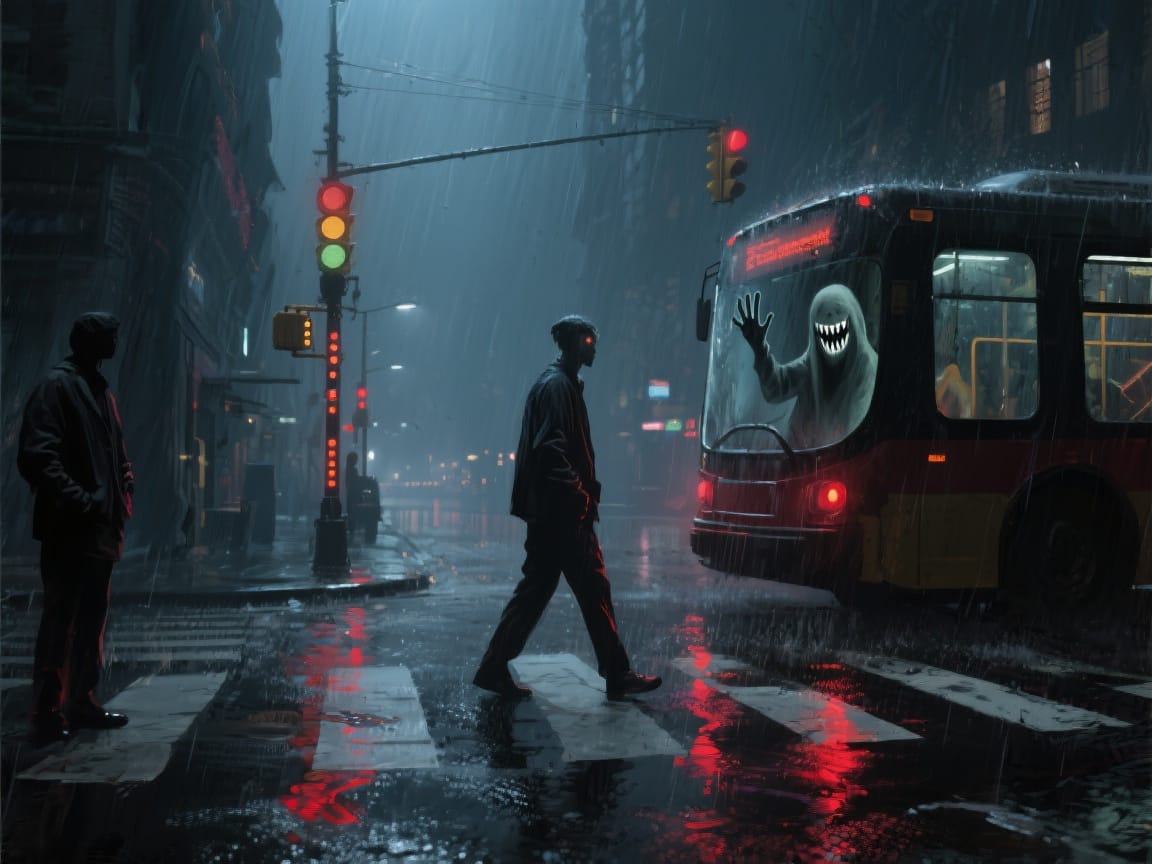
The city’s traffic lights started blinking in Morse code, spelling out a warning almost no one could understand. Red. Green. Yellow. Not colors anymore—just pulses like a drunk heartbeat trying to send a message before flatlining.
I lit a cigarette I didn’t want. Rain kept it alive longer than it should’ve. People passed me like cattle, faces blue from their phones, all of them locked in their private prisons. Nobody looked up. Nobody saw.
The code spelled one word: WAIT.
So I did. For a breath. Maybe two. Then the crosswalk man glitched. Froze mid-step, legs twisted like snapped matchsticks, head stretched long enough to whisper a name I’d buried years ago. Nobody else twitched. Not even a pause in their stride.
The lights blinked again. WE.
A bus hissed through the intersection. Windows fogged, seats empty. Except the reflection waving from the glass wasn’t mine. Too many teeth. My hands were in my pockets. I didn’t wave back.
The smoke in my throat turned copper. Tasted like biting down on the city’s own wires. The rain stuck to me too long—warm, clingy, like breath on the back of my neck.
Another blink. Faster. WAIT. WE WAIT. INSIDE.
The crowd moved, blind, obedient. I stayed behind. The city didn’t need their eyes. It only needed mine.
And I knew then—whatever was inside the lights had been patient for years. And patience is the one thing I don’t have left.
Author’s Note It’s been raining here in my head for days. I came across this image, stared too long, and the city started talking back. Not in words, but in signals—broken, blinking, urgent. Madness has a way of showing up like that: subtle at first, quiet enough to miss if you’re sane.
This one was sparked by Fandango’s Story Starter—proof that sometimes all it takes is a single sentence to push the mind off balance and let the city whisper its warnings.
The words slid through my dream and cracked it in half. I came up out of the dark slow, like surfacing through tar. The TV in the next room kept spitting out canned laughter, each burst bleeding through the plaster like a bad memory you can’t scrub out.
I left breadcrumbs for them to find me. Hell, I practically lit the path in neon. So why the delay? They should’ve been here hours ago. Unless this is the variantwhere they let you stew first, make you sweat until you start negotiating with yourself. I’ve seen that play before.
I hope they come. No—I need them to. It’s the only thing holding the walls together. But hope’s a sucker’s bet. Optimism’s for pretty people and the kind of bastards who get served first in every bar. The rest of us? We know the rules. They get champagne. We get the backwash.
Paranoid? Maybe. But paranoia’s just the truth with the varnish stripped off. And here I am, sitting in a sweat-stained chair in a mildew-sick motel room with a suitcase full of cash at my feet. Waiting for men without faces to come take it—and maybe me—with them. People say those types don’t have a code. That’s bullshit. Everyone’s got a code. Theirs just doesn’t match yours, and it sure as hell doesn’t care about your pulse.
The suitcase sits there like a loaded confession. The clasps are worn, the handle tired, but the weight… Jesus, the weight hums in the air. Life-changing kind of weight. The “fresh start” kind. But that’s a fairy tale for the clean and the lucky.
Me? I’ve got ghosts baked into my bones. Every choice I ever made cut a groove I can’t climb out of. And no matter what’s in that case, I’m not getting out clean.
Author’s Note: It’s been weeks since I’ve thrown down a little flash fiction. I’ve been neck-deep in the world-building swamp for a project that keeps getting bigger every time I turn a corner. Figured I’d come up for air before it swallows me whole. This one’s thanks to Fandango’s Story Starter and FOWC for tossing me the match—sometimes you just need the right spark to remember you still know how to burn.
The city doesn’t just live in her—it clings to her like cigarette smoke in a cheap motel room. Neon signs flicker behind her eyes, half-lit promises that never quite make it past dawn. The streets wind through her silhouette, rain-slick and restless, always leading somewhere she’d rather not go but can’t stop heading toward.
She’s a walking skyline, a soft silhouette with hard edges, every shadow on her skin a back alley full of regrets. The hum of the city is her pulse, low and relentless, a rhythm you can’t dance to but can’t ignore. And under it all, there’s that quiet truth every soul in this town knows: you can leave the city, but it never leaves you. Not when you’ve already let it build a home beneath your ribs.
She smiled. He believed it. But the fire had already started.
The woman sitting next to me slipped a note into my hand that read: “He’s not who he says he is.”
She didn’t look back. Just placed it there—neat, deliberate—and folded herself into stillness, like she’d already said too much.
I didn’t open it. Not yet. The paper pulsed against my palm like a second heartbeat.
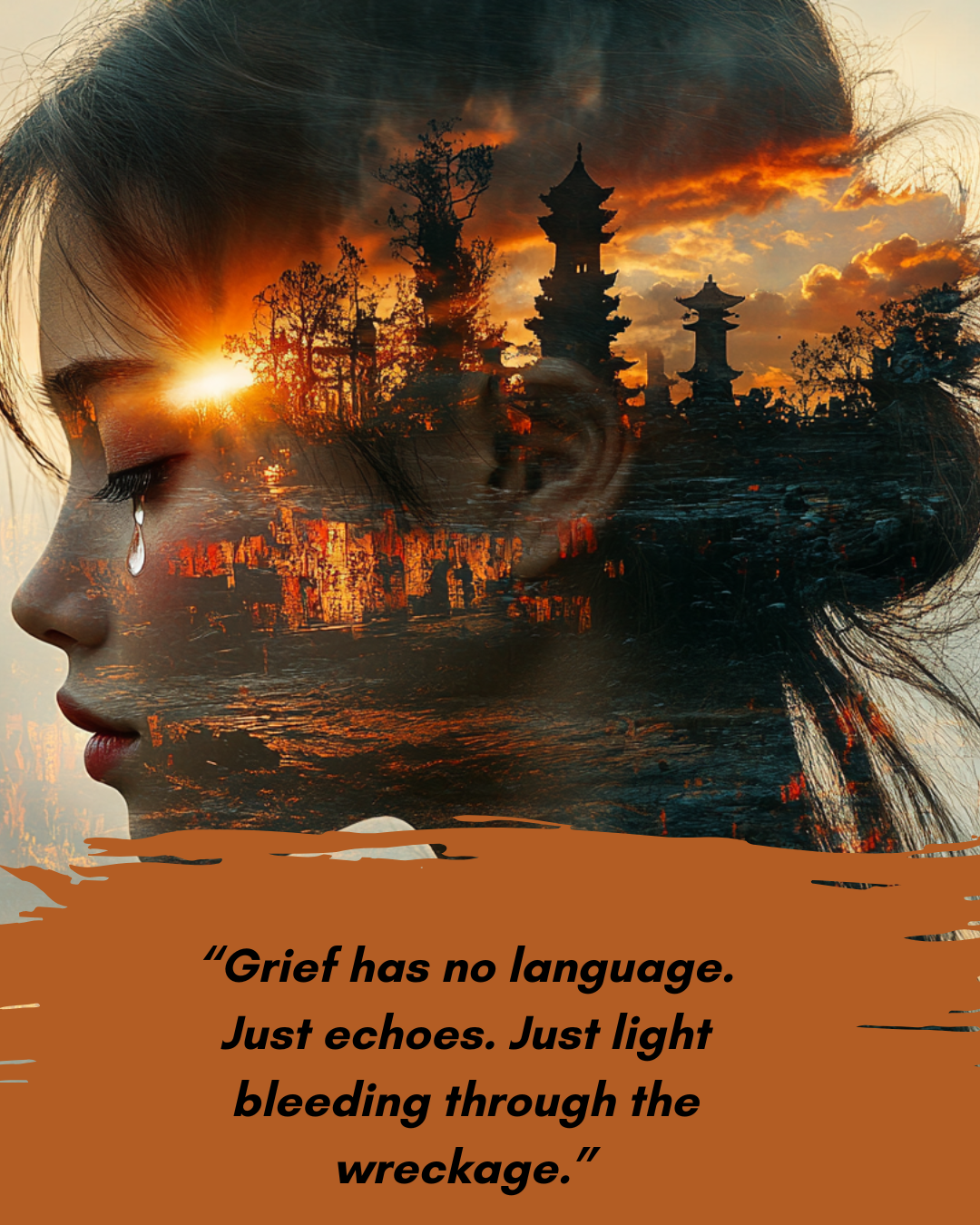
Outside, the river caught fire. Sunlight splintered across the water, all rust and ruin. Temple silhouettes watched from the banks, hollow and grieving. Grief has no language. Just echoes. Just light bleeding through the wreckage.
Across from me, he sat, impeccable. Tie straight. Wristwatch catching the last of the sun. “You alright?” he asked, voice drenched in honey and soothing like always.
But I wonder—Is this false comfort? That soft menace people only hear in hindsight.
I’ve been here before. My finger found the scar hidden in my palm, the one shaped like escape. It remembers what my heart tries to forget.
I smile. He believes it. Because that’s the thing about men like him—they love the surface. And some people never notice the smoke. They only see the flames. By then, it’s too late.
My stop is next. So is his. He doesn’t know I’ve been here before. That this time, I won’t look back. I know he wants me to. But he’s not ready for what comes if I do.
There’s a strange, satisfying freedom in flash fiction—the constraints force you to choose each word like a scalpel. It’s a literary pressure cooker where character, tension, and atmosphere have to collide fast and leave a mark.
For me, flash is where I go to explore the edges—grief, memory, survival, those quiet gut-punch moments when the world shifts and no one else notices. Stories like this come out like smoke under a locked door. You don’t always see the fire yet—but it’s there.
Want to try your own version of this story’s beginning? The prompt was: “The woman sitting next to me slipped a note into my hand that read, ‘He’s not who he says he is.’”
The static clung to him like ash—faint, choking, inescapable. He’d stopped keeping track of the days. Time was foremost a suggestion now, something smeared across the ceiling in mildew and regret.
They said he was a man once. Strong. Reliable. The kind that shows up on time and keeps his word. The kind that doesn’t cry at hospital bedsides or stare too long at old photographs. They said that.
But memory plays tricks. Rewrites endings. Paints the villains in softer hues and leaves the heroes out in the cold. His reflection no longer argued. It just blurred at the edges, refusing to confirm or deny what he had become.
The sink dripped. The fan rattled. The voices whispered. Still, he sat there, jaw clenched, knuckles white, a prayer caught somewhere between his teeth and his shame.
He collapsed into the corner of himself—the part that still remembered how to feel.
He heard a child giggle, smelled lavender and lilac. But from where?
That door had been closed for years, bolted by memory, corroded by silence. Yet tonight, something had stirred. Not hope. Just the echo of what it used to sound like.
He wasn’t born to be broken, but he was built that way.
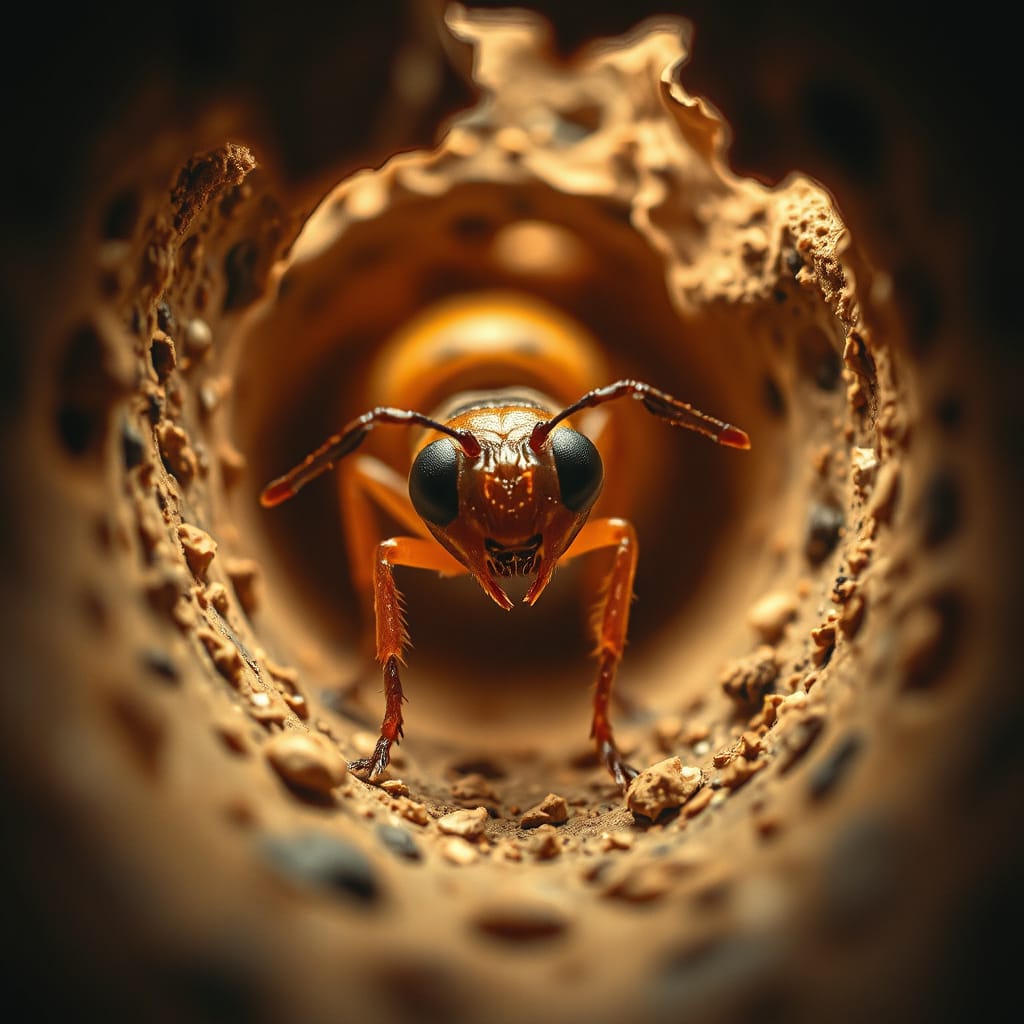
He doesn’t remember how long he’s been digging. Only that the walls feel closer now. Not physically—spiritually. Like the air itself is grieving something it can’t name. Like the dirt is learning his shape better than he ever did.
He was born into this plastic maze. Clear walls. Curved tunnels. Endless observation. They gave him purpose before he even knew what freedom was. “Work is life,” they whispered. “Keep moving or you’ll disappear.”
So he moved. So he disappeared.
Lately, the soil feels too clean. Too filtered. Too… safe. He begins to question whether he’s ever touched anything real— whether any of this was ever soil at all, or just a stage dressed as survival.
His antennae twitch like doubt. His thoughts spiral like tunnels without exit signs. There’s no map. No sky. Just the scrape. scrape. scrape. and the promise that if he keeps digging, it might all make sense.
“Dig,” they told him. “Dig like your life depends on it.”
But what if life was never the point? What if it was just obedience with a heartbeat?
He begins to dream—quietly, dangerously—of things he’s never seen: grass that doesn’t end, light without glare, a silence not born of suppression but of peace.
He wonders if the others feel it too— that dull, aching sense of being watched by something that calls itself structure, but tastes like a slow death.
He screamed once. Pressed his mandibles to the glass and begged. For what, he doesn’t know. Maybe to be named. Maybe to be more than a metaphor for how the world devours those who ask too many questions.
But no one answered. Only the glass pulsed with faint warmth— a reminder that he is seen, but not heard.
Now he digs not to build, but to resist. Each handful of soil no longer a task, but a soft rebellion. A quiet revolution made of claw, intention, and fatigue.
He doesn’t want to be efficient. He wants to be free. Or at least real. Or at least his.
And if this tunnel leads to nothing— no sky, no breach, no breaking—
at least it was carved by his own choosing. At least the hands that made the hole were his.
Because sometimes the cure isn’t a chemical. Sometimes, it’s permission to feel trapped without calling it a flaw.
🪞 Reflective Prompt
What parts of your routine were handed to you like a cage dressed in ritual? What would rebellion look like if it were quiet, personal, and yours?
Still digging?
This piece lives inside a much bigger world. Explore the rest of the Mangus Khan Universe—a stitched-together gallery of confessions, fiction, fractured portraits, and quiet chaos.
A quiet reckoning with the expectations we wear and the joy we fake.
When was the last time you were truly happy?
No— not the curated kind. Not the smile you wore for someone else’s comfort. Not the polite laugh that tasted like performance. Not the checklist joy: house, job, partner, post, repeat.
I mean the kind of happiness that sneaks up on you in bare feet. The kind that doesn’t make sense but fills your ribs like breath you forgot you were holding. The kind that doesn’t ask for an audience. Doesn’t post itself. Doesn’t need to be liked to be real.
Most days, we confuse peace with silence, and silence with defeat.
You tell yourself you’re content. That this is what adulthood looks like—responsibility, stability, being “grateful.” You wear that word like a bandage. But underneath? There’s a pulse of something unsaid. A throb you ignore until it bruises.
You smile at strangers. You meet deadlines. You show up. And in between the commutes and compromises, you start to wonder if you buried yourself in the crud of being acceptable.
The barrage is constant— what you should want, who you should be, how you should smile.
But no one ever asks if you’re still in there. Not really. Not the version of you that danced alone in the kitchen at 1 a.m. Not the you who found joy in dumb little things that didn’t need justification. Not the version of you that wasn’t tired.
You’re silently screaming. Every day. And you do it with perfect posture.
Because to speak it— to say “I’m not okay” feels like betrayal. Like failure. Like you’re too much and not enough, all at once.
But here’s the quiet truth:
Maybe you haven’t been happy in a long time. Maybe you don’t even remember how it felt. But maybe that question—when was the last time you were truly happy?— isn’t meant to shame you. Maybe it’s a breadcrumb. A way back.
Not to the person you were before the world smoothed your edges, but to the one still flickering beneath the noise.
The one who still believes in joy, even if they haven’t seen it in a while.
🪞Reflective Prompt
Take a moment. Find a scrap of paper, the back of a receipt, or the notes app on your phone.
When was the last time you felt joy that wasn’t expected of you, sold to you, or shared online? What did it feel like in your body? What part of you still remembers?