The Reservation


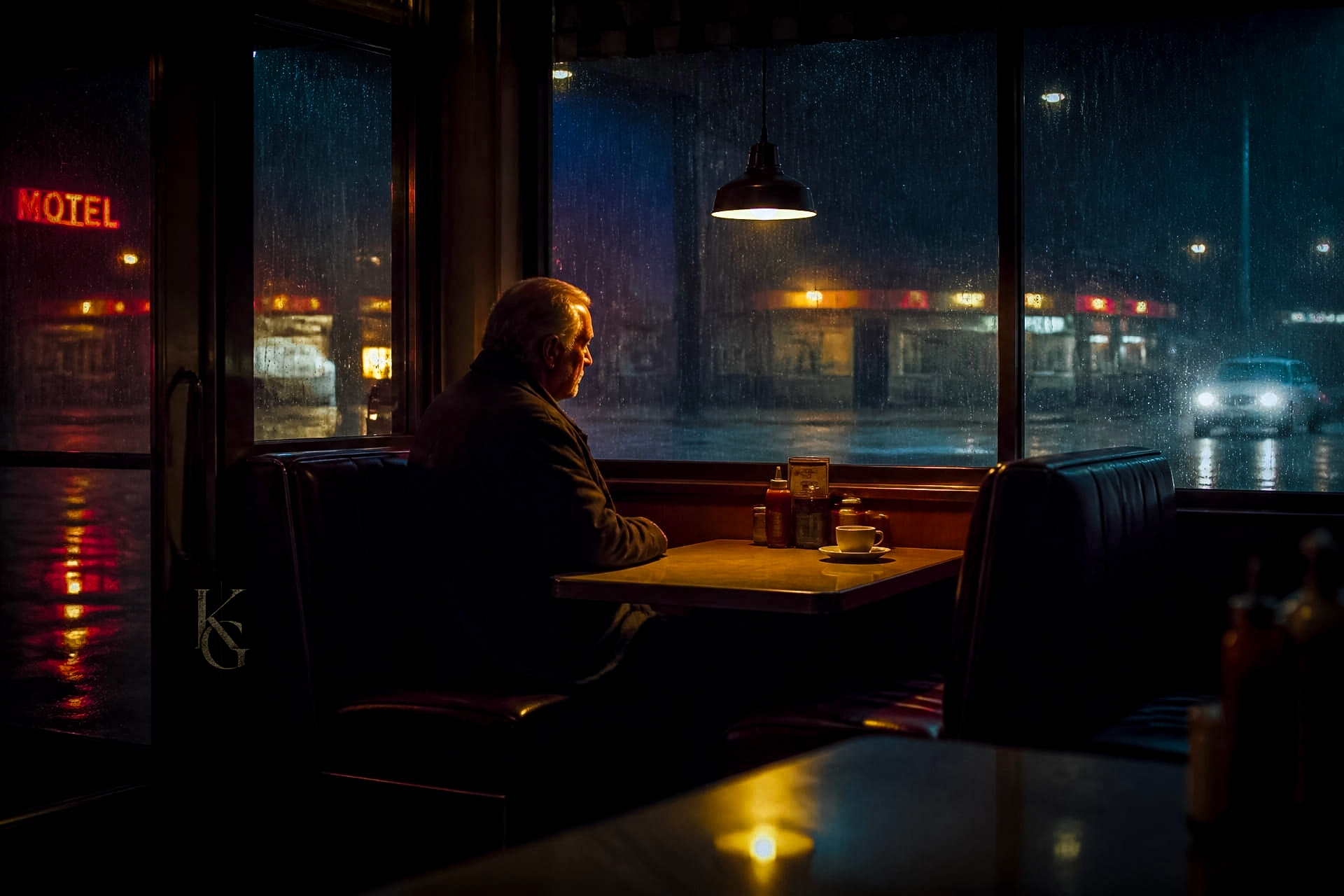
For thirty-two years, Martin Adler had spent every Thursday morning sitting in the same booth at the Blue Star Diner, a narrow corner booth positioned beside a set of rain-streaked windows that overlooked a stretch of highway where people were always traveling somewhere else. The ritual had survived marriages, funerals, layoffs, promotions, birthdays, and enough seasons to make the passage of time feel less like a river and more like a slow erosion. Every Thursday he arrived at seven fifty-five, ordered the same coffee from whichever waitress happened to be working, unfolded the newspaper more out of habit than interest, and settled into a silence that had become as familiar to him as his own reflection. The diner changed around him over the years. Owners came and went. The menu evolved. Booths were reupholstered. Waitresses retired. Yet one thing never changed. The seat across from Martin remained empty, guarded by a small brass RESERVED sign that nobody questioned anymore because the mystery had outlived the curiosity it once inspired.

The sign had become one of those peculiar local traditions that no one could explain but everyone accepted. New employees always asked about it during their first week. Travelers occasionally complained when the diner filled and an unused seat remained unavailable. The answers they received were always vague and unsatisfying. The booth was reserved because it had always been reserved. Reserved for whom was a question nobody seemed interested in answering. Martin himself had spent years trying to understand it before eventually surrendering to the comfort of not knowing. Age had taught him that some questions remained unresolved not because answers were unavailable, but because answers had a habit of complicating things people preferred to leave simple. Over time the sign stopped feeling mysterious and began feeling inevitable, another permanent fixture in a life increasingly defined by routine.

Outside, rain fell with the steady determination of something that intended to last all day. Water streamed down the windows in wavering patterns that transformed passing headlights into smears of gold and white, while across the street the faded neon motel sign cast a crimson glow onto the wet pavement, making the storm appear as though it had stained the morning with old blood. Martin wrapped both hands around his coffee mug and watched the weather perform its slow dance. There was something comforting about storms. They reminded him that not everything could be controlled, predicted, or managed. At sixty-eight, he spent more time than he cared to admit thinking about the decisions that had shaped his life. Not with regret exactly, because regret suggested certainty about an alternative outcome, and certainty was a luxury reserved for people who had never lived long enough to understand how complicated life actually was. What occupied his thoughts instead was curiosity. He found himself wondering about intersections, those seemingly insignificant moments where one decision quietly redirected an entire future. Forty years earlier he had been offered a position in Seattle, a promotion that would have doubled his income and transported him into a life completely different from the one he eventually inhabited. The same week the offer arrived, his father became seriously ill. Martin stayed. Then his father recovered. Then life happened. One year became five. Five became twenty. Twenty became forty. The decision hardened into history while the question attached to it remained stubbornly alive.

The bell above the diner’s entrance jingled softly, and although customers entered and exited throughout the morning with enough frequency that he normally ignored them, something compelled him to look up. A woman stood just inside the doorway holding a rain-darkened umbrella. She appeared to be somewhere in her sixties, though there was a weariness about her that made age difficult to estimate. Silver threaded through dark hair pulled loosely away from her face, and her eyes carried the exhausted focus of someone who had traveled a considerable distance to reach a destination she was not entirely certain existed. She paused near the entrance and surveyed the diner with unusual concentration, not as though she were searching for an empty seat, but as though she were searching for a specific memory. The waitress approached and gestured toward an open booth near the front window. The woman shook her head. Another booth was offered. Again she refused. Then her gaze settled on Martin.

A strange sensation tightened beneath his ribs. He had never seen her before. He was absolutely certain of that. Yet something about her felt familiar in the same way an old scar feels familiar, not because you think about it often, but because it becomes part of the landscape of who you are. He watched as she crossed the diner, ignoring the confusion of the waitress and the questioning look from the owner emerging from the kitchen. Conversation softened around her passage. A few customers glanced up from their meals. Even the rain seemed quieter against the windows. By the time she reached his booth, Martin felt as though he were standing on unstable ground while pretending otherwise. The woman looked briefly at the reserved sign, then at him, and the expression that crossed her face was not one of triumph or relief but recognition. Without asking permission, she slid into the seat that had remained empty for more than three decades.

The first words she spoke struck him with the force of a physical blow. She told him he should have taken the job in Seattle, and for a moment Martin forgot how to breathe. The diner seemed to recede around him until only the woman remained. Nobody alive knew about Seattle anymore. His parents were gone. His wife had been gone for nearly ten years. Friends drifted away, moved away, or died. The decision existed now only as a private artifact stored somewhere deep inside his memory, yet somehow this stranger had reached into that hidden corner of his life and spoken its name aloud. When he asked who she was, she responded with a sadness that suggested the answer would matter less than the reason she had come. Her voice carried the weight of someone who had spent years rehearsing a difficult conversation, and Martin found himself listening despite every instinct urging caution.

What unsettled him most was not what she knew but how she knew it. As the storm continued beyond the windows and fresh coffee appeared on the table without either of them requesting it, the woman began speaking about moments from his life that no stranger should have been able to access. She spoke about sitting alone in his truck after his father’s funeral because he could not face another person telling him they were sorry. She spoke about the Christmas when money had grown so tight that he spent nights calculating bills while pretending everything was fine. She spoke about the evening his wife received her diagnosis and the helpless terror he carried home afterward. Yet she did not describe these events the way a biographer might describe them. She described them the way Martin remembered them. She remembered the silence. She remembered the fear. She remembered the precise shape of the loneliness. Listening to her felt less like hearing stories and more like hearing memories spoken aloud by someone who had been standing beside him the entire time.

Eventually the conversation returned to Seattle, though not in the way he expected. The woman told him that he had spent most of his life believing that decision represented a door that had closed forever, when in reality it represented a door that had opened. She explained that people often became obsessed with the lives they never lived because those lives remained perfect in their imaginations. Imagined futures never suffered disappointments. Imagined futures never accumulated mistakes. Imagined futures remained forever suspended at the moment of possibility. The life Martin had actually lived, however, contained all the imperfections of reality. It contained grief and heartbreak and failure. It also contained children, grandchildren, friendships, laughter, resilience, and countless moments that would never have existed had he boarded that plane. As she spoke, Martin felt something uncomfortable shifting inside him. He realized he had spent decades treating curiosity like regret. He had mistaken wondering for mourning.

The woman eventually leaned back in the booth and studied him with the tired patience of someone who had finally reached the end of a long journey. She told him that he had spent years asking whether he should have gone to Seattle, when the more important question was how many lives existed because he stayed. The observation settled heavily over him. He thought about his children. His grandchildren. His wife. His father. Every meaningful relationship in his life emerged from a decision he had spent years quietly second-guessing. The realization did not erase uncertainty. It did not provide answers. Instead it replaced one question with another, and somehow that felt more honest.

When the woman finally stood to leave, Martin experienced an unexpected surge of panic. It wasn’t fear of her departure so much as fear that whatever understanding had begun taking shape inside him might vanish alongside her. He asked what he was supposed to have done differently. The woman paused beside the booth while rain traced silver rivers down the glass behind her, and after a long moment she smiled with a gentleness that felt almost painful. She told him he had spent most of his life treating existence like an examination he had somehow failed, when the truth was far simpler and far more difficult to accept. He had never been graded. Life was never a test. It was only life. Then she gathered her coat, walked toward the door, and disappeared into the storm without looking back.

Hours later, after the lunch crowd had come and gone and the rain had softened into a distant whisper, Martin remained alone in the booth staring at the empty seat. Something felt different. Not resolved. Not explained. Different. As though a window had opened somewhere deep inside him and allowed fresh air into a room that had been sealed for decades. Almost without thinking, he reached beneath the table and brushed his fingers against rough wood. Curious, he leaned forward and discovered a fresh carving etched into the underside of the table. It contained tomorrow’s date, and beneath it, carved with deliberate precision, were four simple words: YOUR RESERVATION IS READY. For the first time in forty years, Martin found himself looking toward tomorrow not with curiosity about what might have been, but with anticipation for what might still be.
Walk of Shame


A Millhaven Cove Story

What you know about love could fit on the back of a damp matchbook left too long inside the pocket of an old denim jacket. Truth is, the faded fire safety warning printed there probably carried more useful information than anything you ever learned from another human being.

Still, you pick up a few things along the way.

Little survival tricks mostly.

The kind of knowledge a man gathers after enough bad nights, burned bridges, cheap whiskey, and mornings he’d rather not remember in full daylight. Knowledge collected the same way old bars collect cigarette smoke in the walls. Slow. Permanent. Hard to wash out once it settles in.

First thing — never believe a damn word somebody says about love.

Most people lie about it long before they realize they’re lying. They talk forever and still don’t know themselves well enough to tell the truth. They say always when they mean until things get difficult. They say forever because it sounds prettier than for now. Human beings are funny like that. We package temporary emotions in permanent language and then act shocked when reality starts repossessing things.

Second — watch people carefully.

Not in some romantic movie kind of way either. Really watch them. Watch the pauses between words. Watch what makes their eyes drift toward the door. Watch how their voice changes when they talk about somebody they used to be.

The important things in this life rarely announce themselves out loud.

But don’t stare too hard.

Sooner or later people notice they’re being seen. That’s when the pretender crawls out from behind their teeth and starts doing all the talking again.

None of this came from some revelation carved into stone somewhere. No old philosopher standing beside the highway handing out wisdom wrapped in cigarette smoke and motel dust. Most philosophers probably couldn’t survive two nights in Millhaven Cove without developing a drinking problem and an unhealthy relationship with diner coffee.

It was survival.

The kind meant to keep a man from crying himself to sleep at two in the morning while an old refrigerator hums in the dark like it remembers every mistake you ever made.

Millhaven Cove had a way of making nights feel longer than they really were. Harbor fog rolled through the streets after midnight and swallowed whole blocks at a time. Streetlights buzzed weakly through the mist while tired men drifted between bars pretending they weren’t lonely enough to notice each other doing the exact same thing.

Town smelled like saltwater, old wood, fryer grease, diesel fuel, wet pavement, and regret that had overstayed its welcome.

Most of what you learn about women comes afterward anyway.

Not during the flirting.
Not during the whiskey.
Not during all the pretty lies people tell because silence makes them nervous.

Afterward.

During the gray hour before morning fully wakes up.

That’s where the truth lives.

The room smelled like stale gin, harbor air drifting through a cracked kitchen window, sweat, cheap detergent, and the ghost of cigarettes smoked by somebody trying very hard to become a better person next Monday. Somewhere outside, down near the marina, gulls screamed like drunks fighting over the last honest thing left in town. Pipes groaned inside the apartment walls. A radiator hissed unevenly in the corner like it was talking to itself.

You woke up beside somebody you barely knew and suddenly the whole room felt like a hostage situation nobody prepared for.

She sat against the headboard with the blanket tucked beneath her shoulders, staring at you with those tired green eyes that looked prettier last night beneath neon beer signs and whiskey blur. Her black nail polish was chipped near the edges. There was a thin scar near her collarbone she kept touching unconsciously whenever silence stretched too long.

You notice things like that after enough lonely years.

Little fractures in people.

The places where life pressed too hard and never fully let go.

Her mascara had smudged sometime during the night. She looked less like a femme fatale now and more like somebody exhausted from carrying herself through too many disappointing Thursdays and too many men who confused attention with affection.

You wondered briefly what she saw when she looked at you.

Probably some half-hungover idiot trying to remember whether emotional damage counted as a personality trait.

She muttered something about needing to quit drinking and slipped off toward the bathroom wearing one of your flannels. The shirt hung loose around her thighs. The bathroom door closed softly. Water started running through old pipes that knocked like restless ghosts trapped inside the walls.

That’s usually the moment a man starts bargaining with whatever gods still take his calls.

So you do the only respectable thing left.

Make coffee.

There’s something humiliating about standing half-dressed in another person’s kitchen trying to remember where they keep the filters while your head pounds like a guilty conscience. The linoleum floor felt cold beneath your feet. Sunlight crept through dirty blinds in thin yellow stripes that exposed every empty bottle and bad decision left scattered around the apartment.

The coffee maker sputtered awake like it resented existence itself.

Honestly, same.

You leaned against the counter while it brewed and stared out the window at Millhaven Cove slowly dragging itself toward morning. Wet streets. Rusted fire escapes. The old cannery stacks standing motionless against the fog like dead monuments nobody bothered tearing down because the town needed something tall enough to blame.

A couple fought quietly beside a pickup across the street.

Somewhere out on the terrace a cat started meowing like it was personally offended by the concept of daylight. A few seconds later children burst into laughter down in the alley, sneakers slapping wet pavement while they ran from a dog with a playful bark sharp enough to cut through the harbor fog.

Old Mrs. Alvarez downstairs was already out watering plants on her balcony in a pink robe and curlers, humming some old Spanish love song like the world hadn’t disappointed her enough yet.

Never understood people like that.

Millhaven could be falling apart one rusted nail at a time and somehow they still found reasons to grow flowers.

Part of you admired it.

The other part figured they were probably just better at lying to themselves than the rest of us.

Then she came back from the bathroom.

And there’s always that little flicker of surprise when somebody realizes you’re still there.

Like decency somehow missed both of you by accident.

You handed her a cup and waited for the signal. The tiny shift in posture that tells you whether to stay another hour or disappear forever.

Steam curled between you both while the apartment settled around the silence.

She took a sip.

Raised an eyebrow.

And suddenly a brand-new fear entered the room.

What if the coffee was better than the sex?

“You always make coffee after?” she asked.

Her voice still rough from sleep and cigarettes.

“Only when I’m trying to leave politely.”

That earned a tired laugh out of her. Small but real.

“That bad, huh?”

“Usually.”

She studied you over the rim of the cup for another second like she was trying to decide whether you were joking or just honest enough to make people uncomfortable.

Could’ve been either.

“You from Millhaven?” she asked.

“Unfortunately.”

Another faint smile.

“Yeah,” she said softly. “Most people here are.”

Then the silence came back.

Not awkward this time.

Just tired.

The kind shared by people who already knew neither one of them was getting rescued anytime soon.

Her expression stayed mostly unreadable, but she hadn’t thrown you out yet.

That felt promising.
Or dangerous.
Hard telling the difference sometimes.

She sipped her coffee slowly, both hands wrapped around the mug for warmth. Every few seconds you caught her glancing over the rim like she was quietly trying to solve something.

People don’t realize how intimate being observed can feel until somebody actually sees them.

That’s usually when panic starts dressing itself up as instinct.

I didn’t like how much I wanted to stay.

She seemed like the kind of woman who could make a man start reconsidering the stories he told himself about his life. The kind that made staying somewhere feel possible for about five dangerous minutes.

And that right there was enough to make you nervous.

So you finished your coffee, pulled on your jacket, and got out of there before your better judgment started sounding lonely again.

Tried to leave smooth.
Tried to leave cool.

Probably failed at both.

Outside, somebody was already blasting old Aerosmith from a rusted Camaro halfway down the block. The bakery on Mercer Street had started pushing warm bread smell into the cold morning air. Two fishermen argued near the marina about bait prices loud enough to wake the dead.

Town kept moving.

Funny how life refuses to pause just because you’re emotionally constipated.

People in Millhaven made promises like that every week.

Not because they believed them.

Just because hope sounded better out loud.

Or maybe because lying sounded less pathetic than admitting you were scared somebody might actually matter to you.

I always figured love made more sense in motion.

Maybe that’s why I trusted vehicles more than people.

People leave in complicated ways. Cars at least have the decency to break down honestly.

Mine was an old Ford pickup named Gypsy. Primer-gray in some places, rust-red in others, loud enough to wake gulls off the pier when she rolled through Harbor Street too early in the morning. Everybody in Millhaven knew that truck. The old mechanics down near the cannery swore she should’ve died fifteen years ago.

Maybe they were right.

The heater only worked when it felt charitable. The bench seat smelled like gasoline, winter air, old coffee, wet denim, and every bad decision I made between eighteen and thirty-five.

We’d been together since high school.

One of those violent little love affairs where half the memories are good and the other half leave scars you still feel when winter settles into your bones.

I loved her when she was running smooth. Windows down. Radio crackling through old Springsteen songs. Some unsuspecting girl sliding close enough across that old bench seat to make me believe I might actually become somebody worth remembering.

And I hated her when she died on frozen backroads at two in the morning while snow came down sideways and somebody’s father or brother adjusted my jawline for getting too ambitious with their daughter.

Could never tell which one it was.

Didn’t matter much either.

Pain introduces itself without needing names.

Gypsy sat through all of it. Engine ticking softly while I held my face together and tasted blood mixing with winter air. Headlights cut weak tunnels through the falling snow while my fingers shook trying to light cigarettes against the wind.

Truth is, that truck probably saved my life more than once.

Not in some heroic movie kind of way.

More in the quiet mathematical sense.

Every breakdown delayed something.
Every missed chance rerouted disaster somewhere else.

Funny how a busted engine can change your whole life.

I used to joke she saved me from three divorces and child support. Truth is, that joke carried more honesty than humor.

Children deserve steadier hands than mine.

At least that’s what I told myself.

Truth is, I don’t know if that was wisdom or cowardice anymore.

That thought sneaks up on you sometimes without warning. Usually late at night when the road goes quiet and there’s nobody left around to perform for.

You start wondering what kind of father you would’ve been.

Then you remember yourself at twenty-three.
Then twenty-eight.
Then thirty-one.

And suddenly the silence feels safer than the answer.

There comes a point when you realize most of the stories you tell about yourself are just patched-up excuses wearing good boots.

You call yourself restless because it sounds better than afraid.

You call yourself independent because unstable carries too much truth in it.

Men are good at renaming damage.

A guy loses enough good women and suddenly he’s “not built for relationships.” Drinks himself numb every weekend and calls it blowing off steam. Sleeps in his truck two counties over because he can’t stand being known too closely anymore and somehow turns that into freedom.

Hell, I did it myself.

Still do sometimes.

I used to tell people I wasn’t the settling-down type. Said it like it was some rugged personal philosophy instead of what it really was — a man getting nervous whenever somebody learned him too well.

That sounds uglier out loud than it did in my head.

Funny how that works.

I was never the kind of man who mistreated women.

At least that’s what I liked telling myself.

Truth is, most of the time it felt more like an arrangement than romance anyway. Two lonely people reaching for each other the same way drunks reach for neon signs in the rain. Temporary shelter. Temporary warmth. Nobody asking too many questions they didn’t really want answered.

Maybe that sounds cold.

Maybe it was.

But loneliness makes negotiators out of people.

You start convincing yourself you’re providing something useful. A little comfort. A little distraction. Somebody to help carry the weight of a Thursday night until morning arrives and reality starts collecting its debts again.

Consenting adults.
Mutual arrangement.
Nobody promising forever.

That’s the story I liked telling myself anyway.

The dangerous part is repeating a lie often enough that it starts sounding reasonable.

As men, I think sometimes we find ourselves standing right at the edge of something dark, staring down into it long enough to see our own reflection staring back.

That’s usually the moment we turn around.

Run.

Drink more.
Drive farther.
Sleep beside strangers.
Tell ourselves another story about why we keep moving.

Anything to avoid wondering whether we’re frauds beneath all the noise and posturing.

But the thing nobody tells you is this:

There’s no real escaping the abyss once it learns your name.

Sooner or later it calls.

Usually in the quiet.

Usually after midnight.

And usually when there’s nobody left around to help you pretend you don’t hear it.

Men like to pretend we know what we’re doing.

Truth is, most of us don’t know much of anything once the noise dies down. We just get better at hiding confusion behind routines, jobs, drinking, movement, and whatever version of toughness we inherited from the men who failed before us.

Nobody really teaches you how to ask for the things you need.

Especially not as a man.

By the time most of us realize we’re lonely, we’ve already spent years training ourselves to survive without tenderness. Years learning how to swallow pain quietly enough that nobody feels obligated to look directly at it.

Funny thing is, I don’t think most men are looking for permission to fall apart.

Not really.

I think what we want is simpler than that.

Just a place where we could if we needed to.

A place where grief doesn’t immediately turn into judgment. Where silence doesn’t feel like weakness. Where nobody laughs if your voice cracks while talking about something you lost.

Most men would rather break quietly than let somebody watch it happen.

You tell enough stories about why you leave before people can leave you and eventually even you start believing them.

That’s the dangerous part.

Not the lying.

The believing.

I used to imagine selling everything that fit in the bed of Gypsy and driving west until the roads forgot my name. Thought maybe somewhere past Millhaven Cove there’d be a version of me that didn’t carry guilt around like loose change rattling in his pocket.

Truth is, I probably would’ve found another bar, another woman, another excuse, and called it a fresh start.

That’s the problem with running.

You drag yourself along for the ride.

There’s something holy about a long drive.

Not church holy.

Nothing clean like that.

I mean the kind of holiness found in empty highways outside Millhaven with a dying sun stretched across the windshield and enough miles ahead of you to believe, even temporarily, that your life might still change shape.

The road cracks your mind open after a while.

Memories stop arriving in order. They come loose like photographs spilled from an old shoebox. A woman laughing barefoot beside the marina. Blood on your knuckles outside Murphy’s Bar. Your father pretending not to cry in the garage after your mother’s funeral. Snow falling through broken headlights somewhere outside Duluth.

The road doesn’t care what comes first.

Neither does grief.

That’s the beauty of driving alone. Nobody interrupts the replay. Nobody asks why certain memories still live inside your chest like unpaid debts.

You just drive.

Hands loose on the wheel.
Engine humming beneath you.
Darkness rolling beside the truck like an old stray dog that decided to follow you home.

And sometimes it all catches up at once.

The regret.
The loneliness.
The faces.
The years.

It sneaks up somewhere between towns where the radio dissolves into static and the only light left comes from dashboard glow and distant truck stops hanging in the dark like artificial heavens.

That’s when you pull over.

Not because you’re tired.

Because carrying yourself becomes too heavy for a minute.

So you sit there on the shoulder while the engine ticks softly beneath the hood and the cold starts creeping through the cab.

At first you just stare through the windshield pretending you’re fine.

Men do that a lot.

Pretend if we sit still long enough the feeling will pass on its own.

Sometimes it does.

Sometimes it sits down beside you.

The tears come eventually, though usually later than they should. Quiet at first. Angry after that. The kind that leave your chest hurting afterward like something inside you finally got tired of being ignored.

And the worst part is, crying never really fixes a damn thing.

It just makes enough room inside you to keep going a little longer.

So eventually you wipe your face before it turns into something uglier. Rub your hands together for warmth. Step back out into the night smelling like gasoline, winter air, and old regret.

Maybe grab a soda.
A honeybun.
A couple gallons of gas.

Maybe stand beneath those harsh fluorescent lights inside some half-dead station while the cashier avoids eye contact because people at that hour are either running from something or heading back toward it.

Maybe they recognize you from Millhaven Cove and are polite enough not to mention it.

Either way, morning keeps coming.

That’s the cruel thing about life.

No matter how lost you get, dawn still shows up demanding participation.

So you climb back into Gypsy.
Turn the key.
Listen to the engine struggle awake.

Just you and the dark sitting there lying to each other, neither one fully convinced.

And then you head toward whatever disappointment, redemption, or lie you need to believe in next.