Quote of the Day – 05262026


Personal Reflection

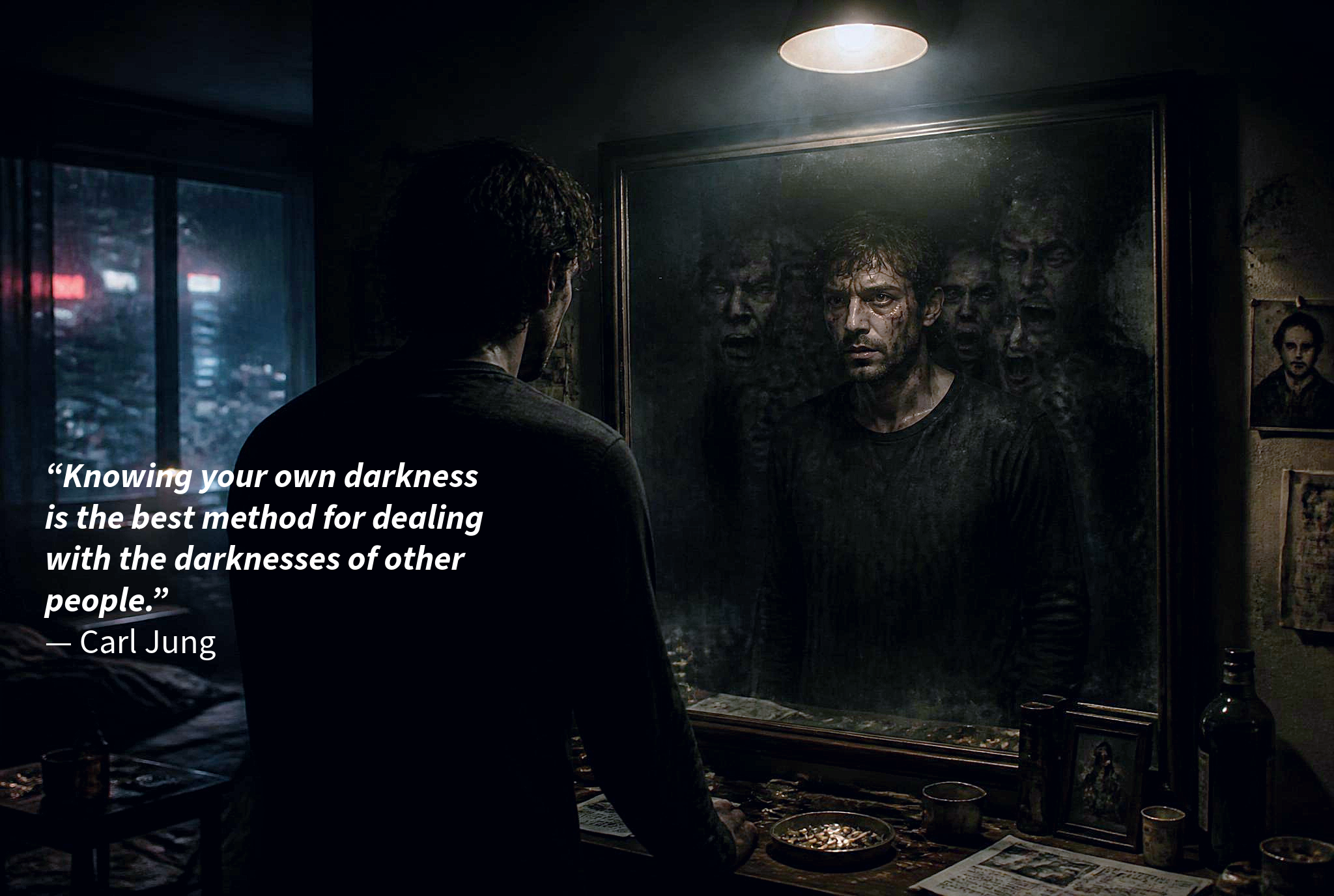
There’s something uncomfortable about this quote immediately. Not because it sounds cruel—but because it asks for honesty most people spend years avoiding.

To know your own darkness means more than acknowledging flaws casually. It means recognizing the parts of yourself that do not fit the identity you prefer to present to the world. The envy. The anger. The selfishness. The fear. The emotional wounds capable of becoming weapons if left unconscious long enough.

Most people would rather believe they are purely good.

Life rarely allows that illusion to survive untouched forever.

Because darkness is not always dramatic.

Sometimes it appears quietly through defensiveness. Through the way unresolved pain leaks into conversations, relationships, reactions. A person who feels abandoned becomes emotionally distant before others can leave first. Someone deeply ashamed learns how to attack vulnerability in other people because witnessing openness reminds them of what they buried in themselves years ago.

That’s the difficult thing about unexamined suffering:
it rarely stays contained.

Human beings pass emotional damage to one another constantly without fully understanding where it originated. Hurt people become controlling. Lonely people become emotionally unavailable. Frightened people become cruel in the name of self-protection. And often the behavior makes perfect psychological sense once you trace it back far enough.

But understanding darkness is not the same thing as excusing it.

That distinction matters.

Self-awareness does not magically remove harmful impulses. It simply prevents people from remaining blindly ruled by them. Because the more disconnected someone becomes from their own inner contradictions, the easier it becomes to project them outward onto everyone else.

Mental exhaustion often deepens there—in the war between the self people want to believe they are and the self quietly revealed through their patterns, reactions, and emotional habits.

That confrontation can feel humiliating.

No one enjoys discovering they are capable of bitterness, manipulation, avoidance, jealousy, or emotional cowardice under the right conditions. Yet pretending those capacities do not exist only gives them more control from the shadows.

And perhaps that’s why emotionally mature people often become gentler over time.

Not because they stop recognizing darkness in others…

…but because they finally recognize enough of it inside themselves to understand how human frailty actually works.

Maybe wisdom is not becoming a person without darkness.

Maybe wisdom is learning how to carry awareness of your own inner complexity without allowing it to harden you into cynicism or self-hatred.

Because once you understand your own capacity for fear, contradiction, and emotional damage, compassion stops being abstract morality.

It becomes realism.

The quiet recognition that every human being is fighting battles between woundedness and responsibility internally—whether they admit it openly or not.

And perhaps the goal is not purity.

Perhaps the goal is consciousness.

To know what lives inside you clearly enough that it no longer has to control the lives of everyone around you unconsciously.


Reflective Prompt

What part of yourself becomes hardest to acknowledge when you are emotionally hurt or afraid?

Quote of the Day – 11082025


Personal Reflection:
Silence has a weight you can’t measure — only feel. It presses gently against the edges of thought, waiting for you to notice it. Most people rush to fill it, terrified of what it might reveal. But Rumi knew better. Silence doesn’t flatter, it doesn’t negotiate — it just tells the truth. The way still water reflects your face, silence reflects your soul. It’s honest even when you’re not.

We live in a world allergic to quiet. Even our grief has a soundtrack now. We drown in commentary, afraid that stillness might expose how much of what we say is just noise. There’s a strange intimacy in silence — the kind that makes you confront your own mind. You start to hear things you’ve been avoiding: the echo of unfinished forgiveness, the ache beneath your composure, the fear that if you stop speaking, you might finally have to listen. Silence is an unkind teacher, but an honest one. It reminds you that clarity rarely comes with comfort.

And yet, silence also keeps us alive in ways noise never can. It teaches you to wait, to observe, to recognize the faint pulse of what is real. When you sit inside it long enough, it begins to reorder your senses. You stop needing to explain yourself. You start to understand that truth doesn’t need your defense — only your attention.

Maybe silence isn’t absence — maybe it’s the soul’s original dialect. Every time you return to it, you’re reminded that life doesn’t need to be narrated to be lived. The quiet doesn’t lie because it can’t — it has nothing to prove. If you can bear its stillness, it will tell you everything you’ve forgotten to hear: that peace was never lost, only buried under noise; that grace has been waiting for you to shut up long enough to arrive.

Silence doesn’t demand faith — it demands presence. It’s not passive; it’s participatory. It’s you, meeting yourself without a script.


Reflective Prompt:
What truth hides beneath the noise in your life — and what might happen if you stopped filling the silence long enough to hear it?

Awe Without Agreement

Daily writing prompt
How important is spirituality in your life?

Why Spirituality Still Guides Me, Even Without Certainty

Spirituality isn’t just important in my life—it’s foundational, not in a rigid or performative sense, but like a compass in the dark: quiet, steady, essential. It’s how I move through the world—not by chasing answers, but by honoring mystery and the many paths people take to find meaning.

Over time, I’ve come to see that spirituality isn’t about being right. It’s about being rooted in humility, in compassion, in the ability to hold tension without needing to control it. It’s about making space for someone else’s truth, even when it doesn’t look like mine.

A person’s spiritual journey is personal and should be respected, not ridiculed. Whether it winds through scripture, silence, ritual, or raw experience, that path isn’t mine to judge—only to witness with reverence.

This isn’t some foolish notion born from reading obscure texts. It’s something I’ve witnessed—men and women of different beliefs working side by side to feed the hungry, to care for the sick, to comfort the grieving. Not because they shared beliefs, but because they shared purpose. That, to me, is sacred.

This ideal is the basis of my forthcoming work, Understanding Without Agreement—a reflection on interfaith understanding, sacred plurality, and the shared longing beneath our differences. It challenges the notion that coexistence requires compromise and instead affirms that belief and respect can live side by side.

Spirituality shows up in sacred texts and indigenous rhythms, in Buddhist stillness and Sufi fire, even in the honest discomfort of philosophical critique. It’s not a uniform—it’s a mosaic. And every piece matters.

So yes, spirituality is vital in my life. Not because it solves everything, but because it keeps me human. It teaches me to listen deeper, to live with open hands, and to believe—fiercely and tenderly—that awe is bigger than agreement.