Personal Reflection
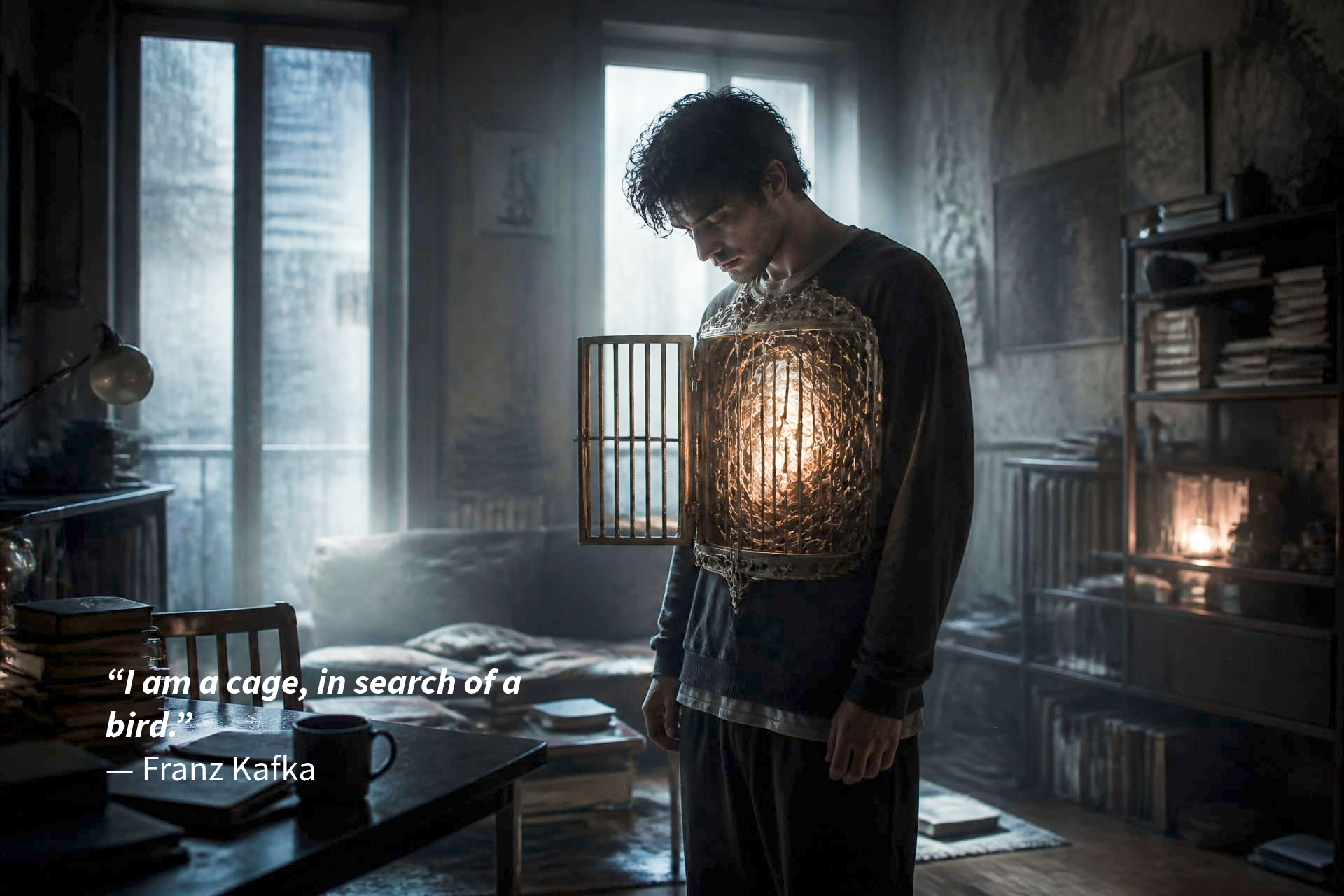
At first glance, it feels strange—almost incomplete. A cage searching for a bird sounds backwards. The cage is supposed to hold something captive, not wander through the world longing for what’s missing.
But maybe that inversion is exactly why it lingers.
Because some people move through life carrying a shape inside them that was built for connection, meaning, intimacy, purpose—something alive—and yet the thing itself never fully arrives. So they continue existing around an absence they can feel but cannot always name.
That’s what makes certain forms of loneliness so difficult to explain. It isn’t always the absence of people. Sometimes it’s the absence of access. Access to yourself. To honesty. To the version of your life that once felt emotionally reachable before survival instincts started sealing things off room by room.
And most cages aren’t built all at once.
They form gradually.
A disappointment here. A betrayal there. The slow accumulation of moments where vulnerability felt unsafe or costly. Eventually, you stop opening certain doors inside yourself because it becomes easier to function than to feel everything sitting behind them.
That’s the dangerous part about emotional survival—it can become so efficient that you no longer recognize it as survival. It just starts feeling like personality. You call yourself private. Reserved. Independent. Meanwhile, underneath those carefully chosen words is someone exhausted from carrying entire conversations internally because trusting another person with the full weight of them feels too risky.
Kafka’s image cuts deeper the longer you sit with it because the cage isn’t only confinement—it’s longing shaped by confinement. The structure itself is searching. Hoping. Waiting for something capable of moving freely through the spaces where air has grown stale.
And maybe that’s why emotional numbness can feel so terrifying once you finally notice it. Not because you feel too much… but because you realize how long you’ve been surviving on fragments. Small emotional rations. Controlled vulnerability. Half-spoken truths.
You begin to wonder what parts of yourself became quiet simply because they were never given room to breathe.
There’s grief in that realization.
The grief of recognizing how much of your emotional life has been spent adapting to confinement instead of questioning whether the confinement should exist at all.
Still… the fact that the cage searches matters.
It means something inside you remains unfinished in the best possible way. Some part of the self still reaches outward despite disappointment. Still believes connection is worth risking discomfort for. Still hopes for movement, warmth, understanding—something living enough to disturb the silence.
Maybe healing isn’t becoming wide open overnight.
Maybe it begins smaller than that.
A single honest conversation.
A moment where you stop editing yourself.
A breath taken without bracing for impact.
Because perhaps the opposite of emotional imprisonment isn’t absolute freedom.
Perhaps it’s simply finding the courage to let something real enter the room again.
Reflective Prompt
What part of yourself became quiet in order to survive—and what would it take for it to feel safe enough to speak again?
Discover more from Memoirs of Madness
Subscribe to get the latest posts sent to your email.


Good piece Mangus.
Anything for a peaceful life, be what was expected, do what other people wanted. BIG MISTAKE. I lost my identify and eventually my sense of worth until everything blew up and I’d had enough. He dared to tell me who I could and could not have in my house when he was not there (away with his mates leaving me to look after his kids). A year later I left, and I have never regretted it.
LikeLiked by 1 person
Awesome …that guy sounds like a tosser [did I get that right?] I’m glad you got away from that environment. Thanks, Di
LikeLike
Spot on Mangus. He’s the guy who got my freshly made cup of coffee in his lap.
LikeLike
A friend and I discussed loneliness the other day…I said when asked about loneliness, “I was never more lonely than when I was married…the day he left, the loneliness disappeared.” For the most part, I’ve never been lonely, because I always had something to do that was valuable…outside of having to work and raising kids which keeps you occupied a great deal of the time, but then I had interests, painting, drawing, in particular until a workplace accident all but took my sight…then as I was talking to my newly acquainted friend, realized, he was a person that made me comfortable, understood and safe…with him, i speak truth honesty unafraid of consequence judgement or worse…finally able to put the cruelty I’ve survived behind me…for that and for him I am truly grateful…
LikeLiked by 1 person
“A woman needs security, like a man needs approval” is the code I live by. You are spot on with analysis of loneliness. Thank you
LikeLiked by 1 person
Thank you for understanding it.
LikeLike