Mikey’s Diner, 2:13 A.M.


Steven had a bad day and just needed something to make him feel better.

That was the excuse anyway.

The truth sat heavier.

The truth was he’d been driving around for nearly an hour with nowhere to put himself. The apartment felt wrong now. Too quiet in the places that mattered. Even the refrigerator hum sounded lonely. Especially at night.

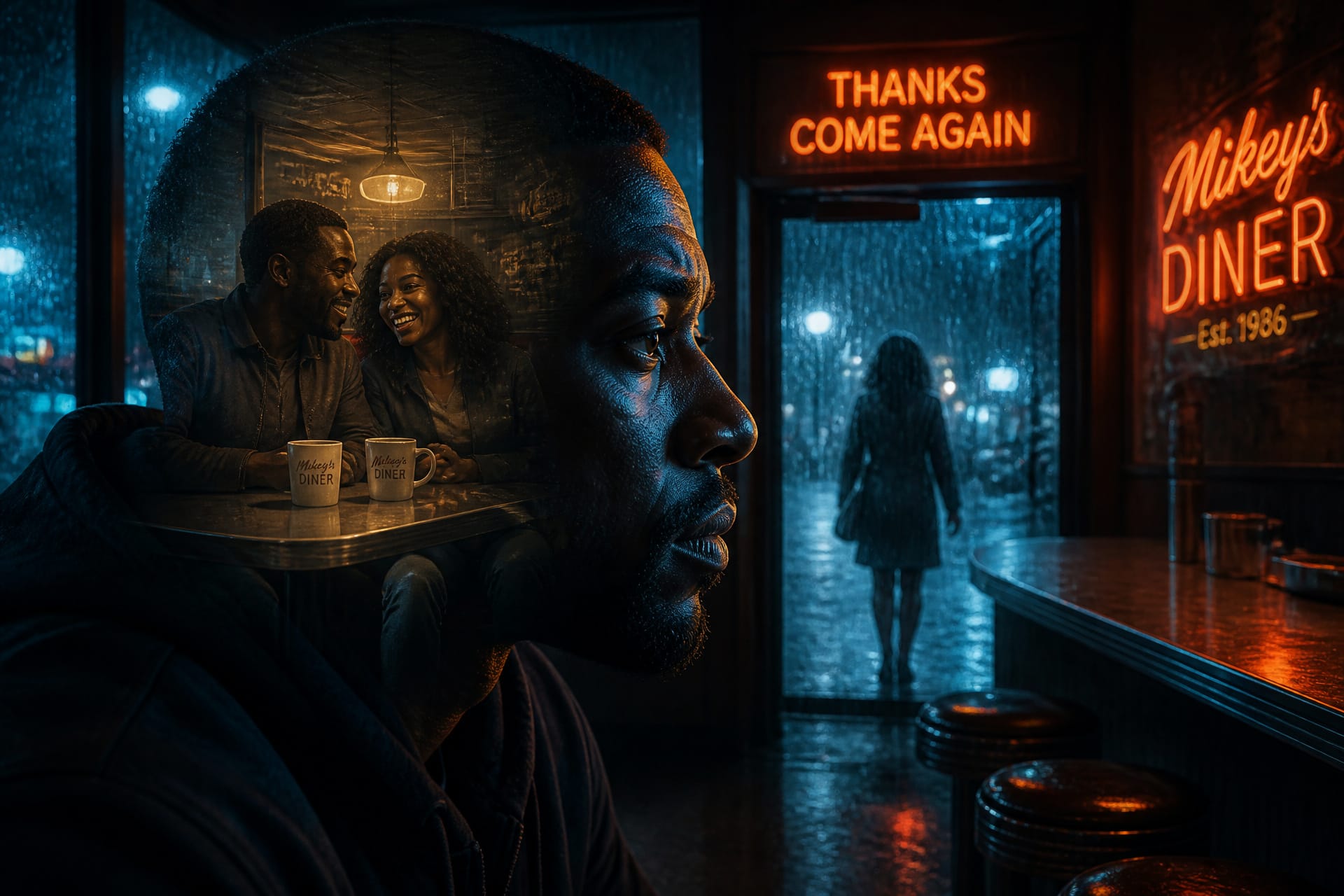
So he ended up at Mikey’s Diner again.

Rain hammered the city in silver sheets, turning headlights into smeared watercolor ghosts across the windshield. The neon sign outside the diner buzzed and flickered in bruised shades of orange and blue.

THANKS COME AGAIN.

Steven stared at the sign longer than necessary.

Funny how harmless things became cruel when you were grieving.

He stepped out into the rain. Cold water soaked through the shoulders of his hoodie instantly, slid down the back of his neck, crawled under his collar like icy fingers. The night smelled of wet asphalt, cigarette smoke, and oil rising from the streets after rain—the scent of a city sweating out its sins.

Inside, warmth hit him first.

Then the smell.

Burnt coffee. Bacon grease. Dish soap. Old leather booths cracked from decades of tired people sliding in and out carrying heartbreak like unpaid tabs.

The kind of place where nobody asked too many questions because everyone was already carrying something.

Mikey glanced up from behind the counter and gave a small nod.

No smile.
No “How you doing?”
Just recognition.

That was the utility of old diners and older men. They understood silence wasn’t emptiness. Sometimes silence was triage.

Steven slid into their booth.

Their booth.

The vinyl creaked beneath him. The table still had the tiny burn mark Jasmine made trying to light one of those ridiculous clove cigarettes she swore made her feel “mysterious and French.” She’d nearly set the napkin dispenser on fire laughing.

Now the mark felt archaeological.

Proof she existed.

Outside, rain crawled down the windows in trembling streams, distorting the city into something underwater and unreal. Steven watched strangers move past beneath umbrellas and streetlights, their shapes bending in the glass.

For a second, every woman became her.

That was the cruel part.

Grief turned the world into a hall of mirrors.

He rubbed his thumb along the coffee mug Mikey set down in front of him. The ceramic heat burned pleasantly against his skin, but the warmth never traveled farther than his hands. His chest still felt hollowed out. Excavated.

“You eating?” Mikey asked.

Steven looked at the menu without seeing a single word.

“Nah.”

“You said that yesterday.”

“I meant it yesterday too.”

Mikey grunted and walked off.

Steven stared at the empty seat across from him.

Jasmine used to fill space aggressively. Not loudly—never that—but completely. She had this way of leaning forward when she listened that made you feel like the center of the universe instead of background noise. Her laughter came fast and reckless, head tilted back slightly, curls catching neon light while her fingers drummed against coffee cups like she carried music under her skin.

And God, she noticed everything.

“You know what your problem is?” she once told him here at this exact booth.

Steven had snorted. “Feels like a dangerous question.”

“You think sadness makes you deeper than everybody else.”

“That sounds insulting.”

“It is insulting.”

Then she smiled afterward so he knew it came from love instead of cruelty.

Now he’d kill to hear her insult him again.

The jukebox crackled near the bathrooms. An old soul record drifted through the diner low and smoky, full of aching brass and tired romance. Jasmine loved music that sounded slightly damaged. Said perfect vocals made her suspicious.

“Pain should leave fingerprints,” she used to say.

Steven swallowed hard.

The memories weren’t arriving clean anymore. They came fragmented now. Pieces. Her hands wrapped around coffee mugs. The scent of coconut lotion and rainwater in her curls. The tiny scar near her eyebrow from falling off a bike at thirteen.

He was terrified of forgetting the sound of her voice.

That fear upset him more than death itself.

Because death was final.

Forgetting felt like betrayal.

A group of college kids stumbled inside laughing too loudly, dripping rainwater across the tile floor. One wore an expensive wool coat with an elite university crest stitched onto the breast pocket. Young faces. Healthy faces. The careless invincibility of people who still believed time owed them something.

Steven looked away before resentment settled too deep.

That bitterness had started creeping in lately.

Not enough to make him cruel.
Just enough to make him tired.

Grief had turned him into a gadfly version of himself—irritable, restless, quietly hostile toward joy he couldn’t participate in anymore. He hated that part. Hated how pain could reduce the soul into something smaller if you weren’t paying attention.

Mikey returned carrying fries Steven didn’t order.

“I said I wasn’t hungry.”

“Yeah,” Mikey muttered. “And I said nothing.”

Steven almost smiled.

Almost.

Steam rose from the fries carrying the smell of salt and grease. Jasmine used to steal half of them while insisting she “only wanted one.”

He reached for a fry automatically before realizing there’d be nobody reaching beside him for the next one.

The realization hit strange.

Not sharp anymore.

Worse.

Dull.

Like emotional nerve damage.

Steven leaned back in the booth and watched the rain assault the windows.

“We barely had time,” he said quietly.

Mikey pretended to wipe the counter.

“Mm.”

“That’s the part nobody tells you.”

The old cook glanced over.

“What part?”

Steven stared into his coffee. Black. Reflective. Bottomless.

“You spend your whole life hearing love is hard to find.” His throat tightened. “Then when you finally do find it…” He exhaled shakily. “Turns out keeping it is harder.”

The diner hummed softly around him. Plates clinked. Coffee poured. Rain battered glass. Somewhere in the kitchen grease hissed like static.

Life continuing without permission.

The song on the jukebox reached the chorus again, soft and bruised around the edges. An encore of longing. Steven closed his eyes for a moment and let it wash over him. Jasmine used to sing this exact part off-key on purpose just to annoy him, dragging out the last line dramatically until he threatened to leave her there with the check.

He’d give anything to hear that terrible performance one more time.

Steven looked toward the door.

For one dangerous second he imagined Jasmine walking through it again—rain-soaked curls, crooked grin, teasing him for looking miserable.

But only strangers entered.

Only strangers left.

The neon sign painted trembling orange across the wet floor tiles.

THANKS COME AGAIN.

Steven laughed softly to himself, exhausted and cracked around the edges.

“Yeah,” he whispered toward the empty seat. “I wish you could.”

And for the first time all night, the silence across from him felt less empty and more haunted.

Not by ghosts.

By love that still refused to leave.

No Vacancy for Ghosts


Rain in Greybridge never fell clean.

It came down carrying the city with it.

Oil from overcrowded streets.
Ash from factory stacks.
The metallic scent of train rails.
The ghost of cigarette smoke trapped between alley bricks from twenty years ago.

By midnight, the rainwater pooled in potholes black enough to mistake for graves. Neon signs bled themselves into the pavement until the entire city looked wounded. Greybridge didn’t sleep so much as flicker. Like an exhausted man trying to stay conscious through one more bad decision.

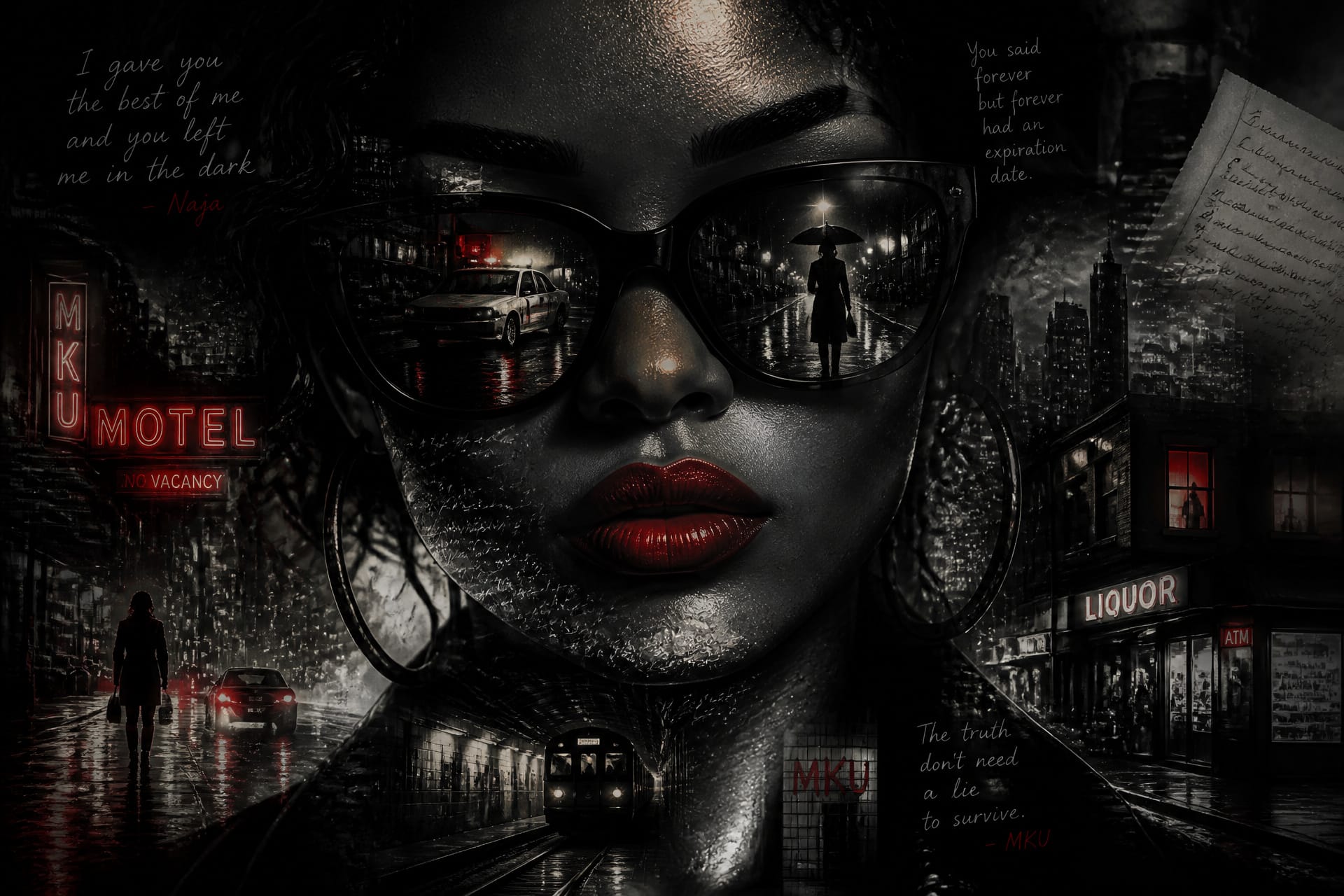
Naja stood beneath the dying red glow of the MKU Motel sign with a cigarette trembling slightly between two fingers she wished she trusted more.

NO VACANCY.

The buzzing neon painted her cheekbones crimson, making her look less alive and more preserved. Like some beautiful thing trapped in formaldehyde.

The cigarette tasted stale. Cheap tobacco and regret.

Across the street, the liquor store windows glowed jaundiced yellow against the storm. Somewhere underground, a train screamed through rusted tunnels, the sound vibrating faintly beneath the soles of her boots. Somewhere above, thunder rolled low and patient over the skyline.

The city was full of sounds that resembled warnings if you listened hard enough.

Most people didn’t.

Most people walked through life assuming catastrophe sent invitations first.

Naja adjusted her sunglasses even though it was night.

Especially because it was night.

People assumed women wore shades after dark because they wanted attention. Mystery. Style. Seduction.

Truth was uglier than that.

Sometimes sunglasses were camouflage.
Sometimes they were exhaustion.
Sometimes they hid bruises.
Sometimes they kept strangers from seeing emotions you couldn’t afford to explain.

Mostly, they created distance.

And distance was survival.

The motel office door creaked open behind her.

“You waiting on somebody?”

The clerk’s voice sounded like bourbon poured over gravel.

Naja didn’t turn around.

“No.”

“Then why you still standing out there?”

She watched headlights smear themselves across the rain-slick street.

“Trying to decide whether regret is a place or a person.”

The old man coughed out something halfway between a laugh and emphysema.

“Hell,” he muttered. “In this town? Could be both.”

The door shut again.

Silence returned except for rain tapping metal gutters and the occasional hiss of passing tires.

Naja stayed where she was.

Because movement would mean commitment.
Leaving.
Returning.
Forgiving.
Breaking.

And she wasn’t sure which frightened her more.

Her phone vibrated inside her coat pocket.

Elias.

Of course it was Elias.

The name alone tightened something behind her ribs.

He moved through her memories like smoke beneath a locked door. Elusive. Impossible to fully remove no matter how many windows you opened afterward. The kind of man who left fingerprints on your psychology.

She stared at the screen until the ringing stopped.

Then started again.

Persistence always sounded romantic in songs and movies.

In real life, persistence often looked a lot like disrespect wearing cologne.

She answered on the fourth ring because loneliness and curiosity were cousins pretending not to know each other.

“What?”

“You still angry?”

Naja closed her eyes slowly.

There it was.

That soft male instinct to reduce devastation into moodiness. As though betrayal was just a temporary emotional inconvenience instead of structural damage.

“You burned my life down.”

“I said I was sorry.”

Rainwater slid down the side of the motel sign and dripped beside her shoulder.

“That’s the problem,” she said quietly. “You think sorry is a fire extinguisher.”

Silence.

Not empty silence.

Weighted silence.

The kind where both people hear truths they’re trying to step around.

A police siren wailed somewhere far downtown. Faint. Distant. Like the city itself crying through clenched teeth.

“I miss you,” Elias finally said.

And damn him for knowing how to sound sincere.

That had always been his greatest weapon.

Not manipulation.

Believability.

Naja leaned against the cold brick wall beside the motel office. Moisture soaked through her coat immediately. Greybridge didn’t do comfort. Even the walls felt emotionally unavailable.

The onset of memory arrived without permission.

Jazz low in the background of his apartment.
Rain against windows.
Coffee burning slightly on the stove because he always forgot it.
The smell of cedar soap on his skin.
His fingers tracing circles against her hip like he was trying to memorize her instead of consume her.

His kiss reminded her of chemistry lessons in school, when, if the right two elements were mixed together, they’d explode.

Back then she thought explosions were passion.

Nobody explained the aftermath.

Nobody talked enough about debris.

“You there?” Elias asked softly.

“Unfortunately.”

He laughed under his breath.

God, she hated that laugh.

Because some traitorous part of her body still remembered feeling safe around it.

“You always knew how to cut somebody.”

“No,” she whispered. “I just stopped bleeding first.”

A black sedan rolled slowly past the motel.

Too slowly.

Naja noticed things because women learned early that survival often lived inside observation. Men mistook vigilance for anxiety because they rarely had to calculate threat levels walking to their own cars.

The sedan circled the block.

Rain distorted its reflection across the pavement until it looked submerged.

Elias kept talking.

About Miami.
About music.
About memories.

Men always remembered vacations after relationships collapsed. Women remembered emotional climate.

Naja remembered standing barefoot in a hotel bathroom staring at concealer covering a bruise she’d explained away to herself before anyone else had the chance.

She remembered the second phone.

The hidden withdrawals.

The gradual onset of fear that arrived so quietly she almost mistook it for stress.

That was the insidious thing about emotional damage.

It rarely arrived screaming.

It arrived reorganizing your nervous system one compromise at a time.

“You know what your problem is?” Elias asked.

Naja smirked faintly.

“This should be educational.”

“You never let people stay.”

“No,” she corrected softly. “I eventually oust the ones trying to bury me.”

The sedan stopped at the curb.

Engine idling.

Windows tinted black.

Every muscle in her body tightened instinctively.

The city taught pattern recognition the same way war taught soldiers.

Repeated exposure.
High consequences.
No room for denial.

“Naja?”

“You need to stop calling me.”

“I can fix this.”

Rain hammered harder now, loud enough to erase smaller sounds.

“No,” she whispered. “You can’t.”

A figure stepped out of the sedan.

Long dark coat.
Umbrella.
Measured pace.

Not hurried.

That scared her more than aggression would have.

Violence was easier to predict than calm.

The figure approached slowly beneath streetlight reflections that broke across puddles like fractured film reels.

Elias was still speaking when Naja ended the call.

The silence afterward felt enormous.

The stranger stopped beneath the motel sign.

Water dripped steadily from the umbrella edges.

“You Naja?”

“That depends who’s asking.”

The woman studied her carefully before answering.

“Someone who knew Vivian.”

The name struck like cold metal against exposed skin.

Naja’s stomach turned hard.

Vivian.

Three years since hearing that name spoken aloud.

Three years trying to outwalk everything attached to it.

“You’re mistaken.”

“No,” the woman said gently. “I don’t think I am.”

The city seemed quieter suddenly.

Or maybe fear just sharpened focus.

Naja noticed everything now.

Steam rising from sewer grates.
A broken window three buildings down.
The smell of wet concrete and gasoline.
The ache in her jaw from clenching too hard.

“You’ve been difficult to find,” the woman continued.

“Elusive,” Naja corrected automatically.

A faint smile touched the stranger’s mouth.

“Fair enough.”

Naja glanced toward the motel office.

Dark windows.
Television glow flickering inside.
Nobody coming to help.

Greybridge loved witnesses right up until involvement became inconvenient.

“What do you want?”

“To warn you.”

“About what?”

The woman looked toward the skyline where skyscrapers disappeared into rain and darkness.

“The people Elias owes money to.”

There it was.

Truth.

Raw.
Unperfumed.
Finally honest.

Naja laughed once beneath her breath.

Not because it was funny.

Because somewhere deep inside herself she’d known the story wasn’t finished.

Stories like this never ended clean.

They metastasized.

Spread themselves through everyone foolish enough to love the wrong person.

“He told them about you,” the woman said quietly.

Coldness slid slowly through Naja’s chest.

“And why would he do that?”

“Because desperate men turn love into outlay. Currency. Collateral.”

Rainwater dripped from Naja’s chin.

Somewhere underground, another train roared through darkness.

She studied the stranger more carefully now.

The scar near her throat.
The exhaustion behind her eyes.
The rigid posture of someone who slept lightly and trusted poorly.

Survivor recognized survivor.

“You knew him too.”

The woman hesitated.

Long enough to hurt.

“That’s why I’m here.”

For a moment neither moved.

Two women standing beneath poisoned neon while the city breathed around them like something alive and carnivorous.

Naja crushed her cigarette beneath her heel.

The ember hissed violently against wet pavement before disappearing.

“You got a name?”

“Clara.”

“You armed, Clara?”

One eyebrow lifted slightly.

“In this city?”

For the first time all night, Naja almost smiled.

Almost.

Then she stepped away from the motel wall and into the rain beside her.

Not because she trusted Clara.

Trust was expensive.

But because instinct recognized something familiar in her.

The exhausted posture.
The hypervigilance.
The quiet fury women carried after surviving men who mistook affection for ownership.

Above them thunder rolled across Greybridge like furniture dragged across heaven.

And somewhere in the dark beyond the city lights, something waited patiently for them both.


Author’s Note

A huge thank you to Di’s 3TC, Fandango Story Starter #246, and Reena Xploration Challenge #430 for the inspiration behind this story. There’s something uniquely addictive about writing with challenge words and prompts because they force you out of creative autopilot. Sometimes a single strange word can unlock an entire emotional landscape you didn’t even know was sitting there waiting.

I especially enjoy the tension of weaving challenge words naturally into a story without making them feel forced or mechanical. It becomes a kind of narrative puzzle — part improvisation, part excavation. You start with scattered ingredients, then somewhere along the way the characters take over, the atmosphere thickens, and suddenly the story begins revealing things you never consciously planned.

That’s the magic of these challenges for me. They push writers to experiment, take risks, and discover unexpected emotional truths hiding between random words, images, and late-night ideas.

Thank you again to all three prompts/challenges for helping spark this rain-soaked little descent into Greybridge.

What Wakes at Midnight


At midnight, the abandoned amusement park came alive.

Not all at once.

It started with a tremor—so slight Daniel thought it was his imagination catching on something. Then came the hum. Low. Electrical. Wrong. It crawled under his skin before it reached his ears, like something waking up beneath the ground rather than inside the wires.

He saw the lights flicker from the road.

One bulb. Then another. A broken string of carnival glow stuttering back to life like a heartbeat trying to remember its rhythm.

He should’ve kept driving.

Instead, his foot eased off the gas. The engine idled like it was waiting for permission he didn’t need to give.

The gate hung open.

Not wide. Not welcoming. Just enough to suggest it had been that way for a long time—or had only just been moved for him.

Inside, the air smelled of rust and old sugar. Burnt oil. Damp wood. The kind of scent that clings to your throat and settles there, like something you forgot to say years ago.

Then the lights came on.

Not bright. Not clean. They buzzed overhead in tired colors—faded reds, sickly yellows, a blue that looked like it had been left out in the rain too long. The Ferris wheel groaned into motion, slow at first, metal dragging against metal with a sound that felt too close to breathing.

Music followed.

A warped calliope tune, stretched thin and uneven. Notes bending where they shouldn’t. Like memory trying to play itself back but getting the details wrong.

Daniel stepped forward.

Not because he wanted to.

Because something in him leaned toward it.

And then he saw her.

She stood beneath the Ferris wheel like she belonged to the place more than the rust did. Still. Unbothered. Watching the wheel turn like it meant something.

“You made it,” she said.

Her voice cut clean through the noise—steady, grounded, like it didn’t need the rest of the park to exist.

Daniel frowned. “Do I know you?”

“Not yet.”

She stepped closer.

The closer she got, the more the world seemed to settle. The flickering lights steadied. The warped music smoothed just enough to be recognizable. Even the air shifted—less decay, more… presence.

He noticed her eyes first. Not because they were striking—but because they weren’t searching. They already knew where to land.

“What is this?” he asked.

“A place that doesn’t lie to you,” she said. “At least not the way the rest of the world does.”

That answer didn’t help.

It didn’t need to.

She took his hand.

Her skin was warm.

That surprised him more than anything.

The moment their fingers closed, the park surged.

The Ferris wheel picked up speed, wind whispering through its spokes. The carousel jolted into motion, horses rising and falling with a rhythm too smooth to be mechanical. Lights stretched into streaks as if the night itself had started to move.

Laughter echoed.

Not distant. Not imagined.

Close enough that he turned, expecting to see faces—but there was nothing there. Just the sound lingering a second too long, like it didn’t know where to go after it existed.

“You feel that?” she asked.

He did.

It wasn’t joy.

It was sharper. Edged. Like standing at the exact point where something could still change—but probably wouldn’t.

They rode everything.

Or maybe everything rode them.

Time didn’t pass—it folded in on itself, collapsing minutes into moments that felt too full to measure. The wind cut across his face on the Ferris wheel, cold enough to sting, grounding enough to remind him he was still in a body that had forgotten how to feel like this.

He laughed.

It came out rough. Rusted. Like a door that hadn’t been opened in years.

She watched him when he did.

Not with amusement.

With recognition.

“You’re starting to remember,” she said.

“Remember what?” he asked, breath uneven.

She didn’t answer.

Instead, she led him into the funhouse.

The mirrors didn’t distort.

They clarified.

In one, he saw himself younger—jaw tighter, eyes sharper, something unbroken sitting just behind them like it hadn’t been introduced to the world yet.

In another, older—shoulders slumped, gaze dulled by a thousand small compromises he never named as such.

And then—

A roadside.

His car idling.

His hand on the wheel.

That moment.

The one where he almost turned left instead of right.

He stepped back.

His chest tightened like something had reached in and pressed against the inside.

“What the hell is this?” he asked.

“This is where the things you walked away from keep breathing,” she said quietly.

He turned to her.

“And you?”

For the first time, she hesitated.

“I’m one of them.”

The words didn’t echo.

They sank.

The park shifted again.

The colors dulled. The lights flickered harder now, exposing the rust beneath the paint, the cracks beneath the illusion. The music stuttered, skipping notes like it was losing its grip.

“You’re not real,” he said.

She smiled—but it carried weight now.

“I was,” she said. “Just not in the life you chose.”

That hit harder than anything else had.

Outside, the sky had begun to thin. The black giving way to something weaker. Something inevitable.

Dawn.

“You don’t have much time,” she said.

“For what?” His voice came out quieter now.

“To decide if this matters,” she said.

He looked at her.

Not the idea of her.

Her.

The way she stood like she didn’t need permission to exist. The way she saw him without asking him to explain himself first.

“You feel real,” he said.

“I am,” she replied. “Just not in a way you get to keep.”

There it was.

The truth, stripped clean.

He swallowed.

“Then what’s the point of this?”

She stepped closer, close enough that he could feel her breath—warm, steady, human.

“To remind you,” she said, “that the man you almost were… didn’t disappear. You just stopped listening to him.”

The Ferris wheel slowed.

The lights dimmed.

The hum faded into something hollow.

He felt it leaving.

Not the park.

The feeling.

That sharp, dangerous clarity slipping back into the quiet place it had come from.

“Stay,” he said.

The word surprised him.

She shook her head gently.

“You don’t want me,” she said.

“I do.”

“No,” she said. “You want the version of yourself that exists when I’m here.”

He didn’t argue.

Because the worst part was—

She was right.

At the gate, the world outside waited. Still. Ordinary. Safe in the way things are when they don’t ask anything from you.

She let go of his hand.

“This is where you go back,” she said.

“And you?”

“I stay where I’ve always been,” she said. “Right at the edge of the choice you didn’t make.”

He nodded slowly.

“Will I see you again?”

She stepped back into the dimming light.

“Only if you forget.”

And then—

Nothing.

The park stilled.

The lights died.

The music cut off mid-note.

Daniel stood there, the silence pressing in heavier than the noise ever had.

He could still feel her hand.

Still smell the rust and sugar.

Still hear the echo of laughter that didn’t belong to anyone.

He got back in his car.

The engine turned over like it always did.

The road stretched ahead like it always had.

But something in him didn’t sit the same.

Because now he knew—

Some places don’t come alive to entertain you.

They wake up to remind you who you were before you decided to be someone easier to live with.

Rooted in Thornblood


The forest didn’t whisper. It listened.

Moist air clung to her skin like a second pulse. The scent of wet bark and crushed fern pressed deep into her lungs. Every step stirred the soft rot of leaves beneath her feet—cool, decomposing, fragrant with endings that fed beginnings. Moss brushed her calves. A thin vine trailed behind her like an unfinished thought.

She was not naked.

She was clothed in what the forest allowed her to keep.

Ivy braided across her ribs. Pale blossoms trembled at her collarbone. Fine thorns traced her thighs like handwriting no one else could read. They tugged when she moved, gentle but present—reminding her that nothing beautiful grows without defense.

Fireflies drifted around her in erratic patterns, their glow warm against the heavy dark. One landed on her shoulder. She felt the faint vibration of its wings before it lifted away. Even the smallest things left impressions.

He had always been observant.

Not casually attentive. Not the sort who admired surface and moved on. He cataloged the world. He noticed breath patterns. The tension in a jaw before a lie. The way her vines tightened when she was unsettled. When he looked at her, she felt studied—not consumed, not worshiped—but understood in layers she hadn’t offered willingly.

That both steadied and frightened her.

The first time he touched her wrist, he had paused at the vine wrapped there.

“It tightens when you’re anxious,” he’d said.

She had laughed too quickly.

Now the forest felt thicker. The air colder against the hollow beneath her throat. Somewhere behind her, a branch shifted. Not broken—just acknowledged. The night insects hummed in low, persistent rhythm, like a pulse beneath the earth.

She felt him before she saw him.

A disturbance in the air. A subtle shift in pressure. Her body reacted first—the vines along her stomach drawing taut, blossoms trembling faintly.

He stepped into the clearing.

The last of the evening light caught along his jaw and dissolved. His face carried that familiar, serious expression—measured, grounded, almost judicial. He was a man who believed emotion should be examined before expressed. He carried silence like a disciplined habit.

She studied him in return.

He was finite. Warm where she was seasonal. His breath fogged faintly in the cooling air. She could hear it—steady, controlled. She could smell the iron edge of his skin, the faint earth he had disturbed walking toward her.

He approached her with a kind of forensic patience, as though reconstructing a fragile scene. Love, to him, was not a declaration but a collection of evidence. The way her shoulders lowered when he stood near. The way her pulse slowed when he didn’t rush. The way her vines relaxed when he chose not to claim.

She stopped a few feet from him.

Her heart beat deep and slow—sap and blood moving beneath skin threaded with green. The blossoms at her collarbone quivered.

She wanted to tell him how much she loved him, but….

The word felt insufficient. Too neat. Too small for what rooted inside her.

Love, for her, was not sentiment. It was infiltration. It was growth that cracked stone and shifted foundations. It was surrender to something that did not ask permission. If she spoke it aloud, she feared it would manifest physically—vines erupting from her mouth, binding him in a promise he might one day resent.

She had been admired before.

Desired. Approached like something rare and luminous.

But when her need for permanence revealed itself—when she grew toward them instead of decorating their lives—they recoiled. Men liked her wildness as long as it did not demand return.

He stepped closer anyway.

“You’re trembling,” he said quietly.

The sound of his voice moved through her like wind through tall grass. She felt it in her sternum.

“I’m trying not to,” she answered.

He reached for her wrist.

The vine tightened instinctively. A thorn grazed his thumb. She saw the skin split before he reacted. A bead of blood surfaced, dark against his warmth.

The metallic scent reached her first.

Her body stilled.

He inhaled sharply—but he did not withdraw.

His breathing steadied. His gaze stayed fixed on hers—not accusing, not startled. Present.

The forest shifted around them. A low wind moved through the canopy, carrying pine and damp earth. Fireflies drifted closer, their glow brighter, warmer.

Perhaps love was not the thing that trapped.

Perhaps it was the thing that stayed after the thorn.

She let her hand turn in his.

Where his blood touched her skin, something ancient recognized something equal. The vine at her wrist loosened—not in surrender, but in consent.

She did not speak the words.

Instead, a single white flower opened over his heart—slowly, deliberately—petals unfurling in the rhythm of his pulse.

The forest exhaled.

And this time, it did not take him back.

Author’s Note

This piece was inspired by the steady rhythm of community prompts that continue to push the work deeper than comfort allows.

Thank you to Fandango for both FOWC and FSS #235, for the nudge toward language that lingers longer than it should.

Gratitude as well to RDP and the Word of the Day, whose simple offerings often become the smallest sparks that ignite something larger and far more rooted than expected.

Sometimes a single word is all it takes to draw blood from a thorn.

Footprints of Omission


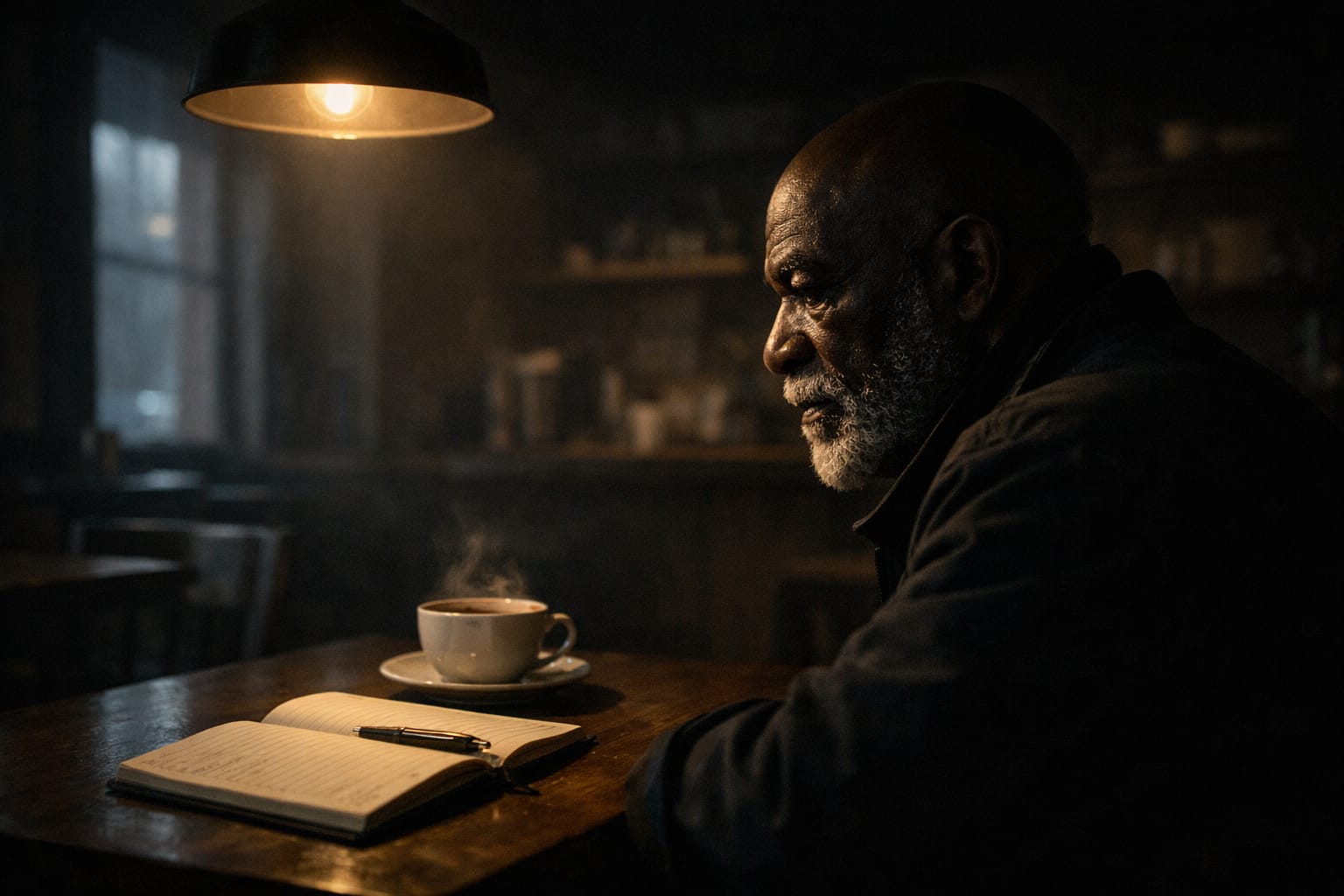
The café was nearly empty, the way it always was at that hour, when the city seemed to hold its breath between one intention and the next. A single bulb hung low over the table, casting a tired halo that didn’t quite reach the corners of the room. He sat beneath it with his shoulders rounded, as if the light itself carried weight, the familiar ache between his shoulder blades reminding him how many mornings had begun this way.

Steam lifted from the cup in front of him, thin and persistent, carrying the faint scent of something burnt at the edges. He didn’t drink it right away. He rarely did. Coffee, like memory, was better approached slowly. The notebook lay open, its spine softened by decades of use, pages crowded with a handwriting that had grown tighter over the years—as though space itself had become something to ration.

He had started the book long before he understood why. Since his father’s death, maybe longer. Names filled the early pages. Dates. Places half-remembered, half-invented. A census line here. A marriage record there. Ordinary things, assembled carefully, as if order alone might explain what had always felt misaligned. The ink had faded in places, smudged where a younger hand had dragged across still-wet letters. He traced a finger over his father’s birth date and wondered, not for the first time, if he had ever truly known his family at all.

Outside, a bus hissed to a stop. Inside, the café remained still.

He paused, pen hovering above the page. A name appeared twice in the records—his grandfather’s—attached to two different women in two towns separated by less than thirty miles. The dates overlapped by three years. He ran his thumb across the indentation in the paper, feeling something settle behind his ribs. It wasn’t proof. It was something worse—suggestion.

They say everyone who looks into their family history will find a secret sooner or later.

The thought didn’t arrive like revelation. It settled. Heavy. Familiar. He lifted the cup and drank, the bitterness grounding him. The past, he had learned, rarely announced itself. It preferred patience.

He turned the page.

What followed wasn’t violent or scandalous. It was quieter. A pattern of omissions. A child listed as “lodger.” A death without cause. A man who moved on easily while others slipped out of the record altogether. There was something almost methodical about it, something faintly sinister in its restraint, like footprints carefully wiped away, leaving only the suggestion of passage.

He closed the notebook and wrapped both hands around the cup. The warmth spread into his fingers, steady and real. Whatever he had uncovered didn’t change who he was—but it explained the silence he’d grown up inside, the way truth had always been treated like something fragile, dangerous, best kept out of reach.

Outside, the bus pulled away. The café’s clock ticked on.

He paid, nodded to no one, and slipped the notebook into his coat, feeling its weight settle against his side. Some secrets didn’t ask to be exposed. They only asked to be acknowledged, carried forward with care.

He stepped back into the cold, the door closing softly behind him. The notebook pressed against him with each step, a quiet reminder that he was just another link in a long chain of silences—and that the light and steam and unanswered questions would follow him home, patient as family ghosts.


Author’s Note

This piece was written in response to the quiet pull of two prompts that lingered longer than expected. My thanks to Fandango for hosting FSS#229, and to Di for MM309. Both offered just enough space to let the story find its own footing. Sometimes the right prompt doesn’t demand an answer—it waits, patient, until the words are ready to catch up.

Right on Cue

Dawn came early, the way it always did—no warning, no mercy. The sun didn’t rise so much as shove its way in through the slit where the blackout curtain had given up, and the landlord’s plastic rod had bowed to gravity. Even with my eyes shut, the light burned red behind my lids, hot and insistent, like it had something personal to settle.

I reached for the clock on the milk crate beside the mattress and knocked over the chipped mug I’d forgotten to finish. The smell of stale coffee lifted into the room, bitter and faintly sour. Three hours. Maybe three and a half if I lied to myself. The numbers glowed an accusing green.

Sleep used to feel like rest. Somewhere along the way, it turned into a negotiation. Too much, and I woke up slow, waterlogged. Too little, and every sound cut straight through me. Either way, the house won. It always did. I’d learned to live with that, the way you live with a low-grade ache—by pretending it wasn’t there until it suddenly was.

I sat up carefully, joints popping like they were keeping score, and I was losing. Five years in this apartment, and my body never lets me forget what it cost to stay. For too much rent, I got one bedroom, a kitchen that doubled as a hallway, and a bathroom floor that sloped in three directions, none of them toward the drain. To knock a few hundred off the rent, I’d agreed to be the building’s super—a title that came with keys, complaints, and the quiet understanding that nothing was ever really under control.

I didn’t mind the work. There was a grim satisfaction in fixing things with vise-grips and duct tape, in persuading broken parts to cooperate. The tenants left me alone until something failed. Then it was always my fault: the pipes, the heat, the smells that crept up from the basement like unfinished conversations. I kept a toolbox in the hall and a can of WD-40 on every windowsill. Some days, that was enough to feel useful.

For a long time, the building held a fragile peace. People suffered privately. Doors stayed closed. Even the plumbing knew better than to complain too loudly. Then, six months ago, something shifted.

The guy in 4B decided the rest of the world no longer mattered.

It took four months to learn his rhythm. Another two to accept that there was no beating it. If he was awake, the building was awake. Television blaring. Speakerphone arguments with creditors and voices I never heard respond. Footsteps that shook dust loose from the ceiling. Noise as occupation.

Right on schedule, the first sound tore through the pipes—a wet, animal bellow that rattled the radiators. I lay there counting the beats that followed. I knew the order. I always did. The grunts. The crash of something heavy. The metallic clatter of breakfast was like a punishment.

You could set your watch by it, if you didn’t mind waking up disappointed.

I swung my legs off the mattress and crossed to the sink, splashing my face with water that couldn’t decide what temperature it wanted to be. My hands shook slightly as I braced against the porcelain. In the cracked mirror, I barely recognized the man looking back—thinning hair, bruised eyes, a face that had learned how to endure by going blank.

Behind me, the apartment listened. The fan sighed. The fridge ticked. A cockroach darted from behind the toaster and froze. We’d reached an understanding, the bugs and me. I didn’t hunt them, and they kept their distance. I flicked the crumb tray. The roach vanished.

From down the hall came the roar of a daytime talk show and a voice shouting back at it, furious and certain. The sound slid under my skin, settled somewhere I hadn’t named yet.

I stood there longer than I meant to.

Then I crossed the hall.

I didn’t knock.

With one kick, the door gave way.

The sound of splitting wood cracked the morning open. The towel jammed beneath the door skidded free and the smell rushed out—burnt oil, old sweat, something sour that had stopped pretending it was food. It hit me all at once, thick enough to taste.

The television kept screaming.

He stood frozen in the middle of the room, frying pan dangling from his hand, eyes wide with the kind of surprise men wear when the world finally refuses to accommodate them. For a second, neither of us moved. I could feel my heart hammering against my ribs, each beat sharp and electric, like my body was bracing for something it hadn’t agreed to yet.

I hadn’t planned anything past the kick. No speech. No threat. Just the quiet that rushed in behind it, heavy and unfamiliar.

“Turn it off,” I said.

My voice didn’t sound like mine. It was low, even. That seemed to scare him more than the door ever could. If I’m honest, it scared me a bit as well. He looked at the television, then back at me, like he was weighing his options for the first time in a long while.

I took one step inside.

The frying pan hit the floor. The volume dipped, then cut out entirely. The silence that followed felt exposed, like skin after a bandage is pulled away. Thin walls. Held breath. A building pretending not to watch.

I stood there longer than I should have. Long enough to notice that the quiet felt good. Long enough to realize how easily I could get used to it. That was the part that stayed with me.

I left before it could harden into something else.

Back in the hall, my leg started to shake. Not fear—release. The kind that comes after you cross a line you didn’t know you were standing near. I leaned my palm against the wall until it passed, the paint cool and gritty, grounding me in a way nothing else had all morning.

The building stayed quiet.

It wouldn’t last. I knew that. Letters, calls, consequences—those were already lining up. But none of that mattered right then.

What mattered was this:
for the first time in months, the noise had stopped because of me.

And that knowledge sat heavier than the sound ever had.

Author’s Note

My thanks to Fandango for hosting FSS #230 and for continuing to make space for writers to test edges, take risks, and let stories breathe a little rough. Flash work like this thrives on constraint and invitation in equal measure, and it’s always a pleasure to step into a prompt that encourages both tension and honesty. I appreciate the time, attention, and community that go into keeping these sessions alive—and for giving this piece a place to land.

Mangus Khan

By Its Light

We learn to live with death the same way we read by firelight—slowly, painfully, beautifully.


No one prepares you for the feeling of loving something that Death has touched.

I sit here looking around his cabin—now mine. The air smells of pine sap, old smoke, and the faint tang of whiskey soaked into the floorboards. Dust floats through the thin light that leaks between the curtains. Each corner is stacked with books—subjects as varied as anatomy and jazz theory. A shelf of vinyl lines the far wall: Coltrane, Bessie Smith, Robert Johnson. Then, tucked behind them, a few heavy metal records—Sabbath, Maiden, Priest. My father, it seems, was a closet metalhead. I smile at that. Maybe I inherited more from him than just a pulse: the music, the books, the need to understand the noise inside.

Warmth slides down my cheeks before I realize I’m crying. The tears catch the scent of dust and woodsmoke, grounding me. I never knew him growing up. He and my mother had a moment in their teens—one of those sparks people mistake for destiny before life smothers it with reason. She was in law school; he was home on leave from the Army. They met at a party through a mutual friend, made promises under a drunk moon, and a week later, he shipped out. Nine months later—technically ten, if you’re counting the way we do in obstetrics—I arrived.

I became a doctor partly to make sense of what my mother wouldn’t talk about: biology, infection, the way life insists on being messy no matter how sterile you keep your hands. That’s where I met my father—though I didn’t know it then.

He came into the ER after an accident. I was covering trauma, running late for my weekly lunch with Mom. She’s a federal judge now, but every Thursday we make time—just an hour to remember we’re still mother and daughter, not just professionals orbiting duty.

When I finally reached the ER, Mom was already there. She’d come looking for me, irritation etched into her face. But as I began to explain, she froze. Her gaze fixed on the patient lying in bed—multiple fractures, head laceration, vitals unstable but holding. The antiseptic smell and hum of monitors felt suddenly foreign, like I’d stepped out of my own body.

“Mom?” I asked.

She stepped closer to the bed. Her hand rose to her mouth, and for the first time in my life, I saw her cry. Real tears—silent, unstoppable. She reached out, caressed the man’s forehead, her fingers trembling like someone touching a ghost.

“Mom, what’s going on? Do you know him?”

She didn’t answer. Just kept tracing the lines of his face, as if memory might come alive under her touch.

“Mom!”

Finally, she turned toward me, her voice steady but low.
“He’s your father.”

Then she pulled a chair to his bedside, sat down, and called her clerk to clear her docket.


My chest tightened. My legs went weak. I recognized the physiology even as it overtook me—tachycardia, dizziness, shallow breath. I nearly hit the floor before someone caught me.
Carol—my charge nurse, my right hand for ten years. A skinny little thing, but deceptively strong.

We weren’t just colleagues. We were friends.

“Sue, what’s going on?” she asked, her voice sharp with command. I heard her barking orders, but the words blurred into static. The next thing I knew, I was staring at a white ceiling, the steady beep of a monitor tracing the edge of my humiliation.

I tried to sit up—irritated beyond measure—but Carol pushed me back down with one hand. For such a small woman, she was a brick wall.

“Pilates?” I asked, breathless, trying to find my bearings.

She grinned, pouring me a cup of water. “The Judge filled me in. Your dad’s a hottie, by the way. Banged up and all.”

I snorted. Of course, she’d say something like that. That was Carol—always trying to make me laugh when she knew I was about to unravel. The water tasted metallic from the cup, cold against the desert of my throat.

She stood beside me, one hand resting over mine, thumb tracing small circles like she was smoothing out the tremors beneath my skin. Neither of us spoke for a while. The monitors filled the silence. Somewhere down the hall, a code was called, and the world kept spinning as if mine hadn’t just tilted off its axis.


After a few minutes, I was steady enough to stand. Carol and I walked back to my father’s room. The corridor smelled faintly of disinfectant and rain-soaked concrete from the ambulance bay. Mom sat beside his bed, holding his hand. The look on her face—devastation mixed with fierce worry—nearly broke me. When she saw me, she stood and came toward me, wrapping me in a soft and trembling hug.

“You okay? I know it’s a lot,” she said.

“It must’ve been one hell of a week,” I quipped.

To my surprise, she roared with laughter—real, unrestrained laughter. I didn’t think it was funny, but she lost it in the middle of the ER.

“It was, actually,” she said, still smiling. “We made you.”

Her eyes drifted off somewhere far beyond the fluorescent lights. It’s strange how memory works—how it lets you step back in time, not just to see it, but to feel it, every heartbeat replaying as if the past were still happening right now.


I had two years with him. Two years I’ll never trade for anything. I’d never seen my mother happier. Watching them together, I understood their brief story hadn’t been some teenage fling—it was a spark that waited decades to breathe again. For a while, it felt like the world had given us a second chance.

Then the disease came, and everything changed.
Nothing was ever the same after that.


So far, the disease had cropped up in five different towns, ravaging everyone and everything in its wake. My father was one of them.

I begged my mother to leave the area, but her stubborn ass wouldn’t budge.

“I won’t hear of it! Nothing’s running me from my home,” she snapped.

I couldn’t believe people actually said that kind of thing outside of old movies. I figured it was one of those lines characters use when they’ve already decided they’re not going anywhere.

Then she gave me that look—sharp, deliberate—and sighed.
“Okay,” she said finally, downing her afternoon scotch. “When are we leaving?”

“I have patients, Mom,” I replied.

She smirked faintly, that judge’s confidence slipping through the exhaustion. “So do I, honey. Mine just happen to sit in courtrooms instead of hospital beds.”

“We just lost Albie to this shit. I won’t risk you as well,” she said.

That stopped me cold. Mom never swore. That was Dad’s thing. Hearing it from her snapped something loose inside me. I looked at her, really looked, and saw the fear beneath all that steel.

We stood there in silence, and in that silence we understood what needed to be done. If it was going to end, let it end like this—on our feet, fighting.

“Sue, honey, you die with your boots on,” my father had told me when he first started showing symptoms. He’d been delivering meds to the infected zones, refusing to stay home. I begged him to stop, but a daughter’s love isn’t enough to turn a man away from his calling.

I wish it were.


Back at the cabin, the world felt smaller, quieter. The disease had moved on, taking what it wanted and leaving the rest of us to sort through the ruins.

I sat in Dad’s old rocker, which creaked like it still remembered his rhythm. The fire popped softly in the hearth, smoke curling through the faint scent of pine and old varnish. A book lay on the end table—Judas, My Brother. Of course. Trust Dad to pick something that questioned everything. I turned it over, thumbed through the pages soft from use, and slipped on his glasses. The prescription was surprisingly close to mine. The world blurred for a heartbeat, then settled into focus—clearer, heavier.

Mom had built the fire and sat on the couch with her usual scotch, watching the flames without speaking. The glass glinted amber in her hand. She didn’t have to say anything. The silence between us said everything—loss, endurance, maybe even grace.

I read a few lines, hearing his voice in the space between words. Then I closed the book, leaned back in his chair, and let the rocker creak like it was breathing for him.

No one prepares you for the feeling of loving something that Death has touched.
But you learn.
You learn to read by its light.


Author’s Note:
Inspired by Fandango’s Story Starter #223.
Thank you, Fandango, for the spark — this one burned quietly but deep.

The Inkwell Rider


The pounding at the front door began long after midnight. Each blow was deliberate and unhurried, like the careful stroke of a sculptor’s chisel against glass. Not a summons but a demand. Brazen. Insistent.

He didn’t rise. He lay still in the attic room, letting the sound seep into him, inevitable as tide against stone. He counted the interval between strikes until his heartbeat followed the rhythm. The house trembled. Thunder muttered beyond the horizon, folding the knock into something larger—an unmeasured tide, washing through the marrow of his bones.

Then the room split open. He stood on a windswept shore. Salt spray stung his lips; the wind tasted of copper and regret. Mist curled along the sea, thin as gauze, trembling as if it hid another world.

A horse exhaled. Its breath rolled heavy as storm clouds, hooves thudding like a buried drum. Damp wool and brine clung to the air. He tasted fear, sharp and metallic, like sucking a coin.

Through the haze came a glint of battered armor—silver rubbed to pewter, seams cracked, catching light from a sun that didn’t exist. The rider’s silhouette wavered, impossibly tall, visor down, face unreadable.

The pounding at the door merged with hoofbeats. Frost rimed his lashes. His boots sank into sand that softened into ink, black and iridescent as beetle shell. The rider advanced, and with each step the sea receded, exposing bones and wire in the seabed’s muck. The air stank of rot and possibility.

A question swelled in his throat, too heavy to voice. Another strike at the door—and the dream collapsed.

He jolted upright at his desk. Shelves stood skeletal, spines stripped bare. Dust clung stubbornly to the air, as if the room refused to surrender its memories.

Only the inkwell remained. Obsidian glass, gleaming like a pool of midnight.

It spoke—not in words but as a tremor in his bones: You are the one I belong to.

Ink leapt upward, coiling into the suggestion of a figure, a face more idea than flesh. Its eyes were ancient and exact, pinning him to his chair.

Are you the writer? The question was absurd and infinite.

The shelves rattled as though books clawed to return. Each knock at the door struck like a punctuation mark, vibrating his jaw.

The room thinned. Corners bent inward. He clapped his hands to his ears, but the pounding only burrowed deeper, lodging itself behind his temples, merging with the pulse behind his eyes.

He tried to stand but found himself rooted. The ink-figure grew, head brushing the ceiling, mouth curling in some half-expression—amusement, hunger, pity.

In the mirror above the desk, his reflection wept. Ink streamed from its sockets, streaking cheeks until the face dissolved into a blur.

The whisper gained teeth. Are you the writer? Answer. Answer. ANSWER.

His tongue flooded with ink, bitter as spoiled wine. He gagged, then finally let the words tumble out, steady as confession:
“Yes. I am the writer. I am the Muse.”

For an instant, silence. The sea stilled. The door hushed. The world held its breath.

But silence bears weight. And weight cracks.

The pounding resumed—faster, furious, like a heart hammering against bone. Shelves pitched forward, gnashing their empty spines. The rider’s visor leaked tar; waves behind him thickened into oil. Seafoam crawled across the rug.

The lamp shrank to a pinprick. Walls bowed outward, then snapped back, leaving him gasping.

He clutched the inkwell. Its glass was fever-hot, pulsing like it contained a second heart. Each knock rattled his skull, more intimate now, less house than body.

He tried to scream, but ink poured out, running down his chin, soaking his shirt. The inkwell slipped and shattered. The spill spread, black and inexorable, birthing the rider whole, towering, boots leaving prints that hissed as they seared into the rug.

He dropped to his knees. Through the cracks between floorboards, he glimpsed writhing shadows—half-finished stories, worlds waiting for permission. The window rattled behind him, panes shaking like teeth in a jaw.

The pounding stopped.

Silence swallowed the room. Every particle of air strained toward the door. A gauntleted hand hovered just beyond the wood. The whisper softened, almost tender: Are you the writer?

He staggered forward, each step leaving an ink-black footprint. His hand shook on the knob, slick with sweat. The ceiling sagged, the house groaning as if it would collapse if he refused.

He swallowed fear and turned the handle.

No pounding. Only the slow, splintering sigh of wood.

The door was not being knocked upon.

It was being opened.


Author’s Note:
Thanks to Fandango for another amazing Fandango’s Story Starter #218 (FSS) prompt. Some doors you knock on, others knock on you. This one wouldn’t stop pounding until I opened it. Funny how a single line can spiral into something that feels less like a story and more like a confession in ink. Appreciate the spark, Fandango — and the reminder that prompts aren’t just exercises; sometimes they’re invitations we can’t ignore.

Litany in Black 2


Chapter 2

The bed had held her like a warm conspiracy—pillows swallowing her shoulders with their downy weight, linen softened by last night’s restless turns. Lantern light pooled in amber halos on the walls, quivering against damp wood. Four hours of sleep after eighteen-hour days should have grounded her for a week, but her body insisted on rebellion. Awake again, she sat upright, toes grazing the cool floorboards, eyes blinking against the dim glow. The tang of office coffee still clung to her tongue: a bitter echo of burnt midnight oil and water-thin sludge, the kind that left her stomach knotted but kept her nerves humming like exposed wiring.

She dragged a chair across the cabin with deliberate care—the legs scraping in protest—and perched at the balcony’s edge. The night air bit her bare arms, each shiver sharpening her senses. Beyond the railing, the mountains stood silent, dark ridges pressed like secrets into the horizon. The lake lay flat as polished obsidian, mirroring bruised clouds of early dawn. Across the glassy water, an old man in a faded plaid shirt painted the silence. His brush moved in slow, patient arcs, each stroke less about color than stitching the world back together, as if he fought gravity and time with bristles and oil.

“Are you just going to sit there, peeking out the window? That’s rude, you know?” A voice cracked through the quiet like a shot glass on stone. Jonquil’s heart jerked—her pulse thundering behind her ribs. For a moment, she blamed the sleepless haze—too many nights hunched over microfiche, eyes stinging under the sterile hum of library projectors, chasing Frog Creek’s ghosts through brittle ’30s newsprint. Dead ends, coy smiles from locals who treated the story like a campfire riddle.

“Bring some coffee and a glass of water while you’re at it,” the voice added, dry as driftwood.

Her gaze flicked back to the painter. He hadn’t paused, but she was certain the brim of his floppy hat dipped—a slow, knowing nod cast in shadow. Words felt heavy, too sluggish to catch. She slipped off the chair, the floorboards groaning like reluctant witnesses, and padded to the kitchenette. She measured the coffee grounds by instinct, water steaming in two battered mugs. She filled two slender glasses with cool spring water. Even before she carried the tray back, the earthy tang of brewed coffee rose to meet her, promising clarity.

As she stepped into the painting’s quiet domain, the tray trembling slightly in her hands, a thought flared: What the hell am I doing? She set the tray on a rough-hewn table beside the painter and stepped back into the flicker of lantern light.

“What took you so long?” he muttered around a sip, not looking up—then slowly raised his head and found himself staring down the barrel of her .40-caliber Smith & Wesson. The metal gleamed silver in the lamplight.

He froze. Recognition bloomed in his eyes, calm as a breeze off the lake. He tilted his head, then—deliberately—brought the coffee cup to his lips. The steam curled around his weathered face before he met her gaze.

“Jonquil! You old firebrand—you scared the hell out of me!”

Her chest unclenched in one rush of relief, fury, and love warring beneath her ribs. She lowered the gun with a shaky exhale, the weight of it receding like a tide.

“Are you gonna give me a hug,” he drawled, “or should I start feeling offended?”

“Offended, of course,” she muttered, stepping forward.

He rose with a groan of old joints, arms outstretched. His paint-stained palms smelled of turpentine and lake mist. She hesitated a heartbeat—then melted into the solid warmth of his embrace. His arms were rough bark, familiar and unyielding.

They held each other while the mountains bore silent witness. Bug kissed her temple, then eased back to study her face under the brim of his hat.

“Tell me about the writer,” he said, voice low. “Is he writing?”

“I made contact,” Jonquil replied, voice soft with pride. “It’s begun.”

“Good. How long before he’s ready?” Bug asked, tone businesslike as he sipped his coffee.

“I’m not rushing him. He’ll be ready when he’s ready,” she snapped, the heat in her words betraying more than she intended.

Bug spread his paint-stained hands in mock surrender, a crooked smile flickering at his beard’s edge.

“Actually, Uncle…I’m glad you’re here,” she added, calmer now, raising her mug. The coffee was strong, bitter—and it steadied her pulse.

They fell into silence, watching dawn bleed into the sky while the lake held its reflection like a promise.

“Tell me about Frog Creek,” she said finally.

Bug jolted, coffee sloshing against his knuckles. His eyes sharpened, horror and determination flickering in the same breath.

“Don’t ask questions that need answers, Jonquil,” he growled, the words rough as gravel.

She swallowed the last of her coffee without flinching, letting his warning sink deep. A faint smile ghosted across her lips. “That’s it,” she said, each word measured. “We’re getting to it.”

Bug’s jaw flexed, unease rippling beneath weathered skin. The lake’s hush pressed in on them, but between the two of them, the silence crackled.

“Did you make contact personally, or one of your people?” Bug asked.

“My agent in the city,” Jonquil replied, cool and distant as gathered smoke.

Bug’s eyes narrowed. “Not Iris, I hope? That woman’ll have you jumping around barking like a dog for sport!”

Jonquil snorted, a half-laugh. She risked a glance at him, the corner of her mouth twitching with reluctant agreement.


In the bookstore’s basement, Iris leaned against a battered jukebox, fingertip tracing dusty chrome. The air was thick with mildew, ink, and the metallic tang of old wiring. Fluorescent bulbs flickered overhead, humming like restless spirits.

“I wonder if this thing still works,” she murmured, voice low. A manicured nail tapped a faded title card: Arnold Layne. A slow smile curled her lips as she mouthed the name, eyes bright.

She pressed a button. A dull click echoed, gears whirring beneath the dust. Vinyl clattered into place.

“Don’t—don’t you dare—” Eli’s voice shredded the gloom. Boots scuffed concrete as he lunged from the shadows, sweat beading his forehead under the dim light.

Iris turned, cool as midnight, watching him approach. She let the speakers crackle to life, a warped guitar riff slicing through the air like a knife.

Eli halted, breath caught in his throat. The sound held him hostage, every nerve taut as a plucked wire.

“Arnold Layne had a strange hobby…” The lyric spilled from the small speakers, tinny and inevitable. Dust motes swirled in the beam of flickering light, drifting like lost memories.

Iris tilted her head, eyes never leaving his face—waiting for the moment the past would snap into focus.


On the far side of the lake, Jonquil froze mid-sip. At first she thought it was the scrape of dawn against stone, but then—faint, distorted, impossible—the opening riff of Arnold Layne crawled through the air like static on a dying radio.

Her hand tightened on the mug, knuckles whitening. Goosebumps blossomed along her arms as the melody haunted the silent morning.

“Way too soon, Iris,” she breathed.

Bug’s brush scratched canvas in steady strokes, oblivious—or willfully blind—to the tremor in her voice.

But the song lingered, a ghost bridging two worlds, threading Jonquil’s dread to Eli’s terror. The mountains exhaled around them, and the lake held its breath.


Author’s Note:
My editor called me after I released Litany in Black and simply said, “I want more!” So here’s the next chapter. I drew from Sadje’s WDYS #307 for the scenery and Fandango’s Story Starter #217 for inspiration.

As always, prompts like these push the story into corners I might not explore alone. Noir breathes in silence, in warnings half-heard, in the places where memory and dread overlap. That’s where Jonquil, Bug, Iris, and Eli are circling now.

If you’re new here, Litany in Black is part experiment, part confession: prompts, noir atmosphere, and a little madness stitched into something ongoing. If you’ve been here before, you know the deal—the coffee’s bitter, the ghosts don’t rest, and the story is never safe.

Thanks to Sadje and Fandango for throwing fuel on the fire. And thanks to you for reading, following the litany deeper.

Pandora’s Return


Today was her first day at her new job and she thought she was prepared.

They had given her instructions. Rituals. Words that felt like passwords more than prayers. But no one told her about the chest. No one warned her it would breathe.

It rose from the stone floor like a relic of a forgotten age, its surface alive with shifting constellations that seemed to map a sky she had never seen. The air around it vibrated, as though the chest itself was holding back a storm.

When she touched the lid, her pulse staggered. Not from fear. From recognition.

The chest opened and she saw herself — not as she was, but as she would be. Hooded. Infinite. A figure draped in shadows stitched with starlight. Galaxies smoldered in her skin as though she were made of the night sky itself.

“You thought you were prepared,” the figure said. The voice was hers, but unfinished, jagged, as if carved in haste. “The job isn’t to open the chest. It’s to be the chest. To carry what others cannot.”

And suddenly, she understood: this was not just a job. This was release. She had been trapped too long in the shadows — between this world and the next, bound to silence, bound to waiting. She never imagined becoming free. Free to walk the streets, to breathe among the living, to leave footprints that didn’t vanish at dawn.

Because of her time in the shadows, she had learned something the living never could: how to exist in both worlds.

She sat in her room, watching the picture box, and it was wonderful and scary all at once. The moving images reminded her of the endless worlds she had observed from the shadows while she was in the chest — glimpses of lives she could never touch, stories she could never enter. Now, they flickered in front of her as if daring her to join.

She studied the pattern of speech. She mimicked smiles, frowns, laughter, and silence.

On Wednesdays, Monica arrived. She was never just Monica — not really. Her questions were too sharp, her gaze too steady. She tested, corrected, reminded. Showed her how to pass unnoticed. How to apply what she had learned. Monica’s voice was kind, but her eyes never betrayed surprise. It was as if she had seen countless others crawl from the chest before.

This time, as Monica adjusted the blinds and set her notes down, she paused. “Remember,” she said softly, “freedom doesn’t mean you’re unbound. It only means you’ve been given longer chains.”

Every lesson pressed her further into this world, though the shadows still whispered her name.

Her hands trembled, but she didn’t step back. She stepped closer.

The figure smiled.

The lid slammed shut.

The room fell silent, except for the faint glow bleeding from the chest’s seams — a light that pulsed like a heartbeat, or a warning.


Author’s Note
This piece grew out of Esther’s Writing Prompt and Fandango’s Story Starter — a simple line about being prepared for the first day at a new job. On the surface, that sounds ordinary, but in my head it twisted into something mythic: a chest that breathes, shadows that teach survival, and a figure learning how to pass in a world that was never built for her.

As always, thank you for reading, for wandering into these strange corners with me. Stories like this sit between myth and memory, control and survival. Your presence reminds me the lantern light isn’t wasted — even when the chest closes and the room goes dark.

Through the Black Frame


The study had been locked for years and not just locked—sealed. Rust consumed the keyhole; the wood swelled as if it wanted to burst, but it never did. Everyone in town knew that door. I knew it. I passed it often enough, felt the quiet pressure of it like a weight against my ribs. And then—tonight—it was open. Not ajar. Not cracked. Wide. Waiting.

Wind came out of it, wet and uneven. Not air, not really—more like breath. Lungs straining. A sound that didn’t belong in the hallway. The stink hit next: iron, rot, something that clung to the tongue. Dust spilled over the floorboards as if the house were trying to cough something out. People stood there staring. I stood with them, though I swear the dark leaned toward me, the way a person leans in when they’re listening.

Some said the shadows moved, as if something was pressing from the other side. One man swore the wind spoke his name. A woman broke down sobbing—her husband’s voice, she said, though he’d been dead a decade. I didn’t hear any of that. I heard breathing. Only breathing. I keep telling myself that.

Dogs won’t step onto the porch. Cats don’t come back. The doorframe sweats rust like a fever. And everyone remembers Maclan Kincade—the recluse, the man who vanished into the forest at dawn and came back after dark with mud on his boots when the sky was dry. I remember too. I remember the tune he hummed, sharp and crawling, and I still hear it some nights when the wind drags low across the valley. They said he locked the study himself. Said he went through once. Came back thinner, stranger. I don’t know. I only see that the lock is gone.

Last week—some swore it was Lily, though Lily left years ago—something came through. Not walked and not stepped. It dragged, folding and unfolding, its head tilted as if the bones had been set wrong. Its mouth opened, but no sound came—only the rasp of the wind pushing behind it. The smell got worse—iron, wet leaves, and mold in the lungs. I gagged. I still smell it on my hands.

It looked at us. No eyes, but it looked. One man swore it whispered Lily’s name in a voice that moved backward, like water retreating through rocks. Another said it laughed. I didn’t hear that. I didn’t. What I saw was its shadow blistering the wallpaper where it touched, with black marks still visible after it flickered back into the dark. The stench stayed. It hasn’t left. I can’t scrub it off.

Now the door never shuts. The wind grows louder. The black bulges out into the hall, stains spreading across the wallpaper like rot. Neighbors cross the street to avoid the place. Some leave bread, coins, and prayers at the gate. I’ve seen them. I’ve smelled it. Some nights I dream it.

The doorway waits. Each night it breathes harder. Each night, the house groans as though making room. Each night, the black leans closer to the street. I tell myself I don’t go near it. I don’t. I won’t.

But the sound—ragged, wet, patient—follows me home.


Author’s Note

Written for Fandango’s Story Starter #215. Sparked by the line: “The door to the study had been locked for years, yet tonight it stood wide open.” What followed is not a tale of discovery but intrusion—the wound left when silence begins to breathe.

Above the Churn


“You funny little man.”

The words slid through my dream and cracked it in half. I came up out of the dark slow, like surfacing through tar. The TV in the next room kept spitting out canned laughter, each burst bleeding through the plaster like a bad memory you can’t scrub out.

I left breadcrumbs for them to find me. Hell, I practically lit the path in neon. So why the delay? They should’ve been here hours ago. Unless this is the variant where they let you stew first, make you sweat until you start negotiating with yourself. I’ve seen that play before.

I hope they come. No—I need them to. It’s the only thing holding the walls together. But hope’s a sucker’s bet. Optimism’s for pretty people and the kind of bastards who get served first in every bar. The rest of us? We know the rules. They get champagne. We get the backwash.

Paranoid? Maybe. But paranoia’s just the truth with the varnish stripped off. And here I am, sitting in a sweat-stained chair in a mildew-sick motel room with a suitcase full of cash at my feet. Waiting for men without faces to come take it—and maybe me—with them. People say those types don’t have a code. That’s bullshit. Everyone’s got a code. Theirs just doesn’t match yours, and it sure as hell doesn’t care about your pulse.

The suitcase sits there like a loaded confession. The clasps are worn, the handle tired, but the weight… Jesus, the weight hums in the air. Life-changing kind of weight. The “fresh start” kind. But that’s a fairy tale for the clean and the lucky.

Me? I’ve got ghosts baked into my bones. Every choice I ever made cut a groove I can’t climb out of. And no matter what’s in that case, I’m not getting out clean.


Author’s Note:
It’s been weeks since I’ve thrown down a little flash fiction. I’ve been neck-deep in the world-building swamp for a project that keeps getting bigger every time I turn a corner. Figured I’d come up for air before it swallows me whole. This one’s thanks to Fandango’s Story Starter and FOWC for tossing me the match—sometimes you just need the right spark to remember you still know how to burn.

The Note Was Just the Match

She smiled. He believed it. But the fire had already started.


The woman sitting next to me slipped a note into my hand that read:
“He’s not who he says he is.”

She didn’t look back. Just placed it there—neat, deliberate—and folded herself into stillness, like she’d already said too much.

I didn’t open it. Not yet. The paper pulsed against my palm like a second heartbeat.

Outside, the river caught fire. Sunlight splintered across the water, all rust and ruin. Temple silhouettes watched from the banks, hollow and grieving.
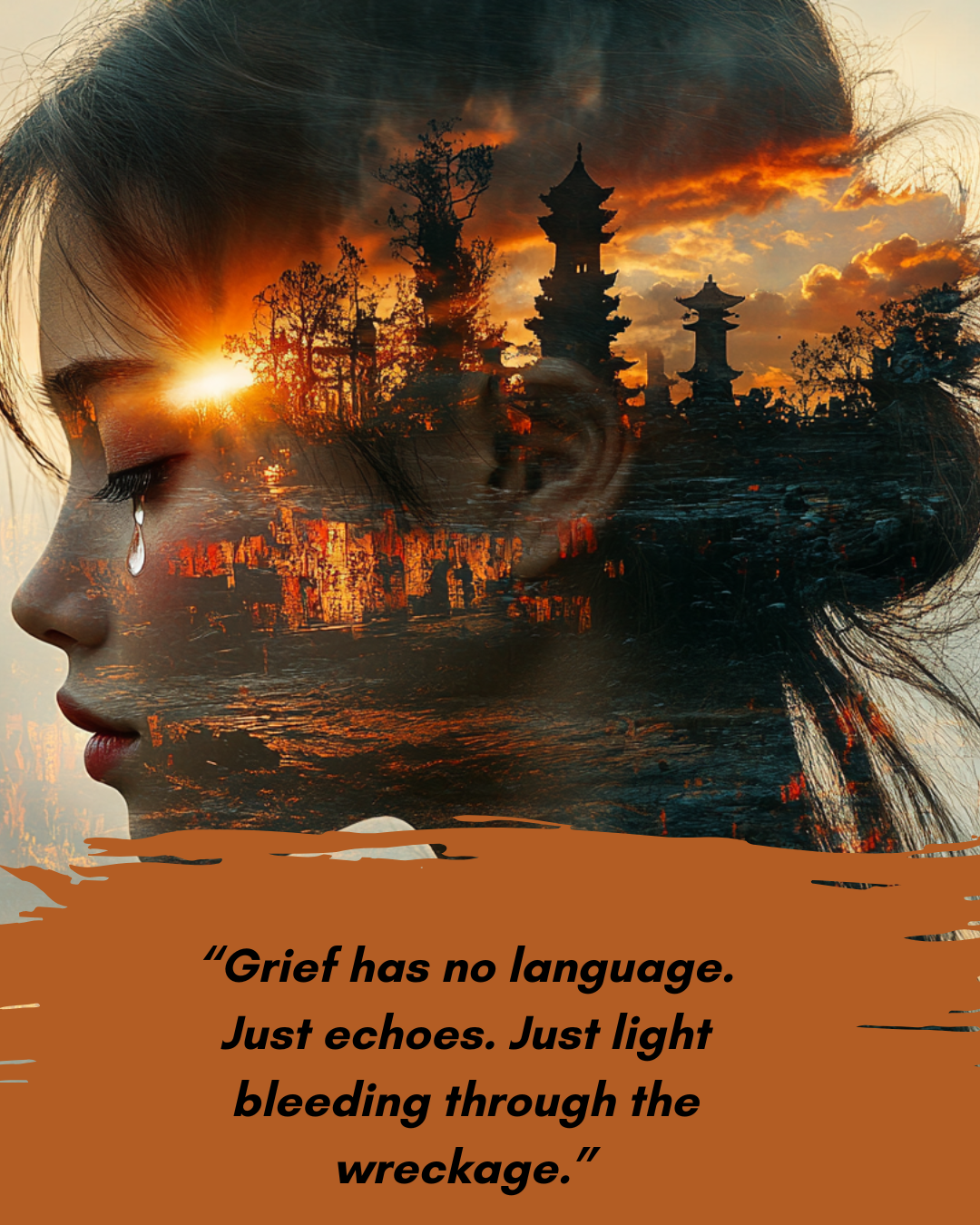
Grief has no language. Just echoes. Just light bleeding through the wreckage.

Across from me, he sat, impeccable. Tie straight. Wristwatch catching the last of the sun.
“You alright?” he asked, voice drenched in honey and soothing like always.

But I wonder—Is this false comfort?
That soft menace people only hear in hindsight.

I’ve been here before.
My finger found the scar hidden in my palm, the one shaped like escape.
It remembers what my heart tries to forget.

I smile. He believes it. Because that’s the thing about men like him—they love the surface.
And some people never notice the smoke. They only see the flames.
By then, it’s too late.

My stop is next. So is his.
He doesn’t know I’ve been here before. That this time, I won’t look back.
I know he wants me to.
But he’s not ready for what comes if I do.


Author’s Note:
This piece was written for Fandango’s Flash Fiction Challenge (FSS #209).

There’s a strange, satisfying freedom in flash fiction—the constraints force you to choose each word like a scalpel. It’s a literary pressure cooker where character, tension, and atmosphere have to collide fast and leave a mark.

For me, flash is where I go to explore the edges—grief, memory, survival, those quiet gut-punch moments when the world shifts and no one else notices. Stories like this come out like smoke under a locked door. You don’t always see the fire yet—but it’s there.

Want to try your own version of this story’s beginning?
The prompt was: “The woman sitting next to me slipped a note into my hand that read, ‘He’s not who he says he is.’”

Kimonogate

FLASH FICTION SERIES – FOWC/RDP/SoCS/FSS #203

A suburban saga of secrets, sequins, and sabotage.


Episode 1:

The Mayor, the Kimono, and Capote’s Forbidden Love

The text the mayor received simply read, “I know what you buried, and it wasn’t just a time capsule.”
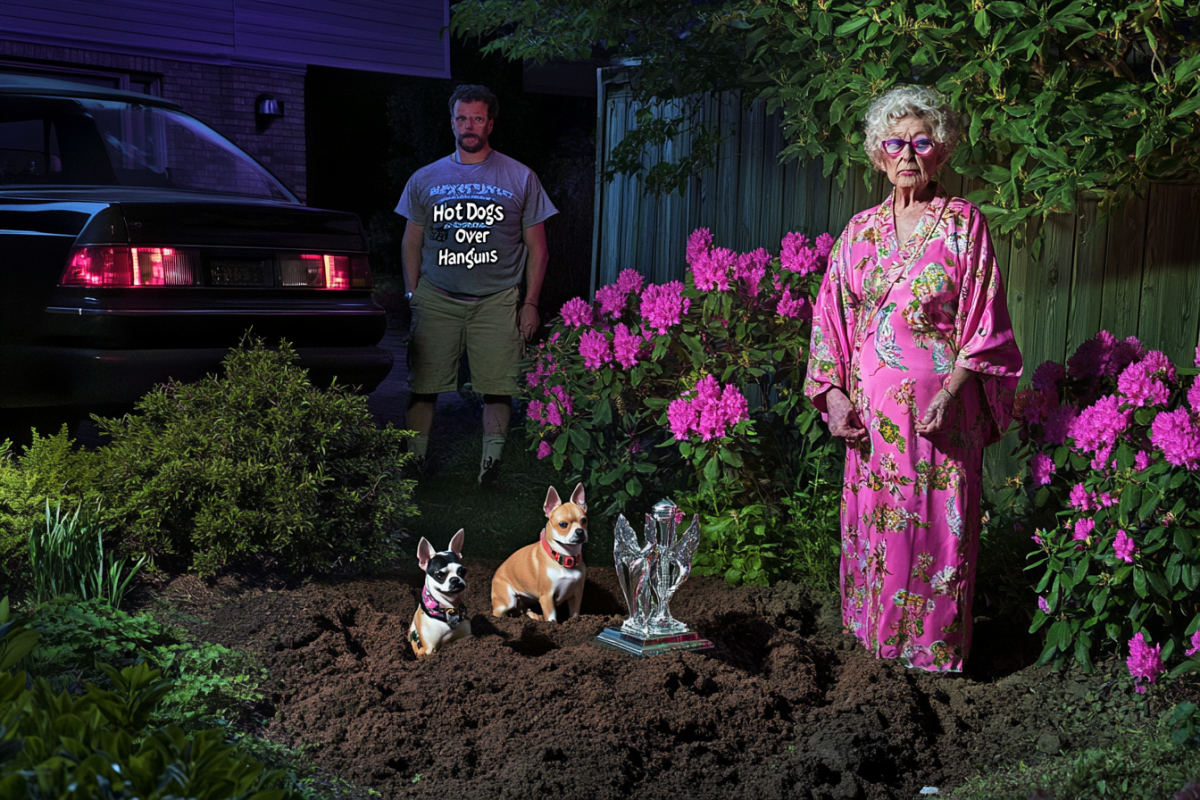
He dropped his spoon into his cereal with a neutral thunk and slowly looked toward the back garden, where the freshly disturbed earth sat like a guilty secret under a patchy rhododendron. He took a deep breath and tugged at the collar of his robe—not the pink kimono, no, that one was currently six feet under with a copy of Mamma Mia! Live at the Greek in a glittery DVD case.

He clutched his phone with one hand and his cereal tube with the other. The mayor didn’t own bowls. Too vulnerable. Too open. Like a confession with handles.

Across the hedges, Myrtle McKlusky—seventy-nine, semi-retired, fully judgmental—was watching him from her sunroom. She sat in her recliner like a falcon in a floral nightgown, sipping from a pint glass of prune juice and fanning her three Chinese Crested dogs, each trembling with a different neurosis.

The largest, Capote, was vibrating like an old blender. He had recently discovered his feelings for Misty, Myrtle’s black Chow, and now stared out the window with the unrelenting passion of a Tennessee Williams heroine.

Capote had needs.

The mayor knew Myrtle had seen him. She always did. She had binoculars shaped like opera glasses and judgment shaped like artillery. He had tried to be discreet, but it’s hard to bury shame quietly when you’re panting in crocs and elbow-deep in mulch.

The kimono was silk. It had a peacock on the back. A punt of brandy had been involved.

And now someone was taunting him.

He stormed out of his house in cargo shorts and a tank top that said “Hot Dogs Over Handguns,” and made a beeline for Myrtle’s porch. She met him at the screen door, holding her smallest dog, Pontius—Pont for short—who barked like he was doing Shakespeare.

“Spying again, Myrtle?” the mayor growled, wiping sweat from his forehead and trying not to pant.

Myrtle narrowed her eyes behind rhinestone bifocals. “I would hardly call ‘having working eyes’ a crime.”

“That text wasn’t funny.”

“I didn’t say it was,” she said coolly. “Capote typed it. He’s quite dexterous. Especially since he caught your Misty presenting.”

The mayor’s eyes widened. “That’s my dog.”

“And that’s my Capote,” Myrtle said, lifting him proudly like a neurotic Simba. “And he’s in love.”

“She’s fixed.”

“So is he. Love finds a way.”

The mayor clenched his fists. “Call off your pervert dog or I swear, I’ll—”

“You’ll what?” Myrtle leaned forward, dangerous now. “Threaten three hairless angels with names from the Harlem Renaissance? Do it, Mayor. The HOA already wants your head after that incident with the inflatable disco duck.”

He froze.

She smiled.

“You wore the kimono to Dancing with Myself, didn’t you?”

Silence.

“And you did the full choreography. With backup. Solo.”

He turned and stormed away, sweat rolling down his temple, heart pounding, ears pent up with the ghost of Billy Idol.

Capote licked the glass longingly as Misty rolled in a pile of mulch. Somewhere, a wind blew through the garden. Somewhere, a love story had just begun.

And under the rhododendron, a peacock shimmered in the dirt, waiting.


The Twist

FLASH FICTION – FOWC/RDP/FSS #204

Carla sprinted from the archaeological site, clutching an artifact that could either save or destroy the world.

The desert wind tore at her coat, slicing her cheeks with grit and heat. Behind her, the canyon bellowed—low, deep, the sound of stone waking from sleep. She didn’t look back.

The artifact pulsed in her palm—black stone, veined with silver that moved like quicksilver, coiling and recoiling. Cold as ice, yet burning her skin. It didn’t make a sound, but its pressure settled in her jaw and spine, like a voice she couldn’t quite hear. A warning. A dare.

She had read the glyphs. Scratched into bone, buried beneath layers of false chambers and cursed earth. Left twist: seal. Right twist: release. A simple choice.

Until it wasn’t.

A sound cracked the sky—a roar too wide to come from a throat. Carla reached the ridge and turned.

The site had vanished. In its place stood a figure made of shadow and ruin, shrouded in strips of black that bled smoke. It held a scythe that scraped the air, hissing with each movement like it sliced through time. Beneath its feet: a field of skulls. Beyond it, the expedition fortress, aflame, its banners melting mid-flap.

Her legs went numb. Her breath caught in smoke. She wanted to run. To cower. To vanish. But the heat from the artifact anchored her. Reminded her: she had opened the door.

She had let it out.

The spirals on the artifact shifted. A recess opened. The mechanism waited. Her thumb hovered over it, trembling.

It was her sister’s voice she heard next. Not real. A memory, maybe. Or a trick.
“The world’s been broken before, Carla. Someone always seals it shut again. Someone just like you.”

The creature stepped forward. The ground cracked. A second sun burned in its wake.

She twisted left.

The silence after was total. Not peace. Something worse.

Then, screaming. From the air itself. The creature reared back as spears of molten light stabbed down from the clouds. Chains wrapped its limbs. It shrieked, stumbling, clawing at the sky—but the light yanked it downward, tearing the world around it like cloth.

Then—nothing.

Carla collapsed to her knees, chest heaving. The artifact lay in her hand, cracked down the center, the silver threads gone dark. The sky was still red. The smoke still stung. But the screaming had stopped.

She stood, slowly, scanning the charred remains of the site. The fortress. Her team.

Gone.

She was lost now. A savior with no witnesses, no one left to remember the choice she’d made.

And just as she turned to leave, the wind shifted. Cold, sharp.
Somewhere far off, something laughed.

Toilet Paper and other Hard Truths

FICTION – FSS #193

He quickly climbed the trellis and reached the balcony outside of her bedroom. He watched her through her window. She was sitting on the floor, legs crossed, phone in hand, completely unaware. She always tied her hair back when she focused, and it was. Probably texting. Probably him.

Jason exhaled slowly, pressing his back against the wall just under the window. He hadn’t planned this. Not exactly. But after three days of being ignored, after seeing that one blurry photo on her story—just a hand on her thigh and a drink in the background—he couldn’t sit still.

He could hear The Cranberries playing in the background—Linger, soft and haunting. She moved to the music, not dancing exactly, but swaying in that unconscious way, like the song had tapped into something old and private inside her. Like it spoke to her soul. Like she was his private dancer and didn’t even know it.

With difficulty, he swallowed. He needed to go. He wasn’t that guy. Not the creepy ones—the ones who watched from the dark, who mistook obsession for romance. The ones who fantasized about a glance, a laugh, a shared elevator ride, and turned it into something it wasn’t.

The ones who, when they finally worked up the nerve, stood trembling and said, “Don’t you remember? You smiled at me once.” Eyes wide. Pleading. Every breath pulling them deeper into the abyss of desperation.

Jason stared at his hands. Pale knuckles, shaky grip on the cold railing.

This wasn’t who he was.
At least, he hoped not.

He jumped from the balcony, hurting his ankle but maintaining his dignity. The pain was excruciating, but it kept him honest. Every limp, every throb was a reminder: he didn’t belong up there. Not like that.

Branches whipped past as he hobbled through the trees behind her house. The cold air cut at his lungs, the wet grass soaked through his sneakers. But he kept going—because turning back would’ve been worse.

Finally, he reached the lake, where his friend Tina was waiting. She was pacing back and forth, arms crossed tight, hoodie pulled over her head. Her eyes lit up when she saw him.

“Did you do it?” she asked urgently, stepping toward him. “Well?”

He didn’t answer right away, sinking onto a bench near the water’s edge, leg outstretched, ankle swelling fast. He winced.

“I saw her,” he said, staring out at the dark water. “She was dancing.”

Tina blinked. “So… that’s a yes?”

Jason shook his head slowly. “No. I couldn’t. I’m not that guy.”

She let out a breath, relief and maybe a little disappointment mixing in her face. She sat next to him, pulling her knees up to her chest.

“Good,” she said. “Because if you were, I wouldn’t be here.”

They sat in silence for a while, the lake still, the sky just hinting at dawn.

How did I get here?
Jason stared at the rippling water like it might answer.

Where did this notion come from—the idea that if he just showed up, climbed high enough, looked long enough, maybe something would fall into place? Some moment, some clarity, some spark between them that would finally catch.

But there was no spark. Just a girl in her room, moving to music, living her life without him in it. And him, standing outside like a stranger.

He wasn’t always this guy. Was he?

Maybe it wasn’t about her at all. Maybe she was just the screen he projected it all onto.

“I think I scared myself,” he said aloud, not even sure if Tina was still listening.

She said nothing at first. Just nodded slowly.

“You weren’t trying to get her back,” she said after a while. “You were trying to find something in yourself. And you didn’t like what you saw.”

Jason closed his eyes.

That was it. That was exactly it.

Tina reached for his hand, hoping Jason would somehow see her, somehow feel her—not just her skin, but what was underneath. All the nights she answered when no one else did. All the pieces of him she held onto so he wouldn’t fall apart.

Her fingers brushed his knuckles. He didn’t pull away. But he didn’t look at her either.

Jason was still staring at the water, lost in his head, somewhere far away from this bench, this lake, from her.

She squeezed his hand gently, grounding him. Or maybe anchoring herself.

“You don’t have to chase ghosts,” she said, voice low. “You aren’t one.”

Jason finally turned to her, and for the first time that night, there was something behind his eyes. Not clarity, not yet—but something softer than the ache he’d been carrying.

He looked down at their hands, then back at her. And something between them shifted.

Tina noticed Jason was crying. Not sobbing, not breaking—but that controlled weep, the only kind allowed for men. Shoulders still. Jaw tight. Tears slipping down anyway.

He squeezed her hand tighter, but it wasn’t painful. It was grounding. Like he needed to make sure she was real.

She watched him, unsure if she should speak, unsure if words would help or just fracture the moment.

Were the tears for the girl he never really had?
Or for something else?
Something older. Deeper. Something even he hadn’t named yet.

Maybe it wasn’t about her at all. Maybe it was the weight of pretending he was okay for too long. The performance of being fine, being cool, being over it. Maybe this was the moment he stopped acting.

Tina didn’t move. She didn’t ask. She just let him feel it.

Because sometimes that’s the only way through.

Everyone knew Jason was the strong one. The steady one.
It was killing her to see him like this—silent, unraveling at the edges.

She remembered last summer. When she chucked every ounce of her self-respect out of the window for Marcus. God, Marcus. She could barely say the name without feeling her stomach turn.

Jason didn’t judge her. Didn’t say I told you so. He just sat next to her on the curb, handed her a Gatorade, and said, “You’ve got nothing to prove. Not to anyone.”

And then:
“I promise I’ll see you through to the other side. We can cry, get drunk, get high, and cry again—if that’s what you need.”

At the time, she thought he was just trying to make her feel better. Talking big, saying what friends say when they don’t know what else to do.

But he meant it.

The bastard was right there, holding her hair back as she worshipped the porcelain god, talking her through it like she was in labor. He had an endless supply of toilet paper, too—which, in hindsight, was no small thing. Because let’s be real: when a real crying fit hits, tissues don’t cut it. Toilet paper is the only thing that makes sense. There’s a lot, and it’s everywhere.

And now here he was. Finally cracked open.

And it was her turn.

“Why are you here, Tina?” Jason asked, voice rough. “Pity? Some sense of duty? Or something else?”

She didn’t flinch, but it stung. Not the words—she’d heard worse—but the fact that he said them. That he really didn’t know.

Tina leaned back, looked up at the night sky like it might help her find the right words. It didn’t.

“You think I came out here in the middle of the night, to a freezing-ass lake, because I pity you?” she said finally. “Come on, Jason. Give me more credit than that.”

He looked away, jaw tight.

“I’m here,” she said, softer now, “because I don’t like who you become when you think no one’s watching. Because I’ve seen you hold everyone else together for so long that I forgot you might fall apart, too.”

She paused.

“And maybe… yeah. Maybe because part of me was waiting for you to need me for once.”

The silence that followed wasn’t awkward. It was heavy. Honest.

Jason didn’t respond right away. But this time, when he looked at her, he really looked.

“There’s never been a time I didn’t need you,” he said, eyes low. “But I don’t think I knew that until right now.”

He ran a hand through his hair, exhaled like he’d been holding it for years.

“So I acted like a jackass.”

Tina didn’t speak right away. She just let it hang there, let him sit in it.

Then she smirked, just a little. “Yeah. You did.”

Jason gave a short, almost-laugh. “Thanks for the grace.”

She nudged his shoulder. “You’re welcome.”

And just like that, the cold didn’t feel so cold.
The silence didn’t feel so loud.
And maybe—for the first time in a long time—Jason felt like he wasn’t holding the weight alone.