Stories in Monochrome
Samuel Mercer had spent most of his life believing that time was a rather poor substitute for understanding. It carried people away from the things that hurt them, certainly, and occasionally provided enough distance to make those things seem smaller, but it seldom explained why certain memories remained when so many others disappeared. He could no longer remember the name of his eighth-grade mathematics teacher, the combination to the locker he’d used for four years, or what he’d eaten for breakfast the previous Tuesday. Yet he remembered the exact shade of Ellen Baker’s eyes, the smell of her perfume, and the way she’d pressed her forehead against his beneath the yellow security light behind the Bellweather bus terminal.
That had been nearly fifty years ago.
He was sixty-eight now, an age he’d once considered impossibly distant, belonging to men who wore suspenders, complained about the government, and fell asleep in front of televisions with the volume turned up loud enough to disturb the neighbors. He had become two of those things, although he’d never developed a particular affection for suspenders.
He’d also become a widower.
His wife, Margaret, had died four years earlier, following thirty-nine years of marriage, two children, three grandchildren, and enough ordinary disagreements to convince Samuel that love had very little to do with agreeing about anything. Margaret had been stubborn, opinionated, occasionally unreasonable, and possessed of an extraordinary talent for finding whatever he’d misplaced while simultaneously explaining why he’d been foolish enough to lose it. She’d loved him fiercely, sometimes impatiently, and had never allowed him to mistake affection for permission to behave like an idiot.
He missed her.
Not in the dramatic fashion people sometimes described in books, where grief arrived like a storm and left the bereaved standing helplessly among the ruins. His grief was quieter and considerably more persistent. It occupied the empty chair across from him at breakfast, the unused half of their bed, and the small space beside the kitchen sink where Margaret had always left her reading glasses. It followed him into grocery stores, where he occasionally reached for things she liked before remembering there was nobody left at home to eat them.
He’d loved Margaret without reservation.
That was something he knew with absolute certainty.
And yet, somewhere beneath the accumulated years of marriage, fatherhood, work, and the thousand small responsibilities that made up an ordinary life, there remained the memory of another woman.
Ellen Baker.
He hadn’t spoken her name aloud in years.
Bellweather had changed considerably since Samuel was young, although he suspected the town’s residents would have disagreed about whether the changes constituted progress.
The paper mill had closed, followed by the furniture factory and the railroad maintenance yard. The department store where his mother purchased his school clothes had become a discount furniture outlet before becoming a vacant building with plywood covering the windows. The old movie theater had burned down in 1987, and the diner where he’d eaten breakfast with his father every Saturday had been replaced by a pharmacy that closed at six.
The eastern district had suffered the worst of it.
People called it the cold part of town.
The name had existed for as long as Samuel could remember, although nobody seemed entirely certain where it originated. Some claimed the winds coming off the river made the eastern neighborhoods several degrees colder than the rest of Bellweather. Others attributed it to the old brick buildings, the narrow streets, and the way winter sunlight disappeared behind the warehouses long before reaching the sidewalks.
Samuel had another theory.
He believed the eastern district had simply become a place where the town stored everything it no longer wanted to acknowledge.
The factories.
The abandoned houses.
The people who couldn’t afford to leave.
And, eventually, the memories.
The Bellweather bus terminal stood near the intersection of Mercer and Fourth, surrounded by vacant storefronts and the skeletal remains of businesses that had once depended upon travelers passing through. Its windows were clouded with grime, the entrance doors chained shut, and weeds had begun growing through the cracks in the pavement.
The city had announced plans to demolish the building.
Samuel learned about it while reading the Sunday newspaper.
He’d been sitting at his kitchen table, drinking coffee and working his way through an article about municipal redevelopment, when he noticed a photograph of the terminal beneath a headline announcing the proposed demolition.
He studied the picture for a long time.
Then he folded the newspaper.
And remembered a girl standing behind the building with tears in her eyes.
Ellen Baker had been nineteen when she enlisted in the military.
Samuel was twenty-one.
They’d known each other since high school, although Samuel maintained that he’d noticed her considerably earlier than she’d noticed him. Ellen disputed this, insisting that she’d been perfectly aware of his existence but had initially considered him too full of himself to warrant further investigation.
“You strutted around that school like you owned the place,” she’d told him once.
“I was confident.”
“You were obnoxious.”
“There’s a difference.”
“Not in your case.”
She’d laughed afterward, and Samuel remembered thinking that he’d gladly endure a lifetime of insults if they continued to end with that sound.
Ellen wanted more than Bellweather.
Not because she hated the town or considered herself superior to the people who lived there. She simply believed the world was too large to spend an entire lifetime occupying the same few square miles.
She wanted to travel.
To learn.
To discover whether the person she imagined becoming was someone she could actually be.
Samuel admired her ambition, although he sometimes wished it had been directed toward something that didn’t involve leaving him behind.
He worked at his father’s electrical contracting business, earning decent money and learning a trade that promised a stable future. His father had already begun discussing the possibility of Samuel eventually taking over the company, and Samuel had imagined a life that seemed perfectly reasonable.
A house.
A wife.
Children.
Sunday dinners with the family.
He’d imagined Ellen standing beside him through all of it.
Ellen, unfortunately, had imagined herself somewhere else.
They argued about it occasionally.
Not bitterly, at least not at first. Their disagreements were the ordinary collisions of two young people who loved one another but had not yet discovered that love did not automatically produce identical ambitions.
Samuel believed they could build a good life in Bellweather.
Ellen believed they could build one anywhere.
The difference seemed insignificant until she announced she’d enlisted.
He remembered sitting across from her at the diner, staring at the untouched coffee between his hands.
“You’re serious?”
“Yes.”
“Military?”
“That’s generally what enlisting means, Sam.”
“Don’t get smart.”
“Then don’t ask foolish questions.”
He’d looked toward the window.
“When?”
“Three weeks.”
Three weeks.
He remembered how absurdly short that sounded.
A person could spend three weeks waiting for a paycheck, recovering from the flu, or deciding whether to purchase a used automobile. Three weeks hardly seemed sufficient time to prepare for losing the person around whom he’d quietly constructed his future.
“Well,” he’d said eventually, “I guess you’ve made up your mind.”
Ellen reached across the table.
“Sam.”
He didn’t take her hand.
That was something he regretted for years.
The day she left, Bellweather was cold enough to make the windows of the terminal fog whenever someone opened the door. Families crowded the waiting area, carrying suitcases, paper bags, and the peculiar expressions people wore when trying to be brave for someone else’s benefit.
Samuel arrived early.
He’d spent most of the previous night rehearsing things he intended to say, none of which seemed particularly intelligent by morning.
Ellen found him standing near the departure board.
“You look terrible.”
“Didn’t sleep.”
“Neither did I.”
He looked at her suitcase.
“That everything?”
“Everything I need.”
He nodded.
There was nothing left to argue about.
The decision had been made, the paperwork signed, and the bus would leave whether Samuel approved of the arrangement or not.
Ellen studied his face.
“Come here.”
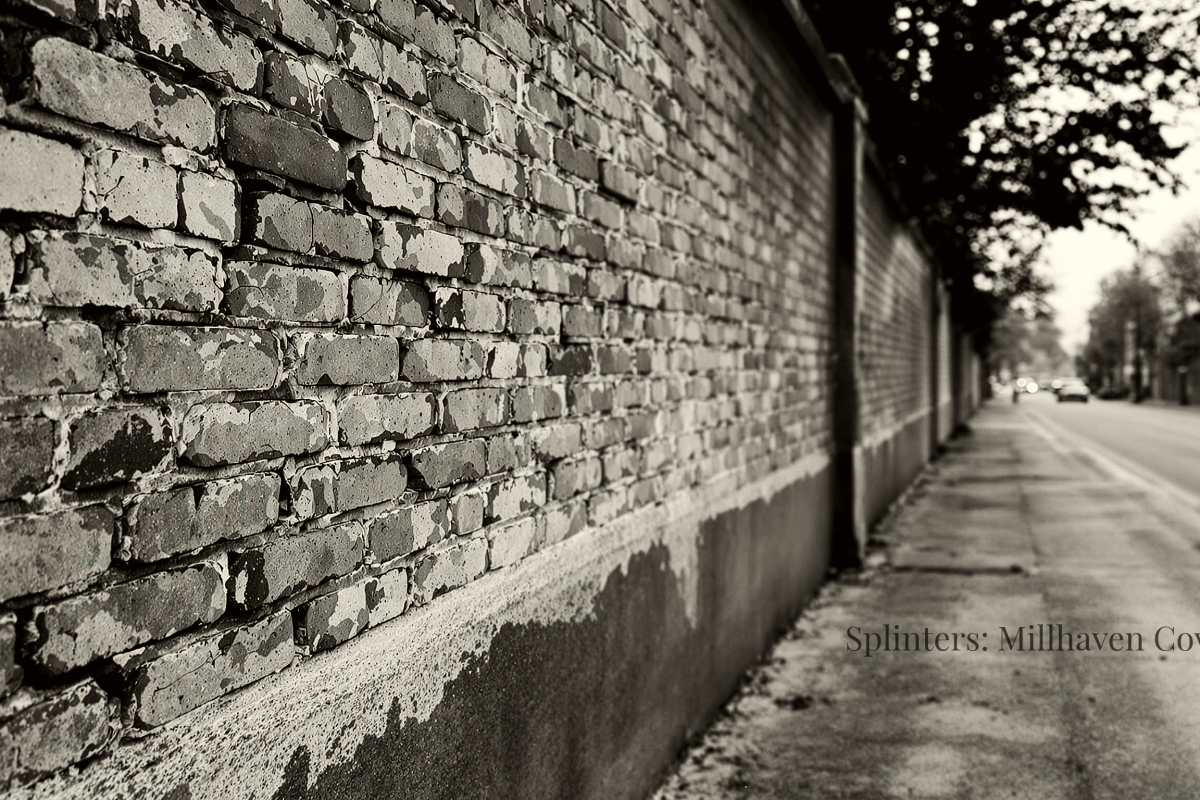
She took his hand and led him through a side door, around the corner of the building, and into the narrow space behind the terminal where the brick wall sheltered them from the wind.
For a moment, neither spoke.
Then Ellen placed her hands against his chest.
“Don’t be angry with me.”
“I’m not angry.”
“Sam.”
He looked away.
“I’m trying not to be.”
She nodded.
“That’s fair.”
He wanted to tell her that he understood. That he was proud of her. That he’d never met anyone with the courage to pursue something so uncertain simply because she believed it mattered.
Instead, he said, “You could still change your mind.”
Ellen smiled sadly.
“No, I couldn’t.”
He knew she was right.
That was what made it hurt.
She reached up and placed her hands against his face.
“Look at me.”
He did.
“I love you, Samuel Mercer.”
His throat tightened.
“I love you too.”
Then she kissed him.
It wasn’t their first kiss, nor the most passionate they’d shared, but it became the one he remembered most clearly. There was something deliberate about it, a tenderness that seemed to acknowledge everything they wanted and everything they could not promise. He held her close, feeling the cold brick against his shoulder and the warmth of her breath against his cheek, wishing the world might occasionally demonstrate enough consideration to stop moving when something important was happening.
Somewhere beyond the wall, the bus driver called for final boarding.
Ellen rested her forehead against his.
“Promise me something.”
“Anything.”
“Have a good life.”
He almost laughed.
“What kind of promise is that?”
“An important one.”
“You’re talking like we’re never going to see each other again.”
She didn’t answer immediately.
And that silence frightened him more than anything she’d said.
“Just promise me, Sam.”
He nodded.
“All right.”
She smiled.
“Good.”
Then she stepped away.
He watched her disappear around the corner.
A few minutes later, the bus pulled out of the terminal.
Ellen sat beside a window near the middle.
She saw him standing on the sidewalk and raised her hand.
He raised his.
And the bus carried her away.
They spoke once more.
Three weeks later, Samuel stood inside the telephone booth at the terminal with a pocketful of quarters, waiting for an operator to connect him to the number Ellen had sent in a letter.
He remembered the impatience of the wait, the metallic clicking of the connection, and the sudden, extraordinary relief of hearing her voice.
“Sam?”
“Who else would be calling you?”
She laughed.
“Well, you never know.”
They talked for nearly twenty minutes.
She told him about the barracks, the other recruits, and a particularly unpleasant instructor who apparently believed shouting was an acceptable substitute for conversation. Samuel told her about his father’s business, the weather, and a minor automobile accident involving his friend Eddie and a parked delivery truck.
She laughed so hard at the accident that he had to repeat part of the story.
He remembered thinking that everything might still work out.
Then the conversation changed.
Ellen told him she would be leaving for another assignment soon.
Communication would become difficult.
She didn’t know when she’d be able to call again.
Samuel tried to sound understanding.
He wasn’t particularly successful.
“You’re getting farther away,” he said.
“I know.”
“Seems like every time we talk, there’s another place between us.”
She was quiet.
“Sam, I don’t want you waiting around for me.”
He closed his eyes.
“Don’t start.”
“I’m serious.”
“So am I.”
“I know you are. That’s what worries me.”
He leaned against the glass.
Outside, rain had begun falling, turning the streetlights into blurred circles of yellow.
“You’re telling me goodbye?”
“I’m telling you I don’t know what’s going to happen.”
“Nobody knows what’s going to happen.”
“Exactly.”
He wanted to argue.
He wanted to tell her that people waited for one another all the time, that distance wasn’t permanent, and that a few years hardly mattered when compared with the rest of their lives.
But something in her voice stopped him.
She wasn’t asking him to stop loving her.
She was asking him not to make his entire future dependent upon her return.
“Sam?”
“I’m here.”
“Remember what you promised me?”
He looked through the rain-streaked glass.
“Yeah.”
“Then keep it.”
The operator interrupted, announcing that their time was nearly exhausted.
Samuel reached into his pocket.
He had one quarter remaining.
He fed it into the telephone.
“Ellie—”
He caught himself.
“Ellen.”
“I’m here.”
He swallowed.
“I love you.”
“I know.”
There was a pause.
Then she spoke again, softly enough that he almost missed it.
“Take care of yourself, Sam.”
The connection ended.
He remained standing with the receiver against his ear, listening to the empty line.
Eventually, he replaced it.
He never spoke to Ellen Baker again.
Life, as it turned out, was considerably less interested in Samuel’s plans than Samuel had been.
Letters arrived for a while.
Then fewer.
Then none.
He wrote several of his own, although he eventually stopped sending them when the replies ceased. He never learned whether she’d met someone, been transferred somewhere inaccessible, or simply decided that the distance between them had become too great to cross.
For a time, he was angry.
Then disappointed.
Then busy.
His father became ill, and Samuel assumed responsibility for the contracting business earlier than expected. There were employees to pay, customers to satisfy, equipment to maintain, and a thousand small problems that required attention whether his heart was broken or not.
He met Margaret two years later.
She worked at the county courthouse, possessed a sharp wit, and had absolutely no patience for men who confused brooding with emotional depth.
On their third date, she’d asked him whether he intended to spend the entire evening thinking about someone else.
Samuel had stared at her.
“Excuse me?”
“You heard me.”
He’d tried to deny it.
Margaret had raised an eyebrow.
“Samuel, I’m not interested in competing with a ghost.”
“She’s not dead.”
“Then stop acting like you are.”
He’d been furious.
Later, he’d recognized that Margaret had offered him something far more valuable than sympathy.
She’d offered him the truth.
They married the following year.
Their life together wasn’t perfect, but Samuel eventually came to understand that perfection was a remarkably poor standard by which to judge happiness. They worked, raised children, worried about bills, argued over household repairs, and grew older together. There were vacations that went badly, holidays that went beautifully, and ordinary evenings when they sat beside one another without speaking because there was nothing that needed saying.
He loved her.
Not as a replacement for Ellen.
Not as a consolation prize.
He loved Margaret because she was Margaret.
And when she died, he discovered that thirty-nine years of marriage could leave a silence large enough to occupy an entire house.
Samuel returned to the old bus terminal on a Thursday afternoon in October.
The sky was overcast, and the wind carried the damp chill that arrived each autumn from the river. He parked across the street and sat behind the steering wheel for several minutes, studying the building through the windshield.
It looked smaller than he remembered.
Most places did.
The entrance had been boarded over, and a chain-link fence surrounded part of the property. Someone had spray-painted an obscenity across the brick wall, and the old departure sign hung crookedly beneath the roof.
Samuel climbed out of the car.
His knees protested.
He ignored them.
He crossed the street, following the cracked sidewalk toward the western side of the building, where the telephone booth had once stood.
He wasn’t entirely certain why he’d come.
The demolition notice had stirred memories, certainly, but he suspected there was something else beneath the nostalgia. He’d spent the past four years learning how to live alone, and although he’d made considerable progress, there were evenings when the silence of his house seemed less like peace and more like an accusation.
He missed Margaret.
He missed the children when they were small.
He missed his father.
And occasionally, without warning, he missed the young man he’d once been.
The one who believed the future was something a person could arrange through determination and sufficient planning.
He rounded the corner.
And stopped.
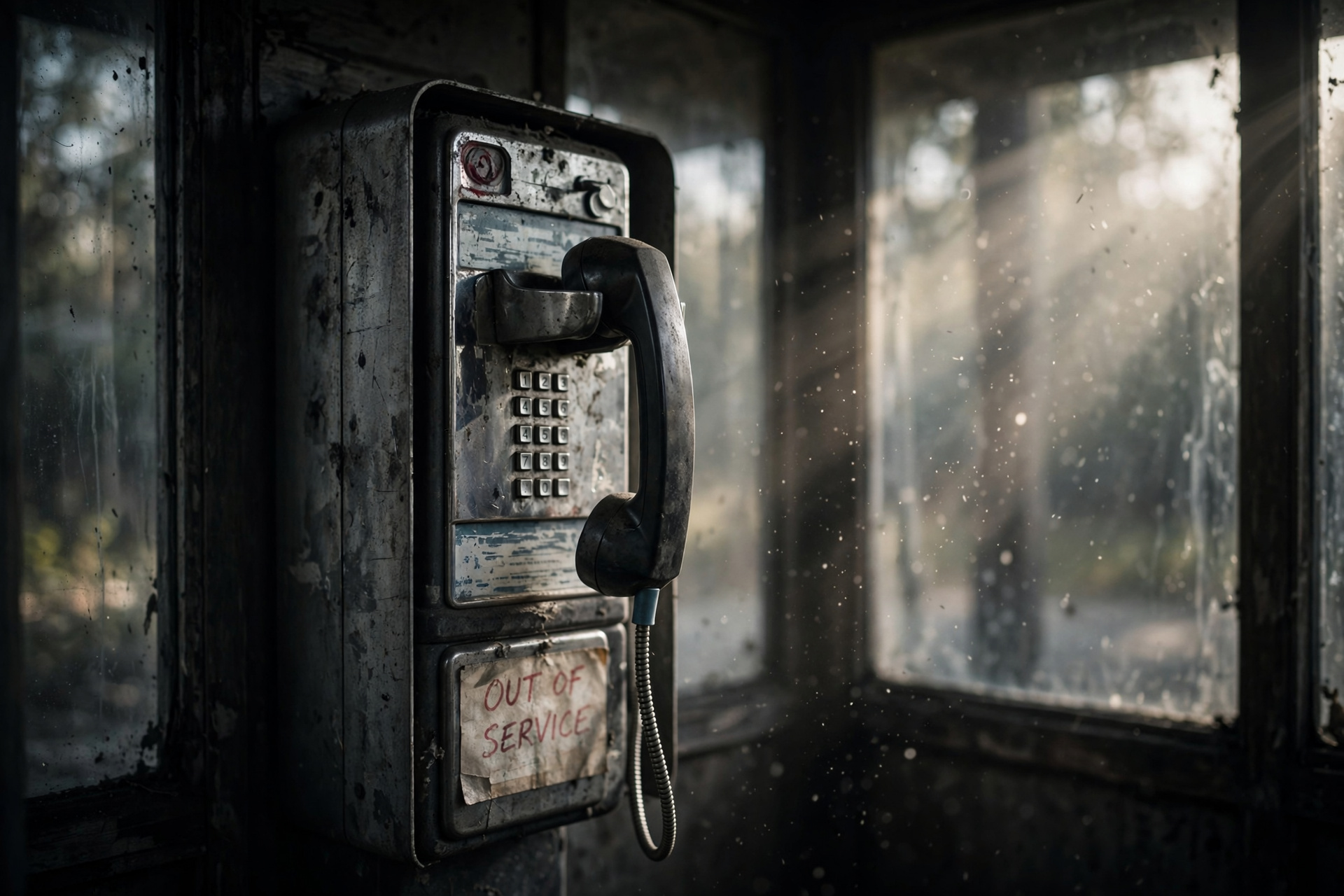
The telephone booth was still there.
Samuel stared at it.
He’d expected the equipment to have been removed decades earlier, sold for scrap or discarded during one of the city’s periodic efforts to modernize its infrastructure. Yet there it stood, tucked against the side of the terminal, its glass panels clouded with grime and its metal frame spotted with rust.
The telephone remained mounted inside.
He laughed quietly.
“Well, I’ll be damned.”
He stepped closer.
A handwritten notice beneath the keypad read:
OUT OF SERVICE.
“That makes two of us,” he muttered.
The booth door resisted when he pulled it.
He gave it another tug.
The hinges complained, then surrendered.
Inside, the air smelled of damp metal, old dust, and something faintly sour that he chose not to investigate. Afternoon light filtered through the dirty windows, illuminating particles suspended in the stale air.
Samuel stood quietly.
He remembered being twenty-one.
Remembered the pocketful of quarters.
The rain against the glass.
The sound of Ellen’s laughter traveling across miles of telephone wire.
He remembered the terrible silence after she’d said goodbye.
And how he’d stood there holding the receiver because putting it down seemed too much like accepting that she was gone.
He looked at the telephone.
The receiver hung crookedly from its cradle, the cord twisted into a stubborn knot. The metal housing was scratched and discolored, its keypad worn smooth in places by thousands of fingers belonging to people who had once needed to reach someone.
He wondered how many conversations had taken place there.
How many promises.
How many apologies.
How many people had stood inside that narrow enclosure trying to find the courage to say something that mattered.
He smiled faintly.
“Probably more than a few.”
Then he turned toward the window.
And noticed something.
Near the lower corner of the glass, almost concealed beneath decades of dirt and accumulated grime, were two sets of initials scratched into the surface.
S.M. + E.B.
Samuel stared.
For a moment, he couldn’t move.
He remembered doing it.
Ellen had scolded him for defacing public property, then laughed when he’d told her the telephone company could send him a bill. She’d insisted he make the letters smaller, afraid someone might recognize them. He’d deliberately made them larger, earning himself a playful slap on the arm and another kiss.
He raised his hand.
His fingertips settled against the glass, tracing the shallow grooves one letter at a time.
The scratches were rough beneath his skin, worn by decades of weather and neglect, but still unmistakably there.
For a moment, he was twenty-one again.
He could smell Ellen’s perfume.
Could hear the distant rumble of the bus engine and the impatient call of the driver announcing final boarding.
He remembered the warmth of her hands against his face, the nervous little laugh she’d given when she realized she was crying, and the way she’d walked toward the bus without looking back until the very last moment.
He’d raised his hand.
She’d raised hers.
And then she was gone.
Samuel stood quietly, his fingers resting against the initials.
“Hello, Ellen,” he whispered.
A small smile crossed his face.
“Been a while.”
Behind him, the telephone rang.