Nothing good happens after midnight. This was my Gam-gam’s mantra.
She said it the way preachers talk about hellfire and old mechanics talk about Fords built after ’79 — with complete certainty born from experience.
Of course, she also chain-smoked generic cigarettes until she was seventy-three and once threatened a meter reader with a garden hoe, so her relationship with good decisions always felt a little selective to me.
Still, every time I found myself inside Harlow’s Market after two in the morning, I heard her voice rattling around somewhere in the back of my skull.
The place looked different at night.
Not dangerous exactly.
Just… stripped down.
Daytime grocery stores were all screaming children, distracted couples, old folks hunting bargains, and exhausted parents comparing expiration dates like their lives depended on it. But after midnight, Harlow’s became a waiting room for people avoiding something.
Or someone.
The fluorescent lights buzzed overhead with the tired persistence of insects trapped against glass. Half the ceiling panels had yellow water stains spreading through them like old bruises. Somewhere near frozen foods, an industrial fan clicked every few seconds in a rhythm just irregular enough to slowly drive a person insane if they stood still too long.
The night crowd moved slower too.
A nurse in wrinkled blue scrubs stared blankly into a refrigerator full of yogurt like she’d forgotten why she opened the door. A teenage stock boy with silver lip rings pushed a pallet of canned soup down aisle seven while mumbling lyrics under his breath.
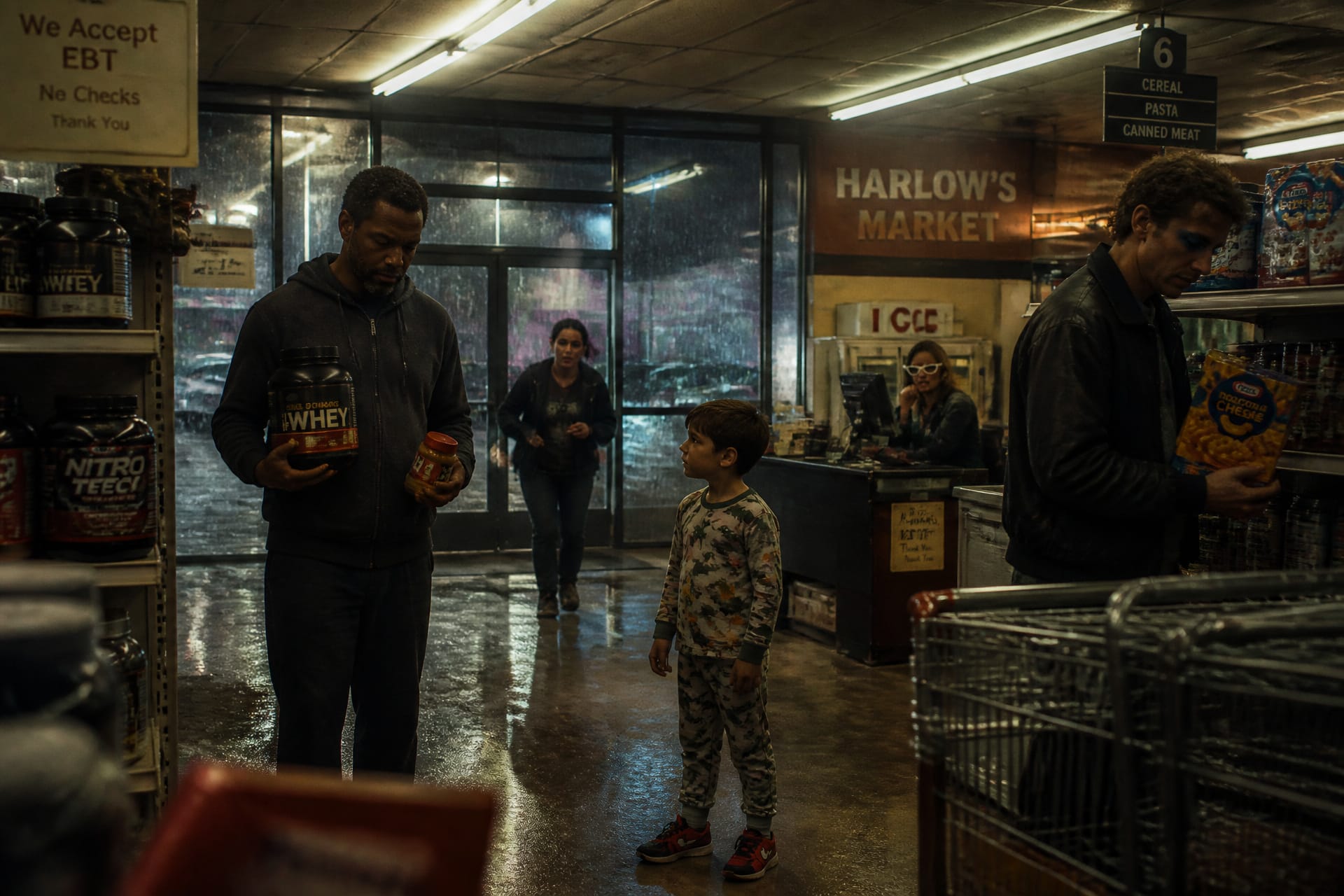
There was a man standing in aisle six wearing a leather jacket over what looked like pajama pants. He hadn’t managed to get all his eyeliner off. His right eye was clean, but the left still carried a thick smear of faded blue glitter liner that really wasn’t his color to begin with. A little glitter clung stubbornly to his right cheek, catching the fluorescent light every time he turned his head. He studied a box of macaroni and cheese with the exhausted seriousness of a man trying to quietly survive the worst night of his week.
Near the coffee station, an old man in suspenders carefully peeled the label from a bottle of root beer with the concentration of a bomb technician.
Somewhere in the back of the store, glass shattered.
Nobody reacted.
That told me more about the night crowd than anything else.
After two in the morning, people came to Harlow’s to buy things they didn’t need while trying not to think about whatever waited for them at home.
Or what didn’t.
I was there for coffee filters, motor oil, and the kind of loneliness that made you wander brightly lit buildings just to hear evidence of other human beings breathing nearby.
Outside, rain tapped softly against the windows. The parking lot shimmered beneath flickering lights, all oil slick rainbows and cracked asphalt. My truck sat crooked near the edge of the lot beside a rusted shopping cart someone had abandoned weeks ago.
The store speakers drifted lazily from one ancient soft-rock song into another. A muzak version of Barry Manilow’s “Copacabana” floated through the aisles sounding oddly cheerful beneath the fluorescent buzz.
Subconsciously, I started humming along.
I think I hated myself a little for that.
I reached for a container of whey protein, and that’s when I heard a small voice behind me.
“You look like somebody who listens to sad music in parking lots.”
I turned and found a little girl standing beside a shopping cart half her size.
Maybe eight years old.
Wild curls. Purple rain boots. An oversized hoodie with cartoon astronauts floating across the front. She held a box of strawberry Pop-Tarts against her chest like it contained classified government secrets.
Behind her, a woman I assumed was her mother stood several feet away near the energy drinks, staring blankly at her phone with the hollow concentration of somebody losing an argument with life.
The kid squinted up at me suspiciously.
“Well?” she asked. “Do you?”
I glanced toward the speakers overhead.
“Sometimes,” I admitted.
She nodded like I’d confirmed something important.
“My dad does that too.”
That landed harder than it should’ve.
The little girl tossed the Pop-Tarts into the cart and wandered off before I could think of anything useful to say.
A few aisles over, the man with the ruined blue eyeliner laughed suddenly at something on his phone. Loud enough to turn heads. Real laughter too. Sharp and startled like he hadn’t expected it from himself.
Then, just as suddenly, he covered his mouth.
Like happiness had slipped out accidentally.
For a moment, the whole store softened.
Not healed.
Just human.
That was when I noticed the cashier watching me.
Her name tag said MARLENE.
Late sixties maybe. Cat-eye glasses hanging low on her nose. Gray curls tucked beneath a Cardinals cap. The kind of face that looked like it had spent years listening to people confess things they never intended to say out loud.
She gave me a slow nod toward the ceiling speakers.
“Happens sometimes,” she said quietly.
I frowned. “What does?”
Marlene scanned a pack of gum for a customer who wasn’t there.
“The music,” she said. “Store plays what people miss.”
I snorted softly at that.
Not because it was ridiculous.
Because at two in the morning, it almost made sense.
There was a little boy standing at the end of the aisle staring at me.
Couldn’t have been older than five.
Spider-Man sneakers. Dinosaur pajamas beneath an oversized winter coat. One shoelace dragging behind him like he’d escaped bedtime and nobody noticed.
He followed me from supplements to canned vegetables without saying a word.
Just staring.
I didn’t say anything to him.
Didn’t need to.
Then I heard it.
A woman’s voice somewhere near frozen foods.
Panicked.
“Ethan?!”
The kid finally blinked and looked toward the sound.
I reached into my jacket pocket and handed him a Dum Dum sucker from the handful I kept for my grandkids.
Bad decision.
The woman appeared seconds later at the end of the aisle, moving fast enough to nearly slam her cart into a display of canned beans.
Her eyes landed on the sucker in the boy’s hand.
Then on me.
Everything changed instantly.
“Get away from my son,” she snapped.
The exhaustion in her face vanished beneath pure adrenaline.
The kid immediately pointed at me with sticky little fingers.
“He gave me candy.”
Jesus Christ.
“What is wrong with you?” she barked. “Giving random kids candy? You some kind of freak?”
A couple nearby suddenly became very interested in comparing soup labels.
The teenager with the lip rings stopped moving his pallet jack.
Even Barry Manilow sounded uncomfortable.
I opened my mouth.
Closed it again.
Because deep down, I already understood something important:
Nothing I said was going to help.
Not at two in the morning.
Not with a terrified mother.
Not with a strange man standing beside protein powder holding a family-sized jar of peanut butter.
So I just stood there while she grabbed the kid’s hand and pulled him away like she was rescuing him from something dangerous.
Maybe she was.
The little boy looked back once as they disappeared around the corner near frozen foods.
Not scared.
Just confused.
A moment later, the automatic doors at the front of the store slid open. Cold rain-scented air drifted briefly through the building before the doors sighed shut again.
The eyeliner guy finally put the macaroni back on the shelf.
Marlene kept scanning invisible groceries.
And somewhere overhead, Barry Manilow kept singing about showgirls and yellow feathers like the world hadn’t become strange somewhere along the way.
Discover more from Memoirs of Madness
Subscribe to get the latest posts sent to your email.


Love your writing…you paint such a clear picture…it’s as if I were standing there watching from the sidelines…delightful, intriguing, inviting,
LikeLike