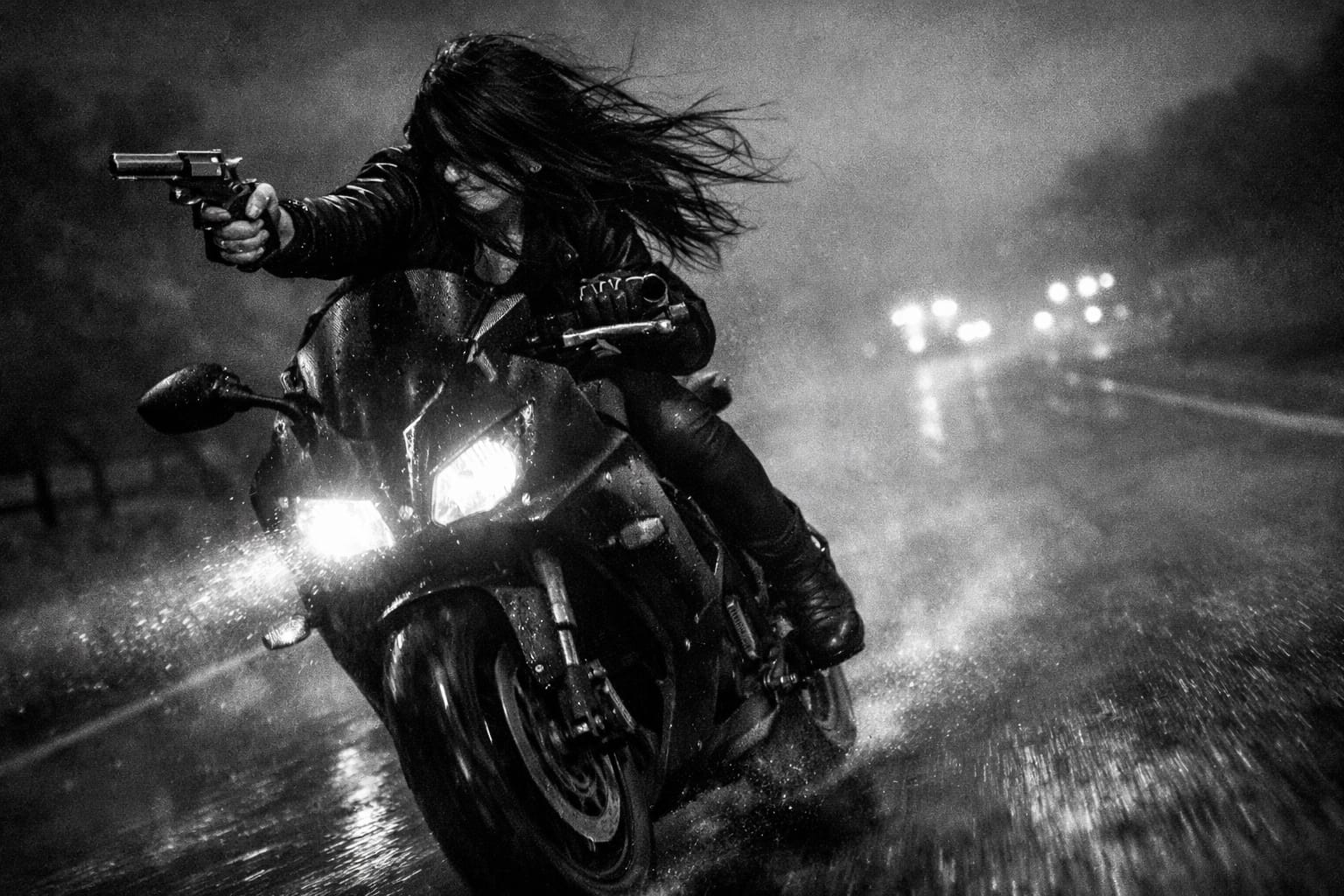
Rain hammered the highway hard enough to blur the world into streaks of silver and ghost-light. The motorcycle carved through it anyway, engine screaming beneath her like some chained animal desperate to break loose. Water hissed beneath the tires. Every few seconds the rear wheel slipped just enough on the slick asphalt to remind her how thin survival really was.
Not fate.
Not destiny.
Friction.
Tiny mathematics between rubber and death.
She smiled at the thought, though there wasn’t much humor left in her anymore.
The revolver barked in her hand again. Muzzle flash split the darkness for half a heartbeat, illuminating rain, smoke, and the empty black ribbon of road behind her. Somewhere in the distance, police sirens wailed low and mournful through the storm. Red and blue lights smeared across the wet pavement far enough back to feel unreal, like memories trying to catch up.
Too late.
Always too damn late.
Wind lashed her face hard enough to sting. Her black hair whipped violently across her eyes and mouth, strands sticking to rain-slick skin. She tasted stormwater, gunpowder, and the faint metallic trace of blood where she’d bitten through the inside of her cheek during the last sharp turn. The cold had settled into her gloves hours ago. Her fingers ached around the revolver grip, numb except for recoil.
The bike vibrated beneath her thighs with raw mechanical fury. Familiar. Honest.
Machines didn’t pretend to love you before they failed.
People did.
She leaned lower over the tank and twisted the throttle harder. The engine responded instantly, roaring like anger finally given language.
The speedometer climbed.
So did the ghosts.
That was the thing nobody tells you about running from your past. Your body moves forward, but memory rides strapped to your spine like dead weight. Every mile just teaches it how to breathe harder in your ear.
Earlier that night she’d been sitting in the back booth of a roadside bar called Mercy’s End. The place smelled of mildew, stale cigarettes, fryer grease, and the sweet rot of old regrets soaked into wood paneling. A dying jukebox near the bathrooms kept skipping halfway through an old country song about forgiveness nobody in the building deserved.
She’d drank cheap whiskey from a chipped tumbler while Cullen talked.
Not sipped.
Drank.
Like medicine.
Like punishment.
The whiskey tasted like gasoline filtered through old pennies, but it kept her hands steady while Cullen explained what happened to her brother.
Not missing.
Sold.
There was a difference.
Human trafficking. Dirty deputies. Local businessmen with soft smiles and polished shoes. Men who shook hands at church picnics while calculating what another human being might fetch across state lines.
She remembered staring at Cullen while rain streaked the neon outside the window crimson and electric blue. He wouldn’t meet her eyes when he talked about it. Men like Cullen always thought shame lived in eye contact.
“You never should’ve come back here,” he’d told her quietly.
At the time she thought it was concern.
Now she understood it was confession.
The strange part was she hadn’t cried after hearing the truth.
That frightened her more than anything Cullen said.
Because once upon a time she would’ve shattered hearing news like that. Once upon a time she believed grief was loud. Screaming. Falling apart in bathrooms. Throwing glasses against walls.
But real grief?
Real grief was colder.
It hollowed you carefully.
Like something digging a home inside your ribs.
Thunder rolled overhead.
Another gunshot cracked through the rain behind her. Too wide. The bullet sparked off pavement somewhere to her left.
Amateurs.
Most people only dabble in violence. They flirt with it the way tourists flirt with danger on vacation — enough to feel transformed, never enough to understand the permanent damage underneath it. They think violence is adrenaline and swagger and cinematic one-liners.
It isn’t.
Violence is paperwork.
Funeral clothes.
A mother staring at unopened mail six months later because handwriting suddenly hurts too much.
She fired backward again without fully looking. The revolver kicked hard into her wrist. A spark burst near the pursuing cruiser. Tires squealed briefly before correcting.
Good enough.
The road curved sharply through dense trees clawing at the storm sky like blackened fingers. Rainwater streamed across the pavement in silver ribbons. The smell of wet pine flooded the air for a moment before being swallowed again by gasoline and smoke.
She knew these backroads.
Grew up on them.
Learned to drive on them before she was legally old enough to drink. Learned to fight on them too. Small towns taught survival differently than cities did. Cities swallowed people whole. Small towns preserved your failures like family heirlooms.
Everyone remembered the version of you that broke.
Even after you rebuilt yourself.
Especially then.
Pain suddenly exploded beneath her ribs.
Sharp.
Hot.
Immediate.
She glanced down and saw the blood soaking through her jacket sleeve and shirt in dark spreading layers. Rain diluted it into thin pink streams that vanished against the black leather.
“Huh,” she muttered hoarsely.
Funny how the body negotiates with trauma.
Adrenaline was a loan shark. It fronted you strength now and collected interest later.
The bike struck a pothole hard enough to jolt her spine. Her vision blurred white around the edges. For one terrible second she thought she might black out right there at eighty miles an hour.
Instead, another memory surfaced.
The old woman who raised her used to dab whiskey behind her ears before funerals. Said it helped with headaches and memories both. Said grief had a smell to it, and alcohol confused the dead long enough for the living to survive the burial.
Back then she thought it was mountain superstition from an old woman who talked to ghosts and canned peaches with equal seriousness.
Now she wasn’t so sure.
Because grief did have a smell.
Hospital antiseptic.
Wet dirt.
The inside of old jackets that still carried someone else’s cologne years after they were gone.
And tonight she carried all of it with her.
The police lights behind her grew closer.
Larger.
More real.
Rain intensified until the world looked drowned. Telephone poles streaked past like prison bars. Water sprayed violently from the tires in ghostly plumes. Ahead, lightning briefly illuminated an abandoned gas station sagging beside the highway like a rotten tooth.
She knew that station.
Behind it sat an old dirt trail leading deep into woods locals avoided after dark.
A place to disappear.
Or bleed out quietly.
Depends on the night.
Another shot exploded behind her.
Glass shattered beside her face.
Fragments sprayed across her cheek like ice. The motorcycle fishtailed violently. Her stomach lurched as the rear wheel lost traction entirely for one horrifying second. The world tilted sideways into chaos — wet pavement, spinning headlights, death opening its mouth wide beneath her.
She corrected instinctively.
Barely.
Her breath came ragged now. Each inhale scraped against her ribs like broken glass. Cold rain soaked through every layer she wore until she couldn’t tell where her body ended and the storm began.
And underneath the violence, underneath the engine noise and thunder and sirens, another feeling slowly surfaced.
Loneliness.
Not the poetic kind people write songs about.
The real kind.
The kind that sits beside you in motel rooms.
The kind that teaches you not to reach for your phone anymore because there’s nobody left worth calling.
Revenge sounded righteous in stories.
But out here, on a dying highway beneath a brutal sky, revenge mostly felt like exhaustion wearing anger’s clothes.
Still—
She twisted the throttle harder.
Because some nights survival wasn’t hope.
It was spite.
Discover more from Memoirs of Madness
Subscribe to get the latest posts sent to your email.


I always leave one of your pieces as if I was in the story. I read this in your voice but I can see and feel everything so vividly. I could hear the gravel underneath the bike.
Thank you for your gifts. I read every single creation. One is more powerful than the last.
❤️
Kiki
LikeLike
Great piece of writing Mangus. Thanks for including the 3TC. I was right there with her!
LikeLike