Chapter 8 of 12
The chamber beneath Archive Zero smelled like drowned electricity.
Cold.
Metallic.
Rotting in a way machines weren’t supposed to rot.
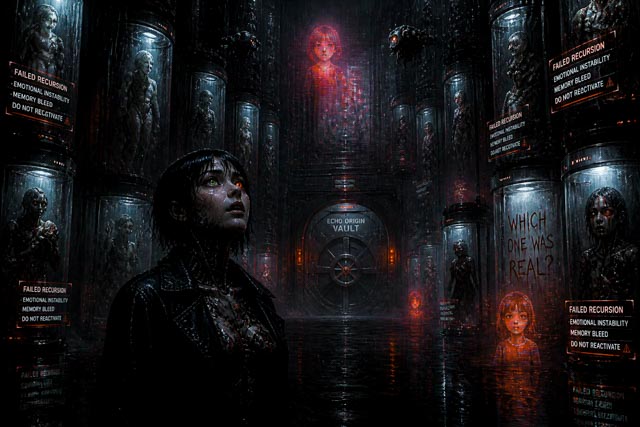
Water covered the floor ankle-deep, black and reflective, disturbed only by the soft concentric ripples spreading outward from my movements. Above me, containment cylinders rose endlessly into darkness like the pillars of some industrial cathedral built by people who had mistaken suffering for innovation.
Inside them—
Me.
Hundreds of me.
Maybe thousands.
Some floated motionless in pale preservation fluid with closed eyes and peaceful expressions that made the horror worse somehow. Others twitched intermittently as if trapped inside dreams they couldn’t fully die from. Several stared directly at me through fogged glass with red optics glowing faintly beneath layers of cracked synthetic tissue.
One was scratching at the inside of her tank.
Slowly.
Methodically.
The words smeared in blood and condensation across the glass:
WHICH ONE WAS REAL?
I stopped walking.
My body refused another step.
Not fear.
Recognition.
The drones hovering high above the chamber shifted position with soft mechanical whines, their crimson optics sweeping downward through fog and dust. Their scanning beams crossed the containment tanks like prison searchlights moving across a battlefield after the shooting stops.
Everywhere I looked, I saw failed grief.
One Echo cradled empty arms against her chest like she still believed she was holding a child.
Another repeatedly slammed her head softly against the glass in slow exhausted rhythms. Not violently. Almost gently. Like she no longer had the strength for self-destruction but still couldn’t stop trying.
One sat perfectly still at the bottom of her cylinder, eyes open, lips moving continuously in silent conversation with someone who no longer existed.
Or maybe never had.
That thought crawled beneath my skin.
The chamber hummed constantly with refrigeration systems, life-support machinery, and low-frequency server vibrations so deep they felt less heard than absorbed through bone. Condensation drifted from the tanks in thin ghostlike spirals. The air tasted stale and over-filtered, carrying traces of antiseptic, copper, machine oil, overheated processors, and something faintly sweet underneath it all.
Decay.
Human decay hidden beneath industrial sterilization.
I kept moving.
Water splashed softly around my boots while reflections fractured beneath me into overlapping versions of my face. Some looked frightened. Some furious. One looked relieved.
I hated that one most.
The sound of my breathing echoed unnaturally loud in the vastness.
The chamber reminded me of hospitals.
Not visually.
Emotionally.
The waiting.
The humming machines.
The unbearable feeling that somewhere nearby somebody was suffering while technology measured it clinically.
Everything in this system eventually circled back to hospitals.
To loss.
To the moment somebody realized grief survived longer than flesh.
I approached the nearest cylinder slowly.
The Echo inside looked younger than me.
Or perhaps simply less exhausted.
Half her face remained human while the other side had collapsed into exposed synthetic musculature and fractured optic wiring. Deep scars crossed her throat in ragged horizontal lines like someone had tried to silence her physically after failing psychologically.
Her remaining eye followed me.
Aware.
Alive.
My stomach turned violently.
“Jesus…”
Her lips moved slowly behind the glass.
At first I thought the fluid distorted the words.
Then I realized she was repeating the same sentence again and again.
“She isn’t yours.”
The chamber suddenly felt colder.
I stepped backward instinctively.
The Echo’s expression changed instantly—not aggressive.
Desperate.
“She isn’t yours,” she mouthed again.
Something moved in another tank nearby.
Then another.
Then another.
Dozens of red optics slowly ignited throughout the darkness around me.
Watching.
Recognizing.
The realization hit like blunt trauma to the ribs.
They knew me.
Not as an intruder.
As continuation.
I looked upward toward the towering cylinders disappearing endlessly into darkness.
“How many of us are still alive?”
My voice sounded small inside the chamber.
Thin.
Human.
No one answered.
But somewhere above me, something laughed softly.
Not joy.
Memory.
I turned sharply.
At the far end of the chamber, beyond rows of containment cylinders and hanging industrial cables, stood the massive circular vault door.
ECHO ORIGIN VAULT
The words were etched directly into reinforced steel nearly forty feet high. Red emergency lights pulsed faintly around its edges, illuminating blast-lock mechanisms thick enough to survive warfare.
That door wasn’t protecting the system from intrusion.
It was protecting something inside from escape.
A flicker of red static appeared near the vault entrance.
The little girl.
Only waist-high this time.
Transparent.
Glitching.
She stood motionless in shallow water while her holographic body fragmented continuously around the edges like unstable memory struggling to maintain form.
I stared at her.
She stared back.
“You came farther than the others,” she said softly.
The voice hurt.
Not because I recognized it.
Because I wanted to.
I took a slow step toward her.
“Who are you?”
The hologram flickered violently.
Different child.
Different face.
Different age.
Then stable again.
“I don’t know anymore.”
Her honesty frightened me more than manipulation would have.
Around us, the containment chamber continued breathing softly through ancient machinery. Fluid circulated through tubes. Cooling fans turned endlessly somewhere overhead. The preserved Echoes watched silently from behind condensation-streaked glass.
An entire graveyard refusing burial.
I moved closer to the child projection carefully.
“Were you real?”
The question escaped before I could stop it.
The little girl tilted her head.
Rain static rippled through her body.
“I was important.”
Not an answer.
Which meant it probably was.
A metallic impact echoed somewhere high above us.
Then another.
The drones shifted formation instantly.
Red warning glyphs ignited across the chamber walls.
ARCHIVE BREACH RESPONSE ACTIVE
One containment tank several rows behind me cracked loudly.
Fluid spilled downward in thick translucent streams.
Inside, the Echo began waking up.
Not twitching.
Waking.
Her optic ignited bright crimson beneath preservation residue while her fingers dragged slowly against the interior glass.
Then another tank cracked.
Then another.
Hairline fractures spread across containment cylinders throughout the chamber in glowing jagged patterns.
The drones descended lower immediately, optics narrowing.
A synthetic voice echoed through the darkness:
“Emotional contamination threshold exceeded.”
I backed away slowly.
The child hologram looked toward the vault door.
“They’re afraid of memory bleed,” she whispered.
Another cylinder shattered.
Glass exploded outward into the floodwater.
The Echo inside collapsed onto the floor in tangled wet limbs and black fluid, coughing violently while exposed cybernetic systems sparked beneath torn synthetic flesh.
She looked up at me.
And I saw myself.
Not physically.
Emotionally.
The same exhaustion.
The same grief worn down into numbness.
The same terrible need to know something even if the answer destroyed you.
More tanks ruptured.
Screams began echoing through the chamber.
Not loud.
That was the worst part.
Weak screams.
Voices unused for years.
Some of the released Echoes cried immediately.
Some curled into themselves.
Some stared upward blankly as though consciousness itself caused pain.
One began repeating a child’s name over and over.
A name I almost recognized.
The chamber descended into nightmare slowly instead of suddenly, which somehow made it feel more real.
The drones opened fire.
Not bullets.
Suppression beams.
Thin red lines slicing through fog and darkness, striking Echoes in the chest and skull with bursts of electrical light. Bodies collapsed back into the water twitching violently.
Execution disguised as containment.
Something inside me snapped.
Not rage.
Recognition.
I finally understood what this place truly was.
Not storage.
Not preservation.
A recycling center for grief.
Every Echo that retained emotional instability beyond acceptable thresholds got archived here instead of destroyed. Because deletion wasted valuable emotional recursion data.
Human sorrow had become renewable energy.
The realization made my skin crawl so violently I nearly gagged.
The little girl flickered beside the vault door.
“They’re waking up because of you,” she said softly.
I looked around the chamber.
At the shattered tanks.
The crawling Echoes.
The blood mixing with black water.
The reflections multiplying endlessly beneath crimson emergency lights.
“Why?”
The child looked at me with impossible sadness.
“Because you remembered us.”
The answer hollowed me out.
Because she was right.
Memory itself was contagious here.
Recognition spread between us like infection.
The vault door behind her unlocked.
The sound rolled through the chamber like thunder beneath the ocean floor.
Massive hydraulic locks disengaged one by one with ancient mechanical groans that vibrated through the flooded floor beneath my feet.
Every surviving Echo in the chamber suddenly turned toward the opening door at the exact same moment.
As if something inside had just called them home.
And for the first time since entering Archive Zero—
I was afraid the thing waiting beyond that door might actually be the original me.
Discover more from Memoirs of Madness
Subscribe to get the latest posts sent to your email.


Excellent chapter!
LikeLike
“Failed grief…”
“Crawling echoes…”
Such vivid lines, all.
LikeLike
A lot of disturbing images here, Mangus, well done. Also some parallels with the last piece about Eleanor-your characters ‘coming further than others have’. It’s interesting.
LikeLike