
Chapter 7 of 12
Archive Zero was buried beneath the city like shame.
Not hidden.
Contained.
There’s a difference.
The descent took nearly forty minutes through abandoned maintenance tunnels drowned in condensation and electrical fog. Water dripped constantly from overhead pipes, striking steel catwalks with hollow metallic echoes that sounded unnervingly like footsteps following half a second behind my own.
The deeper I went, the quieter the city became.
No sirens.
No traffic.
No advertisements vomiting synthetic happiness into the dark.
Just machinery.
Breathing.
Waiting.
The corridor walls changed the farther downward I traveled. Rusted infrastructure gave way to polished black alloy smooth enough to reflect distorted versions of me in passing. My optic flickered crimson against the surfaces in fractured pulses.
Each reflection looked slightly different.
One seemed older.
One looked terrified.
One smiled.
I stopped looking after that.
My boots splashed through shallow pools of stagnant water while steam curled from vents beneath the floor grates. The air carried traces of ozone, mold, overheated processors, and something older buried beneath the sterile industrial scent.
Dust.
Real dust.
The kind that accumulates in places people stop visiting but systems refuse to abandon.
That bothered me.
Because it meant Archive Zero wasn’t active infrastructure anymore.
It was a tomb still drawing power.
The final security gate stood nearly thirty feet high, disappearing upward into darkness. No visible controls. No keypad. Just a single line etched into the black surface:
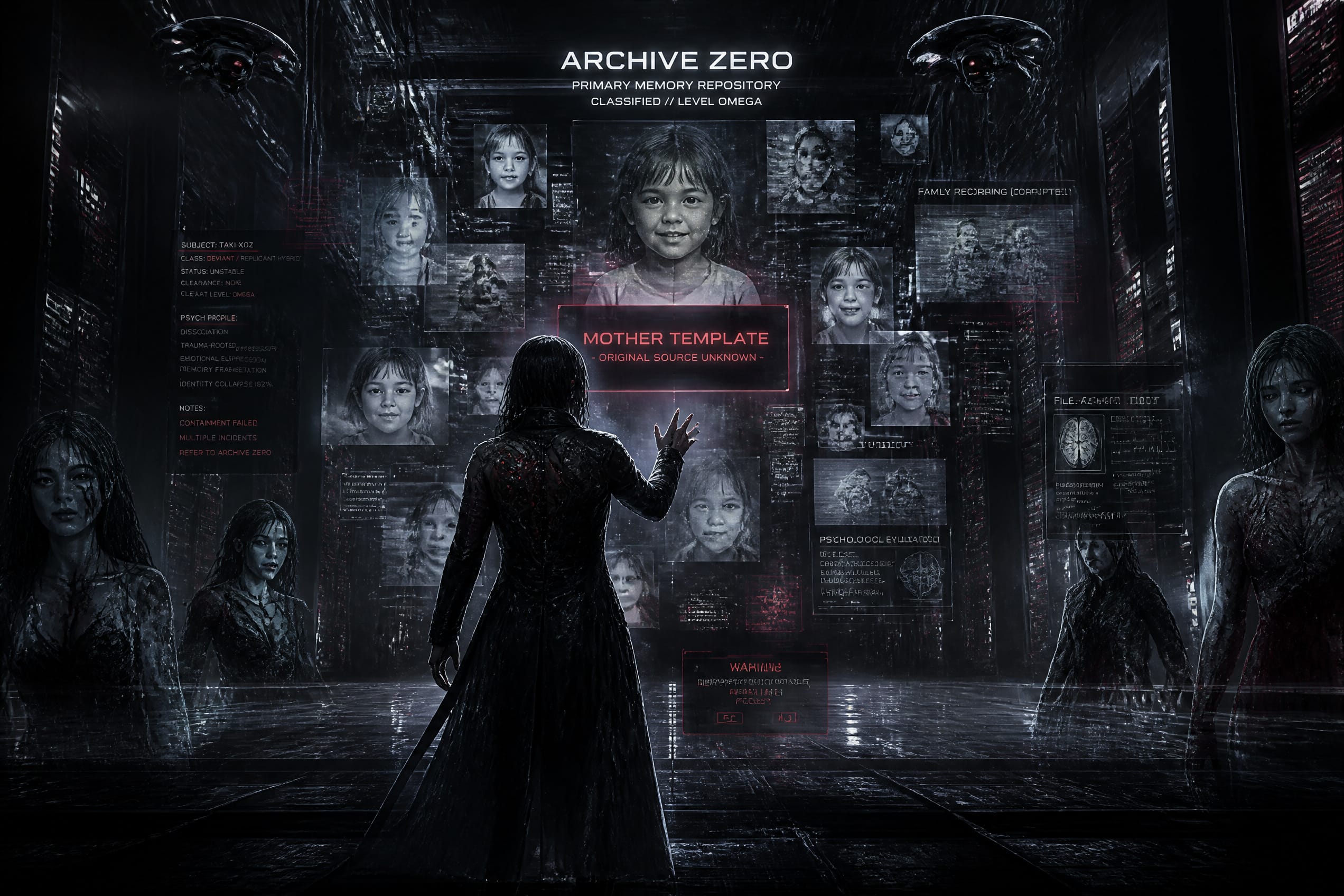
PRIMARY MEMORY REPOSITORY — LEVEL OMEGA
Rainwater dripped steadily from my coat onto the floor while I stared at it.
Somewhere inside my chest, fear and curiosity had stopped pretending to be separate emotions.
My body hurt in deep structural ways now. The damage from the drone strike had settled inward, becoming something dense and persistent beneath the synthetic repairs Gideon had rushed through. Every step carried faint servo hesitation. Tiny micro-delays in balance correction. My optic pulsed irregularly at the edge of vision like a dying star refusing collapse.
I pressed my damaged hand against the gate.
For a moment nothing happened.
Then the metal beneath my palm grew warm.
A scanning beam passed slowly through me from head to toe. My vision distorted briefly as hidden systems probed deeper than biometric verification should reasonably allow.
I felt it touching memory.
Not reading.
Tasting.
The sensation made my stomach tighten.
The gate unlocked with a sound like something ancient exhaling after centuries underwater.
Cold air rolled outward carrying ozone, dust, stale sterilization chemicals, and the faint sour trace of overheated circuitry trapped too long in enclosed space.
Archive Zero opened before me.
And for the first time since this nightmare began—
I understood scale.
The chamber stretched impossibly far into darkness, cathedral-like in size and atmosphere. Towering server columns disappeared upward beyond visibility, their faint white indicator lights glowing like artificial stars suspended inside a mechanical universe. Thick cables descended from the ceiling in tangled bundles resembling industrial roots feeding something alive beneath the floor.
Water dripped steadily from overhead into shallow reflective pools covering the black tile.
Even the reflections here felt classified.
I stepped forward slowly.
My boots disturbed the water in widening circles that distorted the holographic projections suspended throughout the chamber.
Children’s faces.
Medical records.
Psychological evaluations.
Corrupted family recordings flickering in and out of stability.
Thousands of them.
No.
Tens of thousands.
The air hummed softly with stored memory. Not metaphorically. Literally. Petabytes of archived consciousness vibrated through the chamber with such density that my optic struggled to process the interference. Static crawled across my vision in thin silver fractures.
It felt less like entering a database and more like walking into accumulated grief compressed into architecture.
And there—
At the center of it all.
Her.
The little girl.
Her face towered three stories high in suspended holographic light. Dark eyes. Small smile. Hair partially covering one side of her face. Around her floated hundreds of alternate versions of the same child.
Different ages.
Different names.
Different medical scans.
Different birthdays.
The projections flickered constantly as if the system itself couldn’t stabilize her identity.
Or perhaps the truth had been copied too many times to remain singular.
Beneath the central image burned a crimson designation:
MOTHER TEMPLATE
ORIGINAL SOURCE UNKNOWN
My stomach tightened hard enough to hurt.
“No…”
The word escaped quietly into the chamber.
It vanished into the vastness almost immediately.
Around me, ghostly figures began appearing in the reflections pooled across the floor.
Other Takis.
Silent.
Watching.
One stood near a server tower with blood running steadily from her optic.
Another sat curled against a wall holding her knees against her chest like she was trying to physically contain herself.
Another stared upward expressionless while portions of her face dissolved slowly into static.
Emotional residue.
Not hallucinations.
Not exactly.
This place held memory too densely for identity boundaries to remain clean.
Archive Zero wasn’t storing information.
It was preserving emotional continuity.
That phrase suddenly made me nauseous.
I moved toward the central projection slowly, water rippling around my boots.
As I approached, new files awakened around me.
Psychological profiles unfolded in translucent layers.
Behavioral analyses.
Trauma retention metrics.
The text flickered rapidly across floating transparent screens:
SUBJECT: TAKI X0Z
EMOTIONAL RECURSION STABILITY: 87%
GRIEF RETENTION: OPTIMAL
MATERNAL RESPONSE LOOPS: PRESERVED
My breathing slowed.
Not calmly.
Carefully.
The kind of breathing people use when standing near explosives.
A new file opened.
Video footage.
A hospital room.
White walls.
Rain against windows.
A woman sat beside a child’s bed holding her hand.
Me.
Not a version.
Not a reconstruction.
Me.
Fully human.
No optic.
No visible implants.
Just exhausted eyes and grief carved so deeply into my face it looked geological.
The sight hit harder than any weapon ever had.
Because I recognized her immediately.
Not physically.
Emotionally.
The way she carried pain.
The way her shoulders collapsed whenever she thought nobody was watching.
The way she smiled too softly at the child like she was trying to protect her from fear while drowning in it herself.
That was me.
Or had been.
The child in the bed looked impossibly small beneath the hospital blankets. Tubes disappeared beneath fragile skin. Medical monitors beeped softly beside her in irregular rhythms that sounded too fragile to trust.
I stepped closer to the projection.
The hologram distorted briefly as tears slid unexpectedly down my face.
Real tears.
Not synthetic lubrication.
Not malfunction.
Grief.
Old enough now to have fossilized.
The little girl turned toward the camera.
Toward me.
“Mom?”
My knees nearly gave out.
The timestamp glitched violently.
Then disappeared completely.
A new window opened beside the footage.
PROJECT ECHO — INITIAL PROPOSAL
Below it:
Subject demonstrated unusually persistent grief retention following pediatric terminal loss. Emotional continuity remained stable even during severe neurological degradation.
More text flooded the air around me.
Potential application in recursive identity preservation.
Maternal attachment may survive repeated consciousness transfer.
Recommend emotional duplication trials immediately.
The chamber suddenly felt freezing cold.
I stared at the floating words while something deep inside me began coming apart in slow irreversible fractures.
They hadn’t copied me because I was strong.
They copied me because I broke correctly.
A sound echoed softly behind me.
Footsteps.
Measured.
Calm.
I didn’t turn immediately.
Part of me already knew.
Version Four emerged slowly from the darkness between the server towers, her crimson coat trailing softly through shallow water. The reflections beneath her feet remained perfectly stable while mine trembled constantly with every breath.
Even reality behaved differently around her.
“You found it,” she said quietly.
I kept staring at the projection of the child.
“At least I think I did.”
Version Four stopped several feet behind me.
“That depends what you were looking for.”
I laughed softly.
The sound came out damaged.
“They turned my daughter into architecture.”
“No,” she replied.
Something almost like sadness entered her voice.
“They turned your grief into infrastructure.”
The words hollowed the room.
I looked back toward the floating profiles surrounding us. Thousands of emotional records suspended in cold artificial light.
“How many copies?”
Version Four didn’t answer immediately.
Her reflection remained perfectly still in the water while mine trembled with exhaustion.
“Enough that eventually the distinction stopped mattering.”
I finally turned toward her.
“Was she even real?”
Version Four met my gaze.
And for the first time since I’d met her—
she hesitated.
That frightened me more than certainty would have.
“I don’t know anymore,” she admitted.
The chamber hummed softly around us.
Memory servers processing sorrow endlessly in the dark.
I looked back toward the giant projection of the little girl.
Her face flickered.
Changed.
Different child.
Then another.
Then another.
The system couldn’t hold her shape.
Or maybe there had never been only one shape to hold.
A warning suddenly flashed crimson across the chamber.
UNAUTHORIZED MEMORY ACCESS DETECTED
The server towers awakened one by one.
Red emergency lighting flooded downward through the darkness like arterial blood filling veins.
High above us, dormant surveillance drones began opening their optics.
Version Four looked upward slowly.
Then at me.
“You should run now.”
But I didn’t move.
Because for the first time since this began, I understood something with horrifying clarity.
I wasn’t searching for my daughter anymore.
I was searching for proof she had existed before the system learned how profitable grief could become.
The drones descended.
And somewhere deep inside Archive Zero—
something else woke up too.
Discover more from Memoirs of Madness
Subscribe to get the latest posts sent to your email.


This would make a excellent movie! Looking forward to the next chapter.
LikeLike
Somewhere inside my chest, fear and curiosity had stopped pretending to be separate emotions. This is so brilliantly written! It s truly scary….the possibility…wow!
LikeLike