


Most people will probably answer this question with Magneto, Killmonger, or some other modern villain whose motives were understandable even if their methods weren’t. Those are good answers.
Mine is different.
I would argue that Professor Moriarty had the best point—not because of anything he said, but because of what Arthur Conan Doyle was saying through him.
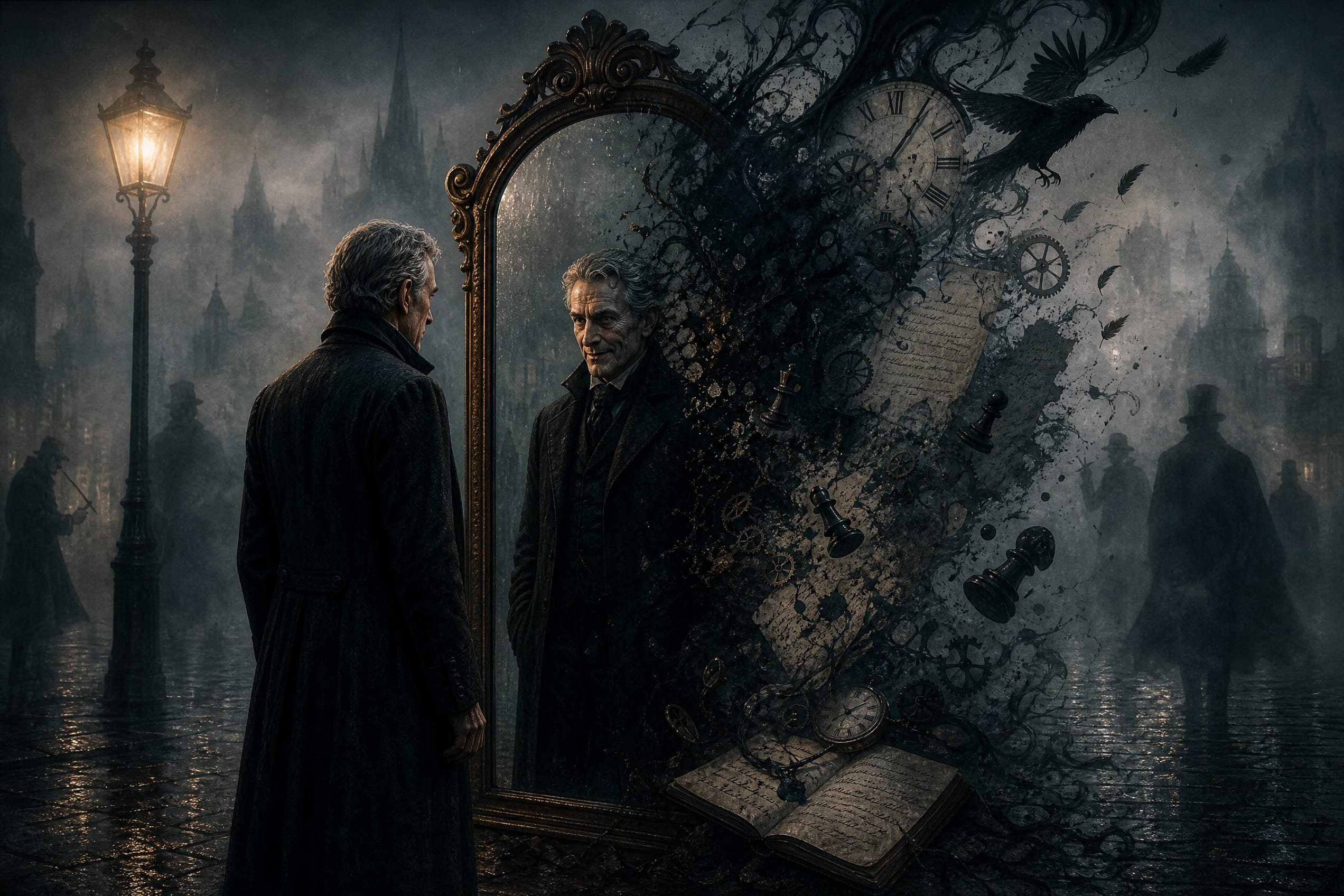
I’ve always believed Holmes and Moriarty are far more alike than different. They possess extraordinary intellects, an almost unsettling ability to detach emotion from reason, and an obsessive pursuit of their chosen purpose. One uses those gifts to restore order. The other uses them to create chaos. Strip away the labels of “hero” and “villain,” and what remains are two men standing at opposite ends of the same road.
To me, that’s the point.
The greatest adversary isn’t the person standing across from us.
It’s the person we could become.
I’ve always found it interesting that we prefer stories where evil is easy to identify. We point to the villain because it’s comforting to believe darkness lives somewhere outside ourselves. It’s much harder to accept that the line separating Holmes from Moriarty isn’t intelligence, talent, or even opportunity. It’s character. It’s the thousands of choices we make when no one is watching.
That’s why I’ve never viewed Moriarty as simply a criminal mastermind. I’ve always seen him as Holmes’s reflection. Not his opposite, but his possibility.
In many ways, Doyle separates into two characters what most of us experience within ourselves. We all possess ambition, pride, resentment, compassion, discipline, and temptation. The struggle isn’t defeating someone like Moriarty. It’s deciding which parts of ourselves we’ll feed and which parts we’ll keep on a leash.
That reminds me of an old saying often attributed to the comic strip character Pogo: “We have met the enemy and he is us.” I’ve always thought those words captured something literature has been trying to tell us for centuries. Before we can confront the darkness in the world, we have to acknowledge the shadows we carry ourselves.
That’s why I think we so often point outward instead of inward. It’s easier to condemn a villain than to acknowledge that, under different circumstances—or after enough bitterness, ego, or fear—we might recognize pieces of ourselves in him.
Maybe that’s why Holmes fascinates me just as much as Moriarty. Holmes doesn’t win because he’s smarter. He wins because he chooses a different purpose for the very gifts that could have made him just as dangerous. His greatest victory isn’t over Moriarty. It’s over the version of himself he refuses to become.
So, what villain actually had a good point?
For me, it wasn’t something Moriarty argued. It was something his existence revealed.
Sometimes the greatest villain in the story isn’t the one we’re chasing.
It’s the one staring back at us from the mirror.
Discover more from Memoirs of Madness
Subscribe to get the latest posts sent to your email.


Wow. So well said and great choice
LikeLike
thank you so much.
LikeLike
TY. You are the first person outside myself that looked at these two men this way. Since most look at the villain only and through that stare relief tension without reciprocity. If you look at the fact that the only thing that stops any single one of us from being Moriarty is strength of character motivation and a belief system or morals if you will. ty
LikeLiked by 1 person
Yes, indeed. Holmes saving grace has always been Watson. If you examine each of adaptations, the common thread is Watson’s humanity. Even though, it’s hard to notice this in the Basil Rathbone and Nigel Bruce series.
LikeLiked by 1 person
I enjoyed your take and agree they were both so similar in trying to outdo the other in the game of life and death.
LikeLike
thank you
LikeLike