
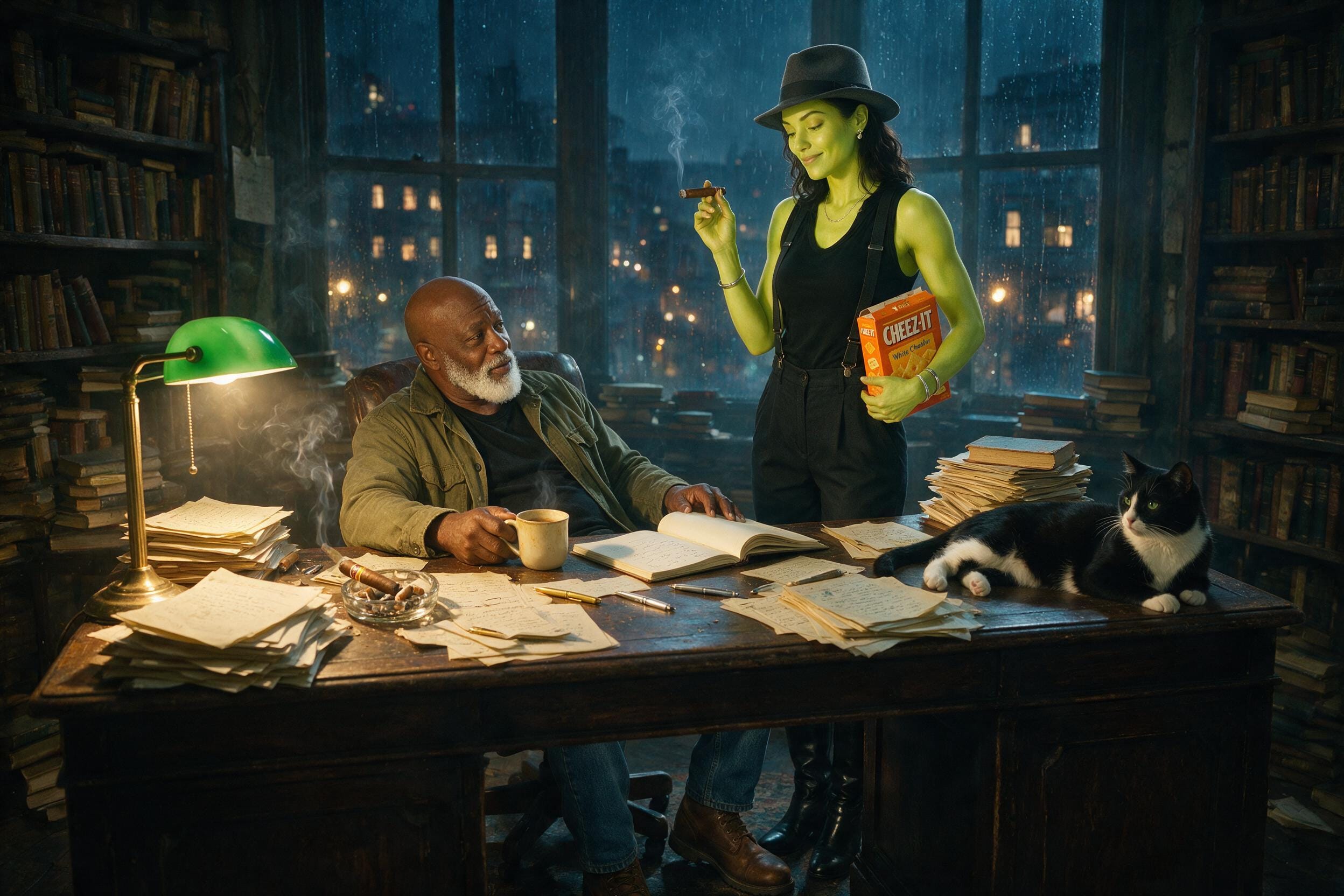
Most people would probably invite Sherlock Holmes, Gandalf, or Atticus Finch to dinner. Me? I’d invite Ursula.
She’d arrive late—not because she was careless, but because she enjoys making an entrance. Lime green from head to toe, fedora tilted just enough to suggest she knows something the rest of us don’t, she’d carry a box of white cheddar Cheez-Its tucked beneath one arm. She insists the orange ones are for amateurs. Somewhere in the evening, she’d light a Cohiba cigar without asking permission, smile at the horrified expressions around the room, and remind everyone that rules are often just comfortable habits wearing neckties.
She was beautiful in all the ordinary ways. But that wasn’t what made you stop talking. There was something else—something that reached beyond symmetry, curves, or color. One look from Ursula and you understood that beauty isn’t what attracts the eye. It’s what leaves the soul struggling to find better words.
Oh yeah… it doesn’t have a damn thing to do with sex.
That may disappoint a few people, but that’s because we’ve spent too much time confusing beauty with desire. They’re not the same thing. Desire asks what it can take. Beauty asks what it can awaken. Ursula never made me want to possess her. She made me want to write something worthy of her company.
At first glance, she’d seem impossible.
The truth is, she is.
Ursula isn’t borrowed from someone else’s imagination. She’s borrowed from mine.
Or perhaps that’s giving me too much credit.
Writers have a peculiar relationship with the people who live in the regions of their minds. We like to pretend we’re in charge, that every sentence marches across the page because we commanded it to. That’s a comforting illusion. Characters have a habit of ignoring outlines, rejecting dialogue, and refusing endings that don’t ring true. They become less like puppets and more like difficult dinner guests who insist on ordering dessert before the entrée.
Ursula has always been the worst offender.
She doesn’t compliment my writing. She interrogates it.
“Why did you choose that word?”
“Is that what the character would say, or what you want them to say?”
“Were you writing the truth…or just something that sounded good?”
Those are uncomfortable questions, which is probably why I keep inviting her back.
Some people imagine a muse as a graceful spirit whispering inspiration into the ear of an artist. Mine steals my pen, critiques my paragraphs, reaches for another handful of white cheddar Cheez-Its, and explains why an entire page deserves to be thrown into the fireplace.
She’s usually right.
Usually.
Here’s where I’d challenge my own answer to this prompt. If Ursula is nothing more than a colorful extension of my personality, then having dinner with her is little more than talking to myself. That sounds less like an interesting evening and more like a reason to schedule an appointment with a professional.
Or does it?
Every writer eventually discovers there are conversations that only become possible after they’re disguised as fiction. We invent people because they can ask questions we’re not yet brave enough to ask ourselves. We hand pieces of ourselves to imaginary strangers, and in return they reveal truths we would have ignored had they arrived in our own voice.
Perhaps that’s all a muse has ever been.
Not magic.
Not mythology.
Just the courage to let another version of yourself speak.
If dinner lasted long enough, Ursula would eventually remove her fedora, lean back in her chair, and let the silence settle between us. She’d tap the ash from her cigar, glance toward the empty notebook lying beside my coffee cup, and smile that infuriating smile she wears whenever she knows the answer before I do.
Then she’d ask the only question that really matters.
“So…what story are you avoiding today?”
I probably wouldn’t answer.
I’d just open the notebook and start writing.


 Memoirs of Madness