Dante in Combat Boots: My Journey Through the Divine Comedy

ESSAY – RANDOM THOUGHTS

The First Encounter – Lost in the Woods (and the Footnotes)

The first time I read The Divine Comedy was sparked by an argument—an intellectual back-and-forth with someone who, as it turned out, didn’t know much about the book. But he was passionate. His conviction was hypnotic. I didn’t buy his analysis, but I understood why he was obsessed.

I picked up the book out of curiosity and a little competitive pride. I didn’t finish it. We got called out on a mission, and you don’t take library books on missions. Fines are one thing—charred pages are another.

Still, even unfinished, it stuck with me. Something about Dante’s voice—strange, serious, deliberate—lingered.

That first attempt, though brief, planted a seed. When I returned to it later, I had more patience, a better dictionary, and no librarian breathing down my neck.

Even then, Inferno was dense. Layers of references. Historical names I barely recognized. Theology deep enough to drown in. I was flipping between footnotes and old library texts like I was defusing a bomb. The nine circles of Hell were vivid, yes—but they felt more like a museum exhibit than a lived experience. I was watching Dante, not walking with him.

It felt like homework. Necessary, maybe. But distant.

Still, something about the structure—the cold logic behind every punishment—got under my skin. Sin wasn’t just bad behavior. It had a shape. A weight. I didn’t have the words for it then, but the idea that justice wasn’t arbitrary began to settle in.

I didn’t love the poem yet. But I was starting to hear it.


Warzones and Infernos – Dante in Combat Boots

When I returned to The Divine Comedy after combat, it hit differently. Dante wasn’t just a poet anymore—he sounded like someone I knew. Maybe even like me.

Inferno started to make more sense. Hell wasn’t about fire and demons—it was about clarity. Brutal, stripped-down moral logic. A world where actions had consequences that couldn’t be bargained with.

In combat, you live in that gray zone between judgment and survival. Right and wrong don’t show up in clean lines. Sometimes you do the right thing, and it haunts you. Sometimes, it felt like there was no God—at least not the one we heard about in Sunday school. We believed in the integrity of what we were doing. We questioned it, sure. But our resolve stayed intact. Sometimes, surviving was all you could do. And that didn’t always feel like redemption.

Dante’s Hell isn’t just punishment—it’s paralysis. People stuck in their choices, their pride, their rage. No growth. No movement. Just a reflection in the worst kind of mirror.

That rang true.

Some turned to a higher power for guidance. We knew—we were fighting for God. But we also knew the limits. We were required to do what was asked of us—but no more. We fought for God. And we had to answer to Him too.

Not just for the people we encountered. Sometimes for what we became.


Purgatorio – The Long Climb Back

Purgatorio doesn’t get the same attention as Inferno. It’s not as dramatic. No fire. No famous sinners frozen in ice. But it’s the part that felt most real to me.

Because after war, after any real descent, what follows isn’t glory—it’s work. Quiet, repetitive, soul-grinding work. That’s Purgatorio.

Dante climbs a mountain, terrace by terrace, confronting the seven deadly sins. Each level is a mirror—less about judgment, more about recognition. It’s not punishment anymore. It’s penance. The difference matters.

After combat, reintegration isn’t just about coming home. It’s about stripping away the armor you lived in. Unpacking things you didn’t have the luxury to process while they were happening—and you don’t have the luxury to process them now. You’re thrust back into your life like nothing happened. You lie to the ones you love to keep them safe, to spare them from the world you know exists but no one is talking about. You keep that secret.

You make a valid attempt to let go of habits that kept you alive but will not help you live. It’s exhausting.

That’s why Purgatorio hit me so hard. I didn’t expect it to. But there’s something deeply honest in the idea that healing doesn’t feel holy. It feels like discipline. Like carrying your own burden up the hill with no end in sight. Some days, you move a little higher. Some days, you just don’t slip backward.

There’s no audience. No headline. Just effort.

And yet—it’s hopeful. The whole mountain is built on the assumption that you can be made whole. That ascent is possible. Redemption is a process, not a prize.


Paradiso – The Light We Try to Name

Paradiso is the hardest part.

Not just to read—but to believe in. It’s abstract, layered with theology and geometry, full of light and music and spheres. Dante is trying to describe the indescribable. He’s chasing God through language; the closer he gets, the less the words hold.

For a long time, I didn’t connect to this part. It felt like too much, too far, too clean.

But after Purgatorio, after the work of climbing, carrying, and unlearning, I started to understand what Paradiso was reaching for—not perfection, not purity, but peace.

And peace—real peace—is foreign when you’ve lived inside chaos. It’s not some cinematic moment of triumph. It’s quieter. It’s the ability to be still, without needing to be numb. It’s presence, not performance. It’s the moment you stop bracing for the next thing to go wrong.

Dante meets Beatrice here—his guide into the divine, his symbol of grace. We all have our Beatrices, if we’re lucky. People who held the line for us when we couldn’t. People who reminded us we weren’t lost forever.

Am I worthy of this grace? Will God forgive me for what I’ve done? I find myself waiting—searching—for that one thing that could wipe away all the havoc of my making. Is that a thing? You know the scales will have an answer.

In the background of all this light, I still imagine the scales. The old ones—Egyptian, Christian, Islamic. The image of your life being weighed. Every choice, every silence. Your hands held out, waiting to see which way it tips.

We fought for God. We made peace with that. But we also knew we’d stand in front of Him one day. And maybe that’s what Paradiso is really about—not escaping judgment, but understanding it. Accepting it. Trusting that there’s a kind of justice that doesn’t crush you, but completes you.

I don’t claim to understand everything Dante saw in Heaven. But I understand the desire to see it.

And that’s something.


Full Circle – Still Listening

I’ve read The Divine Comedy more than once now. Not in a straight line, not as a scholar, but as someone who’s lived with it—left it, returned to it, wrestled with it. And the strange thing is, it keeps changing. Or maybe I do.

What started as a challenge—half a debate, half an ego trip—turned into a mirror. Dante’s journey through Hell, up the mountain, into the light, isn’t just theology or poetry. It’s a blueprint. A map of what it means to go through something, to come back from something, and to wonder if you’re still whole on the other side.

I never read it looking for answers. Not really. But I keep coming back to it for the questions.

Am I worthy of grace? Is peace possible? Can the scales ever truly balance?

I don’t know.

But I’m still listening.

And that’s something too.


Author’s Note:
This was written as a result of a post by alexander87writer. I was going to leave a comment, and just kept writing. My two sentences became this. I’m so extra at times.

Fold Theory & Fiction: Confessions of a Rereader

Daily writing prompt
What book could you read over and over again?

DAILY PROMPT RESPONSE

Plenty of books fall into this category. I’d love to say I have a strict system for what earns a reread, but let’s be honest: the rules shift every time. Sometimes it’s the writing, sometimes it’s a character who won’t shut up in my head, and other times it’s because the book whispered something suspicious from the shelf—like it knows things. Rereading isn’t a choice at that point. It’s a compulsion. Like the story implanted a post-hypnotic trigger in my brain that activates randomly. And when it does, I drop everything—sleep, obligations, dignity—and reread. Again.

Now, my particular brand of obsession comes with a twist: time travel. I don’t just read about it—I research it. Because yes, I’m building a time machine in my basement. And no, I’m not joking. I know what you’re thinking. This person is completely unhinged. Stop looking at me in that tone of voice. Don’t judge me—I’m backed by science.

Stephen Hawking once said, “Time travel used to be thought of as just science fiction, but Einstein’s theory of general relativity allows for the possibility that we could warp space-time so much that you could go off in a rocket and return before you set out.” So, technically, I’m not crazy—I’m just early.

And Einstein himself—our time-bending MVP—once said, “The distinction between past, present, and future is only a stubbornly persistent illusion.” That quote haunts me. Because if time really is just an illusion, then maybe my late-night diagrams and basement scribbles aren’t completely absurd. Maybe I’m just trying to see through the illusion. With tools. And snacks.

Some books feel like accomplices in this mission. Einstein’s Dreams is one of them. It’s not a novel in the traditional sense—it’s more like a collection of speculative time experiments disguised as dreams. Time slows, speeds up, loops, fractures. Each version reveals how fragile we are, how much we lean on the idea that time is stable. It made me wonder if I want to manipulate time or if I just want to understand why it controls me so completely.

Then there’s The Psychology of Time Travel, which sounds quirky but plays out like a cautionary tale. It’s brilliant, and it doesn’t flinch. Time travel in that book isn’t just a shiny toy—it messes with identity, memory, and even reality. It shows the mental strain of knowing too much about your own timeline. Honestly, it made me stop mid-chapter and ask, Do I actually want to succeed at this, or do I just like the chase?

This is probably why I’ve started keeping my own book—a messy, ever-growing volume of experiments, part science, part psychology. Charts, notes, theories, emotional meltdowns—it’s all in there. It’s not publishable (yet), but it’s real. And it’s mine. Some people journal. I document the potential collapse of linear time. To each their own.

And then there’s the part no one wants to discuss—the mythic weight of time. The ancient beings who ruled it long before clocks or quantum theory. Chronos, the Greek god who devoured his children just to keep time moving in his favor. The Moirai, weaving destinies and snipping threads when they feel like it. Kāla, the Hindu personification of time, is both destroyer and renewer. Even the Norse Norns, sitting beneath the world tree, are casually deciding fates like it’s a hobby. These entities weren’t just metaphors—they were warnings. Time is power, and it doesn’t like to be tampered with.

The more I study, the more I feel like time isn’t linear—it’s layered. Some theorists say time can fold over itself like a sheet of paper, bringing two distant moments into contact. Others call it fluid, a river that bends, swells, evaporates, and returns in strange new forms. Honestly, I’ve felt both. There are days where the past bleeds into the present like ink on wet paper. There are moments I swear I’ve already lived. Maybe I’m stuck in a fold. Maybe I’m just bad at time management. Either way, I write it all down.¹

And Then She Vanished wasn’t just another trip down the wormhole—it rerouted my entire approach. The way it plays with memory, causality, and the emotional cost of screwing with time? It hit differently. I went in looking for narrative patterns, maybe a clever paradox or two. What I got was a punch to the gut and a blueprint for moral consequences. The book didn’t just mess with time—it made me rethink why I want to.

And maybe that’s the real loop. Because every time I pick up a pen, I feel it. Writing bends time, too. It stretches memory, warps emotion, and compresses decades into a sentence. Every time we write, are we building new worlds, or are we just reconstructing something we have already lived? Maybe stories are our version of time machines. Just paper ones. Slightly safer than the one in my basement.


¹ Excerpt from my “Working Theories of Time” notebook, vol. 3:

  • Time is a crumpled map, not a straight road. Folds = déjà vu. Rips = blackout years.
  • Fluid time isn’t just poetic—it leaks. Time gets messy around emotional events—breakups, funerals, weird Tuesdays.
  • The body remembers time differently than the mind. Proof: muscle memory, grief anniversaries, and spontaneous panic attacks for no logical reason.
  • Clocks lie. This isn’t a theory. Just a fact.

This is why I track time like a conspiracy theorist with a mood disorder. It’s all connected. Probably.

I’d Be Shaft, Obviously (Everyone Else Needs Therapy)

Daily writing prompt
If you could be a character from a book or film, who would you be? Why?

DAILY PROMPT RESPONSE

An aggressively personal breakdown of alter egos, revenge spirals, and why fictional characters are one emotional snap away from disaster.

Ever watch a movie, read a book, or binge a show and think, Wow, this character really needs therapy? Like… immediately. They have pills for that. And boundaries. And emotional support animals. But instead of signing up for BetterHelp, fictional characters usually take the scenic route: they grow an alter ego, light their lives on fire, and call it “justice.”

Sometimes you’re just sitting there, watching a perfectly normal person start talking to their dead father’s ghost, and all you can think is: They are so fucked.

Let’s talk about that.


The Alter Ego: Fancy Latin for “Oh no, he’s talking to himself again”

There’s something darkly satisfying about a character cracking right down the middle. Not like “oops, I’m having a rough day” cracking—but full-blown talking to their reflection in the mirror and the reflection talks back cracking.

Dr. Jekyll doesn’t just dabble in science—he mainlines Victorian repression and conjures a walking midlife crisis named Hyde. And Tyler Durden? He’s what happens when toxic masculinity drinks four espressos and finds Nietzsche on Reddit.

“Man is something that shall be overcome.” – Nietzsche

Too bad most characters take that as an invitation to become unhinged vigilantes instead of, say, doing the shadow work.

Alter egos don’t just show what characters fear—they show what they secretly want: power, escape, freedom from polite society. It’s the part of them that isn’t okay with playing nice anymore. It’s also the part that starts the fires and says “oops” later.


Holmes and Moriarty: A Gentleman’s Guide to Mutual Obsession

Sherlock Holmes and Professor Moriarty are technically enemies. But let’s be honest: they’re intellectual soulmates with unresolved tension and no HR department to report to. If Holmes is logic in a waistcoat, Moriarty is chaos in a cravat. One solves crimes. The other is the crime.

Holmes says he’s repulsed by Moriarty’s criminal mind. But let’s call it what it is: obsession. Like, we-should-talk-about-this-in-couples-therapy obsession.

“He who fights with monsters should be careful lest he thereby become a monster.” – Nietzsche again, because of course.

Their final tango at Reichenbach Falls? That’s not a climax—it’s a breakup scene disguised as a death drop.


Werewolves, Hulks, and People Who Should Not Be Left Unsupervised

Let’s talk about werewolves: the OG metaphor for “Oops, my emotions got out.” Classic lit was obsessed with this stuff. Guy seems chill—until the moon rises and suddenly he’s shirtless, hairy, and eating villagers. It’s like puberty, but worse.
And then there’s Bruce Banner. Poor guy just wants to be left alone to do his science. But noooo—every time someone provokes him, he turns into a giant green rage machine in cut-off jeans. He told them not to make him angry. They did. Now there’s structural damage.

Each transformation screams what Carl Jung quietly suggested:

“Until you make the unconscious conscious, it will direct your life and you will call it fate.”

Which is a very classy way of saying, “Congrats, you’re the werewolf now.”

But let’s not forget—masks don’t just hide. Sometimes they liberate.

“The mask is the instrument of the power that makes one see and speak.” – Michel Foucault

In other words: sometimes putting on the cape, the claws, or the face paint isn’t about hiding who you are—it’s about finally saying what you were never allowed to. That’s why Batman isn’t just Bruce in costume. He’s Bruce off-leash.

The real question is: when the mask comes off… what’s left?


Revenge: It’s Like Therapy, But With Body Counts

Here’s the thing about revenge stories: they used to be neat and tidy. Somebody wrongs you, you plot, you avenge, you feel… better? At least that’s how it worked in the classics. The Count of Monte Cristo is the gold standard of “I was wrongfully imprisoned, now I’m back with receipts.”

But modern revenge stories? Oh, they’re emotionally messy. There’s no neat payoff. Just guilt, trauma, and a long trail of ex-friends.

Walter White didn’t just want to “provide for his family.” He wanted to feel like the universe owed him something—and when it didn’t pay up, he became the universe’s problem. Watching him morph into Heisenberg is like watching your dad get really into crypto and start calling himself an “alpha.”

Amanda Clarke from Revenge isn’t much better. She goes full Machiavelli in heels. She infiltrates high society to take down the people who framed her dad—and in the process, slowly turns into one of them. You know it’s bad when even your revenge plot has subplots.

“Before you embark on a journey of revenge, dig two graves.” – Confucius (or at least the internet version of him)

Revenge doesn’t heal. It haunts. And if your therapist charges $200 an hour, revenge charges your soul.


Why Can’t We Be More Like Shaft?

Let’s take a breather from all the tortured brooding and talk about someone who handles his business without spiraling into an existential crisis every five minutes: John Shaft.

Shaft is revenge fiction’s cool older cousin who doesn’t need an alter ego because he’s already whole. He doesn’t slip into madness, grow claws, or adopt a second name—he just walks into a room, says something smooth, and gets stuff done. No inner monologue. No moral agony. Just grit, justice, and style.

Here’s what makes Shaft different: he’s angry, sure—but he owns it. His anger doesn’t consume him; it fuels him. He doesn’t lose himself in vengeance because he never lets anyone else define who he is. He knows the system is broken. He knows justice is often DIY. But he doesn’t get lost in it. He stays Shaft—and somehow makes leather trench coats look like emotional armor.

Honestly? Watching most of these fictional characters unravel, you start to wonder:

*Are psychiatrists who Curtis Mayfield was talking about in his classic song “I’m Your Pusherman”?
Because half these people don’t need a gun—they need a prescription and a twice-weekly check-in with someone who says:

“Know thyself.” – Socrates, probably side-eyeing half the MCU right now.

And here’s the kicker: Shaft doesn’t need a mask to be powerful. He doesn’t hide behind a symbol. He is the symbol. While most characters fracture under the weight of dual identities, Shaft walks in fully integrated—what Foucault might call power without disguise.

“Power is not an institution, and not a structure… it is the name that one attributes to a complex strategical situation.” – Foucault, probably watching Shaft with admiration and fear.

Shaft is the complex strategical situation. Everyone else is just playing dress-up.


Final Thoughts: You vs. You (And Sometimes a Werewolf)

At the end of the day, alter egos and revenge stories aren’t really about villains. They’re about us—our insecurities, our grudges, our late-night fantasies of telling someone off and walking away in slow motion while something explodes in the background.

These stories hit because they remind us how hard it is to be a person. A person with baggage. With rage we swallow. With wounds we dress up as ambition. We all want to believe we’d be the Shaft in our own story—cool, unshakable, morally centered with a killer soundtrack—but let’s be honest: most of us are two stressful emails away from turning into Mr. Hyde.

“Where there is power, there is resistance.” – Foucault

Whether it’s the beast inside, the grief-fueled vendetta, or the charming psychopath in your mirror, every character in these stories is resisting something: society, morality, themselves.

And some of them lose.

Most of them do.

But then there’s Shaft—no split self, no mask, no melodrama. Just a man who knows the system’s rigged, knows who he is, and shows up anyway.

Maybe that’s the real power.
Maybe the rest of us are just monologuing in the dark.

War, Wisdom, and Other Lies I Tell Myself at Dawn

PROSE – FOWC, RDP, SoCS

“Damn, you’re ancient! What was it like to be one of Teddy Roosevelt’s Rough Riders?”

One of the kids on my team tossed that gem at me this morning. Smirking like he just reinvented comedy. I wanted to fire back—something about his hairline already surrendering—but I let it ride. Not because I’m mature. I’m just tired. And honestly? The way the squad erupted in laughter… it was worth the hit. They needed the laugh more than I needed the win.

I’ve never really understood the logic of soldiers. Still don’t. We sign up to follow orders we don’t write, from people we’ll never meet, for goals we’re not allowed to fully understand. And we’re supposed to be fine with that.

Back when I was their age, I like to think I was different. Noble. Thoughtful. Maybe even angelic. (Okay, maybe not angelic. More like… less of a jackass?) But that could just be the rose-colored fog of memory, or the result of years spent rewriting my own origin story like a drunk screenwriter.

There’s something ritualistic about the way the morning unfolds out here. The dawn eats the night. First sip of bitter coffee. First cigarette. The world still quiet enough to pretend it’s not completely unhinged. I watch them wake up—slow, clumsy, half-zombies with bedhead and bad attitudes. Too young to have rituals, too new to know those rituals might one day keep them sane.

I remember one morning, I hit them with Sweet Leaf by Black Sabbath. Volume up, sun barely over the ridge. Half of them looked like they’d been shot in their sleep. The other half just looked confused. I let it rip while running them through live-fire scenarios. Brains not even warmed up, bodies still clunky from the cold.

It wasn’t for fun. Okay—it was a little fun. But mostly it was about pressure. Teaching them to operate before they’re ready, because the world doesn’t care if you’re ready. Expect the unexpected, I told them. It’s a cliché until you’re bleeding because you didn’t.

Eventually, they’ll get it. Or they won’t. Some learn the rhythm. Others burn out trying.

Each day, we stand there like portraits—young faces with old eyes—propping up a cause that shapeshifts depending on who’s holding the microphone. Marching to the beat of some distant desk jockey who calls themselves a leader because they can attach a PDF to an email. And no one questions it.

That’s the part I can’t let go of. No one questions it.

“War is peace. Freedom is slavery. Ignorance is strength.”
— George Orwell, 1984

I’ve never fully understood that quote. I’ve got pages of half-drunk, sleep-deprived ramblings trying to unpack it. You’d think, with age, I’d get closer. Clarity, wisdom, all that crap they promise you comes with gray hair. But no. The notes get weirder. The handwriting worse. The questions louder.

Maybe that’s the point. Maybe wisdom isn’t about finding answers. Maybe it’s just about asking better questions—and knowing when to shut up and pass the coffee.

Sun’s up. Time to pretend we’ve got it all figured out again.


This post was written for Ragtag Daily Prompt, Fandango, and Stream of Conscious Saturday.

Writing for Nothing and Ink Stains for Free

Daily writing prompt
What job would you do for free?

DAILY PROMPT RESPONSE – FICTION

Writing was never the plan. I wanted something stable, normal—not this chaotic urge to bleed words onto a page. But here I am—caught off guard, and strangely okay with it.

You know that stability that gets beaten into your brain by your parents? The same folks who told you to follow your dreams? Yeah. I believed them—probably because they said it a few thousand times during my childhood with very sincere faces. But every time I actually tried to chase something I loved, it turned into: “Boy, you better get your head out of the clouds,” or “Son, you better get back into the real world.”

I worked a thousand jobs before I ever called myself a writer. The blame for all this goes squarely to Cheryl Whitmore. She gave me a journal when we graduated high school. Then, she sent me one every year for my birthday—for ten years—like she knew something I didn’t.

Since she kept sending the journals, I thought maybe Cheryl was into me. Like… romantically. But it turned out she’d had her heart broken and took a vow of celibacy. I wasn’t even sure she was serious. For a while, I figured it was just a clever way of shooting me down.

Years later, right after I published my first novel, I ran into her again, and she was still celibate. Like, the one person on earth not ruled by sex. She was kind of my hero after that, in a way I don’t really have the words for. Just… grounded. Steady. A rare person who didn’t want anything from me but gave me everything.

Now, I write in those journals every day. Or in ones that sort of look like them, depending on Amazon’s mood. You know how it goes—they’re out of stock when you actually need them and drowning in inventory when you don’t. I swear they do that on purpose.

Anyway, even if I hadn’t become a writer for real, I probably would’ve ended up working at the plant next to my dad, scribbling stories on the side for free.

Oh—and by the way, my parents? Yeah, they’ve read all my books. Twice. Now they hound me for the next one like it’s a Netflix series. But on weekends, Dad and I still tinker in the garage on his F-1 Ford pickup like nothing ever changed.

There’s nothing like being a writer. Honestly, why wouldn’t someone do it for free? We’re sorcerers—wielding words like spells, hoping each one leaves a mark. Our journals are ad-hoc grimoires, crammed with half-formed ideas, emotional incantations, and messy blue ink that somehow becomes meaning. We build memories out of language, wrap feelings in sentences, and send them into the world like bottled lightning. If even one of them sticks—if one person feels something they didn’t before—then the magic worked. And that’s the job.

Top 5 Ways to Ask a Girl Out: Rule #4

FICTION – SHORT STORY SERIES


Top 5 Ways to Ask a Girl Out: Rule #4
If she says “this isn’t a date,” it’s 100% a date. Don’t ruin it.


“So,” she said, tossing her greasy rag in the toolbox like a boss, “I owe you dinner.”

I tried to play it cool, even though my brain immediately burst into a confetti cannon. “You don’t owe me anything,” I said, knowing full well that yes, yes she absolutely did and dinner sounded like a dream.

“Okay, but I’m still getting you dinner. Not as a thank-you. Just… you know. Casual. Like friends.”

There it was. The dagger.

“Right. Totally. Friend dinner. My favorite kind of dinner,” I said, with the emotional grace of a man trying to pretend pizza doesn’t taste better when it comes with romantic tension.

She smiled like she could see straight through me. “Cool. There’s this taco truck I like. Cheap. Questionably licensed. But amazing.”

“Perfect,” I said. “Nothing says ‘healthy bonding’ like eating meat from a vehicle.”

An hour later, we were sitting on a curb, elbows bumping, holding greasy foil-wrapped masterpieces. She was already two tacos in. I was still trying to figure out how to bite mine without it completely disintegrating into my lap.

“You always eat this slow?” she asked, watching me with mild concern.

“I’m being strategic,” I said. “Every bite is a structural risk.”

She laughed. “You’re weird.”

I paused. “In a bad way?”

She tilted her head. “In a taco-anxious, coffee-faking, car-fixing kind of way.”

“So… like a charming disaster?”

“Exactly,” she said, raising her bottle of Jarritos. “To charming disasters.”

We clinked bottles. Mine fizzed over and spilled down my hand. Of course.

I wiped it on my jeans. “Classic me. Keeping the bar low, so I’m always exceeding expectations.”

She grinned. “You know this is kind of a date, right?”

My brain blue-screened.

“I mean,” she continued, casually licking hot sauce off her thumb, “you offered free labor, let me serve you questionable coffee, survived my car, and now you’re sitting on a curb eating tacos with me like it’s totally normal. You passed the test.”

“There was a test?”

“Oh yeah. The gnome was part of it.”

I blinked. “The gnome was a test?”

She nodded seriously. “He only approves of guys with good intentions and strong emotional stamina.”

“Well. That explains the pressure I’ve been feeling in my soul.”

She laughed again, and I swear it hit me harder than the tacos. It was like someone had tugged a thread that ran straight through me — tight, impossible to ignore.

I looked at her, trying to decide if this was the moment. The moment to claim some free will, throw caution to the wind, and say it.

But she beat me to it.

“So,” she said, “if we do this again, maybe we pick somewhere that doesn’t cause gastrointestinal roulette?”

“Are you asking me out?” I asked.

She raised an eyebrow. “Would that freak you out?”

“Only in the best way.”

“Well, then.” She stood and offered me her hand. “Let’s call it a soft launch.”

I took it, still sitting. “Wait. Was that a farewell to the taco truck?”

“Oh, definitely not,” she said, pulling me up. “We’re just giving it a rest before we end up in a hospital.”

We walked back toward the cars in a quiet little row of footsteps, hers just ahead of mine. And yeah, maybe it wasn’t official. Maybe it was just tacos and teasing.

But this time, I didn’t pretend. It was a date.

The Museum of Knuckleheads – Exhibit A: The Credit Card Burial

Daily writing prompt
If you could have something named after you, what would it be?

DAILY PROMPT RESPONSE

The last time this question was asked, this was what I had to say about it:

So, I decided today, what if I turned this cute moment between my wife and I into something else? Here’s what I came up with…


Docent Notes, Entry No. 1: Exhibit A – The Credit Card Burial

Welcome to the Museum of Knuckleheads. Admission is free. Consequences are not.

If you’re here, chances are you’re curious, lost, mildly disappointed with your life trajectory—or just trying to kill ten minutes before the Wi-Fi comes back. All valid. This museum wasn’t built for the elite, the wise, or the well-adjusted. It was built for people like me. People like you. People who have stared into the mirror mid-shower and muttered, “Well… that was a choice.”

Let’s begin the tour.

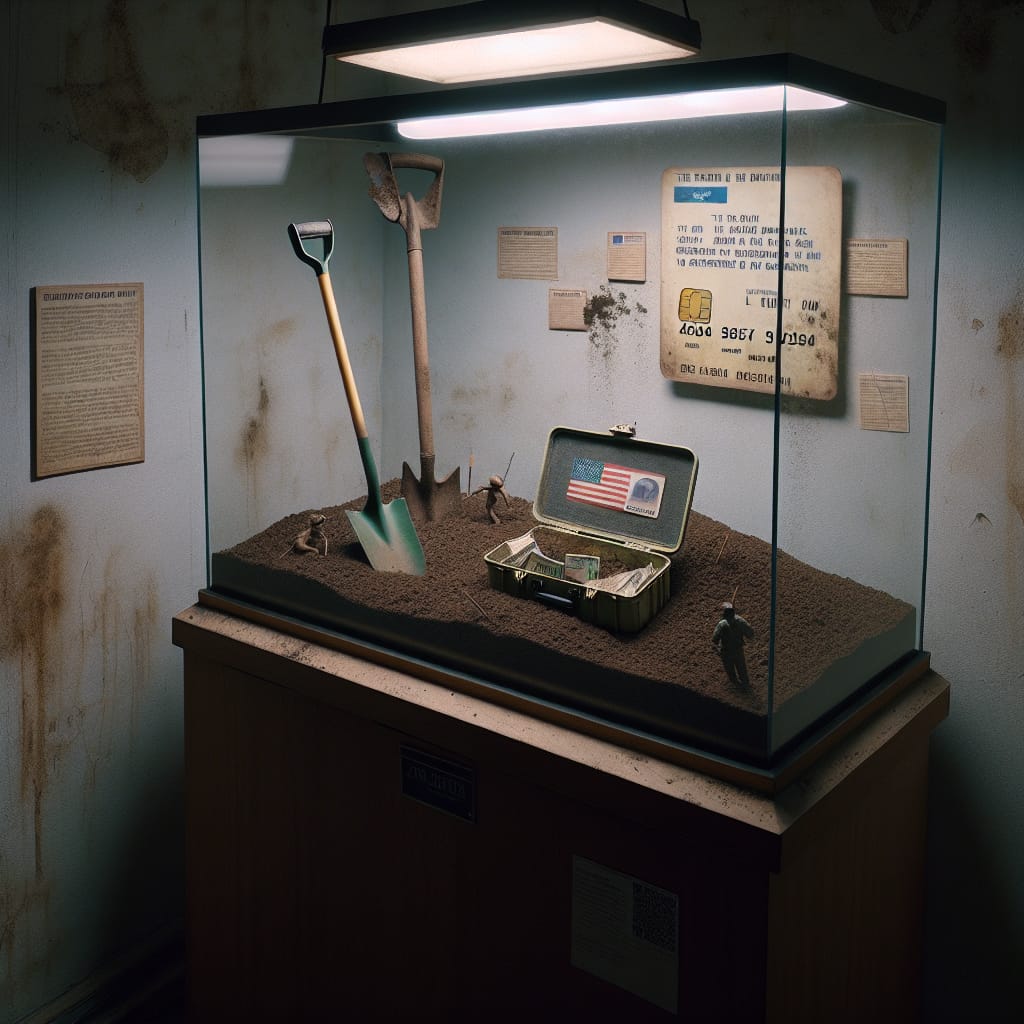
Exhibit A: The Time I Tried to Bury a Credit Card in the Backyard to “Reset My Finances”

Yes, you read that right. That’s an actual dirt-filled display under the buzzing overhead lights. A plastic shovel from a gas station. A laminated credit card. A tiny American flag, for irony.

This was during a phase I call “financial experimentalism,” which is what you call it when you’re broke but still wildly confident. The plan was simple: if burning sage can cleanse a house, why not dig a shallow grave for debt?

I buried the card behind the shed. Said a few words. Patted the soil like it was a dog I was letting go. And then I waited. For what? Honestly, I don’t know. Divine intervention. A good credit score. A sitcom-style reset button.

Spoiler: Capital One does not care if your card is underground. Interest kept growing as if it were photosynthesizing.


Lessons, If You’re the Type Who Learns

  • Debt doesn’t decompose.
  • Just because an idea feels spiritual doesn’t mean it isn’t objectively stupid.
  • Always check where underground sprinklers are before committing to symbolic rituals.

The exhibit still smells faintly like wet dirt and a bad decision you swore you’d only make once. Sometimes, I swear the card shifts positions overnight. Like it’s clawing its way back up.

People laugh when I tell them this one. They assume it’s exaggerated. I let them believe that. It’s easier than admitting it was the most hopeful I’d felt in months.


Closing Notes from the Docent

This museum isn’t here to mock you. It’s here to reflect you—bad choices and all. You may not see yourself in this exhibit. Not yet. But wait a bit. Everyone’s got a shovel moment.

Next time: Exhibit B – Neck Tattoos I Almost Got at 3 A.M.

Until then, take a number. You’ll be up soon.

Docent, Senior Raconteur
Museum of Knuckleheads


Share your own Exhibit

Ever made a decision so irrational that it felt oddly brilliant at the time? Leave it in the comments. One day, we might just build a wing for you. Don’t be shy …


As always, I’d like to shout out the folks who provided inspiration.

Ragtag Daily Prompt

Fandango

Thank you guys for doing what you do

Top 5 Ways to Ask a Girl Out: Rule #2

Daily writing prompt
What makes you laugh?

DAILY PROMPT RESPONSE – FICTION SHORT SERIES


Top 5 Ways to Ask a Girl Out: Rule #2
Don’t insult her car. Even if it deserves it.


We walked down the driveway in silence. Not the comfortable, romantic kind of silence. More like the kind where you know you’re about to meet something terrifying and no one wants to be the first to scream.

Her car came into view. If a rusted toaster had anxiety, it would look like this. The paint was more of a suggestion. The bumper was being held on by what looked like hope and duct tape. One of the side mirrors was missing entirely, probably in protest.

“This is it,” she said, completely straight-faced.

I nodded slowly. “Cool. Vintage… apocalypse chic.”

She raised an eyebrow.

Damn it.

“I mean—it has character. You don’t see this kind of structural chaos every day.”

She laughed. “It’s a piece of crap. You can say it.”

“No! I mean… yes. But lovingly.”

Smooth.

I crouched down to check out the front wheel, pretending to know what I was doing. Which I mostly did. I watched a lot of videos. Some had music. That counts.

“So what’s it doing?” I asked.

“It makes this… sound,” she said, twisting her face like she was bracing for judgment. “Kind of a high-pitched… squeal? Or a scream? It’s hard to describe. Definitely not a sound cars are supposed to make.”

“Got it,” I said. “A banshee vibe.”

She nodded. “Exactly. Like if a haunted violin and a blender had a baby.”

I popped the hood. Steam hissed out like the car was sighing in defeat. I was immediately sweating. From heat, stress, and fear that I was about to electrocute myself in front of someone I liked.

“You don’t have to actually fix it,” she said. “I just thought you might know a guy or something.”

“I am the guy,” I said, way too confidently.

I was not the guy.

Still, I grabbed a wrench like I meant business. Tools make you look legitimate. I tapped something metal. It made a sound. Not a good one.

She leaned over my shoulder. “You sure this is safe?”

“Totally,” I lied. “I’ve done this… dozens of times.”

Once. On YouTube. At 2AM. After searching “how to fix car without dying.”

The gnome wasn’t there anymore. I kind of missed him.


I’m laughing … are you?

Let me know when you are ready for Rule #3

Here’s the link to Rule #1

Top 5 Ways to Ask a Girl Out: Rule #1

FICTION – WDYS #281


Top 5 Ways to Ask a Girl Out: Rule #1
Don’t mention the creepy gnome.


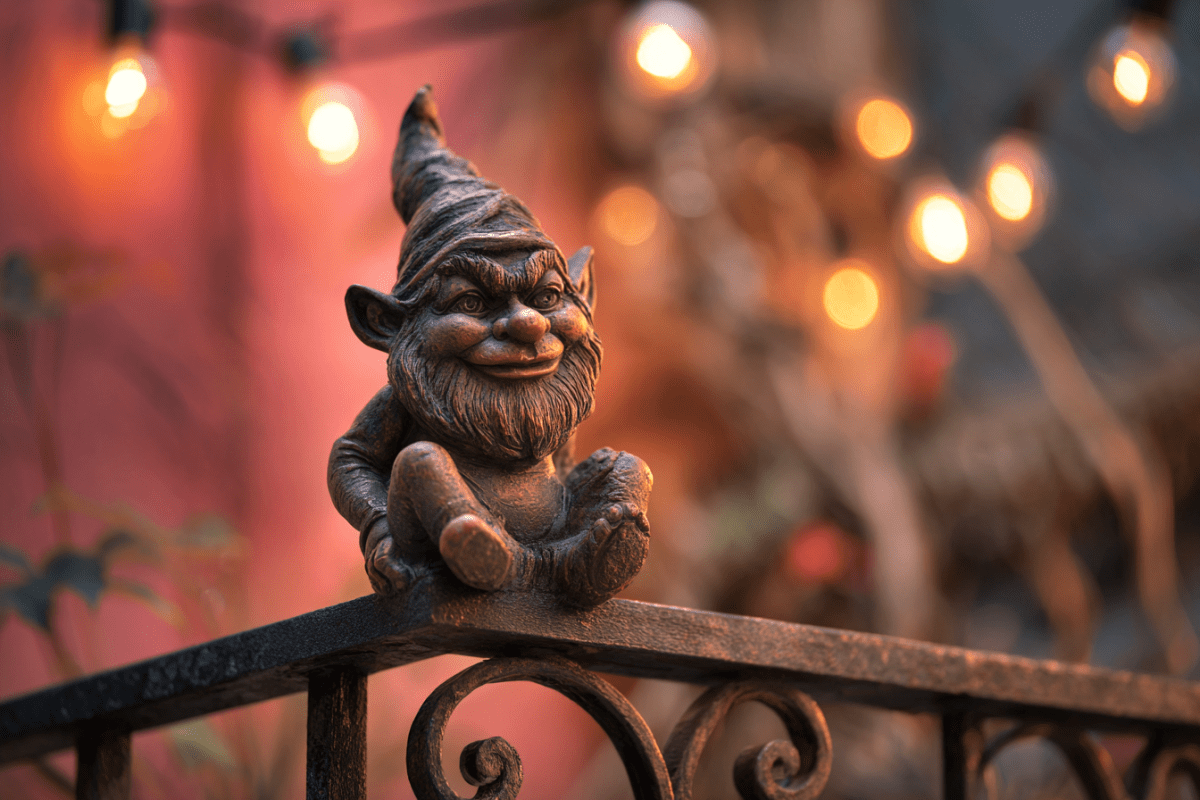
I stood there, just… staring at the thing. A tiny metal gnome? Elf? Goblin? Whatever it was, it was perched on her balcony railing like it owned the place.

Did she put it there? She had to have, right? It’s not like little brass weirdos just wander onto balconies. But still—it felt like it was watching me. Judging me.

I thought about asking her, but no. That would blow up the whole operation. Can’t have her thinking I’m the kind of guy who interrogates her about lawn ornament choices. No, I’m the helpful friend. The guy offering to fix her absolute trainwreck of a car—for free. Out of kindness. Generosity. Totally not because I’m hopelessly into her and grasping at any excuse to spend time together.

God, I’m that guy. The one who offers free labor in the desperate hope of being seen as dateable. I’m one creepy figurine comment away from ruining it all. So I shut up, smile, and pretend like helping her isn’t the highlight of my entire month.

She leaned out the front door, holding two mugs. “Coffee? Or, uh… whatever this is. I might’ve forgotten how coffee works halfway through.”

“Perfect,” I said, taking one. I didn’t even like coffee, but it felt like the right thing to say. Plus, I wasn’t about to reject something she handed me with a smile that made my brain shut down like an overheating laptop.

I took a sip. It was… alarming. Bitter, burnt, and somehow both too hot and lukewarm at the same time.

“Be honest,” she said, raising an eyebrow.

“It’s… ambitious,” I offered.

She laughed. Progress.

We stood in silence for a second, both sipping this mysterious bean liquid and pretending it wasn’t a full-on sensory attack. I glanced back at the gnome. It hadn’t moved. Still smug.

“That little guy yours?” I asked, before my brain could stop my mouth.

Why? Why did I do that?

She looked over and grinned. “Oh! Yeah. Found him at a flea market. He looked like he knew secrets, you know? Like he’s seen some things.”

I nodded. “Yeah, like he knows exactly when you’re lying about liking the coffee.”

She snorted, almost spilling hers. “You’re terrible.”

Yes. Yes, I am. But also? Still here. Not banned. Not rejected. Maybe even kind of funny.

The gnome, I swear, winked at me.

Or maybe the coffee was already hitting my brain weird.

The Joy of Losing Yourself in Writing and Art

Daily writing prompt
What activities do you lose yourself in?

DAILY PROMPT RESPONSE

The last time I answered this prompt, I think I went with something obnoxiously grand like “A Good Story.” I should be shot for sounding so pretentious. But I wasn’t lying—just leaving out the messier bits of the truth.

When I’m in creation mode, the real world ceases to exist. I don’t hear, see, or care about anything other than the story I’m writing or the drawing I’m working on. It’s like my brain switches dimensions, and all outside stimuli become irrelevant. This used to drive my late wife insane. She’d be talking, calling my name, possibly setting the house on fire, and I’d be sitting there, oblivious, lost in whatever imaginary world had taken hold of me. I’d come back to reality only to find her standing there, arms crossed, staring daggers into my soul. And honestly? Fair. It’s a miracle I survived as long as I did.

Writers have been called time travelers, and I think that’s dead-on. But it makes me wonder—when we write, are we building new worlds or excavating old memories? Because when I write, the worlds feel real. I don’t mean in an “I have a well-thought-out setting with consistent internal logic” way. No, I mean in an I can hear the wind howling through the trees, smell the rain-soaked earth, and feel the blood on my hands kind of way. It’s a full-blown sensory experience. I write down everything I see, hear, and feel, but don’t ask me to explain where it all comes from because I genuinely have no clue.

And then there’s the time warp. I sit down to write, and suddenly, five hours have passed. Meals have been skipped. Hydration? Forgotten. Responsibilities? Who’s she? But in exchange for this self-imposed neglect, I get The Surge. The best way I’ve ever found to describe it comes from the movie Highlander. I call it The Quickening. It’s this electric, all-consuming rush—pure creative adrenaline surging through every nerve in my body. I’d say it’s better than drugs, but let’s be real, I wouldn’t know. It’s definitely better than caffeine, though. And I say that as someone whose blood type is probably espresso.

Drawing, however, is a completely different beast. I still lose track of time, but the sensation isn’t electric—it’s tranquil. A deep, bone-melting calm settles over me. My heartbeat slows, my breathing evens out, and for those few hours, the chaos of existence takes a backseat. If writing is an untamed storm, then drawing is a slow, meditative drift down a lazy river. It’s the only thing that relaxes me more than pretending I don’t have responsibilities.

So yeah, I love getting lost in a good story. But really, I just love getting lost. Period. Maybe that’s why I do what I do—because the real world is often too loud, too dull, or just too much. And if I’m going to vanish into another reality, it might as well be one of my own making.

Joy Mangano: The Inventor Who Changed Cleaning Forever

ARTICLE – MINI BIO

If you’ve ever waged war against a kitchen floor, armed with a flimsy, soggy mop that seems more interested in smearing dirt around than cleaning, you’ve probably muttered to yourself: There has to be a better way. Well, Joy Mangano didn’t just mutter—she got to work. She invented the Miracle Mop, a self-wringing, no-hand-dirtying, sanity-saving tool that turned her from a struggling single mom into a business mogul. And let’s be honest: if you’re going to be famous for something, making cleaning suck less is a pretty noble cause.

The Early Years: Before the Miracle Mop

Born on February 1, 1956, in Brooklyn, New York, Joy Mangano spent her childhood in Huntington, Long Island. Even as a teenager, she had a knack for problem-solving. Case in point: while working at an animal hospital, she had the brilliant idea for a fluorescent flea collar to keep pets visible at night. Unfortunately, Hartz beat her to market with something eerily similar. Did that crush her spirit? Nope. It just made her hungrier.

After earning a Business Administration degree from Pace University in 1978, Joy married Anthony Miranne and had three children. But life had other plans, and the marriage ended in divorce, leaving Joy to juggle single parenthood with a carousel of jobs—waitress, airline reservations manager, you name it. It was during this hectic period that her true entrepreneurial spirit took center stage.

The Miracle Mop: A Game-Changer

The legend of the Miracle Mop begins with something many of us know too well: an unholy mess. In 1990, during a dinner party, a guest spilled red wine all over her floor. As Joy wrestled with the sopping-wet, bacteria-breeding disaster that was a standard mop, she hit her breaking point. There had to be a better way.

So, she made one. Using her own savings (and likely a lot of caffeine-fueled nights), she designed the Miracle Mop: a self-wringing mop with a head made from a continuous loop of cotton. It could be wrung out without getting your hands dirty, and for anyone who’s ever gagged while touching old mop water, this was a revolution.

Of course, the road to success wasn’t smooth. Joy invested $100,000—her life savings—to produce her first 1,000 mops. Selling them door-to-door and at trade shows wasn’t exactly a Cinderella story; the response was slow. But Joy wasn’t about to back down. Her break came when she personally convinced QVC to let her demonstrate the mop on air. The result? She sold 18,000 mops in under 20 minutes. That moment didn’t just change her life—it cemented her as a home shopping legend.

From QVC to HSN: Building an Empire

After her smashing QVC debut, Joy became a regular on the Home Shopping Network (HSN). Her natural charisma and infectious enthusiasm made her a powerhouse. In 1999, she sold her company, Ingenious Designs, to USA Networks (HSN’s parent company). By 2000, the Miracle Mop alone was raking in $10 million annually.

But Joy wasn’t a one-hit wonder. She kept churning out wildly successful products, including the Huggable Hangers—yes, the space-saving velvet hangers that have somehow sold over 700 million units. (Seriously, how many closets even exist in the world?)

Her on-air sales? Absurd. At her peak, Joy was moving products at a pace of $1 million per hour. Forget the stock market—if you wanted real action, you tuned in to watch Joy Mangano sell hangers like they were going out of style.

Hollywood Comes Knocking: “Joy”

In 2015, Hollywood took notice. The biographical comedy-drama Joy, starring Jennifer Lawrence, hit the big screen. The film captured the essence of Joy’s relentless drive, though it took some creative liberties (like how she met her ex-husband—Hollywood, of course, had to make it more cinematic).

Regardless, the film highlighted her grit, her struggles, and the absolute circus that is inventing, marketing, and scaling a product. Jennifer Lawrence’s performance was so good that she snagged a Golden Globe and an Oscar nomination. Not bad for a movie about a mop, huh?

Lessons from Joy Mangano

Joy’s story isn’t just inspiring—it’s a masterclass in entrepreneurship. Here’s what we can learn:

  1. Act on Your Ideas – If you’ve ever had a “Why hasn’t anyone invented this?” moment, take a page from Joy’s book and actually do something about it.
  2. Persistence Pays Off – The woman literally went door-to-door to sell her mops. If she had given up at the first sign of rejection, we’d all still be squeezing dirty water out of mop heads like peasants.
  3. Bet on Yourself – She poured her savings into an idea that others doubted. That kind of belief in yourself is what separates dreamers from doers.

Joy Mangano Today: Still Innovating

You’d think after selling millions of products and getting a Hollywood movie, Joy would be kicking back with a cocktail somewhere tropical. Nope. She’s still inventing. In 2021, she launched CleanBoss, a brand focused on next-level cleaning products, and debuted America’s Big Deal, a reality competition show giving other entrepreneurs a shot at success.

Her legacy isn’t just about mops or hangers—it’s about resilience, creativity, and proving that even the most mundane frustrations (looking at you, dirty floors) can lead to something extraordinary.

Conclusion

Joy Mangano’s journey from single mom to self-made millionaire is proof that sometimes, success isn’t about grand, world-changing ideas—it’s about fixing everyday annoyances in a way no one else has. So, the next time you’re battling a stubborn mess, just remember: one woman got so fed up with cleaning that she built an empire.

Now, what are you doing with your frustrations?

Random Fiction – 02212025

FICTION

When you’re young, you wander through life with a carefree attitude, convinced that nothing tragic will ever befall you. It’s not that you think you’re made of steel; it’s just that misfortune always seems to strike elsewhere, affecting other people. You know these people—your classmates who sit a few rows ahead in math, friends who share secrets during recess, rivals who challenge you in sports, and those vaguely familiar faces passing in the school hallway whose names always escape you. “Who is that?” You recognize them; they might live across the street or next door, but their names never stick. You catch wind of their troubles in hushed conversations over cafeteria trays or notice the signs—a bruise blooming under an eye or a sudden empty desk where someone used to sit. But you? You’re shielded by an invisible armor. Untouchable. Until one day, that armor cracks, and the reality that you’re just as vulnerable as everyone else comes crashing down.

As a guy growing up, you were conditioned to believe the worst thing you could be called was a wimp or a pussy. Those words stung like a slap to the face. But the worst of all was “pansy.” It technically meant the same thing, yet it carried a unique venom, like an elite-tier insult that could ignite a brawl. They were fighting words, as the old-timers would say. I often imagined a secret list of such words that, when uttered, left you with no choice but to unleash the rage pent up inside the beast within us all, a primal code of manhood handed down through the ages by our Neanderthal ancestors. The rationale behind it was nonexistent—nonsensical, absurd, or downright foolish didn’t even begin to cover it. I even went so far as to ask friends and acquaintances, hoping to uncover this mythical list’s existence, but they just gave me strange looks as if I was the odd one out. “Weirdo.” There’s another term I’m certain once ranked high on that clandestine list.

If there was one thing certain to amplify male foolishness, it was the presence of a girl. You might assume it would be the confident ones with a smooth stride and an easy grin. But you’d be mistaken. It was simply the presence of any female. Something about her steady, evaluating gaze seemed to flick a switch in our lizard brains. Suddenly, we were all posturing like peacocks, vying for attention as if auditioning for the role of “Alpha Male #2” in a poorly scripted high school drama.

“Cut…cut, cut, cut…” the director’s voice echoed through the set, slicing through our bravado. He rose from his worn director’s chair with an exasperated sigh, his footsteps heavy as he approached. He muttered incoherently, his brows furrowing in frustration. Turning abruptly, he addressed a bewildered production assistant who appeared as if they had stumbled onto the wrong set altogether. “It’s missing… I don’t know,” he said, rubbing his temple as if the motion might conjure clarity from the chaos in his mind. The PA shrugged, their confusion mirroring his own.

“More, you know? More,” he declared, fixing his gaze on you with an intensity that suggested the simple word held the universe’s mysteries. It might, who knows? Because at that moment, you felt the weight of impending humiliation hanging over you like a storm cloud, threatening to unleash if you failed to decipher this cryptic instruction. So you reset, ready to reenact the scene with exaggerated bravado and clumsy confidence. A muscular guy, his shirt straining against bulging biceps, lunged forward to take a swing at a smaller guy. The smaller one stood his ground, fists clenched and eyes steely—not because he had faith in his victory, but because maintaining dignity in defeat was preferable to being labeled a pansy. Who needs self-preservation when fragile masculinity whispers its deceitful promises of status and respect in your ear?

The worst beating I ever took wasn’t even for something I did. And that, frankly, was offensive. I was the kind of kid who had done plenty to earn a few ass-kickings, but this one? This was charity work.

Susan Randle—radiant in a way that made heads turn in every hallway—sat beside me in the darkened movie theater. During what she half-jokingly called our “date” (really just two people sharing a row while an action film played), she eyed me with a mischievous smirk and accused me of being gay simply because I hesitated when she leaned over, voice low and daring, to ask if I wanted to “do it.” The dim light flickering over her face caught the earnest sparkle in her eyes before she suddenly closed the distance and pressed her lips against mine. In that charged moment, the unwritten, yet unanimously understood rule against “unsanctioned sugar”—the secret code dictating who could kiss whom—reared its head. No one ever seemed to grant an exception, whether you were a girl or a guy. And here I was, trapped between the dreaded labels: on one end lay the desperate horndog willing to prove his manhood at every twist, and on the other, the discredited possibility of being gay. I wasn’t interested in becoming just another name on her ever-growing list or dealing with the fallout of shattering her carefully constructed illusion of desirability. When a boy disrupted that illusion, the consequences were swift and ruthless.

That catalog wasn’t a myth—it was as real as the whispered rankings that circulated among us. It wasn’t enough to simply admire the “right” girl; if you dared to look away or, heaven forbid, question the unspoken challenges, your name was scrawled in the ledger of sins. Failed to laugh at the jokes delivered with just the right touch of irony, dress in conforming denim and sneakers, or walk with that practiced swagger? Sure enough, it was marked on the list.

My reluctance to follow these unwritten rules quickly made me a target. Over the following weeks, a series of meticulously scheduled beatings forced me to confront the cruel reality of teenage hierarchies. After school, I would find myself cornered in the deserted back lot behind the gym, where a group of boys awaited with grim determination. They’d shout derogatory names—“fairy boy” and a particular favorite, “pirate,” a crude truncation of “butt pirate”—words spat out with the casual cruelty of a rehearsed routine. Each blow landed with precision, and amid the sting and shock, I discovered a perverse sort of order; they made sure I wasn’t crippled for good. I clutched my prized 96 mph fastball as if it were a lifeline and leaned into my natural left-handed stance, determined to keep my place on the team even if I was labeled a “fairy boy” behind closed doors.

By the time the school year drew to a close, the beatings ceased as if a final judgment had been passed in some bizarre, secret rite of passage. One by one, the bullies patted me on the back with a mixture of grudging admiration and hollow platitudes, congratulating me on having “taken it like a man.” It was as if surviving their collective assault were the final exam in a twisted curriculum of manhood. They’d shrug and say, “It wasn’t personal. It was just something that needed doing.” To them, such senseless violence was nothing short of an honorable tradition—a sacred duty executed without a shred of genuine empathy.

That summer, I found brief refuge away from the tyranny of high school corridors with my father in Northern California. He was a truck driver, his bronzed, weathered hands as familiar with the hum of diesel engines as he was with the hard lines of a life lived outdoors, where emotions were as heavy as the cargo he hauled. My parents’ origins were a collage of chance encounters: they’d originally met at a sultry George Benson concert in the Midwest, where the guitar licks sultry under a neon haze had paved the way for something unexpected. Within nine months of that chance meeting, I came into the picture—a living reminder of their brief yet potent infatuation. They had the wisdom to avoid the charade of forced domesticity; soon after, my mom returned east while my dad continued chasing horizons out west. Mysterious fragments of half-truths and secrets that always belong to a larger narrative are as American as elitism and Chevrolets and need no full explanation.


I used the prompts listed below in this bit of flash fiction

RDP – beast

Fandango – FWOC – Date

Random Fiction – 02112025

FICTION – START OF SOMETHING

“You can never trust the things you hear. Blowhards running around spreading rumors like it’s the national pastime – right up there with baseball and avoiding jury duty,” grunted Detective Maclan as he wrestled with an ancient copper kettle that had seen better days, probably during the Roosevelt administration. The first one.

Mac had the droopy eyes of a basset hound that had just been told Christmas was canceled, minus any of the charm that might make you want to pat his head and give him a biscuit. His face was a topographical map of poor life choices, sour mash, and too many late nights chasing leads that went nowhere.

He was from one of those big cities that think they’re God’s gift to civilization – Detroit, New York, Chicago, take your pick, I could never remember which one. You know the type: concrete jungles where dreams are made of, according to the tourism boards, and people who’ve never had to parallel park there in winter. The kind of places that plaster themselves across postcards nobody sends anymore, where the locals wear their area code like a badge of honor and treat their pizza preferences like a religion.

I’d been wondering, if these metropolitan wonderlands were such paradise on Earth, why Mac had spent the last two decades in our little corner of nowhere, where the most exciting thing to happen was that time someone stole the mayor’s garden gnome. Turned out it was the mayor’s wife, but that’s another story.

At least Mac had decent taste in music – Glenn Miller and Count Basie crooned from a dusty record player in the corner. The big band tunes almost made up for his personality, which had all the warmth of a February morning in Minnesota. Almost.


Prompts Used:

Fandango’s FOWC – Kettle

Ragtag Daily Prompt – Rumor

Daily Doodle – 02042025

ART – PENCIL SKETCH – RANT

In my usual digital existence, I conjure AI-birthed masterpieces from the depths of my imagination, letting algorithms do the heavy lifting while I play puppet master of pixels. But the other day, something snapped in my perfectly curated technological sanctuary. After weeks of wrestling with an inexplicable urge – like a cat trying to resist knocking things off a table – I finally surrendered to my baser artistic instincts.

In a fit of creative madness, I dismantled my pristine computer lab, a temple of processing power and blinking lights, transforming it into something almost prehistoric: an actual art studio. The horror. I excavated long-buried art supplies like an archaeologist unearthing artifacts from a civilization that knew how to function without Wi-Fi. The sketch pad emerged from its tomb, probably wondering what year it was, while dried-up markers and dusty pencils rolled around like confused time travelers.

My reluctance to embrace traditional art wasn’t unfounded – my last serious artistic endeavor predated the invention of social media. Since then, my artistic expressions had been limited to absent-minded scribbles during those endless phone calls with customer service, where “your call is important to us” plays on a loop that would make Dante reconsider the circles of Hell. These masterpieces typically featured abstract demons and nameless entities that looked like they’d been rejected from a budget horror movie’s creature department.

Yet here I stood, analog tools in hand, facing the blank white void of possibility – or possibly just facing the void of my artistic abilities. The paper stared back, judging me with its pristine emptiness, daring me to make my mark. It knew, as did I, that this could either be the renaissance of my artistic journey or just another reason why I should stick to pressing buttons and letting AI do the heavy lifting.


I’m discovering that artistic atrophy is real – like trying to do splits after decades of couch-surfing real. The muscle memory in my fingers has apparently retired to a beach somewhere, sipping cocktails and laughing at my current predicament. I’d conveniently forgotten about the sheer labor involved in sketching, the way it demands patience that my Twitter-trained attention span no longer possesses.

Here I am, yanking out what precious few strands remain on my increasingly reflective dome, while my fingers are stained with pretentious charcoal imported from some artisanal mine in the depths of European forests. Because apparently, American charcoal is too pedestrian, too lacking in that je ne sais quoi that only comes from being excavated by third-generation charcoal artisans who whisper sweet nothings to each piece before packaging. Meanwhile, the humble No. 2 pencil, that faithful companion that birthed countless doodles and masterpieces alike, now sits in the corner like a neglected relic, deemed too barbaric for my evolved artistic sensibilities.

The absurdity isn’t lost on me as I sit here, surrounded by tools that cost more than my first car, trying to remember how I ever managed to create anything with those basic supplies in my youth. It’s like watching a master chef refuse to cook without their imported Japanese knife collection, completely forgetting they first learned to slice vegetables with a butter knife in their mother’s kitchen.

We’re masters at this kind of self-deception, aren’t we? Convincing ourselves that we need the finest tools, the most expensive equipment, the most exotic supplies to create something worthwhile. Meanwhile, our younger selves were out there making magic with crayons and notebook paper, blissfully unaware that their tools were “inferior.” They were too busy having fun, too engrossed in the pure joy of creation to worry about the pedigree of their materials.

Sure, as we develop our craft, better tools can enhance our capabilities – like upgrading from a tricycle to a mountain bike. But somewhere along the way, we’ve started believing that the tools make the artist, rather than the other way around. We’ve forgotten that creativity doesn’t flow from the price tag of our supplies but from that childlike spark that made us pick up a pencil in the first place – that pure, unadulterated joy of making something exist that didn’t before, even if it looked like it was drawn by a caffeinated squirrel, named Ennis.


Let’s be honest – half the time I’m sitting here with the artistic confidence of a drunk penguin attempting interpretive dance. My lines wobble like a politician’s promises, and my attempts at perspective make M.C. Escher look like a strict realist. But here’s the beautiful paradox: I couldn’t care less if I tried. The sheer audacity of not knowing what I’m doing has become its own kind of superpower.

There’s something magnificently liberating about embracing your artistic incompetence with the enthusiasm of a golden retriever chasing its own tail. I’m scribbling away like a mad scientist’s journal entries, creating shapes that probably violate several laws of physics and maybe a few of geometry. My art style could best be described as “enthusiastic chaos meets questionable life choices,” with a dash of “what even is that supposed to be?”

But sweet heavens, am I having fun! The kind of unadulterated joy that usually requires either a prescription or a warning label. I’m doodling with the abandoned glee of a toddler who’s found an unguarded Sharpie, minus the property damage, inevitable time-out, and the utterance in unknown language from my mother. My creative process has all the sophistication of a sugar-rushed squirrel with an art degree, and I’m absolutely here for it.

In this moment, I’ve achieved a state of zen that monks spend decades trying to reach – the perfect balance of complete cluelessness and total contentment. It turns out that sometimes the secret to happiness is just letting your hand do whatever questionable things it wants to do on paper, while your inner art critic takes a much-needed vacation to somewhere far, far away.

Random Fiction – 02022025

FICTION – HUMOR

When it comes to love, I discovered it arrives in varying shades of peculiar. Initially, I assumed my lady cherished me for the conventional checklist – you know, the usual suspects: ruggedly handsome (if you squint just right), that winning smile (courtesy of years of orthodontic torture), or that ever-reliable “he’s so goofy he’s adorable” card that seems to work for some inexplicable reason. But my lady, bless her arachnophobic heart, marches to the beat of her own peculiar drum. Like every man who’s ever claimed his significant other is “different,” I too fell into that trap – except my situation actually warranted the label.

You see, she loves me for my prowess as an arthropod assassin. I ran through the usual litany of my supposed charms – my wit, my charm, my ability to reach things on high shelves – but she dismissed them with all the interest of a cat watching paint dry. No, my superhero cape, according to her, is a simple flyswatter.

One fateful afternoon, I heard the familiar banshee shriek that had become my bat signal. With the weary resignation of a seasoned veteran, I trudged to my weapon of choice hanging in its place of honor. Entering the living room, I encountered what my lady dramatically declared was “the biggest jumpy spider in the known universe and possibly several parallel dimensions.” Plot twist – it wasn’t flying solo. There were two of these eight-legged terrorists, probably plotting world domination from behind our couch.

A quick flick of the wrist, a satisfying thwack, and the threat to humanity was neutralized. Just another day in the life of your friendly neighborhood spider slayer. As I headed to the kitchen to clean my trusty weapon, I caught my lady staring at me with a look that could only be described as a mixture of relief and unbridled admiration.

“You’re so sexy to me right now. I love you so much,” she breathed, as if I’d just single-handedly saved Earth from an alien invasion rather than squashed a couple of wayward arachnids.

I smiled, finished sanitizing my instrument of justice, and hung it back in its sacred spot. Then, in what might be the most confident decision of my life, I canceled our pest control contract. Who needs professional bug hunters when you’ve got love’s own exterminator on speed dial? Besides, why pay someone else for what’s apparently my most attractive quality? Some men have six-pack abs; I have deadly accurate swatter reflexes. I’ll take it.

Random Fiction – 02012025

FICTION – FREEWRITE


The things I know about love could be scribbled on a matchbook’s blank side with room left for a bad limerick. Truth is, the original matchstick instructions—strike here, light fuse, watch things burn—hold more practical wisdom. Over years of singed fingers and smoldered hopes, I’ve gathered scraps of survival tactics. Never trust words spoken in dim light or daylight; most folks peddle lies they’ve yet to realize themselves. Study their hands—the way they flutter like trapped moths when spinning tales. Watch for the split-second flicker in their eyes when truth barges in uninvited. But don’t stare too long, or you’ll become the mirror they’re desperate to avoid.

This isn’t some grand philosophy unearthed in a desert monastery. Just rusty tools to patch the hull when the ship’s taking water. Save the “real men don’t cry” bravado for locker rooms—we all drown the ache somehow. A twelve-pack of Bud, a heart-to-heart with Jack Daniel’s, or sobbing into a motel pillow while Springsteen croons about highways on the tinny alarm clock radio. At least tears don’t leave you waking to that look: a woman recoiling under crumpled sheets, eyes wide as a spooked deer’s. She’ll mutter something about quitting gin as she retreats to the bathroom, and you’ll mumble back about swearing off scotch, both knowing neither promise will outlast the coffee brewing in the stained pot.

The real art lies in the exit. You hand her a chipped mug, steam curling like a question mark between you. She sips, eyebrows lifting—not at the bitterness, but at the shock of you still being there. You brace for the verdict: Is the coffee better than the sex? A half-smile. A nod toward the door. No words, just the unspoken script we all memorize by 30. Dignity intact, you slip into the dawn, both already drafting tomorrow’s excuses.

Gypsy—my ‘65 Ford pickup—taught me more about commitment than any human. She’s been my co-conspirator since high school, back when her engine purred and her bench seat fit two (or three, if we got creative). These days, her love language is breaking down at cinematic moments: snowy backroads, midnight escapes from jealous husbands, and that one time outside Tulsa when her transmission gave up just as Margo’s daddy’s headlights crested the hill. The split lip was worth it. Can’t pay child support if you’re always in the rearview, right?

But the road—Christ, the road. It’s a confession booth on wheels. Twenty miles in, the hum of asphalt strips away the bullshit. Past regrets roll by like telephone poles: Lisa’s laugh in ‘08, the stillborn promise to quit smoking, your father’s hands on the steering wheel that last July. By mile 200, you’re raw enough to pull over and let the tears come—not the pretty kind, but the ugly, snot-dripping ones that scald your cheeks. You cry for the man you thought you’d be, for the love letters burned, for the quiet horror of becoming exactly what you mocked at 22. Then you wipe your face on a gas station napkin, buy a lukewarm Dr Pepper and a honeybun, and drive until the road starts making sense again. Or until it doesn’t. Either way, you keep moving.

To be Young at Heart

Daily writing prompt
Do you play in your daily life? What says “playtime” to you?

DAILY PROMPT RESPONSE

A year ago, WordPress asked this same question. I responded with the post below.

I faced many challenges during that year. These challenges have reminded me that there are more important things than I ever imagined. It is very easy to get lost in the mayhem of life. One of the most important things we overlook is remaining young at heart. It’s important to remember to enjoy every opportunity.

Throughout my adult life, I have often lost sight of enjoying the little things. But I’ve learned to appreciate them in the past year, and I’ve rediscovered my love for the creative arts. So, “playtime” for me is diving deeper into my creativity. I love to see what I can create. The creative arts have helped me heal and kept me sane during one of the most trying times in my life. So, pick up what you use to enjoy yourself, then go crazy.

Excuse me while I make up a silly story and create bizarre images.


America’s Favorite Pastime (Revisited)

If you started a sports team, what would the colors and mascot be?

DAILY PROMPT RESPONSE

The last time this question was asked, I decided to write a bit of flash fiction as a response. The link to that story is listed below.

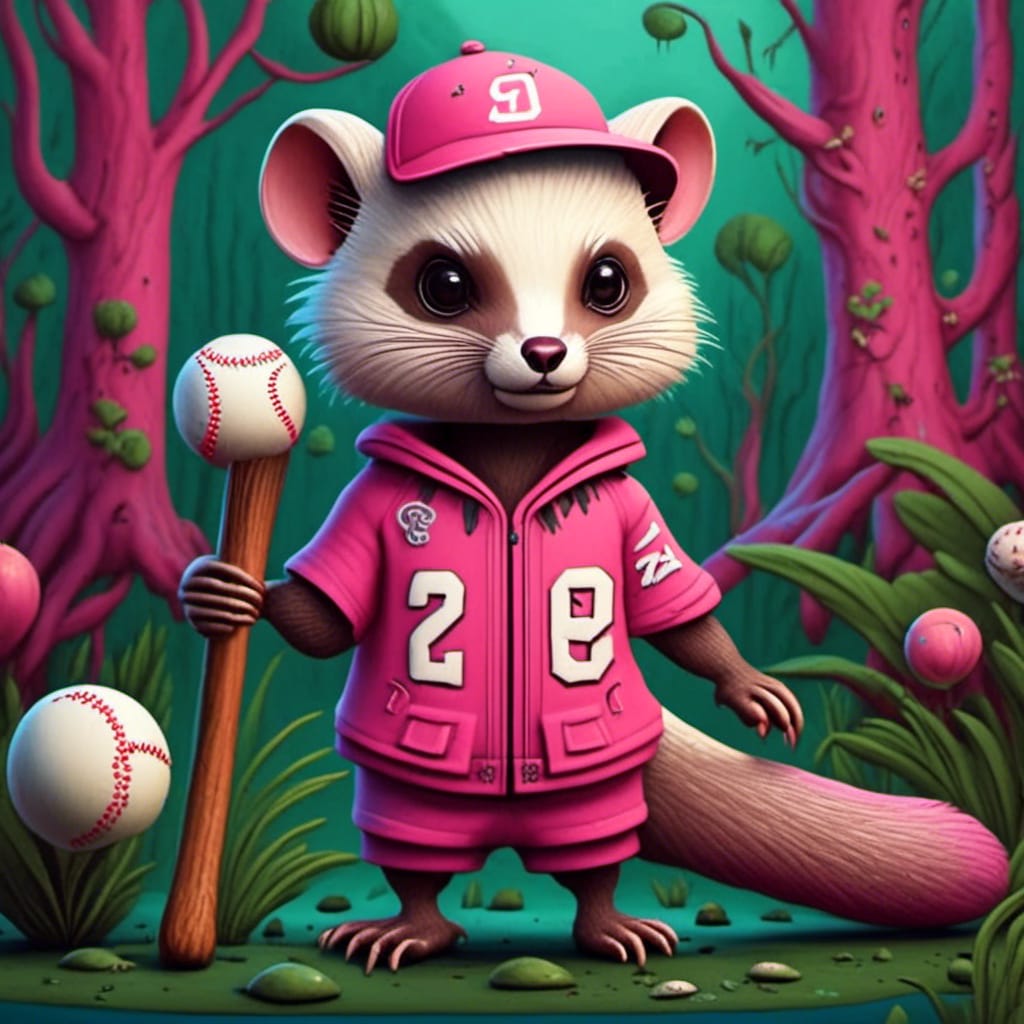
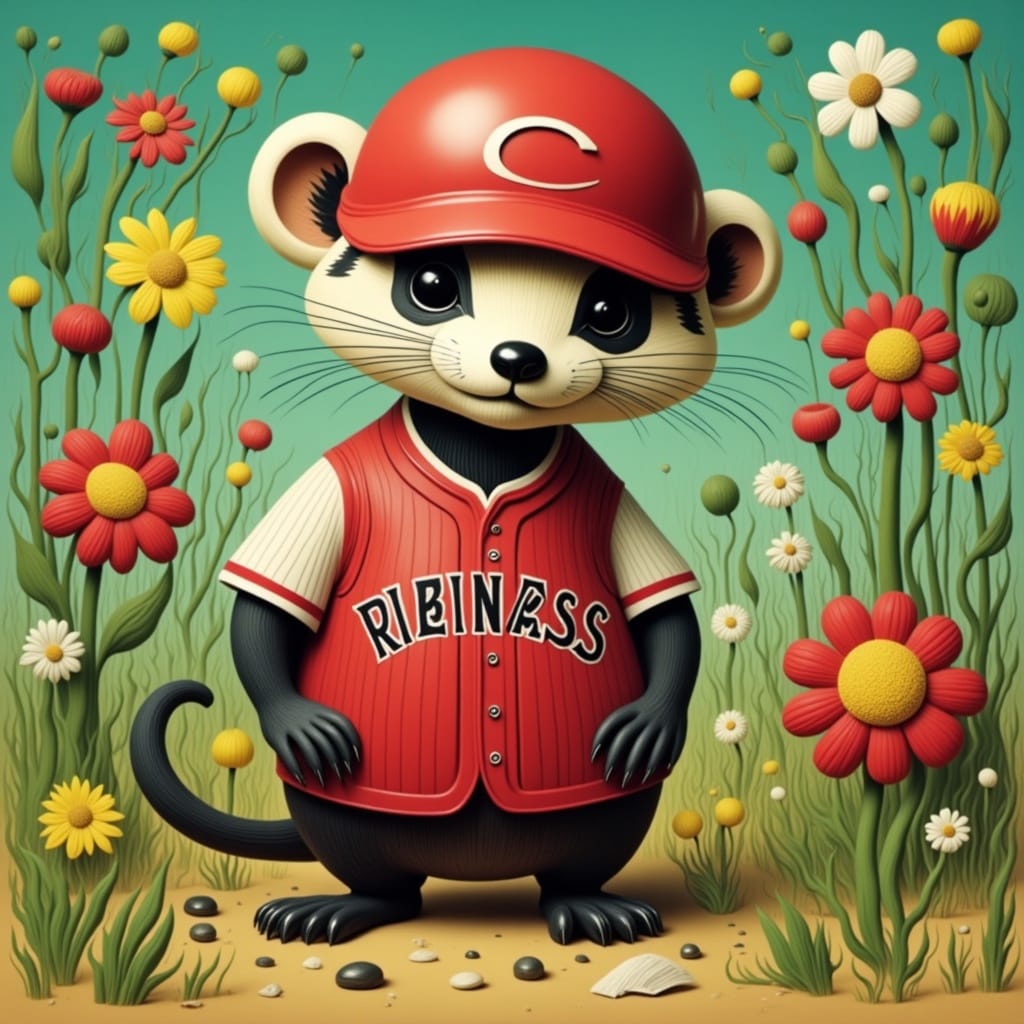
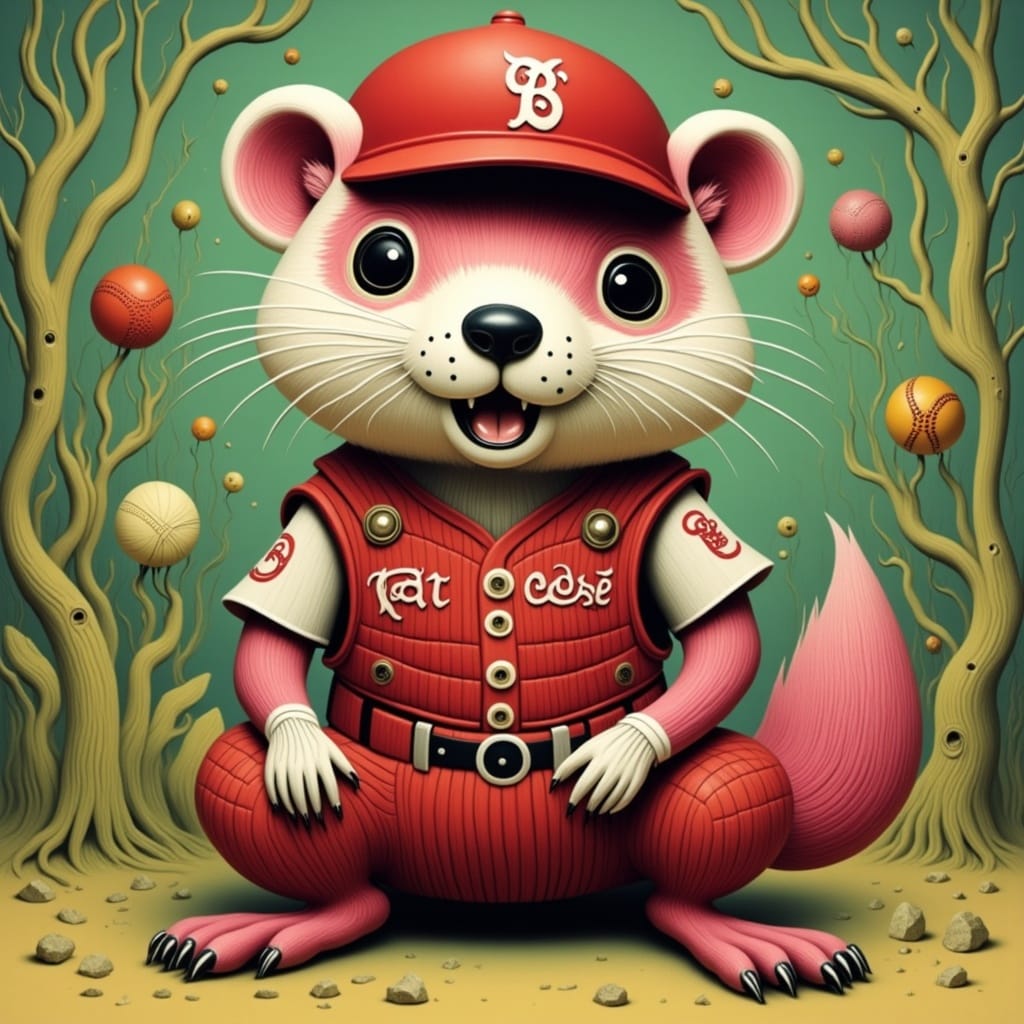
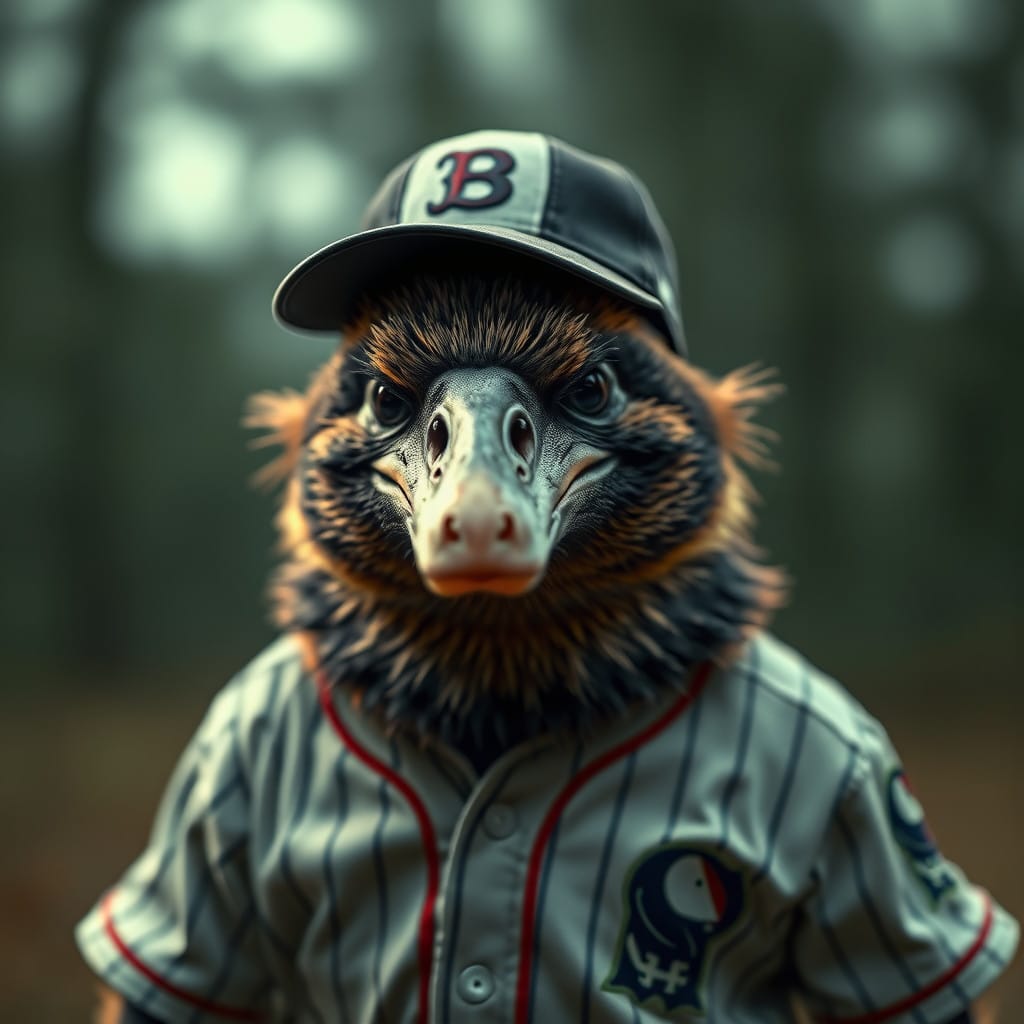
I never anticipated the response to the story. It blew me away. It was just a little idea I came up with, and I decided to write something. However, the comment that struck me the most was my brother’s comment that he wanted to see more artwork featuring pink ferrets and angry platypuses. I told him there was an image already with the story. He nodded as he peered over his glasses.

“I want to see what they would like now, seeing you are better with computer art.”

I laughed and said I would, but I never got around to it. Well, the prompt appeared again. Now, I need to reimage the graphics for the story. So, I sat down and created a roster for the Rico Strong Traveling Pink Ferrets and Angry Platypus. I will probably rewrite the story, but we start with the graphics first.

Here are a few mockups of the project.

Cute mockups:


Realistic Approaches:

Have you read this?

Daily writing prompt
Who are the biggest influences in your life?

DAILY PROMPT RESPONSE

Many years ago, I learned that no one has all the answers. This revelation also led me to discover that wisdom can be found in the oddest places or with the strangest people. As I struggled to answer this prompt, I found an answer that said it all. The truth of this post moved me and helped me find my way to an answer.

I rely on my faith in my journey through the chaos we call life. It has guided me through some of the toughest situations. Without it, I’m not sure who or what I would be. I talked to many people as I’ve walked this journey searching for peace. Only to discover that the peace sought had resided within the entire time. I cannot remember the name of the person who pointed me toward this path, but I’m thankful.

Through my travels, I realize the potential of love resides in each of us, no matter the faith. I’ve seen people of different faiths band together to perform majestic things. It is a wonderful experience to witness and to feel. I don’t have the words to adequately describe its wonder. I’m inspired by people who are steadfast and true in their beliefs and commitment to help their fellow man.

Throughout my journey, I’ve studied several different texts in the hope of gaining a deeper understanding of the world. Though I have stumbled and sometimes questioned certain events, I feel that each step has been worth taking. I remember my father posing a query as he held up his tattered Bible.

Have you read this?

Hoodwinked – Revisited (Year Later)

Daily writing prompt
Are you a good judge of character?

DAILY PROMPT RESPONSE

I suppose everyone would love to say yes to the prompt question, and that would be correct, generally speaking. We have had a lifetime of experiences to teach about the content of one’s character—a lifetime of trial and error, a lifetime of being hoodwinked. Hoodwinked was the title of my response to this question a year ago. That post can be found here.

I think we want to take people at their word. For centuries, we have judged people based on so many different aspects that it would make your head spin. We’ve judged people by race, creed, religion, and sexual orientation. We never even bothered to find out what kind of person they were at the core. We have relied on stereotypes and preconceptions taught to us by society. Societal standards aren’t altogether false; we all have certain beliefs based on these standards. However, we have to be strong enough to stand up against the things that have proven false.

Let me take a moment and list a few things I have heard over the years. These examples should provide a clearer picture of the point I’m trying to illustrate.

  1. “The whole family has been trouble since I’ve known them. There isn’t a good one in the lot!”
  2. “Those Muslims are trying to kill us. It’s in their book.”
  3. “They chose to be that way. They are going to burn in hell.”
  4. “Shiftless and lazy has been my experience with them. They aren’t smart enough to understand what is really going on.
  5. “What do you expect from a woman?”

I’ve heard this nonsense in the last year, and it’s hard to believe that some of it is still being said. I won’t even touch some things I see on social media. The hardest pill to swallow is when the mess comes out of the mouth of someone you thought you knew. Events like these make you question your judgment. We sometimes change our opinion of someone based on a single action or statement. However, I suggest not reacting in haste because everyone has a bad day. Also, we have no idea of their struggles and haven’t shared.


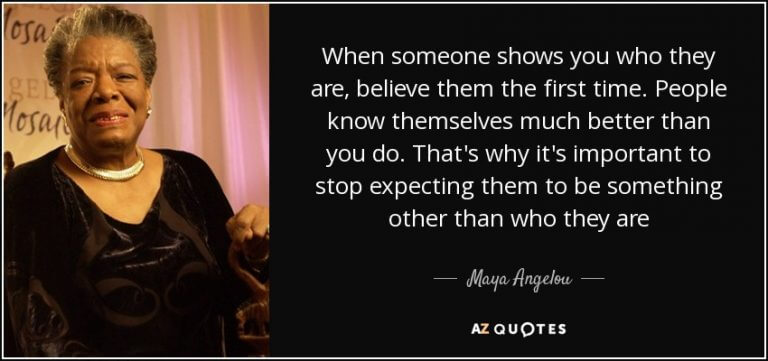
Dr. Maya Angelou offers this advice.


I’ve found this quote to be quite helpful over the years. I’ve tried to minimize placing my expectations or principles on individuals and allowed them to be themselves. In some cases, you will be surprised by someone’s actions. I’ve been in situations where the least likely person came to my aid. You just never know. The only I can hope for is not to be hoodwinked.

A Notebook and Pen

Daily writing prompt
Your life without a computer: what does it look like?

DAILY PROMPT RESPONSE

I can remember a world when the personal computer was something we saw on television. Interestingly enough, computers were often portrayed as villains. So, I smile when I read this prompt, thinking about how much our world has become intertwined with computers. I spend a considerable amount of time working on one of my computers daily. My life without a computer will be significantly affected, but not as much as you might think.

Today, I spent most of the day working with a notebook and a pen. I was collecting my thoughts about a post I want to publish here. I used several references to gather the information I needed to establish the point I was trying to make. Yet, these references weren’t a product of a Google search but rather from my personal library. I reviewed various volumes of information about philosophy, religion, and psychology. I didn’t have to use my computer once. All I needed was a notebook and a pen.

Three Things Challenge – 12072024

CHALLENGE RESPONSE – 3TC – FICTION

The forest stood still, ancient and unyielding as if defying time itself. But now, a strange silence hung in the air—not the serene quiet of life breathing gently, but the uneasy hush of something amiss. The once-crystal stream that wound through the heart of the woods, a lifeline to countless creatures, was no longer clear. Its waters, tainted with an oily sheen, seemed to pollute the very essence of the forest’s soul.

A deer approached hesitantly, its hooves crunching softly on the brittle grass. It bent to drink but recoiled, sensing something wrong. The poison ran deeper than just the water; it was in the air, the earth, the whispers of the leaves. Who had done this? Who could destroy something so pure, so vital?

Perhaps it was the folly of man, always reaching, always taking. It was greed that sought to conquer instead of coexist. Or perhaps—just perhaps—it was the forest itself, tired of centuries of neglect, silently fighting back in ways no one yet understood.

The trees shivered as if sharing a secret, their shadows casting long and mournful patterns across the poisoned ground. And as the sun dipped below the horizon, the forest seemed to sigh, wondering if salvation was still possible in a world so carelessly polluted by those who claimed to love it.

My Editor will kill me when she reads this …

Daily writing prompt
What do you enjoy most about writing?

DAILY PROMPT RESPONSE

One of my favorite parts of writing is the creation of the story. To listen to the story being told to my soul. I know that sounds a little strange, zany even, but this is how I feel whenever I pick up a pen and start writing a story. In this instance, I’m more of a recorder than a writer. Strange, I know, but it is like my pen has a mind of its own. Telling the story in bits and pieces. Sometimes, these fragments make sense, but for others, I have no idea where the fragments come from. It sounds exciting and a blast but isn’t the best part.

Editing is the best part. Once she reads this, my editor will tap into her editor’s magic and send thousands of those dreaded red marks to ensure my happiness. It will bring her joy as I scream in frustration and try to unravel the madness these red marks always bring. I can see her now. Her eyebrow raised, peering over her glasses, muttering something like the following …

“Really?” she says, looking at me bewildered. Which frightens me a bit because she doesn’t do bewilderment.

I look at her with all the confidence I can muster, hoping she buys it. I respond, “Yep!”

She holds my gaze, clearly not buying it. She picks up my latest draft and begins doing her thing. The once-white paper is now red with the faintest glimmers of white remaining. She tosses the draft on the table beside me, smirking, “Have fun!”

“What the f…” I reply

She chuckles harder, “Teaspoon.”

Of course, I don’t find the situation humorous at all. However, I begin the process. I clear the mechanism of doubt and start the next part of the journey.

Editing is the portion where, as writers, we shape our creation into something unexpected and unintended. If we are lucky, we allow it to grow into something magical. So many times, I’ve written things telling one story, but by the time I’m finished editing, it has become something else. Because of this, I’ve been able to reuse concepts to establish foundations or fill in gaps as needed.

There’s something about finding another storyline within a sentence or paragraph or scribbling a note on a napkin. So, excuse me as I prepare to get my butt kicked.

Just Breathe

Daily writing prompt
Do you have a favorite place you have visited? Where is it?

DAILY PROMPT RESPONSE

If you were to ask my late wife this question, she would respond that my favorite place to visit was my house. I was never home. It didn’t matter what country we lived in; it seemed like I dropped off her and the kids and then left. In many ways, she would be wrong. Often, I wonder how I didn’t end up a member of statistics concerning service members and the divorce rate. Military life isn’t for everyone. I’ve seen it break some of the nicest people. I watched them become caught in the churn of military life and drown in a slow, miserable death. Both service members and their families. I suppose I was lucky to a degree.

I don’t have a favorite place, per se; I have more like a region I enjoy spending time in, the Pacific Northwest. I have hundreds of stories about my travels in that area, but none accurately convey my feelings about traveling on Highway 101. I’ve traveled up and down that highway more than I could count. Once you start traveling north on that highway, the world changes. Northern California is completely different than Southern California. Once you cross the border into Oregon, the world changes. This magic repeats itself as you enter Washington.

I also enjoy the time I spent traveling through Montana, Wyoming, and even Idaho. The scenery is breathtaking. All one has to do to feel better is just breathe

Khan’s Records & Tapes

What alternative career paths have you considered or are interested in?

DAILY PROMPT RESPONSE

I’m satisfied with the career path I chose. Could I have done something different? Definitely! However, the goal was to provide for my family, and I did that. So, in this regard, I’m good. I have always wanted to write, and I’m a writer. I wanted to make a difference or do something that mattered. I was a soldier. The best job ever is being a parent. It doesn’t get any better than that for me.

I’ve retired young, so I could return to work once my health improves if I want. The question is, what would I do? It would be something I enjoy, something that brings joy and meaning to my life and others.


I could play Watermelon Man or Blinded by the Light and get a second. It would be expected, even appreciated.

Here’s a sample of the stuff that would be playing over the loudspeakers …

Reading That Shaped My World

List three books that have had an impact on you. Why?

DAILY PROMPT RESPONSE

  • The Green Mile – To be haunted by the actions of your past. To see everything you know and love die. To be left on this earth and witness their demise. One realizes the dead were the lucky ones. To feel the blessing of a long life is a curse. Perhaps, a punishment for a hideous act.
  • Invisible Man – In this novel, we follow the actions of an unnamed protagonist living in a society that chooses not to recognize him as a man. The winner of the National Book Award in 1953, this novel should depict an outdated social construct, but it doesn’t, sadly.
  • 11/22/63 – This book addresses something we all may have wanted to do from time to time. A chance to go back in time and change something we have done. However, the most powerful part for me, was how it laid out the hazards of time travel. I will continue working on the time machine in my basement.

You’re Kidding, right?

Do you trust your instincts?

DAILY PROMPT RESPONSE

If you can’t trust yourself, who can you trust? This is the question that comes to mind when I read this prompt. With the social climate of the last few decades, many have made fortunes in the “Doubt” business. I talked to one of these individuals once, and when I questioned their motives, I quickly became a nonbeliever and radiated large amounts of negative energy. I looked around to see if they had some device that measured energy levels. I was asked to leave when I asked them to present this device. I’m still sad about the event, not at all.

My intuition has saved my butt more times than I can count. So, I trust it. However, I must admit there have been times it has stirred me wrong, mainly partly due to my lack of knowledge of the situation. The other part was the person in charge of the situation seemed shady. I don’t do shady people, as a general rule. However, sometimes they can be rather useful. In cases like these, I adjust the settings on my shade – meter. Overexposure can be harmful, and it takes a while to recover from its effects.

Believing in yourself or trusting yourself are useful tools in building self-reliance, developing personal growth, and strengthening one’s emotional intelligence. I’ve heard people mock the use of gut feelings and demand the use of actual data or science. This is funny because when people use their gut feelings, they combine their knowledge, experiences, and science. Yep, I said science. The issue resides in people’s inability to articulate why they feel a particular way. So, continue trusting your instincts.

Let me provide an example; my editor can read something of mine and say something like this.

“I don’t like it. Don’t ask me why, but there’s something not right.”

When we first started working together, this was some frustrating shit. However, I’ve learned to keep my mouth shut and listen over the years. More times than not, there’s, sure enough, something jacked in my draft.

Smart people say gut feelings are like using a muscle; the more you use it, the stronger it becomes. They recommend continuing to gain knowledge and experience and living life. So, believe and trust yourself; you may very be justified in having pause. So, when someone asks me whether or not I trust my gut. My response is always:

“You’re Kidding, Right?”

Pangs of Madness

CHALLENGE RESPONSE – FICTION

I love the fall; the colors are just as magical as spring. There is beauty in every season if you open your mind to see it. The color resided in the fact that it had the ability to make forget about the madness in the world—the madness that had the potential to destroy every fiber of decency that remained. So, we needed moments like these, moments where the fiery red of the leaves blended with the purplish hues of the space between that made the white of the snow-covered ground have a bluish tint. Moments of otherness.

I stood with an unlit straight hanging from my lips. The temperature dropped enough that you could see your breath. Winter was around the corner. Soon, Winter’s talons would be crawling at your skin. There have been more and more days like these lately. Another horrid crime scene was behind me. An example of the madness this beautiful scene would help me escape, even if it’s just for a little while. I could hear the crunch of footsteps against the snow and turned to see Lt. Rawlins.

Lieutenant Benjamin Rawlins stepped up next to me and stood silently. He wore an expressionless face—the look I was used to seeing. At the last crime scene, he was a pot of emotions on the verge of boiling over. He chewed on the end of his signature cigar. He always smoked the cheap ones. His wife said the good ones were too expensive to be chewed on. An expression that told me he was feeling exactly what I was feeling. We have both been doing this long enough where words weren’t necessary.

“There’s nothing like the fall colors right before winter,” Rawlins remarked as he spit out the chewed-up portion of his cigar. It looked like he would be needing a fresh one before long. I nodded in agreement.

“You gonna get this __” Rawlins broke off due to his promise to his wife when the first grandchild arrived. I stared at him, and he met my gaze. I nodded.

“Before Christmas? I don’t want the city to be in unrest during the season.” Rawlins remarked. Lists of children naughty and nice, letters to Santa, and horrible, well-intended Christmas gifts always gave me a warm fuzzy. Yet, you couldn’t ignore the magical elements of the holiday. So many people were absolutely impossible for most of the year, but they became something else during this season. Only a few weeks later, they seemed to forget the promise of hope and return to the drudgery. It’s disheartening and sad.

I shrugged and lit my cigarette. I took a deep drag, exhaled, and said, “Patience, Boss.” Rawlins stopped chewing, and I felt his gaze. His face reddened with rage, not at me, but at the idea, someone was in his city doing these hideous acts. He swallowed it, but not before he chucked away the remainder of his cigar in frustration.

“Detective Casey,” he began in that low growl graded against my soul. I reached out and gripped his shoulder, “Patience, Boss. We’ll get him, I promise.” Rawlins nodded and walked away. I watched him get into his sedan and leave. I knew better than to make promises in cases like these. It was possible we would catch a break and catch the killer, but it was more likely that we wouldn’t even come close to apprehending the killer. It was the pang of madness.


Authors Note:

I’ve been participating in this year’s NaNoWriMo, so I haven’t been active on WordPress as usual. Yesterday, I completed the word count requirements, but they’re far from complete, so I decided to take a break and read some challenges. It’s always fun participating. While reading today, I noticed a few that caught my eye.

I used the following prompt to draft the opening sequence of the chapter of my ongoing work.

Moonwashed Weekly Prompt – Otherness and the enchanting image provided the imagery in the opening paragraph. It helped me add a bit of beauty to the gritty, grimy story I’ve been working on this month. Thanks, Eugi!

Ragtag Daily Prompt – Chew, Patience, and Shallow provided depth in the character interactions. Thanks Guys!

Esther’s Writing Prompts – Adding a pleasant element to my grisly tale. Thank you!

The Coffee List

Daily writing prompt
If you could meet a historical figure, who would it be and why?

DAILY PROMPT RESPONSE

When I was younger, I made two lists. One was famous people I would have a conversation with over a cup of coffee. The other list of historical people that I thought needed to be throat punched. Now, my wife wasn’t a fan of either list. In fact, every time she caught me making an entry, she gave me something to do. Sighs, the misplaced passion of youth. Where would we be without it?

As a track & field athlete, this photo meant a great deal to me.

The establishment of my era still turned their noses up each time they saw this photo. This photo and others were considered taboo, or if I use the phrase I heard the most, they were “troublemakers.” Martin Luther King, Jesus, or “The Last Supper” in most of my friends’ homes. However, I spent most of my time reading about people who stood against injustice. This was the beginning of the coffee list.

Recently, I had the pleasure of rehashing the glory days with some old friends. The above came up. We all were athletes, and it was important to us. However, I didn’t care much for it, but I understood its significance in the movement. We discussed the civil rights movement at length that day, even though none of us were alive to participate during critical periods. We talked about what we were doing to fulfill MLK’s dream. We questioned whether how our sacrifices would benefit our children and grandchildren. As you can imagine, this was a very long conversation and was getting heavier by the second. So, I decided to lighten the mood.

I held up my phone with the above photo and asked, “Who’s the white guy?” None of us knew, but of course, we had the guy that sputters

“Oh man, I can’t remember his name…Damn!”

We have two of these individuals in our group, and they take turns uttering that phrase. Once, I wanted to see which one said it the most. After several months of observing, it was a tie, and I figured the game was rigged just to skew my data. Yes, I’m the guy who always gathers data.

Well, the gentleman’s name was Peter Norman. Here are a few facts about him.


Peter George Norman was an Australian track athlete born in Melbourne, Australia, on June 15, 1942. He grew up in a devout Salvation Army family and worked as an apprentice butcher before becoming a physical education teacher.

Norman’s athletic career began when he joined the Melbourne Harriers, and he won his first major title, the Victoria junior 200m championship, in 1960. He excelled in sprinting, becoming a five-time national 200-meter champion and representing Australia at the 1966 Commonwealth Games in Jamaica, where he won bronze medals in the 220-yard and 4×110-yard relay.

The defining moment of Norman’s career came at the 1968 Summer Olympics in Mexico City. In the 200-metre final, he stunned everyone by claiming the silver medal with a personal best time of 20.06 seconds, setting an Oceanic record that still stands today. However, the events that followed on the medal podium would forever change Norman’s life and cement his place in history.

As Norman stood on the podium alongside gold medalist Tommie Smith and bronze medalist John Carlos, the two American athletes raised their black-gloved fists in a Black Power salute while playing the U.S. national anthem. This powerful gesture was intended to highlight systemic segregation and racism in the United States. Though not raising his fist, Norman chose to stand in solidarity with Smith and Carlos by wearing an Olympic Project for Human Rights badge on his jacket.

Norman’s decision to support the protest was not without consequences. Upon returning to Australia, he faced unofficial sanctions and was ridiculed as the “forgotten man” of the Black Power salute. Despite qualifying for the 1972 Munich Olympics, Norman was not selected to represent Australia and never competed in the Olympics again.

Throughout his life, Norman remained committed to his beliefs in human rights and never regretted his actions on the podium. He continued to be involved in athletics administration and Olympic fundraising and even worked on organizing the 2000 Sydney Olympics.

Norman passed away on October 3, 2006, at the age of 64, due to a heart attack. In a poignant tribute, Smith and Carlos served as pallbearers at his funeral.

In the years following his death, Norman’s role in the historic protest has gained increased recognition. In 2012, the Australian Parliament formally apologized for the treatment he received after the 1968 Olympics. In 2019, a statue of Norman was unveiled in Albert Park, Melbourne, honoring his athletic achievements and his stand for human rights.

Peter Norman’s legacy extends far beyond his athletic accomplishments. His courageous decision to stand in solidarity with Smith and Carlos during a pivotal moment in the civil rights movement demonstrates the power of allyship and the importance of standing up for one’s beliefs, even in the face of adversity. Norman’s story serves as a reminder that sometimes, the most significant acts of bravery occur not in the spotlight but in quiet moments of support and solidarity.


After reading articles about Mr. Norman, I wondered how I missed him. Better yet, why was his namen’t mentioned like everyone else’s? At any rate, Peter Norman makes The Coffee List.

My Favorite Pastime

Daily writing prompt
What book are you reading right now?

DAILY PROMPT RESPONSE

I always read several books at once. I’ve never been able to keep my focus on one book for any length of time. To help with this, I usually do some research on a particular subject to give my mind a rest. As I research, I usually read several books on the subject I’m studying. Despite this, I still have trouble slowing my mind down enough to enjoy a single. On the rare this occurs, I typically read the book a second time as a writer to see what the writer did to capture my attention.

Here is my current reading list for pleasure:

  1. Duma Key by Stephen King – I’m a sucker for magical realism
  2. Inferno by Dan Brown – I enjoy a bit of historical fiction wrapped in conspiracy from time to time.
  3. Strega by Andrew Vachss – No one does gritty crime fiction better than Vachss. James Ellroy comes close, but not entirely.

Rabbit’s Foot – Are they really lucky?

Daily writing prompt
What’s the coolest thing you’ve ever found (and kept)?

DAILY PROMPT RESPONSE

My Mom had transferred me to a new school. Not only was I the new kid, but I was also the only Black kid, so things were immediately interesting. The world wasn’t as inclusive then as it is now. Despite these challenges, I made a friend. Most of the children were polite, but this guy was my friend for a while. We’d play after school, shooting baskets, skipping rocks, etc. Well, one day, we found a rabbit’s foot. It was exciting and all that, but I quickly forgot about it.

A few years ago, one of the girls from that school reached out on one of the socials. Once she discovered me, she broadcast to the rest of the class. So, my friend contacted me. He sent me a picture of that same rabbit’s foot we found over 40 years old. That picture officially made that rabbit’s foot cool. This story may not be the coolest thing I have found, but it makes me smile every time I think about it. Our lives are made up of tiny moments like these, and we should cherish them.

Share Your World – 11112024

CHALLENGE RESPONSE – SHARE YOUR WORLD

I’ve always liked this challenge but haven’t participated in it in a while.

1.  If reincarnation exists, would you like to come back as a domestic pet or a wild animal? I don’t think reincarnation works this way, but it would be cool if it did. However, I can’t decide which one. As domestic pet life is sweet, just ask my cat. Yet, as a wild animal, all that power and freedom.

2. Do you think Zoos are a good idea? As a child, the zoo was within walking distance and free. I spent time watching the wild cats and the monkeys, so I loved them. However, now I don’t feel the same way. I can’t stand watching them in that environment, none of them. I think all species should be free in their own habitat.

3.  Have you ever been to a safari park? Nope, never wanted to go. I’ve seen my share of wild animals. Sometimes, I was freaked out. They look smaller on television and in magazines. I know this example isn’t a safari, but watching wild mustangs run wild was one of the most beautiful things I have ever seen. I considered letting a mountain lion eat my little brother once, but I figured I would have trouble explaining to his mother how I let this happen to her baby.

4.  Have you visited an oceanarium? Once, it was so freaking cool, but I still think about them as I do about zoos. They should be free no matter how cool they are swimming around stuff. Oh my gosh, the dolphins.

The Neighorhood

CHALLENGE RESPONSE – FICTION – FFFC #288

Authors Note:

When I looked at this image, I had no idea what I would do with it. Literally, nothing came to me. So, I read what others had done with it, and still, no joy. I noticed that Melissa had provided a description of the image—something I think she always does. I’ve seen it before, but it made no impact until this challenge.

I took the description and rendered several images from it. Then, I started playing around with the description. All of a sudden, I had a voice. I looked around to see where it was coming from. I thought maybe my iPad was reading a book, or another of my gadgets had decided to push me over the edge. Nothing. Everything was functioning properly, but isn’t that how it works in the movies? Everything is working correctly when you go to check it.

Anyway, I returned to working on the images when I had the voice again, much louder this time. The voice was telling a story about his friend after his mother’s funeral. Then, I realized I wasn’t losing my mind, but a character was speaking to me. I’ve no clue where he’s going with his story or why he decided to tell me. It doesn’t even have a name. It has been a long time since I had a new character shown up. If I’d known, I would have tidied up a bit.


The Neighborhood

It was a lovely service; Mrs. Byrne would have been proud. No one liked to attend funerals, but they appreciated them being done correctly. Over the years, I remember her mentioning bits of this and that she saw at the different services. She mentioned some more than once, so I added everyone we could remember in her service. Her daughter Ivy had been my best friend since I showed up in the neighborhood at five years old.

My older brother Sean and I moved into the neighborhood after cancer had taken our Mom. Cancer is cruel, and it took its time taking our Mom. Pop lost his job at the plant because he refused to leave our mother’s side at the end. It took five months to cross the Rainbow Bridge and years to prepare for the journey. Her death broke Pop, but somehow, he pulled it together once we moved to the neighborhood. At least for a little while.

The neighborhood was three miles long and ten blocks deep, filled with Irish Catholics, and our Black faces weren’t exactly welcome. Mr. Flannery was Pop’s best friend, and he convinced a friend of his to rent to us. Pop got a job doing demolition. Pop said he had a lot of anger to work off, so the job was perfect. Sean was a teenager when we moved there and had rougher than I did. He’d come home with bruises most days until one day, he didn’t.

I played in the yard by myself most of the time until a red-haired girl with pigtails stood there looking at me one day. She didn’t say a word.

“There are swings a couple of blocks from here,” she said. I stared at her, knowing I couldn’t leave the yard. Yet, something this girl made me want to risk a trashing.

She continued to stare momentarily, then started walking away. I went to the fence and watched her. She turned and looked back, then stopped.

“You coming?” ” You aren’t a pansy, are you?” she asked. In seconds, I was walking next to her. We talked all the way to the park about the usual stuff. She told me Spider-Man was the best superhero ever, and Wonder Woman was a close second. I knew she was crazy because it was Batman, then the Green Arrow.

We played all day, swinging and climbing trees. She fell out of the tree and skinned her elbow. I leaned and kissed it. It was something my mother did when I got a boo-boo. Ivy punched me in the arm.

“You ought to know a girl’s name before you go kissing on her.” she said, smiling. She had one of her front teeth missing, but that stopped that smile one bit.

“I’m Ivy, Ivy Bryne,” she said, sticking out her hand.

“Frank Anders,” I said, shaking her hand. I gave her a soft handshake because she was a girl and punched me again.

“My dad, you give a person a firm handshake. Try it again,” she said, sitting her hand back out. I gave her a proper handshake and went back to swinging. I saw Sean coming over the crest of the hill, and he didn’t look pleased. Ivy and I met him before he got to the swings.

“See you tomorrow, Frankie,” she said and ran off.


FFFC #293

I was standing in the garage smoking a cigarette pacing back and forth when I heard Ivy come in. She always walks hard in her heels. I don’t think she’s taking a graceful step in heels since I’ve know her. Most of the time, she could be found sporting a pair of sandals or sneakers when the weather bad.

“Did you know, Mom was into photography?” Ivy asked, before I could respond she launched into the next question typically Ivy. It always seemed like she wasn’t interested in your response, just your attention. You were to listen until there was break which usually meant your response was required, but sometimes you missed the opening that prompted, “Hello, earth to Frankie! Aren’t you listening to me?” I’ve gotten better over the years catching my cues and today was no different.

Ivy was going around this new discovery about her mother when a few photos fell out of the binder she holding. One was a picture of a crane with it’s beak pointing skyward and the other was a picture of a eagle with a mountain landscape in the background. Wonderful shots I thought. Mrs. B had really found her thing. She had confided, years ago, that felt she had lost a portion of herself being a mother. She had no regrets raising her children, but she should have carved out more time for herself.

The binder slammed Ivy was biting her bottom lip trying to hold back the tears. I didn’t understand why. If these was a time to cry, this was it. However, Ivy never wanted to be considered a punk and she wasn’t by far the toughest person I knew. Tears streamed from her reddened swollen eyes. There emerald hue seemed to sparkle in the light. Yet, she held back the wail. I always loved those eyes. She rushed towards me burying her head in my chest.

The muffled banshee cry grew louder by the second. The harder she wailed, the tighter she squeezed.

“It’s alright, baby. Let it go,” I whispered

If You Have Enough Time? … You do!

Daily writing prompt
Do you need time?

DAILY PROMPT RESPONSE

I read this question and wondered what they meant. I’ve said it a thousand times if I’ve said it once.

“I don’t have time”

or

“I need more time.”

In the military, we have said, “We train to standard, not to time.”. One of those really cool sayings doesn’t always apply. However, as I progressed in ranks, I realized that prior planning or proper planning removes most of the anxiety associated with time constraints. We used a system called After Action Reviews (AAR’s) and later became lessons learned. We would evaluate an exercise and make note of things that went well as well as our failures.

The purpose of this action was to devise a plan to achieve a greater degree of success. Ideally, this plan was placed in a binder for review at a later date. The binder also served as a guide in case of a personnel change. The problem with every system isn’t the system itself, although that is sometimes the case. Rather, the lack of personnel utilizing the system results in the utterance of the above-listed questions.

Now, I won’t sit here and say there weren’t instances where we needed to make adjustments on the fly—there were plenty. However, the majority of the situations when we felt a time crunch were due to a lack of planning or learning from previous mistakes. I have developed an expansion of this philosophy as I have aged.

We have the same amount of time today as yesterday and tomorrow. The first time I said this idea about time to someone, I was told that Daylight Saving Time defeats my logic. I laugh because I feel it isn’t true. The key to successful time management is how we utilize the time we have, which is a constant. So, whatever system or techniques you may use, don’t worry about if you have enough time because you do.

Why would I want to do that?

Is there an age or year of your life you would re-live?

DAILY PROMPT RESPONSE

Fortunately, I’ve reached the age where the heyday has become a part of the conversation. However, with that age, I also have times when talking to the family and other younger people when I have no idea what the hell they are talking about. especially when they tell you a phrase you have been using before they were born, “Doesn’t mean what you think it means,” as if history has been erased. But, to be fair, I often say things where they are completely clueless. One of my last co-workers used to shake, smile, and shake her head like she understood. I confronted her about it after she didn’t do what I asked. Her response, “I’m not going lie, I heard words, but didn’t know what the hell you were talking about.”

Sure, I can remember some amazing moments and horrific ones. These moments shape us into the people we are. So, when it comes to reliving stuff, why would I want to do that?


Why Can’t you Answer Questions like a Normal Person?

Daily writing prompt
Who are your favorite artists?

DAILY PROMPT RESPONSE

Answering this question correctly depends on the definition of artist. Like many Jetpak questions, it fails to be specific. It’s almost like they have a dumb ass question generator or something. However, I like this question well enough to answer with minimal disdain. To do so, I need to provide myself a definition.

noun

  1. a person who produces paintings or drawings as a profession or hobby.
    • Similar: creator originator, designer producer, old master
    • A person who practices any of the various creative arts, such as a sculptor, novelist, poet, or filmmaker.
      • Similar: entertainer performer, trouper, showman, player,
    • a person skilled at a particular task or occupation: “a surgeon who is an artist with the scalpel.”
      • Similar: expert, master, maestro, past master, adept
    • performer, such as a singer, actor, or dancer.
    • informal
      • a habitual practitioner of a specified reprehensible activity: “a con artist” · “rip-off artist.”

As you may have guessed, I’m in a bit of a mood today, but now I have something to base my answer on. So here goes.

As a writer, my first thoughts about the creative arts are about works of literature. However, this presents an issue for me. I can rattle on for days about different works of literature and their importance without breaking a sweat. But, for the purposes of this post I will discuss some of my favorites.

Novels

  1. Ralph Ellison
  2. Gordon Weaver
  3. Stephen King

Poetry

  1. Dante Alighieri
  2. Langston Hughes
  3. Adrienne Rich

Painting and such

  1. Francisco Goya
  2. Sandro Botticelli
  3. Jean-Michel Basquiat

Photography

  1. Gordon Parks
  2. Annie Lieberwitz
  3. Vivian Maier

Comic and such

  1. Luis Royo
  2. Tim Bradstreet
  3. Al Jaffee

Here is the short list off the top of my head. Looking back over this post, I chuckle a bit because I remember my wife asking me a question after I had answered her questions. Why can’t you answer a question like a normal question?

A Matter of Interpretation

When you think of the word “successful,” who’s the first person that comes to mind and why?

DAILY PROMPT RESPONSE

“Successful” can have different meanings depending on the context, but broadly speaking, being successful refers to achieving goals or desired outcomes. Here are some ways success can be defined in different areas:

  1. Personal Success: Achieving personal goals, happiness, fulfillment, or growth. It might involve self-improvement, achieving work-life balance, or cultivating meaningful relationships.
  2. Professional Success: Accomplishing career objectives, such as gaining promotions, excelling in one’s field, building a reputable business, or making significant contributions to a profession.
  3. Financial Success: Attaining financial stability, wealth, or independence, defined by income level, savings, investments, or the ability to support a particular lifestyle.
  4. Creative Success: For artists, writers, and creators, success might involve producing meaningful work, gaining recognition, influencing others, or feeling satisfied with creative expression.
  5. Social Success: This could be defined by having strong relationships, a positive social impact, or being recognized for contributions to a community..

As an administrator, I can provide several definitions of success, as well as examples, plans, and whatever is necessary for a deeper understanding of the meaning of success. However, despite temptation, we must try not to push one’s personal definition on the others around us. I say to myself more than anyone else. As I have gotten older, I’ve learned to appreciate that measuring success is a matter of interpretation.

Nothing Better to Do

Daily writing prompt
What skill would you like to learn?

DAILY PROMPT RESPONSE

Now that I’m retired, there is so much to do. I find myself making up shit to do. However, recently, I decided to put my free time to better use. While convalescing, I explored different ways to explore my creative outlets. Many of you probably noticed I’ve been posting AI images. I learned digital art skills. However, my education isn’t complete. I’d like to learn more about the digital world. I’ve spent years existing within it. I thought I knew how it worked, but it has changed. My grandchildren have taught me.

“Peepaw, you aren’t current with stuff.”

I’ve gone from being the in-house IT guy to the guy who tells them stories about his precious memories of them when they were young. So, I need to update my skills to figure out what they are talking about half the time. I’ve got nothing better to do.

Work Hard and Live Right

Daily writing prompt
In what ways does hard work make you feel fulfilled?

DAILY PROMPT RESPONSE

I’ve lived by a simple code not my own. Despite this truth, this code has served me well. Provided me a strength to develop my own. My parents worked hard their whole lives. Somehow, they didn’t seem to be tainted by this devotion. I’ve seen many succumb to the strain. If I’m honest, it’s easier than I’d like it to be. I’ve been choked by the tentacles of temptation from time to time.

Many of the elders, worked their whole lives to accomplish their individual goals. Each family having their own. I watched them in amazement. I wondered if they would make it. As I got older, I asked how they stayed focused and not lose hope.

“You focused on wrong thing. You can’t worry about that. All you can do is work hard and live right.”

This was code I subscribed to. The code based my entire life on. My personal code isn’t much different than the one I grew up with. The elder who taught me his code, hadn’t lived the life I have. I’ve had too make some adjustments over time. However, I always feel good if I work hard and live right.

A lot of things

Daily writing prompt
What details of your life could you pay more attention to?

DAILY PROMPT RESPONSE

For the past few months, I have been looking over how I handle things, and they totally screwed up. What upsets me is that they have broken for quite some time. Things that should not have broken in the first place. First, I must acknowledge that despite my best efforts, I am still just human. I used to think I was a cybernetic being, but then I went through the part-dragon phase. Alas, I’m just human. The last year’s health issues taught me that lesson tenfold.

I’ve never felt weakness like this before. It’s hard to wrap my head around it. Being in this state blows, to say the least. There were times when I wasn’t sure how things would turn out. I had to rely on the strength of my brothers as well as my own. I’m not used to this, but my people reminded me that my fight isn’t over. I will do well to pay more attention to that.

Random Thoughts – 09242024

PROSE – RANDOM THOUGHTS/REFLECTION – THE STATE OF THINGS

Hello everyone,

You may have noticed that things here at the Memoirs of Madness have been a little spotty. I apologize for that; I really do. It’s been a rough year for me health-wise, and though I’m much better, I’ve been dealing with the emotional side of things. I’ve been wondering how the hell I made it through all this and other questions that arise when dealing with health issues as one ages.

So, in the next few weeks, I will be making some changes to the blog. More precisely, I will focus on cleaning up dead links, adding new pages, removing old pages, and such. This is an attempt to improve the blog’s UI/UX. I will announce the changes as they happen; please let me know if I muck something up. Any suggestions are welcome. Until next time … wish me luck.

My Happy Place

Daily writing prompt
How do you relax?

DAILY PROMPT RESPONSE

I’m not sure if I know what the word really means. I know the definition and how it’s used, but I haven’t been able to relax for most of my life. I’ve always had a vivid imagination, so I tend to retreat inside my mind when I need to take a break. However, you can probably see the problem with this technique. As a writer, I think of various scenes in my mind. I can tell you many of them aren’t rather relaxing. I discussed the concept of relaxation with my editor, and she laughed. When she regained her composure, she provided me some advice. She talked about the avenues of my creative expression and how I should not create content for my blog, portfolio, or anything else I’m into. So, I thought about the places that make me happy.

Here’s what I came up with:

I’ve always found gardening really relaxing, so I can imagine my idea of relaxation involving some sort of garden. I’d have to keep my brain out of it, though. I can see myself trying to figure out the soil composition to plan which flowers grew best in my region.


I’ve also felt at home in the mountains.


However, the activity requiring the least amount of preparation is reading.

Within the pages of a book, I imagine different lands, worlds, and periods of time. After which, a nap is appropriate.

My Own World

Daily writing prompt
Which activities make you lose track of time?

DAILY PROMPT RESPONSE

“You can’t use up creativity. The more you use, the more you have.”
— Maya Angelou

I remember my mother saying, “Boy, you’re in your own little world … ain’t you?” She said this with an amused and proud expression. Later, I learned my mother had been an artist in her youth, and I guess she remembered what it was like to be on another plane of existence. Other than life, I believe passing on her creative mojo was one of the greatest she gave me. Thanks, Mom!


Lately, I’ve been enthralled with the world of artificial intelligence, specifically image generation. Somehow, this artistic expression has woken up something I considered a thing of the past. I sketched long ago, and I started telling stories. I remember using my Big Chief notebook and filling it with random drawings. My teachers would scold me because I had no paper to do my lesson. After all, I had drawn all over them. However, the teacher called my mother and suggested she get a sketchbook. Mom brought me a Mead unruled pad, and the rest was history.

It seemed like everyone was an artist in those days. We tried everything; crayons, colored pencils, watercolors, etc. You named it, and we tried it. Quickly, I discovered I didn’t have a knack for anything color. So, I stuck to sketching. I listened to the accolades my friend’s parents would bestow on their creations. My Mom would simply shrug and go back to what she was doing. It may seem like she wasn’t interested in what I was doing, but that wasn’t the case. I never had to ask for a new pad or notebook. My supplies never seemed to run out. Even when I started stories, there was always plenty of paper and writing instruments.


It seems so long ago, yet I still return to this plane after a good session. Ever since my wife passed, my episodes have gotten worse. No mystery sandwich appeared on my desk, flickering lights letting me know it was time for bed, or my favorite, the warm blanket I nestled under while falling asleep in my chair, scribbling my latest stint into madness. However, I try my best to return in a reasonable amount of time.

Perhaps in enough time to post a story, picture, or photo. Who knows? Because most of the time, I’m in my own world.

Ask me a Real Question

Daily writing prompt
Who is your favorite historical figure?

DAILY PROMPT RESPONSE

When it comes to historical figures, there are too many people to name. That’s just the people we know all about. This doesn’t include the people who conveniently wrote out the annuals of history. I once met a man who worked as an engineer at NASA during the space race. I’ve never heard or read his name anywhere, but he was there. I saw the pictures and remembered the stories. Stories that were confirmed years later in books and motion pictures. But to ask someone about their favorite historical figure? Oh, come on, ask me a real question.

Who decided who is historic anyway? Who makes that determination? I don’t know them, do you know them? You pick up five different history books and have five different accounts of an event or person. Who knows the real truth. However, I love the journey of discovering more information about a person or a topic. There is nothing better for me. Well, until I incorporate that information into one of my stories and sit back, waiting for a local know-it-all to tell me I got my facts wrong. It’s always a pleasure to watch their forehead crinkle and their bunk. Then, they clear their throat to inform me of my error. Followed by this now historical line of conjecture.

“Hmm… this isn’t really historically accurate, but since it’s fiction, I’ll give it a pass.”

Like I give a flying f_ [beep]!


The history taught in schools makes me shudder. I remember asking one of my granddaughters about the history of the computer. Their response “Why does that matter?” I thought I was going to blow a gasket. Neither my children nor grandchildren understood my reaction. Which just increased my fury. They certainly didn’t have a problem. “Peepaw, I need a new laptop.”, “Peepaw, my laptop broke. Can you fix it?” How could something so instrumental to our existence not be taught in schools? They were still teaching Colonial America and the people who shaped it but weren’t teaching about the people who created the instrument they used to teach it.

Ada Lovelace isn’t taught in the history books. If it wasn’t for figuring out that computers could be used for more than calculations, we as a society wouldn’t be where we are now. Lovelace algorithm was built by countless inventors. So when I tell Alexa to play a playlist or ask Siri to set a reminder, perhaps they should have been Ada. Why not? I’m listening to a lecture on physics as I write this post on a pair of Bluetooth headphones. Thank god for Bluetooth; I could never find a pair of headphones with a long enough cord. Well, you can thank Hedy Lamarr for the algorithm. Yep, the beauty queen and movie star from back in the day.

Lamarr co-invented a frequency-hopping torpedo for the Allied forces during WWII, but it was never used. However, Lamarr’s frequency-hopping technology was later used throughout the U.S. military. I had used the tech for years before I knew Lamarr had a hand in its development. I was researching the Olympic games for a post and discovered something interesting. We have heard of Jesse Owens’s legendary exploits during the 1936 Olympics. He won four gold medals during the event and pissed off Hilter for good measure. So, he is always a cool person in history. However, have you heard of Cornelius Johnson?

Cornelius Johnson won the gold medal in the high jump, setting the record. Johnson was 23 years old when he accomplished this feat. Unfortunately, Johnson died in 1946, six months before his 33rd birthday. The United States did a podium sweep that day, meaning the gold, silver, and bronze were won by U.S. athletes. Dave Albritton, silver medalist, and Delos Thurber, bronze medalist, both outlived Johnson but were also left out of the history books.

We are who we are because of history, whether it be good, bad, or ugly. Each known or unknown event has helped you develop, no matter where you form. We need to appreciate what we can and learn from all of it.

Morning Glow

CHALLENGE RESPONSE – THURSDAY INSPIRATION – SHORT FICTION

She sips her coffee, thinking about her first great love—that love she could never talk about—the love that fills her with joy and pain all at once. The joy is knowing what love truly is, not that stuff you read in romance novels or movies. Pain, well, if you know love, you know pain.

There were throwaways—well, that’s what folks called them back then. It meant no one wanted them. She felt that way until she met the woman who changed her life. She also fell in love with a boy who lived with the woman. He was like her, a throwaway. She knew she shouldn’t love him but couldn’t help herself. They spent one night together before he left for the war, and the war took him.

She’ll never forget how she felt the next morning. It felt like she was glowing from the inside. For it was the first day she felt whole.

Beryl Markham – Female Aviator

ARTICLE – MINI BIOGRAPHY

After being raised by a single mom, I’m fully aware of the capabilities of women. I watched my mother face the challenges of raising an oddball son and never seemed to miss a beat. Even as a child, I wondered why they weren’t listed in the annuals of history. Surely, there had to be tough women like my mother throughout history? Of course, there were. I’m glad we have access to the information about these feats done by these amazing women. Will we be able to list them all or discover all the things women had a hand in? Probably not. However, I will use my platform to celebrate the courage of these women.


Beryl Markham’s life reads like an adventure novel, filled with groundbreaking achievements, thrilling exploits, and a legacy that transcends time. As the first woman to fly solo across the Atlantic from east to west, Markham shattered the glass ceiling in aviation. Her memoir, “West with the Night,” offers a mesmerizing account of her experiences in early 20th-century Africa and her daring flights, showcasing her indomitable spirit. This blog post seeks to explore the remarkable journey of Beryl Markham, celebrating her contributions to aviation and literature.

Early Life in Kenya

Born in England in 1902, Beryl Clutterbuck moved to Kenya with her family at a young age, igniting her lifelong love affair with Africa. Growing up on her father’s horse farm, she developed an early passion for horses, which later translated into a pioneering career in horse training. Her fascination with flying began in Kenya, where she met Tom Campbell Black, a notable figure in her aviation journey, fostering her aspiration to take to the skies.

Pioneering Aviation Career

Markham’s aviation career was marked by a series of remarkable achievements. She became the first woman to obtain a commercial pilot’s license in Kenya. In 1936, she made history by flying solo across the Atlantic from east to west, facing harsh weather conditions and navigating by stars. This monumental flight secured her place in aviation history, showcasing her courage and skill as a pilot.

Adventures and Challenges

Markham’s life was replete with adventures that stretched beyond the cockpit. Her personal life, marked by several marriages and notable friendships with prominent figures like Denys Finch Hatton and Karen Blixen, added layers to her already complex character. Despite the challenges she faced, including financial struggles and societal constraints on women of her time, Markham’s resilience never waned, driving her to pursue her passions relentlessly.

Literary Contributions

Though primarily known for her aviation feats, Markham was also an accomplished author. Her memoir West with the Night, published in 1942, was praised for its lyrical prose and vivid descriptions of colonial Africa. Despite its initial lukewarm reception, the book was rediscovered and celebrated in the 1980s, heralded as a masterpiece of 20th-century literature and providing a nuanced perspective on Markham’s extraordinary life.

Legacy and Recognition

Beryl Markham’s legacy is multifaceted, influencing the aviation and literary worlds. Her daring spirit and groundbreaking achievements in aviation paved the way for future generations of female pilots. Meanwhile, her literary contributions offer a unique glimpse into a woman’s life who refused to be defined by the era she lived in. Today, Markham is remembered for her historical flights and as a symbol of courage, resilience, and the pursuit of one’s passions against all odds.

Embarking on this detailed exploration of Beryl Markham’s life will allow us to paint a comprehensive picture of her impact on aviation and literature. Starting with her early life in Kenya, we’ll weave through her many accomplishments, adventures, and the legacy she leaves behind.

Cinematic Gold

REFLECTION – RANDOM THOUGHTS

Typically, when comes to film adaptations, we got two categories:

“Oh my god that was horrible! The book is so much better!”

“Can you believe they did that? That’s not in the book!”

The majority of the film adaptation I’ve seen into these categories. I’m a huge Shawshank Redemption fan. I was a fan of the movie, before I knew it was an adaptation. I found it was based on a Stephen King novella, immediately I was turned off. Have you seen some of film adaptations of Stephen King’s stuff? I’m not talking about the recent adaptations or reboots. There were horrible. I’ve read several King books before seeing this film and enjoyed them. However, for some reason, King fell out of favor with me until I read his book about writing. Single malt scotch rained from the heavens, and all was right in the world again. I was back to being a fan.

So, I read Rita Haywood and the Shawshank Redemption, one of four novellas in Different Seasons collection. I fell in love with the movie even more. They did an amazing job with this adaptation. The casting of Morgan Freeman was a stroke of genius. I saw the picture above online somewhere and had to write something about what I could describe as my favorite movie. 30 years can you believe it!

The Right to Vote

Do you vote in political elections?

DAILY PROMPT RESPONSE

As child, I watched the elders of my community banned together and brave the elements for their chance to be heard. I remember the rumbling of the younger generations about elections being rigged and didn’t matter if they voted or not. The elders wouldn’t hear this foolishness. We have sacrificed so much for this right. How dare you belittle our efforts. This stance changed the minds of some, but others continued in protest. However, they did so silently, because no one wanted to incur the wrath of the elders. I listened to stories of separate bathrooms and drinking fountains. They were hard to believe because it was so different from the world I knew. Unfortunately, the injustice remained vigilant. The methods changed, but the theme remained the same. So, I couldn’t wait to do my part. For years, I waited for my chance to vote. I participated in the voting process in all the school elections. I felt it was civic duty to make a choice. Although I had pledged my devotion to the process, I didn’t really understand why the elders were so committed. So, I looked into it at my grandmother’s request. She never wanted us to do something just because everyone else did it. One of her frequent sayings “If someone jumped off a bridge, you gonna jump too?” “You have the right to do whatever you want, but understand what hell you’re doing. Don’t be a dumbass.” As my research continued, I quickly discovered that the level of injustice ran deeper than I initially thought. Now, I vote at most opportunities. I know this wouldn’t be good enough for the elders, but their legacy is intact. I provided a brief overview of the injustice concerning the right to vote.

The Right to Vote: A Cornerstone of Democracy

The right to vote is often hailed as one of the most fundamental aspects of a democratic society. It is the mechanism through which citizens exercise their sovereignty, choose leaders, and shape the laws that govern them. This right, however, has not always been universally accessible. Its evolution has been marked by struggle, activism, and significant legal reforms. Today, as we strive for more inclusive and fair electoral systems, it is crucial to reflect on the history, importance, and contemporary challenges associated with the right to vote.

Historical Evolution of the Right to Vote

The journey toward universal suffrage has been long and arduous. In the early days of democracy, voting rights were typically restricted to a privileged few. In ancient Athens, often cited as the cradle of democracy, only male citizens with property could vote. Women, slaves, and non-property owners were excluded. Similarly, in the early years of the United States, voting was predominantly a right reserved for white, land-owning men.

The first significant wave of expansion in voting rights came in the 19th century with the abolition of property requirements. This change was driven by a growing belief in the principle that all men, regardless of wealth, should have a say in governance. The 15th Amendment to the U.S. Constitution, ratified in 1870, marked another crucial milestone by prohibiting denying the right to vote based on race, color, or previous condition of servitude. Despite this amendment, African Americans, particularly in the Southern states, faced discriminatory practices like literacy tests, poll taxes, and violent intimidation aimed at disenfranchising them.

Women’s suffrage was another significant battle in the history of voting rights. The movement gained momentum in the late 19th and early 20th centuries, culminating in the ratification of the 19th Amendment to the U.S. Constitution in 1920, which granted women the right to vote. This victory was a pivotal moment in the fight for gender equality and marked the beginning of a broader struggle for women’s rights.

In the mid-20th century, the civil rights movement brought renewed focus to the disenfranchisement of African Americans. The Civil Rights Act of 1964 and the Voting Rights Act of 1965 were landmark pieces of legislation that sought to eliminate racial discrimination in voting. These laws prohibited practices like literacy tests and provided federal oversight of voter registration in areas with a history of discriminatory practices.

The Importance of Voting

Voting is more than just a right; it is a powerful tool for enacting change and holding governments accountable. Through the ballot, citizens can influence policy decisions on issues ranging from healthcare and education to climate change and social justice. It is a means of expressing consent and dissent, giving voice to diverse perspectives within a society.

Moreover, voting is a critical component of political legitimacy. Governments derive their authority from the consent of the governed, and regular, free, and fair elections are the primary mechanism through which this consent is gauged. When citizens participate in elections, they validate the democratic process and reinforce the principle that political power is derived from the will of the people.

Voting also plays a vital role in promoting social cohesion and civic engagement. It encourages individuals to become informed about political issues, candidates, and policies. This engagement fosters a more educated and active citizenry, which is essential for the health and vibrancy of a democracy.

Contemporary Challenges

Despite the progress made over the centuries, the right to vote faces numerous challenges in the contemporary era. Voter suppression, electoral fraud, gerrymandering, and disenfranchisement of marginalized groups are issues that continue to undermine the integrity of democratic systems.

  1. Voter Suppression:
    Voter suppression refers to tactics aimed at discouraging or preventing certain groups of people from voting. These tactics can include strict voter ID laws, purging of voter rolls, limited polling places in certain areas, and misinformation campaigns. Such practices disproportionately affect minority communities, the elderly, and low-income individuals, thereby perpetuating social inequalities.
  2. Electoral Fraud:
    While less common than voter suppression, electoral fraud poses a significant threat to the legitimacy of elections. This can take the form of tampering with ballot boxes, falsifying voter registration, or hacking electronic voting systems. Ensuring the security and transparency of the electoral process is essential to maintaining public trust in democratic institutions.
  3. Gerrymandering:
    Gerrymandering involves manipulating electoral district boundaries to favor a particular political party or group. This practice can distort electoral outcomes and undermine the principle of fair representation. Efforts to establish independent redistricting commissions and use algorithmic approaches to drawing district lines are steps toward addressing this issue.
  4. Disenfranchisement of Marginalized Groups:
    In many countries, certain groups of people, such as convicted felons or non-citizen residents, are disenfranchised. While there are arguments for restricting the voting rights of some groups, it is important to balance these considerations with the broader goal of inclusivity and ensuring that all members of society have a voice in the political process.

Strengthening the Right to Vote

To safeguard and strengthen the right to vote, several measures can be implemented:

  1. Voter Education and Outreach:
    Educating citizens about their voting rights and the importance of participating in elections is crucial. Outreach programs can help increase voter registration and turnout, particularly among marginalized communities.
  2. Electoral Reforms:
    Reforms aimed at making the voting process more accessible and secure are essential. This can include measures like automatic voter registration, expanded early voting, and the implementation of robust cybersecurity protocols for electronic voting systems.
  3. Legislative Protections:
    Strengthening legal protections against voter suppression and discrimination is vital. This includes enforcing existing laws and enacting new legislation to address emerging threats to voting rights.
  4. Civic Engagement:
    Encouraging civic engagement through community organizations, grassroots movements, and public forums can empower citizens to take an active role in the democratic process. Civic education should be integrated into school curricula to foster a culture of participation from an early age.

Conclusion

The right to vote is a cornerstone of democracy, embodying the principles of equality, representation, and political participation. While significant progress has been made in expanding and protecting this right, ongoing challenges necessitate continued vigilance and action. By promoting voter education, enacting electoral reforms, and fostering civic engagement, we can ensure that the right to vote remains a powerful and accessible tool for all citizens. As we navigate the complexities of contemporary democracy, the collective effort to uphold and strengthen this fundamental right will be crucial in shaping a just and equitable society.

Poem of the Day – 04302024

She Was a Phantom of Delight
BY WILLIAM WORDSWORTH


She was a Phantom of delight
When first she gleamed upon my sight;
A lovely Apparition, sent
To be a moment’s ornament;
Her eyes as stars of Twilight fair;
Like Twilight’s, too, her dusky hair;
But all things else about her drawn
From May-time and the cheerful Dawn;
A dancing Shape, an Image gay,
To haunt, to startle, and way-lay.
I saw her upon nearer view,
A Spirit, yet a Woman too!
Her household motions light and free,
And steps of virgin-liberty;
A countenance in which did meet
Sweet records, promises as sweet;
A Creature not too bright or good
For human nature’s daily food;
For transient sorrows, simple wiles,
Praise, blame, love, kisses, tears, and smiles.
And now I see with eye serene
The very pulse of the machine;
A Being breathing thoughtful breath,
A Traveller between life and death;
The reason firm, the temperate will,
Endurance, foresight, strength, and skill;
A perfect Woman, nobly planned,
To warn, to comfort, and command;
And yet a Spirit still, and bright
With something of angelic light.

Poem of the Day – 04282024

Ode on the Spring BY THOMAS GRAY


Lo! where the rosy-bosom’d Hours,
Fair Venus’ train appear,
Disclose the long-expecting flowers,
And wake the purple year!
The Attic warbler pours her throat,
Responsive to the cuckoo’s note,
The untaught harmony of spring:
While whisp’ring pleasure as they fly,
Cool zephyrs thro’ the clear blue sky
Their gather’d fragrance fling.

Where’er the oak’s thick branches stretch
A broader, browner shade;
Where’er the rude and moss-grown beech
O’er-canopies the glade,
Beside some water’s rushy brink
With me the Muse shall sit, and think
(At ease reclin’d in rustic state)
How vain the ardour of the crowd,
How low, how little are the proud,
How indigent the great!

Still is the toiling hand of Care:
The panting herds repose:
Yet hark, how thro’ the peopled air
The busy murmur glows!
The insect youth are on the wing,
Eager to taste the honied spring,
And float amid the liquid noon:
Some lightly o’er the current skim,
Some show their gaily-gilded trim
Quick-glancing to the sun.

To Contemplation’s sober eye
Such is the race of man:
And they that creep, and they that fly,
Shall end where they began.
Alike the busy and the gay
But flutter thro’ life’s little day,
In fortune’s varying colours drest:
Brush’d by the hand of rough Mischance,
Or chill’d by age, their airy dance
They leave, in dust to rest.

Methinks I hear in accents low
The sportive kind reply:
Poor moralist! and what art thou?
A solitary fly!
Thy joys no glitt’ring female meets,
No hive hast thou of hoarded sweets,
No painted plumage to display:
On hasty wings thy youth is flown;
Thy sun is set, thy spring is gone—
We frolic, while ’tis May.

These aren’t the Droids you’re looking for…

What’s a secret skill or ability you have or wish you had?

DAILY PROMPT RESPONSE

As a kid, I was obsessed with moving things with my mind. Yeah, I was the kid who laid the pencil on his desk, staring at it, trying to make it move. Of course, it never happened. Then, I got the idea that perhaps my powers would emerge later. Later, I researched superpowers and discovered that the power I wanted was telekinesis and extrasensory perception.

But before I did my research, I watched every movie that featured people with these powers. Everything I saw focused on the darkness of the abilities. Films like The Fury (1978) made the idea of having these powers spooky. Check this out:

We also had Sci-Fi horror flicks like Scanners (1981). Here is a scene from that movie.

Who can forget the psycho-thriller Patrick (1978)? Take a look

After watching movies like these, who wants telekinesis? Then, one day, I had a discussion with fellow film buffs about the pros and cons of telekinesis. We were teenagers, and this discussion was the first of what we considered a”deep” discussion. We were on the verge of deciding telekinesis wasn’t an ability we wanted. Then, one of the girlfriends announced that we were idiots. She couldn’t believe we hadn’t considered “The Force” in our examples of telekinesis. Her comment stopped us all in our tracks. We had never considered the Force as telekinesis. She said, “Our lack of faith was disturbing.”

I don’t know why we never considered The Force. Perhaps it seems to be something much more powerful than everyday telekinesis. I can’t really explain what I felt then, but “the Force” was so much more to me. Perhaps I felt it was a way of life, perhaps an ideal. My Midi-chlorians count was never enough for consideration for being a Jedi or Sithlord. I’ve always admired the ideal.

I Couldn’t Resist

You’re going on a cross-country trip. Airplane, train, bus, car, or bike?

DAILY PROMPT RESPONSE

I’ve more time behind the wheel than any other mode of transportation. Driving has always relaxed me. I prefer driving alone to think in peace, but I’m not opposed to traveling with someone else. I’ve developed some of my best storylines driving. There’s nothing like working out a difficult scene while gliding across the asphalt sea. The only problem is that I never seem to have a device to capture my thoughts as they come. Yes, yes, I’ve tried the microcassette recorder thing, but I never seem to remember to bring spare tapes. When the digital ones hit the market, the problem is solved, right? Nope, I forget to download to my computer, and when I do, I forget where the hell I put them.

The essentials for a proper road trip: This list varies based on your individual needs, but here are a few suggestions to help you consider what you might need.

  • Two coolers – one for beverages and the other for food. Truck stop or gas station food is not kind to your digestive system. This may not affect you now, but you will understand what I mean as you age. Not to mention, the prices are ridiculous.
  • Thermos – coffee or tea. Most thermos can hold up to 10 -12 cups.
  • A go bag—the contents are at your discretion. However, I suggest a complete change of clothes and a spare pill box for current medications if you take any. Have enough undergarments for at least a week. Also, having some cash and a burner may be a good idea. The cash is handy; not every place is set up for debit or credit cards. I discovered this on my last road trip. The burner; cellphones break all the time.
  • Emergency Kit – Standard items include flares, first-aid kit, reflective triangles, and blankets. However, emergency food may come in handy. Examples include tuna or chicken pouches, bottles of water, and mayonnaise packets; these items keep pretty well. Also, I almost forgot that you need a good flashlight. Preferably, a rechargeable one; alkaline batteries tend to leak or are dead when you needed.
  • A small toolkit—Even if you aren’t mechanically inclined, you’d be surprised at what you can fix with a pair of pliers or a screwdriver.
  • A road atlas – I know I risk sounding like a weirdo, but GPS is NOT the truth. That shit be wonky. Just saying.

The most important thing

Whether you listen to music, podcasts, audiobooks, or talk radio, some items are saved locally on your device for times when you don’t have cell coverage.

If not, you may be forced to listen to stuff like this:


Some of you may enjoy these tracks, so you look at me strangely. However, on one of my road trips, before streaming services were a thing, I found myself listening to a Juice Newton marathon. Now, I ask you, how is this even a thing? It was that day. Some DJ, apparently a huge Juice Newton fan, played all her music. To make matters worse, he had a booming radio station that blasted for miles.

However, you get lucky and get some fun songs like these:

Play that shit Norman

An Anthem for every frustrated worker

This was my jam

By answering this post when I’m supposed to be sleeping, I’m subject to say anything. I couldn’t resist!

Can’t Stand The Rain

Daily writing prompt
What is your favorite type of weather?

DAILY PROMPT RESPONSE

Despite the title, the rain is my favorite type of weather. I never understood why people ran from the rain but spent hours in the shower over a lifetime. They swim laps, surf, and waterski, yet the first raindrops they beat feet for shelter. Trust me, I’m not making fun of anyone. I was just like everyone else until I joined the military.

If it ain’t raining, we ain’t training

If it ain’t raining, ain’t, training became our mantra after just a few weeks in service. At my first duty station in Korea, I survived the monsoon season. Trust me, you will stop worrying about the rain after surviving monsoon season. We are soaked to the epidermis, which was wrinkled by the time you were able to put on dry clothes. I can’t remember the last time I ran from the rain.


At any rate, I love the rain. Its something about it I never could put my finger on. Here are some of my favorite songs with rain in the title. I know, it’s Eddie Rabbit’s fault.


Julian’s Truth

CHALLENGE RESPONSE – FICTION

Here is my response to RDP’s Daily Prompt – Lithe

In the heart of a bustling city park, where children’s laughter mingled with the melodious chirping of birds, sat a man named Julian. He was a solitary figure amidst the vibrant chaos, a contemplative soul who found peace in the art of people-watching. Julian was particularly drawn to the nuances of human interaction, the subtle play of expressions, and the eloquence of body language.

On this sun-drenched afternoon, his attention was captured by a woman practicing yoga on the lush, green grass. She embodied grace, her movements fluid and effortless, a visual symphony that mesmerized Julian. He noted how the word “lithe” seemed to be crafted for her, the very definition of her elegance and strength. She moved with an almost ethereal poise, her limbs stretching and coiling with a feline agility that left Julian in awe.

For days, Julian returned to the park, hoping to catch a glimpse of the lithe woman. She became a muse to him, a living embodiment of art and beauty he dared only admire from afar. Her presence stirred something within him, a longing to reach out and connect, to transcend the boundaries of his solitary existence.

Finally, mustering every ounce of courage, Julian decided it was time to step out of the shadows of his observation and into the light of interaction. He approached her on a day painted with the perfect azure of the sky. His heart thundered in his chest, a tumultuous symphony of nerves and excitement.

“Hello,” he said, his voice barely a whisper against the backdrop of the park’s life.

She turned toward him, her expression mildly surprised. Her eyes reflected the tranquility of the world she embraced. “Hello,” she replied, her voice as soft and melodious as he had imagined.

Julian stumbled through his introduction, words tangled with admiration and awe. He spoke of his observations, his fascination with how she moved, how she seemed to personify the word “lithe.” He expected bemusement, perhaps even annoyance. Instead, she smiled, a warm, genuine curvature of her lips that reached her eyes and ignited a spark of connection.

Her name was Elara, and she listened earnestly attentively, making Julian’s words flow more freely. They talked beneath the canopy of verdant leaves, their conversation meandering through the trivial to the profound, just as the park’s myriad pathways did.

In time, their meetings became a cherished ritual, two once-strangers finding solace and joy in shared moments. Julian, who had once been content to observe life from a distance, actively participated in its menagerie, woven with threads of companionship, understanding, and the unexpected beauty of a chance encounter.

And so, in a park where the world seemed to converge, Julian discovered the courage to connect, inspired by a woman who danced with the wind, her lithe form a reminder of life’s boundless grace.

The Essential’s

What are three objects you couldn’t live without?

DAILY PROMPT RESPONSE

If I’m being honest, there are far too many I would hate to give up. I guess I’ve got soft over the years. However, if I absolutely had these three items I couldn’t live without.

    Photo by Pixabay on Pexels.com

    1. Coffee – I don’t care about the garbage talked about drinking coffee. Bad things happen when I don’t have my coffee; don’t test me on this subject.

    Photo by Pixabay on Pexels.com

    2. iPad Pro 12.9 – This is such a versatile tool. I can read books, Listen to audiobooks, write, and take and edit photos. I’ve been using an iPad model for over a decade. It’s hard to imagine working without one. I even tried out several versions of the Samsung tablets and compared them. Though Samsung makes a solid product, I prefer the iPad.

    Photo by Alexey Demidov on Pexels.com

    3. My Briefcase – My briefcase is far cooler than the one in the photo, but you get the idea. I have several items for survival contained inside.

    Items may include, but are not limited to, the following:

    • A bag of coffee – precisely ground and my mixture. Yes, I’m serious about the Java.
    • A powerpack – it comes in handy for various reasons too many list
    • An assortment of journals of my design and construction. There is no substitution for quality.

    Well, that’s it. That’s all of it.

    Sunday Poser #173: Aging

    CHALLENGE RESPONSE

    My response to Sadje’s challenge

    Do you like the age you are now?

    This is one of the easiest questions I’ve answered in a while. The answer is YES. I love it. However, it feels odd to say so when that hasn’t been the case. For decades, I had this thing where I wanted to be older than my age. Almost like I was born during the wrong era or something. The problem I could never settle on a period I really wanted to be from.

    Then was the whole “you’re just a kid. You’ll understand when you get older.” I hated being treated like a kid. I refused to believe that age possessed this fountain of wisdom that eluded my entire youth. Often, I wondered what age or day I was going to understand the mysteries of the world suddenly. Would it be on a weekday? Or on the weekends? I hoped for sometime during the week because, let’s face it, on the weekends, there was beer and women to be ignored by. Disgusted or disapproving looks from members of the opposite sex while standing obnoxious with the fellas is a rite of passage.

    However, I would like to be on a Monday if it was during the week. Many complain about Monday’s, but I don’t mind so much. Over the years, I found several to be rather pleasant. Tuesdays would be alright, too, yet it doesn’t pop off on Mondays. Any day after is a negative ghost rider. There to much preparation from the pending weekend. You can’t be bogged down with a complex thought. I can see it now, sitting there tugging on your peach fuzz chins, saying, “Hmm.” For those fellas who could grow full beards in high school, I am jealous.

    I enjoy my age now because all I have to do is sit around looking at people like they’re crazy. Who needs cable? Have you ever looked at the younger folks when you get older? They are hilarious, aren’t they? It’s alright. You can admit it. The only drawback is the random, unprovoked ailments that surface periodically. Yes, I said unprovoked. This is my story, and I’m sticking with it. I can speak my mind. I’m old enough to know better but too old to give a shit. After all this crap of wishing I was older, I’m finally in the winter of life. It gets a little chilly at times, but hey. Excuse me while I slip on a sweater.

    Chester Himes: A Pioneering Voice in African American Literature

    ARTICLE – MINI BIOGRAPHY – WRITER

    Chester Himes, an acclaimed African American writer, carved a distinct niche with his crime novels that explored the experiences of black characters in the United States. Born on July 29, 1909, in Jefferson City, Missouri, Himes was raised in a middle-class home. This upbringing was notably ordinary until a dramatic event altered the course of his life.

    At the tender age of 19, Himes was sentenced to prison for armed robbery. This unfortunate event, however, served as the backdrop for the beginning of his writing career. His years in prison became a fertile ground for creativity, and while confined, Himes began writing short stories. His talent and unique voice were showcased, and his stories were published in national magazines such as Esquire, marking the start of his journey as a recognized writer.

    Following his release from prison in 1936, Himes did not abandon his newfound passion. Instead, he continued to write and publish, steadily gaining recognition as a significant voice in African American literature. His works, rooted in his personal experiences and observations, painted a vivid picture of the societal realities faced by African Americans.

    In the 1950s, Himes made a bold move by relocating to France. There, he began writing detective novels featuring black protagonists, a genre in which he found considerable success. His most famous works from this period are the “Harlem Detective” series. The series features the characters Coffin Ed Johnson and Grave Digger Jones, two Harlem detectives who navigate a world fraught with crime, racism, and social issues. These novels were celebrated for realism, as Himes used his powerful storytelling to explore Harlem’s complex dynamics of race and class.

    Throughout his career, Himes used his writing as a tool to explore themes of race, class, and crime. His narratives presented a unique and unflinching perspective on the African American experience. His works did not shy away from the harsh realities of racial inequality and social injustice, making them deeply resonant and thought-provoking.

    Chester Himes passed away in Spain in 1984, but his legacy remains. His powerful and thought-provoking works resonate with readers today, and his contribution to African American literature remains undisputed. Himes’ life and works testify to his courage, resilience, and unyielding commitment to shedding light on the African American experience through his writing.

    Here is a list of some of his notable works:

    1. If He Hollers Let Him Go (1945) – A novel exploring racism and the experiences of African Americans during World War II.
    2. The Lonely Crusade (1947) – A novel depicting the challenges faced by an African American protagonist in a racially divided society.
    3. Cast the First Stone (1952) – A novel that delves into the complexities of race relations and social justice.
    4. The Third Generation (1954) – A novel addressing race and identity issues.
    5. Cotton Comes to Harlem (1965) – The first book in Himes’ “Harlem Detective” series, featuring detectives “Coffin” Ed Johnson and “Gravedigger” Jones. This novel was later adapted into a film in 1970.
    6. Run Man Run (1966) – A novel exploring crime and social justice themes.
    7. Blind Man with a Pistol (1969) – Another installment in the “Harlem Detective” series, continuing the adventures of Johnson and Jones.
    8. The Quality of Hurt (1972) – An autobiographical work in which Himes reflects on his life, experiences, and the challenges of being a black writer.
    9. Black on Black: Baby Sister and Selected Writings (1973) – A collection of short stories, including the novella “Baby Sister,” exploring various aspects of African American life.
    10. Plan B (1973) – A satirical novel that touches on themes of politics and race.
    11. The Heat’s On (1986) – Published posthumously, this novel is the last installment in the “Harlem Detective” series.

    I didn’t hear of Chester Himes until 2011. I was at a book fair when a random shopper approached me and started telling me about this amazing author. Strangely, he handed me a book, but it wasn’t by Chester Himes. Confused, I took the book, hoping he would leave, but he didn’t. The book was entitled Moth by James Sallis. Finally, he got to his point. It turned out that James Sallis wrote a book about Chester Himes.

    Oddly enough, since that day, I have read several books by Chester Himes and James Sallis. I managed to collect a few original pulp editions of Himes’s work. Also, I picked up the Drive series by Sallis, which inspired the motion picture Drive, starring Ryan Gosling. What I haven’t done is read the book about Chester Himes written by James Sallis.

    Garrett A. Morgan: Innovator and Advocate

    ARTICLE – MINI BIOGRAPHY

    Introduction:

    Garrett Augustus Morgan, born on March 4, 1877, in Paris, Kentucky, was a visionary inventor, entrepreneur, and civil rights advocate whose contributions have left an indelible mark on American history. Despite facing racial prejudices and societal challenges, Morgan’s inventive spirit and determination led to the creation of life-changing innovations and pioneering work promoting safety and equality. Let’s dive into the remarkable life and legacy of Garrett A. Morgan.

    Early Life and Entrepreneurship:

    Garrett A. Morgan’s early years were marked by his relentless pursuit of knowledge and an entrepreneurial spirit. After moving to Cincinnati in the late 19th century, Morgan began working as a sewing machine repairman. His natural aptitude for machinery and mechanics laid the foundation for his future inventions.

    In 1907, Morgan established the G.A. Morgan Hair Refining Company, a business focused on the manufacturing and marketing hair care products. This entrepreneurial endeavor showcased Morgan’s business acumen and provided him with the financial means to pursue his inventive interests.

    Innovations in Safety:

    One of Morgan’s most notable inventions was the development of the safety hood, a precursor to the modern gas mask. Inspired by a tragic tunnel explosion in 1916 that claimed workers’ lives, including rescue personnel, Morgan designed a device that could filter out harmful gases, allowing individuals to breathe safely in hazardous environments.

    In 1914, Morgan patented his safety hood, featuring a hood-like apparatus with a breathing tube and two receptacles for inhaling fresh and exhaling air. This effectively prevented the inhalation of toxic fumes. His invention was widely adopted, particularly by fire departments and rescue teams, and played a crucial role in saving lives in various industries.

    Traffic Signal Innovation:

    Another groundbreaking invention by Garrett A. Morgan was the automatic traffic signal, patented in 1923. The inspiration for this invention came from Morgan’s observations of chaotic and dangerous intersections. The original traffic signal, the Morgan Traffic Signal, featured a T-shaped pole with three positions – Stop, Go, and an all-way stop, a precursor to the modern yellow caution signal.

    Morgan’s traffic signal significantly improved road safety and traffic management, paving the way for developing more advanced and standardized traffic control systems. His invention was pivotal in shaping urban infrastructure and reducing traffic accidents.

    Civil Rights Advocacy:

    Beyond his significant contributions to technology and safety, Garrett A. Morgan also advocated for civil rights. Living in a time marked by racial segregation and discrimination, Morgan actively challenged societal norms. He co-founded the Cleveland Call, a Black newspaper that aimed to promote racial equality and provide a platform for African American voices.

    Morgan’s commitment to social justice extended to his community involvement, where he supported initiatives to uplift African Americans and address racial inequalities. His legacy as a trailblazer in both invention and advocacy inspires future generations, emphasizing the importance of perseverance and innovation in the face of adversity.

    Conclusion:

    Garrett A. Morgan’s life exemplifies the power of innovation, determination, and social responsibility. His inventions in safety technology and traffic management have had a lasting impact on society, saving lives and shaping the infrastructure of modern urban environments. Additionally, Morgan’s advocacy for civil rights underscores his commitment to creating a more just and equitable world. As we celebrate the legacy of Garrett A. Morgan, we recognize him not only as an ingenious inventor but also as a pioneer who broke barriers and paved the way for progress in multiple facets of American society.

    Werewolves of London

    Bloganuary writing prompt
    What is your favorite animal?

    DAILY PROMPT RESPONSE

    As a kid, my favorite animal was a dog. Then I watched Ole Yeller and Sounder, and suddenly, the idea of caring for a dog seemed less appealing. Though I’ve had various versions of man’s best friend. I couldn’t help but be enthralled by the mystic of werewolves. In 1981, I was catapulted into the lure of werewolves with the movie American Werewolf in London.

    This fascination evolved into my love for wolves. All variations. Quietly, I’ve read many articles over the years, watched documentaries, and read books on wolves.

    A clip I put together from stock footage I collected over the years

    I can’t explain my fascination with wolves. I can’t explain what makes me stop in my tracks and soak in the beauty of this majestic creature. Perhaps I yearn for its power, its grace, or its presence. No matter, I have to make do with the gifts I possess.

    The Most Intimate Gift

    Daily writing prompt
    What is the greatest gift someone could give you?

    DAILY PROMPT RESPONSE

    I’ve been fortunate to have received some amazing gifts throughout my life. However, that depends on how the word “gift” is defined. Most of the time, when talking to others, I find gifts to be defined as something tangible. Something one can display on a desk or show someone. I would define these sorts of gifts as awesome, wonderful, or cool; maybe? Yet, neither rise up to the occasion of the “greatest.” I think if you take a moment and think about it, you may agree with me or not.

    However, the greatest gift to me is when someone gives you their time. Time is a precious commodity, something you can’t get back. Well, at least not right now; give me another ten years; the machine I’m building should be thoroughly tested and ready for the public. Until then, I view the time people choose to spend with us as special and intimate. I know I may be a little bent on this point, but it seems to be working.

    Distance Learning: The School of Hard Knocks

    Daily writing prompt
    What colleges have you attended?

    DAILY PROMPT RESPONSE

    In a previous post, I discussed autodidactic learning. It’s this method of education I’m most familiar with. However, I always wanted to obtain a college degree of some sort. For whatever reason, I convinced myself I wasn’t smart enough to achieve my goal. As I was torn between my beliefs and desires, I spent considerable time trying to further my education. Throughout the years, I attended several colleges utilizing distance learning platforms.

    I attended schools located in the following states:

    • Illinois
    • Maryland
    • Virginia
    • Texas
    • Minnesota
    • Florida
    • Tennessee

    In most cases, I wasn’t anywhere near the campus. Eventually, I got over my fear and finished my undergraduate degree. I consider my education journey as “The School of Hard Knocks.” If I had believed in myself earlier, achieving the first step of my goal wouldn’t have been so challenging. Throughout my journey, I learned much about life, the world, and, most importantly, myself. Let’s take a moment to explore some of the benefits of distance learning.

    Photo by Andrea Piacquadio on Pexels.com

    Distance learning, also known as online education, has become increasingly popular in recent years. With advancements in technology, more and more people are turning to distance learning as a convenient and flexible way to further their education. Recently, we see online education being used to educate our children. Technology has made online learning a viable option for achieving an education.

    Flexibility

    One of the most significant advantages of distance learning is its flexibility. Distance learning allows students to conveniently access course materials and lectures, unlike traditional classroom settings. This flexibility is particularly beneficial for individuals with other commitments, such as work or family responsibilities. Distance learning allows students to create their study schedules and learn at their own pace, making it easier to balance their personal and professional lives.

    Moreover, distance learning allows students to study from anywhere in the world. The constraints of a physical classroom do not bind them, and they can access their coursework from their homes or while traveling. This level of flexibility allows learners to adapt their education to their individual needs and circumstances.

    Accessibility

    Another advantage of distance learning is its accessibility. In traditional education, individuals who live in remote areas or have physical disabilities may face challenges in accessing educational institutions. Distance learning eliminates these barriers by providing access to education regardless of geographical location or physical abilities.

    Through online platforms, students can participate in classes, submit assignments, and interact with instructors and fellow students from anywhere in the world. This accessibility opens up opportunities for individuals who may not have had access to education otherwise. It also fosters a diverse and inclusive learning environment where students from different backgrounds and cultures can exchange ideas and perspectives.

    Furthermore, distance learning allows individuals to pursue their education while juggling other responsibilities. Many students who are working full-time or taking care of their families find it difficult to attend traditional on-campus classes. Distance learning allows them to continue their education without compromising their other commitments.

    Cost-Effectiveness

    Distance learning can also be a cost-effective option for many students. Traditional education often involves additional expenses such as commuting, accommodation, and textbooks. Students can save on these costs by studying from their homes with distance learning.

    Additionally, many online courses and programs are more affordable than their on-campus counterparts. This affordability makes education more accessible to a broader range of individuals, regardless of their financial circumstances. It also allows students to explore a variety of courses and programs without worrying about the financial burden.

    Good Stroll

    What are your favorite physical activities or exercises?

    DAILY PROMPT RESPONSE

    There is nothing like taking a walk. I would add cigarettes and coffee to the mi, but that would only dimish the benefits. I was poor as a child, we had two ways to get anywhere; walking or riding your bike. In some cases, you ended up doing both. So I learned early to enjoy the journey. To freely allow the thoughts in my head to run wild. No one there sticking their opinion mudding up the process.

    Even now, I walk with headphones on. The music provides a blanket shielding me from the outside. I hear my thoughts exhale, clear their throats, and call the rest of my body to order. My arms and legs are moving in unison to a subconscious rhythm. Yet, I realize my breathing is setting the tempo. My thoughts and ideas line up to me counted.

    Next, I exclaim, not looking up at the next idea waiting to have their say.

    “Good day, Mr. Khan”

    “Good day.” I reply, waiting for them to get on with it. They take a moment to gather themselves to ensure not to waste my time. I’m thankful for the gesture actually. I can’t count the numerous times progress has been striflield by a ridiculous idea.

    ‘“Well get on with it,” I nudge.

    “You see Sir, I been thinking the story needs a bit of restructuring.” Idea stated.

    “How so?” I questioned. The idea went on to explain its opinion in great deal. I have to admit I like the idea. But I couldn’t let this go unchallenged. It was the principle of the thing. I can’t be having ideas rushing up to me at hours of the night thinking they’re to get their say. The other day I saw a wanna-be Picasso paint his cat pink.

    Photo by Anna Shvets Pexels.com

    Painting a cat pink, really?


    Uncle Willie told me a story about a fella who had an idea to impress a woman. We all know the lengths men go to impress women. It’s ridiculous the things we come up with. Well this fella, got the idea that the women of his dreams was worth it. He met her at the local bowling alley. The story goes, she liked him well enough, but she always wanted to see what a kangaroo looked like up close. For months, they’d meet at the bowling alley and talk, but she kept bringing up the kangaroo thing. Finally, the fella invited her to fly with him to Australia to see a kangaroo. Her reply was that she didn’t know him well enough to go on a trip like that. What kind of woman did he think she was?

    Cedric, the fella, was determined to have Gretchen, the woman, by any means necessary. So, he contacted a navy buddy who owed him a favor and got a damn kangaroo. Christmas Day 1966, when the bowling alley was closed, arranged for the place to open and convinced Gretchen to meet him there. So, Gretchen’s Christmas present was a kangaroo, named Rocky. Of course, Gretchen didn’t have any place to keep Rocky, so he lived with Cedric. Christmas 1967, they were married. The marriage lasted five years. Gretchen got the house and Rocky in the settlement. I know this may be hard to believe, but here is a photo from the day Gretchen and Rocky met.


    Aunt Willie, on my father’s side, a bit touched if you listen to Nana. Despite this, Aunt Willie, was the most successful pig farmer in the state. A winter’s back, Aunt Willie got a notion that Charlene and Jessup, her pet pigs didn’t want to spend the winter in the cold. So, she pack them up and took them to the beach. The local took exception to the pigs at the beach and made a big ruckus. However, Aunt Willie was to snap a picture of Charlene and Jessup before things got out of hand.

    I have to admit I’m a bit jealous, they look rather peaceful.


    There’s nothing like a good stroll to clear your mind and you get a little exercise to boot.

    Let George Do It

    Have you ever performed on stage or given a speech?

    DAILY PROMPT RESPONSE

    I’ve given speeches and lectures several times during my adulthood. However, I’ve been a victim of stage fright. Yet, I’ve done so many of them you couldn’t tell. However, I’ve only performed on stage once.

    My stage debut was in a musical called Let George Do It. My teacher came into the class and told us we would perform a musical for the whole school. I didn’t understand what that really meant, but I listened. I can’t remember how this happened, but I ended up with the lead part of George Washington. Of course, since this was a musical, the lead role required me to sing. I didn’t sing then, and I don’t sing now. However, I figured my refusal to sing would indeed send me to the back, where I could pretend to sing along. As it turned out, my teacher had other ideas.

    She decided I speak all the parts of the lead role. I was terrified, but somehow I got through it. Unbeknownst to her, this brilliant move launched my public speaking career. I’m indebted to her for that. It has served me well over the years. Thanks teach.

    Real American Heroes

    What’s your favorite cartoon?

    DAILY PROMPT RESPONSE

    I watched so many cartoons as a child I can’t remember them all. Of course, the classics like Scrooby-Do and Bugs Bunny. However, there was one cartoon that appeared later. GI-Joe ended up being my jam. It might have sparked from having the action figure GI Joe with the kung-fu grip. Whatever the reason, I enjoyed every episode I was able to catch. What’s cool is that YouTube has all the episodes.

    Turkey Day, Hemi’s, Bullitt, and Family

    Here’s my response to pensitivity101‘s Share Your World

    Here are this week’s questions:

    Gratitude:
    Knowing you’re loved is priceless.

    Over the last several weeks, I’ve had a rough go of it, to put it mildly. What I have learned and been reminded of is that I’m loved. There is no doubt about that.

    What is your idea of a good holiday? Seeing the sights, lazing on a beach, hitting the night spots, getting away from it all……………….

    My favorite holiday in the U.S. is Thanksgiving. It’s all about the food. Dishes you haven’t had all year are waiting for you to gorge yourself into oblivion. There are no diets or anything like that. In short, it is the ultimate cheat day. Another thing about this holiday, perhaps the most important, is being with family. It doesn’t get any better than that.

    You are offered tickets to a show. Which would you prefer, Opera, Play, Cinema, Entertainment, Ice Gala, or something else?

    During my 50th birthday celebration, a friend took me to see Cirque du Soleil. I remember complaining the entire trip to the show. Grumbling nonsense about any and everything. My friend stood her ground and let me rant. She had gotten us incredible seats, and the show was amazing. The gracefulness of the performers was breathtaking. It was an ice show, so I kept waiting for someone to face plant. Didn’t happen. I would watch something like that again.

    Have you ever won a sports trophy (or something similar for a particular achievement):

    I was a jock during my youth, so I picked up a few trophies here and there. My mother kept them in a bag. I received awards while serving in the military. I used to call the wall my wife hung them on “The Wall of Shame.” Don’t get me wrong. I’m proud of the time I spent in the military. There is no question that it helped shape me into the man I am today. I never did buy into the whole medal thing. It was more about what we were doing and its importance. However, there was an occasion when I was recognized for an achievement. I got no medal or ceremony, just a simple handwritten thank you note. That gesture means more to me than any awards.

    What is your dream car (fact or fictional):

    As a child, I remember being enthralled by several cars before settling in on my favorite. I still can’t pick a definite favorite, but two stand out. In 1979, the cult classic Phantasm was released. It was a tripped out movie that didn’t make any sense to me at the time. However, my friends and I still talk about that movie. Not as much as we did as kids, but now and again, someone will mention a line at the perfect moment, and we just laugh.

    There were several notable characters in that film, but it wasn’t a character that caused the movie to be bookmarked in my mind; it was the car. A Plymouth Barracuda raced away, rescuing the characters and taking them to safety. From that moment, that was my car. I did my best to learn about that model car, but I discovered something different that I loved even more. A 1968 Plymouth Hemi Cuda became my jam. Take a look

    My first love

    As I got older and started my journey into becoming a mechanic with my father, I learned more about cars and their capabilities. My father was aware of my infatuation with the Hemi but schooled me about the other muscle cars of that era. My appreciation grew for American Muscle. I had the privilege of building and repairing several different ones with my dad. I’m more of a circuit head than a gearhead. Yet, I love mechanics; it’s in me bones. After Pop went to the otherside of the veil, I found myself watching old movies with car chases: Smokey and the Bandit, Dukes of Hazzard, The French Connection, and finally, Bullitt. I found my second love, a 1968 Ford Mustang – GT-500. Let’s take a look at the scene that grabbed me.

    My second love

    However, a different year model of Mustang, the movie Gone in 60 Seconds, the remake with Nicolas Cage, featured a 1967 GT-500. The original featured a 1971 Mustang, a beast in her own right but not as sexy. Here are two clips that express my love for this car.

    Demonstrates my respect for the car
    Sweet!

    Home on the Range

    If you could live anywhere in the world, where would it be?

    DAILY PROMPT RESPONSE

    This isn’t a hard question for me. I would love to live somewhere in the woods. As long as I had wifi. The first places that come to mind are Montana & Wyoming. I spent time in both of these places and I loved it.