
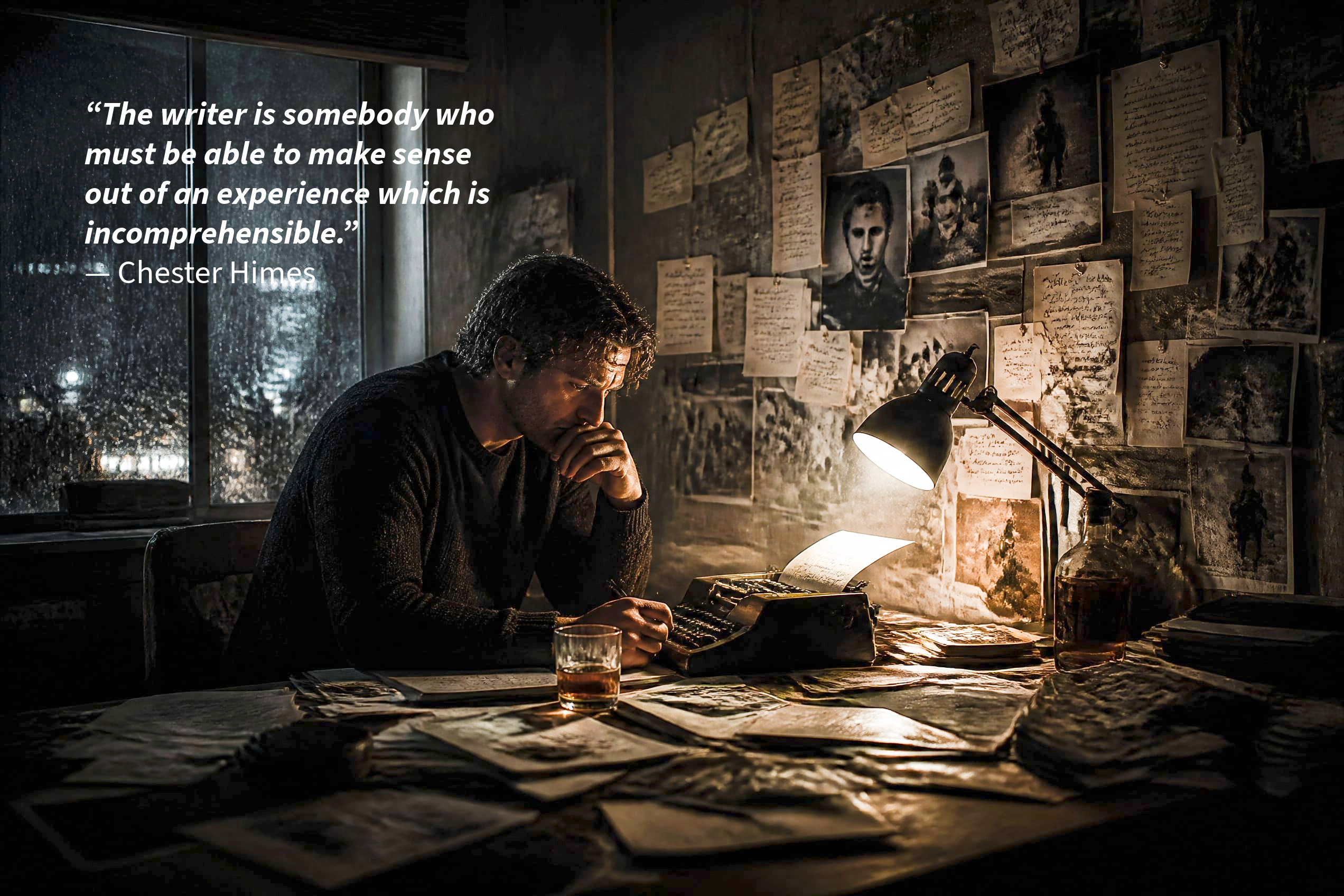
Quote of the Day – 06042026


Personal Reflection

Most writing begins with something unresolved.

Not clarity. Not wisdom. Not some polished life lesson wrapped neatly in metaphor.

Usually it starts with confusion lingering like cigarette smoke in a closed room.

A conversation you can’t stop replaying. A betrayal that still feels unfinished years later. A moment that looked ordinary at the time until memory returned carrying sharper teeth. You try to move on, but the experience keeps tapping at the inside of your skull like a loose pipe in an old apartment building.

So you write.

Not because you fully understand what happened.

Because you don’t.

That’s the uncomfortable truth buried beneath a lot of creative work: writing is often an attempt to translate emotional chaos into something survivable.

Not everything in life arrives with meaning attached to it. Sometimes terrible things happen without revelation. Sometimes people leave without explanation. Sometimes grief just sits in the corner eating quietly long after everyone else has gone home.

And the mind hates unfinished things.

Writers especially.

We keep circling certain memories because part of us believes if we describe them accurately enough, honestly enough, we might finally reduce their power. Like naming a wound somehow changes its shape.

Sometimes it does.

Sometimes it only teaches you how deep it really goes.

That’s why authentic writing often feels dangerous. The page becomes a crime scene where denial slowly runs out of places to hide. Every sentence asks the same question in a different voice:

What really happened here?

Not the public version. Not the edited anecdote polished smooth enough for company. The real version. The one with contradiction and shame and silence still attached to it.

And maybe that’s why readers connect so deeply with work that tells the truth plainly. Not because they want perfection.

Because they recognize themselves in the fracture lines.

Still, there’s something hopeful hidden inside the process.

Writing may not fully solve confusion, but it can transform isolation.

The moment experience becomes language, it stops being trapped entirely inside one person. A stranger reads a sentence and suddenly realizes their private ache isn’t entirely private after all.

That matters.

Especially now.

Maybe making sense of life was never about finding clean answers. Maybe it’s about creating enough honesty to build a bridge between wounded people standing in separate rooms.

One sentence at a time.


Reflective Prompt

What experience in your life still feels unresolved enough that it keeps returning in different forms?


Chester Himes: A Pioneering Voice in African American Literature

ARTICLE – MINI BIOGRAPHY – WRITER

Chester Himes, an acclaimed African American writer, carved a distinct niche with his crime novels that explored the experiences of black characters in the United States. Born on July 29, 1909, in Jefferson City, Missouri, Himes was raised in a middle-class home. This upbringing was notably ordinary until a dramatic event altered the course of his life.

At the tender age of 19, Himes was sentenced to prison for armed robbery. This unfortunate event, however, served as the backdrop for the beginning of his writing career. His years in prison became a fertile ground for creativity, and while confined, Himes began writing short stories. His talent and unique voice were showcased, and his stories were published in national magazines such as Esquire, marking the start of his journey as a recognized writer.

Following his release from prison in 1936, Himes did not abandon his newfound passion. Instead, he continued to write and publish, steadily gaining recognition as a significant voice in African American literature. His works, rooted in his personal experiences and observations, painted a vivid picture of the societal realities faced by African Americans.

In the 1950s, Himes made a bold move by relocating to France. There, he began writing detective novels featuring black protagonists, a genre in which he found considerable success. His most famous works from this period are the “Harlem Detective” series. The series features the characters Coffin Ed Johnson and Grave Digger Jones, two Harlem detectives who navigate a world fraught with crime, racism, and social issues. These novels were celebrated for realism, as Himes used his powerful storytelling to explore Harlem’s complex dynamics of race and class.

Throughout his career, Himes used his writing as a tool to explore themes of race, class, and crime. His narratives presented a unique and unflinching perspective on the African American experience. His works did not shy away from the harsh realities of racial inequality and social injustice, making them deeply resonant and thought-provoking.

Chester Himes passed away in Spain in 1984, but his legacy remains. His powerful and thought-provoking works resonate with readers today, and his contribution to African American literature remains undisputed. Himes’ life and works testify to his courage, resilience, and unyielding commitment to shedding light on the African American experience through his writing.

Here is a list of some of his notable works:

  1. If He Hollers Let Him Go (1945) – A novel exploring racism and the experiences of African Americans during World War II.
  2. The Lonely Crusade (1947) – A novel depicting the challenges faced by an African American protagonist in a racially divided society.
  3. Cast the First Stone (1952) – A novel that delves into the complexities of race relations and social justice.
  4. The Third Generation (1954) – A novel addressing race and identity issues.
  5. Cotton Comes to Harlem (1965) – The first book in Himes’ “Harlem Detective” series, featuring detectives “Coffin” Ed Johnson and “Gravedigger” Jones. This novel was later adapted into a film in 1970.
  6. Run Man Run (1966) – A novel exploring crime and social justice themes.
  7. Blind Man with a Pistol (1969) – Another installment in the “Harlem Detective” series, continuing the adventures of Johnson and Jones.
  8. The Quality of Hurt (1972) – An autobiographical work in which Himes reflects on his life, experiences, and the challenges of being a black writer.
  9. Black on Black: Baby Sister and Selected Writings (1973) – A collection of short stories, including the novella “Baby Sister,” exploring various aspects of African American life.
  10. Plan B (1973) – A satirical novel that touches on themes of politics and race.
  11. The Heat’s On (1986) – Published posthumously, this novel is the last installment in the “Harlem Detective” series.

I didn’t hear of Chester Himes until 2011. I was at a book fair when a random shopper approached me and started telling me about this amazing author. Strangely, he handed me a book, but it wasn’t by Chester Himes. Confused, I took the book, hoping he would leave, but he didn’t. The book was entitled Moth by James Sallis. Finally, he got to his point. It turned out that James Sallis wrote a book about Chester Himes.

Oddly enough, since that day, I have read several books by Chester Himes and James Sallis. I managed to collect a few original pulp editions of Himes’s work. Also, I picked up the Drive series by Sallis, which inspired the motion picture Drive, starring Ryan Gosling. What I haven’t done is read the book about Chester Himes written by James Sallis.