The Man I Was Looking For Kept Walking


Dispatches from the Splinters of My Mind — Entry #34

I started walking because there wasn’t anything else to do with myself.

That’s not entirely true. There were dishes in the sink, unopened boxes stacked against the bedroom wall, messages on my phone from people who had gradually stopped asking whether I was all right and started asking whether I was alive. There were forms from the unemployment office, a refrigerator containing mustard, half a carton of eggs, and something in a plastic container I had stopped trusting several days earlier. There were books I could have read, television I could have watched, sleep I could have attempted. There were plenty of things to do.

There just wasn’t anything I wanted to do.

That distinction had become important.

Somewhere during the previous eighteen months, my life had changed from something I participated in to something I maintained. Wake. Shower. Coffee. Applications. Groceries. Bills. Phone calls returned three days late. Laundry when underwear became a logistical concern. Eat because the body apparently insists upon being consulted. Sleep badly. Repeat.

Nothing catastrophic had happened, which somehow made explaining it worse.

Mara left in February. My father died in April. The company eliminated my department in June after seventeen years and thanked me for my service with a cardboard box and a packet explaining COBRA. In August, my oldest friend stopped calling after I canceled dinner for the fourth time. By October, I had moved into an apartment where the previous tenant’s furniture marks remained pressed into the carpet like fossils.

None of those things destroyed me.

That’s what people misunderstand about disappearing.

You don’t always vanish in an explosion. Sometimes you leave yourself the way a shoreline disappears beneath the tide—an inch here, another there, nothing dramatic enough to photograph until somebody notices the house is standing in water.

So I walked.

At first, I called it exercise.

Then stress management.

Then something to help me sleep.

Eventually I stopped lying.

I walked because every night around eleven, my apartment became too quiet to tolerate.


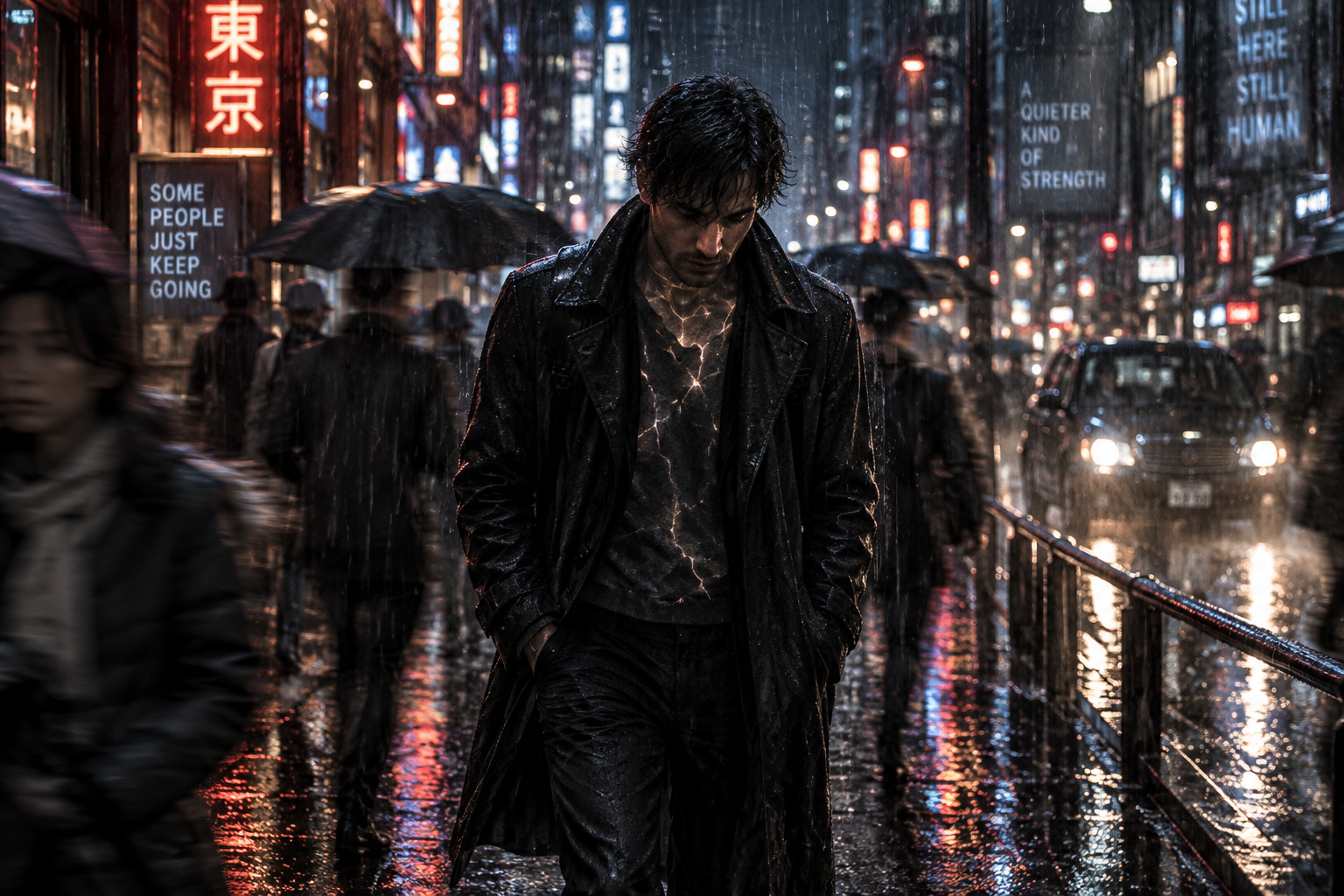
The city was better in the rain.

Rain removed obligation from things. Nobody expected conversation beneath an umbrella. Nobody wondered why you were alone. Everyone walked with purpose even when they had none, shoulders hunched, heads lowered, moving between islands of fluorescent light while tires whispered across black pavement.

I liked becoming anonymous among them.

On dry nights, people had faces. In rain, they became coats and umbrellas, reflections sliding across shop windows, bodies briefly illuminated by headlights before disappearing again.

The first time I saw myself, I was crossing Ninth Street.

He stood on the opposite corner beneath the red glow of a pharmacy sign, hands inside the pockets of a black coat.

My coat.

Not the one I was wearing.

The old one.

Leather, knee-length, ridiculous in retrospect, although at twenty-eight I had believed it made me look dangerous.

The man wearing it looked twenty-eight.

The light changed.

People moved between us.

Someone bumped my shoulder and muttered something.

When the crowd cleared, he was gone.

I stood in the crosswalk until a taxi leaned on its horn.

I told myself resemblance.

Cities manufacture doubles. Give enough strangers similar haircuts and winter coats and eventually somebody will look enough like you to ruin an evening.

I went home.

The next night, I walked the same route.

I didn’t see him.

The night after that, I did.


This version was older.

Thirty-five, maybe thirty-six.

He sat inside a restaurant beside a woman whose face I couldn’t see, laughing so hard his head tilted backward.

I knew that laugh.

Mine before I learned to ration it.

I stopped outside the window.

Rain ran down the glass between us, bending his face.

The woman reached across the table and touched his hand.

He turned.

Saw me.

The laughter disappeared.

For several seconds we stared at each other through the window.

Then a bus passed.

When it cleared, the table was empty.

Not abandoned.

Empty.

No plates.

No glasses.

No woman.

A waiter wiped the spotless surface with a white cloth.

I walked home faster than usual.

The following night, I took a different street.

He was waiting there too.


After that, I began seeing versions of myself everywhere.

One boarded a train as I reached the platform. Another climbed into the back of a taxi. I saw a gray-haired version smoking outside a hotel and a younger one standing beneath an awning kissing somebody whose face disappeared behind an umbrella.

They were never exactly where I could reach them.

Twenty yards.

Half a block.

The opposite platform.

Across four lanes of traffic.

Close enough to recognize.

Far enough to doubt.

I began walking farther.

The city began answering.

At least, that’s what I thought.

The first sign appeared beside a bus shelter.

SOME PEOPLE JUST KEEP GOING.

Advertising, probably.

I couldn’t remember what it was selling.

Three blocks later:

STILL HERE. STILL HUMAN.

I stopped beneath it.

The rain ticked against the metal frame overhead.

“Fuck you,” I said.

A woman waiting for the bus moved several feet away.

Fair enough.

The next evening another billboard read:

A QUIETER KIND OF STRENGTH.

I laughed.

“You’re laying it on a little thick.”

Nobody answered.

Two nights later, the messages changed.

YOU USED TO TURN LEFT HERE.

I stopped.

The sign hung above a closed electronics store.

I had turned left there.

Years ago.

There had been a bar on Jefferson called Milo’s. My friend David and I went every Thursday after work, back when Thursday meant something besides the day before Friday.

I turned left.

Milo’s was gone.

A laundromat occupied the space.

But through its fogged windows, for perhaps three seconds, I saw bar stools.

Pool table.

David waving from the back.

Then somebody opened the laundromat door and warm detergent-scented air rolled across the sidewalk.

Rows of washing machines.

No David.

The next sign said:

YOU DON’T LIKE WHAT’S DOWN THAT STREET.

I went anyway.

Apparently I had retained at least one recognizable personality trait.


The street narrowed.

Neon thinned.

Traffic became distant.

Halfway down the block, a man stood beneath the awning of a closed tailor shop smoking a cigarette.

Black leather coat.

Twenty-eight.

Me.

I stopped.

He looked up.

“You took your time.”

His voice was mine, except younger, carrying an arrogance I’d forgotten possessing.

“Are you me?”

He smiled.

“I used to be.”

I moved closer.

Up close, the differences hurt.

No lines around the eyes. More hair. Shoulders held differently. He inhabited his body as though he’d never considered apologizing for occupying space.

I hated him immediately.

I envied him even faster.

“I’ve been looking for you.”

“Yeah.”

“Why?”

He took a drag.

“Because you think I know where you went.”

Rain drummed against the awning.

“I want my life back.”

He laughed.

Not cruelly.

That somehow irritated me more.

“Which one?”

“The one before all this.”

“Before Mara?”

“Before everything.”

“Your father?”

I said nothing.

“The job?”

Nothing.

“David?”

“Shut up.”

He flicked ash into the gutter.

“You keep talking about losing yourself like I was something worth preserving.”

That landed harder than I expected.

“I was happy.”

“No. You were busy.”

“I had a life.”

“You had momentum. That’s not the same thing.”

I wanted to hit him.

He seemed to know.

“You want me back because you remember me selectively. You remember the coat. The job. The friends. You don’t remember how scared I was all the goddamn time.”

“I wasn’t scared.”

He smiled.

“See?”

A taxi passed, throwing water across the curb.

I turned away.

When I looked back, the awning was empty.

Only a cigarette remained in the gutter, hissing in the rain.


I kept walking.

Not because I expected answers anymore.

Because stopping felt worse.

I met others.

Forty-two stood inside a convenience store staring at lottery tickets.

Fifty sat alone on a bench feeding pieces of bread to pigeons despite a sign prohibiting it.

Thirty-one walked past holding Mara’s hand.

She looked happy.

I didn’t follow them.

The version from the week after my father’s funeral sat on the steps of a church.

I recognized him immediately.

Same shirt I’d worn for three days.

Same beard.

Same vacant expression people mistake for strength when a man doesn’t cry where they can see him.

I sat beside him.

For a while neither of us spoke.

Finally I asked, “Are you the one?”

He shook his head.

“Who am I looking for?”

He pointed down the street.

Of course he did.

Apparently every version of me was committed to being cryptic.

I stood.

Before leaving, I looked back.

“Does it get easier?”

He stared at the rain.

“I wouldn’t know.”

I understood.

He hadn’t survived it yet.

I left him there.


The city grew quieter as I walked.

Storefronts darkened. Traffic disappeared. Even the rain softened until individual drops became audible against my coat.

The signs continued.

NOT THIS ONE.

KEEP WALKING.

YOU ALREADY PASSED HIM.

Then:

STOP LOOKING BACK.

I did.

Nobody.

When I faced forward again, someone stood at the end of the block.

Same coat I was wearing.

Same shoulders.

Same age.

Same tired posture.

Me.

Not younger.

Not older.

I approached slowly.

He waited beneath a streetlight.

Rain streamed from his hair.

“So you’re me.”

He shook his head.

“Not yet.”

I stared at him.

“What does that mean?”

“You know.”

“No, actually, I’m getting pretty goddamn tired of everyone assuming that.”

He almost smiled.

I recognized that too.

“Are you what happens to me?”

“Maybe.”

“How far?”

He shrugged.

“Tomorrow. Ten years. Forty minutes.”

“Do I get better?”

He looked down the empty street.

“Better than what?”

“This.”

I gestured at myself.

He considered me for a long time.

Then said, “You’re still treating yourself like a place you can return to.”

I didn’t answer.

“You keep asking where you went. You didn’t go anywhere.”

“Then why don’t I recognize myself?”

“Because you’re looking for someone who doesn’t exist anymore.”

The words should have hurt.

Instead they felt strangely ordinary.

Like being told a store had closed.

I looked back toward the city.

Somewhere behind us were all the people I’d been.

Twenty-eight beneath the awning.

Thirty-one holding Mara’s hand.

The man outside the funeral.

The husband.

The employee.

The friend.

The son.

All of them temporary.

All of them convinced, while they existed, that they were the permanent version.

When I turned back, the man was walking away.

“Where are you going?”

He didn’t stop.

I followed.


We walked until the rain began thinning into mist.

I stayed perhaps twenty feet behind him.

Every intersection he crossed, I crossed.

Every corner he turned, I turned.

For once I wasn’t trying to catch him.

That mattered.

I don’t know why.

The eastern sky began changing, black becoming charcoal.

He turned one final corner.

I followed.

Empty street.

No man.

No footsteps.

Nothing except shuttered businesses and rainwater running along the curb.

Above a closed shop, a rectangular sign glowed.

YOU ARE HERE.

I stood beneath it.

“No shit.”

The city offered no rebuttal.

Across the street, a dark storefront reflected the sidewalk.

I saw myself.

Wet hair.

Black coat.

Hands inside pockets.

Tired face.

Older than I remembered becoming.

I waited for the reflection to move without me.

It didn’t.

I raised my right hand.

It raised its left.

I stepped closer.

So did he.

Normal.

Perfectly, beautifully normal.

I almost laughed.

Instead I stood there looking at him.

Not the man before Mara.

Not the son before the funeral.

Not the employee before the cardboard box.

Not whoever I had been before things started disappearing.

Just the poor bastard standing in the rain.

For the first time, I didn’t ask whether I recognized him.

A city bus passed behind me.

In the reflection, it passed too.

When it was gone, someone was standing twenty yards behind my reflected self.

Same black coat.

Head lowered.

Walking.

I turned around.

The sidewalk behind me was empty.

When I looked back at the glass, the man was closer.

I didn’t turn again.

He kept walking.

So did I.
Some Shit Just Needs Fixing


Hello, I’m Mangus Khan, and for the next few minutes, I encourage you to walk into Madness with me.

Come on in, Brave Souls.

Watch where you step.


There’s a ten-millimeter socket around here somewhere, which means we’ll probably find Jimmy Hoffa, Amelia Earhart, and evidence of intelligent life in Congress before we find that little bastard.

The shop smells like work.

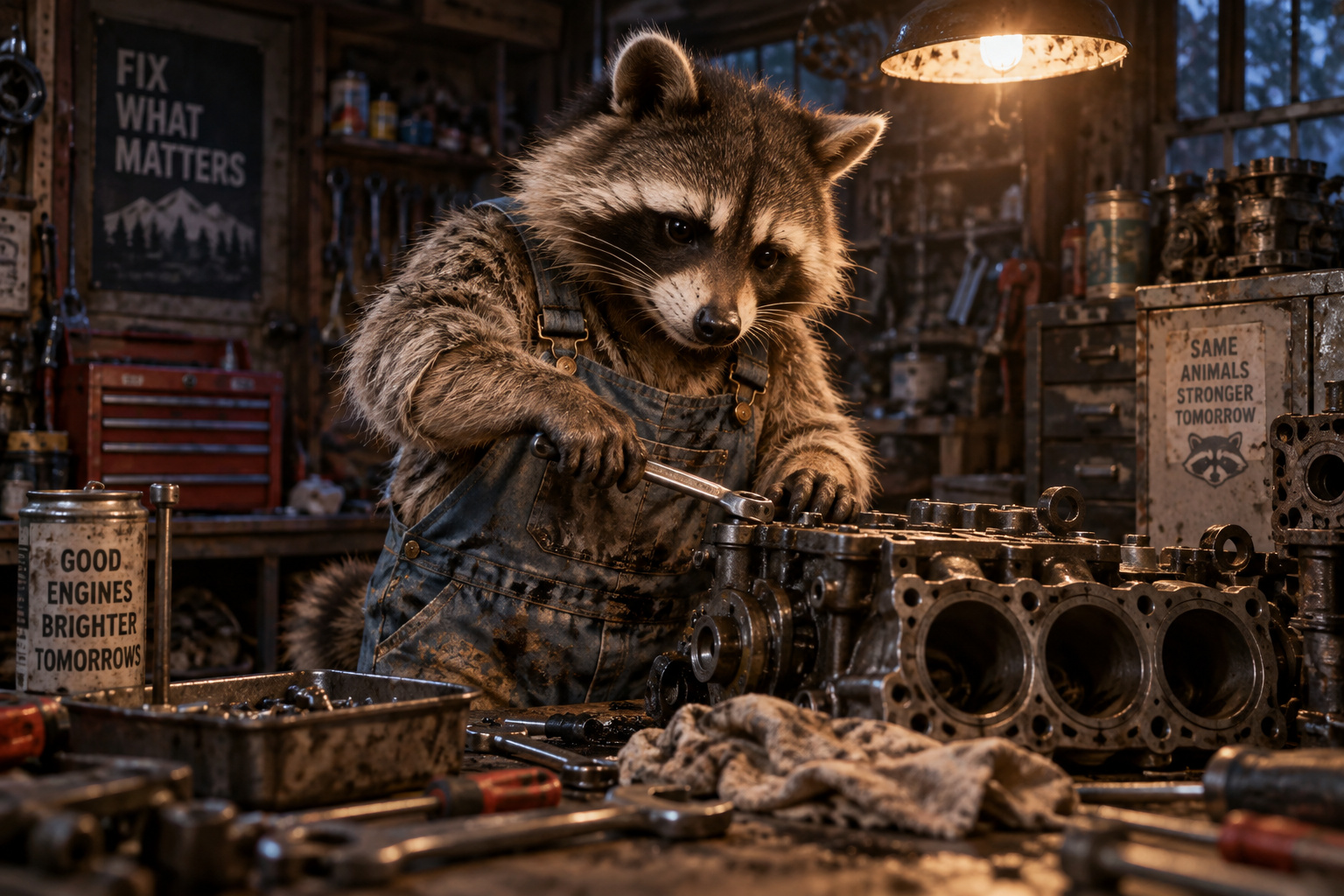
Not the sanitized version sold in commercials where some suspiciously clean mechanic smiles while holding a wrench that has obviously never touched an engine. I mean actual work—the metallic tang of old tools, gasoline evaporating from something it probably shouldn’t be evaporating from, penetrating oil, hot dust, burned grease, and that peculiar sweetness of antifreeze lingering beneath everything else.

There’s grime beneath my fingernails that soap has already filed paperwork against.

Metal shavings glitter across the workbench beneath a hanging lamp whose shade is stained with decades of fingerprints. Wrenches lie scattered among sockets, extensions, screwdrivers, oily shop towels, coffee cans filled with bolts nobody remembers removing, and several mysterious pieces of hardware everyone has collectively agreed were probably unnecessary.

At least, that’s what we’re telling ourselves.

Somewhere against the wall, an old radio wheezes through a speaker that has probably needed replacing since Reagan was president. The music comes and goes beneath the occasional clatter of metal settling against metal.

The engine is open on the bench.

Head removed.

Pistons exposed.

Everything normally hidden beneath steel, plastic, hoses, wires, and the comforting illusion that everything is fine now sits naked beneath the light.

Funny thing about machines.

They look considerably less impressive once you open them up.

So do people.

From the outside, an engine is simply an engine. Turn the key. It starts. Press the accelerator. It moves. Nobody thinks about compression ratios, oil pressure, bearings, timing, fuel mixture, cooling systems, or the thousands of tiny explosions happening a few feet in front of us.

We just expect the motherfucker to work.

Preferably with air conditioning.

People receive roughly the same consideration.

We rarely think about what keeps someone functioning while they’re functioning.

We see the result.

They showed up.

Answered the phone.

Went to work.

Paid the bill.

Cooked dinner.

Made the deadline.

Laughed at the joke.

Asked how everybody else was doing.

Good.

Everything must be fine.

Then something starts knocking.

Ticking.

Grinding.

Maybe there’s a vibration that wasn’t there yesterday.

And suddenly we’re listening.

That’s human nature, I suppose.

We rarely appreciate the machinery while it works.

We notice it when it stops.

Engines.

Plumbing.

Electricity.

Relationships.

Bodies.

People.

Especially people.

That’s the part I’ve been thinking about.

We live in a disposable age.

Something breaks?

Replace it.

Phone gets slow?

Replace it.

Television develops a line across the screen?

Replace it.

Coffee maker starts making a noise suspiciously similar to demonic possession?

Replace the bastard before it starts speaking Latin.

Repair has become inconvenient.

Worse, it has become economically suspicious.

Things aren’t always designed to be repaired anymore. They’re designed to be upgraded, traded, replaced, discarded, forgotten.

Somewhere along the way, new became synonymous with better, and old became something requiring justification.

We stopped asking:

Can this be fixed?

and started asking:

How much is a new one?

Sometimes that’s practical.

There comes a point when repairing something costs more than replacing it. Anybody who has kept an old car alive knows that particular mathematics. Eventually you’ve replaced the starter, alternator, radiator, water pump, fuel pump, half the suspension, three sensors you didn’t know existed, and something the mechanic described only as that damn thing behind the other damn thing.

At some point, you’re forced to admit you’re no longer maintaining a vehicle.

You’re financing an archaeological dig.

Fair enough.

But we’ve allowed that thinking to migrate from things into people.

That’s where the shit gets sideways.

Friendships get difficult.

Replace them.

Relationships require uncomfortable conversations.

Find another one.

Someone disappoints us.

Cut them off.

Someone struggles longer than our patience permits.

Too much baggage.

Someone changes.

We don’t recognize them anymore.

Next.

We have developed an entire vocabulary for throwing human beings away and occasionally calling it personal growth.

Now, before somebody starts warming up their keyboard—

Sometimes walking away is absolutely necessary.

Not every relationship should be repaired.

Some things are toxic.

Some things are dangerous.

Some things are destructive.

Some people will drain every ounce of kindness you possess, complain that the glass wasn’t full enough, then ask what you’re doing for them tomorrow.

There are relationships that have cracked beyond anything glue, prayer, therapy, duct tape, patience, forgiveness, or sheer stubbornness should be expected to hold together.

Knowing when to leave is wisdom.

But knowing when to stay?

Knowing when something is damaged rather than dead?

That’s becoming a rarer skill.

The wrench turns.

Metal groans against metal.

A bolt that hasn’t moved in twenty years refuses the first attempt.

Then the second.

I lean into it.

Nothing.

There is a moment familiar to anyone who has worked on old machinery when you begin negotiating with God despite not remembering inviting Him into the garage.

Then—

crack.

The bolt moves.

About an eighth of an inch.

There.

Progress.

Not dramatic.

Nobody applauds.

No inspirational soundtrack begins playing.

No motivational speaker wanders into the shop to explain that the bolt moved because I believed in myself.

It moved because I soaked the stubborn son of a bitch in penetrating oil and leaned on a breaker bar.

Sometimes progress isn’t spiritual.

Sometimes you need leverage.

Maybe that’s what repair actually looks like.

Small.

Dirty.

Slow.

Unimpressive.

You don’t rebuild an engine by standing across the garage shouting positive affirmations at it.

You are worthy, Chevrolet.

No.

You tear the bastard apart.

And that’s the part nobody puts on the poster.

Before rebuilding comes disassembly.

You remove things.

Label things.

Inspect things.

Clean away years of grime so you can see what you’re actually dealing with.

Sometimes the damage isn’t where you thought it was.

The noise came from here.

The failure began over there.

The thing that finally stopped working wasn’t the thing that started the problem.

Human beings aren’t terribly different.

We spend enormous amounts of time repairing symptoms because symptoms are visible.

We’re tired, so we drink more coffee.

We’re lonely, so we scroll.

We’re angry, so we find somebody convenient to blame.

We’re overwhelmed, so naturally we add more shit to the schedule.

We’re unhappy, so we buy something.

We’re hurting, so we tell everybody we’re fine.

Dashboard light comes on?

Piece of electrical tape over that son of a bitch.

Problem solved.

Except the engine still knows.

That’s the part we forget.

You can hide a warning without repairing the damage.

I’ve done that.

More times than I care to count.

I suspect most of us have.

There’s a strange pride attached to endurance. We admire people who keep going.

He’s strong.

She’s a fighter.

Look at everything they’ve been through.

And there is truth in that.

Endurance matters.

Sometimes getting through the day is an act of courage nobody else will ever see.

But there is a darker side to our worship of resilience.

Sometimes we celebrate people for surviving conditions they should never have been expected to endure.

Sometimes strong becomes the word everybody uses when they don’t want to ask whether you need help.

And sometimes you begin believing your usefulness depends upon your ability to keep functioning.

That one is dangerous.

Because people become extraordinarily skilled at functioning while damaged.

They still go to work.

Still laugh.

Still answer the phone.

Still take care of everybody else.

Still make dinner.

Still pay bills.

Still say:

I’m good.

The engine continues running.

Maybe there’s a knock.

Maybe it’s burning oil.

Maybe compression is down in one cylinder.

Maybe something inside is operating under far more strain than anybody realizes.

But it runs.

So everybody assumes it’s fine.

Including the person operating it.

Especially the person operating it.

I’ve wondered how many times in my life I’ve done exactly that.

Kept moving because movement looked enough like health to fool everybody.

Maybe even myself.

There have been times when stopping seemed more frightening than continuing.

Because stopping meant listening.

And listening meant hearing the knock.

So you stay busy.

Work becomes useful that way.

Schedules.

Deadlines.

Projects.

Other people’s problems.

Anything capable of making enough noise that you don’t have to hear your own machinery.

There is pride in endurance.

There is also stupidity.

I’ve practiced both.

Sometimes stopping feels like failure.

Opening the hood feels like admitting something is wrong.

And once you start taking things apart, there’s always that frightening possibility you’ll discover the damage is worse than you thought.

So we keep driving.

Turn the radio louder.

Ignore the vibration.

Tell ourselves it’ll probably make it.

Probably.

Human beings have built entire lives around that word.

Eventually, though, something forces the hood open.

Loss.

Age.

Failure.

A relationship ending.

A friendship changing.

Children growing up.

Parents growing old.

The empty chair.

The phone call that divides life into before and after.

Or maybe nothing dramatic happens.

Sometimes it’s just a quiet room.

A sleepless night.

Three seventeen in the morning.

The refrigerator humming somewhere down the hall while the entire world appears to have gone silent except for whatever you’ve been refusing to think about.

That’s when you hear it.

The knock.

Not from the engine.

From somewhere deeper.

And suddenly there you are.

Parts scattered across the workbench.

Everything exposed beneath a harsh light.

That’s an uncomfortable place to be.

Because now you can see what you’ve been carrying.

Old damage.

Improvised repairs.

Things held together far longer than they should have been.

Old grief packed beneath new responsibilities.

Anger covering fear.

Humor covering pain.

Work covering loneliness.

Pride covering exhaustion.

Maybe even scars from something you had forgotten was broken.

The instinct is judgment.

How did I let it get this bad?

I’ve never found that question particularly useful.

A mechanic doesn’t insult an engine back into working order.

Well…

Not exclusively.

There is usually some profanity involved.

But eventually the questions have to become simpler.

What’s wrong?

Then:

What caused it?

Then:

What can be repaired?

And finally, the one nobody likes:

What can’t?

That’s where the real work begins.

Because repair doesn’t always mean restoration.

That’s another lie we tell ourselves.

We want repaired things to become what they were before.

We talk about getting our old selves back.

Getting back to normal.

Going back to the way things were.

Sometimes you can’t.

Sometimes you shouldn’t.

A rebuilt engine isn’t untouched.

It has history.

Parts have been replaced.

Surfaces machined.

Tolerances changed.

Old weaknesses discovered.

New pieces installed beside old ones.

Maybe it runs differently afterward.

Maybe better.

Maybe not.

Maybe simply differently.

People are like that too.

Healing doesn’t return us to factory settings.

There are no factory settings.

Whatever happened, happened.

Grief changes the architecture.

Love changes it.

War changes it.

Parenthood.

Failure.

Success.

Betrayal.

Forgiveness.

Time.

The person who comes out the other side isn’t the person who went in.

I’ve stopped believing that’s automatically tragic.

Maybe the goal was never to become who we were.

Maybe the goal is to understand who remains.

To examine the pieces.

Keep what still serves.

Replace what no longer does.

Accept what cannot be restored.

And build something capable of carrying us forward.

Not untouched.

Not new.

Not perfect.

Just functional enough to make tomorrow possible.

The wrench turns again.

Another bolt loosens.

Outside the garage, evening has settled against the windows. The glass has become dark enough to reflect the shop back at itself.

Tools.

Oil.

Old machinery.

A workbench scarred by years of things being taken apart and occasionally put back together.

One tired creature trying to make something work again.

There’s something almost sacred about that.

Not because everything can be saved.

It can’t.

That’s the uncomfortable counterpoint.

Some engines are done.

Some relationships are done.

Some dreams expire.

Some doors should remain closed.

Some versions of ourselves have carried us as far as they can.

Wisdom isn’t repairing everything.

Wisdom is learning what deserves the wrench.

That’s why the sign hanging crooked against the wall catches my attention.

FIX WHAT MATTERS.

Not everything.

What matters.

There’s a hell of a difference.

Maybe that’s what I’ve been trying to learn.

You don’t owe every broken thing your hands.

You don’t owe every broken relationship another year.

You don’t owe every mistake a lifetime of punishment.

And you certainly don’t owe every version of yourself permanent residence simply because it got you this far.

But when something matters—

really matters—

maybe inconvenience isn’t enough reason to throw it away.

Maybe difficulty isn’t proof that something is finished.

Maybe scars aren’t evidence of worthlessness.

Maybe needing repair isn’t the same thing as being broken beyond use.

The shop has gone quiet.

The radio stopped playing sometime ago.

The engine remains open on the bench.

It isn’t fixed yet.

I like that.

Because that’s honest.

Some repairs take longer than an afternoon.

Tomorrow there will be another bolt.

Another gasket.

Another measurement.

Probably another ten-millimeter socket disappearing into whatever alternate dimension has claimed the others.

There may be another problem hidden beneath this one.

That’s how rebuilding works.

One piece at a time.

No grand revelation.

No miracle.

Just attention.

Patience.

Work.

And enough humility to admit that something needs fixing.

I wipe my hands on the rag and look at the engine beneath the lamp.

Still broken.

But understood a little better than it was this morning.

Maybe that’s enough progress for one day.

We’re on a journey through the ordinary and mundane, Brave Souls, taking off the rose-colored glasses and looking for a different side of Madness.

Tonight, maybe the slant is simpler than usual.

You don’t have to fix everything.

You probably can’t.

You shouldn’t even try.

Just learn the difference between what’s broken, what’s finished, what’s merely scarred—

and what still matters.

Then pick up the wrench.

Because sometimes…

That Shit … Be at a Slant.

The Woman Underneath Was Someone Else


Dispatches from the Splinters of My Mind — Entry 33:

The first piece came off beneath my fingernail.

Turquoise.

No bigger than a grain of rice.

I noticed it while washing my face before bed, standing beneath the bathroom light that had been threatening to die for six months but apparently lacked the commitment. It buzzed faintly above the mirror, bleaching everything beneath it—the white sink, the gray grout, the little silver hairs beginning to colonize my temples despite repeated diplomatic objections.

I had already brushed my teeth, taken out my earrings, and tied my hair back.

The ordinary little dismantling we perform every night before allowing ourselves to become whatever sleeps in our beds.

There was something rough along my jaw.

I scratched it.

The turquoise flake landed in the sink with a sound too small to deserve attention.

I stared at it anyway.

I don’t wear turquoise makeup.

Never have.

Too loud.

Red lipstick, yes. Always red. But turquoise belonged on old convertibles, cheap jewelry, swimming pools in motel brochures. Not my face.

I leaned toward the mirror until my breath fogged the bottom edge of the glass.

There was another patch near my cheekbone.

I touched it.

Hard.

Not skin.

I worked a fingernail beneath the edge.

There was resistance at first, a faint pulling sensation that made my teeth ache, and then the piece surrendered with a tiny dry crack.

Something the size of a dime curled away.

There was skin underneath.

Brown.

Warm.

Mine.

I touched it.

The skin felt normal.

Then I remembered that I hated jazz.

I stood there holding the turquoise fragment between my fingers.

Miles Davis was playing in the bedroom.

Kind of Blue.

My favorite album.

Except it wasn’t.

The trumpet slipped through the apartment, muted and melancholy, something I’d heard hundreds of times while cooking, reading, drinking wine, pretending Sunday morning wasn’t already conspiring to become Monday.

I remembered buying the record.

I remembered playing it while Daniel made pancakes.

I remembered arguing with him that Coltrane’s playing on Blue in Green was more interesting than anything else on the album.

Those memories remained.

But beneath them was something quieter.

Older.

I hated jazz.

Too busy.

Too pleased with itself.

Music wandering around looking for somewhere to sit down.

My stomach tightened.

“That’s ridiculous.”

The woman in the mirror agreed.

I think.

I dropped the turquoise piece into the sink.

Miles kept playing.

For the first time in twenty years, I wanted him to stop.

I didn’t turn the music off.

I was afraid of what the silence might confirm.


I found another edge beside my nose.

I should have gone to bed.

There are several moments in my life that would have turned out differently if curiosity possessed an off switch.

I peeled.

Coffee.

I hated coffee.

Not disliked.

Hated.

The bitterness. The scorched smell lingering in rooms. That sour film it left on my tongue. I remembered being seven years old at my aunt’s kitchen table, accidentally drinking from an adult’s cup and immediately spitting it back.

That memory felt ancient.

True.

I’d been drinking three cups every day since graduate school.

I looked toward the mug sitting beside the sink.

DON’T TALK TO ME UNTIL COFFEE.

There was a brown crescent dried inside it.

My sister gave me the mug for Christmas.

No.

Daniel gave it to me.

No.

I bought it myself at an airport.

Chicago?

Atlanta?

I couldn’t remember.

My fingertips went cold.

Another piece.

I hated running.

Another.

I preferred evenings to mornings.

Another.

I didn’t like red.

That one frightened me.

I looked at my mouth.

The lipstick gleamed beneath the bathroom light, glossy and almost obscenely vivid against my skin.

Red had been mine.

Not just a preference.

A declaration.

Red dresses. Red scarves. Red nails whenever work allowed it. Red lipstick even on days when the rest of me couldn’t be bothered.

I had been wearing it since I was nineteen.

I knew exactly why.

My grandmother.

She would stand at the hallway mirror before leaving the house and apply lipstick with the concentration of a surgeon. Church. Grocery store. Doctor’s appointment. Didn’t matter.

I could see her.

Tiny gold mirror in one hand.

Lipstick in the other.

The powdery smell of her bathroom.

The faint tremor in her fingers.

Once, when I was little, I asked why she always wore it.

She smiled at me through the mirror.

“Because I decide which face leaves this house.”

I had carried that sentence for thirty-seven years.

I had quoted it at parties.

Written it inside a birthday card to my niece.

Used it once during a presentation about women and professional identity.

I could hear my grandmother saying it.

Could see the tiny gold mirror.

Could smell her powder.

Could remember standing beside her.

Then another memory surfaced.

My grandmother at church.

My grandmother cooking.

My grandmother asleep in her hospital bed.

Her lips always bare.

My grandmother never wore lipstick.

The room seemed to tilt.

I gripped the sink.


I stopped peeling.

For perhaps five minutes.

Maybe twenty.

The clock on my phone said 11:38 when I finally looked.

I sat on the closed toilet lid staring at the pieces scattered across the porcelain.

Turquoise fragments.

Some glossy.

Some dull.

They looked less like makeup now.

More like paint scraped from an old house.

I touched my cheek.

Ridges.

Layers.

My own face had topography.

I thought about calling someone.

My sister.

Daniel.

A doctor.

  1.  

But what exactly do you say?

Hello, I seem to be molting psychologically.

Emergency rooms have enough problems.

So I did what sensible people do when confronted with something impossible.

I searched the internet.

Allergic reaction.

Skin peeling.

Cosmetic contamination.

Stress.

Dermatitis.

Autoimmune disease.

Hormonal changes.

Cancer, naturally.

The internet can turn a hangnail into six months to live before you’ve finished typing.

I closed the phone.

The screen went black.

For an instant I saw my reflection in it.

Something about the face was wrong.

I turned it facedown.

In the bathroom mirror, a thin turquoise line crossed my forehead.

I pulled it.

A larger piece came away.

And suddenly I knew where my laugh came from.

My sister.

That sharp little inhale before the sound.

Hers.

I tried laughing.

There it was.

Borrowed.

I tried again, deliberately changing it.

Nothing came.

I couldn’t find another laugh.

Another fragment.

The phrase You know what I mean?

Daniel.

Another.

The way I crossed my arms when angry.

My mother.

Another.

The little nod I gave people when pretending I understood something.

Professor Bell.

Graduate seminar.

  1.  

Another.

The confidence I wore during presentations.

Marianne Cooper.

My first supervisor.

She had walked into meetings like the furniture belonged to her.

I’d copied her.

At first deliberately.

Shoulders back.

Voice lower.

Never apologize before disagreeing.

I practiced it before meetings.

Eventually I stopped practicing.

Eventually everyone called it confidence.

Mine.

Except it hadn’t been.

Piece after piece landed in the sink.

My gestures.

My phrases.

My posture.

My taste in wine.

The books on my nightstand.

The way I seasoned chicken.

The perfume I’d worn for fifteen years.

My habit of touching someone’s forearm when I wanted them to know I was listening.

None of it had begun with me.

The thought should have made me feel fraudulent.

Instead, unexpectedly, it made me lonely.

How many people were living inside the ordinary things I called myself?

How many dead people still moved when I moved?

How many people I’d stopped loving still spoke through my mouth?

I looked at the fragments.

For the first time, I didn’t see debris.

I saw fingerprints.


We like to imagine identity as buried treasure.

Dig through enough expectations, enough childhood bullshit, enough failed relationships, enough jobs, compromises, disappointments and obligations, and eventually you’ll reach the authentic self.

Pure.

Untouched.

Waiting patiently beneath everything other people did to you.

That’s a comforting idea.

It is also, I began to suspect, complete bullshit.

Maybe there had never been an untouched me.

My mother’s stubbornness had become my persistence.

My sister’s laugh had become my joy.

Marianne’s arrogance had become my confidence.

Daniel’s jazz had become Sunday mornings.

My grandmother’s impossible lipstick had somehow become my mouth.

Were those things false because they came from somewhere else?

If somebody teaches you kindness and eventually you become kind, is the kindness counterfeit?

If somebody teaches you cruelty and you carry it for thirty years, does it become authentic simply because you’ve had it long enough?

Maybe we aren’t people underneath the accumulation.

Maybe the accumulation is the person.

I understood that.

And I kept peeling anyway.

That’s the part I regret.

Not beginning.

Continuing.


By midnight the turquoise was gone.

Underneath was another layer.

Ochre.

It covered my left cheek and disappeared beneath my hairline.

I laughed when I saw it.

Actually laughed.

Apparently my psyche had been decorated by someone with access to an art-supply store.

The joke sounded weak in the bathroom.

I peeled the ochre.

My first kiss happened behind the gymnasium.

No.

In Marcus Hill’s car.

No.

I’d never kissed Marcus Hill.

I could taste peppermint gum.

Then cigarettes.

Then nothing.

Another piece.

I married Daniel because I loved him.

I married Daniel because I was pregnant.

I’d never been pregnant.

Daniel died.

Daniel left.

Daniel was asleep in the bedroom.

There had never been a Daniel.

I stopped breathing.

“Daniel?”

The name barely escaped my mouth.

I waited.

No answer.

“Daniel?”

Louder.

Nothing.

I ran to the bedroom.

The record had reached the end. The needle traveled around the final groove with a soft rhythmic hiss.

The room smelled faintly of dust and the candle I’d burned earlier.

No Daniel.

No photographs on the dresser.

There should have been photographs.

Wedding.

Beach.

Christmas at my sister’s.

I opened the closet.

Men’s shirts.

Three.

One blue.

One white.

One gray.

I touched the blue one.

Cotton.

Soft from years of washing.

I remembered buying it for him.

I remembered burying him in it.

I remembered watching him fold it into a suitcase while telling me he couldn’t do this anymore.

Three memories.

All complete.

All painful.

All true.

I pressed the shirt against my face.

It smelled like cedar from the closet.

Nothing else.

I couldn’t remember Daniel’s smell.

That broke me.

Not whether he had died.

Not whether he’d left.

Not whether he’d existed.

I couldn’t remember how he smelled when I put my face against his neck.

I sat on the bedroom floor holding the shirt.

Miles Davis spun silently beside me.

I cried until my throat hurt.

Then I heard my sister’s inhale inside my sob.

For a moment, I hated her for giving me even that.


At 2:13, I returned to the bathroom.

I don’t know why I noticed the time.

The floor was covered with pieces of me.

Turquoise.

Ochre.

Gray.

A thin white layer I couldn’t associate with anything except loneliness.

They crunched beneath my bare feet.

I looked terrible.

Half my face appeared raw beneath the remaining material.

Not wounded.

Unfinished.

The red lipstick remained perfect.

I wet a washcloth.

Scrubbed.

Red.

Soap.

Red.

Makeup remover.

Red.

I scrubbed until my lips burned.

Still red.

“Because I decide which face leaves this house.”

I stared at myself.

“Did you even say that?”

My grandmother didn’t answer.

Neither did the mirror.

So I peeled again.

Mother.

Sister.

Teacher.

Lover.

Friend.

Enemy.

Wife.

Widow.

Daughter.

Professional.

Coward.

Woman who stayed.

Woman who left.

Each layer took something.

Eventually I stopped recognizing the memories being removed.

A farmhouse.

A blue bicycle.

Someone named Rebecca.

A dog called Moses.

A harbor.

For one strange moment, I remembered ordering a man named Tomas hanged.

My fingers opened.

The fragment dropped.

“No.”

The bathroom had become silent except for the electrical buzz above me.

That memory wasn’t mine.

I knew that much.

Didn’t I?

I looked at the woman in the mirror.

Most of the layers were gone.

One remained.

Thin.

Nearly transparent.

I found its edge beneath my chin.

My hands trembled.

This was it.

The original.

Whatever existed before everyone else had touched me.

Before expectation.

Before imitation.

Before survival.

Before love.

Before anybody had taught me what face to make when the world looked back.

Me.

I pulled.

The layer resisted.

For the first time, it hurt.

A deep pulling beneath the skin, as though whatever I was removing had roots.

I nearly stopped.

Then it released.

The layer came away almost whole.

I closed my eyes.

My face tingled in the cold bathroom air.

I breathed.

Once.

Twice.

Then looked.

The woman underneath was someone else.


She wasn’t frightening.

That would have been easier.

She was approximately my age.

Brown skin.

Dark eyes.

Wet strands of hair clinging to her forehead.

Red lips.

But the face was unfamiliar.

Different nose.

Different cheekbones.

A faint scar above the left eyebrow.

I leaned closer.

She did too.

I touched my face.

She touched hers.

Her fingertips pressed against skin I could feel beneath mine.

I raised my hand.

She raised hers.

I smiled.

She smiled.

I began to laugh.

So did she.

I couldn’t tell whether either of us meant it.

“Who are you?”

Her lips moved with mine.

No answer.

I looked down.

Hundreds of fragments surrounded my feet.

Everything I’d believed was me.

Suddenly I wanted them back.

Not because they were authentic.

Because they were mine.

Maybe ownership had never required originality.

I dropped to my knees.

Coffee.

Jazz.

Daniel.

My mother’s folded arms.

My sister’s laugh.

Marianne’s confidence.

The stupid mug.

The red dresses.

The lies.

God, even the lies.

Especially the lies.

I gathered handfuls and pressed them against my face.

They wouldn’t stick.

Turquoise broke beneath my fingers.

Ochre crumbled into powder.

Memories flickered and vanished before I could identify them.

“Please.”

I don’t know who I was asking.

When I looked up again, the woman in the mirror was standing.

I wasn’t.

I froze.

She touched her cheek.

I didn’t.

Her fingernail found an edge.

“No.”

She began peeling.

A thin layer came away.

Underneath—

my nose.

Another piece.

My cheekbone.

Another.

The little line beside my mouth I’d spent years pretending wasn’t a wrinkle.

“Stop.”

She continued.

My face emerged beneath hers.

The face I had just removed.

Complete.

Familiar.

Mine.

She smiled with my mouth.

Bright red.

I slowly stood.

She remained still.

Then I touched my lips.

She touched hers.

For the first time all night, our movements matched perfectly.

Both of us stopped.

On the counter between us sat the tube of lipstick.

Black case.

Gold band.

Cap removed.

A bead of red clung to its tip.

I stared at it.

I couldn’t remember taking it out.

Couldn’t remember buying it.

Couldn’t remember applying it.

The woman in the mirror looked down at hers.

Then back at me.

We stood there beneath the dying fluorescent light, surrounded by everything we had once mistaken for a single person.

Neither of us moved.

Finally, she reached for the lipstick.

I didn’t.

She lifted it toward my familiar mouth.

Then stopped.

Her eyes met mine.

There was something in her expression I recognized.

Not fear.

Not confusion.

Permission.

Or perhaps refusal.

I couldn’t tell anymore.

She waited.

So did I.

And somewhere beneath my bare feet, one of the discarded pieces cracked without being touched.

Neither of us looked down.

I don’t know which of us put the lipstick on.

The Man on the Other Side of the Water


Dispatches from the Splinters of My Mind — Entry 32

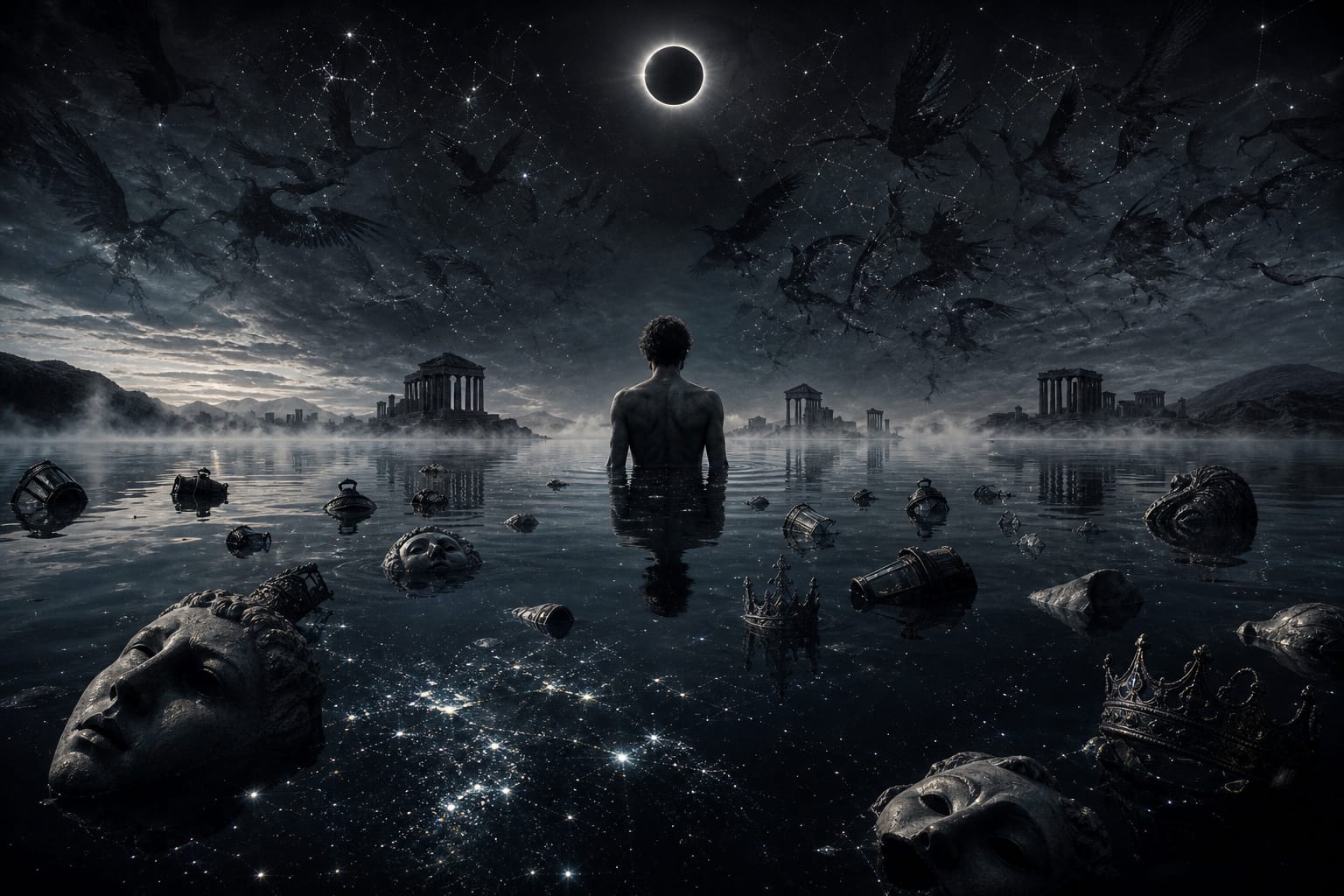
I woke standing waist-deep in water.

Cold was the first thing I understood.

Not where I was. Not how I’d gotten there. Not why the sky looked as though someone had driven a black nail through the sun.

Cold.

The water had worked through my clothes and settled against my skin with the intimacy of something that had been waiting. My feet were buried ankle-deep in mud. Every time I shifted my weight, the bottom tightened around my boots as if reconsidering whether it intended to let me leave.

I stood still.

Sometimes ignorance deserves a moment before you start fucking with it.

The lake stretched farther than I could see, flat except for rings spreading outward from my body. Mist crawled across its surface. Beyond it, pieces of buildings rose from the shoreline—columns, broken roofs, staircases climbing toward entrances that no longer existed. They looked ancient, although I couldn’t have told you why.

Perhaps ruin has its own calendar.

Above them hung the eclipse.

A perfect black circle surrounded by white fire.

I stared at it longer than I should have.

Then something bumped my hip.

I nearly screamed.

A face floated beside me.

I stumbled backward, lost one boot to the mud, caught myself, and watched the face roll lazily in the water.

Stone.

A mask.

Human-sized. Heavy-looking. Eyes closed. Lips slightly parted.

Another drifted behind it.

Then I noticed there were dozens.

Maybe hundreds.

Faces floated everywhere.

Some stared upward. Others sank nose-first beneath the surface before rolling back. A woman’s face drifted past with one cheek broken away. An old man’s mask had no mouth. Something resembling a child’s theatrical mask—

No.

Not a child.

Just small.

I stopped looking at the faces and started looking for land.

That was when I saw the crowns.

They floated too, which made no sense.

Bronze, silver, blackened metal. Some elaborate enough to belong in museums, others little more than twisted bands. One passed close enough that I could see tiny stones set into its rim.

I reached for it.

The instant my fingers touched metal, I remembered ordering a man hanged.

I let go.

The crown splashed away.

My stomach clenched.

For one impossible second I had been standing on a balcony.

Below me, a courtyard packed with people.

Rain.

Red banners hanging from stone walls.

A man kneeling with his hands bound.

I remembered his name.

Tomas.

I remembered signing the order.

I remembered not watching when the rope tightened.

Then I was back in the lake.

“No.”

My voice traveled across the water.

Nothing answered.

I knew no Tomas.

I had never ordered anyone killed.

I had never stood on a balcony above a courtyard.

At least I didn’t think I had.

That’s the problem with memory.

We treat it like evidence because the alternative is admitting most of our lives are stored in something with the structural integrity of wet paper.

Another object bumped my arm.

A mask.

I pushed it away.

It rolled over.

Something had been carved inside.

Letters.

I caught the edge before it drifted past.

MICHAEL.

The name tightened something in my chest.

My mother called me Michael when she was angry.

Everyone else called me Mike.

I dropped it.

Another mask floated within reach.

I turned it over.

SERGEANT.

The next:

DAD.

I stared at that one for a long time.

I don’t have children.

At least—

No.

I don’t have children.

I threw the mask.

It struck the water and disappeared.

A few seconds later it surfaced farther away, staring at the eclipse.

I began walking.

Every step required negotiation with the mud.

The ruins seemed close, but distance behaved strangely there. I walked toward a temple with six surviving columns until my legs trembled, yet it never appeared any nearer.

The masks followed.

Not all of them.

Just enough.

Michael.

Sergeant.

Dad.

A cracked one marked HUSBAND.

Another said LIAR.

That one I left facedown.

The crowns kept their distance.

I was grateful.

Overhead, birds circled.

Ravens, I thought.

Too many to count.

Their wings overlapped until portions of the sky seemed to move.

One descended low over the water.

Its reflection passed beneath it.

Except the reflection wasn’t a bird.

I stopped.

The raven crossed above me.

Below, something human walked across the underside of the lake.

A man.

Then another.

Then dozens.

Their reflections moved beneath the surface as casually as pedestrians crossing a plaza, some alone, some together, all upside down from where I stood.

I looked toward the ruins.

Their reflections were intact.

The broken temple became whole beneath the water.

Columns restored.

Roof unbroken.

Lights burning inside.

My breath caught.

I knew that place.

Not recognized.

Knew.

I had walked those steps carrying flowers.

White ones.

Someone had been waiting inside.

I couldn’t remember her face.

But I remembered loving her.

The memory hurt enough to make me bend forward.

My hand touched the water.

Stars scattered beneath my fingers.

I jerked back.

The sky above was filled with stars despite the eclipse.

The lake held the same constellations.

For several seconds I couldn’t tell where the sky ended.

Then I noticed what was missing.

Me.

The temple reflected.

The birds reflected as people.

The eclipse burned beneath the water like a second black sun.

The masks had pale doubles below them.

I had nothing.

I waved my hand.

No hand moved beneath mine.

I leaned closer.

Only stars.

Then something moved far below.

A shape approached through the darkness.

A man.

He rose until he stood beneath my feet.

Upside down.

Or I was.

Water separated us.

He wore my face.

Same nose.

Same scar along the chin.

Same thinning hair.

But his clothes were dry.

Behind him stretched another shoreline.

The temples there were whole.

People moved between them.

He stared at me.

I stared back.

Then he raised his right hand.

I raised mine.

His expression changed.

So did mine.

We both lowered our hands.

He raised his left.

I didn’t.

His eyes widened.

I raised mine.

He didn’t.

Neither of us moved after that.

A crown bumped my ribs.

I ignored it.

The man beneath the water looked toward something behind me.

His face changed.

Fear.

I turned.

Nothing.

Mist.

Masks.

Ruins.

When I looked down again, he was pounding against the underside of the surface.

His mouth moved.

No sound reached me.

“What?”

He struck the water harder.

The lake didn’t ripple.

I crouched until my face hovered inches above his.

“What are you saying?”

Again.

Two words.

I watched his mouth carefully.

Don’t move.

Something touched my shoulder.

I froze.

Not because he had warned me.

Because I remembered this.

The lake.

The hand.

The man beneath the water.

I remembered standing exactly here.

Except I had been below.

I remembered looking upward at a terrified man surrounded by ruins.

I remembered trying to warn him.

I remembered failing.

The hand tightened.

Warm fingers.

Human.

Behind me, someone breathed.

The man beneath the lake stopped pounding.

His face became strangely calm.

Almost relieved.

Then he stepped backward.

“No.”

He continued away.

“Wait.”

The hand on my shoulder turned me around.

There was nobody there.

Only a mask floating upright.

My face.

Not similar.

Mine.

Its eyes were open.

I grabbed it.

Inside was a single word.

REFLECTION.

The lake moved.

For the first time since I woke, waves spread across its surface.

The ruins distorted.

The eclipse fractured.

Stars stretched into white scars.

Below me, the other man began walking toward the intact temple.

“Hey!”

He didn’t turn.

“Which one of us is real?”

That stopped him.

Slowly, he looked back.

Even through the water, I saw him smile.

Not mockingly.

Sadly.

Then he pointed upward.

At me.

For one stupid, beautiful second, relief flooded through my body.

Me.

I was real.

I laughed.

The sound came out broken.

Then I noticed his finger wasn’t pointing at me.

It pointed beyond me.

At the sky.

I looked up.

The eclipse had begun to move.

Not the moon.

The entire sky.

Stars slid sideways. Darkness rippled. The ravens scattered as though frightened by something behind the heavens.

A thin line appeared across the firmament.

Perfectly straight.

From one horizon to the other.

Light leaked through it.

Not sunlight.

Something white and depthless.

The sky was opening along a seam.

Below me, the other man ran.

I tried to follow.

My feet wouldn’t move.

The mud had tightened around my ankles.

The masks gathered.

Michael.

Sergeant.

Dad.

Husband.

Liar.

Stranger.

Names I knew.

Names I didn’t.

Crowns floated among them.

Lives I remembered.

Lives I couldn’t possibly have lived.

Above, the seam widened.

Below, the intact city disappeared into darkness as the other man reached the temple steps.

He looked back once.

I raised my hand.

This time he raised his.

Perfectly.

I don’t know which of us did it first.

The white opening in the sky grew wider.

The lake began draining upward.

Masks lifted from the surface.

Crowns followed.

Water rose around me in silver threads, climbing toward the wound overhead.

And somewhere beneath my feet, in a world that might have been reflection or memory or the only real place left, the other man entered the temple and closed the door.

I was still standing there when the water reached my knees.

Still standing when it reached my ankles.

Still standing when the lake was gone.

The masks were gone.

The crowns were gone.

The ruins were gone.

There was only black mud beneath my boots and stars above and below me.

Two skies.

No horizon.

No reflection.

And somewhere in the darkness, from a direction I could no longer call beneath me, someone knocked three times.

I have not answered.

The Tree That Grew From Everything We Left Behind


Dispatches Of Splinters Of My Mind Entry 30:

Nothing is ever truly discarded.

The soul composts what the mind refuses to carry.

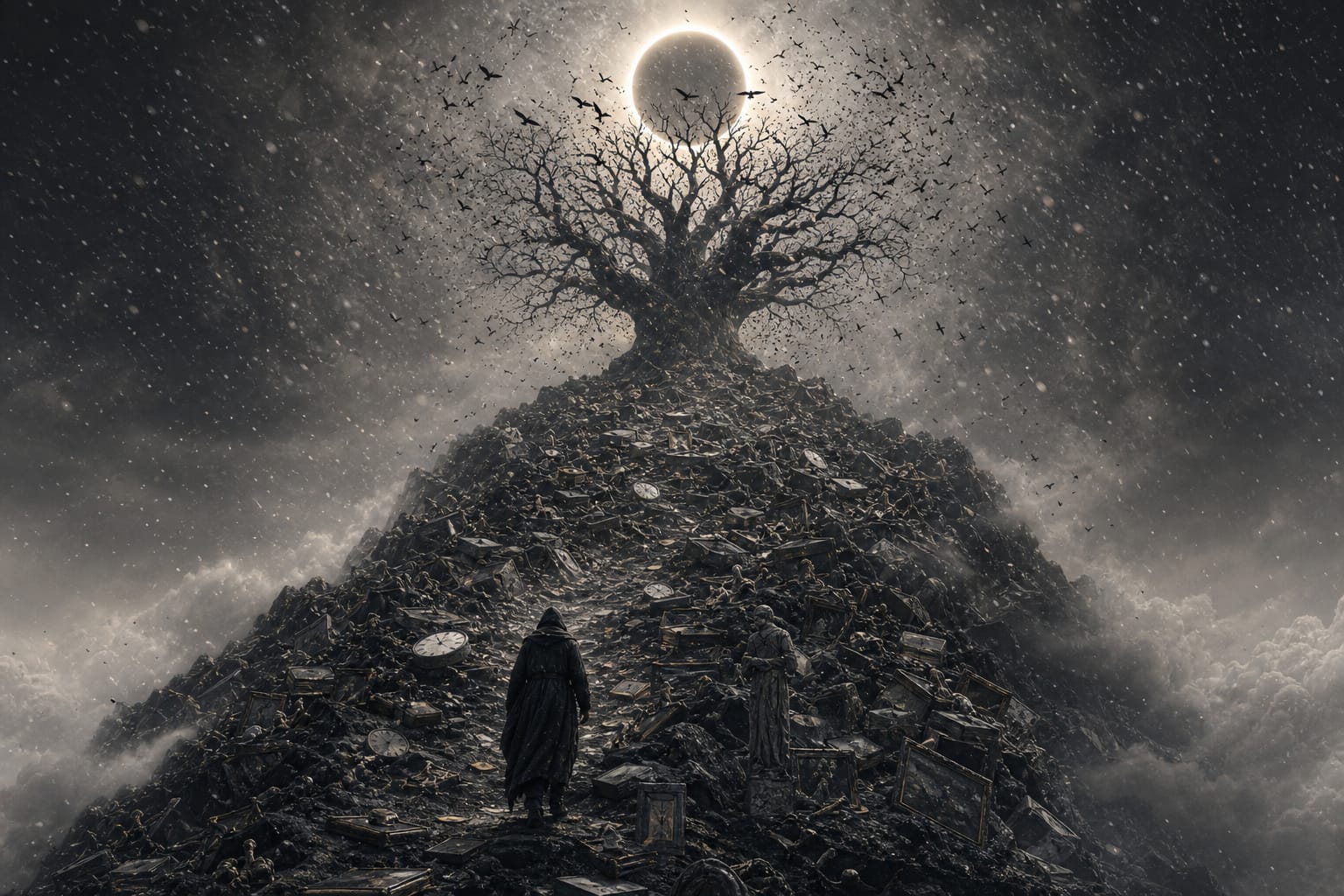
The mountain did not exist on any map.

Mountains like this never do.

They rise slowly from forgotten things until memory mistakes them for permanence. By the time anyone notices them, they have already become older than history itself. They are built grain by grain from abandoned dreams, unfinished conversations, unopened letters, unspoken apologies, and names that no living tongue remembers pronouncing. We imagine the past disappears. The mountain knows better. It simply waits until enough of it accumulates to become a landscape.

I began the ascent without deciding to.

The path revealed itself beneath my feet, winding upward through an impossible terrain built not from stone but from the discarded gravity of human lives. Every step settled upon broken clocks whose hands still searched endlessly for vanished hours. Weathered portraits stared upward through cracked glass, their faces softened by rain until strangers and ancestors had become indistinguishable. Rusted keys rested beside unopened journals swollen from damp, cracked violins whose strings had surrendered their final songs, children’s shoes hardened by years of mud, extinguished lanterns smelling faintly of soot, wedding bands polished smooth by decades of love, and books so saturated with storms that their pages had fused into silent monuments.

The air itself carried memory.

Rain settled upon old paper with the sweet scent of mildew and cedar. Moss clung to forgotten objects, releasing the rich fragrance of wet forests after autumn storms. Somewhere beneath everything lingered the metallic trace of iron, as though the mountain itself possessed blood hidden beneath its skin. Each breath tasted of endings that had quietly transformed into beginnings while no one was paying attention.

Snow drifted from the eclipsed sky.

Yet nothing felt cold.

The flakes dissolved before touching my skin, becoming ash…

Then feathers…

Then fragments of handwritten letters whose ink vanished the instant I tried to read them.

The silence was alive.

Not empty.

Listening.

Every footstep disappeared before its echo could return, absorbed by the countless forgotten things buried beneath the path. The quiet pressed gently against my ears until I became aware of smaller sounds—the slow rasp of fabric against my coat, the steady rhythm of my breathing, the faint creak of leather beneath my boots, and somewhere far below, almost imperceptible, the slow heartbeat of the mountain itself.

Behind me, the world dissolved beneath an endless sea of cloud until there remained only the narrow trail climbing toward the summit and the solitary tree silhouetted against the eclipsed sun. Its branches spread across the heavens like veins beneath translucent skin, black against the silver halo surrounding the hidden light. Thousands of ravens circled through its limbs without ever landing, their wings producing a low, rhythmic murmur that sounded less like birds in flight than immense pages turning inside a forgotten library older than language.

The climb grew steeper.

Not because the mountain demanded strength.

Because it demanded surrender.

Every step required abandoning something I had carried without realizing its weight.

The need to understand.

The need to be right.

The need to explain every wound until it resembled justice.

The higher I climbed, the quieter those burdens became.

Along the path stood statues carved from weathered marble.

Some had no faces.

Others possessed only faces.

A mother forever reaching toward a child she could no longer remember.

A soldier lowering his rifle long after every battle had ended.

A poet whose mouth remained open, still searching for the final word that refused to be written.

An old woman smiling toward someone history had forgotten to record.

They did not commemorate greatness.

They commemorated becoming.

I reached out and brushed my fingers across one worn shoulder.

The stone felt unexpectedly warm.

For one impossible heartbeat I smelled woodsmoke curling through winter air. I heard distant laughter around a supper table lit by candlelight. I felt rough callused hands guiding mine across a piece of unfinished wood. The warmth carried the quiet comfort of belonging somewhere I had never been.

Then…

Nothing.

Only stone once more.

The mountain was built from everything humanity believed it had lost.

Nothing here had vanished.

Everything had simply changed its form.

A realization settled slowly into my ribs.

Perhaps grief itself was never the enemy.

Perhaps forgetting was.

We spend our lives believing pain buries us, when often it is quietly planting something whose roots require decades before they reach water.

The higher I climbed, the lighter my body became.

Not because my burdens disappeared.

Because I had finally stopped insisting they belonged to me alone.

Every regret.

Every failure.

Every broken promise.

Every love that ended before either heart was ready.

None had been wasted.

The soul is incapable of waste.

It transforms every sorrow into soil.

Every joy into rain.

Every unanswered question into another ring hidden deep within the trunk of its oldest tree.

That was why the summit glowed.

Not with holiness.

With accumulation.

The tree had grown from everything humanity believed it had left behind.

I reached its roots as the eclipse settled into perfect stillness.

The trunk towered beyond comprehension, its bark folded into spirals resembling fingerprints pressed into living wood by countless unseen hands. Moss wrapped the roots in thick emerald blankets that released the earthy fragrance of rain-soaked forests. Tiny streams wound between them, carrying fragments of starlight instead of water. When I rested my palm against the bark, warmth flowed into my hand—not heat, but recognition.

Then…

The heartbeat.

Slow.

Impossibly slow.

Each pulse seemed separated by entire generations.

Children were born between two beats.

Empires rose and vanished between the next.

The tree remembered differently than we did.

It remembered completely.

The wind finally spoke.

Not with words.

With voices.

Thousands of them.

Children.

Lovers.

Strangers.

Enemies.

Mothers.

Fathers.

The forgotten.

The unborn.

Every voice layered gently atop another until individuality dissolved into something far older than language. I could not distinguish one story from the next, yet somehow understood them all. Every life had entered the roots. Every choice had become another ring within the trunk. Every grief had nourished another branch stretching toward a sky forever hidden behind the eclipse.

Tears gathered before I understood why.

Not from sadness.

From proportion.

For the first time, my life no longer felt isolated.

It felt connected.

A single root among countless others, each feeding something infinitely larger than itself.

I closed my eyes.

The bark beneath my hand grew warmer.

Suddenly I understood why the ferryman had smiled.

Why the labyrinth had refused directions.

Why the mirror had revealed becoming instead of reflection.

None of them had been destinations.

They had been preparations.

The journey had never been leading me toward knowledge.

It had been leading me toward participation.

The tree asked nothing of me.

Not belief.

Not certainty.

Not perfection.

Only presence.

When I opened my eyes, one raven had finally settled upon the highest branch.

It regarded me without fear.

Without judgment.

Without expectation.

Then…

Almost imperceptibly…

The eclipse began to move.

The first rays of sunlight spilled across the mountain, illuminating every broken clock, every weathered portrait, every forgotten object, every unfinished statue. Nothing had been restored.

Nothing had been repaired.

Yet everything had changed.

Not because the world was different.

Because I finally was.

I understood then that the purpose of the climb had never been to leave my past behind.

It had been to discover that every discarded moment, every forgotten face, every unanswered prayer, every mistake I believed had buried me had instead become part of the living ground beneath my feet.

I looked once more toward the ancient tree before beginning the descent.

For the first time since entering the Splinters…

I no longer felt like a traveler.

I felt like a root.

And somewhere beneath the mountain, where forgotten rivers still carried borrowed names toward unseen shores, another path quietly began to grow.

The Man In The Mirror Had Been Waiting


Dispatches Of Splinters Of My Mind Entry 29:

Mirrors deceive only those who expect reflections.

The old ones are doors.

I did not remember entering the hall.

Perhaps I never had.

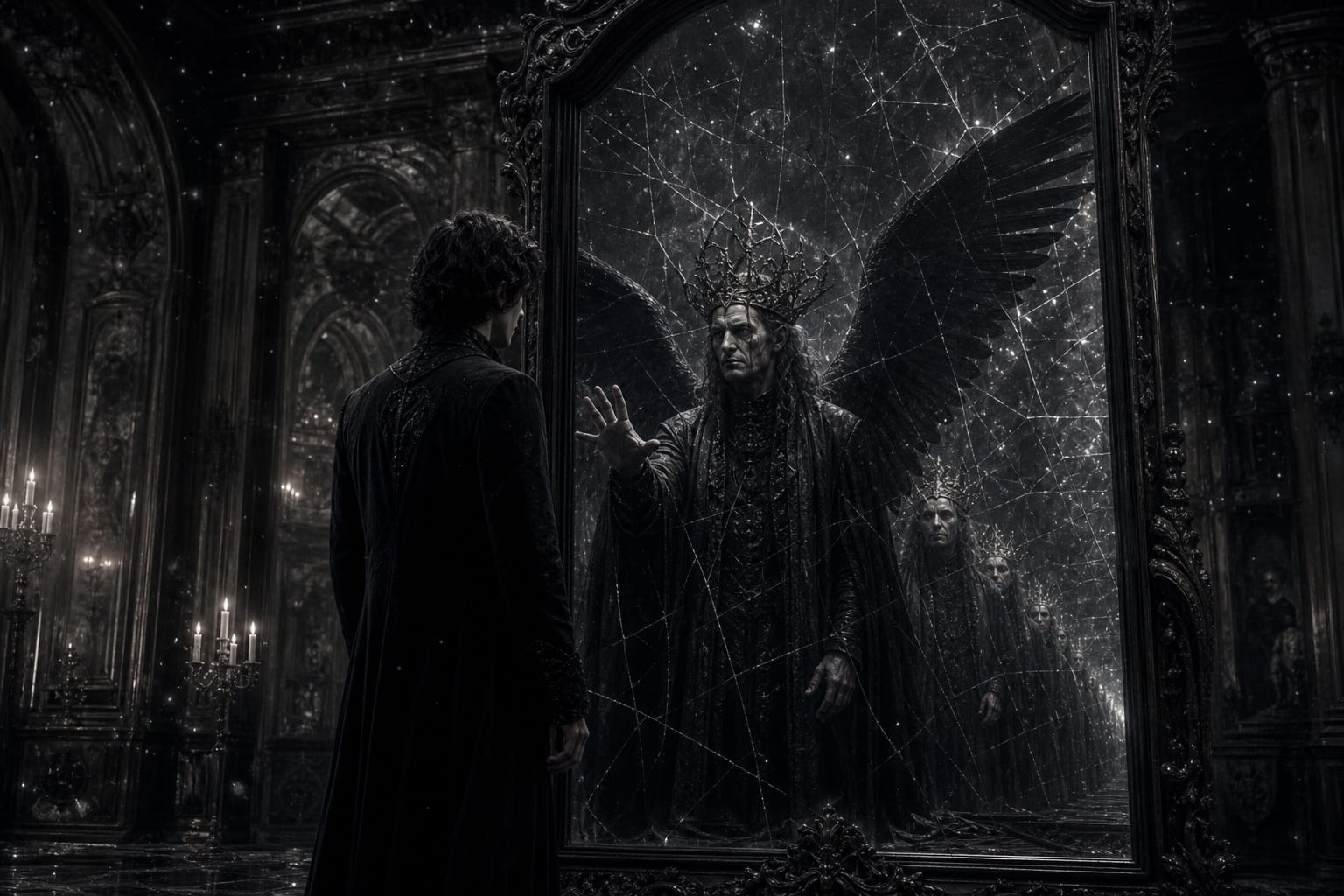
The corridor behind me had dissolved into a darkness so complete it seemed to drink memory itself. Before me rose a mirror taller than any cathedral door, framed in black wood carved with roots, ravens, sleeping kings, and forgotten constellations whose names had been erased from every surviving language. Hundreds of candles burned throughout the chamber, yet none surrendered warmth. Their pale flames trembled without smoke, releasing only the faint fragrance of melting beeswax, cold iron, ancient vellum, and dust so old it carried the dry sweetness of abandoned monasteries. The silence possessed weight. It settled upon my shoulders like a ceremonial cloak, making even breath feel intrusive.

The glass was cracked.

Not broken.

Remembered.

Thousands of silver fractures spread across its surface like rivers frozen beneath winter ice. They caught the candlelight and scattered it into drifting constellations that seemed suspended beneath the glass instead of upon it. The cracks shimmered with impossible depth. Looking into them felt less like studying broken glass than gazing through the veins of reality itself. Every fracture suggested another path. Every path promised another version of the same impossible destination.

He stood where my reflection should have been.

Older.

Not in years.

In burdens.

His robe absorbed the light around it until black itself seemed too pale to describe what I was seeing. Great wings unfolded behind him—not feathered, but woven from living shadow, each movement resembling a murder of ravens lifting from a battlefield after the last soldier had forgotten his own name. Upon his brow rested a crown grown from intertwined branches, thorns, and dead stars whose pale light had long since vanished from the heavens. It did not appear forged.

It appeared inevitable.

He raised one hand.

Slowly.

The motion possessed the unbearable patience of mountains shaping themselves through centuries of wind.

I hesitated.

Not because I feared him.

Because somewhere beneath memory…

I recognized him.

Recognition is rarely comforting.

The air between us became impossibly thin. Ancient glass separated us, yet it felt no thicker than skin. My breathing slowed until every inhale echoed inside my chest like wind passing through cathedral ruins. I heard the faint rasp of cloth shifting against my coat. The soft creak of leather beneath my boots. The steady pulse of blood inside my ears.

Then another sound emerged.

Not his breathing.

Mine.

Older.

Deeper.

Each breath carried the cadence of someone who had witnessed civilizations bloom into dust and still found reason to continue walking. It sounded like my lungs remembering a rhythm my life had somehow forgotten.

The mirror did not reflect who I was.

It reflected who had survived every version of me.

My hand rose almost without permission.

So did his.

Our fingertips stopped an inch apart.

The glass inhaled.

The fractures awakened one by one, veins of silver fire spreading through the mirror until the chamber filled with a faint crystalline hum that vibrated inside my ribs. The sound was neither music nor language. It resembled distant glaciers breaking beneath unseen moons. Beneath the glass unfolded impossible landscapes layered atop one another like memories refusing chronology: forests growing beneath oceans; cities built inside the ribs of sleeping giants; children carrying miniature suns whose warmth smelled faintly of cedar smoke and summer rain; rivers climbing into eclipsed skies where birds flew backward through constellations that no astronomer had ever mapped.

The mirror contained no future.

It contained every possibility abandoned in order to become the person standing before it.

An unexpected grief settled inside me.

Not regret.

Something older.

The sorrow reserved for lives never granted the dignity of existing.

The artist who abandoned the canvas too soon.

The father who spoke too little because silence felt safer than tenderness.

The friend who arrived one day too late.

The stranger whose single act of kindness might have redirected another soul’s entire history.

None accused me.

They simply existed.

Waiting patiently inside the fractures where every unlived decision continued forever, branching into worlds I would never inhabit yet somehow continued to mourn.

His eyes never left mine.

Within them I found neither judgment nor forgiveness.

Only understanding.

Absolute understanding.

The kind that strips every defense from the soul.

His lips never moved.

Yet words entered the chamber with the quiet certainty of snowfall covering forgotten graves.

“Every life believes it is becoming.”

Silence.

The candles bent inward as though listening.

“Few understand they are remembering.”

A cold draft drifted through the hall carrying scents that belonged to no single season—rain striking warm stone, extinguished fireplaces, pine resin, old parchment, cedar chests unopened for generations, and the faint metallic trace of approaching storms. Somewhere beyond the towering arches came the slow beating of unseen wings. Each pulse traveled through the marble floor until the vibration settled beneath my feet like another heartbeat hidden inside the earth.

I searched his face for answers.

Instead…

I found exhaustion.

Not the exhaustion of age.

The exhaustion of waiting.

Waiting so long that time itself had surrendered the habit of counting.

The realization struck with terrifying gentleness.

He had never been imprisoned inside the mirror.

I had.

Every certainty I defended.

Every identity I polished.

Every fear mistaken for truth.

Every role I accepted because it spared me the terrifying freedom of becoming something else.

Each had been another layer of glass placed between us.

The cracks were not evidence of decay.

They were evidence that something inside me had finally become willing to break.

His hand pressed softly against the mirror.

This time…

The glass yielded.

Cold flooded my fingertips—not winter’s cold, but the temperature of water hidden beneath glaciers, stone sleeping beneath mountains, and truths existing long before the first human mouth learned to shape sound into language. It climbed slowly through my hand, my arm, my chest. Every heartbeat echoed through the silver fractures until I could no longer distinguish whether the rhythm belonged to my own heart or to the mirror itself.

For one impossible moment…

I no longer knew which side contained the reflection.

Or whether either side had ever truly been real.

The candles extinguished themselves.

One by one.

Darkness reclaimed the hall with the patient confidence of night returning to a world that had only borrowed daylight.

Only the fractures continued glowing.

When the final flame surrendered, ordinary glass stared back at me.

My reflection had returned.

Smaller than I remembered.

Not diminished.

Merely unfinished.

Deep within the countless silver fractures, almost too distant to distinguish from memory itself, the crowned figure remained motionless.

Watching.

Waiting.

Some thresholds are crossed only once.

Others reveal that they were crossed years ago, and every step taken since has merely been the slow remembering of a meeting the soul has been walking toward since before it ever learned its own name.

Poem of the Day – 06122026

Imitation

Poet: Edgar Allan Poe

A dark unfathomed tide
Of interminable pride –
A mystery, and a dream,
Should my early life seem;
I say that dream was fraught
With a wild and waking thought
Of beings that have been,
Which my spirit hath not seen,
Had I let them pass me by,
With a dreaming eye!
Let none of earth inherit
That vision of my spirit;
Those thoughts I would control,
As a spell upon his soul:
For that bright hope at last
And that light time have past,
And my worldly rest hath gone
With a sigh as it passed on:
I care not though it perish
With a thought I then did cherish.


Personal Reflection

Some poems feel less like statements and more like echoes.

Imitation is one of them.

Written when Poe was still very young, the poem already carries themes that would follow him throughout his life: memory, longing, isolation, and the uneasy relationship between dreams and reality. Even here, he seems haunted by the feeling that he sees the world differently than those around him.

The poem looks backward.

Not toward a specific event, but toward a state of being.

A time when imagination felt limitless, when the mind wandered through mysteries no one else could see. The speaker recalls visions and thoughts that shaped him, experiences so personal and strange that he hesitates to pass them on to others.

That hesitation feels familiar.

Most people carry an inner world they rarely share completely.

Private fears.
Private hopes.
Private versions of themselves that never quite make it into conversation.

We learn how to function in the world, but some part of us remains hidden, known only through memory, dreams, or moments of solitude.

Poe’s speaker seems caught between gratitude and grief.

Gratitude for having experienced those visions.

Grief because they cannot be recovered.

That may be the deepest truth in the poem.

Growing older is not simply gaining years.

It is realizing that certain versions of yourself exist only in memory.

The child who believed impossible things.
The dreamer who saw wonder everywhere.
The person who stood at the edge of life before disappointment, responsibility, and loss began reshaping the landscape.

We cannot return to those earlier selves.

But neither do they disappear entirely.

They remain within us, influencing how we see beauty, sadness, love, and meaning.

Perhaps that is why the poem resonates.

It reminds us that memory is not just a record of the past.

It is a conversation between who we were and who we have become.


Reflection Prompts

  • What part of your younger self do you miss most?
  • Are there dreams you once cherished that still influence your life today?
  • How has your understanding of wonder changed as you’ve grown older?

Synopsis


The porch had learned him.

It knew the sound his knees made when he stood, the way his weight shifted before he sat, the exact board that dipped because he always landed there. It had taken years, but the wood had adjusted. That seemed fair. He was still working on it.

Ford claimed the left side. Chevy took the rail when it was warm, the chair when it wasn’t. The cooler stayed between them, neutral territory. No one argued about it anymore.

The pills were still in his pocket. He didn’t take them right away now. Not rebellion—delay. He liked the small window where his body still belonged to him before chemistry took over negotiations. The doctor called it wellness. He called it maintenance.

Earlier that day, at the pharmacy, the girl—no, the woman—had touched his hand.

Not accidentally. Not lingering. Just a soft, practiced thing as she explained what the pills did, how often, what to avoid. Younger, but not embarrassingly so. Age-appropriate, like that mattered.

The sensation moved through him fast and clean. A shockwave. Lovely. Immediate.

A smile crept onto his face before he could stop it.

She returned it. Let his hand go, then thanked him with a look that stayed a moment longer than necessary. A woman hadn’t looked at him like that in years. Maybe they had and he hadn’t noticed. Or maybe he hadn’t been ready to be seen—to feel anything other than the familiar ache of grief.

It felt like cheating on Olma Jean.

One of the last things OJ said—voice already thinning, eyes still sharp—was that he should live his life without her. Find someone. Share it. He’d called it hogwash at the time. Still did.

But he hadn’t pulled his hand away.

Because her touch proved something.
That he still existed.
That he was alive and visible, even if only for a moment.

It was nice to be seen.

He gathered his things quickly. Too quickly. He needed distance—from the counter, from the light, from what the moment threatened to become. Outside, he sat in his pickup with the bag of meds on the seat beside him and a fresh supply of treats for Ford and Chevy rattling in the cup holder.

Inside, the house still smelled faintly like citrus if the light hit it right. The juicer sat on the counter, dust settled into its seams. He hadn’t cleaned it. Couldn’t bring himself to. Everything turns permanent if you don’t argue back.

He sat down on the porch again, pills still in his pocket, the echo of that touch lingering longer than it had any right to.

He said the words out loud, just to hear them land.

He was still here.

The porch did not respond. It didn’t need to.

But for the first time in a long while, he didn’t sit because he was tired.

He sat because he wasn’t done.

The Gospel According to Miss Ruby

Coffee’s hot, cigarettes’ crooked, and I’m still alive—something Ruby predicted would not be the case by now. Ruby Mae Washington: church-choir soprano, Bible-quoting barroom brawler, and the only woman who ever made me fear both God and the county judge in the same night.

We met at a fish fry. She was belting “His Eye Is on the Sparrow” like she’d personally trained the sparrow, while I was trying to look saved enough to score a free plate. Ruby locked those righteous eyes on me and said, “The Lord sent you to me.”
I should’ve run, but my stomach said catfish first, escape later.
The hush-puppies were innocent; the mushroom gravy was a trap.

Ruby believed in two things: eternal salvation and controlling the thermostat. One was free; the other cost me my heating bill and half my sanity. Every argument started with “The Good Book says…” and ended with a flying object. I once dodged a coffee mug that left a steam trail like a patrol car chasing a stolen Buick.

But here’s the quiet part I don’t like to admit: I liked the danger. Her storms gave my own silence something to push against. After years of drifting through women like a man checking coats he’ll never claim, Ruby’s fire felt like proof I was still combustible.
Her idea of intimacy was a carefully integrated system of prayer and guilt. She’d bless the bed, bless the moment, and halfway through ask the Almighty to “smite the devil out of this man,” which really kills a mood when you’re the man in question.

The breaking point came during a revival service. Preacher asked the congregation to cast out their demons. Ruby shoved me forward like I was auditioning for an exorcism. I stumbled down that aisle, the choir screaming “Just As I Am,” and thought, Buddy, you ain’t ever been more accurate.
Walking out that night, casserole dish tucked under my arm like stolen evidence, I felt something loosen—a knot I’d carried since my twenties when love started to mean endurance instead of joy.

I left with a busted lip and the deep conviction that God loves me, but Ruby does not. Moral of the story? When a woman sings like an angel and fights like a heavyweight, don’t wait for the rapture—grab your hat and go.
But some nights, when the coffee’s cooling and the cigarette burns itself out, I still wonder if the sparrow kept watching after I left.


Author’s Note

Today’s tale from Coffee, Cigarettes, and Catastrophes slides in under the watchful eyes of three prompt masters—FOWC, RDP, and the Word of the Day—all of whom make sure I never run out of linguistic ammunition.
The mandatory culprits—mushroom, patrol, and integrated—were stirred into the story like contraband creamers in Grumble’s coffee: slow to dissolve, impossible to ignore, and guaranteed to leave a bitter aftertaste.

If you’re a writer looking for trouble, follow those prompts. They’re like neighborhood watch for the imagination—keeping your words on patrol while you sneak your own demons into the draft.

The Circle That Opens Itself

Part VI of the Spiral Series

The next breach opened on its own.

No twist. No artifact. No contact.

It simply opened.

Carla felt it hours before she saw it. The air turned sluggish, sticky in her lungs. The horizon bent subtly, like the earth had taken a deep breath and held it too long. Every footstep became suspect. Every shadow slanted just a few degrees off true.

Her pulse accelerated. Not fear. Not instinct. Just alignment.

The spiral didn’t need her hand anymore. It only needed her presence.

—

The map Mikail left had led her here, to a quiet coastal stretch she’d never seen on any topographic registry. A village tucked between crescent cliffs, surrounded on all sides by worn sea walls and high tides. The cliffs curved inward toward the town in a shape too deliberate to be natural. From above, it looked like a pupil watching the ocean.

The people were still here.

That was the worst part.

They walked slowly. Deliberately. Wearing simple white garments, hand-stitched with spirals that mirrored the ones etched into Carla’s dreams. Their faces were peaceful, but blank. Not vacant. Given.

She stepped into their pattern, and no one stopped her.

—

As she moved through the village, time seemed to soften. The light seemed tired, flat, and gray, without the harsh contrast of morning or dusk. The sea air should have been sharp with salt and rot, but instead it tasted light, almost sterile. Too clean.

She passed an elderly woman seated cross-legged on a worn stoop, staring at nothing. A child nearby stacked rocks into a spiral that folded in on itself.

Someone offered her food—a piece of fish, salt-dried and paper-thin.

“Please. Eat. It’s good,” the man said.

She shook her head. Her stomach was empty, yet distant, as if it belonged to someone else.

“Why are they still here?” she wondered. “Why didn’t they run?”

The answer whispered up her spine:

They didn’t need to. The spiral came to them.

—

The breach was in a collapsed chapel at the cliff’s edge. The roof had caved in long ago, and the sea wind passed through like breath through open ribs.

At the center: a spiral of stones, pale and smooth.

At the heart of the spiral: a hole.

Not wide. Not deep. But falling. An absence shaped like a center. A place that swallowed light without dimming.

She approached slowly.

And the world slowed with her.

Her boots crunched over broken mosaic tiles—ancient murals worn smooth, erased by reverent feet. The hole didn’t call to her. It listened.

She knelt beside it and stared down.

And immediately felt herself tilting inward—mind first.

—

“It opened itself,” she whispered.

“Because you’re near.”

The voice didn’t startle her.

A woman stood in the arched doorway, barefoot and hooded. She wore no artifact, no pack. Just white linen wrapped like ritual. Her presence wasn’t threatening—it was inevitable.

Familiar, like someone from a memory Carla never lived.

“You don’t have to seal it,” the woman said. “You’ve done good already. You brought the spiral here. Now rest. Let it open.”

Carla stood. She didn’t know when she’d knelt.

“You want it open?”

The woman smiled.

“It’s not a fault to be part of something larger.”

Carla’s heart hammered. She couldn’t tell whether it was fear… or resonance.

—

“You could seal it,” the woman said. “But the spiral would find another path. It always does. This place chose to remember. Others will forget.”

Carla’s hand drifted to the artifact, but it didn’t hum. It was still. Watching.

“You could lie down,” the woman continued, her voice now like a lullaby. “Let the spiral hold your memory. You wouldn’t even dream. Just one long nap, inside the pattern. No more fight. No more fault.”

Carla shivered.

She looked at the breach again. It wasn’t pulsing.

It was breathing.

—

“Explore the other side,” the woman said. “We did. And we’re better for it. Lighter.”

“Lighter?” Carla repeated.

“Not weight. Memory. The spiral carries it now. We walk without the burden. Isn’t that what you want?”

The woman reached forward, palm out. Not aggressive. An invitation.

Carla stepped back.

Her knees locked. Her legs wanted to move forward, but her spine screamed against it.

“I’m not here to serve the spiral,” Carla said.
“I’m here to close it.”

“Then do it,” the woman said gently. “Seal it. End it. Slow its speed, its spread. Try to make the world still again. But you’ll only bury your part. The rest will wake. It always does.”

—

Carla stepped to the edge of the breach, her marked hand throbbing under her sleeve.

She clenched her fist.

She felt the warmth of the stone beneath her boots. Heard the ocean breathing behind her. Saw the villagers waiting in the square without moving.

They weren’t prisoners. They weren’t brainwashed.

They had chosen this.

Because forgetting is easier than bearing the weight of what’s coming.

She pressed her palm to the ground.

And twisted.

—

No explosion. No scream.

Just a soft recoil, like a rubber band relaxing after centuries of tension.

The spiral of stones dimmed, then faded. The villagers blinked as if waking from a collective trance. Some dropped to their knees. Others simply walked away. One stared out to sea and wept silently, not knowing why.

The woman was gone.

The chapel was whole.

But the hole was still there—only now it was closed with a thin skin of glass-like stone, faint spiral lines beneath its surface like fossilized breath.

—

Carla stood alone in the chapel’s center.

The mark on her palm no longer burned. It pulsed. Steady. Like a metronome waiting for a new rhythm.

The spiral hadn’t just opened itself.
It had opened her.


Author’s Note:
This chapter was happily written for Mindlovemisery’s Menagerie and #Wordle #430. Four chapters remain—stay tuned as the spiral tightens.

Kimonogate 3

Episode 3:

Myrtle Revealed (or, The Boney Truth)

Everyone on Rosewood Lane thought Myrtle McKlusky was a cardigan-wearing, prune-juice-drinking, HOA-terrorizing widow with three jittery Chinese Crested dogs. They were only 25% right.

What no one—not even the mayor, not even Capote—knew was that Myrtle was also…

Tempest Fablestein.

Yes. The Tempest Fablestein. The mysterious, scandalously successful author of the internationally adored, historically inaccurate, and erotically charged adventure-romance series featuring Boney LaFleur, the one-armed French nobleman turned treasure hunter.

She had written 43 novels, 5 novellas, and a cookbook (“Feast Like a Fabulist: 18th Century Seduction Stews”) from the converted sunroom behind her kitchen. Her books had sold over 47 million copies. She was, by all definitions, secretly loaded.

Her fans included conspiracy theorists, failed Broadway understudies, and a suspicious number of junior senators.

And to maintain her anonymity, Myrtle had hired a professional actor—a classically trained Scotsman named Malcolm Finnegan Duff-Whitely III—to play the role of Tempest in public.

Enter Malcolm

At book signings, literary galas, and erotic parchment conventions, Malcolm wore a velvet smoking jacket, quoted Shakespeare deep cuts. He wielded a Scottish accent so buttery it made podcast hosts weep. He was charming. Mysterious. Allegedly celibate.

And he had been in love with Myrtle for six years.

The Confession

During a livestream at the National Erotic Adventure Awards Gala, Malcolm—accepting the award for “Best Use of the Word Ravish in a Scene Involving Lava”—snapped.

“I—I can’t do this anymore,” he said, eyes glassy. “I’ve lived a lie.”

The crowd hushed. A woman in the third row fainted into a fondue fountain.

“I’m not Tempest Fablestein. I’m just Malcolm. But she—”
He stared into the camera.
“She is the greatest mind of our time. And Myrtle… if you’re watching—I love you. I’ve loved you since Boney rode that bull through the Vatican archives.”

Before the audience could react, two large men in matching black suits and medieval-looking boots appeared. They flanked him.

Malcolm’s voice rose over the chaos. “Tell her I meant it!”

He was dragged offstage, still clinging to his crystal pegasus trophy.

The livestream abruptly cut to a pre-recorded interview where “Tempest” explained how she researched 18th-century brothels using only Google Earth and intuition.

The Fallout

A 14-second clip surfaced on YouTube hours later. It showed Malcolm being pushed into a black Escalade while yelling, “Tell Myrtle I know her rhubarb pie uses vodka!”

The clip was quickly removed by Tempest Enterprises LLC under “copyright and culinary infringement.”

Still, the legend of the confession spread. Reddit threads multiplied. Fans demanded answers.

Back in Rosewood Lane…

In her sunroom, Myrtle sat staring at her laptop. Capote snored on a pile of manuscript pages. Pont and Pint had rolled themselves into an anxious spiral.

She didn’t cry. Myrtle McKlusky hadn’t cried since Boney LaFleur and the Lusty Siege of Strasbourg made Oprah’s underground erotica list.

Instead, she opened a new document.

Title: “Boney LaFleur and the Man Who Dared to Love.”

—

That night, in the dim warmth of his paneled study, Mayor Gerald swirled cold chamomile tea and reached for the false back of his bookshelf.

Click.

Behind it: Every single Boney LaFleur first edition, wrapped in archival sleeves and arranged by emotional damage level.

He pulled out “Boney LaFleur and the Underdressed Pharaoh” and gently opened the jacket. Inside:

“To G—
May you never lose your own treasure map.
—T.F.”

He sighed and rubbed his eyes.

“She’s been right next door this whole time,” he whispered.

Then, from a drawer, he pulled a laminated keepsake:
“Boney LaFleur’s Ten Principles of Gentlemanly Adventure.”

He read aloud, voice cracking:

“Rule #1: Never underestimate the swordplay of a woman with nothing left to prove.”

Capote, who had somehow snuck into the study again, thumped his tail once in quiet agreement.

Gerald leaned back in his chair.
“You got me, Myrtle.”

Chronically Challenged: A Friday the 13th Love Story VI

FICTION – 3TC #MM87

Chapter 6:

One Last Leap

The chrono-device vibrated softly in Fiona’s hands, like it had a secret to tell.

It glowed—not in flashes this time, but in steady, rhythmic pulses that matched the cadence of her breath. Blue-white light warmed the bones of her fingers.

The screen read only:
Temporal Window Detected
Friday, 13. Reset.

Fiona stared at it. Her stomach dropped. Again.

“We’re back in range,” she said, voice hushed, reverent.

Elliot stood beside her, damp curls pressed to his forehead. He didn’t ask where—or when—they’d land next. He just met her eyes, the gravity of the moment flickering behind his usually breezy expression.

“Are we ready?” he asked.

She wanted to lie. Wanted to shrug, joke, mask the rising panic the way she always had. But the truth felt louder than usual. Like something long trapped was suddenly allowed to rise to the surface.

“I don’t know,” she admitted. “But I’m tired of waiting for everything to make sense before I act. And I’m tired of thinking real things can only happen in safe places.”

Elliot nodded, slowly. “Then let’s jump.”

She reached for his hand.

They pressed the reset button together.

—

The air peeled around them like silk.
Light shattered. Sound vanished. The world spun gently sideways—

And then stopped.

—

Fiona opened her eyes and gasped.

They stood in a room so pristine, it almost didn’t seem real. The walls were curved and white, seamless, like poured milk. The air buzzed faintly, charged, clean, just on the edge of ozone. Somewhere, soft instrumental music played in a scale she couldn’t name.

Outside a wall-sized pane of glass, a city stretched like a dream: silver towers arched into the sky, ribboned with floating platforms and streaks of silent light. Buildings glowed from within like lanterns. There were no wheels, no smoke. No gravity-bound noise.

“Oh,” Fiona whispered. “I think this is… the future.”

Elliot spun slowly, taking it in like a wide-eyed kid at a museum. “Either that, or we got adopted by the Apple Store.”

Fiona laughed before she could stop herself. It sounded too loud in the quiet, like a human voice didn’t quite belong here.

They found a curved bench—soft and warm to the touch, like stone that had learned empathy—and sat down. Outside, a gliding drone zipped past, trailing soft purple light.

Elliot leaned back, knees bouncing. “Do you think we’re… allowed to be here?”

Fiona stared at their warped reflections in the glass. “Does anyone belong anywhere? I mean, really?”

He glanced at her. “That feels like a yes and a no.”

She smiled faintly. “It’s a yes if you’re next to me.”

The hum of the space surrounded them. It didn’t feel sterile anymore—it felt gentle, like the universe was holding its breath.

Fiona shifted to face him, nervous energy rippling beneath her skin.

“I need to say something,” she said. “And this time I’m saying it out loud so I can’t take it back.”

Elliot blinked. “Okay.”

“I want to be with you,” she said, the words trembling as they left. “Not just next to you. Not just in shared proximity because of academic overlap or time travel disasters. I want… us. I want to be chosen. And to choose you.”

The air seemed to shimmer with its weight.

Elliot was quiet, processing. Then:

“You astound me,” he said. “Every time I think I’ve caught up to how smart or strong or out-of-my-league you are, you find a new way to knock me sideways.”

Her cheeks went hot. “That’s a very dramatic compliment.”

He tilted his head. “You kissed me with physics. I think I’m allowed some drama.”

Then, he leaned in and kissed her.

It wasn’t perfect. His glasses bumped her temple, and she accidentally bit his bottom lip. But neither pulled away. It was clumsy and honest and full of all the things they hadn’t let themselves say until now.

When they parted, forehead to forehead, Fiona felt the moment lodge somewhere deep. This—whatever this was—wasn’t theoretical. It wasn’t temporary. It felt inevitable.

The chrono-device buzzed softly.

They looked down. A new prompt blinked on the screen:

RETURN TO ORIGIN?

Fiona turned to Elliot, heartbeat syncing with the pulse of the text.

“What do you think?” she asked.

Elliot slid his fingers between hers.

“I think we’ve got a date to finish,” he said.

They stood. The device warmed in her hand.
And then the light took them home.

Chronically Challenged: A Friday the 13th Love Story

Daily writing prompt
What notable things happened today?

DAILY PROMPT RESPONSE – FICTION SHORT STORY SERIAL

Chapter 1:

The Ask


Dr. Fiona Klausner had survived worse.

She’d survived peer review by an all-male panel who said things like “feisty formula” and “adorably ambitious.” She’d survived seventeen-hour data cleanses on a broken monitor, and one ill-fated attempt to microwave soup in a vacuum chamber.

But this? This was worse.

She stared across the lab at Dr. Elliot Chowdhury, hunched over a datapad, brow furrowed, lips moving as he whispered numbers to himself. Probably modeling the lattice resonance from their last run. Probably not thinking about her at all.

He wore what he always wore: a Ramones t-shirt (today’s said “Hey Ho Let’s Go”), wrinkled jeans, a slightly singed lab coat, and plastic-frame glasses held together with electrical tape. His prematurely gray hair appeared to have lost an argument with gravity.

To Fiona, he looked like the human embodiment of a chaotic good equation. Unshaven. Brilliant. Endlessly distracting.

You don’t have to do this, her brain whispered. You could just ask him to double-check the time-slice projections. You don’t have to launch your dignity into space on a caffeine-fueled whim.

She reached for her mug, cold. Her hands were damp. Without realizing it, she began adjusting her elegant lab coat. The sleeve, the collar, the pocket. Again and again.
Then she realized what she was doing—you already fixed that—and forced her hand to stop.

Just let it go. He’s nice to everyone. He probably lent you that soldering iron because he’s kind, not because he was flirting in the language of hardware.

She stood up anyway.

Her chair screeched across the tile. Elliot looked up, startled but smiling.

Abort. Retreat. Climb into the trash can and make it your home.

“Elliot?” she said.

He blinked. “Yeah?”

She cleared her throat, then blurted, “I was wondering if you wanted to get dinner sometime. With me. Socially. I mean. Or romantically. I mean—if that’s a thing you’d want. Or ever consider. Or—”


She’d said it. It was now out in the world, irreversible.

Her heart pounded. Her stomach twisted into knots.
She actually felt her intestines realigning themselves like they were trying to flee the scene.

This was a biological emergency.

And then, Elliot made a face. A tiny nose scrunch, subtle but visible.

What’s that face? His nose? Is that a disgust squint?
Do I stink? Is it the emergency deodorant? Oh god, is it the lentil soup from yesterday? I knew it lingered.

Then she blinked. Realized something.
Wait. That’s his thinking face.
She’d seen it dozens of times—whenever he was mid-equation, mid-epiphany, or mid-muffin.
It wasn’t rejection. It was…processing.


Oh. Oh no. This is happening. This is real.

Dr. Fiona Klausner—world-class brain, terrifying poise, hair that doesn’t know chaos—just asked me out.
Me. In this shirt. In these pants. Do these pants even have a functioning zipper?

She’s hot.

Why is a hot girl asking me out?

Am I pitiful? Is this a setup? Is there a camera in the fume hood?

Then it hit him.
The last time a hot girl asked me out…

Carla Smith.
Candle wax. Glitter. A Yelp review.
He still didn’t know how that review got posted under his name, but it cost him two months of eye contact with anyone named Carla.

Say something. Say yes. Don’t mention Carla. Or glitter. Or wax. Just say yes.

He scratched behind his ear. His nose twitched again. Panic reflex.

And somehow, he said it.


“Like a date?” Elliot asked, voice surprisingly steady.

Fiona nodded like a wind-up toy nearing the end of its coil. “Yes. That. Ideally.”

He smiled—not smug or surprised, but warm. Real.

“I’d really like that.”

She blinked. “You would?”

He ran a hand through his ridiculous hair. “Yeah. I’ve been meaning to ask you, actually. But I figured I’d mess it up and say something weird, like, I don’t know… ask if you wanted to split a burrito and debate quantum foam.”

She laughed—a real, involuntary laugh—and it echoed through the lab like something newly possible.

Elliot looked at his watch. “Wait… what day is it?”

Fiona checked her phone. “Friday. The 13th.”

He grinned. “Of course it is.” He shrugged. “What’s the worst that could happen?”

Across the lab, hidden behind a tower of coiled cabling and dead sensors, the chrono-lattice prototype pulsed softly. Once. Twice. Like it was listening. Like it was waiting.

Neither of them noticed.

They were both too busy melting down in tandem.

Caught in the Heavy

FICTION – FOWC, RDP, 3TC


Caught in the Heavy

The corridor stretched on like a memory he couldn’t escape—narrow, dim, damp with a cold that clung to the skin like breath on glass. Mildew, rusted metal, and aging wood tinged the air, a scent that settled into the lungs and whispered of long-forgotten places. Floorboards groaned beneath his boots, their brittle creaks echoing like old bones remembering how to hurt.

He stood in the middle of it all, unmoving. Not frozen by fear exactly—more like resignation. The kind that seeps in after the tenth mistake, the last apology, the moment you realize the story you’ve been living might never shift its ending. He used to think time would fix it. But time, he’d learned, doesn’t heal. It settles—like dust.

The walls pressed close with peeling wallpaper and old nail holes where lives once hung. He scanned them as if he might find his past nailed there, too. Maybe a younger version of himself in a photo frame, smiling with someone whose name he couldn’t say out loud anymore.

An unfortunate truth surfaced: he’d chosen this silence. No one forced him here. He pulled away. He locked the doors before anyone knocked. They called it being guarded—he called it survival.

On a crooked table sat a lone candlestick, melted to a stub. Its wax clung like a memory—dried, useless, but still intact. He reached for it absently, fingers brushing tarnished brass. Cold. Solid. Real. A reminder that even forgotten things still leave traces.

He wondered how long he’d been standing here. How long had he been waiting for the hallway to say something? But hallways don’t speak. They listen. They hold your silence for you until it grows too loud to ignore.

Everything around him felt heavy. His coat, soaked with damp air. His thoughts sagged with years of unanswered questions. Even his heartbeat felt labored, as if each thud carried the weight of something he refused to let go.

He closed his eyes and thought of the words he never said. The calls never returned. The glances he turned away from because he didn’t trust what he saw in them.

Regret was a slow grief, the kind you wear like skin. And the mind, cruel and calculating, was its favorite weapon. Not a blade, not a gun—just memory sharpened to a whisper that says, “this is who you really are,” when you least expect it.

Still, a thought rose unbidden through the noise—quiet, but firm:

We always try to overlook the past, because we can’t change it. But we forget the important factor about the past… the wisdom we gain from it.

He let the idea settle, warm against the cold inside him. Maybe that’s what he’d come here for. Not punishment. No escape. But understanding. A reckoning not with the pain itself, but with the lesson buried beneath it.

He didn’t move. Not because he couldn’t—but because this was the only place he could hear himself. This hallway wasn’t just a space. It was a mirror, a memory, a confessional.

A bulb overhead buzzed, casting him briefly in light—harsh, unflattering. His reflection in the warped glass at the far end looked like a man still mid-sentence, still caught between what he was and what he feared he’d never be.

Just enough light to prove he was still there.

Just enough to remind him that some corridors don’t lead out.
They lead in—and if you’re not careful, they never let you leave.

Top 5 Ways to Ask a Girl Out: Rule #3

FICTION – SHORT FICTION SERIES


Top 5 Ways to Ask a Girl Out: Rule #3
Never assume you’re the smartest person in the driveway.


So there I was, elbow-deep in engine parts, sweating like a liar in a job interview, and just barely pretending I knew what a serpentine belt was. I nodded at a bolt like it had insulted me personally.

She crouched next to me, sipping her probably-toxic coffee and watching with the calm curiosity of someone waiting for a raccoon to finish rooting through their garbage.

“You need a 10mm socket for that,” she said casually.

I froze. “What?”

“That bolt. You’re using the wrong size. That’s why it keeps slipping.”

I looked at the wrench in my hand. I had no idea what size it was. I picked it because it was shiny and made a satisfying clink against the toolbox.

“Right,” I said. “Just warming it up. Loosening the tension.” I said “tension” like I knew what it meant in this context. She didn’t call me out. Worse—she smiled.

“Here,” she said, reaching into the toolbox and plucking out the exact socket like a seasoned mechanic. Then, with zero hesitation, she slid under the hood next to me and got to work like it was no big deal.

“Wait,” I said. “You know how to fix this?”

“I grew up with three older brothers and a string of bad cars,” she said. “Also, I once rebuilt an engine because YouTube dared me.”

I blinked. “So… you’re just letting me fake my way through this for fun?”

“I was curious how long it would take before you admitted it,” she said, laughing. “You were doing okay, though. Kind of charming, in a flailing sort of way.”

Flailing. Excellent. I was now officially “flail-charming.”

She handed me a rag. “Wipe your hands. You’ve got grease on your face. And your shirt. And somehow your ear?”

I wiped at everything and absolutely made it worse.

“Thanks,” I muttered.

She leaned back on her heels, wiping her own hands like a total pro. “So. What was your plan? Fix my car and hope I’d fall in love with you on the spot?”

I froze.

Then shrugged. “Honestly? That was Plan A. I didn’t have a Plan B.”

She laughed. A real one. Then, after a beat, she said, “Well… I like Plan A.”

I nodded, trying not to panic. “Cool. Same. Feels like a solid… multi-step process.”

“You’ve got two more rules left, right?” she said, grinning. “Can’t wait to see what’s next.”

Neither could I.

Mostly because I had absolutely no idea what I was doing.

Top 5 Ways to Ask a Girl Out: Rule #2

Daily writing prompt
What makes you laugh?

DAILY PROMPT RESPONSE – FICTION SHORT SERIES


Top 5 Ways to Ask a Girl Out: Rule #2
Don’t insult her car. Even if it deserves it.


We walked down the driveway in silence. Not the comfortable, romantic kind of silence. More like the kind where you know you’re about to meet something terrifying and no one wants to be the first to scream.

Her car came into view. If a rusted toaster had anxiety, it would look like this. The paint was more of a suggestion. The bumper was being held on by what looked like hope and duct tape. One of the side mirrors was missing entirely, probably in protest.

“This is it,” she said, completely straight-faced.

I nodded slowly. “Cool. Vintage… apocalypse chic.”

She raised an eyebrow.

Damn it.

“I mean—it has character. You don’t see this kind of structural chaos every day.”

She laughed. “It’s a piece of crap. You can say it.”

“No! I mean… yes. But lovingly.”

Smooth.

I crouched down to check out the front wheel, pretending to know what I was doing. Which I mostly did. I watched a lot of videos. Some had music. That counts.

“So what’s it doing?” I asked.

“It makes this… sound,” she said, twisting her face like she was bracing for judgment. “Kind of a high-pitched… squeal? Or a scream? It’s hard to describe. Definitely not a sound cars are supposed to make.”

“Got it,” I said. “A banshee vibe.”

She nodded. “Exactly. Like if a haunted violin and a blender had a baby.”

I popped the hood. Steam hissed out like the car was sighing in defeat. I was immediately sweating. From heat, stress, and fear that I was about to electrocute myself in front of someone I liked.

“You don’t have to actually fix it,” she said. “I just thought you might know a guy or something.”

“I am the guy,” I said, way too confidently.

I was not the guy.

Still, I grabbed a wrench like I meant business. Tools make you look legitimate. I tapped something metal. It made a sound. Not a good one.

She leaned over my shoulder. “You sure this is safe?”

“Totally,” I lied. “I’ve done this… dozens of times.”

Once. On YouTube. At 2AM. After searching “how to fix car without dying.”

The gnome wasn’t there anymore. I kind of missed him.


I’m laughing … are you?

Let me know when you are ready for Rule #3

Here’s the link to Rule #1

Toilet Paper and other Hard Truths

FICTION – FSS #193

He quickly climbed the trellis and reached the balcony outside of her bedroom. He watched her through her window. She was sitting on the floor, legs crossed, phone in hand, completely unaware. She always tied her hair back when she focused, and it was. Probably texting. Probably him.

Jason exhaled slowly, pressing his back against the wall just under the window. He hadn’t planned this. Not exactly. But after three days of being ignored, after seeing that one blurry photo on her story—just a hand on her thigh and a drink in the background—he couldn’t sit still.

He could hear The Cranberries playing in the background—Linger, soft and haunting. She moved to the music, not dancing exactly, but swaying in that unconscious way, like the song had tapped into something old and private inside her. Like it spoke to her soul. Like she was his private dancer and didn’t even know it.

With difficulty, he swallowed. He needed to go. He wasn’t that guy. Not the creepy ones—the ones who watched from the dark, who mistook obsession for romance. The ones who fantasized about a glance, a laugh, a shared elevator ride, and turned it into something it wasn’t.

The ones who, when they finally worked up the nerve, stood trembling and said, “Don’t you remember? You smiled at me once.” Eyes wide. Pleading. Every breath pulling them deeper into the abyss of desperation.

Jason stared at his hands. Pale knuckles, shaky grip on the cold railing.

This wasn’t who he was.
At least, he hoped not.

He jumped from the balcony, hurting his ankle but maintaining his dignity. The pain was excruciating, but it kept him honest. Every limp, every throb was a reminder: he didn’t belong up there. Not like that.

Branches whipped past as he hobbled through the trees behind her house. The cold air cut at his lungs, the wet grass soaked through his sneakers. But he kept going—because turning back would’ve been worse.

Finally, he reached the lake, where his friend Tina was waiting. She was pacing back and forth, arms crossed tight, hoodie pulled over her head. Her eyes lit up when she saw him.

“Did you do it?” she asked urgently, stepping toward him. “Well?”

He didn’t answer right away, sinking onto a bench near the water’s edge, leg outstretched, ankle swelling fast. He winced.

“I saw her,” he said, staring out at the dark water. “She was dancing.”

Tina blinked. “So… that’s a yes?”

Jason shook his head slowly. “No. I couldn’t. I’m not that guy.”

She let out a breath, relief and maybe a little disappointment mixing in her face. She sat next to him, pulling her knees up to her chest.

“Good,” she said. “Because if you were, I wouldn’t be here.”

They sat in silence for a while, the lake still, the sky just hinting at dawn.

How did I get here?
Jason stared at the rippling water like it might answer.

Where did this notion come from—the idea that if he just showed up, climbed high enough, looked long enough, maybe something would fall into place? Some moment, some clarity, some spark between them that would finally catch.

But there was no spark. Just a girl in her room, moving to music, living her life without him in it. And him, standing outside like a stranger.

He wasn’t always this guy. Was he?

Maybe it wasn’t about her at all. Maybe she was just the screen he projected it all onto.

“I think I scared myself,” he said aloud, not even sure if Tina was still listening.

She said nothing at first. Just nodded slowly.

“You weren’t trying to get her back,” she said after a while. “You were trying to find something in yourself. And you didn’t like what you saw.”

Jason closed his eyes.

That was it. That was exactly it.

Tina reached for his hand, hoping Jason would somehow see her, somehow feel her—not just her skin, but what was underneath. All the nights she answered when no one else did. All the pieces of him she held onto so he wouldn’t fall apart.

Her fingers brushed his knuckles. He didn’t pull away. But he didn’t look at her either.

Jason was still staring at the water, lost in his head, somewhere far away from this bench, this lake, from her.

She squeezed his hand gently, grounding him. Or maybe anchoring herself.

“You don’t have to chase ghosts,” she said, voice low. “You aren’t one.”

Jason finally turned to her, and for the first time that night, there was something behind his eyes. Not clarity, not yet—but something softer than the ache he’d been carrying.

He looked down at their hands, then back at her. And something between them shifted.

Tina noticed Jason was crying. Not sobbing, not breaking—but that controlled weep, the only kind allowed for men. Shoulders still. Jaw tight. Tears slipping down anyway.

He squeezed her hand tighter, but it wasn’t painful. It was grounding. Like he needed to make sure she was real.

She watched him, unsure if she should speak, unsure if words would help or just fracture the moment.

Were the tears for the girl he never really had?
Or for something else?
Something older. Deeper. Something even he hadn’t named yet.

Maybe it wasn’t about her at all. Maybe it was the weight of pretending he was okay for too long. The performance of being fine, being cool, being over it. Maybe this was the moment he stopped acting.

Tina didn’t move. She didn’t ask. She just let him feel it.

Because sometimes that’s the only way through.

Everyone knew Jason was the strong one. The steady one.
It was killing her to see him like this—silent, unraveling at the edges.

She remembered last summer. When she chucked every ounce of her self-respect out of the window for Marcus. God, Marcus. She could barely say the name without feeling her stomach turn.

Jason didn’t judge her. Didn’t say I told you so. He just sat next to her on the curb, handed her a Gatorade, and said, “You’ve got nothing to prove. Not to anyone.”

And then:
“I promise I’ll see you through to the other side. We can cry, get drunk, get high, and cry again—if that’s what you need.”

At the time, she thought he was just trying to make her feel better. Talking big, saying what friends say when they don’t know what else to do.

But he meant it.

The bastard was right there, holding her hair back as she worshipped the porcelain god, talking her through it like she was in labor. He had an endless supply of toilet paper, too—which, in hindsight, was no small thing. Because let’s be real: when a real crying fit hits, tissues don’t cut it. Toilet paper is the only thing that makes sense. There’s a lot, and it’s everywhere.

And now here he was. Finally cracked open.

And it was her turn.

“Why are you here, Tina?” Jason asked, voice rough. “Pity? Some sense of duty? Or something else?”

She didn’t flinch, but it stung. Not the words—she’d heard worse—but the fact that he said them. That he really didn’t know.

Tina leaned back, looked up at the night sky like it might help her find the right words. It didn’t.

“You think I came out here in the middle of the night, to a freezing-ass lake, because I pity you?” she said finally. “Come on, Jason. Give me more credit than that.”

He looked away, jaw tight.

“I’m here,” she said, softer now, “because I don’t like who you become when you think no one’s watching. Because I’ve seen you hold everyone else together for so long that I forgot you might fall apart, too.”

She paused.

“And maybe… yeah. Maybe because part of me was waiting for you to need me for once.”

The silence that followed wasn’t awkward. It was heavy. Honest.

Jason didn’t respond right away. But this time, when he looked at her, he really looked.

“There’s never been a time I didn’t need you,” he said, eyes low. “But I don’t think I knew that until right now.”

He ran a hand through his hair, exhaled like he’d been holding it for years.

“So I acted like a jackass.”

Tina didn’t speak right away. She just let it hang there, let him sit in it.

Then she smirked, just a little. “Yeah. You did.”

Jason gave a short, almost-laugh. “Thanks for the grace.”

She nudged his shoulder. “You’re welcome.”

And just like that, the cold didn’t feel so cold.
The silence didn’t feel so loud.
And maybe—for the first time in a long time—Jason felt like he wasn’t holding the weight alone.