Where the Ancestors Breathe Through Her


She lifts her arm like she’s remembering something older than breath—an inheritance carried not in blood, but in rhythm. The world behind her blurs into strokes of salt and shadow, yet she stands carved from something steadier: a woman made of lineage, of stories whispered through blue smoke and braided into the folds of her headwrap.

Her eyes are closed, but nothing about her is blind. She’s listening—maybe to the low tide of an ancestor’s voice, maybe to the soft insistence of her own pulse. The light catches her cheek like a blessing she didn’t ask for but accepts anyway.

And there’s that slight tilt of her mouth—neither smile nor sorrow, just the calm of someone who has survived enough to know the difference between surrender and liberation.

This is not a pose.

It’s a reckoning.
A quiet claiming of space.
A woman mid-stride in a prayer only she understands, and yet somehow, it feels like she speaks for all of us.

Respect Isn’t Rescue

On Quiet Power, Unfinished Equality, and Knowing When to Step Aside

Women have been shaping the world from the quiet corners for as long as there’s been a world to shape. History loves its kings and loudmouths, but look closer and you’ll see the fingerprints of women everywhere—deals struck over kitchen tables, revolutions whispered into motion, empires shifted by a single word.

The damsel-in-distress? Pure fiction. Every woman I’ve known has been a strategist or a survivor. I was raised by women, so I never bought the stereotype. My mother, aunts, and grandmothers ran their worlds with a precision that left no room for excuses.

That lesson stuck. My daughters and granddaughters get no slack because they’re women—the only pass they get is being mine, and even that expires fast. I’ve watched women pick up the slack when men fall short, holding things together while someone else grabs the credit. And still, women are underestimated in ways I’ll never understand. The proof stands right in front of us, yet people squint as if strength needs permission to be real.

I saw it firsthand in the military. Equality is improving, but the gap is still wide. A striking new soldier joined our unit, and the guys forgot every rule of conduct, circling her like moths while she tried to learn her job.
So I played the villain. I called people out, made her untouchable, and turned would-be defenders into cautionary tales. I hated doing it, but it gave her room to breathe. Her father was a command boss I’d butted heads with, so I expected trouble. Instead, we ended up on good terms, a quiet truce born from protecting his kid. She and I became friends, and years later, I still get the occasional text or Facebook update from her and the husband I once terrorized.

Long before marriage, an older woman once told me over beers, “If I can’t get what I want with a look and a smile, I’m not doing my job.” Back then, I didn’t get it. Marriage cleared that up. My wife could hold an entire conversation with a single glance, seal the verdict with a faint smile, and I’d move before she spoke—remembering that barroom oracle and chuckling while carrying out silent orders.

Here’s the tricky part: as much as I know the women in my life can handle themselves, the instinct to defend them never leaves. But that impulse can backfire. Sometimes the smartest move is to pick your battles, stay alert, and trust their strength. Respect isn’t rescue—it’s giving credit, stepping aside, and making sure the field is clear when they swing the hammer themselves.

Even after a lifetime of their guidance, I still don’t have a clue how women work. They tell me that all the time. I just smile, nod, and keep doing my chores. History is finally, grudgingly, starting to catch up.


Author’s Note
I like Sunday Poser’s questions. They make me think—probably more than they should, but think nonetheless. Anything that stirs the mind is a good thing. So, thanks to Sadje for providing these tremendous challenges.

The Victrola and the Strange Business of Bringing Music Home

My first record player was one of those Mickey Mouse things. I thought it was incredibly cool, back then. Now? I’ve probably lost several thousand cool points just for admitting this publicly. But that was the start—the first time I realized music could be mine, portable, spinning on plastic grooves under a cartoon mouse’s nose.

I never wondered about the first record player until years later, standing in a museum, staring at a Victrola like it had just rolled off a time machine. It was gorgeous—mahogany, brass, that air of weighty dignity machines used to have. And of course, the museum folks wouldn’t let me touch it. I was pissed. I ranted the whole way home, arms flailing like some deranged conductor, until my mother gave me that look that said, Boy, you’ve lost your damn mind. A look I would see many times over the years. My wife eventually perfected the same expression. Some conspiracies never die.

But that Victrola stuck with me.


A Box That Made Music Respectable

Before 1906, phonographs were awkward beasts. Giant horns jutting out like mechanical tumors, gathering dust and dominating living rooms. Eldridge R. Johnson—mechanic, dreamer, and founder of the Victor Talking Machine Company—had the audacity to fold the horn inside a cabinet. A simple trick of design that turned a noisy contraption into something you could sit beside polished furniture without shame.

It wasn’t just sound anymore. It was respectability.


The Price of Belonging

The first model, the VTLA, hit the market for $200—nearly half the average American’s yearly income. That’s about $5,700 today. Imagine explaining that to your spouse: “Honey, I spent half our wages on a box that sings.”

And yet every one of the first 500 units sold.

Because what people were really buying wasn’t a machine. They were buying belongings. Owning a Victrola meant you weren’t just grinding away at life—you were plugged into something larger, a signal that beauty belonged in your home.


Tone Doors, Drawers, and Dignity

The Victrola invented volume control—tone doors you could swing open for a flood of sound, or close when you didn’t want the neighbors to know you were spinning opera instead of hymns. It came with a drawer for needles, record storage built in, and even a lid to hush the surface noise.

What Johnson built wasn’t just a phonograph. It was an alibi. “See, dear—it’s furniture, not folly.”


From Freak Show to Fixture

By 1913, annual production had jumped to 250,000 units. The Victrola transformed the phonograph from curiosity to necessity. Music wasn’t just heard—it was hosted. Families gathered around it the way we gather around glowing screens today.

And the industry bent to Victor’s design. Competitors copied the hidden horn, patents expired, and suddenly, the parlor was the stage where the world’s voices arrived.


The Ghost in the Mahogany

That’s why I can’t shake the Victrola’s ghost. Because every time I hit play on Spotify, I feel it humming under the surface—the memory of when music had weight. When it wasn’t disposable, when it demanded space, when it carried dignity just by existing in the room.

My Mickey Mouse player may have sparked it, but the Victrola taught me the truth: music was never just about sound. It was about what you were willing to make room for.

And maybe that’s the real question—not what deserves that kind of space now, but what you’ve quietly pushed out to make room for noise.


Author’s Note

This piece was inspired by Jim Adams’s Thursday Inspiration #294 prompt: Suddenly. His weekly challenges have a way of shaking loose odd corners of memory and letting them bloom into something unexpected. Today it was a Mickey Mouse record player, a museum rant, and a Victrola that refused to leave my head.

As always, these posts are written as part of the ongoing experiment that is Memoirs of Madness—where history, memory, and a little grit collide. If the story sparks something for you, I’d love to hear it in the comments or see your own take on the prompt. Writing is always better when it’s a conversation, not a monologue.

She Kissed Me Hard and Left Me Staggering

Some truths don’t need eyes to see. You feel them in the weight of a man’s silence.

Daily writing prompt
How would you describe yourself to someone who can’t see you?


What good is a physical description to someone blind? They won’t get lost in your eyes. They won’t grin at your sculpted muscle or at that little pudge on your waistline. A woman once told me that’s what made the “cute guys” irresistible—that pudge. Then she kissed me hard, with enough heat that it said she meant every damn word. So, without sight, how can anyone truly see you?

I’m the one brooding in the corner. Always there if you need me, never in your way. You can tell my size by the weight of my breathing. You can tell I’m a troubled man by how it stumbles—half regret, half resolve.

Blindness isn’t just losing sight. It’s what we refuse to see even with both eyes open. If you can’t see me, maybe you’re not missing much. I’m not built on appearances. You’d know me by how the air shifts when I walk in.

Before I say a word, you’ll feel the drag of boots on old floorboards, the kind of silence that’s got teeth. My laugh, when it comes, sounds like it fought its way through smoke. I keep my distance but stay close enough that you know you’re not alone in the dark.

So don’t picture my face. Picture the weight of a man who’s been through fire and stayed standing. Picture silence with sharp edges and breath that’s seen too many long nights. That’s me. If you need me, you won’t need eyes to find me—you’ll feel the shadow that doesn’t leave until you’re safe.


Neon in Her Veins


The city doesn’t just live in her—it clings to her like cigarette smoke in a cheap motel room. Neon signs flicker behind her eyes, half-lit promises that never quite make it past dawn. The streets wind through her silhouette, rain-slick and restless, always leading somewhere she’d rather not go but can’t stop heading toward.

She’s a walking skyline, a soft silhouette with hard edges, every shadow on her skin a back alley full of regrets. The hum of the city is her pulse, low and relentless, a rhythm you can’t dance to but can’t ignore. And under it all, there’s that quiet truth every soul in this town knows: you can leave the city, but it never leaves you. Not when you’ve already let it build a home beneath your ribs.

Tarab & Bone

Prose – 3TC


I’m not afraid.
I’m not afraid.
I’m not allowed to be.

Where I come from, fear is a luxury we were born too broke to afford. Vulnerability wasn’t something we dismissed—it was something we were denied. It was kept behind locked doors, like heirlooms we didn’t inherit.

My grandfather didn’t teach with words. He taught with what he didn’t say. He taught me how to keep the jaw tight, how to pray in silence, how to hold grief like a second spine. He had crafty ways of navigating rooms where he was expected to be invisible, but somehow always left a shadow. He taught me not how to cry—but how to endure the crying of others without blinking.

They told us to walk tall, but not too tall. To speak, but not loudly. To lead, but never forget we’re replaceable. Strong—always. Seen—rarely. Heard—only when invited.

I learned to carry myself like a verdict. The years didn’t soften me—they carved me. And somewhere between funeral suits and morning trains, I mistook resilience for religion.

I’m not afraid.
I’m not afraid.
I’m not allowed to be.

Because they’re still watching.
Because weakness stains in places bleach can’t reach.
Because I carry names no one etched into stone, but I wear them anyway—in the bend of my back and in the tightening of my breath whenever the world grows quiet enough to remember.

I’ve loved with fists.
I’ve buried more brothers than birthdays.
I’ve stared into mirrors and seen ghosts blink back.

And I’m still here.
Which means I’m still dangerous.

Some days, I hear the voices—low and layered, like drums beneath concrete. Whispers at a distance. Ancestral static tuning itself in the back of my skull.

Who is speaking?

My father, maybe—never said “I love you,” but left it folded into a clean shirt and the sound of a deadbolt clicking after midnight.

Or the ones who never made it past eighteen, who hover behind my ribs like secrets I’ll never tell.

Some of them speak in riddles. Some in warnings.
And some just laugh—cheeky, almost cruel:
“Look at this one, still trying to turn ghosts into gospel.”

I remember the nippy mornings, before light. Cold air that slapped you awake. The kind that taught you pain was just a temperature shift you’d survive if you didn’t flinch. Those days made your bones ache—but they made your will sharper, too.

And now, standing here, with all of that folded inside me like a fire I never asked to carry, I wonder:

What have I done with all I’ve been given?
Have I honored the ones before me?
Or just mirrored their silence?

What have I left for the ones next?
A trail of smoke?
A shut door?
A story they won’t want to finish?

What if the bravest thing
isn’t being unafraid—
but being seen?

Not as legend.
Not as weapon.
Not as sacrifice.
But as person
messy, aching, unfinished.

What if legacy
isn’t built on who endured the most,
but who dared to feel
what others refused to name?

Maybe I’ve been strong too long.
Maybe strength
ain’t the absence of fear,
but the courage to admit
you needed saving too.


Not a statue.
Not a sermon.
Not a ghost.
Just a man—
…and maybe that’s where the healing begins. And the trouble ends with me.


Authors Note:

This piece was sparked by Di’s 3TC challenge—and yes, I stole a line from Stacey Johnson’s poem order. Is it still stealing if I tell you up front? (Shrugs.) Anyway, as usual, I’m grateful to be inspired by friends who make me write better, feel deeper, and laugh louder. You know who you are.

I Scream Every Time I’m Asked to Compromise


I scream every time I’m asked to compromise who I am, what I believe.
There are days I walk through this like a ghost—quiet, invisible, barely tethered to the world. I’ve worn this skin too long to pretend anymore. I’ve learned that silence is never neutral. It collects. It bruises. It builds a coffin for the self.

How long did I expect integrity to outweigh ignorance?

The shame cuts deepest when I remember the things I was asked to do to be accepted. Asked to perform, asked to mute the fire, asked to shrink for the comfort of others who never deserved my story in the first place. And like a fool, I tried. I polished my voice. I spoke in softened syllables. I tiptoed like I was walking on eggshells—not to protect myself, but to protect their illusion of safety.

But here’s the truth:
Their comfort was never my duty.

This world has corrupted too much, taken too many of us who had something real to say. It props up empty vessels and paints them gold, calls it culture, calls it “marketable.” Meanwhile, those of us who bleed truth are told we’re too much, too raw, too difficult to brand.

They wanted me to smile like some hollow doll—something quiet, something that won’t fight back when they put words in my mouth. But I’m not plastic. I’m not hollow. I don’t bend like that anymore.

I carry my scars with intention now.

Let them call it anger. Let them call it ungrateful. I call it knowing. Knowing that every time I was asked to “adjust,” they weren’t asking for kindness—they were asking for obedience.

I’m done apologizing for the shape my soul takes.


Author’s Note

This piece was inspired in part by prompts from FOWC, RDP, and WOTD. Thank you all for the sparks you give. Your work matters.

Unapologetically Unedited


Is it hard to be a beautiful woman? People think you have the world at your feet. They think doors open for you, heads turn for you, and life bends around your presence. But they don’t see the trade. They don’t see the constant calibration—how much of yourself you shave off each day to fit into someone else’s frame. Beauty is not freedom. It’s exposure. A spotlight you didn’t ask for, that you can’t turn off.

You’re seen before you’re heard. Assumed before you’re known. People don’t meet you—they meet the idea of you. Their version. Their fantasy. Their fear. And if you don’t match it? You become a threat. A disappointment. A target. It’s not just tiring—it’s erasure in slow motion.

So you patch yourself together—smile here, soften there, silence the part that wants to speak too loudly. Over time, your identity becomes a kind of repair job. You keep the strongest parts in storage, hidden from view, waiting for a time when it might be safe to bring them out. You begin to wonder: Who am I without all the edits? What’s left when I’m not translating myself for someone else’s comfort?

You learn to play roles just to survive. To be warm but not inviting. Assertive, but not “difficult.” Intelligent, but never intimidating. Every room becomes a stage. Every glance is a calculation. When will it be okay for you to step out from behind their idea of you, letting you be who you are, not who they’ve imagined or prefer? How many masks do you have to wear before one of them finally feels like skin?

The tension doesn’t just live in your body—it rewires it. It clutches your voice before you speak. It lingers in your posture, in your smile that’s a little too careful, in your silence that’s mistaken for grace. They don’t see the moments when you swallow yourself to keep the peace. When you feel the full ache of being looked at but never seen.

Every day, you make choices that feel small but cost you something: how to walk into a room, how to hold your face, when to speak, and when to stay quiet. You tell yourself it’s just for now. Just until it’s safe. Just until they see you for real. But how long can you stay edited before you forget the uncut version?

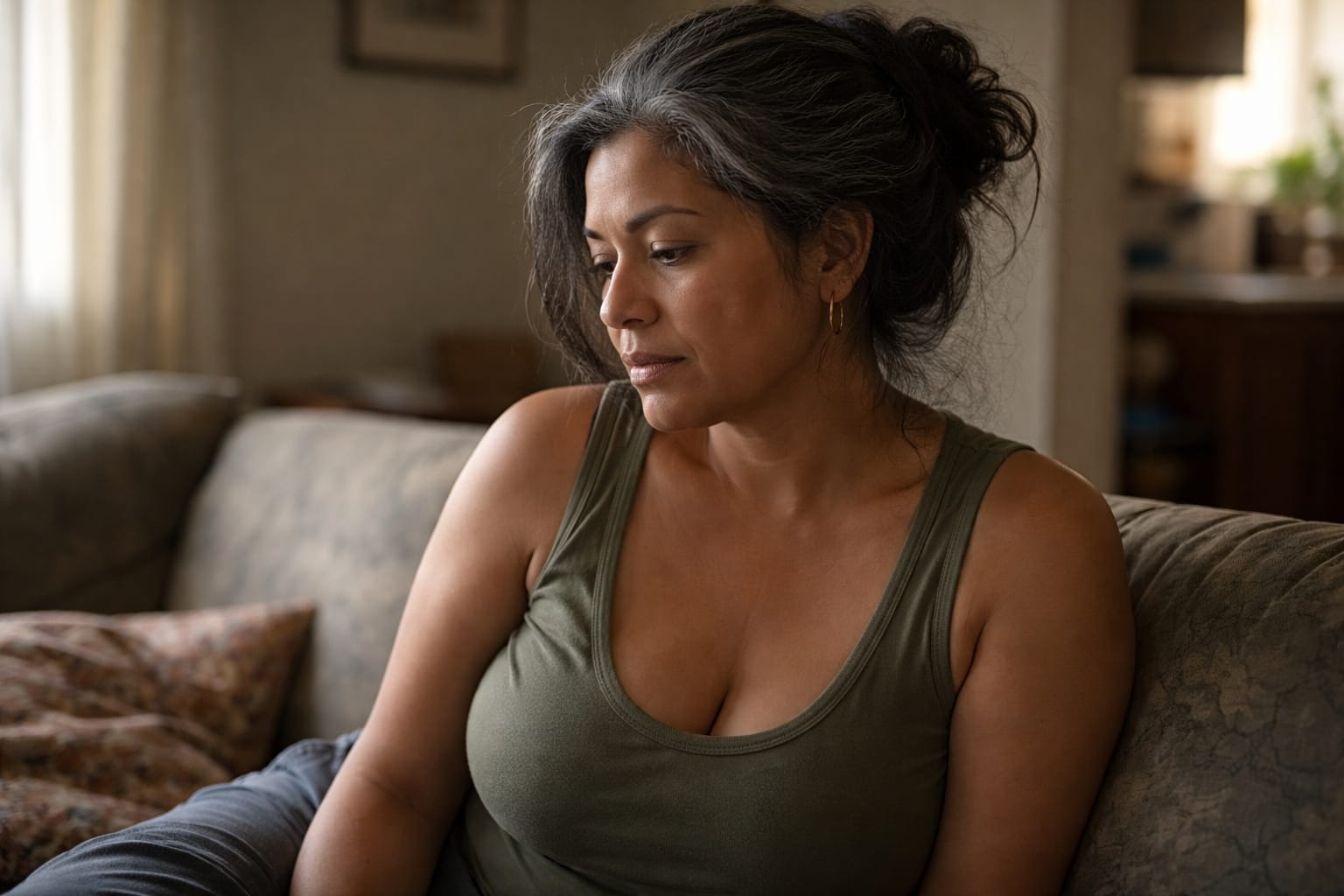
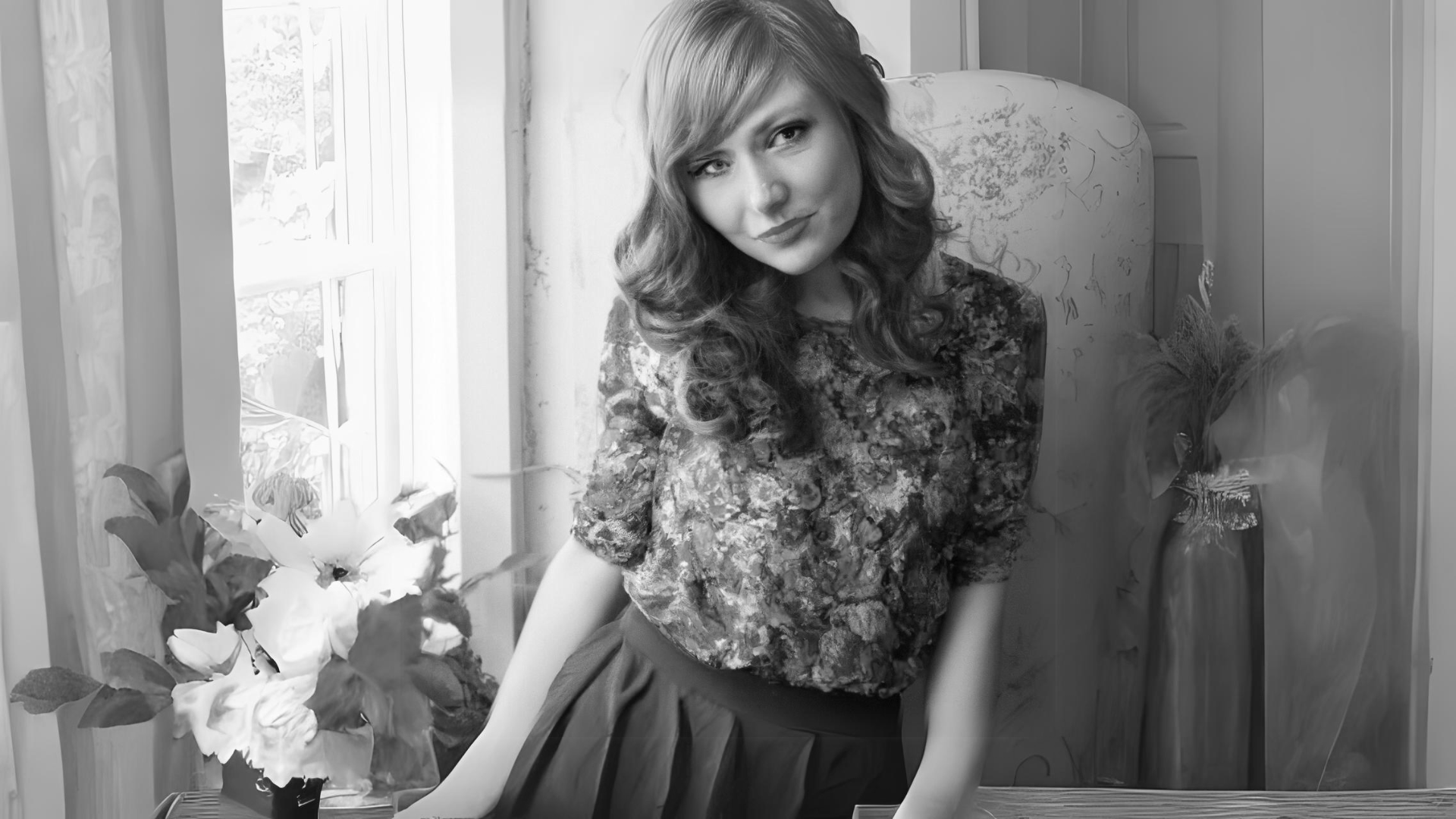
The woman in the photo is not just posing; she’s done shrinking. Her posture is not elegance—it’s exhaustion turned into boundary. It’s defiance without apology. It’s a question you can’t ignore anymore: What happens when a woman stops choosing what’s expected, and finally chooses herself?

Not your version of her. Not the one that plays nice. Just her. Fully, freely, finally.


Author’s Note
This piece was written for Esther’s Weekly Writing Prompt, with a word prompt from Fandango’s FOWC.
Big thanks to all of you for keeping the creative fire lit week after week, day after day. These prompts aren’t just words—they’re jumping-off points, gut checks, and sometimes lifelines. Appreciate what you do more than you know. Keep ‘em coming.

Surviving the Shipwreck: Truth, Even If It Makes Us Uncomfortable

Who writes history, anyway?

Is it a bunch of old men in a room, swirling sherry like it’s holy water, declaring what mattered and what didn’t with the confidence of people who’ve never been told to clean up after themselves? Do they lean back in leather chairs and decide what’s worth remembering, while the rest of the world cleans the dishes, changes the linens, and quietly disappears?

Because let’s be honest—history isn’t what happened. It’s what survived. It’s the polished version of a chaotic past, curated by those with power, perspective, and the privilege to speak uninterrupted.

But what about the ones who made that version possible?

Why don’t we ever hear about them? The people who provided the comfort, the nourishment, the spark. The woman who changed the sheets so a “great man” could sleep through the night. The friend who uttered a half-thought over coffee that later became a manifesto. The cook who fed the movement. The janitor who unlocked the building where the protest was planned. The lover who reminded someone they were human before they put on the mask of leadership.

History applauds the speech, but forgets the breath it took to say it.

We’ve been sold the idea that history is boldface names and bronze statues. But most of what matters happened in kitchens, back porches, alleyways, and hands calloused from lifting, not pointing.

We know the architects of nations. But never the bricklayers. We memorize the names of authors, but forget the unnamed soul who said something beautiful that stuck. We forget that for every “visionary,” there was someone behind the scenes keeping them afloat. Holding the ladder. Mending the net.

So no—history isn’t just written by the victors. It’s written by survivors. By omission. By spin. And often, by those who had the means to make a record in the first place.

The rest? The ones who lit the fires, bore the burdens, whispered the truths?

They became the silence between chapters. The invisible ink.

But if you look close—really close—you’ll find them. In the margins. In the echoes. In the way a melody lingers long after the singer is gone.

Because history wasn’t built on sherry alone. It was built on sweat, sacrifice, and souls that never asked to be remembered—just not to be erased.

But what happens when they get it wrong?

When, the ones holding the pen decide the truth is inconvenient? When the story is shaved, polished, and repainted, so it gleams just right in the museum light? What happens when history becomes less about remembering and more about marketing? About preserving an image, not a truth?

That’s when history turns into myth. Not the kind with gods and monsters, but the kind where the villains are edited out, and the uncomfortable questions are filed away—lost behind locked drawers labeled “context.” You know, for our own good.

And maybe they don’t mean to lie. Maybe they just optimize. Smooth the edges. Add a little glow to the legacy. After all, who doesn’t want their heroes to look heroic? Their country to feel noble? Their ancestors seem wise?

But shaping the past for the best possible result isn’t harmless. It’s rewriting the foundation while pretending the house still stands the same. It’s how entire generations learn pride without accountability, patriotism without honesty, nostalgia without nuance.

And what’s left behind in that process?

The guilt that never gets named. The reparations never paid. The patterns that repeat because we swore they never happened in the first place. The echo chamber grows louder, but the echoes grow fainter—until all we hear is what we want to hear, and not what needs to be heard.

See, history can be a mirror. Or it can be a mask.

One tells you the truth, whether you like it or not.

The other flatters you, and hopes you don’t look too close.

So maybe the question isn’t just who writes history?
Maybe it’s who dares to revise it, once they know better?

Because if we only protect the polished version, if we only pass down the parts that make us proud, then we’re not honoring the past.

We’re embalming it.

And you can’t build a future on something you’ve buried just to keep the story pretty.

But what about when they don’t just get it wrong?
What about when they try to remove history altogether?

Really? That’s the move?

As if tearing down a statue makes the blood it commemorates magically dry up and blow away. As if banning a book unpublishes the pain it contains. As if not teaching something means it never happened.

We’ve seen it before: whole eras scrubbed clean, classrooms sterilized, uncomfortable truths repackaged into “heritage,” or ignored entirely. Entire peoples flattened into footnotes, if mentioned at all. Because someone decided it was better to forget than to face it. Better to be comfortable than be honest.

But here’s the truth, they’re afraid of:
You can’t remove history.

You can burn the documents. You can whitewash the walls. You can call it “divisive,” “unpatriotic,” or “too upsetting for children.”
But history isn’t gone—it just goes underground into stories told at kitchen tables. Into songs, poems, and scars passed down like heirlooms. Into eyes that still remember, even if the curriculum doesn’t.

The attempt to erase history is always a confession. A silent, trembling admission that the truth still hurts. That it never really stopped. It’s not about healing—it’s about hiding.

And hiding doesn’t protect anyone. It just keeps the cycle clean enough to repeat.

So no—you don’t get to skip the hard chapters because they make your heroes look human, or your institutions look cracked. That’s not erasing history. That’s erasing accountability.

And let me tell you—if your story can’t survive the truth, maybe it wasn’t a story worth keeping in the first place.

Maria Popova got it right:
History isn’t what happened. It’s what survives the shipwreck of judgment and chance.

So maybe it’s time we stop polishing the deck chairs and admit we helped steer the damn ship.

Maybe it’s time we stood by the dusty words in old books—the ones that dared to say things like honor, integrity, and truth. Not just when it’s convenient. But when it’s hard. When it means admitting that the past wasn’t all parades and progress. That some of it—hell, a lot of it—would’ve earned us a solid whoopin’ from our mothers, wooden spoon in hand.

So, excuse me while I go through a stack of biographies on Lincoln.

Because if we’re going to keep telling the story—
Let’s at least try to get it right.


Author’s Note
Forgive the rant—but not the passion. That part, I won’t apologize for. The ranting? Yeah… I might’ve gotten a little carried away.

This piece was written for Reena’s Xploration Challenge #386. I try to jump in when I can remember to pull my head out of a book long enough to notice.

Wait—what page was I on?
Black Card Revoked (And I’m Okay With That)

Am I a Snob?

I wish I could say no. That I’m above all that—ego, elitism, the subtle flexes wrapped in “taste” or “refinement.” I’ve tried, seriously. I’ve had the talks, done the therapy. I even cracked open the workbooks—are they still called that? Maybe it was a podcast. Or one of those journaling things we do when someone who shouldn’t matter (and whose name I can’t even remember) says something that sticks. It latches on like gum to your shoe, and suddenly you’re spiraling.

You know the kind of advice—like taking relationship tips from a guy who’s never had a girlfriend. Come to think of it, I’ve never even seen him talk to a woman.

Food Snob? Maybe. But It’s Personal.

“Nothing stays the same”—that’s the mantra we mumble when something doesn’t taste like it used to. The moment hits, and the only explanation that feels right is, “The bastards changed the formula.” Maybe they did. That’s possible.

But what’s also possible—and we hate admitting it—is that the stuff always tasted like garbage. We just didn’t know better. No one had the heart to tell us, because we loved it. And love, especially the nostalgic kind, can turn trash into treasure.

Still, when that old flavor hits different, I dig in. I refuse to accept that it’s me who changed. No—they changed it. And now it’s a matter of principle. “The bastards changed the formula” isn’t just a phrase. It’s my truth. I’m sticking to it.

Culture Snob? Absolutely.

Let’s be real—taste isn’t just personal. It’s cultural.

As a Black man in America, I grew up hearing things you couldn’t say out loud today. Not in public, anyway. Stuff like, “White folks don’t make potato salad like Black folks.” And everyone around the table would nod, mouths full of Granny Smith’s version, hoping for seconds before it disappeared. Because we all knew the danger of ending up with Ms. Johnson’s version. She never quite got it right. But her rhubarb pie? That had fifty things going on, and every one of them hit.

It’s remarkable how the world now dictates what’s considered refined. What’s divine? Overhyped restaurants serve up culture on a plate and call it status. Sure, sometimes it’s good. But nothing compares to the food from our cookouts, our picnics, our church socials. That food had soul. That food knew where it came from.

Now we pay $25 for a steak that comes out wrong and has to be sent back, just to taste decent—something we could’ve cooked at home better and cheaper, with seasoning that actually makes sense. But we do it anyway, because it makes us feel like we belong to something. Like we’re part of a club. Even if that club leaves us hungry and a little hollow.

That right there? That’s the bullshit I’m done with.

Ideology Snob? Let’s Get Real.

Let’s talk ideology. The code we live by. The beliefs hardwired into us through culture—whether we chose them or not.

They show up in how we talk, how we dress, what we read, the music we blast, and the stuff we secretly love but feel judged for.

And here comes the contradictions.

I’ve been told, “You act white.” Like that’s a crime. “I’m pulling your Black card.” “You’re an Oreo—Black on the outside, white on the inside.”

I used to carry a bag of Oreos with me. I liked them. And the same people who said that crap? They’d always take one when I offered. Hypocrites, the lot of them.

Then there are the stereotypes. Once, it was sweltering out, and some coworkers brought watermelons to beat the heat. One of my White friends waved and said, “Hey, we’ve got some watermelon!”
I shouted back, “I’m good, thanks.”

He came over to my truck looking confused.
“Hey man,” he said, “we’ve got some watermelon.”
“I don’t eat that shit,” I said flat.
He raised an eyebrow. “Next thing you’re gonna tell me is you don’t eat fried chicken.”
I looked at him and said, “I prefer mine baked.”

Truth? I love fried chicken. But my wife had me on baked for my blood pressure. That moment wasn’t about the food. It was about reclaiming space. Drawing a line. Saying, you don’t get to define me.

People try to strip your identity when it doesn’t fit their version of what Black is “supposed” to be. But if you stand still too long, they’ll say you’ve stopped growing. You can’t win. So you make your own rules. You claim the parts of yourself they don’t understand, and keep walking.

Music Snob? Nah. Just a Metalhead.

I’m a metalhead. But really, I love music across genres. Blues, jazz, hip hop, classical, metal, whatever hits. If it moves me, I’m in.

But I’ve caught flak for it. Side-eyes at shows. People coming up to me, tilted heads, awkward grins: “Are you enjoying yourself?” Like, I crashed the wrong concert. Like metal has a sticker on it that reads “For White Folks Only.”

Really? That’s your question?

As if I need permission to feel that same raw, gut-deep power you feel. As if I have to prove I belong. I didn’t know loud music came with gatekeeping.

Let’s be clear: music doesn’t segregate. People do. And the real pandemic? It’s not my playlist. It’s the weirdo energy and backhanded doubt people carry around like a badge.

The Labels Don’t Stick.

Stereotypes. Prejudices. Respectability rules dressed up in soft language and cheap slogans. You can’t run from them. We’re told to be ourselves, so long as it fits the mold. Be different, but not too different. Be authentic, but stay in bounds.

Nah. I’m done with that.

So I wear the names they throw at me. I carry them, not as scars, but as proof. Proof that people will always try to box you in. But boxes are for storage, not for living. And if they actually knew me—or tried—they’d realize we’d probably get along just fine.

I love exploring culture. I love discovering new food, ideas, and perspectives. I don’t just tolerate differences. I chase it. That doesn’t make me less Black. It makes me human.

And if I’m anything?

I’m weathered. But I’m true.


Author’s Note:
This rant was written for Sadje’s Sunday Poser, which I genuinely enjoy. It gives me space to think about real things—stuff that hits closer to home than all those philosophies written by dead people.

No, I don’t believe in ghosts.

Well… maybe?

Okay, that came out of nowhere.

The Labyrinth of Yellow Time

PROSE – CAN YOU TELL A STORY


Beneath the yellow sky, a cruel labyrinth spun like a wheel of fate. She walked alone, sand soaking her boots, the hourglass ahead pulsing with time’s breath. A crab scuttled by, indifferent. Each turn twisted deeper. She wasn’t lost—just forgotten. And in that golden light, even memory began to bleed out. Tick. Soak. Vanish.


I wrote this for Esther Clinton’s Can You Tell a Story in 55 Words?—which sounds cute until you try it. Me? I like words. Lots of them. Cutting it down to 55 felt like trying to stuff a novel into a fortune cookie. But hey, challenge accepted. Tiny story, big vibes.

The Watcher at the World’s End

PROSE – 3TC

“All things end, but not all things die.”

In elder days, ere kings were crowned and seas were given name, there lay at the uttermost edge of the world a garden unseen by mortal eye. No chart could find it; no path did lead to it. For it was hidden behind a hedge so wild, it did snarl with the very sinews of time, its roots gorged upon the dust of ages forgotten.

This garden was no verdant haven. Nay, it did blaze with a terrible, floral fury — a sea of poppies red as the blood of stars, each bloom fed upon the sighs of worlds long perished. And amid that fiery bloom stood a lonely bench, smooth-worn by the passing of countless aeons. Upon that bench sat a woman.

Her true name was lost, spoken by none, for fear or reverence, who could say. They called her the Watcher, the Lady Beneath the bunting of Stars, a soul unclaimed by death or life. Her hair fell like rivers of midnight; her raiment shimmered with the ghost-light of a thousand vanished moons. Born she was when first breath quickened flame, and there would she remain until the last whisper stilled the last ember.

Above her, the moon waxed monstrous and red, no gentle beacon but a colossus, strained fiercely against the dark. Tales of old proclaimed: when the moon should bleed full and low, when its furnace breath did wilt the very blossoms, then would the Watcher stir, and with her rising, the world would fold in upon itself, spent and hallowed.

The bunting of stars frayed in the heavens. The hedge withered; poppies fell like the tears of a dying host. And yet still she tarried.

Some said she wove the fate of all things in her stillness — that kingdoms did crumble at the closing of her hand, that battles were lost and won by the flickering of her gaze, that lovers were fated or sundered by the turning of her head.

But upon the last night, the Night of the Final Bloom, she moved not.

The moon, vast and bleeding, filled the firmament; the hedge burned with silent flame.

At length, she stood. The earth sighed low, not in fear, but in weary release. She stepped forward into the floral pyre, her raiment whispering secret oaths to the ashes. And with each step, the stars winked out — one by one — strung like dying bunting across the velvet of the void.

Behind her, the world did fold, not with clamor or woe, but with the solemn grace of an ancient song ended.

Whither she went, none can say. Perchance she walked into a realm yet unborn; perchance she became the hedge, the poppies, the furious moon itself — a silent covenant that every ending be but the herald of another beginning.


Common Sense: Missing. Presumed Ghosting.

RANDOM THOUGHTS – SUNDAY POSER #236

Do most people possess common sense? Technically, yes — in the same way most people technically have a brain. It’s there, but how often it’s used is another conversation. Do we have enough time for that conversation? Absolutely. Will it change anything? Highly doubtful.

See, Voltaire wasn’t just tossing out a witty one-liner when he said, “Common sense is not so common.” He was diagnosing a condition that, centuries later, still plagues society like an expired meme.

Common sense, by definition, should be the basic ability to make sound judgments. Simple, right? But here’s the catch: what counts as “sound judgment” depends on where you grew up, what you’ve lived through, and whether you think TikTok life hacks are a credible source of advice.

And let’s not kid ourselves — emotions are the silent saboteurs. Stress, pride, laziness — they hijack reason faster than you can say “bad idea.” It’s not that people can’t be rational; it’s that they often choose not to be. Rationality takes effort. Effort is wildly overrated these days.

Plus, humans come preloaded with some lovely mental software bugs. Take overconfidence bias — the tendency to think we’re way smarter and more capable than we really are. It’s why your coworker with a GED believes he’s a financial genius after one good week in the stock market. Or why Karen from Facebook suddenly feels qualified to rewrite the CDC guidelines after reading one half-baked blog post. Overconfidence blinds people to their own poor judgment, rendering common sense optional, such as using a turn signal.

Then there’s normalcy bias — our charming ability to assume that because things have been fine, they will be fine. It’s the psychological equivalent of whistling past the graveyard. People often ignore flashing warning signs — both figurative and literal — because facing reality would require them to take uncomfortable action. Why evacuate when you can assume the hurricane will magically change course? Why stop texting while driving when you’ve never crashed before? Common sense doesn’t stand a chance against that kind of wishful thinking.

Even Oliver Wendell Holmes Jr., one of the sharpest legal minds in American history, saw through the myth of pure rationality. Holmes didn’t believe the law was built on logic — he famously wrote, “The life of the law has not been logic; it has been experience.” And when courts invoke the “reasonable man” to judge behavior, they’re really invoking a legal unicorn — an imaginary figure of perfect average judgment. Spoiler: that person does not exist.

Reality? The reasonable man would be rear-ended by someone arguing with their GPS, and then sued for “stopping too suddenly.”

So no, common sense isn’t common. It’s a delicate, context-riddled figment of collective imagination, constantly trampled by human bias and stubbornness. Expecting it from everyone is like expecting a glitch-free Zoom call: a beautiful dream, consistently crushed by reality.

Common sense isn’t dead — it’s just ghosting us. I feel disrespected.

Still Not Grown: Concerts, Consequences, and MiMi’s Side Eye

FANDANGO’S FLASHBACK FRIDAY

So, here we are. It’s MiMi’s birthday — or as she used to call it, her day — and what did I do to honor her? I went to not one, but two concerts back-to-back like I was still 22 and invincible. Now my body’s staging a full-blown rebellion, and honestly? I deserve it.

I can already hear MiMi’s voice, clear as day: “Hmm…running around here thinking you’re grown. You better sit your butt down somewhere.”

She wouldn’t even be mad — just deeply, soulfully amused. That was her way. She didn’t come at you all sweet and gentle; she came at you with common sense wrapped in sarcasm and a side-eye that could stop a grown man mid-sentence.

Thing is, MiMi knew a few things about life — mainly that it would humble you if you weren’t smart enough to humble yourself first. She was tough, she was wise, and she didn’t hand out sympathy just because you made dumb decisions. Nope. She handed you a wet rag, told you to ice that injury, and advised you to sit down and think about your life choices.

And you know what? She was right. She’s still right. Every time my knees pop or my back protests, I can feel her judgment radiating from the great beyond like, “See? Didn’t I tell you?”

But MiMi also believed in living, not just scraping by, but actually living. Laughing hard, dancing when you feel like it (even if your body says otherwise), and gathering memories worth the limp you’ll have tomorrow.

So yeah, I’m hurting today. But I’m also smiling. Because honoring MiMi isn’t about playing it safe — it’s about doing the things that fill you up, even if you have to pay for it later with ibuprofen and regret.

Happy birthday, MiMi. Thanks for the tough love, the side-eye, and the voice in my head telling me to sit my grown self down — right after I live a little.


The Strength in Fracture

PROSE – FOWC & RDP

We find strength when we crack, not despite it, but because of it.


There’s something deeply human about breaking.

Not the kind of collapse that’s loud and chaotic—but the quiet kind. The kind that sneaks in slowly, pressing against your foundation until one day, without warning, you feel it: the shift, the splinter, the give. And then the silence that follows. That’s the feeling these images evoke. A visceral, wordless Yikes that lingers in the gut.

You don’t see the break coming. But when it arrives, it’s undeniable.


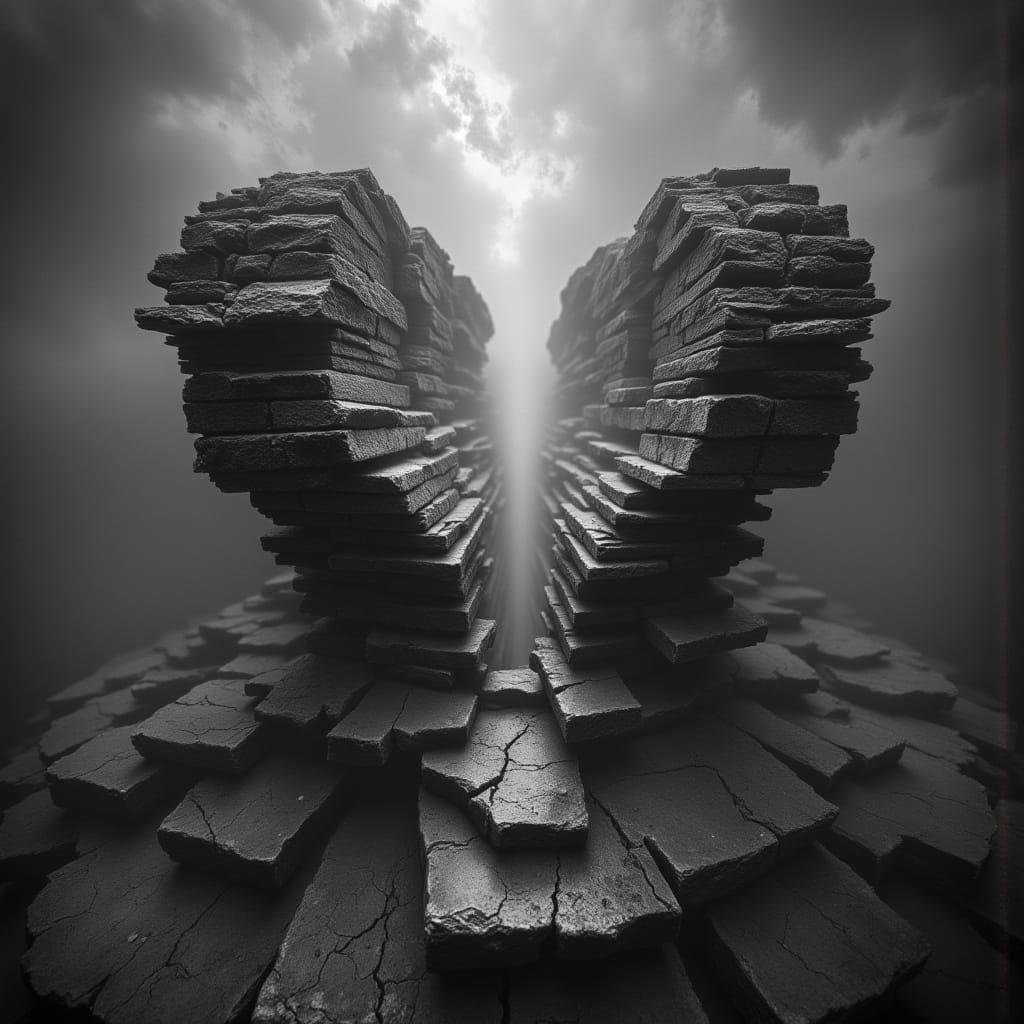
In the first image, we see a heart—not soft, not red, but forged from slabs of cold, cracked stone. Split down the center, it doesn’t bleed. It doesn’t scream. It simply opens, revealing a light that neither heals nor blinds. This is not a symbol of destruction. It’s a portrait of vulnerability. Of strength that dared to yield. And that’s the paradox: what we build to protect us can also be the very thing that prevents us from feeling, from growing, from becoming.

There have been times I cracked. Times when all I could do was sift through the rubble and pretend I was okay. On the outside, I held. On the inside, it was layers of damage—quiet, hidden, untreated. It wasn’t dramatic. It was ordinary, and that’s what made it dangerous.

And just when you think it can’t go deeper, it does.


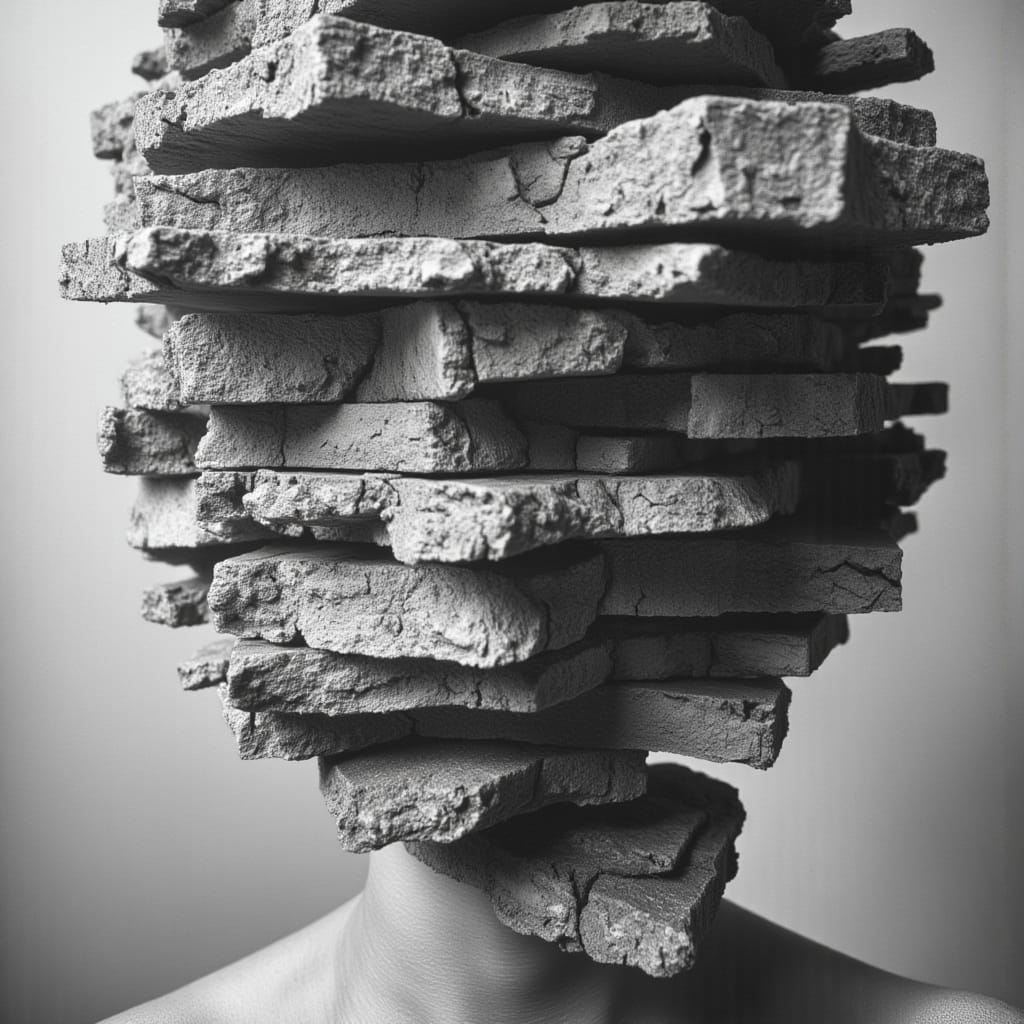
The second image strikes harder. A head—presumably human—layered with thick, dry slices of rock, features obliterated by the burden of their own defenses. You don’t see eyes, mouth, or even expression. You see the consequence of endurance.

We do this, don’t we? We pile on the layers: expectations, roles, trauma, silence. One by one, they smother the self underneath until we become unrecognizable, even to ourselves. And when someone asks us how we’re doing, the reaction is automatic: “I’m fine.” But the truth is buried somewhere deep, wedged between layers too heavy to lift alone.

But what if the face we hide becomes the face we lose?


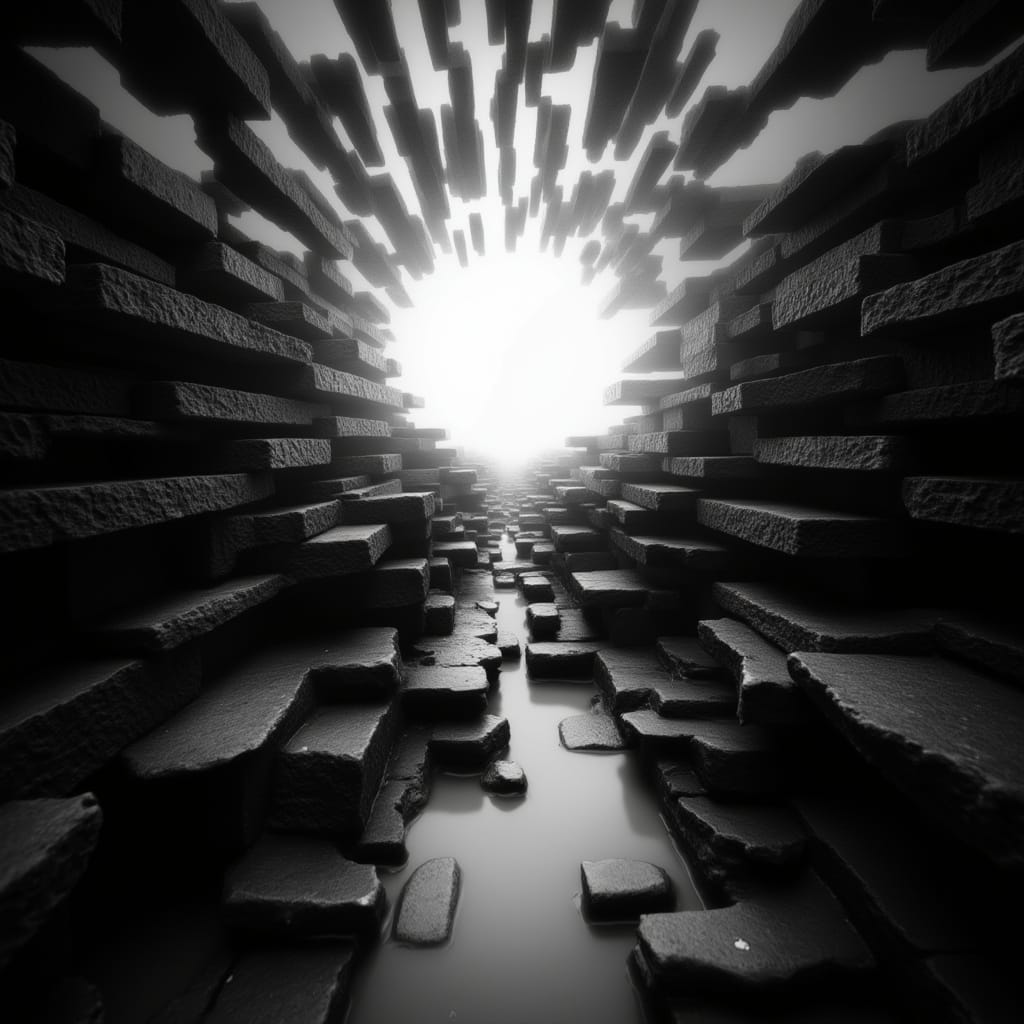
The final image is a tunnel of shattered stone tiles, a fractured pathway bathed in harsh, white light. It’s hard not to see this as a metaphor for transformation. The path isn’t smooth. It’s jagged. Uneven. And yet it leads forward.

That light? It’s not salvation. It’s exposure. Clarity. Maybe even a challenge. The only way through is through. You walk over the wreckage of everything you thought would last, everything you thought you were, and you move anyway.

These images aren’t just art. They’re mirrors. They ask you to look closer—not at the cracks in the stone, but at the fractures within yourself. The places you’ve gone numb. The truths you’ve buried. The parts of you are still waiting to be unearthed.

So yes, Yikes might be your first instinct. But maybe that discomfort is the doorway to something deeper. Maybe the real reaction isn’t fear, but awakening. What if breaking is not the end of the structure, but the beginning of something raw, real, and finally alive?

What have you layered over instead of facing?
What parts of you are still buried beneath the rubble?
And if you followed the cracks, where would they lead?

Too Bright to Touch

PROSE – FOWC & RDP


She moved like a memory caught in motion—half real, half reflection.
Blue light wrapped her like prophecy, like warning.
Everything about her shimmered.
Not from joy, but from exhaustion lacquered into beauty.

There was a cost to being seen this way.

Every inch of her radiated curated power—eyes rimmed in defiance, lips painted in precision.
She looked flawless. Untouchable.
But nothing about her was effortless.
She was sculpted in silence, shaped by scrutiny, smoothed by survival.

The world adored the Gloss.

They called it strength.
They mistook stillness for peace.
They praised the image and ignored the ache.

Because Gloss blinds.

And beneath it, something primal waited—untamed, uninvited, and fully hers.

Fur.

Not for decoration—for defense.
It was everything she’d learned to hide: the mess, the wildness, the depth.
The part of her that could not be branded, couldn’t be edited.

She’d buried it to belong.
But it never stopped breathing.

Now it whispered again.

I want to love.
I want to find peace.
I want to find the real.

But in a world that feeds off illusion…

They tell her lies, in a delicious way.
Wrapped in compliments.
Scented with approval.
Only palatable if she never breaks character.

She tried to believe.
Tried to play along.
But the silence inside her was louder than any applause.

Though she is surrounded, she feels alone.

People held the projection.
No one held her.

Who is the person peering from the cage?
She doesn’t want to be here, but there she is upon the stage.

And one day, without ceremony, she stopped pretending.

She stripped away everything, stood as she truly was.
No gloss.
No pose.
No apology.

And in the rawness of that moment—

To dream of the moment is not insane.

Not foolish.
Not naïve.
Not a weakness.

It’s a kind of rebellion—
To believe in softness after survival.
To imagine stillness after the storm.

Perhaps, she will learn the answer—just not today.

Today is enough.

Because in the stillness…

She not afraid.
She not afraid.
She began to breathe.
It almost easy.

No spotlight.
No mask.
Just breath.
Just truth.
Just her.

Too Strong for You

PROSE – FOWC & RDP


She wore the veil not to disappear, but to survive.

It wasn’t for tradition, or rebellion. It wasn’t a performance. It was protection.
It was her way of saying: I decide what you get to take from me.

They never handed her chains. They handed her mirrors. Bent ones.
Peer pressure didn’t demand. It seduced. Do what we do. Be what we expect. Not because we said so—but because you’ll be alone if you don’t.

Then secular pressure followed, wrapped in freedom’s clothing.
Be who you are—as long as it’s curated, as long as it looks good, as long as it doesn’t disturb.
Express, but don’t confront. Create, but don’t challenge.
Believe in nothing but your brand.

And for a while, she drifted. Trying to belong. Trying to disappear inside approval.

But inside the silence, something broke open.

“Weak as I am…”

She said it like an admission. But it was the beginning of truth.

Weak—not because she failed, but because she felt.
Because she hadn’t let the world harden her into something hollow.
Because even in survival, she still longed for something more than existing.

Because she can’t change the world, but she control how it molds her.
And she refused to be shaped by fear. She chose to be shaped by memory. By presence.
By scars she didn’t hide.

Stay alive. Keep on fighting.

Some days, she did.
Some days, she didn’t.

Like a fugitive on the run—from becoming unrecognizable to herself.
Carrying the weight of all she’s done—and all that’s been done to her.
She was born from regret, yes. But that regret made her conscious. Aware. Awake.

And still, the questions haunt her:

What is she fighting for?
What is she running from?

The answers shift, day to day.

Sometimes she fights for the quiet.
For the small version of herself she abandoned to survive.
For the right to not have to explain.
For the chance to feel something other than fear.

And yes—there are moments. Moments where escape feels like mercy.

What if she wanted to run? Leave it all.
What if she crumbled, and couldn’t fight anymore?

These thoughts don’t scare her anymore.
They keep her honest.
They remind her that strength isn’t the absence of breaking—
it’s the choice to return to yourself after.

Because at the end of all the noise, all the pretending, all the shrinking and reaching and rebuilding—

She is left with one quiet, unshakable truth:

This is who I really am.

No polish. No filter.
Veiled, but not invisible.
Wounded, but not erased.
Tired, but still reaching.

So when the world looks her way, squinting through its own discomfort, trying to place her in a category, or strip her down to something simpler, something safer—

She doesn’t flinch.

She lifts her gaze and speaks with a voice that carries every weight she never dropped:

“With this tainted soul, in this wicked world…
Am I too strong for you?”

And if the answer is yes—so be it.

She never asked for permission.
She only asked to be real.

She Sings Forward the Fire

PROSE – FOWC, RDP, 3TC #MM57, SOCS


Her face, a still sea at twilight, holds a world behind closed eyes — a world scorched and sacred. Beneath the surface of her skin, time moves differently. The tear sliding down her cheek isn’t sorrow alone; it’s layered, like sediment pressed by centuries. It’s the weight of what was lost, and the stubborn, aching beauty of what still lingers.

In the palm of her silence, you can almost hear it: the laughter of ancestors, brittle with joy; the soft rustle of silk on temple floors; the sweet hush before a prayer. Memory lives here not as a ghost, but as a fire — not to destroy, but to illuminate. What we love, we do not forget. It settles into us, builds its shrine in the quietest chambers of the self.

She is witty, yes — but her wit is not for show. It’s forged from survival. Every word she withholds is a choice, every glance a negotiation between pain and pride. She has learned to speak with her silences, to wield them sharper than swords.

Wilful — not out of defiance, but necessity. She resists erasure. She refuses to dim. Within her, temples rise from ashes not as ruins, but as rebirth. Her breath is a hymn to endurance. Her heartbeat, a drum summoning the past into the present.

There is something wondrous in the way she holds it all — grief, fire, memory, and light — without collapsing. As if her soul was built to hold contradictions, to sing through them. A tear falls, yes. But it falls like a bell chime, echoing inward. Each note asking, not “Why me?” but “What now?”

She does not seek to escape the past.
She sings forward the fire.

The Face Beneath

PROSE – FOWC & RDP

The dawn light was pale and useless—just a smear across the treetops, barely making it through the humidity. Everything was wet—the porch boards, the air, your skin, even your breath. It felt like you were breathing through cloth—heavy, damp cloth wrapped around your head.

You stood barefoot on the steps, a slice of watermelon dripping in your hand. It tasted like water and rot now, its sweetness gone. You spat into the grass and stared out at the treeline.

The forest didn’t move. Not even the leaves. It just watched.

You didn’t sleep. Not last night. Not really the night before. The dreams had stopped pretending to be dreams. They didn’t fade in the morning. They lingered in the corners of your vision and behind your ears, where the sound of whispering almost made sense.

You went out early. Needed to check the perimeter cameras. Needed to move. To feel the ground under your boots. That was the plan.

Instead, you wandered. The trail curved in a way it hadn’t before. You followed it. Past the markers. Past the thinning grass. And then it was just you and the dirt.

You nearly tripped over it. At first, just a glint of white in the soil. Bone, maybe. A rock. You crouched, brushed it off with the edge of your shirt. The shape took form fast.

A face.

Stone. Weathered. Cracked. Like it had been buried for years, forgotten. But the eye, just one, was too clean. Too precise. Like it had waited.

You stared at it for a long time. Tried to laugh. Couldn’t. You ran your fingers along the nose, the lips. Your hand trembled, but you didn’t stop.

It looked like you. Not exactly, but enough. The same line between the eyes. The same curve of the jaw. It had no expression, but somehow, it felt like it was judging you.

You left it there. Swore you would forget it.

But that night, you dreamed of breathing through stone. Heavy. Silent. Dreamed of dirt filling your mouth, your ears, your chest. Dreamed of a voice saying your name—not out loud, but from inside.

You woke up with soil under your fingernails.


You told yourself: it’s a statue. Left behind. Forgotten.

You told yourself: it’s just heat sickness, a little sleep deprivation.

You told yourself: don’t go back.

But the forest doesn’t let you decide things like that. Not anymore.


In the Voices of Thousands, We Become One

PROSE – MOONWASHED WEEKLY PROMPT


The sunlight fades. Darkness returns. I wait in the hush, breath held, heart steady. The Keepers stand ahead, already assembled—silent, still, and watchful. In their presence, I feel both small and eternal. Beneath my calm, something stirs—my soul, long quiet, surges suddenly. It’s not noise, not fear. It is truth moving through me like a forgotten rhythm remembered. A tremor rises from the deepest part of who I am, and with it comes a whisper: the light… the call… the quill. These were never external things. They lived within me all along. I had only forgotten how to listen.

In the distance, the sky bends to the horizon’s will. Waves of green light ripple across the dusk like an ancient truth brushing its fingers across the world. The field before me sparkles with dew, each blade of grass a tiny shard of clarity, reflecting the last breath of sunlight. This moment—caught between day and night, between silence and speech—feels sacred. My steed shifts beneath me, sensing the tension in my thoughts. He is anxious, ready. And maybe I am too. But readiness doesn’t feel like confidence. It feels like surrender. I tighten the reins—not to control, but to remind myself that I am here, that I have chosen this.

We ride—not toward victory, but toward purpose. Toward the gathering. Toward those who understand this strange calling to bear words like burdens, and gifts. We are not warriors. We are vessels. We carry stories that are older than we are, stories that ask to be told again, each time a little more fully. We move as one toward the collective, not to be absorbed, but to belong.

Now, surrounded by my brethren, I feel the resonance. Not noise. Harmony. Thousands of voices—not the same but aligned. My own words rise from that shared current, not louder, but clearer. I speak the truth I have wrestled with in the quiet corners of my mind.

Some call the rawness madness. They dismiss it as noise, as rambling. But those of us who live in this tension—we know better. We know that sometimes, madness is just meaning in disguise. That chaos, when held in the right hands, becomes clarity. To those who face the block, I say this: it is not your enemy. It is your mirror.

The block is doubt. Yes. But not the kind that breaks us. It is the kind that slows us down, that makes us ask why before we speak. It is the force that prevents arrogance, that checks ego. Doubt humbles us. It forces us to listen harder, to question deeper, to speak with care. It reminds us that this craft is not about being heard—it is about being understood.

And it is in that pause, that searching, where we grow. The block is not a wall. It is a threshold. When we understand that, it no longer stops us—it transforms us. That understanding, that acceptance, is how the block is shattered.

The Quiet of the Moment

PROSE – 3TC #MM43


The morning began like it had countless times before—but today, it felt different. There was a stillness that lingered just a second longer. A hush in the air that made you listen more closely. The slow fade from darkness to grey had its own rhythm, its own muted pulse. It was that fragile aspect of dawn—neither night nor day—when everything feels suspended, as if the world is holding its breath.

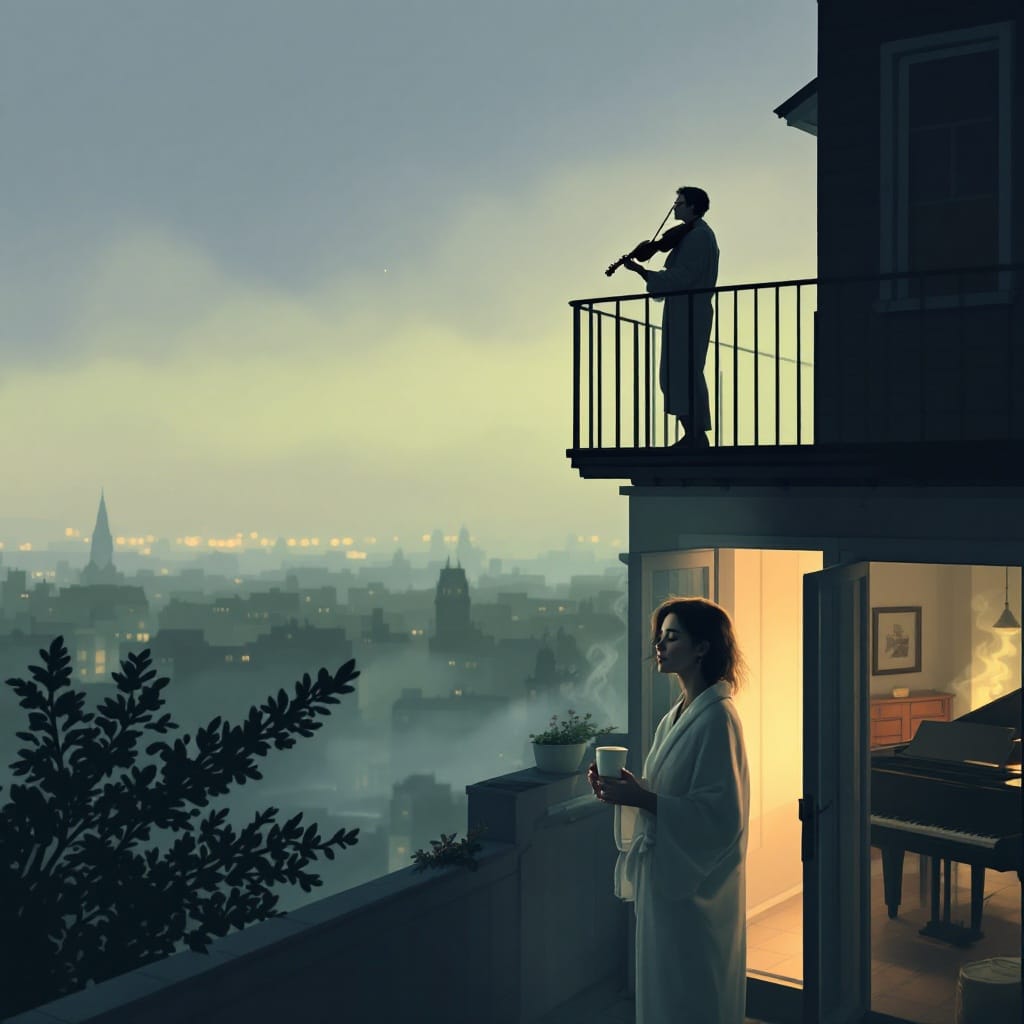
You hear the familiar rush of cars below, life going about its business, unaware of the quiet reverence unfolding above. You step onto the terrace not out of habit, but out of something harder to name. A need, maybe. Or a yearning to be part of something unspoken. You don’t search for a view. You let your gaze fall into the sky, into nothing. Into everything.

Then the sound begins. The piano. Tentative at first, like a thought forming. Fingers move over ivory and black, finding phrases that don’t need words. The melody doesn’t push—it drifts. You close your eyes, and it takes you somewhere. Or perhaps it helps you retrieve something lost in the static of everyday: a gentleness, a memory, a forgotten truth.

You lift your bow, not to perform, but to respond. To join. Your hands move, not with effort but with instinct, the strings vibrating beneath your fingers like a second heartbeat. There’s no audience, no need. Just the sound, the sky, and you.

Then you see her.

She’s there, just below, wrapped in morning light, coffee in hand, eyes somewhere far away. She doesn’t notice you yet. She doesn’t have to. She’s inside the moment too. Something about her stillness makes the entire world feel composed. As if her quiet presence is the final note that makes the music whole.

You watch her for a beat, caught in the beauty of her being, the unforced motion of her simply existing. The way she breathes. The way the steam rises from her cup. How the breeze toys with the loose strand of her hair. It’s ordinary, yet nothing could be more profound.

And in that moment, I understood what beauty and love was—
and it didn’t have a damn thing to do with sex.

You play on. And she listens—without effort, without expectation. Just as you play—without reason, without resistance. The world outside blurs. Time bends. You’re no longer trying to capture the moment. You’re inside it. You are it.

And for once, that’s enough.

Perception Blue

PROSE – 3TC #MM40 & SoCS


The room softened into mist, and time slipped its tether. He saw only her, standing beneath a net of soft lights, her head bowed, lashes dipped in silver. She looked like a secret the universe had forgotten to keep.

He watched her, hardly breathing. There was a stillness about her, as if even the air itself had fallen into orbit around her glow.

Was she real? Or just a dream stitched out of loneliness and hope? He blinked, but she didn’t vanish.

He let himself linger, caught between wonder and a trembling kind of fear. She was too much—too bright, too distant, too beautiful in a way that had nothing to do with the glitter at her temples or the jewels at her brow.

And him? He was just a man standing in the dark, bones full of small regrets, heart patched with quiet scars.

For a moment, he hesitated, sinking into the pause, that heavy moment when you question if you are enough to even be seen. If you are worthy to stand before something so inexplicably beautiful.

His hands shook at his sides, almost imperceptibly. His voice, he feared, would betray him worse.

He closed his eyes and tried to listen — not to the noise of the room, but to the stubborn, fragile hope still alive inside him.

When he opened them, she was still there. Still breathing. Still real.

He stepped forward, heart battering against the cage of his ribs, and found the smallest, truest word:

“Hi,” he said, almost a prayer.

For half a second, the universe hung suspended. Then —

She lifted her head, and the faintest, brightest smile tugged at her lips.

“Hi,” she answered.

And in that small, electric exchange, the stars seemed to exhale, and the night leaned closer around them.

Things Found in the Fire

PROSE – FOWC & RDP

The alley wasn’t picturesque, but it was honest. Cracked brick walls caught the last tired light of the day, holding it like a secret. She leaned against them, letting the roughness bite through the fabric of her shirt — a small reminder she was still here, still standing.

People always skipped places like this. Skipped the alleys, skipped the worn faces that carried too many losses. She used to believe that if she fought hard enough, worked long enough, she could save something — a home, a love, herself. She thought effort could outmatch entropy.

But slowly, we turn the page and walk away from everything. We worked so hard to save. Must we start all over and find another shoulder to lean on?

The question pressed into her like ash on skin. Maybe survival wasn’t about saving what was burning. Maybe it was about knowing when to let it burn. About sifting through the ashes for the pieces that could still hold weight.

The sun folded into the horizon, leaving behind the thick hum of a city settling into itself. She didn’t move quickly. She didn’t look back. Some fires you didn’t put out. Some things you simply let burn and walked away from — lighter, fiercer, more your own.

She stepped out of the alley and into the dusk, steady and unafraid, carrying only what survived the fire.


The Ridge Where Silence Waits

PROSE – FOWC & RDP


Dawn unfolds like a hesitant prayer, its soft light unspooling over the bones of the hills. The stars, one by one, retreat into the folds of daylight, as though ashamed of what they bore witness to through the long, silent hours. Still, I remain at the crest of the ridge, a lone silhouette etched against the slow bloom of morning. I have not slept. I could not—not with the weight of forgotten omens pressing down on me like ancient armor.

The saddle beneath me creaks as I shift, leather complaining in a language only the wind can answer. My limbs ache, not just from the vigil, but from something deeper—an unraveling. I am more wreck than man, hollowed by longing and the quiet violence of loss. My voice, once sure, now drifts somewhere in the ether, unreachable. Even if I could summon the will to speak, I no longer trust the shape of my own words.

Below, the keepers stir. I hear the sharp clash of their voices, rising in petty squabble over rituals they no longer question. Their movements are brisk, their concerns tethered to earth and duty. I do not begrudge them this. But I cannot descend, not yet. I am no longer bound to the cadence of the living. Not while something in me still listens for a call that may never come again.

For I have lost the vision.

Once, it came to me like thunder through a cathedral—blinding, holy, terrible in its beauty. It lit my mind with purpose, set my hands aflame with creation. But that light has dimmed, flickered, vanished. Last night it sang, soft and clear through the bones of the wind. Now it is gone, and in its place: silence, vast and unrelenting.

I reach inward, desperate for a glimmer, a fragment of that divine echo, but find only echoes of my own fear. My compass is shattered. My quill is waiting in some distant place I no longer know how to reach. The path to it—if it still exists—has been swallowed by mist and regret.

And yet, there is no peace in surrender. Only the chill of a fate whispered by unseen mouths, breath like ice on the back of my neck. They murmur not of endings, but of reckonings. Of a soul unmoored of a promise made long ago beneath stranger skies.

Perhaps this is what becoming untethered feels like—not a fall, but a float. Not a silence, but a waiting breath.

The ridge hums beneath me, and I close my eyes.

If the light returns, I will know it by the way the wind shifts. I will feel it in the marrow. I will rise, not with certainty, but with faith scorched into my bones like forgotten scripture.

But until then, I remain.
A shadow made flesh.
A watcher at the edge of memory.
A ghost, listening for the sound of his own return.

The Edge of Becoming: Refusal to Disappear

PROSE – REFLECTION


The light crept in, not with purpose, but inevitability. It pooled over the floorboards in pale streaks, slipped across the rumpled sheets, and found her where she sat—curled in on herself at the edge of the bed like something unfinished. The curtain shifted with a lazy sigh, stirred by the hum of a world already moving without her.

She didn’t move. Just blinked slowly, eyes still heavy. Her hair was a mess—coiled and wild, clinging to the nape of her neck with sweat. The air felt thick, damp from last night’s rain, and carried a faint trace of coffee drifting in from the apartment next door. It reminded her she wasn’t entirely alone in the world—just sealed off from it.

Her phone buzzed on the nightstand. She didn’t look. She already knew the message: “You okay? You were pretty quiet last night.”

She had gone to that rooftop gathering. Smiled on cue. Nodded politely as someone explained a startup idea for the third time. But when the conversation shifted to politics, to “people being too sensitive,” to jokes with teeth she wasn’t supposed to flinch at—she had gone quiet. Not out of agreement. Out of calculation.

It wasn’t fear of confrontation. It was exhaustion.

The kind that seeps into your bones when you’ve spent years editing yourself in real time.

Why can’t you just be easier?

The voice came sharp, cutting through the fog. Familiar. Not hers exactly—but forged in her. It spoke in the tone of her third-grade teacher, the one who called her “bossy” for speaking with certainty. The one who wrote on her report card, “bright, but disruptive.” That was the first time she learned that being loud and being wrong were seen as the same thing.

She had been shrinking ever since. A slow erosion.

And now, this morning, she felt caught between the shrinking and the wanting—wanting to take up space and fearing the cost of it.

You think you’re different? That the rules don’t apply to you?

She flexed her jaw, let the thought sit. The worst part of that voice was how reasonable it sounded. How it wrapped itself in concern. In survival.

Outside the window, a billboard stood tall above the bus stop: a model in spotless white jeans and a tagline in all caps—LIVE YOUR TRUTH™. She almost laughed. As if truth came clean and neatly styled.

Her own truth felt messy. Unmarketable. Like morning breath and ragged nails and questions without answers.

She looked at her hands—real, rough, hers. Last night she had come home and typed a long apology to the group chat. “Sorry I was off. Just tired. Hope I didn’t kill the vibe.”

She hovered over the send button.

Then she didn’t.

Now, she picked up the phone, screen still glowing with the unsent draft. She tapped and held. Delete.

It wasn’t a revolution. Just refusal.

A small, quiet defiance.

She wasn’t whole. There were still bruises beneath her calm, still doubts threading her thoughts. But she was done apologizing for needing more than performance.

The light had shifted again, stronger now. Not demanding. Just there.

She wasn’t sure what came next.

But this—this stillness, this pause, this decision not to disappear—was a start.

Memoirs of Madness: Writing Is the Only Way Through

PROSE – MOONWASHED WEEKLY PROMPT

Mind, body, and spirit—it’s not just a slogan on a t-shirt or a phrase tossed around in self-help books. It’s a lived, gritty process. It doesn’t happen in a straight line. It doesn’t always feel peaceful. It asks to be practiced daily, especially in the moments when we’re coming apart.

When my wife was dying, I was unraveling. There was no calm breath, no quiet meditation that could hold me. The pain was too loud, too sharp. I couldn’t go to the dojo—I knew I might hurt someone. So I turned to the only thing left that didn’t require restraint: writing.

That’s where Memoirs of Madness was born—not from ambition, but necessity. I wrote because if I didn’t, I was going to explode. Writing became my release valve. My attempt to find balance in a world that no longer made sense. It wasn’t polished. It wasn’t composed. But it was honest. It was survival.

Healing doesn’t always look like light. Sometimes it’s just sitting with the darkness long enough to stop being afraid of it. Writing gave me a place to do that. Not to escape pain, but to face it with something steady under my hands—a pen, a page, a place to speak freely.

People like to talk about acceptance, about “new normals,” especially when you’re going through something irreversible. I’ve been told I may never return to the person I was before. And maybe that’s true. But I also know it’s not the whole truth. I know there’s more to me than what’s been broken.

Throughout my life, I’ve encountered teachings I didn’t ask for. Moments of awe, loss, surrender, and grace. I didn’t always understand why they came, but something in me knew not to reject them. Writing became the way I made sense of them. The way I honored them.

It’s not therapy, exactly. It’s more like a mirror. Each word reflects something back at me—something raw, something I need to see. Writing doesn’t heal like medicine. It heals like movement. Like breath after being underwater too long.

Writers tell the truths we were taught to keep quiet. We witness the small miracles—flowers bending to the breeze, the call of a bird we can’t see, the still gaze of an animal watching us. We notice the laughter of children that vibrates with something pure and untouchable. We let it all into our bones. But writing is how we let it back out. How we stay connected—not digitally, but spiritually, viscerally.

Every sentence I write is a thread that connects me to the person I’ve always been beneath the layers of grief, anger, and expectation. Not the old self. Not the broken self. But the essential one. The one that endures.

I once asked: Who’s smarter—the adult or the infant? Predictably, everyone said the adult. When I pressed them, they said the child doesn’t know anything. But I disagreed. I said the infant. They laughed, of course. All but one. That one asked me, “Why?”

“Because the infant sees everything,” I said. “They feel everything. They haven’t learned to numb themselves yet. They haven’t picked up the habit of pretending. They are unfiltered truth.”

That’s what writing brings me back to. That clarity. That honesty. That wholeness before the world taught us to break ourselves into pieces.

Healing through writing isn’t a return to what was. It’s a return to what’s real. And sometimes, that’s more than enough.


Author’s Note:

I sat looking at the challenge image, thinking about the beauty of that moment frozen in time. I found myself wondering how to capture something like that in words. Lately, I’ve been studying Buddhism—not because I want to become a Buddhist, but because I’m wise enough to know that truth can’t be found with a closed mind.

Next thing I knew, this piece came through me.

It’s not all I have to say on the subject, but it’s a beginning.

Thanks, Eugi.

The Weight of Stillness

PROSE – FOWC & RDP

I drift through the mist of life’s abyss, not falling, not flying—just suspended. Time doesn’t move here; it folds in on itself, leaving me trapped in a silence that isn’t peace, but ritual. Dutiful. Respectful. A silence learned over years of swallowing words and measuring breaths. It’s the kind of silence that makes you forget the sound of your own voice.

The air around me stirs, barely. Still, I hear the whispers—low, deliberate, cold. They speak not in sentences, but in suggestions, in warnings that curl around my ears and settle in my chest. They speak of fate, of choices already made, of a path too worn to change.

In my hand, the quill waits, poised like it knows the weight of what it might say. But it’s grown unwieldy—too much meaning, too much memory packed into such a fragile thing. I grip it, unsure whether to write or release. Each word feels like it could be the last. Maybe this sentence is where I stop. Maybe this is where I finally let go.

But still I hover, caught in that space between thought and surrender, listening to the hush of everything I’ve never said.

Where the Sky Remembers Her

She stood still, her profile etched in the quiet glow of imagined worlds. Galaxies spun behind her eyes, each one holding a memory she hadn’t spoken aloud in years. Moons drifted close, brushing her skin with light that wasn’t light, warmth that didn’t burn. The clouds moved through her like thoughts, slow and tangled, as if the sky itself had cracked open to whisper her name.

Her expression didn’t shift. It didn’t need to. She wasn’t here to perform. She was caught in that weightless place between who she’d been and who she might become. And in that stillness, even the planets seemed to orbit slower, listening.

Someone once told her she looked too serious, too distant. But they only gave her a bland kind of attention—the kind that never reached deeper than skin. The type that skimmed her surface and missed the storm beneath.

Now, she let her thoughts roam in this quiet collision of sky and soul. Not forward. Not back. Just… outward. And for a fleeting second, she caught a flicker of something—possibility, maybe—out of the corner of her eye.

A glance, nothing more.

But it was enough to remind her that she was more than what the world saw, more than the shadows cast by fading light. She was part of the cosmos now, and maybe, just maybe, the cosmos was part of her, too.

The Silence of Excess

PROSE – WEEKEND WRITING PROMPT #410

Opulence dazzles, but it doesn’t fill the void. Gilded walls, luxury cars, designer clothes—they impress, not satisfy. The chase for more becomes endless: bigger homes, flashier jewels, louder status. Yet behind the gloss is silence. Relationships shallow. Laughter forced. Meaning fades. Surrounded by everything, the soul starves for something real. Comfort becomes a cage, and abundance numbs. The high of acquisition dulls fast, and stillness creeps in. Opulence, once a dream, becomes a mirror—reflecting what’s missing, not what’s gained. In the echo of excess, we find the truth: wealth can buy things, but not worth.


Warrior’s Creed

PROSE – WEEKEND WRITING PROMPT #411

Fierce burned in her chest—not anger, but resolve. Each setback was fuel. She didn’t flinch, didn’t fold. Determination wasn’t loud; it was steady. Quiet steps forward, no matter what. That’s how she wins.


The Gauntlet of Fog and Stone

PROSE – FOWC & RDP

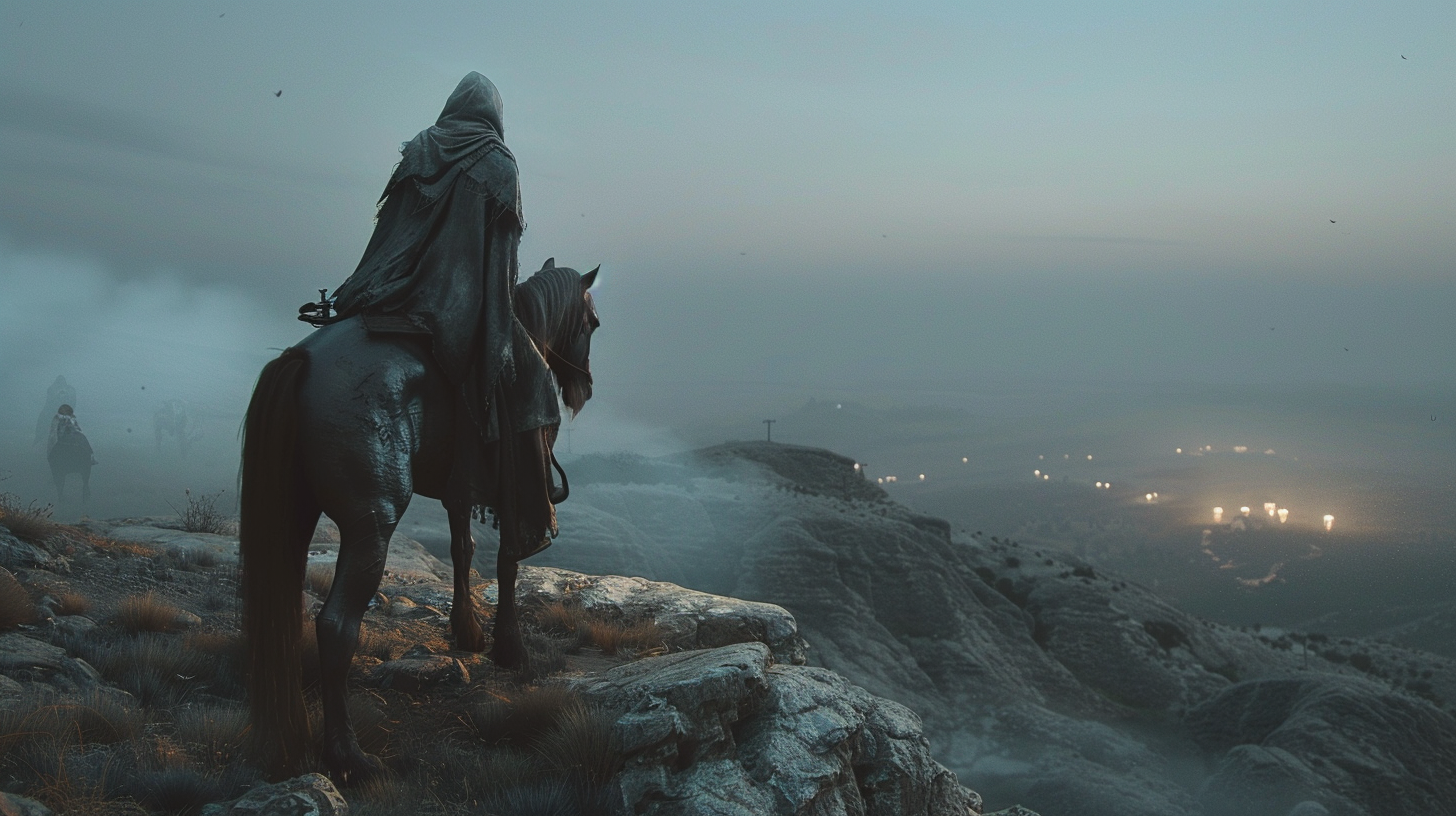
The mist clung to the earth like old sorrow, curling around boots and stones, swallowing sound. Two figures stood before the monolith, cloaked in black, their outlines blurred by fog and fate. The stone towered above them, carved from the mountain’s spine. Its surface was worn by centuries but still bore the mark—an eye within a jagged star—that pulsed faintly, like something alive and watching.

They had come a long way to find it. Through dead forests that whispered their names. Across plains littered with the bones of better men. Not for glory. Not even for vengeance. Just the promise of an answer, or maybe an end.

Behind them, the others waited. Hooded. Silent. A dozen warriors who had followed them without question, bound by old oaths and older regrets. No one asked what lay on the other side of the fog. The question had been buried with the first man who hesitated.

The taller of the two stepped forward, boots crunching on frost-hardened gravel. His hand hovered near the hilt of his sword, fingers twitching like they remembered every fight that hadn’t gone his way. “We stand at the edge,” he said, low and certain.

His companion didn’t look at him, just stared at the monolith. “And what waits beyond?”

“Only those who boldly engage the old magic will know.”

The other figure stepped closer to the stone, his silhouette ragged with wear but upright and determined. He placed a gloved hand on the carving. The stone felt warm—too warm—as if it hadn’t forgotten.

The ground answered—not with light but with a deep, resonant hum that rolled through the valley like a warning. The fog began to move, twisting into strange shapes, pulling backward to reveal what waited deeper in the pass—a path, a gate, shadows shifting on the other side.

The second man drew his blade slowly, the sound of steel slicing the stillness. “Then we put on the gauntlet,” he said, quiet but resolved. “And we walk into whatever comes next.”

Not for glory. Not for vengeance. But for truth. And for the ones they couldn’t bring back.

Together, they stepped forward as the stone split open, the mountain groaning with ancient memory. Finally, the fog began to part.

Oracle of Hollow Peak

PROSE – CONCEPT ART – DOUBLE EXPOSURE

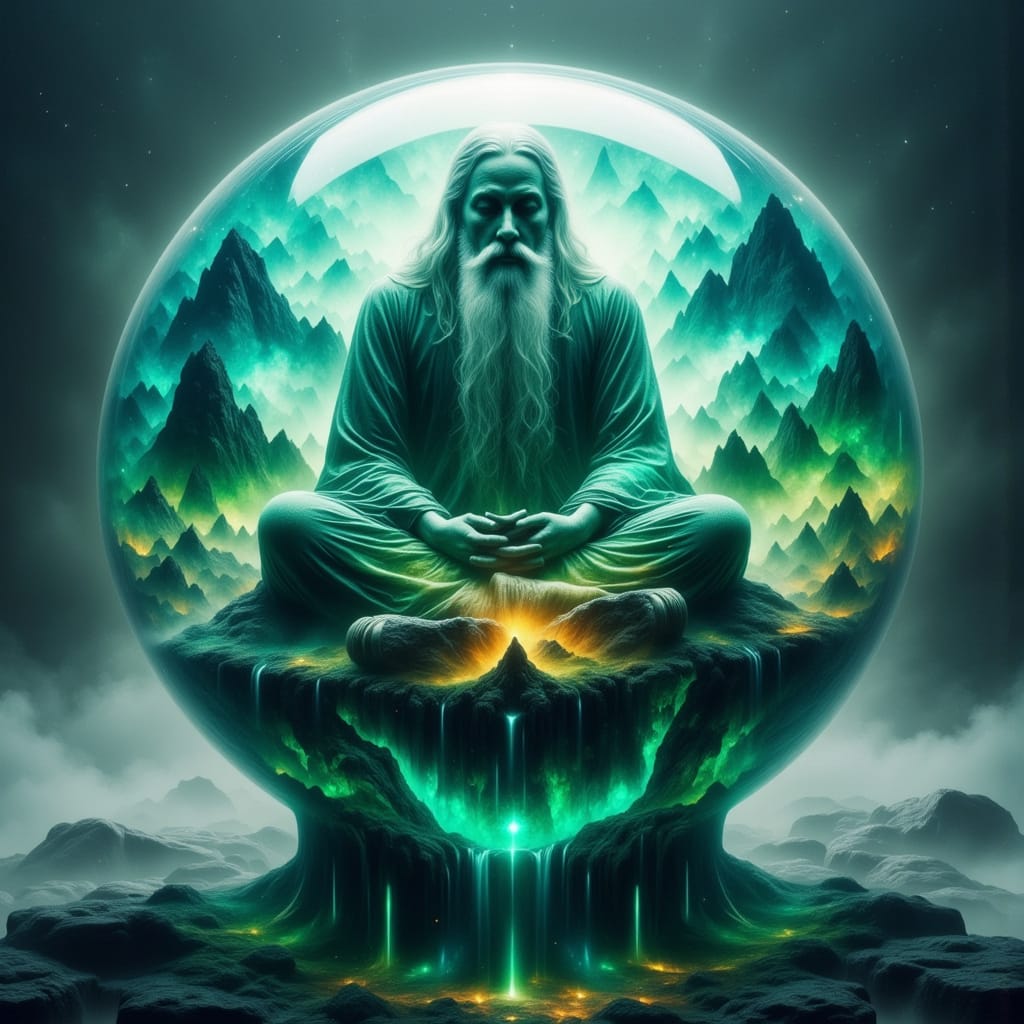
In the heart of the Hollow Mountains, where the air hummed with silence and time forgot to tick, a being older than wind sat. Encased in a sphere of shimmering energy—neither glass nor light, but something between—the Oracle meditated above a chasm that pulsed with ancient fire.

He had not spoken in centuries. He didn’t need to.

The mountains around him were carved not by water but by will. Their jagged silhouettes, emerald-tipped and layered like echoes, were born from his breath. Each ridge was a memory. Each peak was a vow. He had once been flesh, bone, and fire. Now, he was purpose wrapped in the illusion of form.

To the outside world, he appeared as a man—if a man could be sculpted from starlight and storms. His robes flowed like liquid fog, and his long, tangled beard bore streaks of silver like splotches of moonlight left behind by the gods.

Pilgrims had tried to reach him, climbing in silence, their mouths dry from reverence or fear. None returned unchanged. Most didn’t return at all.

Inside the sphere, reality bent. Time curled inward like smoke. The Oracle sat cross-legged on a throne of molten stone that neither burned nor aged. Beneath him, streams of liquid light cascaded into the void—knowledge pouring endlessly into the earth’s soul, never wasted, never full.

He was more than a seer. He was a medium between worlds—the silent conduit through which forgotten truths passed. Not a messenger, not a prophet, but something more elemental, something that watched as stories ended and began again.

He waited—not out of impatience but design. Somewhere, someone would be ready to ask the right question. Not about destiny or death. Those were too easy. But the one that mattered. The one that cracked the world open.

Until then, he breathed. And in that breath, universes whispered.

Things We Couldn’t Say, But That’s the Job

PROSE – MOONWASHED WEEKLY PROMPT


“Duty is what we carry in silence, long after the reasons stop making sense.”

They said, Be all you can be, and we believed them. But we didn’t know at what cost.

There is a line—not drawn, but implied. A hush between steps, a rule never spoken aloud but lived as law. It was my job to hold the line. To guard it. Uphold it. Even on the days I couldn’t see it. Even when I wasn’t sure it was ever really there.

We lied to everyone that mattered. Spoke in half-truths, offered polished answers to unspoken questions. And over time, the lies started to sound like loyalty. We even convinced ourselves. Still—we held the line. We sacrificed everything for it. Time. Peace. Parts of ourselves no apology will ever retrieve. But we believed our sacrifices had meaning. And maybe they did. Maybe meaning isn’t always clean.

There were things we couldn’t say—not because we didn’t want to, but because the job required silence. Duty demanded presence, not explanation. We chose service over clarity. Responsibility over release. That’s what no one tells you: sometimes loyalty means carrying the truth quietly so others don’t have to.

When the dust settled, we tried to find something to hold on to—something we could trust, something true, something pure. Not perfect. Just real. Something that wouldn’t dissolve when we stopped performing.

And yes—we sometimes lived in the dark. Operated in shadows. Did things we could never speak of. Things people will never know. But there was always a light. A flicker. A guide, buried deep, pulling us back. Even when we wandered, even when we hardened. Some of our paths were rockier than others, but still—there was hope. Always hope.

I traced the curve of the line out of habit, out of fear, out of love for something I couldn’t name anymore. The line is not a fence. It’s a suggestion, soft as a breath on glass, sharp as memory. You learn to shape yourself around it—to fold your hunger, to tailor your voice. To make small beautiful, and still wonder why it feels like vanishing.

Some days, it glows. Other days, it disappears, but you still feel it—in the pause before truth, in the way your shoulders remember how to shrink. Still, I held it. With both hands. Tired hands. Loyal hands.

And then one day, without rebellion, without even deciding, I stepped. Nothing broke. No thunder. No light. Just space. Quiet and wide. I waited for collapse. It didn’t come. The air was different here. Not sweeter, not easier—just honest. There was wind, and with it, direction.

I looked back. The line was still there, but fainter now, as if it never meant to stay. And I understood: it was never a barrier, only a shadow cast by belief. And belief, like shadow, can shift with the sun.

We did what we thought was right. We held the line, lived in the shadows, and told the stories people needed to hear. And through it all, we tried to provide hope—while quietly, desperately, trying to hold onto our own.

War, Wisdom, and Other Lies I Tell Myself at Dawn

PROSE – FOWC, RDP, SoCS

“Damn, you’re ancient! What was it like to be one of Teddy Roosevelt’s Rough Riders?”

One of the kids on my team tossed that gem at me this morning. Smirking like he just reinvented comedy. I wanted to fire back—something about his hairline already surrendering—but I let it ride. Not because I’m mature. I’m just tired. And honestly? The way the squad erupted in laughter… it was worth the hit. They needed the laugh more than I needed the win.

I’ve never really understood the logic of soldiers. Still don’t. We sign up to follow orders we don’t write, from people we’ll never meet, for goals we’re not allowed to fully understand. And we’re supposed to be fine with that.

Back when I was their age, I like to think I was different. Noble. Thoughtful. Maybe even angelic. (Okay, maybe not angelic. More like… less of a jackass?) But that could just be the rose-colored fog of memory, or the result of years spent rewriting my own origin story like a drunk screenwriter.

There’s something ritualistic about the way the morning unfolds out here. The dawn eats the night. First sip of bitter coffee. First cigarette. The world still quiet enough to pretend it’s not completely unhinged. I watch them wake up—slow, clumsy, half-zombies with bedhead and bad attitudes. Too young to have rituals, too new to know those rituals might one day keep them sane.

I remember one morning, I hit them with Sweet Leaf by Black Sabbath. Volume up, sun barely over the ridge. Half of them looked like they’d been shot in their sleep. The other half just looked confused. I let it rip while running them through live-fire scenarios. Brains not even warmed up, bodies still clunky from the cold.

It wasn’t for fun. Okay—it was a little fun. But mostly it was about pressure. Teaching them to operate before they’re ready, because the world doesn’t care if you’re ready. Expect the unexpected, I told them. It’s a cliché until you’re bleeding because you didn’t.

Eventually, they’ll get it. Or they won’t. Some learn the rhythm. Others burn out trying.

Each day, we stand there like portraits—young faces with old eyes—propping up a cause that shapeshifts depending on who’s holding the microphone. Marching to the beat of some distant desk jockey who calls themselves a leader because they can attach a PDF to an email. And no one questions it.

That’s the part I can’t let go of. No one questions it.

“War is peace. Freedom is slavery. Ignorance is strength.”
— George Orwell, 1984

I’ve never fully understood that quote. I’ve got pages of half-drunk, sleep-deprived ramblings trying to unpack it. You’d think, with age, I’d get closer. Clarity, wisdom, all that crap they promise you comes with gray hair. But no. The notes get weirder. The handwriting worse. The questions louder.

Maybe that’s the point. Maybe wisdom isn’t about finding answers. Maybe it’s just about asking better questions—and knowing when to shut up and pass the coffee.

Sun’s up. Time to pretend we’ve got it all figured out again.


This post was written for Ragtag Daily Prompt, Fandango, and Stream of Conscious Saturday.

Covid-19: When the Shit Got Real

Daily writing prompt
How have you adapted to the changes brought on by the Covid-19 pandemic?

DAILY PROMPT RESPONSE

Remember when “unprecedented times” became everyone’s favorite phrase? A true statement for the memories of most of the world’s inhabitants, but it still got on my nerves. I held my breath, waiting for someone to throw in the word surreal and say something like, “It’s so surreal, these are unprecedented times.” I swear, I would’ve walked away screaming as someone gently muttered, “Poor fella, everyone’s so overwhelmed.”

So—real talk: How did you adapt to the chaos Covid-19 dropped into our lives?
Did you start baking sourdough? Rethink your entire career? Form a codependent relationship with your couch? Go over your data plan because Netflix, RPGs, and Zoom somehow became a lifestyle?
Grow a beard that now has its own personality? (How’s that going, by the way?) Man, that time produced some truly unfortunate facial hair. Mine looked like a depressed squirrel had taken up residence on my face for a solid month. Eventually, it evened out—but the trauma lingers.

For me, my home became my fortress of solitude—equal parts sanctuary, bunker, and blanket fort. I was lucky: my stepmother, who lived through WWII, told me to stock up on essentials before the lockdown. And I listened.

The provisions—dry goods, paper products, all the basics you don’t think about until they vanish—were stacked neatly and inventoried like I was prepping for the end times. All of it sat on those hideous, industrial metal shelves that belong in basements or crime scenes, not in the middle of a living room.

But they got the job done. Ugly, but reliable. Kind of like the year itself.

I still can’t believe I actually listened, but it made all the difference. It was like the world we knew vanished before our eyes. People became mean and rude for what seemed like no reason.

But looking back, I think it was fear. Everyone just wanted something—anything—they could control. A place that felt safe.

While the world panicked under a double pandemic—Covid, that beast right there in your face that you had no idea which way it would attack, and Hysteria, the silent rogue creeping in from the shadows—I stayed still, battling my own fears.

Even though I was stocked, prepared, trained—it only provided the illusion of calm. A false sense of control.

I knew it. But I leaned on it anyway.

Because sometimes pretending you’re okay is the only way to survive long enough to actually be okay.

But I’ve been here before—in a different kind of war.

In battle, I was surrounded by people who didn’t just know how to survive. We knew what it took to live—no matter how damn hard it got.

That kind of clarity doesn’t leave you. It changes how you move through silence, how you handle fear, how you hold yourself when no one else is watching.

And because of the kind of isolation that comes with PTSD, I didn’t mind being cut off from people. If anything, it gave me space to finally look at my life without distraction.

I realized medication couldn’t fix everything. I had to put in the work. I had to face the demons—even when it felt like I was the demon.

It’s wild, the stories we tell ourselves about what happened to us. Over time, they twist. They shape how we react, instead of letting us respond.

I saw people pretend they were fine—but you could see the cracks.

You offer to help, because you know that darkness. You’ve walked alone in it. And you don’t want anyone else to be there if they’re not ready.

But the rub?

Sometimes, ready or not, you have to walk it anyway.

We’ve made strides in breaking the stigma around mental health. But no one wants to admit they need help—because no one wants to feel different. Or maybe the better word is broken.

But here’s the truth:

It’s okay to be broken. Everyone is. Some more, some less—but broken just the same.

And so we cope. We sip something, cry in the car, buy stuff we don’t need, gamble what we shouldn’t, scroll endlessly, smile when it’s easier than explaining.

All of it—just trying to hold the pieces together.

The world is big. So vast. And we are connected in so many different ways.

So I have to ask—why do we live it so small?

Speak your truth. As Uncle Walt said: sound your barbaric yawp over the rooftops of the world.

You never know when your words will reach someone at just the right moment—when they need it most—to begin to heal.

We are not alone.


Understanding Yourself Costs Nothing—But Changes Everything

Daily writing prompt
What’s something most people don’t understand?

DAILY PROMPT RESPONSE

It seems like most people don’t really understand themselves—not deep down, not at the core. We’re constantly hit with ads telling us to “live our best life” or “be our best self.” Sure, there are things we’d like to change. But we rarely have the resources to make those changes. Ask anyone what they need most to improve their life, and they’ll probably say: more money. And honestly, they’re not wrong. More money could solve a lot. But it also brings its own set of problems.

What we really need is a better understanding of ourselves. That alone could make a huge difference. And guess what? It doesn’t cost a thing—except time and the willingness to take an honest look inward. Then comes the hard part: doing the actual work to change. That’s tough, especially when we’ve been conditioned to look outside ourselves for answers. Blame is our default setting—blame the system, the job, the partner, the timing.

On the flip side, some people internalize everything. I’ve done that. I’ve paid the price for it too—meds meant to manage the fallout of swallowing emotions and ignoring my own needs. But here’s the truth: just realizing that about myself has helped more than any prescription ever could.

Weekend Writing Prompt #408

PROSE – WWP #408

Her heart whispered secrets and dreams only understood by the Moon.


Reflections on Society: The Weight of Words and Actions

PROSE – RANDOM THOUGHTS

In 1988, Chuck D hit us with this unforgettable line: “I got a letter from the government.” That line has lived rent-free in my head ever since, resurfacing when I least expect it—usually when I need it most. Those moments when I need a reminder of the mess we’re in.

I think it stuck with me because of its quiet punch. Public Enemy was known for sonically assaulting your eardrums and shaking your soul, but the opening of “Black Steel in the Hour of Chaos” starts like a casual conversation, just a couple of guys rapping about something that was on everyone’s mind.

“Man, can you believe this shit?”

Every time I got a letter from the government, that same question echoed in my head. It wasn’t some tinfoil-hat paranoia—it was my job. I was the source of that dread and anxiety. I was the one delivering news people didn’t want to hear, the harbinger of bureaucracy, the bearer of all things stamped, sealed, and official.

And you know what? That shit weighs on you.

Driving to an appointment one day, I saw someone I consider a member of “The Homeless”—and yes, I call homelessness a government-sanctioned movement because the fact that we even have a homelessness problem in this country is absurd. We act like it’s some unavoidable force of nature, like hurricanes or earthquakes, instead of a system we built and continue to uphold. We hold charity galas where rich people sip champagne and bid on paintings to “raise awareness,” while outside, a guy is digging through a trash can for half a sandwich. Cities spend millions not on housing solutions but on hostile architecture—park benches with dividers so no one can lie down and spikes under bridges to keep people from taking shelter. We pretend to care just enough to feel good about ourselves, but not enough to actually fix anything.

Some people have sacrificed everything to make this country function, and yet, this is the best we can offer them?

“Is this shit… the best?”

Really? This is it? The pinnacle of civilization? Get the fuck outta here!

But then I saw her. A woman draped in a mink blanket, rocking a floppy hat, standing on the corner like she owned the world. The traffic light changed as I drove past her, and she didn’t flinch. She was unbothered. Cool as she wanted to be. It was almost poetic.

I muttered to myself, “Yes.”


“You’re quite hostile.”

“I got a right to be hostile. My people are persecuted.”

Public Enemy said it best.

For me, “My people” has never been about race, color, or creed. It extends to everyone, no matter how they see me. We like to pat ourselves on the back for how “connected” we are, how much “progress” we’ve made, but let’s be real—we are more divided than ever. Dignity, honor, and respect? Those are punchlines now. If you’re lucky, someone will just forget them entirely instead of twisting them into a joke at your expense.

And “persecuted” doesn’t always come with fire and brimstone. Sometimes, it’s death by a thousand inconveniences. It’s getting pulled over for a busted taillight and knowing you’re about to make some cop’s day more exciting than it needs to be. Seeing corporations celebrate diversity initiatives while their leadership remains overwhelmingly homogenous is infuriating. It’s working twice as hard for half as much, and if you dare complain, you’re labeled “difficult.”

People lie to the very ones they claim to love. We open ourselves and share something close to us; we let them see us, only to be judged, only for them to rip our hearts out, show them to us, and then crush them just to make sure we know who did it and why. And then, just to rub salt in the wound, we’re told we have to be strong. We have to rise above. Sure. No problem. Let me just pop on my superhero cape and pretend I didn’t see that betrayal coming from a mile away.

But what really gets me, what keeps me up at night, is the way some people pick on the weak like it’s a sport. The sheer audacity of it, the cruelty, the absolute bullshit of it all.

Why can’t we just let people be who they are? Love them as they are? No adjustments required.

A movement preaches this very thing, and while it’s well-intended, undoing a hundred years of supreme malarkey is no small task. I admit that I used to be one of those people who judged unfairly. I can’t undo my past, but I can control who I choose to be moving forward. And that, at least, feels like something.


How cool would it be if we could bob in and out of time, cruising in a pink Cadillac with plush velvet seats, Robert Plant belting out the opening verse to “Heartbreaker”? Traveling back to the moment before we became assholes, before bitterness took root. Imagine if we could just press eject and launch all that baggage out the window like a bad mixtape.

But it doesn’t work that way.

Nothing lasts forever. Not even earth and sky.

Weekend Writing Prompt #403

Here is my response to the Weekend Writing Prompt


The Theory of Everything eluded him, dancing just beyond his grasp like starlight through fog. In his cluttered office, equations sprawled across chalkboards, each variable a stepping stone toward universal truth. Years of research had led to this moment, yet certainty remained a stranger. Coffee grew cold beside scattered papers, forgotten in the pursuit of understanding. Perhaps, he thought, watching dust motes spiral in the afternoon light, the beauty lay not in finding the answer but in the endless quest itself.

Weekend Writing Prompt #402

Here is my response to the Weekend Writing Prompt


The old swing creaked in the autumn wind, a spook of childhood laughter echoing through the empty yard. Shadows stretched long, whispering secrets only the moon could understand. The house remembered everything.

Hoodwinked – Revisited (Year Later)

Daily writing prompt
Are you a good judge of character?

DAILY PROMPT RESPONSE

I suppose everyone would love to say yes to the prompt question, and that would be correct, generally speaking. We have had a lifetime of experiences to teach about the content of one’s character—a lifetime of trial and error, a lifetime of being hoodwinked. Hoodwinked was the title of my response to this question a year ago. That post can be found here.

I think we want to take people at their word. For centuries, we have judged people based on so many different aspects that it would make your head spin. We’ve judged people by race, creed, religion, and sexual orientation. We never even bothered to find out what kind of person they were at the core. We have relied on stereotypes and preconceptions taught to us by society. Societal standards aren’t altogether false; we all have certain beliefs based on these standards. However, we have to be strong enough to stand up against the things that have proven false.

Let me take a moment and list a few things I have heard over the years. These examples should provide a clearer picture of the point I’m trying to illustrate.

  1. “The whole family has been trouble since I’ve known them. There isn’t a good one in the lot!”
  2. “Those Muslims are trying to kill us. It’s in their book.”
  3. “They chose to be that way. They are going to burn in hell.”
  4. “Shiftless and lazy has been my experience with them. They aren’t smart enough to understand what is really going on.
  5. “What do you expect from a woman?”

I’ve heard this nonsense in the last year, and it’s hard to believe that some of it is still being said. I won’t even touch some things I see on social media. The hardest pill to swallow is when the mess comes out of the mouth of someone you thought you knew. Events like these make you question your judgment. We sometimes change our opinion of someone based on a single action or statement. However, I suggest not reacting in haste because everyone has a bad day. Also, we have no idea of their struggles and haven’t shared.


Dr. Maya Angelou offers this advice.


I’ve found this quote to be quite helpful over the years. I’ve tried to minimize placing my expectations or principles on individuals and allowed them to be themselves. In some cases, you will be surprised by someone’s actions. I’ve been in situations where the least likely person came to my aid. You just never know. The only I can hope for is not to be hoodwinked.

Weekend Writing Prompt #390

Here is my response to the Weekend Writing Prompt – Diamond


Fractured light danced through the diamond’s heart, each facet holding a universe of trapped rainbows and whispered secrets.

Weekend Writing Prompt #389

Here is my response to the Weekend Writing Prompt – Hunter


The hunter moved through mist that tasted of stardust and forgotten dreams. Her arrows, woven from moonbeams, hung weightless in a quiver made of twilight shadows. Each step left crystalline footprints that bloomed into phosphorescent flowers, their petals humming ancient lullabies. Above, constellations rearranged themselves like curious children watching her passage. She was hunting something that existed between heartbeats, a creature born in the space between reality and imagination. Its trail was a ribbon of liquid silver, leading her deeper into a forest where trees whispered in languages lost to time.

Weekend Writing Prompt #393

CHALLENGE RESPONSE – PROSE

Here is my response to the Weekend Writing Prompt – Occident


Amidst the fading twilight of the Occident, ancient stories whispered through cobblestone streets, carrying echoes of empires long surrendered to time’s embrace.

Weekend Writing Prompt #388

CHALLENGE RESPONSE – WWP

Silence breathed whispers from the shadows, cloaked forgotten secrets slow dance. Memories and promises entwined like lovers, in madness in darkness.

Random Thoughts – 09242024

PROSE – RANDOM THOUGHTS/REFLECTION – THE STATE OF THINGS

Hello everyone,

You may have noticed that things here at the Memoirs of Madness have been a little spotty. I apologize for that; I really do. It’s been a rough year for me health-wise, and though I’m much better, I’ve been dealing with the emotional side of things. I’ve been wondering how the hell I made it through all this and other questions that arise when dealing with health issues as one ages.

So, in the next few weeks, I will be making some changes to the blog. More precisely, I will focus on cleaning up dead links, adding new pages, removing old pages, and such. This is an attempt to improve the blog’s UI/UX. I will announce the changes as they happen; please let me know if I muck something up. Any suggestions are welcome. Until next time … wish me luck.

Amused

Daily writing prompt
How are you feeling right now?

DAILY PROMPT RESPONSE

Today, I got a wild hair up my buttocks and decided to reorganize my office. I didn’t want to reorganize; I needed to relabel all my containers and plastic bins. Plastic bins are evil, just in case you didn’t know. Putting something in a large bin to store somewhere is probably a good sign that you don’t need it. However, we need to have a bunch of stuff we don’t need. I’m sure some therapists would have some fancy word for this behavior. I’m sure they could tell you exactly what it is, right after they find their notes tucked away in one of those bins from medical school.

As I continue to clean up my office and get things in order, I discover I’m making more of a mess. So, I sit here amused as I write this post. I’m a little worn out as well, but as look around and it looks like I haven’t done a damn thing. I’m just amused with myself.

Retirement is Sweet

Daily writing prompt
What daily habit do you do that improves your quality of life?

DAILY PROMPT RESPONSE

Since I retired, I’ve been trying to figure out what I’m doing with myself most days. However, I have developed a few new habits. For some reason, I suddenly felt it was important to do self-care. When I was a young man, you were supposed to be based on the principle of good single malt and bad decisions. However, I try to eat better and enjoy the things I didn’t do when I was young.

Recently, I returned to creating art. I figured that part of my life was over since I hadn’t explored it in decades. So, every day, I brew a pot of coffee and start working on creating something. It doesn’t matter to me which avenue I decide to explore. Lately, I have been sketching out ideas for the creations I’m trying to render. Frequently, I start with character development and work on their backstories. I work until I get worn out and then nap. Napping is a new daily habit.

At the end of the day, I feel good if I have created something.

Random Thoughts – 07062024

PROSE – SATIRE

Good Afternoon, I opened with this line this morning

“I watched the dawn burn away the night.”

I asked my cat what she thought of that line.

This was her response …

Everyone’s a damn critic. I shook my head, and of course, she was unaffected.

Really? I asked

Her response

You a little sh**! My muse had decided to take the form of my cat. My actual cat, Sophie, looks at me as if I have finally lost my mind.

Sophie, she turned 15 last Sunday.

Well, I do write the Memoirs of Madness

Defense of Poetry

PROSE – RANDOM THOUGHT

To defend poetry effectively, we must first address a fundamental question: what is poetry? Only by answering this can we adequately defend it. My initial observation is that poetry itself requires no defense; it is the expression of poetry that sometimes needs defending. This notion may be provocative to some poets and poetry lovers, but I aim to clarify my point.

Poetry embodies the life we live; it surrounds us in every moment, from the warmth of a smile to the pain of loss. All of this is poetry. Humanity tends to categorize and label things, trying to define them to understand them better. This is a natural part of our daily lives. As we sort things into their rightful places, we find that some things fit effortlessly—poetry is one of those things. To me, poetry is like a butterfly that flutters unpredictably. We chase it, knowing we might never catch it, but the pursuit itself is joyful.

Suppose we do catch the butterfly. We place it in a jar with holes in the lid, displaying it for all to see. We admire its beauty daily, its vibrant colors that lie somewhere between soft and crisp. However, we often forget the most enchanting aspect of the butterfly: its flight. With the wings no longer spreading and the butterfly immobilized, it becomes a lifeless specimen on display—a reflection on a painted wall, devoid of the life that once captivated us.

The challenge arises in the expression of poetry. People start using words like “hate” or even stronger terms because, while they understand the essence of poetry as part of their lived experience, they feel alienated by its formal expressions. Terms like sonnet, haiku, and other forms can make us cringe or shy away, burdened by preconceived notions about what we will read or refuse to read. What we need is poetry—life—written in a way that people can appreciate, understand, and perhaps even come to love.

Thus, poetry doesn’t need defending; it needs to be set free. We should all have the chance to chase butterflies. I know I would love to.

Whispers of the Dark – 06142024

PROSE

A waitress stands outside, grabbing a smoke. She was three pats and a wink away from paying her light bill, but if that red fat-faced fuck touched her one more time, she’d scream.

In the Wee Hours – 06142024

PROSE

Happy Friday,

Let’s pull out a separate piece of paper and develop a crazy character belonging to none of your current projects. Take 30 minutes and just have fun …

Why not? …

Enjoy your day!

Whispers of the Dark – 06132024

PROSE – RANDOM THOUGHT

Who do we become when the lights are out and no one is watching?

RDP Tuesday – 06112024

PROSE – RANDOM THOUGHT

Her lips told me I was just a fragment of a daydream put to words on a rugged day

In the Wee Hours – 06132024

PROSE – RANDOM THOUGHT

Good Morning …Dawn is coming, and birds chirp a ballad about the people you don’t capture in verse. Those blessed & cursed Those looked upon with disgust. Without question, they fight for us. Tell their story today … its 4am

Truthful Tuesday – 06112024

CHALLENGE RESPONSE – RANDOM THOUGHTS

Here is my response to the PCGuyIV’s Truthful Tuesday

If my editor knew I was responding to this post, I can envision her holding her breath, hoping I didn’t dive right into a full-on uncensored rant about book adaptations. Lord knows, she has endured more than her share over the years. Partly, I can’t seem to understand the cuts or changes they make. It’s like they never actually read the book, not to mention understood the author’s message. Breathe, Mangus, breathe!

1…2…3…4 … 5..0…7…6 [exhales sharply]

Screenwriting was a part of my training as a cinematographer. So, in theory, I understand the necessity of removing portions of the book as long as it doesn’t sacrifice the story. If it can’t be filmed, then it needs to be cut from the script, was the rule of thumb in class. So, I get it. However, there are still times when things just don’t make sense.

In graduate school, we task to adapt a novel into a full length motion picture. Finally, my chance to show these folks how it’s done. I was determined to get this right.

My determined look

Let me explain screenwriting first. This explanation is simple overview, but you get the point. For every page of script, equals one minute of film. Put simply, 2 and half hour movie is a 150 page script. What? Write an 150 pages? That’s nothing! [scoffs].

So, I sat at my desk and pumped myself up with all the necessary bravado one would need on any given occasion.

“I got this!”

“I’ve written all kinds of stuff, please!”

and so on! This is about the time my brothers would look at me, shaking their heads, and uttering in unison, “Jackass!” I often wondered if they were in a barbershop quartet in previous life. The dissonance of their voices blends together harmoniously. Despite their chiding, I would look continue to display “my determined look,” I will not bow to adversity!

My determined look – 6 months later

Yes, my hair grew out and I rearranged my office, but I was still determined to write the masterpiece. A friend called and needed a favor, so I packed my gear and went and shot a short film, then a commercial, and then another short film. Then the pandemic arrived and the world changed. I never finished my masterpiece. Incidentally, I was adapting Ellison’s Invisible Man, which if adapted uncut would equal a 9 1/2 film. Yeah, I was definitely what my brother’s called me for tackling such a major work of literature on my first stab at full length screenplay. There’s a good reason its never been done before. However, I did learn something.

For motion pictures, novellas, short stories, and stuff work great. It is much easier to say closer to the book. Examples, of this working on well are Shawshank Redemption, Inventing the Abbotts, and Stand by Me. Each of these examples were based on shorter fiction. Two of these films are considered classics.

For novels, it’s better to adapt them for television, if sticking close to the source material is a goal. You have the time to tell a more complete story. In other words, you can put some meat on those bones. However, you have to keep in my mind, if you can’t film it, cut it.

Last thing about screenplays. Screenplays, are basically the movie written on paper. It’s the blueprint to the entire project. The cuts, fades in and out, and those things you think about while you are watching a movie are written in the screenplay. Yes, adjustments will be made, but the screenplay is where it all starts.

Now to the question:

Above, I answered the question from the point of view of a writer. Now I will talk to you as a fan. I was fan long before I ever thought about making movies or writing them. As a fan, I chose TV. Over time and throughout the years, they have done a better job with the adaptations. With the improvement of production quality of television programming, further solidifies my opinion.

Some of my favorite adaptations for television are Bosch, Justified, Dublin Murders, and Lincoln Rhyme: The Hunt for Bone Collector. With Bosch we really get to see who Harry Bosch is as a person. The script has made changes, but Michael Connelly has hand in the show so the character integrity is present. Justified is a adaption of Elmore Leonard’s short story “Fire In The Hole.” However, there are several Raylan Givens novels that pulled elements from for the series. Timothy Olyphant’s portrayal of Raylen Givens is excellent. He brings to the screen that you couldn’t write.

In the Bone Collector (TV series), we really for the first time were introduced to the Lincoln Rhyme of the Jeffrey Deaver series. Lincoln Rhyme is a brilliant, exetremely difficult man with tremendous chip on his shoulder. To say, he was bitter about his circumstances is a understatement. We get a hint of Lincoln’s character in the Denzel protrayal, but it shows through in the series with Russell Hornby protraying Lincoln Rhyme.

Most important of about the Bone Collector (TV Series), this is the first time Amelia Sachs appears in a live action role. Now, in the feature film, Angelina Jolie, protrays a character based on Amelia Sachs, whose first name was Amelia, but she wasn’t Amelia Sachs from the books. Arielle Kebbel protrays Amelia Sachs in the series. We witness Sachs battling her own demons while developing a relationship with Rhyme. She challenges him. This is the Amelia Sachs from the novels.

Six Word Story – 06102024

PROSE – SILLINESS

Where did you hide the ship?

Weekend Writing Prompt # 365

CHALLENGE RESPONSE – PROSE


As the sun began to set, the world, usually at 1000 mph, seemed quiet. The hustle and bustle of life, the constant noise, and chatter fade. It was as if the earth had taken a deep breath, letting it out slowly. Then, it repeated it. At that moment, everything was calm; everything was still. It was a moment of perfect pause.

Cinematic Gold

REFLECTION – RANDOM THOUGHTS

Typically, when comes to film adaptations, we got two categories:

“Oh my god that was horrible! The book is so much better!”

“Can you believe they did that? That’s not in the book!”

The majority of the film adaptation I’ve seen into these categories. I’m a huge Shawshank Redemption fan. I was a fan of the movie, before I knew it was an adaptation. I found it was based on a Stephen King novella, immediately I was turned off. Have you seen some of film adaptations of Stephen King’s stuff? I’m not talking about the recent adaptations or reboots. There were horrible. I’ve read several King books before seeing this film and enjoyed them. However, for some reason, King fell out of favor with me until I read his book about writing. Single malt scotch rained from the heavens, and all was right in the world again. I was back to being a fan.

So, I read Rita Haywood and the Shawshank Redemption, one of four novellas in Different Seasons collection. I fell in love with the movie even more. They did an amazing job with this adaptation. The casting of Morgan Freeman was a stroke of genius. I saw the picture above online somewhere and had to write something about what I could describe as my favorite movie. 30 years can you believe it!

In the Wee Hours – 05262024

PROSE – RANDOM THOUGHT

Sometimes, it seems like we addicts are trying to duplicate the euphoria from the first fix. It may not last more than a moment, but you never forget how it felt and desperately try to regain that feeling. Yet, we become lost in searching for something we were only supposed to experience once. Perhaps we meant to simply capture these moments and stitch them into a quilt of sanctuary our mothers used to make. Each square represents a euphoric memory.

However, it never seems to work out that way. We waste so much time chasing the dragon we eventually feel cheated. We wind up facing ultimatums concerning the things we have unintentionally neglected. We try to rally but end up a headline below the fold or caption scrolling across the bottom screen with the volume on mute.

Is this what has become my life?

Is this the madness I’ve created?

I have faith that my brothers will hold me up until I can stand on my own. The battle against my demons is real. I sit here in the churn of madness, thinking of everything I was supposed to be—a stranger to myself, a shadow of yesterday. On my soul is a tattoo of the ghost of who I used to be. Memories of yesterday fill the present with fear, and a map to nowhere will be upon my face.

Is this what become of my life?

In the madness I created

I pray to God to help me find my strength within.
I pray to God for the patience that day to begin.
I pray to God to help me find myself again.

Find me again

Whispers of the Dark – 05252024

PROSE – REFLECTION

I’ve seen evil. Hell, I’ve been evil. We are so intimate that we can be found slow dancing by candlelight to the melody of the whispering darkness. Can you hear it?

In the Wee Hours – 05172024

PROSE

One minute, you sleep too long, and the next you can’t sleep at all. I suppose somehow, some way we search for the balance. You haven’t seen it so long you forget it east. I suppose it’s the way things do it. Or else it is just something else to fail at. Just another thing to let you down.

Weekend Writing Prompt #363

CHALLENGE PROMPT RESPONSE

In the dimly lit room, an ancient cabinet stood solemnly against the wall. Its wood, dark and glossy, whispered tales of forgotten eras. As the key turned in its lock, a soft sigh escaped, revealing secrets nestled within its heart.

In the Wee Hours – 05052024

PROSE

We mustn’t get lost in its despair, we mustn’t be swallowed before the pain, and we must be careful not to be cut by beauty’s dual edge. But is that even possible? How can we embrace beauty without becoming its victim, without becoming its prey?

In the Wee Hours – 05022024

PROSE

I’m beginning to get used to it. It’s almost like it’s second nature or something. Each day is not much different than the last; each day we are closer to being engulfed by the evil charms of its subtle beauty; bright pale blue lore is deceiving; it masks the wickedness that lurks neath its smiles: we are bitten by its breath

I’m a Man of few words

What topics do you like to discuss?

DAILY PROMPT RESPONSE

I find this a bit difficult since I go days without uttering a single word. There’s something about the serenity of silence that soothes me, and most times, I’m not willing to compromise my serenity for the sake of prattle. I have found that my fondness for silence makes people around me unnerved. Nervous people make me irksome. I don’t do irksome. However, I do enjoy a meaningful and civil conversation on the following topics.

Writing – I love to talk about writing. It’s interesting to hear the different approaches my contemporaries take to express their thoughts. If I lucky, they may be a novice writer among the group. To hear the frustration of trying to find the end of their tale. Not to mention, the excitement of finishing a draft of something they are proud of.

Music—I’d say music was my first love. Lyrics served as a spell that enthralled me in this spooky art of writing. The need to convey an emotion, discuss a topic, or simply groove you. I can’t get enough of it. I especially enjoy the different music challenges on WordPress. It’s like I get to geek out and not be judged. Music is a fusion of so many aspects of creativity; it’s breathtaking.

Nonsense – There is something to be said about bullshitting with your buddies. I can’t express the number of times chopping it up has been cathartic.

RDP Friday – 04122024

CHALLENGE RESPONSE – RDP WING

Each word, each verse, or each sentence we write. Is an attempt to learn to fly.

The Friendly Skies

Image by Nel Botha from Pixabay

Whew! That was a rough landing!

Star Gazer

CHALLENGE RESPONSE – MOONWASHED MUSING’S – STAR-FLECKED

He was enchanted by a woman whose eyes mirrored the night sky—dotted with constellations and shimmering with the light of distant stars. The kind of eyes depicted in storybooks and legend. Each glance into her eyes he fell deeper into their boundless and mesmerizing sea. He was powerless and that was okay. The specks of light slow danced with hope and mystique, a testament to the mysteries and beauties of fantasy. Her gaze was the key to stories untold, worlds unexplored, and the promise of adventure.

“Harold, are you going stand there gawking, my god boy! Close your mouth before you let flies in!”

Harold face redden, “Yes Nanna.”

“Give her the coupons.” Nanna continued. Harold’s embarrassment deepened. He makes eye contact again and her face reddened as well. She is smiling shyly.

“HI! I’m Lucy”

What’s My Age Again – RDP Sunday: Age – 03242024

CHALLENGE RESPONSE – RDP – AGE

I’ve been working on music posts all weekend and writing a bit of fiction. So, when I read today’s prompt, this song came to mind as I popped some Tylenol for my aching bones. Then, ask this question.


Then, of course, this song pops into my head.

Fingers popping and belting the lyrics into a seldom used hairbrush. I stop and catch my breath. I realized this track from 1969, and I knew all the words. Scratching the back of my head, I pause and ask what’s my age again?
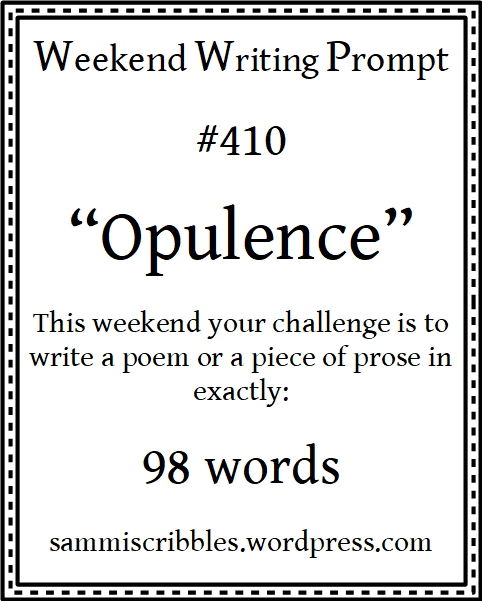
RDP Monday: Women with Grit

CHALLENGE RESPONSE – PROSE: RDP/WORD OF THE DAY

In the tapestry of human endeavor, threads shimmer with unyielding tenacity woven from the fiber of women with grit. These women, from varied walks of life and corners of the earth, share a common trait—a relentless fortitude that propels them through adversity, enabling them to emerge not only unscathed but stronger and more resolute.

Consider the woman who rises before dawn, her day stretching ahead like an uncharted expanse, demanding her sweat, intellect, and care. Yet, she meets each challenge undaunted, fueled by an inner fire that refuses to be extinguished. She could be the single mother who juggles multiple jobs to provide for her children, ensuring they receive the opportunities she never had. Or the scientist in a lab, her eyes alight with the spark of discovery, tirelessly pushing against the frontiers of knowledge despite the voices questioning her place in such a world.

Reflect on the women in history who stood firm against the gales of their times, refusing to bend. They are the suffragettes who endured mockery and imprisonment, their eyes fixed on the horizon of equality. They are the trailblazers in arts, sciences, politics, and activism who dismantled barriers and defied conventions to etch their indelible marks on the annals of time.

Women with grit embody resilience, a quality that resonates through their every action, a silent strength that speaks louder than words. They navigate life’s storms with a steely grace, their resolve a beacon for others to follow. In their perseverance, they weave a legacy of inspiration, a call to each of us to harness our own potential, face our battles with courage, and emerge not just enduring but triumphant.

In celebrating these women, we recognize the grit within ourselves, a testament to the enduring power of the human spirit embodied in the resilience and determination of women across ages and the world.

My mother was such a woman. She had grit, but she referred to it as gumption. I’ve always liked that word. Despite the challenges of raising me on her own, she refused to surrender the chaos surrounding us, no matter how tempting it had been. She remained steady in all that we faced. A lesson I tried to demonstrate to her grandchildren and great-grandchildren. I’m honored to be a steward of her legacy. No different than the others who have courageous women in their lives.

RDP – Monday -02262024

CHALLENGE RESPONSE – PROSE/FICTION

Here is my response to RDP’s Trifling

Elara

A quaint village nestled between rolling hills and whispering woods lived a trifling spirit named Elara. Mischievous and light-hearted, she danced through the villagers’ lives like a playful breeze, her presence barely more substantial than a fleeting shadow. With a penchant for harmless pranks, Elara often left a trail of bewildered smiles and gentle laughter in her wake. She’d whisper riddles in the wind, tie shoelaces together unseen, and sometimes, in a whimsical mood, cause the flowers to bloom out of season, painting the world in unexpected splendor.

Yet, despite her whimsy, Elara held a deeper purpose. Her antics served as gentle reminders not to take life too seriously and to find joy in the small, unexpected moments. In her own trivial way, Elara wove a thread of light-heartedness into the fabric of the village, teaching that sometimes, the heart needs the relief of laughter and the soul the lightness of just being.

RDP Thursday – 02292024

CHALLENGE RESPONSE – PROSE

Here is my response to RDP’s prompt: Shattered

In the pale moonlight, the world seemed ethereal, yet a profound silence pervaded the air, perforated by the echo of distant footsteps. A mosaic of shattered hopes now lay among the ruins of a forgotten city where dreams once flourished. The remnants of crumbled walls whispered tales of yore, each fractured stone a bearer of untold stories. Underneath the celestial gaze, shadows danced across the fragmented relics, casting an intricate ballet of light and darkness. Here, amidst the vestiges of the past, resilience bloomed anew, forging beauty from despair, a poignant reminder of life’s perpetual rebirth amidst ruin.

Weekend Writing Prompt #354

CHALLENGE RESPONSE – PROSE

Here is my response to the Weekend Writing Prompt hosted by Sammi Cox. This is my first time participating. I hope I get right.


In the quietude of twilight, a solitary tap resonates through the empty corridors, echoing off the dimly lit walls. It’s a gentle, rhythmic sound, almost musical as if the universe itself were keeping time. With each tap, memories flicker, casting shadows that dance in the mind’s eye. It’s a moment of connection, a simple, unassuming tap that bridges past and present, conjuring a symphony of silent reflections.


Splinters of My Mind

CHALLENGE RESPONSE

Here is my answer to The Question of the Night #2

Where do you go to escape stress?

I’ve always been told I had a healthy imagination, so it is there I retreat to in times of stress. And this image is a representation of things going on a moment ago. Who knows what will happen next?

RDP Sunday – 02252024

CHALLENGE RESPONSE – FICTION

Here is my response to RDP’S reconcile

I had been for a long time until it ran out of places to go. I ended up here sitting in the darkness hollowed out. I expected to find anything once I arrived, but I found her. She was sipping gas station coffee, grimishing each sip. Her gaze trapped in the moment between breaths. We started something in the next moment that should have lasted a lifetime. She captured my heart, so I gave her my soul.War reared its ugly head and took her snarling. Before that moment, we argued. About what I can’t remember, but now it’s too late to reconcile.

RDP – Thursday

CHALLENGE RESPONSE – FICTION

My response to RDP – Thursday – bamboozle

The Grand Bamboozle

A spry little man named Barkan lived in the serpentine alleys of the ancient city of Khazan, notorious for its labyrinthine streets and enigmatic inhabitants. Barkan was not your average resident. He was a trickster, a master of bamboozles, and his clever ruses were the talk of the city.

Barkan was not always this cunning. Once upon a time, he was an innocent and naive boy. However, life in Khazan was tough, and the city’s harsh realities turned him into the wily person he had become. Yet, Barkan’s bamboozles were never harmful or malicious. They were light-hearted pranks aimed at teaching lessons to the arrogant and the pompous.

One day, a haughty nobleman named Lord Faizan visited Khazan. Rumors of Barkan’s bamboozles had reached him, and he was determined to outwit the trickster. Lord Faizan was known far and wide for his pride and arrogance, qualities that made him the perfect target for Barkan.
Upon his arrival, Lord Faizan announced a reward for anyone who could outsmart him. The city excitedly buzzed, and Barkan saw the perfect opportunity for his most significant bamboozle yet. He accepted the challenge, and the city held its breath, waiting for the grand showdown.

The next day, Barkan invited Lord Faizan to a feast at his humble abode. As the nobleman arrived, he was surprised by the simplicity of Barkan’s home. Little did he know, the grand bamboozle had already begun.

Sunday, Monday, Tuesday – RDP

CHALLENGE RESPONSE – PROSE

Here is my response for RDP Sunday, Monday, and Tuesday.

Let me be blunt from the beginning. The snow was coming down heavy, but the wind blew it sideways. The temperature was dropping rapidly. I didn’t want to be out here, but the gig paid the bills. Prices were so high that you bought a loaf of bread or a gallon of gas. I got a letter in the mail today. An old friend I hadn’t heard from since we both reeked of innocence. I was more than a little envious because he had found the love of his life. He had found happiness. Sighs … good on you, brother! Good on you.

Yeah, they’re a pain, but I love them.

Bloganuary writing prompt
Can you share a positive example of where you’ve felt loved?

DAILY PROMPT RESPONSE

I’ve been fortunate enough to have a network of people in my life who let me know daily I’m loved. They have no problem letting me know when I’m full of crap or any other adjective they choose to use at any given time. I can’t blame them or hold any ill will because I’m a handful, as they say.

You may remember a post I made last year about two individuals who were geniuses. If not, here is a link to that post. What I didn’t tell you is these incredible women have been putting up with my crap for well over a decade. Every rant, tantrum, or foul mood, they have endured it all. They have been with me while I was grief-stricken from the loss of my wife. They were there when I rebuilt myself as a writer and educator to witness me self-destruct through my battle with cancer.

My closest and dearest friend, my editor, you’ve heard me complain about on several occasions on this blog. She put down her red pen and helped me through my cancer battle. She stopped everything and came to the initial surgery. Then she returned for my cancer’s aggressive reemergence. 56 treatments later, I took her home and started to rebuild my life once again. Honestly, I would have been a basket case without her support through all of this madness.

A few years ago, I could barely breathe, and my lady showed up and put a foot in my butt and got me back on my feet. Mumbling something about she couldn’t leave it to me to get proper medical attention. Now, that wasn’t the vernacular she used during her time here. I’m sure you can imagine what was said to a stubborn person such as myself. Their words, not mine. I’m an utterly compliant person. I assure you.

It can’t be easy to deal with me, but their devotion, compassion, and love mean everything. It may even seem at times I don’t appreciate you, but that couldn’t be further from the truth. I love you and appreciate you both; never doubt this. Yep, you guys are a pain, but I love ya.

RDP Wednesday – Hatch – 01172024

CHALLENGE RESPONSE

My response to RDP’s Wednesday prompt.

This morning, I was reviewing this prompt and trying to figure out how to approach it. I knew I didn’t have any photos that featured hatching of some kind. I ran across an image of an old hatchback and remembered our adventures in high school.

A buddy of mine brought a Datsun B210 hatchback and drove everywhere in that thing. Most of the time, there were three of us. We would travel to a nearby town so he could profess his undying love to his girlfriend. It was the stuff they write stories about for about six months. We would buy a case of beer Saturday night and head to the highway. I don’t remember her name or what she looked like.

We all professed our love at one time or another in that car. We traveled hundreds of miles doing so. I suppose we were allergic to the idea of having a local girlfriend. None of us ended up with any of the women that we loved so dearly. I haven’t seen those guys in over 30 years. However, I remember the times we spent together in that hatchback.

Photo courtesy of BY PAUL NIEDERMEYER
 

The Datsun we rode in looked like the one in the photo. The memories just flood back. In fact, our car didn’t have a reverse. So, whenever we parked, we’d stick our foot out of the car and push backward. I wonder what happened to those guys? I hope life was gentler than mine.

Morning Air – 20 Years Later

PROSE – REFLECTION

The morning chill creeps through my layers as I sit on my porch, twirling my finger playfully in my whiskers. I swallow a sip of coffee while tugging at them, lost in the depths of my thoughts. The amber glow of the collision between night and dawn illuminates the horizon. Today, a man was born that brought so much light to the world. His presence hurled us out of a darkness that had engulfed us for nearly a hundred years—a man whose vision, courage, and devotion to humanity will never be forgotten.

Sipping coffee, I watch the lights turn on one by one as the neighborhood awakens. A community in which I could have never lived if it wasn’t for this man’s efforts. Not because where I live now is better than where I grew up. Society’s attitude is better. I remember the speech of this brave man as a child being replayed every year during my youth: a vision of hope, love, determination, and courage. His speech or vision served as a beacon representing one of hell of a dream.

Now a seasoned man, I wonder if my efforts in life have helped fulfill that dream. We fought for God, Country, and the ideal of freedom. We spent countless hours away from home in pursuit of the vision on the mountaintop. The endless miles walked for the dream of the Promised Land. No mile did I walk alone. Each mile walked and every hour spent away was in the faith that a moment of hatred was erased. I hoped they would ring the bell of freedom. A sound heard in the souls of each man and woman in the land. A faith I held on to with all my might, even though it was sometimes fleeting.

Each time I heard the word Jew, it took away a little bit of hope. Whenever I heard the word cracker, freedom’s bell rang a little softer. Every time I heard the word spick or chili pepper, humanity’s love got a little weaker. Each time I heard the nigger humanity’s dignity lessen. However, each time I heard these, we fought harder to fulfill the dream of a man we had never known. We risked our lives to fulfill a dream our forefathers wrote nearly two hundred years before my birth.

I look upon my granddaughter, who shifts under her blanket of freedom provided by the fulfillment of this dream, a granddaughter who turns a year older today. She is allowed to live in a world and taste the crispness of a freedom that wouldn’t have been without his dream. A smile comes across my face as I finish my coffee. I smack my lips because I, too, taste the crispness of freedom in the fresh morning air.

Now, I’m a great-grandfather. I still taste the crispness of freedom in the morning air. It’s rather tasty!

What would I do for Free?

What job would you do for free?

DAILY PROMPT RESPONSE

A Writer

The unfinished projects have formed a pile. Ideas, rants, and incoherent sentences fester. Sometimes I wonder what Goofball gave me the idea to become a writer. Where the hell are they at? I need to hunt them down wherever they may cleverly hide. To the corners of the earth if I must. By God, I need to find and look at them square in the eyes and thank them. Pull them into an embrace. Please do not think less of me, for I may weep. They have provided me with a fantastic gift. You see, boredom will never be a problem for me. Inside each project is the potential to create something that never existed before. At the very least, the potential to heal.


Today has been the longest of days for no reason. Nothing I can put my finger on anyway. I got so much accomplished, but so much more to do. There isn’t enough time to get it all done. I never complete it all. My Lord, what will I do? What will I do? We have all said this statement, felt it, or both. It doesn’t matter if you don’t admit it. It’s fine. Know that wherever you are in your journey, we all have or will walk it. The trail right in front of you. You can get to the other side step by step, word by word, or sentence by sentence. Whatever the method you will be the better for it.


As I lay across my bed, I lit a cigarette, letting it burn in the ashtray for a few minutes before I took another drag. I read a poem in Vietnamese, then I listened to it. Next, I read some prose in Italian; then again, I listened to it. The beauty of the words captured me. I’m reminded of hearing The Holy Quran recited. So beautiful and tranquil. I’m reminded how much I miss Latin Mass. I memorized it as a lad and recited it in English when the priests performed Mass. Though exhausted, hearing these works in their native language healed and recharged me a bit.


I would not have discovered the beauty of our world if I had chosen another profession on the day they whispered to me to become a writer. Although we live in a vast world full of wonder and delight, I wonder why we live so small.

Nope, this is the only profession I would do for free. Nothing else completes me.

Aurora

The rattling of the window in the wind wakes me. Slowly, I stretch away the night, my eyes shift from darkness to a haze, and my eyes shift into focus from slumber to reality. I hear the whirling hiss as the snow hits the screen. I make my way to the kitchen to brew some sanity. Its aroma filled the room in a matter of seconds. In minutes, I am nursing a cup by the window. The night has yet to surrender to dawn. Yet, to tuck itself away, partaking in the much-needed rest. If you look closely and catch it just right, you can see the snowflake’s form before it dissolves against the glass.

It is the perfect day for cuddling. Her head nestled in that special place. My breathing was slow, and my heart skipped a beat, so we were in unison. So that we are connected. Connected on the spiritual level, not just the profane, it is a perfect morning for loving. A soft, slow, lingering turns into a slow grind. To evolve into a breathless gasp that surrenders to a moan. A moan becomes a pant, then a scream, then a contentment sigh is released. Then, fall into a deep, coma-like sleep.

The Lady in Red

PROSE


The night is coming, just like it did the night before. It really isn’t anything special to me, just a darker shade of grey. You see, I view the world through a pair of monochrome lenses. It’s been this way since birth, well, at least until I saw her. Her lips glowed like rubies, her hair seemed on fire, and something shimmery hung from her ears. I can only imagine these colors to be shades of red. Is this what red looks like? How beautiful, how enchanting. Who was she? Who was this woman in red?


Skywriting – 122720231602

PROSE – RANDOM THOUGHTS

My body is healing, so I’ve been sleeping a lot. It’s strange how remarkable the body can be if you allow it to do its thing. I haven’t been able to get much done in these past weeks, but I’ve had the strength to create. This is a blessing in itself. I may never return to being the man I was before all this happened, but honestly, they may not be such a bad thing. In part, it’s because of him; I’m in this situation, and it’s also because of him; I know I can survive it. Who or what will I be after it is all said and done? Who knows? But it’s gonna be fun figuring things out.

Image Credit:

I took this photo a week before my health took a nose dive. I remember feeling horrible that day. However, I pushed through because I’m a tough guy and all that.

RDP Tuesday – 12122023

PROSE

My response to RDP – Tuesday prompt: Comedy

This makes me laugh every time

Perhaps it’s the absurdity of the sign. Are we to believe this man will actually pay for Karate lessons? Perhaps, on some measures, we respect his creativity. I’m reminded of a conversation I had with a panhandler. He approached me slowly, which put me on guard. Slow moving objects make me nervous. I must have given him a look because he stopped in his tracks. He asked for a cigarette; I nodded and signaled him to continue approaching. I handed him a cigarette. He looked at the cigarette and said he didn’t smoke non-methol. I started laughing and asked if he was serious. He handed me back the cigarette and said, “Hell yeah!” I shook my head and walked away.


My Goofball brother

I was at the car show working, and suddenly, this Yahoo told me to take his picture. I didn’t pay attention to the photo until he asked if I looked at it. Well, when I did, I saw this. So tonight, we were giving each other a hard time, and I told him I would post this photo. I always try to be a man of my word.

I’ve learned something over the last few months, life can be the greatest tragedy or a joyous comedy. The person living makes the choice.

Real American Heroes

What’s your favorite cartoon?

DAILY PROMPT RESPONSE

I watched so many cartoons as a child I can’t remember them all. Of course, the classics like Scrooby-Do and Bugs Bunny. However, there was one cartoon that appeared later. GI-Joe ended up being my jam. It might have sparked from having the action figure GI Joe with the kung-fu grip. Whatever the reason, I enjoyed every episode I was able to catch. What’s cool is that YouTube has all the episodes.

Turkey Day, Hemi’s, Bullitt, and Family

Here’s my response to pensitivity101‘s Share Your World

Here are this week’s questions:

Gratitude:
Knowing you’re loved is priceless.

Over the last several weeks, I’ve had a rough go of it, to put it mildly. What I have learned and been reminded of is that I’m loved. There is no doubt about that.

What is your idea of a good holiday? Seeing the sights, lazing on a beach, hitting the night spots, getting away from it all……………….
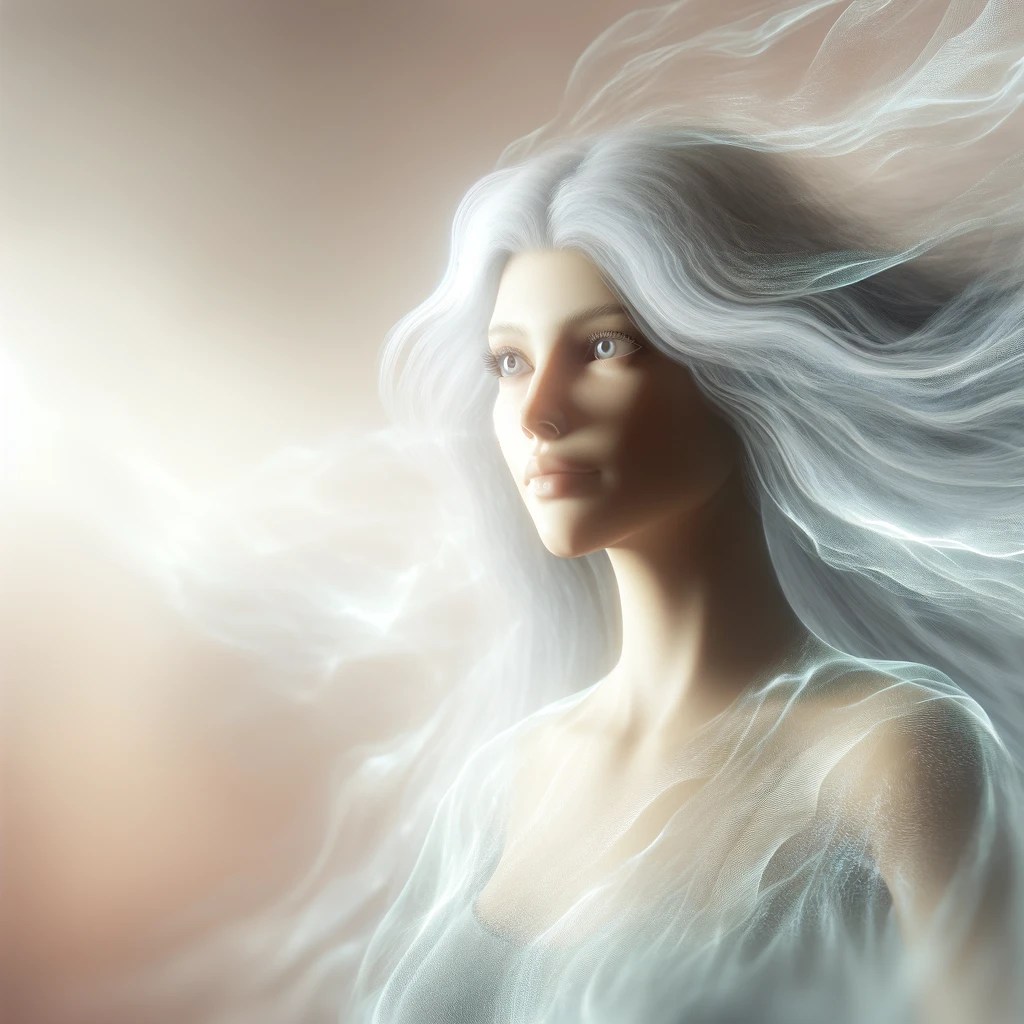
My favorite holiday in the U.S. is Thanksgiving. It’s all about the food. Dishes you haven’t had all year are waiting for you to gorge yourself into oblivion. There are no diets or anything like that. In short, it is the ultimate cheat day. Another thing about this holiday, perhaps the most important, is being with family. It doesn’t get any better than that.

You are offered tickets to a show. Which would you prefer, Opera, Play, Cinema, Entertainment, Ice Gala, or something else?

During my 50th birthday celebration, a friend took me to see Cirque du Soleil. I remember complaining the entire trip to the show. Grumbling nonsense about any and everything. My friend stood her ground and let me rant. She had gotten us incredible seats, and the show was amazing. The gracefulness of the performers was breathtaking. It was an ice show, so I kept waiting for someone to face plant. Didn’t happen. I would watch something like that again.

Have you ever won a sports trophy (or something similar for a particular achievement):

I was a jock during my youth, so I picked up a few trophies here and there. My mother kept them in a bag. I received awards while serving in the military. I used to call the wall my wife hung them on “The Wall of Shame.” Don’t get me wrong. I’m proud of the time I spent in the military. There is no question that it helped shape me into the man I am today. I never did buy into the whole medal thing. It was more about what we were doing and its importance. However, there was an occasion when I was recognized for an achievement. I got no medal or ceremony, just a simple handwritten thank you note. That gesture means more to me than any awards.

What is your dream car (fact or fictional):

As a child, I remember being enthralled by several cars before settling in on my favorite. I still can’t pick a definite favorite, but two stand out. In 1979, the cult classic Phantasm was released. It was a tripped out movie that didn’t make any sense to me at the time. However, my friends and I still talk about that movie. Not as much as we did as kids, but now and again, someone will mention a line at the perfect moment, and we just laugh.

There were several notable characters in that film, but it wasn’t a character that caused the movie to be bookmarked in my mind; it was the car. A Plymouth Barracuda raced away, rescuing the characters and taking them to safety. From that moment, that was my car. I did my best to learn about that model car, but I discovered something different that I loved even more. A 1968 Plymouth Hemi Cuda became my jam. Take a look

My first love

As I got older and started my journey into becoming a mechanic with my father, I learned more about cars and their capabilities. My father was aware of my infatuation with the Hemi but schooled me about the other muscle cars of that era. My appreciation grew for American Muscle. I had the privilege of building and repairing several different ones with my dad. I’m more of a circuit head than a gearhead. Yet, I love mechanics; it’s in me bones. After Pop went to the otherside of the veil, I found myself watching old movies with car chases: Smokey and the Bandit, Dukes of Hazzard, The French Connection, and finally, Bullitt. I found my second love, a 1968 Ford Mustang – GT-500. Let’s take a look at the scene that grabbed me.

My second love

However, a different year model of Mustang, the movie Gone in 60 Seconds, the remake with Nicolas Cage, featured a 1967 GT-500. The original featured a 1971 Mustang, a beast in her own right but not as sexy. Here are two clips that express my love for this car.

Demonstrates my respect for the car
Sweet!

Skywriting -112820231429

PROSE – INTROSPECTION

I’m unsure if you have noticed, but I haven’t been posting a lot over the last week or so. It wasn’t due to the holidays, but I wish it had been. Despite all the progress I’ve made regarding my health, I developed a new issue. If I’m being honest, it’s that sporadically appeared over the years I just ignored. However, now it can’t be ignored. So, like a good little boy, I’m addressing the issue and taking it seriously. In case you were wondering, I’m also eating all my vegetables and stuff.

Despite my current challenges, I’ve been reading and attempting to develop new content for the blog. Yes, I’m aware some of you are waiting for me to finish several projects that currently exist on the blog. I assure you I have every intention to finish them, but I’m a bit scattered brain at the moment. My senior editor would say being scattered brain is normal for me, but even she had to admit the other day that my current state is a bit peculiar.

“Hush, and go to bed,” I believe were her words, but I have to admit there is a possibility they could have been harsher. She gets testy when it comes to my health. It’s weird. Yet, the writers among us, there are hardly many things worse than a testy editor.

Yet, I wonder if I continue being a good boy, will my lady pat me on the head and give me a treat?

Photo by Lisa Fotios on Pexels.com

Men and their Toys

Name the most expensive personal item you’ve ever purchased (not your home or car).

DAILY PROMPT RESPONSE

For most things, I’m a tightwad, even described as squeezing a penny so tight you can see the booger in Lincoln’s nose. There’s truth in that statement, with one exception. When it comes to my tech, I Typically spare no expense.

I don’t run out buying tech all willy-nilly. There will be none of that nonsense. Each piece of equipment must be researched again and again before purchase. Despite this rule, I keep equipment long after it should be replaced or upgraded.

Examples of this devotion to all things frugal: I shoot most of my photos with a secondhand Nikon D3200 and process video on a MacBook Pro. The MacBook Pro was ridiculously priced but is worth the coin. I’ve worn out three Windows boxes since I purchased my Mac.

My Sony FS5 was by far the most expensive equipment I own. She is old but gets the job done. I’m looking for a new camera body to possibly replace my Nikon. It’s going to cost an arm and leg, but what am I going to do? I have no choice, you know? Men and their toys and all.

Brothers in Arms

PROSE – VETERAN’S DAY REFLECTION

I’ve said on this blog that we have two families in life. The one we are born with and the one we choose. This concept has always been more than words for me. It’s been the way I was raised, and I live still. Today, Veteran’s Day, I going to take a moment and showcase my brothers.

These yahoo’s on each side of me are veterans.

The above picture is one of the few times we were together. Our lives are hectic, but we made it happen that day. The gentleman flashing the peace sign is the oldest. He was in the Marine Corps and whipped my skinny butt into shape before Army basic training. On the opposite side, he was in the Army Signal Corps and taught me what it meant to be a member of the Signal Corps. Their guidance and toughness laid the cornerstone of who I am.


Each of these men also served in the military; the top three were in the Navy, and my cousin was in the Army. These men helped me put the pieces back together again after my wife died. They reminded me who I was and what I stood for. I’m indebted to them for life.

As veterans, service and duty aren’t things we are born to; it’s what we learn. In many ways, we are the better for it. In others, that is a cost. Some more than others, but a cost, just the same. During the time we wore the uniform, we did our thang. Nothing or no one can take that away from us. It’s an honor to be among you all.

Happy Veteran’s Day

We Salute You

I woke up this morning fired up. Another glorious day to be above ground. I started this off like this …

I jammed this song before many missions

Swing and Climb Trees

What does it mean to be a kid at heart?

DAILY PROMPT RESPONSE

Sometimes, it’s hard for me to remember what it’s like to be a kid at heart. Lately, I’ve been reminiscing about childhood. I have had several random memories.

I remember pacing endlessly, wondering if my latest crush was into me. I enlisted help from my friends to discern my plight, but they weren’t any help. Then, a girl from the class appeared out of nowhere. She was known to accomplish this feat regularly. There was talk if she was some sort of fairy or some other mythical creature. Putting aside her unknown origins, she offered a probable solution to my crisis. There was a daisy in her hand.

She began plucking the pedals one by one, uttering, ” She loves me,” “She loves me not.” We waited as she continued plucking as if the fate of the world rested on the result. When she finished, I had a new love. However, this result was the farthest from the truth. I remember playing this game. It gives me a hardy laugh.

Photo by Pixabay on Pexels.com

One of my friend’s mother asked me once if I was part squirrel. I didn’t know what she meant, but looking back, I can see why she asked that. I would scurry up a tree in a heartbeat, leaving her son looking up and complaining until he found the courage to climb up with me. We were kings, looking down at the world. We would pack sandwiches and comic books, staying there for hours.

Photo by Ryan Fatalla on Pexels.com

I remember spending hours on various swing sets around the neighborhood. This photo reminds me of an old swing set where I used to sneak and swing. It was something sitting there gathering my thoughts about what mischief I was going to into next.

The bottom represents the playground swing I played with as a child. The swing I used to court my latest crush. The laughter, how I remember the laughter. It was almost like we didn’t know fear. We shared interests, fears, and passions. We never considered whether or not the information we shared would be used against us. It was friendships forged from innocence.

When I can, I think about those moments and smile. Because we used to swing and climb trees.

Six Word Story – 11042023

PROSE

I always enjoy discovering new ways of pushing myself as a writer. Every sentence is an opportunity to redefine my limits. Often, I find myself struggling with who I’m becoming in the wake of my existence. There was a time when I felt certain who I was and my purpose. Now, with age and health issues, I wonder…

What kind of man are you?

Six Word Story – 11022023

PROSE

The beginning of my psychosis … sighs!

Worn out carpet, Bubble baths, and the Boob Tube

Here are this week’s questions (which are nothing to do with Halloween):

  1. Do you have carpets, rugs, laminating flooring, tiles, or wooden floors (or something else) in your property. I always wanted shag carpet. Only because I liked the name. I enjoyed how it sounded when I said it. Currently, I have an old single ply carpet. I’m pretty sure it screams each time I walk into the kitchen. However, my preferred flooring is wooden floors. I love the coolness on the bottom of my feet as I walk through the house in the winter. How it feels as it warms after I get the fireplace going.
  2. Do you have a bathtub and separate shower, or a combination of the two? Back during the fancy years, I had a stand alone shower. It worked great in the mornings. Waiting for your turn in the bathroom blows. I had a house full of daughters, so bathroom time was precious. Now, I have run of the mill garden variety combo. Nothing fancy, but it gets the job done.
  3. What is your favourite room of the house, and why?
    My office. This is where the magic happens. This place I can go and be myself. I get to create some of the most amazing things. Like the boy who’s afraid to talk to the girl of his dreams because he has one leg longer than the other. Something you don’t even notice unless he tells you.

    Mr. Crabtree has been sitting by the window over medicated for six months. He doesn’t complain because somewhere in the back of his mind, he feels he deserves this fate. He watches the night nurses grope one another. He hears them talking about how stoned he is. How he couldn’t tell a soul about what he sees. Then, one day, everything changes. He smells a hint of lilac and lavender. A soft, loving voice is speaking in his ear. He can’t believe this person is talking to him. This was the day he met Rose.
  4.  How many televisions do you have? too many. 4 total. 2 for watching the tele and 2 serve as monitors for my desktop

Six Word Story -10312023

I’ve never done one of these before, but I enjoy them. I think it has something to do with the brevity of it. The power of less is more. So, true to fashion I will combine a few challenges. Let’s see if I get any of them right.

The picture is courtesy of the Melissa Fandango Flash Fiction Challenge

Love, devotion, sacrifice by any means

Cash, Chess pie, and a Well Fitted Suit

Share Your World – 16th October.

Here are this week’s questions:

  1.   What is your favourite dessert? This is a difficult question for me because I’m diabetic. So, officially I hate dessert. However, before diabetes, I had a three dessert rotation depending on the situation. For quick fixes, there are freshly baked chocolate chip cookies. They must be soft, not the crunchy kind. Most store brought brands are trash. However, there is a Canadian brand that is quite nice. Secondly, Pecan pie, is there anything more that needs to be said about its scrumptiousness. Lastly, my mother-in-law’s Chess pie. Now, this might take a minute because my mouth is watering thinking about it. She stopped making them when she reached her eighties, and my brother-in-law took over the baking duties. I love him, but he’s fired.
  2.   Do you still use cash to pay for goods? Not really much anymore. Perhaps I should. The world of electronic currency is a little unsettling. However, it’s hard to remain old school when you have vendors who don’t take cash. Get this? They have the nerve to charge you a convenience fee.
  3.   Apart from a house, car, or holiday, what is the most expensive thing you’ve purchased? My video equipment, my Sony FS-5, and Macbook Pro lead the charge. If we add the peripherals, the price is ridiculous. However, it’s been several years, and the equipment is still very well. So, with the quality, I pretty much forgot about the price.
  4.   If you are going out for a special occasion, what is your favoured outfit? Any special occasion I wear a tailored suit and shirt.

It’s All about the Grandson

Describe a family member.

DAILY PROMPT RESPONSE

It wasn’t supposed to be like this, not even a little bit. Somewhere along the way, the little bastard got to me. Maybe it was his eyes full of innocence that looked up at me as he gripped my finger when I met him. He stole his grandmother’s heart at the first coo. I wasn’t falling for that cute shit. He’s a male. He must be raised hard, tough, and ready. No pansies are allowed in my clan. No sir. No way.

However, from the start, I saw he going to be different. I saw something in him I wasn’t used to seeing. There was a kindness to him, not the kind that makes you soft. But the kind that makes people want to be around. The kind that’s the foundation of becoming a good man. My grandson is also a very thoughtful young man. I’m pretty sure he got these traits from his grandmother.

I have also noticed he has a bit of a mean streak, something he definitely got from my side of the family. However, I seldom see this side. All in all, he is a cool kid. You can’t tell him; he might think I’m getting soft.

Skywriting103020231900

PROSE – RANDOM THOUGHTS

I feel like writing today. There have been so many days where I didn’t feel it, but wrote anyway. I can’t explain or put my finger on the difference. I’m unsure if I need to or if it’s all that important. What’s important to me right now is that I’m feeling it. Today, I not going to fight it.

Perhaps, it’s because

I saw the Moon in a clear blue sky.
So close I could touch it.
It has magical powers, they say
I believe them.

Perhaps it’s because

I saw the clouds glow when they were touched by the Sun.
A bird chirped as it flew by
A stray cat rubbed against my leg
I had a meeting with a friend that didn’t suck

I don’t know why today feels this way, but strap in.