Awe Without Agreement

Daily writing prompt
How important is spirituality in your life?

Why Spirituality Still Guides Me, Even Without Certainty

Spirituality isn’t just important in my life—it’s foundational, not in a rigid or performative sense, but like a compass in the dark: quiet, steady, essential. It’s how I move through the world—not by chasing answers, but by honoring mystery and the many paths people take to find meaning.

Over time, I’ve come to see that spirituality isn’t about being right. It’s about being rooted in humility, in compassion, in the ability to hold tension without needing to control it. It’s about making space for someone else’s truth, even when it doesn’t look like mine.

A person’s spiritual journey is personal and should be respected, not ridiculed. Whether it winds through scripture, silence, ritual, or raw experience, that path isn’t mine to judge—only to witness with reverence.

This isn’t some foolish notion born from reading obscure texts. It’s something I’ve witnessed—men and women of different beliefs working side by side to feed the hungry, to care for the sick, to comfort the grieving. Not because they shared beliefs, but because they shared purpose. That, to me, is sacred.

This ideal is the basis of my forthcoming work, Understanding Without Agreement—a reflection on interfaith understanding, sacred plurality, and the shared longing beneath our differences. It challenges the notion that coexistence requires compromise and instead affirms that belief and respect can live side by side.

Spirituality shows up in sacred texts and indigenous rhythms, in Buddhist stillness and Sufi fire, even in the honest discomfort of philosophical critique. It’s not a uniform—it’s a mosaic. And every piece matters.

So yes, spirituality is vital in my life. Not because it solves everything, but because it keeps me human. It teaches me to listen deeper, to live with open hands, and to believe—fiercely and tenderly—that awe is bigger than agreement.

Surviving the Shipwreck: Truth, Even If It Makes Us Uncomfortable

Who writes history, anyway?

Is it a bunch of old men in a room, swirling sherry like it’s holy water, declaring what mattered and what didn’t with the confidence of people who’ve never been told to clean up after themselves? Do they lean back in leather chairs and decide what’s worth remembering, while the rest of the world cleans the dishes, changes the linens, and quietly disappears?

Because let’s be honest—history isn’t what happened. It’s what survived. It’s the polished version of a chaotic past, curated by those with power, perspective, and the privilege to speak uninterrupted.

But what about the ones who made that version possible?

Why don’t we ever hear about them? The people who provided the comfort, the nourishment, the spark. The woman who changed the sheets so a “great man” could sleep through the night. The friend who uttered a half-thought over coffee that later became a manifesto. The cook who fed the movement. The janitor who unlocked the building where the protest was planned. The lover who reminded someone they were human before they put on the mask of leadership.

History applauds the speech, but forgets the breath it took to say it.

We’ve been sold the idea that history is boldface names and bronze statues. But most of what matters happened in kitchens, back porches, alleyways, and hands calloused from lifting, not pointing.

We know the architects of nations. But never the bricklayers. We memorize the names of authors, but forget the unnamed soul who said something beautiful that stuck. We forget that for every “visionary,” there was someone behind the scenes keeping them afloat. Holding the ladder. Mending the net.

So no—history isn’t just written by the victors. It’s written by survivors. By omission. By spin. And often, by those who had the means to make a record in the first place.

The rest? The ones who lit the fires, bore the burdens, whispered the truths?

They became the silence between chapters. The invisible ink.

But if you look close—really close—you’ll find them. In the margins. In the echoes. In the way a melody lingers long after the singer is gone.

Because history wasn’t built on sherry alone. It was built on sweat, sacrifice, and souls that never asked to be remembered—just not to be erased.

But what happens when they get it wrong?

When, the ones holding the pen decide the truth is inconvenient? When the story is shaved, polished, and repainted, so it gleams just right in the museum light? What happens when history becomes less about remembering and more about marketing? About preserving an image, not a truth?

That’s when history turns into myth. Not the kind with gods and monsters, but the kind where the villains are edited out, and the uncomfortable questions are filed away—lost behind locked drawers labeled “context.” You know, for our own good.

And maybe they don’t mean to lie. Maybe they just optimize. Smooth the edges. Add a little glow to the legacy. After all, who doesn’t want their heroes to look heroic? Their country to feel noble? Their ancestors seem wise?

But shaping the past for the best possible result isn’t harmless. It’s rewriting the foundation while pretending the house still stands the same. It’s how entire generations learn pride without accountability, patriotism without honesty, nostalgia without nuance.

And what’s left behind in that process?

The guilt that never gets named. The reparations never paid. The patterns that repeat because we swore they never happened in the first place. The echo chamber grows louder, but the echoes grow fainter—until all we hear is what we want to hear, and not what needs to be heard.

See, history can be a mirror. Or it can be a mask.

One tells you the truth, whether you like it or not.

The other flatters you, and hopes you don’t look too close.

So maybe the question isn’t just who writes history?
Maybe it’s who dares to revise it, once they know better?

Because if we only protect the polished version, if we only pass down the parts that make us proud, then we’re not honoring the past.

We’re embalming it.

And you can’t build a future on something you’ve buried just to keep the story pretty.

But what about when they don’t just get it wrong?
What about when they try to remove history altogether?

Really? That’s the move?

As if tearing down a statue makes the blood it commemorates magically dry up and blow away. As if banning a book unpublishes the pain it contains. As if not teaching something means it never happened.

We’ve seen it before: whole eras scrubbed clean, classrooms sterilized, uncomfortable truths repackaged into “heritage,” or ignored entirely. Entire peoples flattened into footnotes, if mentioned at all. Because someone decided it was better to forget than to face it. Better to be comfortable than be honest.

But here’s the truth, they’re afraid of:
You can’t remove history.

You can burn the documents. You can whitewash the walls. You can call it “divisive,” “unpatriotic,” or “too upsetting for children.”
But history isn’t gone—it just goes underground into stories told at kitchen tables. Into songs, poems, and scars passed down like heirlooms. Into eyes that still remember, even if the curriculum doesn’t.

The attempt to erase history is always a confession. A silent, trembling admission that the truth still hurts. That it never really stopped. It’s not about healing—it’s about hiding.

And hiding doesn’t protect anyone. It just keeps the cycle clean enough to repeat.

So no—you don’t get to skip the hard chapters because they make your heroes look human, or your institutions look cracked. That’s not erasing history. That’s erasing accountability.

And let me tell you—if your story can’t survive the truth, maybe it wasn’t a story worth keeping in the first place.

Maria Popova got it right:
History isn’t what happened. It’s what survives the shipwreck of judgment and chance.

So maybe it’s time we stop polishing the deck chairs and admit we helped steer the damn ship.

Maybe it’s time we stood by the dusty words in old books—the ones that dared to say things like honor, integrity, and truth. Not just when it’s convenient. But when it’s hard. When it means admitting that the past wasn’t all parades and progress. That some of it—hell, a lot of it—would’ve earned us a solid whoopin’ from our mothers, wooden spoon in hand.

So, excuse me while I go through a stack of biographies on Lincoln.

Because if we’re going to keep telling the story—
Let’s at least try to get it right.


Author’s Note
Forgive the rant—but not the passion. That part, I won’t apologize for. The ranting? Yeah… I might’ve gotten a little carried away.

This piece was written for Reena’s Xploration Challenge #386. I try to jump in when I can remember to pull my head out of a book long enough to notice.

Wait—what page was I on?

Black Card Revoked (And I’m Okay With That)

Am I a Snob?

I wish I could say no. That I’m above all that—ego, elitism, the subtle flexes wrapped in “taste” or “refinement.” I’ve tried, seriously. I’ve had the talks, done the therapy. I even cracked open the workbooks—are they still called that? Maybe it was a podcast. Or one of those journaling things we do when someone who shouldn’t matter (and whose name I can’t even remember) says something that sticks. It latches on like gum to your shoe, and suddenly you’re spiraling.

You know the kind of advice—like taking relationship tips from a guy who’s never had a girlfriend. Come to think of it, I’ve never even seen him talk to a woman.

Food Snob? Maybe. But It’s Personal.

“Nothing stays the same”—that’s the mantra we mumble when something doesn’t taste like it used to. The moment hits, and the only explanation that feels right is, “The bastards changed the formula.” Maybe they did. That’s possible.

But what’s also possible—and we hate admitting it—is that the stuff always tasted like garbage. We just didn’t know better. No one had the heart to tell us, because we loved it. And love, especially the nostalgic kind, can turn trash into treasure.

Still, when that old flavor hits different, I dig in. I refuse to accept that it’s me who changed. No—they changed it. And now it’s a matter of principle. “The bastards changed the formula” isn’t just a phrase. It’s my truth. I’m sticking to it.

Culture Snob? Absolutely.

Let’s be real—taste isn’t just personal. It’s cultural.

As a Black man in America, I grew up hearing things you couldn’t say out loud today. Not in public, anyway. Stuff like, “White folks don’t make potato salad like Black folks.” And everyone around the table would nod, mouths full of Granny Smith’s version, hoping for seconds before it disappeared. Because we all knew the danger of ending up with Ms. Johnson’s version. She never quite got it right. But her rhubarb pie? That had fifty things going on, and every one of them hit.

It’s remarkable how the world now dictates what’s considered refined. What’s divine? Overhyped restaurants serve up culture on a plate and call it status. Sure, sometimes it’s good. But nothing compares to the food from our cookouts, our picnics, our church socials. That food had soul. That food knew where it came from.

Now we pay $25 for a steak that comes out wrong and has to be sent back, just to taste decent—something we could’ve cooked at home better and cheaper, with seasoning that actually makes sense. But we do it anyway, because it makes us feel like we belong to something. Like we’re part of a club. Even if that club leaves us hungry and a little hollow.

That right there? That’s the bullshit I’m done with.

Ideology Snob? Let’s Get Real.

Let’s talk ideology. The code we live by. The beliefs hardwired into us through culture—whether we chose them or not.

They show up in how we talk, how we dress, what we read, the music we blast, and the stuff we secretly love but feel judged for.

And here comes the contradictions.

I’ve been told, “You act white.” Like that’s a crime. “I’m pulling your Black card.” “You’re an Oreo—Black on the outside, white on the inside.”

I used to carry a bag of Oreos with me. I liked them. And the same people who said that crap? They’d always take one when I offered. Hypocrites, the lot of them.

Then there are the stereotypes. Once, it was sweltering out, and some coworkers brought watermelons to beat the heat. One of my White friends waved and said, “Hey, we’ve got some watermelon!”
I shouted back, “I’m good, thanks.”

He came over to my truck looking confused.
“Hey man,” he said, “we’ve got some watermelon.”
“I don’t eat that shit,” I said flat.
He raised an eyebrow. “Next thing you’re gonna tell me is you don’t eat fried chicken.”
I looked at him and said, “I prefer mine baked.”

Truth? I love fried chicken. But my wife had me on baked for my blood pressure. That moment wasn’t about the food. It was about reclaiming space. Drawing a line. Saying, you don’t get to define me.

People try to strip your identity when it doesn’t fit their version of what Black is “supposed” to be. But if you stand still too long, they’ll say you’ve stopped growing. You can’t win. So you make your own rules. You claim the parts of yourself they don’t understand, and keep walking.

Music Snob? Nah. Just a Metalhead.

I’m a metalhead. But really, I love music across genres. Blues, jazz, hip hop, classical, metal, whatever hits. If it moves me, I’m in.

But I’ve caught flak for it. Side-eyes at shows. People coming up to me, tilted heads, awkward grins: “Are you enjoying yourself?” Like, I crashed the wrong concert. Like metal has a sticker on it that reads “For White Folks Only.”

Really? That’s your question?

As if I need permission to feel that same raw, gut-deep power you feel. As if I have to prove I belong. I didn’t know loud music came with gatekeeping.

Let’s be clear: music doesn’t segregate. People do. And the real pandemic? It’s not my playlist. It’s the weirdo energy and backhanded doubt people carry around like a badge.

The Labels Don’t Stick.

Stereotypes. Prejudices. Respectability rules dressed up in soft language and cheap slogans. You can’t run from them. We’re told to be ourselves, so long as it fits the mold. Be different, but not too different. Be authentic, but stay in bounds.

Nah. I’m done with that.

So I wear the names they throw at me. I carry them, not as scars, but as proof. Proof that people will always try to box you in. But boxes are for storage, not for living. And if they actually knew me—or tried—they’d realize we’d probably get along just fine.

I love exploring culture. I love discovering new food, ideas, and perspectives. I don’t just tolerate differences. I chase it. That doesn’t make me less Black. It makes me human.

And if I’m anything?

I’m weathered. But I’m true.


Author’s Note:
This rant was written for Sadje’s Sunday Poser, which I genuinely enjoy. It gives me space to think about real things—stuff that hits closer to home than all those philosophies written by dead people.

No, I don’t believe in ghosts.

Well… maybe?

Okay, that came out of nowhere.

Morning Vibe: No Rush, Just Breath

Track: “February Sea” – George Winston

Some mornings don’t need a soundtrack that lifts you up—they need one that lets you sink in. That’s what “February Sea” by George Winston does. It doesn’t try to motivate you. It doesn’t chase drama. It just exists, quietly, patiently, like it knows exactly what kind of emotional weather you’re in and doesn’t mind sitting with you in it. It’s one of those pieces that doesn’t build toward anything grand. No climax. No message wrapped in a bow. It’s spacious and soft, full of pauses and held breath. Honestly, it sounds like memory in musical form—tentative, slow, a little cold around the edges, but still incredibly human.

I keep coming back to this track on Sundays, especially when the world feels like too much. There’s something sacred about its stillness. Not in the performative, overly dramatic way we sometimes package the word “sacred,” but in the deeply personal, quietly necessary way. This is reflection music—not the kind you put on to feel wise or aesthetic, but the kind that helps you actually stop and feel something real. Sometimes you don’t even realize how much you’ve been holding until you hear a song like this and finally, finally, exhale.

And let’s talk about that exhale for a second. Because we’re not just talking breath—we’re talking release. The kind of release that hits your shoulders, your chest, your heart. This track gives you permission to stop bracing. To unclench. To admit that maybe the week wore you out more than you let on. Reflection like this isn’t indulgent; it’s maintenance. It’s how we gather up all the pieces we scattered during the hustle and say, “Okay, this is where I’m at. Let’s begin again.”

George Winston doesn’t give us answers in this song. He gives us space. And sometimes, that’s so much more valuable. “February Sea” feels like someone leaving the door open while you sit in your feelings—no judgment, just presence. There’s an emotional honesty to that kind of soundscape. No fluff. No manipulation. Just you and your thoughts, floating together in a room full of soft piano and the kind of air that feels a little heavy, but safe.

So if you need a track that won’t tell you how to feel but will let you feel whatever rises, this is the one. Not flashy. Not fast. But true. And on a Sunday morning, sometimes that’s exactly what you need.


Suggested Pairings (for a quiet morning arc):

  • “Weather Storm” – Craig Armstrong
    Moody and cinematic, like walking through fog with intention.
  • “Be Still My Soul” – Liz Story
    A hymn reimagined as a gentle unraveling of emotion.
  • “Only” – RY X
    Minimal vocals and breathy vulnerability.
  • “Georgia” – Vance Joy
    That moment when emotional warmth returns, slow and steady.
  • “Hope” – Michael Giacchino
    A film score whispers that feels like the edge of something new.

Closing Thought:
Another morning. Another chance.
Sometimes what you need most isn’t movement—it’s stillness.
Let this be your breath, your mirror, your reset.
Carry it with you.


Shuggie’s Boogie: The Kind of Guitar Playing That Makes You Question Your Life Choices

TUNAGE – SLS

In the endless debate about great guitarists, you know the names. They’re on every list. Hendrix. Clapton. Page. Santana. Occasionally, a few lesser-knowns sneak in—someone you maybe don’t know, so you check them out, nod, and go, “Okay, yeah, I see it.”

But there’s another tier. The ones who don’t make the lists. Not even the cool-guy “most underrated” lists. They’re ghosts. Phantoms. Legends whispered about in liner notes and sampled by producers who dig deeper than algorithms ever will.

Shuggie Otis is one of those.

Listening to Shuggie’s Boogie from Live in Williamsburg is like that moment in a bar when you stop in for a bite, thinking you’re just killing time. You sit down, order something greasy, maybe a beer. Then the band starts playing. No intro. No warning. You take a bite… and stop mid-chew. Fork halfway to your mouth. What the hell is happening on that stage?

You forget the food. You forget your phone. You just listen.

That’s what this track is. It blindsides you.

Shuggie doesn’t approach the guitar like a technician. He approaches it like someone who’s got something to say. This isn’t about speed or theory—it’s about attitude, feel, and intention. Every phrase lands with the kind of swagger that only comes from living a weird, sideways kind of life through music.

And the band? Locked in like they’ve been rehearsing for a world tour no one told you about. His son, Eric Otis, adds guitar textures like he’s painting in the shadows of his dad’s lead lines. Nick Otis, Shuggie’s brother, holds down drums with a groove that feels more instinct than effort. James Manning on bass is the glue—thick, steady, unshakeable.

The horns—Larry Douglas (trumpet, flugelhorn), Michael Turre (baritone sax, flute, piccolo, backing vocals), and Albert Norris—aren’t just dressing. They’re characters in the story, adding stabs and swells that make you lean in closer. And Russ “Swang” Stewart on keys knows exactly when to tuck in a note and when to let it bloom.

This isn’t a polished, clinical performance. It’s gritty. There’s some dirt under its nails. Some bark in the tone. But that’s why it works. There’s a certain beauty in letting the edges stay frayed. It’s alive. Like something could fall apart at any moment… but never quite does.

Shuggie recorded the original Shuggie’s Boogie when he was 17. Which is already annoying, because it was brilliant even then. But this live version? It’s deeper. Older. Wiser. Looser. He stretches out, takes his time, throws notes like curveballs that somehow always hit the strike zone.

It’s the sound of someone who doesn’t need to be on a list to prove anything.

If you’re into guitar playing that hits your chest more than your brain, this is your track. If you’ve ever dropped your fork because of a solo… well, maybe you already know.

And if you’ve never heard of Shuggie Otis? Good. You’ve got some listening to do.


Notes from a Feeble-Minded Insomniac

Daily writing prompt
What’s the oldest thing you own that you still use daily?

What’s the oldest thing I own that I still use daily?
The last time I answered this question, I mentioned my old pickup sitting in the driveway. It’s beat to hell, leaks a little oil, and rattles like a shopping cart on gravel — but somehow, it still runs. That felt like a solid answer. It felt true.
Except it wasn’t. Not really.

The honest answer hit me while I was sitting at my desk, trying to draft some notes for another post. I was overthinking the structure, second-guessing the tone, basically chasing my own tail. After a while, I leaned back, shook my head, and muttered, “I’ve been using my brain too much.”

And just like that — Eureka.

I’ve been the feeble mind of an insomniac since birth.
Okay — maybe not technically insomniac at the start. Back then, I stayed up past my bedtime mostly out of spite. Perhaps a little orneriness, too. Hard to say. But I do remember using that word — ornery — and now that I think about it, a fair number of women have used it to describe me over the years. So, maybe they were onto something.

I’m a constant learner. Always have been. I believe if you go a day without learning something, you’ve wasted it.

Most people think learning has to mean reading, working, studying, building — something active. But I’ve learned more just by paying attention. Not scrolling, not zoning out — observing.

I don’t Google “brain-boosting activities.” I just rely on my favorite tool: active listening. That might sound simple, but it’s one of the sharpest tools we’ve got.

The thing is, most people don’t actually listen — they wait to respond. You can see it happen: someone’s still mid-thought, and the other person’s already loading up their reply. If we’d just let people finish, then respond or ask a decent question, most of our conversations would be ten times better.

Now, I’m not pointing fingers here — I’ve cut people off after 30 seconds of dumbshit like it’s a reflex. I’ve been trying to stretch my tolerance up to 90 seconds, but somehow it always snaps back to 30. Still, I’m working on it.

A lot of my friends and family talk about how they can’t remember shit anymore. I get it. I’m right there with them. I might’ve single-handedly made the Post-it Note company profitable.

But I’ve got a few tricks. For one, I carry a journal with me everywhere and write things down. Yeah, I know you can make notes or record memos on your phone, but here’s the thing — when you physically write something, you remember it better. Science backs that up. Not that I need some egghead in a lab coat to tell me what works for me.

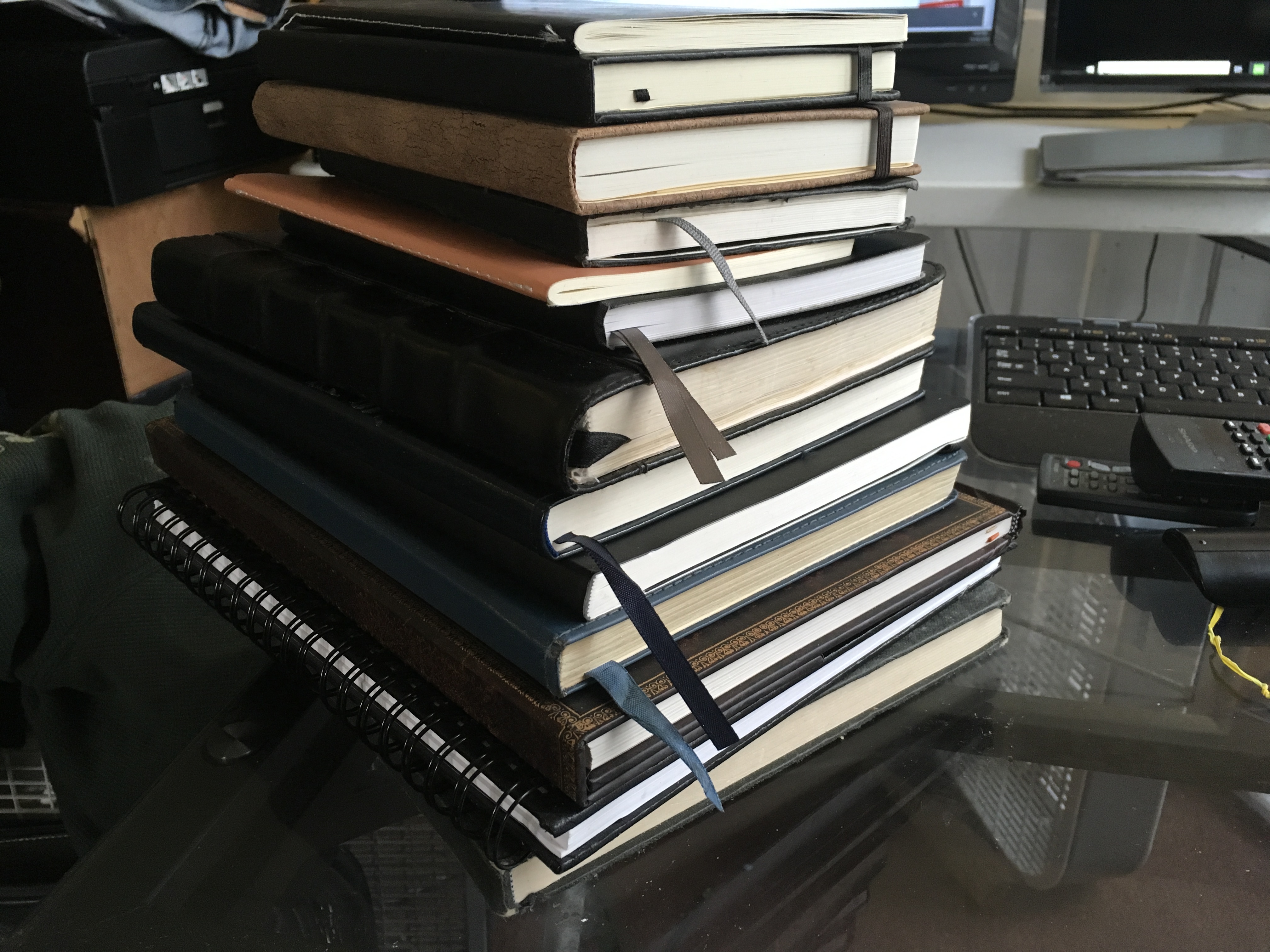
Like yesterday, I was talking about chasing the start of a story, sitting at my laptop… but I skipped a step. First, I write a few notes in my journal. Random lines, loose thoughts, things that feel like they matter. I also keep a microrecorder on hand for fast ideas when I’m out — then I transcribe those into a binder.

I’ll sometimes spend weeks researching a topic before I write a single sentence for a story. Somewhere in one of the dozen journals scattered around my house, there’s a note — a clue — waiting to tie it all together.

“Today was a good day. I wrote a sentence.”
— James Joyce

I keep that quote close. It’s a reminder that one good sentence is worth more than a thousand shitty ones.
No fluff allowed. Ever.

Another way I keep the engine running is by going back and reading my old notes.

Earlier this week, I was flipping through a binder from ten years ago and found a scribble about a quirky love story set on Friday the 13th. Sound familiar? It should — I think I finally wrote that story last year.

Looking back shows you two things: growth and delusion. You see yourself in these raw, unfiltered snapshots — how sharp you were, or how far off base. Sometimes I shake my head at my younger self and think, Jackass.

But that’s part of the deal. This brain — stubborn, scattered, always working something out in the background — it’s the oldest thing I own, and the most used. And like that old pickup, it’s still running. Somehow.

Sometimes I look back and wonder how my late wife ever put up with my scattered, feeble-minded antics. The half-finished thoughts, the notebooks everywhere, the midnight mutterings about plot twists or people-watching revelations.

Then it hits me — maybe she just had a predilection for the company of psychos.

God knows, I gave her plenty of material. But she stuck around, laughed at the chaos, and made room for it. That counts for everything.

The Moment That Catches You

Daily writing prompt
Describe one of your favorite moments.

DAILY PROMPT RESPONSE

Throughout my life, I have had numerous moments that make me smile, chuckle, and even cry. That’s not unique — we all carry those. So, I won’t go there. Instead, I’d like to discuss something else. Something quieter, but deeply personal.

The moment a story begins.

It’s not always dramatic. Sometimes it’s just a flicker — a stray thought, a memory, an odd image that won’t let go. But for me, that moment is electric. It’s the exact point where imagination kicks in, where the real world and the possible world start to blur. It might come during a walk or while staring out a window. No fanfare. Just that quiet spark that tells me: there’s something here.

That’s the kind of moment I treasure. Because from there, anything can happen.

Most of my story ideas come when I first wake up. There’s this moment — half-dream, half-thought — where I catch a fragment of something in the corner of my mind. I turn toward it. I chase it. And if I’m lucky, I chase it long enough for it to turn around and catch me.

That chase is what charges me. Stumbling through the dark, following breadcrumbs left by a story that doesn’t want to be found—not yet. The clues never come in order. They show up like scattered pieces of a massive jigsaw puzzle, except there’s no picture on the box. The image only reveals itself as you fit the pieces together. And even then, sometimes you’re wrong. Fooled. Thrown off.

And honestly? That’s when things get sexy. That’s when the story pushes back, when it fights you a little, when it demands more.

But we must be honest — to get the real stories, the good ones, you’ve got to look into the abyss. That’s where they live—just sitting there, waiting, watching, and daring you to prove you’ve got the patience, the grit, the nerve to piece them together.

You have to be careful, though. When you’re deep in it — in the thick of the story — you can lose everything. It can vanish like a wraith. One second, it’s there, close enough to feel, just long enough to let you know it could be something. The next, it’s gone. Because maybe you weren’t ready. Maybe the story saw through you. Weighed you. Measured you. Found you wanting.

Doubt stands at the edge of the Shadow, glaring with that slight, sinister grin — the kind that chills you deeper than you care to admit. You start to hear the whispers oozing from its lips. At first, you ignore them. But slowly, they start to take hold. You feel them crawl under your skin, digging their nails in. Their shrieks serenade your soul.

You have to resist. You have to defend the faith — in yourself, in the work, in the chase. Sometimes that’s all a writer has. Belief and maybe a little luck. If your courage holds.

So you scream back: “GET THE FUCK OFF ME!”

Then you breathe. Settle. Take the next step on the path.

I sit down in front of my laptop. Coffee on one side. A smoke. Guppy curled up by my feet. I take a deep breath.

And I write the first word.

Bucking the Tiger’s Odds and Surviving

Daily writing prompt
What are you passionate about?

DAILY PROMPT RESPONSE

Remembering who I am after nearly losing everything

If you had asked me what I was passionate about before this moment, I probably would’ve said, “I have no idea.” Not because I didn’t care, but because I forgot. Not in the usual way—like misplacing keys or losing track of time. I forgot because I let other people’s voices drown out my own.

A few close friends once told me I didn’t take my writing seriously.

That wrecked me.

Because if there’s one thing that’s never left me—never betrayed me, never faded—it’s writing. It’s been the thread stitching my life together from the beginning. So when someone said I didn’t take it seriously, I started questioning everything. If not this… then what?

Then someone else told me I’d turned my back on music. The very thing that once felt like oxygen. It used to pulse through me. Now I was being told I’d abandoned it?

That’s when it all started unraveling.

I spiraled. Hard.

I had no idea what the hell I was going to do. My world had changed so much while I was sick, and I hadn’t prepared—not mentally, not emotionally—for what surviving would feel like. I’d braced for death, not for life after it.

Then one day, out of nowhere, I whispered an old mantra:
“I don’t give a fk.”**

I said it so often that someone actually bought me socks with it on them. No joke.

That one line cracked something open. I started writing again. Drawing. Creating anything I felt like. Not for approval. Not for applause. For me.

And something strange happened—I picked up my pen and wrote better than I ever had. My drawings? It was like I’d never stopped. Like all the time I thought I’d lost hadn’t dulled my skill—it had sharpened my edge.

Even my editor noticed. Called me up and asked, “What happened?”

I couldn’t answer. Because I didn’t know.

I didn’t sit around analyzing it. I didn’t break it down into steps or label it some kind of comeback story. I just kept doing my thing.

I followed my curiosity. Researched whatever the hell I wanted to. Filled my head with what most people would call useless facts—until they needed them. Until the moment a random question popped up and I wasn’t just throwing out some recycled opinion off social media—I had real input. Valuable insight.

Then it hit me:

Everything I’ve learned in my life touches the work I create.
All of it. The random facts. The scars. The late nights obsessing over things no one else cared about. I spent a lifetime gaining knowledge—not for grades, not for clout, but because learning was my first passion.
And now, I remember how to apply it.

That’s passion. Not a performance. Not a brand. Just living and learning because it feeds your soul.

It’s not perfect. I still lose my way. I still forget what lights me up.

But I always come back.

Because I remember now:
I almost died.
And I didn’t.

So what am I passionate about?

I’m passionate about not living like I’m already gone.
I’m passionate about writing with truth, not for claps.
I’m passionate about being better, not louder.
I’m passionate about the quiet work of staying true to what matters—especially when no one’s watching.

I remember who I am, even when I’m the one trying hardest to forget.

Peace, Integrity, Humility — And Other Ways to Make Life Harder on Yourself

Daily writing prompt
What are the most important things needed to live a good life?

DAILY PROMPT RESPONSE

What are the most important things needed to live a good life?

For me, it really boils down to three things: peace of mind, integrity, and humility.

Peace of mind isn’t just a cute idea you chase after you’ve ticked off the career boxes and bought the right brand of meditation app. It’s the whole point. It’s being able to sit alone-no noise, no phone, no endless doomscrolling — and not feel like your own brain is trying to mug you. Without peace, all the money, likes, and shiny milestones mean exactly squat.

Integrity — the forgotten art of not being a sellout. Not the performative kind either. I’m talking about the real-deal, do-the-right-thing-even-when-it-sucks integrity. It’s what you do when no one is throwing you a parade or handing you a blue checkmark for it. It’s not glamorous, but it’s what keeps you from waking up one morning wondering how you turned into exactly the kind of person you used to roll your eyes at.

Humility — the secret sauce that keeps peace and integrity from congealing into self-righteous nonsense. Humility isn’t about shrinking yourself or apologizing for existing. It’s about remembering that no matter how many gold stars you’ve earned, you’re still a deeply flawed work-in-progress. You’re not the sun — the world doesn’t revolve around you.

And this leads into something a lot of people miss: Yes, living a good life is about not surrendering — not selling your soul at clearance prices. However, it’s also about recognizing that not everything revolves around you and your needs. Crazy, right? We tend to think our opinions, our feelings, our “truth” are the centerpiece of existence. And sure, it’s great to find like-minded people who “get” you, who nod when you talk and make you feel validated. But here’s the kicker: real growth often comes when someone challenges you, when they offer a perspective you hadn’t even considered because you were too busy broadcasting your own.

That’s why it’s imperative — life-or-death for your soul — to keep an open mind without compromising your integrity. It’s a balancing act, no doubt. But nothing in life is purely black and white, no matter how much we’d love for it to be. Life is lived in the messy, uncomfortable gray zones where two things can be true at once — where right and wrong aren’t always neon signs but flickering streetlights.


Why is it so hard to live by these values today?

Because society basically runs on encouraging the opposite.

We sit around and moan about how broken everything is — how shallow, how divided, how exhausting. And, sure, the system’s cracked. But let’s not kid ourselves — these aren’t new problems. We’ve been fighting the same internal battles — pride, impatience, ego — since we were toddlers throwing tantrums over the wrong color sippy cup.

What’s changed? The chaos is just faster now, noisier, harder to tune out. Peace of mind? Good luck finding it when your entire life is competing with ads, outrage, and hot takes. Integrity? Tough sell when the world loves a good shortcut and sells out faster than concert tickets. Humility? Ha — humility doesn’t trend well. Loud wins. Big wins. Modesty doesn’t even get a participation trophy.

And let’s be real: the stuff we’re so furious at “out there” is often just a slightly uglier reflection of what’s going on inside of us. The same insecurities, anger, and fear. Society didn’t invent these flaws — it just put them in a sparkly package and added a 24/7 subscription model.

So you have to stay close to yourself. Not the Instagram-ready highlight reel, but the actual human being — the one who’s weathered real triumphs and real faceplants. The one who’s fought for peace of mind, integrity, and humility the hard way. These aren’t luxury accessories — they’re battle armor. They’re what protect you when the world, very efficiently and very loudly, tries to drag you into its circus.

At the end of the day, nearly everything you think you own — the job, the house, the accolades, the opinions of others — is rented. Temporary. The only thing you actually own is whether you stayed true to who you are — whether you fought the quiet, ugly battles that no one clapped for.

Living a good life these days isn’t about winning. It’s not about being the loudest, or the richest, or the most-liked. It’s about holding the line. It’s about not surrendering — but also about keeping your mind open without folding your integrity into a paper airplane every time someone disagrees with you.

And no — this isn’t some “Live, Laugh, Love” nonsense I ripped off a cool poster or skimmed in a self-help book. This comes from a lifetime of getting it wrong — repeatedly. Only to finally, stubbornly, start figuring out what actually matters and what doesn’t.

Here’s the rub: I still screw it up on the regular. I’m not handing you a blueprint — I’m handing you a work-in-progress. But the difference is, now I know it when I mess up. And I keep working at maintaining the few things I know are worth the fight: peace, integrity, humility.

If mistakes were to be made, I’ve made them. Lessons to be learned? I’ve learned them — well, some of them. The most important thing is, I haven’t been afraid to live.

If I can do it, you can too.

Because at the end of the day, the likes fade, the trophies collect dust, and the noise dies down. All you’re left with is yourself — hope you made good company. Otherwise, it’s gonna be a long, awkward ride to the end.

Lessons That Endure: Faith, Reflection, and the Blank Page

Daily writing prompt
List three books that have had an impact on you. Why?

DAILY PROMPT RESPONSE

Usually, I might point to a novel, a collection of poetry, or a dense work of philosophy. But today, I want to get back to basics — to the books that have stayed with me through different seasons, roles, and realities. They’ve been a steady hand through chaos, offering balance when the world tilted. They’ve shaped the man I am, no matter what hat I wear.

The Holy Quran — More than a religious text, the Quran is a blueprint for living with intention. It shaped my sense of purpose, grounded me in morality, and instilled a discipline that influences every aspect of my life — from how I treat others to how I carry myself through adversity. Within Islam, I’ve unfolded the idea of knowing thyself — not just knowing who I am, but who I am becoming. The Quran compels me to grapple with justice not just in the world, but within myself. It reminds me that mercy is strength, and that life, no matter how loud or long it seems, is fleeting. Through every trial and triumph, it’s been a mirror, a guide, and at times a necessary challenge.

The Holy Bible — Where the Quran shaped discipline and self-knowledge, the Bible opened the door to grace and forgiveness. Its parables and letters taught me that real strength isn’t just standing tall — it’s knowing when to kneel, when to forgive, and when to let go. The Bible reveals the resilience of the human spirit in the face of suffering, and insists that hope — fragile but fierce — is always within reach. It taught me that failure isn’t an ending; it’s often a beginning. That forgiveness isn’t weakness; it’s power. And that love, even when costly, is worth it. Across the stages of my life, it has met me where I was — sometimes offering comfort, sometimes issuing a hard call, but always pulling me higher.

The Quran and the Bible complement each other — a dialogue between discipline and grace, justice and mercy. And the blank notebook helps me unpack the wisdom each holds.

A blank notebook — Unlike the printed word, a blank notebook offers no guidance — just space. It’s where the noise fades and my own voice rises. Over the years, notebooks have held my dreams, doubts, plans, and questions. As a soldier, I fought for God, doing all I must — but no more. Yet I also answer to God. In the blank pages, I unpack the wisdom that often pushes me outside my comfort zone. This ritual clears my mind. Writing turns chaos into something I can hold and study. The notebook has been a silent witness to every version of me — the ambitious, the lost, the certain, the questioning. It reminds me that growth is messy, nonlinear, and worth recording. More than a tool, it’s a companion—patient, unjudging, and always ready for what comes next.

Vigilance by Another Name

Daily writing prompt
What fears have you overcome and how?

DAILY PROMPT RESPONSE

Fear: My Old Friend Rides Shotgun

You get older and realize you didn’t know a damn thing.

When I was young, fear was the one thing I wasn’t allowed to show. Not in my house, not in the Army, and sure as hell not in front of my family. Fear was the enemy. It was a weakness. It was that voice in your head you learned to silence—or at least pretend you couldn’t hear.

In the Army, fear was treated like a virus. You didn’t talk about it; you didn’t acknowledge it. You locked it down, put on your war face, and moved forward. To hesitate was to risk everything—your mission, your men, your skin. So you learned to shove it deep down somewhere you didn’t have to feel it.

However, the amusing thing is that, while in battle, I realized fear was my friend; it kept me alert. But we didn’t call it fear. We called it vigilance. We used phrases like “Stay Alert, Stay Alive” or the popular one, “Head on a Swivel.” No matter the catchphrase, we learned to understand that fear was a part of the job. But we never said that aloud.

In so many ways, fear gets a bad reputation. It’s been a part of us since the beginning. We need to understand how to use it, just as we do with anything else in life. Fear doesn’t forget. You can pack it away and bury it under years of deployments, promotions, and medals, but it never really goes away. It waits. Patiently.

Fear didn’t vanish when I left the battlefield; it simply found new arenas. When I became a husband and later a father, I thought maybe fear would find a new home somewhere far away from me. After all, what’s scarier—enemy fire or a newborn that won’t sleep for three days? Turns out, fear adapts. It’s just as present when you’re staring at hospital monitors as it is when you’re huddled in a foreign desert waiting for the next move.

All the darkness I’d seen in the world—the villages reduced to rubble, the faces of men who wouldn’t make it home—I wanted to protect my family from it. Shield them from the kind of pain that doesn’t heal, the kind that sticks to your bones. I knew I couldn’t stop the world from being what it is, but I sure as hell wasn’t going to roll over. There’s nothing worse than feeling helpless when the world decides to teach your child a lesson. You want them to grab the world by the horns and kick its ass. When they do something courageous, we applaud them, exhaling because we know it could have gone another way. But you have to trust that the things you taught them will catch hold. They often surprise you because they have been listening all along. And let me tell you, they didn’t make it easy.

Fear stayed with me even as they grew. I swear it’s their job to scare the shit out of you, and they seem to take that job pretty seriously. Like the time, my son decided to jump out of perfectly good airplanes because he “wanted to be all he could be.” I considered banning television in the house. Or when my daughter drove cross-country in a beat-up car with a prayer and a gas card. Every bold move they made had me aging in dog years, and I have the gray hairs to prove it, but damned if I wasn’t proud.

I spent decades pretending I had it all under control. I kept fear on a short leash, convinced that ignoring it was the same thing as mastering it. But no matter how many battles I fought, how many bills I paid, or how many “Dad of the Year” moments I racked up, fear was always there, waiting for a crack in the armor.

It wasn’t until I retired—hung up the uniform, no more missions, no more late-night phone calls, just silence and the old ghosts I’d tried to outrun—that I finally sat still long enough to hear it clearly. Fear wasn’t the enemy. It never was. It was the warning system, the gut check, the part of me that said, “Hey, maybe charging headfirst isn’t always the best plan.”

These days, I no longer fight fear. I listen to it. I don’t let it steer—I’ve still got too much pride for that—but I let it ride along. We’ve made peace, old fear, and I.

Funny thing is, now that I’ve stopped pretending I’m not scared, I’ve never felt braver. Fear, that old companion who kept me vigilant on battlefields and restless nights, still rides with me. Only now, we’re on better terms—I trust it to keep me sharp, and it trusts me to keep moving forward, one step smarter than the man I used to be.

The Strength in Fracture

PROSE – FOWC & RDP

We find strength when we crack, not despite it, but because of it.


There’s something deeply human about breaking.

Not the kind of collapse that’s loud and chaotic—but the quiet kind. The kind that sneaks in slowly, pressing against your foundation until one day, without warning, you feel it: the shift, the splinter, the give. And then the silence that follows. That’s the feeling these images evoke. A visceral, wordless Yikes that lingers in the gut.

You don’t see the break coming. But when it arrives, it’s undeniable.


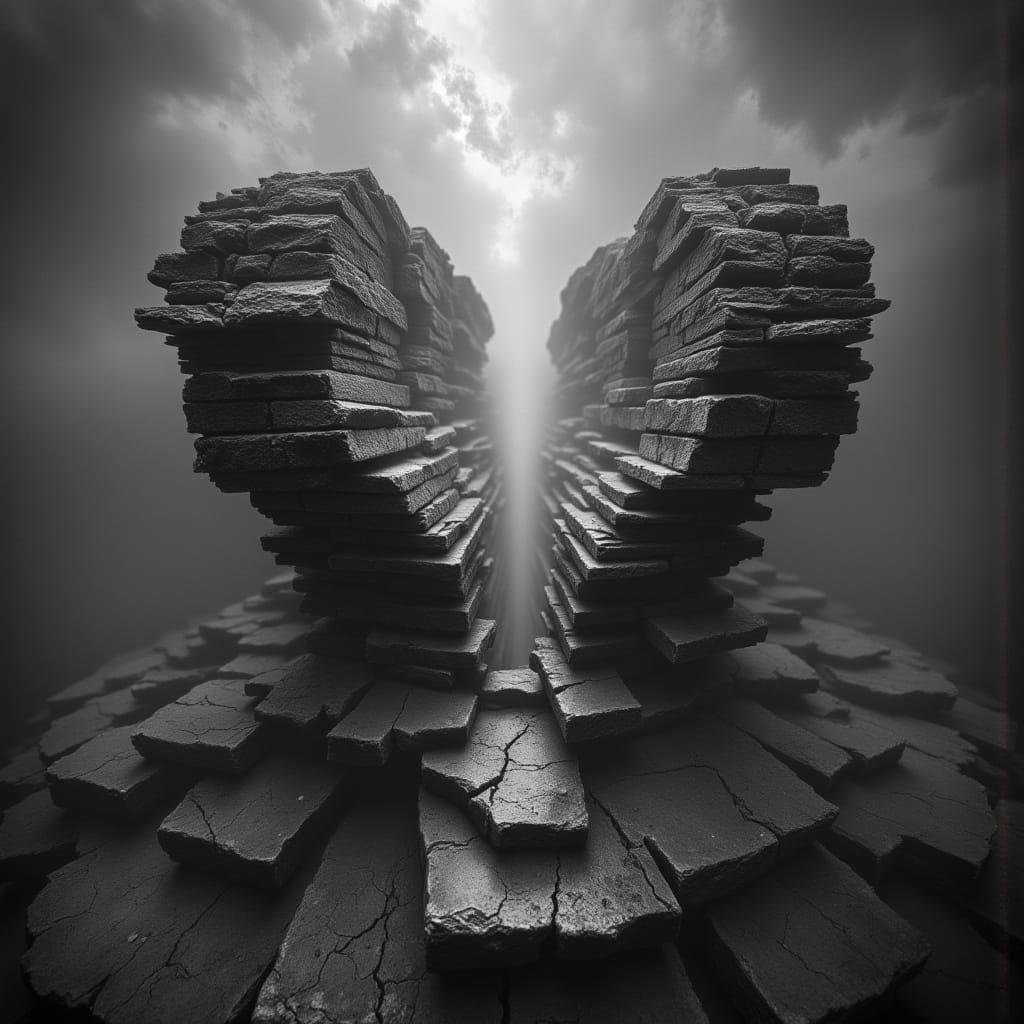
In the first image, we see a heart—not soft, not red, but forged from slabs of cold, cracked stone. Split down the center, it doesn’t bleed. It doesn’t scream. It simply opens, revealing a light that neither heals nor blinds. This is not a symbol of destruction. It’s a portrait of vulnerability. Of strength that dared to yield. And that’s the paradox: what we build to protect us can also be the very thing that prevents us from feeling, from growing, from becoming.

There have been times I cracked. Times when all I could do was sift through the rubble and pretend I was okay. On the outside, I held. On the inside, it was layers of damage—quiet, hidden, untreated. It wasn’t dramatic. It was ordinary, and that’s what made it dangerous.

And just when you think it can’t go deeper, it does.


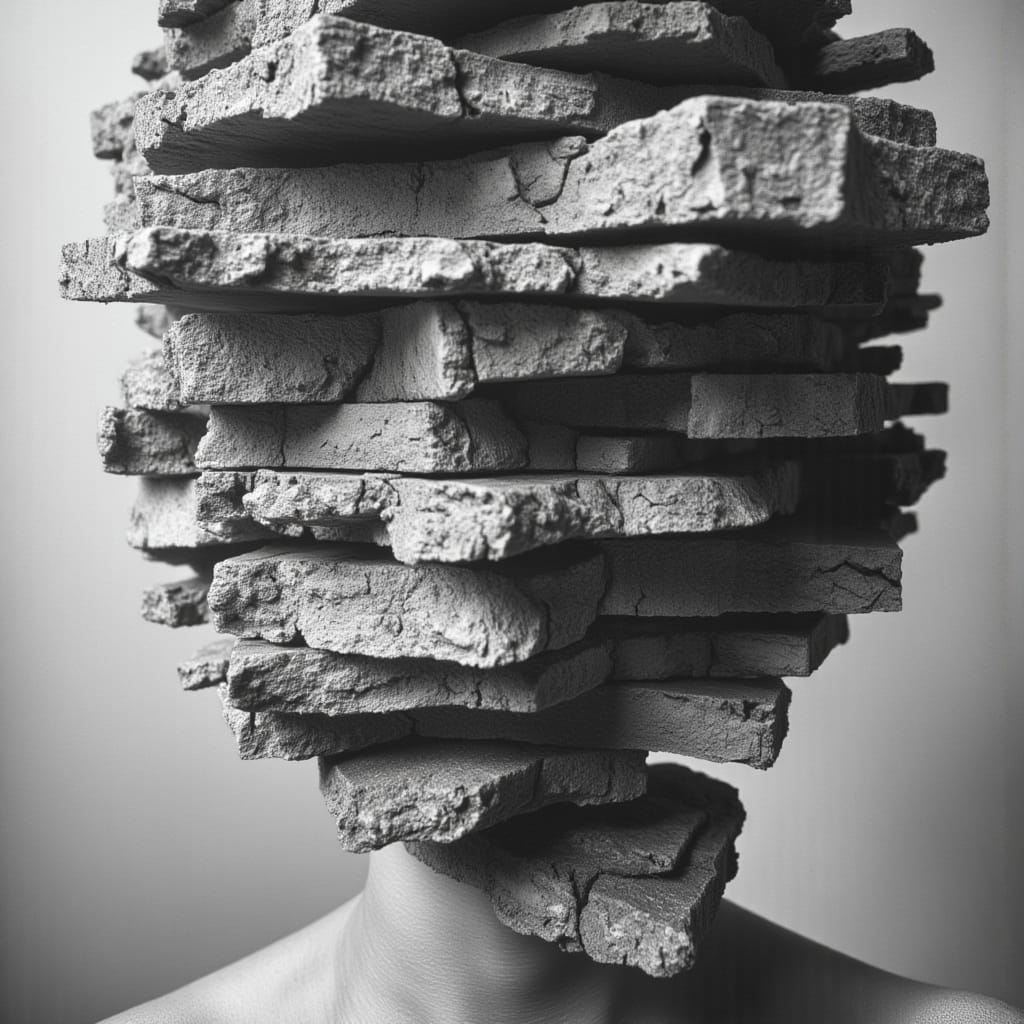
The second image strikes harder. A head—presumably human—layered with thick, dry slices of rock, features obliterated by the burden of their own defenses. You don’t see eyes, mouth, or even expression. You see the consequence of endurance.

We do this, don’t we? We pile on the layers: expectations, roles, trauma, silence. One by one, they smother the self underneath until we become unrecognizable, even to ourselves. And when someone asks us how we’re doing, the reaction is automatic: “I’m fine.” But the truth is buried somewhere deep, wedged between layers too heavy to lift alone.

But what if the face we hide becomes the face we lose?


The final image is a tunnel of shattered stone tiles, a fractured pathway bathed in harsh, white light. It’s hard not to see this as a metaphor for transformation. The path isn’t smooth. It’s jagged. Uneven. And yet it leads forward.

That light? It’s not salvation. It’s exposure. Clarity. Maybe even a challenge. The only way through is through. You walk over the wreckage of everything you thought would last, everything you thought you were, and you move anyway.

These images aren’t just art. They’re mirrors. They ask you to look closer—not at the cracks in the stone, but at the fractures within yourself. The places you’ve gone numb. The truths you’ve buried. The parts of you are still waiting to be unearthed.

So yes, Yikes might be your first instinct. But maybe that discomfort is the doorway to something deeper. Maybe the real reaction isn’t fear, but awakening. What if breaking is not the end of the structure, but the beginning of something raw, real, and finally alive?

What have you layered over instead of facing?
What parts of you are still buried beneath the rubble?
And if you followed the cracks, where would they lead?

I Thought I Could Fix Everything—Until I Couldn’t

Daily writing prompt
What are you good at?

DAILY PROMPT RESPONSE

I’m good at solving problems—the real ones. The messy, inconvenient, “everything’s-on-fire” kind that show up at 2 a.m. I was that guy—the one you call when it’s all falling apart. And by sunrise, I’d be walking away with a cigarette in one hand and a cup of coffee in the other like nothing happened. Crisis averted. No medals. No meltdown. Just fixed.

Fixing things became my identity. Not in some poetic, savior-complex kind of way—but because someone had to do it. Appliances, busted cars, computers, money problems, broken plans—you name it. I’d lock in and work it until it bent or broke for good. Most people panic in chaos. I get focused.

So naturally, when I asked my family what I’m good at—for a course assignment—they stared at me like I’d just asked them to name all my past lives. Eventually, a few mumbled agreements trickled in. But when it came time to list my flaws? Oh, that list rolled off their tongues like they’d been practicing for a roast. That’s when it hit me—people don’t always see the person holding the whole thing together. They just assume the mess disappears on its own.

And still, amid all that, my stepmom—the queen of unsolicited truth bombs—drops this: “Honey, you can’t fix everything.” I laughed, of course. That’s what people say when they’ve given up too soon, right? When they haven’t stepped back, taken a breath, and tried again from another angle.

But with time, her words started to stick. Not because she was right about everything, but because I started to see the limits of even my best efforts. I realized that every problem has a solution, but I wasn’t the solution to every problem. That stung, but it also freed me. I didn’t have to carry every broken thing. I didn’t have to make everything work.

Still, if there’s a problem with a fix in it, I’ll find it. That’s what I do. I bring logic into chaos, patience into panic, and if the solution exists, I’ll get there. But now I know when to fix, when to walk away, and when to just be present in the wreckage with someone else.

So yeah. What am I good at? I’m good at being the one who shows up when it matters. The calm in the storm. The fixer with a sense of humor and a pretty solid track record. And just enough wisdom now to know when I’m not the answer—and to be okay with that.

My Life Goals Include Coffee

Daily writing prompt
What does “having it all” mean to you? Is it attainable?

DAILY PROMPT RESPONSE

“Having it all” sounds like the title of a self-help book ghostwritten by someone who drinks green juice for dinner and cries in their Tesla. It’s vague enough to seem profound, and just specific enough to make you feel like you’re failing.

What does it even mean? A six-figure job with no after-hours emails? A partner who remembers anniversaries and does the dishes? Inner peace, abs, well-adjusted children, and a well-stocked fridge — all at once? That’s not a life. That’s a fever dream.

Ask the right person and they’ll tell you exactly what “having it all” means. They’ll say it with that glazed, TED Talk confidence that screams, “I rehearse my affirmations in the mirror.” Usually, some nonsense about balance, intention, or monetizing your passion. And sure, we let it slide — because we’ve got more urgent problems like whether there’s enough coffee to survive the morning, and if Steve from accounting is going to hog the microwave again.

The truth is, “having it all” is a capitalist carrot. It’s designed to keep you chasing, spending, comparing — never arriving. You can climb every rung, hit every milestone, and still feel like you’re missing something. That’s the point. It’s a treadmill, not a destination.

Is it attainable? In theory, maybe. In this reality? With this rent? With this 47-tab browser brain and a body held together by caffeine and vague dread? Not likely.

For me, “having it all” means waking up without a panic spiral, drinking a full cup of hot coffee in peace, and ending the day without wanting to fake my own death. That’s it. That’s my utopia. If I’ve got that, I’m doing alright.

Maybe it’s not about chasing some polished version of success that looks good on LinkedIn. Maybe it’s about carving out just enough quiet, food, love, and laughs to keep going.

My life goals include coffee. The rest is flexible.

Holding the Line: Fractures and All

Daily writing prompt
What personal belongings do you hold most dear?

DAILY PROMPT RESPONSE

“The only thing necessary for the triumph of evil is for good men to do nothing.”
— Edmund Burke

For years, I stood for what I believed couldn’t be broken: humor, integrity, truth. It’s not the kind you post about, but the kind you lose sleep over. The kind you keep when it costs you something.

I stayed steady. I didn’t cut corners. I thought it would mean something if I just held the line long enough. That my convictions would carry weight. They’d hold the chaos back, even if only a little while.

But then came the choice.

It wasn’t dramatic. No burning building, no lives on the line. Just a conversation in a quiet room, a decision no one would see. And we told ourselves it was for the greater good. That by bending, we could protect more.

The cost was one truth I didn’t speak. One silence I allowed. It didn’t feel like a betrayal at the time. It felt strategic. Efficient.

But the lie lived on, and others paid for it.

The nameless suffered the consequences for what I didn’t expose. Integrity fractured, honor destroyed. I started to look at myself differently—not with anger but with confusion. We told ourselves we were the good guys, but were we?

“The intention is nothing without the action. It is not the consciousness of men that determines their being, but their social being that determines their consciousness.”
— Karl Marx, Preface to A Contribution to the Critique of Political Economy (1859)

And maybe we still are. But not without damage.

Because the most challenging part isn’t the decision—it’s living with what it took from you. You go home. You look in the mirror. You wonder if the person staring back is still you.

And then, today, it happened again.

Another quiet moment. Another conversation behind closed doors. A shortcut. A lie I could’ve told. No one would’ve known.

But I did something different.

I said no. My voice cracked, but I held the line. I walked out knowing I’d made things harder for myself. But I also walked out, still able to breathe.

I’m not who I was before the compromise. I don’t think I ever will be. But I haven’t gone completely. There’s still a part of me that recoils at the easy road. A part that still whispers: “Not this. Not again.”

I fight for that voice now.

Not to be redeemed. I’m long past chasing purity. I fight to guard what remains intact—to protect the sliver of soul that refuses to rot.

Because if I let that go, I’m no longer making hard choices for the greater good. I’m just protecting myself. And that’s where corruption truly begins.

That whisper—fragile as it is—is still mine.
And for that, I fight.

Because if I can keep that alive, I haven’t lost everything.

The Stuff They Give Up (So the Rest of Us Don’t Have To)

Daily writing prompt
What sacrifices have you made in life?

DAILY PROMPT RESPONSE

Everyone makes sacrifices. That’s just part of being an adult—along with bills, back pain, and pretending to understand how taxes work. But some sacrifices don’t get enough credit. They’re quiet, constant, and totally underappreciated. Let’s start with parents.

Parents: The Masters of Silent Sacrifice

Sure, everyone knows parenting is hard. But it’s not just about surviving diaper blowouts or sitting through 300 replays of Frozen. It’s about the real, behind-the-scenes sacrifices. Like the mom who takes a job she doesn’t love just because it comes with decent health insurance. Or the dad who eats the last two bites of crusty mac and cheese instead of cooking himself dinner—again.

Parents give up more than time and money. They give up peace and privacy. They trade dreams for dental plans. And let’s not forget sleep. You could power a small city on the energy parents lose just trying to get a toddler to bed. It’s not glamorous. No one hands out medals for making it through a meltdown in Target. But these sacrifices shape lives. Quietly. Powerfully.

First Responders: Showing Up When It Counts

Then there are first responders—firefighters, EMTs, police officers—the folks who run toward danger while the rest of us are Googling “how to escape a burning building.” These people give up a lot too.

They miss holidays, birthdays, sleep… you know, all the fun stuff. And what do they get in return? Stress, trauma, and the joy of paperwork. Lots of paperwork. Plus, they carry memories most of us couldn’t handle—gritty, painful, unforgettable moments that stay long after the sirens stop.

And yet, they keep showing up. Not for glory. Not for a gold star. Just because someone has to—and they’ve decided it’ll be them.

The Sacrifices We Don’t See—But Should

Here’s the thing: whether it’s a parent sacrificing their sanity during a four-hour kindergarten play, or a paramedic showing up at 3 a.m. because someone else’s world just fell apart—these acts deserve more than a passing “thanks.” They deserve to be seen. Respected. Remembered.

Because at the end of the day, sacrifice isn’t always some big, dramatic gesture. Most of the time, it’s a thousand small decisions made out of love, duty, or just sheer stubborn commitment to doing what’s right.

And maybe a little caffeine.

Camping: Because Paying to Be Miserable Is Apparently a Thing

Daily writing prompt
Have you ever been camping?

DAILY PROMPT RESPONSE


An open letter to everyone who thinks bug bites and canned beans are a good time.

Look, I get it. “Camping is so refreshing,” they say. “It’s healing! It helps you disconnect!”

Cool. So does turning your phone off and taking a nap in a real bed. Because let’s be honest—camping is just voluntary homelessness with snacks.

Yes, yes, I’ve heard the propaganda:

“It reduces stress!”
“It reconnects you with nature!”
“You’ll sleep better!”

Really? Have you ever tried sleeping in a zipped-up nylon taco, on top of a rock, while a mosquito EDM festival rages six inches from your face? Nature isn’t hugging you. It’s hazing you.

Let’s get into it.


1. The Weather Is a Liar
The app said sunny. You packed shorts. Now it’s 3 a.m., your sleeping bag’s a sponge, and you’re praying your tent doesn’t collapse in the downpour. Mother Nature doesn’t care about your forecast—she’s here to ruin your socks and your spirit.


2. Bugs: The True Camp Counselors
“Oh, just a few mosquitoes,” they said. Wrong. It’s an insect Thunderdome out there. Mosquitoes, spiders, ants, bees—plus one raccoon with dead eyes and a chip addiction. You’re not at the top of the food chain. You’re on the menu.


3. You Paid to Be Miserable
Congrats! You dropped $300 on gear to cosplay as a frontier orphan. No mattress. No bathroom. No fridge. Just you, the dirt, and a can of baked beans sweating in your backpack. It’s like glamping, minus the “glam.”


4. The Bathroom Situation (A Horror Story)
It’s midnight. You’re squatting over a questionable log. One hand’s holding a flashlight, the other is praying to the god of not-peeing-on-poison-ivy. This isn’t “rustic.” It’s trauma.


5. Fresh Air Exists in Cities Too
If you want to breathe clean air, open a window. You don’t have to wander into the woods like some kind of Wi-Fi-less pioneer to feel “connected.” There’s a park near your house. It has benches and cell reception.


6. Campfire Cooking Is a Scam
Grilled hot dogs on a stick you found near a squirrel nest? Wow. Truly the Iron Chef experience. And let’s not forget the burnt marshmallows—nothing says “nature cuisine” like charred sugar goo stuck to your molars.


7. Sleep? In This Economy?
Nature sounds peaceful… until you’re trying to sleep. Then it’s either murderously silent or an audio jungle of crickets, raccoons, owls, and something growling that you’re definitely not Googling right now. You won’t get REM. You’ll get hypervigilant.


Final Thoughts
Camping is a beautiful, wholesome way to deeply regret your choices. If your idea of fun is working hard to be cold, itchy, hungry, and slightly feral—great! Have at it.

As for me? I’ll be inside. With flush toilets, strong coffee, and the blessed hum of air conditioning. Nature can stay outside where it belongs—preferably behind a double-paned window. With a lock.

How to Fall Apart (and Call It Progress)

Daily writing prompt
What does freedom mean to you?

DAILY PROMPT RESPONSE


A discussion about becoming unraveled, unburdened

What does freedom even mean? It’s like one of those made-up words everyone thinks they understand, but no one actually does. We toss it around in debates, slap it on bumper stickers, or turn it into a hashtag. Then we try to sound deep by asking, “In what sense do you mean — philosophical, political, personal?” But let’s be honest: most of that is just smoke to dodge the real answer. Which is, simply: I don’t have a clue.

We often treat freedom like a buzzword—something we claim, defend, hashtag, or stick on the back of a truck. It’s sold as autonomy, choice, and the sacred right to do whatever we want whenever we want. But real freedom? It’s not that flashy. It’s quieter, more internal, often inconvenient, and much harder to define. You don’t notice it on a billboard, and it won’t trend for long. It might even be harder to see, because it begins not with what we do, but with how we perceive—how we see ourselves, others, and what we think life owes us.

Across spiritual traditions—Buddhism, Taoism, Sufism, Christianity, Judaism, Islam—a pattern emerges: we are not free by default. We’re born into inherited scripts, societal myths, and a mess of cravings, fears, and projections. Most of our lives are spent reacting to things we don’t even understand. It’s like trying to win a board game where the rules are vague, the instructions are missing, and someone keeps changing the goalposts when you’re not looking. No wonder we’re tired.

Freedom, in the deeper sense, isn’t about getting our way. It’s about seeing clearly enough that we’re no longer at the mercy of every craving, trigger, or existential itch. In Buddhism, this means recognizing dukkha (suffering) and its cause, tanhā (craving). Sufism centers on taming the nafs — the unrestrained, insatiable ego. Taoism discusses abandoning the exhausting need to force outcomes and instead moving with the current.

Christianity points us to the idea that freedom comes not through control but through the purification of the heart. “Blessed are the pure in heart, for they shall see God.” Not “they shall win,” not “they shall be promoted,” but see. It’s not exactly the promise of a six-figure salary, but it might be worth more. Judaism and Islam also make it clear that freedom is not about breaking the rules, but living in alignment with something truer and eternal. In other words, you’re not the center of the universe — and that might be the best news you’ll hear all day.

This challenges our cultural obsession with control. As Ishmael shows us, modern civilization has wrapped freedom in the myth of domination. We think freedom means being the boss—of nature, of time, of each other. But domination isn’t freedom. It’s just anxiety in a power suit. The more we try to force the world to match our expectations, the more we suffer when it doesn’t.

And yet, even when we “get it,” the work is anything but linear. Sometimes, the path to freedom involves breaking down. Not the tidy kind of unraveling you read about in memoirs, but the ugly, confusing, no-GPS type of collapse. And oddly enough, that might be necessary. Because falling apart can strip away what was never really you. It can expose what’s underneath the performance, the control, the coping. You meditate one morning and snap at someone by lunch. You let go of a toxic habit, then dream about it for a week.

That’s because fundamental transformation creates cognitive dissonance—the friction between the polished self we’ve been taught to perform and the inconvenient truths trying to surface, like realizing that your definition of success might be making you miserable, or that the life you built isn’t the one you actually want. The system shakes when what we’ve believed can no longer hold up to what we’re beginning to feel. It’s disorienting. But that disorientation is a gift. It’s how the mind makes space for something more honest.

That’s not regression. It’s evidence you’re alive and paying attention — maybe even transforming.

Absolute freedom isn’t being untouchable. It’s being touchable without falling apart. It’s having enough self-awareness to recognize when you’re being hijacked by old stories, and enough stillness to pause before you reenact them. Learning to laugh at your own nonsense is key before it convinces you it’s the voice of God. You don’t destroy the ego; you learn not to take it so seriously.

And here’s the kicker: understanding isn’t the end of the journey—it is the journey. Freedom begins the moment you start to see differently: when the illusion cracks just enough to let in the light, or, just as often, when the darkness teaches you to feel your way through. The dark isn’t the enemy; it’s where the roots grow, where silence speaks, where real seeing begins. Understanding doesn’t guarantee peace but gets you in the room with it. And that, on most days, is freedom enough.

Perhaps today marks the opening of a much deeper conversation—scary, uncomfortable, and sometimes downright mean. A conversation that shakes the foundation of who we think we are, or who we’ve been told to be. It may challenge the ideals we’ve long held sacred. My question is this:

Do we need that kind of disruption to be free?

I know I do. Yeah, I’m scared. I’m frustrated. I’m pissed off. But I also know it’s necessary—because this discomfort is where I grow into the man I actually want to be.

Corner Wisdom

Daily writing prompt
List the people you admire and look to for advice…

DAILY PROMPT RESPONSE

There have been plenty of people in my life I’ve admired and turned to for advice—too many to name, if I’m being honest. So instead of listing names, I’ll talk about a time in my life.

When I was a young buck, there were a few older gentlemen who used to hang out by the market. These cats preached—not religion, but life. No dogma, just wisdom. I’d stop by with a bag of penny candy and listen in.

Some of them also posted up at the barbershop, dropping the same kind of knowledge. I always wanted to be that cool—calm, sharp, and respected, with something real to say.

I’d go home and tell my auntie and MiMi about those guys. They’d tell me to stay out of grown folks’ business—and let me know which ones to steer clear of. But most of those men knew MiMi, so I was safe. Nobody messed with MiMi’s kinfolk.

Looking back, I probably wasn’t getting the full picture—just a watered-down version of what they were really saying. But I appreciated every bit I was able to soak up. It stuck with me.

Though I admired those men and wanted to be like them, I never thought I’d get there. Then one day, at my niece’s wedding, I was cutting up with my brothers, just talking mess, making people laugh. This young lady nearby was cracking up at us. Then she said, “I hope I’m this cool when I get old.”

We were floored. We’re a lot of things—but cool? That one caught us off guard.

But I’ll always remember this: people will remember your example more than your advice.

Maggot Brain: Where Beauty and Despair Collide (and Punch You in the Gut)

TUNAGE – SLS

Funkadelic’s Maggot Brain isn’t just a record — it’s a reckoning. Released in 1971, it captured the psychic temperature of a country unraveling. War abroad, decay at home, distrust in the air, and the so-called counterculture burning out in real time. Maggot Brain took all that noise, that grief, that disillusionment — and turned it into one of the most brutally honest LPs ever pressed.

It wasn’t neat. It wasn’t safe. It was spiritual, political, cynical, funky as hell, and deeply weird — like a sermon preached from the edge of a nervous breakdown.

Maggot Brain captured the attitude of the entire country within a single LP. There was literally a track that spoke for everyone. If you were angry, it had you. If you were confused, it held you. If you just wanted to dance your way through the end times, Funkadelic had you covered. Every track hit a different nerve, and none of them asked permission.

There are songs that groove hard (You and Your Folks, Me and My Folks), others that mock the stupidity of it all (Super Stupid), and ones that crack open a deeper existential dread (Wars of Armageddon). But all of it orbits the title track. Maggot Brain isn’t just the opener. It’s the altar. It’s the cry at the center of the storm.

Eddie Hazel doesn’t play Maggot Brain. He doesn’t even perform it in the traditional sense. He haunts it. Possesses it. Bleeds into it. And once it begins, you don’t get to be a casual listener anymore. You’re drafted. No warning. No warm-up. Just a single, ghost-drenched guitar note that slides into your chest like a whisper you weren’t supposed to hear.

It’s not loud. It’s not fast. It just is. And that’s more terrifying than any distortion pedal at full blast. Hazel creeps in like a rogue spirit — smooth, silent, uninvited — and by the time you realize what’s happening, you’re already in it, stripped of cool and composure, emotionally pantsed.

You don’t get a beat to grab onto. No vocals to decode. Just a guitar screaming in slow motion. It’s like standing in the middle of a storm you can’t see but definitely feel. The grief is palpable. The rage is buried just deep enough to make you nervous. And right when you think you’ve got it figured out, the damn thing shifts and you’re spiraling again. Welcome to Maggot Brain — cognitive dissonance with a six-string.

Because let’s be real: this song shouldn’t work. It’s ten minutes, mostly one instrument. No verse. No chorus. Not even a satisfying drop. But for ten minutes, Eddie Hazel demolishes every “rule” about what music is supposed to be, and you love him for it. Or maybe you hate him for making you love it. Either way, you’re in it.

And no, you don’t walk away saying, “cool solo, bro.” You walk away dazed, like you just remembered a dream you never had. Or like your soul got mugged, politely. This is the kind of music that picks a fight with your expectations and then hugs you while you cry.

I still remember the first time I heard it — in a smoke-filled room full of strangers pretending not to be high. No one talked. No one moved. We were all just… held. Not by the music, exactly, but by whatever was trying to speak through it. We didn’t share a moment. We survived one. And we were better for it, or at least quieter.

Hazel doesn’t “solo.” He confesses, and we are his priests. Every bend, every scream from those strings is a sin laid bare. And by the end of the song, we have no choice but to grant absolution. Not because we’re qualified, but because he earned it. Because whatever he was holding, he handed it to us. And in some strange, sacred transaction, we took it.

His playing doesn’t follow any tidy roadmap. It stumbles through grief and grace, melting down and pulling itself back together like a nervous breakdown that found religion. There are moments where you think he’s going to lose it entirely — and maybe he does. But somehow, that’s the point.

You want to make sense of it, but your brain is two steps behind the whole time. Because it’s pretty and ugly. Gentle and violent. Hopeful and hopeless. Your heart’s trying to lean in while your head’s going, “Are we okay??” That’s the dissonance. That’s the magic. That’s why it hits harder than any perfect pop chorus ever could.

And George Clinton, cosmic genius and probable chaos wizard, gave Hazel just one instruction: “Play like your mother just died.” Which is both tragic and kind of a dick move, but clearly — it worked. What came out wasn’t a song. It was a slow, spiritual detonation. Hazel didn’t perform grief — he offered it. Raw. Untuned. Unfiltered. The kind of thing most of us spend our lives trying not to feel.

The track never resolves. No big finale. No grand crescendo. Just a long fade into silence, like a memory slipping back under the surface. It’s not done with you — it’s just gone. Until the next time you’re reckless enough to press play.

And I wonder: for those ten minutes, did Eddie Hazel serve as a guide to enlightenment?
Not the neat, monk-on-a-mountain kind.
The messier kind. The gut-punch kind.
The kind that grabs you by the heart, shakes something loose, and leaves without saying a word.


Maggot Brain #479 on 2003 list

Ego, Snacks, and the Search for Peace

PROSE – REFLECTION – SUNDAY POSER #230


At my core? Still me. Still sarcastic. Still curious. Still low-key allergic to group think and people who say “per my last email.” But life—especially this past year—shifted something in me. A life-altering moment has a way of stripping you down to the truth, whether you’re ready or not.

It made me realize I’ve been sitting on a set of gifts I’ve treated like party tricks. I can do more. I should do more. Sure, I could keep yelling into the void about the uncultured swine running the world (still baffled by how that happened). And if I accidentally handed them the keys somewhere along the way, then yeah—I’ve got some things to atone for. Maybe even finish the time machine in the basement.

But mostly, I’ve just changed in the way that matters: I’ve started trying. Less coasting, more choosing. Less needing to be right, more needing to be honest.

Wisdom? Not exactly my department. I’ll never be that guy. Never been that smart, and I’m okay with that. What I am is honest enough to admit I’m a deeply flawed man. Whatever good I carry, I got from my mother. The rest is a work in progress.

Marcus Aurelius said, “Waste no more time arguing what a good man should be. Be one.” I’m trying. Some days better than others. And like in Sufism, where they speak of the nafs—the lower ego—it’s a constant fight. Not to eliminate your ego, but to tame it. To bring it into balance. Peace doesn’t come from pretending to be pure—it comes from wrestling with your own chaos and not letting it win.

And honestly? If King Solomon—the wisest man to ever live—couldn’t get it all right…

I think I’m good.


Chronicles of a Social Media Peepaw

Daily writing prompt
How do you use social media?

DAILY PROMPT RESPONSE

Episode 1: Apparently, I’m “Doing It Wrong”

I don’t know how to use social media. That’s not false modesty—it’s a fact. And my grandkids make sure I never forget it.

“Peepaw, I just don’t understand,” is something I hear far too often, usually after I’ve posted something harmless like a photo of my cat licking a plate of spaghetti. The photo’s blurry (again), the caption’s too long, and apparently I’m using hashtags like I just discovered them yesterday. Which, to be fair, I kind of did.

What really riles them up are those blurry photos. “You literally have a good camera!” they protest, as if I’m dishonoring a sacred artifact. And they’re not wrong. I do have a good camera—it’s a sturdy old DSLR that doesn’t connect to the cloud, but it’s seen more family moments than most smartphones. It just takes a little work to upload. That’s what USB cables are for, right?

And let’s not forget—they got their start in tech by watching me work. I had wires running through the garage office before they could spell “HTML.” I was the one patching together PCs, fixing drivers, and explaining what RAM was. Now they’ve got degrees and job titles like “UI/UX designer,” and suddenly I’m the tech-challenged grandparent who needs an intervention.

I never set out to be the cool grandpa. I just wanted to share a few thoughts. Maybe post a picture of my chili (my chili is the truth). I wanted to cheer them on when they land a new job or adopt another rescue dog. But apparently, there are rules—unspoken, constantly shifting rules—and I’m breaking all of them.

That’s okay. I’ve made peace with being their favorite internet punchline. If “Peepaw doesn’t get it” gives them something to laugh about, I’m happy to play the part.

Besides, this is just the beginning. There’s a whole internet out there for me to misunderstand.


Memoirs of Madness: Writing Is the Only Way Through

PROSE – MOONWASHED WEEKLY PROMPT

Mind, body, and spirit—it’s not just a slogan on a t-shirt or a phrase tossed around in self-help books. It’s a lived, gritty process. It doesn’t happen in a straight line. It doesn’t always feel peaceful. It asks to be practiced daily, especially in the moments when we’re coming apart.

When my wife was dying, I was unraveling. There was no calm breath, no quiet meditation that could hold me. The pain was too loud, too sharp. I couldn’t go to the dojo—I knew I might hurt someone. So I turned to the only thing left that didn’t require restraint: writing.

That’s where Memoirs of Madness was born—not from ambition, but necessity. I wrote because if I didn’t, I was going to explode. Writing became my release valve. My attempt to find balance in a world that no longer made sense. It wasn’t polished. It wasn’t composed. But it was honest. It was survival.

Healing doesn’t always look like light. Sometimes it’s just sitting with the darkness long enough to stop being afraid of it. Writing gave me a place to do that. Not to escape pain, but to face it with something steady under my hands—a pen, a page, a place to speak freely.

People like to talk about acceptance, about “new normals,” especially when you’re going through something irreversible. I’ve been told I may never return to the person I was before. And maybe that’s true. But I also know it’s not the whole truth. I know there’s more to me than what’s been broken.

Throughout my life, I’ve encountered teachings I didn’t ask for. Moments of awe, loss, surrender, and grace. I didn’t always understand why they came, but something in me knew not to reject them. Writing became the way I made sense of them. The way I honored them.

It’s not therapy, exactly. It’s more like a mirror. Each word reflects something back at me—something raw, something I need to see. Writing doesn’t heal like medicine. It heals like movement. Like breath after being underwater too long.

Writers tell the truths we were taught to keep quiet. We witness the small miracles—flowers bending to the breeze, the call of a bird we can’t see, the still gaze of an animal watching us. We notice the laughter of children that vibrates with something pure and untouchable. We let it all into our bones. But writing is how we let it back out. How we stay connected—not digitally, but spiritually, viscerally.

Every sentence I write is a thread that connects me to the person I’ve always been beneath the layers of grief, anger, and expectation. Not the old self. Not the broken self. But the essential one. The one that endures.

I once asked: Who’s smarter—the adult or the infant? Predictably, everyone said the adult. When I pressed them, they said the child doesn’t know anything. But I disagreed. I said the infant. They laughed, of course. All but one. That one asked me, “Why?”

“Because the infant sees everything,” I said. “They feel everything. They haven’t learned to numb themselves yet. They haven’t picked up the habit of pretending. They are unfiltered truth.”

That’s what writing brings me back to. That clarity. That honesty. That wholeness before the world taught us to break ourselves into pieces.

Healing through writing isn’t a return to what was. It’s a return to what’s real. And sometimes, that’s more than enough.


Author’s Note:

I sat looking at the challenge image, thinking about the beauty of that moment frozen in time. I found myself wondering how to capture something like that in words. Lately, I’ve been studying Buddhism—not because I want to become a Buddhist, but because I’m wise enough to know that truth can’t be found with a closed mind.

Next thing I knew, this piece came through me.

It’s not all I have to say on the subject, but it’s a beginning.

Thanks, Eugi.

Nothing, Babe: A Travel Philosophy

Daily writing prompt
What place in the world do you never want to visit? Why?

DAILY PROMPT RESPONSE

To me, this is a loaded question. Like there’s just one place you’d never want to visit, as if you hear a name like Topeka and just decide: absolutely not.

I’ve been around. I’ve seen beauty in unexpected places and tension in spots that looked picture-perfect. So saying I’d never go somewhere feels rigid, and life’s too unpredictable for rigid rules.

But I won’t lie—there are places I instinctively avoid.

Some of that’s just gut feeling. I avoid places with names that don’t sit right—Bone Gap, Jim Falls, Slidell. Part of it is how they sound, part of it is associations I can’t quite shake. Sounds silly, but names carry weight. They trigger memory, emotion, or sometimes just a weird vibe that tells you to keep moving.

Then there are practical reasons. I don’t mess with places where monkeys outnumber people. That’s not fear—it’s realism. Monkeys throw things. I know myself well enough to admit I wouldn’t handle that gracefully. I don’t believe in animal cruelty, and I don’t want to find myself in a moral showdown with a macaque.

Then there’s the deeper stuff. As an American soldier, I’ve seen how quick misunderstandings can turn into something worse—especially when we didn’t know the customs or context. That always struck me as ironic, considering how much we pride ourselves on our ‘attention to detail.’ It taught me to respect where I go and to prepare before I get there. It also taught me that sometimes, respecting a place means knowing when not to go.

When my ex-girlfriend said, “No places with a history of cannibalism,” I didn’t laugh it off. That was her line, and I respected it.
But I couldn’t help myself—I looked at her and said, “So… just to be clear—California’s out, right? That whole Donner Party thing. Colorado too. Can’t forget Alfred Packer. Oh—and Virginia. Jamestown had a real rough winter.”
She stared at me, confused. “Wait… what happened in Virginia?”
I took a long sip of my drink, nodded slowly, and said, “Nothing, babe. Just history being weird again.”

Some places carry histories that deserve reflection, not vacation photos.

So no, I don’t have a definitive “never” on the map. But I have instincts, boundaries, and experiences that shape how I move through the world. That’s not fear—it’s awareness. And in a world this big, I think that’s fair.

What My Mother Taught Me, What My Family Gave Me

Daily writing prompt
Describe a positive thing a family member has done for you.

DAILY PROMPT RESPONSE

“Do as I say, not as I do,” the classic parental phrase, never touched my mother’s lips. However, “Because I said so,” not only repeated — it seemed like it should be on a plaque above the door. I even used it with my children, and they used it with theirs. However, this isn’t the most important lesson she gave me. What she demonstrated my entire life is how to be steady, even in the most challenging situations life has to offer.

She raised me by herself, so every bump, scrape, and broken bone — she was steady. Honestly, I don’t know how she did it. I remember being on the verge of losing it with my own kids, and I had a wife to back me up. To do it all alone? I don’t have the words.

That steadiness she showed me has served me well throughout my entire life. No matter what, I stay steady. I might be pissed off while I’m doing it — that trait definitely comes from my father. He had two modes: super cool or absolute death. Nothing in between. He kept people guessing because you never knew how he’d react. People say I do that too. I always swore I’d never be anything like him… well, oops.

It’s said that in life you have two families: the one you’re born into and the one you choose. My mother gave me the tools to build both. Her steadiness became my anchor, and whether I was dealing with work, parenting, or just the everyday chaos of life, I leaned on what she taught me — stay calm, handle your business, don’t fall apart.

And yeah, maybe I inherited some of my dad’s unpredictability too. But thanks to her, the foundation underneath is solid. That balance — between calm and chaos, between knowing when to hold it together and when to let it fly — that’s something I’ve carried into every relationship I’ve built, chosen or otherwise.

My chosen family has shown up for me in ways I never could’ve imagined. I’m truly blessed to have them in my life. Like all my family, they’ve been incredibly patient with me. I can be a lot sometimes — I know that. But they hang in there.

The challenges in life never really stop coming. But when you’ve got people who stick with you, who steady you, who love you even when you’re not at your best — you can get through anything.

In life, we have two families: the one we’re born into and the one we choose. I’m grateful for both.

The Change That Brought Me Back

Daily writing prompt
Describe one positive change you have made in your life.

DAILY PROMPT RESPONSE

After my health started to improve, I made a quiet promise to myself: take it slow, do it right, and make the changes stick. Not just another sprint followed by burnout. Not another performance. Just something real.

To be honest, I didn’t have much choice. Getting my strength back has been a crawl, not a comeback montage. The days of jumping up, yelling “I’m okay, I’m okay!” while secretly scanning the room for lost cool points—those are done. By the time I realized chasing cool points was just another layer of nonsense, the damage was already in motion.

So I made a deal with myself: if I ever got my strength back, I’d write my butt off. Not for validation. Not to prove something. Just because I have things to say, and writing is how I say them best.

My editor always believed in me—even when I didn’t believe in myself. I’d whine about low engagement, tweak my style constantly, chasing some imaginary formula for success. I forgot the quote a dear friend gave me when I first started posting:
“Better to write for yourself and have no public than to write for the public and have no self.” — Cyril Connolly.

Now I get it. And I’m not just writing again—I’m enjoying it. Actually enjoying it. Not refreshing analytics or stressing over reach. Just creating.

And it’s not just writing, either. I’ve been drawing again. Editing film. Playing with my cat—who may or may not have been a dog in a past life. (I’ll get into that another day. It’s a whole thing.)

But yeah, I’m creating again. Fully. Freely.
And that’s the change that brought me back.

Cut That Shit Out!

Daily writing prompt
What’s the most fun way to exercise?

DAILY PROMPT RESPONSE


A journey through fitness, false identities, and finally figuring your shit out


Fun Way to Exercise, You Say? Let’s Get Delusional.

Let’s start here: Olivia Newton-John basically rewired an entire generation’s brains with “Let’s Get Physical.” She morphed from wholesome sweetheart to headband-wearing fever dream, and somehow we all collectively agreed that writhing in a leotard was fitness. We never really recovered, emotionally or sartorially.

Then there was Jennifer Beals in Flashdance, reminding us that it’s totally fine—encouraged, even—to be obsessive about your passions. Especially if your passion includes dumping water on yourself mid-dance. That “Maniac” scene wasn’t just exercise—it was aspirational chaos. It made sweating look like a personality trait.

Even Popeye tried to get in on it. He wasn’t just pushing spinach; he was pushing the idea that vegetables could give you freakish forearm strength and the confidence to punch boats. No one wanted to be the 90-pound weakling on the beach getting sand kicked in their face. We worked out—not for health, not for longevity—but for the attention of a girl who may or may not even know our name.

Jane Fonda came along and made aerobics a spiritual obligation. Suddenly we were all cult members, grapevining for our lives, and gym bros looked at us like we were losing our minds. You tried aerobics? RESPECT. That’s not cardio. That’s performance art.

And Richard Simmons? That was a whole vibe we still don’t fully understand. Sequins, shouting, sincere encouragement—somewhere between motivational speaker and glitter elemental. Whatever it was, it worked. People moved. They sweat. They cried. They believed.

My step-madre? She was in the trenches with Tae-Bo. Billy Blanks screaming from the TV, and her throwing punches in the living room like a woman possessed. I still don’t know if it was for fitness or because she thought Billy was fine. She’ll never say. She holds secrets like a vault, and no one has the access code.


Supplements & Shenanigans

Just when you thought the movement was enough—enter the supplement era.

We started popping Flintstone Chewables like they were candy (because they were), then graduated to Centrum when we wanted to feel like grownups who still couldn’t swallow pills. Then came Geritol Tonic—that was the truth. Took a sip and blacked out in enlightenment.

Protein shakes replaced food. Creatine replaced logic. Ginseng, ginkgo biloba, and questionable powders scooped into shaker bottles at 6am because someone on the internet said it would “enhance vitality.”

We were building bodies. Fueling potential.
And slowly, maybe accidentally, getting nowhere near wholeness.


Mind, Body, Spirit… and Other Marketing Buzzwords

(Now With 12 Unnecessary Challenges, Just Like Hercules!)

Eventually, the workouts and pills and VHS tapes weren’t enough. People started exercising their minds. Started researching things like inner peace, balance, self-actualization—whatever that is. People wanted to genuinely like themselves. Be whole. Mind, body, and spirit.

Sounds good, right?

But come on—is that even real?
Is that obtainable?
With the flood of curated nonsense, the influencers, the unsolicited life advice, the algorithmic chaos—how does anyone even begin to weed out the bullshit?

Hercules had twelve trials. You? You’ve got:

  • Unread emails,
  • Burnout,
  • Repressed childhood trauma,
  • And a morning routine you’re too tired to follow after Day 3.

He had to slay lions and capture magical deer. You have to:

  • Journal without spiraling,
  • Set boundaries with your toxic cousin,
  • And drink water instead of iced coffee for once.

Same energy.

We all want to feel better. More “aligned.” But instead of holy quests, we get wellness content. Instead of oracles, we have mood boards and moon water. Instead of epiphanies, we get an Instagram carousel of “ways to raise your vibration.”

You started exercising your body.
Then your mind.
Then your spirit—probably via breathwork, moon phases, or a yoga class in a converted warehouse with exposed brick and emotional lighting.

And when that didn’t quite fix the aching void?

People started turning to God.
Or the Universe. Or Source. Or the Vibe Manager in the Sky, depending on your belief system.

Every path, every name—people started reaching out, up, and through, looking for a way to cleanse the demons and purify their spirits. Not just the metaphorical demons either—like, the real ones. The ones whispering, “You’re not enough,” while you’re trying to do a downward dog and not weep into your yoga mat.

Prayer, meditation, sacred texts, incense, tarot, gospel, gospel-adjacent YouTube playlists—anything to feel like you’re not just a sentient to-do list trying to find peace in a collapsing world.

Because after you’ve tried all the earthbound answers, sometimes the only thing left is the divine shrug of surrender.


The Real Labor: Showing Up For Yourself

So here’s the thing.

Exercising isn’t fun.
If you think it is—cut that shit out. Seriously. Stop lying to the rest of us who are dragging our carcasses through spin class wondering if our souls are leaking out with every drop of sweat.

But exercising your entire being?
Taking the time to figure out what you actually need?
That’s different.
That’s hard. That’s a process. That’s showing up and sitting in the silence. It’s being real enough with yourself to stop pretending. And yeah, you need to cut that shit out, too.

This isn’t a 30-day fix.
It’s a lifelong pursuit.
One that changes as you do. One that requires you to keep showing up, even when you don’t feel like it, even when no playlist or dopamine hit is waiting.

But if you do it?

If you do the real work?

The reward… it has no words.

It’s a feeling.
Quiet. Deep.
Solid as bedrock.

The feeling of becoming whole—not perfect, not pure, not finished—just complete in the way only honesty can make you.

And at the center of all of this is one simple truth:
The point of this is to Do You.
No qualifiers. No “better” or “best” or whatever recycled buzzword is trending this week. Just you, fully and unapologetically.

As the great Oscar Wilde said,

“Be yourself; everyone else is already taken.”

You are enough. You always have been.

And if someone tries to tell you otherwise, or if your own brain starts slipping back into that goofy self-hating soundtrack?

Cut that shit out.


About the Author

Mangus Khan did a yoga pose once, and it hurt like hellrespect to anyone still doing that on purpose. He owns a towering stack of unread self-help books, which now function as either a faux end table or a regal perch for his cat, who loves him unconditionally despite the obvious madness. He believes in growth, sort of. He believes in showing up, sometimes. And he definitely believes in cutting that shit out.

War, Wisdom, and Other Lies I Tell Myself at Dawn

PROSE – FOWC, RDP, SoCS

“Damn, you’re ancient! What was it like to be one of Teddy Roosevelt’s Rough Riders?”

One of the kids on my team tossed that gem at me this morning. Smirking like he just reinvented comedy. I wanted to fire back—something about his hairline already surrendering—but I let it ride. Not because I’m mature. I’m just tired. And honestly? The way the squad erupted in laughter… it was worth the hit. They needed the laugh more than I needed the win.

I’ve never really understood the logic of soldiers. Still don’t. We sign up to follow orders we don’t write, from people we’ll never meet, for goals we’re not allowed to fully understand. And we’re supposed to be fine with that.

Back when I was their age, I like to think I was different. Noble. Thoughtful. Maybe even angelic. (Okay, maybe not angelic. More like… less of a jackass?) But that could just be the rose-colored fog of memory, or the result of years spent rewriting my own origin story like a drunk screenwriter.

There’s something ritualistic about the way the morning unfolds out here. The dawn eats the night. First sip of bitter coffee. First cigarette. The world still quiet enough to pretend it’s not completely unhinged. I watch them wake up—slow, clumsy, half-zombies with bedhead and bad attitudes. Too young to have rituals, too new to know those rituals might one day keep them sane.

I remember one morning, I hit them with Sweet Leaf by Black Sabbath. Volume up, sun barely over the ridge. Half of them looked like they’d been shot in their sleep. The other half just looked confused. I let it rip while running them through live-fire scenarios. Brains not even warmed up, bodies still clunky from the cold.

It wasn’t for fun. Okay—it was a little fun. But mostly it was about pressure. Teaching them to operate before they’re ready, because the world doesn’t care if you’re ready. Expect the unexpected, I told them. It’s a cliché until you’re bleeding because you didn’t.

Eventually, they’ll get it. Or they won’t. Some learn the rhythm. Others burn out trying.

Each day, we stand there like portraits—young faces with old eyes—propping up a cause that shapeshifts depending on who’s holding the microphone. Marching to the beat of some distant desk jockey who calls themselves a leader because they can attach a PDF to an email. And no one questions it.

That’s the part I can’t let go of. No one questions it.

“War is peace. Freedom is slavery. Ignorance is strength.”
— George Orwell, 1984

I’ve never fully understood that quote. I’ve got pages of half-drunk, sleep-deprived ramblings trying to unpack it. You’d think, with age, I’d get closer. Clarity, wisdom, all that crap they promise you comes with gray hair. But no. The notes get weirder. The handwriting worse. The questions louder.

Maybe that’s the point. Maybe wisdom isn’t about finding answers. Maybe it’s just about asking better questions—and knowing when to shut up and pass the coffee.

Sun’s up. Time to pretend we’ve got it all figured out again.


This post was written for Ragtag Daily Prompt, Fandango, and Stream of Conscious Saturday.

Covid-19: When the Shit Got Real

Daily writing prompt
How have you adapted to the changes brought on by the Covid-19 pandemic?

DAILY PROMPT RESPONSE

Remember when “unprecedented times” became everyone’s favorite phrase? A true statement for the memories of most of the world’s inhabitants, but it still got on my nerves. I held my breath, waiting for someone to throw in the word surreal and say something like, “It’s so surreal, these are unprecedented times.” I swear, I would’ve walked away screaming as someone gently muttered, “Poor fella, everyone’s so overwhelmed.”

So—real talk: How did you adapt to the chaos Covid-19 dropped into our lives?
Did you start baking sourdough? Rethink your entire career? Form a codependent relationship with your couch? Go over your data plan because Netflix, RPGs, and Zoom somehow became a lifestyle?
Grow a beard that now has its own personality? (How’s that going, by the way?) Man, that time produced some truly unfortunate facial hair. Mine looked like a depressed squirrel had taken up residence on my face for a solid month. Eventually, it evened out—but the trauma lingers.

For me, my home became my fortress of solitude—equal parts sanctuary, bunker, and blanket fort. I was lucky: my stepmother, who lived through WWII, told me to stock up on essentials before the lockdown. And I listened.

The provisions—dry goods, paper products, all the basics you don’t think about until they vanish—were stacked neatly and inventoried like I was prepping for the end times. All of it sat on those hideous, industrial metal shelves that belong in basements or crime scenes, not in the middle of a living room.

But they got the job done. Ugly, but reliable. Kind of like the year itself.

I still can’t believe I actually listened, but it made all the difference. It was like the world we knew vanished before our eyes. People became mean and rude for what seemed like no reason.

But looking back, I think it was fear. Everyone just wanted something—anything—they could control. A place that felt safe.

While the world panicked under a double pandemic—Covid, that beast right there in your face that you had no idea which way it would attack, and Hysteria, the silent rogue creeping in from the shadows—I stayed still, battling my own fears.

Even though I was stocked, prepared, trained—it only provided the illusion of calm. A false sense of control.

I knew it. But I leaned on it anyway.

Because sometimes pretending you’re okay is the only way to survive long enough to actually be okay.

But I’ve been here before—in a different kind of war.

In battle, I was surrounded by people who didn’t just know how to survive. We knew what it took to live—no matter how damn hard it got.

That kind of clarity doesn’t leave you. It changes how you move through silence, how you handle fear, how you hold yourself when no one else is watching.

And because of the kind of isolation that comes with PTSD, I didn’t mind being cut off from people. If anything, it gave me space to finally look at my life without distraction.

I realized medication couldn’t fix everything. I had to put in the work. I had to face the demons—even when it felt like I was the demon.

It’s wild, the stories we tell ourselves about what happened to us. Over time, they twist. They shape how we react, instead of letting us respond.

I saw people pretend they were fine—but you could see the cracks.

You offer to help, because you know that darkness. You’ve walked alone in it. And you don’t want anyone else to be there if they’re not ready.

But the rub?

Sometimes, ready or not, you have to walk it anyway.

We’ve made strides in breaking the stigma around mental health. But no one wants to admit they need help—because no one wants to feel different. Or maybe the better word is broken.

But here’s the truth:

It’s okay to be broken. Everyone is. Some more, some less—but broken just the same.

And so we cope. We sip something, cry in the car, buy stuff we don’t need, gamble what we shouldn’t, scroll endlessly, smile when it’s easier than explaining.

All of it—just trying to hold the pieces together.

The world is big. So vast. And we are connected in so many different ways.

So I have to ask—why do we live it so small?

Speak your truth. As Uncle Walt said: sound your barbaric yawp over the rooftops of the world.

You never know when your words will reach someone at just the right moment—when they need it most—to begin to heal.

We are not alone.


How Not to Lose My Mind by 6 A.M.

Daily writing prompt
What are your morning rituals? What does the first hour of your day look like?

DAILY PROMPT RESPONSE

My cat is my alarm clock. Not metaphorically — literally. She’s the first thing I hear every morning, howling like she’s been abandoned in a void, despite living a life of uninterrupted luxury.

There’s no snooze button, no soft chime, no graceful start. Just claws on the floor, judgment in her eyes, and a relentless demand for breakfast.

So I get up. Not because I’m ready to greet the day, but because feline terrorism leaves no room for negotiation.

I feed her. I grind the coffee. These are the sacred rites of passage — the steps that transform me from a disoriented gremlin into someone who can form sentences.

If anything delays this ritual, I take it personally.
Why are you playing with my emotions? Who told you this was cool?

Once caffeine levels are in the green and nicotine’s holding the line — check, check — and the cat has retreated to whatever sun-drenched corner she’s claimed, I begin the real work: protecting my peace.

And look — I didn’t arrive at this approach because I’m naturally serene or some monk-in-disguise.

I got here because of the life I’ve lived. Because of the dents.
Because there are days when my mind goes rogue and starts offering me metaphorical jackets with buckles on the back.

“Give that a new coat,” it says. “It’s very nice. Leather straps. Fastens in the back. Do you want a new coat, Mr. Khan?”

And I answer like I’m seriously weighing the options.

“If you’re good, we’ve got lime Jello for you… You like lime, don’t you?”

And lime Jello is the truth. You don’t mess with lime.
Last time I cut up? They gave me lemon. No one likes lemon Jello.

That’s just mean. Downright mean.

So yeah, I’ve had to learn how to manage my mind, not just for peace — but for survival.

Calm isn’t some Instagram aesthetic for me. It’s a lifeline.
A way to keep the louder voices quiet and the darkness at bay.

That’s why I keep close something Alan Watts once said:

“Muddy water is best cleared by leaving it alone.
What we see as a clear mind is not the result of frantic activity.
It is clear as the morning, not because we scrubbed the sky, but because we left it alone.”

That line sticks with me because it echoes something ancient — something every major religion or philosophy seems to touch on:

The idea of inner stillness.
Of knowing yourself before engaging with the noise of the world.

In Sufism, Rumi wrote:

“There is a voice that doesn’t use words. Listen.”

In Buddhism, from the Dhammapada:

“Better than a thousand hollow words is one word that brings peace.”

And from the Bible, in Psalms:

“Be still, and know that I am God.” (Psalm 46:10)

Different traditions. Same thread.
Peace isn’t something you chase. It’s something you uncover — when you get quiet enough.

That’s what I’m after each morning.

Some days it’s just coffee and silence.
Other days, a bit of journaling or staring into the void like it owes me money.

The practice doesn’t matter as much as the pause. The space.
The reminder that I get to choose how I show up — even if some days, that choice takes everything I’ve got.


But some mornings, I skip it.
The ritual. The silence. The pause.

Maybe I oversleep.
Maybe I pick up my phone before I breathe.
Maybe I think, “I’m fine, I don’t need it today.”

That’s the trap.
(Cue Admiral Ackbar voice: “It’s a trap!” — and yes, it absolutely plays in my head every time I skip my rituals like I’m going to be fine.)

Because when I skip my rituals, life turns to quicksand.
And no one’s coming to save me.

There’s no helpful rope, no dramatic movie rescue.
Just me, slowly sinking, pretending I can claw my way out of the churn.

I’m three seconds from a panic attack — except it doesn’t always look like panic.

Sometimes it’s quiet.
Like holding your breath without realizing it.
Like being trapped inside a breathless gasp, chained in place by something invisible.

A prison with no walls, but no doors either.

The anxiety doesn’t fade. It just lingers. Constant hum, just under the skin.
Everything feels urgent. Every noise too loud. Every thought too fast.

I forget what I was doing mid-sentence. I lose time. I react instead of respond.

And the worst part?
I can’t tell if it’s me or the world — and at that point, it doesn’t matter.


But I have to remember — the power to escape is within.

Not in some motivational-poster way.
Not in the “just breathe and manifest your peace” kind of way.

I mean that literally.

The same rituals I sometimes skip — the breath, the stillness, the silence, the coffee, the pause — they’re the tools.

The rope in the quicksand.
The key to the prison that looks like it has no door.

I have to choose to reach for them. Even when I don’t feel like it.
Especially then.

It’s not about fixing everything in that moment.

It’s about reclaiming one inch of space.
One breath. One clear thought.

Enough to remind myself that I’m not just a body riding out the chaos —
I’m a person with the ability to shift, to respond, to say:
“Not today. We’re not drowning today.”


A new pot sputters.
Serenity in a sip.

The cat breathes easy on her perch beside me, no longer screaming like the world’s on fire.
She’s fed. I’m fed — in my own way.

My eyes open each day at 5 a.m. Not by choice, but by necessity.
That’s when the mind starts. That’s when the first storm rolls in from the backcountry of my brain.

I wade through the madness in the regions of my mind, step by step, breath by breath.
No armor. Just ritual.

This — the coffee, the quiet, the stillness — this is how I survive myself.

I use these rituals to breathe.
To feel.
To live.

It’s 6 a.m.


You’re Not Just One Thing

Daily writing prompt
Which aspects do you think makes a person unique?

DAILY PROMPT RESPONSE

We hear it all the time—be yourself, own your story, embrace what makes you different. But underneath all the self-help slogans lies a tougher set of questions:

What actually makes a person unique?
Do we truly want to be different—or has “being unique” just become another trend to follow?

In a world where authenticity is marketed, curated, and hashtagged, it’s easy to confuse standing out with just fitting into a different mold. Sometimes, the pressure to be different starts to feel like pressure to be the same kind of different as everyone else.

And if your values or beliefs don’t match the current narrative? Suddenly, you’re not seen as “authentic”—you’re outdated. It’s become almost unpopular to carry forward ideas from previous generations, even if they still ring true for you.

So maybe the better question is this: What genuinely sets someone apart—not just on the surface, but underneath?

Let’s break it down.


It’s Not Just Traits—It’s the Mix

We like to think people are unique because of specific traits—talent, personality, interests, quirks. But that’s only part of the story. Lots of people are funny. Lots of people are driven. Lots of people love photography, or books, or fitness, or whatever else fills their feed.

What actually makes someone unique isn’t what they have—it’s how it all comes together.

Think about it—we’ve got all these phrases and ideals that define what’s considered attractive or impressive: “She’s out of my league,” “He’s the total package,” “Tall, dark, and yummy.” But what makes someone stand out isn’t universal. It’s a matter of perspective—and perspective is as unique as the person doing the observing.

Two women can look at the same man and see completely different things. One might be drawn to his confidence. The other might notice the way he listens. Sure, they might agree on some traits, but certain qualities hit differently for each of them. The same goes for men looking at women. It’s not just about who someone is, but how they’re seen.

That’s the thing about uniqueness—it’s not just defined by the individual. It’s also shaped by how others experience them.


What Actually Makes Someone Unique?

If it’s not just traits or appearances, then what does shape a person’s uniqueness?

Here’s the real mix:


1. Life Experiences
Where you’ve been and what you’ve been through leaves a mark. Not just the big, dramatic moments—but the subtle stuff, too. The way you were raised, the schools you went to, the losses you’ve dealt with, the opportunities you got—or didn’t get. Two people can share the same background on paper and still have completely different stories because the details matter. How you felt in those moments, what you took from them—that’s what shapes you.

“We are not the same person we were a year ago, a month ago, or a week ago. We’re constantly evolving.” – Bob Dylan


2. Values and Beliefs
What do you care about? What would you stand up for—or walk away from? Your internal compass, even if it evolves over time, sets you apart. Especially when you’re not afraid to hold onto a belief that’s no longer trendy or socially rewarded.

But here’s the thing—our values don’t come out of thin air. They’re shaped by what we’ve lived through. The hard lessons, the turning points, the people who’ve impacted us (for better or worse)—they all influence what we believe is right, what we think matters, and what we refuse to compromise on.

“Don’t let the noise of others’ opinions drown out your own inner voice.” – Steve Jobs


3. Perspective
You and someone else could be in the same room, hearing the same words, living through the same event—and walk away with two completely different takeaways. That’s perspective. It’s built on your experiences, your beliefs, and your personality. It’s what makes your voice different when you tell a story, give advice, or solve a problem. It’s the lens through which you see the world, and no one else has that exact lens.

“We don’t see things as they are, we see them as we are.” – Anaïs Nin


4. Habits and Patterns
It’s easy to overlook, but the way you move through daily life says a lot. How you react to stress. How you celebrate wins. Whether you overthink or dive in headfirst. How you communicate. How you rest. These patterns—formed over time through repetition, trauma, trial and error—become part of your personal rhythm. And even if they seem small, they help define how others experience you.

“First we make our habits, then our habits make us.” – Charles C. Noble


5. Choices
This is where it all comes together. Every day, you make choices—what to do with your time, who to keep close, what to speak up about, what to ignore. And over time, those decisions stack up and start to shape the path you’re on. Some people let life decide for them. Others step in and make intentional moves. Either way, your choices are the clearest expression of who you are—and who you’re becoming.

“You are free to choose, but you are not free from the consequences of your choice.” – Anonymous


The Myth of a Fixed Identity

We act like identity is something you’re born with. Like it’s a fixed list of traits you carry for life: shy or outgoing, creative or logical, introvert or extrovert. But real life doesn’t work like that.

People change.

And not just in surface-level ways. The core of who you are—your beliefs, your boundaries, your goals—can shift over time. Sometimes because of trauma. Sometimes because of growth. Sometimes because you simply outgrow the story you’ve been telling yourself.

The idea that there’s one “real you” hiding somewhere, waiting to be discovered, is a nice thought. But it’s not that simple. You don’t find yourself—you build yourself. Bit by bit. Choice by choice. Day by day.

“The self is not something ready-made, but something in continuous formation through choice of action.” – John Dewey

So if you feel like you’re changing, evolving, rethinking things—that’s not a crisis of identity. That’s you becoming more you.


Why This Matters in Real Life

All this talk about uniqueness isn’t just for introspection or personality quizzes. It has real weight in how you live.

Knowing what makes you unique helps you stop chasing someone else’s version of success. You stop comparing yourself to people who are on completely different paths. You start making decisions that actually align with you—not just what looks good on paper or plays well on social media.

It also changes how you connect with others. When you understand that everyone’s shaped by a different mix of experience, values, and perspective, you build empathy. You listen differently. You judge less. You become more curious and less quick to assume.

And here’s the kicker: knowing your own uniqueness helps you spot your strengths—even the ones you didn’t know you had. The way you solve problems. The way you see people. The way you stay calm under pressure. These things might feel ordinary to you, but they’re often what make you valuable to others.

“Too many people overvalue what they are not and undervalue what they are.” – Malcolm Forbes

So this isn’t just about self-discovery—it’s about self-awareness that leads to better choices, stronger relationships, and a life that feels more like yours.


Final Thoughts

All of this is easier said than done. Truth is, no matter how open-minded we are or how willing we are to stand out from the crowd, life has a way of pulling us back into old habits. Not because we’re ignorant. Not because we think those habits are right. We go back because they feel safe.

Comfort is familiar. Change isn’t.

And sometimes, even the most self-aware people still choose the version of themselves that feels known—even if it’s smaller than who they’re becoming.

“Consistency is the last refuge of the unimaginative.” – Oscar Wilde

So yes, being unique takes effort. It takes intention. But the point isn’t to be different for the sake of it—it’s to be honest about who you are, even when it’s inconvenient, even when it’s uncomfortable.

That’s what makes someone truly stand out.
Small Scene Addiction

Daily writing prompt
How do you manage screen time for yourself?

DAILY PROMPT RESPONSE

Several years ago, I posted the following somewhere on one of my socials.

“Curb your addiction; Netflix is not a lifestyle.”

I said this because, at the time, Netflix was the hottest new thing. I believe we should read and spend with our families instead of having faces glued to a screen. It remains my opinion on the matter. However, the current trends and versatility of mobile devices aren’t lost on me. I read the other day and posted on this blog every day for over six months. Looking back at that period, I realize it was done using one of my mobile devices.

My preferences are my desktop for any major creative endeavor, such as video or photo editing, and my laptop when I’m writing fiction. One can’t go anywhere without observing someone lost on their screens. I suppose it is the way of the world, as they say. However, I was amazed when I discovered that someone studied this behavior and named it. It’s called Small Screen Addiction.

Here are the particulars:

Understanding Small Screen Addiction

Overview of the Issue:

Small screen addiction, often referred to as screen dependency disorder, is a growing concern among children and adolescents. This phenomenon encompasses excessive use of devices such as smartphones, tablets, and computers, leading to compulsive behaviors that can negatively impact mental and physical health. As technology becomes increasingly integrated into daily life, understanding the implications of screen addiction is crucial for parents, educators, and health professionals.

Extent of Screen Addiction:

Research indicates that a significant number of young people exhibit signs of screen addiction. A 2021 survey by Common Sense Media revealed that 75% of teenagers felt compelled to respond immediately to notifications, while another study found that teens checked their smartphones a median of 51 times per day. Symptoms of screen addiction include preoccupation with screens, withdrawal symptoms when not using devices, and a loss of interest in activities previously enjoyed. The American Academy of Pediatrics has raised alarms about the detrimental effects of excessive screen time on children’s development and well-being.

Mental and Physical Health Consequences:

The consequences of small screen addiction are multifaceted. Physically, children may experience issues such as insomnia, back pain, vision problems, and headaches due to prolonged screen exposure. Psychologically, increased screen time is linked to higher rates of anxiety, depression, and social isolation. Studies have shown that children who spend excessive time gaming or on social media are at greater risk for mental health issues. Furthermore, the addictive nature of screens can disrupt normal brain development in children, affecting areas responsible for impulse control and empathy.

Behavioral Indicators:

Parents and guardians should be vigilant for signs that may indicate a child is struggling with screen addiction. Key indicators include:

  • Preoccupation with screens: Constantly thinking about or planning to use devices.
  • Withdrawal symptoms: Experiencing irritability or anxiety when unable to access screens.
  • Loss of interest in other activities: Neglecting hobbies or interests that do not involve screens.
  • Aggressive behavior: Increased irritability or aggression when screen time is limited.

Strategies for MitigationTo combat small screen addiction, experts recommend several strategies:

  • Establish Screen Time Limits: Setting clear boundaries on daily screen usage can help manage exposure.
  • Encourage Alternative Activities: Promoting physical activities or hobbies that do not involve screens can foster healthier habits.
  • Model Healthy Behavior: Parents should demonstrate balanced screen use to set a positive example for children.
  • Utilize Technology Mindfully: Encourage mindful engagement with technology using apps that track usage and promote breaks.

When reading this information, I was taken back primarily by the initial data focusing on the small-scene addiction effect on children. It makes me want to visit all the grandchildren and snatch their phones away. “Gave a damn book!” I see myself yelling in my rant. Of course, my grandchildren would look at me and wonder what Peepaw was going on as they glanced up from their screens. I’d have no hope of assistance from my children because they would wonder about the recipe, outfit, and lifestyle of a person they haven’t a clue about.

However, this got me wondering about the effects of small-screen addiction in adults. Here’s what I found.

Physical Health Effects

Eye Strain and Vision Problems

  • Prolonged screen use can cause digital eye strain, leading to symptoms like dry eyes, blurred vision, and headaches.
  • Excessive screen time may increase the risk of myopia (nearsightedness).

Musculoskeletal Issues

  • Poor posture from prolonged screen use can result in neck, shoulder, and back pain.
  • Repetitive motions can lead to conditions like carpal tunnel syndrome.

Sleep Disruption

  • Blue light emitted by screens can interfere with melatonin production, disrupting natural sleep cycles.
  • This can lead to insomnia and poor sleep quality.

Sedentary Lifestyle

  • Excessive screen time often correlates with reduced physical activity, potentially contributing to obesity and related health issues.

Mental Health Effects

Anxiety and Depression

  • Studies have shown a link between excessive screen time and increased risks of anxiety and depression in adults.

Cognitive Changes

  • Screen addiction can lead to structural changes in the brain, particularly in the frontal lobe, affecting attention span, decision-making, and emotional control.

Social Isolation

  • Excessive screen use can lead to withdrawal from real-world social interactions, potentially causing feelings of loneliness and social isolation.

Stress and Mood Disturbances

  • Constant connectivity and information overload can increase stress levels.
  • Compulsive checking of devices can lead to mood swings and irritability.

Reduced Productivity

  • Screen addiction can interfere with work performance and daily responsibilities.

Attention and Focus Issues

  • Frequent multitasking across devices can lead to difficulty maintaining focus and reduced cognitive control.

Other Effects

Dopamine Feedback Loop

  • Screen use can activate the brain’s dopamine reward system, creating addictive patterns similar to substance addictions.

Altered Brain Chemistry

  • Prolonged screen addiction can potentially alter brain chemistry and structure, affecting areas responsible for cognitive control and emotional regulation.

Well damn! This is the only thing I could say after reading this data. Excuse me while I charge my phone and iPad and process this data.

I’m Richer than I’ve Ever Been

Daily writing prompt
What would you do if you lost all your possessions?

DAILY PROMPT RESPONSE

This question reminds me of times when I was a youngster. I remember those horrible confrontations about stealing something; you have no idea what the other person was talking about. That special toy or prized possession has mysteriously vanished, and the only logical explanation is that you stole it. It doesn’t matter how much you profess your innocence; the injured party is convinced. Friendships are destroyed over something that may have cost less than five dollars. The battle between them is bad enough, but when the parents got involved, the issue seemed to be about something other than the vanished item.

I wish this scenario I described was limited to childhood, but sadly, it isn’t. I’ve seen longtime friends destroyed over something like this. I’ve seen people beaten over the loss of possessions. The strangest thing is that most of the time, vanished items either turn up or are taken by someone other than the accused. However, the damage has already been done. Some relationships recover, but they never were like they were before. That’s true, the actual loss… the friendship.

I’ve learned this concept through my own loss. I’ve lost all my possessions several times over the years. Some items aren’t replaceable. I can say honestly that losing some of these items was very painful. I remember a friend was Native American, he carried a leather pouch filled with pebbles. There wasn’t anything special about those pebbles that I could see. However, one day, I asked him about it. I was curious. Other friends told me to mine my own business. So, I dropped it.

At the time, I carried something from each of my children in a zip-lock bag. During the quiet moments, I would pull them out, look at them, and remember what I was fighting for; every mile I walked, every sleepless night, and the duties performed for God and Country so my family could have a better life. I believed that. It’s what held me together. I did this privately. One of those moments, my friend came and sat next to them. He was quiet for a long time. We just sat in the peace of the moment.

After a while, he pulled his pouch from his hip and began to tell me about it. He said each pebble contained a memory of an event that happened in his life. I listened with a perplexed expression. He smiled and said, “Dick Tracy”. I was holding a Dick Tracy trading card in my hand. My youngest daughter had given it to me before deployment. Then I got it.


Throughout my studies, I have learned a great deal about spirituality. I came across this passage some time ago, and it is relevant to this prompt:

Ibrahim Adham said, “Faith in God will be firmly established if three veils are cast aside:

  1. “Feeling pleasure in possessing anything;
  2. “Lamenting over the loss of anything;
  3. “Enjoying self-praise.”


al-Ghazzali

Fadiman, James. Essential Sufism (p. 173). HarperCollins. Kindle Edition.

Living up to this philosophy is very difficult. I struggle with it constantly. However, I still maintain the possessions that mean the most to me. These are the relationships I have developed over the years. Most material things can be replaced. Each person we interact with is unique, and our relationships with them are also exceptional. As I’ve said, I have had to rebuild several times. It’s hard work and not fun, but it can be done if you’re still breathing. Because life is our most important possession. The relationships you develop within that lifetime can be the difference between living and existing. Because of this, I’m richer than I’ve ever been.

But, Of Course

Daily writing prompt
Do you have any collections?

DAILY PROMPT RESPONSE

I have several collections of various things that captured my interest over the years. I could go on about my book, music, or my hard drives filled with unsorted data to be used at some unspecified time. No data is bad data. However, I have a collection that may be a tad unusual. To the point of interesting in a peculiar way.

Unintentionally, I began to collect unused journals. There are of various sizes and types. This collection started by accident. One of those collections that just appear, and you don’t realize you started until you do.

If you ask me there something with each of these journals. Either it’s the binding, the paper, the size, or a combination of everything. I’ve actually found a few of these journals that could work in a pinch, but they didn’t work with my pen rotation. Now, I when hear a writer begin discussing pen and paper combinations, they have a became a pretentious dick. I’m fully aware that I fit this category. I’m okay with it. I’ve even this excuse for not writing. Yep, I’m that guy.

However, because of my oddity, I learned how to make own journals. Just when you think it can’t get any worse. I can’t write on anything lighter than 24lbs paper. Don’t let me get started on the proper pen rotation. We don’t have enough time for the rant that ensue from my dissatisfaction of inferior writing instruments of today. I find myself pondering with the following query “why?”

Enough of that, I have another collection I’d like to share this evening. I’ve been painstakingly assembling for decades. It’s my annuals of “Weak Ass Excuses for not Writing.” I assure you it is quite impressive. There are several volumes of horseshit. I thump through from time to time for giggles.

I Don’t Have Time for This … I’m a Grown @$$ Man.

Do you play in your daily life? What says “playtime” to you?

While working on my undergraduate degree, I had the Psychology of Play course. I immediately tried to drop the course as a grown-ass man; I had no time for play. The idea was ridiculous. The whole affair was an utter waste of time. It was a required course, so I had no choice but to complete this buffoonery. Over the preceding weeks, I actually learned a great deal about “play,” and the only buffoon; was me.

Play is a fundamental aspect of human behavior that has intrigued psychologists for decades. From childhood to adulthood, play serves various purposes and significantly impacts our mental and emotional well-being.

The Benefits of Play

Play is not just a frivolous activity; it serves several important purposes. One of the primary benefits of play is its role in promoting cognitive development. When we engage in play, our brains are actively processing information, problem-solving, and enhancing our creativity. Play provides:

  • A stimulating environment for learning and exploration.
  • Allowing us to develop essential cognitive skills such as problem-solving.
  • Critical thinking.
  • Decision-making.

Moreover, play also aids in the development of social skills. Through play, we have interaction, cooperation, and conflict-resolution opportunities. Whether playing team sports, engaging in cooperative board games, or participating in imaginative play, we learn how to communicate effectively, work together, negotiate, and compromise. These social skills acquired through play are crucial for building and maintaining relationships in childhood and adulthood.

Play as a Stress Reliever

Play has the remarkable ability to alleviate stress and promote relaxation. When we immerse ourselves in play through sports, games, or hobbies, our minds focus on the present moment, diverting attention from daily worries and concerns. This mental shift allows us to recharge, reduce anxiety, and improve our overall mood.

Engaging in play also activates the release of endorphins, commonly known as “feel-good” hormones, which further contribute to stress reduction and a sense of well-being. The enjoyment and pleasure derived from play can act as a natural antidote to the pressures and demands of everyday life, providing us with a much-needed escape and a sense of rejuvenation.

The Therapeutic Power of Play

In recent years, psychologists have recognized the therapeutic potential of play. Play therapy has emerged as a valuable tool in helping individuals, particularly children, express their emotions, cope with traumatic experiences, and develop problem-solving skills. Playing allows individuals to explore difficult situations in a safe and non-threatening environment, leading to emotional healing and personal growth.

Play therapy allows individuals to communicate their thoughts and feelings symbolically, making expressing and processing complex emotions easier. Through play, children can act out scenarios, create narratives, and use various play materials to represent their experiences and emotions. This process helps them gain insight, develop coping strategies, and resolve their challenges. Play therapy can be a transformative experience, enabling individuals to overcome difficulties, build resilience, and improve their overall well-being.

Conclusion: Nurturing the Playful Spirit

In conclusion, the psychology of play reveals its profound impact on our lives. Play enriches our mental and emotional well-being, from cognitive development to stress relief and therapeutic benefits. As we navigate through the complexities of life, it is essential to nurture our playful spirit and make time for activities that bring us joy and fulfillment.

We should embrace play as an integral part of our lives, regardless of age or responsibilities. Whether it’s engaging in recreational activities, pursuing hobbies, or simply allowing ourselves to be spontaneous and playful in our daily lives, we can experience the transformative effects of play.

So, let us prioritize play, create opportunities for playfulness, and uncover the immense benefits it has to offer. We can enhance our cognitive abilities, strengthen social connections, reduce stress, and promote emotional well-being by fostering our playful spirit. Let play be a source of joy, creativity, and personal growth.

The Memory Palace

Photo by Suzy Hazelwood on Pexels.com

As we get older, we often find we don’t remember things the way we used to. I asked a doctor once about my failing memory, and his response was less than gratifying. I’ve never been one who took sweeping generalizations seriously. Despite aging, several conditions have an impact on memory. I’ve listed a few.

  • Alzheimer’s disease is a progressive brain disorder that affects memory, thinking, and behavior.
  • Dementia is a general term for a decline in cognitive ability severe enough to interfere with daily life.
  • Mild cognitive impairment is a condition that involves a slight decline in cognitive abilities but is not severe enough to interfere with daily functioning.
  • Stroke occurs when the blood supply is disrupted to the brain, leading to damage in brain function, including memory.
  • Traumatic brain injury is a brain injury that occurs as a result of a blow or jolt to the head and can lead to various cognitive impairments, including memory problems.
  • Depression is a mood disorder that can affect memory and cognitive functioning.
  • Anxiety disorders are mental health conditions that can contribute to memory difficulties.

As a person living with PTSD, I have issues with my short-term memory. Through researching the different conditions that affect my memory, I discovered several techniques that can assist with any memory issues one may be experiencing. One of the techniques I found that sounded sort of cool was a technique called a Memory Palace. Let’s take a look at an overview of the technique.

AI-Generated by Author

Memory Palace, also known as the Method of Loci, is a powerful technique used for centuries to enhance memory and recall. This technique involves creating a mental map or imaginary location, such as a house or a palace, and associating each piece of information with a specific location within that space. Individuals can effectively store and retrieve vast amounts of data by visualizing and navigating through this memory palace.

History of the Memory Palace Technique

The Memory Palace technique dates back to ancient Greece and Rome, where orators and scholars widely used it to memorize speeches, poems, and other important information. The Roman orator Cicero popularized the method, who believed associating ideas with vivid mental images created a lasting impression in the mind. This technique has been employed by many notable figures throughout history, including Aristotle, Sherlock Holmes, and even modern memory champions. Understanding the historical roots of the Memory Palace technique provides insight into its longevity and effectiveness as a memory enhancement tool.

How the Memory Palace Technique Works

The Memory Palace technique leverages the brain’s ability to remember spatial information. It capitalizes on the fact that our minds are naturally adept at recalling physical locations and their details. By mentally placing pieces of information in specific locations within a familiar or imagined space, we create a structured and organized system for storing and retrieving information. The process involves choosing a memory palace, mentally walking through it, and associating data with different locations. This technique allows readily recalling stored information by navigating through the memory palace. Understanding the inner workings of the Memory Palace technique helps individuals grasp its effectiveness and apply it to their own memory improvement goals.

Applications of the Memory Palace Technique

The Memory Palace technique has a wide range of applications and can enhance memory in various areas of life. Students can utilize this technique to remember complex subjects, such as history timelines or scientific formulas. Professionals can employ it to remember important details for presentations or speeches, ensuring a confident and accurate delivery. The Memory Palace technique can also improve language learning, memorizing scripts for acting or public speaking, or even remembering a grocery list. The versatility of the Memory Palace technique makes it applicable to various fields and everyday life scenarios.

Benefits of the Memory Palace Technique

The Memory Palace technique offers several benefits for memory improvement. Firstly, it provides a structured and organized system for storing and retrieving information, making it easier to recall. Individuals create strong mental connections that aid in memory retention by associating information with specific locations within a memory palace. Additionally, the visualization and navigation involved in the Memory Palace technique engage multiple senses, further enhancing memory and recall. This technique also promotes creativity and imagination, as individuals create vivid mental images to associate with the information they want to remember. Lastly, the Memory Palace technique is a practical and effective approach to enhancing cognitive abilities, regardless of age or educational background.

Conclusion

In conclusion, the Memory Palace technique is powerful for enhancing memory and recall. Its historical roots, working principles, applications, and benefits highlight its effectiveness as a memory enhancement technique. By leveraging the brain’s natural ability to remember spatial information, individuals can create a mental map that serves as a structured system for storing and retrieving information. Whether you are a student, professional, or simply looking to improve your memory, the Memory Palace technique offers a practical and effective approach to enhancing your cognitive abilities. Embrace the power of the Memory Palace and unlock your full memory potential.

If you find yourself or someone close to you experiencing cognitive issues, please seek assistance from a healthcare professional.

Cradled

POETRY – iNTROSPECTION

Cradled within a chair,
For I am soothed and warmed by life’s mystical treasures.
As I turn the pages of time’s forgiving grace.

Dyslexia: Understanding and Overcoming Challenges

When I first heard the word Dyslexia, I didn’t understand what it meant. Oh, I’ve always been able to define the term. Yet, my understanding was rudimentary. It wasn’t until I had a conversation with someone who lives with the condition that I gained a better undestanding of the condition. As I researched the content of this article I still found my understanding to be lacking. There are so many different dynamics to the condition. Let’s get into it.

Dyslexia is a complex learning disorder affecting individuals’ reading, writing, and spelling ability. It is important to note that Dyslexia is not a reflection of intelligence or effort but rather a neurological condition requiring support and understanding. Dyslexia can be hereditary, making recognizing and supporting those with it important. They may also need help with memory, time management, and understanding jokes and idioms. Today, I want to examine the signs and symptoms, the diagnosis process, available support, effective coping strategies, and types of the condition. This information is only an overview and not meant to replace professional assistance.

Signs and Symptoms

Recognizing the signs and symptoms of Dyslexia is crucial for early identification and intervention. Some common indicators of Dyslexia include:

  • Difficulty in Reading: Individuals with Dyslexia often struggle with word recognition and decoding. They may need help reading fluently and require extra time to process written information.
  • Spelling Difficulties: Dyslexia can also manifest as spelling difficulties. Individuals may need help spelling words correctly and may rely on phonetic spelling or guesswork.
  • Writing and Organizational Challenges: Expressing thoughts and ideas in writing can be challenging for people with Dyslexia. They may struggle with organizing their thoughts on paper and find it difficult to write coherently.
  • Understanding and Following Instructions: Dyslexia can impact an individual’s ability to understand and follow instructions. Impairing their ability to perform daily tasks that require following directions.
  • Sequencing and Memory Difficulties: Individuals with Dyslexia may struggle with sequencing and remembering information, affecting their ability to comprehend and recall details in academic and everyday settings.

Diagnosis and Support

Diagnosing Dyslexia involves comprehensive evaluations conducted by professionals trained in learning disabilities. These evaluations assess reading and writing abilities and cognitive processes related to language and literacy skills. Early diagnosis and intervention are crucial for providing appropriate support and strategies to help individuals with Dyslexia succeed academically and in other areas of life.

Support for individuals with Dyslexia may include:

  • Multisensory Instruction Techniques: These techniques engage multiple senses, such as sight, sound, and touch, to reinforce learning and improve reading and writing skills.
  • Assistive Technologies: Various assistive technologies, such as text-to-speech software or speech recognition tools, can assist individuals with Dyslexia in accessing and processing written information.
  • Individualized Education Plans: Individualized education plans (IEPs) are customized objectives outlining specific accommodations, modifications, and goals for students.
  • Reading Intervention Programs: Reading intervention programs focus on improving reading skills, comprehension, and fluency. These programs may include specialized techniques and strategies tailored to the needs of individuals with Dyslexia.

Coping Strategies

While Dyslexia presents challenges, individuals with Dyslexia can develop various coping strategies to manage their difficulties and enhance their reading and writing skills. Some effective coping strategies include:

  • Breaking Down Words: Breaking down words into smaller parts can make them more manageable for individuals with Dyslexia. This technique helps improve word recognition and decoding abilities.
  • Visual Aids and Color-Coding: Visual aids, such as charts, diagrams, and color-coding, can enhance understanding and retention of information. Using colors to highlight important concepts or organize ideas can be particularly helpful.
  • Practicing Reading Aloud: Reading aloud helps individuals with Dyslexia improve their reading fluency and comprehension. This practice allows them to hear the words and sentences, reinforcing their understanding.
  • Utilizing Assistive Technology Tools: Assistive technology tools, such as speech-to-text software or digital spell-checkers, can assist individuals with Dyslexia in writing and editing tasks.
  • Seeking Support: Seeking support from teachers, peers, and family members is essential for individuals with Dyslexia. Encouragement, understanding, and assistance can create a supportive environment that fosters growth and success.

Types of Dyslexia

Dyslexia can manifest in different ways, and there are various types of Dyslexia that individuals may experience.

  • Phonological Dyslexia is the most common type of Dyslexia. Individuals with this type of Dyslexia have difficulty connecting sounds to letters or groups of letters. They may struggle with phonemic awareness, which is the ability to identify and manipulate individual sounds in words. Phonological Dyslexia can make it challenging for individuals to sound out words, decode unfamiliar terms, and spell accurately.
  • Surface Dyslexia involves individuals having difficulty recognizing words as whole units. Individuals with this type of Dyslexia may struggle with sight word recognition, which can impact reading fluency. They may rely heavily on decoding strategies and work with irregularly spelled words. Surface dyslexia often coexists with phonological Dyslexia.
  • Rapid Naming Dyslexia, or rapid automatized naming deficit, involves difficulties in quickly naming or retrieving familiar objects or symbols. Individuals with this type of Dyslexia may have trouble with fluency and speed in reading and writing tasks. They may experience delays in processing visual information and struggle with word retrieval.
  • Visual Dyslexia, also called visual processing disorder, relates to difficulties in processing and interpreting visual information. Individuals with visual Dyslexia may experience challenges in recognizing and differentiating letters, numbers, or symbols. They may have trouble with visual tracking, affecting reading comprehension and fluency.
  • Attentional Dyslexia is associated with difficulties sustaining attention and focus during reading tasks. Individuals with this type of Dyslexia may find it challenging to stay engaged while reading, leading to decreased comprehension and slower reading speed. Attentional Dyslexia is often seen in individuals with attention deficit hyperactivity disorder (ADHD).It is important to remember that these types of Dyslexia are not mutually exclusive, and individuals with Dyslexia may exhibit a combination of these difficulties. Additionally, the severity of Dyslexia can vary from person to person.Understanding the different types of Dyslexia can help educators, parents, and individuals with Dyslexia develop appropriate strategies and interventions to support reading and learning. By recognizing individuals’ specific challenges, we can create an inclusive and supportive environment that empowers individuals with Dyslexia to reach their full potential.If you or someone you know struggles with Dyslexia, remember that resources, support networks, and interventions are available to help. Together, we can break down barriers and promote a more inclusive society for individuals with Dyslexia.

Related Articles:

Dyslexia in Adults: Symptoms, Treatments, and More

Dyslexia and ADHD: Know What to Do When They Happen Together

Conclusion

Dyslexia is a unique learning disorder requiring understanding and support. By raising awareness about Dyslexia and providing the necessary resources, we can empower individuals with Dyslexia to reach their full potential. Remember, Dyslexia doesn’t define a person’s intelligence or capabilities. With the proper support, interventions, and strategies, individuals with Dyslexia can succeed in various areas of life and contribute their unique talents to the world.

Skywriting – 090120231253

What motivates you?

PROSE – INTROSPECTION

I sit thinking about the question before me. As usual, I overthink everything. Qualification is a necessity before answering the simplest question: insanity, a worthy description of my state of being and actions. I believe I’m slow dancing on the edge, but I’m drowning in the middle of an abyss I conjured.

The only thing that keeps me going is my grit. My ability to withstand all I subject myself to. No person has the power to affect you unless you allow them to. Yes, the power they have over you was gifted to them by you. I know, right? That’s the rub. Understanding this concept is the easy part.

Regaining your power won’t be easy. It may be the hardest thing we have to do.

Learn to swim …

I’ll see you in the deep end. I’ll be the guy struggling just like you.

My Unspoken Charge

What is the most important thing to carry with you all the time?

PROSE – REFLECTION

On a table, items are lined up in a certain order. These are the things I take with me each day. The items on the table may change for time to time depending on what is in store for the day. However, there are certain things that I carry regardless.

To answer this question, I suppose line them up; spread them out, look at them individually making a determination of their importance. Then perhaps them in some sort of order. I’m not sure which sorting method I’m going to use, but that’s not what important at the moment.

If I know myself, I’d like to think I got a pretty good handle of who I am. Though I admit I surprise myself now and again. I’d asking the question, “How did things get this way?”

Now I know the purpose of every item on the table and why its there. My question of how? Is simply an exercise of gaining the understanding how these items became important enough to make to the table. If you look at it, something as simple of a yes or no could have altered the way I do things.

An altered decision of undefined place in time, could possibly alter the items on the table. A black pen could be blue, wristwatch instead of pocket watch, etc,. It’s becomes clear to me, none of the items on the table are that important. For they could be changed by answers to questions I didn’t know to ask.

So, what is my most important thing to carry with me daily?

My humanity

No matter what goes on, I still must be truest form of myself.

Be decent and kind,

Despite…
what is said
what is done

Despite …
what is felt
what is not

Despite…
pain
fear
hate
torment
agony

Joy

Yes, there’s joy
Love as well
Grace, compassion

I must stand and remain steady

This is my unspoken charge

Eastbound and Down

How do you practice self-care?

PROSE – RANDOM THOUGHT

There is something about taking a drive. A full tank of gas packed lunch, and your camera and notebook. It’s a sense of freedom; at least, that’s the phrase I’ll use as I sit here talking to you. I suppose it’s as good as any, to really explain this feeling I get when taking a drive. It’s a chance to explore, clear your mind, and, just for a moment, set aside the stresses of everyday life. And having your camera and notebook with you allows you to capture the magic.

There’s no better way to appreciate the beauty of nature and the world around you than to take a leisurely drive, at least I don’t know if any. Maybe one or two others come to mind if I think on it a spell. But, nothing beats a drive. Whether through winding country roads, along the coast, or through the mountains, a scenic drive can be a truly unforgettable experience. Let us not forget, a drive through the city after dark. Another side of life seems to come alive in the night; after dark. One must be careful you may see things you may never have known existed.

But it’s not just about the destination; it’s also about the journey. Taking a drive can be a chance to reflect on your life, think about your goals and dreams, and enjoy the present moment. It’s a form of self-care that can help reduce stress, improve your mood, and boost your creativity.

In fact, many writers, artists, and photographers have used driving to inspire their work. The freedom of the open road allows them to escape the distractions of everyday life and focus on their craft. And with a camera and notebook, they can capture their thoughts and ideas as they come to them.

But even if you’re not a writer or artist, taking a drive can still be a valuable experience. It’s a chance to unplug from technology, connect with nature, and appreciate the simple pleasures in life. And with the flexibility of driving, you can make the experience your own. You can stop at a roadside diner for a classic burger and fries, take a detour to visit a local attraction, or simply park by a scenic overlook and watch the world go by.

So next time you’re feeling stressed or overwhelmed, why not take a drive and see where the road takes you? You never know what new experiences, sights, and insights you may discover. Perhaps, a fond memory or recollection will be unlocked evoking a smile.

Me Scared? You Better Watch Your Mouth!

What fears have you overcome and how?

I’ve spent most of my life conquering fear; at least, I thought so. As a child, we are taught to be tough and not be afraid of anything.

“Are you chicken?”

“What you yella?

Phrases like these quickly appear in my memory when I think of fear. I remember I wanted to be brave, strong, and courageous. For the most part, I feel I accomplished it on some level. I followed the rules and worked hard, volunteering for every crappy assignment to prove to myself and those around me that I feared nothing. Unwittingly, I was actually making a fool of myself. My friends and superiors felt my actions were to curry favor, not prove my courage.

One day in the barracks, I discovered this when I overheard some soldiers discussing my actions. There I was, staring into the face of what I believed to be my greatest fear, mockery. As this continued, I became numb to everything. My attitude damaged my relationship with my wife and children. I had no idea I was suffering from the effects of PTSD. To be honest, I’d never heard of it. Something I regret, I regret it still.

Tragedy and disappointment became my watchwords. However, facing death from something that didn’t carry a rifle became the catalyst of my new mindset. I realized something. I don’t control anything. Then I asked myself, “Why am I trying to conquer an emotion that innate.” So I began to embrace my fear. I took a decade digging into myself, trying to understand my fear. What I figured out was the following:

Once you begin to understand one’s fear, one realizes there is no shame in being afraid. It protects us; keeps us harm.

So, my greatest fear is I’m afraid of being afraid. How I conquered it? I didn’t. I embraced it. Once I accepted this concept, I began to find peace.

The Day I Lost My Courage

SHORT ESSAY – REFLECTION

I never dreamed I had what it took to become a writer. It was more than the usual self-doubt, more like an evaluation of my skills. My mastery of the language was smattering at best. Writing for myself was the only way to feel the joy I desperately desired. My sketches were rudimentary, but I still enjoyed the process occasionally. However, writing is the thing that gets my motor running, as they say. Even after becoming a widower, I kept writing; I began my first novel within the first month. Over the next three years, I took loss after loss. Though wretched like a tsunami with no quarter, I continued to write.

Despite all this tragedy, I created a poetry show and taught workshops about writing poetry. In many ways, my writing career had begun to take off. Then one day, I felt a little off. It felt different than previous experiences of this sort, so I went to the doctor. I was fully prepared to be told I was suffering from several underlining symptoms of my PTSD. It’s peculiar how once you have a diagnosis of something, it becomes the cause of EVERYTHING that ails you. However, today was different; the physician stated

“although unlikely, but it is probable.”

Really, bro? This is how you’re going to start things off? I screamed in my head but gave a tempered response, “I see; when will the test results return?”

A couple days later, I got the news. A confirmation of something I already knew to be true. The doctor had a lot to say, but the only thing I heard was

~You have Cancer~

He was still talking. Still, I heard nothing. Then, my once-decent vocabulary was reduced to one-syllable words.

“Well damn!”

“Fuck!”

“Okay, Okay”

“Fuck!”

The doctor finally stopped talking and ended the call. There was a numbness that took hold, and I can’t quite remember feeling much after that. It seemed as if this feeling was my permanent state for the next couple of years. Even through everything, I was just numb. I befriended people I would never have and shared things usually kept private.

It was as if I didn’t recognize myself. It was me talking to these strangers and sharing these private things. Something was wrong. It wasn’t just me, for I share the wisdom of their secrets in the lines I write. As if it is my duty or something I can’t quite name or describe, to share what is learned in the space between clarity and confusion.

Even now, years later, I can’t tell what I’ve learned. Perhaps, as I write these lines and others like them, lessons will become clear. It took me years to talk about my experience, years to write, and years to share.

I could talk about this experience forever; perhaps I will share more one day. However, for now, I’ll share my feelings about the news that day. Tell you how it stripped away my courage. Slowly tearing away the essence of my existence. I barely wrote a word after that. Somehow, I felt I’d had this coming. I deserved this fate.

Somedays, I hear the echoes of the haunting memories of that man. I’d love to say I’ve shed its torment and walked around free. That wouldn’t be honest. It took me years to regain my courage. With a bit of luck, I can maintain it. We all know luck is all a person needs if their courage holds.

~thank you for reading~

Let Me Tell You About

POETRY – INTROSPECTION

Let me tell you about
the man trapped inside
the one residing in the bowels of madness

His armor is rusted & dented
but his sword remains sharp
as he grips the hilt, he tastes
the blood of the unhealed wounds
beneath the scars

He’s been in that life for so long
he’s forgotten the other
yet, he wonders, if there’s something else
one day, I will tell him about peace.

~thank for you reading~

Memorial Day in Black & White

Today we honor the fallen; I observed them by teaching and passing on some of their lessons. Here are some photos of today’s shoot in black and white.

Family
My grandson capturing a glimpse of the world.

The Hardest Four Letters I Ever Had to Say

What gives you direction in life?

I was taking night courses working on my degree back when that was a thing when I exploded on the instructor during a lecture. She made a comment about the intent of man during times of war. Looking back, I realize it was merely a generalization, a device I’ve had on numerous occasions then and now. However, her words were like white-hot searing to my depths that night. This incident may have been the beginning of my psychosis.

My emotional wounds of war were still fresh, and I overreacted. The next morning, I was summoned to my Commander to answer for my conduct. Though filled with shame, I had nothing to say in my defense. I stood firm and took the verbal assault I had coming until my entire being felt as hollow as my soul. Then the oddest thing occurred.

They sent me to get help…


On this day, I heard the letters for the first time. Nonsense, rubbish, bullocks, “Get the F*@K outta here, wit dat!” And other such phrases were my expression. Knowing me, I probably said them and more. Yet, the counselor remained steady and explained my plight.

I felt better when leaving their office. Better than I had in a very long time.

I never saw them again…


Decades later, I’m destroyed by these four letters, consumed by them. It was the first time I had the courage to utter them without disdain. Yet, having applied to me, I bore the weight of their shame.

P

T

S

D

Everyone involved said its okay, but their expressions said otherwise. Their whispers were louder than an announcement over speakers. The Memoirs of Madness had been started for years, and now I know the name of my affliction provided the memoirs’ direction. Writing the memoirs provides my direction. They provide a smidgen of peace.

Things are better now, I can say those letters. I have accepted, and with understanding, I can move forward.

~thank you for reading~

In the stillness I can find my way

When do you feel most productive?

I’ve asked myself this question numerous times during my life, I never allow myself to honestly answer the question. Generally, I agree with whatever trending topic at the time. I did this because I didn’t want to be the person who went against the group.

As I wrote the previous sentence, I realized something. I’ve never been that person. I’ve always been a rebel, if you will, against anything I deemed foolish.

In the stillness of any time of the day, I can find my way of doing anything. What I mean by the stillness is quiet, tranquil, and relaxing. I do my best work during these times of the day. I suppose the reason is simple I’m able to think.

~thank you for reading~