The Cost of Stillness

Hello, I’m Mangus Khan, and for the next few minutes, Brave Souls, I encourage you to walk into Madness with me.

We are on a journey through the ordinary and mundane, where we take off the rose-colored glasses and look at things from a slightly different angle.

For the next few minutes, reality will slant.


Walter had been walking for forty-three minutes when he decided the universe owed him somewhere to put his ass.

He hadn’t intended to walk that far. The afternoon was supposed to be simple: pick up his prescription, grab coffee, stop by the hardware store for the screws he’d forgotten twice already, and get home before the day disappeared. Somewhere between the pharmacy and the hardware store, however, his phone reminded him that he had three unanswered emails, two missed calls, a text from his daughter, an available software update, a banking alert, a request to rate his pharmacy experience, and seventeen news notifications explaining why civilization might not survive until dinner.

By the time he reached the little park between Fourth and Jefferson, his knees had begun negotiating terms of surrender.

The bench beneath the sycamore wasn’t anything special. Gray wood polished by weather and generations of tired asses. Rust gathering around the bolts. Somebody named Darnell had loved Keisha forever sometime around 2009, although judging by the gouge through her name, forever had lasted about three months.

Walter was lowering himself when he noticed the brass plaque.

PAY BEFORE SITTING.

He straightened.

Read it again.

PAY BEFORE SITTING.

“Of course.”

He checked beneath the plaque.

Nothing.

Walked around the bench.

Nothing there either.

No meter. No coin slot. No card reader. No QR code. Not even one of those cheerful little signs explaining which app he needed to download so somebody in Silicon Valley could collect his email address before allowing him to rest his knees.

Walter dug through his pockets.

Two quarters. A dime. A hardware-store receipt from March. Something furry that might once have been a cough drop.

“Pay where?”

The bench remained silent.

Walter looked around for instructions.

There weren’t any.

“Fine.”

He sat.

The splinter entered his left buttock with the precision of a trained assassin.

Walter came off the bench so quickly his knees temporarily forgot they were old.

“Son of a—”

A woman pushing a stroller glanced toward him.

Walter smiled.

“Bench.”

She increased her pace.

He reached behind himself, found the offender, and pulled free a sliver of wood barely longer than his thumbnail.

“City charges you to sit and can’t sand the damn thing.”

He inspected the seat carefully, ran his palm over the wood, found nothing sharp, then lowered himself several inches farther down.

His phone buzzed.

Your screen time was up 17% last week.

Walter stared at the message.

“Thank you for your concern.”

He opened his email.

Thwick.

Walter froze.

A tiny sting bloomed in his right cheek.

He stood.

Another splinter.

“What the hell?”

He brushed the seat again. Nothing.

He sat closer to the end.

His phone buzzed.

His daughter.

Dad, did you make the appointment?

Walter began typing.

Thwick.

“Goddammit!”

A pigeon abandoned the sidewalk.

Walter stood and stared at the bench.

Three splinters.

Three different places.

The bench offered no explanation.

An older woman approached carrying a folded paper sack beneath one arm. She wore sensible shoes, a blue cardigan despite the warmth, and the unhurried expression of someone who had stopped apologizing for moving at her own speed.

Walter stepped aside.

“Careful.”

She looked at him.

“Splinters.”

She looked at the bench.

Then at Walter.

Then she sat.

Walter waited.

Nothing happened.

She placed the paper sack beside her and folded her hands loosely in her lap.

A bus sighed at the curb across the street. Somewhere behind them, a lawn mower coughed to life. Two children raced bicycles along the path while their father shouted something about helmets. A dog investigated the base of a tree with the concentration of a forensic accountant.

The woman simply sat.

Walter stared at her.

“You okay?”

She turned toward him.

“Yes.”

“Just checking.”

She nodded.

Then returned to doing absolutely nothing.

Walter looked at the plaque.

PAY BEFORE SITTING.

“Did you pay?”

The woman glanced at the sign.

“For what?”

“Exactly.”

She studied him for a moment, apparently found nothing requiring further investigation, and turned toward the trees.

Walter sat at the opposite end.

He waited.

Nothing.

“There.”

The woman didn’t respond.

His phone buzzed.

Walter reached for it.

Thwick.

His hand stopped halfway into his pocket.

Slowly, he withdrew it.

He looked at the woman.

She continued watching the trees.

Walter looked at his pocket.

Then at the bench.

“No.”

Nothing answered.

He pulled the phone out deliberately.

Thwick.

“Ow!”

The woman sighed.

Walter turned toward her.

“You heard that.”

“I heard you.”

“This damn bench keeps sticking me.”

“Then stop doing whatever you’re doing.”

“I’m sitting.”

The woman finally looked at him.

“No. You’re sitting while doing everything else.”

Walter opened his mouth.

Nothing came out.

She turned away.

He put his phone facedown beside him.

For approximately eleven seconds, Walter sat quietly.

Then his knee started bouncing.

Thwick.

“Oh, come on.”

He stopped.

Nothing.

Walter crossed his arms.

Uncrossed them.

Looked toward the street.

Wondered what time it was.

Wondered whether the hardware store closed at six.

Wondered whether he’d remembered to turn off the coffee maker.

His fingers drifted toward his phone.

He caught himself.

The woman remained beside him.

Not meditating.

Not humming.

Not staring blissfully into the middle distance as though she’d recently purchased enlightenment from a lifestyle website.

Just sitting.

Walter watched her for another moment.

“How do you do it?”

“Do what?”

“That.”

She looked around.

“Sit?”

“Yes.”

“I bend my knees first.”

Walter stared at her.

The corner of her mouth moved.

“Very funny.”

“I thought so.”

Silence returned.

Walter decided he’d show her.

He placed both hands on his thighs.

Straightened his back.

Closed his eyes.

Breathed slowly through his nose.

In.

Out.

In.

Thwick.

“Jesus Christ.”

This time the woman laughed.

Quietly.

Walter opened his eyes.

“Now you’re laughing at me.”

“A little.”

“I’m being still.”

“No.” She picked a piece of lint from her cardigan. “You’re working very hard at looking still.”

That irritated him because it was true.

Walter leaned back.

“So what am I supposed to do?”

The woman shrugged.

“Nothing.”

“Nothing?”

“Nothing.”

Walter looked at her.

Then at the bench.

Then at the plaque.

PAY BEFORE SITTING.

Doing nothing shouldn’t have been difficult.

That was the ridiculous part.

Walter had spent most of his life wishing people would leave him alone long enough to do nothing. He complained about meetings. Complained about errands. Complained about phone calls arriving while he was eating. Complained about television commercials, junk mail, traffic, emails, passwords, appointments, deadlines, notifications, updates, upgrades, subscriptions and people who started conversations with Got a minute?

Yet here he was.

Nobody needed him.

Nobody was talking to him.

Nobody was asking him for anything.

And Walter couldn’t stand it.

His phone buzzed.

He left it alone.

Another buzz.

He wondered who it was.

He let himself wonder.

His knee wanted to move.

He let it want.

A thought about the screws wandered through his head.

He didn’t chase it.

Then came the appointment.

His daughter’s text.

The emails.

The dishes in the sink.

Tomorrow.

Yesterday.

A conversation from three weeks ago that Walter suddenly decided he could have handled better.

A bill due Thursday.

A news story he’d already read twice.

A song he couldn’t remember the name of.

The strange realization that he needed to clean behind the refrigerator.

His mind apparently considered silence an emergency and had begun breaking glass to find something—anything—to fill it.

Walter breathed.

Not deliberately.

He simply breathed.

The city continued without his participation.

Tires whispered across pavement. The mower sputtered somewhere beyond the trees. A siren rose in the distance and dissolved again. Children laughed. Somebody dropped something metal. The dog barked once and received an answer from somewhere several blocks away.

The sycamore leaves scraped softly together overhead.

Walter listened.

Eventually he realized something.

The park wasn’t quiet.

It had never been quiet.

He was.

The realization unsettled him enough that he almost reached for his phone.

Almost.

Instead, he remained where he was.

And somewhere between one breath and the next, Walter stopped waiting for the moment to end.

He couldn’t remember the last time he’d done that.

He could remember telephone numbers from forty years ago. Commercial jingles from childhood. Passwords he’d stopped using in 2017. The address of his first apartment. The exact sound his father’s screen door made when it slammed behind him.

But he couldn’t remember the last time he’d sat somewhere without demanding that the moment become something else.

Useful.

Productive.

Entertaining.

Documented.

Shared.

Anything except what it already was.

His phone buzzed again.

Walter smiled.

Not because he’d conquered anything.

Tomorrow he’d probably spend twenty minutes looking for the phone while holding it in his hand.

But right now—

trees.

Wind.

Breath.

Enough.

The woman eventually stood.

Walter opened his eyes.

“You’re leaving?”

“Eventually everybody does.”

She picked up her paper sack.

Walter looked at the plaque.

PAY BEFORE SITTING.

“I think I understand.”

The woman followed his gaze.

“That’s usually when people get themselves in trouble.”

She walked away.

Walter remained.

He didn’t check the time.

Didn’t check his messages.

Didn’t photograph the sunlight slipping through the sycamore branches, although for a moment he wanted to.

Didn’t think about what he would tell anyone about sitting on a strange bench that apparently had opinions about his ass.

He simply watched the afternoon move.

A young man approached eventually, coffee in one hand, phone in the other, earbuds sealing both ears against the world.

He stopped at the plaque.

PAY BEFORE SITTING.

He checked the front of the bench.

Then underneath.

“Where’s the QR code?”

Walter almost laughed.

The young man shrugged and sat.

Thwick.

“Ow! What the hell?”

He jumped up and inspected the seat.

Then looked at Walter.

“You get splinters from this thing?”

Walter considered the question.

The leaves whispered overhead.

His phone buzzed in his pocket.

He left it there.

“Sometimes.”

The young man frowned.

Walter closed his eyes.

For once, there was nowhere else he needed to be.

And nothing he needed to say.

Because that shit …

be at a slant.

The Three O’Clock Crowd


Episode 2:

Hello, I’m Mangus Khan, and for the next few minutes I encourage you to walk into Madness with me.

There is an hour the clocks don’t talk about.

Most people sleep through it. Babies dream through it. Lovers roll closer together without knowing why. Somewhere, bread begins to rise. Somewhere else, a life quietly falls apart.

Three o’clock belongs to neither yesterday nor tomorrow.

It belongs to the people who cannot outrun themselves.

Tonight, we’re stopping at a diner that’s always open. The coffee is burnt, the pie is older than anyone admits, and the waitress has forgotten more stories than most people will ever live.

Reality will slant.

Strap in.

Rain had been falling so long it no longer sounded like weather.

It sounded like memory.

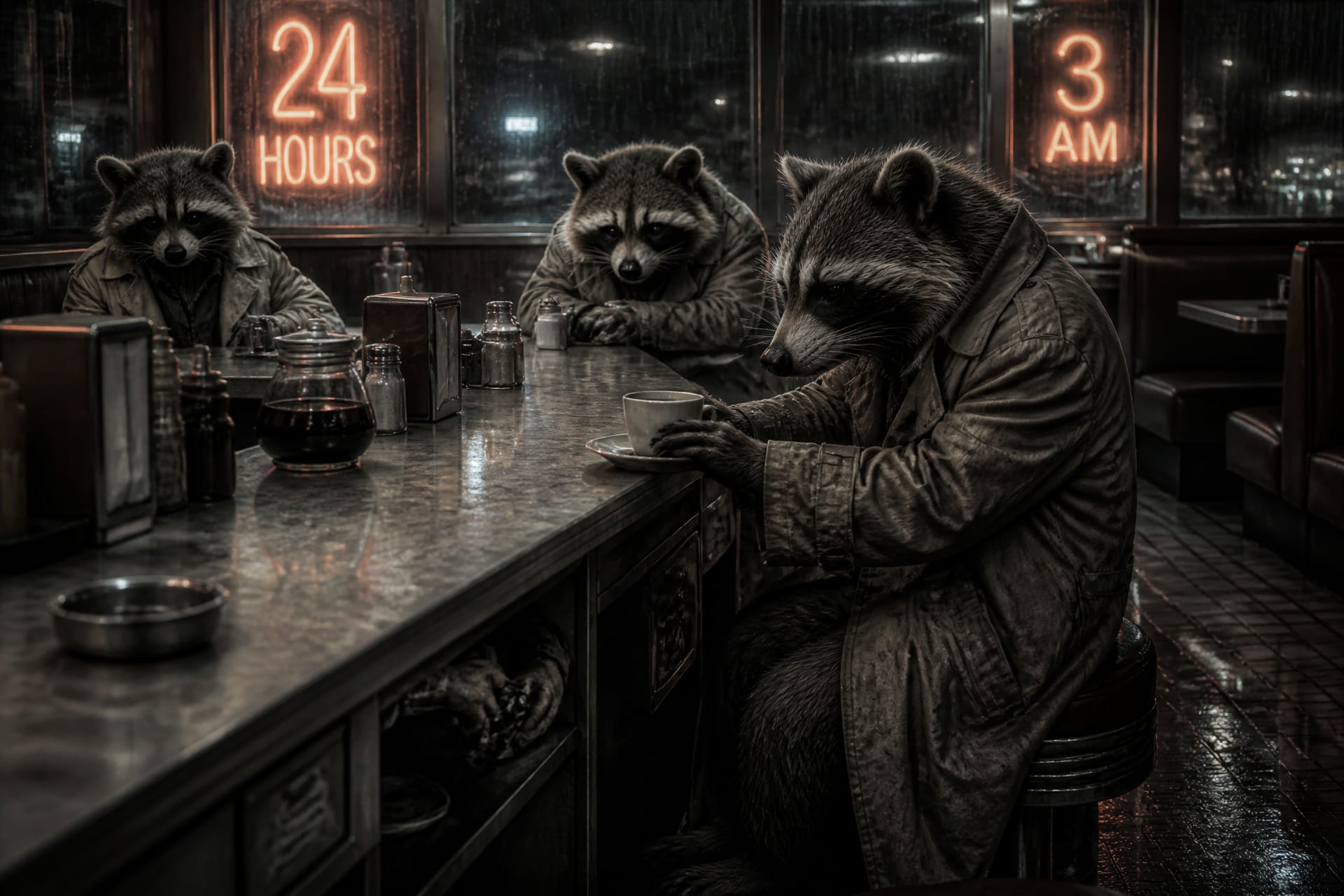
The little diner sat where two forgotten highways crossed, wrapped in neon and darkness, its windows glowing like tired eyes refusing to close. The orange 24 HOURS sign buzzed with a faint electrical hum, shedding just enough light to remind passing travelers they were still among the living.

Whether they wanted to be was another matter.

The bell above the door gave a single tired ring.

Nobody looked up.

The waitress already had the coffee pouring before the newest customer reached the counter.

No menus.

No questions.

Just coffee.

The aroma drifted through the room—burnt beans, scorched sugar, old ceramic mugs that had carried more confessions than conversations. Bacon grease lingered beneath it, mixed with rain-soaked denim, damp wool, and the faint metallic scent that always follows a hard storm.

Some smells don’t belong to places.

They belong to chapters of your life.

Four raccoons occupied the counter.

Their trench coats glistened with rain. Their paws wrapped around chipped white mugs as though warmth were something fragile enough to spill.

One stared into his coffee.

One watched the rain.

One studied the cracked Formica countertop as though it contained directions he could no longer read.

The fourth took the empty stool without asking permission.

Nobody introduced themselves.

Names imply beginnings.

Everyone here felt more like endings.

The waitress slid a mug in front of him.

He nodded.

Steam curled upward between them, briefly hiding his face.

“You look familiar,” she said.

“I’ve been here before?”

She smiled without answering.

“No.”

A long pause.

“But you’ve been carrying the same thing.”

The newcomer looked down into the coffee.

For a heartbeat he thought he saw someone else’s reflection staring back.

When he blinked…

it was only coffee again.

He decided not to mention it.

This wasn’t the kind of place where strange things needed explaining.

A refrigerator compressor kicked on somewhere behind the kitchen. The old jukebox clicked to life by itself, releasing a scratchy jazz melody that sounded as though it had been trapped inside the machine since 1958.

No one had fed it a nickel.

No one seemed surprised.

Outside, headlights drifted across the rain like ghosts searching for exits.

Inside…

time felt thick.

As though every second had to push through syrup before becoming the next.

The raccoon nearest the window finally spoke.

“Funny thing about survival.”

His voice sounded like gravel soaked in whiskey.

“You spend so much time trying not to drown…”

He lifted his mug.

“…you forget what dry feels like.”

Nobody answered.

Truth doesn’t require applause.

Only recognition.

The newcomer rubbed both paws around the warm ceramic.

“When people ask how I’m doing…”

He stopped.

The sentence seemed too heavy to lift.

“They’re hoping I’ll say ‘fine.'”

He laughed softly.

“They’re not asking because they want the truth.”

“They’re asking because the truth might make them late for work.”

A faint chuckle rolled down the counter.

Not because it was funny.

Because everyone had buried that same realization beneath years of polite smiles.

The waitress topped off every cup.

The coffee was bitter enough to wrinkle memory.

“You know why this place stays open twenty-four hours?” she asked.

The newcomer shook his head.

She leaned closer.

“It doesn’t.”

He frowned.

“The diner closes every morning at six.”

He glanced toward the glowing sign.

“It says twenty-four hours.”

“It lies.”

She wiped the counter with slow circles.

“The sign isn’t talking about the diner.”

Nobody elaborated.

Nobody needed to.

Outside, dawn remained several lifetimes away.

The raccoon by the window smiled for the first time.

Small.

Tired.

Earned.

“Three o’clock isn’t a time.”

He watched a raindrop crawl sideways across the glass.

“It’s a place.”

The words settled over the room like dust in an abandoned church.

Some people arrive there after burying someone they loved.

Some after losing a marriage.

Some after surviving war.

Some after finally admitting the person in the mirror has become a stranger.

Different roads.

Same address.

The newcomer closed his eyes.

He realized he’d spent years trying to outrun silence.

Buying things.

Working longer.

Talking louder.

Keeping busy enough that his own thoughts couldn’t catch him.

Yet somehow…

they always found him around three in the morning.

The waitress set a slice of apple pie beside his coffee.

“I didn’t order this.”

“No.”

She smiled.

“But you looked hungry.”

He almost corrected her.

Then realized she wasn’t talking about pie.

The jazz record ended.

For one perfect heartbeat…

the diner became completely silent.

Not empty.

Silent.

There is a difference.

It was the kind of silence that doesn’t ask you to speak.

Only to listen.

When the newcomer finally stood, his coffee cup remained half full.

He reached for his wallet.

The waitress waved him off.

“Someone already paid.”

He looked around the room.

The other stools sat empty.

The raccoons were gone.

Only damp rings from their coffee cups remained on the counter.

He never heard the bell above the door.

Never saw them leave.

Outside, the rain had stopped.

The parking lot reflected the first faint hint of morning.

He turned once to look back.

The neon still glowed.

24 HOURS.

Yet when he blinked…

the diner had become a boarded-up building with dust-covered windows and a faded sign hanging crooked above the door.

Abandoned.

For years.

He stood there until the sunrise washed the orange glow from his memory.

Some mornings begin with an alarm clock.

Others begin with a question you spend the rest of your life trying to answer.

Maybe you’ve been to that diner.

Maybe you just haven’t realized it yet.

I’m Mangus Khan, and this is the Memoirs of Madness.

Until next time… keep your coffee hot, your mind open… because that shit… be at a slant.

The Nest Inspection


“Who left the worm guts in the good nest?”

The forest went quiet.

Not actually quiet, of course. Forests were incapable of shutting up. Leaves whispered among themselves. Insects conducted whatever tiny, irritating business required that much buzzing. Somewhere beyond the trees, water moved over stone with the smug persistence of something that had nowhere else to be. A warm wind pushed through the canopy, carrying the damp perfume of moss, bark, old rain, and something dead enough to be interesting.

But on one particular branch, silence had become a survival strategy.

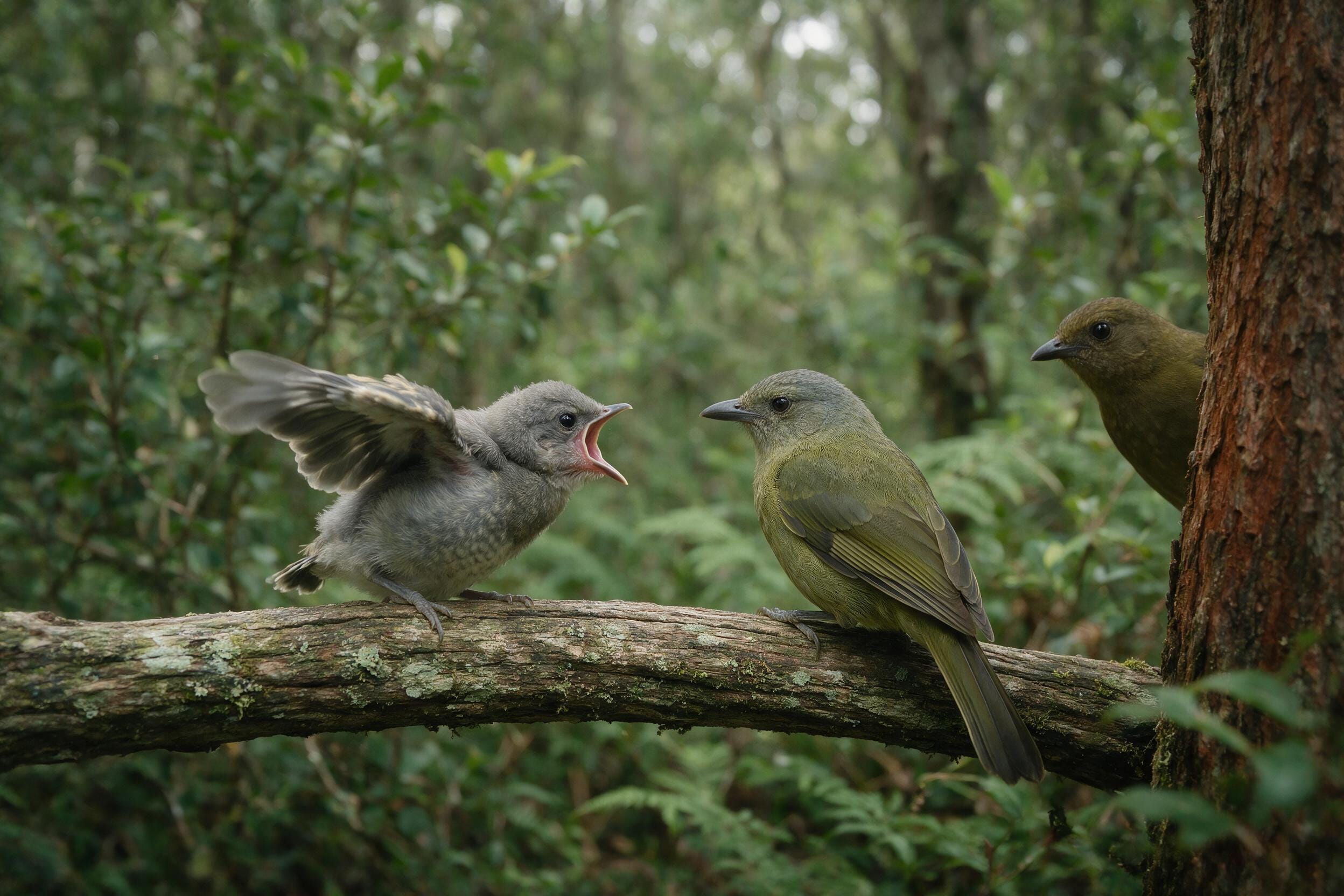
Peep stood with both wings spread, feathers puffed until he looked twice his actual size and considerably more important. He was six days old, still wearing patches of baby fuzz, and had recently discovered righteous indignation.

It suited him.

The wind caught his left wing and nearly spun him sideways.

Peep recovered immediately.

Nobody mentioned it.

This was wise.

His mother sat several inches away, studying him with the expression of someone reconsidering every reproductive decision she’d ever made.

His father peeked around the tree trunk.

He surveyed Peep.

He surveyed Mother.

Then he slowly withdrew his head.

Cowardice, Peep thought.

Typical.

“I asked a question.”

Mother scratched beneath one wing.

Peep waited.

She scratched beneath the other.

“Are you finished?”

“I haven’t even begun.”

“Oh, good.”

Peep pointed dramatically toward the nest tucked into the crook of the tree above them. It had once been a respectable establishment constructed from twigs, grass, moss, and approximately seventeen pieces of material stolen from places nobody intended birds to steal from. Now it smelled like wet feathers, crushed berries, old worms, and regret.

“There are sunflower shells everywhere. Somebody pooped near my sleeping spot. Again. There is half a beetle stuck to the wall, and this morning I found a severed leg under my moss.”

Mother blinked.

“Your moss?”

“Yes. My moss.

“You don’t own moss.”

“I selected it.”

“You fell asleep on it.”

“Exactly. Possession.”

“You fell out of the nest twice yesterday.”

“That is irrelevant.”

“You were chasing your own tail feathers.”

“I was conducting an investigation.”

“Into what?”

Peep hesitated.

That was classified.

His father made a tiny choking sound from behind the tree.

Peep’s head snapped toward him.

“You think this is funny?”

Father’s beak disappeared.

Peep stared at the empty space where his father had been.

“That’s what I thought.”

Mother resumed preening.

That irritated Peep more than an argument would have. There was something deeply insulting about trying to deliver a serious address concerning the collapse of civilization while your audience cleaned its armpits.

Peep paced along the branch.

He had been thinking about this for most of the morning, which represented a significant percentage of his entire life. The conclusion was unavoidable: he was surrounded by animals.

Technically, yes, they were all animals.

That wasn’t the point.

“I am the only bird in this family who cares about standards.”

Mother stopped preening.

“We live like pigeons.”

Silence.

Even Father poked his head around the trunk.

Mother’s eyes narrowed.

There were words a civilized bird simply did not use.

“Watch your mouth.”

“I said what I said.”

“Peep.”

“Look at the place!”

He pointed toward the nest again.

“Yesterday, Dad was adverlying about this place as a ‘premium woodland residence with panoramic views.’”

Father reappeared. “I was attracting renters.”

“We have one bedroom.”

“Open floor plan.”

“We don’t have a floor.”

“Rustic.”

“The roof leaks.”

“Natural ventilation.”

“You can see a squirrel’s butt from the front door.”

Father considered this.

“Panoramic.”

Mother closed her eyes.

Sometimes love wasn’t enough. Sometimes you looked at the bird you’d chosen to build a life with and understood why certain species ate their mates.

Peep continued pacing, growing increasingly drunk on the intoxicating nectar of his own argument.

“Furthermore, this nest has no organizational system. Worm goes in, worm comes out, leftovers go over the side. Seed shells? Over the side. Beetle parts? Over. The. Side. We shouldn’t need a committee.”

Another gust of wind swept through the trees. Leaves shivered. The branch swayed beneath Peep’s feet, and the scent of pine and wet earth washed over him.

He paused.

For one brief moment, he looked beyond his outrage.

The forest stretched farther than he could understand. Green upon green disappeared into shadows. Sunlight slipped through the canopy in pale golden fragments. Somewhere out there were hawks, snakes, storms, winters, and countless things he didn’t even have names for yet.

Peep was six days old.

The world was enormous.

Perhaps that was why the nest bothered him.

It was the only part of the world small enough to control.

He looked back at his parents.

Naturally, this profound realization changed absolutely nothing.

“I have developed a prescription for this family’s chronic filthiness.”

Mother stared at him.

“A prescription.”

“Yes.”

“You’re six days old.”

“I’ve had a busy week.”

Father nodded thoughtfully from behind the tree. “He has.”

Mother looked at him.

Father vanished.

Peep raised one wing and began counting.

“Clean the nest twice daily. Organize worms according to size. Beetles go on the left, berries on the right. No miscellaneous body parts in sleeping areas. And nobody poops until they’ve checked which direction the wind is blowing.”

Father’s head appeared again.

“That’s actually not bad advice.”

Mother turned her head approximately three degrees.

Father disappeared.

Peep smiled.

Victory had a taste.

Apparently, it tasted like yesterday’s caterpillar still stuck to the corner of his beak.

Mother looked toward the nest.

Then at Peep.

Then back toward the nest.

“You know what?”

Peep straightened.

Here it came.

Recognition.

Respect.

Perhaps an apology.

“You’re right.”

His tiny chest swelled.

Mother smiled sweetly.

“Since you’re so concerned about cleanliness, you can clean it.”

Peep’s wings slowly lowered.

The forest resumed its ordinary noise.

A beetle crawled across the branch.

Peep watched it pass.

This was how revolutions died, he realized. Not through superior force. Not through ideological defeat.

Chores.

Father leaned around the tree, making absolutely no effort to conceal his grin.

Mother settled comfortably against the branch.

Peep looked at them.

Then at the nest.

Then at the beetle leg protruding from beneath his beloved moss.

His face hardened.

“This family is toxic.”

Father fell off the other side of the tree laughing.