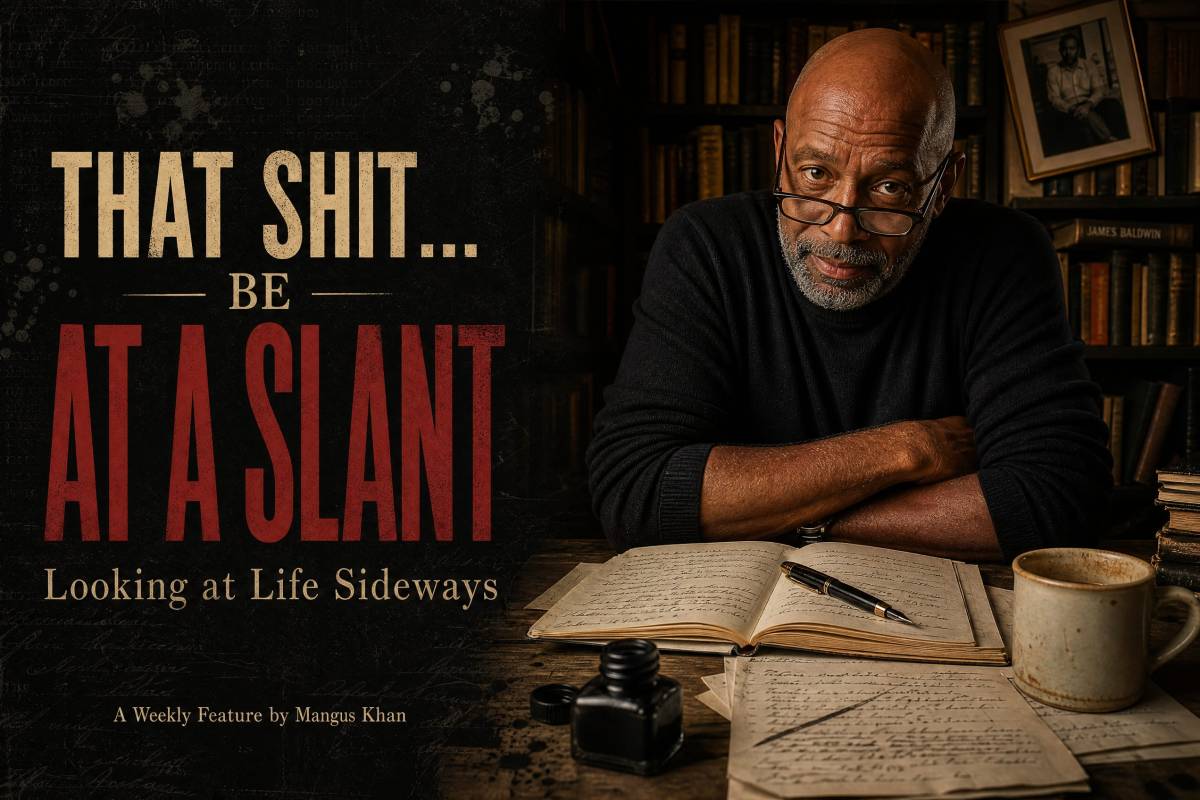

If It Ain’t Broke, Somebody’s Making Money Off It
Hello, I’m Mangus Khan, and for the next few minutes, I encourage you to walk into Madness with me.
Come on in, Brave Souls.
Today, we’re visiting a repair shop.
Not the kind where some fellow charges you six hundred dollars to replace a twelve-dollar part, then explains that your warranty doesn’t cover whatever he just broke.
Although, come to think of it, we’re not that far removed.
No, this establishment specializes in something considerably more complicated.
Life.
More specifically, the machinery that supposedly keeps life operating according to plan.
You know the machinery I’m talking about. The kind that promises everything will work out if you follow the instructions, keep your head down, work hard, and don’t ask too many questions.
Lovely theory.
Absolute bullshit in practice.
But somewhere beyond the ordinary boundaries of common sense, two mechanics have discovered a rather disturbing problem.
The machinery isn’t malfunctioning.
It’s doing exactly what it was designed to do.
And that, Brave Souls, is where our trouble begins.
The Trouble with Perfectly Good Machinery
Martha Bellweather had spent twenty-three years repairing machines that sensible people insisted did not exist. She could rebuild a steam regulator blindfolded, identify a damaged pressure valve by the pitch of its whistle, and distinguish between an ordinary mechanical failure and deliberate sabotage simply by listening to the way an engine complained. At forty-seven, she possessed a formidable collection of scars, a vocabulary that would have embarrassed a dockworker, and an almost religious conviction that most problems could be solved with the proper wrench and sufficient profanity.
Her partner, Professor Thaddeus P. Whiskers, disagreed with the last part.
“Profanity,” he maintained, “is an inefficient substitute for technical precision.”
Martha generally responded by telling him where he could insert his technical precision.
Their partnership had survived eleven years.
Neither could explain why.
The workshop occupied the basement of an abandoned clock factory on the eastern edge of Bellwether City, a sprawling industrial metropolis where the buildings leaned toward one another like conspirators and the streets were perpetually damp from steam escaping beneath the cobblestones. Copper pipes crawled across the ceilings, brass gears turned behind grimy glass partitions, and enormous pressure gauges trembled beneath the strain of keeping the city’s complicated systems operational.
The air smelled of hot metal, machine oil, wet leather, and burnt coffee. Condensation gathered along the exposed pipes and dripped into buckets strategically positioned beneath the more enthusiastic leaks. Somewhere in the building, an enormous flywheel rotated with the slow, persistent rhythm of a heartbeat that had been operating considerably longer than its manufacturer intended.
Martha stood beside a dismantled pressure assembly, one grease-stained hand resting against the workbench. Her dark curls had escaped their leather restraints, her protective goggles sat crookedly atop her head, and a smear of soot crossed her left cheek. She wore a weathered canvas blouse, reinforced leather corset, and a tool belt containing enough sharp instruments to discourage unsolicited opinions.
Thaddeus stood beside her, arms folded.
He was a large gray tabby with intelligent amber eyes, magnificent whiskers, and the permanently skeptical expression of someone who had spent too much time observing humanity and had reached several disappointing conclusions. His leather work vest was fitted with miniature tools, and a pair of brass goggles rested between his ears.
They were examining a machine approximately the size of a railway locomotive.
Its brass identification plate read:
THE UNIVERSAL SATISFACTION REGULATOR
Model 7-B
Manufactured by the Department of Public Contentment
Efficiency Guaranteed.
Martha stared at the machine.
“Something’s wrong.”
Thaddeus adjusted his goggles.
“An astonishing observation, considering it’s currently producing enough steam to boil a small lake.”
“Not the pressure.”
“Then what?”
“The readings.”
Thaddeus examined the gauges.
One indicated PRODUCTIVITY.
Another measured EFFORT.
A third displayed PERSONAL SACRIFICE.
All three were operating at maximum capacity.
The fourth gauge, labeled GENERAL HAPPINESS, barely registered.
Martha tapped the glass.
The needle didn’t move.
She tapped it harder.
Still nothing.
“Well, shit.”
Thaddeus sighed.
“Your diagnostic methods remain breathtakingly primitive.”
“Got a better idea?”
“Naturally.”
He produced a small brass instrument resembling a pocket watch that had suffered an unfortunate encounter with a mathematics professor. He connected its probes to the regulator, adjusted several tiny dials, and studied the resulting measurements.
His ears flattened.
“That’s peculiar.”
Martha smiled.
“Technical term?”
“Quiet.”
He repeated the test.
Then performed another.
And another.
Finally, he removed his spectacles.
“There’s nothing wrong with the machine.”
Martha stared at him.
“Then why isn’t it producing happiness?”
Thaddeus looked toward the enormous brass housing.
“Because it isn’t supposed to.”
The workshop fell silent except for the steady hiss of escaping steam.
Martha frowned.
“Explain.”
Thaddeus opened a maintenance panel and withdrew a thick bundle of yellowed engineering diagrams. The pages were brittle, their edges darkened by decades of heat and neglect. He spread them across the workbench, using a wrench and an empty coffee cup to prevent the paper from curling.
“According to the original specifications, the regulator was designed to convert human effort into personal satisfaction.”
“Right.”
“But somewhere during production, the conversion mechanism was modified.”
“Modified how?”
Thaddeus pointed toward a series of intricate gears.
“The machine measures effort, increases expectations, and redirects the resulting dissatisfaction back into the productivity system.”
Martha blinked.
“English, Thaddeus.”
He sighed.
“The harder people work, the more the machine convinces them they haven’t done enough.”
Martha stared at the diagram.
“That’s ridiculous.”
“Quite.”
“Why would anyone build something like that?”
Thaddeus turned another page.
At the bottom was a handwritten annotation.
CONTINUOUS DISSATISFACTION ENSURES CONTINUOUS PARTICIPATION.
Martha read it twice.
Then a third time.
“Those magnificent bastards.”
Thaddeus looked offended.
“There’s nothing magnificent about it.”
“Depends on whether you’re the one collecting the money.”
The discovery troubled Martha more than she cared to admit.
She had grown up believing in work. Not the sentimental nonsense printed on motivational posters, but the honest satisfaction of building something useful with her own hands. Her father had been a machinist, her mother a seamstress, and both had taught her that effort mattered because it produced something tangible. A repaired engine. A finished garment. A warm meal. A roof that didn’t leak when the weather turned ugly.
There had been dignity in that understanding.
But somewhere along the way, effort had become something else.
People worked longer hours without feeling more secure. They accumulated possessions without feeling more satisfied. They achieved goals only to discover that the finish line had been moved while they were running.
And when exhaustion finally caught up with them, they were told the problem was insufficient ambition.
Martha had always assumed the system was broken.
Now she was looking at evidence that it had been designed that way.
“Can we fix it?” she asked.
Thaddeus studied the diagrams.
“Technically.”
“That’s not an answer.”
“It’s the only one you can afford at present.”
He traced a claw along the schematic.
“The original conversion assembly still exists. It’s simply been disconnected.”
“So reconnect it.”
“That would be inadvisable.”
Martha folded her arms.
“Why?”
“Because the entire city’s infrastructure depends upon the current configuration.”
She looked toward the machinery.
“You’re telling me everybody’s misery is keeping the lights on?”
“Among other things.”
“Wonderful.”
“Quite.”
Martha leaned against the workbench.
For several moments, she said nothing.
Then she asked, “What happens if we reconnect the original system?”
Thaddeus hesitated.
“People might begin experiencing satisfaction from their accomplishments.”
“Sounds dangerous.”
“They might stop working unnecessarily.”
“Terrifying.”
“They could become less susceptible to manufactured dissatisfaction.”
“Now you’re just trying to frighten me.”
“And certain industries might experience significant financial losses.”
Martha grinned.
“There it is.”
Thaddeus wasn’t smiling.
“Martha, you don’t understand. The regulator isn’t merely connected to the city’s economy. It’s integrated into almost every public institution.”
“Such as?”
“Employment. Education. Advertising. Social status. Consumer expectations. Professional advancement.”
“Anything else?”
“Marriage counseling.”
Martha stared at him.
“Marriage counseling?”
“Apparently, dissatisfaction is a remarkably versatile resource.”
She laughed.
A rough, exhausted sound that echoed through the workshop.
Then she stopped.
“How long has this been happening?”
Thaddeus checked the manufacturer’s date.
“Seventy-three years.”
Martha looked toward the ceiling.
Above them, the city continued its ordinary business. Factory whistles announced shift changes. Streetcars rattled through crowded intersections. Office workers hurried beneath umbrellas, already worrying about tomorrow’s obligations before today’s had been completed.
For seventy-three years, people had been told that happiness waited somewhere beyond the next accomplishment.
One more promotion.
One more purchase.
One more sacrifice.
One more demonstration that they deserved the life they were working themselves into the ground to obtain.
And every time they approached satisfaction, the machine quietly moved the target.
Martha felt something cold settle beneath her ribs.
Not anger.
Not yet.
Recognition.
She thought about her father, who had worked thirty-eight years in the same factory and died six months after retirement. He had spent his life promising himself that someday he’d have time to travel, read, and sit beside the river without worrying about what needed doing next.
Someday had arrived too late.
She remembered her mother carefully saving money for occasions that never seemed important enough to justify spending it. The good china remained wrapped in newspaper. The expensive dress stayed inside its protective covering. The photographs from family holidays were stored in boxes because there would always be time to organize them later.
Martha had inherited both their work ethic and their talent for postponing happiness.
She looked around the workshop.
Twenty-three years.
Thousands of repaired machines.
A reputation for excellence.
And she couldn’t remember the last afternoon she’d taken off simply because the weather was beautiful.
“Thaddeus.”
“Yes?”
“Do you ever wonder whether we’re doing the same thing?”
He looked at her.
“Repairing machinery?”
“No. Waiting.”
“For what?”
She shrugged.
“For everything to finally be enough.”
Thaddeus considered the question.
He had spent most of his life believing that understanding the world was the same thing as living in it. He collected knowledge, solved problems, corrected mistakes, and maintained an elaborate system of intellectual standards that allowed him to feel superior to almost everyone he encountered.
Yet he rarely experienced satisfaction.
Every answer produced another question.
Every accomplishment revealed another imperfection.
Every completed project became evidence that he should begin something more ambitious.
He had called it intellectual discipline.
Now he wondered whether it was simply another form of captivity.
“Occasionally,” he admitted.
Martha nodded.
“Thought so.”
They stood together beneath the trembling pressure gauges.
Then Martha reached for her largest wrench.
Thaddeus closed his eyes.
“Oh, dear.”
“What?”
“You’re about to do something reckless.”
“Probably.”
“Without a complete risk assessment.”
“Definitely.”
“Without authorization.”
“Wouldn’t dream of it.”
He sighed.
“I was afraid of that.”
Martha approached the regulator.
“Help me open the housing.”
Thaddeus hesitated.
Then climbed onto the workbench and retrieved his tools.
“Before we proceed,” he said, “I insist upon establishing one thing.”
“What’s that?”
“This machine does not manufacture happiness.”
Martha looked at him.
“Then what does it do?”
“It interferes with people’s ability to recognize when they already have something worth appreciating.”
She considered that.
Then nodded.
“Good enough.”
Together, they began dismantling the regulator.
The work was slow and unpleasant. Bolts had fused beneath decades of heat. Copper pipes resisted removal. The internal gears were coated with a thick black residue that smelled of burnt sugar and overheated ambition.
At one point, a pressure valve exploded, covering Martha in hot condensation and sending Thaddeus scrambling beneath the workbench.
“Your methodology is appalling!” he shouted.
“Your timing needs work!”
“You’re going to kill us both!”
“Then stop talking and hand me the damned wrench!”
By midnight, they had exposed the central conversion assembly.
It was smaller than Martha expected.
A simple brass mechanism containing two interlocking gears.
One labeled EFFORT.
The other ENOUGH.
Between them sat a steel wedge preventing the gears from touching.
Martha stared.
“That’s it?”
Thaddeus nodded.
“Apparently.”
“Seventy-three years of misery because somebody stuck a piece of metal between two gears?”
“An oversimplification.”
“An accurate one?”
“Unfortunately.”
Martha reached for the wedge.
Thaddeus caught her wrist.
“Wait.”
She turned.
“What now?”
He looked toward the pressure gauges.
“If we remove it, the city could experience a sudden reduction in productivity.”
“How sudden?”
“Unpredictable.”
“How severe?”
“Potentially catastrophic.”
Martha stared at him.
Then looked toward the machinery.
She thought about the factories, the offices, the crowded streets, and the thousands of people who depended upon the systems surrounding them.
People needed wages.
Food.
Housing.
Medical care.
The city might be built upon a terrible arrangement, but dismantling it carelessly could hurt the very people they hoped to help.
She lowered the wrench.
“Well, shit.”
Thaddeus nodded.
“An unusually appropriate response.”
For the first time that evening, Martha understood the difference between identifying a problem and solving it.
Breaking the machine would be easy.
Living with the consequences would be considerably more complicated.
She sat on the edge of the workbench.
“So what do we do?”
Thaddeus examined the mechanism.
Then the diagrams.
Then the pressure gauges.
Finally, his ears twitched.
“Perhaps we’ve been asking the wrong question.”
Martha groaned.
“If this turns into a lecture, I’m going home.”
“The machine doesn’t require universal dissatisfaction to operate. It merely uses dissatisfaction because the original conversion system was disabled.”
“Meaning?”
“We don’t have to shut it down.”
“Then what?”
“We can change what it measures.”
Martha leaned forward.
Thaddeus pointed toward the diagram.
“Instead of increasing expectations whenever someone achieves something, we allow the system to recognize completion.”
Martha frowned.
“Completion?”
“Yes.”
“As in finished?”
“Precisely.”
She stared at him.
“You’re telling me the solution is letting people know when they’ve done enough?”
Thaddeus smiled.
“A revolutionary concept, apparently.”
Martha laughed.
Then reached for the tools.
They worked until dawn.
They installed a bypass regulator, recalibrated the pressure valves, and constructed a secondary mechanism to prevent the city’s infrastructure from collapsing during the transition.
At six seventeen, Martha tightened the final bolt.
Thaddeus checked the gauges.
“Ready?”
She wiped grease from her forehead.
“No.”
“Neither am I.”
“Good.”
She pulled the lever.
For a moment, nothing happened.
Then the enormous machinery shuddered.
The pressure gauges spun wildly.
Steam burst from the overhead pipes.
Somewhere above them, the factory clock stopped.
Martha grabbed the workbench.
Thaddeus clung to a brass support.
The regulator emitted a deep metallic groan.
Then settled.
The needle marked GENERAL HAPPINESS moved.
Not dramatically.
Not all the way to the top.
Just a little.
Enough to notice.
Outside, the city continued waking.
Factory workers arrived at their stations. Streetcars began their morning routes. Shopkeepers opened their doors.
Nothing collapsed.
No buildings exploded.
The world did not end.
But small things began happening.
A factory supervisor looked at a completed production report and, for the first time in years, decided that the day’s work was sufficient.
A schoolteacher stopped assigning unnecessary homework simply because the curriculum demanded measurable evidence of effort.
A woman who had spent twenty years saving her best dishes for a special occasion set them on the breakfast table.
An elderly man sat beside the river with a newspaper and discovered that he didn’t need to justify the afternoon.
A young father left work on time and went home to read to his daughter.
Nothing spectacular.
No revolution.
No grand announcement.
Just ordinary people discovering that sometimes the thing they’d been chasing had been waiting quietly beneath the noise of everything they believed they still needed to accomplish.
Back in the workshop, Martha watched the gauges.
“Well?”
Thaddeus examined the readings.
“Productivity has declined slightly.”
“How slightly?”
“Four percent.”
“Disastrous.”
“Personal satisfaction has increased.”
“How much?”
“Twenty-three percent.”
Martha smiled.
“Not bad.”
“However, there’s another problem.”
She sighed.
“Of course there is.”
Thaddeus pointed toward a small red indicator that had begun flashing beneath the control panel.
UNAUTHORIZED CONTENTMENT DETECTED.
A second light illuminated.
CORPORATE OVERSIGHT NOTIFIED.
Then a third.
INSPECTION TEAM DISPATCHED.
Martha stared at the warning lights.
Thaddeus folded his arms.
“Well,” he said, “that seems unfortunate.”
Martha reached for her wrench.
“How long before they arrive?”
“Approximately twelve minutes.”
She grinned.
“Plenty of time.”
“For what?”
“Coffee.”
Thaddeus stared at her.
“Martha, the Department of Public Contentment is sending an inspection team to investigate an unauthorized modification of its primary regulatory system.”
“I heard you.”
“They may revoke our licenses.”
“Probably.”
“Confiscate our equipment.”
“Possibly.”
“Arrest us.”
“Wouldn’t be the first time.”
Thaddeus looked horrified.
“You’re taking this remarkably well.”
Martha poured two cups of coffee.
Then sat down.
For the first time in twenty-three years, she wasn’t thinking about the next repair.
The next customer.
The next deadline.
Or the next problem waiting to be solved.
She was simply sitting in her workshop, drinking coffee with her oldest friend.
The machinery hummed around them.
Morning sunlight filtered through the dirty windows.
Somewhere above, a bird began singing.
Martha smiled.
“Thaddeus?”
“Yes?”
“Do you think we’ve done enough for today?”
He considered the question.
Then looked toward the approaching warning lights.
“Technically, we have a considerable amount of unfinished business.”
“Naturally.”
“But…”
He paused.
“But I believe the repair is complete.”
Martha raised her cup.
“Then that’ll do.”
Thaddeus lifted his own.
And for the next eleven minutes, neither of them attempted to improve anything.
And there it is, Brave Souls.
Martha Bellweather and Professor Thaddeus P. Whiskers.
Two mechanics who discovered that the machinery wasn’t broken.
It was operating exactly as intended.
Now, before someone decides I’m advocating laziness, let me clarify something.
Work matters.
Ambition matters.
Discipline, perseverance, and the willingness to accomplish difficult things are qualities worth preserving.
But somewhere along the way, we developed a peculiar relationship with the word enough.
We treat it like surrender.
Like mediocrity.
Like an admission that we’ve stopped trying.
And perhaps that’s because we’ve become so accustomed to measuring our worth by what we produce that we no longer know what to do with ourselves when the work is finished.
There’s always another goal.
Another improvement.
Another expectation.
Another reason to postpone enjoying the life we’re supposedly working so hard to build.
And there’s a difference between wanting to grow and believing you’re never allowed to be satisfied.
Martha and Thaddeus didn’t destroy ambition.
They didn’t eliminate responsibility.
They simply repaired the mechanism that prevented people from recognizing when something worthwhile had already been accomplished.
We’re on a journey through the ordinary and mundane, taking off the rose-colored glasses and looking for a different side of Madness.
Perhaps today’s slant is this:
You can appreciate what you’ve accomplished without abandoning what you still hope to achieve.
Those two things are not enemies.
And sometimes, the most radical thing you can do in a world obsessed with more is look at what you’ve already done and say:
That’ll do.
Because sometimes, Brave Souls…
That Shit … Be at a Slant.
Discover more from Memoirs of Madness
Subscribe to get the latest posts sent to your email.

