Being Right Isn’t Free
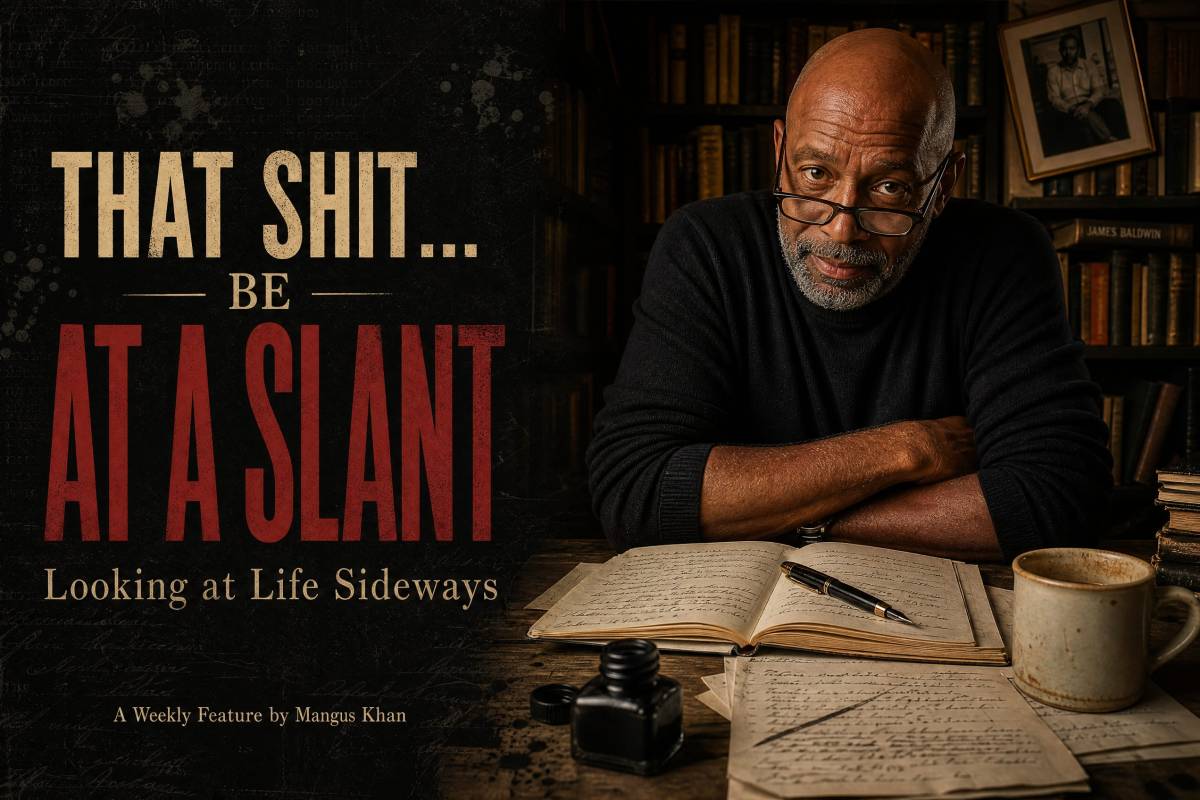
Hello, I’m Mangus Khan, and for the next few minutes, I encourage you to walk into Madness with me.
Come on in, Brave Souls.
Today, we’re going to talk about being right.
Not doing what’s right. That’s an entirely different conversation, and one that humanity has been spectacularly successful at avoiding whenever it becomes inconvenient.
No, I’m talking about the irresistible pleasure of proving somebody wrong.
You know the feeling.
That delicious little moment when the evidence finally arrives, the facts line up, and you can look another human being squarely in the eye and deliver those four magnificent words:
I told you so.
There are people who would crawl naked through broken glass for the opportunity to say those words. Others have spent decades rehearsing arguments that ended before the invention of the internet. Some have maintained grudges longer than their marriages, friendships, and occasionally their original teeth.
And somewhere, in a rain-soaked corner of a city that has long since stopped pretending to be respectable, there’s a peculiar establishment dedicated to helping those people.
A place where arguments are investigated, evidence is examined, and vindication can be purchased for a reasonable fee.
Well, reasonable if you don’t count what it might actually cost you.
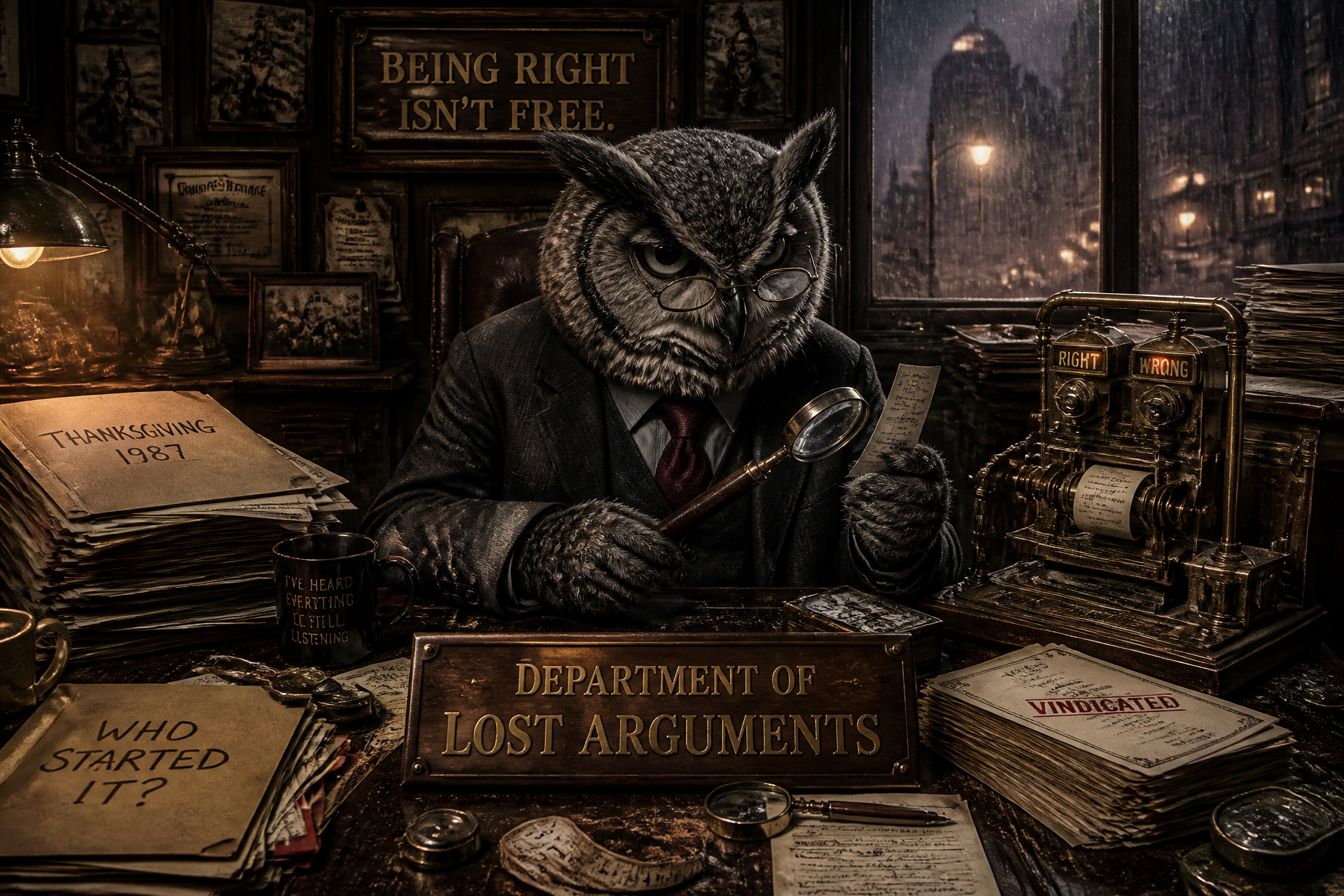
Welcome to the Department of Lost Arguments.
Where the customer is always right.
Provided the evidence supports it.
And the check clears.
The Department of Lost Arguments
Professor Archibald Cornelius Hootsworth had never lost an argument in his life.
At least, that was his official position.
The unofficial record was considerably more complicated, but Archibald considered unofficial records an unfortunate invention of people who lacked the intellectual discipline to appreciate facts. He had spent seventy-nine years cultivating a reputation for precision, logic, and an almost pathological intolerance for inaccuracies. He could identify a misquotation from forty paces, distinguish between a genuine contradiction and a poorly constructed inference, and dismantle an opponent’s argument with the delicate efficiency of a surgeon removing a tumor. Unfortunately, he had never developed a comparable talent for recognizing when the patient was still conscious.
Archibald was an elderly owl with charcoal-gray feathers, pale silver markings around his enormous amber eyes, and a pair of spectacles that rested precariously upon his sharply curved beak. His eyebrows were magnificent arrangements of unruly feathers that seemed permanently offended by the intellectual shortcomings of everyone around him. He wore a dark three-piece suit, a burgundy tie, and the expression of someone who had just discovered that the rest of the world had been assembled without consulting the instructions.
His office occupied the second floor of a narrow brick building overlooking a street where rain seemed less like a weather condition and more like a municipal policy. The windows rattled whenever the wind came off the river, and the ancient radiator beneath his desk produced a series of metallic knocks that resembled someone attempting to escape from inside the walls. The room smelled of old paper, furniture polish, damp wool, and coffee that had been reheated so many times it had lost all resemblance to the beverage from which it originated.
Behind his desk, mounted in an elaborate wooden frame, hung the department’s guiding principle.
BEING RIGHT ISN’T FREE.
Archibald considered it an honest statement of business ethics.
His customers rarely appreciated the irony.
The office was crowded with evidence of humanity’s remarkable commitment to preserving disagreements long after their usefulness had expired. Filing cabinets contained witness statements, restaurant receipts, photographs, handwritten correspondence, and carefully reconstructed conversations dating back several generations. One shelf was devoted entirely to arguments involving holiday dinners. Another contained disputes about directions, misplaced household objects, and the proper interpretation of the phrase you know what you did.
That particular category occupied seventeen cabinets.
Archibald had petitioned for additional storage.
Twice.
At the center of his desk sat his greatest professional achievement: the Hootsworth Mechanical Determinator of Factual Accuracy, an intricate brass apparatus containing gears, pressure valves, rotating cylinders, and two prominent indicators labeled RIGHT and WRONG. The machine had been calibrated over several decades using historical records, sworn testimony, documentary evidence, and an alarming quantity of statistical analysis. It was, by every measurable standard, extraordinarily accurate.
It was also completely incapable of determining whether the person receiving its verdict was an insufferable asshole.
Archibald regarded this as a minor engineering limitation.
At precisely nine o’clock, he adjusted his spectacles, opened his appointment ledger, and prepared to begin another day of professional vindication.
His first client arrived seven minutes late.
Archibald noticed.
Naturally.
Mrs. Beatrice Pemberton entered carrying a handbag large enough to conceal a moderately sized household appliance. She was a retired schoolteacher with silver hair, a stern expression, and the unmistakable posture of someone who had spent forty years correcting children and had never quite accepted that retirement meant she was no longer authorized to do so.
“Professor Hootsworth.”
“Mrs. Pemberton. Your appointment was scheduled for nine.”
“I know.”
“It is nine-oh-seven.”
“The traffic was dreadful.”
“An explanation, madam, is not a correction.”
She narrowed her eyes.
Archibald gestured toward the chair.
“Nature of your dispute?”
“My sister.”
“Naturally.”
“She insists that during Thanksgiving dinner in 1998, I said her pumpkin pie tasted like wet cardboard.”
Archibald opened a notebook.
“Did you?”
“Absolutely not.”
“What did you say?”
Beatrice straightened.
“I said it had the texture of damp packing material.”
Archibald stopped writing.
He looked at her.
She looked at him.
Outside, rain tapped against the window.
“Mrs. Pemberton, are you familiar with the concept of semantic equivalence?”
“Of course.”
“Apparently not.”
She leaned forward.
“Professor, I did not say wet cardboard.”
“No. You substituted a slightly more elaborate description of the same unfortunate culinary experience.”
“Then I was right.”
“Technically.”
Beatrice smiled triumphantly.
Archibald sighed.
He had learned long ago that the word technically possessed extraordinary restorative powers when administered to people suffering from wounded pride.
He fed the relevant documentation into the Determinator.
The gears turned.
A brass bell chimed.
The needle swung decisively toward RIGHT.
A narrow strip of paper emerged.
STATEMENT FACTUALLY ACCURATE.
Beatrice clapped her hands.
“I knew it!”
“Congratulations.”
“I’ve been waiting twenty-eight years for this.”
Archibald examined her over his spectacles.
“Twenty-eight years?”
“Yes.”
“Has your sister acknowledged the distinction?”
“No.”
“Have you spoken to her recently?”
“Not since Christmas of 2004.”
Archibald paused.
“Because of the pie?”
“Among other things.”
“Naturally.”
Beatrice paid her fee, collected her certificate, and departed with the satisfied expression of someone who had finally obtained justice for a crime against vocabulary.
Archibald watched her leave.
He wondered whether she would call her sister.
Then dismissed the thought.
That was not his department.
At ten fifteen, a gentleman named Harold Wexler arrived carrying three maps, a faded restaurant receipt, and a photograph of a highway exit sign taken sometime during the Clinton administration. Harold had spent thirty-one years insisting that his wife had directed him toward the wrong interstate exit during a family vacation in 1995. His wife maintained that Harold had ignored her instructions because he refused to admit she knew where they were going.
The dispute had survived two children, four automobiles, three houses, and the eventual closure of the restaurant they had been attempting to reach.
Harold wanted vindication.
Archibald wanted lunch.
Nevertheless, professional obligations prevailed.
After forty-seven minutes of testimony, the professor examined the maps, reconstructed the route, and established that Harold’s wife had indeed suggested Exit 42 when the correct route required Exit 43.
Harold nearly wept.
“Thirty-one years,” he whispered. “Thirty-one goddamn years.”
Archibald stamped the certificate.
VINDICATED.
Harold clutched the document against his chest.
“I’m going straight home.”
“To reconcile?”
“To show her.”
Archibald hesitated.
He considered advising caution.
Then remembered that unsolicited relationship counseling was not included in the standard investigation fee.
“Good luck, Mr. Wexler.”
Harold departed.
Three hours later, he returned.
His certificate had been torn in half.
“She says she told me to take Exit 43 after I missed 42.”
Archibald examined the evidence.
“Did she?”
Harold stared at him.
“That’s not the point.”
Archibald folded his wings.
“Then, Mr. Wexler, I fear we’ve entered territory beyond my professional jurisdiction.”
By midafternoon, the professor had investigated a disagreement over whether a neighbor’s dog had barked at 11:43 or 11:47 on a Tuesday evening in 2011, an accusation involving a missing garden gnome, and a particularly heated dispute between two brothers concerning who had broken their father’s fishing rod in 1976.
The brothers were sixty-eight and seventy-one.
Their father had been dead for nineteen years.
Neither remembered what the fishing rod looked like.
Both demanded a ruling.
Archibald provided one.
The younger brother had broken the rod.
The older brother had witnessed the incident and subsequently blamed the family dog.
Both men left furious.
Archibald considered the investigation a success.
Accuracy, after all, was not obligated to be pleasant.
That had always been his philosophy.
Facts were facts. Evidence was evidence. Truth existed independently of human comfort, and Archibald had spent his entire professional life defending that distinction. He despised dishonesty, intellectual laziness, and the increasingly popular notion that personal conviction somehow constituted proof. He believed people should be held accountable for their words, that disagreements should be examined rather than merely shouted through, and that admitting an error was not an act of weakness but evidence of intellectual maturity.
On those matters, he was frequently correct.
His difficulty arose elsewhere.
Archibald had developed the unfortunate habit of treating every disagreement as a courtroom proceeding and every conversation as an opportunity to establish a factual record. He could listen carefully enough to identify a misplaced date, an exaggerated claim, or an inconsistency in someone’s recollection. What he rarely considered was why the person had begun speaking in the first place.
He listened for errors.
Not injuries.
He searched for contradictions.
Not understanding.
And because he was extraordinarily good at finding the former, he had gradually convinced himself that the latter was unnecessary.
There had been consequences.
Professional colleagues respected him but rarely invited him anywhere. Former friends described him as brilliant, exhausting, and best appreciated in small doses. His younger brother had once remarked that Archibald could turn a pleasant afternoon into a disciplinary hearing simply by asking someone what they meant by approximately.
Archibald considered these criticisms evidence of society’s declining standards.
He had never considered that the problem might be his own.
At four thirty, the rain intensified. Water streamed down the windows, blurring the streetlights into trembling amber streaks. Archibald switched on his desk lamp and began reviewing the day’s completed investigations. The Determinator clicked softly as its brass mechanisms cooled, and somewhere beneath the desk, the radiator resumed its unsuccessful attempt to communicate with the living.
He reached for his coffee.
Cold.
Naturally.
He took a swallow anyway.
Then noticed the envelope.
It lay beneath the afternoon correspondence, a narrow cream-colored rectangle bearing no return address. His name had been written across the front in a familiar hand.
Not familiar because he recognized the penmanship immediately.
Familiar because he had spent twenty-seven years pretending he no longer remembered it.
Archibald Cornelius Hootsworth.
He stared at the envelope.
For several moments, he did nothing.
Then he carefully set down his cup, adjusted his spectacles, and opened it.
Inside was a single sheet of stationery.
Archie,
I’m clearing out the attic. I found the box containing your papers from Thanksgiving 1987. I thought you might want them.
You were right about what happened that evening. I’ve never disputed that.
I hope someday you’ll understand why that wasn’t what I was trying to tell you.
— Eleanor
Archibald read the letter.
Then read it again.
The room seemed unusually quiet.
He could hear the rain moving through the gutters outside, the faint ticking of the wall clock, and the soft mechanical settling of the Determinator.
Thanksgiving.
He turned toward the filing cabinet behind his desk.
Third drawer.
Left side.
A thick folder labeled THANKSGIVING 1987 rested between two completed investigations.
He removed it.
The cardboard was worn, its edges softened by years of handling. Inside were photographs, handwritten notes, witness statements, and a meticulously reconstructed timeline of an argument that had occurred almost four decades earlier.
Archibald knew every page.
He had examined them hundreds of times.
He had memorized the sequence of events, the precise wording of the disagreement, and the documentary evidence supporting his position.
He had even fed the material through the Determinator.
Twice.
Both times, the machine had declared him correct.
The argument itself had begun over something almost embarrassingly ordinary.
Eleanor had invited her widowed sister, Margaret, to Thanksgiving dinner without consulting him. Archibald had objected, not because he disliked Margaret, but because the invitation disrupted arrangements he had carefully planned weeks earlier. He had calculated seating positions, meal portions, and the timing of each course. Margaret’s arrival required adjustments, and Archibald had been irritated that Eleanor had made the decision without discussing it with him.
He had been right about that.
She should have consulted him.
Eleanor had acknowledged as much.
But Margaret had recently lost her husband. She had been spending most evenings alone in a house that still smelled of his tobacco and aftershave, surrounded by furniture arranged for a life that no longer existed. Eleanor had recognized that her sister needed company more than Archibald needed his seating arrangements preserved.
That was where the disagreement had begun.
It was not where it had ended.
Archibald remembered Eleanor standing beside the dining room window, her face illuminated by the weak November sunlight. He remembered the smell of roasting turkey, the faint sweetness of cinnamon, and the way the old wooden floor creaked beneath her feet when she turned toward him.
“You don’t understand, Archie.”
He had corrected her.
“On the contrary, Eleanor. I understand perfectly. You made a decision affecting both of us without consulting me.”
“That’s not what I’m talking about.”
“Then explain yourself.”
“I’ve been trying.”
“Then perhaps you should be more precise.”
He remembered the silence that followed.
It had irritated him.
He had mistaken it for an inability to defend her position.
Then Eleanor had said something he had spent the next twenty-seven years refusing to examine.
“Sometimes I need you to care about me more than you care about being correct.”
Archibald had answered immediately.
“Those two things are not mutually exclusive.”
Technically, he was right.
Again.
And that had been the problem.
Eleanor had not been asking him to abandon logic. She had not been disputing the facts. She had not been demanding that he agree with something he knew to be false.
She had been asking him to recognize that her sister was grieving.
That compassion sometimes required flexibility.
That a marriage could survive an imperfect seating arrangement more easily than it could survive two people who had stopped hearing one another.
But Archibald had been too busy defending the correctness of his position to notice the desperation beneath her words.
The argument continued.
He produced examples.
She attempted explanations.
He identified inconsistencies.
She grew quieter.
By the time Margaret arrived, Eleanor had stopped arguing altogether.
Archibald considered that evidence of victory.
He remembered being particularly pleased with himself.
The dinner had proceeded according to the revised schedule. Margaret had been polite, the turkey had been excellent, and the seating arrangements had required only minor adjustments.
He had regarded the evening as a successful demonstration of the importance of communication.
Eleanor had barely spoken.
In the months that followed, the disagreements became more frequent. Not because they argued about increasingly important matters, but because Archibald insisted upon treating every difference of opinion as something requiring resolution through evidence and logic.
If Eleanor said she felt ignored, he listed occasions when he had listened.
If she said he was distant, he documented the hours they spent together.
If she complained that he corrected her constantly, he explained that correction was necessary only when she made an inaccurate statement.
He had answers for everything.
And somehow, none of them helped.
Eventually, Eleanor stopped trying to explain.
That should have frightened him.
Instead, he interpreted her silence as improvement.
The marriage ended years later, after a final disagreement so inconsequential that Archibald could no longer remember what had started it.
He remembered only that he had been right.
And that Eleanor had packed a suitcase.
She had stood in the doorway with her coat over one arm, looking at him with an expression he had spent decades attempting to classify.
Anger?
Disappointment?
Resignation?
He had never reached a satisfactory conclusion.
“You’re not listening, Archie,” she had said.
“I’ve heard every word.”
“I know.”
Then she left.
For twenty-seven years, Archibald had considered those final words a contradiction.
Now, sitting beneath the amber desk lamp, he began to suspect they had been the most accurate statement of their entire marriage.
He had heard every word.
He simply hadn’t understood what she needed him to hear.
Archibald removed his spectacles.
His eyes burned.
He blamed the dust.
The office contained a considerable amount of it.
He examined the old photographs. There was Eleanor laughing beside the kitchen sink, flour on her cheek and her sleeves rolled above her elbows. Another showed them standing beneath a flowering tree during the first spring of their marriage. In a third, she sat reading beside the fireplace while Archibald watched her from the opposite chair.
He remembered taking that photograph.
He remembered how the afternoon light had caught the edges of her feathers.
He remembered thinking she was beautiful.
He could not remember the last time he had told her.
That realization troubled him more than any factual discrepancy he had ever encountered.
He looked toward the framed sign above his desk.
BEING RIGHT ISN’T FREE.
For years, he had interpreted those words as a justification for his fees.
Now they appeared to be describing something considerably more expensive.
He had been right about the invitation.
Right about the seating arrangements.
Right about the sequence of events.
And entirely wrong about what mattered in the conversation.
The distinction was devastating.
Not because the facts had changed.
They hadn’t.
But because the facts had never been the whole story.
Archibald had spent his life believing that truth could be established through careful examination of evidence. He still believed that. He had no intention of abandoning reason, accuracy, or the responsibility to distinguish between what happened and what someone merely wished had happened.
Yet he had overlooked something fundamental.
A person could be factually correct and emotionally careless.
An argument could be won without a problem being solved.
And sometimes the most important evidence was not contained in the words someone spoke, but in the reason they had finally stopped speaking.
He looked toward the Determinator.
The machine remained silent.
Its brass indicators rested between RIGHT and WRONG.
Archibald considered feeding Eleanor’s letter into it.
He knew what the result would be.
The machine would examine the original dispute, review the documented evidence, and confirm that he had been correct.
It would produce another certificate.
Another official declaration.
Another piece of paper proving something Eleanor had never denied.
For the first time in his professional life, Archibald understood that a correct answer could be completely irrelevant to the question being asked.
He closed the folder.
Then opened it again.
He removed the certificate he had issued himself decades earlier.
VINDICATED.
The word had once brought him enormous satisfaction.
Now it seemed strangely small.
He held the paper between his feathered fingers, examining the elaborate seal, the official signature, and the precise language declaring his position factually correct.
He could almost hear his younger self explaining why the certificate mattered.
Why the evidence was decisive.
Why Eleanor should have acknowledged his reasoning.
And why he had been justified in refusing to apologize.
Archibald sighed.
“Magnificent work, you pompous old bastard.”
He placed the certificate on the desk.
Then reached for a blank sheet of stationery.
For several minutes, he sat motionless.
He had written thousands of investigative reports, scholarly articles, professional opinions, and formal determinations. He could construct a compelling argument with almost effortless precision.
But an apology?
That required a different kind of courage.
One that offered no guarantee of victory.
He dipped his pen into the ink.
Eleanor,
He stopped.
Crossed out the name.
Started again.
Ellie,
The familiar nickname looked strange after so many years.
He continued.
I received your letter.
I’ve spent a great deal of time examining what happened between us. Unfortunately, most of that examination was devoted to proving that I was correct.
I was.
He stared at the sentence.
Then scratched it out.
Not because it was false.
Because it was unnecessary.
He began again.
You were trying to tell me something important, and I treated your words as an argument to defeat. I listened for mistakes when I should have been listening for what was hurting you.
I cannot change what happened. I cannot give you back the years we lost, and I have no right to expect that an apology will repair what my stubbornness helped destroy.
But I am sorry.
He paused.
The words looked insufficient.
Pathetically small.
After twenty-seven years, he had expected an apology to require more elaborate construction.
Perhaps supporting documentation.
A carefully reasoned explanation.
Some demonstration that he fully understood the magnitude of his error.
Instead, he had written three words.
I am sorry.
He read them again.
They were accurate.
For once, accuracy was enough.
Archibald folded the letter and placed it inside an envelope.
Then he looked toward the clock.
Six forty-three.
Eleanor lived three streets away.
He knew that because he had occasionally passed her house during his evening walks. He had never stopped. Sometimes he had seen her tending the small garden beside the front steps. Once, several years earlier, he had watched her laughing with a gentleman carrying groceries.
He had felt an unexpected stab of jealousy.
Then spent the remainder of the evening constructing an argument explaining why the feeling was irrational.
He had been correct about that, too.
It hadn’t made the feeling disappear.
Archibald rose from his chair, retrieved his coat, and switched off the desk lamp.
The office settled into darkness.
Only the streetlights remained, their amber reflections trembling across the rain-streaked windows.
He descended the narrow staircase and stepped into the evening.
The rain had softened to a fine mist. Water gathered in the cracks between the cobblestones, and the air carried the mingled smells of wet brick, automobile exhaust, and bread cooling in the bakery across the street. Somewhere in the distance, a church bell marked the hour. Archibald pulled his coat tighter around his shoulders and began walking.
Three streets.
He had walked farther to investigate disagreements over parking spaces.
Yet each step seemed unusually difficult.
He rehearsed what he might say.
Then stopped himself.
He had spent enough years preparing arguments.
Perhaps this time he could simply speak.
Eleanor’s house stood near the corner, its windows glowing warmly against the gathering darkness. A small garden bordered the walkway, and a brass wind chime hung beside the porch. He remembered buying it for her during a trip to the coast. She had loved the sound it made when the evening breeze moved through the garden.
He had complained that it was slightly out of tune.
The memory made him wince.
He approached the gate.
Stopped.
Through the front window, he could see Eleanor moving about the sitting room. Her silver feathers caught the lamplight as she placed a book on a side table. She looked older, naturally. So did he. Time had been conducting its business without consulting either of them.
Archibald reached into his coat pocket.
The letter was there.
Beside it rested the old certificate.
He had brought it without thinking.
Perhaps some part of him had still wanted the protection of evidence.
He removed the certificate and unfolded it beneath the porch light.
VINDICATED.
He stared at the word.
Then folded the paper into quarters.
Not because the evidence was wrong.
Not because the truth had changed.
But because the certificate had never answered the question Eleanor had been asking.
He placed it back in his pocket.
Then looked toward the front door.
He could knock.
She might answer.
She might refuse to speak with him.
She might accept his apology.
She might tell him that twenty-seven years was too long to wait for something that should have been said before the first suitcase was packed.
Every possibility frightened him.
Not because he lacked an argument.
Because he finally understood that he wasn’t entitled to win.
He climbed the porch steps.
The old boards creaked beneath his shoes.
For a moment, he stood before the door, listening to the faint sound of music coming from inside.
He recognized the melody.
Eleanor had always loved that song.
He raised his hand.
Paused.
Then knocked.
Somewhere inside, footsteps approached.
Archibald straightened his tie.
Adjusted his spectacles.
And, for the first time in seventy-nine years, prepared to enter a conversation without knowing how to defend himself.
The lock turned.
And there it is, Brave Souls.
Professor Archibald Cornelius Hootsworth.
A brilliant investigator.
A master of evidence.
A man who could prove almost anything.
Except that being right had made him happy.
Now, before somebody decides I’m suggesting we abandon facts, surrender our principles, and start agreeing with every ridiculous statement that wanders across our path, allow me to clarify something.
Truth matters.
Accountability matters.
There are times when standing your ground is not only justified but necessary. Some disagreements involve integrity, justice, and consequences far too serious to dismiss for the sake of keeping everybody comfortable.
But not every disagreement is a moral battlefield.
Sometimes it’s a casserole dish.
Sometimes it’s a highway exit.
Sometimes it’s a Thanksgiving seating arrangement.
And sometimes, while we’re busy constructing the perfect argument, the person standing across from us is trying desperately to tell us something that has absolutely nothing to do with winning.
We hear the words.
We identify the inconsistencies.
We prepare our rebuttal.
And somewhere between proving our point and celebrating our victory, we lose sight of the person we were supposed to be talking with.
That’s the uncomfortable part.
Being right doesn’t automatically mean we’ve understood.
And being wrong about someone’s feelings doesn’t necessarily mean we’ve misunderstood the facts.
Those are two different things.
Archibald didn’t need to surrender the truth.
He needed to recognize that the truth he had been defending wasn’t the only truth worth considering.
He was correct about what happened.
Eleanor was trying to tell him what it meant.
And for twenty-seven years, he couldn’t distinguish between the two.
We’re on a journey through the ordinary and mundane, taking off the rose-colored glasses and looking for a different side of Madness.
Perhaps today’s slant is worth carrying into the next disagreement.
Before you sharpen your arguments, assemble your evidence, and prepare to demonstrate the magnificent superiority of your reasoning, ask yourself one question:
Am I trying to understand this person, or am I simply trying to defeat them?
Because sometimes the answer matters considerably more than the argument.
And as for Archibald?
We don’t know what happened when Eleanor opened that door.
Perhaps she invited him inside.
Perhaps she accepted the letter and asked him to leave.
Perhaps they stood together on the porch, two old souls confronting the ruins of something neither had ever completely stopped caring about.
Whatever happened, it belonged to them.
Not to us.
Not to the Determinator.
And certainly not to a certificate stamped VINDICATED.
For once, Archibald would have to live without knowing the outcome in advance.
And perhaps that was the beginning of wisdom.
Because sometimes, Brave Souls…
That Shit … Be at a Slant.
Discover more from Memoirs of Madness
Subscribe to get the latest posts sent to your email.

