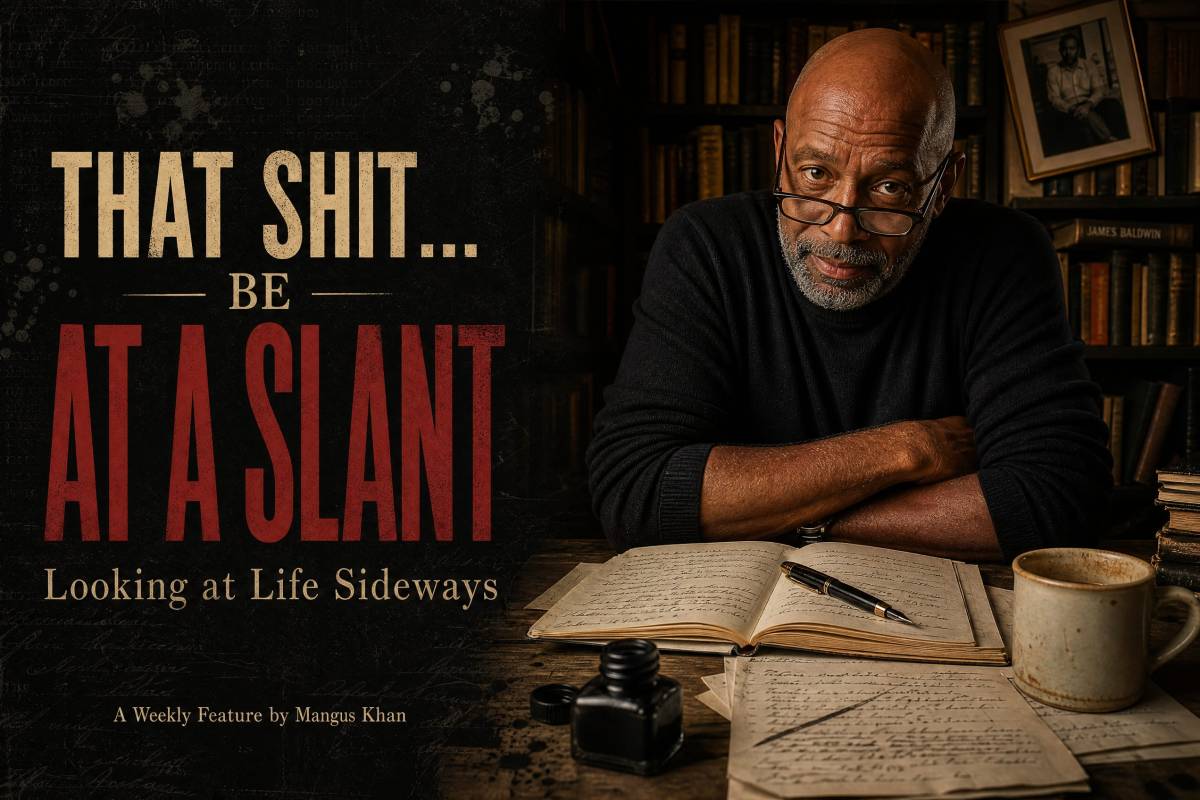
That Shit … Be at a Slant – Episode 7
Hello, I’m Mangus Khan, and for the next few minutes, I encourage you to walk into Madness with me.
Come on in, Brave Souls.
Today, we’re going to discuss control.
Not self-control. That’s an entirely different conversation, and frankly, considering some of the decisions I’ve made over the years, I’m probably not qualified to lead it.
No, I’m talking about our remarkable ability to convince ourselves that we’re in charge of things that have absolutely no intention of cooperating.
The weather.
Other people.
Tomorrow.
And, apparently, the universe itself.
Somewhere in a forgotten observatory, there’s an old man who believes he controls the weather.
He’s been doing it for forty-six years.
And before you start laughing at him, you might want to take a closer look at your own life.
Because I suspect most of us have a few disconnected wires beneath our control panels.
Professor Ezekiel Bartholomew Weatherby arrived at the Atmospheric Control Division every morning at precisely 5:43. Not 5:42, not 5:44, and certainly not whenever the hell he felt like it. He had maintained this schedule for forty-six years, seven months, and thirteen days, excluding three hospitalizations, one particularly unpleasant bout of pneumonia, and the morning his second wife informed him that she was leaving because he apparently loved the weather more than he loved her. He considered that accusation unfair. The weather, after all, had never demanded that he discuss his feelings.
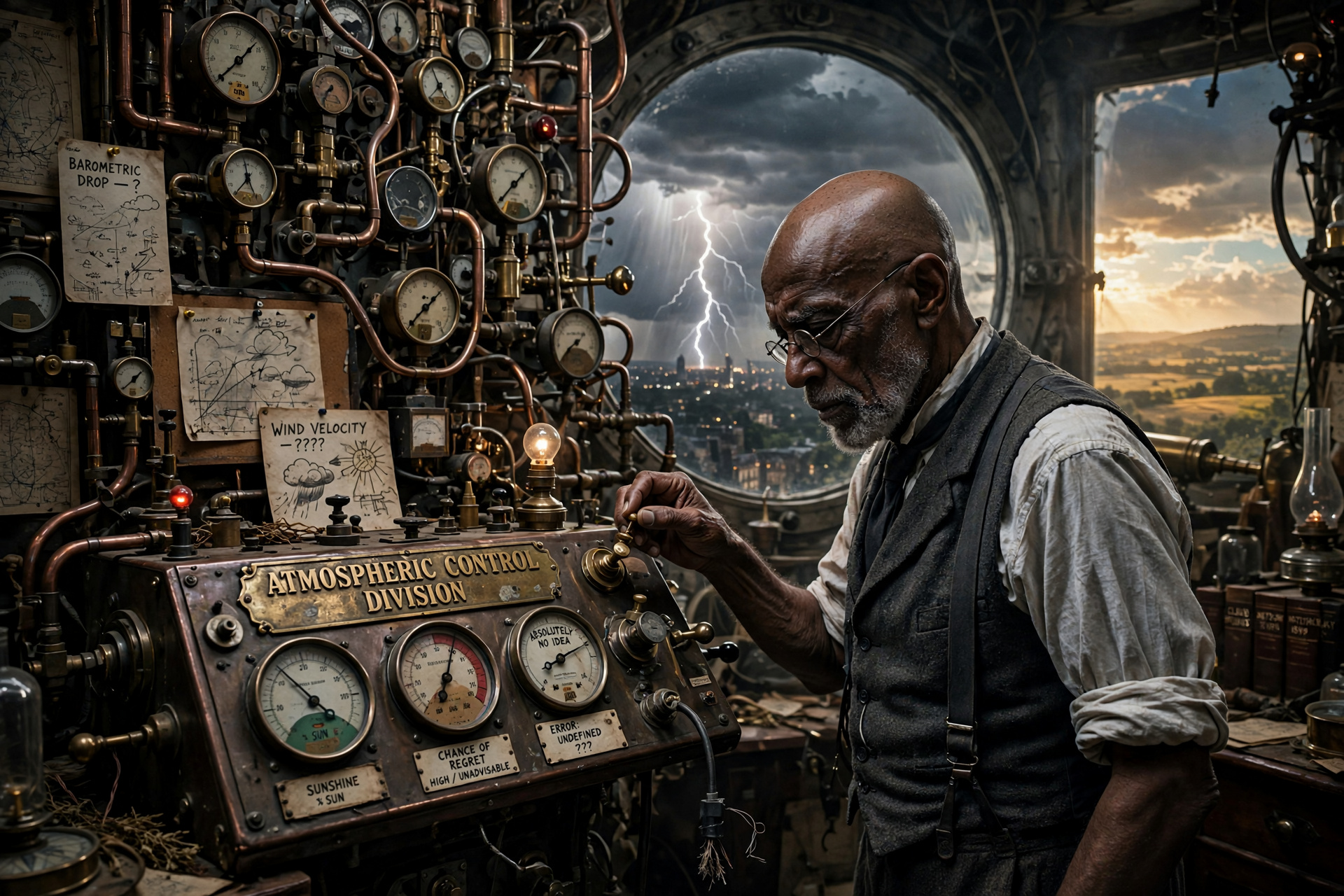
At eighty-one, Ezekiel was a tall, slightly stooped Black gentleman with a bald head, a neatly trimmed silver beard, and the deeply furrowed expression of someone who had spent most of his adult life being disappointed by the intellectual capabilities of his fellow human beings. His spectacles rested near the end of his nose, his shirtsleeves were permanently rolled to his elbows, and his charcoal waistcoat had been repaired so many times that identifying the original fabric required a degree in archaeology. He walked with a slight limp, complained about his knees every morning, and possessed the remarkable ability to make the words interesting theory sound like a declaration of war.
The observatory occupied the uppermost floor of an abandoned municipal research facility overlooking the city. Its enormous circular windows offered an unobstructed view of the surrounding countryside, where farmland surrendered to industrial buildings, neighborhoods, and the distant silhouettes of downtown. The room itself resembled the aftermath of a particularly enthusiastic collision between a Victorian steamship, a telephone exchange, and a hardware store experiencing financial difficulties. Copper pipes twisted across the walls like metallic vines, pressure gauges crowded every available surface, and hundreds of switches, levers, dials, and brass fittings formed an elaborate mechanical landscape that appeared to have been designed by someone who considered simplicity a personal insult.
The air smelled of hot dust, machine oil, old paper, and coffee strong enough to remove paint from a battleship. Beneath the low electrical hum of the instruments, the building produced its own peculiar soundtrack: the intermittent ticking of cooling pipes, the faint rattle of loose windowpanes, and an occasional metallic groan from somewhere inside the walls that Ezekiel had been meaning to investigate since 1989.
He hung his coat beside the entrance, placed his battered leather briefcase on the workbench, and approached the central control console.
“Good morning, ladies and gentlemen,” he announced to the machinery.
Nobody answered.
This was customary.
Ezekiel preferred it that way.
He examined the first pressure gauge, adjusted a brass valve exactly one-quarter turn clockwise, and recorded the reading in a leather-bound notebook. The second gauge indicated moderate atmospheric instability. The third suggested sunshine. The fourth displayed a reading that had not changed since 1978, although Ezekiel continued documenting it because consistency, in his opinion, was the foundation of respectable scientific inquiry.
The fifth gauge was labeled CHANCE OF REGRET.
Its needle remained firmly in the red.
“Naturally,” Ezekiel muttered.
Beside it, another instrument bore the inscription ABSOLUTELY NO IDEA.
That particular needle moved constantly.
Ezekiel considered it the most honest piece of equipment in the entire building.
He poured himself a cup of coffee, took one swallow, and grimaced with satisfaction. It tasted like burned rubber, old pennies, and the bitter disappointment of a thousand failed expectations. Perfect. He settled onto his stool, opened the morning’s atmospheric charts, and began the delicate business of managing the weather.
At 6:17, he increased the regional sunshine output by twelve percent.
Outside, thunder rolled across the city.
Ezekiel frowned.
“Delayed response.”
He adjusted another valve.
Lightning split the sky beyond the circular window, illuminating the rooftops and sending a low, rolling concussion through the observatory.
“Atmospheric resistance,” he explained to nobody.
At 6:42, he reduced precipitation over the western agricultural district.
Rain began falling.
At 7:03, he activated the auxiliary cloud-dispersal mechanism.
The sky darkened considerably.
By 7:19, the eastern suburbs were experiencing hail, the southern industrial district had disappeared beneath a wall of rain, and a particularly ambitious thunderstorm was moving toward downtown with the determination of a debt collector who had finally located the correct address.
Ezekiel studied his instruments.
“Well,” he said, “somebody’s being an asshole.”
He increased the barometric stabilization setting.
A fuse blew.
The room filled with the sharp smell of scorched insulation.
Ezekiel sighed, reached beneath the console, and replaced the fuse without looking.
He had performed this particular operation approximately eleven thousand times.
Experience, he believed, was the difference between expertise and mere enthusiasm.
Unfortunately, experience also had a peculiar way of convincing people that familiarity and effectiveness were the same thing.
Ezekiel had not always been an eccentric old man operating machinery in an abandoned observatory. Once, he had been among the most promising atmospheric engineers in the country. He had studied mathematics, physics, fluid dynamics, and the complicated behavior of pressure systems with an almost religious devotion. His early research into localized weather prediction had attracted attention from universities, government agencies, and several private companies interested in the possibility of controlling precipitation.
The original Atmospheric Control Project had been ambitious, expensive, and spectacularly optimistic. Its architects believed that a sufficiently sophisticated network of sensors, atmospheric monitors, pressure regulators, and experimental electrical systems might eventually influence localized weather conditions. They imagined ending droughts, preventing floods, protecting crops, and perhaps even persuading hurricanes to reconsider their travel arrangements.
The government loved the idea.
Politicians adored it.
Investors practically achieved orgasm.
After all, what could be more appealing than controlling something that had been ignoring human authority since the beginning of recorded history?
The project received funding.
Buildings were constructed.
Equipment was installed.
Committees were established.
Consultants were hired.
Naturally, somebody ordered commemorative coffee mugs before the first experiment had been completed.
Then reality arrived.
Reality has always been particularly inconsiderate toward ambitious government programs.
The machinery could measure atmospheric conditions with extraordinary precision. It could identify developing pressure systems, track temperature changes, monitor humidity, and produce detailed predictions about the movement of storms. What it could not do, despite several million dollars and the combined optimism of numerous highly educated individuals, was make the weather obey.
The clouds continued doing whatever the hell they pleased.
Rain fell where it wanted.
Wind changed direction without submitting the appropriate paperwork.
And thunderstorms demonstrated a remarkable indifference to budgetary oversight.
Eventually, the funding disappeared. The project was discontinued, the research staff reassigned, and the control mechanisms disconnected from their experimental power systems. The facility was scheduled for closure, although the closure paperwork became entangled in an administrative dispute involving three departments, two contractors, and a disagreement over who technically owned the copper pipes.
Ezekiel remained.
Initially, he had been retained to supervise the preservation of the equipment. Then someone forgot to terminate his position. By the time the mistake was discovered, the employee responsible had retired, the department overseeing the project had been dissolved, and nobody could locate the original employment agreement.
Thus, Professor Ezekiel Bartholomew Weatherby became the last remaining employee of a government program that no longer officially existed.
He continued arriving every morning at 5:43.
He continued adjusting the controls.
And the weather continued ignoring him.
Forty-six years is a long time to maintain an illusion.
It’s also a long time to develop a relationship with one.
At 9:26, Ezekiel was examining a suspicious fluctuation in the northern wind-pressure readings when someone knocked on the observatory door.
He ignored it.
The knocking continued.
“Unless you’re carrying coffee or an emergency authorization from God, come back later!”
The door opened.
A young woman stepped inside carrying a toolbox, a clipboard, and the expression of someone who had already decided that whatever she found in this building was going to become somebody else’s problem.
Her name was Olivia Mercer. She was twenty-nine, recently employed by the municipal facilities department, and had been assigned to inspect the building after an automated utility audit revealed that electricity was still being supplied to a research facility officially listed as demolished.
“Professor Weatherby?”
“Depends who’s asking.”
“Olivia Mercer. Facilities Maintenance.”
Ezekiel glanced over his spectacles.
“You’re late.”
“We didn’t have an appointment.”
“Then you’re extraordinarily late.”
Olivia looked around the room. Her gaze moved across the copper pipes, ancient gauges, flickering indicator lights, and handwritten charts covering the walls. The machinery emitted a low mechanical hum punctuated by an occasional clicking sound that suggested something expensive was contemplating suicide.
“What exactly happens here?” she asked.
“Atmospheric regulation.”
“You control the weather?”
“Obviously.”
Olivia glanced toward the circular window, where lightning illuminated a thunderstorm advancing across the city.
“How’s that working out?”
Ezekiel narrowed his eyes.
“Are you familiar with the principles of atmospheric resistance?”
“Not particularly.”
“Then I suggest you avoid asking stupid questions.”
Olivia smiled faintly.
She had worked in municipal maintenance long enough to recognize the species.
Highly intelligent.
Territorial.
Convinced that every problem could be solved by explaining it loudly enough to someone with fewer academic credentials.
She set her toolbox on the floor and approached the main console.
“I’m here to inspect the electrical systems. Apparently, this building has been drawing power for several decades without an active departmental account.”
“Government accounting has never been particularly impressive.”
“On that, Professor, we agree.”
She removed a panel beneath the central console.
Ezekiel returned to his instruments.
Outside, the storm intensified.
Olivia examined the wiring. Several cables had been disconnected, others had been capped, and an elaborate collection of brass switches appeared to terminate in a junction box containing nothing more substantial than dust, a dead spider, and what looked suspiciously like a peppermint wrapper.
She traced the connections.
Checked the power supply.
Examined the schematics.
Then checked everything again.
“Professor?”
“Hmm?”
“These controls aren’t connected to anything.”
“That’s a rather broad statement.”
“I mean electrically. The primary circuits are disconnected.”
“Naturally.”
Olivia looked up.
“Naturally?”
“Yes.”
She stood slowly.
“Professor, this machine cannot control the weather.”
Ezekiel adjusted a valve.
“I know.”
Olivia stared at him.
For several seconds, the only sounds were the ticking of the instruments and the rain striking the enormous windows.
“You know?”
“Of course I know.”
“But you’ve been operating it.”
“Your observational skills are improving.”
“For forty-six years?”
“Forty-six years, seven months, and thirteen days.”
“Why?”
Ezekiel didn’t answer immediately.
Instead, he closed the notebook, removed his spectacles, and turned toward the window.
The storm had reached the city. Rain moved across the rooftops in silver sheets, and the distant streets reflected the occasional blue-white flash of lightning. Beyond the storm, sunlight still illuminated the western farmland, painting the fields in warm amber beneath a sky that appeared divided against itself.
“Tell me something, Miss Mercer. Do you plan your days?”
“Of course.”
“Schedules?”
“Yes.”
“Appointments?”
“Obviously.”
“Budgets?”
“When I can.”
“Contingencies?”
“Sometimes.”
“And does everything happen according to those plans?”
Olivia laughed.
“Not even remotely.”
“Yet you continue making them.”
“Because planning helps.”
“Precisely.”
He replaced his spectacles.
“Now tell me, does planning mean you’re controlling what happens?”
Olivia considered the question.
“Not entirely.”
“Not entirely,” Ezekiel repeated. “An interesting phrase. Rather generous, don’t you think?”
She folded her arms.
“There’s a difference between planning and pretending you control the weather.”
“Of course there is.”
“Then why keep turning the knobs?”
Ezekiel looked toward the gauges.
“Because the knobs were never the important part.”
Olivia frowned.
The professor rose from his stool and approached the window. His knees protested, his back stiffened, and for a moment he stood with one hand resting against the metal frame, watching the rain.
“When I was younger, I believed that understanding something meant I could eventually control it. I studied atmospheric pressure, temperature gradients, moisture distribution, and wind patterns. I could calculate the probable movement of a storm with considerable accuracy. I could tell you why clouds formed, why lightning occurred, and why certain conditions produced tornadoes while others did not.”
He paused.
“And I mistook that knowledge for authority.”
Olivia remained silent.
“That’s a dangerous mistake, Miss Mercer. Particularly for intelligent people. The more we understand, the easier it becomes to believe that understanding entitles us to obedience.”
He gestured toward the storm.
“That weather doesn’t give a damn how many degrees I possess. It doesn’t care how carefully I prepare my calculations. It won’t postpone a thunderstorm because someone scheduled a wedding, and it certainly won’t move a tornado because a city council approved a zoning ordinance.”
“Then why come here every day?”
Ezekiel smiled.
“Because every morning, somebody has to admit they don’t know what the hell is going to happen.”
Olivia studied him.
“That sounds suspiciously like something you could do from home.”
“Certainly.”
“With considerably less equipment.”
“Undoubtedly.”
“And better coffee.”
“Now you’re just being disrespectful.”
She laughed.
Ezekiel returned to his desk and opened a different notebook. Unlike the others, this one contained no elaborate calculations or experimental formulas. Its pages were filled with observations: the dates of unusual storms, the timing of seasonal changes, the behavior of migrating birds, the first frost of each autumn, and the peculiar ways ordinary people responded when nature interrupted their carefully constructed plans.
He turned to a page from several years earlier.
“March seventeenth. Severe thunderstorm. Unexpected flooding along the eastern river. Three neighborhoods evacuated. Power outages throughout the city.”
Olivia leaned closer.
“And?”
“People helped one another. Neighbors opened their homes. Strangers carried sandbags. A man who hadn’t spoken to his brother in twelve years borrowed his boat to rescue him.”
He turned another page.
“July twenty-third. Record heat. Municipal cooling systems failed. Several businesses opened their doors to people who couldn’t afford air conditioning.”
Another page.
“November ninth. Early snowfall. Transportation disrupted. Schools closed. Children spent the afternoon building snowmen while their parents complained about the inconvenience.”
Olivia looked at him.
“You’re studying people.”
“Among other things.”
“I thought you were studying weather.”
“I am. But weather has a remarkable habit of revealing what people become when their plans stop working.”
He closed the notebook.
“Anyone can appear organized when everything cooperates. It’s when the machinery fails, the schedule collapses, and the universe decides to introduce a few unexpected variables that you discover what someone actually understands about control.”
Olivia considered that.
Outside, the thunderstorm began moving east.
The rain softened.
A pale ribbon of sunlight broke through the clouds.
Ezekiel glanced toward the central console.
“Ah. Excellent.”
Olivia followed his gaze.
“Don’t tell me.”
“Atmospheric stabilization achieved.”
“You didn’t do anything.”
“That’s a matter of interpretation.”
“Professor.”
“Miss Mercer.”
She shook her head.
“You’re impossible.”
“Frequently.”
Olivia returned to the open electrical panel and began documenting the disconnected circuits. She had enough information to recommend decommissioning the equipment, disconnecting the remaining power supply, and closing the building permanently. The report would be straightforward. The facility served no official purpose, the machinery performed no active function, and the last remaining employee was an elderly gentleman who apparently spent his mornings arguing with thunderstorms.
Yet something about the notebooks bothered her.
Not because they proved the machinery worked.
They didn’t.
But because the professor had spent decades doing something the original project had failed to understand.
He had learned to observe without assuming ownership.
He had learned to prepare without demanding certainty.
And perhaps most importantly, he had learned that the inability to control something did not make understanding it worthless.
Still, Olivia wasn’t entirely convinced.
“Professor, there’s something I don’t understand.”
“Only one thing? Remarkable.”
“If you know the machine doesn’t work, why keep pretending it does?”
Ezekiel looked at her for a long moment.
Then he laughed.
Not politely.
Not quietly.
It was the deep, slightly wheezing laughter of a man who had spent eighty-one years collecting evidence that the universe possessed a particularly vicious sense of humor.
“Miss Mercer, have you ever met a person who believed they were completely in control of their life?”
“Plenty.”
“And what happened?”
“Usually something they didn’t expect.”
“Exactly.”
He gestured toward the machinery.
“This contraption is no different from half the systems people construct to convince themselves that tomorrow will behave. They make five-year plans, ten-year plans, retirement plans, relationship plans, financial plans, and elaborate schedules detailing what they intend to accomplish before lunch. Then someone gets sick, the economy collapses, a marriage ends, a child is born, or a perfectly respectable automobile decides to surrender its transmission on the interstate.”
He shook his head.
“And suddenly everybody discovers that the universe neglected to consult their calendar.”
Olivia smiled.
“You’re saying planning is pointless?”
“Absolutely not. Planning is essential. Preparation matters. Maintenance matters. Knowledge matters. You should inspect the equipment, study the conditions, and make the best decisions available with the information you possess.”
He leaned closer.
“But don’t confuse preparing for the storm with having authority over the rain.”
The room fell quiet.
For a moment, Olivia considered her own life. The apartment she was saving to leave. The promotion she hoped to receive. The relationship she had been trying to repair through a series of carefully arranged conversations that never seemed to unfold the way she imagined. She thought about the spreadsheets on her computer, the reminders on her phone, and the growing frustration she experienced whenever reality wandered away from the schedule.
She had always considered herself organized.
Responsible.
Prepared.
But somewhere along the way, preparation had become an expectation that the world should cooperate.
And when it didn’t, she treated the deviation as a personal failure.
She wondered how much energy she had spent attempting to manage outcomes that had never belonged entirely to her.
The thought was uncomfortable.
Ezekiel noticed.
He had become rather good at recognizing the expression.
“Don’t look so troubled, Miss Mercer. It’s not a terminal condition.”
“What isn’t?”
“Discovering you’re not God.”
She laughed.
“That’s reassuring.”
“Quite. The position comes with terrible hours and absolutely no vacation.”
Olivia closed her toolbox.
“I suppose I should finish my report.”
“Naturally.”
“They’ll probably want to shut this place down.”
“Probably.”
“Doesn’t that bother you?”
Ezekiel glanced around the observatory. The machinery had occupied most of his adult life. Every scratch on the brass panels, every repaired valve, every faded chart represented years of effort, disappointment, discovery, and stubborn persistence. He knew the building’s sounds better than he knew most people. He could identify a failing bearing by its vibration and recognize the approach of rain by the subtle changes in pressure against the old window seals.
For decades, this place had given his days structure.
Perhaps too much structure.
“Of course it bothers me,” he admitted. “I rather like the old bastard.”
He rested a hand against the console.
“But the building was never mine to keep forever.”
Olivia waited.
“Nothing is, really.”
The professor looked toward the western window, where sunlight had finally broken through the clouds.
“That’s another thing the weather teaches you. Everything changes. The trick isn’t preventing change. It’s learning when to open an umbrella and when to get the hell out of the way.”
Olivia smiled.
“I’ll see what I can do about the report.”
“Don’t falsify anything on my account.”
“I wasn’t planning to.”
“Good. Government employees have enough trouble with honesty without encouragement.”
She gathered her clipboard and walked toward the door.
Before leaving, she stopped.
“Professor?”
“Hmm?”
“One last question.”
“Make it a good one.”
“What’s the gauge marked ‘Absolutely No Idea’ actually measuring?”
Ezekiel looked toward the instrument.
Its needle continued wandering erratically across the dial.
He considered the question with exaggerated seriousness.
“Management confidence.”
Olivia burst out laughing.
“You’re kidding.”
“Entirely.”
She shook her head and disappeared down the stairwell.
Ezekiel listened until her footsteps faded.
Then he returned to the console.
The storm had passed.
The city glistened beneath the afternoon sun. Water dripped from rooftops, steam rose from the pavement, and distant traffic resumed its usual impatient crawl through the streets.
He examined the instruments.
Adjusted his spectacles.
Reached toward the brass control knob.
Then stopped.
For several seconds, his hand hovered above it.
He smiled faintly.
And left it alone.
Outside, a small cloud drifted across the sun.
Ezekiel watched it pass.
“Show-off,” he muttered.
And there it is, Brave Souls.
Forty-six years.
Millions of dollars in equipment.
Enough copper tubing to supply a small plumbing company.
And one elderly professor who finally understood that knowing how something works doesn’t mean it owes you obedience.
Now, before somebody decides I’m suggesting we abandon planning, throw away our calendars, and start making major financial decisions based on the position of Jupiter—
No.
That’s not the lesson.
Preparation matters.
Discipline matters.
Knowledge matters.
But somewhere between making a plan and demanding that life follow it, we cross a line that doesn’t actually exist anywhere except inside our own heads.
We begin treating uncertainty as failure.
Change as betrayal.
Unexpected circumstances as evidence that somebody screwed up.
And sometimes somebody did.
But sometimes it just rains.
The world isn’t obligated to cooperate with our expectations.
People aren’t machinery.
Relationships aren’t equations.
Tomorrow isn’t a contract.
And the universe doesn’t give a damn what you wrote in your planner.
We’re on a journey through the ordinary and mundane, taking off the rose-colored glasses and looking for a different side of Madness.
Maybe the slant today is simply this:
You can learn to read the weather without ever learning to command the rain.
So make your plans.
Check your equipment.
Prepare for the worst.
Hope for the best.
And when the clouds roll in despite your careful calculations, remember that an umbrella is considerably more useful than standing outside screaming at the sky.
Because sometimes…
That Shit … Be at a Slant.
Discover more from Memoirs of Madness
Subscribe to get the latest posts sent to your email.

