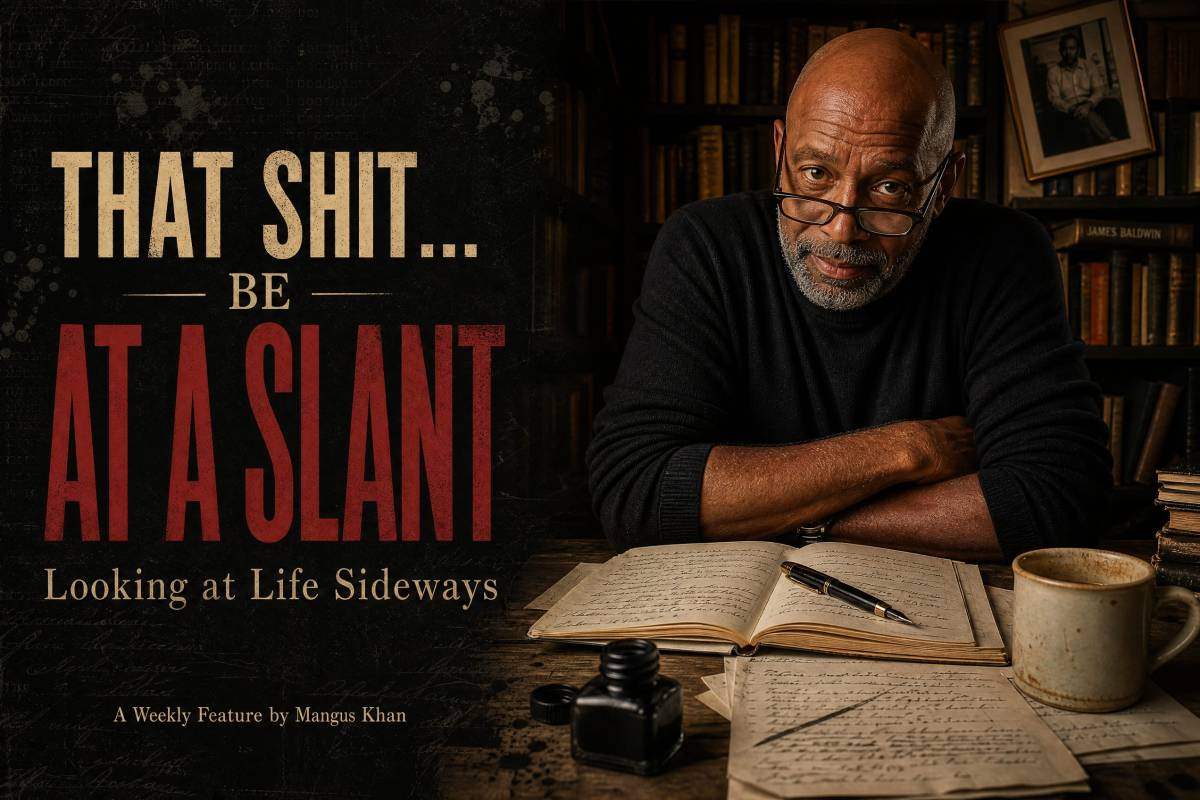
Hello, I’m Mangus Khan, and for the next few minutes, I encourage you to walk into Madness with me.
Come on in, Brave Souls.
Today we’re going to talk about perspective.
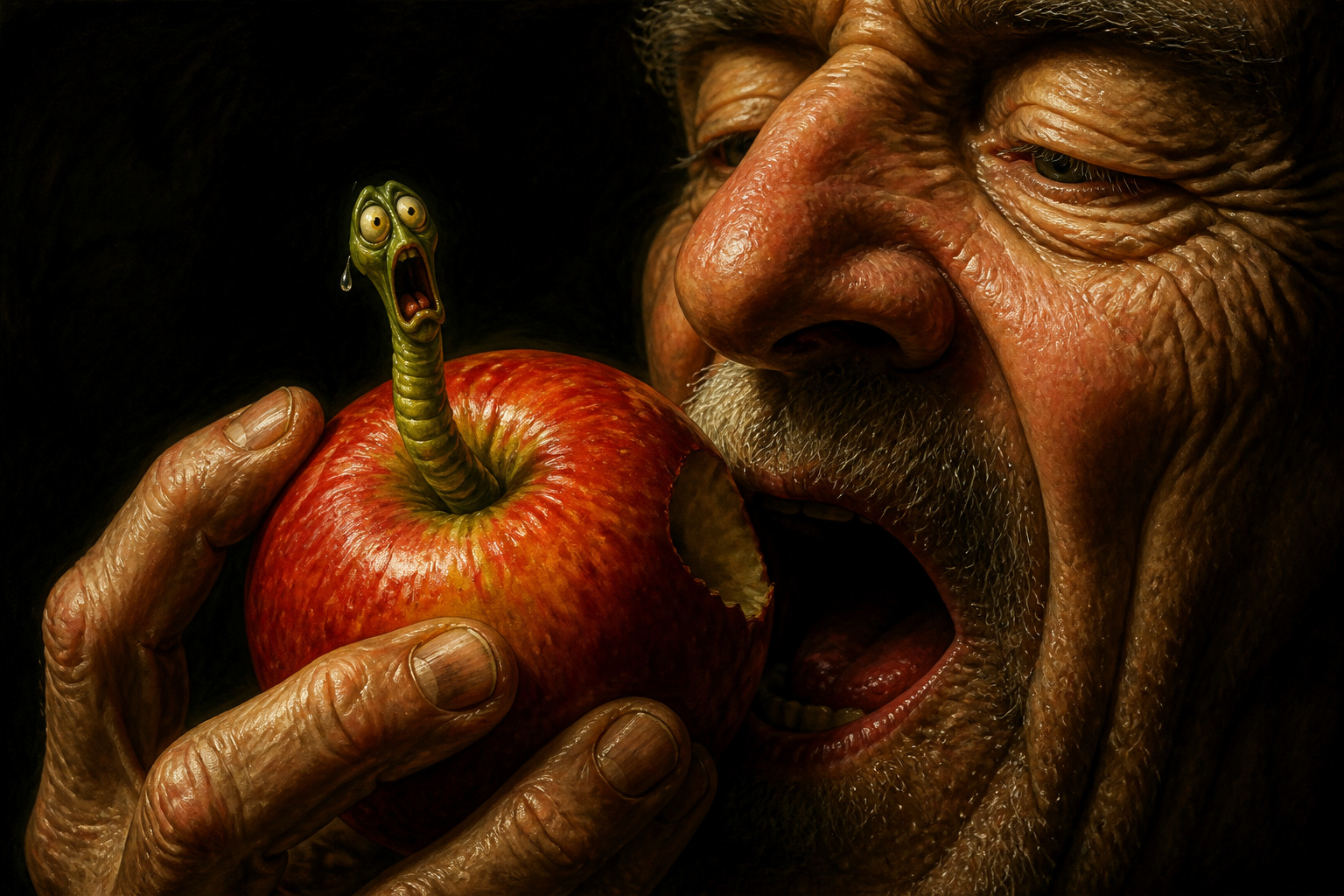
There’s a man.
There’s an apple.
There’s a worm.
And depending upon which one you ask, this is either lunch—
or a home invasion followed by attempted murder.
The man didn’t know this, of course. That’s important. As far as he was concerned, he was having an apple. Maybe his doctor told him to eat better. Maybe he was trying to lose a few pounds. Maybe the vending machine wanted three dollars and twenty-five cents for a candy bar, and even desperation has financial limits. Whatever the reason, he picked the apple. Good for him. Look at that son of a bitch making responsible decisions.
Meanwhile, Clarence was about to die.
I’ve named the worm Clarence because he looked like a Clarence, and Clarence had been having a perfectly ordinary morning before the apocalypse arrived. The apple was comfortable. The temperature was good. The neighborhood was quiet. The rent was reasonable—free, actually. Clarence had found a particularly sweet section near the core and was contemplating whether he should spend the afternoon tunneling toward the opposite side when something enormous wrapped itself around his entire universe.
Five fingers. Calloused. Warm. Smelling faintly of soap, cigarettes, and whatever humans touch during the course of an ordinary day.
The apple moved.
Clarence froze as gravity shifted beneath him. Light poured through the small opening he’d been using as a breakfast nook, and his entire world rose toward something he couldn’t understand. Then he saw it—a face, enormous and wrinkled, gray whiskers framing an opening mouth. Beyond the lips were teeth.
Oh, hell no.
Now, I don’t know whether worms experience existential dread. I’m assuming they do because it makes this story considerably better. Whatever Clarence experienced, it was enough to send him shooting out of that apple like the mortgage company had arrived with paperwork.
The man screamed.
Clarence screamed.
There are moments when species differences become irrelevant.
This was one of them.
The apple hit the table. The chair scraped violently backward, its legs shrieking against the kitchen floor. Clarence stood upright in the middle of what had been, until seconds ago, his dining room, his narrow green body trembling while the man stared at him as though Satan himself had crawled from the produce section.
For several seconds, neither moved.
Then Clarence said, “What the fuck is wrong with you?”
The man blinked. “What?”
“You heard me.”
He leaned closer.
Clarence recoiled. “Back the hell up.”
Surprisingly, the man did.
“You were in my apple.”
Clarence stared at him. “Your apple?”
“Yes.”
“I’ve lived here for six weeks.”
“I bought it yesterday.”
Clarence paused. “From whom?”
“The grocery store.”
“Did they show you a deed?”
The man frowned. “No.”
“Lease?”
“No.”
“Title?”
“It’s an apple.”
“Convenient.”
And there it was.
Perspective.
The man saw food; Clarence saw property. The man saw contamination; Clarence saw attempted murder. Neither had changed the object sitting between them. It remained the same apple, bruised now where it had struck the table, one bite missing from its side and a rather indignant worm protruding from the top. Yet two completely different realities had somehow managed to occupy the same kitchen.
We do this shit constantly.
Not with worms, necessarily, although after today I’d inspect the produce.
We move through the world assuming we’re the protagonist because we’re standing behind our own eyes. It makes sense. Every morning you wake inside the same skull, accompanied by your memories, worries, plans, bills, aches, regrets, and whatever unfinished argument your brain decided to resume at three seventeen in the morning. There’s probably background music too, although you can’t hear it because the budget for your particular production was apparently spent elsewhere. Still, this is your story, so naturally you’re the main character.
The problem is that everybody else woke up believing exactly the same thing.
You’re driving to work when some asshole cuts you off. You slam on the brakes, your coffee attempts escape, and your blood pressure discovers territory Lewis and Clark never mapped. For the next twelve miles, you conduct an extensive investigation into this person’s intelligence, parentage, driving ability, moral character, and whether civilization would benefit from their immediate removal from the gene pool. They ruined your morning. They are clearly the villain.
Meanwhile, three cars ahead, that person doesn’t remember you exist.
Maybe they never saw you. Maybe their child is sick. Maybe they’re late for something important. Maybe their mother called from the hospital five minutes ago.
Or maybe they’re just an asshole.
Let’s not romanticize everybody.
Sometimes the asshole actually is an asshole.
But while you’re behind them constructing a psychological profile that would impress the FBI, they’re wondering whether they remembered to turn off the coffee maker. You’re living through an incident they’ll never remember. Same road. Same ten seconds. Different story.
That’s uncomfortable when you follow it far enough, because it means there are probably people walking around this planet carrying memories of us that we don’t possess.
Think about that for a moment.
Somewhere, somebody may remember something you said twenty years ago. One sentence. You don’t remember saying it. Hell, you might not remember the conversation, the room, or the person, but they do. Maybe it hurt them. Maybe it encouraged them. Maybe it changed something. Maybe they went home afterward and cried. Maybe they decided not to quit. Maybe they decided they could never forgive you.
And you went home and had meatloaf.
That’s a hell of a thing.
We tend to judge our impact by our intention. I didn’t mean anything by it. Perhaps not, but intention belongs to the person throwing the stone. Impact belongs to whatever it hits. That doesn’t mean we’re responsible for every interpretation anyone has ever made of us. That road leads directly to madness, and around here we prefer to walk into Madness voluntarily. But it does mean our version isn’t the only version.
I’ve thought about that more as I’ve gotten older. There are situations from my past where I once knew exactly what happened—or at least I believed I did. Age has a nasty habit of sanding certainty down around the edges. Eventually you realize the memory you’ve carried for thirty years isn’t footage. It’s testimony. Your testimony. It passed through who you were, what you knew, what you feared, what you loved, and perhaps most importantly, what you needed to believe about yourself when it happened.
Someone else may have walked away from the same room carrying an entirely different version.
Neither person necessarily lying.
That’s the bastard of it.
Sometimes there isn’t a villain.
Just two people standing on opposite sides of the same apple.
Clarence was still pissed, by the way. I haven’t forgotten about him. He stood inside the crater where the man’s first bite had nearly ended his entire bloodline, staring at the human with an expression of outrage that seemed anatomically ambitious for something without eyebrows.
“Do you have any idea what you almost did?”
“I was eating.”
“You bit my bedroom.”
“I didn’t know you were there.”
Clarence stared at him.
And maybe that’s the sentence sitting underneath this whole ridiculous mess.
I didn’t know you were there.
How much damage begins there?
I didn’t know you were hurting. I didn’t know you heard me. I didn’t know that mattered to you. I didn’t know you were afraid. I didn’t know you needed help. I didn’t know you loved me. I didn’t know you were saying goodbye.
I didn’t know.
Sometimes it’s an excuse.
Sometimes it’s the absolute truth.
We cannot see every consequence before we act. We cannot know every private battle taking place around us. We cannot spend our lives terrified that some casual movement will turn us into the monster in somebody else’s memory. But maybe we can move a little more carefully. Ask another question. Listen another thirty seconds. Leave a little room for the possibility that what looks obvious from our side of the apple looks completely different from the other.
And perspective isn’t the same thing as truth. That’s another trap. Seeing another side doesn’t mean every side is equally correct. Sometimes somebody is wrong. Sometimes somebody is cruel. Sometimes somebody knows exactly what they’re doing. Sometimes the villain knows he’s the villain and simply doesn’t give a shit.
Understanding perspective doesn’t require surrendering judgment.
It requires humility.
The willingness to consider that the camera isn’t always pointed where we think it is.
We like certainty because certainty makes casting easier. Heroes over here. Villains over there. Good people. Bad people. Us. Them. Nice, clean categories with the moral complexity of a Saturday morning cartoon. Reality has always been messier. Sometimes the hero in one chapter is the bastard in another. Sometimes the person who saved you couldn’t save somebody else. Sometimes the person you remember as cruel was surviving something you never knew about. Sometimes the person you hurt remembers your face more clearly than you remember their name.
And sometimes you’re just a hungry old man trying to eat a goddamn apple while Clarence is inside filing charges with the Hague.
Perspective.
The man looked at Clarence. Clarence looked at the man. Somewhere behind them, the refrigerator hummed with complete indifference to the diplomatic crisis unfolding beside the fruit bowl.
“So what happens now?” the man asked.
Clarence considered the question. “You put the apple down.”
“Fine.”
“Slowly.”
The man lowered it to the table.
“And then?”
“You leave.”
“This is my kitchen.”
Clarence glanced around. “Again with the property claims.”
The man rubbed his face. He was hungry, increasingly irritated, and beginning to suspect that choosing fruit had been the worst dietary decision he’d made all week. “What am I supposed to eat?”
Clarence shrugged. “Not my problem.”
“There’s a banana.”
Clarence narrowed his eyes.
“You might want to knock first.”
The man turned toward the banana sitting beside the coffee maker.
For the first time in his life, he wondered.
And perhaps that’s enough.
Not agreement. Not guilt. Not spending the rest of our lives apologizing for occupying space. Just wondering. Wondering what something looks like from over there. Wondering what we missed. Wondering whether the person we’ve cast as the villain has a version of the story where we’re wearing the black hat. Wondering whether that irritating stranger is carrying something heavy. Wondering whether our harmless joke landed somewhere we couldn’t see.
Wondering whether there’s a Clarence in the apple before taking the first bite.
The man picked up the banana. He stared at it for several seconds, turned it over in his weathered hands, then tapped it twice against the counter.
“Anybody home?”
Silence.
He peeled it cautiously.
Clarence watched from the apple.
“Paranoid bastard,” he muttered.
And there it is, Brave Souls.
You can learn the lesson and still get talked about afterward.
That’s life.
We’re on a journey through the ordinary and mundane, taking off the rose-colored glasses and looking for a different side of Madness.
Sometimes the world doesn’t need to change.
Sometimes you just need to move three feet to the left and look again.
Because somewhere, in somebody else’s version of events, the villain isn’t plotting anything.
He’s just trying to have lunch.
And sometimes…
That Shit … Be at a Slant.
Discover more from Memoirs of Madness
Subscribe to get the latest posts sent to your email.


😂Testify!
LikeLike
We truly are threads that make up one massive and ever-expanding tapestry. Moreover, we can’t begin to quantify our effect.
LikeLike