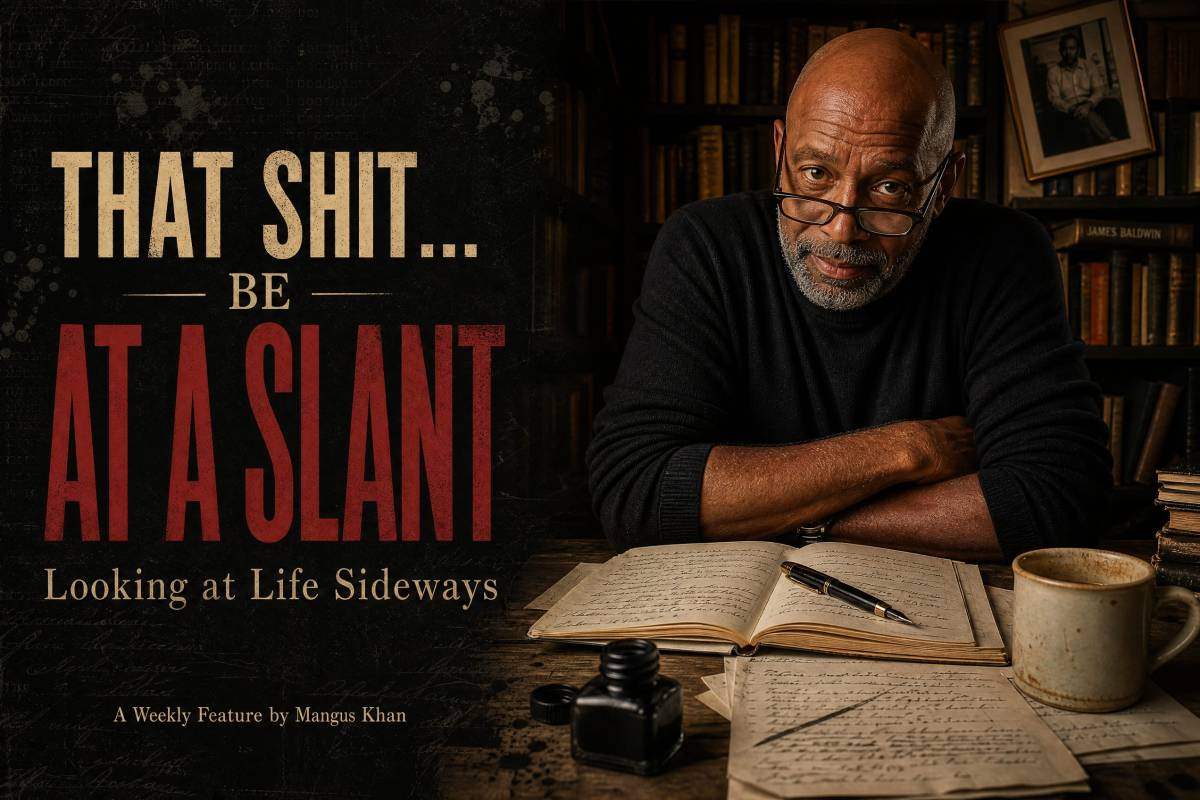
Hello, I’m Mangus Khan, and for the next few minutes, I encourage you to walk into Madness with me.
Come on in, Brave Souls.
Watch where you step.
There’s a ten-millimeter socket around here somewhere, which means we’ll probably find Jimmy Hoffa, Amelia Earhart, and evidence of intelligent life in Congress before we find that little bastard.
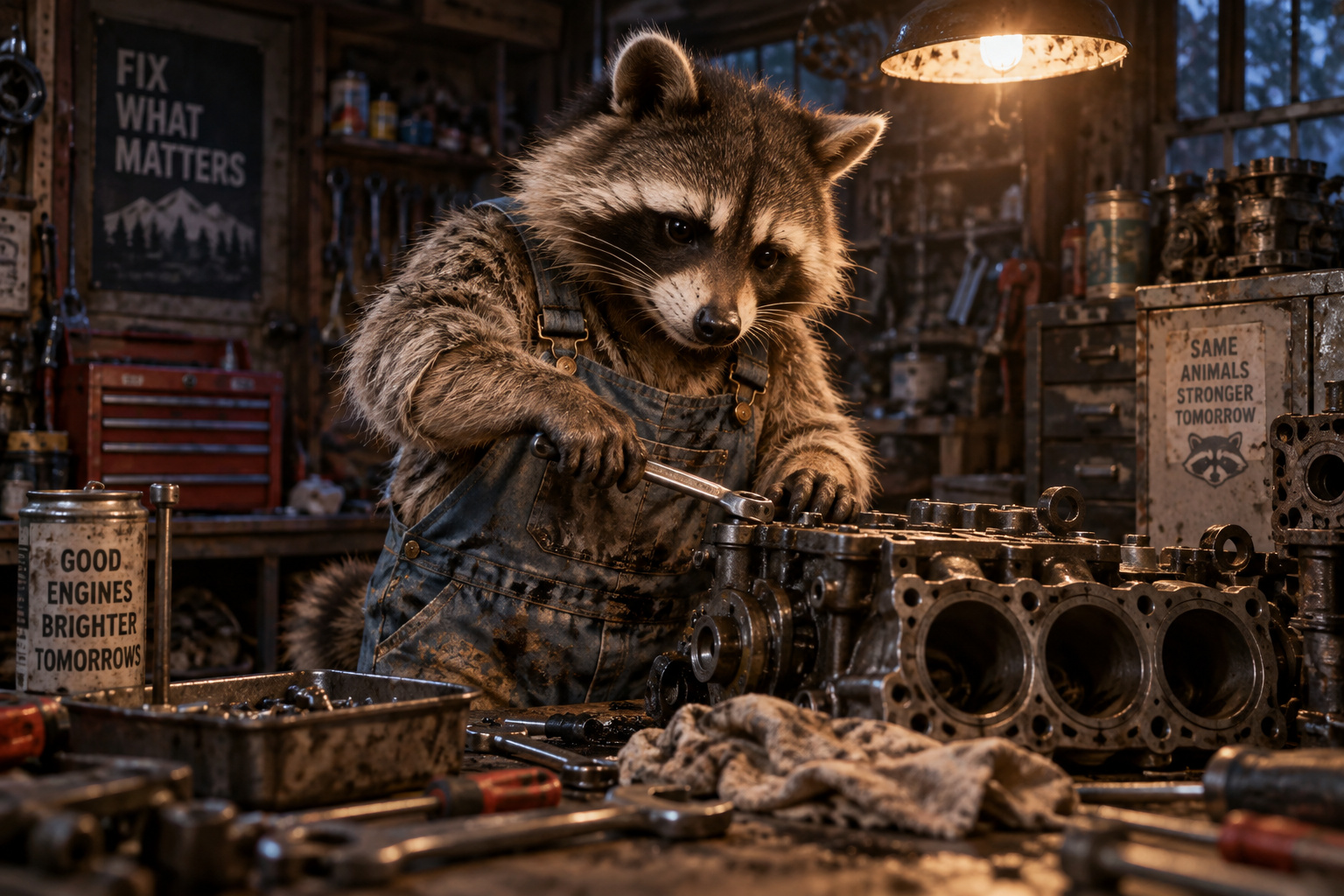
The shop smells like work.
Not the sanitized version sold in commercials where some suspiciously clean mechanic smiles while holding a wrench that has obviously never touched an engine. I mean actual work—the metallic tang of old tools, gasoline evaporating from something it probably shouldn’t be evaporating from, penetrating oil, hot dust, burned grease, and that peculiar sweetness of antifreeze lingering beneath everything else.
There’s grime beneath my fingernails that soap has already filed paperwork against.
Metal shavings glitter across the workbench beneath a hanging lamp whose shade is stained with decades of fingerprints. Wrenches lie scattered among sockets, extensions, screwdrivers, oily shop towels, coffee cans filled with bolts nobody remembers removing, and several mysterious pieces of hardware everyone has collectively agreed were probably unnecessary.
At least, that’s what we’re telling ourselves.
Somewhere against the wall, an old radio wheezes through a speaker that has probably needed replacing since Reagan was president. The music comes and goes beneath the occasional clatter of metal settling against metal.
The engine is open on the bench.
Head removed.
Pistons exposed.
Everything normally hidden beneath steel, plastic, hoses, wires, and the comforting illusion that everything is fine now sits naked beneath the light.
Funny thing about machines.
They look considerably less impressive once you open them up.
So do people.
From the outside, an engine is simply an engine. Turn the key. It starts. Press the accelerator. It moves. Nobody thinks about compression ratios, oil pressure, bearings, timing, fuel mixture, cooling systems, or the thousands of tiny explosions happening a few feet in front of us.
We just expect the motherfucker to work.
Preferably with air conditioning.
People receive roughly the same consideration.
We rarely think about what keeps someone functioning while they’re functioning.
We see the result.
They showed up.
Answered the phone.
Went to work.
Paid the bill.
Cooked dinner.
Made the deadline.
Laughed at the joke.
Asked how everybody else was doing.
Good.
Everything must be fine.
Then something starts knocking.
Ticking.
Grinding.
Maybe there’s a vibration that wasn’t there yesterday.
And suddenly we’re listening.
That’s human nature, I suppose.
We rarely appreciate the machinery while it works.
We notice it when it stops.
Engines.
Plumbing.
Electricity.
Relationships.
Bodies.
People.
Especially people.
That’s the part I’ve been thinking about.
We live in a disposable age.
Something breaks?
Replace it.
Phone gets slow?
Replace it.
Television develops a line across the screen?
Replace it.
Coffee maker starts making a noise suspiciously similar to demonic possession?
Replace the bastard before it starts speaking Latin.
Repair has become inconvenient.
Worse, it has become economically suspicious.
Things aren’t always designed to be repaired anymore. They’re designed to be upgraded, traded, replaced, discarded, forgotten.
Somewhere along the way, new became synonymous with better, and old became something requiring justification.
We stopped asking:
Can this be fixed?
and started asking:
How much is a new one?
Sometimes that’s practical.
There comes a point when repairing something costs more than replacing it. Anybody who has kept an old car alive knows that particular mathematics. Eventually you’ve replaced the starter, alternator, radiator, water pump, fuel pump, half the suspension, three sensors you didn’t know existed, and something the mechanic described only as that damn thing behind the other damn thing.
At some point, you’re forced to admit you’re no longer maintaining a vehicle.
You’re financing an archaeological dig.
Fair enough.
But we’ve allowed that thinking to migrate from things into people.
That’s where the shit gets sideways.
Friendships get difficult.
Replace them.
Relationships require uncomfortable conversations.
Find another one.
Someone disappoints us.
Cut them off.
Someone struggles longer than our patience permits.
Too much baggage.
Someone changes.
We don’t recognize them anymore.
Next.
We have developed an entire vocabulary for throwing human beings away and occasionally calling it personal growth.
Now, before somebody starts warming up their keyboard—
Sometimes walking away is absolutely necessary.
Not every relationship should be repaired.
Some things are toxic.
Some things are dangerous.
Some things are destructive.
Some people will drain every ounce of kindness you possess, complain that the glass wasn’t full enough, then ask what you’re doing for them tomorrow.
There are relationships that have cracked beyond anything glue, prayer, therapy, duct tape, patience, forgiveness, or sheer stubbornness should be expected to hold together.
Knowing when to leave is wisdom.
But knowing when to stay?
Knowing when something is damaged rather than dead?
That’s becoming a rarer skill.
The wrench turns.
Metal groans against metal.
A bolt that hasn’t moved in twenty years refuses the first attempt.
Then the second.
I lean into it.
Nothing.
There is a moment familiar to anyone who has worked on old machinery when you begin negotiating with God despite not remembering inviting Him into the garage.
Then—
crack.
The bolt moves.
About an eighth of an inch.
There.
Progress.
Not dramatic.
Nobody applauds.
No inspirational soundtrack begins playing.
No motivational speaker wanders into the shop to explain that the bolt moved because I believed in myself.
It moved because I soaked the stubborn son of a bitch in penetrating oil and leaned on a breaker bar.
Sometimes progress isn’t spiritual.
Sometimes you need leverage.
Maybe that’s what repair actually looks like.
Small.
Dirty.
Slow.
Unimpressive.
You don’t rebuild an engine by standing across the garage shouting positive affirmations at it.
You are worthy, Chevrolet.
No.
You tear the bastard apart.
And that’s the part nobody puts on the poster.
Before rebuilding comes disassembly.
You remove things.
Label things.
Inspect things.
Clean away years of grime so you can see what you’re actually dealing with.
Sometimes the damage isn’t where you thought it was.
The noise came from here.
The failure began over there.
The thing that finally stopped working wasn’t the thing that started the problem.
Human beings aren’t terribly different.
We spend enormous amounts of time repairing symptoms because symptoms are visible.
We’re tired, so we drink more coffee.
We’re lonely, so we scroll.
We’re angry, so we find somebody convenient to blame.
We’re overwhelmed, so naturally we add more shit to the schedule.
We’re unhappy, so we buy something.
We’re hurting, so we tell everybody we’re fine.
Dashboard light comes on?
Piece of electrical tape over that son of a bitch.
Problem solved.
Except the engine still knows.
That’s the part we forget.
You can hide a warning without repairing the damage.
I’ve done that.
More times than I care to count.
I suspect most of us have.
There’s a strange pride attached to endurance. We admire people who keep going.
He’s strong.
She’s a fighter.
Look at everything they’ve been through.
And there is truth in that.
Endurance matters.
Sometimes getting through the day is an act of courage nobody else will ever see.
But there is a darker side to our worship of resilience.
Sometimes we celebrate people for surviving conditions they should never have been expected to endure.
Sometimes strong becomes the word everybody uses when they don’t want to ask whether you need help.
And sometimes you begin believing your usefulness depends upon your ability to keep functioning.
That one is dangerous.
Because people become extraordinarily skilled at functioning while damaged.
They still go to work.
Still laugh.
Still answer the phone.
Still take care of everybody else.
Still make dinner.
Still pay bills.
Still say:
I’m good.
The engine continues running.
Maybe there’s a knock.
Maybe it’s burning oil.
Maybe compression is down in one cylinder.
Maybe something inside is operating under far more strain than anybody realizes.
But it runs.
So everybody assumes it’s fine.
Including the person operating it.
Especially the person operating it.
I’ve wondered how many times in my life I’ve done exactly that.
Kept moving because movement looked enough like health to fool everybody.
Maybe even myself.
There have been times when stopping seemed more frightening than continuing.
Because stopping meant listening.
And listening meant hearing the knock.
So you stay busy.
Work becomes useful that way.
Schedules.
Deadlines.
Projects.
Other people’s problems.
Anything capable of making enough noise that you don’t have to hear your own machinery.
There is pride in endurance.
There is also stupidity.
I’ve practiced both.
Sometimes stopping feels like failure.
Opening the hood feels like admitting something is wrong.
And once you start taking things apart, there’s always that frightening possibility you’ll discover the damage is worse than you thought.
So we keep driving.
Turn the radio louder.
Ignore the vibration.
Tell ourselves it’ll probably make it.
Probably.
Human beings have built entire lives around that word.
Eventually, though, something forces the hood open.
Loss.
Age.
Failure.
A relationship ending.
A friendship changing.
Children growing up.
Parents growing old.
The empty chair.
The phone call that divides life into before and after.
Or maybe nothing dramatic happens.
Sometimes it’s just a quiet room.
A sleepless night.
Three seventeen in the morning.
The refrigerator humming somewhere down the hall while the entire world appears to have gone silent except for whatever you’ve been refusing to think about.
That’s when you hear it.
The knock.
Not from the engine.
From somewhere deeper.
And suddenly there you are.
Parts scattered across the workbench.
Everything exposed beneath a harsh light.
That’s an uncomfortable place to be.
Because now you can see what you’ve been carrying.
Old damage.
Improvised repairs.
Things held together far longer than they should have been.
Old grief packed beneath new responsibilities.
Anger covering fear.
Humor covering pain.
Work covering loneliness.
Pride covering exhaustion.
Maybe even scars from something you had forgotten was broken.
The instinct is judgment.
How did I let it get this bad?
I’ve never found that question particularly useful.
A mechanic doesn’t insult an engine back into working order.
Well…
Not exclusively.
There is usually some profanity involved.
But eventually the questions have to become simpler.
What’s wrong?
Then:
What caused it?
Then:
What can be repaired?
And finally, the one nobody likes:
What can’t?
That’s where the real work begins.
Because repair doesn’t always mean restoration.
That’s another lie we tell ourselves.
We want repaired things to become what they were before.
We talk about getting our old selves back.
Getting back to normal.
Going back to the way things were.
Sometimes you can’t.
Sometimes you shouldn’t.
A rebuilt engine isn’t untouched.
It has history.
Parts have been replaced.
Surfaces machined.
Tolerances changed.
Old weaknesses discovered.
New pieces installed beside old ones.
Maybe it runs differently afterward.
Maybe better.
Maybe not.
Maybe simply differently.
People are like that too.
Healing doesn’t return us to factory settings.
There are no factory settings.
Whatever happened, happened.
Grief changes the architecture.
Love changes it.
War changes it.
Parenthood.
Failure.
Success.
Betrayal.
Forgiveness.
Time.
The person who comes out the other side isn’t the person who went in.
I’ve stopped believing that’s automatically tragic.
Maybe the goal was never to become who we were.
Maybe the goal is to understand who remains.
To examine the pieces.
Keep what still serves.
Replace what no longer does.
Accept what cannot be restored.
And build something capable of carrying us forward.
Not untouched.
Not new.
Not perfect.
Just functional enough to make tomorrow possible.
The wrench turns again.
Another bolt loosens.
Outside the garage, evening has settled against the windows. The glass has become dark enough to reflect the shop back at itself.
Tools.
Oil.
Old machinery.
A workbench scarred by years of things being taken apart and occasionally put back together.
One tired creature trying to make something work again.
There’s something almost sacred about that.
Not because everything can be saved.
It can’t.
That’s the uncomfortable counterpoint.
Some engines are done.
Some relationships are done.
Some dreams expire.
Some doors should remain closed.
Some versions of ourselves have carried us as far as they can.
Wisdom isn’t repairing everything.
Wisdom is learning what deserves the wrench.
That’s why the sign hanging crooked against the wall catches my attention.
FIX WHAT MATTERS.
Not everything.
What matters.
There’s a hell of a difference.
Maybe that’s what I’ve been trying to learn.
You don’t owe every broken thing your hands.
You don’t owe every broken relationship another year.
You don’t owe every mistake a lifetime of punishment.
And you certainly don’t owe every version of yourself permanent residence simply because it got you this far.
But when something matters—
really matters—
maybe inconvenience isn’t enough reason to throw it away.
Maybe difficulty isn’t proof that something is finished.
Maybe scars aren’t evidence of worthlessness.
Maybe needing repair isn’t the same thing as being broken beyond use.
The shop has gone quiet.
The radio stopped playing sometime ago.
The engine remains open on the bench.
It isn’t fixed yet.
I like that.
Because that’s honest.
Some repairs take longer than an afternoon.
Tomorrow there will be another bolt.
Another gasket.
Another measurement.
Probably another ten-millimeter socket disappearing into whatever alternate dimension has claimed the others.
There may be another problem hidden beneath this one.
That’s how rebuilding works.
One piece at a time.
No grand revelation.
No miracle.
Just attention.
Patience.
Work.
And enough humility to admit that something needs fixing.
I wipe my hands on the rag and look at the engine beneath the lamp.
Still broken.
But understood a little better than it was this morning.
Maybe that’s enough progress for one day.
We’re on a journey through the ordinary and mundane, Brave Souls, taking off the rose-colored glasses and looking for a different side of Madness.
Tonight, maybe the slant is simpler than usual.
You don’t have to fix everything.
You probably can’t.
You shouldn’t even try.
Just learn the difference between what’s broken, what’s finished, what’s merely scarred—
and what still matters.
Then pick up the wrench.
Because sometimes…
That Shit … Be at a Slant.
Discover more from Memoirs of Madness
Subscribe to get the latest posts sent to your email.


Really liked this Mangus. Fix what matters is so true. We change, adapt, improvise, make adjustments and allowances, but there comes a time when you’re done trying.
LikeLike
Hoffa? Earhart? Intelligent life in Congress? Two out of three ain’t bad.
We have long surpassed the point when being a disposable society gives us pause. And now there’s only one thing left to dispose of, and yet we’re racing toward the cliff. Imagine that the dilemma between fixing and replacing didn’t end with “stuff.” What sort of unenlightened species would allow such an ethos to spread?
One of the monotheisms suggests: save one person and you save the world. I will yank on that goddamn bolt until I finally get it to turn. I will also take solace in that tinkering man in the dark corner of a garage. I hope he’s still there. I’m rooting for him. I need him to succeed.
LikeLike