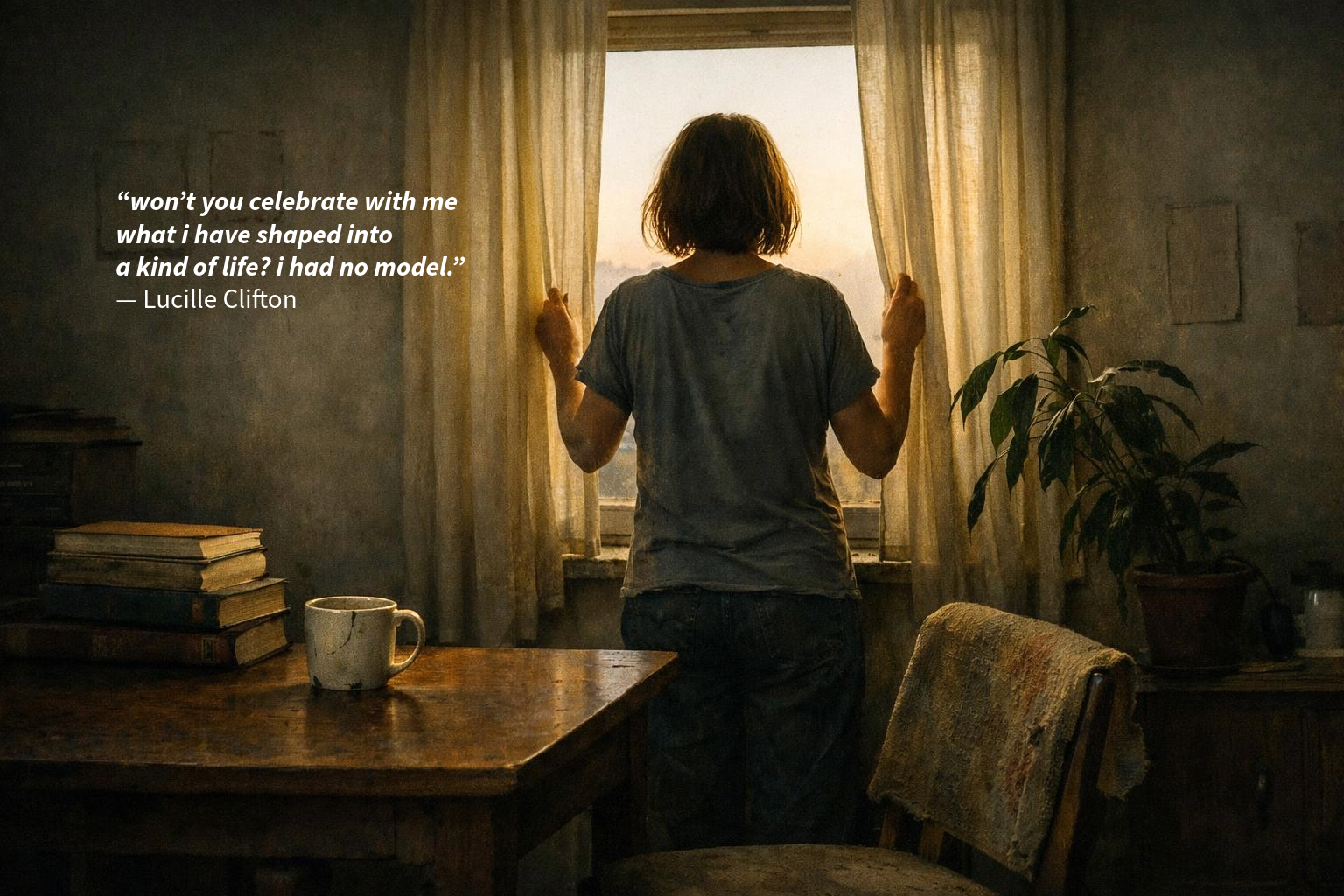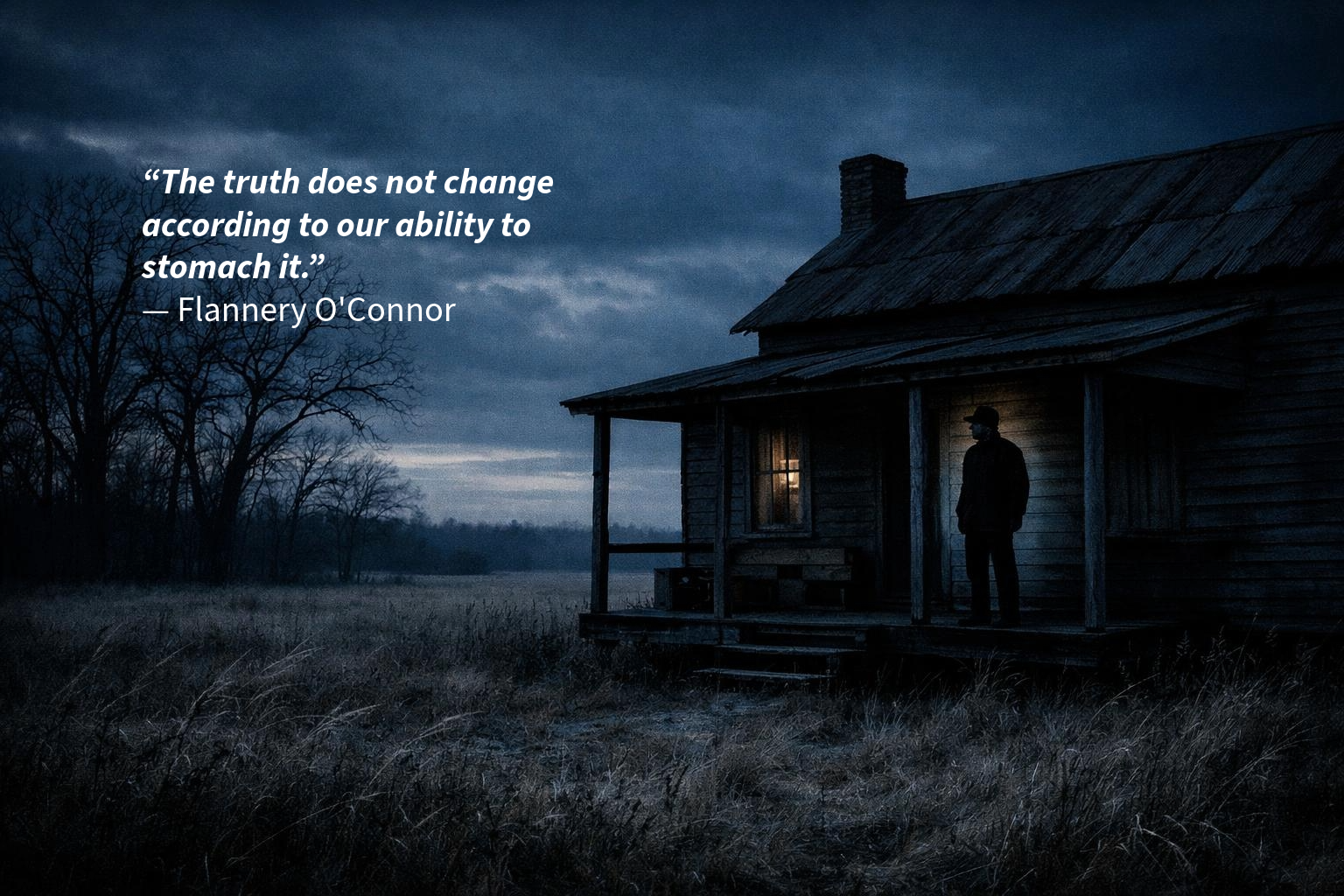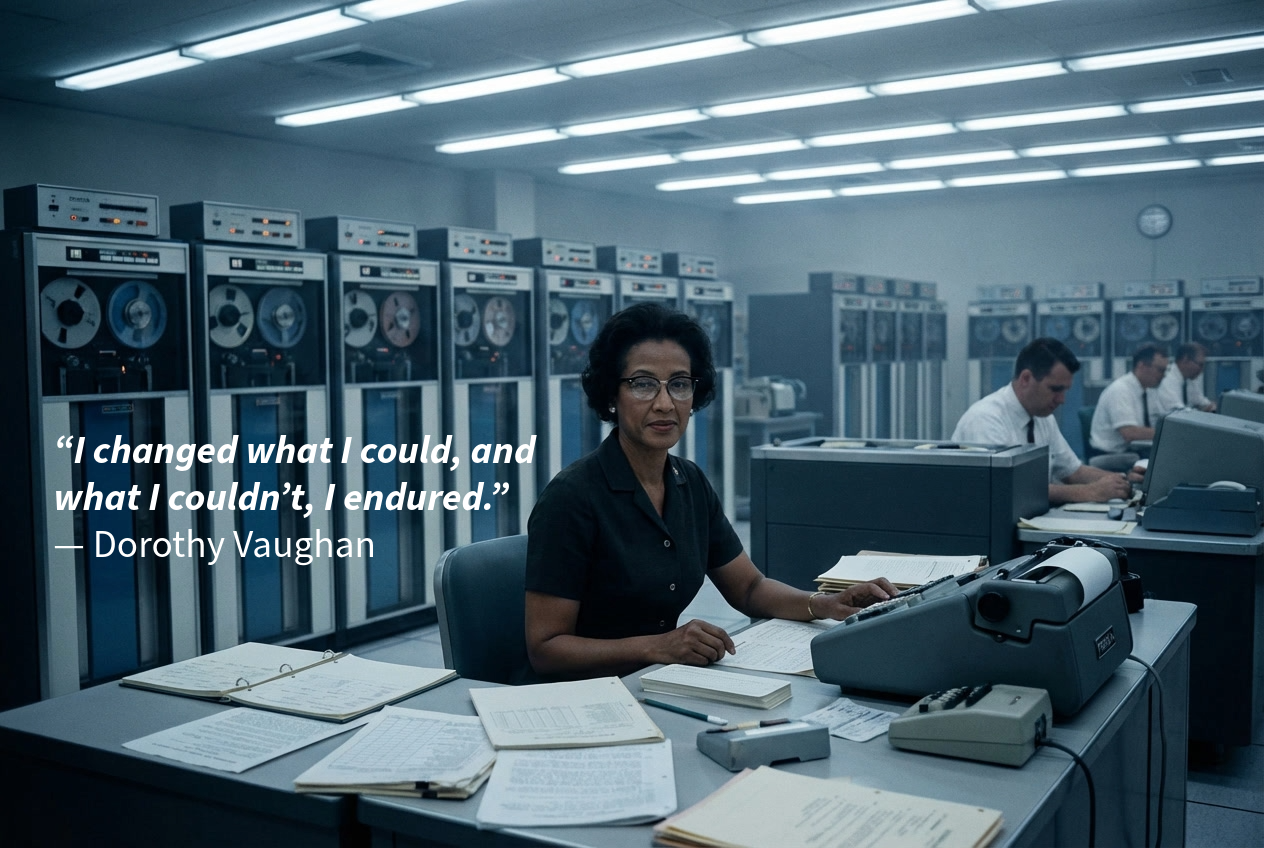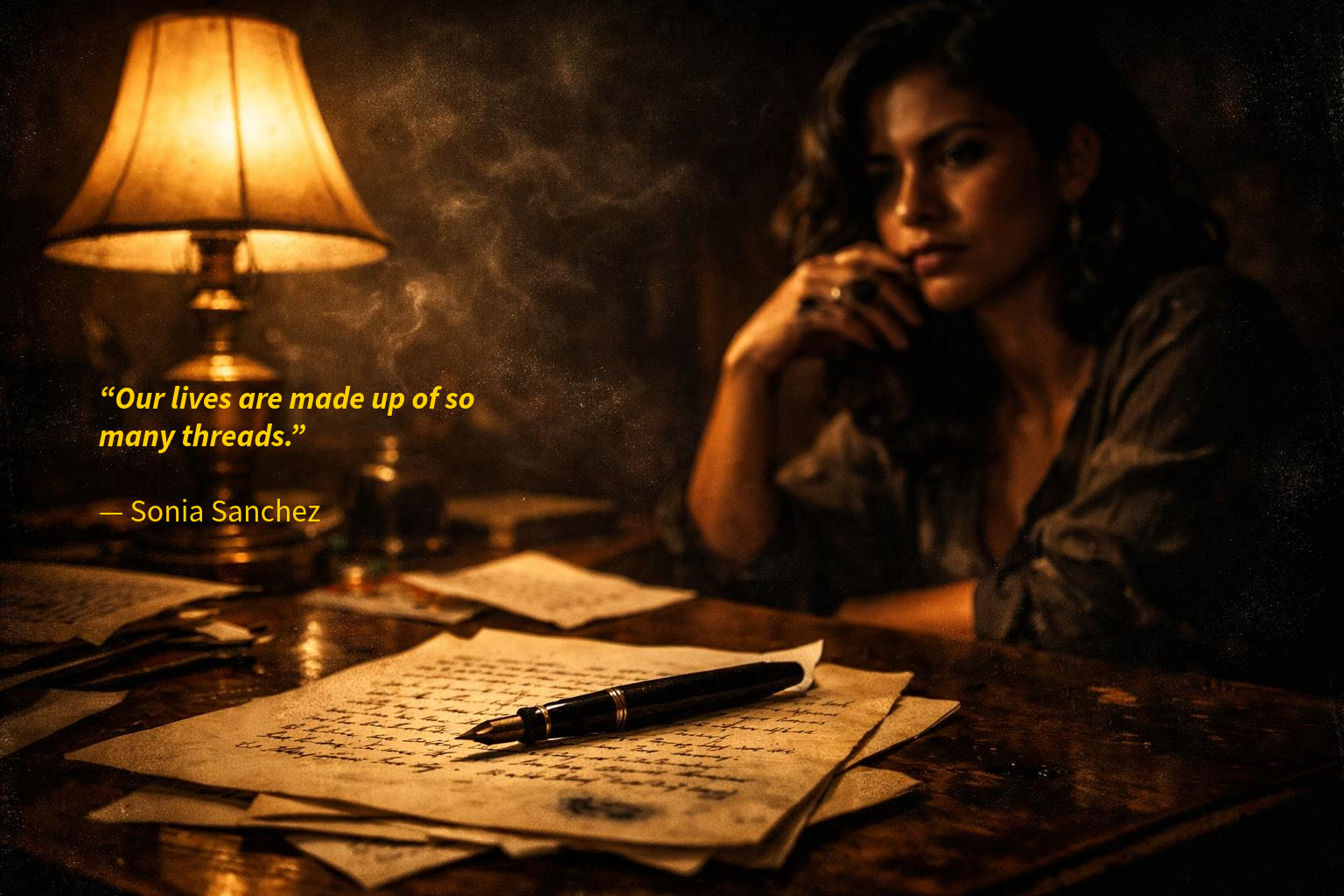
Quote of the Day – 12072025


Personal Reflection:
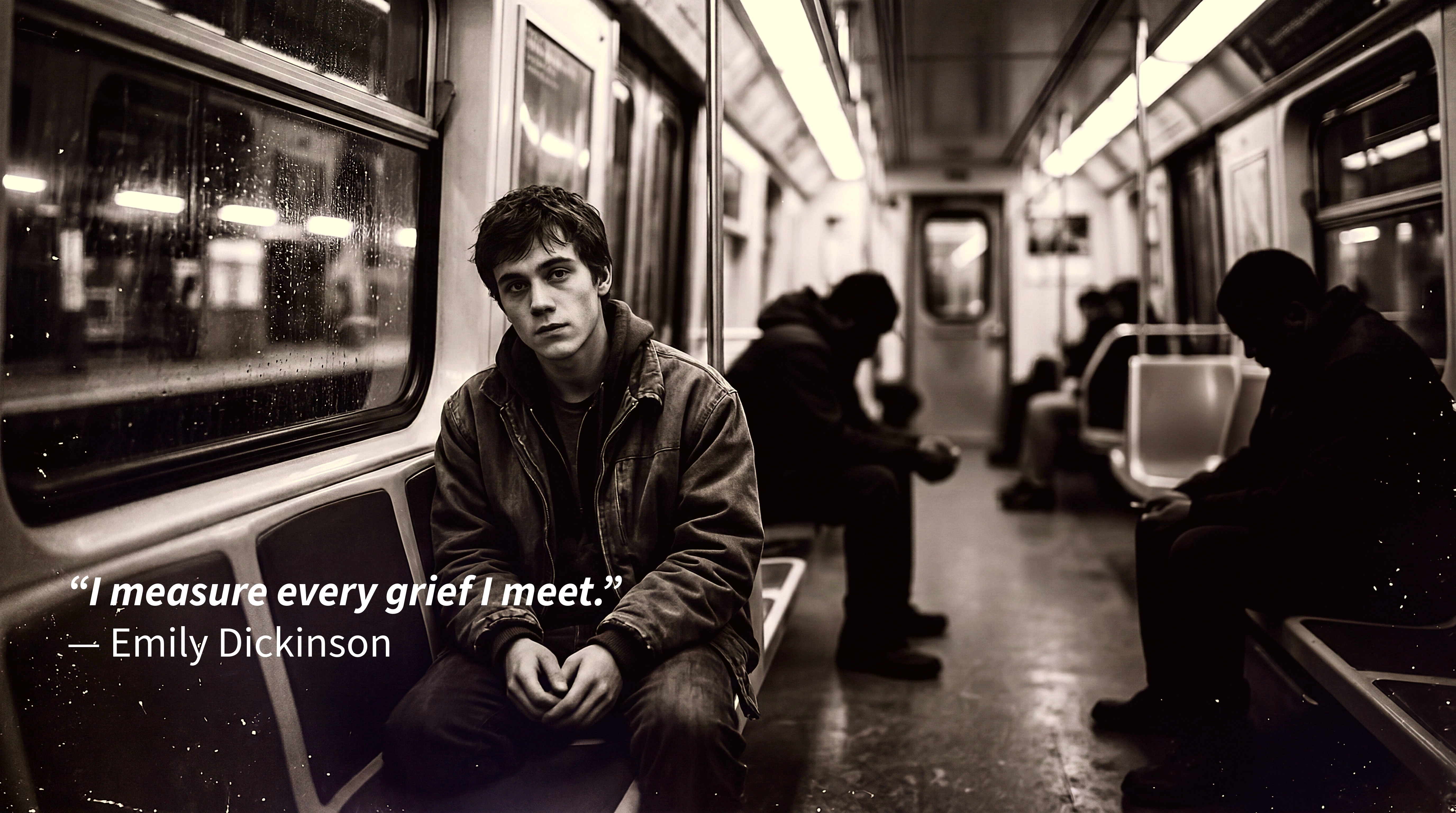
Winter pulls memory into strange shapes. You find yourself thinking about who you once were — the old reactions, the old habits, the versions of yourself that felt permanent at the time. Didion’s line lands with a quiet honesty: you don’t just outgrow old identities — sometimes you forget how they even fit you. There are people you used to be who feel like distant acquaintances now, faces you’d nod to politely if you passed them on the street.

Losing touch with old selves isn’t always graceful. Some versions of you died in rooms no one else saw. Some were shed out of necessity, not desire. Some you abandoned because they could no longer carry you without breaking. And some… some you miss without wanting them back. That’s the strange thing about growth — it holds both grief and gratitude at the same time.

You look back and see the decisions you made with the tools you had. The mistakes that taught you more than any triumph. The fears that shaped you. The stubbornness that saved you. Those earlier selves were stepping stones, scaffolding, incomplete drafts — important, but not meant to last. And part of becoming who you are now is acknowledging that you’ll continue to lose contact with old versions of yourself as you evolve.

Memory isn’t a museum.
It’s a landscape weathering in real time.

Maybe today is about honoring the people you used to be — not clinging to them, not wishing for their return, but recognizing their role in building the person who stands here now. You don’t owe nostalgia to your past selves. You owe them gratitude, and freedom. Let them rest where they belong: in memory, in distance, in the quiet archive of everything you’ve survived.

And if you’ve lost touch with who you were?
That’s not failure.
That’s movement.
That’s life continuing, even through the cold.


Reflective Prompt:
Which version of yourself are you grateful for — even though you no longer inhabit them?

Quote of the Day – 12062025


Personal Reflection:
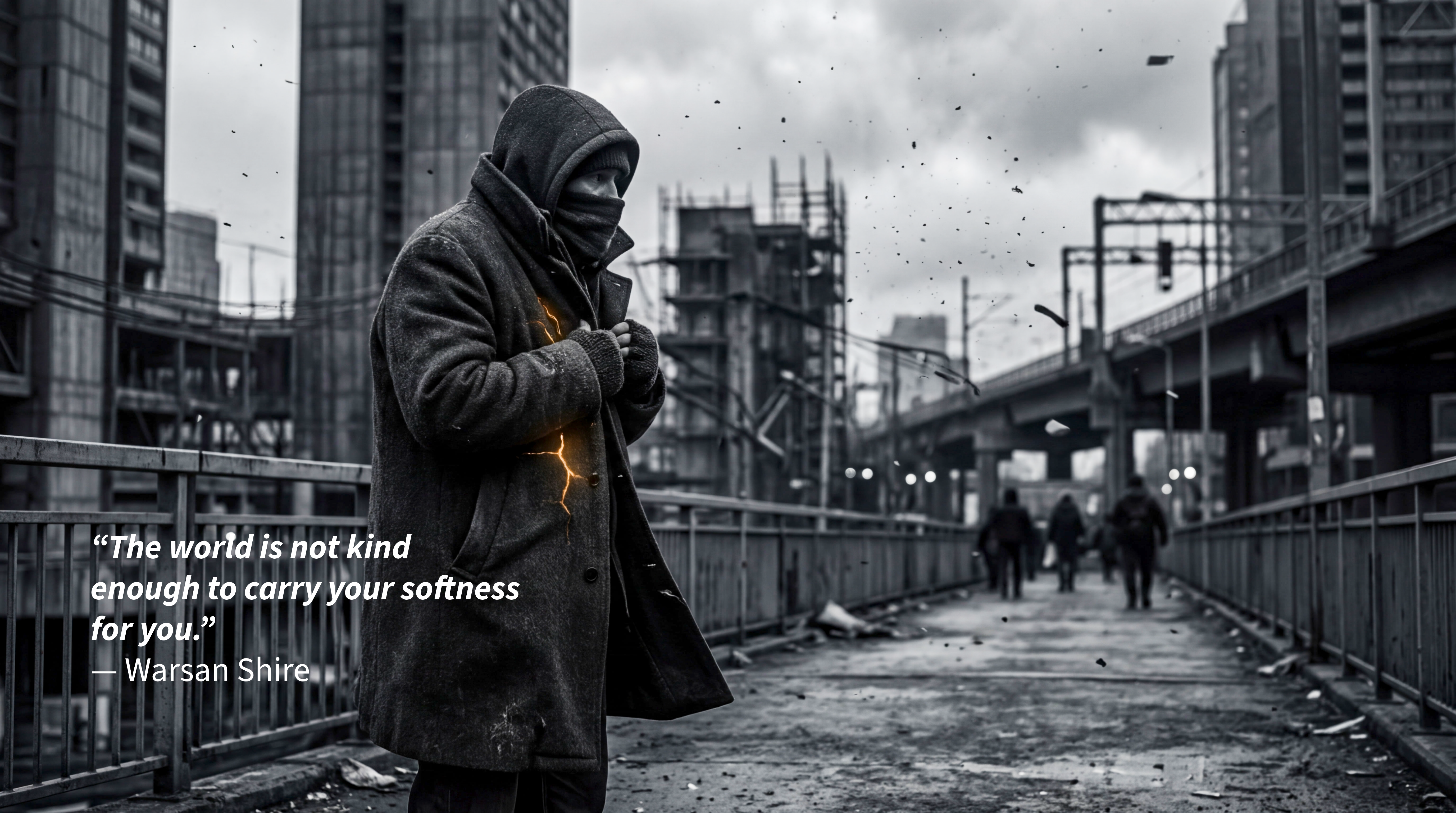
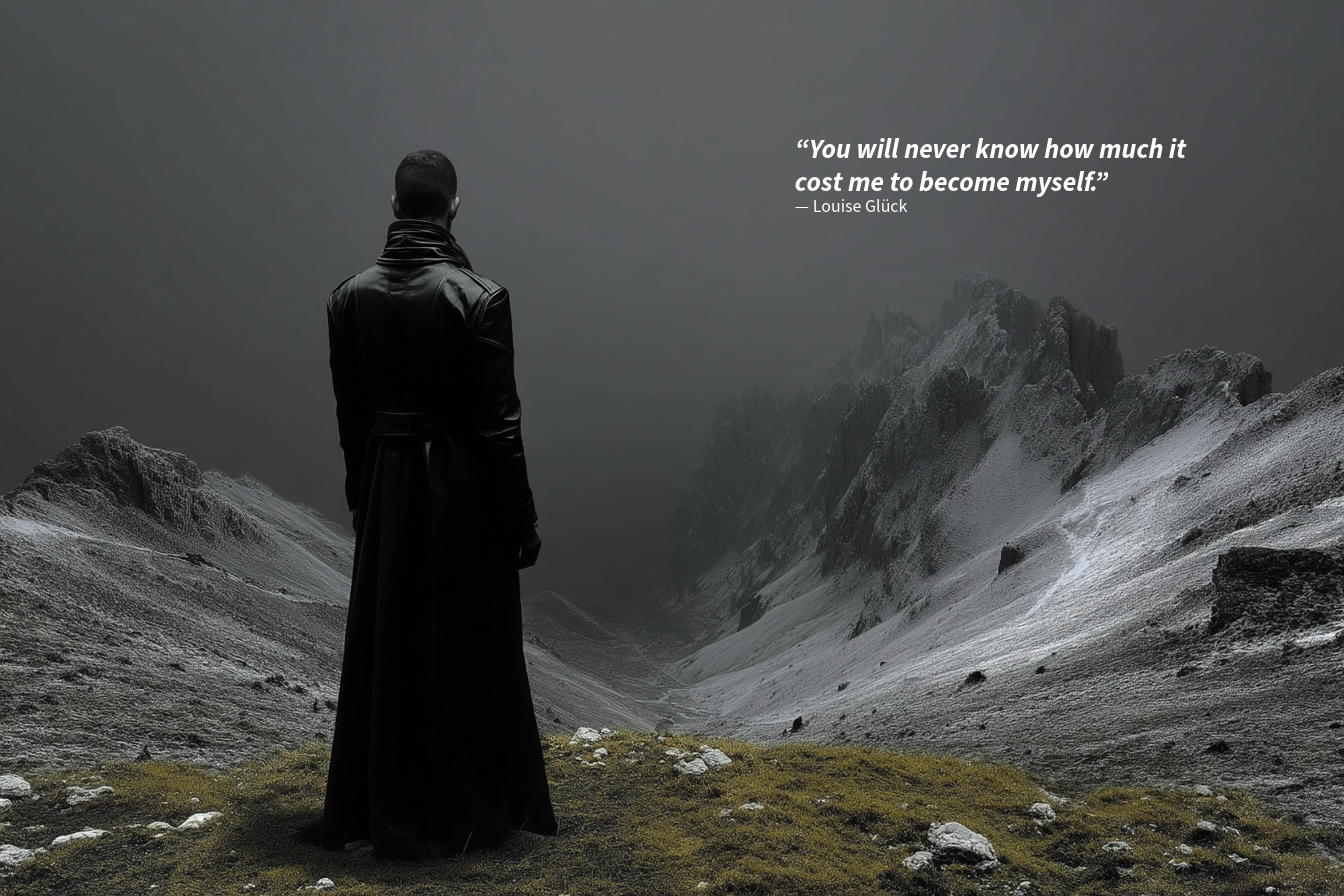
Winter is honest about the cost of things. The cold exposes cracks, the dark lengthens shadows, and even the light arrives at angles that reveal what’s usually hidden. This line drops into that landscape with quiet gravity. Becoming yourself isn’t a clean story or an easy arc. It’s a series of choices no one else fully sees — the losses, the risks, the private battles that never made it into conversation. The world may admire who you are now, but it rarely understands the price you paid to get here.

Because becoming yourself isn’t a single transformation — it’s a slow burn that demands pieces of your former life as fuel. You lose people who preferred the older versions of you. You outgrow dreams you once swore were permanent. You dismantle comforts that kept you small because growth demanded more space than they allowed. And beneath all that change is a truth most people never consider:
evolution is expensive.

Not financially — emotionally.

It takes courage to stand in the wreckage of who you were and still decide to keep moving. It takes clarity to recognize when something familiar has turned into something harmful. And it takes a quiet, relentless kind of strength to admit that becoming yourself means disappointing the expectations others built around your past.

The cost isn’t always visible — but the ache is.

Maybe the point isn’t to be understood — not fully. Maybe the point is to honor the price you paid. To acknowledge the private courage it took to shed your old life and stand in the sharper air of who you are now. Becoming yourself is not about being admired — it’s about being true, even when truth carries weight.

And if the world never knows the cost?

That doesn’t diminish the value.
It means you carried something heavy far enough to step into your own name — and that is enough.


Reflective Prompt:
What part of your becoming has been misunderstood or unseen by others?

Quote of the Day – 12052025


Personal Reflection:
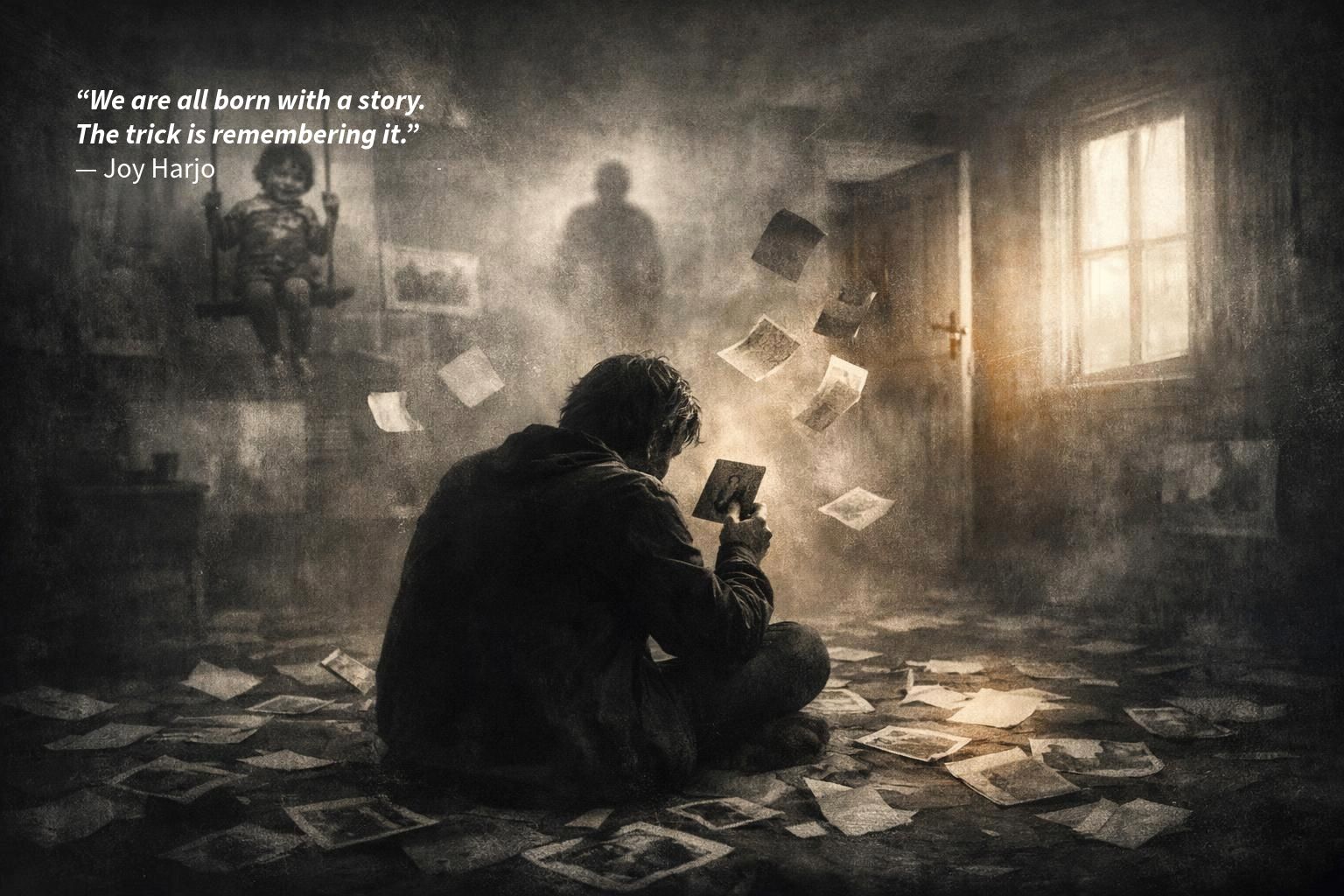
Winter offers the kind of clarity that summer tries to hide. Cold air, bare branches, honest light. There’s no room for pretending in this season — everything unnecessary falls away. This line steps directly into that clarity. It’s a reminder that identity isn’t a life sentence. Who you were is not a contract you’re obligated to renew. You’re allowed to walk away from the older versions of yourself without explaining the exit.

But leaving who you were is not as simple as shedding skin. The past sticks to you — not because it defines you, but because you’ve carried it long enough to confuse weight with worth. You stay loyal to outdated versions of yourself out of habit, or guilt, or the quiet fear that becoming someone new means betraying someone old. Winter challenges that loyalty. It asks: Is this truly you, or just the version of you that survived long enough to become familiar?

And that’s where the discomfort lives — in the realization that you can outgrow identities the way trees outgrow bark. It splits. It cracks. It hurts a little. But it’s necessary.

Maybe today is the day you give yourself permission to stop rehearsing an outdated self. To step into the quiet and ask who you’re becoming, not who you’ve been. You don’t owe permanence to anything that no longer feels true. You’re allowed to choose again. You’re allowed to evolve without waiting for the world to notice. The cold doesn’t ask for permission to change the landscape — it simply arrives. Maybe you can do the same.


Reflective Prompt:
What part of your past self have you outgrown, but still carry out of habit?

Quote of the Day – 12042025


Personal Reflection:
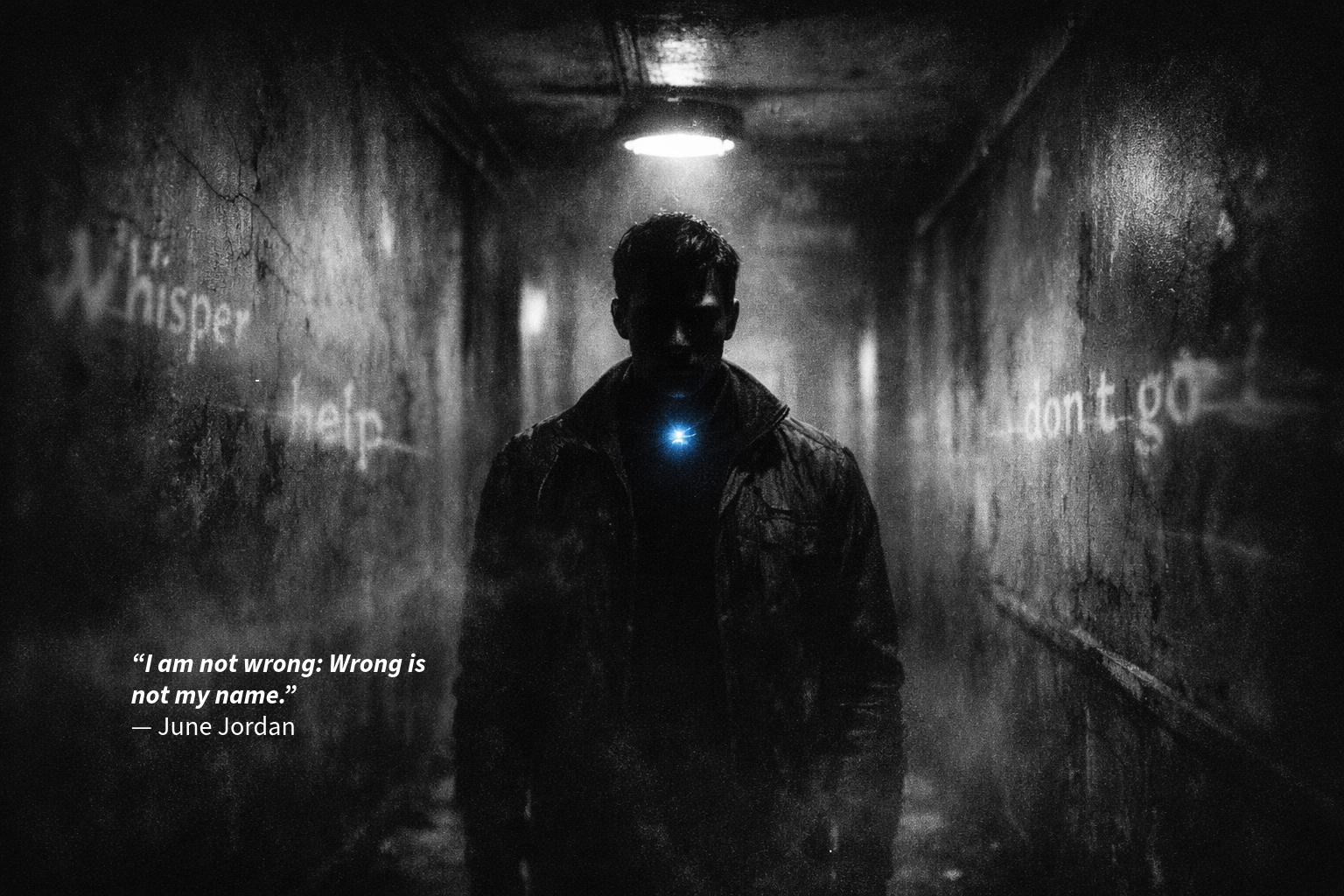
Winter mornings have a particular kind of quiet — not empty, but concentrated. The world feels like it’s holding its breath, waiting for something unnamed. This quote steps into that hush with a truth we often avoid: silence isn’t about what disappears. It’s about what remains. When the noise of the day drops away, you’re left with the sound of your own thoughts, your own pulse, your own unfiltered presence. Sometimes that’s comforting. Sometimes it scares you.

Because here’s the part we don’t like to admit: a lot of the noise we surround ourselves with is intentional. Distraction is a kind of refuge. Constant motion is a way to outrun the parts of ourselves we aren’t ready to face. Silence removes the shield. It returns you to the version of yourself you’ve postponed — the one waiting beneath all the performance, the obligation, the practiced answers. And winter, with its wide-open spaces and long nights, brings that truth to the surface whether you asked for it or not. Stillness demands honesty. It asks you to sit with the things that don’t flinch when the world goes quiet.

Maybe the invitation today is simple: listen. Not to the world, but to what rises in the absence of it. Notice what refuses to vanish. Notice what grows louder when everything else is muted. Silence is not a void — it’s a mirror. And when you meet yourself there, without the usual noise to soften the edges, you realize presence isn’t something you earn. It’s something you return to.


Reflective Prompt:
What part of you becomes unmistakable when the world grows quiet?

Quote of the Day – 12032025


Personal Reflection
Winter has a way of stripping everything down to what’s essential. Trees holding nothing. Light barely making it over the horizon. The world quieter than you remember it being. This line steps into that stillness with a quiet revelation — that sometimes you don’t discover what you’re made of until the cold has taken everything unnecessary away. Winter doesn’t lie. It shows you what survives inside you when everything else goes silent.

But let’s be honest: no one finds their “invincible summer” on a good day. You find it when the warmth is gone, when you’re trembling in the dark with only your breath to remind you that you’re still here. Strength isn’t some heroic surge — it’s a slow burn you don’t notice until you’re forced to rely on it. And winter, whether literal or emotional, has a way of testing every weak beam in the structure. It exposes the drafts, the fractures, the places you thought were sealed. But it also reveals the heat you didn’t know you carried — the stubborn pulse that refuses to go out.

Maybe the real lesson here isn’t about hope, but recognition. The quiet understanding that even in the season of least light, you are not empty. That something inside you endures — not loudly, but faithfully. December isn’t asking you to bloom; it’s asking you to remember what still burns. The part of you that stays alive in the dark. The ember that doesn’t need applause or sunlight. The summer that waits beneath your ribs, patient and unwavering.


Reflective Prompt
What warmth in you has outlived the coldest seasons of your life?

Quote of the Day – 11202025


Personal Reflection
There’s a moment — usually quiet, usually unexpected — when you realize the world has been tugging at you from every direction. Expectations. Obligations. Ghosts of who you used to be. People who still think you owe them a version of yourself you outgrew. This line steps in like a hand on your shoulder: a reminder that before you belong to anyone or anything, you belong to your own damn life. Not shallowly, not politely — deeply.

But belonging to yourself isn’t a gentle process. It requires taking inventory of every place you’ve handed out pieces of your identity just to stay loved, or useful, or accepted. It means looking at the roles you were pushed into, the ones you performed out of habit or survival, and asking whether they still fit the shape of you. Some won’t. Some never did. And that’s where the fracture begins — the quiet conflict between the self you’ve carried and the self you’re becoming.

Sometimes you reclaim yourself in small ways: saying no without apologizing, taking up space without shrinking first, naming what you actually want even if your voice shakes. And sometimes you reclaim yourself by walking away from people who only love the version of you that makes their world easier.

Belonging to yourself is a kind of rebellion.
A soft, steady revolt.

Maybe today is about remembering that your life is not a negotiation. You don’t have to audition for your own existence. You don’t have to justify your becoming. You don’t have to earn the right to stand where you stand. You belong — not because the world agrees, but because you decided to come home to yourself.

And that kind of belonging can’t be taken.
It can only be lived.


Reflective Prompt
Where in your life have you been asking for permission to be who you already are?

Quote of the Day – 11192025


Personal Reflection

November has a way of showing you what still weighs on you — the half-finished things, the quiet regrets, the truths you’ve been circling all year without naming. The air feels thinner, the days shorter, the world stripped to bone. And somewhere in that bare landscape, you start to notice what you’ve been carrying without meaning to. This quote steps right into that moment. There are burdens you can’t hand off, no matter how much you want to. And there are truths you can’t ignore, no matter how tired your spirit feels. November doesn’t care about the story you told yourself in June. It cares about what’s still in your hands now.

But this is the month when the hidden weight starts talking back.
Not loudly — that would almost be merciful — but in a steady, relentless whisper that threads itself into every quiet space. The things you avoided start showing teeth. The versions of yourself you grew out of linger like ghosts in their old rooms. And the silence you once thought you needed becomes a mirror you can’t turn away from.

This is the part no one warns you about: becoming often means letting go of the lies that kept you upright. The narratives that softened the edges. The masks you perfected. November strips those away with the same casual certainty that trees drop their leaves. And in the cold clarity that follows, you’re left facing truths that aren’t gentle. The ones too heavy to carry gracefully, too essential to abandon without losing your shape.

Some truths don’t break you.
They reveal you.

Maybe that’s November’s gift — not clarity, but honesty. Not resolution, but recognition.
This month doesn’t ask you to rise.
It asks you to stay.
To sit with what’s real.
To hold your truth without rushing to pretty it up or make it palatable.

Becoming isn’t a transformation montage. It’s the slow, steady acceptance of who you’ve been, who you are, and who you’re trying to grow into — even when those identities don’t agree. It’s learning to carry what matters, set down what doesn’t, and live with the ache of not always knowing the difference.

Maybe today the victory isn’t lightness.
Maybe it’s the willingness to stop pretending the weight isn’t there — and the quiet courage it takes not to look away.


Reflective Prompt:

What truth have you carried all year that still refuses to be put down?

Quote of the Day – 11182025


Personal Reflection

Some days there’s no revelation waiting for you. No clarity. No second wind. Just the simple, unglamorous choice to keep moving in the direction you said mattered. The world keeps insisting everything should come wrapped in a pretty bow — clean lines, smooth edges, no proof of the struggle it took to get there. But look at any real artisan. Their world is chaos until the work is done. Sawdust choking the air, paint bleeding onto the floor, bruised knuckles, tools scattered like a crime scene. Creation is never tidy. It’s loud. It’s stubborn. It demands a piece of you. And the outcome only becomes breathtaking because you walked through the mess and didn’t flinch.

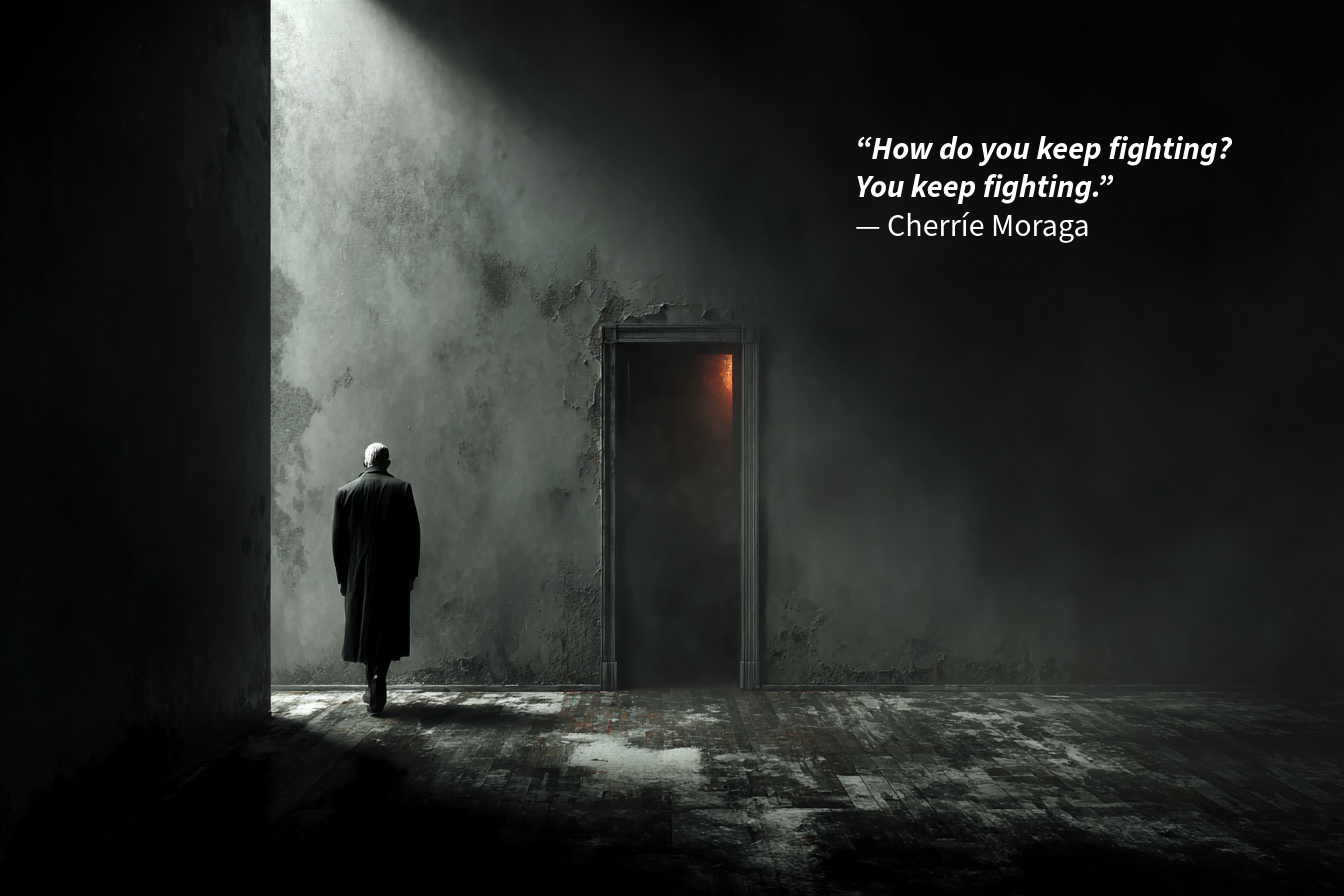
We love to romanticize perseverance — the comeback story, the clean arc, the triumphant soundtrack. But most real fighting looks nothing like that. It’s waking up already exhausted. It’s dragging old fears behind you like unwilling dogs, snarling and snapping with every step. It’s pushing forward even when the only thing you’re sure of is the ache settling somewhere between your ribs and your resolve. And buried underneath it all is the truth you don’t say out loud: stopping feels too close to disappearing. And you’ve disappeared enough times already.

Maybe that’s the lesson today. You don’t have to feel brave to keep going. You don’t need inspiration or momentum or some sudden rush of conviction. You just keep moving. Step by stubborn step. Breath by stubborn breath. And somewhere in that slow crawl forward, you realize the fight was never about winning — it was about refusing to vanish from your own life. That quiet persistence becomes its own kind of craft. Its own kind of art.


Reflective Prompt

Where are you still fighting, even quietly, even without applause?

Quote of the Day – 11172025


Personal Reflection:

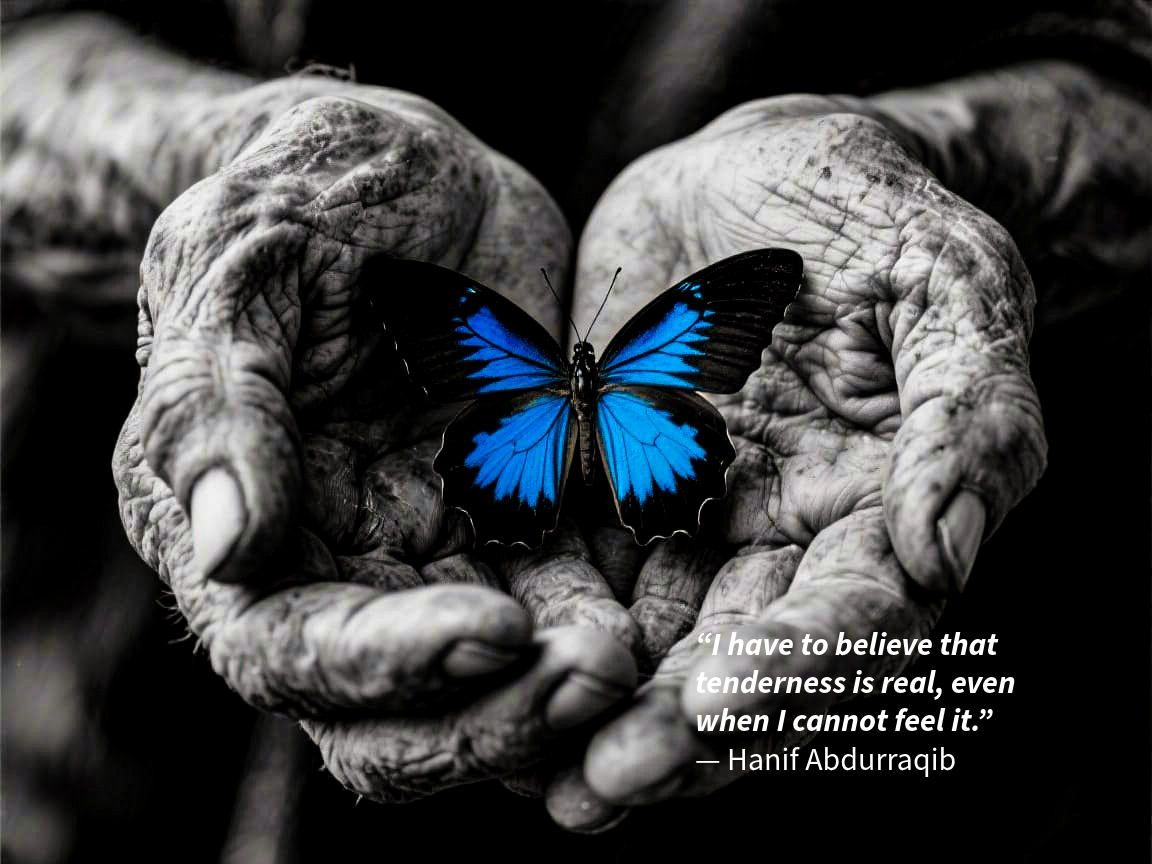
Some mornings you wake up armored without even trying. Shoulders tight. Voice low. Every small kindness feels like something meant for someone else. Perhaps it was a bad dream, or a fragment of a memory you thought was buried, rising just enough to shift the weight of the day before it even begins. This line lands right there—in that gap between what your heart remembers and what your body refuses to trust. Believing in tenderness on the days you can’t feel it isn’t delusion. It’s survival.

But let’s not pretend it’s easy. Disappointment builds scar tissue. Grief calcifies. Some hurts become fossils—old pain preserved in perfect detail, untouched but never truly gone. And some wounds never heal properly; they knit themselves together in crooked ways, reminding you that survival doesn’t always mean restoration. It’s hard to reach for softness when life has taught you to brace, to expect the hit, to map the exits before the door even closes behind you. Yet becoming requires a dangerous kind of courage: letting the walls down a fraction, enough for light to get in even if you’re still flinching. Tenderness is not weakness—it’s risk. And risk is where transformation waits.

Maybe today isn’t about feeling tenderness, but acknowledging the stubborn belief that it exists. And stubborn in the real sense—not noble or poetic, but the kind of hold you keep because letting go feels like losing one more piece of hope you can’t afford to misplace. A small, quiet truth you carry like a pilot light. Even when the world is loud. Even when your own heart feels far away. Becoming yourself means making room for what you cannot yet hold. Letting one soft thing survive the hard days. Trusting that tenderness, once allowed, knows how to find its way back.


Reflective Prompt:
Where in your life have you mistaken protection for absence?

Quote of the Day – 11162025


Personal Reflection:

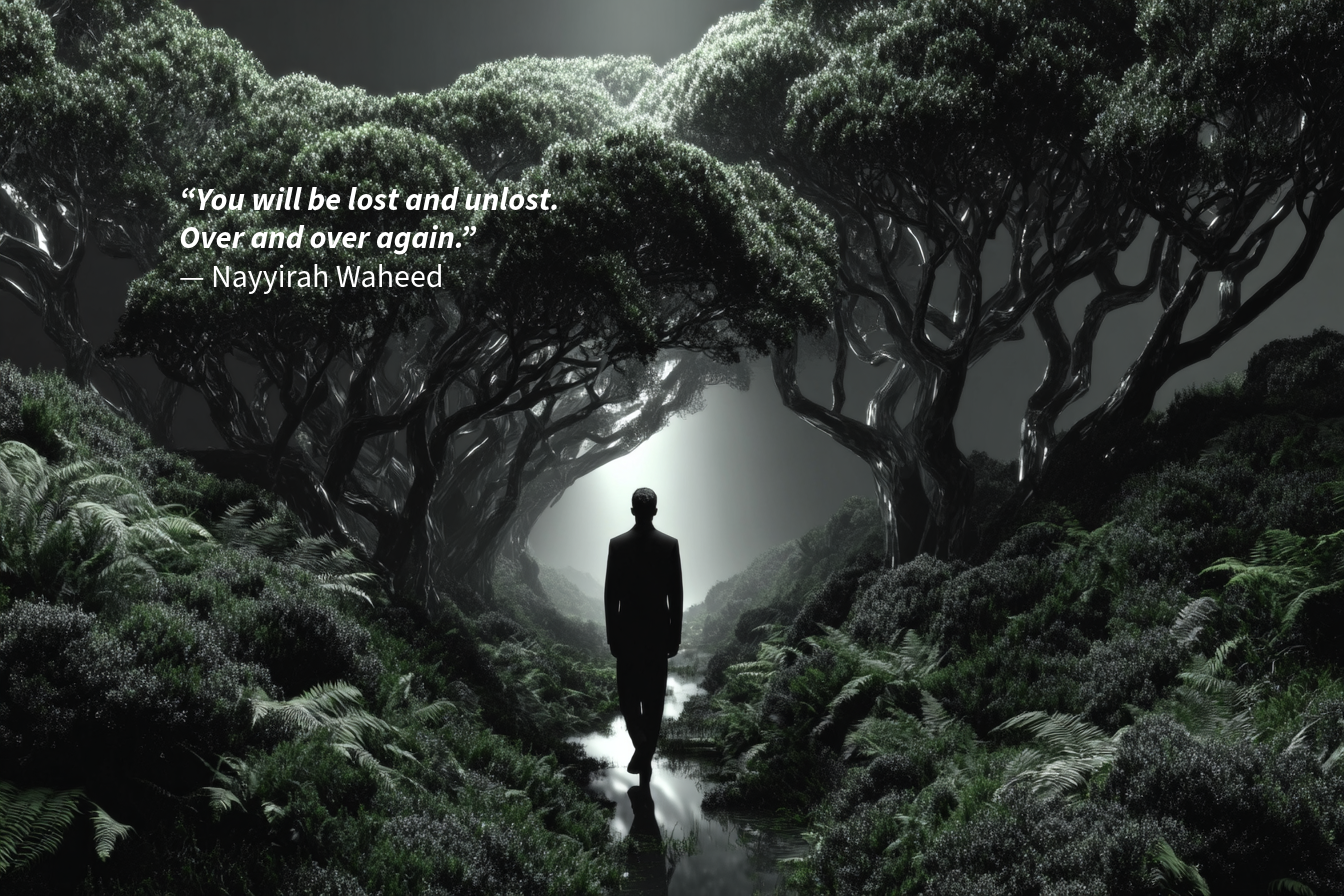
There are mornings when clarity slips out the back door before you even wake. You move through the house like someone left the lights on but the power off—everything familiar, yet dim. This quote sits in that space. The simple truth that being “lost” isn’t a permanent address; it’s a condition of being alive, breathing, and paying attention. Some days you know who you are. Some days you forget. Most days, you’re somewhere in between.

But there’s a deeper ache here—the quiet admission that becoming yourself is not a single heroic moment. It’s more like tidal work. You rise, you recede, you wash ashore in pieces you have to gather with your own hands. And God help you if you think you’re supposed to stay steady the whole time. We lose ourselves in grief, in grind, in the noise of other people’s expectations. We lose ourselves in the stories we tell to survive. And then—somewhere in the wreckage—we catch a glint of the person we’re trying to grow into. It’s never clean. It’s never cinematic. But it’s real. And it’s ours.

Maybe this is the quiet mercy of the whole thing: you are allowed to return to yourself as many times as it takes. No failure in not knowing. No shame in wandering. Just the slow, stubborn truth that becoming isn’t a destination—it’s a rhythm. Lost. Unlost. Lost again. And still here, still walking, still listening for the next version of yourself calling from somewhere just beyond the edge of today.


Reflective Prompt

When was the last time you returned to yourself without announcing it to anyone?

Quote of the Day – 11152025


Personal Reflection:

Camus wrote about survival the way other people write about prayer — quiet, desperate, honest. This line isn’t optimism; it’s recognition. The “invincible summer” isn’t sunshine or ease. It’s that small, stubborn warmth that refuses to die when everything else has gone cold. The kind that hums low inside you when the world stops making sense.

We all have winters — the kind that steal color from the days and reason from the mind. They teach you what kind of strength doesn’t show up in photographs. Not the loud kind. The enduring kind.

There’s a point where you stop asking the cold to end and start asking what it’s trying to show you. Because winter, for all its ache, has its own truth: clarity. No noise. No camouflage. Just the bare structure of what remains when everything unnecessary has fallen away.

You learn that the warmth you were waiting for doesn’t come from outside. It’s generated from friction — the rub of loss against gratitude, despair against endurance. You realize that light isn’t something you chase; it’s something you protect. And sometimes, the act of protecting it is the only faith you have left.

When everything feels stripped bare — that’s when you meet yourself without decoration. No roles. No noise. Just the raw pulse of being alive. That pulse is your summer. It’s been there all along.

The beauty of surviving winter isn’t in forgetting the cold — it’s in remembering you carried heat through it. That you were the shelter you needed. You don’t come out of it the same. You come out tempered. Clear-eyed. Grateful.

Camus wasn’t promising endless sunshine. He was saying: You are not as breakable as you feared. The world can freeze around you, but somewhere beneath it, something inside keeps blooming — steady, defiant, alive.

That’s your invincible summer. You don’t find it; you become it.


Reflective Prompt:
What has your winter taught you — and what quiet warmth have you been carrying all along, even when you thought it was gone?

Quote of the Day – 11142025


Personal Reflection:
We talk about peace like it’s a luxury reserved for quiet places — a cabin in the woods, a meditation hall, a Sunday morning before the world wakes up. But most of life isn’t built that way. The refrigerator hums, the neighbor argues, the mind won’t stop rehearsing the same tired fears. The truth is, the world never actually gets quiet. The only silence that exists is the one we learn to make inside ourselves.

And maybe that’s what peace really is — not the clean absence of sound, but the ability to listen differently. The ability to hear the chaos without letting it dictate the rhythm of your heart.

Noise isn’t the enemy. It’s information. It tells you where your boundaries are, where you’re leaking energy, where you’ve been refusing to pay attention. The chatter of the world mirrors the clutter of the mind. You can’t mute it into submission; you have to translate it.

The hard truth is that sometimes the noise comes from within — the self-criticism disguised as ambition, the anxious loop of what-ifs, the memory you keep replaying because it still hasn’t forgiven you. And the more you resist it, the louder it gets. Real peace begins when you stop negotiating with your noise and start listening to what it’s trying to say.

For me, the lesson came late. I used to believe calm required control — that if I could just fix everything, I’d finally get to rest. But control is just another kind of noise. It’s fear dressed as order. You can’t think your way to stillness. You have to surrender to it, one heartbeat at a time.

Peace is a skill — one you practice in traffic, in grief, in uncertainty. It’s learning how to hear the storm without becoming it. To feel the weight of the world without mistaking it for your own. It’s not passivity; it’s presence — the discipline of staying open when everything in you wants to shut down.

Eventually, you realize the noise was never against you. It was your teacher. It forced you to listen, to slow down, to separate what’s urgent from what’s true. When you can hear the world screaming and still keep your soul steady, that’s not luck — that’s mastery.

Peace doesn’t arrive when the noise stops. It arrives when you no longer need the noise to stop in order to feel whole.


Reflective Prompt:
What part of your life feels the loudest right now — and if you listened closely, what truth might that noise be trying to tell you?

Quote of the Day – 11132025


Personal Reflection:
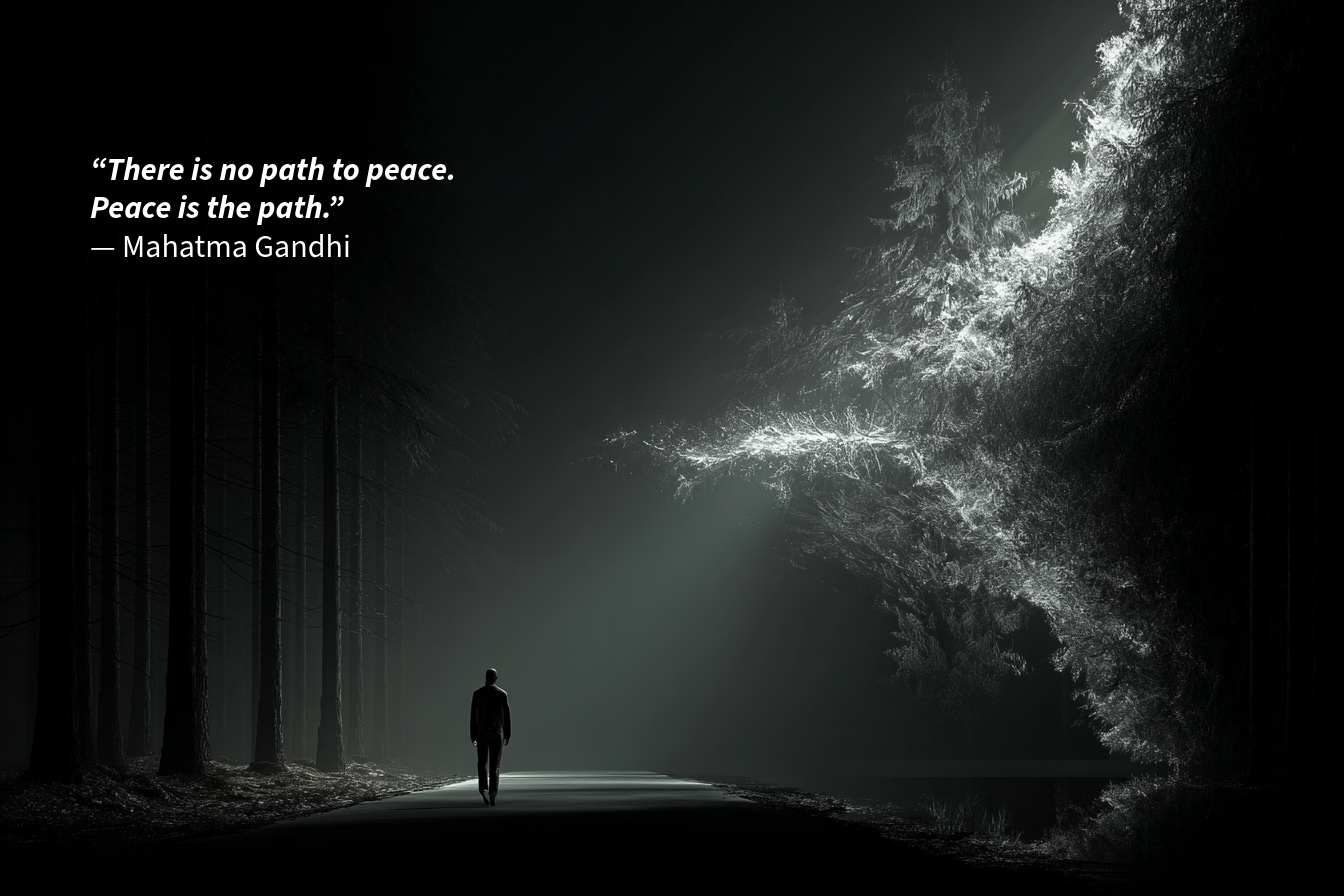
We talk about peace like it’s something waiting for us at the finish line — a reward after the storm, a condition we earn once everything else is settled. But Gandhi cuts that illusion clean: there is no path to peace, because peace isn’t a destination. It’s a direction. A way of walking.

It’s easy to mistake stillness for peace — to think quiet means calm. But real peace doesn’t depend on silence; it lives inside the noise. It’s the steady breath in chaos, the choice not to match the world’s violence with your own. Peace isn’t passive. It’s discipline.

Most of us are at war with ourselves long before the world gets involved. We want peace, but we feed on conflict — our outrage, our fear, our need to win. We keep waiting for life to calm down before we start living gently, but that’s not how it works. You don’t find peace — you practice it. Every moment you choose restraint over reaction, compassion over certainty, awareness over distraction — that’s the path.

Peace is an act of rebellion in a culture addicted to noise. It asks you to move slower in a world that profits from your panic. It asks you to listen when everyone else is shouting. And sometimes, it asks you to let go of being right just to stay whole.

It’s not easy. It never was. But each time you choose calm over chaos, you reclaim a small piece of yourself the world doesn’t get to touch.

Peace isn’t what happens when the world finally makes sense. It’s what happens when you stop needing it to. You begin to see that your stillness isn’t weakness — it’s presence. That you can walk through fire without becoming it.

There is no path to peace because peace is already under your feet. Every breath, every pause, every deliberate act of kindness — that’s the way forward. You don’t chase it. You become it.


Reflective Prompt:
When was the last time you stopped waiting for peace to arrive — and started creating it, one quiet choice at a time?

Quote of the Day – 11122025


Personal Reflection:
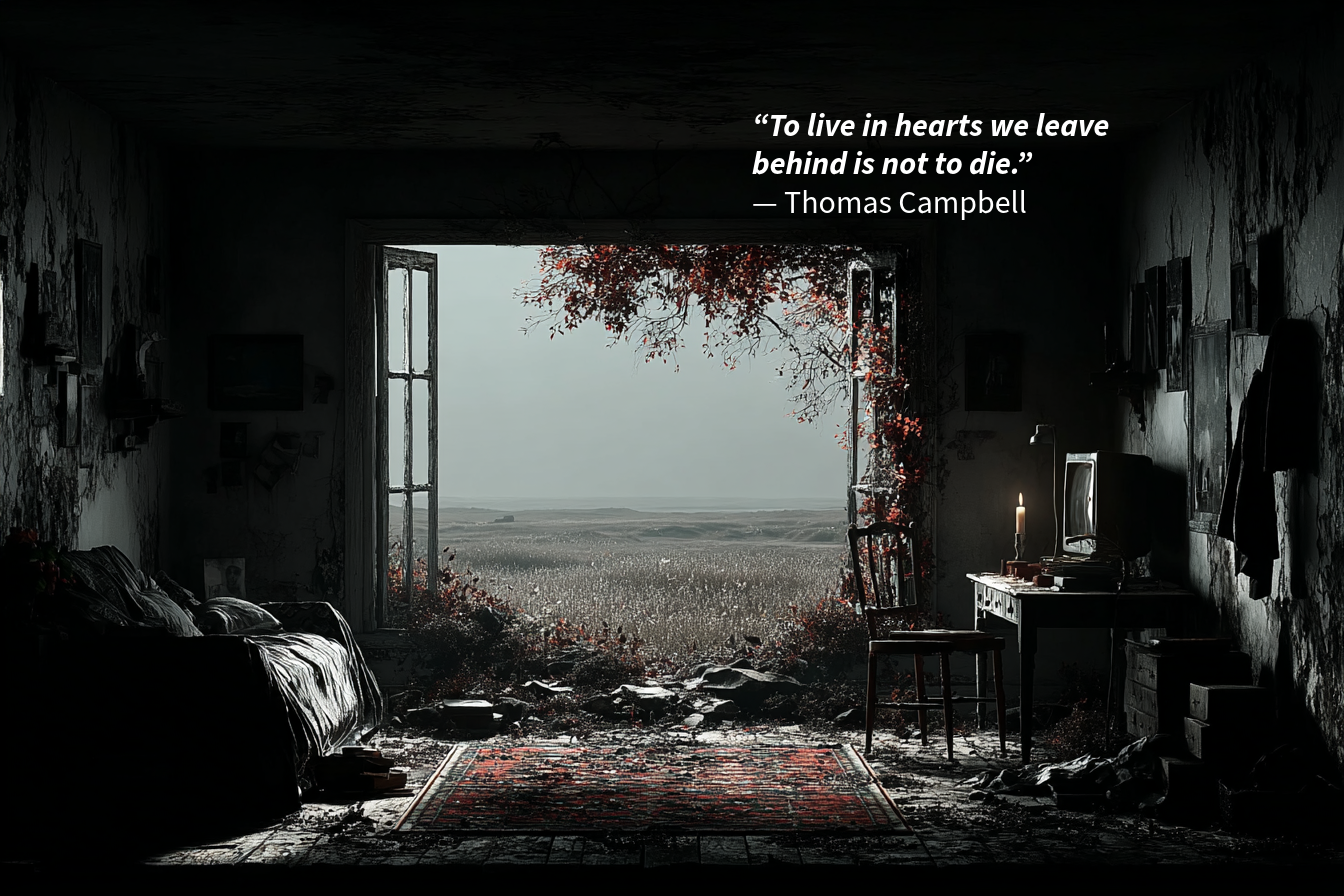
There’s a stillness to remembrance that feels heavier than silence. It’s the pause between breaths when memory starts to move — slow, careful, alive. Campbell’s words are simple but unflinching: To live in hearts we leave behind is not to die. He doesn’t offer comfort through denial. He reminds us that love is a kind of continuity, a quiet rebellion against the finality of loss.

You never really stop missing the people who shaped you. You just learn to carry them differently — in gestures, in stories, in the things they once loved that now feel like yours. Sometimes, the memory hurts because it’s supposed to. That ache is proof of connection — the echo of life refusing to let go.

Grief doesn’t move in straight lines. It lingers in doorways, rewinds conversations, haunts the ordinary. You think you’ve made peace, then a smell, a song, a laugh drags you back to the rawness of absence. But maybe that’s not regression — maybe that’s devotion. To remember someone deeply is to keep them alive in the only way that matters: through continued presence.

We talk about closure as if it’s an achievement, but real love doesn’t close. It lingers. It evolves. You begin to understand that grief isn’t an interruption of life — it is life, reshaped. The sharp edges soften. What once felt unbearable becomes a kind of sacred weight — not to crush you, but to anchor you.

And maybe that’s the point. Memory keeps us tethered to what’s human. It humbles us, slows us, makes us gentle. You start realizing that carrying someone’s story forward is not a burden — it’s a quiet act of grace.

Eventually, you stop asking the loss to go away. Instead, you start walking beside it. You realize the people you’ve lost haven’t vanished — they’ve just changed forms. They live in the kindness you offer without thinking, in the patience you didn’t used to have, in the courage you borrowed from their memory.

Love doesn’t end. It just finds new ways to speak. To live in hearts we leave behind is not to die — it’s to echo, to ripple, to remain.


Reflective Prompt:
Whose memory lives quietly within your daily rituals — and how do they still speak through the way you move in the world?

Quote of the Day – 11112025


Personal Reflection:
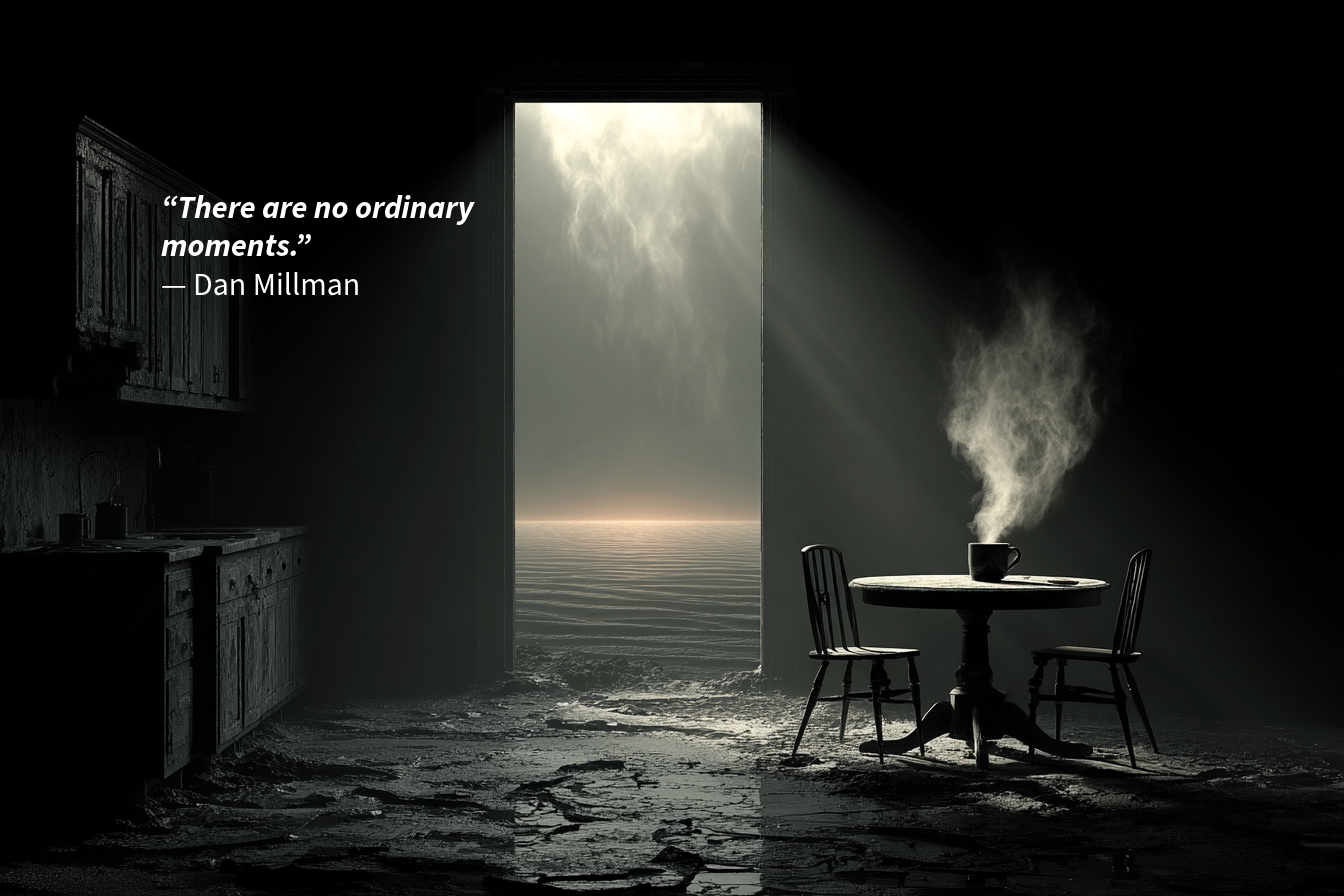
We treat the ordinary like it owes us more — more excitement, more revelation, more proof that something’s happening. But maybe the problem isn’t that life is mundane. Maybe it’s that we’ve forgotten how to notice. Millman’s line feels like a quiet dare: what if this moment — the one you’re in right now — is the sacred one you keep waiting for?

It’s easy to find wonder in the big stuff — love, loss, miracles, chaos. But the quiet repetitions of daily life — the coffee spoon, the traffic light, the creak of the same floorboard — those are the parts of existence that actually hold it together. The world doesn’t need to shout to be alive. Sometimes it just hums.

We keep postponing our presence, waiting for something “worth” our full attention. But the truth is, most of life hides in the in-between. You’ll miss entire seasons if you’re only looking for meaning in the highlights. The morning light through the blinds, the warmth of your breath on cold air, the pause before you answer a question — these moments are small, but they’re honest. They’re the evidence that you’re still here.

Maybe there are no ordinary moments because life itself refuses to be ordinary. Even pain, when you stop running from it, carries its own strange beauty. Every scar, every silence, every flicker of kindness between strangers — they all make up the anatomy of now.

You start to realize that the miracle isn’t the event; it’s the awareness. The act of seeing. Gratitude is not a reaction; it’s a stance — a way of standing in the world that keeps wonder within reach. When you catch yourself chasing the next big thing, stop. Look around. Feel the pulse of something steady beneath all the motion.

There are no ordinary moments because every second carries a chance — to notice, to breathe, to exist without apology. Maybe holiness was never hiding; maybe we just forgot how to look.


Reflective Prompt:
What ordinary moment did you rush past today — and what would it mean to truly see it before it’s gone?

Quote of the Day – 11102025


Personal Reflection:
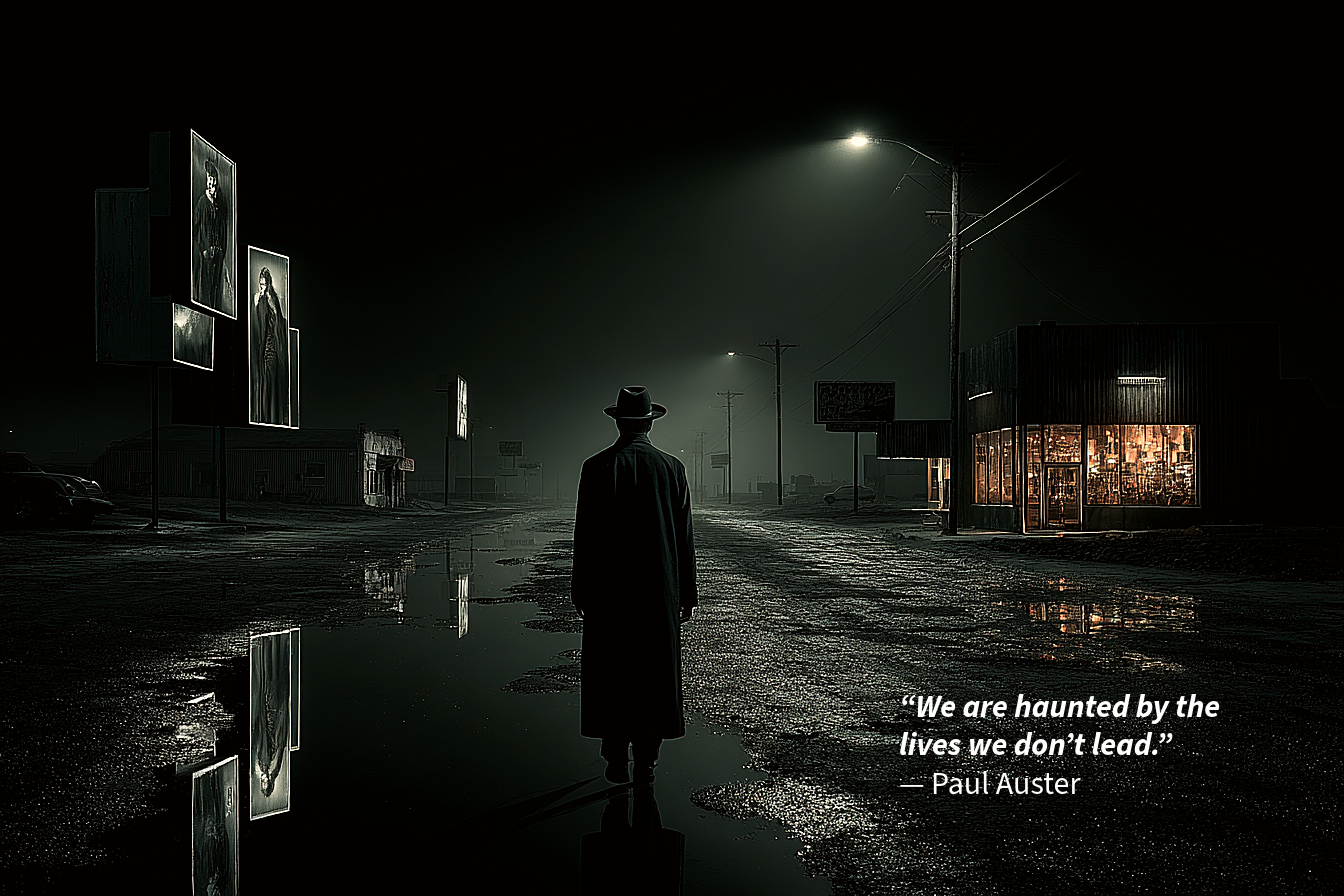
Regret has a peculiar way of lingering — not loud, but constant, like background static. You can’t touch it, but it hums underneath the day. Auster’s words cut close: We are haunted by the lives we don’t lead. The choices we didn’t make, the versions of ourselves we left hanging in the doorway. We tell ourselves we’re fine with how things turned out, but every now and then, something stirs — a half-remembered song, a familiar street, a name we don’t say out loud — and we feel the ghost move again.

We don’t like to admit it, but we build entire lives out of what we didn’t choose. Every decision erases a hundred possibilities, and those absences don’t disappear — they follow quietly behind us, a shadow of what might have been. Maybe that’s what nostalgia really is — the ache of parallel versions of ourselves still trying to be born.

I think about the person I might’ve become if I’d stayed, if I’d gone, if I’d said yes instead of no. But every alternate life has its own price tag. Even the ones that look golden from this side of the glass would’ve demanded a different loss. Maybe the haunting isn’t punishment — maybe it’s memory’s way of reminding us that every path costs something.

And sometimes, the hardest ghosts to face aren’t the lives we never lived — they’re the parts of ourselves we abandoned along the way. The ones we outgrew too fast. The ones we silenced for approval. The ones we dismissed as weakness when they were just unguarded.

We are all haunted, but maybe haunting isn’t a curse — maybe it’s a form of tenderness. Proof that we’ve imagined more than we could live. Proof that somewhere inside us still believes in what’s possible. The trick is not to banish those ghosts, but to listen to what they’re trying to say: that life is not a single straight line, but a chorus of unfinished songs.

You don’t have to live every life to be whole. You just have to make peace with the ones that never happened — to thank them for showing you who you could have been, and then keep walking toward who you still might become.


Reflective Prompt:
What unlived version of yourself still lingers at the edges — and what might happen if you stopped mourning them and started listening to what they’re trying to tell you?
Quote of the Day – 11092025


Personal Reflection:
I grew up believing there was always an answer — that effort could fix anything if you just pushed hard enough. Work the problem, find the crack, patch it up, move on. It’s a tidy myth, and it keeps you busy enough to mistake exhaustion for purpose. But life doesn’t run on equations. Some problems aren’t puzzles; they’re mirrors. They don’t want solving — they want acknowledgment.

It’s a strange kind of arrogance, thinking you can be everyone’s medicine. You convince yourself it’s compassion, that you’re being noble — but if you strip away the performance, it’s fear. Fear of being useless. Fear of being replaced. Fear that if you stop fixing, you’ll disappear.

I’ve been the rescuer before — the one patching leaks in other people’s lives while my own foundations quietly rotted. You learn eventually that the act of fixing can become its own addiction. You start confusing love with labor, healing with control. And when things still fall apart, you feel betrayed — by them, by yourself, by whatever god you thought was keeping score.

Sometimes stepping back isn’t surrender; it’s sacred restraint. There’s mercy in recognizing where your reach ends. You can offer presence without performance. You can love without solving. You can bear witness without carrying the weight. That’s not indifference — it’s integrity.

I used to think letting go was a weakness. Now I see it’s the only way to stay whole. You learn to sit with someone’s chaos without trying to quiet it. You learn that love doesn’t mean repairing — it means remaining, even when there’s nothing left to fix.

Freedom begins when you stop trying to be the solution and start listening for what the problem is trying to teach you. Sometimes, what it’s saying is simple: You’re not the cure — you’re the companion. And that’s enough.


Reflective Prompt:
Where in your life are you trying to be the solution — and what truth might reveal itself if you stopped trying to fix it?

Quote of the Day – 11082025


Personal Reflection:
Silence has a weight you can’t measure — only feel. It presses gently against the edges of thought, waiting for you to notice it. Most people rush to fill it, terrified of what it might reveal. But Rumi knew better. Silence doesn’t flatter, it doesn’t negotiate — it just tells the truth. The way still water reflects your face, silence reflects your soul. It’s honest even when you’re not.

We live in a world allergic to quiet. Even our grief has a soundtrack now. We drown in commentary, afraid that stillness might expose how much of what we say is just noise. There’s a strange intimacy in silence — the kind that makes you confront your own mind. You start to hear things you’ve been avoiding: the echo of unfinished forgiveness, the ache beneath your composure, the fear that if you stop speaking, you might finally have to listen. Silence is an unkind teacher, but an honest one. It reminds you that clarity rarely comes with comfort.

And yet, silence also keeps us alive in ways noise never can. It teaches you to wait, to observe, to recognize the faint pulse of what is real. When you sit inside it long enough, it begins to reorder your senses. You stop needing to explain yourself. You start to understand that truth doesn’t need your defense — only your attention.

Maybe silence isn’t absence — maybe it’s the soul’s original dialect. Every time you return to it, you’re reminded that life doesn’t need to be narrated to be lived. The quiet doesn’t lie because it can’t — it has nothing to prove. If you can bear its stillness, it will tell you everything you’ve forgotten to hear: that peace was never lost, only buried under noise; that grace has been waiting for you to shut up long enough to arrive.

Silence doesn’t demand faith — it demands presence. It’s not passive; it’s participatory. It’s you, meeting yourself without a script.


Reflective Prompt:
What truth hides beneath the noise in your life — and what might happen if you stopped filling the silence long enough to hear it?

Quote of the Day – 11072025


Personal Reflection

Life will leave its fingerprints on you — that’s inevitable. No one gets out clean. You can armor yourself all you want, but living means being touched, shaped, even scarred by change. Angelou’s words strip the myth of resilience bare. She’s not talking about bouncing back; she’s talking about bending without breaking — the kind of strength that doesn’t require applause. To be changed is to evolve; to be reduced is to surrender what makes you you.

We talk about resilience like it’s a performance — a hashtag, a brand of toughness. But real resilience is quieter. It happens when no one’s watching. It’s the night you cry on the bathroom floor and still get up in the morning. It’s realizing that pain rewires you, and sometimes, you’ll never be who you were — and maybe that’s the point. Change is inevitable; reduction is optional. There’s a difference between growth and diminishment, but when everything hurts, they can look the same. We learn early to equate vulnerability with weakness, and so we shrink. We trade authenticity for acceptance, softness for survival. But smallness doesn’t save you — it erases you. Angelou’s defiance is a warning: you can adapt without disappearing.

Maybe resilience isn’t strength in the traditional sense. Maybe it’s endurance with soul — the refusal to let your compassion rot into cynicism. It’s being able to say, Yes, I’ve been changed, but still mean it when you say, I’m here. Because wholeness isn’t about being untouched; it’s about staying human despite what touched you. The truth is, every scar, every heartbreak, every cracked place is a proof of life — not reduction, but record. And if someone ever tells you to “get over it,” tell them you’re not trying to get over it. You’re learning how to carry it without letting it crush who you are.


Reflective Prompt

What have you survived that tried to reduce you — and what part of yourself did you fight hardest to keep alive?

Quote of the Day – 11062025


Personal Reflection:

A world where stillness is sacrilege. We treat quiet like failure, reflection like wasted time. Everything demands our reaction before we even know how we feel. Yet devotion begins in the pause. The moment you stop rehearsing and actually witness what’s in front of you, you reclaim something sacred that this world keeps trying to trade for speed.

Paying attention sounds simple until you try it. It asks you to slow down in a culture that worships motion, to sit in the ache of what is instead of racing toward what’s next. It’s not glamorous; it doesn’t make headlines or fill your feed. But when you really notice—really see—something ordinary becomes almost holy. The dust floating in morning light. The pulse behind someone’s trembling hand. The small mercy of being alive long enough to witness either. Attention is the first language of devotion; it’s how we whisper, I’m here.

There’s danger in awareness. The moment you begin to see clearly, the noise you’ve been using as armor starts to crumble. Silence creeps in. Reflection gets heavy. Attention drags old ghosts out of hiding—the ones disguised as ambition, distraction, or pride. To pay attention is to be unguarded before your own life. It means watching yourself fail, ache, forgive, and try again without looking away. Most people don’t avoid stillness because they’re busy; they avoid it because stillness tells the truth. And truth—unlike chaos—doesn’t flatter. It exposes. It humbles. Yet within that humbling, something soft stirs: recognition, grace’s earliest echo.

Grace doesn’t crash in like a miracle. It slips in quietly, through the cracks awareness leaves behind. It’s the hush after honesty, the exhale that follows surrender. The moment you stop performing for your life and start living it. Devotion isn’t about worship—it’s about attention. And grace isn’t about reward—it’s about presence. When you finally look closely enough, even at the ruins, you realize you’re standing on sacred ground.


Reflective Prompt:

What in your life have you been moving too quickly to notice—and what truth might appear if you dared to look longer?

Quote of the Day – 11052025


Personal Reflection

There’s a strange kind of bravery in simply being visible. Not loud, not armored — just seen. Even braver is to allow yourself to be seen. One can stand quietly and visible, but still move within the shadows of the environment. Put simply, one blends in. There’s an old Nordic tradition that says when a person visits, they should allow themselves to be seen — so the people know they aren’t ghosts or spirits. It’s a way of saying, I’m real. I’m here. In a world addicted to performance, that kind of presence feels like rebellion. Estés reminds us that courage doesn’t always roar; sometimes it just refuses to vanish.

We’re conditioned to protect the softest parts of ourselves — to hide them behind humor, intellect, or distraction. One is taught, the more you know about me, the more you can use against me. Let me tell you, that’s a very true statement. However, we as a society crave connection. There’s data linking mortality rates to isolation — people who live without meaningful interaction die sooner than those who don’t. I know that sounds like hulcum — my grandmother’s word for nonsense — but I’ve read the data. It’s real. The problem is that because of our performance addiction, people can be ruthless. We’ve learned to turn vulnerability into spectacle or weaponry, not intimacy. But soul doesn’t survive in hiding. Every time you show it, even trembling, you steady the ground beneath someone else’s feet. That’s the quiet power of authenticity: it ripples outward, unannounced, and changes the room.

To show your soul isn’t a performance — it’s an offering. It’s saying, I’m still here, even after the storm tried to erase me. And maybe that’s what resilience really is: not surviving untouched, but standing — cracked, luminous, and unashamed — in full view of the world. In the stillness of simply being, you dare the ones around you to get to know who you really are. And if they don’t like what they see? Then they can kick rocks — because you don’t need any additional madness. Everyone’s got enough already.


Reflective Prompt

When was the last time you showed your soul — not your strength, not your mask, but your unguarded self?

Quote of the Day – 11042025


Personal Reflection

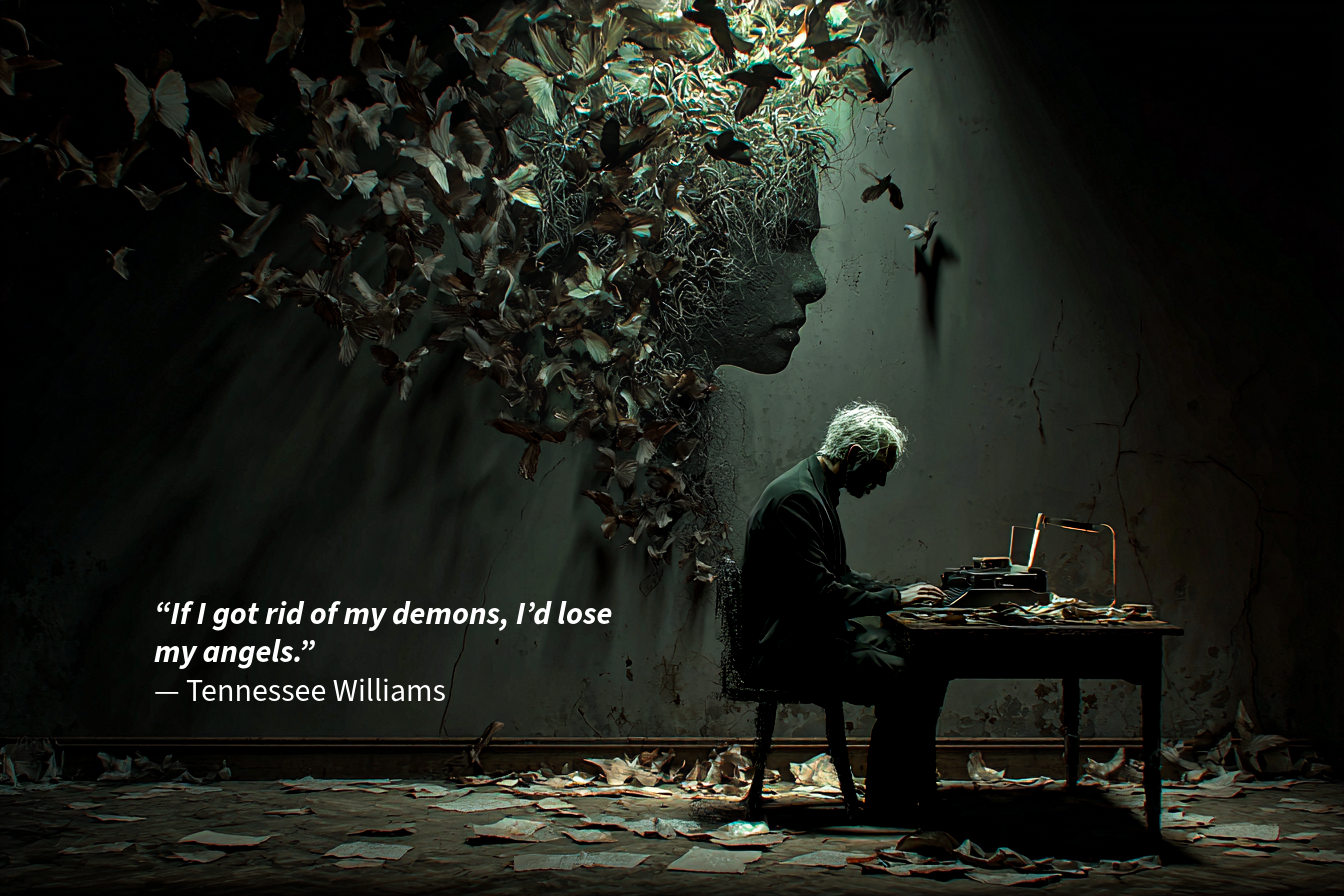
Tennessee Williams understood something most of us spend our lives denying — that light and shadow don’t exist apart, but entangled. He wasn’t glorifying pain; he was confessing a truth artists rarely say out loud: the things that torment us also teach us how to see.

We spend years trying to cauterize our wounds, to sterilize the parts of ourselves that frighten us — fear, obsession, desire, despair. But those same forces carve depth into us. Without them, there’s no contrast, no compassion, no reason to create. Williams wasn’t celebrating madness; he was acknowledging that art and anguish share a bloodstream.

Maybe resilience isn’t about exorcising the demons — maybe it’s about learning to live with them without letting them drive. To take their fire, but not their chaos. After all, what’s an angel but a fallen thing that remembered how to rise?


Reflective Prompt

Which of your inner demons has taught you the most — and what would you lose if they were gone?

Quote of the Day – 11032025


Personal Reflection

Simone didn’t mean it as poetry. She meant it as warning.

To create honestly is to bear witness — to feel the weight of a world that keeps breaking and still refuse to look away. It’s not the kind of duty that wins applause; it’s the one that leaves you raw. Because to reflect the times means letting their noise live inside you — letting the chaos, grief, and hunger scrape against your ribs until it finds a sound that feels true.

There’s a loneliness in that kind of honesty. You stop making art that pleases and start making art that confronts — the kind that doesn’t ask permission to exist. Every brushstroke, every word, every note becomes a confession. This is what it’s like to be alive right now.

Simone understood that silence is not neutrality — it’s surrender. She didn’t sing from distance; she sang from the fire itself. Her voice carried the truth that art isn’t decoration — it’s resistance, it’s reckoning, it’s the memory of who we were when the world forgot itself.

If you’re lucky, your work will outlive you. But before it does, it should undress you. Strip away the illusions you built for safety until what’s left is unfiltered, unpolished, unafraid. That’s not art for comfort — it’s art for survival.

To reflect the times is not to mirror the surface — it’s to reveal the soul of the era beneath it.


Reflective Prompt

What part of your truth have you softened to make it easier to share?
If you stopped protecting your audience, what would your work finally dare to say?

Quote of the Day – 11022025


Personal Reflection

Cohen understood something most people spend a lifetime avoiding — that joy and sorrow aren’t opposites, they’re partners in the same waltz. The beauty that moves us to tears is the same beauty that reminds us we’re temporary. The song doesn’t ask for your permission to feel; it simply reaches into the softest part of you and starts to play what’s already there.

We chase peace as if it means never aching again, but music teaches a different kind of peace — the kind that coexists with longing. You can close your eyes and still see everything you’ve lost, still feel the echoes of what once mattered. But in that ache, something holy hums. It’s the reminder that sorrow isn’t a wound to be healed; it’s a place the light passes through.

There’s a moment — quiet, heavy, sacred — when the melody hits something you didn’t know was waiting. Maybe that’s the soul recognizing itself. Maybe that’s what Cohen meant when he said the spirit soared. Not upward, but inward — toward the place where pain and beauty stop competing and begin to hold hands.

That’s what music does. It doesn’t cure the ache; it makes it sing.


Reflective Prompt

What song still finds the version of you you thought had disappeared?
When was the last time you let the melody hurt — and thanked it for remembering you?
Quote of the Day – 11012025


Personal Reflection

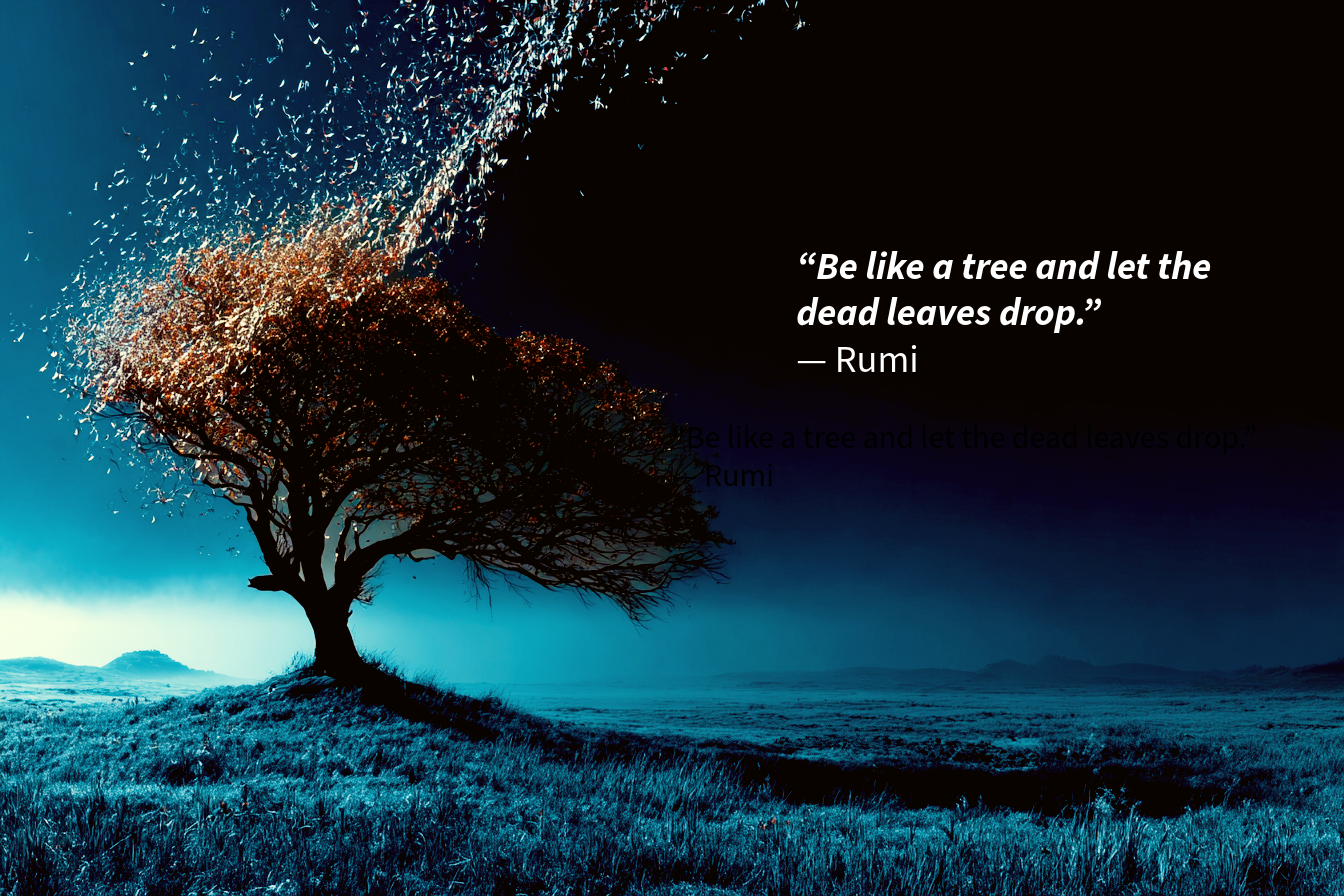
There’s a strange violence in release. We call it growth, but sometimes it feels like grief — like watching the parts of yourself that once felt sacred crumble into something you can’t hold anymore. Rumi knew that letting go isn’t graceful. It’s necessary.

A tree doesn’t argue with winter. It doesn’t try to keep what’s dying attached. It sheds, not out of despair, but wisdom — the knowing that life can’t thrive under the weight of what’s meant to fall. The tree doesn’t call this death; it calls it preparation.

We, on the other hand, cling. We hold on to people long after their presence has turned into silence. We keep carrying beliefs that don’t fit the person we’ve become. We confuse endurance with devotion, even when the holding has hollowed us out.

But the truth is, nothing real is lost in letting go. What remains after the shedding — that’s who you actually are. Bare. Honest. Stripped of performance. The wind moves through you differently when you stop pretending you’re still in bloom.

And maybe that’s the quiet power Rumi meant:
to know when a season has ended,
to stand unadorned,
and trust that what falls away was never yours to keep.


Reflective Prompt

What are you afraid might die if you stop holding on?
What if that death is only a clearing — making space for what’s been waiting to grow in the open?

Quote of the Day – 10312025


Personal Reflection


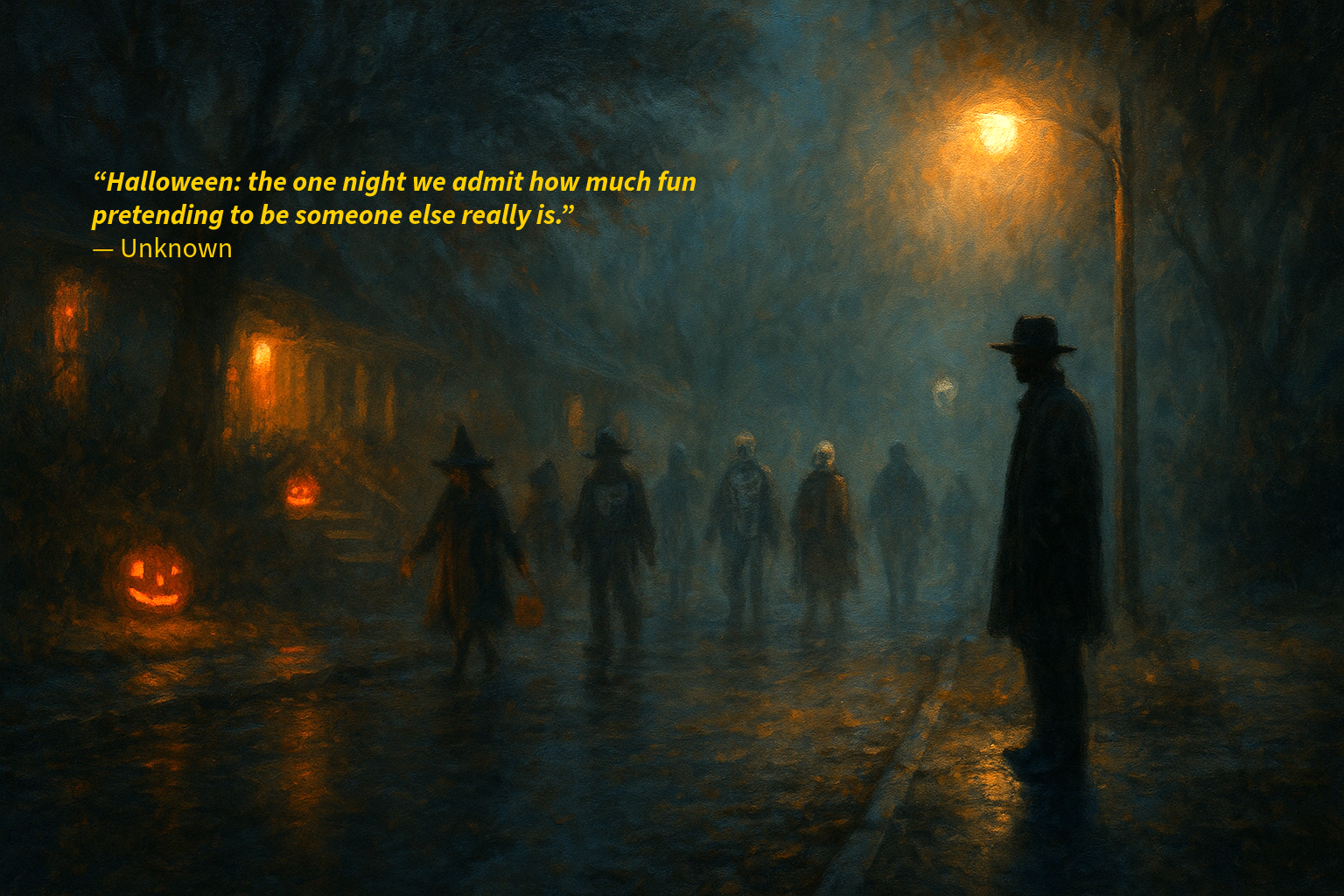
Halloween is the great masquerade — chaos wrapped in cellophane, laughter stitched with unease. We dress up, get loud, and for one night, the world stops asking us to make sense. The absurdity feels like oxygen. Maybe that’s why we crave it — the freedom to be ridiculous without apology.

But beneath the laughter is an ancient kind of truth. Every costume hides a longing — the wish to slip out of our own skin for a while. To stop performing the version of ourselves we built to survive the daylight. Behind the mask, we can breathe. Pretending becomes its own kind of confession. Because pretending, at least, admits there’s something real we’re running from.

Maybe that’s why Halloween feels honest. It’s not the monsters that scare us — it’s the mirror. It’s knowing that when the mask comes off, the performance doesn’t. The faces we wear every other day just cost more and come without eyeholes.


Reflective Prompt

Who are you when no one’s watching — and would you recognize them if they looked back?

Quote of the Day – 10302025


Personal Reflection

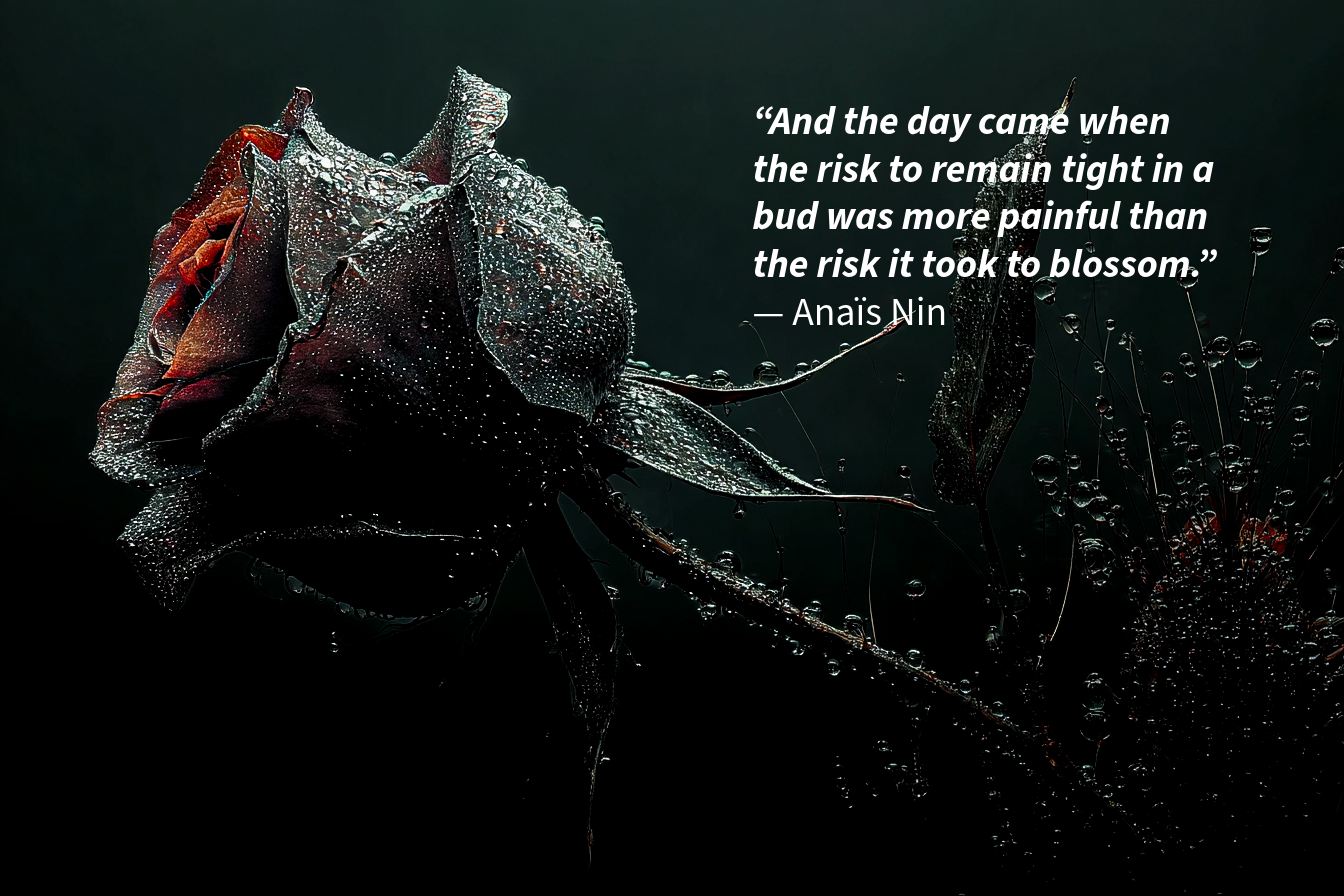
You don’t wake up one morning and decide to bloom. You reach a point where staying closed starts to hurt. It’s not courage at first — it’s exhaustion. You get tired of pretending safety feels like peace. You start to feel the pressure building under the surface, the ache that comes from containing too much life inside too small a space.

Nin understood that pain is a kind of compass. The bud doesn’t split because it wants to; it splits because it has to. The same is true for us. We stay sealed until silence becomes unbearable, until the cost of stillness outweighs the comfort of hiding. That’s when the soul begins its quiet rebellion — not loud, not triumphant, but necessary.

Growth isn’t graceful. It’s messy, tender, and often lonely. You lose parts of yourself in the process — not because they were wrong, but because they were temporary. What remains is raw, trembling, alive. And even if no one sees it, the act of blooming itself becomes an act of truth.

Sometimes healing isn’t a return. Sometimes it’s an opening.


Reflective Prompt

What have you kept sealed out of fear it might not survive the light?
What if the thing you’re protecting isn’t your fragility, but your becoming?

Quote of the Day – 10292025


Personal Reflection

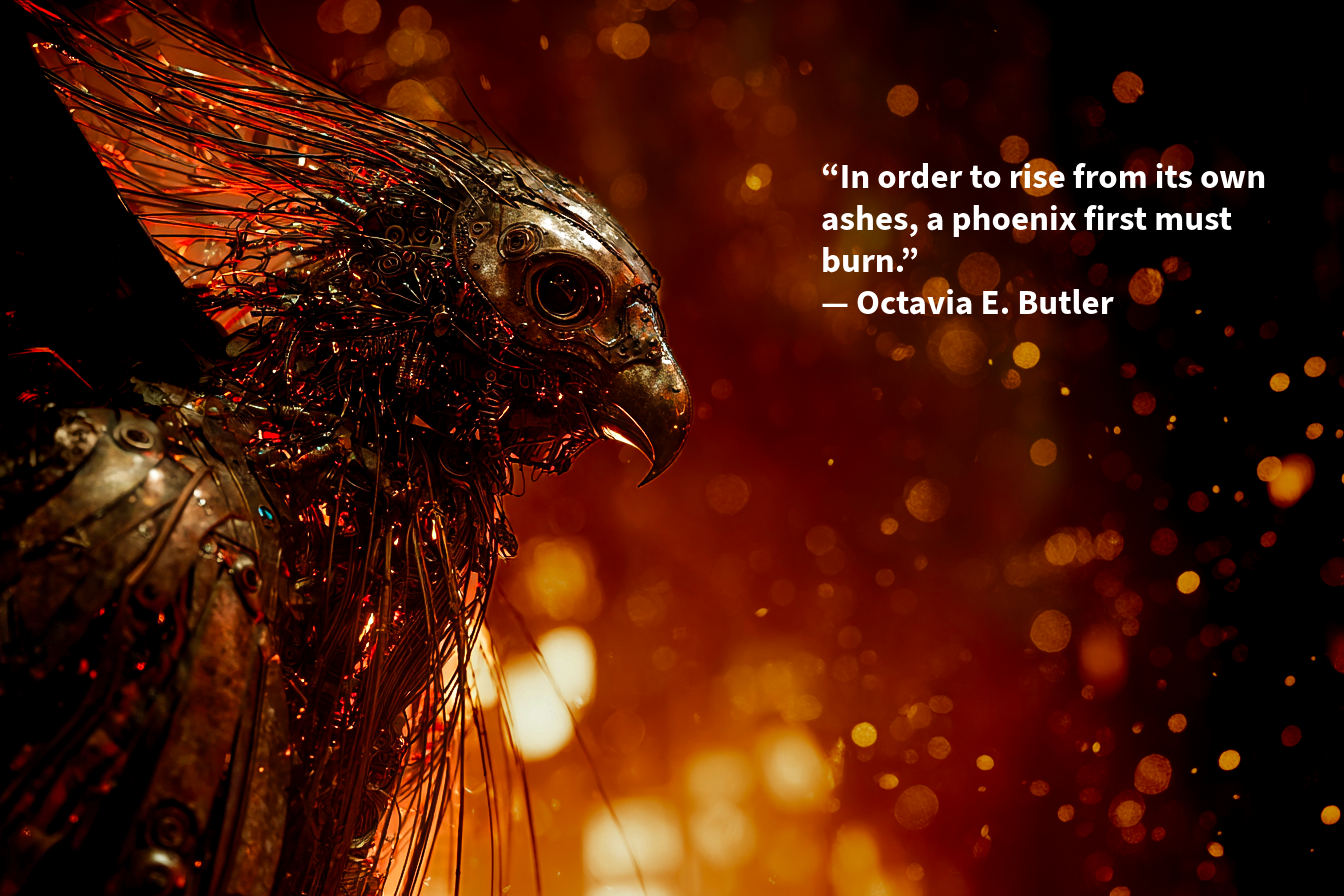
We like to talk about rebirth as if it’s beautiful — all gold feathers and glowing wings — but the truth is, it’s mostly smoke and silence. The fire doesn’t ask for your consent; it just arrives, uninvited, and takes everything that’s no longer meant to stay.

Rebuilding isn’t the triumphant act people make it out to be. It’s slow, deliberate, sometimes cruel. It asks you to look at what you’ve built — systems, habits, identities — and admit what’s rotting beneath the structure. That’s the part no one romanticizes: the self-audit. The dismantling. The sound of your own certainty collapsing.

Butler understood that burning isn’t the end; it’s the cost of clarity. The ashes aren’t a metaphor — they’re memory, residue, proof. To rise means to remember where you fell, and to carry the weight of that lesson into the next version of yourself.

The MKU rebuild isn’t just about reassembling hardware and code — it’s about confronting how we clutter our own creative systems with ego, sentimentality, and noise. It’s about building with intention this time — knowing what to keep, what to bury, and what deserves to burn again if it ever loses its purpose.

The phoenix doesn’t rise because of the fire. It rises through it. And that’s the difference between those who rebuild and those who simply replace.


Reflective Prompt

What part of your life or work are you still trying to rebuild on ashes that were meant to scatter?
What would it look like to stop saving what’s already served its purpose — and let the new architecture rise clean from the flame?

Quote of the Day – 10212025


Personal Reflection

There comes a point after the breaking, after the rebuilding, where words stop being useful. The noise of explanation fades, and you find yourself in a quieter kind of space — not healed exactly, but emptied of the need to defend your scars.

Silence isn’t absence. It’s an invitation — the kind that makes you uncomfortable at first because it offers no distraction, no applause. Just you, sitting with the echo of your own pulse. For years, you filled the quiet with stories about what should’ve been, what could’ve been, who you might have been if life had been kinder. But the soul doesn’t whisper to your potential — it speaks to what’s real.

That whisper doesn’t flatter. It doesn’t beg for recognition. It just asks: Are you listening yet?

To live from that place — the still, unhurried center — is to understand that peace isn’t the absence of pain; it’s the willingness to stop resisting it. It’s knowing that sometimes the most radical act of strength is to be still long enough for your soul to find its voice again.


Reflective Prompt

When was the last time you let silence speak without interrupting it?
What might your soul be trying to tell you beneath all that noise?

Quote of the Day – 10202025


Personal Reflection

We spend our youth believing we can outrun the breaking. We think strength means staying intact, uncracked, untouched by loss. But the world has a way of teaching otherwise. It doesn’t ask permission before it takes something from you — it just keeps carving until all that’s left is what can’t be taken.

Hemingway understood that kind of strength — the kind that’s not visible until after everything else is gone. The kind born from what survives the fracture. Brokenness doesn’t make us less whole; it makes us more true. The places we seal with gold, with grit, with sheer will — those become our proof of living.

The mistake isn’t in breaking; it’s in pretending the wound never happened. The body remembers, the soul remembers, and if we’re lucky, we learn to move differently — not out of fear, but out of reverence.

Sometimes strength isn’t the rebuilding of what was lost. Sometimes it’s learning to carry the crack like a scar that hums when it rains — a reminder that you’re still here, and somehow, still capable of beauty.


Reflective Prompt

What part of your story did you once call broken that now carries your strength?
Can you trace the light that seeps through the cracks you tried so long to hide?

Quote of the Day – 10192025


Personal Reflection

The world teaches you early how to hide. Not maliciously — just insistently. It rewards composure, not truth; appearance, not presence. You learn to smile when you want to scream, to make peace with things that gnaw at you in the dark. Hiding becomes habit, and habit becomes identity.

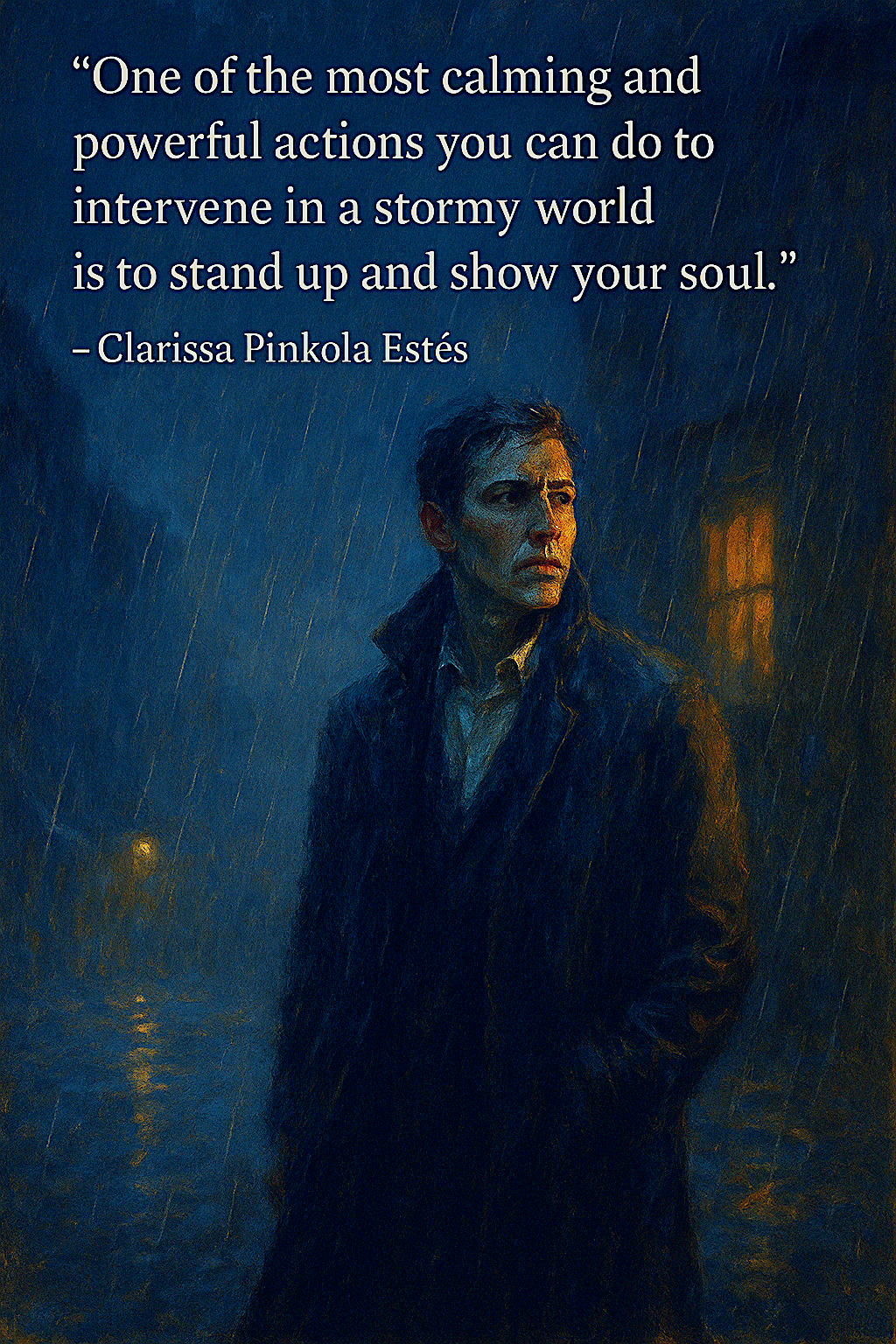
But there comes a breaking point — subtle at first — when the performance starts to hurt more than the exposure ever could. That’s where Estés is pointing. Standing up and showing your soul isn’t rebellion for its own sake; it’s survival through honesty. It’s saying, I will not vanish to make you comfortable.

To show your soul in a storm is not to transcend fear but to let it stand beside you. To let the world see your tremor and your teeth, your tenderness and your rage — unedited. Because calm doesn’t mean silence; sometimes calm is the stillness that remains after everything collapses and you refuse to collapse with it.

The soul isn’t a performance. It’s the quiet insistence that even if the world doesn’t listen, you’ll speak anyway — not to be heard, but to stay human.


Reflective Prompt

Where in your life have you been mistaking composure for peace?
What would happen if you stopped shrinking to survive and started letting your unguarded self breathe in full view of the storm?

Quote of the Day – 10182025


Personal Reflection

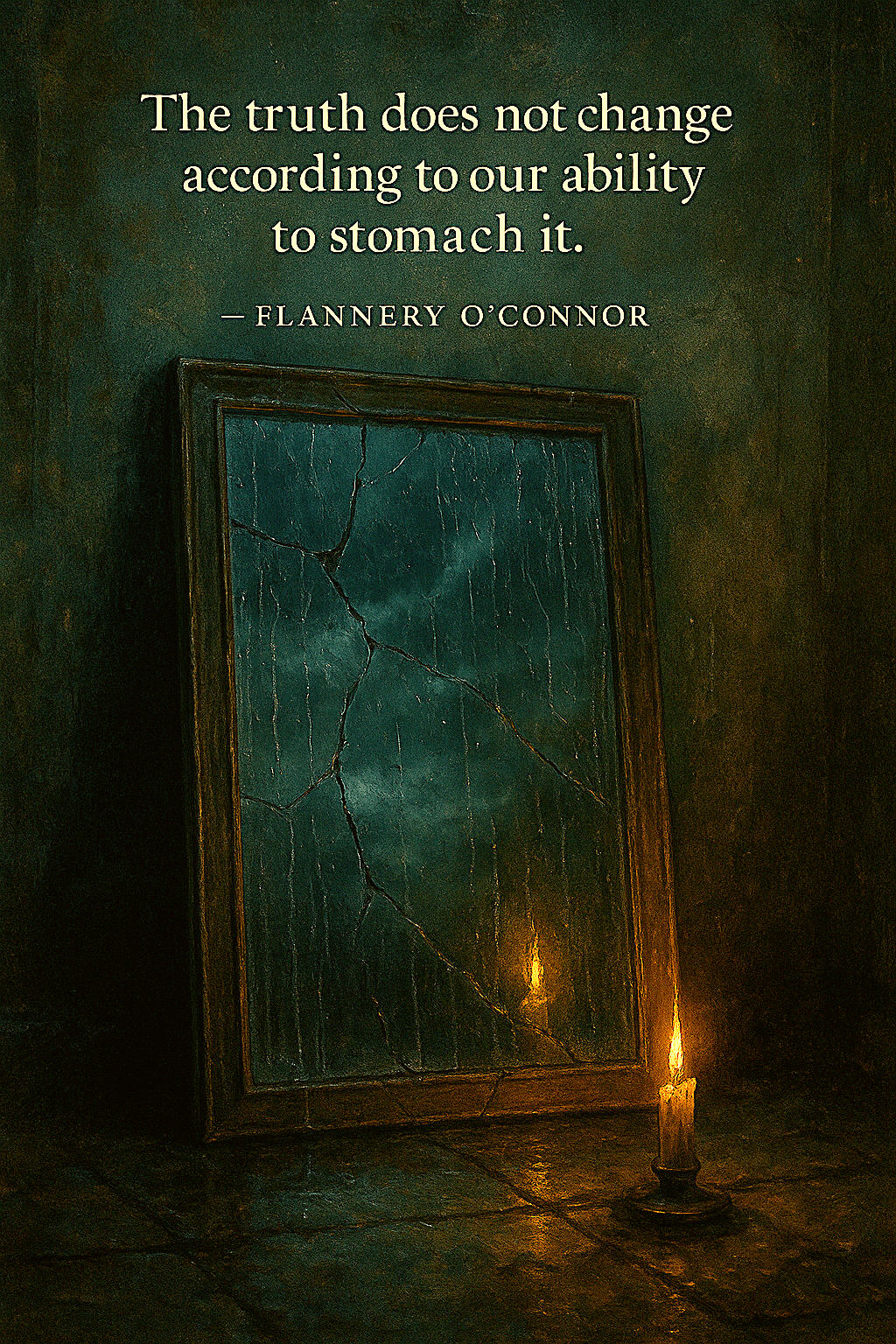
Truth doesn’t wait for your readiness. It doesn’t knock before it enters — it walks straight through the front door, dripping rain and dirt across the floorboards of your comfort. We spend years pretending we want it, when what we really crave is permission to keep lying — softly, politely, to ourselves.

The truth shows up anyway. It doesn’t shout. It sits in the corner like an old ghost, watching you rehearse the same story about who you are. And when it finally speaks, it doesn’t ask for belief — it asks for surrender.

There’s a moment, quiet and awful, when you realize your reflection has stopped negotiating. You can’t hide behind good intentions or clever reasoning anymore. The truth has no interest in the version of you that survives through performance. It wants what’s underneath — the trembling, unvarnished you who still flinches at the sound of your own name.

We call that pain. I think it’s grace. The kind that doesn’t comfort but cleanses — the kind that strips you down to bone so you can finally stop pretending you’re made of anything else.


Reflective Prompt

What truth have you avoided because it threatened your favorite lie?
And if you faced it now — no armor, no story — what part of you would it ask to die so the rest could live?

Quote of the Day – 10172025


Personal Reflection

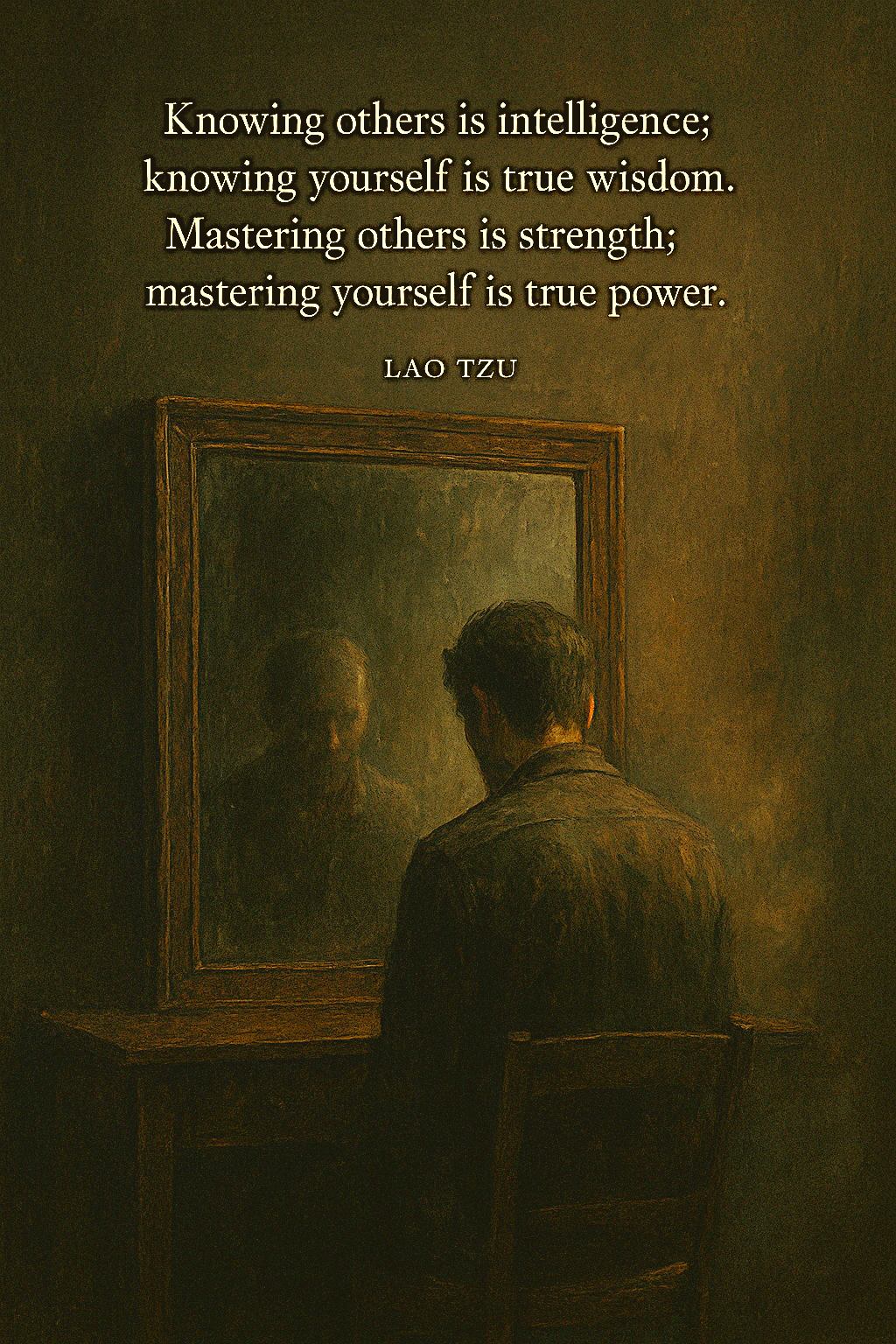
Most people chase knowledge like it’s armor — how to read a room, how to outthink, outmaneuver, outlast. But Lao Tzu wasn’t speaking to the mind that conquers. He was warning the mind that hides.

Knowing yourself isn’t gentle work. It’s the slow dismantling of every story you’ve been told about who you’re supposed to be — the cultural scripts, the self-help slogans, the identities you inherited and performed until they hardened into skin. When you peel all that away, what’s left isn’t serenity. It’s fear. Vulnerability. Indecision.

And that’s the point. Those aren’t flaws to fix — they’re evidence that something real is surfacing. We were never meant to overcome fear; we were meant to understand it. Vulnerability isn’t weakness; it’s the seam where truth leaks in. Mastery, in the truest sense, isn’t dominance over emotion but intimacy with it. It’s standing inside your own uncertainty and not reaching for a mask.

The work of self-knowledge doesn’t happen all at once. It’s a lifetime of dissolving illusions at the speed of honesty — a slow unlearning of the urge to control. Enlightenment isn’t an event. It’s the moment-to-moment practice of not turning away from what you find.

Power isn’t the absence of weakness. It’s the courage to remain whole in the presence of it.


Reflective Prompt

When the performance falls away, what remains that’s still you?
What truth waits behind the fear you keep calling failure?
Sit with that — not to fix it, but to finally hear what it’s been trying to tell you.

Quote of the Day – 10162025


Personal Reflection

Pascal wasn’t dismissing reason — he was reminding us that logic alone can’t explain why we ache, why we love the wrong people, why we stay when leaving would make sense. The heart lives by its own compass, unbothered by the tidy arguments of the mind.

We try to dissect our feelings until they make sense, but the heart resists translation. It knows things reason can’t touch — the weight of silence, the pull of memory, the strange faith that something unseen still matters. To live by reason alone is to flatten experience into facts; to live only by the heart is to drown in its tide. The tension between the two is where we become human — trembling, inconsistent, and alive.

Maybe the heart’s “reasons” aren’t irrational but ancient — the echo of something older than language, something that recognizes meaning long before we can explain it. The challenge isn’t to silence one or the other but to let them speak in turn: the mind for direction, the heart for purpose.

Because the truth is, reason can chart the path — but only the heart can tell us why we’re walking it.


Reflective Prompt

When has your heart led you somewhere reason warned against? Did it end in ruin or revelation — and what did it teach you about the cost of trusting what cannot be explained?

Quote of the Day – 10152025


Personal Reflection

Bukowski’s honesty is never graceful — that’s what makes it real. He understood that survival isn’t about glory; it’s about accumulation. The bruises we carry, the choices that aged us, the regrets that keep whispering — these aren’t failures to erase, but evidence that we kept showing up when we didn’t have to.

Life doesn’t move in a clean line of progress. It staggers, loops, and limps through us. We build meaning not from perfection but from persistence — the ability to keep gathering the broken parts and calling them experience. The small victories aren’t glamorous. They’re getting out of bed when your bones feel heavy with yesterday. They’re forgiving yourself for another false start. They’re learning to see beauty in the unremarkable act of continuing.

Maybe that’s the quiet miracle Bukowski was naming — that survival itself, however messy, is its own kind of art. The fact that you’re still here, still trying, still writing your name across another day — that’s not failure. That’s the unfinished triumph of being human.


Reflective Prompt

When you look back on your own story, what small victories do you overlook — the quiet moments where you showed resilience, grace, or stubbornness just to keep going? What would it mean to see your survival not as luck or accident, but as a deliberate act of creation?

Quote of the Day – 10142025


Personal Reflection

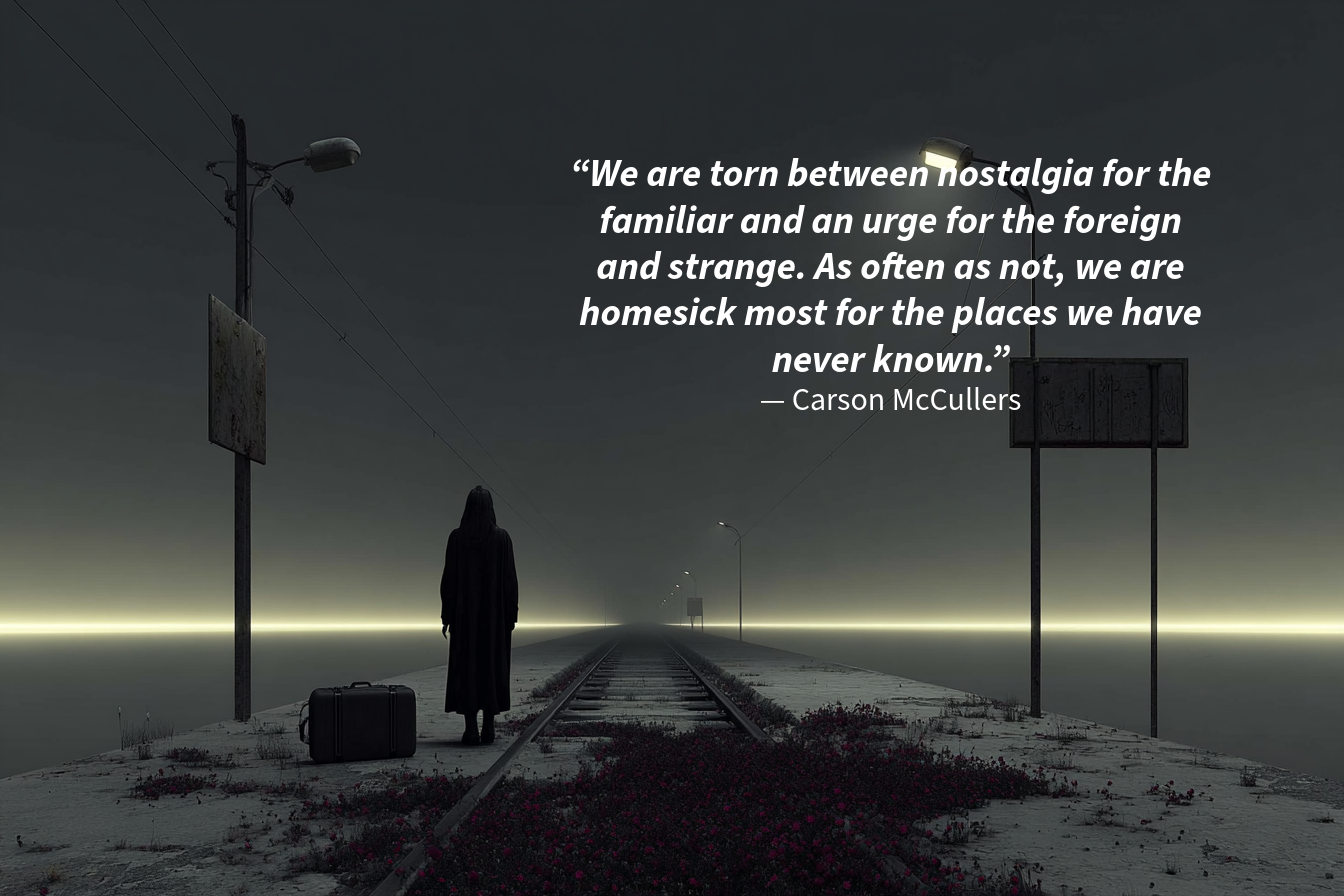
McCullers was never writing about geography. She was writing about that quiet fracture between who we are and who we ache to become — the homes we build in imagination because the real ones never fit quite right. There’s a particular loneliness in that, a nostalgia not for the past but for the version of ourselves we lost along the way. We crave a place that holds our contradictions without judgment — something both foreign and familiar, like memory speaking in a language we almost remember.

We carry our restlessness like an heirloom. It shows up in the urge to move, to start over, to burn everything and begin again. But what if the places we long for aren’t physical at all? What if they’re the internal landscapes we abandoned — the wonder we traded for control, the softness we sacrificed to survive? Maybe the “foreign and strange” McCullers speaks of isn’t elsewhere — maybe it’s the uninhabited corners of ourselves we’ve been too afraid to enter.

We mistake longing for direction. We chase what’s distant because it feels safer than sitting still with our own ghosts. But the truth is, we’re all homesick for something intangible — the feeling of being entirely known, entirely unhidden. And perhaps the work of living isn’t about finding that home, but creating it — brick by tender brick — inside the ruins we already occupy.


Reflective Prompt

When you trace the map of your own life, what places do you return to — not the ones on any atlas, but the ones that live behind your ribs? Where does your spirit feel most unfinished, most in-between? And if the home you long for has never existed, what would it look like if you began to build it within yourself — from memory, imagination, and the fragments of everything you’ve survived?

Quote of the Day – 10132025


Personal Reflection

There’s a strange ache in Bukowski’s words — not from cynicism, but from clarity. To “exist” is to follow the motions: to breathe, work, repeat. To “live,” though, is an act of rebellion. It means feeling everything the world keeps trying to numb — the loss, the love, the quiet longing between both.

Existing is safe. It demands nothing but endurance. Living, however, asks for presence — to stand unguarded in the noise and feel it all press against your ribs. Maybe that’s why it hurts. Because to truly live means you can no longer look away from your own truth. You begin to see the difference between what keeps you busy and what keeps you alive.

Bukowski wasn’t glorifying chaos; he was exposing the hollowness of a life without pulse. To live, in his sense, is to wrestle meaning out of monotony — to dig through the static until you find something that still burns. Maybe that’s the quiet tragedy of adulthood: we forget that aliveness and comfort rarely share the same room.


Reflective Prompt

Where in your life have you been merely existing — following routine without passion or pulse? What would it take to live again, not in grand gestures, but in small, deliberate acts that remind you you’re still capable of feeling deeply?

Quote of the Day – 10122025


Personal Reflection

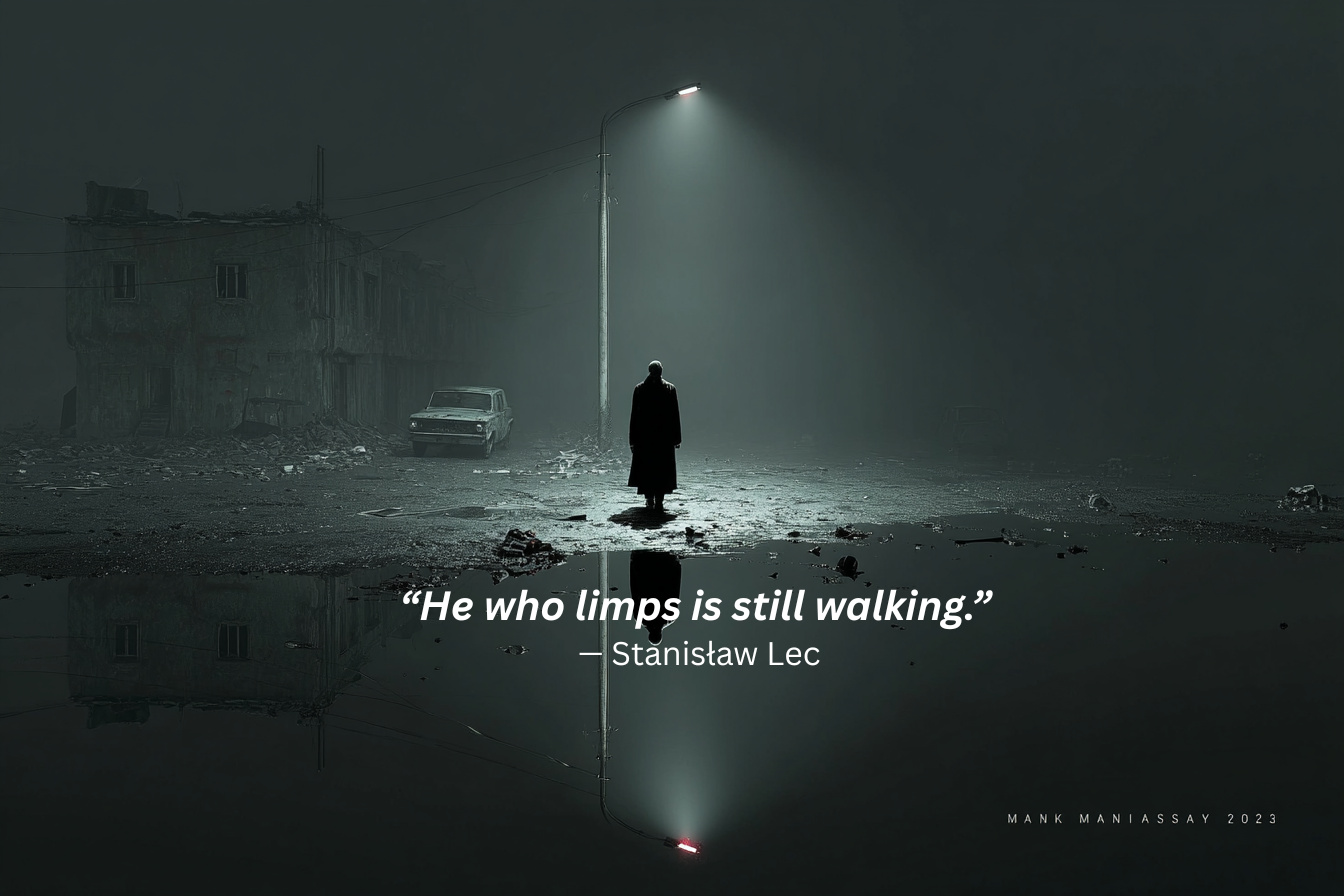
Lec wasn’t speaking about a literal limp. He was speaking about the way the soul walks after it’s been fractured — the uneven rhythm that comes from surviving what was meant to end you. The limp is what remains after the world has tried to take your stride. It’s the visible mark of invisible wars.

To limp is to continue in spite of the damage. It’s not about returning to who you were; it’s about carrying forward what you’ve become. There’s a quiet rebellion in that — a refusal to disappear. Lec understood that progress isn’t always graceful; sometimes it drags, sometimes it stumbles, but it endures. The limp is living proof that the wound didn’t win.

In a world obsessed with appearances and perfection, the limp is a dangerous kind of honesty. It exposes what survival really looks like — imperfect, asymmetrical, raw. And yet, it moves. That’s the defiance Lec is whispering about: the beauty of motion after meaning has collapsed. The limp is consciousness made visible — a body aware of its own fragility, yet stubborn enough to continue.

Maybe strength isn’t about walking straight after all. Maybe it’s about limping with purpose — about accepting that every step forward carries a story the unbroken will never understand.


Reflective Prompt

When you think of the ways you’ve been altered by what you’ve survived, where do you still feel the limp? Not in body, but in memory — in the quiet spaces where strength became something slower, more deliberate. What would it mean to stop hiding that uneven rhythm, and instead see it as proof that you refused to stop moving?

Quote of the Day – 10112025


Personal Reflection

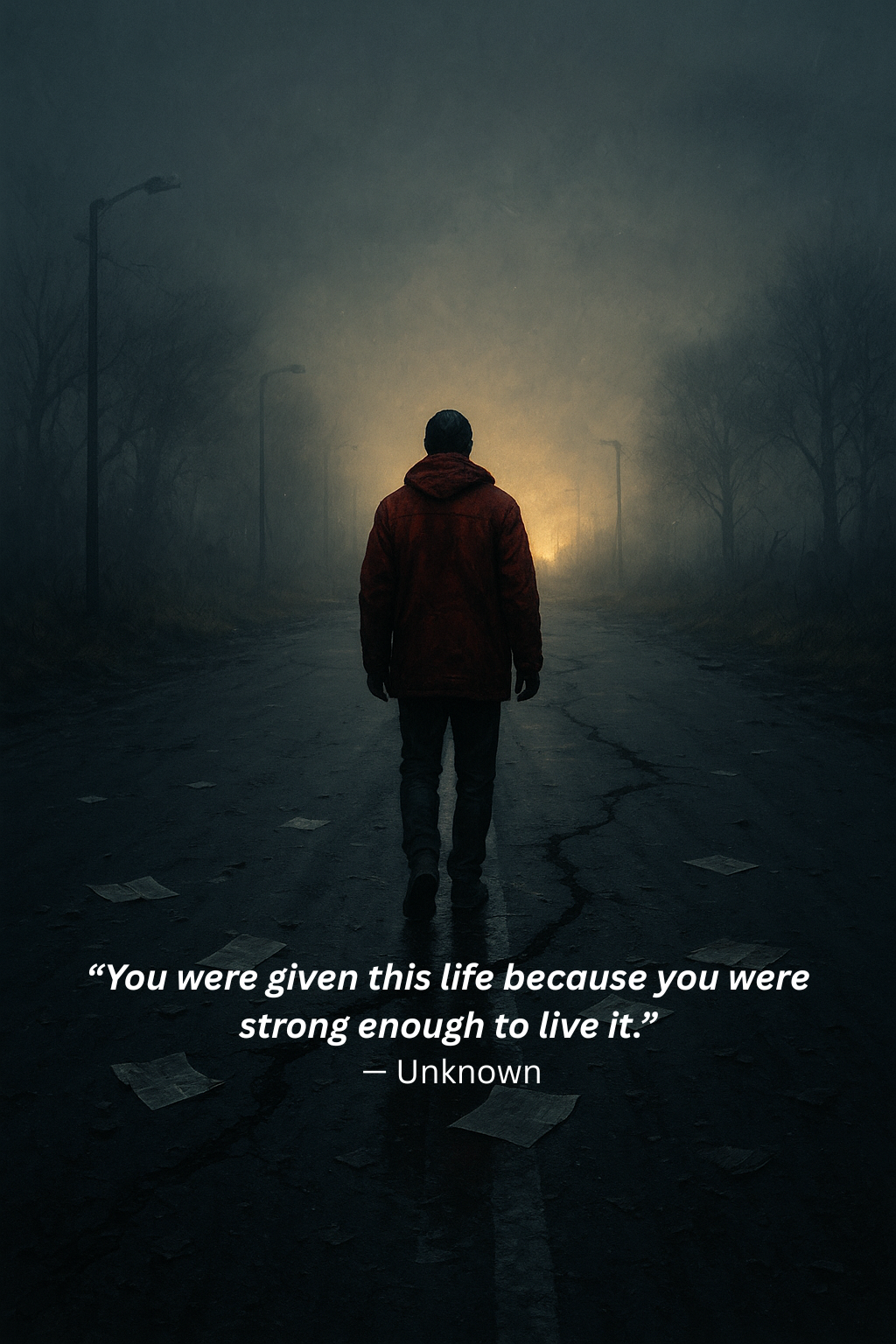
Strength is rarely the gift we want — it’s the inheritance of survival. It’s not handed to the lucky; it’s carved into the ones who’ve learned how to keep breathing when the world goes silent. This life — the one you didn’t choose in all its weight and wonder — asks for something deeper than optimism. It asks for persistence when faith falters. It asks for motion when meaning disappears.

The truth is, you don’t feel strong when you’re becoming it. You feel undone, hollowed, threadbare. You question whether it’s worth it — this constant fight to hold yourself together. But maybe that’s what this quote gets right. You weren’t chosen for an easy life; you were built for the hard one. For the slow rebuilding after loss, for the quiet compassion born of scars, for the small, defiant act of still being here.

Strength isn’t loud. It doesn’t announce itself. It lives in the pause between collapse and continuation — that sacred moment when you choose to rise again, even when no one’s watching.


Reflective Prompt

When did strength stop feeling like triumph and start feeling like endurance? What have you carried — quietly, faithfully — that proves you were strong enough for this life, even when you doubted it?

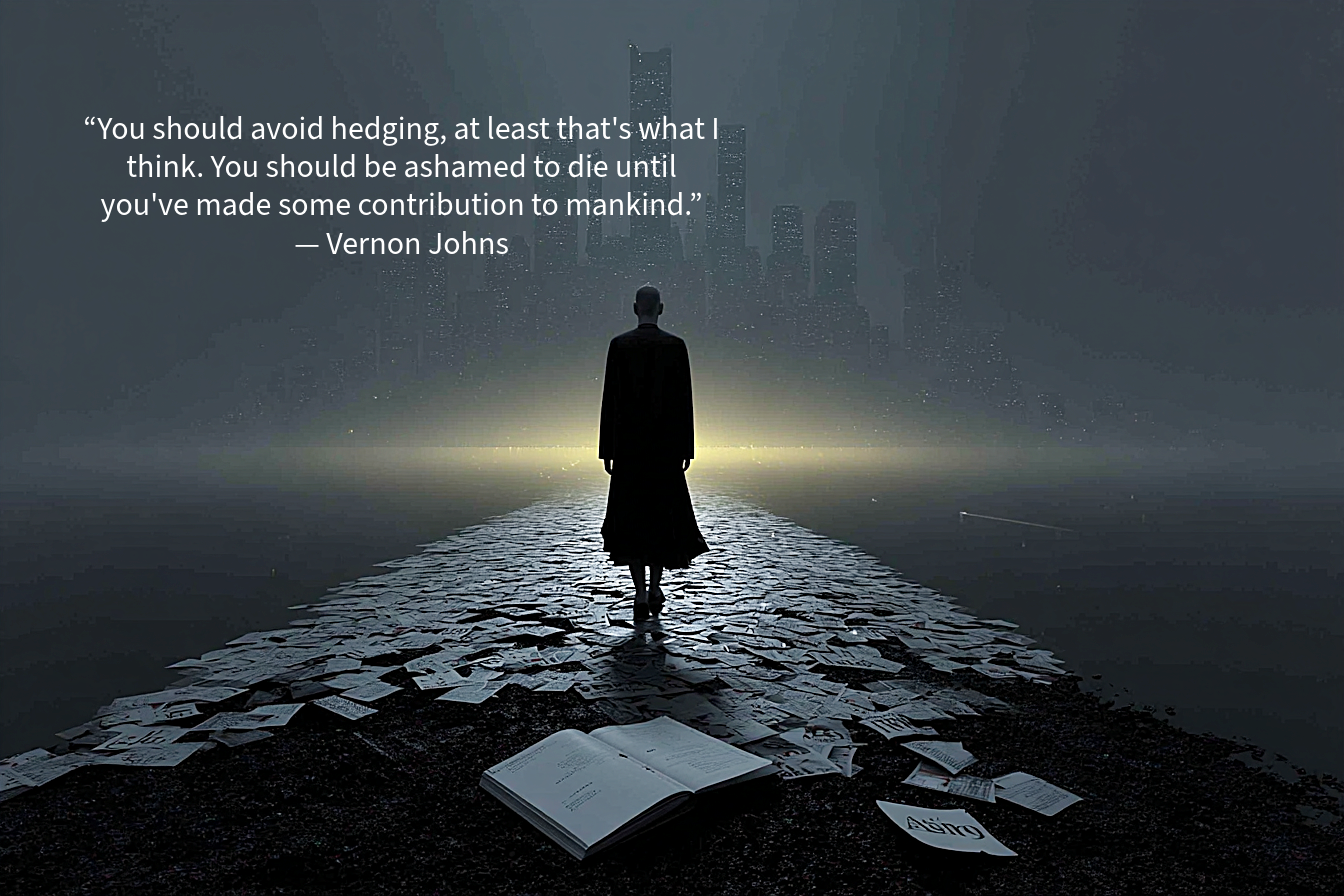
Quote of the Day – 10102025


Personal Reflection

There’s a rare honesty in this quote — the kind that cuts through the polite illusions we build around “purpose.” Johns isn’t romanticizing contribution; he’s demanding accountability. He’s calling out that quiet cowardice that disguises itself as caution — the way we postpone our lives in the name of preparation, waiting for the mythical moment when the fear will fade and the path will clear.

But the truth is, most of us hedge not because we lack ability, but because we fear insignificance. We hesitate, edit ourselves mid-sentence, and bury our ideas in “someday.” We tell ourselves the timing isn’t right, that the world doesn’t need one more writer, one more painter, one more dreamer. Yet contribution isn’t about scale — it’s about offering what only you can. Sometimes that means creating something raw and imperfect, sometimes it means showing up for someone who’s about to give up. Either way, it requires the courage to exist unapologetically.

Maybe the shame Johns speaks of isn’t moral but existential — the ache of realizing we let fear keep us small. Perhaps our only real task is to live in such a way that when the end comes, we can say we tried. Not perfectly. Not painlessly. But honestly.


Reflective Prompt

If you stopped hedging — if you stripped away the excuses and met your own potential head-on — what would you create, build, or give? What would your version of “contribution” look like, not in grandeur, but in truth?

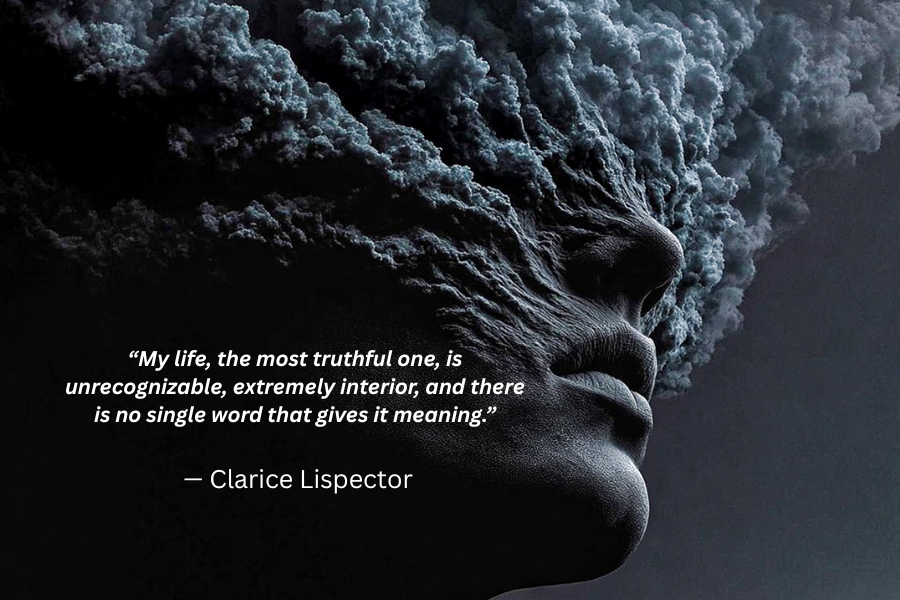
Quote of the Day – 10092025


Personal Reflection:
There’s a kind of honesty that can’t survive translation—the parts of us that speak in silence, that move beneath words. Lispector’s confession feels like a mirror turned inward: the recognition that who we are in public is only the outline, never the pulse.
We spend years constructing a self that can be explained, one that fits inside sentences tidy enough for others to understand. But the interior life resists definition—it mutters in metaphors, hides behind small gestures, aches in ways even language can’t reach.
Maybe that’s what truth really is: not something that demands to be known, but something that asks to be felt. The raw, shapeless, holy mess of being alive before we name it. Maybe the truest parts of us are the ones we can’t post, can’t polish, can’t fully confess. They exist in fragments—between breaths, between sentences—and that’s where meaning quietly builds its nest.


Reflective Prompt:
What would your life look like if you stopped trying to make it understandable?
What truths have you hidden simply because they don’t fit the version of you others recognize?

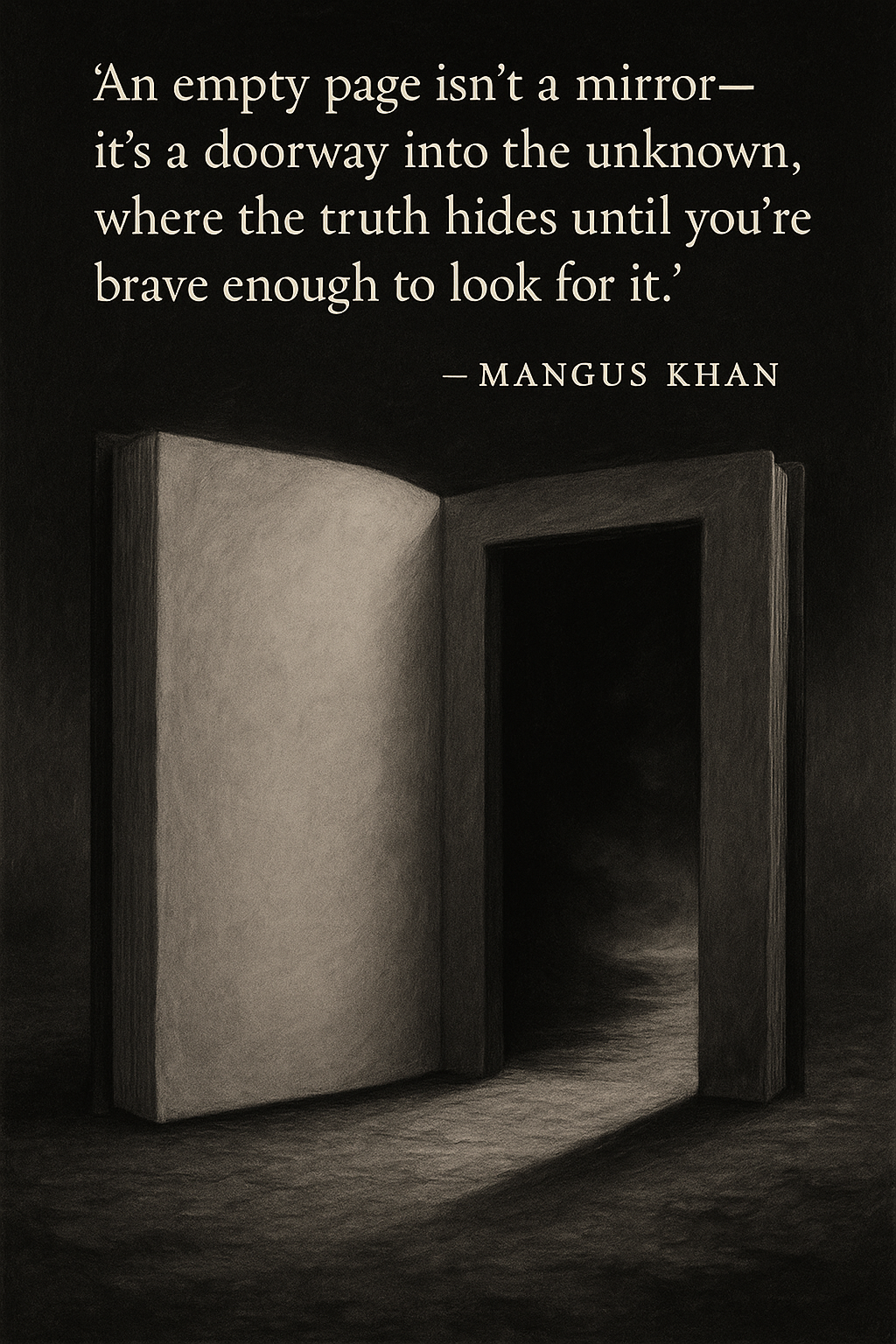
Quote of the Day – 10082025


Personal Reflection:
We like to believe we know ourselves, but the page has a cruel way of proving otherwise. It strips away the rehearsed versions—the masks we polish for public view—and leaves us standing there, naked with the truth we almost buried. Writing doesn’t always heal; sometimes it exposes the wound we’ve been pretending isn’t there.
Yet, that’s the beauty of it. The page doesn’t demand perfection, only presence. Each sentence becomes an act of courage, a conversation between who we think we are and who we’re becoming. It’s not the ink that transforms us—it’s the willingness to face what the ink reveals.


Reflective Prompt:
When was the last time your writing surprised you?
What truth emerged from your words that you didn’t know you were ready to face?

Quote of the Day – 10072025


Personal Reflection (Memoirs of Madness Edition)

We like to think writing is an act of control — that we build worlds one word at a time, bending them to our will. But the truth is far less divine. Sometimes we stumble into a story by accident, and other times it drags us down a flight of stairs just to show us who’s really in charge.

That’s the part no one warns you about — the loss of authorship. The realization that the page doesn’t belong to you once the ink starts moving. You can’t force honesty; it bleeds out when it’s ready.

Maybe the act of falling — of tripping over what we meant to write — is where the real work begins. That’s when the masks crack, when the ghosts step forward, when the story stops pretending to be art and starts confessing its truth.

The best stories don’t wait for our permission. They just want us to be brave enough to stay on the floor long enough to listen.


Reflective Prompt for Readers

What stories have you stumbled into — the ones that weren’t part of the plan but somehow revealed a truth you didn’t know you were carrying?

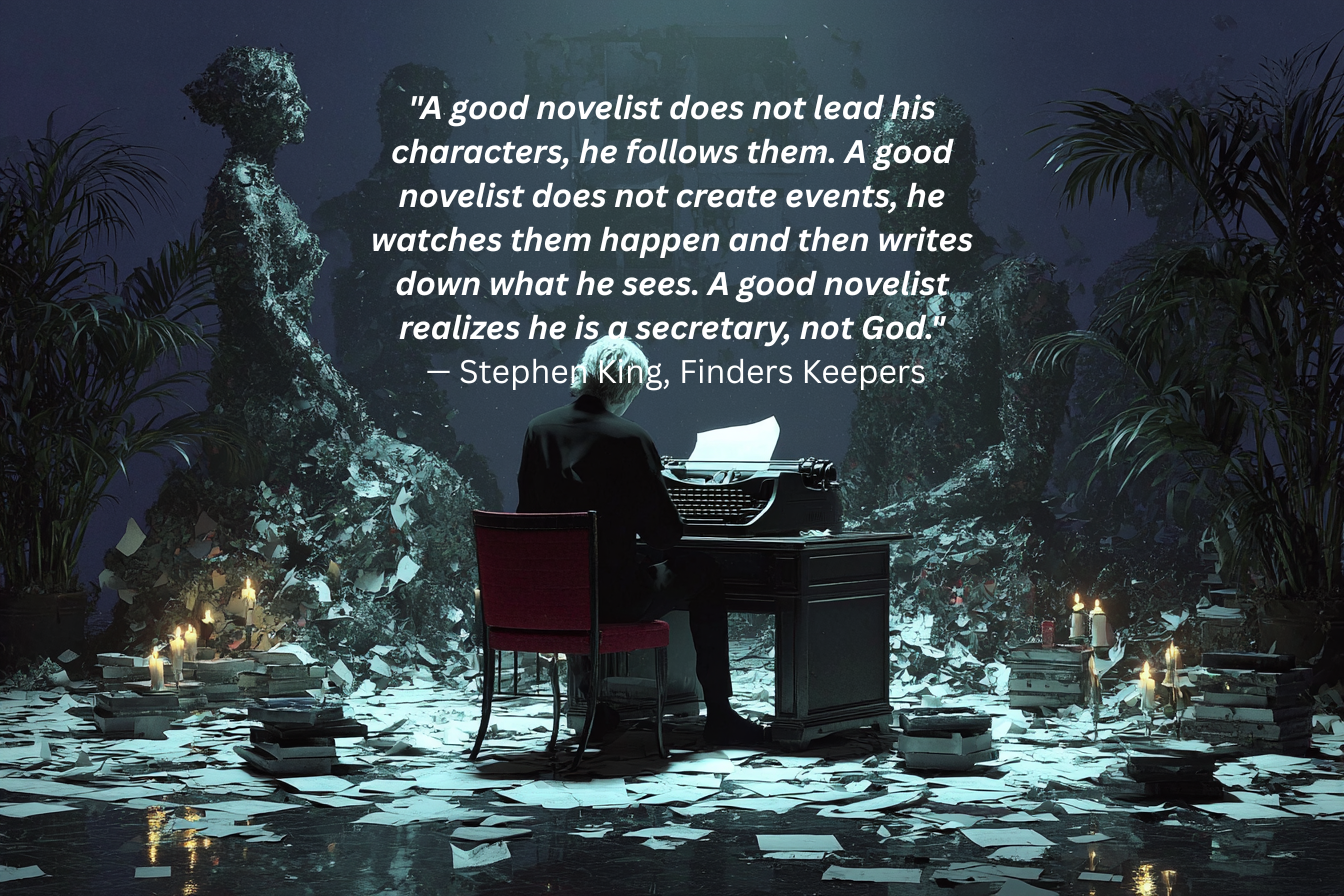
Quote of the Day – 10062025


Personal Reflection

Writing is an act of surrender disguised as control. Every story begins with certainty—plots mapped, destinies sketched—but then the characters start breathing. They talk back. They wander off. They reveal pieces of you that you didn’t intend to give away. It’s unnerving when the words stop obeying, when the page becomes a mirror instead of a window. That’s when you realize the story isn’t about them—it’s about you.

King said a novelist is a secretary, not God. That’s true for more than just fiction. Life has a way of writing through us, too. The moments we can’t explain, the people we can’t forget, the patterns we swore we’d never repeat—they’re all characters we follow, whether we want to or not.

The older I get, the more I think stories are just a rehearsal for honesty. The plot doesn’t need our control—it requires our confession. The same way our lives don’t need to be perfect—they just need to be true.

We’re not the authors of our souls; we’re the transcribers. We observe the madness, the beauty, the contradictions, and we write them down. Some days, the narrative makes sense. Most days, it doesn’t. But if we follow the truth long enough—on the page or in ourselves—we eventually see the same thing King did: we were never meant to lead the story. We were meant to witness it.


Reflective Prompt for Readers

What story is your life trying to tell that you keep rewriting out of fear or pride?
If you stopped editing the truth—just for a moment—and wrote down what you actually see, what would the page reveal about who you are, and who you’ve been pretending to be?

Quote of the Day – 10052025


Personal Reflection:

Fear is persuasive because it sounds like reason. Because sometimes it is… but this isn’t what we’re going to talk about today.

Most days, fear wears the face of logic. It tells us not to risk too much, not to look foolish, not to try again. It dresses itself in memory—every failure, every misstep, every scar that whispers don’t you dare. And we listen, because falling is familiar. Pain has always been the more reliable teacher.

But Hanson’s words cut through that lie with something simple, almost childlike in its daring: what if you fly? It’s not optimism; it’s defiance. It’s a quiet middle finger to the voice that says “stay small.” Because fear isn’t the enemy—it’s the inertia that follows it. We let the fear calcify until even the idea of trying feels foreign.

Freedom doesn’t arrive as a grand revelation; it comes in tremors. In the moment you stop asking permission to exist. In the tiny decision to move anyway—shaking, doubting, breath caught in your throat—but moving.

Maybe the point isn’t to silence the fear. Maybe the point is to carry it to the edge with you, acknowledge its weight, and jump anyway. Because at some point, the ache of staying grounded becomes heavier than the risk of falling. And when that happens, when you finally step off the ledge—that’s not the sound of fear breaking.
That’s the sound of your wings remembering what they were built for.


Reflective Prompt for Readers:

What fear have you mistaken for reason?
When was the last time you stopped arguing with it long enough to hear what it was really saying?
And if you carried that fear with you to the edge—not to silence it, but to show it the view—what might happen if you jumped anyway?

Quote of the Day – 10042025


Personal Reflection:

History isn’t a museum—it’s marrow. It lives in our gestures, in the language we inherit, in the silence we keep. To forget it is not an act of ignorance—it’s an act of self-erasure. We become the amnesiacs of our own becoming, drifting from one imitation of meaning to another. Abdul-Jabbar’s words cut clean because they remind us: without memory, direction is a myth.

We float easier when we refuse to look back. There’s comfort in pretending we’re original, that our chaos is new. But every storm we face has been weathered before, and every fracture in our world mirrors one in history. Forgetting that doesn’t free us—it condemns us to repeat the same collapse with better technology.

Maybe the rudder isn’t just knowledge—it’s humility. The willingness to admit we are not the first to ache like this. That someone before us also fought, lost, rose again. That remembering is not nostalgia—it’s navigation.

Because when you drift long enough, even freedom starts to look like aimlessness. And that’s how history disappears—not in fire, but in forgetfulness.


Reflective Prompt for Readers:

What pieces of history—your own, your family’s, your people’s—have you quietly allowed to fade?
If you traced the ache you carry back far enough, whose hands would you find holding it first?
And if you remembered them fully—name, struggle, fire—how would that change the way you move through the world now?

Quote of the Day – 10032025


Personal Reflection
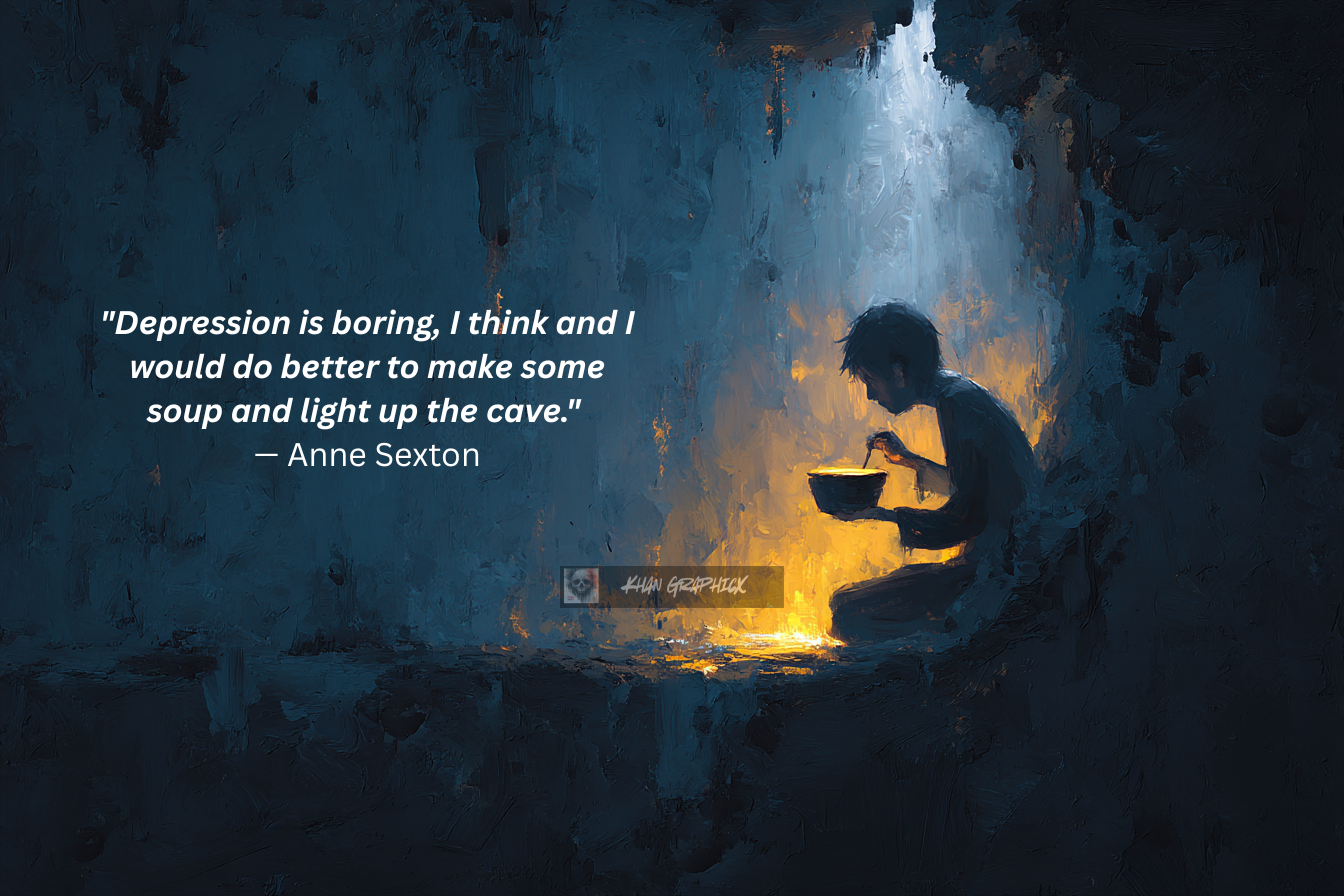
Depression rarely looks like the grand collapse we see in films—it’s slower, quieter, a kind of suffocating monotony. Yet, it is very real. It’s not the dramatic breakdown in a rain-soaked street; it’s the heavy silence that lingers in the kitchen at 2 a.m. It’s the untouched dishes, the stalled conversation, the way light feels thinner when it slips through the blinds. It’s the boredom that corrodes everything, the dull ache of simply existing.

Anne Sexton strips the monster of its glamour. She reminds us that depression isn’t always a tragedy to be performed; sometimes it’s just…boring. And maybe that’s its cruelest trick—it convinces us that even our suffering has become ordinary. Sexton’s defiance is in the small things: soup, light, fire in the cave. Not grand gestures, not a cure, but a refusal to let the dark have all the power.

It’s not about pretending the cave isn’t real—it’s about refusing to let it stay pitch-black. Small rituals—heat, nourishment, a flicker of flame—don’t erase the cave, but they carve out enough space to breathe inside it. Sometimes survival isn’t about escape—it’s about claiming one corner of the darkness and saying, this part is mine, and I will not let it go out.

Reflective Prompt for Readers
When the cave closes in, what’s the one small act that keeps you from going under completely?
Not the big, polished answers—the raw, ordinary thing. The soup. The match. The flicker that proves you’re still here.
What is it for you, and when was the last time you reached for it?

Quote of the Day – 10022025


Personal Reflection:
Truth isn’t complicated—it’s brutal in its simplicity. The problem is never in understanding it; it’s in tearing down the defenses we’ve built to keep from seeing it. We drown it in noise, cover it with masks, dress it in distraction because the raw thing itself is too sharp. When truth finally breaks through, it doesn’t arrive like a revelation—it feels like something you always knew, something that’s been rotting in your gut while you’ve pretended otherwise.

And that’s the sting: truth isn’t hard to grasp, it’s hard to live with. It doesn’t just ask you to see differently—it demands you be different. It forces you to admit the wasted time, the lies you’ve rehearsed into habit, the parts of yourself you’ve abandoned because denial was easier. Silence shows you the cracks. Pretending paints them over. But truth? Truth rips the paint away and leaves you with the wall as it really is: scarred, unfinished, unflinching.

The madness is not in failing to discover truth—it’s in knowing it’s there, within reach, and still choosing to turn your head.

Reflective Prompt:
What truth have you been dodging so long it’s practically tattooed on your bones?
If it stood in front of you right now—merciless, undeniable—would you face it, or would you reach for the nearest distraction and pretend you never saw it?

Quote of the Day – 10012025


Personal Reflection (MoM style)
We polish the edges, step back, and flash a plastic smile. Then we exhale in disgust when no one is looking. Our version of living, but really it’s just surviving—barely. And here’s the sickness: we convince ourselves this survival is enough. But are we really surviving if all we’re doing is pretending to be something we’re not?

Pretending is seductive. It gets you through the door, keeps the questions away, and buys you one more day in the crowd. But it eats you slow. The act starts to calcify until it’s no longer an act at all. You smile so often you forget what your face feels like without it. You say “I’m fine” so many times that you forget what broken sounds like in your own voice. And one day, you can’t tell if there’s anything left beneath the role you’ve rehearsed into permanence.

Vonnegut wasn’t just warning us about fooling others—he was warning us about the quiet death of fooling ourselves.

Reflective Prompt for Readers
What part of your life have you been polishing for show while exhaling in disgust when no one’s watching?
If you stopped pretending for a single day, what truth would finally crawl out from underneath the mask?

Quote of the Day – 09302025


Personal Reflection
We’ve trained ourselves to fear silence. The moment it settles in, we scramble for distraction—another scroll, another headline, another meaningless fragment of someone else’s life. But silence isn’t the enemy; it’s the one thing that won’t lie to you. In its stillness, the questions you’ve been burying claw their way to the surface. Who are you without the noise? What do you actually know that matters? We chase knowledge like trophies, parading it around to prove we’re not lost, but knowledge without humility is just arrogance in disguise.

Silence is harder. Silence strips you. It shows you where the rot lives, where you’ve let yourself decay under the weight of distraction. And if you let it, silence doesn’t just wound—it transforms. It reminds you that wisdom isn’t loud, it doesn’t need a spotlight. Wisdom humbles you. It asks for the courage to stop posturing, stop scrolling, stop running from the truths you’ve already sensed. The madness is not in silence. The madness is how far we’ll go to avoid it.

Reflective Prompt for Readers
When silence finally catches you—do you flinch and reach for noise, or do you let it strip you bare?
What truth have you been drowning out that you’re most afraid to hear?

Quote of the Day – 09292025


Personal Reflection:
We endlessly scroll on our phones, clawing at lives we’ll never touch—hell, half the time we don’t even like the people we’re obsessed with. It’s easier to stitch ourselves into their noise than to face our own silence. Wilde nailed it: we’ve got an insatiable hunger for everything except the truths that would actually matter. We are so obsessed with chatter that when we finally stumble into silence, it feels disturbing—like a room we’ve been avoiding, thick with dust and mirrors.

But here’s the twist: knowledge itself isn’t the villain. It’s what saves us from rotting out from the inside. Yet so many times we fixate on the pain, the negative edges, that we forget its light. Knowledge shapes, heals, even redeems—if we let it. The real question is what we do with it. Do we boast, turn wisdom into a weapon, another badge to flex? Or do we wear it quietly, let it humble us? Maybe humility has become just another antique word, pressed flat between the pages of old books—respected in theory, ignored in practice.

Wilde’s quote still burns, but maybe the truer madness is this: not that we ignore what’s worth knowing, but that when we finally grasp it, we don’t know how to carry it.

Reflective Prompt for Readers:
When was the last time you let silence speak instead of filling it with chatter?
And when knowledge found you, did you use it to posture, or did you let it humble you?
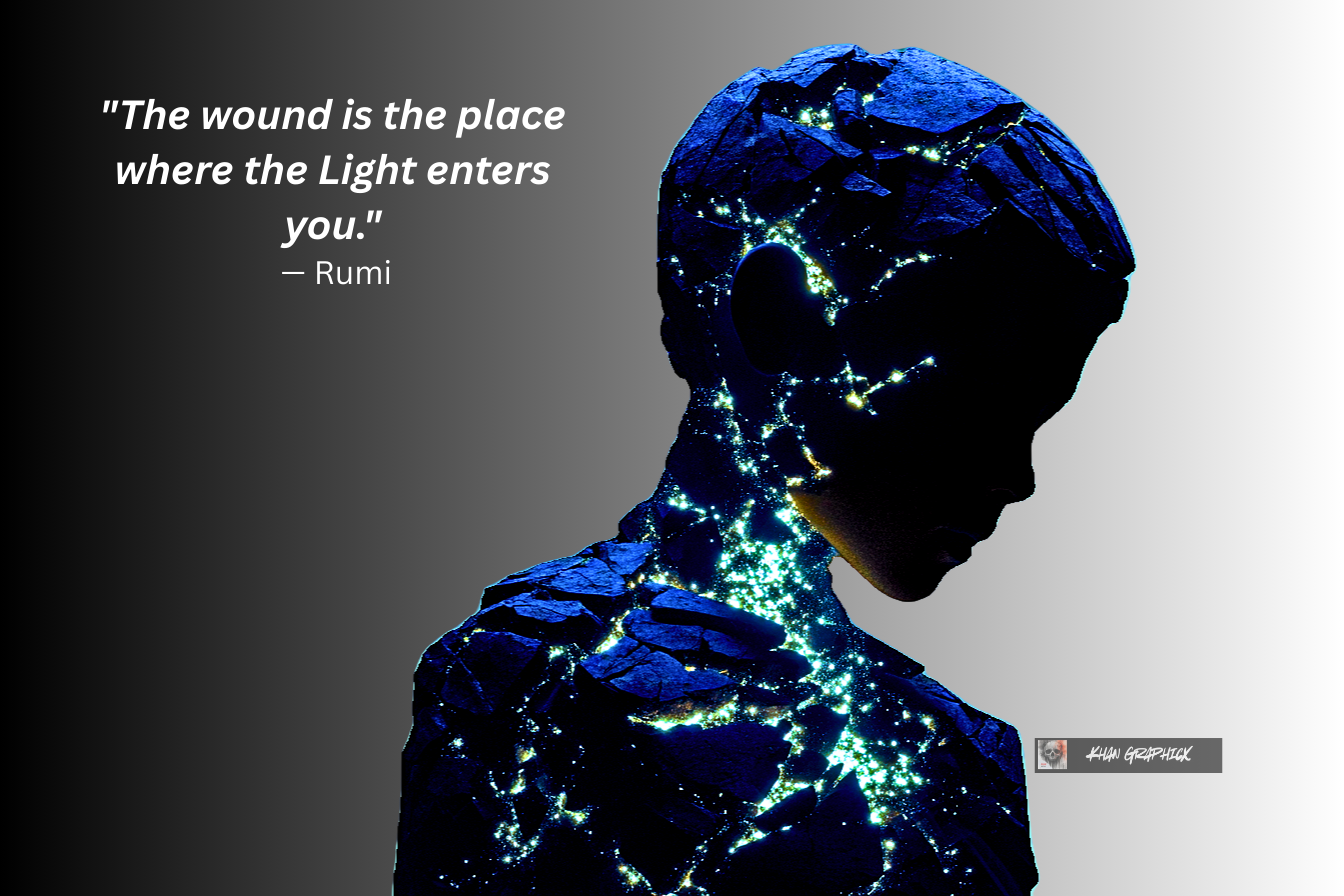
Sit with the unease: are you chasing noise, or carrying wisdom in a way that matters?

Quote of the Day – 09282025


Personal Reflection
To be strange is to walk with a dual inheritance: the ache of being misread and the quiet exaltation of seeing the world differently. McKay names it a dark delight—a paradox that rings true for anyone who has carried their difference like both a burden and a lantern. The crowd demands sameness because sameness is easier to hold, easier to ignore. But wisdom, even when it isolates, stains the air around it. Loneliness is not just absence—it’s the sharpening of presence, the recognition that your strangeness is not a defect but a rare clarity. To stand apart is to feel the cold edges of exile, yes, but also to glimpse the hidden patterns others cannot see.

Reflective Prompt for Readers
When has your strangeness felt like exile—costly, isolating, almost unbearable?
And when has it felt like a secret lantern—illuminating truths no one else could see?
Sit with both sides. What wisdom has your difference given you, and what toll has it asked you to pay?

Quote of the Day – 09272025


Personal Reflection
Thoughts are not passive passengers—they are dyes, slow and stubborn, seeping into the fabric of who you become. Some creep in like smoke, unnoticed until everything smells of it; others blaze in like molten pigment, changing the whole room in an instant. Each worry, each quiet act of gratitude, each flicker of awe leaves a tint that lingers. If your inner palette feels dark today, remember that a single deliberate stroke—one kind thought, one small choice—can begin to shift the entire spectrum.

Reflective Prompt for Readers
What colors have your thoughts been carrying lately—quiet shades you barely notice, or bold pigments that demand attention?
Take a moment to name the hues of your inner world today.
If you could choose a single new color to tint tomorrow—patience, courage, curiosity—what would it be, and what small action could help you mix it in?

Quote of the Day – 09262025


Personal Reflection

Fear rarely shows up wearing its own name. It disguises itself as logic, as procrastination, as anger, as comfort. It whispers, not now, not you, not this way. We tell ourselves we’re being careful when really we’re being caged.

Courage isn’t about slaying that voice. It’s about answering it anyway. To be brave is to stand inside the shaking, the sweat, the doubt—and move because staying still would cost more than the fall. It’s a brutal kind of math: risk on one side, meaning on the other. And if meaning outweighs fear, even by an ounce, that’s where the step forward begins.

The truth is, courage never feels clean. It feels jagged, messy, and often indistinguishable from desperation. But on the other side of it? That’s where you find the evidence that fear is not the ceiling of your life.


Reflective Prompt

Where has fear disguised itself in your life—and what would it cost you if you let it keep the final word?

Quote of the Day – 09252025


Personal Reflection

The mind is relentless. It wants reasons, it wants control, it wants to turn every wound into a tidy equation. But the soul doesn’t work in equations—it works in currents, in quiet truths that rise from somewhere beyond logic.

This image is a reminder of that struggle: the smoke of restless thought trying to cloak everything in haze, while the still figure waits, rooted in silence. Above, a ring of light suggests a doorway, not out of the world but into the self. Healing is less about doing and more about surrendering. Less about thinking your way forward, and more about listening long enough for the whisper beneath the noise.

The soul does not rush. It doesn’t bargain. It waits until we stop running in circles and remember that clarity often comes dressed as stillness. The real challenge isn’t learning how to heal—it’s learning how to be quiet enough to let healing begin.


Reflective Prompt

What inner noise do you need to quiet so your deeper self can finally speak?

Quote of the Day – 09242025


Personal Reflection:
We’re taught to treat our wounds as shame — something to hide, something to outgrow, something that proves we were weak. So we stitch them shut with silence, wrap them in distraction, or bury them under layers of toughness. But Rumi flips the script: what if the wound isn’t the end of the story, but the doorway?

The paradox is brutal — pain that breaks us also carves space inside us. A hollow we never wanted becomes the very place where truth, compassion, or resilience can finally take root. The wound becomes the breach that lets in light, not because the pain was noble, but because it stripped us of illusions we refused to let go of.

The light that enters doesn’t erase the scar. It doesn’t excuse the damage. Instead, it transforms it into something raw and unpolished — a reminder that what hurt us can also remake us. That our most fragile places are not only where we bleed, but also where we begin to see.

Reflective Prompt:
Where has pain carved an opening in you — and what unexpected light has entered through that hollow?

Quote of the Day – 09232025


Personal Reflection:
Some chains are forged by history — systems, oppression, and circumstance that press against us from the outside. Those are real, and Baldwin never denied their weight. But here, he’s pointing to a quieter, more insidious kind of captivity: the lies we rehearse until they pass for truth.

Lies whisper in our own voice. I can’t leave. I’m not worthy. It’s too late for me. They’re persuasive not because they’re true, but because they offer safety. They let us stay in the cell we’ve come to know, even when the door has been standing open.

That’s the cruelty of self-deception: it convinces us the lock is unbreakable when, in reality, it’s our own belief that keeps us still. Iron can be shattered. Histories can be challenged. But the stories we tell ourselves? Those are harder to undo because they demand confrontation with the self.

Freedom, then, isn’t just escape — it’s clarity. It begins when we strip away the excuses, the rehearsed scripts, the fear dressed up as certainty. And once the lie falls apart, the chain loses its power.

Reflective Prompt:
What story have you been telling yourself that feels safe but keeps you captive — and what truth would you have to face to finally step free?

Quote of the Day – 09222025


Personal Reflection:
We’re conditioned to see the world through hand-me-down lenses. Parents, teachers, bosses, algorithms — they hand us their truths, and we swallow them without question. It’s easier that way. But easy vision is borrowed vision, and borrowed vision will always keep you half-blind.

Einstein’s words hit harder the longer you sit with them: most people will never risk seeing with their own eyes or feeling with their own hearts. Why? Because it’s safer to blend in, safer to parrot back what the crowd already believes. Safer, but hollow.

To see with your own eyes means you’re going to notice the cracks, the lies, the hypocrisy nobody else wants to name. To feel with your own heart means you’re going to bleed — joy, grief, rage, wonder — all of it, raw and unfiltered. And maybe that’s why so few choose it: it’s not clean, it’s not convenient, and it sure as hell won’t win you applause.

But conformity has its own cost: you end up living as a ghost in your own skin. Better to be cut open by your own truth than embalmed in someone else’s comfort.

Reflective Prompt:
When was the last time you trusted your own eyes and heart over the noise around you? What did it reveal about who you are becoming?

Quote of the Day – 09212025


Personal Reflection:
Fear doesn’t live in the doing — it lives in the waiting. The scariest moment is the one just before we step into motion, when the unknown still has infinite power over us. King’s words hit harder because they name the truth: our hesitation feeds the monster.

That pause before beginning is where our doubts multiply. Every failure we’ve endured, every voice that told us we weren’t enough, every imagined disaster — they all gather in that breath before action. We give them weight by standing still.

But once we begin, the fear fractures. The blank page becomes a sentence, the closed door becomes a room, the leap becomes flight. The terror doesn’t vanish, but it loses its grip because we’ve shifted from imagining to inhabiting.

The lesson isn’t about fearlessness. It’s about remembering that fear is loudest at the threshold, and that courage is not the absence of fear but the decision to step forward anyway.

Reflective Prompt:
What threshold are you standing at right now — and what would it take for you to step through, despite the fear waiting there?

Quote of the Day – 09202025


Personal Reflection:
Excuses are easy. Attention is easy. Both give us the appearance of movement without requiring any real change. Bennett cuts through the noise with a reminder that progress is quiet work, and respect is earned through consistency, not spectacle.

Improvement rarely makes headlines. It happens in the margins — in the choices no one sees, in the discipline that doesn’t need applause. Excuses demand nothing; improvement demands honesty. Attention fades; respect endures.

The hard question is whether we’re chasing noise or substance. One vanishes when the lights go out. The other keeps building, brick by brick, into something that lasts.

Reflective Prompt:
What’s one area of your life where you’ve been chasing attention or making excuses — and how could you shift toward steady improvement instead?

Quote of the Day – 09192025


Personal Reflection:
We talk about transformation like it’s clean — a fresh start, a reinvention, a new chapter. But Carrel’s words remind us it’s rarely that neat. To remake ourselves is to enter into a brutal, intimate labor. We are both sculptor and stone: the hand that swings the hammer, and the surface that cracks beneath it.

That duality is what makes growth so hard. Change hurts because it requires self-inflicted loss. Old identities don’t drift away quietly — they shatter. Patterns we cling to must be chipped off piece by piece, and each strike feels personal because it is personal.

Yet within the breaking, something truer emerges. The rough stone gives way to shape, to form, to a version of ourselves that couldn’t exist without the pain of subtraction. Suffering doesn’t guarantee transformation — but without it, the marble stays uncarved.

The question isn’t whether we will be struck, but whether we will dare to keep chiseling, knowing the cost, in pursuit of what waits beneath.

Reflective Prompt:
What part of yourself have you had to let shatter in order to reveal the shape of who you are becoming?

Quote of the Day – 09182025


Reflection:
We spend so much time looking outward — to jobs, titles, possessions, even the applause of others — as if these external things could finally define us. But Rilke reminds us: the only journey worth taking is inward. Everything else is a distraction.

The only title that matters is being ourselves. And that’s harder than it sounds. The world keeps pushing us to become our “Best Selves,” while also telling us exactly how that should look. There’s a whole industry built on convincing us we’re incomplete without their blueprint. But let’s be honest — half the people preaching this gospel don’t seem to know who the hell they are.

Self-discovery isn’t about chasing a trend or polishing a brand. It’s a lifestyle, a discipline, a refusal to outsource our identity. To walk inward is to risk discomfort, to face truths we’d rather bury, to learn how to be at home in our own skin. But it’s the only road that doesn’t run out beneath us.

Prompt for readers:
What would it look like for you to stop chasing the world’s version of a “best self” and start living your own?

Quote of the Day – 09172025


Reflection:
We think of journeys as miles traveled, mountains crossed, oceans endured. But the most difficult distance is the one between who we are on the surface and who we are underneath. Hammarskjöld’s words cut to the truth: it takes more courage to walk into your own depths than to face any external trial.

That inward journey is endless. Every step uncovers another layer — old wounds, forgotten dreams, hidden strengths, stubborn fears. It is not a straight path but a spiral, circling back on lessons we thought we’d learned, asking us to face them again with clearer eyes.

And yet, this is the only journey that cannot be taken from us. The world may cage our bodies, strip our titles, silence our voices — but the inward road remains ours alone. To walk it is to risk disorientation, but to refuse it is to remain a stranger to ourselves.

Prompt for readers:
What part of your inward journey have you been avoiding, and what might you discover if you finally faced it?

Quote of the Day – 09162025


Reflection:
Self-discovery is rarely a clean or graceful process. It isn’t a tidy list of traits or a personality quiz result you can frame on the wall. It’s the uneasy work of sitting with the silence long enough for what you’ve buried to surface. Jung reminds us that the dream lies outside, but the awakening waits within — and that truth is often harder to face than any fantasy.

When we look inward, we don’t just find clarity. We find contradictions: the child we used to be, the wounds we pretend don’t ache anymore, the hunger we try to disguise, the voice that whispers not yet. To awaken is to acknowledge that the self is layered, sometimes jagged, and not always flattering.

But it’s also where the compass lives. The world can give us mirrors, but only we can decide which reflection we claim. Self-discovery isn’t about arriving at a perfect version of ourselves. It’s about stripping away the borrowed identities and false allegiances until we finally recognize the pulse of something undeniably our own.

Prompt for readers:
When you turn inward and strip away the noise, what truth about yourself have you uncovered that both unsettled you and set you free?

Quote of the Day – 09152025


Reflection:
Self-acceptance is not soft. It is a daily fight to resist being folded into the crowd. The world demands masks, conformity, performance — it tells us what to mute and what to amplify until we can hardly remember the shape of our own voice.

Cummings calls it what it is: a battle. And the hardest one. Because it requires standing alone when it would be easier to blend in. It means enduring the silence when applause goes to those who play the role better than you ever could. It means accepting that your truth might not fit neatly into anyone else’s script.

But when you hold the line, when you refuse to erase yourself, you become something unshakable. Not perfect. Not always understood. But unmistakably you.

Prompt for readers:
Where in your life are you fighting hardest to stay yourself — and what keeps you from surrendering to the crowd?

Quote of the Day – 09142025


Personal Reflection:
We want to believe we are fixed creatures — brave or timid, strong or weak, worthy or forgettable. But Meltzer dismantles that illusion. The truth is messier, more human: we are all of it. Hero and coward. Dreamer and doubter. Every day reshuffles the cards, and the version of ourselves we play depends on context, circumstance, and the battles we’re carrying inside.

There’s freedom in this. To know that being ordinary one day doesn’t disqualify us from greatness the next. To accept that feeling helpless doesn’t mean helplessness is our identity — it’s just a moment in motion. We are kaleidoscopes, not statues. And that, in its shifting imperfection, is what makes us real.

Reflective Prompt:
Which version of yourself showed up today — and how might tomorrow ask for a different one?

Quote of the Day – 09132025


Personal Reflection:
The fire is never optional. It comes in the form of loss, betrayal, heartbreak, failure, the unraveling of everything we thought was solid. Most of us spend half our lives trying to dodge it, building walls, distractions, rituals of avoidance. But Jung makes the truth plain: the flames will find you anyway. The question is not if, but how.

Walking through fire is not about stoicism or bravado. It’s about what we choose to carry with us and what we allow to burn away. Some parts of us can’t make it out — illusions, false identities, the roles we cling to because they feel safe. The fire strips those bare, whether we like it or not. What survives, if we let it, is something closer to the core of who we are.

And yes, we emerge scarred. But scars are not just evidence of pain — they are proof of endurance. They remind us that we walked through something that could have ended us, and we’re still here. The difference between a good life and a bad one isn’t whether you burn; it’s whether you learn to keep walking, carrying the ember of yourself that refuses to be extinguished.

Reflective Prompt:
When you look back at the fires you’ve survived, what parts of you were burned away — and what ember did you carry out that still defines you today?

Quote of the Day – 09122025


Personal Reflection:
We are flooded with borrowed truths — from pulpits, screens, politics, and algorithms. They tell us what to value, what to chase, what to fear. But Kierkegaard reminds us that none of it matters if it isn’t ours. To live on someone else’s borrowed conviction is to live half-asleep.

The harder work is carving out a truth forged in your own fire. Not a slogan, not a trend, not a doctrine handed down, but a truth you’ve wrestled with — one you’d stake your life on. Finding it isn’t about certainty. It’s about the courage to hold something so close it becomes inseparable from who you are.

Reflective Prompt:
What truth have you claimed as your own — the one that could guide you even when everything else falls away?

Quote of the Day – 09112025


Reflection:
There are days that don’t pass like other days. They sit heavier, carrying the weight of what has been lost, what was torn apart, and what was never the same again. September 11th is one of those days.

Camus doesn’t ask us to deny the winter — he names it. He admits the cold. And still, he insists there’s something untouchable inside us, a summer that cannot be extinguished. That isn’t optimism; it’s defiance. The kind of defiance that keeps memory alive without letting despair define it.

The truth is, resilience isn’t about never breaking. It’s about finding the warmth you thought you lost, even if it flickers faintly, even if it’s buried under ashes. The ember is enough. The ember is survival.

Prompt for readers:
On days when memory feels heavier than hope, what is the ember you protect within yourself — the one thing that reminds you you’re still alive?

Quote of the Day – 09102025


Reflection:
Every writer, every artist, knows the siren call of approval. The dopamine hit of likes, the quiet hope of validation, the thought that maybe this piece will finally land. But Connolly’s words cut through the illusion: if you bargain away your voice for acceptance, what remains of you when the clapping stops?

Writing for yourself isn’t selfish — it’s survival. It’s how you stay tethered when the noise of the world tries to define your worth. It’s not about rejecting the audience, but about refusing to let the audience become the compass. To create is to risk being unseen. But to create only for others is to risk being erased.

Prompt for readers:
What would your art look like if you stopped chasing approval and created with no audience in mind—just you, the page, and your truth?

Quote of the Day – 09092025


Personal Reflection:
Falling has never felt like learning in the moment. It feels like failure, like shame, like the world was right about you all along. But the ground has a way of teaching what the sky never could. The wings don’t strengthen in safety—they sharpen in the freefall, in the wind tearing past your ears, in the split second where you’re not sure if you’ll rise or break. To fly, you’ve got to risk the fall. And sometimes, you’ve got to hit hard before you remember what wings are for.


Reflective Prompt:
What “fall” in your life might actually be the beginning of your flight?

Quote of the Day – 09082025


Personal Reflection:
I used to waste time asking for breaks, for things to finally smooth out. But life doesn’t deal in easy—it deals in weight. The only choice is whether you crumble under it or learn how to carry it. Strength isn’t a clean gym poster with flexed arms and victory poses. Strength is grit teeth in the dark. It’s dragging yourself through when your body wants to quit. It’s refusing to let the world break you the way it’s broken so many before. An easy life never made anyone worth remembering. The difficult one, endured—that’s where you find out what you’re made of.


Reflective Prompt:
Where in your life do you need to stop wishing for easy and instead start building the strength to endure?

Quote of the Day – 09072025


Personal Reflection:
Deliberate doesn’t mean reckless. It means I’ve counted the cost, felt the fear chewing at my edges, and moved anyway. Too often we wait for bravery to arrive like a clean shirt—we want to be fresh, unshaken, presentable. But courage is never neat. It’s raw, jagged, stitched together with trembling hands. To be deliberate is to move with intention even when your knees want to buckle. Afraid or not, you step. That’s the whole point.


Reflective Prompt:
Where in your life do you need to stop waiting for fear to leave before you act, and instead choose to move with intention through it?

Quote of the Day – 09062025


Personal Reflection:
I’ve learned the hardest battles don’t happen out in the open—they happen in the quiet, when no one’s watching. The monsters aren’t under the bed, they’re in the mirror. The ghosts don’t rattle chains, they whisper your old mistakes until you believe them. Some days they win. I’ve felt it. The trick isn’t pretending they don’t exist—it’s knowing when to drag them into the light, when to fight, and when to just outlast them until morning. Survival isn’t clean. Sometimes it just means you’re still here, breathing in the dark.


Reflective Prompt:
What inner ghost or monster have you been wrestling with lately, and what would it take to stop letting it win?

Quote of the Day – 09052025


Personal Reflection:
Perfection is a ghost I’ve chased too long. It never shows up, never pays rent, just haunts every move with the whisper that what I’ve got isn’t enough. I’ve broken myself trying to silence that voice. But cracks don’t mean ruin—they mean survival. They mean you’re still standing after the hit. Let the cracks show. Let the light leak through. Better to ring a fractured bell than die clutching silence in your hands.


Reflective Prompt:
What ghosts of perfection are you still chasing, and what would happen if you let the cracks speak instead?

Quote of the Day – 09042025


Personal Reflection:
Fear doesn’t vanish. It waits in the marrow, twitching when you least expect it, reminding you of every stumble, every failure. I’ve felt it clamp down on my chest right when I needed air the most. The lie is thinking courage means silence in the bones. It doesn’t. Courage is hauling that noise with you, refusing to let it hold the wheel. Triumph isn’t clean—it’s ugly, cracked, sweat-soaked. It’s the shaky breath you take as you step forward anyway.


Reflective Prompt:
When has fear tried to steer your choices, and what did it take for you to wrestle the wheel back?

Quote of the Day – 09032025


Personal Reflection:
The past has a way of branding itself into the skin, leaving marks you swear will never fade. Some of mine still itch when the weather shifts. But here’s the thing: scars don’t dictate direction, they just remind you of where you’ve been burned. Becoming isn’t about erasing what happened; it’s about refusing to let it keep the pen in its hand. Every morning, I wake up with the choice—am I replaying the same old scene, or am I writing something new?


Reflective Prompt:
What part of your story have you let define you for too long, and how might you reclaim the pen today?

Quote of the Day – 09012025


Personal Reflection:
I’ve stood outside too many doors in my life, waiting for them to swing open on their own. Maybe out of fear. Maybe out of some twisted politeness that wasn’t doing me any favors. The truth is, life doesn’t hand you keys—it hands you bruised knuckles and a choice. You either knock, or you don’t.

But the trick is knowing whether to knock or not. Sometimes patience is its own key. Stillness can shatter a door better than force, if you can stomach the waiting. That’s the gamble—deciding when to strike and when to trust the silence.

One’s movements should be purposeful; they should lead to something. I’ve heard too many times, “at least I did something.” At this point, I just smile at the impatience. Not because it’s ridiculous, but because I remember when it guided me as well.

And still—the silence waits, heavier each time, as if daring me to choose.


Reflective Prompt:
Where in your life are you standing at a door, unsure if it needs your fist or your patience? What would it take for you to finally decide?

Quote of the Day – 08312025


Personal Reflection
We like to pretend joy is born from joy, but it rarely works that way. Most of the color in my life came only after I’d been cracked by grief. Tears aren’t just salt and water—they’re proof that something mattered, that love or hope or memory had weight enough to leave a mark. I used to wipe them away quickly, ashamed to be seen undone. Now I wonder if the rainbow only forms because the storm lingers long enough for light to touch it. Joy without sorrow is counterfeit, a rainbow painted on the wall instead of one born from the storm.

Reflective Prompt
How has life reshaped you? Have you been able to see the beauty in pain?
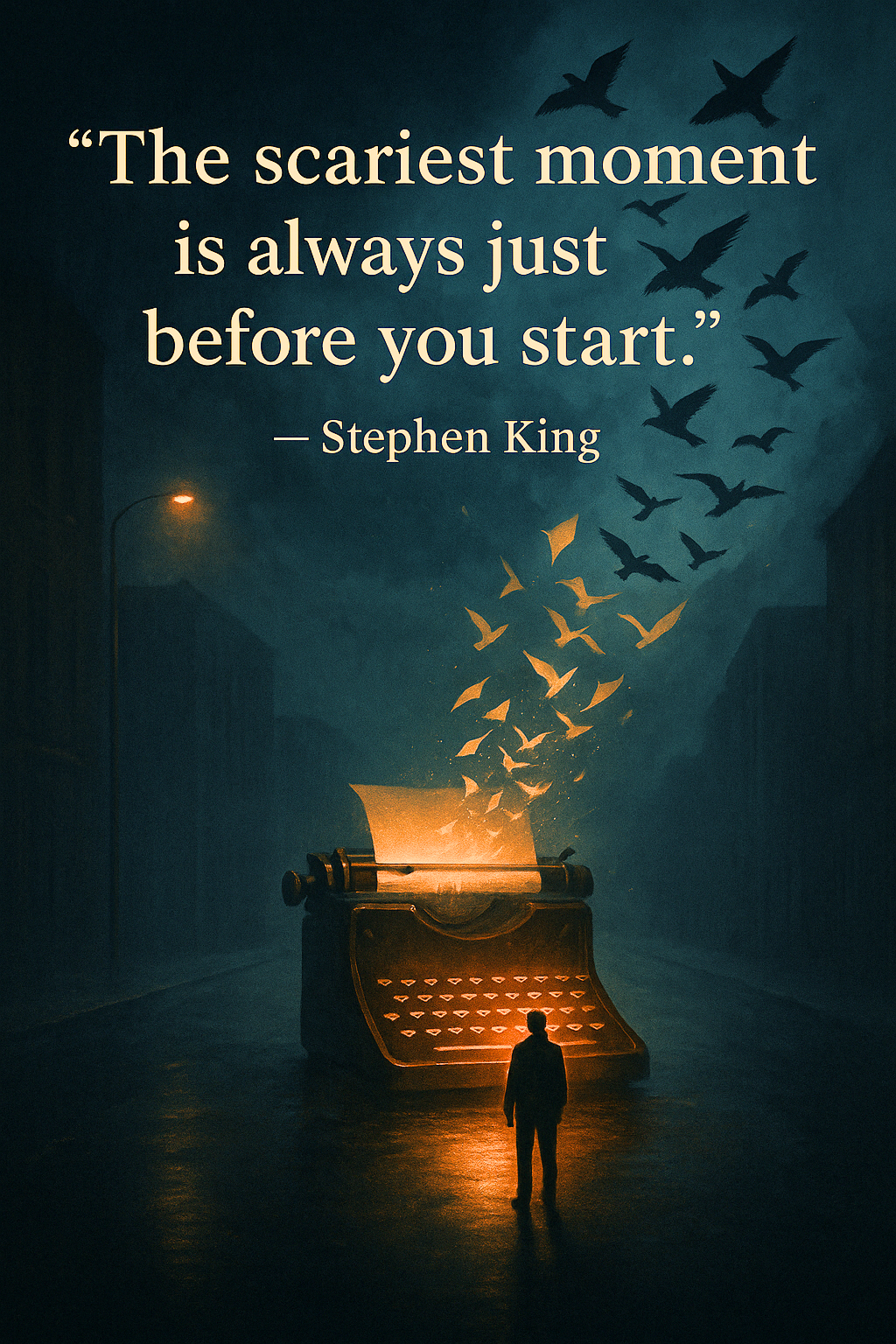
Quote of the Day – 08302025


Personal Reflection
Change never waits for permission—it builds like pressure under the skin. I’ve held myself in, clinging to what felt safe, even as it turned suffocating. There comes a point when staying closed hurts more than opening ever could. That’s the moment of rupture, the crack where transformation spills through. Blossoming isn’t clean or easy—it’s raw, exposed, and dangerous. But it’s also the only way to grow into who you were meant to be.

Reflective Prompt
Where in your life are you still holding yourself tight in the bud? What would it mean to risk blooming?

Quote of the Day – 08292025


Personal Reflection
Scars tell the stories we’d rather forget, but they’re also proof of survival. I used to hate mine—both the ones on my skin and the ones no one could see. They felt like evidence of failure. But over time, I’ve come to see them differently. They’re not just reminders of pain—they’re marks of endurance, proof that I’ve been tested and still here. Strength isn’t found in untouched surfaces; it’s found in what’s been broken and remade.

Reflective Prompt
What scar—physical or emotional—tells a story of strength in your life?

Quote of the Day – 08282025


Personal Reflection
Normal is a cage dressed up as comfort. I’ve spent parts of my life trying to fit the mold, sanding off edges just to blend in. But the truth is, “normal” never saved me—it only shrank me. The moments I’ve felt most alive weren’t when I was acceptable, but when I was reckless enough to be myself. Maya Angelou didn’t just challenge the idea of normal, she shattered it. And maybe that’s the point: your brilliance isn’t found in what makes you blend, it’s in what makes you break the pattern.

Reflective Prompt
Where in your life have you traded authenticity for “normal”? What might happen if you stopped?

Quote of the Day – 08272025


Personal Reflection
We all want transformation without the ache, change without the cut of the chisel. But it doesn’t work that way. To become something new, parts of us must be broken down, carved away, reshaped. I’ve felt that pain—sharp, unrelenting—but I’ve also seen what it reveals. We are the stone and the hand that shapes it, caught in the contradiction of resisting and creating all at once. Suffering isn’t the enemy here—it’s the evidence that the work is real.

Reflective Prompt
What’s one way you’ve reshaped yourself through struggle? What part of you had to be chipped away to uncover something stronger beneath?

Quote of the Day – 08262025


Personal Reflection
The body gives out. It grows tired, it breaks, it betrays us when we least expect it. I’ve felt that firsthand. But spirit—spirit has a way of carrying us when nothing else will. It’s the thing that drags you to your feet after the body has nothing left. The world measures strength in muscles, speed, and stamina, but I’ve come to see it’s the unseen resilience—the stubborn, unyielding spirit—that matters most. That’s the strength no one can take from you.

Reflective Prompt
When has your spirit carried you farther than your body thought possible?

Quote of the Day – 08252025


Personal Reflection
Fear doesn’t vanish just because you’ve decided to act. It lingers, claws at your ribs, whispers every excuse in the book. But courage has never been about silence in the face of fear—it’s about defiance. It’s choosing to move anyway, to step forward because what waits on the other side matters more than your comfort. The moments I remember most in my own life weren’t the times I avoided fear, but the times I carried it with me and kept walking.

Reflective Prompt
What’s one decision you made that terrified you—but you knew was worth doing anyway?

Quote of the Day – 08242025


Personal Reflection
The past has teeth, the future has shadows—but neither is as powerful as what’s burning inside you right now. I’ve spent too much of my life staring backward at mistakes or forward at fears, missing the fact that the real fight, the real strength, was already in me. What lies within isn’t always pretty—it can be messy, fractured, restless—but it’s also where resilience lives. Emerson was right: the weight of the world doesn’t crush you unless you forget what you’re carrying inside.

Reflective Prompt
What part of yourself have you overlooked while worrying about the past or the future? How might you honor it today?

Quote of the Day – 08232025


Personal Reflection
Despair is easy. It comes on like the tide, constant and heavy, pulling at your ankles until standing still feels like sinking. Hope takes more work. It’s stubborn, unruly, and often inconvenient. But it’s the only thing that keeps despair from swallowing us whole. John Lewis knew that struggle doesn’t end—it just changes shape. The call isn’t to wait for it to ease, but to step into it, to fight, to raise your voice even when silence feels safer. Hope without action is fantasy. Action without hope is ruin. Together, they’re survival.

Reflective Prompt
What’s your version of “good trouble”? Where in your life—or in the world—does silence feel safer, but noise might be necessary?

Quote of the Day – 08222025


Personal Reflection
Most mornings don’t come with fanfare—they come with weight. The kind that presses down before your feet even hit the floor. I’ve had days where I swore I wouldn’t make it through, only to look back later and realize I’ve carried that same dread countless times before. Somehow, I always moved forward anyway. Maybe survival isn’t about certainty—it’s about showing up, even when doubt is the first voice you hear.

Reflective Prompt
When was the last time you thought you wouldn’t make it through a day, only to find yourself standing stronger on the other side?

Fandango’s Flashback Friday – August 22, 2025

FFF

When I first posted this QOTD, I would simply post the quote with no personal reflection or reflective prompt. I’ve always thought about expanding my QOTD posts. However, it took nearly a year to figure out how I wanted to handle these posts. So, I will post the same quote and provide the information as I currently handle it. This post was originally posted on August 24, 2024.


Personal Reflection
Music has always had a way of cutting through the noise. Elvis said it plain—when you feel it, you move. That’s the essence of rock and roll, but it’s also the essence of being alive. Too often, we overthink what should just be felt. I’ve learned that if something stirs you—whether it’s music, words, or even silence—you owe it to yourself not to hold back. That instinct to move, to respond, is proof you’re still lit from the inside.

Reflective Prompt
What’s a song that still makes you move without hesitation? Does it remind you of who you were, or who you still are?

Quote of the Day – 08212025


Personal Reflection
Pain has a way of carving out space we never asked for. I’ve cursed my wounds, tried to stitch them shut, tried to pretend they were never there. But the more I covered them, the heavier they became. Somewhere along the line, I realized they weren’t just scars—they were doorways. Every hurt cracked me open, and in those fractures something unexpected slipped in: a glimpse of grace, a sliver of strength, a light I couldn’t have found otherwise.

Reflective Prompt
What wound in your life shaped you in a way you didn’t expect? Did it bring something into your life you might have missed otherwise?

Quote of the Day – 08192025


Personal Reflection
Perfection is the biggest lie we chase. It’s like the legends we were told as children—the fairytales and bedtime stories we believed wholeheartedly as we drifted to sleep. We believed in magic back then. But as we age, that belief fades, and in its place the idea of perfection takes root and grows. I’ve wasted years sanding down my rough edges, trying to fit into some polished shape that never really belonged to me. But the cracks—those breaks and scars I tried so hard to hide—turned out to be the places where something honest finally came through. Light doesn’t care about flawless surfaces. It needs openings, even the jagged ones, to break through.

Reflective Prompt
What’s one “crack” in your life you once hid in shame, but now see as the source of strength or beauty?

Quote of the Day – 08182025


Personal Reflection
Truth has teeth. Every time I’ve stepped closer to it, fear has risen up like a wall—heart pounding, voice shaking, every excuse begging me to turn back. But fear isn’t a signal to retreat; it’s proof you’re on the right road. The lies are comfortable, the illusions easy. They let you keep your mask on, let you keep the story neat and unchallenged. But truth doesn’t care about neat—it tears at you, strips away the performance, and demands you face what’s been rotting underneath.

I used to think fear meant I was weak, that it was a sign I wasn’t ready. Now I see it differently. Fear is the body’s last defense against transformation, a warning flare that something inside is about to break open. And if you stay, if you breathe through it instead of running, the fear always gives way—to clarity, to freedom, to the kind of brutal honesty that can finally set you loose.

Reflective Prompt
What truth have you avoided because it scared you? What would change if you faced it head-on?

Quote of the Day – 08172025


Personal Reflection
I’ve wasted too many hours trying to outtalk ignorance, explain myself to the unworthy, or fill the air just so I wouldn’t feel the weight of quiet. But silence—real silence—can be sharper than any retort. It leaves space for the truth to echo, for others to hear the hollow in their own noise. And sometimes, holding your tongue is the only way to keep your dignity intact.

Reflective Prompt
When have you chosen silence instead of speaking? Did it protect your peace, or did it say more than words ever could?

Quote of the Day – 08142025


Personal Reflection
The mind can be a brutal warden. I’ve locked myself in cells I built, believing lies I whispered into my own ear until they felt like truth. It’s strange—freedom isn’t always about breaking out of something; sometimes it’s about noticing the door was never locked. The moment you stop treating your doubts as facts, the bars start to rust.

Reflective Prompt
What’s one belief you’ve carried about yourself that you now know isn’t true? How did you realize it was time to let it go?

Quote of the Day – 08132025


Personal Reflection
We are taught to be selfless, but what the hell does that even mean? Especially when you watch everyone around be out for themselves. There’s a fine line between generosity and self-erasure. I’ve crossed it more times than I care to admit, thinking the burn was proof of my worth. But here’s the truth—if you spend all your heat on others, there’s nothing left to guide your own way. It took years to learn that keeping my own flame alive isn’t selfish—it’s survival. Because the truth is, no one’s going to thank you for burning to ash in their name. I doubt they even remember your name.

Reflective Prompt
When was the last time you gave more than you could afford—emotionally, mentally, or physically? What would it look like to protect your own flame without guilt?

Quote of the Day – 08122025


Personal Reflection
I’ve learned the sea doesn’t care about your plans, your pride, or your sense of timing. Storms arrive when they choose, and they never apologize for the mess they leave behind. There was a time I thought I had to wait for the skies to clear before moving forward. But that’s not living—it’s hiding. Somewhere between the gusts and the lightning, I realized the only way to find my strength was to sail straight into the weather and learn what my hands could do.

Reflective Prompt
Think about a storm you’ve faced—not just weather, but a moment that shook your footing. How did you steady yourself? What did you discover about your own strength in the middle of it?

Quote of the Day – 08112025


Personal Reflection:
The hardest journey is often the one no one else can see. The road into yourself has no clear signs, no reassuring milestones, and no one to tell you if you’re headed the right way. Sometimes it feels like walking in circles; other times, like stepping into a part of yourself you’ve avoided for years. But each turn, each pause, each step into the shadows brings a truth you can’t find anywhere else. This is the kind of journey that reshapes not the world around you, but the one within you — and that’s where every lasting change begins.

Reflective Prompt:
Where in your life have you avoided the inward journey, and what might you discover if you finally take the first step?

Quote of the Day – 08102025


Personal Reflection:
Strength is often measured in muscles, speed, and endurance, but the truth is, physical power will only take you so far. When the body falters—when the climb gets too steep, the night too cold—it’s the spirit that decides whether you keep going. The spirit is forged in silence, in loss, in those moments when no one is watching and no applause is coming. The strongest people I’ve met weren’t the loudest or the most visibly powerful—they were the ones who had every reason to stop but took another step anyway.

Reflective Prompt:
When the weight of your challenges feels too heavy, what can you draw from within to keep moving forward?

Quote of the Day – 08092025


Personal Reflection

Love that liberates does not bind you in chains disguised as devotion. It does not demand you shrink to fit the comfort of another, nor does it wilt in the shadow of fear. In its truest form, love defies rules written by those who fear its power. It is not tethered to conditions, politics, or the fragile agreements of society. It rises — even when the world burns around you — carrying you above the smoke and rubble. And sometimes, it’s in those moments when everything else has been stripped away that you finally understand: love, at its purest, is the only thing you cannot conquer and the only thing that can truly set you free.


Reflective Prompt

When have you felt love elevate you beyond fear, doubt, or circumstance — even in moments when the world felt like it was falling apart?

Quote of the Day – 08082025


Personal Reflection

Wounds make us uncomfortable. They expose our weakness, our failures, the things we couldn’t fix. But there’s another side—one we don’t talk about enough. Sometimes, the break is where the truth gets in.

And sometimes, that break is needed to let the things you’ve been holding seep out.

The pain. The pressure. The stories you never told.
You don’t always know how much you’ve been carrying until something cracks—and in that cracking, something releases.

Not all healing is about stitching yourself closed.
Sometimes, it’s about learning to stay open just long enough for the light to reach the parts of you that forgot how to feel.

I’ve tried hiding my wounds. Dressing them up with productivity, deflecting them with humor. But they bleed anyway, quietly, beneath it all.
And strangely, in those rawest moments, I’ve found something holy.
Not peace exactly—but presence.
And maybe that’s enough.


Reflective Prompt

What part of yourself have you been holding in for too long?
What would it feel like to let it out—gently, honestly, without shame?