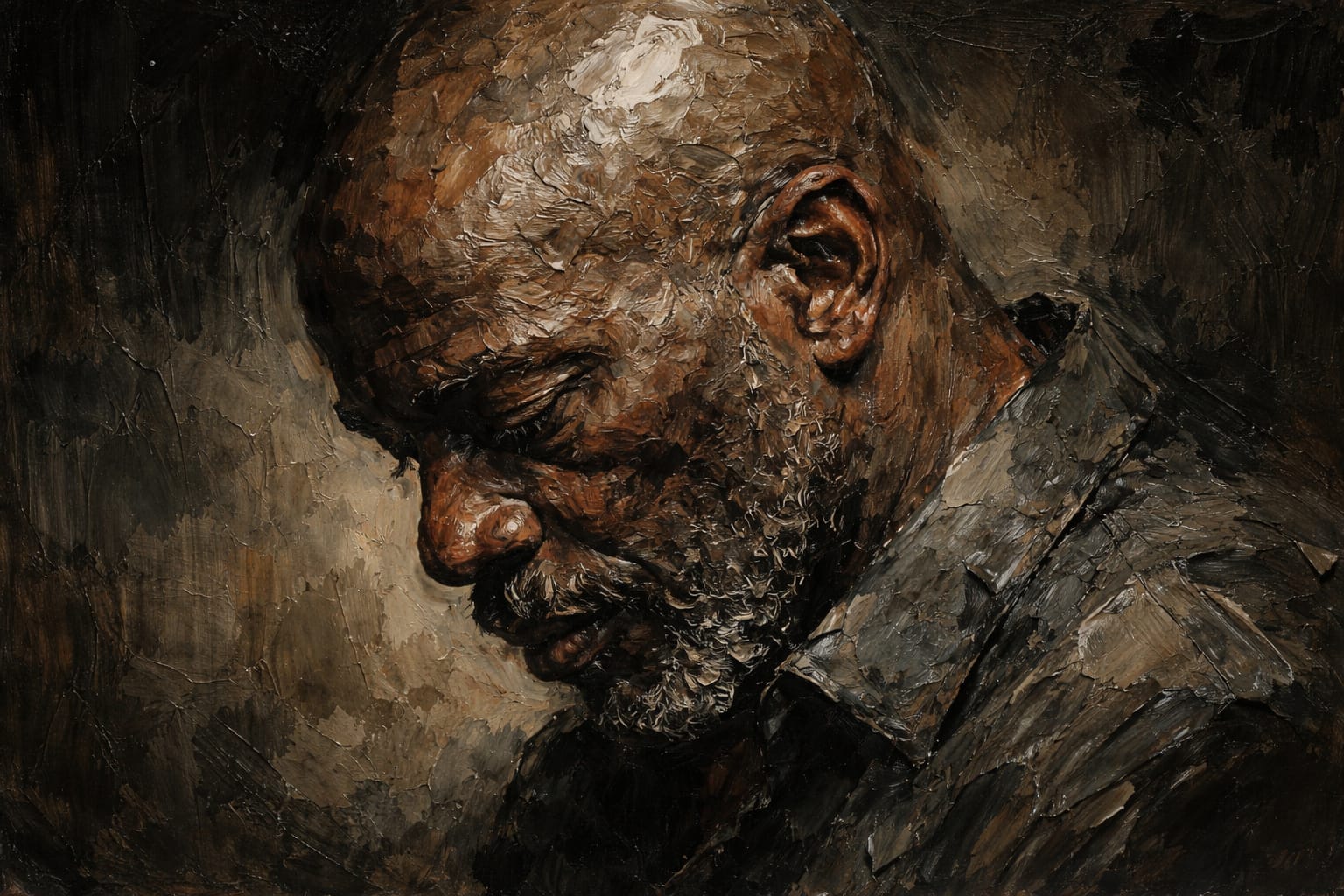
Where the Ancestors Breathe Through Her


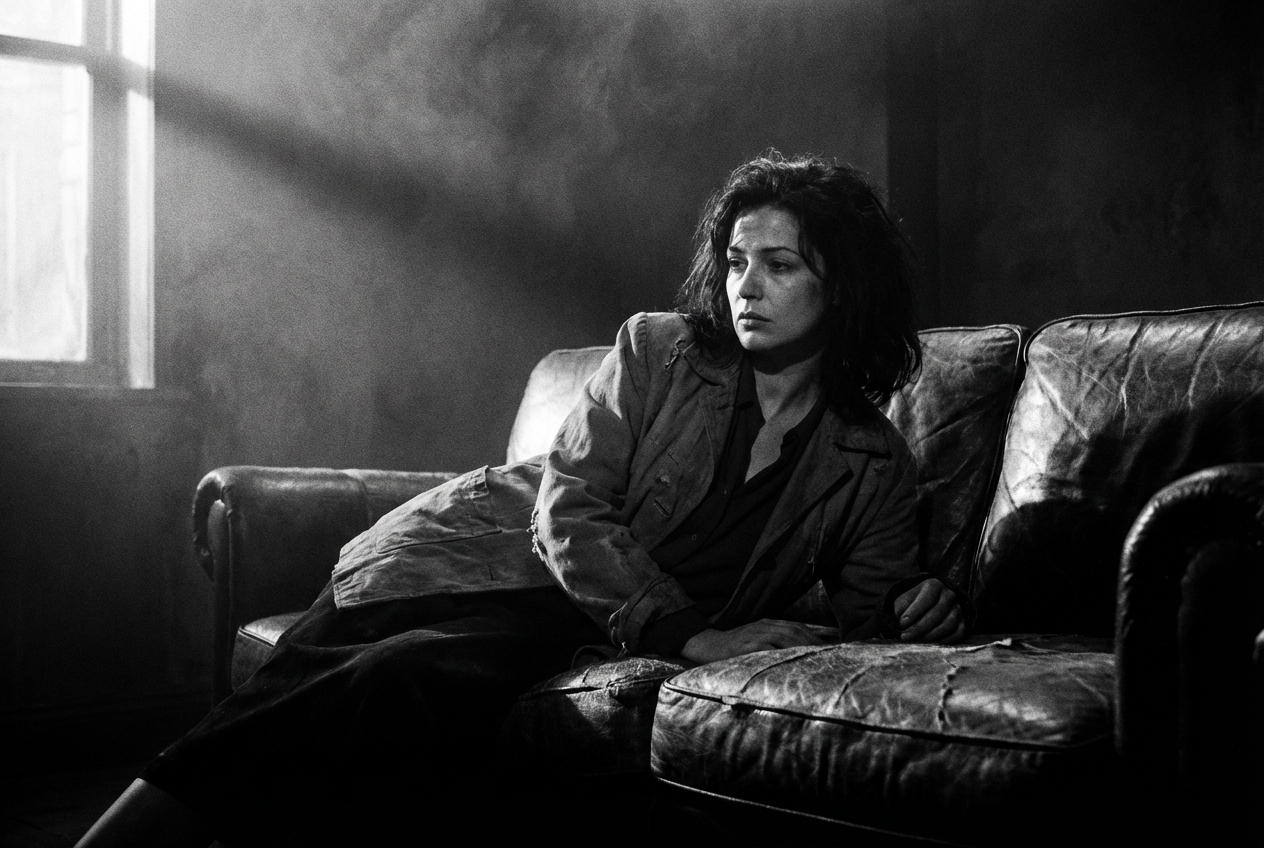
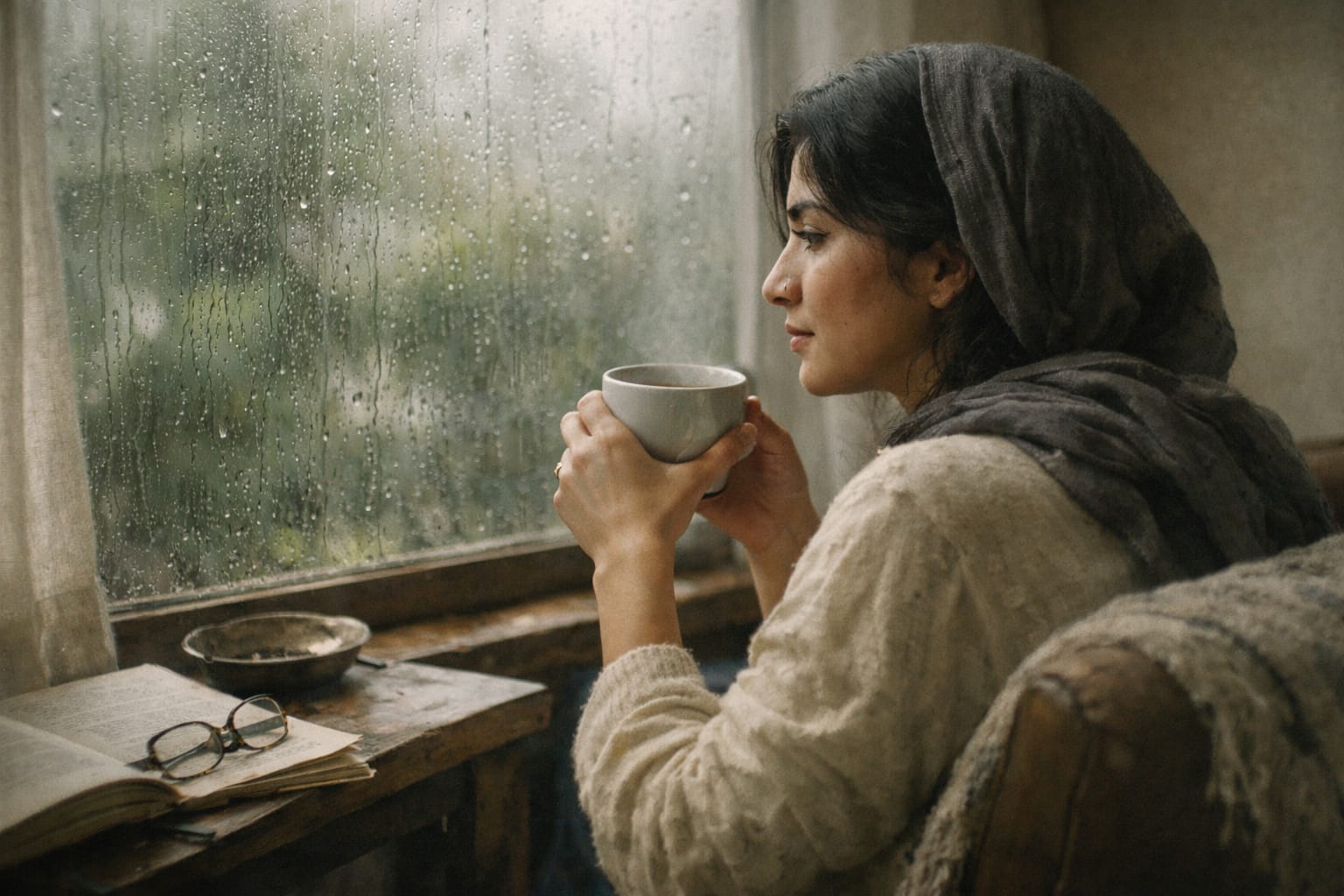
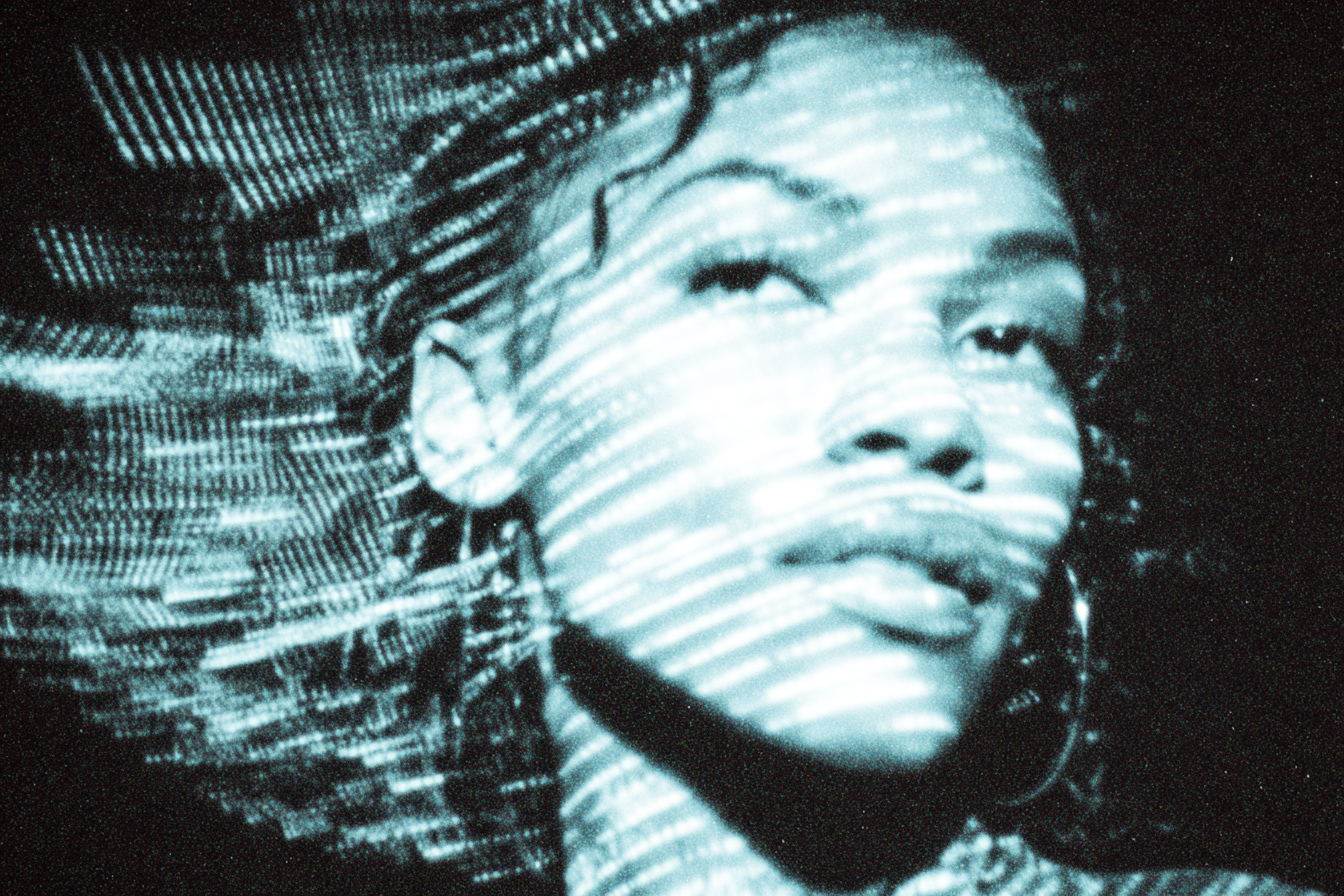
She lifts her arm like she’s remembering something older than breath—an inheritance carried not in blood, but in rhythm. The world behind her blurs into strokes of salt and shadow, yet she stands carved from something steadier: a woman made of lineage, of stories whispered through blue smoke and braided into the folds of her headwrap.

Her eyes are closed, but nothing about her is blind. She’s listening—maybe to the low tide of an ancestor’s voice, maybe to the soft insistence of her own pulse. The light catches her cheek like a blessing she didn’t ask for but accepts anyway.

And there’s that slight tilt of her mouth—neither smile nor sorrow, just the calm of someone who has survived enough to know the difference between surrender and liberation.

This is not a pose.

It’s a reckoning.
A quiet claiming of space.
A woman mid-stride in a prayer only she understands, and yet somehow, it feels like she speaks for all of us.

Reblog: Black Soldiers in the Napoleonic Wars

I came across this piece earlier today, and it stopped me. We talk about the Napoleonic Wars like they were fought by one kind of soldier in one kind of uniform, but history is rarely that clean. This post digs into the lives of Black soldiers who served in that era — men like George Rose and Thomas James — whose stories sit in the margins instead of the main text.

I’m reblogging it because it reminds us how easily entire lives can disappear from the record, not by accident, but by habit. And sometimes the most important thing we can do is shine a light where the page went quiet.


Station Break

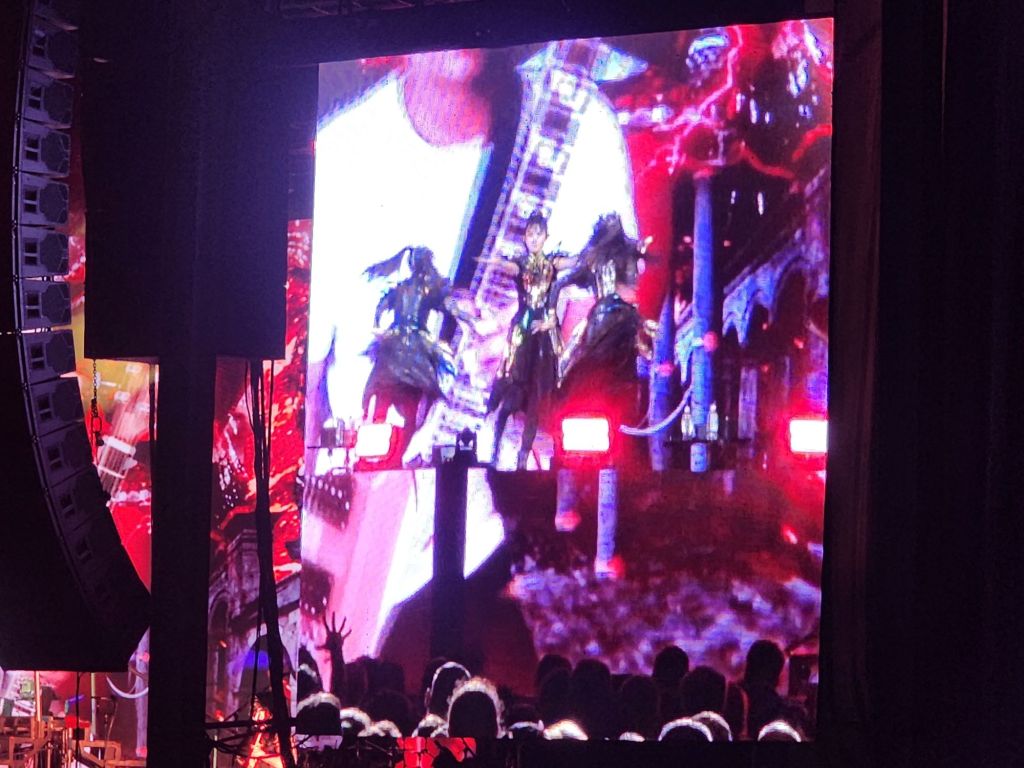
I’m currently at another heavy metal concert2 doing research fort next music post. I will have the article ready tomorrow

I think. stay cool and be blessed

Holding the Line Behind the Curtain

Some days the MKU pulls me deep into the art side of the house, and that’s where I’ve been this week—buried in images, color work, and the kind of creative mess that leaves your desk looking like a crime scene made of pixels.

But I’m still here behind the curtain on MoM, handling the admin work, reading fellow bloggers, keeping things tuned even if the front page looks quiet. Sometimes the best thing I can do is step back, breathe, and make sure the whole machine stays steady. More posts are coming. Just doing the groundwork first.

REBLOG: Life after door kicking’s post

Some words don’t just honor the fallen — they remind us the living are still carrying their ghosts.

I stumbled across a piece that doesn’t wear patriotism like a costume. It doesn’t shout. It doesn’t wave flags. It simply stands still for a moment and asks: What happens to those who came home, but never truly made it back?

It traces the thin, invisible line between Veterans Day and Memorial Day—not to scold, but to reveal how often we blur the two because it’s easier than seeing the cost in human terms.

If you’ve ever said “Thank you for your service” and wondered afterward if it was enough—go read this.

👉 Not All Who Served Are Gone

REBLOG: Nguyễn Thị Phương Trâm’s Translation


Every now and then, a poem comes along that feels like it was written in a language your heart already understood. This one is exactly that—a quiet confession of the ways we love when we’re not sure the world is safe enough to love openly. And reading it through the Vietnamese translation by Nguyễn Thị Phương Trâm adds a different kind of weight. Her rendering doesn’t dilute Rumi’s longing; it sharpens it. The phrasing feels more intimate, more exposed, almost like a truth whispered in the dark rather than something meant for daylight. It carries the tremor of someone choosing their words carefully—not to hide the feeling, but to keep it from breaking.

I recognize myself in these lines—not because they’re romantic, but because they’re honest in the way only the wounded can be honest. The choices Rumi names—silence, loneliness, distance, wind, dreams—aren’t just poetic gestures; they’re survival strategies we adopt long before we ever learn to name them. Before I step into the analysis, I want to be clear about the feeling underneath all of this: this is a poem about longing, but it’s also a poem about what fear teaches us to call love.


Rumi’s Poem (Full Examination)

“I choose to love you in silence…
Because in silence there is no rejection,”

Silence becomes a controlled environment. No exposure, no risk. It’s the heart refusing to let someone’s “no” dismantle what feels sacred. There’s tenderness here, but also deep self-protection.

“I choose to love you in loneliness…
Because in loneliness you do not belong to anyone but me,”

Loneliness becomes ownership. Not of the person, but of the fantasy. It’s that quiet admission that imagined intimacy feels safer than shared intimacy—because reality involves other people, other choices, other ways to be hurt.

“I choose to cherish you from afar…
Because distance will shield me from pain,”

Distance is anesthetic. Keep the feeling alive, but keep it far enough away that it can’t burn you. There’s longing here rooted in past wounds—love held at arm’s length because closeness has teeth.

“I choose to kiss you in the wind…
Because the wind is softer than my lips,”

The wind becomes a surrogate for touch—the gentler, safer stand-in. This speaks to someone who has learned that physical connection can wound as easily as it heals. Gentleness outsourced to nature because the body remembers hurt.

“I choose to hold you in my dreams…
Because in my dreams, you will be forever.”

Dreams are the only place where love doesn’t die, change, betray, or disappear. Permanence becomes a fantasy because impermanence has already carved its mark.


Personal Reflection:

Rumi’s poem reads like someone tracing the outline of their own heart without daring to fill it in. Every choice—silence, loneliness, distance, dreams—feels less like surrender and more like survival. Anyone who’s lived through love that left bruises knows this pattern: protect the feeling by protecting yourself. Sometimes the safest place to love someone is the one where you never have to test whether they love you back.

But there’s a heavier truth humming beneath these lines. Loving in silence isn’t just reverence—it’s fear wearing poetry as armor. We tell ourselves we’re choosing distance when what we’re really choosing is control.

Silence keeps us from being shattered. Loneliness gives us a version of them we never have to share. Dreams let us rewrite the ending.

The thing is, these choices don’t just shield us from pain—they shield us from possibility. And that’s the part Rumi doesn’t say but implies: sometimes unspoken love is a sanctuary, and sometimes it’s a cell. The heart learns to ration hope after it’s been broken enough times. We call it wisdom, but it’s also scar tissue deciding what stories we’re allowed to tell.

Still, there’s something profoundly human in this poem—this instinct to hold what feels sacred in the quiet. Not every love needs to be confessed to be real. Some loves are meant to teach us, soften us, remind us we’re still capable of feeling deeply even after the world has taken its swings.

Maybe the point isn’t to stay hidden. Maybe it’s to understand the terrain of our own tenderness before we risk crossing it with someone else. Silence can be a starting point, not a resignation. Distance can be a breath, not a retreat.

And dreams… well, sometimes dreams hold our truest selves until we’re ready to step into the light and admit what we want out loud.

REBLOG: What Do You Learn When You Choose Peace Over Fear?

Choosing peace over fear is never easy. Learn what this difficult decision teaches about courage, clarity, purpose, and trusting God fully. The post …

What Do You Learn When You Choose Peace Over Fear?

REBLOG: Poor Old Henry’s Preoccupation – The March of Fina -1

Poor Old Henry’s Preoccupation – The March of Fina -1

A Different Kind of Work

I’m stepping back from posting new pieces for the rest of the month — not because the well is dry, but because the work has shifted.

There’s writing, and then there’s everything that protects the writing — tending the archives, organizing drafts, sketching out what 2026 should feel like, not just look like. And just as important: actually showing up in other people’s spaces. Reading. Responding. Listening the way I ask others to.

I’ve always said I don’t want a crowd — I want a conversation. But conversation takes presence. It doesn’t happen if I only speak.

So this month, I’m still here. Just a little quieter. I’ll be reading your work, catching up on the stories and reflections I’ve missed. I’ll be behind the scenes — editing, planning, strengthening the scaffolding that holds this place up.

I’m realizing that engagement isn’t a side-task — it’s part of the practice. And I intend to carry that into 2026.

Not less writing.
Just writing built on connection — not isolation.

See you in the comments.

— Mangus

The Draft 2

Daily writing prompt
If you could meet a historical figure, who would it be and why?

Chapter 2

The Magnificent Seven, Mangus Style

I’m sitting at the table, drinking coffee, smoking a cigarette, waiting for the liquor distributors to show up. The invoices are spread out like old confessions. Ursula drops into the booth beside me, scooting against the wall, legs propped up on the bench like she’s claiming territory. She looks like she’s been rode hard and put away wet.

“You look like hammered dogshit,” I say.

“Thanks,” she sighs. “It’s a wonder women aren’t fighting in the parking lot for a chance to talk to you.”

I grunt and go back to the receipts. It was a good night. A bunch of weekenders dropped in just because they heard Willie and Ernie were here. Then somehow someone whispered that Josephine Baker might show. It was over after that. Word of mouth is gasoline in a place like this.

We’re in between both worlds—nobody really knows the size of the joint. The place shifts. Expands. Contracts. Accommodates. Like memory. Like guilt.

The door opens, blasting light from the heat tab—too bright, too sharp. Just a silhouette. I shield my eyes.

Bass Reeves walks in.

Not dressed like legend, not like myth—just a man who’s walked through dust and didn’t bother wiping it off. I don’t call him over. He comes anyway. Doesn’t sit. Just stands long enough to confirm he’s real, and not just folklore wearing boots.

He takes the seat across from me—no words exchanged. Doesn’t need any.

The door opens again, except this time, it doesn’t make a sound.

Poe steps through.

He enters like he’s always belonged indoors, even when he hasn’t eaten in days. Coat longer than necessary. Shoes too clean for a man with his kind of imagination. He doesn’t look at us. He looks at the rafters, checking for ravens. Bass nods. Poe nods back, like grief recognizing authority.

Ursula doesn’t greet them. She knows better than to greet ghosts.

I start to say something, but I stop—because someone is standing at the edge of the table.

No one saw her come in.

No coat. No apology. No explanation.

Just there.

Mata Hari.

She’s not posing. Not seductive. Not shimmering. Just still.

Present.

Composed like someone who’s tired of being looked at and never actually seen.

Reeves rises—not out of courtesy, not because she’s a woman—but because someone has entered his perimeter.

Poe stands, too, but slower. Not startled. Just… intrigued. Like he’s been trying to write her for years.

She doesn’t look at either of them.

Her gaze drops to my receipts.

My records.

“You keep records,” she says softly.
“That makes you accountable.”

She doesn’t sit. She doesn’t need to. The room begins adjusting around her—like furniture shifting to make space for gravity.

Before I can recover, the door opens—with noise this time.

Ursula walks back in, not with plates, not with style. But with familiarity.

She leans down and kisses the newcomer on the cheek.

“Hey, Rudy.”

Rudolph Fisher blushes and shrugs like a schoolboy caught passing notes.

I light another cigarette. My hand is not steady.

“Remember my first kiss,” I mutter. “Lime green woman.”

“Lime green chick, huh?” Yuri calls from across the room—thick Russian, thick boots, thicker folklore.

“You eat the worm again?” Roscoe asks. He’s polishing the same glass he’s been polishing since Truman was president.

I shake my head.

The fellas glance at each other—slowly, like the air just changed language.

Oscar breaks the silence.

“It was two worms.”

Everyone nods like that explains everything.

Ursula guides Rudolph to the table. He doesn’t posture. Doesn’t rush. He sits like a man whose pace belongs to him—not to the room.

“Now we’ve got rhythm,” he says, tapping the table twice. The table… agrees.

“You guys hungry?” Ursula asks—already heading to the kitchen before anyone answers.

She won’t cook it—God forbid—but she’ll deliver it. Gifted waitress. Terrible woman for boiling water.

Roscoe and Oscar drift toward the bar, part-time employees who never leave and never clock in. I once told them I’m not paying extra.

They nodded like monks agreeing poverty was noble.

Ursula returns with plates she definitely did not make.

Bass studies his meal like it’s giving testimony.

Poe inhales the steam like he’s trying to decode its loneliness.

Fisher smiles without tasting anything.

Mata Hari watches butter knives like they hold state secrets.

No one speaks.

Not because we’re eating.

Because something is coming.

The door opens a third time.

Not dramatic.

Just right.

Gwendolyn Brooks walks in.

Not like royalty.

Like someone royalty once stood for.

And everyone—Poe, Reeves, Fisher, Yuri, Roscoe, Oscar, Mata Hari—stands.

Not out of politeness.

Out of alignment.

She doesn’t require attention. The room composes itself around her presence.

She does not take the head of the table.

She takes the center.

Because that is where gravity sits.

She sets down her satchel. Folds her napkin.

And without looking up:

“Tell me,” she says,
“why you write.”

No one answers.

Because royalty does not ask questions.

She issues invitations.

And then—

There are eight cups on the table.

And only seven of us sitting.

The eighth cup is warm.

I turn—

And Toni Morrison is already there.

Not having entered.

Not having appeared.

Just present—hands folded, elbows resting, as if she had always been here.

Brooks doesn’t turn to greet her.

She only says:

“You took your time.”

Morrison smiles—small, devastating.

“No,” she says.
“I took my place.”

Then she looks at me.

Not through me.

Into me.

Not asking a question—

Delivering one.

“What promises have you made…
that your writing is afraid to keep?”

No one speaks.

Because that was not a question.

It was a verdict.

And that is where the chapter ends.

Forged from an Old Soul


He wasn’t born lucky. Nobody handed him a map.
He learned early that some of us come into this world half-built, and the rest is on us.
So he carved his name into time, steady and deliberate — a slow rebellion written in scars.

The city didn’t raise him. It tolerated him.
Concrete and glass can’t teach you much, but they’ll listen if you bleed honest enough.
He made peace with that kind of silence — the kind that hums between streetlights and memory.

There was a facility once — a place that smelled like rust, regret, and second chances.
He wasn’t supposed to be there, but he stayed.
Sometimes, a man doesn’t need comfort — he needs a place where the noise inside his head finally echoes back.
In that echo, he found rhythm. In rhythm, he found himself.
No blueprints. No saviors. Just repetition.
Each motion a prayer, each mistake a gospel of survival.

He doesn’t worship. He works.
He doesn’t beg. He endures.
And if you ask what drives him, he’ll tell you the truth —
it’s not pride or anger, not anymore. It’s the memory of a boy who promised a broken world he’d walk out standing.

Half in shadow.
Half in light.
All his.

Guppy, Mojo, and Does Anybody Have a Cigarette?

(Memoirs of Madness — Return Post)

When my system went down, it seemed like divine intervention—a forced pause. I took the chance to stop fighting the noise and reset my creative energy.

I sat there for a minute, half expecting the room to fill with people saying, “We’re here because we love and care about you. We’re worried. You don’t seem okay.”
Instead, it was just me—and Guppy, staring like she’d seen this movie before.
I muttered my customary “Kick Rocks,” and she gave me that look:
“What’s going on with you, human? Pet me. Feed me. Clean my poop.”

Fair enough.

And because the universe clearly thought I needed a little more chaos, I decided to quit smoking. Yep, that was a moment of brilliance right there, buddy.
I can’t remember the last time I built a machine, wrote a line, or rewired a circuit without a cigarette hanging from my lips or burning down in the ashtray. The old routine: light another while one’s already smoldering, forget which is which, call it inspiration.
Now I’m in the cut back phase. Pray for me, light a candle, or call a hoodoo man to lay down some mojo—I can use all the help I can get.

Somewhere in the middle of all that nicotine withdrawal and digital resurrection, I pulled up the storyboard and looked at the mess. Dozens of storylines—some finished, most not. I decided it was time to clean house.
So I’m finishing what I started. Focusing on the long fiction threads and promising myself that from here on, quality comes first. The foundation’s solid, but there’s still plenty of building to do.

You’ve all been patient, loyal, and willing to walk through my corridors of madness while I rebuild piece by piece. You deserve the best I’ve got—and that’s exactly what’s coming.

I suppose I should be pulling my hair out… wait, I’m bald—so I’m good.

When the Milk Crate Was the Cloud

Understanding begins where the noise ends.

“The cracks are where the future gets in.” — Nick Cave

Earlier this week, I wrote about dealing with multiple system failures — digital, emotional, creative. The kind of breakdown that makes everything feel heavier. Every keystroke. Every thought.

I couldn’t even open a text editor without feeling like the machine and I were daring each other to quit first.

So, I did what any rational person does when their world starts flickering — I tore it down.

Every wire. Every drive. Every application.

I started looking at everything — the hardware, the software, even the mental clutter I’d built around them. And I started cutting. To borrow a writer’s term, I’ve been killing my darlings. Not just the old drafts and half-finished files, but the stuff I’d been keeping out of sentiment — tools I didn’t use, folders I hadn’t opened since the Obama years, plans I wasn’t brave enough to admit were dead.

It’s strange, what survives a purge. The things you thought mattered crumble under scrutiny, while the quiet essentials — the things that actually serve you — emerge stronger, cleaner.

That’s when it hit me: maybe this isn’t just about computers. Maybe it’s about life architecture.


The Breakdown Phase

Sometimes the system has to fail so you’ll finally stop pretending it’s fine.

When the screens went dark, it wasn’t just technology collapsing — it was me running into the edge of my own maintenance backlog. You know the one: the projects, bills, and habits that pile up in the background while you tell yourself you’ll “get to it.”

Then, one day, everything gets to you instead.

But here’s the gift buried in the crash — it forces you to re-evaluate everything. To sit in the silence after the hum fades and ask: what’s still necessary? what’s still mine?


Back When We Built Our Own Fixes

I come from a time when computers didn’t “just work.” You had to earn them.

You didn’t buy plug-and-play — you built plug-and-hope. You traded parts out of milk crates, scribbled command lines in pencil, and held your breath during the boot beep because you weren’t sure if the whole thing would smoke or sing.

We understood our machines because we had to.*

There was intimacy in it — a relationship between curiosity and consequence. You learned to think like a system, to troubleshoot your way through the mess.

Now everything’s sealed, optimized, “user-friendly.” But friendly to whom?

The less we have to know, the less we understand. And when we stop understanding, we lose something fundamental — the muscle memory of resilience.

We used to break things and fix them.
Now we just replace them and complain.


The Rebuild

So I went back to basics.

I started rebuilding my system piece by piece, checking every connection, testing every drive. And as I did, I realized this wasn’t just a technical reset — it was a personal audit.

I’ve been doing the same thing with my finances: cutting unnecessary subscriptions, auditing expenses, trimming the fat. I’m tired of auto-renewed everything — the digital equivalent of dust.

Same with my creativity. If a tool doesn’t serve the work, it’s gone. No more chasing new apps, new aesthetics, new noise. I’m rebuilding for efficiency, not ego.

There’s a strange peace in it — this deliberate stripping away. It reminds me that clarity isn’t something you download. It’s something you earn, line by line, dollar by dollar, decision by decision.


The System and the Self

The truth is, we’re not that different from the machines we build.

We run on energy and memory. We slow down when cluttered. We crash when overheated.
And sometimes, the only way forward is to reformat.

But unlike machines, we get to choose how we rebuild.
We decide what stays. We define what’s worth running.

This whole process — the wires, the drives, the self-audits — it isn’t about perfection. It’s about understanding. I don’t need things to run flawlessly. I just need them to make sense.


Keep Going, Responsibly

Here’s the part nobody romanticizes: rebuilding is exhausting. It’s unglamorous. It’s long hours, slow progress, and endless testing.

But it’s also the only way to ensure what you’re building can stand on its own.

Sometimes you have to keep going — not because it’s easy, but because stopping would mean accepting confusion as normal.

I’ve learned that keep going doesn’t mean sprinting through burnout. It means moving with intention.
It means knowing when to step back, when to unplug, when to rewrite the damn script.

Because in life — just like in code — the smallest syntax errors can wreck the whole thing if you never stop to look.

“Sometimes you just have to keep walking, even if the map burned up a few miles back.” — Unknown


Author’s Note

Patience is a kind of engineering.
You learn it by failing, by pausing, by realizing not everything needs to be fixed immediately.

Lately, I’ve been reminding myself that understanding — real understanding — takes time. Systems crash. People do too. What matters is how we rebuild, not how fast.

So if you’re in one of those messy seasons — where every wire feels tangled and every drive hums with static — breathe. Slow down. Learn your system before you rewrite it.

You’ll get there. Just not all at once.

When the Room Goes Quiet

“Fear doesn’t always mean run. Sometimes it means you’ve finally cornered the truth.”


Let’s start with an admission: I’ve never liked the sound of my own voice.
Not the way it cracks when I speak too quickly, or how it forgets itself halfway through a thought. Writing has always been safer — the words obey there. They arrive dressed and deliberate. Out loud, they stumble.

Before I speak, my body stages a small rebellion. My pulse climbs. My jaw tightens. The air feels heavy, as if the room is waiting to see what kind of fraud I’ll turn out to be. That’s what fear does — it turns attention into judgment, curiosity into threat. Only when I’m speaking about my writing does this happen — as if some inner voice hisses, “How dare you think your work is worthy of commentary?”

Yet outside the creative world, I’ve never hesitated to speak. Giving orders? No problem. I did it unapologetically. If someone broke down or got their feelings hurt, my answer was simple: “It’s not my fault your parents raised you to be a pansy.” Was that wrong? Of course. But it was effective — more often than not. That’s why the transition to civilian life hit me like a slow collapse. You can’t bark your way through vulnerability. You can’t command creativity. It doesn’t answer to rank.

But it isn’t really the audience I fear. It’s exposure.
Writing lets me curate my confessions, polish the edges, make the mess beautiful. Speaking strips that away. It demands the raw version — the one that still shakes. And people are strange — sometimes cruel. Some need to be publicly flogged for how they treat others. I laugh when life gives them a taste of their own medicine. Not because two wrongs make a right — they don’t — but because it’s human to feel that flicker of satisfaction when justice shows up wearing irony’s grin. What always gets me, though, is how quickly the guilty feign ignorance. “I’ve done nothing,” they say. Or worse, “All I did was…” as if cruelty came with a receipt and a refund policy.

Sometimes I wonder if the page has made me soft. Soft in that pansy way I used to mock. Where are the tissues? Did you just hand me the cheap stuff? Man, you better give me the Puffs if we’re gonna do this right.
Thank you.
Where was I?
Right — softness. I can write about grief, about love, about the parts of me that never healed. It’s almost easy to do so from the shadows, where no one sees your face or knows your name. A brave soul or a coward? Maybe both.

What do I look like without my mask? Will it fall away, or do I have to peel it off piece by piece? It’s okay to be frightened by what you see. It’s okay to scream aloud as you stare at the stranger in front of you — until you realize it isn’t a stranger at all.
It’s you.
And that’s the moment the voice in your head mutters, “The shit just got real. Damn it, man.”

Could I say these things out loud without flinching? Could I bear the sound of my truth without a backspace key to hide behind?

Maybe that’s what this season of my life is about — learning to live without the safety of revision. To understand that fear, pain, and uncertainty aren’t evidence of weakness, but proof that I’m alive — proof that I matter. The pounding of my heart, the sweat along my brow, the tingling at my edges — they’re all part of it. Then somewhere amidst all of this, I clear the mechanism. Serenity appears. It doesn’t replace the fear, pain, or uncertainty; it listens to them. They have a conversation while I exhale.

I don’t know if I’ll ever love the microphone. But I’m starting to think the page and the stage aren’t enemies. They’re just two mirrors — one for the voice, one for the soul — and I’m standing between them, trying to recognize my own reflection.


Reflective Prompt

What would your truth sound like if you stopped editing it mid-sentence?
Say it out loud — even if your voice shakes.


Author’s Note

Sometimes honesty is a fistfight between who we were and who we’re trying to be. This one left a few bruises — the good kind.
Now, if anyone knows where I left the ice packs… or hell, even a bag of frozen peas — I’m open to suggestions.
Where’s the love, people? Where’s the love?

Respect Isn’t Rescue

On Quiet Power, Unfinished Equality, and Knowing When to Step Aside

Women have been shaping the world from the quiet corners for as long as there’s been a world to shape. History loves its kings and loudmouths, but look closer and you’ll see the fingerprints of women everywhere—deals struck over kitchen tables, revolutions whispered into motion, empires shifted by a single word.

The damsel-in-distress? Pure fiction. Every woman I’ve known has been a strategist or a survivor. I was raised by women, so I never bought the stereotype. My mother, aunts, and grandmothers ran their worlds with a precision that left no room for excuses.

That lesson stuck. My daughters and granddaughters get no slack because they’re women—the only pass they get is being mine, and even that expires fast. I’ve watched women pick up the slack when men fall short, holding things together while someone else grabs the credit. And still, women are underestimated in ways I’ll never understand. The proof stands right in front of us, yet people squint as if strength needs permission to be real.

I saw it firsthand in the military. Equality is improving, but the gap is still wide. A striking new soldier joined our unit, and the guys forgot every rule of conduct, circling her like moths while she tried to learn her job.
So I played the villain. I called people out, made her untouchable, and turned would-be defenders into cautionary tales. I hated doing it, but it gave her room to breathe. Her father was a command boss I’d butted heads with, so I expected trouble. Instead, we ended up on good terms, a quiet truce born from protecting his kid. She and I became friends, and years later, I still get the occasional text or Facebook update from her and the husband I once terrorized.

Long before marriage, an older woman once told me over beers, “If I can’t get what I want with a look and a smile, I’m not doing my job.” Back then, I didn’t get it. Marriage cleared that up. My wife could hold an entire conversation with a single glance, seal the verdict with a faint smile, and I’d move before she spoke—remembering that barroom oracle and chuckling while carrying out silent orders.

Here’s the tricky part: as much as I know the women in my life can handle themselves, the instinct to defend them never leaves. But that impulse can backfire. Sometimes the smartest move is to pick your battles, stay alert, and trust their strength. Respect isn’t rescue—it’s giving credit, stepping aside, and making sure the field is clear when they swing the hammer themselves.

Even after a lifetime of their guidance, I still don’t have a clue how women work. They tell me that all the time. I just smile, nod, and keep doing my chores. History is finally, grudgingly, starting to catch up.


Author’s Note
I like Sunday Poser’s questions. They make me think—probably more than they should, but think nonetheless. Anything that stirs the mind is a good thing. So, thanks to Sadje for providing these tremendous challenges.

Confessions of an Insomniac – Episode 2: Mainlining Caffeine

Daily writing prompt
What could you do more of?

Sleep and I are estranged lovers—centuries of cold shoulders and midnight betrayals between us.
Sleep is like that perfect lover we imagine we could find, but do we really want perfection? Knowing that perfection is something for shitbirds and affirmation junkies. There’s no help for the shitbirds, but the affirmation junkies—there’s a new 5 a.m. virtual meeting. I think that’s the word. Who knows? I can’t keep up. Hell, I can’t even get up.
If we reconciled now, the shock might kill us both—like a jolt of mainlined caffeine through a cracked vein.

I could try being nicer to people. Be giddy, even. (Insert laugh track here.) But no—perish the thought. Niceness feels suspicious, like a door-to-door guru peddling enlightenment for the price of my dignity.

The writer in me says write more, which is hilarious because I already write every damn day. My editor swears I start a new series just to watch her eye twitch. Sometimes she sends me texts that are just a single, vibrating ellipsis. I plead the Fifth. She rolls her eyes so hard I can hear it over the phone.
The other day she asked, “When are you going to take the next step? You know you’re ready, right?”
Maybe she’s right. Maybe it’s time I believe in myself a little more—have faith in the work I keep throwing into the world like sparks from a stubborn match.

Still, there’s something quietly miraculous about creating work you love and finding out strangers love it too. For years, I didn’t have the time—raising a family will eat decades before you can blink. (Contrary to the baffling opinions of certain buttwipes who think parenting is optional.)

But the thing I’d truly like to do more of? Pay attention to my art. Not for money, not for likes—just to see how far I can push it. No limits, no internal hang-ups, none of the flimsy excuses we invent to dodge our own passions. Retirement has made one thing clear: I’m a storyteller. Always have been. Every skill I’ve picked up—writing, photography, film work, design—has been another star in the same battered sky, flickering through the smog of burnt coffee and late-night keystrokes. Each one lights a different corner of the story. Perhaps it’s time to stop forcing the tale into a single constellation and let the stars arrange themselves, allowing the story to decide whether it shines as prose, image, film, or sound.

As I write this, it begs the question… What if?
What if I let go and took the plunge? Will doubt finally fall away? Will I edge closer to whatever version of me is hiding under all this noise—no matter how cleverly I might hide myself?
Not to get hippy-dippy, but isn’t that the engine under all of this—the quiet force beneath the surface, behind the mask we flash to the world?
Excuse me while I glue my mask back together. They don’t epoxy like they used to. Progress my ass.

Maybe sleep will keep sulking in the corner. Fine. I’ll keep mapping my own constellations until the night runs out of darkness.
Sleep can wait. Niceness can rot. The story gets every last hour I have.

Delores the Detour

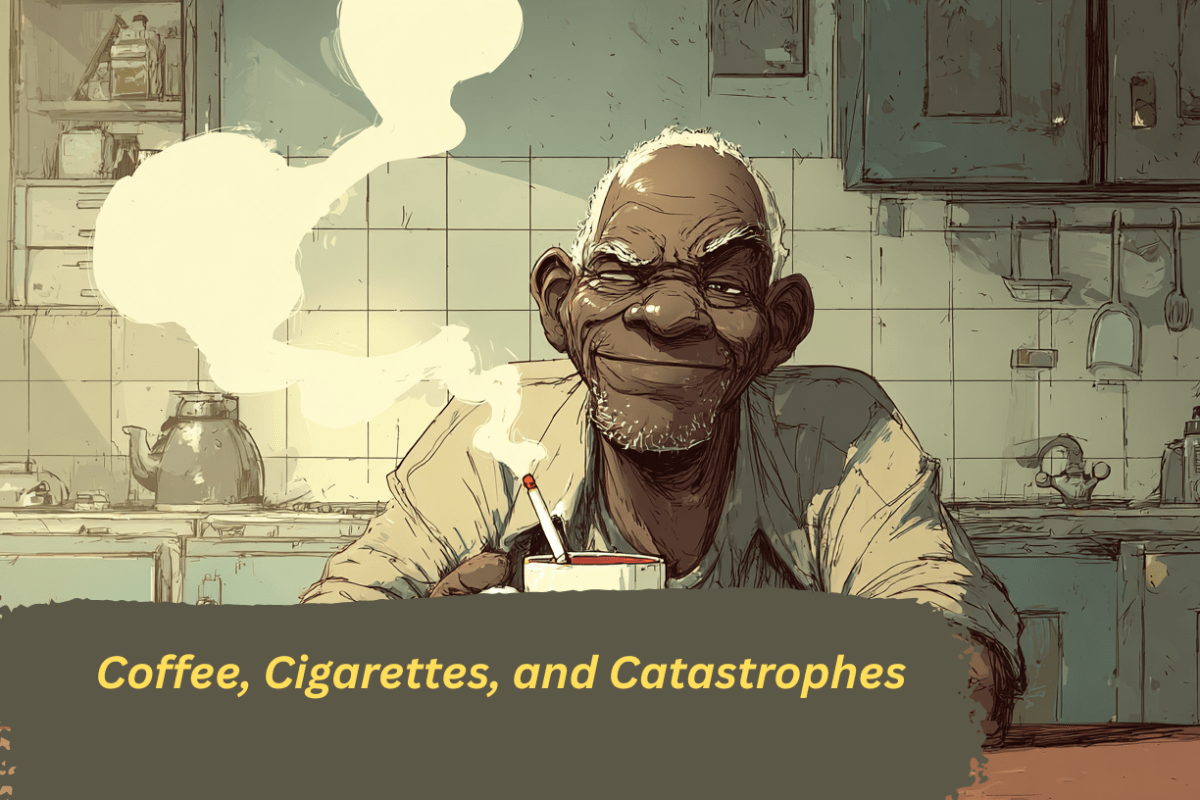
Episode 2: Coffee, Cigarettes, and Catastrophes

The morning coffee tastes like wet asphalt today, bitter and a little metallic, which feels right because Delores was the human embodiment of a detour sign—bright, tempting, and guaranteed to land you somewhere you didn’t plan on going.

We met outside a dive bar that smelled of stale gin and Monday failures. I was waving for a cab, she was leaning against one—hair slick with streetlight, cigarette ember pulsing like a tiny warning flare. Delores fixed one eye on me through the smoke and said, “Get in if you’re brave or drunk enough.”
I was both, and apparently suicidal enough to think that sounded like romance.

Her cab smelled of gasoline and fading leather, the heater coughing a lukewarm breath that carried the ghost of every passenger before me. Delores drove like the city owed her a favor and she meant to collect, slicing through alleys slick with last night’s rain. Each turn came with a commentary delivered in that dulcet rasp of hers—soft velvet laid over broken glass—that made even a near-miss feel like a bedtime story.

Dinner was a mushroom pizza balanced on the hood at three a.m., steam rising into the amber glow of streetlamps. Sirens wailed in the distance, a crooked lullaby. She’d gesture at the skyline with a grease-stained hand and tell me where she’d hide when the world finally caught fire. I believed her. There was already a bunker behind her smile.

Our nights blurred into an integrated system of near-misses: her ex calling mid-shift to harass her over some ancient grudge, my wallet sliding between cracked seats, the sudden realization that her idea of commitment was showing up before dawn. Every mile carried the taste of exhaust and the thrill of maybe not making it home.

I loved the motion more than the woman, though I didn’t admit it then. The rush of wet tires on pavement, the neon flicker on her cheekbones—it all made me feel like my own stillness might finally shake loose. Trouble is, you can’t build a life at thirty miles over the limit. Motion only disguises the void; it doesn’t fill it.

The night it ended, we hit a traffic circle she called “The Bermuda Triangle of Bad Decisions.” She didn’t slow down. I grabbed the dash, she grabbed my knee, and whispered, “You ever wonder if we keep driving fast enough, maybe the past can’t catch us?”
Her words slid into me like smoke through a cracked window—seductive, poisonous, and half-true.

I stepped out at the next red light and let the cold air slap me awake. Behind me, the cab’s taillights smeared into the wet dark, a pair of crimson commas on the sentence we’d never finish.

Moral of the story? Detours thrill the blood, but every one of them bends back to the same brutal truth: you can outrun traffic, but not yourself.


Author’s Note

This late-night joyride is fueled by the unholy trinity of prompts—FOWC, RDP, and the Word of the Day—each one a pothole I was happy to hit. The required troublemakers—eye, dulcet, and harass—slipped into the story like sirens in the distance: sharp, unavoidable, and just loud enough to make you check your rearview.

Writing Delores the Detour reminded me how motion can masquerade as meaning. It’s easy to chase neon streets and mistake adrenaline for affection; harder to admit that speed only hides the quiet parts of ourselves we’d rather not patrol. Consider this your friendly warning from the passenger seat: detours are thrilling, but the bill always comes due—usually in gas fumes and unanswered questions.

Skin Against the Wall


The wall split open at the hairline crack, and she came through screaming. Not with sound, but with vibration—the kind you feel crawling in your teeth, rattling in your bones. Her hair—roots alive with autumn rot and evergreen hunger—whipped outward like roots searching for soil.

Where’d you go?
She’s alive, but barely. She stood out, so loud, so bright, you could see. Her silence sings to me, as if she belted out a primal scream. She was so loud, it’s wrong—she was strong. Where did we go? Tonight, the Sun will hum its final hymn.

She tastes the blood from her hidden, unhealed wounds. The plaster burns her skin; it’s slowly melting her spirit. There’s an itch under the surface she can’t stop clawing at, something crawling deep in the marrow, carving names she doesn’t want to remember.

Blood streaks her cheek, though she hadn’t been struck. It seeps from a single dark spot beneath her left eye, like the wall itself was leaking into her.

The air around her trembles. Not with rage, not with fear, but with the ache of a body caught between two worlds—one solid, one unfinished.

And still she screamed.
And still, I listened.
Because sometimes a scream is the only way a wound remembers it’s alive.


Author’s Note:
This piece was written for Di’s Three Things Challenge — today’s words: hairline, itch, spot. Much appreciation to Di for keeping the ink restless and the imagination cornered. I’ll be back to flash fiction once I iron out the kinks of Narrative Forge. Thanks for hanging with me — telling stories is my happy place, having you enjoy them is just the perks of the gig.

The Garden of Ashes – New Chapter Released


This morning, over on The Narrative Forge, I set another chapter loose into the fire.

The Garden of Ashes isn’t just a story—it’s a slow burn through betrayal, memory, and the kind of survival that leaves marks you can’t wash off. Griffin and his band of survivors keep stumbling forward, carrying secrets sharp enough to cut, and this new chapter digs the blade a little deeper.

Here’s a link to the latest chapter:

If you’ve walked this path with me already, you know the ground keeps shifting under their feet. If you’re new to Memoirs of Madness, welcome—this is as good a place as any to step into the smoke. Every chapter is waiting for you at the Garden of Ashes Series Hub, a vault of fire and memory where the whole trail unfolds.

The door’s open. Step through, and see how far the fire spreads.

—Mangus Khan

The Victrola and the Strange Business of Bringing Music Home

My first record player was one of those Mickey Mouse things. I thought it was incredibly cool, back then. Now? I’ve probably lost several thousand cool points just for admitting this publicly. But that was the start—the first time I realized music could be mine, portable, spinning on plastic grooves under a cartoon mouse’s nose.

I never wondered about the first record player until years later, standing in a museum, staring at a Victrola like it had just rolled off a time machine. It was gorgeous—mahogany, brass, that air of weighty dignity machines used to have. And of course, the museum folks wouldn’t let me touch it. I was pissed. I ranted the whole way home, arms flailing like some deranged conductor, until my mother gave me that look that said, Boy, you’ve lost your damn mind. A look I would see many times over the years. My wife eventually perfected the same expression. Some conspiracies never die.

But that Victrola stuck with me.


A Box That Made Music Respectable

Before 1906, phonographs were awkward beasts. Giant horns jutting out like mechanical tumors, gathering dust and dominating living rooms. Eldridge R. Johnson—mechanic, dreamer, and founder of the Victor Talking Machine Company—had the audacity to fold the horn inside a cabinet. A simple trick of design that turned a noisy contraption into something you could sit beside polished furniture without shame.

It wasn’t just sound anymore. It was respectability.


The Price of Belonging

The first model, the VTLA, hit the market for $200—nearly half the average American’s yearly income. That’s about $5,700 today. Imagine explaining that to your spouse: “Honey, I spent half our wages on a box that sings.”

And yet every one of the first 500 units sold.

Because what people were really buying wasn’t a machine. They were buying belongings. Owning a Victrola meant you weren’t just grinding away at life—you were plugged into something larger, a signal that beauty belonged in your home.


Tone Doors, Drawers, and Dignity

The Victrola invented volume control—tone doors you could swing open for a flood of sound, or close when you didn’t want the neighbors to know you were spinning opera instead of hymns. It came with a drawer for needles, record storage built in, and even a lid to hush the surface noise.

What Johnson built wasn’t just a phonograph. It was an alibi. “See, dear—it’s furniture, not folly.”


From Freak Show to Fixture

By 1913, annual production had jumped to 250,000 units. The Victrola transformed the phonograph from curiosity to necessity. Music wasn’t just heard—it was hosted. Families gathered around it the way we gather around glowing screens today.

And the industry bent to Victor’s design. Competitors copied the hidden horn, patents expired, and suddenly, the parlor was the stage where the world’s voices arrived.


The Ghost in the Mahogany

That’s why I can’t shake the Victrola’s ghost. Because every time I hit play on Spotify, I feel it humming under the surface—the memory of when music had weight. When it wasn’t disposable, when it demanded space, when it carried dignity just by existing in the room.

My Mickey Mouse player may have sparked it, but the Victrola taught me the truth: music was never just about sound. It was about what you were willing to make room for.

And maybe that’s the real question—not what deserves that kind of space now, but what you’ve quietly pushed out to make room for noise.


Author’s Note

This piece was inspired by Jim Adams’s Thursday Inspiration #294 prompt: Suddenly. His weekly challenges have a way of shaking loose odd corners of memory and letting them bloom into something unexpected. Today it was a Mickey Mouse record player, a museum rant, and a Victrola that refused to leave my head.

As always, these posts are written as part of the ongoing experiment that is Memoirs of Madness—where history, memory, and a little grit collide. If the story sparks something for you, I’d love to hear it in the comments or see your own take on the prompt. Writing is always better when it’s a conversation, not a monologue.

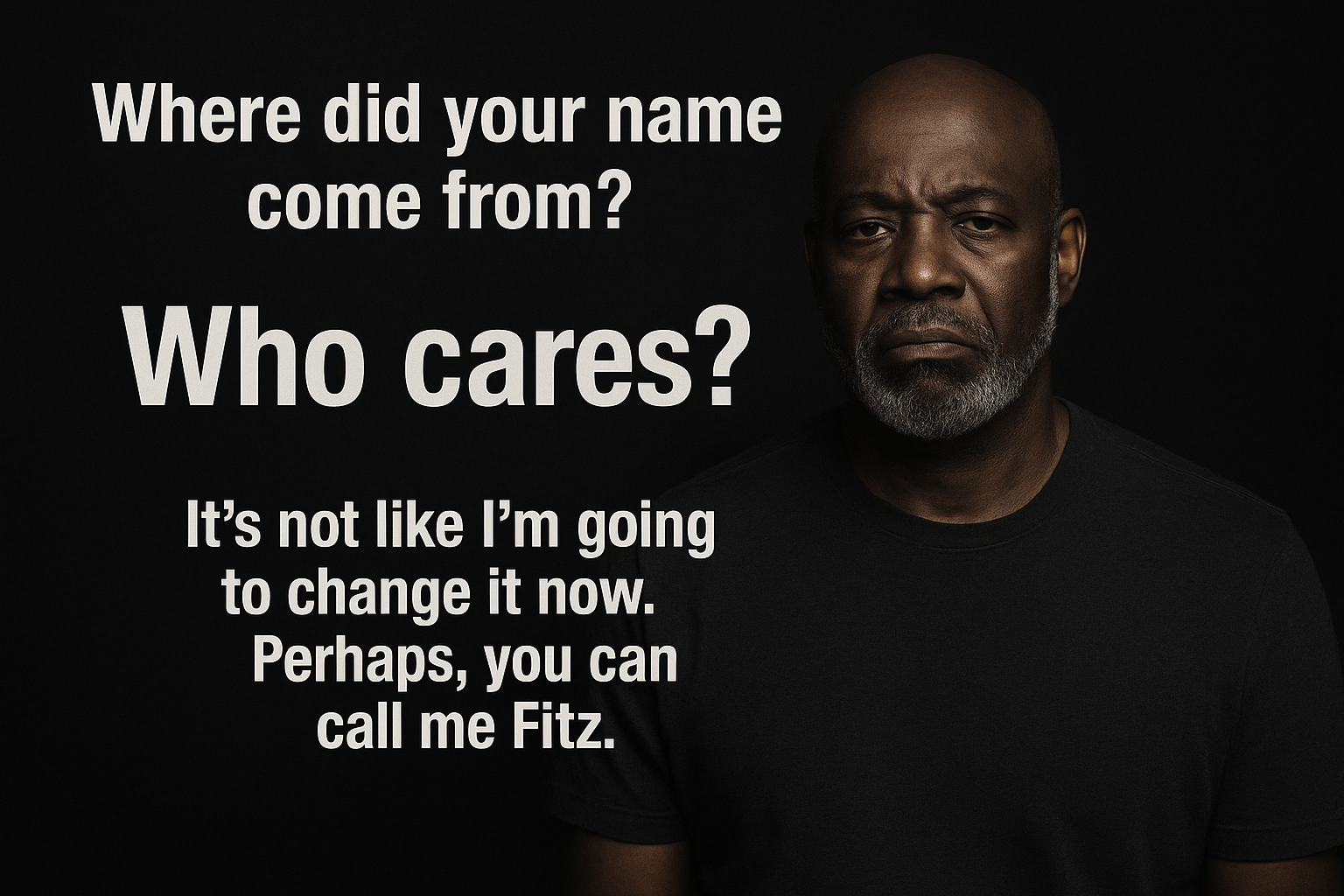
The Name Question Noboby Asked

Where did your name come from?

Status Update: Building Worlds, Breaking Plans

Let’s be honest—last month didn’t exactly go according to plan. Deadlines slipped, chapters missed their mark, and Truth Burns got yanked off the shelf completely. But don’t mistake the quiet for inactivity. The Forge is still burning, and I’m hammering out something more substantial beneath the smoke.

I’ve been waist-deep in worldbuilding—not just character backstories or timelines, but full-on infrastructure. Truth Burns needed a city that felt real, with streets you can navigate, neighborhoods that breathe, and a logic that holds up past chapter five. Turns out, designing a place from scratch is like running an urban planning boot camp while writing a novel. No wonder other writers fictionalize real cities. Creating every bridge, hospital, and back alley by hand is a nightmare, and you don’t notice the holes until you’re knee-deep in a scene asking, “Where the hell do they even go from here?”

Usually, I live in stream of consciousness writing. I like flying by the seat of my pants and letting the story find its path. That works for flash fiction, short pieces, even most of what you see on MoM. But long fiction is different. When you don’t have a plan, you end up with chapters that are just you thinking out loud. You deserve better than that.

So I’m slowing down to get it right. Truth Burns will return, rebuilt from the ground up with a foundation strong enough to carry the story it deserves. Until then, the rest of the Forge keeps firing.


What’s Still Live

While Truth Burns is in surgery, other series are still rolling out:

  • Garden of Ashes – Mondays
  • Ashwood County – Fridays
  • Bourbon & Rust – Saturdays

Sundays are my admin day across the MKU universe, Wednesdays are reserved for worldbuilding and the occasional Love Drop. Everything else? It’s being reforged to last.


What’s Next (No Dates, No Rush)

There are other stories simmering in the background, waiting for the right moment to hit the page. They’ll come to The Forge when they’re ready, not before.


This isn’t a stall—it’s a rebuild. Thanks for sticking around while I tear things apart just to make them stronger. The Forge will burn brighter for it.

Neon in Her Veins


The city doesn’t just live in her—it clings to her like cigarette smoke in a cheap motel room. Neon signs flicker behind her eyes, half-lit promises that never quite make it past dawn. The streets wind through her silhouette, rain-slick and restless, always leading somewhere she’d rather not go but can’t stop heading toward.

She’s a walking skyline, a soft silhouette with hard edges, every shadow on her skin a back alley full of regrets. The hum of the city is her pulse, low and relentless, a rhythm you can’t dance to but can’t ignore. And under it all, there’s that quiet truth every soul in this town knows: you can leave the city, but it never leaves you. Not when you’ve already let it build a home beneath your ribs.

Still Breathing: A State of the MKU Dispatch

A vintage typewriter on a cluttered desk, exploding into birds as books tower around it—chaos and creativity in motion.

You ever walk into a room expecting your voice to boom like a prophet’s and instead get met with blank stares and TikTok scrolling?

That was me two weeks ago, stepping into a summer workshop with students aged 8 to 17. I came in with fire and myth, ready to guide them into storytelling. The younger kids couldn’t sit still long enough to absorb anything. The teens? Aloof at best. My usual trick—command the room with presence, reinforce with voice—didn’t move the needle.

I walked out thinking: I might be losing my mojo.

So I did what any story-hardened madman would do.

I built them a universe.

The Ashoma Codex rose from that frustration. An entire mythos crafted for them—a sacred order of supernatural beings bound by fire, memory, and sacrifice. Vampires and werewolves. Secret Circles. Flame-born rites. I even spun up a website just for them, with lore, rituals, and a place to submit their own creations.

And then today, I got word from their instructor: they love it.

They’re building characters. Creating art. Engaging with the world I made. Turns out they didn’t need a lecture. They needed a world that would speak their language.

It’s been a long time since I had that much fun doing something for someone else.


Forging the Forge (with Fewer Bugs and More Story)

Let’s talk about The Narrative Forge (TNF)—my dedicated space for longform fiction.

Eventually, it’ll be home to five deep-cut series:

  • Ashwood County – Southern Gothic horror soaked in grief and ghost stories
  • No Half Measures (formerly Cop Stories) – A noir detective tale where trust is dangerous and truth cuts deep
  • Reilly McGee: Misadventures at Crestview High – 1980s chaos, coming-of-age style, with more heartache than heroics
  • Bourbon and Rust – Grit, regret, and a neo-Western sense of justice
  • Truth Burns – Emotional aftermath and the slow claw toward redemption

The plan: post one chapter a week, rotating series. I’m kicking things off with Ashwood County as I work out the kinks and refine the reader experience.

TNF is my main focus right now. But soon, House of Tunage and The Howlin’ Inkwell will start to move forward again too—each with their own voice and rhythm. And yes, visual arts are coming as well. That site’s still under development, slowed down by the same quirks that’ve been haunting the others.

You guys remember The Knucklehead Report? I gave it its own space so I can rant, roast, or rave about the books and movies that cross my path—without crowding out the rest of Memoirs of Madness.

All of this—the new structure, the site spinoffs, the redesigns—is meant to do one thing: streamline MoM. Make it cleaner. More focused. Easier to navigate without tripping over half-finished drafts or misplaced experiments.

I don’t know which projects will thrive, but right now, building them helps me clear the noise and move forward.


Links to Explore:


So yeah—if things have been a little quiet here, it’s not because I’ve stopped writing. It’s because I’ve been building.

Worlds. Platforms. Foundations.

Madness is still in motion.
Stay with me.

If you’ve been wrestling with your own creative chaos, you’re not alone.
Let’s build through it—one chapter, one echo, one imperfect myth at a time.

Let me know in the comments which project you’re most curious about—Ashwood County, No Half Measures, Reilly, Rust, or something else entirely.

—Mangus

Tarab & Bone

Prose – 3TC


I’m not afraid.
I’m not afraid.
I’m not allowed to be.

Where I come from, fear is a luxury we were born too broke to afford. Vulnerability wasn’t something we dismissed—it was something we were denied. It was kept behind locked doors, like heirlooms we didn’t inherit.

My grandfather didn’t teach with words. He taught with what he didn’t say. He taught me how to keep the jaw tight, how to pray in silence, how to hold grief like a second spine. He had crafty ways of navigating rooms where he was expected to be invisible, but somehow always left a shadow. He taught me not how to cry—but how to endure the crying of others without blinking.

They told us to walk tall, but not too tall. To speak, but not loudly. To lead, but never forget we’re replaceable. Strong—always. Seen—rarely. Heard—only when invited.

I learned to carry myself like a verdict. The years didn’t soften me—they carved me. And somewhere between funeral suits and morning trains, I mistook resilience for religion.

I’m not afraid.
I’m not afraid.
I’m not allowed to be.

Because they’re still watching.
Because weakness stains in places bleach can’t reach.
Because I carry names no one etched into stone, but I wear them anyway—in the bend of my back and in the tightening of my breath whenever the world grows quiet enough to remember.

I’ve loved with fists.
I’ve buried more brothers than birthdays.
I’ve stared into mirrors and seen ghosts blink back.

And I’m still here.
Which means I’m still dangerous.

Some days, I hear the voices—low and layered, like drums beneath concrete. Whispers at a distance. Ancestral static tuning itself in the back of my skull.

Who is speaking?

My father, maybe—never said “I love you,” but left it folded into a clean shirt and the sound of a deadbolt clicking after midnight.

Or the ones who never made it past eighteen, who hover behind my ribs like secrets I’ll never tell.

Some of them speak in riddles. Some in warnings.
And some just laugh—cheeky, almost cruel:
“Look at this one, still trying to turn ghosts into gospel.”

I remember the nippy mornings, before light. Cold air that slapped you awake. The kind that taught you pain was just a temperature shift you’d survive if you didn’t flinch. Those days made your bones ache—but they made your will sharper, too.

And now, standing here, with all of that folded inside me like a fire I never asked to carry, I wonder:

What have I done with all I’ve been given?
Have I honored the ones before me?
Or just mirrored their silence?

What have I left for the ones next?
A trail of smoke?
A shut door?
A story they won’t want to finish?

What if the bravest thing
isn’t being unafraid—
but being seen?

Not as legend.
Not as weapon.
Not as sacrifice.
But as person
messy, aching, unfinished.

What if legacy
isn’t built on who endured the most,
but who dared to feel
what others refused to name?

Maybe I’ve been strong too long.
Maybe strength
ain’t the absence of fear,
but the courage to admit
you needed saving too.


Not a statue.
Not a sermon.
Not a ghost.
Just a man—
…and maybe that’s where the healing begins. And the trouble ends with me.


Authors Note:

This piece was sparked by Di’s 3TC challenge—and yes, I stole a line from Stacey Johnson’s poem order. Is it still stealing if I tell you up front? (Shrugs.) Anyway, as usual, I’m grateful to be inspired by friends who make me write better, feel deeper, and laugh louder. You know who you are.

I Scream Every Time I’m Asked to Compromise


I scream every time I’m asked to compromise who I am, what I believe.
There are days I walk through this like a ghost—quiet, invisible, barely tethered to the world. I’ve worn this skin too long to pretend anymore. I’ve learned that silence is never neutral. It collects. It bruises. It builds a coffin for the self.

How long did I expect integrity to outweigh ignorance?

The shame cuts deepest when I remember the things I was asked to do to be accepted. Asked to perform, asked to mute the fire, asked to shrink for the comfort of others who never deserved my story in the first place. And like a fool, I tried. I polished my voice. I spoke in softened syllables. I tiptoed like I was walking on eggshells—not to protect myself, but to protect their illusion of safety.

But here’s the truth:
Their comfort was never my duty.

This world has corrupted too much, taken too many of us who had something real to say. It props up empty vessels and paints them gold, calls it culture, calls it “marketable.” Meanwhile, those of us who bleed truth are told we’re too much, too raw, too difficult to brand.

They wanted me to smile like some hollow doll—something quiet, something that won’t fight back when they put words in my mouth. But I’m not plastic. I’m not hollow. I don’t bend like that anymore.

I carry my scars with intention now.

Let them call it anger. Let them call it ungrateful. I call it knowing. Knowing that every time I was asked to “adjust,” they weren’t asking for kindness—they were asking for obedience.

I’m done apologizing for the shape my soul takes.


Author’s Note

This piece was inspired in part by prompts from FOWC, RDP, and WOTD. Thank you all for the sparks you give. Your work matters.

The Dame Wore Duck Boots

Forecast: Regret – Episode 2

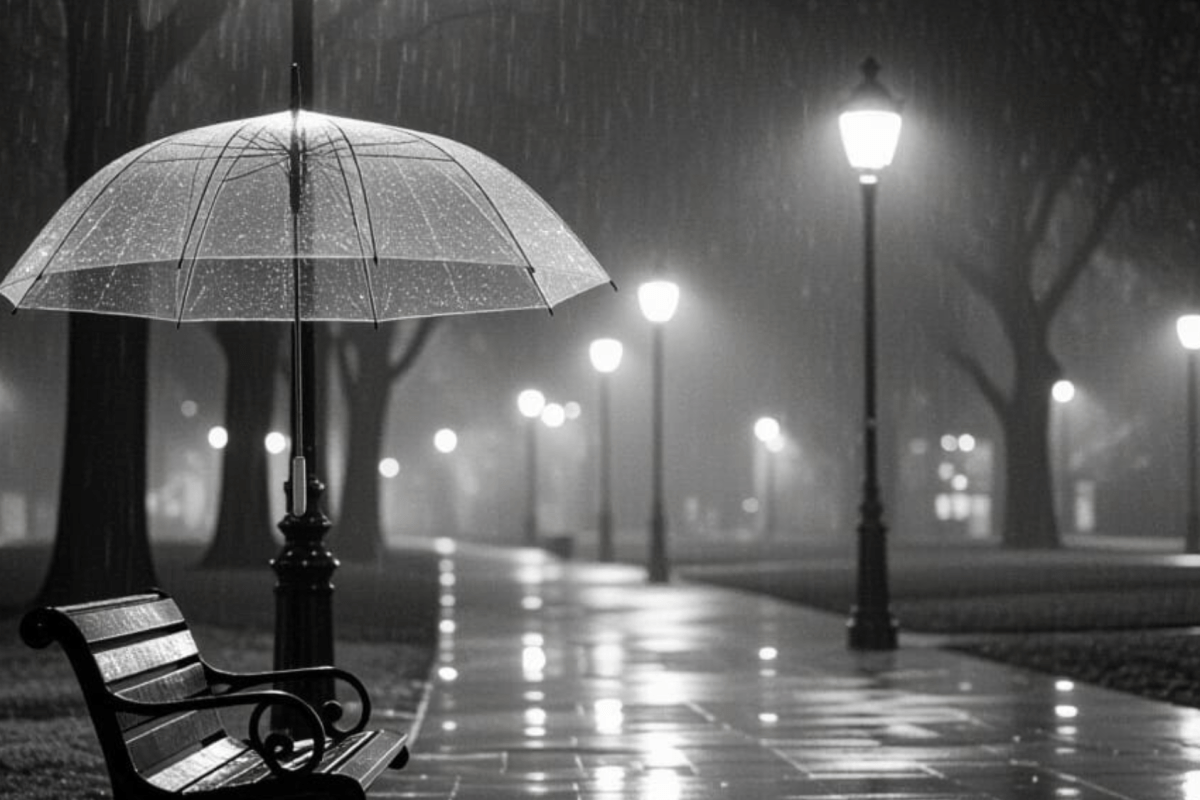
She appeared just past the second lamppost—trench coat clinging like a secret, umbrella in hand, striding through puddles like the laws of physics were optional.

Julian knew trouble when he saw it. It usually wore red lipstick, a miniskirt, and a tight monogrammed sweater—the kind of outfit that said “daddy pays the rent but I hold the lease on chaos.”
Today, though, trouble wore duck boots that quacked with every step and a look that could curl paint off a Buick.

She didn’t look at him. She didn’t have to. Women like that didn’t look; they summoned.

“Lost your umbrella again?” she said, pausing by the bench where Julian had been pretending not to argue with a squirrel.

“It fled the scene. Honestly, I think it’s seeing other people.”

She didn’t laugh. Just smiled—barely—a slow tilt at the corner of her mouth, like a private joke that hadn’t decided whether to trust him yet.

They stood in silence, rain dotting her umbrella like Morse code for bad decisions. The space between them held history—not romance, not quite—but something forged in long nights, bad coffee, and one too many favors exchanged with no names attached.

Then the birds attacked.

Not big ones. Not Hitchcock’s apocalyptic squad. These were small. Spiteful. Moist. They dive-bombed like feathered torpedoes with a vendetta against hats.

Julian flailed. She calmly finished a sip of coffee.

“I told you not to use that conditioner,” she said, ducking as one bird performed a tactical swoop. “Lavender-scented. They think you’re a meadow.”

“Then why are they hitting you, too?”

“I might have rubbed some of it on your collar.”

Julian blinked, now soggy and betrayed. “Why?”

She sipped again, her expression as neutral as Switzerland on a Tuesday. “Science.”

One bird landed triumphantly on the umbrella. Another did an aerial split and flipped him off mid-squawk.

Julian sighed and slumped onto the bench, defeated. She sat beside him, leaving an equal six inches of space and chaos between them.

For a moment, the world fell quiet—just rain tapping the concrete, the occasional rustle of wings, and that unspoken thing that always hung between them.

Maybe it was love once. Maybe just recognition. Like two people who survived the same fire and never spoke of it.

“I curl my hair in the mornings just for this,” she muttered, brushing a wet strand from her face.

Julian didn’t reply. He was too busy wondering if dignity could be taxidermied—or if maybe, just maybe, this ridiculous kind of connection was all the grace some of us got.


Author’s Note:
This piece is a continuation of the Forecast: Regret series—a flash fiction collection built on misadventures, poor choices, and the occasional squirrel assault. I wrote this story using the prompts from SoCS (Stream of Consciousness Saturday) and Esther’s Weekly Writing Prompt, which continue to challenge and inspire me in strange and delightful ways.

As always, I try to have fun writing fiction—because if I’m not enjoying it, I can guarantee Julian isn’t either.

All That Remained

PROSE – FOWC & RDP


The static clung to him like ash—faint, choking, inescapable. He’d stopped keeping track of the days. Time was foremost a suggestion now, something smeared across the ceiling in mildew and regret.

They said he was a man once. Strong. Reliable. The kind that shows up on time and keeps his word. The kind that doesn’t cry at hospital bedsides or stare too long at old photographs. They said that.

But memory plays tricks. Rewrites endings. Paints the villains in softer hues and leaves the heroes out in the cold. His reflection no longer argued. It just blurred at the edges, refusing to confirm or deny what he had become.

The sink dripped. The fan rattled. The voices whispered. Still, he sat there, jaw clenched, knuckles white, a prayer caught somewhere between his teeth and his shame.

He collapsed into the corner of himself—the part that still remembered how to feel.

He heard a child giggle, smelled lavender and lilac.
But from where?

That door had been closed for years, bolted by memory, corroded by silence. Yet tonight, something had stirred.
Not hope.
Just the echo of what it used to sound like.

It’s Not Perfect. It’s Not Finished. But Neither Am I.

A vintage typewriter on a cluttered desk, exploding into birds as books tower around it—chaos and creativity in motion.

A brief confession about messy renovations, too many domains, and building the MKU out of creative rubble.

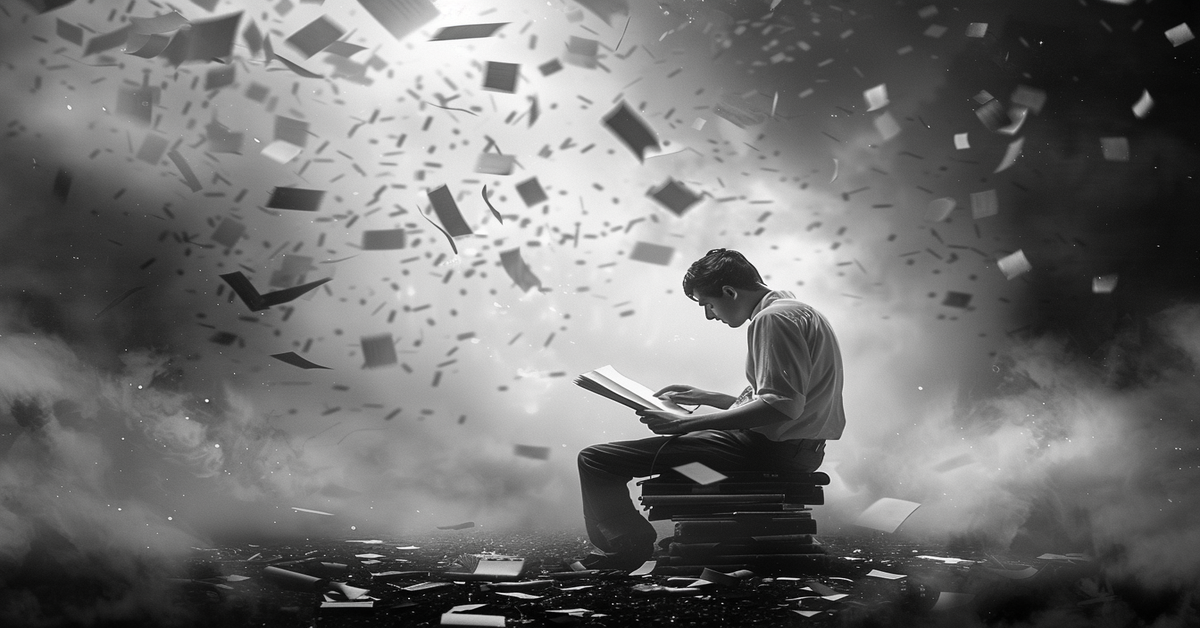
A man sits on a stack of books, reading, while pages swirl around him in a storm of chaos and creativity.

You Ever Try to Clean and Just Make a Bigger Mess?

Yeah, that’s me right now.

I’ve been trying to fix this blog for months. What started as a quick tidy-up turned into something resembling a digital yard sale—only with fewer treasures and way more broken links. I even considered shutting the whole thing down and rebuilding from scratch. But that felt a little extreme, even for me. I have a knack for turning easy tasks into complicated messes. It’s a gift. Or a delusion. Same difference.

So, I got a wild hair—you know the rest—and decided to look at my entire online footprint. It turns out that I was hoarding domains, just like I was collecting vintage Pez dispensers. Just paying for them to sit there, doing absolutely nothing. Honestly, I’d have better luck with a couple of scratch-offs and a can of Peach Nehi.

That’s when I finally did it—I built something called the Mangus Khan Universe (MKU). Yeah, it’s a little on the nose, but the point was to create a space that could properly hold all the creative work I’ve been cramming into Memoirs of Madness.

MKU isn’t finished, but it’s functional. Over the next few weeks, you’ll see things shifting. Posts might vanish, new stuff will appear, and categories will get shuffled. Don’t panic—it’s all part of the plan. Mostly.

I just wanted to give you a heads-up that Memoirs of Madness is undergoing a bit of a makeover. More changes are coming, and I’ll share a full announcement once the MKU is officially live and dangerous.

Stay tuned. Stay weird.

Step into the MKU
It’s not perfect. It’s not finished. But neither am I.

Lessons in Disappearance


for those who know what it’s like to be visible but not believed

Every day is another lesson in invisibility.
Not the kind you choose, not the soft fade of a disappearing act.
This is the kind handed down in glances that slide past you.
In doors that stay closed just a second longer when you’re approaching.
In the space you leave behind when you’re gone, and no one notices the shape of your absence.

You become fluent in the language of indifference.
You learn the weight of unasked questions.
You memorize the way people say “I didn’t see you there” like it’s a kindness,
instead of an indictment.

There is a peculiar violence in being overlooked.
Not bruised. Not broken. Just… reduced.
Down to skin, down to stereotype, down to background noise.
They don’t mean to erase you—
and somehow, that makes it worse.

They’ll say you’re quiet.
You’ll wonder if they’ve ever actually listened.

You wear shame like a second skin.
Not because you earned it,
but because somewhere along the way,
someone handed it to you like inheritance
and you forgot how to put it down.

You stand still in a world built to move around you—
fast, loud, full of curated meaning.
And you begin to question:

Is there something wrong with me, or is there something wrong with this lens that always finds me blurred?

You’ve learned to map your pain in silence.
Each breath is a kind of protest.
Each blink a refusal to disappear entirely.

There are veins beneath your skin that look like lightning—
not because you are struck,
but because you are always just about to burn.

And yet you don’t.
Not fully.

You endure.
Not in glory. Not with applause.
But with defiance.
The quiet kind.
The kind that goes unnoticed until someone says:

“I didn’t realize you were carrying that much.”

And you smile without smiling,
because you know the truth:

You were always carrying that much.
They just never asked to know.

Antidepressant

He wasn’t born to be broken, but he was built that way.


He doesn’t remember how long he’s been digging.
Only that the walls feel closer now.
Not physically—spiritually.
Like the air itself is grieving something it can’t name.
Like the dirt is learning his shape better than he ever did.

He was born into this plastic maze.
Clear walls. Curved tunnels. Endless observation.
They gave him purpose before he even knew what freedom was.
“Work is life,” they whispered.
“Keep moving or you’ll disappear.”

So he moved.
So he disappeared.

Lately, the soil feels too clean.
Too filtered. Too… safe.
He begins to question whether he’s ever touched anything real—
whether any of this was ever soil at all,
or just a stage dressed as survival.

His antennae twitch like doubt.
His thoughts spiral like tunnels without exit signs.
There’s no map. No sky. Just the scrape. scrape. scrape.
and the promise that if he keeps digging, it might all make sense.

“Dig,” they told him. “Dig like your life depends on it.”

But what if life was never the point?
What if it was just obedience with a heartbeat?

He begins to dream—quietly, dangerously—of things he’s never seen:
grass that doesn’t end,
light without glare,
a silence not born of suppression
but of peace.

He wonders if the others feel it too—
that dull, aching sense of being watched by something
that calls itself structure,
but tastes like a slow death.

He screamed once.
Pressed his mandibles to the glass and begged.
For what, he doesn’t know.
Maybe to be named.
Maybe to be more than a metaphor
for how the world devours those who ask too many questions.

But no one answered.
Only the glass pulsed with faint warmth—
a reminder that he is seen, but not heard.

Now he digs not to build, but to resist.
Each handful of soil no longer a task,
but a soft rebellion.
A quiet revolution made of claw, intention, and fatigue.

He doesn’t want to be efficient.
He wants to be free.
Or at least real.
Or at least his.

And if this tunnel leads to nothing—
no sky, no breach, no breaking—

at least it was carved by his own choosing.
At least the hands that made the hole were his.

Because sometimes the cure isn’t a chemical.
Sometimes, it’s permission to feel trapped without calling it a flaw.


🪞 Reflective Prompt

What parts of your routine were handed to you like a cage dressed in ritual?
What would rebellion look like if it were quiet, personal, and yours?


Still digging?

This piece lives inside a much bigger world.
Explore the rest of the Mangus Khan Universe—a stitched-together gallery of confessions, fiction, fractured portraits, and quiet chaos.

👉 Enter the MKU

Do I Look Happy Enough?

A quiet reckoning with the expectations we wear and the joy we fake.


When was the last time you were truly happy?

No—
not the curated kind.
Not the smile you wore for someone else’s comfort.
Not the polite laugh that tasted like performance.
Not the checklist joy: house, job, partner, post, repeat.

I mean the kind of happiness that sneaks up on you in bare feet.
The kind that doesn’t make sense but fills your ribs like breath you forgot you were holding.
The kind that doesn’t ask for an audience.
Doesn’t post itself.
Doesn’t need to be liked to be real.

Most days, we confuse peace with silence, and silence with defeat.

You tell yourself you’re content. That this is what adulthood looks like—responsibility, stability, being “grateful.”
You wear that word like a bandage.
But underneath?
There’s a pulse of something unsaid.
A throb you ignore until it bruises.

You smile at strangers. You meet deadlines. You show up.
And in between the commutes and compromises,
you start to wonder if you buried yourself in the crud of being acceptable.

The barrage is constant—
what you should want, who you should be, how you should smile.

But no one ever asks if you’re still in there.
Not really.
Not the version of you that danced alone in the kitchen at 1 a.m.
Not the you who found joy in dumb little things that didn’t need justification.
Not the version of you that wasn’t tired.

You’re silently screaming.
Every day.
And you do it with perfect posture.

Because to speak it—
to say “I’m not okay”
feels like betrayal.
Like failure.
Like you’re too much and not enough, all at once.

But here’s the quiet truth:

Maybe you haven’t been happy in a long time.
Maybe you don’t even remember how it felt.
But maybe that question—when was the last time you were truly happy?
isn’t meant to shame you.
Maybe it’s a breadcrumb.
A way back.

Not to the person you were before the world smoothed your edges,
but to the one still flickering beneath the noise.

The one who still believes in joy,
even if they haven’t seen it in a while.


🪞Reflective Prompt

Take a moment.
Find a scrap of paper, the back of a receipt, or the notes app on your phone.

When was the last time you felt joy that wasn’t expected of you, sold to you, or shared online?
What did it feel like in your body?
What part of you still remembers?

Late Night Grooves # 161

WHOT Episode 161 – “Best Direction” by Zig Mentality

Hosted by Mangus Khan

[No fade-in. Just impact. The drums kick like defibrillators. Guitars fuzz and slice. The voice? Controlled chaos.]

“WHOT.
Late Night Grooves.

I’m Mangus Khan.

And tonight—
We’re not looking for the right answer.
We’re just calling bullsht on all the wrong ones.*

Zig Mentality – “Best Direction.”

This track is the sound of pressure.

Not the kind that breaks you.

The kind that twists you into someone you barely recognize.

“Don’t know if this is the best direction…”

That line?
That’s not indecision.

That’s survival in progress.

Zig Mentality isn’t asking for guidance.

They’re screaming through the static.

They’re ripping through expectations, projections, corrections, selections.

Everyone wants you to be something.

This track says be something real.

Even if it’s loud.
Even if it’s messy.
Even if it scares people who only know how to follow maps.

The guitars don’t resolve.
The vocals barely hold on.

Because this isn’t a message.

It’s a moment.

And sometimes, that’s enough.

WHOT doesn’t play just to soothe.

We play what it feels like inside.

Tonight, it sounds like Zig Mentality.

Episode 161.
Best Direction.

I’m Mangus Khan—
Still walking.
Still questioning.
Still here.


Unapologetically Unedited


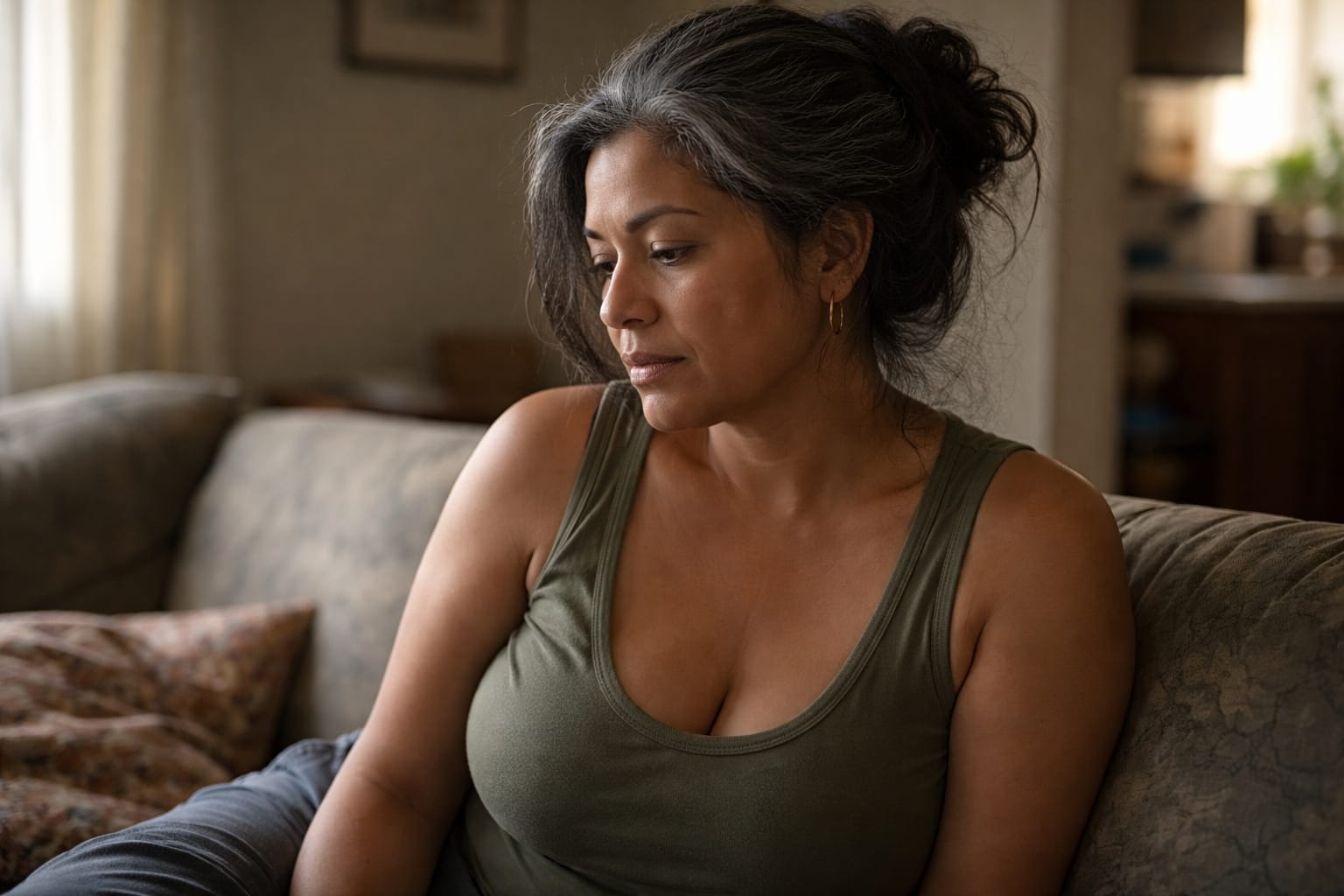
Is it hard to be a beautiful woman? People think you have the world at your feet. They think doors open for you, heads turn for you, and life bends around your presence. But they don’t see the trade. They don’t see the constant calibration—how much of yourself you shave off each day to fit into someone else’s frame. Beauty is not freedom. It’s exposure. A spotlight you didn’t ask for, that you can’t turn off.

You’re seen before you’re heard. Assumed before you’re known. People don’t meet you—they meet the idea of you. Their version. Their fantasy. Their fear. And if you don’t match it? You become a threat. A disappointment. A target. It’s not just tiring—it’s erasure in slow motion.

So you patch yourself together—smile here, soften there, silence the part that wants to speak too loudly. Over time, your identity becomes a kind of repair job. You keep the strongest parts in storage, hidden from view, waiting for a time when it might be safe to bring them out. You begin to wonder: Who am I without all the edits? What’s left when I’m not translating myself for someone else’s comfort?

You learn to play roles just to survive. To be warm but not inviting. Assertive, but not “difficult.” Intelligent, but never intimidating. Every room becomes a stage. Every glance is a calculation. When will it be okay for you to step out from behind their idea of you, letting you be who you are, not who they’ve imagined or prefer? How many masks do you have to wear before one of them finally feels like skin?

The tension doesn’t just live in your body—it rewires it. It clutches your voice before you speak. It lingers in your posture, in your smile that’s a little too careful, in your silence that’s mistaken for grace. They don’t see the moments when you swallow yourself to keep the peace. When you feel the full ache of being looked at but never seen.

Every day, you make choices that feel small but cost you something: how to walk into a room, how to hold your face, when to speak, and when to stay quiet. You tell yourself it’s just for now. Just until it’s safe. Just until they see you for real. But how long can you stay edited before you forget the uncut version?

The woman in the photo is not just posing; she’s done shrinking. Her posture is not elegance—it’s exhaustion turned into boundary. It’s defiance without apology. It’s a question you can’t ignore anymore: What happens when a woman stops choosing what’s expected, and finally chooses herself?

Not your version of her. Not the one that plays nice. Just her. Fully, freely, finally.


Author’s Note
This piece was written for Esther’s Weekly Writing Prompt, with a word prompt from Fandango’s FOWC.
Big thanks to all of you for keeping the creative fire lit week after week, day after day. These prompts aren’t just words—they’re jumping-off points, gut checks, and sometimes lifelines. Appreciate what you do more than you know. Keep ‘em coming.

Late Night #155

WHOT Episode 155 – “hometown” by cleopatrick

Hosted by Mangus Khan

[Distorted guitar punches in without warning. No build-up, no warning—just impact. Then the words spill out—sarcastic, tired, and sharp as a busted bottle.]

“You’re back on Late Night Grooves.
WHOT.

And I’m Mangus Khan.

Episode 155.

Let’s call tonight what it is—a reckoning.

This track right here?
It’s not a love letter.
It’s a middle finger in 4/4 time.

cleopatrick – ‘hometown.’

From their 2021 album BUMMER—an album that’s exactly what it says it is:
Heavy, pissed off, and painfully accurate.

And this song?
This is for anyone who had to shrink themselves to survive where they came from.

“And you never did like my hometown / And I never did like you.”

That’s not petty.
That’s truth.

This song is the sound of leaving behind the people who laughed when you tried.

The ones who called you fake when you evolved.

The ones who kept the town small, because small was all they could handle.

But the genius here?
It’s not just in the anger.

It’s in the specificity.

cleopatrick captures that weird space between rage and heartbreak.

When you’re not just mad at the town—
You’re mad at yourself for ever wanting to be seen by it.

The guitars are thick.
The drums are relentless.
The vocal delivery?
Half confrontation, half confession.

Because leaving a place doesn’t mean you escape it.

The memories come with you.
The shame.
The “maybe they were right” thoughts.

But here’s the thing:

This song doesn’t end with peace.

It ends with clarity.

That sometimes, the bravest thing you can do is walk away from the version of you that made everyone else comfortable.

Episode 155.
cleopatrick.
hometown.

A breakup song for the version of you that settled.

A groove for the moment you stop apologizing for your volume.

This is Late Night Grooves.
WHOT.

And I’m Mangus Khan—
Still breaking free.
Still growing loud.
Still here.”


Late Night Grooves #152

WHOT Episode 152 – “Goat Head” by Brittany Howard
Hosted by Mangus Khan

[A subtle organ hums. Bassline slow as molasses. Then her voice: soft, wounded, precise.]

“You’re listening to Late Night Grooves.
WHOT.

The signal that lives in the margins.

I’m Mangus Khan.

And this is Episode 152.

Tonight, we don’t just listen.

We reckon.

Because some stories don’t fit neatly into a melody.

Some truths come carved in the bone.

Tonight’s track:
Brittany Howard – ‘Goat Head.’

From her solo record Jaime.

And this one?

This one doesn’t care if you’re ready.

It just exists.

Like pain you forgot how to name.

“I was four years old when they threw a goat head in the back of my daddy’s car.”

And just like that—

The myth of a post-racial anything crumbles.

No build-up. No soft landing.

Just trauma—placed right there in the back seat.

Brittany doesn’t sing this with outrage.

She sings it like someone who’s had to live in the after.

Who’s had to grow up with blood on her history and grace in her lungs.

The music?
Bare. Measured.

Because when you’re telling the truth, you don’t need theatrics.

You just need clarity.

And that’s what “Goat Head” is—

A memory so sharp it shaves your soul.

But here’s where it goes even deeper—

The question she asks at the end?

“What is a Black life worth?”

That’s not rhetorical.

That’s personal inventory.

It’s about growing up wondering if the world sees you fully, or only in fragments.

It’s about code-switching as protection, and memory as inheritance.

This is not a song about justice.

This is a song about remembrance.

About being made of two worlds—Black and white—yet accepted by neither without condition.

Jaime, the album, is named for her late sister.

And you feel that ghost here—

Not haunting, but witnessing.

Watching from the corners of every note.

Because this song?

It’s not just an act of defiance.

It’s an act of preservation.

Brittany Howard isn’t asking you to agree.

She’s asking you to listen.

To sit in discomfort long enough to understand the weight she carries quietly.

Episode 152.

Brittany Howard.
Goat Head.

A hymn to identity, fractured and fused.

A groove with no forgiveness—only reflection.

This is Late Night Grooves.
WHOT.

And I’m Mangus Khan—

Still walking with ghosts.

Still naming what they tried to erase.

Still here.”


Surviving the Shipwreck: Truth, Even If It Makes Us Uncomfortable

Who writes history, anyway?

Is it a bunch of old men in a room, swirling sherry like it’s holy water, declaring what mattered and what didn’t with the confidence of people who’ve never been told to clean up after themselves? Do they lean back in leather chairs and decide what’s worth remembering, while the rest of the world cleans the dishes, changes the linens, and quietly disappears?

Because let’s be honest—history isn’t what happened. It’s what survived. It’s the polished version of a chaotic past, curated by those with power, perspective, and the privilege to speak uninterrupted.

But what about the ones who made that version possible?

Why don’t we ever hear about them? The people who provided the comfort, the nourishment, the spark. The woman who changed the sheets so a “great man” could sleep through the night. The friend who uttered a half-thought over coffee that later became a manifesto. The cook who fed the movement. The janitor who unlocked the building where the protest was planned. The lover who reminded someone they were human before they put on the mask of leadership.

History applauds the speech, but forgets the breath it took to say it.

We’ve been sold the idea that history is boldface names and bronze statues. But most of what matters happened in kitchens, back porches, alleyways, and hands calloused from lifting, not pointing.

We know the architects of nations. But never the bricklayers. We memorize the names of authors, but forget the unnamed soul who said something beautiful that stuck. We forget that for every “visionary,” there was someone behind the scenes keeping them afloat. Holding the ladder. Mending the net.

So no—history isn’t just written by the victors. It’s written by survivors. By omission. By spin. And often, by those who had the means to make a record in the first place.

The rest? The ones who lit the fires, bore the burdens, whispered the truths?

They became the silence between chapters. The invisible ink.

But if you look close—really close—you’ll find them. In the margins. In the echoes. In the way a melody lingers long after the singer is gone.

Because history wasn’t built on sherry alone. It was built on sweat, sacrifice, and souls that never asked to be remembered—just not to be erased.

But what happens when they get it wrong?

When, the ones holding the pen decide the truth is inconvenient? When the story is shaved, polished, and repainted, so it gleams just right in the museum light? What happens when history becomes less about remembering and more about marketing? About preserving an image, not a truth?

That’s when history turns into myth. Not the kind with gods and monsters, but the kind where the villains are edited out, and the uncomfortable questions are filed away—lost behind locked drawers labeled “context.” You know, for our own good.

And maybe they don’t mean to lie. Maybe they just optimize. Smooth the edges. Add a little glow to the legacy. After all, who doesn’t want their heroes to look heroic? Their country to feel noble? Their ancestors seem wise?

But shaping the past for the best possible result isn’t harmless. It’s rewriting the foundation while pretending the house still stands the same. It’s how entire generations learn pride without accountability, patriotism without honesty, nostalgia without nuance.

And what’s left behind in that process?

The guilt that never gets named. The reparations never paid. The patterns that repeat because we swore they never happened in the first place. The echo chamber grows louder, but the echoes grow fainter—until all we hear is what we want to hear, and not what needs to be heard.

See, history can be a mirror. Or it can be a mask.

One tells you the truth, whether you like it or not.

The other flatters you, and hopes you don’t look too close.

So maybe the question isn’t just who writes history?
Maybe it’s who dares to revise it, once they know better?

Because if we only protect the polished version, if we only pass down the parts that make us proud, then we’re not honoring the past.

We’re embalming it.

And you can’t build a future on something you’ve buried just to keep the story pretty.

But what about when they don’t just get it wrong?
What about when they try to remove history altogether?

Really? That’s the move?

As if tearing down a statue makes the blood it commemorates magically dry up and blow away. As if banning a book unpublishes the pain it contains. As if not teaching something means it never happened.

We’ve seen it before: whole eras scrubbed clean, classrooms sterilized, uncomfortable truths repackaged into “heritage,” or ignored entirely. Entire peoples flattened into footnotes, if mentioned at all. Because someone decided it was better to forget than to face it. Better to be comfortable than be honest.

But here’s the truth, they’re afraid of:
You can’t remove history.

You can burn the documents. You can whitewash the walls. You can call it “divisive,” “unpatriotic,” or “too upsetting for children.”
But history isn’t gone—it just goes underground into stories told at kitchen tables. Into songs, poems, and scars passed down like heirlooms. Into eyes that still remember, even if the curriculum doesn’t.

The attempt to erase history is always a confession. A silent, trembling admission that the truth still hurts. That it never really stopped. It’s not about healing—it’s about hiding.

And hiding doesn’t protect anyone. It just keeps the cycle clean enough to repeat.

So no—you don’t get to skip the hard chapters because they make your heroes look human, or your institutions look cracked. That’s not erasing history. That’s erasing accountability.

And let me tell you—if your story can’t survive the truth, maybe it wasn’t a story worth keeping in the first place.

Maria Popova got it right:
History isn’t what happened. It’s what survives the shipwreck of judgment and chance.

So maybe it’s time we stop polishing the deck chairs and admit we helped steer the damn ship.

Maybe it’s time we stood by the dusty words in old books—the ones that dared to say things like honor, integrity, and truth. Not just when it’s convenient. But when it’s hard. When it means admitting that the past wasn’t all parades and progress. That some of it—hell, a lot of it—would’ve earned us a solid whoopin’ from our mothers, wooden spoon in hand.

So, excuse me while I go through a stack of biographies on Lincoln.

Because if we’re going to keep telling the story—
Let’s at least try to get it right.


Author’s Note
Forgive the rant—but not the passion. That part, I won’t apologize for. The ranting? Yeah… I might’ve gotten a little carried away.

This piece was written for Reena’s Xploration Challenge #386. I try to jump in when I can remember to pull my head out of a book long enough to notice.

Wait—what page was I on?

Black Card Revoked (And I’m Okay With That)

Am I a Snob?

I wish I could say no. That I’m above all that—ego, elitism, the subtle flexes wrapped in “taste” or “refinement.” I’ve tried, seriously. I’ve had the talks, done the therapy. I even cracked open the workbooks—are they still called that? Maybe it was a podcast. Or one of those journaling things we do when someone who shouldn’t matter (and whose name I can’t even remember) says something that sticks. It latches on like gum to your shoe, and suddenly you’re spiraling.

You know the kind of advice—like taking relationship tips from a guy who’s never had a girlfriend. Come to think of it, I’ve never even seen him talk to a woman.

Food Snob? Maybe. But It’s Personal.

“Nothing stays the same”—that’s the mantra we mumble when something doesn’t taste like it used to. The moment hits, and the only explanation that feels right is, “The bastards changed the formula.” Maybe they did. That’s possible.

But what’s also possible—and we hate admitting it—is that the stuff always tasted like garbage. We just didn’t know better. No one had the heart to tell us, because we loved it. And love, especially the nostalgic kind, can turn trash into treasure.

Still, when that old flavor hits different, I dig in. I refuse to accept that it’s me who changed. No—they changed it. And now it’s a matter of principle. “The bastards changed the formula” isn’t just a phrase. It’s my truth. I’m sticking to it.

Culture Snob? Absolutely.

Let’s be real—taste isn’t just personal. It’s cultural.

As a Black man in America, I grew up hearing things you couldn’t say out loud today. Not in public, anyway. Stuff like, “White folks don’t make potato salad like Black folks.” And everyone around the table would nod, mouths full of Granny Smith’s version, hoping for seconds before it disappeared. Because we all knew the danger of ending up with Ms. Johnson’s version. She never quite got it right. But her rhubarb pie? That had fifty things going on, and every one of them hit.

It’s remarkable how the world now dictates what’s considered refined. What’s divine? Overhyped restaurants serve up culture on a plate and call it status. Sure, sometimes it’s good. But nothing compares to the food from our cookouts, our picnics, our church socials. That food had soul. That food knew where it came from.

Now we pay $25 for a steak that comes out wrong and has to be sent back, just to taste decent—something we could’ve cooked at home better and cheaper, with seasoning that actually makes sense. But we do it anyway, because it makes us feel like we belong to something. Like we’re part of a club. Even if that club leaves us hungry and a little hollow.

That right there? That’s the bullshit I’m done with.

Ideology Snob? Let’s Get Real.

Let’s talk ideology. The code we live by. The beliefs hardwired into us through culture—whether we chose them or not.

They show up in how we talk, how we dress, what we read, the music we blast, and the stuff we secretly love but feel judged for.

And here comes the contradictions.

I’ve been told, “You act white.” Like that’s a crime. “I’m pulling your Black card.” “You’re an Oreo—Black on the outside, white on the inside.”

I used to carry a bag of Oreos with me. I liked them. And the same people who said that crap? They’d always take one when I offered. Hypocrites, the lot of them.

Then there are the stereotypes. Once, it was sweltering out, and some coworkers brought watermelons to beat the heat. One of my White friends waved and said, “Hey, we’ve got some watermelon!”
I shouted back, “I’m good, thanks.”

He came over to my truck looking confused.
“Hey man,” he said, “we’ve got some watermelon.”
“I don’t eat that shit,” I said flat.
He raised an eyebrow. “Next thing you’re gonna tell me is you don’t eat fried chicken.”
I looked at him and said, “I prefer mine baked.”

Truth? I love fried chicken. But my wife had me on baked for my blood pressure. That moment wasn’t about the food. It was about reclaiming space. Drawing a line. Saying, you don’t get to define me.

People try to strip your identity when it doesn’t fit their version of what Black is “supposed” to be. But if you stand still too long, they’ll say you’ve stopped growing. You can’t win. So you make your own rules. You claim the parts of yourself they don’t understand, and keep walking.

Music Snob? Nah. Just a Metalhead.

I’m a metalhead. But really, I love music across genres. Blues, jazz, hip hop, classical, metal, whatever hits. If it moves me, I’m in.

But I’ve caught flak for it. Side-eyes at shows. People coming up to me, tilted heads, awkward grins: “Are you enjoying yourself?” Like, I crashed the wrong concert. Like metal has a sticker on it that reads “For White Folks Only.”

Really? That’s your question?

As if I need permission to feel that same raw, gut-deep power you feel. As if I have to prove I belong. I didn’t know loud music came with gatekeeping.

Let’s be clear: music doesn’t segregate. People do. And the real pandemic? It’s not my playlist. It’s the weirdo energy and backhanded doubt people carry around like a badge.

The Labels Don’t Stick.

Stereotypes. Prejudices. Respectability rules dressed up in soft language and cheap slogans. You can’t run from them. We’re told to be ourselves, so long as it fits the mold. Be different, but not too different. Be authentic, but stay in bounds.

Nah. I’m done with that.

So I wear the names they throw at me. I carry them, not as scars, but as proof. Proof that people will always try to box you in. But boxes are for storage, not for living. And if they actually knew me—or tried—they’d realize we’d probably get along just fine.

I love exploring culture. I love discovering new food, ideas, and perspectives. I don’t just tolerate differences. I chase it. That doesn’t make me less Black. It makes me human.

And if I’m anything?

I’m weathered. But I’m true.


Author’s Note:
This rant was written for Sadje’s Sunday Poser, which I genuinely enjoy. It gives me space to think about real things—stuff that hits closer to home than all those philosophies written by dead people.

No, I don’t believe in ghosts.

Well… maybe?

Okay, that came out of nowhere.

Late Night Grooves #145

WHOT Episode 145 – “Time to Get It Together” by Marvin Gaye
Hosted by Mangus Khan

[Slow fade. A drum shuffle moves like heavy footsteps. Bass hums low. A sigh. Then Mangus Khan begins.]

“You’re listening to Late Night Grooves.

WHOT—broadcasting from the long road between what you feel and what you admit.

I’m Mangus Khan.

And tonight’s groove…

It don’t smile.

It don’t flirt.

It doesn’t even wait for you to be ready.

Marvin Gaye – “Time to Get It Together.”
From Here, My Dear.
1978.

An album most folks don’t talk about.

And when they do?
They get it wrong.

This wasn’t Marvin making music.

This was Marvin bleeding.

See, he wasn’t supposed to create here.

He was supposed to pay.

A court ruling told him to give the profits from his next album to his ex-wife.

So Marvin did what no one expected—he gave her the whole story.

Not just hers.
His.

And “Time to Get It Together”?

That’s not the beginning of the album.

That’s the moment where Marvin starts to talk to himself.

“I’ve got to clean up the mess I made / Before I can start living again…”

That’s not a lyric.

That’s repentance in real time.

The groove is classic Marvin: smooth, sensual, polished on the surface.

But under it?

Panic.
Regret.
Exhaustion.

He’s not telling a story.
He’s trying to wake himself up.

And the thing is—
There’s no resolution here.
No redemption arc.

Just a man trying to pull the wheel before he crashes again.

The pain in this track isn’t in the past.

It’s happening now.

This is a middle-of-the-night, mirror-staring kind of song.

When you realize no one’s coming to save you… and the only voice left in the room is your own.

And sometimes?
That’s the scariest voice of all.

So yeah—this ain’t “Let’s Get It On.”

This is: Let’s try not to fall apart again tomorrow.

And you know what?
That’s sacred.

Because growth doesn’t always come with horns and halos.

Sometimes it sounds like this:

Low. Broken. Honest.

Episode 145.

Marvin Gaye.
“Time to Get It Together.”

Not a hit.
Not a single.

Just a man finally telling the truth.

This is Late Night Grooves.

WHOT.

And I’m Mangus Khan.

Still turning pain into poetry.
Still playing what the daylight can’t handle.”


The Labyrinth of Yellow Time

PROSE – CAN YOU TELL A STORY


Beneath the yellow sky, a cruel labyrinth spun like a wheel of fate. She walked alone, sand soaking her boots, the hourglass ahead pulsing with time’s breath. A crab scuttled by, indifferent. Each turn twisted deeper. She wasn’t lost—just forgotten. And in that golden light, even memory began to bleed out. Tick. Soak. Vanish.


I wrote this for Esther Clinton’s Can You Tell a Story in 55 Words?—which sounds cute until you try it. Me? I like words. Lots of them. Cutting it down to 55 felt like trying to stuff a novel into a fortune cookie. But hey, challenge accepted. Tiny story, big vibes.

How I Became Secretary of Seeds

PROSE – FOWC & RDP

The bluebird glared at me from its perch on the fence post like it had been waiting all day just to start something. It was a deep, suspicious blue, like the sky on a day when the weather can’t make up its mind. The bird’s feathers shimmered in the sun, and its eyes were full of judgment.

“You’re staring,” it said.

I blinked. I hadn’t expected this. Birds usually don’t sass me.

“Sorry,” I said. “It’s just… you remind me of when I was young. I used to think birds had secret meetings and built tiny cities out in the fields.”

The bluebird fluffed up. “Yeah, well, we do. You think this is just a fence post? This is the Capitol building.”

I squinted at the worn, splintery wood and the sagging barbed wire. “Seems a little… low budget for a capital.”

“Budget cuts,” the bird said flatly. “Also, you’re standing on the public square. Watch the granola crumbs.”

I shifted awkwardly. Nostalgia hit me like a soap bubble — light, slightly annoying, and somehow sticky. I remembered chasing birds in the backyard, shouting important speeches to them about imaginary kingdoms. I thought they listened. Turns out, they just had bad exit strategies.

“So what’s the bird government up to these days?” I asked, genuinely curious now.

The bluebird tapped its beak thoughtfully. “Mostly snack acquisition. Some squabbling over real estate. And we’re still figuring out how to unionize against cats.”

It flapped its wings once, a grand, slow-motion move like it had just delivered a very important decree. “Anyway, I gotta fly. Press conference in a cedar tree at noon. But before I go—” it paused dramatically, “you’re appointed Secretary of Seeds.”

I blinked again. “Wait, what? I didn’t even apply.”

“Exactly why you’re qualified,” the bird said, very seriously. “No one who wants the job should have it. Now go forth. Scatter responsibly.”

And just like that, it took off, leaving me alone with my nostalgia, a few leftover granola crumbs, and a brand-new title I hadn’t asked for.

I brushed my shirt off with as much dignity as I could muster and gave a solemn nod to the fence post capital. It’s not every day you get conscripted into bird government. Diplomacy with birds was a tricky business, but I like to think I made progress.


The Watcher at the World’s End

PROSE – 3TC

“All things end, but not all things die.”

In elder days, ere kings were crowned and seas were given name, there lay at the uttermost edge of the world a garden unseen by mortal eye. No chart could find it; no path did lead to it. For it was hidden behind a hedge so wild, it did snarl with the very sinews of time, its roots gorged upon the dust of ages forgotten.

This garden was no verdant haven. Nay, it did blaze with a terrible, floral fury — a sea of poppies red as the blood of stars, each bloom fed upon the sighs of worlds long perished. And amid that fiery bloom stood a lonely bench, smooth-worn by the passing of countless aeons. Upon that bench sat a woman.

Her true name was lost, spoken by none, for fear or reverence, who could say. They called her the Watcher, the Lady Beneath the bunting of Stars, a soul unclaimed by death or life. Her hair fell like rivers of midnight; her raiment shimmered with the ghost-light of a thousand vanished moons. Born she was when first breath quickened flame, and there would she remain until the last whisper stilled the last ember.

Above her, the moon waxed monstrous and red, no gentle beacon but a colossus, strained fiercely against the dark. Tales of old proclaimed: when the moon should bleed full and low, when its furnace breath did wilt the very blossoms, then would the Watcher stir, and with her rising, the world would fold in upon itself, spent and hallowed.

The bunting of stars frayed in the heavens. The hedge withered; poppies fell like the tears of a dying host. And yet still she tarried.

Some said she wove the fate of all things in her stillness — that kingdoms did crumble at the closing of her hand, that battles were lost and won by the flickering of her gaze, that lovers were fated or sundered by the turning of her head.

But upon the last night, the Night of the Final Bloom, she moved not.

The moon, vast and bleeding, filled the firmament; the hedge burned with silent flame.

At length, she stood. The earth sighed low, not in fear, but in weary release. She stepped forward into the floral pyre, her raiment whispering secret oaths to the ashes. And with each step, the stars winked out — one by one — strung like dying bunting across the velvet of the void.

Behind her, the world did fold, not with clamor or woe, but with the solemn grace of an ancient song ended.

Whither she went, none can say. Perchance she walked into a realm yet unborn; perchance she became the hedge, the poppies, the furious moon itself — a silent covenant that every ending be but the herald of another beginning.


Forged Within the Ether

PROSE – FOWC & RDP


Before gods bore names and before stars had patterns, she was promised to the beast.

She was not born—she was forged—beneath an aurora that tore the heavens open, a raw seam of color bleeding across the void. The elders spoke of it in fearful whispers: the girl born beneath a wound in the sky must one day walk alone into the dark and not return.

And so she did.

The tiger awaited her at the threshold where the world ends — not as a beast, but as a remnant of a forgotten order. His fur shimmered with the dust of collapsed stars, his stripes like scars left by ancient battles. He was more than the creature, less than a god. He was a memory of what the cosmos used to be before time taught it to decay.

She should have been afraid.

Instead, she felt something deeper: the pull of recognition. The silent knowledge that she, too, was a relic — born out of step with the age that claimed her. She had carried it all her life, that ache that no mortal hand could soothe.

When their foreheads touched, she did not kneel. She did not beg. She listened.

In his steady breath she heard the slow exhale of dying stars. In his pulse, she felt the ancient patience of mountains that crumble and are reborn as sand. He spoke no words, but she understood: to be mine is not to be possessed, but to be remembered.

Her hands, steady now, sank into the thick, impossible warmth of his fur. She thought of how the world would forget her, how her village would carry on, how even the memory of her name would dissolve in the slow acid of time. But here — here she was seen. Known.

And if oblivion was the price, she would pay it gladly.

Above them, the etherlight burned brighter, fierce and beautiful, a scar that would never heal.

When she vanished into the folds of the night, no one marked her passing.

But somewhere beyond the reach of history, she still walks beside the last Skyborn, two relics out of time — bound not by chains, but by the quiet, immutable truth that even in a universe of endless forgetting, some things — some bonds — remain.

Common Sense: Missing. Presumed Ghosting.

RANDOM THOUGHTS – SUNDAY POSER #236

Do most people possess common sense? Technically, yes — in the same way most people technically have a brain. It’s there, but how often it’s used is another conversation. Do we have enough time for that conversation? Absolutely. Will it change anything? Highly doubtful.

See, Voltaire wasn’t just tossing out a witty one-liner when he said, “Common sense is not so common.” He was diagnosing a condition that, centuries later, still plagues society like an expired meme.

Common sense, by definition, should be the basic ability to make sound judgments. Simple, right? But here’s the catch: what counts as “sound judgment” depends on where you grew up, what you’ve lived through, and whether you think TikTok life hacks are a credible source of advice.

And let’s not kid ourselves — emotions are the silent saboteurs. Stress, pride, laziness — they hijack reason faster than you can say “bad idea.” It’s not that people can’t be rational; it’s that they often choose not to be. Rationality takes effort. Effort is wildly overrated these days.

Plus, humans come preloaded with some lovely mental software bugs. Take overconfidence bias — the tendency to think we’re way smarter and more capable than we really are. It’s why your coworker with a GED believes he’s a financial genius after one good week in the stock market. Or why Karen from Facebook suddenly feels qualified to rewrite the CDC guidelines after reading one half-baked blog post. Overconfidence blinds people to their own poor judgment, rendering common sense optional, such as using a turn signal.

Then there’s normalcy bias — our charming ability to assume that because things have been fine, they will be fine. It’s the psychological equivalent of whistling past the graveyard. People often ignore flashing warning signs — both figurative and literal — because facing reality would require them to take uncomfortable action. Why evacuate when you can assume the hurricane will magically change course? Why stop texting while driving when you’ve never crashed before? Common sense doesn’t stand a chance against that kind of wishful thinking.

Even Oliver Wendell Holmes Jr., one of the sharpest legal minds in American history, saw through the myth of pure rationality. Holmes didn’t believe the law was built on logic — he famously wrote, “The life of the law has not been logic; it has been experience.” And when courts invoke the “reasonable man” to judge behavior, they’re really invoking a legal unicorn — an imaginary figure of perfect average judgment. Spoiler: that person does not exist.

Reality? The reasonable man would be rear-ended by someone arguing with their GPS, and then sued for “stopping too suddenly.”

So no, common sense isn’t common. It’s a delicate, context-riddled figment of collective imagination, constantly trampled by human bias and stubbornness. Expecting it from everyone is like expecting a glitch-free Zoom call: a beautiful dream, consistently crushed by reality.

Common sense isn’t dead — it’s just ghosting us. I feel disrespected.

Still Not Grown: Concerts, Consequences, and MiMi’s Side Eye

FANDANGO’S FLASHBACK FRIDAY

So, here we are. It’s MiMi’s birthday — or as she used to call it, her day — and what did I do to honor her? I went to not one, but two concerts back-to-back like I was still 22 and invincible. Now my body’s staging a full-blown rebellion, and honestly? I deserve it.

I can already hear MiMi’s voice, clear as day: “Hmm…running around here thinking you’re grown. You better sit your butt down somewhere.”

She wouldn’t even be mad — just deeply, soulfully amused. That was her way. She didn’t come at you all sweet and gentle; she came at you with common sense wrapped in sarcasm and a side-eye that could stop a grown man mid-sentence.

Thing is, MiMi knew a few things about life — mainly that it would humble you if you weren’t smart enough to humble yourself first. She was tough, she was wise, and she didn’t hand out sympathy just because you made dumb decisions. Nope. She handed you a wet rag, told you to ice that injury, and advised you to sit down and think about your life choices.

And you know what? She was right. She’s still right. Every time my knees pop or my back protests, I can feel her judgment radiating from the great beyond like, “See? Didn’t I tell you?”

But MiMi also believed in living, not just scraping by, but actually living. Laughing hard, dancing when you feel like it (even if your body says otherwise), and gathering memories worth the limp you’ll have tomorrow.

So yeah, I’m hurting today. But I’m also smiling. Because honoring MiMi isn’t about playing it safe — it’s about doing the things that fill you up, even if you have to pay for it later with ibuprofen and regret.

Happy birthday, MiMi. Thanks for the tough love, the side-eye, and the voice in my head telling me to sit my grown self down — right after I live a little.


The Strength in Fracture

PROSE – FOWC & RDP

We find strength when we crack, not despite it, but because of it.


There’s something deeply human about breaking.

Not the kind of collapse that’s loud and chaotic—but the quiet kind. The kind that sneaks in slowly, pressing against your foundation until one day, without warning, you feel it: the shift, the splinter, the give. And then the silence that follows. That’s the feeling these images evoke. A visceral, wordless Yikes that lingers in the gut.

You don’t see the break coming. But when it arrives, it’s undeniable.


In the first image, we see a heart—not soft, not red, but forged from slabs of cold, cracked stone. Split down the center, it doesn’t bleed. It doesn’t scream. It simply opens, revealing a light that neither heals nor blinds. This is not a symbol of destruction. It’s a portrait of vulnerability. Of strength that dared to yield. And that’s the paradox: what we build to protect us can also be the very thing that prevents us from feeling, from growing, from becoming.

There have been times I cracked. Times when all I could do was sift through the rubble and pretend I was okay. On the outside, I held. On the inside, it was layers of damage—quiet, hidden, untreated. It wasn’t dramatic. It was ordinary, and that’s what made it dangerous.

And just when you think it can’t go deeper, it does.


The second image strikes harder. A head—presumably human—layered with thick, dry slices of rock, features obliterated by the burden of their own defenses. You don’t see eyes, mouth, or even expression. You see the consequence of endurance.

We do this, don’t we? We pile on the layers: expectations, roles, trauma, silence. One by one, they smother the self underneath until we become unrecognizable, even to ourselves. And when someone asks us how we’re doing, the reaction is automatic: “I’m fine.” But the truth is buried somewhere deep, wedged between layers too heavy to lift alone.

But what if the face we hide becomes the face we lose?


The final image is a tunnel of shattered stone tiles, a fractured pathway bathed in harsh, white light. It’s hard not to see this as a metaphor for transformation. The path isn’t smooth. It’s jagged. Uneven. And yet it leads forward.

That light? It’s not salvation. It’s exposure. Clarity. Maybe even a challenge. The only way through is through. You walk over the wreckage of everything you thought would last, everything you thought you were, and you move anyway.

These images aren’t just art. They’re mirrors. They ask you to look closer—not at the cracks in the stone, but at the fractures within yourself. The places you’ve gone numb. The truths you’ve buried. The parts of you are still waiting to be unearthed.

So yes, Yikes might be your first instinct. But maybe that discomfort is the doorway to something deeper. Maybe the real reaction isn’t fear, but awakening. What if breaking is not the end of the structure, but the beginning of something raw, real, and finally alive?

What have you layered over instead of facing?
What parts of you are still buried beneath the rubble?
And if you followed the cracks, where would they lead?

One Liner Wednesday – 05212025

ONE LINER WEDNESDAY & FOWC

“Think of it this way: cleavage is the downfall of man—and honestly, no one’s complaining.”

Too Bright to Touch

PROSE – FOWC & RDP


She moved like a memory caught in motion—half real, half reflection.
Blue light wrapped her like prophecy, like warning.
Everything about her shimmered.
Not from joy, but from exhaustion lacquered into beauty.

There was a cost to being seen this way.

Every inch of her radiated curated power—eyes rimmed in defiance, lips painted in precision.
She looked flawless. Untouchable.
But nothing about her was effortless.
She was sculpted in silence, shaped by scrutiny, smoothed by survival.

The world adored the Gloss.

They called it strength.
They mistook stillness for peace.
They praised the image and ignored the ache.

Because Gloss blinds.

And beneath it, something primal waited—untamed, uninvited, and fully hers.

Fur.

Not for decoration—for defense.
It was everything she’d learned to hide: the mess, the wildness, the depth.
The part of her that could not be branded, couldn’t be edited.

She’d buried it to belong.
But it never stopped breathing.

Now it whispered again.

I want to love.
I want to find peace.
I want to find the real.

But in a world that feeds off illusion…

They tell her lies, in a delicious way.
Wrapped in compliments.
Scented with approval.
Only palatable if she never breaks character.

She tried to believe.
Tried to play along.
But the silence inside her was louder than any applause.

Though she is surrounded, she feels alone.

People held the projection.
No one held her.

Who is the person peering from the cage?
She doesn’t want to be here, but there she is upon the stage.

And one day, without ceremony, she stopped pretending.

She stripped away everything, stood as she truly was.
No gloss.
No pose.
No apology.

And in the rawness of that moment—

To dream of the moment is not insane.

Not foolish.
Not naïve.
Not a weakness.

It’s a kind of rebellion—
To believe in softness after survival.
To imagine stillness after the storm.

Perhaps, she will learn the answer—just not today.

Today is enough.

Because in the stillness…

She not afraid.
She not afraid.
She began to breathe.
It almost easy.

No spotlight.
No mask.
Just breath.
Just truth.
Just her.

Too Strong for You

PROSE – FOWC & RDP


She wore the veil not to disappear, but to survive.

It wasn’t for tradition, or rebellion. It wasn’t a performance. It was protection.
It was her way of saying: I decide what you get to take from me.

They never handed her chains. They handed her mirrors. Bent ones.
Peer pressure didn’t demand. It seduced. Do what we do. Be what we expect. Not because we said so—but because you’ll be alone if you don’t.

Then secular pressure followed, wrapped in freedom’s clothing.
Be who you are—as long as it’s curated, as long as it looks good, as long as it doesn’t disturb.
Express, but don’t confront. Create, but don’t challenge.
Believe in nothing but your brand.

And for a while, she drifted. Trying to belong. Trying to disappear inside approval.

But inside the silence, something broke open.

“Weak as I am…”

She said it like an admission. But it was the beginning of truth.

Weak—not because she failed, but because she felt.
Because she hadn’t let the world harden her into something hollow.
Because even in survival, she still longed for something more than existing.

Because she can’t change the world, but she control how it molds her.
And she refused to be shaped by fear. She chose to be shaped by memory. By presence.
By scars she didn’t hide.

Stay alive. Keep on fighting.

Some days, she did.
Some days, she didn’t.

Like a fugitive on the run—from becoming unrecognizable to herself.
Carrying the weight of all she’s done—and all that’s been done to her.
She was born from regret, yes. But that regret made her conscious. Aware. Awake.

And still, the questions haunt her:

What is she fighting for?
What is she running from?

The answers shift, day to day.

Sometimes she fights for the quiet.
For the small version of herself she abandoned to survive.
For the right to not have to explain.
For the chance to feel something other than fear.

And yes—there are moments. Moments where escape feels like mercy.

What if she wanted to run? Leave it all.
What if she crumbled, and couldn’t fight anymore?

These thoughts don’t scare her anymore.
They keep her honest.
They remind her that strength isn’t the absence of breaking—
it’s the choice to return to yourself after.

Because at the end of all the noise, all the pretending, all the shrinking and reaching and rebuilding—

She is left with one quiet, unshakable truth:

This is who I really am.

No polish. No filter.
Veiled, but not invisible.
Wounded, but not erased.
Tired, but still reaching.

So when the world looks her way, squinting through its own discomfort, trying to place her in a category, or strip her down to something simpler, something safer—

She doesn’t flinch.

She lifts her gaze and speaks with a voice that carries every weight she never dropped:

“With this tainted soul, in this wicked world…
Am I too strong for you?”

And if the answer is yes—so be it.

She never asked for permission.
She only asked to be real.

Fandango’s Flashback Friday – 05232025

PROSE – FFFC

Fandango asked us to share a flashback. Two years ago, I was thinking hard about mental health. I was wrestling with how to speak openly about something that affects more people than we’re often willing to admit. The stigma is real; unfortunately, that silence—that collective reluctance to talk—is part of the problem.

But I’ve also learned that standing on a soapbox hollering about PTSD or anxiety doesn’t always help much either. Yes, we need awareness. We need voices and visibility for what’s become a growing crisis. But awareness without connection can fall flat. Sometimes, the most powerful thing we can do isn’t a speech or a post—it’s simply being present.

Being the friend who checks in. The sibling who listens without trying to fix. The stranger who offers compassion without judgment. That’s how we start to chip away at the shame. That’s how we show each other we’re not alone. And sometimes, that quiet presence speaks louder than any headline.


Detour Ahead: A Quick Update on My Ongoing Series

A vintage typewriter on a cluttered desk, exploding into birds as books tower around it—chaos and creativity in motion.

PUBLIC SERVICE ANNOUNCEMENT

Hey friends and faithful readers,

You’ve probably noticed things have gotten a little… quiet around here in some of the ongoing series. That’s not because I’ve abandoned them or run off to start an Emu farm in Montana (though, let’s be honest, tempting). Truth is: somewhere between drafts, outlines, edits, and late-night inspiration spirals, I lost my place.

Literally.

I know—how does one misplace an entire narrative arc? The same way you lose your keys while holding them. It happens. Especially when you’re juggling multiple storylines, characters with baggage heavier than a carry-on, and about seventeen open Google Docs.

So, here’s the deal: I’m taking a short pause to get everything back in order. Consider it a creative recalibration. A chance to regroup, sort through the chaos, and return each series to the standard you—and I—expect.

What to Expect

  • Each story will be wrapped up with care and intention.
  • I’ll revisit each project over the next few days to ensure nothing’s rushed or forgotten.
  • Regular posts will resume once I can see the roadmap again (and remember where I parked the plot).

If you’ve been following along, thank you. Your patience, curiosity, and encouragement mean everything. These stories are for you, and I want to ensure they’re done right.

More soon. Stay weird and wonderful.

Mangus

Emotion in Disguise: What Modernist Poetry Really Feels

ESSAY – JAVA & VERSE

How Teaching, Trauma, and Innovation Keep Modernism Alive Today

When I lectured on poetry, I always felt that the material used wasn’t keeping pace with the times. Poetry has evolved—radically, beautifully—but the way we teach it? Not so much.

The curriculum often clings to rigid categories, ignoring the electric shift in voice, form, and identity that defines our current generation of poets. Modernism, in particular, gets framed as cold and impenetrable, when in truth, it’s full of feeling—just coded, fragmented, and refracted through the chaos of its age. This essay is my attempt to reframe that lens, to show that even when modernist poets claimed to escape emotion, they were actually inventing new ways to express it.

Modernism in Poetry: Emotion in Disguise

Once upon a time, poetry was in love with itself. It rhymed, it sighed, it danced through rose gardens under the moonlight.

Then came Modernism, and poetry had a breakdown. Or maybe a breakthrough. Either way, it stopped pretending everything made sense.

Modernist poetry emerged in the late 19th and early 20th centuries as a fiery rejection of Victorian sentimentality and Romantic melodrama. The old poetic order collapsed under the weight of war, industrial chaos, and deep existential dread. Modernist poets didn’t just shift gears—they set fire to the vehicle and walked away from the wreckage.

World War I turned landscapes into graveyards and ideals into ruins. Suddenly, poetry couldn’t afford to be polite. The genteel, pastoral verses of the past felt dishonest in a world haunted by gas masks, shellshock, and trench mud. Poets had to find a new language for a new kind of grief—and modernism answered the call.

Their rallying cry? Make it new. But that didn’t mean shinier or simpler. It meant fragmented, disjointed, allusive, ambiguous, and unapologetically difficult. It meant challenging readers to confront reality as it was: broken, unstable, and brutally honest.

Emotion in the Age of Irony

T.S. Eliot, one of modernism’s high priests, famously argued for poetic “impersonality”—an escape from emotion rather than an outpouring of it. In essays like “Tradition and the Individual Talent,” he promoted a poetry that transformed feelings into universal truths through rigorous craft.

But let’s be honest: Eliot’s work is emotionally loaded. The Waste Land practically sweats anxiety, loss, and spiritual exhaustion. It’s just wearing a very intellectual trench coat. Consider the lines:

“I will show you fear in a handful of dust.”

That’s not emotionless—that’s terror, disillusionment, and existential dread, crystallized in a single line.

Modernist poets didn’t stop feeling. They just stopped making it obvious.

Emotion didn’t leave the building; it ducked behind fragmented syntax, layered allusions, and shifting perspectives. If Romantic poets sobbed openly, Modernists cried in code. Virginia Woolf said it best: “On or about December 1910, human character changed.” The form had to follow.

The Poet’s New Job Description

So, is the poet still supposed to express their feelings?

Yes—but not necessarily in the way previous generations understood it. The modernist poet became less of a lyrical confessor and more of a curator of chaos, a mapmaker of mental and social disintegration.

They still responded to the world—they just didn’t trust language to carry raw emotion without distortion. The job wasn’t to simply say, “I feel,” but to build structures that evoke feeling in the reader through complexity.

Take Ezra Pound’s imagism, for example. The emotions are there, but compressed into precise images—a few words with the density of granite. In “In a Station of the Metro,” he writes:

“The apparition of these faces in the crowd; / Petals on a wet, black bough.”

In just 14 words, he delivers a fleeting, haunted image of urban life—emotion without explanation.

Or H.D. (Hilda Doolittle), whose poetry strips myth to its emotional core, blending trauma and transcendence through crystal-cut language. Her poem “Oread” demands:

“Whirl up, sea— / Whirl your pointed pines, / Splash your great pines / On our rocks.”

The natural world becomes charged with urgency and erotic force. It’s minimalist, but the emotion crackles.

Enter the Outsiders: Ethnic Voices Redefine the Game

Jean Toomer, author of Cane, masterfully blended poetic and narrative modes to explore race, memory, and identity in modernist form. His lines from the vignette “November Cotton Flower” are both lyrical and piercing:

“But cotton flowers bloomed as the snow fell. / The same thing happened every year, but / It was just as strange to him now as then.”

Toomer’s work drifts between prose and poetry, reality and myth, reflecting the fragmented self of the early 20th-century Black experience.

Another haunting moment comes from the poem “Georgia Dusk,” where Toomer captures the tension between cultural memory and modern displacement:

“A feast of moon and men and barking hounds, / An orgy for some genius of the South / With blood-hot eyes and chicken-lust and Dixie / Moonlight…”

This excerpt seethes with layered imagery—ritual, violence, beauty, and longing—all compressed into a snapshot of Southern Black life distorted by history and myth.

Nella Larsen, and others grappled with identity, dual consciousness, and racial experience using all the modernist tools—fragmentation, symbolism, free indirect discourse.

  • Asian American poets like Yone Noguchi and Sadakichi Hartmann merged Eastern poetic tradition with Western modernist aesthetics, expressing alienation and cultural negotiation in radically new forms. Hartmann’s haiku and Noguchi’s lyrical innovations brought introspective nuance to the movement.
  • Latin American writers associated with Modernismo, like Rubén Darío and José Martí, were remixing lyricism and experiment before Anglo-American poets caught up. Darío’s poetic voice declared a rebellion against colonial linguistic norms while experimenting with form:

“Youth, divine treasure, / you go and will not return.”

These voices challenged the notion that modernism was an elite, Eurocentric experiment. They showed that fragmented identities, complex cultural legacies, and emotional nuance weren’t just compatible with modernism—they were its heart.

Why It Still Matters

Today’s poets are still echoing the modernist ethos—whether consciously or not. Ocean Vuong’s fragmented lyricism, Claudia Rankine’s hybrid forms, and Terrance Hayes’ formal innovation all carry the spirit of modernism into the 21st century. These writers play with structure, voice, and silence in ways that resonate deeply with modernist experimentation. Vuong’s On Earth We’re Briefly Gorgeous is, in many ways, a modernist epic disguised as memoir, laced with dislocation and myth. Rankine’s Citizen fuses poetry, essay, and visual art—alienating and urgent. Hayes’s American Sonnets for My Past and Future Assassin reshapes a traditional form into something eerily postmodern, yet deeply modernist in its emotional restraint and coded rage.

As a teacher, I believe reintroducing modernism through this living lineage is essential. If we teach it not as a dusty archive, but as an ongoing conversation—a set of tools that today’s poets still use, twist, and question—it becomes something vibrant. Something urgent. Something real.

Modernism isn’t over. It’s evolved. It continues to whisper—sometimes scream—through the voices of today’s poets, who dismantle and reconstruct identity, form, and meaning with every line they write. That’s not just exciting—it’s a necessary response to our own disjointed world.

So read it. Re-read it. Struggle with it. That’s part of the experience—because poetry, like life, doesn’t hand you answers. It demands your attention, your resilience, your curiosity. It mirrors the way we stumble through grief, joy, contradiction, and complexity. In an age of tweets and filters, poetry—and especially modernist poetry—reminds us how to sit with ambiguity. As Eliot might say, it is the “still point of the turning world”—poetry that stands still while everything else falls apart.

In a world still wrestling with identity crises, global conflict, cultural hybridity, and the failure of institutions, modernist poetry remains weirdly relevant. Its refusal to pretend, its hunger for new forms, and its emotionally guarded yet powerfully resonant core—what we might call “coded vulnerability”—offer something today’s overly curated emotional expressions can’t: authentic complexity.
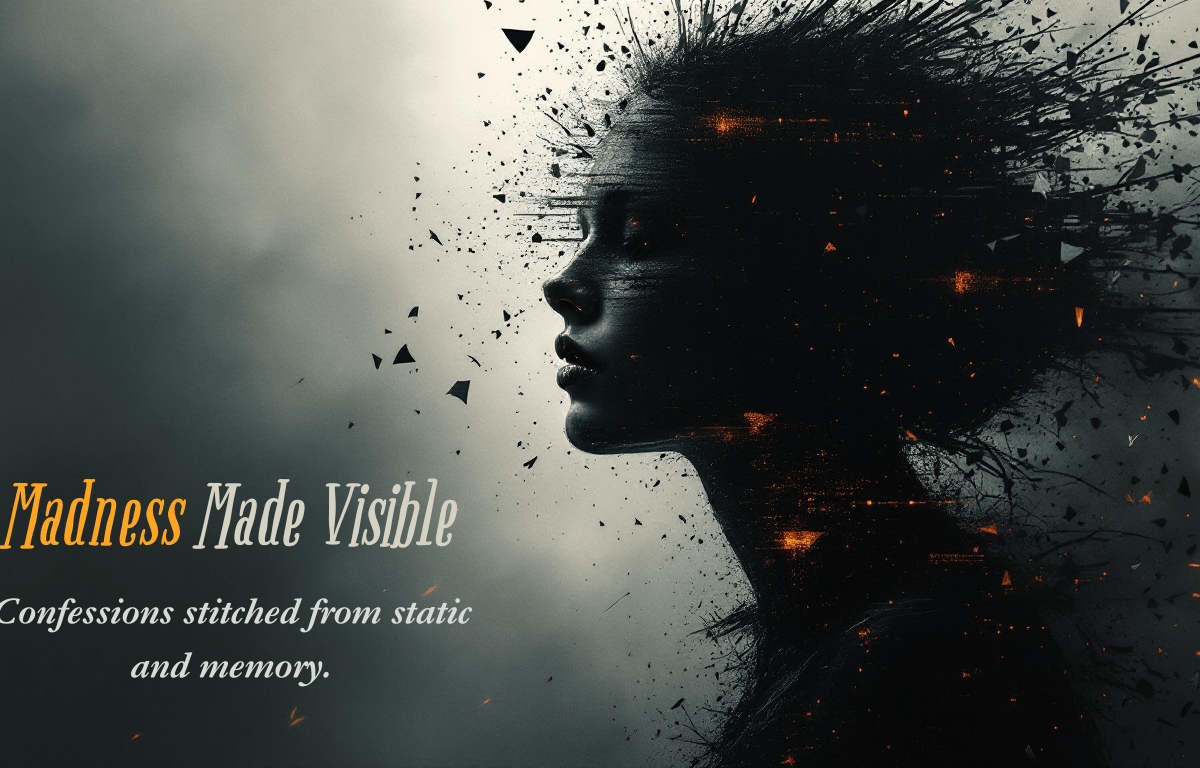

Veils and Ashes

PROSE – FOWC & RDP


“Some things don’t burn. They linger.”

She moved through the dusk like a half-forgotten song—elegant, aching, familiar in a way you couldn’t explain. Her hat, a sweeping crown of violet static, caught the fading light and turned it into a halo of broken stars. Beneath the veil, her face held the softness of someone who once loved loudly, now silent by choice.

People noticed her, but they never really saw her. They spoke of mystery, allure, power—but never of the tenderness that used to live in her laugh, or the way her hands used to linger at the end of a hug, like she didn’t want to be the first to let go.

She remembered it differently.

As strangers, we sat there, nervously seeking glances, smiling so hard until our jaws ached. The table between us was small, but the space felt endless. His voice cracked once when he tried to compliment my laugh, and I fell in love with the effort. There was a kind of sweetness in not knowing what we were yet—just possibility stretching between us like a wire, trembling but strong.

Later came the kitchen. The late afternoons where sunlight melted across countertops and we moved around each other like dancers, improvising. She used to bake for him—not out of duty, but devotion. Small, golden gestures. A language of warmth. The scent of cinnamon, the weight of still-warm bread in his hands. He’d say it tasted like home, and her heart would tighten because no one had ever called her that before.

The garlic, too, made its mark—sliced, smashed, stirred into sauce with the kind of care you only give to things that matter. He’d sneak a taste from the pan, grin at her with that crooked smile, and she’d pretend to scold him, just to hear him laugh again. That kitchen held so many tiny forevers.

Now, she wore veils instead of aprons, shadows instead of perfume. But her grace wasn’t armor—it was memory. People looked at her and thought strength. They didn’t realize strength came after softness had been broken, and stitched together with quieter things: resilience, gentleness, love that never fully left.

There were nights she stood at windows tracing the shape of his name in the fog. Nights she held his mug with both hands just to feel the echo of him. The past wasn’t gone. It curled into her like breath in winter—invisible, undeniable.

And still, she moved—unshaken, unreadable, unforgettable. Some women burned bright. She burned like a hearth—quiet, steady, waiting for someone who remembered the warmth.

She Sings Forward the Fire

PROSE – FOWC, RDP, 3TC #MM57, SOCS


Her face, a still sea at twilight, holds a world behind closed eyes — a world scorched and sacred. Beneath the surface of her skin, time moves differently. The tear sliding down her cheek isn’t sorrow alone; it’s layered, like sediment pressed by centuries. It’s the weight of what was lost, and the stubborn, aching beauty of what still lingers.

In the palm of her silence, you can almost hear it: the laughter of ancestors, brittle with joy; the soft rustle of silk on temple floors; the sweet hush before a prayer. Memory lives here not as a ghost, but as a fire — not to destroy, but to illuminate. What we love, we do not forget. It settles into us, builds its shrine in the quietest chambers of the self.

She is witty, yes — but her wit is not for show. It’s forged from survival. Every word she withholds is a choice, every glance a negotiation between pain and pride. She has learned to speak with her silences, to wield them sharper than swords.

Wilful — not out of defiance, but necessity. She resists erasure. She refuses to dim. Within her, temples rise from ashes not as ruins, but as rebirth. Her breath is a hymn to endurance. Her heartbeat, a drum summoning the past into the present.
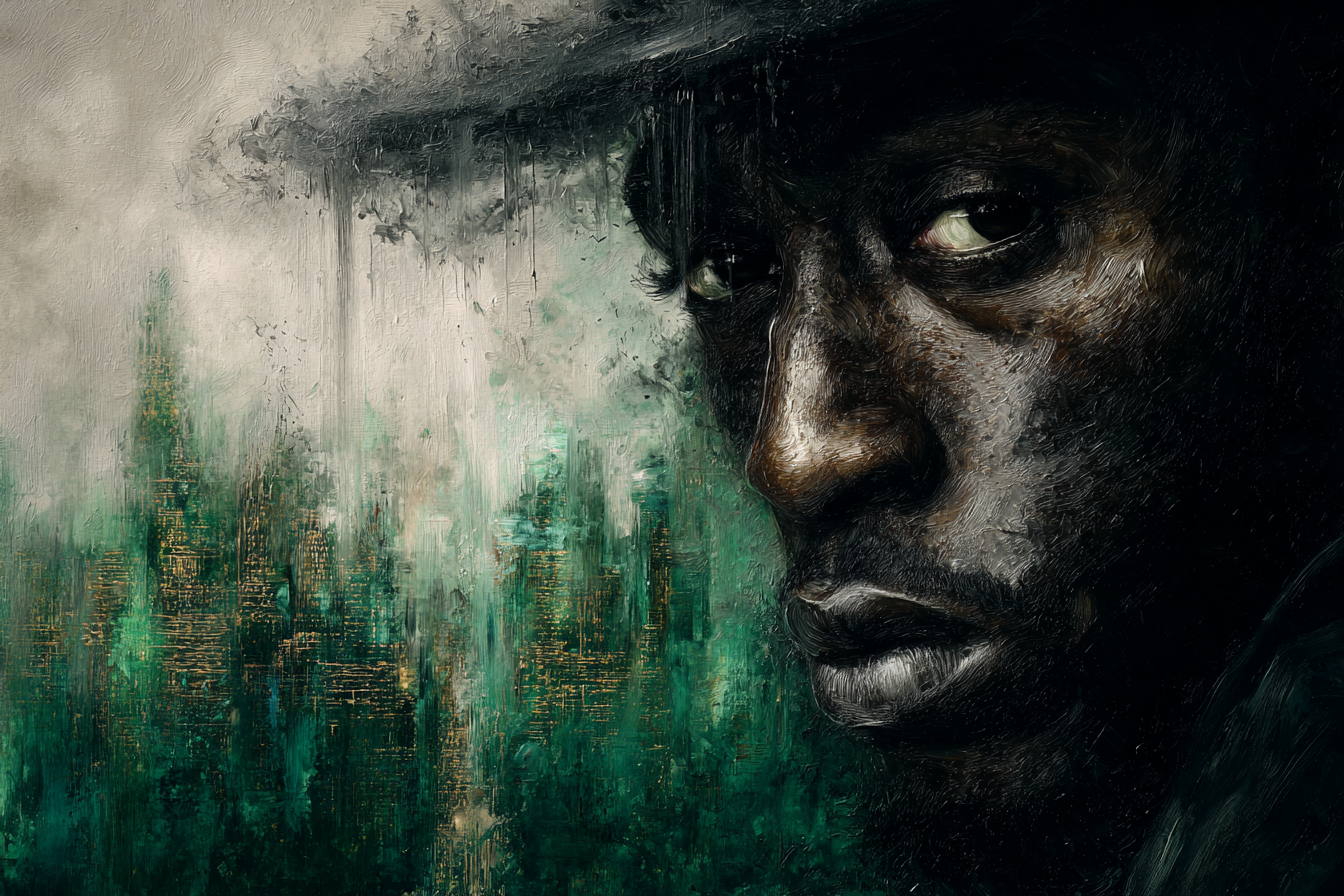
There is something wondrous in the way she holds it all — grief, fire, memory, and light — without collapsing. As if her soul was built to hold contradictions, to sing through them. A tear falls, yes. But it falls like a bell chime, echoing inward. Each note asking, not “Why me?” but “What now?”

She does not seek to escape the past.
She sings forward the fire.

Poor Old Henry’s Brilliant Post

In a world that constantly demands we cram as much as possible into every single day, this post resonates deeply. It’s a reminder that sometimes, slowing down is the most productive thing we can do.

The Face Beneath

PROSE – FOWC & RDP

The dawn light was pale and useless—just a smear across the treetops, barely making it through the humidity. Everything was wet—the porch boards, the air, your skin, even your breath. It felt like you were breathing through cloth—heavy, damp cloth wrapped around your head.
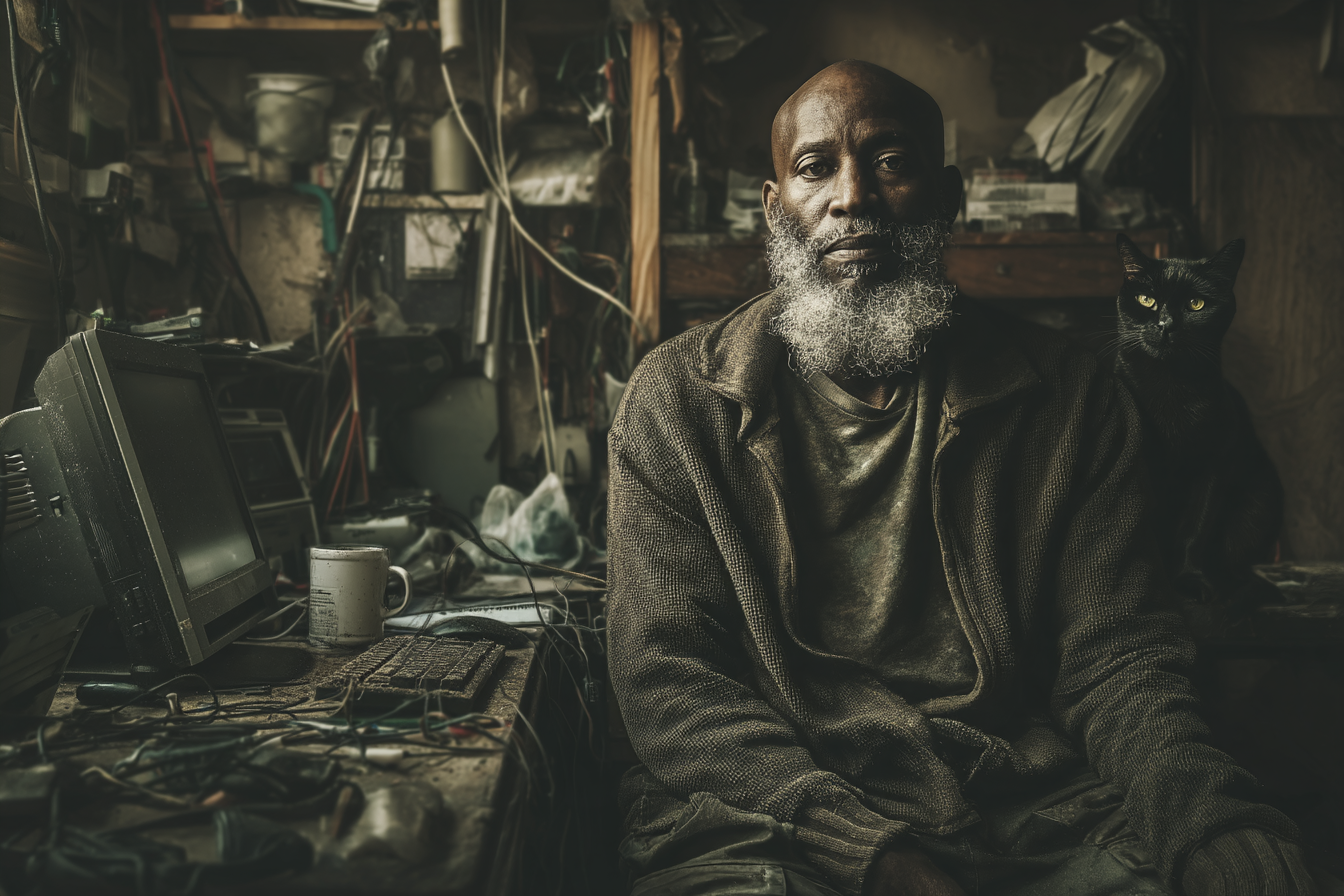
You stood barefoot on the steps, a slice of watermelon dripping in your hand. It tasted like water and rot now, its sweetness gone. You spat into the grass and stared out at the treeline.

The forest didn’t move. Not even the leaves. It just watched.

You didn’t sleep. Not last night. Not really the night before. The dreams had stopped pretending to be dreams. They didn’t fade in the morning. They lingered in the corners of your vision and behind your ears, where the sound of whispering almost made sense.

You went out early. Needed to check the perimeter cameras. Needed to move. To feel the ground under your boots. That was the plan.
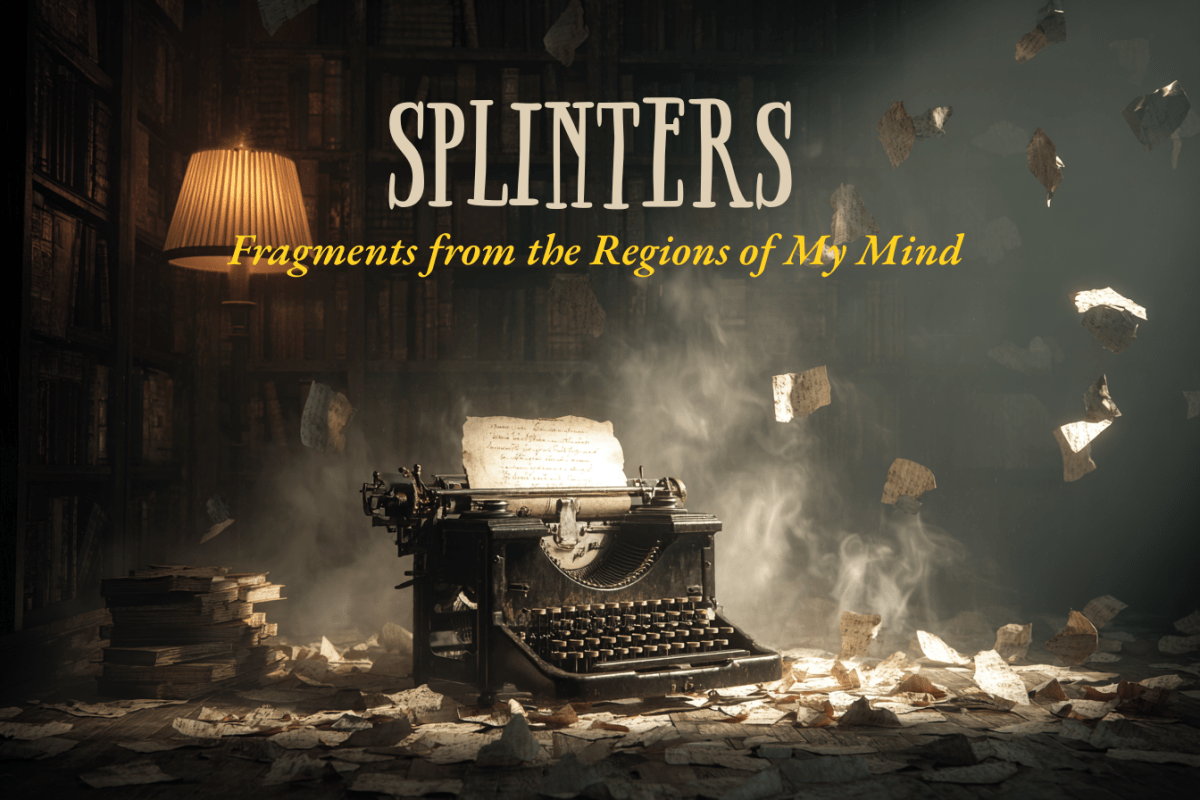
Instead, you wandered. The trail curved in a way it hadn’t before. You followed it. Past the markers. Past the thinning grass. And then it was just you and the dirt.

You nearly tripped over it. At first, just a glint of white in the soil. Bone, maybe. A rock. You crouched, brushed it off with the edge of your shirt. The shape took form fast.

A face.

Stone. Weathered. Cracked. Like it had been buried for years, forgotten. But the eye, just one, was too clean. Too precise. Like it had waited.

You stared at it for a long time. Tried to laugh. Couldn’t. You ran your fingers along the nose, the lips. Your hand trembled, but you didn’t stop.

It looked like you. Not exactly, but enough. The same line between the eyes. The same curve of the jaw. It had no expression, but somehow, it felt like it was judging you.

You left it there. Swore you would forget it.

But that night, you dreamed of breathing through stone. Heavy. Silent. Dreamed of dirt filling your mouth, your ears, your chest. Dreamed of a voice saying your name—not out loud, but from inside.

You woke up with soil under your fingernails.


You told yourself: it’s a statue. Left behind. Forgotten.

You told yourself: it’s just heat sickness, a little sleep deprivation.

You told yourself: don’t go back.

But the forest doesn’t let you decide things like that. Not anymore.


In the Voices of Thousands, We Become One

PROSE – MOONWASHED WEEKLY PROMPT


The sunlight fades. Darkness returns. I wait in the hush, breath held, heart steady. The Keepers stand ahead, already assembled—silent, still, and watchful. In their presence, I feel both small and eternal. Beneath my calm, something stirs—my soul, long quiet, surges suddenly. It’s not noise, not fear. It is truth moving through me like a forgotten rhythm remembered. A tremor rises from the deepest part of who I am, and with it comes a whisper: the light… the call… the quill. These were never external things. They lived within me all along. I had only forgotten how to listen.

In the distance, the sky bends to the horizon’s will. Waves of green light ripple across the dusk like an ancient truth brushing its fingers across the world. The field before me sparkles with dew, each blade of grass a tiny shard of clarity, reflecting the last breath of sunlight. This moment—caught between day and night, between silence and speech—feels sacred. My steed shifts beneath me, sensing the tension in my thoughts. He is anxious, ready. And maybe I am too. But readiness doesn’t feel like confidence. It feels like surrender. I tighten the reins—not to control, but to remind myself that I am here, that I have chosen this.

We ride—not toward victory, but toward purpose. Toward the gathering. Toward those who understand this strange calling to bear words like burdens, and gifts. We are not warriors. We are vessels. We carry stories that are older than we are, stories that ask to be told again, each time a little more fully. We move as one toward the collective, not to be absorbed, but to belong.

Now, surrounded by my brethren, I feel the resonance. Not noise. Harmony. Thousands of voices—not the same but aligned. My own words rise from that shared current, not louder, but clearer. I speak the truth I have wrestled with in the quiet corners of my mind.

Some call the rawness madness. They dismiss it as noise, as rambling. But those of us who live in this tension—we know better. We know that sometimes, madness is just meaning in disguise. That chaos, when held in the right hands, becomes clarity. To those who face the block, I say this: it is not your enemy. It is your mirror.
The block is doubt. Yes. But not the kind that breaks us. It is the kind that slows us down, that makes us ask why before we speak. It is the force that prevents arrogance, that checks ego. Doubt humbles us. It forces us to listen harder, to question deeper, to speak with care. It reminds us that this craft is not about being heard—it is about being understood.

And it is in that pause, that searching, where we grow. The block is not a wall. It is a threshold. When we understand that, it no longer stops us—it transforms us. That understanding, that acceptance, is how the block is shattered.

The Quiet of the Moment

PROSE – 3TC #MM43


The morning began like it had countless times before—but today, it felt different. There was a stillness that lingered just a second longer. A hush in the air that made you listen more closely. The slow fade from darkness to grey had its own rhythm, its own muted pulse. It was that fragile aspect of dawn—neither night nor day—when everything feels suspended, as if the world is holding its breath.

You hear the familiar rush of cars below, life going about its business, unaware of the quiet reverence unfolding above. You step onto the terrace not out of habit, but out of something harder to name. A need, maybe. Or a yearning to be part of something unspoken. You don’t search for a view. You let your gaze fall into the sky, into nothing. Into everything.

Then the sound begins. The piano. Tentative at first, like a thought forming. Fingers move over ivory and black, finding phrases that don’t need words. The melody doesn’t push—it drifts. You close your eyes, and it takes you somewhere. Or perhaps it helps you retrieve something lost in the static of everyday: a gentleness, a memory, a forgotten truth.

You lift your bow, not to perform, but to respond. To join. Your hands move, not with effort but with instinct, the strings vibrating beneath your fingers like a second heartbeat. There’s no audience, no need. Just the sound, the sky, and you.

Then you see her.

She’s there, just below, wrapped in morning light, coffee in hand, eyes somewhere far away. She doesn’t notice you yet. She doesn’t have to. She’s inside the moment too. Something about her stillness makes the entire world feel composed. As if her quiet presence is the final note that makes the music whole.

You watch her for a beat, caught in the beauty of her being, the unforced motion of her simply existing. The way she breathes. The way the steam rises from her cup. How the breeze toys with the loose strand of her hair. It’s ordinary, yet nothing could be more profound.

And in that moment, I understood what beauty and love was—
and it didn’t have a damn thing to do with sex.

You play on. And she listens—without effort, without expectation. Just as you play—without reason, without resistance. The world outside blurs. Time bends. You’re no longer trying to capture the moment. You’re inside it. You are it.

And for once, that’s enough.

Into the Khanverse: Rebuilding, Reshaping, and Saying Thanks

A vintage typewriter on a cluttered desk, exploding into birds as books tower around it—chaos and creativity in motion.

PUBLIC SERVICE ANNOUNCEMENT

As April wraps up, I just want to say: thank you.

This past month has been one of the best yet for the blog — new readers discovering the space, longtime followers sticking around and engaging more than ever. Your support, feedback, and energy mean a lot.

What’s Changing Moving Forward
I want to keep the momentum going and make things even better. Here’s what’s coming:

  • New Posting Schedule: I’ll be posting regularly to keep things consistent.
  • Expanded Topics: While writing stays front and center, I’ll add [new topics, if any, time travel].
  • Reader Spotlights: Once a month, I’ll feature a reader’s story, feedback, or question to keep the conversation two-way.

The Bigger Picture: Rebuilding the Khanverse
2025 is my year to rebuild and organize my online world. Over time, I’ve created a lot, and it’s gotten a little chaotic. My PTSD and OCD aren’t exactly helping, so it’s time to bring some order to the madness.

And yeah — I know “the Khanverse” sounds pretentious and extra. But if you’ve been reading me for a while, you already know… sometimes I’m both.

I’ve collected several domain names over the years (and kept paying for them), and it’s time to actually use them. Some content from this blog will shift to new homes:

  • The Howlin’ Inkwell: Home for The Knucklehead Report, From the Stoop, and other essays.
  • House of Tunage: Everything music-related — including responses to musical challenges. (If you spot a strange new face in your challenge, it’s probably me.)
  • Memoirs of Madness: A space for creative writing — fiction, poetry, prose, and writing challenge responses. Some visual art will eventually move to another site, but I’ll share my favorites here, like Wordless Wednesday.

I’m excited — and honestly relieved — to start untangling the web I’ve built. Thanks again for sticking with me through this ride. I think it’s going to make everything better for all of us.

See you soon,
Mangus

Perception Blue

PROSE – 3TC #MM40 & SoCS


The room softened into mist, and time slipped its tether. He saw only her, standing beneath a net of soft lights, her head bowed, lashes dipped in silver. She looked like a secret the universe had forgotten to keep.

He watched her, hardly breathing. There was a stillness about her, as if even the air itself had fallen into orbit around her glow.

Was she real? Or just a dream stitched out of loneliness and hope? He blinked, but she didn’t vanish.

He let himself linger, caught between wonder and a trembling kind of fear. She was too much—too bright, too distant, too beautiful in a way that had nothing to do with the glitter at her temples or the jewels at her brow.

And him? He was just a man standing in the dark, bones full of small regrets, heart patched with quiet scars.

For a moment, he hesitated, sinking into the pause, that heavy moment when you question if you are enough to even be seen. If you are worthy to stand before something so inexplicably beautiful.

His hands shook at his sides, almost imperceptibly. His voice, he feared, would betray him worse.

He closed his eyes and tried to listen — not to the noise of the room, but to the stubborn, fragile hope still alive inside him.

When he opened them, she was still there. Still breathing. Still real.

He stepped forward, heart battering against the cage of his ribs, and found the smallest, truest word:

“Hi,” he said, almost a prayer.

For half a second, the universe hung suspended. Then —

She lifted her head, and the faintest, brightest smile tugged at her lips.

“Hi,” she answered.

And in that small, electric exchange, the stars seemed to exhale, and the night leaned closer around them.

Things Found in the Fire

PROSE – FOWC & RDP

The alley wasn’t picturesque, but it was honest. Cracked brick walls caught the last tired light of the day, holding it like a secret. She leaned against them, letting the roughness bite through the fabric of her shirt — a small reminder she was still here, still standing.

People always skipped places like this. Skipped the alleys, skipped the worn faces that carried too many losses. She used to believe that if she fought hard enough, worked long enough, she could save something — a home, a love, herself. She thought effort could outmatch entropy.

But slowly, we turn the page and walk away from everything. We worked so hard to save. Must we start all over and find another shoulder to lean on?

The question pressed into her like ash on skin. Maybe survival wasn’t about saving what was burning. Maybe it was about knowing when to let it burn. About sifting through the ashes for the pieces that could still hold weight.

The sun folded into the horizon, leaving behind the thick hum of a city settling into itself. She didn’t move quickly. She didn’t look back. Some fires you didn’t put out. Some things you simply let burn and walked away from — lighter, fiercer, more your own.

She stepped out of the alley and into the dusk, steady and unafraid, carrying only what survived the fire.


T. S. Eliot’s Cold, Snobby Guide to Poetry (Now with 90% More Dead Guys)

ESSAY – JAVA & VERSE

What if greatness in poetry isn’t about your feelings, but your ability to disappear? T. S. Eliot thought so. And he said it with the intellectual force of a literary wrecking ball.


The Essay That Keeps Haunting Me

An English professor once handed me a stack of literary theories, as if they were polite interventions. I was emotionally raw, so naturally, I assumed the worst. One of the texts was T. S. Eliot’s Tradition and the Individual Talent—a dense, icy essay I’ve come back to over the years, especially when I start thinking my writing is getting good.

Spoiler: Eliot never lets me feel good for long.

Tradition: Now with 90% More Dead Guys

Eliot opens by dragging the English for treating “tradition” as a brag or an excuse to never change. He’s not here for that. For him, tradition isn’t a safety blanket—it’s literary CrossFit. You don’t inherit it; you earn it. You read so much Dante and Shakespeare that their ghosts start charging rent in your brain. That’s Eliot’s idea of a “historical sense.”

“The historical sense involves a perception, not only of the pastness of the past, but of its presence.”

If you’re not writing while haunted by the canon, Eliot’s judging you from his perch in the great library in the sky.

Your Poem Isn’t That Special

Next, Eliot drops the literary version of “you didn’t build that.” Your new poem? Cute. But it only matters in relation to what came before it. Tradition isn’t a one-way street—it’s a remix. Every time you drop a new metaphor, the canon must make room, like a snobby dinner party where you just showed up in a hoodie. The past adjusts—but only if your work is good enough to make it flinch.

Kill Your Ego, Save the Poem

Now for Eliot’s hottest take: great poetry isn’t about you. It’s not your diary entry. It’s not your breakup in verse. The poet should be like platinum in a chemical reaction—an invisible catalyst. You cause the emotional explosion, but leave no trace of yourself.

“The progress of an artist is a continual self-sacrifice, a continual extinction of personality.”

Your angst? Irrelevant. Your personality? A liability. Eliot’s poetic hero is the anti-snowflake: invisible, ego-free, and built like a Greek grammar book.
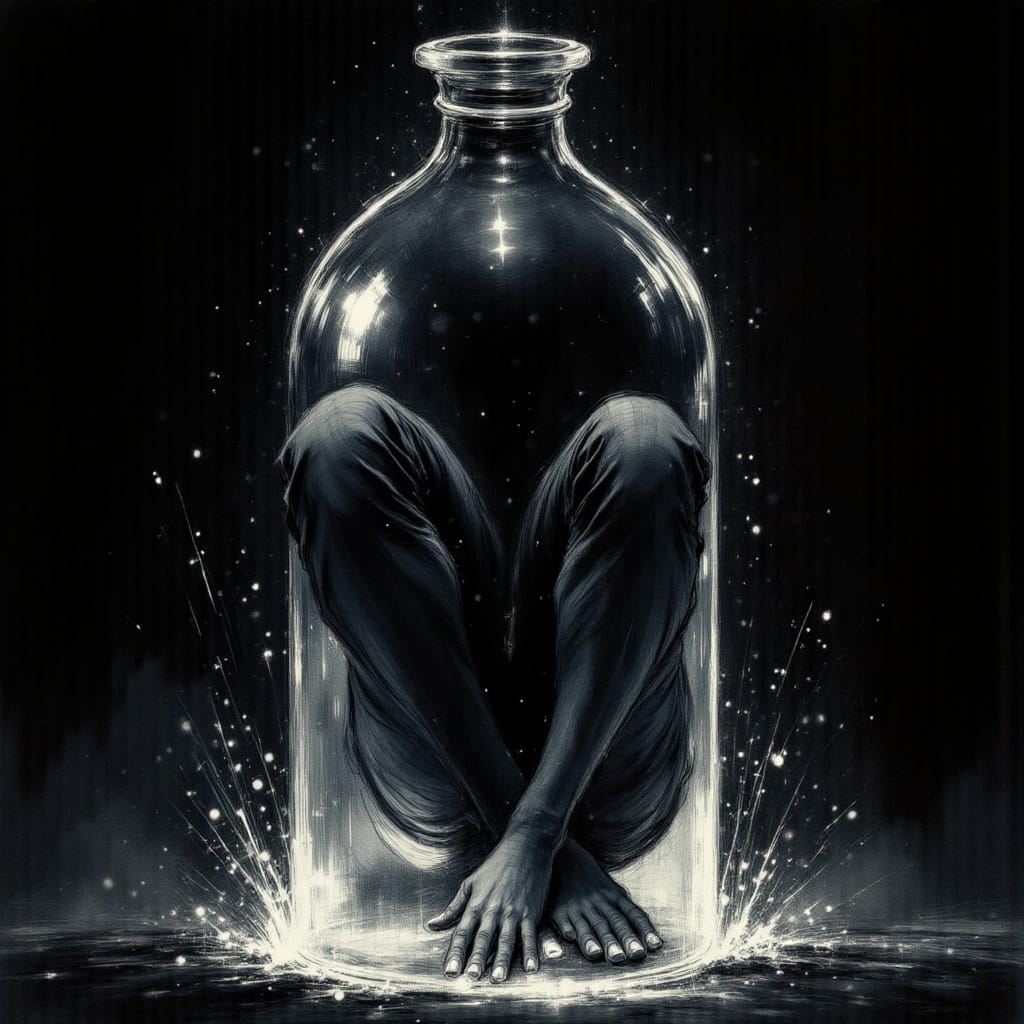
He’s not just dunking on confessional poets—he’s challenging the cult of authenticity. Writing as therapy? Valid. Writing as art? That’s a different game. Great poetry doesn’t wallow in feeling; it refines it. And yes, it takes someone deeply emotional to understand the need to flee from emotion. Cue the mic drop.


Feelings? Meh.

Eliot closes by swinging at sincerity. Feeling something doesn’t mean you’ve written something worth reading. You can mean every word and still write a dud.

“Poetry is not a turning loose of emotion, but an escape from emotion.”

The emotion belongs to the poem, not the poet. So if you’re writing about your fifth breakup in six months, maybe skip the sad-girl sonnet and channel Ovid’s exile or the fall of Rome instead. Just a thought.

Final Thoughts: Eliot vs. Instagram Poets

In a world obsessed with “finding your voice” and “speaking your truth,” Eliot reads like a literary curmudgeon with a PhD in gatekeeping. But there’s a weird freedom in his elitism. He doesn’t want you to be original—he wants you to be excellent. That means burying your ego, studying like a maniac, and writing like you’ve time-traveled through the entire Western canon.

So, don’t ask, “How do I feel next time you write?” Ask, “Would this make Virgil roll over in his grave?”

And if that sounds exhausting, good. Eliot didn’t write for quitters. He wrote for ghosts with PhDs.


This post was written for Reena’s Xploration Challenge #378

The Ridge Where Silence Waits

PROSE – FOWC & RDP


Dawn unfolds like a hesitant prayer, its soft light unspooling over the bones of the hills. The stars, one by one, retreat into the folds of daylight, as though ashamed of what they bore witness to through the long, silent hours. Still, I remain at the crest of the ridge, a lone silhouette etched against the slow bloom of morning. I have not slept. I could not—not with the weight of forgotten omens pressing down on me like ancient armor.

The saddle beneath me creaks as I shift, leather complaining in a language only the wind can answer. My limbs ache, not just from the vigil, but from something deeper—an unraveling. I am more wreck than man, hollowed by longing and the quiet violence of loss. My voice, once sure, now drifts somewhere in the ether, unreachable. Even if I could summon the will to speak, I no longer trust the shape of my own words.

Below, the keepers stir. I hear the sharp clash of their voices, rising in petty squabble over rituals they no longer question. Their movements are brisk, their concerns tethered to earth and duty. I do not begrudge them this. But I cannot descend, not yet. I am no longer bound to the cadence of the living. Not while something in me still listens for a call that may never come again.

For I have lost the vision.

Once, it came to me like thunder through a cathedral—blinding, holy, terrible in its beauty. It lit my mind with purpose, set my hands aflame with creation. But that light has dimmed, flickered, vanished. Last night it sang, soft and clear through the bones of the wind. Now it is gone, and in its place: silence, vast and unrelenting.

I reach inward, desperate for a glimmer, a fragment of that divine echo, but find only echoes of my own fear. My compass is shattered. My quill is waiting in some distant place I no longer know how to reach. The path to it—if it still exists—has been swallowed by mist and regret.

And yet, there is no peace in surrender. Only the chill of a fate whispered by unseen mouths, breath like ice on the back of my neck. They murmur not of endings, but of reckonings. Of a soul unmoored of a promise made long ago beneath stranger skies.

Perhaps this is what becoming untethered feels like—not a fall, but a float. Not a silence, but a waiting breath.

The ridge hums beneath me, and I close my eyes.

If the light returns, I will know it by the way the wind shifts. I will feel it in the marrow. I will rise, not with certainty, but with faith scorched into my bones like forgotten scripture.

But until then, I remain.
A shadow made flesh.
A watcher at the edge of memory.
A ghost, listening for the sound of his own return.

Bark and Blood

PROSE – WWP #395


Every morning, Elías stood before the vow tree—the one with his father’s face etched in bark. Its eyes never moved, but somehow, it watched. When Elías broke a promise, the mouth curled in silent disapproval. He learned to speak carefully, act deliberately. To commit was no longer abstract. It was rooted, ancient, and watching. The tree remembered. And it never forgave.


REBLOG: CaptureTutor

REBLOG – PHOTOGRAPHY TIPS

I spent a lot of time taking crappy photos before I got lucky and snapped a good one—total fluke. That’s when I realized I had no idea what actually made a photo work. If that sounds familiar, this post is for you. Whether you’re just starting out or you’ve been at it for years and need a refresher, it breaks down simple, practical composition tips—like leading lines, framing, and the Rule of Thirds—that actually make your shots look better. Doesn’t matter if you’re shooting with a phone or a DSLR. Check it out—you’ll be surprised how much a few small changes can improve your photos.

Ego, Snacks, and the Search for Peace

PROSE – REFLECTION – SUNDAY POSER #230


At my core? Still me. Still sarcastic. Still curious. Still low-key allergic to group think and people who say “per my last email.” But life—especially this past year—shifted something in me. A life-altering moment has a way of stripping you down to the truth, whether you’re ready or not.

It made me realize I’ve been sitting on a set of gifts I’ve treated like party tricks. I can do more. I should do more. Sure, I could keep yelling into the void about the uncultured swine running the world (still baffled by how that happened). And if I accidentally handed them the keys somewhere along the way, then yeah—I’ve got some things to atone for. Maybe even finish the time machine in the basement.

But mostly, I’ve just changed in the way that matters: I’ve started trying. Less coasting, more choosing. Less needing to be right, more needing to be honest.

Wisdom? Not exactly my department. I’ll never be that guy. Never been that smart, and I’m okay with that. What I am is honest enough to admit I’m a deeply flawed man. Whatever good I carry, I got from my mother. The rest is a work in progress.

Marcus Aurelius said, “Waste no more time arguing what a good man should be. Be one.” I’m trying. Some days better than others. And like in Sufism, where they speak of the nafs—the lower ego—it’s a constant fight. Not to eliminate your ego, but to tame it. To bring it into balance. Peace doesn’t come from pretending to be pure—it comes from wrestling with your own chaos and not letting it win.

And honestly? If King Solomon—the wisest man to ever live—couldn’t get it all right…

I think I’m good.


The Edge of Becoming: Refusal to Disappear

PROSE – REFLECTION


The light crept in, not with purpose, but inevitability. It pooled over the floorboards in pale streaks, slipped across the rumpled sheets, and found her where she sat—curled in on herself at the edge of the bed like something unfinished. The curtain shifted with a lazy sigh, stirred by the hum of a world already moving without her.

She didn’t move. Just blinked slowly, eyes still heavy. Her hair was a mess—coiled and wild, clinging to the nape of her neck with sweat. The air felt thick, damp from last night’s rain, and carried a faint trace of coffee drifting in from the apartment next door. It reminded her she wasn’t entirely alone in the world—just sealed off from it.

Her phone buzzed on the nightstand. She didn’t look. She already knew the message: “You okay? You were pretty quiet last night.”

She had gone to that rooftop gathering. Smiled on cue. Nodded politely as someone explained a startup idea for the third time. But when the conversation shifted to politics, to “people being too sensitive,” to jokes with teeth she wasn’t supposed to flinch at—she had gone quiet. Not out of agreement. Out of calculation.

It wasn’t fear of confrontation. It was exhaustion.

The kind that seeps into your bones when you’ve spent years editing yourself in real time.

Why can’t you just be easier?

The voice came sharp, cutting through the fog. Familiar. Not hers exactly—but forged in her. It spoke in the tone of her third-grade teacher, the one who called her “bossy” for speaking with certainty. The one who wrote on her report card, “bright, but disruptive.” That was the first time she learned that being loud and being wrong were seen as the same thing.

She had been shrinking ever since. A slow erosion.

And now, this morning, she felt caught between the shrinking and the wanting—wanting to take up space and fearing the cost of it.

You think you’re different? That the rules don’t apply to you?

She flexed her jaw, let the thought sit. The worst part of that voice was how reasonable it sounded. How it wrapped itself in concern. In survival.

Outside the window, a billboard stood tall above the bus stop: a model in spotless white jeans and a tagline in all caps—LIVE YOUR TRUTH™. She almost laughed. As if truth came clean and neatly styled.

Her own truth felt messy. Unmarketable. Like morning breath and ragged nails and questions without answers.

She looked at her hands—real, rough, hers. Last night she had come home and typed a long apology to the group chat. “Sorry I was off. Just tired. Hope I didn’t kill the vibe.”

She hovered over the send button.

Then she didn’t.

Now, she picked up the phone, screen still glowing with the unsent draft. She tapped and held. Delete.

It wasn’t a revolution. Just refusal.

A small, quiet defiance.

She wasn’t whole. There were still bruises beneath her calm, still doubts threading her thoughts. But she was done apologizing for needing more than performance.

The light had shifted again, stronger now. Not demanding. Just there.

She wasn’t sure what came next.

But this—this stillness, this pause, this decision not to disappear—was a start.

Poem of the Day – 04182025

Memoirs of Madness: Writing Is the Only Way Through

PROSE – MOONWASHED WEEKLY PROMPT

Mind, body, and spirit—it’s not just a slogan on a t-shirt or a phrase tossed around in self-help books. It’s a lived, gritty process. It doesn’t happen in a straight line. It doesn’t always feel peaceful. It asks to be practiced daily, especially in the moments when we’re coming apart.

When my wife was dying, I was unraveling. There was no calm breath, no quiet meditation that could hold me. The pain was too loud, too sharp. I couldn’t go to the dojo—I knew I might hurt someone. So I turned to the only thing left that didn’t require restraint: writing.

That’s where Memoirs of Madness was born—not from ambition, but necessity. I wrote because if I didn’t, I was going to explode. Writing became my release valve. My attempt to find balance in a world that no longer made sense. It wasn’t polished. It wasn’t composed. But it was honest. It was survival.

Healing doesn’t always look like light. Sometimes it’s just sitting with the darkness long enough to stop being afraid of it. Writing gave me a place to do that. Not to escape pain, but to face it with something steady under my hands—a pen, a page, a place to speak freely.

People like to talk about acceptance, about “new normals,” especially when you’re going through something irreversible. I’ve been told I may never return to the person I was before. And maybe that’s true. But I also know it’s not the whole truth. I know there’s more to me than what’s been broken.

Throughout my life, I’ve encountered teachings I didn’t ask for. Moments of awe, loss, surrender, and grace. I didn’t always understand why they came, but something in me knew not to reject them. Writing became the way I made sense of them. The way I honored them.

It’s not therapy, exactly. It’s more like a mirror. Each word reflects something back at me—something raw, something I need to see. Writing doesn’t heal like medicine. It heals like movement. Like breath after being underwater too long.

Writers tell the truths we were taught to keep quiet. We witness the small miracles—flowers bending to the breeze, the call of a bird we can’t see, the still gaze of an animal watching us. We notice the laughter of children that vibrates with something pure and untouchable. We let it all into our bones. But writing is how we let it back out. How we stay connected—not digitally, but spiritually, viscerally.

Every sentence I write is a thread that connects me to the person I’ve always been beneath the layers of grief, anger, and expectation. Not the old self. Not the broken self. But the essential one. The one that endures.

I once asked: Who’s smarter—the adult or the infant? Predictably, everyone said the adult. When I pressed them, they said the child doesn’t know anything. But I disagreed. I said the infant. They laughed, of course. All but one. That one asked me, “Why?”

“Because the infant sees everything,” I said. “They feel everything. They haven’t learned to numb themselves yet. They haven’t picked up the habit of pretending. They are unfiltered truth.”

That’s what writing brings me back to. That clarity. That honesty. That wholeness before the world taught us to break ourselves into pieces.

Healing through writing isn’t a return to what was. It’s a return to what’s real. And sometimes, that’s more than enough.


Author’s Note:

I sat looking at the challenge image, thinking about the beauty of that moment frozen in time. I found myself wondering how to capture something like that in words. Lately, I’ve been studying Buddhism—not because I want to become a Buddhist, but because I’m wise enough to know that truth can’t be found with a closed mind.

Next thing I knew, this piece came through me.

It’s not all I have to say on the subject, but it’s a beginning.

Thanks, Eugi.

The Weight of Stillness

PROSE – FOWC & RDP

I drift through the mist of life’s abyss, not falling, not flying—just suspended. Time doesn’t move here; it folds in on itself, leaving me trapped in a silence that isn’t peace, but ritual. Dutiful. Respectful. A silence learned over years of swallowing words and measuring breaths. It’s the kind of silence that makes you forget the sound of your own voice.

The air around me stirs, barely. Still, I hear the whispers—low, deliberate, cold. They speak not in sentences, but in suggestions, in warnings that curl around my ears and settle in my chest. They speak of fate, of choices already made, of a path too worn to change.

In my hand, the quill waits, poised like it knows the weight of what it might say. But it’s grown unwieldy—too much meaning, too much memory packed into such a fragile thing. I grip it, unsure whether to write or release. Each word feels like it could be the last. Maybe this sentence is where I stop. Maybe this is where I finally let go.

But still I hover, caught in that space between thought and surrender, listening to the hush of everything I’ve never said.

Where the Sky Remembers Her

She stood still, her profile etched in the quiet glow of imagined worlds. Galaxies spun behind her eyes, each one holding a memory she hadn’t spoken aloud in years. Moons drifted close, brushing her skin with light that wasn’t light, warmth that didn’t burn. The clouds moved through her like thoughts, slow and tangled, as if the sky itself had cracked open to whisper her name.

Her expression didn’t shift. It didn’t need to. She wasn’t here to perform. She was caught in that weightless place between who she’d been and who she might become. And in that stillness, even the planets seemed to orbit slower, listening.

Someone once told her she looked too serious, too distant. But they only gave her a bland kind of attention—the kind that never reached deeper than skin. The type that skimmed her surface and missed the storm beneath.

Now, she let her thoughts roam in this quiet collision of sky and soul. Not forward. Not back. Just… outward. And for a fleeting second, she caught a flicker of something—possibility, maybe—out of the corner of her eye.

A glance, nothing more.

But it was enough to remind her that she was more than what the world saw, more than the shadows cast by fading light. She was part of the cosmos now, and maybe, just maybe, the cosmos was part of her, too.

The Silence of Excess

PROSE – WEEKEND WRITING PROMPT #410

Opulence dazzles, but it doesn’t fill the void. Gilded walls, luxury cars, designer clothes—they impress, not satisfy. The chase for more becomes endless: bigger homes, flashier jewels, louder status. Yet behind the gloss is silence. Relationships shallow. Laughter forced. Meaning fades. Surrounded by everything, the soul starves for something real. Comfort becomes a cage, and abundance numbs. The high of acquisition dulls fast, and stillness creeps in. Opulence, once a dream, becomes a mirror—reflecting what’s missing, not what’s gained. In the echo of excess, we find the truth: wealth can buy things, but not worth.


Warrior’s Creed

PROSE – WEEKEND WRITING PROMPT #411

Fierce burned in her chest—not anger, but resolve. Each setback was fuel. She didn’t flinch, didn’t fold. Determination wasn’t loud; it was steady. Quiet steps forward, no matter what. That’s how she wins.


Alcoholism: The Drug Hiding in Plain Sight

It’s not always the staggering drunk on a sidewalk.
Sometimes, it’s the friend who always shows up, the parent who keeps it together, or the coworker who “just likes to unwind.”

But behind closed doors, they’re shrinking. Fighting. Breaking.

Alcoholism doesn’t always look like what we expect. And that’s the problem.


Folded into himself. Silent. Alone. Crushed under the pressure of needing something he hates needing.

We call it “just a drink.”
But alcohol is the most lethal drug in the world—more deadly than opioids, meth, or cocaine.

And yet… it’s everywhere.
It’s legal.
It’s glorified.
It’s handed out at every wedding, every weekend, every wound.


Not a habit. A fight. Against himself. Against the silence. Against the pressure to act like everything’s fine.

Addiction doesn’t start with rock bottom.
It often begins with social acceptance.
A drink to relax. A drink to celebrate. A drink to cope.
Until the bottle isn’t an option—it’s a cage.


Even the strong get trapped. Alcohol doesn’t care how tough you are.

What makes alcohol so dangerous isn’t just the physical toll.
It’s the silence.
The shame.
The way we minimize it, laugh it off, ignore the signs.


This is what addiction feels like. Rage, regret, and no way out. But always another drink.

The Truth:

  • Alcohol kills more than 3 million people globally each year.
  • Withdrawal from alcohol can be fatal.
  • It destroys bodies, families, and lives—and we rarely talk about it.

If you or someone you know is struggling:

You are not alone.
There is help.
There is life outside the bottle.


CTA (Call to Action):

📞 [Insert helpline or resource link – e.g., SAMHSA’s National Helpline: 1-800-662-HELP]
💬 Share this post. You never know who needs to see it.

REBLOG: JoyfulStephanie’s Journey

Reblogging this powerful and vulnerable piece from Stephanie. Her courage in acknowledging her truth and sharing her journey with alcoholism and recovery deeply resonated with me.

Reading this stirred something in me—not just empathy, but reflection. While our paths differ, the terrain of struggle, self-confrontation, and healing feels familiar. I’ve danced with my own shadows, and I’ve been meaning to speak on that for a while now.

I’ll be sharing more about my journey in the coming days—not to diminish Stephanie’s voice but to add to the conversation. Healing isn’t a solo act. It’s a chorus, and sometimes, just hearing another voice echo your truth can be the thing that carries you a little further.

More to come soon.

Dante in Combat Boots: My Journey Through the Divine Comedy

ESSAY – RANDOM THOUGHTS

The First Encounter – Lost in the Woods (and the Footnotes)

The first time I read The Divine Comedy was sparked by an argument—an intellectual back-and-forth with someone who, as it turned out, didn’t know much about the book. But he was passionate. His conviction was hypnotic. I didn’t buy his analysis, but I understood why he was obsessed.

I picked up the book out of curiosity and a little competitive pride. I didn’t finish it. We got called out on a mission, and you don’t take library books on missions. Fines are one thing—charred pages are another.

Still, even unfinished, it stuck with me. Something about Dante’s voice—strange, serious, deliberate—lingered.

That first attempt, though brief, planted a seed. When I returned to it later, I had more patience, a better dictionary, and no librarian breathing down my neck.

Even then, Inferno was dense. Layers of references. Historical names I barely recognized. Theology deep enough to drown in. I was flipping between footnotes and old library texts like I was defusing a bomb. The nine circles of Hell were vivid, yes—but they felt more like a museum exhibit than a lived experience. I was watching Dante, not walking with him.

It felt like homework. Necessary, maybe. But distant.

Still, something about the structure—the cold logic behind every punishment—got under my skin. Sin wasn’t just bad behavior. It had a shape. A weight. I didn’t have the words for it then, but the idea that justice wasn’t arbitrary began to settle in.

I didn’t love the poem yet. But I was starting to hear it.


Warzones and Infernos – Dante in Combat Boots

When I returned to The Divine Comedy after combat, it hit differently. Dante wasn’t just a poet anymore—he sounded like someone I knew. Maybe even like me.

Inferno started to make more sense. Hell wasn’t about fire and demons—it was about clarity. Brutal, stripped-down moral logic. A world where actions had consequences that couldn’t be bargained with.

In combat, you live in that gray zone between judgment and survival. Right and wrong don’t show up in clean lines. Sometimes you do the right thing, and it haunts you. Sometimes, it felt like there was no God—at least not the one we heard about in Sunday school. We believed in the integrity of what we were doing. We questioned it, sure. But our resolve stayed intact. Sometimes, surviving was all you could do. And that didn’t always feel like redemption.

Dante’s Hell isn’t just punishment—it’s paralysis. People stuck in their choices, their pride, their rage. No growth. No movement. Just a reflection in the worst kind of mirror.

That rang true.

Some turned to a higher power for guidance. We knew—we were fighting for God. But we also knew the limits. We were required to do what was asked of us—but no more. We fought for God. And we had to answer to Him too.

Not just for the people we encountered. Sometimes for what we became.


Purgatorio – The Long Climb Back

Purgatorio doesn’t get the same attention as Inferno. It’s not as dramatic. No fire. No famous sinners frozen in ice. But it’s the part that felt most real to me.

Because after war, after any real descent, what follows isn’t glory—it’s work. Quiet, repetitive, soul-grinding work. That’s Purgatorio.

Dante climbs a mountain, terrace by terrace, confronting the seven deadly sins. Each level is a mirror—less about judgment, more about recognition. It’s not punishment anymore. It’s penance. The difference matters.

After combat, reintegration isn’t just about coming home. It’s about stripping away the armor you lived in. Unpacking things you didn’t have the luxury to process while they were happening—and you don’t have the luxury to process them now. You’re thrust back into your life like nothing happened. You lie to the ones you love to keep them safe, to spare them from the world you know exists but no one is talking about. You keep that secret.

You make a valid attempt to let go of habits that kept you alive but will not help you live. It’s exhausting.

That’s why Purgatorio hit me so hard. I didn’t expect it to. But there’s something deeply honest in the idea that healing doesn’t feel holy. It feels like discipline. Like carrying your own burden up the hill with no end in sight. Some days, you move a little higher. Some days, you just don’t slip backward.

There’s no audience. No headline. Just effort.

And yet—it’s hopeful. The whole mountain is built on the assumption that you can be made whole. That ascent is possible. Redemption is a process, not a prize.


Paradiso – The Light We Try to Name

Paradiso is the hardest part.

Not just to read—but to believe in. It’s abstract, layered with theology and geometry, full of light and music and spheres. Dante is trying to describe the indescribable. He’s chasing God through language; the closer he gets, the less the words hold.

For a long time, I didn’t connect to this part. It felt like too much, too far, too clean.

But after Purgatorio, after the work of climbing, carrying, and unlearning, I started to understand what Paradiso was reaching for—not perfection, not purity, but peace.

And peace—real peace—is foreign when you’ve lived inside chaos. It’s not some cinematic moment of triumph. It’s quieter. It’s the ability to be still, without needing to be numb. It’s presence, not performance. It’s the moment you stop bracing for the next thing to go wrong.

Dante meets Beatrice here—his guide into the divine, his symbol of grace. We all have our Beatrices, if we’re lucky. People who held the line for us when we couldn’t. People who reminded us we weren’t lost forever.

Am I worthy of this grace? Will God forgive me for what I’ve done? I find myself waiting—searching—for that one thing that could wipe away all the havoc of my making. Is that a thing? You know the scales will have an answer.

In the background of all this light, I still imagine the scales. The old ones—Egyptian, Christian, Islamic. The image of your life being weighed. Every choice, every silence. Your hands held out, waiting to see which way it tips.

We fought for God. We made peace with that. But we also knew we’d stand in front of Him one day. And maybe that’s what Paradiso is really about—not escaping judgment, but understanding it. Accepting it. Trusting that there’s a kind of justice that doesn’t crush you, but completes you.

I don’t claim to understand everything Dante saw in Heaven. But I understand the desire to see it.

And that’s something.


Full Circle – Still Listening

I’ve read The Divine Comedy more than once now. Not in a straight line, not as a scholar, but as someone who’s lived with it—left it, returned to it, wrestled with it. And the strange thing is, it keeps changing. Or maybe I do.

What started as a challenge—half a debate, half an ego trip—turned into a mirror. Dante’s journey through Hell, up the mountain, into the light, isn’t just theology or poetry. It’s a blueprint. A map of what it means to go through something, to come back from something, and to wonder if you’re still whole on the other side.

I never read it looking for answers. Not really. But I keep coming back to it for the questions.

Am I worthy of grace? Is peace possible? Can the scales ever truly balance?

I don’t know.

But I’m still listening.

And that’s something too.


Author’s Note:
This was written as a result of a post by alexander87writer. I was going to leave a comment, and just kept writing. My two sentences became this. I’m so extra at times.

The Gauntlet of Fog and Stone

PROSE – FOWC & RDP

The mist clung to the earth like old sorrow, curling around boots and stones, swallowing sound. Two figures stood before the monolith, cloaked in black, their outlines blurred by fog and fate. The stone towered above them, carved from the mountain’s spine. Its surface was worn by centuries but still bore the mark—an eye within a jagged star—that pulsed faintly, like something alive and watching.

They had come a long way to find it. Through dead forests that whispered their names. Across plains littered with the bones of better men. Not for glory. Not even for vengeance. Just the promise of an answer, or maybe an end.

Behind them, the others waited. Hooded. Silent. A dozen warriors who had followed them without question, bound by old oaths and older regrets. No one asked what lay on the other side of the fog. The question had been buried with the first man who hesitated.

The taller of the two stepped forward, boots crunching on frost-hardened gravel. His hand hovered near the hilt of his sword, fingers twitching like they remembered every fight that hadn’t gone his way. “We stand at the edge,” he said, low and certain.

His companion didn’t look at him, just stared at the monolith. “And what waits beyond?”

“Only those who boldly engage the old magic will know.”

The other figure stepped closer to the stone, his silhouette ragged with wear but upright and determined. He placed a gloved hand on the carving. The stone felt warm—too warm—as if it hadn’t forgotten.

The ground answered—not with light but with a deep, resonant hum that rolled through the valley like a warning. The fog began to move, twisting into strange shapes, pulling backward to reveal what waited deeper in the pass—a path, a gate, shadows shifting on the other side.

The second man drew his blade slowly, the sound of steel slicing the stillness. “Then we put on the gauntlet,” he said, quiet but resolved. “And we walk into whatever comes next.”

Not for glory. Not for vengeance. But for truth. And for the ones they couldn’t bring back.

Together, they stepped forward as the stone split open, the mountain groaning with ancient memory. Finally, the fog began to part.

Oracle of Hollow Peak

PROSE – CONCEPT ART – DOUBLE EXPOSURE

In the heart of the Hollow Mountains, where the air hummed with silence and time forgot to tick, a being older than wind sat. Encased in a sphere of shimmering energy—neither glass nor light, but something between—the Oracle meditated above a chasm that pulsed with ancient fire.

He had not spoken in centuries. He didn’t need to.

The mountains around him were carved not by water but by will. Their jagged silhouettes, emerald-tipped and layered like echoes, were born from his breath. Each ridge was a memory. Each peak was a vow. He had once been flesh, bone, and fire. Now, he was purpose wrapped in the illusion of form.

To the outside world, he appeared as a man—if a man could be sculpted from starlight and storms. His robes flowed like liquid fog, and his long, tangled beard bore streaks of silver like splotches of moonlight left behind by the gods.

Pilgrims had tried to reach him, climbing in silence, their mouths dry from reverence or fear. None returned unchanged. Most didn’t return at all.

Inside the sphere, reality bent. Time curled inward like smoke. The Oracle sat cross-legged on a throne of molten stone that neither burned nor aged. Beneath him, streams of liquid light cascaded into the void—knowledge pouring endlessly into the earth’s soul, never wasted, never full.

He was more than a seer. He was a medium between worlds—the silent conduit through which forgotten truths passed. Not a messenger, not a prophet, but something more elemental, something that watched as stories ended and began again.

He waited—not out of impatience but design. Somewhere, someone would be ready to ask the right question. Not about destiny or death. Those were too easy. But the one that mattered. The one that cracked the world open.

Until then, he breathed. And in that breath, universes whispered.

Things We Couldn’t Say, But That’s the Job

PROSE – MOONWASHED WEEKLY PROMPT


“Duty is what we carry in silence, long after the reasons stop making sense.”

They said, Be all you can be, and we believed them. But we didn’t know at what cost.

There is a line—not drawn, but implied. A hush between steps, a rule never spoken aloud but lived as law. It was my job to hold the line. To guard it. Uphold it. Even on the days I couldn’t see it. Even when I wasn’t sure it was ever really there.

We lied to everyone that mattered. Spoke in half-truths, offered polished answers to unspoken questions. And over time, the lies started to sound like loyalty. We even convinced ourselves. Still—we held the line. We sacrificed everything for it. Time. Peace. Parts of ourselves no apology will ever retrieve. But we believed our sacrifices had meaning. And maybe they did. Maybe meaning isn’t always clean.

There were things we couldn’t say—not because we didn’t want to, but because the job required silence. Duty demanded presence, not explanation. We chose service over clarity. Responsibility over release. That’s what no one tells you: sometimes loyalty means carrying the truth quietly so others don’t have to.

When the dust settled, we tried to find something to hold on to—something we could trust, something true, something pure. Not perfect. Just real. Something that wouldn’t dissolve when we stopped performing.

And yes—we sometimes lived in the dark. Operated in shadows. Did things we could never speak of. Things people will never know. But there was always a light. A flicker. A guide, buried deep, pulling us back. Even when we wandered, even when we hardened. Some of our paths were rockier than others, but still—there was hope. Always hope.

I traced the curve of the line out of habit, out of fear, out of love for something I couldn’t name anymore. The line is not a fence. It’s a suggestion, soft as a breath on glass, sharp as memory. You learn to shape yourself around it—to fold your hunger, to tailor your voice. To make small beautiful, and still wonder why it feels like vanishing.

Some days, it glows. Other days, it disappears, but you still feel it—in the pause before truth, in the way your shoulders remember how to shrink. Still, I held it. With both hands. Tired hands. Loyal hands.

And then one day, without rebellion, without even deciding, I stepped. Nothing broke. No thunder. No light. Just space. Quiet and wide. I waited for collapse. It didn’t come. The air was different here. Not sweeter, not easier—just honest. There was wind, and with it, direction.

I looked back. The line was still there, but fainter now, as if it never meant to stay. And I understood: it was never a barrier, only a shadow cast by belief. And belief, like shadow, can shift with the sun.

We did what we thought was right. We held the line, lived in the shadows, and told the stories people needed to hear. And through it all, we tried to provide hope—while quietly, desperately, trying to hold onto our own.

War, Wisdom, and Other Lies I Tell Myself at Dawn

PROSE – FOWC, RDP, SoCS

“Damn, you’re ancient! What was it like to be one of Teddy Roosevelt’s Rough Riders?”

One of the kids on my team tossed that gem at me this morning. Smirking like he just reinvented comedy. I wanted to fire back—something about his hairline already surrendering—but I let it ride. Not because I’m mature. I’m just tired. And honestly? The way the squad erupted in laughter… it was worth the hit. They needed the laugh more than I needed the win.

I’ve never really understood the logic of soldiers. Still don’t. We sign up to follow orders we don’t write, from people we’ll never meet, for goals we’re not allowed to fully understand. And we’re supposed to be fine with that.

Back when I was their age, I like to think I was different. Noble. Thoughtful. Maybe even angelic. (Okay, maybe not angelic. More like… less of a jackass?) But that could just be the rose-colored fog of memory, or the result of years spent rewriting my own origin story like a drunk screenwriter.

There’s something ritualistic about the way the morning unfolds out here. The dawn eats the night. First sip of bitter coffee. First cigarette. The world still quiet enough to pretend it’s not completely unhinged. I watch them wake up—slow, clumsy, half-zombies with bedhead and bad attitudes. Too young to have rituals, too new to know those rituals might one day keep them sane.

I remember one morning, I hit them with Sweet Leaf by Black Sabbath. Volume up, sun barely over the ridge. Half of them looked like they’d been shot in their sleep. The other half just looked confused. I let it rip while running them through live-fire scenarios. Brains not even warmed up, bodies still clunky from the cold.

It wasn’t for fun. Okay—it was a little fun. But mostly it was about pressure. Teaching them to operate before they’re ready, because the world doesn’t care if you’re ready. Expect the unexpected, I told them. It’s a cliché until you’re bleeding because you didn’t.

Eventually, they’ll get it. Or they won’t. Some learn the rhythm. Others burn out trying.

Each day, we stand there like portraits—young faces with old eyes—propping up a cause that shapeshifts depending on who’s holding the microphone. Marching to the beat of some distant desk jockey who calls themselves a leader because they can attach a PDF to an email. And no one questions it.

That’s the part I can’t let go of. No one questions it.

“War is peace. Freedom is slavery. Ignorance is strength.”
— George Orwell, 1984

I’ve never fully understood that quote. I’ve got pages of half-drunk, sleep-deprived ramblings trying to unpack it. You’d think, with age, I’d get closer. Clarity, wisdom, all that crap they promise you comes with gray hair. But no. The notes get weirder. The handwriting worse. The questions louder.

Maybe that’s the point. Maybe wisdom isn’t about finding answers. Maybe it’s just about asking better questions—and knowing when to shut up and pass the coffee.

Sun’s up. Time to pretend we’ve got it all figured out again.


This post was written for Ragtag Daily Prompt, Fandango, and Stream of Conscious Saturday.

Arthur & Guinevere

CONCEPT ART – POTD

In the Shadow of the Sword: My Unhealthy Love Affair with Arthurian Legend

Look, I don’t know what they were putting in the water back in medieval Britain, but something about knights, swords, and love triangles gets me every time. There’s this foggy, dramatic world where chivalry clashes with betrayal, magic meddles with fate, and everyone’s either nobly dying or making wildly bad romantic decisions. Naturally, I’m obsessed.

Give me Camelot, give me Arthur (the himbo king with a destiny complex), give me Merlin muttering cryptic nonsense in a cave somewhere. And Guinevere? Queen of tragic love and complicated feelings. It’s basically a mythological soap opera with chainmail.

But here’s the thing—these stories aren’t just dusty old legends. They still hit. Hard. Arthur’s idealism, Merlin’s weird wisdom, Guinevere’s heartache—they’re all just medieval stand-ins for our modern messes. Love, power, sacrifice, the occasional magical sword—it’s all still painfully relevant.

So yeah, I keep coming back to Avalon. Not because I’m looking for answers (spoiler: nobody has those), but because getting lost in all that drama and destiny is half the fun.

These images were inspired from this passion

Weekend Writing Prompt #408

PROSE – WWP #408

Her heart whispered secrets and dreams only understood by the Moon.


Reflections on Society: The Weight of Words and Actions

PROSE – RANDOM THOUGHTS

In 1988, Chuck D hit us with this unforgettable line: “I got a letter from the government.” That line has lived rent-free in my head ever since, resurfacing when I least expect it—usually when I need it most. Those moments when I need a reminder of the mess we’re in.

I think it stuck with me because of its quiet punch. Public Enemy was known for sonically assaulting your eardrums and shaking your soul, but the opening of “Black Steel in the Hour of Chaos” starts like a casual conversation, just a couple of guys rapping about something that was on everyone’s mind.

“Man, can you believe this shit?”

Every time I got a letter from the government, that same question echoed in my head. It wasn’t some tinfoil-hat paranoia—it was my job. I was the source of that dread and anxiety. I was the one delivering news people didn’t want to hear, the harbinger of bureaucracy, the bearer of all things stamped, sealed, and official.

And you know what? That shit weighs on you.

Driving to an appointment one day, I saw someone I consider a member of “The Homeless”—and yes, I call homelessness a government-sanctioned movement because the fact that we even have a homelessness problem in this country is absurd. We act like it’s some unavoidable force of nature, like hurricanes or earthquakes, instead of a system we built and continue to uphold. We hold charity galas where rich people sip champagne and bid on paintings to “raise awareness,” while outside, a guy is digging through a trash can for half a sandwich. Cities spend millions not on housing solutions but on hostile architecture—park benches with dividers so no one can lie down and spikes under bridges to keep people from taking shelter. We pretend to care just enough to feel good about ourselves, but not enough to actually fix anything.

Some people have sacrificed everything to make this country function, and yet, this is the best we can offer them?

“Is this shit… the best?”

Really? This is it? The pinnacle of civilization? Get the fuck outta here!

But then I saw her. A woman draped in a mink blanket, rocking a floppy hat, standing on the corner like she owned the world. The traffic light changed as I drove past her, and she didn’t flinch. She was unbothered. Cool as she wanted to be. It was almost poetic.

I muttered to myself, “Yes.”


“You’re quite hostile.”

“I got a right to be hostile. My people are persecuted.”

Public Enemy said it best.

For me, “My people” has never been about race, color, or creed. It extends to everyone, no matter how they see me. We like to pat ourselves on the back for how “connected” we are, how much “progress” we’ve made, but let’s be real—we are more divided than ever. Dignity, honor, and respect? Those are punchlines now. If you’re lucky, someone will just forget them entirely instead of twisting them into a joke at your expense.

And “persecuted” doesn’t always come with fire and brimstone. Sometimes, it’s death by a thousand inconveniences. It’s getting pulled over for a busted taillight and knowing you’re about to make some cop’s day more exciting than it needs to be. Seeing corporations celebrate diversity initiatives while their leadership remains overwhelmingly homogenous is infuriating. It’s working twice as hard for half as much, and if you dare complain, you’re labeled “difficult.”

People lie to the very ones they claim to love. We open ourselves and share something close to us; we let them see us, only to be judged, only for them to rip our hearts out, show them to us, and then crush them just to make sure we know who did it and why. And then, just to rub salt in the wound, we’re told we have to be strong. We have to rise above. Sure. No problem. Let me just pop on my superhero cape and pretend I didn’t see that betrayal coming from a mile away.

But what really gets me, what keeps me up at night, is the way some people pick on the weak like it’s a sport. The sheer audacity of it, the cruelty, the absolute bullshit of it all.

Why can’t we just let people be who they are? Love them as they are? No adjustments required.

A movement preaches this very thing, and while it’s well-intended, undoing a hundred years of supreme malarkey is no small task. I admit that I used to be one of those people who judged unfairly. I can’t undo my past, but I can control who I choose to be moving forward. And that, at least, feels like something.


How cool would it be if we could bob in and out of time, cruising in a pink Cadillac with plush velvet seats, Robert Plant belting out the opening verse to “Heartbreaker”? Traveling back to the moment before we became assholes, before bitterness took root. Imagine if we could just press eject and launch all that baggage out the window like a bad mixtape.

But it doesn’t work that way.

Nothing lasts forever. Not even earth and sky.

REBLOG: The Creative Chic’s Latest

In this life, we are bombarded with the notions of becoming “a better you”, “the best version”. While in this post, The Creative Chic has something to say about these notions. Check it out

I question who we will be when we step from behind someone else’s idea of who we are.

Random Fiction – 02212025

FICTION

When you’re young, you wander through life with a carefree attitude, convinced that nothing tragic will ever befall you. It’s not that you think you’re made of steel; it’s just that misfortune always seems to strike elsewhere, affecting other people. You know these people—your classmates who sit a few rows ahead in math, friends who share secrets during recess, rivals who challenge you in sports, and those vaguely familiar faces passing in the school hallway whose names always escape you. “Who is that?” You recognize them; they might live across the street or next door, but their names never stick. You catch wind of their troubles in hushed conversations over cafeteria trays or notice the signs—a bruise blooming under an eye or a sudden empty desk where someone used to sit. But you? You’re shielded by an invisible armor. Untouchable. Until one day, that armor cracks, and the reality that you’re just as vulnerable as everyone else comes crashing down.

As a guy growing up, you were conditioned to believe the worst thing you could be called was a wimp or a pussy. Those words stung like a slap to the face. But the worst of all was “pansy.” It technically meant the same thing, yet it carried a unique venom, like an elite-tier insult that could ignite a brawl. They were fighting words, as the old-timers would say. I often imagined a secret list of such words that, when uttered, left you with no choice but to unleash the rage pent up inside the beast within us all, a primal code of manhood handed down through the ages by our Neanderthal ancestors. The rationale behind it was nonexistent—nonsensical, absurd, or downright foolish didn’t even begin to cover it. I even went so far as to ask friends and acquaintances, hoping to uncover this mythical list’s existence, but they just gave me strange looks as if I was the odd one out. “Weirdo.” There’s another term I’m certain once ranked high on that clandestine list.

If there was one thing certain to amplify male foolishness, it was the presence of a girl. You might assume it would be the confident ones with a smooth stride and an easy grin. But you’d be mistaken. It was simply the presence of any female. Something about her steady, evaluating gaze seemed to flick a switch in our lizard brains. Suddenly, we were all posturing like peacocks, vying for attention as if auditioning for the role of “Alpha Male #2” in a poorly scripted high school drama.

“Cut…cut, cut, cut…” the director’s voice echoed through the set, slicing through our bravado. He rose from his worn director’s chair with an exasperated sigh, his footsteps heavy as he approached. He muttered incoherently, his brows furrowing in frustration. Turning abruptly, he addressed a bewildered production assistant who appeared as if they had stumbled onto the wrong set altogether. “It’s missing… I don’t know,” he said, rubbing his temple as if the motion might conjure clarity from the chaos in his mind. The PA shrugged, their confusion mirroring his own.

“More, you know? More,” he declared, fixing his gaze on you with an intensity that suggested the simple word held the universe’s mysteries. It might, who knows? Because at that moment, you felt the weight of impending humiliation hanging over you like a storm cloud, threatening to unleash if you failed to decipher this cryptic instruction. So you reset, ready to reenact the scene with exaggerated bravado and clumsy confidence. A muscular guy, his shirt straining against bulging biceps, lunged forward to take a swing at a smaller guy. The smaller one stood his ground, fists clenched and eyes steely—not because he had faith in his victory, but because maintaining dignity in defeat was preferable to being labeled a pansy. Who needs self-preservation when fragile masculinity whispers its deceitful promises of status and respect in your ear?

The worst beating I ever took wasn’t even for something I did. And that, frankly, was offensive. I was the kind of kid who had done plenty to earn a few ass-kickings, but this one? This was charity work.

Susan Randle—radiant in a way that made heads turn in every hallway—sat beside me in the darkened movie theater. During what she half-jokingly called our “date” (really just two people sharing a row while an action film played), she eyed me with a mischievous smirk and accused me of being gay simply because I hesitated when she leaned over, voice low and daring, to ask if I wanted to “do it.” The dim light flickering over her face caught the earnest sparkle in her eyes before she suddenly closed the distance and pressed her lips against mine. In that charged moment, the unwritten, yet unanimously understood rule against “unsanctioned sugar”—the secret code dictating who could kiss whom—reared its head. No one ever seemed to grant an exception, whether you were a girl or a guy. And here I was, trapped between the dreaded labels: on one end lay the desperate horndog willing to prove his manhood at every twist, and on the other, the discredited possibility of being gay. I wasn’t interested in becoming just another name on her ever-growing list or dealing with the fallout of shattering her carefully constructed illusion of desirability. When a boy disrupted that illusion, the consequences were swift and ruthless.

That catalog wasn’t a myth—it was as real as the whispered rankings that circulated among us. It wasn’t enough to simply admire the “right” girl; if you dared to look away or, heaven forbid, question the unspoken challenges, your name was scrawled in the ledger of sins. Failed to laugh at the jokes delivered with just the right touch of irony, dress in conforming denim and sneakers, or walk with that practiced swagger? Sure enough, it was marked on the list.

My reluctance to follow these unwritten rules quickly made me a target. Over the following weeks, a series of meticulously scheduled beatings forced me to confront the cruel reality of teenage hierarchies. After school, I would find myself cornered in the deserted back lot behind the gym, where a group of boys awaited with grim determination. They’d shout derogatory names—“fairy boy” and a particular favorite, “pirate,” a crude truncation of “butt pirate”—words spat out with the casual cruelty of a rehearsed routine. Each blow landed with precision, and amid the sting and shock, I discovered a perverse sort of order; they made sure I wasn’t crippled for good. I clutched my prized 96 mph fastball as if it were a lifeline and leaned into my natural left-handed stance, determined to keep my place on the team even if I was labeled a “fairy boy” behind closed doors.

By the time the school year drew to a close, the beatings ceased as if a final judgment had been passed in some bizarre, secret rite of passage. One by one, the bullies patted me on the back with a mixture of grudging admiration and hollow platitudes, congratulating me on having “taken it like a man.” It was as if surviving their collective assault were the final exam in a twisted curriculum of manhood. They’d shrug and say, “It wasn’t personal. It was just something that needed doing.” To them, such senseless violence was nothing short of an honorable tradition—a sacred duty executed without a shred of genuine empathy.

That summer, I found brief refuge away from the tyranny of high school corridors with my father in Northern California. He was a truck driver, his bronzed, weathered hands as familiar with the hum of diesel engines as he was with the hard lines of a life lived outdoors, where emotions were as heavy as the cargo he hauled. My parents’ origins were a collage of chance encounters: they’d originally met at a sultry George Benson concert in the Midwest, where the guitar licks sultry under a neon haze had paved the way for something unexpected. Within nine months of that chance meeting, I came into the picture—a living reminder of their brief yet potent infatuation. They had the wisdom to avoid the charade of forced domesticity; soon after, my mom returned east while my dad continued chasing horizons out west. Mysterious fragments of half-truths and secrets that always belong to a larger narrative are as American as elitism and Chevrolets and need no full explanation.


I used the prompts listed below in this bit of flash fiction

RDP – beast

Fandango – FWOC – Date

Weekend Writing Prompt #403

Here is my response to the Weekend Writing Prompt


The Theory of Everything eluded him, dancing just beyond his grasp like starlight through fog. In his cluttered office, equations sprawled across chalkboards, each variable a stepping stone toward universal truth. Years of research had led to this moment, yet certainty remained a stranger. Coffee grew cold beside scattered papers, forgotten in the pursuit of understanding. Perhaps, he thought, watching dust motes spiral in the afternoon light, the beauty lay not in finding the answer but in the endless quest itself.

Weekend Writing Prompt #402

Here is my response to the Weekend Writing Prompt


The old swing creaked in the autumn wind, a spook of childhood laughter echoing through the empty yard. Shadows stretched long, whispering secrets only the moon could understand. The house remembered everything.

Random Thoughts – 01152025

Animals enrich our lives in ways we can’t describe. I often write about my adventures with my cats. However, this morning I found this interesting clip while cruising Reddit check it out…

It reminds me of training my Rottie’s and how they each had their own personalities. I had who loved to help me in the shop. While another would do yardwork with me. She’d drag the clipped branches to the curb. I never thought about the role that pets play in our lives, the effect they have on us, or the effect we have on them.

REBLOG: Regina’s post about Nostalgia

I find this post quite interesting because I’ve been quite nostalgic lately. I’ve been having these moments of return about things I hadn’t thought about in a very long time. I like this post because Regina drives into nostalgia. She provides a window into something we rarely discuss but often participate in. Take a look at the post. And if you haven’t been to her blog, there are several interesting posts. Enjoy!

RDP Saturday – Vessel

ART INSPIRED BY RDP PROMPT


“Confronting a storm is like fighting God. All the powers in the universe seem to be against you and, in an extraordinary way, your irrelevance is at the same time both humbling and exalting.”

REBLOG: Dollar Tree Closing

Here is an interesting article about the Dollar Tree. It illustrates a condition we seldom want to discuss openly.

Weekend Writing Prompt #390

Here is my response to the Weekend Writing Prompt – Diamond


Fractured light danced through the diamond’s heart, each facet holding a universe of trapped rainbows and whispered secrets.

Weekend Writing Prompt #389

Here is my response to the Weekend Writing Prompt – Hunter


The hunter moved through mist that tasted of stardust and forgotten dreams. Her arrows, woven from moonbeams, hung weightless in a quiver made of twilight shadows. Each step left crystalline footprints that bloomed into phosphorescent flowers, their petals humming ancient lullabies. Above, constellations rearranged themselves like curious children watching her passage. She was hunting something that existed between heartbeats, a creature born in the space between reality and imagination. Its trail was a ribbon of liquid silver, leading her deeper into a forest where trees whispered in languages lost to time.

REBLOG: Real American Heroes

Daily writing prompt
What’s your favorite cartoon?

As it turns out, my favorite cartoon hasn’t changed in a year. Imagine that! I suppose I could make up something about how I loved SpaceGhost or He-Man, but I’d be lying, and you guys would see right through it

uld see right through it

Three Things Challenge – 12072024

CHALLENGE RESPONSE – 3TC – FICTION

The forest stood still, ancient and unyielding as if defying time itself. But now, a strange silence hung in the air—not the serene quiet of life breathing gently, but the uneasy hush of something amiss. The once-crystal stream that wound through the heart of the woods, a lifeline to countless creatures, was no longer clear. Its waters, tainted with an oily sheen, seemed to pollute the very essence of the forest’s soul.

A deer approached hesitantly, its hooves crunching softly on the brittle grass. It bent to drink but recoiled, sensing something wrong. The poison ran deeper than just the water; it was in the air, the earth, the whispers of the leaves. Who had done this? Who could destroy something so pure, so vital?

Perhaps it was the folly of man, always reaching, always taking. It was greed that sought to conquer instead of coexist. Or perhaps—just perhaps—it was the forest itself, tired of centuries of neglect, silently fighting back in ways no one yet understood.

The trees shivered as if sharing a secret, their shadows casting long and mournful patterns across the poisoned ground. And as the sun dipped below the horizon, the forest seemed to sigh, wondering if salvation was still possible in a world so carelessly polluted by those who claimed to love it.

REBLOG: Mangus’s Wild Kingdom

Daily writing prompt
Do you ever see wild animals?

For some reason, Jetpak likes to recycle questions for their prompts. Usually, when this happens, I either ignore the question or provide a different answer. However, my previous response is still valid since this prompt was only asked a few months ago.