Nineteen and Nowhere

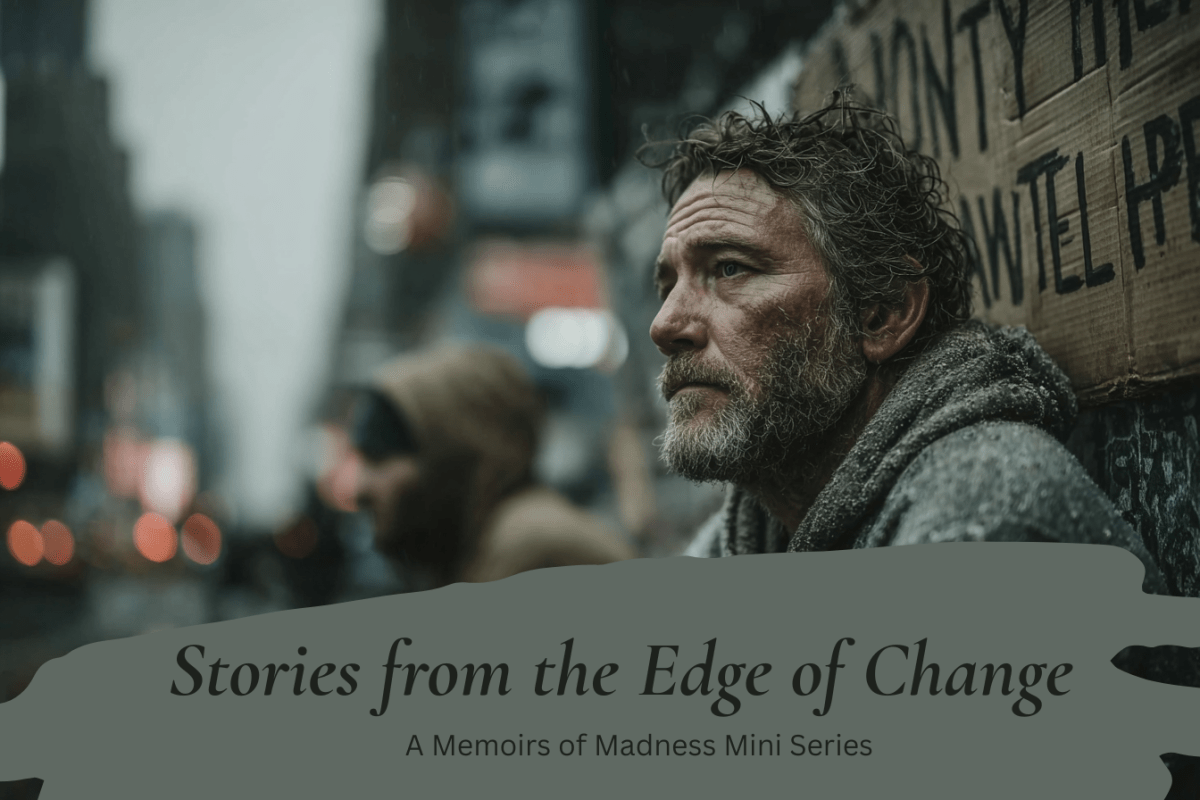
Stories from the Edge of Change – Volume 2, Part 1

“They said the system lost track of him. But he was never theirs to keep.”


The morning rain didn’t bother Ren. He’d learned that water was gentler than people.

He crouched beside the alley dumpster behind the drop-in center, shoulders hunched under a threadbare hoodie two sizes too big, sleeves eaten at the cuffs. His shoes—untied and uneven—squished when he shifted his weight. Rain pooled around the soles, but he stayed put, drawing loops on a soggy intake form with a chewed Bic pen. The form was from three weeks ago. He didn’t remember if he ever turned it in. Didn’t matter.

It was quiet this early. The kind of quiet that makes everything louder. His breath. His heartbeat. The clack of metal shutters two streets over. His fingers trembled, but not from cold.

He hadn’t slept inside in nine days.
But he knew where the cameras were, where the streetlights stopped working. Which stairs stayed dry?

He used to think that was survival. Now it just felt like memorizing a test he’d never pass.

A city bus hissed to a stop up the block, brakes squealing like something in pain. He looked up for a second, then back down. He’d been in those buses, once. With trash bags full of his stuff. Being transferred. “Transitioned.” “Placed.” Words that meant temporary. Always.

The folder in his backpack held every proof of his existence that the county ever gave him:

  • Two expired Medicaid cards
  • A GED prep schedule with coffee stains
  • A letter saying he was denied transitional housing
  • A single photograph, sun-bleached and wrinkled: him and Miss Tanner, his last foster placement, grinning with sparkler smoke behind them

He’d never shown that picture to anyone. He wasn’t even sure if the smile was his.
Sometimes he felt like that photo was the only place he still left a fingerprint.


Inside the drop-in center, they’d already started handing out coffee and hygiene kits. Ren didn’t go in. Not yet. He didn’t want to be seen with wet hair and a panic attack crawling just beneath the skin.

He’d been in a group home once that called itself “trauma-informed.” They still lock the bathroom at night.
He’d rather piss in the alley than ask permission again.

A man passed by, muttering to himself, trailing a shopping cart full of pillows and clinking bottles. Ren didn’t flinch. The cart guy nodded, as if he knew him. Maybe he did.

He did know the feeling: You’re alone but not exempt. Not from the weather. Not from the noise. Not from the memory of being fifteen, hands shaking as a caseworker said, “We’re placing you in a new home.” She said it like it was an opportunity, not another stab wound in a file no one would read.


The sky split open with a gust of cold air, and Ren finally stood. Pulled his hoodie tighter. Slipped the intake form into his back pocket. It had his name spelled wrong anyway.

He stepped out from behind the dumpster, not into confidence or comfort, but into motion. He moved the way you do when no one’s expecting you—not slow, not rushed, just enough to stay above notice.

As he passed the shelter entrance, he saw a boy younger than him sitting on the stoop, wrapped in a trash bag and drawing in the condensation on the glass door.

They didn’t speak. Just exchanged a glance. The kind that said: Yeah, I see you. No, I won’t say your name.

Ren knew that sometimes a glance was the only shield you had left.


He kept walking toward the corner, toward the same coffee shop he never entered, where the manager never made eye contact and the workers tossed day-old bagels out at 11:00. He’d wait nearby. Not to beg. Just to exist adjacent to someone else’s comfort.

This was the work.
Not recovery.
Not healing.
Just… enduring without disappearing.


He passed a torn flyer taped to a lamppost—one of those mental health outreach posters that still had a suicide hotline and a QR code for free therapy that didn’t exist anymore.
Someone had scrawled across the bottom in Sharpie:

“Hope is just the thing they say when they have nothing left to offer.”

Ren stopped.

He stared at that line for a long time.
Then smiled, just barely.

Not because it was funny.
But because he’d believed in hope once—and he’d watched it falter in real time.


Author’s Note

Written for Stories from the Edge of Change – Volume 2.
This piece responds to today’s word prompts:

Ren is fictional, but his story is rooted in reality—lived, endured, and too often ignored.
This piece isn’t about rescue or redemption. It’s about what it costs to keep going when the world has already filed you away.

Some people carry their past in manila folders.
Some names vanish before they’re ever called.
And some stories live in silence until someone listens.

Thank you for reading. Let me know if you’re ready to meet the others.

The Twist

FLASH FICTION – FOWC/RDP/FSS #204

Carla sprinted from the archaeological site, clutching an artifact that could either save or destroy the world.

The desert wind tore at her coat, slicing her cheeks with grit and heat. Behind her, the canyon bellowed—low, deep, the sound of stone waking from sleep. She didn’t look back.

The artifact pulsed in her palm—black stone, veined with silver that moved like quicksilver, coiling and recoiling. Cold as ice, yet burning her skin. It didn’t make a sound, but its pressure settled in her jaw and spine, like a voice she couldn’t quite hear. A warning. A dare.

She had read the glyphs. Scratched into bone, buried beneath layers of false chambers and cursed earth. Left twist: seal. Right twist: release. A simple choice.

Until it wasn’t.

A sound cracked the sky—a roar too wide to come from a throat. Carla reached the ridge and turned.

The site had vanished. In its place stood a figure made of shadow and ruin, shrouded in strips of black that bled smoke. It held a scythe that scraped the air, hissing with each movement like it sliced through time. Beneath its feet: a field of skulls. Beyond it, the expedition fortress, aflame, its banners melting mid-flap.

Her legs went numb. Her breath caught in smoke. She wanted to run. To cower. To vanish. But the heat from the artifact anchored her. Reminded her: she had opened the door.

She had let it out.

The spirals on the artifact shifted. A recess opened. The mechanism waited. Her thumb hovered over it, trembling.

It was her sister’s voice she heard next. Not real. A memory, maybe. Or a trick.
“The world’s been broken before, Carla. Someone always seals it shut again. Someone just like you.”

The creature stepped forward. The ground cracked. A second sun burned in its wake.

She twisted left.

The silence after was total. Not peace. Something worse.

Then, screaming. From the air itself. The creature reared back as spears of molten light stabbed down from the clouds. Chains wrapped its limbs. It shrieked, stumbling, clawing at the sky—but the light yanked it downward, tearing the world around it like cloth.

Then—nothing.

Carla collapsed to her knees, chest heaving. The artifact lay in her hand, cracked down the center, the silver threads gone dark. The sky was still red. The smoke still stung. But the screaming had stopped.

She stood, slowly, scanning the charred remains of the site. The fortress. Her team.

Gone.

She was lost now. A savior with no witnesses, no one left to remember the choice she’d made.

And just as she turned to leave, the wind shifted. Cold, sharp.
Somewhere far off, something laughed.

Closet Quest: A Steampunk Sock Saga

FLASH FICTION – FOWC & RDP

In the heart of a creaky old workshop, Reginald the Raccoon, steampunk engineer extraordinaire, adjusted his brass goggles and stared at his latest invention: the Interdimensional Sock Locator 3000. His mission was clear and absurd — recover The Sock. Not just any sock. The one embroidered with tiny mechanical gears and the words “Wrench It Like You Mean It.”

But the sock had vanished into the most feared place in the entire workshop — The Closet.

The Closet wasn’t just a closet. It was a legendary abyss, sealed with a handwritten warning: “ENTER AT OWN RISK — MAY CONTAIN WILD TOASTERS”. Inside were decades of misplaced inventions, rogue gadgets, and sandwiches from questionable eras.

Reginald wasn’t afraid. He was prepared.

He packed his essentials: a grappling hook, a glowing morale-boosting lightbulb, a peanut butter sandwich (for negotiations — mayonnaise had backfired last time), and his trusty spanner. Thus began The Closet Quest.

With a deep breath, he cracked open the door. The closet sucked him in with a WHOOOOOMP — the kind of sound a vacuum cleaner would make if it suddenly gained ambition.

Inside was chaos: umbrellas lunged like javelins, toasters flung shuriken-bread, and an especially grumpy bagpipe band oozed around, playing nothing but angry honks. Reginald ducked and weaved, narrowly avoiding a spatula attack.

Halfway in, he encountered the sandwich kingpin — a towering club sandwich wearing a tiny crown of pickle slices.

“I demand mustard!” it bellowed.

Reginald, calm as ever, offered a jar of peanut butter. The sandwich sniffed, grumbled, and waved him through with a soggy lettuce leaf.

After what felt like three Tuesdays and one awkward staring contest with a unicycle, Reginald spotted it — his sock, perched on the back of a six-legged chair scuttling like a nervous crab.

With a battle cry that sounded suspiciously like “FOR SOCK AND GLORY!” Reginald launched himself through the air, snagging the sock mid-tumble while the chair skittered away, squealing in defeat.

Victorious, Reginald emerged from the closet, slightly scorched, moderately crumbed, but grinning wildly. He slid the sock onto his paw like a puppet and proclaimed, “No sock left behind!”

He celebrated by installing three more clocks — all wrong — and scribbling a new warning on the closet door: “STILL HUNGRY.”

Just as he was polishing his spanner, a tiny scroll slipped out from under the door. It was a ransom note, scrawled in mustard:

“Next time… Dijon. – Sandwich King”

Worse yet, the new clocks he’d installed began to tick backward, forward, and sideways. Time hiccupped, and a second Reginald — equally confused but holding a jelly jar — blinked into existence.

Reginald sighed. “Guess it’s Tuesday again.”


Glossary of Reginald’s Workshop Essentials (coming soon):

  • Spanner of Questionable Durability — works until it doesn’t.
  • Sock Locator 3000 — still missing a “find” function.
  • Emergency Sandwiches — one per dimension.

How I Became Secretary of Seeds

PROSE – FOWC & RDP

The bluebird glared at me from its perch on the fence post like it had been waiting all day just to start something. It was a deep, suspicious blue, like the sky on a day when the weather can’t make up its mind. The bird’s feathers shimmered in the sun, and its eyes were full of judgment.

“You’re staring,” it said.

I blinked. I hadn’t expected this. Birds usually don’t sass me.

“Sorry,” I said. “It’s just… you remind me of when I was young. I used to think birds had secret meetings and built tiny cities out in the fields.”

The bluebird fluffed up. “Yeah, well, we do. You think this is just a fence post? This is the Capitol building.”

I squinted at the worn, splintery wood and the sagging barbed wire. “Seems a little… low budget for a capital.”

“Budget cuts,” the bird said flatly. “Also, you’re standing on the public square. Watch the granola crumbs.”

I shifted awkwardly. Nostalgia hit me like a soap bubble — light, slightly annoying, and somehow sticky. I remembered chasing birds in the backyard, shouting important speeches to them about imaginary kingdoms. I thought they listened. Turns out, they just had bad exit strategies.

“So what’s the bird government up to these days?” I asked, genuinely curious now.

The bluebird tapped its beak thoughtfully. “Mostly snack acquisition. Some squabbling over real estate. And we’re still figuring out how to unionize against cats.”

It flapped its wings once, a grand, slow-motion move like it had just delivered a very important decree. “Anyway, I gotta fly. Press conference in a cedar tree at noon. But before I go—” it paused dramatically, “you’re appointed Secretary of Seeds.”

I blinked again. “Wait, what? I didn’t even apply.”

“Exactly why you’re qualified,” the bird said, very seriously. “No one who wants the job should have it. Now go forth. Scatter responsibly.”

And just like that, it took off, leaving me alone with my nostalgia, a few leftover granola crumbs, and a brand-new title I hadn’t asked for.

I brushed my shirt off with as much dignity as I could muster and gave a solemn nod to the fence post capital. It’s not every day you get conscripted into bird government. Diplomacy with birds was a tricky business, but I like to think I made progress.


Shred for Me, Pretty Lady

FLASH FICTION – FOWC & RDP

He heard her riff from the other side of the park — sharp, ragged, alive — and it hooked him deep.

She wore ripped jeans, grease-smeared at the thighs, and a black tank clinging like second skin. Her wedge sandals cracked against the pavement, loud in the dead night air. Neon from the bodega stuttered green and pink across her face. The street smelled like hot concrete, burnt coffee, and metal.

The park was a ghost — limp swings, bleeding graffiti, trash twisting in the wind. She crossed barefoot, her wedges abandoned like broken shells, toes flexing against the grit.

Guitar slung low, she slammed a chord that split the silence.

He was already moving — hoodie up, sneakers scuffing, sweat trickling down his spine. His mouth tasted like rust and cheap beer. His pulse, steady but hard.

She extended an arm, fingers loose, head bobbing deeper into the groove — lost, or somewhere he couldn’t follow. Each beat hollowed out the night until it was just her.

He crossed the street, the music pulling him in.

Two steps. Three.

She hit a final shred — sharp, blistering, reckless — tearing the night wide open. Then she stopped.

Looked straight at him.

For a second, the whole city held its breath.

She smiled first — small, real.

He smiled back.

No words. No need.


Forged Within the Ether

PROSE – FOWC & RDP


Before gods bore names and before stars had patterns, she was promised to the beast.

She was not born—she was forged—beneath an aurora that tore the heavens open, a raw seam of color bleeding across the void. The elders spoke of it in fearful whispers: the girl born beneath a wound in the sky must one day walk alone into the dark and not return.

And so she did.

The tiger awaited her at the threshold where the world ends — not as a beast, but as a remnant of a forgotten order. His fur shimmered with the dust of collapsed stars, his stripes like scars left by ancient battles. He was more than the creature, less than a god. He was a memory of what the cosmos used to be before time taught it to decay.

She should have been afraid.

Instead, she felt something deeper: the pull of recognition. The silent knowledge that she, too, was a relic — born out of step with the age that claimed her. She had carried it all her life, that ache that no mortal hand could soothe.

When their foreheads touched, she did not kneel. She did not beg. She listened.

In his steady breath she heard the slow exhale of dying stars. In his pulse, she felt the ancient patience of mountains that crumble and are reborn as sand. He spoke no words, but she understood: to be mine is not to be possessed, but to be remembered.

Her hands, steady now, sank into the thick, impossible warmth of his fur. She thought of how the world would forget her, how her village would carry on, how even the memory of her name would dissolve in the slow acid of time. But here — here she was seen. Known.

And if oblivion was the price, she would pay it gladly.

Above them, the etherlight burned brighter, fierce and beautiful, a scar that would never heal.

When she vanished into the folds of the night, no one marked her passing.

But somewhere beyond the reach of history, she still walks beside the last Skyborn, two relics out of time — bound not by chains, but by the quiet, immutable truth that even in a universe of endless forgetting, some things — some bonds — remain.

Earth Girls Are (Not) Easy

FLASH FICTION – FOWC & RDP

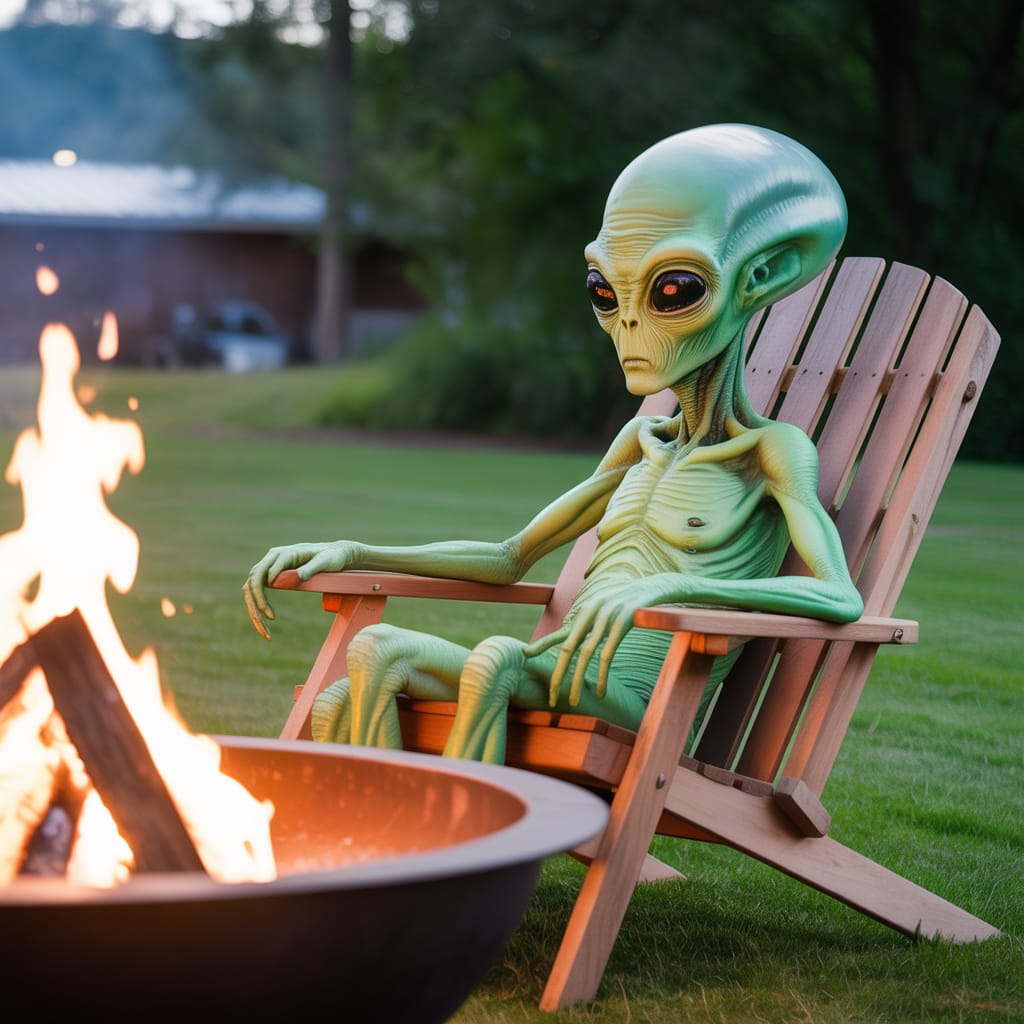
Zog had traveled 27 light-years for this nonsense.

He’d battled through the fray of the Andromeda-Fermilab skirmishes, dodged a black hole that smelled suspiciously like burnt popcorn, and bribed a customs agent on Venus — all for what Earth’s glossy travel brochures promised: an authentic campfire night.

Now he sat paralyzed in a splintery lawn chair, staring at a pit of flaming sticks like they were a personal insult.

This is it? Zog blinked slowly. Fire. In a hole. Congratulations, Earth. You’ve reinvented the sun, but dumber.

The smoke was relentless. Shift left — it followed. Shift right — it hunted him like an ex with a grudge. His oxygen filters strained, and he already smelled like scorched pine and bad decisions.

Two Earth juveniles gawked at him from across the yard.

“Is he okay?” one whispered, chocolate smeared across his wrist.

“Maybe he’s meditating,” the other said, as if Zog was one deep breath away from achieving Nirvana.

No, Timmy, Zog thought grimly. I’m rethinking every life decision, starting with trusting Mon.

Ah, Mon — fellow traveler, distributor of lies. Earth girls are easy, Mon had said, smirking, right before getting ejected from a Martian dive bar. You’ll be knee-deep in interspecies romance before you can say, “Take me to your leader.”

So far, Zog hadn’t even been knee-deep in conversation. The only intimate contact he’d had was with the mosquito drilling into his forearm.

A marshmallow flung from a crooked stick splattered onto his lap, instantly fusing to his exosuit.

He didn’t flinch. He didn’t dare.

Perfect, Zog thought. Now I’m paralyzed, smoke-drenched, and sticky. What an exotic species I must appear: a confused, flammable piñata.

Across the fire, someone strummed a guitar and began mumbling a song about truck beds and heartbreak. Zog stared blankly, mentally composing his one-star review.

Earth Girls: False Advertising. Fires: Aggressively Enthusiastic. Hospitality: Threat Level Marshmallow. Would Not Recommend.

Still, he thought, if he could survive the fray, he could survive this. Maybe even find a girl — though at this point he’d settle for someone who didn’t accidentally set him on fire.


Too Bright to Touch

PROSE – FOWC & RDP


She moved like a memory caught in motion—half real, half reflection.
Blue light wrapped her like prophecy, like warning.
Everything about her shimmered.
Not from joy, but from exhaustion lacquered into beauty.

There was a cost to being seen this way.

Every inch of her radiated curated power—eyes rimmed in defiance, lips painted in precision.
She looked flawless. Untouchable.
But nothing about her was effortless.
She was sculpted in silence, shaped by scrutiny, smoothed by survival.

The world adored the Gloss.

They called it strength.
They mistook stillness for peace.
They praised the image and ignored the ache.

Because Gloss blinds.

And beneath it, something primal waited—untamed, uninvited, and fully hers.

Fur.

Not for decoration—for defense.
It was everything she’d learned to hide: the mess, the wildness, the depth.
The part of her that could not be branded, couldn’t be edited.

She’d buried it to belong.
But it never stopped breathing.

Now it whispered again.

I want to love.
I want to find peace.
I want to find the real.

But in a world that feeds off illusion…

They tell her lies, in a delicious way.
Wrapped in compliments.
Scented with approval.
Only palatable if she never breaks character.

She tried to believe.
Tried to play along.
But the silence inside her was louder than any applause.

Though she is surrounded, she feels alone.

People held the projection.
No one held her.

Who is the person peering from the cage?
She doesn’t want to be here, but there she is upon the stage.

And one day, without ceremony, she stopped pretending.

She stripped away everything, stood as she truly was.
No gloss.
No pose.
No apology.

And in the rawness of that moment—

To dream of the moment is not insane.

Not foolish.
Not naïve.
Not a weakness.

It’s a kind of rebellion—
To believe in softness after survival.
To imagine stillness after the storm.

Perhaps, she will learn the answer—just not today.

Today is enough.

Because in the stillness…

She not afraid.
She not afraid.
She began to breathe.
It almost easy.

No spotlight.
No mask.
Just breath.
Just truth.
Just her.

Too Strong for You

PROSE – FOWC & RDP


She wore the veil not to disappear, but to survive.

It wasn’t for tradition, or rebellion. It wasn’t a performance. It was protection.
It was her way of saying: I decide what you get to take from me.

They never handed her chains. They handed her mirrors. Bent ones.
Peer pressure didn’t demand. It seduced. Do what we do. Be what we expect. Not because we said so—but because you’ll be alone if you don’t.

Then secular pressure followed, wrapped in freedom’s clothing.
Be who you are—as long as it’s curated, as long as it looks good, as long as it doesn’t disturb.
Express, but don’t confront. Create, but don’t challenge.
Believe in nothing but your brand.

And for a while, she drifted. Trying to belong. Trying to disappear inside approval.

But inside the silence, something broke open.

“Weak as I am…”

She said it like an admission. But it was the beginning of truth.

Weak—not because she failed, but because she felt.
Because she hadn’t let the world harden her into something hollow.
Because even in survival, she still longed for something more than existing.

Because she can’t change the world, but she control how it molds her.
And she refused to be shaped by fear. She chose to be shaped by memory. By presence.
By scars she didn’t hide.

Stay alive. Keep on fighting.

Some days, she did.
Some days, she didn’t.

Like a fugitive on the run—from becoming unrecognizable to herself.
Carrying the weight of all she’s done—and all that’s been done to her.
She was born from regret, yes. But that regret made her conscious. Aware. Awake.

And still, the questions haunt her:

What is she fighting for?
What is she running from?

The answers shift, day to day.

Sometimes she fights for the quiet.
For the small version of herself she abandoned to survive.
For the right to not have to explain.
For the chance to feel something other than fear.

And yes—there are moments. Moments where escape feels like mercy.

What if she wanted to run? Leave it all.
What if she crumbled, and couldn’t fight anymore?

These thoughts don’t scare her anymore.
They keep her honest.
They remind her that strength isn’t the absence of breaking—
it’s the choice to return to yourself after.

Because at the end of all the noise, all the pretending, all the shrinking and reaching and rebuilding—

She is left with one quiet, unshakable truth:

This is who I really am.

No polish. No filter.
Veiled, but not invisible.
Wounded, but not erased.
Tired, but still reaching.

So when the world looks her way, squinting through its own discomfort, trying to place her in a category, or strip her down to something simpler, something safer—

She doesn’t flinch.

She lifts her gaze and speaks with a voice that carries every weight she never dropped:

“With this tainted soul, in this wicked world…
Am I too strong for you?”

And if the answer is yes—so be it.

She never asked for permission.
She only asked to be real.

Caught in the Heavy

FICTION – FOWC, RDP, 3TC


Caught in the Heavy

The corridor stretched on like a memory he couldn’t escape—narrow, dim, damp with a cold that clung to the skin like breath on glass. Mildew, rusted metal, and aging wood tinged the air, a scent that settled into the lungs and whispered of long-forgotten places. Floorboards groaned beneath his boots, their brittle creaks echoing like old bones remembering how to hurt.

He stood in the middle of it all, unmoving. Not frozen by fear exactly—more like resignation. The kind that seeps in after the tenth mistake, the last apology, the moment you realize the story you’ve been living might never shift its ending. He used to think time would fix it. But time, he’d learned, doesn’t heal. It settles—like dust.

The walls pressed close with peeling wallpaper and old nail holes where lives once hung. He scanned them as if he might find his past nailed there, too. Maybe a younger version of himself in a photo frame, smiling with someone whose name he couldn’t say out loud anymore.

An unfortunate truth surfaced: he’d chosen this silence. No one forced him here. He pulled away. He locked the doors before anyone knocked. They called it being guarded—he called it survival.

On a crooked table sat a lone candlestick, melted to a stub. Its wax clung like a memory—dried, useless, but still intact. He reached for it absently, fingers brushing tarnished brass. Cold. Solid. Real. A reminder that even forgotten things still leave traces.

He wondered how long he’d been standing here. How long had he been waiting for the hallway to say something? But hallways don’t speak. They listen. They hold your silence for you until it grows too loud to ignore.

Everything around him felt heavy. His coat, soaked with damp air. His thoughts sagged with years of unanswered questions. Even his heartbeat felt labored, as if each thud carried the weight of something he refused to let go.

He closed his eyes and thought of the words he never said. The calls never returned. The glances he turned away from because he didn’t trust what he saw in them.

Regret was a slow grief, the kind you wear like skin. And the mind, cruel and calculating, was its favorite weapon. Not a blade, not a gun—just memory sharpened to a whisper that says, “this is who you really are,” when you least expect it.

Still, a thought rose unbidden through the noise—quiet, but firm:

We always try to overlook the past, because we can’t change it. But we forget the important factor about the past… the wisdom we gain from it.

He let the idea settle, warm against the cold inside him. Maybe that’s what he’d come here for. Not punishment. No escape. But understanding. A reckoning not with the pain itself, but with the lesson buried beneath it.

He didn’t move. Not because he couldn’t—but because this was the only place he could hear himself. This hallway wasn’t just a space. It was a mirror, a memory, a confessional.

A bulb overhead buzzed, casting him briefly in light—harsh, unflattering. His reflection in the warped glass at the far end looked like a man still mid-sentence, still caught between what he was and what he feared he’d never be.

Just enough light to prove he was still there.

Just enough to remind him that some corridors don’t lead out.
They lead in—and if you’re not careful, they never let you leave.

Coffee, Heels, Ramen, Commutes, and the End of the World

FICTION – FOWC & RDP

For most people, the holidays are a time for joy, togetherness, family, and other concepts pushed by commercials and overpriced airline tickets. Me? I got a new city, a new job, a new apartment, and not a single damn soul to split a drink with. A festive little cocktail of isolation, garnished with cold floors and ramen noodles.

Warm beer wasn’t a preference. It was apathy in a can. Every dollar was rationed like I was living in a bunker, waiting for a war that already came and went. All in service of building a “normal” life. Whatever that meant. Probably something people posted about with filters and hashtags while wondering how far they could lean out their windows without falling.

I stared out the window, coffee in hand—black, burnt, and bitter, just like me. Outside, the early morning parade of wage slaves stumbled toward their cars, moving like background actors in a post-apocalyptic sitcom. Another day of selling hours they’ll never get back. I lit a cigarette with my Zippo, watching the flame catch like it was lighting a fuse. It usually was.

Then she appeared. A brunette with an athlete’s build and a power suit tailored like a threat. She walked like the world owed her rent—somewhere between courtroom and catwalk. I didn’t know if it was lust, curiosity, or cabin fever talking, but after nine months of social starvation, she might as well have been a hallucination in heels.

I told myself I was meant to be a writer. The kind who bled truth onto paper and didn’t flinch. But instead, I was half-awake, smoking, and objectifying strangers. Not exactly Pulitzer material. So I turned back to my notebook. It was the only thing that didn’t feel fake. Just ink, paper, and whatever was left of my sanity—a loop I couldn’t seem to break.

Every morning, I wrote until 6:30. Then I’d drag myself into the shower and make the fifteen-minute commute that somehow always took an hour. Sixty minutes of bumper-to-bumper hostility. Everyone late, everyone pissed, everyone pretending their playlist made it okay. It was the same ritual every day—wake, write, shower, drive, repeat. Resist the urge to scream, loop through it again tomorrow.

My job? IT guy. The one people called after breaking things they didn’t understand, then blamed me for fixing too slowly. You could tell within thirty seconds I hated it. I didn’t try to hide it. Misery loves company. I hosted parties.

The paycheck kept the lights on, but not much else. I worked for a mid-tier company with big egos and small ideas. But lately, the rumor mill has been grinding overtime. Word was, we were getting bought out by some corporate giant with a thirst for blood and profit margins.

That meant an audit. Cue the chaos. People who spent the last six months tweeting through staff meetings were now sprinting to cover their asses. Watching them panic was the most fun I’d had in weeks. The hammer was coming, and I had the best seat in the house—coffee in hand, notebook open, waiting to see who’d get crushed first.

Things Found in the Fire

PROSE – FOWC & RDP

The alley wasn’t picturesque, but it was honest. Cracked brick walls caught the last tired light of the day, holding it like a secret. She leaned against them, letting the roughness bite through the fabric of her shirt — a small reminder she was still here, still standing.

People always skipped places like this. Skipped the alleys, skipped the worn faces that carried too many losses. She used to believe that if she fought hard enough, worked long enough, she could save something — a home, a love, herself. She thought effort could outmatch entropy.

But slowly, we turn the page and walk away from everything. We worked so hard to save. Must we start all over and find another shoulder to lean on?

The question pressed into her like ash on skin. Maybe survival wasn’t about saving what was burning. Maybe it was about knowing when to let it burn. About sifting through the ashes for the pieces that could still hold weight.

The sun folded into the horizon, leaving behind the thick hum of a city settling into itself. She didn’t move quickly. She didn’t look back. Some fires you didn’t put out. Some things you simply let burn and walked away from — lighter, fiercer, more your own.

She stepped out of the alley and into the dusk, steady and unafraid, carrying only what survived the fire.


The Ridge Where Silence Waits

PROSE – FOWC & RDP


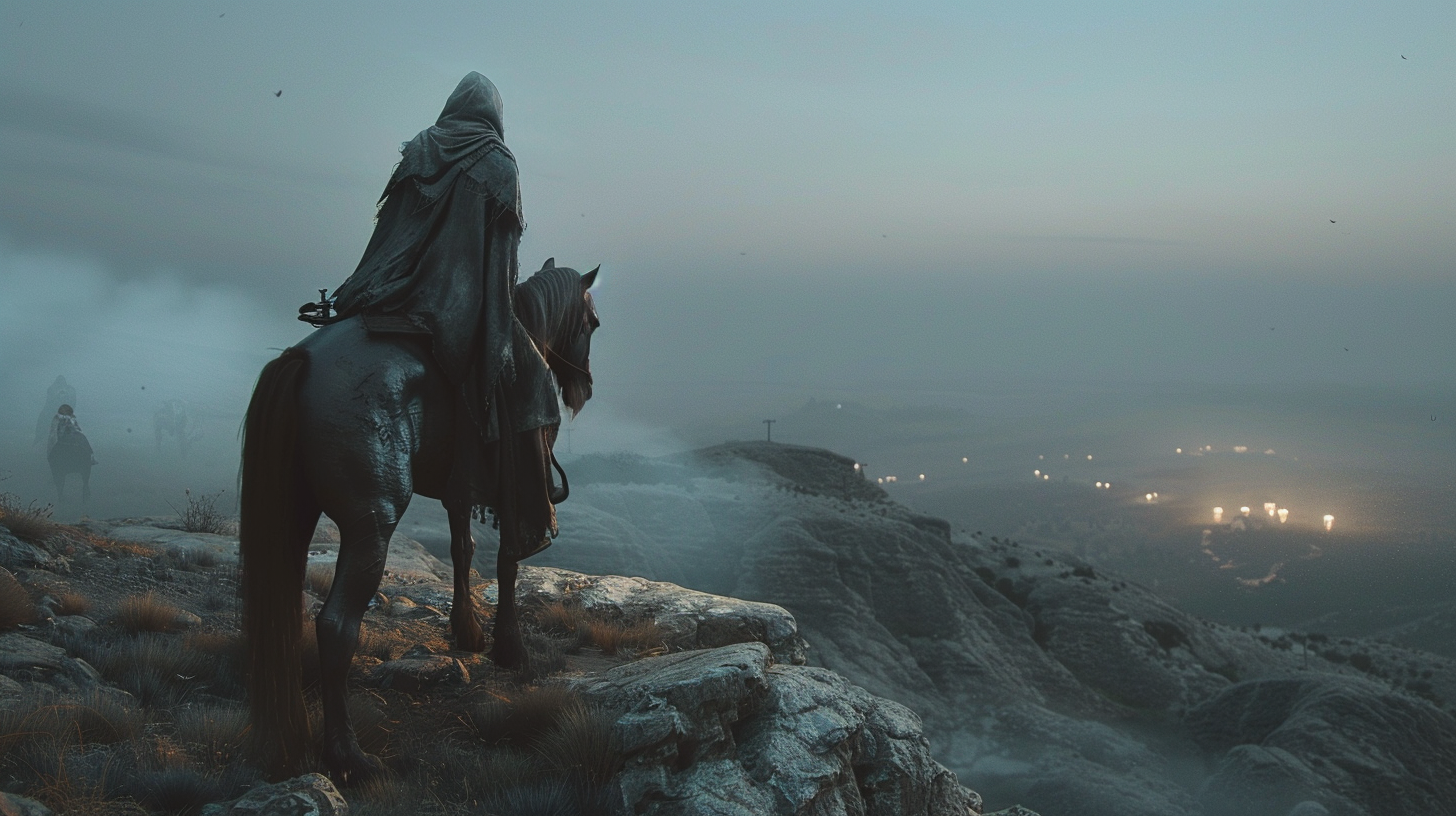
Dawn unfolds like a hesitant prayer, its soft light unspooling over the bones of the hills. The stars, one by one, retreat into the folds of daylight, as though ashamed of what they bore witness to through the long, silent hours. Still, I remain at the crest of the ridge, a lone silhouette etched against the slow bloom of morning. I have not slept. I could not—not with the weight of forgotten omens pressing down on me like ancient armor.

The saddle beneath me creaks as I shift, leather complaining in a language only the wind can answer. My limbs ache, not just from the vigil, but from something deeper—an unraveling. I am more wreck than man, hollowed by longing and the quiet violence of loss. My voice, once sure, now drifts somewhere in the ether, unreachable. Even if I could summon the will to speak, I no longer trust the shape of my own words.

Below, the keepers stir. I hear the sharp clash of their voices, rising in petty squabble over rituals they no longer question. Their movements are brisk, their concerns tethered to earth and duty. I do not begrudge them this. But I cannot descend, not yet. I am no longer bound to the cadence of the living. Not while something in me still listens for a call that may never come again.

For I have lost the vision.

Once, it came to me like thunder through a cathedral—blinding, holy, terrible in its beauty. It lit my mind with purpose, set my hands aflame with creation. But that light has dimmed, flickered, vanished. Last night it sang, soft and clear through the bones of the wind. Now it is gone, and in its place: silence, vast and unrelenting.

I reach inward, desperate for a glimmer, a fragment of that divine echo, but find only echoes of my own fear. My compass is shattered. My quill is waiting in some distant place I no longer know how to reach. The path to it—if it still exists—has been swallowed by mist and regret.

And yet, there is no peace in surrender. Only the chill of a fate whispered by unseen mouths, breath like ice on the back of my neck. They murmur not of endings, but of reckonings. Of a soul unmoored of a promise made long ago beneath stranger skies.

Perhaps this is what becoming untethered feels like—not a fall, but a float. Not a silence, but a waiting breath.

The ridge hums beneath me, and I close my eyes.

If the light returns, I will know it by the way the wind shifts. I will feel it in the marrow. I will rise, not with certainty, but with faith scorched into my bones like forgotten scripture.

But until then, I remain.
A shadow made flesh.
A watcher at the edge of memory.
A ghost, listening for the sound of his own return.

Swallowed, then Speak

POETRY – DEFIANCE

What is the moment when I scream into silence?

But I’m silent, really—
no sound, no voice,
just a mouth stretched wide around something too big to name.
My eyes glaze—not with calm, but with shock.
A thin film of disbelief over everything.
My heart races.
I’m wrecked like a tsunami with no quarter,
flung breathless against the shore.

It’s not quiet.
Not truly.
It’s a silence that throbs,
that undresses me,
strips me down to the rawest nerve.

Why?
Am I afraid to speak what I feel?
I push it down until I crack.
Swallow the pain, the misery, the grief—
like that’s what strength is.
As if silence means control.

But inside, it never stops screaming.

I’ve built a prison with no walls.
I’m both prisoner and warden.
Every emotion I swallow—another brick.
My tears, the mortar.
The longer I hold on,
the harder the mortar sets.

Letting go should be simple.
But I can’t.
I won’t.
I have to be strong.
Another brick.

The chains tear into me.
I pull and pull,
begging for clemency I know isn’t coming.
Skin breaks.
Something deeper frays.
Still I pull.
Still I scream.
Another brick.
How did I get here?

I slump into the abyss of agony.
Its waves strangely soft,
almost soothing.
The ghosts of my past wrap around me,
pulling me under.

Is this peace?
Is this what I deserve?

No.

I scream NOOOOO!!!
A final act of defiance.
A rupture in the silence.
A crack in the wall.

I scream again—louder.
Louder than the pain.
Louder than the ghosts.
Louder than everything that told me to stay quiet.

The final word is no longer a whisper.
The silence and I become one.
And we finally—

SPEAK.


The Weight of Stillness

PROSE – FOWC & RDP

I drift through the mist of life’s abyss, not falling, not flying—just suspended. Time doesn’t move here; it folds in on itself, leaving me trapped in a silence that isn’t peace, but ritual. Dutiful. Respectful. A silence learned over years of swallowing words and measuring breaths. It’s the kind of silence that makes you forget the sound of your own voice.

The air around me stirs, barely. Still, I hear the whispers—low, deliberate, cold. They speak not in sentences, but in suggestions, in warnings that curl around my ears and settle in my chest. They speak of fate, of choices already made, of a path too worn to change.

In my hand, the quill waits, poised like it knows the weight of what it might say. But it’s grown unwieldy—too much meaning, too much memory packed into such a fragile thing. I grip it, unsure whether to write or release. Each word feels like it could be the last. Maybe this sentence is where I stop. Maybe this is where I finally let go.

But still I hover, caught in that space between thought and surrender, listening to the hush of everything I’ve never said.

Where the Sky Remembers Her

She stood still, her profile etched in the quiet glow of imagined worlds. Galaxies spun behind her eyes, each one holding a memory she hadn’t spoken aloud in years. Moons drifted close, brushing her skin with light that wasn’t light, warmth that didn’t burn. The clouds moved through her like thoughts, slow and tangled, as if the sky itself had cracked open to whisper her name.

Her expression didn’t shift. It didn’t need to. She wasn’t here to perform. She was caught in that weightless place between who she’d been and who she might become. And in that stillness, even the planets seemed to orbit slower, listening.

Someone once told her she looked too serious, too distant. But they only gave her a bland kind of attention—the kind that never reached deeper than skin. The type that skimmed her surface and missed the storm beneath.

Now, she let her thoughts roam in this quiet collision of sky and soul. Not forward. Not back. Just… outward. And for a fleeting second, she caught a flicker of something—possibility, maybe—out of the corner of her eye.

A glance, nothing more.

But it was enough to remind her that she was more than what the world saw, more than the shadows cast by fading light. She was part of the cosmos now, and maybe, just maybe, the cosmos was part of her, too.

The Gauntlet of Fog and Stone

PROSE – FOWC & RDP

The mist clung to the earth like old sorrow, curling around boots and stones, swallowing sound. Two figures stood before the monolith, cloaked in black, their outlines blurred by fog and fate. The stone towered above them, carved from the mountain’s spine. Its surface was worn by centuries but still bore the mark—an eye within a jagged star—that pulsed faintly, like something alive and watching.

They had come a long way to find it. Through dead forests that whispered their names. Across plains littered with the bones of better men. Not for glory. Not even for vengeance. Just the promise of an answer, or maybe an end.

Behind them, the others waited. Hooded. Silent. A dozen warriors who had followed them without question, bound by old oaths and older regrets. No one asked what lay on the other side of the fog. The question had been buried with the first man who hesitated.

The taller of the two stepped forward, boots crunching on frost-hardened gravel. His hand hovered near the hilt of his sword, fingers twitching like they remembered every fight that hadn’t gone his way. “We stand at the edge,” he said, low and certain.

His companion didn’t look at him, just stared at the monolith. “And what waits beyond?”

“Only those who boldly engage the old magic will know.”

The other figure stepped closer to the stone, his silhouette ragged with wear but upright and determined. He placed a gloved hand on the carving. The stone felt warm—too warm—as if it hadn’t forgotten.

The ground answered—not with light but with a deep, resonant hum that rolled through the valley like a warning. The fog began to move, twisting into strange shapes, pulling backward to reveal what waited deeper in the pass—a path, a gate, shadows shifting on the other side.

The second man drew his blade slowly, the sound of steel slicing the stillness. “Then we put on the gauntlet,” he said, quiet but resolved. “And we walk into whatever comes next.”

Not for glory. Not for vengeance. But for truth. And for the ones they couldn’t bring back.

Together, they stepped forward as the stone split open, the mountain groaning with ancient memory. Finally, the fog began to part.

Oracle of Hollow Peak

PROSE – CONCEPT ART – DOUBLE EXPOSURE

In the heart of the Hollow Mountains, where the air hummed with silence and time forgot to tick, a being older than wind sat. Encased in a sphere of shimmering energy—neither glass nor light, but something between—the Oracle meditated above a chasm that pulsed with ancient fire.

He had not spoken in centuries. He didn’t need to.

The mountains around him were carved not by water but by will. Their jagged silhouettes, emerald-tipped and layered like echoes, were born from his breath. Each ridge was a memory. Each peak was a vow. He had once been flesh, bone, and fire. Now, he was purpose wrapped in the illusion of form.

To the outside world, he appeared as a man—if a man could be sculpted from starlight and storms. His robes flowed like liquid fog, and his long, tangled beard bore streaks of silver like splotches of moonlight left behind by the gods.

Pilgrims had tried to reach him, climbing in silence, their mouths dry from reverence or fear. None returned unchanged. Most didn’t return at all.

Inside the sphere, reality bent. Time curled inward like smoke. The Oracle sat cross-legged on a throne of molten stone that neither burned nor aged. Beneath him, streams of liquid light cascaded into the void—knowledge pouring endlessly into the earth’s soul, never wasted, never full.

He was more than a seer. He was a medium between worlds—the silent conduit through which forgotten truths passed. Not a messenger, not a prophet, but something more elemental, something that watched as stories ended and began again.

He waited—not out of impatience but design. Somewhere, someone would be ready to ask the right question. Not about destiny or death. Those were too easy. But the one that mattered. The one that cracked the world open.

Until then, he breathed. And in that breath, universes whispered.

Top 5 Ways to Ask a Girl Out: Rule #5

FICTION – FOWC & RDP


Top 5 Ways to Ask a Girl Out: Rule #5
If you survive the kiss attempt, you’re in.


We walked back from the taco truck under the kind of sky that made everything look slightly more romantic than it deserved to. Streetlights flickered on like they were rooting for me. Or mocking me. Hard to tell.

“So,” she said, arms folded, still carrying her drink like it was a trophy. “Do you usually spend your Saturdays pretending to be a mechanic-slash-foodie with girls you’re not dating?”

“Only the ones who invite me to test-drive their haunted vehicles and emotionally unstable lawn statues.”

She laughed. “So I’m special.”

“You are,” I said, before my filter could save me.

She looked over, eyes holding for a beat too long. I panicked and did what any emotionally underdeveloped guy would do: I kicked a pebble and immediately regretted everything I’ve ever said.

We got to her door. The gnome was back. Sitting on the railing again like nothing had happened.

“You brought him back out?” I asked.

She shrugged. “Didn’t move him.”

We both stared at the gnome.
The gnome stared back.
Relentless.

I cleared my throat. “So. Tonight was… really good. Even if I almost stripped the threads off your lug nuts and spilled soda on my own knee.”

She smiled. “Definitely one of my better fake-date disasters.”

And then it happened.
That silence.
The kind that invites a kiss if you’re bold, or complete social collapse if you’re not.

I stepped a little closer. Not a full leap—just a half-step of doomed courage. She didn’t move. Just watched me with that same small smile and terrifying confidence.

This was it. This was the moment.
I leaned in.
And completely misjudged the height difference.

My nose bumped hers. Her forehead bumped mine. My glasses fogged instantly. Her drink sloshed. One of us made a weird surprised sound—pretty sure it was me.

We pulled back, both blinking.

I wanted the sidewalk to swallow me. Instead, she started laughing.
Like, full-on, can’t-stop, leaning-on-the-doorframe laughing.

I winced. “Cool. Yep. Nailed it.”

She grabbed the front of my shirt, pulled me in, and kissed me properly.
Soft. Sure. Just long enough to shut my brain off.

When she pulled away, she whispered, “You passed that test, too.”

The gnome was still watching.
Probably smirking.
Waiting for whatever moment would arrive next.


Author’s Note
And that’s a wrap on this blog series. Thanks for sticking with it. This story (and its awkward kiss energy) will be part of my upcoming short story collection. Same premise, just expanded—with more chaos, more heart, and yes, probably more gnome appearances.

War, Wisdom, and Other Lies I Tell Myself at Dawn

PROSE – FOWC, RDP, SoCS

“Damn, you’re ancient! What was it like to be one of Teddy Roosevelt’s Rough Riders?”

One of the kids on my team tossed that gem at me this morning. Smirking like he just reinvented comedy. I wanted to fire back—something about his hairline already surrendering—but I let it ride. Not because I’m mature. I’m just tired. And honestly? The way the squad erupted in laughter… it was worth the hit. They needed the laugh more than I needed the win.

I’ve never really understood the logic of soldiers. Still don’t. We sign up to follow orders we don’t write, from people we’ll never meet, for goals we’re not allowed to fully understand. And we’re supposed to be fine with that.

Back when I was their age, I like to think I was different. Noble. Thoughtful. Maybe even angelic. (Okay, maybe not angelic. More like… less of a jackass?) But that could just be the rose-colored fog of memory, or the result of years spent rewriting my own origin story like a drunk screenwriter.

There’s something ritualistic about the way the morning unfolds out here. The dawn eats the night. First sip of bitter coffee. First cigarette. The world still quiet enough to pretend it’s not completely unhinged. I watch them wake up—slow, clumsy, half-zombies with bedhead and bad attitudes. Too young to have rituals, too new to know those rituals might one day keep them sane.

I remember one morning, I hit them with Sweet Leaf by Black Sabbath. Volume up, sun barely over the ridge. Half of them looked like they’d been shot in their sleep. The other half just looked confused. I let it rip while running them through live-fire scenarios. Brains not even warmed up, bodies still clunky from the cold.

It wasn’t for fun. Okay—it was a little fun. But mostly it was about pressure. Teaching them to operate before they’re ready, because the world doesn’t care if you’re ready. Expect the unexpected, I told them. It’s a cliché until you’re bleeding because you didn’t.

Eventually, they’ll get it. Or they won’t. Some learn the rhythm. Others burn out trying.

Each day, we stand there like portraits—young faces with old eyes—propping up a cause that shapeshifts depending on who’s holding the microphone. Marching to the beat of some distant desk jockey who calls themselves a leader because they can attach a PDF to an email. And no one questions it.

That’s the part I can’t let go of. No one questions it.

“War is peace. Freedom is slavery. Ignorance is strength.”
— George Orwell, 1984

I’ve never fully understood that quote. I’ve got pages of half-drunk, sleep-deprived ramblings trying to unpack it. You’d think, with age, I’d get closer. Clarity, wisdom, all that crap they promise you comes with gray hair. But no. The notes get weirder. The handwriting worse. The questions louder.

Maybe that’s the point. Maybe wisdom isn’t about finding answers. Maybe it’s just about asking better questions—and knowing when to shut up and pass the coffee.

Sun’s up. Time to pretend we’ve got it all figured out again.


This post was written for Ragtag Daily Prompt, Fandango, and Stream of Conscious Saturday.

Top 5 Ways to Ask a Girl Out: Rule #4

FICTION – SHORT STORY SERIES


Top 5 Ways to Ask a Girl Out: Rule #4
If she says “this isn’t a date,” it’s 100% a date. Don’t ruin it.


“So,” she said, tossing her greasy rag in the toolbox like a boss, “I owe you dinner.”

I tried to play it cool, even though my brain immediately burst into a confetti cannon. “You don’t owe me anything,” I said, knowing full well that yes, yes she absolutely did and dinner sounded like a dream.

“Okay, but I’m still getting you dinner. Not as a thank-you. Just… you know. Casual. Like friends.”

There it was. The dagger.

“Right. Totally. Friend dinner. My favorite kind of dinner,” I said, with the emotional grace of a man trying to pretend pizza doesn’t taste better when it comes with romantic tension.

She smiled like she could see straight through me. “Cool. There’s this taco truck I like. Cheap. Questionably licensed. But amazing.”

“Perfect,” I said. “Nothing says ‘healthy bonding’ like eating meat from a vehicle.”

An hour later, we were sitting on a curb, elbows bumping, holding greasy foil-wrapped masterpieces. She was already two tacos in. I was still trying to figure out how to bite mine without it completely disintegrating into my lap.

“You always eat this slow?” she asked, watching me with mild concern.

“I’m being strategic,” I said. “Every bite is a structural risk.”

She laughed. “You’re weird.”

I paused. “In a bad way?”

She tilted her head. “In a taco-anxious, coffee-faking, car-fixing kind of way.”

“So… like a charming disaster?”

“Exactly,” she said, raising her bottle of Jarritos. “To charming disasters.”

We clinked bottles. Mine fizzed over and spilled down my hand. Of course.

I wiped it on my jeans. “Classic me. Keeping the bar low, so I’m always exceeding expectations.”

She grinned. “You know this is kind of a date, right?”

My brain blue-screened.

“I mean,” she continued, casually licking hot sauce off her thumb, “you offered free labor, let me serve you questionable coffee, survived my car, and now you’re sitting on a curb eating tacos with me like it’s totally normal. You passed the test.”

“There was a test?”

“Oh yeah. The gnome was part of it.”

I blinked. “The gnome was a test?”

She nodded seriously. “He only approves of guys with good intentions and strong emotional stamina.”

“Well. That explains the pressure I’ve been feeling in my soul.”

She laughed again, and I swear it hit me harder than the tacos. It was like someone had tugged a thread that ran straight through me — tight, impossible to ignore.

I looked at her, trying to decide if this was the moment. The moment to claim some free will, throw caution to the wind, and say it.

But she beat me to it.

“So,” she said, “if we do this again, maybe we pick somewhere that doesn’t cause gastrointestinal roulette?”

“Are you asking me out?” I asked.

She raised an eyebrow. “Would that freak you out?”

“Only in the best way.”

“Well, then.” She stood and offered me her hand. “Let’s call it a soft launch.”

I took it, still sitting. “Wait. Was that a farewell to the taco truck?”

“Oh, definitely not,” she said, pulling me up. “We’re just giving it a rest before we end up in a hospital.”

We walked back toward the cars in a quiet little row of footsteps, hers just ahead of mine. And yeah, maybe it wasn’t official. Maybe it was just tacos and teasing.

But this time, I didn’t pretend. It was a date.

Random Fiction – 03062025

FICTION – CHALLENGE RESPONSES

Welcome to the world of Disbelief and Distrust—

Worlds where conflict eclipses triumph, where chaos consumes order, and where the seeds of doubt and treachery grow into forests of despair. But these realms were not always so. In the earliest days, when existence was still young and malleable, Disbelief and Distrust were mere flickers in the minds of creation’s first inhabitants.

Some say these forces were the unintended consequences of free will—a byproduct of curiosity and skepticism, given form and power through the thoughts of mortals. Others believe they were forged by celestial beings, birthed as cosmic safeguards to ensure that no single truth could dominate reality unchallenged. Whether accident or design, they grew unchecked, feeding on the uncertainties of gods and men alike.

Disbelief first manifested as a whisper—a single voice among the masses who dared question the unquestionable, challenge the sacred, and pull at the strings of fate. Basically, the original troublemaker who looked at the divine rulebook and said, ‘Yeah, but what if we didn’t?’ With each doubter, its presence strengthened, evolving from a mere notion into a force capable of unmaking destiny itself.

Distrust, its counterpart, festered in the spaces between souls, spreading like a silent toxin. It began as a quiet unease between rulers and their subjects, between lovers, and between allies on the battlefield. In time, it became an entity all its own, feeding off betrayal and paranoia, unraveling the very fabric of unity.

Together, these forces did not simply exist—they consumed, reshaped, and twisted the world until belief became fragile and alliances mere illusions. And so, the war began, not with swords or spells, but with doubt and deception, forces far more insidious than any weapon forged by mortal hands. Disbelief, a venomous force that poisons the soul, breeds Havoc and Turmoil, twisting reality into something grotesque and unrecognizable—like a bad haircut you were too confident about until you saw your reflection. It has existed in many forms, but each version of it is darker than the last, evolving with the fears and doubts of mankind. It was not always so—Disbelief was once a mere whisper, a subtle question in the hearts of mortals. But as time passed and the hearts of men grew uncertain, Disbelief found its roots deep within their souls, growing stronger with every doubt, every fear, every betrayal.

The origins of Disbelief can be traced back to the early days of creation, when mortals were still bound to the will of the gods—because, apparently, even celestial beings like to micromanage. In those days, the gods bestowed their gifts upon mankind, guiding them with divine wisdom. But as civilizations flourished, so too did pride and skepticism. Some began to question the gods’ intentions, wondering if their fates were truly dictated by celestial hands or if they had been deceived. This questioning fractured the foundation of faith, and from the cracks, Disbelief was born.

A nameless entity at first, Disbelief took shape in the minds of those who no longer saw the gods as their benefactors but as distant and uncaring overlords. It whispered to kings and scholars, to soldiers and poets, planting the seeds of doubt that would one day bloom into chaos. The first great war between mortals and the divine was not fought with swords but with defiance, as if the gods themselves had crafted the world from brittle tin, waiting for it to collapse under the weight of human uncertainty. As temples were abandoned and prayers went unanswered, Disbelief swelled in power, taking on a consciousness of its own.

As the gods watched their influence wane, some chose to leave, retreating beyond the veil of mortal comprehension, while others attempted to reclaim their dominion through force. But it was too late. Disbelief had become more than an idea—it was a force, a presence that fed on uncertainty, growing stronger with every soul that wavered, spreading like a blight across the minds of those who once held faith. When the gods fled the Earth during the distorted Age of Iron, Disbelief was free to roam unchecked, a shadow in every mind, a voice in every heart.

Now, Disbelief is no longer just a thought—it is an entity, a being that drifts unseen, whispering into the ears of rulers, warriors, and scholars alike—kind of like an overenthusiastic life coach, except instead of motivation, it peddles existential dread. It’s the mental equivalent of a mouse loose in your house—small, sneaky, and impossible to get rid of, no matter how many traps you set. It is a realm unto itself, a vast expanse where reality bends and truth is an illusion. Those who enter it rarely return, for within its depths, all certainty dissolves.

When combined with Distrust, the effect is catastrophic. The tension becomes unbearable, the mind a battlefield where shadows whisper lies, and truth is a fleeting ghost. Together, these forces break the spirit of Ian more thoroughly than the might of the ancient gods—gods who once claimed dominion over the will of mankind but who fled Earth during the distorted Age of Iron. An age when the world was stained with sin, riddled with betrayal, and reeking of dishonor.

When these two realms collide, a force unlike any other emerges—an all-encompassing dominance that suffocates even the strongest of beings. No matter how resilient and how indomitable one believes themselves to be, they are bound to fall, shackled by the unseen chains of paranoia and despair. This force, if harnessed, can become a weapon—a blade forged in suffering, wielded by those who thrive in chaos. In the hands of a master of mayhem, the devastation is boundless. The earth itself weeps beneath the carnage, rivers turning crimson with the blood of the fallen. The bodies of men and women, once vibrant, now lifeless, litter the ground, silent witnesses to the horror. A wrath unchallenged, its echoes rippling through time, distorting the lives of its many victims, unweaving their very essence until nothing remains but fragmented ghosts of who they once were.

Altered logic usurps rational thought, warping perception until truth and illusion intertwine. The world becomes an ever-shifting labyrinth where deception reigns supreme. The veil of reality is lifted, revealing visions conjured by unseen forces, images that flicker and shift like a mirage on a sun-scorched wasteland. What wicked hand has beckoned forth such a power? What dark scheme has set this storm of deception into motion? Could it be the cunning of Lucifer himself, resurrecting an age-old dominion?

If there is to be salvation, it lies in opposition. The forces of belief and trust, the antithesis of destruction, must rise to meet this encroaching void. These forces stand as mirror images to the realms of disorder, the counterbalance in an eternal war. The battle between these realms rages on, an endless clash of light and dark. Legends tell of past wars where champions of both forces rose and fell. The Celestial Reckoning, a war that shook the heavens and earth alike, saw the rise of the Radiant King, a true crackajack of battle and wisdom, whose unwavering belief in truth and order nearly sealed the fate of chaos forever. But from the abyss emerged the Harbinger of Doubt, a being forged from the very essence of Disbelief, who shattered the golden citadel and plunged the realms into turmoil once more.

The Forgotten War, fought in the silence between ages, saw the rise of the Forsaken Legion—warriors who once served the gods but fell victim to Distrust, which, honestly, is what happens when divine beings start playing favorites and forget that mortals have an attention span shorter than a goldfish on caffeine. It’s the celestial equivalent of giving a starving cat a single bite of food and then wondering why it won’t leave you alone. Their betrayal unleashed a darkness so profound that even the gods themselves hesitated to intervene, leaving mortals to fend for themselves in a world consumed by uncertainty.

Each battle carves deeper wounds into existence, proving time and again that neither side will ever truly claim victory. The war is eternal, and those who dare enter its fray find themselves lost to history, their names spoken only in whispers, their fates written in the blood-soaked annals of time. Some claim that good will always triumphs and that righteousness will endure. But to underestimate the power of chaos is to invite ruin.

For within the darkness lies a weapon beyond mortal comprehension. It remains dormant, a thing of insignificance, until one dares master it. Only those with unwavering conviction, boundless skill, and a deep-seated belief in its power can unlock its full potential. This belief is paramount, for without it, the very fabric of existence unravels. Reality would fragment, leaving us stranded in isolated worlds of our own making—prisons of the mind, where despair festers and hope withers.

The journey does not end here, for all paths eventually lead to the inevitable—

The Land of the Dead.

Or as some like to call it, ‘the afterlife’s waiting room,’ complete with an unsettling lack of background music and a never-ending queue.

Or as some like to call it, ‘the afterlife’s waiting room,’ where even the dead can’t escape bureaucracy.

The air grows heavy, thick with the scent of decay and the whispers of forgotten souls. The light dims, not into darkness but into an eerie, shifting twilight where shadows move with minds of their own. Each step forward feels like sinking into an unseen abyss, the very ground beneath shifting and unstable, as though reality itself is reluctant to let go. A deep chill seeps into the marrow of your bones, and an unsettling pressure coils around your chest as if unseen hands are testing your resolve.

A wind, carrying the echoes of wailing voices, howls through the void, neither warm nor cold but filled with an otherworldly weight. The transition is not abrupt but agonizingly slow, stretching time until past and present blur. The veil between worlds is thin here, and every sensation—every breath, every heartbeat—feels distant, detached, as though you are already half a ghost. And then, with a final step, you arrive. The land before you is neither fully alive nor fully dead, a liminal space where the lost linger, awaiting judgment or oblivion.

The Land of the Dead.

But before we reach its chilling gates, we pass through a place suspended in uncertainty, a world known to some as the Realm of Indecision, to others as the Land of Neutrality. Here, all must wander at some point in their existence. For indecision is a plague of the soul, a force that binds even the strongest hearts in shackles of hesitation. It thrives on the turmoil of man, growing stronger with each faltering step.

Your only true ally in this place is the resilience of your mind. If one’s thoughts twist and turn, they will be twisted in return. For the body is but a shell, its sole purpose to house the immortal soul. When its task is complete, the soul departs, moving toward a final reckoning. Only in completion does it find peace, shielded from the reach of mortals. For each soul has a mission, a destiny known only to itself.

As we tread further, the Land of the Dead reveals itself in all its haunting splendor. The inhabitants of this forsaken world drift like wraiths, their faces twisted in expressions of bewilderment and dread. Each soul lingers, uncertain of where their journey will take them next. Have they fulfilled their purpose? Or are they doomed to walk the path leading to eternal suffering?

There is yet another fate—one feared above all others. Some try to defy the inevitable, to twist fate itself, but they cannot escape the weight of their own existence. The judgment of the soul is final. If Lucifer is outwitted, freedom is granted. But if one falters, if darkness prevails, then the fate is clear—the soul is cast into the fiery abyss of Chaotic Evil, which is essentially Hell’s VIP section, but with worse music and a strict no-refunds policy.

Hell.

And so, the cycle continues.

The world you once knew fades into obscurity, replaced by something else entirely—a new realm, where the inhabitants bear a different curse. This world is inhabited by those who have chosen their fate. They followed the Path of Suicide, forsaking life, fleeing pain in the only way they knew. But their suffering did not end—it merely changed form.

The story does not end here. It never truly ends.

For the war between belief and disbelief, trust and betrayal, light and chaos is eternal. But there is a prophecy whispered among the remnants of faith, etched in the forgotten tongues of those who saw beyond the veil of chaos. It speaks of a final reckoning, a moment when the balance will be tipped for the last time.

Legends tell of a wanderer, neither fully bound to the realm of trust nor entirely lost to the abyss of doubt. This wanderer, marked by both worlds, holds the key to the war’s conclusion. Some say they will be the one to weave belief and disbelief into something new, something beyond the cycle of destruction. Others fear they will be the catalyst that plunges existence into an inescapable darkness.

And as the battle rages on, the forces of both sides seek this figure, eager to shape the prophecy to their will—before the prophecy shapes them.

And you are now a part of it.


Ah, the best-laid plans of mice, men, and procrastinating creatives. There I was, determined to take a “break” from my earth-shattering projects—you know, the ones that will undoubtedly revolutionize the art world and literature as we know it. I dramatically set aside my drawing pencils (because apparently, I’m too good for a simple #2) and closed my idea notebook with a satisfying thud. Today was going to be different. Today, I would be a normal human being and mindlessly scroll through WordPress like everyone else.

But the universe, in its infinite wisdom, had other plans. Not even a full morning had passed before I glanced down to find my notebook splayed open like an attention-seeking drama queen. Lo and behold, it was littered with hastily scribbled notes that had apparently manifested themselves through sheer force of creative genius. Or, you know, my subconscious refusing to take a day off. Thanks, brain.

“Well,” I sighed dramatically to my empty room (because talking to yourself is the first sign of genius or insanity—I’m banking on the former), “let’s make something up.” And that’s when it happened. Guppy, my feline overlord, executed a move so graceful it would make Simone Biles weep with envy. In one fluid motion, she raised her paw skyward, a look of utter bewilderment gracing her furry visage as her eyes darted to her treat bowl. It was as if she was auditioning for the floor exercise in some bizarre alternate universe where cats compete in gymnastics.

Naturally, this led me to ponder: Do domestic pets have their own Olympics? Picture it: Labradoodles doing synchronized swimming, hamsters on the balance beam, and goldfish competing in the 100-meter butterfly (pun absolutely intended). The opening ceremony alone would be worth the price of admission—assuming you could get all the animals to march in an orderly fashion without starting an inter-species war.

As I contemplated this groundbreaking concept, Guppy maintained her pose, no doubt wondering why her human was lost in thought instead of filling her bowl with the gourmet delicacies she so richly deserves. And there I was, once again, with pen in hand, jotting down ideas for yet another project that would surely change the world—or at least provide a solid 15 minutes of entertainment on social media.

So much for taking a break; at this rate, I’ll need a vacation from my vacation. Oh, wait, I’m retired. Maybe next time I’ll try locking my notebook in a safe and throwing away the key. Though knowing my luck, I’d probably end up writing the next great American novel on Post-it notes stuck to my forehead.

Whew! Where did that rant come from?

Thanks to the following challenges:

Ragtag Daily Prompt

Fandango’s FOWC

Linda Hill’s Stream of Consciousness Saturday
Random Fiction – 02112025

FICTION – START OF SOMETHING

“You can never trust the things you hear. Blowhards running around spreading rumors like it’s the national pastime – right up there with baseball and avoiding jury duty,” grunted Detective Maclan as he wrestled with an ancient copper kettle that had seen better days, probably during the Roosevelt administration. The first one.

Mac had the droopy eyes of a basset hound that had just been told Christmas was canceled, minus any of the charm that might make you want to pat his head and give him a biscuit. His face was a topographical map of poor life choices, sour mash, and too many late nights chasing leads that went nowhere.

He was from one of those big cities that think they’re God’s gift to civilization – Detroit, New York, Chicago, take your pick, I could never remember which one. You know the type: concrete jungles where dreams are made of, according to the tourism boards, and people who’ve never had to parallel park there in winter. The kind of places that plaster themselves across postcards nobody sends anymore, where the locals wear their area code like a badge of honor and treat their pizza preferences like a religion.

I’d been wondering, if these metropolitan wonderlands were such paradise on Earth, why Mac had spent the last two decades in our little corner of nowhere, where the most exciting thing to happen was that time someone stole the mayor’s garden gnome. Turned out it was the mayor’s wife, but that’s another story.

At least Mac had decent taste in music – Glenn Miller and Count Basie crooned from a dusty record player in the corner. The big band tunes almost made up for his personality, which had all the warmth of a February morning in Minnesota. Almost.


Prompts Used:

Fandango’s FOWC – Kettle

Ragtag Daily Prompt – Rumor

RDP Thursday – 12292024

Here is my response to the RDP prompt – The Day After

Saturday Morning Blues

RDP Saturday – 12292024
Here is my response to RDP prompt – festivities

Bob’s Retirement Party

RDP Sunday – Meditate

ART INSPIRED BY RDP PROMPT

“The quieter you become, the more you are able to hear”

RDP Sunday – 10272024

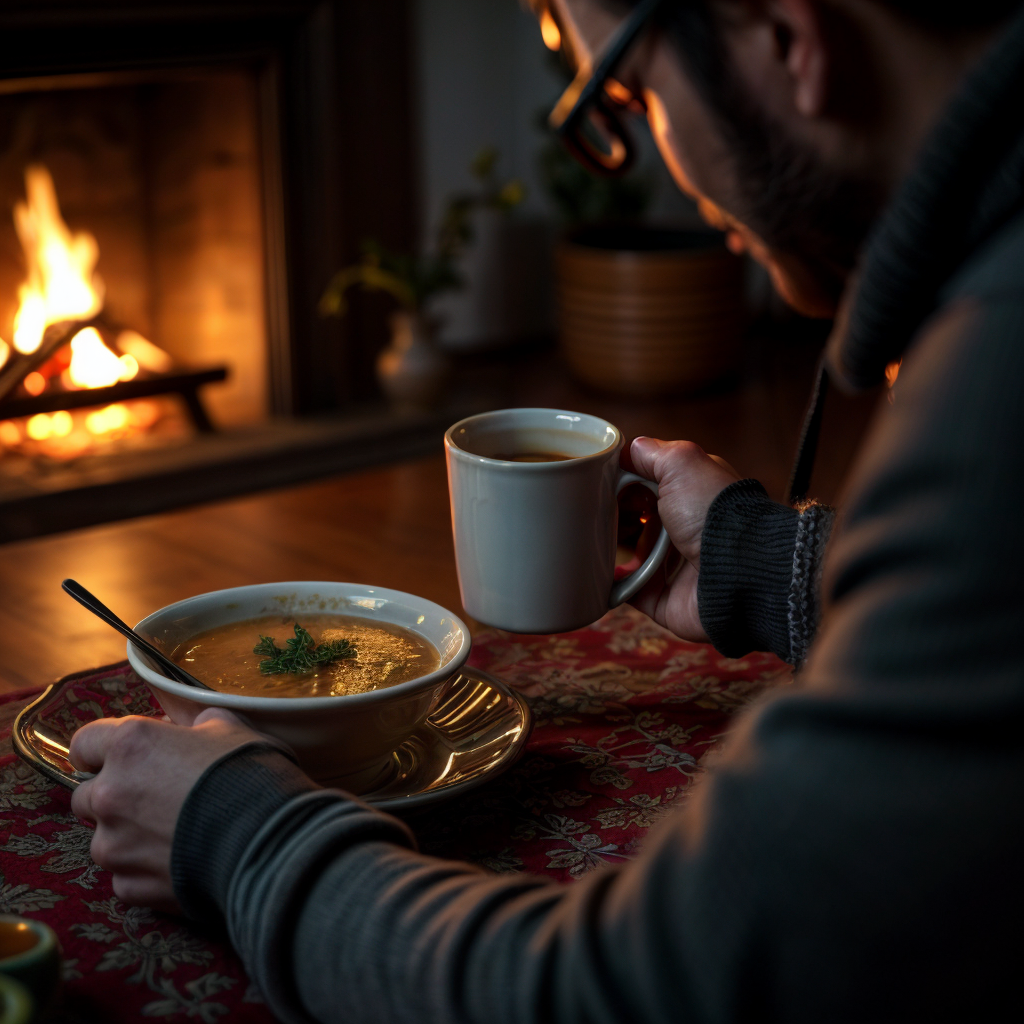
Here is my response to Ragtag Daily Prompt – Soup

Somedays, all you need a good of soup

RDP Saturday – 10262024

This is in response to Ragtag Daily Prompt – Pumpkin.

RDP Tuesday – 06112024

PROSE – RANDOM THOUGHT

Her lips told me I was just a fragment of a daydream put to words on a rugged day

RDP Friday – 03152024

PHOTOGRAPHY – AI GENERATED ART

Here is my response to Ragtag Daily Prompt – Kindness

RDP – Tuesday – 05282024

Here’s my response for Ragtag Daily Prompt

RDP Friday – 04122024

CHALLENGE RESPONSE – RDP WING

Each word, each verse, or each sentence we write. Is an attempt to learn to fly.

Six Word Story & RDP Saturday – 04132024

CHALLENGE RESPONSE – RDP TRUMPET

A trumpet blare equals allergy season

RDP Wednesday – Doodle

CHALLENGE RESPONSE

Every time I write a story, it’s like doodling in my mind.

The Friendly Skies

Image by Nel Botha from Pixabay

Whew! That was a rough landing!

Willow Creek

CHALLENGE RESPONSE – RDP SUNDAY – FICTION

Mabel McGee

Mabel McGee lived in the quiet town of Willow Creek in a quaint cottage that seemed to hold more memories than objects. To the townsfolk, she was known as the elderly woman with a penchant for mixing up dates and events, often speaking of historical happenings as if she’d lived through them herself. Some whispered about dementia, others about a life too lonely. But little did they know, Mabel’s supposed confusion was not a symptom of her age but rather a consequence of her extraordinary past as a retired time traveler.

Mabel’s journey began in 2045 in a world where time travel was possible and regulated by a strict code. She was one of the elite, a ChronoNavigator tasked with maintaining the integrity of the timeline. Her missions had taken her from the bustling streets of ancient Rome to the futuristic landscapes of the 22nd century, each adventure embedding itself into the fabric of her being.

As the years passed, the toll of her travels grew heavier. The lines between times began to blur, not just in her mind but in her heart. Mabel realized that she yearned for something the vast expanse of time could not give her—a place to call home. And so, she chose to retire in the one era that had always felt like a balm to her soul—the early 21st century.

The townsfolk of Willow Creek knew none of this. To them, Mabel was the eccentric old woman who lived alone, her house filled with strange artifacts and her conversation sprinkled with anachronisms. Children dared each other to peek through her windows, hoping to catch a glimpse of her rumored collection of “antiques” that seemed too out of place, even for a collector. They didn’t realize that each piece in Mabel’s home was a memento from her travels—a Roman coin, a futuristic gadget that no longer worked in this timeline, a painting from an artist who wouldn’t be born for centuries. And the stories she told, dismissed as confused ramblings, were indeed true accounts of historical events she had witnessed firsthand.

One day, a new family moved into Willow Creek, and with them came young Ellie, a curious and bright girl with an insatiable appetite for stories. Unlike the others, Ellie found herself enchanted by Mabel’s tales. She listened, wide-eyed, as Mabel spoke of walking with dinosaurs, witnessing the signing of the Declaration of Independence, and even attending a speech by a future president yet to be elected.

Over time, the seasoned time traveler and the young girl formed a unique friendship. Mabel saw in Ellie a kindred spirit who understood the value of time not by its weight but by its wonders. For Ellie, Mabel was the gateway to a world far beyond the confines of Willow Creek—a world where anything was possible. As their bond deepened, Mabel decided to change Ellie’s life forever. She decided to share her greatest secret, the time device that had been dormant for years. Together, they embarked on a journey that spanned centuries, a final adventure for Mabel and the beginning of a lifetime of wonders for Ellie

In the end, Mabel McGee’s legacy in Willow Creek was not that of a confused old woman but of a mentor who opened the door to the universe for a young girl. As for the townsfolk, they would never look at their world the same way again, always wondering if the stranger passing through was just a visitor or a traveler from another time, inspired by the tales of Mabel McGee, the retired ChronoNavigator who found her home not in time, but in the hearts of those she touched.

Shutter Wars: Two Cameras and a Squirrel

CHALLENGE RESPONSE – FICTION – RDP SATURDAY

In the heart of an attic, amidst a treasure trove of forgotten gadgets, an argument of epochal proportions was unfolding. Oliver, an old, venerable camera with a penchant for nostalgia, found himself at odds with Dexter, a high-tech digital camera with more settings than a spaceship.

“Back in my day, we captured the essence of life, one click at a time,” Oliver boasted, his lens gleaming under the dim attic light.

“Pfft, the essence of life? I can capture, edit, and share a photo before you even figure out your aperture,” Dexter retorted, his LED screen flashing in disdain.

The debate might have ended there if a cheeky squirrel had not chosen that moment to dart across the attic floor, pausing only to strike a pose.

A light bulb flickered to life above Oliver’s viewfinder. “I propose a challenge! Let’s see who can take the best photo of that squirrel,” he declared, adjusting his focus.

Dexter beeped in amusement. “You’re on, grandpa. Prepare to be pixelated.”

Oliver took his time, calculating the light, adjusting his focus, and waiting… waiting for the moment when the squirrel, enticed by a nut left on the windowsill, struck a majestic pose. Click. The sound resonated through the attic, capturing a moment in time.

Meanwhile, Dexter, with the efficiency of a modern marvel, snapped approximately 47 photos in burst mode, applied a “Squirrel-Enhance” filter, and even photoshopped a tiny superhero cape onto the squirrel in one of the shots. “Done. And I’ve already shared it on SquirrelGram,” Dexter announced triumphantly.

They turned to the attic’s old computer to judge their work. Oliver’s photo was a masterpiece of timing and light, showcasing the squirrel in a moment of serene beauty. The soft lighting gave it an almost ethereal quality.

Dexter’s photos were sharp, vivid, and varied, with the superhero squirrel garnering a particular chuckle. “Look at that! It’s going viral among the attic spiders,” Dexter bragged.

Just then, the squirrel, having completed its snack, scampered over to see what all the fuss was about. It peered at the screen, then at the two competitors. With a decisive nod, it grabbed a forgotten paintbrush with its tiny paws. It dashed off a squirrelly masterpiece on a piece of scrap paper: Oliver and Dexter, lenses crossed in friendship, capturing the squirrel in a heroic pose.

The two cameras, old and new, realized that the best photos come from seeing the world through each other’s lenses. They laughed, a sound of mechanical clicks and digital beeps, united in their newfound friendship and respect for each other’s techniques.

As the sun set, casting a golden hue over the attic, Oliver and Dexter understood that photography isn’t just about the camera—it’s about the vision, the moment, and sometimes, a squirrel with a flair for the dramatic.

And so, amidst the dust and memories, two cameras from different generations found common ground, proving once and for all that when it comes to capturing life’s beautiful moments, the best approach is a shared one. As for the squirrel, it became an honorary member of their photographic adventures, always ready for its next close-up—cape and all.

What’s My Age Again – RDP Sunday: Age – 03242024

CHALLENGE RESPONSE – RDP – AGE

I’ve been working on music posts all weekend and writing a bit of fiction. So, when I read today’s prompt, this song came to mind as I popped some Tylenol for my aching bones. Then, ask this question.


Then, of course, this song pops into my head.

Fingers popping and belting the lyrics into a seldom used hairbrush. I stop and catch my breath. I realized this track from 1969, and I knew all the words. Scratching the back of my head, I pause and ask what’s my age again?

Hazards of Binge Watching

RDP MONDAY – PHOTOGENIC

~Have a great day!~

Julian’s Truth

CHALLENGE RESPONSE – FICTION

Here is my response to RDP’s Daily Prompt – Lithe

In the heart of a bustling city park, where children’s laughter mingled with the melodious chirping of birds, sat a man named Julian. He was a solitary figure amidst the vibrant chaos, a contemplative soul who found peace in the art of people-watching. Julian was particularly drawn to the nuances of human interaction, the subtle play of expressions, and the eloquence of body language.

On this sun-drenched afternoon, his attention was captured by a woman practicing yoga on the lush, green grass. She embodied grace, her movements fluid and effortless, a visual symphony that mesmerized Julian. He noted how the word “lithe” seemed to be crafted for her, the very definition of her elegance and strength. She moved with an almost ethereal poise, her limbs stretching and coiling with a feline agility that left Julian in awe.

For days, Julian returned to the park, hoping to catch a glimpse of the lithe woman. She became a muse to him, a living embodiment of art and beauty he dared only admire from afar. Her presence stirred something within him, a longing to reach out and connect, to transcend the boundaries of his solitary existence.

Finally, mustering every ounce of courage, Julian decided it was time to step out of the shadows of his observation and into the light of interaction. He approached her on a day painted with the perfect azure of the sky. His heart thundered in his chest, a tumultuous symphony of nerves and excitement.

“Hello,” he said, his voice barely a whisper against the backdrop of the park’s life.

She turned toward him, her expression mildly surprised. Her eyes reflected the tranquility of the world she embraced. “Hello,” she replied, her voice as soft and melodious as he had imagined.

Julian stumbled through his introduction, words tangled with admiration and awe. He spoke of his observations, his fascination with how she moved, how she seemed to personify the word “lithe.” He expected bemusement, perhaps even annoyance. Instead, she smiled, a warm, genuine curvature of her lips that reached her eyes and ignited a spark of connection.

Her name was Elara, and she listened earnestly attentively, making Julian’s words flow more freely. They talked beneath the canopy of verdant leaves, their conversation meandering through the trivial to the profound, just as the park’s myriad pathways did.

In time, their meetings became a cherished ritual, two once-strangers finding solace and joy in shared moments. Julian, who had once been content to observe life from a distance, actively participated in its menagerie, woven with threads of companionship, understanding, and the unexpected beauty of a chance encounter.

And so, in a park where the world seemed to converge, Julian discovered the courage to connect, inspired by a woman who danced with the wind, her lithe form a reminder of life’s boundless grace.

RDP Monday: Women with Grit

CHALLENGE RESPONSE – PROSE: RDP/WORD OF THE DAY

In the tapestry of human endeavor, threads shimmer with unyielding tenacity woven from the fiber of women with grit. These women, from varied walks of life and corners of the earth, share a common trait—a relentless fortitude that propels them through adversity, enabling them to emerge not only unscathed but stronger and more resolute.

Consider the woman who rises before dawn, her day stretching ahead like an uncharted expanse, demanding her sweat, intellect, and care. Yet, she meets each challenge undaunted, fueled by an inner fire that refuses to be extinguished. She could be the single mother who juggles multiple jobs to provide for her children, ensuring they receive the opportunities she never had. Or the scientist in a lab, her eyes alight with the spark of discovery, tirelessly pushing against the frontiers of knowledge despite the voices questioning her place in such a world.

Reflect on the women in history who stood firm against the gales of their times, refusing to bend. They are the suffragettes who endured mockery and imprisonment, their eyes fixed on the horizon of equality. They are the trailblazers in arts, sciences, politics, and activism who dismantled barriers and defied conventions to etch their indelible marks on the annals of time.

Women with grit embody resilience, a quality that resonates through their every action, a silent strength that speaks louder than words. They navigate life’s storms with a steely grace, their resolve a beacon for others to follow. In their perseverance, they weave a legacy of inspiration, a call to each of us to harness our own potential, face our battles with courage, and emerge not just enduring but triumphant.

In celebrating these women, we recognize the grit within ourselves, a testament to the enduring power of the human spirit embodied in the resilience and determination of women across ages and the world.

My mother was such a woman. She had grit, but she referred to it as gumption. I’ve always liked that word. Despite the challenges of raising me on her own, she refused to surrender the chaos surrounding us, no matter how tempting it had been. She remained steady in all that we faced. A lesson I tried to demonstrate to her grandchildren and great-grandchildren. I’m honored to be a steward of her legacy. No different than the others who have courageous women in their lives.

RDP – Monday -02262024

CHALLENGE RESPONSE – PROSE/FICTION

Here is my response to RDP’s Trifling

Elara

A quaint village nestled between rolling hills and whispering woods lived a trifling spirit named Elara. Mischievous and light-hearted, she danced through the villagers’ lives like a playful breeze, her presence barely more substantial than a fleeting shadow. With a penchant for harmless pranks, Elara often left a trail of bewildered smiles and gentle laughter in her wake. She’d whisper riddles in the wind, tie shoelaces together unseen, and sometimes, in a whimsical mood, cause the flowers to bloom out of season, painting the world in unexpected splendor.

Yet, despite her whimsy, Elara held a deeper purpose. Her antics served as gentle reminders not to take life too seriously and to find joy in the small, unexpected moments. In her own trivial way, Elara wove a thread of light-heartedness into the fabric of the village, teaching that sometimes, the heart needs the relief of laughter and the soul the lightness of just being.

RDP Saturday – Shoots
CHALLENGE RESPONSE

Here is my response to RDP’s Shoots

A toddler unleashes a shriek of glee as he shoots past an elderly gentleman with his unsure footing. He balances himself with his tiny arms outstretched. He giggles a little more with each step. We stand silently, watching him go. My soul churned in the warmth of his happiness as it spurred my own. His happiness brought back vivid memories of my grandchildren learning to walk and run. I missed my children’s milestones; otherwise, I was engaged.

I stopped to fuel up pickup before heading to a photo shoot. I’m excited about this one because it is the first time in months I’ve been well enough to even consider pulling out my camera. I’m startled back in the present by a metallic clang of debris hitting a dumpster. I watch the trash chutes flex as the waste finds its way down. AC/DC’s Shoot to Thrill starts the road trip playlist.

After, a few minutes of chatting after arriving at shop I discover I have everything in my camera bag, but an SD card. We laugh about the ridiculousness. I finally got myself together to do the shoot and realized I’m so rusty I have no idea if any pictures will be good enough to post. I show a few to the fellas and assure me that concerns are justified.

Here are a couple shots:

My brother skim coating a new gas tank.

Today was first day all three been in the shop in months. The first time in forever, where there wasn’t constant look of concern on whether I was going face plant at any moment. I lasted several hours before I plain tuckered out and needed to make the drive home.

My first photo shoot back was disaster as photo shoot’s go, but it felt damn good to be working in the shop again. Round 2 is tomorrow; wish me luck

RDP Sunday – 02252024

CHALLENGE RESPONSE – FICTION

Here is my response to RDP’S reconcile

I had been for a long time until it ran out of places to go. I ended up here sitting in the darkness hollowed out. I expected to find anything once I arrived, but I found her. She was sipping gas station coffee, grimishing each sip. Her gaze trapped in the moment between breaths. We started something in the next moment that should have lasted a lifetime. She captured my heart, so I gave her my soul.War reared its ugly head and took her snarling. Before that moment, we argued. About what I can’t remember, but now it’s too late to reconcile.

RDP – Tuesday – 02272024

CHALLENGE RESPONSE

Here is my response to RDP’s prompt: Ink

There’s a thud as my quill hits the desk. My inkwell unleashes a howl mixed with desperation and relief. It’s a little beside itself because I haven’t written anything of note in months. My eyes burn from what was supposed to be all-nighter, but really only a few hours of spits and starts. Baby steps, huh? They got to be better than not writing anything all. At least, that’s what I tell myself as I stare at the ink stained fingers of my aching hands.

I close my eyes and the let the stream of world of random thoughts fill my screen. Each word typed is attempt to rediscover the path to a coherent thought. A thought minus the lure of ineffective painkillers. Taken only to help you forget the torment you’re suffering momentarily. Yet, forget the principle of pain; it’s a reminder we are alive. Each wince, cringe, or scream a verse in the testimony of our lives

Bradbury got it right in a way. We are tattooed neath the surfaces. Each of those tattoos are alive illustrating the moments that matter . Moments we acknowledge, yet include the ones swear that mean anything, but touch us so deeply.

My inkwell unleashes a belch, then stretches. A metallic click fills the room as the licks its lips and throats a “Thank you!” I refill my quill and pull out a fresh notebook. Then lean back in my office chair to rest.

“I knew that shit, you’re such a fucking tease!” My quill and inkwell declare in unison.

I close my eyes and chuckle ….

Spoon River: RDP – Friday

PHOTOGRAPHY – COLOR

One of the things I love about photography is you never know why you take a picture. There’s something about the lighting, the feel, or something else that captures you and makes you snap the shutter. I’ve had these photos for years. When I first took these photos, I had no idea what I would do with them. Yet, I hung onto them, wondering If I would see something different the next time I looked at them.


RDP – Saturday – Web

PHOTOGRAPHY – COLOR

This is my response to the tangled web prompt. I took this photo this fall. I forgot about it until I was deleting some of the horrible photos, I took last year.

RDP – Sunday – Jug
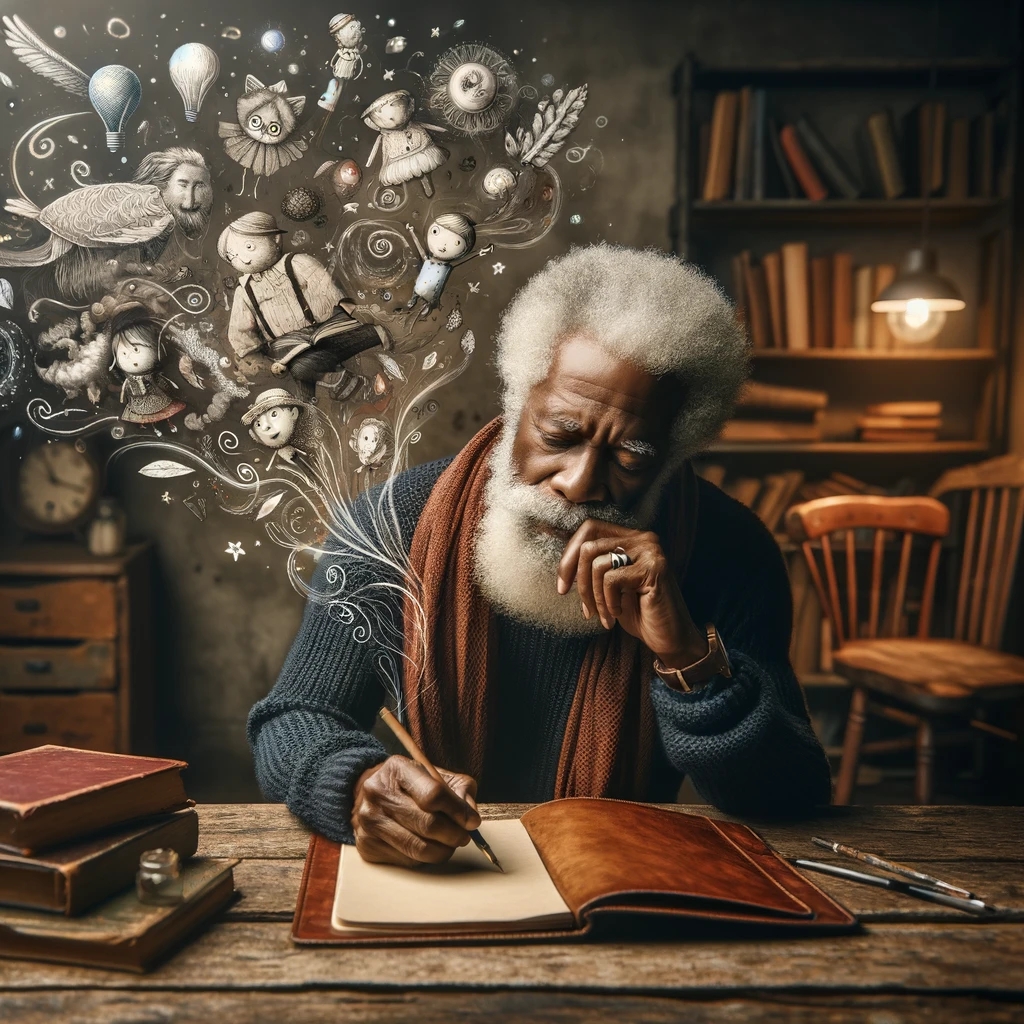
CHALLENGE RESPONSE

Over the years, I watched my late wife restore and sell these milk jugs. So, I snapped a picture of this one as I drove through a small town.

Time after Time: The Concept of Time

After looking at the RDP Friday prompt. I decided to dig in the subject a little further.

Nature of Time

Time, as we understand it, is a dimension. It’s a constant, flowing entity, moving from the past to the present and future. Physicists describe it as the fourth dimension of our universe, following the three spatial dimensions. Unlike the spatial dimensions, however, time has a direction – it is always moving forward, never backward. This unidirectionality of time, often called the ‘arrow of time,’ is a fundamental aspect of its nature.
But what does it mean for time to ‘flow’? This is a question that continues to perplex scientists and philosophers alike. The ‘flow’ of time is often associated with change – the ticking of a clock, the rising and setting of the Sun, the changing of seasons – all are manifestations of time’s ceaseless march forward.

Perception of Time

While the nature of time is constant, our perception of it is not. We, as humans, experience time in a highly subjective manner. The exact length of time can often feel different depending on various factors. Sometimes, an hour can feel like an eternity, while at other times, years seem to slip by in the blink of an eye.

Several factors influence this variability in our perception of time. Age, for instance, is often said to alter our perception of time. As we grow older, time passes more quickly. Our mental state – anxious, relaxed, focused, or distracted – can also dramatically affect how we perceive time. Additionally, the activities we engage in and the intensity of our experiences can modulate our sense of time.

Our Relationship with Time

Our relationship with time is complex and multifaceted. On the one hand, time is an essential part of our lives – it structures our days, determines the rhythm of our activities, and marks the milestones of our journey through life. On the other hand, time can also be a source of stress and anxiety – the pressure of deadlines, the fear of wasting time, and the relentless clock reminding us of our mortality.

Moreover, our relationship with time is not just individual but also collective. Societies, cultures, and civilizations have their ways of conceptualizing and measuring time – from the lunar calendars of ancient organizations to today’s atomic clocks.

Importance of Time

Time plays a pivotal role in our lives. It is a universal measure used to quantify everything from a mayfly’s lifespan to the universe’s age. It governs our daily routines, life events, and even our existence. Understanding and managing time is critical in today’s fast-paced world, where every second counts.

In this context, time management is about efficiency, productivity, balance, and well-being. It’s about making the most of our time, not by filling every moment with activity, but by using our time in a meaningful and fulfilling way.

The measurement of time is an essential aspect of human civilization. It provides structure, order, and predictability to our daily lives and is deeply ingrained in almost every aspect of our existence. This essay explores the historical development of timekeeping, the standard units of time measurement, the modern technologies employed in timekeeping, and the future implications of advancements in this field.

The Measurement of Time 

Historical Development of Timekeeping

The concept of measuring time has been integral to human societies throughout history. Ancient civilizations such as the Egyptians, Babylonians, and Greeks relied on primitive yet ingenious devices like sundials and water clocks. These devices marked the passage of time using the Sun’s position or water flow, providing these civilizations with a rudimentary but vital sense of temporal order and structure.

As societies progressed, so too did their timekeeping methods. The invention of the mechanical clock in the 14th century marked a significant milestone in the history of timekeeping. Powered by weights and gears, these clocks provided a more accurate and reliable means of measuring time than their predecessors.

The 20th century saw the advent of the atomic clock, a device that measures time-based on the vibrations of atoms. This marked a monumental leap in timekeeping technology, reflecting the immense technological advancements of the era.

Standard Units of Time Measurement

The standard units of time—seconds, minutes, hours, days, weeks, months, and years—are universally recognized and utilized. These units were primarily based on the movements of the celestial bodies. For instance, a day is determined by the rotation of the Earth on its axis, while a year is defined by the Earth’s orbit around the Sun.

The second, the base unit of time in the International System of Units, was redefined in 1967 regarding the oscillation period of a cesium-133 atom. This redefinition provided an exact time measurement unit, demonstrating humanity’s growing understanding of the natural world and our ability to harness it for our needs.

Modern Technologies in Timekeeping

In the present day, timekeeping has become more precise and accurate due to technological advances. Atomic clocks, which use the vibrations of atoms to measure time, are currently the most precise timekeeping devices known to man. These clocks are pivotal in various fields, including telecommunications, scientific research, and global navigation satellite systems such as GPS.

Other modern technologies have also revolutionized timekeeping. Digital clocks and watches have become commonplace, offering easy and convenient access to accurate timekeeping. These devices, often synchronized with atomic clocks, ensure high accuracy and reliability.

Concept of Time in Ancient Civilizations 

Egyptian Concept of Time

The ancient Egyptians had a unique and sophisticated understanding of time, deeply rooted in their cosmological and religious beliefs. They divided the day into 24 hours, with 12 hours dedicated to the daytime and another 12 hours for the nighttime. This division was not arbitrary but was based on the movement of the Sun god Ra across the sky, illustrating how their understanding of time was intertwined with their religious beliefs.

Additionally, the Egyptians used a lunar calendar, but they also developed a 365-day solar calendar. This solar calendar became the foundation for our modern calendars, a testament to the advanced nature of their civilization. The importance of time for the Egyptians was further evident in their elaborate burial rituals, which were based on the belief in eternal life after death. These rituals often involved extensive preparations and ceremonies, reflecting their faith in the continuity of time even after death.

Mayan Concept of Time

The Mayans, a civilization that thrived in Central America, had an intricate and complex understanding of time. They developed a detailed calendar system that included a 260-day sacred calendar (Tzolkin), a 365-day solar calendar (Haab), and a Long Count calendar that tracked longer periods. These calendars were not just a way to track days and years but also deeply connected to their religious and cultural practices.

Moreover, the Mayans viewed time as cyclical, with creation, destruction, and rebirth periods. This concept of time greatly influenced their architecture, agriculture, and religious practices. For instance, many of their architectural structures were built in alignment with celestial events, showing their understanding of time and its cyclical nature.

Greek Concept of Time

The ancient Greeks had a dual concept of time, represented by two gods: Chronos and Kairos. Chronos referred to sequential or quantitative time, while Kairos represented the right or opportune moment. This dichotomy reflected the Greek understanding of time as both measurable and qualitative, a complex interpretation unique to their civilization.

The Greeks also developed the concept of ‘Aion,’ representing eternity or infinite time. This concept was central to their philosophy and metaphysical thought, influencing the works of philosophers like Plato and Aristotle. Their understanding of time, therefore, was not just practical but also philosophical, shaping their worldview and understanding of existence.

RDP – Friday – Time

Here is my response to today’s Ragtag Daily Prompt – Time

POETRY

Time

Sitting within the wondering of unknown destiny.
Riding the waves of the abyss of sorrow.
Like the sands of the hourglass, the moments of a promiseless
tomorrow slip away

But…

Have you heard the news today?

Our kinsmen…

Our brethren…

Has passed away

Not of blood, but of spirit

What is felt goes by many names
yet the pain
remains the same

Remember…

He has been called home
to sit alongside our Master
and his golden throne

Boundfull
dutiful
we are
to acknowledge his words of passion and grace

for they have

Lifted us…
Caressed us…
Consoled us…

I wish to thank all those who have taken the time to read the ranting of a feeble mind.

From my stoop, on my soapbox, I stare into the abyss, then begin reading my list.

Life is short…

So kiss it…
taste it..
Close your eyes and
Savor it…

But most of all

LIVE IT !!!

One minute at a time


I wrote this piece years ago after the writing community had lost one of its brethren. To me, he was gentle, but wise soul with so much to offer. The writing community took a blow that day.

It doesn’t matter about the existence of time, moments we spend with one another count. Make the moments we spend even with strangers matter. Humanity’s most precious gift to one another is their time.

Sunday, Monday, Tuesday – RDP

CHALLENGE RESPONSE – PROSE

Here is my response for RDP Sunday, Monday, and Tuesday.

Let me be blunt from the beginning. The snow was coming down heavy, but the wind blew it sideways. The temperature was dropping rapidly. I didn’t want to be out here, but the gig paid the bills. Prices were so high that you bought a loaf of bread or a gallon of gas. I got a letter in the mail today. An old friend I hadn’t heard from since we both reeked of innocence. I was more than a little envious because he had found the love of his life. He had found happiness. Sighs … good on you, brother! Good on you.

RDP Wednesday – Hatch – 01172024

CHALLENGE RESPONSE

My response to RDP’s Wednesday prompt.

This morning, I was reviewing this prompt and trying to figure out how to approach it. I knew I didn’t have any photos that featured hatching of some kind. I ran across an image of an old hatchback and remembered our adventures in high school.

A buddy of mine brought a Datsun B210 hatchback and drove everywhere in that thing. Most of the time, there were three of us. We would travel to a nearby town so he could profess his undying love to his girlfriend. It was the stuff they write stories about for about six months. We would buy a case of beer Saturday night and head to the highway. I don’t remember her name or what she looked like.

We all professed our love at one time or another in that car. We traveled hundreds of miles doing so. I suppose we were allergic to the idea of having a local girlfriend. None of us ended up with any of the women that we loved so dearly. I haven’t seen those guys in over 30 years. However, I remember the times we spent together in that hatchback.

Photo courtesy of BY PAUL NIEDERMEYER
 

The Datsun we rode in looked like the one in the photo. The memories just flood back. In fact, our car didn’t have a reverse. So, whenever we parked, we’d stick our foot out of the car and push backward. I wonder what happened to those guys? I hope life was gentler than mine.

The Bionic Kid who wanted to be a Gymnast

Have you ever had surgery? What for?

PROSE – CREATIVE NON-FICTION

I’ve been under the blade a few times in my short time on this side of the veil. I’m not precisely accident-prone but in the words of Pop. “If you gonna do anything, do it right.” I might as well scream at the top of my lungs, “Yes sir!” like those military folks in boot camp. You know, as you see on the shows.

Today, I’d like to direct your attention 1976. I was a wee lad. I hadn’t graduated from Wrigley’s to Bazooka Joe yet. Col. Steve Austin was on the airwaves doing fantastic with his bionic parts. So, I ran around making sounds heard every time he used his bionics.

I thought this was so cool

As it happens, 1976 was the year Kurt Thomas competed in the Summer Olympics. I watched that guy do his thing, and I was floored. He was so good; my grandma let me watch him every time he was on the TV. Now this was a woman who firmly believed in children going outside to play. I can only think of one exception; rain “cause you’d catch cold.”

You see that? Badass

So, at the start of the school year, I decided to show off my new gymnast skills. These skills comprised doing a back flip off the swing set and crossing the creek on a fallen tree. Now this didn’t qualify me to become a gymnast by any stretch, but by God, not a soul was going to me any different.

In gym class, I decided to jump off the top of the jungle gym. The first time was a disaster; I didn’t nail the landing. I fell back, can you believe it? Just shameful. The second attempt was perfect dismount; since I failed the first time, I went for broke. I did a triple somersault with a one-half twist. That’s right, un-huh, I was showing out. Perfect execution. I nailed the landing. Things went to hell from there.

Well, I broke my hip. I can only remember fragments of that period, but I can remember hollering as they rolled me to surgery, “I don’t want a bionic leg!”, “I don’t want to be the Six Million Dollar Man.” I ended up in traction, then a body cast. Good times for all, especially my mother because had to change my bedpan.