Signal Through the Static

I was never a cartoon kid. The bright colors, the slapstick chaos, the noise—they all felt like they were shouting past me. But every now and then, something stranger slipped through the broadcast. Clutch Cargo. Space Angel. The 70s Spider-Man reruns with animation so stiff it felt like everyone was holding their breath.

Most folks remember those shows for the uncanny mouths or the budget that barely covered a pot of coffee. I remember the stories.

Even as a kid, that’s what hooked me. It wasn’t the art; it was the pulse beneath it. A pilot lost in deep space. A hero swinging across a city that looked more empty than alive. A mystery to unravel before the next commercial break. Those shows were weird—no denying that—but weird wasn’t a flaw. Weird was an invitation.

While other kids waited for punchlines, I waited for stakes. I wanted to know what the trouble was, what hidden door we were about to open, what secret someone was trying to bury. The stories were simple, but they had weight. They made you pay attention. They carried that quiet tension you only feel when something matters, even if you can’t explain why.

Looking back, I think that’s what stayed with me. Not the animation. Not the nostalgia. The stories. They were the first lesson in how narrative works when you strip away spectacle: character, pressure, consequence. The essentials.

Maybe that’s why they stuck.
Maybe that’s why I still chase that same feeling when I sit down to write—just a strange transmission cutting through the static, reminding me that the story is the thing that survives.


Daily writing prompt
What’s your favorite cartoon?

The Discipline of a Quiet Man

There are words we use carelessly, scattering them across people who haven’t earned them. Honor is not one of them. Honor is not a word; it’s a state of being. Many treat it as a relic from old books, a concept preserved in ink but forgotten in practice. We remember its definition, but not its discipline. Honor belongs to lives that can bear its weight—those whose choices reveal intent rather than performance, discipline rather than spectacle, substance rather than noise. Kareem Abdul-Jabbar is one of the rare men whose life, lived deliberately and consistently, justifies the use of that word.

Long before trophies or records, before the skyhook carved its arc into basketball history, Kareem learned what it meant to walk a disciplined path. In Black Cop’s Kid, he writes about his father, a Black New York City police officer navigating a segregated America. His father moved through streets that demanded vigilance, wisdom, and restraint—a man required to inhabit two worlds that seldom acknowledged the full weight of his humanity. That quiet duality shaped Kareem’s earliest understanding of strength. His father did not preach lessons; he embodied them. The discipline in that household was not loud or performative. It was patient. Intentional. A way of carrying oneself when no one is watching. It was here that Kareem first learned that the inner life must be steadier than the world pressing against it.

As Kareem stepped into the national spotlight, that lesson met its first genuine test. His presence alone carried expectations that were not of his choosing. Every gesture, every silence, every interview became a canvas for projection. America demanded a familiar performance from its Black athletes—gratitude without question, humility without edge, excellence without voice. Kareem refused the performance. His reserve was mistaken for distance; his intellect, for defiance. Yet what much called aloofness was simply the discipline he had been raised with: the separation of worlds, protecting the private self, the refusal to let public hunger consume what must remain internal. Strength, for him, was never volume. It was alignment. And maintaining that alignment in the face of scrutiny became its own form of endurance.

This alignment is what he carried into the moment that would sharpen his moral identity. In Black Cop’s Kid, Kareem describes being invited, at just twenty years old, to join a gathering now known as the Cleveland Summit. Jim Brown called him to sit alongside Bill Russell, Carl Stokes, Muhammad Ali, and other Black leaders—a room full of men who bore their own histories of struggle and conviction. They met to confront Ali’s refusal to be drafted into the Vietnam War. Some had served in uniform; others had walked the front lines of civil rights battles. The air in that room was a crucible, not a ceremony. Kareem entered as the youngest voice present, carrying the discipline of his father but stepping into a conversation that demanded clarity far beyond his years.

For hours, the group questioned Ali. They challenged his reasoning, his faith, his willingness to accept consequences. Ali argued that the war was being fought by people of color against people of color, for a nation that denied them basic civil rights. His refusal was rooted in religious conviction and moral clarity, not political theatrics. As Kareem recounts it, the debate grew heated—sharp questions, sharper answers, the weight of identity and duty pressing into every sentence. What emerged was not a portrait of a defiant champion but of a man prepared to sacrifice everything rather than betray his principles.

Bill Russell summarized what a good deal of felt but would not say aloud: he envied Ali’s “absolute and sincere faith.” Envy—not of fame or power, but of conviction. Kareem saw it plainly: even giants grappled with doubt. Even legends feared whether they could withstand the cost of conscience. In that moment, Kareem recognized a truth his father had lived without speaking—integrity is measured by what a person refuses to surrender. By the end of the Summit, they stood with Ali. Kareem left not with a slogan but with a direction. As he wrote, he felt he was finally doing something important rather than merely watching the world from its edges. His father’s quiet discipline had found its test, and it held.

That commitment of intent over performance would define the decades that followed. Kareem did not chase the spotlight. He did not soften his seriousness to become more palatable. His writing, activism, and public presence reflect a consistent refusal to be shaped by expectation. In a culture that rewards noise, he chose depth. In an era that prized spectacle, he chose substance. His reserve was not distance—it was stewardship of the inner life his father taught him to protect.

This same ethos threads through his work beyond basketball. In Brothers in Arms, his tribute to the 761st Tank Battalion of Black soldiers in World War II, he writes of men whose greatest acts were known only in fragments. Many lived entire lives without revealing what they had endured. Their silence was not secrecy—it was dignity. Kareem writes about them with reverence, humility, and a recognition that some forms of service cannot be measured by praise. In many ways, his own life echoes theirs: principled choices, quiet strength, a preference for action over advertisement. Deeds, not words, as the old motto says.

Across time, the pattern of his life remains coherent. The public, private, and secret selves that his father taught him to guard align under a single discipline: to move with intent, even when misunderstood. The same steadiness that kept his father upright on hostile streets steadied Kareem through shifting eras, hostile headlines, and the long shadow of fame. His reserve is no longer misread when viewed through this lens. It becomes what it always was: a disciplined way of walking through a world eager to consume more than it has earned.

Most athletes earn admiration. Very few earn Honor. Kareem Abdul-Jabbar does, not because he was flawless or universally embraced, but because he lived with deliberate intent when it would have been easier to drift, and with discipline when it would have been easier to perform. Honor is not a word; it is a state of being. And if we are to use that word with any seriousness, we should reserve it for lives capable of carrying its weight. Kareem Abdul-Jabbar’s life is one of them.


Daily writing prompt
Name the professional athletes you respect the most and why.

Instincts, Echoes, and the Work of Coming Back

Of course I trust my instincts. These instincts are the reason I’m still here. They’re the early warning system that kicked in long before I had the language to explain what was happening. They’ve pulled me out of bad situations, terrible decisions, and moments where everything felt razor-thin. Survival sharpens you in ways calm living never will. Yet there are times you wonder if what you’re feeling is actually what’s happening. As someone living with PTSD, even after years of progress, the episodes don’t disappear—they just get quieter, less commanding, but still capable of blindsiding you when life hits at the wrong angle.

That’s the strange part: instincts are made of scar tissue and memory, not magic. They’re a patchwork of everything you’ve lived through—every mistake, every close call, every moment you had to react before you had time to think. And when your past includes trauma, those instincts can carry echoes of things you already survived. Sometimes they show up as alarms, even when there’s no fire in the room. It’s difficult to explain this to people. Not because they don’t care or don’t try, but because they don’t have a point of reference. If someone’s never had their body react to a memory like it’s happening in real time, or never had their nervous system jump to high alert over a sound everyone else barely notices, there’s only so much they can understand.

It’s not their fault. It’s simply the gap between lived experience and good intentions. But sometimes that gap feels like its own form of isolation. You end up minimizing what you feel or staying quiet because explaining it feels like trying to describe color to someone who’s only ever seen in grayscale. Eventually the question becomes: Why bother? And that silence can be its own kind of weight.

Even so, with the right support and coping tools, you really can relearn how to trust—not just your instincts, but yourself. Healing isn’t about shutting off the alarms; it’s about recalibrating them so they stop drowning out everything else. You learn to tell the difference between a real signal and old static. You learn how to talk yourself down without dismissing what your body is trying to say. You realize you’re not fighting your nervous system—you’re retraining it. Support and coping skills create space between the present moment and the past, and that’s the space where self-trust has room to grow.

But healing isn’t linear. There are days when every tool you’ve learned goes out the window. Days when your instincts feel unreliable, when your body reacts before your brain catches up, when everything hits at once and you’re back in old patterns without warning. Those days can make progress feel imaginary. But they aren’t the whole story. Because the very fact that you can name what’s happening now—the fact that you can reach for help, reach for tools, reach for clarity—means you’re not where you used to be.

Trust isn’t a single leap. It’s a series of small choices where you refuse to abandon yourself. Over time, instinct and self-trust start to merge again, the way they were always meant to. You move from surviving to navigating, and eventually, to living with a steadiness that’s earned, not imagined.

It’s not perfect. But it’s real. And real is enough.


Do you trust your instincts?

The Line Between Us and the Wild Is Paper-Thin

Some days, I feel like the unofficial understudy for Marlon Perkins from Mutual of Omahas Wild Kingdom—minus the khaki shorts and the camera crew. No judgement here, khaki’s are so comfortable. Wildlife keeps showing up in my life like it’s angling for a recurring role.

A few years back, it was Louie and Smiley—two raccoons who treated my house like a spiritual retreat with free snacks. I returned from visiting my folks to find Louie perched in my office chair reading the Douay-Rheims Bible with the focus of a man reconsidering his sins. Smiley wandered out of the kitchen with a loaf of bread and a pack of cheese like he was prepping for a midnight sermon.

“I found the mother lode!” he said.

“Shut up, Smiley,” Louie muttered—then saw me.
“Louie! He’s back! He’s back!”

Panic. Scramble. Silence.
I expected the Bible to be covered in raccoon glyphs, but it was clean. The kitchen was another story entirely. The kitchen looked like a flour bomb had gone off. And the little bastards were munching on my Cheez-its. Looking back I can’t blame them because Cheez-It’s are righteous. And it’s been over a year since I’ve seen either of them. Strange to admit, but I miss those idiots. You don’t realize how lonely you’ve gotten until you start missing thieves with tails.

These days, everything seems to drift toward “normal”—if that word still means anything. Maybe it’s really just slipping back into the routine that makes sense to you, even if it looks ridiculous to anyone else. My routine involves trying (and failing) to quit smoking while watching the neighborhood wildlife walk around like they pay rent.

Groundhogs strolling like retirees.
Squirrels hustling like Wall Street interns.
Feral cats acting like landlords.

They don’t hide; they don’t wait for the coast to clear. They move like the world belongs to them.

Some mornings, the line between wild and human feels paper-thin.

Lately I’ve been paying attention in a way I never used to—maybe that’s why the animals have gotten bolder.

Because then came the possums.

A pair waddled down my sidewalk one evening, paused, and stared at me like I was the one intruding. As if they were wondering if I was going to hurt them or let them be. I supposed they had decided because one of them lifted a tiny paw and waved.

Then she stood up and said,
Mangus, dont act like you dont see us! Ralph, would you look at this—humans can be so rude.”

Ralph gave the possum equivalent of a shrug.

I figured that was strange enough for the week, but winter has a way of dragging even stranger things to your doorstep.

There’s something about a cold morning—the chill bites you like you walked into the wrong yard. A reminder of the no-no’s of life.

A few mornings later, frost was clinging to everything like regret. I stepped out with a cigarette—a filthy habit, so I’m told. But I’ve lived long enough to see people celebrate worse sins, so I take the judgment with a grain of salt.

That’s when I saw him.

A raccoon was sitting on my stoop, smoking one of my cigarettes, staring into the frost as if it had whispered a prophecy. He jumped when he finally noticed me. His eyes went wide, then settled. If I meant him harm, I’d have done it already.

I lit my own cigarette.
You hear the snow crunching beneath someone’s footsteps. I turned.

Don’t worry,” the raccoon said without looking back. “That’s just Smoke wondering if you put anything out to eat. You’ve been slipping on that, by the way.

Smoke—another raccoon—raised a paw in greeting, then kept moving toward the trash can like we were roommates who barely tolerated each other.

I took my first drag.
Ah, the sweet relief of the little lies we tell ourselves.
Best thing ever.”
Not really—but the small fibs get us through the day.

Cold mornings always pry open old memories. Suddenly, I was thinking about a chocolate cake—dangerously good-looking, baked by someone capable of getting a diabetic canonized or killed. I told myself I’d be a “good diabetic” that day. Truth was, it simply wasn’t the weekend.

I’m not diabetic on the weekends.
A doctor once told me that’s not how it works.
My response: “Watch me, partner.”
Gave him my patented fuck off look. He didn’t know that expression at the time, but he learned fast.

Later, a young woman offering the cake stood beside me—closer than she needed to be. She smelled nice. Held out a plate.

“Yes, you have diabetes,” she whispered. “But you still have to live.”

Best cake ever.

Back on the stoop, the raccoon finally spoke.

Im Stu. Stuart Bigelow. Thats what a little girl across town used to call me. Cancer took her. Cancers an evil SOB—it comes for us all.”

Im Mangus, I said. And I have one question.”

Whats that?”

“Who in the hell told you you could smoke my cigarettes?”

Stu coughed mid-drag, a little smoke curling out like he was half-laughing.
Well, I figured since you left them outside, it was a party pack.”

Stu’s whiskers twitched after each exhale as if the smoke was burning his nose.

I snorted, then coughed, then burst into laughter.
So not a party pack, Stu.”

Some mornings, the wild doesn’t feel wild at all.


Daily writing prompt
Do you ever see wild animals?

Skills from a Graduate of the School of Hard Knocks

If I’m being honest, the things I’m good at didn’t come from any classroom with fluorescent lights and tidy rows. They came from life pulling me aside, usually at the worst possible moment, and saying, “Pay attention—this part matters.” Most of what I know was earned the long way: scraped knuckles, late nights, and a few seasons where survival wasn’t guaranteed but somehow still happened. These skills didn’t unfold gently. They arrived as consequences, as revelations, as the quiet clarity that follows a storm.

One thing I’ve learned is that I’m better at creating a feeling than I am at delivering a finished product. I don’t sit down to produce anything polished or algorithm-friendly. I write to capture a moment’s temperature—the hush before a confession, the weight of a truth someone’s been carrying too long, the strange peace that settles in when you finally stop pretending everything is fine. I follow the line that tightens my chest because that’s where the real story is hiding. Atmosphere isn’t decoration; it’s the closest thing I have to honesty. And if someone walks into that space and feels seen, then the work did what it was supposed to.

I’ve also learned how to make complicated emotions legible—not tidy, not simple, but real. The heavy stuff never hands you clean language. Grief has its own dialect. Shame speaks in whispers. Loneliness shows up wearing someone else’s coat. Most people run from these things because they think naming them will make them bigger. But I sit with them long enough to understand their shape. Not because I’m brave—because I don’t know how else to move through the world. If I can translate that heaviness into a line that makes someone pause and think, “Yeah… me too,” then maybe the weight becomes shareable.

Another skill I’ve picked up is the ability to hold a ridiculous number of moving parts without letting the whole structure collapse. MKU. MoM. HoT. Fiction arcs. Art projects. QOTD. Image collections. The universe I’m building is messy, sprawling, and sometimes bigger than I intended. But even in the chaos, there’s a thread running through it—something emotional, instinctive, connective. I don’t always know where the thread is leading, but I know when I’ve lost it. And I know how to find my way back by listening to what the work is trying to become. People mistake this for multitasking; it’s really just surviving the storm with both hands open.

I’ve stopped worshipping the first draft. If a piece doesn’t feel right, I tear it apart, not out of self-doubt but out of loyalty—to the truth, to the reader, to the version of myself that refuses to settle for the easy version of anything. Revision is where the honesty happens. It’s where the mask slips. It’s where I notice the lines I wrote to protect myself instead of reveal something. I’ve rebuilt myself enough times to know that tearing something down is just another form of creation.

And finally, I adapt. Quickly. Quietly. Often without applause or acknowledgment. Life didn’t give me the privilege of staying the same for long. Every year demanded a new version of me—some built by choice, others by necessity. Adaptation isn’t a talent; it’s a scar that learned how to walk. When something breaks, I adjust. When something shifts beneath my feet, I move. Reinvention stopped feeling dramatic years ago; now it’s just how I breathe.

These are the skills I’ve gathered on my way through the wreckage. Not glamorous. Not marketable. But real. They weren’t taught—they were carved. And maybe that’s the mark of a true education in the school of hard knocks: you don’t graduate with honors. You graduate with perspective. With endurance. With stories you didn’t ask for but somehow needed.

And when someone asks what you’re good at, you finally have the language to answer—not with pride, but with truth.


The Boy Who Wasn’t Afraid of the Dark

There’s something about the night I’ve never managed to explain without feeling like I’m circling the real truth instead of touching it. It isn’t just the absence of light. It’s the way the world exhales after midnight, how everything settles into a version of itself that feels more honest. If you’re a night person, you already know what I mean—you don’t need me to draw a map to that place.

As a kid, I treated the night like a sanctuary no one else had discovered. The dark didn’t judge, didn’t demand, didn’t tap its foot waiting for me to prove something. I used to get sad when the Dawn arrived—not out of melodrama, but because daybreak felt like someone flipping on the fluorescent lights, telling me to sit up straight and get back in line. Dawn was order. Dawn was expectation. Dawn was the world reminding me I owed it something.

Night never asked for payment.
It just handed me the keys and stepped aside.

I really believed there were no rules after sunset. In the dark, the harsh edges of the day softened. The noise thinned out. My thoughts stopped running defense and finally came out from hiding. The boy I was didn’t have the language for it, but he understood the feeling: Night made room for him in a way life rarely did.

Looking back, I can see how much of that was escape. The night gave me cover—space to imagine, space to feel, space to acknowledge things I wasn’t ready to say out loud. But escape isn’t always cowardice. Sometimes it’s survival. Sometimes it’s the only way a kid can breathe.

And even now—older, carrying more history than I ever expected to survive—I still feel that tug when the sky lightens. There’s a part of me that mourns the end of the hours where I don’t have to pretend to be anything. A part that whispers, Hold on… not yet.
That boy is still in there. He still trusts the dark more than the dawn.

But here’s the thing I keep circling back to: the night didn’t make me free. It made me honest. There’s a difference. The dark gave me room to face myself without all the day’s noise confusing the signal. It let me consider who I was becoming, who I wasn’t, who I might still be if I stopped running long enough to look in the mirror.

And some nights—when the world goes quiet and the air feels like it’s holding its breath—that honesty still slips through. It reminds me why I loved the dark in the first place: not because it hid me, but because it revealed the parts of me I didn’t yet know how to live with in the light.

The Hardest Decision Was Saying Yes to Myself

Daily writing prompt
What’s the hardest decision you’ve ever had to make? Why?

The hardest decision I’ve made recently wasn’t life-or-death. It was deciding to release my work—actually release it. Not hide it in drafts. Not polish it into oblivion. Not drop something small into the void and pretend I didn’t care about the silence afterward. The real battle wasn’t skill or imagination. It was belief—my own.

And I had reason to hesitate. I’d put work out before, here and there. A story, an image, a thought I didn’t mind people ignoring. And they did. The response was minimal or nonexistent, and that kind of quiet gets inside your head. It feeds every story you whisper to yourself at three in the morning: Why do I bother? What does it take to keep going? No one’s reading me anyway. Silence is its own kind of confirmation bias. It tells you you’re forgettable long before you ever get a chance to be known.

Then 2024 hit, and everything went sideways. I was terribly ill—bent, shaken, barely holding myself upright some days. But the blog? Strange as it sounds, it became the one place that felt sane. Real. Safe. My body was chaos, but the work gave my mind somewhere to breathe. I didn’t write because I was inspired. I wrote because it was the only steady ground I had left to stand on.

2025 rolled in with its own question mark hanging over my head. I’d survived—but now what? Who the hell was I supposed to be after everything? No grand gestures; those are just New Year’s resolutions dressed up in fancier language. We make them because we mean well, but half the time we don’t say them out loud. Not because they’re secret—shhh, G-14 classified—but because if we fail, at least the failure stays private. No ridicule. No audience.

Still, I was creating. Since 2023, I’d been grinding like a madman, pushing out content as if volume alone could outrun doubt. But earlier this year, something shifted. I slowed down. I started choosing quality over quantity. Fewer posts, deeper ones. Work that actually had weight. And the analytics—when they finally came—didn’t just pat me on the back. They confirmed it. Memoirs of Madness has had its best year ever. I’m proud of the work, sure. But what hits harder are the unexpected relationships that have come out of this place. That’s the real measure of success. Connection. Not clicks.

Only after all that did I look back at why I never trusted the praise from friends and family. It wasn’t that I doubted their honesty. It’s just that love carries a bias. It’s like being the most beautiful woman in four counties. Everyone knows it, everyone agrees. She leaves home expecting doors to swing open—only to find herself in a city where everyone is beautiful and suddenly she’s average. Not any less beautiful, just no longer exceptional by default. Creative praise works the same way. When the only eyes on your work are the ones already in your corner, it’s easy to confuse affection with validation. And easier still to hide behind that confusion.

But the last seven or eight months changed everything. I kept showing up. The work matured. The engagement grew. Strangers—people with no stake in my ego—connected with pieces I almost didn’t release. It wasn’t validation I was chasing. It was proof that the work could stand in bigger rooms. And for the first time, it could.

Releasing my work wasn’t the victory. That was just the surface.


The real decision—the hard one—was finally trusting that it belonged in the world.
Once I chose that, the rest started falling into place.

The People I Keep Close

Daily writing prompt
Who are your current most favorite people?

These days, my favorite people aren’t the loud ones. They aren’t the ones chasing applause, reposting their virtues, or building entire personalities out of whatever trend is paying attention this week. I find myself drawn to the honest ones—the people who speak plainly and stand up straight even when nobody’s watching. The ones whose integrity isn’t a performance but a reflex.

Authenticity gets romanticized a lot, but most folks don’t actually want the real thing. Real authenticity means you’re going to disappoint someone. It means saying the thing that needs to be said instead of the thing that keeps the peace. Integrity has a cost, and everyone nods along right up to the moment the bill shows up.

I’ve learned to pay attention to who stays the same when the stakes rise. Who doesn’t bend their moral spine just to make a situation smoother. Who tells you the truth even when it’s awkward, or heavy, or not what you wanted to hear. Those people are rare, and when you find them, you feel your shoulders drop a little. You breathe easier. The room feels safer.

So yes—my favorite people are the honest ones, the authentic ones, the ones whose integrity isn’t situational. They don’t need a spotlight. They don’t need a crowd. They just show up as themselves, every damn time.

Those are the people worth keeping close.

The Draft 2

Daily writing prompt
If you could meet a historical figure, who would it be and why?

Chapter 2

The Magnificent Seven, Mangus Style

I’m sitting at the table, drinking coffee, smoking a cigarette, waiting for the liquor distributors to show up. The invoices are spread out like old confessions. Ursula drops into the booth beside me, scooting against the wall, legs propped up on the bench like she’s claiming territory. She looks like she’s been rode hard and put away wet.

“You look like hammered dogshit,” I say.

“Thanks,” she sighs. “It’s a wonder women aren’t fighting in the parking lot for a chance to talk to you.”

I grunt and go back to the receipts. It was a good night. A bunch of weekenders dropped in just because they heard Willie and Ernie were here. Then somehow someone whispered that Josephine Baker might show. It was over after that. Word of mouth is gasoline in a place like this.

We’re in between both worlds—nobody really knows the size of the joint. The place shifts. Expands. Contracts. Accommodates. Like memory. Like guilt.

The door opens, blasting light from the heat tab—too bright, too sharp. Just a silhouette. I shield my eyes.

Bass Reeves walks in.

Not dressed like legend, not like myth—just a man who’s walked through dust and didn’t bother wiping it off. I don’t call him over. He comes anyway. Doesn’t sit. Just stands long enough to confirm he’s real, and not just folklore wearing boots.

He takes the seat across from me—no words exchanged. Doesn’t need any.

The door opens again, except this time, it doesn’t make a sound.

Poe steps through.

He enters like he’s always belonged indoors, even when he hasn’t eaten in days. Coat longer than necessary. Shoes too clean for a man with his kind of imagination. He doesn’t look at us. He looks at the rafters, checking for ravens. Bass nods. Poe nods back, like grief recognizing authority.

Ursula doesn’t greet them. She knows better than to greet ghosts.

I start to say something, but I stop—because someone is standing at the edge of the table.

No one saw her come in.

No coat. No apology. No explanation.

Just there.

Mata Hari.

She’s not posing. Not seductive. Not shimmering. Just still.

Present.

Composed like someone who’s tired of being looked at and never actually seen.

Reeves rises—not out of courtesy, not because she’s a woman—but because someone has entered his perimeter.

Poe stands, too, but slower. Not startled. Just… intrigued. Like he’s been trying to write her for years.

She doesn’t look at either of them.

Her gaze drops to my receipts.

My records.

“You keep records,” she says softly.
“That makes you accountable.”

She doesn’t sit. She doesn’t need to. The room begins adjusting around her—like furniture shifting to make space for gravity.

Before I can recover, the door opens—with noise this time.

Ursula walks back in, not with plates, not with style. But with familiarity.

She leans down and kisses the newcomer on the cheek.

“Hey, Rudy.”

Rudolph Fisher blushes and shrugs like a schoolboy caught passing notes.

I light another cigarette. My hand is not steady.

“Remember my first kiss,” I mutter. “Lime green woman.”

“Lime green chick, huh?” Yuri calls from across the room—thick Russian, thick boots, thicker folklore.

“You eat the worm again?” Roscoe asks. He’s polishing the same glass he’s been polishing since Truman was president.

I shake my head.

The fellas glance at each other—slowly, like the air just changed language.

Oscar breaks the silence.

“It was two worms.”

Everyone nods like that explains everything.

Ursula guides Rudolph to the table. He doesn’t posture. Doesn’t rush. He sits like a man whose pace belongs to him—not to the room.

“Now we’ve got rhythm,” he says, tapping the table twice. The table… agrees.

“You guys hungry?” Ursula asks—already heading to the kitchen before anyone answers.

She won’t cook it—God forbid—but she’ll deliver it. Gifted waitress. Terrible woman for boiling water.

Roscoe and Oscar drift toward the bar, part-time employees who never leave and never clock in. I once told them I’m not paying extra.

They nodded like monks agreeing poverty was noble.

Ursula returns with plates she definitely did not make.

Bass studies his meal like it’s giving testimony.

Poe inhales the steam like he’s trying to decode its loneliness.

Fisher smiles without tasting anything.

Mata Hari watches butter knives like they hold state secrets.

No one speaks.

Not because we’re eating.

Because something is coming.

The door opens a third time.

Not dramatic.

Just right.

Gwendolyn Brooks walks in.

Not like royalty.

Like someone royalty once stood for.

And everyone—Poe, Reeves, Fisher, Yuri, Roscoe, Oscar, Mata Hari—stands.

Not out of politeness.

Out of alignment.

She doesn’t require attention. The room composes itself around her presence.

She does not take the head of the table.

She takes the center.

Because that is where gravity sits.

She sets down her satchel. Folds her napkin.

And without looking up:

“Tell me,” she says,
“why you write.”

No one answers.

Because royalty does not ask questions.

She issues invitations.

And then—

There are eight cups on the table.

And only seven of us sitting.

The eighth cup is warm.

I turn—

And Toni Morrison is already there.

Not having entered.

Not having appeared.

Just present—hands folded, elbows resting, as if she had always been here.

Brooks doesn’t turn to greet her.

She only says:

“You took your time.”

Morrison smiles—small, devastating.

“No,” she says.
“I took my place.”

Then she looks at me.

Not through me.

Into me.

Not asking a question—

Delivering one.

“What promises have you made…
that your writing is afraid to keep?”

No one speaks.

Because that was not a question.

It was a verdict.

And that is where the chapter ends.

Fuzzy Creatures, Women, and the Truth

Daily writing prompt
Beach or mountains? Which do you prefer? Why?

I’ve been to several corners of the world. I’ve spent time in places that would make people cringe—hell, they make me cringe when I let my mind drift back there. But when I look at these two choices, it feels like a no-brainer.

Give me the mountains.

Not the postcard kind—the real ones. The ones where the air thins out and you can hear your own pulse arguing with gravity. I’ve sat there wondering how much time it took to carve them into what they are—ancient, stubborn, unapologetically themselves. Walking a trail through them will kick your ass in the most honest way possible, every step a small tax you pay for the privilege of being there.

And when you finally reach whatever passes for a destination? The sense of accomplishment hits different. It’s not victory—it’s communion.

Funny thing is, when I was young, I swore the beach was where it was at. Not because I actually enjoyed it all that much—more because that’s where the women always talked about going. At that age, it was a no-brainer. Youth, and the nonsense we tell ourselves. I played volleyball barefoot in the sand, listened to that guy who only knew one chord on his guitar, watched the girls swoon like he was some kind of desert prophet. We had bonfires, told stories, laughed until the night was serenaded by the dawn.

It was magic in its own chaotic, salt-soaked way.
But even with all that, it doesn’t compare to the mountains for me.

Up there, everything strips down to what matters. You hear the creatures before you see them—felt more than observed. Every now and then one will wander out, give you that slow, measured look, maybe share the moment with you. They’re never fussy. I like that about them.

And somewhere along the way, I figured out there are women up there too.
Fuzzy creatures, women, and breathtaking views—what’s not to like?

Honestly, the animals might be cooler than most people. At least they don’t pretend to be anything other than what they are. People?
What did Morrison say?
People are strange—and he was being polite.

The beach is pretty, sure. But the mountains?
They make you bleed a little for every inch of beauty.
And anything worth keeping has always cost me something.

So yeah—I pick the mountains.
I trust things that don’t lie.

Can You Read a Person’s Soul in Five Seconds?

Daily writing prompt
What’s the first impression you want to give people?

When I was young, they drilled it into us: “First impressions are lasting impressions.”
Dress right, talk right, act right.
Show people the best version of yourself and they’ll treat you accordingly.

Then I stepped into the world as a Black man in America and learned the fine print they never bothered to mention:
some folks made their impressions before I even opened my mouth.
They’d look at me and decide who I was, what I was, and where I belonged.
Then came the compliments disguised as praise—“articulate”—like I’d crawled out of the woods dragging a club and a grunt.

I wish I could say that nonsense is ancient history.
That we’ve evolved past it.
But I’ve lived long enough to know you can pull down statues, rename buildings, and rewrite curriculum, and still never undo the generational damage.
When I was a kid, history class felt like a bragging session: Look what we did to these people.
The day I discovered the truth about President Lincoln—his contradictions, his motives, the myth vs. the man—I blew up in class and got tossed out.
Didn’t help my GPA, but it sure helped my clarity.

Funny thing is, I didn’t let that anger harden me.
I kept reading.
And the more I learned, the more Lincoln felt like someone I could actually respect—someone I could sit down and have coffee with, contradictions and all.

Years later, my daughter came home with a school assignment about Lincoln, and I saw my opening. I had the knowledge. I had the books. I had the truth.
But something said, Slow down.
So I asked her, “Do you want the truth, or what they teach you in school?”
She chose school.
And I understood.
The whitewashing had already reached her generation.
Her innocence was intact.
Her hope was intact.
And I wasn’t ready to be the one to crack it.

That same daughter once refused to watch movies about racism.
Hands on her hips, chin up, she said, “It isn’t like that anymore.”
A moment of pride mixed with dread.
Because I knew she was wrong—not out of foolishness, but out of youth.
I knew one day the world would show her its teeth.
And the worst part?
There wasn’t a damn thing I could do to stop it.

Eventually, she came back to me with another assignment—Malcolm X this time.
She knew exactly what she was doing.
The moment she said his name, I switched on like a breaker panel.
I dragged out every book I had. I told her everything school would never teach her.
That kid didn’t lift a finger for that assignment.
I did the whole damn thing.
Yep—she played me.
I still tease her about it.

But I’d be lying if I said I don’t make snap judgments of my own.
When you’ve lived long enough, patterns get etched into you.
But every now and then, life steps in and reminds me I don’t know everything either.

Once, in Wyoming, I’d forgotten my shower kit and wandered into a general store expecting the usual sideways looks.
Instead, the woman at the register glanced at my items and said, “Honey, you forgot…”
She pointed out what I missed, sent me back for it, and checked everything again when I returned.
“Now you’re ready,” she said.
Simple kindness.
Caught me off guard.
Still makes me smile.

Another time, in Montana, a freak storm trapped us in a Chinese restaurant. Power went out, candles came on, and the kitchen kept rolling like it was nothing new.
I went to the bathroom, and an older gentleman nearly jumped out of his skin when he saw me.
I said, “Hell, I’m not gonna cook you and eat you.”
Let it hang there.
He burst out laughing. We walked out with nods of mutual respect—two strangers caught in something human.

Later that same night, a man walked up to my table—me and my biracial friend—and asked, “You having fun?”
Same words, twice.
Same smile that doesn’t smile.
My friend tensed. I put a hand on him to settle him.
Storm wasn’t going anywhere.
No point making our own.

And here’s the thing:
When America talks race, everything gets framed as Black vs. White.
Two sides. One battlefield.
But history wasn’t that small.

Black folks and White folks just had better publicists.

Because while America was glued to civil rights marches on TV, every marginalized group in this country was fighting their own battles:

Asian immigrants finally broke through racist immigration quotas with the 1965 Immigration and Nationality Act.
The Chicano Movement reshaped labor rights, education, and political identity.
Native activists occupied Alcatraz, formed AIM, and demanded sovereignty.
In 1969, N. Scott Momaday became the first Native American to win the Pulitzer for Fiction.
Japanese Americans were fighting for redress after internment.
Filipino farmworkers sparked the grape strike.
And the Stonewall uprising ignited the modern LGBTQ+ movement.

Everyone was fighting.
Everyone was changing the country.
But America prefers a tidy narrative.
Reality never asked for one.

So let me be clear before someone tries to twist my words:
This isn’t a Black vs. White essay.
Not even close.

Because hate?
Hate is colorblind.

It doesn’t care about race, religion, gender, sexual orientation, or whatever else we invent to justify cruelty.
I learned that the hard way.

I was overseas once—a situation that turned violent fast.
Not combat the way we trained for.
Not patriotic speeches or heroic music.
Just raw hate aimed at a group of Americans who looked like the whole world shrunk into one squad.
Black, white, brown—none of it mattered.
They didn’t hate our skin.
They hated our nationality.
And they came at us like it was sport.

We came home bonded by survival, only to step back into a country where the old assumptions waited like unpaid bills.

These days, I laugh—but not because any of it is funny.
I laugh out of frustration and exhaustion.
Because sometimes that’s the only release valve a man’s got.

So first impressions…
they have their uses, I suppose.
But I’ve seen them lie, and I’ve seen them reveal the whole damn soul of a person.
Sometimes they’re nothing but noise.
Sometimes they expose the heart.
You learn to pay attention—not to the surface, but to the truth leaking around the edges.

And while folks are busy misjudging me on sight, I remind myself of one truth:

We fought to protect “God and Country.”
So if you’re out here treating me falsely,
just remember—
I defended your right to do it.

Damn, I’m good at my job.

What We Pretend Not to See

Daily writing prompt
What book are you reading right now?

It’s never as simple as answering, “What book are you reading right now?” I usually have four or five going at once — most of them nonfiction. Histories, craft books, philosophy, the “how did this happen and why does it still matter?” kind of material. Somewhere along the way, I forgot how to read purely for pleasure. Training does that. Once you learn to take stories apart, you stop seeing them as entertainment and start seeing them as machines.

Even when a novel doesn’t fully work, I still take a wrench to it.
I listen for the knock in the engine, the missed beat in a line of dialogue, the moment the writer blinked instead of pushing through. I can enjoy a book, absolutely — but I enjoy it like a mechanic listening to an engine idling just a little rough.

And here’s the part I’m almost embarrassed to admit: I can’t bring myself to write in books. Feels like a cardinal sin. So instead I’ve got notebooks scattered all over the house — pages filled with scribbles, arrows, fragments, arguments I’m having with an author who isn’t in the room. I finally gave in and bought one of those e-reader gizmos that lets you highlight the digital version. It feels like cheating, but at least I’m not defacing paper. A technicality, but I’ll take the loophole.

So when someone asks what I’m reading, they expect a title.
But the truth is, I’m running an autopsy.

And the books on my desk right now — Under the Dome by Stephen King and L.A. Confidential by James Ellroy — are the kind that don’t give up their secrets easily. Which is exactly why they matter.

Stephen King gets labeled “the Master of Horror,” but that’s just a convenience for the shelf. King’s real mastery is building pressure systems — closed environments where the air tightens and ordinary people start showing their real faces. In Under the Dome, the dome could be aliens, magic, or a freak atmospheric event; it doesn’t matter. It’s a magnifying glass. It forces truth to the surface.

King understands that people don’t transform under pressure — they’re revealed. Chester’s Mill doesn’t turn violent because of the dome. The dome just takes away the freedom to pretend.

And that’s where the cognitive dissonance hits.
You read something wild — a man electrocuted by an invisible barrier, the town fracturing into fear and paranoia — and your mind rejects it. “People aren’t like this,” you think. But rewind thirty seconds. You heard a crash outside your window, put the book down, checked it out, and watched your neighbor scream at a trash can like it betrayed him. You shook your head at the nonsense, then came back to a fictional scene that suddenly feels easier to believe than real life.

That’s King’s trick.
He shows you something unbelievable so you finally acknowledge the truth you’ve been ignoring.

Ellroy, on the other hand, doesn’t need supernatural pressure.
He starts inside the rot.

In L.A. Confidential, corruption isn’t a plot device — it’s oxygen. The moral decay isn’t creeping in; it’s already soaked into every wall, badge, and handshake. His characters don’t break down over time. They begin the story already fractured, already bent by pressures they barely acknowledge. Ellroy’s cognitive dissonance comes from the reader wanting to believe people aren’t this cruel, this compromised, this hungry for power and absolution.

But then your phone buzzes with a news alert and disproves that hope in under four seconds.

Ellroy doesn’t distort reality.
He removes the polite language that keeps us comfortable.

King writes about what happens when the walls close in.
Ellroy writes about what happens when the walls never existed in the first place.

King exposes human nature by turning up the pressure.
Ellroy exposes human nature by turning off the excuses.

One town collapses because the dome forces truth to the surface.
The other city collapses because truth was never allowed to stand upright.

Both men understand something we work very hard to avoid:

The unbelievable is always happening.
The unbelievable has always been happening.
We just prefer to call it fiction.

So when someone asks what I’m reading, the short answer is Under the Dome and L.A. Confidential.

But the real answer is: I’m reading two authors who drag the human condition out into the open, each in their own way — King through the surreal, Ellroy through the hyperreal. Both force you to look at the reflection, even when you’d rather look away.

And maybe that’s the part we pretend not to see —
the truth isn’t hiding from us.
We’re hiding from it.

The Bookstore I Never Opened

What alternative career paths have you considered or are interested in?


When I think about alternate paths, I don’t lean toward regret so much as curiosity. I made the choices I needed to make—provide for my family, show up when it mattered, carry the weight I was handed without folding. That path shaped me, and I don’t flinch from it.

I’ve always wanted to write, and I’m doing that. I wanted a life that mattered to someone beyond myself, and I lived that out as a soldier. And the best job I’ve ever had—the one nobody prepared me for but I’d sign up for again without hesitation—is being a parent. Nothing outshines that.

But there were other lives tugging at me from the edges.

If you were to look at my bookshelves, you might think I was quietly running a used bookstore out of my living room. My grandchildren even thought I lived in a library for a while. I just smiled and let them believe it. Honestly, the only thing keeping me from opening a bookstore is the part where you’re expected to sell the books. I understand the business model—I’m just not convinced it’s for me.

Books and music have always been my constants. If life had tilted differently, I could’ve easily become the old guy at the record store or the corner bookstore—the one who knows exactly which album you need on a bad day or which worn-down paperback might knock some truth loose in you. There’s a version of me in another timeline handing people vinyl and saying, “Trust me,” then going back to alphabetizing the Miles Davis section for the fifteenth time.

Maybe that’s the thread through all of it: stories and sound have always been the places I went to breathe.

And the wild thing is, I’m basically living that alternate life now. Not in a storefront, but through the work I do—curating, writing, sharing pieces of music and meaning, building spaces where people come to find something they didn’t know they needed. Turns out you don’t need a counter or a cash register to play that role. Just shelves full of books, stacks of vinyl, and enough stubborn joy to keep the doors open in your own way.

So yes, there were other paths I might’ve walked. But the one I chose? It mattered. And the one I’m building now—this mix of writing, art, story, and sound—might just be the closest I’ve ever come to living all my alternate lives at once.

I Didn’t Grow Up — I Got Drafted

Daily writing prompt
When was the first time you really felt like a grown up (if ever)?

Some people swear I was never a child. They talk about me like I came out of the womb already irritated with humanity—scowl pre-installed, voice warmed up and ready to yell at strangers. And honestly? I get it. I spent over twenty years raising my voice for a living. Hard to picture a guy like that in a onesie, getting hyped over stickers and suckers.

But I remember it.
I remember rolling my eyes with the kids and grandkids—performing the whole too cool for this act—but also hoping, in that quiet place you don’t admit out loud, that nobody ever broke their hearts or stole their joy. There’s something about watching innocence that makes you want to stand guard, even if you pretend you’re above it.

Still, none of that made me feel grown.
Not the early milestones everyone swears matter. Not the first kiss, the first heartbreak, or the first time I put on a uniform and pretended I knew what I was doing. I hit all the checkpoints without crossing the threshold.

Adulthood didn’t sneak up gently.
It came as a year—a tight, unrelenting twelve months—where mortality stopped being philosophical and started breathing down my neck. I remember one night in particular: stepping outside after an incident, dust still floating in the air, adrenaline refusing to let my hands settle. That was the moment I understood life wasn’t theoretical. It could vanish, just like that.

And somewhere in that stretch, something inside me shifted. Not a big, cinematic revelation. More like an internal fracture you can’t ignore once you hear it.

The kid in me didn’t disappear; he just stopped driving. Maybe he stepped back. Maybe he grew quiet. Maybe he finally understood the stakes.

Because once I walked onto a battlefield, I knew I wasn’t a kid anymore.
You feel the ground vibrating under your boots, and it rearranges something in you. Permanently. After that, youth stops being a phase and becomes a memory.

People love to believe adulthood is a choice—something you claim, or celebrate, or ease into with birthdays and responsibilities.

For me, it arrived in the dirt and the dust and the dark.
A draft notice I never signed, delivered on a day I can’t forget.

I didn’t grow up.
I got drafted.

The Place That Doesn’t Ask Anything of Me

Daily writing prompt
If you could live anywhere in the world, where would it be?

If I could live anywhere in the world, I’d choose a place that doesn’t demand explanations or performances. I’ve lived in cities, deserts, the deep woods — turns out I can settle in just about any landscape as long as it leaves me room to disappear a little.

These days, I picture a small town within driving distance of my hideaway. A place where the market clerk nods without prying, and the librarian teases me about my tattered books but respects the depth of them. Guppy wouldn’t trust her at first, naturally. But a few well-timed treats would work faster than diplomacy ever could. Age catches up with all of us, but if anyone’s going on a diet, it’s her.

Most mornings would start the same: a meditation-heavy book cracked open, a good pen waiting, coffee steaming, my thoughts wandering until Guppy yanks me back to earth with a judgmental meow. Just enough contact with the world to keep me grounded — not enough to get invited to supper. (People get touchy when you say no.)

What I’m really chasing is a chance to breathe. A place where the air isn’t sharpened by worry, where everything isn’t a potential threat even when it isn’t one. Somewhere I can write without the static of the world pressing in, where anonymity isn’t loneliness — it’s relief.

And at the end of each day, I’d know I chose right: Guppy stretching and settling into her next perch, the porch light catching dust in the evening air, the quiet presence of night creatures moving around me. They don’t disturb me. I don’t disturb them. Just a mutual agreement to exist without fear.

Hard to ask for more than that.

What I Found, What I Kept, What I Became


A simple sewing kit, a lifetime of inherited rhythm.


I ended up with my mother’s sewing kit after she crossed over, though “kit” might be too generous a word. It was a simple plastic box the color of old Tupperware, caked in decades of dirt and lint and whatever life had rubbed off on it. I emptied the contents, cleaned it, and put everything back the way I remembered. Funny thing is, I didn’t think I remembered much—until I did. Muscle memory is honest like that.

She used to have me sit beside her while she ran her old Singer like it was a locomotive. Heat built up around that machine. The motor would hum, fabric would spark with static, and the whole room felt charged—like electricity and summer trapped in a small space. My job was simple: keep the needles threaded and the bobbins loaded. I’d keep a couple wound and ready so she’d never have to stop. Every time she hit her groove, something new for my room came out of it. I didn’t buy store-bought sheets until I got married.

I learned to sew, knit, crochet—“girlie things,” the world called them. I say that with a smirk because later, when I had daughters, I taught them the same skills I wasn’t “supposed” to know. Nothing shuts down a stereotype quicker than a man who can backstitch better than you.

After she passed, I didn’t want to use her kit. That box felt like sacred ground. I told myself I’d build my own—fresh basket, fresh tools, fresh start. I even wrote out a supply list. But finding the right basket turned into a ridiculous odyssey. I mentioned the problem to a friend, and she told me, “You know, it’s okay to use your mom’s.”

I refused without thinking.

She didn’t push. She just said softly, “She wouldn’t mind.”

But that was the thing—I minded.

The kit sat there for years. Cleaned, restored, untouched.

The turning point came the day I wandered into a store to look at sewing machines. I wanted something that felt close to her old Singer, though I knew nothing like it existed anymore. The man behind the counter didn’t ask what kind of stitch work I did or what machine I learned on. Didn’t ask about thread tension or feed dogs or bobbin types. He just talked price.
Over and over.
Like money was the point.

I walked out without saying much. If the first thing you bring to me is cost instead of purpose, we have nothing to talk about.

I went home and opened her kit again. Those old Singer needles were still inside—delicate, outdated, impossible to replace. I picked one up and threaded it without thinking, the way she taught me. When I pricked my finger, I could practically hear her: “Where’s your thimble?” The kind of thing she’d say with half-exasperation, half-love. I stuck my finger in my mouth like a kid, and for the first time since she crossed the veil, I smiled.

She once told me, “I’m teaching you all this stuff because knowing you, you’ll marry a woman who doesn’t know how to do anything.” She said it with affection, the way mothers do when they’ve already figured you out.
She was wrong, of course. I didn’t marry a woman like that.

I remember a visit where Mom and my late wife argued—good-natured but firm—about who spoiled me the most. According to them, I was spoiled rotten. According to me, I’m just a man who thinks things ought to be done a certain way.

Hell, right is right, right?

You know, the precision of that first stitch—after all those years—hit me harder than I expected. Something about it was too perfect, too familiar, like my hands remembered a language my mind forgot. And now that I’m older, I find myself full of questions I’d ask my mother and my late wife if the veil worked both ways. It never does. There’s always a million things you want to say to someone once they’re gone.

Looking back, I think teaching me all that sewing and knitting wasn’t just about preparing me for some imaginary woman who couldn’t thread a needle. I think she was keeping my hands busy, slowing down a mind that ran too hot, too fast. At the time, I didn’t believe there was a woman on this planet who couldn’t sew, stitch, or fix something. Then I dated one. Funny thing—I even thought about marrying her. Maybe my mother knew something I didn’t.

There’s something about using my hands that stills me. Crafting, repairing, working with tools—it forces my mind to slow down and focus in a way nothing else does. Writing pulls me outward into worlds that don’t exist yet, chasing the unknown. But when I sew, or mend, or make something real, the world narrows to the size of the task. It started with that old sewing kit on the shelf. But it grew into something much larger. Using her tools isn’t about the past anymore.
It’s how I keep my hands steady enough to build the future


Daily writing prompt
What’s the coolest thing you’ve ever found (and kept)?

Confessions of a Horrible Student II: The Connie Winford Diabolical

Daily writing prompt
What was your favorite subject in school?

“Because sometimes the lessons that shape you come folded, ink-stained, and intercepted by your parents.”

The last time we talked, I narrowly escaped the fallout from The Battle.
I still don’t know why my father even put up a fight. In situations like that, Mom wins—she always wins.

Dinner was late that night, and Dad’s last nerve; frayed. He moped around the house like a rejected understudy in his own life. Mom chuckled every time she passed him—quietly, of course, out of his line of sight.

But enough about The Battle. I’m here today to tell you about my next misadventure: The Connie Winford Diabolical.


Suppose you’ve ever been twelve and suddenly realized that girls weren’t carriers of incurable cooties but mysterious, magnificent creatures who smelled like shampoo and danger. In that case, you already know where this story begins. And what were those bumps on their chest? Some mysterious growth? Were they dying? Nope—they were boobs. The downfall of man.

Middle School.
The arena of hormonal confusions, bad decisions, Grey Flannel, and Drakkar. The mixture alone was enough to make anyone hurl. But back then, we had the constitution of gods—right up until alcohol got involved. That’s a story for another day.

By then, I’d graduated from class clown to romantic visionary. English was still my thing, which meant I’d discovered a weapon far more dangerous than spitballs—words.

I started writing notes. Not just any notes. Masterpieces. Folded with precision, tight enough to survive the perilous journey across the classroom. Each one a mini-drama of doodled hearts, overwrought metaphors, and shamelessly borrowed Hallmark poetry.

Shakespeare would have been proud.

However, evidence suggested otherwise.

Then came The Note.

She was new—a transfer student, with curly hair, a smile like she’d been warned not to use it in public. Connie Winford. A name that still sounds like a trap.

I slipped her my finest work: a declaration of eternal middle-school devotion written in purple ink. It included the words destiny, soul connection, and—God help me—forever.

She giggled. I took that as a victory. But she showed her best friend, who showed another, and by lunch, the entire cafeteria knew I’d pledged undying love. They had thoughts. Loud ones.

I tried to play it cool. That lasted six minutes. Then, in a fit of damage control, I wrote a second note claiming it was all a joke. She didn’t buy it. My teacher, who intercepted note number three, definitely didn’t buy it.

By 2:15, I was in the principal’s office. By 3:00, my parents had been called.


Home.

My father was furious. “No man in this family conducts himself like this,” he said.

Mom countered, “What about Uncle Butch?”

My father popped, “You think this is a laughing matter?”

I braced myself for the usual surrender—Mom softening, saying something like, Of course not, dear.

But not my mama. No way.

“Yep, freaking hilarious,” she said. “You act like you didn’t pass me notes in school. If I recall, your note was worse than his. Plus, your folding was terrible. Everyone knows it’s about the presentation. Eat your peas.”

Dad said nothing. Just stabbed at his plate, probably reconsidering all his life choices.


That night, I did what any self-respecting, lovesick fool would do: I called her. The house phone was mounted on the kitchen wall—the kind with a coiled cord long enough to lasso a small horse. I dragged it down the hallway into my room and whispered my apology, voice trembling like it carried state secrets.

Things were going well—until I heard it.

A click.

The quiet death of privacy.

My parents were listening in.

Mother’s voice came first: “That’s a mighty long cord for a short conversation.”

Then Father, dry as ever: “Son, next time you write a love note, use better paper. That cheap stuff smears.”

This from a man who knew his folding game was subpar.
Was I adopted?

They tag-teamed me. There was no escape.

I hung up the phone, face burning, dignity in ruins.

The next day, my teacher sentenced me to read from the dictionary during lunch. I didn’t mind. It felt poetic somehow.

That’s the day I learned two things:

  1. Love makes geniuses stupid.
  2. Parents have a sixth sense for dial tones. Some may even say, they feel a disturbance in the Force.

And maybe—just maybe—that’s when I became a writer. Because if you’re going to get in trouble for your words, they might as well be worth reading.
Until you get in trouble saying nothing. Again, a story for another day.

The Negotiation of Light: Notes on Screens, Silence, and Stillness

Daily writing prompt
How do you manage screen time for yourself?

In the mornings, when I sit on the porch with my coffee, I watch the world before it fully wakes. The birds navigate from post to post, wings catching the soft light as if they were practicing choreography from a higher rehearsal. I imagine their laughter in bird-speak — gossip about Gary, the feathered fool who embarrassed himself at last night’s “Bird Watch.”

I marvel at how they not only fly but know where they’re going. Then it hits me — magnetism, the original GPS. Nature had built-in navigation long before we turned it into a subscription model.

The squirrels join the morning rush soon after, leaping from limb to limb with effortless grace. There’s a small platoon that passes by daily — the same crew, the same route. I can almost hear them cheering one another on: “Look at you! We’re almost there — ten more minutes!”

And there I am, coffee in hand, watching this unfiltered world unfold — no buffering, no pop-ups, no endless scroll. Just life doing what life does best: being.

Several years ago, I wrote a short line on social media:

“Curb your addiction; Netflix is not a lifestyle.”

At the time, streaming was the new religion. Everyone worshiped the next series drop like it was gospel, and I was no better. I said it partly to be clever, partly as a confession. Because let’s face it — I wasn’t preaching from a mountaintop; I was speaking from the couch.

Even now, I still believe we should spend more time reading, thinking, and being with the people who matter. But the reality is more complicated. These days, screens aren’t just entertainment — they’re the medium of our lives. I’ve written novels, edited photographs, designed worlds, and built entire digital ecosystems from a laptop screen. I’ve written on this blog nearly every day for months straight, and much of it was done on my phone between sips of coffee and the next notification.

So, how do I manage screen time? I don’t always manage it. I negotiate with it.

My desktop is for heavy creative work — the serious stuff: film editing, image manipulation, long fiction. My laptop is for writing in motion. But when I pick up my phone, that small rectangle becomes a world all its own. It’s easy to get lost in that glow — the infinite scroll of headlines, half-truths, dopamine, and distraction.

I once read that researchers call this Small Screen Addiction. I laughed — mostly because I recognized myself in the diagnosis. It’s that quiet pull to check just one more thing, that phantom buzz you swear you felt. The addiction isn’t to the device; it’s to the anticipation of something happening.

That’s the real danger. We’ve become a generation of watchers waiting for something new to arrive on our screens — a message, a miracle, a moment of validation.

These days, I try to make peace with it. I’ve set small rituals: no screens before coffee, no scrolling after midnight, and at least one hour a day where I stare at the ceiling or the sky instead of pixels. It’s not perfect, but it’s balance — or something like it.

And then the day winds down. I return to the porch, this time with tea instead of coffee, preparing for whatever remains of the night. Sometimes I play an audiobook I’ve already heard — something familiar enough to let my mind wander through the spaces between words, where new ideas like to hide.

The glow shifts now — from screens to the eyes of nocturnal creatures beginning their day. They watch me, curious, trying to decide if I mean harm or if I’m one of them. I smell different, but I’ve earned their tolerance through time and quiet. Yes, this is my home — but it was theirs long before me, and it will be theirs long after I’m gone.

It’s funny, the things you learn when you sit, watch, and listen. Their stories begin to braid themselves into yours. Something to be shared — not uploaded or streamed, just lived.

And maybe that’s the best screen management there is.


Author’s Note

We’re surrounded by light — digital, artificial, celestial — and each one demands something of us. Some burn fast and bright, while others whisper in frequencies older than language. The trick, I think, isn’t to turn them off, but to listen long enough to know which ones deserve your attention.

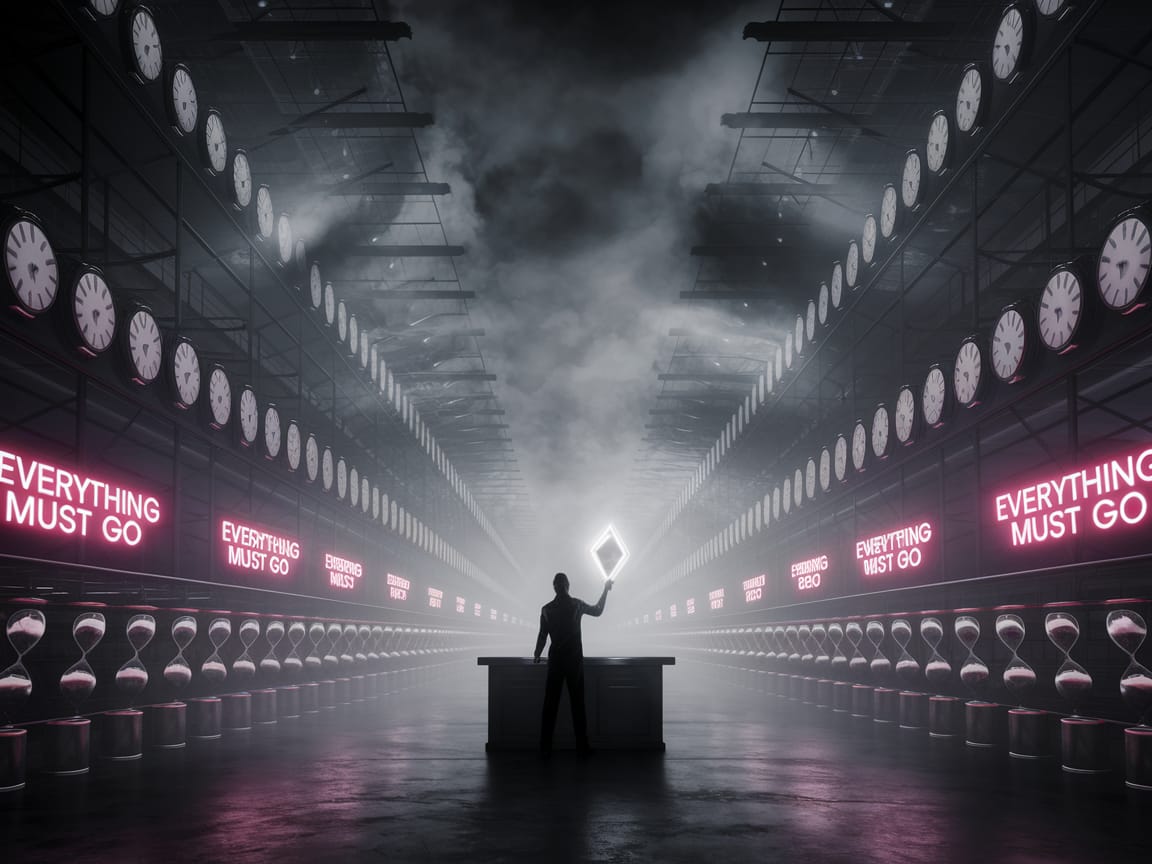
Everything Must Go… Time Is Running Out

The Time Machine Files, Vol. 3

Depends. You selling or giving it away?


People love to talk about time like it’s a membership program — renewable, limited, and probably ad-supported.
“There’s not enough time in the day.”
“I wish I had more time.”
“Time just got away from me.”
We all say it. I’ve said it too.

The thing about time, though, is it’s always been the same amount since we started measuring it. The only thing that changes is us — or more precisely, how we try to package it.
We’ve gone from lunar calendars to solar calendars to whatever daylight-saving-time fever dream we’re still pretending makes sense. The problem isn’t time. It’s that we keep treating it like software that needs constant updates.

So naturally, someone’s going to say, “We just need to manage it better.”
Cue the parade of Day Runners, Franklin Coveys, and every other trendy organizer that promised to make us “more efficient.” We’ve become so efficient that people now have time to buy multiple organizing systems, compare them on YouTube, and make affiliate links ranking which one saves you more of your already wasted life.

So I wonder if the next big thing will be the ability to purchase time in blocks.
You know — “Now available in convenient six-hour increments!” Buy one, get a bonus fifteen minutes for self-care. Maybe throw in a loyalty program. Because nothing says progress like turning eternity into a subscription service.

They’ll probably call it something sleek and stupid, like Chrono+ or The Timely App.
“Reclaim your minutes!”
“Upgrade your life!”
“Don’t waste another second — for just $19.99 a month.”


(A bright, sterile retail space. Muzak hums in the background. A counter gleams beneath fluorescent lights.)

Sales Associate: Good evening, ma’am, can I help you?
Customer: Yes, I’d like to purchase a time block.
Sales Associate: Certainly. How much were you thinking?
Customer: Hmm… I’m not sure.
Sales Associate: We’re offering thirty percent off any blocks over ninety days, if that helps.
Customer: Really? Oh, Jeremy — stop that! Don’t put things in your mouth. What have I told you about putting things in your mouth? What is that? Spit it out! Right now, young man. Thank you.

(A pause. She straightens her coat, smiles politely.)
Customer: I’m so sorry, where were we? Oh, yes. I’ll take one ninety-day block and three one-hundred-twenty-day blocks. Time flies so fast — you can never be too careful.


And that’s exactly the problem.
We’ve turned time into a product, a project, and a panic attack — all rolled into one. You can color-code your planner, automate your calendar, and stack every “optimization hack” known to humankind.
You still can’t out-organize mortality.

Maybe the trick isn’t getting more time. Maybe it’s using the time you already have without acting like you’re auditioning for it.

So, do I need time?
Not really. I need less of it hanging over my head and more of it sitting quietly beside me — the kind that doesn’t come with notifications, countdowns, or motivational quotes.

If I ever finish the time machine, maybe I’ll try deleting the concept altogether. No deadlines, no clocks, no “you’re running late.” Just motion and memory. Just the sound of life moving forward without asking permission.

Until then, I’ll keep what I’ve got —
a half-wired machine,
a cup of cold coffee,
and a future still on backorder.

Daily writing prompt
Do you need time?

Oh Look, Another Time Travel Question 

They asked what my life will be like in three years. I told them I’m still trying to figure out next Tuesday. 

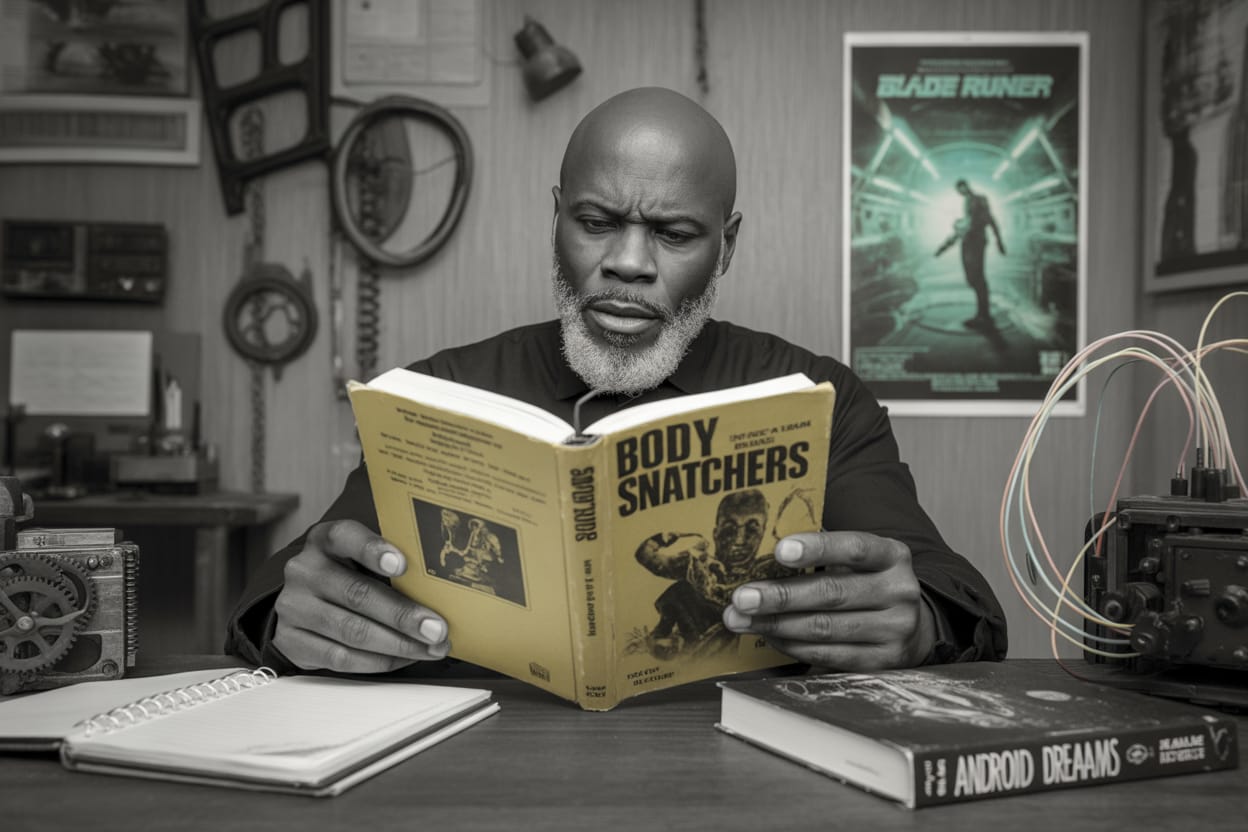
Some men build time machines. Others read about alien pods and synthetic sheep, hoping to understand what went wrong with the species. I do both — coffee optional, cynicism not. 


Every time someone asks about the future, I picture a crowd of anxious humans trying to schedule the weather or negotiate with fate via Google Calendar. It’s adorable. Come here, let me pinch your cheek. Really—this obsession with pretending we’re in control. I’ve met potholes with a stronger sense of inevitability. 

Three years from now, I’ll probably still be working on the time machine in my basement. People keep asking why. I tell them it’s cheaper than therapy and safer than dating apps. Besides, time travel makes more sense than “five-year plans.” At least with time travel, you accept the paradox. With planning, you just lie to yourself more efficiently. 

So, keep endless scrolling and doing your TikTok dances. Because apparently no one needs cable anymore, and I suppose that makes you a public servant now. So—high five? What? Get away from me… weirdo. 

In three years, I hope to have mastered the fine art of not giving a damn about metrics. Maybe I’ll finally stop apologizing for slow progress and start celebrating that I’m still moving at all. I might have fewer teeth, more coffee stains, and the same bad back—but I’ll also have more stories. And if that’s not progress, what is? 

If the time machine works, I’ll visit future me just to see if I ever stopped procrastinating. My bet? Future me is standing in the same spot, muttering something about “calibration issues” and sipping cold coffee. If that’s the case, I’ll pat him on the shoulder, tell him he did fine, and leave him to his nonsense. 

Because maybe that’s the secret: it’s not about what the future looks like. It’s about showing up for the weird present we’ve already got—even if the gears grind, the circuits smoke, and the timeline refuses to cooperate. 

Because no one needs body snatchers—thank you, Jack Finney—or android replicas of Philip K. Dick. Be yourself. Live in the moment. Don’t be a pansy. 

So, what will my life be like in three years? 

Hopefully still under construction. Hopefully still mine. 

And if the time machine’s finally working by then… I’ll let you know. 


Daily writing prompt
What will your life be like in three years?

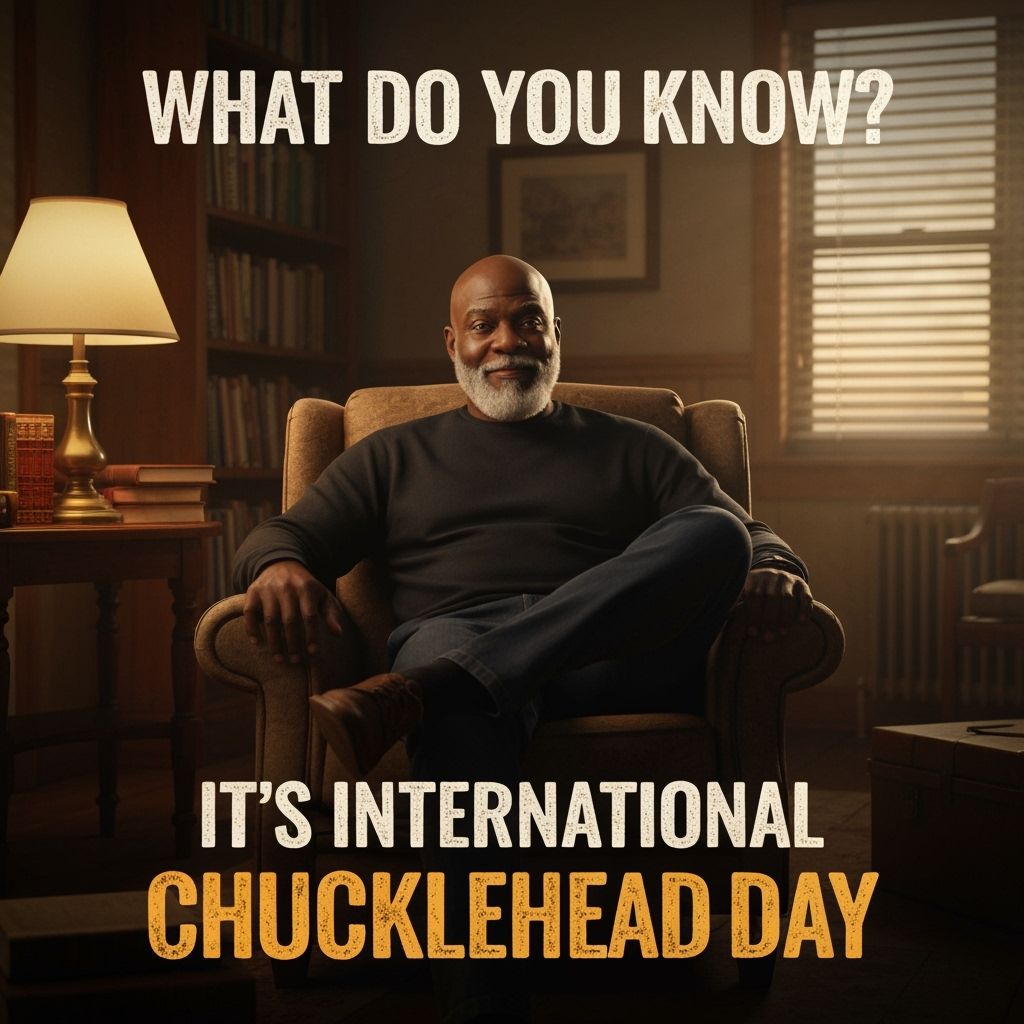
International Chucklehead Day 


No one remembers who started it. Probably someone who said something so catastrophically dumb that laughter was the only way to keep the world from collapsing in on itself. That’s the real magic of it — turning foolishness into fellowship. 

Every year, on the first Friday of November, we celebrate the sacred art of not having it all together. A holiday for the half-aware, the overconfident, and the beautifully human. 

There are rules to this madness, of course — because even fools need structure. 

How to Celebrate: 

Step 1: Confess Your Foolishness 

Start the day by admitting your latest act of nonsense — the thing that made even your reflection sigh. Write it down on a scrap of paper. Don’t overthink it; the truth works best when it’s still raw. 

Fold it up. 

No name, no excuses. 

Drop it into the Crowning Ceremony Drawing — a sacred bowl, coffee mug, or whatever container hasn’t been repurposed as an ashtray. 

It’s not about shame. It’s about liberation — the moment you realize your worst mistake has become everyone’s favorite story. 

Step 2: Craft the Crown 

Tradition states that the previous year’s Chucklehead Supreme must craft the crown for the new one. It’s a sacred duty — part redemption arc, part creative punishment. 

No two crowns should ever look alike. Some are wrapped in tinfoil and regret, others in duct tape and leftover wisdom. A few have been rumored to include receipts from bad decisions and one brave attempt at origami. 

The important thing is effort. The crown must be made by hand and offered with the solemnity of someone who’s learned their lesson — or at least pretended to. 

Step 3: Acts of Absurd Kindness 

At some point during the day, pay someone a compliment so strange it bends their sense of reality for a second. 

Say, “Your left eye is particularly dazzling today.” 

Say it straight-faced. No grin, no flinch. 

Pick a word you’d never use — dazzling, radiant, exquisite. The kind that belongs in perfume ads or embroidered pillows. Use it anyway. Because for one brief, shining moment, everyone deserves to be a little ridiculous. 

Step 4: The 3 P.M. Chuckle Ritual 

Wherever you are, tell the worst joke you know. No winners. No scoring. Just the shared sound of collective groaning to remind us that laughter, even bad laughter, is still holy. 

When the last chuckle fades, everyone assembles for the Crowning Ceremony Drawing. The folded confessions are placed in the center — a bowl, a hat, or a leftover candy dish from last year’s failed diet. 

One confession is drawn. One truth is read aloud. 

And somewhere in the room, the new Chucklehead Supreme exhales and steps forward to claim their crown. 

Step 5: Crown the Worthy 

Present the handcrafted crown in a mock ceremony — bonus points for a kazoo processional or a slow clap that lasts slightly too long. 

The new Chucklehead Supreme must wear it proudly until someone else out-chuckles them. It’s not a punishment. It’s an acknowledgment: you’ve officially joined the noble order of people brave enough to look foolish and laugh about it. 

Step 6: For the Retired & the Wise 

Same rules apply — only now the arena has changed. Gather your fellow retirees at your usual hangout: the diner, the park bench, the coffee shop that knows your order before you walk in. 

Write down your foolishness on a napkin if that’s all you’ve got. Drop it in an empty sugar packet box. Tell the same bad joke you’ve told every week since ‘92. 

Crown the winner, or the loser — depending on how you look at it — and raise your mugs in solidarity. Because time doesn’t make you immune to foolishness; it just gives you better material. 

Why We Celebrate: 

Because perfection is a myth sold by people who’ve never burned toast. 

Because humility ages better than pride. 

Because every one of us is a walking blooper reel trying to look composed in public. 

And maybe because, after a lifetime of getting it wrong, I’ve learned the trick isn’t avoiding the fall — it’s learning to laugh when you hit the floor. 

So pour your coffee. Wear your invisible crown. And remember: the world doesn’t fall apart when you screw up — it just becomes a little funnier. 

Long live the Chuckleheads. 

Author’s Note: 

This piece was written in celebration of imperfection — the kind that keeps us honest, humble, and human. Somewhere out there, someone’s still wearing last year’s Crown of Cluelessness. If that’s you, your left eye is still dazzling. 

Daily writing prompt
Invent a holiday! Explain how and why everyone should celebrate.

Do’s, Don’ts, and Dumbshit: A Brief Guide to Time Travel

Aging isn’t the problem — it’s the reruns. A tongue-in-cheek survival guide for anyone who’s ever looked back and thought, “What the hell was I thinking?”

Daily writing prompt
Is there an age or year of your life you would re-live?


This could be an interesting question, depending on how you look at it.
If we’re talking about glory days—back before the gray, before the knees filed for early retirement, before hangovers started needing a recovery plan—then no thanks. I have no time for foolishness and even less to say on the matter.

But if we’re talking time travel—now you’ve got my attention.

I’ve mentioned before that I’ve been building a time machine in my basement. No one believes I’ll ever get the damn thing working. Their “lack of faith in the Force is disturbing.” One woman told me, “It’s not my lack of faith in the Force—it’s my lack of faith in time travel.” I rolled my eyes, of course. Time travel is real—just like dragons. What, don’t look at me in that tone of voice.

So, I decided it was necessary to create a short list of do’s and don’ts. Some of these should be obvious, but you and I both know humans are notorious for dumbshit. What follows is my rough draft of the guide.


Time Travel: A Practical Guide for the Chronologically Curious

DO

  1. Bring humility, not luggage. You can’t pack self-awareness into a carry-on, but it’s the only thing that makes the trip worth it.
  2. Wave, don’t interfere. Watching your younger self screw up is part of the fun—it’s a rerun with better lighting.
  3. Ask the questions you were too proud to ask back then. “What the hell were you thinking?” still counts.
  4. Thank the ghosts. The people who left or broke you were part of the architecture that got you here.
  5. Notice the details—the color of the room, your mother’s voice, the way your laughter used to sound before the world got louder.
  6. Come home. Time travel’s a sightseeing tour, not a place to live.

DON’T

  1. Don’t try to fix anything. You’ll only trade one regret for a newer, shinier model.
  2. Don’t warn your younger self. That idiot needs to learn. You’re living proof they eventually did.
  3. Don’t chase old flames. The girl who didn’t pay you attention the first time still doesn’t give a damn about your ass now.
  4. Don’t drown in the what-ifs. That’s not nostalgia; that’s self-harm in prettier clothes.
  5. Don’t justify your present by rewriting your past. If you’re lost, that’s on today’s version of you.
  6. Don’t forget to bring back souvenirs—perspective, closure, forgiveness. They travel light but change everything.

Once I stop procrastinating and actually finish building the damn time machine, I wouldn’t use it to relive anything. I’d just visit long enough to remember that every mistake had a purpose and every joy had an expiration date. Then I’d come back, pour some coffee, and—I don’t know—maybe write my thoughts on a blog called Memoirs of Madness. Then get on with the business of living whatever version of now I’ve got left.

I’ll let you know how it goes.


The Price of Stolen Time

Daily writing prompt
What historical event fascinates you the most?

As a lifelong student of history, I’ve never been able to pull one event from the timeline and say, “This is my jam,” or “This right here—this is the shit.”

I’ve said it, of course. Probably said it too often. But none of them ever stick, because the truth is—it’s all the jam. Every revolution, every backroom betrayal, every random Tuesday that accidentally changed the world. History is the world’s longest mixtape, and it never skips a track.

I remember friends saying, “History’s boring.” Or worse, “So what?” I’d sit there thinking: You mean to tell me you can scroll for hours watching conspiracy podcasts and true-crime breakdowns, but a real story about an empire eating itself alive doesn’t do it for you?

History isn’t boring. It’s gossip that got serious—a mirror that never lies.

And sometimes, buried in the margins, there’s someone like Henrietta Wood.

Henrietta Wood wasn’t supposed to be remembered.

 Born enslaved in Kentucky around 1818. Freed in 1848. Kidnapped back into slavery in 1853 by a man named Zebulon Ward—an opportunist who saw her freedom as a clerical error he could correct for profit.

He sold her into slavery in Mississippi and Texas. Twelve years gone.

 Then emancipation came, and instead of fading quietly into “freedom,” she filed a lawsuit. Not a complaint. Not a plea. A bill.

In 1870, she sued Ward for $20,000 in federal court—a number so bold it had to make the room flinch. The trial dragged for eight years because that’s what the legal system does when it owes you something. In 1878, she won $2,500, the equivalent of about $65,000 today.

Ward paid.

 Henrietta used the money to send her son to law school.

 Tell me that’s not poetic symmetry.

She didn’t change the system. She cracked it—just enough to let the light in.

“Arthur H. Simms graduated law school in 1889, made his mark in Chicago—living proof that a mother’s lawsuit wasn’t just a story, but the starting gun for a lineage.”

Most people would’ve spent it fast, but Henrietta played a longer game.

 She had principles and foresight in a time when most folks were just trying to breathe through the next day. Survival back then wasn’t a metaphor—it was the whole assignment.

She was awarded her money just after the crash of 1877, when the country was bleeding out from economic collapse and labor riots. Chaos in the streets. Blood on the rails. And in the middle of all that noise, there she was—a newly wealthy Black woman in America. By any measure, that was nothing short of miraculous.

She didn’t just win a case; she won proof that the system could be forced, however briefly, to recognize her humanity—

 and the humanity we had fought for a hundred years earlier.

Just one year before her victory, Black people had officially become citizens under the Reconstruction Amendments. On paper, anyway. But the ink was still wet, and the promise hadn’t been delivered. Citizenship didn’t come with safety, or wealth, or power—it came with a target on your back.

It’s wild when you think about it: Lincoln said “four score and seven years ago” to define what America was supposed to mean, and here we were, a single score later, still trying to cash that promise. Henrietta Wood’s lawsuit was more than a demand for money—it was a demand for the score to finally be settled.

But history doesn’t balance its books that easily. Her win was a down payment, not a clean ledger.

Nearly five full scores—ninety-five years—passed between the ratification of the 14th Amendment in 1868, which declared Black people citizens, and the 24th in 1964, which finally said they could vote without paying for the privilege. Ninety-five years between being written into the Constitution and being let into the booth. That’s not progress; that’s a slow bleed dressed up as democracy.

And that’s what makes Henrietta Wood’s victory so damn profound. She didn’t wait for the Constitution to catch up. She didn’t wait for permission. In a time when her citizenship was still a technicality and her humanity was a debate; she walked into a courtroom and forced the system to do what the law had promised but hadn’t yet learned how to deliver—recognize her.

The same law they had fought and bled for before they were even citizens. Before the ink on the 14th Amendment, before the word freedom stopped needing quotation marks. Henrietta stood on that battlefield of paperwork and principle and made the country do what the statue in the bay only claimed to represent.

She settled her own score nearly a century before the nation even realized the debt existed.

That’s why I study history. That’s why I never found it boring. Because every century, every headline, every name carved into stone is part of the same damn argument about who gets to be human and who gets to send the bill.

Henrietta Wood didn’t just win money—she won meaning. She took the same law they fought and bled for before they were even citizens, and she made it do what the statue in the bay only pretends to: stand for liberty, not theater. She didn’t ask for mercy. She demanded math.

And that’s what history really is—math written in blood and ink. Every generation adds up what the last one promised, and we’re still carrying the remainder.

So when people tell me, “History’s over,” I just laugh. The score’s not settled. Somewhere between 1868 and now—between Henrietta’s courthouse and that statue still holding her torch over borrowed water—the light keeps flickering like a warning.

What did Led Zeppelin say? “The Song Remains the Same.”

That’s the jam. Every damn time.

Author’s Note

I love history. So much that I’m building an entire website for it—and for everything else that refuses to be forgotten.

 We make history in every breath we take. Every choice, every fight, every story that doesn’t get told.

How in the hell can that ever be boring?

No Cheap Shit

The Lab’s gone quiet tonight. Just me, a dead desktop, and the taste of old regret. Turns out, every shortcut comes with a bill — and this time, I paid in time I can’t get back.

Daily writing prompt
What’s something you believe everyone should know.

NO CHEAP SHIT.
That’s my one rule in the Lab — the hill I’ll die on — and the one I just broke.

The glow of the screen paints my hands in soft blue light. LibreOffice hums open, and for a second it’s like stepping through time. The last time I used this suite, it was still called OpenOffice — back when nobody could afford Microsoft, and we were all running on hope and cracked CDs. I remember the word-processor wars: Lotus 1-2-3, WordPerfect, Microsoft Word. That was the golden age of making do, when half the job was convincing old machines not to die mid-save.

I’ve been thinking about all that because today I pulled a machine out of rotation. She’s sitting on the shelf now, waiting to be stripped for parts — fans still warm, power light still pulsing like a heartbeat. She’s only a few years old, but she never earned her keep. Truth is, I knew better the day I bought her.

I broke my own rule.

See, when it comes to my Lab, I don’t buy cheap — I buy right. I wait. I build machines meant to last longer than the mood I’m in. Every four or five years, I rebuild. Every eight, I start from scratch. Even the retired ones still hum like old blues records — tired but proud. One of my boys calls dibs early every cycle. Says, “Your shit be like new.”

But this one? I knew she was weak from the start. My editor warned me, and I said the four dumbest words in my vocabulary: “It’ll get me by.” She sighed — that kind of sigh that comes from knowing a man who refuses to learn the easy way. My late wife used to give me the same look.

She’d drag me through electronics aisles, make me put back laptops like they were bad decisions with price tags. “You don’t buy tools,” she’d say. “You buy time.” And she was right.

Cutting corners never saves you anything — not in money, not in effort, not in peace. It just delays the reckoning.

That off-the-rack desktop was only the second prebuilt I’d owned in forty years. First night I had it, I was already cussing under my breath. Adobe CC lagged, the fan howled, and I called tech support just to have someone to blame. Yeah — I was that guy.

Now here I am, working on a ten-year-old laptop running Linux, and she’s humming like a jazz trio at midnight. Ten years old and still moving smooth because I built her right, upgraded her right, respected her limits. Forty-eight hours into a fresh burn-in and not a single stutter.

So here’s what I believe everyone should know: don’t cut corners.
Not on your machines. Not on your craft. Not on your life.

The easy route always comes back around to collect its fee.
Because the hardest thing you’ll ever have to do in life — is the right thing.
And doing the right thing almost always takes longer, costs more, and hurts like hell in the moment.

But it lasts.

Nothing worth a damn comes easy.

Buy the right tools. Take the time to build things that endure.
Because when you cheat the process, you’re not saving time — you’re stealing it from your future self.

And time’s the only thing the Lab can’t rebuild.

Well Shit, There Is Never Enough Duct Tape

Weathered, Hard Knocks Wisdom


Well shit. There is never enough duct tape.

Guppy and I are sitting in the middle of chaos again. She’s perched on the edge of the desk, licking her paw like she’s above it all. Around us, the lab looks like a hardware crime scene — cables spilling from gutted towers, screws scattered like confession pieces. A half-drunk cup of coffee cools beside me, burnt and bitter, the official scent of frustration.

She meows right on cue, the sound sharp and knowing. I look over. “Yeah,” I tell her. “I did it again.”

Outside, the truck’s still dead in the driveway. The house keeps popping up new problems like it’s auditioning for a demolition reel. And inside, my computers — the ones that run everything I’ve built — have decided to crash in unison. It’s a full symphony of failure.

It kinda feels like life bitch-slapped me. I’m standing there, half laughing, half wondering what cosmic fuse I blew this time. Then, in my mind, a ghostly finger points right at me and says, in that whiny little voice only the universe uses: “You know why.” The kind of voice that grates — part guilt, part game show host.

So I sit there, breathing through the noise, because reacting to chaos never resolves anything. There’s never enough duct tape for that kind of mess.


I’ve been fixing broken things since I was a kid. Did my first tune-up at eight years old — or what I thought was a tune-up. Standing on a kitchen chair in my school clothes, wrench in hand, trying to change plugs and set points. Madre nearly lost her mind when she saw the grease stains on that chair. But when that engine coughed back to life, I felt it — that quiet click inside that says, You can fix this.

Then came the eighties and my next addiction: computers. Back before color screens and mouse pads, when hope fit on a floppy disk and syntax errors were life lessons. We typed code line by line, fingers crossed, praying the damn thing would run. Our instructors were learning right beside us. When we figured out how to make a 5.25-inch floppy dual-sided, we thought we were gods.

We wrote everything down back then — notebooks, sketchpads, pages of half-finished programs and circuit doodles. There weren’t breaches in those days, just broken noses if someone got too close to your notebook. Hidden between the pages, you’d find a floppy or two — our version of a flash drive. Everything we built lived by hand, by instinct, by obsession.


I remember the early version of Memoirs of Madness. It wasn’t even a site yet — just an idea and a laptop I built from scavenged parts. I used to walk to the local library to borrow their Wi-Fi, fingers freezing on the keyboard, trying to post something before the battery died. My first “lab” was a pile of junked machines I dragged home and resurrected. Every boot-up felt like a small miracle, a little defiance against the void.

Then I got fancy — started buying ready-made machines, the kind that come preloaded with operating systems that assume they know what’s best for you. Windows. Loud, bossy, always watching. So I went back to Linux. The hard way, of course.

And naturally, it couldn’t be as simple as clicking “install.” There are, what, fifty different Linux distros to choose from? (It’s probably not fifty, but in the middle of a rebuild, it sure as hell feels like it.) Matching distro to hardware… don’t even get me started. The world’s built for Windows and Mac, not for the stubborn few still willing to build their own bones.

My old MacBook’s still around, though. She’s slow, loyal, and half-retired. She’s got the heart for it, just not the legs. I can’t bring myself to replace her. We’ve been through too much — too many drafts, too many late nights, too many little resurrections.

Every crash, every patch, every clunky restart just reminds me: I’ve been here before. Different machines, same madness.


It’s that time of year again — the anniversaries of loss, the kind that pile up quietly. Some losses don’t stay buried; they just wait for the calendar to circle back. And it’s in moments like these you pause, wondering what the right response to chaos even looks like. Because reacting never fixes it — there’s never enough duct tape.

The machines hum again now — not perfect, but alive. The house still leaks. The truck still sulks. I’ll fix what I can, curse what I can’t, and keep rebuilding in the meantime.

Guppy jumps into my lap, head-butts my beard, and purrs like she’s proud of me for surviving another day. I scratch behind her ear, take a sip of cold coffee, and sigh.

So, what am I working on?

My life.

And for now, it’s still running — a little buggy, sure, but running all the same.

Groove, Guppy… Guppy? Groove, please… ah, yes, thank you.

🎧 Soundtrack: “Help Me” – Sonny Boy Williamson II | “The Stumble” – Freddie King


Daily writing prompt
What have you been working on?

Tell Yourself Whatever You Need To

Most people think I’m loud — the kind of person who fills a room just by showing up. The one cracking jokes, telling stories, holding court like I was born to. I let them believe it. It keeps things easier, smoother. But truthfully, I’m an introvert in disguise — a quiet man who learned that silence makes people nervous.

I’ve actually heard folks say they were scared of me when I didn’t talk. Something about my face, maybe — the way it rests heavy, unreadable, like I’m thinking too much or judging too hard. I guess that’s my curse: I look like trouble when I’m just tired.

So I talk. Even when I don’t want to. Even when the words feel like sand in my mouth. I talk to make other people comfortable, to smooth over the awkwardness that silence seems to bring. I know that probably sounds weak, but it helps things along. It makes the day move easier. And sometimes, pretending to be the loud one is less exhausting than explaining why I’m quiet.

When I worked in offices, coworkers would say things like, “Are you judging me?” or “You’re judging me right now, aren’t you?” or “You look like you’re about to call me a name.” I’d laugh it off, but inside, I wasn’t judging anyone. I was probably thinking about a story idea, or how lunch wasn’t sitting right, or why the hell the printer only jammed when I used it. But try explaining that without sounding like a weirdo. It’s easier just to say something funny, make them laugh, keep the peace.

Even my ex used to tell me, “Let me know before you go dark.” She meant the quiet spells — those stretches when I’d retreat into my head, writing or reading or just not talking. To her, silence felt like absence, like a door closed without warning. But for me, it was never about her. It was how I reset. I don’t disappear out of anger; I disappear to breathe. But try convincing someone of that when they’ve been taught that noise means love.

The truth is, I can go days without saying a word and feel completely fine. The quiet doesn’t scare me — it steadies me. It’s where I make sense of things. Where I untangle the noise I swallowed all week. My desk becomes a refuge. A book, a pen, and a cup of cooling coffee are enough to rebuild the parts I’ve spent too long bending out of shape for other people’s peace.

But silence has its own cost. You start to wonder if anyone ever really knew you beneath the performance. If they’d still come around if you stopped making it easy for them. If they’d sit in the quiet long enough to realize you’re not angry — just tired of having to explain your existence.

So yeah, I’m loud. But not because I love attention. I’m loud because silence unsettles people, and I’ve spent too many years trying not to be someone’s reason for discomfort. Maybe that’s my weakness. Or maybe it’s another kind of grace — learning to speak, even when the world hasn’t earned your voice.

Before I go dark.

Daily writing prompt
What’s something most people don’t know about you?

The Geography of Silence

Daily writing prompt
What makes a good neighbor?

A good neighbor knows when not to wave.
They nod from across the street, maybe lift a hand if the mood strikes, but mostly—they stay put. They don’t wander over with gossip wrapped in small talk or ask what that noise was last night. They know everyone’s got ghosts, and some of us like to drink coffee with ours in peace.

A good neighbor minds their lawn, their lights, and their damn business. They understand proximity isn’t friendship—it’s geography. The best ones don’t pretend otherwise. They’re the kind who’ll pull your trash bin up to the curb when you forget, but never ask why you forgot in the first place.

But here’s the part no one admits: good neighbors save us, quietly.
They remind us we’re not alone even when we choose to be. The sound of their footsteps, the faint hum of their television through the wall—it’s proof of life, the fragile kind that keeps you tethered when the world starts feeling too wide. We may never speak beyond a passing hello, but that’s not indifference. It’s understanding.

The secret isn’t in being close—it’s in being considerate. It’s in knowing that kindness sometimes looks like silence. And if you’re lucky, it’s in the neighbor who nods at you through the blinds, both of you quietly agreeing that the best relationships are the ones that never need explaining.

When Nobody’s Watching

On the kind of truth that doesn’t need an audience.


I’ve always felt that people who do things “as a matter of principle” are full of it. Too often, they cling to their moral code like a lifeboat, even when the water’s shallow enough to stand. I don’t think most of them mean harm — they just get caught up in being right, afraid to face the possibility that they might be wrong. It’s human nature. We mistake conviction for truth because it’s easier than questioning ourselves.

The older I’ve gotten, the more I’ve realized that all our so-called principles are built on experience — the good, the bad, and the ones that broke us open. What we value changes. What once mattered deeply starts to fade. Acceptance doesn’t come easy; denial usually wins the first few rounds.

Over time, I stopped pretending I needed a long list of virtues to define me. I stripped it down to what felt real — two principles that anchor everything else: honesty and integrity.

Honesty keeps me from lying to myself, especially when self-deception would be easier.
Integrity keeps me from betraying who I say I am, even when it costs me something to stay true.

Everything else — compassion, respect, perseverance — grows from those two. I’ve found that when I hold to them, I don’t need much else. It’s simple, but it’s not easy.

I recall people talking about staying up with the times — as if evolution meant trading in your soul for a newer model. But some things shouldn’t change. Things like being true to yourself and paying attention to what actually matters — the choices, the people, and the moments that leave fingerprints on the rest of your life, whether you notice them or not.

I still hear my Madre’s voice when I start to drift:

“You know the difference between right and wrong. No one has to teach you. But I will remind you from time to time.”

That line stuck with me. Maybe because she was right — deep down, we all know. Life just tries to talk us out of it.

Some people call it character, others call it discipline. I just call it doing what’s right when nobody’s watching. The kind of thing you don’t brag about, because if you have to, it probably doesn’t count.

Daily writing prompt
What principles define how you live?

Ghosts, Deadlines, and the Cool Monitor

Somewhere between the ghosts that won’t shut up and the deadlines that never arrive, I learned the trick — just keep writing anyway.


In 2023, my writing team accused me of procrastinating. I was offended — we’d built blogs, workshops, entire worlds together. How could they think I wasn’t doing enough? Then my senior editor cornered me one afternoon. It wasn’t a talk so much as a scolding — the kind that makes you feel like a kid again, thumb hovering near your mouth, waiting for the cue to say, “I’m sorry. I’ll never do it again.”

She wasn’t wrong, though. She asked a single question I couldn’t answer:
“Why haven’t you finished your novels?”

I had no answer then, and I still don’t. I’ve told myself plenty of stories — excuses dressed up as reasons — but none with any iron in them. They clang hollow, like empty promises we whisper to ourselves when doubt starts pacing the floor.

Since my reemergence, I’ve kept writing. Slowly. Unevenly. Each sentence feels like a step back toward the part of me that once trusted the words. My editor’s been kinder lately — maybe because I’ve stopped hiding behind excuses, or maybe because Ursula, my muse, stopped sulking now that she’s getting her pages again.

But somewhere along the way, I forgot how to do it. I can’t recall the moment it happened — it slipped away in the night, like a silent rogue with perfect aim. Maybe I was its willing victim. Not the kind that dies, but the kind that lives haunted by the absence of what was taken.

You’d think that once you recognize what you’ve lost, it would be easy to reclaim. But it isn’t. It’s like I hid it in some special place — the one where I put all the things I swore I’d never lose. Now I stand at the door, staring into that room, unable to remember where I left it.

So I wait. I search the corners. I listen for echoes of the writer who once trusted the words to come. With patience, I know I’ll find what’s hidden — the secrets, the treasures, the grace buried under dust and doubt.

Believing in myself is the key. The rest is just remembering how to turn it.

By 2025, the ghosts have quieted. I’m no longer haunted by my demons — I think they took a cruise or something. But their cousins pop in from time to time, usually uninvited, always loud, never staying long. I let them talk. Then I get back to writing.

Still, despite the progress I’ve made, there’s something holding me back — something keeping me from reaching that place where I can be completely at ease with who I am as a creator. I don’t want to cross to the other side of the veil wondering if I could have been more.

Of course, there will always be unfinished work when we cross over. That’s the nature of it. But I don’t want to be one of those guys replaying fragments of what I could have been.

So this year, I’ve started making moves to change that — to turn my writing and art into something more than what sits quietly on my hard drive. I’ve focused on quality rather than quantity, and I’m learning, finally, to get out of my own way.

You know how embarrassing it is to trip over your own feet? Talk about losing cool points. The Cool Monitor’s in the corner, shaking his head and deducting them one by one.

But this time, at least, I’m still walking forward.

Maybe the real work was never about finishing — just refusing to stop.

I’ve made peace with the ghosts in my process. They’re lousy tenants — leave coffee rings, mutter bad advice, rearrange my ideas when I’m not looking. But I’ve learned to write through their noise. Some days, that’s what it means to be an artist: to keep typing while the past heckles from the cheap seats.

I’ve spent years chasing the version of myself I thought I was supposed to be — the novelist, the mentor, the unshakable voice. Turns out, I don’t need to become him again. I just need to keep showing up — pen in hand, imagination slightly bruised, heart still willing.

Once I realized that, I’ve written some of the most powerful stuff in years.


Reflective Prompt

Take a moment. Unplug from the artificial ether and tap into the one we were born with — the raw signal beneath the static. Acknowledge the things you wanted to do, the things you left hanging, the things you can still do. What are they?

Don’t dress them up as goals or resolutions. Just name them. Whisper them back into existence. Some will sting. Some will make you laugh at how small or strange they seem now. But all of them are proof that you’re still reaching — still alive enough to want.

Maybe that’s the real work of this life: learning to live with the unfinished, to walk beside the ghosts of what we almost became, and still make something worth remembering.

Daily writing prompt
What have you been putting off doing? Why?

When the Words Stop Belonging to Me

Somewhere between the promise to finish and the fear of release, I found the echo of a voice that used to steady me. Maybe finishing isn’t the victory—it’s the letting go.


The hardest personal goal I’ve set for myself was deciding to finish a manuscript by the end of the year. I made that promise quietly—no big declarations, no social media countdowns—just a whispered deal between me and the page. I told myself that this time, I wouldn’t stall, I wouldn’t second-guess, I’d simply finish. And for a while, I did. The words came like a slow, steady thaw after a long winter.

But somewhere along the way, I lost my nerve. I’ve been published before, but that was before my wife died. Back then, I wrote with a kind of reckless courage—like someone who still believed the act of creation could outlast the ache of being human. Now, everything I write feels like an echo of the life we built together, the silence between us inked in every line.

People call it fear, and maybe they’re right. But I think it’s more complicated than that. Fear can be fought. This… this feels like standing at the edge of something sacred, knowing that once I let the work go, I can’t pull it back. It’ll belong to the world—and not to her, not to me.

Still, I keep returning to the manuscript, the way you revisit an old photograph. There’s grief in it, but also grace. Maybe finishing isn’t about conquering the fear at all. Maybe it’s about learning to live with the ghosts that remain—and letting the story carry them somewhere new.


Author’s Note:
We talk a lot about fear in creative spaces, as if naming it will banish it. But sometimes, fear isn’t the enemy—it’s the proof that what we’re doing still matters.

Daily writing prompt
What was the hardest personal goal you’ve set for yourself?

Detention, Da Vinci, and the Making of a Misfit

I wouldn’t know the names of the masters if you paid me a million dollars. I can’t look at a painting and tell you who brushed what stroke or why it matters. There are a few comic book artists I really enjoy, but again, I couldn’t tell you their names. I just know when something stops me in my tracks.

The feeling I get when I look at art… I don’t really have words for it. It’s like trying to explain why a storm feels beautiful while it’s tearing through your neighborhood. You just feel it. Despite that, I spend my time trying to create the same kind of reaction in other people—through writing, art, film, photography—whatever medium happens to grab me that day.

I recall giving a speech in class once. When I finished, there was silence. No applause, no eye rolls—just my classmates staring at me like I’d confessed something I shouldn’t have. My teacher asked what inspired it, and I told him I made the whole thing up. He didn’t believe me. They sent me to the counselor’s office to “discuss my feelings.”

It took a while, but I finally convinced an adult that it was a work of fiction. I had my notebook with me, filled with half-finished stories and wild ideas. That notebook saved me. It proved I wasn’t broken—I was just a writer.

It was after that little incident I landed myself in detention for running my mouth. I’ve got a habit of voicing my disdain in its raw, unfiltered form. Come to think of it, that might’ve been what led my mother to suggest I give up profanity for Lent. Hmmm.

Meanwhile, back in detention, I checked out an art book from the library and started leafing through it. I found a Da Vinci sketch—nothing fancy, just a face drawn with impossible precision. I tried drawing my own version, and something in me shifted. After that, I started drawing everything. Then, write everything. Strangely, that was the birth of Mangus Khan.

Funny how things happen, huh?

Since then, I’ve learned that every work of art hits everyone differently. I’ve written things I meant to be serious, only to have people burst out laughing. There’s no predicting what someone will feel. You just roll with it, cherish the experience, and most of all—feel.


Author’s Note:
Don’t let anyone crush your creative spirit. They may not understand what you’ve created—and that’s okay. You never know how it will affect the next person. So create. Always create.

Daily writing prompt
Who are your favorite artists?

The Stories That Yearn to Be Told

Daily writing prompt
What is your favorite hobby or pastime?

I didn’t set out to be a writer. It happened by accident, somewhere between a half-finished sketch and a notebook full of half-thought ideas. Back then, I was a teenager with more curiosity than direction, filling pages because it felt like the only way to keep my thoughts from spilling everywhere else. One of my oldest friends likes to remind me he can’t remember a time I didn’t have a notebook in my hand. He says I was always scribbling or sketching, usually both.

It was at his house, during one of those long afternoons that used to stretch forever, when someone suggested I could write and illustrate my own book. I never did—but the idea never left. Over the years I’ve written stories inspired by other people’s art, and drawn illustrations for stories that weren’t mine. Maybe that’s the closest I’ve come to answering that old dare.

These days, my rituals are quieter, more deliberate. I start with coffee, smokes, and a notebook—that’s the constant. The rest depends on mood. Sometimes I need silence; other times, I scroll through playlists until I find something that matches the weather inside my head. The room is dimly lit, Guppy purring on the desk, both of us waiting for my next move. It’s not glamorous, but it’s home—the small ritual that turns chaos into coherence.

I don’t consider writing a hobby. But apparently, some people around me do. They say it like it’s harmless, even complimentary, as if writing were just another way to pass the time. Most days, it pisses me off—not because I crave validation, but because it ignores the time, discipline, and mental excavation it takes to build worlds, shape characters, or research a single line that rings true.

I’ve spent weeks turning over ideas before I ever write a word, sometimes months just mapping the geography of a story or tracing the emotional logic of a character. That’s not leisure; that’s labor—creative, invisible, and deeply consuming. Yet somehow, the work only “counts” if it’s published, printed, or profitable. Maybe that’s the illusion people live by: that creation isn’t real until it leaves your desk.

I’ve read the books. I’ve done the study. I’m not waiting for a permission slip to call myself a writer. Still, I can admit that sometimes fresh eyes help—someone catching a rhythm I missed, a sentence that stumbles, or an idea that needs to breathe differently. But that’s collaboration, not validation. The work itself has always been serious enough.

I remember the first time I saw my name in print. I was just a kid then, with childish dreams about becoming something I didn’t fully understand. But even at that age, I knew it was the only thing that gave me genuine joy and peace. It felt right. Like I’d found the one place where my head and my heart could finally speak the same language.

Even when I draw, I’m still telling stories. Sometimes, when I get it right, a single sketch can hold the whole narrative—the emotion, the silence between moments, the pulse of something unfinished but alive.

As an adult, that sense of wonder changed shape. I never thought my writing would go anywhere; most of it was just stories I’d tell my wife over coffee or late-night laughter. When she smiled, I’d rewrite. When she made that face—the one that said, “you’ve hit something”—I’d dig deeper. For a long time, I was defensive about my writing, too fragile to take a critique, too unsure to trust my own voice.

But somewhere along the way, I stopped chasing perfection and started writing from that place where the magic happens. I write from the soul, not the head. It took me forever to realize that for myself, even though I’d taught it a thousand times in workshops. Funny how the truths we teach others take the longest to reach home.

So maybe my favorite pastime isn’t writing itself, at least not in the way people imagine. It’s telling the stories that insist on being told—the ones that show up uninvited and refuse to leave quietly. Not the planned ones or the well-outlined projects, but the whispers that come when I’m half-awake, the flickers that make me reach for a pen even when I swore I was done for the night.

Those are the stories that remind me why I started. They aren’t about publishing or approval or anyone’s idea of success. They’re about listening—to memory, to imagination, to the things that ache to take shape. I suppose that’s what writing has always been for me: not a hobby, not even work, but a kind of surrender.
A way of being in conversation with something larger than myself.

One Size Fits Nobody 

When I was young, we didn’t know anything about bipolar, ADHD, or OCD. For most of the kids who looked like me, we were troublemakers. Lazy. Not living up to our “potential.” And my personal favorite — “at risk.” 

I saw things that still twist my stomach. Families locking their special-needs kids away like shame in human form. Others giving children up for adoption because they saw difference as a “defect.” I didn’t understand it then, but I also didn’t question it. I figured it wasn’t my business. That was my own brand of ignorance — youthful stupidity with a good dose of asswipe. Luckily, I got my head out of my ass before it became permanent. 

I watched people claw their way toward acceptance, thinking if they could just fit in, life might hurt less. It didn’t. I saw cruelty take every shape imaginable. And one night, I watched one of the kindest people I’d ever met get invited to a “party” by the popular crowd. What happened there was wrong on every level — a setup disguised as an invitation. People laughed. Some stood frozen, watching. Nobody stopped it. That was the night I decided I wouldn’t stand by again. I made it my mission to fight for the ones who couldn’t. Easier said than done, but it was a start. 

Thing was, I knew what it felt like to be made to feel less than. My athletic ability was my equalizer — my way to earn space. But it was a fragile kind of belonging. I thought if I could hit harder, run faster, fight better, I’d earn respect. 

Turns out, asswipes are going to be asswipes no matter how many beatings you hand out. 

Being a nerd and a geek didn’t help either — things I embrace now but used to hide. Being Black in America wasn’t easy, but even that didn’t compare to the way people treated those with mental or learning conditions. Hate, I learned, is colorblind and endlessly creative. 

We love to talk about how diversity makes America great. Sometimes I think diversity only exists on posters and TV slogans. 

Then it hit home. My family. I wasn’t ready, but I wasn’t scared. I just had to face a truth I didn’t want to admit: I had some buried prejudice of my own. Stuff I didn’t even know was there. And if I wanted to keep my family whole, I had to deal with it. Over time, I did. 

Then came my own diagnosis. PTSD. That’s when I found even more latent bullshit buried under the macho armor — the “last American badass” act. Mental illness didn’t exist for men like me. Especially not for Black men, because we’re supposed to be ridiculously strong. But let’s be honest — that toxic script applies to men everywhere. Be strong. Don’t cry. Fix it or bury it. It’s a lie that kills quietly. 

The stigma runs deep — not just in the streets, but in the system. I asked a therapist once about ADHD and OCD, wondering if some of my symptoms overlapped. She waved it off: “Once you resolve your PTSD, you’ll be back to normal.” 

Back to normal. As if “normal” were a bus stop I could just catch on the next route. 

That’s the problem. Too many mental health professionals treat PTSD like it’s a virus. “Bend over, quick poke, might sting a little.” Hell, if it were that simple, I’d have rolled up my sleeve years ago. 

But it’s not. None of it is. Every mind is different. What wrecks me might roll right off you. What medication lifts you up might level me. But they don’t listen. They pull out the checklist, ask the same robotic questions, tick the same boxes, and call it “care.” 

It’s one-size-fits-all medicine — and that bullshit didn’t work for clothing, so why the hell do they think it’ll work for the mind? 

When I hit full-blown crisis mode, I was lucky. I got an intern who actually gave a damn. She helped me start living with PTSD instead of suffering from it. She listened. She paid attention. She saw the person, not the file. 

My psychiatrist? Worthless. I called him my dope man to his face. He corrected me — gave me his title like I was some illiterate twit. I told him I didn’t give a damn what his title was; he was still my dope man, and the least he could do was give me some good shit. 

Instead, I got the cheap stuff — the kind that made me feel disrespected, doped, and disposable. 

But I’ve been lucky since then. I have a care team now that actually seems to give a damn about me as a person — not just a walking diagnosis. I don’t know exactly how that happened, but I’ve got a small inkling. See, there were a few medical professionals who became casualties of my unfiltered disdain for incompetence. I didn’t hold back. Maybe that left a trail — maybe word got around that I wasn’t someone to bullshit. Whatever it was, I finally ended up with people who listen. Who treat me like a human being instead of a puzzle to solve. 

Medication isn’t the solution. It never has been. It’s the work of the individual — the daily grind of facing the mirror and doing the damn work — that brings real results. I’ve worked with soldiers and civilians who carry the same ghosts, and the truth doesn’t change. The treatment only works when you treat the person. They’re not data points. They’re people. Treat them as such. 

We are people. We deserve to be treated fairly. Not pitied. Not managed. Not turned into a statistic on a spreadsheet. We deserve the love and fairness that every living soul on this planet is owed. 

If you want to help someone, start by listening. Don’t tell them what they need — ask them. Sure, you might know a few things, but don’t force it. Offer choices. Let them decide for themselves. Nobody likes being told what to do. And the ones who say they don’t mind? They’re lying. 

Healing isn’t a factory line. It’s messy, human, and different for everyone. What calms one person might break another. What saves you might drown me. 

There was a saying back in the day, before online dating. We used to say, “You got a sister or a friend?” — a way of saying, you’re good people, got anyone else like you? 

That’s how I feel about good mental health professionals. When you find one who actually listens — who sees you as a person, not a case number — all you can think is: You got a sister or a friend? 

But in my experience, most of these so-called mental health professionals don’t act like that. 

Two words for you: 

Uncultured Swine. 

(It’s still a compliment.) 

Author’s Note: 

This piece is about stigma — the kind that hides behind silence, systems, and credentials. It’s about learning that real strength doesn’t come from toughness or treatment plans. It comes from listening — to yourself, to others, to the pain no one wants to name. Because healing, like humanity, never fits into a box. 

Daily writing prompt
What’s a topic or issue about which you’ve changed your mind?

Well… You Know 

What it means to be labeled, to mock, and to finally understand. 

There’s something about that question — “Tell us about a time when you felt out of place” — that stirs up more than I want to admit. For someone like me, admitting fear or discomfort has always felt like breaking an unspoken code. Society still treats fear like a weakness, and men especially are taught to hide it behind our egos. I’d love to say I’ve outgrown that, that my ego doesn’t run the show anymore. Truth is, I’d be full of shit if I said that. Ego still tugs at my decisions, but I do my best to keep it in check. 

I remember when I was first diagnosed with PTSD. I wasn’t ashamed of it—I told friends and family outright, thinking honesty would bring support. I thought they’d rally, that they’d have my back in this new state of being. I was wrong. What I found instead was silence where I expected comfort, distance where I expected closeness. I heard whispers that weren’t really whispers, caught side-glances dressed up as concern, saw pity masquerading as care. The labels came quick: “Touched.” “Not right in the head.” And my personal favorite—“Well… you know.” 

Looking back, I can admit there were times I blew things out of proportion. PTSD has a way of magnifying shadows until they look like monsters. But there were other times when I was dead-on, seeing things that others couldn’t because they hadn’t lived through it. Learning techniques to live with PTSD—rather than just suffer under it—changed my perspective. 

I realized some of the fears I carried were invisible to others, because they’d never walked in that dark. And I also realized some of the fears they carried, the ones they thought were dire, looked small to me because I’d been through worse. That’s where the real challenge came in: not mocking them for what seemed trivial, not throwing back the same treatment they’d given me. That shit was hard. To pass up the chance to feed them the same poison they’d fed me? Damn near impossible. 

But I knew better. I knew what it was like to be on the receiving end of whispers, side-glances, and labels. Mocking them—even quietly, even under my breath—only made me worse. It made me just like them. And that realization? That was harder to swallow than the diagnosis itself. 

Before I retired, I spent the last few years working with people living with all kinds of mental conditions. What struck me wasn’t just the weight of their struggles, but how deeply they wanted to be “normal.” That desire ran so strong it could push them into choices that would shape, even haunt, the rest of their lives. 

I came to understand something: it’s one thing to know, intellectually, that it’s okay to be different. It’s another thing entirely to believe it in your bones. I saw people wrestle with that gap every day, and in their fight, I saw myself. Being out of place had taught me what it felt like to carry that longing, that shame, that desperate wish to blend in. And maybe that’s the only gift of being “othered” — the chance to understand someone else’s battle, even when they can’t put it into words. 

Perhaps, in some ways, this is what Memoirs of Madness is about. I didn’t start the blog with that purpose in mind, but maybe it has become a place to name the fears we all carry — the ones that make us feel out of place in our own lives. Or maybe it’s nothing of the kind. Maybe it’s just one man behind a keyboard, running his mouth. I’d like to believe it’s more than that. That in speaking my demons aloud, I give someone else permission to face theirs. That I remind them they’re not as alone as they think. 

Author’s Note: 
This piece grew from a prompt asking about a time I felt out of place. As always, I didn’t take the safe route. The question became an exploration of stigma, ego, and the long road toward compassion. If nothing else, I hope it reminds someone out there they aren’t as alone in their demons as they might believe. 

Daily writing prompt
Tell us about a time when you felt out of place.

Living Both Lives 

Daily writing prompt
Your life without a computer: what does it look like?

Coffee, Miles Davis, and a fresh OS 

On the surface, it sounds simple. Life without a computer? Quiet. Peaceful. No antivirus sales pop-ups, no Cialis spam at cost, no desperate emails from Classmates.com trying to drag me back to people I don’t remember—or worse, the ones I do. Strip all that away and sure, it’s tempting to picture myself sitting in an easy chair, no screen glow, no endless buzz. But simple answers are just window dressing. Let’s peel back the glass and see what’s really inside. 

I can remember the feel of it—life before all this. Index cards. Library catalogs. Encyclopedias stacked like walls around a curious kid. I’d curl up in the corner of a room and lose myself in some unknown world waiting to be discovered. A flashlight, a Conan paperback, an aunt who kept my trunk stocked. My mother would walk the hall, check to see if I was asleep. I’d roll to the side, play-acting. She never called me on it. Years later, I returned the favor when my daughters pulled the same trick with Goosebumps and The Babysitters Club. Memory does this thing—it polishes the edges. We remember the warmth, not the splinters. Maybe that’s why fragments from the past glow brighter: because we need them to. 

But nostalgia only tells half the story. You want the other half? Without computers, the scaffolding of modern life buckles. The power grid falters, the fridge sweats, the meds spoil, the pumps stall. Life unravels fast. You don’t have to be a doomsday prepper to see it—the dependency is baked in. 

And then there’s the smaller erosion, the social kind. I asked two young men for directions not long ago. One was polite, helpful. The other? Rude enough to make me want to crush him into wine. Back in the day, you blamed the parents and moved on. Now everyone blames “the cell phone generation”—usually while scrolling their own feeds or taking selfies. Computers didn’t invent rudeness. They just gave it more stages. 

So no, this isn’t an indictment. Computers didn’t ruin us. The cracks were already there long before the first home PC blinked awake. What computers did was speed it all up. Made connection instant, exposure constant. They’ve fed my family, carried my work, given me conversations with people in corners of the world I never would’ve reached otherwise. And they’ve pissed me off. As I type this, I’m smiling through the irony—I’m literally writing about life without computers while debugging a Linux distro on my desktop. It’s a love-hate relationship, and it always will be. 

Music is my counterweight. Computers speed me up, music slows me down. The screen demands reaction; the record demands attention. Drop Zeppelin or Miles Davis and suddenly the world exhales. The horns breathe, the guitars stretch, and I remember that time doesn’t have to move at the pace of a notification. 

So excuse me, as I sit down with my coffee, open a notebook, and let Miles play. I’ll scribble lines of prose that might become something later. And when I’m ready, I’ll boot the machine back up—fresh OS humming—ready to write, to read, to connect with friends across the world. 

Life without a computer? Maybe I’ve been living both lives all along. 

The Details That Keep Me Here

Learning to Trade Control for Presence

Daily writing prompt
What details of your life could you pay more attention to?

Looking back, I see the shift clear as day. In 2023, I leaned hard on control—details, contingencies, the belief that if I just tightened the screws enough, nothing could come loose. By 2024, the screws had already rattled out, and I was staring down a kind of fragility I’d never known before.

One year, I was convincing myself discipline was enough. Next, I was joking about my “part-dragon phase” just to soften the gut-punch of realizing I’m flesh and blood like everyone else. What hasn’t changed is the truth at the center: the details I need to pay attention to aren’t the external ones. They’re internal—the quiet daily choices that keep me alive, standing, and present with the people who’d notice if I wasn’t.

That’s not the answer I wanted to give, but it’s the only one that matters.

For most of my life, I’ve been the kind of person who sweats the details. I suppose it grew out of fear—fear of making a mistake, fear of letting something slip. My default mode was to be squared away: backup plans layered on top of contingency plans, every angle covered, every risk accounted for. If you’d asked me back then what details I needed to pay more attention to, I would’ve shrugged and said, “None. I’ve got it handled.”

But then life came along with its own set of details I couldn’t spreadsheet or strong-arm my way through. Health issues hit, and with them came changes I didn’t ask for and didn’t want. At first, I fell into my usual pattern—pretend control, mask the cracks, mutter “fuck it” when the new limits pressed too hard. But weakness has a way of humbling you. For the first time, I wasn’t sure how things would turn out.

That’s when my circle—the family I chose—stepped in. They reminded me I wasn’t done fighting, even when my body said otherwise. I’m not used to relying on anyone, but I learned to lean when I had to. It turns out that those details matter just as much as the ones I used to obsess over.

So what do I need to pay more attention to? The unglamorous, invisible stuff: eating better, resting when I should, saying no before I collapse, listening to my people when they call me on my bullshit. All the little choices that keep me here, present, and alive.

It’s tempting to say I’m doing this just for myself, and on some level that’s true. But it isn’t lost on me that my brothers, my friends, my people—they want me around too. There’s nothing better than feeling that kind of love. And honestly, I’m getting too old to risk another beating, figurative or otherwise.

No Punk in Me

On anniversaries, admin work, and the grit to keep moving.

Daily writing prompt
What’s your #1 priority tomorrow?

The end of the month always brings a surge in paperwork. Spreadsheets, backend checks, the kind of admin work that keeps my websites standing upright instead of collapsing in a heap of missed updates and broken links. Usually, I keep pace. But this month — hell, these last two months — I’ve been dragging. Emotion takes its toll, and when it hits, it doesn’t just knock you down; it scrapes off your momentum.

And tomorrow isn’t just the end of the month. It’s the anniversary of my wife’s death — the moment that split my life into three acts: the life before, the life during, the life after. Some years, I handle it better. Some years, it feels like the wound was carved just yesterday. But I’ve learned forgetting isn’t the goal. The point is remembering fully. Letting myself feel the pain, the joy, the sorrow, all tangled together in the memories that built me.

Funny thing is, she’d probably put her foot up my backside for the way I’ve been living. Can’t say I’d blame her. I’d probably kick my own ass, too. I remember the man I was, and I see the man I’ve become. Some parts I’m proud of; other times, I just shake my head at the mess I’ve gotten myself into. Jackass comes to mind more often than I’d like to admit.

I catch myself wondering who I’d be if she hadn’t died. Better? Happier? Maybe just more ornery — that last one feels like a safe bet. (Truth is, the orneriness has been growing by the day, and I’ve made my peace with it.)

But here’s what I know: no matter what might have been, this is the life I’ve got. The work still waits. The words still demand to be written. The fight — for the things I believe in, for the things I’ve spent my life creating — hasn’t gone anywhere.

So yes, tomorrow there will be admin. There will be memories, some sharp enough to cut, others soft enough to cradle. There will be the temptation to run from the ache, to hide in distraction or numbness. But my mama didn’t raise no punk. I’ll remember. I’ll work. I’ll fight. And I’ll laugh at myself along the way, because wisdom without humor is just another burden.


Author’s Note:
Grief never leaves — it just changes costumes. Some days it appears as silence, some days as laughter, and some days as the sharp edge of memory. But I’ve learned to live with it, and sometimes even laugh at it. Tomorrow will hurt, but it’ll also remind me why I keep showing up for the work and the fight. That’s how I honor her and myself.

Burnt Coffee & Time Machines

Daily writing prompt
List three jobs you’d consider pursuing if money didn’t matter.

When I first answered this question years ago, I leaned into time travel, jukeboxes, and 24-hour diners. Those images still live in me—they always will—but retirement has shifted my perspective. Now it isn’t about dreaming up another job so much as embracing what I already do: writing, creating art, and taking pictures.

People love to say, “If you do something you love, you never work a day in your life.” I’ve always liked the sound of that, though I know now it isn’t quite true. Writing and art have been part of me most of my life, and while I love them, they demand work—grinding, detailed, sometimes thankless work. The pride comes not from sidestepping that effort, but from doing it anyway and still loving the process enough to come back the next day. That’s the real magic.

Although I’m still tinkering with my time machine in the basement, for now, time travel lives inside my stories. That’s the gift of the page: step through, and suddenly you’re anywhere. And while the dream of owning a 24-hour diner never happened, I still sometimes write in one. The booths are cracked, the coffee burnt, and the danish usually stale—but if you show up before the morning rush, you might catch a fresh pastry and, better yet, a pocket of quiet. The hum of neon, the shuffle of strangers, and the early-morning stillness create a kind of portal of their own.

So maybe I never needed to own the diner. Perhaps it was always enough to sit in the corner with a notebook, bad coffee, and the ache of possibility in the air—time traveling in my own way.


Author’s Note:
The older I get, the more I realize it’s not about finding the perfect job, but finding the space where your imagination can keep breathing. Whether it’s a chipped mug in a half-empty diner, or the quiet corner of your own basement where “impossible” machines get built, what matters is the work you return to—the thing that keeps you curious. For me, that’s the page, the image, the story. The grind and the magic are inseparable.

Reflective Prompt:
Where do you find your own “time machine”—the place, habit, or ritual that lets you slip out of ordinary time and into the work (or play) you love, even when it demands effort?

Keeping It Old School—One Repair at a Time

Daily writing prompt
What brands do you associate with?

When I was a kid, brands were a kind of social currency. Clothes weren’t just fabric; they were shorthand for who you were. Madre Khan didn’t have much, but she made sure I never went hungry or without a place to sleep. Back then, I thought the right label could hide the lean years. We lived through the “generic” craze—plain white packaging, bargain prices—and adults preached, “You pay for what you get. Quality costs.” It felt like gospel.

For years I carried those lessons forward. My loyalties were automatic: Dickies for everyday wear, Logitech for office gear, Apple for everything but my phone. I even joked about being a brand whore, because at least I knew why I liked what I liked. My stepmother once shook her head at how casually I spent, but I’d tell her I bought what I needed and rarely worried about price. Quality justified the tab.

Lately, the gospel rings hollow. The “solid” names I grew up trusting don’t always deliver. Prices climb, quality slips, and you can’t put a price on quality now sounds like something printed on the inside of a fortune cookie. More than once, a no-name hard drive or keyboard has outperformed the legacy brand at half the cost.

These days I notice another shift. I own plenty of off-brand gear that works just fine for what I need. Retirement changes the math: I don’t need professional-grade tools anymore, but the ones I have will serve until they die. I used to research only within the circle of names I trusted; now the field is so crowded you watch the distributor more than the logo. Even established vendors let quality control slide, which often leaves me repairing old equipment or building my own replacement. I don’t buy desks or bookshelves anymore—I build them. I’ve started refurbishing old furniture and appliances with lower-grade tools and find the process oddly satisfying.

Just today I paused mid-essay to repair an outdoor extension cord. A simple fix would’ve done the job, but I couldn’t resist the upgrade—added roughly twenty-five feet for good measure. It’s a small thing, but it says a lot: why settle for a patch when you can quietly rewrite the boundaries of your backyard? Somewhere, Madre Khan is smiling at the sight of me splicing wires with the same patient curiosity she once showed when I tore things apart for parts.

I still research before I buy, but loyalty no longer seals the deal. If a nameless drive stores my files without complaint, it wins. If a plain keyboard keeps up with my writing, I don’t care whose badge sits on the box. The brands I associate with now aren’t names—they’re the ones that keep their promises.

Maybe that’s the real lesson: value isn’t in the logo, it’s in the follow-through. Childhood taught me to chase quality. Adulthood taught me to measure it myself. These days my motto is simple—get the most bang for the buck and enjoy the build along the way.

Confessions of an Insomniac – Episode 2: Mainlining Caffeine

Daily writing prompt
What could you do more of?

Sleep and I are estranged lovers—centuries of cold shoulders and midnight betrayals between us.
Sleep is like that perfect lover we imagine we could find, but do we really want perfection? Knowing that perfection is something for shitbirds and affirmation junkies. There’s no help for the shitbirds, but the affirmation junkies—there’s a new 5 a.m. virtual meeting. I think that’s the word. Who knows? I can’t keep up. Hell, I can’t even get up.
If we reconciled now, the shock might kill us both—like a jolt of mainlined caffeine through a cracked vein.

I could try being nicer to people. Be giddy, even. (Insert laugh track here.) But no—perish the thought. Niceness feels suspicious, like a door-to-door guru peddling enlightenment for the price of my dignity.

The writer in me says write more, which is hilarious because I already write every damn day. My editor swears I start a new series just to watch her eye twitch. Sometimes she sends me texts that are just a single, vibrating ellipsis. I plead the Fifth. She rolls her eyes so hard I can hear it over the phone.
The other day she asked, “When are you going to take the next step? You know you’re ready, right?”
Maybe she’s right. Maybe it’s time I believe in myself a little more—have faith in the work I keep throwing into the world like sparks from a stubborn match.

Still, there’s something quietly miraculous about creating work you love and finding out strangers love it too. For years, I didn’t have the time—raising a family will eat decades before you can blink. (Contrary to the baffling opinions of certain buttwipes who think parenting is optional.)

But the thing I’d truly like to do more of? Pay attention to my art. Not for money, not for likes—just to see how far I can push it. No limits, no internal hang-ups, none of the flimsy excuses we invent to dodge our own passions. Retirement has made one thing clear: I’m a storyteller. Always have been. Every skill I’ve picked up—writing, photography, film work, design—has been another star in the same battered sky, flickering through the smog of burnt coffee and late-night keystrokes. Each one lights a different corner of the story. Perhaps it’s time to stop forcing the tale into a single constellation and let the stars arrange themselves, allowing the story to decide whether it shines as prose, image, film, or sound.

As I write this, it begs the question… What if?
What if I let go and took the plunge? Will doubt finally fall away? Will I edge closer to whatever version of me is hiding under all this noise—no matter how cleverly I might hide myself?
Not to get hippy-dippy, but isn’t that the engine under all of this—the quiet force beneath the surface, behind the mask we flash to the world?
Excuse me while I glue my mask back together. They don’t epoxy like they used to. Progress my ass.

Maybe sleep will keep sulking in the corner. Fine. I’ll keep mapping my own constellations until the night runs out of darkness.
Sleep can wait. Niceness can rot. The story gets every last hour I have.

Where’d I Go?

Daily writing prompt
Share a lesson you wish you had learned earlier in life.

Geez, where do I start? There’s a whole damn syllabus of lessons I should’ve heeded earlier. One of the few perks of aging—besides knowing which joints will protest the weather—is the slow burn of wisdom. The kind you don’t get from books or podcasts. It comes wrapped in mistakes and bad decisions, leaving scars you can trace with your fingertips when the night goes too quiet.

Most of us have no idea what we’re doing. We’re trained to react instead of pause, to sprint when the real answer demands a slow walk and a long think. That made me an oddball—the guy who couldn’t walk and chew bubblegum, as the saying goes. I used to think something was broken in me because I didn’t move like my friends. So I faked it. Tried on their swagger like an ill-fitting coat and wound up knee-deep in more trouble than any decent statute of limitations allows. No one forced my hand. Every bad turn was my choice.

Eventually I needed to look in the mirror and recognize the person staring back. One night I finally did and whispered, “Where’d I go?” Instead of facing the answer, I reached for alcohol. At first it felt like an experiment; by the time the haze lifted, I realized I wasn’t just drinking—I was binge drinking. Like every drug, it took over. I drank to be accepted, but the acceptance I craved wasn’t external. It was the quiet inner nod that says this is who you are, faults and all.

I wasn’t sure I could follow through—if I had the courage to become me. I’d stand in a room full of people and still feel lonely. Everything felt wrong, yet temptation stayed strong: keep hiding like everyone else, stay two-faced and plastic. I knew every effort to fake it was bound to fail. I hate being wrong and go to great pains to avoid it. But here’s the twist—I was completely wrong, and I’m more than okay with it. Alcohol was so woven into my life I once believed it helped me find my muse. Pure horseshit. Fifteen years ago, I put down the bottle and I’ve been writing my ass off ever since.

It’s okay to be yourself. Let your weirdo flag fly. If anyone tells you different, the only appropriate and dignified response is a proper, “Fuck off!” For me, I had to whisper, “Sorry, Mom.” She wanted me to stop cussing for Lent. I told her I wasn’t Catholic anymore, but she wasn’t buying that as an excuse for a foul mouth.

If I had to pick one lesson, it’d be this: it’s alright to be me.
Not the version patched together from other people’s expectations. Not the quiet kid pretending to enjoy chaos. Just me. Turns out the hardest permission to grant is your own.


Author’s Note

Never let a shitbird talk you into being something other than who you are. Of course you’re going to evolve—that’s the point of living—but growth isn’t the same as surrender. Don’t sand down your edges just to fit someone else’s blueprint. The right people will respect your crooked angles and the wrong ones will drift off when they realize you’re not bending.

Sobriety taught me this, but you don’t need a bottle to learn it. The pressure to perform is everywhere—family dinners, office politics, the endless scroll of curated lives. Remember: becoming isn’t about becoming acceptable; it’s about becoming unmistakably yourself.


Reflective Prompt

Think back to a moment when you felt the pressure to shrink, fake, or bend just to belong.

  • What did you trade away in that moment—time, voice, dignity, a dream?
  • If you looked in the mirror right now, what question would stare back at you?
  • What would granting yourself full permission—your own quiet yes—actually look like?

Write it down. No filters, no audience. Just you and the truth that refuses to stay hidden.

Diet of Disdain

Daily writing prompt
What are your favorite types of foods?

Steps That Really Count

Daily writing prompt
How often do you walk or run?

What the Silence Knows

On Leadership and Reading the Room

Daily writing prompt
Do you see yourself as a leader?

The question lands like a pebble in the gut.
Not heavy, but unsettling—because it asks for a tidy answer when my life has been anything but tidy.

I’ve led unintentionally and followed on purpose. I’ve watched silence choke a room, felt the weight of nothing happening, and stepped forward because someone had to. And I’ve stepped back when my presence would only add noise. Both moves have carved me in ways no title ever could.

The military taught me early that leadership isn’t a birthright. You follow first. You fail. You observe. You learn how to carry the weight before you dare to lift it for someone else. Titles are just badges; the real work happens when no one is clapping—when you steady someone else’s fear while keeping your own hands from shaking.

Leadership, for me, is a rhythm. Some days you step up and speak. Other days, you keep your mouth shut and hold the line. The trick is reading the moment and being honest enough to become what it needs. Courage without a parade. Clarity without applause. Responsibility without the crown.

I’ve stepped forward when a group project stalled, laid out the path, and then faded back when momentum returned. I’ve seen teammates like Maya rewrite a messy spec and pull a team back from drift without a single title to their name. That, too, is leadership: the ability to lead, follow, or stand aside—and to know which role the moment requires.

So do I see myself as a leader?
I see myself as a reader of moments.
Sometimes the room needs a calm hand.
Sometimes it needs me to get out of the way.

That’s the work.
That’s the honor.
That’s what the silence knows.


Author’s Note
Leadership isn’t a title I chase. It’s a weight I sometimes shoulder when the room tilts and no one else moves. Writing this was a reminder that the moments that define us rarely come with applause—they come with silence, and the choice to break it or hold it.

How do you read the room when the air goes still? I’d love to hear the quiet rules you live by.

What Are You Doing Tonight?

Daily writing prompt
What are you doing this evening?

Denial — Everyone Sees It but You

Daily writing prompt
What personality trait in people raises a red flag with you?

Coffee, Smoke, and Silence

Daily writing prompt
Describe your ideal week.

Some weeks, peace isn’t found in grand adventures or endless productivity. It’s found in the quiet. A cup of coffee that doesn’t go cold. Smoke curling from a half-forgotten cigarette. And, maybe most importantly, silence from the noise people bring with them. My ideal week? One free of shitbirds. The kind who drain energy, stir chaos, or show up with nothing but drama in their pockets. Give me stillness. Give me focus. Give me the kind of week where I remember what it feels like to breathe without interruption.

You Can’t Keep the Force Waiting

Daily writing prompt
How do you relax?

Relax? I’m not even sure I know what that word means. I can define it, sure. I can even toss it into a sentence with some authority, like I’ve got the concept nailed down. But when it comes to actually doing it—executing the mysterious act of “relaxing”—I draw a blank.

That’s not to say I haven’t had relaxing moments. I’ve had a few, here and there, like finding an unexpected pocket of calm wedged between chaos and obligation. But that’s different than inhabiting a true state of relaxation. If such a state exists, it must’ve slipped past me sometime after childhood and never bothered to circle back.

However, I do have the ability to press pause in my mind in small increments. It’s become quite usual over the years. For example, I didn’t write again and ended up watching a couple of sports movies that, for some reason, had strippers in them. Before you sit in judgment—I didn’t write the movies. Still, I caught myself thinking about adding elements like that into a story. Hmmm. I like that. Excuse me for a minute while I make some notes. Okay, I’m back. Where was I?

For me, it’s more like waiting for the noise to die down rather than learning how to step out of it. And maybe that’s the rub: real relaxation isn’t about moments—it’s about being able to stay in that state, to stretch it out until it holds you. I haven’t cracked that code. Maybe I don’t even want to.

Oh yeah, relaxing. Yeah, I got nothing. So excuse me while I check out the latest Star Wars trilogies. You just can’t keep the Force waiting.

Mangus Khan: Exposed, then Reborn

Daily writing prompt
Why do you blog?

I didn’t start blogging out of passion. I started because somebody told me I needed a website. Truth is, I didn’t even know what a blog was. I opened an account here on WordPress, a couple more elsewhere, and thought traffic would just follow me, the way stray dogs follow a food truck. Wrong. This place sat dead for nearly ten years—so long I forgot it existed—until one random day in 2022 when a notification lit up my screen. A new like. WTF? From where? I clicked the link and landed back here, staring at the ghost of myself.

When I first began, I was faceless. Anonymous. That mask was armor, and it gave me freedom. I could bleed here, collapse here, spit out my fears and grief without worrying who was watching. At events I’d hear people talk about my work—sometimes praise, sometimes poison—and they had no idea the person standing close enough to smell their cologne was the one who wrote it. Sometimes I’d even push them, ask what they really meant, still hiding my identity like a loaded gun in my pocket.

Then came the rupture. Tragedy. Exposure. Suddenly there was a face to the words. My face. And Mangus died in that moment. The mask was gone, and anonymity was stripped clean.

Why did I come back? Simple: the people here. When nobody read my words, I read theirs. Hours spent slipping into voices from around the world, getting lost in stories that weren’t mine. Even without traffic on my end, the connection was real. Still is, when I manage to claw time out of the chaos. Since 2023 this blog has grown beyond what I imagined it could be. Grateful doesn’t come close. Appreciation feels too small. What I feel is heavier, messier. It sits with teeth in it.

Now I blog to bleed. To heal. To rage. To rejoice. To carve my words into the silence before it swallows me again. Blogging reminded me who I was before chaos dictated my breath, and it taught me something else, too: the strength was always mine. I just forgot where I left it.


Author’s Note: The support I receive from my WordPress peeps keeps me motivated and engaged. Thank you. What started as a faceless outlet has turned into something I never imagined—a place where words aren’t just spilled but witnessed. Every like, every comment, every late-night read means more than I can put cleanly into words. You all remind me that writing doesn’t have to echo in a vacuum. It can breathe. It can bruise. It can belong.

So yeah—I’ll keep showing up here, scars and all.

MiMi, the Jedi Master

What TV shows did you watch as a kid?


When I was a kid, I wanted to be a Jedi.
Broomsticks hacked down to lightsaber length, me out in the yard defending the galaxy one swing at a time. I even convinced a few gullible friends I had “the Force.” That lasted until we were broke and couldn’t afford to go to the movies. Then reality slammed shut like a door, and I was trapped in the living room with MiMi, who wasn’t buying my space-wizard nonsense.

She only perked up when I mentioned Billy Dee Williams was in the films — Lando Calrissian with a Colt 45 smile. That got her attention. But her television kingdom was a dictatorship. For years, I was the remote — standing up, twisting dials, flipping channels on command. Then one day we got a “clicker,” and it was like technology had finally crawled into our living room just to save my legs.

So instead of saving the galaxy, I was watching Lawrence Welk with bubbles and bad tuxedos. Johnny Carson telling jokes I didn’t get. Tom Snyder talking late into the night with that weird, hypnotic voice. If I even thought about running in and out the doors, I got drafted into her soaps — General Hospital, Luke and Laura making love and betrayal look like Olympic events. Sometimes she’d hit me with Donahue, which I considered cruel and unusual punishment.

Still, if I played the good grandson, MiMi threw me a bone: The Midnight Special, late-night bands that felt like pure rebellion, or Benny Hill, which I didn’t really understand but knew was deliciously wrong. Benny led me to Monty Python’s Flying Circus — people with funny accents and even funnier logic. I didn’t know they were British. I just knew they made chaos look like art.

In between MiMi’s programming, the house ran on a steady diet of sitcoms that said more about America than any textbook: Good Times, All in the Family, The Jeffersons, Sanford & Son. Those shows were a crash course in race, class, family, and why the laugh track always sounded a little too eager. On the fringes came Chico and the Man, Barney Miller, WKRP in Cincinnati, Taxi, Rhoda, Alice, Lou Grant — each one another set of rules about how adults were supposed to live, fail, and get back up again.

Sometimes we veered rural with Hee Haw, Green Acres, Grand Ole Opry, or A Family Affair. They weren’t staples in the house, but they stuck, like songs you never wanted to learn but somehow knew all the words to.

But my true obsession was space. If MiMi let me touch the dial, I went searching for galaxies: Lost in Space, The Jetsons, Battlestar Galactica, and Star Trek. I never loved Star Trek the way I loved Star Wars, but Uhura’s poise and Spock’s cool logic dug under my skin. They felt like glimpses of who I might be if I could escape gravity — balanced, unshaken, speaking a language that made sense.

So yeah, I grew up with Jedi broomsticks and MiMi’s soap operas, Benny Hill’s chaos and Red Foxx’s side-eye, Donahue’s earnestness and Carson’s smirk. Somewhere in that mess was me, caught between galaxies and daytime TV, learning that the Force was real — but only if MiMi said so.


Author’s Note:
Looking back, I think MiMi & crew were the original Jedi. I’m convinced all the Grandmas, Moms, and Aunts were the bones from which Jedi were born. Their Jedi Mind Tricks got medicine swallowed, chores finished, and strange vegetables eaten — usually under the illusion of baked goods or a shiny quarter. In other words: Grandmas invented Jedi Mind Tricks, and we never stood a chance.

The Sacred Hour of Shut-Eye

Daily writing prompt
What’s your favorite time of day?

The Name Question Noboby Asked

Where did your name come from?

The Gospel According to Mangus

Daily writing prompt
What motivates you?

Convoys, Replicants, and a Lady Who Sings the Blues

Daily writing prompt
What are your top ten favorite movies?

When I was a kid, I wore out VHS tapes like other kids wore out sneakers. I’d rewind, replay, and rewind again until my mother finally snapped, “Lord, not this one again!” We laughed about it years later when my grandkids started doing the same thing — watching the same cartoon on loop until it could play without the TV being on. Obsession runs deep in this family.

Here are the ten films that got under my skin, refused to let go, and still pull me in every time I hit play.


Convoy (1978)

Kris Kristofferson, Ali MacGraw, and a convoy of truckers rolling across America, flipping the bird at authority with CB slang I barely understood.

I couldn’t tell you what hooked me harder — the radios, the semis, or the rebellion. I memorized lines, stomped around the house calling myself Rubber Duck, and believed a convoy of eighteen-wheelers could change the world. It’s not a cinema classic, but it speaks to the part of me that refuses to follow rules, even now.


A Piece of the Action (1977)

Sidney Poitier and Bill Cosby playing con men forced to do some good — crime with a conscience, swagger with a side of redemption.

I worshipped Poitier, and seeing him in a lighter role felt like catching your dad cracking a joke when you weren’t supposed to. Cosby was a bonus — I’d worn out Himself on cassette a thousand times, so seeing him on screen was like déjà vu with moving pictures. Add James Earl Jones’s voice booming through the mix and Denise Nicholas as Poitier’s love interest, and I was sold. I didn’t see the social commentary back then — I was too busy grinning. Now, I see it plain as day.


The Chinese Connection (Fist of Fury, 1972)

Bruce Lee tearing through colonial arrogance, fists and fury flying like scripture.

My friends split down the middle: you were either the Six Million Dollar Man or Bruce Lee. I chose Lee every time. We practiced the moves, clumsy imitations in the yard, convinced we were dangerous. Only a handful of us ever stepped foot in a dojo, but the code, the discipline, the honor — that film planted it in me. I still practice martial arts, decades later, because of Bruce.


Blade Runner (1982)

Neon rain, broken people, and machines chasing something like a soul.

I shouldn’t have even been there. Bought a ticket to the godawful Gymkata, slid into Blade Runner like a thief. My first R-rated film on the big screen, and I was gone the second Deckard lit his cigarette. This wasn’t a movie — it was a world. I force-fed it to my kids like vegetables disguised as candy. Years later, one of my daughters called me the week 2049 dropped: “Dad, you ready?” You’re damn right I was. Some obsessions don’t fade. They get inherited.


Excalibur (1981)

Fog, blood, betrayal, and the gleam of steel. John Boorman’s fever dream of Arthurian legend.

This was my first taste of King Arthur, and it sunk deep. I’ve hunted down every Arthurian film since, stacked books on the legends in my house. But it wasn’t the spectacle that stuck — it was the idea of honor, devotion, and duty. It shaped how I thought a man was supposed to be. For better or worse, that sword still gleams in my head.


The Outlaw Josey Wales (1976)

Clint Eastwood spitting tobacco juice and cutting his way through the wreckage of the Civil War.

This wasn’t just my favorite Western — it became mine and my wife’s. We’d sit glued to the TV, watching it over and over until the dialogue was part of our marriage. Because of her, I learned to love Westerns in general. And every time I watch one now, I smile at the memory of her beside me. Clint Eastwood was a badass, sure — but she made the movie matter more.


Cooley High (1975)

Friendship, heartbreak, betrayal — and a Motown soundtrack to drown in.

This wasn’t just a movie; it was my life in another time and place. The music, the teenage angst, the betrayals that cut deeper than any knife — all of it felt too close to home. Even though it was set in the ’60s, it mirrored the world around me. It became a staple in the Black community, right up there with Shaft. And it still hits today, just as hard.


FM (1978)

DJs fighting corporate suits with nothing but vinyl and attitude.

I found this one through my mother’s soundtrack, then realized there was a whole movie attached. For a kid glued to the radio, it felt like God had delivered it straight to my TV. My buddy and I even launched a pirate station we called Q-Sky Radio. He didn’t know where I got the name. I smiled and let him think it was his idea. That love of music never left, and I’d argue FM is part of why House of Tunage even exists today. This movie is my jam, then and now.


The Wanderers (1979)

Bronx gangs, doo-wop on the jukebox, swagger and fists flying at the edge of an era.

Everyone around me worshipped The Warriors — and I did too — but The Wanderers dug under my skin in a different way. Maybe it was the sense of a world dying, of everything you know mutating into something unfamiliar and scary. It taught me that you either shrink back or walk forward into the unknown. I chose forward. I’ve read the book five times at least, and it still hits differently than the film, but just as hard.


Lady Sings the Blues (1972)

Diana Ross as Billie Holiday, Billy Dee Williams smooth as glass, Richard Pryor burning in every scene.

My mom loved Diana Ross, so I sat through this film with her more times than I can count. I didn’t share her love for Ross, but Billie Holiday got her hooks in me. Later, I told that story to my wife, and she showed up with two CDs: Lady Sings Jazz and Blues by Diana Ross and a Billie Holiday collection. She knew me better than I knew myself sometimes. Man, I loved that woman.


Closing Reflection

These weren’t just movies. They were obsessions. They taught me about rebellion, loyalty, heartbreak, and survival before I even had the language for it. My mom teased me for playing them to death, but when I watch my grandchildren loop the same film until it frays, I can’t help but smile. The cycle continues. Different movies, same obsession. And maybe that’s what cinema really is — a mirror we pass down, cracked and glowing, frame by frame.

The Streets Breathe, the Shadows Crawl

Daily writing prompt
What do you enjoy most about writing?

I used to treat setting like an afterthought—slap a name on a town, maybe add a landmark, and call it done. But by accident, I stumbled into a book on worldbuilding, and it flipped something in me. Now I see the world itself as a character, one that presses against the protagonist and antagonist alike. The streets breathe. The shadows crawl. The town isn’t just where the story happens—it is the story. Almost like the place itself is the boogeyman lurking in the dark. And honestly, that’s what I enjoy most right now: shaping a world that fights back.

I didn’t just sit at a desk and invent details out of thin air. I pulled out a notebook, stacked up the photos from my travels, and let the world start whispering. I’ve crossed oceans, driven the continental United States, and every stop—whether a dusty diner, a half-broken neon sign, or a small-town mural—carries something worth keeping. This time, instead of pushing the idea of “place” aside, I leaned into it. Notes piled up. History mixed with imagination. Articles, old texts, even scraps of folklore—they all became raw material. Slowly, the world started to take on a pulse of its own.

The most interesting part of my travels has never been the landmarks—it’s the people. Their traits, the way they speak, even the rhythm of how they move through the world—all of it has the potential to slip into one of my characters. The world itself is beautiful, yes, but it’s the hidden histories that take my breath away. I don’t announce my sources, but my binders are crammed with notes—detailed, cited, cross-referenced, tabbed like I’m building my own private archive. The research takes longer than the writing, and I don’t mind. Once I get my hands on a piece of history, I can twist it, bend it, or use it in ways it was never meant to be used. That’s the thrill—watching a small discovery push a story into a direction I never planned.

What I’ve discovered is that if you build a world properly, it doesn’t just hold one story—it can hold a whole series of them. A single town, mapped and breathing, can stretch into multiple narratives, each pulling from the same veins of history, rumor, and atmosphere. That’s the real joy for me right now: knowing the work I put into one world can echo across stories, creating a place readers can return to, and a place I never quite finish exploring myself.

The Long Exhale

Daily writing prompt
What positive emotion do you feel most often?

The positive emotion I feel most often is contentment. I’m not one of those sunshine-all-the-time people, and I’m not walking around mad at the world either. I land somewhere in the middle. When I finish a project and it matches the standard I set for myself, that’s when it hits. Not as fireworks, not as a euphoric high—more like a long exhale.

Most of my life, I pushed things to the edge just to get by, so being content feels like a win. It means I don’t have to live in constant overdrive. It’s not about chasing joy or ducking pain—it’s about recognizing that “enough” can be its own kind of peace. And I’ll take that over chaos any day.

How I Learned to Stop Hating S.M.A.R.T. Goals (And Make Them Useful)

Daily writing prompt
How do you plan your goals?

There’s no shortage of nifty acronyms about goals floating around the internet. Toss a dart and you’ll hit one.

When I was growing up, we didn’t talk about “goals.” We had tasks. You made a checklist, worked through it, and crossed things off. Simple. Direct. No mysticism, no motivational posters required.

It wasn’t until I was an adult that I started hearing people talk about “goals” like they were magic spells. Set your goals, visualize them, and manifest your dreams. Cute. But does anyone ever stop to ask what the hell a “goal” actually means? Does it have a deadline? A measure? Or is it just a vague wish written in business casual?

When I was in the military, I leaned hard on the task-oriented system. Every mission boiled down to clear tasks that could be checked, tracked, and rechecked. Later, when I moved into social services, my organization introduced another acronym: S.M.A.R.T. goals. At first, I hated it. Not because the form was broken, but because the instructions were. People filled it out and treated it like a box-checking exercise.

So, I started using it alongside my task-oriented system. That’s when it clicked. Paired with a real process, S.M.A.R.T. stopped being fluff and started being functional.


What the Hell Are S.M.A.R.T. Goals?

It’s simple:

  • SSpecific: Clearly define what you want to accomplish.
  • MMeasurable: You can track it — numbers don’t lie.
  • AAchievable: Ambitious, not impossible.
  • RRelevant: It actually matters to you.
  • TTime-bound: A finish line, not “someday.”

That’s it. Straightforward enough. But the trick is using it right.


How to Use Them Effectively

Most people treat S.M.A.R.T. like a worksheet you fill out and forget. That’s not planning — that’s paperwork.

Here’s what makes it actually work:

  1. Break it into tasks. A goal is only real if you can do something today that moves it forward.
  2. Apply P.A.C.E. thinking. Your Primary plan, Alternate options, Contingency if things shift, and Emergency fallback. Same system I use for emergency preparedness.
  3. Review often. If you never check the plan, it dies on the page.

Real-World Example: Writing

Vague goal: “I want to write more.”

S.M.A.R.T. goal:

  • Specific: Publish one blog post per week on Memoirs of Madness.
  • Measurable: One a week = 4 per month.
  • Achievable: Realistic with your schedule.
  • Relevant: Writing sharpens your craft and feeds the community.
  • Time-bound: Do this for 12 weeks, then review.

P.A.C.E. it?

  • Primary: Write at your desk on schedule.
  • Alternate: Draft on your phone if you’re away.
  • Contingency: Record a voice memo, transcribe later.
  • Emergency: Jot bullet points in a notebook — messy but usable.

Suddenly, “write more” isn’t a dream. It’s a system you can actually work.


Real-World Example: Preparedness

Vague goal: “I want to be ready for blackouts.”

S.M.A.R.T. goal:

  • Specific: Build a 72-hour blackout kit with food, water, and lighting.
  • Measurable: 3 gallons of water, 9 meals, 3 working lights.
  • Achievable: Start with basic supplies, expand later.
  • Relevant: Storm season hits every year — this matters.
  • Time-bound: Have it assembled in 30 days.

P.A.C.E. it?

  • Primary: Store kit in the house.
  • Alternate: Keep a smaller kit in the car.
  • Contingency: Borrow or share with neighbors if needed.
  • Emergency: Improvise with what’s on hand — but only if you must.

Now, you’re not just “hoping to be ready.” You’ve got a clear target with backup layers.


Final Word

S.M.A.R.T. goals aren’t magic. They’re not perfect either. But paired with tasks and P.A.C.E. thinking, they actually become useful.

Because at the end of the day, a goal isn’t about the acronym. It’s about whether you can move it from “idea” to “done.”


Question for You: When you set a goal, do you actually break it down into tasks, or does it stay a vague idea floating around in your head? And if you’ve ever used something like S.M.A.R.T. goals — did it actually help, or did it feel like just another form to fill out?

When the Lights Go Out: A P.A.C.E. Guide to Staying Connected and Powered

Daily writing prompt
Create an emergency preparedness plan.

When I was in the military, I used P.A.C.E. more times than I can count. We prepared, checked, and rechecked things to the extreme. We did this because we had to — failure wasn’t an option.

Fast forward a few years. I’m out of the service, living civilian life, and a nasty storm rolls through. Most of the city lost power for days. Some parts stayed dark for weeks. Suddenly, all that military planning muscle memory kicked in. I had to reach into my trusty bag of tricks. Yeah, that’s right — I was doing some Felix the Cat shit.

That’s the thing about P.A.C.E. — Primary, Alternate, Contingency, Emergency — it’s not just for the battlefield. It works anywhere you need layered backup plans… like when the lights go out and stay out.


The idea is simple:

  • Primary – The way you expect it to work.
  • Alternate – The way you hope you won’t need, but will use if the first fails.
  • Contingency – The way you grit your teeth and say, “Well, this sucks, but it’ll do.”
  • Emergency – Last-ditch survival mode when the universe has gone full chaos.

Let’s run it through a blackout scenario — focusing on keeping in touch and keeping the lights (or at least the coffee) on.


Primary – Your Everyday Comfort Zone

Communications: Cell phone + home Wi-Fi. Group texts. Video calls. Social media doomscrolling while you wait for the lights to flicker back on.
Power Strategy: Lights work. Outlets work. Your devices are charged without you even thinking about it.

Enjoy it. It’s your baseline. But don’t assume it’ll last forever.


Alternate – When the Obvious Fails

Communications: The Wi-Fi’s dead, and cell towers are overloaded. You switch to a fully charged power bank, use text instead of calls (less bandwidth), and if you’ve got one, a GMRS or FRS radio for local chatter.

Power Strategy:

  • Portable Power Stations – Bigger than a phone power bank, these can run small appliances, recharge laptops, and keep lights on.
  • Vehicle Charging – A car inverter can power essentials if you have gas in the tank.
  • Rechargeable Flashlights & Lanterns – No hunting for batteries in the dark. Just remember: unplug them once they’re fully charged to keep the battery healthy and extend its life. If the device allows, consider buying a spare rechargeable battery so you’re never stuck waiting for one to charge.
  • Pro Tip: If you’ve got a local battery repair shop, get to know them. I’ve used mine for years to rebuild batteries for gear most people would just toss. Odds are, there’s one in your area too — and they can save you money and keep your kit ready for the next outage.

Question for You: When was the last time you actually checked your power banks or battery supplies? If you had to use them right now, would they be ready — or dead as door knobs?


Contingency – The “We’re Really Doing This” Stage

Communications: Phones are dead. Radios are on low battery. This is where pre-arranged meeting times, printed maps, and low-power radios (kept in reserve) come in. Maybe you’ve even stashed a cheap prepaid phone with a different carrier for coverage overlap.

Power Strategy:

  • Solar Chargers & Panels – Even small foldable panels can keep radios, lights, and phones alive indefinitely — as long as you have sunlight.
  • Crank-Powered Gear – Flashlights, radios, and USB chargers that work with a hand crank. No sunshine? No problem.
  • Rechargeable Lanterns – Longer runtime and more coverage than a flashlight, and most can be topped off from a power bank or solar panel.

This is when people who didn’t plan start borrowing from people who did. Don’t be the borrower.

Question for You: If you have an Emergency Preparedness Plan, when was the last time you actually pulled it out and checked things? Plans don’t work if they live in a drawer collecting dust.


Emergency – Last-Ditch Survival

Communications: Nothing electronic works. You send a neighbor to check on your sister across town. You use whistles or flashlight signals after dark.

Power Strategy: It’s no longer about powering gadgets — it’s about heat, light, and cooking enough to keep going. Fire pit, layered clothing, shared shelter.

For lights inside the house, I’ve used old-school oil lamps. I also keep several candles as backup. Fun fact — in the winter, you can use blankets over windows and doorways to trap heat. You’d be amazed at how much warmth a candle can put off in an enclosed space. You won’t be sweating, but it can prevent you from freezing to death. And remember, even if you have a gas furnace or stove, the ignitors still run on electricity — so I keep long matches on hand to light them manually when the power’s out.

For hot meals, propane stoves and other fuel-based camp stoves are worth their weight in gold. They’re compact, easy to store, and can run even when the grid is completely down. Just store the fuel safely, and rotate your supply so it’s fresh when you need it.

This is where the difference between “prepared” and “in trouble” gets real.


Power Strategies – Keeping the Juice Flowing

The world we know runs on electricity. Our homes, our jobs, our grocery stores, the way we communicate — hell, I can hardly think of anything that doesn’t need power these days. Take it away, and things get interesting real fast.

We all know about portable power packs. You probably even own a few. I do too. The problem? Half the time, they’re as dead as the power grid when you need them. I’ve got a couple of those damn things stuffed in go bags, and when I actually checked them… dead as doorknobs. Might as well have been carrying bricks.

So, let’s talk about rechargeable power sources — the stuff that can keep you going in a blackout without turning you into the neighborhood caveman.

  • Primary: Keep devices charged, rotate your power banks, and use a small UPS for short-term internet access.
  • Alternate: Portable power stations, vehicle charging, rechargeable flashlights, and lanterns.
  • Contingency: Solar chargers, crank-powered gear, rechargeable lanterns.
  • Emergency: Shared resources and low-power living.

DC Power – The Unsung Hero of Blackouts

Your car’s not just a way to get around — it’s a rolling DC power source. And DC gear skips the waste of converting to AC, meaning more runtime for less juice.

DC Lifesavers:

  • 12V Fridge/Freezers – Sips power, keeps food safe for days.
  • DC Coffee Pots – The apocalypse should still come with caffeine.
  • 12V Fans – Crucial in hot climates.
  • LED Work Lights – Long runtime and efficient.

Your Vehicle: More Than a Ride

With a few smart tweaks, your vehicle can be a blackout powerhouse.

Safe, Useful Mods:

  • Extra 12V outlets.
  • Heavy-duty battery or dual-battery setup.
  • Marine Battery + Inverter Combo – A dedicated deep-cycle battery connected to a properly sized inverter for AC gear. Marine batteries handle deep discharges, so you can use their stored energy without killing them. Recharge via your car’s alternator or solar panels.
  • Roof rack storage box for emergency gear.

Why it matters: It doesn’t hurt the vehicle, supports DC and AC power, and doubles as a camping setup.


Final Word:
P.A.C.E. isn’t just military jargon — it’s the difference between sitting in the dark complaining and flipping on your backup light with a grin because you’ve got the next three steps already covered. The lights will go out again. The question is, will you be ready?


Does Anybody Know What the Hell They’re Saying Anymore?

Daily writing prompt
What is a word you feel that too many people use?

I can’t tell you when it started, but some genius decided “surreal” was the sexiest word in the English language, and everyone lined up to mangle it. Back in the day, we actually looked words up in a dictionary, underlined them, wrote them down, and tested them in sentences to see if we were using them right. Madness, right? Now it’s easier to grab a word and make shit up. Surreal used to mean dream-logic and fever visions—like stepping into a Dalí canvas where clocks melt and eyes bloom into roses. Now it’s slapped on oat milk shortages or spotting a C-list celebrity in baggage claim. “It was surreal,” they sigh, like they just returned from some cosmic vision quest. No—it was Thursday. And I still had one more load of laundry left. Do I have enough quarters?

And if “surreal” has been abused to the point of boredom, “unprecedented” is its overachieving twin. Unprecedented was used to pack heat, carry weight, and demand attention. Now it’s what people whine about while waiting for a latte—right before bragging about a thrift store “treasure” that’s just a busted lamp with a missing cord. These days, it’s duct-taped onto headlines, CEO pep talks, and press releases written by people who wouldn’t buy their own pitch. “We live in unprecedented times,” they chant, like the words alone could cover the rent or clean up the wreckage they helped cause. People actually know what the hell they’re talking about. Now that would be unprecedented.

These two words have become the lazy twins of public speech, tag teaming their way through news broadcasts, political soundbites, and influencer captions. Surreal and unprecedented. Say them together enough, and they dissolve into flavorless mush, like a stick of gum chewed until it’s nothing but rubber and spit. That’s the real surreal moment—watching language bleed out in the gutter while everyone nods along like it’s still breathing.


Author’s Note:
This one started as a gripe about “surreal” and snowballed into a two-word autopsy. I don’t expect people to stop using them—they’ve already been beaten into cliché—but maybe we could save them for moments that actually deserve them. Until then, I’ll be over here, counting quarters and waiting for the day “unprecedented” gets the dictionary funeral it deserves.

Somewhere Between Woods and Desert

Daily writing prompt
What brings you peace?

I have no damn idea.

People talk about peace like it’s a cabin in the woods, or a deep breath, or some Instagram-ready sunset. Sounds nice, I guess. But my life’s been a long stretch of noise—some of it mine, most of it not. I’ve gotten used to living in the hum, like an old fridge that rattles in the night. Or the hiss of an air compressor after it shuts down. Then you jump every time it kicks back on. It happens when you least expect it, just like the things in life.

I’ve been at peace in the woods. I’ve been at peace in the desert. That’s about as far apart as you can get, which tells me it’s not the place—it’s the state of mind. But the trick is holding onto it, and that’s where I lose it every time. Quiet feels like the moment before the other shoe drops, and I’ve had enough shoes drop to know better.

If peace ever shows up, it’ll have to find me where I am—coffee cooling in my hand, pen scratching against paper, the world still loud but not enough to stop me. Until then, I’ll keep moving through the noise.

This Is Not a Mission Statement; It’s Just the Way It Is

Daily writing prompt
What change, big or small, would you like your blog to make in the world?

We’ve been trained to expect clarity.
To believe every big feeling must end with a moral—
A neat conclusion, a TED Talk takeaway, a three-step solution.

But here’s the truth, I keep chewing like nasty gristle:

Some things don’t resolve.
Some stories stay jagged.
And some blogs, this one especially, aren’t built to clean up after your pain.
They’re built to leave it on the floor, still breathing.


I started Memoirs of Madness because I didn’t know what else to do with the words.

Over a decade ago, someone said every writer needed a blog if they were serious. I didn’t think much of it. I didn’t know if I was serious. I just knew I had things in me that wouldn’t stay quiet.

I wrote because I needed to. Still do.
Not to change the world. Not to craft a brand.
But because silence costs too damn much.


So when you ask me, “What change do you want your blog to make?”
I honestly don’t know.
And that’s not me being evasive. That’s me refusing to lie to you.

I could dress it up. Tell you it’s about healing. About expression. About building a community for the unseen. All of which might be true, sometimes. But defining that change in a singular, bite-sized way would flatten what this space actually is.

This blog isn’t one thing.
It’s a mirror that distorts and reveals depending on how the light hits.
It’s rage on Monday, softness on Tuesday, confession by Thursday, and grief that overstays its welcome every damn Sunday.


If Memoirs of Madness changes anything, I hope it changes the way you think about being unfinished.

I hope it disrupts that polished self you wear in front of strangers.
I hope it reminds you that not knowing is still worthy of a voice.
Those messy, unresolved, and unsellable truths still deserve the page.

I hope this blog pisses you off sometimes.
Not because I’m aiming to provoke, but because something buried in you recognized itself and flinched.

Because it sure as hell pisses me off—
dragging up things I thought I buried,
making me admit shit I’d rather leave unsaid.
That’s how I know it’s honest.


So no, I didn’t build this place to change the world.
I built it to survive mine.

And if, by some luck or accident, it helps you survive yours—
then maybe that’s the kind of change that matters most.


Smoke, Mirrors, and Monkey-Poop Coffee

Daily writing prompt
What’s the most money you’ve ever spent on a meal? Was it worth it?

This is what I talked about the first time I answered this question:

I’ve dropped stupid money on “fine dining” more than once, usually to be served food that looks like it belongs in a museum instead of my stomach. But the one that sticks with me? The night I took my late wife to that steakhouse she wouldn’t stop talking about. She made me dress up—tie, polished shoes, the whole bit—like we were going to meet royalty.

The place was gorgeous, sure. Atmosphere dripping in class. The kind of joint where they pull out your chair for you and whisper when they ask for your order. But the food? Overpriced mediocrity on a porcelain plate. I sat there chewing, thinking about how many actual cows must’ve died in vain for that bland cut of steak.

She smiled through it, pretending it was everything she’d hoped for. I stayed quiet, pretending right along with her. We drove home, still dressed to the nines, and the first thing she did was pull ground beef from the fridge. Buttered buns, sizzling patties, a dusting of garlic salt. Her famous cheeseburgers hit the table ten minutes later.

She took a bite, lit a cigarette, and said, “That place was sure nice, but the food was horrible.”

I laughed, halfway through my own burger, grease running down my fingers. “Yeah,” I said, deadpan, “but you’re sure wearing that dress.”

She gave me that mischievous grin that meant the night wasn’t a total loss.

So no, the meal wasn’t worth it. But sitting in our kitchen, sharing those burgers, talking like the world didn’t exist outside those four walls? That was priceless. And no five-star restaurant has ever come close.

“Fine Cuisine,” scoffs. I’ve been dragged to a few more of these temples of pretension since my wife passed, and it’s always the same circus act: menus written like bad poetry, plates dressed up like runway models, and food that couldn’t fight its way out of a paper bag flavor-wise. Then, some slick-haired waiter wants to tell me about coffee made from monkey poop like it’s the gospel of good taste. Stop for a second and consider: Why in all that is holy and suspect would anyone want to drink monkey poop coffee? Maybe I missed my calling as a food critic. I’ve got the palate, the sarcasm, and enough bad meals under my belt to write a horror anthology. I just stare and think, Does your Mama know you talk like that? Don’t you lie to me! Whew, were you about to lie on your mama? Let me slap you for her. Come on now, take this. Over here, lying on your mama. Just shame. Because here’s the truth: half these places are selling smoke and mirrors, not meals. And most nights, I walk out thinking, I could’ve stayed home, cooked a real burger, and saved myself the insult and the bill.

Counting Happiness Feels Like a Lie

Daily writing prompt
List 30 things that make you happy.

I don’t get this thing where people make lists about what makes them happy. Feels like busywork for souls that forgot how to breathe. Maybe that’s the trick now—scribble down thirty reasons to keep your heart beating and hope one of them sticks.

Me? I don’t have thirty.

Hell, I barely scraped together five—and even that feels like a stretch some days. But here they are, the small anchors that keep me from drifting too far:

  1. A cup of coffee strong enough to burn the fog out of my skull.
  2. A good smoke when the world won’t shut up.
  3. A pen that glides like it knows what I’m about to say before I do.
  4. A fresh pad of paper, clean and waiting for truth or madness to spill on it.
  5. Not having to wade through nonsense questions about things nobody really wants to know.

Maybe that’s enough.
Maybe happiness was never meant to be a laundry list—it’s just these little sparks that keep the dark from swallowing you whole.

And if you’re wondering why there aren’t more?

I live by one code: Truth or happiness? Never both.

Writing’s the Only Weapon Left

Daily writing prompt
Describe one habit that brings you joy.

Writing didn’t start as some big calling. It was just something to do when there was nothing else, a way to keep my head from turning into static. A hobby, they called it. Hell, I never thought of it as a career. I think I wanted to be something else once—can’t even remember what anymore.

Oh wait… yeah, G.I. Joe. That was the dream. Plastic helmet, stick grenades, and saving the block from imaginary bad guys. Thought war would feel like that—fast, clean, with clear winners. Turns out real soldiering doesn’t come with a soundtrack or a script, and I sure as hell didn’t have Kung-Fu grip.

Somewhere between pretending to be a hero and learning what the word actually costs, I picked up a pen. Maybe it was just another mission, this time against the noise in my own head. Now writing’s the only weapon left. It doesn’t fix anything, doesn’t make the past cleaner or the future brighter. But it gives me a place to set it all down before it eats me alive.


Kindness Shouldn’t Have a Name

Some lessons in decency don’t need applause—they just need doing.

Daily writing prompt
Write about a random act of kindness you’ve done for someone.

When we were kids, life taught us early how far a nickel could stretch—and how often it didn’t. We’d walk the streets collecting bottles and cans, hoping to scrape enough together for a sugar rush at the corner store. Back then, they were Mom-and-Pop joints, the kind where everyone knew your name and your running tab of trouble. We’d stand at the candy rack, counting and recounting our coins, trying to game the system and get the most candy for the least cash. Never worked out like we wanted. Especially when a new treat hit the shelf, shiny and out of reach.

Fast forward a few decades. I’m in one of those little grocery stores that somehow survived the big-box purge. I catch sight of two kids doing that same math on the floor, coins spread out like a desperate poker hand. Something about it yanked me backward in time, to the weight of nickels in a sweaty palm and the taste of wanting more than you could buy.

So I slid the cashier a few bills and told her to make sure those kids didn’t have to choose between sour worms and chocolate that day. The store owner, in his well-meaning way, pointed me out like some small-town hero. The kids lit up, grinning at me like I’d handed them the moon.

And that’s the part I hated. Not the kids’ smiles—hell, that’s the good stuff—but the fact that it wasn’t supposed to have my name on it. My father brought strangers home, gave them a meal, a place to sleep for the night, and never said a word about it. My stepmom told me those stories later, like family lore whispered over coffee. I grew up believing you do what’s right, no matter the cost. I didn’t understand this then, but as I got older, it began to resonate.

Kindness, the way I learned it, is quiet. It’s supposed to slip in, do its work, and leave without a sound. That day, the sound of my name broke the rule I was raised on.

She Kissed Me Hard and Left Me Staggering

Some truths don’t need eyes to see. You feel them in the weight of a man’s silence.

Daily writing prompt
How would you describe yourself to someone who can’t see you?


What good is a physical description to someone blind? They won’t get lost in your eyes. They won’t grin at your sculpted muscle or at that little pudge on your waistline. A woman once told me that’s what made the “cute guys” irresistible—that pudge. Then she kissed me hard, with enough heat that it said she meant every damn word. So, without sight, how can anyone truly see you?

I’m the one brooding in the corner. Always there if you need me, never in your way. You can tell my size by the weight of my breathing. You can tell I’m a troubled man by how it stumbles—half regret, half resolve.

Blindness isn’t just losing sight. It’s what we refuse to see even with both eyes open. If you can’t see me, maybe you’re not missing much. I’m not built on appearances. You’d know me by how the air shifts when I walk in.

Before I say a word, you’ll feel the drag of boots on old floorboards, the kind of silence that’s got teeth. My laugh, when it comes, sounds like it fought its way through smoke. I keep my distance but stay close enough that you know you’re not alone in the dark.

So don’t picture my face. Picture the weight of a man who’s been through fire and stayed standing. Picture silence with sharp edges and breath that’s seen too many long nights. That’s me. If you need me, you won’t need eyes to find me—you’ll feel the shadow that doesn’t leave until you’re safe.


The Tradition I Refused to Keep

Daily writing prompt
What traditions have you not kept that your parents had?

Traditions? We didn’t have those. What we had was the grind—long hours, picket lines, busted knuckles, and dreams that never quite made it past the kitchen table. That’s what I grew up with. That’s what I walked away from.

My Ma worked her ass off every damn day. She never made speeches about doing it for me—she just got up, got dressed, and kept food in my mouth. I spent time on picket lines with her, too young to know what we were fighting for but old enough to feel the solidarity—cookies, soda, and snacks passed my way no matter the weather. Years later, sitting in thirty-below weather on my own grind, I thought, so this is how it feels. Some lessons don’t come wrapped in wisdom—you learn them the hard way.

My father’s grind was a different verse to the same song. He and my stepmom worked long hours, no safety nets. Dad taught me how to fix things with lines like, “Boy, grab me this,” or my favorite, “Fix this—it better be done by the time I get back.” He never yelled. There was a rare calm in him when he was fixing something, like bringing broken things back to life was his way of breathing. That stuck with me. Eventually, I learned not just to fix things but to make them better. Maybe that was his version of a tradition.

Retirement was the myth in my family, whispered about like a holy grail no one ever reached. My dad swore he’d finally read when he retired. He never got there. My ma hit semi-retirement only to take extra shifts to keep the lights on. My stepmom? She made it, still kicking, still talking smack.

And me? I’ve retired twice now, younger than they ever did. When I visit my stepmom, I tease my older brothers about it with gusto, like it’s my life’s calling. She just smiles and finally says, “Leave your brothers alone.” But I don’t. I earned this one.

I read every damn day. I smile. I exhale. That’s the tradition I refused to keep—the one where you grind yourself to dust chasing a finish line you never reach. I broke the cycle. I fought like hell so I could finally breathe.

Typical? Not Even Close.

Daily writing prompt
Was today typical?

If you asked me this morning, I’d have said yeah, just another day in the trenches. But now? Sitting in a half-dismantled lab, my old Mac humming like it’s judging me for abandoning it years ago, and my desktop sulking in the corner after another crash-fest—I’m not so sure.

Today was supposed to be simple: get the other MKU sites moving, feed the beast, keep the universe spinning. Instead, my main machine decided to reenact a demolition derby every time I opened a design file. After the fourth hard reboot, I did what any sane person would do—I shut the whole thing down, stared at the chaos, and muttered a few choice words about technology that I won’t repeat here.

Reorganizing the lab felt like a hostage negotiation with my own mess. Cables everywhere, notes buried under old coffee cups, and me wondering if “organized chaos” is just code for “I gave up.” Eventually, I gave in and switched to the Mac. It felt weird, like moving back into your childhood bedroom—familiar walls, but you don’t quite fit anymore.

And because I never know when to leave well enough alone, I decided an active series needed a complete rewrite. Not a tweak, not a tidy edit—a tear-it-down, salt-the-earth, start-from-scratch rewrite. Why? Because “active” doesn’t mean “good,” and I’m done posting just to keep the lights on. If it doesn’t hit the mark, it burns. That’s the rule.

So, was today typical? In some ways, yeah—just another battle between me, my machines, and the madness of trying to build something bigger than myself. But in other ways, no. Today came with surprises: chaos, frustration, a few muttered expletives, and one revelation worth keeping—this Mac keyboard? Absolute magic. The rest of my machines are getting one whether they like it or not.

Maybe that’s how most days really are in this line of work: half plan, half fire drill, always one keystroke away from starting over.

Listening My Way Out

A reflection on what I hear when I write.

Daily writing prompt
What do you listen to while you work?

It depends on the work. And, if I’m honest, the version of me doing it.

If I’m handling logistics—email chains, platform fixes, all the invisible gears of the MKU—I’ll throw on a podcast or an audiobook. Something with steady cadence. Human voices filling the space so I don’t have to. It’s functional. Grounding. A distraction that still lets me move forward.

But when I’m writing—when the words actually matter—I need music. Not background noise. Not ambiance. Music that moves something.

There’s a point I hit when the doubt creeps in, when the old story shows up: You’re not good enough. You’re not ready. You don’t have anything left to say. And that’s when I reach for the headphones.

Because music gets me past that wall. Certain songs act like a key—one turn, and I’m not in the room anymore. I’m somewhere quieter, older, deeper. Below the part of me that edits, or performs, or tries to be clever. Music lets me slip under all that. It gives me access to the version of me that remembers things I haven’t lived yet. The version that trusts.

Writing becomes less about expression and more about excavation. I’m not inventing—I’m uncovering. Music helps me remember where to dig.

And when it’s really working—when the song hits just right—I’m not working at all. I’m listening.

To the story.
To myself.
To whatever’s been waiting.

So what do I listen to while I work?

Whatever helps me get out of my own way.

How I Learned to Story

A Journey Through Games, Memory, and Becoming a Writer

Daily writing prompt
What’s your favorite game (card, board, video, etc.)? Why?

I’ve played my fair share of games across formats—cards, boards, consoles, even a few tabletop RPGs. But there’s one that always pulls me back, not because of its graphics or mechanics, but because of what it reveals.

My mother taught me the first rules of engagement—one card at a time. Solitaire came first, then 500 Rummy, and eventually Spades. She didn’t just teach me to play; she taught me to watch, to calculate, to bluff with grace. Playing cards were never just about the hand you held—they were about the story you told while pretending it didn’t matter.

But as I got older, I found myself pulled toward something deeper. Not just strategy, but myth. That’s where the tabletop games came in—Dungeons & Dragons, Villains & Vigilantes, and my personal favorite: Werewolf: The Apocalypse. That game didn’t just have a storyline—it had lore, ancestry, rage, and sacrifice. It wasn’t about winning. It was about remembering who you were before the world made you forget.

And somewhere in between were the bones—the dominoes—clacking on a Saturday night table, keeping time like a metronome for the past.

I was already writing back then, scribbling scenes in notebooks and building little worlds no one else saw. But games like Werewolf: The Apocalypse didn’t just show me that stories could be powerful—they showed me they could be communal. That they could hit like thunder across a table. That they could change how someone sat, how someone breathed, just by what you said next.

I remember wishing I could write something that gave my friends what those stories gave me: tension, emotion, catharsis. I never thought I had the talent to pull it off. But I kept writing anyway—quietly, stubbornly—hoping maybe someone out there would feel a little of what I felt rolling those dice or flipping that card.

I still do.

I’ve learned not to underestimate myself. Not to confuse doubt with truth. Some stories need polish, sure—but some just need you. Your voice. Your flaws. Your fire.

So I play. I write. I miss a beat, then catch the next one. I embrace the strengths and the limitations—because they both show up to the table.

Be yourself. Write your butt off. The rest takes care of itself.

Notes from the Edge: Go to Sleep

Prompt Addicts Anonymous – Session Two

Daily writing prompt
Which activities make you lose track of time?

A vintage typewriter on a cluttered desk, exploding into birds as books tower around it—chaos and creativity in motion.

Are you being serious right now?

You do know I’m a writer, right?

Losing track of time isn’t a bug — it’s a feature. A built-in occupational hazard. Time slips, evaporates, gets swallowed whole. You want to know what makes me lose track of time? Existing. Creating. Trying to survive my own thoughts with a pen in my hand and a playlist I’ve overanalyzed into oblivion.

Writing. Not just any writing. The kind that starts as a whisper, then sets your spine on fire. The kind that makes your coffee go cold and your leg fall asleep. The kind where you look up and three meals have gone missing. The next thing you know, you’re ranting on a blog (Memoirs of Madness) about the phantom who comes up with these writing prompts like they’re paying attention to your ass.

“Which activities make you lose track of time?”
Go to sleep.

Because I sure haven’t.

You ever try to sleep when your brain is busy unraveling fictional timelines, reorganizing half-finished character arcs, or rewording a sentence you wrote in 2014? That’s not insomnia. That’s creative maintenance.

Then there’s music — but again, not casual listening. I’m talking full immersion. Deep dives into B-sides and dusty vinyl grooves. Emotional spelunking. What starts as one track becomes a therapy session. A confession. A reconstruction of every heartbreak I thought I forgot. That’s not a playlist — that’s a time machine. And I keep punching the return ticket.

Next thing you know, there’s a whole damn website just about music (House of Tunage), because you clearly have nothing better to do with your time than build emotional mixtapes for ghosts.
Oh yeah, go to sleep.

Thinking is another trap. Or maybe the original sin. I sit down for “a minute,” and suddenly I’m in a three-act dialogue with a dead mentor, an imaginary enemy, and the version of myself that had more optimism and less back pain. Thought spirals aren’t a time suck. They’re the prelude to every good story I’ve ever written — and the footnote to everyone I’ve abandoned.

Next thing you know, your table’s covered in monographs and marginalia. Then you have the nerve to post them like they’re literary gold on yet another website (The Howlin’ Inkwell), because apparently the only thing more dangerous than thinking is believing any of it might matter.
Wow.
…maybe I shou—
go to sleep.

And let’s not forget the premium act of staring into space. That’s not wasted time. That’s creative buffering. System reboot. Soul loading.

So no, I don’t just “lose track of time.”
I command it.
I twist, bend, and shape it to the will of the gods of story and sound.
And most days, they don’t even say thank you.

But that’s fine. Because this isn’t for them. Not really.

My job is to guide you through the splinters that only exist outside of time.
You know the place: cold, light, dark, and joyful land.
Where memory hums, story bites, and music bleeds.

Let me guide you.
Come and take my hand.
You’re looking at me like you’re confused.
Let me help you clear things up.
You look as if you need to get something off your chest.

Seriously, sit down, please.
Talk to Mangus.

But if you still think this was all just about losing track of time, I’ll allow the indulgence — just this once.
Because I whined once. In the ’70s.
Don’t look at me in that tone of voice.
Whining was allowed briefly after the bicentennial.
There was a memo.


Missed the first meeting of Prompt Addicts Anonymous?
That’s okay. We don’t judge.
But you might want to catch up before the next spiral.
👉 Session One: “Hi, My Name is Mangus…”


Author’s Note

Yes, the websites mentioned in this piece — House of Tunage, The Howlin’ Inkwell, and even Memoirs of Madness itself — are all very real. And yes, they’re all still works in progress. Like most things I love, they’re messy, unfinished, and somehow always expanding when I should probably be sleeping instead.

So if you click something and it’s half-built, half-broken, or wildly under construction… welcome to the Mangus Khan Universe.
We’re getting there. Slowly. Beautifully.
Eventually.


The MKU is under construction. But the lights are already on.

Scarred, Still Writing

About Things Faith Ignored

Daily writing prompt
What bothers you and why?

It’s not like I haven’t given workshops before. I have. I’ve stood in front of rooms, talked craft, told stories, helped shape sentences and spark ideas. But this time feels different.

Maybe it’s because I haven’t done this since I got gut-punched over a decade ago—since the ground gave out, and I had to relearn how to stand. Since pain stopped being something I processed and started being something I wore. Somewhere along the line, I started using it like a mask. And the thing about masks is, after a while, they stop feeling like something you’re wearing. They start feeling like skin.

It became comfortable. Familiar. I could hide in it. Feel the illusion of security it gave me. But now I’m being asked to step forward again—to speak to young writers about the craft I’ve spent a lifetime practicing. And I’m wondering: am I ready to take that mask off?

What bothers me is the doubt. Not about the knowledge—I have that. Not about the experience—I’ve lived it. What bothers me is the fear that what I carry now might come through in ways I can’t control. That my jaded, scarred, honest soul might discourage someone before they even start. That I’ll slip into some surrealist rant about how writing is both a gift and a curse, a duty and a burden. That I’ll tell the truth too plainly, and it’ll scare them.

Or maybe worse: that I’ll freeze. Go silent. Stage fright. Blank mind. That I’ll stand there with nothing to give.

But the deeper fear—the one that really digs—is this: what if I’ve forgotten how to speak as the person I’ve become? Not the one I used to be. Not the one who was broken. But the one who crawled through it all and still believes in words.

Because truth matters. Even when it hurts. Especially when it hurts. And writing—that strange, beautiful, brutal act—is built on truth. Our words tell who we are. They don’t lie. And if I show up and speak honestly—about the process, the pain, the doubt, the moments of fire—then maybe that’s enough.

What bothers me isn’t the fear of failure. It’s the responsibility. The weight of standing in front of new voices and showing them not just how to write, but how to be a writer. To give them not comfort, but clarity. Not perfection, but presence.

So yes, I’m nervous. Yes, I feel exposed. But maybe that’s exactly where I need to be. Maybe the only way to teach this craft is to live it—right there, in real time, with all the scars showing.

I reach out into the darkness—and find myself.
Doubt courses through my blood.
The writer within whispers: Please don’t forget me.

Though doubt chills me, I won’t surrender to its might.
I lift my head and know—I don’t walk alone.
I whisper back, “I won’t forget you, because you are me… and I am you.”

No more wasting time. I must prepare.

I’ll see you after the ink dries.

When Sleep Slips Out and the Muse Kicks In

Insomniac Chronicles, Vol. 1

Daily writing prompt
What time do you go to bed and wake up currently?

Sleep and I have a complicated history. We used to be close, tight, even. But somewhere along the way, we grew apart. Maybe it was the late-night thoughts that wouldn’t shut up, or the memories that kept crawling back under the covers. Now, we pass like strangers in a hallway—familiar, but distant.

Slumber is that elusive lover who whispers sweet nothings in my ear as she caresses the back of my neck. She pulls the sheets back, looking at me with that suggestive gaze of hers. I slip into bed beside her, feel her warmth press against my restlessness. That’s it—I begin to drift…

But just as the fog settles, chaos kicks open the door.

Suddenly, I hear my muse Ursula—lime green ass and all—screaming in my ears, “I want my words! You think this is fucking Boy Scouts?” I swear, Ursula has no manners whatsoever. She eats all the Cheez-Its and leaves crumbs in the bed. But she wears a fedora, smokes Cohibas, and if she thinks the groove is tight, she’ll pass you one and nod like jazz is leaking from her bones. So I spend the next several hours writing, creating graphics, editing film—or whatever the hell she’s decided is non-negotiable that night. I really need to buy her a bib. And a damn watch.

Wake time? Whenever Ursula crashes, the muse finally shuts up, or the coffee starts flirting again.

Teaching from Both Sides of the Desk

Daily writing prompt
What makes a teacher great?

We tend to think of teachers as just the ones in the classroom. But they’re not the only ones, are they? The truth is, our education doesn’t start in a classroom—and it certainly doesn’t end there either.

I didn’t really get what teachers were about when I was younger. To be honest, I was probably a pain in the neck to deal with. I look back now and realize I owe every one of them an apology. They showed up every day. They put up with kids like me—kids who thought they had it all figured out—and still tried to teach us something real. That takes more than patience. That takes purpose.

I raised four kids. There’s a reason I’ve got a bald head and a gray beard. And those were my own kids. Teachers deal with dozens of kids every day, each with their own story, their baggage, their chaos. And they do it with little supplies, low pay, and almost no credit. They improvise. They stretch. They hustle. And still, they show up.

It wasn’t until I began training soldiers that I truly began to understand. I was working with adults—grown people, trained to follow orders—and it was still a challenge. Getting through to them, helping them grow, managing all the different personalities and egos? Not easy. Now think about doing that with a room full of kids. Every single day.

Then came the workshops. Then mentorship. Years of teaching and guiding—and here’s the truth that finally hit me: we’re not just teachers. We’re also students. I know, that sounds simple. Obvious even. But here’s where it gets sticky. Oh no, Mangus is about to say something weird.

I submit that we’re both teacher and student at the same time.

You can’t teach well if you’re not also learning. Every interaction, every mistake, every person you try to help teach you something. And if you’re paying attention, it changes how you teach. It humbles you. It sharpens you.

So yeah, classroom teachers are incredible. They deserve way more respect than they get. However, the truth is that we’re surrounded by teachers all the time. And we’re teaching too, whether we realize it or not. If you’re doing it right, every day you’re learning something new—even as you’re passing something on.

That’s the loop. That’s the truth. And once you see it, you never look at “teaching” the same way again.

Baptized in Madness

Daily writing prompt
What are your daily habits?

What I owe to the women who made me, and the ink I spill because of them.

Let’s dive a little deeper into that whole “I write every day” thing.

Give me a second while I get comfortable. Gotta grab my coffee and smokes. Yeah, yeah—I know smoking is bad and all that. We’ll pretend I’ve already heard the lecture.

Now that that’s out of the way, let me just say: I don’t have some hyper-structured routine where I spring out of bed at 5 AM shouting slogans like, “Today’s a new day, people!” or “Good Rising!” If that’s your vibe, live your truth. Go for it. I support people being themselves and embracing that shit with gusto.

But that’s not me.

If I’m awake during those early hours, it’s because I’ve pulled an all-nighter—writing, researching a current project, or chasing a half-formed idea that refuses to shut up. My mornings aren’t about starting the day. They’re about finally ending one.

The first part of my day—when it actually begins—requires the following:

COFFEE!!

Don’t even think about trying to have a meaningful conversation with me before I’ve had it. At the start of my day, I live by a strict code: Coffee and Silence. Even Guppy, my cat, adheres to this policy, which honestly says a lot. But let’s be real: cats do whatever the hell they want, whenever they want. That she chooses to respect this boundary is a minor miracle.

Secondly, Guppy appears on my left like clockwork for her daily dose of affection. This lasts precisely as long as she deems necessary. Again, if you have a cat, you already know—you don’t run anything. They run the house, the schedule, and your emotions. If you think otherwise, I hate to break it to you: you’re in a Jedi mind trick, and it’s time to let that delusion go.

After nicotine and caffeine levels have reached acceptable levels, there’s a period of reevaluation. More sleep? Errands? Or—let’s be honest—more sleep, because I’m an insomniac and probably didn’t get enough rest at any point in the last week.

Rarely do I actually crawl back into bed. Instead, I shuffle into my office, fire up some tunes, refill my coffee, light another smoke, and check the overnights, which, in my world, just means figuring out what’s happened while I was crashed.

Memoirs of Madness is currently my primary connection to the outside universe. And while it might not seem like it, that blog takes a lot of planning and work behind the scenes. The content? All generated by me. Every sentence. Every theme. Every overcaffeinated ramble and emotional deep dive.

I wish I could blame the mistakes—or hell, the crappy posts—on someone else. But I can’t. And honestly? I’m not sure I would even if I could.

One of the reasons I take this blog so seriously is twofold.

First, before my wife passed, she took my hand and said, “You are a writer now. The soldier, and everything else you needed to be, is over. This is who you are now.” I didn’t say a word. I just listened.

Then there was another time—she was looking back over her life and asked me, “Honey, could you write about the things you do, the way you do… without leaving the life you have?” Again, I stayed silent. I didn’t have an answer then. I’m still not sure I do.

Second, my madre. She gave me the kind of quiet encouragement that allows you to stretch without fear. No loud cheering. No grand declarations. Just steady presence and a gentle nudge at the exact right moment. She never told me who to be—but she always made room for me to find out.

I owe those women a debt I can never repay.

So my fingers will forever be stained with ink.

There’s another huge motivator I didn’t mention earlier.

My editor.

She’s constantly complaining that I never finish stories. “There you go again, starting another one,” or “You better not start something new before finishing the last damn thing.” I usually hit her with a snarky comeback, and she always fires back with: “You need to come visit me, honey. So I can choke you.”

She doesn’t actually want to choke me. She just wants me to read from my current journal—what she calls “The Juice.” That unpublished gold I’ve been holding out on. The stuff that lives in fragments and whispers and half-finished brilliance.

Because of her, I really do work my ass off trying to stay focused on my open projects. When I actually managed to finish a couple of series this year, she called me, worried. Legit concern in her voice.

“Are you okay?” she asked.

I assured her I was fine. Just trying—really trying—to get my words onto the page the way I’ve always meant to. Like I’ve been doing the entire time she’s known me.

Yes, I’ve been failing.
Spectacularly.
But hey, I’m still trying.

Memoirs of Madness has existed in one form or another for nearly fifteen years, but I’ve only been working on it consistently since 2023. Not everything I write ends up on the blog—some pieces aren’t ready, some never will be—but I’ve gotten more comfortable sharing my thoughts publicly.

Part of that shift came from exhaustion. I grew tired of people pretending they knew who I was, where I came from, or where they thought I should go. All those projections, assumptions, labels—they never fit.

So I made a choice: to release my truth. Whether it’s good, bad, brilliant, petty, tender, or outright despicable—it’s mine.

And that’s why I keep showing up.

Listen—
It’s time for evolution. For revolution.
Time to learn from our mistakes.
To speak our truth, as our gift demands.

In 2025, my pen has been on fire.
Walk with me—
things are only getting hotter.

This is what it means
to be baptized in madness.

Not for Praise or Glory; Just Keep Writing

Daily writing prompt
Are there things you try to practice daily to live a more sustainable lifestyle?

I write every day—not for praise or glory, just because I have to. Somewhere, someone once claimed you need 10,000 hours to master a craft. Personally, I think that number is nonsense—I’ve seen folks master things in far less time, and others who’ve done something their whole lives without ever really getting it. But I get the sentiment. The adage I prefer is, “If you want to be good at something, you need to practice.” So, every day, I sit down and write something. A story. A journal entry. A poem. A post. Not because I think it’ll save the world, but because it keeps me grounded—and honestly, that’s where sustainability starts: with the habits that root you to yourself.

I recall that when I was a kid, my school had a program called the “Young Writers Club.” I don’t know if that was the actual name, but you get the gist. I wasn’t a member, though I wanted to be so bad. Years later, flipping through an old yearbook (Mothers keep everything), I found a photo of that club, and the memories hit hard. I wasn’t in the picture, nor was this one girl I remember vividly—she used to read a book and then write a play based on it. We’re talking second or third grade—already doing adaptation work like she was born with a publisher’s deadline. You just knew she’d end up on TV or have her name in the paper. But what stuck with me even more? She always asked me to be in her plays. Apparently, I was quite the little thespian in those days. Thank God I grew out of that phase.

And here’s the kicker—none of those kids in that picture became writers. Not one.

I’d been fascinated by drawing and writing for as long as I can remember, so not being included in that club stung more than I admitted at the time. Maybe that was the beginning of my psychosis—who knows? We’re obsessed with tracing life’s cracks back to the moment, like finding the exact second everything went sideways. The “if I could do it over,” the “if only they had picked me,” the “what if I had just tried harder”—take your pick. Whatever it was, somewhere around that time, I decided I wasn’t good enough to be a writer.

Interestingly, I actually published my first story around the same time. Didn’t win the contest, though. And kids who didn’t even enter had plenty to say about that. Why does their opinion matter so damn much? I don’t know. But I never entered another contest. I just… kept writing.

Fast forward to high school—the breeding ground of bullies and their loyal underlings. I was reading, writing, and sketching constantly. Not because it was cool. I didn’t care if it was cool. I didn’t care what people thought, period. It was mine, so I did it. Of course, I also did other things to ensure I survived those years with minimal scars—everyone does. But I wrote everything down. Entire chapters from books. Snippets of overheard conversations. Lines from movies, bits of songs, weird things I saw on TV. I was basically a sponge with a pen.

Then something strange happened. A guy—cool guy, someone I sorta knew—came up and asked if I’d write some lyrics for a song. Naturally, I gave the only appropriate response: “What the f**k are you talking about?” and walked off. But the question lingered. How did he know to ask me? I didn’t advertise. He kept at it, though. He was persistent. Eventually, I handed him my latest scribble and walked away like I didn’t care. But deep down? I was paying attention.

Somewhere around that time, I started dabbling in long fiction—and the rest, as they say, is history. Decades passed. Then, after nearly 30 years away, I returned home. Cue the usual reunion soundtrack: “What are you doing now? What have you been up to?” I told them I was a writer. Not one person looked surprised, which surprised me.

But there was this one woman in particular. She gave me that slow smile of hers—the kind I imagine broke a few hearts over the years. Then it hit me. She’d read my stuff.

“You little minx,” I said, narrowing my eyes. “You read my stuff, didn’t you?”

I didn’t even wait for an answer.

“And told people.”

Her smile widened and she started to giggle—whole body, just like she used to when we were kids. She knew me all the way back to that first article. Watched me in the plays. Saw what I didn’t yet believe about myself. And maybe that’s the most sustainable thing I’ve ever done—kept writing, even when I thought no one was watching.

Later, she read a draft of a chapter I was working on—expressionless. I braced myself, waiting for the verdict. She smiled. I thought she was going to say she loved it.

Nope.

She slid off her glasses and said, “You still suck at grammar. In fact, I think you actually got worse.” Then she giggled—same full-body laugh as always.

I just sat there, silent. And then came the punch I wasn’t ready for:

“Where’s the rest? Oh my God, you’re still holding out. I used to hate when you did this shit. Start a story and just leave me hanging.”

That moment cracked me up because my current editor says the exact same thing at least three times a month. You could set your watch by it.

But here’s the thing: I write every day. Not because I’m trying to prove anything, or because I think one day I’ll finally master it (though fewer grammar notes would be nice). I write because it’s how I make sense of the world. It’s my way of staying rooted, of filtering the noise, of remembering who I was—and deciding who I want to be.

That’s my sustainable practice. Long before anyone else noticed. Long after anyone else had an opinion.

It was never really about contests, clubs, or grammar.

It was always about the page.
And the fact that I kept showing up.
Still do.

Diet Be Damned: A Pie Worth Fighting For

Daily writing prompt
What’s the most delicious thing you’ve ever eaten?

Pie, Memory, and a Whole Lot of Butter

By the size of my waistline, it’s clear I’ve enjoyed several delicious things over the years. I’m not shy about my love for food—comfort food, street food, grandma’s Sunday roasts, and that one time I accidentally stumbled into a Michelin-starred bistro thinking it was a diner (don’t ask).
But today, let’s zero in on a single dish. Not the most expensive, not the fanciest, and certainly not the healthiest. But maybe—just maybe-the most soul-hugging, tastebud-dancing, eye-closing bite of heaven I’ve ever had.
We’re talking nostalgia. Flavor. A moment in time where everything felt just right.

Let me take you there.

The most delicious thing I’ve ever eaten? That honor belongs to my mother-in-law’s Chess Pie.
Who knew eggs, butter, and sugar could transform into something so profoundly magical? No fancy ingredients. No secret spice blend stolen from an old monk in the mountains. Just pantry staples and a woman who understood what it meant to cook with heart.

When she made them—and I happened to be in town—she’d always bake one just for me. No slice, no dainty plate. I’d grab a fork and go in straight from the tin like a man possessed. I didn’t have time for pretense or politeness when it came to that pie.

My brothers-in-law and I used to laugh about it later—how they’d try to fight me for my special pie. They always lost. Bitterly. They’d grumble and sulk, but we all knew the truth: that pie had my name baked right into it.

She’s gone now. The oven’s long since cooled, but the memory of that pie clings to me like a warm quilt. Others have tried to replicate it. Good intentions, decent efforts… but no one’s even come close. Maybe they’re missing the butter. Maybe they’re missing the touch. But I think—more than anything—they’re just missing her.

Now, I’ve gone on many rants about that pie. My poor stepmom has heard them all. She’s a legend in her own right—her baked goods could have their own chapter in the “Food That’ll Ruin Your Diet (and You Won’t Care)” section of my memoirs.

One night, after listening to yet another pie lament, she leaned back with a smile and said, “I can make that pie. Matter of fact, mine’ll be your new favorite.”
Challenge accepted.

I went to the store like I had a hundred times before, rattling off that recipe list I had memorized more by heart than by paper. She worked her magic, put her spin on it, and soon her version of the legendary Chess Pie was cooling on the counter.

I dug in—fork first, as always. No formality. No mercy. The pie was incredible. Creamy, buttery, with that perfect caramelized top and a sweet, silky center. She beamed.

“It’s good, ain’t it?” she asked. “Better than hers, huh?”

Without skipping a beat, I said, “No.”

She looked at me like I’d just cussed in the middle of a sermon. And let me be clear—I’ve actually cussed in church before. I know that look.

“No ma’am,” I said. “It’s not hers. You added coconut. But listen—every time I visit, I’m gonna need this pie. That’s a fact.”

Her smile returned, full and wide. And when my brother took me to my mother-in-law’s funeral, there it was—my stepmom’s pie, waiting for me. A tribute. A comfort. A bridge between what was and what still remains.

I was blessed—richly blessed—to have three mother figures in my life. Each of them different. Each of them fierce in their love and quiet in their sacrifices. My stepmom is the only one who remains, and I don’t take that for granted.

So the next time I visit? I’ll be grubbing, fork in hand, diet be damned. That pie—her pie—now carries more than flavor. It carries memory, resilience, grief, love, and a whole lot of butter.

See, the most delicious thing I’ve ever eaten wasn’t just about taste. It was about connection. About the sacred ritual of someone baking just for you. About loss and legacy, and how sometimes, healing shows up in a crust that cracks just right.

Food has a funny way of holding memory, doesn’t it? And if you’re lucky—really lucky—it’ll also hold the people you’ve loved, the ones who made the world feel safe, sweet, and whole.

Einstein, My Daughters, and the Great Color Uprising

A dad’s lifelong devotion to black tees, military logic, and resisting floral print tyranny.

Daily writing prompt
If you were forced to wear one outfit over and over again, what would it be?

Wearing the same outfit every day? That’s not a hypothetical for me — that was life.
I spent most of my adult years in the military, where your uniform isn’t just clothing — it’s a routine, a mindset, and a welcome escape from the exhausting question of “What should I wear today?” Back then, getting dressed wasn’t a choice. It was automatic. Simple. Efficient. Honestly? That was one of the easiest parts of life. The uniform taught me that identity isn’t stitched into fabric — it’s how you carry yourself in it.

Meanwhile, back home, a very different clothing crisis was unfolding.

While I was out there in my neatly pressed gear, my daughters were launching daily fashion battles. I’m talking full-on wardrobe wars. Drama over shoes. Tears over tops. Shouting matches with closets that had more options than a department store. Watching them choose an outfit was like witnessing a live episode of Project Runway, with less time and more screaming.

One’s yelling, “I have nothing to wear!” while standing in front of a closet that could clothe a small army. The other’s pairing leopard print with glitter unicorns like she’s auditioning for a circus-themed fashion show. And don’t even get me started on the hair. The hair was its own saga. Bows, buns, braids, total breakdowns. It was like a reality show challenge: Can this ponytail survive until school drop-off?

In a moment of what I thought was parenting genius, I offered them a solution: shave your heads. Just like Dad. Minimalism at its finest. No combs, no tangles, no problem.

They were horrified. Naturally, they tattled to their mom within seconds.
She was… not amused.

I calmly explained that I was just trying to be helpful. I even showed them photos of me rocking the shaved look — clean, confident, streamlined. But no one was buying it. Not my wife, not my daughters, and definitely not the household consensus on “acceptable hair decisions.” Still, to this day, I stand by that suggestion. Bald is bold. Bald is practical. Bald would’ve solved a lot of tears.

Now that I’m out of uniform, my outfit hasn’t changed much. These days, it’s all about t-shirt, jeans, and boots. That’s it. Always has been. Always will be. My color palette? Black and blue. It’s simple, functional, and most importantly — mine.

But my daughters? Oh, they’ve got opinions. Suddenly they’re fashion consultants, calling me “boring,” offering unsolicited advice, and trying to inject color into my life like I’m a walking grayscale emergency. And yet — every time I dress up for a formal event in a sharp suit and tie — they light up. “Ooooh Dad! You look good!” Yeah. I know. My suit game is elite.

Still, the color crusade never ends. They’ll toss me a lime green shirt and say, “Dad, it looks good on you!” I answer with my world-renowned and often-lamented scowl. Doesn’t stop them one bit. They just keep up their absurd banter and — as if it couldn’t get any more dramatic — they now rope in my granddaughters for backup. It’s a full-on fashion intervention squad.

My response? Calm. Stoic. “That’s adorable.”

At one point, I even brought science into the mix. Told them Albert Einstein wore the same outfit every day to avoid wasting mental energy on small decisions. Genius, right?

Their response: “Einstein is stupid.”

Einstein. The father of relativity. Disrespected in my own kitchen.

Ever since, the care packages have started. Random boxes show up with shirts in every color of the rainbow — sunburst orange, flamingo pink, Caribbean teal — loud enough to disrupt air traffic. Their mission is clear: convert Dad.

I never wear them… unless I’m visiting. Then I throw one on, smile for the selfies, and play along. But the moment I’m back home? It’s straight back to black and blue. Reliable. Timeless. Unbothered.

Because when it comes to choosing one outfit to wear forever?


I already made that choice a long time ago.
And until Einstein gets his fashion redemption, I’ll be right here — black tee, boots, and unbothered.

Awe Without Agreement

Daily writing prompt
How important is spirituality in your life?

Why Spirituality Still Guides Me, Even Without Certainty

Spirituality isn’t just important in my life—it’s foundational, not in a rigid or performative sense, but like a compass in the dark: quiet, steady, essential. It’s how I move through the world—not by chasing answers, but by honoring mystery and the many paths people take to find meaning.

Over time, I’ve come to see that spirituality isn’t about being right. It’s about being rooted in humility, in compassion, in the ability to hold tension without needing to control it. It’s about making space for someone else’s truth, even when it doesn’t look like mine.

A person’s spiritual journey is personal and should be respected, not ridiculed. Whether it winds through scripture, silence, ritual, or raw experience, that path isn’t mine to judge—only to witness with reverence.

This isn’t some foolish notion born from reading obscure texts. It’s something I’ve witnessed—men and women of different beliefs working side by side to feed the hungry, to care for the sick, to comfort the grieving. Not because they shared beliefs, but because they shared purpose. That, to me, is sacred.

This ideal is the basis of my forthcoming work, Understanding Without Agreement—a reflection on interfaith understanding, sacred plurality, and the shared longing beneath our differences. It challenges the notion that coexistence requires compromise and instead affirms that belief and respect can live side by side.

Spirituality shows up in sacred texts and indigenous rhythms, in Buddhist stillness and Sufi fire, even in the honest discomfort of philosophical critique. It’s not a uniform—it’s a mosaic. And every piece matters.

So yes, spirituality is vital in my life. Not because it solves everything, but because it keeps me human. It teaches me to listen deeper, to live with open hands, and to believe—fiercely and tenderly—that awe is bigger than agreement.

This Is How I Survive: Ink and Breath

Daily writing prompt
How do you practice self-care?

The dawn slowly burns away the remnants of the night. It’s already hot, but most of the world still sleeps—for now. Soon, they’ll rise. They’ll fall into motion, surrendering to the bustle, the pursuit of progress, the comfort of productivity. There’s a kind of faith in the checklist, in the belief that doing enough will make you feel like enough. But I don’t begin my day that way. I don’t chase. I listen.

I write. Not to perform. Not to perfect. But to return to myself. The page is where I can be honest, messy, contradictory, and human. There’s no audience. No need to edit the ache or organize the confusion. I write what is, as it is. The act alone brings me back.

When I write, I unearth what I’ve buried: grief that’s gone unnamed, anger I’ve swallowed, hope that feels too fragile to speak aloud. The words don’t always come clearly. Some days they’re sharp and certain. Other days, they drift, soft and uncertain. But either way, I leave lighter.

I don’t write to resolve. I write to reveal. To confess the parts of me I usually keep hidden—even from myself. I spill what I can’t carry. I give shape to what I feel. I name the fear, the guilt, the longing. I write until I remember: none of this needs to be perfect. It just needs to be present.

The page doesn’t ask me to be fine. It doesn’t demand clarity or closure. It simply holds space. And in that space, I breathe. I stop performing. I stop pretending. I remember who I am beneath the noise, beneath the roles, beneath the pressure to produce and please.

So, no, I don’t start the day by rushing into it. I begin by slowing down. By sitting still. By listening. I begin by writing. By breathing. By being.

That’s not just self-care.
That’s survival.

It’s 5am


How Ralph Ellison Punked Us

Daily writing prompt
Who is your favorite historical figure?

DAILY PROMPT RESPONSE

On Naming the Nameless, Winning the Awards, and Blinding Us with 1,369 Light Bulbs

There are far too many historical figures I respect to name just one. Frankly, the question borders on the ridiculous—like picking a favorite breath of air. Some names rise above the noise—revolutionaries, artists, philosophers—but reducing history to a single “favorite” feels cheap. That said, I got my new glasses today, so I’m in a decent mood. Let’s talk about one who actually did something seismic with his voice.

Let’s talk about Ralph Ellison.

In 1953, Invisible Man hit like a lightning strike. This wasn’t another book about slavery. This wasn’t a moral fable. This was something else—blunt, surreal, unflinching. America was long overdue for a story that didn’t contort the Black experience into something palatable. Ellison delivered a story that didn’t apologize, didn’t translate. He wrote it exactly the way it needed to be heard.

And he did it through a narrator with no name.

That choice wasn’t symbolic—it was the whole point. The protagonist is unseen by society, overlooked even when he’s standing in plain sight. He becomes whatever people need him to be—token, tool, threat—until he’s nothing but a projection. Ellison strips him of a name to make that erasure visible. He is invisible not because he hides, but because no one bothers to see him.

But Ellison didn’t just tell a story. He orchestrated an experience.

Before he became a writer, Ellison studied music—trumpet, specifically, at Tuskegee Institute. He trained as a composer, not a novelist. And that background echoes through every page of Invisible Man. The structure of the novel plays like jazz: unpredictable, looping, improvisational, yet rigorously controlled. It doesn’t move from point A to point B. It riffs. It distorts. It circles, breaks down, explodes, and rebuilds.

That musical sensibility fused with his literary growth under the mentorship of Richard Wright, who helped him see the potential of fiction as a weapon, not just of protest, but of truth. Yet while Wright carved truth with sharp realism, Ellison went inward, sideways, and underground. He made the psychological terrain just as political as the streets above it.

But how did a novel that daring even get published in 1952?

It took time—and the right people. Ellison spent nearly seven years writing Invisible Man, supported by a small circle of editors, mentors, and radical literary journals. Early on, he published essays and short stories in magazines like New Masses and Partisan Review, spaces that were open to racial politics and modernist experimentation.

Then came Albert Erskine, an editor at Random House, who saw early chapters and backed Ellison all the way. Erskine didn’t try to tame the book. He gave Ellison the room to go deeper, to make it more challenging, more honest. That kind of editorial trust was rare, especially for a debut novel by a Black author writing outside the box.

Ellison didn’t chase the market. He wrote the novel he needed to write. And somehow—despite the Cold War climate, despite the publishing world’s conservatism—it broke through. Maybe because it was just that good.

Surreal scenes erupt throughout the novel—the Liberty Paints factory mixing “Optic White” with black drops, the death and objectification of Tod Clifton, the Brotherhood’s exploitation dressed up as activism. These moments don’t just symbolize oppression. They make the reader feel its absurdity and weight. Ellison crafted them not just as plot points but as emotional dissonance, like minor chords and unresolved melodies that leave you unsettled.

And then there’s the ending: the basement, the 1,369 stolen light bulbs, the quiet. The narrator isn’t defeated. He’s aware. He knows now that invisibility isn’t something he caused—it’s something he’s forced to live inside. But from that underground space, clarity emerges. He hasn’t escaped the system. But he sees it.

In 1953, Invisible Man won the National Book Award for Fiction, making Ralph Ellison the first African American to ever win the prize. And he didn’t win it by default. He beat out John Steinbeck’s East of Eden, Ernest Hemingway’s The Old Man and the Sea, Jean Stafford, Isabel Bolton, and others. That’s not just a literary win. That’s a cannon blast.

Ellison didn’t provide us with a clear arc or a moral fable. He gave us a jazz-soaked, fragmented, blistering novel that stared invisibility dead in the eye and refused to blink. Invisible Man didn’t demand visibility. It took it.

And over seventy years later, it still doesn’t let you look away.

Half In – Half Out: The Whispers of Madness

Daily writing prompt
What’s your favorite thing about yourself?

DAILY PROMPT RESPONSE

“He has such a vivid imagination,” my teachers used to tell my mother.

I never knew if they were trying to say she didn’t really know me, or if they just wanted to show off that they did. That phrase usually came with a tight-lipped smile, the kind adults give when they’re trying to be nice but also slide in a jab. And more often than not, it was followed by the real kicker:

“He’s not working up to his potential.”

Now that was my favorite.

There’s something about the way that sentence lands. It’s got just enough structure to sound official, and just enough judgment to make your eye twitch. It practically begs for a dramatic eye roll. It sounds like it belongs on a report card, scrawled in red ink by someone who thinks they’re diagnosing your entire life after watching you color outside the lines once.

None of them saw it. Or if they did, no one said anything to me or my mother about the possibility of me becoming a writer.

So much for “knowing me,” right?

Imagination’s a slippery word anyway. It wears disguises. Gets called various things depending on the setting. When I’m working through a technical problem, people say I’m “innovative.” Which sounds nice—like a résumé bullet point. But back in the day, “innovative” wouldn’t exactly get you a date. So, whatever. That one can sit on the bench.

When I was sketching at parties or in libraries or wherever there was enough noise to ignore, suddenly I was “creative.” That one came with some perks. Dates. Curiosity. A little mystique. So I let that version stick around longer.

But my all-time favorite review? “It’s like there’s a whole world living inside your head.”

Runner-up? “Can I just sit inside your head and watch and listen?”

Let’s stop there for a second.

That second one sounds cool—until you actually think about it. Like, really think about it. Someone sitting inside your mind, watching and listening? That’s not curiosity. That’s creepy. You know that haunted doll energy.

I can’t remember the first time it happened.

But it always starts the same way.

The room begins to spin—not fast, not violently, just enough to let me know I’m not in control anymore. And then comes the sound.

It fills everything. The floor. The walls. The air in my lungs. I used to cover my ears. Used to bury my head under a pillow, thinking maybe I could muffle it, outrun it, block it out.

But there was no escaping it.

Eventually, I stopped fighting. I lay still and listened.

That’s when I realized: it was wings. A thousand wings. Fluttering, pulsing, stuttering in rhythm with my breath. Not birds. Not bats. Something stranger. Something older. They never landed. They just swarmed inside the air like static waiting to spark.

I call it The Madness.

It doesn’t hurt me. But it doesn’t leave, either. It waits for a crack—an opening. A sentence, a picture, a glance out the window—and then it rushes in, dragging stories behind it like a storm full of teeth and ink.

The Madness is a portal. A doorway. A window—nay, it’s my safe space. My special place.

And sometimes, when I come back from wherever it takes me, there’s someone standing outside the door.

Mom would come to check on me, like mothers do when they feel a disturbance in the Force.

Yeah, I’m pretty sure that’s where that whole concept came from. They just made it sound cool in the movies.

She’d find me at my desk, scribbling furiously, or on the floor sketching something impossible. Somewhere between this world and… something else. Something I still don’t have a name for.

I just call it the void. Not because it’s empty. It’s not. It’s full of things no one else can see. I call it that because I don’t know what else to call it.

In those early days, you had to stay tethered—one foot in, one foot out. You can’t go too deep. That’s how you raise questions you don’t want to answer. That’s how you start slipping.

But half in, half out? That gets you labeled as “imaginative.” Or “quiet.” Or “a little aloof.”

Which is perfect, really.

I know it sounds like I had control of this.

But I didn’t. Not even close.

I’d be sitting in class, trying to focus on something profound, something that was supposed to matter to my future. Physics. Math. One of those subjects that builds bridges or lands rockets. The kind of knowledge that makes you useful.

And then it would happen.

No warning. No permission asked. I’d feel the shift—like my brain hit a soft patch and sank. One second I’m tracking equations on the board, the next I’m staring through them, seeing something else entirely.

Dragons nesting in the graph paper.

Planets orbiting around the tip of my pencil.

A character stepping through the number line like it was a doorway.

The teacher’s voice would stretch and blur. The room would fade. I’d float just high enough above it all to stop caring about whatever was “important.” Not because I was lazy. Not because I didn’t get it.

Because something louder, brighter, realer was calling.

And sometimes, when I disappear, I don’t go to war or into a storm. I go somewhere quiet. Strange, but calm.

It always begins with stillness. The world fades. Sound thins out. My body stays here, but my mind slips—not far, just far enough. Fog rolls in around my feet. The light changes. Something opens.

I don’t know exactly where I am. I never do. But I know I’ve been here before.

My fingers tighten around something familiar. A shape. A weight. It fits my hand perfectly. I adjust my armor—loose in places, snug in others, shaped by time and use.

The wind moves differently here. Like it knows secrets.

And then I hear it—soft hooves in the mist.

A gentle snort. Then a warm, wet touch on my cheek.

I turn.

Shadow.

My old friend.

He stands calm, steady, like he’s been waiting for me all along. His breath rises in small clouds. His nose presses against me like a question: Are you still in there? Are you coming back?

I stroke his head, my fingers brushing through his thick mane. He’s real here—more real than most things. He smells like woodsmoke and memory.

“We ride, my friend?”

His ears flick, listening. Ready.

“Where to?”

No answer. Just the wind.

“For how long?”

Still silence.

But it doesn’t matter.

I pull myself up, the saddle creaking beneath me. Shadow turns toward the road ahead—faint, shifting, unmarked. It never looks the same twice. But it always leads somewhere.

And we ride.

As a writer, I’m a time traveler of sorts.

Every time I sit down to write, it’s like stepping into Wells’ time machine—but I don’t just visit the past or the future.

I move through memories. Through emotions. Through versions of myself that never got to speak out loud.

And when I move, I do it invisibly. Not like Wells’ Invisible Man—no. Like Ellison’s. Moving through the world unseen, but deeply aware. My presence felt only in the stories I leave behind.

Like many with superpowers, it’s both a blessing and a curse.

To imagine deeply is to feel deeply. To create vividly is to remember painfully. To slip into other worlds is to risk losing track of your own.

But I wouldn’t trade it.

Because this is my favorite thing about myself. Not just that I imagine—but that I keep going back into the void. Back into the madness. Back onto the road with Shadow, with sword or pen in hand.

It’s not just escape.

It’s discovery.

And every time I return, I bring something back with me.

I love this ability about myself.

And I must remember to use these gifts for good.

Retired and Slightly Feral

Daily writing prompt
How do you want to retire?

DAILY PROMPT RESPONSE

Funny question. I’m already retired — so that ship has sailed, caught fire, and drifted into the fog. I didn’t exactly plan it this way. I retired earlier than I intended, not because I hit a financial milestone or had a burning desire to live in sweatpants, but because life shoved me out the door and said, “Good luck.”

At first? I thought I was going to lose my damn mind. Retirement wasn’t the champagne-and-passport fantasy my friends and I used to ramble about. It was me standing in my kitchen at 10AM, reorganizing the fridge magnets like they were sacred runes. I was out here inventing errands and scheduling things like “check mail” and “organize junk drawer,” just to feel useful.

We live in a world obsessed with doing. If your calendar isn’t jam-packed with Zoom calls, workout classes, and color-coded nonsense, people assume you’re wasting your life. Productivity has become a personality trait. Rest? That’s considered weakness.

I bought into it for a while. I kept trying to prove I was still “useful.” But eventually, something in me gave up — in the best way.

I stopped asking, “What should I be doing?” and started asking, “Do I want to?” And just like that, life got simpler.

Now? I nap when I’m tired. I read without guilt. I write, wander, daydream, and sit in silence without apology. Retirement isn’t what I imagined — but it’s real, and it’s mine. Turns out, that ship I thought was burning? Just needed to slow down and enjoy the view.

Sometimes I wonder if I could’ve adopted this mindset earlier. Maybe I didn’t need retirement to learn how to rest. But hey — better late than stuck in a never-ending to-do list.

If I could send a note back in time, it’d read:

You’re not lazy. You’re just finally done with the bullshit.

Notes from a Feeble-Minded Insomniac

Daily writing prompt
What’s the oldest thing you own that you still use daily?

What’s the oldest thing I own that I still use daily?
The last time I answered this question, I mentioned my old pickup sitting in the driveway. It’s beat to hell, leaks a little oil, and rattles like a shopping cart on gravel — but somehow, it still runs. That felt like a solid answer. It felt true.
Except it wasn’t. Not really.

The honest answer hit me while I was sitting at my desk, trying to draft some notes for another post. I was overthinking the structure, second-guessing the tone, basically chasing my own tail. After a while, I leaned back, shook my head, and muttered, “I’ve been using my brain too much.”

And just like that — Eureka.

I’ve been the feeble mind of an insomniac since birth.
Okay — maybe not technically insomniac at the start. Back then, I stayed up past my bedtime mostly out of spite. Perhaps a little orneriness, too. Hard to say. But I do remember using that word — ornery — and now that I think about it, a fair number of women have used it to describe me over the years. So, maybe they were onto something.

I’m a constant learner. Always have been. I believe if you go a day without learning something, you’ve wasted it.

Most people think learning has to mean reading, working, studying, building — something active. But I’ve learned more just by paying attention. Not scrolling, not zoning out — observing.

I don’t Google “brain-boosting activities.” I just rely on my favorite tool: active listening. That might sound simple, but it’s one of the sharpest tools we’ve got.

The thing is, most people don’t actually listen — they wait to respond. You can see it happen: someone’s still mid-thought, and the other person’s already loading up their reply. If we’d just let people finish, then respond or ask a decent question, most of our conversations would be ten times better.

Now, I’m not pointing fingers here — I’ve cut people off after 30 seconds of dumbshit like it’s a reflex. I’ve been trying to stretch my tolerance up to 90 seconds, but somehow it always snaps back to 30. Still, I’m working on it.

A lot of my friends and family talk about how they can’t remember shit anymore. I get it. I’m right there with them. I might’ve single-handedly made the Post-it Note company profitable.

But I’ve got a few tricks. For one, I carry a journal with me everywhere and write things down. Yeah, I know you can make notes or record memos on your phone, but here’s the thing — when you physically write something, you remember it better. Science backs that up. Not that I need some egghead in a lab coat to tell me what works for me.

Like yesterday, I was talking about chasing the start of a story, sitting at my laptop… but I skipped a step. First, I write a few notes in my journal. Random lines, loose thoughts, things that feel like they matter. I also keep a microrecorder on hand for fast ideas when I’m out — then I transcribe those into a binder.

I’ll sometimes spend weeks researching a topic before I write a single sentence for a story. Somewhere in one of the dozen journals scattered around my house, there’s a note — a clue — waiting to tie it all together.

“Today was a good day. I wrote a sentence.”
— James Joyce

I keep that quote close. It’s a reminder that one good sentence is worth more than a thousand shitty ones.
No fluff allowed. Ever.

Another way I keep the engine running is by going back and reading my old notes.

Earlier this week, I was flipping through a binder from ten years ago and found a scribble about a quirky love story set on Friday the 13th. Sound familiar? It should — I think I finally wrote that story last year.

Looking back shows you two things: growth and delusion. You see yourself in these raw, unfiltered snapshots — how sharp you were, or how far off base. Sometimes I shake my head at my younger self and think, Jackass.

But that’s part of the deal. This brain — stubborn, scattered, always working something out in the background — it’s the oldest thing I own, and the most used. And like that old pickup, it’s still running. Somehow.

Sometimes I look back and wonder how my late wife ever put up with my scattered, feeble-minded antics. The half-finished thoughts, the notebooks everywhere, the midnight mutterings about plot twists or people-watching revelations.

Then it hits me — maybe she just had a predilection for the company of psychos.

God knows, I gave her plenty of material. But she stuck around, laughed at the chaos, and made room for it. That counts for everything.

The Moment That Catches You

Daily writing prompt
Describe one of your favorite moments.

DAILY PROMPT RESPONSE

Throughout my life, I have had numerous moments that make me smile, chuckle, and even cry. That’s not unique — we all carry those. So, I won’t go there. Instead, I’d like to discuss something else. Something quieter, but deeply personal.

The moment a story begins.

It’s not always dramatic. Sometimes it’s just a flicker — a stray thought, a memory, an odd image that won’t let go. But for me, that moment is electric. It’s the exact point where imagination kicks in, where the real world and the possible world start to blur. It might come during a walk or while staring out a window. No fanfare. Just that quiet spark that tells me: there’s something here.

That’s the kind of moment I treasure. Because from there, anything can happen.

Most of my story ideas come when I first wake up. There’s this moment — half-dream, half-thought — where I catch a fragment of something in the corner of my mind. I turn toward it. I chase it. And if I’m lucky, I chase it long enough for it to turn around and catch me.

That chase is what charges me. Stumbling through the dark, following breadcrumbs left by a story that doesn’t want to be found—not yet. The clues never come in order. They show up like scattered pieces of a massive jigsaw puzzle, except there’s no picture on the box. The image only reveals itself as you fit the pieces together. And even then, sometimes you’re wrong. Fooled. Thrown off.

And honestly? That’s when things get sexy. That’s when the story pushes back, when it fights you a little, when it demands more.

But we must be honest — to get the real stories, the good ones, you’ve got to look into the abyss. That’s where they live—just sitting there, waiting, watching, and daring you to prove you’ve got the patience, the grit, the nerve to piece them together.

You have to be careful, though. When you’re deep in it — in the thick of the story — you can lose everything. It can vanish like a wraith. One second, it’s there, close enough to feel, just long enough to let you know it could be something. The next, it’s gone. Because maybe you weren’t ready. Maybe the story saw through you. Weighed you. Measured you. Found you wanting.

Doubt stands at the edge of the Shadow, glaring with that slight, sinister grin — the kind that chills you deeper than you care to admit. You start to hear the whispers oozing from its lips. At first, you ignore them. But slowly, they start to take hold. You feel them crawl under your skin, digging their nails in. Their shrieks serenade your soul.

You have to resist. You have to defend the faith — in yourself, in the work, in the chase. Sometimes that’s all a writer has. Belief and maybe a little luck. If your courage holds.

So you scream back: “GET THE FUCK OFF ME!”

Then you breathe. Settle. Take the next step on the path.

I sit down in front of my laptop. Coffee on one side. A smoke. Guppy curled up by my feet. I take a deep breath.

And I write the first word.

Chronically Challenged: A Friday the 13th Love Story

Daily writing prompt
What notable things happened today?

DAILY PROMPT RESPONSE – FICTION SHORT STORY SERIAL

Chapter 1:

The Ask


Dr. Fiona Klausner had survived worse.

She’d survived peer review by an all-male panel who said things like “feisty formula” and “adorably ambitious.” She’d survived seventeen-hour data cleanses on a broken monitor, and one ill-fated attempt to microwave soup in a vacuum chamber.

But this? This was worse.

She stared across the lab at Dr. Elliot Chowdhury, hunched over a datapad, brow furrowed, lips moving as he whispered numbers to himself. Probably modeling the lattice resonance from their last run. Probably not thinking about her at all.

He wore what he always wore: a Ramones t-shirt (today’s said “Hey Ho Let’s Go”), wrinkled jeans, a slightly singed lab coat, and plastic-frame glasses held together with electrical tape. His prematurely gray hair appeared to have lost an argument with gravity.

To Fiona, he looked like the human embodiment of a chaotic good equation. Unshaven. Brilliant. Endlessly distracting.

You don’t have to do this, her brain whispered. You could just ask him to double-check the time-slice projections. You don’t have to launch your dignity into space on a caffeine-fueled whim.

She reached for her mug, cold. Her hands were damp. Without realizing it, she began adjusting her elegant lab coat. The sleeve, the collar, the pocket. Again and again.
Then she realized what she was doing—you already fixed that—and forced her hand to stop.

Just let it go. He’s nice to everyone. He probably lent you that soldering iron because he’s kind, not because he was flirting in the language of hardware.

She stood up anyway.

Her chair screeched across the tile. Elliot looked up, startled but smiling.

Abort. Retreat. Climb into the trash can and make it your home.

“Elliot?” she said.

He blinked. “Yeah?”

She cleared her throat, then blurted, “I was wondering if you wanted to get dinner sometime. With me. Socially. I mean. Or romantically. I mean—if that’s a thing you’d want. Or ever consider. Or—”


She’d said it. It was now out in the world, irreversible.

Her heart pounded. Her stomach twisted into knots.
She actually felt her intestines realigning themselves like they were trying to flee the scene.

This was a biological emergency.

And then, Elliot made a face. A tiny nose scrunch, subtle but visible.

What’s that face? His nose? Is that a disgust squint?
Do I stink? Is it the emergency deodorant? Oh god, is it the lentil soup from yesterday? I knew it lingered.

Then she blinked. Realized something.
Wait. That’s his thinking face.
She’d seen it dozens of times—whenever he was mid-equation, mid-epiphany, or mid-muffin.
It wasn’t rejection. It was…processing.


Oh. Oh no. This is happening. This is real.

Dr. Fiona Klausner—world-class brain, terrifying poise, hair that doesn’t know chaos—just asked me out.
Me. In this shirt. In these pants. Do these pants even have a functioning zipper?

She’s hot.

Why is a hot girl asking me out?

Am I pitiful? Is this a setup? Is there a camera in the fume hood?

Then it hit him.
The last time a hot girl asked me out…

Carla Smith.
Candle wax. Glitter. A Yelp review.
He still didn’t know how that review got posted under his name, but it cost him two months of eye contact with anyone named Carla.

Say something. Say yes. Don’t mention Carla. Or glitter. Or wax. Just say yes.

He scratched behind his ear. His nose twitched again. Panic reflex.

And somehow, he said it.


“Like a date?” Elliot asked, voice surprisingly steady.

Fiona nodded like a wind-up toy nearing the end of its coil. “Yes. That. Ideally.”

He smiled—not smug or surprised, but warm. Real.

“I’d really like that.”

She blinked. “You would?”

He ran a hand through his ridiculous hair. “Yeah. I’ve been meaning to ask you, actually. But I figured I’d mess it up and say something weird, like, I don’t know… ask if you wanted to split a burrito and debate quantum foam.”

She laughed—a real, involuntary laugh—and it echoed through the lab like something newly possible.

Elliot looked at his watch. “Wait… what day is it?”

Fiona checked her phone. “Friday. The 13th.”

He grinned. “Of course it is.” He shrugged. “What’s the worst that could happen?”

Across the lab, hidden behind a tower of coiled cabling and dead sensors, the chrono-lattice prototype pulsed softly. Once. Twice. Like it was listening. Like it was waiting.

Neither of them noticed.

They were both too busy melting down in tandem.

Bucking the Tiger’s Odds and Surviving

Daily writing prompt
What are you passionate about?

DAILY PROMPT RESPONSE

Remembering who I am after nearly losing everything

If you had asked me what I was passionate about before this moment, I probably would’ve said, “I have no idea.” Not because I didn’t care, but because I forgot. Not in the usual way—like misplacing keys or losing track of time. I forgot because I let other people’s voices drown out my own.

A few close friends once told me I didn’t take my writing seriously.

That wrecked me.

Because if there’s one thing that’s never left me—never betrayed me, never faded—it’s writing. It’s been the thread stitching my life together from the beginning. So when someone said I didn’t take it seriously, I started questioning everything. If not this… then what?

Then someone else told me I’d turned my back on music. The very thing that once felt like oxygen. It used to pulse through me. Now I was being told I’d abandoned it?

That’s when it all started unraveling.

I spiraled. Hard.

I had no idea what the hell I was going to do. My world had changed so much while I was sick, and I hadn’t prepared—not mentally, not emotionally—for what surviving would feel like. I’d braced for death, not for life after it.

Then one day, out of nowhere, I whispered an old mantra:
“I don’t give a fk.”**

I said it so often that someone actually bought me socks with it on them. No joke.

That one line cracked something open. I started writing again. Drawing. Creating anything I felt like. Not for approval. Not for applause. For me.

And something strange happened—I picked up my pen and wrote better than I ever had. My drawings? It was like I’d never stopped. Like all the time I thought I’d lost hadn’t dulled my skill—it had sharpened my edge.

Even my editor noticed. Called me up and asked, “What happened?”

I couldn’t answer. Because I didn’t know.

I didn’t sit around analyzing it. I didn’t break it down into steps or label it some kind of comeback story. I just kept doing my thing.

I followed my curiosity. Researched whatever the hell I wanted to. Filled my head with what most people would call useless facts—until they needed them. Until the moment a random question popped up and I wasn’t just throwing out some recycled opinion off social media—I had real input. Valuable insight.

Then it hit me:

Everything I’ve learned in my life touches the work I create.
All of it. The random facts. The scars. The late nights obsessing over things no one else cared about. I spent a lifetime gaining knowledge—not for grades, not for clout, but because learning was my first passion.
And now, I remember how to apply it.

That’s passion. Not a performance. Not a brand. Just living and learning because it feeds your soul.

It’s not perfect. I still lose my way. I still forget what lights me up.

But I always come back.

Because I remember now:
I almost died.
And I didn’t.

So what am I passionate about?

I’m passionate about not living like I’m already gone.
I’m passionate about writing with truth, not for claps.
I’m passionate about being better, not louder.
I’m passionate about the quiet work of staying true to what matters—especially when no one’s watching.

I remember who I am, even when I’m the one trying hardest to forget.

Winter Is My Favorite Season (Except When It Tries to Kill Me)

Daily writing prompt
What is your favorite season of year? Why?

DAILY PROMPT RESPONSE

If I had to pick a favorite season, it’s winter. Yeah, I said it. The one that makes most people curl up under three blankets, clutching cocoa like it’s a life preserver. There’s just something about winter. It feels alive.

The air turns sharp. The world quiets down like it’s holding its breath. That chill in your bones? That’s winter tapping you on the shoulder, reminding you you’re still kicking. That crisp air that stings your lungs when you step outside? It’s like nature slapping you awake and yelling, “Rise and shine, you dramatic little mammal!”

I love that. I live for that. It’s refreshing. It’s honest. Unlike summer, which pretends it’s all fun and games until you’re sweat-glued to your car seat and melting into your flip-flops.

And let’s not forget the glory days: building snow forts like it was serious architecture. I was useless at building the actual fort—mine always looked like a collapsed igloo—but when it came to the snowball fight? Lethal. I had sniper aim with a fistful of packed powder. Honestly, I probably peaked as a ten-year-old winter soldier. Gloves, mittens on strings, and a tube of chapstick were standard-issue gear. That was the uniform. That was the life.

But—and this is key—there’s a line. And that line is subzero.

Once the temperature starts playing limbo with zero degrees, all bets are off. I’m not stepping outside. Not for errands. Not for “fresh air.” Not even for a dog walk, and I don’t even have a dog. At subzero, winter stops being poetic and starts being personal.

That’s not weather. That’s assault.

I remember one winter—it hit 30 below. I assumed the world would just… stop. Nature says nope, we say nope, we all go home, right? I call my boss, thinking surely we’re shut down. Nope. Open for business.

So we’re out there before sunrise, trying to coax frozen equipment back to life while it feels like your skin is cracking open. Meanwhile, the operator sits in the cab in the warmth and has the nerve to rush us. I swear, there would’ve been blood spilled if it wasn’t too damn cold to swing a wrench. We still talk about that day. Like it’s legend. Like winter war stories.

So yes—give me winter. The snow, the chill, the breath that turns visible like I’m exhaling secrets into the world. It’s magical.

Just don’t give me the “I can feel my soul shivering inside my spleen” version of winter. That one can go directly to Hell—ironically, a warmer place.

Wake me up when it’s hoodie weather again.

The Quiet Things That Save Me

Daily writing prompt
What’s the one luxury you can’t live without?

DAILY PROMPT RESPONSE

The kind of luxury I crave isn’t wrapped in gold or stitched with labels. It’s quieter. It’s a full night of sleep—something I’ve been chasing for decades like a mirage. When you’ve lived with insomnia long enough, sleep stops being just rest. It becomes sacred. A kind of mercy. The rare nights when my body lets go and my mind stops spiraling—those feel like stolen hours from another life, a gentler one.

But just as vital is having a creative outlet. Not just the act of creating, but the space—mental, emotional, and physical—to do it. When my kids were little, that space didn’t exist. Creativity lived in scraps of time, scribbled in the margins of obligation. I remember fantasizing about a corner of the house where no one needed anything from me. A desk. A door that closed. Even now, that space feels like a fragile, hard-won miracle.

So no, I can’t choose just one. Sleep restores me. Creativity reminds me who I am. Without both, I forget how to be human.

From the Splinters of Madness

Daily writing prompt
If humans had taglines, what would yours be?

DAILY PROMPT RESPONSE

When the inkwell weeps, I howl.

A writer trapped inside the mind of a psychopath — but not a complete monster. He lets me out sometimes, just long enough to tickle the page, to scrape a little beauty from the wreckage. I don’t write for peace. I write for the rattle of the cage, for the bleed of ink and bone, for the grin that comes before the bite.

I’m Mangus Khan. I write the Memoirs of Madness.

Peace, Integrity, Humility — And Other Ways to Make Life Harder on Yourself

Daily writing prompt
What are the most important things needed to live a good life?

DAILY PROMPT RESPONSE

What are the most important things needed to live a good life?

For me, it really boils down to three things: peace of mind, integrity, and humility.

Peace of mind isn’t just a cute idea you chase after you’ve ticked off the career boxes and bought the right brand of meditation app. It’s the whole point. It’s being able to sit alone-no noise, no phone, no endless doomscrolling — and not feel like your own brain is trying to mug you. Without peace, all the money, likes, and shiny milestones mean exactly squat.

Integrity — the forgotten art of not being a sellout. Not the performative kind either. I’m talking about the real-deal, do-the-right-thing-even-when-it-sucks integrity. It’s what you do when no one is throwing you a parade or handing you a blue checkmark for it. It’s not glamorous, but it’s what keeps you from waking up one morning wondering how you turned into exactly the kind of person you used to roll your eyes at.

Humility — the secret sauce that keeps peace and integrity from congealing into self-righteous nonsense. Humility isn’t about shrinking yourself or apologizing for existing. It’s about remembering that no matter how many gold stars you’ve earned, you’re still a deeply flawed work-in-progress. You’re not the sun — the world doesn’t revolve around you.

And this leads into something a lot of people miss: Yes, living a good life is about not surrendering — not selling your soul at clearance prices. However, it’s also about recognizing that not everything revolves around you and your needs. Crazy, right? We tend to think our opinions, our feelings, our “truth” are the centerpiece of existence. And sure, it’s great to find like-minded people who “get” you, who nod when you talk and make you feel validated. But here’s the kicker: real growth often comes when someone challenges you, when they offer a perspective you hadn’t even considered because you were too busy broadcasting your own.

That’s why it’s imperative — life-or-death for your soul — to keep an open mind without compromising your integrity. It’s a balancing act, no doubt. But nothing in life is purely black and white, no matter how much we’d love for it to be. Life is lived in the messy, uncomfortable gray zones where two things can be true at once — where right and wrong aren’t always neon signs but flickering streetlights.


Why is it so hard to live by these values today?

Because society basically runs on encouraging the opposite.

We sit around and moan about how broken everything is — how shallow, how divided, how exhausting. And, sure, the system’s cracked. But let’s not kid ourselves — these aren’t new problems. We’ve been fighting the same internal battles — pride, impatience, ego — since we were toddlers throwing tantrums over the wrong color sippy cup.

What’s changed? The chaos is just faster now, noisier, harder to tune out. Peace of mind? Good luck finding it when your entire life is competing with ads, outrage, and hot takes. Integrity? Tough sell when the world loves a good shortcut and sells out faster than concert tickets. Humility? Ha — humility doesn’t trend well. Loud wins. Big wins. Modesty doesn’t even get a participation trophy.

And let’s be real: the stuff we’re so furious at “out there” is often just a slightly uglier reflection of what’s going on inside of us. The same insecurities, anger, and fear. Society didn’t invent these flaws — it just put them in a sparkly package and added a 24/7 subscription model.

So you have to stay close to yourself. Not the Instagram-ready highlight reel, but the actual human being — the one who’s weathered real triumphs and real faceplants. The one who’s fought for peace of mind, integrity, and humility the hard way. These aren’t luxury accessories — they’re battle armor. They’re what protect you when the world, very efficiently and very loudly, tries to drag you into its circus.

At the end of the day, nearly everything you think you own — the job, the house, the accolades, the opinions of others — is rented. Temporary. The only thing you actually own is whether you stayed true to who you are — whether you fought the quiet, ugly battles that no one clapped for.

Living a good life these days isn’t about winning. It’s not about being the loudest, or the richest, or the most-liked. It’s about holding the line. It’s about not surrendering — but also about keeping your mind open without folding your integrity into a paper airplane every time someone disagrees with you.

And no — this isn’t some “Live, Laugh, Love” nonsense I ripped off a cool poster or skimmed in a self-help book. This comes from a lifetime of getting it wrong — repeatedly. Only to finally, stubbornly, start figuring out what actually matters and what doesn’t.

Here’s the rub: I still screw it up on the regular. I’m not handing you a blueprint — I’m handing you a work-in-progress. But the difference is, now I know it when I mess up. And I keep working at maintaining the few things I know are worth the fight: peace, integrity, humility.

If mistakes were to be made, I’ve made them. Lessons to be learned? I’ve learned them — well, some of them. The most important thing is, I haven’t been afraid to live.

If I can do it, you can too.

Because at the end of the day, the likes fade, the trophies collect dust, and the noise dies down. All you’re left with is yourself — hope you made good company. Otherwise, it’s gonna be a long, awkward ride to the end.

Confessions of a Chocoholic: I Manifested the Ultimate Chocolate Bar

Daily writing prompt
Describe your dream chocolate bar.

DAILY PROMPT RESPONSE

Let’s get something straight: when people say “dream big,” they usually mean winning the lottery or finally getting the top bunk. I say, dream bigger. Dream in chocolate.

Now, I’m not talking about your run-of-the-mill “gourmet” chocolate that costs more than your first car and melts into a sad puddle the second you dare leave it in the sun. No, my dream chocolate bar isn’t bound by the petty limitations of physics, sugar, or common sense.

Picture this:

The chocolate bar is infinite. You snap off a piece, savor it, and before you can even finish your dramatic sigh of contentment, it’s back. Full-sized. Ready for round two. Or seventeen. It regenerates like Wolverine, but you know, sweeter and less stabby.

But wait, it gets better. This isn’t just any chocolate. It’s a mood ring for your mouth. One day it’s caramel-filled and gooey, the next it’s a snappy dark chocolate espresso crunch. Feel like nougat? Boom. Salted pretzel swirl? You got it. It reads your vibe better than your best friend during a breakup.

And if you’re the type who changes your mind mid-bite (no judgment, you’re complicated and that’s okay), you just speak it into existence.

“I need caramel and espresso.”

Snap — done.

“Wait, scratch that. I’m feeling peanut butter and toffee.”

Boom — reality.

This bar listens. No app. No settings menu. Just you, your snack, and a mutual understanding that life is too short for bad chocolate.

Now, before the fitness brigade shows up with their pitchforks, let’s make something clear: this magical bar has zero effect on your blood sugar. Nada. It metabolizes into pure energy and good vibes. It’s basically a kale smoothie in disguise — if kale were, you know, actually delicious.

And let’s address the most important feature: no melting, no smearing. None of that sad crime scene on your fingers. It’s got some high-level molecular wizardry happening, keeping it perfectly intact until it touches your lips. Clean hands, clean conscience.

Oh, and sharing? Optional. The bar will only grow a second one if you say so. Because not everyone is worthy, and boundaries are healthy.

Just for kicks, it also whispers encouragements like:

“You’re doing amazing.”

“Have another piece. You’ve earned it.”

“You’re basically crushing life right now.”

Finally, a chocolate bar that understands us better than most humans.


So, if anyone out there is working on rewriting the laws of matter and space-time, please prioritize this chocolate bar. The world doesn’t need another social media app or a new type of yogurt. We need this.

And when it’s ready? I’ll be the first in line — with clean hands and high expectations.

And if it whispers encouragement at me? Even better. Finally, a snack that understands the assignment.

The Book That Taught Survival: Black Boy Wasn’t History. It Was a Mirror.

Daily writing prompt
Do you remember your favorite book from childhood?

DAILY PROMPT RESPONSE


Reading Richard Wright as a teenager wasn’t an assignment. It was a confrontation with a world that hadn’t changed nearly enough.


As a young Black teenager in America, most of the books I was required to read felt like carefully constructed lies. Shakespeare, Hawthorne, Fitzgerald — classics, sure, if you lived in castles or worried about existential crises between cocktails. But for me, stepping out into a world where suspicion and struggle were everyday facts, those books didn’t just miss the mark — they didn’t even see me. They didn’t explain the weight I carried, or why survival sometimes felt like a full-time job.

Then came Richard Wright’s Black Boy.

It didn’t flinch. It didn’t apologize. Wright didn’t write for comfort — he wrote to survive, and that survival came soaked in blood, hunger, and humiliation. Even though Black Boy told the story of Wright’s youth in the early 1900s Jim Crow South — an era textbooks liked to pretend was long buried — it spoke directly to my now. The signs no longer read Colored Only, but the barriers hadn’t moved much.

Wright’s rawness wasn’t a historical artifact to me. It was a living, breathing reality. The world he described — where you learned quickly how little your life was valued, where curiosity was a dangerous act of defiance — was still the world outside my window. I didn’t just understand his hunger and anger. I recognized it.

Most books on our reading lists demanded quiet admiration. Worse, most classes taught us exactly what to think about them. We weren’t reading; we were reciting. But the teacher who handed us Black Boy — he was different. He gave us room to breathe. He didn’t want us to analyze the book — he wanted us to feel it. He looked for original thought, honest reactions, even discomfort. It was the first time in a classroom I felt like my own voice mattered as much as the author’s — and with a book like Black Boy, that mattered.

Reading Black Boy wasn’t an assignment. It was a confrontation. It was survival training.

And Wright wasn’t just a lone voice howling into the void. He helped launch Ralph Ellison, who would later write Invisible Man and carve out his own complicated take on identity and erasure. Wright paved the way, kicking down the door with his bare hands; Ellison walked through and started rearranging the room.

Lessons That Endure: Faith, Reflection, and the Blank Page

Daily writing prompt
List three books that have had an impact on you. Why?

DAILY PROMPT RESPONSE

Usually, I might point to a novel, a collection of poetry, or a dense work of philosophy. But today, I want to get back to basics — to the books that have stayed with me through different seasons, roles, and realities. They’ve been a steady hand through chaos, offering balance when the world tilted. They’ve shaped the man I am, no matter what hat I wear.

The Holy Quran — More than a religious text, the Quran is a blueprint for living with intention. It shaped my sense of purpose, grounded me in morality, and instilled a discipline that influences every aspect of my life — from how I treat others to how I carry myself through adversity. Within Islam, I’ve unfolded the idea of knowing thyself — not just knowing who I am, but who I am becoming. The Quran compels me to grapple with justice not just in the world, but within myself. It reminds me that mercy is strength, and that life, no matter how loud or long it seems, is fleeting. Through every trial and triumph, it’s been a mirror, a guide, and at times a necessary challenge.

The Holy Bible — Where the Quran shaped discipline and self-knowledge, the Bible opened the door to grace and forgiveness. Its parables and letters taught me that real strength isn’t just standing tall — it’s knowing when to kneel, when to forgive, and when to let go. The Bible reveals the resilience of the human spirit in the face of suffering, and insists that hope — fragile but fierce — is always within reach. It taught me that failure isn’t an ending; it’s often a beginning. That forgiveness isn’t weakness; it’s power. And that love, even when costly, is worth it. Across the stages of my life, it has met me where I was — sometimes offering comfort, sometimes issuing a hard call, but always pulling me higher.

The Quran and the Bible complement each other — a dialogue between discipline and grace, justice and mercy. And the blank notebook helps me unpack the wisdom each holds.

A blank notebook — Unlike the printed word, a blank notebook offers no guidance — just space. It’s where the noise fades and my own voice rises. Over the years, notebooks have held my dreams, doubts, plans, and questions. As a soldier, I fought for God, doing all I must — but no more. Yet I also answer to God. In the blank pages, I unpack the wisdom that often pushes me outside my comfort zone. This ritual clears my mind. Writing turns chaos into something I can hold and study. The notebook has been a silent witness to every version of me — the ambitious, the lost, the certain, the questioning. It reminds me that growth is messy, nonlinear, and worth recording. More than a tool, it’s a companion—patient, unjudging, and always ready for what comes next.

Vigilance by Another Name

Daily writing prompt
What fears have you overcome and how?

DAILY PROMPT RESPONSE

Fear: My Old Friend Rides Shotgun

You get older and realize you didn’t know a damn thing.

When I was young, fear was the one thing I wasn’t allowed to show. Not in my house, not in the Army, and sure as hell not in front of my family. Fear was the enemy. It was a weakness. It was that voice in your head you learned to silence—or at least pretend you couldn’t hear.

In the Army, fear was treated like a virus. You didn’t talk about it; you didn’t acknowledge it. You locked it down, put on your war face, and moved forward. To hesitate was to risk everything—your mission, your men, your skin. So you learned to shove it deep down somewhere you didn’t have to feel it.

However, the amusing thing is that, while in battle, I realized fear was my friend; it kept me alert. But we didn’t call it fear. We called it vigilance. We used phrases like “Stay Alert, Stay Alive” or the popular one, “Head on a Swivel.” No matter the catchphrase, we learned to understand that fear was a part of the job. But we never said that aloud.

In so many ways, fear gets a bad reputation. It’s been a part of us since the beginning. We need to understand how to use it, just as we do with anything else in life. Fear doesn’t forget. You can pack it away and bury it under years of deployments, promotions, and medals, but it never really goes away. It waits. Patiently.

Fear didn’t vanish when I left the battlefield; it simply found new arenas. When I became a husband and later a father, I thought maybe fear would find a new home somewhere far away from me. After all, what’s scarier—enemy fire or a newborn that won’t sleep for three days? Turns out, fear adapts. It’s just as present when you’re staring at hospital monitors as it is when you’re huddled in a foreign desert waiting for the next move.

All the darkness I’d seen in the world—the villages reduced to rubble, the faces of men who wouldn’t make it home—I wanted to protect my family from it. Shield them from the kind of pain that doesn’t heal, the kind that sticks to your bones. I knew I couldn’t stop the world from being what it is, but I sure as hell wasn’t going to roll over. There’s nothing worse than feeling helpless when the world decides to teach your child a lesson. You want them to grab the world by the horns and kick its ass. When they do something courageous, we applaud them, exhaling because we know it could have gone another way. But you have to trust that the things you taught them will catch hold. They often surprise you because they have been listening all along. And let me tell you, they didn’t make it easy.

Fear stayed with me even as they grew. I swear it’s their job to scare the shit out of you, and they seem to take that job pretty seriously. Like the time, my son decided to jump out of perfectly good airplanes because he “wanted to be all he could be.” I considered banning television in the house. Or when my daughter drove cross-country in a beat-up car with a prayer and a gas card. Every bold move they made had me aging in dog years, and I have the gray hairs to prove it, but damned if I wasn’t proud.

I spent decades pretending I had it all under control. I kept fear on a short leash, convinced that ignoring it was the same thing as mastering it. But no matter how many battles I fought, how many bills I paid, or how many “Dad of the Year” moments I racked up, fear was always there, waiting for a crack in the armor.

It wasn’t until I retired—hung up the uniform, no more missions, no more late-night phone calls, just silence and the old ghosts I’d tried to outrun—that I finally sat still long enough to hear it clearly. Fear wasn’t the enemy. It never was. It was the warning system, the gut check, the part of me that said, “Hey, maybe charging headfirst isn’t always the best plan.”

These days, I no longer fight fear. I listen to it. I don’t let it steer—I’ve still got too much pride for that—but I let it ride along. We’ve made peace, old fear, and I.

Funny thing is, now that I’ve stopped pretending I’m not scared, I’ve never felt braver. Fear, that old companion who kept me vigilant on battlefields and restless nights, still rides with me. Only now, we’re on better terms—I trust it to keep me sharp, and it trusts me to keep moving forward, one step smarter than the man I used to be.

Post-Its, Index Cards, and the Lies the Internet Told Us

Daily writing prompt
Do you remember life before the internet?

DAILY PROMPT RESPONSE

Let’s clear something up: I’m not ancient. I didn’t walk uphill both ways to school with a torch in one hand and a stone tablet in the other. But I do remember life before the internet — when knowledge didn’t come from Google, and “cloud storage” meant checking the weather.

And while I’m no technophobe clutching a rotary phone, I’ll be damned if I don’t feel a certain warmth for the messier, more deliberate days of analog life.

Because if you lived it, you know: the world before Wi-Fi was a beautiful mix of struggle, discovery, and sweet, sweet chaos.


The Pre-Digital Grind: Slower, Messier, Real-er (and Honestly, Kind of Glorious)

Back then, learning wasn’t convenient — it was a full-contact sport. If you wanted to find something out, you didn’t just type it into a search bar. You hunted it down. You geared up with a sharpened pencil, a library card, and a suspicious level of confidence in the Dewey Decimal system.

Our tools? Index cards, neatly filed in metal boxes that clanked with authority. These things weren’t just for notes — they were blueprints for your thoughts. And when Post-its hit the scene? Absolute pandemonium. You could stick your brilliance on walls, mirrors, textbooks, your little brother’s forehead. Revolutionary.

But then — we hit the next level.

You know they make index cards with sticky stuff on the back? Yeah. Like Post-it Note Index Cards. Peak innovation. The greatest invention since caffeine and sarcasm. I remember showing one to a younger coworker — their face looked like I’d just handed them an alien artifact. Meanwhile, they were frantically making phone memos, taking screenshots, and praying their phone didn’t die mid-download because they forgot their charger. Again.

Let’s not forget the royalty of the supply cabinet: binder dividers and document protectors. If you put a sheet in one of those, it meant business. That page wasn’t just homework — it was a declaration of organized excellence.

Sure, it was clunky. Sure, it was slow. But you remembered things. You paid attention. Because you had to.


The Digital Era: Glorious, Addictive Chaos (Also, Kind of a Scam?)

Then came the machines.

My first laptop had a whopping 20MB hard drive, and we thought we were basically astronauts. All the information in the world? Right there. At home. On a screen. With a printer! No more photocopying worksheets or begging the bank for quarters. We were living in the future.

Until the printer ink cartel got us. Suddenly, ink cost more than the damn printer. One cartridge and your bank account was in critical condition.

And then — the so-called upgrade: DSL. We thought we’d arrived. Fast internet! Until we realized it was basically Dial-Up Deluxe™, just with slightly less screeching and slightly more disappointment.

Now? We’ve got fiber, cable, and cellular that can stream an entire Marvel franchise while running a Zoom meeting and auto-ordering cat litter. And somehow… we still don’t know anything.

We skim. We scroll. We “save for later” and never come back. Half the time we can’t even remember what we were looking for in the first place.

Honestly? It was easier when you had to look things up, take notes, and engage with information like it mattered.


Still Here, Still Learning, Still Stocked on Toner

Despite all the apps, all the AI, all the tech that’s supposed to “do the work for us” — I still research every day. I still use highlighters, different colored pens, and yes — I have a fat stack of index cards. My smallest flash drive is 32GB, and I buy toner in bulk like it’s a controlled substance.

Because some habits aren’t outdated — they’re battle-tested.

I remember the world before the internet — the slow wins, the rough edges, the analog beauty of it all. Just like I’ll remember this world as we bumble into the next one — the endless updates, the algorithmic everything, and the existential dread of accepting cookies you never wanted.

But me? I’ll still be taking notes. On index cards. With tabs. For “random rants,” “stats that prove my point,” and of course, a dedicated section for “Sh*t Talking Points.”

Because there will come a time when someone younger, fresher, and more deluded will roll their eyes and say, “Okay, boomer.” And I’ll be ready.

Color-coded.


Because maybe the future isn’t about going faster.
Maybe it’s about not forgetting what made the ride worth it in the first place.

I Thought I Could Fix Everything—Until I Couldn’t

Daily writing prompt
What are you good at?

DAILY PROMPT RESPONSE

I’m good at solving problems—the real ones. The messy, inconvenient, “everything’s-on-fire” kind that show up at 2 a.m. I was that guy—the one you call when it’s all falling apart. And by sunrise, I’d be walking away with a cigarette in one hand and a cup of coffee in the other like nothing happened. Crisis averted. No medals. No meltdown. Just fixed.

Fixing things became my identity. Not in some poetic, savior-complex kind of way—but because someone had to do it. Appliances, busted cars, computers, money problems, broken plans—you name it. I’d lock in and work it until it bent or broke for good. Most people panic in chaos. I get focused.

So naturally, when I asked my family what I’m good at—for a course assignment—they stared at me like I’d just asked them to name all my past lives. Eventually, a few mumbled agreements trickled in. But when it came time to list my flaws? Oh, that list rolled off their tongues like they’d been practicing for a roast. That’s when it hit me—people don’t always see the person holding the whole thing together. They just assume the mess disappears on its own.

And still, amid all that, my stepmom—the queen of unsolicited truth bombs—drops this: “Honey, you can’t fix everything.” I laughed, of course. That’s what people say when they’ve given up too soon, right? When they haven’t stepped back, taken a breath, and tried again from another angle.

But with time, her words started to stick. Not because she was right about everything, but because I started to see the limits of even my best efforts. I realized that every problem has a solution, but I wasn’t the solution to every problem. That stung, but it also freed me. I didn’t have to carry every broken thing. I didn’t have to make everything work.

Still, if there’s a problem with a fix in it, I’ll find it. That’s what I do. I bring logic into chaos, patience into panic, and if the solution exists, I’ll get there. But now I know when to fix, when to walk away, and when to just be present in the wreckage with someone else.

So yeah. What am I good at? I’m good at being the one who shows up when it matters. The calm in the storm. The fixer with a sense of humor and a pretty solid track record. And just enough wisdom now to know when I’m not the answer—and to be okay with that.

The Pain in My Ass I’d Never Trade

Who would you like to talk to soon?

DAILY PROMPT RESPONSE

My stepmom has been a pain in my ass for over forty years. Don’t judge me — the feeling’s mutual, and we both know it. That’s just how we operate. Call it our version of a love language: blunt, sarcastic, no sugarcoating.

When I was younger, I used to wonder what my dad saw in her. Later, after spending enough time dealing with him, I started wondering how she managed to put up with him. She’s one of the toughest women I’ve ever met — sharp-tongued, unfiltered, impossible to rattle.

And if I’m being honest, she’s guided me through some very rough situations over the years. I’ve learned to appreciate her wisdom — the kind that comes from experience, not books. I’m grateful she cares enough to speak up, to give input even when I act like I don’t want it. But she’ll never hear me say that. It’s not what we do.

Her birthday’s coming up, and I plan to surprise her. We’ll end up having one of our signature conversations — no niceties, just raw honesty and sideways affection. My older brother will give me that look he always does, like Can you two not do this right now? And I’ll fire back with my classic Don’t make me punch you glare. He knows better.

What blows my mind is that she’s pushing ninety. Ninety. She’s lived through things I’ve only read about in history books or faked authority on in college essays. And yet she’s still sharp, still fierce, still calling it like she sees it.

That’s her. That’s us. Messy, loud, brutally real — and somehow, it works.

My Life Goals Include Coffee

Daily writing prompt
What does “having it all” mean to you? Is it attainable?

DAILY PROMPT RESPONSE

“Having it all” sounds like the title of a self-help book ghostwritten by someone who drinks green juice for dinner and cries in their Tesla. It’s vague enough to seem profound, and just specific enough to make you feel like you’re failing.

What does it even mean? A six-figure job with no after-hours emails? A partner who remembers anniversaries and does the dishes? Inner peace, abs, well-adjusted children, and a well-stocked fridge — all at once? That’s not a life. That’s a fever dream.

Ask the right person and they’ll tell you exactly what “having it all” means. They’ll say it with that glazed, TED Talk confidence that screams, “I rehearse my affirmations in the mirror.” Usually, some nonsense about balance, intention, or monetizing your passion. And sure, we let it slide — because we’ve got more urgent problems like whether there’s enough coffee to survive the morning, and if Steve from accounting is going to hog the microwave again.

The truth is, “having it all” is a capitalist carrot. It’s designed to keep you chasing, spending, comparing — never arriving. You can climb every rung, hit every milestone, and still feel like you’re missing something. That’s the point. It’s a treadmill, not a destination.

Is it attainable? In theory, maybe. In this reality? With this rent? With this 47-tab browser brain and a body held together by caffeine and vague dread? Not likely.

For me, “having it all” means waking up without a panic spiral, drinking a full cup of hot coffee in peace, and ending the day without wanting to fake my own death. That’s it. That’s my utopia. If I’ve got that, I’m doing alright.

Maybe it’s not about chasing some polished version of success that looks good on LinkedIn. Maybe it’s about carving out just enough quiet, food, love, and laughs to keep going.

My life goals include coffee. The rest is flexible.

Holding the Line: Fractures and All

Daily writing prompt
What personal belongings do you hold most dear?

DAILY PROMPT RESPONSE

“The only thing necessary for the triumph of evil is for good men to do nothing.”
— Edmund Burke

For years, I stood for what I believed couldn’t be broken: humor, integrity, truth. It’s not the kind you post about, but the kind you lose sleep over. The kind you keep when it costs you something.

I stayed steady. I didn’t cut corners. I thought it would mean something if I just held the line long enough. That my convictions would carry weight. They’d hold the chaos back, even if only a little while.

But then came the choice.

It wasn’t dramatic. No burning building, no lives on the line. Just a conversation in a quiet room, a decision no one would see. And we told ourselves it was for the greater good. That by bending, we could protect more.

The cost was one truth I didn’t speak. One silence I allowed. It didn’t feel like a betrayal at the time. It felt strategic. Efficient.

But the lie lived on, and others paid for it.

The nameless suffered the consequences for what I didn’t expose. Integrity fractured, honor destroyed. I started to look at myself differently—not with anger but with confusion. We told ourselves we were the good guys, but were we?

“The intention is nothing without the action. It is not the consciousness of men that determines their being, but their social being that determines their consciousness.”
— Karl Marx, Preface to A Contribution to the Critique of Political Economy (1859)

And maybe we still are. But not without damage.

Because the most challenging part isn’t the decision—it’s living with what it took from you. You go home. You look in the mirror. You wonder if the person staring back is still you.

And then, today, it happened again.

Another quiet moment. Another conversation behind closed doors. A shortcut. A lie I could’ve told. No one would’ve known.

But I did something different.

I said no. My voice cracked, but I held the line. I walked out knowing I’d made things harder for myself. But I also walked out, still able to breathe.

I’m not who I was before the compromise. I don’t think I ever will be. But I haven’t gone completely. There’s still a part of me that recoils at the easy road. A part that still whispers: “Not this. Not again.”

I fight for that voice now.

Not to be redeemed. I’m long past chasing purity. I fight to guard what remains intact—to protect the sliver of soul that refuses to rot.

Because if I let that go, I’m no longer making hard choices for the greater good. I’m just protecting myself. And that’s where corruption truly begins.

That whisper—fragile as it is—is still mine.
And for that, I fight.

Because if I can keep that alive, I haven’t lost everything.