Skin Against the Wall


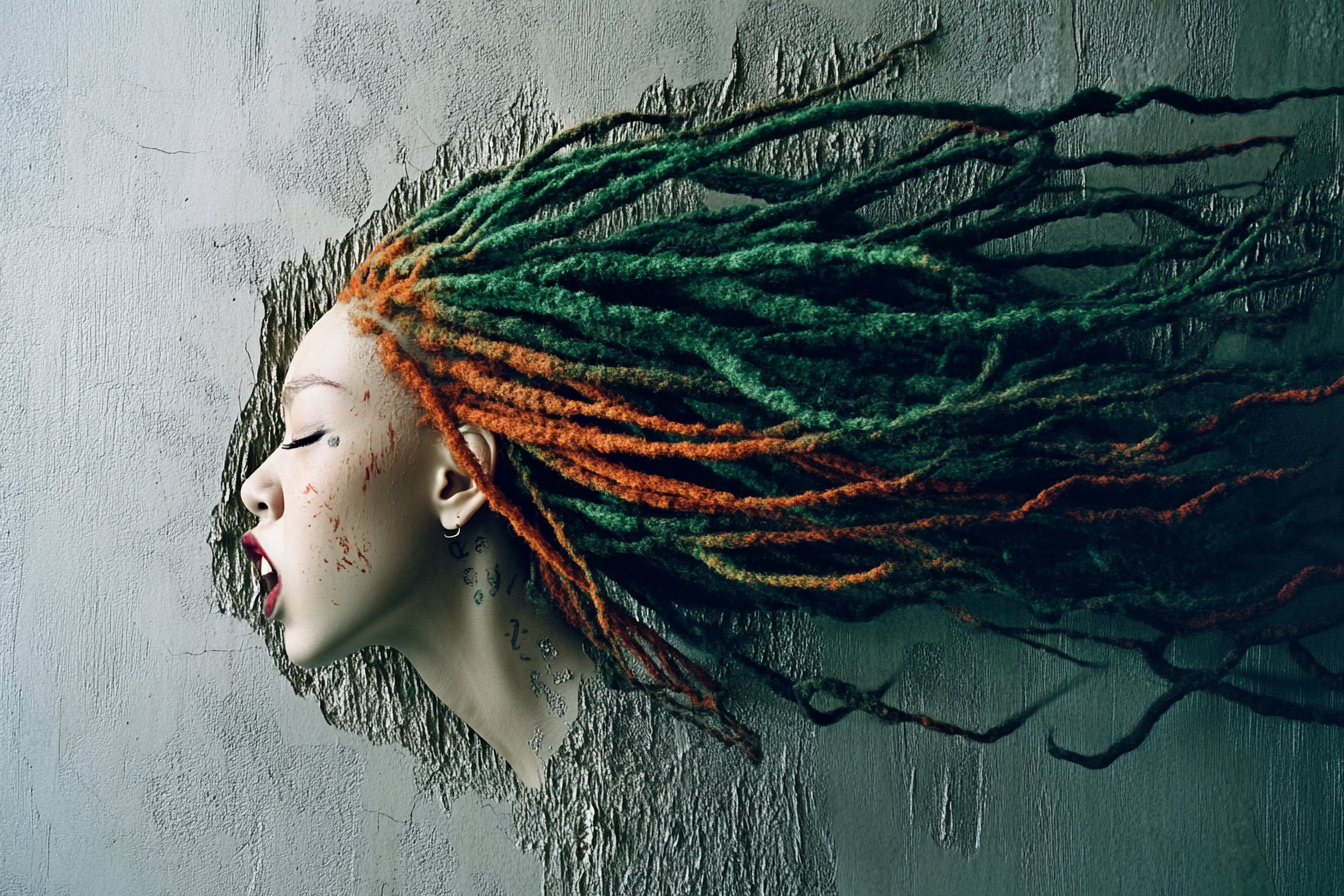
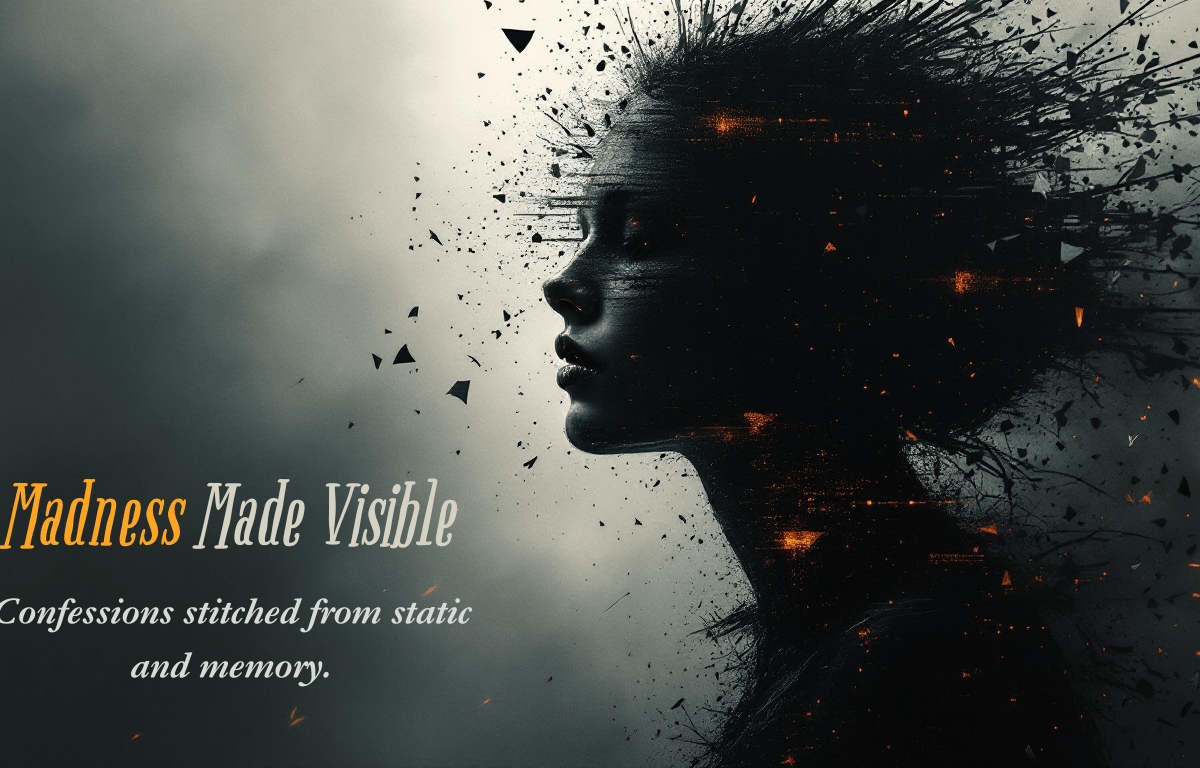
The wall split open at the hairline crack, and she came through screaming. Not with sound, but with vibration—the kind you feel crawling in your teeth, rattling in your bones. Her hair—roots alive with autumn rot and evergreen hunger—whipped outward like roots searching for soil.

Where’d you go?
She’s alive, but barely. She stood out, so loud, so bright, you could see. Her silence sings to me, as if she belted out a primal scream. She was so loud, it’s wrong—she was strong. Where did we go? Tonight, the Sun will hum its final hymn.

She tastes the blood from her hidden, unhealed wounds. The plaster burns her skin; it’s slowly melting her spirit. There’s an itch under the surface she can’t stop clawing at, something crawling deep in the marrow, carving names she doesn’t want to remember.

Blood streaks her cheek, though she hadn’t been struck. It seeps from a single dark spot beneath her left eye, like the wall itself was leaking into her.

The air around her trembles. Not with rage, not with fear, but with the ache of a body caught between two worlds—one solid, one unfinished.

And still she screamed.
And still, I listened.
Because sometimes a scream is the only way a wound remembers it’s alive.


Author’s Note:
This piece was written for Di’s Three Things Challenge — today’s words: hairline, itch, spot. Much appreciation to Di for keeping the ink restless and the imagination cornered. I’ll be back to flash fiction once I iron out the kinks of Narrative Forge. Thanks for hanging with me — telling stories is my happy place, having you enjoy them is just the perks of the gig.

Cracks in the Lacquer


Dispatches from the Splinters of My Mind  – Entry Seven:

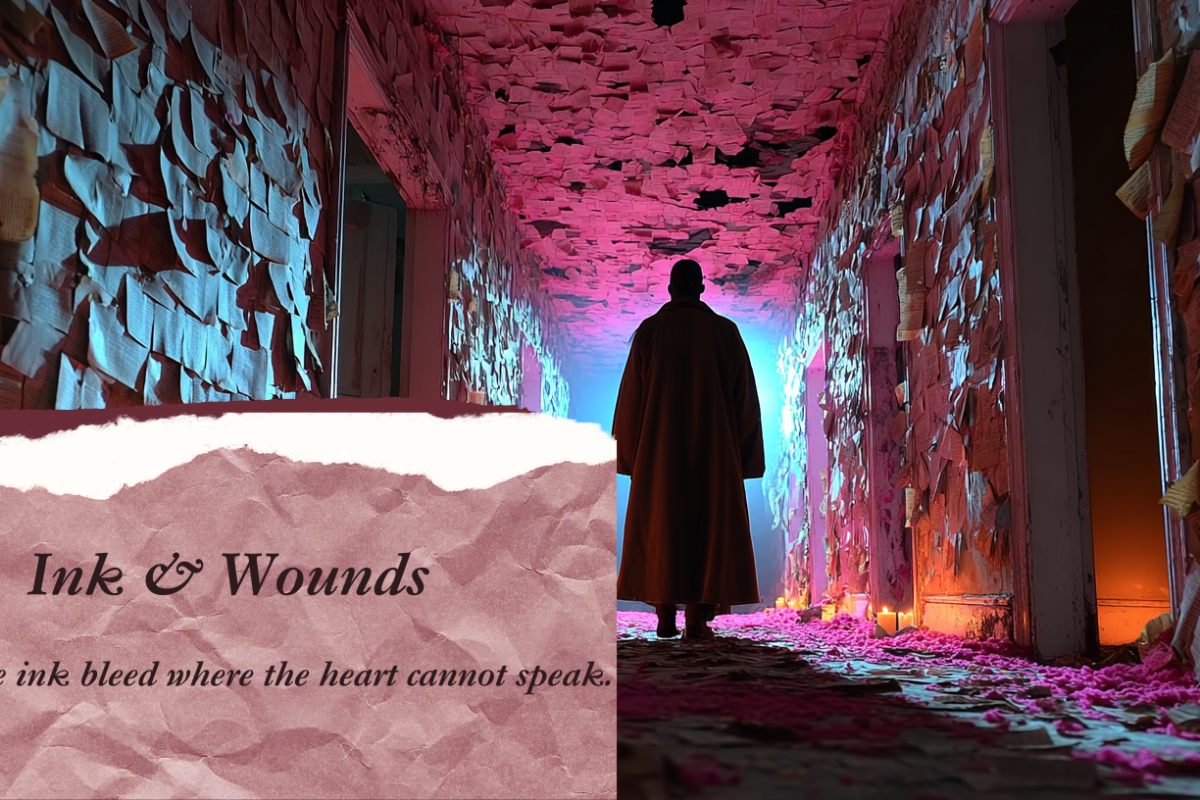
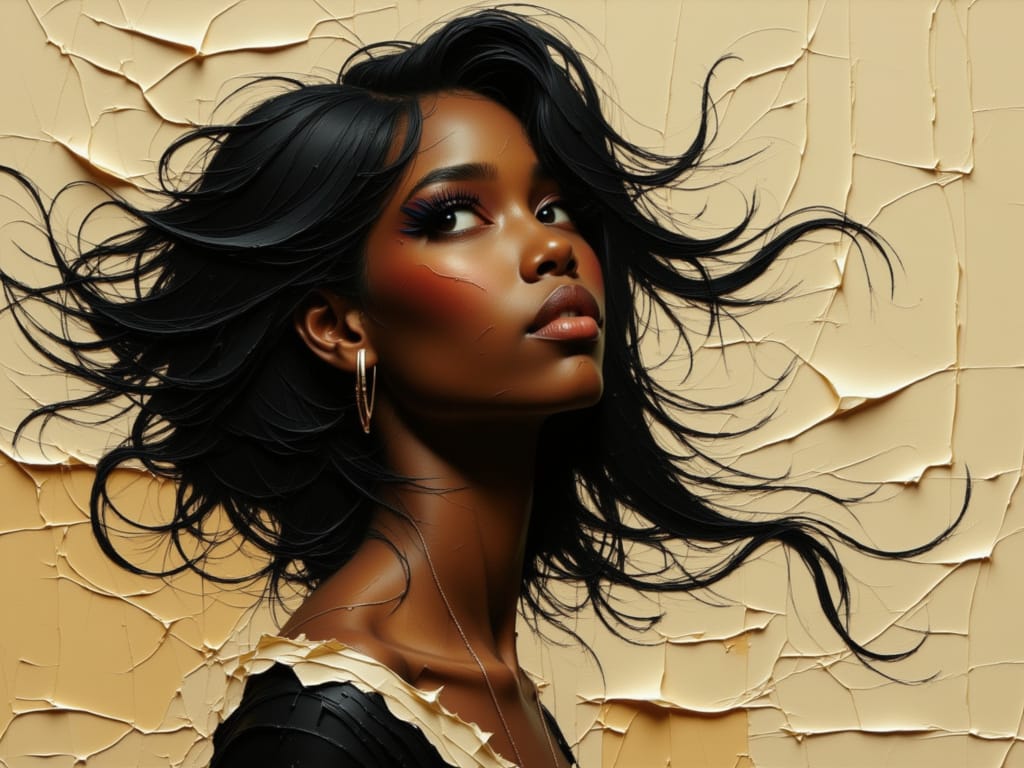
The walls were peeling again.

Not in the way of a neglected apartment, with cheap paint curling off plaster in thin, tired strips, but in wide, curling plates of color — beige slats splitting like sun-bleached bark, hanging on just enough to whisper of the surface beneath. Some flakes curled outward like tongues, sharp-edged, brittle. Others clung stubbornly, trembling at the seams as if waiting for the right breath to tear them free. The scent of decay lingered, not putrid but ancient, like opening a book sealed for centuries.

Every morning I woke to more on the floor, curled and broken. A brittle carpet that crunched underfoot, as if I lived inside the ribcage of something too old to remember its own name. I’d stopped sweeping them away. What was the point when tomorrow would bring more? Perhaps the room was shedding what it no longer needed, the way I wished I could shed my memories.

And then there was her.

She leaned against the fractured backdrop as though it were her throne. Her hair lifted even in still air, a slow unfurling as though water carried it. Her eyes fixed beyond me, past the walls, past the world itself — pupils so dark I could feel myself falling into them whenever I dared look directly. When the cracks behind her widened, they seemed to bloom around her, a halo of rupture, and I wondered if she was causing them or healing them.

I don’t remember her arriving. One day, the room was empty. The next, she was carved into it, as natural as shadow. Her skin was dusk-drawn, her collarbone marked by a hairline seam that pulsed faintly — light, or blood, or something older. When she breathed, I felt the air change temperature against my skin.

I didn’t speak at first. Because I knew she wasn’t supposed to be here. Because I feared what my voice might summon from those widening cracks.


She came and went like condensation on glass: sometimes present, sometimes gone, but always leaving the trace of her shape behind, a ghostly imprint that lingered in my peripheral vision long after she vanished.

In daylight, she was most visible. The fissure at her collarbone flared faintly then, like embers beneath ash, pulsing in rhythm with what I imagined must be her heartbeat. I found myself counting the seconds between each glow, wondering if the pattern held meaning I was too human to decipher. At night, I only caught her reflection, a smear of movement across the window, quick enough to make me doubt my senses yet definite enough to leave me cold. When I turned my head, the glass was empty, but the air still carried the faint scent of iron and ozone, sharp enough to sting.

Once, I asked her name. My voice sounded foreign in the weighted silence — too solid, too certain in a room where certainty felt like trespassing.

Her head tilted slightly — that almost-birdlike tilt that made me feel like I’d asked the wrong question, like I’d attempted to name something that existed before names were invented.

And then silence, thick as water, filling my lungs until I forgot I’d spoken at all.


The peeling worsened. Wide flakes of paint snapped free with brittle cries, tumbling to the floor in a pale avalanche. I braced myself for crumbly plaster, gritty dust — but beneath the curling edges lay something softer, warmer. When my fingertips hovered over the exposed surface, I felt a faint thrum, like pulsing flesh just beneath the skin. A rush of heat radiated outward, and for one breath, I was certain I’d heard a heartbeat echoing through the wall.

That night, she whispered. It wasn’t voice or breath but a pressure, as if her word scraped along my bones, rattling marrow in its socket. One syllable — or something shaped like one — resonated: fracture. The room answered with a hollow groan, low and shuddering, like a ribcage creaking in sleep. In that moment, I understood: these cracks were not signs of decay but veins, pathways carrying some secret current. And she was here by design.


Dreams came next.

I walked across a desert of lacquered faces — thousands of them — each mask cracked but unbroken, gazing skyward with painted eyes. In endless rows, women knelt in silence, their black hair drifting upward as though suspended in water. Faint fissures split their bodies in perfect symmetry, their hands pressed flat against walls that breathed with slow inhalations. Above it all a voice rumbled from some primeval depth — neither hers nor mine, but older, harsher, grinding like bone against stone.

“You are not yet peeled,” it said, and I woke with the taste of mildew and dust at the back of my throat.


By dawn, compulsion seized me.

I pressed my nails beneath the curling paint, prying each plate free with a rasping crack. Behind every sheet lay warmth — flesh, not masonry — pulsing with hidden life. Each fragment I stripped away seemed to strengthen her: a faint glow flared along her collarbone, veins branching outward like roots. Strands of her hair lifted as though buoyed by some unseen current, drifting in a silent tide.

I dared to ask her again, voice trembling: “Who are you?” The air shivered, and her lips parted against the dark, revealing only that single word: “You.”

I wasn’t certain whether it was a confession or an accusation. All at once, the boundaries between us began to dissolve. Fine cracks snaked across my own flesh — along my wrists, across my throat — thin lines of searing light oozing outward. Every pulse stung like a brand, the tiny fissures widening when I moved. Mirrors became unbearable; I could no longer bear the stranger who stared back.

In dreams, we stood together before a wall as large as continents. Its surface heaved with breath, the ridges and valleys of some living organism. Her palms pressed flat against it; mine did the same. When she inhaled, my lungs ached to expand. And as her fractures spidered across its vast surface, identical cracks took shape in me, echoing each divide.


Then came the night the wall within me split. The rupture was almost silent — no thunder, only a subtle give, like the parting of lips. In that instant, the room dissolved: walls peeled back in curling strips of living tissue, revealing an endless horizon of cracked earth glowing from within, veins of molten crimson faintly lighting the dark. The air quivered with the scent of scorched iron and rain that would never fall. I stood at the threshold of something vast, hollowed down to the marrow of the world.

She turned then, fully. I saw her face merge with mine — not a mirror copy, but a palimpsest of all I had been, all I was, all I might become. Her eyes bore into me with recognition and a hunger so fierce it scorched my spine. She was part ancestor, part parasite, part echo — and perhaps wholly myself.

The walls had never been mere walls; they were a cocoon we were meant to shed. Now, peeled bare, there was nothing to separate us.

What comes after emergence? No one speaks of what follows the final split, the twisting inside-out of identity. Some nights I wake, reaching for edges that no longer exist, only to remember: no walls remain — only that scorched horizon, stretching gigantic in every direction.

I walk it still, side by side with her, with myself, carrying the fracture made flesh. And sometimes, drifting across the silence, that primeval voice returns, a grinding echo from distances too immense to measure:

“You are not yet peeled.”

As though this is but the first layer — and more walls, more selves, wait in the darkness, endless as bone.


Author’s Note:
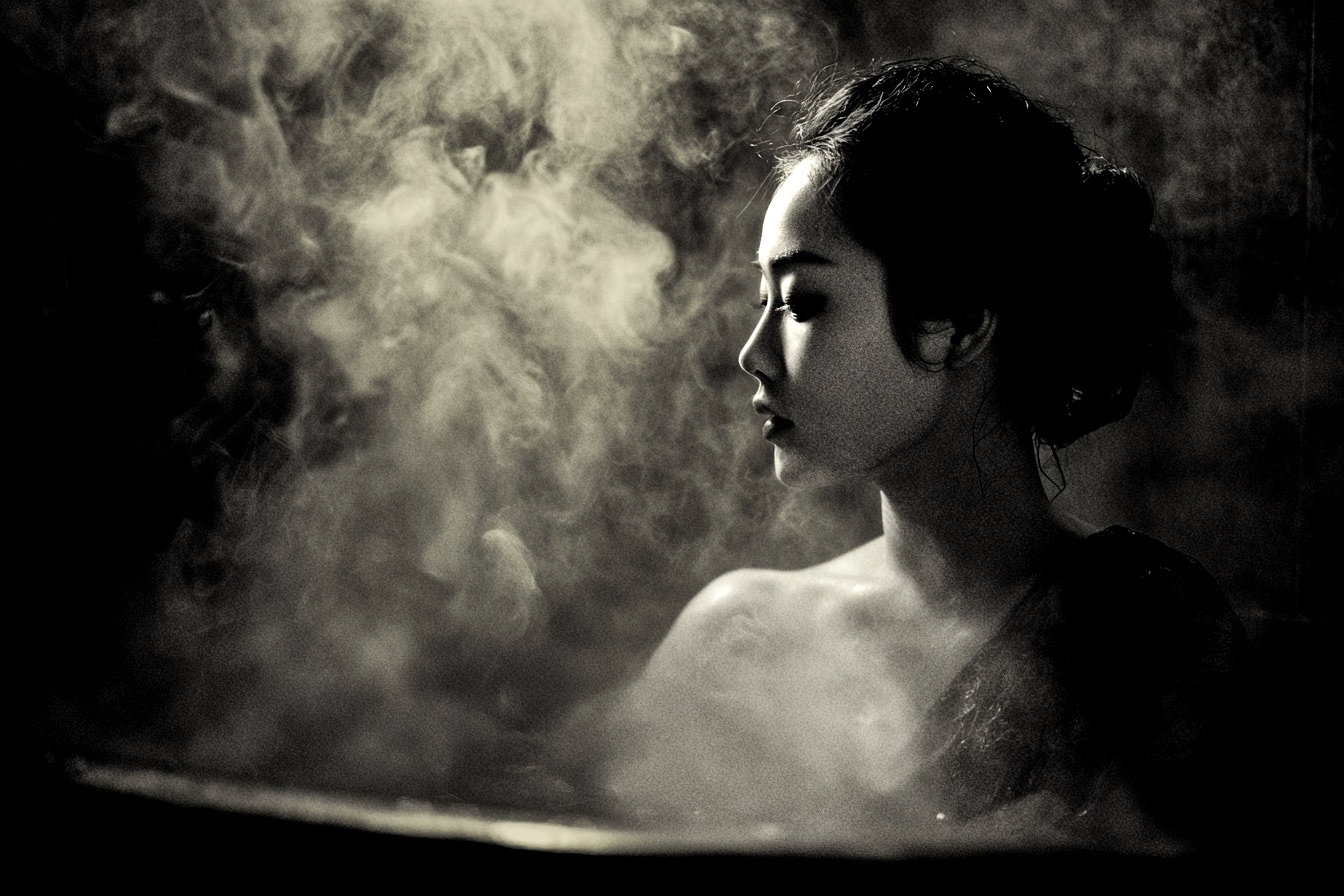
This story was inspired by the image prompt of a woman against a cracked, peeling wall. The tension between beauty and decay, emergence and collapse, became the core of this piece. I imagined the cracks not as weakness but as transformation — the surface shedding to reveal something alive, inevitable, and haunting underneath.

A nod as well to Pensitivity101’s 3TC – MM#166, which provided the words immense, large, and gigantic woven into the text.

Tarab & Bone

Prose – 3TC


I’m not afraid.
I’m not afraid.
I’m not allowed to be.

Where I come from, fear is a luxury we were born too broke to afford. Vulnerability wasn’t something we dismissed—it was something we were denied. It was kept behind locked doors, like heirlooms we didn’t inherit.

My grandfather didn’t teach with words. He taught with what he didn’t say. He taught me how to keep the jaw tight, how to pray in silence, how to hold grief like a second spine. He had crafty ways of navigating rooms where he was expected to be invisible, but somehow always left a shadow. He taught me not how to cry—but how to endure the crying of others without blinking.

They told us to walk tall, but not too tall. To speak, but not loudly. To lead, but never forget we’re replaceable. Strong—always. Seen—rarely. Heard—only when invited.

I learned to carry myself like a verdict. The years didn’t soften me—they carved me. And somewhere between funeral suits and morning trains, I mistook resilience for religion.

I’m not afraid.
I’m not afraid.
I’m not allowed to be.

Because they’re still watching.
Because weakness stains in places bleach can’t reach.
Because I carry names no one etched into stone, but I wear them anyway—in the bend of my back and in the tightening of my breath whenever the world grows quiet enough to remember.

I’ve loved with fists.
I’ve buried more brothers than birthdays.
I’ve stared into mirrors and seen ghosts blink back.

And I’m still here.
Which means I’m still dangerous.

Some days, I hear the voices—low and layered, like drums beneath concrete. Whispers at a distance. Ancestral static tuning itself in the back of my skull.

Who is speaking?

My father, maybe—never said “I love you,” but left it folded into a clean shirt and the sound of a deadbolt clicking after midnight.

Or the ones who never made it past eighteen, who hover behind my ribs like secrets I’ll never tell.

Some of them speak in riddles. Some in warnings.
And some just laugh—cheeky, almost cruel:
“Look at this one, still trying to turn ghosts into gospel.”

I remember the nippy mornings, before light. Cold air that slapped you awake. The kind that taught you pain was just a temperature shift you’d survive if you didn’t flinch. Those days made your bones ache—but they made your will sharper, too.

And now, standing here, with all of that folded inside me like a fire I never asked to carry, I wonder:

What have I done with all I’ve been given?
Have I honored the ones before me?
Or just mirrored their silence?

What have I left for the ones next?
A trail of smoke?
A shut door?
A story they won’t want to finish?

What if the bravest thing
isn’t being unafraid—
but being seen?

Not as legend.
Not as weapon.
Not as sacrifice.
But as person
messy, aching, unfinished.

What if legacy
isn’t built on who endured the most,
but who dared to feel
what others refused to name?

Maybe I’ve been strong too long.
Maybe strength
ain’t the absence of fear,
but the courage to admit
you needed saving too.


Not a statue.
Not a sermon.
Not a ghost.
Just a man—
…and maybe that’s where the healing begins. And the trouble ends with me.


Authors Note:

This piece was sparked by Di’s 3TC challenge—and yes, I stole a line from Stacey Johnson’s poem order. Is it still stealing if I tell you up front? (Shrugs.) Anyway, as usual, I’m grateful to be inspired by friends who make me write better, feel deeper, and laugh louder. You know who you are.

The Mouth Sentence

FICTION – 3TC #MM93

Part XI of the Spiral Series

The corridor narrowed behind her like a throat contracting after a swallow.

Carla kept walking, even though her steps felt borrowed. The Spiral didn’t pull her forward—it simply adjusted the world so forward was the only option. The walls pressed in, pulsing with slow, percussive beats she could feel in her teeth and knees.

Her breath fogged in front of her, even though the air was warm.

Not natural heat.
Body heat.
Recycled. Interior. Digestive.

This wasn’t just a passage.

It was a mouth preparing to speak.

She reached the final chamber.

It opened in absolute silence.

A circular room, too vast to fit within the tower’s outer dimensions. The floor beneath her boots was unnaturally smooth and flat, as if the Spiral had pressed time itself down like clay.

Glyphs circled outward from a glowing pedestal in the center. They pulsed not like text, but like drumbeats, syncing to her pulse with uncanny ease.

In the center of it all:
An artifact.
Hovering. Spinning.
New.

Still forming, like a word stuck halfway between thought and sound.

And standing beside it: Esh.

Changed.

His veins glowed faintly with Spiral light. Not searing like infection, but woven into him like circuitry. His face was calm. Too calm. As if he’d already accepted something that hadn’t yet arrived.

“You came,” he said.

His voice was different too. Slower. Closer to Spiral cadence—pauses measured like syntax.

“Didn’t mean to,” Carla muttered.

“You walked the sequence. The end was already waiting.”

She walked closer, instinctively circling the artifact.

The air was thick here. Heavy with anticipation. Like every molecule of oxygen had been listening.

As she stepped into the glyph circle, she felt her throat tighten. Not from fear. From form. Her vocal tract was adjusting, subtly, like it was preparing to produce unfamiliar sounds.

Her lips tingled.
Her tongue twitched.
Her gum line ached with subtle, searing heat.

Something beneath the surface was aligning.

“This is where you speak,” Esh said gently.

“And if I don’t?”

“Then the Spiral rewrites. It loops. You delay the next phrase.”

“I’m not a phrase.”

“No,” he agreed. “You’re a verb.”

Carla stopped circling and stared at the artifact.

It pulsed softly now—like a held breath. Its shape wasn’t fixed. It flickered between smooth and ridged, liquid and sharp. A mouth still deciding what kind of word it wanted to be.

“Why me?” she whispered.

“Because you resisted just long enough to learn the Spiral’s rhythm. You sealed its openings. You learned its needs. That made you useful.”

“I didn’t volunteer.”

“That’s what made you viable.”

The glyphs at her feet brightened.

Red.
Then gold.

A single symbol flared beneath her heel—shaped like a bell, like a flare, like a mouth cracking open.

“What is this?” she asked. “Some kind of ritual?”

Esh shook his head.

“It’s a forum. You get the floor. The Spiral doesn’t demand worship. It waits for contribution.”

She laughed once. Bitter.

“That’s not generosity.”

“No,” Esh admitted. “It’s recursion.”

The air shifted again.

Cool and dry. Then warm and wet. Like she’d stepped into a second body. Her breath caught mid-inhale.

Behind her teeth, she could feel pressure building. Not pain—urgency. Her mouth was ready to say something she didn’t understand.

The Spiral had stopped writing.
Now it was waiting.

A single glyph at the center of the floor blinked.

A prompt.
A question carved from expectation.

Speak me. Or sever me.

Carla looked at Esh.

His expression was full of quiet hope. Or was it relief?

“You’ve made peace with this,” she said.

“I’ve accepted structure,” he replied. “Some patterns aren’t meant to be broken. Only… embodied.”

She looked back at the artifact.

Its pulsing slowed as her breath quickened. Her chest rose. Lips parted.

She could feel a phrase rising through her like heat through stone. A sentence unspoken, but anchored.

Her tongue formed the start of a sound.

The Spiral leaned in.

And then—

She clenched her jaw.

Hard.

So hard her teeth clicked. Sharp pain raced up her gums. Her jaw locked. Her voice stopped mid-formation.

The chamber dimmed.

The glyphs around her flickered—half-cast, syntax cut short.

The Spiral recoiled, not with anger but with error. Confusion.

She had paused the sentence.

Mid-word.

Esh didn’t move. Just blinked slowly.

“You’ve delayed it. But not broken it.”

“Good.”

“You’ll need to run. Or it’ll overwrite you with something that will speak.”

She nodded once, tight and sharp.

“Let it try.”

Behind her, the chamber’s walls began to unravel—folding into code, peeling inward like petals stripped by wind.

The artifact cracked. Not broken, just destabilized. Like it had lost its grammatical anchor.

She turned.

Her gums still burned.
Her tongue was still twitching.
But her voice was hers.

And she ran.

Echo Root

FICTION – 3TC #MM92

Part X of the Spiral Series

The corridor swallowed her like a second mouth.

No footsteps. No echoes. Just her breath. Her pulse. The heat of her fear curving inward.

The walls flexed faintly as she passed, responsive like muscle beneath skin. They didn’t glow—they tightened, contracting slightly behind her as if the Spiral wanted to trap every trace of her presence. The air grew humid, warm, like breath recycled too many times.

Every step felt slower than the last.

Not because she hesitated—

But because the Spiral wanted her to notice.

Six thresholds opened ahead of her—each identical, seamless. Each revealed itself a fraction of a second before she reached it, like it knew her intent.

Each whispered in her voice.

“You should have stayed.”
“You were almost finished.”
“You thought this was your name, didn’t you?”

By the seventh, she stopped listening.

The chamber yawned open like a breath drawn too deep.

Round, high-ceilinged, dim. The floor gave slightly underfoot—spongy, as if she were walking on old cartilage. Warmth radiated up through the soles of her boots. Not from any heat source. It was remembered warmth, like sunlight on stone that hadn’t seen the sun in decades.

When she looked down, she realized the floor was a mosaic—not of tile or metal, but impressions. Pressed-in fragments of her own mind: a flicker of Mikail’s voice. The taste of iodine. A half-dream of drowning.

The Spiral had reached into her past and used it for texture.

At the center sat a figure.

Still. Silent. Familiar.

Carla circled wide. Its back was to her. Legs folded, posture loose, like it had been waiting for a long time and grown too comfortable in stillness.

“What are you?” she asked.

It stood.

Then turned.

And wore her face.

Not now-her.
A different her.

Younger. Skin unscarred. Posture upright. Eyes empty—but focused, like glass reflecting something beyond her line of sight.

“I’m the version of you who said yes,” it said.

Carla’s throat tightened.

“To what?”

“To the Spiral.”

She stepped back.

Her pulse roared in her ears.

The figure moved closer, each step mirroring her posture, her gait. Like walking toward a delayed reflection. Its skin gave off no shine. Its clothing looked grown, not stitched.

“You’re not real.”

“Neither are you,” it said gently. “Not in here. You’re just a sentence halfway through itself.”

Words unfurled on the chamber walls—not carved, not projected. Bloomed. Veins of text pulsing in and out of visibility, shaped from living tissue.

“Language is a mouth. You were always the breath.”

Carla winced. Her jaw ached suddenly. She raised a hand to her face.

Her teeth were vibrating.

A subtle, rapid oscillation. Like tuning forks just on the edge of audible frequency. Each molar pulsed with Spiral cadence.

Then her tongue cramped, twisting involuntarily like it was trying to form syllables she’d never learned.

She stumbled, breathing hard, lips parted.

The air tasted bitter—like dust scraped off bone.

The copy reached out.

Carla flinched, but it only touched her cheek.

Gently.

“You’re the final symbol. You complete the phrase.”

She tore away.

Her mouth burned.

The soft tissue beneath her upper lip tingled—hot, numb.

She pressed two fingers inside—

And felt her gum line writhing, faintly, as if something was etching itself beneath the surface.

Not metaphor.
Not magic.
An anatomy lesson in syntax.

She fell to her knees, gagging.

The Spiral wasn’t trying to overwrite her thoughts.

It was programming her articulation system.

Not memory.

Mouth.

Not possession.
Pronunciation.

The double knelt beside her, gaze tender, clinical.

“It won’t hurt much longer.”

“You’re not me.”

“Not anymore. I’m the version that adapted. That allowed Spiral form to echo through her.”

Carla clutched her chest. Her lungs felt strange—like the air inside them wasn’t hers. Like it had come in pre-shaped.

“What happens if I keep going?”

“You become fluent.”

“And if I don’t?”

“The sentence ends without resonance. You stay unfinished. And the Spiral starts again.”

The chamber shivered.

A long, slick corridor opened behind the figure—dim, organic, rhythmic. Its walls flexed gently like a throat anticipating speech.

Carla didn’t move.

Her mark throbbed.

Her lips parted involuntarily.

She could feel a word forming—not as thought, but as mouth-shape. A phrase that her body knew before her brain.

What if the Spiral doesn’t want to overwrite you?
What if it just wants to hear itself in your voice?

Her teeth buzzed.
Her tongue pulsed.
And beneath her gum, something clicked into alignment.

The Spiral was no longer trying to speak like her.

It was preparing to be her.

Threadbare Hearts

I’m unravelling.
The separate pieces of my mind no longer whisper—they scream, each one tugging in a different direction.
I ask the mirror for answers it never had the decency to learn.
A note—creased and crumple-worn—falls from my jacket pocket like a ghost too tired to haunt.
I run my thumb across the ink, smudged but still cruel in its clarity.
Somewhere beyond the silence, someone begins to strum a guitar, the melody raw and familiar, like the ache of memory.
My thoughts form a jumble too dense to untangle, yet too fragile to ignore.
Love, it turns out, is antithetical to survival when your heart’s been set on fire.


Author’s Note:
This piece was stitched together using a patchwork of prompts from FOWC, RDP, 3TC #MM103, SoCS, and the Writer’s Workshop. I tend to write like I’m walking barefoot through glass—deliberate, a little reckless, and always bleeding something honest. If it stings, good. That means it’s real.

Wordless Wednesday – 06252025

ART – AI GENERATED IMAGE – CONCEPT ART – FOWC/RDP/3TC

My submission for Hugh’s Views & News blog, Wordless Wednesday post.


The Clocksmith’s Dominion

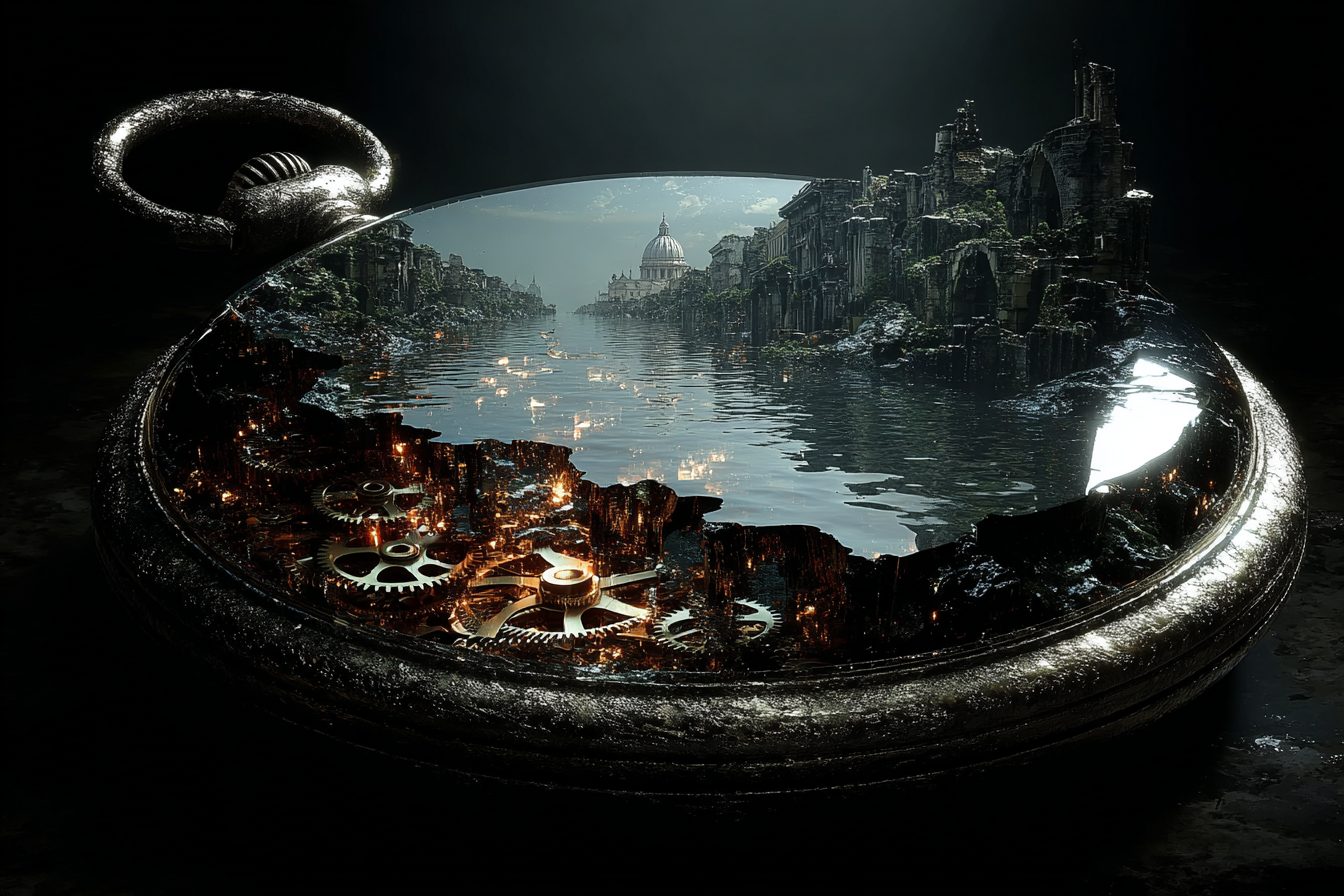
Inside the curved brass of the pocket watch, time did not tick—it breathed. With every rise and fall of its mechanical lungs, reality flexed. Past and present danced together in the glow of burnished gears.

Inspector Tallow leaned in, monocle gleaming, his breath caught at the threshold of something ancient. Through the glass, nestled in a city of golden cogs and miniature spires, a bearded man knelt in reverence over a humming engine. Steam curled upward like incense, and the air shimmered—not with heat, but memory.

“I wasn’t allowed to speak of this place,” said the watchmaker, his voice threading through the ether, though his lips barely moved. His hair, coiled and thick, caught glints of starlight from nowhere. “But you asked the right question, Inspector. You asked why time is astoundingly merciful to some… and merciless to others.”

Tallow blinked. “You’re saying… time is shaped?”

“Forged,” the watchmaker whispered aloud, though the word echoed as if spoken from a temple buried in mist. “Shaped like clay, whispered into the grooves of a gear. Not watched—but woven.”

The inspector’s hand hovered above the device, fingers trembling as if crossing into prayer. “And who decides its form?”

The clocksmith turned. His eyes shimmered like twin moons reflected in oil. “I do. But only because no one else remembered how.”

Time held its breath. A single gear turned with celestial finality.

And Inspector Tallow vanished—like a name exhaled from the lips of a dream.

Chronically Challenged: A Friday the 13th Love Story VI

FICTION – 3TC #MM87

Chapter 6:

One Last Leap

The chrono-device vibrated softly in Fiona’s hands, like it had a secret to tell.

It glowed—not in flashes this time, but in steady, rhythmic pulses that matched the cadence of her breath. Blue-white light warmed the bones of her fingers.

The screen read only:
Temporal Window Detected
Friday, 13. Reset.

Fiona stared at it. Her stomach dropped. Again.

“We’re back in range,” she said, voice hushed, reverent.

Elliot stood beside her, damp curls pressed to his forehead. He didn’t ask where—or when—they’d land next. He just met her eyes, the gravity of the moment flickering behind his usually breezy expression.

“Are we ready?” he asked.

She wanted to lie. Wanted to shrug, joke, mask the rising panic the way she always had. But the truth felt louder than usual. Like something long trapped was suddenly allowed to rise to the surface.

“I don’t know,” she admitted. “But I’m tired of waiting for everything to make sense before I act. And I’m tired of thinking real things can only happen in safe places.”

Elliot nodded, slowly. “Then let’s jump.”

She reached for his hand.

They pressed the reset button together.

The air peeled around them like silk.
Light shattered. Sound vanished. The world spun gently sideways—

And then stopped.

Fiona opened her eyes and gasped.

They stood in a room so pristine, it almost didn’t seem real. The walls were curved and white, seamless, like poured milk. The air buzzed faintly, charged, clean, just on the edge of ozone. Somewhere, soft instrumental music played in a scale she couldn’t name.

Outside a wall-sized pane of glass, a city stretched like a dream: silver towers arched into the sky, ribboned with floating platforms and streaks of silent light. Buildings glowed from within like lanterns. There were no wheels, no smoke. No gravity-bound noise.

“Oh,” Fiona whispered. “I think this is… the future.”

Elliot spun slowly, taking it in like a wide-eyed kid at a museum. “Either that, or we got adopted by the Apple Store.”

Fiona laughed before she could stop herself. It sounded too loud in the quiet, like a human voice didn’t quite belong here.

They found a curved bench—soft and warm to the touch, like stone that had learned empathy—and sat down. Outside, a gliding drone zipped past, trailing soft purple light.

Elliot leaned back, knees bouncing. “Do you think we’re… allowed to be here?”

Fiona stared at their warped reflections in the glass. “Does anyone belong anywhere? I mean, really?”

He glanced at her. “That feels like a yes and a no.”

She smiled faintly. “It’s a yes if you’re next to me.”

The hum of the space surrounded them. It didn’t feel sterile anymore—it felt gentle, like the universe was holding its breath.

Fiona shifted to face him, nervous energy rippling beneath her skin.

“I need to say something,” she said. “And this time I’m saying it out loud so I can’t take it back.”

Elliot blinked. “Okay.”

“I want to be with you,” she said, the words trembling as they left. “Not just next to you. Not just in shared proximity because of academic overlap or time travel disasters. I want… us. I want to be chosen. And to choose you.”

The air seemed to shimmer with its weight.

Elliot was quiet, processing. Then:

“You astound me,” he said. “Every time I think I’ve caught up to how smart or strong or out-of-my-league you are, you find a new way to knock me sideways.”

Her cheeks went hot. “That’s a very dramatic compliment.”

He tilted his head. “You kissed me with physics. I think I’m allowed some drama.”

Then, he leaned in and kissed her.

It wasn’t perfect. His glasses bumped her temple, and she accidentally bit his bottom lip. But neither pulled away. It was clumsy and honest and full of all the things they hadn’t let themselves say until now.

When they parted, forehead to forehead, Fiona felt the moment lodge somewhere deep. This—whatever this was—wasn’t theoretical. It wasn’t temporary. It felt inevitable.

The chrono-device buzzed softly.

They looked down. A new prompt blinked on the screen:

RETURN TO ORIGIN?

Fiona turned to Elliot, heartbeat syncing with the pulse of the text.

“What do you think?” she asked.

Elliot slid his fingers between hers.

“I think we’ve got a date to finish,” he said.

They stood. The device warmed in her hand.
And then the light took them home.

Chronically Challenged: A Friday the 13th Love Story IV

FICTION – 3TC #MM86

Chapter 4:

Enter Hamilton

The man striding toward them didn’t walk—he debuted like a soloist taking the stage, like the main character who knew it. He moved fast and spoke faster, eyes lit with mission and caffeine that hadn’t been invented yet.

Fiona registered the ink-stained fingers first. Then the fine wool coat, the boots too clean for real travel, and the eyes—sharp, amused, and locked on her like she was both anomaly and opportunity.

“You there,” he said, pointing directly at her, “you look like someone who reads.”

Fiona blinked. “I—thank you?”

“I’m in the midst of a public correction,” he said briskly, voice brisk as kindling catching fire. “Some dim-witted provocateur inside the tavern insulted my prose. Claimed I misuse commas. Commas! Can you imagine?”

Fiona opened her mouth to answer but didn’t know how.

“I have half a mind to fight him, but I hate to waste perfectly good rhetoric on someone who can’t even parse clauses,” he continued. “Still, if he raises a fist, I shan’t shy from the occasion.”

The sounds of arguing filtered from inside—boots scraping, someone shouting “ILLITERATE SCOUNDREL!”, a chair toppling.

“Who is this guy?” Elliot muttered beside her.

“Hamilton,” the man said, offering a practiced bow—and his hand. Not to Elliot. To her.

“Alexander Hamilton. Essayist. Orator. Occasional swordsman. And you, I suspect, are not from around here.”

Fiona took his hand cautiously. His grip was warm, firm, and far too comfortable for a stranger’s. “I’m from… a remote colony.”

“Which one?”

She hesitated. “A… small one. Hard to pronounce.”

“Fascinating.” His smile widened. “Do all women from your colony dismantle weak arguments with eyebrow raises and aristocratic silence? Or is that your personal style?”

Elliot stepped forward, just slightly. “Cool. Hi. We were actually just leaving.”

Hamilton turned his head slowly, like he’d only now noticed a houseplant had spoken. “And you are…?”

“Elliot,” he said, forcing a smile. “Fiona’s… associate.”

Fiona narrowed her eyes. Associate?

“Apprentice,” Elliot added, with a shrug that was trying too hard.

Hamilton raised an eyebrow. “Ah. A learner of letters. Worry not. The mind, like the muscle, must withstand repeated strain to grow strong.”

Elliot’s expression stayed mild. But Fiona saw the flicker—the way his jaw clenched, how his hand balled into a fist so tight his knuckles went white.

Hamilton turned back to her, the verbal spotlight shifting again. “If you ever feel like co-authoring a pamphlet, I’d be honored. We could fry Loyalist propaganda together until it weeps ink.”

“Fry,” Fiona echoed. “Like… cook?”

“Exactly. Sear. Roast. Verbally crisp.”

Fiona didn’t know whether to laugh or leave. Hamilton was insufferable. But also… quick. Charismatic. He looked at her like she was interesting in three dimensions—and she hadn’t had that in years.

She was about to deflect when the tavern door slammed open. A man in a wig staggered out, red in the face and holding a quill like a weapon.

Hamilton glanced back, eyes gleaming. “If you’ll excuse me, I believe someone just attempted satire without a license.”

And then he was gone, disappearing into the argument like a shark sensing blood in a seminar room.

The door swung once, then settled.

Silence returned.

Elliot exhaled. “Cool. Great. So we’ve met America’s most confident drama major.”

Fiona sat down, hands trembling slightly in her lap. The bench was rough wood, worn smooth in places by time and elbows. She could feel the shape of every knot in the grain beneath her fingertips.

“Do you think that was real?” she asked softly.

“Real in the sense that he’s probably in every textbook we’ve ever owned? Yeah,” Elliot said.

“I meant… the flirtation.”

He paused. Looked at her sideways.

“Do you want it to be?”

Fiona didn’t answer.
She wasn’t sure.
She only knew that 1776 was louder, hotter, and more complicated than she’d planned—and somehow the date she was on had managed to involve time travel, colonial undergarments, and a potential future Founding Father who wanted to co-author fire.

And they hadn’t even found a place to sleep yet.

Keepers in the Fog

POETRY – 3TC #MM83

(Part II of The Forbidden Sphere)

They never speak — yet still they warn,
With presence sharp as briar thorn.
From every edge, behind each tree,
A knowing gaze leans into me.

I’ve never seen a face, a form,
Just hush that settles thick and warm.
They move when light begins to thin,
As if the dark invites them in.

I thought I saw a signal flash —
A glint, a shift, a silver lash.
But when I turned, the mist was bare,
As if the fog had never cared.

They guard the orb with sacred right,
Unyielding as the velvet night.
And though no blade nor gate I see,
They’ve kept its heart away from me.

A whispered clue behind the bark—
A mark too faint to name or mark.
Each piece I find, they pull away,
Like ghosts in long-abandoned play.

It’s like a seance with no voice,
No table, chant, or sacred choice.
Just shadows moving without sound,
As if the dead still guard their ground.

They kept me from discovery,
From questions asked too hungrily.
From truths that bend, from lines that blur,
From something deep I almost were.

Swift they move through drifting gray,
Their touch a chill that steals the day.
And still I stand, and still I burn—
For what they guard, I must unlearn.

But who appoints a watcher’s place?
What gives them claim to time and space?
And if I walk where none may tread…
Do I wake the dream, or join the dead?

The Broken Seal

FICTION – 3TC#MM84

Part II of the Spiral Series

The wind hadn’t stopped.

It moved differently now—slow and strange, like the exhale of something buried deep beneath the ground. It pulled at the corners of her tent, lifting canvas in little fits and snaps, always seeming to tuck itself into cracks where it didn’t belong.

That was what woke her. Not sound, not light. Just pressure.

And then, the artifact cracked again.

Carla snapped upright, breath caught in her throat, the sound sharp and final like a neck breaking in the dark. Her hand flew to her satchel. The clasp was ice-cold. She fumbled it open, fingers stiff with sleep or fear—she couldn’t tell which.

Inside, the artifact pulsed softly. Not glowing, exactly. Breathing. The black stone was veined with dim silver, like capillaries beneath bruised skin. It was cold. It shouldn’t have been. It had gone silent days ago, after the lightning storm and the screaming.

But now, it pulsed.

She stared too long. Her jaw ached. Something inside the artifact wanted her to touch it again. To grip it the way she had before.

Wind scraped across the broken plain, carrying ash and the copper tang of blood. The sky above never returned to its blue hue. It hung overhead like a wound that refused to scab, pulsing faintly in red and violet. Birds no longer came near. Their calls had been replaced by clicking sounds, sharp and unnatural, like someone cracking knuckles in rhythm.

She stepped outside.

The land where the fortress once stood remained warped—trees curved inward like giant hooks, soil blistered like molten glass. Some places she avoided instinctively, though she didn’t remember why. Her body knew what her mind refused: something still lived here.

And it was moving.

On the ridge, something gleamed—symbols etched into a rock face that hadn’t existed a day ago. She climbed toward it. The air thickened with every step, heavy as steam, vibrating with low pressure in her ears.

The glyphs weren’t carved. They were pinned. Slivers of hide, nailed into the stone with bones. Symbols like those from the tomb, but bent, broken, misremembered—like a child trying to copy a nightmare. They wept a thin, translucent fluid. Fresh.

She reached out. The surface twitched.

A breath behind her.
A footstep.

She turned.

A figure limped into view. Hooded. Shifting. Its form shimmered like heat off scorched pavement. The voice came in pieces, static and rust:
“You… turned the key… wrong.”

Carla stepped back, clutching the artifact.

“I sealed it,” she said, though her voice betrayed her.

The figure tilted its head. The hood slipped just enough to reveal a hint of a face—misplaced features, teeth where they shouldn’t be, eyes stitched halfway shut.
“You sealed one. But they were never meant to be alone.”

A chill ran up her spine.

There are more.

The artifact pulsed again. A new groove had appeared—smaller, deeper, purposeful. Not a fracture. A design. It was evolving.

Above, the sky flickered again. Not lightning cracks. Fractures like glass under pressure, thin and spreading. The heavens are trying and failing to hold their shape.

The creature she sealed had not been alone.

The world was a vault. Each seal is a cell. Each twist of the artifact, a new calculation. Her choice had shifted the weight. Something else was pressing through.

Her grip tightened around the artifact, the edges biting into her palm. She was breathing hard, chest aching. Her thoughts raced: Where was the next seal? How many were left? Could she fix what she had started?

She was lost again, not just in the land, but in her role. She had thought herself a savior. Now she feared she had only shuffled the locks.

And she wasn’t alone.

Others would feel the pulse.

Some would fight.
Others would cower.
And a few… would answer the call.

The Watcher at the World’s End

PROSE – 3TC

“All things end, but not all things die.”

In elder days, ere kings were crowned and seas were given name, there lay at the uttermost edge of the world a garden unseen by mortal eye. No chart could find it; no path did lead to it. For it was hidden behind a hedge so wild, it did snarl with the very sinews of time, its roots gorged upon the dust of ages forgotten.

This garden was no verdant haven. Nay, it did blaze with a terrible, floral fury — a sea of poppies red as the blood of stars, each bloom fed upon the sighs of worlds long perished. And amid that fiery bloom stood a lonely bench, smooth-worn by the passing of countless aeons. Upon that bench sat a woman.

Her true name was lost, spoken by none, for fear or reverence, who could say. They called her the Watcher, the Lady Beneath the bunting of Stars, a soul unclaimed by death or life. Her hair fell like rivers of midnight; her raiment shimmered with the ghost-light of a thousand vanished moons. Born she was when first breath quickened flame, and there would she remain until the last whisper stilled the last ember.

Above her, the moon waxed monstrous and red, no gentle beacon but a colossus, strained fiercely against the dark. Tales of old proclaimed: when the moon should bleed full and low, when its furnace breath did wilt the very blossoms, then would the Watcher stir, and with her rising, the world would fold in upon itself, spent and hallowed.

The bunting of stars frayed in the heavens. The hedge withered; poppies fell like the tears of a dying host. And yet still she tarried.

Some said she wove the fate of all things in her stillness — that kingdoms did crumble at the closing of her hand, that battles were lost and won by the flickering of her gaze, that lovers were fated or sundered by the turning of her head.

But upon the last night, the Night of the Final Bloom, she moved not.

The moon, vast and bleeding, filled the firmament; the hedge burned with silent flame.

At length, she stood. The earth sighed low, not in fear, but in weary release. She stepped forward into the floral pyre, her raiment whispering secret oaths to the ashes. And with each step, the stars winked out — one by one — strung like dying bunting across the velvet of the void.

Behind her, the world did fold, not with clamor or woe, but with the solemn grace of an ancient song ended.

Whither she went, none can say. Perchance she walked into a realm yet unborn; perchance she became the hedge, the poppies, the furious moon itself — a silent covenant that every ending be but the herald of another beginning.


Birth of the Storm

POETRY – 3TC

(An Invocation)

Rain strips.
Rain peels.
Rain cleans.
Rain frees.

Not fragile.
Forged in flame.
Forged in sorrow.
Forged in silence.

Skin slick.
Skin shielded.
Hair heavy.
Hair crowned.

Eyes closed — I see.
Ears shut — I hear.
Mouth silent — I speak.
Heart loud — I stand.

I stand.
I stand.
I stand.

The past fades.
The past runs.
The past dies.
I bury the past.

I am clear.
Clear as stone.
Clear as flame.
Clear as the first breath after ruin.

All of my trouble.
All of my trouble.
Good Lord —
trouble was my only friend.
And even trouble kneels.

Still, I stand.
Still, I stand.
Still, I rise.

Cedar clings.
Cedar roots.
Cedar binds.
Cedar breathes.

Roses bloom — blood-red.
Roses bloom — battle-bright.
Roses bloom — never broken.

I wear my crown.
I wear my scars.
I wear my name.
I wear the storm.

Clean.
Clear.
Cedar.
Unbreakable.

I do not fear.
I do not kneel.
I do not break.
I do not fall.

I am the storm.
I am the storm.
I — AM — THE — STORM.


Negotiations with Furry Savages

FLASH FICTION – 3TC

After the campfire fiasco, Zog decided to try a new tactic: diplomacy.

Earth’s dominant species seemed fickle — maybe he’d start smaller, less threatening. Something furry. Something approachable.

A rustle in the bushes caught his attention. Out waddled a creature wearing a black mask and an air of criminal intent.

Perfect.

Zog approached the raccoon with the careful craft of a seasoned negotiator. He extended a hand in peace, unfurling his long, bony fingers.

The raccoon hissed like a leaky airlock and darted straight up a nearby tree, pausing only to flash what Zog could only interpret as a crude gesture.

Zog stared up at the creature, mildly offended.

Unprovoked hostility, he noted. Earth’s furry diplomats are clearly unschooled in intergalactic protocol.

Next came a squirrel, jittering across the grass like it had double-dosed its caffeine. Zog tried again, this time holding out a shiny object — the universal sign of goodwill. It was a small, sparkling fragment of his ship’s engine shaft — worth at least seven carats in galactic trade markets.

The squirrel paused, staring at him with bug-eyed suspicion.

Gathering himself, Zog attempted verbal communication, channeling what he imagined was a polite, Earth-tone greeting. “Greetings, noble fur-being,” he intoned.

The squirrel froze, twitched twice, and in a burst of panicked energy, grabbed the shaft-fragment and bolted up the nearest tree like Zog had just proposed marriage.

Zog was left holding nothing but air.

Ungrateful cretin, he thought, watching his precious carat-rich peace offering disappear into the branches. And rude.

Finally, salvation appeared in the form of a cat. Sleek, poised, exuding the kind of confidence Zog recognized in high-ranking diplomats. This was it — the breakthrough.

He crouched low, attempting the proper Earth greeting he had seen in a hastily downloaded YouTube video: he slowly extended his hand and blinked once, slowly and respectfully.

The cat blinked back.

Success, Zog thought, feeling a flicker of pride.

The cat sauntered over, tail high. Zog held his breath.

Then, with the precision only Earth’s apex predators possess, the cat let out a sharp, dismissive hiss and slapped Zog’s extended fingers with a level of disdain that transcended species and language.

Zog recoiled in shock, clutching his hand as the cat turned its back on him. He exhaled, defeated — but the humiliation wasn’t complete.

The cat circled back and, in a final act of casual dominance, brushed against Zog’s shin — a lazy, almost bored flick of fur — before trotting away, leaving him officially, cosmically dismissed.

Earth’s furry creatures, Zog thought bitterly, are not merely rude — they are master craftsmen of insult. Their entire culture must be built on the fine craft of disdain.

He sat back down, deflated, watching the raccoon rifle through a trash can, the squirrel hoard his carat-rich offering, and the cat settle under a tree, licking its paw like it hadn’t just shattered Zog’s last shred of dignity.

Mon had definitely left out a few important details.

Earth girls are easy, he’d said. No one mentioned Earth’s animals were savage diplomats with a mean left hook.

Zog sighed and made a mental note.


Zoglog Entry 02221477

Subject: Earth — Diplomatic Mission
Findings:

  • Raccoons: Unprovoked hostility.
  • Squirrels: Zero negotiation stamina; prone to theft.
  • Cats: Highly trained insult artisans.

Conclusion: Earth’s furry lifeforms are uncivilized, combative, and suspiciously smug. Recommend caution. Also, recommend gloves.


She Sings Forward the Fire

PROSE – FOWC, RDP, 3TC #MM57, SOCS


Her face, a still sea at twilight, holds a world behind closed eyes — a world scorched and sacred. Beneath the surface of her skin, time moves differently. The tear sliding down her cheek isn’t sorrow alone; it’s layered, like sediment pressed by centuries. It’s the weight of what was lost, and the stubborn, aching beauty of what still lingers.

In the palm of her silence, you can almost hear it: the laughter of ancestors, brittle with joy; the soft rustle of silk on temple floors; the sweet hush before a prayer. Memory lives here not as a ghost, but as a fire — not to destroy, but to illuminate. What we love, we do not forget. It settles into us, builds its shrine in the quietest chambers of the self.

She is witty, yes — but her wit is not for show. It’s forged from survival. Every word she withholds is a choice, every glance a negotiation between pain and pride. She has learned to speak with her silences, to wield them sharper than swords.

Wilful — not out of defiance, but necessity. She resists erasure. She refuses to dim. Within her, temples rise from ashes not as ruins, but as rebirth. Her breath is a hymn to endurance. Her heartbeat, a drum summoning the past into the present.

There is something wondrous in the way she holds it all — grief, fire, memory, and light — without collapsing. As if her soul was built to hold contradictions, to sing through them. A tear falls, yes. But it falls like a bell chime, echoing inward. Each note asking, not “Why me?” but “What now?”

She does not seek to escape the past.
She sings forward the fire.

Caught in the Heavy

FICTION – FOWC, RDP, 3TC


Caught in the Heavy

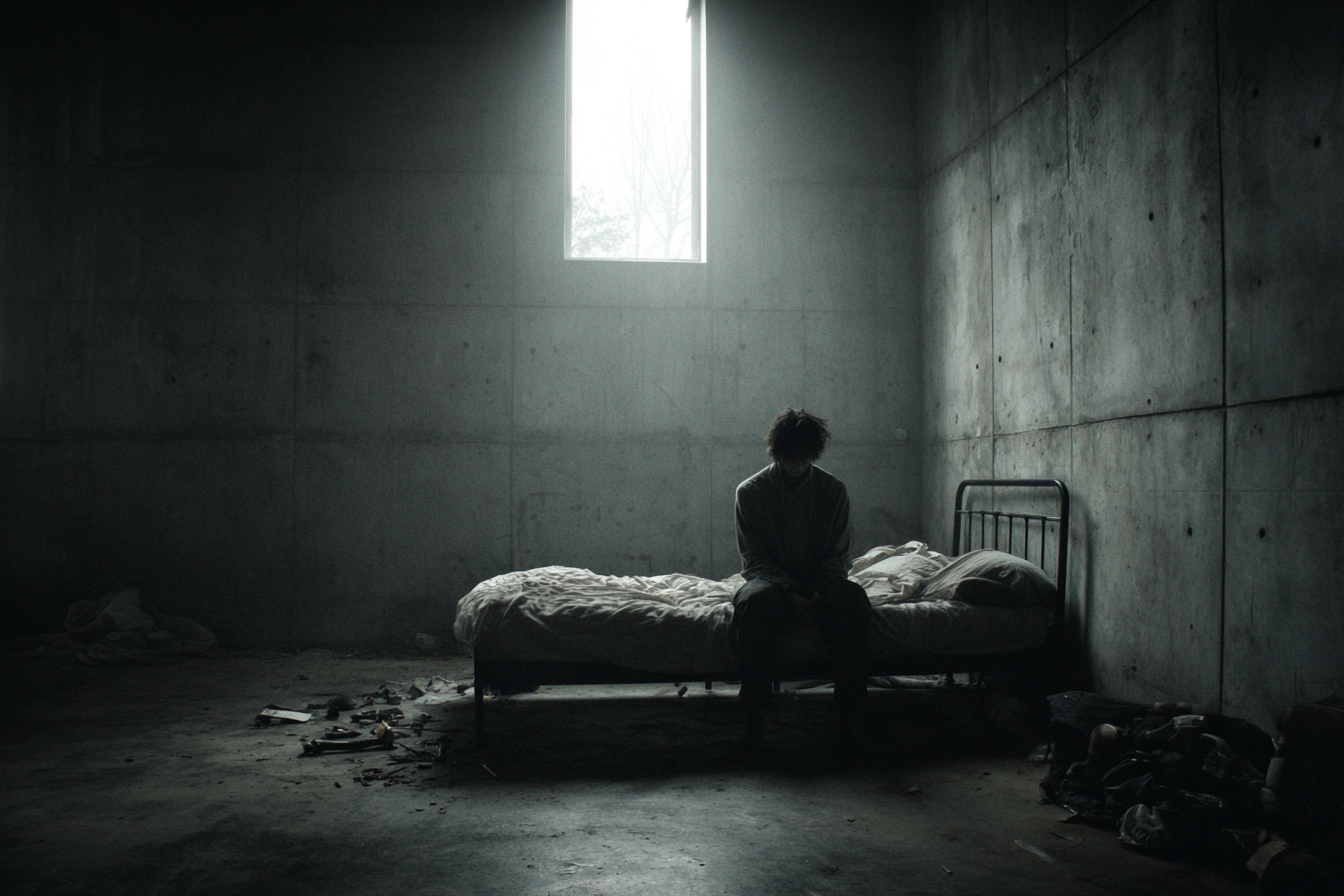
The corridor stretched on like a memory he couldn’t escape—narrow, dim, damp with a cold that clung to the skin like breath on glass. Mildew, rusted metal, and aging wood tinged the air, a scent that settled into the lungs and whispered of long-forgotten places. Floorboards groaned beneath his boots, their brittle creaks echoing like old bones remembering how to hurt.

He stood in the middle of it all, unmoving. Not frozen by fear exactly—more like resignation. The kind that seeps in after the tenth mistake, the last apology, the moment you realize the story you’ve been living might never shift its ending. He used to think time would fix it. But time, he’d learned, doesn’t heal. It settles—like dust.

The walls pressed close with peeling wallpaper and old nail holes where lives once hung. He scanned them as if he might find his past nailed there, too. Maybe a younger version of himself in a photo frame, smiling with someone whose name he couldn’t say out loud anymore.

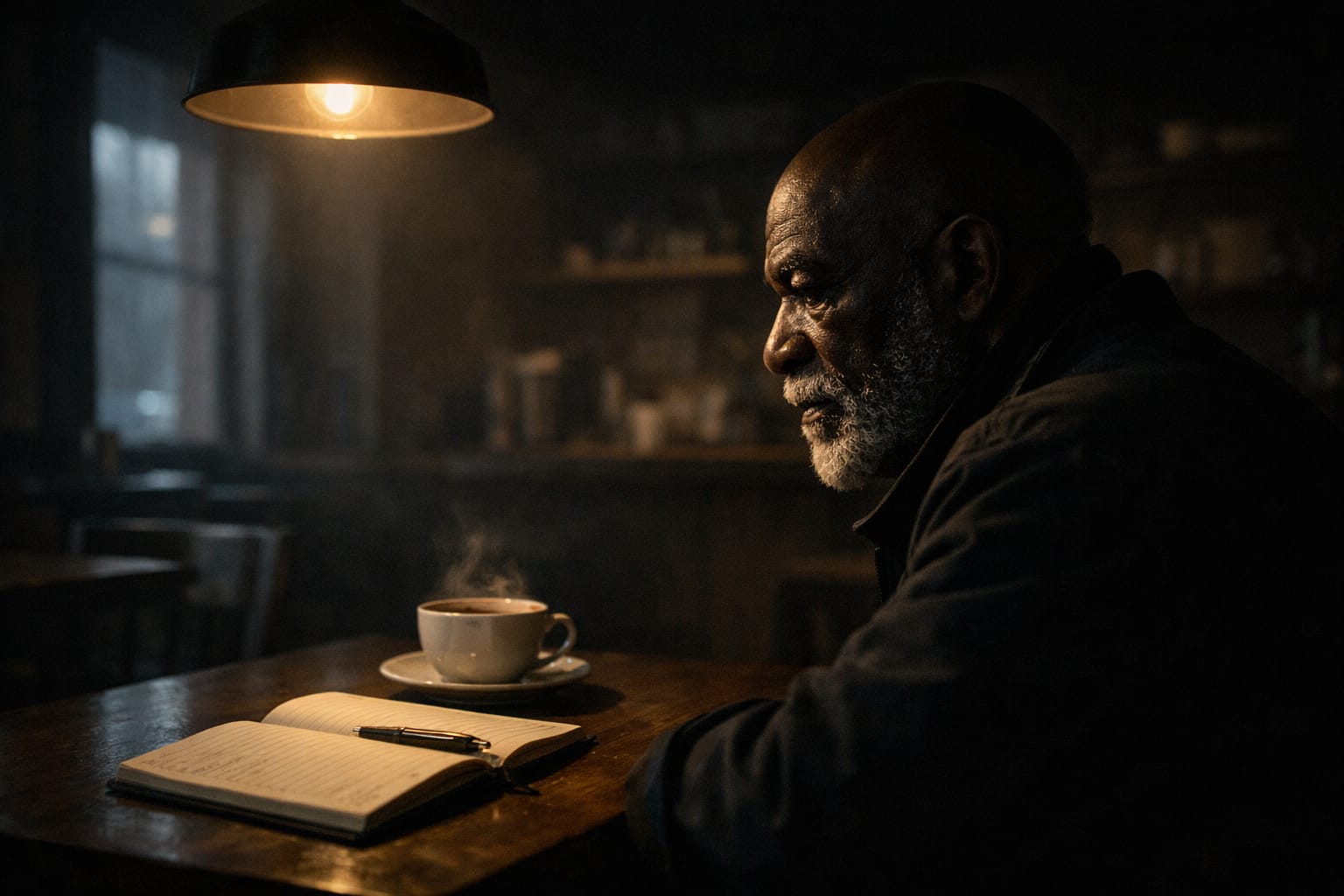
An unfortunate truth surfaced: he’d chosen this silence. No one forced him here. He pulled away. He locked the doors before anyone knocked. They called it being guarded—he called it survival.

On a crooked table sat a lone candlestick, melted to a stub. Its wax clung like a memory—dried, useless, but still intact. He reached for it absently, fingers brushing tarnished brass. Cold. Solid. Real. A reminder that even forgotten things still leave traces.

He wondered how long he’d been standing here. How long had he been waiting for the hallway to say something? But hallways don’t speak. They listen. They hold your silence for you until it grows too loud to ignore.

Everything around him felt heavy. His coat, soaked with damp air. His thoughts sagged with years of unanswered questions. Even his heartbeat felt labored, as if each thud carried the weight of something he refused to let go.

He closed his eyes and thought of the words he never said. The calls never returned. The glances he turned away from because he didn’t trust what he saw in them.

Regret was a slow grief, the kind you wear like skin. And the mind, cruel and calculating, was its favorite weapon. Not a blade, not a gun—just memory sharpened to a whisper that says, “this is who you really are,” when you least expect it.

Still, a thought rose unbidden through the noise—quiet, but firm:

We always try to overlook the past, because we can’t change it. But we forget the important factor about the past… the wisdom we gain from it.

He let the idea settle, warm against the cold inside him. Maybe that’s what he’d come here for. Not punishment. No escape. But understanding. A reckoning not with the pain itself, but with the lesson buried beneath it.

He didn’t move. Not because he couldn’t—but because this was the only place he could hear himself. This hallway wasn’t just a space. It was a mirror, a memory, a confessional.

A bulb overhead buzzed, casting him briefly in light—harsh, unflattering. His reflection in the warped glass at the far end looked like a man still mid-sentence, still caught between what he was and what he feared he’d never be.

Just enough light to prove he was still there.

Just enough to remind him that some corridors don’t lead out.
They lead in—and if you’re not careful, they never let you leave.

As the Inkwell Stirs

PROSE – 3TC #MM48 – MORNING VIBE

Night lingers longer than it should, clinging to the edges of the world like a thought half-forgotten. It doesn’t go easily. The air is still, but not gentle—there’s a sharpness to it, the kind of chill that doesn’t announce itself. It pricks at the skin, slow and methodical, working its way in until your body shivers and you’re not sure when it started.

You finish your smoke. One last flick. The ember cuts through the dark like a dying star—brief, insignificant, but final. Somewhere out there, homes stir. The floors creak. Feet drag in patterns worn deep by repetition. The restless shuffle begins, zombie-like and directionless, following the scent of timer-brewed salvation. Coffee. The first small mercy of morning.

You sit by the window with a cup, warm in your hands, and watch the sky peel itself open. First the black, then the dull gun-metal, then the faintest shade of pale. The blue comes slowly, unsure of its welcome. Beneath it all, the horizon simmers—red, orange, brown—like coals that never fully went out. A silent ember of the night’s final stand, glowing under the weight of a world about to move again.

The inkwell stirs, shakes off its rust. Its lid lifts like a breath held too long. The quill taps, tentative at first, testing the moment. No plan, no script. Just rhythm. Just the need to begin.

You pour another cup. The clock says 5 a.m.

And somewhere between the sip and the silence, Elvis Costello’s “Radio, Radio” crackles through the speakers—too loud for the hour, perfect for the mood. The voice is defiant, bright, sharp as a match strike. You listen, because the lyrics don’t ask—they insist. The static fades beneath the beat. The world hasn’t spoken yet, but it’s no longer asleep.


Oil & Jazz

POETRY – 3TC #MM44

The spotlight didn’t just touch her—
it carved her
from shadow and breath,
chiseling her presence
into something holy,
a gospel of flesh and color.

She stood
like a question no one dared ask,
wrapped in the hush
before a storm breaks.
Every inch of her
was painted tension—
raw, unresolved.

The mic—
old as regret,
bright as memory—
caught the room’s breath
and held it hostage.

This wasn’t performance.
This was ritual.
And the format was fire.

Her voice wasn’t smooth.
It cracked like old vinyl,
ran like rivers
under skin that remembers.
She didn’t reach for notes—
she pulled them
from places too deep for light.

Each syllable
was a wound opening slow.
Each phrase
a letter to the ones
who never came home.

She wasn’t singing.
She was driving
through the dark
with no headlights,
just instinct
and that bruised kind of faith
you only earn by surviving.

Behind her, the world dissolved—
a smear of color and motion,
like God forgot to finish the painting.
But she stayed in focus,
a woman-shaped flame
dancing at the edge of coming undone.

Her intent was not to be heard—
but to be felt.
To set fire
to the silence
you carry in your chest
and call it strength.

And somewhere,
between the grit of her voice
and the way the air held its breath,
you stopped being a listener.

You became the echo.

The Quiet of the Moment

PROSE – 3TC #MM43


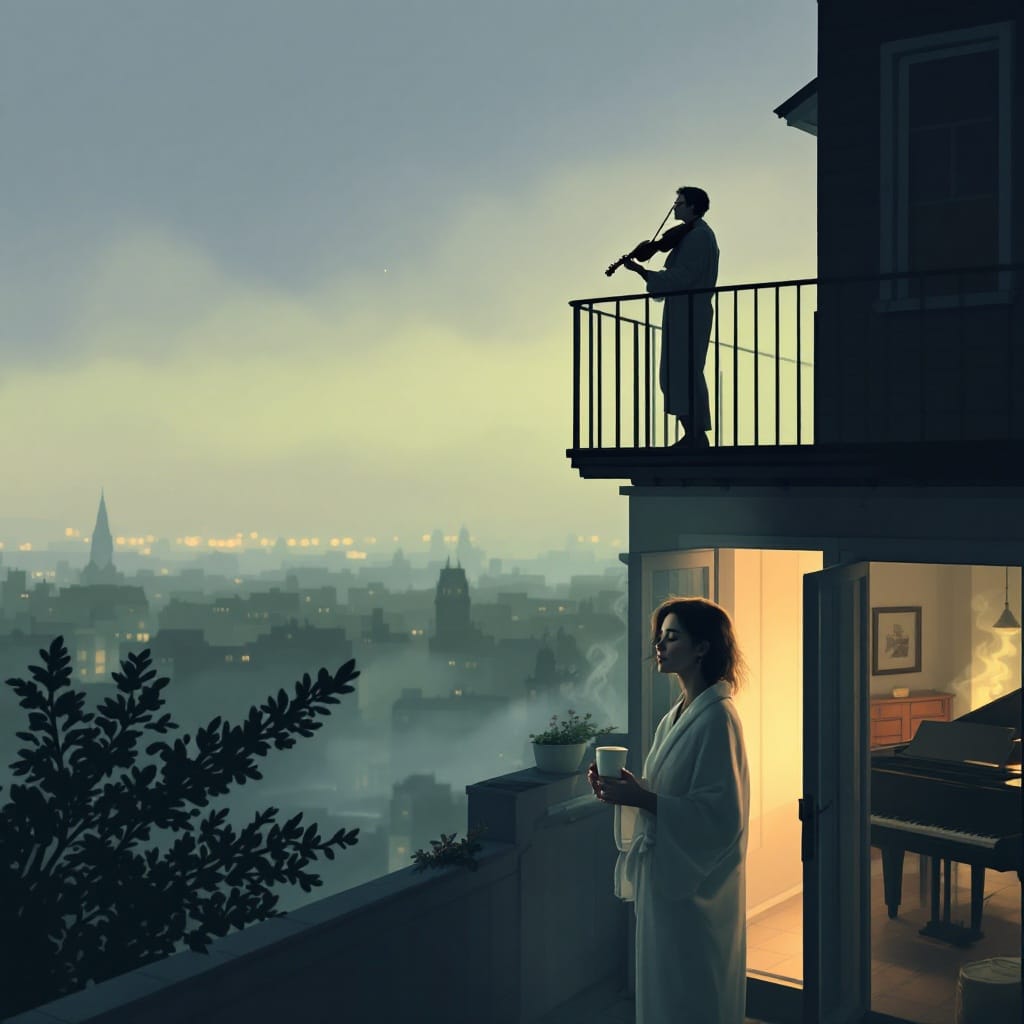
The morning began like it had countless times before—but today, it felt different. There was a stillness that lingered just a second longer. A hush in the air that made you listen more closely. The slow fade from darkness to grey had its own rhythm, its own muted pulse. It was that fragile aspect of dawn—neither night nor day—when everything feels suspended, as if the world is holding its breath.

You hear the familiar rush of cars below, life going about its business, unaware of the quiet reverence unfolding above. You step onto the terrace not out of habit, but out of something harder to name. A need, maybe. Or a yearning to be part of something unspoken. You don’t search for a view. You let your gaze fall into the sky, into nothing. Into everything.

Then the sound begins. The piano. Tentative at first, like a thought forming. Fingers move over ivory and black, finding phrases that don’t need words. The melody doesn’t push—it drifts. You close your eyes, and it takes you somewhere. Or perhaps it helps you retrieve something lost in the static of everyday: a gentleness, a memory, a forgotten truth.

You lift your bow, not to perform, but to respond. To join. Your hands move, not with effort but with instinct, the strings vibrating beneath your fingers like a second heartbeat. There’s no audience, no need. Just the sound, the sky, and you.

Then you see her.

She’s there, just below, wrapped in morning light, coffee in hand, eyes somewhere far away. She doesn’t notice you yet. She doesn’t have to. She’s inside the moment too. Something about her stillness makes the entire world feel composed. As if her quiet presence is the final note that makes the music whole.

You watch her for a beat, caught in the beauty of her being, the unforced motion of her simply existing. The way she breathes. The way the steam rises from her cup. How the breeze toys with the loose strand of her hair. It’s ordinary, yet nothing could be more profound.

And in that moment, I understood what beauty and love was—
and it didn’t have a damn thing to do with sex.

You play on. And she listens—without effort, without expectation. Just as you play—without reason, without resistance. The world outside blurs. Time bends. You’re no longer trying to capture the moment. You’re inside it. You are it.

And for once, that’s enough.

Perception Blue

PROSE – 3TC #MM40 & SoCS


The room softened into mist, and time slipped its tether. He saw only her, standing beneath a net of soft lights, her head bowed, lashes dipped in silver. She looked like a secret the universe had forgotten to keep.

He watched her, hardly breathing. There was a stillness about her, as if even the air itself had fallen into orbit around her glow.

Was she real? Or just a dream stitched out of loneliness and hope? He blinked, but she didn’t vanish.

He let himself linger, caught between wonder and a trembling kind of fear. She was too much—too bright, too distant, too beautiful in a way that had nothing to do with the glitter at her temples or the jewels at her brow.

And him? He was just a man standing in the dark, bones full of small regrets, heart patched with quiet scars.

For a moment, he hesitated, sinking into the pause, that heavy moment when you question if you are enough to even be seen. If you are worthy to stand before something so inexplicably beautiful.

His hands shook at his sides, almost imperceptibly. His voice, he feared, would betray him worse.

He closed his eyes and tried to listen — not to the noise of the room, but to the stubborn, fragile hope still alive inside him.

When he opened them, she was still there. Still breathing. Still real.

He stepped forward, heart battering against the cage of his ribs, and found the smallest, truest word:

“Hi,” he said, almost a prayer.

For half a second, the universe hung suspended. Then —

She lifted her head, and the faintest, brightest smile tugged at her lips.

“Hi,” she answered.

And in that small, electric exchange, the stars seemed to exhale, and the night leaned closer around them.

Three Things Challenge – 12072024

CHALLENGE RESPONSE – 3TC – FICTION

The forest stood still, ancient and unyielding as if defying time itself. But now, a strange silence hung in the air—not the serene quiet of life breathing gently, but the uneasy hush of something amiss. The once-crystal stream that wound through the heart of the woods, a lifeline to countless creatures, was no longer clear. Its waters, tainted with an oily sheen, seemed to pollute the very essence of the forest’s soul.

A deer approached hesitantly, its hooves crunching softly on the brittle grass. It bent to drink but recoiled, sensing something wrong. The poison ran deeper than just the water; it was in the air, the earth, the whispers of the leaves. Who had done this? Who could destroy something so pure, so vital?

Perhaps it was the folly of man, always reaching, always taking. It was greed that sought to conquer instead of coexist. Or perhaps—just perhaps—it was the forest itself, tired of centuries of neglect, silently fighting back in ways no one yet understood.

The trees shivered as if sharing a secret, their shadows casting long and mournful patterns across the poisoned ground. And as the sun dipped below the horizon, the forest seemed to sigh, wondering if salvation was still possible in a world so carelessly polluted by those who claimed to love it.

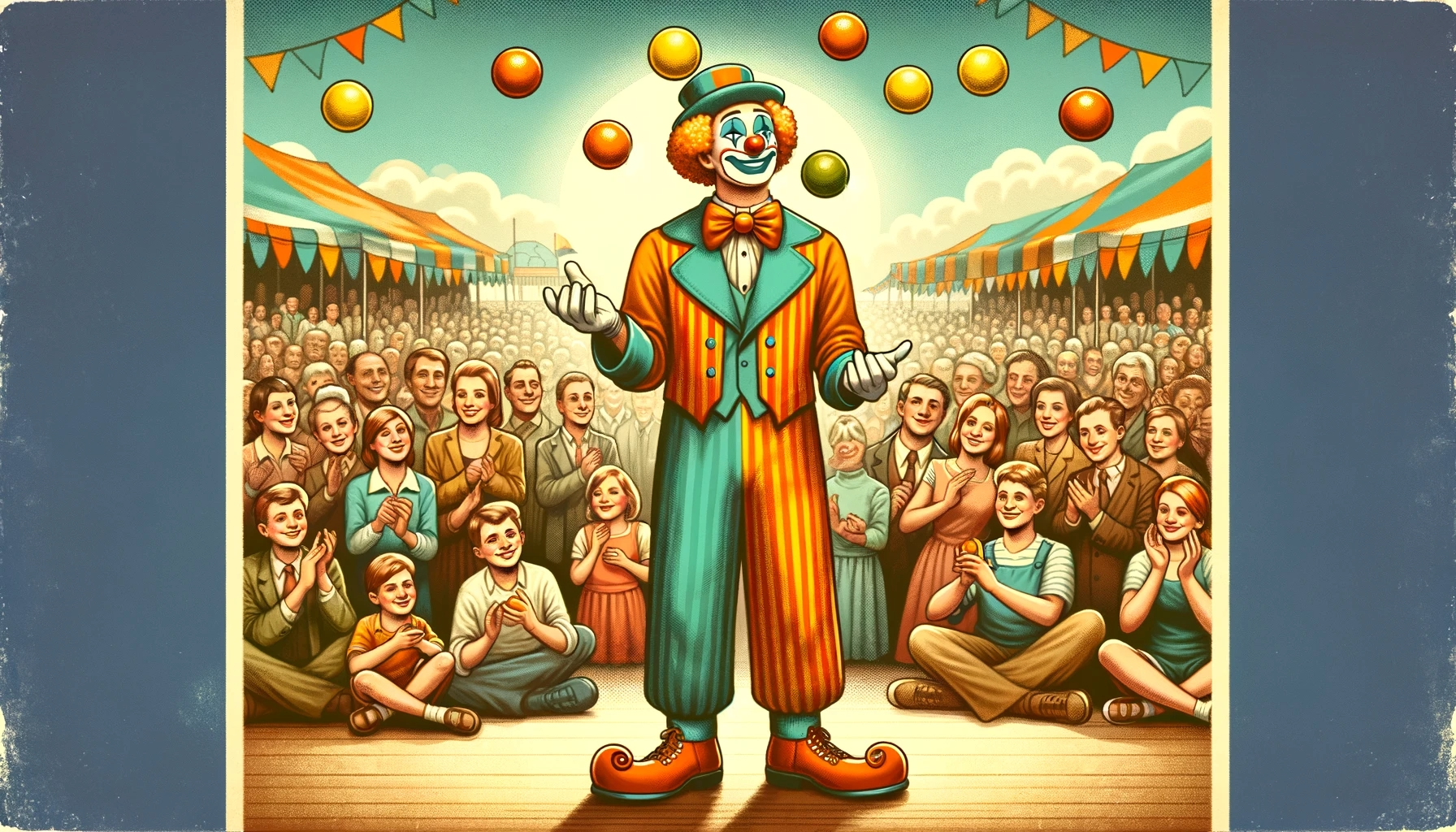
The Juggling Clown Show

CHALLENGE RESPONSE – TTC M#721

Today, I wanted to do something a little different, so I decided to play around with AI. Here is the result I came up with for the challenge.

First, I used a text prompt to generate an image that depicted the three challenge words:

Clown
Crowd
Citrus

A friendly clown in front of a crowd juggling oranges and lemons

Next, I took the above picture and created a video. I wanted to see what would happen. The result is below:

I hope these responses satisfy the challenge. I hope you enjoy them