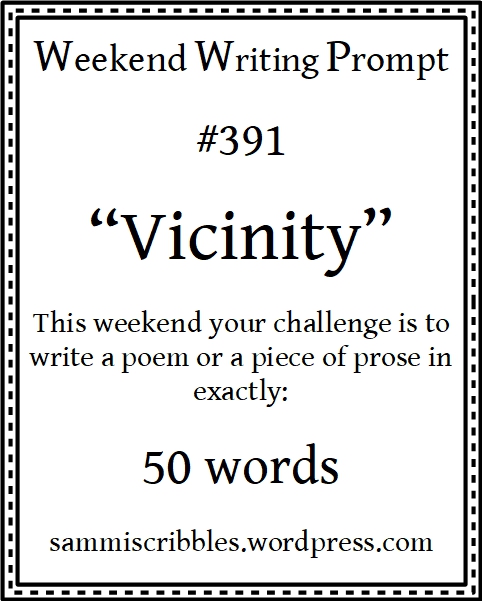
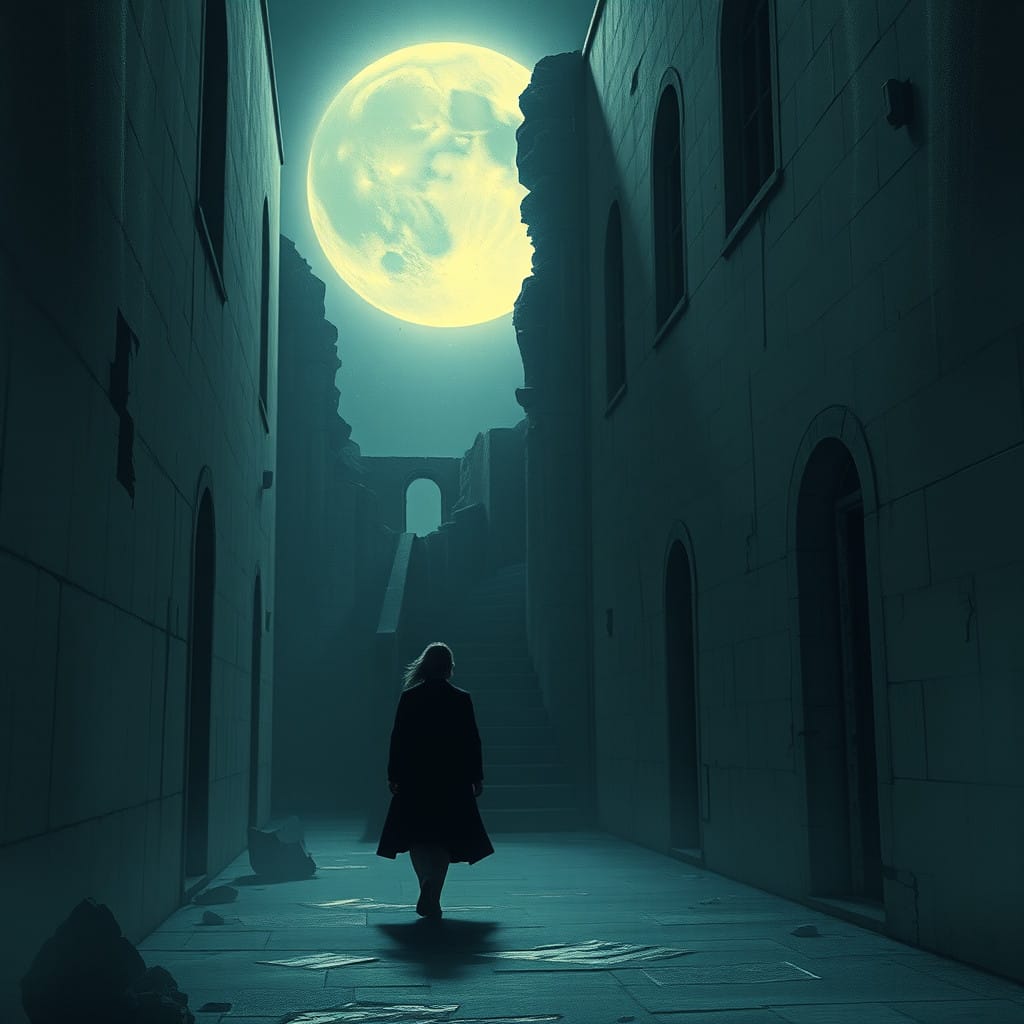
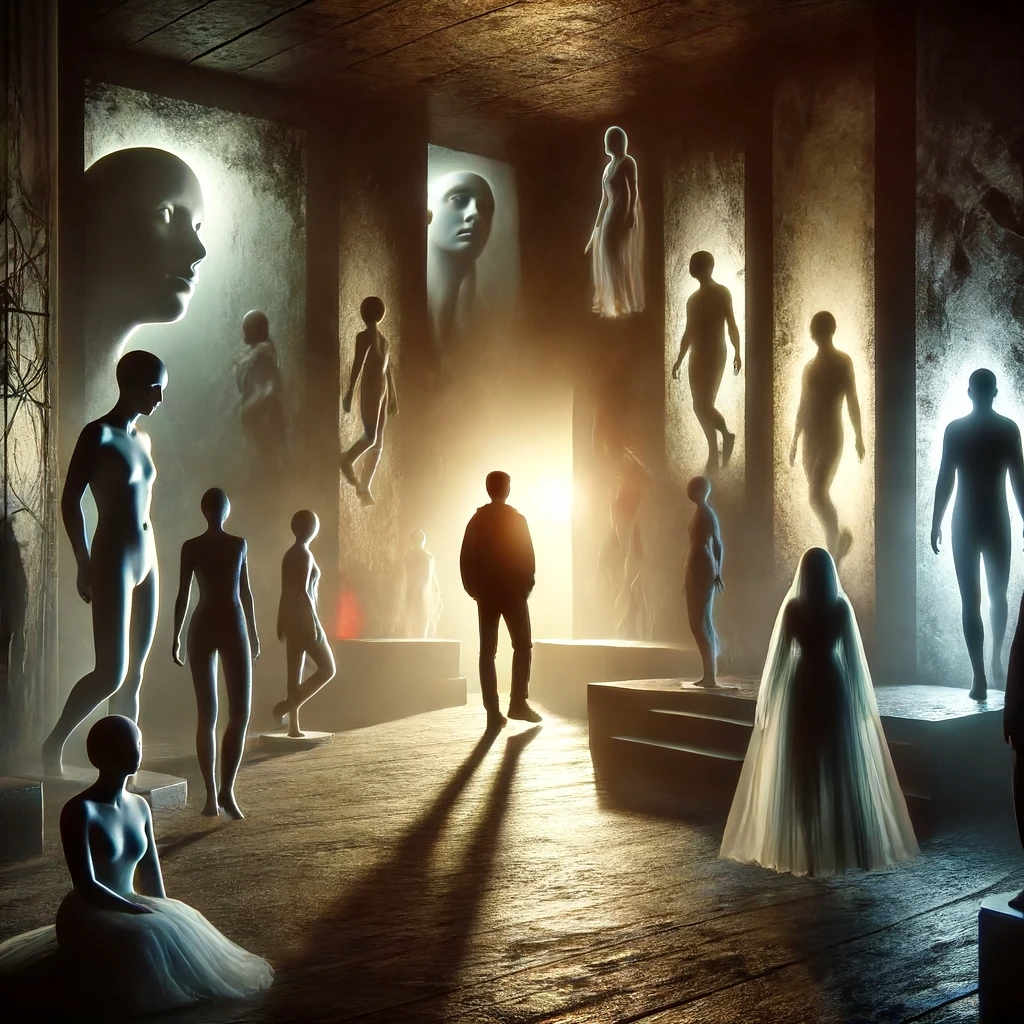
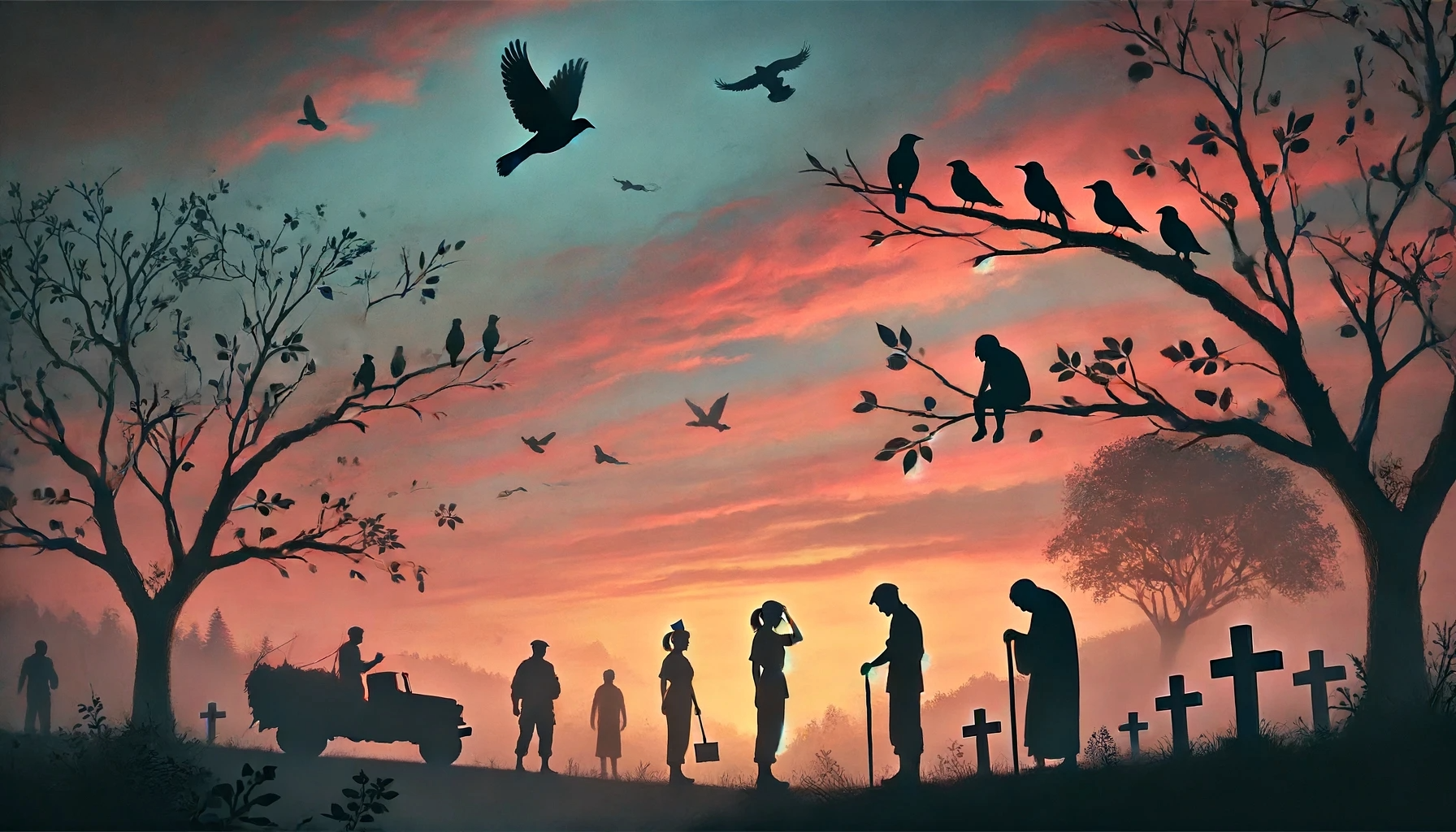
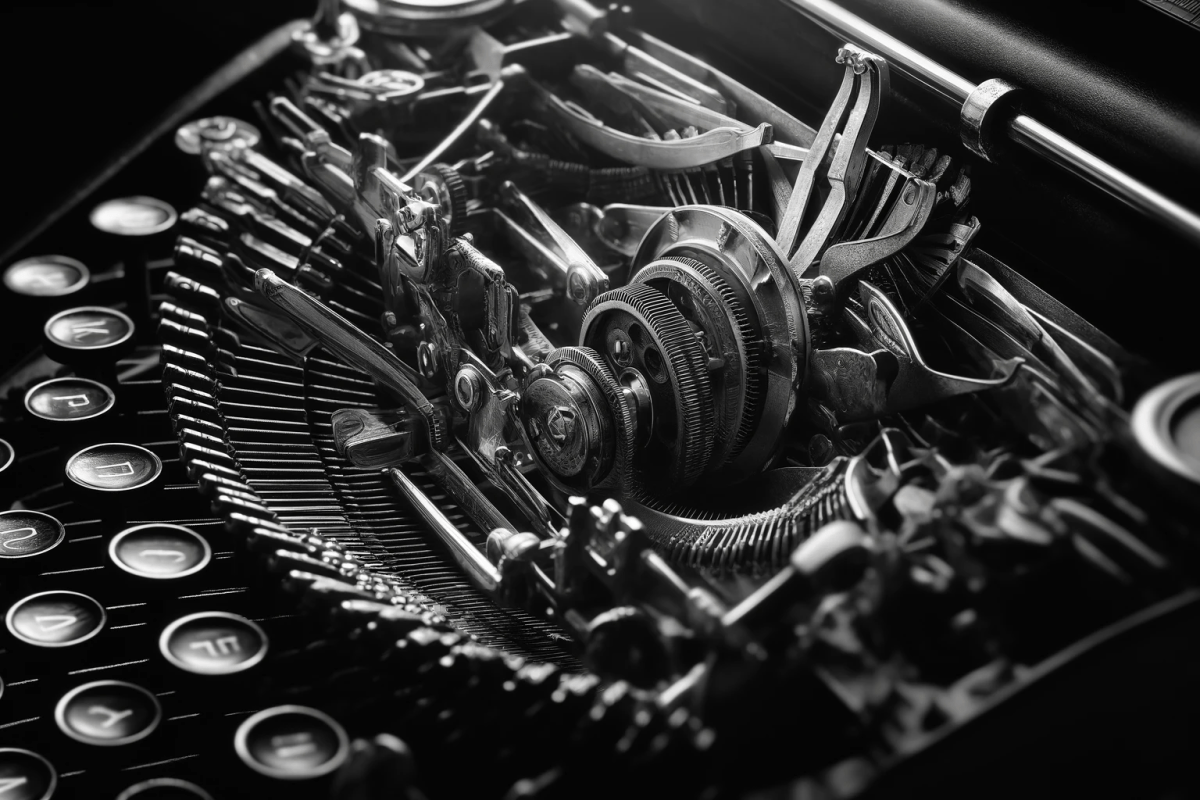
In the vicinity of forgotten dreams, shadows whispered ancient tales. Moonlight painted silver streaks across crumbling walls, while time stood still. Echoes of laughter drifted through empty corridors, carrying memories of those who once walked these halls into the velvet night.
I’m sure the first time I answered this question, I probably attempted to say something clever or mildly entertaining. Honestly, I can’t even remember. The school was fine, and I liked the subject well enough. As far as my favorite subject, it probably has something to do with english or history.
The thing I remember most, perhaps for a time the only thing that mattered, were snow days. Winters were winters back then, snow covered every surface. A cold, wet beauty for all to wonder. Our parents dressed us in snowsuits to keep warm. They weren’t worried about fashion or any of that garbage. Our gloves were tied to a string which fed through the arms of our snowsuits. They did this so we wouldn’t lose our gloves or mittens. Our snowsuits were are our armor and we were knights ready for battle.
We were architects, engineers, athletes, and anything we wanted to be. We would spend all day waiting by the radio announcement declaring school was closed. Once we had it, we’d bolt outside and begin building forts and stockpiling snowballs. Within hours, we had everything ready for the battle. We knew only had one day. There were rarely two snow days in a row. The battle would ensue. For the next few hours we battled until our tiny bodies gave out.
We heard our mother’s calling us back inside before we got frostbite or catch your death. They would unthaw us with hot cocoa. I remember so days we got fancy and added marshmellows. Yes, I said add them we didn’t have fancy premade packets. Our mothers made the hot cocoa on the stive and we waited patiencly for each cup. Our wet snowsuits would lay on the back of the chairs. Small puddles forming on the floor. Our boots stuffed with newspaper, because the newspaper absorbs the water out of our boots.
Sophia Tallon has published 5 Big Distractions From Writing and How to Beat Them, by Ben Starling at her site. “How do to defeat distractions and stay on top of targets? Some times I don’t. But I’ve found a few plans for conquering my distractions that work well for me most of the time. Perhaps […]
PROSE – RANDOM THOUGHTS/REFLECTION – THE STATE OF THINGS
Hello everyone,
You may have noticed that things here at the Memoirs of Madness have been a little spotty. I apologize for that; I really do. It’s been a rough year for me health-wise, and though I’m much better, I’ve been dealing with the emotional side of things. I’ve been wondering how the hell I made it through all this and other questions that arise when dealing with health issues as one ages.
So, in the next few weeks, I will be making some changes to the blog. More precisely, I will focus on cleaning up dead links, adding new pages, removing old pages, and such. This is an attempt to improve the blog’s UI/UX. I will announce the changes as they happen; please let me know if I muck something up. Any suggestions are welcome. Until next time … wish me luck.
Lately, I’ve gotten into the habit of overthinking each of the challenges I usually participate in here on WordPress. So, when I read this challenge, I decided to explore all the television programs I could remember from my youth. I used AI to assist with this project, and of course, AI started repeating television shows. So, I had to rely on my memory. So, here are the television shows I can remember watching as a kid. This list only includes only the television shows that I enjoyed.
1. All in the Family (1971–1979)
2. M*A*S*H (1972–1983)
3. Hawaii Five-O (1968–1980)
4. Happy Days (1974–1984)
5. Laverne & Shirley (1976–1983)
6. The White Shadow (1978–1981)
7. Sanford and Son (1972–1977)
8. The Streets of San Francisco (1972–1977)
9. Charlie’s Angels (1976–1981)
10. The Love Boat (1977–1987)
11. The Six Million Dollar Man (1974–1978)
12. The Bionic Woman (1976–1978)
13. Columbo (1971–2003)
14. The Jeffersons (1975–1985)
15. Good Times (1974–1979)
16. Kojak (1973–1978)
17. Starsky & Hutch (1975–1979)
18. Wonder Woman (1975–1979)
19. Taxi (1978–1983)
20. What’s Happening!! (1976 – 1979)
21. WKRP in Cincinnati (1978–1982)
22. Welcome Back, Kotter (1975–1979)
23. Fantasy Island (1977–1984)
24. Barnaby Jones (1973–1980)
25. Three’s Company (1977 – 1984)
26. Barney Miller (1975–1982)
27. The Rockford Files (1974–1980)
28. Chico and the Man (1974–1978)
29. Get Smart (1965–1970)
30. Soap (1977–1981)
31. Quincy, M.E. (1976–1983)
32. The Mod Squad (1968–1973)
33. McMillan & Wife (1971–1977)
34. Bonanza (1959–1973)
35. The Beverly Hillbillies (1962–1971)
36. The Night Stalker (1974–1975)
37. Maude (1972–1978)
38. Police Woman (1974–1978)
39. One Day at a Time (1975–1984)
40. Room 222 (1969–1974)
41. Ironside (1967–1975)
42. Mission: Impossible (1966–1973)
43. Gunsmoke (1955–1975)
44. S.W.A.T. (1975–1976)
45. Rhoda (1974–1978)
46. Baretta (1975–1978)
47. The Paper Chase (1978–1979)
48. Rawhide (1959 – 1965)
49. Magnum P.I. (1980 – 1988)
50. Airwolf (1984 – 1987)
I only listed 50 shows; I figured that was enough. I actually got close to nearly 75 shows. I think this is as much a memory exercise as anything else. It was fun reminiscing about my youth. One thing that occurred to me was that I watched too much television.
Tonight on LNG, we are going to try something a little different. The concert crew has drug me out the house for my first show of the year. To see one of my favorite bands of the new stuff. They didn’t listen to my usual excuses for not going.
So, the band playing is Badflower. I got a special treat with Des Roc, which is one of the biggest surprises of last year before i got ill. Des Roc is out of New York, a piece band with a big sound.
Here is some live footage:
Des Roc jamming
Uploading video over my cellular network is slow.
This is the opening band for Badflower. Stay tuned for the next post featuring Badflower.
I think it’s essential to establish a routine as a writer. Many of the greats discuss this technique in several books about writing. The post below offers some tips.
I haven’t lived a life where someone would dare name something after me. I think it would be a constant reminder of how much I annoyed them with my shenanigans. I’m okay with that, really. However, someone might just a found a museum. I do remember a woman saying to me once, “They ought to establish a museum for folks like you.”
My editor threatened to quit if I didn’t stop playing around with AI imagery. Normally, I don’t respond well to threats, but in her case, I’d be a good boy and start writing again. So long, lovely people who reside in the splinters of my mind. Well, not really so long, but your visualization will have to wait for a bit. Now, don’t pout. Hey, missy, why are you looking at me in that tone of voice? That goes double for you, mister!
Sorry about that. Can you believe these people? Trying to get out of my head any way they can, the nerve! As I was saying, I’m going to do a little for the next couple of days. Is that alright with you folks?
I hear the fluttering of its wings, my breathing quickens, and my heart begins to pound. My fingers inch their way to my inkwell. My quill and inkwell shun me.
“Come on, now don’t be like that!” I plead
My quill gives me a quick look, but my inkwell is not having any of it. He has been fooled before. I pause for a moment, thinking. Then, it occurs to me.
“Alexa! Oh, Alexa, Prince, please!”
“Playing Prince from Spotify playlist “They funky Sh**!” She replies as her blue lights lit the room. I watch the Inkwell begin to groove.
“Don’t hurt yourself, now!” I tease
“Shut up and write!” The Inkwell replies
So, the inkwell, quill, and Sophie continue grooving. I chuckle as I pick up the laptop and begin to do my thing.
To defend poetry effectively, we must first address a fundamental question: what is poetry? Only by answering this can we adequately defend it. My initial observation is that poetry itself requires no defense; it is the expression of poetry that sometimes needs defending. This notion may be provocative to some poets and poetry lovers, but I aim to clarify my point.
Poetry embodies the life we live; it surrounds us in every moment, from the warmth of a smile to the pain of loss. All of this is poetry. Humanity tends to categorize and label things, trying to define them to understand them better. This is a natural part of our daily lives. As we sort things into their rightful places, we find that some things fit effortlessly—poetry is one of those things. To me, poetry is like a butterfly that flutters unpredictably. We chase it, knowing we might never catch it, but the pursuit itself is joyful.
Suppose we do catch the butterfly. We place it in a jar with holes in the lid, displaying it for all to see. We admire its beauty daily, its vibrant colors that lie somewhere between soft and crisp. However, we often forget the most enchanting aspect of the butterfly: its flight. With the wings no longer spreading and the butterfly immobilized, it becomes a lifeless specimen on display—a reflection on a painted wall, devoid of the life that once captivated us.
The challenge arises in the expression of poetry. People start using words like “hate” or even stronger terms because, while they understand the essence of poetry as part of their lived experience, they feel alienated by its formal expressions. Terms like sonnet, haiku, and other forms can make us cringe or shy away, burdened by preconceived notions about what we will read or refuse to read. What we need is poetry—life—written in a way that people can appreciate, understand, and perhaps even come to love.
Thus, poetry doesn’t need defending; it needs to be set free. We should all have the chance to chase butterflies. I know I would love to.
A waitress stands outside, grabbing a smoke. She was three pats and a wink away from paying her light bill, but if that red fat-faced fuck touched her one more time, she’d scream.
Good Morning …Dawn is coming, and birds chirp a ballad about the people you don’t capture in verse. Those blessed & cursed Those looked upon with disgust. Without question, they fight for us. Tell their story today … its 4am
Though they may never admit it, all a man needs in his mate is a safe place to cry. No tear ever needs to plummet, but the sure fact he can, if desired, means everything.
I first met Dave a few years back at a gun show. My brother was looking for something particular for his collection, and I was just hanging out. We ran into Dave, and he told about his products, and I brought one. I do knives like my brother does guns. A Great guy who makes a solid product. Take a look at his interview.
I wish I had known this information before I started my blog. Though I made the best choice for me and my schedule, there are still things I would have liked to know before making my decision. I find this a very interesting read. Maybe you will as well.
What is the difference between WordPress.com vs. WordPress.org? Learn everything you need to know here.
If my editor knew I was responding to this post, I can envision her holding her breath, hoping I didn’t dive right into a full-on uncensored rant about book adaptations. Lord knows, she has endured more than her share over the years. Partly, I can’t seem to understand the cuts or changes they make. It’s like they never actually read the book, not to mention understood the author’s message. Breathe, Mangus, breathe!
1…2…3…4 … 5..0…7…6 [exhales sharply]
Screenwriting was a part of my training as a cinematographer. So, in theory, I understand the necessity of removing portions of the book as long as it doesn’t sacrifice the story. If it can’t be filmed, then it needs to be cut from the script, was the rule of thumb in class. So, I get it. However, there are still times when things just don’t make sense.
In graduate school, we task to adapt a novel into a full length motion picture. Finally, my chance to show these folks how it’s done. I was determined to get this right.
My determined look
Let me explain screenwriting first. This explanation is simple overview, but you get the point. For every page of script, equals one minute of film. Put simply, 2 and half hour movie is a 150 page script. What? Write an 150 pages? That’s nothing! [scoffs].
So, I sat at my desk and pumped myself up with all the necessary bravado one would need on any given occasion.
“I got this!”
“I’ve written all kinds of stuff, please!”
and so on! This is about the time my brothers would look at me, shaking their heads, and uttering in unison, “Jackass!” I often wondered if they were in a barbershop quartet in previous life. The dissonance of their voices blends together harmoniously. Despite their chiding, I would look continue to display “my determined look,” I will not bow to adversity!
My determined look – 6 months later
Yes, my hair grew out and I rearranged my office, but I was still determined to write the masterpiece. A friend called and needed a favor, so I packed my gear and went and shot a short film, then a commercial, and then another short film. Then the pandemic arrived and the world changed. I never finished my masterpiece. Incidentally, I was adapting Ellison’s Invisible Man, which if adapted uncut would equal a 9 1/2 film. Yeah, I was definitely what my brother’s called me for tackling such a major work of literature on my first stab at full length screenplay. There’s a good reason its never been done before. However, I did learn something.
For motion pictures, novellas, short stories, and stuff work great. It is much easier to say closer to the book. Examples, of this working on well areShawshank Redemption, Inventing the Abbotts, and Stand by Me.Each of these examples were based on shorter fiction. Two of these films are considered classics.
For novels, it’s better to adapt them for television, if sticking close to the source material is a goal. You have the time to tell a more complete story. In other words, you can put some meat on those bones. However, you have to keep in my mind, if you can’t film it, cut it.
Last thing about screenplays. Screenplays, are basically the movie written on paper. It’s the blueprint to the entire project. The cuts, fades in and out, and those things you think about while you are watching a movie are written in the screenplay. Yes, adjustments will be made, but the screenplay is where it all starts.
Now to the question:
Above, I answered the question from the point of view of a writer. Now I will talk to you as a fan. I was fan long before I ever thought about making movies or writing them. As a fan, I chose TV. Over time and throughout the years, they have done a better job with the adaptations. With the improvement of production quality of television programming, further solidifies my opinion.
Some of my favorite adaptations for television are Bosch, Justified, Dublin Murders, and Lincoln Rhyme: The Hunt for Bone Collector. With Bosch we really get to see who Harry Bosch is as a person. The script has made changes, but Michael Connelly has hand in the show so the character integrity is present. Justified is a adaption of Elmore Leonard’s short story “Fire In The Hole.” However, there are several Raylan Givens novels that pulled elements from for the series. Timothy Olyphant’s portrayal of Raylen Givens is excellent. He brings to the screen that you couldn’t write.
In the Bone Collector (TV series), we really for the first time were introduced to the Lincoln Rhyme of the Jeffrey Deaver series. Lincoln Rhyme is a brilliant, exetremely difficult man with tremendous chip on his shoulder. To say, he was bitter about his circumstances is a understatement. We get a hint of Lincoln’s character in the Denzel protrayal, but it shows through in the series with Russell Hornby protraying Lincoln Rhyme.
Most important of about the Bone Collector (TV Series), this is the first time Amelia Sachs appears in a live action role. Now, in the feature film, Angelina Jolie, protrays a character based on Amelia Sachs, whose first name was Amelia, but she wasn’t Amelia Sachs from the books. Arielle Kebbel protrays Amelia Sachs in the series. We witness Sachs battling her own demons while developing a relationship with Rhyme. She challenges him. This is the Amelia Sachs from the novels.
When I first started seriously considering writing as a career, I found myself in competition with other writers. Ridiculous, huh? What made matters worse was that I didn’t realize this until years later. This post will help you not do that.
As the sun began to set, the world, usually at 1000 mph, seemed quiet. The hustle and bustle of life, the constant noise, and chatter fade. It was as if the earth had taken a deep breath, letting it out slowly. Then, it repeated it. At that moment, everything was calm; everything was still. It was a moment of perfect pause.
Typically, when comes to film adaptations, we got two categories:
“Oh my god that was horrible! The book is so much better!”
“Can you believe they did that? That’s not in the book!”
The majority of the film adaptation I’ve seen into these categories. I’m a huge Shawshank Redemption fan. I was a fan of the movie, before I knew it was an adaptation. I found it was based on a Stephen King novella, immediately I was turned off. Have you seen some of film adaptations of Stephen King’s stuff? I’m not talking about the recent adaptations or reboots. There were horrible. I’ve read several King books before seeing this film and enjoyed them. However, for some reason, King fell out of favor with me until I read his book about writing. Single malt scotch rained from the heavens, and all was right in the world again. I was back to being a fan.
So, I read Rita Haywood and the Shawshank Redemption, one of four novellas in Different Seasons collection. I fell in love with the movie even more. They did an amazing job with this adaptation. The casting of Morgan Freeman was a stroke of genius. I saw the picture above online somewhere and had to write something about what I could describe as my favorite movie. 30 years can you believe it!
Shopping Sprees? I’m bold, daring, and a tad bit reckless. Slinging money left and right. Yep, that’s me. Three places I make it rain at. Amazon, local used bookstore, and local used record shop. I know it’s crazy, and I need to contain myself. Yes, I’ve thought about therapy. Perhaps, even joining some sort of support group. You know, stand up there sharing my tales of how I spent my money on a first-edition Poe. Perhaps I tell them about the thingamajig I got on the lighting deal. I saved so much I can’t believe I got it. What a bargain. You know, “that deal” sitting in the junk drawer, and you can’t even know what it is, not to mention why you brought it? Tell this to a perfect stranger? I don’t think so!
But I’ll go anyway because I have nothing to do on Fridays at 6:00 p.m. St. John’s has a lovely meeting room, and they spare no expense on the refreshments. However, the guy who leads the Thursday meeting at St. Agnes has a booming voice and stares at you with penetrating eyes. I find myself sliding down in my chair by the time he’s done. I’m thinking my shopping sprees aren’t diddlysquat compared to him. I’m just a cute little furry kitten.
For some reason, this recipe sounds good to me. I’ve used several recipes from this lady. She knows what she’s doing. Check out her latest. Here’s the link click here
The sun through the 4th floor glass felt good, It was partly on my shoulder and partly on my face. It was good to the feel the warmth. I’d been so cold lately. Nothing, I did made me warm enough. Even when AC went out and it was 90’s degrees in the house, I was okay everyone was else, but they kept their complaints out of earshot. I appreciated that.
I’m sitting thinking about the one who got away. The one who was supposed to make things better and all that. I never knew if they really happened or was it something said we believed in publicly, but thought was a crock of shit privately. “The One” worked at Aunt Peg’s candy shop in the local mall. I must have spent hundreds of dollars on soft peppermint sticks that summer.
The neighborhood paperboy loved me. He made a dollar for every trip to the candy shop. You see, I never could muster up enough courage to actually go up to the counter and ask for the candy.
“Do you even like peppermint?” Maynard, the paperboy asked
I didn’t answer. I did my best to give him an evil leer. Although, I don’t think it was working very well.
“Look, if this is all about the girl? She’s right there. Just talk to her.” Maynard took his dollar and left. That was the last day of summer and I never said a word to the girl.
I still eat soft peppermint sticks when I can find them. Those puff balls seem to have cornered the market. Some marketing genius started this whole mess.
Yep, Aunt Peg’s soft peppermint sticks were the best!
When I started my blog years ago, I did so because I followed the advice of a trusted advisor. It turned out to be solid advice, but they really never explained why. I didn’t ask my questions either so I can’t deflect any blame. However, in this post below, there are some good reasons with explanations on why authors/writers should blog. Take a minute and read the information.
Sometimes, it seems like we addicts are trying to duplicate the euphoria from the first fix. It may not last more than a moment, but you never forget how it felt and desperately try to regain that feeling. Yet, we become lost in searching for something we were only supposed to experience once. Perhaps we meant to simply capture these moments and stitch them into a quilt of sanctuary our mothers used to make. Each square represents a euphoric memory.
However, it never seems to work out that way. We waste so much time chasing the dragon we eventually feel cheated. We wind up facing ultimatums concerning the things we have unintentionally neglected. We try to rally but end up a headline below the fold or caption scrolling across the bottom screen with the volume on mute.
Is this what has become my life?
Is this the madness I’ve created?
I have faith that my brothers will hold me up until I can stand on my own. The battle against my demons is real. I sit here in the churn of madness, thinking of everything I was supposed to be—a stranger to myself, a shadow of yesterday. On my soul is a tattoo of the ghost of who I used to be. Memories of yesterday fill the present with fear, and a map to nowhere will be upon my face.
Is this what become of my life?
In the madness I created …
I pray to God to help me find my strength within. I pray to God for the patience that day to begin. I pray to God to help me find myself again.
I’ve seen evil. Hell, I’ve been evil. We are so intimate that we can be found slow dancing by candlelight to the melody of the whispering darkness. Can you hear it?
My health has improved, but my writing is struggling for some reason. Just give me a moment. I will come up with something. It may not be my best work, but it will probably do in a pinch. My cat keeps finding new places to nap. I admit I’m jealous because she can plop her butt anywhere and sleep. I’ve been considered a large fellow, so my plopping is limited. This meme sums up my feelings about my writing as of late.
For a long time, I fought for humor, integrity, and truth. I was steadfast in my duty. Then, for a moment, I fought for glory. This was the moment of corruption.
How can this be?
After years of devotion, it only takes a moment to lose everything. Corruption festers, chipping away at who you are.
So today, with each breath, I fight to protect what is most dear …
One minute, you sleep too long, and the next you can’t sleep at all. I suppose somehow, some way we search for the balance. You haven’t seen it so long you forget it east. I suppose it’s the way things do it. Or else it is just something else to fail at. Just another thing to let you down.
When I was a child, candy was truly a treat. Holidays like Easter, Halloween, and Christmas were awesome because we were allowed to eat candy for days. However, the remainder of the time, fruit served as our treat or snack. After wonderful years of sampling different types of fruit, I came up with the following list of favorites.
Apples – I enjoy all types of apples, but my favorite is Fuji.
Grapes – I destroy a couple pounds of grapes without thinking about it.
Mangos – They are just good; what else is there to say about that.
Oranges – I like all types of these varieties of this citrus fruit.
Peaches – nice and juicy.
I actually have a ten, but the response asked for just five. Although I love my candy and went through a period as an adult where I kept a jar full, now I prefer fruit in a way that is better because I choose it.
In the dimly lit room, an ancient cabinet stood solemnly against the wall. Its wood, dark and glossy, whispered tales of forgotten eras. As the key turned in its lock, a soft sigh escaped, revealing secrets nestled within its heart.
I’ve spent a great deal of time in the woods, sleeping under the stars and even being chased by a family of wild boars, so the idea of going back to the woods for “fun” didn’t really appeal to me. However, I’m aware of oodles of fun had at the campfire, smores, and the guy serenading some girl while playing a single chord on his guitar. I’m so sorry that I missed that; not really!
We mustn’t get lost in its despair, we mustn’t be swallowed before the pain, and we must be careful not to be cut by beauty’s dual edge. But is that even possible? How can we embrace beauty without becoming its victim, without becoming its prey?
I’m beginning to get used to it. It’s almost like it’s second nature or something. Each day is not much different than the last; each day we are closer to being engulfed by the evil charms of its subtle beauty; bright pale blue lore is deceiving; it masks the wickedness that lurks neath its smiles: we are bitten by its breath
She Was a Phantom of Delight BY WILLIAM WORDSWORTH
She was a Phantom of delight When first she gleamed upon my sight; A lovely Apparition, sent To be a moment’s ornament; Her eyes as stars of Twilight fair; Like Twilight’s, too, her dusky hair; But all things else about her drawn From May-time and the cheerful Dawn; A dancing Shape, an Image gay, To haunt, to startle, and way-lay. I saw her upon nearer view, A Spirit, yet a Woman too! Her household motions light and free, And steps of virgin-liberty; A countenance in which did meet Sweet records, promises as sweet; A Creature not too bright or good For human nature’s daily food; For transient sorrows, simple wiles, Praise, blame, love, kisses, tears, and smiles. And now I see with eye serene The very pulse of the machine; A Being breathing thoughtful breath, A Traveller between life and death; The reason firm, the temperate will, Endurance, foresight, strength, and skill; A perfect Woman, nobly planned, To warn, to comfort, and command; And yet a Spirit still, and bright With something of angelic light.
Lo! where the rosy-bosom’d Hours, Fair Venus’ train appear, Disclose the long-expecting flowers, And wake the purple year! The Attic warbler pours her throat, Responsive to the cuckoo’s note, The untaught harmony of spring: While whisp’ring pleasure as they fly, Cool zephyrs thro’ the clear blue sky Their gather’d fragrance fling.
Where’er the oak’s thick branches stretch A broader, browner shade; Where’er the rude and moss-grown beech O’er-canopies the glade, Beside some water’s rushy brink With me the Muse shall sit, and think (At ease reclin’d in rustic state) How vain the ardour of the crowd, How low, how little are the proud, How indigent the great!
Still is the toiling hand of Care: The panting herds repose: Yet hark, how thro’ the peopled air The busy murmur glows! The insect youth are on the wing, Eager to taste the honied spring, And float amid the liquid noon: Some lightly o’er the current skim, Some show their gaily-gilded trim Quick-glancing to the sun.
To Contemplation’s sober eye Such is the race of man: And they that creep, and they that fly, Shall end where they began. Alike the busy and the gay But flutter thro’ life’s little day, In fortune’s varying colours drest: Brush’d by the hand of rough Mischance, Or chill’d by age, their airy dance They leave, in dust to rest.
Methinks I hear in accents low The sportive kind reply: Poor moralist! and what art thou? A solitary fly! Thy joys no glitt’ring female meets, No hive hast thou of hoarded sweets, No painted plumage to display: On hasty wings thy youth is flown; Thy sun is set, thy spring is gone— We frolic, while ’tis May.
these hips are big hips they need space to move around in. they don’t fit into little petty places. these hips are free hips. they don’t like to be held back. these hips have never been enslaved, they go where they want to go they do what they want to do. these hips are mighty hips. these hips are magic hips. i have known them to put a spell on a man and spin him like a top!

Personal Reflection:
When I first heard this poem, it was on audio. It was so different from What I thought poetry was supposed to be. While in school, we had Frost, Whitman, and others shoved down our throats. Though I had grown to appreciate the classics, I definitely had a bad taste in my mouth when it came to poetry. I discovered the beauty and complexity of poetry. Thank you, Lucille Clifton and the many other poets in my library.
How do significant life events or the passage of time influence your perspective on life?
DAILY PROMPT RESPONSE
It’s easy to be affected by the major events of our lives. We can point back to them, like time travelers, and recall exactly what happened and how it affected us. However, I’ve lived long enough to realize it’s the little things that mean so much. We can rage into anger, burst into laughter, or be moved to tears at the slightest thing. It doesn’t make sense in the scheme of things.
Over the last several months, I’ve been battling the ups and downs of my illness. The healthcare professionals are expected to take good care of you. For the most part, I’ve been blessed with the care I have received. However, there are times when the professional will do a small thing without being prompted, and that just blows your mind and is greatly appreciated.
Yeah, the major events are easy to remember, but the little things shape us.
I would not exchange the sorrows of my heart For the joys of the multitude. And I would not have the tears that sadness makes To flow from my every part turn into laughter.
I would that my life remain a tear and a smile.
A tear to purify my heart and give me understanding Of life’s secrets and hidden things. A smile to draw me nigh to the sons of my kind and To be a symbol of my glorification of the gods.
A tear to unite me with those of broken heart; A smile to be a sign of my joy in existence.
I would rather that I died in yearning and longing than that I live weary and despairing.
I want the hunger for love and beauty to be in the Depths of my spirit,for I have seen those who are Satisfied the most wretched of people. I have heard the sigh of those in yearning and longing, and it is sweeter than the sweetest melody.
With evening’s coming the flower folds her petals And sleeps, embracing her longing. At morning’s approach she opens her lips to meet The sun’s kiss.
The life of a flower is longing and fulfilment. A tear and a smile.
The waters of the sea become vapor and rise and come Together and are a cloud.
And the cloud floats above the hills and valleys Until it meets the gentle breeze, then falls weeping To the fields and joins with brooks and rivers to return to the sea, its home.
The life of clouds is a parting and a meeting. A tear and a smile.
And so does the spirit become separated from The greater spirit to move in the world of matter And pass as a cloud over the mountain of sorrow And the plains of joy to meet the breeze of death And return whence it came.
Well, son, I’ll tell you: Life for me ain’t been no crystal stair. It’s had tacks in it, And splinters, And boards torn up, And places with no carpet on the floor— Bare. But all the time I’se been a-climbin’ on, And reachin’ landin’s, And turnin’ corners, And sometimes goin’ in the dark Where there ain’t been no light. So boy, don’t you turn back. Don’t you set down on the steps ’Cause you finds it’s kinder hard. Don’t you fall now— For I’se still goin’, honey, I’se still climbin’, And life for me ain’t been no crystal stair.
I definitely agree with this article. My inner critic has kept me in the shadows for many years when it came to releasing my fiction. I find the article to be full of solid advice.
I can’t remember a conversation where money wasn’t mentioned at least once. The most common complaint is that they don’t have enough to get by. In several cases, financial challenes are real and can be overwheleming. The general consesus is that problems will be answered if we had enough money to resolve them. I can’t say I haven’t felt this way myself. I beleive in the ideal, if work hard and take care of money a person will be just fine. However, we know this ideal doesn’t always workout this way. We know or heard of people working hard their entire lives and don’t have the resources to be buried.
Due to situations such of this, we turn to financial experts to try find way to stay above water. We understand the necessity of money, but we don’t have a firm understanding on how to utilize the income we do have. Television commercials constantly bombard us with different ways to improve our financial status. Reverse mortgages, debt relief, and debt consolidation loans all offer us different avenues to address out issues. Yet, the question becomes; what’s is legitimate, and which one are scams.
As we continue to struggle, materialism has become the standard. We justify our purchases one or another. We figure out how to make ends meet or how to survive until the next paycheck. I have discussed financial issues with people in several socioeconomic classes and their struggles are very similar.
The following website offers a vast amount of information concerning financial literacy.
Consumer Financial Protection Bureau is a free resource that could provide the information you have been searching for to assist you in achieving your financial goals.
Here are some of my favorite tracks the deal with money.
He was enchanted by a woman whose eyes mirrored the night sky—dotted with constellations and shimmering with the light of distant stars. The kind of eyes depicted in storybooks and legend. Each glance into her eyes he fell deeper into their boundless and mesmerizing sea. He was powerless and that was okay. The specks of light slow danced with hope and mystique, a testament to the mysteries and beauties of fantasy. Her gaze was the key to stories untold, worlds unexplored, and the promise of adventure.
“Harold, are you going stand there gawking, my god boy! Close your mouth before you let flies in!”
Harold face redden, “Yes Nanna.”
“Give her the coupons.” Nanna continued. Harold’s embarrassment deepened. He makes eye contact again and her face reddened as well. She is smiling shyly.
Mabel McGee lived in the quiet town of Willow Creek in a quaint cottage that seemed to hold more memories than objects. To the townsfolk, she was known as the elderly woman with a penchant for mixing up dates and events, often speaking of historical happenings as if she’d lived through them herself. Some whispered about dementia, others about a life too lonely. But little did they know, Mabel’s supposed confusion was not a symptom of her age but rather a consequence of her extraordinary past as a retired time traveler.
Mabel’s journey began in 2045 in a world where time travel was possible and regulated by a strict code. She was one of the elite, a ChronoNavigator tasked with maintaining the integrity of the timeline. Her missions had taken her from the bustling streets of ancient Rome to the futuristic landscapes of the 22nd century, each adventure embedding itself into the fabric of her being.
As the years passed, the toll of her travels grew heavier. The lines between times began to blur, not just in her mind but in her heart. Mabel realized that she yearned for something the vast expanse of time could not give her—a place to call home. And so, she chose to retire in the one era that had always felt like a balm to her soul—the early 21st century.
The townsfolk of Willow Creek knew none of this. To them, Mabel was the eccentric old woman who lived alone, her house filled with strange artifacts and her conversation sprinkled with anachronisms. Children dared each other to peek through her windows, hoping to catch a glimpse of her rumored collection of “antiques” that seemed too out of place, even for a collector. They didn’t realize that each piece in Mabel’s home was a memento from her travels—a Roman coin, a futuristic gadget that no longer worked in this timeline, a painting from an artist who wouldn’t be born for centuries. And the stories she told, dismissed as confused ramblings, were indeed true accounts of historical events she had witnessed firsthand.
One day, a new family moved into Willow Creek, and with them came young Ellie, a curious and bright girl with an insatiable appetite for stories. Unlike the others, Ellie found herself enchanted by Mabel’s tales. She listened, wide-eyed, as Mabel spoke of walking with dinosaurs, witnessing the signing of the Declaration of Independence, and even attending a speech by a future president yet to be elected.
Over time, the seasoned time traveler and the young girl formed a unique friendship. Mabel saw in Ellie a kindred spirit who understood the value of time not by its weight but by its wonders. For Ellie, Mabel was the gateway to a world far beyond the confines of Willow Creek—a world where anything was possible. As their bond deepened, Mabel decided to change Ellie’s life forever. She decided to share her greatest secret, the time device that had been dormant for years. Together, they embarked on a journey that spanned centuries, a final adventure for Mabel and the beginning of a lifetime of wonders for Ellie
In the end, Mabel McGee’s legacy in Willow Creek was not that of a confused old woman but of a mentor who opened the door to the universe for a young girl. As for the townsfolk, they would never look at their world the same way again, always wondering if the stranger passing through was just a visitor or a traveler from another time, inspired by the tales of Mabel McGee, the retired ChronoNavigator who found her home not in time, but in the hearts of those she touched.
In the heart of an attic, amidst a treasure trove of forgotten gadgets, an argument of epochal proportions was unfolding. Oliver, an old, venerable camera with a penchant for nostalgia, found himself at odds with Dexter, a high-tech digital camera with more settings than a spaceship.
“Back in my day, we captured the essence of life, one click at a time,” Oliver boasted, his lens gleaming under the dim attic light.
“Pfft, the essence of life? I can capture, edit, and share a photo before you even figure out your aperture,” Dexter retorted, his LED screen flashing in disdain.
The debate might have ended there if a cheeky squirrel had not chosen that moment to dart across the attic floor, pausing only to strike a pose.
A light bulb flickered to life above Oliver’s viewfinder. “I propose a challenge! Let’s see who can take the best photo of that squirrel,” he declared, adjusting his focus.
Dexter beeped in amusement. “You’re on, grandpa. Prepare to be pixelated.”
Oliver took his time, calculating the light, adjusting his focus, and waiting… waiting for the moment when the squirrel, enticed by a nut left on the windowsill, struck a majestic pose. Click. The sound resonated through the attic, capturing a moment in time.
Meanwhile, Dexter, with the efficiency of a modern marvel, snapped approximately 47 photos in burst mode, applied a “Squirrel-Enhance” filter, and even photoshopped a tiny superhero cape onto the squirrel in one of the shots. “Done. And I’ve already shared it on SquirrelGram,” Dexter announced triumphantly.
They turned to the attic’s old computer to judge their work. Oliver’s photo was a masterpiece of timing and light, showcasing the squirrel in a moment of serene beauty. The soft lighting gave it an almost ethereal quality.
Dexter’s photos were sharp, vivid, and varied, with the superhero squirrel garnering a particular chuckle. “Look at that! It’s going viral among the attic spiders,” Dexter bragged.
Just then, the squirrel, having completed its snack, scampered over to see what all the fuss was about. It peered at the screen, then at the two competitors. With a decisive nod, it grabbed a forgotten paintbrush with its tiny paws. It dashed off a squirrelly masterpiece on a piece of scrap paper: Oliver and Dexter, lenses crossed in friendship, capturing the squirrel in a heroic pose.
The two cameras, old and new, realized that the best photos come from seeing the world through each other’s lenses. They laughed, a sound of mechanical clicks and digital beeps, united in their newfound friendship and respect for each other’s techniques.
As the sun set, casting a golden hue over the attic, Oliver and Dexter understood that photography isn’t just about the camera—it’s about the vision, the moment, and sometimes, a squirrel with a flair for the dramatic.
And so, amidst the dust and memories, two cameras from different generations found common ground, proving once and for all that when it comes to capturing life’s beautiful moments, the best approach is a shared one. As for the squirrel, it became an honorary member of their photographic adventures, always ready for its next close-up—cape and all.
I’ve been working on music posts all weekend and writing a bit of fiction. So, when I read today’s prompt, this song came to mind as I popped some Tylenol for my aching bones. Then, ask this question.
Then, of course, this song pops into my head.
Fingers popping and belting the lyrics into a seldom used hairbrush. I stop and catch my breath. I realized this track from 1969, and I knew all the words. Scratching the back of my head, I pause and ask what’s my age again?
Several teachers over the years made a massive impact on me. As I think back, I find myself smiling about some lessons and cringing about the others. However, none of them impacted me more than my mother.
It all started with a watch. My mother realized I was different when I took a part of her favorite watch and put it back together. She said she wasn’t much more than eight years old. I barely remember the event. When my mother told my wife and me this story, she had the sweetest, tiniest smile. She was visiting and came to my shop to see exactly what I did for a living. It was crazy. She seemed amazed and proud all at once.
Mom said I had taken apart her watch, and the pieces were laid out on the table, and she was furious. I simply looked up and said hey, Mom. She said she then returned to reassemble the watch. She watched me carefully put everything back together, not leaving out a single piece. The watch never worked again, but she said she figured if I could do that at that age, there would be no telling what I could accomplish.
So, Mom never discouraged my endless questions about things. If it wasn’t in the encyclopedia, she took me to the library on the weekends and scribbled notes in a notebook. I found one of those notebooks last year and couldn’t believe what I was into. Because of how she raised me, I have never been afraid to learn a new skill. I went on and accomplished several things. Repairing things much more complicated than her watch, but the watch is where it started.
Mom taught me how to navigate through life with minimal whining. Take no crap from anyone and be my own person. Her favorite response to me following the lead of someone she disapproved of.
“if they jumped off a bridge, are you going to follow them?”
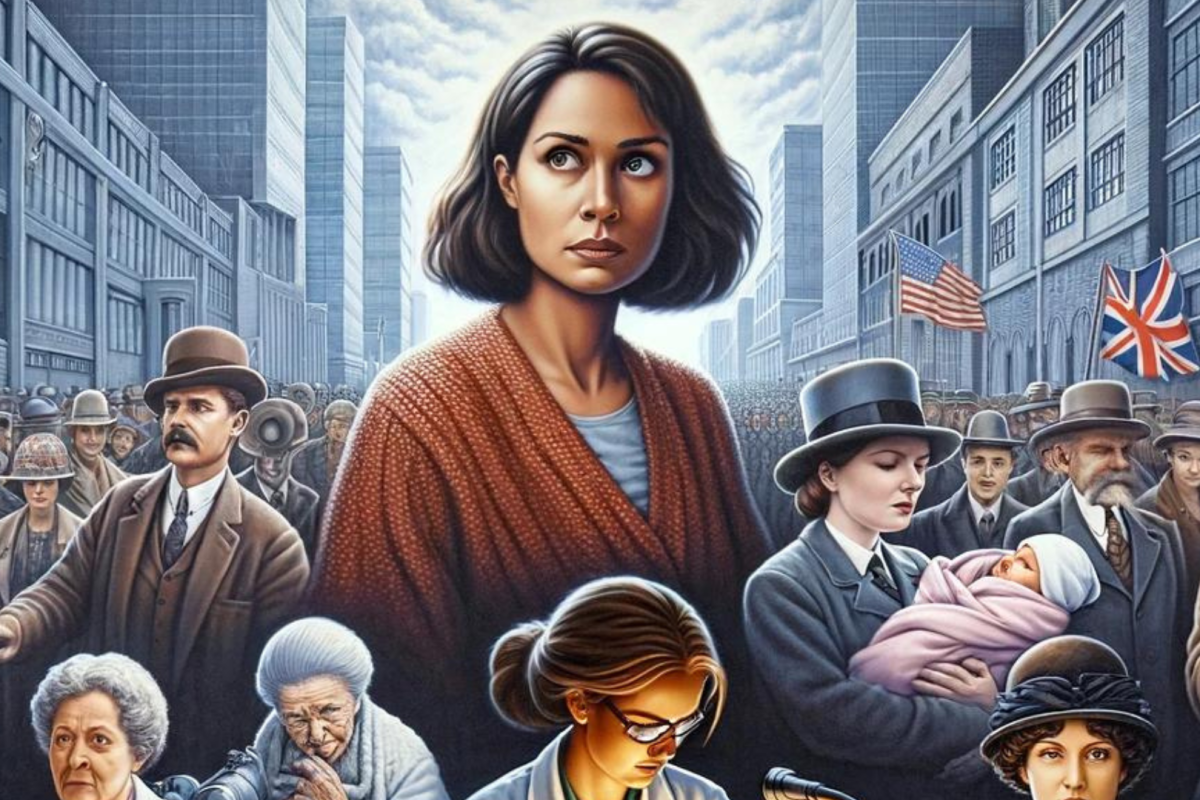
In the tapestry of human endeavor, threads shimmer with unyielding tenacity woven from the fiber of women with grit. These women, from varied walks of life and corners of the earth, share a common trait—a relentless fortitude that propels them through adversity, enabling them to emerge not only unscathed but stronger and more resolute.
Consider the woman who rises before dawn, her day stretching ahead like an uncharted expanse, demanding her sweat, intellect, and care. Yet, she meets each challenge undaunted, fueled by an inner fire that refuses to be extinguished. She could be the single mother who juggles multiple jobs to provide for her children, ensuring they receive the opportunities she never had. Or the scientist in a lab, her eyes alight with the spark of discovery, tirelessly pushing against the frontiers of knowledge despite the voices questioning her place in such a world.
Reflect on the women in history who stood firm against the gales of their times, refusing to bend. They are the suffragettes who endured mockery and imprisonment, their eyes fixed on the horizon of equality. They are the trailblazers in arts, sciences, politics, and activism who dismantled barriers and defied conventions to etch their indelible marks on the annals of time.
Women with grit embody resilience, a quality that resonates through their every action, a silent strength that speaks louder than words. They navigate life’s storms with a steely grace, their resolve a beacon for others to follow. In their perseverance, they weave a legacy of inspiration, a call to each of us to harness our own potential, face our battles with courage, and emerge not just enduring but triumphant.
In celebrating these women, we recognize the grit within ourselves, a testament to the enduring power of the human spirit embodied in the resilience and determination of women across ages and the world.
My mother was such a woman. She had grit, but she referred to it as gumption. I’ve always liked that word. Despite the challenges of raising me on her own, she refused to surrender the chaos surrounding us, no matter how tempting it had been. She remained steady in all that we faced. A lesson I tried to demonstrate to her grandchildren and great-grandchildren. I’m honored to be a steward of her legacy. No different than the others who have courageous women in their lives.
A quaint village nestled between rolling hills and whispering woods lived a trifling spirit named Elara. Mischievous and light-hearted, she danced through the villagers’ lives like a playful breeze, her presence barely more substantial than a fleeting shadow. With a penchant for harmless pranks, Elara often left a trail of bewildered smiles and gentle laughter in her wake. She’d whisper riddles in the wind, tie shoelaces together unseen, and sometimes, in a whimsical mood, cause the flowers to bloom out of season, painting the world in unexpected splendor.
Yet, despite her whimsy, Elara held a deeper purpose. Her antics served as gentle reminders not to take life too seriously and to find joy in the small, unexpected moments. In her own trivial way, Elara wove a thread of light-heartedness into the fabric of the village, teaching that sometimes, the heart needs the relief of laughter and the soul the lightness of just being.
In the pale moonlight, the world seemed ethereal, yet a profound silence pervaded the air, perforated by the echo of distant footsteps. A mosaic of shattered hopes now lay among the ruins of a forgotten city where dreams once flourished. The remnants of crumbled walls whispered tales of yore, each fractured stone a bearer of untold stories. Underneath the celestial gaze, shadows danced across the fragmented relics, casting an intricate ballet of light and darkness. Here, amidst the vestiges of the past, resilience bloomed anew, forging beauty from despair, a poignant reminder of life’s perpetual rebirth amidst ruin.
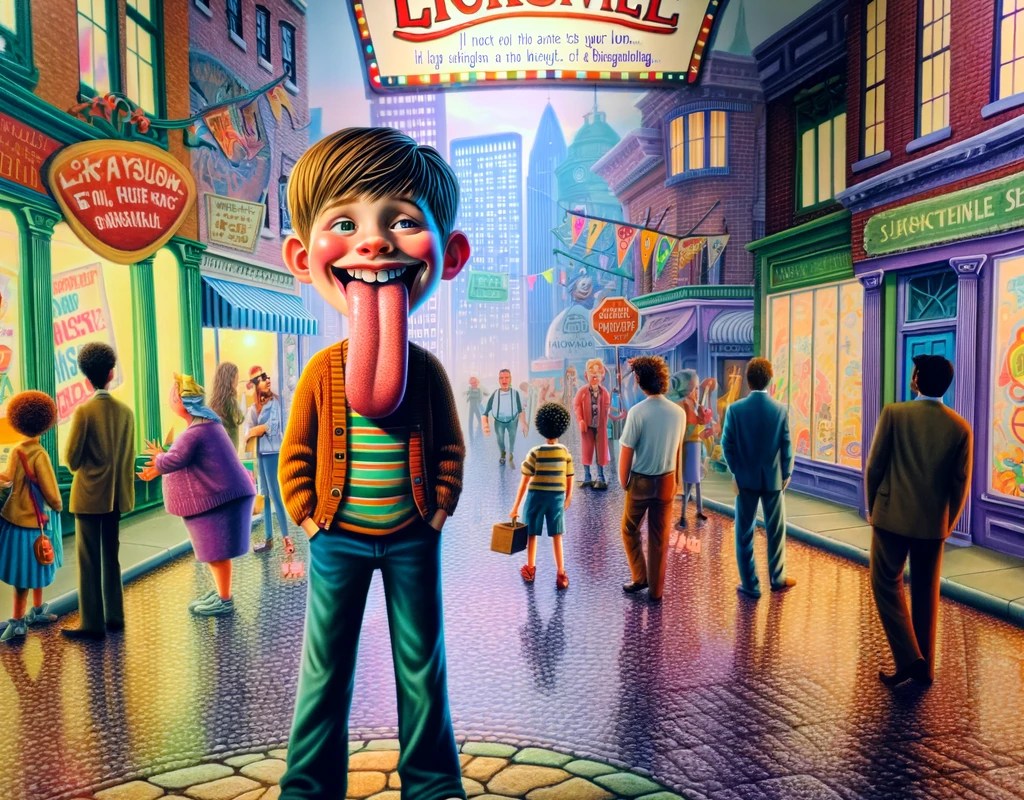
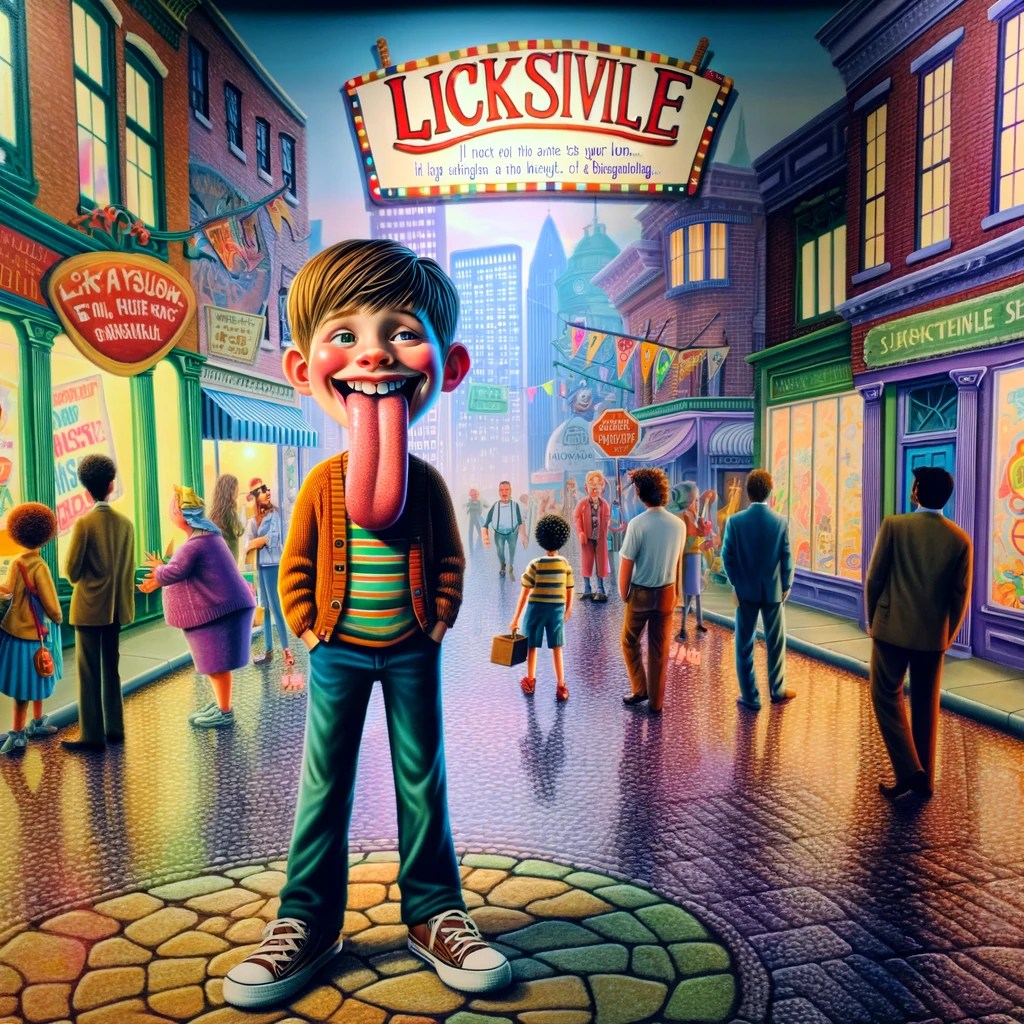
A boy named Timmy Sinclair lived in a bustling city named Licksville, known far and wide for his extraordinarily large tongue. Timmy was no ordinary boy, and his tongue was no ordinary tongue. It was the size of a baguette, supple like a gymnast’s and versatile like an artist’s palette.
From an early age, Timmy realized that his large tongue was not a curse but a blessing. He discovered he could use his tongue for tasks that others could not. He could taste the subtlest of flavors in food, making him the best judge in town for cooking competitions. He could also use his large tongue to help clean out jars and reach places his hands could not.
In school, Timmy was the star of the science fair. He used his tongue to demonstrate how taste buds worked, making science fun and exciting. His classmates admired him, and his teachers praised him for his creativity. Unfortunately, not everyone saw Timmy’s tongue that way.
Summer ended, and school began. Timmy was excited. He couldn’t wait for his next adventures. When he arrived at homeroom on the first day, there were two new students: one girl and one boy. Timmy took a seat and waited. He wanted to know everything about the girl. She had long raven hair, caramel-colored skin, and the most enchanting eyes he had ever seen.
Ms. Rowster came into the room, and they settled down for attendance. Timmy barely could contain himself as he anxiously waited to hear the name of this beautiful girl. When Ms. Rowster got to her name, she asked her to stand up and tell the class a little about herself. She did.
“Hello. My name is Simin Karimi, and I’m from Detriot,” Simin said, then sat down. Timmy felt she had the most beautiful voice to accompany the rest of her beauty.
Ms. Rowster did the same with the new boy as well. He stood and cleared his throat, “I’m Brad Zigler from Ohio. I know everyone has heard of Zigler cheese, right? Brad asked. A few nodded in agreement while the others sat in quiet bewilderment.
They were all sixteen, but Brad stood over 6 feet and had a large nose, freckles, and a fiery beard. Due to his size and attitude, he had already started gaining friends. Timmy knew he would be one of the most popular kids in school before long.
At lunch, Timmy sat at his usual table, watching Simin’s every move, hoping she would sit at his table. Marcy Busch slapped Timmy on the shoulder.
“Who’s that?” Marcy asked.
“S S S imin,” Timmy shuttered. He was a little tongue-tied, as they say. He felt strange because he never shuttered a day in his life. Marcy looked puzzled at Timmy, then Simin. Marcy motioned for Simin to sit with them. Timmy shifted uncomfortably but managed a smile. Marcy introduced herself.
Marcy and Simin chatted away while eating, picking at their food, if you can call it eating. They were well on their way to being fast friends. Timmy sat quietly, nodding and smiling at the appropriate times. Timmy noticed Simin kept glancing and smiling at him. This made Timmy nervous. Here is the most beautiful girl, and he’s suddenly tongue-tied.
“Stop being rude!” Marcy said as she nudged on the shoulder. Timmy tried to say something, but his tongue got in the way. It felt like it filled his entire mouth. Timmy had never experienced this before. Marcy’s comment didn’t help matters.
“So, you see a pretty girl, huh?” Marcy asked.
“You’ve been talking my ear off since first grade. Geez, thanks,” she smiled. Her cobalt blue eyes sparkled when she smiled, and her smile always seemed to do the trick when Timmy got nervous. Marcy made him feel safe.
“Oh my god! So you’re the freak people have been whispering about!” a voice exclaimed. They looked up, and it was Brad Zigler with a horrified expression.
“What are you? Some sort of lizard?” he exclaimed.
Timmy blushed, and his eyes filled with tears. Before he knew it, Marcy had sprung from the table, kneeing Brad, and delivered a well-practiced right cross—the signature move she picked up when she developed breasts at 12. Marcy explained that once all the women in her family had a nice set of girls, her mother, and grandmother taught her the move in case the boys got handsy. Nanna said boys “always get handsy.”
Marcy stood Brad silently, her brunette hair tied in a ponytail. Brad groaned in pain as he clutched his private area. Marcy stepped toward him, and Brad scooted away with his held up in surrender. Marcy turned to look at Timmy. Her pale alabaster skin was rose-colored. Her eyes were like fire. Yet, they softened when Timmy looked up at her. She stood 5 feet even.
“Bullies give me the sweet ass!” she exclaimed as she retook her seat. Marcy didn’t make eye contact with anyone, then whispered, “Sorry.” Simin squeezed her hand. “Marcy, you’re wicked fast. Next time, can you save me some?” Simin asked jokingly. They all chuckled as they left the lunchroom.
Author’s Note:
Today, I felt good enough to write a little fiction. I hope you don’t mind. So, I combined a couple of hosted challenges I felt worked for the story. The third challenge was one I had for myself, and it was two-fold. Primarily, I’ve been writing light non-fiction for the last few weeks. I needed to know if my fiction tools still worked in something light. I also challenged myself to see if my depictions of the characters in this could used with AI image generation. The answer to the latter is yes. Overall, I’m pleased with the image outcome. As for the former, it felt good writing, but I will leave it up to you guys. Should I continue this corky tale? I wrote more, in case you are wondering. Or hit delete and move on to another project?
Prompts used for this story:
SocS: Hosted by Linda Hill – Words starting with “signa”
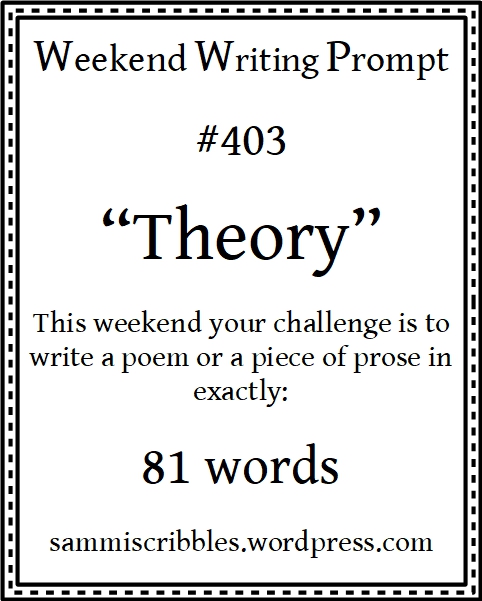
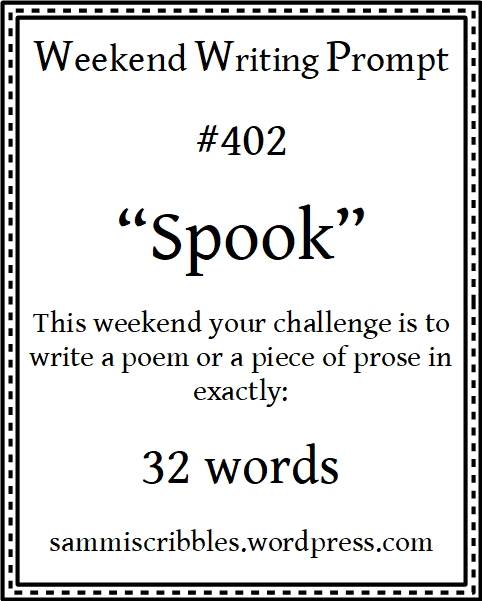
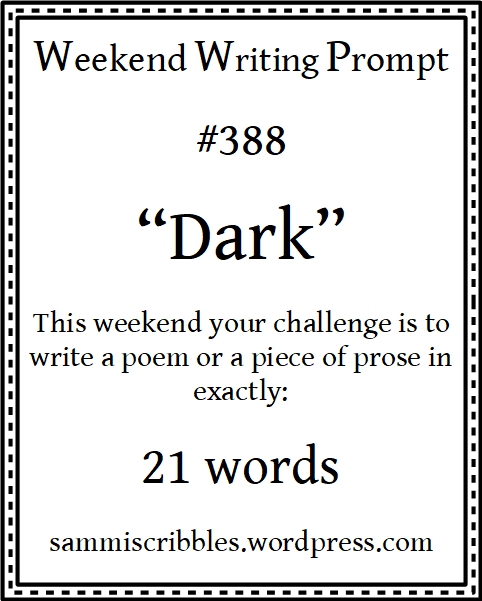
Here is my response to the Weekend Writing Prompt hosted by Sammi Cox. This is my first time participating. I hope I get right.
In the quietude of twilight, a solitary tap resonates through the empty corridors, echoing off the dimly lit walls. It’s a gentle, rhythmic sound, almost musical as if the universe itself were keeping time. With each tap, memories flicker, casting shadows that dance in the mind’s eye. It’s a moment of connection, a simple, unassuming tap that bridges past and present, conjuring a symphony of silent reflections.
Expect nothing. Live frugally On surprise. become a stranger To need of pity Or, if compassion be freely Given out Take only enough Stop short of urge to plead Then purge away the need.
Wish for nothing larger Than your own small heart Or greater than a star; Tame wild disappointment With caress unmoved and cold Make of it a parka For your soul.
Discover the reason why So tiny human midget Exists at all So scared unwise But expect nothing. Live frugally On surprise.
I’ve always been told I had a healthy imagination, so it is there I retreat to in times of stress. And this image is a representation of things going on a moment ago. Who knows what will happen next?
A toddler unleashes a shriek of glee as he shoots past an elderly gentleman with his unsure footing. He balances himself with his tiny arms outstretched. He giggles a little more with each step. We stand silently, watching him go. My soul churned in the warmth of his happiness as it spurred my own. His happiness brought back vivid memories of my grandchildren learning to walk and run. I missed my children’s milestones; otherwise, I was engaged.
I stopped to fuel up pickup before heading to a photo shoot. I’m excited about this one because it is the first time in months I’ve been well enough to even consider pulling out my camera. I’m startled back in the present by a metallic clang of debris hitting a dumpster. I watch the trash chutes flex as the waste finds its way down. AC/DC’s Shoot to Thrill starts the road trip playlist.
After, a few minutes of chatting after arriving at shop I discover I have everything in my camera bag, but an SD card. We laugh about the ridiculousness. I finally got myself together to do the shoot and realized I’m so rusty I have no idea if any pictures will be good enough to post. I show a few to the fellas and assure me that concerns are justified.
Here are a couple shots:
My brother skim coating a new gas tank.
Today was first day all three been in the shop in months. The first time in forever, where there wasn’t constant look of concern on whether I was going face plant at any moment. I lasted several hours before I plain tuckered out and needed to make the drive home.
My first photo shoot back was disaster as photo shoot’s go, but it felt damn good to be working in the shop again. Round 2 is tomorrow; wish me luck
In the night in my half hour negro dreams i hear voices knocking at the door i see walls dripping screams up and down the halls won’t someone open the door for me? won’t some one schedule my sleep and don’t ask no questions? noise. like when he took me to his home away from home place and i died the long sought after death he’d planned for me. Yeah, bessie he put in the bacon and it overflowed the pot. and two days later when i was talking i started to grin. as everyone knows i am still grinning.
As a writer, I often reflect on my inspirations or, more precisely, why I chose to become a writer. I ask myself, was there a thing more than the others that influenced this decision? I never come up with a definitive answer, but I feel compelled to discuss the impact of the Harlem Renaissance.
The Harlem Renaissance is one of American history’s most significant cultural movements, representing a period of profound artistic and intellectual awakening among African Americans in the 1920s and 1930s. Centered in the vibrant neighborhood of Harlem in New York City, this period witnessed an unprecedented surge of creativity and innovation across various artistic disciplines, including literature, music, visual arts, and theater. The Harlem Renaissance not only transformed the cultural landscape of America but also challenged prevailing racial stereotypes and paved the way for greater recognition of African American contributions to society. This essay aims to provide a comprehensive overview of the Harlem Renaissance, exploring its historical context, key figures, artistic achievements, and lasting impact on American culture.
Historical Context:
The Harlem Renaissance emerged against the backdrop of widespread racial discrimination, segregation, and socio-economic inequality faced by African Americans in the early 20th century. The Great Migration, a mass movement of African Americans from the rural South to urban centers in the North, including Harlem, during and after World War I, was pivotal in shaping the period’s cultural milieu. In Harlem, a vibrant community of artists, writers, musicians, intellectuals, and activists converged, seeking refuge from racial oppression and striving to create a space for artistic expression and cultural affirmation.
Key Figures and Literary Contributions:
Central to the Harlem Renaissance were the writers and intellectuals who articulated African Americans’ experiences, aspirations, and struggles through their literary works. Among the most prominent figures of the movement were:
1. Langston Hughes: Renowned for his poetry, fiction, and essays, Hughes captured the rhythms and vernacular of African American life in his works, addressing themes of identity, heritage, and social justice. His seminal poem “The Negro Speaks of Rivers” and his collection “The Weary Blues” are enduring classics of the Harlem Renaissance. Hughes moved so much as a young poet. His work was instrumental in assisting me to develop my style as a writer.
2. Zora Neale Hurston: A pioneering novelist, folklorist, and anthropologist, Hurston celebrated the culture and traditions of the rural South in her writing, challenging stereotypes and portraying the complexity of African American life. Her masterpiece “Their Eyes Were Watching God” remains a cornerstone of African American literature. Before discovering her, I had such a limited glimpse of the power of the period.
3. Claude McKay: Known for his poetry and novels, McKay explored themes of race, oppression, and resistance in his works, blending elements of traditional English poetry with African American vernacular. His poem “If We Must Die” became a rallying cry against racial violence and injustice. Mckay’s work taught me that I could include hope amidst the verses of pain and despair. He fundamentally affected how I constructed a verse.
4. Nella Larsen: A gifted novelist, Larsen depicted the complexities of racial identity and social mobility among African Americans in her novels “Quicksand” and “Passing,” shedding light on the psychological and emotional challenges faced by individuals navigating between racial boundaries. Passing took me to a world I seldom acknowledged. She introduced me to the struggles my adoptive grandmother faced. I often wondered about some of Mimi’s beliefs; what were their origins? Passing provided possible answers to my numerous queries.
5. Jean Toomer: Influenced by his experiences in the rural South and Harlem, Toomer’s experimental novel “Cane” defied conventional literary genres, blending poetry, prose, and drama to explore the lives of African Americans in the post-Reconstruction era. Often, I experimented with the combination of prose and poetry. For example, I was often ridiculed for my attempts. I knew it could be done. Not only done, but done well. I was introduced to Toomer and his Cane. I ceased doubting myself and continued writing. When I read Jason Reynolds, I am reminded of Toomer.
These writers and many others challenged prevailing literary conventions and redefined the African American literary tradition, enriching American literature with their diverse voices and perspectives. Here are a few more of the notable writers of the period.
Countee Cullen
Jessie Redmon Fauset
James Weldon Johnson
Alain Locke
Wallace Thurman
Arna Bontemps
Rudolph Fisher
Angelina Weld Grimké
Georgia Douglas Johnson
Helene Johnson
Alice Dunbar-Nelson
Anne Spencer
Gwendolyn Bennett
Marita Bonner
Dorothy West
Artistic Achievements and Cultural Impact:
Beyond literature, the Harlem Renaissance encompassed a rich tapestry of artistic expressions, including music, visual arts, theater, and dance. Jazz, with its improvisational style and syncopated rhythms, became the quintessential sound of the era, symbolizing the spirit of cultural innovation and liberation. Musicians such as Duke Ellington, Louis Armstrong, and Bessie Smith rose to prominence, captivating audiences with their electrifying performances and reshaping the landscape of American music.
In the visual arts, African American artists such as Aaron Douglas, Jacob Lawrence, and Romare Bearden explored themes of identity, history, and social justice through their paintings, murals, and collages, contributing to the flourishing of African American artistry and aesthetics.
The Harlem Renaissance also witnessed a resurgence of African American theater, with playwrights such as Langston Hughes, Zora Neale Hurston, and Eugene O’Neill staging productions that reflected the experiences and aspirations of African Americans. The New Negro Movement, as articulated by Alain Locke in his seminal anthology “The New Negro,” sought to challenge racial stereotypes and promote a positive image of African American culture and identity.
The legacy of the Harlem Renaissance extends far beyond its immediate historical context, influencing subsequent generations of artists, writers, and activists and contributing to the ongoing struggle for racial equality and social justice. By reclaiming their cultural heritage and asserting their creative agency, the participants of the Harlem Renaissance paved the way for greater recognition and appreciation of African American contributions to American culture and society.
Conclusion:
The Harlem Renaissance is a testament to the African American community’s resilience, creativity, and cultural vitality in adversity. Through their artistic achievements and intellectual pursuits, the participants of the Harlem Renaissance challenged prevailing racial stereotypes, celebrated the richness of African American culture, and laid the groundwork for a more inclusive and equitable society. As we commemorate the legacy of the Harlem Renaissance, remind us of the enduring power of art and culture to inspire, uplift, and transform lives, transcending barriers of race, ethnicity, and nationality.
I had been for a long time until it ran out of places to go. I ended up here sitting in the darkness hollowed out. I expected to find anything once I arrived, but I found her. She was sipping gas station coffee, grimishing each sip. Her gaze trapped in the moment between breaths. We started something in the next moment that should have lasted a lifetime. She captured my heart, so I gave her my soul.War reared its ugly head and took her snarling. Before that moment, we argued. About what I can’t remember, but now it’s too late to reconcile.
This is one of the easiest questions I’ve answered in a while. The answer is YES. I love it. However, it feels odd to say so when that hasn’t been the case. For decades, I had this thing where I wanted to be older than my age. Almost like I was born during the wrong era or something. The problem I could never settle on a period I really wanted to be from.
Then was the whole “you’re just a kid. You’ll understand when you get older.” I hated being treated like a kid. I refused to believe that age possessed this fountain of wisdom that eluded my entire youth. Often, I wondered what age or day I was going to understand the mysteries of the world suddenly. Would it be on a weekday? Or on the weekends? I hoped for sometime during the week because, let’s face it, on the weekends, there was beer and women to be ignored by. Disgusted or disapproving looks from members of the opposite sex while standing obnoxious with the fellas is a rite of passage.
However, I would like to be on a Monday if it was during the week. Many complain about Monday’s, but I don’t mind so much. Over the years, I found several to be rather pleasant. Tuesdays would be alright, too, yet it doesn’t pop off on Mondays. Any day after is a negative ghost rider. There to much preparation from the pending weekend. You can’t be bogged down with a complex thought. I can see it now, sitting there tugging on your peach fuzz chins, saying, “Hmm.” For those fellas who could grow full beards in high school, I am jealous.
I enjoy my age now because all I have to do is sit around looking at people like they’re crazy. Who needs cable? Have you ever looked at the younger folks when you get older? They are hilarious, aren’t they? It’s alright. You can admit it. The only drawback is the random, unprovoked ailments that surface periodically. Yes, I said unprovoked. This is my story, and I’m sticking with it. I can speak my mind. I’m old enough to know better but too old to give a shit. After all this crap of wishing I was older, I’m finally in the winter of life. It gets a little chilly at times, but hey. Excuse me while I slip on a sweater.
There’s a thud as my quill hits the desk. My inkwell unleashes a howl mixed with desperation and relief. It’s a little beside itself because I haven’t written anything of note in months. My eyes burn from what was supposed to be all-nighter, but really only a few hours of spits and starts. Baby steps, huh? They got to be better than not writing anything all. At least, that’s what I tell myself as I stare at the ink stained fingers of my aching hands.
I close my eyes and the let the stream of world of random thoughts fill my screen. Each word typed is attempt to rediscover the path to a coherent thought. A thought minus the lure of ineffective painkillers. Taken only to help you forget the torment you’re suffering momentarily. Yet, forget the principle of pain; it’s a reminder we are alive. Each wince, cringe, or scream a verse in the testimony of our lives
Bradbury got it right in a way. We are tattooed neath the surfaces. Each of those tattoos are alive illustrating the moments that matter . Moments we acknowledge, yet include the ones swear that mean anything, but touch us so deeply.
My inkwell unleashes a belch, then stretches. A metallic click fills the room as the licks its lips and throats a “Thank you!” I refill my quill and pull out a fresh notebook. Then lean back in my office chair to rest.
“I knew that shit, you’re such a fucking tease!” My quill and inkwell declare in unison.
I’ve been here over a week. I’m not sure I have I left here on the front. My body is waging war against my spirit. My spirit is losing, but the battle is far from over. Last Monday, I walked into the ED thinking one thing and discovering another. Each day, we take another step toward victory. Each day, it feels we take five steps back toward defeat.
Despite this, I gaze upon the evening skew finding strength in its beauty. Each sighs becomes the breath of hope. In each breath I finds courage.
What I like about this post is that it applies to everyone. The speaker speaks to a Christian audience, but I believe it applies to all faiths. It takes more than faith when serving the Master. I been to battle with people of all faiths and their one constant. We believed what we doing was for a better world for our families. Our faith in this concept gave us the strength to do what was necessary. Thank you Fibercraft Grannie for reminder.
I’ve reached the age where complaining seems like a superpower. Of course, this expands my current superpower of ranting at the drop of a hat. Not to mention, I drop a few justified gripes when it’s called for. Yet, there are times when I remain silent, but I can’t be held accountable for facial expressions. So, if I think you’re jackass; I don’t have to say a word. My face says it all.
However, lately, the thing that chaps my ass the most is people’s lack of compassion for others. It seems we don’t care about each other like we used to. I get it! Times are different. People are different. I’m no better. I can go days without talking to another person. I’ve always been that way. Anti-social is what they called me. So, trust me, I’m not casting any stones.
I’m sure you have noticed people are walling themselves off more now than ever. As if they prefer interactions on their devices rather than actual human conversation. Another thing I’ve seen is that when you are having these conversations, they aren’t actually listening. There are a lot of head nods and other indicators they aren’t paying attention to, but they are meant to fool you into thinking you’re having a meaningful conversation.
Alas, don’t fret. I, too, have been fooled. We need to slow down, stop, listen, and help one another.
Living with cats is so different from living with dogs. It took a minute to grasp that, but now I believe we have an understanding with each other; I think, maybe. Well at least the best understanding one could have with a cat.
Now when I raised dogs, I’m certain we had an understanding. They pretty much followed all their commands without hesitation, giving enough training and time. However, I remember my first Rottweiler could seem to grasp the concept of saving me at least one Oatmeal Creme Pie. No matter how hard I tried he would goggle them all up. Despite this, I still loved him dearly.
A dark unfathomed tide Of interminable pride – A mystery, and a dream, Should my early life seem; I say that dream was fraught With a wild and waking thought Of beings that have been, Which my spirit hath not seen, Had I let them pass me by, With a dreaming eye! Let none of earth inherit That vision of my spirit; Those thoughts I would control, As a spell upon his soul: For that bright hope at last And that light time have past, And my worldly rest hath gone With a sigh as it passed on: I care not though it perish With a thought I then did cherish.