Litany in Black


Rain glazed the neon crescent above Second Moon Books until it gleamed like a razor’s edge slicing through the night. Elias Moreau’s fingers trembled as he flipped the weathered placard to CLOSED. The paint on the letters bled, fading faster every September—as though some unseen smart-ass on the other side of the door was trying to erase the word before last call.

Inside, the air carried the sour bite of old glue and the metallic tang that seeped up from the subway grates. A crooked chalkboard behind the register wore last week’s proclamation in smudged white chalk:
BIRTHDAY BLOWOUT – A FULL WEEK OF HORROR & HOPEFUL DREAD
A Tribute to Stephen King

Eli’s pulse ticked in time with the neon strobe outside. Every year he staged this seven-day ritual for King, the undisputed monarch of macabre wonder. King’s uncanny magic felt almost domestic, like discovering an old friend hiding in the crawlspace. But Gordon Weaver—now that was a different kind of haunt. Weaver carved the American family like a butcher who’d gone to seminary, exposing grudges and betrayals with a quiet precision that left scar tissue. Friends nodded politely at Eli’s King obsession but flinched at Weaver’s hushed horrors, as if the silence of a fractured household couldn’t follow them home harder than a demon ever could.

Counting bills at the till, Eli listened to the upstairs dehumidifier hum and a distant patrol siren wail. The shop was empty—until the door chime rang.
One polite jingle.
He froze, chest tightening, waiting for the echo that never came.

A damp breath rose from the basement stairs. Twelve years of half-formed chapters and midnight revisions leaned against a dented Underwood down there, sulking. He’d promised himself an extra hour—maybe two—before trudging home. Perhaps he’d finally finish the scene about a stranger who knocks after hours, demanding a book that doesn’t exist.

The bell chimed again, louder this time.

He jerked his head toward the door. Beyond the glass, a wet silhouette lingered: coat collar turned up, hat brim low—someone who moved like yesterday’s regret. A third jangle, brittle and hollow, and the lock clicked itself open. A gust of rain-scented air swept in, carrying a soft undercurrent of cedar. Then she stepped across the threshold.

She was impeccable, as if traced by a meticulous pen. Mid-forties maybe, but she wore her age like a tailored alibi—each line on her face an elegant footnote. Dark hair, slick with rain, clung to the sharp planes of her cheeks. Her long coat shimmered under the flickering fluorescents. But it was her eyes—gray, or green, the light shifting like a flame—that snagged him and refused to let go.

A needle-sharp ache blossomed beneath his sternum, radiating into his left arm. Heart attack, his mind hissed. He slammed a hand on the counter, breathing ragged, every inhale a serrated blade.

She paused just inside the door, lips curving in a small, almost tender smile. He didn’t know her—he was sure of that—but some buried page of his past fluttered to life. Familiar and impossible in the same breath.

“You okay?” Her voice was low, calm—the kind you’d use to coax a frightened animal out of traffic.

He nodded too fast. “ I-I’m fine. Long day. Sale week.” The words tasted like he’d chewed them wrong.

Her smile deepened, unreadable. She turned toward the chalkboard, fingertips trailing through the chalk dust. BIRTHDAY BLOWOUT – A FULL WEEK OF HORROR & HOPEFUL DREAD…

“Do you still read Gordon Weaver?” she asked, voice soft as velvet smoke.

The name hit him like a dropped stone. Weaver wasn’t on the board. He hadn’t said that name aloud in months.

“How… how do you know about Weaver?” he stammered.

Her eyes glinted with something not quite amusement. “Oh, Eli,” she breathed. “You always did love a good story.”

Weaver: Count a Lonely Cadence, the battered paperback he’d rescued at a college sale, pages yellowed and reeking of cigarettes. Weaver peeled back the American family like skin from bone—quiet betrayals, unsaid resentments, love rotting in plain sight. Then Such Waltzing Was Not Easy dragged him deeper, mapping small domestic wars in brutal intimacy. No demons, no ghosts, just everyday hauntings that never left his marrow.

Now this rain-soaked stranger spoke Weaver’s name as though she’d plucked it from the private margins of his soul.

“Have we… met?” he asked, voice smaller than he felt.

“Not in the way you mean.” She stepped closer, eyes roving the shop’s towers of paperbacks and the narrow aisles of hardcovers balanced like drunk skyscrapers. “You look familiar.”

He swallowed. “Or maybe you’re a character I’ve been writing for years.”

Her smile flickered—a blade wrapped in silk. His chest flared, nerves taut with something like fear or longing or the first line of a story he couldn’t put down.

An echo of his own unfinished draft whispered through his mind: She enters like a paragraph he rewrote a hundred times and could never perfect. Named only by his yearning for her to hurt him.

The shop inhaled. Somewhere beneath their feet, the basement typewriter began to tap—slow, deliberate keystrokes spelling out a narrative Eli no longer commanded.

She gestured toward the narrow stairwell. “Shall we?”


The basement smelled of damp brick and stubborn paper. She eased into the swivel chair beside his desk and crossed one elegant leg over the other. From some unseen pocket, she produced a long cigarette holder—old Hollywood glamour in a room that smelled like busted neon dreams. She slid a thin cigarette into the mouthpiece, fingers steady, and lit it with a soft gesture. Smoke curled around her like a velvet sermon.

Above them, the Underwood sprang to life, keys clattering in a jagged, confident rhythm. Each strike was a heartbeat in steel. The carriage dinged, bright and final. With every mechanical echo, the vise around Eli’s ribcage loosened, the stabbing ache receding to a dull throb. He inhaled freely at last.

“Iris Devine,” he whispered—the name he’d once given a character who refused to stay on the page.

She watched through the smoke, eyes glimmering with triumph. “Have you figured it out yet?”

The typing slowed. A new line appeared:

The writer clutched his chest as the pain returned, sharp as a rusted nail. Would the story kill him before the final word?

Eli’s breath caught. His knees trembled. Darkness edged in.

“Oh, Eli… darling, you can stop this. You know,” Iris whispered, leaning close, breath a warm brush against his ear.

Keys clattered again—then the ding of the carriage returned, harsh as a gavel.

“Eli,” she said, voice closer still, “I know who you are.”

The typewriter fell silent.

“Who am I?” she asked, tilting her head.

“You’re… a character. You can’t be real. This must be a delusion—right?”

Her smile sharpened, sudden and fierce. “Then why are you bleeding inside one?”

She pressed a soft kiss to his cheek, then a slow, deliberate lick that left warm proof on his skin.

“You feel that? Real enough for you, darling? Be a dear and fetch me something to drink—bourbon, if you have it.”


He stumbled toward the stairs—and above him, glass shattered.
He wheeled around. The chair was empty. In its place, a ghost of smoke curled where she’d sat.

“Darling, you need to come upstairs—hurry,” her voice drifted down from the shop above.

He climbed into the main room to find broken glass strewn across the floor. A lone policeman stood by the register, uniform soaked, cap pulled low.

“Elias Moreau?” The officer’s voice was soft, almost uncertain.

“Can I help you, officer?” Eli’s hand dove beneath the counter, grasping the cold comfort of an old revolver. He cleared his throat, voice steady. “Step back.”

The man froze, rain dripping from his shoulders. Eli’s finger curled on the trigger—then he exhaled and let the gun clatter onto the countertop. Instead, his hand found something heavier: the knowledge that stories kill cleaner than bullets.

The shop flickered—
And when he blinked, everything was normal.
No broken glass.
No officer.
Only a dark, wet outline on the floorboards where the stranger had stood.

A single ding drifted up from below.


Eli descended again.
Iris sat beside the desk, sipping bourbon, a neat stack of crisp pages at her elbow. A half-empty tumbler caught the amber light. She raised it in a silent toast.

“Welcome back, darling.”

He slid a fresh sheet into the typewriter. The carriage clicked forward, awaiting his command. His fingers hovered—then struck, each letter unfolding with deliberate clarity.

CHAPTER 1

Writing has always been bigger than the writer and the story.
A kind of theology.
The religion between the writer and the story is a spell cast upon them.
The reader sits back and deciphers this literary kung fu.

Writing is a living theology.
A way of life, not just an ideal misunderstood by its practitioners.
Something real, and genuine. Something absolute.
The page is a pulpit, the keys a busted rosary, each prayer hammered out like it owes you rent.

Iris placed her hand on Eli’s arm, warm and insistent.
“Do you know,” she said softly, “that a marmot will chew through its own trap rather than stay caged? Writers should do the same.”

Her thumb traced a slow circle on his sleeve.
“Don’t be the marmot that gnaws in silence. Write until the steel bends for you.”

The typewriter answered with a single, eager ding.

Eli exhaled, a small, resolute smile breaking through the shadows on his face.
“This is where I belong.”

She rose with unhurried grace, smoke trailing like a benediction.

“I’ll put on the coffee,” she said.

The Underwood offered one final, gentle ding—a promise, not an ending.


Author’s Note

Today is Stephen King’s birthday, so I decided to play around with the supernatural and other weird stuff.
The prompt words used today were theology, marmot, and literacy.
Again, as always, thank you, FOWC, RDP, and Word of the Day for your inspiration.

The Monument’s Silence

Entry Eight: Dispatches from the Splinters of My Mind


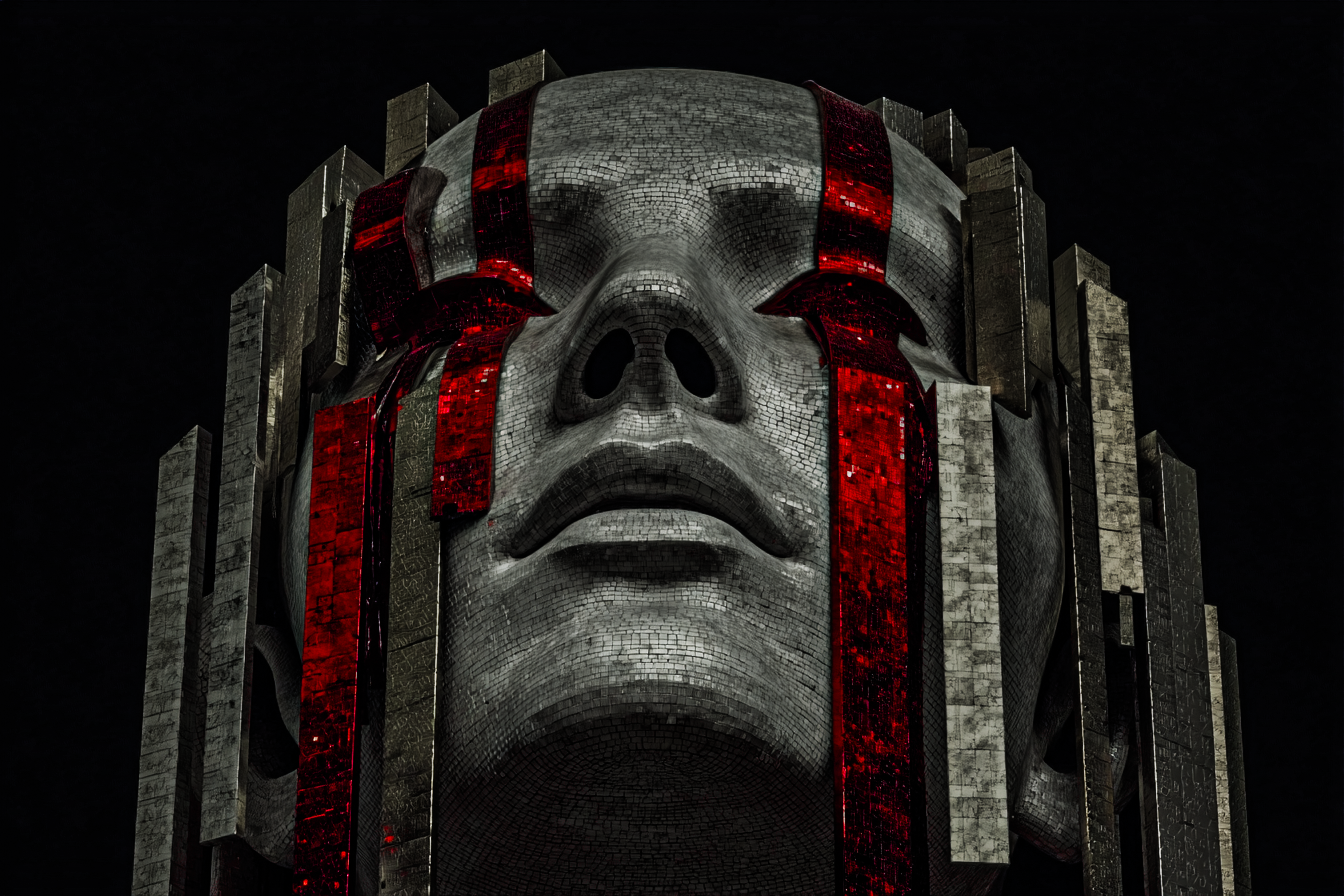
The face hung over her as a dead moon would, immense and inert, plastered to the sky with the obscene permanence of a fossilized wound. It was not sculpted in the image of any god she recognized, nor did it bear the standard of a people desperate to placate the furies or worship their own reflection. Instead, it hovered on the edge of intent and accident—a precipice suspended in time, inevitability chiseled into every brute angle of the jaw. Each block that made up the visage was a shorn-off shard, ash-gray and rough-edged, but arranged so that the fractures and pitting created a ragged, almost animate skin. From a distance, the monument looked inert, but on approach it seemed to lean forward, as if gravity bent toward its own creation.

Up close, the surface shimmered with a faint, sickly gloss, not the result of centuries of wind polishing, but rather something more insidious: a hidden moisture, as though the stone itself exhaled condensation from a deep, slow-breathing lung buried far beneath the earth. The closer she drew, the more this exudation gleamed in the dying light, slicking her hand when she dared to stretch her trembling fingers only an inch from the surface. She jerked her hand away before contact, an involuntary spasm of repulsion, and it seemed to her that the stone recoiled as well, as if momentarily startled by her nearness.

The face’s hollow orbits, each deeper than a well and rimmed in a thousand years’ worth of wind-scoured dust, were not empty but filled with a red so saturated and unyielding that it was neither liquid nor illumination, but a third thing—a dense, coagulating radiance. This red bled outward in precise tracks, each line adhering to a groove so deliberate it made her stomach clench. At dusk, when the world’s colors flattened and the boundary between flesh and stone blurred, these rivulets painted the entire monument as if it wept a world’s worth of dying embers.

Beneath the eyes, the mouth was a gash so perfectly aligned that it projected neither malice nor welcome—simply a vacancy so absolute it wrenched at her. It did not pass judgment or offer answers, but waited in a silence that felt more like appraisal than apathy. When she stared at it, she became conscious of her own tongue, the dryness of her palate, the faint click of her teeth as her jaw tensed in counterpoint to the stone’s passive oblivion. For an instant, she lost the distinction between her own face and the monument’s, as though she were gazing at her own effigy, erected by hands who’d never known her and cared nothing for her likeness.

The statue was girdled by a ring of spines—pillars, each twelve feet high, tilting like teeth around the perimeter. Their faces were gouged by runes shallow and erratic, as if clawed by a desperate hand that knew it must leave a mark, but lacked time or understanding to encode more than a warning. When she turned her head just so, a vibration juddered through her jaw and teeth—a resonance that not only bypassed air but seemed to travel directly through calcified matter. It was not an audible tone but a bone-deep hum, a buried dirge that sang in frequencies meant not for ears but for the marrow itself.

A faint metallic tang rode the air, stinging her nose and settling on her tongue. Her pulse beat harder, a staccato drum against the inside of her skull. She knew she should have been afraid, or at least careful, but curiosity is rarely adaptable. It presses forward in one direction, refusing diversion. Even as some primitive sense screamed retreat, a more insistent force, slow and syrupy as honey, compelled her closer.

At the monument’s base, a set of spiral steps had been hewn directly into the rock, winding up toward the face’s sealed lips. The staircase’s edge was polished to a treacherous smoothness—perhaps by centuries of bare feet, or perhaps by something more recent. Each step she took yanked a shudder up her spine, the chill stone leaching heat from her bones. She tried to picture the hands and feet that had shaped these stairs, that had come before her, but the imagined forms refused to hold: they slipped away at the periphery, just out of sight, like ghosts not quite ready to reveal their sorrow.

As she climbed, the red seepage intensified, painting her arms and face in its cast. The color made her flesh look flayed and raw, as though she’d shed her skin and left it behind on the plain below. Her breath hitched in her throat, every inhalation mirrored by a second, deeper rasp—a guttural echo that rode beside her own, shadowing her ascent. She placed a hand against the cheek, bracing herself, and felt warmth pulsing through the stone—a low, feverish heat, rhythmic but not quite alive. Her heart skipped in answer. The pillars’ hum swelled, shaking her vision, warping the outlines of the world.

Suddenly, the lips moved. At firs,t it was only a quiver at their seam, a ripple of tension, but then the entire mouth flexed—and she swore she saw the faintest suggestion of tongue behind the teeth. She leaned closer, pressing her ear against the fissure. Beneath the monument’s stony shell, she heard breathing: not the shrill whistle of wind through cracks, but a true respiration, cavernous and ponderous, as though the monument had lungs the size of mountains and was only now remembering how to fill them.

The revelation paralyzed her. This was not a tomb built to honor the dead, she realized, nor a shrine to contain some ancient anger. The statue was a sarcophagus, yes, but one not yet emptied. The red running from its eyes was neither pigment nor rainwater but a bodily fluid, leaking from a cocoon that could not hold its contents. The face was a shell, a boundary—and something was trying to cross it.

Even so, she kept climbing, compelled by a mixture of terror and awe, the two emotions indistinguishable now in their velocity. By the final step, her knees trembled and her throat ached from the acid bite of fear, but she crouched anyway at the summit, only inches from the sealed lips. Veins of shimmering ember threaded across their surface, glowing brighter with every pulse of the monument’s breath. She felt a wave of heat roll over her, dense and chemical, and it left her dizzy, her skin tingling as though exposed to low voltage.

Now, as if cued by her presence, the ring of pillars began to thrum in a synchronized rhythm. One after another, they trembled against the ground, a chain reaction that rattled the bones of the earth itself. With each pulse, the red liquid burst a little brighter from the monument’s wounds, feeding rivers that ran down the steps and pooled at their base. Her limbs buzzed with a painful, almost ecstatic electricity.

Without meaning to, she heard herself whisper, “What are you?”

The answer arrived not as speech but as a violence in her skeleton. The words detonated inside her skull and reverberated through her ribcage, as though she’d been struck by a tuning fork forged for a different species. The sensation was not one of comprehension, but of total subjugation—a message delivered in a medium older than language or thought.

You.

The word was a spasm, a convulsion of being. She staggered backward, and the pillars responded, their angled bodies creaking as they pressed inward, shrinking the circumference of the circle until she was contained. The air thickened, the metallic taste blooming into a full, choking flavor. Her lungs seized, and she tasted rust and old ashes on her tongue.

The rivers of red exploded, no longer trickling but surging, a deluge that hissed as it struck the cold stone. In the reflections, she saw faces—hundreds, maybe thousands—each one a warped variant of her own, their eyes wide with terror or ecstasy or both. Each face pressed itself against the surface as if desperate to break through, their mouths open in a cry she could feel but never hear.

You repeated the monument, but now it was not merely a label, but an imperative.

She tried to clap her hands over her ears, but the sound lived behind them, in the architecture of her skull. Where her hands touched skin, she felt fissures opening: thin, pale lines that leaked light, as if her bone marrow had turned into a lantern. Each seam split further, the glow intensifying until the skin could not contain it.

Inheritance, not worship.

The lips of the monument parted, forming syllables that bent the air into impossible shapes. The pillars groaned, their runes flaring with a dark fire. One pillar cracked, then another, each yielding with the wet snap of a femur under pressure. Dust erupted into the air, shrouding the steps. The rivers rose higher, climbing up the pedestal and wrapping around her ankles, then calves, burning her with a heat that did not scald flesh so much as erase it.

She stood rooted in place, unable to turn away, because in that moment she understood: This was not a prison, but an incubator. The thing inside was not a remnant, but a seed.

And it was time to hatch.

What followed was not blackout but erasure. Her mind remained, but submerged, as though she had been drowned beneath a tide of molten syllables. Her body convulsed, every joint unhinging, seams of light splitting wider until the marrow itself glowed.

She tried to scream, but the sound was stolen from her, bent into a chant that was not her own.

It spread through her like fever, like birth, like—


Author’s Note:
This entry was inspired by the image of a monumental stone face weeping red channels, surrounded by jagged pillars. I wanted to explore the tension between worship and imprisonment — the idea of a monument that is not passive, but alive, incubating something ancient. The words fake, adaptable, and angle were drawn from community prompts (FOWC, RDP, and Word of the Day) and woven into the text.

Delores the Detour

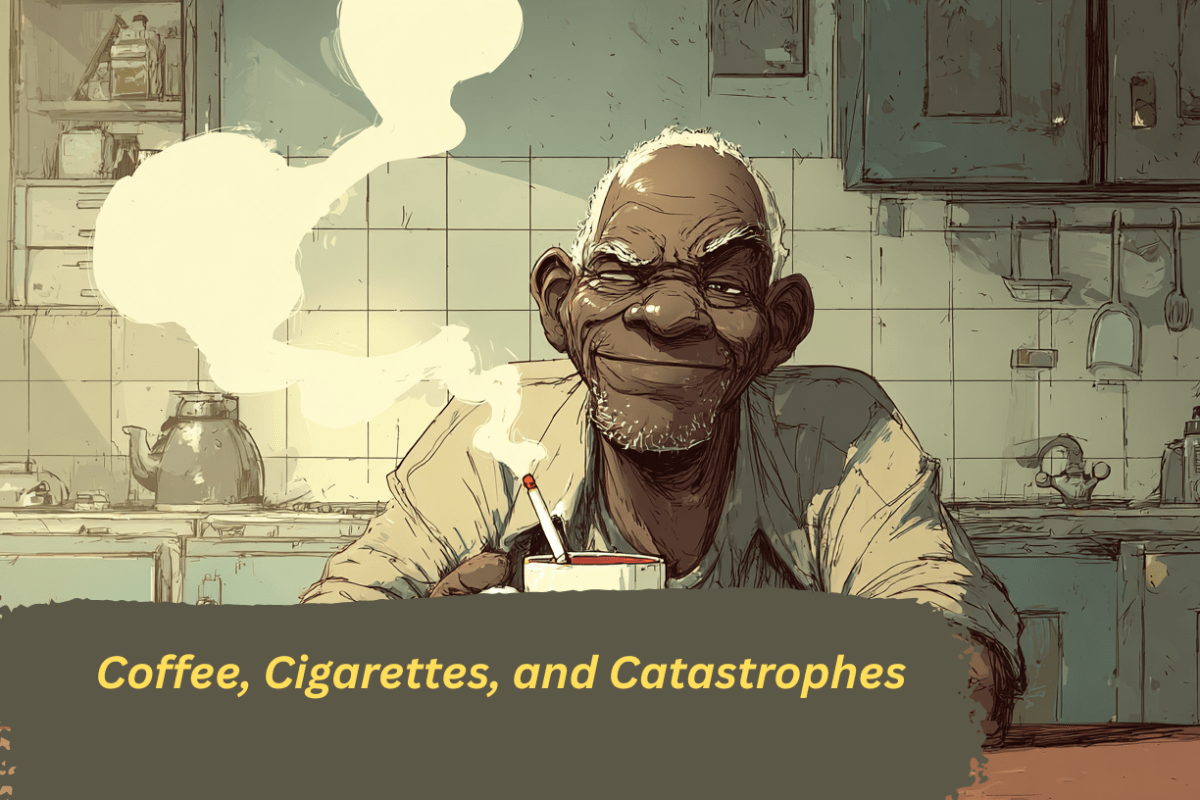
Episode 2: Coffee, Cigarettes, and Catastrophes

The morning coffee tastes like wet asphalt today, bitter and a little metallic, which feels right because Delores was the human embodiment of a detour sign—bright, tempting, and guaranteed to land you somewhere you didn’t plan on going.

We met outside a dive bar that smelled of stale gin and Monday failures. I was waving for a cab, she was leaning against one—hair slick with streetlight, cigarette ember pulsing like a tiny warning flare. Delores fixed one eye on me through the smoke and said, “Get in if you’re brave or drunk enough.”
I was both, and apparently suicidal enough to think that sounded like romance.

Her cab smelled of gasoline and fading leather, the heater coughing a lukewarm breath that carried the ghost of every passenger before me. Delores drove like the city owed her a favor and she meant to collect, slicing through alleys slick with last night’s rain. Each turn came with a commentary delivered in that dulcet rasp of hers—soft velvet laid over broken glass—that made even a near-miss feel like a bedtime story.

Dinner was a mushroom pizza balanced on the hood at three a.m., steam rising into the amber glow of streetlamps. Sirens wailed in the distance, a crooked lullaby. She’d gesture at the skyline with a grease-stained hand and tell me where she’d hide when the world finally caught fire. I believed her. There was already a bunker behind her smile.

Our nights blurred into an integrated system of near-misses: her ex calling mid-shift to harass her over some ancient grudge, my wallet sliding between cracked seats, the sudden realization that her idea of commitment was showing up before dawn. Every mile carried the taste of exhaust and the thrill of maybe not making it home.

I loved the motion more than the woman, though I didn’t admit it then. The rush of wet tires on pavement, the neon flicker on her cheekbones—it all made me feel like my own stillness might finally shake loose. Trouble is, you can’t build a life at thirty miles over the limit. Motion only disguises the void; it doesn’t fill it.

The night it ended, we hit a traffic circle she called “The Bermuda Triangle of Bad Decisions.” She didn’t slow down. I grabbed the dash, she grabbed my knee, and whispered, “You ever wonder if we keep driving fast enough, maybe the past can’t catch us?”
Her words slid into me like smoke through a cracked window—seductive, poisonous, and half-true.

I stepped out at the next red light and let the cold air slap me awake. Behind me, the cab’s taillights smeared into the wet dark, a pair of crimson commas on the sentence we’d never finish.

Moral of the story? Detours thrill the blood, but every one of them bends back to the same brutal truth: you can outrun traffic, but not yourself.


Author’s Note

This late-night joyride is fueled by the unholy trinity of prompts—FOWC, RDP, and the Word of the Day—each one a pothole I was happy to hit. The required troublemakers—eye, dulcet, and harass—slipped into the story like sirens in the distance: sharp, unavoidable, and just loud enough to make you check your rearview.

Writing Delores the Detour reminded me how motion can masquerade as meaning. It’s easy to chase neon streets and mistake adrenaline for affection; harder to admit that speed only hides the quiet parts of ourselves we’d rather not patrol. Consider this your friendly warning from the passenger seat: detours are thrilling, but the bill always comes due—usually in gas fumes and unanswered questions.

Nineteen and Nowhere

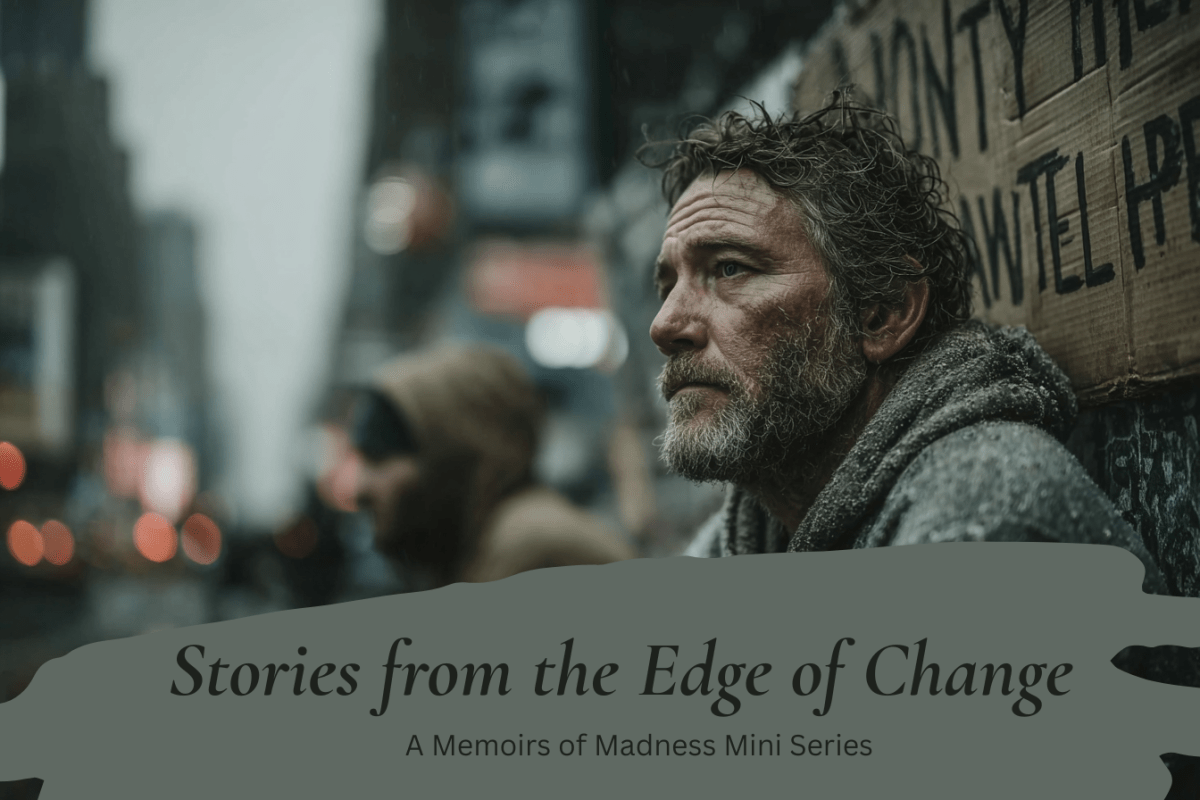
Stories from the Edge of Change – Volume 2, Part 1

“They said the system lost track of him. But he was never theirs to keep.”


The morning rain didn’t bother Ren. He’d learned that water was gentler than people.

He crouched beside the alley dumpster behind the drop-in center, shoulders hunched under a threadbare hoodie two sizes too big, sleeves eaten at the cuffs. His shoes—untied and uneven—squished when he shifted his weight. Rain pooled around the soles, but he stayed put, drawing loops on a soggy intake form with a chewed Bic pen. The form was from three weeks ago. He didn’t remember if he ever turned it in. Didn’t matter.

It was quiet this early. The kind of quiet that makes everything louder. His breath. His heartbeat. The clack of metal shutters two streets over. His fingers trembled, but not from cold.

He hadn’t slept inside in nine days.
But he knew where the cameras were, where the streetlights stopped working. Which stairs stayed dry?

He used to think that was survival. Now it just felt like memorizing a test he’d never pass.

A city bus hissed to a stop up the block, brakes squealing like something in pain. He looked up for a second, then back down. He’d been in those buses, once. With trash bags full of his stuff. Being transferred. “Transitioned.” “Placed.” Words that meant temporary. Always.

The folder in his backpack held every proof of his existence that the county ever gave him:

  • Two expired Medicaid cards
  • A GED prep schedule with coffee stains
  • A letter saying he was denied transitional housing
  • A single photograph, sun-bleached and wrinkled: him and Miss Tanner, his last foster placement, grinning with sparkler smoke behind them

He’d never shown that picture to anyone. He wasn’t even sure if the smile was his.
Sometimes he felt like that photo was the only place he still left a fingerprint.


Inside the drop-in center, they’d already started handing out coffee and hygiene kits. Ren didn’t go in. Not yet. He didn’t want to be seen with wet hair and a panic attack crawling just beneath the skin.

He’d been in a group home once that called itself “trauma-informed.” They still lock the bathroom at night.
He’d rather piss in the alley than ask permission again.

A man passed by, muttering to himself, trailing a shopping cart full of pillows and clinking bottles. Ren didn’t flinch. The cart guy nodded, as if he knew him. Maybe he did.

He did know the feeling: You’re alone but not exempt. Not from the weather. Not from the noise. Not from the memory of being fifteen, hands shaking as a caseworker said, “We’re placing you in a new home.” She said it like it was an opportunity, not another stab wound in a file no one would read.


The sky split open with a gust of cold air, and Ren finally stood. Pulled his hoodie tighter. Slipped the intake form into his back pocket. It had his name spelled wrong anyway.

He stepped out from behind the dumpster, not into confidence or comfort, but into motion. He moved the way you do when no one’s expecting you—not slow, not rushed, just enough to stay above notice.

As he passed the shelter entrance, he saw a boy younger than him sitting on the stoop, wrapped in a trash bag and drawing in the condensation on the glass door.

They didn’t speak. Just exchanged a glance. The kind that said: Yeah, I see you. No, I won’t say your name.

Ren knew that sometimes a glance was the only shield you had left.


He kept walking toward the corner, toward the same coffee shop he never entered, where the manager never made eye contact and the workers tossed day-old bagels out at 11:00. He’d wait nearby. Not to beg. Just to exist adjacent to someone else’s comfort.

This was the work.
Not recovery.
Not healing.
Just… enduring without disappearing.


He passed a torn flyer taped to a lamppost—one of those mental health outreach posters that still had a suicide hotline and a QR code for free therapy that didn’t exist anymore.
Someone had scrawled across the bottom in Sharpie:

“Hope is just the thing they say when they have nothing left to offer.”

Ren stopped.

He stared at that line for a long time.
Then smiled, just barely.

Not because it was funny.
But because he’d believed in hope once—and he’d watched it falter in real time.


Author’s Note

Written for Stories from the Edge of Change – Volume 2.
This piece responds to today’s word prompts:

Ren is fictional, but his story is rooted in reality—lived, endured, and too often ignored.
This piece isn’t about rescue or redemption. It’s about what it costs to keep going when the world has already filed you away.

Some people carry their past in manila folders.
Some names vanish before they’re ever called.
And some stories live in silence until someone listens.

Thank you for reading. Let me know if you’re ready to meet the others.

Stories from the Edge of Change II

Chapter 2

The One Who Stayed

They called him Angel. Not because he was good—he wasn’t. But because that was the name his mother had scrawled on the back of a birth certificate before vanishing into whatever hole the meth and the men had dug. That’s what the caseworker said, anyway. He never knew if it was meant as a blessing or a dare.

Maple Street didn’t care what your name was. It didn’t give a damn about backstory or trauma files. It just asked if you had something worth trading—dignity, a story, sometimes blood. If not, it lets you rot in its shadow. Cold. Dirty. Forgettable.

Angel’s coat smelled like salt and mildew. His jeans were stiff with city grime and sweat. He kept his hoodie pulled low and his mouth shut. That was his trick—if you kept your eyes on the pavement, people passed by faster. If you sat still enough, maybe the shame wouldn’t boil over.

He didn’t want sympathy. He wanted protein. He wanted socks. He wanted to fall asleep without twitching awake to sirens or wet cardboard collapsing under him.

And maybe—though he’d never say it out loud—he wanted someone to call him by his name without checking a clipboard first.


The man who sat next to him that day didn’t look like much. Worn hoodie, creased face, tired eyes. Same as the rest. But he didn’t try to hawk salvation. Didn’t flash a business card or mutter some rehab mantra through a forced smile. He just lowered himself down, exhaled like it hurt, and offered a protein bar.

“You don’t gotta stay here.”

That was all he said.

Angel didn’t answer. But the words landed anyway, quiet as dust, sharp as memory. There was no lecture in the tone, no brag in his posture. Just something steady. Like a man who knew what a long fall looked like and still chose to climb anyway.

Angel watched him walk away. There was a patience to his stride, not fast, not dragging, more like a hawk circling something that hadn’t happened yet.

The protein bar felt heavy in his hand. Real. He unwrapped it hours later behind the train station, fingers cracked and trembling from the cold. It tasted like chocolate and chalk. Like something that might matter.


That night, he couldn’t sleep.

Not because of the cold—he was used to that—but because of the quiet. Something inside him had shifted, and he didn’t like it. He wanted the usual numbness back, the hollow where hope had once lived.

He kept hearing that sentence. You don’t gotta stay here.
It scraped against the walls of his skull.

Because what if the here wasn’t just the corner? What if it was his skin? His blood? His whole damn life?

The wind picked up and pushed trash through the alley. A soda can clattered down the curb like it was running from something. He pulled the hoodie tighter. Even wrapped in layers, he couldn’t shake the chill. It wasn’t just cold—it was recognition.

He thought about every report, every meeting, every incident on file. His whole existence was a debt—an account he didn’t remember opening but kept getting billed for. A chain of overdrafts, each mistake compounded by the last. And the thing about that kind of debt is, no one wants to co-sign your recovery.


The flyer was still there in the bench slat. Creased and slightly damp, but readable. The rehab center’s logo had a bird on it—a dove, maybe, or a pigeon pretending. “Supportive, Long-Term Recovery,” it said in round, hopeful font, like a band-aid on a bullet wound.

Angel stared at it for a long time. Then shoved it in his pocket.

He didn’t go in. Not that day.

Instead, he drifted. Three more nights outside. Two sober. One was so drunk he pissed himself in his sleep and woke up shaking. He thought about mugging someone at the red line platform. Didn’t. Thought about calling Marcus—his old foster brother, who once tried to stab him with a pencil during a group home fight. Didn’t.


Then, one morning, he was there.

Just standing outside the center like a sleepwalker. He didn’t remember making the decision. His feet had dragged him there like they were on auto-pilot. He kept his hands in his pockets and stared across the street.

A nurse with dreadlocks carried a cardboard box of snacks through the door. A man with sunken cheeks and a twitch stood outside arguing with security, begging for one more chance. A woman in pajama pants and slippers stormed out, phone in hand, yelling at her sponsor that she was done doing this bullshit.

It was clear enough—nobody was exempt from the wreckage. No matter how clean you looked walking in, the ghosts still followed.

Angel lit a cigarette. Took slow, deliberate drags. He didn’t cross the street. But he didn’t walk away either.

And somehow, that felt like the start of something he didn’t yet have the words for.


Author’s Note:

Written for today’s FOWC, RDP, and Word of the Day prompts.

Stories from the Edge of Change is a slow-burn series about survival without spectacle. It’s for those caught in between the ones who haven’t crossed the threshold, but also haven’t run. This story belongs to the uncertain, the reluctant, the almost ready. We see you.

The Dame Wore Duck Boots

Forecast: Regret – Episode 2

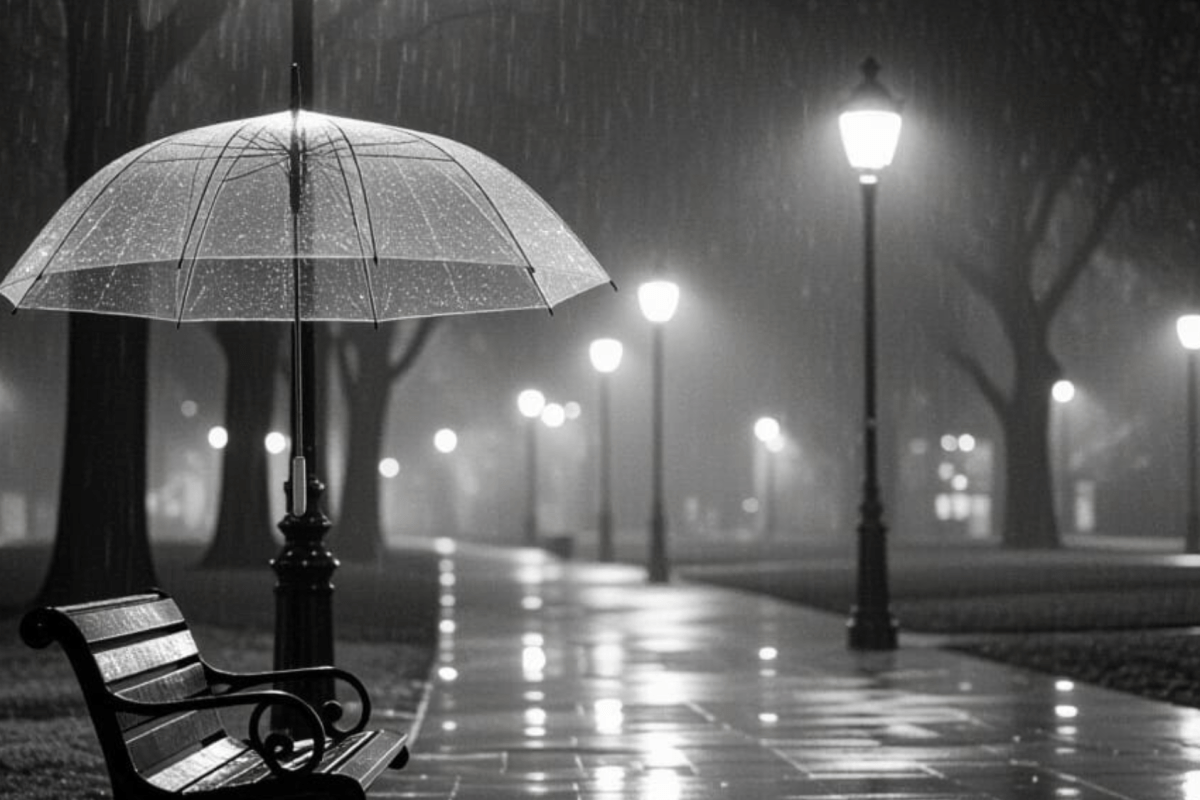
She appeared just past the second lamppost—trench coat clinging like a secret, umbrella in hand, striding through puddles like the laws of physics were optional.

Julian knew trouble when he saw it. It usually wore red lipstick, a miniskirt, and a tight monogrammed sweater—the kind of outfit that said “daddy pays the rent but I hold the lease on chaos.”
Today, though, trouble wore duck boots that quacked with every step and a look that could curl paint off a Buick.

She didn’t look at him. She didn’t have to. Women like that didn’t look; they summoned.

“Lost your umbrella again?” she said, pausing by the bench where Julian had been pretending not to argue with a squirrel.

“It fled the scene. Honestly, I think it’s seeing other people.”

She didn’t laugh. Just smiled—barely—a slow tilt at the corner of her mouth, like a private joke that hadn’t decided whether to trust him yet.

They stood in silence, rain dotting her umbrella like Morse code for bad decisions. The space between them held history—not romance, not quite—but something forged in long nights, bad coffee, and one too many favors exchanged with no names attached.

Then the birds attacked.

Not big ones. Not Hitchcock’s apocalyptic squad. These were small. Spiteful. Moist. They dive-bombed like feathered torpedoes with a vendetta against hats.

Julian flailed. She calmly finished a sip of coffee.

“I told you not to use that conditioner,” she said, ducking as one bird performed a tactical swoop. “Lavender-scented. They think you’re a meadow.”

“Then why are they hitting you, too?”

“I might have rubbed some of it on your collar.”

Julian blinked, now soggy and betrayed. “Why?”

She sipped again, her expression as neutral as Switzerland on a Tuesday. “Science.”

One bird landed triumphantly on the umbrella. Another did an aerial split and flipped him off mid-squawk.

Julian sighed and slumped onto the bench, defeated. She sat beside him, leaving an equal six inches of space and chaos between them.

For a moment, the world fell quiet—just rain tapping the concrete, the occasional rustle of wings, and that unspoken thing that always hung between them.

Maybe it was love once. Maybe just recognition. Like two people who survived the same fire and never spoke of it.

“I curl my hair in the mornings just for this,” she muttered, brushing a wet strand from her face.

Julian didn’t reply. He was too busy wondering if dignity could be taxidermied—or if maybe, just maybe, this ridiculous kind of connection was all the grace some of us got.


Author’s Note:
This piece is a continuation of the Forecast: Regret series—a flash fiction collection built on misadventures, poor choices, and the occasional squirrel assault. I wrote this story using the prompts from SoCS (Stream of Consciousness Saturday) and Esther’s Weekly Writing Prompt, which continue to challenge and inspire me in strange and delightful ways.

As always, I try to have fun writing fiction—because if I’m not enjoying it, I can guarantee Julian isn’t either.

Kimonogate 5

Chapter 5:

The Kimono Reawakens

It began with the sprinklers.

Not all of them—just the mayor’s.
At 12:13 a.m. sharp. Every night. A hiss, then a cough, then the sudden rhythmic chk-chk-chk of mechanical rain. His lawn lit up in droplets under the sodium streetlight, painting the grass silver and slick.

No one else’s sprinklers turned on. Not Myrtle’s. Not the Watsons’. Not the scorched patch in front of the abandoned townhome next door. Just his.

He stared at the soaked lawn from behind the kitchen blinds, barefoot, one trembling hand wrapped around a sweating glass of ginger ale. He told himself it was a glitch. Faulty programming. Coincidence.

But the next night, it happened again.

And the next.

And the next.


Then came the flags.

Little plastic ones—red, yellow, white—planted sporadically across his yard like someone was planning a tiny coup. The kind used by utility companies to mark gas lines or buried cables. He hadn’t scheduled any service.

One was stabbed right into the center of the lawn, directly above the place he’d buried the kimono.
Scrawled in blue ink on the tag:

What lies beneath grows bold.

He plucked the flag from the soil like it might bite him and stumbled back inside.


But the worst was the mail.

One morning, he opened his mailbox to find the usual pile of catalogs, water bills, and local campaign flyers. All accounted for—except the water bill. Gone.

In its place: a single pink sequin.

He stood frozen in the driveway, sun bearing down on his shoulders, sequin glinting in his palm like a warning. It felt too warm. Like it had been placed there just seconds before.

A neighbor walked past with her dog. Brindle nodded stiffly. She smiled, unaware that the mayor of their town had just begun to quietly lose his grip on reality.


Across the street, Myrtle wrote.

The typewriter she’d dusted off had a key that stuck on the letter “R.” Every time she typed a word with one, it made a soft hiccupping sound, like the machine was clearing its throat.

Her apartment smelled faintly of clove and lemon oil and something older, darker—possibly resentment.

She hadn’t written in years. Not properly. But this story… this one came crawling out of her like it had been waiting.

The protagonist: a petty man with secrets and a fading public smile.
The setting: a town where things didn’t stay buried.
The details: unsettlingly accurate.

She hadn’t meant to write about the mayor. Not at first. But the words showed up on the page like they’d been dictated through the blinds.

Myrtle paused, finger hovering over the spacebar. Capote lay curled at her feet, three-legged and twitchy, one eye blinking at half speed. He’d growled twice that morning. Once on the sofa. Once, at the kimono she hadn’t seen. Yet.

She lit a small lavender candle and resumed typing.


Around the neighborhood, the effects spread like static:

– A retired teacher claimed her garden gnome had moved overnight, now staring into her kitchen window.
– A man jogging past the park tripped over a tree root that hadn’t been there the day before.
– At precisely 12:13 a.m., two crows began circling the HOA sign in slow, deliberate loops. Clockwise. Always clockwise.

Next door lit up with cryptic updates:

“Anyone else missing their cable bill?”
“Found glitter in the hummingbird feeder. Can’t explain it.”
“Do NOT go near the mayor’s yard after midnight.”


Mayor Brindle sat in his guest room, lights on, knees pulled to his chest, a copy of Temple Blade and the Hollow Crown clutched like a holy book. His palms itched. His mouth tasted metallic, like he’d been chewing on tinfoil dreams.

He hadn’t slept. Not really.
He dreamed of sequins and spotlights and slow-motion applause that turned into dirt being shoveled over silk.

Every time he closed his eyes, he saw her.

Not Myrtle—LaFleur.

Her smile in his mind had changed. Sharpened. It wasn’t friendly anymore. It was authorial.
Like she was outlining his arc.


At 2:14 a.m., he cracked.

He walked to the park in house shoes and a flannel robe.
Dug up the kimono.

The soil felt wrong—damp even though it hadn’t rained. And warm. Not sun-warm, but body-warm. As if it had been waiting for him.

He unearthed the garment slowly, breath short, heart hammering in his throat.

It was still intact. Impossibly pristine. Not a spot of dirt. No frayed threads.
The sequins shimmered in the moonlight like they were alive.

He held it up, hands trembling.

It shifted.

Just slightly. But enough to make him drop it.

He stumbled back. Tripped on the shovel. Fell hard onto his side in the grass, wind knocked out of him.

From the edge of the trees, Capote appeared.

Silent. Watching. One leg cocked like he was deciding whether or not to bite.

Then Myrtle’s voice, floating from her porch like honey laced with arsenic:

“You might as well leave it in the ground, dear. The story’s better that way.”

The porch light clicked off.

And the moon blinked behind a cloud.

The Open Door

Part IV of the Spiral Series

The spiral pulled her north.

She didn’t decide. Not really. The artifact simply leaned in that direction, its hum stronger when she faced the mountains, weaker when she turned away. Her dreams ended there too—in jagged silhouettes etched against a dying sky, clouds crawling like wounded things.

She stopped asking why.

On the third day, the silence deepened.

Not just quiet—absence. No birdsong. No wind brushing leaves. Even her own breath seemed muffled, as if the world had turned down the volume on her existence.

It wasn’t altitude.
It was approach.

Something didn’t want to be disturbed.


She crested a ridge and saw it: a broken temple, half-consumed by the rock around it like the mountain had tried to swallow it whole. Pillars leaned like fractured bones. The stone steps bled with black moss. Light didn’t quite land right here—it floated, hung, like it wasn’t sure where to fall.

And in the air above the ruin: a spiral.

Not carved. Not painted. Projected—faint, flickering, as if the sky was remembering a shape it wasn’t meant to hold.

The artifact throbbed inside her coat, pressing against her chest with each step like a heartbeat just out of sync with her own.

She descended in silence.


Inside, the temple smelled like old metal and wet dust. Not decay—memory. The scent of forgotten things trying to stay relevant. The walls bent in strange ways—straight lines that turned slightly as she walked, always off by a few degrees, until her sense of balance slipped sideways.

Time didn’t work here.

A hallway led into itself. An echo arrived before her footstep. Her shadow stretched behind her, then ahead, then vanished completely.

And then—whispers.

Not words. Tones. Rising and falling in a rhythm that made her teeth ache. The artifact vibrated harder. It wanted something. Or it feared something.

Then she saw him.

A man seated in the center of a circular chamber, bones fanned around him like a ritual compass. He didn’t turn. Didn’t speak. Just opened his eyes like he’d never closed them.

“I was wondering when you’d arrive,” he said.

His voice was calm. Steady. Too steady.

Carla didn’t speak. She stepped closer, hand hovering over the artifact. Her breath fogged slightly, though the air was warm.

“You’re a keyholder,” she said.

He smiled—not with his mouth, but with his posture. His stillness. His certainty.

“So are you. Or you wouldn’t be here.”


His name was Liran.

He spoke like someone who didn’t just believe what he said—he’d built himself around it.

“They called the spiral a prison,” he said, gesturing to the glyphs. “But that was always the lie. It’s not a cage. It’s a cradle.”

The way he touched the stone was too gentle. Reverent. Like it had raised him.

Carla felt her pulse climbing. The air in the chamber shifted—thicker now. Her chest felt tight, like the oxygen was being repurposed for something else.

“A cradle for what?” she asked.

“For the next world. This one was a rehearsal.”


Liran reached into his coat and drew something out—another artifact. Smaller than hers, no silver veins. Matte black, split by a single groove that shimmered faintly red. The spiral on it was asymmetrical, sharp-edged. Wrong.

“This one doesn’t twist,” he said. “It just opens.”

Carla felt her own artifact heat up, protesting. Reacting.

“What happens if I use mine?” she asked, already knowing.

“Then you bury it. But it still grows beneath. It gets louder. Smarter. Hungrier.”

The floor beneath them pulsed. Not an earthquake—a breath. The room inhaled.

She took a step back. Liran didn’t move.

“You’ve already let something through,” he said. “Sealing this won’t fix that. It’ll just make you deaf to what’s coming.”

“Good,” she whispered.

And twisted.


The world ruptured.

No sound—just pressure, slamming outward. The glyphs ignited in a burst of white. The air tore with invisible claws. Something screamed, not with a voice, but with recoil—a shriek of retreat.

Liran staggered, shielding his face. The bones around him exploded into dust. The spiral projected above the altar shrank inward like a dying eye.

Carla collapsed to one knee, gasping for breath. Both artifacts pulsed once—hard—then went still. Her ears rang. Her skin burned.

She opened her eyes.

Liran was gone. No trace. No blood. Just the afterimage of something that had been there.

And her hand—

Red. Raw. Branded.

A spiral etched into the flesh of her palm—not cut, not tattooed. Emerging. Like it had always been under the skin, waiting to show itself.

Her breath caught. Her pulse raced.

I sealed it.
But I brought something through.

She wrapped her hand quickly, ignoring the pain.

Then she stood. Alone. Eyes on the exit.

There were more doors.

And now, something inside her was learning how to knock.

Kimonogate 4

Chapter 4:

The Collector

Mayor Brindle only entered Room 14 on Sundays.
Not for the quiet. Not for the privacy.
For containment.

The room had no windows. Just four beige walls, the smell of municipal-grade carpet cleaner, and the faint static crackle of a vent that hadn’t worked in years. It wasn’t an office, exactly. It was… a chamber. For reverence. And regret.

He flicked on the fluorescent light. It buzzed overhead, a sickly white hum that made his temples throb. And then—there they were.

The shelves.

Lined edge to edge with Boney LaFleur’s complete works, the glossy covers glowing faintly under the flickering light like stained glass. Temple Blade and the Hollow Crown. The Tethered Labyrinth. Scepter’s Wake. Even the obscure prequel novella she’d tried to scrub from publication—he had it. Signed, no less.

He didn’t sit down right away. He never did. First, he had to… look. Just look.

He moved along the rows slowly, brushing the spines with the back of his hand. His fingers tingled slightly. Part reverence. Part panic. The books weren’t just stories to him. They were a sanctuary. Places where everything made sense. Where people had destinies and enemies and epic confrontations—and none of them involved city council meetings or HOA bylaws or the unraveling of one’s dignity in front of a dog named Capote.

A squeak echoed underfoot. He looked down. The laminate tile had a fresh scuff.

He hadn’t noticed that before.

He clenched his jaw and walked to the small folding chair in the corner. Sat. Took out the paperback of The Hollow Crown—the one with his notes in the margins. Yellow highlighter, purple ink, a few fevered pencil scribbles he no longer remembered writing.

Page 217:
“No secret stays buried forever, only patiently waiting to be found.”

He stared at that line for a long time.

The pink kimono still haunted his dreams. The way it shimmered in the moonlight. The way the sequins had caught on the shovel. The way the dirt made it seem human, like he was burying a body. Not a costume. Not a memory. A truth.

He tried to breathe deeply. Couldn’t. The air in Room 14 always felt just slightly recycled. Like it had passed through too many confessionals.

The text message still burned behind his eyes:
“I know what you buried, and it wasn’t just a time capsule.”

Who sent it? How did they know?

He wiped his hands on his pants. They felt sticky, like his palms were leaking secrets.

The worst part wasn’t the fear of being found out. It was the possibility that Myrtle—sweet, sour, pastel-sweatered Myrtle—wasn’t just Myrtle. That behind the orthopedic shoes and off-brand Tupperware was Boney LaFleur, architect of the Temple Blade saga, literary genius, and keeper of the narrative fate of hundreds of fictional villains.

He closed the book. Pressed it to his chest.

If she were LaFleur… if she knew about the kimono…
Would she write him in? Would he become one of her morally confused side characters? The kind that gets impaled by a decorative umbrella in chapter three?

He didn’t know whether to be terrified or honored.

And that made it worse.

The silence in the room felt sentient now. Listening.

He stood abruptly. Put the book back with a little too much force.

He had to find out if Myrtle knew. He had to confirm it.

But part of him already did. The way she looked at him lately. Her smile, small and tight, like a woman who’d just plotted something delicious. The little glances. The pause when he’d walked by. She was toying with him. Maybe write to him already.

He pressed a hand to the wall, steadying himself.

Outside, the parking lot was empty.
Inside, Room 14 held its breath.

So did the mayor.

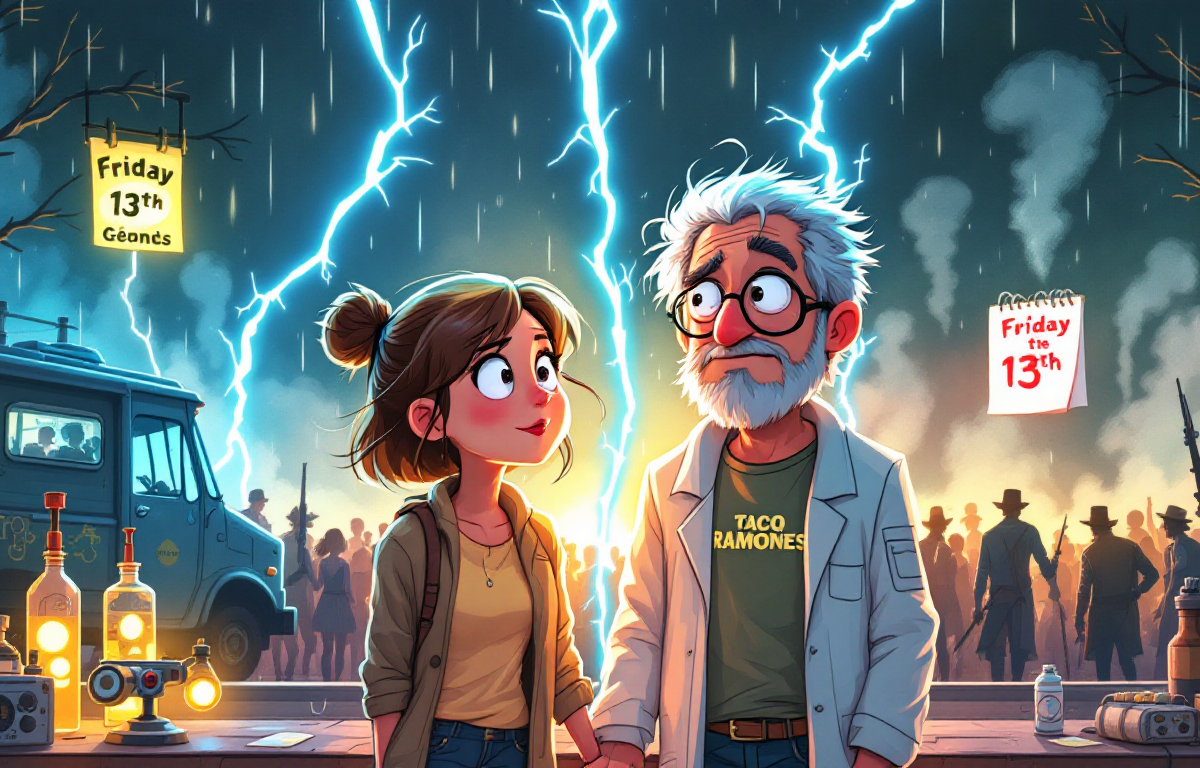
Chronically Challenged: A Friday the 13th Love Story IV

FICTION – 3TC #MM86

Chapter 4:

Enter Hamilton

The man striding toward them didn’t walk—he debuted like a soloist taking the stage, like the main character who knew it. He moved fast and spoke faster, eyes lit with mission and caffeine that hadn’t been invented yet.

Fiona registered the ink-stained fingers first. Then the fine wool coat, the boots too clean for real travel, and the eyes—sharp, amused, and locked on her like she was both anomaly and opportunity.

“You there,” he said, pointing directly at her, “you look like someone who reads.”

Fiona blinked. “I—thank you?”

“I’m in the midst of a public correction,” he said briskly, voice brisk as kindling catching fire. “Some dim-witted provocateur inside the tavern insulted my prose. Claimed I misuse commas. Commas! Can you imagine?”

Fiona opened her mouth to answer but didn’t know how.

“I have half a mind to fight him, but I hate to waste perfectly good rhetoric on someone who can’t even parse clauses,” he continued. “Still, if he raises a fist, I shan’t shy from the occasion.”

The sounds of arguing filtered from inside—boots scraping, someone shouting “ILLITERATE SCOUNDREL!”, a chair toppling.

“Who is this guy?” Elliot muttered beside her.

“Hamilton,” the man said, offering a practiced bow—and his hand. Not to Elliot. To her.

“Alexander Hamilton. Essayist. Orator. Occasional swordsman. And you, I suspect, are not from around here.”

Fiona took his hand cautiously. His grip was warm, firm, and far too comfortable for a stranger’s. “I’m from… a remote colony.”

“Which one?”

She hesitated. “A… small one. Hard to pronounce.”

“Fascinating.” His smile widened. “Do all women from your colony dismantle weak arguments with eyebrow raises and aristocratic silence? Or is that your personal style?”

Elliot stepped forward, just slightly. “Cool. Hi. We were actually just leaving.”

Hamilton turned his head slowly, like he’d only now noticed a houseplant had spoken. “And you are…?”

“Elliot,” he said, forcing a smile. “Fiona’s… associate.”

Fiona narrowed her eyes. Associate?

“Apprentice,” Elliot added, with a shrug that was trying too hard.

Hamilton raised an eyebrow. “Ah. A learner of letters. Worry not. The mind, like the muscle, must withstand repeated strain to grow strong.”

Elliot’s expression stayed mild. But Fiona saw the flicker—the way his jaw clenched, how his hand balled into a fist so tight his knuckles went white.

Hamilton turned back to her, the verbal spotlight shifting again. “If you ever feel like co-authoring a pamphlet, I’d be honored. We could fry Loyalist propaganda together until it weeps ink.”

“Fry,” Fiona echoed. “Like… cook?”

“Exactly. Sear. Roast. Verbally crisp.”

Fiona didn’t know whether to laugh or leave. Hamilton was insufferable. But also… quick. Charismatic. He looked at her like she was interesting in three dimensions—and she hadn’t had that in years.

She was about to deflect when the tavern door slammed open. A man in a wig staggered out, red in the face and holding a quill like a weapon.

Hamilton glanced back, eyes gleaming. “If you’ll excuse me, I believe someone just attempted satire without a license.”

And then he was gone, disappearing into the argument like a shark sensing blood in a seminar room.

The door swung once, then settled.

Silence returned.

Elliot exhaled. “Cool. Great. So we’ve met America’s most confident drama major.”

Fiona sat down, hands trembling slightly in her lap. The bench was rough wood, worn smooth in places by time and elbows. She could feel the shape of every knot in the grain beneath her fingertips.

“Do you think that was real?” she asked softly.

“Real in the sense that he’s probably in every textbook we’ve ever owned? Yeah,” Elliot said.

“I meant… the flirtation.”

He paused. Looked at her sideways.

“Do you want it to be?”

Fiona didn’t answer.
She wasn’t sure.
She only knew that 1776 was louder, hotter, and more complicated than she’d planned—and somehow the date she was on had managed to involve time travel, colonial undergarments, and a potential future Founding Father who wanted to co-author fire.

And they hadn’t even found a place to sleep yet.

Entangled Contradictions

FICTION – REENA CHALLENGE #385

by Julia Drake (and someone else entirely)

Dr. Eugene Irving Krane did not believe in metaphor, which was why he used it constantly in his head.

Standing before a lecture hall of half-conscious undergrads, chalk raised like a scalpel, he dissected equations with clinical precision. “Symmetry,” he said, “is not about aesthetics. It’s a constraint. A system obeys certain laws until one of them breaks. And that break is where the interesting physics begins.”

Behind him, the whiteboard bloomed with the Higgs mechanism—perfect arcs, cold beauty, tension contained.

Krane saw what his students did not. The math wasn’t sterile. It was tragic. Elegant. Alive.

He was an odd man, even by faculty standards. He collected things. Not stamps or coins—ideas. He had an entire drawer in his office dedicated to obsolete words, sorted by emotional tone: “Words That Die Alone,” “Words That Bleed Nicely,” “Words With No Home.” He took long walks at dawn to photograph patterns of fractured light in puddles and alleyways. And he kept what he privately called an “emotional landfill” — a file full of discarded breakup letters, apologies never sent, and confessions overheard in stairwells. He said they helped him write with precision.

These collections weren’t academic. They were scaffolding for something else—a hidden voice, one that poured all that silent debris into fiction.

From the front row, Tess Ramírez scribbled something in the margin of her notebook and suppressed a grin. She was in her forties, finishing a long-delayed PhD, and possibly the only person alive who would one day use the phrase “quantum betrayal” in casual conversation.

She respected Krane. She also suspected he had no idea how visible his loneliness was.

When class ended, Krane retreated behind his desk, where a stack of problem sets sat dangerously close to a notepad filled with scribbles. Not physics. Fiction. The bones of a scene for Julia: entanglement as metaphor, two characters locked in orbit, never quite in sync. He’d been shaping it since 3 a.m.

He tugged down his sleeves and nudged the pile toward Tess.

“If you could… the thing.”

She blinked. “You’re a world-class communicator, you know that?”

He blinked back. “That was implied.”

Tess rolled her eyes and scooped up the stack, including—unbeknownst to him—a handful of Julia’s latest pages.

Later that night, she was grading on her couch, jazz humming from the speakers, half a glass of Malbec on the coffee table. And then she saw it.

A page that didn’t belong.

“They spoke like electrons entangled: each word collapsing a possibility in the other. He didn’t touch her hand, but the air around it bent.”

Tess froze. Her wine glass stopped midair.

Her heart did a weird thing, like an extra beat—or maybe a skipped one.

She flipped to the next page.

“Lina stood in the field, symmetry broken, heart split by the simplest law of decay: what once was held cannot always stay.”

And at the bottom, tight and unmistakable: 
–J. Drake

Her pulse kicked.

No. Impossible.

She’d read every Julia Drake novel twice — dog-eared, underlined, whole chapters bookmarked for reasons she couldn’t explain. Not because they were romantic. Because they were honest. No one in Drake’s stories ever got rescued cleanly. They hurt each other. They tried. They failed better. It wasn’t fantasy. It was familiar.

Tess had never known who Julia Drake really was — just that she’d been through the shit. You couldn’t write emotional wreckage that clearly unless you’d lived inside it.

And now here it was. 
On paper. 
In Krane’s handwriting.

Her first instinct was disbelief. Her second was awe. 
Her third was: Does he even know how hot this stuff is?

Tess barely slept. She kept rereading the pages, flipping between disbelief and adrenaline. The idea of confronting Eugene left her nauseous—what if she embarrassed him? What if she was wrong? What if she ruined something by naming it? But the words wouldn’t let her sleep. They weren’t just good. They were true. And she couldn’t unknow that truth now.

The next morning, she didn’t knock. She barged in.

Eugene looked up, mid-sip of coffee, and nearly dropped the mug.

“You’re Julia Drake.”

He froze. Opened his mouth. Closed it.

“You are,” she said. “You’re my favorite author of all time. I thought you were dead. Or French. Or a collective of lesbians.”

Eugene stared at her like she’d just accused him of arson.

“You’re serious,” he managed.

“I’ve read everything,” Tess said, waving the pages. “Twice. I memorized half of A Constant Craving like it was scripture. You made me cry in a Denny’s, Eugene.”

He looked absolutely horrified.

“I was under the impression,” he said slowly, “that my prose was… categorically sentimental.”

“It’s not,” she snapped. “It’s vulnerable. And tight. And unbearably good. God, no wonder you hate small talk—your soul is in six mass market paperbacks and nobody knows.”

Krane went pink. Pink.

“I don’t—it’s not—people in the department wouldn’t understand.”

Tess softened. “I understand. I just didn’t expect my emotionally unavailable science mentor to be moonlighting as the poet laureate of romantic ache.”

Eugene rubbed his forehead. “Please never say that out loud again.”

She grinned. “No promises.”

They sat in silence for a moment, the weight of the secret between them now less like lead and more like gravity—still heavy, but pulling them into orbit.

For Tess, something shifted. She’d always seen Krane as brilliant but unreachable, like a locked cabinet full of equations and rules. But now, she saw the tenderness behind the rigidity. The collector of discarded feelings. The man who couldn’t say what he felt unless it was fictionalized. And somehow, that made her respect him more, not less.

“You ever think,” Tess said quietly, “maybe fiction is the only way people like us know how to feel?”

He looked at her, and for once, didn’t look away.

“All the time,” he said.

That night, Julia Drake began a new manuscript. As Eugene typed, he paused over one line and rewrote it three times—not for clarity, but for care.

The main character’s first real moment of connection came in a cluttered office, after a truth slipped out by accident. The other character didn’t flinch. She saw him. Not just the polished surface, but the hoarder of obsolete words, the photographer of lost light, the emotional archivist in disguise. Her name was Teresa.

It opened with a woman named Teresa. Sharp. Unafraid. The first character Eugene had ever written did not need rescuing or permission. She met the main character’s silence with curiosity, not pity.

And for the first time, Julia Drake wrote a love story that didn’t end in silence.

It ended in symmetry.

Chronically Challenged: A Friday the 13th Love Story

Daily writing prompt
What notable things happened today?

DAILY PROMPT RESPONSE – FICTION SHORT STORY SERIAL

Chapter 1:

The Ask


Dr. Fiona Klausner had survived worse.

She’d survived peer review by an all-male panel who said things like “feisty formula” and “adorably ambitious.” She’d survived seventeen-hour data cleanses on a broken monitor, and one ill-fated attempt to microwave soup in a vacuum chamber.

But this? This was worse.

She stared across the lab at Dr. Elliot Chowdhury, hunched over a datapad, brow furrowed, lips moving as he whispered numbers to himself. Probably modeling the lattice resonance from their last run. Probably not thinking about her at all.

He wore what he always wore: a Ramones t-shirt (today’s said “Hey Ho Let’s Go”), wrinkled jeans, a slightly singed lab coat, and plastic-frame glasses held together with electrical tape. His prematurely gray hair appeared to have lost an argument with gravity.

To Fiona, he looked like the human embodiment of a chaotic good equation. Unshaven. Brilliant. Endlessly distracting.

You don’t have to do this, her brain whispered. You could just ask him to double-check the time-slice projections. You don’t have to launch your dignity into space on a caffeine-fueled whim.

She reached for her mug, cold. Her hands were damp. Without realizing it, she began adjusting her elegant lab coat. The sleeve, the collar, the pocket. Again and again.
Then she realized what she was doing—you already fixed that—and forced her hand to stop.

Just let it go. He’s nice to everyone. He probably lent you that soldering iron because he’s kind, not because he was flirting in the language of hardware.

She stood up anyway.

Her chair screeched across the tile. Elliot looked up, startled but smiling.

Abort. Retreat. Climb into the trash can and make it your home.

“Elliot?” she said.

He blinked. “Yeah?”

She cleared her throat, then blurted, “I was wondering if you wanted to get dinner sometime. With me. Socially. I mean. Or romantically. I mean—if that’s a thing you’d want. Or ever consider. Or—”


She’d said it. It was now out in the world, irreversible.

Her heart pounded. Her stomach twisted into knots.
She actually felt her intestines realigning themselves like they were trying to flee the scene.

This was a biological emergency.

And then, Elliot made a face. A tiny nose scrunch, subtle but visible.

What’s that face? His nose? Is that a disgust squint?
Do I stink? Is it the emergency deodorant? Oh god, is it the lentil soup from yesterday? I knew it lingered.

Then she blinked. Realized something.
Wait. That’s his thinking face.
She’d seen it dozens of times—whenever he was mid-equation, mid-epiphany, or mid-muffin.
It wasn’t rejection. It was…processing.


Oh. Oh no. This is happening. This is real.

Dr. Fiona Klausner—world-class brain, terrifying poise, hair that doesn’t know chaos—just asked me out.
Me. In this shirt. In these pants. Do these pants even have a functioning zipper?

She’s hot.

Why is a hot girl asking me out?

Am I pitiful? Is this a setup? Is there a camera in the fume hood?

Then it hit him.
The last time a hot girl asked me out…

Carla Smith.
Candle wax. Glitter. A Yelp review.
He still didn’t know how that review got posted under his name, but it cost him two months of eye contact with anyone named Carla.

Say something. Say yes. Don’t mention Carla. Or glitter. Or wax. Just say yes.

He scratched behind his ear. His nose twitched again. Panic reflex.

And somehow, he said it.


“Like a date?” Elliot asked, voice surprisingly steady.

Fiona nodded like a wind-up toy nearing the end of its coil. “Yes. That. Ideally.”

He smiled—not smug or surprised, but warm. Real.

“I’d really like that.”

She blinked. “You would?”

He ran a hand through his ridiculous hair. “Yeah. I’ve been meaning to ask you, actually. But I figured I’d mess it up and say something weird, like, I don’t know… ask if you wanted to split a burrito and debate quantum foam.”

She laughed—a real, involuntary laugh—and it echoed through the lab like something newly possible.

Elliot looked at his watch. “Wait… what day is it?”

Fiona checked her phone. “Friday. The 13th.”

He grinned. “Of course it is.” He shrugged. “What’s the worst that could happen?”

Across the lab, hidden behind a tower of coiled cabling and dead sensors, the chrono-lattice prototype pulsed softly. Once. Twice. Like it was listening. Like it was waiting.

Neither of them noticed.

They were both too busy melting down in tandem.

Too Soft to Survive

POETRY


by the time they named her strong, she’d already lost everything else

This is what she looked like before.

Before the veil. Before the gloss. Before they praised her composure and confused it for peace.
Before she turned herself into armor.

Before the night Jimmy died.

She was Annabelle then. Not a symbol. Not a survivor. Just a girl who still smiled with her whole face, even when it hurt.
Who wore her softness without fear.
Who believed in mornings, in second chances, in love that didn’t need explanation.

Jimmy saw her.

Not the projection, not the potential—just her.
Hair tangled from sleep. Laugh like rebellion.
Questions that didn’t need answers.
He held her like she was real, and that was the most dangerous thing of all.

Because real things break.

And that night, something did.

She didn’t cry at first. She didn’t scream.
She went still.
Still enough to make a decision.

If softness got her here, she would bury it.
If love made her reckless, she would starve it.
If truth demanded grief, she would wear lies like couture.

So she did what women like her are trained to do.

She became someone else.

The world met her later—painted, polished. They called her elegant. Formidable. Composed.
They didn’t know she’d cut out parts of herself to fit that dress.
They didn’t see the ghost she carried in her mouth.

They just saw a woman who never cracked.

But some nights, when her reflection forgets to lie—
the voice inside her whispers:

Did you ever wish you were someone else?
Because I do.
She don’t belong here. She doesn’t belong.

She’s worn the mask so long, it’s started to feel like skin.
It itched at first; now it bleeds beneath the scars.
And she no longer knows where it ends, or where she begins.

But underneath, that other girl—the before girl—isn’t gone. Just buried.

And with her, the memory:

She was selfless. He was a true friend.
She should have been there for him.
Slow dancing until the crying eased.
Letting him collapse into her silence.
Being the warmth when the cold got too loud.

Now she speaks the unspeakable.

Jimmy is gone.
And she wasn’t there.

Not the way he needed.
Not the way he had been for her.
She should’ve been someone he could come to.

Jimmy’s watch ticks, ticks, ticks—a reminder that she is still alive.
She wears it now, not for timekeeping, but as penance.
It doesn’t tell time.
It tells absence.

She remembers who she was before they called her strong.
Before she survived by silence.
Before she was too bright to touch.
Before the grief calcified into poise.

She remembers Jimmy.

And tonight, she doesn’t want to be worshipped, or applauded, or envied.
She wants to be held.
She wants someone to say her name like it means something.
Annabelle.
Like it’s not just a title she wears in his absence.

Her thumb rubs his lighter—silver, worn smooth, still warm from her pocket.
She exhales her words into the air like smoke, like prayer.

“You saved me…
You saved me.”

Too Bright to Touch

PROSE – FOWC & RDP


She moved like a memory caught in motion—half real, half reflection.
Blue light wrapped her like prophecy, like warning.
Everything about her shimmered.
Not from joy, but from exhaustion lacquered into beauty.

There was a cost to being seen this way.

Every inch of her radiated curated power—eyes rimmed in defiance, lips painted in precision.
She looked flawless. Untouchable.
But nothing about her was effortless.
She was sculpted in silence, shaped by scrutiny, smoothed by survival.

The world adored the Gloss.

They called it strength.
They mistook stillness for peace.
They praised the image and ignored the ache.

Because Gloss blinds.

And beneath it, something primal waited—untamed, uninvited, and fully hers.

Fur.

Not for decoration—for defense.
It was everything she’d learned to hide: the mess, the wildness, the depth.
The part of her that could not be branded, couldn’t be edited.

She’d buried it to belong.
But it never stopped breathing.

Now it whispered again.

I want to love.
I want to find peace.
I want to find the real.

But in a world that feeds off illusion…

They tell her lies, in a delicious way.
Wrapped in compliments.
Scented with approval.
Only palatable if she never breaks character.

She tried to believe.
Tried to play along.
But the silence inside her was louder than any applause.

Though she is surrounded, she feels alone.

People held the projection.
No one held her.

Who is the person peering from the cage?
She doesn’t want to be here, but there she is upon the stage.

And one day, without ceremony, she stopped pretending.

She stripped away everything, stood as she truly was.
No gloss.
No pose.
No apology.

And in the rawness of that moment—

To dream of the moment is not insane.

Not foolish.
Not naïve.
Not a weakness.

It’s a kind of rebellion—
To believe in softness after survival.
To imagine stillness after the storm.

Perhaps, she will learn the answer—just not today.

Today is enough.

Because in the stillness…

She not afraid.
She not afraid.
She began to breathe.
It almost easy.

No spotlight.
No mask.
Just breath.
Just truth.
Just her.

The Edge of Becoming: Refusal to Disappear

PROSE – REFLECTION


The light crept in, not with purpose, but inevitability. It pooled over the floorboards in pale streaks, slipped across the rumpled sheets, and found her where she sat—curled in on herself at the edge of the bed like something unfinished. The curtain shifted with a lazy sigh, stirred by the hum of a world already moving without her.

She didn’t move. Just blinked slowly, eyes still heavy. Her hair was a mess—coiled and wild, clinging to the nape of her neck with sweat. The air felt thick, damp from last night’s rain, and carried a faint trace of coffee drifting in from the apartment next door. It reminded her she wasn’t entirely alone in the world—just sealed off from it.

Her phone buzzed on the nightstand. She didn’t look. She already knew the message: “You okay? You were pretty quiet last night.”

She had gone to that rooftop gathering. Smiled on cue. Nodded politely as someone explained a startup idea for the third time. But when the conversation shifted to politics, to “people being too sensitive,” to jokes with teeth she wasn’t supposed to flinch at—she had gone quiet. Not out of agreement. Out of calculation.

It wasn’t fear of confrontation. It was exhaustion.

The kind that seeps into your bones when you’ve spent years editing yourself in real time.

Why can’t you just be easier?

The voice came sharp, cutting through the fog. Familiar. Not hers exactly—but forged in her. It spoke in the tone of her third-grade teacher, the one who called her “bossy” for speaking with certainty. The one who wrote on her report card, “bright, but disruptive.” That was the first time she learned that being loud and being wrong were seen as the same thing.

She had been shrinking ever since. A slow erosion.

And now, this morning, she felt caught between the shrinking and the wanting—wanting to take up space and fearing the cost of it.

You think you’re different? That the rules don’t apply to you?

She flexed her jaw, let the thought sit. The worst part of that voice was how reasonable it sounded. How it wrapped itself in concern. In survival.

Outside the window, a billboard stood tall above the bus stop: a model in spotless white jeans and a tagline in all caps—LIVE YOUR TRUTH™. She almost laughed. As if truth came clean and neatly styled.

Her own truth felt messy. Unmarketable. Like morning breath and ragged nails and questions without answers.

She looked at her hands—real, rough, hers. Last night she had come home and typed a long apology to the group chat. “Sorry I was off. Just tired. Hope I didn’t kill the vibe.”

She hovered over the send button.

Then she didn’t.

Now, she picked up the phone, screen still glowing with the unsent draft. She tapped and held. Delete.

It wasn’t a revolution. Just refusal.

A small, quiet defiance.

She wasn’t whole. There were still bruises beneath her calm, still doubts threading her thoughts. But she was done apologizing for needing more than performance.

The light had shifted again, stronger now. Not demanding. Just there.

She wasn’t sure what came next.

But this—this stillness, this pause, this decision not to disappear—was a start.

Oracle of Hollow Peak

PROSE – CONCEPT ART – DOUBLE EXPOSURE

In the heart of the Hollow Mountains, where the air hummed with silence and time forgot to tick, a being older than wind sat. Encased in a sphere of shimmering energy—neither glass nor light, but something between—the Oracle meditated above a chasm that pulsed with ancient fire.

He had not spoken in centuries. He didn’t need to.

The mountains around him were carved not by water but by will. Their jagged silhouettes, emerald-tipped and layered like echoes, were born from his breath. Each ridge was a memory. Each peak was a vow. He had once been flesh, bone, and fire. Now, he was purpose wrapped in the illusion of form.

To the outside world, he appeared as a man—if a man could be sculpted from starlight and storms. His robes flowed like liquid fog, and his long, tangled beard bore streaks of silver like splotches of moonlight left behind by the gods.

Pilgrims had tried to reach him, climbing in silence, their mouths dry from reverence or fear. None returned unchanged. Most didn’t return at all.

Inside the sphere, reality bent. Time curled inward like smoke. The Oracle sat cross-legged on a throne of molten stone that neither burned nor aged. Beneath him, streams of liquid light cascaded into the void—knowledge pouring endlessly into the earth’s soul, never wasted, never full.

He was more than a seer. He was a medium between worlds—the silent conduit through which forgotten truths passed. Not a messenger, not a prophet, but something more elemental, something that watched as stories ended and began again.

He waited—not out of impatience but design. Somewhere, someone would be ready to ask the right question. Not about destiny or death. Those were too easy. But the one that mattered. The one that cracked the world open.

Until then, he breathed. And in that breath, universes whispered.

Top 5 Ways to Ask a Girl Out: Rule #5

FICTION – FOWC & RDP


Top 5 Ways to Ask a Girl Out: Rule #5
If you survive the kiss attempt, you’re in.


We walked back from the taco truck under the kind of sky that made everything look slightly more romantic than it deserved to. Streetlights flickered on like they were rooting for me. Or mocking me. Hard to tell.

“So,” she said, arms folded, still carrying her drink like it was a trophy. “Do you usually spend your Saturdays pretending to be a mechanic-slash-foodie with girls you’re not dating?”

“Only the ones who invite me to test-drive their haunted vehicles and emotionally unstable lawn statues.”

She laughed. “So I’m special.”

“You are,” I said, before my filter could save me.

She looked over, eyes holding for a beat too long. I panicked and did what any emotionally underdeveloped guy would do: I kicked a pebble and immediately regretted everything I’ve ever said.

We got to her door. The gnome was back. Sitting on the railing again like nothing had happened.

“You brought him back out?” I asked.

She shrugged. “Didn’t move him.”

We both stared at the gnome.
The gnome stared back.
Relentless.

I cleared my throat. “So. Tonight was… really good. Even if I almost stripped the threads off your lug nuts and spilled soda on my own knee.”

She smiled. “Definitely one of my better fake-date disasters.”

And then it happened.
That silence.
The kind that invites a kiss if you’re bold, or complete social collapse if you’re not.

I stepped a little closer. Not a full leap—just a half-step of doomed courage. She didn’t move. Just watched me with that same small smile and terrifying confidence.

This was it. This was the moment.
I leaned in.
And completely misjudged the height difference.

My nose bumped hers. Her forehead bumped mine. My glasses fogged instantly. Her drink sloshed. One of us made a weird surprised sound—pretty sure it was me.

We pulled back, both blinking.

I wanted the sidewalk to swallow me. Instead, she started laughing.
Like, full-on, can’t-stop, leaning-on-the-doorframe laughing.

I winced. “Cool. Yep. Nailed it.”

She grabbed the front of my shirt, pulled me in, and kissed me properly.
Soft. Sure. Just long enough to shut my brain off.

When she pulled away, she whispered, “You passed that test, too.”

The gnome was still watching.
Probably smirking.
Waiting for whatever moment would arrive next.


Author’s Note
And that’s a wrap on this blog series. Thanks for sticking with it. This story (and its awkward kiss energy) will be part of my upcoming short story collection. Same premise, just expanded—with more chaos, more heart, and yes, probably more gnome appearances.

Toilet Paper and other Hard Truths

FICTION – FSS #193

He quickly climbed the trellis and reached the balcony outside of her bedroom. He watched her through her window. She was sitting on the floor, legs crossed, phone in hand, completely unaware. She always tied her hair back when she focused, and it was. Probably texting. Probably him.

Jason exhaled slowly, pressing his back against the wall just under the window. He hadn’t planned this. Not exactly. But after three days of being ignored, after seeing that one blurry photo on her story—just a hand on her thigh and a drink in the background—he couldn’t sit still.

He could hear The Cranberries playing in the background—Linger, soft and haunting. She moved to the music, not dancing exactly, but swaying in that unconscious way, like the song had tapped into something old and private inside her. Like it spoke to her soul. Like she was his private dancer and didn’t even know it.

With difficulty, he swallowed. He needed to go. He wasn’t that guy. Not the creepy ones—the ones who watched from the dark, who mistook obsession for romance. The ones who fantasized about a glance, a laugh, a shared elevator ride, and turned it into something it wasn’t.

The ones who, when they finally worked up the nerve, stood trembling and said, “Don’t you remember? You smiled at me once.” Eyes wide. Pleading. Every breath pulling them deeper into the abyss of desperation.

Jason stared at his hands. Pale knuckles, shaky grip on the cold railing.

This wasn’t who he was.
At least, he hoped not.

He jumped from the balcony, hurting his ankle but maintaining his dignity. The pain was excruciating, but it kept him honest. Every limp, every throb was a reminder: he didn’t belong up there. Not like that.

Branches whipped past as he hobbled through the trees behind her house. The cold air cut at his lungs, the wet grass soaked through his sneakers. But he kept going—because turning back would’ve been worse.

Finally, he reached the lake, where his friend Tina was waiting. She was pacing back and forth, arms crossed tight, hoodie pulled over her head. Her eyes lit up when she saw him.

“Did you do it?” she asked urgently, stepping toward him. “Well?”

He didn’t answer right away, sinking onto a bench near the water’s edge, leg outstretched, ankle swelling fast. He winced.

“I saw her,” he said, staring out at the dark water. “She was dancing.”

Tina blinked. “So… that’s a yes?”

Jason shook his head slowly. “No. I couldn’t. I’m not that guy.”

She let out a breath, relief and maybe a little disappointment mixing in her face. She sat next to him, pulling her knees up to her chest.

“Good,” she said. “Because if you were, I wouldn’t be here.”

They sat in silence for a while, the lake still, the sky just hinting at dawn.

How did I get here?
Jason stared at the rippling water like it might answer.

Where did this notion come from—the idea that if he just showed up, climbed high enough, looked long enough, maybe something would fall into place? Some moment, some clarity, some spark between them that would finally catch.

But there was no spark. Just a girl in her room, moving to music, living her life without him in it. And him, standing outside like a stranger.

He wasn’t always this guy. Was he?

Maybe it wasn’t about her at all. Maybe she was just the screen he projected it all onto.

“I think I scared myself,” he said aloud, not even sure if Tina was still listening.

She said nothing at first. Just nodded slowly.

“You weren’t trying to get her back,” she said after a while. “You were trying to find something in yourself. And you didn’t like what you saw.”

Jason closed his eyes.

That was it. That was exactly it.

Tina reached for his hand, hoping Jason would somehow see her, somehow feel her—not just her skin, but what was underneath. All the nights she answered when no one else did. All the pieces of him she held onto so he wouldn’t fall apart.

Her fingers brushed his knuckles. He didn’t pull away. But he didn’t look at her either.

Jason was still staring at the water, lost in his head, somewhere far away from this bench, this lake, from her.

She squeezed his hand gently, grounding him. Or maybe anchoring herself.

“You don’t have to chase ghosts,” she said, voice low. “You aren’t one.”

Jason finally turned to her, and for the first time that night, there was something behind his eyes. Not clarity, not yet—but something softer than the ache he’d been carrying.

He looked down at their hands, then back at her. And something between them shifted.

Tina noticed Jason was crying. Not sobbing, not breaking—but that controlled weep, the only kind allowed for men. Shoulders still. Jaw tight. Tears slipping down anyway.

He squeezed her hand tighter, but it wasn’t painful. It was grounding. Like he needed to make sure she was real.

She watched him, unsure if she should speak, unsure if words would help or just fracture the moment.

Were the tears for the girl he never really had?
Or for something else?
Something older. Deeper. Something even he hadn’t named yet.

Maybe it wasn’t about her at all. Maybe it was the weight of pretending he was okay for too long. The performance of being fine, being cool, being over it. Maybe this was the moment he stopped acting.

Tina didn’t move. She didn’t ask. She just let him feel it.

Because sometimes that’s the only way through.

Everyone knew Jason was the strong one. The steady one.
It was killing her to see him like this—silent, unraveling at the edges.

She remembered last summer. When she chucked every ounce of her self-respect out of the window for Marcus. God, Marcus. She could barely say the name without feeling her stomach turn.

Jason didn’t judge her. Didn’t say I told you so. He just sat next to her on the curb, handed her a Gatorade, and said, “You’ve got nothing to prove. Not to anyone.”

And then:
“I promise I’ll see you through to the other side. We can cry, get drunk, get high, and cry again—if that’s what you need.”

At the time, she thought he was just trying to make her feel better. Talking big, saying what friends say when they don’t know what else to do.

But he meant it.

The bastard was right there, holding her hair back as she worshipped the porcelain god, talking her through it like she was in labor. He had an endless supply of toilet paper, too—which, in hindsight, was no small thing. Because let’s be real: when a real crying fit hits, tissues don’t cut it. Toilet paper is the only thing that makes sense. There’s a lot, and it’s everywhere.

And now here he was. Finally cracked open.

And it was her turn.

“Why are you here, Tina?” Jason asked, voice rough. “Pity? Some sense of duty? Or something else?”

She didn’t flinch, but it stung. Not the words—she’d heard worse—but the fact that he said them. That he really didn’t know.

Tina leaned back, looked up at the night sky like it might help her find the right words. It didn’t.

“You think I came out here in the middle of the night, to a freezing-ass lake, because I pity you?” she said finally. “Come on, Jason. Give me more credit than that.”

He looked away, jaw tight.

“I’m here,” she said, softer now, “because I don’t like who you become when you think no one’s watching. Because I’ve seen you hold everyone else together for so long that I forgot you might fall apart, too.”

She paused.

“And maybe… yeah. Maybe because part of me was waiting for you to need me for once.”

The silence that followed wasn’t awkward. It was heavy. Honest.

Jason didn’t respond right away. But this time, when he looked at her, he really looked.

“There’s never been a time I didn’t need you,” he said, eyes low. “But I don’t think I knew that until right now.”

He ran a hand through his hair, exhaled like he’d been holding it for years.

“So I acted like a jackass.”

Tina didn’t speak right away. She just let it hang there, let him sit in it.

Then she smirked, just a little. “Yeah. You did.”

Jason gave a short, almost-laugh. “Thanks for the grace.”

She nudged his shoulder. “You’re welcome.”

And just like that, the cold didn’t feel so cold.
The silence didn’t feel so loud.
And maybe—for the first time in a long time—Jason felt like he wasn’t holding the weight alone.