By Its Light

We learn to live with death the same way we read by firelight—slowly, painfully, beautifully.


No one prepares you for the feeling of loving something that Death has touched.

I sit here looking around his cabin—now mine. The air smells of pine sap, old smoke, and the faint tang of whiskey soaked into the floorboards. Dust floats through the thin light that leaks between the curtains. Each corner is stacked with books—subjects as varied as anatomy and jazz theory. A shelf of vinyl lines the far wall: Coltrane, Bessie Smith, Robert Johnson. Then, tucked behind them, a few heavy metal records—Sabbath, Maiden, Priest. My father, it seems, was a closet metalhead. I smile at that. Maybe I inherited more from him than just a pulse: the music, the books, the need to understand the noise inside.

Warmth slides down my cheeks before I realize I’m crying. The tears catch the scent of dust and woodsmoke, grounding me. I never knew him growing up. He and my mother had a moment in their teens—one of those sparks people mistake for destiny before life smothers it with reason. She was in law school; he was home on leave from the Army. They met at a party through a mutual friend, made promises under a drunk moon, and a week later, he shipped out. Nine months later—technically ten, if you’re counting the way we do in obstetrics—I arrived.

I became a doctor partly to make sense of what my mother wouldn’t talk about: biology, infection, the way life insists on being messy no matter how sterile you keep your hands. That’s where I met my father—though I didn’t know it then.

He came into the ER after an accident. I was covering trauma, running late for my weekly lunch with Mom. She’s a federal judge now, but every Thursday we make time—just an hour to remember we’re still mother and daughter, not just professionals orbiting duty.

When I finally reached the ER, Mom was already there. She’d come looking for me, irritation etched into her face. But as I began to explain, she froze. Her gaze fixed on the patient lying in bed—multiple fractures, head laceration, vitals unstable but holding. The antiseptic smell and hum of monitors felt suddenly foreign, like I’d stepped out of my own body.

“Mom?” I asked.

She stepped closer to the bed. Her hand rose to her mouth, and for the first time in my life, I saw her cry. Real tears—silent, unstoppable. She reached out, caressed the man’s forehead, her fingers trembling like someone touching a ghost.

“Mom, what’s going on? Do you know him?”

She didn’t answer. Just kept tracing the lines of his face, as if memory might come alive under her touch.

“Mom!”

Finally, she turned toward me, her voice steady but low.
“He’s your father.”

Then she pulled a chair to his bedside, sat down, and called her clerk to clear her docket.


My chest tightened. My legs went weak. I recognized the physiology even as it overtook me—tachycardia, dizziness, shallow breath. I nearly hit the floor before someone caught me.
Carol—my charge nurse, my right hand for ten years. A skinny little thing, but deceptively strong.

We weren’t just colleagues. We were friends.

“Sue, what’s going on?” she asked, her voice sharp with command. I heard her barking orders, but the words blurred into static. The next thing I knew, I was staring at a white ceiling, the steady beep of a monitor tracing the edge of my humiliation.

I tried to sit up—irritated beyond measure—but Carol pushed me back down with one hand. For such a small woman, she was a brick wall.

“Pilates?” I asked, breathless, trying to find my bearings.

She grinned, pouring me a cup of water. “The Judge filled me in. Your dad’s a hottie, by the way. Banged up and all.”

I snorted. Of course, she’d say something like that. That was Carol—always trying to make me laugh when she knew I was about to unravel. The water tasted metallic from the cup, cold against the desert of my throat.

She stood beside me, one hand resting over mine, thumb tracing small circles like she was smoothing out the tremors beneath my skin. Neither of us spoke for a while. The monitors filled the silence. Somewhere down the hall, a code was called, and the world kept spinning as if mine hadn’t just tilted off its axis.


After a few minutes, I was steady enough to stand. Carol and I walked back to my father’s room. The corridor smelled faintly of disinfectant and rain-soaked concrete from the ambulance bay. Mom sat beside his bed, holding his hand. The look on her face—devastation mixed with fierce worry—nearly broke me. When she saw me, she stood and came toward me, wrapping me in a soft and trembling hug.

“You okay? I know it’s a lot,” she said.

“It must’ve been one hell of a week,” I quipped.

To my surprise, she roared with laughter—real, unrestrained laughter. I didn’t think it was funny, but she lost it in the middle of the ER.

“It was, actually,” she said, still smiling. “We made you.”

Her eyes drifted off somewhere far beyond the fluorescent lights. It’s strange how memory works—how it lets you step back in time, not just to see it, but to feel it, every heartbeat replaying as if the past were still happening right now.


I had two years with him. Two years I’ll never trade for anything. I’d never seen my mother happier. Watching them together, I understood their brief story hadn’t been some teenage fling—it was a spark that waited decades to breathe again. For a while, it felt like the world had given us a second chance.

Then the disease came, and everything changed.
Nothing was ever the same after that.


So far, the disease had cropped up in five different towns, ravaging everyone and everything in its wake. My father was one of them.

I begged my mother to leave the area, but her stubborn ass wouldn’t budge.

“I won’t hear of it! Nothing’s running me from my home,” she snapped.

I couldn’t believe people actually said that kind of thing outside of old movies. I figured it was one of those lines characters use when they’ve already decided they’re not going anywhere.

Then she gave me that look—sharp, deliberate—and sighed.
“Okay,” she said finally, downing her afternoon scotch. “When are we leaving?”

“I have patients, Mom,” I replied.

She smirked faintly, that judge’s confidence slipping through the exhaustion. “So do I, honey. Mine just happen to sit in courtrooms instead of hospital beds.”

“We just lost Albie to this shit. I won’t risk you as well,” she said.

That stopped me cold. Mom never swore. That was Dad’s thing. Hearing it from her snapped something loose inside me. I looked at her, really looked, and saw the fear beneath all that steel.

We stood there in silence, and in that silence we understood what needed to be done. If it was going to end, let it end like this—on our feet, fighting.

“Sue, honey, you die with your boots on,” my father had told me when he first started showing symptoms. He’d been delivering meds to the infected zones, refusing to stay home. I begged him to stop, but a daughter’s love isn’t enough to turn a man away from his calling.

I wish it were.


Back at the cabin, the world felt smaller, quieter. The disease had moved on, taking what it wanted and leaving the rest of us to sort through the ruins.

I sat in Dad’s old rocker, which creaked like it still remembered his rhythm. The fire popped softly in the hearth, smoke curling through the faint scent of pine and old varnish. A book lay on the end table—Judas, My Brother. Of course. Trust Dad to pick something that questioned everything. I turned it over, thumbed through the pages soft from use, and slipped on his glasses. The prescription was surprisingly close to mine. The world blurred for a heartbeat, then settled into focus—clearer, heavier.

Mom had built the fire and sat on the couch with her usual scotch, watching the flames without speaking. The glass glinted amber in her hand. She didn’t have to say anything. The silence between us said everything—loss, endurance, maybe even grace.

I read a few lines, hearing his voice in the space between words. Then I closed the book, leaned back in his chair, and let the rocker creak like it was breathing for him.

No one prepares you for the feeling of loving something that Death has touched.
But you learn.
You learn to read by its light.


Author’s Note:
Inspired by Fandango’s Story Starter #223.
Thank you, Fandango, for the spark — this one burned quietly but deep.
Well Shit, There Is Never Enough Duct Tape

Weathered, Hard Knocks Wisdom


Well shit. There is never enough duct tape.

Guppy and I are sitting in the middle of chaos again. She’s perched on the edge of the desk, licking her paw like she’s above it all. Around us, the lab looks like a hardware crime scene — cables spilling from gutted towers, screws scattered like confession pieces. A half-drunk cup of coffee cools beside me, burnt and bitter, the official scent of frustration.

She meows right on cue, the sound sharp and knowing. I look over. “Yeah,” I tell her. “I did it again.”

Outside, the truck’s still dead in the driveway. The house keeps popping up new problems like it’s auditioning for a demolition reel. And inside, my computers — the ones that run everything I’ve built — have decided to crash in unison. It’s a full symphony of failure.

It kinda feels like life bitch-slapped me. I’m standing there, half laughing, half wondering what cosmic fuse I blew this time. Then, in my mind, a ghostly finger points right at me and says, in that whiny little voice only the universe uses: “You know why.” The kind of voice that grates — part guilt, part game show host.

So I sit there, breathing through the noise, because reacting to chaos never resolves anything. There’s never enough duct tape for that kind of mess.


I’ve been fixing broken things since I was a kid. Did my first tune-up at eight years old — or what I thought was a tune-up. Standing on a kitchen chair in my school clothes, wrench in hand, trying to change plugs and set points. Madre nearly lost her mind when she saw the grease stains on that chair. But when that engine coughed back to life, I felt it — that quiet click inside that says, You can fix this.

Then came the eighties and my next addiction: computers. Back before color screens and mouse pads, when hope fit on a floppy disk and syntax errors were life lessons. We typed code line by line, fingers crossed, praying the damn thing would run. Our instructors were learning right beside us. When we figured out how to make a 5.25-inch floppy dual-sided, we thought we were gods.

We wrote everything down back then — notebooks, sketchpads, pages of half-finished programs and circuit doodles. There weren’t breaches in those days, just broken noses if someone got too close to your notebook. Hidden between the pages, you’d find a floppy or two — our version of a flash drive. Everything we built lived by hand, by instinct, by obsession.


I remember the early version of Memoirs of Madness. It wasn’t even a site yet — just an idea and a laptop I built from scavenged parts. I used to walk to the local library to borrow their Wi-Fi, fingers freezing on the keyboard, trying to post something before the battery died. My first “lab” was a pile of junked machines I dragged home and resurrected. Every boot-up felt like a small miracle, a little defiance against the void.

Then I got fancy — started buying ready-made machines, the kind that come preloaded with operating systems that assume they know what’s best for you. Windows. Loud, bossy, always watching. So I went back to Linux. The hard way, of course.

And naturally, it couldn’t be as simple as clicking “install.” There are, what, fifty different Linux distros to choose from? (It’s probably not fifty, but in the middle of a rebuild, it sure as hell feels like it.) Matching distro to hardware… don’t even get me started. The world’s built for Windows and Mac, not for the stubborn few still willing to build their own bones.

My old MacBook’s still around, though. She’s slow, loyal, and half-retired. She’s got the heart for it, just not the legs. I can’t bring myself to replace her. We’ve been through too much — too many drafts, too many late nights, too many little resurrections.

Every crash, every patch, every clunky restart just reminds me: I’ve been here before. Different machines, same madness.


It’s that time of year again — the anniversaries of loss, the kind that pile up quietly. Some losses don’t stay buried; they just wait for the calendar to circle back. And it’s in moments like these you pause, wondering what the right response to chaos even looks like. Because reacting never fixes it — there’s never enough duct tape.

The machines hum again now — not perfect, but alive. The house still leaks. The truck still sulks. I’ll fix what I can, curse what I can’t, and keep rebuilding in the meantime.

Guppy jumps into my lap, head-butts my beard, and purrs like she’s proud of me for surviving another day. I scratch behind her ear, take a sip of cold coffee, and sigh.

So, what am I working on?

My life.

And for now, it’s still running — a little buggy, sure, but running all the same.

Groove, Guppy… Guppy? Groove, please… ah, yes, thank you.

🎧 Soundtrack: “Help Me” – Sonny Boy Williamson II | “The Stumble” – Freddie King


Daily writing prompt
What have you been working on?

Quote of the Day – 09242025


Personal Reflection:
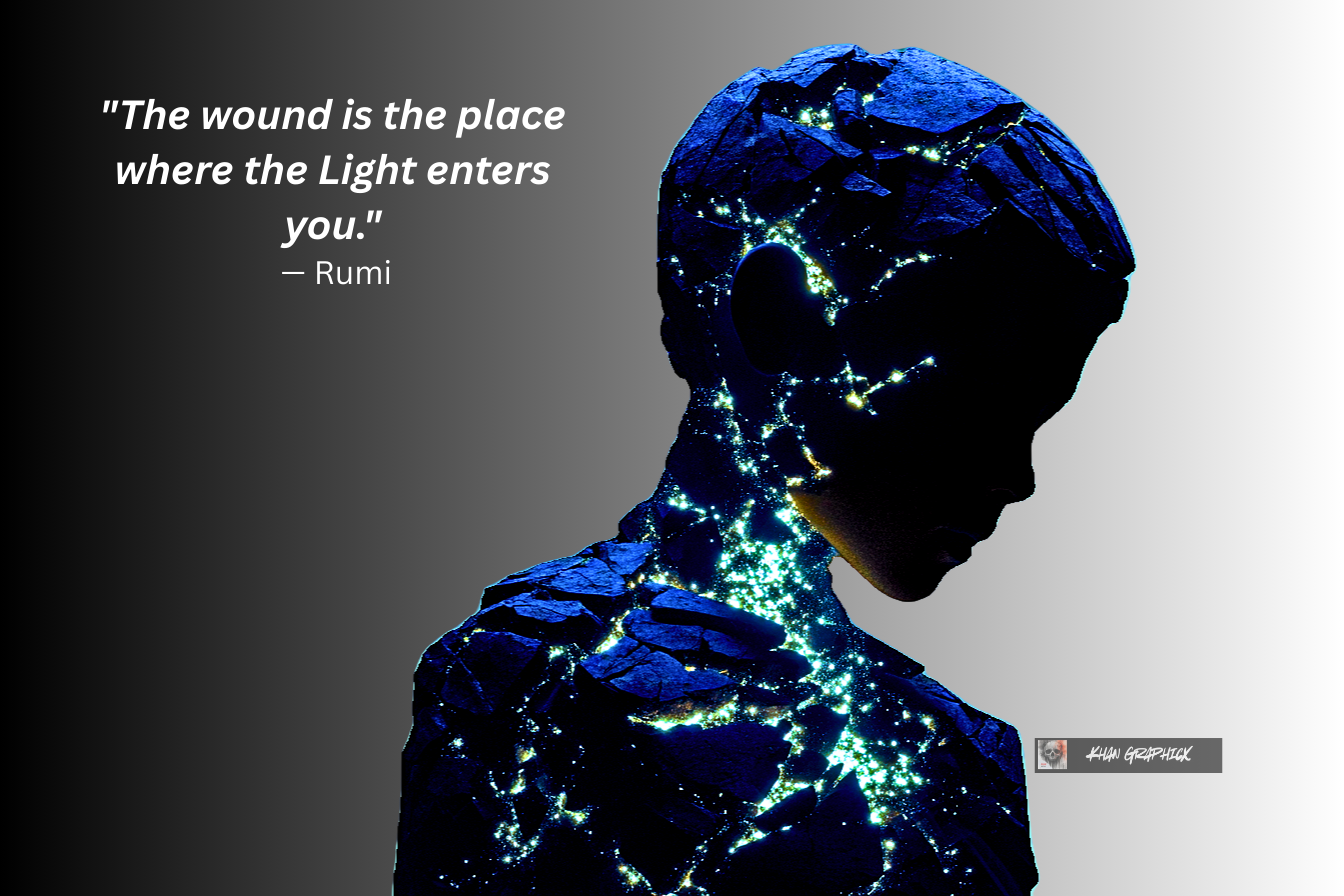
We’re taught to treat our wounds as shame — something to hide, something to outgrow, something that proves we were weak. So we stitch them shut with silence, wrap them in distraction, or bury them under layers of toughness. But Rumi flips the script: what if the wound isn’t the end of the story, but the doorway?

The paradox is brutal — pain that breaks us also carves space inside us. A hollow we never wanted becomes the very place where truth, compassion, or resilience can finally take root. The wound becomes the breach that lets in light, not because the pain was noble, but because it stripped us of illusions we refused to let go of.

The light that enters doesn’t erase the scar. It doesn’t excuse the damage. Instead, it transforms it into something raw and unpolished — a reminder that what hurt us can also remake us. That our most fragile places are not only where we bleed, but also where we begin to see.

Reflective Prompt:
Where has pain carved an opening in you — and what unexpected light has entered through that hollow?

Quote of the Day – 08022025


Personal Reflection

Fear doesn’t vanish just because we know what needs to be done. It lingers, whispering its warnings, stacking every worst-case scenario like a wall between where we are and where we long to be.

But courage is not about smashing through fear. It’s not about becoming untouchable. Courage is quieter than that. It’s the simple, stubborn choice to move forward because something else is heavier than fear. A dream. A promise. A love. A life you refuse to abandon.

There will always be risk. Always doubt. Always that quiver in the gut before you leap. But you don’t owe fear the final word. You owe yourself the attempt.

That’s courage — not the absence of trembling, but the refusal to let trembling decide who you become.


Reflective Prompt

What part of your life have you been letting fear dictate, and what matters more than that fear?

Quote of the Day – 07272025


Personal Reflection

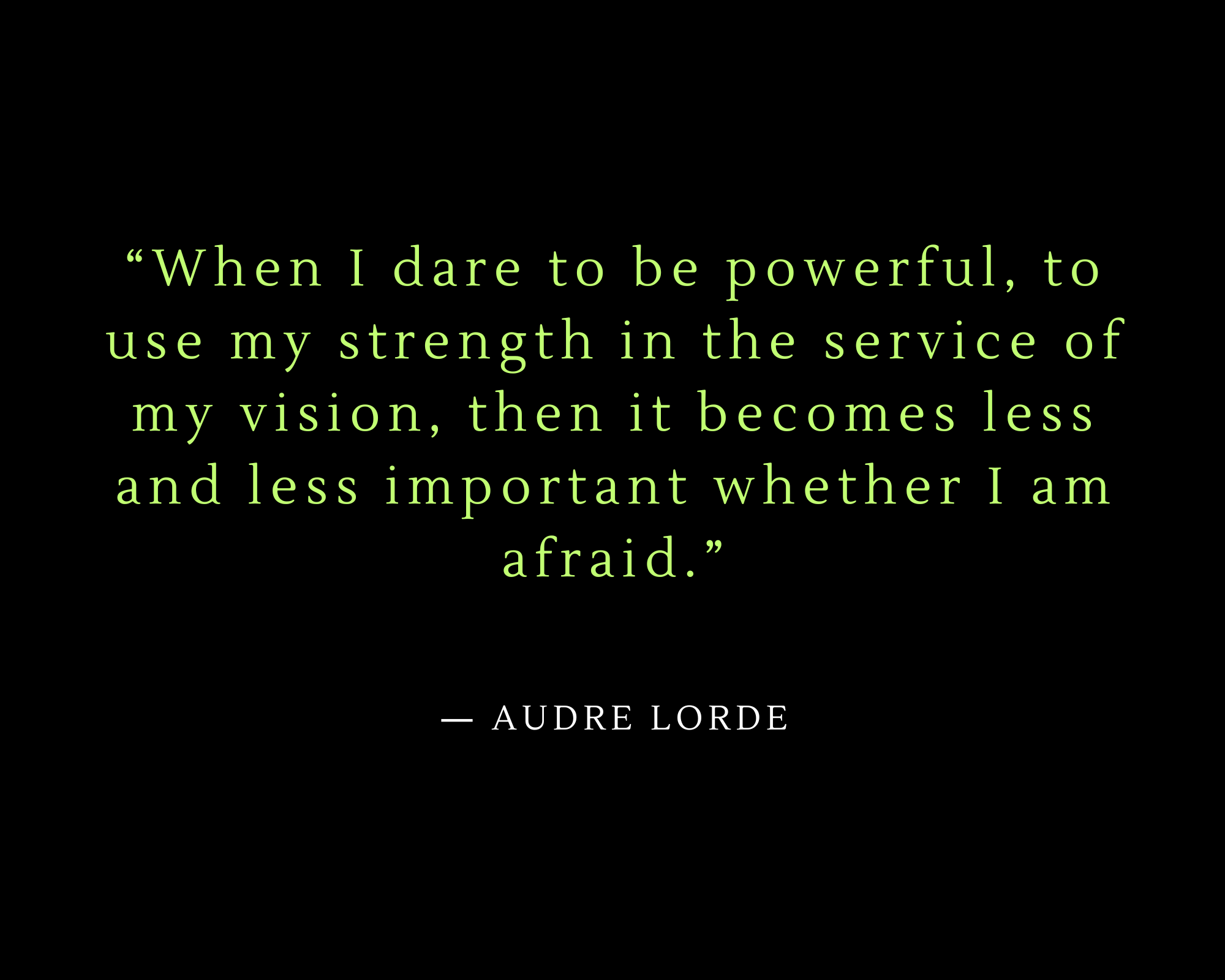
Fear has always been there for me — not loud, not always sharp, but persistent. Like background static I’ve mistaken for intuition. And for a long time, I measured my strength by how little I felt that fear.

But Audre Lorde doesn’t tell us to wait for fear to leave.
She tells us to anchor ourselves in vision — to shift the focus from what frightens us to what drives us. That’s a harder, quieter kind of strength. One that doesn’t need applause.

When I think about my own vision — the one that’s just under the surface, waiting for me to commit — I realize it’s never fear that’s stopped me. It’s the belief that my fear disqualified me. That strength had to feel like certainty.

But Lorde redefines it:
Power isn’t the absence of fear.
It’s the decision to act in spite of it.
To speak when silence would be safer.
To create even when the world shrugs.
To dare — not because we aren’t afraid—but because something deeper won’t let us retreat.

And that’s the moment fear becomes irrelevant.
Not gone. Just… quieter.


Reflective Prompt

What vision is waiting for you to stop asking for permission and start acting with conviction?

Quote of the Day – 07162025


Personal Reflection

The past doesn’t ask for permission — it sits uninvited, breaks things, it’s a part of us, brands you with its weight.
And too often, we carry those ruins like an identity card.

But Jung flips the script.
We are not our damage — we are our decisions.

There’s power in that pause. The breath between what scarred you and what you shape next. It’s the moment you stop asking “why me?” and start asking, “what now?”

Let your fire be forged from choice, not just consequence.
And remember: even cracked skin glows when the soul’s on fire.


Reflective Prompt

What have you been telling yourself you are — because of what happened? What would it mean to rewrite that truth?

Scarred, Still Writing

About Things Faith Ignored

Daily writing prompt
What bothers you and why?

It’s not like I haven’t given workshops before. I have. I’ve stood in front of rooms, talked craft, told stories, helped shape sentences and spark ideas. But this time feels different.

Maybe it’s because I haven’t done this since I got gut-punched over a decade ago—since the ground gave out, and I had to relearn how to stand. Since pain stopped being something I processed and started being something I wore. Somewhere along the line, I started using it like a mask. And the thing about masks is, after a while, they stop feeling like something you’re wearing. They start feeling like skin.

It became comfortable. Familiar. I could hide in it. Feel the illusion of security it gave me. But now I’m being asked to step forward again—to speak to young writers about the craft I’ve spent a lifetime practicing. And I’m wondering: am I ready to take that mask off?

What bothers me is the doubt. Not about the knowledge—I have that. Not about the experience—I’ve lived it. What bothers me is the fear that what I carry now might come through in ways I can’t control. That my jaded, scarred, honest soul might discourage someone before they even start. That I’ll slip into some surrealist rant about how writing is both a gift and a curse, a duty and a burden. That I’ll tell the truth too plainly, and it’ll scare them.

Or maybe worse: that I’ll freeze. Go silent. Stage fright. Blank mind. That I’ll stand there with nothing to give.

But the deeper fear—the one that really digs—is this: what if I’ve forgotten how to speak as the person I’ve become? Not the one I used to be. Not the one who was broken. But the one who crawled through it all and still believes in words.

Because truth matters. Even when it hurts. Especially when it hurts. And writing—that strange, beautiful, brutal act—is built on truth. Our words tell who we are. They don’t lie. And if I show up and speak honestly—about the process, the pain, the doubt, the moments of fire—then maybe that’s enough.

What bothers me isn’t the fear of failure. It’s the responsibility. The weight of standing in front of new voices and showing them not just how to write, but how to be a writer. To give them not comfort, but clarity. Not perfection, but presence.

So yes, I’m nervous. Yes, I feel exposed. But maybe that’s exactly where I need to be. Maybe the only way to teach this craft is to live it—right there, in real time, with all the scars showing.

I reach out into the darkness—and find myself.
Doubt courses through my blood.
The writer within whispers: Please don’t forget me.

Though doubt chills me, I won’t surrender to its might.
I lift my head and know—I don’t walk alone.
I whisper back, “I won’t forget you, because you are me… and I am you.”

No more wasting time. I must prepare.

I’ll see you after the ink dries.

Quote of the Day – 07142025


Personal Reflection

Some days it feels like you’re giving everything — time, love, energy, sanity — and you’re still told it’s not enough.
Honestly, you may feel it’s not enough.

But maybe that ache in your chest isn’t weakness.
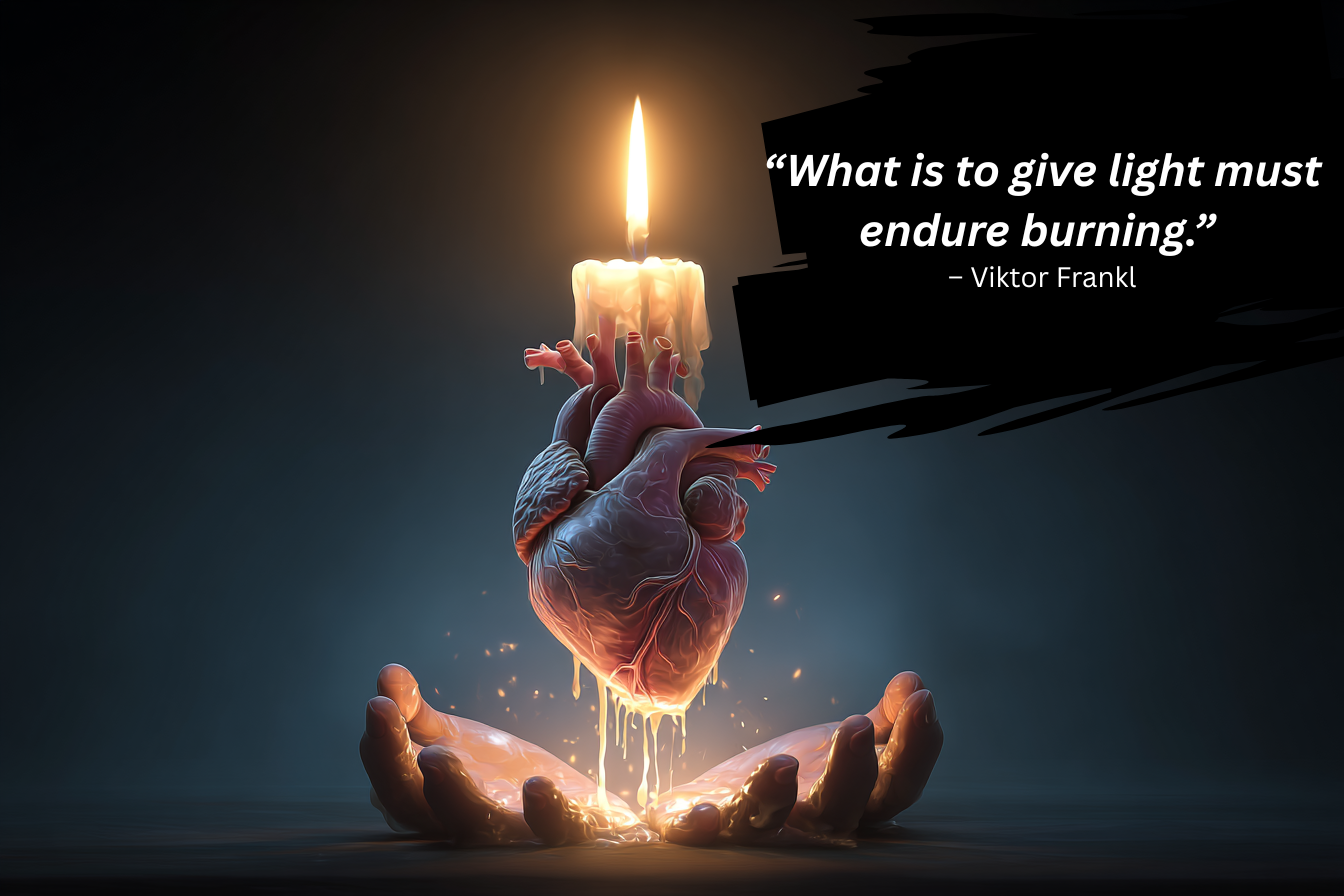
Maybe it’s the candlelight of your soul doing exactly what it was made to do: burn to illuminate.

To create light, something must burn.
A truth that doesn’t ask your permission — it simply demands your heart.
Again and again.

The cost of giving isn’t just exhaustion.
It’s a transformation.


Reflective Prompt

What part of you has burned to bring light to someone else? Was it worth it?