What We Pretend Not to See

Daily writing prompt
What book are you reading right now?

It’s never as simple as answering, “What book are you reading right now?” I usually have four or five going at once — most of them nonfiction. Histories, craft books, philosophy, the “how did this happen and why does it still matter?” kind of material. Somewhere along the way, I forgot how to read purely for pleasure. Training does that. Once you learn to take stories apart, you stop seeing them as entertainment and start seeing them as machines.

Even when a novel doesn’t fully work, I still take a wrench to it.
I listen for the knock in the engine, the missed beat in a line of dialogue, the moment the writer blinked instead of pushing through. I can enjoy a book, absolutely — but I enjoy it like a mechanic listening to an engine idling just a little rough.

And here’s the part I’m almost embarrassed to admit: I can’t bring myself to write in books. Feels like a cardinal sin. So instead I’ve got notebooks scattered all over the house — pages filled with scribbles, arrows, fragments, arguments I’m having with an author who isn’t in the room. I finally gave in and bought one of those e-reader gizmos that lets you highlight the digital version. It feels like cheating, but at least I’m not defacing paper. A technicality, but I’ll take the loophole.

So when someone asks what I’m reading, they expect a title.
But the truth is, I’m running an autopsy.

And the books on my desk right now — Under the Dome by Stephen King and L.A. Confidential by James Ellroy — are the kind that don’t give up their secrets easily. Which is exactly why they matter.

Stephen King gets labeled “the Master of Horror,” but that’s just a convenience for the shelf. King’s real mastery is building pressure systems — closed environments where the air tightens and ordinary people start showing their real faces. In Under the Dome, the dome could be aliens, magic, or a freak atmospheric event; it doesn’t matter. It’s a magnifying glass. It forces truth to the surface.

King understands that people don’t transform under pressure — they’re revealed. Chester’s Mill doesn’t turn violent because of the dome. The dome just takes away the freedom to pretend.

And that’s where the cognitive dissonance hits.
You read something wild — a man electrocuted by an invisible barrier, the town fracturing into fear and paranoia — and your mind rejects it. “People aren’t like this,” you think. But rewind thirty seconds. You heard a crash outside your window, put the book down, checked it out, and watched your neighbor scream at a trash can like it betrayed him. You shook your head at the nonsense, then came back to a fictional scene that suddenly feels easier to believe than real life.

That’s King’s trick.
He shows you something unbelievable so you finally acknowledge the truth you’ve been ignoring.

Ellroy, on the other hand, doesn’t need supernatural pressure.
He starts inside the rot.

In L.A. Confidential, corruption isn’t a plot device — it’s oxygen. The moral decay isn’t creeping in; it’s already soaked into every wall, badge, and handshake. His characters don’t break down over time. They begin the story already fractured, already bent by pressures they barely acknowledge. Ellroy’s cognitive dissonance comes from the reader wanting to believe people aren’t this cruel, this compromised, this hungry for power and absolution.

But then your phone buzzes with a news alert and disproves that hope in under four seconds.

Ellroy doesn’t distort reality.
He removes the polite language that keeps us comfortable.

King writes about what happens when the walls close in.
Ellroy writes about what happens when the walls never existed in the first place.

King exposes human nature by turning up the pressure.
Ellroy exposes human nature by turning off the excuses.

One town collapses because the dome forces truth to the surface.
The other city collapses because truth was never allowed to stand upright.

Both men understand something we work very hard to avoid:

The unbelievable is always happening.
The unbelievable has always been happening.
We just prefer to call it fiction.

So when someone asks what I’m reading, the short answer is Under the Dome and L.A. Confidential.

But the real answer is: I’m reading two authors who drag the human condition out into the open, each in their own way — King through the surreal, Ellroy through the hyperreal. Both force you to look at the reflection, even when you’d rather look away.

And maybe that’s the part we pretend not to see —
the truth isn’t hiding from us.
We’re hiding from it.

Status Update: Building Worlds, Breaking Plans

Let’s be honest—last month didn’t exactly go according to plan. Deadlines slipped, chapters missed their mark, and Truth Burns got yanked off the shelf completely. But don’t mistake the quiet for inactivity. The Forge is still burning, and I’m hammering out something more substantial beneath the smoke.

I’ve been waist-deep in worldbuilding—not just character backstories or timelines, but full-on infrastructure. Truth Burns needed a city that felt real, with streets you can navigate, neighborhoods that breathe, and a logic that holds up past chapter five. Turns out, designing a place from scratch is like running an urban planning boot camp while writing a novel. No wonder other writers fictionalize real cities. Creating every bridge, hospital, and back alley by hand is a nightmare, and you don’t notice the holes until you’re knee-deep in a scene asking, “Where the hell do they even go from here?”

Usually, I live in stream of consciousness writing. I like flying by the seat of my pants and letting the story find its path. That works for flash fiction, short pieces, even most of what you see on MoM. But long fiction is different. When you don’t have a plan, you end up with chapters that are just you thinking out loud. You deserve better than that.

So I’m slowing down to get it right. Truth Burns will return, rebuilt from the ground up with a foundation strong enough to carry the story it deserves. Until then, the rest of the Forge keeps firing.


What’s Still Live

While Truth Burns is in surgery, other series are still rolling out:

  • Garden of Ashes – Mondays
  • Ashwood County – Fridays
  • Bourbon & Rust – Saturdays

Sundays are my admin day across the MKU universe, Wednesdays are reserved for worldbuilding and the occasional Love Drop. Everything else? It’s being reforged to last.


What’s Next (No Dates, No Rush)

There are other stories simmering in the background, waiting for the right moment to hit the page. They’ll come to The Forge when they’re ready, not before.


This isn’t a stall—it’s a rebuild. Thanks for sticking around while I tear things apart just to make them stronger. The Forge will burn brighter for it.

Chronically Challenged: A Friday the 13th Love Story VII

FICTION – FOWC & RDP

Chapter 7:

Tacos and Time Loops

Final chapter of Chronically Challenged

The first thing Fiona registered was the smell—
Grilled meat. Cilantro. The unmistakable scent of hot corn tortillas and lime rinds warming under neon light.

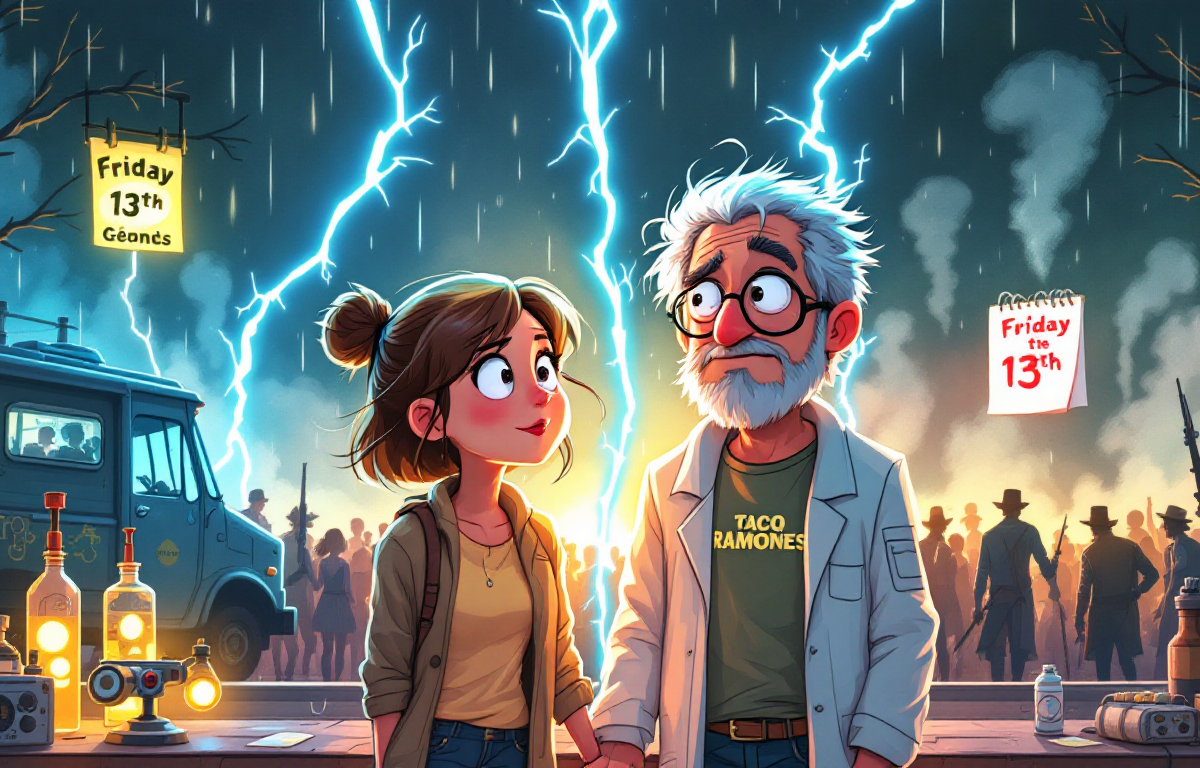
She opened her eyes slowly, adjusting to the dim light of dusk. The taco truck stood exactly where it had before, parked under a buzzing fluorescent sign that read “Tacotón 5000” in cracked vinyl letters. The same string of rainbow papel picado fluttered above them, fading from the sun and sagging from the weather.

A warm breeze passed. It smelled like onions and traffic and the city on a Friday night—alive, restless, ordinary.

They were home.

“Didn’t think déjà vu would come with salsa,” Elliot said beside her.

Fiona exhaled. She hadn’t realized she’d been holding her breath.

She was back in her own jeans. Her real boots. Her coat with a broken zipper and a ballpoint pen still jammed in the inner lining. The chrono-device—no longer pulsing, no longer demanding—rested cool and quiet in her pocket like a relic from someone else’s life.

And Elliot? He looked… lighter. Tired, yes, but unburdened. His curls were wind-tousled, his glasses slightly crooked, and his Ramones shirt was—miraculously—clean. She smiled at the thought he’d maybe picked a fresh one on purpose.

A thin fog of steam rose from the taco truck window. The same vendor as last time—greying, gum-chewing, and blessedly nonchalant—tossed two wrapped tacos onto the counter and gave them a single, knowing nod.

They didn’t pay.

“I think we broke his sense of reality,” Elliot said, collecting the food like it might still vanish. “Or earned his eternal respect. Hard to tell.”

“I’ll take either,” Fiona murmured.

They sat on the same bench—their bench—its paint peeling, the metal cold beneath them. The sound of the street curled around them: honking cars, a mumbled rap track from a passing bike speaker, the sharp clatter of skateboards echoing under the overpass.

Fiona peeled the foil back from her taco with careful fingers, letting the scent rise. It was warm, greasy, and strangely grounding. The first bite burned her tongue and made her eyes water. She welcomed it.

Elliot was watching her.

“Do you remember what you were thinking right before you asked me out?” he asked.

She chewed, then swallowed. Wiped her mouth with the back of her hand.

“I had a mantra,” she said. “In my head. I kept repeating: Don’t die alone surrounded by lab reports.

He grinned. “That’s so… deeply romantic.”

“It worked.”

He looked down at his own taco, then back up at her.

“I almost said no.”

Fiona froze mid-chew. “You what?”

“When you asked me out,” Elliot said. “I panicked. Thought it was a prank. Or a bet. Or a really elaborate social experiment.”

“Seriously?”

He nodded sheepishly. “Then I realized I didn’t care. You were wearing those boots—the intimidating ones. And if it was a trap, I figured I’d go down swinging.”

Fiona laughed—a surprised, full-bodied laugh that startled a pigeon nearby into a fluttering escape.

“I thought you didn’t like me,” she said. “You always looked like you were trying to solve me.”

“I was,” he said, voice quiet. “Still am.”

They sat for a moment in comfortable silence, listening to the city breathe around them. Fiona leaned into him, their shoulders pressed. His warmth was solid. Familiar. Real.

It felt… earned.

“Do you think this counts as our first real date?” she asked.

Elliot nodded slowly. “We survived 1776. Got interrogated by Hamilton. Made out in a future that might not technically exist.”

“So that’s a yes.”

“Definitely.”

The chrono-device buzzed once in her pocket—just a faint vibration, like a cat purring in sleep. Then stillness.

Fiona didn’t check it.

She didn’t need to.

They were here. And now. And not running anymore.

Elliot raised his taco like a glass.

“To us,” he said.

She clinked hers against his foil wrap. “To now.”

And together, under a taco truck sign that flickered uncertainly between green and purple, with grease on their hands and time behind them, they finally finished their first date.


And that’s a wrap!

Chronically Challenged: A Friday the 13th Love Story began with a taco truck, a reluctant crush, and a time travel accident—and somehow turned into one of the most unexpectedly joyful stories I’ve had the pleasure of writing.

Creating Fiona and Elliot’s awkward, brilliant, chaotic journey through history (and each other’s emotional walls) has been such a weird and wonderful ride. From Hamilton’s dramatic entrance to futuristic first kisses, every scene brought something surprising—and often unplanned—to the table.

This was a story about missed signals, emotional experiments, and learning that sometimes the biggest leap isn’t through time—it’s letting someone really see you.

If you made it all the way here, thank you. I hope you laughed, blushed, winced at the secondhand awkwardness, and maybe found a little bit of yourself somewhere in these pages.

And if this is your first read-through, remember: time travel may be fiction, but tacos and courage are very real.

Until next time,

— Mangus

Click the link below for the full story:

Fold Theory & Fiction: Confessions of a Rereader

Daily writing prompt
What book could you read over and over again?

DAILY PROMPT RESPONSE

Plenty of books fall into this category. I’d love to say I have a strict system for what earns a reread, but let’s be honest: the rules shift every time. Sometimes it’s the writing, sometimes it’s a character who won’t shut up in my head, and other times it’s because the book whispered something suspicious from the shelf—like it knows things. Rereading isn’t a choice at that point. It’s a compulsion. Like the story implanted a post-hypnotic trigger in my brain that activates randomly. And when it does, I drop everything—sleep, obligations, dignity—and reread. Again.

Now, my particular brand of obsession comes with a twist: time travel. I don’t just read about it—I research it. Because yes, I’m building a time machine in my basement. And no, I’m not joking. I know what you’re thinking. This person is completely unhinged. Stop looking at me in that tone of voice. Don’t judge me—I’m backed by science.

Stephen Hawking once said, “Time travel used to be thought of as just science fiction, but Einstein’s theory of general relativity allows for the possibility that we could warp space-time so much that you could go off in a rocket and return before you set out.” So, technically, I’m not crazy—I’m just early.

And Einstein himself—our time-bending MVP—once said, “The distinction between past, present, and future is only a stubbornly persistent illusion.” That quote haunts me. Because if time really is just an illusion, then maybe my late-night diagrams and basement scribbles aren’t completely absurd. Maybe I’m just trying to see through the illusion. With tools. And snacks.

Some books feel like accomplices in this mission. Einstein’s Dreams is one of them. It’s not a novel in the traditional sense—it’s more like a collection of speculative time experiments disguised as dreams. Time slows, speeds up, loops, fractures. Each version reveals how fragile we are, how much we lean on the idea that time is stable. It made me wonder if I want to manipulate time or if I just want to understand why it controls me so completely.

Then there’s The Psychology of Time Travel, which sounds quirky but plays out like a cautionary tale. It’s brilliant, and it doesn’t flinch. Time travel in that book isn’t just a shiny toy—it messes with identity, memory, and even reality. It shows the mental strain of knowing too much about your own timeline. Honestly, it made me stop mid-chapter and ask, Do I actually want to succeed at this, or do I just like the chase?

This is probably why I’ve started keeping my own book—a messy, ever-growing volume of experiments, part science, part psychology. Charts, notes, theories, emotional meltdowns—it’s all in there. It’s not publishable (yet), but it’s real. And it’s mine. Some people journal. I document the potential collapse of linear time. To each their own.

And then there’s the part no one wants to discuss—the mythic weight of time. The ancient beings who ruled it long before clocks or quantum theory. Chronos, the Greek god who devoured his children just to keep time moving in his favor. The Moirai, weaving destinies and snipping threads when they feel like it. Kāla, the Hindu personification of time, is both destroyer and renewer. Even the Norse Norns, sitting beneath the world tree, are casually deciding fates like it’s a hobby. These entities weren’t just metaphors—they were warnings. Time is power, and it doesn’t like to be tampered with.

The more I study, the more I feel like time isn’t linear—it’s layered. Some theorists say time can fold over itself like a sheet of paper, bringing two distant moments into contact. Others call it fluid, a river that bends, swells, evaporates, and returns in strange new forms. Honestly, I’ve felt both. There are days where the past bleeds into the present like ink on wet paper. There are moments I swear I’ve already lived. Maybe I’m stuck in a fold. Maybe I’m just bad at time management. Either way, I write it all down.¹

And Then She Vanished wasn’t just another trip down the wormhole—it rerouted my entire approach. The way it plays with memory, causality, and the emotional cost of screwing with time? It hit differently. I went in looking for narrative patterns, maybe a clever paradox or two. What I got was a punch to the gut and a blueprint for moral consequences. The book didn’t just mess with time—it made me rethink why I want to.

And maybe that’s the real loop. Because every time I pick up a pen, I feel it. Writing bends time, too. It stretches memory, warps emotion, and compresses decades into a sentence. Every time we write, are we building new worlds, or are we just reconstructing something we have already lived? Maybe stories are our version of time machines. Just paper ones. Slightly safer than the one in my basement.


¹ Excerpt from my “Working Theories of Time” notebook, vol. 3:

  • Time is a crumpled map, not a straight road. Folds = déjà vu. Rips = blackout years.
  • Fluid time isn’t just poetic—it leaks. Time gets messy around emotional events—breakups, funerals, weird Tuesdays.
  • The body remembers time differently than the mind. Proof: muscle memory, grief anniversaries, and spontaneous panic attacks for no logical reason.
  • Clocks lie. This isn’t a theory. Just a fact.

This is why I track time like a conspiracy theorist with a mood disorder. It’s all connected. Probably.

I’d Be Shaft, Obviously (Everyone Else Needs Therapy)

Daily writing prompt
If you could be a character from a book or film, who would you be? Why?

DAILY PROMPT RESPONSE

An aggressively personal breakdown of alter egos, revenge spirals, and why fictional characters are one emotional snap away from disaster.

Ever watch a movie, read a book, or binge a show and think, Wow, this character really needs therapy? Like… immediately. They have pills for that. And boundaries. And emotional support animals. But instead of signing up for BetterHelp, fictional characters usually take the scenic route: they grow an alter ego, light their lives on fire, and call it “justice.”

Sometimes you’re just sitting there, watching a perfectly normal person start talking to their dead father’s ghost, and all you can think is: They are so fucked.

Let’s talk about that.


The Alter Ego: Fancy Latin for “Oh no, he’s talking to himself again”

There’s something darkly satisfying about a character cracking right down the middle. Not like “oops, I’m having a rough day” cracking—but full-blown talking to their reflection in the mirror and the reflection talks back cracking.

Dr. Jekyll doesn’t just dabble in science—he mainlines Victorian repression and conjures a walking midlife crisis named Hyde. And Tyler Durden? He’s what happens when toxic masculinity drinks four espressos and finds Nietzsche on Reddit.

“Man is something that shall be overcome.” – Nietzsche

Too bad most characters take that as an invitation to become unhinged vigilantes instead of, say, doing the shadow work.

Alter egos don’t just show what characters fear—they show what they secretly want: power, escape, freedom from polite society. It’s the part of them that isn’t okay with playing nice anymore. It’s also the part that starts the fires and says “oops” later.


Holmes and Moriarty: A Gentleman’s Guide to Mutual Obsession

Sherlock Holmes and Professor Moriarty are technically enemies. But let’s be honest: they’re intellectual soulmates with unresolved tension and no HR department to report to. If Holmes is logic in a waistcoat, Moriarty is chaos in a cravat. One solves crimes. The other is the crime.

Holmes says he’s repulsed by Moriarty’s criminal mind. But let’s call it what it is: obsession. Like, we-should-talk-about-this-in-couples-therapy obsession.

“He who fights with monsters should be careful lest he thereby become a monster.” – Nietzsche again, because of course.

Their final tango at Reichenbach Falls? That’s not a climax—it’s a breakup scene disguised as a death drop.


Werewolves, Hulks, and People Who Should Not Be Left Unsupervised

Let’s talk about werewolves: the OG metaphor for “Oops, my emotions got out.” Classic lit was obsessed with this stuff. Guy seems chill—until the moon rises and suddenly he’s shirtless, hairy, and eating villagers. It’s like puberty, but worse.

And then there’s Bruce Banner. Poor guy just wants to be left alone to do his science. But noooo—every time someone provokes him, he turns into a giant green rage machine in cut-off jeans. He told them not to make him angry. They did. Now there’s structural damage.

Each transformation screams what Carl Jung quietly suggested:

“Until you make the unconscious conscious, it will direct your life and you will call it fate.”

Which is a very classy way of saying, “Congrats, you’re the werewolf now.”

But let’s not forget—masks don’t just hide. Sometimes they liberate.

“The mask is the instrument of the power that makes one see and speak.” – Michel Foucault

In other words: sometimes putting on the cape, the claws, or the face paint isn’t about hiding who you are—it’s about finally saying what you were never allowed to. That’s why Batman isn’t just Bruce in costume. He’s Bruce off-leash.

The real question is: when the mask comes off… what’s left?


Revenge: It’s Like Therapy, But With Body Counts

Here’s the thing about revenge stories: they used to be neat and tidy. Somebody wrongs you, you plot, you avenge, you feel… better? At least that’s how it worked in the classics. The Count of Monte Cristo is the gold standard of “I was wrongfully imprisoned, now I’m back with receipts.”

But modern revenge stories? Oh, they’re emotionally messy. There’s no neat payoff. Just guilt, trauma, and a long trail of ex-friends.

Walter White didn’t just want to “provide for his family.” He wanted to feel like the universe owed him something—and when it didn’t pay up, he became the universe’s problem. Watching him morph into Heisenberg is like watching your dad get really into crypto and start calling himself an “alpha.”

Amanda Clarke from Revenge isn’t much better. She goes full Machiavelli in heels. She infiltrates high society to take down the people who framed her dad—and in the process, slowly turns into one of them. You know it’s bad when even your revenge plot has subplots.

“Before you embark on a journey of revenge, dig two graves.” – Confucius (or at least the internet version of him)

Revenge doesn’t heal. It haunts. And if your therapist charges $200 an hour, revenge charges your soul.


Why Can’t We Be More Like Shaft?

Let’s take a breather from all the tortured brooding and talk about someone who handles his business without spiraling into an existential crisis every five minutes: John Shaft.

Shaft is revenge fiction’s cool older cousin who doesn’t need an alter ego because he’s already whole. He doesn’t slip into madness, grow claws, or adopt a second name—he just walks into a room, says something smooth, and gets stuff done. No inner monologue. No moral agony. Just grit, justice, and style.

Here’s what makes Shaft different: he’s angry, sure—but he owns it. His anger doesn’t consume him; it fuels him. He doesn’t lose himself in vengeance because he never lets anyone else define who he is. He knows the system is broken. He knows justice is often DIY. But he doesn’t get lost in it. He stays Shaft—and somehow makes leather trench coats look like emotional armor.

Honestly? Watching most of these fictional characters unravel, you start to wonder:

*Are psychiatrists who Curtis Mayfield was talking about in his classic song “I’m Your Pusherman”?
Because half these people don’t need a gun—they need a prescription and a twice-weekly check-in with someone who says:

“Know thyself.” – Socrates, probably side-eyeing half the MCU right now.

And here’s the kicker: Shaft doesn’t need a mask to be powerful. He doesn’t hide behind a symbol. He is the symbol. While most characters fracture under the weight of dual identities, Shaft walks in fully integrated—what Foucault might call power without disguise.

“Power is not an institution, and not a structure… it is the name that one attributes to a complex strategical situation.” – Foucault, probably watching Shaft with admiration and fear.

Shaft is the complex strategical situation. Everyone else is just playing dress-up.


Final Thoughts: You vs. You (And Sometimes a Werewolf)

At the end of the day, alter egos and revenge stories aren’t really about villains. They’re about us—our insecurities, our grudges, our late-night fantasies of telling someone off and walking away in slow motion while something explodes in the background.

These stories hit because they remind us how hard it is to be a person. A person with baggage. With rage we swallow. With wounds we dress up as ambition. We all want to believe we’d be the Shaft in our own story—cool, unshakable, morally centered with a killer soundtrack—but let’s be honest: most of us are two stressful emails away from turning into Mr. Hyde.

“Where there is power, there is resistance.” – Foucault

Whether it’s the beast inside, the grief-fueled vendetta, or the charming psychopath in your mirror, every character in these stories is resisting something: society, morality, themselves.

And some of them lose.

Most of them do.

But then there’s Shaft—no split self, no mask, no melodrama. Just a man who knows the system’s rigged, knows who he is, and shows up anyway.

Maybe that’s the real power.
Maybe the rest of us are just monologuing in the dark.

The Neighorhood

CHALLENGE RESPONSE – FICTION – FFFC #288

Authors Note:

When I looked at this image, I had no idea what I would do with it. Literally, nothing came to me. So, I read what others had done with it, and still, no joy. I noticed that Melissa had provided a description of the image—something I think she always does. I’ve seen it before, but it made no impact until this challenge.

I took the description and rendered several images from it. Then, I started playing around with the description. All of a sudden, I had a voice. I looked around to see where it was coming from. I thought maybe my iPad was reading a book, or another of my gadgets had decided to push me over the edge. Nothing. Everything was functioning properly, but isn’t that how it works in the movies? Everything is working correctly when you go to check it.

Anyway, I returned to working on the images when I had the voice again, much louder this time. The voice was telling a story about his friend after his mother’s funeral. Then, I realized I wasn’t losing my mind, but a character was speaking to me. I’ve no clue where he’s going with his story or why he decided to tell me. It doesn’t even have a name. It has been a long time since I had a new character shown up. If I’d known, I would have tidied up a bit.


The Neighborhood

It was a lovely service; Mrs. Byrne would have been proud. No one liked to attend funerals, but they appreciated them being done correctly. Over the years, I remember her mentioning bits of this and that she saw at the different services. She mentioned some more than once, so I added everyone we could remember in her service. Her daughter Ivy had been my best friend since I showed up in the neighborhood at five years old.

My older brother Sean and I moved into the neighborhood after cancer had taken our Mom. Cancer is cruel, and it took its time taking our Mom. Pop lost his job at the plant because he refused to leave our mother’s side at the end. It took five months to cross the Rainbow Bridge and years to prepare for the journey. Her death broke Pop, but somehow, he pulled it together once we moved to the neighborhood. At least for a little while.

The neighborhood was three miles long and ten blocks deep, filled with Irish Catholics, and our Black faces weren’t exactly welcome. Mr. Flannery was Pop’s best friend, and he convinced a friend of his to rent to us. Pop got a job doing demolition. Pop said he had a lot of anger to work off, so the job was perfect. Sean was a teenager when we moved there and had rougher than I did. He’d come home with bruises most days until one day, he didn’t.

I played in the yard by myself most of the time until a red-haired girl with pigtails stood there looking at me one day. She didn’t say a word.

“There are swings a couple of blocks from here,” she said. I stared at her, knowing I couldn’t leave the yard. Yet, something this girl made me want to risk a trashing.

She continued to stare momentarily, then started walking away. I went to the fence and watched her. She turned and looked back, then stopped.

“You coming?” ” You aren’t a pansy, are you?” she asked. In seconds, I was walking next to her. We talked all the way to the park about the usual stuff. She told me Spider-Man was the best superhero ever, and Wonder Woman was a close second. I knew she was crazy because it was Batman, then the Green Arrow.

We played all day, swinging and climbing trees. She fell out of the tree and skinned her elbow. I leaned and kissed it. It was something my mother did when I got a boo-boo. Ivy punched me in the arm.

“You ought to know a girl’s name before you go kissing on her.” she said, smiling. She had one of her front teeth missing, but that stopped that smile one bit.

“I’m Ivy, Ivy Bryne,” she said, sticking out her hand.

“Frank Anders,” I said, shaking her hand. I gave her a soft handshake because she was a girl and punched me again.

“My dad, you give a person a firm handshake. Try it again,” she said, sitting her hand back out. I gave her a proper handshake and went back to swinging. I saw Sean coming over the crest of the hill, and he didn’t look pleased. Ivy and I met him before he got to the swings.

“See you tomorrow, Frankie,” she said and ran off.


FFFC #293

I was standing in the garage smoking a cigarette pacing back and forth when I heard Ivy come in. She always walks hard in her heels. I don’t think she’s taking a graceful step in heels since I’ve know her. Most of the time, she could be found sporting a pair of sandals or sneakers when the weather bad.

“Did you know, Mom was into photography?” Ivy asked, before I could respond she launched into the next question typically Ivy. It always seemed like she wasn’t interested in your response, just your attention. You were to listen until there was break which usually meant your response was required, but sometimes you missed the opening that prompted, “Hello, earth to Frankie! Aren’t you listening to me?” I’ve gotten better over the years catching my cues and today was no different.

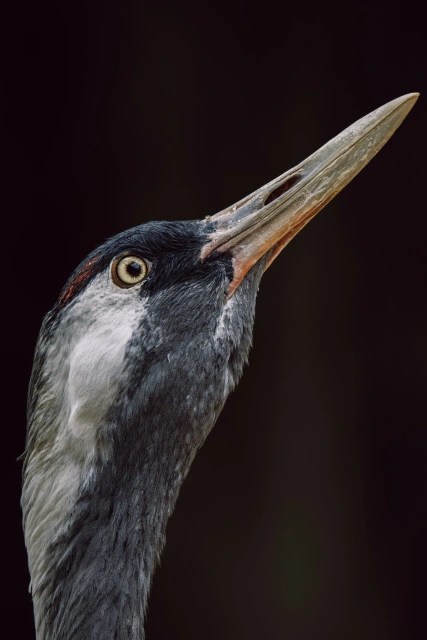
Ivy was going around this new discovery about her mother when a few photos fell out of the binder she holding. One was a picture of a crane with it’s beak pointing skyward and the other was a picture of a eagle with a mountain landscape in the background. Wonderful shots I thought. Mrs. B had really found her thing. She had confided, years ago, that felt she had lost a portion of herself being a mother. She had no regrets raising her children, but she should have carved out more time for herself.

The binder slammed Ivy was biting her bottom lip trying to hold back the tears. I didn’t understand why. If these was a time to cry, this was it. However, Ivy never wanted to be considered a punk and she wasn’t by far the toughest person I knew. Tears streamed from her reddened swollen eyes. There emerald hue seemed to sparkle in the light. Yet, she held back the wail. I always loved those eyes. She rushed towards me burying her head in my chest.

The muffled banshee cry grew louder by the second. The harder she wailed, the tighter she squeezed.

“It’s alright, baby. Let it go,” I whispered