The Night Watches Back


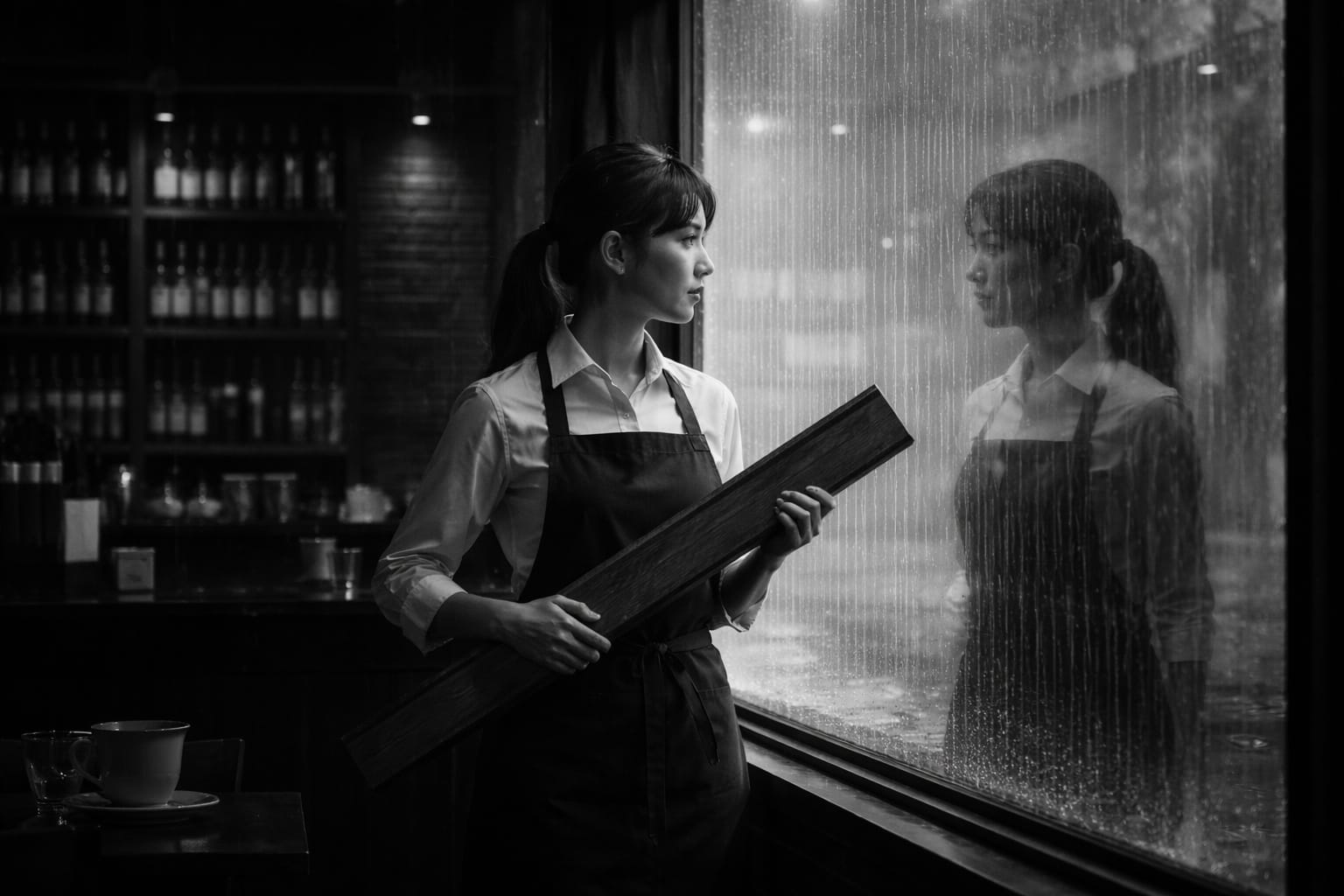
Rain slid down the café window in thin silver lines.

Inside, the lights were low and patient. Bottles stood behind the bar like quiet sentries. A cup of coffee cooled beside an untouched plate, the room carrying the faint smell of roasted beans, wet coats, and something fried hours ago.

Klaire stood near the glass holding the long wooden board used for slicing bread and meat. The worn wood rested against her hip like it belonged there. Thin knife lines crossed its surface, years of quiet work pressed deep into the grain.

Outside, the streetlights flickered.

The intermittent buzz from their tired wiring drifted through the rain. Moths circled the glowing globe of the nearest lamp, occasionally striking it as if they simply didn’t care what happened next.

Someone’s dogs barked in the distance.

Homes went dark one by one. Somewhere out there people were settling into beds, finishing conversations, turning off televisions.

I suppose it is like that somewhere in some town in the world.

It just doesn’t describe mine.

“The city never sleeps.”

Klaire had heard that phrase all her life. She never knew who said it first, but she knew it was true.

More happens in the night than anyone ever admits.

Young love blooming in the back seat of a borrowed car.
A waitress stepping outside for a cigarette, three pats and a wink away from paying her light bill.
A delivery truck driver staring at a flickering candle stuck into a blueberry muffin while wondering how forty-five years managed to pass him by.

Klaire had seen them all.

Not by name.

By posture.

You learn things when you work nights.

You learn who counts coins before ordering.

You learn who sits too long over a single cup of coffee.

You learn the shape loneliness makes in a person’s shoulders before they ever say a word.

Klaire had seen a woman cry quietly over a plate of eggs once, the tears slipping into the yolk before the fork ever touched it.

A man in a pressed suit once sat where the window light fell hardest, staring into his coffee like it owed him answers his expensive apartment never gave him.

And there was the father who came in every Thursday night, always ten days late on the rent, pretending the slice of pie was for someone waiting at home.

The night carried all of them.

Smoke-filled bars. Back alleys. Neon signs humming over people searching for relief from something they couldn’t quite name.

But pain is patient.

It waits.

And the night always knows where to find it.

Klaire shifted the board in her hands. Tonight it felt heavier than usual, as if the wood had absorbed the quiet mass of every story that had passed across the counter.

Her reflection watched her through the rain.

The glass turned her into two women.

One standing inside.

One trapped in the weather.

For a moment Klaire wondered which one was real.

Maybe the one in the glass was the version who had left this city years ago. The one who found a mate, moved somewhere warm, and forgot what neon light looked like through falling rain.

But life rarely follows the road we draw for it.

Klaire wiped the inside of the glass with her sleeve, though it made no difference. The rain outside didn’t care what she could see.

Somewhere down the street a siren wailed and faded into the dark.

Inside, the clock ticked.

Klaire stood there quietly, still holding the board meant for bread and meat, while the quiet mass of the city pressed against the glass.

Her reflection watched her through the rain.

Klaire didn’t wave.

After a moment, neither woman moved.


Thanks Di

The Quiet Between Storms


Stories in Monochrome
Episode: The Quiet Between Storms

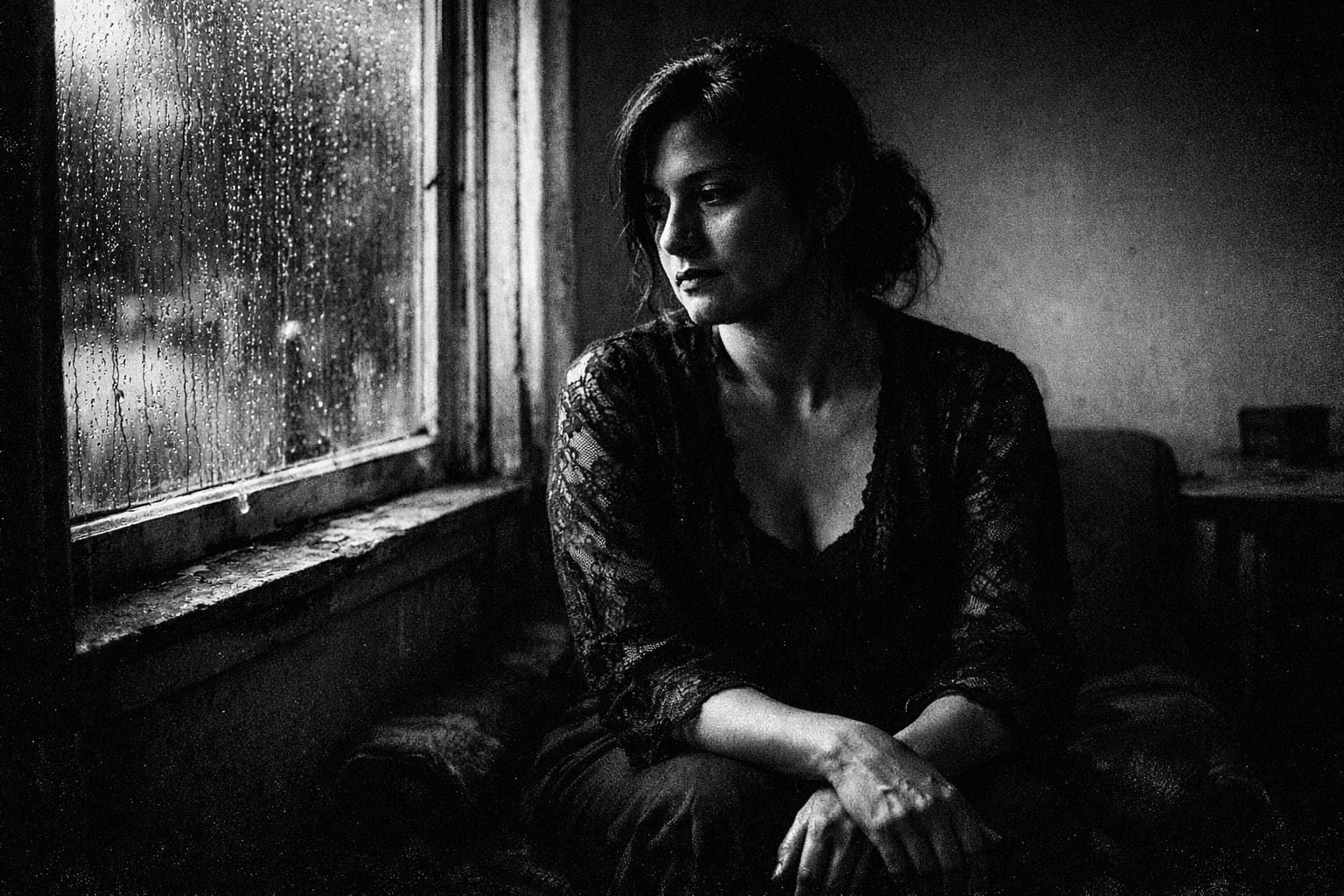
The rain didn’t knock. It pressed itself against the window like it had a right to be there.

She sat in the chair beside the glass, lace sleeves drinking in what little light the afternoon had left. The room was narrow, wood-paneled, holding the smell of old dust and colder days. Outside, the sky had folded in on itself—low, heavy, undecided. Inside, she folded her hands the same way.

There are people who perform their sadness.

She was not one of them.

Her grief was private, disciplined. Almost forensic. She examined it the way some people study fingerprints—turning it under the light, tracing its ridges, asking where it began and who it belonged to. She had once believed that love lived in the body like a pulse. Now she knew better. Love lives in the core. It survives there long after pride burns off and explanations dry up.

The rain sketched restless patterns on the glass. If you watched long enough, it looked like language. A secret code only the sky understood.

She wondered when she had become fluent in silence.

There had been a time—before the hospital corridors, before the unanswered calls—when she believed everything could be repaired with honesty. Say the right words. Hold the right hand. Pull the right emotional cord and the machinery of two hearts would start again.

But some wires don’t reconnect.

Some silences aren’t pauses. They are verdicts.

She shifted in the chair, lace tightening at her elbows. The skin at her wrist was pale where a bracelet used to sit. The absence felt louder than the metal ever had. Objects leave ghosts. So do people.

She wasn’t angry. That would have been easier.

Anger has movement. It gives you something to throw.

This was something else.

This was the long, slow realization that love can end without drama. No slammed doors. No shattered glass. Just a gradual thinning. A quieting. Two people drifting like separate drops of rain, sliding down the same pane, never quite touching again.

Her reflection hovered faintly in the window—half face, half shadow. She studied it the way she once studied him, searching for clues. Was there something she missed? A tremor in his voice? A look that lingered too long somewhere else? Or had the unraveling been mutual—two hands loosening their grip at the same time?

Outside, a car passed. Its tires hissed across wet pavement. The sound felt like a reminder: the world continues. Even when you want it to stall. Even when you sit perfectly still.

She closed her eyes.

There, beneath the ache, beneath the analysis and the restraint, something steady remained. Not hope exactly. Not bitterness either.

Just awareness.

She could survive this.

The rain softened. The sky lightened by a shade no one would notice unless they were watching carefully. She had become good at watching carefully.

Careful is what heartbreak teaches you.

She stood at last and placed her palm against the cool glass. For a moment, the chill startled her. Then it steadied her.

Not everything that breaks you is meant to destroy you.

Some things strip you back to your core so you can see what still beats.

And in the quiet between storms, that is enough.

Dirt You Don’t Swallow


I learned early you don’t eat another man’s dirt.

Not in this city.

Not if you plan on walking it tomorrow.

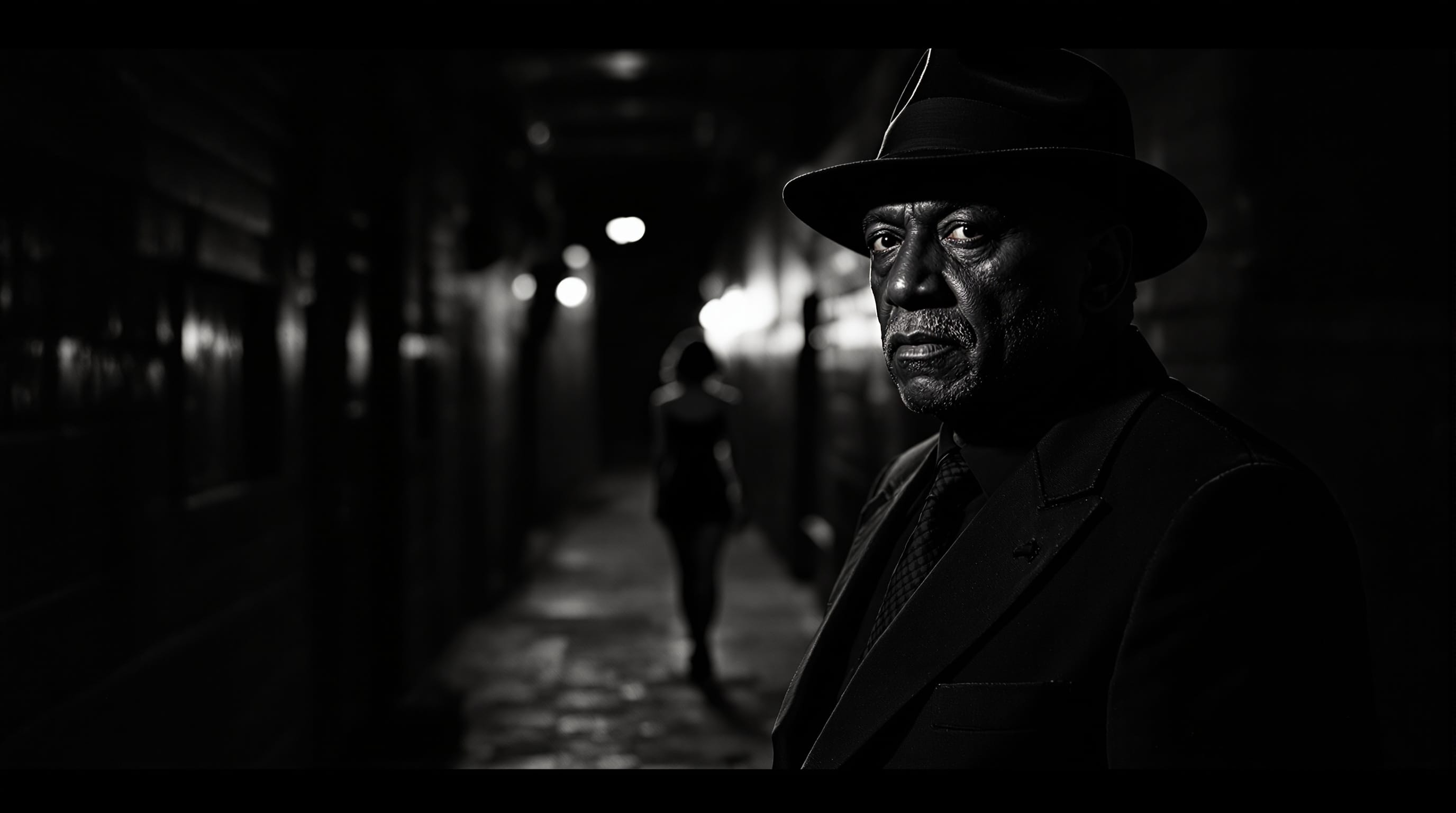
The alley was narrow enough to hold a secret and long enough to bury one. Rain had passed through an hour ago, left the bricks sweating and the pavement slick like old oil. Streetlamp overhead flickered—weak pulse, tired heart. It painted my shadow tall and crooked against the wall.

She was halfway down the corridor of dark by then.

Didn’t look back.

Heels tapping soft. Measured. Like she’d rehearsed it.

I could’ve called her name. Could’ve let it echo off the brick, let it beg a little. Pride’s a funny thing—it talks loud when you’re alone and goes mute when it’s time to prove itself. I felt it rise in my throat anyway. Bitter. Hot.

I swallowed.

But not that.

There’s a difference between swallowing words and swallowing dirt. Words heal. Dirt settles in your lungs.

I’ve watched men eat it before. Watched them nod and grin while somebody else pressed their face into the ground. They tell themselves it’s strategy. Survival. Temporary.

But dirt multiplies.

You take one mouthful, and before long you’re chewing gravel every morning just to get out of bed. You forget what clean air tastes like.

I’ve done things I don’t talk about. Stood in rooms where the air felt heavy enough to bruise. Bent just enough to keep breathing. But I never knelt long enough for it to stick.

Tonight was close.

The man she chose—he’s got money, reach, hands that don’t shake. He wanted me to step aside quiet. Smile while he erased me. Shake his hand like we were gentlemen and not wolves circling the same scrap of warmth.

All it would’ve taken was one nod.

One concession.

One mouthful.

The light cut across my face and showed me what I’d look like if I agreed.

Smaller.

She slowed near the mouth of the alley. Maybe waiting. Maybe hoping I’d run. That I’d make it messy. Give her something dramatic to carry home.

I stayed where I was.

The city doesn’t reward dignity. It doesn’t hand out medals for restraint. It just keeps moving. Drains fill. Neon hums. Taxis slide past like nothing happened.

But I knew.

Better to go home alone, pride cracked but breathing, than let another man decide how deep you kneel.

She turned the corner.

Gone.

The alley felt wider after that. Or maybe emptier. Hard to tell the difference some nights.

I adjusted my hat. Smoothed the front of my coat. Let the rain-cool air settle into my chest. It stung. That was fine. Pain’s clean compared to shame.

You don’t eat another man’s dirt.

Not for love.

Not for leverage.

Not to stay in a story that isn’t yours anymore.

I stepped out of the alley and into the streetlight like a man who’d lost something.

But not himself.

Winter’s Slow Burn


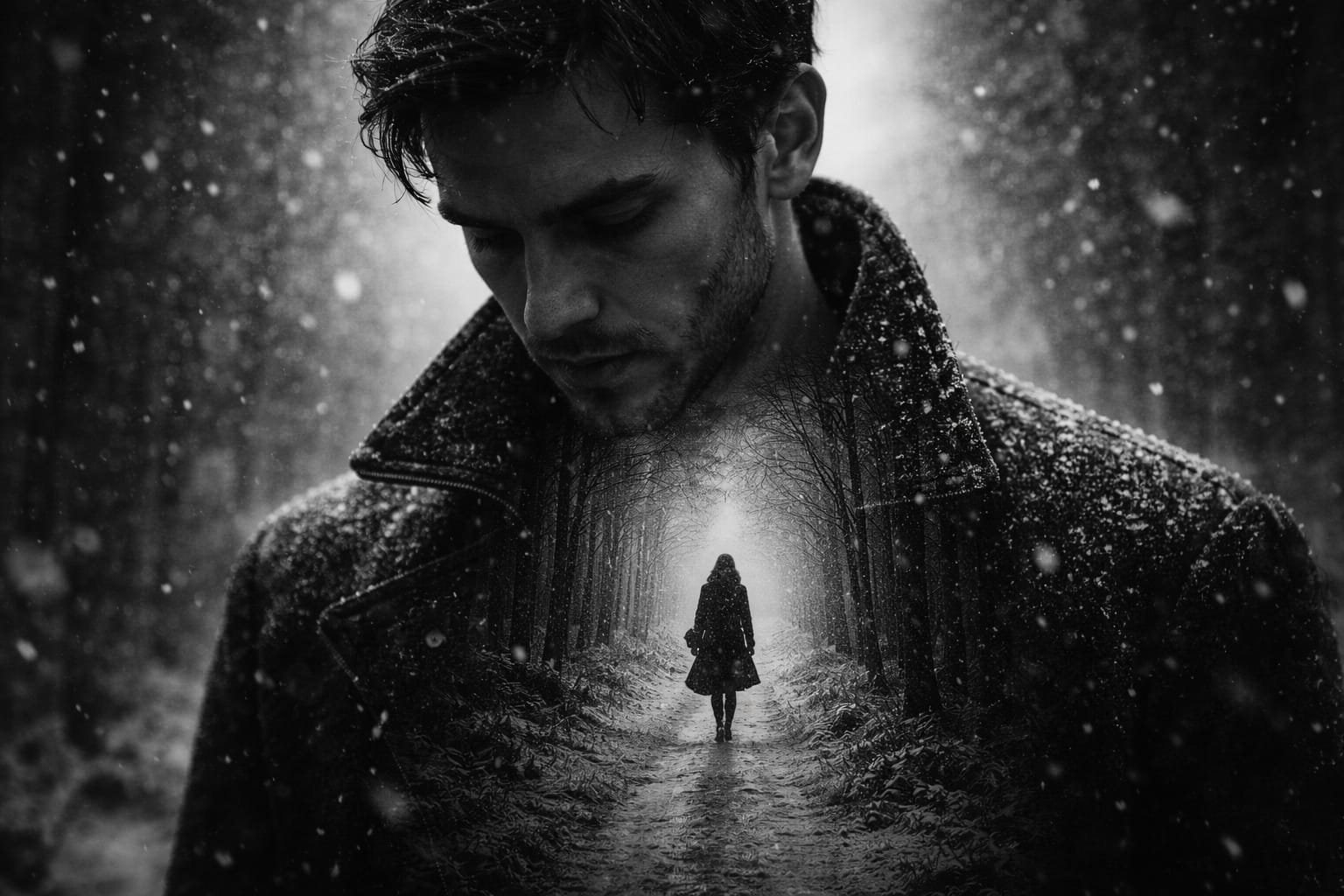
It’s always easiest in the winter.

The cold stiffens things. Numbs the soft tissue. Makes it easier to pack her away into that special box we build for the things that make us uncomfortable. Regret. Longing. Questions with no return address.

In the summer everything breathes too loud. In the winter, silence feels honest.

I sit here with damp cheeks.

The voices arrive like they always do.

“What kind of man are you? Pull yourself together.”

They mean well. Or they think they do. There’s always a script for men. Be steady. Be solid. Don’t leak.

It would be easier if I had done something obvious. Something unforgivable. Something I could circle in red ink and confess to. At least then the ending would have structure. A cause. A clean narrative.

But ambiguity lingers like breath in cold air.

For weeks I told myself she never really saw me. That I stood there open and she looked past me. It preserved something in me to believe that. Made the ache cleaner.

I move through the world now like a man slightly out of phase. Smiling when required. Laughing on cue. Telling jokes that land just well enough to pass inspection. I even went on a few dates, just to see if the machinery still worked.

“There are plenty of fish in the sea.”

“What you need is someone for the night.”

Advice dispensed like loose change.

Do people even believe the things that come out of their mouths? Or do they just speak because silence makes them nervous?

This isn’t about replacement. It’s about recognition.

I could sit here and say she never saw me.

Perhaps I never saw her.

If I’m honest — for once — it’s probably both.

There were moments I mistook her quiet for contentment. Moments she mistook my restraint for indifference. We were standing inches apart, translating each other poorly.

I thought love meant stability. She might have needed expansion. I thought silence meant peace. She might have heard distance.

No one storms out when this happens.

Things just cool.

An empty room doesn’t echo because someone smashed it. It echoes because no one is speaking inside it anymore.

Winter makes it easier to pretend that’s natural.

But maybe the slow burn was always there — not fire consuming us, but warmth fading a degree at a time until we were both shivering, pretending not to notice.

Maybe being seen begins with learning how to see.

And maybe next time, I’ll look closer.

Writer’s Workshop Prompt – 05312024

CHALLENGE RESPONSE – FICTION

Here is my response to Writer’s Workshop

The sun through the 4th floor glass felt good, It was partly on my shoulder and partly on my face. It was good to the feel the warmth. I’d been so cold lately. Nothing, I did made me warm enough. Even when AC went out and it was 90’s degrees in the house, I was okay everyone was else, but they kept their complaints out of earshot. I appreciated that.

I’m sitting thinking about the one who got away. The one who was supposed to make things better and all that. I never knew if they really happened or was it something said we believed in publicly, but thought was a crock of shit privately. “The One” worked at Aunt Peg’s candy shop in the local mall. I must have spent hundreds of dollars on soft peppermint sticks that summer.

The neighborhood paperboy loved me. He made a dollar for every trip to the candy shop. You see, I never could muster up enough courage to actually go up to the counter and ask for the candy.

“Do you even like peppermint?” Maynard, the paperboy asked

I didn’t answer. I did my best to give him an evil leer. Although, I don’t think it was working very well.

“Look, if this is all about the girl? She’s right there. Just talk to her.” Maynard took his dollar and left. That was the last day of summer and I never said a word to the girl.

I still eat soft peppermint sticks when I can find them. Those puff balls seem to have cornered the market. Some marketing genius started this whole mess.

Yep, Aunt Peg’s soft peppermint sticks were the best!

Brothers in Arms

PROSE – VETERAN’S DAY REFLECTION

I’ve said on this blog that we have two families in life. The one we are born with and the one we choose. This concept has always been more than words for me. It’s been the way I was raised, and I live still. Today, Veteran’s Day, I going to take a moment and showcase my brothers.

These yahoo’s on each side of me are veterans.

The above picture is one of the few times we were together. Our lives are hectic, but we made it happen that day. The gentleman flashing the peace sign is the oldest. He was in the Marine Corps and whipped my skinny butt into shape before Army basic training. On the opposite side, he was in the Army Signal Corps and taught me what it meant to be a member of the Signal Corps. Their guidance and toughness laid the cornerstone of who I am.


Each of these men also served in the military; the top three were in the Navy, and my cousin was in the Army. These men helped me put the pieces back together again after my wife died. They reminded me who I was and what I stood for. I’m indebted to them for life.

As veterans, service and duty aren’t things we are born to; it’s what we learn. In many ways, we are the better for it. In others, that is a cost. Some more than others, but a cost, just the same. During the time we wore the uniform, we did our thang. Nothing or no one can take that away from us. It’s an honor to be among you all.

Happy Veteran’s Day