The Line Between Us and the Wild Is Paper-Thin

Some days, I feel like the unofficial understudy for Marlon Perkins from Mutual of Omahas Wild Kingdom—minus the khaki shorts and the camera crew. No judgement here, khaki’s are so comfortable. Wildlife keeps showing up in my life like it’s angling for a recurring role.

A few years back, it was Louie and Smiley—two raccoons who treated my house like a spiritual retreat with free snacks. I returned from visiting my folks to find Louie perched in my office chair reading the Douay-Rheims Bible with the focus of a man reconsidering his sins. Smiley wandered out of the kitchen with a loaf of bread and a pack of cheese like he was prepping for a midnight sermon.

“I found the mother lode!” he said.

“Shut up, Smiley,” Louie muttered—then saw me.
“Louie! He’s back! He’s back!”

Panic. Scramble. Silence.
I expected the Bible to be covered in raccoon glyphs, but it was clean. The kitchen was another story entirely. The kitchen looked like a flour bomb had gone off. And the little bastards were munching on my Cheez-its. Looking back I can’t blame them because Cheez-It’s are righteous. And it’s been over a year since I’ve seen either of them. Strange to admit, but I miss those idiots. You don’t realize how lonely you’ve gotten until you start missing thieves with tails.

These days, everything seems to drift toward “normal”—if that word still means anything. Maybe it’s really just slipping back into the routine that makes sense to you, even if it looks ridiculous to anyone else. My routine involves trying (and failing) to quit smoking while watching the neighborhood wildlife walk around like they pay rent.

Groundhogs strolling like retirees.
Squirrels hustling like Wall Street interns.
Feral cats acting like landlords.

They don’t hide; they don’t wait for the coast to clear. They move like the world belongs to them.

Some mornings, the line between wild and human feels paper-thin.

Lately I’ve been paying attention in a way I never used to—maybe that’s why the animals have gotten bolder.

Because then came the possums.

A pair waddled down my sidewalk one evening, paused, and stared at me like I was the one intruding. As if they were wondering if I was going to hurt them or let them be. I supposed they had decided because one of them lifted a tiny paw and waved.

Then she stood up and said,
Mangus, dont act like you dont see us! Ralph, would you look at this—humans can be so rude.”

Ralph gave the possum equivalent of a shrug.

I figured that was strange enough for the week, but winter has a way of dragging even stranger things to your doorstep.

There’s something about a cold morning—the chill bites you like you walked into the wrong yard. A reminder of the no-no’s of life.

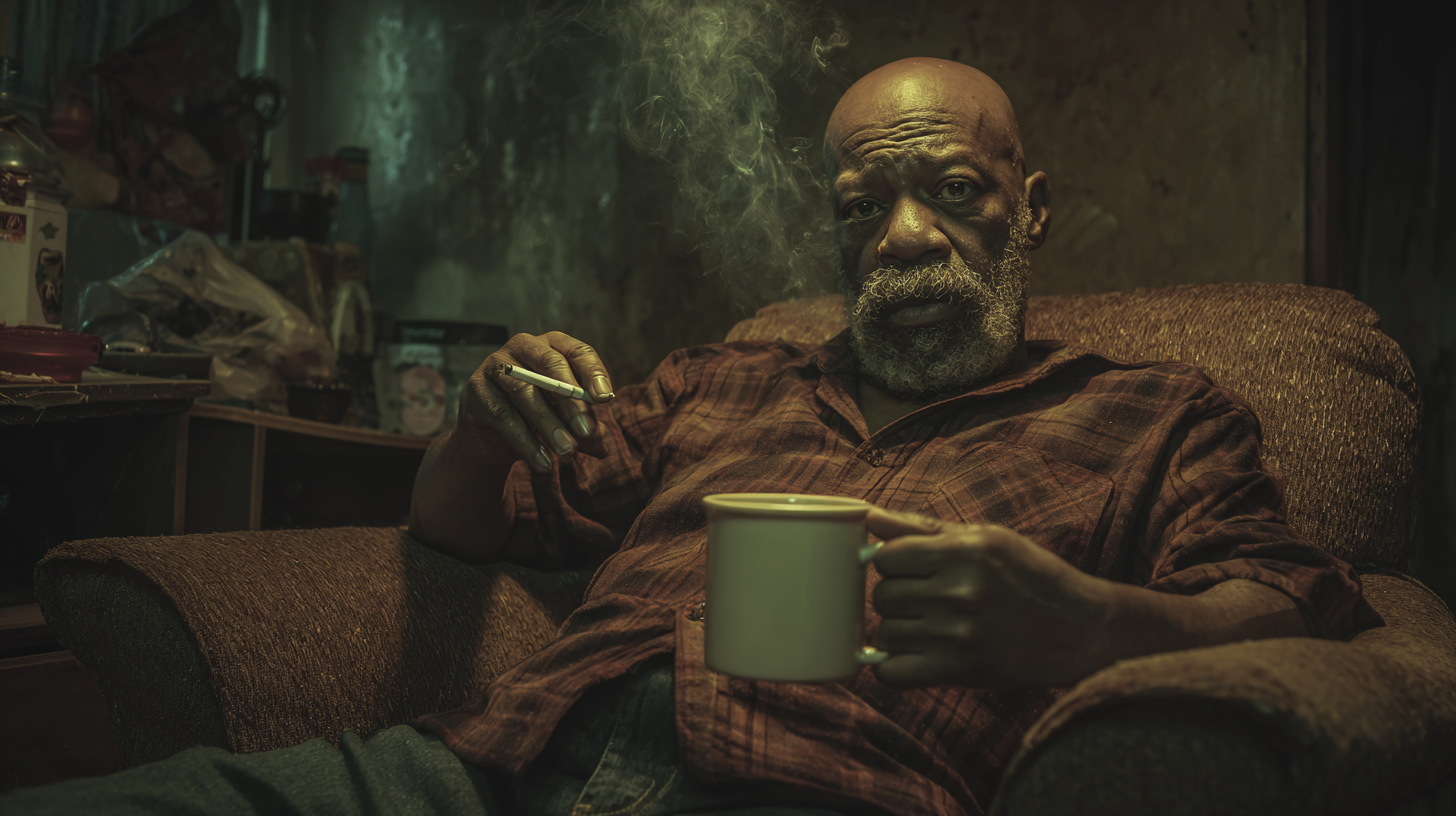
A few mornings later, frost was clinging to everything like regret. I stepped out with a cigarette—a filthy habit, so I’m told. But I’ve lived long enough to see people celebrate worse sins, so I take the judgment with a grain of salt.

That’s when I saw him.

A raccoon was sitting on my stoop, smoking one of my cigarettes, staring into the frost as if it had whispered a prophecy. He jumped when he finally noticed me. His eyes went wide, then settled. If I meant him harm, I’d have done it already.

I lit my own cigarette.
You hear the snow crunching beneath someone’s footsteps. I turned.

Don’t worry,” the raccoon said without looking back. “That’s just Smoke wondering if you put anything out to eat. You’ve been slipping on that, by the way.

Smoke—another raccoon—raised a paw in greeting, then kept moving toward the trash can like we were roommates who barely tolerated each other.

I took my first drag.
Ah, the sweet relief of the little lies we tell ourselves.
Best thing ever.”
Not really—but the small fibs get us through the day.

Cold mornings always pry open old memories. Suddenly, I was thinking about a chocolate cake—dangerously good-looking, baked by someone capable of getting a diabetic canonized or killed. I told myself I’d be a “good diabetic” that day. Truth was, it simply wasn’t the weekend.

I’m not diabetic on the weekends.
A doctor once told me that’s not how it works.
My response: “Watch me, partner.”
Gave him my patented fuck off look. He didn’t know that expression at the time, but he learned fast.

Later, a young woman offering the cake stood beside me—closer than she needed to be. She smelled nice. Held out a plate.

“Yes, you have diabetes,” she whispered. “But you still have to live.”

Best cake ever.

Back on the stoop, the raccoon finally spoke.

Im Stu. Stuart Bigelow. Thats what a little girl across town used to call me. Cancer took her. Cancers an evil SOB—it comes for us all.”

Im Mangus, I said. And I have one question.”

Whats that?”

“Who in the hell told you you could smoke my cigarettes?”

Stu coughed mid-drag, a little smoke curling out like he was half-laughing.
Well, I figured since you left them outside, it was a party pack.”

Stu’s whiskers twitched after each exhale as if the smoke was burning his nose.

I snorted, then coughed, then burst into laughter.
So not a party pack, Stu.”

Some mornings, the wild doesn’t feel wild at all.


Daily writing prompt
Do you ever see wild animals?

Cigarettes and Coffee: The Sound of Staying Awake 

“It’s early in the morning / About a quarter to three…” 

— Otis Redding 

Nicotine stains my fingers, and there’s a coffee ring bleeding through the corner of my notebook. My shoulders ache — that familiar, loyal pain that’s been with me longer than most people. You get to that stopping point, the one where you promise yourself just one more thing so the mind can shut off without guilt or shame. Not that you’ve done anything wrong; it’s just the brain’s way of punishing ambition. You light up, take a sip, and the room hums like an overworked transformer. No bacon, no eggs — just the stench of being fried. 

I’d been pulling an all-nighter, trying to wrestle systems into order before the next sunrise. Sleep wasn’t an option — at least that’s what I told myself, and once you start believing your own lies, they might as well be true. Somewhere around that blurred hour when the clock forgets which side of midnight it’s on, my wife came in with that look — half worry, half why in the hell aren’t you in bed next to me. The first two parts I could shrug off; the last one carried weight. She stood there, watched me for a moment, then went to put on a pot of coffee. 

She was the wife of a soldier, so she knew the score. She didn’t like it much, but she knew it all the same. She looked at the clock and chuckled, that kind of laugh that carried both resignation and love. 

“This is your theme song, right here,” she said. “Metal something — you’re always going on about it.” 

“It’s Metallica, babe,” I said, “and the track is Am I Evil.” 

She lit her own cigarette, slow and precise, the way she did everything that mattered. The smoke rose along the side of her face, curling like a slow dance with the light. One eye squinted through the haze as she looked my way — then in one easy breath, the smoke was gone. 

“Shit, you say,” she replied, and I laughed — a small, grateful sound. The kind that breaks tension without fixing a thing. I took another sip of coffee. The bitterness hit just right, grounding me in that narrow space between exhaustion and clarity. Otis was still humming through the speakers, like an old friend keeping score of the hours we’d lost. 


Otis Redding’s “Cigarettes and Coffee” came out in 1966, tucked into The Soul Album, a record overshadowed by his bigger hits. No stadium anthem here — just the quiet gospel of survival. The band plays soft, steady, respectful. Al Jackson Jr. keeps the drums whisper-thin, Duck Dunn anchors the bass like a heartbeat, and Steve Cropper’s guitar flickers in and out of the light. 

It’s a sparse room of sound. You can almost smell the studio air — the tape reel humming, the smoke hanging low. Otis isn’t singing to anyone in particular. He’s talking to whoever’s still awake, whoever’s chasing purpose through fatigue. 

“I’m sittin’ here talkin’ with my baby / Over cigarettes and coffee…” 

That’s not romance. That’s ritual. 

It’s the sound of two people trying to stay human when the night’s too long and the world’s too loud. 


People love to say the sixties were a musical revolution. You hear it your whole life, like gospel. But you don’t really understand it until you’ve lived long enough to see how hype survives every generation. They didn’t have social media then, but they had slogans — peace signs, protest anthems, movements branded before they could breathe. 

Today, the noise just comes in technicolor. Everything trending, nothing sticking. But Otis — he stuck. He already had his name etched in wax by the time this song landed, but “Cigarettes and Coffee” wasn’t for the spotlight. It was for the back room, the insomniacs, the men and women sitting at their own breaking points. 

That’s what makes it timeless. It’s still talking about what we’re still living — the quiet wars we fight with ourselves, the long nights spent trying to hold it all together. 


Every time I hear this track, something in me unclenches. It doesn’t lift me up — it settles me. Makes me honest. There’s a weight in Otis’s voice that feels like a man exhaling after carrying the world too long. 

The song doesn’t fix anything; it just reminds you you’re not alone in the fixing. It says peace isn’t about rest — it’s about acceptance. The kind that comes when you’ve worked yourself down to silence and realize the silence feels sacred. 

For a few minutes, I stop fighting the fatigue. My hands ache, my eyes burn, my shoulders protest, and somehow it all feels right. The song gives the exhaustion purpose. It turns the ache into evidence — proof that I’m still in motion. 

That’s what makes it beautiful. Not joy. Recognition. The shared breath of the living tired. 


Music provides the soundtrack of our lives — checkpoints across time, a kind of living mythos. We all move through the same years differently, but the songs mark us just the same. A verse here, a chorus there — little coordinates reminding us who we were before the noise got too loud. 

It’s strange, isn’t it? Two people can walk side by side, hearing the same song, and still be living two entirely different truths. That’s the thing about music — it doesn’t belong to an era; it belongs to the listener. 

That’s why Otis still matters. “Cigarettes and Coffee” isn’t nostalgia — it’s memory work. It’s here to keep us from forgetting what it feels like to be awake in the dark, searching for balance in the hum of a tired world. 

Music is here so you don’t forget — how to feel, how to love, and how to weep. It’s a reminder that even in the long nights of rebuilding, there’s still rhythm left in the wreckage. And if you listen close enough, you might just hear yourself breathing in time with the song. 

Pull Quote: 

“It’s not a love song — it’s a mirror. A hymn for the living tired.” 


Author’s Note:
This piece was written for Jim Adams’ Song Lyric Sunday challenge, where writers and music lovers gather each week to explore songs through memory, meaning, and emotion. This week’s theme — coffee or tea — led me back to one of Otis Redding’s quiet masterpieces, “Cigarettes and Coffee.” What started as a late-night listen turned into something more personal — a reflection on rebuilding, resilience, and the art of staying awake long enough to make sense of it all.

The Deprivation Chronicles: Tales from the Edge of Sleep and Sanity

FICTION – MLMM #423

The darkness rolled in like it had something to prove. Real main-character energy. Clouds stacked overhead like they were about to drop the most dramatic breakup speech ever. The wind started howling—less “otherworldly whisper” and more “Karen demanding to speak to the manager of nature.” Windows rattled like they owed the wind money. Shutters flailed with the enthusiasm of someone who just realized they left the stove on.

The scent of rain filled the room, all ominous and moody, but of course—not a single drop. Just a tease. Rain was clearly ghosting the whole event.

A candle flickered in its blue glass holder, doing its best impression of ambience. It gave off an aura of “I tried, okay?”—like it had dreams once, but then it met grad school. Its flame danced like it had no rhythm but a lot of confidence, like that guy at weddings who thinks even the Electric Slide is freestyle.

He sat cross-legged in the middle of the room, surrounded by books stacked with the precision of someone deeply avoiding emotional responsibilities. It was less a cozy reading nook and more a literary panic fort. The spines practically shouted, “Look at us! We’re important! We’re unread!” Each story melted into the next until they formed a plot smoothie that tasted suspiciously like pretentiousness and unresolved metaphors.

Sleep tiptoed in like a cat with boundary issues. He was no longer in control—just a tired, passive spectator in a dream sponsored by confusion. The haze pulled him in gently, like a sentient weighted blanket with attachment issues.

Then it got weird.

He felt the warmth of her breath on his face. Comforting. Mysterious. And deeply concerning because, again, he lived outside of a romantic subplot. Who was this woman? Did she come with the house?

Her soft, wet lips pressed to his cheek—sweet, tender, and vaguely moist, like a warm fruit snack. He didn’t question it. Honestly, he didn’t want to know. A strand of hair brushed his brow with the precision of a motivational TikTok influencer wiping away his doubts and reminding him to hydrate.

He sank deeper. Into the story. Into the illusion. Into a pile of metaphors with no exit strategy. Reality became a suggestion. One he politely ignored.

Because sometimes, in the words of others, we somehow… somehow we find our own. And other times, we fall asleep halfway through a book and wake up with a paperback stuck to our cheek and a vague sense of accomplishment.

Writing

How are you creative?

DAILY PROMPT RESPONSE

Although I have been writing and drawing since I was a kid, I never really considered myself to be creative. This isn’t because I wasn’t encouraged or anything like that. It’s partly because I was surrounded by very talented people. I just didn’t consider my work good enough to make the cut.

I suppose another issue is I never found a particular style I excelled in. I enjoy writing every genre. It’s nothing better than getting an idea down on paper and seeing where it goes. Sometimes, that’s no further than a notation in a notebook or scribbled on a scrap of paper.

Lately, my friends have been expressing in my photography. I have to admit I enjoy capturing the images and seeing what stories they tell me. Yet, recently, I have been discovering the stories within themselves.

I must say I’m lucky. I get to tell stories by writing, photos, or film. Every now and then, I get combine all three. It’s special when things work out that way. When writing a screenplay, I must rely on imagery to get it done. This can be a challenge for a narrative fiction writer.

This is where the photography comes into play. I can capture images and use them as templates of the world I’m trying to create. This can be done with a video camera, but sometimes, the stills just work better for me.

Often, I sketch ideas and then try to find them in the real world. Well, I guess I’ve babbled enough for you to get the idea.

As always,

~thanks for reading~

A Glimpse into Madness

Here is a glimpse of my world in response to Pensitivity101“s prompt

Here are this week’s questions:

  1. If you could reinvent yourself, how would you like to be? I wouldn’t change much about myself. Each success and failure has been a learning experience I’ve found them useful in a variety of situations. However, I think it would be nice to live without the nightmares.
  2. Would you like to be a pet in your household? Yes, of course, I believe pets make us better. They can be messy, but the emotional support they provide is crucial. At least, it’s that way for me.
  3. How many house moves have you had as an adult? I have moved a lot as an adult. A few countries and several states. I’m going to guess and say, maybe 15 times.
  4. What was your favourite home? I don’t have a favorite home was whereever my wife and children were. It’s literally that simple for me. 

Gratitude:
It costs nothing to be nice. You may even be remembered for it.