Mara knocked three times, softly enough that I could have pretended not to hear her, which I suspect was intentional.
“Elias?”
I looked toward the door without answering. Whoever had designed Ward C had apparently believed privacy was something mentally unstable people might misuse, so the doors never quite closed. Mine remained open by three inches, leaving a narrow strip through which I could see the opposite wall, part of the nurses’ station, and occasionally somebody wandering past in hospital socks while carrying on a conversation with God.
Mara remained just outside my line of sight.
“Elias, may I come in?”
I took another drag from my cigarette and considered the question with considerably more seriousness than it deserved. The cigarette itself was already a violation of at least four rules, although nobody had bothered confiscating them since Tuesday. Either security had become remarkably incompetent or somebody had decided lung cancer was sufficiently far down the list of things likely to kill me that enforcement seemed petty.
Coffee presented the larger problem.
I hadn’t had any in four days.
A man deprived of caffeine for ninety-six hours should not be expected to make decisions involving women, strangers, suspicious knocks, or reality.
“Depends,” I said.
“On what?”
“Whether you’re real.”
There was silence from the hallway.
Then she laughed.
Not loudly. Just enough.
“I was wondering the same thing about you.”
That seemed fair.
“Come in.”
The door opened.
And there she was.
Three days earlier I had watched Mara Bell standing barefoot on a cafeteria table screaming that somebody had stolen Thursday. Two orderlies had eventually talked her down, although talked is generous considering one of them had tackled her around the waist while she attempted to bite the other.
Yesterday she had shuffled past me wearing institutional blue, her hair looking as though it had spent the night negotiating with electricity.
Tonight she looked like murder had dressed for dinner.
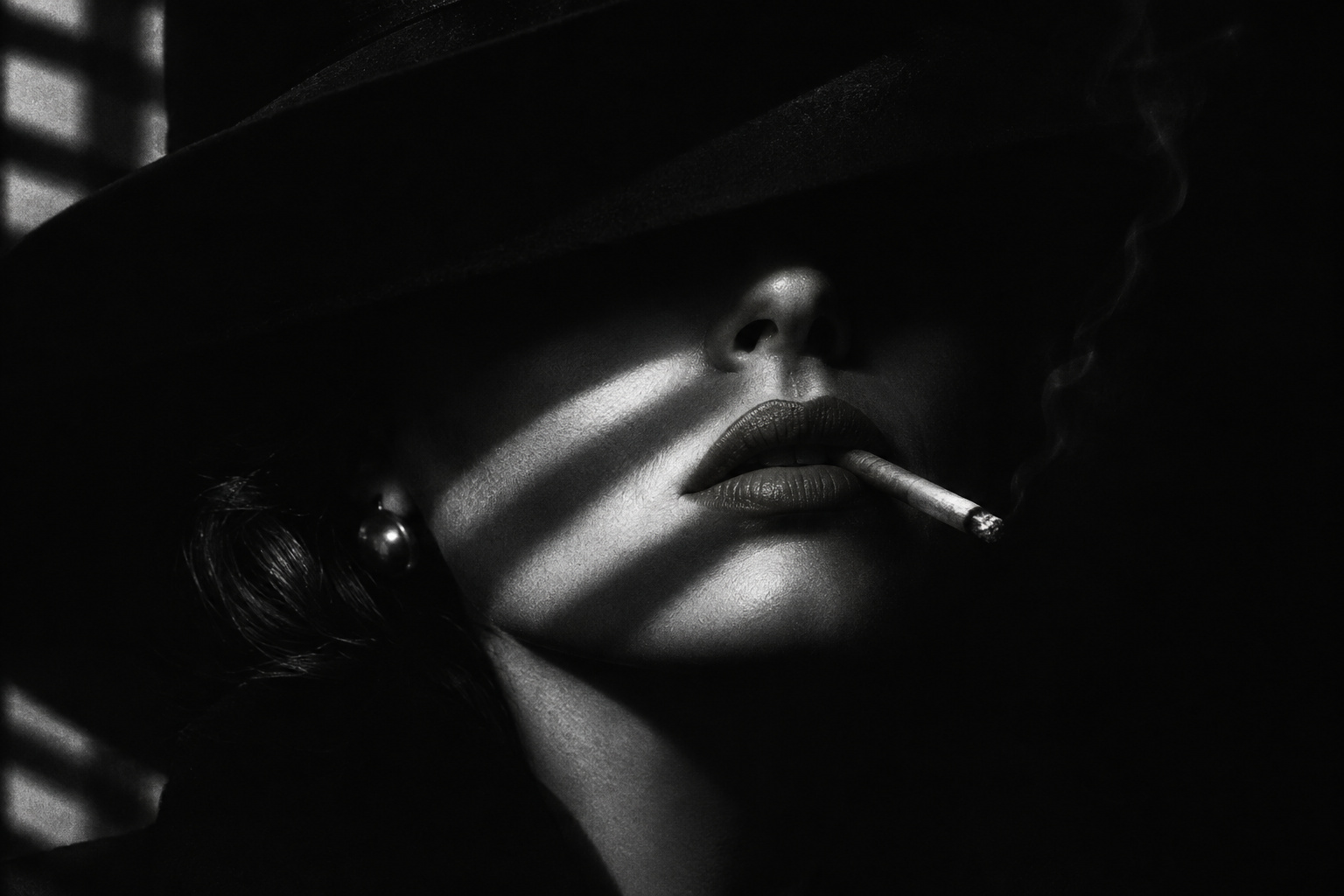
Black dress. Dark stockings. Pearl earrings. Gloves. A wide-brimmed hat tilted low enough that her eyes disappeared beneath it, leaving only the sculpted geography of cheekbones, nose, and mouth exposed whenever the light found her. A cigarette rested between her lips, unlit.
I stared.
She waited.
I continued staring.
“You’re supposed to say something, Elias.”
“I’m trying to decide whether asking where you got the clothes would ruin the moment.”
“It would.”
“Then you look lovely.”
“That will do.”
She entered with the slow confidence of a woman walking into a room she already owned and stopped beside the window. Moonlight leaked through the blinds and broke itself across her face in narrow silver bars.
She removed the cigarette from her lips.
“You have a light?”
“Apparently.”
I crossed the room and struck a match.
For a moment neither of us moved.
The flame trembled between us.
Mara leaned toward it until the cigarette caught, and somewhere in that tiny ceremony something shifted. Perhaps it was the hat. Perhaps the perfume I hadn’t noticed until then, something faintly floral struggling beneath antiseptic and cigarette smoke. Perhaps four days without coffee had finally caused permanent neurological damage.
Whatever the reason, I stopped seeing the woman from the cafeteria.
I saw Mara.
She inhaled deeply and leaned against the windowsill.
“Thank you.”
“You’re welcome.”
She looked around my room.
“You live like an animal.”
“I’ve been here eleven days.”
“Twelve.”
That stopped me.
“You’ve been counting?”
She didn’t answer.
Instead, Mara examined the cigarette between her fingers as though she’d discovered something written in the ash.
“They’re coming tomorrow.”
There are sentences whose meaning depends entirely upon the person speaking them.
Had Nurse Franklin said it, they would probably have meant doctors.
Had Dr. Levin said it, they might have meant my family.
Coming from Mara, they could have meant the federal government, extraterrestrials, Jehovah’s Witnesses, or the Four Horsemen of the Apocalypse.
I decided not to guess.
“Who?”
“The zombies.”
There it was.
I lit another cigarette.
“Of course.”
“You don’t believe me.”
“I didn’t say that.”
“You thought it.”
“I think lots of things. Most of them aren’t admissible as evidence.”
For the first time since entering the room, her performance slipped.
Only slightly.
Her mouth tightened. Her shoulders dropped perhaps half an inch. Then something glittered beneath the shadow of her hat and traveled slowly down her cheek.
A tear.
She didn’t wipe it away.
That frightened me more than anything she’d said.
“Mara.”
“They aren’t dead people.”
I waited.
She smoked.
Outside my room, a cart squeaked along the corridor. Someone laughed somewhere farther down the ward. A telephone rang twice before being answered. Ordinary sounds. Hospital sounds.
Mara lowered her voice.
“That’s just what I call them.”
“Why?”
“Because there isn’t anything left inside them.”
Something cold moved through me.
She lifted her face enough that I could finally see her eyes.
“They smile. They talk. They remember your name. They ask whether you’re sleeping and whether the medicine is helping, and they write things down when you answer.”
I said nothing.
“Then they take pieces.”
“What pieces?”
“The ones that don’t fit.”
The cigarette burned between her fingers.
I wanted to dismiss it.
I desperately wanted to dismiss it.
There was only one problem.
I had been having the same dream for six nights.
Except I was beginning to suspect it wasn’t a dream.
Mara stepped closer.
“Elias, I need you to help me.”
There was perfume beneath the antiseptic again. Tobacco. Something warm and human. She was close enough that I could see the faint tremor at the corner of her mouth despite all that manufactured composure.
“With the zombies?”
She nodded.
I should have told her no.
I should have found Nurse Franklin. I should have reported the conversation, surrendered my cigarettes, requested whatever medication they gave people when reality started developing cracks around the edges.
Instead, I heard myself ask the question that would eventually ruin both our lives.
“What do you need me to do?”
Mara smiled.
Not seductively.
Not triumphantly.
Relieved.
And somehow that was worse.
“First,” she whispered, “you need to remember why you’re here.”
Then she walked out.
I remained beside the window long after her footsteps disappeared down the corridor, smoking until the cigarette burned close enough to my fingers to hurt.
On the opposite wall hung the calendar I’d been given when I arrived.
I looked at it.
September 26.
Then I looked again.
Because beneath today’s date, written in my own handwriting, were four words I had absolutely no memory of writing.
DO NOT TRUST MARA BELL.
Discover more from Memoirs of Madness
Subscribe to get the latest posts sent to your email.


It brought back memories of the old 40s- black and white noir movies – very descriptive in how it presented the story – painted a vivid picture – could picture Bogart – Garfield – Raft Mitchum – Bacall – so well done.
LikeLiked by 2 people
Ha, my wife and I just watched The Big Sleep. That movie is 80 years old, but it’s still good!
LikeLike
I like your start here, Mangus.
LikeLike