
When I first looked at the question, How does our perspective change our reality? I had no idea how to proceed. It is simple enough on the surface, one of those questions that seems to invite a tidy answer and perhaps a clever sentence at the end. Yet there was something underneath it I couldn’t quite put my finger on. So, as they say, if you want to know how you feel about something, write. Or something like that.
The first thing that came to mind was something I heard decades ago while attending a discussion on religion. It was a lively discussion, I assure you, the sort where everybody arrived carrying convictions and nobody seemed particularly interested in leaving with fewer of them. The leader kept repeating the same phrase:
“Your perception is your reality.”
At the time, I thought it was a cop-out. A philosophical dodge dressed nicely enough to sound profound. I remember thinking, Stand your guns, man. Pick a side. Are you a namby-pansy? It’s okay if you are. It’s all about know thyself, yeah?
Funny thing about getting older: sometimes it takes decades to understand something you were absolutely certain you understood the first time.
The truth is the truth. Our perception does not possess some magical authority to rewrite it. A thing does not become true simply because we believe it, fear it, need it, or repeat it loudly enough. What perception can change is the version of that truth we are willing to accept. Sometimes we don’t have enough information. Sometimes experience hasn’t taught us what we’re looking at yet. Sometimes we are simply wrong.
And sometimes we know damn well it’s a lie.
That last one bothers me.
T.S. Eliot gives us a wonderful example in The Love Song of J. Alfred Prufrock. Prufrock spends so much time trapped within his perception of himself, and imagining how others perceive him, that possibility becomes something he can contemplate but struggles to inhabit. Nothing needs to physically restrain him. His uncertainty, hesitation, and relentless self-examination do much of the work.
How we perceive ourselves can become a prison with no walls.
Those may be the hardest prisons to escape because there is nothing obvious to tear down. No bars to bend. No lock waiting for the right key. There is only the quiet certainty that this is who I am. I can’t do that. I’m too old. I’m not intelligent enough. People like me don’t belong there. Someone like that could never want someone like me. I tried once. I failed. This is simply the hand I’ve been dealt.
Some walls, of course, are real. Poverty is real. Prejudice is real. Age comes collecting whether we answer the door or not. Bodies have limitations, circumstances have consequences, and no amount of positive thinking turns concrete into mist. Pretending otherwise is motivational-poster bullshit.
But sometimes there isn’t a wall.
Sometimes there is only our perception of one.
Worse, sometimes somebody else built it for us.
We often find comfort and safety wrapped inside the ideals of another person. Parents tell us what respectable looks like. Teachers tell us what we’re capable of. Communities tell us where we belong. Lovers tell us what makes us worthy of love. Society hands us categories before we’ve learned enough about ourselves to question them. None of these influences must necessarily be malicious. Some protected us. Some gave us structure when we needed structure. Some taught us things worth keeping.
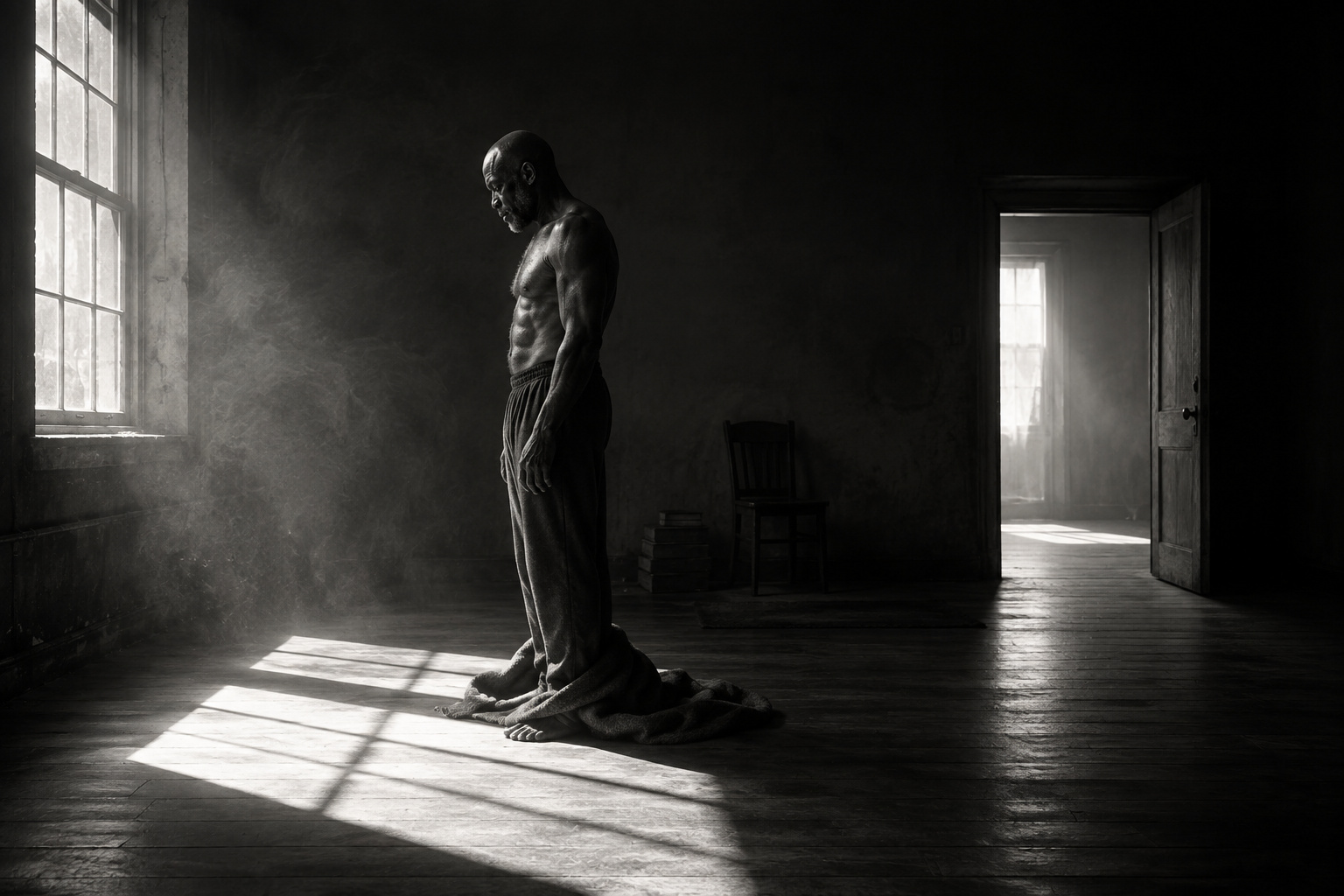
But a blanket can keep you warm long after it has become too small.
We are assembled from fragments: lessons learned, books read, music heard, films watched, conversations remembered, mistakes survived. Each adds something to the information through which we interpret the world. None of us sees from nowhere. We look through everything that came before, carrying what we know alongside everything we don’t know yet.
That raises an uncomfortable possibility. If our perception is shaped by the information available to us, what happens when new information contradicts what we thought we knew? What happens when experience reveals something that had always been there, but we lacked the knowledge—or perhaps the willingness—to recognize?
More importantly, what happens when the new information is about us?
Eventually, we have to decide which fragments still belong.
That is where this gets uncomfortable.
What happens when you shake off the blanket and stand naked before the truth about yourself?
Not your truth. I’ve become suspicious of that phrase here. The truth doesn’t need our ownership. I mean the truth about you, stripped of the flattering explanations, inherited expectations, convenient villains, excuses polished smooth from years of handling, and stories you’ve repeated so often you’ve forgotten you were the one telling them.
Now you’re exposed.
And perhaps the person you’re most exposed to is yourself.
Other people can be dismissed. We can argue with them, avoid them, accuse them of misunderstanding us, decide their opinions don’t matter, and go home feeling wonderfully vindicated. What we know about ourselves is considerably more difficult to escape, particularly when we begin to recognize how much of what confined us was accepted, inherited, or maintained by us.
Seeing that doesn’t make it disappear.
Knowledge isn’t courage.
Awareness isn’t transformation.
And recognizing the truth does not suddenly create responsibility.
You bore that responsibility all along.
Now you simply know it’s there.
Perhaps that’s how perspective changes our reality. It doesn’t change the truth. It changes what we’re capable of seeing, what we’re willing to acknowledge, and eventually what excuses remain available to us. We can learn more. We can look from another angle. We can question the fragments from which we’ve constructed ourselves. We can discover that some limitations are real while others have survived because we never seriously questioned them.
Or we can pull the blanket back over our heads.
That’s still a choice.
So maybe that man all those decades ago wasn’t dodging the question when he kept saying, Your perception is your reality. Maybe I was too busy demanding that he pick a side to understand what he was actually placing in front of us.
The truth was there.
It always had been.
So was the responsibility.
Now that you can see both, do you possess the courage to do something about it?
Author’s Note
Thanks, Sadje, for providing the catalyst that eventually became this essay. I never quite know where one of these Sunday Poser prompts is going to take me, and perhaps that’s part of the fun.
It’s wonderful to step away from fiction from time to time. Fiction gives me plenty of room to explore ideas, but there’s always the additional work of figuring out how to weave a concept into the story without making the characters sound like they suddenly wandered into a philosophy lecture. The idea has to belong there. It has to emerge from the characters, the circumstances, and whatever trouble I’ve gotten them into.
Non-fiction offers a different kind of freedom.
Sometimes you don’t need the character, the dark alley, the suspicious stranger, or somebody standing beneath a streetlamp contemplating all the terrible decisions that brought them there.
Sometimes you can just talk straight.
This question gave me the opportunity to do that. I started with perception, wandered through a memory several decades old, bumped into Eliot along the way, and eventually found myself somewhere considerably more uncomfortable: responsibility.
Apparently, even when I step away from fiction, I still manage to wander into the darker corners.
Thanks for the inspiration, Sadje, and for giving me another excuse to walk into the madness and see what was waiting there.
Discover more from Memoirs of Madness
Subscribe to get the latest posts sent to your email.
 Memoirs of Madness
Excellent post Mangus.
LikeLike