
Which outdated technology do you miss the most, and why?
When you live long enough, the list of answers to this question becomes long.
Hours have been spent discussing the way things used to be, the way things should be, and one of our favorites: Why the hell did they change this or that?
But are those the real questions?
Typically, questions such as this fall into what I call the Dumbshit Category. Questions that give us an excuse to reminisce about rotary phones, cassette tapes, typewriters, television sets that weighed approximately the same as a Buick, and all the other things we once considered modern.
Nothing wrong with dumbshit.
Dumbshit has its place.
Every once in a while, though, one of these questions accidentally asks something worth answering.
Which outdated technology do I miss the most?
None of it.
What I miss is a time when we seemed to believe everyone mattered.
I am increasingly troubled—sometimes enraged—by the moment when human interaction began disappearing behind a hexadecimal veil. Somewhere along the way, convenience stopped assisting human connection and began replacing it.
We don’t visit as much.
We don’t sit.
We don’t spend time with our elders simply because they are there.
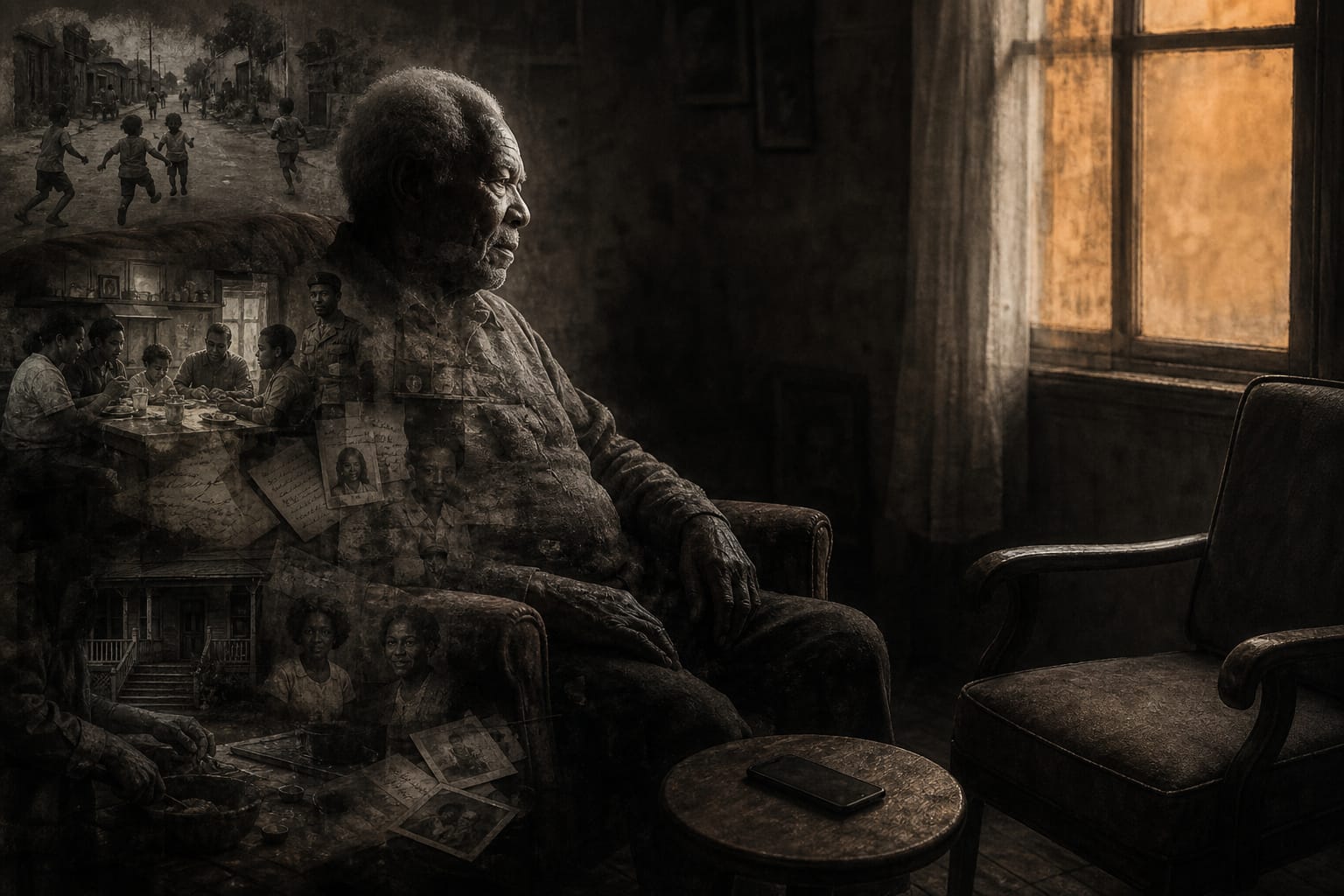
There was a time when sitting with an elder felt like an honor. You listened to stories you may have heard before. Sometimes several times before. You drank something. Ate something. Sat around doing absolutely nothing important.
Except it was important.
Now I sometimes hear people discuss visiting an elder as though somebody assigned them a shift.
Maybe this bothers me more now because I’ve learned something youth makes difficult to understand.
There isn’t always another Saturday.
An elder isn’t simply someone sitting in a chair waiting for company. They are a living archive. They carry stories nobody bothered to write down, names beneath photographs nobody thought to label, family history, neighborhood history, mistakes, victories, recipes, grudges, jokes, and answers to questions we haven’t thought to ask yet.
Then one day the archive closes.
No backup.
No password recovery.
No cloud.
Gone.
And suddenly the stories we thought we’d heard too many times become the ones we’d give anything to hear once more.
Perhaps people haven’t stopped caring. Maybe that’s too harsh. Perhaps we’ve built a world where caring has become increasingly inconvenient—and then spent enormous amounts of technology trying to eliminate inconvenience.
The problem is that some things worth keeping were inconvenient all along.
I don’t blame technology for this. That would be too easy, and probably dishonest.
We’ve done versions of this to ourselves throughout history.
I remember the elders of my youth looking around at the changing world and asking the same question.
What happened?
As a young man, I had answers.
They’re old.
They don’t understand.
Things change.
There was some truth in all of it.
Every generation eventually encounters a world it no longer completely recognizes. New customs appear. Language changes. Technology changes. Things once considered essential disappear. Some of those changes are improvements. Some are merely different. Some things probably deserved to disappear.
Nostalgia is a talented liar.
It remembers the mixtape but conveniently forgets standing beside the cassette player with a pencil trying to wind the damn tape back into the shell.
So I don’t want the old world back.
Yet here I sit as one of the elders, looking through essentially the same window they did, asking the same damned question.
What happened?
And now I understand what I couldn’t understand then.
Perhaps they weren’t asking us to stop the world from changing.
Perhaps they were asking whether we understood what we were giving up.
Even our language has evolved in an attempt to provide greater clarity. We have words for things previous generations struggled to articulate. That’s progress, and I wouldn’t dismiss it.
Still, somewhere in all this precision, we occasionally seem to have misplaced understanding.
We correct terminology without hearing meaning. We label before listening. We communicate through abbreviations, reactions, emojis, likes, shares, and whatever collection of symbols happens to be fashionable this week.
Sometimes those things communicate perfectly well.
Sometimes they allow us to avoid actually talking to one another.
In 1969, Led Zeppelin released a track called “Communication Breakdown.”
More than half a century later, the title sounds less like a song and more like a prophetic message.
Consider the absurdity.
We carry devices capable of reaching another human being almost anywhere on the planet in seconds. We can send photographs, text messages, email, video, voice, and thoughts across thousands of miles before the coffee gets cold.
We have never possessed more tools for communication.
Yet I’m not convinced we’ve become better at communicating.
Perhaps communication was never primarily about transmission.
Perhaps it was about presence.
Human beings are inconvenient.
We repeat ourselves. We interrupt. We tell stories badly. We need rides when somebody has something else planned. We call at the wrong time. We sit in silence. We need someone beside us when there isn’t a damn thing they can do to fix what hurts.
Real relationships require something modern life constantly teaches us to eliminate:
inconvenience.
Technology didn’t make that choice for us.
We did.
And before I climb too high onto the elder’s soapbox, I remember the young man who heard older people asking What happened? and dismissed them because they didn’t understand his world.
Now I understand theirs a little better.
Maybe that’s another piece of technology that has become outdated: the belief that another human being is worth our time even when there is nothing to gain, nothing to accomplish, and nothing to post afterward.
I don’t miss the rotary telephone.
I miss remembering why we called.
Maybe the elders weren’t trying to tell us that everything was better back then.
Maybe they were simply asking us not to throw away the things that mattered while we were busy building what came next.
It took me becoming one of them to finally hear it.
LASND
Discover more from Memoirs of Madness
Subscribe to get the latest posts sent to your email.
 Memoirs of Madness
I miss drive-in movies, real restaurants, and a good truck stop hamburger
LikeLiked by 1 person
Oh, I’m with you on the drive-ins. And there was something about those old truck-stop hamburgers—and the old-school waitresses who had heard it all and could still set down a coffee, look you dead in the eye, and ask, “What’d you have?”—that probably violated several modern health regulations but tasted damn good doing it. 😂 Some things disappeared for good reason. I’m not convinced those were among them. Thanks for chiming in.
LikeLike
You summed up the situation perfectly. I agree. This younger generation more than most, has lost more, in my opinion than previous generations. The touchy feely up close and personal…that being in the same room with someone older with experience who has lived a life could share. Whether we have heard the story a hundred times or just once…one day they will be gone…one day, we will miss those stories, want those stories, wonder about what history, knowledge, sharing, compassion, love, sacrifices were made, of which we know very little to nothing. We took it for granted they’d always be there, in some corner of our mind….then they weren’t. I’m with you, sitting in the other chair, the quietly ignored chair, the misunderstood chair, the chair that was made back in the day and has no idea of what goes on in the ‘modern’ world. Oh I beg to differ. One things haven’t changed that much and two, I have eyes and ears and I see, hear and observe more than I speak about. I’m with you. It took becoming one of them to finally hear it. Although having said that having been born an old soul, I was more aware than most and still missed out.
LikeLiked by 1 person
That chair. You caught exactly what I was trying to get at. I remember being young enough to think the people sitting in it simply didn’t understand the world anymore. Now I’m old enough to realize how much they understood that I hadn’t lived long enough to see yet.
And those repeated stories hit differently now, don’t they? There are voices I would gladly sit through the same story for the hundred-and-first time just to hear them tell it again.
I’m hesitant to put all of this at the feet of the younger generation, though. We helped build the world they’re inheriting, just as the generation before us helped build ours. Maybe that’s part of sitting in this chair too—recognizing what we’ve learned without forgetting how easily we dismissed the people who occupied it before us.
I’m glad you’re sitting in the other chair. We can be misunderstood together. 🙂
LikeLiked by 1 person
Indeed. Of course, your right we have aided and abetted the current situation. Still…
LikeLike
My late FIL promised to sit down with me and tell me the story behind his father’s and his own medals.
Hubby didn’t know the history either so it was something we were both looking forward to. It never happened for a combination of reasons, but one being my MIL who didn’t see the point and always put him off.
If the younger generation listened to the elders, maybe the same mistakes would stop. Leaders say ‘Lessons will be learned’, but they never are and won’t be until somebody grows a pair and says Enough!
Excellent piece Mangus.
LikeLiked by 1 person
Thanks, Di. That story about your father-in-law and those medals hit me. That’s exactly the kind of thing I was thinking about when I wrote this. We assume there will be another afternoon, another cup of tea, another chance to finally ask the question—and sometimes there simply isn’t.
And now those medals remain, but part of the story that gave them meaning went with him. That’s the part we don’t realize we’re losing until it’s gone.
Maybe that’s one lesson we actually can learn: ask while the person who knows the answer is still sitting across from us. Thanks for sharing that with me.
LikeLiked by 1 person
My pleasure Mangus.
LikeLike
There is something deeply compelling about the way this piece captures the uncertainty of trying to make sense of what happened. Honest, reflective, and quietly powerful, it stays with you long after reading. Thank you for sharing such a personal perspective.
LikeLiked by 1 person
Thank you. I think the uncertainty is really at the heart of this one. I started with the question “What happened?” and realized somewhere along the way that I don’t have a clean answer—and maybe there isn’t one. I’m beginning to understand the people I once heard asking that same question, though. There’s a strange humility in finally finding yourself standing where they once stood. I appreciate you taking the time to read it so thoughtfully.
LikeLiked by 1 person