

I don’t really have a decorating style, and I’ve never wanted one.
Well… unless mystery storage totes count as a decorating style. I have a few tucked away, and I’m not entirely sure what’s in them. Doesn’t everyone?
Over the last few years, I’ve made a conscious effort to reduce the clutter in my home. The older I get, the more I realize that everything I own quietly asks something of me. It needs to be cleaned, stored, moved, repaired, or simply remembered. If something no longer serves a purpose, I try to let it go. If I can, I’d rather give it directly to someone who needs it. If not, I donate it and hope it finds the right home.
That philosophy has become part of how I live, not just how I organize my house.
The hardest part wasn’t deciding what to do with my own belongings. It was sorting through the treasures my children left behind after they grew up. To them, many of those things are forgotten relics from another lifetime. To a parent, they’re snapshots of a life unfolding.
While going through my mother’s belongings, I found a small plaster keepsake I had painted with watercolors as a child. It isn’t valuable. It isn’t particularly beautiful. It now sits on my kitchen windowsill.
Its purpose isn’t decoration.
It’s a reminder that one of life’s greatest privileges is watching our children become the people they were meant to be. We watch them stumble, succeed, fail, laugh, and slowly discover themselves. It’s beautiful.
It’s also frustrating when you’re standing there wondering, Who—or where—the hell did you get that dumb shit?
Parenthood has a way of teaching both awe and humility.
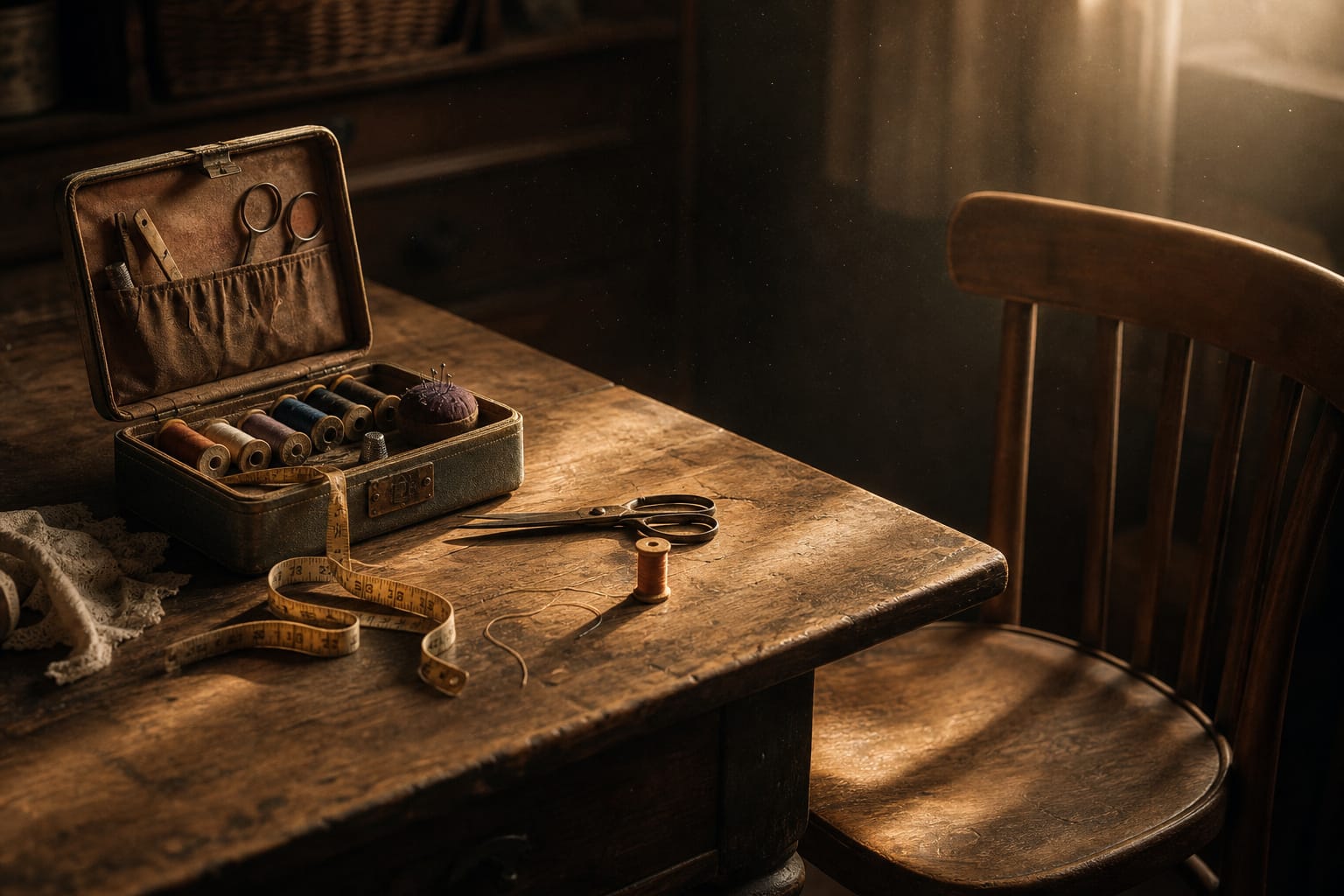
Not long after, I found my mother’s old sewing kit—the very one she taught me to sew with.
I carried it to my desk and carefully emptied its contents. Every spool of thread, every needle, every button, every thimble. More than fifty years of mending were tucked inside that little box.
I cleaned the case, replaced the pieces I knew were missing, arranged everything the way I imagined she would have wanted it, then closed the lid and placed it on a shelf.
It was complete again.
Sometime later, I needed to mend a shirt. Instead of reaching for the sewing kit, I started making a shopping list for one of my own.
One of my closest friends watched me for a moment before saying quietly, “Your mom wouldn’t mind if you used the sewing kit.”
“Nope,” I replied. “It’s Mom’s.”
“It’s okay, dear,” she said softly. “She’d want you to use it.”
That conversation stayed with me.
Eventually, I opened the box, threaded a needle, and began mending my own clothes with the same sewing kit that had mended mine decades earlier.
Now it’s the sewing kit I use.
Or maybe that’s not quite true.
Maybe I’m simply its next caretaker.
I still keep it clean. I still put everything back where it belongs. But I’ve stopped trying to preserve it as though it were a museum piece. My mother didn’t keep it pristine. She kept it useful.
Perhaps one day one of my children will open that same box. They may recognize it immediately, or they may simply see an old sewing kit with worn edges and neatly arranged thread. I hope they use it. I hope they add a few spools of their own. I hope, somewhere in the middle of mending a torn sleeve or replacing a missing button, they remember their grandmother.
I used to believe that everything in my home had to justify the space it occupied. I still believe that. I was simply measuring purpose too narrowly.
Some things are built to mend fabric. The lucky ones spend generations mending families.
Perhaps this is their purpose—not to sit untouched on a shelf, but to carry a story from one generation to the next.
Discover more from Memoirs of Madness
Subscribe to get the latest posts sent to your email.


You reduced me to tears both of remembrance, joy, any many other emotions as well. I too have a tin, a button it, an old tobacco tin given to my mother by her father. It has interesting unique buttons in it, that I scour through from time to time to use on an entirely different item from a different decade. Like the children’s art work I used to tape to each cupboard door and change weekly as new arrived. I kept all of it, for ever, then finally chose the ones I knew they enjoyed the most and stored them, leaving the rest behind. Thank you for this delightful reminder of both what is, and what is important and the differentiation between and how often it is so difficult to let go even if the ‘something’ doesn’t fill our current life, but it is a valued memory all the same.
LikeLiked by 1 person
Thank you so much for sharing this with me.
Your comment reminded me that the things we keep are rarely about the objects themselves. They’re about the people, the moments, and the stories they’ve quietly carried through the years. I smiled when you mentioned your grandfather’s tobacco tin and the buttons inside it. What a beautiful example of an ordinary object becoming something extraordinary simply because of the memories it holds.
I especially loved what you wrote about your children’s artwork. There comes a time when we realize we can’t keep everything, but we also discover that letting go of some things doesn’t mean we’re letting go of the love attached to them. The memories remain, even when the boxes become a little lighter.
Thank you for trusting me with such a personal reflection. Knowing the essay stirred those memories—and perhaps encouraged you to revisit them for a little while—is one of the greatest gifts a writer can receive.
LikeLike
Good skill to have, sewing. And storytelling.
LikeLike